WO2019088258A1 - Agent d'immobilisation de cellule photodégradable - Google Patents
Agent d'immobilisation de cellule photodégradable Download PDFInfo
- Publication number
- WO2019088258A1 WO2019088258A1 PCT/JP2018/040853 JP2018040853W WO2019088258A1 WO 2019088258 A1 WO2019088258 A1 WO 2019088258A1 JP 2018040853 W JP2018040853 W JP 2018040853W WO 2019088258 A1 WO2019088258 A1 WO 2019088258A1
- Authority
- WO
- WIPO (PCT)
- Prior art keywords
- cell
- substrate
- photodegradable
- fixing agent
- hydrophilic
- Prior art date
- Legal status (The legal status is an assumption and is not a legal conclusion. Google has not performed a legal analysis and makes no representation as to the accuracy of the status listed.)
- Ceased
Links
Images



Classifications
-
- C—CHEMISTRY; METALLURGY
- C12—BIOCHEMISTRY; BEER; SPIRITS; WINE; VINEGAR; MICROBIOLOGY; ENZYMOLOGY; MUTATION OR GENETIC ENGINEERING
- C12N—MICROORGANISMS OR ENZYMES; COMPOSITIONS THEREOF; PROPAGATING, PRESERVING, OR MAINTAINING MICROORGANISMS; MUTATION OR GENETIC ENGINEERING; CULTURE MEDIA
- C12N11/00—Carrier-bound or immobilised enzymes; Carrier-bound or immobilised microbial cells; Preparation thereof
- C12N11/02—Enzymes or microbial cells immobilised on or in an organic carrier
- C12N11/08—Enzymes or microbial cells immobilised on or in an organic carrier the carrier being a synthetic polymer
- C12N11/089—Enzymes or microbial cells immobilised on or in an organic carrier the carrier being a synthetic polymer obtained otherwise than by reactions only involving carbon-to-carbon unsaturated bonds
-
- C—CHEMISTRY; METALLURGY
- C08—ORGANIC MACROMOLECULAR COMPOUNDS; THEIR PREPARATION OR CHEMICAL WORKING-UP; COMPOSITIONS BASED THEREON
- C08G—MACROMOLECULAR COMPOUNDS OBTAINED OTHERWISE THAN BY REACTIONS ONLY INVOLVING UNSATURATED CARBON-TO-CARBON BONDS
- C08G65/00—Macromolecular compounds obtained by reactions forming an ether link in the main chain of the macromolecule
- C08G65/02—Macromolecular compounds obtained by reactions forming an ether link in the main chain of the macromolecule from cyclic ethers by opening of the heterocyclic ring
- C08G65/32—Polymers modified by chemical after-treatment
- C08G65/329—Polymers modified by chemical after-treatment with organic compounds
- C08G65/331—Polymers modified by chemical after-treatment with organic compounds containing oxygen
- C08G65/332—Polymers modified by chemical after-treatment with organic compounds containing oxygen containing carboxyl groups, or halides, or esters thereof
-
- C—CHEMISTRY; METALLURGY
- C12—BIOCHEMISTRY; BEER; SPIRITS; WINE; VINEGAR; MICROBIOLOGY; ENZYMOLOGY; MUTATION OR GENETIC ENGINEERING
- C12N—MICROORGANISMS OR ENZYMES; COMPOSITIONS THEREOF; PROPAGATING, PRESERVING, OR MAINTAINING MICROORGANISMS; MUTATION OR GENETIC ENGINEERING; CULTURE MEDIA
- C12N11/00—Carrier-bound or immobilised enzymes; Carrier-bound or immobilised microbial cells; Preparation thereof
- C12N11/02—Enzymes or microbial cells immobilised on or in an organic carrier
Definitions
- the present invention relates to a photodegradable cell fixing agent excellent in cell immobilization power, a substrate for cell immobilization having a surface modified with the photolytic cell fixing agent, and a cell recovery method using the substrate .
- Conventional cell separation / sorting techniques can be classified as in the following 1) to 5). 1) Method of centrifugation using differences in cell size and specific gravity 2) Method of fluorescently labeling cells and separation using a flow cytometer 3) Arraying cells using microwells and separation while observing Method 4) Method of fixing cells with a photolytic gel and dissolving and separating the gel by light irradiation while observing 5) Fixing cells by light irradiation while arranging cells using a photodegradable cell immobilization material Method of decomposing and separating
- the method (1) is a simple cell separation method, there are problems such as low separation accuracy and unsuitable for selection of rare cells.
- the method (2) is the most commonly used cell sorting method because of its high throughput, but it can not simultaneously observe differences between cells because it can not observe multiple cells simultaneously at the same time, and it can not follow changes over time. There is a problem called.
- the method of (3) has recently attracted attention in that it can overcome the problems of the method of (2).
- problems remain in the method of recovering arrayed cells. For example, in the method using a micromanipulator, the throughput is lowered because each cell is absorbed by a capillary (eg, Patent Document 1).
- Other techniques for extracting cells electrochemically and physicochemically have been developed, but have the disadvantage that the cells are directly stressed.
- the method (4) has recently attracted attention in that it is highly likely to overcome the separation speed, which is the problem of the method (3).
- An aqueous solution containing cells is gelled using a photodegradable crosslinking agent, and the gel can be dissolved by light irradiation, and only desired cells can be recovered conveniently and rapidly (eg, Patent Document 2).
- Patent Document 2 In order to immobilize individual cells without contacting them in the lateral direction and stacking them in the vertical direction, the cell density must be lowered, and the number of cells that can be observed and separated at one time is extremely small. There is a drawback.
- the method (5) is advantageous in that the low cell density, which is the problem of the method (4), can be improved.
- the present inventors arrange and fix cells in a microchannel with already photolyzable polyethylene glycol (PEG) lipid, and when the cells to be collected are subjected to light irradiation to apply flux, the cells It has been found that it is possible to selectively detach from the substrate (Non-patent Document 1).
- the immobilizing power of the cells is low, and when one cell is separated, cells not irradiated with light are also detached by the shear stress of the microfluidic and can not be used for cell separation. There was a problem of that. Therefore, a strong cell immobilization power photolytic cell immobilization agent capable of sufficiently immobilizing single cells is essential for cell isolation.
- the photocleavable cell fixing agent of Non-Patent Document 1 developed by the inventors until now is a compound in which polyethylene glycol (PEG) and a lipid are linked via a photocleavable linker, and this molecule is used as a substrate
- PEG polyethylene glycol
- the lipid moiety interacts with the lipid bilayer of cells, it is possible to immobilize any cells, whether adherent cells or non-adherent cells, on a substrate.
- the spot size is reduced and cells are immobilized one by one, the flow rate required to release the cells allows 60 to 80% of the cells to be released in a few minutes without light irradiation. It will Then, this invention makes it a subject to develop the photodegradable cell fixing agent excellent in cell immobilization power, in order to compensate the fault of the conventional cell sorting method.
- the present inventors have found that a specific length between the photocleavable site in the structure of the conventional photodegradable PEG lipid and the hydrophobic site that binds to the target cell is By inserting a hydrophilic region having a diameter, it is possible to strengthen the cell immobilization power, stably immobilize a substance covered with any cell or lipid membrane, and selectively recover it by light irradiation. It can be found that the present invention has been completed.
- the present invention ⁇ 1> A photocleavable cell fixing agent for fixing a predetermined target cell on a substrate, the hydrophobic chain capable of interacting with the target cell, in the form of a monolayer on the surface of the substrate It has a hydrophilic chain that can be arranged, and a hydrophilic linker that links the hydrophobic chain and the hydrophilic chain, and a photodegradable linker, and the hydrophilic linker is between the hydrophobic chain and the photodegradable linker.
- Said photodegradable cell fixing agent characterized in that it is arranged in ⁇ 2>
- the photodegradable cell fixing agent according to ⁇ 1>, wherein the hydrophilic linker has the following partial structure; (Wherein, m is a natural number greater than 2)
- the present invention provides: ⁇ 13> A substrate for cell immobilization, having a surface modified with the photolytic cell immobilization agent according to any one of ⁇ 1> to ⁇ 12>above; ⁇ 14> The substrate for cell immobilization according to ⁇ 13>, which has a patterned surface modification having a photolytic cell immobilization agent only in a specific surface area of the substrate; and ⁇ 15> A step of modifying the entire substrate surface with the photolytic cell fixing agent according to any one of the above ⁇ 1> to ⁇ 13>, and the surface modification with the photolytic cell fixing agent is maintained only in a specific region A step of patterning the surface, wherein light is irradiated to a region other than the specific region on the surface of the substrate to cut the photodegradable linker moiety in the photodegradable cell fixing agent,
- the present invention provides a method for producing a cell immobilizing substrate comprising the
- the invention provides: The process which makes the solution containing a predetermined
- the present invention provides a method for recovering cells, which comprises the steps of: separating and recovering from a substrate for cell immobilization.
- the cell immobilization power can be enhanced, so that target cells can be stably immobilized and selectively recovered by light irradiation.
- the substrate for cell immobilization which has been surface-modified with the photolytic cell-fixing agent of the present invention can immobilize cells at a single cell level by patterning the surface modification region in advance by light irradiation, and a strong flow rate The cell pattern can be firmly maintained under
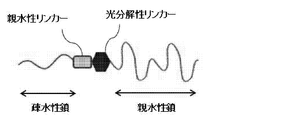
- FIG. 1 is a schematic view showing the entire structure of the photodegradable cell fixing agent of the present invention.
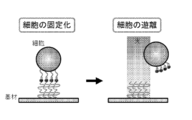
- FIG. 2 is a schematic view of a substrate surface-modified with the photolytic cell fixing agent of the present invention and a conceptual view of the immobilization / recovery of cells.
- FIG. 3 is a schematic view showing a patterning step of surface modification in the substrate for cell immobilization of the present invention.
- FIG. 4 is a graph showing the cell survival rate for the photolytic cell immobilization agent of the present invention and a comparative example.
- FIG. 5 is a graph showing the light irradiation dependency of the cell survival rate by the photolytic cell fixing agent of the present invention.
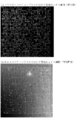
- FIG. 6 is an image of a 1-cell microarray formed on the substrate for cell immobilization of the present invention.
- FIG. 6 (a) is a fluorescence image of an EGFP-expressing BaF3 cell array formed on a cell immobilization substrate coated with collagen as a covering layer.
- FIG. 6 (a) is a bright field image of an EGFP-expressing BaF3 cell array formed on a cell immobilization substrate coated with BSA as a coating layer.
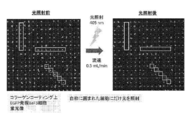
- FIG. 7 is a fluorescence image before and after selective detachment of the cell array.
- FIG. 8 is a graph showing the cell detachment rate in light-irradiated spots and non-irradiated spots.
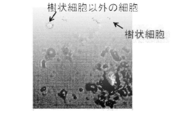
- FIG. 9 is an image of dendritic cells cultured on a substrate for cell immobilization.
- the photodegradable cell fixing agent of the present invention is (A) a hydrophobic chain having a function of interacting with a target cell to bind to the cell, (B) hydrophilic chains which can be arranged in the form of a monomolecular film on the surface of a substrate, Furthermore, it has (c) a hydrophilic linker and (d) a photocleavable linker as two linker sites for linking these hydrophobic chains and hydrophilic chains. And, it is characterized in that the hydrophilic linker (c) is disposed between the hydrophobic chain (a) and the photodegradable linker (d).
- the entire structure of the photolytic cell fixing agent of the present invention is a structure in which these (a) to (d) are linked in the following order.
- the linkage of each site may be, for example, a covalent bond such as an amide bond, an ester bond, an ether bond, a thioether bond, a carbamate bond, a thiocarbamate bond, a triazole bond, or a urea bond.
- the linkage between the photocleavable linker moiety (d) and the hydrophilic chain (b) is an amide bond or an ester bond from the viewpoint of permitting cleavage of the photodegradable linker moiety (d) by light irradiation. Is preferred.
- FIG. 2 the schematic diagram of the base material surface-modified by the photolytic cell fixing agent of this invention, and the conceptual diagram of immobilization and collection
- the photolytic cell fixing agent modifies the surface of the substrate by binding to the surface of the substrate directly at the end of the hydrophilic chain (b) or via a covering layer described later.
- the photocleavable cell fixing agent is preferably arranged in the form of a monolayer on the surface of the substrate.
- the hydrophobic chain (a) can bind to and capture a target cell by an interaction such as a hydrophobic interaction. Thereby, target cells can be immobilized on a specific region of the substrate surface. Thereafter, light irradiation is performed on a desired region on the substrate surface, whereby the target cells can be separated from the substrate surface and recovered by being decomposed with the photodegradable linker portion (d).
- cells can include animal cells, plant cells, insect cells, prokaryotic cells, fungal cells and the like, and generally do not adhere to or extend on the surface of a carrier such as a culture device, but in a suspended or precipitated state
- a carrier such as a culture device
- proliferating cells eg, blood cells
- adheres to or extends on the surface of the carrier are dispersed from the carrier with a suitable dispersing agent such as EDTA-trypsin, dispase, etc. and temporarily suspended.
- a suitable dispersing agent such as EDTA-trypsin, dispase, etc.
- organisms having a phospholipid bilayer membrane on the surface of liposomes, exosomes, bacteria, viruses, organelles, plant cells from which cell walls have been removed protoplasts
- substances having lipids such as lipid-coated particles can also be immobilized.
- the hydrophobic chain (a) is a site for interacting with a target cell and capturing the target cell.
- noncovalent interaction such as hydrophobic interaction can be used.
- the hydrophobic chain (a) can bind to a target cell by hydrophobic interaction with a lipid moiety in a cell membrane or the like which is a lipid bilayer membrane.
- the hydrophobic chain (a) is not particularly limited as long as it can bind to a target cell by hydrophobic interaction, but it may be a saturated or unsaturated hydrocarbon chain which may have a substituent.
- hydrocarbon chains include, for example, a C 7-30 alkyl group (preferably a C 7-22 alkyl group), a C 6-14 aryl group, and a C 6-14 aryl C 7-30 alkyl group (preferably C 6 C). 6-14 aryl C 7-22 alkyl group), and C 7-30 alkyl C 6-14 aryl group (preferably C 6-14 aryl C 7-22 alkyl group) and the like.
- adjacent carbon atoms may be linked by a C 7-30 alkyl group which may be linked by 1 to 3 unsaturated bonds, and adjacent carbon atoms may be linked by 1 to 3 unsaturated bonds C 7-22 alkyl group, or C 11-22 alkyl group in which adjacent carbon atoms may be linked by 1 to 3 unsaturated bonds, or adjacent carbon atoms are linked by 1 to 3 unsaturated bonds It may be a C 16-18 alkyl group which may be linked.
- the hydrophobic chain (a) is a hexadecyl group, a heptadecyl group, an octadecyl (stearyl) group, a cis-9-hexadecenyl (palmitolayl) group, a cis-8-heptadecenyl group, a trans-8-heptadecenyl group, a trans -9-octadecenyl (elaidyl) group, cis -9-octadecenyl (oleyl) group, cis, cis-9,12-octadecadienyl (linolenyl) group, (9E, 12E, 15E) -octadeca-9, 12, It can be a 15-trienyl (erilide linolenyl) group.
- the oleyl group which is a part of the phospholipid which comprises
- the hydrophilic chain (b) is preferably constituted by a hydrophilic polymer.
- a hydrophilic polymer polysaccharides such as polyalkylene glycol, polyvinyl alcohol, polyacrylic acid, polypeptide, polyacrylamide and dextran, or polymers and copolymers of glycolic acid derivatives, lactic acid derivatives and p-dioxane derivatives Etc. can be used.
- the polyalkylene glycol is preferably a polymer of an oxyalkylene unit having 2 to 4 carbon atoms, and one having an average polymerization number in the range of 2 to 500 (preferably 45 to 500) can be used.
- the hydrophilic polymer is preferably a biocompatible polymer, more preferably polyethylene glycol (PEG).
- the hydrophilic chain (b) may further have an optional substituent.
- the hydrophilic chain (b) preferably has a functional group at its end for linking to the substrate surface by covalent bond or the like.
- a terminal functional group for example, those shown below can be used (wherein, the arrow indicates the point of attachment to the hydrophilic chain (b)).
- the terminal functional group may be an active ester group such as N-hydroxysuccinimide (NHS), a carboxyl group, a silanol group, a disulfide group or a thiol group.
- an active ester group such as N-hydroxysuccinimide (NHS), a carboxyl group, a silanol group, a disulfide group or a thiol group.
- NHS N-hydroxysuccinimide
- the hydrophilic linker (c) is disposed between the hydrophobic chain (a) and the photocleavable linker (d) as described above. It is a feature of the present invention that by inserting a hydrophilic linker (c) having a predetermined length, target cells can be more firmly immobilized as compared with conventional methods.
- the hydrophilic linker (c) is preferably constituted by a hydrophilic polymer.
- hydrophilic chain (b) As the hydrophilic chain (b), as the hydrophilic polymer, polysaccharides such as the above polyalkylene glycol, polyvinyl alcohol, polyacrylic acid, polypeptide, polyacrylamide, dextran and the like, or glycolic acid derivatives and lactic acid derivatives, Polymers, copolymers and the like of p-dioxane derivatives can be used.
- the polyalkylene glycol is preferably a polymer of an oxyalkylene unit having 2 to 4 carbon atoms, and one having an average polymerization number in the range of 2 to 100 (preferably 4 to 40) can be used.
- the hydrophilic polymer is preferably a biocompatible polymer, more preferably polyethylene glycol (PEG).
- the hydrophilic linker (c) preferably has the following partial structure having a repeating unit derived from ethylene glycol.
- n is a natural number greater than 2, preferably a natural number of 3 to 100. More preferably, m is a natural number of 4 to 40.
- hydrophilic chain (b) and the hydrophilic linker (c) are both composed of the same hydrophilic polymer.
- the hydrophilic chain (b) and the hydrophilic linker (c) both contain polyethylene glycol.
- the photocleavable linker (d) contains a functional group that can be decomposed by irradiation with light such as visible light and ultraviolet light.
- target cells can be separated and collected from the surface of the substrate by performing light irradiation after capturing the target cells in the hydrophobic chain (a).
- the hydrophobic chain (a) is detached in advance by irradiating a specific area with light, and a desired area is obtained. It is also possible to pattern so as to have cell binding property.
- the functional group of the photodegradable linker (d) that can be decomposed by light irradiation is not particularly limited as long as it can cleave the hydrophilic linker (c) and the hydrophilic chain (b) by photoreaction, -A bivalent group having a -nitrobenzyl skeleton, a coumarin-4-ylmethyl skeleton, a phenylcarbonylmethyl skeleton or a 7-nitroindolinocarbonyl skeleton can be used.
- it is bivalent having a 2-nitrobenzyl skeleton.
- the compound has an oleyl group as the hydrophobic chain (a); a polyethylene glycol chain as the hydrophilic chain (b) and the hydrophilic linker (c); a 2-nitrobenzyl group in the photocleavable linker (d); And N-hydroxysuccinimide at the end of the hydrophilic chain (b) for binding to a substrate.
- m is a natural number greater than 2, and n is a natural number of 50 or more.
- m is preferably preferably a natural number of 3 to 100, more preferably m is a natural number of 4 to 8.
- the present invention also relates to a cell immobilizing substrate having a surface modified with the above-mentioned photolyzable cell immobilizing agent.
- the surface structure of the cell immobilizing substrate is, as described above, a photocleavable cell fixing agent bound to the surface of the substrate directly at the end of the hydrophilic chain (b) or via a covering layer described later. is there.
- the photocleavable cell fixing agent is preferably arranged in the form of a monolayer on the surface of the substrate.
- the material, shape, and the like of the base material to be modified by the photodegradable cell fixing agent are not particularly limited, and various suitable base materials can be selected according to the use and the like.
- the carrier for example, particles such as beads
- the carrier may be colloidal
- fibrous structures for example, tubes, containers (eg test tubes and vials).
- Materials of the substrate to be modified include glass; cement; ceramics or fine ceramics such as chinaware; polymer resins such as polyethylene terephthalate, cellulose acetate, polycarbonate, polystyrene and polymethyl methacrylate; biomaterials such as polypeptide and protein; silicon; Activated carbon; porous glass; porous ceramics; porous silicon; porous activated carbon; nonwoven fabric; filter paper; membrane filter; conductive material such as gold, etc. may be mentioned.
- the surface of the substrate to be modified is coated with a polymer such as polycation or treated with a silane coupling agent having a substituent introduced onto the substrate surface. It may be applied, or reactive functional groups may be introduced by plasma treatment.
- the photolytic cell fixing agent may be modified by direct bonding to the substrate surface, or a coating layer is provided on the substrate surface, and the photolytic cell fixing agent is applied to the surface of the coating layer. It is also possible to carry out surface modification by bonding.
- a coating layer for example, collagen, bovine serum albumin (BSA), 3-aminopropyltriethoxysilane (APTES), or ovalbumin can be used.
- the substrate for cell immobilization of the present invention can have a patterned surface modification having a photolytic cell fixing agent only on a specific surface area.
- target cells can be immobilized on a specific area of the substrate surface.
- a plurality of spot-type modified regions can be provided.
- the diameter of the spot for immobilizing one cell depends on the size of the target cell, but can be approximately 2 to 30 ⁇ m, or 5 to 15 ⁇ m.
- the substrate for cell immobilization having such a patterned surface modification can be prepared by the following steps as shown in FIG. (A) modifying the entire substrate surface with a photolytic cell fixing agent, and (B) patterning the surface such that the surface modification with the photolytic cell fixing agent is maintained only in a specific region And irradiating the region other than the specific region on the substrate surface with light to cleave the photocleavable linker moiety in the photocleavable cell fixing agent.
- the present invention is also directed to a cell sorting technique in which target cells are immobilized and selectively recovered using a substrate for cell immobilization which has been surface-modified with a photolytic cell immobilization agent.
- the cell recovery method of the present invention comprises the following steps: (1) contacting a solution containing predetermined target cells with a substrate for cell immobilization, and immobilizing the target cells on the substrate for cell immobilization, (2) The cell immobilization substrate is irradiated with light, and the photocleavable linker moiety in the photodegradable cell immobilization agent on the surface of the cell immobilization substrate is cut, whereby the immobilization is performed. Separating and recovering target cells from the cell immobilization substrate.
- a base for cell immobilization can be placed in the microchannel as a place to perform the method.
- a flux can be applied to the surface of the substrate to recover target cells after cleavage of the photocleavable linker moiety.
- the reaction solution was added with MgSO 4 for drying, and after suction filtration to remove MgSO 4 , the solvent was removed under reduced pressure. After vacuum drying, an orange solid was obtained. Thereafter, the product is dissolved in vinegar and saturated by removal under reduced pressure, hexane is added dropwise until the drop in the dropping does not disappear, and the mixture is allowed to stand at -20 ° C, and the precipitated precipitate is collected by suction filtration three times repeatedly. , Recrystallized. At this time, a yellowish white paste-like solid was obtained in the first and second times, and an orange powder was obtained in the third time. The resulting solid was dried under vacuum to give compound 4. The identification was performed by 1 H-NMR (DMSO-d6) (FIG. 5-9), and the yield was 1.0992 g (1,2nd 0.95 g, 3rd 0.1492 g), and the yield was 76.4%.
- Substrate preparation Surface modification of the glass substrate with the photodegradable cell fixing agent was performed in the following procedure.
- Photolytic cell immobilization agent (PEG lipid) modification of substrate spot method
- the PEG lipid to be used for modification was prepared by dissolving it in dry DMSO so as to be 10 mM, aliquoted in 5 ⁇ l aliquots, and stored at ⁇ 20 ° C. after Ar substitution.
- This stock solution is diluted with 495 ⁇ l of PBS- to 100 ⁇ M immediately before use, and placed in a 4-well dish where 0.3 ⁇ l of total 0.3 ⁇ l spots are placed at 1 cm intervals in the center of the channel, and the incubator (37 ° C, Incubate for 1 hour in 5% CO 2 ), then wash 6 times with MQ and air dry.
- eGFP expressing Ba / F3 RPMI (10% FBS), 1 ng / ml IL3 Passage Ba / F3 is only diluted in basic fresh medium. Frozen cells are collected in a 15 ml tube, washed once with a clean medium, suspended in Cell Banker, aliquoted in 0.5 or 1 ml aliquots, and stored at -80 ° C. Long term storage samples were stored in liquid nitrogen.
- Photopatterning Photoirradiation was used with Asahi Spectrometer MAX-302, and a filter was used with LX0360 (360 nm ⁇ 2 nm). The light was automatically emitted using the MAX-302 timer function based on the amount of light measured by the light amount meter.
- the surface of the mask of the photo mask faces up and the base of the substrate is modified with the PEG-modified surface facing down, with respect to light from below. Contact exposure was performed by putting.
- the PEG lipid of the comparative example has the following structure and has a photocleavable linker between the hydrophobic chain and the hydrophilic chain, but the hydrophobic chain and the photocleavable linker are directly linked: It does not have a hydrophilic linker.
- the photodegradable cell fixing agent of the present invention in which the cell immobilization power is enhanced by incorporating a hydrophilic linker, it is possible to selectively recover the cells immobilized one by one by light irradiation. Indicated.
- the bottom surface of the microchannel is irradiated with a pattern of ultraviolet light (365 nm) of 3 J / cm 2 or more, and the surface on which cells are not immobilized
- the region where the hydrophobic chain part of the degradable cell fixing agent was released and the surface (non-irradiated region) to be fixed were patterned.
- the cell suspension is introduced into the microchannel, and the cells are immobilized through the interaction of the hydrophobic chain of the photolytic cell fixing agent in the non-irradiated area with the cells, and the cells are about 2 to 5 ml / min.
- the cells non-specifically adsorbed to the light-irradiated area are washed out by rinsing by adjusting the flow rate to become Thereby, a cell array was produced in the microchannel.
- FIG. 6 shows an image of the obtained 1-cell microarray.
- FIG. 6 (a) is a fluorescence image of an EGFP-expressing BaF3 cell array formed on a cell immobilization substrate coated with collagen as a covering layer.
- FIG. 6 (a) is a bright field image of an EGFP-expressing BaF3 cell array formed on a cell immobilization substrate coated with BSA as a coating layer.
- the cell detachment rate in the light-irradiated spot and the non-irradiated spot calculated by analysis of the fluorescence image before and after light irradiation is shown in FIG. This result shows that cells can be selectively detached by light irradiation by using the substrate for cell immobilization of the present invention.
Landscapes
- Chemical & Material Sciences (AREA)
- Organic Chemistry (AREA)
- Health & Medical Sciences (AREA)
- Zoology (AREA)
- Life Sciences & Earth Sciences (AREA)
- Engineering & Computer Science (AREA)
- Bioinformatics & Cheminformatics (AREA)
- Genetics & Genomics (AREA)
- Wood Science & Technology (AREA)
- Biotechnology (AREA)
- Microbiology (AREA)
- Biochemistry (AREA)
- General Engineering & Computer Science (AREA)
- General Health & Medical Sciences (AREA)
- Biomedical Technology (AREA)
- General Chemical & Material Sciences (AREA)
- Chemical Kinetics & Catalysis (AREA)
- Medicinal Chemistry (AREA)
- Polymers & Plastics (AREA)
- Immobilizing And Processing Of Enzymes And Microorganisms (AREA)
- Polyethers (AREA)
- Apparatus Associated With Microorganisms And Enzymes (AREA)
Abstract
Le problème décrit par la présente invention est de développer un agent d'immobilisation de cellule photodégradable possédant une capacité d'immobilisation de cellule supérieure. La solution selon l'invention porte sur un agent d'immobilisation de cellule photodégradable qui est destiné à immobiliser une cellule cible prédéterminée sur un matériau de base, l'agent étant caractérisé en ce qu'il comprend une chaîne hydrophobe apte à entrer en interaction avec la cellule cible, une chaîne hydrophile apte à être mise en réseau dans un film monomoléculaire sur une surface du matériau de base, et un lieur hydrophile et un lieur photodégradable qui relient la chaîne hydrophobe et la chaîne hydrophile ensemble, le lieur hydrophile étant positionné entre la chaîne hydrophobe et le lieur photodégradable.
Priority Applications (1)
| Application Number | Priority Date | Filing Date | Title |
|---|---|---|---|
| JP2019550500A JP7205910B2 (ja) | 2017-11-06 | 2018-11-02 | 光分解性細胞固定化剤 |
Applications Claiming Priority (2)
| Application Number | Priority Date | Filing Date | Title |
|---|---|---|---|
| JP2017214107 | 2017-11-06 | ||
| JP2017-214107 | 2017-11-06 |
Publications (1)
| Publication Number | Publication Date |
|---|---|
| WO2019088258A1 true WO2019088258A1 (fr) | 2019-05-09 |
Family
ID=66331995
Family Applications (1)
| Application Number | Title | Priority Date | Filing Date |
|---|---|---|---|
| PCT/JP2018/040853 Ceased WO2019088258A1 (fr) | 2017-11-06 | 2018-11-02 | Agent d'immobilisation de cellule photodégradable |
Country Status (2)
| Country | Link |
|---|---|
| JP (1) | JP7205910B2 (fr) |
| WO (1) | WO2019088258A1 (fr) |
Cited By (1)
| Publication number | Priority date | Publication date | Assignee | Title |
|---|---|---|---|---|
| JP2023077272A (ja) * | 2021-11-24 | 2023-06-05 | 学校法人聖路加国際大学 | 細胞特性の評価方法 |
Citations (2)
| Publication number | Priority date | Publication date | Assignee | Title |
|---|---|---|---|---|
| JP2008125952A (ja) * | 2006-11-24 | 2008-06-05 | National Institute For Materials Science | 複合架橋体 |
| WO2016158327A1 (fr) * | 2015-03-30 | 2016-10-06 | 国立大学法人 東京大学 | Composé pour fixer une composition contenant une membrane lipidique, matériau de base modifié par le composé, procédé de formation de motifs de la composition contenant une membrane lipidique sur le matériau de base et procédé pour isoler la composition contenant une membrane lipidique sur le matériau de base |
-
2018
- 2018-11-02 JP JP2019550500A patent/JP7205910B2/ja active Active
- 2018-11-02 WO PCT/JP2018/040853 patent/WO2019088258A1/fr not_active Ceased
Patent Citations (2)
| Publication number | Priority date | Publication date | Assignee | Title |
|---|---|---|---|---|
| JP2008125952A (ja) * | 2006-11-24 | 2008-06-05 | National Institute For Materials Science | 複合架橋体 |
| WO2016158327A1 (fr) * | 2015-03-30 | 2016-10-06 | 国立大学法人 東京大学 | Composé pour fixer une composition contenant une membrane lipidique, matériau de base modifié par le composé, procédé de formation de motifs de la composition contenant une membrane lipidique sur le matériau de base et procédé pour isoler la composition contenant une membrane lipidique sur le matériau de base |
Non-Patent Citations (4)
| Title |
|---|
| NAGAMUNE, TERUYUKI: "Development of microchip for identifying and separating tumor cells circulating in blood", 2015 RESEARCH PERFORMANCE REPORT ON SCIENTIFIC RESEARCH FUND- RAISING BUSINESS, 10 May 2017 (2017-05-10) * |
| YAMAGUCHI, S. ET AL.: "Photocontrollable dynamic micropatterning of non-adherent mammalian cells using a photocleavable poly (ethylene glycol) lipid", ANGEW. CHEM. INT. ED., vol. 51, 2012, pages 128 - 131, XP055602106 * |
| YAMAGUCHI, SATOSHI ET AL.: "35.1 Development of photoresponsive cell -fixing agent, aiming at cell operation", LECTURE ABSTRACTS OF THE 28TH BIO AND POLYMER SYMPOSIUM, 20 July 2018 (2018-07-20), pages 155 - 156 * |
| YAMAHIRA, S. ET AL.: "Collagen surfaces modified with photo-cleavable polyethylene glycol-lipid support versatile single- cell arrays of both non- adherent and adherent cells", MACROMOL. BIOSCI., vol. 14, 2014, pages 1670 - 1676, XP55612997 * |
Cited By (1)
| Publication number | Priority date | Publication date | Assignee | Title |
|---|---|---|---|---|
| JP2023077272A (ja) * | 2021-11-24 | 2023-06-05 | 学校法人聖路加国際大学 | 細胞特性の評価方法 |
Also Published As
| Publication number | Publication date |
|---|---|
| JPWO2019088258A1 (ja) | 2020-11-26 |
| JP7205910B2 (ja) | 2023-01-17 |
Similar Documents
| Publication | Publication Date | Title |
|---|---|---|
| CN107428918B (zh) | 紫外线吸收聚合物染料及其使用方法 | |
| US20140099695A1 (en) | Cell-adhering light-controllable substrate | |
| Susumu et al. | A new family of pyridine-appended multidentate polymers as hydrophilic surface ligands for preparing stable biocompatible quantum dots | |
| JP4630817B2 (ja) | 物質固定化剤、それを用いた物質固定化方法及びそれを用いた物質固定化基体 | |
| Elahipanah et al. | General dialdehyde click chemistry for amine bioconjugation | |
| WO2016140369A1 (fr) | Structure tridimensionnelle en cellulose et son procédé de production | |
| JP6901714B2 (ja) | 脂質膜含有物を固定化するための化合物、当該化合物で修飾された基材、当該基材上に脂質膜含有物をパターニングする方法及び脂質膜含有物を当該基材上で単離する方法 | |
| CN112980786B (zh) | 一种基于点击化学的t细胞与纳米颗粒的连接方法 | |
| WO2019088258A1 (fr) | Agent d'immobilisation de cellule photodégradable | |
| CN116803995B (zh) | 一类氨基酰胺类脂质化合物及其制备方法和应用 | |
| CN112375562A (zh) | 一类基于半胱氨酸-多胺-吗啉修饰的量子点溶酶体靶向荧光探针及其制备方法和应用 | |
| CN107778367A (zh) | 多肽、其应用及包含所述多肽的药物 | |
| CA2914448A1 (fr) | Composes pour augmenter l'adherence liposomale et cellulaire et compositions et procedes pour les utiliser | |
| US11447733B2 (en) | Transparent disc-shaped microparticles coated with polydopamine | |
| JP2006524680A (ja) | 荷電開始剤ポリマーおよび使用法 | |
| CN115645530A (zh) | 一种基于半菁和ido抑制剂的双激活光动力免疫前药及其制备方法和应用 | |
| JP6121127B2 (ja) | 細胞回収用デバイス、装置及び方法 | |
| US8728520B2 (en) | Cross-linked alginate-polyalkylene glycol polymer coatings for encapsulation and methods of making the same | |
| CN104610912A (zh) | 可光降解磁性纳米材料和纳米生物探针及其制备方法 | |
| WO2019230441A1 (fr) | Agent de fixation de cellules photosensibles | |
| CN113293137B (zh) | 一种基于细胞膜表面改性技术的树突状细胞的改性方法及其应用 | |
| JP2023165489A (ja) | 細胞固定化用基材の製造方法 | |
| JP5099074B2 (ja) | ターゲット分子の選択的吸着領域を有する吸着用担体及びその製造方法 | |
| JP7752415B2 (ja) | 生体物質固定化材料 | |
| WO2025134839A1 (fr) | Substrat à surface modifiée pour la culture et la récupération de groupes de cellules |
Legal Events
| Date | Code | Title | Description |
|---|---|---|---|
| 121 | Ep: the epo has been informed by wipo that ep was designated in this application |
Ref document number: 18874529 Country of ref document: EP Kind code of ref document: A1 |
|
| ENP | Entry into the national phase |
Ref document number: 2019550500 Country of ref document: JP Kind code of ref document: A |
|
| NENP | Non-entry into the national phase |
Ref country code: DE |
|
| 122 | Ep: pct application non-entry in european phase |
Ref document number: 18874529 Country of ref document: EP Kind code of ref document: A1 |