WO2019088302A1 - Matériau d'absorption et de libération d'oxygène, catalyseur, système de purification de gaz d'échappement et méthode de traitement de gaz d'échappement - Google Patents
Matériau d'absorption et de libération d'oxygène, catalyseur, système de purification de gaz d'échappement et méthode de traitement de gaz d'échappement Download PDFInfo
- Publication number
- WO2019088302A1 WO2019088302A1 PCT/JP2018/041238 JP2018041238W WO2019088302A1 WO 2019088302 A1 WO2019088302 A1 WO 2019088302A1 JP 2018041238 W JP2018041238 W JP 2018041238W WO 2019088302 A1 WO2019088302 A1 WO 2019088302A1
- Authority
- WO
- WIPO (PCT)
- Prior art keywords
- ceria
- zirconia
- catalyst
- composite oxide
- oxide
- Prior art date
- Legal status (The legal status is an assumption and is not a legal conclusion. Google has not performed a legal analysis and makes no representation as to the accuracy of the status listed.)
- Ceased
Links
Images


Classifications
-
- B—PERFORMING OPERATIONS; TRANSPORTING
- B01—PHYSICAL OR CHEMICAL PROCESSES OR APPARATUS IN GENERAL
- B01J—CHEMICAL OR PHYSICAL PROCESSES, e.g. CATALYSIS OR COLLOID CHEMISTRY; THEIR RELEVANT APPARATUS
- B01J23/00—Catalysts comprising metals or metal oxides or hydroxides, not provided for in group B01J21/00
- B01J23/38—Catalysts comprising metals or metal oxides or hydroxides, not provided for in group B01J21/00 of noble metals
- B01J23/40—Catalysts comprising metals or metal oxides or hydroxides, not provided for in group B01J21/00 of noble metals of the platinum group metals
- B01J23/44—Palladium
-
- B—PERFORMING OPERATIONS; TRANSPORTING
- B01—PHYSICAL OR CHEMICAL PROCESSES OR APPARATUS IN GENERAL
- B01D—SEPARATION
- B01D53/00—Separation of gases or vapours; Recovering vapours of volatile solvents from gases; Chemical or biological purification of waste gases, e.g. engine exhaust gases, smoke, fumes, flue gases, aerosols
- B01D53/34—Chemical or biological purification of waste gases
- B01D53/92—Chemical or biological purification of waste gases of engine exhaust gases
- B01D53/94—Chemical or biological purification of waste gases of engine exhaust gases by catalytic processes
-
- B—PERFORMING OPERATIONS; TRANSPORTING
- B01—PHYSICAL OR CHEMICAL PROCESSES OR APPARATUS IN GENERAL
- B01J—CHEMICAL OR PHYSICAL PROCESSES, e.g. CATALYSIS OR COLLOID CHEMISTRY; THEIR RELEVANT APPARATUS
- B01J21/00—Catalysts comprising the elements, oxides, or hydroxides of magnesium, boron, aluminium, carbon, silicon, titanium, zirconium, or hafnium
- B01J21/06—Silicon, titanium, zirconium or hafnium; Oxides or hydroxides thereof
-
- B—PERFORMING OPERATIONS; TRANSPORTING
- B01—PHYSICAL OR CHEMICAL PROCESSES OR APPARATUS IN GENERAL
- B01J—CHEMICAL OR PHYSICAL PROCESSES, e.g. CATALYSIS OR COLLOID CHEMISTRY; THEIR RELEVANT APPARATUS
- B01J21/00—Catalysts comprising the elements, oxides, or hydroxides of magnesium, boron, aluminium, carbon, silicon, titanium, zirconium, or hafnium
- B01J21/06—Silicon, titanium, zirconium or hafnium; Oxides or hydroxides thereof
- B01J21/066—Zirconium or hafnium; Oxides or hydroxides thereof
-
- B—PERFORMING OPERATIONS; TRANSPORTING
- B01—PHYSICAL OR CHEMICAL PROCESSES OR APPARATUS IN GENERAL
- B01J—CHEMICAL OR PHYSICAL PROCESSES, e.g. CATALYSIS OR COLLOID CHEMISTRY; THEIR RELEVANT APPARATUS
- B01J23/00—Catalysts comprising metals or metal oxides or hydroxides, not provided for in group B01J21/00
- B01J23/10—Catalysts comprising metals or metal oxides or hydroxides, not provided for in group B01J21/00 of rare earths
-
- B—PERFORMING OPERATIONS; TRANSPORTING
- B01—PHYSICAL OR CHEMICAL PROCESSES OR APPARATUS IN GENERAL
- B01J—CHEMICAL OR PHYSICAL PROCESSES, e.g. CATALYSIS OR COLLOID CHEMISTRY; THEIR RELEVANT APPARATUS
- B01J23/00—Catalysts comprising metals or metal oxides or hydroxides, not provided for in group B01J21/00
- B01J23/38—Catalysts comprising metals or metal oxides or hydroxides, not provided for in group B01J21/00 of noble metals
- B01J23/40—Catalysts comprising metals or metal oxides or hydroxides, not provided for in group B01J21/00 of noble metals of the platinum group metals
-
- B—PERFORMING OPERATIONS; TRANSPORTING
- B01—PHYSICAL OR CHEMICAL PROCESSES OR APPARATUS IN GENERAL
- B01J—CHEMICAL OR PHYSICAL PROCESSES, e.g. CATALYSIS OR COLLOID CHEMISTRY; THEIR RELEVANT APPARATUS
- B01J23/00—Catalysts comprising metals or metal oxides or hydroxides, not provided for in group B01J21/00
- B01J23/38—Catalysts comprising metals or metal oxides or hydroxides, not provided for in group B01J21/00 of noble metals
- B01J23/54—Catalysts comprising metals or metal oxides or hydroxides, not provided for in group B01J21/00 of noble metals combined with metals, oxides or hydroxides provided for in groups B01J23/02 - B01J23/36
- B01J23/56—Platinum group metals
- B01J23/63—Platinum group metals with rare earths or actinides
-
- B—PERFORMING OPERATIONS; TRANSPORTING
- B01—PHYSICAL OR CHEMICAL PROCESSES OR APPARATUS IN GENERAL
- B01J—CHEMICAL OR PHYSICAL PROCESSES, e.g. CATALYSIS OR COLLOID CHEMISTRY; THEIR RELEVANT APPARATUS
- B01J35/00—Catalysts, in general, characterised by their form or physical properties
- B01J35/70—Catalysts, in general, characterised by their form or physical properties characterised by their crystalline properties, e.g. semi-crystalline
- B01J35/77—Compounds characterised by their crystallite size
-
- C—CHEMISTRY; METALLURGY
- C01—INORGANIC CHEMISTRY
- C01G—COMPOUNDS CONTAINING METALS NOT COVERED BY SUBCLASSES C01D OR C01F
- C01G25/00—Compounds of zirconium
-
- C—CHEMISTRY; METALLURGY
- C01—INORGANIC CHEMISTRY
- C01G—COMPOUNDS CONTAINING METALS NOT COVERED BY SUBCLASSES C01D OR C01F
- C01G25/00—Compounds of zirconium
- C01G25/006—Compounds containing zirconium, with or without oxygen or hydrogen, and containing two or more other elements
-
- C—CHEMISTRY; METALLURGY
- C01—INORGANIC CHEMISTRY
- C01G—COMPOUNDS CONTAINING METALS NOT COVERED BY SUBCLASSES C01D OR C01F
- C01G25/00—Compounds of zirconium
- C01G25/02—Oxides
-
- F—MECHANICAL ENGINEERING; LIGHTING; HEATING; WEAPONS; BLASTING
- F01—MACHINES OR ENGINES IN GENERAL; ENGINE PLANTS IN GENERAL; STEAM ENGINES
- F01N—GAS-FLOW SILENCERS OR EXHAUST APPARATUS FOR MACHINES OR ENGINES IN GENERAL; GAS-FLOW SILENCERS OR EXHAUST APPARATUS FOR INTERNAL-COMBUSTION ENGINES
- F01N3/00—Exhaust or silencing apparatus having means for purifying, rendering innocuous, or otherwise treating exhaust
- F01N3/08—Exhaust or silencing apparatus having means for purifying, rendering innocuous, or otherwise treating exhaust for rendering innocuous
- F01N3/10—Exhaust or silencing apparatus having means for purifying, rendering innocuous, or otherwise treating exhaust for rendering innocuous by thermal or catalytic conversion of noxious components of exhaust
-
- F—MECHANICAL ENGINEERING; LIGHTING; HEATING; WEAPONS; BLASTING
- F01—MACHINES OR ENGINES IN GENERAL; ENGINE PLANTS IN GENERAL; STEAM ENGINES
- F01N—GAS-FLOW SILENCERS OR EXHAUST APPARATUS FOR MACHINES OR ENGINES IN GENERAL; GAS-FLOW SILENCERS OR EXHAUST APPARATUS FOR INTERNAL-COMBUSTION ENGINES
- F01N3/00—Exhaust or silencing apparatus having means for purifying, rendering innocuous, or otherwise treating exhaust
- F01N3/08—Exhaust or silencing apparatus having means for purifying, rendering innocuous, or otherwise treating exhaust for rendering innocuous
- F01N3/10—Exhaust or silencing apparatus having means for purifying, rendering innocuous, or otherwise treating exhaust for rendering innocuous by thermal or catalytic conversion of noxious components of exhaust
- F01N3/101—Three-way catalysts
-
- B—PERFORMING OPERATIONS; TRANSPORTING
- B01—PHYSICAL OR CHEMICAL PROCESSES OR APPARATUS IN GENERAL
- B01J—CHEMICAL OR PHYSICAL PROCESSES, e.g. CATALYSIS OR COLLOID CHEMISTRY; THEIR RELEVANT APPARATUS
- B01J35/00—Catalysts, in general, characterised by their form or physical properties
- B01J35/30—Catalysts, in general, characterised by their form or physical properties characterised by their physical properties
-
- B—PERFORMING OPERATIONS; TRANSPORTING
- B01—PHYSICAL OR CHEMICAL PROCESSES OR APPARATUS IN GENERAL
- B01J—CHEMICAL OR PHYSICAL PROCESSES, e.g. CATALYSIS OR COLLOID CHEMISTRY; THEIR RELEVANT APPARATUS
- B01J35/00—Catalysts, in general, characterised by their form or physical properties
- B01J35/50—Catalysts, in general, characterised by their form or physical properties characterised by their shape or configuration
- B01J35/56—Foraminous structures having flow-through passages or channels, e.g. grids or three-dimensional [3D] monoliths
-
- C—CHEMISTRY; METALLURGY
- C01—INORGANIC CHEMISTRY
- C01P—INDEXING SCHEME RELATING TO STRUCTURAL AND PHYSICAL ASPECTS OF SOLID INORGANIC COMPOUNDS
- C01P2006/00—Physical properties of inorganic compounds
- C01P2006/12—Surface area
-
- C—CHEMISTRY; METALLURGY
- C01—INORGANIC CHEMISTRY
- C01P—INDEXING SCHEME RELATING TO STRUCTURAL AND PHYSICAL ASPECTS OF SOLID INORGANIC COMPOUNDS
- C01P2006/00—Physical properties of inorganic compounds
- C01P2006/40—Electric properties
-
- F—MECHANICAL ENGINEERING; LIGHTING; HEATING; WEAPONS; BLASTING
- F01—MACHINES OR ENGINES IN GENERAL; ENGINE PLANTS IN GENERAL; STEAM ENGINES
- F01N—GAS-FLOW SILENCERS OR EXHAUST APPARATUS FOR MACHINES OR ENGINES IN GENERAL; GAS-FLOW SILENCERS OR EXHAUST APPARATUS FOR INTERNAL-COMBUSTION ENGINES
- F01N3/00—Exhaust or silencing apparatus having means for purifying, rendering innocuous, or otherwise treating exhaust
- F01N3/08—Exhaust or silencing apparatus having means for purifying, rendering innocuous, or otherwise treating exhaust for rendering innocuous
- F01N3/0807—Exhaust or silencing apparatus having means for purifying, rendering innocuous, or otherwise treating exhaust for rendering innocuous by using absorbents or adsorbents
- F01N3/0828—Exhaust or silencing apparatus having means for purifying, rendering innocuous, or otherwise treating exhaust for rendering innocuous by using absorbents or adsorbents characterised by the absorbed or adsorbed substances
- F01N3/0835—Hydrocarbons
-
- F—MECHANICAL ENGINEERING; LIGHTING; HEATING; WEAPONS; BLASTING
- F01—MACHINES OR ENGINES IN GENERAL; ENGINE PLANTS IN GENERAL; STEAM ENGINES
- F01N—GAS-FLOW SILENCERS OR EXHAUST APPARATUS FOR MACHINES OR ENGINES IN GENERAL; GAS-FLOW SILENCERS OR EXHAUST APPARATUS FOR INTERNAL-COMBUSTION ENGINES
- F01N3/00—Exhaust or silencing apparatus having means for purifying, rendering innocuous, or otherwise treating exhaust
- F01N3/08—Exhaust or silencing apparatus having means for purifying, rendering innocuous, or otherwise treating exhaust for rendering innocuous
- F01N3/0807—Exhaust or silencing apparatus having means for purifying, rendering innocuous, or otherwise treating exhaust for rendering innocuous by using absorbents or adsorbents
- F01N3/0828—Exhaust or silencing apparatus having means for purifying, rendering innocuous, or otherwise treating exhaust for rendering innocuous by using absorbents or adsorbents characterised by the absorbed or adsorbed substances
- F01N3/0842—Nitrogen oxides
-
- F—MECHANICAL ENGINEERING; LIGHTING; HEATING; WEAPONS; BLASTING
- F01—MACHINES OR ENGINES IN GENERAL; ENGINE PLANTS IN GENERAL; STEAM ENGINES
- F01N—GAS-FLOW SILENCERS OR EXHAUST APPARATUS FOR MACHINES OR ENGINES IN GENERAL; GAS-FLOW SILENCERS OR EXHAUST APPARATUS FOR INTERNAL-COMBUSTION ENGINES
- F01N3/00—Exhaust or silencing apparatus having means for purifying, rendering innocuous, or otherwise treating exhaust
- F01N3/08—Exhaust or silencing apparatus having means for purifying, rendering innocuous, or otherwise treating exhaust for rendering innocuous
- F01N3/0807—Exhaust or silencing apparatus having means for purifying, rendering innocuous, or otherwise treating exhaust for rendering innocuous by using absorbents or adsorbents
- F01N3/0828—Exhaust or silencing apparatus having means for purifying, rendering innocuous, or otherwise treating exhaust for rendering innocuous by using absorbents or adsorbents characterised by the absorbed or adsorbed substances
- F01N3/0857—Carbon oxides
-
- Y—GENERAL TAGGING OF NEW TECHNOLOGICAL DEVELOPMENTS; GENERAL TAGGING OF CROSS-SECTIONAL TECHNOLOGIES SPANNING OVER SEVERAL SECTIONS OF THE IPC; TECHNICAL SUBJECTS COVERED BY FORMER USPC CROSS-REFERENCE ART COLLECTIONS [XRACs] AND DIGESTS
- Y02—TECHNOLOGIES OR APPLICATIONS FOR MITIGATION OR ADAPTATION AGAINST CLIMATE CHANGE
- Y02T—CLIMATE CHANGE MITIGATION TECHNOLOGIES RELATED TO TRANSPORTATION
- Y02T10/00—Road transport of goods or passengers
- Y02T10/10—Internal combustion engine [ICE] based vehicles
- Y02T10/12—Improving ICE efficiencies
Definitions
- the present invention relates to an oxygen absorbing and releasing material composed of a ceria-zirconia based composite oxide.
- the present invention relates to an oxygen absorbing and releasing material having a high oxygen absorbing and releasing rate, which is used as a cocatalyst in an exhaust gas purification catalyst.
- the present invention relates to a three-way catalyst containing the oxygen absorbing and releasing material.
- a three-way catalyst has been used as a method for purifying carbon monoxide (CO), hydrocarbons (HC) and nitrogen oxides (NOx) which are harmful substances in exhaust gas of automobiles.
- a three-way catalyst simultaneously oxidizes CO and HC and reduces nitrogen oxides (NOx) to purify the exhaust gas.
- a noble metal eg, Pt, Rh, Pd, Ir, Ru, etc.
- a refractory oxide porous body such as an alumina porous body having a high surface area, and this is used as a base material, eg, fireproof It is generally used that it is supported on a honeycomb structure base made of ceramic or metal or supported on refractory particles.
- Ceria (cerium oxide CeO 2 ) is widely used as a promoter for adjusting the oxygen partial pressure of automobile exhaust gas purification catalysts because it has oxygen storage capacity (Oxygen Storage Capacity, hereinafter sometimes simply referred to as “OSC”). There is. This utilizes the redox reaction of Ce 3+ / Ce 4+ .
- the ceria is generally used as a ceria-zirconia-based composite oxide in solid solution with zirconia (zirconium oxide ZrO 2 ) in order to enhance its properties.
- the ceria / zirconia-based composite oxide is generally mixed with alumina in a ratio of several% to several tens% with the catalyst noble metal supported, and a wash of a thickness of several tens ⁇ m to several hundreds ⁇ m on the surface of the honeycomb support It forms on the coat layer and functions as a cocatalyst.
- the catalyst washcoated inside the honeycomb carrier is purified by contact with the circulating exhaust gas, but the total length of the honeycomb carrier is as short as 10 cm to at most about 30 cm, and the time for purifying the exhaust gas is very short.
- the total length of the honeycomb carrier is as short as 10 cm to at most about 30 cm, and the time for purifying the exhaust gas is very short.
- ceria / zirconia-based composite oxides have been developed focusing on the retention of the specific surface area after the heating endurance test in order to increase the contact area with the exhaust gas (see Patent Document 1).
- Patent Documents 2 to 4 Examples of development focused on the oxygen release rate of the ceria / zirconia-based composite oxide are, for example, Patent Documents 2 to 4.
- Patent Document 2 focuses on the oxygen release rate up to 60 seconds after the start of reduction
- Patent Document 3 combines a ceria-zirconia composite oxide having a fluorite structure with a ceria-zirconia composite oxide having a pyrochlore structure.
- Patent Document 4 for the purpose of increasing the specific surface area of a ceria-zirconia-based composite oxide or the like, the surface of a ceria-zirconia-based hydrated oxide is made of La, Pr, Nd, Sm, Gd, or Y.
- Metal acetylacetonate surface-modified ceria-zirconia based hydrated oxides are proposed which are surface-modified with at least one acetylacetonate selected from the group.
- Patent Document 5 discloses that Gd is contained on the surface of a solid acid catalyst (silica / alumina catalyst, ie, a zeolite catalyst) which is not ceria / zirconia but can suppress the formation of coke in the cracking reaction of naphtha. There is.
- a solid acid catalyst silicon / alumina catalyst, ie, a zeolite catalyst
- Non-Patent Document 1 As an example of measuring the ion conductivity of a ceria-zirconia-based composite oxide, there is, for example, Non-Patent Document 1.
- ceria-zirconia-based composite oxides are known as oxygen absorbing and releasing materials, and until now, high OSC values and large specific surface areas for maintaining them have been required for automobile exhaust gas purification catalysts etc. Development has been done.
- electronic control of engines has become widespread, and electronic control of fuel injection has also become increasingly complex in order to improve fuel consumption and engine performance. Under such circumstances, the requirements for the ceria / zirconia-based composite oxide are also changing. Specifically, there is a demand for a ceria / zirconia-based composite oxide having an OSC capability capable of responding at high speed also to complicated electronic control.
- Patent Document 1 examines the composition of additional elements and the like for obtaining a high OSC (oxygen absorbing and releasing ability) value and excellent durability. It was only. Since the requirement for the OSC rate has not been realized until now, there has been little attempt to improve the OSC rate of the ceria / zirconia-based composite oxide, and even its evaluation method was unclear.
- Patent Document 2 describes that the OSC response speed can be improved by including a specific amount of indium oxide in the ceria / zirconia-based composite oxide.
- the use of the hydrogen (H 2) as reducing agent in the measurement of the OSC response speed in the real exhaust gas conditions have sufficiently evaluate the required characteristics since it is reduced with carbon monoxide (CO) Absent.
- CO carbon monoxide
- the ceria-zirconia-based composite oxide is evaluated as it is, since it is actually used by supporting a noble metal, it should be evaluated whether the OSC response speed is improved by the characteristic of supporting the noble metal. However, that point has not been evaluated at all.
- indium oxide does not necessarily improve the OSC response speed under carbon monoxide reduction conditions when a noble metal is supported.
- indium oxide is a special and expensive additive in the ceria-zirconia based complex oxide used as the OSC material, a method for improving the OSC response speed without using indium oxide is desired.
- Patent Document 3 states that the pyrochlore ceria-zirconia-based composite oxide can absorb and release a large amount of oxygen.
- the ceria-zirconia-based composite oxide of cubic crystal (fluorite structure) has a high oxygen absorption / desorption rate.
- the ceria-zirconia-based composite oxide obtained by combining these is said to exhibit excellent catalytic performance.
- the evaluation criteria of OSC speed are evaluated by the time for the atmosphere to maintain stoichiometry after lean to rich change. However, this does not measure the OSC velocity immediately after the time of the atmosphere change, which is the object of the present invention, and has not been sufficiently characterized.
- the surface of a ceria-zirconia-based hydrated oxide is selected from the group of La, Pr, Nd, Sm, Gd, and Y in order to increase the specific surface area of the ceria-zirconia-based composite oxide or the like.
- Surface modification with at least one acetylacetonate selected is disclosed.
- the purification performance is significantly improved specifically by adding a predetermined amount of Gd 2 O 3 to a ceria-zirconia-based composite oxide having high ion conductivity, focusing on Gd.
- patent document 5 although it is a catalyst which contains Gd in the surface, the base is the zeolite of a solid acid catalyst, and there is neither description nor suggestion that it is based on ceria-zirconia based complex oxide which can absorb and release oxygen. Further, the catalyst is used for a chemical synthesis reaction, and there is no description or suggestion of using it as a catalyst in exhaust gas purification of automobiles and the like.
- Non-Patent Document 1 the internal friction strength of the ceria-zirconia-based composite oxide is measured to discuss the relationship with the ion conductivity, but the OSC material is not related to the absorption / release rate of oxygen.
- the inventors of the present invention have found that the ceria / zirconia-based composite oxide having a large amount of oxygen absorption and release and the OSC rate is not necessarily high in HC and NOx purification ability. Therefore, in recent engine control, ceria-zirconia-based composite oxide with large amount of oxygen absorption / desorption or OSC speed is not sufficient. Rather, HC or NOx purification ability can be obtained even if the amount of oxygen absorption / desorption is not large There is a need to develop a large ceria-zirconia-based composite oxide.
- the present invention has been made in view of the above-mentioned circumstances, and includes an oxygen absorbing and releasing material comprising a ceria-zirconia based composite oxide having improved ability to purify hydrocarbons (HC) and nitrogen oxides (NOx), and the same
- the purpose is to provide a three-way catalyst.
- the present inventors have found that HC and NOx purification ability is specifically remarkable when a predetermined amount of Gd 2 O 3 is added to a ceria-zirconia-based composite oxide having large ion conductivity. It has been found that an improved ceria-zirconia-based composite oxide can be obtained, and the present invention has been completed. Furthermore, the present inventors have also found that NOx emission can be reduced in a running mode test by using a three-way catalyst containing a ceria-zirconia-based composite oxide containing a predetermined amount of Gd.
- the gist of the present invention is as follows. (1) It is a ceria-zirconia-based composite oxide, characterized in that it contains Gd 2 O 3 in an amount of 0.1 mol% or more and less than 20 mol%, and has an ion conductivity of 2 ⁇ 10 ⁇ 5 S / cm or more at 400 ° C. Oxygen absorbing and releasing material. (2) The oxygen absorption and release according to the above (1), wherein the molar ratio of cerium to zirconium in the ceria / zirconia-based composite oxide is 0.2 or more and 0.6 or less in cerium / (cerium + zirconium). material.
- the ceria-zirconia-based composite oxide includes at least one of an alkaline earth having a larger ionic radius than Gd 3+ ion, and a rare earth ion, and the oxygen absorption according to the above (1) or (2) Release material.
- the oxygen storage / release material according to any one of the above (1) to (4) which has an oxygen storage / release amount (OSC amount) of 300 ⁇ mol-O 2 / g or more.
- a catalyst comprising an oxygen storage / release material containing the Gd component according to any one of the above (1) to (5).
- the catalyst according to (6) is a honeycomb structure in which a catalyst layer is coated on a ceramic honeycomb or a metal honeycomb.
- the catalyst according to the above (6) which contains an oxygen absorbing and desorbing material containing one or more selected from cerium oxide, zirconium oxide, and ceria-zirconia-based composite oxide.
- the catalyst according to any one of the above (6) to (8) which contains an oxygen absorbing and releasing material of a ceria-zirconia based composite oxide.
- the inorganic oxide is alumina, lanthanum stabilized alumina, alkaline earth stabilized alumina, silica, aluminosilicate, magnesia / alumina composite oxide, titania, niobium oxide, tantalum oxide, neodymium oxide, yttrium oxide, lanthanoid
- the catalyst according to the above (6) to (14), wherein the oxygen absorbing and releasing material contains 0.1 to 20 mol% of an Nd component.
- An exhaust gas purification system for treating a combustion exhaust gas comprising the catalyst according to any one of the above (6) to (15).
- a method for treating exhaust gas from an internal combustion engine comprising contacting the exhaust gas with the catalyst according to any one of the above (6) to (15).
- the oxygen absorbing / releasing material comprising the ceria / zirconia-based composite oxide to which Gd of the present invention is added is used as an automobile exhaust gas purification catalyst, it helps purification of the exhaust gas which changes momentarily according to traveling conditions.
- the harmful component purification performance of precious metals becomes higher than before.
- an automobile exhaust gas purification catalyst excellent in NOx purification ability can be obtained.
- FIG. 6 (a) shows the evaluation results of CO
- FIG. 6 (b) shows the evaluation results of NMHC (non-methane hydrocarbon) and NOx.
- the material having a large ion conductivity has large HC and NOx decomposition activity by adding Gd, and when it is used for an automobile exhaust gas purification catalyst, it changes every moment according to the running condition. It can help clean up the exhaust gas.
- the ceria-zirconia-based composite oxide of the present invention means that the ceria-zirconia-based composite oxide contains 0.1% by mole or more and less than 20% by mole of Gd 2 O 3 and has an ion conductivity of 2 ⁇ 10 ⁇ 5 at 400 ° C. It is a ceria-zirconia type complex oxide which is S / cm or more.
- the purification performance is significantly improved specifically. If Gd 2 O 3 is less than 0.1 mol%, the effect can not be obtained, and if it exceeds 20 mol%, the effect is reduced. Therefore, less than 20 mol% is set as the upper limit.
- a ceria-zirconia-based composite in which cerium or zirconium is partially substituted with metal ions having a valence of less than 4 (Ca, Sc, Sr, Y, Ba, La, Pr, Nd, Sm, Yb, etc.) It is desirable that it is an oxide.
- Sc, Y, La, Pr, Nd and the like can be mentioned as a substituted metal element which is particularly effective.
- substitution effect of each element, Sc, Y and the like can be cited to improve the ion conductivity, and La, Pr, Nd and the like can be considered to be the improvement in heat resistance.
- the substitution amount is not particularly limited, but is preferably 20 mol% or less with respect to the total cation of the ceria / zirconia-based composite oxide, and 3 mol% or more and 20 mol% or less, more preferably 3 mol% or more to obtain larger substitution effect. It is 15 mol% or less.
- the material having a high oxygen absorption / desorption rate desirably has an ion conductivity of 2 ⁇ 10 ⁇ 5 S / cm or more at 400 ° C., which is measured by an alternating current impedance method.
- the upper limit of the ion conductivity is not particularly limited, but is preferably 1 ⁇ 10 ⁇ 2 S / cm or less.
- the ion conductivity is high, the movement of oxygen in particles is likely to occur, and the purification performance is enhanced.
- the ion conductivity is less than 2 ⁇ 10 ⁇ 5 S / cm at 400 ° C., the movement of oxygen in particles is less likely to occur, so the purification performance is poor.
- the third component is added to increase the ion conductivity, but the ion conductivity exceeds 1 ⁇ 10 -2 S / cm because the amount of Ce ions that carry out oxygen absorption / desorption decreases by the amount that the third component is increased. Preparation of materials is difficult.
- the ceria / zirconia-based composite oxide contains at least one or more kinds of an alkaline earth having an ion radius larger than that of the Gd 3+ ion, and a rare earth ion.
- Particularly preferred metal ions having a larger ion radius than Gd 3+ ions are La, Pr and Nd.
- the molar ratio of cerium to zirconium of the ceria / zirconia-based composite oxide is represented by the formula of cerium / (cerium + zirconium) (the number of moles of cerium and the number of moles of cerium and zirconium) It is desirable that the ratio to the total be 0.2 or more and 0.6 or less. More preferably, it is 0.5 or less. When the ratio of cerium / (cerium + zirconium) exceeds 0.6, the amount of cerium is increased, and valence number fluctuation of cerium is less likely to occur, which is not desirable for improving the oxygen absorption / release rate. If the molar ratio of cerium / (cerium + zirconium) is 0.2 or more, the OSC speed can be improved, but in order to obtain a greater effect, it is preferably 0.25 or more, more preferably It is 0.3 or more.
- cerium / (cerium + zirconium) is 0.5 or less from the viewpoint that the oxygen absorption / release rate of the ceria / zirconia-based composite oxide can be increased.
- metal (alkaline earth, rare earth) ions having a larger ion radius than Ce 4+ ions, in particular La, Pr, Nd be included. Since the crystal lattice of the complex oxide is expanded by blending metal ions having a large ion radius, the ion radius change is likely to occur with the valence change from Ce 4+ to Ce 3+ , and as a result, the effect of enhancing the OSC velocity is there.
- the OSC speed ⁇ t 50 be 20.0 seconds or more.
- the OSC speed ⁇ t 50 is desirably high, and the upper limit thereof is not particularly limited, but 30.0 seconds or less is realistic.
- the ceria / zirconia-based composite oxide has a cerium / (cerium + zirconium) ratio of 0.2 to 0.6, preferably 0, from the viewpoint of obtaining a large amount of oxygen absorption / desorption. .25 or more and 0.5 or less.
- metal ions having a larger ion radius than Ce 4+ ions, in particular La, Pr, Nd be included. Since the crystal lattice of the complex oxide is expanded by blending metal ions having a large ion radius, the ion radius change is likely to occur with the valence change from Ce 4+ to Ce 3+, and the effect of increasing the OSC amount of oxygen is is there.
- the amount of OSC is preferably 300 ⁇ mol-O 2 / g or more.
- the amount of OSC is preferably large, and the upper limit is not particularly limited, but 600 ⁇ mol-O 2 / g is realistic.
- a catalyst containing an oxygen absorbing and releasing material containing Gd is preferably used as a three-way catalyst.
- the oxygen absorbing and releasing material preferably contains one or more selected from cerium oxide, zirconium oxide, and a ceria-zirconia-based composite oxide. More preferably, a ceria-zirconia based composite oxide is included.
- the ceria-zirconia-based composite oxide may contain additional elements (substituting elements) such as La, Nd, Y, Pr and the like.
- the ceria / zirconia-based composite oxide is one in which the molar ratio of zirconia: ceria is at least 50:50 or more, more preferably more than 60:40, still more preferably more than 75:25. Furthermore, the oxygen absorbing and releasing material functions as a carrier material carrying a noble metal component.
- the ceria / zirconia based composite oxide can have a zirconia: ceria molar ratio of 20: 1 to 1:20.
- the ceria / zirconia-based composite oxide can have a zirconia: ceria molar ratio of 10: 1 to 1:10.
- the ceria / zirconia-based composite oxide can have a zirconia: ceria molar ratio of 5: 1 to 1: 1.
- the ceria / zirconia-based composite oxide can have a zirconia: ceria molar ratio of 4: 1 to 2: 3.
- the catalyst contains 0.1 to 20 mole% of gadolinium component in the oxygen absorbing and releasing material. Preferably, 1 to 15 mol%, more preferably 2 to 10 mol% of the gadolinium component is included.
- the Gd-added (substituted) ceria / zirconia-based composite oxide has an oxidizing atmosphere gas and a reducing atmosphere gas of the compositions shown in Table 1 And a crystallite size of less than 50 nm after a redox durability test in a water vapor atmosphere at 1000.degree. C. for 20 hours.
- the repetition of the oxidation and reduction is at intervals of 3 minutes, and the catalyst is alternately exposed to the oxidizing atmosphere and the reducing atmosphere at the intervals.
- the Gd-added (substituted) ceria-zirconia-based composite oxide preferably has a crystallite size of less than 40 nm, more preferably less than 30 nm after the above-mentioned oxidation-reduction endurance test in a steam atmosphere at 1000 ° C. for 20 hours. Is preferred, and more preferably less than 25 nm.
- the catalyst contains a platinum group metal component (noble metal component).
- the platinum group metal component is preferably at least one selected from palladium, platinum and rhodium.
- the catalyst may further contain an inorganic oxide.
- the inorganic oxide is preferably an oxide of an element of Group 2, Group 3, Group 4, Group 5, Group 13, or Group 14.
- the inorganic oxide is more preferably at least one selected from alumina, magnesia, lanthanum oxide, silica, titanium oxide, niobium oxide, tantalum oxide, molybdenum oxide, tungsten oxide, and a composite oxide of the above oxides.
- Oxide of Particularly preferred inorganic oxides are alumina, aluminum oxide / lanthanum oxide composite oxide, and magnesia / alumina composite oxide. Among the above-mentioned inorganic oxides, aluminum oxide / lanthanum oxide composite oxide and magnesia / alumina composite oxide are more preferable.
- the inorganic oxide may be a carrier on which a noble metal is supported.
- the inorganic oxide preferably has an initial (fresh) specific surface area of more than 80 m 2 / g and a pore volume in the range of 0.1 to 4 mL / g. Particularly preferred are high specific surface area inorganic oxides having a specific surface area greater than 100 m 2 / g. For example, high specific surface area alumina.
- Another preferable inorganic oxide is a lanthanum oxide / aluminum oxide composite oxide, and the composite oxide may further contain a component containing cerium, such as ceria. In this case, ceria may be present on the surface of the lanthanum oxide / aluminum oxide composite oxide, and may be, for example, coated.
- the ratio of the oxygen absorbing and releasing material to the inorganic oxide is less than 10: 1, preferably less than 8: 1, or less than 5: 1, more preferably 4: It is less than 1 or less than 3: 1, most preferably less than 2: 1.
- the ratio of the oxygen absorbing / releasing material to the inorganic oxide is 10: 1 to 1:10, preferably 8: 1 to 1: 8 or 5 in mass ratio of oxygen absorbing / releasing material: inorganic oxide 1 to 1: 5, more preferably 4: 1 to 1: 4 or 3: 1 to 1: 3, most preferably 2: 1 to 1: 2.
- the catalyst of the present invention may be coated on a substrate to form a catalyst structure.
- the catalyst structure may include additional components and components known to those skilled in the art.
- a binder or a surfactant may be further included as the component or component. If a binder is present, a dispersible alumina binder is preferred.
- the substrate is a flow through monolith (gas permeable structure substrate), a partition wall permeable gasoline particulate filter. More preferred substrates are flow-through monoliths.
- the flow-through monolith substrate has a first side (front side) and a second side (rear side) in the longitudinal direction.
- the flow-through monolith substrate has a plurality of channels (tunnel holes) between the first surface and the second surface.
- the majority of channels are longitudinally open and have a plurality of internal surfaces (i.e., the surface of the wall delimiting each channel).
- Each of the plurality of channels opens from the first surface to the second surface.
- the flow-through monolith substrate is not a septum permeable filter (wall flow filter).
- the first side is typically the inlet side of the substrate and the second side is the outlet side of the substrate.
- the channels have a constant width, and most of the channels have uniform channel widths.
- the flow-through monolith substrate has preferably 100 to 900 channels per square inch, preferably 300 to 750 channels in a plane perpendicular to the longitudinal direction (vertical plane).
- the density of the open first channel and the closed second channel is 300 to 750 per square inch.
- the channel is a cross section of a rectangle, square, circle, ellipse, triangle, hexagon or other polygon.
- the monolithic substrate acts as a substrate for holding the catalyst material.
- Suitable materials for forming the monolith substrate include cordierite, silicon carbide, silicon nitride, zirconia, mullite, spodumene, alumina-silica (aluminosilicate), magnesia, zirconium silicate, refractory, porous materials thereof And so on. Such materials and their use to produce porous monolithic substrates are known in the art.
- the flow-through monolith substrate is one piece (e.g., one block).
- the monolith used when used as an exhaust gas treatment system, may be formed by gathering a large number of channels together, or may be formed by gathering a large number of small monoliths. Such techniques are well known in the art, as well as techniques of molding and arrangement suitable for exhaust gas treatment systems.
- the ceramic substrate may be any suitable refractory material such as alumina, silica, titania, ceria, zirconia, magnesia, zeolite, silicon nitride, silicon carbide, zirconium silicate, It consists of magnesium silicate, aluminosilicate, metalloaluminosilicate (cordierite, spodumene, etc.), or a mixture or complex oxide of one or more of these. Among them, cordierite, magnesium aluminosilicate and silicon carbide are particularly preferable.
- a three-way catalyst including a Cderia-zirconia-based composite oxide containing Gd can effectively reduce HC, CO, and NOx emissions in an exhaust gas control mode test, in particular, CO and NOx emissions
- the amount can be reduced significantly. That is, when the ceria / zirconia-based composite oxide is included in the three-way catalyst used for exhaust gas purification of a gasoline engine, the emissions of HC, CO, and NOx can be effectively reduced, and in particular, the emissions of CO and NOx The amount can be reduced significantly.
- the three-way catalyst of the present invention may contain the ceria-zirconia-based composite oxide as it is, but the ceria-zirconia-based composite oxide carries a noble metal catalyst such as Pd, Rh, Pt, etc. Is more preferable. More preferably, Pd, Rh, or both Pd and Rh are supported.
- the three-way catalyst of the present invention is more preferably coated on the ceramic honeycomb structure or the metal honeycomb structure from the viewpoint of the contact efficiency with the exhaust gas.
- the three-way catalyst of the present invention may contain conventional ceria-zirconia, ceria, zirconia, alumina, silica, zeolite, etc.
- the ceria-zirconia-based composite oxide in addition to the ceria-zirconia-based composite oxide and the noble metal catalyst, and these oxides may be oxidized.
- the precious metal may be carried on the object.
- the ceria / zirconia-based composite oxide preferably contains at least 25% by mass or more, more preferably 35% by mass or more, and most preferably 50% by mass or more.
- a three-way catalyst including one in which a noble metal catalyst of Pd is supported on the ceria / zirconia-based composite oxide is excellent in HC, CO, and NOx purification ability. Above all, the ability to purify CO and NOx is excellent, and in particular, the ability to purify NOx is excellent.
- noble metal catalysts of Pd show oxidation characteristics of hydrocarbon HC and carbon monoxide CO
- noble metal catalysts of Rh show excellent characteristics as nitrogen oxide NOx reduction catalysts.
- the noble metal catalyst of Pd according to the present invention has excellent characteristics as a NOx reduction catalyst. This is due to the synergetic effect of the large effect of the oxygen uptake and release rate of the ceria / zirconia based composite oxide and the effect of Gd contained in the ceria / zirconia based composite oxide.
- the three-way catalyst is a catalyst capable of purifying exhaust gas by simultaneously performing oxidation of CO and HC and reduction of nitrogen oxides (NOx).
- an oxide support is obtained by supporting a noble metal (for example, Pt, Rh, Pd, Ir, Ru, etc.).
- the oxide carrier may be of one type or a combination of two or more types.
- an oxide not carrying a noble metal may be included.
- two or more types of noble metals may be supported on the oxide carrier.
- the oxide support contained in the three-way catalyst is the oxygen absorbing and releasing material of the present invention, the effect of the present invention can be obtained if it is contained at 24% by mass or more among the oxides contained in the three-way catalyst.
- the content of the oxygen storage / release material of the present invention is more preferably 43% by mass or more, still more preferably 50% by mass or more.
- the noble metal may be supported on the oxygen storage / release material of the present invention for use, and a mixture of another oxide on which the noble metal is supported and the oxygen storage / release material of the present invention on which the noble metal is not supported. It may be
- the three-way catalyst may be a three-way catalyst in which the three-way catalyst containing an oxygen absorbing / releasing material is coated as a catalyst layer on a honeycomb structure base made of refractory ceramic or metal. it can.
- honeycomb structure By using the honeycomb structure, the exhaust gas can be purified more effectively and well.
- One embodiment is a method of treating automotive exhaust comprising NOx, CO, HC using the catalysts described below.
- the three-way catalyzed catalytic converter prepared according to the present invention exhibits superior catalytic performance (purification performance) compared to conventional three-way catalysts.
- Another aspect of the present invention is a system for treating automobile exhaust gas using the catalyst of the present invention, which is connected with a conduit for passing the exhaust gas passing through the system.
- wash coat is well known in the art and means adhesively coated on a substrate in the manufacture of a catalyst.
- the noble metal is also referred to as PGM (platinum group metal) and means Ru, Rh, Pd, Os, Ir, Pt or Au metal, and in a narrow sense, indicates Ru, Rh, Pd, Pt.
- Rh, Pt, Pd are used.
- the composite oxide is generally a plurality of oxides in the form of a single phase, but may be composed of a plurality of oxides to be a single phase or more complex phase.
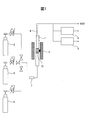
- the OSC velocity measured by the present invention is measured as follows. Referring to FIG. 1 showing a schematic view of the OSC velocity measuring device, first, measurement is performed in a state where nothing is filled in the reaction tube 1 (Blank test). That is, the reaction tube 1 is heated by the electric furnace 3 and heated to 400 ° C. under O 2 flow from the O 2 cylinder 2 (3 mass% O 2 , N 2 balance). The temperature in the reaction tube 1 is measured by a thermocouple 4. The inside of the reaction tube 1 is purged with N 2 from the N 2 cylinder 5, and CO is circulated from the CO cylinder 6 (1.5 mass% CO, N 2 balance). The flow rates of O 2 , CO, and N 2 are measured by a flow rate display meter 7.
- O 2 and CO discharged from the reaction tube 1 are measured by O 2 8 and CO 9 respectively.
- the time (t 50 (Blank) ) when the CO concentration reaches half of the circulated CO concentration is determined.
- measurement is carried out in a state where the reaction layer 10 is filled with ceria-zirconia-based composite oxide powder in which 0.5 mass% of Pd is supported by impregnation in the reaction tube 1 (Sample measurement).
- the reaction tube 1 is heated to 400 ° C. under an O 2 flow. Purge with N 2 and distribute CO.
- the time (t 50 (Sample) ) when the CO concentration reaches half of the circulated CO concentration is determined, and the OSC velocity ⁇ t 50 is determined by the following equation.
- ⁇ t 50 t 50 (Sample) ⁇ t 50 (Blank) .
- the OSC speed ⁇ t 50 is calculated.
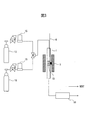
- the HC oxidation activity test measured in the present invention is measured as follows. It demonstrates using FIG. 2 which shows the schematic of HC oxidation activity test.
- a ceria-zirconia-based composite oxide powder in which 0.5 mass% of Pd is supported by impregnation in the reaction tube 1 is filled in the reaction layer 10.
- the inside of the reaction tube 1 is purged with N 2 from the N 2 bomb 5, and the O 2 bomb 2 (0.45 mass% O 2 , N 2 balance) and the HC bomb 11 (0.3 mass% HC (C 3 H) 6 ) Distribute O 2 and HC from N 2 balance).
- the flow rates of N 2 and O 2 are respectively measured by a flow rate indicator 15 (MFC).
- H 2 O is introduced into the flow path from the syringe 13. While raising the temperature of the electric furnace 3 from 200 ° C., the CO 2 concentration C 2 CO 2 at the outlet is measured with a total of 12 CO 2 .
- the temperature in the reaction tube 1 is measured by a thermocouple 4.
- the H 2 O in the exhaust gas is removed by the H 2 O trap 14 before being introduced into the CO 2 meter. After the start of measurement, measurement is ended when the concentration of CO 2 becomes constant, and CO concentration C 2 CO 2 (saturation) is obtained.
- the conversion (Conversion /%) is determined by the following equation.
- the NOx reduction activity test measured in the present invention is measured as follows. It demonstrates using FIG. 3 which shows the schematic of a NOx reduction activity test.
- a ceria-zirconia-based composite oxide powder in which 0.5 mass% of Pd is supported by impregnation in the reaction tube 1 is filled in the reaction layer 10.
- the flow rate from each cylinder is measured by a flow rate indicator (mass flow controller) 15, respectively.
- the temperature in the reaction tube 1 is measured by a thermocouple 4.
- the N 2 concentration C N2 (saturation) at which the N 2 concentration became constant is obtained.
- the conversion (Conversion /%) is determined by the following equation.
- the ion conductivity is measured as follows. A sample (ceria-zirconia-based composite oxide) is calcined at 1200 ° C. and pulverized in a wet ball mill. 1 mass% of PVA as a binder is added to 500 g of a sample, and a pressure of 1 ton / m 2 is applied to prepare a pellet. Thereafter, the pellet is sintered at 1450 ° C. and silver paste is applied to the pellet. Measure the pellet coated with silver paste with JIS R1661 AC impedance.
- the OSC velocity is measured by the measurement method described above, and the OSC amount is measured as follows.
- About 10 mg of sample (ceria / zirconia-based composite oxide) is filled in an alumina pan, and set in a thermogravimetric analyzer.
- the sample is subjected to reduction treatment at 400 ° C. for 1 hour under 5% H 2 / Ar flow. Thereafter, 100% O 2 is circulated at 800 ° C. for 10 minutes to perform oxidation treatment.
- the weight change before and after oxidation treatment is calculated as the OSC amount of the sample.
- the solution was heated to 98 ° C. with stirring to precipitate a cerium-zirconium composite sulfate.
- the resulting solution was poured into 3.3% aqueous ammonia to adjust the pH to 8 or more.
- the cerium-zirconium composite hydroxide cake was obtained by repeating the filtration-washing operation five times with 2.5% aqueous ammonia with respect to the obtained precipitate.
- Pure water was added to the obtained cerium-zirconium composite hydroxide cake to prepare a slurry having a concentration of 97 g / L of ZrO 2 + CeO 2 .
- Hydrochloric acid was added to bring the pH of the slurry to 6.5.
- the composite hydroxide cake was obtained by repeating the filtration-washing operation three times with 2.3% ammonia water. The obtained composite hydroxide cake was dried at 120 ° C. to form a powder, which was put into a bowl and fired at 700 ° C. for 3 hours in an electric furnace to obtain a ceria-zirconia-based composite oxide powder.
- the ion conductivity of the obtained powder was measured by the method described above, to be 4.35 ⁇ 10 ⁇ 5 S / cm.
- the obtained powder was further impregnated with Pd at a rate of 0.5 mass%, and the OSC velocity ( ⁇ t 50 ) and the amount of OSC were measured.
- the OSC velocity ⁇ t 50 of 20.0 seconds, OSC The result was obtained with the amount of 519 ⁇ mol-O 2 / g.
- the obtained powder was measured for ionic conductivity, OSC velocity, and OSC amount in the same manner as in Example 1. As a result, it was 4.79 ⁇ 10 ⁇ 5 S / cm, ⁇ t 50 was 20.0 seconds, and OSC amount was 480 ⁇ mol-O. It was 2 / g.
- the ion conductivity of the obtained powder was measured in the same manner as in Example 1 to find that it was 4.3 ⁇ 10 ⁇ 5 S / cm.
- the ion conductivity of the obtained powder and the SSA after endurance at 1100 ° C. were measured to be 4.0 ⁇ 10 ⁇ 5 S / cm and 16 m 2 / g, respectively.
- the obtained powder was measured for OSC speed, OSC amount, and SSA after endurance at 1100 ° C., and ⁇ t 50 was 21.0 seconds, and the amount of OSC was 507 ⁇ mol-O 2 / g, 30 m 2 / g.
- the obtained powder was measured for ionic conductivity, OSC velocity, and OSC amount in the same manner as in Example 1. As a result, 2.2 ⁇ 10 -5 (S / cm), ⁇ t 50 of 21.0 seconds, and OSC amount of 420 ⁇ mol. It was -O 2 / g.
- the obtained powder was measured for ionic conductivity, OSC speed, OSC amount, and SSA after 1,100 ° C. durability in the same manner as in Example 1 to find that SSA was 5.42 ⁇ 10 -5 (S / cm), 24.0 seconds, 474 ⁇ mol, respectively. It was -O 2 / g, 21 (m 2 / g).
- the obtained powder was measured for ionic conductivity, OSC speed, OSC amount, and SSA after endurance at 1100 ° C. in the same manner as in Example 1.
- SSA was measured at 1.8 ⁇ 10 ⁇ 5 (S / cm), 14.9 sec, 256 ⁇ mol. It was -O 2 / g, 15 (m 2 / g).
- Example 4 when Example 4 and Example 5 are compared, it is understood that the addition of La and Pr improves the SSA after endurance at 1100 ° C.
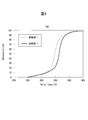
- FIG. 4 shows the results of measurement of HC oxidation activity test in Example 1 and Comparative Example.
- the temperatures at which the THC conversion reaches 50% are 347 ° C. and 365 ° C., respectively, and Example 1 can oxidize HC at a lower temperature than in Comparative Example 1, so it can be seen that the catalyst activity is high.
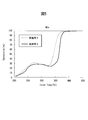
- FIG. 5 shows the results of measurement of the NOx reduction activity test for Example 1 and Comparative Example 1.
- the temperatures at which the NOx conversion reaches 50% are 342 ° C. and 360 ° C., respectively, and Example 1 can reduce NOx at a lower temperature than the comparative example, so it can be seen that the catalyst activity is high.
- the ceria / zirconia based composite oxide obtained in Examples 1 and 2 and Comparative Example 1 contains a metal ion having a valence of less than 4 and has an ion conductivity of 1 ⁇ 10 ⁇ at 400 ° C. It was an oxygen absorbing and releasing material with 5 S / cm or more, an OSC speed of 20.0 seconds, and an OSC amount of 300 ⁇ mol-O 2 / g.
- the ceria-zirconia-based composite oxide obtained in Example 1 from FIGS. 4 and 5 has temperatures of 347 ° C. and 342 ° C. at which the HC and NOx conversions reach 50%, respectively, and excellent HC oxidation activity and NOx. It showed a reducing activity.
- the temperatures at which the HC and NOx conversions of the ceria-zirconia based composite oxide obtained in Comparative Example 1 reach 50% are 365 ° C. and 360 ° C., respectively, and the HC oxidation activity and NOx reduction activity, ie, harmful
- the purification performance of the component was inferior to the example.
- Example 7 A three-way catalyst consisting of a single layer was prepared according to the present invention.
- the catalyst layer is formed by wash-coating the Gd-added (substituted) ceria-zirconia-based composite oxide of Example 1, La-stabilized alumina, and Ba promoter, and supports Pd.
- the washcoat amount of the layer coated on the ceramic honeycomb is about 1.7 g / cubic inch (0.104 g / cm 3 ), and the Pd loading amount is 45 g / cubic foot (1.27 g / m 3 ).
- 45% by mass of the ceria-zirconia-based composite oxide of Example 1 is contained.
- the three-way catalyst was subjected to engine bench endurance (aging) treatment for 100 hours in a fuel cut endurance cycle at a peak temperature of 1000 ° C. Furthermore, using the honeycomb structure, an FTP mode (California emission control mode) running test was conducted using a 2.5 L engine commercial vehicle.
- aging engine bench endurance
- FTP mode California emission control mode
- the FTP mode running test was also performed on a honeycomb structure formed of a single layer similarly manufactured using a conventional (currently used) ceria-zirconia-based composite oxide not containing Gd.
- the three-way catalyst is formed by wash-coating a ceria-zirconia-based composite oxide not containing Gd, a La-stabilized alumina, and a Ba promoter, and is a catalyst supporting Pd.
- the washcoat amount of the layer coated on the ceramic honeycomb is about 1.7 g / cubic inch (0.104 g / cm 3 ), and the Pd loading amount is 45 g / cubic foot (1.27 g / m 3 ).
- the three-way catalyst was subjected to engine bench endurance (aging) treatment for 100 hours in a fuel cut endurance cycle at a peak temperature of 1000 ° C.
- an FTP mode California emission control mode
- FIG. 6 (a) shows the difference in the amount of CO emissions
- FIG. 6 (b) shows the result of the evaluation in terms of the differences in the NMHC (non-methane hydrocarbon) and NOx emissions.
- the three-way catalyst (Example 7) using the ceria-zirconia-based composite oxide according to the present invention is HC (NMHC (non-methane hydrocarbon) in FIG.
- the material with high HC oxidation and NOx reduction activity of the present invention is used as a co-catalyst for automobile exhaust gas purification catalyst, it will help purification of exhaust gas that changes from moment to moment according to the running condition, more than ever before. Can be improved.
Landscapes
- Chemical & Material Sciences (AREA)
- Engineering & Computer Science (AREA)
- Organic Chemistry (AREA)
- Chemical Kinetics & Catalysis (AREA)
- Materials Engineering (AREA)
- Combustion & Propulsion (AREA)
- Health & Medical Sciences (AREA)
- Toxicology (AREA)
- General Engineering & Computer Science (AREA)
- Mechanical Engineering (AREA)
- Inorganic Chemistry (AREA)
- Oil, Petroleum & Natural Gas (AREA)
- General Chemical & Material Sciences (AREA)
- Analytical Chemistry (AREA)
- Environmental & Geological Engineering (AREA)
- Biomedical Technology (AREA)
- Catalysts (AREA)
- Exhaust Gas Treatment By Means Of Catalyst (AREA)
- Exhaust Gas After Treatment (AREA)
- Inorganic Compounds Of Heavy Metals (AREA)
Abstract
Priority Applications (6)
| Application Number | Priority Date | Filing Date | Title |
|---|---|---|---|
| BR112020008897-8A BR112020008897A2 (pt) | 2017-11-06 | 2018-11-06 | material de armazenagem e liberação de oxigênio, catalisador, sistema de purificação de gás de exaustão, e método de tratamento de gás de exaustão |
| RU2020118358A RU2744472C1 (ru) | 2017-11-06 | 2018-11-06 | Запасающий и выделяющий кислород материал, катализатор, система очистки выхлопного газа и способ очистки выхлопного газа |
| EP18872990.9A EP3708541B1 (fr) | 2017-11-06 | 2018-11-06 | Matériau d'absorption et de libération d'oxygène, catalyseur, système de purification de gaz d'échappement et méthode de traitement de gaz d'échappement |
| CN201880071607.5A CN111372893B (zh) | 2017-11-06 | 2018-11-06 | 吸放氧材料、催化剂、废气净化系统及废气处理方法 |
| JP2019550522A JP6906624B2 (ja) | 2017-11-06 | 2018-11-06 | 酸素吸放出材料、触媒、排ガス浄化システム、および排ガス処理方法 |
| US16/762,087 US11559788B2 (en) | 2017-11-06 | 2018-11-06 | Oxygen storage and release material, catalyst, exhaust gas purification system, and exhaust gas treatment method |
Applications Claiming Priority (2)
| Application Number | Priority Date | Filing Date | Title |
|---|---|---|---|
| JP2017214248 | 2017-11-06 | ||
| JP2017-214248 | 2017-11-06 |
Publications (1)
| Publication Number | Publication Date |
|---|---|
| WO2019088302A1 true WO2019088302A1 (fr) | 2019-05-09 |
Family
ID=66333175
Family Applications (1)
| Application Number | Title | Priority Date | Filing Date |
|---|---|---|---|
| PCT/JP2018/041238 Ceased WO2019088302A1 (fr) | 2017-11-06 | 2018-11-06 | Matériau d'absorption et de libération d'oxygène, catalyseur, système de purification de gaz d'échappement et méthode de traitement de gaz d'échappement |
Country Status (7)
| Country | Link |
|---|---|
| US (1) | US11559788B2 (fr) |
| EP (1) | EP3708541B1 (fr) |
| JP (1) | JP6906624B2 (fr) |
| CN (1) | CN111372893B (fr) |
| BR (1) | BR112020008897A2 (fr) |
| RU (1) | RU2744472C1 (fr) |
| WO (1) | WO2019088302A1 (fr) |
Cited By (7)
| Publication number | Priority date | Publication date | Assignee | Title |
|---|---|---|---|---|
| CN113019363A (zh) * | 2021-03-23 | 2021-06-25 | 中自环保科技股份有限公司 | 一种尾气处理催化剂及其用途 |
| JP2022073362A (ja) * | 2020-10-30 | 2022-05-17 | 新日本電工株式会社 | 窒素酸化物吸着材料及び自動車排ガス触媒 |
| JP2022525736A (ja) * | 2019-04-03 | 2022-05-19 | ジョンソン、マッセイ、パブリック、リミテッド、カンパニー | 酸素貯蔵用のセリア含有混合酸化物 |
| CN115254129A (zh) * | 2022-06-24 | 2022-11-01 | 江阴华音陶瓷机电科技有限公司 | 一种用于汽车尾气净化的蜂巢体及其制备方法 |
| JP2023060773A (ja) * | 2021-10-18 | 2023-04-28 | 国立大学法人大阪大学 | 触媒および揮発性有機化合物の除去方法 |
| JP7522906B1 (ja) | 2023-12-06 | 2024-07-25 | 第一稀元素化学工業株式会社 | 酸化セリウム安定化ジルコニウム組成物 |
| JP2024542381A (ja) * | 2021-11-21 | 2024-11-15 | イエダ リサーチ アンド ディベロップメント カンパニー リミテッド | ドープセリアに基づく電歪材料 |
Families Citing this family (5)
| Publication number | Priority date | Publication date | Assignee | Title |
|---|---|---|---|---|
| JP7588484B2 (ja) * | 2020-09-02 | 2024-11-22 | 株式会社キャタラー | 排ガス浄化触媒装置 |
| US11618008B2 (en) * | 2020-10-05 | 2023-04-04 | Ford Global Technologies, Llc | Precious group metal on pyrochlore-phase ceria zirconia with superior oxygen storage capacity and TWC performance |
| EP4052787A1 (fr) * | 2021-03-02 | 2022-09-07 | Johnson Matthey Public Limited Company | Matériau de stockage de nox |
| CN113417728B (zh) * | 2021-06-30 | 2022-10-18 | 一汽奔腾轿车有限公司 | 一种钯钌配方催化器的台架老化时间计算和老化试验方法 |
| US12427477B2 (en) | 2022-01-20 | 2025-09-30 | Ford Global Technologies, Llc | High entropy rare earth oxides for emissions control |
Citations (11)
| Publication number | Priority date | Publication date | Assignee | Title |
|---|---|---|---|---|
| JP2004529837A (ja) * | 2001-03-13 | 2004-09-30 | ダブリュー・アール・グレイス・アンド・カンパニー−コネチカット | 高い酸素貯蔵能力を有する触媒支持体材料およびこれの製造方法 |
| JP2006256912A (ja) | 2005-03-17 | 2006-09-28 | Tosoh Corp | 表面修飾されたセリア・ジルコニア系水和酸化物、その酸化物及びそれらの製造方法並びに用途 |
| JP2009537432A (ja) * | 2006-05-15 | 2009-10-29 | ロデイア・オペラシヨン | 高い比表面積および還元率を有する、ジルコニウム、セリウムおよびランタンならびにイットリウム、ガドリニウムまたはサマリウムの酸化物を基にした組成物、調製方法および触媒としての使用 |
| JP2011121851A (ja) | 2009-12-10 | 2011-06-23 | Daiichi Kigensokagaku Kogyo Co Ltd | セリウム−ジルコニウム系複合酸化物及びその製造方法 |
| WO2012105454A1 (fr) | 2011-02-01 | 2012-08-09 | 株式会社アイシーティー | Catalyseur pour épurer un gaz d'échappement |
| JP2012519060A (ja) * | 2009-02-27 | 2012-08-23 | トライバッハー インダストリー アーゲー | 新規なジルコニアセリア組成物 |
| JP2013525255A (ja) * | 2010-05-06 | 2013-06-20 | ロデイア・オペラシヨン | ジルコニウム、セリウムおよび少なくとも1種の他の希土類の酸化物を含み、特定の多孔度を有する組成物、それを調製する方法、および触媒作用におけるその使用 |
| JP2017042752A (ja) * | 2015-08-29 | 2017-03-02 | 新日本電工株式会社 | 希土類酸化物相がハイブリッド化されたセリア・ジルコニア系酸化物系酸素吸放出材料 |
| JP2017087086A (ja) * | 2015-11-02 | 2017-05-25 | 新日本電工株式会社 | 酸素吸放出材料 |
| WO2017130917A1 (fr) * | 2016-01-26 | 2017-08-03 | 新日本電工株式会社 | Matériau d'absorption/libération d'oxygène oxyde composite à base de cérium·zircone, catalyseur de purification de gaz d'échappement et structure en nid d'abeilles pour la purification de gaz d'échappement |
| US20180065110A1 (en) | 2016-07-15 | 2018-03-08 | Korea Research Institute Of Chemical Technology | Gd-containing, anti-coking solid acid catalysts and preparation method and use thereof |
Family Cites Families (23)
| Publication number | Priority date | Publication date | Assignee | Title |
|---|---|---|---|---|
| JP2991572B2 (ja) * | 1991-09-11 | 1999-12-20 | キヤノン株式会社 | 画像記録装置 |
| GB9800325D0 (en) * | 1998-01-09 | 1998-03-04 | Johnson Matthey Plc | Improvements in catalytic materials |
| US20020032123A1 (en) * | 2000-02-23 | 2002-03-14 | Ford Global Technologies, Inc. | Exhaust gas catalyst and method of manufacturing same |
| JP2002177781A (ja) * | 2000-12-12 | 2002-06-25 | Ict:Kk | 排ガス浄化用触媒 |
| US6660683B1 (en) * | 2002-10-21 | 2003-12-09 | W.R. Grace & Co.-Conn. | NOx reduction compositions for use in FCC processes |
| US7030055B2 (en) * | 2003-08-18 | 2006-04-18 | W.R. Grace & Co.-Conn. | NOx reduction compositions for use in FCC processes |
| FR2900920B1 (fr) * | 2006-05-15 | 2008-07-11 | Rhodia Recherches & Tech | Composition a base d'oxides de zirconium, de cerium, de lanthane et d'yttrium, de gadolinium ou de samarium, a surface specifique stable, procede de preparation et utilisation comme catalyseur |
| JP4938013B2 (ja) * | 2006-07-06 | 2012-05-23 | 株式会社キャタラー | 酸素貯蔵材料 |
| US7754171B2 (en) * | 2007-02-02 | 2010-07-13 | Basf Corporation | Multilayered catalyst compositions |
| US7879755B2 (en) * | 2007-08-09 | 2011-02-01 | Basf Corporation | Catalyst compositions |
| US8038951B2 (en) * | 2007-08-09 | 2011-10-18 | Basf Corporation | Catalyst compositions |
| JP5099828B2 (ja) * | 2007-10-31 | 2012-12-19 | 株式会社豊田中央研究所 | 無機混合酸化物及びそれを用いた排ガス浄化用触媒 |
| US20090324468A1 (en) * | 2008-06-27 | 2009-12-31 | Golden Stephen J | Zero platinum group metal catalysts |
| JP5287884B2 (ja) * | 2011-01-27 | 2013-09-11 | トヨタ自動車株式会社 | 排ガス浄化用触媒 |
| EP2781487B1 (fr) | 2011-11-16 | 2019-01-02 | Santoku Corporation | Oxyde composite |
| JP5724856B2 (ja) * | 2011-12-02 | 2015-05-27 | トヨタ自動車株式会社 | 排ガス浄化用触媒 |
| JP5883425B2 (ja) * | 2013-10-04 | 2016-03-15 | 株式会社豊田中央研究所 | セリア−ジルコニア系複合酸化物及びその製造方法、並びにそのセリア−ジルコニア系複合酸化物を用いた排ガス浄化用触媒 |
| JP6087784B2 (ja) * | 2013-10-21 | 2017-03-01 | トヨタ自動車株式会社 | 酸素吸放出材及びそれを含む排ガス浄化用触媒 |
| CA2975108A1 (fr) * | 2015-01-29 | 2016-08-04 | Basf Corporation | Catalyseurs a metal du groupe du platine (pgm) pour traitement des emissions automobiles |
| WO2016143722A1 (fr) * | 2015-03-12 | 2016-09-15 | Toyota Jidosha Kabushiki Kaisha | Support noyau-enveloppe, son procédé de production, catalyseur de purification des gaz d'échappement utilisant ledit support noyau-enveloppe, son procédé de production, et procédé de purification des gaz d'échappement utilisant le catalyseur de purification des gaz d'échappement |
| EP3271070A4 (fr) * | 2015-03-19 | 2018-11-21 | BASF Corporation | Catalyseurs pour automobile avec du palladium soutenu dans une couche sans alumine |
| EP3445486A4 (fr) * | 2016-04-22 | 2019-11-27 | BASF Corporation | Catalyseurs métalliques du groupe du platine portés sur un support d'alumine à larges pores |
| JP6701581B2 (ja) * | 2017-03-02 | 2020-05-27 | 株式会社豊田中央研究所 | 酸素吸放出材 |
-
2018
- 2018-11-06 CN CN201880071607.5A patent/CN111372893B/zh active Active
- 2018-11-06 WO PCT/JP2018/041238 patent/WO2019088302A1/fr not_active Ceased
- 2018-11-06 BR BR112020008897-8A patent/BR112020008897A2/pt not_active IP Right Cessation
- 2018-11-06 RU RU2020118358A patent/RU2744472C1/ru active
- 2018-11-06 US US16/762,087 patent/US11559788B2/en active Active
- 2018-11-06 JP JP2019550522A patent/JP6906624B2/ja not_active Expired - Fee Related
- 2018-11-06 EP EP18872990.9A patent/EP3708541B1/fr active Active
Patent Citations (12)
| Publication number | Priority date | Publication date | Assignee | Title |
|---|---|---|---|---|
| JP2004529837A (ja) * | 2001-03-13 | 2004-09-30 | ダブリュー・アール・グレイス・アンド・カンパニー−コネチカット | 高い酸素貯蔵能力を有する触媒支持体材料およびこれの製造方法 |
| JP2006256912A (ja) | 2005-03-17 | 2006-09-28 | Tosoh Corp | 表面修飾されたセリア・ジルコニア系水和酸化物、その酸化物及びそれらの製造方法並びに用途 |
| JP2009537432A (ja) * | 2006-05-15 | 2009-10-29 | ロデイア・オペラシヨン | 高い比表面積および還元率を有する、ジルコニウム、セリウムおよびランタンならびにイットリウム、ガドリニウムまたはサマリウムの酸化物を基にした組成物、調製方法および触媒としての使用 |
| JP2012180271A (ja) | 2006-05-15 | 2012-09-20 | Rhodia Operations | 高い比表面積および還元率を有する、ジルコニウム、セリウムおよびランタンならびにイットリウム、ガドリニウムまたはサマリウムの酸化物を基にした組成物、調製方法および触媒としての使用 |
| JP2012519060A (ja) * | 2009-02-27 | 2012-08-23 | トライバッハー インダストリー アーゲー | 新規なジルコニアセリア組成物 |
| JP2011121851A (ja) | 2009-12-10 | 2011-06-23 | Daiichi Kigensokagaku Kogyo Co Ltd | セリウム−ジルコニウム系複合酸化物及びその製造方法 |
| JP2013525255A (ja) * | 2010-05-06 | 2013-06-20 | ロデイア・オペラシヨン | ジルコニウム、セリウムおよび少なくとも1種の他の希土類の酸化物を含み、特定の多孔度を有する組成物、それを調製する方法、および触媒作用におけるその使用 |
| WO2012105454A1 (fr) | 2011-02-01 | 2012-08-09 | 株式会社アイシーティー | Catalyseur pour épurer un gaz d'échappement |
| JP2017042752A (ja) * | 2015-08-29 | 2017-03-02 | 新日本電工株式会社 | 希土類酸化物相がハイブリッド化されたセリア・ジルコニア系酸化物系酸素吸放出材料 |
| JP2017087086A (ja) * | 2015-11-02 | 2017-05-25 | 新日本電工株式会社 | 酸素吸放出材料 |
| WO2017130917A1 (fr) * | 2016-01-26 | 2017-08-03 | 新日本電工株式会社 | Matériau d'absorption/libération d'oxygène oxyde composite à base de cérium·zircone, catalyseur de purification de gaz d'échappement et structure en nid d'abeilles pour la purification de gaz d'échappement |
| US20180065110A1 (en) | 2016-07-15 | 2018-03-08 | Korea Research Institute Of Chemical Technology | Gd-containing, anti-coking solid acid catalysts and preparation method and use thereof |
Non-Patent Citations (2)
| Title |
|---|
| "Materials", INFLUENCE OF CERIA DOPING ON OXYGEN RELAXATION AND OXIDE ION CONDUCTION IN YTTRIA STABILIZED CUBIC ZIRCONIA, vol. 60, no. 3, March 2011 (2011-03-01), pages 194 - 197 |
| See also references of EP3708541A4 |
Cited By (12)
| Publication number | Priority date | Publication date | Assignee | Title |
|---|---|---|---|---|
| JP2022525736A (ja) * | 2019-04-03 | 2022-05-19 | ジョンソン、マッセイ、パブリック、リミテッド、カンパニー | 酸素貯蔵用のセリア含有混合酸化物 |
| JP7664843B2 (ja) | 2019-04-03 | 2025-04-18 | ジョンソン、マッセイ、パブリック、リミテッド、カンパニー | 酸素貯蔵用のセリア含有混合酸化物 |
| JP2022073362A (ja) * | 2020-10-30 | 2022-05-17 | 新日本電工株式会社 | 窒素酸化物吸着材料及び自動車排ガス触媒 |
| CN113019363A (zh) * | 2021-03-23 | 2021-06-25 | 中自环保科技股份有限公司 | 一种尾气处理催化剂及其用途 |
| JP2023060773A (ja) * | 2021-10-18 | 2023-04-28 | 国立大学法人大阪大学 | 触媒および揮発性有機化合物の除去方法 |
| JP7734366B2 (ja) | 2021-10-18 | 2025-09-05 | 国立大学法人大阪大学 | 触媒および揮発性有機化合物の除去方法 |
| JP2024542381A (ja) * | 2021-11-21 | 2024-11-15 | イエダ リサーチ アンド ディベロップメント カンパニー リミテッド | ドープセリアに基づく電歪材料 |
| CN115254129A (zh) * | 2022-06-24 | 2022-11-01 | 江阴华音陶瓷机电科技有限公司 | 一种用于汽车尾气净化的蜂巢体及其制备方法 |
| CN115254129B (zh) * | 2022-06-24 | 2023-08-22 | 江阴华音陶瓷机电科技有限公司 | 一种用于汽车尾气净化的蜂巢体及其制备方法 |
| JP7522906B1 (ja) | 2023-12-06 | 2024-07-25 | 第一稀元素化学工業株式会社 | 酸化セリウム安定化ジルコニウム組成物 |
| WO2025121258A1 (fr) * | 2023-12-06 | 2025-06-12 | 第一稀元素化学工業株式会社 | Composition de zirconium stabilisée par de l'oxyde de cérium |
| JP2025090925A (ja) * | 2023-12-06 | 2025-06-18 | 第一稀元素化学工業株式会社 | 酸化セリウム安定化ジルコニウム組成物 |
Also Published As
| Publication number | Publication date |
|---|---|
| EP3708541B1 (fr) | 2024-04-10 |
| JPWO2019088302A1 (ja) | 2020-07-30 |
| BR112020008897A2 (pt) | 2020-10-20 |
| US11559788B2 (en) | 2023-01-24 |
| EP3708541A1 (fr) | 2020-09-16 |
| US20210355851A1 (en) | 2021-11-18 |
| JP6906624B2 (ja) | 2021-07-21 |
| CN111372893A (zh) | 2020-07-03 |
| RU2744472C1 (ru) | 2021-03-09 |
| CN111372893B (zh) | 2022-12-30 |
| EP3708541A4 (fr) | 2021-08-25 |
Similar Documents
| Publication | Publication Date | Title |
|---|---|---|
| JP6906624B2 (ja) | 酸素吸放出材料、触媒、排ガス浄化システム、および排ガス処理方法 | |
| KR101868176B1 (ko) | 개선된 no 산화 활성을 갖는 가솔린 린번 엔진용 촉매 | |
| JP7206045B2 (ja) | 排気システム用の亜酸化窒素除去触媒 | |
| EP2644271B1 (fr) | Catalyseur de stockage de nox et procédé pour la réduction des nox | |
| KR102483435B1 (ko) | 배기 시스템용 아산화질소 제거 촉매 | |
| JP7319971B2 (ja) | 熱耐久性が改善されたガソリン排気ガス用途のためのtwc触媒 | |
| JP5719294B2 (ja) | 熱的なエージングに対して抵抗性のNOx貯蔵材料及びトラップ | |
| JP5910833B2 (ja) | 排ガス浄化触媒 | |
| JP7518763B2 (ja) | 排気ガス浄化触媒 | |
| KR101859786B1 (ko) | 개선된 nh3 형성 활성을 갖는 가솔린 린번 엔진용 촉매 | |
| JP6907890B2 (ja) | 排ガス浄化用触媒 | |
| WO2003097232A1 (fr) | Matiere d'oxydation de particules et catalyseur d'oxydation | |
| WO2014041984A1 (fr) | Support de catalyseur de purification de gaz d'échappement | |
| JP6748590B2 (ja) | 排ガス浄化用触媒 | |
| CN103459017A (zh) | 废气净化用氧化催化剂、其制备方法以及使用该催化剂的废气净化方法 | |
| KR101855537B1 (ko) | Rh 로딩량이 감소된 NOx 저장 촉매 | |
| CN102574057B (zh) | 基于镧系元素含氧硫酸盐的氧吸附剂、其制造方法和包含其的废气净化催化剂 | |
| JP2001046870A (ja) | 排気ガス浄化用触媒及び排気ガス浄化システム | |
| JP5549453B2 (ja) | 排気ガス浄化用触媒 | |
| CN111315476A (zh) | 氮氧化物吸留材料和废气净化用催化剂 | |
| RU2772210C2 (ru) | Тройные катализаторы (twc) для очистки выхлопного газа бензинового двигателя с улучшенной термостойкостью | |
| JP2009090235A (ja) | 排ガス成分浄化用触媒材及び同触媒材付パティキュレートフィルタ | |
| RU2790008C2 (ru) | Катализатор для очистки выхлопного газа | |
| WO2023047185A1 (fr) | Catalyseur d'épuration des gaz d'échappement et dispositif de catalyseur d'épuration des gaz d'échappement pour véhicules |
Legal Events
| Date | Code | Title | Description |
|---|---|---|---|
| 121 | Ep: the epo has been informed by wipo that ep was designated in this application |
Ref document number: 18872990 Country of ref document: EP Kind code of ref document: A1 |
|
| ENP | Entry into the national phase |
Ref document number: 2019550522 Country of ref document: JP Kind code of ref document: A |
|
| NENP | Non-entry into the national phase |
Ref country code: DE |
|
| ENP | Entry into the national phase |
Ref document number: 2018872990 Country of ref document: EP Effective date: 20200608 |
|
| REG | Reference to national code |
Ref country code: BR Ref legal event code: B01A Ref document number: 112020008897 Country of ref document: BR |
|
| ENP | Entry into the national phase |
Ref document number: 112020008897 Country of ref document: BR Kind code of ref document: A2 Effective date: 20200505 |