WO2019088331A1 - 콜라겐을 이용하여 제조된 의료용 재료 및 그 제조방법 - Google Patents
콜라겐을 이용하여 제조된 의료용 재료 및 그 제조방법 Download PDFInfo
- Publication number
- WO2019088331A1 WO2019088331A1 PCT/KR2017/012718 KR2017012718W WO2019088331A1 WO 2019088331 A1 WO2019088331 A1 WO 2019088331A1 KR 2017012718 W KR2017012718 W KR 2017012718W WO 2019088331 A1 WO2019088331 A1 WO 2019088331A1
- Authority
- WO
- WIPO (PCT)
- Prior art keywords
- collagen
- crosslinking
- present
- cross
- agent
- Prior art date
- Legal status (The legal status is an assumption and is not a legal conclusion. Google has not performed a legal analysis and makes no representation as to the accuracy of the status listed.)
- Ceased
Links
Images


Classifications
-
- A—HUMAN NECESSITIES
- A61—MEDICAL OR VETERINARY SCIENCE; HYGIENE
- A61L—METHODS OR APPARATUS FOR STERILISING MATERIALS OR OBJECTS IN GENERAL; DISINFECTION, STERILISATION OR DEODORISATION OF AIR; CHEMICAL ASPECTS OF BANDAGES, DRESSINGS, ABSORBENT PADS OR SURGICAL ARTICLES; MATERIALS FOR BANDAGES, DRESSINGS, ABSORBENT PADS OR SURGICAL ARTICLES
- A61L27/00—Materials for grafts or prostheses or for coating grafts or prostheses
- A61L27/14—Macromolecular materials
- A61L27/22—Polypeptides or derivatives thereof, e.g. degradation products
- A61L27/24—Collagen
-
- A—HUMAN NECESSITIES
- A61—MEDICAL OR VETERINARY SCIENCE; HYGIENE
- A61L—METHODS OR APPARATUS FOR STERILISING MATERIALS OR OBJECTS IN GENERAL; DISINFECTION, STERILISATION OR DEODORISATION OF AIR; CHEMICAL ASPECTS OF BANDAGES, DRESSINGS, ABSORBENT PADS OR SURGICAL ARTICLES; MATERIALS FOR BANDAGES, DRESSINGS, ABSORBENT PADS OR SURGICAL ARTICLES
- A61L17/00—Materials for surgical sutures or for ligaturing blood vessels ; Materials for prostheses or catheters
- A61L17/06—At least partially resorbable materials
- A61L17/08—At least partially resorbable materials of animal origin, e.g. catgut, collagen
-
- A—HUMAN NECESSITIES
- A61—MEDICAL OR VETERINARY SCIENCE; HYGIENE
- A61L—METHODS OR APPARATUS FOR STERILISING MATERIALS OR OBJECTS IN GENERAL; DISINFECTION, STERILISATION OR DEODORISATION OF AIR; CHEMICAL ASPECTS OF BANDAGES, DRESSINGS, ABSORBENT PADS OR SURGICAL ARTICLES; MATERIALS FOR BANDAGES, DRESSINGS, ABSORBENT PADS OR SURGICAL ARTICLES
- A61L31/00—Materials for other surgical articles, e.g. stents, stent-grafts, shunts, surgical drapes, guide wires, materials for adhesion prevention, occluding devices, surgical gloves, tissue fixation devices
- A61L31/04—Macromolecular materials
- A61L31/043—Proteins; Polypeptides; Degradation products thereof
- A61L31/044—Collagen
-
- D—TEXTILES; PAPER
- D01—NATURAL OR MAN-MADE THREADS OR FIBRES; SPINNING
- D01D—MECHANICAL METHODS OR APPARATUS IN THE MANUFACTURE OF ARTIFICIAL FILAMENTS, THREADS, FIBRES, BRISTLES OR RIBBONS
- D01D5/00—Formation of filaments, threads, or the like
- D01D5/0007—Electro-spinning
- D01D5/0015—Electro-spinning characterised by the initial state of the material
-
- D—TEXTILES; PAPER
- D10—INDEXING SCHEME ASSOCIATED WITH SUBLASSES OF SECTION D, RELATING TO TEXTILES
- D10B—INDEXING SCHEME ASSOCIATED WITH SUBLASSES OF SECTION D, RELATING TO TEXTILES
- D10B2211/00—Protein-based fibres, e.g. animal fibres
- D10B2211/01—Natural animal fibres, e.g. keratin fibres
- D10B2211/06—Collagen fibres
Definitions
- the present invention relates to a medical material prepared using collagen and a method for producing the material. More particularly, the present invention relates to a medical material produced by using collagen and cross- The collagen seals increase in strength compared with those before crosslinking and remain in the form of an aqueous solution. As a result, the collagen seals can be used in a variety of applications as medical seals and supports, thereby greatly improving the quality and reliability of medical materials. So that a good image can be planted.
- collagen is a constituent of human tissue.
- Collagen is known to help tissue regeneration when collagen is applied to the site of injury, and it is widely used in the medical field. This is because collagen has a lot of functional advantages, and its functional merits are biocompatibility, biodegradability, and tissue repair ability.
- collagen is applied to human tissues in almost all body tissues such as bones, tissues, and biological membranes.
- a similar technique related to the production of collagen yarn in the present literatures is a method of producing a collagen yarn using dehydration, a method of producing a yarn using electrospinning, and a method of producing a yarn using 3D printing.
- the method of producing collagen seaweed using dehydration it is considered that the collagen seaweed is easily decomposed in the human body by keeping the form through dehydration.
- electrospinning or 3d printing the collagen seaweed is fixed in two or three dimensional structure, And thus it is unlikely that the prior art will be applied to the human body as a medical room.
- the conventional collagen yarn has a disadvantage in that it does not have sufficient strength or is loosened in water.
- Patent Document 1 Korean Laid-Open Patent Publication No. 2001-0090876 (October 19, 2001) has been disclosed.
- Patent Document 2 Korean Published Patent Application No. 2013-0066581 (Feb.
- Patent Document 3 Korean Patent Laid-Open Publication No. 2016-0032569 (June 23, 2016) has been disclosed.
- Patent Document 4 Korean Patent Registration No. 1473617 (Apr. 12, 2014) was registered.
- Non-Patent Document 1 Alvin T. Yeh, Bernard Choi, J. Stuart Nelson, and Bruce J. Tromberg Reversible Dissociation of Collagen in Tissue. vol. 121, No. 6 December 2003, The Society for Investigative Dermatology. 121: 1332-1335
- the present invention has been made in order to overcome the above problems of the prior art, and it is a first object of the present invention to provide a crosslinked solution comprising collagen, a hyperosmotic agent and a crosslinking agent. 2
- the purpose of the present invention is to cross-link the threaded yarn after spinning the collagen to form a yarn.
- the collagen yarn after crosslinking increases in strength compared to that before crosslinking and maintains its shape in the aqueous solution.
- the third object of the present invention is to provide a method for fabricating an electrostatic latent image by using the present invention as it is in an actual form, after woven in the form of a woven fabric, laminated using 3D printing, electrospinning,
- the medical field where collagen thread can be applied in this form is suture, dental material
- the fourth object of the present invention is that the collagen thread, which is a one-dimensional structure of the present invention, is not used in the prior art, and the collagen thread, which is the one-dimensional structure, is used as a two- It is possible to process by structure and it can make various modifications according to the demand of the consumer.
- the fifth purpose is to improve the quality and reliability of the medical material by this, so that it can meet the various needs of the users, A medical material manufactured using one collagen and a method for producing the same are provided.
- the present invention relates to a method of preparing collagen using distilled water as a solvent in order to produce a medical material using collagen.
- a crosslinking solution which is a mixture of a hyperosmotic agent and a crosslinking agent.
- the present invention also provides a method for producing a medical material using collagen
- the present invention also provides a medical material prepared using the collagen produced by the manufacturing method of the above (1) to (5).
- the present invention provides a cross-linking solution comprising collagen, a hyperosmotic agent and a cross-linking agent.
- the collagen yarn after the crosslinking is increased in strength as compared with that before crosslinking, As a result, various applications can be made as a medical room and a support.
- the present invention uses the present invention as it is in an actual form, after woven in the form of a woven fabric, laminated using 3D printing, electrospinning, or otherwise processed into various forms.
- Applicable medical fields include sutures, dental materials, tissue substitutes, adhesion inhibitors, hemostats, drug delivery systems, and film forms.
- the collagen thread which is a one-dimensional structure according to the present invention, can be processed into a two-dimensional or three-dimensional structure of the collagen thread, which is the one- Do.
- the present invention greatly improves the quality and reliability of a medical material due to the above-described effects, and is a very useful invention that can provide a good image by satisfying various needs of users.
- (b) is a view showing a conventional collagen hemostatic fiber manufacturing process.
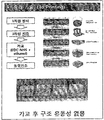
- Fig. 2 is a view showing a manufacturing process of a medical material manufactured using collagen applied to the present invention
- Fig. 3 is a view showing a manufacturing process of a medical material manufactured using collagen applied to the present invention
- Fig. 4 is a schematic view of a collagen yarn manufacturing process using a hyperosmotic agent and a crosslinking agent according to the present invention.
- FIG. 5 is a graph showing the effect of the present invention on the working principle of the crosslinking solution (a mixed solution of a hyperosmotic agent and a crosslinking agent)
- FIG. 8 is a graph showing tensile strength of a collagen yarn manufactured under various conditions.
- FIG. 11 is a graph showing the tensile strength of the collagen film produced by the present invention.
- the medical material manufactured using the collagen applied to the present invention and the manufacturing method thereof are configured as shown in Figs. 2 to 11.
- the present invention relates to a technique for producing a collagen thread, and can be processed and applied in various forms due to the characteristics of an actual shape. For example, they may be used in the form of yarn, after weaving in the form of a fabric, by lamination using 3D printing, by electrospinning, or by processing in various other forms. Medical applications in which collagen seams can be applied in this form include sutures, dental materials, tissue substitutes, adhesion inhibitors, hemostatic agents, drug delivery systems, and film forms.
- a step of formulating it into a specific form is required.
- Collagen is inherently easily soluble in water.
- a cross-linking step is required during the collagen forming step.
- Cross-linking induces physico-chemical bonds between collagen molecules and connects them to each other.
- Collagen after cross-linking does not easily dissolve in water and tends to increase in strength.
- collagen thread has a thin one-dimensional structure and its strength is weak. Therefore, a special crosslinking method for increasing the strength is required.
- collagen has an opaque phase in aqueous solution. This is because many collagen molecules clump together in the form of fibers and 'collagen fibrosis' occurs.
- the 'collagen fibers' generated by the 'collagen fibrosis' are very dense and huge structures.
- the cross-linking agent can not penetrate into the 'collagen fiber', and a limited cross-linking occurs between the 'collagen fiber' and the 'collagen fiber' .
- the hyperosmopolysaccharide is added, the 'collagen fibers' are dissociated to cause crosslinking between the 'collagen molecules' rather than 'collagen fibers', thus forming a more dense crosslinked structure.
- the present invention should be crosslinked.
- the collagen molecules forming the collagen fibrosis have a very dense structure, the cross-linking agent can not penetrate between the fibers.
- collagen fibrosis was dissociated using a hyperosmotic agent and crosslinked to form a dense crosslinked structure between the collagen molecules.
- Non-crosslinked collagen is easily released into water and has no strength.
- the hyperosmopolysaccharide and the crosslinking agent are used according to the above method, the collagen thread has a very dense crosslinked structure and does not melt into water and exhibits very high strength.
- a crosslinking solution which is a mixture of a hyperosmotic agent and a crosslinking agent.
- the present invention relates to a method for producing a medical material using collagen
- the concentration of collagen in step (1) is 1 to 15% (w / v).
- the collagen concentration is 1 to 15 (%, w / v) because the collagen concentration of less than 1% does not produce strength as a yarn or film and the collagen concentration of 15% desirable.
- the radiating step in the step (2) radiates the collagen in an actual form, and the radiated yarn thickness is 100 nm to 10 mm.
- the thickness range that can be practically used as a yarn or a film is preferably 100 nm to 10 mm, which is a set range.
- a crosslinking solution which is a mixture of a hyperosmotic agent and a crosslinking agent.
- the ratio of the hyperosmotic agent to the cross-linking agent is 0.1 to 10 (%, v / v), and the concentration of the cross-linking agent Is the concentration of glutaraldehyde in which glycerol is used as a solvent.
- the crosslinking time is long as the concentration of the crosslinking solution is low (0.1% or less) and the crosslinking time is short as the concentration of the crosslinking solution is high (10% or more) To 10%, it is possible to obtain an optimum crosslinking time which is industrially available. Accordingly, the range of the crosslinking solution was set as described above.
- the hyperosmotic agent applied to the present invention may be any one selected from glycerol, isosorbide, mannitol, and urea.
- the crosslinking agent used in the present invention is preferably composed of any one selected from the group consisting of glutaraldehyde, carbodiimide, and epoxycompounds.
- the crosslinking time in the step (3) is preferably 1 minute to 48 hours.
- the crosslinking time varies depending on the concentration of the crosslinking solution.
- the crosslinking time is usually varied in the case of less than 1 minute and becomes too hard in the case of exceeding 48 hours. Therefore, the range of the crosslinking time available industrially is preferably set to 1 minute to 48 hours.
- the washing step of step (4) of the present invention is preferably exposed to any one selected from phosphate buffered saline (PBS), methanol, ethanol, distilled water, acetone, distilled water and physiological saline.
- PBS phosphate buffered saline
- the drying in the step (5) of the present invention is preferably performed by any one selected from freeze drying, dry heat drying and natural drying.
- the present invention relates to a method for producing collagen, A suture, a dental material, a support, an tissue substitute, a tissue restorative, an adhesion inhibitor, a hemostatic agent, a drug delivery material, and a reinforcing material.
- the collagen thread that has undergone crosslinking increases in strength compared to that before crosslinking and maintains its shape in the aqueous solution.
- supports as a support.
- FIG. 2 is a flowchart illustrating a method of manufacturing a medical material using collagen according to an embodiment of the present invention.
- FIG. 3 is a schematic view showing a method of manufacturing a medical material using collagen applied to the present invention.
- FIG. 4 is a schematic view of the production of a collagen yarn using the hyperosmotic agent and the crosslinking agent of the present invention.
- crosslinking was impossible due to insufficient physical properties, but the present invention exhibits excellent physical properties.
- Fig. 5 is a schematic view showing the working principle of the crosslinking solution of the present invention (a mixed solution of a hyperosmotic agent and a crosslinking agent), showing limited crosslinking and sufficient crosslinking.
- FIG. 6 is an enlarged photograph showing the collagen yarn produced by the present invention.
- FIG. 7 is an enlarged photograph showing the collagen yarn spun in various thicknesses of the present invention.
- FIG. 8 is a graph showing the tensile strength of the collagen yarn prepared under various conditions. It includes 9 (%, w / v) collagen [g / ml * 100 (%, w / v) (%, V / v), 2 (%, v / v), 4 (%, v / v) for each crosslinking time condition (10 min, 30 min) [Glycerol: Glutaraldehyde in volume ratio of 99: 1, 98: 2, and 96: 4 respectively]).
- the concentration of the crosslinking solution refers to the concentration of glutaraldehyde in which glycerol is used as a solvent.
- FIG. 9 is a collagen film produced by the present invention
- FIG. 10 shows the support produced by the present invention
- FIG. 11 is a graph showing tensile strength of the collagen film produced by the present invention.
- the present invention refers to 1 to 15 (%, w / v) [g / ml * 100 (%, w / v)) using distilled water as a solvent.
- Solution containing collagen in an amount of 1 to 15 g per 100 ml of solution] is prepared.
- the prepared collagen is filled into a syringe and then radiated through an injection needle or sliced into a Petri dish.
- the present invention then immerses the collagen seal or film immediately in the crosslinking solution.
- the crosslinking solution refers to a solution prepared by mixing a crosslinking agent with a high osmotic pressure agent in a ratio of 0.1 to 10 (%, v / v) [Glycerol: Glutaraldehyde in a volume ratio of 99.9: 0.1 to 90:10 .
- Glycerol was used as a hyperosmotic agent and Glutaraldehyde was used as a crosslinking agent.
- the present invention immerses the collagen thread or film in the crosslinking solution for about 1 minute to 48 hours.
- the present invention rescues the collagen thread and the film and rinses them in PBS or distilled water.
- the present invention extracts the collagen thread and the film and dries them.
- the collagen yarn and the film produced in the above-described embodiment are used to process the biomaterial for tissue repair.
- processing include weaving for use as a tissue replacement material, a particular shape for use as a support, wound dressings, hemostats, tissue restorations, etc., alum to a suitable size for use as a medical thread, suture, To be used as a stiffener in a medical device of the present invention.
- the above-mentioned invention has obtained the comparative table as shown in the following table.
- the crosslinking solution applied to the present invention is not in the prior art, and has the effect of imparting excellent physical properties to the collagen thread when using the crosslinking solution of the present invention.
- the technical idea of the medical material manufactured by using the collagen of the present invention and the manufacturing method thereof is that the same result can be repeatedly practically practiced.
- it is possible to contribute to industrial development by promoting technology development, There is enough.
Landscapes
- Health & Medical Sciences (AREA)
- Life Sciences & Earth Sciences (AREA)
- Engineering & Computer Science (AREA)
- Animal Behavior & Ethology (AREA)
- Veterinary Medicine (AREA)
- Public Health (AREA)
- General Health & Medical Sciences (AREA)
- Epidemiology (AREA)
- Chemical & Material Sciences (AREA)
- Surgery (AREA)
- Vascular Medicine (AREA)
- Oral & Maxillofacial Surgery (AREA)
- Zoology (AREA)
- Mechanical Engineering (AREA)
- Textile Engineering (AREA)
- Biophysics (AREA)
- Dermatology (AREA)
- Medicinal Chemistry (AREA)
- Materials Engineering (AREA)
- Transplantation (AREA)
- Heart & Thoracic Surgery (AREA)
- Materials For Medical Uses (AREA)
- Medicinal Preparation (AREA)
- Medicines That Contain Protein Lipid Enzymes And Other Medicines (AREA)
Abstract
Description
| 구분 | 본 발명 | 유사특허 콜라겐 실 | 일반 의료용 실 | 전기방사 |
| 내용 | 콜라겐을 실로방사 후 가교 | 콜라겐을 실로 방사 후 탈수 | 기타 고분자로 만든 실 | 콜라겐+고분자를 매트릭스 형태로 방사 |
| 특징 | -실형태-조직수복능력 (콜라겐)-강도 높음-물에 풀리지 않음 | -실형태-물에 풀릴 것으로 예상(가교 없음) | -조직 수복 능력 없음 | -매트릭스 형태(실 아님) |
Claims (12)
- 콜라겐을 이용하여 의료용 재료를 제조하기 위해,(1) 증류수를 용매로 하는 콜라겐을 준비하는 단계;(2) 준비된 콜라겐을 주사기에 충전 후 주사 바늘을 통하여 방사하는 단계;(3) 방사된 콜라겐을 즉시 고삼투압제와 가교제를 혼합한 혼합물인 가교용액에 침지 또는 노출시키는 단계;(4) 가교가 완료된 후 콜라겐을 건져내어 세척하는 단계; 및(5) 세척 완료 후 콜라겐을 건져내어 건조시키는 단계;가 포함됨을 특징으로 하는 콜라겐을 이용하여 제조된 의료용 재료의 제조방법.
- 콜라겐을 이용하여 의료용 재료를 제조하기 위해,증류수를 용매로 하는 콜라겐을 준비하는 단계;콜라겐을 즉시 고삼투압제와 가교제를 혼합한 혼합물인 가교용액에 노출시키는 단계;콜라겐을 건조시키는 단계;가 포함됨을 특징으로 하는 콜라겐을 이용하여 제조된 의료용 재료의 제조방법.
- 청구항 1 또는 2 에 있어서,상기 콜라겐의 농도는,1 내지 15(%, w/v)가 포함됨을 특징으로 하는 콜라겐을 이용하여 제조된 의료용 재료의 제조방법.
- 청구항 1 에 있어서,상기 (2) 단계의 방사 단계는,콜라겐을 실 형태로 방사하되, 방사된 실 두께는 100nm 내지 10mm 임을 특징으로 하는 콜라겐을 이용하여 제조된 의료용 재료의 제조방법.
- 청구항 1 또는 2 에 있어서,상기 가교용액은,가교용액을 만들기 위한 고삼투압제와 가교제의 비율을 고삼투압제를 용매로 하여 가교제를 0.1 내지 10(%,v/v)가 포함되고,상기 가교용액의 농도는 글리세롤(glycerol)을 용매로 하는 글루타르알데히드(glutaraldehyde)이 농도임을 특징으로 하는 콜라겐을 이용하여 제조된 의료용 재료의 제조방법.
- 청구항 1 또는 2 에 있어서,상기 고삼투압제는,글리세롤(glycerol), 이소소르비드(Isosorbide), 마니톨(mannitol), 요소(urea) 중에서 선택된 어느 하나로 이루어지는 것을 특징으로 하는 콜라겐을 이용하여 제조된 의료용 재료의 제조방법.
- 청구항 1 또는 2 에 있어서,상기 가교제는,글루타르알데히드(glutaraldehyde), 카르보디이미드(carbodiimide), 에폭시 혼합물(epoxycompounds) 중에서 선택된 어느 하나로 이루어지는 것을 특징으로 하는 콜라겐을 이용하여 제조된 의료용 재료의 제조방법.
- 청구항 1 또는 2 에 있어서,상기 가교 시간은,1분 내지 48시간 임을 특징으로 하는 콜라겐을 이용하여 제조된 의료용 재료의 제조방법.
- 청구항 1 에 있어서,상기 (4) 단계의 세척 단계는,PBS(phosphate buffer saline), 메탄올, 에탄올, 증류수, 아세톤, 증류수, 생리식염수 중에서 선택된 어느 하나에 노출 시킴을 특징으로 하는 콜라겐을 이용하여 제조된 의료용 재료의 제조방법.
- 청구항 1 또는 2 에 있어서,상기 건조는,동결건조, 건열건조, 자연건조 중에서 선택된 어느 하나로 이루어지는 것을 특징으로 하는 콜라겐을 이용하여 제조된 의료용 재료의 제조방법.
- 청구항 1 또는 2 에 있어서,상기 콜라겐을,의료용 실, 의료용 필름, 봉합사, 치과용 재료, 지지체, 조직 대체재, 조직수복재, 유착방지제, 지혈제, 약물전달체, 보강재 중에서 선택된 어느 하나로 사용함을 특징으로 하는 콜라겐을 이용하여 제조된 의료용 재료의 제조방법.
- 청구항 1 또는 2 항 중 어느 하나의 항의 제조방법으로 제조된 콜라겐을 이용하여 제조된 의료용 재료.
Priority Applications (5)
| Application Number | Priority Date | Filing Date | Title |
|---|---|---|---|
| EP17930786.3A EP3705140A4 (en) | 2017-11-03 | 2017-11-10 | MEDICAL MATERIAL PRODUCED BY USING COLLAGEN AND PROCESS FOR THE PRODUCTION OF THE SAME |
| US16/759,220 US11590256B2 (en) | 2017-11-03 | 2017-11-10 | Medical material produced using collagen and method for producing same |
| JP2020522349A JP6986327B2 (ja) | 2017-11-03 | 2017-11-10 | コラーゲンを用いて製造された医療用材料及びその製造方法 |
| BR112020008494-8A BR112020008494A2 (pt) | 2017-11-03 | 2017-11-10 | material médico produzido usando colágeno e método para produzir o mesmo |
| CN201780096259.2A CN111278475A (zh) | 2017-11-03 | 2017-11-10 | 利用胶原制备的医疗用材料及其制备方法 |
Applications Claiming Priority (2)
| Application Number | Priority Date | Filing Date | Title |
|---|---|---|---|
| KR10-2017-0146201 | 2017-11-03 | ||
| KR1020170146201A KR101876196B1 (ko) | 2017-11-03 | 2017-11-03 | 콜라겐을 이용하여 제조된 의료용 재료 및 그 제조방법 |
Publications (1)
| Publication Number | Publication Date |
|---|---|
| WO2019088331A1 true WO2019088331A1 (ko) | 2019-05-09 |
Family
ID=62919403
Family Applications (1)
| Application Number | Title | Priority Date | Filing Date |
|---|---|---|---|
| PCT/KR2017/012718 Ceased WO2019088331A1 (ko) | 2017-11-03 | 2017-11-10 | 콜라겐을 이용하여 제조된 의료용 재료 및 그 제조방법 |
Country Status (7)
| Country | Link |
|---|---|
| US (1) | US11590256B2 (ko) |
| EP (1) | EP3705140A4 (ko) |
| JP (1) | JP6986327B2 (ko) |
| KR (1) | KR101876196B1 (ko) |
| CN (1) | CN111278475A (ko) |
| BR (1) | BR112020008494A2 (ko) |
| WO (1) | WO2019088331A1 (ko) |
Cited By (1)
| Publication number | Priority date | Publication date | Assignee | Title |
|---|---|---|---|---|
| CN110025820A (zh) * | 2019-05-30 | 2019-07-19 | 福建吉特瑞生物科技有限公司 | 一种可吸收胶原蛋白缝合线及其制备方法 |
Families Citing this family (7)
| Publication number | Priority date | Publication date | Assignee | Title |
|---|---|---|---|---|
| KR102493622B1 (ko) | 2020-10-16 | 2023-01-31 | 주식회사 파이버엔텍 | 고강도 콜라겐 필라멘트의 제조방법 |
| CN115726188B (zh) * | 2021-08-26 | 2024-08-16 | 香港城市大学 | 一种高性能胶原静电纺丝防水透湿薄膜及其制备方法与应用 |
| CN115337222B (zh) * | 2022-07-28 | 2023-08-25 | 爱美客技术发展股份有限公司 | 一种中空胶原蛋白结构体及其制备方法和应用 |
| WO2024038783A1 (ja) * | 2022-08-16 | 2024-02-22 | 株式会社高研 | アルデヒド基付加環状分子を含むポリロタキサン及び該ポリロタキサンの製造方法、並びに、伸縮性を有する生体材料及び該生体材料の製造方法 |
| KR102933203B1 (ko) * | 2024-04-12 | 2026-03-05 | 주식회사 파마리서치바이오 | 콜라겐 안정화제 조성물 |
| WO2025216587A1 (ko) * | 2024-04-12 | 2025-10-16 | 주식회사 파마리서치바이오 | 콜라겐 안정화제 조성물 |
| KR102729703B1 (ko) | 2024-06-25 | 2024-11-13 | 주식회사 이노파마 | 카올린과 셀룰로오스를 혼합한 부착형 지혈제 제조방법 및 그에 따라 제조된 부착형 지혈제 |
Citations (8)
| Publication number | Priority date | Publication date | Assignee | Title |
|---|---|---|---|---|
| JPH0783759B2 (ja) * | 1990-06-29 | 1995-09-13 | 株式会社高研 | コラーゲン繊維止血材及びその製造方法 |
| JP2000271207A (ja) * | 1999-03-29 | 2000-10-03 | Nissho Corp | 縫合可能な癒着防止膜 |
| KR20010090876A (ko) | 1998-12-11 | 2001-10-19 | 진 에프. 밀러 | 콜라겐 지혈 섬유 |
| KR20130066581A (ko) | 2010-03-24 | 2013-06-20 | 리포텍 에스.에이. | 섬유 및/또는 직물 재료의 처리 방법 |
| KR101473617B1 (ko) | 2014-08-01 | 2014-12-17 | 부산대학교 산학협력단 | 전기방사법을 이용한 피쉬콜라겐/합성고분자 복합 나노섬유 지지체, 이의 제조방법 및 이의 용도 |
| KR20160032569A (ko) | 2014-09-16 | 2016-03-24 | 고려대학교 산학협력단 | 나노섬유형 콜라겐 필라멘트로 이루어진 매크로/나노 다공성 콜라겐 지지체 제조를 위한 2단계 상분리 기반 3d 바이오플라팅 기술 |
| JP2016069783A (ja) * | 2014-09-30 | 2016-05-09 | 多木化学株式会社 | コラーゲンファイバー |
| KR20160081940A (ko) * | 2013-10-31 | 2016-07-08 | 유비전 바이오텍 컴퍼니 리미티드 | 이종 각막 이식재의 제조방법 |
Family Cites Families (15)
| Publication number | Priority date | Publication date | Assignee | Title |
|---|---|---|---|---|
| JP3726280B2 (ja) * | 1998-09-18 | 2005-12-14 | ニプロ株式会社 | 医療用コラーゲン膜 |
| US6977231B1 (en) * | 1999-01-21 | 2005-12-20 | Nipro Corporation | Suturable adhesion-preventing membrane |
| JP3536295B2 (ja) * | 1999-01-21 | 2004-06-07 | ニプロ株式会社 | 縫合可能な組織再生誘導型癒着防止膜 |
| US20030114061A1 (en) * | 2001-12-13 | 2003-06-19 | Kazuhisa Matsuda | Adhesion preventive membrane, method of producing a collagen single strand, collagen nonwoven fabric and method and apparatus for producing the same |
| JP4168740B2 (ja) * | 2002-12-12 | 2008-10-22 | ニプロ株式会社 | コラーゲン製人工血管 |
| EP1998798B1 (en) * | 2006-03-28 | 2013-02-27 | LNK Chemsolutions, LLC. | Method of manufacturing fibrous hemostatic bandages |
| WO2008036393A1 (en) * | 2006-09-21 | 2008-03-27 | Purdue Research Foundation | Collagen preparation and method of isolation |
| EP2486175B1 (en) * | 2009-10-07 | 2015-05-20 | Grasim Industries Limited | A process of manufacturing low fibrillating cellulose fibers |
| EP2504472A1 (en) * | 2009-11-24 | 2012-10-03 | Collplant Ltd. | Method of generating collagen fibers |
| CN102906319B (zh) * | 2010-05-28 | 2014-10-22 | 绿北洋株式会社 | 可溶化胶原纤维棉球 |
| CN103668617B (zh) * | 2012-08-31 | 2016-12-21 | 康力得生技股份有限公司 | 天然高分子纱线及其制造方法、网状织物与应用 |
| WO2016049625A1 (en) * | 2014-09-26 | 2016-03-31 | University Of South Carolina | Novel biofabrication techniques for the implementation of intrinsic tissue geometries to an in vitro collagen hydrogel |
| JP7109882B2 (ja) * | 2016-02-15 | 2022-08-01 | モダン メドウ,インコーポレイテッド | コラーゲンフィブリルを含むバイオファブリケーテッド材料を作製するための方法 |
| JP6873731B2 (ja) * | 2016-02-23 | 2021-05-19 | 多木化学株式会社 | 縫合可能な線維化コラーゲン架橋膜 |
| CN107190341B (zh) * | 2016-03-14 | 2021-06-29 | 株式会社钟化 | 再生胶原纤维的制造方法 |
-
2017
- 2017-11-03 KR KR1020170146201A patent/KR101876196B1/ko active Active
- 2017-11-10 BR BR112020008494-8A patent/BR112020008494A2/pt not_active Application Discontinuation
- 2017-11-10 JP JP2020522349A patent/JP6986327B2/ja active Active
- 2017-11-10 EP EP17930786.3A patent/EP3705140A4/en not_active Withdrawn
- 2017-11-10 CN CN201780096259.2A patent/CN111278475A/zh active Pending
- 2017-11-10 WO PCT/KR2017/012718 patent/WO2019088331A1/ko not_active Ceased
- 2017-11-10 US US16/759,220 patent/US11590256B2/en active Active
Patent Citations (8)
| Publication number | Priority date | Publication date | Assignee | Title |
|---|---|---|---|---|
| JPH0783759B2 (ja) * | 1990-06-29 | 1995-09-13 | 株式会社高研 | コラーゲン繊維止血材及びその製造方法 |
| KR20010090876A (ko) | 1998-12-11 | 2001-10-19 | 진 에프. 밀러 | 콜라겐 지혈 섬유 |
| JP2000271207A (ja) * | 1999-03-29 | 2000-10-03 | Nissho Corp | 縫合可能な癒着防止膜 |
| KR20130066581A (ko) | 2010-03-24 | 2013-06-20 | 리포텍 에스.에이. | 섬유 및/또는 직물 재료의 처리 방법 |
| KR20160081940A (ko) * | 2013-10-31 | 2016-07-08 | 유비전 바이오텍 컴퍼니 리미티드 | 이종 각막 이식재의 제조방법 |
| KR101473617B1 (ko) | 2014-08-01 | 2014-12-17 | 부산대학교 산학협력단 | 전기방사법을 이용한 피쉬콜라겐/합성고분자 복합 나노섬유 지지체, 이의 제조방법 및 이의 용도 |
| KR20160032569A (ko) | 2014-09-16 | 2016-03-24 | 고려대학교 산학협력단 | 나노섬유형 콜라겐 필라멘트로 이루어진 매크로/나노 다공성 콜라겐 지지체 제조를 위한 2단계 상분리 기반 3d 바이오플라팅 기술 |
| JP2016069783A (ja) * | 2014-09-30 | 2016-05-09 | 多木化学株式会社 | コラーゲンファイバー |
Non-Patent Citations (3)
| Title |
|---|
| ALVIN T. YEHBERNARD CHOIJ. STUART NELSONBRUCE J.: "Tromberg Reversible Dissociation of Collagen in Tissue", THE SOCIETY FOR INVESTIGATIVE DERMATOLOGY, vol. 121, no. 6, December 2003 (2003-12-01), pages 1332 - 1335 |
| NA, G. C. ET AL.: "In Vitro Collagen Fibril Assembly in Glycerol Solution: Evidence for a Helical Cooperative Mechanism Involving Microfibrils", BIOCHEMISTRY, vol. 25, 1986, pages 958 - 966, XP55612679 * |
| See also references of EP3705140A4 |
Cited By (2)
| Publication number | Priority date | Publication date | Assignee | Title |
|---|---|---|---|---|
| CN110025820A (zh) * | 2019-05-30 | 2019-07-19 | 福建吉特瑞生物科技有限公司 | 一种可吸收胶原蛋白缝合线及其制备方法 |
| CN110025820B (zh) * | 2019-05-30 | 2021-08-10 | 福建吉特瑞生物科技有限公司 | 一种可吸收胶原蛋白缝合线及其制备方法 |
Also Published As
| Publication number | Publication date |
|---|---|
| JP6986327B2 (ja) | 2021-12-22 |
| EP3705140A4 (en) | 2021-07-28 |
| CN111278475A (zh) | 2020-06-12 |
| EP3705140A1 (en) | 2020-09-09 |
| US11590256B2 (en) | 2023-02-28 |
| KR101876196B1 (ko) | 2018-07-09 |
| JP2020537581A (ja) | 2020-12-24 |
| US20200316247A1 (en) | 2020-10-08 |
| BR112020008494A2 (pt) | 2020-10-20 |
Similar Documents
| Publication | Publication Date | Title |
|---|---|---|
| WO2019088331A1 (ko) | 콜라겐을 이용하여 제조된 의료용 재료 및 그 제조방법 | |
| CN112553785B (zh) | 一种双层引导组织再生膜及其制备方法 | |
| WO2011019211A2 (ko) | 실크 나노섬유 신경도관 및 이의 제조방법 | |
| WO2023080307A1 (ko) | 다공성 콜라겐펩타이드 나노섬유 부직포 및 이의 제조 방법 | |
| WO2012086988A9 (en) | Artificial silk membrane having excellent flexibility and suturing ability and method of manufacturing the same | |
| WO2019156463A1 (ko) | 점착성이 우수한 유착 방지 필름 | |
| WO2021167330A1 (ko) | 수축 제어가 가능한 진피층 개발, 및 이를 이용한 균일한 성능의 인공피부의 제조 | |
| WO2019031776A1 (ko) | 상이한 생분해 속도를 갖는 콜라겐층이 적층된 복합 콜라겐 멤브레인 및 이의 제조 방법 | |
| WO2015099282A1 (ko) | 복합 부직포 및 이의 제조 방법 | |
| WO2016099065A1 (ko) | 나노섬유 복합사를 이용한 치과용 코드 및 그의 제조방법 | |
| CN113846419A (zh) | 一种抗菌消毒纳米纤维医用敷料及制备方法 | |
| WO2016195152A1 (ko) | 자외선을 이용한 콜라겐 필름의 제조방법, 이를 이용하여 제조된 콜라겐 필름 및 콜라겐 필름을 이용하여 제조된 생체재료 | |
| WO2015190860A1 (en) | Artificial biomembrane using cocoon and method for manufacturing same | |
| CN113134110B (zh) | 一种pvp/pvb缓释纳米纤维医用敷料及其制备方法与应用 | |
| WO2016021859A1 (en) | Dental barrier membrane using cocoon and methdof for manufacturing same | |
| WO2018079899A1 (ko) | 건습식형 창상피복재의 제조방법 및 이에 의해 제조된 창상피복재 | |
| CN112076022B (zh) | 一种创口敷料贴及其制备方法 | |
| WO2017069366A1 (en) | Dental barrier membrane using silk matrix and method of manufacturing the same | |
| WO2019059437A1 (ko) | 덱스트란 기반의 창상 피복재 및 창상 피복재의 제조방법 | |
| Yeo et al. | Studies on PVA/chitosan/fibroin blend sponge sheets: preparation and wound healing effects in Rats | |
| IT202400000858A1 (it) | Materiale comprendente un peptide avente proprietà anti-biofouling | |
| WO2012144778A2 (ko) | 펩타이드에 의한 표면활성형 콜라겐 차폐막 | |
| WO2026071377A1 (ko) | 메타크릴로일 치환 젤라틴을 포함하는 세포외기질 기반 접착제 조성물 | |
| CN121943778A (zh) | 一种益生菌面膜及其制备方法 | |
| WO2024225551A1 (ko) | 상처치유 및 재생을 위한 피부조직 봉합 조성물, 및 이의 제조방법 |
Legal Events
| Date | Code | Title | Description |
|---|---|---|---|
| 121 | Ep: the epo has been informed by wipo that ep was designated in this application |
Ref document number: 17930786 Country of ref document: EP Kind code of ref document: A1 |
|
| ENP | Entry into the national phase |
Ref document number: 2020522349 Country of ref document: JP Kind code of ref document: A |
|
| NENP | Non-entry into the national phase |
Ref country code: DE |
|
| ENP | Entry into the national phase |
Ref document number: 2017930786 Country of ref document: EP Effective date: 20200603 |
|
| REG | Reference to national code |
Ref country code: BR Ref legal event code: B01A Ref document number: 112020008494 Country of ref document: BR |
|
| ENP | Entry into the national phase |
Ref document number: 112020008494 Country of ref document: BR Kind code of ref document: A2 Effective date: 20200429 |