WO2019093201A1 - Terminal de communication, dispositif serveur, et programme - Google Patents
Terminal de communication, dispositif serveur, et programme Download PDFInfo
- Publication number
- WO2019093201A1 WO2019093201A1 PCT/JP2018/040472 JP2018040472W WO2019093201A1 WO 2019093201 A1 WO2019093201 A1 WO 2019093201A1 JP 2018040472 W JP2018040472 W JP 2018040472W WO 2019093201 A1 WO2019093201 A1 WO 2019093201A1
- Authority
- WO
- WIPO (PCT)
- Prior art keywords
- key
- message
- ciphertext
- communication terminal
- server device
- Prior art date
- Legal status (The legal status is an assumption and is not a legal conclusion. Google has not performed a legal analysis and makes no representation as to the accuracy of the status listed.)
- Ceased
Links
Images



Classifications
-
- H—ELECTRICITY
- H04—ELECTRIC COMMUNICATION TECHNIQUE
- H04L—TRANSMISSION OF DIGITAL INFORMATION, e.g. TELEGRAPHIC COMMUNICATION
- H04L63/00—Network architectures or network communication protocols for network security
- H04L63/04—Network architectures or network communication protocols for network security for providing a confidential data exchange among entities communicating through data packet networks
- H04L63/0428—Network architectures or network communication protocols for network security for providing a confidential data exchange among entities communicating through data packet networks wherein the data content is protected, e.g. by encrypting or encapsulating the payload
- H04L63/0478—Network architectures or network communication protocols for network security for providing a confidential data exchange among entities communicating through data packet networks wherein the data content is protected, e.g. by encrypting or encapsulating the payload applying multiple layers of encryption, e.g. nested tunnels or encrypting the content with a first key and then with at least a second key
-
- H—ELECTRICITY
- H04—ELECTRIC COMMUNICATION TECHNIQUE
- H04L—TRANSMISSION OF DIGITAL INFORMATION, e.g. TELEGRAPHIC COMMUNICATION
- H04L9/00—Cryptographic mechanisms or cryptographic arrangements for secret or secure communications; Network security protocols
- H04L9/08—Key distribution or management, e.g. generation, sharing or updating, of cryptographic keys or passwords
- H04L9/0861—Generation of secret information including derivation or calculation of cryptographic keys or passwords
-
- H—ELECTRICITY
- H04—ELECTRIC COMMUNICATION TECHNIQUE
- H04L—TRANSMISSION OF DIGITAL INFORMATION, e.g. TELEGRAPHIC COMMUNICATION
- H04L12/00—Data switching networks
- H04L12/66—Arrangements for connecting between networks having differing types of switching systems, e.g. gateways
-
- H—ELECTRICITY
- H04—ELECTRIC COMMUNICATION TECHNIQUE
- H04L—TRANSMISSION OF DIGITAL INFORMATION, e.g. TELEGRAPHIC COMMUNICATION
- H04L63/00—Network architectures or network communication protocols for network security
- H04L63/02—Network architectures or network communication protocols for network security for separating internal from external traffic, e.g. firewalls
- H04L63/0281—Proxies
-
- H—ELECTRICITY
- H04—ELECTRIC COMMUNICATION TECHNIQUE
- H04L—TRANSMISSION OF DIGITAL INFORMATION, e.g. TELEGRAPHIC COMMUNICATION
- H04L9/00—Cryptographic mechanisms or cryptographic arrangements for secret or secure communications; Network security protocols
- H04L9/08—Key distribution or management, e.g. generation, sharing or updating, of cryptographic keys or passwords
-
- H—ELECTRICITY
- H04—ELECTRIC COMMUNICATION TECHNIQUE
- H04L—TRANSMISSION OF DIGITAL INFORMATION, e.g. TELEGRAPHIC COMMUNICATION
- H04L9/00—Cryptographic mechanisms or cryptographic arrangements for secret or secure communications; Network security protocols
- H04L9/08—Key distribution or management, e.g. generation, sharing or updating, of cryptographic keys or passwords
- H04L9/0816—Key establishment, i.e. cryptographic processes or cryptographic protocols whereby a shared secret becomes available to two or more parties, for subsequent use
- H04L9/0819—Key transport or distribution, i.e. key establishment techniques where one party creates or otherwise obtains a secret value, and securely transfers it to the other(s)
-
- H—ELECTRICITY
- H04—ELECTRIC COMMUNICATION TECHNIQUE
- H04L—TRANSMISSION OF DIGITAL INFORMATION, e.g. TELEGRAPHIC COMMUNICATION
- H04L9/00—Cryptographic mechanisms or cryptographic arrangements for secret or secure communications; Network security protocols
- H04L9/08—Key distribution or management, e.g. generation, sharing or updating, of cryptographic keys or passwords
- H04L9/0891—Revocation or update of secret information, e.g. encryption key update or rekeying
-
- H—ELECTRICITY
- H04—ELECTRIC COMMUNICATION TECHNIQUE
- H04L—TRANSMISSION OF DIGITAL INFORMATION, e.g. TELEGRAPHIC COMMUNICATION
- H04L9/00—Cryptographic mechanisms or cryptographic arrangements for secret or secure communications; Network security protocols
- H04L9/14—Cryptographic mechanisms or cryptographic arrangements for secret or secure communications; Network security protocols using a plurality of keys or algorithms
- H04L9/16—Cryptographic mechanisms or cryptographic arrangements for secret or secure communications; Network security protocols using a plurality of keys or algorithms the keys or algorithms being changed during operation
-
- H—ELECTRICITY
- H04—ELECTRIC COMMUNICATION TECHNIQUE
- H04L—TRANSMISSION OF DIGITAL INFORMATION, e.g. TELEGRAPHIC COMMUNICATION
- H04L9/00—Cryptographic mechanisms or cryptographic arrangements for secret or secure communications; Network security protocols
- H04L9/32—Cryptographic mechanisms or cryptographic arrangements for secret or secure communications; Network security protocols including means for verifying the identity or authority of a user of the system or for message authentication, e.g. authorization, entity authentication, data integrity or data verification, non-repudiation, key authentication or verification of credentials
- H04L9/3236—Cryptographic mechanisms or cryptographic arrangements for secret or secure communications; Network security protocols including means for verifying the identity or authority of a user of the system or for message authentication, e.g. authorization, entity authentication, data integrity or data verification, non-repudiation, key authentication or verification of credentials using cryptographic hash functions
- H04L9/3242—Cryptographic mechanisms or cryptographic arrangements for secret or secure communications; Network security protocols including means for verifying the identity or authority of a user of the system or for message authentication, e.g. authorization, entity authentication, data integrity or data verification, non-repudiation, key authentication or verification of credentials using cryptographic hash functions involving keyed hash functions, e.g. message authentication codes [MACs], CBC-MAC or HMAC
-
- H—ELECTRICITY
- H04—ELECTRIC COMMUNICATION TECHNIQUE
- H04L—TRANSMISSION OF DIGITAL INFORMATION, e.g. TELEGRAPHIC COMMUNICATION
- H04L2463/00—Additional details relating to network architectures or network communication protocols for network security covered by H04L63/00
- H04L2463/062—Additional details relating to network architectures or network communication protocols for network security covered by H04L63/00 applying encryption of the keys
-
- H—ELECTRICITY
- H04—ELECTRIC COMMUNICATION TECHNIQUE
- H04L—TRANSMISSION OF DIGITAL INFORMATION, e.g. TELEGRAPHIC COMMUNICATION
- H04L67/00—Network arrangements or protocols for supporting network services or applications
- H04L67/50—Network services
- H04L67/56—Provisioning of proxy services
Definitions
- the present invention relates to a communication terminal, a server device, and a program.
- Non-Patent Document 1 is an example of a cloud-based message transmission system.
- the communication path is encrypted to prevent eavesdropping on the communication path, or as described above, the communication terminal is lost or illegal by not leaving data in the communication terminal. Information leakage prevention caused by taking out is taken.
- the conventional message transmission system copes with the threat to "communication path" and "communication terminal", the countermeasure to the threat to the server apparatus is insufficient.
- Examples of threats to the server apparatus include “attack from the outside of the server apparatus” and “internal fraud by a server administrator or the like”. For these threats, measures may be taken to encrypt and store messages. However, as long as the server device can decrypt the message, there is still the possibility of a message leak from the server device against the aforementioned threat. It is important that the message sent to the server device that performs transmission / reception and storage is concealed from the server device (it is not intercepted on the server device side).
- Non-Patent Document 2 proposes a protocol for sharing keys (hereinafter, session keys) between users without providing any information to the authentication server in a star type network having an authentication server at the center.
- the session key is shared so that the message can be read only by the currently participating communication terminal, the session key is updated by an event such as addition / deletion of a user.
- NTT Software "Business chat for group chat TopicRoom", [online], NTT Software, [October 18, 2017 search], Internet ⁇ URL: https://www.ntt-tx.co.jp/products/topicroom /> Tetsutaro Kobayashi, Kazuki Yoneyama, Reio Yoshida, Hayato Kawahara, Toshihito Yamamoto "Scalable Dynamic Multi-user Key Distribution Protocol", SCIS2016-Symposium on Cryptography and Information Security-The Institute of Electronics, Information and Communication Engineers , January 2016, 4E2-3
- Non-Patent Document 2 by sharing the session key between the communication terminals so as not to be known to the server device, it is possible to exchange messages with the server device while concealing the message.
- other processes may occur on the server apparatus in conjunction with the update of the session key, and the load on the server apparatus may increase.
- processing on the server device takes time.
- an object of the present invention is to provide a communication terminal capable of reducing the load on the server apparatus by reusing message keys used for message encryption.
- the communication terminal is a communication terminal that transmits a ciphertext to another communication terminal via a server device, and includes a session key storage unit, a determination unit, a message key generation unit, and a message key storage unit. It includes a message encryption unit, a message key encryption unit, and a ciphertext transmission unit.
- the session key storage unit stores session keys shared with other communication terminals and not shared with the server apparatus.
- the determination unit determines that the message key to be used for message encryption is newly generated if the transmission of the ciphertext is the first transmission after generation or update of the session key, otherwise the message key is used. Determined to be reused.
- the message key generation unit generates a message key when the determination result is a new generation.
- the message key storage unit stores the message key to be reused when the determination result is reuse in association with the message key identifier.
- the message encryption unit generates a message ciphertext based on the common key encryption method using the message and the generated or stored message key.
- the message key encryption unit generates a message key ciphertext based on the re-encryptable common key encryption method using the session key and the generated message key when the determination result is a newly generated. If the result of the determination is a new generation, the ciphertext transmission unit transmits the group identifier that is the identifier of the group to which the own machine belongs, the message key ciphertext, and the message ciphertext to the server apparatus, In the case of reuse, the group identifier, the message key identifier, and the message ciphertext are sent to the server device.
- the load on the server device can be reduced by reusing the message key used for message encryption.
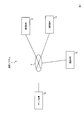
- FIG. 1 is a block diagram showing the configuration of a communication system of a first embodiment.
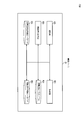
- FIG. 2 is a block diagram showing the configuration of a server apparatus according to the first embodiment.
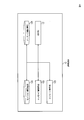
- FIG. 2 is a block diagram showing the configuration of a communication terminal that performs a message transmission operation according to the first embodiment.
- FIG. 2 is a block diagram showing the configuration of a communication terminal that performs a message reception operation according to the first embodiment.
- FIG. 7 is a block diagram showing the configuration of a communication terminal that performs the re-encryption key transmission operation of the first embodiment.
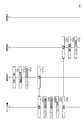
- FIG. 7 is a sequence diagram showing a re-encryption operation of the first embodiment.
- the common key cryptosystem is used for message encryption.
- a key used to encrypt a message (hereinafter, a message key) is encrypted with a session key using a common key-based re-encryption encryption method.
- the same message key is used after the session key is updated until the session key is updated next time.
- the server device stores the ciphertext of the message (hereinafter, message ciphertext) and the ciphertext of the message key (hereinafter, message key ciphertext) in separate tables (storage units).
- a key identifier (key ID) is added to make it possible to know which message key is being used for a message, and this is used as a key and stored in another table (storage unit).
- the server device updates only the table (storage unit) storing the message key ciphertext. Since a plurality of message ciphertexts are associated with one message key ciphertext by the key ID, the re-encryption target is reduced, and the load on the server device at the time of re-encryption processing is reduced. Since the message is never decrypted during the re-encryption process, the server device performs the re-encryption process without knowing the content of the message.
- KEM.Enc KEM.Dec
- KEM.ReKeyGen KEM.ReEnc
- KEM.Dec (SK j , C 1 (i) ) ⁇ K ' An algorithm that receives an element SK j of Kspace 1 and a ciphertext C 1 (i) and outputs an element K ′ of Kspace 2 .
- KEM.ReKeyGen (SK i1 , SK i2 ) ⁇ RK i1, i2
- Patent Document 1 As an example of the re-encryption method satisfying the above, the method of Patent Document 1 can be mentioned.
- Reference Non-Patent Document 1 D. Boneh, K. Lewi, H. Montgomery, and A. Raghunathan. 2015. Key Homo-morphic PRFs and Their Applications. Cryptology Print Archive, Report 2015/220. (2015).
- the common key cryptosystem consists of the following two algorithms (Enc, Dec), each of which has the following input / output: ⁇ Enc (K, m) ⁇ C 2 As input source K and the message m of Kspace 2, an algorithm that outputs the ciphertext C 2.
- ⁇ Dec (K, C 2 ) ⁇ m It is an algorithm that takes an element K of Kspace 2 and a ciphertext C 2 as input and outputs a message m.
- Examples of the encryption method that satisfies the above include AES and Camellia, but not limited here.
- the communication system 1 of the present embodiment includes a server device 10, a communication terminal 11, a communication terminal 12, and a communication terminal 13, and the respective devices are communicably connected by a network 9.
- the communication terminal 11, the communication terminal 12, and the communication terminal 13 can be realized by a personal computer, a smart phone or the like, but are not particularly limited.
- the communication terminal 11 is a terminal in charge of message encryption and transmission of the encrypted message and the like, and the communication terminal 12 is the reception and encrypted message of the encrypted message etc.
- the communication terminal 13 is a terminal in charge of the decryption of the key and the communication terminal 13 is in charge of generation and transmission of a re-encryption key described later.
- a communication terminal having all the functions of the communication terminal 11, the communication terminal 12, and the communication terminal 13 may be realized.
- each group is given an identifier.
- the users of the communication terminal 11, the communication terminal 12, and the communication terminal 13 are referred to as user A, user B, and user C, respectively. It is assumed that the user A, the user B, and the user C belong to the group having the group identifier groupID, and each communication terminal stores the groupID.
- the session key is, for each group, a key shared among communication terminals used by users belonging to the group.
- a protocol for sharing a key other than the communication terminal for example, a key without sharing any information regarding the session key with the server device 10.
- Reference Non-Patent Document 2 may be mentioned, but the session key sharing method is not particularly limited.
- Reference Non-Patent Document 2 K. Yoneyama, R. Yoshida, Y. Kawahara, T. Kobayashi, H. Fuji, and T. Yamamoto. 2016. Multi-Cast Key Distribution. Scalable, Dynamic and Provably Secure Construction. Cryptology ePrint Archive, Report 2016/833. (2016).
- the user is added to the group, the user leaves the group, a predetermined time elapses, and the session key is generated / updated every time the user logs in / out. I assume.
- the server device 10 includes a receiving unit 101, a message ciphertext storage unit 102, a message key ciphertext storage unit 103, a group user storage unit 104, a distribution unit 105, and a re-encryption process. Section 106 is included.
- the communication terminal 11 includes a determination unit 111, a message key generation unit 112, a message encryption unit 113, a message key encryption unit 114, a transmission unit 115, and a message key storage unit. And a session key storage unit 117. Further, as shown in FIG.
- the communication terminal 12 includes a receiving unit 121, a message key decryption unit 122, a message decryption unit 123, a session key storage unit 124, and a message key storage unit 125. Further, as shown in FIG. 5, the communication terminal 13 includes a re-encryption key generation unit 131, a transmission unit 132, and a session key storage unit 133.
- each device of the communication system 1 of the present embodiment uses the communication terminal 11 to send the message m in the form of ciphertext to the group identified by the group identifier groupID.
- Each communication terminal (communication terminal 11, communication terminal 12, communication terminal 13) is assumed to share the latest session key SK 1, this respective session key storage unit 117, a session key storage unit 124, a session key It is assumed that it is held in the storage unit 133.
- the session key SK 1 because it is not shared with the server apparatus 10, the server apparatus 10 does not know the session key SK 1.
- the message key generation unit 112 of the communication terminal 11 generates an element K 1 (message key) of Kspace 2 (S112-1).
- the message encryption unit 113 of the communication terminal 11 generates a message ciphertext C 2, m E Enc (K 1 , m) using the message m and the generated message key K 1 based on the common key encryption method. (S113).
- the message key encryption unit 114 of the communication terminal 11 uses the session key SK 1 and the generated message key K 1 to generate a message key ciphertext C (1) based on the re-encryptable common key encryption method. 1, K1 ⁇ KEM. Enc (SK 1 , K 1 ) is generated (S 114).
- the transmitting unit 115 of the communication terminal 11 has a group identifier groupID which is an identifier of a group to which the own terminal belongs, a message key ciphertext C (1) 1, K1, and a message ciphertext C 2, m , that is, (groupID, C (1) Send 1, 1 and C 2, m ) to the server device 10 (S115-1).
- (C (1) 1, K 1, C 2, m ) is simply described as K 1 , m for convenience in order to distinguish it from other messages and ciphertexts of other message keys.
- the message key K 1 and the message m are not inferred from the sentence.
- Communication terminal 11 after sending a message to the server apparatus 10, but stores the message key K 1 to the message key storage unit 116, to that message key identifier KeyID 1 is assigned to the message key K 1 at this point Do. It is desirable that the message key K 1 itself from the message key identifier KeyID 1 is not identified.
- the method of generating the identifier using a SHA256 hash function or the like there is a method to the output value when you enter the message key K 1 to SHA256 hash function identifier is not particularly limited.
- the message key identifier KeyID 1 may be generated by the communication terminal 11, or when the server device 10 receives a message, it is generated for the message key ciphertext, and the communication terminal 11 is notified that the message has been received. When notifying, KeyID 1 may be attached and transmitted, but it is not limited here.
- the message key generation unit 112 of the communication terminal 11 acquires message key K 1 and the message key identifier KeyID 1 (S112-2).
- the message key K 1 is a message key used to encrypt the message m when the at least one previous message transmission.
- Message encryption unit 113 of the communication terminal 11 using a message key K 1 stored in the message m and the message key storage unit 116, based on the common key cryptography, a message ciphertext C 2, m ⁇ Enc (K 1 , m) are generated (S113).
- the transmitting unit 115 of the communication terminal 11 transmits the group identifier groupID, the message key identifier KeyID 1, and the message ciphertext C 2, m , that is, (group ID, Key ID 1 , C 2, m ) to the server device 10 ( S115-2).
- the server device 10 receives the message ciphertext C 2, m from the communication terminal 11
- the delivery operation to another communication terminal is described by using the message reception as a trigger
- the server apparatus 10 stores the encrypted message in response to the addition of the user, the login, and the request from the other communication terminal. It may be distributed to the communication terminal.
- the message ciphertext storage unit 102 of the server device 10 stores the message key identifier KeyID 1 and the message ciphertext C 2, m , that is, (KeyID 1 , C 2, m ) (S102).
- the message key ciphertext storage unit 103 of the server device 10 stores the message key identifier KeyID 1 and the message key ciphertext C (1) 1, K 1, that is , ( Key ID 1 , C (1) 1, K 1). (S103-1).
- the server apparatus 10 executes the above operation (S101-1, S102, S103-1) every time data is received in the form of (group ID, C (1) 1, K1 , C 2, m ). .
- the server device 10 refers to the user (including the users B and C) belonging to the group corresponding to the group ID, which is stored in the group user storage unit 104 (S104).
- the delivery unit 105 of the server device 10 directs each user who belongs to the group corresponding to the group ID the message key ciphertext C (1) 1, K1 and the message ciphertext C 2, m , that is, (C (1) 1, K1 , C2 , m ) are transmitted (distributed) (S105).
- the server device 10 transmits (distributes) (C (1) 1, K 1 , C 2, m ) to the communication terminal 12.
- the message ciphertext storage unit 102 of the server device 10 stores the message key identifier KeyID 1 and the message ciphertext C 2, m , that is, (KeyID 1 , C 2, m ) (S102).
- the server apparatus 10 executes the above operation (S101-2 and S102) each time data is received in the form of (group ID, Key ID 1 , C 2, m ).
- the message key ciphertext storage unit 103 of the server device 10 acquires the message key ciphertext C (1) 1, K1 associated with the KeyID 1 (S103-2).
- the server device 10 refers to the user (including the users B and C) belonging to the group corresponding to the group ID, which is stored in the group user storage unit 104 (S104).
- the delivery unit 105 of the server device 10 directs each user who belongs to the group corresponding to the group ID the message key ciphertext C (1) 1, K1 and the message ciphertext C 2, m , that is, (C (1) 1, K1 , C2 , m ) are transmitted (distributed) (S105).
- the server device 10 transmits (distributes) (C (1) 1, K 1 , C 2, m ) to the communication terminal 12.
- the session key storage unit 124 is shared with another communication terminal, it stores the latest session key SK 1 that is not shared with the server device.
- the receiving unit 121 of the communication terminal 12 transmits the message key ciphertext C (1) 1, K1 and the message ciphertext C 2, m , that is, (C (1) 1, K1 , C 2, m ) to the server device 10 From S (S121).
- the message key decryption unit 122 of the communication terminal 12 obtains K 1 KE KEM.Dec (SK 1 , C 1 (1) Calculate 1, 1 and decrypt the message key K1 (S122).
- the message decryption unit 123 of the communication terminal 12 calculates m ⁇ Dec (K 1 , C 2, m ) from the decrypted message key K 1 and the message ciphertext C 2, m based on the common key encryption method. , And decrypt the message m (S123). Thus, the communication terminal 12 can correctly display the message m transmitted from the communication terminal 11.
- the operation of the communication terminal 13 will be described with reference to FIG.
- the communication terminal 11, communication terminal 12, communication terminal 13 shares the latest session key SK 2, the latest session key SK 2, respectively session key storage unit 117, a session key storage unit 124, a session key It is stored in the storage unit 133 (FIG. 8, sharing of a new session key).
- the session key storage unit 133 of the communication terminal 13, before updating the session key SK 1 are also assumed to hold.
- the server device 10 Since the session keys SK 1 and SK 2 are not shared with the server device 10, the server device 10 does not know the session keys SK 1 and SK 2 .
- the server device 10 the message key ciphertext storage unit 103, the ciphertext associated with groupID, i.e., the transmitted ciphertext group identifier groupID friendly, C (1) 1, Ki1 , ..., C ( 1) It shall hold 1 and Kin .
- i 1 ,..., I n are subscripts used to describe the present embodiment to distinguish message keys.
- the re-encryption key generation unit 131 of the communication terminal 13 uses RK 1,2 ⁇ KEM.ReKeyGen (SK 1 , SK) from the session key SK 1 before the update and the session key SK 2 after the update. 2 ) Calculate and generate the re-encryption key RK1, 2 (S131).
- Transmission unit 132 of the communication terminal 13 a group identifier groupID, the set of re-encryption key RK 1, 2, i.e. (groupID, RK 1, 2) transmits to the server device 10 (S132).
- the receiving unit 101 of the server device 10 receives a pair (group ID, RK 1 , 2 ) of the group identifier group ID and the re-encryption key RK 1 , 2 from the communication terminal 13 (S101-3).
- the re-encryption processing unit 106 of the server device 10 and the message key ciphertext storage unit 103 repeatedly execute the following process on each j ⁇ i 1 ,..., I n ⁇ .
- the message key ciphertext storage unit 103 takes out the message key ciphertext C (1) 1, Kj .
- the re-encryption processing unit 106 based on the re-encryptable common key encryption method, a re-encryption key RK 1, 2, message key ciphertext C (1) corresponding to the group identifier groupID from 1, Kj, Execute C (2) 1, Kj KE KEM.
- ReEnc (RK 1 , 2 , C (1) 1, Kj ) to generate a message key ciphertext C (2) 1, Kj after re-encryption ( S106).
- the message key ciphertext storage unit 103 overwrites and stores the message key ciphertext C (2) 1, Kj after re-encryption with respect to the message key ciphertext C (1) 1, Kj (S 103-3).
- the communication terminal that has received the ciphertext attached to the groupID distributed from the server device 10 correctly decrypts each message by the same operation as when receiving the message, as long as the latest session key SK 2 is held. can do.
- ⁇ Receive multiple messages> When logging in or adding a group, several messages such as 10 messages or 20 messages may be received at one time. The operation at that time will be described.
- the communication terminal 12 enters a predetermined group at login and downloads the latest five messages.
- the server device 10 extracts the latest 5 messages transmitted in the group from the message ciphertext storage unit 102.
- the server device 10 includes a pair of message key identifier and message key ciphertext (KeyID 1 , C 1, K 1 ), (KeyID 2 , C 1, K 2 ), (KeyID 3 , C 1, K 3 ) in the communication terminal 12.
- message key identifier and the message ciphertext pairs (KeyID 1, C 2, m1 ), (KeyID 1, C 2, m2), (KeyID 2, C 2, m3), (KeyID 1, C 2, m4), ( Send KeyID 3 , C 2 , m 5 ).
- Message key identifier and message key ciphertext pairs (KeyID 1, C 1, K1 ), (KeyID 2, C 1, K2), (KeyID 3, C 1, K3) with the message key identifier and the message ciphertext pairs ( KeyID 1, C 2, m1) , (KeyID 1, C 2, m2), (KeyID 2, C 2, m3), receive (KeyID 1, C 2, m4 ), (KeyID 3, C 2, m5) communication terminal and 12 from the session key storage unit 124 to retrieve the latest session key SK 1.
- the message key decryption unit 122 of the communication terminal 12 is configured such that K 1 KE KEM.Dec (SK 1 , C 1, K 1 ), K 2 KE KEM. Dec (SK 1 , C 1, K 2 ), K 3 KE KEM.
- K 1 KE KEM.Dec SK 1 , C 1, K 1
- K 2 KE KEM. Dec SK 1 , C 1, K 2
- K 3 KE KEM K 1 KE KEM.Dec
- K 1 , C 1, K 1 K 1
- K 2 KE KEM Dec
- K 3 KE KEM K 3 KE KEM.
- Each of SK 1 , C 1, and K 3 ) is calculated, the message keys K 1 , K 2 , and K 3 are decrypted, and a message key identifier and a message key pair (KeyID 1 , K 1 ) are stored in the message key storage unit 125.
- (KeyID 2 , K 2 ), and (KeyID 3 , K 3 )
- message decryption is performed. Since the message ciphertext is acquired in combination with the message key identifier, the corresponding message key is extracted and decryption processing is performed. That is, in the message decryption unit 123, m 1 D Dec (K 1 , C 2, m 1 ), m 2 (Dec (K 1 , C 2, m 2 ), m 3 D Dec (K 2 , C 2, m 3 ), m 4 D Dec (K 1 , C 2, m 4 ), m 5 ⁇ Dec (K 3 , C 2, m 5 ) is calculated, and each message is decoded. This can reduce the process of decrypting the message key ciphertext for each message, and can correctly display each message. It is desirable from the viewpoint of security that all message key identifiers and message key pairs stored in the message key storage unit 125 are deleted after all messages are acquired.
- the apparatus is, for example, an input unit to which a keyboard or the like can be connected, an output unit to which a liquid crystal display or the like can be connected as a single hardware entity, or a communication device (for example, communication cable) capable of communicating outside the hardware entity.
- Communication unit that can be connected, CPU (central processing unit, cache memory, registers, etc. may be provided), RAM or ROM that is memory, external storage device that is hard disk, input unit for these, output unit, communication unit , CPU, RAM, ROM, and a bus connected so as to enable exchange of data between external storage devices.
- the hardware entity may be provided with a device (drive) capable of reading and writing a recording medium such as a CD-ROM. Examples of physical entities provided with such hardware resources include general purpose computers.
- the external storage device of the hardware entity stores a program necessary for realizing the above-mentioned function, data required for processing the program, and the like (not limited to the external storage device, for example, the program is read) It may be stored in the ROM which is a dedicated storage device). In addition, data and the like obtained by the processing of these programs are appropriately stored in a RAM, an external storage device, and the like.
- each program stored in the external storage device (or ROM etc.) and data necessary for processing of each program are read into the memory as necessary, and interpreted and processed appropriately by the CPU .
- the CPU realizes predetermined functions (each component requirement expressed as the above-mentioned,...
- the present invention is not limited to the above-described embodiment, and various modifications can be made without departing from the spirit of the present invention. Further, the processing described in the above embodiment may be performed not only in chronological order according to the order of description but also may be performed in parallel or individually depending on the processing capability of the device that executes the processing or the necessity. .
- the processing function in the hardware entity (the apparatus of the present invention) described in the above embodiment is implemented by a computer, the processing content of the function that the hardware entity should have is described by a program. Then, by executing this program on a computer, the processing function of the hardware entity is realized on the computer.
- the program describing the processing content can be recorded in a computer readable recording medium.
- the computer readable recording medium any medium such as a magnetic recording device, an optical disc, a magneto-optical recording medium, a semiconductor memory, etc. may be used.
- a magnetic recording device a hard disk drive, a flexible disk, a magnetic tape or the like as an optical disk, a DVD (Digital Versatile Disc), a DVD-RAM (Random Access Memory), a CD-ROM (Compact Disc Read Only) Memory), CD-R (Recordable) / RW (Rewritable), etc. as magneto-optical recording medium, MO (Magneto-Optical disc) etc., as semiconductor memory, EEP-ROM (Electronically Erasable and Programmable Only Read Memory) etc. Can be used.
- this program is carried out, for example, by selling, transferring, lending, etc. a portable recording medium such as a DVD, a CD-ROM, etc. in which the program is recorded.
- this program may be stored in a storage device of a server computer, and the program may be distributed by transferring the program from the server computer to another computer via a network.
- a computer that executes such a program first temporarily stores a program recorded on a portable recording medium or a program transferred from a server computer in its own storage device. Then, at the time of execution of the process, the computer reads the program stored in its own recording medium and executes the process according to the read program. Further, as another execution form of this program, the computer may read the program directly from the portable recording medium and execute processing according to the program, and further, the program is transferred from the server computer to this computer Each time, processing according to the received program may be executed sequentially.
- ASP Application Service Provider
- the program in the present embodiment includes information provided for processing by a computer that conforms to the program (such as data that is not a direct command to the computer but has a property that defines the processing of the computer).
- the hardware entity is configured by executing a predetermined program on a computer, but at least a part of the processing content may be realized as hardware.
Landscapes
- Engineering & Computer Science (AREA)
- Computer Security & Cryptography (AREA)
- Computer Networks & Wireless Communication (AREA)
- Signal Processing (AREA)
- Computer Hardware Design (AREA)
- Computing Systems (AREA)
- General Engineering & Computer Science (AREA)
- Power Engineering (AREA)
- Information Transfer Between Computers (AREA)
- Mobile Radio Communication Systems (AREA)
Abstract
L'invention concerne un terminal de communication capable de réduire une charge sur un dispositif serveur en réutilisant une clé de message utilisée pour le chiffrement d'un message. Le terminal de communication comprend : une unité de stockage de clé de session pour stocker une clé de session qui est partagée avec d'autres terminaux de communication et n'est pas partagée avec un dispositif serveur; une unité de génération de clé de message pour générer une clé de message; une unité de stockage de clé de message pour stocker la clé de message à réutiliser en association avec un identifiant de clé de message; une unité de chiffrement de message pour générer un cryptogramme de message en utilisant le message et la clé de message sur la base d'un cryptosystème de clé commune; une unité de chiffrement de clé de message pour générer un cryptogramme de clé de message en utilisant la clé de session et la clé de message sur la base d'un cryptosystème de clé commune re-encryptable; et une unité de transmission de cryptogramme pour transmettre, au dispositif serveur, un identifiant de groupe en tant qu'identifiant d'un groupe auquel appartient ce terminal de communication, un cryptogramme de clé de message ou un identifiant de clé de message, et un cryptogramme de message.
Priority Applications (4)
| Application Number | Priority Date | Filing Date | Title |
|---|---|---|---|
| US16/758,936 US11336441B2 (en) | 2017-11-07 | 2018-10-31 | Communication terminal, server apparatus, and program |
| CN201880068770.6A CN111480313B (zh) | 2017-11-07 | 2018-10-31 | 通信终端、服务器装置、记录介质 |
| EP18875762.9A EP3709565B1 (fr) | 2017-11-07 | 2018-10-31 | Terminal de communication, dispositif serveur, et programme |
| JP2019552739A JP6939897B2 (ja) | 2017-11-07 | 2018-10-31 | 通信端末、プログラム |
Applications Claiming Priority (2)
| Application Number | Priority Date | Filing Date | Title |
|---|---|---|---|
| JP2017-214927 | 2017-11-07 | ||
| JP2017214927 | 2017-11-07 |
Publications (1)
| Publication Number | Publication Date |
|---|---|
| WO2019093201A1 true WO2019093201A1 (fr) | 2019-05-16 |
Family
ID=66437714
Family Applications (1)
| Application Number | Title | Priority Date | Filing Date |
|---|---|---|---|
| PCT/JP2018/040472 Ceased WO2019093201A1 (fr) | 2017-11-07 | 2018-10-31 | Terminal de communication, dispositif serveur, et programme |
Country Status (5)
| Country | Link |
|---|---|
| US (1) | US11336441B2 (fr) |
| EP (1) | EP3709565B1 (fr) |
| JP (1) | JP6939897B2 (fr) |
| CN (1) | CN111480313B (fr) |
| WO (1) | WO2019093201A1 (fr) |
Cited By (1)
| Publication number | Priority date | Publication date | Assignee | Title |
|---|---|---|---|---|
| CN115699670A (zh) * | 2020-06-17 | 2023-02-03 | 三菱电机株式会社 | 重加密装置、加密系统、重加密方法和重加密程序 |
Families Citing this family (4)
| Publication number | Priority date | Publication date | Assignee | Title |
|---|---|---|---|---|
| US12088728B2 (en) * | 2018-10-03 | 2024-09-10 | Panasonic Automotive Systems Company Of America, Division Of Panasonic Corporation Of North America | Secure controller area network in vehicles |
| WO2021138426A1 (fr) * | 2019-12-30 | 2021-07-08 | Dogwood Logic, Inc. | Contrôle décentralisé sécurisé d'accès réseau à des modèles et données d'ia |
| US12579284B2 (en) | 2020-07-06 | 2026-03-17 | Dogwood Logic, Inc. | Traceable decentralized control of network access to private information |
| JP2025016818A (ja) * | 2021-12-27 | 2025-02-05 | ソニーセミコンダクタソリューションズ株式会社 | 電子機器、情報処理方法 |
Citations (1)
| Publication number | Priority date | Publication date | Assignee | Title |
|---|---|---|---|---|
| JP2017005587A (ja) * | 2015-06-12 | 2017-01-05 | コニカミノルタ株式会社 | 暗号化システム、更新方法、および更新プログラム |
Family Cites Families (16)
| Publication number | Priority date | Publication date | Assignee | Title |
|---|---|---|---|---|
| US7356688B1 (en) * | 1999-04-06 | 2008-04-08 | Contentguard Holdings, Inc. | System and method for document distribution |
| US7181017B1 (en) * | 2001-03-23 | 2007-02-20 | David Felsher | System and method for secure three-party communications |
| US7082200B2 (en) * | 2001-09-06 | 2006-07-25 | Microsoft Corporation | Establishing secure peer networking in trust webs on open networks using shared secret device key |
| US7706540B2 (en) * | 2002-12-16 | 2010-04-27 | Entriq, Inc. | Content distribution using set of session keys |
| US20050195975A1 (en) * | 2003-01-21 | 2005-09-08 | Kevin Kawakita | Digital media distribution cryptography using media ticket smart cards |
| US8520844B2 (en) * | 2003-06-20 | 2013-08-27 | Alcatel Lucent | Methods and apparatus for providing secure two-party public key cryptosystem |
| JP4764639B2 (ja) * | 2005-01-28 | 2011-09-07 | 株式会社オーク情報システム | ファイルの暗号化・復号化プログラム、プログラム格納媒体 |
| US8291237B2 (en) * | 2005-03-01 | 2012-10-16 | The Regents Of The University Of California | Method for private keyword search on streaming data |
| US8630422B2 (en) * | 2009-11-10 | 2014-01-14 | International Business Machines Corporation | Fully homomorphic encryption method based on a bootstrappable encryption scheme, computer program and apparatus |
| US8515058B1 (en) * | 2009-11-10 | 2013-08-20 | The Board Of Trustees Of The Leland Stanford Junior University | Bootstrappable homomorphic encryption method, computer program and apparatus |
| US8954740B1 (en) * | 2010-10-04 | 2015-02-10 | Symantec Corporation | Session key proxy decryption method to secure content in a one-to-many relationship |
| WO2012149395A1 (fr) * | 2011-04-29 | 2012-11-01 | International Business Machines Corporation | Chiffrement complètement homomorphique |
| US9281941B2 (en) * | 2012-02-17 | 2016-03-08 | International Business Machines Corporation | Homomorphic evaluation including key switching, modulus switching, and dynamic noise management |
| US9380044B2 (en) * | 2014-09-10 | 2016-06-28 | Cisco Technology, Inc. | Supporting differentiated secure communications among heterogeneous electronic devices |
| WO2016051591A1 (fr) * | 2014-10-03 | 2016-04-07 | 株式会社 東芝 | Dispositif de génération de clé de rechiffrement, dispositif de rechiffrement, dispositif de chiffrement, dispositif de déchiffrement et programme |
| WO2016168487A1 (fr) * | 2015-04-14 | 2016-10-20 | Gigavation, Inc. | Protection contre des menaces de sécurité paravirtualisées d'un système commandé par ordinateur avec des dispositifs en réseau |
-
2018
- 2018-10-31 EP EP18875762.9A patent/EP3709565B1/fr active Active
- 2018-10-31 WO PCT/JP2018/040472 patent/WO2019093201A1/fr not_active Ceased
- 2018-10-31 CN CN201880068770.6A patent/CN111480313B/zh active Active
- 2018-10-31 JP JP2019552739A patent/JP6939897B2/ja active Active
- 2018-10-31 US US16/758,936 patent/US11336441B2/en active Active
Patent Citations (1)
| Publication number | Priority date | Publication date | Assignee | Title |
|---|---|---|---|---|
| JP2017005587A (ja) * | 2015-06-12 | 2017-01-05 | コニカミノルタ株式会社 | 暗号化システム、更新方法、および更新プログラム |
Non-Patent Citations (5)
Cited By (3)
| Publication number | Priority date | Publication date | Assignee | Title |
|---|---|---|---|---|
| CN115699670A (zh) * | 2020-06-17 | 2023-02-03 | 三菱电机株式会社 | 重加密装置、加密系统、重加密方法和重加密程序 |
| US20230087142A1 (en) * | 2020-06-17 | 2023-03-23 | Mitsubishi Electric Corporation | Re-encryption device, cryptographic system, re-encryption method, and computer readable medium |
| US12177346B2 (en) * | 2020-06-17 | 2024-12-24 | Mitsubishi Electric Corporation | Re-encryption device, cryptographic system, re-encryption method, and computer readable medium |
Also Published As
| Publication number | Publication date |
|---|---|
| JP6939897B2 (ja) | 2021-09-22 |
| EP3709565B1 (fr) | 2022-06-08 |
| EP3709565A4 (fr) | 2021-05-26 |
| JPWO2019093201A1 (ja) | 2020-12-03 |
| US11336441B2 (en) | 2022-05-17 |
| US20210184844A1 (en) | 2021-06-17 |
| CN111480313A (zh) | 2020-07-31 |
| CN111480313B (zh) | 2023-11-03 |
| EP3709565A1 (fr) | 2020-09-16 |
Similar Documents
| Publication | Publication Date | Title |
|---|---|---|
| US11316677B2 (en) | Quantum key distribution node apparatus and method for quantum key distribution thereof | |
| US10785019B2 (en) | Data transmission method and apparatus | |
| JP6363032B2 (ja) | 鍵付替え方向制御システムおよび鍵付替え方向制御方法 | |
| JP6939897B2 (ja) | 通信端末、プログラム | |
| CN111448779A (zh) | 用于混合秘密共享的系统、设备和方法 | |
| JP6348004B2 (ja) | 暗号化データ管理システム、プロキシサーバ、暗号化データ管理方法およびコンピュータプログラム | |
| JP6072806B2 (ja) | グループメンバによるグループ秘密の管理 | |
| JP6556955B2 (ja) | 通信端末、サーバ装置、プログラム | |
| WO2014010202A1 (fr) | Système, procédé et programme de traitement statistique crypté, système de décryptage, dispositif de génération de clé, dispositif mandataire et dispositif de génération de données statistiques cryptées | |
| CN112889240B (zh) | 服务器装置、通信终端、通信系统、以及记录介质 | |
| JP2019102970A (ja) | データ共有サーバ装置、鍵生成サーバ装置、通信端末、プログラム | |
| US11177949B2 (en) | Data sharing method, data sharing system, data sharing server, communication terminal and program | |
| JP6840685B2 (ja) | データ共有方法、データ共有システム、通信端末、データ共有サーバ、プログラム | |
| WO2020051833A1 (fr) | Procédé de traitement d'informations, dispositif terminal et système de réseau | |
| US9369442B2 (en) | System and method for the safe spontaneous transmission of confidential data over unsecure connections and switching computers | |
| JP7097581B2 (ja) | 通信システム、サーバ装置、通信方法、及びプログラム | |
| JP7254296B2 (ja) | 鍵交換システム、情報処理装置、鍵交換方法及びプログラム | |
| CN119519918A (zh) | 一种同态密文的处理方法、装置和计算设备 | |
| JP2025029419A (ja) | 暗号化装置、再暗号化装置および復号装置、ならびに、それらのプログラム | |
| JP2012253589A (ja) | 多重暗号化鍵配送システム、多重暗号化鍵配送方法、プログラム |
Legal Events
| Date | Code | Title | Description |
|---|---|---|---|
| 121 | Ep: the epo has been informed by wipo that ep was designated in this application |
Ref document number: 18875762 Country of ref document: EP Kind code of ref document: A1 |
|
| ENP | Entry into the national phase |
Ref document number: 2019552739 Country of ref document: JP Kind code of ref document: A |
|
| NENP | Non-entry into the national phase |
Ref country code: DE |
|
| ENP | Entry into the national phase |
Ref document number: 2018875762 Country of ref document: EP Effective date: 20200608 |