WO2019102705A1 - Procédé de production de ferromanganèse à teneur faible/intermédiaire en carbone - Google Patents
Procédé de production de ferromanganèse à teneur faible/intermédiaire en carbone Download PDFInfo
- Publication number
- WO2019102705A1 WO2019102705A1 PCT/JP2018/035103 JP2018035103W WO2019102705A1 WO 2019102705 A1 WO2019102705 A1 WO 2019102705A1 JP 2018035103 W JP2018035103 W JP 2018035103W WO 2019102705 A1 WO2019102705 A1 WO 2019102705A1
- Authority
- WO
- WIPO (PCT)
- Prior art keywords
- carbon ferromanganese
- manganese
- slag
- molten metal
- charged
- Prior art date
- Legal status (The legal status is an assumption and is not a legal conclusion. Google has not performed a legal analysis and makes no representation as to the accuracy of the status listed.)
- Ceased
Links
Images


Classifications
-
- C—CHEMISTRY; METALLURGY
- C22—METALLURGY; FERROUS OR NON-FERROUS ALLOYS; TREATMENT OF ALLOYS OR NON-FERROUS METALS
- C22C—ALLOYS
- C22C33/00—Making ferrous alloys
- C22C33/04—Making ferrous alloys by melting
Definitions
- the present invention relates to a method for producing medium to low carbon ferromanganese capable of improving manganese yield.
- silicon removal method a method called so-called silicon removal method.
- a silicomanganese melt having a target carbon content is prepared in an electric furnace or the like, and then manganese oxide such as manganese ore is charged into the melt to oxidize and remove silicon in the silicomanganese melt. It is.
- This method has a problem that the power cost is increased because an electric furnace is used.
- Patent Document 1 uses a converter-type reaction vessel, blows an inert gas from a tuyere provided at the furnace bottom to stir the molten metal, and oxygen from the upper blowing lance.
- a method is disclosed for producing medium to low carbon ferromanganese by oxidizing and removing carbon in a high carbon ferromanganese melt by blowing a gas.
- the temperature of the molten metal becomes high at the end of operation, so the evaporation loss of manganese, which is a main component, increases.
- it is carried out to form a slag covering the surface of the molten metal by charging a fowler into the reaction vessel before or during the beginning of the blowing.
- a slag forming material is charged to form a slag, there is a problem that manganese, which is a main component, is absorbed by the slag by the slag and eventually the loss of manganese increases.
- the present invention has been made in view of the above problems, and an object thereof is to provide a method for producing medium-to-low carbon ferromanganese capable of improving the yield of manganese as a total by suppressing both loss due to slag formation of manganese and evaporation loss. It is to provide.
- a high-carbon ferromanganese molten metal is charged into a reaction vessel equipped with a top blowing lance and a bottom blowing tuyere, and an oxygen-containing gas is blown from the top blowing lance and an inert gas from the bottom blowing tuyere.
- the loss of manganese due to the formation of slag can be suppressed, and the evaporation loss of manganese can be suppressed in the final stage of blowing in which the temperature of the molten metal rises. This can improve the yield of manganese in the production of medium and low carbon ferromanganese.
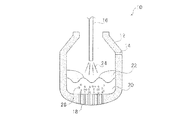
- FIG. 1 is a schematic cross-sectional view showing a state in which return slag is pre-charged in a converter-type reaction vessel.
- FIG. 2 is a schematic cross-sectional view showing a state in which high-carbon ferromanganese molten metal is decarburized and refined in a reaction vessel.
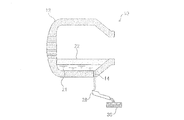
- FIG. 3 is a schematic cross-sectional view showing a state in which a low to medium carbon ferromanganese molten metal is poured into a mold.
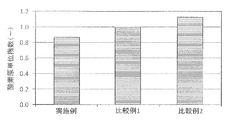
- FIG. 4 is a graph showing the manganese loss index of Example 1, Comparative Example 1 and Comparative Example 2.
- FIG. 5 is a graph showing the oxygen consumption index of Example 1, Comparative Example 1 and Comparative Example 2.
- FIG. 1 is a schematic cross-sectional view showing a state in which a return slag 32 is pre-charged together with a fender material 34 in a converter-type reaction vessel.
- the reaction vessel 10 is a converter-type reaction vessel, and includes a vessel body 12 for containing high carbon ferromanganese melt, and an upper blowing lance 16 for blowing oxygen-containing gas to the high carbon ferromanganese melt 20.
- a tapping spout 14 is provided on the side of the container body 12 for tapping the molten low- and medium-carbon ferromanganese melt 21 after the refining process, and an inert gas 26 is blown into the high-carbon ferromanganese melt 20 at the bottom of the container body 12.
- a plurality of bottom blowoffs 18 are provided.
- the return slag 32 is pre-charged into the container body 12 together with the iron-forming material 34 before the high-carbon ferromanganese molten metal is charged into the reaction container 10.
- the iron making material has a basicity of 0.5 or more and 1.5 or less
- the return slag is one obtained by cooling and crushing the slag produced by the decarburization and refining of the high carbon ferromanganese molten metal in the past. It is.
- the return slag 32 having a basicity (CaO / SiO 2 ) of 0.5 to 2.0 and a manganese concentration of 30 to 70% by mass is used.
- the return slag 32 may be charged during decarburization and refining.
- FIG. 2 is a schematic cross-sectional view showing a state in which the high carbon ferromanganese molten metal 20 is decarburized and refined using the reaction vessel.
- the high carbon ferromanganese molten metal 20 is charged into the container body 12.
- the high carbon ferromanganese molten metal 20 to be decarburized and refined in the reaction vessel 10 is produced, for example, by reduction smelting in a vertical smelting furnace.
- the high carbon ferromanganese molten metal 20 may be manufactured by reduction smelting using an electric furnace. Instead of pre-loading the filler material 34 and the return slag 32 into the container body 12, it is possible to leave the pre-charged slag in the container body 12.
- the charged amount of the return slag 32 pre-charged to the container body 12 is preferably 10 kg / t or more.
- kg / t indicates the mass of the return slag 32 charged per 1 t of the high carbon ferromanganese molten metal.
- the pre-loading amount of the return slag 32 is less than 10 kg / t, the manganese recovery amount from the return slag 32 is reduced, and the effect of improving the yield of manganese is reduced.
- the total amount of slag (the combined amount of the charged amount of the return slag 32 and the charged amount of the forging material 34) is too large, not only the heat balance is deteriorated but also the molten material is the furnace opening of the container body 12 There is also a high possibility of the occurrence of throttling blown out from the air. Therefore, the total amount of slag is preferably 40 kg / t or less.
- the upper limit of the charged amount of the return slag 32 is determined in consideration of the charged amount of the filler material 34 and the heat balance.
- the filler material 34 is charged in order to protect the furnace body or to generate a slag covering the surface of the molten metal.
- the wound filler material 34 is composed of components such as MgO, CaO and SiO 2 and is appropriately selected from, for example, calcined lime and dolomite.
- the composition and the amount of addition of the wound filler material 34 may be determined according to the operating conditions (operating temperature, furnace condition and the like).
- the high-carbon ferromanganese molten metal 20 charged in the container body 12 is blown with the inert gas 26 from the bottom blowing nozzle 18 and stirred, and the oxygen-containing gas 24 is blown from the upper blowing lance 16.
- the carbon contained in the high carbon ferromanganese melt 20 is oxidized and removed.
- the oxygen-containing gas 24 blown from the upper blowing lance 16 for example, a mixed gas of oxygen and a non-oxidizing gas for reducing the oxygen partial pressure such as a rare gas may be used, and an oxygen gas containing only oxygen is used. It is also good.
- argon gas may be used as the inert gas 26 blown from the bottom blowing nozzle 18.
- the filler material 34 and the return slag 32 are melted by the high carbon ferromanganese melt 20. Thereby, the slag 22 which covers the surface of the high carbon ferromanganese molten metal 20 is formed.
- the oxygen-containing gas 24 is continuously blown and the inert gas 26 is continuously blown until the carbon concentration of the high carbon ferromanganese molten metal 20 decreases to a predetermined concentration, and the carbon contained in the high carbon ferromanganese molten metal 20 is Remove by oxidation. Furthermore, MnO contained in the slag 22 formed on the surface of the high carbon ferromanganese melt 20 reacts with carbon contained in the high carbon ferromanganese melt 20 (MnO + C ⁇ Mn + CO). As a result, manganese contained in the return slag 32 can be recovered, and oxygen contained in the return slag 32 can also be recovered. The reaction of MnO contained in the slag 22 with carbon contained in the high-carbon ferromanganese melt 20 improves the manganese yield and reduces the oxygen basic unit.
- the slag 22 formed on the surface of the high carbon ferromanganese melt 20 plays a role of suppressing the evaporation of manganese in the ferromanganese melt. Thereby, the evaporation loss of manganese is suppressed and the manganese yield can be further improved.
- the high carbon ferromanganese molten metal 20 is decarburized to a carbon concentration of 2.0% by mass or less when producing medium carbon ferromanganese, and when producing low carbon ferromanganese, the carbon concentration is 1 It is decarburized to less than 0 mass%.
- the carbon concentration of the high carbon ferromanganese molten metal 20 during the decarburizing treatment is the measured value of the carbon concentration of the high carbon ferromanganese molten metal 20 which has been drained from the vertical type smelting furnace and the oxygen-containing gas 24 blown from the upper blowing lance 16. It can be estimated from the amount supplied and the decarboxylation elemental efficiency of the ferromanganese molten metal obtained empirically. Therefore, the supply amount of oxygen calculated from the measured value of the carbon concentration of the high carbon ferromanganese melt 20, the carbonation efficiency, and the target carbon concentration is the high carbon ferromanganese melt 20 as the oxygen-containing gas 24.
- the carbon concentration of the high carbon ferromanganese molten metal 20 has decreased to the above-described carbon concentration by being supplied to the.
- the high carbon ferromanganese molten metal 20 may be collected to measure the carbon concentration, and it may be confirmed that there is no difference between the estimated value and the actual value of the carbon concentration of the high carbon ferromanganese molten metal 20.
- FIG. 3 is a schematic cross-sectional view showing a state in which a low to medium carbon ferromanganese molten metal is poured into a mold.
- the container body 12 is tilted from the low-carbon ferromanganese molten metal 21 whose carbon concentration has been reduced by decarburization, and is poured from the outlet 14 to the mold 30 through the crucible 28.
- the low-carbon ferromanganese molten metal 21 that has been poured into the mold 30 is air-cooled and sprinkled-cooled in the mold 30 to produce medium-low-carbon ferromanganese.
- the carbonization material 34 and the return slag 32 are pre-charged in the container body 12 and then the high-carbon ferromanganese molten metal 20 is charged to decarburize. Do the refining. Thereby, the slag 22 can be formed on the surface of the high carbon ferromanganese molten metal 20, the loss due to the formation of manganese slag and the evaporation loss can be suppressed, and the yield of manganese is improved.
- MnO contained in the slag 22 formed on the surface decarburizes with the carbon of the high-carbon ferromanganese molten metal 20, manganese can be recovered without using oxygen blown from the upper blowing lance 16. As a result, the yield of manganese can be further improved, and the oxygen consumption can be reduced.
- the example which pre-charges the steelmaking material 34 and the return slag 32 to the container main body 12 was shown as a manufacturing method of the medium to low carbon ferro manganese which concerns on this embodiment, it is not restricted to this.
- the iron-forming material 34 and the return slag 32 may be charged into the container body 12.
- the iron making material 34 and the return slag 32 may be charged into the container body 12, and the iron making material 34 and return slag before the decarburizing refining and during the decarburizing refining 32 may be loaded into the container body 12.
- the iron making material 34 and the return slag 32 are charged after the start of the decarburization refining, the iron making material 34 and the return slag 32 are melted to form the slag 22 before the evaporation loss of manganese becomes severe. It is preferable to charge the wound material 34 and the return slag 32 into the container body 12 as described above.
- the example which charges return slag 32 in container main part 12 in addition to iron-making material 34 was shown as a manufacturing method of medium- and low-carbon ferromanganese concerning this embodiment, it is not restricted to this.
- the return slag 32 one containing 20% by mass or more of manganese oxide, such as manganese ore, may be charged into the container body 12.
- manganese ore it is preferable to use manganese ore having a large content of manganese oxide. By using manganese ore having a high content of manganese oxide, the amount of manganese that can be recovered from the slag during decarburization and refining increases.
- the converter type of the converter type is shown in FIG. 1 with 20 kg / t of return slag having 10 kg / t of iron-making material, 1.5 basicity (CaO / SiO 2 ) and 40% by mass of manganese concentration.
- the high carbon ferromanganese molten metal which was previously charged in a reaction vessel having the same configuration as the reaction vessel 10 and then reduced and smelted in a vertical type smelting furnace was charged and decarburization refining was performed.
- Argon gas was blown into the high carbon ferromanganese melt from the bottom blowing nozzle, and oxygen gas was blown from the top blowing lance into the high carbon ferromanganese melt to carry out decarburization refining.
- the blowing of oxygen gas from the upper blowing lance was stopped to complete the decarburizing and refining.
- the ferromanganese molten metal was poured into a mold, and the ferromanganese molten metal was air-cooled and sprinkled-cooled in the mold to produce low carbon ferromanganese.
- the components of the low carbon ferromanganese thus produced are: Mn: 75.3% by mass, Fe: 23.1% by mass, Si: 0.3% by mass, C: 1.0% by mass, P: 0 It was .14 mass%.
- the slag loss and dust loss of manganese in the low carbon ferromanganese production of the example the amount of manganese contained in the high carbon ferromanganese melt charged and the amount of manganese contained in the produced slag And the amount of manganese contained in the generated dust.
- the oxygen basic unit which is the amount of oxygen used to produce 1 ton of low carbon ferromanganese, was calculated.
- Comparative Example 1 30 kg / t of iron-forming material is pre-charged to the same reaction vessel as in the example without pre-charging return slag, and thereafter, it is manufactured by reduction kneading in a vertical type smelting furnace
- the high carbon ferromanganese melt was charged into the same reaction vessel as in the example.
- Argon gas was blown into the high carbon ferromanganese melt from the bottom blowing nozzle, and oxygen gas was blown from the top blowing lance into the high carbon ferromanganese melt to carry out decarburization refining.
- the blowing of oxygen gas from the upper blowing lance was stopped to complete the decarburizing and refining. Thereafter, the ferromanganese molten metal was poured into a mold, and the mold was air-cooled and sprinkled-cooled to produce low carbon ferromanganese.
- the components of the low carbon ferromanganese thus produced are: Mn: 75.2% by mass, Fe: 23.2% by mass, Si: 0.3% by mass, C: 1.0% by mass, P: 0 It was .15 mass%.
- the slag loss and dust loss of manganese in the low carbon ferromanganese production of Comparative Example 1 After producing low carbon ferromanganese, the slag loss and dust loss of manganese in the low carbon ferromanganese production of Comparative Example 1, the amount of manganese contained in the high carbon ferromanganese molten metal charged and the amount of manganese contained in the produced slag And the amount of manganese contained in the generated dust.
- the oxygen basic unit which is the amount of oxygen used to produce 1 ton of low carbon ferromanganese, was calculated.
- Comparative Example 2 40 kg / t of steel material is pre-charged to the same reaction vessel as in the example without pre-charging return slag, and thereafter, it is manufactured by reduction kneading in a vertical type smelting furnace
- the high carbon ferromanganese melt was charged into the same reaction vessel as in the example.
- Argon gas was blown into the high carbon ferromanganese melt from the bottom blowing nozzle, and oxygen gas was blown from the top blowing lance into the high carbon ferromanganese melt to carry out decarburization refining.
- the blowing of oxygen gas from the upper blowing lance was stopped to complete the decarburizing and refining. Thereafter, the ferromanganese molten metal was poured into a mold, and the mold was air-cooled and sprinkled-cooled to produce low carbon ferromanganese.
- the components of the low carbon ferromanganese thus produced are: Mn: 75.1% by mass, Fe: 23.3% by mass, Si: 0.3% by mass, C: 1.0% by mass, P: 0 It was .15 mass%.
- the slag loss and dust loss of manganese in the low carbon ferromanganese production of Comparative Example 2 After producing low carbon ferromanganese, the slag loss and dust loss of manganese in the low carbon ferromanganese production of Comparative Example 2, the amount of manganese contained in the high carbon ferromanganese molten metal charged and the amount of manganese contained in the produced slag And the amount of manganese contained in the generated dust.
- the oxygen basic unit which is the amount of oxygen used to produce 1 ton of low carbon ferromanganese, was calculated.
- FIG. 4 is a graph showing the manganese loss index of Example, Comparative Example 1 and Comparative Example 2.
- the vertical axis in FIG. 4 is a manganese loss index (-) obtained by indexing the manganese loss of the example and the comparative example 2 with the sum of the manganese loss due to the slag and the dust of the comparative example 1 as 100. For this reason, in FIG. 4, the sum of the manganese loss index of Comparative Example 1 is 100.
- (-) Means dimensionless.
- FIG. 5 is a graph showing the oxygen consumption index of the example, the comparative example 1 and the comparative example 2.
- the vertical axis in FIG. 5 is an oxygen unit index ( ⁇ ) obtained by indexing the oxygen unit of the example and the comparative example 2 with the oxygen unit of Comparative Example 1 as 1. For this reason, in FIG. 5, the oxygen consumption index of Comparative Example 1 is 1.
- Comparative Example 2 As shown in FIG. 5, compared with Comparative Example 1 in which only 30 kg / t of the filler material is charged, the oxygen consumption rate is increased in Comparative Example 2 in which the charge amount of the filler material is increased to 40 kg / t. . As shown in FIG. 4, in Comparative Example 2, the amount of slag loss of manganese increases, so a large amount of oxygen is used to oxidize manganese for that amount, thereby increasing the oxygen basic unit.
- the surface of the ferromanganese molten metal is increased without increasing the amount of slag loss of manganese and the oxygen consumption rate by pre-charging the return slag generated by decarburizing and refining of the high carbon ferromanganese molten metal in the past.
- carbon in the high-carbon ferromanganese melt is decarburized by MnO in the slag, the basic unit of oxygen blown from the upper blowing lance is reduced.
- reaction container 12 container main body 14 outlet 16 top blow lance 18 bottom blow nozzle 20 high carbon ferromanganese molten metal 21 middle and low carbon ferromanganese molten metal 22 slag 24 oxygen containing gas 26 inert gas 28 ⁇ 30 mold 32 return slag 34 construction Firewood
Landscapes
- Chemical & Material Sciences (AREA)
- Engineering & Computer Science (AREA)
- Materials Engineering (AREA)
- Mechanical Engineering (AREA)
- Metallurgy (AREA)
- Organic Chemistry (AREA)
- Carbon Steel Or Casting Steel Manufacturing (AREA)
- Treatment Of Steel In Its Molten State (AREA)
Abstract
L'invention concerne un procédé de production de ferromanganèse à teneur faible/intermédiaire en carbone apte à améliorer le rendement global du manganèse, par la réduction aussi bien de la perte due à la formation de laitier de manganèse que de la perte due à l'évaporation. Le procédé de production de ferromanganèse à teneur faible/intermédiaire en carbone réalise un raffinage par décarburation, par chargement d'une masse fondue de ferromanganèse à teneur élevée en carbone dans un récipient de réaction présentant une lance de soufflage supérieure et une tuyère de soufflage inférieure, et par soufflage d'un gaz contenant de l'oxygène à partir de la lance de soufflage supérieure tout en soufflant un gaz inerte à partir de la tuyère de soufflage inférieure ; avant et/ou pendant le raffinage par décarburation de la masse fondue de ferromanganèse à teneur élevée en carbone, le laitier de retour formé pendant le raffinage par décarburation passé de ferromanganèse à teneur élevée en carbone étant chargé dans le récipient de réaction.
Priority Applications (2)
| Application Number | Priority Date | Filing Date | Title |
|---|---|---|---|
| MYPI2020002381A MY195752A (en) | 2017-11-27 | 2018-09-21 | Medium- Or Low-Carbon Ferromanganese Production Method |
| ZA2020/03036A ZA202003036B (en) | 2017-11-27 | 2020-05-22 | Low/medium-carbon ferromanganese production method |
Applications Claiming Priority (2)
| Application Number | Priority Date | Filing Date | Title |
|---|---|---|---|
| JP2017-226583 | 2017-11-27 | ||
| JP2017226583A JP2021028404A (ja) | 2017-11-27 | 2017-11-27 | 中低炭素フェロマンガンの製造方法 |
Publications (1)
| Publication Number | Publication Date |
|---|---|
| WO2019102705A1 true WO2019102705A1 (fr) | 2019-05-31 |
Family
ID=66631539
Family Applications (1)
| Application Number | Title | Priority Date | Filing Date |
|---|---|---|---|
| PCT/JP2018/035103 Ceased WO2019102705A1 (fr) | 2017-11-27 | 2018-09-21 | Procédé de production de ferromanganèse à teneur faible/intermédiaire en carbone |
Country Status (4)
| Country | Link |
|---|---|
| JP (1) | JP2021028404A (fr) |
| MY (1) | MY195752A (fr) |
| WO (1) | WO2019102705A1 (fr) |
| ZA (1) | ZA202003036B (fr) |
Cited By (1)
| Publication number | Priority date | Publication date | Assignee | Title |
|---|---|---|---|---|
| EP4116443A4 (fr) * | 2020-03-06 | 2024-05-22 | JFE Steel Corporation | Procédé de production de ferromanganèse pauvre en carbone |
Citations (3)
| Publication number | Priority date | Publication date | Assignee | Title |
|---|---|---|---|---|
| JPS61272346A (ja) * | 1985-05-29 | 1986-12-02 | Nippon Steel Corp | 高マンガン鉄合金の溶融還元精錬方法 |
| JPH03100140A (ja) * | 1989-09-13 | 1991-04-25 | Kawasaki Steel Corp | 中・低炭素フェロマンガンの溶製方法 |
| JP2000297313A (ja) * | 1999-04-09 | 2000-10-24 | Kobe Steel Ltd | フェロマンガン製造時の副成スラグの再利用方法 |
-
2017
- 2017-11-27 JP JP2017226583A patent/JP2021028404A/ja active Pending
-
2018
- 2018-09-21 WO PCT/JP2018/035103 patent/WO2019102705A1/fr not_active Ceased
- 2018-09-21 MY MYPI2020002381A patent/MY195752A/en unknown
-
2020
- 2020-05-22 ZA ZA2020/03036A patent/ZA202003036B/en unknown
Patent Citations (3)
| Publication number | Priority date | Publication date | Assignee | Title |
|---|---|---|---|---|
| JPS61272346A (ja) * | 1985-05-29 | 1986-12-02 | Nippon Steel Corp | 高マンガン鉄合金の溶融還元精錬方法 |
| JPH03100140A (ja) * | 1989-09-13 | 1991-04-25 | Kawasaki Steel Corp | 中・低炭素フェロマンガンの溶製方法 |
| JP2000297313A (ja) * | 1999-04-09 | 2000-10-24 | Kobe Steel Ltd | フェロマンガン製造時の副成スラグの再利用方法 |
Cited By (2)
| Publication number | Priority date | Publication date | Assignee | Title |
|---|---|---|---|---|
| EP4116443A4 (fr) * | 2020-03-06 | 2024-05-22 | JFE Steel Corporation | Procédé de production de ferromanganèse pauvre en carbone |
| US12473605B2 (en) | 2020-03-06 | 2025-11-18 | Jfe Steel Corporation | Method for producing low-carbon ferromanganese |
Also Published As
| Publication number | Publication date |
|---|---|
| ZA202003036B (en) | 2022-03-30 |
| JP2021028404A (ja) | 2021-02-25 |
| MY195752A (en) | 2023-02-09 |
Similar Documents
| Publication | Publication Date | Title |
|---|---|---|
| US20080156144A1 (en) | Method for reducing to metallic chromium the chromium oxide in slag from stainless steel processing | |
| CN103409595B (zh) | 一种含钒铁水脱磷炼钢的方法 | |
| JP6962934B2 (ja) | 中低炭素フェロマンガンの製造方法および中低炭素フェロマンガン | |
| CN112322958A (zh) | 低碳含铝钢及其冶炼控制方法 | |
| CN107502704B (zh) | 一种降低半钢炼钢铸坯中氧化铝夹杂的方法 | |
| JPH10130714A (ja) | 伸線性及び清浄度に優れた線材用鋼の製造方法 | |
| JPH044388B2 (fr) | ||
| JPS63290242A (ja) | 低炭素低シリコンフェロマンガンの製造方法およびその実施のための転炉およびランス | |
| JP3580096B2 (ja) | 低Mn鋼の溶製方法 | |
| JP2006206957A (ja) | マンガン系合金鉄製造時に発生するスラグからのマンガン回収方法 | |
| JPH09235611A (ja) | 清浄性の高い極低硫純鉄の製造方法 | |
| JP2021028404A (ja) | 中低炭素フェロマンガンの製造方法 | |
| JPH0437136B2 (fr) | ||
| JP2003147430A (ja) | 製鋼用還元剤及び製鋼方法 | |
| JP6726777B1 (ja) | 低炭素フェロマンガンの製造方法 | |
| JP4461495B2 (ja) | 溶銑の脱燐精錬方法 | |
| JP3158912B2 (ja) | ステンレス鋼の精錬方法 | |
| JPH0355538B2 (fr) | ||
| JP7036993B2 (ja) | 低炭素フェロマンガンの製造方法 | |
| JP2000212623A (ja) | 生石灰の少ない溶銑脱燐方法 | |
| JP2587286B2 (ja) | 製鋼方法 | |
| JPH11343514A (ja) | 底吹転炉を用いた高炭素溶鋼の溶製方法 | |
| JPH01312020A (ja) | 溶銑の昇温脱燐法 | |
| JPH01316437A (ja) | 中、低炭素フェロマンガンの製造方法 | |
| WO2024202742A1 (fr) | Procédé de fonctionnement pour four de fabrication d'acier |
Legal Events
| Date | Code | Title | Description |
|---|---|---|---|
| 121 | Ep: the epo has been informed by wipo that ep was designated in this application |
Ref document number: 18880230 Country of ref document: EP Kind code of ref document: A1 |
|
| NENP | Non-entry into the national phase |
Ref country code: DE |
|
| 122 | Ep: pct application non-entry in european phase |
Ref document number: 18880230 Country of ref document: EP Kind code of ref document: A1 |
|
| NENP | Non-entry into the national phase |
Ref country code: JP |