WO2019102746A1 - Dispositif d'enseignement direct pour robots et procédé associé - Google Patents
Dispositif d'enseignement direct pour robots et procédé associé Download PDFInfo
- Publication number
- WO2019102746A1 WO2019102746A1 PCT/JP2018/038332 JP2018038332W WO2019102746A1 WO 2019102746 A1 WO2019102746 A1 WO 2019102746A1 JP 2018038332 W JP2018038332 W JP 2018038332W WO 2019102746 A1 WO2019102746 A1 WO 2019102746A1
- Authority
- WO
- WIPO (PCT)
- Prior art keywords
- force
- input pattern
- robot
- direct teaching
- articulated robot
- Prior art date
- Legal status (The legal status is an assumption and is not a legal conclusion. Google has not performed a legal analysis and makes no representation as to the accuracy of the status listed.)
- Ceased
Links
Images


Classifications
-
- G—PHYSICS
- G05—CONTROLLING; REGULATING
- G05B—CONTROL OR REGULATING SYSTEMS IN GENERAL; FUNCTIONAL ELEMENTS OF SUCH SYSTEMS; MONITORING OR TESTING ARRANGEMENTS FOR SUCH SYSTEMS OR ELEMENTS
- G05B19/00—Program-control systems
- G05B19/02—Program-control systems electric
- G05B19/42—Recording and playback systems, i.e. in which the program is recorded from a cycle of operations, e.g. the cycle of operations being manually controlled, after which this record is played back on the same machine
- G05B19/423—Teaching successive positions by walk-through, i.e. the tool head or end effector being grasped and guided directly, with or without servo-assistance, to follow a path
-
- B—PERFORMING OPERATIONS; TRANSPORTING
- B25—HAND TOOLS; PORTABLE POWER-DRIVEN TOOLS; MANIPULATORS
- B25J—MANIPULATORS; CHAMBERS PROVIDED WITH MANIPULATION DEVICES
- B25J19/00—Accessories fitted to manipulators, e.g. for monitoring, for viewing; Safety devices combined with or specially adapted for use in connection with manipulators
- B25J19/02—Sensing devices
-
- B—PERFORMING OPERATIONS; TRANSPORTING
- B25—HAND TOOLS; PORTABLE POWER-DRIVEN TOOLS; MANIPULATORS
- B25J—MANIPULATORS; CHAMBERS PROVIDED WITH MANIPULATION DEVICES
- B25J9/00—Program-controlled manipulators
- B25J9/16—Program controls
- B25J9/1628—Program controls characterised by the control loop
- B25J9/163—Program controls characterised by the control loop learning, adaptive, model based, rule based expert control
-
- B—PERFORMING OPERATIONS; TRANSPORTING
- B25—HAND TOOLS; PORTABLE POWER-DRIVEN TOOLS; MANIPULATORS
- B25J—MANIPULATORS; CHAMBERS PROVIDED WITH MANIPULATION DEVICES
- B25J9/00—Program-controlled manipulators
- B25J9/16—Program controls
- B25J9/1628—Program controls characterised by the control loop
- B25J9/1633—Program controls characterised by the control loop compliant, force, torque control, e.g. combined with position control
-
- G—PHYSICS
- G05—CONTROLLING; REGULATING
- G05B—CONTROL OR REGULATING SYSTEMS IN GENERAL; FUNCTIONAL ELEMENTS OF SUCH SYSTEMS; MONITORING OR TESTING ARRANGEMENTS FOR SUCH SYSTEMS OR ELEMENTS
- G05B19/00—Program-control systems
- G05B19/02—Program-control systems electric
- G05B19/42—Recording and playback systems, i.e. in which the program is recorded from a cycle of operations, e.g. the cycle of operations being manually controlled, after which this record is played back on the same machine
-
- G—PHYSICS
- G05—CONTROLLING; REGULATING
- G05B—CONTROL OR REGULATING SYSTEMS IN GENERAL; FUNCTIONAL ELEMENTS OF SUCH SYSTEMS; MONITORING OR TESTING ARRANGEMENTS FOR SUCH SYSTEMS OR ELEMENTS
- G05B2219/00—Program-control systems
- G05B2219/30—Nc systems
- G05B2219/36—Nc in input of data, input key till input tape
- G05B2219/36343—Select machining method as function of selected tool
Definitions
- the present invention relates to a direct teaching apparatus and method for a robot that applies an operating force to the robot to directly teach the position of its hand.
- the present invention solves the above-mentioned problems, and a robot direct teaching apparatus and method that can selectively use high-speed movement and high-precision movement at the time of teaching work to a robot without reducing the teaching efficiency. Intended to provide.
- the robot direct teaching apparatus detects the operation force applied to the articulated robot having a plurality of axes by the force sensor, and moves the articulated robot according to the force control of the force control unit based on the detection result.
- a force estimation unit for estimating the operation force applied to the axis, and an input of the operation force estimated by the force estimation unit
- An input pattern classification unit that classifies patterns according to preset input pattern types, and a force control switching unit that switches force control of the force control unit according to the input pattern of the operating force classified by the input pattern classification unit And.
- the operation force applied to the articulated robot having a plurality of axes is detected by a force sensor, and the articulated robot is moved according to the force control based on the detection result.
- the direct teaching method of the robot for direct teaching the operating force applied to the axis is estimated based on the detection result of the force sensor, and the input pattern of the estimated operating force is set for each type of input pattern set in advance. According to the classified and classified input pattern of the operating force, the force control is switched.
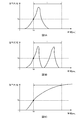
- FIG. 5A is a diagram showing an input pattern of operation force corresponding to high-precision translational movement.
- FIG. 5B is a diagram showing an input pattern of an operating force corresponding to high precision rotational movement.
- 5C is a diagram showing an input pattern of an operating force corresponding to high speed movement. It is a figure showing the movement form of the link member corresponding to the worker's operation pattern.
- FIG. 1 is an external view showing a configuration example of an articulated robot 10 to which a robot direct teaching device according to a first embodiment of the present invention is applied.
- the articulated robot 10 includes a base 11 and an arm 12 supported by the base 11.
- the arm 12 has six degrees of freedom, and includes six link members 21a to 21f, six joint parts 22a to 22f, and a hand part 23. That is, the articulated robot 10 is a general six-axis articulated robot.
- the robot direct teaching device and method according to the present invention do not lose their essence depending on the configuration and the degree of freedom of the articulated robot.
- the link members 21a to 21f respectively have axes J1 to J6, and are disposed in order from the base end side of the arm 12 toward the tip end side.
- the end portion 23 is provided at the end of the link member 21 f and constitutes the end of the arm 12.
- the joint portions 22a to 22f are between the base 11 and the link member 21a, between the link members 21a and 21b, between the link members 21b and 21c, between the link members 21c and 21d, between the link members 21d and 21e, and 21e and 21f are connected to each other. Further, the joint portions 22a to 22f rotatably support the link members 21a to 21f around the axes J1 to J6.
- the operator When performing the teaching operation for the articulated robot 10, the operator operates any one of the link members 21a to 22f. That is, the operating force applied by the operator acts on a plurality of axes among the six axes J1 to J6, and the axes J1 to J6 on which the operating force is applied move as the operating axis, and the entire arm 12 Move it. At this time, the position and posture of the hand portion 23 are taught because the hand portion 23 translates or rotationally moves with linear or rotational movement of the operation axis.
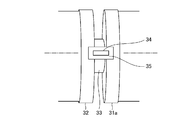
- FIG. 2 is a view showing the installation state of the torque sensor 34 in each of the joint portions 22a to 22f.
- the rotary shaft 31a of the motor 31, the central shaft 32 of the link members 21a to 21f, the connecting shaft 33, and the torque sensor 34 serving as a force sensor are provided in each of the joint portions 22a to 22f. It is done.
- the motor 31 rotates the link members 21a to 21f around the central axis 32 thereof.
- the torque sensor 34 detects an operation force acting on the central axis 32 of each of the link members 21a to 21f.
- the rotating shaft 31 a of the motor 31 and the central shaft 32 are connected via the connecting shaft 33.
- the shaft diameter of the connecting shaft 33 is smaller than the shaft diameter of the rotary shaft 31 a and the shaft diameter of the central shaft 32.
- the joint shafts of the rotary shaft 31a, the central shaft 32, and the connecting shaft 33 of the motor 31 and the joint portions 22a to 22f are coaxial with the respective axes J1 to J6. That is, the rotation axis 31a, the center axis 32, and the connection axis 33 rotate around the axes J1 to J6.
- the torque sensor 34 is attached to the rotating shaft 31 a and the central shaft 32 via the mounting plate 35, and rotates with the shafts 31 a and 32.
- the mounting plate 35 is provided between the outer peripheral surface of the rotary shaft 31 a and the outer peripheral surface of the central shaft 32 so as to bridge an axial gap formed therebetween.
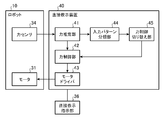
- FIG. 3 is a block diagram showing the configuration of a direct teaching device 40 for a robot according to Embodiment 1 of the present invention.
- the direct teaching device 40 shown in FIG. 3 enables the worker to directly teach the articulated robot 10, and is connected to the articulated robot 10 and the direct teaching instruction unit 36.
- the direct teaching instruction unit 36 is used when the operator instructs the teaching device 40 to directly teach the articulated robot 10. The operator can select execution or stop of direct teaching to the articulated robot 10 by switching operation of the direct teaching instruction unit 36.
- the direct teaching device 40 includes a force estimation unit 41, a force control unit 42, a motor driver 43, an input pattern classification unit 44, and a force control switching unit 45.
- the force estimation unit 41 estimates, based on the output result of the torque sensor 34, the link members 21a to 21f to which the operating force is applied by the operator, and the magnitude (input pattern) of the operating force.
- the force control unit 42 controls the drive of the motor driver 43 based on the estimation result of the force estimation unit 41.
- the motor driver 43 controls the rotation angle of the motor 31.
- the force control unit 42 controls the drive of the motor driver 43 based on the link members 21a to 21f to which the operating force is directly applied and the magnitude of the operating force, and the rotation angle of each motor 31 Adjust the
- the direct teaching device 40 operates the arm 12 based on the operation force, guides the hand portion 23 thereof to a working position as a target position, and teaches the working position.
- the hand portion 23 contacts the work object from any direction, in any posture, and with any force.
- This preset input pattern is an input pattern of the operating force, and a time when the applied operating force exceeds a predetermined threshold is set as an input start time, and the magnitude of the operating force is from the input start time It is classified into a plurality of types according to how it changes within a predetermined period.
- an input pattern in which the applied operating force is equal to or less than the threshold within a predetermined period from the input start time is taken as the input pattern of the operating force corresponding to the high precision movement of the arm 12. Further, an input pattern in which the applied operating force always exceeds the threshold within a predetermined period from the input start time is taken as the input pattern of the operating force corresponding to the high speed movement of the arm 12.
- the operator selects a plurality of types of input patterns set in advance, an operation pattern (an operation on the link members 21a to 21f) for the input pattern of the operation force to be applied to become an input pattern set in advance, and a link member after operation
- the movement modes of 21a to 21f and hand portion 23 are stored in advance.
- the input pattern classification unit 44 determines whether or not the input pattern of the operating force estimated by the force estimation unit 41 matches the preset input pattern, and when they match, The input pattern of the estimated operation force is classified into one of an input pattern corresponding to high precision movement and an input pattern corresponding to high speed movement.
- the force control switching unit 45 switches the force control of the force control unit 42 according to the type of the input pattern of the operating force classified by the input pattern classification unit 44.
- the force control switching unit 45 executes an operation defined in advance by the link members 21a to 21f serving as the operation axis. Command the force control unit 42 to do so.
- the force control switching unit 45 performs force control so that the conventional direct teaching can be performed by the light operating force. It instructs the part 42.
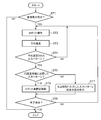
- step ST1 the operator determines whether to instruct the teaching device 40 to directly teach the articulated robot 10 directly.
- the process proceeds to step ST2.
- the processing is ended.
- step ST2 the operator applies an operating force to any one of the link members 21a to 21f among the link members 21a to 21f to guide the hand 23 toward the target position.
- each torque sensor 34 detects the force acting on the axes J1 to J6 of the link members 21a to 21f.
- step ST3 the force estimation unit 41 estimates, based on the detection results of all the torque sensors 34, the link members 21a to 21f to which the operating force has been applied and the magnitude of the operating force.
- the force estimation unit 41 uses the fact that no force acts on the link member located on the tip end side of the link member to which the operation force is applied (the output value of the torque sensor 34 does not change).
- the link members 21a to 21f to which the operation force is applied are estimated.
- the force estimation unit 41 estimates the magnitude of the operation force using the following equation (1).
- f J- T ⁇ ...
- f [fx fy fz f ⁇ f ⁇ f ⁇ ]
- J Gravity compensated output value
- J [axial direction of link member to which operating force is applied Velocity in the center]
- J ⁇ Matrix satisfying [speed of joint corresponding to link member to which operation force is applied]
- fx, fy, fz are translational forces in three orthogonal axes
- f ⁇ , f ⁇ , f ⁇ are in three orthogonal axes It is each torque.
- ⁇ 1, ⁇ 2, ⁇ 3, ⁇ 4, ⁇ 5 and ⁇ 6 are gravity-compensated output values of the six torque sensors 34.
- step ST4 the input pattern classification unit 44 determines whether the estimated input pattern of the operating force matches any one of a plurality of types of input patterns set in advance. Here, if it is determined that the estimated input pattern of the operating force matches the input pattern set in advance, the process proceeds to step ST5. On the other hand, when it is determined that the estimated input pattern of the operating force does not match the preset input pattern, the process returns to step ST2.
- step ST5 the input pattern classification unit 44 determines whether or not the input pattern of the estimated operation force can be classified into the input pattern corresponding to the high precision movement.
- the process proceeds to step ST6.
- the process proceeds to step ST7.
- FIG. 6 shows the link member 21a as a representative of the link members 21a to 21f. Moreover, the white arrow of FIG. 6 has shown the direction which an operator strikes.
- the input pattern of the operating force shown in FIG. 5A is an input pattern corresponding to the high precision movement of the arm 12.
- the input pattern corresponding to this high-precision movement assumes that the time when the applied operating force exceeds the predetermined threshold value fo is the input start time to, and the operating force is 1 within the predetermined period t from the input start time to.
- the input pattern is equal to or less than the threshold value fo, and ends as it is. That is, in the input pattern corresponding to the high precision movement, the operating force has one peak value within the predetermined period t from the input start time to.
- the operation pattern of the worker for obtaining such an input pattern is an operation of tapping any one of the link members 21a to 21f once.
- the input pattern of the operating force shown in FIG. 5B is another input pattern corresponding to the high precision movement of the arm 12.
- the input pattern corresponding to the high precision movement is an input pattern in which the applied operation force is twice or less the threshold fo within the predetermined period t from the input start time to, and is ended as it is. That is, in the input pattern corresponding to the high accuracy movement, the operating force has two peak values within a predetermined period t from the input start time to.
- the operation pattern of the worker for obtaining such an input pattern is an operation of tapping any one of the link members 21a to 21f twice.
- the input pattern of the operating force shown in FIG. 5C is an input pattern corresponding to the high speed movement of the arm 12.
- the input pattern corresponding to the high-speed movement is an input pattern in which the applied operating force always exceeds the threshold value fo within a predetermined period t from the input start time to.
- the operation pattern of the worker for obtaining such an input pattern is an operation of continuously pressing the link members 21a to 21f.
- step ST6 the hand portion 23 is taught by the conventional direct teaching to teach a target position and a target posture.
- the force control unit 42 determines the action direction (translational direction) of the applied operating force.
- the force control unit 42 rotates the hand unit 23 according to the acting direction of the operating force.
- the force control unit 42 rotates the link members 21a, 21c, and 21e.
- the link members 21b, 21d and 21f are set to be rotated in the rotational direction R2 while being rotated in the direction R1.
- the hand 23 follows the rotation of the link members 21a, 21c, 21e in the rotational direction R1. , And rotates about the axes J1, J3, and J5.
- the hand 23 follows the rotation of the link members 21b, 21b, 21f in the rotational direction R2. , And rotates about the axes J2, J4, and J6.
- the force control unit 42 controls the axes of the link members 21a to 21f.
- Linking member when the crossing angle ⁇ f between the reference line O and the action direction of the operating force passing through the axes J1 to J6 is 0 to 179 [deg], with the reference line O passing J1 to J6 as the reference angle
- the link members 21a to 21f are rotated in the rotational direction R2 while rotating 21a to 21f in the rotational direction R1, while being 180 to 359 [deg].
- the hit link members 21a to 21f rotate in the rotational direction R1 or rotational direction R2 according to the crossing angle ⁇ f. Rotate towards. As a result, the end portion 23 rotates around the axes J1 to J6 of the hit link members 21a to 21f.
- the force control unit 42 sets the target rotation angle ⁇ r6 of the link member 21f using the following equation (4) even when one of the two force control methods described above is adopted.
- ⁇ ri ⁇ i + Ks (4)
- ⁇ i A current rotation angle at the link member corresponding to i: Constant s: a variable that is “1” in the rotation direction R1 and “ ⁇ 1” in the rotation direction R2
- step ST7 the hand portion 23 teaches a target position and a target posture by moving according to the conventional direct teaching such that the arm 12 can be moved by a light operation force.
- the process proceeds to step ST8.
- step ST8 the operator determines whether to direct the teaching device 40 to finish direct teaching to the articulated robot 10.
- the processing is ended.
- the process proceeds to step ST2.
- the robot direct teaching apparatus and the direct teaching method according to the first embodiment can selectively use high-speed movement and high-precision movement at the time of teaching work to the articulated robot 10 without reducing the teaching efficiency. .
- one 6-axis force sensor (not shown) is substituted for the six torque sensors 34 in the robot direct teaching apparatus and method according to the first embodiment. ) Is provided in the end portion 23.
- the force estimation unit 41 estimates the magnitude of the operation force f using the following equation (5), using only the detection result of the six-axis force sensor which is a multi-axis force sensor.
- f [fx fy fz f ⁇ f ⁇ f ⁇ ] T (5)
- the force control unit 42 rotates the hand unit 23 according to the acting direction of the operating force. That is, when the six torque sensors 34 are provided, since they are provided corresponding to the respective axes J1 to J6, the force estimation unit 41 directly acts on which link members 21a to 21f. It can be estimated. On the other hand, when the six-axis force sensor is provided, since it is not provided corresponding to each axis J1 to J6, the force estimation unit 41 directly transmits the operating force to which link member 21a to 21f. It is not possible to estimate what worked. Therefore, the force control unit 42 adopts only the second force control method described above.
- the robot direct teaching apparatus and the direct teaching method according to the second embodiment can selectively use high-speed movement and high-precision movement at the time of teaching work to the articulated robot 10 without reducing the teaching efficiency. .
- the direct teaching device and method of the robot according to the present invention can use the high-speed movement and the high-precision movement properly without lowering the teaching efficiency at the time of teaching work to the robot.
- it is suitable for use in a direct teaching apparatus and method of a robot that directly teaches its hand position.
Landscapes
- Engineering & Computer Science (AREA)
- Robotics (AREA)
- Mechanical Engineering (AREA)
- Physics & Mathematics (AREA)
- General Physics & Mathematics (AREA)
- Automation & Control Theory (AREA)
- Manipulator (AREA)
- Numerical Control (AREA)
Abstract
La présente invention concerne un dispositif d'enseignement direct (40) pour robots qui détecte, grâce à un capteur de force (34), une force de manipulation appliquée à un robot articulé (10) doté d'une pluralité d'axes (J1 à J6), qui déplace le robot articulé (10) en fonction de la commande de force d'une unité de commande de force (42) sur la base de ces résultats et qui enseigne directement la position de celui-ci, ledit dispositif comprenant : une unité d'estimation de force (41) qui estime la force de manipulation appliquée aux axes (J1 à J6) sur la base des résultats de détection du capteur de force (34) ; une unité de classification de motif d'entrée (44) qui classifie le motif d'entrée de la force de manipulation estimée par l'unité d'estimation de force (41) en tant que types de motif d'entrée prédéfinis ; et une unité de commutation de commande de force (45) qui commute la commande de force de l'unité de commande de force (42) en fonction du motif d'entrée de la force de manipulation classifiée par l'unité de classification de motif d'entrée (44).
Priority Applications (2)
| Application Number | Priority Date | Filing Date | Title |
|---|---|---|---|
| KR1020207012612A KR20200064115A (ko) | 2017-11-27 | 2018-10-15 | 로봇의 직접 교시 장치 및 그 방법 |
| CN201880072646.7A CN111356559A (zh) | 2017-11-27 | 2018-10-15 | 机械手的直接教示装置及其方法 |
Applications Claiming Priority (2)
| Application Number | Priority Date | Filing Date | Title |
|---|---|---|---|
| JP2017227223A JP6964494B2 (ja) | 2017-11-27 | 2017-11-27 | ロボットの直接教示装置及びその方法 |
| JP2017-227223 | 2017-11-27 |
Publications (1)
| Publication Number | Publication Date |
|---|---|
| WO2019102746A1 true WO2019102746A1 (fr) | 2019-05-31 |
Family
ID=66631455
Family Applications (1)
| Application Number | Title | Priority Date | Filing Date |
|---|---|---|---|
| PCT/JP2018/038332 Ceased WO2019102746A1 (fr) | 2017-11-27 | 2018-10-15 | Dispositif d'enseignement direct pour robots et procédé associé |
Country Status (4)
| Country | Link |
|---|---|
| JP (1) | JP6964494B2 (fr) |
| KR (1) | KR20200064115A (fr) |
| CN (1) | CN111356559A (fr) |
| WO (1) | WO2019102746A1 (fr) |
Cited By (3)
| Publication number | Priority date | Publication date | Assignee | Title |
|---|---|---|---|---|
| WO2021078344A1 (fr) * | 2019-10-22 | 2021-04-29 | Universal Robots A/S | Activation sécurisée du mode à entraînement libre d'un bras de robot |
| US12296485B2 (en) | 2019-10-22 | 2025-05-13 | Universal Robots A/S | Robot arm with adaptive three-dimensional boundary in free-drive |
| US12397414B2 (en) | 2019-10-22 | 2025-08-26 | Universal Robots A/S | Maintaining free-drive mode of robot arm for period of time |
Families Citing this family (3)
| Publication number | Priority date | Publication date | Assignee | Title |
|---|---|---|---|---|
| JP7095944B2 (ja) * | 2018-09-07 | 2022-07-05 | アズビル株式会社 | ロボットの直接教示装置及び直接教示方法 |
| CN109623830B (zh) * | 2018-11-27 | 2021-11-30 | 佛山科学技术学院 | 一种基于多传感器的机器人任务示教方法及系统 |
| JP2021062436A (ja) * | 2019-10-11 | 2021-04-22 | セイコーエプソン株式会社 | 教示方法 |
Citations (6)
| Publication number | Priority date | Publication date | Assignee | Title |
|---|---|---|---|---|
| JPH03123907A (ja) * | 1989-10-06 | 1991-05-27 | Hitachi Constr Mach Co Ltd | ロボットの直接教示装置及び直接教示方法 |
| JP2008110406A (ja) * | 2006-10-27 | 2008-05-15 | Yaskawa Electric Corp | ロボットの直接教示装置 |
| JP2009297853A (ja) * | 2008-06-16 | 2009-12-24 | Denso Wave Inc | ロボットのダイレクトティーチ制御装置 |
| WO2010079564A1 (fr) * | 2009-01-09 | 2010-07-15 | パナソニック株式会社 | Appareil de commande et procédé de commande pour bras robotique, robot, programme de commande pour bras robotique et circuit électronique intégré |
| JP2014128843A (ja) * | 2012-12-28 | 2014-07-10 | Toyota Motor Corp | ロボットアーム教示システム及びロボットアーム教示方法 |
| JP2017074669A (ja) * | 2015-10-14 | 2017-04-20 | 株式会社リコー | マニピュレータの制御装置、マニピュレータ駆動装置、及びロボットシステム |
Family Cites Families (3)
| Publication number | Priority date | Publication date | Assignee | Title |
|---|---|---|---|---|
| JPH08336785A (ja) * | 1995-06-09 | 1996-12-24 | Yaskawa Electric Corp | 産業用ロボットの教示装置 |
| JP5893665B2 (ja) * | 2014-04-14 | 2016-03-23 | ファナック株式会社 | 作用された力に応じて移動されるロボットを制御するロボット制御装置 |
| JP6489991B2 (ja) * | 2015-10-02 | 2019-03-27 | ファナック株式会社 | ロボットを操作するハンドルを備えたロボット用操作装置 |
-
2017
- 2017-11-27 JP JP2017227223A patent/JP6964494B2/ja not_active Expired - Fee Related
-
2018
- 2018-10-15 CN CN201880072646.7A patent/CN111356559A/zh active Pending
- 2018-10-15 WO PCT/JP2018/038332 patent/WO2019102746A1/fr not_active Ceased
- 2018-10-15 KR KR1020207012612A patent/KR20200064115A/ko not_active Ceased
Patent Citations (6)
| Publication number | Priority date | Publication date | Assignee | Title |
|---|---|---|---|---|
| JPH03123907A (ja) * | 1989-10-06 | 1991-05-27 | Hitachi Constr Mach Co Ltd | ロボットの直接教示装置及び直接教示方法 |
| JP2008110406A (ja) * | 2006-10-27 | 2008-05-15 | Yaskawa Electric Corp | ロボットの直接教示装置 |
| JP2009297853A (ja) * | 2008-06-16 | 2009-12-24 | Denso Wave Inc | ロボットのダイレクトティーチ制御装置 |
| WO2010079564A1 (fr) * | 2009-01-09 | 2010-07-15 | パナソニック株式会社 | Appareil de commande et procédé de commande pour bras robotique, robot, programme de commande pour bras robotique et circuit électronique intégré |
| JP2014128843A (ja) * | 2012-12-28 | 2014-07-10 | Toyota Motor Corp | ロボットアーム教示システム及びロボットアーム教示方法 |
| JP2017074669A (ja) * | 2015-10-14 | 2017-04-20 | 株式会社リコー | マニピュレータの制御装置、マニピュレータ駆動装置、及びロボットシステム |
Cited By (5)
| Publication number | Priority date | Publication date | Assignee | Title |
|---|---|---|---|---|
| WO2021078344A1 (fr) * | 2019-10-22 | 2021-04-29 | Universal Robots A/S | Activation sécurisée du mode à entraînement libre d'un bras de robot |
| CN114585483A (zh) * | 2019-10-22 | 2022-06-03 | 优傲机器人公司 | 安全激活机器人臂的自由驱动模式 |
| US12296485B2 (en) | 2019-10-22 | 2025-05-13 | Universal Robots A/S | Robot arm with adaptive three-dimensional boundary in free-drive |
| US12384019B2 (en) | 2019-10-22 | 2025-08-12 | Universal Robots A/S | Safe activation of free-drive mode of robot arm |
| US12397414B2 (en) | 2019-10-22 | 2025-08-26 | Universal Robots A/S | Maintaining free-drive mode of robot arm for period of time |
Also Published As
| Publication number | Publication date |
|---|---|
| JP6964494B2 (ja) | 2021-11-10 |
| KR20200064115A (ko) | 2020-06-05 |
| JP2019093526A (ja) | 2019-06-20 |
| CN111356559A (zh) | 2020-06-30 |
Similar Documents
| Publication | Publication Date | Title |
|---|---|---|
| WO2019102746A1 (fr) | Dispositif d'enseignement direct pour robots et procédé associé | |
| CN108290257B (zh) | 机器人系统以及控制方法 | |
| CN107820456B (zh) | 用于冗余优化地规划移动式机器人的操作的方法 | |
| US20160129588A1 (en) | Event-Based Redundancy Angle Configuration for Articulated-Arm Robots | |
| US20060178775A1 (en) | Accelerometer to monitor movement of a tool assembly attached to a robot end effector | |
| CN108000477A (zh) | 一种全位姿主被动柔顺机器人及利用该机器人的旋拧阀门方法 | |
| JP2015033747A (ja) | ロボットシステム、ロボット制御装置及びロボット制御方法 | |
| JP2015155126A (ja) | ロボットシステムのツール座標系補正方法、およびロボットシステム | |
| JP2021121451A (ja) | 教示方法およびロボットシステム | |
| JP2018528085A (ja) | ロボットアームおよびロボットリスト | |
| CN107199562B (zh) | 机器人控制装置和机器人控制方法 | |
| JP7140508B2 (ja) | パラレルリンク機構を用いた作業装置およびその制御方法 | |
| JPH0438553B2 (fr) | ||
| JP2022539813A (ja) | 異なる方向範囲にわたるロボットマニピュレータのエンドエフェクタの触覚フィードバック | |
| JP7154748B2 (ja) | ロボットシステム、物品の製造方法、制御方法、制御プログラム、及び記録媒体 | |
| JP2016221653A (ja) | ロボット制御装置およびロボットシステム | |
| JP7595978B2 (ja) | ロボット及びロボット用手先部材 | |
| CN111716343B (zh) | 机器人 | |
| JPS6149075B2 (fr) | ||
| JP4378517B2 (ja) | 丸型ハンドルバルブ操作用ロボットアーム制御装置 | |
| CN119795137B (zh) | 一种高空作业车的末端执行机构及其控制方法 | |
| JP2021130146A (ja) | マニピュレータの制御装置 | |
| JP2713702B2 (ja) | ロボットの制御方法および装置 | |
| JP7414426B2 (ja) | ロボットシステム | |
| WO2026078878A1 (fr) | Dispositif d'enseignement, système robotique et procédé de création de programme d'enseignement |
Legal Events
| Date | Code | Title | Description |
|---|---|---|---|
| 121 | Ep: the epo has been informed by wipo that ep was designated in this application |
Ref document number: 18881344 Country of ref document: EP Kind code of ref document: A1 |
|
| ENP | Entry into the national phase |
Ref document number: 20207012612 Country of ref document: KR Kind code of ref document: A |
|
| NENP | Non-entry into the national phase |
Ref country code: DE |
|
| 122 | Ep: pct application non-entry in european phase |
Ref document number: 18881344 Country of ref document: EP Kind code of ref document: A1 |