WO2019106883A1 - Système, procédé et programme d'assistance - Google Patents
Système, procédé et programme d'assistance Download PDFInfo
- Publication number
- WO2019106883A1 WO2019106883A1 PCT/JP2018/028728 JP2018028728W WO2019106883A1 WO 2019106883 A1 WO2019106883 A1 WO 2019106883A1 JP 2018028728 W JP2018028728 W JP 2018028728W WO 2019106883 A1 WO2019106883 A1 WO 2019106883A1
- Authority
- WO
- WIPO (PCT)
- Prior art keywords
- data
- medical
- prospective
- visit
- examination
- Prior art date
- Legal status (The legal status is an assumption and is not a legal conclusion. Google has not performed a legal analysis and makes no representation as to the accuracy of the status listed.)
- Ceased
Links
Images




Classifications
-
- G—PHYSICS
- G16—INFORMATION AND COMMUNICATION TECHNOLOGY [ICT] SPECIALLY ADAPTED FOR SPECIFIC APPLICATION FIELDS
- G16H—HEALTHCARE INFORMATICS, i.e. INFORMATION AND COMMUNICATION TECHNOLOGY [ICT] SPECIALLY ADAPTED FOR THE HANDLING OR PROCESSING OF MEDICAL OR HEALTHCARE DATA
- G16H50/00—ICT specially adapted for medical diagnosis, medical simulation or medical data mining; ICT specially adapted for detecting, monitoring or modelling epidemics or pandemics
- G16H50/20—ICT specially adapted for medical diagnosis, medical simulation or medical data mining; ICT specially adapted for detecting, monitoring or modelling epidemics or pandemics for computer-aided diagnosis, e.g. based on medical expert systems
-
- G—PHYSICS
- G16—INFORMATION AND COMMUNICATION TECHNOLOGY [ICT] SPECIALLY ADAPTED FOR SPECIFIC APPLICATION FIELDS
- G16H—HEALTHCARE INFORMATICS, i.e. INFORMATION AND COMMUNICATION TECHNOLOGY [ICT] SPECIALLY ADAPTED FOR THE HANDLING OR PROCESSING OF MEDICAL OR HEALTHCARE DATA
- G16H10/00—ICT specially adapted for the handling or processing of patient-related medical or healthcare data
- G16H10/60—ICT specially adapted for the handling or processing of patient-related medical or healthcare data for patient-specific data, e.g. for electronic patient records
-
- G—PHYSICS
- G16—INFORMATION AND COMMUNICATION TECHNOLOGY [ICT] SPECIALLY ADAPTED FOR SPECIFIC APPLICATION FIELDS
- G16H—HEALTHCARE INFORMATICS, i.e. INFORMATION AND COMMUNICATION TECHNOLOGY [ICT] SPECIALLY ADAPTED FOR THE HANDLING OR PROCESSING OF MEDICAL OR HEALTHCARE DATA
- G16H40/00—ICT specially adapted for the management or administration of healthcare resources or facilities; ICT specially adapted for the management or operation of medical equipment or devices
- G16H40/20—ICT specially adapted for the management or administration of healthcare resources or facilities; ICT specially adapted for the management or operation of medical equipment or devices for the management or administration of healthcare resources or facilities, e.g. managing hospital staff or surgery rooms
-
- G—PHYSICS
- G16—INFORMATION AND COMMUNICATION TECHNOLOGY [ICT] SPECIALLY ADAPTED FOR SPECIFIC APPLICATION FIELDS
- G16H—HEALTHCARE INFORMATICS, i.e. INFORMATION AND COMMUNICATION TECHNOLOGY [ICT] SPECIALLY ADAPTED FOR THE HANDLING OR PROCESSING OF MEDICAL OR HEALTHCARE DATA
- G16H80/00—ICT specially adapted for facilitating communication between medical practitioners or patients, e.g. for collaborative diagnosis, therapy or health monitoring
Definitions
- the present invention relates to a support system, a support method, and a support program for supporting medical consultations by medical personnel.
- Japan is facing a super-aging society, and there are concerns about the shortage of healthcare workers and the decline in the quality of healthcare. Therefore, regional medical cooperation is promoted in which a plurality of medical institutions cooperate with each other to treat patients for the purpose of improving the efficiency of medical treatment and improving the quality of medical treatment.
- Patent Document 1 describes a regional medical cooperation system that supports patient referral between medical institutions.
- the present invention has been made in view of the above circumstances, and an object thereof is to provide a support system, a support method, and a support program that contribute to the reduction of medical expenses.
- the support system according to the present invention for achieving the above object is a support system for supporting medical examination by a medical worker, and the planned examinee data on the prospective examiner who plans to have a visit at a medical institution, Data acquisition unit for acquiring visit data regarding visit history to a medical institution and consultation data regarding medical examination content that the prospective doctor had visited at the medical institution in the past, the prospective consultation data, the visit data, and the medical consultation It has a learning part which carries out machine learning using data, and a presentation part which presents necessity of medical examination to the person planning to visit based on a result of the machine learning.
- the support method according to the present invention for achieving the above object is a support method for supporting medical examination by a medical worker, and the planned examinee data on the prospective examiner who plans to have a visit at a medical institution, Data acquisition step for acquiring visit data regarding visit history to a medical institution, and consultation data regarding medical examination content that the prospective examinee visited at the medical institution in the past, the prospective consultation data, the visit data, and the consultation It has a learning step of machine learning using data, and a presenting step of presenting necessity of medical examination for the prospective examinee based on the result of the machine learning.
- the support program according to the present invention for achieving the above object is a support program for supporting medical examinations by medical workers, and the planned data of the prospective callee data on the prospective callee who is scheduled to see a medical institution
- Data acquisition step for acquiring visit data regarding visit history to a medical institution, and consultation data regarding medical examination content that the prospective examinee visited at the medical institution in the past, the prospective consultation data, the visit data, and the consultation
- a learning step of machine learning using data and a presenting step of presenting necessity of medical examination for the prospective examinee are executed based on the result of the machine learning.
- the present invention presents, based on the result of machine learning, the necessity of medical examination for a prospective doctor by a medical worker.
- the medical staff can avoid the medical examination for the prospective examinee who has a low need for a medical examination.
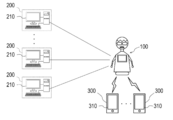
- FIG. 1 and FIG. 2 are diagrams for explaining the overall configuration of a support system 100 according to the present embodiment.
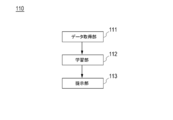
- FIGS. 3A and 3B are diagrams provided to explain each part of the support system 100.
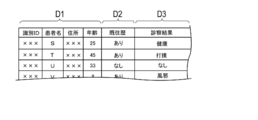
- FIG. FIGS. 4A to 4E are diagrams for explaining data handled by the support system 100.
- the support system 100 performs examination using the prospective examinee data D1, visit data D2, examination data D3, other data D4 (area data D41, weather data D42, medical institution data D43), etc.
- a system that presents the necessity of medical examination for the prospective patients who wish to have a medical examination, and also presents the prescribed aspects of the medicine (eg, necessity of medicine prescription, kind of medicine, quantity of medicine, dosage form of medicine, etc.) is there.
- a "medical institution” is not specifically limited, For example, a doctor or a nurse says the thing of the plant
- the “specific (fixed) area” is not particularly limited, but is, for example, a municipality unit, a prefectural unit, an area separated by a country unit, or the like.
- the support system 100 is connected to the medical institution terminal 200 of each medical institution and the examinee terminal 300 owned by each prospective examinee via a network, and the medical institution terminal 200 and the examination It is configured as a server that transmits and receives data to and from the user terminal 300.
- the medical institution terminal 200 and the examination It is configured as a server that transmits and receives data to and from the user terminal 300.
- a medical institution When visiting a medical institution or before visiting a medical institution such as an elderly person or the like, it is possible to receive a presentation of a medical examination policy from the support system 100 by operating the medical examiner terminal 300. Further, a medical worker (doctor, nurse, etc.) can confirm the above-mentioned consultation policy at the medical institution terminal 200.
- the network can adopt, for example, a wireless communication method using a communication function such as Wifi (registered trademark) or Bluetooth (registered trademark), other noncontact wireless communication, or wired communication.
- the support system 100 is configured by an interactive device capable of communicating with a person by interaction.
- a robot with an interactive function equipped with an AI can be used as the interactive device.
- the interactive device can be equipped with, for example, a display capable of displaying a still image or a moving image, a speaker capable of outputting sound or music, a camera function capable of capturing a still image or a moving image, or the like.
- the appearance design and the like of the interactive robot are not particularly limited, and examples thereof include a human type and an animal type.
- the support system 100 will be described in detail below.
- the hardware configuration of the support system 100 will be described.
- the support system 100 is not particularly limited, but can be configured by, for example, a mainframe or a computer cluster. As shown in FIG. 3A, the support system 100 includes a central processing unit (CPU) 110, a storage unit 120, an input / output I / F 130, and a communication unit 140.
- the CPU 110, the storage unit 120, the input / output I / F 130, and the communication unit 140 are connected to the bus 150, and mutually transmit and receive data and the like via the bus 150.
- the CPU 110 executes control of each unit, various arithmetic processing, and the like in accordance with various programs stored in the storage unit 120.
- the storage unit 120 stores ROM (Read Only Memory) for storing various programs and various data, RAM (Randam Access Memory) for temporarily storing programs and data as a work area, and stores various programs and various data including an operating system.
- ROM Read Only Memory
- RAM Random Access Memory
- the input / output I / F 130 is an interface for connecting input devices such as a keyboard, a mouse, a scanner, and a microphone, and output devices such as a display, a speaker, and a printer.
- the communication unit 140 is an interface for communicating with the medical institution terminal 200, the examinee terminal 300, and the like.
- the storage unit 120 stores various data such as prospective examinee data D1, visit data D2, visit data D3, and other data D4.
- the storage unit 120 also stores a support program for providing the support method according to the present embodiment.
- the CPU 110 functions as a data acquisition unit 111, a learning unit 112, and a presentation unit 113 by executing the support program stored in the storage unit 120 as shown in FIG. 3B.
- the data acquisition unit 111 will be described.
- the data acquisition unit 111 acquires the prospective examinee data D1, the visit data D2, the examination data D3, and other data D4.
- the prospective examinee data D1 includes, for example, the identification ID of the prospective examinee (for example, data that can be acquired from my number or the like), the name of the prospective examinee, the address, and the age.
- the visit data D2 includes, for example, a medical history (visiting history to a medical institution).
- the examination data D3 includes, for example, the result of the previous visit to the medical institution and the result of the previous visit to the medical institution. In the case where the prospective examinee has experience in home medical care and home care, it is also possible to include data acquired at the time of these consultations (at the time of a home visit) in the consultation data D3.
- the prospective examinee data D1 can also include, for example, data on genetic information of the prospective examinee.
- the genetic information may include not only the genetic information of the prospective recipient but also the genetic information of the relatives. Genetic information can be constituted by, for example, DNA test results. The genetic information can be used, for example, to judge whether the disease is strongly influenced by a genetic factor or the like when judging the disease of the prospective participant.
- the prospective examinee data D1, the visit data D2, and the consultation data D3 are stored in the storage unit 120 in a state of being associated with each prospective examinee. Further, each of these data D1, D2, and D3 can be stored and managed by, for example, a known electronic medical record or the like.
- the medical examination data D3 can include medical institution side prescription data (prescription data) D31 and pharmacy side prescription data (prescription data) D32, as shown in FIG. 4B.
- the medical institution side prescription data D31 includes, for example, various data related to the prescription when the person to be consulted has prescribed a medicine (for example, a drug etc.) at the medical institution in the past.
- the medical institution side prescription data D31 includes, for example, data regarding date and time of prescription, type of medicine, prescription amount, dosage form and the like.
- the pharmacy-side prescription data D32 includes data on a medicine that is actually prescribed to a prospective doctor at a pharmacy based on a prescription provided by a medical institution.
- the pharmacy-side prescription data D32 includes, for example, data relating to the prescribed date and time, type of medicine, prescription amount, dosage form, etc. (prescription history described in medicine notebook, etc.) as in the medical institution-side prescription data D31. .
- the medicine according to the present embodiment includes a so-called digital medicine on which a digital function (for example, a function of detecting biological information of a living organ after medication and acquiring the information) is mounted. For example, it can be used to share information etc. on a prospective medical doctor acquired by a digital medicine among medical institutions, prospective medical check-up persons, and medical personnel, or to monitor the status of taking a medical checkup candidate.
- the data acquisition unit 111 can acquire, for example, the prospective examinee data D1, the visit data D2, and the examination data D3 from the medical institution terminal 200 of each medical institution and the examinee terminal 300 of each prospective examinee.
- the other data D4 that is the acquisition target of the data acquisition unit 111 can include the area data D41 shown in FIG. 4C, the weather data D42 shown in FIG. 4D, and the medical institution data D43 shown in FIG. 4E.
- the regional data D41 includes a specific area name, a population in a specific area, a main family structure in a specific area (for example, an average value of the number of families in a specific area), and a specific area. It includes information on the age group (for example, the average value of the age group in a specific area), and whether or not the prospective examinee has received a medical history / prescription history in a specific area.
- the regional data D41 can include, for example, data such as a disease that is prevalent in a specific region.
- the area data D41 can include, for example, data on traffic information in a specific area.
- the data on traffic information includes, for example, the distance from the home of the prospective examinee to the medical institution, and the type of transportation available (for example, bus, train).
- the weather data D42 includes, as shown in FIG. 4D, data on the weather (weather) relating to the surrounding environment of each medical institution.
- the weather data D42 includes the weather, temperature, humidity, and sunshine time of the surrounding environment.
- the data acquisition unit 111 can acquire, for example, the area data D41 and the weather data D42 from the Internet.
- the medical institution data D43 is, as shown in FIG. 4E, the name (medical institution name) of each medical institution, address, medical treatment subject, number of equipment (bed, ambulance, medical equipment, equipment including office equipment, etc.), It includes data on layout, clinical paths, policies, doctors, etc. These data are stored in the storage unit 120 in a state linked to each medical institution.
- the layout data may be, for example, a medical institution showing the position and distance of each equipment, examination room, examination room, operating room, nurse station, general ward, intensive care unit (ICU), high care unit (HCU), etc. It can be configured by a sketch.
- the data of the clinical path can be configured, for example, by a schedule table that summarizes the schedule from admission to discharge of a plurality of prospective examinees.
- the data of the policy includes, for example, data on an education policy such as training, and data on a medical policy such as priority medical care. Further, although data of doctors and the like are not shown, for example, data such as doctor names, medical care subjects, medical care experiences, surgical experiences, work schedules and the like can be mentioned. These data are stored in the storage unit 120 in a state linked to each doctor.
- the medical institution data D43 can include, for example, data on the congestion status of the medical institution.
- the data on the crowded status includes, for example, the crowded status (congested status regarding outpatients, crowded status related to hospitalization, etc.) of medical institutions within a certain range from the home of the prospective examinee.
- the support system 100 provides information (timetable, transfer guidance, etc.) of the most appropriate transportation means to the prospective contact based on data on traffic information and data on congestion status. ), Recommending a doctor who excels in treatment outcome for a specific disease, or presenting a medical institution where such a doctor works.
- the support system 100 may automatically carry out a medical examination reservation or the like according to the arrival time to the medical institution, together with the presentation of the medical institution by means of transportation.
- the other data D4 can include, for example, reuse data on a medical device or a medicine.
- the reuse data includes, for example, information on whether or not the medical device can be reused by performing cleaning and sterilization.
- the medical device is, for example, a single-use medical device, but may be a medical device other than a single-use medical device (a part of components of the medical device).
- the reuse data can include, for example, information on surplus medicines.
- the surplus medicine includes, for example, information on whether or not a medicine (for example, a liquid medicine) stored in a predetermined amount by a container such as a bottle can be used for a plurality of prospective patients. For example, if a drug stored in a particular container can be administered to a prospective recipient and a drug stored in a similar container can be administered to another prospective patient, the drug is treated as reusable.
- the reuse data can be acquired in real time, for example, from a hospital information system (Hospital Information System) of a medical device that owns medical devices and medicines to be reused.
- a hospital information system Hospital Information System
- the data acquisition unit 111 can acquire, for example, medical data as other information useful for supporting medical personnel.
- Medical data is, for example, data on medical knowledge, disease data on disease (name of disease, symptoms, necessity of medical treatment, etc.), treatment data on treatment (treatment method, time required for treatment, necessary equipment and drugs, and The wholesale value etc. of those), the data about the medical insurance system etc. can be mentioned.
- the data acquisition unit 111 can acquire, for example, medical data from the Internet or can be acquired from electronic data of medical specialty books read by a scanner or the like.
- the learning unit 112 performs machine learning using the prospective examinee data D1, the visit data D2, the examination data D3, and the other data D4.
- machine learning refers to analyzing input data using an algorithm, extracting useful rules and judgment criteria from the analysis result, and developing the algorithm.
- the support system 100 performs both presentation of necessity of medical examination by a medical worker and presentation of a prescription aspect of a medicine.
- the support system 100 performs machine learning based on the above-described data so that the contents of the presentation do not become invalid.
- the learning unit 112 performs machine learning to schedule a visit from the past behavior (visit frequency to a medical institution, visit content, visit results, prescription of a medicine, usage of a medicine, etc.) of a prospective callee. Predict the current and future dynamics of the person, and present appropriate measures to healthcare workers based on the prediction results.
- the learning unit 112 can learn a suitable medicine prescription mode based on, for example, medical institution side prescription data D31 and / or pharmacy side prescription data D32.
- the presentation unit 113 determines based on the machine learning result of the learning unit 112 when there is a request for a medical examination from the prospective doctor who visited the medical institution or the prospective medical doctor before visiting the medical institution. Present health care workers with and without need.
- the presentation unit 113 also presents a prescription mode of a medicine that a medical worker performs for a person who plans to receive a check.
- prescription mode includes, for example, determining whether or not to prescribe a pharmaceutical product, and specifying the type, amount, usage, dosage form and the like of a drug.
- one household for example, couple, parent and child, etc.
- the presentation unit 113 presents the presentation basis which led to the presentation together with the presentation contents when presenting the necessity of medical examination by the medical staff and the prescription mode of the medicine. For example, in the present embodiment, as will be described later, when it is determined that medical consultation by a medical worker is unnecessary, the basis is presented based on each data. If there is more than one basis, more than one basis can be presented. The health care worker can adopt each presentation content with a sense of convincing by being presented with the necessity of medical examination by the health care worker and the prescription aspect of the medicine together with the basis.
- the method of presenting the ground may indicate, for example, the relationship between the data using a graph or a table, or may specifically indicate an event that is a factor leading to the ground, together with a number such as a contribution rate.
- the presentation unit 113 executes the presentation when there is a presentation request from a medical worker or a person planning to undergo a medical examination.
- the timing at which the presentation unit 113 executes presentation is not particularly limited.
- the presentation unit 113 automatically and periodically performs data acquisition, and even if there is no request for presentation from a medical worker or a prospective doctor, it is predicted that a prospective doctor visits a medical institution. In some cases, it is possible to automatically present a medical institution or a medical worker with an appropriate response policy for a prospective doctor.
- the presentation unit 113 acquires data on the behavior of the prospective visitee irregularly or periodically, and presents a future forecast such as a medical treatment policy to the prospective visitee expected to visit the medical institution. It is also good.
- FIG. 5 and FIG. 6 are diagrams for explaining the support method according to the present embodiment.
- the support method according to the present embodiment will be described with reference to FIGS. 5 and 6.
- the support method will be outlined with reference to FIG. 5.
- the data acquisition step (S1) for acquiring the prospective examinee data D1, the visit data D2, the visit data D3 and other data D4, the prospective patient data D1, the visit A presentation step of presenting necessity / non-presence of medical examination by a medical worker and a prescription mode of a medicine based on a learning step (S2) of machine learning using data D2, examination data D3 and other data D4 and a result of machine learning And step (S3).
- S1 for acquiring the prospective examinee data D1, the visit data D2, the visit data D3 and other data D4, the prospective patient data D1, the visit
- machine learning algorithms are classified into supervised learning, unsupervised learning, reinforcement learning, and the like.
- supervised learning algorithm data sets of inputs and results are provided to the learning unit 112 for machine learning.
- unsupervised learning algorithm a large amount of input data is provided to the learning unit 112 for machine learning.
- the algorithm of reinforcement learning changes the environment based on the solution output by the algorithm, and makes a correction based on the reward of how correct the output solution is.
- the algorithm of machine learning of the learning unit 112 may be any of supervised learning, unsupervised learning, and reinforcement learning, but in the present embodiment, a case where the learning unit 112 performs machine learning by the supervised learning algorithm is described as an example. Do.
- the data acquisition unit 111 acquires the prospective examinee data D1, the visit data D2, the examination data D3, and other data D4 and stores the acquired data in the storage unit 120.
- the timings at which the data acquisition unit 111 acquires the prospective examinee data D1, the visit data D2, the examination data D3, and the other data D4 are not particularly limited, and may be acquired, for example, at predetermined time intervals. It may be acquired at the timing when the data has changed.
- the data acquisition unit 111 acquires the prospective examinee data D1, the visit data D2, the examination data D3 and other data D4 over a predetermined period, and stores the acquired data in the storage unit 120. Therefore, a large amount of data sets of input data and solutions for performing supervised learning are stored in the storage unit 120.
- each data of the prospective physician inside and outside a predetermined area from the medical examination ticket, the health insurance card, the shared data of regional medical care by electronic medical records, my number, etc. Acquire and confirm the prospective examinee data D1, the visit data D2, and the visit data D3).
- the correspondence to the prospective examinee is executed by a plurality of or single interactive devices, and the prospective examinee interviews the testimony regarding the consultation. The results of the interview are used together with each data in the learning step described later.
- the method of acquiring information from the prospective examinee is not limited to the acquisition of linguistic information by hearing as described above.
- the support system 100 may acquire biological information.
- a method of acquiring biological information for example, there is a method of acquiring temperature and oxygen saturation using infrared rays, and acquiring progress of arteriosclerosis by measuring pulse waves of peripheral blood vessels.
- the support system 100 may acquire information on the reaction (the degree of red tide of the face, the movement function, and the like) of the prospective examinee at the time of the interview through the interactive device.
- the support system 100 is provided with an algorithm that determines the credibility of the behavior and behavior of the prospective participant based on the hearing and the information obtained by the above-described methods, and an algorithm for confirming the appropriateness of each information obtained from the prospective participant. You can also.
- the interactive device included in the support system 100 may be performed by a human (medical worker etc.), or interactive It may be done by both the device and the human.
- humans attempt to communicate with the examinees through the interactive devices and input the acquired information from the examinees. It becomes possible to acquire information more accurately and smoothly.
- the learning unit 112 applies an algorithm of supervised learning to a large number of data sets stored in the storage unit 120.
- the supervised learning algorithm is not particularly limited, and examples thereof include known algorithms such as least squares, linear regression, autoregression, and neural networks.
- the learning unit 112 predicts current and future behavior of the prospective examinee's visit to the medical institution based on the acquired data.
- the medical staff carries out presentation of necessity of medical examination and presentation of prescription dynamics of medicine.
- the learning unit 112 determines whether the medical device is reusable or not, and when the medical device is reusable, any method ( Machine learning information that contributes to the judgment of reuse of medical equipment based on information such as whether it can be reused by adopting cleaning and sterilization methods) and which components of medical equipment can be reused Can.
- the learning unit 113 determines whether or not the medicine is reusable, and in the case where the medicine is reusable, any method (preservation of medicine It is possible to machine-learn information that contributes to the determination of re-use of a medicine, based on information such as whether it can be reused by adopting a method or a method of providing it to a prospective doctor).
- the presentation unit 113 can provide the medical institution with information on reuse of the medical device and the medicine by presenting the learning result of the machine learning. Medical institutions can effectively reduce medical expenses by acquiring or sharing learning results on the reuse between one specific medical institution or a plurality of medical institutions.
- the presentation unit 113 can display the presentation content and the presentation basis on the display 210 of the medical institution terminal 200.
- the presentation contents and the presentation basis can be displayed on, for example, the display 310 (see FIG. 1) of the examinee terminal 300 owned by the prospective examinee, the display provided to the interactive device, or the like.
- the main cause leading to the determination result is displayed as the presentation basis.
- the judgment result is also displayed as the presentation contents for the prescription mode of the medicine.
- the presentation content includes, for example, a second opinion.
- the second opinion includes, for example, both the judgment on the necessity of medical examination by the medical staff and the judgment on the prescription mode of the medicine. Also, if it is determined by the second opinion that a new prescription for a drug (such as when a different drug is prescribed) is required, a new prescription recommendation is presented, and the same prescription as before is made. In this case, based on each prescription data D31, D32 (see FIG. 4B), a prescription recommendation is presented that predicts the remaining amount of medicine and compensates only for the deficiency.
- the presentation content includes, for example, a notification. Notification is given to the prospective doctor, medical institution, relatives of prospective physician, etc. when it is judged that previous medical examination and prescription of medicine have not been properly performed as a result of hearing of the prospective physician. Suggest that. For example, when the judgment result is obtained, the presentation unit 113 determines that the prospective examinee intentionally desires a heavy examination or the prescription of the medicine is intentionally repeated. Etc. Presenting notification to that effect.
- the presentation content includes, for example, use of an interactive device. If it is determined that a prospective examinee has not visited a medical institution for the purpose of a visit, the prospective examinee receives a medical examination by a healthcare professional by executing conversation (communication) using an interactive device. Even without it, you can get a sense of satisfaction. Therefore, it is possible to smoothly prompt the return home to the prospective doctor.
- the presentation part 113 presents methods other than the conversation by an interactive device as another medical examination activity which substitutes the medical staff's medical examination, for example, when showing that medical staff's medical examination is unnecessary. It is also good.
- the presentation unit 113 can present, for example, a conversation with a volunteer staff member, a conversation with another prospective examinee, a touch with an animal, and the like.
- the data acquisition unit 111 may acquire data such as the prospective examinee data D1, the visit data D2, and the consultation data D3 again. Then, the learning unit 112 may execute machine learning again using newly acquired data to update the learning model. Based on the updated learning model, for example, the support system 100 predicts future behavior of the same prospective visitee or a different prospective visitee, accumulates the result as new data, and utilizes it at the next proposal. it can.
- the support system 100 includes the planned visitee data D1 for the prospective visitee who plans to receive a medical examination at the medical institution, and the visit data D2 for the visit history of the prospective visitee to the medical institution And a data acquisition unit 111 that acquires consultation data D3 regarding the consultation content that the consultation candidate consulted at the medical institution in the past, and a learning unit that performs machine learning using the consultation candidate data D1, visit data D2, and consultation data D3 And a presentation unit 113 which presents the necessity of the medical examination for the prospective doctor based on the result of the machine learning.
- the support system 100 presents, based on the result of the machine learning, the necessity of the medical staff for the medical examination for the prospective doctor.
- the medical staff can avoid the medical examination for the prospective examinee who has a low need for a medical examination.
- the presentation unit 113 presents another medical examination action that substitutes for the medical care worker's medical examination. Therefore, even if a medical examiner does not receive medical examination by a medical worker, he / she can obtain high satisfaction by visiting a medical institution.
- the presentation unit 113 presents, as another medical examination action, communication with the prospective examinee by the interactive device. Therefore, it is possible to further enhance the satisfaction of the prospective examinee while suppressing an increase in the workload of the medical staff.
- the examination data D3 includes prescription data D31 and D32 related to a medicine prescribed for a prospective examination person.
- the learning unit 112 learns a recommended medicine prescription mode based on the prospective examinee data D1, the visit data D2, the examination data D3, and the prescription data D31 and D32.
- the presentation part 113 presents the prescription mode of a pharmaceutical based on the result of machine learning. Therefore, the support system 100 can more appropriately determine whether or not to prescribe a pharmaceutical, and can provide an appropriate prescription amount and an appropriate type of pharmaceutical when prescribing a pharmaceutical.
- the presentation unit 113 presents the presentation basis together with the presentation content. Therefore, it is possible for a medical worker, a person planning to receive a consultation, etc. to adopt the contents of presentation with a sense of satisfaction.
- the support method includes the planned visitee data D1 regarding the planned visitee who is scheduled to receive a medical examination at the medical institution, the visit data D2 regarding the visit history to the medical institution of the prospective examinee, and the planned visitee Data acquisition step (S1) which acquires consultation data D3 about the medical examination contents which the medical institution visited in the past in the medical institution, learning step (S2) which carries out machine learning using consultation planned person data D1, visit data D2 and consultation data D3 And a presenting step (S3) for presenting necessity of medical examination for the prospective doctor based on the result of machine learning. Therefore, the medical worker can avoid the medical examination for the prospective doctor who has a low need for medical examination by referring to the presented contents. As a result, it is possible to prevent an increase in the burden on the work of medical workers and the occurrence of excessive prescription of medicines due to the elderly people visiting medical facilities, and medical expenses can be effectively reduced. become.
- the support program according to the present embodiment includes the planned visitee data D1 for the planned visitee at the medical institution, the visited data D2 for the visitee's visit history to the medical institution, and the planned visitee Data acquisition step (S1) which acquires consultation data D3 about the medical examination contents which the medical institution visited in the past in the medical institution, learning step (S2) which carries out machine learning using consultation planned person data D1, visit data D2 and consultation data D3 And a presenting step (S3) of presenting the necessity of the medical examination for the prospective doctor based on the result of the machine learning. Therefore, the medical worker can avoid the medical examination for the prospective doctor who has a low need for medical examination by referring to the presented contents. As a result, it is possible to prevent an increase in the burden on the work of medical workers and the occurrence of excessive prescription of medicines due to the elderly people visiting medical facilities, and medical expenses can be effectively reduced. become.
- the support system, support method, and support program according to the above embodiments may share each acquired data and presentation content among multiple medical institutions, or may be used only at a single medical institution. It is also good.
- data used for machine learning by the support system according to the present invention is not particularly limited as long as it uses at least prospective participant data, visit data, and visit data.
- the contents to be presented may include at least the necessity of the medical examination for the person scheduled to receive the examination.
- the prescription data when prescription data is included in the visit data, the prescription data may include at least one of medical institution prescription data and pharmacy prescription data.
- the learning unit performs machine learning using an algorithm of supervised learning, but the algorithm used by the learning unit for machine learning may be an unsupervised learning algorithm. It may be an algorithm of reinforcement learning. Also, the learning unit may perform machine learning using a plurality of types of algorithms.
- the means and method for performing various processes in the support system according to the above embodiment can be realized by either a dedicated hardware circuit or a programmed computer.
- the support program may be provided by a computer-readable recording medium such as, for example, a compact disc read only memory (CD-ROM), or may be provided online via a network such as the Internet.
- the program recorded on the computer readable recording medium is usually transferred to and stored in a storage unit such as a hard disk.
- the support program may be provided as a single application software.
- 100 support system interactive device
- 111 Data Acquisition Unit 112 Learning Department
- 113 presentation unit D1 Examination planned person data
- D2 Visit data D3 consultation data
- D31 Medical institution side prescription data prescription data
- D32 Pharmacy side prescription data prescription data
- D4 Other data D41 regional data
- D42 Weather data D43 Medical institution data.
Landscapes
- Health & Medical Sciences (AREA)
- Engineering & Computer Science (AREA)
- Medical Informatics (AREA)
- Public Health (AREA)
- Biomedical Technology (AREA)
- General Health & Medical Sciences (AREA)
- Epidemiology (AREA)
- Primary Health Care (AREA)
- Business, Economics & Management (AREA)
- General Business, Economics & Management (AREA)
- Pathology (AREA)
- Data Mining & Analysis (AREA)
- Databases & Information Systems (AREA)
- Medical Treatment And Welfare Office Work (AREA)
Abstract
Le problème décrit par la présente invention est de pourvoir à un système d'assistance, à un procédé d'assistance et à un programme d'assistance qui contribuent à une réduction des dépenses médicales. La solution selon l'invention porte sur un système d'assistance (100) qui comprend : une unité d'acquisition de données (111) qui acquiert des données (D1) de patient ayant programmé une consultation médicale concernant un patient qui a programmé une consultation dans un établissement médical, des données de rendez-vous médicaux (D2) concernant l'historique des rendez-vous médicaux au sein de l'établissement médical du patient ayant programmé une consultation médicale, et des données de consultation médicale (D3) concernant les détails des examens médicaux passés du patient ayant programmé une consultation médicale, et effectués au sein de l'établissement médical ; une unité d'apprentissage (112) qui réalise un apprentissage automatique à l'aide des données de patient ayant programmé une consultation médicale, des données de rendez-vous médicaux et des données de consultation médicale ; et une unité de présentation (113) qui indique, sur la base du résultat de l'apprentissage automatique, si le patient ayant programmé une consultation médicale doit subir un examen médical.
Priority Applications (4)
| Application Number | Priority Date | Filing Date | Title |
|---|---|---|---|
| CN201880076774.9A CN111406293A (zh) | 2017-11-30 | 2018-07-31 | 支援系统、支援方法以及支援程序 |
| US16/766,917 US20200381114A1 (en) | 2017-11-30 | 2018-07-31 | Assistance system, assistance method, and assistance program |
| JP2019557007A JP6782372B2 (ja) | 2017-11-30 | 2018-07-31 | 支援システム、支援方法、および支援プログラム |
| US17/400,606 US20210375464A1 (en) | 2017-11-30 | 2021-08-12 | Assistance system, assistance method, and assistance program |
Applications Claiming Priority (2)
| Application Number | Priority Date | Filing Date | Title |
|---|---|---|---|
| JP2017-230847 | 2017-11-30 | ||
| JP2017230847 | 2017-11-30 |
Related Child Applications (2)
| Application Number | Title | Priority Date | Filing Date |
|---|---|---|---|
| US16/766,917 A-371-Of-International US20200381114A1 (en) | 2017-11-30 | 2018-07-31 | Assistance system, assistance method, and assistance program |
| US17/400,606 Continuation US20210375464A1 (en) | 2017-11-30 | 2021-08-12 | Assistance system, assistance method, and assistance program |
Publications (1)
| Publication Number | Publication Date |
|---|---|
| WO2019106883A1 true WO2019106883A1 (fr) | 2019-06-06 |
Family
ID=66663853
Family Applications (1)
| Application Number | Title | Priority Date | Filing Date |
|---|---|---|---|
| PCT/JP2018/028728 Ceased WO2019106883A1 (fr) | 2017-11-30 | 2018-07-31 | Système, procédé et programme d'assistance |
Country Status (4)
| Country | Link |
|---|---|
| US (2) | US20200381114A1 (fr) |
| JP (1) | JP6782372B2 (fr) |
| CN (1) | CN111406293A (fr) |
| WO (1) | WO2019106883A1 (fr) |
Cited By (7)
| Publication number | Priority date | Publication date | Assignee | Title |
|---|---|---|---|---|
| CN112185467A (zh) * | 2019-07-04 | 2021-01-05 | 合同会社予幸集团中央研究所 | 检查辅助方法、第一检查辅助装置、第二检查辅助装置和存储介质 |
| JP2021009630A (ja) * | 2019-07-02 | 2021-01-28 | メディア株式会社 | 入力手段、情報処理システム、情報処理システムの制御方法、プログラム、及び記録媒体 |
| JP2023014569A (ja) * | 2021-07-19 | 2023-01-31 | アームズ株式会社 | 動物用医薬品処方販売装置及び動物用医薬品処方販売プログラム |
| JP2023115376A (ja) * | 2019-09-27 | 2023-08-18 | 富士フイルム株式会社 | 診療支援装置、その作動方法及び作動プログラム |
| JP7369391B1 (ja) | 2023-05-31 | 2023-10-26 | 東日本メディコム株式会社 | 医療支援システム、医療支援方法、及び医療支援プログラム |
| JP2025048840A (ja) * | 2023-09-20 | 2025-04-03 | ソフトバンクグループ株式会社 | システム |
| JP2025048841A (ja) * | 2023-09-20 | 2025-04-03 | ソフトバンクグループ株式会社 | システム |
Families Citing this family (1)
| Publication number | Priority date | Publication date | Assignee | Title |
|---|---|---|---|---|
| JP2024110637A (ja) * | 2023-02-03 | 2024-08-16 | キヤノン株式会社 | 情報処理装置、情報処理装置の制御方法、プログラム |
Citations (5)
| Publication number | Priority date | Publication date | Assignee | Title |
|---|---|---|---|---|
| JP2003122844A (ja) * | 2001-10-12 | 2003-04-25 | Sysmex Corp | 診療支援装置 |
| JP2004164173A (ja) * | 2002-11-12 | 2004-06-10 | Matsushita Electric Ind Co Ltd | 医療受診支援システム及び医療受診支援方法 |
| JP2005157782A (ja) * | 2003-11-26 | 2005-06-16 | Fujitsu Ltd | 重複受診判定システム、地域医療情報センタシステムおよび医療機関システム |
| JP2014157393A (ja) * | 2013-02-14 | 2014-08-28 | Hitachi Systems Ltd | 情報管理システム |
| JP2015084132A (ja) * | 2013-10-25 | 2015-04-30 | 朋秀 赤瀬 | 服薬支援コンピュータ装置、それによって読み取り可能なコンピュータプログラムならびに服薬支援コンピュータシステム |
Family Cites Families (9)
| Publication number | Priority date | Publication date | Assignee | Title |
|---|---|---|---|---|
| US8852093B2 (en) * | 2006-08-31 | 2014-10-07 | Health Hero Network, Inc. | Home care logistics and quality assurance system |
| US10360343B2 (en) * | 2013-03-15 | 2019-07-23 | Adityo Prakash | Facilitating integrated behavioral support through personalized adaptive data collection |
| US20180052960A1 (en) * | 2015-02-04 | 2018-02-22 | Drexel University | Computer-implemented methods of promoting patient compliance with one or more recommended treatments or screening regimens |
| US20160328990A1 (en) * | 2015-05-07 | 2016-11-10 | Dexcom, Inc. | System and method for educating users, including responding to patterns |
| US20170228505A1 (en) * | 2016-02-05 | 2017-08-10 | International Business Machines Corporation | System and Method for Optimizing Visualization for Comparative Treatment Analysis from a Cognitive and Personal Approach |
| CN106777909A (zh) * | 2016-11-28 | 2017-05-31 | 深圳市人民医院 | 妊娠期健康风险评估系统 |
| CN107066822A (zh) * | 2017-04-18 | 2017-08-18 | 深圳市品格科技有限公司 | 一种健康评估的方法及系统 |
| CN107247868B (zh) * | 2017-05-18 | 2020-05-12 | 深思考人工智能机器人科技(北京)有限公司 | 一种人工智能辅助问诊系统 |
| CN107180283A (zh) * | 2017-07-05 | 2017-09-19 | 山东大学 | 一种基于最优特征组合的再住院行为预测系统及方法 |
-
2018
- 2018-07-31 WO PCT/JP2018/028728 patent/WO2019106883A1/fr not_active Ceased
- 2018-07-31 JP JP2019557007A patent/JP6782372B2/ja active Active
- 2018-07-31 US US16/766,917 patent/US20200381114A1/en not_active Abandoned
- 2018-07-31 CN CN201880076774.9A patent/CN111406293A/zh active Pending
-
2021
- 2021-08-12 US US17/400,606 patent/US20210375464A1/en not_active Abandoned
Patent Citations (5)
| Publication number | Priority date | Publication date | Assignee | Title |
|---|---|---|---|---|
| JP2003122844A (ja) * | 2001-10-12 | 2003-04-25 | Sysmex Corp | 診療支援装置 |
| JP2004164173A (ja) * | 2002-11-12 | 2004-06-10 | Matsushita Electric Ind Co Ltd | 医療受診支援システム及び医療受診支援方法 |
| JP2005157782A (ja) * | 2003-11-26 | 2005-06-16 | Fujitsu Ltd | 重複受診判定システム、地域医療情報センタシステムおよび医療機関システム |
| JP2014157393A (ja) * | 2013-02-14 | 2014-08-28 | Hitachi Systems Ltd | 情報管理システム |
| JP2015084132A (ja) * | 2013-10-25 | 2015-04-30 | 朋秀 赤瀬 | 服薬支援コンピュータ装置、それによって読み取り可能なコンピュータプログラムならびに服薬支援コンピュータシステム |
Cited By (11)
| Publication number | Priority date | Publication date | Assignee | Title |
|---|---|---|---|---|
| JP2021009630A (ja) * | 2019-07-02 | 2021-01-28 | メディア株式会社 | 入力手段、情報処理システム、情報処理システムの制御方法、プログラム、及び記録媒体 |
| JP7762364B2 (ja) | 2019-07-02 | 2025-10-30 | メディア株式会社 | 入力手段、情報処理システム、情報処理システムの制御方法、プログラム、及び記録媒体 |
| CN112185467A (zh) * | 2019-07-04 | 2021-01-05 | 合同会社予幸集团中央研究所 | 检查辅助方法、第一检查辅助装置、第二检查辅助装置和存储介质 |
| JP2023115376A (ja) * | 2019-09-27 | 2023-08-18 | 富士フイルム株式会社 | 診療支援装置、その作動方法及び作動プログラム |
| JP2023014569A (ja) * | 2021-07-19 | 2023-01-31 | アームズ株式会社 | 動物用医薬品処方販売装置及び動物用医薬品処方販売プログラム |
| JP7651168B2 (ja) | 2021-07-19 | 2025-03-26 | アームズ株式会社 | 動物用医薬品処方販売装置及び動物用医薬品処方販売プログラム |
| JP7369391B1 (ja) | 2023-05-31 | 2023-10-26 | 東日本メディコム株式会社 | 医療支援システム、医療支援方法、及び医療支援プログラム |
| JP2024172698A (ja) * | 2023-05-31 | 2024-12-12 | 東日本メディコム株式会社 | 医療支援システム、医療支援方法、及び医療支援プログラム |
| JP2025048840A (ja) * | 2023-09-20 | 2025-04-03 | ソフトバンクグループ株式会社 | システム |
| JP2025048841A (ja) * | 2023-09-20 | 2025-04-03 | ソフトバンクグループ株式会社 | システム |
| JP7841045B2 (ja) | 2023-09-20 | 2026-04-06 | ソフトバンクグループ株式会社 | システム |
Also Published As
| Publication number | Publication date |
|---|---|
| CN111406293A (zh) | 2020-07-10 |
| US20200381114A1 (en) | 2020-12-03 |
| JP6782372B2 (ja) | 2020-11-11 |
| US20210375464A1 (en) | 2021-12-02 |
| JPWO2019106883A1 (ja) | 2020-07-30 |
Similar Documents
| Publication | Publication Date | Title |
|---|---|---|
| JP7216662B2 (ja) | 支援システム、支援方法、および支援プログラム | |
| JP6782372B2 (ja) | 支援システム、支援方法、および支援プログラム | |
| US9501624B2 (en) | Pharmacy management and administration with bedside real-time medical event data collection | |
| US20170053088A1 (en) | Interactive and analytical mobile system that provides a dynamic tool for therapies to prevent and change the progression of dementia-related diseases | |
| US11529204B2 (en) | Support system, support method, and support program | |
| Kimmel et al. | Discharge from the acute hospital: trauma patients’ perceptions of care | |
| US20240379238A1 (en) | Interactive and analytical system that provides a dynamic tool for therapies to prevent and cure dementia-related diseases | |
| Abou Amsha et al. | Shifting patterns in home care work: supporting collaboration among self-employed care actors | |
| Burns | Medication therapy management in community pharmacy practice: Core elements of an MTM service (Version 1.0): American Pharmacists Association and National Association of Chain Drug Stores Foundation | |
| Athish et al. | Online Doctor Consultation and Automatic Medicine Dispensers in Primary Health Care Centres Using Machine Learning | |
| US20200294673A1 (en) | Assist system, assist method, and assist program | |
| Chang et al. | Institutional contexts contribute to the low priority given to developing self-care independence in a rehabilitation ward: a qualitative study | |
| Round | COVID-19: the Great decentralized Clinical Trials accelerator | |
| Suyal et al. | Intersection of AI Tools and Application for Elderly Healthcare | |
| Skrabanek et al. | Intersection of AI Tools and Application for Elderly Healthcare | |
| US20250246280A1 (en) | Ai-based home health system and methods of use | |
| Vance et al. | Nursing care in the intensive care unit setting: The role of the nurse in the ICU | |
| Tsiounia | The internet of things in healthcare | |
| Mansfield et al. | The future role of the registered nurse in patient safety and quality | |
| Castiello | Early Identification of Post-Demission Setting | |
| Hollowood et al. | Managing complex care in long term conditions | |
| Fabius et al. | “CAREGIVING IS TEAMWORK...” INFORMATION SHARING IN HOME CARE FOR OLDER ADULTS WITH DISABILITIES IN THE COMMUNITY | |
| Abidi | A WWW Based Tele-Healthcare Information and Diagnostic Environment | |
| Gega et al. | Elderly Services, Community Care, and Health Economics of Service | |
| Roberts | 13 Care pathways for older people’s mental health care |
Legal Events
| Date | Code | Title | Description |
|---|---|---|---|
| 121 | Ep: the epo has been informed by wipo that ep was designated in this application |
Ref document number: 18882463 Country of ref document: EP Kind code of ref document: A1 |
|
| ENP | Entry into the national phase |
Ref document number: 2019557007 Country of ref document: JP Kind code of ref document: A |
|
| NENP | Non-entry into the national phase |
Ref country code: DE |
|
| 122 | Ep: pct application non-entry in european phase |
Ref document number: 18882463 Country of ref document: EP Kind code of ref document: A1 |