WO2019106972A1 - 1,2,3,4-テトラクロロブタンの製造方法 - Google Patents
1,2,3,4-テトラクロロブタンの製造方法 Download PDFInfo
- Publication number
- WO2019106972A1 WO2019106972A1 PCT/JP2018/037965 JP2018037965W WO2019106972A1 WO 2019106972 A1 WO2019106972 A1 WO 2019106972A1 JP 2018037965 W JP2018037965 W JP 2018037965W WO 2019106972 A1 WO2019106972 A1 WO 2019106972A1
- Authority
- WO
- WIPO (PCT)
- Prior art keywords
- reaction
- tetrachlorobutane
- liquid
- reaction vessel
- reaction liquid
- Prior art date
- Legal status (The legal status is an assumption and is not a legal conclusion. Google has not performed a legal analysis and makes no representation as to the accuracy of the status listed.)
- Ceased
Links
Images

Classifications
-
- C—CHEMISTRY; METALLURGY
- C07—ORGANIC CHEMISTRY
- C07C—ACYCLIC OR CARBOCYCLIC COMPOUNDS
- C07C17/00—Preparation of halogenated hydrocarbons
- C07C17/013—Preparation of halogenated hydrocarbons by addition of halogens
- C07C17/04—Preparation of halogenated hydrocarbons by addition of halogens to unsaturated halogenated hydrocarbons
-
- C—CHEMISTRY; METALLURGY
- C07—ORGANIC CHEMISTRY
- C07C—ACYCLIC OR CARBOCYCLIC COMPOUNDS
- C07C19/00—Acyclic saturated compounds containing halogen atoms
- C07C19/01—Acyclic saturated compounds containing halogen atoms containing chlorine
Definitions
- the present invention relates to a process for the preparation of 1,2,3,4-tetrachlorobutane.
- TCB 1,2,3,4-Tetrachlorobutane
- TCB 1,2,3,4-Tetrachlorobutane
- Patent Document 1 describes that solidification of TCB causes a disadvantage for industrial production of the compound, and in the reaction of TCB with fluorine, the proportion of meso form of TCB is 60% by mass. It is disclosed that the following is desirable. If the proportion of the meso form is 60% by mass or less, solidification of TCB can be prevented, and therefore, the temperature and reaction temperature at the time of dissolving TCB in the reaction solvent can be set low.
- Iron chloride etc. is considered to be mixed in the reaction solution as one of the reasons why a large amount of meso form is generated depending on the reaction conditions.
- Patent Document 2 in the reaction of 3,4-dichloro-1-butene and chlorine, a catalyst in which 0.1 to 20% by mass of iron chloride is supported on silica gel is placed in a reaction site to obtain meso-TCB. It is disclosed that the rate of generation is high. For this reason, in order to suppress the ratio of the meso form so that solidification of TCB does not occur, in the reaction of 3,4-dichloro-1-butene with chlorine, as a material of the reaction vessel in which the reaction is carried out It was thought necessary to avoid using metals such as iron.
- An object of the present invention is to provide a method for producing 1,2,3,4-tetrachlorobutane which can stably and economically produce 1,2,3,4-tetrachlorobutane.
- one aspect of the present invention is as follows [1] to [4].
- a reaction liquid containing 3,4-dichloro-1-butene is charged into a reaction vessel in which the inner surface in contact with the reaction liquid is formed of a metal, chlorine gas is introduced into the reaction liquid,
- chlorine gas is introduced into the reaction liquid
- 1,2,3,4-tetrachlorobutane at least a portion of the reaction liquid in the reaction vessel is extracted and filtered.
- the method for producing 1,2,3,4-tetrachlorobutane which comprises carrying out the reaction while removing the solid substance in the reaction liquid withdrawn and returning the filtered reaction liquid to the reaction vessel.
- [2] The method for producing 1,2,3,4-tetrachlorobutane according to [1], wherein the metal is at least one selected from iron, an iron alloy, nickel, a nickel alloy, and tantalum.
- [3] The method for producing 1,2,3,4-tetrachlorobutane according to [1] or [2], wherein at least one of polishing treatment and acid washing treatment is applied to the inner surface of the reaction vessel.
- the reaction solution is a solution in which the 3,4-dichloro-1-butene is dissolved in a solvent, and the solvent is 1,2,3,4-tetrachloro-1,1,2,3,4,4.
- 1,2,3,4-tetrachlorobutane can be produced stably and economically.
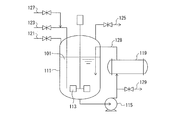
- FIG. It is a figure explaining one embodiment of a manufacturing method of 1,2,3,4-tetrachlorobutane concerning the present invention, and is a model explaining a composition of a manufacturing device of 1,2,3,4-tetrachlorobutane.
- FIG. It is a schematic diagram explaining the structure of the manufacturing apparatus of the conventional 1,2,3,4- tetrachloro butane.
- the present embodiment shows an example of the present invention, and the present invention is not limited to the present embodiment.
- various changes or improvements can be added to this embodiment, and a form added with such changes or improvements can be included in the present invention.
- the conventional apparatus for producing 1,2,3,4-tetrachlorobutane shown in FIG. 2 comprises a reaction vessel 111 in which a reaction of 3,4-dichloro-1-butene with chlorine gas is carried out;
- the reaction liquid feed pipe 121 for introducing the reaction liquid 101 containing -1-butene into the reaction vessel 111, the stirrer 113 for stirring the reaction liquid 101 in the reaction vessel 111, and chlorine in the reaction liquid 101 in the reaction vessel 111
- a chlorine gas pipe 123 for introducing a gas and an exhaust pipe 125 for discharging the gas phase portion in the reaction vessel 111 to the outside are provided.
- a nitrogen gas pipe 127 is branchedly connected to the chlorine gas pipe 123. Nitrogen gas is introduced from the nitrogen gas pipe 127 to the chlorine gas pipe 123, and nitrogen gas is mixed with chlorine gas, A mixed gas in which chlorine gas is diluted with nitrogen gas is prepared, and the mixed gas can be introduced into the reaction liquid 101 from the chlorine gas pipe 123.
- the apparatus for producing 1,2,3,4-tetrachlorobutane shown in FIG. 2 extracts a part of the reaction liquid 101 in the reaction vessel 111 during the reaction to the outside of the reaction vessel 111 and returns it to the reaction vessel 111.
- It has a circulation facility. More specifically, both ends of an annular circulation pipe 128 are connected to the reaction vessel 111, and the reaction liquid 101 is fed by the liquid circulation pump 115 installed on the circulation pipe 128 and removed from the reaction vessel 111.
- the reaction solution 101 can be returned to the inside of the reaction vessel 111 via the circulation pipe 128.
- a heat exchanger 119 may be installed, for example, on the downstream side of the liquid circulation pump 115 of the circulation pipe 128.
- a reaction liquid extraction pipe 129 is connected in a branched manner to the circulation pipe 128, and the reaction liquid 101 is not returned to the reaction container 111, and a production apparatus for the 1,2,3,4-tetrachlorobutane can be obtained. It can be extracted outside.
- the reaction vessel 111 is formed of stainless steel SUS316, but the gas of the inner surface or the gas phase portion in contact with the reaction liquid 101 is Fluorinated resin lining is applied to the contacting part.
- the principle that causes such solidification problems is due to the following reasons. That is, the reaction of 3,4-dichloro-1-butene with chlorine is usually carried out at a temperature of 60 to 70.degree. If the reaction temperature is 60 ° C. or higher, the mesobody does not separate out during the reaction, so clogging of the pipe does not occur, and if the reaction temperature is 70 ° C. or lower, the yield is reduced due to the polymerization reaction of 3,4-dichloro-1-butene Because there is little
- the cause of the increase in the ratio of meso form is considered to be due to the inclusion of a solid containing iron chloride or the like in the reaction solution, as described above.
- a solid containing iron chloride or the like in the reaction solution, as described above.
- the rough part of the iron surface forming the reaction vessel is scraped off by the chlorine used for the reaction and floats in the reaction solution, which serves as a catalyst to increase the proportion of meso bodies Conceivable.
- the present inventors even when using an economical iron reaction vessel, the ratio of meso form by providing a device capable of circulating the reaction liquid and filtering out solids. We have found a manufacturing method that can avoid the problem of solidification without raising
- the reaction liquid containing 3,4-dichloro-1-butene is formed of a metal whose inner surface in contact with the reaction liquid is metal.
- the reaction vessel is charged with chlorine gas, and 3,4-dichloro-1-butene is reacted with chlorine gas to produce 1,2,3,4-tetrachlorobutane.
- at least a part of the reaction liquid in the reaction vessel is extracted and filtered to remove solids in the extracted reaction liquid, and the above reaction is carried out while returning the filtered reaction liquid to the reaction vessel.
- reaction solution was passed through a filtration device and the reaction was carried out while removing the solid substances present in the reaction solution, whereby a reaction vessel made of a metal with an inner surface was used. Even if, it can suppress that problems, such as obstruction of piping, arise. Therefore, according to the method for producing 1,2,3,4-tetrachlorobutane according to the present embodiment, TCB can be stably and economically produced.
- 1,2,3,4-Tetrachlorobutane is hexafluoro-1,3-dimethyl-1 via 1,2,3,4-tetrachloro-1,1,2,3,4,4-hexafluorobutane. It can be used as a raw material for synthesizing butadiene. Since hexafluoro-1,3-butadiene is used in large quantities as a gas for etching in the semiconductor manufacturing process, a method for stably and economically producing TCB is very useful.
- the inner surface of the reaction container may be made of metal.
- the metal forming the inner surface of the reaction vessel is preferably one having corrosion resistance to chlorine gas, hydrogen chloride and hydrochloric acid, for example, at least one selected from iron, iron alloy, nickel, nickel alloy and tantalum. Be One of these metals may be used alone, or two or more thereof may be used in combination. Examples of the iron alloy include stainless steel such as SUS316L, and examples of the nickel alloy include Hastelloy (registered trademark) and Monel (registered trademark).
- the inner surface of the reaction vessel may be subjected to at least one of polishing treatment and acid washing treatment.
- An example of the polishing process is a process of polishing with an abrasive paper provided with an abrasive having a particle size larger than P150.
- Examples of the acid washing treatment include treatment of washing the surface with an acid such as nitric acid or sulfuric acid. Note that at least one of polishing treatment and acid washing treatment may be applied to metal surfaces other than the inner surface of the reaction vessel in the 1,2,3,4-tetrachlorobutane production apparatus.
- Rust and dirt are supplied.
- rust or dirt is a substance containing iron, it reacts with water and hydrogen chloride to form iron oxide, or reacts with chlorine gas to form iron chloride. Then, the generated iron oxide or iron chloride exhibits a catalytic action to increase the formation ratio of the meso form.
- filtration device that circulates the reaction solution to separate solids by filtration
- examples of which include filters and precipitation filtration devices but a device that removes solids by filtration is the most convenient. It is an apparatus.
- the filter a filter cloth or a perforated plate which does not allow solid matter to permeate but allows liquid to permeate can be used. Further, it is preferable that the filter be made of a material with the smallest amount of eluted matter eluted in the reaction solution.
- the filter material include filter cloths made of synthetic fibers such as polyester, polyamide, polyolefin, aramid, acrylic resin, fluorine resin, polyphenylene sulfide, polyimide and glass fibers, and sintered metals.
- synthetic fibers such as polyester, polyamide, polyolefin, aramid, acrylic resin, fluorine resin, polyphenylene sulfide, polyimide and glass fibers, and sintered metals.
- the amount of circulating the reaction liquid is not particularly limited because it changes depending on the amount of the reaction liquid, the amount of chlorine gas blown, the capacity of the heat exchanger, etc., but it is at least 5 times the amount of the reaction liquid charged in the reaction vessel. It is preferable to circulate a 1000-fold or less liquid volume per hour, and more preferable to circulate a 10-fold to 100-fold liquid volume per hour.
- the circulation amount described above is economical because a heat exchanger having a particularly high cooling capacity and a pump having a particularly high liquid feeding capacity are not required.
- the purity of the raw material 3,4-dichloro-1-butene is preferably 90% by mass or more.
- the reaction of 3,4-dichloro-1-butene with chlorine gas may be carried out without a solvent or in a solvent.
- 3,4-dichloro-1-butene is used as a reaction liquid, and the reaction is carried out by introducing chlorine gas into the reaction liquid.
- a solution of 3,4-dichloro-1-butene in a solvent is used as a reaction solution, and chlorine gas is introduced into the reaction solution to carry out the reaction.
- the type of solvent is not particularly limited, but it may be at least one of 1,2,3,4-tetrachloro-1,1,2,3,4,4-hexafluorobutane and carbon tetrachloride. it can.
- the amount of solvent depends on the handling temperature of the reaction liquid Adjusted.
- the water content in the reaction solution is preferably less than the saturation solubility of water in the reaction solution, and more preferably 100 mass ppm or less.
- the state in which water having a saturation solubility or more is contained is a state in which an aqueous layer is present on the liquid surface of the reaction liquid.
- the concentration of chlorine gas used in the reaction is not particularly limited, but when using chlorine gas diluted with an inert gas such as nitrogen gas or argon, the exhaust gas is discharged from the gas phase portion of the reaction vessel It is preferable to attach piping for the reaction vessel to the reaction vessel. Since the chlorination reaction is an exothermic reaction, in order to keep the temperature of the reaction solution constant, install a heat exchanger for removing the heat of reaction in the 1,2,3,4-tetrachlorobutane production apparatus. Is preferred. Moreover, in order to cause the blown chlorine gas and the reaction liquid to react uniformly, it is preferable to install a stirrer equipped with a stirring blade for stirring the reaction liquid in the reaction vessel.
- reaction vessel may be provided with a reaction liquid feeding pipe to be introduced, and a reaction liquid extracting pipe for taking out the reaction liquid to the outside of the reaction vessel.
- thermocouples that measure the temperature of the reaction liquid
- pressure gauges that measure the pressure of each part in the reaction vessel
- flow meters that measure the flow rate of the liquid passing through the piping, etc.
- 1,4-Tetrachlorobutane The general instrument necessary to operate the production apparatus may be attached to the production apparatus for 1,2,3,4-tetrachlorobutane.
- Example 1 First, the configuration of an apparatus for producing 1,2,3,4-tetrachlorobutane used in Example 1 will be described with reference to FIG. The apparatus for producing 1,2,3,4-tetrachlorobutane shown in FIG.
- reaction liquid 1 comprises a reaction vessel 11 in which the reaction of 3,4-dichloro-1-butene with chlorine gas is carried out, and 3,4-dichloro-1
- the reaction liquid feed pipe 21 for introducing the reaction liquid 1 containing butene into the reaction vessel 11, the stirrer 13 for stirring the reaction liquid 1 in the reaction vessel 11, chlorine gas in the reaction liquid 1 in the reaction vessel 11
- a chlorine gas pipe 23 to be introduced and an exhaust pipe 25 for discharging the gas phase portion in the reaction vessel 11 to the outside are provided.
- a nitrogen gas pipe 27 is branchedly connected to the chlorine gas pipe 23, and nitrogen gas is introduced from the nitrogen gas pipe 27 to the chlorine gas pipe 23 to mix nitrogen gas with chlorine gas, A mixed gas in which chlorine gas is diluted with nitrogen gas is prepared, and the mixed gas can be introduced into the reaction liquid 1 from the chlorine gas pipe 23.
- the apparatus for producing 1,2,3,4-tetrachlorobutane shown in FIG. 1 extracts a part of the reaction liquid 1 in the reaction vessel 11 during the reaction to the outside of the reaction vessel 11, and performs a process such as filtration. It is equipped with a circulation facility which is returned to the inside of the reaction vessel 11 after the operation. More specifically, both ends of an annular circulation pipe 28 are connected to the reaction vessel 11, and the reaction liquid 1 is fed by the liquid circulation pump 15 installed on the circulation pipe 28 and removed from the reaction vessel 11. The reaction solution 1 can be returned to the inside of the reaction vessel 11 via the circulation pipe 28.
- a filtering device 17 is provided between the reaction vessel 11 and the liquid circulation pump 15 so that the solid matter in the extracted reaction liquid 1 can be removed.
- the filtered reaction liquid 1 is returned to the reaction vessel 11 after passing through the heat exchanger 19. That is, the apparatus for producing 1,2,3,4-tetrachlorobutane shown in FIG. 1 extracts and filters a part of the reaction liquid 1 in the reaction vessel 11 and removes solids in the extracted reaction liquid 1 The reaction can be performed while performing an operation of returning the filtered reaction liquid 1 to the reaction vessel 11.
- reaction liquid outlet pipe 29 is connected to the circulation pipe 28 downstream of the filtration device 17 in a branched manner, so that the filtered reaction liquid 1 is not returned to the inside of the reaction container 11. It can be extracted outside.
- the inner diameter of the reaction vessel 11 is 1 m, the height is 0.9 m, and the area of the liquid surface of the reaction liquid 1 placed in the reaction vessel 11 is 0.78 m 2 .
- the reaction container 11 is entirely formed of stainless steel SUS316 including the inner surface.
- the inner surface of the reaction vessel 11 is polished with an abrasive paper provided with an abrasive having a particle size larger than P240 and then acid washed, and a nitrogen stream is used. Dried.
- the reaction was carried out using the apparatus for producing 1,2,3,4-tetrachlorobutane described above to produce 1,2,3,4-tetrachlorobutane.
- 550 kg of 3,4-dichloro-1-butene was charged as the reaction liquid 1 into the reaction vessel 11, and after adjusting the liquid temperature to 70 ° C., chlorine gas having a concentration of 100 mol% was supplied to the reaction liquid 1 at a flow rate of 54 kg / h
- the chlorination reaction was carried out.
- the reaction solution 1 was sent to the filter device 17 at a flow rate of 14700 kg / h and circulated.
- reaction liquid 1 was sent to the filtration device 17 through the circulation pipe 28 to filter the solid matter, and the reaction liquid 1 passed through the filtration device 17 was returned to the reaction vessel 11.
- the temperature of the reaction solution 1 during the reaction was maintained at 70.degree. Further, the water content in the reaction solution 1 is 10 mass ppm.
- Comparative Example 2 The same procedure as in Example 1 was carried out except that the production apparatus for 1,2,3,4-tetrachlorobutane was not equipped with a filtration apparatus and the reaction was carried out by adding 5 g of iron (III) oxide powder. Reaction. Analysis of the reaction mixture was conducted after stopping the supply of chlorine gas. As a result, the conversion of 3,4-dichloro-1-butene was 100%, and the yield of TCB was 97 mol%. The proportion of meso form in the obtained TCB was 75% by mass.
- Example 2 The reaction was carried out in the same manner as in Example 1 except that 5 g of iron (III) oxide powder was added for reaction. Analysis of the reaction liquid 1 was conducted after stopping the supply of chlorine gas, and the reaction rate of 3,4-dichloro-1-butene was 100%, and the yield of TCB was 97 mol%. The proportion of meso form in the obtained TCB was 55% by mass. Also, when the inside of the reaction vessel 11 was checked, the powder of iron oxide (III) added and the powder of iron chloride formed by reaction of iron oxide (III) with chlorine were removed by a filtration device, There was no powder at the bottom of the reaction vessel 11.
- Comparative Example 3 The reaction was carried out in the same manner as in Example 1 except that the production apparatus for 1,2,3,4-tetrachlorobutane was not equipped with a filtration apparatus and that the inner surface of the reaction vessel was not polished and acid-washed. went. Analysis of the reaction mixture was conducted after stopping the supply of chlorine gas. As a result, the conversion of 3,4-dichloro-1-butene was 100%, and the yield of TCB was 97 mol%. The proportion of meso form in the obtained TCB was 67% by mass.
- Comparative Example 4 Example 1 except that the production apparatus for 1,2,3,4-tetrachlorobutane was not equipped with a filtration apparatus, and that the reaction was carried out by adding 5 g of iron (III) oxide powder and 550 g of water. The reaction was carried out in the same manner as in. Analysis of the reaction mixture was conducted after stopping the supply of chlorine gas. As a result, the conversion of 3,4-dichloro-1-butene was 100%, and the yield of TCB was 97 mol%. The proportion of meso form in the obtained TCB was 79% by mass.
- Example 3 The reaction was carried out in the same manner as Example 1 except that 550 g of water was added and the reaction was carried out so that an aqueous layer was formed on the liquid surface of the reaction liquid 1. Analysis of the reaction liquid 1 was conducted after stopping the supply of chlorine gas, and the reaction rate of 3,4-dichloro-1-butene was 100%, and the yield of TCB was 97 mol%. The proportion of meso form in the obtained TCB was 61% by mass. Further, when the inside of the reaction vessel 11 was checked, the iron chloride powder generated during the reaction was removed by the filtering device 17 and there was no powder at the bottom of the reaction vessel 11.
- Example 4 The reaction was carried out in the same manner as in Example 1 except that 5 g of iron (III) oxide powder and 550 g of water were added for reaction. Analysis of the reaction liquid 1 was conducted after stopping the supply of chlorine gas, and the reaction rate of 3,4-dichloro-1-butene was 100%, and the yield of TCB was 97 mol%. The proportion of meso form in the obtained TCB was 63% by mass. Also, when the inside of the reaction vessel 11 was checked, the powder of iron oxide (III) added and the powder of iron chloride formed by reaction of iron oxide (III) with chlorine were removed by a filtration device, There was no powder at the bottom of the reaction vessel 11.
- Table 1 summarizes the reaction conditions and the evaluation results. As can be seen from Table 1, in Examples 1 to 4, the ratio of the meso form in the obtained TCB was lower than that in Comparative Examples 1 to 4, and was 65% by mass or less. Neither the formation of iron chloride powder nor the corrosion of the inner surface of the reaction vessel 11 occurred.
Landscapes
- Chemical & Material Sciences (AREA)
- Organic Chemistry (AREA)
- Organic Low-Molecular-Weight Compounds And Preparation Thereof (AREA)
Abstract
Description
本発明は、1,2,3,4-テトラクロロブタンを安定的且つ経済的に製造することができる1,2,3,4-テトラクロロブタンの製造方法を提供することを課題とする。
[1] 3,4-ジクロロ-1-ブテンを含有する反応液を、該反応液と接触する内面が金属で形成されている反応容器に仕込み、前記反応液に塩素ガスを導入して、前記3,4-ジクロロ-1-ブテンと前記塩素ガスとの反応を行い、1,2,3,4-テトラクロロブタンを製造するに際して、前記反応容器内の反応液の少なくとも一部を抜き取りろ過して、抜き取った反応液中の固形物を除去し、ろ過された反応液を前記反応容器に戻す操作を行いながら前記反応を行うことを含む1,2,3,4-テトラクロロブタンの製造方法。
[3] 前記反応容器の内面は、研磨処理及び酸洗浄処理の少なくとも一方が施されている[1]又は[2]に記載の1,2,3,4-テトラクロロブタンの製造方法。
[4] 前記反応液は、前記3,4-ジクロロ-1-ブテンを溶媒に溶解した溶液であり、前記溶媒は1,2,3,4-テトラクロロ-1,1,2,3,4,4-ヘキサフルオロブタン及び四塩化炭素の少なくとも一方である[1]~[3]のいずれか一項に記載の1,2,3,4-テトラクロロブタンの製造方法。
図2に示す従来の1,2,3,4-テトラクロロブタンの製造装置は、反応容器111はステンレス鋼SUS316で形成されているが、反応液101と接触する内面や気相部分のガスが接する部分にはフッ素樹脂ライニングが施されている。
図2に示す1,2,3,4-テトラクロロブタンの製造装置を使用して反応を行った場合は、反応液101(3,4-ジクロロ-1-ブテン)に混合ガスを吹き込むと、概ね安定して反応が進行し、TCBが生成した。そして、TCBのメソ体の比率は51質量%であった。
種々検討の結果、本発明者らは、経済的な鉄製の反応容器を使用した場合においても、反応液を循環させて固形物をろ別することのできる装置を備えることにより、メソ体の比率を上げることなく固化の問題を避けることができる製造方法を見出した。
原料である3,4-ジクロロ-1-ブテンの純度は、90質量%以上が好ましい。
溶媒の有無によって生成するTCB中のメソ体の生成比率が変化することはなく、反応液中のメソ体の濃度によってメソ体が固化する温度が異なるため、反応液の取り扱い温度によって溶媒の量は調整される。
塩素化反応は発熱反応であるため、反応液の温度を一定に保つためには反応熱を除去するための熱交換器を1,2,3,4-テトラクロロブタンの製造装置に設置することが好ましい。また、吹き込んだ塩素ガスと反応液を均一に反応させるために、反応液を撹拌するための撹拌翼を備える攪拌機を反応容器に設置することが好ましい。
〔実施例1〕
まず、実施例1において使用した1,2,3,4-テトラクロロブタンの製造装置の構成について、図1を参照しながら説明する。図1に示す1,2,3,4-テトラクロロブタンの製造装置は、3,4-ジクロロ-1-ブテンと塩素ガスとの反応が行われる反応容器11と、3,4-ジクロロ-1-ブテンを含有する反応液1を反応容器11に導入する反応液仕込み用配管21と、反応容器11内の反応液1を撹拌する攪拌機13と、反応容器11内の反応液1に塩素ガスを導入する塩素ガス用配管23と、反応容器11内の気相部分を外部に排出する排気用配管25と、を備えている。
反応容器11の内径は1m、高さは0.9mであり、反応容器11に入れられた反応液1の液面の面積は0.78m2である。反応容器11は、内面を含む全体がステンレス鋼SUS316で形成されている。1,2,3,4-テトラクロロブタンの製造装置を反応に用いる前に、反応容器11の内面を、粒度がP240よりも大きい研磨材を備える研磨紙で研磨した後に酸洗浄し、窒素気流で乾燥した。
1,2,3,4-テトラクロロブタンの製造装置がろ過装置を備えていない点と、水を550g加えて反応液の液面上に水層が形成されるようにして反応を行った点以外は、実施例1と同様にして反応を行った。
塩素ガスの供給停止後に反応液の分析を行ったところ、3,4-ジクロロ-1-ブテンの反応率は100%であり、TCBの収率は97モル%であった。得られたTCB中のメソ体の比率は、70質量%であった。また、反応容器の内部を点検したところ、反応容器の内面のうち気相部分に接する箇所が腐食していた。腐食の結果生じたと思われる粉状の物質が反応容器の底部に残っていたため、分析を行ったところ、酸化鉄と塩化鉄の混合物であった。
1,2,3,4-テトラクロロブタンの製造装置がろ過装置を備えていない点と、酸化鉄(III)の粉末5gを添加して反応を行った点以外は、実施例1と同様にして反応を行った。
塩素ガスの供給停止後に反応液の分析を行ったところ、3,4-ジクロロ-1-ブテンの反応率は100%であり、TCBの収率は97モル%であった。得られたTCB中のメソ体の比率は、75質量%であった。
酸化鉄(III)の粉末5gを添加して反応を行った点以外は、実施例1と同様にして反応を行った。
塩素ガスの供給停止後に反応液1の分析を行ったところ、3,4-ジクロロ-1-ブテンの反応率は100%であり、TCBの収率は97モル%であった。得られたTCB中のメソ体の比率は、55質量%であった。また、反応容器11の内部を点検したところ、添加した酸化鉄(III)の粉末や、酸化鉄(III)が塩素と反応して生じた塩化鉄の粉末は、ろ過装置によって除去されており、反応容器11の底部に粉末はなかった。
1,2,3,4-テトラクロロブタンの製造装置がろ過装置を備えていない点と、反応容器の内面の研磨及び酸洗浄を行わなかった点以外は、実施例1と同様にして反応を行った。
塩素ガスの供給停止後に反応液の分析を行ったところ、3,4-ジクロロ-1-ブテンの反応率は100%であり、TCBの収率は97モル%であった。得られたTCB中のメソ体の比率は、67質量%であった。
1,2,3,4-テトラクロロブタンの製造装置がろ過装置を備えていない点と、酸化鉄(III)の粉末5g及び水550gを添加して反応を行った点以外は、実施例1と同様にして反応を行った。
塩素ガスの供給停止後に反応液の分析を行ったところ、3,4-ジクロロ-1-ブテンの反応率は100%であり、TCBの収率は97モル%であった。得られたTCB中のメソ体の比率は、79質量%であった。
水を550g加えて反応液1の液面上に水層が形成されるようにして反応を行った点以外は、実施例1と同様にして反応を行った。
塩素ガスの供給停止後に反応液1の分析を行ったところ、3,4-ジクロロ-1-ブテンの反応率は100%であり、TCBの収率は97モル%であった。得られたTCB中のメソ体の比率は、61質量%であった。また、反応容器11の内部を点検したところ、反応中に生成した塩化鉄の粉末はろ過装置17によって除去されており、反応容器11の底部に粉末はなかった。
酸化鉄(III)の粉末5g及び水550gを添加して反応を行った点以外は、実施例1と同様にして反応を行った。
塩素ガスの供給停止後に反応液1の分析を行ったところ、3,4-ジクロロ-1-ブテンの反応率は100%であり、TCBの収率は97モル%であった。得られたTCB中のメソ体の比率は、63質量%であった。また、反応容器11の内部を点検したところ、添加した酸化鉄(III)の粉末や、酸化鉄(III)が塩素と反応して生じた塩化鉄の粉末は、ろ過装置によって除去されており、反応容器11の底部に粉末はなかった。

11、111 反応容器
13、113 撹拌機
15、115 液循環ポンプ
17 ろ過装置
19、119 熱交換器
21、121 反応液仕込み用配管
23、123 塩素ガス用配管
25、125 排気用配管
27、127 窒素ガス用配管
28、128 循環用配管
29、129 反応液抜き出し用配管
Claims (4)
- 3,4-ジクロロ-1-ブテンを含有する反応液を、該反応液と接触する内面が金属で形成されている反応容器に仕込み、前記反応液に塩素ガスを導入して、前記3,4-ジクロロ-1-ブテンと前記塩素ガスとの反応を行い、1,2,3,4-テトラクロロブタンを製造するに際して、前記反応容器内の反応液の少なくとも一部を抜き取りろ過して、抜き取った反応液中の固形物を除去し、ろ過された反応液を前記反応容器に戻す操作を行いながら前記反応を行うことを含む1,2,3,4-テトラクロロブタンの製造方法。
- 前記金属が、鉄、鉄合金、ニッケル、ニッケル合金、及びタンタルから選ばれる少なくとも1種である請求項1に記載の1,2,3,4-テトラクロロブタンの製造方法。
- 前記反応容器の内面は、研磨処理及び酸洗浄処理の少なくとも一方が施されている請求項1又は請求項2に記載の1,2,3,4-テトラクロロブタンの製造方法。
- 前記反応液は、前記3,4-ジクロロ-1-ブテンを溶媒に溶解した溶液であり、前記溶媒は1,2,3,4-テトラクロロ-1,1,2,3,4,4-ヘキサフルオロブタン及び四塩化炭素の少なくとも一方である請求項1~3のいずれか一項に記載の1,2,3,4-テトラクロロブタンの製造方法。
Priority Applications (5)
| Application Number | Priority Date | Filing Date | Title |
|---|---|---|---|
| US16/760,091 US10995046B2 (en) | 2017-11-30 | 2018-10-11 | Process for producing 1,2,3,4-tetrachlorobutane |
| CN201880066876.2A CN111212823B (zh) | 2017-11-30 | 2018-10-11 | 1,2,3,4-四氯丁烷的制造方法 |
| KR1020207010771A KR102380543B1 (ko) | 2017-11-30 | 2018-10-11 | 1,2,3,4-테트라클로로부탄의 제조 방법 |
| JP2019557051A JP7122324B2 (ja) | 2017-11-30 | 2018-10-11 | 1,2,3,4-テトラクロロブタンの製造方法 |
| EP18882554.1A EP3718994B1 (en) | 2017-11-30 | 2018-10-11 | Process for the production of 1,2,3,4-tetrachlorobutane |
Applications Claiming Priority (2)
| Application Number | Priority Date | Filing Date | Title |
|---|---|---|---|
| JP2017230726 | 2017-11-30 | ||
| JP2017-230726 | 2017-11-30 |
Publications (1)
| Publication Number | Publication Date |
|---|---|
| WO2019106972A1 true WO2019106972A1 (ja) | 2019-06-06 |
Family
ID=66664858
Family Applications (1)
| Application Number | Title | Priority Date | Filing Date |
|---|---|---|---|
| PCT/JP2018/037965 Ceased WO2019106972A1 (ja) | 2017-11-30 | 2018-10-11 | 1,2,3,4-テトラクロロブタンの製造方法 |
Country Status (7)
| Country | Link |
|---|---|
| US (1) | US10995046B2 (ja) |
| EP (1) | EP3718994B1 (ja) |
| JP (1) | JP7122324B2 (ja) |
| KR (1) | KR102380543B1 (ja) |
| CN (1) | CN111212823B (ja) |
| TW (1) | TWI761615B (ja) |
| WO (1) | WO2019106972A1 (ja) |
Citations (17)
| Publication number | Priority date | Publication date | Assignee | Title |
|---|---|---|---|---|
| GB1019150A (en) | 1963-07-19 | 1966-02-02 | British Cellophane Ltd | Improvements in or relating to the manufacture of 1,2,3,4-tetrachlorobutane |
| JPS5528334B2 (ja) | 1973-05-07 | 1980-07-26 | ||
| JPS6127A (ja) * | 1984-06-11 | 1986-01-06 | Kanegafuchi Chem Ind Co Ltd | 二塩化エタンの製造法 |
| JPH07258122A (ja) * | 1994-03-18 | 1995-10-09 | Tokuyama Corp | 低次ハロゲン化炭化水素の製造方法 |
| JPH11240855A (ja) * | 1997-12-26 | 1999-09-07 | Kuraray Co Ltd | 反応方法及び反応装置 |
| JPH11286462A (ja) * | 1998-03-31 | 1999-10-19 | Nippon Zeon Co Ltd | フッ素化飽和炭化水素の製造方法 |
| JP2001247494A (ja) * | 2000-03-07 | 2001-09-11 | Nippon Zeon Co Ltd | 1,1,2,2,3,3,4−ヘプタフルオロシクロペンタンの製造方法およびその製造装置 |
| JP2001322954A (ja) * | 2000-05-15 | 2001-11-20 | Asahi-Penn Chemical Co Ltd | トリクロロエチレンおよびテトラクロロエチレンの製造方法 |
| JP2003012578A (ja) * | 2001-06-28 | 2003-01-15 | Asahi Glass Co Ltd | 有機ハロゲン化合物と高温高圧水との反応方法 |
| JP2005515250A (ja) * | 2002-01-21 | 2005-05-26 | ロディア・ポリアミド・インターミーディエッツ | ニトリル又はニトロ化合物をアミンに水素化させるための連続方法 |
| JP2007320972A (ja) * | 2007-09-11 | 2007-12-13 | Kureha Corp | 1,1,2−トリクロロエタンの製造方法及び装置 |
| JP2008531474A (ja) * | 2005-01-19 | 2008-08-14 | グレート・レイクス・ケミカル・コーポレイション | ハロゲン化炭素生成方法、ハロゲン化炭素分離方法及びハロゲン化炭素生成システム |
| WO2008120642A1 (ja) * | 2007-03-30 | 2008-10-09 | Showa Denko K.K. | 1,2,3,4-テトラクロロヘキサフルオロブタンの製造方法および精製方法 |
| WO2008133086A1 (ja) * | 2007-04-20 | 2008-11-06 | Showa Denko K.K. | 含フッ素化合物の製造方法 |
| WO2009139352A1 (ja) * | 2008-05-16 | 2009-11-19 | 昭和電工株式会社 | 1,2,3,4-テトラクロロヘキサフルオロブタンの製造方法および精製方法 |
| JP2015501300A (ja) * | 2011-10-14 | 2015-01-15 | ハネウェル・インターナショナル・インコーポレーテッド | 2,3,3,3−テトラフルオロプロペンの製造方法 |
| JP2015508818A (ja) * | 2012-02-29 | 2015-03-23 | ハネウェル・インターナショナル・インコーポレーテッド | 2,3,3,3−テトラフルオロプロペンの生産方法 |
Family Cites Families (8)
| Publication number | Priority date | Publication date | Assignee | Title |
|---|---|---|---|---|
| US1019150A (en) | 1911-12-20 | 1912-03-05 | Charles L Heisler | Piston-rod-extension guide. |
| JP4724997B2 (ja) * | 2000-02-02 | 2011-07-13 | ダイキン工業株式会社 | 含水素フッ素化炭化水素の製造方法 |
| US20030028057A1 (en) | 2001-07-20 | 2003-02-06 | Stephen Owens | Methods and materials for the preparation and purification of halogenated hydrocarbons |
| JP4043802B2 (ja) * | 2002-02-25 | 2008-02-06 | 株式会社クレハ | 1,1,2−トリクロロエタンの製造方法及び装置 |
| US9416074B2 (en) | 2007-07-06 | 2016-08-16 | Honeywell International Inc. | Process for producing 2,3,3,3-tetrafluoropropene |
| CN102076644B (zh) * | 2008-07-01 | 2015-03-11 | 昭和电工株式会社 | 1,2,3,4-四氯六氟丁烷的制造方法 |
| WO2011058575A1 (en) * | 2009-11-10 | 2011-05-19 | Pidilite Industries Ltd | An improved process for the preparation of 2,3,-dichloro 1,3,butadiene from 1,3 butadiene |
| WO2016058568A1 (en) * | 2014-10-16 | 2016-04-21 | Spolek Pro Chemickou A Hutni Vyrobu, Akciova Spolecnost | A process for producing highly pure chlorinated alkanes |
-
2018
- 2018-10-11 EP EP18882554.1A patent/EP3718994B1/en active Active
- 2018-10-11 US US16/760,091 patent/US10995046B2/en active Active
- 2018-10-11 JP JP2019557051A patent/JP7122324B2/ja active Active
- 2018-10-11 KR KR1020207010771A patent/KR102380543B1/ko active Active
- 2018-10-11 WO PCT/JP2018/037965 patent/WO2019106972A1/ja not_active Ceased
- 2018-10-11 CN CN201880066876.2A patent/CN111212823B/zh active Active
- 2018-10-23 TW TW107137315A patent/TWI761615B/zh active
Patent Citations (17)
| Publication number | Priority date | Publication date | Assignee | Title |
|---|---|---|---|---|
| GB1019150A (en) | 1963-07-19 | 1966-02-02 | British Cellophane Ltd | Improvements in or relating to the manufacture of 1,2,3,4-tetrachlorobutane |
| JPS5528334B2 (ja) | 1973-05-07 | 1980-07-26 | ||
| JPS6127A (ja) * | 1984-06-11 | 1986-01-06 | Kanegafuchi Chem Ind Co Ltd | 二塩化エタンの製造法 |
| JPH07258122A (ja) * | 1994-03-18 | 1995-10-09 | Tokuyama Corp | 低次ハロゲン化炭化水素の製造方法 |
| JPH11240855A (ja) * | 1997-12-26 | 1999-09-07 | Kuraray Co Ltd | 反応方法及び反応装置 |
| JPH11286462A (ja) * | 1998-03-31 | 1999-10-19 | Nippon Zeon Co Ltd | フッ素化飽和炭化水素の製造方法 |
| JP2001247494A (ja) * | 2000-03-07 | 2001-09-11 | Nippon Zeon Co Ltd | 1,1,2,2,3,3,4−ヘプタフルオロシクロペンタンの製造方法およびその製造装置 |
| JP2001322954A (ja) * | 2000-05-15 | 2001-11-20 | Asahi-Penn Chemical Co Ltd | トリクロロエチレンおよびテトラクロロエチレンの製造方法 |
| JP2003012578A (ja) * | 2001-06-28 | 2003-01-15 | Asahi Glass Co Ltd | 有機ハロゲン化合物と高温高圧水との反応方法 |
| JP2005515250A (ja) * | 2002-01-21 | 2005-05-26 | ロディア・ポリアミド・インターミーディエッツ | ニトリル又はニトロ化合物をアミンに水素化させるための連続方法 |
| JP2008531474A (ja) * | 2005-01-19 | 2008-08-14 | グレート・レイクス・ケミカル・コーポレイション | ハロゲン化炭素生成方法、ハロゲン化炭素分離方法及びハロゲン化炭素生成システム |
| WO2008120642A1 (ja) * | 2007-03-30 | 2008-10-09 | Showa Denko K.K. | 1,2,3,4-テトラクロロヘキサフルオロブタンの製造方法および精製方法 |
| WO2008133086A1 (ja) * | 2007-04-20 | 2008-11-06 | Showa Denko K.K. | 含フッ素化合物の製造方法 |
| JP2007320972A (ja) * | 2007-09-11 | 2007-12-13 | Kureha Corp | 1,1,2−トリクロロエタンの製造方法及び装置 |
| WO2009139352A1 (ja) * | 2008-05-16 | 2009-11-19 | 昭和電工株式会社 | 1,2,3,4-テトラクロロヘキサフルオロブタンの製造方法および精製方法 |
| JP2015501300A (ja) * | 2011-10-14 | 2015-01-15 | ハネウェル・インターナショナル・インコーポレーテッド | 2,3,3,3−テトラフルオロプロペンの製造方法 |
| JP2015508818A (ja) * | 2012-02-29 | 2015-03-23 | ハネウェル・インターナショナル・インコーポレーテッド | 2,3,3,3−テトラフルオロプロペンの生産方法 |
Non-Patent Citations (1)
| Title |
|---|
| See also references of EP3718994A4 |
Also Published As
| Publication number | Publication date |
|---|---|
| KR102380543B1 (ko) | 2022-03-29 |
| JP7122324B2 (ja) | 2022-08-19 |
| EP3718994A1 (en) | 2020-10-07 |
| US20200346997A1 (en) | 2020-11-05 |
| CN111212823B (zh) | 2022-06-24 |
| JPWO2019106972A1 (ja) | 2020-10-08 |
| TW201925148A (zh) | 2019-07-01 |
| KR20200051796A (ko) | 2020-05-13 |
| TWI761615B (zh) | 2022-04-21 |
| CN111212823A (zh) | 2020-05-29 |
| EP3718994A4 (en) | 2021-02-24 |
| US10995046B2 (en) | 2021-05-04 |
| EP3718994B1 (en) | 2023-06-14 |
Similar Documents
| Publication | Publication Date | Title |
|---|---|---|
| JP7707351B2 (ja) | 少なくとも1つの不純物をNaCl-MgCl2塩から除去するための方法 | |
| EP2105410B1 (en) | Chlorosilanes purifying apparatus and chlorosilanes purifying method | |
| CN111918839B (zh) | 六氟化钼的制造方法和制造装置 | |
| CA1213717A (fr) | Obtention d'une solution d'hypochlorite de sodium a haute concentration par un procede continu | |
| JP6021720B2 (ja) | フルオロアルキルアイオダイドの利用方法 | |
| CN107999001A (zh) | 用于制备溴化物的方法 | |
| JP7122324B2 (ja) | 1,2,3,4-テトラクロロブタンの製造方法 | |
| KR100687214B1 (ko) | 고순도 6불화텅스텐의 정제방법 | |
| CN113905979A (zh) | 五氟化溴的制造方法 | |
| JP2010227906A (ja) | 粒度分布を有する粒状物の洗浄方法 | |
| JP4517656B2 (ja) | ビスフェノールaの製造方法 | |
| KR102662109B1 (ko) | 1,2,3,4-테트라클로로부탄의 제조 방법 및 제조 장치 | |
| CA2501326A1 (en) | Improved conversion of sodium bromide to anhydrous hydrobromic acid and sodium bisulfate | |
| CN114096521A (zh) | 全氟酰基过氧化物的制造方法及氟烷基碘的制造方法 | |
| JP6504059B2 (ja) | ヘキサクロロアセトンの製造方法 | |
| JP6657086B2 (ja) | オレフィンの高圧ヒドロホルミル化のための反応器中のコバルト付着物を除去する方法 | |
| JP2026016945A (ja) | トリフルオロヨードメタンの製造方法及び組成物 | |
| JPS60238428A (ja) | 金属剥離方法およびその装置 |
Legal Events
| Date | Code | Title | Description |
|---|---|---|---|
| 121 | Ep: the epo has been informed by wipo that ep was designated in this application |
Ref document number: 18882554 Country of ref document: EP Kind code of ref document: A1 |
|
| ENP | Entry into the national phase |
Ref document number: 2019557051 Country of ref document: JP Kind code of ref document: A |
|
| ENP | Entry into the national phase |
Ref document number: 20207010771 Country of ref document: KR Kind code of ref document: A |
|
| NENP | Non-entry into the national phase |
Ref country code: DE |
|
| ENP | Entry into the national phase |
Ref document number: 2018882554 Country of ref document: EP Effective date: 20200630 |