WO2019123718A1 - 非水液状物質の精製方法及び外気遮断部材付きイオン交換樹脂充填カートリッジ - Google Patents
非水液状物質の精製方法及び外気遮断部材付きイオン交換樹脂充填カートリッジ Download PDFInfo
- Publication number
- WO2019123718A1 WO2019123718A1 PCT/JP2018/031301 JP2018031301W WO2019123718A1 WO 2019123718 A1 WO2019123718 A1 WO 2019123718A1 JP 2018031301 W JP2018031301 W JP 2018031301W WO 2019123718 A1 WO2019123718 A1 WO 2019123718A1
- Authority
- WO
- WIPO (PCT)
- Prior art keywords
- exchange resin
- ion exchange
- macroporous
- water content
- cartridge
- Prior art date
- Legal status (The legal status is an assumption and is not a legal conclusion. Google has not performed a legal analysis and makes no representation as to the accuracy of the status listed.)
- Ceased
Links
Images



Classifications
-
- B—PERFORMING OPERATIONS; TRANSPORTING
- B01—PHYSICAL OR CHEMICAL PROCESSES OR APPARATUS IN GENERAL
- B01J—CHEMICAL OR PHYSICAL PROCESSES, e.g. CATALYSIS OR COLLOID CHEMISTRY; THEIR RELEVANT APPARATUS
- B01J47/00—Ion-exchange processes in general; Apparatus therefor
- B01J47/02—Column or bed processes
- B01J47/04—Mixed-bed processes
-
- B—PERFORMING OPERATIONS; TRANSPORTING
- B01—PHYSICAL OR CHEMICAL PROCESSES OR APPARATUS IN GENERAL
- B01D—SEPARATION
- B01D15/00—Separating processes involving the treatment of liquids with solid sorbents; Apparatus therefor
- B01D15/08—Selective adsorption, e.g. chromatography
- B01D15/10—Selective adsorption, e.g. chromatography characterised by constructional or operational features
- B01D15/20—Selective adsorption, e.g. chromatography characterised by constructional or operational features relating to the conditioning of the sorbent material
- B01D15/203—Equilibration or regeneration
-
- B—PERFORMING OPERATIONS; TRANSPORTING
- B01—PHYSICAL OR CHEMICAL PROCESSES OR APPARATUS IN GENERAL
- B01D—SEPARATION
- B01D15/00—Separating processes involving the treatment of liquids with solid sorbents; Apparatus therefor
- B01D15/08—Selective adsorption, e.g. chromatography
- B01D15/26—Selective adsorption, e.g. chromatography characterised by the separation mechanism
- B01D15/36—Selective adsorption, e.g. chromatography characterised by the separation mechanism involving ionic interaction, e.g. ion-exchange, ion-pair, ion-suppression or ion-exclusion
- B01D15/361—Ion-exchange
-
- B—PERFORMING OPERATIONS; TRANSPORTING
- B01—PHYSICAL OR CHEMICAL PROCESSES OR APPARATUS IN GENERAL
- B01J—CHEMICAL OR PHYSICAL PROCESSES, e.g. CATALYSIS OR COLLOID CHEMISTRY; THEIR RELEVANT APPARATUS
- B01J39/00—Cation exchange; Use of material as cation exchangers; Treatment of material for improving the cation exchange properties
- B01J39/04—Processes using organic exchangers
-
- B—PERFORMING OPERATIONS; TRANSPORTING
- B01—PHYSICAL OR CHEMICAL PROCESSES OR APPARATUS IN GENERAL
- B01J—CHEMICAL OR PHYSICAL PROCESSES, e.g. CATALYSIS OR COLLOID CHEMISTRY; THEIR RELEVANT APPARATUS
- B01J39/00—Cation exchange; Use of material as cation exchangers; Treatment of material for improving the cation exchange properties
- B01J39/08—Use of material as cation exchangers; Treatment of material for improving the cation exchange properties
- B01J39/16—Organic material
- B01J39/18—Macromolecular compounds
- B01J39/20—Macromolecular compounds obtained by reactions only involving unsaturated carbon-to-carbon bonds
-
- B—PERFORMING OPERATIONS; TRANSPORTING
- B01—PHYSICAL OR CHEMICAL PROCESSES OR APPARATUS IN GENERAL
- B01J—CHEMICAL OR PHYSICAL PROCESSES, e.g. CATALYSIS OR COLLOID CHEMISTRY; THEIR RELEVANT APPARATUS
- B01J41/00—Anion exchange; Use of material as anion exchangers; Treatment of material for improving the anion exchange properties
- B01J41/04—Processes using organic exchangers
-
- B—PERFORMING OPERATIONS; TRANSPORTING
- B01—PHYSICAL OR CHEMICAL PROCESSES OR APPARATUS IN GENERAL
- B01J—CHEMICAL OR PHYSICAL PROCESSES, e.g. CATALYSIS OR COLLOID CHEMISTRY; THEIR RELEVANT APPARATUS
- B01J41/00—Anion exchange; Use of material as anion exchangers; Treatment of material for improving the anion exchange properties
- B01J41/08—Use of material as anion exchangers; Treatment of material for improving the anion exchange properties
- B01J41/12—Macromolecular compounds
- B01J41/14—Macromolecular compounds obtained by reactions only involving unsaturated carbon-to-carbon bonds
-
- B—PERFORMING OPERATIONS; TRANSPORTING
- B01—PHYSICAL OR CHEMICAL PROCESSES OR APPARATUS IN GENERAL
- B01J—CHEMICAL OR PHYSICAL PROCESSES, e.g. CATALYSIS OR COLLOID CHEMISTRY; THEIR RELEVANT APPARATUS
- B01J47/00—Ion-exchange processes in general; Apparatus therefor
- B01J47/02—Column or bed processes
- B01J47/022—Column or bed processes characterised by the construction of the column or container
- B01J47/024—Column or bed processes characterised by the construction of the column or container where the ion-exchangers are in a removable cartridge
-
- B—PERFORMING OPERATIONS; TRANSPORTING
- B01—PHYSICAL OR CHEMICAL PROCESSES OR APPARATUS IN GENERAL
- B01J—CHEMICAL OR PHYSICAL PROCESSES, e.g. CATALYSIS OR COLLOID CHEMISTRY; THEIR RELEVANT APPARATUS
- B01J47/00—Ion-exchange processes in general; Apparatus therefor
- B01J47/02—Column or bed processes
- B01J47/06—Column or bed processes during which the ion-exchange material is subjected to a physical treatment, e.g. heat, electric current, irradiation or vibration
-
- B—PERFORMING OPERATIONS; TRANSPORTING
- B01—PHYSICAL OR CHEMICAL PROCESSES OR APPARATUS IN GENERAL
- B01J—CHEMICAL OR PHYSICAL PROCESSES, e.g. CATALYSIS OR COLLOID CHEMISTRY; THEIR RELEVANT APPARATUS
- B01J47/00—Ion-exchange processes in general; Apparatus therefor
- B01J47/14—Controlling or regulating
-
- B—PERFORMING OPERATIONS; TRANSPORTING
- B01—PHYSICAL OR CHEMICAL PROCESSES OR APPARATUS IN GENERAL
- B01D—SEPARATION
- B01D2257/00—Components to be removed
- B01D2257/60—Heavy metals or heavy metal compounds
Definitions
- the present invention relates to a method for purifying non-aqueous liquid material for removing impurities in non-aqueous liquid material, and an ion exchange resin-filled cartridge used therefor.
- an ion exchange resin is packed into a cartridge or column, and the non-aqueous liquid material as the liquid to be treated is passed directly into the cartridge or column and purified.
- a purification method (purification method 1) for obtaining a liquid liquid substance, and a cartridge filled with an ion exchange resin and further covering the same are provided, and a non-aqueous liquid substance to be treated passes between the cartridge and the storage container.
- the purification method (purification method 2) is known which passes through the inside of the cartridge to obtain a purified non-aqueous liquid substance.
- Patent Document 1 reports a purification method in which a non-aqueous liquid is brought into contact with a cation exchange resin having a water content of 3 to 30% to remove metal ions and the like.
- Patent Document 2 reports a purification method in which a non-aqueous liquid is brought into contact with a cation exchange resin having a water content of less than 3% and an anion exchange resin having a water content of 30% or less to remove metal ions and the like. ing.
- Patent Document 3 a method of reducing a strongly acidic cation exchange resin to a water content of 5% or less, packing a drying ion exchange resin into a column, and purifying a non-aqueous liquid material by passing the non-aqueous liquid material has been reported.
- a purifier for removing chromium from an organic solvent As the purification method 2, for example, in Patent Document 4, as a purifier for removing chromium from an organic solvent, a purifier including an ion exchange resin container for filling an ion exchange resin in a cylindrical housing and a method of use Is reported about.
- the ion exchange resin in a water wet state is usually filled.
- the non-aqueous liquid substance purified by the ion exchange resin-filled cartridge be highly purified by reducing the impurity concentration, so water and other ions become impurities as well as metal ions in the non-aqueous liquid substance. Therefore, extremely low moisture content is required.
- the pore inside the ion exchange resin remains in the pore by swelling in the non-aqueous liquid even if a dry ion exchange resin is used
- the elution of water molecules and the elution of water molecules hydrated with ion exchange groups by ion exchange increase the water concentration in the treatment liquid compared to the liquid to be treated. Therefore, in order to perform purification of non-aqueous liquid material using an unused ion exchange resin-filled cartridge, the non-aqueous liquid material is passed through the cartridge and filled in the cartridge before purification. By contacting with the ion exchange resin, it is necessary to have an initial blowing step to remove the water of the ion exchange resin.
- thermal drying or reduced pressure drying reported in Patent Document 3 is used.
- contact with metal in the drying step and the step of transferring the dry ion exchange resin to the cartridge or column, or contact with the atmosphere containing metal or fine particles may be a problem to the ion exchange resin. It causes contamination of impurities.
- an object of the present invention is to provide an amount of non-aqueous liquid material used for initial blow in a method of purifying non-aqueous liquid material by contacting non-aqueous liquid material with ion exchange resin to remove impurities from non-aqueous liquid material. It is an object of the present invention to provide a method of purifying a non-aqueous liquid material which can reduce the amount of water and which does not contaminate the ion exchange resin in the ion exchange resin-filled cartridge.
- the present invention (1) is a method for purifying a non-aqueous liquid substance, which comprises removing the impurities from the non-aqueous liquid substance by bringing the non-aqueous liquid substance into contact with a macroporous or porous ion exchange resin.
- the ion exchange resin is filled with an ion exchange resin-filled cartridge in which a macroporous or porous ion exchange resin in a water wet state is filled in a cartridge container and the macroporous or porous ion exchange resin is filled before the water content reduction.
- the water content (A) of the macroporous or porous ion exchange resin after reduction of water content is 90.0 to 97.
- the unrefined non-aqueous liquid material is passed through the cartridge container filled with the macroporous or porous ion exchange resin after the reduction of water content, and the initial blow waste solution is discharged from the cartridge container Initial blow process,
- the unrefined non-aqueous liquid material is brought into contact with the macroporous or porous ion exchange resin in the cartridge container, Purifying the non-aqueous liquid material to obtain a purified non-aqueous liquid material; It provides the purification method of the non-aqueous liquid substance characterized by having.
- the inert gas is allowed to pass through the inside of the cartridge container to bring the macroporous or porous ion exchange resin in the cartridge container into contact with the inert gas. It is an object of the present invention to provide a method of purifying a non-aqueous liquid substance according to (1), which comprises performing a water content reduction step.
- the present invention (3) provides the method of purifying a non-aqueous liquid material according to (2), wherein the temperature of the inert gas is 0 to 60 ° C.
- the inside of the cartridge container filled with the macroporous or porous ion exchange resin is decompressed to dry the macroporous or porous ion exchange resin under reduced pressure. It is an object of the present invention to provide a method for purifying a non-aqueous liquid substance according to (1), which comprises carrying out the water content reduction step.
- the present invention (5) provides the method for purifying a non-aqueous liquid material according to (4), wherein the temperature for drying under reduced pressure is 0 to 60 ° C.
- the water content reduction step is performed by heating the ion exchange resin-filled cartridge filled with the macroporous type or porous type ion exchange resin in a heating device in an inert gas atmosphere. It provides the purification method of the non-aqueous liquid substance of (1) characterized by doing.
- the present invention (7) is a cartridge container, A supply port for supplying a non-aqueous liquid substance into the cartridge container; An outlet for discharging the non-aqueous liquid substance from the inside of the cartridge container; A macroporous or porous ion exchange resin filled in the cartridge container and having a water content (D) of 90.0 to 97.0% of a water content (E) in a saturated equilibrium state; An ion exchange resin-filled cartridge having An outside air blocking member for blocking air flow between the inside of the cartridge and the outside air; Consisting of An ion exchange resin-filled cartridge with an external air blocking member, characterized in that
- the non-aqueous liquid material in the method of purifying a non-aqueous liquid material, is brought into contact with an ion exchange resin to remove impurities from the non-aqueous liquid material, the amount of non-aqueous liquid material used for initial blowing is reduced. It is possible to provide a method of purifying a non-aqueous liquid which can be carried out and the ion exchange resin in the ion exchange resin filled cartridge is not contaminated.
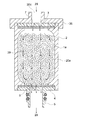
- FIG. 1 is a schematic end view showing an embodiment of an ion exchange resin-filled cartridge used in the method for purifying non-aqueous liquid material of the present invention, wherein the ion exchange resin-filled cartridge after performing the ion exchange resin filling step
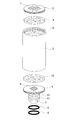
- FIG. 2 is a perspective view showing members constituting the ion exchange resin-filled cartridge 20 a in FIG. 1.
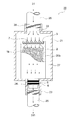
- FIG. 3 is a schematic end view showing how the water content reduction step is being performed.
- FIG. 4 is a schematic end view showing how an initial blowing process is performed.
- FIG. 5 is a schematic end view showing how the purification step is being performed.
- the ion exchange resin-filled cartridge 20a shown in FIG. 1 is a cartridge exchangeably attached to a metal removal column for removing metal in the non-aqueous liquid material with the ion exchange resin.
- the ion exchange resin filled cartridge 20a includes a cylindrical part 2 filled with granular macroporous or porous ion exchange resin 1a in a water wet state, and passage holes 7 of the liquid to be treated (unrefined non-aqueous liquid substance).
- the upper lid 3 provided at the upper end of the cylindrical portion 2 and the passage hole 8 for the treatment liquid (non-aqueous liquid substance after purification) are formed, and the lower lid 4 provided at the lower end of the cylindrical portion 2
- an insertion pipe 5 connected to the lower lid and inserted inside the treatment liquid discharge pipe provided at the bottom of the storage container of the metal removal column, and a granular macroporous filled in the inside of the cylindrical portion 2
- An O-ring attachment groove 51 is formed on the outside of the insertion pipe 5 to seal between the inner wall of the treatment liquid discharge pipe of the metal removal column and the outside of the insertion pipe 5 of the ion exchange resin-filled cartridge 20a.
- the O-ring 6 is fitted and attached to the O-ring attachment groove 51.
- the lower cover 4 and the insertion tube 5 are integrally formed.
- the lower lid 4 to which the cylindrical portion 2, the upper lid 3 and the insertion tube 5 are attached is a cartridge container.
- the upper end side tube diameter reduction portion 11 is formed on the upper end side inside the cylindrical portion 2
- the lower end side tube diameter reduction portion 12 is formed on the lower end side inside the cylindrical portion 2 There is.
- the mesh 9 is formed at the upper end of the filling region of the ion exchange resin, the upper side tube diameter reduction portion 11 and the upper lid 3 is attached by sandwiching the outer edge portion, and the mesh 10 is attached to the lower end of the ion exchange resin filled region between the lower end tube diameter reduction portion 12 and the lower lid 4. It is attached by pinching the part.
- the mesh 9 and the mesh 10 have a clearance of the magnitude
- the lower lid 4 integrally formed with the insertion tube 5 in a state where the mesh 10 is disposed inside the lower end of the cylindrical portion 2, Screw it into the lower end of 2 and insert it. At this time, the outer edge portion of the mesh 10 is sandwiched and fixed between the lower end side tube diameter reduction portion 12 and the lower lid 4.
- the tubular portion 2 is filled with particulate macroporous or porous ion exchange resin 1a (not shown) in a water wet state.
- the upper cover 3 is screwed into the upper end side of the cylindrical portion 2 and fitted. At this time, the outer edge portion of the mesh 9 is sandwiched and fixed between the upper end side tube diameter reduction portion 11 and the upper lid 3.
- the O-ring 6 is attached to the O-ring attachment groove 51 formed in the insertion pipe 5.
- the ion exchange resin filling step is carried out to produce an ion exchange resin filled cartridge in which a macroporous or porous ion exchange resin in a water wet state is filled in the cartridge container.
- the ion exchange resin filled cartridge 20a obtained by performing the ion exchange resin filling step that is, the ion exchange resin filled cartridge 20a in which the macroporous or porous ion exchange resin 1a in a water wet state is filled in the cartridge container.
- inert gas 29 Is allowed to pass through the inert gas 29 (during contact), and the inert gas 29 (after contact) is discharged from the insertion pipe 5 through the passage hole 8 of the processing liquid from the inside of the cartridge container. 29 is passed through the inside of the cartridge container to bring the inert gas 29 into contact with the water-wet macroporous or porous ion exchange resin 1a. At this time, the inert gas 29 is present on the surface of the water-wet macroporous or porous ion exchange resin 1a and in the vicinity thereof by contacting the water-wet macroporous or porous ion exchange resin 1a.
- Water is evaporated and transferred to the inert gas 29, water on the surface of the water-wet macroporous or porous ion exchange resin 1a and its vicinity are removed, and the water-wet macroporous Alternatively, the water content of the porous ion exchange resin 1a is reduced. Then, until the moisture content of the macroporous or porous ion exchange resin 1a in the water wet state becomes a predetermined moisture content, the inert gas 29 to the macroporous or porous ion exchange resin 1a in the water wet state The contact is continued to be converted into the macroporous or porous ion exchange resin 1 b after reduction of the water content, which is a predetermined water content.
- the cartridge container is made into the ion exchange resin-filled cartridge 20b filled with the macroporous or porous ion exchange resin 1b after the water content reduction.
- the ion exchange resin-filled cartridge 20 b obtained by performing the water content reduction step is installed in the storage container 21 of the metal removal column 30, and the metal removal column 30 is assembled.
- the metal removal column 30 is formed in the storage container 21 and the storage container 21 and has a liquid supply port 22 for supplying the liquid to be treated (unrefined non-aqueous liquid substance) to the inside of the storage container, and the storage container A treatment liquid discharge pipe 23 provided on the bottom side of the container 21 and communicating with the inside of the storage container 21 for discharging the processing liquid (non-aqueous liquid substance after purification), and ions stored in the storage container 21 And a replacement resin filled cartridge 20b.
- the insertion pipe 5 of the ion exchange resin-filled cartridge 20b is inserted into the inside of the processing liquid discharge pipe 23, and the O-ring 6 attached to the outside of the insertion pipe 5 is the inner wall 24 of the processing liquid discharge pipe 23 and the ions.
- the space between the inner wall of the treatment liquid discharge pipe 23 and the outside of the insertion pipe 5 is sealed.
- a connection pipe 28 is attached to the liquid supply port 22.
- the end of the infusion pipe 26 of the liquid to be treated (unrefined non-aqueous liquid substance) 31 is screwed into the connection pipe 28, and the infusion pipe 26 of the liquid to be treated (non-aqueous liquid substance after purification) 31 Is connected.
- the end of the infusion tube 25 of the treatment liquid is screwed into the treatment liquid discharge tube 23, and the infusion tube 25 of the treatment liquid is connected.
- a discharge pipe (not shown) of the initial blow waste fluid 311 branched from the infusion pipe 25 for the treatment liquid is attached to the treatment liquid infusion tube 25 in order to discharge the initial blow waste fluid 311 to the outside.
- the liquid to be treated (unrefined non-aqueous liquid substance) 31 is transferred from the storage tank of the liquid to be treated 31 to the metal removal column 30 through the infusion tube 26 of the liquid to be treated connected to the metal removal column 30.
- the liquid is carried and supplied into the storage container 21 of the metal removal column 30 via the liquid supply port 22.
- the space 27 between the cylindrical portion 2 of the ion exchange resin-filled cartridge 20 b and the storage container 21 of the metal removal column 30 is filled with the liquid to be treated 31 supplied into the storage container 21.
- the resin filling cartridge 20b is made to flow into the cartridge container of the ion exchange resin filling cartridge 20b through the passage hole 7 of the liquid to be treated formed in the upper lid 3 of the resin filling cartridge 20b.
- the liquid to be treated 31 introduced into the cartridge container of the ion exchange resin-filled cartridge 20b is allowed to pass through the ion exchange resin filled region while being in contact with the ion exchange resin 1b filled in the cartridge container,
- the liquid is discharged to the outside of the cartridge container of the ion exchange resin-filled cartridge 20b through the passage hole (reference numeral 8 in FIG. 1) of the treatment liquid formed in the lower lid 4 of the cylindrical portion 2.
- the initial blow waste solution 311 discharged out of the cartridge container of the ion exchange resin-filled cartridge 20 b is discharged from the initial blow waste solution discharge pipe branched from the infusion solution pipe 25 of the treatment liquid connected to the metal removal column 30.
- the transfer valve of the initial blow waste solution 311 is initially operated by operating the switching valve attached to the infusion tube 25 of the treatment liquid so that the initial blow waste solution does not flow into the use point or the storage tank of the treatment liquid. Switch to the blow waste liquid discharge pipe side. Then, until the water concentration (mg H 2 O / g non-aqueous liquid substance) in the initial blow waste solution 311 reaches a predetermined concentration, or until the initial initial blow amount reaches a predetermined value, the macroporous type after water content reduction The contact between the porous ion exchange resin 1 b and the liquid to be treated (unrefined non-aqueous liquid substance) 31 is continued. It is desirable to analyze the water concentration in the non-aqueous liquid substance by Karl Fischer coulometric titration method.
- the macroporous or porous ion exchange resin is converted to the macroporous or porous ion exchange resin 1c after the initial blowing.
- the transfer valve of the treatment liquid is operated to switch the transport path of the treatment liquid to the point of use or the storage tank side of the treatment liquid, as shown in FIG.
- the liquid (unrefined non-aqueous liquid substance) 31 is carried from the storage tank of the liquid 31 to be treated to the metal removal column 30 through the infusion pipe 26 of the liquid to be treated connected to the metal removal column 30.
- the liquid is supplied into the storage container 21 of the metal removal column 30 through the liquid supply port 22.
- the liquid 27 supplied into the storage container 21 is allowed to pass through the space 27 between the cylindrical portion 2 of the ion exchange resin-filled cartridge 20 c and the storage container 21 of the metal removal column 30.
- the resin filling cartridge 20c is made to flow into the cartridge container of the ion exchange resin filling cartridge 20c through the passage hole 7 of the liquid to be treated formed in the upper lid 3 of the resin filling cartridge 20c.
- the liquid to be treated 31 introduced into the cartridge container of the ion exchange resin-filled cartridge 20c is charged with the ion exchange resin while being brought into contact with the macroporous or porous ion exchange resin 1c filled in the cartridge container. After passing through the region, it is discharged out of the cartridge container of the ion exchange resin-filled cartridge 20c through the passage (reference numeral 8 in FIG. 1) of the treatment liquid formed in the lower lid 4 of the cylindrical portion 2.
- the treatment liquid (refined non-aqueous liquid substance) 32 discharged to the outside of the cartridge container of the ion exchange resin-filled cartridge 20 c is used at the point of use or treatment via the treatment liquid infusion tube 25 connected to the metal removal column 30. Transport to the storage tank of liquid. Thus, the purification process is carried out to obtain the non-aqueous liquid substance after purification.
- the method for purifying a non-aqueous liquid material according to the present invention is a method for purifying a non-aqueous liquid material, which comprises removing an impurity from the non-aqueous liquid material by bringing the non-aqueous liquid material into contact with a macroporous or porous ion exchange resin.
- the ion exchange resin is filled with an ion exchange resin-filled cartridge in which a macroporous or porous ion exchange resin in a water wet state is filled in a cartridge container and the macroporous or porous ion exchange resin is filled before the water content reduction.
- the water content (A) of the macroporous or porous ion exchange resin after reduction of water content is 90.0 to 97.
- the unrefined non-aqueous liquid material is passed through the cartridge container filled with the macroporous or porous ion exchange resin after the reduction of water content, and the initial blow waste solution is discharged from the cartridge container Initial blow process,
- the unrefined non-aqueous liquid material is brought into contact with the macroporous or porous ion exchange resin in the cartridge container, Purifying the non-aqueous liquid material to obtain a purified non-aqueous liquid material; It is a purification method of a non-aqueous liquid substance characterized by having.
- the purification method of the non-aqueous liquid material of the present invention is a non-aqueous liquid material which removes impurities from an unrefined non-aqueous liquid material by bringing an unexchanged non-aqueous liquid material to be treated into contact with an ion exchange resin.
- Unrefined non-aqueous liquid substances, ie, liquid to be treated include IPA (isopropanol), PGMEA (propylene glycol monomethyl ether acetate), PGME (propylene glycol monomethyl ether), PGEE (propylene glycol monoethyl ether), NMP (N Organic solvents such as -methyl-2-pyrrolidone).
- metal ions such as Li, Na, Mg, Al, K, Ca, Ti, Cr, Mn, Fe, Co, Ni, Cu, Zn, As, Cd, Pb, etc.
- Anions such as Cl, SO 4 , NO 3 , PO 4 , CO 3 , HCO 3 , etc., organic acids such as formic acid, acetic acid, maleic acid, proponic acid, etc., and polymer compounds having positive to negative charges.
- the ion exchange resin used to purify the non-aqueous liquid material is a particulate macroporous or porous ion exchange resin.
- the gel type structure and the macroporous type structure and the porous type structure are distinguished by the following method. (1) When the ion exchange resin irradiated with light is observed with an optical microscope, the one transmitting light is a "gel type structure", the one transmitting no light is a "porous type structure" or "macroporous type” It is determined that "structure”.
- gel type structure From the value of specific surface area or pore volume of ion exchange resin measured by adsorption method (BET method) using nitrogen gas etc., "gel type structure", "porous type structure” or “macroporous type structure””Is determined.
- an ion exchange resin having a gel-type structure has an extremely small specific surface area and an extremely small pore volume
- the ion-exchange resin having a gel-type structure has a specific surface area of 0.1 m 2 / g (dry) Less than resin, the pore volume of the ion exchange resin having a gel-type structure is 0.001 to 0.008 ml / ml (dry resin).
- the ion exchange resin having a porous structure or macroporous structure has a relatively large specific surface area and a relatively large pore volume, and the specific surface area of the ion exchange resin having a porous structure or a macroporous structure.
- the pore volume of the ion-exchange resins having a porous structure or a macroporous structure is 0.17 ⁇ 0.50ml / ml (dry resin).
- macroporous or porous ion exchange resin As macroporous or porous ion exchange resin, macroporous or porous cation exchange resin, macroporous or porous anion exchange resin, macroporous or porous cation exchange resin, and macroporous or porous anion exchange The combination of resin is mentioned.
- the macroporous or porous ion exchange resin is a combination of a macroporous or porous cation exchange resin and a macroporous or porous anion exchange resin
- the macroporous or porous cation exchange resin and the macroporous or porous are used.
- the macroporous-type or porous-type cation exchange resin When used as a mixed bed in which the anion-type anion exchange resin is uniformly mixed, the macroporous-type or porous-type cation exchange resin is filled on the upstream side of the filling region of the macroporous-type or porous type ion exchange resin, The downstream side of the macroporous or porous ion exchange resin-filled region is filled with the macroporous or porous anion exchange resin, or the upstream side of the macroporous or porous ion exchange resin-filled region, Macroporous type or porous type On-exchange resin is filled, and, on the downstream side of the filling region of the macroporous type or porous type ion exchange resin, is sometimes used as Fukuyuka that macroporous or porous type cation-exchange resin is filled.
- the macroporous or porous cation exchange resin is a combination of a macroporous or porous strong acid cation exchange resin or a macroporous or porous weak acid cation exchange resin. May be
- the macroporous or porous strong acid cation exchange resin may, for example, be Orlite DS-4.
- the macroporous or porous weak acid cation exchange resin Amberlite IRC 76, Amberlite IRC 747 UPS, Amberlite IRC 748, Amberlite IRC 743 and the like can be mentioned.
- the macroporous or porous anion exchange resin is a combination of a macroporous or porous strong base anion exchange resin or a macroporous or porous weak base anion exchange resin. It may be As a macroporous or porous strong base anion exchange resin, Orlite DS-5 and the like can be mentioned. Moreover, as a macroporous or porous weakly basic anion exchange resin, Orlite DS-6 and the like can be mentioned. As a mixed product of a macroporous or porous strong acid cation exchange resin and a macroporous or porous strong base anion exchange resin, Ollite DS-7 can be mentioned.
- the average particle size of the dry macroporous or porous ion exchange resin is not particularly limited, but is preferably 200 to 1000 ⁇ m, and particularly preferably 200 to 500 ⁇ m.
- the average particle size of the dry macroporous or porous ion exchange resin is a value measured by a laser diffraction type particle size distribution measuring apparatus.
- the macroporous or porous ion exchange resin is usually produced in a water-containing state, and is present in a water-containing state even at the time of sales, distribution, filling of the ion exchange resin at the place of use, etc.
- the macroporous or porous ion exchange resin in a water-containing state is referred to as "water-wet macroporous or porous ion exchange resin", and the water-wet state is 25 ° C.
- the state in which the moisture in the resin pore is adjusted to a saturated equilibrium state in the state of 100% relative humidity in is referred to as "a macroporous or porous ion exchange resin in a saturated equilibrium state”.
- the state of being dried by an appropriate drying method and having a water content of 0% by mass is referred to as "dry state macroporous or porous ion exchange resin".
- the macroporous or porous ion exchange resin in a saturated equilibrium state can be obtained by bringing the macroporous or porous ion exchange resin into saturation by bringing it into contact with air at 25 ° C. and 100% relative humidity for 30 minutes or longer.
- the macroporous or porous ion exchange resin in a dry state can be obtained by drying the macroporous or porous ion exchange resin in a water wet state by a constant temperature drier at 105 ° C. for 16 hours.
- the water content (%) (B) of the macroporous or porous ion exchange resin in the saturated equilibrium state is “((weight of the macroporous or porous ion exchange resin in the saturated equilibrium state before drying-dry macro The weight of the porous or porous ion exchange resin) / the weight of the macroporous or porous ion exchange resin in a saturated equilibrium state before drying) ⁇ 100 ”.
- the amount of the macroporous or porous ion exchange resin in a saturated equilibrium state before drying is preferably 5 g or more in order to enhance the measurement accuracy.
- the weight of the porous ion exchange resin can be obtained by the following formula.
- the water content (%) (C) of the macroporous or porous ion exchange resin before the water content reduction similarly, weigh 5 g or more of the resin to be measured, and use the constant temperature drier 105 for the weighed resin. "((Weight of macroporous or porous ion exchange resin before reduction of water content-weight of macroporous or porous ion exchange resin in dry state) before drying for 16 hours, macroporous before reduction of water content Weight of mold or porous type ion exchange resin) ⁇ 100 ".
- ion exchange resin filling step according to the method for purifying a non-aqueous liquid substance of the present invention, a macroporous or porous type ion exchange resin in a water wet state is filled in a cartridge container and the water content is reduced. In this step, an ion exchange resin-filled cartridge filled with ion exchange resin is obtained.
- the cartridge container according to the ion exchange resin filling step is a filling container of an ion exchange resin in which a macroporous or porous ion exchange resin in a water wet state is filled.
- the cartridge container is not particularly limited, and may be appropriately selected depending on, for example, the shape of the metal removal column on which the ion exchange resin-filled cartridge is installed, but generally, the cylindrical member and both ends of the cylindrical member are selected. And a lid member for closing.
- a treatment liquid supply port for supplying unrefined non-aqueous liquid substance (liquid to be treated) into the cartridge container is formed, and at the other end of the cartridge container In this case, a liquid discharge port for discharging the non-aqueous liquid substance (treatment liquid) after purification from the inside of the cartridge container is formed.
- the material of the cartridge container is not particularly limited.
- PTFE polytetrafluoroethylene
- PFA tetrafluoroethylene perfluoroalkyl vinyl ether copolymer
- ETFE tetrafluoroethylene-ethylene copolymer
- low density polyethylene low density polyethylene
- the material of the cartridge container is appropriately selected depending on the type of liquid to be treated, the type of dissolved substance, and the like.
- the ion exchange resin filled in the cartridge container is a water wet ion exchange resin.
- the water content of the macroporous or porous ion exchange resin in a water wet state filled in the cartridge container that is, the water content of the macroporous or porous ion exchange resin before the water content reduction (C)
- the water content is preferably 95 to 100%, particularly preferably 98 to 100%, of the water content (B) in the saturated equilibrium state of the macroporous or porous ion exchange resin.
- the water content of the macroporous or porous ion exchange resin manufactured industrially is 95 to 100% of the water content (B) in the saturated equilibrium state of the macroporous or porous ion exchange resin
- the water content of the commercially available macroporous or porous ion exchange resin is 95 to 100% of the water content (B) in the saturated equilibrium state of the macroporous or porous ion exchange resin. Therefore, in the ion exchange resin filling step, industrially manufactured macroporous or porous ion exchange resin in a water wet state, or commercially available macroporous or porous ion exchange resin in a water wet state is preferable.
- the moisture content (C) of the macroporous or porous ion exchange resin in the water-wet state is preferably 95 to 100% of the moisture content (B) of the saturated equilibrium state of the macroporous or porous ion exchange resin (Especially preferably 98 to 100%) is “water-wet macroporous or porous ion exchange resin actually filled in the ion exchange resin filling step, ie macroporous before water content reduction.
- the percentage calculated by the moisture content (C) of the porous or porous ion exchange resin / "the moisture content in saturated equilibrium state of the macroporous or porous ion exchange resin (B)" x 100 is preferably from 95 to It refers to 100%, particularly preferably 98 to 100%.
- the method for filling the ion exchange resin in a water wet state in the cartridge container is not particularly limited, and a method in which no foreign matter is mixed in at the time of filling is appropriately selected.
- the ion exchange resin filled cartridge obtained by performing the ion exchange resin filling step is an ion exchange resin filled cartridge in which a cartridge container is filled with a water wet ion exchange resin. Since the ion exchange resin filled cartridge obtained by performing the ion exchange resin filling process is an ion exchange resin filled cartridge before the water content reduction process, the ion exchange resin filled process obtained by performing the ion exchange resin filling process The cartridge is, in other words, an ion exchange resin-filled cartridge in which the cartridge container is filled with the ion exchange resin before the water content reduction.
- the water content (A) of the macroporous or porous ion exchange resin after the water content reduction is a macroporous or porous ion exchange resin
- the water content of the ion exchange resin in the cartridge container is reduced to 90.0 to 97.0%, preferably 90 to 95%, of the water content (B) in a saturated equilibrium state.
- the water content of the macroporous or porous ion exchange resin after reduction of water content (A) is 90.0 to 97 of the water content of the macroporous or porous ion exchange resin in the saturation equilibrium state (B) 0%, preferably 90 to 95%
- an inert gas is allowed to pass through the inside of the cartridge container, and the ion exchange resin in the cartridge container is brought into contact with the inert gas, thereby reducing the water content
- Such a form can also be performed as the water content reduction step (1).
- Nitrogen gas, helium gas, argon gas etc. are mentioned as an inert gas which concerns on a moisture content reduction process (1).
- the purity of the inert gas is preferably as high as possible, but it may be 99.9% by volume or more.
- the dew point of the inert gas is preferably ⁇ 50 ° C. or less, particularly preferably ⁇ 60 ° C. or less.
- the temperature of the inert gas when supplying the inert gas into the cartridge container is preferably 0 to 60 ° C., particularly preferably 10 to 30 ° C.
- the surface of the water-wet macroporous or porous ion exchange resin and the water wet air by contacting the inert gas with the water-wet macroporous or porous ion exchange resin
- the water present in the vicinity is evaporated and transferred to the inert gas, and the water in the water-wet macroporous or porous ion exchange resin surface and its vicinity are removed, and the water-wet macroporous
- the moisture content of the mold or porous ion exchange resin is reduced.
- the water content (A) of the macroporous or porous ion exchange resin after the water content reduction is the water content of the macroporous or porous ion exchange resin in the saturated equilibrium state (
- the contact of the inert gas with the water-wet macroporous or porous ion exchange resin is continued to 90.0-97.0%, preferably 90-95% of B), and the water-wet macro is
- the porous or porous ion exchange resin is converted to a macroporous or porous ion exchange resin having a predetermined water content and a reduced water content.
- the method of passing the inert gas through the cartridge container and bringing the macroporous or porous ion exchange resin in the cartridge container into contact with the inert gas is not particularly limited.
- the method may be any method as long as the inert gas is supplied from the one end side of the cartridge container into the cartridge container and the inert gas is discharged from the inside of the cartridge container from the other end side of the cartridge container.
- the inert gas containing water in the macroporous or porous ion exchange resin is treated with a dehydrator for the inert gas to obtain the water content in the inert gas. It can be reduced and used again as the inert gas supplied into the cartridge container in the water content reduction step (1).
- the inside of the cartridge container is depressurized, and the ion exchange resin is dried under reduced pressure to reduce the water content (steps such as 2) can also be performed.
- the absolute pressure when drying under reduced pressure is preferably ⁇ 0.05 MPa or less.
- the temperature for drying under reduced pressure is preferably 0 to 60 ° C., particularly preferably 30 to 50 ° C.
- a well-known vacuum dryer may be used to place the resin to be treated under the above-described heating and reduced pressure drying conditions.
- the macroporous or porous ion exchange resin in the water wet state is dried under reduced pressure to be present on the surface of the macroporous or porous ion exchange resin in the water wet state and in the vicinity thereof Moisture evaporates, and the water on the surface of the water-wet macroporous or porous ion exchange resin and its vicinity are removed to reduce the water content of the water-wet macroporous or porous ion exchange resin Do.
- the water content (A) of the macroporous or porous ion exchange resin after the water content reduction is the water content of the macroporous or porous ion exchange resin in a saturated equilibrium state
- the water-wet macroporous or porous ion exchange resin is dried under reduced pressure to 90.0 to 97.0%, preferably 90 to 95% of B), and the water-wet macroporous or porous
- the ion exchange resin of type is converted to a macroporous or porous ion exchange resin after reduction of the water content, which is a predetermined water content.
- the method for drying the macroporous or porous ion exchange resin in a water-wet state under reduced pressure is not particularly limited.
- the ion exchange resin filled cartridge is allowed to stand in a reduced pressure drying device
- the inside of the reduced-pressure drying apparatus is returned to normal pressure after drying under reduced pressure, it is preferable that the pressure be reduced to normal pressure by introducing an inert gas of high purity into the pressure reducing apparatus so that impurities in the atmosphere do not mix. .
- the moisture content is improved by heating an ion exchange resin-filled cartridge filled with a macroporous or porous ion exchange resin in a heating device under an inert gas atmosphere.
- a reduction step (hereinafter, such a form is also described as a water content reduction step (3)) can be performed.
- the heating temperature when heating the ion exchange resin-filled cartridge is preferably 0 to 60 ° C., particularly preferably 30 to 50 ° C.
- the macroporous or porous ion exchange resin in the water wet state is heated to be present on the surface of the macroporous or porous ion exchange resin in the water wet state and in the vicinity thereof Moisture evaporates, and water on the surface of the water-wet macroporous or porous ion exchange resin and its vicinity are removed to reduce the moisture content of the water-wet macroporous or porous ion exchange resin .
- the water content (A) of the macroporous or porous ion exchange resin after the water content reduction is the water content of the macroporous or porous ion exchange resin in a saturated equilibrium state (
- the water-wet ion exchange resin is heated to 90.0 to 97.0%, preferably 90 to 95% of B), and the water-wet macroporous or porous ion exchange resin is The water content is converted to a macroporous or porous ion exchange resin after the water content reduction.
- the method for heating the water-wet macroporous or porous ion exchange resin in the water content reduction step (3) is not particularly limited, and the ion exchange resin-filled cartridge may be heated in an inert gas atmosphere heating apparatus. Any method can be used as long as it can be heated.
- the macroporous or porous ion exchange resin in a water wet state (macroporous or porous ion exchange resin before the reduction of water content) has a predetermined water content. Converted to a macroporous or porous ion exchange resin (macroporous or porous ion exchange resin after reduction of water content), and the macroporous or porous ion exchange resin after reduction of water content to a cartridge container. An ion exchange resin filled cartridge filled with resin is obtained.
- the degree of reduction of the water content is determined by the fact that the water content (A) of the macroporous or porous ion exchange resin after reduction of water content is the saturation equilibrium of the macroporous or porous ion exchange resin Water content reduction process (1), water content reduction process (2), water content reduction by setting the water content in the state to 90.0 to 97.0%, preferably 90 to 95% of the water content (B) Even if the water content can be reduced by a simple method such as step (3) and the reduction load can be reduced, the amount of the initial blow waste solution can be reduced.
- the water content (A) of the macroporous or porous ion exchange resin after reduction of the water content relative to the water content (B) of the macroporous or porous ion exchange resin in the saturated equilibrium state exceeds the above range, The amount of initial blow waste solution will increase. If the water content (A) of the macroporous or porous ion exchange resin after reduction of the water content relative to the water content (B) in the saturated equilibrium state of the macroporous or porous ion exchange resin is less than the above range, Although the amount of the initial blow waste solution decreases, the time taken to reduce the water content of the macroporous or porous ion exchange resin becomes long, and in some cases, the cost becomes high.
- the unrefined non-aqueous liquid material is passed through a cartridge container filled with a macroporous or porous ion exchange resin after reduction of water content. It is a step of draining and discharging the initial blow waste liquid from the inside of the cartridge container.
- the initial blowing step is a pretreatment step carried out before purifying the non-aqueous liquid substance, and mainly the water content is reduced by replacing the water contained in the macroporous or porous ion exchange resin with the non-aqueous liquid substance.
- the purpose of the present invention is to reduce the amount of water eluted from the macroporous or porous ion exchange resin to the non-aqueous liquid material to reduce the amount of water, thereby achieving a state where normal purification can be performed.
- the unrefined non-aqueous liquid material is flowed into the cartridge container of the ion exchange resin-filled cartridge subjected to the initial blowing step.
- the nonporous non-aqueous liquid material is brought into contact with the macroporous type or porous type ion exchange resin to purify the non-aqueous liquid material to obtain a purified non-aqueous liquid material.
- the inventors of the present invention have found that (1) a large amount of water flowing out of the ion exchange resin by contacting with a non-aqueous liquid material during initial blow is on the surface and inside of the macroporous or porous ion exchange resin. Water that exists as free water molecules that are not hydrated with the ion exchange group in the pores, and water molecules in the hydrated state with the ion exchange groups in the pores of the ion exchange resin are in contact with the non-aqueous liquid substance Even if the ion exchange resin hardly flows out, (2) by continuously contacting the ion exchange resin with an inert gas, drying the ion exchange resin under reduced pressure, heating the ion exchange resin, etc.
- the water content (A) of the ion exchange resin after the water content reduction is 90.0 to 97 of the water content (B) of the saturated equilibrium state of the ion exchange resin. .0%
- the water content is preferably 90 to 95%, free water molecules which are not in a hydrated state with ion exchange groups at the surface and inside pores which are easy to flow out of the ion exchange resin at the time of initial blow. It has been found that the amount of outflow of water to the initial blow waste solution can be reduced, and (3) the amount of the initial blow waste solution can be reduced by these factors.
- the ion exchange resin filled cartridge is Inside the metal removal column, feed the unrefined non-aqueous liquid material into the metal removal column, pass through the storage container of the metal removal column, and pass through the unrefined non-water liquid material into the cartridge container of the ion exchange resin filled cartridge.
- the solution is passed through to carry out the initial blowing step and the purification step, the present invention is not limited thereto.
- the ion exchange resin filled cartridge is installed in the metal removal column, and the metal removal column is
- the unrefined non-aqueous liquid material is supplied, passed through the storage container of the metal removal column, and passed through the unrefined non-aqueous liquid material into the cartridge container of the ion exchange resin-filled cartridge to carry out the initial blowing step and purification.
- the method for purifying a non-aqueous liquid substance of the present invention after performing the ion exchange resin filling step and the water content reduction step, unrefined directly in the cartridge container of the ion exchange resin filled cartridge. There is a mode in which the non-aqueous liquid substance is passed to carry out the initial blowing step and the purifying step.
- another embodiment of the method for purifying non-aqueous liquid material of the present invention supplies unrefined non-aqueous liquid material directly into the cartridge container of an ion exchange resin-filled cartridge without using a metal removal column. It is a form.
- the unrefined non-aqueous liquid material is directly passed into the cartridge container of the ion exchange resin filled cartridge.
- the ion exchange resin filling cartridge 120 shown in FIG. 6 is mentioned, for example.
- the ion exchange resin-filled cartridge 120 has a cylindrical portion 2 filled with granular ion exchange resin 1a in a water-wet state, and passage holes 7 for the liquid to be treated (unrefined non-aqueous liquid substance).
- an upper lid 103 is provided on the upper end of the cylindrical portion 2 provided with the connection portion 102 screwed to the end of the infusion tube of the liquid to be treated (unrefined non-aqueous liquid substance);
- the passage hole 8 for the liquid fluid is formed, and it is connected to the lower lid 4 provided at the lower end of the cylindrical portion 2 and the lower lid, and at the end of the infusion tube of the treatment liquid (non-aqueous liquid after purification) It has a treatment liquid discharge pipe 105 to be screwed, and a granular ion exchange resin 1 a filled in the inside of the cylindrical portion 2.
- the lower lid 4 and the treatment liquid discharge pipe 105 are integrally formed. Further, in the embodiment shown in FIG.
- the lower lid 4 to which the cylindrical portion 2, the upper lid 3 and the treatment liquid discharge pipe 105 are attached is a cartridge container. Further, the upper end side tube diameter reduction portion 11 is formed on the upper end side inside the cylindrical portion 2, and the lower end side tube diameter reduction portion 12 is formed on the lower end side inside the cylindrical portion 2 There is. Then, in order to prevent the ion exchange resin 1 from flowing out from the cylindrical portion 2, the mesh 9 is provided between the upper end side tube diameter reduction portion 11 and the upper lid 3 at the upper end of the filling region of the ion exchange resin. The mesh 10 is attached at the lower end of the ion exchange resin-filled area by being sandwiched between the lower end side tube diameter reduced portion 12 and the upper lid 4 by being pinched by the outer edge. It is done. In addition, the mesh 9 and the mesh 10 have a clearance of the magnitude
- the ion exchange resin filled cartridge is Although the initial blowing step and the purification step are performed after being installed in the removal column, when the water content reduction step (1) is adopted as the water content reduction step, it is not limited to this.
- the water content reduction step (1) As a mode of employing the water content reduction step (1) as the water content reduction step, ion exchange resin after performing the ion exchange resin filling step and the water content reduction step there is a mode in which the resin-filled cartridge is installed in the metal removal column and then the initial blowing step and the purification step are performed.
- the water content reduction step (1) As another embodiment employing the water content reduction step (1) as the water content reduction step, after performing the ion exchange resin filling step, the ion exchange resin filled cartridge Is placed in a metal removal column, and an inert gas is introduced from an inert gas introduction tube provided at an appropriate position such as a metal removal column, an infusion tube of a liquid to be treated, and the like.
- the moisture content reduction step (1) is performed by discharging the inert gas from an inert gas discharge pipe provided at an appropriate position such as an infusion pipe of the treatment liquid, and then an initial blowing step and a purification step Can be mentioned.
- the ion exchange resin-filled cartridge with the outside air blocking member of the present invention comprises a cartridge container, A supply port for supplying a non-aqueous liquid substance into the cartridge container; An outlet for discharging the non-aqueous liquid substance from the inside of the cartridge container; A macroporous or porous ion exchange resin filled in the cartridge container and having a water content (D) of 90.0 to 97.0% of a water content (E) in a saturated equilibrium state; An ion exchange resin-filled cartridge having An outside air blocking member for blocking air flow between the inside of the cartridge and the outside air; Consisting of An ion exchange resin-filled cartridge with an outside air blocking member, characterized in that
- the cartridge container according to the ion exchange resin-filled cartridge with the external air blocking member of the present invention is the same as the cartridge container according to the method for purifying a non-aqueous liquid substance of the present invention.
- the macroporous or porous ion exchange resin packed in the cartridge container has a water content (D) of a water content (E) in a saturated equilibrium state. It is a macroporous or porous ion exchange resin of 90.0 to 97.0%, preferably 90 to 95%. “The moisture content (D) of the macroporous or porous ion exchange resin filled in the cartridge container is 90. The moisture content (E) of the saturated equilibrium state of the macroporous or porous ion exchange resin.
- the outside air blocking member according to the ion exchange resin-filled cartridge with the outside air blocking member of the present invention is a member for blocking air flow between the inside of the cartridge and the outside air.
- Examples of the outside air blocking member include the embodiment shown in FIG. In FIG. 7, in the ion exchange resin-filled cartridge 40 with the external air blocking member, the passage hole of the liquid to be treated formed in the upper lid of the cylinder is completely covered on the upper end side of the cylinder of the ion exchange resin-filled cartridge 20a.
- the upper cap member 33a is attached, and at the lower end side of the cylindrical portion of the ion exchange resin-filled cartridge 20a, the passage hole of the processing liquid formed in the lower lid of the cylindrical portion and the opening of the insertion tube are completely
- the lower cap member 33b is attached so as to cover it.
- the space between the upper cap member 33a and the cylindrical portion and the space between the lower cap member 33b and the cylindrical portion are sealed to the extent that outside air does not enter the cartridge container.
- the material of the cap member is not particularly limited.
- PTFE polytetrafluoroethylene
- PFA tetrafluoroethylene perfluoroalkyl vinyl ether copolymer
- ETFE tetrafluoroethylene-ethylene copolymer
- a member may be attached to the inside of the upper cap member 33a and the lower cap member 33b in order to improve the sealing performance of an O-ring, a seal tape, and the like.
- outside air blocking member is, for example, a surrounding bag in which the inside of the ion exchange resin filled cartridge is entirely enclosed and air flow between the inside and outside air is blocked.
- the material of the surrounding bag is a material that does not transmit air.
- the ion exchange resin-filled cartridge with an open air blocking member of the present invention is characterized in that the water content (D) of the macroporous or porous ion exchange resin filled in the cartridge container is 90 of the water content (E) in a saturated equilibrium state. 0 to 97.0%, preferably 90 to 95%, in other words, a macroporous type or a porous body in which the water on the surface easy to flow out of the ion exchange resin and its vicinity during the initial blowing are reduced Since the porous ion exchange resin is filled in the cartridge container, if the initial blowing step and the purification step are performed using the ion exchange resin-filled cartridge with the open air blocking member of the present invention, the initial blown waste liquid can be reduced. Can.
- Example 1 ⁇ Reduction test of water content ⁇ ion exchange resin filling process> The following ion exchange resin A was brought into contact with air at 25 ° C. and 100% relative humidity for 30 minutes or more to obtain ion exchange resin A in a saturated equilibrium state (water content 60.8%). Next, as the ion exchange resin, the cation exchange resin A in a saturated equilibrium state was filled in the cartridge container, and an ion exchange resin-filled cartridge B shown in FIG. 1 was produced. Details of the loaded ion exchange resin and O-ring are shown below, and details of the cartridge container are shown in Table 1.
- the change of the water content in the initial blow waste solution is shown in FIG. ⁇ Purification process>
- Supply of isopropyl alcohol of the liquid to be treated to the metal removal column was continued, and isopropyl alcohol of the treatment liquid at a bed volume (BV) of 18 was collected, and the water content was measured.
- the water content of isopropyl alcohol in the treatment liquid was 200 ppm.
- Ion exchange resin A A mixture of macroporous strongly acidic cation exchange resin and macroporous strongly basic anion exchange resin, manufactured by Organo Corporation (Orlite DS-7), resin material: styrene-divinyl benzene Copolymer, type of ion exchange group: sulfonic acid group, trimethyl ammonium group, ion exchange equivalent: cation exchange group 1.7 mg equivalent / ml or more wet resin, anion exchange group 0.8 mg equivalent / ml wet resin or more, dry state Average particle size of 400 to 80 ⁇ m, moisture content of 61% by mass in a saturated equilibrium state.
- ⁇ O ring> Product name: PFA coated O-ring, material: Viton coated with PFA, wire diameter: 3.53 ⁇ 0.10 mm, inner diameter: 37.69 ⁇ 0.38 mm, outer diameter: 44.75 mm
- the ion exchange resin is brought into contact with the atmosphere at 25 ° C. and an relative humidity of 100% for 30 minutes or more to saturate the ion exchange resin to obtain the ion exchange resin in a saturated equilibrium state. Further, the ion exchange resin in a saturated equilibrium state was dried at 105 ° C. for 16 hours in a thermostatic dryer to obtain a dry ion exchange resin.
- the moisture content (%) (B) of the macroporous ion exchange resin in the saturated equilibrium state is expressed as “((weight of macroporous ion exchange resin in the saturated equilibrium state before drying-macroporous type exchange resin in the dried state Of the macroporous ion exchange resin in a saturated equilibrium state before drying) / 100).
- 5 g or more of ion exchange resin in a saturated equilibrium state before drying was collected.
- SE grade water content of 50 mass ppm or less
- the change of the water content in the initial blow waste solution is shown in FIG. That is, in Comparative Example 1, an initial blow test was performed using an ion exchange resin not subjected to the water content reduction step.
- Example 2 In the same manner as in Example 1, the ion exchange resin filling step was carried out to produce an ion exchange resin filled cartridge B. ⁇ Water content reduction process> Subsequently, nitrogen gas (purity 99.99% or more) at 50 ° C. is supplied to the ion exchange resin-filled cartridge B at a flow rate of 10 L / hour for 120 minutes, and nitrogen gas is supplied to the ion exchange resin-filled cartridge B The water content of the ion exchange resin was reduced by passing it to obtain an ion exchange resin-filled cartridge E filled with the ion exchange resin after the water content reduction.
- nitrogen gas purity 99.99% or more
- the change of the water content in the initial blow waste solution is shown in FIG. ⁇ Purification process> Supply of isopropyl alcohol of the liquid to be treated to the metal removal column was continued, and isopropyl alcohol of the treatment liquid at a bed volume (BV) of 18 was collected, and the water content was measured. As a result, the water content of isopropyl alcohol in the treatment liquid was 190 ppm.
Landscapes
- Chemical & Material Sciences (AREA)
- Chemical Kinetics & Catalysis (AREA)
- Organic Chemistry (AREA)
- Analytical Chemistry (AREA)
- Treatment Of Water By Ion Exchange (AREA)
- Separation Using Semi-Permeable Membranes (AREA)
- Organic Low-Molecular-Weight Compounds And Preparation Thereof (AREA)
Abstract
Description
すなわち、本発明(1)は、マクロポーラス型又はポーラス型イオン交換樹脂に非水液状物質を接触させて、該非水液状物質から不純物を除去する非水液状物質の精製方法であって、
水湿潤状態のマクロポーラス型又はポーラス型イオン交換樹脂をカートリッジ容器に充填し、含水率低減前の該マクロポーラス型又はポーラス型イオン交換樹脂が充填されたイオン交換樹脂充填カートリッジを得るイオン交換樹脂充填工程と、
含水率低減後の前記マクロポーラス型又はポーラス型イオン交換樹脂の含水率(A)が、前記マクロポーラス型又はポーラス型イオン交換樹脂の飽和平衡状態の含水率(B)の90.0~97.0%となるまで、前記カートリッジ容器内の前記マクロポーラス型又はポーラス型イオン交換樹脂の含水率を低減させる含水率低減工程と、
含水率低減後の前記マクロポーラス型又はポーラス型イオン交換樹脂が充填されている前記カートリッジ容器内に、未精製の前記非水液状物質を通液し、前記カートリッジ容器内から初期ブロー廃液を排出する初期ブロー工程と、
前記カートリッジ容器内に、未精製の前記非水液状物質を通液することにより、前記カートリッジ容器内の前記マクロポーラス型又はポーラス型イオン交換樹脂に未精製の前記非水液状物質を接触させて、前記非水液状物質の精製を行い、精製された前記非水液状物質を得る精製工程と、
を有することを特徴とする非水液状物質の精製方法を提供するものである。
前記カートリッジ容器内に非水液状物質を供給するための供給口と、
前記カートリッジ容器内から非水液状物質を排出するための排出口と、
前記カートリッジ容器内に充填され、含水率(D)が、飽和平衡状態の含水率(E)の90.0~97.0%であるマクロポーラス型又はポーラス型イオン交換樹脂と、
を有するイオン交換樹脂充填カートリッジと、
前記カートリッジ内と外気との通気を遮断するため外気遮断部材と、
からなること、
を特徴とする外気遮断部材付きイオン交換樹脂充填カートリッジを提供するものである。
水湿潤状態のマクロポーラス型又はポーラス型イオン交換樹脂をカートリッジ容器に充填し、含水率低減前の該マクロポーラス型又はポーラス型イオン交換樹脂が充填されたイオン交換樹脂充填カートリッジを得るイオン交換樹脂充填工程と、
含水率低減後の前記マクロポーラス型又はポーラス型イオン交換樹脂の含水率(A)が、前記マクロポーラス型又はポーラス型イオン交換樹脂の飽和平衡状態の含水率(B)の90.0~97.0%となるまで、前記カートリッジ容器内の前記マクロポーラス型又はポーラス型イオン交換樹脂の含水率を低減させる含水率低減工程と、
含水率低減後の前記マクロポーラス型又はポーラス型イオン交換樹脂が充填されている前記カートリッジ容器内に、未精製の前記非水液状物質を通液し、前記カートリッジ容器内から初期ブロー廃液を排出する初期ブロー工程と、
前記カートリッジ容器内に、未精製の前記非水液状物質を通液することにより、前記カートリッジ容器内の前記マクロポーラス型又はポーラス型イオン交換樹脂に未精製の前記非水液状物質を接触させて、前記非水液状物質の精製を行い、精製された前記非水液状物質を得る精製工程と、
を有することを特徴とする非水液状物質の精製方法である。
(1)光が照射されているイオン交換樹脂が、光学顕微鏡で観察された時に、光を透過するものが「ゲル型構造」、光を透過しないものが「ポーラス型構造」又は「マクロポーラス型構造」と判別される。
(2)窒素ガス等を用いる吸着法(BET法)により測定されるイオン交換樹脂の比表面積又は細孔容積の値から、「ゲル型構造」と、「ポーラス型構造」又は「マクロポーラス型構造」とが、判別される。一般的には、ゲル型構造を有するイオン交換樹脂は、比表面積が極めて小さく、また、細孔容積が極めて小さく、ゲル型構造を有するイオン交換樹脂の比表面積は0.1m2/g(乾燥樹脂)未満、ゲル型構造を有するイオン交換樹脂の細孔容積は0.001~0.008ml/ml(乾燥樹脂)である。また、ポーラス型構造又はマクロポーラス型構造を有するイオン交換樹脂は、比表面積が比較的大きく、また、細孔容積が比較的大きく、ポーラス型構造又はマクロポーラス型構造を有するイオン交換樹脂の比表面積は2~125m2/g(乾燥樹脂)、ポーラス型構造又はマクロポーラス型構造を有するイオン交換樹脂の細孔容積は0.17~0.50ml/ml(乾燥樹脂)である。
含水率低減後のマクロポーラス型又はポーラス型イオン交換樹脂の含水率(%)(A)も同様に、測定対象となる樹脂を5g以上量り取り、量り取った樹脂を恒温乾燥器で105℃、16時間乾燥させ、「((含水率低減後のマクロポーラス型又はポーラス型イオン交換樹脂の重量-乾燥状態のマクロポーラス型又はポーラス型イオン交換樹脂の重量)/含水率低減後のマクロポーラス型又はポーラス型イオン交換樹脂の重量)×100」の式により求められる。
また、含水率低減前のマクロポーラス型又はポーラス型イオン交換樹脂の含水率(%)(C)も同様に、測定対象となる樹脂を5g以上量り取り、量り取った樹脂を恒温乾燥器で105℃、16時間乾燥させ、「((含水率低減前のマクロポーラス型又はポーラス型イオン交換樹脂の重量-乾燥状態のマクロポーラス型又はポーラス型イオン交換樹脂の重量)/含水率低減前のマクロポーラス型又はポーラス型イオン交換樹脂の重量)×100」の式により求められる。
前記カートリッジ容器内に非水液状物質を供給するための供給口と、
前記カートリッジ容器内から非水液状物質を排出するための排出口と、
前記カートリッジ容器内に充填され、含水率(D)が、飽和平衡状態の含水率(E)の90.0~97.0%であるマクロポーラス型又はポーラス型イオン交換樹脂と、
を有するイオン交換樹脂充填カートリッジと、
前記カートリッジ内と外気との通気を遮断するため外気遮断部材と、
からなること、
を特徴とする外気遮断部材付きイオン交換樹脂充填カートリッジである。
・含水率の低減試験
<イオン交換樹脂充填工程>
下記のイオン交換樹脂Aを、25℃で相対湿度100%の大気に、30分以上接触させて、飽和平衡状態のイオン交換樹脂A(含水率60.8%)を得た。
次いで、イオン交換樹脂として、飽和平衡状態のカチオン交換樹脂Aを、カートリッジ容器に充填して、図1に示すイオン交換樹脂充填カートリッジBを作製した。充填されているイオン交換樹脂及びOリングの詳細を以下に、カートリッジ容器の詳細を表1に示す。
<含水率低減工程>
次いで、イオン交換樹脂充填カートリッジBに、25℃の窒素ガス(純度99.99%以上)を、60L/時間の流量で、75分間供給して、イオン交換樹脂充填カートリッジB内を、窒素ガスを通過させて、イオン交換樹脂の含水率を低減させ、含水率低減後のイオン交換樹脂が充填されたイオン交換樹脂充填カートリッジCを得た。
<含水率の低減割合の算出>
次いで、窒素ガスの供給を止め、イオン交換樹脂充填カートリッジC内のイオン交換樹脂を取り出し、含水率を測定した。その結果、含水率は58.0%であった。これらから、含水率低減後のイオン交換樹脂の含水率(A)は、イオン交換樹脂の飽和平衡状態の含水率(B)の95%と算出された。
上記と同様にして、イオン交換樹脂充填工程及び含水率低減工程を行い、イオン交換樹脂充填カートリッジCを作製した。
<初期ブロー工程>
ポール社製脱メタルフィルター用PFAハウジングに、イオン交換樹脂充填カートリッジCを設置して、金属除去カラムを組み立てた。
次いで、金属除去カラムに、被処理液として、イソプロピルアルコール(SEグレード、含水率50質量ppm以下)を、SV=4h-1で供給し、ベットボリューム(BV)が30となるまで、被処理液のイソプロピルアルコールの供給を続け、初期ブロー工程を行った。初期ブロー工程中に生じた初期ブロー廃液中の水分量の変化を測定した。その結果、BV=10.5の時の含水率は800質量ppmであり、BV=14の時の含水率は400質量ppmであった。また、初期ブロー廃液中の水分量の変化を図8に示す。
<精製工程>
金属除去カラムへの被処理液のイソプロピルアルコールの供給を続け、ベットボリューム(BV)が18の時点での処理液のイソプロピルアルコールを採取し、含水率を測定した。その結果、処理液のイソプロピルアルコールの含水率は200ppmであった。
・イオン交換樹脂A:マクロポーラス型の強酸性カチオン交換樹脂とマクロポーラス型の強塩基性陰イオン交換樹脂の混合品、オルガノ株式会社製(オルライト DS-7)、樹脂の材質:スチレン-ジビニルベンゼン共重合体、イオン交換基の種類:スルホン酸基、トリメチルアンモニウム基、イオン交換当量:カチオン交換基1.7mg当量/ml湿潤樹脂以上、アニオン交換基0.8mg当量/ml湿潤樹脂以上、乾燥状態の平均粒径:400~80μm、飽和平衡状態の含水率61質量%。
<Oリング>
フロン工業社製、商品名:PFA被覆Oリング、材質:バイトンをPFAで被覆、線径:3.53±0.10mm、内径:37.69±0.38mm、外径:44.75mm

・イオン交換樹脂を、25℃で相対湿度100%の大気に、30分以上接触させて、イオン交換樹脂を飽和状態にさせることにより、飽和平衡状態のイオン交換樹脂を得た。また、飽和平衡状態のイオン交換樹脂を、恒温乾燥器で105℃、16時間乾燥させることで乾燥状態のイオン交換樹脂を得た。そして、飽和平衡状態のマクロポーラス型イオン交換樹脂の含水率(%)(B)を、「((乾燥前の飽和平衡状態のマクロポーラス型イオン交換樹脂の重量-乾燥状態のマクロポーラス型交換樹脂の重量)/乾燥前の飽和平衡状態のマクロポーラス型イオン交換樹脂の重量)×100」の式により求めた。なお、測定の正確さを高めるため、乾燥前の飽和平衡状態のイオン交換樹脂を、5g以上採取して行った。
実施例1と同様にして、イオン交換樹脂充填工程を行い、イオン交換樹脂充填カートリッジBを作製した。
次いで、ポール社製脱メタルフィルター用PFAハウジングに、イオン交換樹脂充填カートリッジBを設置して、金属除去カラムを組み立てた。
次いで、金属除去カラムに、被処理液として、イソプロピルアルコール(SEグレード、含水率50質量ppm以下)を、SV=4h-1で供給し、ベットボリューム(BV)が30となるまで、被処理液のイソプロピルアルコールの供給を続け、初期ブロー工程を行った。初期ブロー工程中に生じた初期ブロー廃液中の水分量の変化を測定した。その結果、BV=12.5の時の含水率は800質量ppmであり、BV=16の時の含水率は400質量ppmであった。また、初期ブロー廃液中の水分量の変化を図8に示す。
つまり、比較例1では、含水率低減工程を行っていないイオン交換樹脂を用いて、初期ブロー試験を行った。
実施例1と同様にして、イオン交換樹脂充填工程を行い、イオン交換樹脂充填カートリッジBを作製した。
<イオン交換樹脂の乾燥>
次いで、イオン交換樹脂充填カートリッジBを、減圧乾燥機内に入れ、50℃、ゲージ圧-0.1MPaの条件で、21時間減圧乾燥を行い、減圧乾燥後のイオン交換樹脂が充填されたイオン交換樹脂充填カートリッジDを得た。
<含水率の算出>
次いで、窒素ガスの供給を止め、イオン交換樹脂充填カートリッジD内のイオン交換樹脂を取り出し、含水率を測定した。その結果、含水率は6%であった。これらから、減圧乾燥後のイオン交換樹脂の含水率は、イオン交換樹脂の飽和平衡状態の含水率(B)の10%と算出された。
上記と同様にして、イオン交換樹脂充填工程及び含水率低減工程を行い、イオン交換樹脂充填カートリッジDを作製した。
次いで、ポール社製脱メタルフィルター用PFAハウジングに、イオン交換樹脂充填カートリッジDを設置して、金属除去カラムを組み立てた。
次いで、金属除去カラムに、被処理液として、イソプロピルアルコール(SEグレード、含水率50質量ppm以下)を、SV=4h-1で供給し、ベットボリューム(BV)が30となるまで、被処理液のイソプロピルアルコールの供給を続け、初期ブロー工程を行った。初期ブロー工程中に生じた初期ブロー廃液中の水分量の変化を測定した。その結果、BV=10.5の時の含水率は800質量ppmであり、BV=13の時の含水率は400質量ppmであった。また、初期ブロー廃液中の水分量の変化を図9に示す。
実施例1と同様にして、イオン交換樹脂充填工程を行い、イオン交換樹脂充填カートリッジBを作製した。
<含水率低減工程>
次いで、イオン交換樹脂充填カートリッジBに、50℃の窒素ガス(純度99.99%以上)を、10L/時間の流量で、120分間供給して、イオン交換樹脂充填カートリッジB内を、窒素ガスを通過させて、イオン交換樹脂の含水率を低減させ、含水率低減後のイオン交換樹脂が充填されたイオン交換樹脂充填カートリッジEを得た。
<含水率の低減割合の算出>
次いで、窒素ガスの供給を止め、イオン交換樹脂充填カートリッジE内のイオン交換樹脂を取り出し、含水率を測定した。その結果、含水率は56%であった。これらから、含水率低減後のイオン交換樹脂の含水率(A)は、イオン交換樹脂の飽和平衡状態の含水率(B)の92%と算出された。
上記と同様にして、イオン交換樹脂充填工程及び含水率低減工程を行い、イオン交換樹脂充填カートリッジEを作製した。
<初期ブロー工程>
ポール社製脱メタルフィルター用PFAハウジングに、イオン交換樹脂充填カートリッジEを設置して、金属除去カラムを組み立てた。
次いで、金属除去カラムに、被処理液として、イソプロピルアルコール(SEグレード、含水率50質量ppm以下)を、SV=4h-1で供給し、ベットボリューム(BV)が30となるまで、被処理液のイソプロピルアルコールの供給を続け、初期ブロー工程を行った。初期ブロー工程中に生じた初期ブロー廃液中の水分量の変化を測定した。その結果、BV=10.5の時の含水率は800質量ppmであり、BV=13.5の時の含水率は400質量ppmであった。また、初期ブロー廃液中の水分量の変化を図10に示す。
<精製工程>
金属除去カラムへの被処理液のイソプロピルアルコールの供給を続け、ベットボリューム(BV)が18の時点での処理液のイソプロピルアルコールを採取し、含水率を測定した。その結果、処理液のイソプロピルアルコールの含水率は190ppmであった。
1b 含水率低減後のマクロポーラス型又はポーラス型イオン交換樹脂
1c 初期ブロー後のマクロポーラス型又はポーラス型イオン交換樹脂
2 筒部
3、103 上蓋
4 下蓋
5 挿通管
6 Oリング
7 被処理液の通過孔
8 処理液の通過孔
9 メッシュ
10 メッシュ
11 上端側管径縮小部
12 下端側管径縮小部
20a、20b、20c、120 イオン交換樹脂充填カートリッジ
21 収納容器
22 被処理液供給口
23 処理液排出管
24 処理液排出管の内壁
25 処理液の輸液管
26 被処理液の輸液管
27 筒部と収納容器の間の空間
28 連結管
29 不活性ガス
30 金属除去カラム
31 被処理液
32 処理液
33a 上側キャップ部材
33b 下側キャップ部材
35 不活性ガス導入用治具
40 外気遮断部材付きイオン交換樹脂充填カートリッジ
51 Oリング付設用溝
102 連結部
105 処理液排出管
311 初期ブロー廃液
351 不活性ガスの供給口
Claims (7)
- マクロポーラス型又はポーラス型イオン交換樹脂に非水液状物質を接触させて、該非水液状物質から不純物を除去する非水液状物質の精製方法であって、
水湿潤状態のマクロポーラス型又はポーラス型イオン交換樹脂をカートリッジ容器に充填し、含水率低減前の該マクロポーラス型又はポーラス型イオン交換樹脂が充填されたイオン交換樹脂充填カートリッジを得るイオン交換樹脂充填工程と、
含水率低減後の前記マクロポーラス型又はポーラス型イオン交換樹脂の含水率(A)が、前記マクロポーラス型又はポーラス型イオン交換樹脂の飽和平衡状態の含水率(B)の90.0~97.0%となるまで、前記カートリッジ容器内の前記マクロポーラス型又はポーラス型イオン交換樹脂の含水率を低減させる含水率低減工程と、
含水率低減後の前記マクロポーラス型又はポーラス型イオン交換樹脂が充填されている前記カートリッジ容器内に、未精製の前記非水液状物質を通液し、前記カートリッジ容器内から初期ブロー廃液を排出する初期ブロー工程と、
前記カートリッジ容器内に、未精製の前記非水液状物質を通液することにより、前記カートリッジ容器内の前記マクロポーラス型又はポーラス型イオン交換樹脂に未精製の前記非水液状物質を接触させて、前記非水液状物質の精製を行い、精製された前記非水液状物質を得る精製工程と、
を有することを特徴とする非水液状物質の精製方法。 - 前記カートリッジ容器内を、不活性ガスを通過させて、前記カートリッジ容器内の前記マクロポーラス型又はポーラス型イオン交換樹脂に該不活性ガスを接触させることにより、前記含水率低減工程を行うことを特徴とする請求項1記載の非水液状物質の精製方法。
- 前記不活性ガスの温度が、0~60℃であることを特徴とする請求項2記載の非水液状物質の精製方法。
- 前記マクロポーラス型又はポーラス型イオン交換樹脂が充填されている前記カートリッジ容器内を減圧して、前記マクロポーラス型又はポーラス型イオン交換樹脂を減圧乾燥することにより、前記含水率低減工程を行うことを特徴とする請求項1記載の非水液状物質の精製方法。
- 前記減圧乾燥の温度が、0~60℃であることを特徴とする請求項4記載の非水液状物質の精製方法。
- 前記マクロポーラス型又はポーラス型イオン交換樹脂が充填されたイオン交換樹脂充填カートリッジを、不活性ガス雰囲気の加熱装置内で加熱することにより、前記含水率低減工程を行うことを特徴とする請求項1記載の非水液状物質の精製方法。
- カートリッジ容器と、
前記カートリッジ容器内に非水液状物質を供給するための供給口と、
前記カートリッジ容器内から非水液状物質を排出するための排出口と、
前記カートリッジ容器内に充填され、含水率(D)が、飽和平衡状態の含水率(E)の90.0~97.0%であるマクロポーラス型又はポーラス型イオン交換樹脂と、
を有するイオン交換樹脂充填カートリッジと、
前記カートリッジ内と外気との通気を遮断するため外気遮断部材と、
からなること、
を特徴とする外気遮断部材付きイオン交換樹脂充填カートリッジ。
Priority Applications (4)
| Application Number | Priority Date | Filing Date | Title |
|---|---|---|---|
| JP2019560035A JP6934069B2 (ja) | 2017-12-21 | 2018-08-24 | 非水液状物質の精製方法及びイオン交換樹脂充填カートリッジの作製方法 |
| US16/769,477 US11607624B2 (en) | 2017-12-21 | 2018-08-24 | Method for purifying nonaqueous liquid substance and ion exchange resin-filled cartridge with external air blocking member |
| KR1020207010564A KR102291223B1 (ko) | 2017-12-21 | 2018-08-24 | 비수액상 물질의 정제방법 및 외기차단부재 부착 이온교환수지 충전 카트리지 |
| CN201880057576.8A CN111065462A (zh) | 2017-12-21 | 2018-08-24 | 非水液状物质的精制方法和带外部气体阻隔部件的离子交换树脂填充筒 |
Applications Claiming Priority (2)
| Application Number | Priority Date | Filing Date | Title |
|---|---|---|---|
| JP2017-244686 | 2017-12-21 | ||
| JP2017244686 | 2017-12-21 |
Publications (1)
| Publication Number | Publication Date |
|---|---|
| WO2019123718A1 true WO2019123718A1 (ja) | 2019-06-27 |
Family
ID=66994001
Family Applications (1)
| Application Number | Title | Priority Date | Filing Date |
|---|---|---|---|
| PCT/JP2018/031301 Ceased WO2019123718A1 (ja) | 2017-12-21 | 2018-08-24 | 非水液状物質の精製方法及び外気遮断部材付きイオン交換樹脂充填カートリッジ |
Country Status (6)
| Country | Link |
|---|---|
| US (1) | US11607624B2 (ja) |
| JP (1) | JP6934069B2 (ja) |
| KR (1) | KR102291223B1 (ja) |
| CN (1) | CN111065462A (ja) |
| TW (1) | TWI756470B (ja) |
| WO (1) | WO2019123718A1 (ja) |
Cited By (1)
| Publication number | Priority date | Publication date | Assignee | Title |
|---|---|---|---|---|
| JP2022015957A (ja) * | 2020-07-10 | 2022-01-21 | 日産化学株式会社 | リソグラフィー用塗布膜形成組成物の製造方法 |
Citations (6)
| Publication number | Priority date | Publication date | Assignee | Title |
|---|---|---|---|---|
| JPH07232089A (ja) * | 1993-11-08 | 1995-09-05 | Rohm & Haas Co | 有機溶液の精製方法 |
| JPH0853162A (ja) * | 1994-08-11 | 1996-02-27 | Kurita Seizosho:Kk | イオン交換樹脂用包装材 |
| US5518628A (en) * | 1993-11-08 | 1996-05-21 | Shipley Company Inc. | Purification process |
| JP2002104539A (ja) * | 2000-09-28 | 2002-04-10 | Kawasumi Lab Inc | 医療用具包装体及びその製造方法 |
| JP2004181351A (ja) * | 2002-12-03 | 2004-07-02 | Japan Organo Co Ltd | 非水液状物の精製方法 |
| JP2015188829A (ja) * | 2014-03-28 | 2015-11-02 | オルガノ株式会社 | 浄水器用カートリッジおよび浄水器 |
Family Cites Families (12)
| Publication number | Priority date | Publication date | Assignee | Title |
|---|---|---|---|---|
| CH550354A (de) | 1972-04-10 | 1974-06-14 | Oetiker Hans | Bajonnet-leitungskupplung. |
| US4731438A (en) * | 1986-12-30 | 1988-03-15 | Union Carbide Corporation | Water treatment method for resin in a purge vessel |
| CN1072637C (zh) * | 1993-08-11 | 2001-10-10 | 北兴化学工业株式会社 | D-手性肌醇的制造方法 |
| EP1405840B1 (en) * | 2001-06-28 | 2014-08-20 | Zeon Corporation | Organometallic reaction method |
| JP2004181352A (ja) | 2002-12-03 | 2004-07-02 | Japan Organo Co Ltd | 非水液状物の精製方法 |
| JP2004249238A (ja) | 2003-02-21 | 2004-09-09 | Japan Organo Co Ltd | 乾燥強酸性陽イオン交換樹脂およびその製造方法 |
| CN101973859B (zh) | 2010-10-29 | 2014-12-31 | 上海化学试剂研究所 | 一种超纯丙酮的制备方法及装置 |
| WO2013165602A1 (en) | 2012-05-01 | 2013-11-07 | Entegris, Inc. | Organic solvent purifier and method of using |
| KR101480849B1 (ko) * | 2012-10-15 | 2015-01-13 | 주식회사 삼양제넥스 | 무수당 알코올의 제조방법 |
| JP5886234B2 (ja) | 2013-04-11 | 2016-03-16 | 信越化学工業株式会社 | シラン化合物またはクロロシラン化合物の精製方法、多結晶シリコンの製造方法、および、弱塩基性イオン交換樹脂の再生処理方法 |
| CN106699522A (zh) | 2015-11-16 | 2017-05-24 | 青岛森美克化工技术有限公司 | 一种高品质原乙酸三甲酯的生产工艺 |
| JP2017119234A (ja) * | 2015-12-28 | 2017-07-06 | ダウ グローバル テクノロジーズ エルエルシー | 親水性有機溶媒のための精製プロセス |
-
2018
- 2018-08-24 CN CN201880057576.8A patent/CN111065462A/zh active Pending
- 2018-08-24 KR KR1020207010564A patent/KR102291223B1/ko active Active
- 2018-08-24 WO PCT/JP2018/031301 patent/WO2019123718A1/ja not_active Ceased
- 2018-08-24 US US16/769,477 patent/US11607624B2/en active Active
- 2018-08-24 JP JP2019560035A patent/JP6934069B2/ja active Active
- 2018-09-18 TW TW107132741A patent/TWI756470B/zh active
Patent Citations (6)
| Publication number | Priority date | Publication date | Assignee | Title |
|---|---|---|---|---|
| JPH07232089A (ja) * | 1993-11-08 | 1995-09-05 | Rohm & Haas Co | 有機溶液の精製方法 |
| US5518628A (en) * | 1993-11-08 | 1996-05-21 | Shipley Company Inc. | Purification process |
| JPH0853162A (ja) * | 1994-08-11 | 1996-02-27 | Kurita Seizosho:Kk | イオン交換樹脂用包装材 |
| JP2002104539A (ja) * | 2000-09-28 | 2002-04-10 | Kawasumi Lab Inc | 医療用具包装体及びその製造方法 |
| JP2004181351A (ja) * | 2002-12-03 | 2004-07-02 | Japan Organo Co Ltd | 非水液状物の精製方法 |
| JP2015188829A (ja) * | 2014-03-28 | 2015-11-02 | オルガノ株式会社 | 浄水器用カートリッジおよび浄水器 |
Cited By (4)
| Publication number | Priority date | Publication date | Assignee | Title |
|---|---|---|---|---|
| JP2022015957A (ja) * | 2020-07-10 | 2022-01-21 | 日産化学株式会社 | リソグラフィー用塗布膜形成組成物の製造方法 |
| JP7543741B2 (ja) | 2020-07-10 | 2024-09-03 | 日産化学株式会社 | リソグラフィー用塗布膜形成組成物の製造方法 |
| JP2024161521A (ja) * | 2020-07-10 | 2024-11-19 | 日産化学株式会社 | リソグラフィー用塗布膜形成組成物の製造方法 |
| US12235580B2 (en) | 2020-07-10 | 2025-02-25 | Nissan Chemical Corporation | Method for producing a lithography coating film forming-composition |
Also Published As
| Publication number | Publication date |
|---|---|
| US11607624B2 (en) | 2023-03-21 |
| TWI756470B (zh) | 2022-03-01 |
| CN111065462A (zh) | 2020-04-24 |
| KR102291223B1 (ko) | 2021-08-19 |
| KR20200051788A (ko) | 2020-05-13 |
| TW201927732A (zh) | 2019-07-16 |
| JP6934069B2 (ja) | 2021-09-08 |
| JPWO2019123718A1 (ja) | 2020-07-27 |
| US20200384383A1 (en) | 2020-12-10 |
Similar Documents
| Publication | Publication Date | Title |
|---|---|---|
| JP4302201B2 (ja) | 実質的に無水の有機液体の精製法 | |
| US11759774B2 (en) | Purification process for hydrophilic organic solvent | |
| JP7083633B2 (ja) | 非水液状物質の精製方法及び外気遮断部材付きイオン交換樹脂充填カートリッジ | |
| Rezvani et al. | Application of l-cystine modified zeolite for preconcentration and determination of ultra-trace levels of cadmium by flame atomic absorption spectrometry | |
| TWI892463B (zh) | 藥液的純化方法 | |
| JP7219174B2 (ja) | 非水溶媒の精製方法 | |
| TWI750274B (zh) | 離子交換體填充匣及金屬去除管柱 | |
| JP2022078891A (ja) | 精製された有機不純物吸着剤の製造方法および精製装置ならびに該有機不純物吸着剤の薬液精製装置への使用 | |
| JP6934069B2 (ja) | 非水液状物質の精製方法及びイオン交換樹脂充填カートリッジの作製方法 | |
| JP7696502B2 (ja) | 有機溶媒の精製方法及び精製装置 | |
| JP7807270B2 (ja) | 過酸化水素水精製用混合床イオン交換体の調製方法および過酸化水素水の精製方法、並びに重炭酸アンモニウム溶液の精製方法 | |
| JP7507181B2 (ja) | 有機溶媒を精製するためのプロセス | |
| JP3248205B2 (ja) | 超純水製造用イオン交換樹脂、その製造法、及びこれを用いる超純水の製造法 | |
| JP2024520291A (ja) | グリコールエーテルを精製するためのプロセス | |
| CN108318550B (zh) | 一种液态油品中硫化氢的检测装置及检测方法 | |
| WO2022209233A1 (ja) | 乾燥イオン交換樹脂の製造方法および製造装置、ならびに被処理液の精製方法および精製装置 | |
| WO2024057744A1 (ja) | 有機溶媒中の金属不純物を取得する不純物取得方法、及び不純物取得装置 | |
| JP2007083132A (ja) | 陰イオン交換樹脂からの有機物溶出低減方法 | |
| JP2020066591A (ja) | 有機溶媒の精製方法及び精製装置 | |
| JP2024018194A (ja) | 非水溶媒中の水分測定方法および水分測定装置 | |
| JP7840222B2 (ja) | 液体精製装置の運転方法 | |
| CN113041703A (zh) | 实验室用高纯溶剂制备装置及制备高纯溶剂的方法 | |
| KR102704707B1 (ko) | 유체 내 금속 불순물 여과용 필터 | |
| JP2025186731A (ja) | 非水溶媒の精製方法及び非水溶媒の管理方法 | |
| JP2015137982A (ja) | 陰イオン濃縮再生装置 |
Legal Events
| Date | Code | Title | Description |
|---|---|---|---|
| 121 | Ep: the epo has been informed by wipo that ep was designated in this application |
Ref document number: 18890931 Country of ref document: EP Kind code of ref document: A1 |
|
| ENP | Entry into the national phase |
Ref document number: 2019560035 Country of ref document: JP Kind code of ref document: A |
|
| ENP | Entry into the national phase |
Ref document number: 20207010564 Country of ref document: KR Kind code of ref document: A |
|
| NENP | Non-entry into the national phase |
Ref country code: DE |
|
| 122 | Ep: pct application non-entry in european phase |
Ref document number: 18890931 Country of ref document: EP Kind code of ref document: A1 |