WO2019131442A1 - 脂肪酸ポリオキシエチレンメチルエーテルの製造方法 - Google Patents
脂肪酸ポリオキシエチレンメチルエーテルの製造方法 Download PDFInfo
- Publication number
- WO2019131442A1 WO2019131442A1 PCT/JP2018/047012 JP2018047012W WO2019131442A1 WO 2019131442 A1 WO2019131442 A1 WO 2019131442A1 JP 2018047012 W JP2018047012 W JP 2018047012W WO 2019131442 A1 WO2019131442 A1 WO 2019131442A1
- Authority
- WO
- WIPO (PCT)
- Prior art keywords
- fatty acid
- methyl ester
- acid methyl
- ethylene oxide
- methyl ether
- Prior art date
- Legal status (The legal status is an assumption and is not a legal conclusion. Google has not performed a legal analysis and makes no representation as to the accuracy of the status listed.)
- Ceased
Links
Classifications
-
- B—PERFORMING OPERATIONS; TRANSPORTING
- B01—PHYSICAL OR CHEMICAL PROCESSES OR APPARATUS IN GENERAL
- B01J—CHEMICAL OR PHYSICAL PROCESSES, e.g. CATALYSIS OR COLLOID CHEMISTRY; THEIR RELEVANT APPARATUS
- B01J21/00—Catalysts comprising the elements, oxides, or hydroxides of magnesium, boron, aluminium, carbon, silicon, titanium, zirconium, or hafnium
- B01J21/02—Boron or aluminium; Oxides or hydroxides thereof
- B01J21/04—Alumina
-
- B—PERFORMING OPERATIONS; TRANSPORTING
- B01—PHYSICAL OR CHEMICAL PROCESSES OR APPARATUS IN GENERAL
- B01J—CHEMICAL OR PHYSICAL PROCESSES, e.g. CATALYSIS OR COLLOID CHEMISTRY; THEIR RELEVANT APPARATUS
- B01J21/00—Catalysts comprising the elements, oxides, or hydroxides of magnesium, boron, aluminium, carbon, silicon, titanium, zirconium, or hafnium
- B01J21/10—Magnesium; Oxides or hydroxides thereof
-
- B—PERFORMING OPERATIONS; TRANSPORTING
- B01—PHYSICAL OR CHEMICAL PROCESSES OR APPARATUS IN GENERAL
- B01J—CHEMICAL OR PHYSICAL PROCESSES, e.g. CATALYSIS OR COLLOID CHEMISTRY; THEIR RELEVANT APPARATUS
- B01J23/00—Catalysts comprising metals or metal oxides or hydroxides, not provided for in group B01J21/00
- B01J23/002—Mixed oxides other than spinels, e.g. perovskite
-
- B—PERFORMING OPERATIONS; TRANSPORTING
- B01—PHYSICAL OR CHEMICAL PROCESSES OR APPARATUS IN GENERAL
- B01J—CHEMICAL OR PHYSICAL PROCESSES, e.g. CATALYSIS OR COLLOID CHEMISTRY; THEIR RELEVANT APPARATUS
- B01J23/00—Catalysts comprising metals or metal oxides or hydroxides, not provided for in group B01J21/00
- B01J23/02—Catalysts comprising metals or metal oxides or hydroxides, not provided for in group B01J21/00 of the alkali- or alkaline earth metals or beryllium
-
- B—PERFORMING OPERATIONS; TRANSPORTING
- B01—PHYSICAL OR CHEMICAL PROCESSES OR APPARATUS IN GENERAL
- B01J—CHEMICAL OR PHYSICAL PROCESSES, e.g. CATALYSIS OR COLLOID CHEMISTRY; THEIR RELEVANT APPARATUS
- B01J37/00—Processes, in general, for preparing catalysts; Processes, in general, for activation of catalysts
- B01J37/08—Heat treatment
-
- C—CHEMISTRY; METALLURGY
- C07—ORGANIC CHEMISTRY
- C07C—ACYCLIC OR CARBOCYCLIC COMPOUNDS
- C07C67/00—Preparation of carboxylic acid esters
- C07C67/28—Preparation of carboxylic acid esters by modifying the hydroxylic moiety of the ester, such modification not being an introduction of an ester group
- C07C67/29—Preparation of carboxylic acid esters by modifying the hydroxylic moiety of the ester, such modification not being an introduction of an ester group by introduction of oxygen-containing functional groups
-
- C—CHEMISTRY; METALLURGY
- C07—ORGANIC CHEMISTRY
- C07C—ACYCLIC OR CARBOCYCLIC COMPOUNDS
- C07C69/00—Esters of carboxylic acids; Esters of carbonic or haloformic acids
- C07C69/52—Esters of acyclic unsaturated carboxylic acids having the esterified carboxyl group bound to an acyclic carbon atom
- C07C69/533—Monocarboxylic acid esters having only one carbon-to-carbon double bond
- C07C69/54—Acrylic acid esters; Methacrylic acid esters
-
- C—CHEMISTRY; METALLURGY
- C07—ORGANIC CHEMISTRY
- C07C—ACYCLIC OR CARBOCYCLIC COMPOUNDS
- C07C69/00—Esters of carboxylic acids; Esters of carbonic or haloformic acids
- C07C69/52—Esters of acyclic unsaturated carboxylic acids having the esterified carboxyl group bound to an acyclic carbon atom
- C07C69/533—Monocarboxylic acid esters having only one carbon-to-carbon double bond
- C07C69/58—Esters of straight chain acids with eighteen carbon atoms in the acid moiety
-
- C—CHEMISTRY; METALLURGY
- C07—ORGANIC CHEMISTRY
- C07B—GENERAL METHODS OF ORGANIC CHEMISTRY; APPARATUS THEREFOR
- C07B61/00—Other general methods
Definitions
- the present invention relates to a process for the production of fatty acid polyoxyethylene methyl ether.
- Priority is claimed on Japanese Patent Application No. 2017-250992, filed Dec. 27, 2017, the content of which is incorporated herein by reference.
- Fatty acid polyoxyethylene methyl ether is used as nonionic surfactant in various fields.
- a method for producing fatty acid polyoxyethylene methyl ether a method is known in which ethylene oxide is added to fatty acid methyl ester in the presence of a composite metal oxide catalyst.
- the mixed metal oxide catalyst which is solid is usually removed from the product after reaction by solid-liquid separation.
- a method is proposed in which a polyhydric alcohol such as glycerin is present together with a composite metal oxide catalyst in the production of an alkylene oxide adduct (Patent Document 1).
- Patent Document 1 describes that when the amount of polyhydric alcohol used increases, it has a long time for the onset of catalytic activity at the initial stage of the reaction, that is, the induction period becomes longer.
- An object of the present invention is to provide a method for producing fatty acid polyoxyethylene methyl ether capable of reducing the induction period when adding ethylene oxide to fatty acid methyl ester in the presence of a composite metal oxide catalyst.
- the present invention has the following aspects.
- At least one alcohol selected from the group consisting of diethylene glycol, ethylene glycol, propylene glycol, ethanol, methanol and isopropyl alcohol, and a fatty acid residue having 18 to 22 carbon atoms in the presence of a composite metal oxide catalyst
- the manufacturing method of fatty acid polyoxyethylene methyl ether which adds ethylene oxide to the fatty-acid methyl ester component which has as a main component the fatty-acid methyl ester which it has.
- the fatty acid methyl ester component is a mixture of fatty acid methyl ester derived from palm oil, palm kernel oil, coconut oil or 18 carbon atoms fraction of coconut oil, fatty acid methyl ester mixture derived from C18 to 22 fraction of rapeseed oil Or a method of producing fatty acid polyoxyethylene methyl ether according to any one of [1] to [3], which is a mixture of two or more thereof.
- the manufacturing method of fatty-acid polyoxyethylene methyl ether which can reduce the induction period at the time of adding ethylene oxide to fatty-acid methyl ester in presence of a composite metal oxide catalyst can be provided.
- the method for producing fatty acid polyoxyethylene methyl ether of the present invention has a step (addition step) of adding ethylene oxide to a fatty acid methyl ester component in the presence of an alcohol and a composite metal oxide catalyst. After the addition step, if necessary, a step of purifying the product generated in the addition step (purification step) may be carried out.
- Alcohol is used to reduce the induction period.
- the alcohol is at least one selected from the group consisting of diethylene glycol, ethylene glycol, propylene glycol, ethanol, methanol and isopropyl alcohol.
- One of these alcohols may be used alone, or two or more thereof may be used in combination.
- diethylene glycol, ethylene glycol and propylene glycol are preferable, and diethylene glycol is more preferable in that the effect of reducing the induction period is excellent.
- Composite metal oxide catalyst for example, magnesium oxide to which one or more metal ions such as Al 3+ , Ga 3+ , In 3+ , Tl 3+ , Co 3+ , Sc 3+ , La 3+ , and Mn 2+ are added (for example, JP-A-6-15038, JP-A-7-227540, JP-A-6-198169, JP-A-6-182206, JP-A-5-170688); calcined hydrotalcites (for example, those described in Aluminum-magnesium based composite metal oxide catalysts such as those described in JP-A-2-71841) and calcined products of aluminum hydroxide and magnesium (for example, those described in JP-A-8-268919); .
- These composite metal oxide catalysts may be used alone or in combination of two or more.
- Composite metal oxide catalysts are typically particulate.
- the particulate composite metal oxide catalyst is also referred to as catalyst particles.
- the aluminum hydroxide / magnesium sintered product include compounds represented by the following formula (1).
- the aluminum hydroxide and magnesium fired product can be obtained by firing a coprecipitate of aluminum hydroxide and magnesium hydroxide.
- n and m are each positive numbers.
- n is preferably 1 to 3, and particularly preferably about 2.5.
- m is not particularly limited and can be appropriately selected depending on the purpose.
- the calcination temperature can be appropriately selected according to the purpose, but from the point of view of catalyst activity expression and suppression of the amount of by-products generated, 400 to 950 ° C. is preferable, and 800 to 900 ° C. is more preferable.
- the firing time can be appropriately selected, but is 2 to 4 hours, for example, in the case of firing in the above-mentioned range. If the calcination temperature is too low, there is a problem that the catalytic activity is lowered and a problem is that the amount of by-products generated is increased.
- the specific surface area of the catalyst particles can be used as an indicator of process control.
- the specific surface area of the catalyst particles may be, for example, 100 to 200 m 2 / g.
- the specific surface area of the catalyst particles is a value measured by a BET specific surface area measuring device (a surface area measuring device SA-1000 or the like manufactured by Shibata Scientific Co., Ltd.).
- the average particle size of the catalyst particles is not particularly limited, and may be, for example, 10 to 1000 ⁇ m.
- the average particle size of the catalyst particles is a median size measured using acetonitrile as a dispersion medium using a laser diffraction / scattering type particle size distribution measuring apparatus (LA-920 manufactured by HORIBA).
- the catalyst particles are disintegrated by accumulation of reaction heat inside the catalyst particles, formation of high molecular weight by-products, occurrence of a rapid pressure difference, mechanical shearing by a stirring blade, etc.
- the average particle size can vary.
- the polyhydric alcohol may further refine the catalyst. Accordingly, the average particle size of the catalyst contained in the product after reaction may be, for example, 0.1 to 500 ⁇ m.
- the composite metal oxide catalyst is preferably surface-modified with a metal hydroxide.
- a metal hydroxide the amount of remaining unreacted fatty acid methyl ester is small, and the distribution of ethylene oxide addition mole number is narrow (high narrow ratio) fatty acid Polyoxyethylene methyl ether can be obtained.
- the metal hydroxide selectively partially poisons (deactivates) the active acid sites present at high density on the surface of the composite metal oxide catalyst.
- the hydroxide of an alkali metal or alkaline-earth metal is preferable, and sodium hydroxide and potassium hydroxide are more preferable.
- the surface modification of the composite metal oxide catalyst with metal hydroxide can be carried out, for example, by the methods described in JP-A-8-169860 and JP-A-8-169861.
- the amount of metal hydroxide used for surface modification can be appropriately selected according to the purpose, and, for example, 1 to 4 with respect to the mass of the composite metal oxide catalyst (unmodified composite metal oxide catalyst) % By mass is preferable, 2 to 4% by mass is more preferable, and 2 to 3% by mass is particularly preferable.
- the effect by surface modification is fully acquired as the quantity of a metal hydroxide is more than the said lower limit. When the amount of the metal hydroxide is less than or equal to the above upper limit value, the performance of the composite metal oxide catalyst is good, and the reaction time of the addition reaction can be shortened.
- the fatty acid methyl ester component is a component consisting of at least one type of fatty acid methyl ester, and is a fatty acid methyl ester having a fatty acid residue having 18 to 22 carbon atoms (hereinafter also referred to as "C18 to 22 fatty acid methyl ester").
- Main component By using a C18 to 22 fatty acid methyl ester as a main component, the effect of reducing the induction period by the alcohol can be obtained.
- the fatty acid methyl ester component may consist only of C18-22 fatty acid methyl ester, or may be a mixture of C18-22 fatty acid methyl ester and another fatty acid methyl ester.
- a fatty acid methyl ester having a fatty acid residue having 10 to 17 carbon atoms is preferable. That is, the fatty acid methyl ester constituting the fatty acid methyl ester component is preferably a fatty acid methyl ester having a fatty acid residue having 10 to 22 carbon atoms.
- the "fatty acid residue” means a group obtained by removing OH from the carboxy group of a fatty acid.
- the “main component” means that the ratio of C18 to 22 fatty acid methyl ester is 50% by mass or more based on the total mass of the fatty acid methyl ester component.
- the proportion of the C18 to 22 fatty acid methyl ester is preferably 85% by mass or more, more preferably 95% by mass or more, based on the total mass of the fatty acid methyl ester component.
- the upper limit of this ratio is not particularly limited, and may be 100% by mass.
- the fatty acid methyl ester component is a fatty acid methyl ester represented by the following formula (2), and C18 to 22 fatty acids wherein R 1 in the formula (2) is a saturated or unsaturated hydrocarbon group having 17 to 21 carbon atoms It is preferable to have methyl ester as a main component.
- the fatty acid methyl ester component may or may not contain a fatty acid methyl ester in which R 1 in the formula (2) is a saturated or unsaturated hydrocarbon group having 9 to 16 carbon atoms.
- R 1 COOCH 3 (2) In the formula (2), R 1 is a saturated or unsaturated hydrocarbon group having 9 to 21 carbon atoms. Therefore, the carbon number of the fatty acid residue (R 1 CO) possessed by the fatty acid methyl ester represented by the formula (2) is 10 to 22.
- the saturated or unsaturated hydrocarbon group is preferably linear or branched.
- An unsaturated hydrocarbon group contains unsaturated bonds between carbon atoms such as double bonds and triple bonds.
- the number of unsaturated bonds in the unsaturated hydrocarbon group is, for example, 1 to 3.
- the C18-22 fatty acid methyl ester in the fatty acid methyl ester component may be used alone or in combination of two or more. At least a portion of the C18 ⁇ 22 fatty acid methyl ester, unsaturated fatty acid residue (R 1 is R 1 CO is an unsaturated hydrocarbon group having 17-21 carbon atoms) preferably has. That is, it is preferable that the fatty acid methyl ester component contains a fatty acid methyl ester having an unsaturated fatty acid residue having 18 to 22 carbon atoms. Thereby, the reduction effect of an induction period is more excellent.
- the unsaturated fatty acid residue having 18 to 22 carbon atoms typically contains 1 to 3 double bonds.
- the ratio of C18 to 22 fatty acid methyl esters having unsaturated fatty acid residues (hereinafter also referred to as "C18 to 22 unsaturated fatty acid residue ratio”) is 70% by mass with respect to the total mass of C18 to 22 fatty acid methyl esters.
- the above is preferable, 80 mass% or more is more preferable, 88 mass% or more is more preferable.
- the C18 to 22 unsaturated fatty acid residue ratio is at least the lower limit value, the induction period reducing effect is more excellent.
- the upper limit of the C18 to 22 unsaturated fatty acid residue rate is not particularly limited, but is preferably 95% by mass or less in terms of ease of preparation or availability.
- the C18 to 22 unsaturated fatty acid residue ratio may be, for example, 70 to 95% by mass, further 80 to 95% by mass, and further 88 to 95% by mass.
- the C18 to 22 unsaturated fatty acid residue ratio may be a known value, or a value measured by a known method, for example, a gas chromatograph using an HP-INNO Wax column manufactured by Aglient.
- the C18 to C22 fatty acid methyl ester preferably contains a fatty acid methyl ester having a C18 fatty acid residue (hereinafter also referred to as "C18 fatty acid methyl ester").
- the content of the C18 fatty acid methyl ester is preferably 50% by mass or more, more preferably 90% by mass or more, and still more preferably 99% by mass or more based on the total mass of the C18 to 22 fatty acid methyl ester.
- the upper limit of the content is not particularly limited, and may be 100% by mass.
- it is preferable that at least a part of the C18 fatty acid methyl ester has an unsaturated fatty acid residue.
- C18 unsaturated fatty acid residue rate (Hereafter, it is also mentioned "C18 unsaturated fatty acid residue rate.")
- C18 unsaturated fatty acid residue rate Of the C18 fatty acid methyl ester which has an unsaturated fatty acid residue with respect to the total mass of C18 fatty acid methyl ester. % Or more is more preferable, and 88 mass% or more is more preferable.
- the upper limit of this ratio is not particularly limited, and may be 100% by mass.
- fatty acid methyl ester component for example, palm oil, palm kernel oil, fatty acid methyl ester mixture derived from C18 fraction of coconut oil or soybean oil, fatty acid methyl ester mixture derived from C18 to C22 fraction of rapeseed oil, A mixture of two or more of them can be used.
- the above mixture is preferable, and a fatty acid methyl ester mixture derived from the carbon number 18 fraction of palm oil is more preferable in that a large proportion of the carbon number 18 fraction is easily obtained.
- a fatty acid methyl ester mixture derived from a C18-22 fraction of rapeseed oil can be used.
- these fatty acid methyl ester mixtures those obtained by known production methods may be used, or commercially available products may be used.
- ethylene oxide is added to the fatty acid methyl ester component in the presence of the alcohol and the composite metal oxide catalyst.
- the amount of the alcohol used in the addition step is preferably 0.06 to 0.25% by mass, more preferably 0.10 to 0.20% by mass, with respect to the total mass of the fatty acid methyl ester component and ethylene oxide.
- the amount of the alcohol is equal to or more than the lower limit value, the effect of reducing the induction period is easily obtained.
- the purification step is performed after the addition step, when the amount of the alcohol is equal to or less than the upper limit value, the purification time can be shortened.
- the amount of the composite metal oxide catalyst used in the addition step is preferably 0.1 to 0.2% by mass, preferably 0.10 to 0.15% by mass, based on the total mass of the fatty acid methyl ester component and ethylene oxide. Is more preferred.
- the amount of the composite metal oxide catalyst is equal to or more than the lower limit value, the reaction rate is fast, and the reaction time can be shortened.
- the amount of the composite metal oxide catalyst is less than or equal to the upper limit value, the purification time can be shortened when the purification step is performed after the addition step.
- the composite metal oxide catalyst is surface-modified with a metal hydroxide, the amount of the composite metal oxide catalyst is the amount in the unreformed state.
- the amount of ethylene oxide used in the addition step can be appropriately selected according to the type of the fatty acid methyl ester to be used, the performance required for the fatty acid polyoxyethylene methyl ether to be obtained, etc.
- the amount is preferably 1 to 50 mol, more preferably 3 to 30 mol, and particularly preferably 5 to 20 mol, per 1 mol of the ester.
- the addition step it is preferable to add ethylene oxide to the fatty acid methyl ester component in the presence of the metal oxide catalyst after the catalyst is brought into contact with the alcohol.
- the complex metal oxide catalyst and the alcohol may be mixed.
- the fatty acid methyl ester component may be mixed together, and, if necessary, the metal hydroxide may be mixed together to modify the surface of the composite metal oxide catalyst.
- the addition step first, the fatty acid methyl ester component, the composite metal oxide catalyst, and the alcohol, and, optionally, the metal hydroxide, in an amount such that each falls within the preferred range,
- the reactor is introduced into the reactor, charged, and the inside of the reactor is purged with nitrogen while being stirred and mixed, and then dehydrated under heating and reduced pressure conditions. Then, the temperature and pressure in the reactor are adjusted, and ethylene oxide is introduced (supplied) at a predetermined rate in such an amount as to fall within the preferred range.
- the addition reaction of ethylene oxide proceeds to generate fatty acid polyoxyethylene methyl ether.
- a maturation reaction may be carried out, if necessary.
- the temperature at which the inside of the reactor is replaced with nitrogen can be appropriately selected depending on the purpose, but it is preferably 0 to 90 ° C., and more preferably 20 to 70 ° C.
- the temperature is equal to or higher than the lower limit value, the fluidization state of the charged raw material is good, the composite metal oxide catalyst and the alcohol sufficiently contact, and the effect of the alcohol is easily obtained.
- the temperature is equal to or less than the upper limit, the water contained in the charged raw material is less likely to interact with the surface of the composite metal oxide catalyst, and desired catalyst performance is easily obtained.
- the pressure at which the inside of the reactor is replaced with nitrogen is not particularly limited, and can be appropriately selected according to the purpose.
- the temperature at which dehydration is performed under heating and reduced pressure conditions can be appropriately selected depending on the purpose, but is preferably 70 to 150 ° C., and more preferably 90 to 130 ° C. When the temperature is equal to or higher than the lower limit value, a sufficient dehydration effect can be obtained, and it can be suppressed that the remaining water causes the formation of by-products or the deterioration of the reactivity of the catalyst. It can suppress that the supplied raw material distills out of the reaction system as the said temperature is below the said upper limit.
- the pressure at the time of dehydrating under heating decompression conditions can be suitably selected according to the object, 13 kPa or less is preferred and 4 kPa or less is more preferred.
- the lower limit of the pressure is not particularly limited, and may be 4 kPa, for example.
- the reaction temperature when ethylene oxide is introduced (supplied) into the reactor to carry out the ethylene oxide addition reaction can be appropriately selected according to the activity of the catalyst used, etc., but it is preferably 120 to 230 ° C. 150 to 200 ° C. is more preferable.
- the temperature is equal to or higher than the lower limit value, the catalyst activity becomes sufficiently high, and the reaction time can be shortened.
- the reaction pressure when ethylene oxide is introduced (supplied) into the reactor to carry out the ethylene oxide addition reaction depends on the reaction temperature, the activity of the catalyst used, etc., and the reactor used in the sense of the upper limit pressure In accordance with the withstand pressure design of the above, it can be appropriately selected within a known range which is usually carried out.
- the upper limit pressure is preferably 0.1 to 2.0 MPa, and more preferably 0.2 to 1.0 MPa.
- Va is a feed rate (mol / min) of ethylene oxide to be subjected to the reaction
- Mp is an amount (mol) of fatty acid polyoxyethylene methyl ether produced by the reaction.
- the ethylene oxide supply rate is sufficiently slow relative to the catalyst activity, and the pressure in the reactor can be suppressed from exceeding the preferable upper limit value. Also, the formation of high molecular weight polyethylene glycol, which is a by-product, can be suppressed.
- the reaction time in the addition step is, for example, 3 to 8 hours. The reaction time is the period from the end of the induction period to the end of the introduction of all the ethylene oxide. The induction period is a period from the start of introduction of ethylene oxide to the reactor to a pressure drop in the reactor.
- the product of the addition step includes the above-mentioned complex metal oxide catalyst, the above-mentioned alcohol and the like in addition to the fatty acid polyoxyethylene methyl ether.
- unreacted fatty acid methyl ester and polyethylene glycol which is a by-product may be contained.
- the composite metal oxide catalyst is contained in the product in a size (for example, an average particle diameter of more than 2 ⁇ m) which needs to be treated substantially as particles, it is preferable to remove in the purification step described later.
- the composite metal oxide catalyst is miniaturized to a size (for example, an average particle diameter of 2 ⁇ m or less) which does not need to be treated substantially as particles, it may not be removed in the purification step.
- the product obtained in the addition step is purified.
- the complex metal oxide catalyst, polyethylene glycol, in the product is removed.
- Purification of the product can be carried out by known methods. For example, water, citric acid, malic acid and the like as necessary are added to the product to coagulate by-product polyethylene glycol and the like, and then the complex metal oxide is separated by solid-liquid separation such as filtration or centrifugation. The catalyst, the polyethylene glycol and the like can be removed.
- fatty acid polyoxyethylene methyl ether is obtained.
- the average addition mole number of ethylene oxide in fatty acid polyoxyethylene methyl ether is typically the same as the mole number per mole of fatty acid methyl ester component of ethylene oxide used in the addition step.
- As the fatty acid polyoxyethylene methyl ether one corresponding to the fatty acid residue of the fatty acid methyl ester component of the raw material can be obtained. Since the fatty acid methyl ester component is mainly composed of C18 to 22 fatty acid methyl ester, fatty acid polyoxyethylene methyl ether is mainly composed of fatty acid polyoxyethylene methyl ether having a fatty acid residue having 18 to 22 carbon atoms.
- the ratio of the number of moles of fatty acid polyoxyethylene methyl ether having a fatty acid residue having 18 to 22 carbon atoms to the total number of moles of fatty acid polyoxyethylene methyl ether is C18 to 22 fatty acids relative to the total number of moles of fatty acid methyl ester component It is the same as the ratio of the number of moles of methyl ester.
- the fatty acid methyl ester is a main component
- it is a compound represented by the following formula (4), wherein R 1 in the formula (4) is a saturated or unsaturated hydrocarbon group having 17 to 21 carbon atoms
- the fatty acid polyoxyethylene methyl ether which has as a main component is obtained.
- the obtained fatty acid polyoxyethylene methyl ether is also included are compounds in which R 1 in the formula (4) is a saturated or unsaturated hydrocarbon group having 9 to 16 carbon atoms.
- R 1 and R 2 are as defined above, E is an ethylene group, and p is a positive integer.
- (OE) p is formed by the addition of ethylene oxide. p corresponds to the average added mole number of ethylene oxide.
- the average addition mole number of ethylene oxide is preferably 1 to 50 moles, more preferably 3 to 30 moles, and still more preferably 5 to 20 moles per mole of the fatty acid methyl ester.
- the fatty acid polyoxyethylene methyl ether preferably has a structure in which its HLB (Griffin method) is 3 to 20.
- the narrow ratio indicating the distribution ratio of compounds (ethylene oxide adducts) having different addition molar number of ethylene oxide is preferably 30 to 75% by mass, and more preferably 45 to 60% by mass .
- the higher the narrow ratio the smaller the addition mole number of the fatty acid methyl ester and ethylene oxide as raw materials (for example, 1 to 2).
- the ethylene oxide adduct decreases and the odor decreases.
- the narrow ratio is determined by the method described in the examples described later.
- the narrow ratio can be controlled, for example, by the amount of metal hydroxide used for surface modification of the composite metal oxide catalyst.
- the use of the fatty acid polyoxyethylene methyl ether is not particularly limited.
- surfactants for example, in the field of household use, industrial use, agricultural use, etc., surfactants, detergents, emulsifiers, dispersants, oil phase ingredient modifiers, penetrants, It can be used for used paper recycling deinking agents, spreading agents for agriculture, etc.
- the induction period at the initial stage of the reaction can be reduced.
- the induction period measured by the method described in the examples described later can be less than 0.5 hours, or even less than 0.25 hours. Since the induction period can be reduced, the production time of fatty acid polyoxyethylene methyl ether can be shortened.
- the alcohol is not added by using the alcohol, or glycerin is used.
- a high narrow ratio can be obtained even if the amount of the metal hydroxide used is small compared to when adding. By reducing the use amount of the metal hydroxide, it is possible to suppress the decrease in the reaction rate of the addition reaction and the extension of the reaction time associated therewith.
- Conventionally when ethylene oxide is added to a fatty acid methyl ester component in the presence of a composite metal oxide catalyst, there has been an induction period at the initial stage of the reaction. Specifically, after the introduction of ethylene oxide into the reactor, it took time to express the composite metal oxide catalyst, and there was a period in which the pressure in the reactor did not decrease (the reaction of ethylene oxide did not proceed) .
- the induction period becomes long. Even if the alcohol is used, the induction period becomes long when a fatty acid methyl ester component having a fatty acid methyl ester having 12 carbon atoms as the main component is used instead of the fatty acid methyl ester component. .
- Pastel M12 (trade name): manufactured by Lion Chemical Co., Ltd. (a fatty acid methyl ester derived from palm kernel oil and having a carbon number of 12 fractions).
- Composite metal oxide catalyst A sintered product of aluminum hydroxide and magnesium obtained in Production Example 1 below.
- Glycerin manufactured by Kanto Chemical Co., Ltd.
- Diethylene glycol manufactured by Kanto Chemical Co., Ltd.
- KOH manufactured by Kanto Chemical Co., Ltd.
- Citric acid monohydrate manufactured by Kanto Chemical Co., Ltd.
- KC Flock W-50S (trade name): manufactured by Nippon Paper Industries Co., Ltd.
- Hyflo Super Cell (trade name): manufactured by Wako Pure Chemical Industries, Ltd.
- Production Example 1 Preparation of Composite Metal Oxide Catalyst Aluminum ⁇ magnesium hydroxide (Kyowa Chemical Industry Co., Ltd., KW-300) of chemical composition consisting of 2.5MgO ⁇ Al 2 O 3 ⁇ mH 2 O is calcined at 900 ° C for 3 hours and the magnesium ⁇ aluminum mixed metal oxide catalyst Obtained a powder.
- Example 1 (Addition of ethylene oxide)
- 1005 g of Pastel M 182 2.5 g of a composite metal oxide catalyst, 3.13 g of diethylene glycol, 0.1875 g of a 40% aqueous KOH solution (3% in terms of KOH relative to a composite metal oxide catalyst) are charged, After purging the inside of the autoclave with nitrogen while stirring and mixing at 25 ° C., the temperature was raised, and dehydration was performed at 100 ° C. under reduced pressure (1.33 kPa) for 30 minutes. Next, at 180 ° C., the reaction pressure upper limit was 0.6 MPa, and 1489 g of ethylene oxide (corresponding to a 10-fold molar amount relative to Pastel M 182) was introduced.
- the mixture was further stirred for 30 minutes to carry out a ripening reaction, and then cooled to room temperature (25 ° C.) to obtain a product containing fatty acid polyoxyethylene methyl ether (MEE) having an average addition mole number of ethylene oxide of 10.
- MEE fatty acid polyoxyethylene methyl ether
- Hyflo Supercel (0.3% diluted with water) and 6.31 g (0.5% diluted with water) of KC floc W-50S as a filter aid and stir for 15 minutes. did. Then, take 200 g of water dilution containing a filter aid, and use 0.25 g (0.2 kg / m 2 against filtration area) of Hyflo Supercel as a pre-coating agent, 1.25 g of KC floc W-50S (1.0 kg / m 2 with respect to filtration area) was added and dispersed uniformly, and then pre-coating was performed on a filter medium (metal mesh type filter). Using the precoated filter medium, the remaining water dilution was subjected to main filtration, and the composite metal oxide catalyst was removed by filtration to obtain a purified product.
- a filter medium metal mesh type filter
- nmax shows the addition mole number of the ethylene oxide of the ethylene oxide adduct most abundantly present in the whole ethylene oxide adduct.
- i represents the number of moles of ethylene oxide added.
- Y i represents the ratio (% by mass) of the ethylene oxide adduct in which the number of moles of ethylene oxide added is i to the entire ethylene oxide adduct.
- Induction period A period from the start of ethylene oxide introduction into the autoclave to the pressure drop in the autoclave.
- Reaction time The period from the end of the induction period to the end of the introduction of all the ethylene oxide.
- Purification time The period from the start of the main filtration of water dilution to the end of filtration of all the water dilution.
- Examples 2 to 10 Comparative Examples 1 to 5 Type or amount of alcohol, type of fatty acid methyl ester component, amount of composite metal oxide catalyst (hereinafter also referred to as “catalytic amount”), amount of 40% KOH aqueous solution (hereinafter also referred to as “alkali amount”)
- Catalytic amount amount of composite metal oxide catalyst
- alkali amount amount of 40% KOH aqueous solution
- Example 1 and Comparative Examples 3 to 5 From the comparison of Example 1 and Comparative Examples 3 to 5, when the fatty acid methyl ester component contains C18 to 22 fatty acid methyl ester as a main component, the induction period is eliminated by the alcohol, and the fatty acid methyl ester component is C12 fatty acid methyl ester It can be seen that the alcohol rather promotes the induction period when From the comparison of Comparative Examples 1 and 5, it is understood that the induction period is rather promoted with glycerin. From the comparison of Examples 1 to 3 and 8 and Comparative Example 5, it is understood that the reaction time is shortened by the alcohol, while the purification time is increased.
- the manufacturing method of fatty-acid polyoxyethylene methyl ether which can reduce the induction period at the time of adding ethylene oxide to fatty-acid methyl ester in presence of a composite metal oxide catalyst can be provided.
Landscapes
- Chemical & Material Sciences (AREA)
- Organic Chemistry (AREA)
- Engineering & Computer Science (AREA)
- Materials Engineering (AREA)
- Chemical Kinetics & Catalysis (AREA)
- Physics & Mathematics (AREA)
- Thermal Sciences (AREA)
- Organic Low-Molecular-Weight Compounds And Preparation Thereof (AREA)
- Low-Molecular Organic Synthesis Reactions Using Catalysts (AREA)
- Catalysts (AREA)
Abstract
本発明の脂肪酸ポリオキシエチレンメチルエーテルの製造方法では、ジエチレングリコール、エチレングリコール、プロピレングリコール、エタノール、メタノール及びイソプロピルアルコールからなる群から選ばれる少なくとも1種のアルコール、及び複合金属酸化物触媒の存在下で、炭素数18~22の脂肪酸残基を有する脂肪酸メチルエステルを主成分とする脂肪酸メチルエステル成分にエチレンオキサイドを付加する。
Description
本発明は、脂肪酸ポリオキシエチレンメチルエーテルの製造方法に関する。
本願は、2017年12月27日に、日本に出願された特願2017-250992号に基づき優先権を主張し、その内容をここに援用する。
本願は、2017年12月27日に、日本に出願された特願2017-250992号に基づき優先権を主張し、その内容をここに援用する。
脂肪酸ポリオキシエチレンメチルエーテルは、非イオン界面活性剤として種々の分野で用いられている。
脂肪酸ポリオキシエチレンメチルエーテルの製造方法として、複合金属酸化物触媒の存在下で、脂肪酸メチルエステルにエチレンオキサイドを付加する方法が知られている。固体である複合金属酸化物触媒は通常、反応後の生成物から固液分離によって除去される。
反応後の固液分離を不要とするために、アルキレンオキサイド付加物の製造に際し、複合金属酸化物触媒と共に、グリセリン等の多価アルコールを存在させる方法が提案されている(特許文献1)。
脂肪酸ポリオキシエチレンメチルエーテルの製造方法として、複合金属酸化物触媒の存在下で、脂肪酸メチルエステルにエチレンオキサイドを付加する方法が知られている。固体である複合金属酸化物触媒は通常、反応後の生成物から固液分離によって除去される。
反応後の固液分離を不要とするために、アルキレンオキサイド付加物の製造に際し、複合金属酸化物触媒と共に、グリセリン等の多価アルコールを存在させる方法が提案されている(特許文献1)。
複合金属酸化物触媒の存在下で脂肪酸メチルエステルにエチレンオキサイドを付加する場合、反応初期に誘導期があり、反応時間が長くなる問題がある。誘導期は、触媒活性発現に時間を要するために生じるもので、反応工程時間の延長につながる。
特許文献1には、多価アルコールの使用量が多くなると、反応初期の触媒活性発現に長時間を有すること、つまり誘導期が長くなることが記載されている。
特許文献1には、多価アルコールの使用量が多くなると、反応初期の触媒活性発現に長時間を有すること、つまり誘導期が長くなることが記載されている。
本発明は、複合金属酸化物触媒の存在下で脂肪酸メチルエステルにエチレンオキサイドを付加する際の誘導期を低減できる脂肪酸ポリオキシエチレンメチルエーテルの製造方法を提供することを目的とする。
本発明は、以下の態様を有する。
〔1〕ジエチレングリコール、エチレングリコール、プロピレングリコール、エタノール、メタノール及びイソプロピルアルコールからなる群から選ばれる少なくとも1種のアルコール、及び複合金属酸化物触媒の存在下で、炭素数18~22の脂肪酸残基を有する脂肪酸メチルエステルを主成分とする脂肪酸メチルエステル成分にエチレンオキサイドを付加する、脂肪酸ポリオキシエチレンメチルエーテルの製造方法。
〔2〕前記炭素数18~22の脂肪酸残基を有する脂肪酸メチルエステルの少なくとも一部が不飽和脂肪酸残基を有する〔1〕の脂肪酸ポリオキシエチレンメチルエーテルの製造方法。
〔3〕前記炭素数18~22の脂肪酸残基を有する脂肪酸メチルエステルが、炭素数18の脂肪酸残基を有する脂肪酸メチルエステルを含む〔1〕又は〔2〕の脂肪酸ポリオキシエチレンメチルエーテルの製造方法。
〔4〕前記脂肪酸メチルエステル成分が、パーム油、パーム核油、ヤシ油もしくは大豆油の炭素数18留分由来の脂肪酸メチルエステル混合物、菜種油の炭素数18~22留分由来の脂肪酸メチルエステル混合物、又はそれらの2以上の混合物である〔1〕~〔3〕のいずれかの脂肪酸ポリオキシエチレンメチルエーテルの製造方法。
〔5〕前記アルコールの量が、前記脂肪酸メチルエステル成分及び前記エチレンオキサイドの合計質量に対し、0.06~0.25質量%である〔1〕~〔4〕のいずれかの脂肪酸ポリオキシエチレンメチルエーテルの製造方法。
〔6〕前記複合金属酸化物触媒の量が、前記脂肪酸メチルエステル成分及び前記エチレンオキサイドの合計質量に対し、0.1~0.2質量%である〔1〕~〔5〕のいずれかの脂肪酸ポリオキシエチレンメチルエーテルの製造方法。
〔7〕前記複合金属酸化物触媒が、金属水酸化物により表面改質されている〔1〕~〔6〕のいずれかの脂肪酸ポリオキシエチレンメチルエーテルの製造方法。
〔8〕前記金属水酸化物の量が、前記複合金属酸化物触媒の質量に対して2~4質量%である〔7〕の脂肪酸ポリオキシエチレンメチルエーテルの製造方法。
〔1〕ジエチレングリコール、エチレングリコール、プロピレングリコール、エタノール、メタノール及びイソプロピルアルコールからなる群から選ばれる少なくとも1種のアルコール、及び複合金属酸化物触媒の存在下で、炭素数18~22の脂肪酸残基を有する脂肪酸メチルエステルを主成分とする脂肪酸メチルエステル成分にエチレンオキサイドを付加する、脂肪酸ポリオキシエチレンメチルエーテルの製造方法。
〔2〕前記炭素数18~22の脂肪酸残基を有する脂肪酸メチルエステルの少なくとも一部が不飽和脂肪酸残基を有する〔1〕の脂肪酸ポリオキシエチレンメチルエーテルの製造方法。
〔3〕前記炭素数18~22の脂肪酸残基を有する脂肪酸メチルエステルが、炭素数18の脂肪酸残基を有する脂肪酸メチルエステルを含む〔1〕又は〔2〕の脂肪酸ポリオキシエチレンメチルエーテルの製造方法。
〔4〕前記脂肪酸メチルエステル成分が、パーム油、パーム核油、ヤシ油もしくは大豆油の炭素数18留分由来の脂肪酸メチルエステル混合物、菜種油の炭素数18~22留分由来の脂肪酸メチルエステル混合物、又はそれらの2以上の混合物である〔1〕~〔3〕のいずれかの脂肪酸ポリオキシエチレンメチルエーテルの製造方法。
〔5〕前記アルコールの量が、前記脂肪酸メチルエステル成分及び前記エチレンオキサイドの合計質量に対し、0.06~0.25質量%である〔1〕~〔4〕のいずれかの脂肪酸ポリオキシエチレンメチルエーテルの製造方法。
〔6〕前記複合金属酸化物触媒の量が、前記脂肪酸メチルエステル成分及び前記エチレンオキサイドの合計質量に対し、0.1~0.2質量%である〔1〕~〔5〕のいずれかの脂肪酸ポリオキシエチレンメチルエーテルの製造方法。
〔7〕前記複合金属酸化物触媒が、金属水酸化物により表面改質されている〔1〕~〔6〕のいずれかの脂肪酸ポリオキシエチレンメチルエーテルの製造方法。
〔8〕前記金属水酸化物の量が、前記複合金属酸化物触媒の質量に対して2~4質量%である〔7〕の脂肪酸ポリオキシエチレンメチルエーテルの製造方法。
本発明によれば、複合金属酸化物触媒の存在下で脂肪酸メチルエステルにエチレンオキサイドを付加する際の誘導期を低減できる脂肪酸ポリオキシエチレンメチルエーテルの製造方法を提供できる。
本明細書及び特許請求の範囲において、数値範囲を示す「~」は、その前後に記載された数値を下限値及び上限値として含むことを意味する。
本発明の脂肪酸ポリオキシエチレンメチルエーテルの製造方法は、アルコール及び複合金属酸化物触媒の存在下で、脂肪酸メチルエステル成分にエチレンオキサイドを付加する工程(付加工程)を有する。
付加工程の後、必要に応じて、付加工程で生成した生成物を精製する工程(精製工程)を行ってもよい。
付加工程の後、必要に応じて、付加工程で生成した生成物を精製する工程(精製工程)を行ってもよい。
(アルコール)
アルコールは、誘導期の低減のために使用される。
アルコールは、ジエチレングリコール、エチレングリコール、プロピレングリコール、エタノール、メタノール及びイソプロピルアルコールからなる群から選ばれる少なくとも1種である。これらのアルコールは1種を単独で使用してもよく2種以上を併用してもよい。
アルコールとしては、ジエチレングリコール、エチレングリコール、プロピレングリコールが好ましく、誘導期の低減効果に優れる点で、ジエチレングリコールがより好ましい。
アルコールは、誘導期の低減のために使用される。
アルコールは、ジエチレングリコール、エチレングリコール、プロピレングリコール、エタノール、メタノール及びイソプロピルアルコールからなる群から選ばれる少なくとも1種である。これらのアルコールは1種を単独で使用してもよく2種以上を併用してもよい。
アルコールとしては、ジエチレングリコール、エチレングリコール、プロピレングリコールが好ましく、誘導期の低減効果に優れる点で、ジエチレングリコールがより好ましい。
(複合金属酸化物触媒)
複合金属酸化物触媒としては、例えば、Al3+、Ga3+、In3+、Tl3+、Co3+、Sc3+、La3+、Mn2+等の金属イオンの1種以上が添加された酸化マグネシウム(例えば特公平6-15038号公報、特開平7-227540号公報、特開平6-198169号公報、特開平6-182206号公報、特開平5-170688号公報に記載のもの);焼成ハイドロタルサイト(例えば特開平2-71841号公報に記載のもの)、水酸化アルミニウム・マグネシウム焼成物(例えば特開平8-268919号公報に記載のもの)等のアルミニウム-マグネシウム系複合金属酸化物触媒;等が挙げられる。これらの複合金属酸化物触媒は1種を単独で使用してもよく2種以上を併用してもよい。
複合金属酸化物触媒は典型的には粒子状である。以下、粒子状の複合金属酸化物触媒を触媒粒子ともいう。
複合金属酸化物触媒としては、例えば、Al3+、Ga3+、In3+、Tl3+、Co3+、Sc3+、La3+、Mn2+等の金属イオンの1種以上が添加された酸化マグネシウム(例えば特公平6-15038号公報、特開平7-227540号公報、特開平6-198169号公報、特開平6-182206号公報、特開平5-170688号公報に記載のもの);焼成ハイドロタルサイト(例えば特開平2-71841号公報に記載のもの)、水酸化アルミニウム・マグネシウム焼成物(例えば特開平8-268919号公報に記載のもの)等のアルミニウム-マグネシウム系複合金属酸化物触媒;等が挙げられる。これらの複合金属酸化物触媒は1種を単独で使用してもよく2種以上を併用してもよい。
複合金属酸化物触媒は典型的には粒子状である。以下、粒子状の複合金属酸化物触媒を触媒粒子ともいう。
水酸化アルミニウム・マグネシウム焼成物としては、具体的には、下記式(1)で表される化合物が挙げられる。水酸化アルミニウム・マグネシウム焼成物は、水酸化アルミニウムと水酸化マグネシウムとの共沈物を焼成することによって得ることができる。
nMgO・Al2O3・mH2O (1)
式(1)中、n及びmはそれぞれ正の数である。
nは、1~3が好ましく、2.5程度が特に好ましい。
mは、特に制限はなく、目的に応じて適宜選択できる。
nMgO・Al2O3・mH2O (1)
式(1)中、n及びmはそれぞれ正の数である。
nは、1~3が好ましく、2.5程度が特に好ましい。
mは、特に制限はなく、目的に応じて適宜選択できる。
焼成ハイドロタルサイトや水酸化アルミニウム・マグネシウム焼成物を得る際の焼成条件のうち焼成温度は、目的に応じて適宜選択することができるが、触媒活性発現と副生物の生成量抑制の点から、400~950℃が好ましく、800~900℃がより好ましい。焼成時間は、適宜選択することができるが、前述の範囲で焼成を行う場合には、例えば2~4時間である。
焼成温度が低すぎると、触媒活性が低下するという問題や副生物の生成量が多くなるという問題がある。一方、焼成温度が高すぎると、触媒活性が低下するという問題がある。すなわち触媒の焼成条件は、触媒活性を高く保つことと、副生物量を低減させることとの2つの観点から適切に管理することが望ましい。
焼成の際、触媒粒子の比表面積を工程管理の指標とすることができる。
焼成温度が低すぎると、触媒活性が低下するという問題や副生物の生成量が多くなるという問題がある。一方、焼成温度が高すぎると、触媒活性が低下するという問題がある。すなわち触媒の焼成条件は、触媒活性を高く保つことと、副生物量を低減させることとの2つの観点から適切に管理することが望ましい。
焼成の際、触媒粒子の比表面積を工程管理の指標とすることができる。
触媒粒子の比表面積は、例えば100~200m2/gであってよい。
触媒粒子の比表面積は、BET比表面積測定装置(柴田科学株式会社製 表面積測定装置SA-1000等)で測定した値である。
触媒粒子の平均粒子径は、特に制限は無く、例えば10~1000μmであってよい。
触媒粒子の平均粒子径は、レーザー回折/散乱式粒子径分布測定装置(HORIBA社製 LA-920)を使用し、アセトニトリルを分散媒として測定したメジアン径である。
エチレンオキサイド付加反応時には、例えば触媒粒子内部での反応熱の蓄積や高分子量副生物の生成、急激な圧力差の発生、撹拌翼等による機械的な剪断等によって触媒粒子が崩壊するため、触媒の平均粒子径は変動し得る。さらには、多価アルコールによって触媒がさらに微細化する場合もある。従って、反応後の生成物中に含まれる触媒の平均粒子径は、例えば0.1~500μmであり得る。
触媒粒子の比表面積は、BET比表面積測定装置(柴田科学株式会社製 表面積測定装置SA-1000等)で測定した値である。
触媒粒子の平均粒子径は、特に制限は無く、例えば10~1000μmであってよい。
触媒粒子の平均粒子径は、レーザー回折/散乱式粒子径分布測定装置(HORIBA社製 LA-920)を使用し、アセトニトリルを分散媒として測定したメジアン径である。
エチレンオキサイド付加反応時には、例えば触媒粒子内部での反応熱の蓄積や高分子量副生物の生成、急激な圧力差の発生、撹拌翼等による機械的な剪断等によって触媒粒子が崩壊するため、触媒の平均粒子径は変動し得る。さらには、多価アルコールによって触媒がさらに微細化する場合もある。従って、反応後の生成物中に含まれる触媒の平均粒子径は、例えば0.1~500μmであり得る。
複合金属酸化物触媒は、金属水酸化物により表面改質されていることが好ましい。金属水酸化物により表面改質された複合金属酸化物触媒を使用して反応を行うと、残存する未反応脂肪酸メチルエステル量が少なく、エチレンオキサイド付加モル数分布が狭い(ナロー率が高い)脂肪酸ポリオキシエチレンメチルエーテルを得ることができる。金属水酸化物は、複合金属酸化物触媒表面に高密度に存在する活性酸点を選択的に部分被毒(失活)する。
金属水酸化物としては、アルカリ金属又はアルカリ土類金属の水酸化物が好ましく、水酸化ナトリウム、水酸化カリウムがより好ましい。
金属水酸化物としては、アルカリ金属又はアルカリ土類金属の水酸化物が好ましく、水酸化ナトリウム、水酸化カリウムがより好ましい。
金属水酸化物による複合金属酸化物触媒の表面改質は、例えば特開平8-169860号公報、特開平8-169861号公報に記載の方法により実施できる。
表面改質に用いる金属水酸化物の量は、目的に応じて適宜選択することができ、例えば、複合金属酸化物触媒(未改質の複合金属酸化物触媒)の質量に対し、1~4質量%が好ましく、2~4質量%がより好ましく、2~3質量%が特に好ましい。金属水酸化物の量が前記下限値以上であると、表面改質による効果が充分に得られる。金属水酸化物の量が前記上限値以下であると、複合金属酸化物触媒の性能が良好で、付加反応の反応時間を短くできる。
表面改質に用いる金属水酸化物の量は、目的に応じて適宜選択することができ、例えば、複合金属酸化物触媒(未改質の複合金属酸化物触媒)の質量に対し、1~4質量%が好ましく、2~4質量%がより好ましく、2~3質量%が特に好ましい。金属水酸化物の量が前記下限値以上であると、表面改質による効果が充分に得られる。金属水酸化物の量が前記上限値以下であると、複合金属酸化物触媒の性能が良好で、付加反応の反応時間を短くできる。
(脂肪酸メチルエステル成分)
脂肪酸メチルエステル成分は、少なくとも1種の脂肪酸メチルエステルからなる成分であって、炭素数18~22の脂肪酸残基を有する脂肪酸メチルエステル(以下、「C18~22脂肪酸メチルエステル」ともいう。)を主成分とする。C18~22脂肪酸メチルエステルを主成分とすることにより、前記アルコールによる誘導期の低減効果が得られる。
脂肪酸メチルエステル成分は、C18~22脂肪酸メチルエステルのみからなるものであってもよく、C18~22脂肪酸メチルエステルと他の脂肪酸メチルエステルとの混合物であってもよい。他の脂肪酸メチルエステルとしては、炭素数10~17の脂肪酸残基を有する脂肪酸メチルエステルが好ましい。すなわち、脂肪酸メチルエステル成分を構成する脂肪酸メチルエステルは、炭素数10~22の脂肪酸残基を有する脂肪酸メチルエステルであることが好ましい。
「脂肪酸残基」とは、脂肪酸のカルボキシ基からOHを除いた基を意味する。
「主成分」とは、脂肪酸メチルエステル成分の総質量に対し、C18~22脂肪酸メチルエステルの割合が50質量%以上であることを意味する。
脂肪酸メチルエステル成分の総質量に対し、C18~22脂肪酸メチルエステルの割合は、85質量%以上が好ましく、95質量%以上がより好ましい。この割合の上限は特に限定されず、100質量%であってもよい。
脂肪酸メチルエステル成分は、少なくとも1種の脂肪酸メチルエステルからなる成分であって、炭素数18~22の脂肪酸残基を有する脂肪酸メチルエステル(以下、「C18~22脂肪酸メチルエステル」ともいう。)を主成分とする。C18~22脂肪酸メチルエステルを主成分とすることにより、前記アルコールによる誘導期の低減効果が得られる。
脂肪酸メチルエステル成分は、C18~22脂肪酸メチルエステルのみからなるものであってもよく、C18~22脂肪酸メチルエステルと他の脂肪酸メチルエステルとの混合物であってもよい。他の脂肪酸メチルエステルとしては、炭素数10~17の脂肪酸残基を有する脂肪酸メチルエステルが好ましい。すなわち、脂肪酸メチルエステル成分を構成する脂肪酸メチルエステルは、炭素数10~22の脂肪酸残基を有する脂肪酸メチルエステルであることが好ましい。
「脂肪酸残基」とは、脂肪酸のカルボキシ基からOHを除いた基を意味する。
「主成分」とは、脂肪酸メチルエステル成分の総質量に対し、C18~22脂肪酸メチルエステルの割合が50質量%以上であることを意味する。
脂肪酸メチルエステル成分の総質量に対し、C18~22脂肪酸メチルエステルの割合は、85質量%以上が好ましく、95質量%以上がより好ましい。この割合の上限は特に限定されず、100質量%であってもよい。
脂肪酸メチルエステル成分は、下記式(2)で表される脂肪酸メチルエステルからなり、前記式(2)中のR1が炭素数17~21の飽和又は不飽和炭化水素基であるC18~22脂肪酸メチルエステルを主成分とすることが好ましい。この脂肪酸メチルエステル成分は、前記式(2)中のR1が炭素数9~16の飽和又は不飽和炭化水素基である脂肪酸メチルエステルを含んでも含まなくてもよい。
R1COOCH3 (2)
式(2)中、R1は炭素数9~21の飽和又は不飽和炭化水素基である。したがって、式(2)で表される脂肪酸メチルエステルが有する脂肪酸残基(R1CO)の炭素数は10~22である。
R1COOCH3 (2)
式(2)中、R1は炭素数9~21の飽和又は不飽和炭化水素基である。したがって、式(2)で表される脂肪酸メチルエステルが有する脂肪酸残基(R1CO)の炭素数は10~22である。
飽和又は不飽和炭化水素基は、直鎖状又は分岐鎖状であることが好ましい。
不飽和炭化水素基は、二重結合、三重結合等の炭素原子間の不飽和結合を含む。不飽和炭化水素基の不飽和結合の数は、例えば1~3である。
不飽和炭化水素基は、二重結合、三重結合等の炭素原子間の不飽和結合を含む。不飽和炭化水素基の不飽和結合の数は、例えば1~3である。
脂肪酸メチルエステル成分中のC18~22脂肪酸メチルエステルは1種でもよく2種以上でもよい。
C18~22脂肪酸メチルエステルの少なくとも一部は、不飽和脂肪酸残基(R1が炭素数17~21の不飽和炭化水素基であるR1CO)を有することが好ましい。つまり脂肪酸メチルエステル成分は、炭素数18~22の不飽和脂肪酸残基を有する脂肪酸メチルエステルを含むことが好ましい。これにより、誘導期の低減効果がより優れる。
炭素数18~22の不飽和脂肪酸残基は典型的には二重結合を1~3個含む。
C18~22脂肪酸メチルエステルの少なくとも一部は、不飽和脂肪酸残基(R1が炭素数17~21の不飽和炭化水素基であるR1CO)を有することが好ましい。つまり脂肪酸メチルエステル成分は、炭素数18~22の不飽和脂肪酸残基を有する脂肪酸メチルエステルを含むことが好ましい。これにより、誘導期の低減効果がより優れる。
炭素数18~22の不飽和脂肪酸残基は典型的には二重結合を1~3個含む。
C18~22脂肪酸メチルエステルの総質量に対し、不飽和脂肪酸残基を有するC18~22脂肪酸メチルエステルの割合(以下、「C18~22不飽和脂肪酸残基率」ともいう。)は、70質量%以上が好ましく、80質量%以上がより好ましく、88質量%以上がさらに好ましい。C18~22不飽和脂肪酸残基率が前記下限値以上であると、誘導期の低減効果がより優れる。C18~22不飽和脂肪酸残基率の上限は特に限定されないが、製造又は入手の容易さの点では、95質量%以下が好ましい。
C18~22不飽和脂肪酸残基率は、例えば70~95質量%であってよく、さらには80~95質量%であってよく、さらには88~95質量%であってよい。
C18~22不飽和脂肪酸残基率は、既知の値を用いてもよく、公知の方法、例えばAglient社製のHP-INNOWaxカラムを用いたガスクロマトグラフにより測定した値を用いてもよい。
C18~22不飽和脂肪酸残基率は、例えば70~95質量%であってよく、さらには80~95質量%であってよく、さらには88~95質量%であってよい。
C18~22不飽和脂肪酸残基率は、既知の値を用いてもよく、公知の方法、例えばAglient社製のHP-INNOWaxカラムを用いたガスクロマトグラフにより測定した値を用いてもよい。
C18~22脂肪酸メチルエステルは、炭素数18の脂肪酸残基を有する脂肪酸メチルエステル(以下、「C18脂肪酸メチルエステル」ともいう。)を含むことが好ましい。
C18脂肪酸メチルエステルの含有量は、C18~22脂肪酸メチルエステルの総質量に対し、50質量%以上が好ましく、90質量%以上がより好ましく、99質量%以上がさらに好ましい。この含有量の上限は特に限定されず、100質量%であってもよい。
また、C18脂肪酸メチルエステルの少なくとも一部は不飽和脂肪酸残基を有することが好ましい。C18脂肪酸メチルエステルの総質量に対し、不飽和脂肪酸残基を有するC18脂肪酸メチルエステルの割合(以下、「C18不飽和脂肪酸残基率」ともいう。)は、70質量%以上が好ましく、80質量%以上がより好ましく、88質量%以上がさらに好ましい。この割合の上限は特に限定されず、100質量%であってもよい。
C18脂肪酸メチルエステルの含有量は、C18~22脂肪酸メチルエステルの総質量に対し、50質量%以上が好ましく、90質量%以上がより好ましく、99質量%以上がさらに好ましい。この含有量の上限は特に限定されず、100質量%であってもよい。
また、C18脂肪酸メチルエステルの少なくとも一部は不飽和脂肪酸残基を有することが好ましい。C18脂肪酸メチルエステルの総質量に対し、不飽和脂肪酸残基を有するC18脂肪酸メチルエステルの割合(以下、「C18不飽和脂肪酸残基率」ともいう。)は、70質量%以上が好ましく、80質量%以上がより好ましく、88質量%以上がさらに好ましい。この割合の上限は特に限定されず、100質量%であってもよい。
脂肪酸メチルエステル成分としては、例えば、パーム油、パーム核油、ヤシ油もしくは大豆油の炭素数18留分由来の脂肪酸メチルエステル混合物、菜種油の炭素数18~22留分由来の脂肪酸メチルエステル混合物、それらの2以上の混合物等を使用できる。
上記の中でも、リノール酸残基数やリノレン酸残基数が少なく酸化耐性に優れる点で、パーム油、パーム核油もしくはヤシ油の炭素数18留分由来の脂肪酸メチルエステル混合物、又はそれらの2以上の混合物が好ましく、炭素数18留分の割合が多く入手しやすい点で、パーム油の炭素数18留分由来の脂肪酸メチルエステル混合物がより好ましい。
より長鎖長で不飽和脂肪酸残基率が高い脂肪酸メチルエステルを使用する場合は、菜種油の炭素数18~22留分由来の脂肪酸メチルエステル混合物を使用することができる。
これらの脂肪酸メチルエステル混合物は、公知の製造方法により得られるものが用いられてもよいし、市販品が用いられてもよい。
上記の中でも、リノール酸残基数やリノレン酸残基数が少なく酸化耐性に優れる点で、パーム油、パーム核油もしくはヤシ油の炭素数18留分由来の脂肪酸メチルエステル混合物、又はそれらの2以上の混合物が好ましく、炭素数18留分の割合が多く入手しやすい点で、パーム油の炭素数18留分由来の脂肪酸メチルエステル混合物がより好ましい。
より長鎖長で不飽和脂肪酸残基率が高い脂肪酸メチルエステルを使用する場合は、菜種油の炭素数18~22留分由来の脂肪酸メチルエステル混合物を使用することができる。
これらの脂肪酸メチルエステル混合物は、公知の製造方法により得られるものが用いられてもよいし、市販品が用いられてもよい。
(付加工程)
付加工程では、前記アルコール及び前記複合金属酸化物触媒の存在下で、前記脂肪酸メチルエステル成分にエチレンオキサイドを付加する。
付加工程では、前記アルコール及び前記複合金属酸化物触媒の存在下で、前記脂肪酸メチルエステル成分にエチレンオキサイドを付加する。
付加工程で使用する前記アルコールの量は、前記脂肪酸メチルエステル成分及びエチレンオキサイドの合計質量に対し、0.06~0.25質量%が好ましく、0.10~0.20質量%がより好ましい。前記アルコールの量が前記下限値以上であると、誘導期の低減効果が得られやすい。前記アルコールの量が前記上限値以下であると、付加工程後に精製工程を行う場合に、精製時間を短くできる。
付加工程で使用する前記複合金属酸化物触媒の量は、前記脂肪酸メチルエステル成分及びエチレンオキサイドの合計質量に対し、0.1~0.2質量%が好ましく、0.10~0.15質量%がより好ましい。前記複合金属酸化物触媒の量が前記下限値以上であると、反応速度が速く、反応時間を短くできる。前記複合金属酸化物触媒の量が前記上限値以下であると、付加工程後に精製工程を行う場合に、精製時間を短くできる。なお、複合金属酸化物触媒が金属水酸化物により表面改質されている場合、前記複合金属酸化物触媒の量は、未改質の状態での量である。
付加工程で使用するエチレンオキサイドの量は、使用する前記脂肪酸メチルエステルの種類、得ようとする脂肪酸ポリオキシエチレンメチルエーテルに要求される性能等に応じて適宜選択することができるが、前記脂肪酸メチルエステルの1モルに対して、1~50モルが好ましく、3~30モルがより好ましく、5~20モルが特に好ましい。
付加工程では、前記複合金属酸化物触媒と前記アルコールとを接触させた後、それらの存在下で前記脂肪酸メチルエステル成分にエチレンオキサイドを付加することが好ましい。
前記複合金属酸化物触媒と前記アルコールとを接触させるには、例えば、前記複合金属酸化物触媒と前記アルコールと混合すればよい。このとき、前記脂肪酸メチルエステル成分を共に混合してもよく、必要に応じて、前記複合金属酸化物触媒を表面改質するために、前記金属水酸化物を共に混合してもよい。
前記複合金属酸化物触媒と前記アルコールとを接触させるには、例えば、前記複合金属酸化物触媒と前記アルコールと混合すればよい。このとき、前記脂肪酸メチルエステル成分を共に混合してもよく、必要に応じて、前記複合金属酸化物触媒を表面改質するために、前記金属水酸化物を共に混合してもよい。
付加工程の好ましい一態様では、まず、前記脂肪酸メチルエステル成分、前記複合金属酸化物触媒及び前記アルコール、必要に応じてさらに前記金属水酸化物を、それぞれ前記好ましい範囲内となるような量で、反応器内に導入して仕込み、攪拌、混合しながら前記反応器内を窒素で置換した後、加熱減圧条件下で脱水を行う。次いで、前記反応器内の温度及び圧力を調整し、エチレンオキサイドを、前記好ましい範囲内となるような量で、所定の速度で導入(供給)する。これにより、エチレンオキサイドの付加反応が進行し、脂肪酸ポリオキシエチレンメチルエーテルが生成する。エチレンオキサイドの導入後、必要に応じて、熟成反応を行ってもよい。
前記反応器としては、特に制限はなく、目的に応じて適宜選択することができ、例えば、オートクレーブ等の、一般的な撹拌槽型回分式の反応器が挙げられる。
前記の各成分の前記反応器への導入方法としては、特に制限はなく、目的に応じて適宜選択することができる。前記複合金属酸化物触媒については、前記反応器を減圧にした状態で、前記触媒を粉体の状態のまま吸引して導入する方法が、発生する圧力差から触媒粒子の微細化が更に促進される点で、好ましい。
前記の各成分の前記反応器への導入方法としては、特に制限はなく、目的に応じて適宜選択することができる。前記複合金属酸化物触媒については、前記反応器を減圧にした状態で、前記触媒を粉体の状態のまま吸引して導入する方法が、発生する圧力差から触媒粒子の微細化が更に促進される点で、好ましい。
前記反応器内を窒素で置換する際の温度は、目的に応じて適宜選択することができるが、0~90℃が好ましく、20~70℃がより好ましい。前記温度が前記下限値以上であると、仕込んだ原料の流動化状態が良好で、前記複合金属酸化物触媒と前記アルコールとが充分に接触し、前記アルコールによる効果が得られやすい。前記温度が前記上限値以下であると、仕込んだ原料中に含まれる水分が前記複合金属酸化物触媒表面と相互作用を起こしにくく、所望の触媒性能が得られやすい。
前記反応器内を窒素で置換する際の圧力は、特に制限はなく、目的に応じて適宜選択することができる。
前記反応器内を窒素で置換する際の圧力は、特に制限はなく、目的に応じて適宜選択することができる。
加熱減圧条件下で脱水を行う際の温度は、目的に応じて適宜選択することができるが、70~150℃が好ましく、90~130℃がより好ましい。前記温度が前記下限値以上であると、充分な脱水効果が得られ、残った水分が副生物生成の原因となったり触媒の反応性を悪化させたりすることを抑制できる。前記温度が前記上限値以下であると、仕込んだ原料が反応系外に留出することを抑制できる。
加熱減圧条件下で脱水を行う際の圧力は、目的に応じて適宜選択することができるが、13kPa以下が好ましく、4kPa以下がより好ましい。前記圧力が前記上限値以下であると、充分な脱水効果が得られ、残った水分が副生物生成の原因となったり触媒の反応性を悪化させたりすることを抑制できる。前記圧力の下限は特に限定されず、例えば4kPaであってよい。
加熱減圧条件下で脱水を行う際の圧力は、目的に応じて適宜選択することができるが、13kPa以下が好ましく、4kPa以下がより好ましい。前記圧力が前記上限値以下であると、充分な脱水効果が得られ、残った水分が副生物生成の原因となったり触媒の反応性を悪化させたりすることを抑制できる。前記圧力の下限は特に限定されず、例えば4kPaであってよい。
エチレンオキサイドを前記反応器内に導入(供給)してエチレンオキサイド付加反応を行う際の反応温度は、使用する触媒の活性等に応じて適宜選択することができるが、120~230℃が好ましく、150~200℃がより好ましい。前記温度が前記下限値以上であると、触媒活性が充分に高くなり、反応時間を短くできる。前記温度が前記上限値以下であると、反応原料や生成物の分解が発生しにくい。
エチレンオキサイドを前記反応器内に導入(供給)してエチレンオキサイド付加反応を行う際の反応圧力は、反応温度、使用する触媒の活性等に応じて、また、上限圧という意味では使用する反応器の耐圧設計等に応じて、通常実施されている公知の範囲内で、適宜選択することができる。例えば、上限圧として、0.1~2.0MPaが好ましく、0.2~1.0MPaがより好ましい。
エチレンオキサイドを前記反応器内に導入(供給)してエチレンオキサイド付加反応を行う際の、前記反応器へのエチレンオキサイドの導入速度(供給速度)は、目的に応じて適宜選択することができるが、下記式(3)で示されるFの値(/分)が0.01~0.07を満足するように、エチレンオキサイドの供給速度Vaを制御することが好ましい。
F=Va/Mp (3)
式(3)中、Vaは、反応に供するエチレンオキサイドの供給速度(モル/分)であり、Mpは、反応によって生成する脂肪酸ポリオキシエチレンメチルエーテルの量(モル)である。
前記Fの値が前記下限値以上であると、反応時間を充分に短くできる。前記Fの値が前記上限値以下であると、エチレンオキサイドの供給速度が触媒活性に対して充分に遅く、反応器内圧力が好ましい上限値を超えることを抑制できる。また、副生物である高分子量のポリエチレングリコールの生成を抑制できる。
付加工程における反応時間は、例えば3~8時間である。
反応時間とは、誘導期の終了時から、エチレンオキサイドの全量を導入し終えるまでの期間である。誘導期とは、反応器へのエチレンオキサイドの導入開始時から、反応器内の圧力低下が見られるまでの期間である。
F=Va/Mp (3)
式(3)中、Vaは、反応に供するエチレンオキサイドの供給速度(モル/分)であり、Mpは、反応によって生成する脂肪酸ポリオキシエチレンメチルエーテルの量(モル)である。
前記Fの値が前記下限値以上であると、反応時間を充分に短くできる。前記Fの値が前記上限値以下であると、エチレンオキサイドの供給速度が触媒活性に対して充分に遅く、反応器内圧力が好ましい上限値を超えることを抑制できる。また、副生物である高分子量のポリエチレングリコールの生成を抑制できる。
付加工程における反応時間は、例えば3~8時間である。
反応時間とは、誘導期の終了時から、エチレンオキサイドの全量を導入し終えるまでの期間である。誘導期とは、反応器へのエチレンオキサイドの導入開始時から、反応器内の圧力低下が見られるまでの期間である。
付加工程での生成物には、脂肪酸ポリオキシエチレンメチルエーテルのほか、前記複合金属酸化物触媒、前記アルコール等が含まれる。また、未反応の脂肪酸メチルエステルや、副生物であるポリエチレングリコールが含まれることがある。
前記複合金属酸化物触媒が、実質的に粒子として扱う必要のある大きさ(例えば平均粒子径2μm超)で生成物中に含まれている場合は、後述する精製工程で除去することが好ましい。前記複合金属酸化物触媒が、実質的に粒子として扱う必要のない大きさ(例えば平均粒子径2μm以下)まで微細化されている場合は、精製工程で除去しなくてもよい。
前記複合金属酸化物触媒が、実質的に粒子として扱う必要のある大きさ(例えば平均粒子径2μm超)で生成物中に含まれている場合は、後述する精製工程で除去することが好ましい。前記複合金属酸化物触媒が、実質的に粒子として扱う必要のない大きさ(例えば平均粒子径2μm以下)まで微細化されている場合は、精製工程で除去しなくてもよい。
(精製工程)
精製工程では、付加工程で得た生成物を精製する。
精製工程では、例えば、前記生成物中の前記複合金属酸化物触媒、ポリエチレングリコールを除去する。
前記生成物の精製は、公知の方法により実施できる。例えば前記生成物に水、必要に応じてクエン酸、リンゴ酸等を添加して、副生物であるポリエチレングリコール等を凝集させた後、ろ過、遠心分離等の固液分離によって前記複合金属酸化物触媒、前記ポリエチレングリコール等を除去できる。
精製工程では、付加工程で得た生成物を精製する。
精製工程では、例えば、前記生成物中の前記複合金属酸化物触媒、ポリエチレングリコールを除去する。
前記生成物の精製は、公知の方法により実施できる。例えば前記生成物に水、必要に応じてクエン酸、リンゴ酸等を添加して、副生物であるポリエチレングリコール等を凝集させた後、ろ過、遠心分離等の固液分離によって前記複合金属酸化物触媒、前記ポリエチレングリコール等を除去できる。
上記のようにして、脂肪酸ポリオキシエチレンメチルエーテルが得られる。脂肪酸ポリオキシエチレンメチルエーテルにおけるエチレンオキサイドの平均付加モル数は、典型的には、付加工程で使用したエチレンオキサイドの、脂肪酸メチルエステル成分1モル当たりのモル数と同じである。
脂肪酸ポリオキシエチレンメチルエーテルとしては、原料の脂肪酸メチルエステル成分の脂肪酸残基に対応したものが得られる。脂肪酸メチルエステル成分はC18~22脂肪酸メチルエステルを主成分とするので、脂肪酸ポリオキシエチレンメチルエーテルは、炭素数18~22の脂肪酸残基を有する脂肪酸ポリオキシエチレンメチルエーテルを主成分とする。また、脂肪酸ポリオキシエチレンメチルエーテルの総モル数に対する炭素数18~22の脂肪酸残基を有する脂肪酸ポリオキシエチレンメチルエーテルのモル数の割合は、脂肪酸メチルエステル成分の総モル数に対するC18~22脂肪酸メチルエステルのモル数の割合と同じである。
例えば前記脂肪酸メチルエステル成分が、前記式(2)で表される脂肪酸メチルエステルからなり、前記式(2)中のR1が炭素数17~21の飽和又は不飽和炭化水素基であるC18~22脂肪酸メチルエステルを主成分とする場合、下記式(4)で表される化合物からなり、前記式(4)中のR1が炭素数17~21の飽和又は不飽和炭化水素基である化合物を主成分とする脂肪酸ポリオキシエチレンメチルエーテルが得られる。前記脂肪酸メチルエステル成分が、前記式(2)中のR1が炭素数9~16の飽和又は不飽和炭化水素基である脂肪酸メチルエステルも含む場合、得られる脂肪酸ポリオキシエチレンメチルエーテルは、前記式(4)中のR1が炭素数9~16の飽和又は不飽和炭化水素基である化合物も含む。
R1CO(OE)pOCH3 (4)
式(4)中、R1及びR2は前記と同義であり、Eはエチレン基であり、pは正の整数である。
(OE)pは、エチレンオキサイドの付加によって形成される。pはエチレンオキサイドの平均付加モル数に相当する。
脂肪酸ポリオキシエチレンメチルエーテルとしては、原料の脂肪酸メチルエステル成分の脂肪酸残基に対応したものが得られる。脂肪酸メチルエステル成分はC18~22脂肪酸メチルエステルを主成分とするので、脂肪酸ポリオキシエチレンメチルエーテルは、炭素数18~22の脂肪酸残基を有する脂肪酸ポリオキシエチレンメチルエーテルを主成分とする。また、脂肪酸ポリオキシエチレンメチルエーテルの総モル数に対する炭素数18~22の脂肪酸残基を有する脂肪酸ポリオキシエチレンメチルエーテルのモル数の割合は、脂肪酸メチルエステル成分の総モル数に対するC18~22脂肪酸メチルエステルのモル数の割合と同じである。
例えば前記脂肪酸メチルエステル成分が、前記式(2)で表される脂肪酸メチルエステルからなり、前記式(2)中のR1が炭素数17~21の飽和又は不飽和炭化水素基であるC18~22脂肪酸メチルエステルを主成分とする場合、下記式(4)で表される化合物からなり、前記式(4)中のR1が炭素数17~21の飽和又は不飽和炭化水素基である化合物を主成分とする脂肪酸ポリオキシエチレンメチルエーテルが得られる。前記脂肪酸メチルエステル成分が、前記式(2)中のR1が炭素数9~16の飽和又は不飽和炭化水素基である脂肪酸メチルエステルも含む場合、得られる脂肪酸ポリオキシエチレンメチルエーテルは、前記式(4)中のR1が炭素数9~16の飽和又は不飽和炭化水素基である化合物も含む。
R1CO(OE)pOCH3 (4)
式(4)中、R1及びR2は前記と同義であり、Eはエチレン基であり、pは正の整数である。
(OE)pは、エチレンオキサイドの付加によって形成される。pはエチレンオキサイドの平均付加モル数に相当する。
前記脂肪酸ポリオキシエチレンメチルエーテルにおいて、エチレンオキサイドの平均付加モル数は、前記脂肪酸メチルエステル1モル当り、1~50モルが好ましく、3~30モルがより好ましく、5~20モルがさらに好ましい。
前記脂肪酸ポリオキシエチレンメチルエーテルを非イオン界面活性剤として用いる場合、前記脂肪酸ポリオキシエチレンメチルエーテルは、そのHLB(グリフィン法)が3~20となる構造を有することが好ましい。
前記脂肪酸ポリオキシエチレンメチルエーテルを非イオン界面活性剤として用いる場合、前記脂肪酸ポリオキシエチレンメチルエーテルは、そのHLB(グリフィン法)が3~20となる構造を有することが好ましい。
前記脂肪酸ポリオキシエチレンメチルエーテルにおいて、エチレンオキサイドの付加モル数が異なる化合物(エチレンオキサイド付加体)の分布の割合を示すナロー率は、30~75質量%が好ましく、45~60質量%がより好ましい。ナロー率が高いほど、つまり分布が狭いほど、低温での溶解性に優れる。また、ナロー率が高いほど、原料である脂肪酸メチルエステル及びエチレンオキサイドの付加モル数が少ない(例えば1~2)エチレンオキサイド付加体が少なくなり、臭気が少なくなる。
ナロー率は、後述する実施例に記載の方法により求められる。ナロー率は、例えば、複合金属酸化物触媒の表面改質に用いる金属水酸化物の量によって制御することができる。
ナロー率は、後述する実施例に記載の方法により求められる。ナロー率は、例えば、複合金属酸化物触媒の表面改質に用いる金属水酸化物の量によって制御することができる。
脂肪酸ポリオキシエチレンメチルエーテルの用途は特に限定されず、例えば、家庭用、工業用、農業用等の分野で、界面活性剤、洗浄剤、乳化剤、分散剤、油相成分調整剤、浸透剤、古紙再生脱墨剤、農業用展着剤等に利用できる。
以上説明した本発明の製造方法にあっては、C18~22脂肪酸メチルエステルを主成分とする脂肪酸メチルエステル成分と特定のアルコールとを組み合わせているため、反応初期の誘導期を低減できる。例えば、後述する実施例に示す方法で測定される誘導期を0.5時間未満、さらには0.25時間未満にできる。誘導期を低減できるため、脂肪酸ポリオキシエチレンメチルエーテルの製造時間を短縮できる。
また、脂肪酸ポリオキシエチレンメチルエーテルのナロー率を高めるために、前記複合金属酸化物触媒を前記金属水酸化物により表面改質する場合、前記アルコールを用いることにより、前記アルコールを添加しない場合やグリセリンを添加する場合に比べて、前記金属水酸化物の使用量を少なくしても、高いナロー率を得ることができる。前記金属水酸化物の使用量を少なくすることで、付加反応の反応速度の低下、それに伴う反応時間の延長を抑制できる。
従来、複合金属酸化物触媒の存在下で脂肪酸メチルエステル成分にエチレンオキサイドを付加する際には、反応初期に誘導期があった。具体的には、反応器へのエチレンオキサイドの導入開始後、複合金属酸化物触媒の発現に時間を要し、反応器内の圧力が低下しない(エチレンオキサイドの反応が進まない)期間があった。
前記アルコールの代わりにグリセリンを用いた場合は、脂肪酸メチルエステル成分がC18~22脂肪酸メチルエステルを主成分としていても、誘導期が長くなる。前記アルコールを用いていても、前記脂肪酸メチルエステル成分の代わりに、脂肪酸残基の炭素数が12の脂肪酸メチルエステルを主成分とする脂肪酸メチルエステル成分を用いた場合には、誘導期が長くなる。
また、脂肪酸ポリオキシエチレンメチルエーテルのナロー率を高めるために、前記複合金属酸化物触媒を前記金属水酸化物により表面改質する場合、前記アルコールを用いることにより、前記アルコールを添加しない場合やグリセリンを添加する場合に比べて、前記金属水酸化物の使用量を少なくしても、高いナロー率を得ることができる。前記金属水酸化物の使用量を少なくすることで、付加反応の反応速度の低下、それに伴う反応時間の延長を抑制できる。
従来、複合金属酸化物触媒の存在下で脂肪酸メチルエステル成分にエチレンオキサイドを付加する際には、反応初期に誘導期があった。具体的には、反応器へのエチレンオキサイドの導入開始後、複合金属酸化物触媒の発現に時間を要し、反応器内の圧力が低下しない(エチレンオキサイドの反応が進まない)期間があった。
前記アルコールの代わりにグリセリンを用いた場合は、脂肪酸メチルエステル成分がC18~22脂肪酸メチルエステルを主成分としていても、誘導期が長くなる。前記アルコールを用いていても、前記脂肪酸メチルエステル成分の代わりに、脂肪酸残基の炭素数が12の脂肪酸メチルエステルを主成分とする脂肪酸メチルエステル成分を用いた場合には、誘導期が長くなる。
以下に実施例を用いて本発明をさらに詳しく説明するが、本発明はこれら実施例に限定されるものではない。本実施例において「%」、「部」はそれぞれ、特に断りがない限り「質量%」、「質量部」を示す。
本実施例において使用した原料は下記の通りである。
本実施例において使用した原料は下記の通りである。
<使用原料>
パステルM182(商品名):ライオンケミカル株式会社製(パーム油由来の炭素数18留分由来の脂肪酸メチルエステル混合物。C16/C18:0/C18:1/C18:2=3/10/70/17(質量比))。Cの後の数値は脂肪酸残基の炭素数を示す。「C18:X」の「X」は、脂肪酸残基中の二重結合の数を示す。
パステルM12(商品名):ライオンケミカル株式会社製(パーム核油由来の炭素数12留分由来の脂肪酸メチルエステル。)
複合金属酸化物触媒:下記製造例1で得た水酸化アルミニウム・マグネシウム焼成物。
グリセリン:関東化学株式会社製。
ジエチレングリコール:関東化学株式会社製。
KOH:関東化学株式会社製。
クエン酸一水和物:関東化学株式会社製。
KCフロック W-50S(商品名):日本製紙株式会社製。
ハイフロスーパーセル(商品名):和光純薬工業株式会社製。
パステルM182(商品名):ライオンケミカル株式会社製(パーム油由来の炭素数18留分由来の脂肪酸メチルエステル混合物。C16/C18:0/C18:1/C18:2=3/10/70/17(質量比))。Cの後の数値は脂肪酸残基の炭素数を示す。「C18:X」の「X」は、脂肪酸残基中の二重結合の数を示す。
パステルM12(商品名):ライオンケミカル株式会社製(パーム核油由来の炭素数12留分由来の脂肪酸メチルエステル。)
複合金属酸化物触媒:下記製造例1で得た水酸化アルミニウム・マグネシウム焼成物。
グリセリン:関東化学株式会社製。
ジエチレングリコール:関東化学株式会社製。
KOH:関東化学株式会社製。
クエン酸一水和物:関東化学株式会社製。
KCフロック W-50S(商品名):日本製紙株式会社製。
ハイフロスーパーセル(商品名):和光純薬工業株式会社製。
<製造例1:複合金属酸化物触媒の調製>
2.5MgO・Al2O3・mH2Oからなる化学組成の水酸化アルミニウム・マグネシウム(協和化学工業社製、KW-300)を900℃で3時間焼成してマグネシウム・アルミニウム複合金属酸化物触媒粉末を得た。
2.5MgO・Al2O3・mH2Oからなる化学組成の水酸化アルミニウム・マグネシウム(協和化学工業社製、KW-300)を900℃で3時間焼成してマグネシウム・アルミニウム複合金属酸化物触媒粉末を得た。
<実施例1>
(エチレンオキサイドの付加)
4Lオートクレーブ中にパステルM182の1005g、複合金属酸化物触媒の2.5g、ジエチレングリコールの3.13g、40%KOH水溶液の0.1875g(複合金属酸化物触媒に対するKOH換算量で3%)を仕込み、25℃にて、撹拌混合しながらオートクレーブ内を窒素で置換した後、昇温し、100℃にて、減圧下(1.33kPa)で30分間、脱水を行った。次いで、180℃にて、反応圧力上限を0.6MPaとし、エチレンオキサイド1489g(パステルM182に対して10倍モル相当)を導入した。更に30分間攪拌し熟成反応を行った後、室温(25℃)まで冷却し、エチレンオキサイド平均付加モル数が10の脂肪酸ポリオキシエチレンメチルエーテル(MEE)を含む生成物を得た。得られた生成物はオートクレーブから抜き出した。
(エチレンオキサイドの付加)
4Lオートクレーブ中にパステルM182の1005g、複合金属酸化物触媒の2.5g、ジエチレングリコールの3.13g、40%KOH水溶液の0.1875g(複合金属酸化物触媒に対するKOH換算量で3%)を仕込み、25℃にて、撹拌混合しながらオートクレーブ内を窒素で置換した後、昇温し、100℃にて、減圧下(1.33kPa)で30分間、脱水を行った。次いで、180℃にて、反応圧力上限を0.6MPaとし、エチレンオキサイド1489g(パステルM182に対して10倍モル相当)を導入した。更に30分間攪拌し熟成反応を行った後、室温(25℃)まで冷却し、エチレンオキサイド平均付加モル数が10の脂肪酸ポリオキシエチレンメチルエーテル(MEE)を含む生成物を得た。得られた生成物はオートクレーブから抜き出した。
(生成物の精製)
攪拌器と温調装置を備えた圧力容器に上記生成物の1200gを入れ、80℃に加温した。次いで、イオン交換水の63gを加え、水希釈物を得た。得られた水希釈物に対して、pH(一部をサンプリングし、エチレンオキサイド付加物濃度が5%になるように蒸留水により希釈した希釈物のpH)が7.6となるようにクエン酸一水和物を添加してpH調整を行い、80℃を維持したまま15分間攪拌した。次いで、ろ過助剤としてハイフロスーパーセルの3.88g(対水希釈物0.3%)、KCフロック W-50Sの6.31g(対水希釈物0.5%)を添加し、15分間攪拌した。次いで、ろ過助剤の入った水希釈物200gをとり、そこにプレコート剤としてハイフロスーパーセルの0.25g(ろ過面積に対して0.2kg/m2)、KCフロック W-50Sの1.25g(ろ過面積に対して1.0kg/m2)を添加し、均一に分散させた後、ろ材(金属メッシュ型フィルター)に対してプレコートを行った。プレコートを行ったろ材を用い、残りの水希釈物の本ろ過を行い、複合金属酸化物触媒をろ別除去して精製物を得た。
攪拌器と温調装置を備えた圧力容器に上記生成物の1200gを入れ、80℃に加温した。次いで、イオン交換水の63gを加え、水希釈物を得た。得られた水希釈物に対して、pH(一部をサンプリングし、エチレンオキサイド付加物濃度が5%になるように蒸留水により希釈した希釈物のpH)が7.6となるようにクエン酸一水和物を添加してpH調整を行い、80℃を維持したまま15分間攪拌した。次いで、ろ過助剤としてハイフロスーパーセルの3.88g(対水希釈物0.3%)、KCフロック W-50Sの6.31g(対水希釈物0.5%)を添加し、15分間攪拌した。次いで、ろ過助剤の入った水希釈物200gをとり、そこにプレコート剤としてハイフロスーパーセルの0.25g(ろ過面積に対して0.2kg/m2)、KCフロック W-50Sの1.25g(ろ過面積に対して1.0kg/m2)を添加し、均一に分散させた後、ろ材(金属メッシュ型フィルター)に対してプレコートを行った。プレコートを行ったろ材を用い、残りの水希釈物の本ろ過を行い、複合金属酸化物触媒をろ別除去して精製物を得た。
(ナロー率の測定)
得られた精製物について、下記測定条件で、高速液体クロマトグラフィー(HPLC)により、エチレンオキサイドの付加モル数が異なるエチレンオキサイド付加体の分布を測定し、下記式(5)によりMEEのナロー率を算出した。結果を表1に示す。
得られた精製物について、下記測定条件で、高速液体クロマトグラフィー(HPLC)により、エチレンオキサイドの付加モル数が異なるエチレンオキサイド付加体の分布を測定し、下記式(5)によりMEEのナロー率を算出した。結果を表1に示す。
[HPLCによるエチレンオキサイド付加体の分布の測定条件]
装置:LC-6A(株式会社島津製作所製)、
検出器:SPD-10A、
測定波長:220nm、
カラム:Zorbax C8(Du Pont株式会社製)、
移動相:アセトニトリル/水=60/40(体積比)、
流速:1mL/分、
温度:20℃。
装置:LC-6A(株式会社島津製作所製)、
検出器:SPD-10A、
測定波長:220nm、
カラム:Zorbax C8(Du Pont株式会社製)、
移動相:アセトニトリル/水=60/40(体積比)、
流速:1mL/分、
温度:20℃。

上記式(5)中、nmaxは、全体のエチレンオキサイド付加体中に最も多く存在するエチレンオキサイド付加体のエチレンオキサイドの付加モル数を示す。
iはエチレンオキサイドの付加モル数を示す。
Yiは、全体のエチレンオキサイド付加体に対するエチレンオキサイドの付加モル数がiであるエチレンオキサイド付加体の割合(質量%)を示す。
iはエチレンオキサイドの付加モル数を示す。
Yiは、全体のエチレンオキサイド付加体に対するエチレンオキサイドの付加モル数がiであるエチレンオキサイド付加体の割合(質量%)を示す。
(誘導期、反応時間、精製時間)
前記エチレンオキサイドの付加における誘導期及び反応時間を以下の基準で測定した。また、前記生成物の精製における精製時間を以下の基準で測定した。結果を表1に示す。
誘導期:オートクレーブへのエチレンオキサイドの導入開始時から、オートクレーブ内の圧力低下が見られるまでの期間。
反応時間:誘導期の終了時から、エチレンオキサイドの全量を導入し終えるまでの期間。
精製時間:水希釈物の本ろ過の開始時から、水希釈物の全量をろ過し終えるまでの期間。
前記エチレンオキサイドの付加における誘導期及び反応時間を以下の基準で測定した。また、前記生成物の精製における精製時間を以下の基準で測定した。結果を表1に示す。
誘導期:オートクレーブへのエチレンオキサイドの導入開始時から、オートクレーブ内の圧力低下が見られるまでの期間。
反応時間:誘導期の終了時から、エチレンオキサイドの全量を導入し終えるまでの期間。
精製時間:水希釈物の本ろ過の開始時から、水希釈物の全量をろ過し終えるまでの期間。
<実施例2~10、比較例1~5>
アルコールの種類又は量、脂肪酸メチルエステル成分の種類、複合金属酸化物触媒の量(以下、「触媒量」ともいう。)、40%KOH水溶液の量(以下、「アルカリ量」ともいう。)を表1~3に示すようにしたこと以外は実施例1と同様の操作を行い、ナロー率、誘導期、反応時間、精製時間を測定した。結果を表1~3に示す。
表1~3中、「C18」はパステルM182を示し、「C12」はパステルM12を示す。アルコール量及び触媒量は、脂肪酸メチルエステル成分及びエチレンオキサイドの合計質量に対する割合である。アルカリ量は、複合金属酸化物触媒に対するアルカリ金属水酸化物(KOH)の量を示す。
アルコールの種類又は量、脂肪酸メチルエステル成分の種類、複合金属酸化物触媒の量(以下、「触媒量」ともいう。)、40%KOH水溶液の量(以下、「アルカリ量」ともいう。)を表1~3に示すようにしたこと以外は実施例1と同様の操作を行い、ナロー率、誘導期、反応時間、精製時間を測定した。結果を表1~3に示す。
表1~3中、「C18」はパステルM182を示し、「C12」はパステルM12を示す。アルコール量及び触媒量は、脂肪酸メチルエステル成分及びエチレンオキサイドの合計質量に対する割合である。アルカリ量は、複合金属酸化物触媒に対するアルカリ金属水酸化物(KOH)の量を示す。
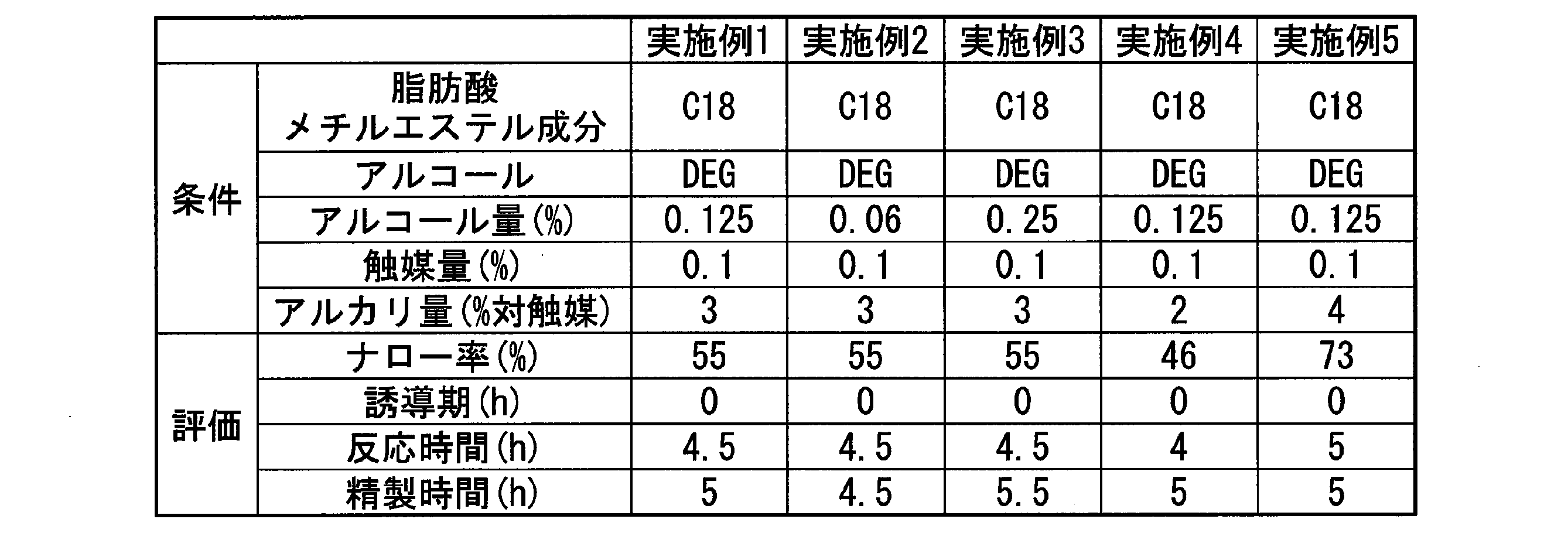


実施例1、比較例3~5の対比から、脂肪酸メチルエステル成分がC18~22脂肪酸メチルエステルを主成分とする場合、前記アルコールによって誘導期が消失すること、脂肪酸メチルエステル成分がC12脂肪酸メチルエステルを主成分とする場合、前記アルコールはむしろ誘導期を助長することがわかる。
比較例1、5の対比から、グリセリンでは誘導期はむしろ助長されることがわかる。
実施例1~3、8、比較例5の対比から、前記アルコールによって反応時間が短くなり、一方で精製時間が長くなることがわかる。
実施例1、4、5、7及び比較例1、2、5の対比から、前記アルコールを用いることによって、グリセリンを用いる場合に比べ、少ないアルカリ量で、反応速度を低下させずに高いナロー率が得られることがわかる。
実施例1、6、9、10の対比から、触媒量は誘導期には影響しないこと、触媒量が増えると、反応速度は速くなるが精製時間が長くなることがわかる。
比較例1、5の対比から、グリセリンでは誘導期はむしろ助長されることがわかる。
実施例1~3、8、比較例5の対比から、前記アルコールによって反応時間が短くなり、一方で精製時間が長くなることがわかる。
実施例1、4、5、7及び比較例1、2、5の対比から、前記アルコールを用いることによって、グリセリンを用いる場合に比べ、少ないアルカリ量で、反応速度を低下させずに高いナロー率が得られることがわかる。
実施例1、6、9、10の対比から、触媒量は誘導期には影響しないこと、触媒量が増えると、反応速度は速くなるが精製時間が長くなることがわかる。
本発明によれば、複合金属酸化物触媒の存在下で脂肪酸メチルエステルにエチレンオキサイドを付加する際の誘導期を低減できる脂肪酸ポリオキシエチレンメチルエーテルの製造方法を提供できる。
Claims (4)
- ジエチレングリコール、エチレングリコール、プロピレングリコール、エタノール、メタノール及びイソプロピルアルコールからなる群から選ばれる少なくとも1種のアルコール、及び複合金属酸化物触媒の存在下で、炭素数18~22の脂肪酸残基を有する脂肪酸メチルエステルを主成分とする脂肪酸メチルエステル成分にエチレンオキサイドを付加する、脂肪酸ポリオキシエチレンメチルエーテルの製造方法。
- 前記炭素数18~22の脂肪酸残基を有する脂肪酸メチルエステルの少なくとも一部が不飽和脂肪酸残基を有する請求項1に記載の脂肪酸ポリオキシエチレンメチルエーテルの製造方法。
- 前記炭素数18~22の脂肪酸残基を有する脂肪酸メチルエステルが、炭素数18の脂肪酸残基を有する脂肪酸メチルエステルを含む請求項1又は2に記載の脂肪酸ポリオキシエチレンメチルエーテルの製造方法。
- 前記脂肪酸メチルエステル成分が、パーム油、パーム核油、ヤシ油もしくは大豆油の炭素数18留分由来の脂肪酸メチルエステル混合物、菜種油の炭素数18~22留分由来の脂肪酸メチルエステル混合物、又はそれらの2以上の混合物である請求項1~3のいずれか一項に記載の脂肪酸ポリオキシエチレンメチルエーテルの製造方法。
Priority Applications (4)
| Application Number | Priority Date | Filing Date | Title |
|---|---|---|---|
| EP18896969.5A EP3733639A4 (en) | 2017-12-27 | 2018-12-20 | FATTY ACID POLYOXYETHYLENE ETHYLETHER MANUFACTURING PROCESS |
| US16/766,638 US20210009500A1 (en) | 2017-12-27 | 2018-12-20 | Method for producing fatty acid polyoxyethylene methyl ether |
| SG11202005250SA SG11202005250SA (en) | 2017-12-27 | 2018-12-20 | Method for producing fatty acid polyoxyethylene methyl ether |
| KR1020207010614A KR20200047714A (ko) | 2017-12-27 | 2018-12-20 | 지방산 폴리옥시에틸렌메틸에테르의 제조 방법 |
Applications Claiming Priority (2)
| Application Number | Priority Date | Filing Date | Title |
|---|---|---|---|
| JP2017-250992 | 2017-12-27 | ||
| JP2017250992A JP2019116440A (ja) | 2017-12-27 | 2017-12-27 | 脂肪酸ポリオキシエチレンメチルエーテルの製造方法 |
Publications (1)
| Publication Number | Publication Date |
|---|---|
| WO2019131442A1 true WO2019131442A1 (ja) | 2019-07-04 |
Family
ID=67063681
Family Applications (1)
| Application Number | Title | Priority Date | Filing Date |
|---|---|---|---|
| PCT/JP2018/047012 Ceased WO2019131442A1 (ja) | 2017-12-27 | 2018-12-20 | 脂肪酸ポリオキシエチレンメチルエーテルの製造方法 |
Country Status (7)
| Country | Link |
|---|---|
| US (1) | US20210009500A1 (ja) |
| EP (1) | EP3733639A4 (ja) |
| JP (1) | JP2019116440A (ja) |
| KR (1) | KR20200047714A (ja) |
| SG (1) | SG11202005250SA (ja) |
| TW (1) | TW201930397A (ja) |
| WO (1) | WO2019131442A1 (ja) |
Families Citing this family (1)
| Publication number | Priority date | Publication date | Assignee | Title |
|---|---|---|---|---|
| US12606774B2 (en) * | 2021-04-30 | 2026-04-21 | Clariant International Ltd | Methyl ester ethoxylates with a mixture of C18 monounsaturated and C18 unsaturated/polyunsaturated alkyl groups |
Citations (11)
| Publication number | Priority date | Publication date | Assignee | Title |
|---|---|---|---|---|
| JPH0271841A (ja) | 1988-04-25 | 1990-03-12 | Henkel Kgaa | エトキシ化またはプロポキシ化触媒 |
| JPH05170688A (ja) | 1991-12-26 | 1993-07-09 | Mitsui Toatsu Chem Inc | アルキレンオキシド付加体の製造方法 |
| JPH0615038B2 (ja) | 1987-09-29 | 1994-03-02 | ライオン株式会社 | アルコキシル化用触媒 |
| JPH06182206A (ja) | 1992-12-21 | 1994-07-05 | Nippon Shokubai Co Ltd | 活性水素含有有機化合物アルコキシレート製造用触媒 |
| JPH06198169A (ja) | 1992-11-13 | 1994-07-19 | Nippon Shokubai Co Ltd | 活性水素含有有機化合物アルコキシレート製造用触媒 |
| JPH07227504A (ja) | 1994-02-17 | 1995-08-29 | Nomura Micro Sci Co Ltd | 溶存酸素除去方法 |
| JPH08169861A (ja) | 1993-12-24 | 1996-07-02 | Lion Corp | 脂肪酸ポリオキシアルキレンアルキルエーテルの製造方法 |
| JPH08169860A (ja) | 1993-12-24 | 1996-07-02 | Lion Corp | 脂肪酸ポリオキシアルキレンアルキルエーテルの製造方法 |
| JPH08268919A (ja) | 1995-03-28 | 1996-10-15 | Lion Corp | 活性水素を有する化合物のアルキレンオキサイド付加物の製造方法 |
| WO2007113985A1 (ja) | 2006-03-30 | 2007-10-11 | Lion Corporation | アルキレンオキサイド付加物及びその製造方法、並びに界面活性剤組成物 |
| WO2008078768A1 (ja) * | 2006-12-27 | 2008-07-03 | Lion Corporation | アルキレンオキシド付加物の製造方法 |
-
2017
- 2017-12-27 JP JP2017250992A patent/JP2019116440A/ja active Pending
-
2018
- 2018-12-20 KR KR1020207010614A patent/KR20200047714A/ko not_active Ceased
- 2018-12-20 EP EP18896969.5A patent/EP3733639A4/en not_active Withdrawn
- 2018-12-20 SG SG11202005250SA patent/SG11202005250SA/en unknown
- 2018-12-20 WO PCT/JP2018/047012 patent/WO2019131442A1/ja not_active Ceased
- 2018-12-20 US US16/766,638 patent/US20210009500A1/en not_active Abandoned
- 2018-12-22 TW TW107146662A patent/TW201930397A/zh unknown
Patent Citations (11)
| Publication number | Priority date | Publication date | Assignee | Title |
|---|---|---|---|---|
| JPH0615038B2 (ja) | 1987-09-29 | 1994-03-02 | ライオン株式会社 | アルコキシル化用触媒 |
| JPH0271841A (ja) | 1988-04-25 | 1990-03-12 | Henkel Kgaa | エトキシ化またはプロポキシ化触媒 |
| JPH05170688A (ja) | 1991-12-26 | 1993-07-09 | Mitsui Toatsu Chem Inc | アルキレンオキシド付加体の製造方法 |
| JPH06198169A (ja) | 1992-11-13 | 1994-07-19 | Nippon Shokubai Co Ltd | 活性水素含有有機化合物アルコキシレート製造用触媒 |
| JPH06182206A (ja) | 1992-12-21 | 1994-07-05 | Nippon Shokubai Co Ltd | 活性水素含有有機化合物アルコキシレート製造用触媒 |
| JPH08169861A (ja) | 1993-12-24 | 1996-07-02 | Lion Corp | 脂肪酸ポリオキシアルキレンアルキルエーテルの製造方法 |
| JPH08169860A (ja) | 1993-12-24 | 1996-07-02 | Lion Corp | 脂肪酸ポリオキシアルキレンアルキルエーテルの製造方法 |
| JPH07227504A (ja) | 1994-02-17 | 1995-08-29 | Nomura Micro Sci Co Ltd | 溶存酸素除去方法 |
| JPH08268919A (ja) | 1995-03-28 | 1996-10-15 | Lion Corp | 活性水素を有する化合物のアルキレンオキサイド付加物の製造方法 |
| WO2007113985A1 (ja) | 2006-03-30 | 2007-10-11 | Lion Corporation | アルキレンオキサイド付加物及びその製造方法、並びに界面活性剤組成物 |
| WO2008078768A1 (ja) * | 2006-12-27 | 2008-07-03 | Lion Corporation | アルキレンオキシド付加物の製造方法 |
Non-Patent Citations (1)
| Title |
|---|
| See also references of EP3733639A4 * |
Also Published As
| Publication number | Publication date |
|---|---|
| KR20200047714A (ko) | 2020-05-07 |
| SG11202005250SA (en) | 2020-07-29 |
| TW201930397A (zh) | 2019-08-01 |
| US20210009500A1 (en) | 2021-01-14 |
| JP2019116440A (ja) | 2019-07-18 |
| EP3733639A4 (en) | 2021-11-17 |
| EP3733639A1 (en) | 2020-11-04 |
Similar Documents
| Publication | Publication Date | Title |
|---|---|---|
| JP6028017B2 (ja) | アルコキシル化触媒、前記触媒の製造方法、及び前記触媒を用いた脂肪酸アルキルエステルアルコキシレートの製造方法 | |
| EP2893976B1 (en) | Copper-based catalyst precursor, method for manufacturing same, and hydrogenation method | |
| KR20090058541A (ko) | 개선된 말레산 무수물 촉매 및 그의 제조 방법 | |
| Jindapon et al. | Production of biodiesel over waste seashell-derived active and stable extrudate catalysts in a fixed-bed reactor | |
| JP5531328B2 (ja) | アルキレンオキシド付加物の製造方法 | |
| TWI726907B (zh) | 硫酸鈣粒子及其製造方法 | |
| WO2019131442A1 (ja) | 脂肪酸ポリオキシエチレンメチルエーテルの製造方法 | |
| JP6469091B2 (ja) | 脂肪酸アルキルエステルアルコキシレートの製造方法 | |
| JP2022101758A (ja) | 脂肪酸アルキルエステルアルコキシレートの製造方法 | |
| JP2010006964A (ja) | アルキレンオキシド付加物の製造方法 | |
| KR20080106565A (ko) | 알킬렌옥사이드 부가물 및 그 제조 방법, 및 계면활성제 조성물 | |
| JP6199197B2 (ja) | ポリオキシアルキレンアルキルエーテルカルボン酸塩の製造方法 | |
| CN117177801A (zh) | 提取方法 | |
| JP2008291009A (ja) | 非フェノール性エトキシレートの高生産方法 | |
| JP4602042B2 (ja) | 非イオン界面活性剤組成物の製造方法 | |
| JP6532055B2 (ja) | 金属粒子担持触媒、触媒組成物、および、ヒドロキシ脂肪酸の製造方法 | |
| JP2016124972A (ja) | 脂肪酸アルキルエステルアルコキシレートの製造方法 | |
| JP2007021435A (ja) | アルコキシル化用触媒及びアルコキシレートの製造方法 | |
| JP2000344702A (ja) | アルキレンオキサイド付加体の製造方法 | |
| Huang et al. | An evaluation of trimethyl phosphate on deactivation of Cu/Zn catalyst in hydrogenation of dodecyl methyl ester | |
| JP2007054717A (ja) | アルコキシル化用触媒及びアルコキシレートの製造方法 | |
| JPH0236585B2 (ja) | Eeterukarubonsanennoseiho | |
| JP2016074560A (ja) | セメント系固化材の製造方法 | |
| JP2022101761A (ja) | アルコキシル化触媒およびその製造方法 | |
| CN112717922A (zh) | 一种叔丁醇预处理催化剂及其制备方法和应用 |
Legal Events
| Date | Code | Title | Description |
|---|---|---|---|
| 121 | Ep: the epo has been informed by wipo that ep was designated in this application |
Ref document number: 18896969 Country of ref document: EP Kind code of ref document: A1 |
|
| ENP | Entry into the national phase |
Ref document number: 20207010614 Country of ref document: KR Kind code of ref document: A |
|
| NENP | Non-entry into the national phase |
Ref country code: DE |
|
| ENP | Entry into the national phase |
Ref document number: 2018896969 Country of ref document: EP Effective date: 20200727 |