WO2019142808A1 - 積層チューブ - Google Patents
積層チューブ Download PDFInfo
- Publication number
- WO2019142808A1 WO2019142808A1 PCT/JP2019/001033 JP2019001033W WO2019142808A1 WO 2019142808 A1 WO2019142808 A1 WO 2019142808A1 JP 2019001033 W JP2019001033 W JP 2019001033W WO 2019142808 A1 WO2019142808 A1 WO 2019142808A1
- Authority
- WO
- WIPO (PCT)
- Prior art keywords
- polyamide
- laminated tube
- layer
- hfc
- acid
- Prior art date
- Legal status (The legal status is an assumption and is not a legal conclusion. Google has not performed a legal analysis and makes no representation as to the accuracy of the status listed.)
- Ceased
Links
Classifications
-
- B—PERFORMING OPERATIONS; TRANSPORTING
- B32—LAYERED PRODUCTS
- B32B—LAYERED PRODUCTS, i.e. PRODUCTS BUILT-UP OF STRATA OF FLAT OR NON-FLAT, e.g. CELLULAR OR HONEYCOMB, FORM
- B32B27/00—Layered products comprising a layer of synthetic resin
- B32B27/06—Layered products comprising a layer of synthetic resin as the main or only constituent of a layer, which is next to another layer of the same or of a different material
- B32B27/08—Layered products comprising a layer of synthetic resin as the main or only constituent of a layer, which is next to another layer of the same or of a different material of synthetic resin
-
- B—PERFORMING OPERATIONS; TRANSPORTING
- B32—LAYERED PRODUCTS
- B32B—LAYERED PRODUCTS, i.e. PRODUCTS BUILT-UP OF STRATA OF FLAT OR NON-FLAT, e.g. CELLULAR OR HONEYCOMB, FORM
- B32B1/00—Layered products having a non-planar shape
- B32B1/08—Tubular products
-
- B—PERFORMING OPERATIONS; TRANSPORTING
- B32—LAYERED PRODUCTS
- B32B—LAYERED PRODUCTS, i.e. PRODUCTS BUILT-UP OF STRATA OF FLAT OR NON-FLAT, e.g. CELLULAR OR HONEYCOMB, FORM
- B32B27/00—Layered products comprising a layer of synthetic resin
- B32B27/18—Layered products comprising a layer of synthetic resin characterised by the use of special additives
- B32B27/22—Layered products comprising a layer of synthetic resin characterised by the use of special additives using plasticisers
-
- B—PERFORMING OPERATIONS; TRANSPORTING
- B32—LAYERED PRODUCTS
- B32B—LAYERED PRODUCTS, i.e. PRODUCTS BUILT-UP OF STRATA OF FLAT OR NON-FLAT, e.g. CELLULAR OR HONEYCOMB, FORM
- B32B27/00—Layered products comprising a layer of synthetic resin
- B32B27/28—Layered products comprising a layer of synthetic resin comprising synthetic resins not wholly covered by any one of the sub-groups B32B27/30 - B32B27/42
- B32B27/281—Layered products comprising a layer of synthetic resin comprising synthetic resins not wholly covered by any one of the sub-groups B32B27/30 - B32B27/42 comprising polyimides
-
- B—PERFORMING OPERATIONS; TRANSPORTING
- B32—LAYERED PRODUCTS
- B32B—LAYERED PRODUCTS, i.e. PRODUCTS BUILT-UP OF STRATA OF FLAT OR NON-FLAT, e.g. CELLULAR OR HONEYCOMB, FORM
- B32B27/00—Layered products comprising a layer of synthetic resin
- B32B27/30—Layered products comprising a layer of synthetic resin comprising vinyl (co)polymers; comprising acrylic (co)polymers
-
- B—PERFORMING OPERATIONS; TRANSPORTING
- B32—LAYERED PRODUCTS
- B32B—LAYERED PRODUCTS, i.e. PRODUCTS BUILT-UP OF STRATA OF FLAT OR NON-FLAT, e.g. CELLULAR OR HONEYCOMB, FORM
- B32B27/00—Layered products comprising a layer of synthetic resin
- B32B27/32—Layered products comprising a layer of synthetic resin comprising polyolefins
-
- B—PERFORMING OPERATIONS; TRANSPORTING
- B32—LAYERED PRODUCTS
- B32B—LAYERED PRODUCTS, i.e. PRODUCTS BUILT-UP OF STRATA OF FLAT OR NON-FLAT, e.g. CELLULAR OR HONEYCOMB, FORM
- B32B27/00—Layered products comprising a layer of synthetic resin
- B32B27/34—Layered products comprising a layer of synthetic resin comprising polyamides
-
- B—PERFORMING OPERATIONS; TRANSPORTING
- B32—LAYERED PRODUCTS
- B32B—LAYERED PRODUCTS, i.e. PRODUCTS BUILT-UP OF STRATA OF FLAT OR NON-FLAT, e.g. CELLULAR OR HONEYCOMB, FORM
- B32B27/00—Layered products comprising a layer of synthetic resin
- B32B27/38—Layered products comprising a layer of synthetic resin comprising epoxy resins
-
- B—PERFORMING OPERATIONS; TRANSPORTING
- B32—LAYERED PRODUCTS
- B32B—LAYERED PRODUCTS, i.e. PRODUCTS BUILT-UP OF STRATA OF FLAT OR NON-FLAT, e.g. CELLULAR OR HONEYCOMB, FORM
- B32B27/00—Layered products comprising a layer of synthetic resin
- B32B27/42—Layered products comprising a layer of synthetic resin comprising condensation resins of aldehydes, e.g. with phenols, ureas or melamines
-
- C—CHEMISTRY; METALLURGY
- C08—ORGANIC MACROMOLECULAR COMPOUNDS; THEIR PREPARATION OR CHEMICAL WORKING-UP; COMPOSITIONS BASED THEREON
- C08G—MACROMOLECULAR COMPOUNDS OBTAINED OTHERWISE THAN BY REACTIONS ONLY INVOLVING UNSATURATED CARBON-TO-CARBON BONDS
- C08G69/00—Macromolecular compounds obtained by reactions forming a carboxylic amide link in the main chain of the macromolecule
- C08G69/02—Polyamides derived from amino-carboxylic acids or from polyamines and polycarboxylic acids
- C08G69/08—Polyamides derived from amino-carboxylic acids or from polyamines and polycarboxylic acids derived from amino-carboxylic acids
- C08G69/14—Lactams
-
- C—CHEMISTRY; METALLURGY
- C08—ORGANIC MACROMOLECULAR COMPOUNDS; THEIR PREPARATION OR CHEMICAL WORKING-UP; COMPOSITIONS BASED THEREON
- C08G—MACROMOLECULAR COMPOUNDS OBTAINED OTHERWISE THAN BY REACTIONS ONLY INVOLVING UNSATURATED CARBON-TO-CARBON BONDS
- C08G69/00—Macromolecular compounds obtained by reactions forming a carboxylic amide link in the main chain of the macromolecule
- C08G69/02—Polyamides derived from amino-carboxylic acids or from polyamines and polycarboxylic acids
- C08G69/26—Polyamides derived from amino-carboxylic acids or from polyamines and polycarboxylic acids derived from polyamines and polycarboxylic acids
-
- C—CHEMISTRY; METALLURGY
- C08—ORGANIC MACROMOLECULAR COMPOUNDS; THEIR PREPARATION OR CHEMICAL WORKING-UP; COMPOSITIONS BASED THEREON
- C08L—COMPOSITIONS OF MACROMOLECULAR COMPOUNDS
- C08L23/00—Compositions of homopolymers or copolymers of unsaturated aliphatic hydrocarbons having only one carbon-to-carbon double bond; Compositions of derivatives of such polymers
- C08L23/02—Compositions of homopolymers or copolymers of unsaturated aliphatic hydrocarbons having only one carbon-to-carbon double bond; Compositions of derivatives of such polymers not modified by chemical after-treatment
- C08L23/04—Homopolymers or copolymers of ethene
- C08L23/08—Copolymers of ethene
- C08L23/0807—Copolymers of ethene with unsaturated hydrocarbons only containing four or more carbon atoms
- C08L23/0815—Copolymers of ethene with unsaturated hydrocarbons only containing four or more carbon atoms with aliphatic 1-olefins containing one carbon-to-carbon double bond
-
- C—CHEMISTRY; METALLURGY
- C08—ORGANIC MACROMOLECULAR COMPOUNDS; THEIR PREPARATION OR CHEMICAL WORKING-UP; COMPOSITIONS BASED THEREON
- C08L—COMPOSITIONS OF MACROMOLECULAR COMPOUNDS
- C08L77/00—Compositions of polyamides obtained by reactions forming a carboxylic amide link in the main chain; Compositions of derivatives of such polymers
- C08L77/02—Polyamides derived from omega-amino carboxylic acids or from lactams thereof
-
- C—CHEMISTRY; METALLURGY
- C08—ORGANIC MACROMOLECULAR COMPOUNDS; THEIR PREPARATION OR CHEMICAL WORKING-UP; COMPOSITIONS BASED THEREON
- C08L—COMPOSITIONS OF MACROMOLECULAR COMPOUNDS
- C08L77/00—Compositions of polyamides obtained by reactions forming a carboxylic amide link in the main chain; Compositions of derivatives of such polymers
- C08L77/06—Polyamides derived from polyamines and polycarboxylic acids
-
- C—CHEMISTRY; METALLURGY
- C09—DYES; PAINTS; POLISHES; NATURAL RESINS; ADHESIVES; COMPOSITIONS NOT OTHERWISE PROVIDED FOR; APPLICATIONS OF MATERIALS NOT OTHERWISE PROVIDED FOR
- C09D—COATING COMPOSITIONS, e.g. PAINTS, VARNISHES OR LACQUERS; FILLING PASTES; CHEMICAL PAINT OR INK REMOVERS; INKS; CORRECTING FLUIDS; WOODSTAINS; PASTES OR SOLIDS FOR COLOURING OR PRINTING; USE OF MATERIALS THEREFOR
- C09D177/00—Coating compositions based on polyamides obtained by reactions forming a carboxylic amide link in the main chain; Coating compositions based on derivatives of such polymers
- C09D177/02—Polyamides derived from omega-amino carboxylic acids or from lactams thereof
-
- C—CHEMISTRY; METALLURGY
- C09—DYES; PAINTS; POLISHES; NATURAL RESINS; ADHESIVES; COMPOSITIONS NOT OTHERWISE PROVIDED FOR; APPLICATIONS OF MATERIALS NOT OTHERWISE PROVIDED FOR
- C09D—COATING COMPOSITIONS, e.g. PAINTS, VARNISHES OR LACQUERS; FILLING PASTES; CHEMICAL PAINT OR INK REMOVERS; INKS; CORRECTING FLUIDS; WOODSTAINS; PASTES OR SOLIDS FOR COLOURING OR PRINTING; USE OF MATERIALS THEREFOR
- C09D177/00—Coating compositions based on polyamides obtained by reactions forming a carboxylic amide link in the main chain; Coating compositions based on derivatives of such polymers
- C09D177/06—Polyamides derived from polyamines and polycarboxylic acids
-
- B—PERFORMING OPERATIONS; TRANSPORTING
- B32—LAYERED PRODUCTS
- B32B—LAYERED PRODUCTS, i.e. PRODUCTS BUILT-UP OF STRATA OF FLAT OR NON-FLAT, e.g. CELLULAR OR HONEYCOMB, FORM
- B32B2250/00—Layers arrangement
- B32B2250/02—2 layers
-
- B—PERFORMING OPERATIONS; TRANSPORTING
- B32—LAYERED PRODUCTS
- B32B—LAYERED PRODUCTS, i.e. PRODUCTS BUILT-UP OF STRATA OF FLAT OR NON-FLAT, e.g. CELLULAR OR HONEYCOMB, FORM
- B32B2250/00—Layers arrangement
- B32B2250/03—3 layers
-
- B—PERFORMING OPERATIONS; TRANSPORTING
- B32—LAYERED PRODUCTS
- B32B—LAYERED PRODUCTS, i.e. PRODUCTS BUILT-UP OF STRATA OF FLAT OR NON-FLAT, e.g. CELLULAR OR HONEYCOMB, FORM
- B32B2250/00—Layers arrangement
- B32B2250/24—All layers being polymeric
-
- B—PERFORMING OPERATIONS; TRANSPORTING
- B32—LAYERED PRODUCTS
- B32B—LAYERED PRODUCTS, i.e. PRODUCTS BUILT-UP OF STRATA OF FLAT OR NON-FLAT, e.g. CELLULAR OR HONEYCOMB, FORM
- B32B2270/00—Resin or rubber layer containing a blend of at least two different polymers
-
- B—PERFORMING OPERATIONS; TRANSPORTING
- B32—LAYERED PRODUCTS
- B32B—LAYERED PRODUCTS, i.e. PRODUCTS BUILT-UP OF STRATA OF FLAT OR NON-FLAT, e.g. CELLULAR OR HONEYCOMB, FORM
- B32B2307/00—Properties of the layers or laminate
- B32B2307/30—Properties of the layers or laminate having particular thermal properties
-
- B—PERFORMING OPERATIONS; TRANSPORTING
- B32—LAYERED PRODUCTS
- B32B—LAYERED PRODUCTS, i.e. PRODUCTS BUILT-UP OF STRATA OF FLAT OR NON-FLAT, e.g. CELLULAR OR HONEYCOMB, FORM
- B32B2307/00—Properties of the layers or laminate
- B32B2307/30—Properties of the layers or laminate having particular thermal properties
- B32B2307/308—Heat stability
-
- B—PERFORMING OPERATIONS; TRANSPORTING
- B32—LAYERED PRODUCTS
- B32B—LAYERED PRODUCTS, i.e. PRODUCTS BUILT-UP OF STRATA OF FLAT OR NON-FLAT, e.g. CELLULAR OR HONEYCOMB, FORM
- B32B2307/00—Properties of the layers or laminate
- B32B2307/50—Properties of the layers or laminate having particular mechanical properties
- B32B2307/51—Elastic
-
- B—PERFORMING OPERATIONS; TRANSPORTING
- B32—LAYERED PRODUCTS
- B32B—LAYERED PRODUCTS, i.e. PRODUCTS BUILT-UP OF STRATA OF FLAT OR NON-FLAT, e.g. CELLULAR OR HONEYCOMB, FORM
- B32B2307/00—Properties of the layers or laminate
- B32B2307/50—Properties of the layers or laminate having particular mechanical properties
- B32B2307/54—Yield strength; Tensile strength
-
- B—PERFORMING OPERATIONS; TRANSPORTING
- B32—LAYERED PRODUCTS
- B32B—LAYERED PRODUCTS, i.e. PRODUCTS BUILT-UP OF STRATA OF FLAT OR NON-FLAT, e.g. CELLULAR OR HONEYCOMB, FORM
- B32B2307/00—Properties of the layers or laminate
- B32B2307/50—Properties of the layers or laminate having particular mechanical properties
- B32B2307/546—Flexural strength; Flexion stiffness
-
- B—PERFORMING OPERATIONS; TRANSPORTING
- B32—LAYERED PRODUCTS
- B32B—LAYERED PRODUCTS, i.e. PRODUCTS BUILT-UP OF STRATA OF FLAT OR NON-FLAT, e.g. CELLULAR OR HONEYCOMB, FORM
- B32B2307/00—Properties of the layers or laminate
- B32B2307/50—Properties of the layers or laminate having particular mechanical properties
- B32B2307/554—Wear resistance
-
- B—PERFORMING OPERATIONS; TRANSPORTING
- B32—LAYERED PRODUCTS
- B32B—LAYERED PRODUCTS, i.e. PRODUCTS BUILT-UP OF STRATA OF FLAT OR NON-FLAT, e.g. CELLULAR OR HONEYCOMB, FORM
- B32B2307/00—Properties of the layers or laminate
- B32B2307/50—Properties of the layers or laminate having particular mechanical properties
- B32B2307/558—Impact strength, toughness
-
- B—PERFORMING OPERATIONS; TRANSPORTING
- B32—LAYERED PRODUCTS
- B32B—LAYERED PRODUCTS, i.e. PRODUCTS BUILT-UP OF STRATA OF FLAT OR NON-FLAT, e.g. CELLULAR OR HONEYCOMB, FORM
- B32B2307/00—Properties of the layers or laminate
- B32B2307/70—Other properties
- B32B2307/714—Inert, i.e. inert to chemical degradation, corrosion
-
- B—PERFORMING OPERATIONS; TRANSPORTING
- B32—LAYERED PRODUCTS
- B32B—LAYERED PRODUCTS, i.e. PRODUCTS BUILT-UP OF STRATA OF FLAT OR NON-FLAT, e.g. CELLULAR OR HONEYCOMB, FORM
- B32B2307/00—Properties of the layers or laminate
- B32B2307/70—Other properties
- B32B2307/726—Permeability to liquids, absorption
- B32B2307/7265—Non-permeable
-
- B—PERFORMING OPERATIONS; TRANSPORTING
- B32—LAYERED PRODUCTS
- B32B—LAYERED PRODUCTS, i.e. PRODUCTS BUILT-UP OF STRATA OF FLAT OR NON-FLAT, e.g. CELLULAR OR HONEYCOMB, FORM
- B32B2307/00—Properties of the layers or laminate
- B32B2307/70—Other properties
- B32B2307/732—Dimensional properties
-
- B—PERFORMING OPERATIONS; TRANSPORTING
- B32—LAYERED PRODUCTS
- B32B—LAYERED PRODUCTS, i.e. PRODUCTS BUILT-UP OF STRATA OF FLAT OR NON-FLAT, e.g. CELLULAR OR HONEYCOMB, FORM
- B32B2323/00—Polyalkenes
- B32B2323/10—Polypropylene
-
- B—PERFORMING OPERATIONS; TRANSPORTING
- B32—LAYERED PRODUCTS
- B32B—LAYERED PRODUCTS, i.e. PRODUCTS BUILT-UP OF STRATA OF FLAT OR NON-FLAT, e.g. CELLULAR OR HONEYCOMB, FORM
- B32B2377/00—Polyamides
-
- B—PERFORMING OPERATIONS; TRANSPORTING
- B32—LAYERED PRODUCTS
- B32B—LAYERED PRODUCTS, i.e. PRODUCTS BUILT-UP OF STRATA OF FLAT OR NON-FLAT, e.g. CELLULAR OR HONEYCOMB, FORM
- B32B2419/00—Buildings or parts thereof
-
- B—PERFORMING OPERATIONS; TRANSPORTING
- B32—LAYERED PRODUCTS
- B32B—LAYERED PRODUCTS, i.e. PRODUCTS BUILT-UP OF STRATA OF FLAT OR NON-FLAT, e.g. CELLULAR OR HONEYCOMB, FORM
- B32B2457/00—Electrical equipment
-
- B—PERFORMING OPERATIONS; TRANSPORTING
- B32—LAYERED PRODUCTS
- B32B—LAYERED PRODUCTS, i.e. PRODUCTS BUILT-UP OF STRATA OF FLAT OR NON-FLAT, e.g. CELLULAR OR HONEYCOMB, FORM
- B32B2479/00—Furniture
-
- B—PERFORMING OPERATIONS; TRANSPORTING
- B32—LAYERED PRODUCTS
- B32B—LAYERED PRODUCTS, i.e. PRODUCTS BUILT-UP OF STRATA OF FLAT OR NON-FLAT, e.g. CELLULAR OR HONEYCOMB, FORM
- B32B2535/00—Medical equipment, e.g. bandage, prostheses or catheter
-
- B—PERFORMING OPERATIONS; TRANSPORTING
- B32—LAYERED PRODUCTS
- B32B—LAYERED PRODUCTS, i.e. PRODUCTS BUILT-UP OF STRATA OF FLAT OR NON-FLAT, e.g. CELLULAR OR HONEYCOMB, FORM
- B32B2597/00—Tubular articles, e.g. hoses, pipes
-
- B—PERFORMING OPERATIONS; TRANSPORTING
- B32—LAYERED PRODUCTS
- B32B—LAYERED PRODUCTS, i.e. PRODUCTS BUILT-UP OF STRATA OF FLAT OR NON-FLAT, e.g. CELLULAR OR HONEYCOMB, FORM
- B32B2605/00—Vehicles
-
- C—CHEMISTRY; METALLURGY
- C08—ORGANIC MACROMOLECULAR COMPOUNDS; THEIR PREPARATION OR CHEMICAL WORKING-UP; COMPOSITIONS BASED THEREON
- C08L—COMPOSITIONS OF MACROMOLECULAR COMPOUNDS
- C08L2207/00—Properties characterising the ingredient of the composition
- C08L2207/20—Recycled plastic
-
- F—MECHANICAL ENGINEERING; LIGHTING; HEATING; WEAPONS; BLASTING
- F16—ENGINEERING ELEMENTS AND UNITS; GENERAL MEASURES FOR PRODUCING AND MAINTAINING EFFECTIVE FUNCTIONING OF MACHINES OR INSTALLATIONS; THERMAL INSULATION IN GENERAL
- F16L—PIPES; JOINTS OR FITTINGS FOR PIPES; SUPPORTS FOR PIPES, CABLES OR PROTECTIVE TUBING; MEANS FOR THERMAL INSULATION IN GENERAL
- F16L11/00—Hoses, i.e. flexible pipes
- F16L11/04—Hoses, i.e. flexible pipes made of rubber or flexible plastics
Definitions
- the present invention relates to a laminated tube.
- hoses and tubes are used for In these hoses and tubes, chemical solutions such as coolant (alcohol and water), refrigerant, oil, and urea solution are transported.
- Various hoses and tubes used in the automotive industry are required to have extremely high performance such as high breaking pressure strength under high temperature, long-term heat resistance, chemical resistance, water vapor and chemical liquid barrier properties, flexibility, etc. .
- the circulating fluid is used as a coolant (LLC) mainly composed of ethylene glycol to prevent freezing in winter, a urea solution enclosed as a catalyst for removing NOx released from a diesel engine, an air conditioner, a radiator, etc.
- LLC coolant
- a refrigerant such as carbon dioxide, chlorofluorocarbons, alternative chlorofluorocarbons, propane, water, etc.
- the cooling effect and the catalytic effect can not be sufficiently exhibited at the time of actual use unless the barrier properties to these chemicals are sufficient.
- the requirements for the refrigerant barrier properties of refrigerant transport tubes used in automobiles and the like are becoming stricter.
- R-1234yf refrigerant is developed as an alternative refrigerant to HFC-134a refrigerant, and has a low ozone destruction coefficient and global warming coefficient compared to HFC-134a refrigerant, and is an extremely environmentally friendly refrigerant.
- R-1234yf refrigerant is particularly susceptible to hydrolysis by contact with water in a high temperature environment to generate an acid (such as formic acid), which acid causes hydrolysis, depending on the material in contact with the drug solution In the worst case, a crack may occur and the fluid may leak, failing to fulfill the purpose of fluid transport.
- the tube body may have an adverse effect on parts through which the drug solution or water permeates and contacts.
- a fluorine-based resin such as ethylene / tetrafluoroethylene copolymer (ETFE) is excellent in resistance to various chemical solutions and is considered as one of the material members having a barrier property against water vapor.
- EFE ethylene / tetrafluoroethylene copolymer
- Patent Documents 1 to 3 development of fluorine-based resins having adhesiveness with polyamides has been active (see Patent Documents 1 to 3).
- halogen-containing materials is being avoided and there is a problem of high specific gravity and high cost, halogen-free materials are used, barrier properties to chemical solutions are excellent, and resistance to various chemical solutions is provided. Development of piping system is required.
- polyolefin is inexpensive and is excellent in chemical liquid permeation prevention property and chemical liquid long-term tolerance.
- a cooling pipe constituted by an outer layer made of polyamide and an inner layer made of cross-linked polyethylene has been proposed (see Patent Document 4).
- a cooling pipe has been proposed which is configured of an outer layer made of polyamide, an inner layer made of polypropylene having a certain thickness or more and containing a specific additive (see Patent Document 5).
- the outer layer which is inert and non-swellable to the coolant and which consists of polyamide
- the inner layer is composed of halogenated or non-halogenated homopolyolefins or copolyolefins and is produced by extrusion blow molding
- the length of the conduit is A cooling pipe has been proposed in which the wall thicknesses of the layers are different, and the polymers of the inner and outer layers are distinctly different in their flexibility (see Patent Document 6).
- a multilayer tube comprising a protective layer has been proposed (see Patent Document 7).
- a fuel comprising an outer layer material comprising a polyamide resin and a styrene / isobutylene block copolymer as an essential component as an outer layer, and a polyolefin resin and an inner layer material comprising a styrene / isobutylene block copolymer as an essential component Battery piping has also been proposed (see Patent Document 8).
- Patent Literatures 5 to 7 have specific techniques. There is no data or technical suggestion.
- the styrene / isobutylene block copolymer contained in the outer layer material does not have a sufficient flexibility improving effect, and further improvement is required.
- the space where piping can be constructed is becoming smaller, and in the case of an electric car or the like, the piping layout is becoming more complicated in order to improve the cooling efficiency.
- the flexibility of the laminated tube is required from the viewpoint of the workability of the parts and the freedom of layout, and the coexistence of high pressure resistance that can withstand the internal pressure of the chemical solution in a high temperature atmosphere is further required. ing.
- the object of the present invention is to solve the above-mentioned problems, and to provide a laminated tube excellent in low temperature impact resistance, high fracture strength at high temperature, flexibility, dimensional stability, and elution resistance of low molecular weight substances and ionic components. It is to do.
- the inventors of the present invention conducted intensive studies to solve the above problems, and as a result, the ratio of the number of methylene groups to the number of amide groups was from the aliphatic polyamide and the unsaturated compound having a carboxyl group and / or an acid anhydride group within a predetermined range.
- the present invention is a laminated tube of two or more layers including (a) layer and (b) layer,
- the (a) layer contains an aliphatic polyamide composition (A)
- the (b) layer contains a modified polyolefin (B)
- the aliphatic polyamide composition (A) comprises a polyamide (A1) and an elastomeric polymer (A2)
- the polyamide (A1) is an aliphatic polyamide having a ratio of the number of methylene groups to the number of amide groups of 7.0 or more, and is contained in the aliphatic polyamide composition (A) in an amount of 55% by mass to 95% by mass.
- the elastomeric polymer (A2) contains a structural unit derived from an unsaturated compound having a carboxyl group and / or an acid anhydride group, and it is contained in an amount of 5 to 30% by mass in the aliphatic polyamide composition (A).
- the aliphatic polyamide composition (A) may contain a plasticizer (A3),
- the plasticizer (A3) is a sulfur-free, p- and / or o-hydroxybenzoic acid, and a linear and / or branched alkyl aliphatic alcohol having 12 to 24 carbon atoms, and an ester structure
- the content of the plasticizer (A3) in the aliphatic polyamide composition (A) is 0% by mass or more and 15% by mass or less
- the aliphatic polyamide composition (A) has a flexural modulus of 400 MPa or more and 1,000 MPa or less measured in accordance with ISO 178
- the modified polyolefin (B) has a unit derived from a monomer based on an ⁇ -olefin having 2 to 10 carbon atoms, and has a melting point of 130 ° C.
- the thickness of the layer (a) occupies 60% or more of the total thickness of the tube.
- Preferred embodiments of the laminated tube are shown below. A plurality of preferred embodiments can be combined.
- the polyamide (A1) is made of polyundecaneamide (polyamide 11), polydodecaneamide (polyamide 12), polyhexamethylene decamide (polyamide 610), polyhexamethylene dodecamide (polyamide 612), polydecamethylene deca At least one homopolymer selected from the group consisting of polyamide (polyamide 1010), polydecamethylene dodecamide (polyamide 1012), and polydodecamethylene dodecamide (polyamide 1212), and / or raw material monomers forming these A laminated tube which is a copolymer using several kinds of
- the modified polyolefin (B) is at least selected from the group consisting of a carboxyl group or a derivative thereof, a hydroxyl group, an epoxy group, an amino group, an amido group, an imide group, a nitrile group, a thiol group, and an isocyanate group.
- a layer (c) is further included, the layer (c) includes a polyolefin (C), and the polyolefin (C) is derived from a monomer based on an ⁇ -olefin having 2 to 10 carbon atoms.
- the unit has a melting point of at least 120 ° C measured in accordance with ISO 11357-3 and a tensile yield stress of at least 20 MPa measured in accordance with ISO 527 according to ISO 179/1 eA.
- a laminated tube having a Charpy impact strength (notched) at 23 ° C. of 40 kJ / m 2 or more.
- a laminated tube which is any one of a coolant (LLC) cooler tube, a urea solution transfer tube, a battery cooling and heating tube, and an air conditioner tube.
- LLC coolant
- the present invention it is possible to provide a laminated tube excellent in low-temperature impact resistance, breaking pressure strength at high temperature, flexibility, dimensional stability, and elution resistance of low molecular weight substances and ionic components.
- the laminated tube of the present invention is a laminated tube of two or more layers including (a) layer and (b) layer, and the (a) layer contains an aliphatic polyamide composition (A), and the above (b)
- the layer contains a modified polyolefin (B), and the aliphatic polyamide composition (A) contains a polyamide (A1), an elastomeric polymer (A2), and the polyamide (A1) has a ratio of the number of methylene groups to the number of amide groups Is an aliphatic polyamide of 7.0 or more, and contained 55% by mass or more and 95% by mass or less in the aliphatic polyamide composition (A), and the elastomeric polymer (A2) contains a carboxyl group and / or an acid
- the aliphatic polyamide composition (A) contains a constituent unit derived from an unsaturated compound having an anhydride group, and is contained in an amount of 5% by mass to 30% by mass, and the aliphatic polyamide composition
- the aliphatic polyamide composition (A) has a flexural modulus of 400 MPa or more and 1,000 MPa or less measured according to ISO 178, and the modified polyolefin (B) has 2 or more and 10 or less carbon atoms.
- a unit derived from an ⁇ -olefin-based monomer, having a melting point of 130 ° C. or higher measured according to ISO 11357-3, and the inner side of the laminated tube from the outer side (A) layer and (b) layer are disposed in this order, and the thickness of the (a) layer is 60% or more of the total thickness of the tube.
- the (a) layer of the laminated tube of the present invention contains an aliphatic polyamide composition (A).
- the aliphatic polyamide composition (A) contains a polyamide (A1) and an elastomeric polymer (A2), and the polyamide (A1) is an aliphatic polyamide having a ratio of the number of methylene groups to the number of amide groups of 7.0 or more.
- Component (A) is contained in an amount of 55% by mass to 95% by mass, and the elastomeric polymer (A2) is a structural unit derived from an unsaturated compound having a carboxyl group and / or an acid anhydride group Containing and contained in the aliphatic polyamide composition (A) in an amount of 5% by mass or more and 30% by mass or less, and may optionally contain a plasticizer (A3), and the plasticizer (A3) contains a sulfur atom And an aliphatic polyamide containing an ester structure of p- and / or o-hydroxybenzoic acid and a linear and / or branched alkyl aliphatic alcohol having 12 to 24 carbon atoms,
- the content of the plasticizer (A3) in the composition (A) is 0% by mass or more and 15% by mass or less, and the aliphatic polyamide composition (A) has a flexural modulus measured according to ISO 178. Is 400 MPa or more and 1,000 MPa or less (
- the polyamide (A1) is an aliphatic polyamide having a ratio of the number of methylene groups to the number of amide groups (hereinafter sometimes referred to as [CH 2 ] / [NHCO]) of 7.0 or more (hereinafter referred to as polyamide (A1)) Sometimes called).
- polyamide (A1)) is an aliphatic polyamide having a ratio of the number of methylene groups to the number of amide groups (hereinafter sometimes referred to as [CH 2 ] / [NHCO]) of 7.0 or more (hereinafter referred to as polyamide (A1)) Sometimes called).
- the polyamide (A1) has an amide bond (-CONH-) in its main chain and can be melt polymerized or solution polymerized using an aliphatic lactam, an aliphatic aminocarboxylic acid, or an aliphatic diamine and an aliphatic dicarboxylic acid as raw materials. It is obtained by polymerization or copolymerization by a known method such as solid phase polymerization.
- aliphatic lactams examples include caprolactam, enanthate lactams, undecane lactams, dodecane lactams, ⁇ -pyrrolidones, ⁇ -piperidone, etc.
- aliphatic amino carboxylic acids 6-aminocaproic acid, 7-aminoheptanoic acid, 9-aminononanoic acid, 11-aminoundecanoic acid, 12-aminododecanoic acid and the like can be mentioned. One or more of these may be used.
- aliphatic dicarboxylic acid glutaric acid, adipic acid, pimelic acid, suberic acid, azelaic acid, sebacic acid, undecanedioic acid, dodecanedioic acid, tridecanedioic acid, tetradecanedioic acid, pentadecanedioic acid, hexadecanedioic acid, octadecane Diacid, eicosan diacid and the like can be mentioned. One or more of these may be used.
- polyamide (A1) for example, polyundecaneamide (polyamide 11), polydodecaneamide (polyamide 12), polytetramethylene dodecamide (polyamide 412), polypentamethylene dodecamide (polyamide 512), polyhexamethylene dodecamide (Polyamide 612), polyhexamethylene tetradecamide (polyamide 614), polyhexamethylene hexadecamide (polyamide 616), polyhexamethylene octadecamide (polyamide 618), polynonamethylene adipamide (polyamide 96), poly Nona methylene suberamide (polyamide 98), poly nona methylene aceramide (polyamide 99), poly nona methylene sebacamide (polyamide 910), poly nona methylene dodecamide (polyamide 912), poly Kamethylene adipamide (polyamide 106), polydecamethylene suberamide (polyamide 108), polydecamethylene
- polyamide (A1) from the viewpoint of sufficiently securing the mechanical properties and heat resistance and other physical properties of the obtained laminated tube, and from the viewpoint of economy and availability, polyamide decanoamide (polyamide) 11), polydodecane amide (polyamide 12), polyhexamethylene decamide (polyamide 610), polyhexamethylene dodecamide (polyamide 612), polydecamethylene decamide (polyamide 1010), polydecamethylene dodecamide (polyamide 1012) It is preferable to use at least one homopolymer selected from the group consisting of and polydodecamethylene dodecamide (polyamide 1212) and / or a copolymer using several kinds of raw material monomers forming these.
- polyamide (A1) As a production apparatus of polyamide (A1), kneading reaction extruders such as batch type reaction kettle, single tank type or multi tank continuous reaction apparatus, tubular continuous reaction apparatus, single screw type kneading extruder, twin screw type kneading extruder, etc. And the like, and known polyamide production devices.
- polymerization method polymerization can be repeated by repeating operations of normal pressure, reduced pressure and pressure, using known methods such as melt polymerization, solution polymerization and solid phase polymerization. These polymerization methods can be used alone or in combination as appropriate.
- the relative viscosity of polyamide (A1) measured under the conditions of 96% sulfuric acid, 1% of polymer concentration, and 25 ° C. in accordance with JIS K-6920 ensures the mechanical properties of the obtained laminated tube. And from the viewpoint of securing the desirable formability of the laminated tube by setting the viscosity at the time of melting to an appropriate range, it is preferably 1.5 or more and 5.0 or less, and more preferably 2.0 or more and 4.5 or less preferable.
- the terminal amino group concentration [A] ( ⁇ eq / g) can be measured by dissolving the polyamide in a phenol / methanol mixed solution and titrating with 0.05 N hydrochloric acid.
- the terminal carboxyl group concentration [B] ( ⁇ eq / g) can be measured by dissolving the polyamide in benzyl alcohol and titrating with a 0.05 N sodium hydroxide solution.
- amines examples include monoamines, diamines, triamines, tetramines, and polyamines.
- carboxylic acids such as monocarboxylic acids, dicarboxylic acids and tricarboxylic acids may be added as long as the above range of the end group concentration conditions is not exceeded. These amines and carboxylic acids may be added simultaneously or separately.
- 1 type or 2 types or more can be used for amines and carboxylic acids of the following illustration.
- monoamines to be added include methylamine, ethylamine, propylamine, butylamine, pentylamine, hexylamine, heptylamine, octylamine, 2-ethylhexylamine, nonylamine, decylamine, undecylamine, dodecylamine, tridecylamine
- Aliphatic monoamines such as tetradecylamine, pentadecylamine, hexadecylamine, octadecylamine, octadecylenamine, eicosylamine and docosylamine; alicyclic monoamines such as cyclohexylamine and methylcyclohexylamine; benzylamine, ⁇ - Aromatic monoamines such as phenylmethylamine; N, N-dimethylamine, N, N-diethylamine, N, N-dipropylamine, N, N
- diamine to be added examples include 1,2-ethanediamine, 1,3-propanediamine, 1,4-butanediamine, 1,5-pentanediamine, 1,6-hexanediamine, 1,7-heptanediamine 1,8-octanediamine, 1,9-nonanediamine, 1,10-decanediamine, 1,11-undecanediamine, 1,12-dodecanediamine, 1,13-tridecanediamine, 1,14-tetradecanediamine 1,15-Pentadecanediamine, 1,16-hexadecanediamine, 1,17-heptadecanediamine, 1,18-octadecanediamine, 2-methyl-1,5-pentanediamine, 3-methyl-1,5-pentanediamine , 2-Methyl-1,8-octanediamine, 2,2,4-trimethyl-1,6-hexane Aliphatic diamines such as amines, 2,4,4-trimethyl-1,6-hexanediamine, 5-methyl-1,9
- triamine and tetramine to be added include 1,2,3-triaminopropane, 1,2,3-triamino-2-methylpropane, 1,2,4-triaminobutane, 1,2,3,3 4-tetraminobutane, 1,3,5-triaminocyclohexane, 1,2,4-triaminocyclohexane, 1,2,3-triaminocyclohexane, 1,2,4,5-tetraminocyclohexane, 1,3, 5-triaminobenzene, 1,2,4-triaminobenzene, 1,2,3-triaminobenzene, 1,2,4,5-tetraminobenzene, 1,2,4-triaminonaphthalene, 2,5 , 7-triaminonaphthalene, 2,4,6-triaminopyridine, 1,2,7,8-tetraminonaphthalene, 1,4,5,8-tetraminonaphthalene. One or more of these may be used
- the polyamine to be added may be a compound having a plurality of primary amino groups (-NH 2 ) and / or secondary amino groups (-NH-), for example, polyalkyleneimines, polyalkylene polyamines, polyvinyl amines, Polyallylamine etc. are mentioned.
- the amino group with active hydrogen is the reactive point of the polyamine.
- the polyalkyleneimine is produced by, for example, a method of ionically polymerizing an alkyleneimine such as ethyleneimine or propyleneimine, or a method of polymerizing an alkyl oxazoline and then partially or completely hydrolyzing the polymer.
- alkyleneimine such as ethyleneimine or propyleneimine
- polyalkylene polyamines include diethylenetriamine, triethylenetetramine, pentaethylenehexamine, and a reaction product of ethylenediamine and a polyfunctional compound.
- Polyvinylamine can be obtained, for example, by polymerizing N-vinylformamide to form poly (N-vinylformamide) and then partially or completely hydrolyzing the polymer with an acid such as hydrochloric acid.
- Polyallylamine is generally obtained by polymerizing the hydrochloride of allylamine monomer and then removing the hydrochloric acid. One or more of these may be used. Among these, polyalkyleneimines
- polyalkyleneimine one or two kinds of alkyleneimine having 2 to 8 carbon atoms such as ethyleneimine, propyleneimine, 1,2-butyleneimine, 2,3-butyleneimine, 1,1-dimethylethyleneimine and the like
- ethyleneimine propyleneimine
- 1,2-butyleneimine 1,2-butyleneimine
- 2,3-butyleneimine 1,1-dimethylethyleneimine and the like
- homopolymers and copolymers obtained by polymerizing species or more according to a conventional method Among these, polyethylene imine is more preferable.
- Polyalkyleneimines are obtained by polymerizing a primary amine, a secondary amine, and a branched polyalkyleneimine containing a tertiary amine, or an alkyl oxazoline, which is obtained by ring-opening polymerization of the alkyleneimine as a raw material, and polymerizing this. It may be either a linear type polyalkyleneimine containing only a primary amine and a secondary amine obtained by reaction, or a three-dimensionally crosslinked structure.
- polyalkyleneimine is generally derived from the reactivity of the active hydrogen atom on the nitrogen atom contained, and in addition to the tertiary amino group, a primary amino group or secondary amino group having an active hydrogen atom (imino Group).
- the number of nitrogen atoms in the polyalkyleneimine is not particularly limited, and is preferably 4 or more and 3,000, more preferably 8 or more and 1,500 or less, and still more preferably 11 or more and 500 or less.
- the number average molecular weight of the polyalkyleneimine is preferably 100 or more and 20,000 or less, more preferably 200 or more and 10,000 or less, and still more preferably 500 or more and 8,000 or less.
- the amount of the amine to be added is appropriately determined by known methods in consideration of the terminal amino group concentration, terminal carboxyl group concentration, and relative viscosity of the polyamide (A1) to be produced.
- the amount of addition of the amines is to obtain sufficient reactivity and to obtain a polyamide having a desired viscosity.
- the equivalent (amino acid equivalent (eq) is The amount of the amino group which reacts with the carboxyl group 1: 1 to form an amide group is 1 equivalent).
- polyamide (A1) it is preferable to add diamine and / or polyamine at the time of polymerization in order to satisfy the end group concentration condition among the above exemplified amines, and from the viewpoint of gel formation suppression, aliphatic diamines, It is more preferable to add at least one member selected from the group consisting of alicyclic diamines and polyalkyleneimines during polymerization.
- polyamide (A1) satisfy
- the terminal amino group concentration and terminal carboxyl group concentration of the aliphatic polyamide mixture are determined by the terminal amino group concentration, terminal carboxyl group concentration, and the blending ratio of the aliphatic polyamide constituting the mixture.
- the aliphatic polyamide composition (A) contains an elastomer polymer (A2) having a structural unit derived from an unsaturated compound having a carboxyl group and / or an acid anhydride group (hereinafter referred to as an elastomer polymer (A2) May be called).
- elastomer polymer (A2) (ethylene and / or propylene) / ⁇ -olefin copolymer, (ethylene and / or propylene) / ( ⁇ , ⁇ -unsaturated carboxylic acid ester) copolymer, etc. These may be used alone or in combination of two or more.
- the (ethylene and / or propylene) / ⁇ -olefin copolymer is a polymer obtained by copolymerizing ethylene and / or propylene and an ⁇ -olefin having 3 or more carbon atoms, and it is an ⁇ - (3 or more carbon atoms)
- olefin propylene, 1-butene, 1-pentene, 1-hexene, 1-heptene, 1-octene, 1-nonene, 1-decene, 1-undecene, 1-dodecene, 1-tridecene, 1-tetradecene, 1-pentadecene, 1-hexadecene, 1-heptadecene, 1-octadecene, 1-nonadecene, 1-eicosene, 3-methyl-1-butene, 3-methyl-1-pentene, 3-ethyl-1-pentene, 4- Methyl-1-pentene, 4-methyl-1-
- the (ethylene and / or propylene) / ( ⁇ , ⁇ -unsaturated carboxylic acid ester) copolymer is a polymer obtained by copolymerizing ethylene and / or propylene with an ⁇ , ⁇ -unsaturated carboxylic acid ester monomer
- ⁇ , ⁇ -unsaturated carboxylic acid ester monomer methyl acrylate, methyl methacrylate, ethyl acrylate, ethyl methacrylate, propyl acrylate, propyl methacrylate, butyl acrylate, butyl methacrylate, Pentyl acrylate, pentyl methacrylate, hexyl acrylate, hexyl methacrylate, heptyl acrylate, heptyl methacrylate, octyl acrylate, octyl methacrylate, nonyl acrylate, nonyl methacrylate, decyl acryl
- unsaturated compounds having a carboxyl group in the elastomer polymer (A2) acrylic acid, methacrylic acid, maleic acid, fumaric acid, itaconic acid, crotonic acid, mesaconic acid, citraconic acid, glutaconic acid, cis-4-cyclohexene- And ⁇ , ⁇ -unsaturated carboxylic acids such as 1,2-dicarboxylic acid, endobicyclo- [2.2.1] -5-heptene-2,3-dicarboxylic acid, and metal salts of these carboxylic acids.
- unsaturated compounds having an acid anhydride group ⁇ such as maleic anhydride, itaconic anhydride, citraconic anhydride, endobicyclo- [2.2.1] -5-heptene-2,3-dicarboxylic acid anhydride, etc.
- dicarboxylic anhydrides having a ⁇ -unsaturated bond One or more of these may be used. Among these, dicarboxylic acid anhydrides having an ⁇ , ⁇ -unsaturated bond are preferable, and maleic anhydride and itaconic acid anhydride are more preferable.
- the carboxyl group and / or acid anhydride group concentration in the elastomeric polymer (A2) exhibits good compatibility with the polyamide (A1), and the fluidity of the aliphatic polyamide composition (A) obtained Therefore, it is preferably 25 ⁇ eq / g or more and 200 ⁇ eq / g or less, and more preferably 50 ⁇ eq / g or more and 150 ⁇ eq / g or less.
- the concentration of the carboxyl group and / or acid anhydride group in the elastomer polymer (A2) can be measured using a sample solution prepared by dissolving the elastomer polymer in a toluene solution and further adding ethanol to give an indicator of phenolphthalein It can be measured by titration with 0.1 N KOH ethanol solution.
- the aliphatic polyamide composition (A) also preferably contains a plasticizer (A3) from the viewpoint of imparting flexibility to the obtained laminated tube.
- the plasticizer (A3) contains no sulfur atom, and has an ester structure of p- and / or o-hydroxybenzoic acid and a linear and / or branched alkyl aliphatic alcohol having 12 to 24 carbon atoms. It contains (Hereafter, a plasticizer (A3) may be called.).
- the plasticizer (A3) is composed of an ester of p- and / or o-hydroxybenzoic acid and a linear or branched aliphatic alcohol having 12 to 24 carbon atoms.
- the aliphatic alcohol which is the raw material of the ester may have either linear or branched chain.
- the carbon atom number of aliphatic alcohol is 12 or more and 22 or less. As long as the number of carbon atoms is 12 or more and 22 or less, any of saturated alcohol and unsaturated alcohol can be used.
- the ester of such an alcohol and hydroxybenzoic acid has good compatibility with the polyamide resin, little stickiness on the surface, low volatility, and sufficient plasticizing effect.
- plasticizer (A3) for example, dodecyl o-hydroxybenzoate, dodecyl p-hydroxybenzoate, tridecyl o-hydroxybenzoate, tridecyl p-hydroxybenzoate, tetradecyl o-hydroxybenzoate, p-hydroxybenzoic acid Tetradecyl, pentadecyl o-hydroxybenzoate, pentadecyl p-hydroxybenzoate, hexadecyl o-hydroxybenzoate, hexadecyl p-hydroxybenzoate, heptadecyl o-hydroxybenzoate, heptadecyl p-hydroxybenzoate, octadecyl o-hydroxybenzoate , P-hydroxybenzoate octadecyl, o-hydroxybenzoate nonadecyl, p-hydroxybenzoate nonadecyl, o-hydroxybenzoate (
- Content of polyamide (A1) in aliphatic polyamide composition (A) is 55 mass% or more and 95 mass% or less with respect to 100 mass% of aliphatic polyamide composition (A), and 60 mass% or more and 95 It is preferable that it is mass% or less, and it is more preferable to contain 70 mass% or more and 89 mass% or less.
- the content of the polyamide (A1) is in the above range, it is possible to make the characteristics such as the breaking pressure strength at high temperature of the obtained laminated tube sufficiently excellent.
- the content of the polyamide (A1) is less than the lower limit value, the breaking pressure strength at high temperature of the laminated tube can not be sufficiently obtained.
- the content of the polyamide (A1) exceeds the upper limit value, the flexibility and the low temperature impact resistance of the laminated tube can not be sufficiently obtained.
- Content of the elastomer polymer (A2) in an aliphatic polyamide composition (A) is 5 mass% or more and 30 mass% or less with respect to 100 mass% of aliphatic polyamide composition (A), and 7 mass%
- the content is preferably 25% by mass or less, and more preferably 10% by mass to 20% by mass.
- the content of the elastomeric polymer (A2) is in the above range, the flexibility and the low-temperature impact resistance can be made excellent while maintaining the mechanical properties of the obtained laminated tube.
- the content of the elastomeric polymer (A2) is less than the lower limit value, the flexibility and the low-temperature impact resistance of the laminated tube can not be sufficiently obtained.
- the content of the elastomeric polymer (A2) exceeds the above upper limit value, the breaking pressure strength at high temperature of the laminated tube and other mechanical properties can not be sufficiently obtained.
- Content of the plasticizer (A3) in aliphatic polyamide composition (A) is 0 mass% or more and 15 mass% or less with respect to 100 mass% of aliphatic polyamide composition (A), and 1 mass% or more It is preferable that it is 10 mass% or less.
- content of the plasticizer (A3) is in the appropriate range, the flexibility of the laminated tube can be made excellent while maintaining the high-temperature breaking pressure strength of the obtained laminated tube.
- content of a plasticizer (A3) exceeds the said upper limit, the rupture pressure intensity at the time of the high temperature of a lamination tube may not fully be obtained.
- the aliphatic polyamide composition (A) has a flexural modulus of 400 MPa to 1,000 MPa, preferably 450 MPa to 950 MPa, and more preferably 500 MPa to 900 MPa, as measured according to ISO 178. preferable.
- the flexural modulus of the aliphatic polyamide composition (A) is in the above range, the flexibility of the laminated tube can be made excellent while maintaining the high-temperature breaking pressure strength of the resulting laminated tube.
- the flexural modulus of the aliphatic polyamide composition (A) can be adjusted by appropriately changing the amount of the elastomer polymer (A2) and, if necessary, the plasticizer (A3).
- the method for producing the aliphatic polyamide composition (A) is not particularly limited, and various additives may be blended, if necessary, and various methods conventionally known can be adopted. For example, using a tumbler or a mixer with the polyamide (A1), the elastomer polymer (A2), and the plasticizer (A3) together with other components added as necessary, the pellets may be mixed with each other as described above.
- melt blending method dry blending method, polyamide (A1), elastomeric polymer (A2), and plasticizer (A3) together with other components added if necessary, and then melt-kneaded, polyamide ( A1)
- the elastomer polymer (A2) and the plasticizer (A3) are dry-blended in advance together with other components added as required, and each of them is separately fed and melt-kneaded, etc. be able to.
- Melt-kneading can be performed using kneaders, such as a single-screw extruder, a twin-screw extruder, a kneader, and a Banbury mixer.
- an antioxidant if necessary, an antioxidant, a heat stabilizer, an ultraviolet light absorber, a light stabilizer, a lubricant, an inorganic filler, an antistatic agent, a flame retardant, crystallization An accelerator, a coloring agent, etc. may be added.
- the modified polyolefin (B) has a unit derived from an ⁇ -olefin-based monomer having 2 to 10 carbon atoms, and has a melting point of 130 ° C. or higher measured in accordance with ISO 11357-3 ( Hereinafter, it may be called modified polyolefin (B).
- the polyolefin (B1) constituting the modified polyolefin (B) is a polymer mainly composed of a unit derived from a monomer based on an ⁇ -olefin having 2 to 10 carbon atoms, and having 2 or more carbon atoms It is preferable that the polymer is mainly composed of a unit derived from a monomer based on an ⁇ -olefin of 8 or less.
- the carbon atom number of the unit derived from the monomer based on ⁇ -polyolefin in the modified polyolefin (B) is within the above range, the elution resistance of low molecular weight substances and ionic components of the obtained laminated tube is particularly It can be excellent.
- the content of units derived from a monomer based on an ⁇ -polyolefin having 2 or more and 10 or less carbon atoms as a main component is 60 mol% or more with respect to 100 mol% of all the polymerized units Is preferably 70 mol% or more, and more preferably 90 mol% or more.
- the content of the unit derived from the monomer based on the ⁇ -polyolefin having 2 or more and 10 or less carbon atoms is equal to or more than the above value, the low molecular weight is obtained while the flexibility of the obtained laminated tube is sufficient.
- the elution resistance of substances and ionic components is further improved.
- Monomers based on ⁇ -olefins having 2 to 10 carbon atoms include ethylene, propylene, 1-butene, 1-pentene, 1-hexene, 1-heptene, 1-octene, 1-nonene, 1-decene , 2-butene, 3-methyl-1-butene, 3-methyl-1-pentene, 3-ethyl-1-pentene, 4-methyl-1-pentene, 4,4-dimethyl-1-pentene, 4-methyl- 1-hexene, 4,4-dimethyl-1-hexene, 4,4-dimethyl-1-pentene, 4-ethyl-1-hexene, 3-ethyl-1-hexene and the like. One or more of these may be used. Among these, monomers based on an ⁇ -olefin having 2 to 8 carbon atoms are preferable.
- the obtained laminated tube If it is in the range which does not impair the excellent various characteristics of the obtained laminated tube, it is styrene, nonconjugated dienes, cyclic olefins other than the monomer based on 2 or more and 10 or less carbon atoms, for example, ⁇ -olefin And other monomers such as oxygen atom-containing olefins.
- Styrenes include styrene, o-methylstyrene, m-methylstyrene, p-methylstyrene, 1,5-dimethylstyrene, 2,4-dimethylstyrene, vinyl naphthalene, vinyl anthracene, 4-propylstyrene, 4-cyclohexyl Styrene, 4-dodecylstyrene, 2-ethyl-4-benzylstyrene, 4- (phenylbutyl) styrene and the like can be mentioned.
- Non-conjugated dienes include 1,3-butadiene 1,4-pentadiene, 1,4-hexadiene, 1,5-hexadiene, 1,4-octadiene, 1,5-octadiene, 1,6-octadiene, 7-octadiene, 2-methyl-1,5-hexadiene, 6-methyl-1,5-heptadiene, 7-methyl-1,6-octadiene, 4-ethylidene-8-methyl-1,7-nonadiene 4, 8-dimethyl-1,4,8-decatriene (DMDT) and the like can be mentioned.
- DMDT 8-dimethyl-1,4,8-decatriene
- cyclic olefins examples include dicyclopentadiene, cyclohexadiene, cyclooctadiene, 5-vinyl norbornene, 5-ethylidene-2-norbornene, 5-methylene-2-norbornene, 5-isopropylidene-2-norbornene, 6-chloro Examples thereof include methyl-5-isopropenyl-2-norbornene, 2,3-diisopropylidene-5-norbornene, 2-ethylidene-3-isopropylidene-5-norbornene, 2-propenyl-2,5-norbornadiene and the like.
- oxygen atom-containing olefins examples include hexenol, hexenoic acid, methyl octenoate and the like.
- the content of units derived from other monomers is preferably less than 40 mol%, more preferably less than 30 mol%, and less than 10 mol% with respect to 100 mol% of all polymerized units. It is further preferred that
- Crystalline polyolefins such as olefin copolymers, are preferred.
- olefin copolymers One or more of these may be used.
- polypropylene homopolymers, random copolymers of propylene and other ⁇ -olefins at 20 mol% or less, and block copolymers of propylene and other ⁇ -olefins at 30 mol% or less are more preferable.
- the polyolefin (B1) can be produced by any conventionally known method, and for example, can be polymerized using a titanium-based catalyst, a vanadium-based catalyst, a metallocene catalyst or the like.
- the polyolefin (B1) may be any form of resin and elastomer, and both an isotactic structure and a syndiotactic structure can be used, and there is no particular limitation on the stereoregularity.
- polyolefin (B1) is a copolymer, any of alternating copolymerization, random copolymerization, and block copolymerization may be sufficient.
- the modified polyolefin (B) has a melting point of 130 ° C. or higher, preferably 145 ° C. or higher, as measured in accordance with ISO 11357-3.
- the melting point of the modified polyolefin (B) is not less than the above value, the breaking pressure strength at high temperature of the obtained laminated tube and the long-term resistance to a chemical solution become excellent.
- the modified polyolefin (B) is at least one functional group selected from the group consisting of a carboxyl group or a derivative thereof, a hydroxyl group, an epoxy group, an amino group, an amido group, an imide group, a nitrile group, a thiol group, and an isocyanate group. It is preferred to contain units derived from unsaturated compounds having By making the modified polyolefin (B) contain a unit derived from the unsaturated compound having a functional group, the interlayer adhesion between the (a) layer and the (b) layer in the obtained laminated tube is made high Can.
- unsaturated compounds having a carboxyl group examples include acrylic acid, methacrylic acid, maleic acid, fumaric acid, tetrahydrophthalic acid, itaconic acid, citraconic acid, crotonic acid, isocrotonic acid, norbornene dicarboxylic acid, bicyclo [2,2,2 1)
- Unsaturated carboxylic acids such as hept-2-ene-5,6-dicarboxylic acid or derivatives thereof (eg, acid anhydrides, acid halides, amides, imides, esters, etc.). One or more of these may be used.
- Examples of derivatives of unsaturated compounds having a carboxyl group include malenyl chloride, malenyl imide, maleic anhydride, itaconic anhydride, citraconic anhydride, tetrahydrophthalic anhydride, bicyclo [2,2,1] hept-2-ene- 5,6-dicarboxylic acid anhydride, dimethyl maleate, monomethyl maleate, diethyl maleate, diethyl fumarate, dimethyl itaconate, diethyl citraconate, dimethyl tetrahydrophthalate, bicyclo [2,2,1] hept-2-yl Examples thereof include dimethyl ene-5,6-dicarboxylate and the like. One or more of these may be used.
- unsaturated compounds having a hydroxyl group examples include hydroxyl group-containing (meth) acrylics such as hydroxyethyl acrylate, hydroxyethyl methacrylate, hydroxypropyl acrylate, hydroxypropyl methacrylate, glycerin mono (meth) acrylate and pentaerythritol mono (meth) acrylate.
- hydroxyl group-containing (meth) acrylics such as hydroxyethyl acrylate, hydroxyethyl methacrylate, hydroxypropyl acrylate, hydroxypropyl methacrylate, glycerin mono (meth) acrylate and pentaerythritol mono (meth) acrylate.
- examples thereof include acid ester, 10-undecen-1-ol, 1-octen-3-ol, glycerin monoallyl ether, allyl alcohol, 2-butene-1,4-diol, glycerin monoalcohol and
- unsaturated compounds having an epoxy group examples include glycidyl esters of unsaturated carboxylic acids such as glycidyl acrylate and glycidyl methacrylate, or monoglycidyl esters of unsaturated dicarboxylic acids such as maleic acid and fumaric acid (in the case of monoglycidyl ester 1 or more and 12 or less carbon atoms of alkyl group), alkyl glycidyl ester of p-styrene carboxylic acid, 2-methyl allyl glycidyl ether, 3,4-epoxy-1-butene, 3,4-epoxy-3-methyl-1 And butene, 3,4-epoxy-1-pentene, 3,4-epoxy-3-methyl-1-pentene, 5,6-epoxy-1-hexene, vinylcyclohexene monoxide and the like. One or more of these may be used.
- Examples of the unsaturated compound having an amino group include acrylic acid or methacrylic acid such as aminomethyl acrylate, aminomethyl methacrylate, dimethylaminoethyl methacrylate, aminopropyl acrylate, aminopropyl methacrylate, cyclohexylaminoethyl methacrylate and the like.
- aminoamine derivatives of the above vinylamine derivatives such as N-vinyldiethylamine, N-acetylvinylamine and the like. One or more of these may be used.
- Examples of the unsaturated compound having an amide group include acrylamide derivatives such as acrylamide, methacrylamide, N-methyl acrylamide, N, N-dimethyl acrylamide, N, N-dimethylaminopropyl acrylamide and the like. One or more of these may be used.
- the unsaturated compound having an imide group for example, N-acryloyloxyethyl-1,2,3,6-tetrahydrophthalimide (manufactured by Toagosei Co., Ltd., trade name: Alonics TO-1428), N-acryloyloxyethyl Hexahydrophthalimide (manufactured by Toagosei Co., Ltd., trade name: ALONIX TO-1429), N-acryloyloxyethyl-3,4,5,6-tetrahydrophthalimide (manufactured by Toagosei Co., Ltd., trade name: ALONIX TO-) 1534) and the like. One or more of these may be used.
- Examples of unsaturated compounds having a nitrile group include acrylonitrile, methacrylonitrile, 5-hexene nitrile, 5-methyl-5-hexene nitrile, methyl 2-cyanoacrylate, ethyl 2-cyanoacrylate and butyl 2--2- Examples thereof include cyanoacrylate, cyclohexyl 2-cyanoacrylate, 2-ethylhexyl 2-cyanoacrylate and ethoxyethyl 2-cyanoacrylate. One or more of these may be used.
- unsaturated compounds having a thiol group examples include 2-mercaptoethanol, ethanedithiol, 1,2-propanedithiol, 1,3-propanedithiol, parahydroxythiophenol, 3-mercapto-1,2-propanedithiol, Thiol group-containing compounds such as aliphatic or aromatic mercapto alcohols or dithiols such as 1,4-butanedithiol, 2-mercaptoethyl ether, 2-mercaptoethyl sulfide and esters with acrylic acid or methacrylic acid It can be mentioned. One or more of these may be used.
- Examples of the unsaturated compound having an isocyanate group include 2-methacryloyloxyethyl isocyanate (manufactured by Showa Denko KK, trade name: Karenz MOI), 2-acryloyloxyethyl isocyanate (manufactured by Showa Denko KK), Trade name: Kalens AOI) etc. are mentioned. One or more of these may be used.
- a method of introducing into the polyolefin a unit derived from the unsaturated compound having a functional group it is possible to adopt a known method.
- a method of graft copolymerizing an unsaturated compound having the functional group with polyolefin (B1) a method of radically copolymerizing an unsaturated compound having an olefin monomer and the functional group, and the like can be exemplified.
- the method of graft-copolymerizing the unsaturated compound which has the said functional group to polyolefin (B1) is preferable.
- the radical polymerization initiator to be used is not particularly limited as long as it promotes the reaction of the polyolefin main chain and the unsaturated compound having the functional group, but organic peroxides and organic peresters are preferable.
- organic peroxides and organic peresters are preferable.
- the radical polymerization initiator is preferably used in an amount of about 0.001 to 10 parts by mass with respect to 100 parts by mass of the polyolefin (B1).
- the grafting amount of the unsaturated compound having a functional group is preferably 0.05% by mass to 20% by mass with respect to 100% by mass of the polyolefin (B1), and 0.05% by mass to 10% by mass
- the content is more preferably the following, more preferably 0.05% by mass to 5% by mass, and particularly preferably 0.05% by mass to 3% by mass.
- the grafting amount of polyolefin (B1) is a net grafting amount measured after removing the unsaturated compound which has the said functional group from polyolefin (B1).
- the modified polyolefin (B) is preferably maleic anhydride-modified polypropylene from the viewpoint of obtaining a laminated tube having good mechanical properties, long-term resistance to a chemical solution, and interlayer adhesion.
- the content of polypropylene in the maleic anhydride-modified polypropylene is preferably 50% by mass or more and 99.5% by mass or less, and 60% by mass or more and 97% by mass or less with respect to 100% by mass of the maleic anhydride-modified polypropylene.
- the content is more preferably 70% by mass or more and 95% by mass or less.
- the content of polypropylene in the maleic anhydride modified polypropylene is at least the above value, the elution resistance of low molecular weight substances and ionic components is further improved while the flexibility of the obtained laminated tube is made sufficient It can be done.
- the modified polyolefin (B) preferably has a MFR value measured according to ISO 1133 under conditions of 230 ° C./2, 160 g is 1.0 g / 10 min or more and 10.0 g / 10 min or less, and 1 More preferably, they are not less than 0.5 g / 10 min and not more than 7.0 g / 10 min.
- MFR value of the modified polyolefin (B) is in the above range, the molding stability of the obtained laminated tube can be made higher.
- the modified polyolefin (B) has a density, as measured in accordance with ISO 1183-3 is preferably at 0.85 g / cm 3 or more, more not less 0.85 m 3 or more 0.95 m 3 or less preferable.
- the density of the modified polyolefin (B) is in the above range, the flexibility and breaking pressure strength of the resulting laminated tube are made sufficiently excellent.
- the laminated tube preferably further has a (c) layer.
- the (c) layer of the laminated tube contains a polyolefin (C).
- the polyolefin (C) has a unit derived from a monomer based on an ⁇ -olefin having 2 to 10 carbon atoms, and has a melting point of 120 ° C. or higher, which is measured in accordance with ISO 11357-3.
- the tensile yield stress measured according to 527 is 20 MPa or more, and the Charpy impact strength (notched) at 23 ° C measured according to ISO 179/1 eA is 40 kJ / m 2 or more (hereinafter, polyolefin (C) May be called).
- Polyolefin (C) is a polymer mainly composed of a unit derived from a monomer based on an ⁇ -olefin having 2 to 10 carbon atoms, and is based on an ⁇ -olefin having 2 to 8 carbon atoms. It is preferable that it is a polymer which has a unit derived from a monomer as a main component.
- the carbon atom number of the unit derived from the monomer based on ⁇ -polyolefin in the polyolefin (C) falls within the above range, the chemical solution permeation preventing property can be achieved while the flexibility of the obtained laminated tube is made sufficient. The long-term resistance of the drug solution can be further improved.
- polyolefin (C) polyolefin (B1) described by description of modified
- ethylene homopolymer the manufacturing method may be either low pressure method or high pressure method
- the polyolefin (C) has a melting point of 120 ° C. or higher, preferably 125 ° C. or higher, as measured in accordance with ISO 11357-3.
- the melting point of the polyolefin (C) is at least the above value, the fracture pressure strength at high temperature of the obtained laminated tube and the long-term resistance to a chemical solution can be further improved.
- the polyolefin (C) can be produced by any conventionally known method, and for example, can be polymerized using a titanium-based catalyst, a vanadium-based catalyst, a metallocene catalyst or the like.
- the polyolefin (C) may be in the form of either a resin or an elastomer, and both of an isotactic structure and a syndiotactic structure can be used, and there is no particular limitation on the stereoregularity.
- polyolefin (C) is a copolymer, any of alternating copolymerization, random copolymerization, and block copolymerization may be sufficient.
- the polyolefin (C) can also contain various additives as required.
- additives include conductive fillers, antioxidants, heat stabilizers, UV absorbers, light stabilizers, lubricants, inorganic fillers, antistatic agents, flame retardants, crystallization accelerators, and plastic Agents, colorants, lubricants, and other thermoplastic resins.
- the first embodiment of the laminated tube includes two or more layers of (a) layer and (b) layer, and is arranged in the order of (a) layer, (b) layer from the outside toward the inside, and the (a) layer Thickness accounts for 60% or more of the total thickness of the tube.
- the laminated tube of the first aspect it is essential to include the (a) layer, and it becomes possible to obtain a laminated tube excellent in mechanical properties, chemical resistance and flexibility.
- the inclusion of the layer (b) is also essential, and the chemical solution barrier properties of the laminated tube, in particular, the barrier properties against water vapor, coolant (LLC), and urea solution, and long-term chemical solution resistance become good.
- the thickness of the (a) layer in the laminated tube accounts for 60% to 95% of the total thickness of the tube, preferably 65% to 90%, and is 70% to 85%. More preferable. When the layer thickness of the layer (a) falls within the above range, the above-mentioned respective characteristics can be effectively exhibited.
- the thickness of the (b) layer in the laminated tube accounts for more than 5% and less than 40% of the total thickness of the tube, preferably more than 10% and less than 35%, and more than 15% and less than 30% More preferable.
- the layer thickness of the layer (b) falls within the above range, the above-mentioned respective characteristics can be effectively exhibited.
- the (a) layer and the (b) layer are disposed adjacent to each other. This makes it possible to obtain a laminated tube having excellent interlayer adhesion.
- the (a) layer is disposed on the outermost layer of the laminated tube.
- A) By arranging the layer as the outermost layer, it becomes possible to obtain a laminated tube excellent in breaking pressure strength at high temperature.
- B) The layer is disposed on the innermost layer of the laminated tube. By arranging the layer (b) in the innermost layer, it becomes possible to suppress the elution of low molecular weight substances due to contact with a chemical solution.
- the total number of layers in the laminated tube of the first embodiment is not particularly limited as long as it is at least two layers having the (a) layer and the (b) layer. Furthermore, in addition to the two layers (a) and (b), the laminated tube according to the first aspect has another thermoplastic resin in order to impart a further function or to obtain an economically advantageous laminated tube.
- the layer to be contained may have one or more layers.
- the number of layers of the laminated tube of the first embodiment is two or more, but it is preferably eight or less as judged from the mechanism of the tube manufacturing apparatus, and more preferably two or more and seven or less.
- the second aspect of the laminated tube further comprises three or more layers, further having (c) a layer in the first aspect.
- the laminated tube of the second aspect it is essential to include the (a) layer, and it becomes possible to obtain a laminated tube excellent in mechanical properties, chemical resistance and flexibility.
- the inclusion of the layer (b) is also essential, and the chemical solution barrier properties of the laminated tube, in particular, the barrier properties against water vapor, coolant (LLC), and urea solution become good.
- the (c) layer it is also essential to include the (c) layer, and it is possible to obtain a laminated tube excellent in the low-temperature impact resistance, the breaking pressure strength at high temperature, and the long-term chemical resistance of the obtained laminated tube.
- the thickness of the (a) layer in the laminated tube accounts for 60% to 95% of the total thickness of the tube, preferably 65% to 90%, and is 70% to 85%.
- the layer thickness of the layer (a) falls within the above range, the above-mentioned respective characteristics can be effectively exhibited.
- the total thickness of layers (b) and (c) in the laminated tube accounts for more than 5% and less than 40% of the total thickness of the tube, preferably more than 10% and less than 35%, more than 15% and 30 More preferably, it is less than 10%.
- the total thickness of the layer (b) and the layer (c) falls within the above range, the above-mentioned respective characteristics can be effectively exhibited.
- the (c) layer is disposed inside the (b) layer. That is, it is preferable to arrange
- the (b) layer and the (c) layer are disposed adjacent to each other. That is, in the laminated tube, the (a) layer is disposed at the outermost layer, the (b) layer is disposed at the intermediate layer, and the (c) layer is disposed at the innermost layer.
- A By arranging the layer as the outermost layer, it becomes possible to obtain a laminated tube excellent in breaking pressure strength at high temperature.
- By arranging the layer (b) in the intermediate layer it becomes possible to obtain a laminated tube excellent in interlayer adhesion.
- the total number of layers in the laminated tube of the second embodiment is not particularly limited as long as it is at least three layers including (a) layer, (b) layer, and (c) layer.
- the laminated tube of the second aspect has a further function in addition to the three layers of (a) layer, (b) layer, and (c) layer, or in order to obtain an economically advantageous laminated tube, It may have one or more layers containing other thermoplastic resins.
- the number of layers of the laminated tube of the second embodiment is three or more, but it is preferably eight or less as judged from the mechanism of the tube manufacturing apparatus, and more preferably three or more and seven or less.
- PVDF polyvinylidene fluoride
- PVF polyvinyl fluoride
- PTFE polytetrafluoroethylene
- PCTFE polychlorotrifluoroethylene
- FEP Tetrafluoroethylene / hexafluoropropylene copolymer
- EEP Tetrafluoroethylene / hexafluoropropylene copolymer
- EEP Tetrafluoroethylene / perfluoro (alkyl vinyl ether) / hexafluoropropylene copolymer
- ETFE ethylene / tetrafluoroethylene copolymer
- EEP ethylene / tetrafluoroethylene / Hexafluoropropylene copolymer
- EEP vinylidene fluoride / tetrafluoroethylene copolymer
- vinylidene fluoride / tetrafluoroethylene copolymer vinylidene fluoride / hexaflu
- polybutylene terephthalate PBT
- PET polyethylene terephthalate
- PEI polyethylene isophthalate
- PET / PEI poly (ethylene terephthalate / ethylene isophthalate) copolymer
- PTT polytrimethylene terephthalate
- PCT dimethylene terephthalate
- PEN polyethylene naphthalate
- PBN polybutylene naphthalate
- PAR polyarylate
- LCP liquid crystal polyester
- PPA polylactic acid
- PPO polyglycolic acid
- PPO polyether resins
- PSU polyacetal
- PPO polyphenylene ether
- PPO polysulfone
- PESU polyethersulfone
- PPSU polyphenylsulfone
- Polysulfone resins such as polyphenylene sulfide (PPS), polythioether resins such as polythioether sulfone (PTES)
- any base material other than thermoplastic resin for example, paper, metal-based material, non-oriented, uniaxially or biaxially stretched plastic film or sheet, woven fabric, non-woven fabric, metallic cotton, wood, etc.
- metal-based material metals such as aluminum, iron, copper, nickel, gold, silver, titanium, molybdenum, magnesium, manganese, lead, tin, chromium, beryllium, tungsten, cobalt and / or metal compounds thereof, and 2 Examples thereof include alloy steels such as stainless steel and the like, aluminum alloys, copper alloys such as brass and bronze, and alloys such as nickel alloys.
- melt extrusion a method of simultaneously laminating in or out of a die (coextrusion molding method) using an extruder corresponding to the number of layers or the number of materials, or a single layer tube or A method (coating method) is available in which the laminated tube manufactured by the above method is manufactured in advance, and an adhesive is used on the outside sequentially as needed to integrate the resin and laminate.
- the laminated tube of the present invention is preferably manufactured by a co-extrusion method in which various materials are co-extruded in a molten state, and both are heat-sealed (melt-bonded) to produce a laminated tube in one step.
- the resulting laminated tube has a complicated shape or if it is subjected to heating and bending after molding to form a molded product, after forming the above-mentioned laminated tube in order to remove residual distortion of the molded product, It is also possible to obtain a target molded article by heat treatment at a temperature less than the lowest melting point of the melting points of the resin constituting the tube for 0.01 hours or more and 10 hours or less.
- the laminated tube may have a corrugated area.
- the waveform area is an area formed in a waveform shape, a bellows shape, an accordion shape, a corrugated shape or the like.
- the corrugated area may not only be provided over the entire length of the laminated tube but may be partially provided in an appropriate area on the way.
- the corrugated area can be easily formed by first molding a straight tubular tube and subsequently molding it to form a predetermined corrugated shape or the like. By having such a corrugated area, it is possible to have shock absorption and to facilitate attachment. Furthermore, for example, it is possible to add necessary parts, such as a connector, or to form an L-shape, a U-shape, or the like by bending.
- natural rubber NR
- BR butadiene rubber
- IR isoprene rubber
- the protective member may be a sponge-like porous body by a known method. By using a porous body, it is possible to form a protective portion that is lightweight and excellent in heat insulation. Also, the material cost can be reduced. Alternatively, glass fiber or the like may be added to improve the strength.
- the shape of the protective member is not particularly limited, it is usually a block-like member having a recess for receiving a tubular member or a laminated tube. In the case of a tubular member, the laminated tube can be inserted later into a tubular member prepared in advance, or the tubular member can be coated and extruded on the laminated tube so that they are in close contact with each other.
- an adhesive is applied to the inner surface of the protective member or the concave as necessary, the laminated tube is inserted or fitted into this, and the two are adhered to integrate the laminated tube and the protective member. Form a structure. Moreover, it is also possible to reinforce with metal etc.
- the outer diameter of the laminated tube takes into consideration the flow rate of the circulating chemical solution and / or gas (for example , engine coolant), the wall thickness does not increase the permeability of the chemical solution, and can maintain the breaking pressure of the normal tube
- the thickness is designed to be a thickness that can maintain the pliability of the tube in a good degree of ease of assembly work and vibration resistance during use, but is not limited. It is preferable that an outer diameter is 4 mm or more and 300 mm or less, an inner diameter is 3 mm or more and 250 mm or less, and a thickness is 0.5 mm or more and 25 mm or less.
- the laminated tube of the present invention is used for machine parts such as automobile parts, internal combustion engines, electric tool housings, etc., industrial materials, industrial materials, electric and electronic parts, medical care, food, household and office supplies, construction materials related parts, furniture It is possible to use for various uses such as parts.
- the laminated tube of the present invention is excellent in the chemical liquid permeation prevention property, it is suitably used as a chemical liquid transport tube.
- the chemical solution for example, aromatic hydrocarbon solvents such as benzene, toluene, xylene, alkylbenzenes; methanol, ethanol, propanol, butanol, pentanol, ethylene glycol, propylene glycol, diethylene glycol, phenol, cresol, polyethylene glycol, polypropylene glycol Alcohols such as polyalkylene glycols; phenol solvents; ether solvents such as dimethyl ether, dipropyl ether, methyl-t-butyl ether, ethyl-t-butyl ether, dioxane, tetrahydrofuran, polyols esters, polyvinyl ethers, etc .; HFC-23 (trifluoromethane), HFC-32 (difluoromethane), HFC-41
- a laminated tube is suitable as a tube for transporting the chemical solution, and specifically, a feed tube, a return tube, an evaporation tube, a fuel filler tube, an ORVR tube, a reserve tube, a fuel tube such as a reserve tube, a vent tube, an oil tube, petroleum Drilling tube, pneumatic pressure, hydraulic tube, clutch tube, brake tube, brake negative pressure tube, suspension tube, air tube, turbo air tube, air duct tube, blow-by tube, EGR valve control tube, window-osher fluid tube, coolant (LLC) Cooler tube, reservoir tank tube, urea solution transfer tube, battery cooling heating tube, fuel cell tube, air conditioner tube, heater Used as tubes, radiator tubes, road heating tubes, floor heating tubes, tubes for infrastructure supply, tubes for fire extinguishers and fire extinguishing equipment, tubes for medical cooling equipment, inks, paint dispersion tubes, and other chemical solution tubes More preferably, it is used as a coolant (LLC) cooler tube, a urea solution transfer tube,
- the properties of the polyamide were measured by the following method. [Relative viscosity] According to JIS K-6920, it was measured under the conditions of a polymer concentration of 1% and a temperature of 25 ° C. in 96% sulfuric acid.
- Terminal amino group concentration Place a predetermined amount of polyamide sample in a stoppered Erlenmeyer flask, add 40 mL of solvent phenol / methanol (volume ratio 9/1) prepared beforehand, dissolve with stirring using a magnetic stirrer, and use thymol blue as an indicator The mixture was titrated with 0.05 N hydrochloric acid to determine the terminal amino group concentration.
- Terminal carboxyl group concentration A predetermined amount of polyamide sample is placed in a three-necked pear-shaped flask, 40 mL of benzyl alcohol is added, and the sample is immersed in an oil bath set at 180 ° C. under a nitrogen stream. The mixture was stirred and dissolved by a stirring motor attached to the top, and titration was performed with a 0.05 N sodium hydroxide solution using phenolphthalein as an indicator to determine the terminal carboxyl group concentration.
- MFR The MFR was measured under the conditions of 230 ° C. and 2160 g in accordance with ISO 1133.
- Aliphatic Polyamide (A1) [Production of Polyamide 12 (A1-1)] In a pressure-resistant reaction vessel with a stirrer having an inner volume of 70 liters, 19.73 kg (100.0 moles) of dodecane lactam, 45.0 g (0.264 moles) of 5-amino-1,3,3-trimethylcyclohexanemethylamine, and 0.5 L of distilled water was charged, and the inside of the polymerization tank was purged with nitrogen, and then heated to 180 ° C., and stirred at this temperature so that the inside of the reaction system became uniform.
- the temperature in the polymerization tank was raised to 270 ° C., and polymerization was carried out with stirring for 2 hours while regulating the pressure in the tank to 3.5 MPa. Thereafter, the pressure was released to normal pressure over about 2 hours, then the pressure was reduced to 53 kPa, and polymerization was performed for 5 hours under reduced pressure. Next, nitrogen was introduced into the autoclave, and after repressurization to normal pressure, it was extracted as a strand from the lower nozzle of the reaction vessel and cut to obtain a pellet.
- polyamide 12 having a relative viscosity of 2.20, a terminal amino group concentration of 48 ⁇ eq / g, and a terminal carboxyl group concentration of 24 ⁇ eq / g (hereinafter, this polyamide 12 is referred to as (A1-1)).
- the ratio [CH 2 ] / [NHCO] of the number of methylene groups of the polyamide 12 (A1-1) to the number of amide groups is 11.0 and satisfies 7.0 or more.
- the terminal amino group concentration [A] ( ⁇ eq / g) and the terminal carboxyl group concentration [B] ( ⁇ eq / g) of the polyamide 12 (A1-1) satisfy [A]> [B] +5.
- polyamide 612 having a relative viscosity of 2.48, a terminal amino group concentration of 50 ⁇ eq / g, and a terminal carboxyl group concentration of 35 ⁇ eq / g (hereinafter, this polyamide 612 is referred to as (A1-2)).
- the ratio [CH 2 ] / [NHCO] of the number of methylene groups of the polyamide 612 (A1-2) to the number of amide groups is 8.0 and satisfies 7.0 or more.
- the terminal amino group concentration [A] ( ⁇ eq / g) and the terminal carboxyl group concentration [B] ( ⁇ eq / g) of the polyamide 612 (A1-2) satisfy [A]> [B] +5.
- Plasticizer (A3) p-hydroxybenzoic acid 2-hexyldecyl ester (A3-1) (manufactured by Kao Corporation, excepearl HDPB)
- Aliphatic polyamide composition (A) [Production of Aliphatic Polyamide Composition (A-1)] Polyamide 12 (A1-1), maleic anhydride-modified ethylene / 1-butene copolymer (A2-1) as elastomer polymer, p-hydroxybenzoic acid 2-hexyldecyl ester (A3-1) as plasticizer, Triethylene glycol-bis [3- (3-t-butyl-5-methyl-4-hydroxyphenyl) propionate] (manufactured by BASF Japan Ltd., IRGANOX 245) as an antioxidant, and tris (2, 4-Di-t-butylphenyl) phosphite (manufactured by BASF Japan Ltd., IRGAFOS 168) is premixed and supplied to a twin-screw melt kneader (manufactured by Japan Steel Works, type: TEX44), cylinder temperature 180 ° C.
- Pellets of an aliphatic polyamide composition (A-1) comprising 0.8 parts by mass of an antioxidant and 0.2 parts by mass of a phosphorus-based processing stabilizer were obtained based on 100 parts by mass in total.
- the flexural modulus of the aliphatic polyamide composition (A-1) was 600 MPa.
- the production of the aliphatic polyamide composition (A-1) is the same as the production of the aliphatic polyamide composition (A-1) except that the polyamide 12 (A1-1) is changed to the polyamide 612 (A1-2).
- a total of 100 parts by mass of polyamide 612 (A1-2) / elastomer polymer (A2-1) / plasticizer (A3-1) 85.0 / 10.0 / 5.0 (% by mass)
- pellets of an aliphatic polyamide composition (A-6) comprising 0.8 parts by mass of an antioxidant and 0.2 parts by mass of a phosphorus-based processing stabilizer were obtained.
- the flexural modulus measured according to ISO 178 of the aliphatic polyamide composition (A-6) was 890 MPa.
- the flexural modulus measured according to ISO 178 of the aliphatic polyamide composition (A-8) was 1,100 MPa.
- the flexural modulus measured according to ISO 178 of the aliphatic polyamide composition (A-9) was 650 MPa.
- the production of the aliphatic polyamide composition (A-7) is the same as the production of the aliphatic polyamide composition (A-7) except that the polyamide 12 (A1-1) is changed to the polyamide 612 (A1-2).
- 0.8 parts by mass of an antioxidant based on 100 parts by mass in total of polyamide 612 (A1-2) / elastomer polymer (A2-1) 70.0 / 30.0 (% by mass)
- Pellets of an aliphatic polyamide composition (A-10) comprising 0.2 parts by mass of a phosphorus-based processing stabilizer were obtained.
- the flexural modulus measured according to ISO 178 of the aliphatic polyamide composition (A-10) was 1,150 MPa.
- An aliphatic polyamide composition (A-13) comprising 0.8 parts by mass of an antioxidant and 0.2 parts by mass of a phosphorus-based processing stabilizer with respect to a total of 100 parts by mass of 0 / 5.0 (% by mass) Pellets were obtained.
- the flexural modulus measured according to ISO 178 of the aliphatic polyamide composition (A-13) was 610 MPa.
- Modified polyolefin (B) Modified polypropylene (B-1) (manufactured by Mitsui Chemicals, Inc., Admer QB520E, melting point: 160 ° C., MFR (230 ° C./2, 160 g): 1.8 g / 10 min, density: 0.90 g / cm 3 )
- Example 4 A laminated tube having a layer configuration shown in Table 1 was obtained in the same manner as in Example 1 except that the aliphatic polyamide composition (A-1) was changed to (A-2) in Example 1. The physical property measurement results of the laminated tube are shown in Table 1.
- Example 5 A laminated tube having a layer configuration shown in Table 1 was obtained in the same manner as in Example 2 except that the aliphatic polyamide composition (A-1) was changed to (A-2) in Example 2. The physical property measurement results of the laminated tube are shown in Table 1.
- Example 6 A laminated tube having a layer configuration shown in Table 1 was obtained in the same manner as in Example 3 except that the aliphatic polyamide composition (A-1) was changed to (A-2) in Example 3. The physical property measurement results of the laminated tube are shown in Table 1.
- Example 7 A laminated tube having a layer configuration shown in Table 1 was obtained in the same manner as in Example 1 except that the aliphatic polyamide composition (A-1) was changed to (A-3) in Example 1. The physical property measurement results of the laminated tube are shown in Table 1.
- Example 8 A laminated tube having a layer configuration shown in Table 1 was obtained in the same manner as in Example 2 except that the aliphatic polyamide composition (A-1) was changed to (A-3) in Example 2. The physical property measurement results of the laminated tube are shown in Table 1.
- Example 9 A laminated tube having a layer configuration shown in Table 1 was obtained in the same manner as in Example 3 except that the aliphatic polyamide composition (A-1) was changed to (A-3) in Example 3. The physical property measurement results of the laminated tube are shown in Table 1.
- Example 10 A laminated tube having a layer configuration shown in Table 1 was obtained in the same manner as in Example 1 except that the aliphatic polyamide composition (A-1) was changed to (A-4) in Example 1. The physical property measurement results of the laminated tube are shown in Table 1.
- Example 11 A laminated tube having a layer configuration shown in Table 1 was obtained in the same manner as in Example 2 except that the aliphatic polyamide composition (A-1) was changed to (A-4) in Example 2. The physical property measurement results of the laminated tube are shown in Table 1.
- Example 12 A laminated tube having a layer configuration shown in Table 1 was obtained in the same manner as in Example 3 except that the aliphatic polyamide composition (A-1) was changed to (A-4) in Example 3. The physical property measurement results of the laminated tube are shown in Table 1.
- Example 13 A laminated tube having a layer configuration shown in Table 1 was obtained in the same manner as in Example 1 except that the aliphatic polyamide composition (A-1) was changed to (A-5) in Example 1. The physical property measurement results of the laminated tube are shown in Table 1.
- Example 14 A laminated tube having a layer configuration shown in Table 1 was obtained in the same manner as in Example 2 except that the aliphatic polyamide composition (A-1) was changed to (A-5) in Example 2. The physical property measurement results of the laminated tube are shown in Table 1.
- Example 15 A laminated tube having a layer configuration shown in Table 1 was obtained in the same manner as in Example 3 except that the aliphatic polyamide composition (A-1) was changed to (A-5) in Example 3. The physical property measurement results of the laminated tube are shown in Table 1.
- Example 16 A laminated tube having a layer configuration shown in Table 1 was obtained in the same manner as in Example 1 except that the aliphatic polyamide composition (A-1) was changed to (A-6) in Example 1. The physical property measurement results of the laminated tube are shown in Table 1.
- Example 17 A laminated tube having a layer configuration shown in Table 1 was obtained in the same manner as in Example 2 except that the aliphatic polyamide composition (A-1) was changed to (A-6) in Example 2. The physical property measurement results of the laminated tube are shown in Table 1.
- Example 18 A laminated tube having a layer configuration shown in Table 1 was obtained in the same manner as in Example 3 except that the aliphatic polyamide composition (A-1) was changed to (A-6) in Example 3. The physical property measurement results of the laminated tube are shown in Table 1.
- Example 19 A laminated tube having a layer configuration shown in Table 1 was obtained in the same manner as in Example 1 except that the aliphatic polyamide composition (A-1) was changed to (A-7) in Example 1. The physical property measurement results of the laminated tube are shown in Table 1.
- Example 20 A laminated tube having a layer configuration shown in Table 1 was obtained in the same manner as in Example 2 except that the aliphatic polyamide composition (A-1) was changed to (A-7) in Example 2. The physical property measurement results of the laminated tube are shown in Table 1.
- Example 21 A laminated tube having a layer configuration shown in Table 1 was obtained in the same manner as in Example 3 except that the aliphatic polyamide composition (A-1) was changed to (A-7) in Example 3. The physical property measurement results of the laminated tube are shown in Table 1.
- Example 22 By using the aliphatic polyamide composition (A-1), modified polypropylene (B-1) and polypropylene (C-1) shown above, it is possible to use a Plabor (made by Plastic Engineering Research Institute Co., Ltd.) 3-layer tube molding machine (A-1) is separately melted at an extrusion temperature of 270 ° C., (B-1) at an extrusion temperature of 220 ° C., and (C-1) at an extrusion temperature of 220 ° C. And molded into a laminated tubular body.
- A-1 aliphatic polyamide composition
- B-1 modified polypropylene
- C-1 polypropylene
- the physical property measurement results of the laminated tube are shown in Table 2.
- Example 25 A laminated tube having a layer configuration shown in Table 1 was obtained by the same method as in Example 22 except that the aliphatic polyamide composition (A-1) was changed to (A-2) in Example 22.
- the physical property measurement results of the laminated tube are shown in Table 2.
- Example 26 A laminated tube having a layer configuration shown in Table 1 was obtained by the same method as that of Example 23, except that, in Example 23, the aliphatic polyamide composition (A-1) was changed to (A-2). The physical property measurement results of the laminated tube are shown in Table 2.
- Example 27 A laminated tube shown in Table 1 was obtained in the same manner as in Example 22 except that the aliphatic polyamide composition (A-1) was changed to (A-3) in Example 22.
- the physical property measurement results of the laminated tube are shown in Table 2.
- Example 28 A laminated tube having a layer configuration shown in Table 1 was obtained by the same method as that of Example 23, except that, in Example 23, the aliphatic polyamide composition (A-1) was changed to (A-3). The physical property measurement results of the laminated tube are shown in Table 2.
- Example 29 A laminated tube shown in Table 1 was obtained in the same manner as in Example 22 except that the aliphatic polyamide composition (A-1) was changed to (A-4) in Example 22.
- the physical property measurement results of the laminated tube are shown in Table 2.
- Example 30 A laminated tube having a layer configuration shown in Table 1 was obtained by the same method as in Example 23, except that the aliphatic polyamide composition (A-1) was changed to (A-4) in Example 23.
- the physical property measurement results of the laminated tube are shown in Table 2.
- Example 31 A laminated tube shown in Table 1 was obtained in the same manner as in Example 22 except that the aliphatic polyamide composition (A-1) was changed to (A-5) in Example 22.
- the physical property measurement results of the laminated tube are shown in Table 2.
- Example 32 A laminated tube having a layer configuration shown in Table 1 was obtained by the same method as that of Example 23, except that, in Example 23, the aliphatic polyamide composition (A-1) was changed to (A-5). The physical property measurement results of the laminated tube are shown in Table 2.
- Example 33 A laminated tube shown in Table 1 was obtained in the same manner as in Example 22 except that the aliphatic polyamide composition (A-1) was changed to (A-6) in Example 22.
- the physical property measurement results of the laminated tube are shown in Table 2.
- Example 34 A laminated tube having a layer configuration shown in Table 1 was obtained by the same method as in Example 23, except that the aliphatic polyamide composition (A-1) was changed to (A-6) in Example 23.
- the physical property measurement results of the laminated tube are shown in Table 2.
- Example 35 A laminated tube having a layer configuration shown in Table 1 was obtained by the same method as in Example 22 except that the aliphatic polyamide composition (A-1) was changed to (A-7) in Example 22.
- the physical property measurement results of the laminated tube are shown in Table 2.
- Example 36 A laminated tube having a layer configuration shown in Table 1 was obtained by the same method as in Example 23, except that the aliphatic polyamide composition (A-1) was changed to (A-7) in Example 23.
- the physical property measurement results of the laminated tube are shown in Table 2.
- Example 37 A laminated tube shown in Table 1 was obtained in the same manner as in Example 22 except that polypropylene (C-1) was changed to polybutene-1 (C-2) in Example 22.
- the physical property measurement results of the laminated tube are shown in Table 2.
- Example 1 A laminated tube having a layer configuration shown in Table 1 was obtained in the same manner as in Example 1 except that the aliphatic polyamide composition (A-1) was changed to (A-8) in Example 1. The physical property measurement results of the laminated tube are shown in Table 1.
- Example 2 A laminated tube having a layer configuration shown in Table 1 was obtained in the same manner as in Example 1 except that the aliphatic polyamide composition (A-1) was changed to (A-9) in Example 1. The physical property measurement results of the laminated tube are shown in Table 1.
- Example 3 A laminated tube having a layer configuration shown in Table 1 was obtained in the same manner as in Example 1 except that the aliphatic polyamide composition (A-1) was changed to (A-10) in Example 1. The physical property measurement results of the laminated tube are shown in Table 1.
- Example 4 A laminated tube having a layer configuration shown in Table 1 was obtained in the same manner as in Example 1 except that the aliphatic polyamide composition (A-1) was changed to (A-11) in Example 1. The physical property measurement results of the laminated tube are shown in Table 1.
- Example 5 A laminated tube having a layer configuration shown in Table 1 was obtained in the same manner as in Example 1 except that the aliphatic polyamide composition (A-1) was changed to (A-12) in Example 1. The physical property measurement results of the laminated tube are shown in Table 1.
- Example 6 A laminated tube having a layer configuration shown in Table 1 was obtained in the same manner as in Example 1 except that the aliphatic polyamide composition (A-1) was changed to (A-13) in Example 1. The physical property measurement results of the laminated tube are shown in Table 1.
- Example 10 A laminated tube having a layer configuration shown in Table 1 was obtained by the same method as in Example 22 except that the aliphatic polyamide composition (A-1) was changed to (A-10) in Example 22.
- the physical property measurement results of the laminated tube are shown in Table 2.
- the physical property measurement results of the laminated tube are shown in Table 2.
- the laminated tube of each example is excellent in low temperature impact resistance, breaking pressure strength at high temperature, flexibility, dimensional stability, and elution resistance of low molecular weight substances and ionic components. .
Landscapes
- Chemical & Material Sciences (AREA)
- Chemical Kinetics & Catalysis (AREA)
- Organic Chemistry (AREA)
- Medicinal Chemistry (AREA)
- Polymers & Plastics (AREA)
- Health & Medical Sciences (AREA)
- Engineering & Computer Science (AREA)
- Mechanical Engineering (AREA)
- Life Sciences & Earth Sciences (AREA)
- Wood Science & Technology (AREA)
- Materials Engineering (AREA)
- Rigid Pipes And Flexible Pipes (AREA)
- Laminated Bodies (AREA)
Abstract
Description
また、薬液搬送用チューブ等は内部に流れる薬液への硫黄成分のコンタミによる触媒汚染や低分子量物の溶出によるチューブ内への閉塞が懸念されるが、特許文献5から7には具体的な技術データや技術的示唆はない。
特許文献8においては、外層材に含有されるスチレン/イソブチレンブロック共重合体は柔軟性改良効果が十分ではなく、更なる改良が求められている。一方、配管が施工できるスペースは狭くなりつつあり、電気自動車等においては、冷却効率を向上させるため、配管レイアウトもより複雑になりつつある。このような状況下、部品の施工性、レイアウトの自由度の観点から、積層チューブの柔軟性が求められており、更に高温雰囲気下での薬液の内圧に耐えうる高い耐圧性の両立が要求されている。
前記(a)層は、脂肪族ポリアミド組成物(A)を含み、
前記(b)層は、変性ポリオレフィン(B)を含み、
前記脂肪族ポリアミド組成物(A)は、ポリアミド(A1)、エラストマー重合体(A2)を含み、
前記ポリアミド(A1)は、メチレン基数のアミド基数に対する比が7.0以上の脂肪族ポリアミドであり、前記脂肪族ポリアミド組成物(A)中に、55質量%以上95質量%以下含まれ、
前記エラストマー重合体(A2)は、カルボキシル基及び/又は酸無水物基を有する不飽和化合物から誘導される構成単位を含有し、前記脂肪族ポリアミド組成物(A)中に、5質量%以上30質量%以下含まれ、
また、前記脂肪族ポリアミド組成物(A)は、可塑剤(A3)を含んでもよく、
前記可塑剤(A3)は、硫黄原子を含まず、p-及び/又はo-ヒドロキシ安息香酸と炭素原子数12以上24以下の直鎖状及び/又は分岐鎖状アルキル脂肪族アルコール、エステル構造を含有し、前記脂肪族ポリアミド組成物(A)中における前記可塑剤(A3)の含有量は、0質量%以上15質量%以下であり、
前記脂肪族ポリアミド組成物(A)は、ISO 178に準拠して測定した曲げ弾性率が400MPa以上1,000MPa以下であり、
前記変性ポリオレフィン(B)は、炭素原子数2以上10以下のα-オレフィンに基づく単量体から誘導される単位を有し、ISO 11357-3に準拠して測定した融点が130℃以上であり、
前記積層チューブにおいて、外側より内側に向かって、(a)層、(b)層の順に配置され、
前記(a)層の厚みがチューブの全肉厚の60%以上を占める積層チューブである。
本発明の積層チューブの(a)層は、脂肪族ポリアミド組成物(A)を含む。
脂肪族ポリアミド組成物(A)は、ポリアミド(A1)、エラストマー重合体(A2)を含み、ポリアミド(A1)は、メチレン基数のアミド基数に対する比が7.0以上の脂肪族ポリアミドであり、脂肪族ポリアミド組成物(A)中に、55質量%以上95質量%以下含まれ、エラストマー重合体(A2)は、カルボキシル基及び/又は酸無水物基を有する不飽和化合物から誘導される構成単位を含有し、脂肪族ポリアミド組成物(A)中に、5質量%以上30質量%以下含まれ、必要に応じて可塑剤(A3)を含んでもよく、可塑剤(A3)は、硫黄原子を含まず、p-及び/又はo-ヒドロキシ安息香酸と炭素原子数12以上24以下の直鎖状及び/又は分岐鎖状アルキル脂肪族アルコールとのエステル構造を含有し、脂肪族ポリアミド組成物(A)中における前記可塑剤(A3)の含有量は、0質量%以上15質量%以下であり、脂肪族ポリアミド組成物(A)は、ISO 178に準拠して測定した曲げ弾性率が400MPa以上1,000MPa以下である(以下、脂肪族ポリアミド組成物(A)と称する場合がある。)。
ポリアミド(A1)は、メチレン基数のアミド基数に対する比(以下、[CH2]/[NHCO]と称する場合がある。)が7.0以上の脂肪族ポリアミドである(以下、ポリアミド(A1)と称する場合がある。)。[CH2]/[NHCO]が7.0以上の脂肪族ポリアミドを用いることにより、得られる積層チューブの機械的特性等の諸物性を優れたものとすることができる。
脂肪族ポリアミド組成物(A)は、カルボキシル基及び/又は酸無水物基を有する不飽和化合物から誘導される構成単位を有するエラストマー重合体(A2)を含有する(以下、エラストマー重合体(A2)と称する場合がある。)。
脂肪族ポリアミド組成物(A)は、得られる積層チューブに柔軟性を付与する観点から、可塑剤(A3)を含むことも好ましい。
可塑剤(A3)は、硫黄原子を含まず、p-及び/又はo-ヒドロキシ安息香酸と炭素原子数12以上24以下の直鎖状及び/又は分岐鎖状アルキル脂肪族アルコールとのエステル構造を含有する(以下、可塑剤(A3)と称する場合がある。)。
本発明の積層チューブの(b)層は、変性ポリオレフィン(B)を含む。
共重合体の場合、主成分となる炭素原子数2以上10以下のα―ポリオレフィンに基づく単量体から誘導される単位の含有量は、全重合単位100モル%に対して、60モル%以上であることが好ましく、70モル%以上であることがより好ましく、90モル%以上であることが更に好ましい。炭素原子数2以上10以下のα―ポリオレフィンに基づく単量体から誘導される単位の含有量が前記の値以上であることにより、得られる積層チューブの柔軟性を十分なものにしつつ、低分子量物やイオン成分の耐溶出性を更に優れたものとなる。
前記官能基を有する不飽和化合物のグラフト量は、ポリオレフィン(B1)を100質量%に対して、0.05質量%以上20質量%以下であることが好ましく、0.05質量%以上10質量%以下であることがより好ましく、0.05質量%以上5質量%以下であることが更に好ましく、0.05質量%以上3質量%以下であることが特に好ましい。尚、ポリオレフィン(B1)のグラフト量は、ポリオレフィン(B1)から前記官能基を有する不飽和化合物を除いた後に測定される、正味のグラフト量である。また、グラフト量は、13C-NMR、1H-NMR測定等の公知の手段で行うことが出来る。前記官能基を有する不飽和化合物として、不飽和カルボン酸及びその酸無水物等の酸性官能基を有する単量体を用いる場合、ポリオレフィン(B1)に導入された官能基の量の目安となる量として、例えば、酸価を用いることも可能である。また、前記官能基を有する不飽和化合物として、無水マレイン酸を用いる場合、赤外分光光度計を用いて、通常1780~1790cm-1付近に検出される無水マレイン酸のカルボニル基の吸収スペクトルに基づいて、グラフト量を求めることもできる。
積層チューブは、更に(c)層を有することが好ましい。
積層チューブの(c)層は、ポリオレフィン(C)を含む。
更に、ポリオレフィン(C)は、ISO 179/1eAに準拠して測定した23℃におけるシャルピー衝撃強さ(ノッチ付き)が40kJ/m2以上であり、45kJ/m2以上であることが好ましい。ポリオレフィン(C)の引張降伏応力や23℃におけるシャルピー衝撃強さ(ノッチ付き)が前記の値以上であることにより、得られる積層チューブの低温耐衝撃性、高温時の破壊圧強度を更に優れたものとすることができる。
積層チューブの第一態様は、(a)層及び(b)層の2層以上を含み、外側より内側に向かって、(a)層、(b)層の順に配置され、前記(a)層の厚みがチューブの全肉厚の60%以上を占める。
積層チューブにおける(a)層の厚みは、チューブの全肉厚の60%以上95%以下を占めており、65%以上90%以下であることが好ましく、70%以上85%以下であることがより好ましい。(a)層の層厚みが前記範囲内になることにより、前記の各特性を効果的に発揮させることができる。
積層チューブにおける(b)層の厚みは、チューブの全肉厚の5%超40%未満を占めており、10%超35%未満であることが好ましく、15%超30%未満であることがより好ましい。(b)層の層厚みが前記範囲内になることにより、前記の各特性を効果的に発揮させることができる。
積層チューブにおける(a)層の厚みは、チューブの全肉厚の60%以上95%以下を占めており、65%以上90%以下であることが好ましく、70%以上85%以下であることがより好ましい。(a)層の層厚みが前記範囲内になることにより、前記の各特性を効果的に発揮させることができる。
積層チューブにおける(b)層と(c)層の合計厚みは、チューブの全肉厚の5%超40%未満を占めており、10%超35%未満であることが好ましく、15%超30%未満であることがより好ましい。(b)層と(c)層の合計厚みが前記範囲内になることにより、前記の各特性を効果的に発揮させることができる。
6I)、ポリヘキサメチレンヘキサヒドロテレフタラミド(ポリアミド6T(H))、ポリヘキサメチレンナフタラミド(ポリアミド6N)、ポリ(2-メチルペンタメチレンテレフタラミド)(ポリアミドM5T)、ポリ(2-メチルペンタメチレンイソフタラミド)(ポリアミドM5I)、ポリ(2-メチルペンタメチレンヘキサヒドロテレフタラミド)(ポリアミドM5T(H))、ポリ(2-メチルペンタメチレンナフタラミド(ポリアミドM5N)、ポリノナメチレンテレフタラミド(ポリアミド9T)、ポリノナメチレンイソフタラミド(ポリアミド9I)、ポリノナメチレンヘキサヒドロテレフタラミド(ポリアミド9T(H))、ポリノナメチレンナフタラミド(ポリアミド9N)、ポリ(2-メチルオクタメチレンテレフタラミド)(ポリアミドM8T)、ポリ(2-メチルオクタメチレンイソフタラミド)(ポリアミドM8I)、ポリ(2-メチルオクタメチレンヘキサヒドロテレフタラミド)(ポリアミドM8T(H))、ポリ(2-メチルオクタメチレンナフタラミド)(ポリアミドM8N)、ポリトリメチルヘキサメチレンテレフタラミド(ポリアミドTMHT)、ポリトリメチルヘキサメチレンイソフタラミド(ポリアミドTMHI)、ポリトリメチルヘキサメチレンヘキサヒドロテレフタラミド(ポリアミドTMHT(H))、ポリトリメチルヘキサメチレンナフタラミド(ポリアミドTMHN)、ポリデカメチレンテレフタラミド(ポリアミド10T)、ポリデカメチレンイソフタラミド(ポリアミド10I)、ポリデカメチレンヘキサヒドロテレフタラミド(ポリアミド10T(H))、ポリデカメチレンナフタラミド(ポリアミド10N)、ポリウンデカメチレンテレフタラミド(ポリアミド11T)、ポリウンデカメチレンイソフタラミド(ポリアミド11I)、ポリウンデカメチレンヘキサヒドロテレフタラミド(ポリアミド11T(H))、ポリウンデカメチレンナフタラミド(ポリアミド11N)、ポリドデカメチレンテレフタラミド(ポリアミド12T)、ポリドデカメチレンイソフタラミド(ポリアミド12I)、ポリドデカメチレンヘキサヒドロテレフタラミド(ポリアミド12T(H))、ポリドデカメチレンナフタラミド(ポリアミド12N)等の単独重合体、及び/又はこれらポリアミドの原料単量体、並び/若しくは前記ポリアミド(A1)の原料単量体を数種用いた共重合体等のポリアミド系樹脂が挙げられる。
ロ-3-メチル-2-ブテン)、HFC-1447fyz(2,4,4,4-テトラフルオロ-3-(トリフルオロメチル)-1-ブテン)、HFC-1447ezz(1,4,4,4-テトラフルオロ-3-(トリフルオロメチル)-1-ブテン)、HFC-1447qzt(1,4,4,4-テトラフルオロ-2-(トリフルオロメチル)-2-ブテン)、HFC-1447syt(2,4,4,4-テトラフルオロ-2-(トリフルオロメチル)-2-ブテン)、HFC-1456szt(3-(トリフルオロメチル)-4,4,4-トリフルオロ-2-ブテン)、HFC-1456szy(3,4,4,5,5,5ヘキサフルオロ-2-ペンテン)、HFC-1456mstz(1,1,1,4,4,4-ヘキサフルオロ-2-メチル-2-ブテン)、HFC-1456fzce(3,3,4,5,5,5-ヘキサフルオロ-1-ペンテン)、HFC-1456ftmf(4,4,4-トリフルオロ-2-(トリフルオロメチル)-1-ブテン)、FC-151-12c(1,1,2,3,3,4,4,5,5,6,6,6-ドデカ-1-ヘキセン、ペルフルオロ-1-ヘキセン)、FC-151-12mcy(1,1,1,2,2,3,4,5,5,6,6,6-ドデカ-3-ヘキセン、ペルフルオロ-3-ヘキセン)、FC-151-12mmtt(1,1,1,4,4,4-ヘキサフルオロ-2,3-ビス(トリフルオロメチル)-2-ブテン)、FC-151-12mmzz(1,1,1,2,3,4,5,5,5-ノナフルオロ-4-(トリフルオロメチル)-2-ペンテン)、HFC-152-11mmtz(1,1,1,4,4,5,5,5-オクタフルオロ-2-(トリフルオロメチル)-2-ペンテン)、HFC-152-11mmyyz(1,1,1,3,4,5,5,5-オクタフルオロ-4-(トリフルオロメチル)-2-ペンテン)、HFC-152-11mmyyz(1,1,1,3,4,5,5,5-オクタフルオロ-4-(トリフルオロメチル)-2-ペンテン)、HFC-1549fz(PFBE)(3,3,4,4,5,5,6,6,6-ノナフルオロ-1-ヘキセン、パ-フルオロブチル)、HFC-1549fztmm(4,4,4-トリフルオロ-3,3-ビス(トリフルオロメチル)-1-ブテン)、HFC-1549mmtts(1,1,1,4,4,4-ヘキサフルオロ-3-メチル-2-(トリフルオロメチル)-2-ブテン)、HFC-1549fycz(2,3,3,5,5,5-ヘキサフルオロ-4-(トリフルオロメチル)-1-ペンテン)、HFC-1549myts(1,1,1,2,4,4,5,5,5-ノナフルオロ-3-メチル-2-ペンテン)、HFC-1549mzzz(1,1,1,5,5,5-ヘキサフルオロ-4-(トリフルオロメチル)-2-ペンテン)、HFC-1558szy(3,4,4,5,5,6,6,6-オクタフルオロ-2-ヘキセン)、HFC-1558fzccc(3,3,4,4,5,5,6,6-オクタフルオロ-2-ヘキセン)、HFC-1558mmtzc(1,1,1,4,4-ペンタフルオロ-2-(トリフルオロメチル)-2-ペンテン)、HFC-1558ftmf(4,4,5,5,5-ペンタフルオロ-2-(トリフルオロメチル)-1-ペンテン)、HFC-1567fts(3,3,4,4,5,5,5-ヘプタフルオロ-2-メチル-1-ペンテン)、HFC-1567szz(4,4,5,5,6,6,6-ヘプタフルオロ-2-ヘキセン)、HFC-1567fzfc(4,4,5,5,6,6,6-ヘプタフルオロ-1-ヘキセン)、HFC-1567sfyy(1,1,1,2,2,3,4-ヘプタフルオロ-3-ヘキセン)、HFC-1567fzfy(4,5,5,5-テトラフルオロ-4-(トリフルオロメチル)-1-ペンテン)、HFC-1567myzzm(1,1,1,2,5,5,5-ヘプタフルオロ-4-メチル-2-ペンテン)、HFC-1567mmtyf(1,1,1,3-テトラフルオロ-2-(トリフルオロメチル)-2-ペンテン)、FC-161-14myy(1,1,1,2,3,4,4,5,5,6,6,7,7,7-テトラデカフルオロ-2-ヘプテン)、FC-161-14mcyy(1,1,1,2,2,3,4,5,5,6,6,7,7,7-テトラデカフルオロ-2-ヘプテン)、HFC-162-13mzy(1,1,1,3,4,4,5,5,6,6,7,7,7-トリデカフルオロ-2-ヘプテン)、HFC162-13myz(1,1,1,2,4,4,5,5,6,6,7,7,7-トリデカフルオロ-2-ヘプテン)、HFC-162-13mczy(1,1,1,2,2,4,5,5,6,6,7,7,7-トリデカフルオロ-3-ヘプテン)、HFC-162-13mcyz(1,1,1,2,2,3,5,5,6,6,7,7,7-トリデカフルオロ-3-ヘプテン)、CFC-11(フルオロトリクロロメタン)、CFC-12(ジクロロジフルオロメタン)、CFC-114(1,1,2,2-テトラフルオロ-1,2-ジクロロエタン)、CFC-114a(1,1,1,2-テトラフルオロ-2,2-ジクロロエタン)、CFC-115(1,1,1,2,2-ペンタフルオロ-2-ジクロロエタン)、HCFC-21(ジクロロフルオロメタン)、HCFC-22(クロロジフルオロメタン)、HCFC-122(1,1,2-トリクロロ-2,2-ジフルオロエタン)、HCFC-123(1,1,1-トリフルオロ-2,2-ジクロロエタン)、HCFC-124(1,1,1,2-テトラフルオロ-2-クロロエタン)、HCFC-124a(1,1,2,2-テトラフルオロ-2-クロロエタン)、HCFC-132(ジクロロジフルオロエタン)、HCFC-133a(1,1,1-トリフルオロ-2-クロロエタン)、HCFC-141b(1,1-ジクロロ-1-フルオロエタン)、HCFC-142(1,1-ジフルオロ-2-クロロエタン)、HCFC-142b(1,1-ジフルオロ-1-クロロエタン)、HCFC-225ca(3,3-ジクロロ-1,1,1,2,2-ペンタフルオロプロパン)、HCFC-225cb(1,3-ジクロロ-1,1,2,2,3-ペンタフルオロプロパン)、HCFC-240db(1,1,1,2,3-ペンタクロロプロパン)、HCFC-243db(1,1,1-トリフルオロ-2,3-ジクロロプロパン)、HCFC-243ab(1,1,1-トリフルオロ-2,2-ジクロロプロパン)、HCFC-244eb(1,1,1,2-テトラフルオロ-3-クロロプロパン)、HCFC-244bb(1,1,1,2-テトラフルオロ-2-クロロプロパン)、HCFC-244db(1,1,1,3-テトラフルオロ-2-クロロプロパン)、HCFC-1111(1,1,2-トリクロロ-2-フルオロエチレン)、HCFC-1113(1,1,2-トリフルオロ-2-クロロエチレン)、HCFC-1223xd(3,3,3-トリフルオロ-1,2-ジクロロプロペン)、HCFC-1224xe(1,3,3,3-テトラフルオロ-2-クロロプロペン)、HCFC-1232xf(3,3-ジフルオロ-1,3-ジクロロプロペン)、HCFC-1233xf(3,3,3-トリフルオロ-2-クロロプロペン)、HCFC-1233zd(3,3,3-トリフルオロ-1-クロロプロペン)、及びこれらの混合物等のハロオレフィン類;アセトン、メチルエチルケトン、ジエチルケトン、アセトフェノン等のケトン溶媒;鉱油類、シリコ-ン油類、天然パラフィン類、ナフテン類、合成パラフィン類、ポリアルファオレフィン類等、ガソリン、灯油、ディーゼルガソリン、菜種油メチルエステル、大豆油メチルエステル、パ-ム油メチルエステル、ココナツ油メチルエステル、ガス液化油(Gas To Liquid:GTL)、石炭液化油(Coal To Liquid:CTL)、バイオマス液化油(Biomass To Liquid: BTL)、含アルコールガソリン、エチル-t-ブチルエーテルブレンド含酸素ガソリン、含アミンガソリン、サワーガソリン、圧縮天然ガス(CNG)、液化石油ガス(LPG)、液化炭化水素ガス(LHG)、液化天然ガス(LNG)、燃料用ジメチルエーテル(DME)、ひまし油ベースブレーキ液、グリコールエーテル系ブレーキ液、ホウ酸エステル系ブレーキ液、極寒地用ブレーキ液、シリコーン油系ブレーキ液、鉱油系ブレーキ液、パワーステアリングオイル、含硫化水素オイル、ウインドウオッシャー液、エンジン冷却液、尿素溶液、医薬剤、インク、塗料等が挙げられる。
まず、実施例及び比較例における分析及び物性の測定方法、及び実施例及び比較例に用いた材料を示す。
[相対粘度]
JIS K-6920に準拠して、96%の硫酸中、ポリマー濃度1%、温度25℃の条件下で測定した。
ISO 178に準拠して、曲げ弾性率を測定した。
活栓付三角フラスコに所定量のポリアミド試料を入れ、あらかじめ調整しておいた溶媒フェノール/メタノール(体積比9/1)の40mLを加えた後、マグネットスターラで攪拌溶解し、指示薬にチモールブルーを用いて0.05Nの塩酸で滴定を行い、末端アミノ基濃度を求めた。
三つ口ナシ型フラスコに所定量のポリアミド試料を入れ、ベンジルアルコール40mLを加えた後、窒素気流下、180℃に設定したオイルバスに浸漬する。上部に取り付けた攪拌モータにより攪拌溶解し、指示薬にフェノールフタレインを用いて0.05Nの水酸化ナトリウム溶液で滴定を行い、末端カルボキシル基濃度を求めた。
ISO11357-3に準拠して、融点を測定した。
ISO1133に準拠して、230℃、2,160gの条件にてMFRを測定した。
ISO 1183-3に準拠して、密度を測定した。
[低温耐衝撃性]
SAE J 2260 7.5に記載の方法で、-40℃にて衝撃試験を実施した。
SAE J 2260 7.2に記載の方法で、115℃にて破壊圧強度試験を実施した。
280mmにカットしたチューブを、110℃の熱風循環オーブンで72時間処理した後、SAE J 844 9.8に記載の方法で、規定された試験機を使用し、23℃にて試験片先端50mm移動時荷重を測定した。測定荷重が30N以下の場合、柔軟性に優れていると判断した。
0.3mにカットしたチューブを、100℃の熱風循環オーブンで72時間処理した後、重量変化を評価した。
0.5mにカットしたチューブの片端を密栓し、水50%、エチレングリコール50%の混合物のLLCを内部に入れ、残りの端部も密栓した。その後、試験チューブを135℃のオーブンに入れ、96時間処理した。その後、取り出したチューブ内の溶液をガスクロマトグラフィーにて可塑剤の定量分析を行い、LLC内に溶出した可塑剤含有量を測定した。LLC内に溶出した可塑剤含有量をチューブの内表面積で除して、可塑剤の溶出量(g/m2)を算出した。溶出量が2.0g/m2以下のとき、耐溶出性に優れていると判断した。
前記「低分子量物(可塑剤)の耐溶出性」試験にて得たチューブ内の溶液の元素分析を行い、硫黄原子の検出の有無を確認した。
(1)脂肪族ポリアミド(A1)
[ポリアミド12(A1-1)の製造]
内容積70リットルの攪拌機付き耐圧力反応容器に、ドデカンラクタム19.73kg(100.0モル)、5-アミノ-1,3,3-トリメチルシクロヘキサンメチルアミン45.0g(0.264モル)、及び蒸留水0.5Lを仕込み、重合槽内を窒素置換した後、180℃まで加熱し、この温度で反応系内が均一な状態になるように攪拌した。次いで重合槽内温度を270℃まで昇温させ、槽内圧力を3.5MPaに調圧しながら、2時間攪拌下に重合した。その後、約2時間かけて常圧に放圧し、次いで、53kPaまで減圧し、減圧下において5時間重合を行なった。次いで、窒素をオートクレーブ内に導入し、常圧に復圧後、反応容器の下部ノズルからストランドとして抜き出し、カッティングしてペレットを得た。このペレットを減圧乾燥し、相対粘度2.20、末端アミノ基濃度48μeq/g、末端カルボキシル基濃度24μeq/gのポリアミド12を得た(以下、このポリアミド12を(A1-1)という。)。ポリアミド12(A1-1)のメチレン基数のアミド基数に対する比[CH2]/[NHCO]は11.0であり、7.0以上を満たす。また、ポリアミド12(A1-1)の末端アミノ基濃度[A](μeq/g)、末端カルボキシル基濃度[B](μeq/g)は、[A]>[B]+5を満たす。
内容積70リットルの攪拌機付き耐圧力反応容器に、1,6-ヘキサンジアミンとドデカン二酸の等モル塩16.42kg(50.0モル)、1,6-ヘキサンジアミン16.3g(0.14モル)、及び蒸留水5.0Lを仕込み、重合槽内を窒素置換した後、220℃まで加熱し、この温度で反応系内が均一な状態になるように攪拌した。次いで、重合槽内温度を270℃まで昇温させ、槽内圧力を1.7MPaに調圧しながら、2時間攪拌下に重合した。その後、約2時間かけて常圧に放圧し、次いで、53kPaまで減圧し、減圧下において4時間重合を行なった。次いで、窒素をオートクレーブ内に導入し、常圧に復圧後、反応容器の下部ノズルからストランドとして抜き出し、カッティングしてペレットを得た。このペレットを減圧乾燥し、相対粘度2.48、末端アミノ基濃度50μeq/g、末端カルボキシル基濃度35μeq/gのポリアミド612を得た(以下、このポリアミド612を(A1-2)という。)。ポリアミド612(A1-2)のメチレン基数のアミド基数に対する比[CH2]/[NHCO]は8.0であり、7.0以上を満たす。また、ポリアミド612(A1-2)の末端アミノ基濃度[A](μeq/g)、末端カルボキシル基濃度[B](μeq/g)は、[A]>[B]+5を満たす。
無水マレイン酸変性エチレン/1-ブテン共重合体(A2-1)(三井化学(株)製、タフマーMH5010、酸無水物基濃度:50μeq/g)
p-ヒドロキシ安息香酸2-ヘキシルデシルエステル(A3-1)(花王(株)製、エキセパールHDPB)
[脂肪族ポリアミド組成物(A-1)の製造]
ポリアミド12(A1-1)に、エラストマー重合体として無水マレイン酸変性エチレン/1-ブテン共重合体(A2-1)、可塑剤としてp-ヒドロキシ安息香酸2-ヘキシルデシルエステル(A3-1)、酸化防止剤としてトリエチレングリコール-ビス[3-(3-t-ブチル-5-メチル-4-ヒドロキシフェニル)プロピオネート](BASFジャパン社製、IRGANOX245)、及びリン系加工安定剤としてトリス(2,4-ジ-t-ブチルフェニル)ホスファイト(BASFジャパン社製、IRGAFOS168)をあらかじめ混合し、二軸溶融混練機((株)日本製鋼所製、型式:TEX44)に供給し、シリンダ温度180℃から270℃で溶融混練し、溶融樹脂をストランド状に押出した後、これを水槽に導入し、冷却、カット、真空乾燥して、ポリアミド12(A1-1)/エラストマー重合体(A2-1)/可塑剤(A3-1)=85.0/10.0/5.0(質量%)の合計100質量部に対して、酸化防止剤0.8質量部、リン系加工安定剤0.2質量部よりなる脂肪族ポリアミド組成物(A-1)のペレットを得た。脂肪族ポリアミド組成物(A-1)の曲げ弾性率は、600MPaであった。
脂肪族ポリアミド組成物(A-1)の製造において、エラストマー重合体と可塑剤の添加量を変更した以外は、脂肪族ポリアミド組成物(A-1)の製造と同様の方法にて、ポリアミド12(A1-1)/エラストマー重合体(A2-1)/可塑剤(A3-1)=87.5/10.0/2.5(質量%)の合計100質量部に対して、酸化防止剤0.8質量部、リン系加工安定剤0.2質量部よりなる脂肪族ポリアミド組成物(A-2)のペレットを得た。脂肪族ポリアミド組成物(A-2)のISO 178に準拠して測定した曲げ弾性率は、850MPaであった。
脂肪族ポリアミド組成物(A-1)の製造において、エラストマー重合体と可塑剤の添加量を変更した以外は、脂肪族ポリアミド組成物(A-1)の製造と同様の方法にて、ポリアミド12(A1-1)/エラストマー重合体(A2-1)/可塑剤(A3-1)=85.0/5.0/10.0(質量%)の合計100質量部に対して、酸化防止剤0.8質量部、リン系加工安定剤0.2質量部よりなる脂肪族ポリアミド組成物(A-3)のペレットを得た。脂肪族ポリアミド組成物(A-3)のISO 178に準拠して測定した曲げ弾性率は、490MPaであった。
脂肪族ポリアミド組成物(A-1)の製造において、p-ヒドロキシ安息香酸2-ヘキシルデシルエステル(A3-1)をp-ヒドロキシ安息香酸ヘキサデシルエステル(A3-2)に変更した以外は、脂肪族ポリアミド組成物(A-1)の製造と同様の方法にて、ポリアミド12(A1-1)/エラストマー重合体(A2-1)/可塑剤(A3-2)=85.0/10.0/5.0(質量%)の合計100質量部に対して、酸化防止剤0.8質量部、リン系加工安定剤0.2質量部よりなる脂肪族ポリアミド組成物(A-4)のペレットを得た。脂肪族ポリアミド組成物(A-4)のISO 178に準拠して測定した曲げ弾性率は、620MPaであった。
脂肪族ポリアミド組成物(A-1)の製造において、無水マレイン酸変性エチレン/1-ブテン共重合体(A2-1)を(A2-2)に変更した以外は、脂肪族ポリアミド組成物(A-1)の製造と同様の方法にて、ポリアミド12(A1-1)/エラストマー重合体(A2-2)/可塑剤(A3-1)=85.0/10.0/5.0(質量%)の合計100質量部に対して、酸化防止剤0.8質量部、リン系加工安定剤0.2質量部よりなる脂肪族ポリアミド組成物(A-5)のペレットを得た。脂肪族ポリアミド組成物(A-5)のISO 178に準拠して測定した曲げ弾性率は、620MPaであった。
脂肪族ポリアミド組成物(A-1)の製造において、ポリアミド12(A1-1)をポリアミド612(A1-2)に変更した以外は、脂肪族ポリアミド組成物(A-1)の製造と同様の方法にて、ポリアミド612(A1-2)/エラストマー重合体(A2-1)/可塑剤(A3-1)=85.0/10.0/5.0(質量%)の合計100質量部に対して、酸化防止剤0.8質量部、リン系加工安定剤0.2質量部よりなる脂肪族ポリアミド組成物(A-6)のペレットを得た。脂肪族ポリアミド組成物(A-6)のISO 178に準拠して測定した曲げ弾性率は、890MPaであった。
脂肪族ポリアミド組成物(A-1)の製造において、p-ヒドロキシ安息香酸2-ヘキシルデシルエステル(A3-1)を添加せず、無水マレイン酸変性エチレン/1-ブテン共重合体(A2-1)の添加量を変更した以外は、脂肪族ポリアミド組成物(A-1)の製造と同様の方法にて、ポリアミド12(A1-1)/エラストマー重合体(A2-1)=70.0/30.0(質量%)の合計100質量部に対して、酸化防止剤0.8質量部、リン系加工安定剤0.2質量部よりなる脂肪族ポリアミド組成物(A-7)のペレットを得た。脂肪族ポリアミド組成物(A-7)のISO 178に準拠して測定した曲げ弾性率は、800MPaであった。
脂肪族ポリアミド組成物(A-7)の製造において、無水マレイン酸変性エチレン/1-ブテン共重合体(A2-1)の添加量を変更した以外は、脂肪族ポリアミド組成物(A-7)の製造と同様の方法にて、ポリアミド12(A1-1)/エラストマー重合体(A2-1)=80.0/20.0(質量%)の合計100質量部に対して、酸化防止剤0.8質量部、リン系加工安定剤0.2質量部よりなる脂肪族ポリアミド組成物(A-8)のペレットを得た。脂肪族ポリアミド組成物(A-8)のISO 178に準拠して測定した曲げ弾性率は、1,100MPaであった。
脂肪族ポリアミド組成物(A-7)の製造において、無水マレイン酸変性エチレン/1-ブテン共重合体(A2-1)の添加量を変更した以外は、脂肪族ポリアミド組成物(A-7)の製造と同様の方法にて、ポリアミド12(A1-1)/エラストマー重合体(A2-1)=60.0/40.0(質量%)の合計100質量部に対して、酸化防止剤0.8質量部、リン系加工安定剤0.2質量部よりなる脂肪族ポリアミド組成物(A-9)のペレットを得た。脂肪族ポリアミド組成物(A-9)のISO 178に準拠して測定した曲げ弾性率は、650MPaであった。
脂肪族ポリアミド組成物(A-7)の製造において、ポリアミド12(A1-1)をポリアミド612(A1-2)に変更した以外は、脂肪族ポリアミド組成物(A-7)の製造と同様の方法にて、ポリアミド612(A1-2)/エラストマー重合体(A2-1)=70.0/30.0(質量%)の合計100質量部に対して、酸化防止剤0.8質量部、リン系加工安定剤0.2質量部よりなる脂肪族ポリアミド組成物(A-10)のペレットを得た。脂肪族ポリアミド組成物(A-10)のISO 178に準拠して測定した曲げ弾性率は、1,150MPaであった。
脂肪族ポリアミド組成物(A-1)の製造において、無水マレイン酸変性エチレン/1-ブテン共重合体(A2-1)とp-ヒドロキシ安息香酸2-ヘキシルデシルエステル(A3-1)の添加量を変更した以外は、脂肪族ポリアミド組成物(A-1)の製造と同様の方法にて、ポリアミド12(A1-1)/エラストマー重合体(A2-1)/可塑剤(A3-1)=75.0/5.0/20.0(質量%)の合計100質量部に対して、酸化防止剤0.8質量部、リン系加工安定剤0.2質量部よりなる脂肪族ポリアミド組成物(A-11)のペレットを得た。脂肪族ポリアミド組成物(A-11)のISO 178に準拠して測定した曲げ弾性率は、260MPaであった。
脂肪族ポリアミド組成物(A-1)の製造において、p-ヒドロキシ安息香酸2-ヘキシルデシルエステル(A3-1)をN-ブチルベンゼンスルホンアミド(A3-3)に変更した以外は、脂肪族ポリアミド組成物(A-1)の製造と同様の方法にて、ポリアミド12(A1-1)/エラストマー重合体(A2-1)/可塑剤(A3-3)=85.0/10.0/5.0(質量%)の合計100質量部に対して、酸化防止剤0.8質量部、リン系加工安定剤0.2質量部よりなる脂肪族ポリアミド組成物(A-12)のペレットを得た。脂肪族ポリアミド組成物(A-12)のISO 178に準拠して測定した曲げ弾性率は、500MPaであった。
脂肪族ポリアミド組成物(A-1)の製造において、p-ヒドロキシ安息香酸2-ヘキシルデシルエステル(A3-1)をp-ヒドロキシ安息香酸2―エチルヘキシルエステル(A3-4)に変更した以外は、脂肪族ポリアミド組成物(A-1)の製造と同様の方法にて、ポリアミド12(A1-1)/エラストマー重合体(A2-1)/可塑剤(A3-4)=85.0/10.0/5.0(質量%)の合計100質量部に対して、酸化防止剤0.8質量部、リン系加工安定剤0.2質量部よりなる脂肪族ポリアミド組成物(A-13)のペレットを得た。脂肪族ポリアミド組成物(A-13)のISO 178に準拠して測定した曲げ弾性率は、610MPaであった。
変性ポリプロピレン(B-1)(三井化学(株)製、Admer QB520E、融点:160℃、MFR(230℃/2,160g):1.8g/10min、密度:0.90g/cm3)
ポリプロピレン(C-1)(プライムポリマー(株)製、プライムポリプロE-702MG、融点:162℃、引張降伏応力:30MPa、シャルピー衝撃強さ(ノッチ付き、23℃):58kJ/m2)
ポリブテン-1(C-2)(三井化学(株)製、ビューロンP5050、融点:128℃、引張降伏応力:27MPa、シャルピー衝撃強さ(ノッチ付き、23℃):49kJ/m2)
(実施例1)
前記に示す脂肪族ポリアミド組成物(A-1)、変性ポリプロピレン(B-1)を使用して、Plabor(プラスチック工学研究所(株)製)2層チューブ成形機にて、(A-1)を押出温度270℃、(B-1)を押出温度220℃にて別々に溶融させ、吐出された溶融樹脂をアダプタによって合流させ、積層管状体に成形した。引き続き、寸法制御するサイジングダイにより冷却し、引き取りを行い、(A-1)からなる(a)層(最外層)、(B-1)からなる(b)層(最内層)としたとき、層構成が(a)/(b)=0.75/0.25mmで内径6.0mm、外径8.0mmの積層チューブを得た。当該積層チューブの物性測定結果を表1に示す。
実施例1において、層厚みを変更した以外は、実施例1と同様の方法にて、層構成が(a)/(b)=0.65/0.35mmで内径6.0mm、外径8.0mmの積層チューブを得た。当該積層チューブの物性測定結果を表1に示す。
実施例1において、層厚みを変更した以外は、実施例1と同様の方法にて、層構成が(a)/(b)=0.80/0.20mmで内径6.0mm、外径8.0mmの積層チューブを得た。当該積層チューブの物性測定結果を表1に示す。
実施例1において、脂肪族ポリアミド組成物(A-1)を(A-2)に変更した以外は、実施例1と同様の方法にて、表1に示す層構成の積層チューブを得た。当該積層チューブの物性測定結果を表1に示す。
実施例2において、脂肪族ポリアミド組成物(A-1)を(A-2)に変更した以外は、実施例2と同様の方法にて、表1に示す層構成の積層チューブを得た。当該積層チューブの物性測定結果を表1に示す。
実施例3において、脂肪族ポリアミド組成物(A-1)を(A-2)に変更した以外は、実施例3と同様の方法にて、表1に示す層構成の積層チューブを得た。当該積層チューブの物性測定結果を表1に示す。
実施例1において、脂肪族ポリアミド組成物(A-1)を(A-3)に変更した以外は、実施例1と同様の方法にて、表1に示す層構成の積層チューブを得た。当該積層チューブの物性測定結果を表1に示す。
実施例2において、脂肪族ポリアミド組成物(A-1)を(A-3)に変更した以外は、実施例2と同様の方法にて、表1に示す層構成の積層チューブを得た。当該積層チューブの物性測定結果を表1に示す。
実施例3において、脂肪族ポリアミド組成物(A-1)を(A-3)に変更した以外は、実施例3と同様の方法にて、表1に示す層構成の積層チューブを得た。当該積層チューブの物性測定結果を表1に示す。
実施例1において、脂肪族ポリアミド組成物(A-1)を(A-4)に変更した以外は、実施例1と同様の方法にて、表1に示す層構成の積層チューブを得た。当該積層チューブの物性測定結果を表1に示す。
実施例2において、脂肪族ポリアミド組成物(A-1)を(A-4)に変更した以外は、実施例2と同様の方法にて、表1に示す層構成の積層チューブを得た。当該積層チューブの物性測定結果を表1に示す。
実施例3において、脂肪族ポリアミド組成物(A-1)を(A-4)に変更した以外は、実施例3と同様の方法にて、表1に示す層構成の積層チューブを得た。当該積層チューブの物性測定結果を表1に示す。
実施例1において、脂肪族ポリアミド組成物(A-1)を(A-5)に変更した以外は、実施例1と同様の方法にて、表1に示す層構成の積層チューブを得た。当該積層チューブの物性測定結果を表1に示す。
実施例2において、脂肪族ポリアミド組成物(A-1)を(A-5)に変更した以外は、実施例2と同様の方法にて、表1に示す層構成の積層チューブを得た。当該積層チューブの物性測定結果を表1に示す。
実施例3において、脂肪族ポリアミド組成物(A-1)を(A-5)に変更した以外は、実施例3と同様の方法にて、表1に示す層構成の積層チューブを得た。当該積層チューブの物性測定結果を表1に示す。
実施例1において、脂肪族ポリアミド組成物(A-1)を(A-6)に変更した以外は、実施例1と同様の方法にて、表1に示す層構成の積層チューブを得た。当該積層チューブの物性測定結果を表1に示す。
実施例2において、脂肪族ポリアミド組成物(A-1)を(A-6)に変更した以外は、実施例2と同様の方法にて、表1に示す層構成の積層チューブを得た。当該積層チューブの物性測定結果を表1に示す。
実施例3において、脂肪族ポリアミド組成物(A-1)を(A-6)に変更した以外は、実施例3と同様の方法にて、表1に示す層構成の積層チューブを得た。当該積層チューブの物性測定結果を表1に示す。
実施例1において、脂肪族ポリアミド組成物(A-1)を(A-7)に変更した以外は、実施例1と同様の方法にて、表1に示す層構成の積層チューブを得た。当該積層チューブの物性測定結果を表1に示す。
実施例2において、脂肪族ポリアミド組成物(A-1)を(A-7)に変更した以外は、実施例2と同様の方法にて、表1に示す層構成の積層チューブを得た。当該積層チューブの物性測定結果を表1に示す。
実施例3において、脂肪族ポリアミド組成物(A-1)を(A-7)に変更した以外は、実施例3と同様の方法にて、表1に示す層構成の積層チューブを得た。当該積層チューブの物性測定結果を表1に示す。
前記に示す脂肪族ポリアミド組成物(A-1)、変性ポリプロピレン(B-1)、ポリプロピレン(C-1)を使用して、Plabor(プラスチック工学研究所(株)製)3層チューブ成形機にて、(A-1)を押出温度270℃、(B-1)を押出温度220℃、(C-1)を押出温度220℃にて別々に溶融させ、吐出された溶融樹脂をアダプタによって合流させ、積層管状体に成形した。引き続き、寸法制御するサイジングダイにより冷却し、引き取りを行い、(A-1)からなる(a)層(最外層)、(B-1)からなる(b)層(中間層)、(C-1)からなる(c)層(最内層)としたとき、層構成が(a)/(b)/(c)=0.75/0.10/0.15mmで内径6.0mm、外径8.0mmの積層チューブを得た。当該積層チューブの物性測定結果を表2に示す。
実施例22において、層厚みを変更した以外は、実施例22と同様の方法にて、層構成が(a)/(b)/(c)=0.65/0.10/0.25mmで内径6.0mm、外径8.0mmの積層チューブを得た。当該積層チューブの物性測定結果を表2に示す。
実施例22において、層厚みを変更した以外は、実施例22と同様の方法にて、層構成が(a)/(b)/(c)=0.80/0.10/0.10mmで内径6.0mm、外径8.0mmの積層チューブを得た。当該積層チューブの物性測定結果を表2に示す。
実施例22において、脂肪族ポリアミド組成物(A-1)を(A-2)に変更した以外は、実施例22と同様の方法にて、表1に示す層構成の積層チューブを得た。当該積層チューブの物性測定結果を表2に示す。
実施例23において、脂肪族ポリアミド組成物(A-1)を(A-2)に変更した以外は、実施例23と同様の方法にて、表1に示す層構成の積層チューブを得た。当該積層チューブの物性測定結果を表2に示す。
実施例22において、脂肪族ポリアミド組成物(A-1)を(A-3)に変更した以外は、実施例22と同様の方法にて、表1に示す層構成の積層チューブを得た。当該積層チューブの物性測定結果を表2に示す。
実施例23において、脂肪族ポリアミド組成物(A-1)を(A-3)に変更した以外は、実施例23と同様の方法にて、表1に示す層構成の積層チューブを得た。当該積層チューブの物性測定結果を表2に示す。
実施例22において、脂肪族ポリアミド組成物(A-1)を(A-4)に変更した以外は、実施例22と同様の方法にて、表1に示す層構成の積層チューブを得た。当該積層チューブの物性測定結果を表2に示す。
実施例23において、脂肪族ポリアミド組成物(A-1)を(A-4)に変更した以外は、実施例23と同様の方法にて、表1に示す層構成の積層チューブを得た。当該積層チューブの物性測定結果を表2に示す。
実施例22において、脂肪族ポリアミド組成物(A-1)を(A-5)に変更した以外は、実施例22と同様の方法にて、表1に示す層構成の積層チューブを得た。当該積層チューブの物性測定結果を表2に示す。
実施例23において、脂肪族ポリアミド組成物(A-1)を(A-5)に変更した以外は、実施例23と同様の方法にて、表1に示す層構成の積層チューブを得た。当該積層チューブの物性測定結果を表2に示す。
実施例22において、脂肪族ポリアミド組成物(A-1)を(A-6)に変更した以外は、実施例22と同様の方法にて、表1に示す層構成の積層チューブを得た。当該積層チューブの物性測定結果を表2に示す。
実施例23において、脂肪族ポリアミド組成物(A-1)を(A-6)に変更した以外は、実施例23と同様の方法にて、表1に示す層構成の積層チューブを得た。当該積層チューブの物性測定結果を表2に示す。
実施例22において、脂肪族ポリアミド組成物(A-1)を(A-7)に変更した以外は、実施例22と同様の方法にて、表1に示す層構成の積層チューブを得た。当該積層チューブの物性測定結果を表2に示す。
実施例23において、脂肪族ポリアミド組成物(A-1)を(A-7)に変更した以外は、実施例23と同様の方法にて、表1に示す層構成の積層チューブを得た。当該積層チューブの物性測定結果を表2に示す。
実施例22において、ポリプロピレン(C-1)をポリブテン-1(C-2)に変更した以外は、実施例22と同様の方法にて、表1に示す層構成の積層チューブを得た。当該積層チューブの物性測定結果を表2に示す。
実施例1において、脂肪族ポリアミド組成物(A-1)を(A-8)に変更した以外は、実施例1と同様の方法にて、表1に示す層構成の積層チューブを得た。当該積層チューブの物性測定結果を表1に示す。
実施例1において、脂肪族ポリアミド組成物(A-1)を(A-9)に変更した以外は、実施例1と同様の方法にて、表1に示す層構成の積層チューブを得た。当該積層チューブの物性測定結果を表1に示す。
実施例1において、脂肪族ポリアミド組成物(A-1)を(A-10)に変更した以外は、実施例1と同様の方法にて、表1に示す層構成の積層チューブを得た。当該積層チューブの物性測定結果を表1に示す。
実施例1において、脂肪族ポリアミド組成物(A-1)を(A-11)に変更した以外は、実施例1と同様の方法にて、表1に示す層構成の積層チューブを得た。当該積層チューブの物性測定結果を表1に示す。
実施例1において、脂肪族ポリアミド組成物(A-1)を(A-12)に変更した以外は、実施例1と同様の方法にて、表1に示す層構成の積層チューブを得た。当該積層チューブの物性測定結果を表1に示す。
実施例1において、脂肪族ポリアミド組成物(A-1)を(A-13)に変更した以外は、実施例1と同様の方法にて、表1に示す層構成の積層チューブを得た。当該積層チューブの物性測定結果を表1に示す。
実施例1において、各層厚みを変更した以外は、実施例1と同様の方法にて、層構成が(a)/(b)=0.50/0.50mmで内径6.0mm、外径8.0mmの積層チューブを得た。当該積層チューブの物性測定結果を表1に示す。
実施例22において、脂肪族ポリアミド組成物(A-1)を(A-8)に変更した以外は、実施例22と同様の方法にて、表1に示す層構成の積層チューブを得た。当該積層チューブの物性測定結果を表2に示す。
実施例22において、脂肪族ポリアミド組成物(A-1)を(A-9)に変更した以外は、実施例22と同様の方法にて、表1に示す層構成の積層チューブを得た。当該積層チューブの物性測定結果を表2に示す。
実施例22において、脂肪族ポリアミド組成物(A-1)を(A-10)に変更した以外は、実施例22と同様の方法にて、表1に示す層構成の積層チューブを得た。当該積層チューブの物性測定結果を表2に示す。
実施例22において、脂肪族ポリアミド組成物(A-1)を(A-11)に変更した以外は、実施例22と同様の方法にて、表1に示す層構成の積層チューブを得た。当該積層チューブの物性測定結果を表2に示す。
実施例22において、脂肪族ポリアミド組成物(A-1)を(A-12)に変更した以外は、実施例22と同様の方法にて、表1に示す層構成の積層チューブを得た。当該積層チューブの物性測定結果を表2に示す。
実施例22において、脂肪族ポリアミド組成物(A-1)を(A-13)に変更した以外は、実施例22と同様の方法にて、表1に示す層構成の積層チューブを得た。当該積層チューブの物性測定結果を表2に示す。
実施例22において、層厚みを変更した以外は、実施例22と同様の方法にて、層構成が(a)/(b)/(c)=0.50/0.10/0.40mmで内径6.0mm、外径8.0mmの積層チューブを得た。当該積層チューブの物性測定結果を表2に示す。
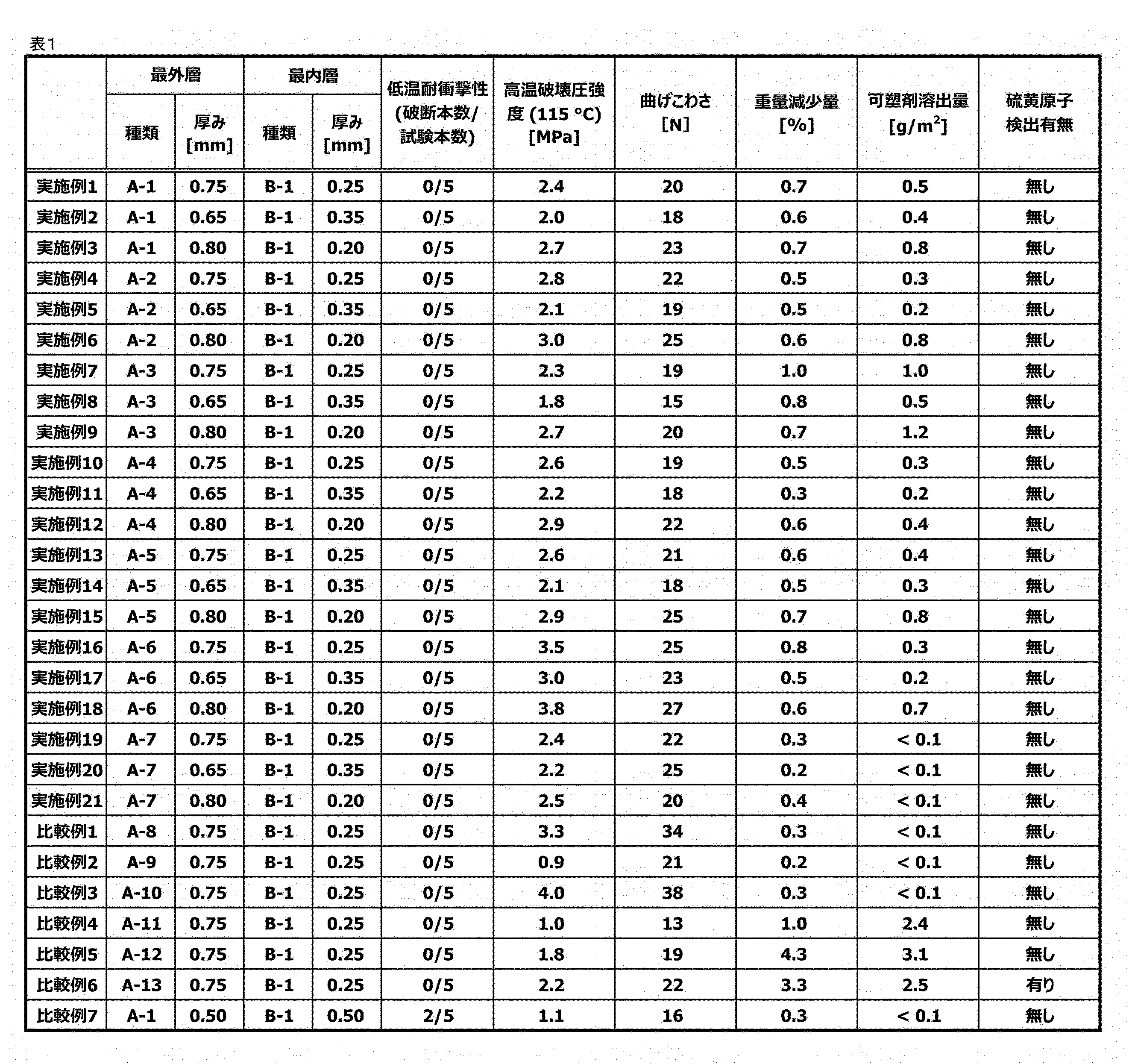

Claims (12)
- (a)層、(b)層を含む2層以上の積層チューブであって、
前記(a)層は、脂肪族ポリアミド組成物(A)を含み、
前記(b)層は、変性ポリオレフィン(B)を含み、
前記脂肪族ポリアミド組成物(A)は、ポリアミド(A1)、エラストマー重合体(A2)を含み、
前記ポリアミド(A1)は、メチレン基数のアミド基数に対する比が7.0以上の脂肪族ポリアミドであり、前記脂肪族ポリアミド組成物(A)中に、70質量%以上90質量%以下含まれ、
前記エラストマー重合体(A2)は、カルボキシル基及び/又は酸無水物基を有する不飽和化合物から誘導される構成単位を含有し、前記脂肪族ポリアミド組成物(A)中に、5質量%以上30質量%以下含まれ、
また、前記脂肪族ポリアミド組成物(A)は、可塑剤(A3)を含んでもよく、
前記可塑剤(A3)は、硫黄原子を含まず、p-及び/又はo-ヒドロキシ安息香酸と炭素原子数12以上24以下の直鎖状及び/又は分岐鎖状アルキル脂肪族アルコールとのエステル構造を含有し、前記脂肪族ポリアミド組成物(A)中における前記可塑剤(A3)の含有量は、0質量%以上15質量%以下であり、
前記脂肪族ポリアミド組成物(A)は、ISO 178に準拠して測定した曲げ弾性率が400MPa以上1,000MPa以下であり、
前記変性ポリオレフィン(B)は、炭素原子数2以上10以下のα-オレフィンに基づく単量体から誘導される単位を有し、ISO 11357-3に準拠して測定した融点が130℃以上であり、
前記積層チューブにおいて、外側より内側に向かって、(a)層、(b)層の順に配置され、
前記(a)層の厚みがチューブの全肉厚の60%以上を占める積層チューブ。 - 前記ポリアミド(A1)が、ポリウンデカンアミド(ポリアミド11)、ポリドデカンアミド(ポリアミド12)、ポリヘキサメチレンデカミド(ポリアミド610)、ポリヘキサメチレンドデカミド(ポリアミド612)、ポリデカメチレンデカミド(ポリアミド1010)、ポリデカメチレンドデカミド(ポリアミド1012)、及びポリドデカメチレンドデカミド(ポリアミド1212)からなる群より選ばれる少なくとも1種の単独重合体、及び又はこれらを形成する原料単量体を数種用いた共重合体である請求項1に記載の積層チューブ。
- 前記ポリアミド(A1)の1gあたりの末端アミノ基濃度を[A](μeq/g)、末端カルボキシル基濃度を[B](μeq/g)とした時、[A]>[B]+5である請求項1又は2のいずれか1項に記載の積層チューブ。
- 前記変性ポリオレフィン(B)は、カルボキシル基又はこれらの誘導体、ヒドロキシル基、エポキシ基、アミノ基、アミド基、イミド基、ニトリル基、チオール基、及びイソシアネート基からなる群より選ばれる少なくとも1種の官能基を有する不飽和化合物から誘導される単位を含有する請求項1から3のいずれか1項に記載の積層チューブ。
- 前記変性ポリオレフィン(B)は、変性前のポリオレフィンを溶融させ、前記官能基を有する不飽和化合物を添加して、グラフト共重合化させる方法により製造される請求項1から4のいずれか1項に記載の積層チューブ。
- 前記変性ポリオレフィン(B)が230℃/2,160gの条件下にて、ISO 1133に準拠して測定したMFR値が1.0g/10min以上10.0g/10min以下である請求項1から5のいずれか1項に記載の積層チューブ。
- 前記変性ポリオレフィン(B)がISO 1183-3に準拠して測定した密度が0.85g/cm3以上である請求項1から6のいずれか1項に記載の積層チューブ。
- 前記変性ポリオレフィン(B)は無水マレイン酸変性ポリプロピレンであり、ポリプロピレンの含有量は50質量%以上である請求項1から7のいずれか1項に記載の積層チューブ。
- 更に(c)層を含み、
前記(c)層は、ポリオレフィン(C)を含み、
前記ポリオレフィン(C)は、炭素原子数2以上10以下のα-オレフィンに基づく単量体から誘導される単位を有し、ISO 11357-3に準拠して測定した融点が120℃以上であり、ISO 527に準拠して測定した引張降伏応力が20MPa以上、ISO 179/1eAに準拠して測定した23℃におけるシャルピー衝撃強さ(ノッチ付き)が40kJ/m2以上である請求項1から8のいずれか1項に記載の積層チューブ。 - 前記(c)層が、前記(b)層に対して内側に配置される請求項9に記載の積層チューブ。
- 共押出成形法により製造される請求項1から10のいずれか1項に記載の積層チューブ。
- 冷却液(LLC)クーラーチューブ、尿素溶液搬送チューブ、バッテリ冷却加熱用チューブ、及びエアコン用チューブのいずれかである請求項1から11のいずれか1項に記載の積層チューブ。
Priority Applications (4)
| Application Number | Priority Date | Filing Date | Title |
|---|---|---|---|
| EP19741157.2A EP3742033B1 (en) | 2018-01-16 | 2019-01-16 | Multilayer tube |
| JP2019523887A JP6610838B1 (ja) | 2018-01-16 | 2019-01-16 | 積層チューブ |
| US16/961,421 US10960635B1 (en) | 2018-01-16 | 2019-01-16 | Multilayer tube |
| CN201980008723.7A CN111601995B (zh) | 2018-01-16 | 2019-01-16 | 层叠管 |
Applications Claiming Priority (2)
| Application Number | Priority Date | Filing Date | Title |
|---|---|---|---|
| JP2018-005108 | 2018-01-16 | ||
| JP2018005108 | 2018-01-16 |
Publications (1)
| Publication Number | Publication Date |
|---|---|
| WO2019142808A1 true WO2019142808A1 (ja) | 2019-07-25 |
Family
ID=67301482
Family Applications (1)
| Application Number | Title | Priority Date | Filing Date |
|---|---|---|---|
| PCT/JP2019/001033 Ceased WO2019142808A1 (ja) | 2018-01-16 | 2019-01-16 | 積層チューブ |
Country Status (5)
| Country | Link |
|---|---|
| US (1) | US10960635B1 (ja) |
| EP (1) | EP3742033B1 (ja) |
| JP (1) | JP6610838B1 (ja) |
| CN (1) | CN111601995B (ja) |
| WO (1) | WO2019142808A1 (ja) |
Cited By (5)
| Publication number | Priority date | Publication date | Assignee | Title |
|---|---|---|---|---|
| JP2021088178A (ja) * | 2019-10-30 | 2021-06-10 | エムス−ケミー アーゲーEMS−Chemie AG | 複合材料 |
| JPWO2021261301A1 (ja) * | 2020-06-23 | 2021-12-30 | ||
| WO2022066665A1 (en) * | 2020-09-25 | 2022-03-31 | Carefusion 303, Inc. | Multilayer tubing having intermediate layer with additives |
| JPWO2024135624A1 (ja) * | 2022-12-23 | 2024-06-27 | ||
| WO2024242188A1 (ja) * | 2023-05-23 | 2024-11-28 | 旭化成株式会社 | 樹脂パイプ |
Families Citing this family (5)
| Publication number | Priority date | Publication date | Assignee | Title |
|---|---|---|---|---|
| CN120921786A (zh) * | 2019-03-29 | 2025-11-11 | Ube株式会社 | 层叠体 |
| WO2021079244A1 (en) * | 2019-10-24 | 2021-04-29 | Invista North America S.A.R.L. | Polyamide compositions and articles made therefrom |
| CN113097943A (zh) * | 2021-03-24 | 2021-07-09 | 来安县友鹏交通设备有限公司 | 一种多层结构的电缆保护管及其生产方法 |
| FR3137605B1 (fr) * | 2022-07-07 | 2025-05-02 | Arkema France | Structure tubulaire a faible conductivite ionique |
| CN116001401B (zh) * | 2022-12-29 | 2025-12-30 | 万华化学(宁波)有限公司 | 多层复合管路材料及其制备方法 |
Citations (4)
| Publication number | Priority date | Publication date | Assignee | Title |
|---|---|---|---|---|
| JP2007253459A (ja) * | 2006-03-23 | 2007-10-04 | Japan Steel Works Ltd:The | 樹脂の射出成形方法および成形溶着部品の製造方法 |
| JP2011224988A (ja) * | 2010-03-30 | 2011-11-10 | Ube Industries Ltd | 積層チューブ |
| WO2015033982A1 (ja) * | 2013-09-04 | 2015-03-12 | 宇部興産株式会社 | 積層チューブ |
| WO2017170985A1 (ja) * | 2016-03-31 | 2017-10-05 | 宇部興産株式会社 | 積層チューブ |
Family Cites Families (30)
| Publication number | Priority date | Publication date | Assignee | Title |
|---|---|---|---|---|
| JPS5431489A (en) * | 1977-08-12 | 1979-03-08 | Toyobo Co Ltd | Laminate with gas barrier properties |
| DE3715251A1 (de) | 1987-05-08 | 1988-12-01 | Caprano & Brunnhofer | Kraftfahrzeug-rohrleitung fuer die fuehrung eines alkoholischen mediums |
| DE4000434C2 (de) * | 1990-01-09 | 1997-07-24 | Inventa Ag | Mehrlagige flexible Kühlflüssigkeitsleitung |
| DE29511606U1 (de) | 1995-07-18 | 1995-09-21 | Ems-Inventa AG, Zürich | Kühlflüssigkeitsleitung |
| ATE156172T1 (de) * | 1990-06-01 | 1997-08-15 | Atochem Elf Sa | Zusammensetzungen thermoplastischer elastomere auf der basis von polyamiden und modifizierten polyolefinen, geformte oder extrudierte körper, filme und verbundmaterialien hergestellt aus diesen |
| DE9319880U1 (de) | 1993-12-23 | 1994-03-17 | Ems-Inventa AG, Zürich | Blasgeformte Kühlflüssigkeitsleitung |
| US5789529A (en) | 1995-06-13 | 1998-08-04 | Ube Industries, Ltd. | Polyamide resin composition and tubular molding comprising the same |
| JP2000246852A (ja) | 1999-03-02 | 2000-09-12 | Mitsubishi Chem Mkv Co | 農業用多層フィルム |
| EP1270208B1 (en) | 2000-02-10 | 2019-01-30 | Daikin Industries, Ltd. | Laminated resin |
| US6893729B2 (en) | 2000-02-18 | 2005-05-17 | Daikin Industries, Ltd. | Layered resin molding and multilayered molded article |
| EP1362890B2 (de) * | 2002-05-07 | 2016-09-28 | Ems-Chemie Ag | Gewellter Mehrschicht-Polymer-Schlauch- oder Rohrleitung mit reduzierter Längenänderung |
| JP4619624B2 (ja) | 2003-03-31 | 2011-01-26 | 旭硝子株式会社 | 積層ホース |
| JP4603255B2 (ja) | 2003-11-05 | 2010-12-22 | 旭硝子株式会社 | 積層体ホース |
| JP4483317B2 (ja) | 2004-01-30 | 2010-06-16 | 東海ゴム工業株式会社 | 燃料電池用ホース |
| DE102004022963A1 (de) | 2004-05-10 | 2005-12-08 | Ems-Chemie Ag | Thermoplastische Polyamid-Formmassen |
| DE102004036179A1 (de) * | 2004-07-26 | 2006-03-23 | Degussa Ag | Kühlmittelleitung |
| FR2876764B1 (fr) | 2004-10-19 | 2007-01-05 | Nobel Plastiques Soc Par Actio | Tube multicouche po/adhesif/evoh/pa/couche de protection |
| JP4792232B2 (ja) | 2005-02-25 | 2011-10-12 | 東海ゴム工業株式会社 | 燃料電池用ホース |
| ATE435243T1 (de) | 2005-05-20 | 2009-07-15 | Borealis Tech Oy | Polymer mit hohem schmelzfluss und verbesserter beständigkeit für röhrenanwendungen |
| DE102006011493A1 (de) | 2006-03-14 | 2007-09-20 | Degussa Gmbh | Druckluftbremsleitung |
| JP2008030386A (ja) | 2006-07-31 | 2008-02-14 | Tokai Rubber Ind Ltd | 低透過樹脂ホース |
| JP2008069190A (ja) | 2006-09-12 | 2008-03-27 | Ube Ind Ltd | 高剛性および低温耐衝撃性ポリアミド樹脂組成物 |
| MX2009009529A (es) | 2007-03-07 | 2009-09-16 | Arkema France | Utilizacion de una composicion a base de poliamida para tubos flexibles destinados para transportar petroleo o gas y tubo flexible que utiliza tal composicion. |
| US20090162591A1 (en) * | 2007-06-22 | 2009-06-25 | Shailesh Ratilal Doshi | Multilayer coolant pipes |
| JP2010168559A (ja) * | 2008-12-26 | 2010-08-05 | Toray Ind Inc | ポリアミド樹脂組成物およびそれからなる成形品 |
| JP5497355B2 (ja) * | 2009-07-21 | 2014-05-21 | 株式会社ブリヂストン | 冷媒輸送用ホース |
| EP2366539B1 (de) | 2010-03-15 | 2013-05-08 | Ems-Patent Ag | Zweilagiges Kunststoff-Leitungsstück für druckbeaufschlagte Flüssigkeitsleitungen |
| BR112013033368A2 (pt) * | 2011-06-27 | 2017-01-31 | Mitsubishi Gas Chemical Co | corpo moldado por injeção com multicamadas |
| CN105451991B (zh) * | 2013-08-29 | 2018-10-02 | 三菱瓦斯化学株式会社 | 多层结构体 |
| KR101777985B1 (ko) * | 2013-12-06 | 2017-09-12 | 미쯔이가가꾸가부시끼가이샤 | 폴리아미드계 열가소성 엘라스토머 조성물 및 그 성형품 |
-
2019
- 2019-01-16 CN CN201980008723.7A patent/CN111601995B/zh active Active
- 2019-01-16 EP EP19741157.2A patent/EP3742033B1/en active Active
- 2019-01-16 US US16/961,421 patent/US10960635B1/en active Active
- 2019-01-16 JP JP2019523887A patent/JP6610838B1/ja active Active
- 2019-01-16 WO PCT/JP2019/001033 patent/WO2019142808A1/ja not_active Ceased
Patent Citations (4)
| Publication number | Priority date | Publication date | Assignee | Title |
|---|---|---|---|---|
| JP2007253459A (ja) * | 2006-03-23 | 2007-10-04 | Japan Steel Works Ltd:The | 樹脂の射出成形方法および成形溶着部品の製造方法 |
| JP2011224988A (ja) * | 2010-03-30 | 2011-11-10 | Ube Industries Ltd | 積層チューブ |
| WO2015033982A1 (ja) * | 2013-09-04 | 2015-03-12 | 宇部興産株式会社 | 積層チューブ |
| WO2017170985A1 (ja) * | 2016-03-31 | 2017-10-05 | 宇部興産株式会社 | 積層チューブ |
Cited By (9)
| Publication number | Priority date | Publication date | Assignee | Title |
|---|---|---|---|---|
| JP2021088178A (ja) * | 2019-10-30 | 2021-06-10 | エムス−ケミー アーゲーEMS−Chemie AG | 複合材料 |
| JP7792748B2 (ja) | 2019-10-30 | 2025-12-26 | エムス-ケミー アーゲー | 複合材料 |
| JPWO2021261301A1 (ja) * | 2020-06-23 | 2021-12-30 | ||
| WO2021261301A1 (ja) * | 2020-06-23 | 2021-12-30 | 株式会社クラレ | 多層構造体及び多層管 |
| WO2022066665A1 (en) * | 2020-09-25 | 2022-03-31 | Carefusion 303, Inc. | Multilayer tubing having intermediate layer with additives |
| US11987024B2 (en) | 2020-09-25 | 2024-05-21 | Carefusion 303, Inc. | Multilayer tubing having intermediate layer with additives |
| JPWO2024135624A1 (ja) * | 2022-12-23 | 2024-06-27 | ||
| WO2024135624A1 (ja) * | 2022-12-23 | 2024-06-27 | 住友理工株式会社 | 車両用冷却液輸送チューブ用樹脂組成物および車両用冷却液輸送チューブ |
| WO2024242188A1 (ja) * | 2023-05-23 | 2024-11-28 | 旭化成株式会社 | 樹脂パイプ |
Also Published As
| Publication number | Publication date |
|---|---|
| EP3742033A1 (en) | 2020-11-25 |
| EP3742033B1 (en) | 2025-06-11 |
| JP6610838B1 (ja) | 2019-11-27 |
| US20210078283A1 (en) | 2021-03-18 |
| JPWO2019142808A1 (ja) | 2020-02-06 |
| US10960635B1 (en) | 2021-03-30 |
| CN111601995B (zh) | 2022-08-02 |
| CN111601995A (zh) | 2020-08-28 |
| EP3742033A4 (en) | 2021-10-13 |
Similar Documents
| Publication | Publication Date | Title |
|---|---|---|
| JP6610838B1 (ja) | 積層チューブ | |
| US10933615B2 (en) | Multilayer tubes | |
| JP7157394B2 (ja) | 積層チューブ | |
| JP6970371B2 (ja) | 積層チューブ | |
| JP7331365B2 (ja) | 積層チューブ | |
| US11518155B2 (en) | Multilayer tube | |
| KR102490728B1 (ko) | 적층 튜브 | |
| US11951718B2 (en) | Laminate | |
| JP6455649B1 (ja) | 積層チューブ | |
| JP6455648B1 (ja) | 積層チューブ | |
| JP7124331B2 (ja) | 積層チューブ | |
| JP6856889B2 (ja) | 積層チューブ |
Legal Events
| Date | Code | Title | Description |
|---|---|---|---|
| ENP | Entry into the national phase |
Ref document number: 2019523887 Country of ref document: JP Kind code of ref document: A |
|
| 121 | Ep: the epo has been informed by wipo that ep was designated in this application |
Ref document number: 19741157 Country of ref document: EP Kind code of ref document: A1 |
|
| NENP | Non-entry into the national phase |
Ref country code: DE |
|
| ENP | Entry into the national phase |
Ref document number: 2019741157 Country of ref document: EP Effective date: 20200817 |
|
| WWG | Wipo information: grant in national office |
Ref document number: 2019741157 Country of ref document: EP |