WO2019151128A1 - Agent de marquage cellulaire et kit de marquage cellulaire - Google Patents
Agent de marquage cellulaire et kit de marquage cellulaire Download PDFInfo
- Publication number
- WO2019151128A1 WO2019151128A1 PCT/JP2019/002440 JP2019002440W WO2019151128A1 WO 2019151128 A1 WO2019151128 A1 WO 2019151128A1 JP 2019002440 W JP2019002440 W JP 2019002440W WO 2019151128 A1 WO2019151128 A1 WO 2019151128A1
- Authority
- WO
- WIPO (PCT)
- Prior art keywords
- sialic acid
- cell
- cell labeling
- labeling agent
- monosaccharide derivative
- Prior art date
- Legal status (The legal status is an assumption and is not a legal conclusion. Google has not performed a legal analysis and makes no representation as to the accuracy of the status listed.)
- Ceased
Links
Images



Classifications
-
- C—CHEMISTRY; METALLURGY
- C07—ORGANIC CHEMISTRY
- C07H—SUGARS; DERIVATIVES THEREOF; NUCLEOSIDES; NUCLEOTIDES; NUCLEIC ACIDS
- C07H13/00—Compounds containing saccharide radicals esterified by carbonic acid or derivatives thereof, or by organic acids, e.g. phosphonic acids
- C07H13/12—Compounds containing saccharide radicals esterified by carbonic acid or derivatives thereof, or by organic acids, e.g. phosphonic acids by acids having the group -X-C(=X)-X-, or halides thereof, in which each X means nitrogen, oxygen, sulfur, selenium or tellurium, e.g. carbonic acid, carbamic acid
-
- G—PHYSICS
- G01—MEASURING; TESTING
- G01N—INVESTIGATING OR ANALYSING MATERIALS BY DETERMINING THEIR CHEMICAL OR PHYSICAL PROPERTIES
- G01N33/00—Investigating or analysing materials by specific methods not covered by groups G01N1/00 - G01N31/00
- G01N33/48—Biological material, e.g. blood, urine; Haemocytometers
- G01N33/50—Chemical analysis of biological material, e.g. blood, urine; Testing involving biospecific ligand binding methods; Immunological testing
- G01N33/58—Chemical analysis of biological material, e.g. blood, urine; Testing involving biospecific ligand binding methods; Immunological testing involving labelled substances
- G01N33/582—Chemical analysis of biological material, e.g. blood, urine; Testing involving biospecific ligand binding methods; Immunological testing involving labelled substances with fluorescent label
-
- C—CHEMISTRY; METALLURGY
- C07—ORGANIC CHEMISTRY
- C07H—SUGARS; DERIVATIVES THEREOF; NUCLEOSIDES; NUCLEOTIDES; NUCLEIC ACIDS
- C07H7/00—Compounds containing non-saccharide radicals linked to saccharide radicals by a carbon-to-carbon bond
- C07H7/02—Acyclic radicals
- C07H7/027—Keto-aldonic acids
-
- G—PHYSICS
- G01—MEASURING; TESTING
- G01N—INVESTIGATING OR ANALYSING MATERIALS BY DETERMINING THEIR CHEMICAL OR PHYSICAL PROPERTIES
- G01N2400/00—Assays, e.g. immunoassays or enzyme assays, involving carbohydrates
Definitions
- the present invention relates to a cell labeling agent and a cell labeling kit.
- a metabolic labeling method for labeling sugar chains on the cell surface by utilizing the metabolism of monosaccharides by the sialic acid biosynthesis pathway is known.
- a derivative of N-acetylmannosamine (ManNAc) having an azide group peracetylated N-azidoacetylmannosamine, Ac 4 ManNAz
- Ac 4 ManNAz taken up into cells is deacetylated by the enzyme in the cytoplasm and metabolized to the corresponding N-azidoacetylsialic acid (SiaNAz).
- SiaNAz is incorporated into the sialosugar complex.
- SiaNAz is presented on the cell surface together with the sugar chain.
- a reporter substance having a fluorescent dye or the like can be added to the azide group of SiaNAz by a click reaction such as an azide-alkyne cycloaddition reaction (CuAAC) using a copper catalyst.
- CuAAC azide-alkyne cycloa
- Non-Patent Document 1 discloses a metabolic labeling method using peracetylated N- (4-pentinoyl) mannosamine (Ac 4 ManNAl).
- Ac 4 ManNAl is metabolized to the corresponding sialic acid (SiaNAl) in the cell, and SiaNAl is presented on the cell surface. Since SiaNAl has an alkyne at the end, the reporter substance can be added to the sugar chain on the cell surface by reacting the alkyne and azide with CuAAC.
- the present invention has been made in view of the above circumstances, and an object thereof is to provide a cell labeling agent and a cell labeling kit that are highly safe and can be applied clinically.
- the cell labeling agent according to the first aspect of the present invention comprises: A 6-membered monosaccharide derivative that is metabolized to sialic acid in the cellular sialic acid biosynthetic pathway, Of the groups bonded to the carbon atoms constituting the 6-membered ring in the monosaccharide derivative, at least one group that does not change even when metabolized in the sialic acid biosynthetic pathway, It includes a ring structure having a carbon-carbon double bond or triple bond.
- the monosaccharide derivative is The group containing the ring structure as R, Represented by It is good as well.
- the monosaccharide derivative is The group containing the ring structure as R is represented by the formula (II) Represented by It is good as well.
- the monosaccharide derivative is The group containing the ring structure as R, Represented by It is good as well.
- the R is Below (a)-(m) Selected from the group consisting of It is good as well.
- the cell labeling kit according to the second aspect of the present invention comprises: The cell labeling agent according to the first aspect of the present invention, A reporter substance that is presented outside the cell and reacts with the group that does not change when metabolized in the sialic acid biosynthetic pathway and binds to the sialic acid; Is provided.
- the cell labeling agent and cell labeling kit according to the present invention are highly safe and can be applied clinically.
- FIG. 1 It is a schematic diagram which shows a series of reaction in a sialic acid biosynthesis pathway. It is a figure which shows the synthesis method and structure of a monosaccharide derivative which concern on Example 1 of this invention. It is a figure which shows the click reaction of the monosaccharide derivative which concerns on Example 1, and the reporter substance containing a fluorescent substance.
- 2 is a diagram showing a fluorescence spectrum of a fluorescent substance bound to a monosaccharide derivative according to Example 1.
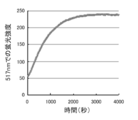
- FIG. It is a figure which shows a time-dependent change of the fluorescence spectrum of the fluorescent substance couple
- FIG. 1 shows the fluorescence image of the cell which added the fluorescent substance through the monosaccharide derivative which concerns on Example 1.
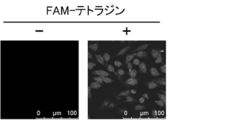
- FIG. 1 shows the fluorescence image of the cell when the cell culture
- the cell labeling agent according to the present embodiment contains a monosaccharide derivative that is metabolized to sialic acid in the sialic acid biosynthesis pathway of the cell.
- the cells in the present embodiment are not particularly limited as long as the sialic acid biosynthesis pathway functions.
- the cell is an animal cell.
- the cell may be a cell collected from a living body, a primary cultured cell, or a cell line.
- the cells may be normal cells or cancerous cells, that is, cancer cells.
- the sialic acid biosynthetic pathway is a pathway in which monosaccharide derivatives such as ManNAc incorporated into cells are metabolized to the corresponding sialic acid by various enzymes and converted into sugar chains having sialic acid.
- Monosaccharides that are metabolized to sialic acid through the sialic acid biosynthetic pathway are based on a six-membered ring structure. Therefore, the monosaccharide derivative has a 6-membered ring structure.
- sialic acid is a generic term for derivatives of neuraminic acid, and in particular, a generic term for acyl derivatives of neuraminic acid.
- FIG. 1 shows a sialic acid biosynthetic pathway in which Ac 4 ManNAl is metabolized by various enzymes and converted into a sugar chain to which SiaNAl (encircled by a one-dot chain line) is bound.
- Ac 4 ManNAl is taken into the cell, it becomes CMP-sialic acid in the nucleus through the reaction of A to E in the cytoplasm, and the sugar chain to which SiaNAl is bonded is formed on the cell surface through the reactions of F and G.
- Ac 4 ManNAl is taken into the cell, it becomes CMP-sialic acid in the nucleus through the reaction of A to E in the cytoplasm, and the sugar chain to which SiaNAl is bonded is formed on the cell surface through the reactions of F and G.
- A, B, C, D, E, F and G are respectively non-specific esterase, ManNAc 6-kinase, sialic acid 9-phosphate synthase, sialic acid 9-phosphatase, CMP-sialic acid synthetase, CMP- By the action of sialic acid Golgi transporter and sialic acid transferase.
- Examples of monosaccharide derivatives that are metabolized to sialic acid through the sialic acid biosynthetic pathway include mannosamine derivatives, glucosamine derivatives, and sialic acid.
- Mannosamine derivatives, glucosamine derivatives, and sialic acid have at least one group that does not change even when metabolized in the sialic acid biosynthetic pathway among the groups bonded to the carbon atoms constituting the six-membered ring.
- the “group” in this specification means a group of atoms, that is, an atomic group. Therefore, the “group” does not include a hydrogen atom directly bonded to a carbon atom constituting a 6-membered ring.
- the group surrounded by the double-dot chain line including the amino group of Ac 4 ManNAl is maintained in SiaNAl. Yes.
- the group surrounded by a two-dot chain line is a group that does not change even if it is metabolized by the sialic acid biosynthesis pathway in Ac 4 ManNAl.
- the monosaccharide derivative according to the present embodiment among the groups bonded to the carbon atoms constituting the 6-membered ring in the monosaccharide derivative, at least one group that does not change even when metabolized in the sialic acid biosynthesis pathway is carbon and It includes a ring structure having a double bond or triple bond with carbon.
- the monosaccharide derivative is preferably represented by the formula (I), where R is a group containing a ring structure. It is represented by
- glucosamine derivative When a glucosamine derivative is used as the monosaccharide derivative, for example, the formula (II) The monosaccharide derivative represented by these is preferable.
- the monosaccharide derivative is sialized in the sialic acid biosynthesis pathway.
- a group that does not change even when metabolized to an acid is a group containing an amino group bonded to the 2-position (—NH—C ( ⁇ O) —O—C—R). R is contained in a group bonded to the 2-position.
- sialic acid is represented by formula (IV) It is represented by In the sialic acid represented by the formula (IV), among the groups bonded to the carbon atoms constituting the 6-membered ring, a group that does not change even when metabolized in the sialic acid biosynthetic pathway is a carboxyl group ( -COOH containing carbon at the 1-position), hydroxy group bonded at the 4-position (-OH), acetylamide group bonded at the 5-position (-NHAc), and groups bonded at the 6-position (7-position, 8-position and 9-position) -C (OH) -C (OH) -C (OH)) containing
- the group that does not change even when metabolized in the sialic acid biosynthetic pathway is a carboxyl group bonded to the 2-position A hydroxy group bonded to the 4-position, an acetylamide group bonded to the 5-position, and a group bonded to the 6-position (—C (OH) —C (OH) —C—NH—C ( ⁇ O) —O—C— R).
- R is contained in a group bonded to the 6-position.
- the monosaccharide derivative is sialic acid represented by the formula (III)
- the monosaccharide derivative is taken into the cell and transported into the nucleus (E in FIG. 1). Thereafter, the monosaccharide derivative is presented on the cell surface via the Golgi apparatus in the same manner as Ac 4 ManNAl.
- R examples include various groups including a ring structure having a carbon-carbon double bond or triple bond.
- the structure of R is exemplified in the following (a) to (m).
- R is shown in (a).
- the monosaccharide derivative according to the present embodiment can be synthesized by a known method based on the structure using a monosaccharide as a starting material.
- the monosaccharide derivative represented by the formula (I) may be obtained by binding a compound having R to the amino group of mannosamine hydrochloride and acetylating the obtained mannosamine derivative.
- the monosaccharide derivative represented by the formula (II) may be obtained by binding a compound having R to the amino group of glucosamine hydrochloride and acetylating the obtained glucosamine derivative.
- the structure of the synthesized monosaccharide derivative can be confirmed by a conventional method using a nuclear magnetic resonance method (Nuclear Magnetic Resonance, NMR), a mass spectrometry method (Mass Spectrometry, MS), or the like.
- the cell labeling agent according to the present embodiment may contain only the above monosaccharide derivative, or may contain the above monosaccharide derivative as an active ingredient and further contain a pharmacologically acceptable carrier.
- Pharmacologically acceptable carriers are various organic or inorganic carrier materials used as pharmaceutical materials.
- the cell labeling agent may contain, for example, an excipient, a lubricant, a binder, a disintegrant, a solvent, a solubilizing agent, a suspending agent, an isotonic agent, a buffering agent, and the like.
- the cell labeling agent may contain additives such as preservatives, antioxidants, coloring agents and sweeteners as necessary.
- the form of the cell labeling agent is not particularly limited, and examples thereof include solutions, granules, tablets, and capsules.
- the monosaccharide derivative and other components may be blended and formulated by a known method.
- the content of the monosaccharide derivative in the cell labeling agent is not particularly limited.
- the cell labeling agent contains 1 to 100% by weight, 5 to 95% by weight, 10 to 90% by weight, 20 to 80% by weight, 30 to 70% by weight or 40 to 60% by weight is contained.
- R is presented on the cell surface when the monosaccharide derivative is metabolized through the sialic acid biosynthesis pathway. Therefore, cells can be labeled with the cell labeling agent according to the present embodiment. Since R is a group including a ring structure having a carbon-carbon double bond or triple bond, it is highly reactive. Since R is a structure that does not normally exist in the living body, it can be subjected to a bioorthogonal reaction such as a click reaction between tetrazine or azide and the like and R, for example. Thereby, various functional substances can be specifically added to sugar chains on the cell surface via R.
- a cell labeling agent may be added to a medium containing cells and the cells may be exposed to the cell labeling agent.
- the concentration at the time of adding the cell labeling agent to the medium is, for example, that the concentration of the monosaccharide inducer in the medium is 0.1 to 1 mM, 0.1 to 500 ⁇ M, 0.1 to 50 ⁇ M, 0.1 to 30 ⁇ M, or 1 ⁇ 25 ⁇ M.
- the time for exposing the cell to the cell labeling agent is appropriately adjusted according to the type of cell and the activity of the sialic acid biosynthesis pathway in the cell, but is 12 to 96 hours or 48 to 96 hours, preferably 72 hours. .
- the monosaccharide derivative remaining in the medium may be removed and the cells may be washed. By doing so, cells labeled with R presented on the cell surface can be obtained.
- cells labeled with R can be visualized.
- a reporter substance that reacts with R may be used.
- the reporter substance include a fluorescent substance and a luminescent substance bound to tetrazine or azide.
- the fluorescent substance include FAM, cyanine dye, Cy3, Cy5, pyrene and rhodamine.
- Observation methods include fluorescence microscope observation, fluorescence endoscope observation, confocal endoscope observation, multiphoton excitation fluorescence microscope observation, narrow-band light observation, and co-optical coherence tomographic image observation, depending on the type of reporter substance. Is used.
- the cell labeling agent according to the present embodiment is not limited to in vitro, but can label cells in vivo (in vivo).
- the cell labeling agent may be administered to a subject.
- the cell labeling agent is administered to animals such as zebrafish, medaka, frog, mouse, rat, dog, rabbit, chimpanzee, monkey and human.
- the administration route of the cell labeling agent is not particularly limited.
- the cell labeling agent can be administered orally or parenterally.
- the cell labeling agent may be administered systemically or locally.
- cell labeling agents can be injected into, for example, intravascular, sublingual, rectal, intravaginal, cutaneous, subcutaneous, intradermal, intravesical, trachea, eye, nose and ear, etc. It is administered by a method such as injection, spraying, or application.
- the dose of the cell labeling agent is not particularly limited as long as it is an amount that can label the target cells.
- the dosage form, administration route and dosage are appropriately selected depending on the body weight or condition of the subject animal.
- the dose of the cell labeling agent is also adjusted depending on the type of target cell and reporter substance.
- the dosage is, for example, 0.01 to 1000 mg / kg, 0.1 to 100 mg / kg, or 1 to 10 mg / kg per dose.
- target cells may be collected from the mouse and exposed to the reporter substance as described above.
- the reporter substance When R is added to the cell surface, the cell can be visualized or detected by a reporter substance.
- the cells may be immobilized for easy observation.
- a tissue section prepared by a known method from a tissue such as an organ of a mouse administered with a cell labeling agent may be exposed to a reporter substance.
- a functional substance such as a reporter substance can be added to the cell surface without using a copper catalyst. Can do. Therefore, even if a cell labeling agent is administered to a living body, it is highly safe and can be widely applied in clinical practice.
- R when R is contained in the group bonded to the 6-position, R is not limited to the terminal of the group bonded to the 6-position, that is, the group bonded to the carbon at the 9-position, It may be contained in a group bonded to the 7th or 8th carbon.
- the monosaccharide derivative is sialic acid represented by the formula (III)
- it is transported into the nucleus without undergoing the reactions A to D shown in FIG. 1, and sialic acid is presented on the cell surface.
- the monosaccharide derivative represented by the formula (III) since it is presented on the cell surface earlier than the mannosamine derivative and the glucosamine derivative, the cells can be labeled with higher efficiency.
- R When the monosaccharide derivative is sialic acid represented by the formula (III), R may be contained in a group substituted with a carboxyl group bonded to the 2-position, or a group bonded to the 4-position or 5-position. . When the monosaccharide derivative is sialic acid represented by the formula (III), R is preferably contained in a group bonded to the 5th or 9th position in order to efficiently react with a reporter substance or the like.
- the monosaccharide derivative is a sialic acid represented by the formula (IV), and is a group bonded to carbon atoms constituting the 6-membered ring, which does not change even if metabolized by the sialic acid biosynthetic pathway. R may be included. Even if it is the said monosaccharide derivative, a cell can be labeled efficiently like the monosaccharide derivative represented by Formula (III).
- the cell labeling agent according to the present embodiment is also useful for capturing sugar chains on cells or cell surfaces.
- biotin may be bound to R using a click reaction.
- Cells with biotin added to the surface can be captured by, for example, a column in which streptavidin is immobilized on a carrier.
- the cell labeling agent is also useful for detecting or quantifying the sugar chain.
- the reporter substance may contain a radionuclide.
- a radionuclide By adding a radionuclide to the cell surface, the cells can be detected or visualized by autoradiography, positron emission tomography (PET) or computed tomography projection (SPECT).
- PET positron emission tomography
- SPECT computed tomography projection
- the radionuclide is not particularly limited and is selected depending on the mode of use.
- nuclides that emit positrons such as 11 C, 14 C, 13 N, 15 O, 18 F, 19 F, 62 Cu, 68 Ga, and 78 Br may be used.
- nuclides that emit ⁇ -rays such as 99m Tc, 111 In, 67 Ga, 201 Tl, 123 I, and 133 Xe may be used.
- a functional group that gives free radicals via R may be added to the cell surface. If a functional group that gives free radicals is added to the surface of cancer cells, proliferation of cancer cells, tumor growth, and the like are suppressed by the free radicals.
- cyclooctyne In order to react with R, cyclooctyne, cyclooctene, cyclobutene and cyclopropene may be used as a reporter substance in addition to azide and tetrazine.
- a cell labeling kit in another embodiment, includes a cell labeling agent according to the present embodiment, and a reporter that reacts with R, reacts with R, and binds to sialic acid when it is metabolized in the sialic acid biosynthetic pathway presented outside the cell.
- a substance that reacts with R, reacts with R, and binds to sialic acid when it is metabolized in the sialic acid biosynthetic pathway presented outside the cell.
- a disease diagnosis method using the cell labeling agent according to the present embodiment includes a first administration step of administering the cell labeling agent to the subject, a second administration step of administering to the subject a reporter substance that reacts with R and binds to sialic acid, and detects the reporter substance Or an evaluation step for quantification.
- the diagnostic method can be preferably used for diagnosis of cancer and inflammation.
- the sialic acid biosynthetic pathway is activated compared to normal cells, and more sialic acid is presented on the cell surface. Therefore, for example, by comparing the amount of the reporter substance detected in the subject as a subject with the amount of the reporter substance detected in cells of the normal tissue of the subject or cells of a healthy person, cancer and Inflammation and the like can be diagnosed. Since the cell labeling agent can rapidly add a reporter substance or the like to the cell surface, it can be diagnosed quickly.
- Example 1 Synthesis of monosaccharide derivative BCN-ManNAc
- D-Mannosamine hydrochloride 35.9 mg
- DMF dimethylformamide
- DIEA N-diisopropylethylamine
- FIG. 2 shows the structures of D-mannosamine hydrochloride, BCN-Man and BCN-ManNAc.
- BCN-ManNAc 27.2 mg was obtained with a yield of 53%.
- the identification results of BCN-ManNAc by NMR (AV-400M, Bruker) and MS (Exactive, ThermoFisher) are shown below.
- BCN-ManNAc 2.0 mg was dissolved in 190 ⁇ L of DMSO to obtain a 20 mM BCN-ManNAc solution.
- 1.0 mg of FAM-tetrazine was dissolved in 180 ⁇ L of DMSO to prepare a 10 mM FAM-tetrazine solution.
- 89 ⁇ L of phosphate buffered saline (PBS) was prepared in a microtube, and 1 ⁇ L of BCN-ManNAc solution and 10 ⁇ L of FAM-tetrazine solution were added thereto, and the mixture was stirred well with a vortex mixer to obtain a mixed solution.
- the final concentrations of BCN-ManNAc and FAM-tetrazine in the mixture are 200 ⁇ M and 1 ⁇ M, respectively.
- FIG. 3 shows the fluorescence spectra of the mixture and the control. It was shown that the fluorescence intensity greatly increased when BCN-ManNAc and FAM-tetrazine reacted.
- FIG. 5 shows the change with time of the fluorescence spectrum of the mixed solution. It was shown that after about 1800 seconds, the fluorescence intensity was almost maximized.
- BCN-ManNAc was added to a medium containing 1 ⁇ 10 5 HeLa cells and cultured for 72 hours.
- the medium used was DMEM (Dulbecco's Modified Eagle's Medium) containing 10% FBS (Fetal Bovine Serum).
- the final concentration of BCN-ManNAc added to the medium was 0, 2.5, 5, 10, 20, 25 ⁇ M.
- the medium was removed and the cells were washed 3 times with PBS. 3.7% paraformaldehyde was added and the cells were fixed for 20 minutes at room temperature.
- a final concentration of 1 ⁇ M FAM-tetrazine was added to the plate containing the immobilized cells and incubated at room temperature for 20 minutes.
- the cells were observed for fluorescence using a confocal laser microscope (Leica TCS SP8, manufactured by Leica Microsystems).
- FIG. 6 shows the fluorescence image of the cell imaged with the confocal laser microscope. Fluorescence of FAM bound to BCN-ManNAc was observed. FAM fluorescence was not observed in cells cultured in a medium containing no BCN-ManNAc, but increased in a BCN-ManNAc concentration-dependent manner.
- FIG. 7 shows a fluorescence image of cells cultured in a medium containing 25 ⁇ M BCN-ManNAc. Cells exposed to FAM-tetrazine (+) were observed by fluorescence, whereas cells not exposed to FAM-tetrazine ( ⁇ ) were not observed. This showed that cells cultured in media containing BCN-ManNAc can be visualized by exposure to FAM-tetrazine.
- the present invention is suitable for labeling cells and diagnosing cancer and inflammation.
Landscapes
- Life Sciences & Earth Sciences (AREA)
- Health & Medical Sciences (AREA)
- Chemical & Material Sciences (AREA)
- Engineering & Computer Science (AREA)
- Molecular Biology (AREA)
- Biomedical Technology (AREA)
- Hematology (AREA)
- Immunology (AREA)
- General Health & Medical Sciences (AREA)
- Organic Chemistry (AREA)
- Urology & Nephrology (AREA)
- Biotechnology (AREA)
- Biochemistry (AREA)
- Food Science & Technology (AREA)
- Physics & Mathematics (AREA)
- Analytical Chemistry (AREA)
- Medicinal Chemistry (AREA)
- Microbiology (AREA)
- General Physics & Mathematics (AREA)
- Pathology (AREA)
- Genetics & Genomics (AREA)
- Cell Biology (AREA)
- Saccharide Compounds (AREA)
- Measuring Or Testing Involving Enzymes Or Micro-Organisms (AREA)
- Investigating Or Analysing Biological Materials (AREA)
Abstract
La présente invention concerne un agent de marquage cellulaire qui comprend un dérivé de monosaccharide ayant une structure cyclique à six chaînons métabolisée par l'acide sialique dans une voie de biosynthèse d'acide sialique d'une cellule. Parmi les groupes liés à des atomes de carbone constituant le cycle de six chaînons dans le dérivé de monosaccharide, au moins un groupe qui ne change pas même lorsqu'il est métabolisé par la voie de biosynthèse d'acide sialique comprend une structure cyclique ayant une double liaison ou triple liaison carbone-carbone.
Priority Applications (2)
| Application Number | Priority Date | Filing Date | Title |
|---|---|---|---|
| JP2019569074A JP7295571B2 (ja) | 2018-02-05 | 2019-01-25 | 細胞標識剤及び細胞標識キット |
| US16/967,306 US12050220B2 (en) | 2018-02-05 | 2019-01-25 | Cell labeling agent and cell labeling kit |
Applications Claiming Priority (2)
| Application Number | Priority Date | Filing Date | Title |
|---|---|---|---|
| JP2018-018172 | 2018-02-05 | ||
| JP2018018172 | 2018-02-05 |
Publications (1)
| Publication Number | Publication Date |
|---|---|
| WO2019151128A1 true WO2019151128A1 (fr) | 2019-08-08 |
Family
ID=67478224
Family Applications (1)
| Application Number | Title | Priority Date | Filing Date |
|---|---|---|---|
| PCT/JP2019/002440 Ceased WO2019151128A1 (fr) | 2018-02-05 | 2019-01-25 | Agent de marquage cellulaire et kit de marquage cellulaire |
Country Status (3)
| Country | Link |
|---|---|
| US (1) | US12050220B2 (fr) |
| JP (1) | JP7295571B2 (fr) |
| WO (1) | WO2019151128A1 (fr) |
Cited By (1)
| Publication number | Priority date | Publication date | Assignee | Title |
|---|---|---|---|---|
| US12050220B2 (en) | 2018-02-05 | 2024-07-30 | University Of Miyazaki | Cell labeling agent and cell labeling kit |
Citations (6)
| Publication number | Priority date | Publication date | Assignee | Title |
|---|---|---|---|---|
| JP2008515875A (ja) * | 2004-10-07 | 2008-05-15 | コーニンクレッカ フィリップス エレクトロニクス エヌ ヴィ | 医療のイメージングに用いる化合物、キット及び方法 |
| JP2011504507A (ja) * | 2007-11-21 | 2011-02-10 | ユニバーシティ・オブ・ジョージア・リサーチ・ファウンデイション・インコーポレイテッド | アルキン類及び1,3−双極子機能性化合物とアルキン類を反応させる方法 |
| JP2013525425A (ja) * | 2010-04-27 | 2013-06-20 | シンアフィックス ビー.ブイ. | 縮合シクロオクチン化合物及び無金属クリック反応におけるそれらの使用 |
| US20130344527A1 (en) * | 2004-11-01 | 2013-12-26 | The Regents Of The University Of California | Compositions and Methods for Modification of Biomolecules |
| JP2016506905A (ja) * | 2013-01-15 | 2016-03-07 | グラクソスミスクライン バイオロジカルズ ソシエテ アノニム | シクロアルキン誘導体化糖類 |
| JP2017505770A (ja) * | 2014-01-24 | 2017-02-23 | シンアフィックス ビー.ブイ. | (ヘテロ)アリール1,3−双極子化合物と(ヘテロ)シクロアルキンとの環化付加のためのプロセス |
Family Cites Families (1)
| Publication number | Priority date | Publication date | Assignee | Title |
|---|---|---|---|---|
| WO2019151128A1 (fr) | 2018-02-05 | 2019-08-08 | 国立大学法人 宮崎大学 | Agent de marquage cellulaire et kit de marquage cellulaire |
-
2019
- 2019-01-25 WO PCT/JP2019/002440 patent/WO2019151128A1/fr not_active Ceased
- 2019-01-25 JP JP2019569074A patent/JP7295571B2/ja active Active
- 2019-01-25 US US16/967,306 patent/US12050220B2/en active Active
Patent Citations (6)
| Publication number | Priority date | Publication date | Assignee | Title |
|---|---|---|---|---|
| JP2008515875A (ja) * | 2004-10-07 | 2008-05-15 | コーニンクレッカ フィリップス エレクトロニクス エヌ ヴィ | 医療のイメージングに用いる化合物、キット及び方法 |
| US20130344527A1 (en) * | 2004-11-01 | 2013-12-26 | The Regents Of The University Of California | Compositions and Methods for Modification of Biomolecules |
| JP2011504507A (ja) * | 2007-11-21 | 2011-02-10 | ユニバーシティ・オブ・ジョージア・リサーチ・ファウンデイション・インコーポレイテッド | アルキン類及び1,3−双極子機能性化合物とアルキン類を反応させる方法 |
| JP2013525425A (ja) * | 2010-04-27 | 2013-06-20 | シンアフィックス ビー.ブイ. | 縮合シクロオクチン化合物及び無金属クリック反応におけるそれらの使用 |
| JP2016506905A (ja) * | 2013-01-15 | 2016-03-07 | グラクソスミスクライン バイオロジカルズ ソシエテ アノニム | シクロアルキン誘導体化糖類 |
| JP2017505770A (ja) * | 2014-01-24 | 2017-02-23 | シンアフィックス ビー.ブイ. | (ヘテロ)アリール1,3−双極子化合物と(ヘテロ)シクロアルキンとの環化付加のためのプロセス |
Non-Patent Citations (4)
| Title |
|---|
| AGARD, N. J. ET AL.: "A Strain-Promoted [3+2] Azide-Alkyne Cycloaddition for Covalent Modification of Biomolecules in Livi", JOURNAL OF THE AMERICAN CHEMICAL SOCIETY, vol. 126, no. 46, 2004, pages 15046 - 15047, XP002362785, doi:10.1021/ja044996f * |
| AGARWAL PARESH ET AL.: "Systemic Fluorescence Imaging of Zebrafish Glycans with Bioorthogonal Chemistry", ANGEWANDTE CHEMIE INTERNATIONAL EDITION, vol. 54, no. 39, 2015, pages 11504 - 11510, XP055628002 * |
| BATEMAN LESLIE ET AL.: "N-Propargyloxycarbamate monosaccharides as metabolic chemical reporters of carbohydrate salvage pathways and protein glycosylation", CHEMICAL COMMUNICATIONS, vol. 49, no. 39, 2013, pages 4328 - 4330, XP055628004 * |
| NING, X. ET AL.: "Visualizing metabolically labeled glycoconjugates of living cells by copper-free and fast huisgen cycloadditions", ANGEWANDTE CHEMIE, vol. 47, no. 12, 2008, pages 2253 - 2255, XP002659161 * |
Cited By (1)
| Publication number | Priority date | Publication date | Assignee | Title |
|---|---|---|---|---|
| US12050220B2 (en) | 2018-02-05 | 2024-07-30 | University Of Miyazaki | Cell labeling agent and cell labeling kit |
Also Published As
| Publication number | Publication date |
|---|---|
| US20210033617A1 (en) | 2021-02-04 |
| JP7295571B2 (ja) | 2023-06-21 |
| US12050220B2 (en) | 2024-07-30 |
| JPWO2019151128A1 (ja) | 2021-01-28 |
Similar Documents
| Publication | Publication Date | Title |
|---|---|---|
| Yu et al. | Design strategies for tetrazine fluorogenic probes for bioorthogonal imaging | |
| Devaraj et al. | Biomedical applications of tetrazine cycloadditions | |
| Kamiya et al. | An enzymatically activated fluorescence probe for targeted tumor imaging | |
| Guo et al. | Comparison of near‐infrared fluorescent deoxyglucose probes with different dyes for tumor diagnosis in vivo | |
| Liu et al. | Molecular engineering of activatable NIR-II hemicyanine reporters for early diagnosis and prognostic assessment of inflammatory bowel disease | |
| Jia et al. | Water-soluble chromenylium dyes for shortwave infrared imaging in mice | |
| US20080181847A1 (en) | Targeted Imaging and/or Therapy Using the Staudinger Ligation | |
| US8092782B2 (en) | Polybiotin compounds of magnetic resonance imaging and drug delivery | |
| Godinat et al. | Bioorthogonal chemistry in bioluminescence imaging | |
| Hu et al. | In vivo monitoring of endogenous hydrogen sulfide and evaluation of natural protectants in liver injury mice using a highly selective bioluminescent probe | |
| Ding et al. | An ESIPT-based NIR-fluorescent probe for exosome labeling and in situ imaging | |
| Wang et al. | Design, synthesis and in vivo fluorescence imaging study of a cytochrome P450 1B1 targeted NIR probe containing a chelator moiety | |
| Fang et al. | Oxidative cleavage of alkene: A new strategy to construct a mitochondria-targeted fluorescent probe for hydrogen peroxide imaging in vitro and in vivo | |
| Wang et al. | Polarity Sensitive and H2O2/Lipid Droplets Sequence‐Activated Asymmetric Cyanine Probe Achieves Multi‐marker Imaging of Atherosclerosis | |
| Lang et al. | Enzyme-responsive fluorescent labeling strategy for in vivo imaging of gut bacteria | |
| JP7295571B2 (ja) | 細胞標識剤及び細胞標識キット | |
| Son et al. | Design and synthesis of a novel BODIPY-labeled PSMA inhibitor | |
| Wei et al. | A nitroreductase-activated chemiluminescent prodrug for real-time monitoring of camptothecin release in peritoneal metastasis theranostics | |
| Huynh et al. | Labeling of Cellular DNA with a Cyclosal Phosphotriester Pronucleotide Analog of 5‐ethynyl‐2′‐deoxyuridine | |
| Fang et al. | Characterization of a near-infrared fluorescent DCPO-tagged glucose analogue for cancer cell imaging | |
| Sun et al. | A novel fluorescent probe for nitroreductase detection and imaging of cancer cells under hypoxia conditions | |
| ES2539475T3 (es) | Derivados de oligotiofeno como sondas moleculares | |
| Lo et al. | Radiolabelling Pt-based quadruplex DNA binders via click chemistry | |
| Kang et al. | A hybrid imaging platform (CT/PET/FMI) for evaluating tumor necrosis and apoptosis in real-time | |
| Yang et al. | Bioorthogonal Chemistry in Biomolecule Quantification: A Review of Reactions and Strategies |
Legal Events
| Date | Code | Title | Description |
|---|---|---|---|
| 121 | Ep: the epo has been informed by wipo that ep was designated in this application |
Ref document number: 19746689 Country of ref document: EP Kind code of ref document: A1 |
|
| ENP | Entry into the national phase |
Ref document number: 2019569074 Country of ref document: JP Kind code of ref document: A |
|
| NENP | Non-entry into the national phase |
Ref country code: DE |
|
| 122 | Ep: pct application non-entry in european phase |
Ref document number: 19746689 Country of ref document: EP Kind code of ref document: A1 |