WO2019156252A1 - Agent de prévention et de traitement de maladies lysosomales - Google Patents
Agent de prévention et de traitement de maladies lysosomales Download PDFInfo
- Publication number
- WO2019156252A1 WO2019156252A1 PCT/JP2019/004766 JP2019004766W WO2019156252A1 WO 2019156252 A1 WO2019156252 A1 WO 2019156252A1 JP 2019004766 W JP2019004766 W JP 2019004766W WO 2019156252 A1 WO2019156252 A1 WO 2019156252A1
- Authority
- WO
- WIPO (PCT)
- Prior art keywords
- disease
- cells
- lovastatin
- therapeutic agent
- autophagy
- Prior art date
- Legal status (The legal status is an assumption and is not a legal conclusion. Google has not performed a legal analysis and makes no representation as to the accuracy of the status listed.)
- Ceased
Links
Images


Classifications
-
- A—HUMAN NECESSITIES
- A61—MEDICAL OR VETERINARY SCIENCE; HYGIENE
- A61K—PREPARATIONS FOR MEDICAL, DENTAL OR TOILETRY PURPOSES
- A61K31/00—Medicinal preparations containing organic active ingredients
- A61K31/33—Heterocyclic compounds
- A61K31/335—Heterocyclic compounds having oxygen as the only ring hetero atom, e.g. fungichromin
- A61K31/365—Lactones
- A61K31/366—Lactones having six-membered rings, e.g. delta-lactones
-
- A—HUMAN NECESSITIES
- A61—MEDICAL OR VETERINARY SCIENCE; HYGIENE
- A61K—PREPARATIONS FOR MEDICAL, DENTAL OR TOILETRY PURPOSES
- A61K45/00—Medicinal preparations containing active ingredients not provided for in groups A61K31/00 - A61K41/00
-
- A—HUMAN NECESSITIES
- A61—MEDICAL OR VETERINARY SCIENCE; HYGIENE
- A61P—SPECIFIC THERAPEUTIC ACTIVITY OF CHEMICAL COMPOUNDS OR MEDICINAL PREPARATIONS
- A61P21/00—Drugs for disorders of the muscular or neuromuscular system
-
- A—HUMAN NECESSITIES
- A61—MEDICAL OR VETERINARY SCIENCE; HYGIENE
- A61P—SPECIFIC THERAPEUTIC ACTIVITY OF CHEMICAL COMPOUNDS OR MEDICINAL PREPARATIONS
- A61P3/00—Drugs for disorders of the metabolism
-
- A—HUMAN NECESSITIES
- A61—MEDICAL OR VETERINARY SCIENCE; HYGIENE
- A61P—SPECIFIC THERAPEUTIC ACTIVITY OF CHEMICAL COMPOUNDS OR MEDICINAL PREPARATIONS
- A61P43/00—Drugs for specific purposes, not provided for in groups A61P1/00-A61P41/00
Definitions
- the present invention relates to a preventive or therapeutic agent for lysosomal disease. More specifically, the present invention relates to a preventive or therapeutic agent for lysosomal disease comprising an HMG-CoA reductase inhibitor.
- Lysozyme disease (hereinafter sometimes abbreviated as “LSD”) is caused by a genetic defect of an acid-degrading enzyme in lysosome or an abnormality of a gene causing lysosomal dysfunction. Due to these defects, various substrates and unwanted substances accumulate in lysosomes. As a result, liver, spleen enlargement, bone deformation, neurological disorders (convulsions, intelligence disorders, etc.), eye disorders, kidney disorders, heart failure, etc. It is a disease that presents symptoms and is designated as an intractable disease designated by the Ministry of Health, Labor and Welfare.
- the cause of LSD is a large number of genetic defects of acid-degrading enzymes in lysosomes, which are classified into a number of diseases depending on the accumulated substrate and the type of enzyme that is lost (Gaucher disease, Fabry disease, Niemann-Pick disease, GM1). Gangliosidosis, mucopolysaccharidosis type I, etc.).
- iPS cells artificial pluripotent stem cells established by Yamanaka et al.
- Patent Document 1 artificial pluripotent stem cells established by Yamanaka et al.
- iPS cells derived from various patients with intractable diseases are produced by the above-described method, differentiated into target cells, and therapeutic drugs are screened.
- the present inventors previously expressed exogeneous MyoD and Myf5 in pluripotent stem cells cultured under conditions that do not specifically induce skeletal muscle cells, and adjusted the expression period to thereby convert skeletal muscle cells from skeletal muscle cells to skeletal muscle cells.
- Patent Document 2 A method for efficiently inducing differentiation of muscle cells has been established (Patent Document 2), and model cells of the same disease have been established from iPS cells derived from Pompe disease patients using this method (Non-Patent Document 2).
- An object of the present invention is to provide a novel preventive and / or therapeutic drug for LSD that is more effective and has fewer side effects.
- the present inventors established iPS cells from fibroblasts derived from patients with Pompe disease, and used the differentiation induction method developed by the present inventors (the above-mentioned Patent Document 2) to develop myocytes. Differentiation induction was performed.
- the myocytes were brought into contact with the test compound to screen for compounds that reduce autophagosome accumulation.
- HMGCR HMG-CoA reductase
- the present invention is as follows.
- a prophylactic or therapeutic agent for lysosomal disease comprising an HMG-CoA reductase inhibitor.
- the agent according to [1], wherein the HMG-CoA reductase inhibitor is lovastatin.
- the agent according to [1] or [2], wherein the lysosomal disease is Pompe disease or GNE myopathy.
- a method for preventing or treating lysosomal disease in a subject comprising administering to the subject an effective amount of an HMG-CoA reductase inhibitor.
- the method according to [4], wherein the HMG-CoA reductase inhibitor is lovastatin.
- the agent according to [7] or [8], wherein the lysosomal disease is Pompe disease or GNE myopathy.
- the dysfunction of autophagy that could not be intervened by conventional enzyme replacement therapy can be improved. Therefore, as an effective new preventive and / or therapeutic means of LSD Be expected.
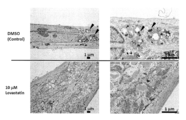
- FIG. 3 shows that lovastatin eliminates autophagic vacuoles in GNE myopathy specific muscle cells. It is an electron micrograph which shows the therapeutic effect of lovastatin in a GNE myopathy specific muscle cell.
- the present invention provides a preventive and / or therapeutic agent for lysosomal disease (LSD) containing an HMG-CoA reductase (HMGCR) inhibitor (hereinafter also referred to as “prophylactic / therapeutic agent of the present invention”).
- LSD lysosomal disease
- HMGCR HMG-CoA reductase
- a substance to be decomposed accumulates as a waste product due to an enzyme deficiency related to lysosome, fusion between lysosome and autophagosome is inhibited, autophagosome accumulates and autophagy
- a substance to be decomposed accumulates as a waste product due to an enzyme deficiency related to lysosome, fusion between lysosome and autophagosome is inhibited, autophagosome accumulates and autophagy
- Pompe disease in which glycogen accumulates due to deficiency of ⁇ -glucosidase (GAA), UDP-N-acetylglucosamine 2-epimerase / N-acetylmannosamine kinase Distal myopathy (GNE myopathy) with rimmed vacuoles lacking (GNE), GM1 gangliosidosis, GM2 gangliosidosis, metachromatic leukodystrophy (MLD), Fabry disease ( ⁇ -galactosidase A deficiency), Faber Disease, Gaucher disease ( ⁇ - Diseases such as Lukocerebrosidase deficiency), Niemann-Pick disease (types A, B, and C), Krabbe disease, and other sphingolipid accumulation diseases, mucopolysaccharidosis (type I-VII), Danone disease, ⁇ -mannosidosis Preferred examples include, but are not limited to, Pompe disease or GNE myopathy.
- GAA ⁇ -glu
- HMG-CoA reductase (HMGCR) inhibitor which is an active ingredient of the preventive / therapeutic agent of the present invention, is not particularly limited as long as it is a compound having an activity that inhibits the enzyme activity of hydroxymethylglutaryl CoA reductase, and is derived from a microorganism.
- (+)-(3R, 5R) -3,5-dihydroxy-7-[(1S, 2S, 6S, 8S, 8aR) -6-hydroxy-2-methyl-8-[(S) -2- Methylbutyryloxy] -1,2,6,7,8,8a-hexahydro-1-naphthyl] heptanoic acid see pravastatin, JP 57-2240 (USP 4346227)
- the above-mentioned statin compound includes a lactone ring-closed compound or a pharmacologically acceptable salt thereof (preferably a sodium salt or a calcium salt).
- the prophylactic / therapeutic agent of the present invention is a pharmaceutical composition of an appropriate dosage form obtained by mixing an HMGCR inhibitor as an active ingredient alone or with a pharmacologically acceptable carrier, excipient, diluent or the like. Can be administered orally or parenterally.
- compositions for oral administration include solid or liquid dosage forms, specifically tablets (including dragees and film-coated tablets), pills, granules, powders, capsules (including soft capsules), syrups Agents, emulsions, suspensions and the like.
- a composition for parenteral administration for example, injections, suppositories and the like are used, and injections include intravenous injections, subcutaneous injections, intradermal injections, intramuscular injections, infusions, and the like. Dosage forms may be included.
- excipients eg sugar derivatives such as lactose, sucrose, sucrose, mannitol, sorbitol; starch derivatives such as corn starch, potato starch, alpha starch, dextrin; cellulose derivatives such as crystalline cellulose; Gum arabic; dextran; organic excipients such as pullulan; and silicate derivatives such as light anhydrous silicic acid, synthetic aluminum silicate, calcium silicate and magnesium metasilicate aluminate; phosphates such as calcium hydrogen phosphate; Carbonates such as calcium; inorganic excipients such as sulfates such as calcium sulfate), lubricants (eg, stearic acid metal salts such as stearic acid, calcium stearate, magnesium stearate; talc; Colloidal silica; wax like beeswax and gay wax Borax; adipic acid; sulfate such as sodium sulfate; glycol; fumedi
- the dosage of the HMGCR inhibitor can vary depending on various conditions such as the patient's symptoms, age, weight and the like.
- the dose varies depending on symptoms, age, etc., but in the case of oral administration, the lower limit is 0.1 mg per dose, the upper limit is 1000 mg (preferably 500 mg), and in the case of parenteral administration, the lower limit is per dose. 0.01 mg and an upper limit of 100 mg (preferably 50 mg) can be administered to adults 1 to 6 times per day. The dose may be increased or decreased depending on the symptoms.
- the prophylactic / therapeutic agent of the present invention includes other agents such as those conventionally used in the treatment of lysosomal diseases, such as enzyme replacement therapy agents (eg, ⁇ -glucosidase (Pompe disease), ⁇ -galactosidase A (fabry Disease), Gaucher's disease ( ⁇ -glucocerebrosidase, etc.), pharmacological chaperone therapeutic agent, substrate reduction therapeutic agent and the like.
- enzyme replacement therapy agents eg, ⁇ -glucosidase (Pompe disease), ⁇ -galactosidase A (fabry Disease), Gaucher's disease ( ⁇ -glucocerebrosidase, etc.
- the prophylactic / therapeutic agent of the present invention and these other agents can be administered simultaneously, sequentially or separately.
- Example 1 Pharmacological evaluation using iPS cells established from a patient with Pompe disease (1) Fibroblast derived from a patient with Pompe disease After biopsy of 4 mm of skin for 3 weeks, as a fibroblast derived from a patient with Pompe disease Using.
- the number of cells per well of a 96-well culture plate ranged from 3.0 ⁇ 10 3 to 1.0 ⁇ 10 4 .
- the culture medium was changed to a human iPS medium without bFGF and having 10 ⁇ M Y-27632 (wako).
- AK02N or AK03 (Ajinomoto) human iPS medium containing 1 ⁇ g / mL doxycycline (LKT Laboratories) was added.
- KSR Knockout Serum Replacement
- 50 mU / L penicillin / 50 ⁇ g / L streptomycin Invitrogen
- 1 ⁇ g / mL doxycycline LKT Laboratories
- 100 ⁇ M 2-mercaptoethanol (2-roen) Changed to Furthermore, cell culture was continued until 5 days later to induce differentiation into skeletal muscle cells. All of these cultures were performed by incubating in a humidified atmosphere at 37 ° C., 5% CO 2 . By this method, MHC positive cells were obtained, and differentiation induction into skeletal muscle cells was confirmed.
- the cell-stained plate was measured and analyzed using ArrayScan (Thermo Scientific).
- ArrayScan Thermo Scientific
- the fluorescence value of autophagy in the cell and the region were used, and the compound was evaluated in a scatter diagram (FIG. 1).
- one group that reduces the autophagy region was the HMGCoA inhibitor group, and one of them was lovastatin.
- lovastatin was evaluated as a representative compound.
- a base (0.3% dimethylsulfoxide (DMSO)
- a final concentration of 10, 3, 1, 0.3 ⁇ M lovastatin were added for 48 hours. Incubated. Differentiated cells were fixed with 4% paraformaldehyde (wako) / PBS at room temperature for 10 minutes, washed with PBS, and then washed with PBS (Nacalai Tesque) with 0.5% Triton X-100 (Sigma-aldrich).
- DMSO dimethylsulfoxide
- Permeabilization was performed for 10 minutes at room temperature. Thereafter, the plate was washed with PBS, blocked using Blocking one (Nacalai Tesque) at 4 ° C. for 30 minutes, and washed again with PBS.
- the primary antibody used was diluted rabbit monoclonal antibody (mAb) anti-LC3B (1: 200; Cellsignaling) in the above 10% blocking one solution. The cells were reacted at 4 ° C. for 5 hours and washed with PBS.
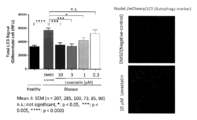
- the 10% blocking one solution was diluted with Alexa fluor488-conjugated anti-rabbit IgG goat antibody (1: 500; Invitrogen) as a secondary antibody and Hoechst 33342 (1: 10000; Dojindo) for nuclear staining, The reaction was allowed to proceed for 1 hour at room temperature. After washing with PBS, measurement and analysis were performed with ArrayScan (Thermo Scientific). As a result, it was confirmed that LC3, which is a typical autophagy marker protein, was more expressed in disease-derived muscle cells than in healthy individuals, but decreased in a concentration-dependent manner in the lovastatin-treated group. (FIG. 2).
- Example 2 Pharmacological evaluation using iPS cells established from a patient with distal myopathy (GNE myopathy) with rimmed vacuoles (1) Fibroblasts from GNE myopathy patients Biocultured 4 mm skin was cultured for 3 weeks Later, it was used as a fibroblast derived from a GNE myopathy patient.
- the number of cells per well of a 96-well culture plate ranged from 3.0 ⁇ 10 3 to 1.0 ⁇ 10 4 .
- the culture medium was changed to a human iPS medium without bFGF and having 10 ⁇ M Y-27632 (wako).
- AK02N or AK03 (Ajinomoto) human iPS medium containing 1 ⁇ g / mL doxycycline (LKT Laboratories) was added.
- the culture solution was added to ⁇ minimum essential medium ( ⁇ MEM) (Nacalai Tesque) with 5% Knockout Serum Replacement (KSR) (Invitrogen), 50 mU / L penicillin / 50 ⁇ g / L streptomycin (Invitrogen), 1 ⁇ g / mL. Doxycycline (LKT Laboratories) and 100 ⁇ M 2-mercaptoethanol (2-ME) (Invitrogen) were added. Furthermore, cell culture was continued until 5 days later to induce differentiation into skeletal muscle cells. All of these cultures were performed by incubating in a humidified atmosphere at 37 ° C., 5% CO 2 . By this method, MHC positive cells were obtained, and differentiation induction into skeletal muscle cells was confirmed.
- ⁇ MEM Knockout Serum Replacement
- KSR Knockout Serum Replacement
- 2-ME 2-mercaptoethanol
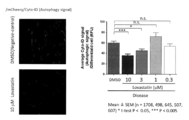
- Lovastatin against GNE myopathy was evaluated. Lovastatin having a final concentration of 10 ⁇ M was added to the muscle-differentiated cells. After incubation for 48 hours, the cells were evaluated with Cyto-ID autophagy detection kit 2.0 (Enzo Life Science, Inc.), which is an autophagy detection kit. The staining method was in accordance with the method attached to Kit. The cell-stained plate was measured and analyzed using ArrayScan (Thermo Scientific). As a result, disappearance of autophagy accumulation in the lovastatin treatment group was confirmed (FIG. 5).
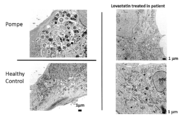
- lovastatin Pharmacological evaluation using an electron microscope
- a base (0.3% dimethylsulfoxide (DMSO)
- a final concentration of 10 ⁇ M lovastatin were added and incubated for 48 hours.
- the cells were then harvested and fixed with 2% paraformaldehyde and 2% glutaraldehyde for 30 minutes. After washing three times with PBS, the sample was fixed with 2% osmium in PBS at 4 ° C. for 1 hour. Subsequently, after polymerization at 60 ° C. for 48 hours, a section was cut out and observed with a transmission electron microscope (JEOL).
- JEOL transmission electron microscope
- the present invention although it is a pathological condition common to LSD, it can improve the dysfunction of autophagy that could not be intervened by conventional enzyme replacement therapy. It is extremely useful in that cell death due to damage / stress of the mitochondrion and mitochondrial dysfunction is suppressed, and not only improvement of life prognosis but also improvement of skeletal muscle symptoms and central nerve symptoms can be expected.
Landscapes
- Health & Medical Sciences (AREA)
- Veterinary Medicine (AREA)
- Chemical & Material Sciences (AREA)
- Medicinal Chemistry (AREA)
- Pharmacology & Pharmacy (AREA)
- Life Sciences & Earth Sciences (AREA)
- Animal Behavior & Ethology (AREA)
- General Health & Medical Sciences (AREA)
- Public Health (AREA)
- Chemical Kinetics & Catalysis (AREA)
- Engineering & Computer Science (AREA)
- Bioinformatics & Cheminformatics (AREA)
- General Chemical & Material Sciences (AREA)
- Nuclear Medicine, Radiotherapy & Molecular Imaging (AREA)
- Organic Chemistry (AREA)
- Epidemiology (AREA)
- Diabetes (AREA)
- Hematology (AREA)
- Obesity (AREA)
- Neurology (AREA)
- Orthopedic Medicine & Surgery (AREA)
- Physical Education & Sports Medicine (AREA)
- Pharmaceuticals Containing Other Organic And Inorganic Compounds (AREA)
- Medicines That Contain Protein Lipid Enzymes And Other Medicines (AREA)
Abstract
La présente invention concerne un agent de prévention/traitement d'une maladie lysosomale comprenant un inhibiteur de la HMG-CoA réductase.
Priority Applications (1)
| Application Number | Priority Date | Filing Date | Title |
|---|---|---|---|
| JP2019571189A JP7366408B2 (ja) | 2018-02-06 | 2019-02-05 | ライソゾーム病の予防及び治療剤 |
Applications Claiming Priority (2)
| Application Number | Priority Date | Filing Date | Title |
|---|---|---|---|
| JP2018-019698 | 2018-02-06 | ||
| JP2018019698 | 2018-02-06 |
Publications (1)
| Publication Number | Publication Date |
|---|---|
| WO2019156252A1 true WO2019156252A1 (fr) | 2019-08-15 |
Family
ID=67549668
Family Applications (1)
| Application Number | Title | Priority Date | Filing Date |
|---|---|---|---|
| PCT/JP2019/004766 Ceased WO2019156252A1 (fr) | 2018-02-06 | 2019-02-05 | Agent de prévention et de traitement de maladies lysosomales |
Country Status (2)
| Country | Link |
|---|---|
| JP (1) | JP7366408B2 (fr) |
| WO (1) | WO2019156252A1 (fr) |
Citations (4)
| Publication number | Priority date | Publication date | Assignee | Title |
|---|---|---|---|---|
| JP2006117553A (ja) * | 2004-10-19 | 2006-05-11 | National Institute Of Advanced Industrial & Technology | Ii型キュービック液晶組成物にリソソーム酵素を包埋した複合体 |
| WO2009040816A1 (fr) * | 2007-09-26 | 2009-04-02 | Ramot At Tel Aviv University Ltd. | Procédés de traitement de troubles du stockage des lysosomes |
| WO2010131712A1 (fr) * | 2009-05-15 | 2010-11-18 | 財団法人ヒューマンサイエンス振興財団 | Agent pharmaceutique destine au traitement des maladies associees a une diminution de la fonction de la proteine gne, composition et additif alimentaires |
| JP2017536363A (ja) * | 2014-11-19 | 2017-12-07 | ラッシュ・ユニバーシティ・メディカル・センター | リソソーム蓄積症治療のための組成物及び方法 |
-
2019
- 2019-02-05 WO PCT/JP2019/004766 patent/WO2019156252A1/fr not_active Ceased
- 2019-02-05 JP JP2019571189A patent/JP7366408B2/ja active Active
Patent Citations (4)
| Publication number | Priority date | Publication date | Assignee | Title |
|---|---|---|---|---|
| JP2006117553A (ja) * | 2004-10-19 | 2006-05-11 | National Institute Of Advanced Industrial & Technology | Ii型キュービック液晶組成物にリソソーム酵素を包埋した複合体 |
| WO2009040816A1 (fr) * | 2007-09-26 | 2009-04-02 | Ramot At Tel Aviv University Ltd. | Procédés de traitement de troubles du stockage des lysosomes |
| WO2010131712A1 (fr) * | 2009-05-15 | 2010-11-18 | 財団法人ヒューマンサイエンス振興財団 | Agent pharmaceutique destine au traitement des maladies associees a une diminution de la fonction de la proteine gne, composition et additif alimentaires |
| JP2017536363A (ja) * | 2014-11-19 | 2017-12-07 | ラッシュ・ユニバーシティ・メディカル・センター | リソソーム蓄積症治療のための組成物及び方法 |
Non-Patent Citations (1)
| Title |
|---|
| QUAN, YANG: "Lysosomal Acid Lipase Deficiency: Focus on Cholesterol Ester Storage Disease", CESD, vol. 69, no. 3, 2014, pages 445 - 453 * |
Also Published As
| Publication number | Publication date |
|---|---|
| JPWO2019156252A1 (ja) | 2021-01-28 |
| JP7366408B2 (ja) | 2023-10-23 |
Similar Documents
| Publication | Publication Date | Title |
|---|---|---|
| US9233089B2 (en) | Treatment of pulmonary hypertension with leukotriene inhibitors | |
| RU2435585C2 (ru) | Антагонисты рецептора эндотелина, предназначенные для ранней стадии идиопатического фиброза легких | |
| US20190100492A1 (en) | Treatment for lipodystrophy | |
| KR20030069983A (ko) | 치료용 조합물 | |
| CN111655669A (zh) | 治疗包括运动神经元疾病的神经紊乱的组合物和方法 | |
| US20170152222A1 (en) | Compounds and methods for inhibiting production of trimethylamine | |
| US12582652B2 (en) | 3-(ethoxydifluoromethyl)-6-(5-fluoro-6-(2,2,2-trifluoroethoxy)pyridin-3-yl)-[1,2,4]triazolo[4,3-a]pyrazine as an ion channel modulator | |
| US20100093010A1 (en) | Inhibitor for the Formation of Gamma-Secretase Complex | |
| US20200113899A1 (en) | Statin compositions and methods for use in treating synucleinopathies | |
| Li et al. | Lovastatin suppresses the aberrant tau phosphorylation from FTDP-17 mutation and okadaic acid-induction in rat primary neurons | |
| JP7366408B2 (ja) | ライソゾーム病の予防及び治療剤 | |
| US20080027088A1 (en) | Imidazole-Based Hmg-Coa Reductase Inhibitors | |
| US8252524B2 (en) | Method of screening pharmaceutical compositions that promote nuclear transfer of Cdc42 protein | |
| WO2005115397A2 (fr) | Compositions et traitements pour moduler une kinase et/ou une hmg-coa reductase | |
| US20040087597A1 (en) | Preventives and remedies for complications of diabetes | |
| US20200078319A1 (en) | Pharmaceutical composition, containing nm23 activator, for inhibiting cancer metastasis | |
| KR20080015789A (ko) | 신규의 트리글리세리드 저하제 | |
| US20070059357A1 (en) | Adiponectin production enhancer | |
| CA2524175C (fr) | Composition activant l'aptitude a consommer du sucre | |
| US20060276486A1 (en) | Lklf/klf2 gene expression promoter | |
| JP4187141B2 (ja) | 新規なトロンボモジュリン発現促進剤 | |
| US8309574B2 (en) | Nuclear transfer promoter for Rac protein and method of screening the same | |
| AU2015268725B2 (en) | Treatment for lipodystrophy | |
| Eyjolfsdottir | Nerve growth factor in Alzheimer’s disease: biological effects and therapeutic potential | |
| JPWO2008001752A1 (ja) | スタチンによる慢性閉塞性肺疾患治療 |
Legal Events
| Date | Code | Title | Description |
|---|---|---|---|
| 121 | Ep: the epo has been informed by wipo that ep was designated in this application |
Ref document number: 19750711 Country of ref document: EP Kind code of ref document: A1 |
|
| ENP | Entry into the national phase |
Ref document number: 2019571189 Country of ref document: JP Kind code of ref document: A |
|
| NENP | Non-entry into the national phase |
Ref country code: DE |
|
| 122 | Ep: pct application non-entry in european phase |
Ref document number: 19750711 Country of ref document: EP Kind code of ref document: A1 |