WO2019160111A1 - 頭足類用給餌装置、給餌方法、及び頭足類 - Google Patents
頭足類用給餌装置、給餌方法、及び頭足類 Download PDFInfo
- Publication number
- WO2019160111A1 WO2019160111A1 PCT/JP2019/005683 JP2019005683W WO2019160111A1 WO 2019160111 A1 WO2019160111 A1 WO 2019160111A1 JP 2019005683 W JP2019005683 W JP 2019005683W WO 2019160111 A1 WO2019160111 A1 WO 2019160111A1
- Authority
- WO
- WIPO (PCT)
- Prior art keywords
- feed
- cephalopods
- feeding
- outer shell
- feeding device
- Prior art date
- Legal status (The legal status is an assumption and is not a legal conclusion. Google has not performed a legal analysis and makes no representation as to the accuracy of the status listed.)
- Ceased
Links
Images
Classifications
-
- A—HUMAN NECESSITIES
- A01—AGRICULTURE; FORESTRY; ANIMAL HUSBANDRY; HUNTING; TRAPPING; FISHING
- A01K—ANIMAL HUSBANDRY; AVICULTURE; APICULTURE; PISCICULTURE; FISHING; REARING OR BREEDING ANIMALS, NOT OTHERWISE PROVIDED FOR; NEW BREEDS OF ANIMALS
- A01K61/00—Culture of aquatic animals
- A01K61/50—Culture of aquatic animals of shellfish
- A01K61/54—Culture of aquatic animals of shellfish of bivalves, e.g. oysters or mussels
-
- A—HUMAN NECESSITIES
- A01—AGRICULTURE; FORESTRY; ANIMAL HUSBANDRY; HUNTING; TRAPPING; FISHING
- A01K—ANIMAL HUSBANDRY; AVICULTURE; APICULTURE; PISCICULTURE; FISHING; REARING OR BREEDING ANIMALS, NOT OTHERWISE PROVIDED FOR; NEW BREEDS OF ANIMALS
- A01K61/00—Culture of aquatic animals
- A01K61/50—Culture of aquatic animals of shellfish
-
- A—HUMAN NECESSITIES
- A01—AGRICULTURE; FORESTRY; ANIMAL HUSBANDRY; HUNTING; TRAPPING; FISHING
- A01K—ANIMAL HUSBANDRY; AVICULTURE; APICULTURE; PISCICULTURE; FISHING; REARING OR BREEDING ANIMALS, NOT OTHERWISE PROVIDED FOR; NEW BREEDS OF ANIMALS
- A01K61/00—Culture of aquatic animals
- A01K61/80—Feeding devices
-
- A—HUMAN NECESSITIES
- A23—FOODS OR FOODSTUFFS; TREATMENT THEREOF, NOT COVERED BY OTHER CLASSES
- A23K—FODDER
- A23K10/00—Animal feeding-stuffs
- A23K10/20—Animal feeding-stuffs from material of animal origin
- A23K10/22—Animal feeding-stuffs from material of animal origin from fish
-
- A—HUMAN NECESSITIES
- A23—FOODS OR FOODSTUFFS; TREATMENT THEREOF, NOT COVERED BY OTHER CLASSES
- A23K—FODDER
- A23K50/00—Feeding-stuffs specially adapted for particular animals
- A23K50/80—Feeding-stuffs specially adapted for particular animals for aquatic animals, e.g. fish, crustaceans or molluscs
-
- Y—GENERAL TAGGING OF NEW TECHNOLOGICAL DEVELOPMENTS; GENERAL TAGGING OF CROSS-SECTIONAL TECHNOLOGIES SPANNING OVER SEVERAL SECTIONS OF THE IPC; TECHNICAL SUBJECTS COVERED BY FORMER USPC CROSS-REFERENCE ART COLLECTIONS [XRACs] AND DIGESTS
- Y02—TECHNOLOGIES OR APPLICATIONS FOR MITIGATION OR ADAPTATION AGAINST CLIMATE CHANGE
- Y02A—TECHNOLOGIES FOR ADAPTATION TO CLIMATE CHANGE
- Y02A40/00—Adaptation technologies in agriculture, forestry, livestock or agroalimentary production
- Y02A40/80—Adaptation technologies in agriculture, forestry, livestock or agroalimentary production in fisheries management
- Y02A40/81—Aquaculture, e.g. of fish
Definitions
- the present invention relates to a cephalopod feeding device, a feeding method using the same, and a cephalopod cultivated by the feeding method.
- Patent Document 1 discloses an octopus breeding shelter and an octopus farming system.
- Non-Patent Document 1 discloses octopus breeding observation.
- the present invention provides a cephalopod feeding device capable of breeding cephalopods satisfactorily, a feeding method using the same, and a cephalopod cultivated by the feeding method. With the goal.
- the present invention is as follows.
- the feeding device according to [1] to [3], wherein the feed is an adherent feed.
- ADVANTAGE OF THE INVENTION According to this invention, it can give more feed, can prevent the deterioration of a breeding environment, can feed a cephalopod well, a feeding apparatus for cephalopods and a feeding method, and can be bred well. Can provide cephalopods with improved meat quality.
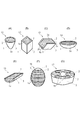
- FIGS. 1A to 1G are schematic views showing a feeding device.
- the term “process” is not limited to an independent process, and is included in the term if the intended purpose of the process is achieved even when it cannot be clearly distinguished from other processes. .
- a numerical range indicated by using “to” indicates a range including numerical values described before and after the numerical value as a minimum value and a maximum value, respectively.
- the amount of each component in the mixture means the total amount of the plurality of substances present in the mixture unless there is a specific notice when there are a plurality of substances corresponding to each component in the mixture. .
- the term “below” or “less than” in terms of percentage includes 0%, ie, “does not contain” unless otherwise specified, or includes a value not detectable by current means. Means range.
- the feeding device (cephalopod feeding device) according to one embodiment of the present invention is used for breeding cephalopods.
- the feeding device may be installed in the aquarium where cephalopods are raised, or outside the aquarium where cephalopods are raised as long as the cephalopods extend their tentacles and feed. You may do.
- the “tentacles” of cephalopods described in this embodiment refers to protrusions that grow from the heads of cephalopods.
- An eight-armed cephalopod containing an octopus has eight tentacles, and a ten-armed cephalopod containing a squid has ten tentacles. Of the ten tentacles of cephalopods, the long two are called tentacles and are sometimes used for feeding.
- Cultivation of cephalopods can take a method suitable for breeding according to the type of cephalopods. Cultivation of cephalopods can be done in onshore water tanks or marine ginger. Breeding in an onshore water tank makes it easy to observe the feeding of the fed feed. For the breeding of cephalopods, a plurality of individuals can be reared in a water tank or a ginger at the same time, or each individual can be individually raised in a water tank or a ginger.
- the feeding device according to the present embodiment may be installed temporarily at the time of feeding, or may be permanently installed while appropriately replacing the feed arranged in the feeding device. Also good.
- the device may be placed in a predetermined installation location such as in a water tank, or if the cephalopod can extend its tentacles and feed, For example, you may suspend from the upper part.
- FIG. 1 (A) to FIG. 1 (G) show seven types of feeding devices 11 to 17.
- the feeding apparatus 11 includes an outer shell 1 having a recess 1a and a feed 2 disposed in the recess.
- the material of the outer shell 1 may be anything as long as it does not hinder cephalopod feeding.
- artificial materials exemplified by metals, ceramics, ceramics, synthetic resins, wood, rubber, paper, leather, glass and tiles may be used, and stone materials, shells and bones are exemplified. Natural materials may be used.
- the outer shell 1 When the outer shell 1 has a strength that can withstand the pressure of tentacles of cephalopods, the outer shell 1 does not collapse, the dissipation of the feed disposed in the recess is reduced, and deterioration of water quality can be prevented, An appropriate breeding environment can be maintained.
- the shape of the outer shell 1 of the feeding device 11 is a cup shape having a recess 1a at the center.
- the shape of the outer shell 1 of the feeding device 11 may be any shape as long as it can be fed to cephalopods.
- a shape resembling an organism that prey on cephalopods can be used. Examples of organisms that prey on cephalopods include small fish, crustaceans, shellfish, hermit crabs and shellfish.
- the shape of the outer shell 1 of the feeding device 11 may be a shape held by the tentacles of cephalopods. If the shape of the outer shell 1 of the feeding apparatus 11 is a shape that can be held by the tentacles of cephalopods, a large amount of food can be fed to cephalopods that have the habit of drawing food near the mouth.
- the size of the outer shell 1 of the feeding device 11 is not particularly limited as long as the cephalopods can be fed by extending their tentacles.
- the outer diameter is reduced. It can be about 1 cm to 7 cm.
- the recess 1a of the outer shell 1 of the feeding device 11 may have any shape as long as feed can be disposed inside the recess 1a.
- the recess 1a of the outer shell 1 of the feeding device 11 may have a substantially hemispherical shape, a substantially groove shape, or a substantially pyramid shape, or may have a substantially tubular shape through the outer shell 1.
- the recessed part provided in natural materials, such as a stone material, a shell, or a bone can also be utilized as an outer shell of the feeding apparatus 11 as it is.
- the concave portion 1a of the outer shell 1 may be formed so as to wrap more than half of the volume of the feed in order to hold the feed disposed inside the concave portion 1a, or a part of the feed is fixed to the outer shell. You may form so that it may wrap.
- the feed 2 is disposed inside the outer periphery 3 of the recess, that is, inside the recess 1 a of the outer shell 1.
- the feed 2 may be arranged in any way as long as it is held inside the recess 1a.
- a part of the feed 2 may be directly bonded to the outer shell 1, or even if it is not bonded to the outer shell 1, it is held by being physically covered by the concave portion of the outer shell 1. You may arrange.
- the feed 2 is easily held by the outer shell 1 even if there is a water flow caused by movement of cephalopods, movement of bubbles, or the like.
- an adhesive feed can be made.
- the adherent feed according to the present embodiment is a feed that can adhere to the concave portion of the outer shell 1 and keep its shape.
- the adhesive feed can have a viscosity of 10 Pa to 100 Pa, for example.
- the adherent feed can be a feed having physical properties that keep the original shape when exposed to a water flow having a flow rate of 0.1, 1, 5, 10, 15 cm / s.
- the adherent feed can be a feed that easily disintegrates in water. The collapse may be determined by fragmenting to such an extent that the shape of the bait cannot be recognized.
- the easily disintegrating feed means, for example, a feed that disintegrates in about 15 minutes when left in water and has a disintegrating property that disintegrates immediately when cephalopods grab the feed.
- a protein exemplified by collagen As a substance adhering to the outer shell 1, a protein exemplified by collagen, a polysaccharide exemplified by fucodyne and carrageenan, a phospholipid exemplified by an egg membrane, a glycoprotein and a glycolipid may be used. Diets containing protein can promote cephalopod growth.
- the surface shape include giving fine irregularities to the surface of the outer shell 1 (the inner surface of the recess), and providing a plurality of fine grooves.
- the surface shape of the outer shell 1 to which the feed 2 does not adhere may be changed so that cephalopods can be easily held using tentacles.
- the change in the surface shape include, for example, adding fine irregularities to the surface of the outer shell 1 (the surface inside the concave portion), providing a plurality of fine grooves, and the like.
- feed 2 can be used as long as it can prey on cephalopods.
- the feed can be made using one or more feed ingredients.
- feed materials include fish exemplified by horse mackerel, mackerel, and sardine, shellfish exemplified by clam, swordfish and tuna, crustacean exemplified by shrimp, crab and krill, soybean, corn, rice and wheat Cereals may be used.
- a mixed feed can be used as feed 2.
- the compound feed can be obtained by grinding fish, shellfish, shellfish, cereals and the like.
- a mixed feed is used as a feed, it is easy to add a component that promotes the growth of cephalopods, and it is easy to flexibly cope with price fluctuations of feed raw materials.
- Ingredients that promote the growth of cephalopods include vitamins, minerals, hormones, preventive drugs, therapeutic drugs, sedatives, vaccines and the like.
- the feeding device 11 When feeding cephalopods using the feeding device 11, positions where the cephalopods can feed using the tentacles with the feed 2 attached inside the recess provided in the outer shell 1
- the feeding device 11 is arranged in When the cephalopods are interested in the feed, they feed their feed 2 with their tentacles extended. Feeding by the cephalopods is promoted by keeping the feeding device 11 to which the feed 2 is attached in a state in which cephalopods are easy to feed.
- feeding of cephalopods is promoted, so that feed can be prevented from remaining in the breeding environment, and deterioration of the breeding environment is prevented. It becomes possible.
- the craniopods bred by the above feeding method improve the nutritional state of the cephalopods by promoting feeding of the cephalopods by improving the breeding environment.
- the tentacles of cephalopods or the surface of the body can be reduced, and the meat quality of cephalopods can be improved so as to enhance the taste and umami when used for food.
- the risk of infection can be reduced by reducing damage to the tentacles or body surface.
- the feeding time for cephalopods can be any time as long as it is possible to feed protein-containing feed after the occurrence.
- the feeding ability can be enhanced at the time of feeding so that the tentacles hold the feed.
- Feeding using the feeding device described in the present embodiment is 10% or more, 20% or more, 30% or more, or 50% or more of the feeding amount for cephalopods, thereby providing high feeding ability.
- Cultivate cephalopods with high growth quality and good meat quality by feeding for 1 month or more, 2 months or more, or 3 months or more using the feeding apparatus described in this embodiment can do.
- the feed can be learned as feed and the feeding of the feed can be accelerated.
- the timing of feeding cephalopods may be any time as long as cephalopods can be fed.
- the circadian clock in the cephalopods and the digestion / absorption cycle work together to reduce stress and promote growth.
- breeding cephalopods when giving a light-dark cycle, by synchronizing the light-dark cycle and feeding timing, the circadian clock synchronized with the light-dark cycle and the cycle of digestion and absorption are linked, Reduce stress and encourage growth. Feeding to the cephalopods may be performed by planned feeding giving a predetermined amount, or by observing the amount of feeding while feeding, and by feeding satiety while continuing feeding.
- the cephalopods bred in the feeding device of the present invention can be used for feed use and ornamental use, as well as for food use including raw foods, processed foods, frozen foods, chilled foods, dried foods and food raw materials. In addition, it can be used as an extraction raw material for useful components.
- the cephalopods bred in the feeding apparatus of the present invention are excellent in growth and contain abundant proteins, so that they have a good taste, have many components that contribute to health, and are excellent for food applications.
- a feeding device 12 shown in FIG. 1 (B) is an example in which the outer shell 1 has a substantially quadrangular prism shape.
- the outer periphery 3 of the concave portion is a quadrangle in plan view, and the concave portion 1a of the outer shell 1 is also a substantially quadrangular prism shape.
- the outer shape of the outer shell 1 and the feed 2 is substantially a quadrangular prism as in the case of the feeding device 12, but a part of the side wall is removed as compared with the feeding device 12. It can be said.
- the outer shell 1 of the feeding device 13 has a cylindrical shape in which a part (one side) of the feeding device 13 is an opening, the inner side thereof is a recess 1a, and the feed 2 is disposed.
- the feed 2 is exposed in the opening portion 2a and the opening portions 2b and 2c at both ends of the cylindrical outer shell 1 (the opening portion 2c is the end opposite to the opening portion 2b). Become. Therefore, cephalopods are easy to feed using the openings 2a to 2c.
- the feeding device 14 shown in FIG. 1 (D) has a cup shape having a concave portion 1a at the center like the feeding device 11, but its depth is shallower than that of the feeding device 11. Therefore, since the exposed surface of the feed 2 is largely secured, cephalopods can easily take the feed 2.
- a feeding device 15 shown in FIG. 1 (E) has an arc shape with a semicircular cross section, and a feed 2 is attached to the inner side of the arc portion of the outer shell 1 extending in the illustrated depth direction. That is, the inside of the arc portion functions as the recess 1a. In the case of the feeding device 15 having such a shape, the exposed surface of the feed 2 is increased in the same manner as the feeding device 13, so that cephalopods can easily ingest the feed 2.
- the outer shell 1 has a substantially spherical shape, and a plurality of groove-shaped recesses 1a extending in the circumferential direction are formed around the outer shell 1, and the feed 2 is contained therein. It is attached. A recess outer edge 3 is formed between two adjacent grooves.
- a plurality of recesses 1 a for accommodating the feed 2 may be provided in one outer shell 1. Even if it is set as such a structure, since the exposed surface of the feed 2 becomes large, cephalopods will be easy to ingest the feed 2.
- FIG. 1 (G) is provided with a plurality of (six in FIG.
- the through-hole 1 b functions as a recess that accommodates the feed 2.
- a plurality of recesses for accommodating the feed 2 are provided in one outer shell 1.
- the through-hole 1b does not need to penetrate.
- the shape of the feeding device can be changed as appropriate.
- the shapes of the outer shell and the recess can be changed as appropriate.
- Example 1 A synthetic resin pipe having a length of 5 cm and an outer diameter of 20 mm was prepared as an outer shell. A fish meat surimi was filled as a feed in a recess having an inner diameter of 18 mm of the pipe, and a feeding apparatus according to Example 1 was produced. In this feeding apparatus, the outer shell 1 has a cylindrical shape, and the columnar region inside the pipe is a recess for accommodating feed.
- the octopus When the feeding apparatus according to Example 1 was provided to five octopus of about 200 g in an onshore water tank, the octopus immediately held the feeding apparatus with tentacles and started feeding. After 30 minutes, the feed arranged in the concave portion of the synthetic resin pipe was completely eaten. Moreover, the kind of feed was changed and the feed which mixed fish surimi and shellfish surimi, and the feed which mix
- Comparative Example 1 As Comparative Example 1, feed containing 20% gelatin mixed with fish surimi was directly fed to octopus without being placed in the outer shell. As a result, the octopus was held by the tentacles, but stopped feeding halfway, and about 50% or more of the feed remained in the aquarium. In addition, the remaining food collapsed in the water, so the water quality deteriorated and fine food was not consumed.
- Example 1 only fish surimi was treated as feed, but fish surimi was weakly formed and could not be fed directly to octopus.
- the feeding ability of cephalopods can be improved. Moreover, according to this invention, the deterioration of the breeding environment of cephalopods can be prevented. In addition, according to the present invention, a cephalopod having a good taste and having many components contributing to health can be obtained.
Landscapes
- Life Sciences & Earth Sciences (AREA)
- Environmental Sciences (AREA)
- Marine Sciences & Fisheries (AREA)
- Zoology (AREA)
- Animal Husbandry (AREA)
- Biodiversity & Conservation Biology (AREA)
- Chemical & Material Sciences (AREA)
- Polymers & Plastics (AREA)
- Engineering & Computer Science (AREA)
- Food Science & Technology (AREA)
- Birds (AREA)
- Insects & Arthropods (AREA)
- Health & Medical Sciences (AREA)
- Biomedical Technology (AREA)
- Biotechnology (AREA)
- Molecular Biology (AREA)
- Physiology (AREA)
- Fodder In General (AREA)
- Farming Of Fish And Shellfish (AREA)
- Feed For Specific Animals (AREA)
- Physical Vapour Deposition (AREA)
Abstract
Description
[1]凹部を有する外殻と、前記凹部に配置された飼料と、を含む頭足類用給餌装置。
[2]外殻が、頭足類の触手で抱えられる形状である、[1]の給餌装置。
[3]外殻が、頭足類の触手の圧力に耐えられる強度を有する外殻である、[1]又は[2]の給餌装置。
[4]飼料が付着性飼料である、[1]ないし[3]の給餌装置。
[5]前記[1]ないし[4]の給餌装置を用いた、頭足類の給餌方法。
[6]前記[5]の給餌方法で育成された頭足類。
本明細書において「~」を用いて示された数値範囲は、その前後に記載される数値をそれぞれ最小値及び最大値として含む範囲を示すものとする。
本明細書において、混合物中の各成分の量は、混合物中に各成分に該当する物質が複数存在する場合、特に断らない限り、混合物中に存在する当該複数の物質の合計の量を意味する。
[実施例1]
長さ5センチメートル、外径20ミリメートルの合成樹脂製パイプを外殻として準備した。当該パイプの内径18ミリメートルの凹部に魚肉のすり身を飼料として充填し、実施例1に係る給餌装置を作製した。この給餌装置では、外殻1が円筒状であり、パイプの内側の円柱状の領域が飼料を収容する凹部となっている。
比較例1として、魚肉のすり身に20%ゼラチンを配合した飼料を、外殻に配置せずにそのまま直接マダコに給餌した。その結果、マダコは触手で抱え込んだが、途中で摂餌を止め、大きさで約50%以上の飼料は水槽中に残った。また、残った餌は水中で崩壊したため、水質は悪化し、細かくなった餌料は摂餌されなかった。
実施例1で用いた餌料で養殖したマダコは、3ヵ月以上継続的に旺盛な食欲を示した。飼育成績としては、生残率は100%であり、体重はいずれの個体も5倍以上に増加した。いずれの個体も触手、及び体表の損傷が少なく、食用に供したところ、味は濃厚で、旨味が強かった。比較例1で用いた餌料で養殖したマダコは、触手や体表の損傷が認められた。
Claims (6)
- 凹部を有する外殻と、前記凹部に配置された飼料と、を含む頭足類用給餌装置。
- 前記外殻が、頭足類の触手で抱えられる形状である、請求項1に記載の給餌装置。
- 前記外殻が、頭足類の触手の圧力に耐えられる強度を有する、請求項1又は2に記載の給餌装置。
- 前記飼料が付着性飼料である、請求項1~3のいずれか一項に記載の給餌装置。
- 請求項1~4のいずれか一項に記載の給餌装置を用いた、頭足類の給餌方法。
- 請求項5に記載の給餌方法で育成された頭足類。
Priority Applications (8)
| Application Number | Priority Date | Filing Date | Title |
|---|---|---|---|
| MX2020008480A MX2020008480A (es) | 2018-02-15 | 2019-02-15 | Alimentador de cefalopodos, metodo de alimentacion y cefalopodo. |
| KR1020267002239A KR20260018192A (ko) | 2018-02-15 | 2019-02-15 | 두족류용 급이 장치, 급이 방법 및 두족류 |
| KR1020207023947A KR102918647B1 (ko) | 2018-02-15 | 2019-02-15 | 두족류용 급이 장치, 급이 방법 및 두족류 |
| CN201980011691.6A CN111683525B (zh) | 2018-02-15 | 2019-02-15 | 头足纲用投饵装置、投饵方法以及头足纲 |
| EP19754669.0A EP3753402A4 (en) | 2018-02-15 | 2019-02-15 | FEEDING DEVICE FOR CEPHALOPODE, FEEDING METHODS AND CEPHALOPODE |
| US16/969,804 US20210000086A1 (en) | 2018-02-15 | 2019-02-15 | Cephalopod feeder, feeding method, and cephalopod |
| JP2019563647A JP6674074B2 (ja) | 2018-02-15 | 2019-02-15 | 頭足類用給餌装置、給餌方法、及び頭足類 |
| US16/992,774 US20200383301A1 (en) | 2018-02-15 | 2020-08-13 | Cephalopod feeder, feeding method, and cephalopod |
Applications Claiming Priority (2)
| Application Number | Priority Date | Filing Date | Title |
|---|---|---|---|
| JP2018-025412 | 2018-02-15 | ||
| JP2018025412 | 2018-02-15 |
Related Child Applications (1)
| Application Number | Title | Priority Date | Filing Date |
|---|---|---|---|
| US16/992,774 Continuation-In-Part US20200383301A1 (en) | 2018-02-15 | 2020-08-13 | Cephalopod feeder, feeding method, and cephalopod |
Publications (1)
| Publication Number | Publication Date |
|---|---|
| WO2019160111A1 true WO2019160111A1 (ja) | 2019-08-22 |
Family
ID=67619175
Family Applications (1)
| Application Number | Title | Priority Date | Filing Date |
|---|---|---|---|
| PCT/JP2019/005683 Ceased WO2019160111A1 (ja) | 2018-02-15 | 2019-02-15 | 頭足類用給餌装置、給餌方法、及び頭足類 |
Country Status (7)
| Country | Link |
|---|---|
| US (2) | US20210000086A1 (ja) |
| EP (1) | EP3753402A4 (ja) |
| JP (3) | JP6674074B2 (ja) |
| KR (2) | KR102918647B1 (ja) |
| CN (1) | CN111683525B (ja) |
| MX (1) | MX2020008480A (ja) |
| WO (1) | WO2019160111A1 (ja) |
Families Citing this family (2)
| Publication number | Priority date | Publication date | Assignee | Title |
|---|---|---|---|---|
| JP7207377B2 (ja) * | 2020-06-30 | 2023-01-18 | 株式会社羽根 | 養殖用水槽内給餌用水流遮蔽体、及び養殖用水槽内給餌方法 |
| ES2983590B2 (es) * | 2023-03-20 | 2025-02-28 | Entenza Andres Moares | Cebo de pesca |
Citations (5)
| Publication number | Priority date | Publication date | Assignee | Title |
|---|---|---|---|---|
| JPS58190335A (ja) * | 1982-04-30 | 1983-11-07 | 酒伊繊維工業株式会社 | 魚介類の増殖、「い」集ならびに育成に供せられる魚礁 |
| JPH01149949U (ja) * | 1988-04-04 | 1989-10-17 | ||
| JP2003047380A (ja) * | 2001-08-03 | 2003-02-18 | Kuniyuki Hori | 釣り用撒餌散布器 |
| JP2015208322A (ja) * | 2014-04-25 | 2015-11-24 | 義孝 箕本 | 簡便撒き餌籠と撒き餌挿入装置 |
| JP2017006054A (ja) | 2015-06-23 | 2017-01-12 | 有限会社グルメイト | タコ飼育用シェルタおよびタコの飼育システム |
Family Cites Families (15)
| Publication number | Priority date | Publication date | Assignee | Title |
|---|---|---|---|---|
| JPH11289907A (ja) * | 1998-04-16 | 1999-10-26 | Suiken:Kk | 水槽における給餌具 |
| JP2003169608A (ja) | 2001-12-10 | 2003-06-17 | Asuka:Kk | 餌料及びその製造方法 |
| US7506614B1 (en) * | 2004-01-12 | 2009-03-24 | Ourpet's Company | Pet chew toy for holding consumable treats |
| NL1028689C2 (nl) * | 2004-07-09 | 2006-02-27 | Sonia R Hillios | Onderwater afgiftesysteem voor visvoer. |
| DE202004014142U1 (de) * | 2004-09-09 | 2004-11-04 | Schmidt, Thomas | Fütterungsvorrichtung für Fische |
| JP2005211075A (ja) * | 2005-03-08 | 2005-08-11 | Ichibansha:Kk | 活きイカの処理方法、活きイカの処理道具、および墨抜き活きイカ |
| EP2435554B1 (en) * | 2009-05-26 | 2017-07-26 | Advanced Bionutrition Corporation | Stable dry powder composition comprising biologically active microorganisms and/or bioactive materials and methods of making |
| KR100954864B1 (ko) * | 2009-07-10 | 2010-04-28 | 대봉엘에스 주식회사 | 붕해 및 소화효율이 우수한 양어용 펠렛 사료 및 이의 제조방법 |
| KR101196469B1 (ko) * | 2010-04-26 | 2012-11-01 | 정병재 | 두족류 양식장치 |
| KR101364161B1 (ko) * | 2012-04-03 | 2014-02-28 | 박철유 | 문어 양식장치 |
| US20140261211A1 (en) | 2013-03-12 | 2014-09-18 | Ling Liu Tuan | Fish food dispenser |
| KR101588084B1 (ko) | 2013-06-26 | 2016-01-25 | 정장용담 | 물의 순환이 양호한 두족류 양식장치 |
| CN104521855A (zh) * | 2014-12-22 | 2015-04-22 | 浙江海洋学院 | 乌贼工厂化养殖饵料循环保持装置 |
| US20160219840A1 (en) * | 2015-02-02 | 2016-08-04 | Steven Yim | Pellet and Flake Aquarium Feeder |
| FI20155330L (fi) * | 2015-05-06 | 2016-11-07 | Betulium Oy | Rehukoostumus |
-
2019
- 2019-02-15 CN CN201980011691.6A patent/CN111683525B/zh active Active
- 2019-02-15 WO PCT/JP2019/005683 patent/WO2019160111A1/ja not_active Ceased
- 2019-02-15 MX MX2020008480A patent/MX2020008480A/es unknown
- 2019-02-15 US US16/969,804 patent/US20210000086A1/en not_active Abandoned
- 2019-02-15 JP JP2019563647A patent/JP6674074B2/ja active Active
- 2019-02-15 KR KR1020207023947A patent/KR102918647B1/ko active Active
- 2019-02-15 KR KR1020267002239A patent/KR20260018192A/ko active Pending
- 2019-02-15 EP EP19754669.0A patent/EP3753402A4/en active Pending
-
2020
- 2020-03-05 JP JP2020037696A patent/JP7187498B2/ja active Active
- 2020-08-13 US US16/992,774 patent/US20200383301A1/en active Pending
-
2022
- 2022-11-30 JP JP2022192018A patent/JP7256922B2/ja active Active
Patent Citations (5)
| Publication number | Priority date | Publication date | Assignee | Title |
|---|---|---|---|---|
| JPS58190335A (ja) * | 1982-04-30 | 1983-11-07 | 酒伊繊維工業株式会社 | 魚介類の増殖、「い」集ならびに育成に供せられる魚礁 |
| JPH01149949U (ja) * | 1988-04-04 | 1989-10-17 | ||
| JP2003047380A (ja) * | 2001-08-03 | 2003-02-18 | Kuniyuki Hori | 釣り用撒餌散布器 |
| JP2015208322A (ja) * | 2014-04-25 | 2015-11-24 | 義孝 箕本 | 簡便撒き餌籠と撒き餌挿入装置 |
| JP2017006054A (ja) | 2015-06-23 | 2017-01-12 | 有限会社グルメイト | タコ飼育用シェルタおよびタコの飼育システム |
Non-Patent Citations (1)
| Title |
|---|
| ROSARIO MARTINEZ ET AL.: "rowth, survival and physiological condition of Octopus maya when fed a successful formulated diet", AQUACULTURE, no. 426-427, 20 April 2014 (2014-04-20), pages 310 - 317 |
Also Published As
| Publication number | Publication date |
|---|---|
| JPWO2019160111A1 (ja) | 2020-02-27 |
| JP2020156468A (ja) | 2020-10-01 |
| CN111683525A (zh) | 2020-09-18 |
| EP3753402A1 (en) | 2020-12-23 |
| KR20260018192A (ko) | 2026-02-06 |
| KR102918647B1 (ko) | 2026-01-26 |
| US20200383301A1 (en) | 2020-12-10 |
| JP6674074B2 (ja) | 2020-04-01 |
| KR20200119265A (ko) | 2020-10-19 |
| CN111683525B (zh) | 2022-06-24 |
| MX2020008480A (es) | 2020-10-14 |
| JP7187498B2 (ja) | 2022-12-12 |
| JP7256922B2 (ja) | 2023-04-12 |
| JP2023022229A (ja) | 2023-02-14 |
| US20210000086A1 (en) | 2021-01-07 |
| EP3753402A4 (en) | 2021-11-10 |
Similar Documents
| Publication | Publication Date | Title |
|---|---|---|
| Walsh | The end of the line | |
| JP7256922B2 (ja) | 頭足類用給餌装置、水槽、生簀、頭足類の飼育方法 | |
| KR101751869B1 (ko) | 곤충 사료 제조방법 | |
| Cox et al. | Feeding biology of spiny lobster larvae and implications for culture | |
| JP4579535B2 (ja) | カプセル化の改良 | |
| JP5184076B2 (ja) | 大型魚用の固形飼料 | |
| JP2013176337A (ja) | ウナギ養殖用飼料およびウナギの養殖方法 | |
| JP2022166329A (ja) | 頭足類への給餌方法および頭足類への給餌器具 | |
| ES2250343T3 (es) | Cris de especies acuaticas con organismos presa ricos en dha. | |
| RU2338389C1 (ru) | Комбикорм для осетровых рыб | |
| Nelson et al. | Nutrition of wild and cultured lobsters | |
| JP2023109148A (ja) | タコ用給餌物体およびタコを養殖、飼育、保管、運搬または治療する方法 | |
| KR20010019159A (ko) | 영지란을 생산하기 위한 사료의 제조방법 | |
| JP2003125686A (ja) | 餌くるみオキアミ | |
| JP2001275581A (ja) | 頭足類養殖用飼料 | |
| CN204273129U (zh) | 一种鱼胶囊饲料 | |
| MX2011005278A (es) | Composicion alimenticia para animales acuaticos. | |
| CN107259113A (zh) | 一种幼鳖养殖饲料 | |
| EP4280892A1 (en) | Aquaculture feed and method for producing same | |
| Waiho | Review of mud crab seed | |
| Ranjan et al. | Technology on seed production and culture of orange spotted grouper-A breakthrough for Indian mariculture | |
| Langdon et al. | Technological innovations in the development of microparticulate feeds for marine suspension feeders | |
| DOI | Early development of the digestive system and digestive enzyme activity of reared mandarinfish Siniperca chuatsi (Perciformes: Sinipercidae) | |
| CN121263070A (zh) | 水生动物幼体饲料 | |
| JP2011103803A (ja) | 魚釣り用の乾燥固形撒き餌 |
Legal Events
| Date | Code | Title | Description |
|---|---|---|---|
| 121 | Ep: the epo has been informed by wipo that ep was designated in this application |
Ref document number: 19754669 Country of ref document: EP Kind code of ref document: A1 |
|
| ENP | Entry into the national phase |
Ref document number: 2019563647 Country of ref document: JP Kind code of ref document: A |
|
| NENP | Non-entry into the national phase |
Ref country code: DE |
|
| ENP | Entry into the national phase |
Ref document number: 2019754669 Country of ref document: EP Effective date: 20200915 |
|
| WWR | Wipo information: refused in national office |
Ref document number: 1020207023947 Country of ref document: KR |
|
| WWC | Wipo information: continuation of processing after refusal or withdrawal |
Ref document number: 1020207023947 Country of ref document: KR |