WO2019163067A1 - Résines époxydiques, composition de résine époxydique, résine époxydique durcie et leur procédé de production, matériau composite, élément isolant, appareil électronique, matériau structural et objet mobile - Google Patents
Résines époxydiques, composition de résine époxydique, résine époxydique durcie et leur procédé de production, matériau composite, élément isolant, appareil électronique, matériau structural et objet mobile Download PDFInfo
- Publication number
- WO2019163067A1 WO2019163067A1 PCT/JP2018/006565 JP2018006565W WO2019163067A1 WO 2019163067 A1 WO2019163067 A1 WO 2019163067A1 JP 2018006565 W JP2018006565 W JP 2018006565W WO 2019163067 A1 WO2019163067 A1 WO 2019163067A1
- Authority
- WO
- WIPO (PCT)
- Prior art keywords
- epoxy resin
- liquid crystal
- epoxy
- epoxy compound
- crystal structure
- Prior art date
- Legal status (The legal status is an assumption and is not a legal conclusion. Google has not performed a legal analysis and makes no representation as to the accuracy of the status listed.)
- Ceased
Links
Images

Classifications
-
- C—CHEMISTRY; METALLURGY
- C08—ORGANIC MACROMOLECULAR COMPOUNDS; THEIR PREPARATION OR CHEMICAL WORKING-UP; COMPOSITIONS BASED THEREON
- C08G—MACROMOLECULAR COMPOUNDS OBTAINED OTHERWISE THAN BY REACTIONS ONLY INVOLVING UNSATURATED CARBON-TO-CARBON BONDS
- C08G59/00—Polycondensates containing more than one epoxy group per molecule; Macromolecules obtained by polymerising compounds containing more than one epoxy group per molecule using curing agents or catalysts which react with the epoxy groups
- C08G59/18—Macromolecules obtained by polymerising compounds containing more than one epoxy group per molecule using curing agents or catalysts which react with the epoxy groups ; e.g. general methods of curing
- C08G59/20—Macromolecules obtained by polymerising compounds containing more than one epoxy group per molecule using curing agents or catalysts which react with the epoxy groups ; e.g. general methods of curing characterised by the epoxy compounds used
- C08G59/22—Di-epoxy compounds
- C08G59/226—Mixtures of di-epoxy compounds
-
- C—CHEMISTRY; METALLURGY
- C08—ORGANIC MACROMOLECULAR COMPOUNDS; THEIR PREPARATION OR CHEMICAL WORKING-UP; COMPOSITIONS BASED THEREON
- C08G—MACROMOLECULAR COMPOUNDS OBTAINED OTHERWISE THAN BY REACTIONS ONLY INVOLVING UNSATURATED CARBON-TO-CARBON BONDS
- C08G59/00—Polycondensates containing more than one epoxy group per molecule; Macromolecules obtained by polymerising compounds containing more than one epoxy group per molecule using curing agents or catalysts which react with the epoxy groups
- C08G59/18—Macromolecules obtained by polymerising compounds containing more than one epoxy group per molecule using curing agents or catalysts which react with the epoxy groups ; e.g. general methods of curing
- C08G59/20—Macromolecules obtained by polymerising compounds containing more than one epoxy group per molecule using curing agents or catalysts which react with the epoxy groups ; e.g. general methods of curing characterised by the epoxy compounds used
- C08G59/22—Di-epoxy compounds
- C08G59/24—Di-epoxy compounds carbocyclic
- C08G59/245—Di-epoxy compounds carbocyclic aromatic
-
- C—CHEMISTRY; METALLURGY
- C08—ORGANIC MACROMOLECULAR COMPOUNDS; THEIR PREPARATION OR CHEMICAL WORKING-UP; COMPOSITIONS BASED THEREON
- C08G—MACROMOLECULAR COMPOUNDS OBTAINED OTHERWISE THAN BY REACTIONS ONLY INVOLVING UNSATURATED CARBON-TO-CARBON BONDS
- C08G59/00—Polycondensates containing more than one epoxy group per molecule; Macromolecules obtained by polymerising compounds containing more than one epoxy group per molecule using curing agents or catalysts which react with the epoxy groups
- C08G59/18—Macromolecules obtained by polymerising compounds containing more than one epoxy group per molecule using curing agents or catalysts which react with the epoxy groups ; e.g. general methods of curing
- C08G59/20—Macromolecules obtained by polymerising compounds containing more than one epoxy group per molecule using curing agents or catalysts which react with the epoxy groups ; e.g. general methods of curing characterised by the epoxy compounds used
- C08G59/22—Di-epoxy compounds
- C08G59/28—Di-epoxy compounds containing acyclic nitrogen atoms
-
- C—CHEMISTRY; METALLURGY
- C08—ORGANIC MACROMOLECULAR COMPOUNDS; THEIR PREPARATION OR CHEMICAL WORKING-UP; COMPOSITIONS BASED THEREON
- C08G—MACROMOLECULAR COMPOUNDS OBTAINED OTHERWISE THAN BY REACTIONS ONLY INVOLVING UNSATURATED CARBON-TO-CARBON BONDS
- C08G59/00—Polycondensates containing more than one epoxy group per molecule; Macromolecules obtained by polymerising compounds containing more than one epoxy group per molecule using curing agents or catalysts which react with the epoxy groups
- C08G59/18—Macromolecules obtained by polymerising compounds containing more than one epoxy group per molecule using curing agents or catalysts which react with the epoxy groups ; e.g. general methods of curing
- C08G59/40—Macromolecules obtained by polymerising compounds containing more than one epoxy group per molecule using curing agents or catalysts which react with the epoxy groups ; e.g. general methods of curing characterised by the curing agents used
- C08G59/50—Amines
- C08G59/5033—Amines aromatic
-
- C—CHEMISTRY; METALLURGY
- C08—ORGANIC MACROMOLECULAR COMPOUNDS; THEIR PREPARATION OR CHEMICAL WORKING-UP; COMPOSITIONS BASED THEREON
- C08J—WORKING-UP; GENERAL PROCESSES OF COMPOUNDING; AFTER-TREATMENT NOT COVERED BY SUBCLASSES C08B, C08C, C08F, C08G or C08H
- C08J5/00—Manufacture of articles or shaped materials containing macromolecular substances
- C08J5/04—Reinforcing macromolecular compounds with loose or coherent fibrous material
-
- C—CHEMISTRY; METALLURGY
- C08—ORGANIC MACROMOLECULAR COMPOUNDS; THEIR PREPARATION OR CHEMICAL WORKING-UP; COMPOSITIONS BASED THEREON
- C08K—Use of inorganic or non-macromolecular organic substances as compounding ingredients
- C08K5/00—Use of organic ingredients
- C08K5/0008—Organic ingredients according to more than one of the "one dot" groups of C08K5/01 - C08K5/59
- C08K5/0025—Crosslinking or vulcanising agents; including accelerators
-
- C—CHEMISTRY; METALLURGY
- C08—ORGANIC MACROMOLECULAR COMPOUNDS; THEIR PREPARATION OR CHEMICAL WORKING-UP; COMPOSITIONS BASED THEREON
- C08L—COMPOSITIONS OF MACROMOLECULAR COMPOUNDS
- C08L63/00—Compositions of epoxy resins; Compositions of derivatives of epoxy resins
-
- C—CHEMISTRY; METALLURGY
- C08—ORGANIC MACROMOLECULAR COMPOUNDS; THEIR PREPARATION OR CHEMICAL WORKING-UP; COMPOSITIONS BASED THEREON
- C08G—MACROMOLECULAR COMPOUNDS OBTAINED OTHERWISE THAN BY REACTIONS ONLY INVOLVING UNSATURATED CARBON-TO-CARBON BONDS
- C08G2250/00—Compositions for preparing crystalline polymers
Definitions
- the present invention relates to an epoxy resin, an epoxy resin composition, a cured epoxy resin and a manufacturing method thereof, a composite material, an insulating member, an electronic device, a structural material, and a moving body.
- CFRP Carbon Fiber Reinforced Plastic
- CFRP has a high specific strength (strength / density)
- replacement with metal is being actively promoted as a material that can achieve both weight reduction and strength enhancement.
- metals undergo ductile fracture, resins and ceramics have the property of brittle fracture when a certain stress threshold is exceeded, and CFRP, which is a composite of resin and ceramics, is also expected to brittle. The Therefore, the improvement of the toughness of the resin used for CFRP is calculated
- an object of the present invention is to provide an epoxy resin and an epoxy resin composition from which a cured product having excellent toughness is obtained, and an epoxy resin cured product obtained by using these and a manufacturing method thereof, a composite material, an insulating member, an electronic It is to provide a device, a structural material, and a moving body.
- ⁇ 1> An epoxy resin composed of two or more phases in a cured product and capable of forming a phase separation structure in which at least one of the two or more phases includes a liquid crystal structure.
- ⁇ 2> The epoxy resin according to ⁇ 1>, wherein at least one of the two or more phases includes a smectic structure or a nematic structure as a liquid crystal structure.
- ⁇ 3> The epoxy resin according to ⁇ 1> or ⁇ 2>, wherein at least one of the two or more phases includes a smectic structure as a liquid crystal structure, and at least one of the other phases includes a nematic structure as a liquid crystal structure.
- ⁇ 4> An epoxy resin capable of forming a phase separation structure in a cured product obtained by heating at a rate of 20 ° C./min or less from room temperature to a curing temperature and curing at the curing temperature.
- the phase separation structure is composed of two or more phases, and at least one of the two or more phases includes a liquid crystal structure.
- ⁇ 7> The epoxy resin according to ⁇ 5> or ⁇ 6>, wherein at least one of the two or more phases includes a smectic structure as a liquid crystal structure, and at least one of the other phases includes a nematic structure as a liquid crystal structure.
- ⁇ 8> The epoxy resin according to any one of ⁇ 1> to ⁇ 7>, wherein the epoxy resin includes a liquid crystalline epoxy compound and a multimer of the epoxy compound.
- ⁇ 9> The epoxy resin according to any one of ⁇ 1> to ⁇ 8>, wherein the epoxy resin includes a liquid crystalline epoxy compound A and an epoxy compound B having a structure different from that of the liquid crystalline epoxy compound A.
- the epoxy compound B is an epoxy compound that forms a liquid crystal structure different from the liquid crystal structure formed by the liquid crystalline epoxy compound A, or is an epoxy compound that does not form a liquid crystal structure.
- Epoxy resin. ⁇ 11> The epoxy resin according to ⁇ 9> or ⁇ 10>, wherein the epoxy compound B includes a biphenyl type epoxy compound or a bisphenol type epoxy compound.
- ⁇ 12> The epoxy resin according to any one of ⁇ 1> to ⁇ 11>, wherein the epoxy resin includes an epoxy compound having a mesogenic structure.
- X represents a linking group containing at least one selected from the group (I) consisting of the following divalent groups.
- Y is independently an aliphatic hydrocarbon group having 1 to 8 carbon atoms, an aliphatic alkoxy group having 1 to 8 carbon atoms, a fluorine atom, a chlorine atom, a bromine atom, an iodine atom, a cyano group, a nitro group, or an acetyl group.
- n independently represents an integer of 0 to 4.
- each Y independently represents an aliphatic hydrocarbon group having 1 to 8 carbon atoms, an aliphatic alkoxy group having 1 to 8 carbon atoms, a fluorine atom, a chlorine atom, or a bromine atom. , An iodine atom, a cyano group, a nitro group, or an acetyl group.
- n independently represents an integer of 0 to 4, k represents an integer of 0 to 7, m represents an integer of 0 to 8, and l represents an integer of 0 to 12.
- M an epoxy compound represented by the following general formula (M).
- R 1 to R 4 each independently represents a hydrogen atom or an alkyl group having 1 to 3 carbon atoms.
- An epoxy resin composition comprising the epoxy resin according to any one of ⁇ 1> to ⁇ 14> and a curing agent.
- ⁇ 18> The epoxy resin composition according to any one of ⁇ 15> to ⁇ 17>, further comprising a filler.
- ⁇ 19> A step of raising the temperature of the epoxy resin composition according to any one of ⁇ 15> to ⁇ 18> from room temperature to a curing temperature at a rate of 20 ° C./min or less; and the epoxy resin at the curing temperature. And a step of curing the epoxy resin cured product.
- An epoxy resin cured product comprising two or more phases and having a phase separation structure in which at least one of the two or more phases includes a liquid crystal structure.
- ⁇ 21> The cured epoxy resin product according to ⁇ 20>, wherein at least one of the two or more phases includes a smectic structure or a nematic structure as a liquid crystal structure.
- ⁇ 22> The cured epoxy resin according to ⁇ 20> or ⁇ 21>, wherein at least one of the two or more phases includes a smectic structure as a liquid crystal structure, and at least one of the other phases includes a nematic structure as a liquid crystal structure. .
- a composite material comprising the cured epoxy resin according to any one of ⁇ 20> to ⁇ 22> and a reinforcing material.
- An insulating member comprising the cured epoxy resin according to any one of ⁇ 20> to ⁇ 22> or the composite material according to ⁇ 23>.
- ⁇ 25> Electronic equipment including the insulating member according to ⁇ 24>.
- ⁇ 26> A structural material comprising the cured epoxy resin according to any one of ⁇ 20> to ⁇ 22> or the composite material according to ⁇ 23>.
- ⁇ 27> A moving object comprising the structural material according to ⁇ 26>.
- an epoxy resin and an epoxy resin composition from which a cured product with excellent toughness is obtained, and an epoxy resin cured product obtained by using these, a composite material, an insulating member, an electronic device, a structural material, and transfer The body is provided.
- the term “process” includes a process that is independent of other processes and includes the process if the purpose of the process is achieved even if it cannot be clearly distinguished from the other processes.
- numerical ranges indicated using “to” include numerical values described before and after “to” as the minimum value and the maximum value, respectively.
- the upper limit value or the lower limit value described in one numerical range may be replaced with the upper limit value or the lower limit value of another numerical description.
- the upper limit value or the lower limit value of the numerical range may be replaced with the values shown in the examples.
- each component may contain a plurality of corresponding substances.
- the content or content of each component is the total content or content of the multiple types of substances present in the composition unless otherwise specified.
- a plurality of particles corresponding to each component may be included.
- the particle diameter of each component means a value for a mixture of the plurality of particles present in the composition unless otherwise specified.
- the term “layer” refers to a case where the layer is formed only in a part of the region in addition to the case where the layer is formed over the entire region. included.
- the “epoxy compound” means a compound having an epoxy group in the molecule
- the “epoxy resin” means a concept of capturing the epoxy compound as an aggregate.
- “Liquid crystal epoxy compound” means an epoxy compound that forms a liquid crystal structure when cured.
- the epoxy resin of the present embodiment is an epoxy resin that is composed of two or more phases in a cured product, and at least one of the two or more phases can form a phase separation structure including a liquid crystal structure.
- phase separation structure is formed in a cured product of an epoxy resin which is composed of two or more phases and at least one of which has a phase separation structure including a liquid crystal structure. It was found that the toughness is superior to the cured epoxy resin.
- the phase separation structure formed in the cured product is not particularly limited as long as it is composed of two or more phases and at least one of them includes a liquid crystal structure.
- it may be in a state where a sea-island structure composed of a continuous phase and a domain phase dispersed in the continuous phase is formed, or each phase may be in a state where a continuous phase is formed.
- the type of liquid crystal structure contained in at least one of two or more phases constituting the phase separation structure is not particularly limited. Examples thereof include a smectic structure, a nematic structure, and a structure having an intermediate property between these.
- At least one of the two or more phases included in the phase separation structure includes a smectic structure or a nematic structure, and at least two of the two or more phases included in the phase separation structure. More preferably, one includes a smectic structure, more preferably at least one of two or more phases included in the phase separation structure includes a smectic structure, and at least one of the other phases includes a nematic structure.
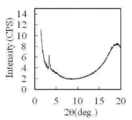
- the state of the phase separation structure and the liquid crystal structure in the cured epoxy resin can be determined, for example, by observation with a polarizing microscope. Whether or not the cured epoxy resin contains a smectic structure can also be determined by X-ray diffraction measurement. Specifically, for example, when X-ray analysis measurement is performed by the method described in the examples, if a diffraction peak exists in the range of 2 ⁇ of 1 ° to 10 °, the cured product includes a smectic structure. It can be judged that
- the phase separation structure includes a smectic structure, and the ratio of the smectic structure is preferably 60% or more, and more preferably 80% or more.
- the ratio of the smectic structure in the phase separation structure can be examined by observing the cross section of the cured product using a polarizing microscope or the like. In this case, the ratio (%) of the area corresponding to the smectic structure to the area of the entire visual field observed with the polarizing microscope can be obtained as the ratio of the smectic structure in the phase separation structure.
- the continuous phase contains a nematic structure and the domain phase (island part) is smectic from the viewpoint of increasing the toughness of the cured product. It preferably includes a structure.
- At least one of the phases constituting the phase separation structure includes a smectic structure, and the length of one period (period length) in the periodic structure is 2.0 nm to 3.0 nm. Preferably there is.
- a smectic structure having a periodic structure of 2.0 nm to 3.0 nm the regularity of the smectic structure is increased and higher toughness can be exhibited.
- Period in the periodic structure of the smectic structure is obtained, for example, by performing X-ray diffraction measurement by the method described in the Examples and converting the obtained diffraction angle by the Bragg equation.
- Epoxy resin (second embodiment) The epoxy resin of this embodiment can form a phase separation structure in a cured product obtained by heating at a rate of 20 ° C./min or less from room temperature (25 ° C.) to the curing temperature and curing at the curing temperature. It is an epoxy resin.
- a cured product obtained by curing an epoxy resin capable of forming a phase separation structure in a cured product obtained by curing under the above conditions is a phase separation structure in the cured product. It was found to be superior in toughness as compared with a cured product obtained by curing an epoxy resin that does not form a resin.
- the phase separation structure formed in the cured product is preferably composed of two or more phases, at least one of which includes a liquid crystal structure.
- details and preferred aspects of the phase separation structure details and preferred aspects of the phase separation structure formed in the cured epoxy resin of the first embodiment can be referred to.
- the rate of temperature increase when the temperature of the epoxy resin is increased from room temperature to the curing temperature at a rate of 20 ° C./min or less may be constant or may vary.
- the rate of temperature rise when raising the temperature of the epoxy resin from room temperature to the curing temperature is not particularly limited as long as it is 20 ° C./min or less, but is 15 ° C./min or less from the viewpoint of increasing the toughness of the resulting cured product. It is preferable.
- the lower limit of the rate of temperature increase when the temperature is raised is not particularly limited, but is preferably 0.1 ° C./min or more from the viewpoint of increasing the toughness of the obtained cured product, and is 5 ° C./min or more. Is more preferable.
- the epoxy resin preferably contains an epoxy compound (liquid crystalline epoxy compound) that forms a liquid crystal structure when cured as an epoxy compound.
- liquid crystalline epoxy compounds include epoxy compounds having a mesogenic structure in the molecule.
- the mesogen structure include a biphenyl structure, a phenylbenzoate structure, a cyclohexylbenzoate structure, an azobenzene structure, a stilbene structure, a terphenyl structure, an anthracene structure, derivatives thereof, and two or more of these mesogen structures via a bonding group. Examples include bonded structures.
- An epoxy compound having a mesogenic structure has a property that a higher order structure is formed in a cured product obtained by curing the epoxy compound.
- An epoxy compound having a mesogenic structure forms a higher order structure (also referred to as a periodic structure) derived from the mesogenic structure in a cured product obtained by reacting with a curing agent.
- the higher order structure means a state in which molecules of the epoxy compound are aligned in the cured product.
- the higher order structure formed in the cured product becomes a crystal structure or a liquid crystal structure.
- Whether or not a crystal structure or a liquid crystal structure is formed in the cured product can be confirmed directly by, for example, observation with a polarizing microscope under crossed Nicols or X-ray scattering (XRD).
- XRD X-ray scattering
- Examples of the liquid crystal structure derived from the mesogenic structure of the epoxy compound include a nematic structure and a smectic structure.
- the nematic structure is a liquid crystal structure in which the major axis of the molecule of the epoxy compound is oriented in a uniform direction and has only alignment order.
- the smectic structure is a liquid crystal structure having a one-dimensional positional order in addition to the orientation order and having a layer structure with a constant period.
- a domain in which the same periodic structure of the smectic structure is assembled is formed. Since the stress is dispersed by this domain, the cured product including the smectic structure tends to have better toughness than the cured product including the nematic structure.
- Examples of the epoxy compound having a mesogenic structure include an epoxy compound represented by the following general formula (A).
- X represents a linking group containing at least one selected from the group (I) consisting of the following divalent groups.
- Y is independently an aliphatic hydrocarbon group having 1 to 8 carbon atoms, an aliphatic alkoxy group having 1 to 8 carbon atoms, a fluorine atom, a chlorine atom, a bromine atom, an iodine atom, a cyano group, a nitro group, or an acetyl group.
- n independently represents an integer of 0 to 4.
- each Y independently represents an aliphatic hydrocarbon group having 1 to 8 carbon atoms, an aliphatic alkoxy group having 1 to 8 carbon atoms, a fluorine atom, a chlorine atom, a bromine atom, An iodine atom, a cyano group, a nitro group, or an acetyl group is shown.
- n independently represents an integer of 0 to 4
- k represents an integer of 0 to 7
- m represents an integer of 0 to 8
- l represents an integer of 0 to 12.
- each Y is preferably independently an aliphatic hydrocarbon group having 1 to 8 carbon atoms, preferably an alkyl group having 1 to 3 carbon atoms. More preferably, it is more preferably an alkyl group having 1 or 2 carbon atoms, and particularly preferably a methyl group.
- n, k, m and l are preferably each independently 0.
- the epoxy compound represented by the general formula (A) may be a compound in which X is a linking group each containing a divalent group represented by the following structure in the group (I).
- the liquid crystalline epoxy compound may be an epoxy compound having one or more structures represented by the following general formula (I).
- R 1 to R 4 each independently represents a hydrogen atom or an alkyl group having 1 to 3 carbon atoms.
- R 1 to R 4 are each independently preferably a hydrogen atom or an alkyl group having 1 to 2 carbon atoms, more preferably a hydrogen atom or a methyl group, and even more preferably a hydrogen atom.
- 2 to 4 of R 1 to R 4 are hydrogen atoms, more preferably 3 or 4 are hydrogen atoms, and more preferably that all 4 are hydrogen atoms.
- any of R 1 to R 4 is an alkyl group having 1 to 3 carbon atoms
- at least one of R 1 and R 4 is preferably an alkyl group having 1 to 3 carbon atoms.
- Examples of the epoxy compound having one structure represented by the general formula (I) include an epoxy compound represented by the following general formula (M).
- R 1 to R 4 in general formula (M) are the same as the specific examples of R 1 to R 4 in general formula (I), and preferred ranges thereof are also the same.
- the epoxy resin may be one containing a liquid crystalline epoxy compound and a multimer thereof (prepolymer).
- Liquid crystalline epoxy compounds are generally easy to crystallize and may have a lower solubility in solvents than other epoxy compounds.
- a prepolymer containing a multimer obtained by polymerizing a part of the liquid crystalline epoxy compound crystallization is suppressed and the moldability of the epoxy resin composition tends to be improved.
- the multimer of the liquid crystalline epoxy compound is not particularly limited as long as it contains a structure (preferably a mesogenic structure) derived from two or more liquid crystalline epoxy compounds in the molecule.
- a multimer of a liquid crystalline epoxy compound it is obtained by reacting a liquid crystalline epoxy compound with a compound having two or more functional groups capable of reacting with an epoxy group of the liquid crystalline epoxy compound (prepolymerizing agent).
- prepolymerizing agent The compound which can be mentioned is mentioned.
- the type of prepolymerizing agent is not particularly limited. From the viewpoint of forming a smectic structure in the cured product, a dihydroxybenzene compound having a structure in which two hydroxyl groups are bonded to one benzene ring, a diaminobenzene compound having a structure in which two amino groups are bonded to one benzene ring, It consists of a dihydroxybiphenyl compound having a structure in which one hydroxyl group is bonded to each of two benzene rings forming a biphenyl structure, and a diaminobiphenyl compound having a structure in which one amino group is bonded to each of two benzene rings forming a biphenyl structure. It is preferably at least one selected from the group (hereinafter also referred to as a specific aromatic compound).
- dihydroxybenzene compound examples include catechol, resorcinol, hydroquinone, and derivatives thereof.
- diaminobenzene compound examples include 1,2-diaminobenzene, 1,3-diaminobenzene, 1,4-diaminobenzene, and derivatives thereof.
- Dihydroxybiphenyl compounds include 2,2′-dihydroxybiphenyl, 2,3′-dihydroxybiphenyl, 2,4′-dihydroxybiphenyl, 3,3′-dihydroxybiphenyl, 3,4′-dihydroxybiphenyl, 4,4 ′ -Dihydroxybiphenyl, derivatives thereof and the like.
- Diaminobiphenyl compounds include 2,2'-diaminobiphenyl, 2,3'-diaminobiphenyl, 2,4'-diaminobiphenyl, 3,3'-diaminobiphenyl, 3,4'-diaminobiphenyl, 4,4 ' -Diaminobiphenyl, derivatives thereof and the like.
- Examples of the derivative of the specific aromatic compound include a compound in which a substituent such as an alkyl group having 1 to 8 carbon atoms is bonded to the benzene ring of the specific aromatic compound.
- a specific aromatic compound may be used individually by 1 type, and may use 2 or more types together.
- hydroquinone, 1,4-diaminobenzene, 4,4'-dihydroxybiphenyl (4,4'-biphenol), 4,4'-diaminobiphenyl and derivatives thereof are preferable. Since these compounds have a structure in which the functional group in the molecule is substituted so as to have a para-position, the multimer obtained by reacting with the liquid crystalline epoxy compound tends to have a linear structure. For this reason, it is considered that the stacking property of molecules is high, and it is easy to form a higher order structure in the cured product.
- a reaction catalyst may be used when the liquid crystalline epoxy compound is reacted with the prepolymerizing agent.
- the type of the reaction catalyst is not particularly limited, and an appropriate catalyst can be selected from the viewpoint of reaction rate, reaction temperature, storage stability, and the like. Specific examples include imidazole compounds, organophosphorus compounds, tertiary amines, and quaternary ammonium salts.
- a reaction catalyst may be used individually by 1 type, and may use 2 or more types together.
- the ratio of the multimer in the prepolymer, the molecular weight of the multimer, and the like can be adjusted by adjusting the blending ratio of the two.
- the compounding ratio may be such that the equivalent ratio of the epoxy group of the liquid crystalline epoxy compound to the functional group of the prepolymerizing agent (epoxy group / functional group) is 100/5 to 100/50.
- the compounding ratio may be 100/30.
- the multimer is an epoxy compound having a structure represented by the following general formula (1-A) or general formula (1-B). There may be.
- R 1 and R 2 each independently represents an alkyl group having 1 to 8 carbon atoms, preferably an alkyl group having 1 to 3 carbon atoms, and more preferably a methyl group.
- Each m independently represents an integer of 0 to 4.
- Z independently represents —O— or —NH—.
- the epoxy compound having a structure represented by the general formula (1-A) is preferably an epoxy compound having a structure represented by the following general formula (2-A),
- the epoxy compound having a structure represented by the general formula (1-B) is preferably an epoxy compound having a structure represented by the following general formula (2-B).
- Examples of the epoxy compound represented by the general formula (1-A) and having the structure represented by the general formula (I) include those represented by the following general formula (3-A-1) and general formula (3-A-2).
- Examples of the epoxy compound represented by the general formula (1-B) and having the structure represented by the general formula (I) include those represented by the following general formula (3-B-1) and general formula (3-B-2).
- R 3 to R 6 are each independently Represents a hydrogen atom or an alkyl group having 1 to 3 carbon atoms. Further, the definition and preferred examples of R 1, R 2, m and Z, as well as definitions and preferred examples of R 1, R 2, m and Z of formula (1-A) and formula (1-B) It is.
- the number of structures derived from the liquid crystalline epoxy compound is not particularly limited as long as it is 2 or more. From the viewpoint of reducing the viscosity during work, it is preferable that at least a part of the multimer of the liquid crystalline epoxy compound is an epoxy compound (dimer compound) containing two structures derived from the liquid crystalline epoxy compound.
- Examples of the structure when the multimer of the liquid crystalline epoxy compound is a dimer compound include an epoxy compound represented by the following general formula (4-A-1) or the following general formula (4-B-1). .
- the epoxy compound having a structure represented by the general formula (4-A-1) has a structure represented by the following general formula (5-A-1).
- the epoxy compound having a structure represented by the general formula (4-B-1) is an epoxy compound having a structure represented by the following general formula (5-B-1) It is preferable.
- Specific examples of the epoxy compound represented by the general formula (4-A-1) and having the structure represented by the general formula (I) include the following general formulas (6-A-1) to (6-A- The epoxy compound which has a structure represented by 3) is mentioned.
- Specific examples of the epoxy compound represented by the general formula (4-B-1) and having the structure represented by the general formula (I) include the following general formulas (6-B-1) to (6-B- The epoxy compound which has a structure represented by 3) is mentioned.
- Z and Z are R 3 to R 6 in the general formula (3-A-1), (3-A-2), (3-B-1) or the general formula (3-B-2).
- R 1 , R 2 , m and Z are the same as defined and preferred examples.
- the epoxy resin may include a liquid crystal epoxy compound A and an epoxy compound B having a structure different from that of the liquid crystal epoxy compound A (except for a multimer of the liquid crystal epoxy compound A).
- the epoxy resin contains the liquid crystalline epoxy compound A and the epoxy compound B having a structure different from that of the liquid crystalline epoxy compound A, a phase separation structure is formed in the cured product as compared with the case where only the liquid crystalline epoxy compound A is contained. It may be easier.
- the epoxy compound B is an epoxy compound that is not liquid crystalline even if it is a liquid crystalline epoxy compound (by itself)
- the liquid crystal structure may not be formed when cured).
- the epoxy compound B forms a liquid crystal structure different from the liquid crystal structure formed by the liquid crystalline epoxy compound A, or an epoxy compound that does not form a liquid crystal structure. It is preferable that
- the type of the epoxy compound B is not particularly limited.
- the epoxy compound B preferably contains a biphenyl type epoxy compound or a bisphenol type epoxy compound.
- Examples of the biphenyl type epoxy compound include an epoxy compound represented by the following general formula (B).
- each Z independently represents an aliphatic hydrocarbon group having 1 to 8 carbon atoms, an aliphatic alkoxy group having 1 to 8 carbon atoms, a fluorine atom, a chlorine atom, a bromine atom, an iodine atom, or a cyano group.
- n independently represents an integer of 0 to 4.
- each Z is preferably independently an aliphatic hydrocarbon group having 1 to 8 carbon atoms, and more preferably a methyl group. In addition, it is preferable that each Z is independently in the meta position with respect to the position of the single bond of the biphenyl structure.
- Each n is preferably independently 1 to 3, more preferably 1 or 2.
- Examples of the compound represented by the general formula (B) include epoxy compounds represented by the following structure (R is independently a hydrogen atom or a methyl group).
- Examples of the bisphenol type epoxy compound include glycidyl ethers of phenol compounds such as bisphenol A, bisphenol F, and bisphenol S.
- Examples of the epoxy compound B not corresponding to the biphenyl type epoxy compound or the bisphenol type epoxy compound include glycidyl ethers of alcohol compounds such as butanediol, polyethylene glycol, and polypropylene glycol; glycidyls of carboxylic acid compounds such as phthalic acid, isophthalic acid, and tetrahydrophthalic acid.
- esters Glycidyl-type (including methylglycidyl-type) epoxy monomers such as those in which active hydrogen bonded to nitrogen atoms such as aniline and isocyanuric acid is substituted with glycidyl groups; Vinylcyclohexene epoxides obtained by epoxidizing intramolecular olefinic bonds 3,4-epoxycyclohexylmethyl-3,4-epoxycyclohexanecarboxylate, 2- (3,4-epoxy) cyclohexyl-5,5-spiro (3,4-ethyl) Xyl) cyclohexane-m-dioxane and other alicyclic epoxy monomers; epoxidized bis (4-hydroxy) thioether; paraxylylene-modified phenolic resin, metaxylylene-paraxylylene-modified phenolic resin, terpene-modified phenolic resin, dicyclopentadiene-modified
- the ratio of the epoxy compound B is not particularly limited.
- the liquid crystalline epoxy compound A when the liquid crystalline epoxy compound A is 1, it is preferably 0.3 or less, more preferably 0.2 or less, and even more preferably 0.1 or less.
- the lower limit of the ratio of the epoxy compound B is not particularly limited, but may be 0.01 or more when the liquid crystalline epoxy compound A is 1.
- the epoxy resin composition of the present disclosure includes the above-described epoxy resin and a curing agent.
- the curing agent is not particularly limited as long as it can cause a curing reaction with the epoxy resin. Specific examples include amine curing agents, phenol curing agents, acid anhydride curing agents, polymercaptan curing agents, polyaminoamide curing agents, isocyanate curing agents, and blocked isocyanate curing agents.
- curing agent may be used individually by 1 type, or may use 2 or more types together.
- the curing agent is preferably an amine curing agent or a phenol curing agent, more preferably an amine curing agent, and two or more amino groups directly bonded to the aromatic ring. More preferably, it is a compound having an aromatic amine.
- amine curing agents include 3,3′-diaminodiphenylsulfone, 4,4′-diaminodiphenylsulfone, 4,4′-diaminodiphenylmethane, 4,4′-diaminodiphenyl ether, 4,4′-diamino- 3,3'-dimethoxybiphenyl, 4,4'-diaminophenylbenzoate, 1,5-diaminonaphthalene, 1,3-diaminonaphthalene, 1,4-diaminonaphthalene, 1,8-diaminonaphthalene, 1,3-diamino Examples include benzene, 1,4-diaminobenzene, 4,4′-diaminobenzanilide, trimethylene-bis-4-aminobenzoate, and the like.
- Examples of the phenol curing agent include a low molecular phenol compound and a phenol novolac resin obtained by connecting a low molecular phenol compound with a methylene chain to form a novolac.
- Low molecular phenol compounds include monofunctional phenol compounds such as phenol, o-cresol, m-cresol, and p-cresol, bifunctional phenol compounds such as catechol, resorcinol, hydroquinone, 1,2,3-trihydroxybenzene, 1 , 2,4-trihydroxybenzene, trifunctional phenol compounds such as 1,3,5-trihydroxybenzene and the like.
- the content of the curing agent in the epoxy resin composition is not particularly limited. From the viewpoint of the efficiency of the curing reaction, the ratio between the number of equivalents of the functional group of the curing agent contained in the epoxy resin composition and the number of equivalents of the epoxy group of the epoxy resin (number of equivalents of functional group / number of equivalents of epoxy group) ) Is preferably from 0.3 to 3.0, more preferably from 0.5 to 2.0.
- the epoxy resin composition may contain a filler.
- a filler ceramic fibers, ceramic particles, rubber particles, and the like can be used from the viewpoint of strength and toughness.
- the content of the filler is preferably 10% by mass or more, more preferably 20% by mass to 90% by mass, and further preferably 30% by mass to 80% by mass in the total solid content.
- the epoxy resin composition may further contain a sizing material, a coupling agent, a dispersant, an elastomer, a solvent, and the like. From the viewpoint of forming a smectic structure in the cured product, the smaller the content of the solvent, the better. Specifically, the content of the solvent in the epoxy resin composition is preferably 10% by mass or less, more preferably 1% by mass or less, and further preferably 0.1% by mass or less. .
- the content rate of the epoxy resin contained in the epoxy resin composition is not particularly limited, and can be selected according to the use.
- the content of the epoxy resin is preferably 5% by volume to 40% by volume in the total solid content of the epoxy resin composition. % To 35% by volume is more preferable, 15% to 35% by volume is more preferable, and 15% to 30% by volume is particularly preferable.
- the volume-based content of the epoxy resin in the total solid content of the epoxy resin composition is a value determined by the following formula.
- each variable is as follows.
- Aw Mass composition ratio of filler (% by mass)
- Bw mass composition ratio of epoxy resin (mass%)
- Cw mass composition ratio (% by mass) of curing agent
- Dw mass composition ratio (% by mass) of other optional components (excluding solvent)
- Ad Specific gravity of filler
- Bd Specific gravity of epoxy resin
- Cd Specific gravity of curing agent
- Dd Specific gravity of other optional components (excluding solvent)
- the epoxy resin composition of the present disclosure exhibits excellent toughness when cured. Moreover, the hardened
- the method for producing a cured epoxy resin of the present disclosure includes a step of raising the temperature of the epoxy resin composition described above from room temperature (25 ° C.) to a curing temperature at a rate of 20 ° C./min or less, Curing.
- the phase separation structure can be efficiently formed in the cured epoxy resin. Moreover, the epoxy resin hardened
- the temperature increase rate in the step of increasing the temperature of the epoxy resin from room temperature to the curing temperature at a rate of 20 ° C./min or less may be constant or may vary.
- the rate of temperature rise when raising the temperature of the epoxy resin from room temperature to the curing temperature is not particularly limited as long as it is 20 ° C./min or less, but is 15 ° C./min or less from the viewpoint of increasing the toughness of the resulting cured product. It is preferable.
- the lower limit of the rate of temperature increase when the temperature is raised is not particularly limited, but is preferably 0.1 ° C./min or more from the viewpoint of increasing the toughness of the obtained cured product, and is 5 ° C./min or more. Is more preferable.
- the cured epoxy resin of this embodiment is composed of two or more phases, and at least one of them has a phase separation structure including a liquid crystal structure.
- An epoxy resin cured product composed of two or more phases and at least one of which has a phase separation structure including a liquid crystal structure is superior in toughness as compared with a cured epoxy resin material having no such phase separation structure. Yes.
- phase separation structure of the cured epoxy resin are the same as the details and preferred embodiments of the phase separation structure formed in the cured product obtained using the above-described epoxy resin.
- the composite material of the present disclosure includes the above-described cured epoxy resin and a reinforcing material.
- the material of the reinforcing material included in the composite material is not particularly limited and can be selected according to the use of the composite material.
- Specific examples of the reinforcing material include carbon materials, glass, aromatic polyamide resins (for example, Kevlar (registered trademark)), ultrahigh molecular weight polyethylene, alumina, boron nitride, aluminum nitride, mica, silicon, and the like.
- the shape of the reinforcing material is not particularly limited, and examples thereof include fibrous and particulate (filler). From the viewpoint of the strength of the composite material, the reinforcing material is preferably a carbon material, and more preferably a carbon fiber.
- the reinforcing material contained in the composite material may be one type or two or more types.
- the insulating member of the present disclosure includes the above-described cured epoxy resin or composite material.
- Examples of the insulating member include an insulating base material, an insulating film such as an electric / electronic component, and a molding material.
- An electronic device according to the present disclosure includes the insulating member described above. Examples of the electronic device include home appliances and communication devices.
- the structural material of the present disclosure includes the above-described cured epoxy resin or composite material. Examples of the structural material include a moving body, a building material, a housing for home appliances, and other various articles.
- the moving body of the present disclosure includes the above-described structural material. Examples of the moving body include an automobile, a ship, a railway vehicle, and an airplane.
- a prepolymer (hereinafter also referred to as “resin 1”) was synthesized. In the synthesis, triphenylphosphine was used as a reaction catalyst and cyclohexanone was used as a synthesis solvent.
- An epoxy compound represented by the following structure (trade name “YX4000H”, Mitsubishi Chemical Corporation, hereinafter also referred to as “resin 2”) was added to resin 1 to prepare a mixture.
- the amount of resin 2 in the mixture was set to 0.05 when the amount of resin 1 was 1 on a mass basis.
- 3,3-diaminodiphenylsulfone as a curing agent was added so that the ratio of the number of equivalents of active hydrogen in the curing agent to the number of equivalents of epoxy groups in the mixture was 1: 1, and a liquid crystalline epoxy resin was added.
- a composition was prepared. Next, the liquid crystalline epoxy resin composition was once heated to 180 ° C. and then cooled to room temperature (25 ° C.) so that the curing agent was uniformly mixed.
- the prepared epoxy resin composition is heated from normal temperature (25 ° C.) to a curing temperature (150 ° C.) at a rate of temperature increase of 2 ° C./min, and kept at this temperature for 2 hours to cure the epoxy resin composition, An epoxy resin cured product was obtained.
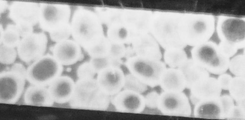
- FIG. 1 is a photograph of the cured epoxy resin (800 ⁇ m thickness, 4 mm width) obtained in Example 1. As shown in FIG. 1, the phase-separation structure which consists of a sea part and an island part has been confirmed visually.
- FIG. 2 is a photograph showing a state where the cured epoxy resin (800 ⁇ m thickness, 4 mm width) obtained in Example 1 is bent with a finger. As shown in FIG. 2, the cured epoxy resin had high flexibility.
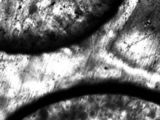
- FIG. 3 is a polarizing micrograph of the surface of the cured epoxy resin obtained in Example 1. A nematic structure was observed in the central area corresponding to the sea, and a smectic structure was observed in the upper and lower areas corresponding to the island.
- d is the length of one period
- ⁇ is the diffraction angle
- n the reflection order
- ⁇ is the X-ray wavelength (0.15406 nm).
- FIG. 4 is an XRD measurement result showing that a smectic structure is formed in the cured epoxy resin obtained in Example 1.
- the fracture toughness value (MPa ⁇ m 1/2 ) was measured as an index for evaluating the toughness of the cured epoxy resin. Specifically, a test piece (3.75 mm ⁇ 7.5 mm ⁇ 33 mm) of a cured epoxy resin was prepared, and calculation was performed by performing a three-point bending measurement based on ASTM D5045 using this test piece. Instron 5948 (Instron) was used as an evaluation apparatus. The results are shown in Table 1.
- Example 2 An epoxy resin composition was prepared in the same manner as in Example 1 except that the amount of Resin 2 was 0.1 when the amount of Resin 1 was 1 on a mass basis. A cured resin was prepared. In the same manner as in Example 1, the presence / absence of the phase separation structure, the state of the periodic structure, the state of the liquid crystal structure, and the toughness were evaluated.
- Example 3 the same amount of epoxy compound represented by the following structure (trade name “YL6121H”, a mixture in which R is a methyl compound and R is a hydrogen compound having a mass ratio of 1: 1, Mitsubishi Chemical Corporation)
- the epoxy resin composition was prepared in the same manner as in Example 1 except that it was changed to “resin 3”), and a cured epoxy resin was produced.
- the presence / absence of the phase separation structure, the state of the periodic structure, the state of the liquid crystal structure, and the toughness were evaluated.
- Example 4 an epoxy resin composition was prepared in the same manner as in Example 2 except that the resin 2 was changed to the same amount of resin 3, and a cured epoxy resin was produced. In the same manner as in Example 1, the presence / absence of the phase separation structure, the state of the periodic structure, the state of the liquid crystal structure, and the toughness were evaluated.
- Example 5 In the synthesis of Resin 1, the prepolymerizing agent is changed to hydroquinone, and the prepolymer (hereinafter referred to as “resin 4”) is reacted with the compounding amount as 10 / 2.0 in terms of molar ratio (liquid crystalline epoxy compound / hydroquinone). Was synthesized. Next, an epoxy resin composition was prepared in the same manner as in Example 1 except that the resin 1 was changed to the same amount of resin 4, and a cured epoxy resin was produced. In the same manner as in Example 1, the presence / absence of the phase separation structure, the state of the periodic structure, the state of the liquid crystal structure, and the toughness were evaluated.
- Example 6 an epoxy resin composition was prepared in the same manner as in Example 2 except that the resin 1 was changed to the same amount of the resin 4, and a cured epoxy resin was produced. In the same manner as in Example 1, the presence / absence of the phase separation structure, the state of the periodic structure, the state of the liquid crystal structure, and the toughness were evaluated.
- Example 7 the epoxy resin was changed to the same amount of bisphenol A type epoxy compound (trade name “jER828”, Mitsubishi Chemical Corporation, hereinafter also referred to as “resin 5”) in the same manner as in Example 2, except that A resin composition was prepared to produce a cured epoxy resin.
- the presence / absence of the phase separation structure, the state of the periodic structure, the state of the liquid crystal structure, and the toughness were evaluated.
- Example 8 an epoxy resin composition was prepared in the same manner as in Example 1 except that the amount of the resin 2 was 0.15 when the amount of the resin 1 was 1 on the mass basis, and the epoxy resin A cured resin was prepared. In the same manner as in Example 1, the presence / absence of the phase separation structure, the state of the periodic structure, the state of the liquid crystal structure, and the toughness were evaluated.
- Example 9 An epoxy resin composition was prepared in the same manner as in Example 2 except that the rate of temperature increase to the curing temperature was 10 ° C./min, and a cured epoxy resin was produced. In the same manner as in Example 1, the presence / absence of the phase separation structure, the state of the periodic structure, the state of the liquid crystal structure, and the toughness were evaluated.
- Example 10 an epoxy resin composition was prepared in the same manner as in Example 2 except that resin 4 was further added in an amount of 50% by mass of resin 1, and a cured epoxy resin was produced. In the same manner as in Example 1, the presence / absence of the phase separation structure, the state of the periodic structure, the state of the liquid crystal structure, and the toughness were evaluated.
- Example 1 an epoxy resin composition was prepared in the same manner as in Example 1 except that only the resin 2 was used as the epoxy resin, and a cured epoxy resin was produced. In the same manner as in Example 1, the presence / absence of the phase separation structure, the state of the periodic structure, the state of the liquid crystal structure, and the toughness were evaluated.
- Example 2 An epoxy resin composition was prepared in the same manner as in Example 1 except that only the resin 3 was used as the epoxy resin, and a cured epoxy resin was produced. In the same manner as in Example 1, the presence / absence of the phase separation structure, the state of the periodic structure, the state of the liquid crystal structure, and the toughness were evaluated.
- Example 3 An epoxy resin composition was prepared in the same manner as in Example 1 except that only the resin 5 was used as the epoxy resin, and a cured epoxy resin was produced. In the same manner as in Example 1, the presence / absence of the phase separation structure, the state of the periodic structure, the state of the liquid crystal structure, and the toughness were evaluated.
- Example 2 an epoxy resin composition was prepared in the same manner as in Example 2 except that the resin 1 was replaced with the same amount of resin 5, and a cured epoxy resin was produced. In the same manner as in Example 1, the presence / absence of the phase separation structure, the state of the periodic structure, the state of the liquid crystal structure, and the toughness were evaluated.
- Example 5 an epoxy resin composition was prepared in the same manner as in Example 1 except that the rate of temperature increase to the curing temperature was 50 ° C./min, and a cured epoxy resin was produced. In the same manner as in Example 1, the presence / absence of the phase separation structure, the state of the periodic structure, the state of the liquid crystal structure, and the toughness were evaluated.
Landscapes
- Chemical & Material Sciences (AREA)
- Health & Medical Sciences (AREA)
- Chemical Kinetics & Catalysis (AREA)
- Medicinal Chemistry (AREA)
- Polymers & Plastics (AREA)
- Organic Chemistry (AREA)
- Engineering & Computer Science (AREA)
- Manufacturing & Machinery (AREA)
- Materials Engineering (AREA)
- Epoxy Resins (AREA)
- Reinforced Plastic Materials (AREA)
Abstract
Priority Applications (5)
| Application Number | Priority Date | Filing Date | Title |
|---|---|---|---|
| US16/971,307 US12104009B2 (en) | 2018-02-22 | 2018-02-22 | Epoxy resin, epoxy resin composition, epoxy resin cured product and method of producing epoxy resin cured product, composite material, insulating member, electronic appliance, structural material, and vehicle |
| JP2020501934A JP7095732B2 (ja) | 2018-02-22 | 2018-02-22 | エポキシ樹脂、エポキシ樹脂組成物、エポキシ樹脂硬化物及びその製造方法、複合材料、絶縁部材、電子機器、構造材料並びに移動体 |
| PCT/JP2018/006565 WO2019163067A1 (fr) | 2018-02-22 | 2018-02-22 | Résines époxydiques, composition de résine époxydique, résine époxydique durcie et leur procédé de production, matériau composite, élément isolant, appareil électronique, matériau structural et objet mobile |
| EP18907389.3A EP3757148B1 (fr) | 2018-02-22 | 2018-02-22 | Résine époxydiques, composition de résine époxydique, résine époxydique durcie et matériau composite |
| US18/817,654 US20240417509A1 (en) | 2018-02-22 | 2024-08-28 | Epoxy resin, epoxy resin composition, epoxy resin cured product and method of producing epoxy resin cured product, composite material, insulating member, electronic appliance, structural material, and vehicle |
Applications Claiming Priority (1)
| Application Number | Priority Date | Filing Date | Title |
|---|---|---|---|
| PCT/JP2018/006565 WO2019163067A1 (fr) | 2018-02-22 | 2018-02-22 | Résines époxydiques, composition de résine époxydique, résine époxydique durcie et leur procédé de production, matériau composite, élément isolant, appareil électronique, matériau structural et objet mobile |
Related Child Applications (2)
| Application Number | Title | Priority Date | Filing Date |
|---|---|---|---|
| US16/971,307 A-371-Of-International US12104009B2 (en) | 2018-02-22 | 2018-02-22 | Epoxy resin, epoxy resin composition, epoxy resin cured product and method of producing epoxy resin cured product, composite material, insulating member, electronic appliance, structural material, and vehicle |
| US18/817,654 Division US20240417509A1 (en) | 2018-02-22 | 2024-08-28 | Epoxy resin, epoxy resin composition, epoxy resin cured product and method of producing epoxy resin cured product, composite material, insulating member, electronic appliance, structural material, and vehicle |
Publications (1)
| Publication Number | Publication Date |
|---|---|
| WO2019163067A1 true WO2019163067A1 (fr) | 2019-08-29 |
Family
ID=67687176
Family Applications (1)
| Application Number | Title | Priority Date | Filing Date |
|---|---|---|---|
| PCT/JP2018/006565 Ceased WO2019163067A1 (fr) | 2018-02-22 | 2018-02-22 | Résines époxydiques, composition de résine époxydique, résine époxydique durcie et leur procédé de production, matériau composite, élément isolant, appareil électronique, matériau structural et objet mobile |
Country Status (4)
| Country | Link |
|---|---|
| US (2) | US12104009B2 (fr) |
| EP (1) | EP3757148B1 (fr) |
| JP (1) | JP7095732B2 (fr) |
| WO (1) | WO2019163067A1 (fr) |
Families Citing this family (2)
| Publication number | Priority date | Publication date | Assignee | Title |
|---|---|---|---|---|
| WO2021230326A1 (fr) * | 2020-05-14 | 2021-11-18 | 昭和電工マテリアルズ株式会社 | Apprêt, substrat doté d'une couche d'apprêt, procédé de production d'un substrat doté d'une couche d'apprêt, dispositif à semi-conducteur et procédé de production de dispositif à semi-conducteur |
| US12065562B2 (en) * | 2022-01-17 | 2024-08-20 | National Technology & Engineering Solutions Of Sandia, Llc | Method of tuning physical properties of thermosets |
Citations (8)
| Publication number | Priority date | Publication date | Assignee | Title |
|---|---|---|---|---|
| JP2010001427A (ja) | 2008-06-23 | 2010-01-07 | Nippon Kayaku Co Ltd | エポキシ樹脂、エポキシ樹脂組成物、およびその硬化物 |
| JP2010018679A (ja) * | 2008-07-09 | 2010-01-28 | Mitsubishi Electric Corp | 絶縁組成物及びそれを含有する絶縁シート |
| JP2011074366A (ja) | 2009-09-03 | 2011-04-14 | Sumitomo Chemical Co Ltd | ジエポキシ化合物、該化合物を含む組成物及び該組成物を硬化して得られる硬化物 |
| JP2013194166A (ja) * | 2012-03-21 | 2013-09-30 | Tdk Corp | 樹脂シート、積層板及びプリント配線板 |
| JP2016113540A (ja) * | 2014-12-15 | 2016-06-23 | 日立化成株式会社 | エポキシ樹脂組成物、樹脂シート、半硬化エポキシ樹脂組成物、硬化エポキシ樹脂組成物及び金属基板 |
| JP2017123252A (ja) * | 2016-01-06 | 2017-07-13 | 日立化成株式会社 | プリプレグマイカテープ |
| WO2017145412A1 (fr) * | 2016-02-25 | 2017-08-31 | 日立化成株式会社 | Feuille de résine et feuille de résine durcie |
| JP2018002809A (ja) * | 2016-06-29 | 2018-01-11 | 日立化成株式会社 | エポキシ樹脂組成物、成形材前駆体、及び成形材 |
Family Cites Families (12)
| Publication number | Priority date | Publication date | Assignee | Title |
|---|---|---|---|---|
| JP3605556B2 (ja) | 1993-02-24 | 2004-12-22 | イビデン株式会社 | 擬似均一相溶構造を有する樹脂複合体 |
| TWI435887B (zh) * | 2008-02-26 | 2014-05-01 | Toray Industries | 環氧樹脂組成物、預浸透物及纖維強化複合材料 |
| JP2013006893A (ja) * | 2011-06-22 | 2013-01-10 | Hitachi Chemical Co Ltd | 高熱伝導樹脂組成物、高熱伝導性硬化物、接着フィルム、封止用フィルム、及びこれらを用いた半導体装置 |
| TWI545155B (zh) | 2012-06-05 | 2016-08-11 | 三菱麗陽股份有限公司 | 環氧樹脂組成物、預浸絲束、複合材料補強壓力容器以及鋼腱 |
| JP2014091744A (ja) * | 2012-10-31 | 2014-05-19 | 3M Innovative Properties Co | アンダーフィル組成物、半導体装置およびその製造方法 |
| CN107108856B (zh) * | 2014-12-26 | 2022-05-31 | 昭和电工材料株式会社 | 环氧树脂、环氧树脂组合物、含有无机填料的环氧树脂组合物、树脂片、固化物以及环氧化合物 |
| WO2018070053A1 (fr) * | 2016-10-14 | 2018-04-19 | 日立化成株式会社 | Résine époxyde, composition de résine époxyde, produit de résine époxyde durci, et matériau composite |
| WO2018070051A1 (fr) * | 2016-10-14 | 2018-04-19 | 日立化成株式会社 | Résine époxy, composition de résine époxy, objet durci de résine époxy, et matériau composite |
| KR102686755B1 (ko) * | 2016-10-14 | 2024-07-18 | 가부시끼가이샤 레조낙 | 에폭시 수지, 에폭시 수지 조성물, 에폭시 수지 경화물 및 복합 재료 |
| CN110418810B (zh) * | 2017-03-15 | 2023-03-28 | 日立化成株式会社 | 环氧树脂、环氧树脂组合物、环氧树脂固化物及复合材料 |
| US11440990B2 (en) * | 2017-09-29 | 2022-09-13 | Showa Denko Materials Co., Ltd. | Epoxy resin, epoxy resin composition, epoxy resin cured product, and composite material |
| US11919995B2 (en) * | 2018-02-19 | 2024-03-05 | Resonac Corporation | Epoxy resin, epoxy resin composition, epoxy resin cured product, and composite material |
-
2018
- 2018-02-22 JP JP2020501934A patent/JP7095732B2/ja active Active
- 2018-02-22 US US16/971,307 patent/US12104009B2/en active Active
- 2018-02-22 EP EP18907389.3A patent/EP3757148B1/fr active Active
- 2018-02-22 WO PCT/JP2018/006565 patent/WO2019163067A1/fr not_active Ceased
-
2024
- 2024-08-28 US US18/817,654 patent/US20240417509A1/en active Pending
Patent Citations (8)
| Publication number | Priority date | Publication date | Assignee | Title |
|---|---|---|---|---|
| JP2010001427A (ja) | 2008-06-23 | 2010-01-07 | Nippon Kayaku Co Ltd | エポキシ樹脂、エポキシ樹脂組成物、およびその硬化物 |
| JP2010018679A (ja) * | 2008-07-09 | 2010-01-28 | Mitsubishi Electric Corp | 絶縁組成物及びそれを含有する絶縁シート |
| JP2011074366A (ja) | 2009-09-03 | 2011-04-14 | Sumitomo Chemical Co Ltd | ジエポキシ化合物、該化合物を含む組成物及び該組成物を硬化して得られる硬化物 |
| JP2013194166A (ja) * | 2012-03-21 | 2013-09-30 | Tdk Corp | 樹脂シート、積層板及びプリント配線板 |
| JP2016113540A (ja) * | 2014-12-15 | 2016-06-23 | 日立化成株式会社 | エポキシ樹脂組成物、樹脂シート、半硬化エポキシ樹脂組成物、硬化エポキシ樹脂組成物及び金属基板 |
| JP2017123252A (ja) * | 2016-01-06 | 2017-07-13 | 日立化成株式会社 | プリプレグマイカテープ |
| WO2017145412A1 (fr) * | 2016-02-25 | 2017-08-31 | 日立化成株式会社 | Feuille de résine et feuille de résine durcie |
| JP2018002809A (ja) * | 2016-06-29 | 2018-01-11 | 日立化成株式会社 | エポキシ樹脂組成物、成形材前駆体、及び成形材 |
Non-Patent Citations (1)
| Title |
|---|
| See also references of EP3757148A4 |
Also Published As
| Publication number | Publication date |
|---|---|
| US12104009B2 (en) | 2024-10-01 |
| US20200385512A1 (en) | 2020-12-10 |
| JPWO2019163067A1 (ja) | 2021-02-18 |
| US20240417509A1 (en) | 2024-12-19 |
| EP3757148B1 (fr) | 2025-10-08 |
| EP3757148A4 (fr) | 2021-07-07 |
| JP7095732B2 (ja) | 2022-07-05 |
| EP3757148A1 (fr) | 2020-12-30 |
Similar Documents
| Publication | Publication Date | Title |
|---|---|---|
| US20240417509A1 (en) | Epoxy resin, epoxy resin composition, epoxy resin cured product and method of producing epoxy resin cured product, composite material, insulating member, electronic appliance, structural material, and vehicle | |
| JP6891901B2 (ja) | エポキシ樹脂、エポキシ樹脂組成物、エポキシ樹脂硬化物及び複合材料 | |
| EP3476878A1 (fr) | Matériau barrière au gaz, composition de résine, matière barrière au gaz, produit durci, et matériau composite | |
| WO2018168556A1 (fr) | Résine époxyde, composition de résine époxyde, produit durci de résine époxyde et matériau composite | |
| KR102481902B1 (ko) | 유리상 액정성 에폭시 수지 및 유리상 액정성 에폭시 수지 조성물의 제조 방법, 액정성 에폭시 수지 및 액정성 에폭시 수지 조성물의 보존 방법, 유리상 액정성 에폭시 수지 및 유리상 액정성 에폭시 수지 조성물, 액정성 에폭시 수지 및 액정성 에폭시 수지 조성물, 및 에폭시 수지 경화물의 제조 방법 | |
| JP2023099224A (ja) | エポキシ樹脂、エポキシ樹脂組成物、エポキシ樹脂硬化物及び複合材料 | |
| JP6866939B2 (ja) | エポキシ樹脂、エポキシ樹脂組成物、エポキシ樹脂硬化物及び複合材料 | |
| JP7176308B2 (ja) | 液晶性エポキシ樹脂組成物、液晶性エポキシ樹脂硬化物、複合材料、絶縁材料、電子機器、構造材料、及び移動体 | |
| JP7243093B2 (ja) | エポキシ樹脂、エポキシ樹脂組成物、エポキシ樹脂硬化物及び複合材料 | |
| JP7003999B2 (ja) | エポキシ樹脂、エポキシ樹脂組成物、エポキシ樹脂硬化物及び複合材料 | |
| JP7004000B2 (ja) | エポキシ樹脂、エポキシ樹脂組成物、エポキシ樹脂硬化物及び複合材料 | |
| JP7342852B2 (ja) | エポキシ樹脂組成物、エポキシ樹脂フィルム、及びエポキシ樹脂フィルムの製造方法 | |
| CA3049751C (fr) | Compositions de resine epoxydique cristalline liquide vitreuse et methodes de fabrication | |
| KR102408630B1 (ko) | 에폭시 수지, 에폭시 수지 조성물, 에폭시 수지 경화물 및 복합 재료 | |
| JP2020143192A (ja) | エポキシ樹脂、エポキシ樹脂組成物、エポキシ樹脂硬化物及び複合材料 | |
| JP2017218468A (ja) | エポキシ樹脂組成物、成形材前駆体、成形材、及び成形材の製造方法 |
Legal Events
| Date | Code | Title | Description |
|---|---|---|---|
| 121 | Ep: the epo has been informed by wipo that ep was designated in this application |
Ref document number: 18907389 Country of ref document: EP Kind code of ref document: A1 |
|
| ENP | Entry into the national phase |
Ref document number: 2020501934 Country of ref document: JP Kind code of ref document: A |
|
| NENP | Non-entry into the national phase |
Ref country code: DE |
|
| ENP | Entry into the national phase |
Ref document number: 2018907389 Country of ref document: EP Effective date: 20200922 |
|
| WWG | Wipo information: grant in national office |
Ref document number: 2018907389 Country of ref document: EP |