WO2019163520A1 - 粉末製剤、カートリッジ、及びデバイス - Google Patents
粉末製剤、カートリッジ、及びデバイス Download PDFInfo
- Publication number
- WO2019163520A1 WO2019163520A1 PCT/JP2019/004331 JP2019004331W WO2019163520A1 WO 2019163520 A1 WO2019163520 A1 WO 2019163520A1 JP 2019004331 W JP2019004331 W JP 2019004331W WO 2019163520 A1 WO2019163520 A1 WO 2019163520A1
- Authority
- WO
- WIPO (PCT)
- Prior art keywords
- powder
- powder preparation
- air pressure
- region
- powder formulation
- Prior art date
- Legal status (The legal status is an assumption and is not a legal conclusion. Google has not performed a legal analysis and makes no representation as to the accuracy of the status listed.)
- Ceased
Links
Images


Classifications
-
- A—HUMAN NECESSITIES
- A61—MEDICAL OR VETERINARY SCIENCE; HYGIENE
- A61K—PREPARATIONS FOR MEDICAL, DENTAL OR TOILETRY PURPOSES
- A61K9/00—Medicinal preparations characterised by special physical form
- A61K9/0012—Galenical forms characterised by the site of application
- A61K9/0043—Nose
-
- A—HUMAN NECESSITIES
- A61—MEDICAL OR VETERINARY SCIENCE; HYGIENE
- A61K—PREPARATIONS FOR MEDICAL, DENTAL OR TOILETRY PURPOSES
- A61K9/00—Medicinal preparations characterised by special physical form
- A61K9/14—Particulate form, e.g. powders, Processes for size reducing of pure drugs or the resulting products, Pure drug nanoparticles
-
- A—HUMAN NECESSITIES
- A61—MEDICAL OR VETERINARY SCIENCE; HYGIENE
- A61K—PREPARATIONS FOR MEDICAL, DENTAL OR TOILETRY PURPOSES
- A61K45/00—Medicinal preparations containing active ingredients not provided for in groups A61K31/00 - A61K41/00
-
- A—HUMAN NECESSITIES
- A61—MEDICAL OR VETERINARY SCIENCE; HYGIENE
- A61K—PREPARATIONS FOR MEDICAL, DENTAL OR TOILETRY PURPOSES
- A61K45/00—Medicinal preparations containing active ingredients not provided for in groups A61K31/00 - A61K41/00
- A61K45/06—Mixtures of active ingredients without chemical characterisation, e.g. antiphlogistics and cardiaca
-
- A—HUMAN NECESSITIES
- A61—MEDICAL OR VETERINARY SCIENCE; HYGIENE
- A61K—PREPARATIONS FOR MEDICAL, DENTAL OR TOILETRY PURPOSES
- A61K9/00—Medicinal preparations characterised by special physical form
- A61K9/0012—Galenical forms characterised by the site of application
- A61K9/007—Pulmonary tract; Aromatherapy
- A61K9/0073—Sprays or powders for inhalation; Aerolised or nebulised preparations generated by other means than thermal energy
- A61K9/0075—Sprays or powders for inhalation; Aerolised or nebulised preparations generated by other means than thermal energy for inhalation via a dry powder inhaler [DPI], e.g. comprising micronized drug mixed with lactose carrier particles
-
- A—HUMAN NECESSITIES
- A61—MEDICAL OR VETERINARY SCIENCE; HYGIENE
- A61M—DEVICES FOR INTRODUCING MEDIA INTO, OR ONTO, THE BODY; DEVICES FOR TRANSDUCING BODY MEDIA OR FOR TAKING MEDIA FROM THE BODY; DEVICES FOR PRODUCING OR ENDING SLEEP OR STUPOR
- A61M11/00—Sprayers or atomisers specially adapted for therapeutic purposes
- A61M11/001—Particle size control
-
- A—HUMAN NECESSITIES
- A61—MEDICAL OR VETERINARY SCIENCE; HYGIENE
- A61M—DEVICES FOR INTRODUCING MEDIA INTO, OR ONTO, THE BODY; DEVICES FOR TRANSDUCING BODY MEDIA OR FOR TAKING MEDIA FROM THE BODY; DEVICES FOR PRODUCING OR ENDING SLEEP OR STUPOR
- A61M15/00—Inhalators
- A61M15/0065—Inhalators with dosage or measuring devices
-
- A—HUMAN NECESSITIES
- A61—MEDICAL OR VETERINARY SCIENCE; HYGIENE
- A61M—DEVICES FOR INTRODUCING MEDIA INTO, OR ONTO, THE BODY; DEVICES FOR TRANSDUCING BODY MEDIA OR FOR TAKING MEDIA FROM THE BODY; DEVICES FOR PRODUCING OR ENDING SLEEP OR STUPOR
- A61M15/00—Inhalators
- A61M15/0086—Inhalation chambers
-
- A—HUMAN NECESSITIES
- A61—MEDICAL OR VETERINARY SCIENCE; HYGIENE
- A61P—SPECIFIC THERAPEUTIC ACTIVITY OF CHEMICAL COMPOUNDS OR MEDICINAL PREPARATIONS
- A61P25/00—Drugs for disorders of the nervous system
-
- A—HUMAN NECESSITIES
- A61—MEDICAL OR VETERINARY SCIENCE; HYGIENE
- A61P—SPECIFIC THERAPEUTIC ACTIVITY OF CHEMICAL COMPOUNDS OR MEDICINAL PREPARATIONS
- A61P31/00—Antiinfectives, i.e. antibiotics, antiseptics, chemotherapeutics
-
- A—HUMAN NECESSITIES
- A61—MEDICAL OR VETERINARY SCIENCE; HYGIENE
- A61M—DEVICES FOR INTRODUCING MEDIA INTO, OR ONTO, THE BODY; DEVICES FOR TRANSDUCING BODY MEDIA OR FOR TAKING MEDIA FROM THE BODY; DEVICES FOR PRODUCING OR ENDING SLEEP OR STUPOR
- A61M11/00—Sprayers or atomisers specially adapted for therapeutic purposes
- A61M11/02—Sprayers or atomisers specially adapted for therapeutic purposes operated by air or other gas pressure applied to the liquid or other product to be sprayed or atomised
-
- A—HUMAN NECESSITIES
- A61—MEDICAL OR VETERINARY SCIENCE; HYGIENE
- A61M—DEVICES FOR INTRODUCING MEDIA INTO, OR ONTO, THE BODY; DEVICES FOR TRANSDUCING BODY MEDIA OR FOR TAKING MEDIA FROM THE BODY; DEVICES FOR PRODUCING OR ENDING SLEEP OR STUPOR
- A61M15/00—Inhalators
- A61M15/08—Inhaling devices inserted into the nose
-
- A—HUMAN NECESSITIES
- A61—MEDICAL OR VETERINARY SCIENCE; HYGIENE
- A61M—DEVICES FOR INTRODUCING MEDIA INTO, OR ONTO, THE BODY; DEVICES FOR TRANSDUCING BODY MEDIA OR FOR TAKING MEDIA FROM THE BODY; DEVICES FOR PRODUCING OR ENDING SLEEP OR STUPOR
- A61M2202/00—Special media to be introduced, removed or treated
- A61M2202/06—Solids
- A61M2202/064—Powder
-
- A—HUMAN NECESSITIES
- A61—MEDICAL OR VETERINARY SCIENCE; HYGIENE
- A61M—DEVICES FOR INTRODUCING MEDIA INTO, OR ONTO, THE BODY; DEVICES FOR TRANSDUCING BODY MEDIA OR FOR TAKING MEDIA FROM THE BODY; DEVICES FOR PRODUCING OR ENDING SLEEP OR STUPOR
- A61M2205/00—General characteristics of the apparatus
- A61M2205/07—General characteristics of the apparatus having air pumping means
- A61M2205/071—General characteristics of the apparatus having air pumping means hand operated
- A61M2205/073—Syringe, piston type
-
- A—HUMAN NECESSITIES
- A61—MEDICAL OR VETERINARY SCIENCE; HYGIENE
- A61M—DEVICES FOR INTRODUCING MEDIA INTO, OR ONTO, THE BODY; DEVICES FOR TRANSDUCING BODY MEDIA OR FOR TAKING MEDIA FROM THE BODY; DEVICES FOR PRODUCING OR ENDING SLEEP OR STUPOR
- A61M2205/00—General characteristics of the apparatus
- A61M2205/82—Internal energy supply devices
- A61M2205/8218—Gas operated
- A61M2205/8225—Gas operated using incorporated gas cartridges for the driving gas
-
- A—HUMAN NECESSITIES
- A61—MEDICAL OR VETERINARY SCIENCE; HYGIENE
- A61M—DEVICES FOR INTRODUCING MEDIA INTO, OR ONTO, THE BODY; DEVICES FOR TRANSDUCING BODY MEDIA OR FOR TAKING MEDIA FROM THE BODY; DEVICES FOR PRODUCING OR ENDING SLEEP OR STUPOR
- A61M2210/00—Anatomical parts of the body
- A61M2210/06—Head
- A61M2210/0618—Nose
Definitions
- the present invention relates to a powder formulation for selectively administering an active ingredient to a specific region in the nasal cavity.
- the present invention also relates to a cartridge containing the powder formulation.
- the present invention relates to a device including the cartridge.
- nasal administration has been mainly aimed at local treatment such as rhinitis treatment.
- attempts have been made to use nasal administration to prevent or treat systemic diseases, central nervous system diseases, infections, etc., and various nasal preparations and nasal administration devices have been reported. ing.
- Patent Document 1 as a powdery composition for nasal administration, which can be accurately filled in a nasal administration device for multiple administrations and can be sprayed accurately and uniformly after filling, “A composition for powdery nasal administration, which is made by mixing a drug and a base with a mixer having shear force, and is difficult to be fooled. Is disclosed.
- Patent Document 2 combines quantitative sprayability, miniaturization (portability), ease of operation / rapidity, simplicity of manufacturing process, dispersibility of powder preparation, minimization of parts, cost reduction, etc. As a powder drug multi-dose device having a predetermined structure is disclosed.
- Patent Document 3 discloses a nasal spray nozzle for administering a viscous preparation to the nasal mucosa.
- the active ingredient administered to the olfactory region can move directly to the brain without passing through the blood-brain barrier.
- the respiratory region has a vascular system that develops in a mesh shape, it is excellent in the absorption of active ingredients, and because the first-pass effect of the liver can be avoided by passing through the respiratory region, the active ingredients can be efficiently absorbed throughout the body. It is possible to circulate.
- the respiratory region has lymphatic tissue related to nasopharynx that is important for antigen uptake, infection can be effectively prevented and / or treated by selectively administering a vaccine as an active ingredient to the respiratory region. It is also possible to do.
- An object of the present invention is to provide a powder preparation suitable for selective administration to the olfactory region or the respiratory region, a cartridge containing the powder preparation, and a device containing the cartridge.
- the present inventors have found that the powder preparation can be selectively administered to the region by changing the predetermined physical properties of the powder preparation according to the target region in the nasal cavity, and have completed the present invention.
- the present invention includes the following embodiments.
- the bulk density of the powder preparation is 0.1 to 0.5 g / cm 3
- the powder formulation has a Hausner ratio of 1.6 to 2.4, Said powder formulation.
- [1-A1] The powder formulation according to [1], wherein the bulk density is 0.1 to 0.4 g / cm 3 .
- [1-A2] The powder formulation according to [1], wherein the bulk density is 0.2 to 0.4 g / cm 3 .
- [1-A3] The powder formulation according to [1], wherein the bulk density is 0.2 to 0.35 g / cm 3 .
- [1-A4] The powder formulation according to [1], wherein the bulk density is 0.2 to 0.3 g / cm 3 .
- [1-B1] The powder formulation according to any one of [1] to [1-A4], wherein the Hausner ratio is 1.6 to 2.3.
- [1-B2] The powder formulation according to any one of [1] to [1-A4], wherein the Hausner ratio is 1.6 to 2.2.
- [1-B3] The powder formulation according to any one of [1] to [1-A4], wherein the Hausner ratio is 1.7 to 2.2.
- [1-B4] The powder formulation according to any one of [1] to [1-A4], wherein the Hausner ratio is 1.8 to 2.2.
- [1-C1] The powder formulation according to any one of [1] to [1-B4], wherein the tap density of the powder formulation is 0.1 to 0.8 g / cm 3 .
- [1-C2] The powder formulation according to any one of [1] to [1-B4], wherein the tap density of the powder formulation is 0.1 to 0.6 g / cm 3 .
- [1-C3] The powder formulation according to any one of [1] to [1-B4], wherein the tap density of the powder formulation is 0.2 to 0.6 g / cm 3 .
- [1-C4] The powder formulation according to any one of [1] to [1-B4], wherein the tap density of the powder formulation is 0.3 to 0.55 g / cm 3 .
- the bulk density of the powder formulation is 0.2 to 1.1 g / cm 3 ;
- the powder formulation has a Hausner ratio of 1.0 to 2.2. Said powder formulation.
- [10-A2] The powder formulation according to [10], wherein the bulk density is 0.2 to 0.7 g / cm 3 .
- [10-A3] The powder formulation according to [10], wherein the bulk density is 0.2 to 0.6 g / cm 3 .
- [10-A4] The powder formulation according to [10], wherein the bulk density is 0.2 to 0.5 g / cm 3 .
- [10-A5] The powder formulation according to [10], wherein the bulk density is 0.25 to 0.4 g / cm 3 .
- [10-B1] The powder formulation according to any one of [10] to [10-A5], wherein the Hausner ratio is 1.1 to 2.2.
- [10-B2] The powder formulation according to any one of [10] to [10-A5], wherein the Hausner ratio is 1.2 to 2.2.
- [10-B3] The powder formulation according to any one of [10] to [10-A5], wherein the Hausner ratio is 1.3 to 2.2.
- [10-B4] The powder formulation according to any one of [10] to [10-A5], wherein the Hausner ratio is 1.4 to 2.1.
- [10-B5] The powder formulation according to any one of [10] to [10-A5], wherein the Hausner ratio is 1.5 to 2.0.
- [10-C1] The powder formulation according to any one of [10] to [10-B5], wherein the tap density of the powder formulation is 0.2 to 1.0 g / cm 3 .
- [10-C2] The powder formulation according to any one of [10] to [10-B5], wherein the tap density of the powder formulation is 0.2 to 0.8 g / cm 3 .
- [10-C3] The powder formulation according to any one of [10] to [10-B5], wherein the powder formulation has a tap density of 0.3 to 0.9 g / cm 3 .
- [10-C4] The powder formulation according to any one of [10] to [10-B5], wherein the tap density of the powder formulation is 0.4 to 0.7 g / cm 3 .
- [10-C5] The powder formulation according to any one of [10] to [10-B5], wherein the tap density of the powder formulation is 0.4 to 0.6 g / cm 3 .
- [11] The powder formulation according to any one of [10] to [10-C5], wherein the powder formulation has a specific surface area of 0.2 to 2.5 m 2 / g.
- [17] The powder formulation according to any one of [10] to [15-3] for preventing and / or treating infectious diseases.
- [18] [10] A cartridge comprising the powder formulation according to any one of [17].
- [19-1] The device according to [19], wherein the injector is configured to achieve a maximum air pressure defined in any of [13] to [13-3].
- [19-2] [19] or [19-1], wherein the injector is configured to achieve a time to reach the maximum air pressure defined in any of [14] to [14-3].
- the present invention further includes the following embodiments.
- [A1] Injecting a powder formulation having a bulk density of 0.1 to 0.5 g / cm 3 and a Hausner ratio of 1.6 to 2.4 into the nasal cavity. A method of selectively administering to the olfactory region in the nasal cavity.
- [A2] Containing the active ingredient, spraying the active ingredient into the nasal cavity with a powder formulation having a bulk density of 0.2 to 1.1 g / cm 3 and a Hausner ratio of 1.0 to 2.2. A method of selectively administering to the respiratory region in the nasal cavity.
- the embodiments [A1] and [B1] may further include the features described in the embodiments [1] to [9-3].
- the embodiments [A2] and [B2] may further include one or more features described in the embodiments [10] to [19-3].
- a powder preparation suitable for selective administration to the olfactory region or the respiratory region a cartridge containing the powder preparation, and a device containing the cartridge can be provided.
- FIG. 1 shows a human nasal cavity model created using a 3D printer.
- FIG. 2 shows each region (a: olfactory region, b: respiratory region, c: nasal vestibule region, d: pharyngeal region) in the nasal cavity (A: nasal turbinate side, B: nasal septum side) in the human nasal cavity model. ).
- the distribution of the test formulation in the nasal cavity is shown.
- the monkey intranasal distribution and brain translocation by manganese-enhanced MRI are shown.
- Fig. 2 shows immunogenicity after nasal administration of an OVA antigen preparation selectively in the respiratory region.
- the blood concentration after nasal administration selective to the respiratory region of the testosterone preparation is shown.
- the blood concentration after nasal administration of a testosterone preparation is shown.
- the blood concentration after nasal administration and intravenous administration of the olfactory region selective oxytocin preparation is shown.
- concentration in the cerebrospinal fluid after nasal administration and intravenous administration of the olfactory region selective oxytocin preparation is shown.
- a powder formulation for selectively administering an active ingredient to the olfactory region in the nasal cavity (hereinafter referred to as “powder formulation for the olfactory region”), and an active ingredient selectively in the respiratory region in the nasal cavity
- the powder preparation for administration (hereinafter referred to as “powder preparation for respiratory region”) will be described.
- One embodiment of the present invention is a powder formulation for selectively administering the active ingredient to the olfactory region in the nasal cavity containing the active ingredient, wherein the bulk density of the powder formulation is 0.1-0.
- the powder preparation is 5 g / cm 3 , and the Hausner ratio of the powder preparation is 1.6 to 2.4.
- the active ingredient By selectively administering the active ingredient to the olfactory region in the nasal cavity, the active ingredient can be transferred directly to the brain without passing through the blood brain barrier. That is, the active ingredient can be efficiently delivered to the brain by selective administration to the olfactory region. As a result, central nervous system diseases can be effectively prevented and / or treated.
- Olfactory region is a term commonly used in this technical field (for example, Der Pharmacia Sinica, 2011, 2 (3): 94-106, and Pharm Res (2016) 33: 1527-1541).
- the olfactory region is within the range from the nasal valve located in the anterior nasal cavity to the front of the olfactory pharyngeal mouth located in the posterior nasal cavity, and the upper nasal fin located in the canopy of the nasal cavity. It means a region consisting of a part covering the medium and a part on the nasal septum side facing this.
- the selective administration to the olfactory region is preferably 20% by weight or more of the active ingredient injected into the nasal cavity, more preferably 35% by weight or more, still more preferably 50% by weight or more, particularly preferably 60% by weight or more. Is distributed in the olfactory region. There is no particular upper limit, but it may be, for example, 90% by weight, 80% by weight, or 70% by weight.
- the distribution amount of the active ingredient in the olfactory region can be measured according to a method using a human nasal cavity model described in the following examples.
- the concentration of the active ingredient in the olfactory region is compared with the concentration of the active ingredient in the olfactory region compared to the concentration in the other regions. Means significantly higher.
- the bulk density of the powder preparation for the olfactory region is 0.1 to 0.5 g / cm 3 , preferably 0.1 to 0.4 g / cm 3 , more preferably 0.2 to 0.4 g / cm 3. 3 , more preferably 0.2 to 0.35 g / cm 3 , and particularly preferably 0.2 to 0.3 g / cm 3 .
- the bulk density can be measured according to the method described in the following examples.
- the bulk density indicates the specific gravity of the powder preparation for the olfactory region. When the bulk density is the above value, the selectivity of the active ingredient to the olfactory region is improved.
- the olfactory region powder preparation preferably has a lower bulk density than the respiratory region powder preparation described below.
- the Hausner ratio of the powder preparation for the olfactory region is 1.6 to 2.4, preferably 1.6 to 2.3, more preferably 1.6 to 2.2, and still more preferably 1. It is 7 to 2.2, particularly preferably 1.8 to 2.2.
- the Hausner ratio can be measured according to the method described in the examples below.
- the Hausner ratio indicates the fluidity of the powder preparation for the olfactory region. When the Hausner ratio is the above value, the selectivity of the active ingredient to the olfactory region is improved.
- the powder preparation for olfactory region has low fluidity as compared with conventional preparations.
- the olfactory region powder preparation preferably has lower fluidity than the respiratory region powder preparation described below. Note that poor fluidity can also be expressed as high cohesiveness or low dispersibility.
- Hausner ratio degree of fluidity 1.00 to 1.11: very good 1.12 to 1.18: good 1.19 to 1.25: slightly good 1.26 to 1.34: normal 1.35 to 1 .45: Somewhat bad 1.46 to 1.59: Bad> 1.60: Extremely bad
- the tap density of the olfactory region powder preparation is preferably 0.1 to 0.8 g / cm 3 , more preferably 0.1 to 0.6 g / cm 3 , and still more preferably 0.2 to 0. a .6g / cm 3, particularly preferably 0.3 ⁇ 0.55g / cm 3.
- the tap density can be measured according to the method described in the following examples. When the tap density is the above value, the selectivity of the active ingredient to the olfactory region is improved.
- the specific surface area of the powder preparation for the olfactory region is preferably 0.3 to 2.5 m 2 / g, more preferably 0.4 to 2.4 m 2 / g, still more preferably 0.6 to 2 .3m a 2 / g, particularly preferably 0.8 ⁇ 2.3m 2 / g.
- the specific surface area can be measured according to the method described in the following examples. When the specific surface area is the above value, the selectivity of the active ingredient to the olfactory region is improved.
- the average particle size of the powder preparation for the olfactory region is preferably 10 to 150 ⁇ m, more preferably 10 to 120 ⁇ m, still more preferably 10 to 80 ⁇ m, and particularly preferably 10 to 60 ⁇ m.
- the average particle diameter can be measured according to the method described in the following examples. When the average particle size is the above value, the selectivity of the active ingredient to the olfactory region is improved.
- the powder preparation for the olfactory region is injected into the nasal cavity with a predetermined air pressure.
- the maximum air pressure (hereinafter referred to as “maximum air pressure”) for injecting the powder preparation for the olfactory region into the nasal cavity is preferably 15 to 100 kPa, more preferably 15 to 80 kPa, and still more preferably 15 -60 kPa, particularly preferably 15-40 kPa.
- Maximum air pressure can be measured according to the method described in the examples below. When the maximum air pressure is the above value, the selectivity of the active ingredient to the olfactory region is improved.
- the time required to reach the maximum air pressure (hereinafter referred to as “maximum air pressure arrival time”) is preferably 0 to 40 msec, more preferably 0 to 30 msec, still more preferably 0 to 20 msec, and particularly preferably. Is 0 to 10 msec.
- the maximum air pressure arrival time can be measured according to the method described in the following examples. When the maximum air pressure arrival time is the above value, the selectivity of the active ingredient to the olfactory region is improved.
- the time of continuous injection at an air pressure of 10 kPa or more is preferably 15 to 150 msec, more preferably 15 to 100 msec, and even more preferably. Is 25 to 100 msec, particularly preferably 25 to 80 msec.
- the constant air pressure continuous ejection time ( ⁇ 10 kPa) can be measured according to the method described in the following examples. When the constant air pressure continuous ejection time ( ⁇ 10 kPa) is the above value, the selectivity of the active ingredient to the olfactory region is improved.
- the olfactory region powder preparation is preferably injected at a higher air pressure and in a shorter time than the respiratory region powder preparation described below.
- the administration target of the powder preparation for the olfactory region is not particularly limited, but is preferably a human.
- the olfactory region powder formulation is suitable for selectively administering active ingredients to the olfactory region, especially in human nasal cavity structures
- the powder preparation for the olfactory region can transfer the active ingredient directly to the brain, the prevention and / or treatment of central nervous system diseases, etc., or the examination or diagnosis based on the action on the central nervous system, or before surgery or examination It is effective for applying the previous treatment.
- central nervous system diseases include cerebral hemorrhage, cerebral infarction, central nervous system infection, brain tumor, Parkinson's disease, epilepsy, amyotrophic lateral sclerosis, Alzheimer's disease, Lewy body dementia, progressive supranuclear Paralysis, cerebral cortex basal ganglia degeneration, Pick's disease, frontotemporal dementia, multiple sclerosis, schizophrenia, depression, bipolar disorder, dysthymic disorder, adjustment disorder, social anxiety disorder, panic disorder, obsessive compulsive sexual disorders, autism spectrum disorders, attention deficit / hyperactivity disorder, sleep disorders, insomnia, traumatic brain injury, pain, migraine.
- Examples of the examination or diagnosis based on the action on the central nervous system or the treatment before or after the operation include imaging, anesthesia, sedation, analgesia, and anxiety.
- the modality of the active ingredient of the powder preparation for the olfactory region is not particularly limited, but low molecular compounds, medium molecular drugs including peptide drugs, protein drugs including antibody drugs, nucleic acid drugs, cell drugs, regenerative medicine, or peptide antigens Can be mentioned.
- the active ingredient of the powder preparation for the olfactory region is not particularly limited, but for prevention and / or treatment of central nervous system diseases, examination or diagnosis based on the action on the central nervous system, treatment before surgery or before examination, etc.
- An effective component can be mentioned.
- Active ingredients include, for example, tissue plasminogen activator, edaravone, ozagrel sodium, selective thrombin inhibitor, acyclovir, vidarabine, vancomycin, ceftazidime, ampicillin, panipenem betamipron, dexamethasone, cisplatin, carboplatin, vincristine, cyclophosphamide , Ifosfamide, temozolomide, etoposide, L-dopa, adrenaline, amphetamine, apomorphine, amantadine, cabergoline, zonisamide, droxidopa, piperidene, phenobarbital, phenytoin, primidone, ethosuximide, zonisamide, clonazepam Gabapentin, topiramate, cannabid, donepezil, Bastigmine, galantamine, memantine, dimethyl fumarate, natalizumab, halope
- Olfactory region powder preparation may contain a base in addition to the active ingredient.
- the base include saccharides and amino acids that can be applied to biological mucous membranes.
- the said base may be used individually by 1 type, and may be used in combination of 2 or more type.
- saccharides applicable to biological mucous membranes include sucrose, lactulose, lactose, maltose, trehalose, cellobiose, cellulose, hemicellulose, microcrystalline cellulose, hydroxypropylmethylcellulose, hydroxypropylcellulose, starch, pregelatinized starch, amylose, pectin, Mention may be made of glycomannan, pullulan, chitosan, chitin, mannitol, lactitol, sorbitol, xylitol, chondroitinic acid, heperanoic acid and hyaluronic acid. Although it does not specifically limit, it is preferable to use a cellulose from a viewpoint of making the powder formulation for olfactory part area
- amino acids applicable to biological mucosa include alanine, arginine, asparagine, aspartic acid, cysteine, glutamine, glutamic acid, glycine, histidine, isoleucine, leucine, lysine, methionine, phenylalanine, proline, serine, threonine, tryptophan, tyrosine And valine.
- Olfactory region powder preparation may contain additives in addition to the active ingredient and base.
- additives include lubricants, fluidizers, binders, solubilizers, buffers, stabilizers, surfactants, preservatives, reducing agents, antioxidants that can be applied to biological mucous membranes, A sweetening agent and a corrigent can be mentioned.
- the said additive may be used individually by 1 type, and may be used in combination of 2 or more type.
- the powder preparation for the olfactory region may be filled in a cartridge.
- a cartridge a cartridge generally known in this technical field can be used.
- the cartridge may be removably attached to the injector to form a device.
- the injector include a single use injector and a multiple use injector.
- the injector is preferably configured to achieve the maximum air pressure, the maximum air pressure arrival time, and the constant air pressure continuous ejection time ( ⁇ 10 kPa).
- Examples of the injector include those including a nozzle part, a preparation filling or loading part, a valve part, and an air generating part.
- nozzle portion examples include a nozzle outer diameter that can be inserted into a human nostril, a nozzle length that allows the nozzle tip to reach the vicinity of the inlet of the nasal cavity, and a nozzle outlet diameter of about 1 to 5 mm.
- the preparation filling or loading unit for example, an internal volume (for example, 0.05 to 2 mL) that can be filled with at least one powder preparation, and a container filled with at least one powder preparation are loaded. What can be mentioned.
- the preparation filling or loading unit may be integrated with the nozzle unit.
- valve part for example, a part having a rectifying function (for example, a swirl flow forming function) for efficiently injecting a preparation in a preparation filling or loading part, and a part having a function of opening a valve at a constant pressure Can be mentioned.
- a rectifying function for example, a swirl flow forming function
- Examples of the air generation unit include a syringe type air generation unit and a pump type air generation unit.
- a syringe type air generation part what generates air by pushing in a plunger can be mentioned, for example.
- As a pump type air generation part what generates air by pressing a pump can be mentioned, for example.
- production part can also be mentioned.
- the pressure generated in the air generating unit include 5 to 100 kPa.
- the powder preparation for the olfactory region is sprayed preferably once per nose, preferably 5-100 mg, more preferably 5-50 mg, and even more preferably 10-25 mg.
- the active ingredient contained in the powder preparation for the olfactory region is preferably injected in an amount of 0.001 to 25 mg, more preferably 0.1 to 20 mg, still more preferably 0.2 to 10 mg per nose. .
- Examples of the method for producing the powder preparation for the olfactory region include, for example, a pressure mixing method using a mortar or the like; a container mixing method using a V-type mixer; a shelf-type freeze dryer, a tube-type freeze dryer, a micro-injection freeze Freeze-drying method using a dryer, spray-type freeze dryer or stirring type freeze-dryer; Granulation method using an extrusion granulator, fluidized bed granulator or stirring granulator; Kneading method; and spray-drying method Can be mentioned.
- a sieve In order to adjust the particle size of the powder preparation for the olfactory region, for example, a sieve; an air classifier; or a pulverizer such as a hammer mill, a jet mill, or a pin mill may be further used.
- the said manufacturing method may be used individually by 1 type, and may be used in combination of 2 or more type.
- One embodiment of the present invention is a powder formulation for selectively administering an active ingredient to a respiratory region in the nasal cavity containing the active ingredient, wherein the bulk density of the powder formulation is 0.2-1.
- the powder preparation is 1 / cm 3 , and the Hausner ratio of the powder preparation is 1.0 to 2.2.
- the respiratory region Since the respiratory region has a vascular system developed in a mesh shape, it is excellent in absorption of active ingredients, and the first-pass effect of the liver can be avoided by passing through the respiratory region. Therefore, the active ingredient can be efficiently circulated throughout the whole body by selectively administering the active ingredient to the respiratory region. As a result, systemic diseases can be effectively prevented and / or treated.
- the respiratory region has nasopharyngeal-related lymphoid tissues that are important for antigen uptake, by selectively administering a vaccine as an active ingredient to the respiratory region, infection can be effectively prevented and / or It can also be treated.
- Respiratory region is a term commonly used in this technical field (for example, Der Pharmacia Sinica, 2011, 2 (3): 94-106).
- the respiratory region is within the range from the nasal valve located in the front nasal cavity to the front of the pharyngeal mouth located in the rear nasal cavity, and the middle turbinate and the lower turbinate. It means a region consisting of a portion from the lower part of the olfactory region to be covered to the lowest part of the nasal cavity and a portion on the nasal septum side facing this.
- the selective administration to the respiratory region is preferably 50% by weight or more of the active ingredient injected into the nasal cavity, more preferably 70% by weight or more, still more preferably 80% by weight or more, particularly preferably 90% by weight or more. Means that it is distributed in the respiratory region. There is no particular upper limit, but it may be, for example, 100%, 95%, or 90% by weight.
- the active ingredient injected into the nasal cavity is preferably 0 to 5% by weight, more preferably 0 to 3% by weight, still more preferably 0 to 2% by weight, particularly preferably 0. ⁇ 1% by weight is distributed in the olfactory region.
- the distribution amount of the active ingredient in the respiratory region and the olfactory region can be measured according to a method using a human nasal cavity model described in the following examples.
- the bulk density of the powder preparation for respiratory region is 0.2 to 1.1 g / cm 3 , preferably 0.2 to 0.8 g / cm 3 , more preferably 0.2 to 0.7 g / cm 3. 3 , more preferably 0.2 to 0.6 g / cm 3 , more preferably 0.2 to 0.5 g / cm 3 , particularly preferably 0.25 to 0.4 g. / Cm 3 .
- the bulk density can be measured according to the method described in the following examples.
- the bulk density indicates the specific gravity of the powder preparation for the respiratory region. When the bulk density is the above value, the selectivity of the active ingredient to the respiratory region is improved. It is preferable that the powder preparation for respiratory region has a higher bulk density than the powder preparation for olfactory region.
- the Hausner ratio of the powder preparation for the respiratory region is 1.0 to 2.2, preferably 1.1 to 2.2, more preferably 1.2 to 2.2, and still more preferably 1. It is 3 to 2.2, more preferably 1.4 to 2.1, and particularly preferably 1.5 to 2.0.
- the Hausner ratio can be measured according to the method described in the examples below.
- the Hausner ratio indicates the cohesiveness of the powder preparation for the respiratory region. When the Hausner ratio is the above value, the selectivity of the active ingredient to the respiratory region is improved.
- the powder preparation for respiratory region has low fluidity compared to conventional preparations.
- the respiratory region powder preparation preferably has higher fluidity than the olfactory region powder preparation. Note that poor fluidity can also be expressed as high cohesiveness or low dispersibility.
- the tap density of the powder preparation for respiratory region is preferably 0.2 to 1.0 g / cm 3 , preferably 0.2 to 0.8 g / cm 3 , more preferably 0.3 to 0.00. 9 g / cm 3 , more preferably 0.4 to 0.7 g / cm 3 , and particularly preferably 0.4 to 0.6 g / cm 3 .
- the tap density can be measured according to the method described in the following examples. When the tap density is the above value, the selectivity of the active ingredient to the respiratory region is improved.
- the specific surface area of the powder preparation for respiratory region is preferably 0.2 to 2.5 m 2 / g, more preferably 0.2 to 2.4 m 2 / g, still more preferably 0.2 to 2. .2m a 2 / g, particularly preferably 0.3 ⁇ 2.1m 2 / g.
- the specific surface area can be measured according to the method described in the following examples. When the specific surface area is the above value, the selectivity of the active ingredient to the respiratory region is improved.
- the average particle size of the powder preparation for respiratory region is preferably 10 to 500 ⁇ m, more preferably 10 to 300 ⁇ m, still more preferably 15 to 250 ⁇ m, still more preferably 15 to 200 ⁇ m, and particularly preferably. Is 15 to 150 ⁇ m.
- the average particle diameter can be measured according to the method described in the following examples. When the average particle diameter is the above value, the selectivity of the active ingredient to the respiratory region is improved.
- the powder preparation for the respiratory region is injected into the nasal cavity with a predetermined air pressure.
- the maximum air pressure for injecting the powder preparation for the respiratory region into the nasal cavity is preferably 5 to 50 kPa, more preferably 5 to 40 kPa, still more preferably 5 to 30 kPa, and particularly preferably 5 to 20 kPa. It is. Maximum air pressure can be measured according to the method described in the examples below. When the maximum air pressure is the above value, the selectivity of the active ingredient to the respiratory region is improved.
- the maximum air pressure arrival time is preferably 0 to 150 msec, more preferably 0 to 130 msec, still more preferably 5 to 120 msec, and particularly preferably 10 to 120 msec.
- the maximum air pressure arrival time can be measured according to the method described in the following examples. When the maximum air pressure arrival time is the above value, the selectivity of the active ingredient to the respiratory region is improved.
- the time of continuous injection at an air pressure of 5 kPa or more is preferably 30 to 200 msec, more preferably 30 to 150 msec, and even more preferably. Is 40 to 150 msec, particularly preferably 60 to 150 msec.
- the constant air pressure continuous ejection time ( ⁇ 5 kPa) can be measured according to the method described in the following examples. When the constant air pressure continuous ejection time ( ⁇ 5 kPa) is the above value, the selectivity of the active ingredient to the respiratory region is improved.
- the powder preparation for the respiratory region is injected with a lower air pressure and a longer time than the powder preparation for the olfactory region.
- the administration target of the powder preparation for respiratory region is not particularly limited, but is preferably a human.
- Respiratory area powder formulations are suitable for selectively administering active ingredients to the respiratory area, particularly in human nasal structures
- Systemic diseases include, for example, antipyretic, analgesia, inflammation, rheumatism, hypnosis / sedation, anxiety, psychosis, depression, epilepsy, Parkinson's disease / syndrome, cerebral circulation metabolism, muscle relaxation, autonomic neuropathy, dizziness, migraine, Hypertension, angina pectoris, arrhythmia, circulatory organs, allergies, bronchodilation / asthma, other respiratory diseases (antitussive, expectorant, etc.), peptic ulcer, other digestive organ diseases (diarrhea, intestine, healthy stomach, digestion promotion) ), Gout / hyperuricemia, dyslipidemia, diabetes, hormone-related diseases (diseases related to pituitary hormones, corticosteroids, sex hormones, other hormones, etc.), uter
- the modality of the active ingredient of the powder preparation for respiratory region is not particularly limited, but low molecular compounds, medium molecular drugs including peptide drugs, protein drugs including antibody drugs, nucleic acid drugs, cell drugs, regenerative medicine, or peptide antigens Can be mentioned.
- the powder preparation for the respiratory region is also effective for the prevention and / or treatment of infectious diseases.
- infectious diseases include vaccine / toxoid, fungal or fungal infection, viral infection, parasite / protozoan infection, and cancer. Infectious diseases and systemic diseases are not completely distinguished, and some of them may overlap.
- the active ingredient of the powder preparation for respiratory region is not particularly limited, and examples thereof include an ingredient effective for the prevention and / or treatment of systemic diseases and / or infectious diseases.
- the active ingredient include tissue plasminogen activator, edaravone, ozagrel sodium, selective thrombin inhibitor, vidarabine, acyclovir, ganciclovir, valganciclovir, zidovudine, didanosine, zalcitabine, nevirapine, delavirdine, saquinavir, ritonavir, indinavir, nelfinavir , Vancomycin, ceftazidime, ampicillin, panipenem betamipron, dexamethasone, cisplatin, carboplatin, vincristine, cyclophosphamide, ifosfamide, temozolomide, etoposide, L-dopa, adrenaline, amphetamine, apomorphine, dop
- examples of the active ingredient include vaccine antigens against the following viruses and pathogens.
- viruses and pathogens include adenovirus, AIDS virus, baculovirus, HCMV (human cytomegalovirus), hemorrhagic fever virus, hepatitis virus, herpes B virus, immunodeficiency virus, human immunodeficiency virus, and human T cell leukemia virus.
- Neonatal gastroenteritis virus infectious hematopoietic necrosis virus, infectious pancreatic necrosis virus, influenza virus, Japanese encephalitis virus, leukemia virus, mumps virus, orthomyxovirus, pneumonia virus, poliovirus, polydonavirus, rotavirus, sputum SARS virus , Vaccinia virus, RS virus, Shigella species, Salmonella typhi, tuberculosis, tetanus, diphtheria, meningococcus, pertussis, Streptococcus pneumoniae, Bacillus anthracis, Clostridium botulinum, Clostridium difficile, Clostridium perfringens, Enter Staphylococcus faecalis, mention may be made of Enterococcus faecium, Haemophilus influenzae, Helicobacter pylori, Mycobacterium leprae, Neisseria gonorrhoeae, Neisseria men
- the powder preparation for respiratory region may contain a base in addition to the active ingredient.
- the base include saccharides and amino acids that can be applied to biological mucous membranes.
- the said base may be used individually by 1 type, and may be used in combination of 2 or more type.
- saccharides applicable to biological mucous membranes include sucrose, lactulose, lactose, maltose, trehalose, cellobiose, cellulose, hemicellulose, microcrystalline cellulose, hydroxypropylmethylcellulose, hydroxypropylcellulose, starch, pregelatinized starch, amylose, pectin, Mention may be made of glycomannan, pullulan, chitosan, chitin, mannitol, lactitol, sorbitol, xylitol, chondroitinic acid, heperanoic acid and hyaluronic acid. Although it does not specifically limit, it is preferable to use a cellulose from a viewpoint of making the powder preparation for respiratory region area
- amino acids applicable to biological mucosa include alanine, arginine, asparagine, aspartic acid, cysteine, glutamine, glutamic acid, glycine, histidine, isoleucine, leucine, lysine, methionine, phenylalanine, proline, serine, threonine, tryptophan, tyrosine And valine.
- the respiratory region powder preparation may contain additives in addition to the active ingredient and base.
- additives include lubricants, fluidizers, binders, solubilizers, buffers, stabilizers, surfactants, preservatives, reducing agents, antioxidants that can be applied to biological mucous membranes, Mention may be made of sweeteners, flavoring agents and adjuvants.
- the said additive may be used individually by 1 type, and may be used in combination of 2 or more type.
- the powder preparation for the respiratory region may be filled in a cartridge.
- a cartridge generally known in this technical field can be used.
- the cartridge may be removably attached to the injector to form a device.
- an injector the thing similar to the injector demonstrated in relation to said powder preparation for respiratory region area
- regions can be mentioned, for example.
- the injector is preferably configured to achieve the maximum air pressure, the maximum air pressure arrival time, and the constant air pressure continuous ejection time ( ⁇ 5 kPa).
- the powder preparation for respiratory region is sprayed preferably once per nose, preferably 5-100 mg, more preferably 5-50 mg, and even more preferably 10-25 mg.
- the active ingredient contained in the powder preparation for the respiratory region is sprayed preferably 0.001 to 25 mg, more preferably 0.1 to 20 mg, still more preferably 0.2 to 10 mg per nose. .
- Examples of a method for producing a powder preparation for the respiratory region include a pressure mixing method using a mortar or the like; a container mixing method using a V-type mixer; a shelf-type freeze dryer, a tube-type freeze dryer, a micro-injection freeze Freeze-drying method using a dryer, spray-type freeze dryer or stirring type freeze-dryer; Granulation method using an extrusion granulator, fluidized bed granulator or stirring granulator; Kneading method; and spray-drying method Can be mentioned.
- a sieve In order to adjust the particle size of the powder preparation for the respiratory region, for example, a sieve; an airflow classifier; or a pulverizer such as a hammer mill, a jet mill, or a pin mill may be further used.
- the said manufacturing method may be used individually by 1 type, and may be used in combination of 2 or more type.
- Test formulations having the compositions shown in Table 1 were prepared. The materials and production method of the test preparation are as described below.
- Average particle size The average primary particle diameter was measured under a dispersion pressure of 2 bar using a particle size distribution measuring apparatus (Mastersizer 2000, Malvern) based on laser diffraction.
- the air generation unit is a syringe type or a pump type, and includes the characteristics of the injection air to be generated including adjustment of the valve opening timing (maximum air pressure, maximum air pressure arrival time, and constant air pressure continuous ejection time ( ⁇ 10 kPa or ⁇ 5 kPa)) can be controlled within a certain range.
- FIG. 1 A human nasal cavity model (FIG. 1) was produced using a 3D printer based on the head CT image data of a Japanese adult male.
- this human nasal cavity model the right and left nasal cavities can be divided from the nasal septum, and the distribution of the spray injected into the nasal cavity model can be easily observed and washed and collected.
- Each region in the nasal cavity is shown in FIG. As is apparent from FIG. 2, the olfactory region is a very limited region.
- test preparation containing tartrazine 25 mg was filled in the drug filling part of the injector, and the nozzle part was inserted into one nostril of a human nasal cavity model in which the nasal cavity was moistened with artificial saliva, the air generating part was activated, and the nasal cavity
- the test formulation was injected into the interior.
- the human nasal cavity model was disassembled, and the preparations adhering to the olfactory region or respiratory region of the human nasal cavity model shown in FIG. 2 were washed away with purified water and recovered (FIG. 3 shows the human injecting the test preparation). A typical example of the formulation distribution of the nasal cavity model is shown).
- the amount of tartrazine in the collected test preparation was measured by HPLC, and the ratio of tartrazine distributed to the evaluation region was calculated based on the amount of tartrazine injected from the injector, and this was used as the distribution ratio.
- the injection rate was calculated by dividing the total amount of tartrazine collected from the human nasal cavity model by the theoretical amount of tartrazine charged in the injector.
- inhalation anesthesia was performed immediately before imaging, and before administration, immediately after administration, 3 hours after administration, 6 hours after administration, and 24 hours after administration.
- manganese-enhanced MRI imaging (MAGNETOM Allegra, 3T, SIEMENS) of the head was performed. Images obtained by manganese-enhanced MRI imaging of the head were analyzed using image analysis software OsiriX MD (Version 6.0, 64-bit, Pixmeo SARL). This test was conducted after obtaining approval from the New Japan Science Co., Ltd. Animal Ethics Committee.
- FIG. 4 shows a manganese contrast-enhanced MRI image.
- FIG. 4 shows that manganese is remarkably distributed in the olfactory region in the nasal cavity immediately after administration, and that manganese has migrated to the olfactory bulb in the brain 3 hours after administration. Thereby, it was confirmed that the delivery system to the olfactory region according to the present invention improves the brain transfer of the active ingredient.
- the anti-OVA-IgG antibody titer in the collected serum and the anti-OVA-sIgA antibody titer in the intranasal washing solution were respectively Goat anti-Monkey IgG (Fc specific) conjugated with Hoursadisti peroxidase (Urbi-Gold) Based on the ELISA method using the monkey secretory component (free and bound) conjugated with Hoursadis peroxidase (Nordic-MUbio), measured by a plate reader (F039300, Tecann Japan Co., Ltd. at 450 nm). The value obtained by subtracting the average value of the absorbance of the negative control wells from the absorbance of each well is taken as the measurement value.
- the average value of the measurement value of the preserum sample diluted 500 times +3 standard deviations (SD
- the average value of the measured values of the pre-nasal wash sample diluted 10 times + 3 standard deviations (SD) was used as the cut-off value.
- a measured value higher than the cut-off value was defined as antibody positive, and the antibody titer was determined by the maximum sample dilution rate.
- the antibody titer was calculated with the cut-off value uniformly set to 0.1.
- the antibody titer was treated as 250 when the antibody was less than detection sensitivity, and the antibody titer was treated as 5 when the sample was less than the detection sensitivity in the case of a nasal wash sample.
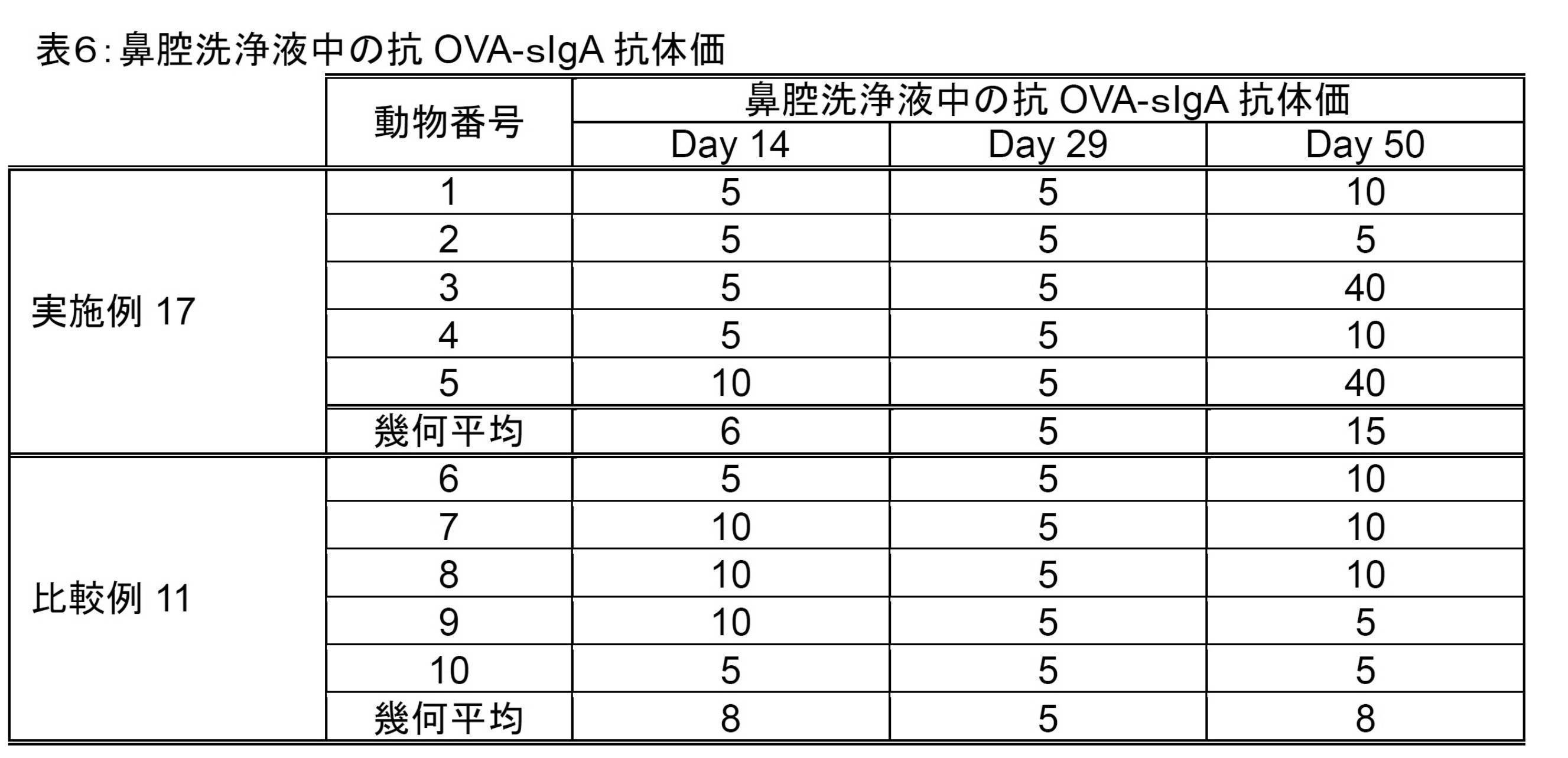
- Table 5 and FIG. 5 show the measurement results of anti-OVA-IgG antibody titer in serum and anti-OVA-sIgA antibody titer in nasal wash.
- Table 6 and FIG. 5 show the measurement results of anti-OVA-IgG antibody titer in serum and anti-OVA-sIgA antibody titer in nasal wash.
- Table 6 and FIG. 5 show the measurement results of anti-OVA-IgG antibody titer in serum and anti-OVA-sIgA antibody titer in nasal wash.
- Table 6 and FIG. 5 show the measurement results of anti-OVA-IgG antibody titer in serum and anti-OVA-sIgA antibody titer in nasal wash.
- testosterone concentration was measured by a chemiluminescent enzyme immunoassay using Abbott Architect i2000 (ARCHITECT Testosterone, Abbott Japan Co., Ltd.). This test was conducted after obtaining approval from the New Japan Science Co., Ltd. Animal Ethics Committee.
- Table 7 and FIG. 6 show changes in blood testosterone concentration. As is clear from Table 7 and FIG. 6, a significant increase in the blood testosterone concentration was observed from 10 minutes after administration, and the maximum blood concentration (C max ) was reached 30 minutes after administration. Thereby, it was confirmed that the delivery system to the respiratory region according to the present invention increases the nasal mucosa absorbability of the active ingredient.
- testosterone concentration was measured by electrochemiluminescence immunization using Cobas 8000 (ECLusys TESTO II, Roche Diagnostics Inc.).
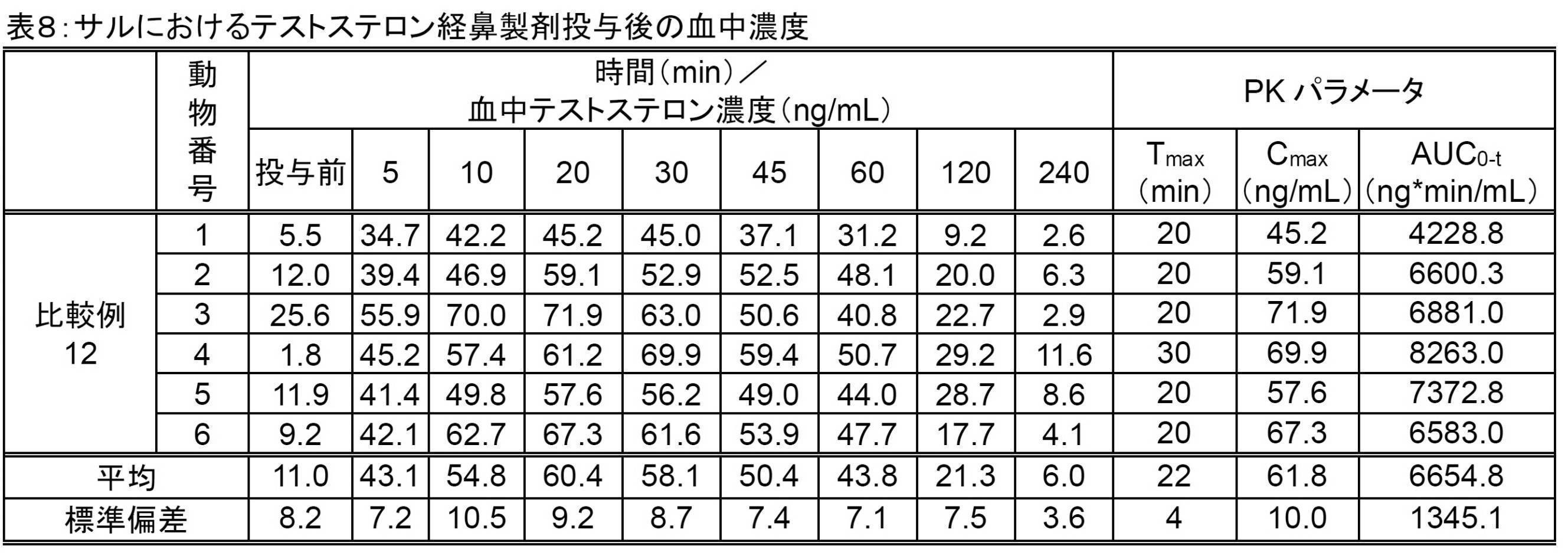
- Table 8 and FIG. 7 show changes in blood testosterone concentration in Comparative Example 12. As is clear from comparison between Table 7 and FIG. 6 regarding the delivery system to the respiratory region according to the present invention, in Comparative Example 12 that is not effectively distributed to the respiratory region, the nasal mucosa absorbability of the active ingredient is It was confirmed to be lower than Example 18.
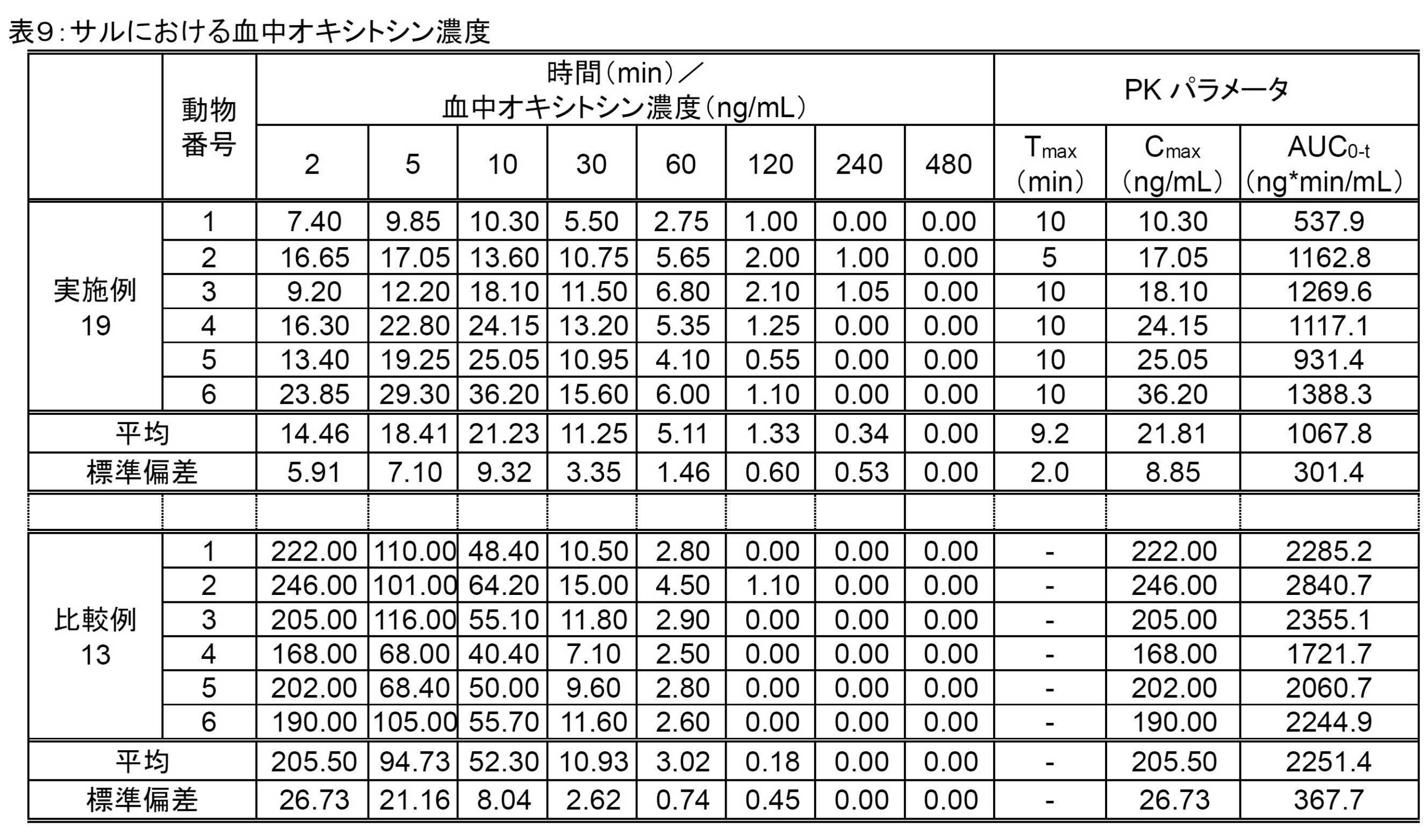
- oxytocin concentration blood was collected from the femoral vein using a syringe before administration and at 2, 5, 10, 30, 60, 120, 240 and 480 minutes (total 9 times) after administration (EDTA- Dispense into 2K-added blood collection tubes).
- cerebrospinal fluid was collected through a catheter placed in the cisterna before administration and at 10, 30, 60, 120, 240 and 480 minutes (total 7 times) after administration. Collected.
- the oxytocin concentration was measured by the EIA method using Oxytocin Enzyme Immunoassay Kit: Extraction-Free (Peninsula Laboratories International). This test was conducted after obtaining approval from the New Japan Science Co., Ltd. Animal Ethics Committee.
- Example 19 showed a higher value than Comparative Example 13.
- Example 19 in order to estimate the degree to which the nasally administered drug migrated to the brain without passing through the blood-brain barrier, Md, S. (Eur. J. Pharm. Sci., 2013 Feb 14; 48 (3): 393-405), DTE% (Drug Targeting Efficiency) based on the following equations (1) and (2). And DTP% (Direct Transport Percentage), respectively.
- DTE% is an index indicating the brain transferability in Example 19 when the amount of drug transfer from the blood vessel to the brain is 100%, and DTP% is from the non-blood vessel to the brain with respect to the total drug transfer amount to the brain. This is an index indicating the ratio of drug transfer, that is, the ratio of drug transfer directly from the nose to the brain without blood.
- DTP% [AUC 0-t (in, csf) ⁇ F] / AUC 0-t (in, csf ) ⁇ 100 (Formula 2)
- F AUC 0-t (iv, csf) ⁇ AUC 0-t (in, plasma) / AUC 0-t (iv, plasma)
- AUC 0-t (in, csf) Area under the oxytocin concentration-time curve in cerebrospinal fluid of Example 19
- AUC 0-t (in, plasma) Area under the blood oxytocin concentration-time curve of Example 19
- AUC 0 -T (iv, csf) Area under the oxytocin concentration-time curve in cerebrospinal fluid of Comparative Example 13
- AUC 0-t (iv, plasma) Area under the blood oxytocin concentration-time curve of Comparative Example 13
- Example 19 The DTE% and DTP% of Example 19 were 450.7% and 77.8%, respectively, and in Example 19, it was found that the drug was efficiently transferred from the nose to the brain without passing through blood.
Landscapes
- Health & Medical Sciences (AREA)
- Life Sciences & Earth Sciences (AREA)
- Animal Behavior & Ethology (AREA)
- Veterinary Medicine (AREA)
- Public Health (AREA)
- General Health & Medical Sciences (AREA)
- Engineering & Computer Science (AREA)
- Pharmacology & Pharmacy (AREA)
- Medicinal Chemistry (AREA)
- Chemical & Material Sciences (AREA)
- Bioinformatics & Cheminformatics (AREA)
- Epidemiology (AREA)
- Biomedical Technology (AREA)
- Anesthesiology (AREA)
- Heart & Thoracic Surgery (AREA)
- Hematology (AREA)
- Pulmonology (AREA)
- Otolaryngology (AREA)
- General Chemical & Material Sciences (AREA)
- Nuclear Medicine, Radiotherapy & Molecular Imaging (AREA)
- Organic Chemistry (AREA)
- Chemical Kinetics & Catalysis (AREA)
- Communicable Diseases (AREA)
- Neurosurgery (AREA)
- Neurology (AREA)
- Oncology (AREA)
- Biophysics (AREA)
- Medicinal Preparation (AREA)
- Pharmaceuticals Containing Other Organic And Inorganic Compounds (AREA)
Abstract
Description
[1]
有効成分を含む、鼻腔内の嗅部領域に前記有効成分を選択的に投与するための粉末製剤であって、
前記粉末製剤のかさ密度が0.1~0.5g/cm3であり、
前記粉末製剤のHausner比が1.6~2.4である、
前記粉末製剤。
[1-A1]
前記かさ密度が0.1~0.4g/cm3である、[1]に記載の粉末製剤。
[1-A2]
前記かさ密度が0.2~0.4g/cm3である、[1]に記載の粉末製剤。
[1-A3]
前記かさ密度が0.2~0.35g/cm3である、[1]に記載の粉末製剤。
[1-A4]
前記かさ密度が0.2~0.3g/cm3である、[1]に記載の粉末製剤。
[1-B1]
前記Hausner比が1.6~2.3である、[1]~[1-A4]のいずれかに記載の粉末製剤。
[1-B2]
前記Hausner比が1.6~2.2である、[1]~[1-A4]のいずれかに記載の粉末製剤。
[1-B3]
前記Hausner比が1.7~2.2である、[1]~[1-A4]のいずれかに記載の粉末製剤。
[1-B4]
前記Hausner比が1.8~2.2である、[1]~[1-A4]のいずれかに記載の粉末製剤。
[1-C1]
前記粉末製剤のタップ密度が0.1~0.8g/cm3である、[1]~[1-B4]のいずれかに記載の粉末製剤。
[1-C2]
前記粉末製剤のタップ密度が0.1~0.6g/cm3である、[1]~[1-B4]のいずれかに記載の粉末製剤。
[1-C3]
前記粉末製剤のタップ密度が0.2~0.6g/cm3である、[1]~[1-B4]のいずれかに記載の粉末製剤。
[1-C4]
前記粉末製剤のタップ密度が0.3~0.55g/cm3である、[1]~[1-B4]のいずれかに記載の粉末製剤。
[2]
前記粉末製剤の比表面積が0.3~2.5m2/gである、[1]~[1-C4]のいずれかに記載の粉末製剤。
[2-1]
前記比表面積が0.4~2.4m2/gである、[2]に記載の粉末製剤。
[2-2]
前記比表面積が0.6~2.3m2/gである、[2]に記載の粉末製剤。
[2-3]
前記比表面積が0.8~2.3m2/gである、[2]に記載の粉末製剤。
[3]
前記粉末製剤の平均粒子径が10~150μmである、[1]~[2-3]のいずれかに記載の粉末製剤。
[3-1]
前記平均粒子径が10~120μmである、[3]に記載の粉末製剤。
[3-2]
前記平均粒子径が10~80μmである、[3]に記載の粉末製剤。
[3-3]
前記平均粒子径が10~60μmである、[3]に記載の粉末製剤。
[4]
前記粉末製剤を鼻腔内に噴射するための最大の空気圧が15~100kPaである、[1]~[3-3]のいずれかに記載の粉末製剤。
[4-1]
前記最大の空気圧が15~80kPaである、[4]に記載の粉末製剤。
[4-2]
前記最大の空気圧が15~60kPaである、[4]に記載の粉末製剤。
[4-3]
前記最大の空気圧が15~40kPaである、[4]に記載の粉末製剤。
[5]
最大の空気圧に到達するまでの時間が0~40msecである、[4]~[4-3]のいずれかに記載の粉末製剤。
[5-1]
前記最大の空気圧に到達するまでの時間が0~30msecである、[5]に記載の粉末製剤。
[5-2]
前記最大の空気圧に到達するまでの時間が0~20msecである、[5]に記載の粉末製剤。
[5-3]
前記最大の空気圧に到達するまでの時間が0~10msecである、[5]に記載の粉末製剤。
[6]
前記粉末製剤が10kPa以上の空気圧で持続して噴射される時間が15~150msecである、[1]~[5-3]のいずれかに記載の粉末製剤。
[6-1]
前記10kPa以上の空気圧で持続して噴射される時間が15~100msecである、[6]に記載の粉末製剤。
[6-2]
前記10kPa以上の空気圧で持続して噴射される時間が25~100msecである、[6]に記載の粉末製剤。
[6-3]
前記10kPa以上の空気圧で持続して噴射される時間が25~80msecである、[6]に記載の粉末製剤。
[7]
中枢神経系疾患を予防及び/又は治療するための、又は中枢神経系への作用に基づく検査若しくは診断又は手術前若しくは検査前の処置を施すための、[1]~[6-3]のいずれかに記載に粉末製剤。
[8]
[1]~[7]のいずれかに記載に粉末製剤を含む、カートリッジ。
[9]
[8]に記載のカートリッジと、
前記カートリッジに含まれる粉末製剤を噴射するための噴射器と、
を含む、デバイス。
[9-1]
前記噴射器が、[4]~[4-3]のいずれかで定義した最大の空気圧を達成するように構成されている、[9]に記載のデバイス。
[9-2]
前記噴射器が、[5]~[5-3]のいずれかで定義した最大の空気圧に到達するまでの時間を達成するように構成されている、[9]又は[9-1]に記載のデバイス。
[9-3]
前記噴射器が、[6]~[6-3]のいずれかで定義した10kPa以上の空気圧で持続して噴射される時間を達成するように構成されている、[9]~[9-2]のいずれかに記載のデバイス。
[10]
有効成分を含む、鼻腔内の呼吸部領域に前記有効成分を選択的に投与するための粉末製剤であって、
前記粉末製剤のかさ密度が0.2~1.1g/cm3であり、
前記粉末製剤のHausner比が1.0~2.2である、
前記粉末製剤。
[10-A1]
前記かさ密度が0.2~0.8g/cm3である、[10]に記載の粉末製剤。
[10-A2]
前記かさ密度が0.2~0.7g/cm3である、[10]に記載の粉末製剤。
[10-A3]
前記かさ密度が0.2~0.6g/cm3である、[10]に記載の粉末製剤。
[10-A4]
前記かさ密度が0.2~0.5g/cm3である、[10]に記載の粉末製剤。
[10-A5]
前記かさ密度が0.25~0.4g/cm3である、[10]に記載の粉末製剤。
[10-B1]
前記Hausner比が1.1~2.2である、[10]~[10-A5]のいずれかに記載の粉末製剤。
[10-B2]
前記Hausner比が1.2~2.2である、[10]~[10-A5]のいずれかに記載の粉末製剤。
[10-B3]
前記Hausner比が1.3~2.2である、[10]~[10-A5]のいずれかに記載の粉末製剤。
[10-B4]
前記Hausner比が1.4~2.1である、[10]~[10-A5]のいずれかに記載の粉末製剤。
[10-B5]
前記Hausner比が1.5~2.0である、[10]~[10-A5]のいずれかに記載の粉末製剤。
[10-C1]
前記粉末製剤のタップ密度が0.2~1.0g/cm3である、[10]~[10-B5]のいずれかに記載の粉末製剤。
[10-C2]
前記粉末製剤のタップ密度が0.2~0.8g/cm3である、[10]~[10-B5]のいずれかに記載の粉末製剤。
[10-C3]
前記粉末製剤のタップ密度が0.3~0.9g/cm3である、[10]~[10-B5]のいずれかに記載の粉末製剤。
[10-C4]
前記粉末製剤のタップ密度が0.4~0.7g/cm3である、[10]~[10-B5]のいずれかに記載の粉末製剤。
[10-C5]
前記粉末製剤のタップ密度が0.4~0.6g/cm3である、[10]~[10-B5]のいずれかに記載の粉末製剤。
[11]
前記粉末製剤の比表面積が0.2~2.5m2/gである、[10]~[10-C5]のいずれかに記載の粉末製剤。
[11-1]
前記比表面積が0.2~2.4m2/gである、[11]に記載の粉末製剤。
[11-2]
前記比表面積が0.2~2.2m2/gである、[11]に記載の粉末製剤。
[11-3]
前記比表面積が0.3~2.1m2/gである、[11]に記載の粉末製剤。
[12]
前記粉末製剤の平均粒子径が10~500μmである、[10]~[11-3]のいずれかに記載の粉末製剤。
[12-1]
前記平均粒子径が10~300μmである、[12]に記載の粉末製剤。
[12-2]
前記平均粒子径が15~250μmである、[12]に記載の粉末製剤。
[12-3]
前記平均粒子径が15~200μmである、[12]に記載の粉末製剤。
[12-4]
前記平均粒子径が15~150μmである、[12]に記載の粉末製剤。
[13]
前記粉末製剤を鼻腔内に噴射するための最大の空気圧が5~50kPaである、[10]~[12-4]のいずれかに記載の粉末製剤。
[13-1]
前記最大の空気圧が5~40kPaである、[13]に記載の粉末製剤。
[13-2]
前記最大の空気圧が5~30kPaである、[13]に記載の粉末製剤。
[13-3]
前記最大の空気圧が5~20kPaである、[13]に記載の粉末製剤。
[14]
最大の空気圧に到達するまでの時間が0~150msecである、[13]~[13-3]のいずれかに記載の粉末製剤。
[14-1]
前記最大の空気圧に到達するまでの時間が0~130msecである、[14]に記載の粉末製剤。
[14-2]
前記最大の空気圧に到達するまでの時間が5~120msecである、[14]に記載の粉末製剤。
[14-3]
前記最大の空気圧に到達するまでの時間が10~120msecである、[14]に記載の粉末製剤。
[15]
前記粉末製剤が5kPa以上の空気圧で持続して噴射される時間が30~200msecである、[10]~[14-3]のいずれかに記載の粉末製剤。
[15-1]
前記5kPa以上の空気圧で持続して噴射される時間が30~150msecである、[15]に記載の粉末製剤。
[15-2]
前記5kPa以上の空気圧で持続して噴射される時間が40~150msecである、[15]に記載の粉末製剤。
[15-3]
前記5kPa以上の空気圧で持続して噴射される時間が60~150msecである、[15]に記載の粉末製剤。
[16]
全身疾患を予防及び/又は治療するための、又は検査若しくは診断又は手術前若しくは検査前の処置を施すための、[10]~[15-3]のいずれかに記載に粉末製剤。
[17]
感染症を予防及び/又は治療するための、[10]~[15-3]のいずれかに記載に粉末製剤。
[18]
[10]~[17]のいずれかに記載に粉末製剤を含む、カートリッジ。
[19]
[18]に記載のカートリッジと、
前記カートリッジに含まれる粉末製剤を噴射するための噴射器と、
を含む、デバイス。
[19-1]
前記噴射器が、[13]~[13-3]のいずれかで定義した最大の空気圧を達成するように構成されている、[19]に記載のデバイス。
[19-2]
前記噴射器が、[14]~[14-3]のいずれかで定義した最大の空気圧に到達するまでの時間を達成するように構成されている、[19]又は[19-1]に記載のデバイス。
[19-3]
前記噴射器が、[15]~[15-3]のいずれかで定義した5kPa以上の空気圧で持続して噴射される時間を達成するように構成されている、[19]~[19-2]のいずれかに記載のデバイス。
[A1]
有効成分を含み、かさ密度が0.1~0.5g/cm3であり、Hausner比が1.6~2.4である粉末製剤を、鼻腔内に噴射することを含む、前記有効成分を前記鼻腔内の嗅部領域に選択的に投与する方法。
[A2]
有効成分を含み、かさ密度が0.2~1.1g/cm3であり、Hausner比が1.0~2.2である粉末製剤を、鼻腔内に噴射することを含む、前記有効成分を前記鼻腔内の呼吸部領域に選択的に投与する方法。
[B1]
鼻腔内の嗅部領域に有効成分を選択的に投与するための、
有効成分を含み、かさ密度が0.1~0.5g/cm3であり、Hausner比が1.6~2.4である粉末製剤の使用。
[B2]
鼻腔内の呼吸部領域に有効成分を選択的に投与するための、
有効成分を含み、かさ密度が0.2~1.1g/cm3であり、Hausner比が1.0~2.2である粉末製剤の使用。
前記実施形態[A2]及び[B2]は、前記実施形態[10]~[19-3]に記載の特徴の1つ以上を更に有していてもよい。
本発明の一実施形態は、有効成分を含む、鼻腔内の嗅部領域に前記有効成分を選択的に投与するための粉末製剤であって、前記粉末製剤のかさ密度が0.1~0.5g/cm3であり、前記粉末製剤のHausner比が1.6~2.4である、前記粉末製剤に関する。
Hausner比:流動性の程度
1.00~1.11:極めて良好
1.12~1.18:良好
1.19~1.25:やや良好
1.26~1.34:普通
1.35~1.45:やや不良
1.46~1.59:不良
>1.60:極めて不良
本発明の一実施形態は、有効成分を含む、鼻腔内の呼吸部領域に前記有効成分を選択的に投与するための粉末製剤であって、前記粉末製剤のかさ密度が0.2~1.1/cm3であり、前記粉末製剤のHausner比が1.0~2.2である、前記粉末製剤に関する。
表1に示す組成を有する試験製剤を調製した。試験製剤の材料及び製法は、以下に記載するとおりである。
タートラジン(和光純薬工業株式会社)、塩化マンガン(II)四水和物(Sigma-Aldrich Co. LLC)、オボアルブミン(Sigma-Aldrich Co. LLC)、チミジン(和光純薬工業株式会社)、テストステロン(和光純薬工業株式会社)、オキシトシン(Sigma-Aldrich Co. LLC)、インドメタシン(和光純薬工業株式会社)。
Ceolus(登録商標)PH-301(旭化成ケミカルズ株式会社)、Ceolus(登録商標)PH-F20JP(旭化成ケミカルズ株式会社)、第三リン酸カルシウム(ICL Performance Products LP)、塩化ナトリウム(和光純薬工業株式会社)、マンニトール(和光純薬工業株式会社)、トレハロース二水和物(和光純薬工業株式会社)、プルラン(東京化成工業株式会社)、レスピトースSV003(DEF Pharma)、軽質無水ケイ酸(富士シリシア化学株式会社)、HPMC TC-5E(信越化学工業株式会社)、アルファー化デンプン(旭化成ケミカルズ株式会社)。
表1に記載の成分を同記載の配合割合でガラス乳鉢に入れ10分程度混合した。
表1に記載の成分を同記載の配合割合でリン酸バッファーに混和後、1mLのガラスバイアルに入れたものを棚式凍結乾燥機内(FreeZone Triad Freeze Dry System、Labconco Corp.)に置き、次の条件下で凍結乾燥品を得た。凍結乾燥条件としては、-30℃で1.5時間の事前凍結し、-45℃で0.6時間の凍結を行った後、105mTorrの減圧下において、-45℃で0.4時間、-35℃で14.5時間の一次乾燥をし、更に30℃で4時間の二次乾燥を行った。調製した凍結乾燥品をVortexを用いて粉砕したものを試験製剤とした。
事前に超純水を200mLアルミトレイに入れ、-20℃でアルミトレイ内底部を凍結後、表1に記載の成分を同記載の配合割合でリン酸バッファーに混和したものをアルミトレイに入れ、-20℃で2時間の事前凍結を行い、棚式凍結乾燥機内(FreeZone Triad Freeze Dry System、Labconco Corp.)に置き、次の条件下で凍結乾燥品を得た。凍結乾燥条件としては、105mTorrの減圧下において、-25℃で30時間の一次乾燥をし、更に30℃で37時間の二次乾燥を行った。調製した凍結乾燥品をファインインパクトミル100UPZ-C(ホソカワミクロン株式会社)で粉砕したものを試験製剤とした。
表1に記載の成分を同記載の配合割合で2000mLのガラス容器に入れ、リン酸バッファーで液量を調整後、混和したものをチューブ式凍結乾燥機(ICS-1-301型、共和真空技術株式会社)に投入し、次の条件下で凍結乾燥品を得た。凍結乾燥条件としては、-45℃で2時間の凍結を行った後、6.7Paの減圧下において-25℃で30時間の一次乾燥をし、更に30℃で13時間の二次乾燥を行った。調製した凍結乾燥品をファインインパクトミル100UPZ-C(ホソカワミクロン株式会社)で粉砕したものを試験製剤とした。
表1に記載の成分を同記載の配合割合で1000mLのガラス容器に入れ、リン酸バッファーで液量を調整後、混和したものを微噴凍結乾燥機(μPD400、株式会社ULVAC)に投入し、次の条件下で凍結乾燥品を得た。凍結乾燥条件としては、棚温度-40℃で噴霧凍結し、10Paの減圧下において、30℃で16時間乾燥後、Full Vacuumで乾燥した。調製した凍結乾燥品をそのまま試験製剤とした。
表1に記載の成分を同記載の配合割合でガラス容器に入れ、10分程度ボルテックス混合した。
表1に記載のHPMC又はStarch以外の成分を同記載の配合割合で流動層造粒機(FL-LABO, フロイント産業株式会社)に投入し、70℃の空気で造粒機内の紛体を流動しながら、HPMCを精製水に溶かした5.7%溶液又はStarchを精製水に溶かした1.4%溶液を造粒機内に噴霧した。調製した造粒品をそのまま試験製剤とした。

表1に示す試験製剤の比表面積、平均粒子径、かさ密度、タップ密度、及びHausner比を測定した。各物性の測定方法は、以下に記載するとおりである。結果を表2に示す。
測定試料を吸引減圧下で100℃で1時間又は吸引減圧下で室温16時間乾燥した後、窒素又はクリプトンガスを用いたガス吸着法に基づく比表面積測定器(Autosorb-iQ-MP, カンタクローム、もしくはASAP2460,マイメリティクス)を用いて測定した。
レーザー回析法に基づく粒度分布測定装置(Mastersizer 2000, Malvern社)を用いて、2barの分散圧下で平均一次粒子径を測定した。
日本薬局方一般試験法の紛体物性測定法に基づき、既知質量の各粉末製剤を、メスシリンダー内に入れた時の体積を測定し、質量を体積で除して算出した。
日本薬局方一般試験法の紛体物性測定法に基づき、既知質量の各粉末製剤を、メスシリンダー内に入れた後、メスシリンダーをタップし、粉末製剤の体積変化が認められなくなる体積を測定し、質量を体積で除して算出した。
かさ密度をタップ密度で除して算出した。
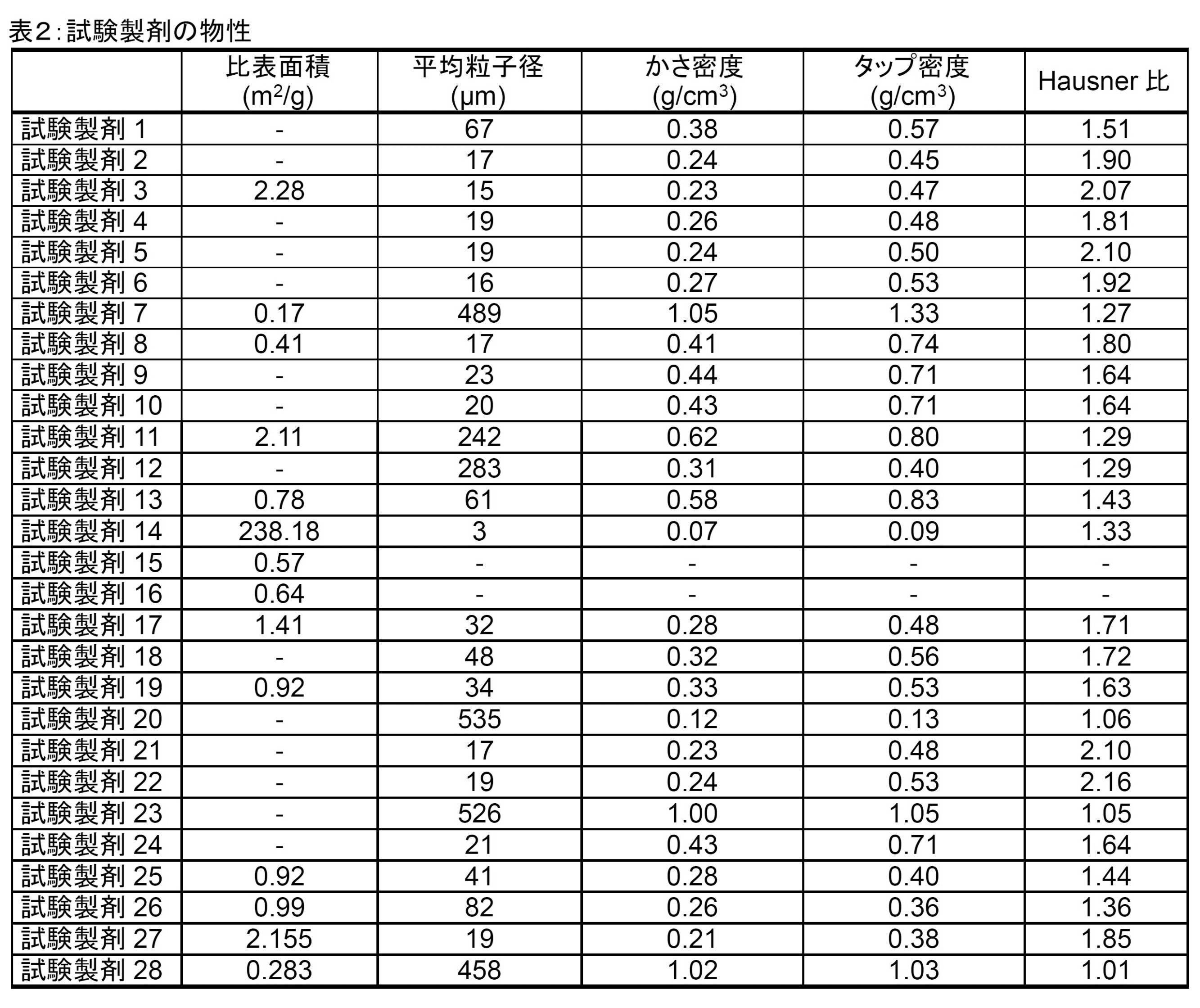
(噴射器)
ノズル部(薬剤充填部を兼ねていてもよい)、薬剤充填部、バルブ部、及び空気発生部の順序で接続された噴射器を製作した。なお、空気発生部は、シリンジ型又はポンプ型であって、バルブの開放タイミングの調整を含めて、発生させる噴射空気特性(最大空気圧、最大空気圧到達時間、及び一定空気圧持続噴出時間(≧10kPa又は≧5kPa)を含む)をある程度の範囲でコントロール可能なものである。
噴射器の空気発生部にデータロガーを接続した圧力計を繋ぎ、空気発生部を作動させたときの1msec毎の圧変化を測定した。なお、蓄圧した状態からバルブを開放して噴射空気を発生させる場合には、蓄圧が完了するまでの圧変化のデータは収集せず、蓄圧が完了した後の圧変化を測定した。測定した圧変化データから、最大空気圧、最大空気圧到達時間、及び一定空気圧持続噴出時間(≧10kPa又は≧5kPa)を求めた。
20mg又は25mgの試験製剤を薬剤充填部に充填した噴射器の重量を秤量した後、空気発生部を作動させ、再度噴射器の重量を秤量した。噴射前後の噴射器の重量差から、噴射率を算出した。
日本成人男性の頭部CT撮影データを元に、3Dプリンタを使ってヒト鼻腔モデル(図1)を製作した。このヒト鼻腔モデルでは、鼻中隔から左右の鼻腔を分割でき、鼻腔モデル内に噴射した製剤の分布観察や洗浄回収が容易に可能である。なお、鼻腔内の各領域を図2に示した。図2から明らかなように、嗅部領域は非常に限定された領域である。タートラジンを配合した試験製剤25mgを噴射器の薬剤充填部に充填し、そのノズル部を、人口唾液で鼻腔内を湿らせたヒト鼻腔モデルの片鼻孔に挿入し、空気発生部を作動させ、鼻腔内に試験製剤を噴射した。噴射後、ヒト鼻腔モデルを分解し、図2に示したヒト鼻腔モデルの嗅部領域又は呼吸部領域にそれぞれ付着した製剤を精製水で洗い流し、回収した(図3に、試験製剤を噴射したヒト鼻腔モデルの製剤分布の代表例を示す)。回収した試験製剤中のタートラジン量をHPLCで測定し、噴射器から噴射されたタートラジン量を基準に、評価領域へ分布したタートラジン割合を算出し、これを分布割合とした。なお、噴射率は、ヒト鼻腔モデルから回収された全てタートラジン量を、噴射器に充填した理論タートラジン量で除して、算出した。

表3に示したように、実施例1~8では、噴射率が60%以上であり、そのうちの20%以上が非常に限定された領域である嗅部領域に分布した。そのため、試験製剤3、8及び17は、嗅部領域をターゲットにした送達システムにおいて有効であると判明した。また、同一又は類似の噴射空気特性を使用する実施例1~8と比較例2~6とを比較することにより、製剤の物性が、嗅部領域への選択性を向上させるために重要であると判明した。更に、同一の試験製剤を使用する実施例7及び8と比較例1及び7とを比較することにより、所定の噴射空気特性を採用すると、嗅部領域への選択性が向上することが判明した。
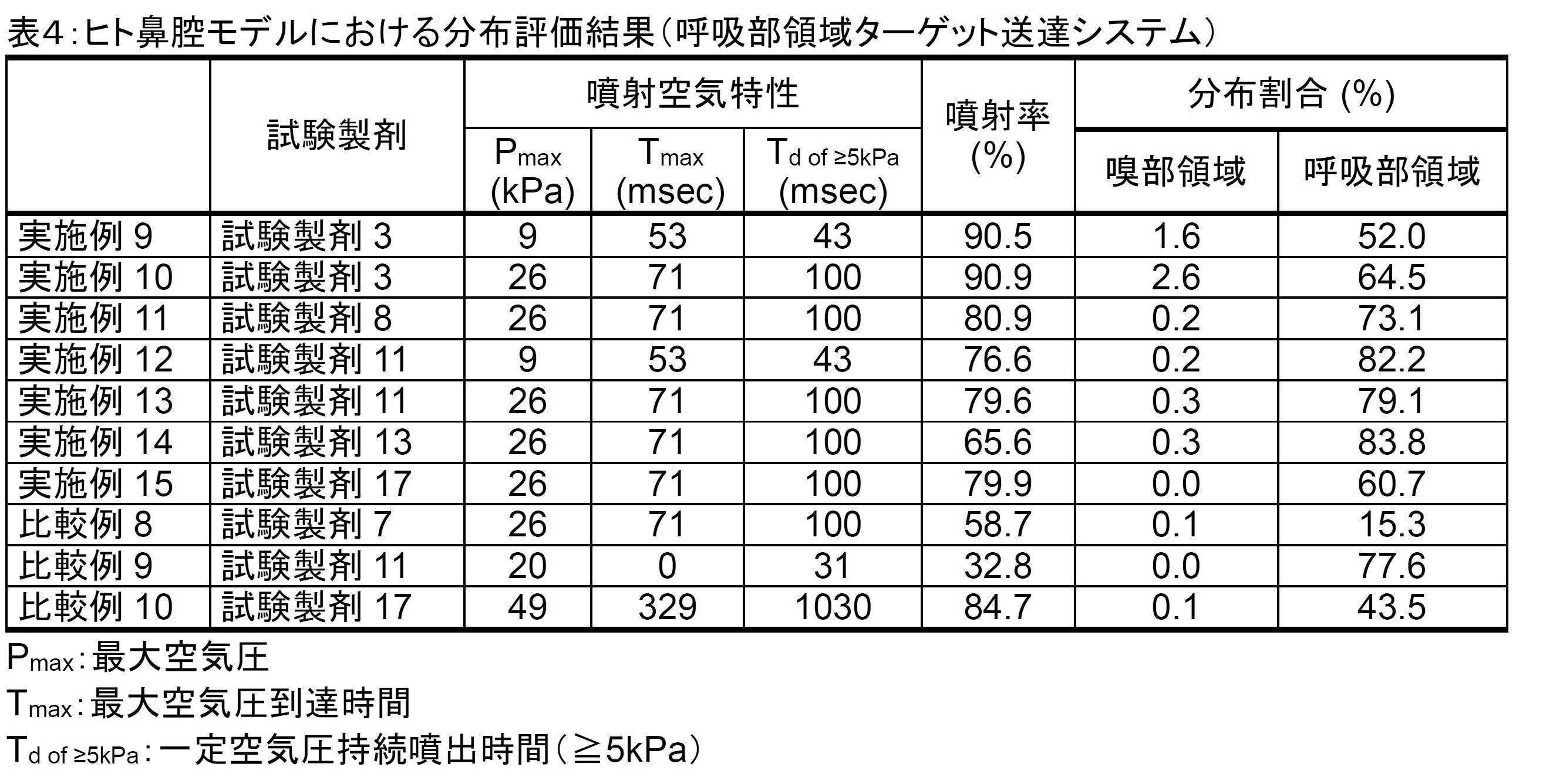
表4に示したように、実施例9~15では、噴射率が60%以上であり、そのうちの50%以上が呼吸部領域に分布し、嗅部領域への分布は5%未満であった。なお、呼吸部領域への選択的投与を目的とする場合には、嗅部領域への分布は最小限に留めることが望ましい。そのため、試験製剤3、8、11、13及び17は、呼吸部領域をターゲットにした送達システムにおいて有効であると判明した。また、同一の噴射空気特性を使用する実施例10、11及び13~15と比較例8とを比較することにより、製剤の物性が、呼吸部領域への選択性を向上させるために重要であると判明した。更に、同一の試験製剤を使用する実施例12、13及び15と比較例9及び10とを比較することにより、所定の噴射空気特性を採用すると、呼吸部領域への選択性が向上することが判明した。
ヒトと鼻腔構造が類似した雄性カニクイザル(体重3.73kg、1匹、株式会社新日本科学)に対して、最大空気圧58kPa、最大空気圧到達時間0msec、及び一定空気圧持続噴出時間(≧10kPa)110msecの空気発生部を有する、嗅部領域送達用の噴射器を使って、表1に示した25mgの試験製剤4を、覚醒下で右鼻腔内に噴射した。試験製剤中に含まれるマンガンの鼻腔内分布及び脳移行性を評価するために、撮影直前に吸入麻酔を行った上で、投与前、投与直後、投与3時間後、投与6時間後及び投与24時間後に、頭部のマンガン造影MRI撮影(MAGNETOM Allegra,3T,SIEMENS)を実施した。頭部のマンガン造影MRI撮影で得られた画像を、画像解析ソフトウエアOsiriX MD(Version 6.0,64-bit,Pixmeo SARL)を使って解析を行った。なお、本試験は株式会社新日本科学の動物倫理委員会による承認を得た上で実施した。
ヒトと鼻腔構造が類似した雄性カニクイザル(体重2.8~5.5kg、5匹、株式会社新日本科学)に対して、最大空気圧28kPa、最大空気圧到達時間88msec、及び一定空気圧持続噴出時間(≧5kPa)146msecの空気発生部を有する、呼吸部領域送達用の噴射器を使って、表1に示した25mgの試験製剤5を、初回投与日(第1日目)、第15日目、及び第36日目の合計3回で、それぞれ1回ずつ右鼻腔内に噴射した。免疫原性評価のために、初回投与日の4日前、第14日目、第29日目、及び第50日目に血清及び鼻腔内洗浄液を採取した。

ヒトと鼻腔構造が類似した雄性カニクイザル(体重5.73~5.64kg、2匹、株式会社新日本科学)に対して、最大空気圧28kPa、最大空気圧到達時間88msec、及び一定空気圧持続噴出時間(≧5kPa)146msecの、呼吸部領域送達用の空気発生部を有する噴射器を使って、表1に示した20mgの試験製剤22を、覚醒下で右鼻腔内に噴射した。テストステロンの血中濃度測定のために、投与前、並びに投与後10、30、60、及び240分(計5回)に、ヘパリンNaを含む注射器を用いて大腿静脈から採血した。テストステロン濃度は、Abbott Architect i2000(ARCHITECT Testosterone、アボットジャパン株式会社)を用いた化学発光酵素免疫法により測定した。なお、本試験は株式会社新日本科学の動物倫理委員会による承認を得た上で実施した。

ヒトと鼻腔構造が類似した雄性カニクイザル(体重4.94~5.76kg、6匹、株式会社新日本科学)に対して、最大空気圧28kPa、最大空気圧到達時間88msec、及び一定空気圧持続噴出時間(≧5kPa)146msecの、呼吸部領域送達用の空気発生部を有する噴射器を使って、表1に示した20mgの試験製剤28を、覚醒下で右鼻腔内に噴射した。テストステロンの血中濃度測定のために、投与前、並びに投与後5、10、20、30、45、60、120、及び240分(計9回)に、ヘパリンNaを含む注射器を用いて大腿静脈から採血した。テストステロン濃度は、Cobas 8000(ECLusys TESTO II、ロシュ・ダイアグノスティックス株式会社)を用いた電気化学発光免疫法により測定した。

/[AUC0-t(iv, csf)/AUC0-t(iv, plasma)]×100 (式1)
F=AUC0-t(iv, csf)×AUC0-t(in, plasma)/AUC0-t(iv, plasma)
AUC0-t(in, csf):実施例19の脳脊髄液中オキシトシン濃度-時間曲線下面積
AUC0-t(in, plasma):実施例19の血中オキシトシン濃度-時間曲線下面積
AUC0-t(iv, csf):比較例13の脳脊髄液中オキシトシン濃度-時間曲線下面積
AUC0-t(iv, plasma):比較例13の血中オキシトシン濃度-時間曲線下面積
Claims (19)
- 有効成分を含む、鼻腔内の嗅部領域に前記有効成分を選択的に投与するための粉末製剤であって、
前記粉末製剤のかさ密度が0.1~0.5g/cm3であり、
前記粉末製剤のHausner比が1.6~2.4である、
前記粉末製剤。 - 前記粉末製剤の比表面積が0.3~2.5m2/gである、請求項1に記載の粉末製剤。
- 前記粉末製剤の平均粒子径が10~150μmである、請求項1又は2に記載の粉末製剤。
- 前記粉末製剤を鼻腔内に噴射するための最大の空気圧が15~100kPaである、請求項1~3のいずれか一項に記載の粉末製剤。
- 最大の空気圧に到達するまでの時間が0~40msecである、請求項4に記載の粉末製剤。
- 前記粉末製剤が10kPa以上の空気圧で持続して噴射される時間が15~150msecである、請求項1~5のいずれか一項に記載の粉末製剤。
- 中枢神経系疾患を予防及び/又は治療するための、又は中枢神経系への作用に基づく検査若しくは診断又は手術前若しくは検査前の処置を施すための、請求項1~6のいずれか一項に記載に粉末製剤。
- 請求項1~7のいずれか一項に記載に粉末製剤を含む、カートリッジ。
- 請求項8に記載のカートリッジと、
前記カートリッジに含まれる粉末製剤を噴射するための噴射器と、
を含む、デバイス。 - 有効成分を含む、鼻腔内の呼吸部領域に前記有効成分を選択的に投与するための粉末製剤であって、
前記粉末製剤のかさ密度が0.2~1.1g/cm3であり、
前記粉末製剤のHausner比が1.0~2.2である、
前記粉末製剤。 - 前記粉末製剤の比表面積が0.2~2.5m2/gである、請求項10に記載の粉末製剤。
- 前記粉末製剤の平均粒子径が10~500μmである、請求項10又は11に記載の粉末製剤。
- 前記粉末製剤を鼻腔内に噴射するための最大の空気圧が5~50kPaである、請求項10~12のいずれか一項に記載の粉末製剤。
- 最大の空気圧に到達するまでの時間が0~150msecである、請求項13に記載の粉末製剤。
- 前記粉末製剤が5kPa以上の空気圧で持続して噴射される時間が30~200msecである、請求項10~14のいずれか一項に記載の粉末製剤。
- 全身疾患を予防及び/又は治療するため、又は検査若しくは診断又は手術前若しくは検査前の処置を施すための、請求項10~15のいずれか一項に記載に粉末製剤。
- 感染症を予防及び/又は治療するための、請求項10~15のいずれか一項に記載に粉末製剤。
- 請求項10~17のいずれか一項に記載に粉末製剤を含む、カートリッジ。
- 請求項18に記載のカートリッジと、
前記カートリッジに含まれる粉末製剤を噴射するための噴射器と、
を含む、デバイス。
Priority Applications (7)
| Application Number | Priority Date | Filing Date | Title |
|---|---|---|---|
| CN201980013095.1A CN111712233A (zh) | 2018-02-26 | 2019-02-07 | 粉末制剂、药筒及装置 |
| EP19757464.3A EP3760189A4 (en) | 2018-02-26 | 2019-02-07 | POWDER PREPARATION, CARTRIDGE AND DEVICE |
| KR1020207026695A KR20200125632A (ko) | 2018-02-26 | 2019-02-07 | 분말 제제, 카트리지 및 디바이스 |
| CA3090457A CA3090457A1 (en) | 2018-02-26 | 2019-02-07 | Powder preparation, cartridge, and device |
| AU2019225031A AU2019225031B2 (en) | 2018-02-26 | 2019-02-07 | Powder preparation, cartridge, and device |
| US16/975,701 US12343472B2 (en) | 2018-02-26 | 2019-02-07 | Powder preparation, cartridge, and device |
| JP2020501655A JP7282735B2 (ja) | 2018-02-26 | 2019-02-07 | 粉末製剤、カートリッジ、及びデバイス |
Applications Claiming Priority (2)
| Application Number | Priority Date | Filing Date | Title |
|---|---|---|---|
| JP2018032498 | 2018-02-26 | ||
| JP2018-032498 | 2018-02-26 |
Publications (1)
| Publication Number | Publication Date |
|---|---|
| WO2019163520A1 true WO2019163520A1 (ja) | 2019-08-29 |
Family
ID=67688107
Family Applications (1)
| Application Number | Title | Priority Date | Filing Date |
|---|---|---|---|
| PCT/JP2019/004331 Ceased WO2019163520A1 (ja) | 2018-02-26 | 2019-02-07 | 粉末製剤、カートリッジ、及びデバイス |
Country Status (8)
| Country | Link |
|---|---|
| US (1) | US12343472B2 (ja) |
| EP (1) | EP3760189A4 (ja) |
| JP (1) | JP7282735B2 (ja) |
| KR (1) | KR20200125632A (ja) |
| CN (1) | CN111712233A (ja) |
| AU (1) | AU2019225031B2 (ja) |
| CA (1) | CA3090457A1 (ja) |
| WO (1) | WO2019163520A1 (ja) |
Cited By (2)
| Publication number | Priority date | Publication date | Assignee | Title |
|---|---|---|---|---|
| JP2023517532A (ja) * | 2020-03-16 | 2023-04-26 | ナサス ファーマ リミテッド | 粉末化された鼻腔内エピネフリンによる治療 |
| WO2025225629A1 (ja) * | 2024-04-23 | 2025-10-30 | 株式会社メディラボRfp | 経鼻投与用組成物 |
Families Citing this family (3)
| Publication number | Priority date | Publication date | Assignee | Title |
|---|---|---|---|---|
| US12005185B2 (en) | 2021-12-17 | 2024-06-11 | Belhaven BioPharma Inc. | Medical counter measures including dry powder formulations and associated methods |
| CN116159231A (zh) * | 2023-04-24 | 2023-05-26 | 乐恩(北京)医药技术有限公司 | 一种下呼吸道喷雾控制处理系统及方法 |
| CN117243822A (zh) * | 2023-09-28 | 2023-12-19 | 浙江联德意华水疗设备有限公司 | 一种中药制备方法 |
Citations (5)
| Publication number | Priority date | Publication date | Assignee | Title |
|---|---|---|---|---|
| JP2001131057A (ja) * | 1999-08-26 | 2001-05-15 | Takeda Chem Ind Ltd | 鼻粘膜付着マトリックス |
| JP2014028848A (ja) * | 2006-12-26 | 2014-02-13 | Shin Nippon Biomedical Laboratories Ltd | 経鼻投与用製剤 |
| JP2015509788A (ja) * | 2012-02-29 | 2015-04-02 | パルマトリックス,インコーポレイテッド | 吸入に適した乾燥粉末 |
| JP2016520378A (ja) * | 2013-04-28 | 2016-07-14 | インペル ニューロファーマ インコーポレイテッド | 医用単位用量コンテナ |
| JP2016135272A (ja) * | 2008-06-13 | 2016-07-28 | マンカインド コーポレイション | 薬物送達用の乾燥粉末吸入器およびシステム |
Family Cites Families (14)
| Publication number | Priority date | Publication date | Assignee | Title |
|---|---|---|---|---|
| GB9700624D0 (en) * | 1997-01-14 | 1997-03-05 | Danbiosyst Uk | Drug delivery composition |
| PT1291031E (pt) | 2000-06-12 | 2006-10-31 | Teijin Ltd | Dispositivo para administracao de doses multipla de medicamento em po |
| JP2002255795A (ja) | 2001-02-26 | 2002-09-11 | Teijin Ltd | 経鼻投与用組成物 |
| GB0721394D0 (en) | 2007-10-31 | 2007-12-12 | Vectura Group Plc | Compositions for trating parkinson's disease |
| MX2011009251A (es) | 2009-03-04 | 2011-11-18 | Mannkind Corp | Sistema mejorado de suministro de farmaco en polvo seco. |
| US8827946B2 (en) * | 2009-07-31 | 2014-09-09 | Shin Nippon Biomedical Laboratories, Ltd. | Intranasal granisetron and nasal applicator |
| WO2012030664A1 (en) | 2010-08-30 | 2012-03-08 | Pulmatrix, Inc. | Dry powder formulations and methods for treating pulmonary diseases |
| US8758824B2 (en) * | 2010-08-30 | 2014-06-24 | Pulmatrix, Inc. | Respirably dry powder comprising calcium lactate, sodium chloride and leucine |
| EP4008326A1 (en) | 2010-09-29 | 2022-06-08 | Pulmatrix Operating Company, Inc. | Monovalent metal cation dry powders for inhalation |
| AU2013289957B2 (en) | 2012-07-12 | 2017-02-23 | Mannkind Corporation | Dry powder drug delivery systems and methods |
| US11554229B2 (en) * | 2013-03-26 | 2023-01-17 | OptiNose Inc. | Nasal administration |
| KR20150135328A (ko) * | 2013-04-01 | 2015-12-02 | 풀매트릭스 인코퍼레이티드 | 티오트로피움 건조 분말 |
| JP6322844B2 (ja) | 2014-06-25 | 2018-05-16 | 東興薬品工業株式会社 | 医療用シリンジに用いられる点鼻用噴霧ノズル |
| WO2016196401A1 (en) * | 2015-05-29 | 2016-12-08 | The Texas A&M University System | Antimicrobial and anti-inflammatory compositions |
-
2019
- 2019-02-07 KR KR1020207026695A patent/KR20200125632A/ko active Pending
- 2019-02-07 JP JP2020501655A patent/JP7282735B2/ja active Active
- 2019-02-07 EP EP19757464.3A patent/EP3760189A4/en active Pending
- 2019-02-07 WO PCT/JP2019/004331 patent/WO2019163520A1/ja not_active Ceased
- 2019-02-07 CN CN201980013095.1A patent/CN111712233A/zh active Pending
- 2019-02-07 US US16/975,701 patent/US12343472B2/en active Active
- 2019-02-07 AU AU2019225031A patent/AU2019225031B2/en active Active
- 2019-02-07 CA CA3090457A patent/CA3090457A1/en active Pending
Patent Citations (5)
| Publication number | Priority date | Publication date | Assignee | Title |
|---|---|---|---|---|
| JP2001131057A (ja) * | 1999-08-26 | 2001-05-15 | Takeda Chem Ind Ltd | 鼻粘膜付着マトリックス |
| JP2014028848A (ja) * | 2006-12-26 | 2014-02-13 | Shin Nippon Biomedical Laboratories Ltd | 経鼻投与用製剤 |
| JP2016135272A (ja) * | 2008-06-13 | 2016-07-28 | マンカインド コーポレイション | 薬物送達用の乾燥粉末吸入器およびシステム |
| JP2015509788A (ja) * | 2012-02-29 | 2015-04-02 | パルマトリックス,インコーポレイテッド | 吸入に適した乾燥粉末 |
| JP2016520378A (ja) * | 2013-04-28 | 2016-07-14 | インペル ニューロファーマ インコーポレイテッド | 医用単位用量コンテナ |
Non-Patent Citations (1)
| Title |
|---|
| See also references of EP3760189A4 * |
Cited By (4)
| Publication number | Priority date | Publication date | Assignee | Title |
|---|---|---|---|---|
| JP2023517532A (ja) * | 2020-03-16 | 2023-04-26 | ナサス ファーマ リミテッド | 粉末化された鼻腔内エピネフリンによる治療 |
| JP2026094260A (ja) * | 2020-03-16 | 2026-06-09 | ナサス ファーマ リミテッド | 粉末化された鼻腔内エピネフリンによる治療 |
| US12678402B2 (en) | 2020-03-16 | 2026-07-14 | Nasus Pharma Ltd. | Treatment with powdered intranasal epinephrine |
| WO2025225629A1 (ja) * | 2024-04-23 | 2025-10-30 | 株式会社メディラボRfp | 経鼻投与用組成物 |
Also Published As
| Publication number | Publication date |
|---|---|
| EP3760189A1 (en) | 2021-01-06 |
| CN111712233A (zh) | 2020-09-25 |
| KR20200125632A (ko) | 2020-11-04 |
| JP7282735B2 (ja) | 2023-05-29 |
| CA3090457A1 (en) | 2019-08-29 |
| US12343472B2 (en) | 2025-07-01 |
| US20200405983A1 (en) | 2020-12-31 |
| JPWO2019163520A1 (ja) | 2021-03-04 |
| AU2019225031B2 (en) | 2024-04-18 |
| AU2019225031A1 (en) | 2020-08-06 |
| EP3760189A4 (en) | 2022-01-05 |
Similar Documents
| Publication | Publication Date | Title |
|---|---|---|
| JP7282735B2 (ja) | 粉末製剤、カートリッジ、及びデバイス | |
| AU702108B2 (en) | Medicament for nasal administration | |
| JP6491658B2 (ja) | 熱安定性乾燥粉末医薬組成物及び方法 | |
| KR100466486B1 (ko) | 에어러졸화된약제의폐전달 | |
| JP6509193B2 (ja) | 製剤の安定性を向上させるための、噴霧乾燥により得られる少なくとも2つの乾燥粉末類を含む組成物 | |
| KR20220164784A (ko) | 1'-시아노 치환된 카르바뉴클레오시드 유사체의 흡입 제형 | |
| WO2014066856A9 (en) | Inhalable influenza vaccine compositions and methods | |
| CN103841960A (zh) | 用于吸入的方法和制剂 | |
| CA2654264C (en) | Inhalant powder containing phenylalanine | |
| JP2007514664A (ja) | 低分子量デキストランを含む粉末及びこれらの粉末の製造方法 | |
| KR20180023884A (ko) | 마그네슘-함유 옥시토신 제제 및 사용 방법 | |
| JP2024111203A (ja) | 経鼻投与用の粉末製剤及びその製造方法 | |
| CN104208029B (zh) | 一种鼻用疫苗组合物粉体制剂及其制备方法 | |
| JP2026065074A (ja) | 新規多機能オリゴペプチド | |
| Fabio et al. | Heat-stable dry powder oxytocin formulations for delivery by oral inhalation | |
| JPH11322582A (ja) | 経鼻吸収用鼻粘膜付着・滞留型キャリヤ | |
| ES2841933T3 (es) | Formulación en polvo | |
| CN102091049B (zh) | 一种苦参碱分散片及其制备工艺 | |
| CN104208664B (zh) | 一种鼻用疫苗组合物液体制剂及其制备方法 | |
| US20260115140A1 (en) | Compositions for enhanced mucosal penetration | |
| Parry et al. | Formulation of biologics for inhaled and nasal delivery | |
| CN119136827A (zh) | 包含抗原和tlr3激动剂的疫苗组合物 |
Legal Events
| Date | Code | Title | Description |
|---|---|---|---|
| 121 | Ep: the epo has been informed by wipo that ep was designated in this application |
Ref document number: 19757464 Country of ref document: EP Kind code of ref document: A1 |
|
| ENP | Entry into the national phase |
Ref document number: 2020501655 Country of ref document: JP Kind code of ref document: A |
|
| ENP | Entry into the national phase |
Ref document number: 3090457 Country of ref document: CA |
|
| ENP | Entry into the national phase |
Ref document number: 2019225031 Country of ref document: AU Date of ref document: 20190207 Kind code of ref document: A |
|
| NENP | Non-entry into the national phase |
Ref country code: DE |
|
| ENP | Entry into the national phase |
Ref document number: 20207026695 Country of ref document: KR Kind code of ref document: A |
|
| ENP | Entry into the national phase |
Ref document number: 2019757464 Country of ref document: EP Effective date: 20200928 |
|
| WWR | Wipo information: refused in national office |
Ref document number: 1020207026695 Country of ref document: KR |
|
| WWG | Wipo information: grant in national office |
Ref document number: 16975701 Country of ref document: US |
|
| WWR | Wipo information: refused in national office |
Ref document number: 1020207026695 Country of ref document: KR |
|
| WWC | Wipo information: continuation of processing after refusal or withdrawal |
Ref document number: 1020207026695 Country of ref document: KR |