WO2019163805A1 - Procédé de fabrication d'un réseau de micro-aiguilles - Google Patents
Procédé de fabrication d'un réseau de micro-aiguilles Download PDFInfo
- Publication number
- WO2019163805A1 WO2019163805A1 PCT/JP2019/006230 JP2019006230W WO2019163805A1 WO 2019163805 A1 WO2019163805 A1 WO 2019163805A1 JP 2019006230 W JP2019006230 W JP 2019006230W WO 2019163805 A1 WO2019163805 A1 WO 2019163805A1
- Authority
- WO
- WIPO (PCT)
- Prior art keywords
- needle
- mold
- drug
- microneedle array
- tip
- Prior art date
- Legal status (The legal status is an assumption and is not a legal conclusion. Google has not performed a legal analysis and makes no representation as to the accuracy of the status listed.)
- Ceased
Links
Images










Classifications
-
- A—HUMAN NECESSITIES
- A61—MEDICAL OR VETERINARY SCIENCE; HYGIENE
- A61K—PREPARATIONS FOR MEDICAL, DENTAL OR TOILETRY PURPOSES
- A61K9/00—Medicinal preparations characterised by special physical form
- A61K9/0012—Galenical forms characterised by the site of application
- A61K9/0019—Injectable compositions; Intramuscular, intravenous, arterial, subcutaneous administration; Compositions to be administered through the skin in an invasive manner
- A61K9/0021—Intradermal administration, e.g. through microneedle arrays or needleless injectors
-
- A—HUMAN NECESSITIES
- A61—MEDICAL OR VETERINARY SCIENCE; HYGIENE
- A61M—DEVICES FOR INTRODUCING MEDIA INTO, OR ONTO, THE BODY; DEVICES FOR TRANSDUCING BODY MEDIA OR FOR TAKING MEDIA FROM THE BODY; DEVICES FOR PRODUCING OR ENDING SLEEP OR STUPOR
- A61M37/00—Other apparatus for introducing media into the body; Percutany, i.e. introducing medicines into the body by diffusion through the skin
- A61M37/0015—Other apparatus for introducing media into the body; Percutany, i.e. introducing medicines into the body by diffusion through the skin by using microneedles
-
- A—HUMAN NECESSITIES
- A61—MEDICAL OR VETERINARY SCIENCE; HYGIENE
- A61M—DEVICES FOR INTRODUCING MEDIA INTO, OR ONTO, THE BODY; DEVICES FOR TRANSDUCING BODY MEDIA OR FOR TAKING MEDIA FROM THE BODY; DEVICES FOR PRODUCING OR ENDING SLEEP OR STUPOR
- A61M37/00—Other apparatus for introducing media into the body; Percutany, i.e. introducing medicines into the body by diffusion through the skin
- A61M37/0015—Other apparatus for introducing media into the body; Percutany, i.e. introducing medicines into the body by diffusion through the skin by using microneedles
- A61M2037/0023—Drug applicators using microneedles
-
- A—HUMAN NECESSITIES
- A61—MEDICAL OR VETERINARY SCIENCE; HYGIENE
- A61M—DEVICES FOR INTRODUCING MEDIA INTO, OR ONTO, THE BODY; DEVICES FOR TRANSDUCING BODY MEDIA OR FOR TAKING MEDIA FROM THE BODY; DEVICES FOR PRODUCING OR ENDING SLEEP OR STUPOR
- A61M37/00—Other apparatus for introducing media into the body; Percutany, i.e. introducing medicines into the body by diffusion through the skin
- A61M37/0015—Other apparatus for introducing media into the body; Percutany, i.e. introducing medicines into the body by diffusion through the skin by using microneedles
- A61M2037/0046—Solid microneedles
-
- A—HUMAN NECESSITIES
- A61—MEDICAL OR VETERINARY SCIENCE; HYGIENE
- A61M—DEVICES FOR INTRODUCING MEDIA INTO, OR ONTO, THE BODY; DEVICES FOR TRANSDUCING BODY MEDIA OR FOR TAKING MEDIA FROM THE BODY; DEVICES FOR PRODUCING OR ENDING SLEEP OR STUPOR
- A61M37/00—Other apparatus for introducing media into the body; Percutany, i.e. introducing medicines into the body by diffusion through the skin
- A61M37/0015—Other apparatus for introducing media into the body; Percutany, i.e. introducing medicines into the body by diffusion through the skin by using microneedles
- A61M2037/0053—Methods for producing microneedles
-
- A—HUMAN NECESSITIES
- A61—MEDICAL OR VETERINARY SCIENCE; HYGIENE
- A61M—DEVICES FOR INTRODUCING MEDIA INTO, OR ONTO, THE BODY; DEVICES FOR TRANSDUCING BODY MEDIA OR FOR TAKING MEDIA FROM THE BODY; DEVICES FOR PRODUCING OR ENDING SLEEP OR STUPOR
- A61M37/00—Other apparatus for introducing media into the body; Percutany, i.e. introducing medicines into the body by diffusion through the skin
- A61M37/0015—Other apparatus for introducing media into the body; Percutany, i.e. introducing medicines into the body by diffusion through the skin by using microneedles
- A61M2037/0061—Methods for using microneedles
Definitions
- the present invention relates to a method for producing a microneedle array, and more particularly to a method for producing a self-dissolving microneedle array containing a drug.
- a microneedle array formed with a microneedle (needle part) containing a high aspect ratio containing the drug is used. Attention has been focused on a method of injecting a drug into the skin without penetrating through the stratum corneum barrier layer. For example, a self-dissolving microneedle array based on a substance having in vivo solubility has been reported. In the self-dissolving microneedle array, the drug can be administered into the skin by holding the drug on the base material and self-dissolving the base material when the microneedle is inserted into the skin.
- a filling process for filling the needle recess with the solution of the transdermal absorption material by flowing the layer film, a solidification process for solidifying the multilayer film while pressing the mold against the surface of the multilayer film, and solidification A method for producing a percutaneous absorption sheet, which comprises a peeling step of peeling the multilayer film from the mold.
- the inventors of the present invention have a step of filling a hydrophobic mold with a drug-containing liquid to form a needle tip, and the mold including the formed needle tip.
- the method for producing a microneedle array which includes a step of filling a liquid containing a water-soluble polymer or disaccharide into a needle portion base and a sheet portion, 0.01 mg / mL to 5 mg / mL of the drug-containing solution. It has been found that a microneedle array capable of concentrating a drug on the tip of the needle portion of the microneedle array can be produced by containing mL of a surfactant. The present invention has been completed based on these findings.
- the following inventions are provided.
- (1) Filling a hydrophobic mold with a drug-containing liquid to form a needle tip, and filling the mold containing the needle tip with a water-soluble polymer or disaccharide
- a method for producing a microneedle array comprising the step of forming a needle base and a sheet, wherein the drug-containing liquid contains 0.01 mg / mL to 5 mg / mL of a surfactant.
- the surfactant is a nonionic surfactant.
- (3) The mass of the drug in the needle tip region having a height corresponding to 2/3 or 575/800 of the height of the entire needle part, including the tip of the needle part.
- the method according to (1) or (2) which is 80% or more of the total mass of the filled drug.
- the drug comprises a peptide or a vaccine.
- the mold includes a silicon atom or a carbon atom.
- microneedle array that can concentrate a drug on the tip of the needle portion of the microneedle array.
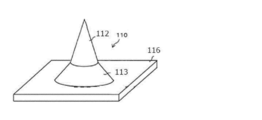
- FIG. 1A is a perspective view of a conical microneedle
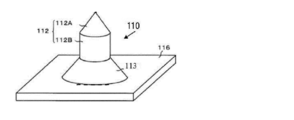
- FIG. 1B is a perspective view of a pyramidal microneedle
- FIG. 1C is a cross-sectional view of the conical and pyramidal microneedles.
- FIG. 2 is a perspective view of another shape of the microneedle.
- FIG. 3 is a perspective view of another shape of the microneedle.
- FIG. 4 is a cross-sectional view of the microneedle shown in FIGS. 2 and 3.
- FIG. 5 is a perspective view of another shape of the microneedle.
- FIG. 6 is a perspective view of another shape of the microneedle.
- FIG. 7 is a cross-sectional view of the microneedle shown in FIGS. 5 and 6.
- FIG. 8 is a cross-sectional view of another shape of microneedle in which the inclination (angle) of the side surface of the needle portion is continuously changed.
- 9A to 9C are process diagrams of the mold manufacturing method.
- FIG. 10 is an enlarged view of the mold.
- FIG. 11 is a cross-sectional view showing another mold.
- 12A to 12C are schematic views showing a process of filling a mold with a drug-containing liquid.
- FIG. 13 is a perspective view showing the tip of the nozzle.
- FIG. 14 is a partially enlarged view of the tip of the nozzle being filled and the mold.
- FIG. 15 is a partially enlarged view of the tip of the moving nozzle and the mold.
- 16A to 16D are explanatory views showing another microneedle array forming process.
- FIG. 17A to 17C are explanatory views showing another microneedle array forming process.
- FIG. 18 is an explanatory diagram showing a peeling process.
- FIG. 19 is an explanatory view showing another peeling step.
- FIG. 20 is an explanatory view showing a microneedle array.
- 21A and 21B are a plan view and a side view of the original plate.
- “comprising a drug” means including a drug in an amount that exhibits a medicinal effect when puncturing the body surface. “No drug” means that the drug does not contain an amount of the drug that is effective, and the range of the drug amount is from the range that does not include the drug to the amount that does not exhibit the drug effect. Including.
- the microneedle array manufactured by the method of the present invention is a microneedle array having a sheet portion and a plurality of needle portions existing on the upper surface of the sheet portion.
- the plural means one or more.
- the microneedle array includes at least a sheet part and a needle part, and the drug is carried on the needle part.
- a microneedle array is a device in which a plurality of needle portions are arranged in an array on the upper surface side of a sheet portion.
- the needle portion is preferably disposed on the upper surface side of the seat portion.
- the needle part may be arranged directly on the upper surface of the sheet part, or the needle part may be arranged on the upper surface of the frustum part arranged on the upper surface of the sheet part.
- the sheet part is a base for supporting the needle part, and has a planar shape like the sheet part 116 shown in FIGS.
- the upper surface of the sheet portion refers to a surface on which a plurality of needle portions are arranged in an array.
- the area of the sheet portion is not particularly limited, but is preferably 0.005 to 1000 mm 2 , more preferably 0.05 to 500 mm 2 , and still more preferably 0.1 to 400 mm 2 .
- the thickness of the sheet portion is represented by the distance between the surface in contact with the frustum portion or the needle portion and the opposite surface.
- the thickness of the sheet portion is preferably 1 ⁇ m or more and 2000 ⁇ m or less, more preferably 3 ⁇ m or more and 1500 ⁇ m or less, and further preferably 5 ⁇ m or more and 1000 ⁇ m or less.
- the sheet portion includes at least one of a water-soluble polymer and a disaccharide.
- the sheet portion may contain other additives.
- seat part does not contain a medicine.
- the water-soluble polymer contained in the sheet part is not particularly limited, and examples thereof include polysaccharides, polyvinyl pyrrolidone, polyoxyethylene polyoxypropylene glycol, polyethylene glycol, polyvinyl alcohol, and proteins (for example, gelatin).
- examples of the polysaccharide include hyaluronic acid, sodium hyaluronate, pullulan, dextran, dextrin, chondroitin sulfate, sodium chondroitin sulfate, and cellulose derivatives (for example, carboxymethyl cellulose, hydroxypropyl cellulose, hydroxypropyl methylcellulose, etc.) Modified water-soluble cellulose derivatives), hydroxyethyl starch, gum arabic and the like.
- Said component may be used individually by 1 type, and may be used as a 2 or more types of mixture.
- the water-soluble polymer contained in the sheet part is hydroxyethyl starch, dextran, chondroitin sulfate, sodium chondroitin sulfate, sodium hyaluronate, carboxymethyl cellulose, polyvinyl pyrrolidone, polyoxyethylene polyoxypropylene glycol, polyethylene glycol and polyvinyl It is preferably at least one selected from the group consisting of alcohols, and chondroitin sulfate is particularly preferable.
- the weight average molecular weight of the water-soluble polymer contained in the sheet part is preferably from 5,000 to 200,000, more preferably from 10,000 to 150,000, and more preferably from 30,000 to 120,000. More preferably, it is as follows.
- a disaccharide may be added to the sheet portion, and examples of the disaccharide include sucrose, lactulose, lactose, maltose, trehalose, and cellobiose, and sucrose, maltose, and trehalose are particularly preferable.
- the microneedle array is composed of a plurality of needle portions arranged in an array on the upper surface side of the sheet portion.
- the needle portion is a convex structure having a tip, and is not limited to a needle shape having a sharp tip, and may have a shape without a sharp tip.
- Examples of the shape of the needle part include a conical shape, a polygonal pyramid shape (such as a quadrangular pyramid shape), and a spindle shape.
- it has a shape like the needle portion 112 shown in FIGS. 1 to 8, and the entire shape of the needle portion may be a conical shape or a polygonal pyramid shape (such as a quadrangular pyramid shape). It may be a structure in which the inclination (angle) of is continuously changed.
- the microneedle array of the present invention is applied to the skin, it is preferable that the needle portion is inserted into the skin and the upper surface of the sheet portion or a part thereof comes into contact with the skin.
- the height (length) of the needle portion is represented by the length of a perpendicular line dropped from the tip of the needle portion to the frustum portion or the sheet portion (when there is no frustum portion).
- the height (length) of the needle part is not particularly limited, but is preferably 50 ⁇ m or more and 3000 ⁇ m or less, more preferably 100 ⁇ m or more and 1500 ⁇ m or less, and further preferably 100 ⁇ m or more and 1000 ⁇ m or less. If the length of the needle is 50 ⁇ m or more, the drug can be administered transdermally, and if the length of the needle is 3000 ⁇ m or less, pain caused by contact of the needle with the nerve can be prevented. This is preferable because it can prevent and avoid bleeding.
- the needle portion includes at least one of a water-soluble polymer and a disaccharide, a drug, and a surfactant. It is preferable that the water-soluble polymer is a biosoluble substance so that the human body is not affected even if the needle portion remains in the skin.
- Peptides or derivatives and proteins thereof include, for example, calcitonin, adrenocorticotropic hormone, parathyroid hormone (PTH), human PTH (1 ⁇ 34), insulin, exendin, secretin, oxytocin, angiotensin, ⁇ -endorphin, glucagon, Vasopressin, somatostatin, gastrin, luteinizing hormone releasing hormone, enkephalin, neurotensin, atrial natriuretic peptide, growth hormone, growth hormone releasing hormone, bradykinin, substance P, dynorphin, thyroid stimulating hormone, prolactin, interferon, interleukin, Granulocyte colony stimulating factor (G-CSF), glutathione peroxidase, superoxide dismutase, desmopressin, somato Jin, endothelin, and salts thereof.
- PTH parathyroid hormone
- human PTH 1 ⁇ 34
- insulin exendin
- secretin secretin
- adjuvants include aluminum salts such as aluminum phosphate, aluminum chloride and aluminum hydroxide, emulsions such as MF59 (trademark) and AS03 (trade name), liposomes, plant-derived components, nucleic acids, biopolymers, cytokines, peptides, Examples include proteins and sugar chains.
- the drug is preferably at least one selected from the group consisting of peptide hormones, vaccines and adjuvants, and peptide hormones or vaccines are particularly preferable.
- Growth hormone is particularly preferred as the peptide hormone.
- An influenza vaccine is particularly preferred as the vaccine.
- the needle part includes a surfactant.
- the surfactant may be any of a nonionic surfactant (electrically neutral surfactant), a cationic surfactant, an anionic surfactant, or an amphoteric surfactant, preferably nonionic.
- Surfactant electrically neutral surfactant
- the needle portion 112 has a conical shape, and in FIG. 1B, the needle portion 112 has a quadrangular pyramid shape.
- H indicates the height of the needle portion 112
- W indicates the diameter (width) of the needle portion 112
- T indicates the height (thickness) of the sheet portion 116.
- FIG. 4 is a cross-sectional view of the microneedle 110 shown in FIGS. 2 and 3.
- H indicates the height of the needle part 112
- W indicates the diameter (width) of the base part
- T indicates the height (thickness) of the sheet part 116.
- the microneedle array of the present invention preferably has the shape of the microneedle 110 of FIG. 4 rather than the shape of the microneedle 110 of FIG. 1C.
- the volume of the entire needle portion is increased, and more drug can be concentrated on the upper end of the needle portion when the microneedle array is manufactured.
- FIG. 7 is a cross-sectional view of the microneedle 110 shown in FIGS. 5 and 6.
- H represents the height of the needle portion 112
- W represents the diameter (width) of the base portion
- T represents the height (thickness) of the sheet portion 116.
- the microneedle array can be supplied in a form that is hermetically stored together with a desiccant.
- a desiccant for example, silica gel, quicklime, calcium chloride, silica alumina, sheet-like desiccant, etc.
- a known desiccant for example, silica gel, quicklime, calcium chloride, silica alumina, sheet-like desiccant, etc.
- the present invention includes a step of filling a hydrophobic mold with a drug-containing liquid to form a needle tip portion, and a liquid containing a water-soluble polymer or disaccharide in the mold including the needle tip tip formed.
- the present invention relates to a method for producing a microneedle array comprising a step of filling to form a needle base and a sheet, wherein the drug-containing liquid contains 0.01 mg / mL to 5 mg / mL of a surfactant.
- a microneedle array can be produced by the following method according to the method described in JP2013-153866A or International Publication WO2014 / 077742.
- the first method after applying a photoresist on a Si substrate, exposure and development are performed. Then, by performing etching by RIE (reactive ion etching) or the like, an array of conical shape portions (convex portions) 12 is produced on the surface of the original 11.
- RIE reactive ion etching
- a conical shape can be formed by etching from an oblique direction while rotating the Si substrate. Is possible.
- the second method is a method of forming an array of shape portions 12 such as square pyramids on the surface of the original plate 11 by processing a metal substrate such as Ni using a cutting tool such as a diamond tool.
- a mold 13 is produced from the original 11.
- the following four methods are conceivable.
- the first method is to pour a PDMS (polydimethylsiloxane, for example, Sylgard 184 (registered trademark) manufactured by Dow Corning) into the original plate 11, and heat cure at 100 ° C. to cure. This is a method of peeling from the original 11.
- the second method is a method in which a UV (Ultraviolet) curable resin that is cured by irradiating ultraviolet rays is poured into the original plate 11 and irradiated from the original plate 11 after being irradiated with ultraviolet rays in a nitrogen atmosphere.
- the third method a solution in which a plastic resin such as polystyrene or PMMA (polymethyl methacrylate) is dissolved in an organic solvent is poured into the original plate 11 coated with a release agent, and the organic solvent is volatilized and cured by drying. And then peeling from the original plate 11.
- the fourth method is a method of creating a reverse product by Ni electroforming.
- the mold 13 is produced in which the needle-like concave portions 15 which are the inverted shape of the conical shape or the pyramid shape of the original plate 11 are arranged in a two-dimensional arrangement.
- the mold 13 produced in this way is shown in FIG. 9C.
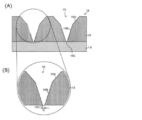
- FIG. 11 shows a more preferable embodiment of the mold composite 18 in manufacturing the microneedle array.
- part (A) shows the mold composite 18.
- part (B) is an enlarged view of a part surrounded by a circle in part (A).
- the mold composite 18 is bonded to the mold 13 having an air vent hole 15 ⁇ / b> C formed at the tip (bottom) of the needle-like recess 15 and the back surface of the mold 13. And a gas permeable sheet 19 formed of a material that transmits but does not transmit liquid.
- the air vent hole 15 ⁇ / b> C is formed as a through hole penetrating the back surface of the mold 13.
- the back surface of the mold 13 refers to the surface on which the air vent hole 15C is formed.
- gas permeable sheet 19 formed of a material that transmits gas but does not transmit liquid for example, a gas permeable film (manufactured by Sumitomo Electric Industries, Poreflon (registered trademark), FP-010) can be preferably used.
- a gas permeable film manufactured by Sumitomo Electric Industries, Poreflon (registered trademark), FP-010
- the material used for the mold 13 may be a hydrophobic material.
- an elastic material or a metal material can be used, an elastic material is preferable, and a material having high gas permeability is more preferable.
- the oxygen permeability which is representative of gas permeability, is preferably 1 ⁇ 10 ⁇ 12 (mL / s ⁇ m 2 ⁇ Pa) or more, more preferably 1 ⁇ 10 ⁇ 10 (mL / s ⁇ m 2 ⁇ Pa) or more. . 1 mL is 10 ⁇ 6 m 3 .
- silicone resins for example, Sylgard 184 (registered trademark) manufactured by Dow Corning, KE-1310ST (product number) manufactured by Shin-Etsu Chemical Co., Ltd.
- ultraviolet curable resins plastic resins (for example, , Polystyrene, PMMA (polymethylmethacrylate)), or those dissolved in a solvent.
- plastic resins for example, Polystyrene, PMMA (polymethylmethacrylate)
- a silicone rubber-based material is preferable because it is durable to transfer by repeated pressurization and has good peelability from the material.
- (solution) In the present invention, (I) Drug-containing liquid (preferably a liquid containing at least one of a water-soluble polymer and a disaccharide, a drug, and a surfactant) for forming the tip of the needle that is a part of the needle As well as (Ii) a liquid containing a water-soluble polymer or a disaccharide for forming a needle base and a sheet part (or a needle base, a frustum part, and a sheet part) of the needle part; It is preferable to prepare.
- Drug-containing liquid preferably a liquid containing at least one of a water-soluble polymer and a disaccharide, a drug, and a surfactant for forming the tip of the needle that is a part of the needle
- a liquid containing a water-soluble polymer or a disaccharide for forming a needle base and a sheet part (or a needle base, a frustum part, and a sheet part) of the needle
- the types of water-soluble polymer, disaccharide, drug, and surfactant are as described above in the present specification.
- the content of the surfactant in the drug-containing solution is 0.01 mg / mL to 5 mg / mL, preferably 0.05 mg / mL to 5 mg / mL.
- the surfactant content is 0.01 mg / mL or more, the drug can be concentrated on the tip of the needle.
- hook failure can be suppressed by making content of surfactant into 5 mg / mL or less.
- the tip of the needle portion is formed by filling a hydrophobic mold with a drug-containing liquid.
- a mold 13 having needle-like recesses 15 arranged two-dimensionally is disposed on a base 20.
- the mold 13 is formed with two sets of a plurality of needle-like recesses 15 that are two-dimensionally arranged in a 5 ⁇ 5 manner.
- a liquid supply device 36 having a tank 30 for storing the drug-containing liquid 22, a pipe 32 connected to the tank, and a nozzle 34 connected to the tip of the pipe 32 is prepared.
- the needle-like concave portions 15 are two-dimensionally arranged in 5 ⁇ 5 is illustrated, but the number of the needle-like concave portions 15 is not limited to 5 ⁇ 5, and M ⁇ N (M and N each independently represent an arbitrary integer of 1 or more, preferably 2 to 30, more preferably 3 to 25, and still more preferably 3 to 20).
- an elastic material or a metal material can be used as the material used for the nozzle 34.
- examples include Teflon (registered trademark), stainless steel (SUS (Steel Use Stainless)), titanium, and the like.
- the drug-containing liquid 22 can be sucked by sucking from the back surface of the mold 13, and the filling of the drug-containing liquid 22 into the needle-shaped recess 15 can be promoted. it can.
- the liquid supply device 36 extends in the direction perpendicular to the length direction of the opening 34 ⁇ / b> B while contacting the lip 34 ⁇ / b> A of the nozzle 34 and the surface of the mold 13.
- the nozzle 34 is moved to the needle-like recess 15 that is not filled with the drug-containing liquid 22.
- the position of the opening 34 ⁇ / b> B of the nozzle 34 is adjusted on the needle-like recess 15.
- the example in which the nozzle 34 is moved has been described, but the mold 13 may be moved.
- the nozzle 34 can scrape off the drug-containing liquid 22 remaining on the surface other than the needle-shaped recess 15 of the mold 13. It is possible to prevent the drug-containing liquid 22 from remaining other than the needle-like recess 15 of the mold 13.
- the embodiment may be such that the drug-containing liquid 22 is filled into the needle-like recess 15 while moving the nozzle 34, or (2) Alternatively, the nozzle 34 may be temporarily stopped and filled with the drug-containing liquid 22, and the nozzle 34 may be moved again after filling.
- the lip portion 34A of the nozzle 34 is in contact with the surface of the mold 13 between the filling step and the moving step.
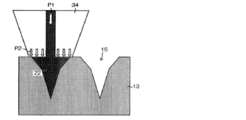
- FIG. 14 is a partially enlarged view of the tip of the nozzle 34 and the mold 13 during filling of the drug-containing liquid 22 into the needle-like recess 15.
- filling the drug-containing liquid 22 into the needle-like recess 15 can be promoted by applying a pressing force P ⁇ b> 1 in the nozzle 34.
- the pressing force P ⁇ b> 2 for bringing the nozzle 34 into contact with the surface of the mold 13 is equal to or higher than the pressure P ⁇ b> 1 in the nozzle 34.
- FIG. 15 is a partially enlarged view of the tip of the nozzle 34 and the mold 13 while the nozzle 34 is moving.
- the pressing force P ⁇ b> 3 for bringing the nozzle 34 into contact with the surface of the mold 13 is made smaller than the pressing force P ⁇ b> 2 for bringing the nozzle 34 being filled into contact with the surface of the mold 13. Is preferred. This is for reducing damage to the mold 13 and suppressing deformation due to compression of the mold 13.
- the drug-containing liquid 22 may flow from the nozzle 34 to other than the needle-shaped recess 15 of the mold 13, and in order to suppress this, the liquid pressure in the nozzle 34 is detected and it is determined that the liquid pressure becomes too high. At this time, it is preferable to stop the supply of the drug-containing liquid 22.
- a drying treatment after supplying the drug-containing liquid to the needle-shaped recess.
- a needle part forming mold filled with a drug-containing liquid is dried to form a needle part tip part; and a liquid containing a water-soluble polymer or a disaccharide It can be manufactured by a process of filling and drying the upper surface of the tip end portion of the needle portion formed in (1).
- the conditions for drying the needle-forming mold filled with the drug-containing liquid are preferably conditions such that the water content of the solution reaches 20% or less after 30 minutes to 300 minutes have elapsed since the start of drying.
- the above-mentioned drying can be controlled so that the water content of the solution reaches 20% or less after 60 minutes or more has elapsed after the start of drying, while maintaining the temperature at which the drug does not expire.
- any means capable of delaying drying such as temperature, humidity, amount of drying air, use of the container, volume and / or shape of the container can be taken.
- the drying can be preferably performed in a state where the needle-forming mold filled with the drug-containing liquid is covered with or contained in the container.
- the drying temperature is preferably 1 to 45 ° C., more preferably 1 to 40 ° C.
- the relative humidity during drying is preferably 10 to 95%, more preferably 20 to 95%, and still more preferably 30 to 95%.
- the needle part base part and the sheet part are formed by filling the mold including the needle part tip part formed as described above with a liquid containing a water-soluble polymer or disaccharide.
- a liquid containing a water-soluble polymer or disaccharide Several aspects of the process of forming the needle base and the sheet will be described. Regarding the process of forming the sheet portion, the first aspect will be described with reference to FIGS. 16A to 16D.
- the needle-like recess 15 of the mold 13 is filled with the drug-containing liquid 22 from the nozzle 34.
- the drug-containing liquid 22 is dried and solidified to form a layer 120 containing a drug in the needle-like recess 15.
- FIG. 16B the drug-containing liquid 22 is dried and solidified to form a layer 120 containing a drug in the needle-like recess 15.
- a liquid 24 containing a water-soluble polymer or disaccharide is applied to the mold 13 on which the layer 120 containing the drug is formed, using a dispenser.
- a dispenser In addition to application by a dispenser, application by bar coating, spin coating, spraying, or the like can be applied. Since the layer 120 containing the drug is solidified, the drug can be prevented from diffusing into the liquid 24.
- the liquid 24 is dried and solidified to form the microneedle array 1 including a plurality of needle portions 112, a frustum portion 113, and a sheet portion 116.
- the liquid 24 formed on the support 29 is overlaid on the mold 13 in which the layer 120 containing the drug is formed in the needle-like recess 15. As a result, the liquid 24 is filled into the needle-shaped recess 15. Since the layer containing the drug is solidified, the drug can be prevented from diffusing into the liquid 24. Next, by drying and solidifying the liquid 24, a microneedle array including a plurality of needle portions 112, a frustum portion 113, and a sheet portion 116 is formed.
- pressurization from the surface of the mold 13 and vacuum suction from the back surface of the mold 13 are performed in order to promote the filling of the liquid 24 containing the water-soluble polymer or disaccharide into the needle-shaped recess 15. It is also preferable to do this.
- any process may be used as long as the solvent in the solution is volatilized.
- the method is not particularly limited, and for example, methods such as heating, blowing, and decompressing are used.
- the drying treatment can be performed at 1 to 50 ° C. for 1 to 72 hours.
- air blowing a method of blowing warm air of 0.1 to 10 m / second can be mentioned.
- the drying temperature is preferably a temperature that does not cause thermal degradation of the drug in the drug-containing liquid 22.
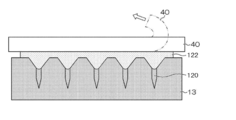
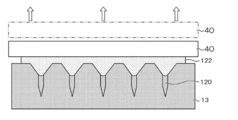
- the method for peeling the microneedle array from the mold 13 is not particularly limited. It is preferable that the needle portion does not bend or break during peeling. Specifically, as shown in FIG. 18, after the sheet-like base material 40 on which the adhesive adhesive layer is formed is attached on the microneedle array, the base material 40 is turned from the end. Can be peeled off. However, in this method, the needle portion may be bent. Therefore, as shown in FIG. 19, a method of installing a suction cup (not shown) on the base material 40 on the microneedle array and pulling it up vertically while sucking with air can be applied. In addition, you may use the support body 29 as the base material 40. FIG.
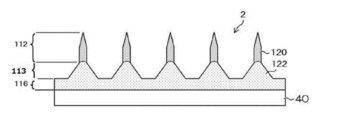
- FIG. 20 shows the microneedle array 2 peeled from the mold 13.
- the microneedle array 2 includes a base material 40, a needle part 112 formed on the base material 40, a frustum part 113, and a sheet part 116.
- the needle portion 112 has at least a conical shape or a polygonal pyramid shape at the tip, but the needle portion 112 is not limited to this shape.
- the method for producing the microneedle array of the present invention is not particularly limited, but (1) a mold production process, (2) a liquid containing at least one of a water-soluble polymer or disaccharide, a drug, and a surfactant. (3) filling the mold with the liquid obtained in (2) to form a needle tip region, (4) filling the mold with a liquid containing a water-soluble polymer or disaccharide, and the needle It is preferable to obtain by the manufacturing method including the process of forming the remainder of a part, (the frustum part if necessary), and a sheet
- HES hydroxyethyl starch 70000 (Fresenius Kabi Co., Ltd.) (weight average molecular weight is 70000)
- CS Sodium chondroitin sulfate (Maruhanichiro Co., Ltd.) (weight average molecular weight 90000)
- Sucrose Sucrose (Wako Pure Chemical Industries, Ltd.)
- Tw Tween (registered trademark) 80 (Seppic Inc.)
- SDS Sodium dodecyl sulfate (Wako Pure Chemical Industries, Ltd.)
- Pluronic registered trademark
- F-68 Nippon Yushi Co., Ltd.
- Triton registered trademark
- -X Alfa Aesar Co., Ltd.
- the bottom surface On the surface of a smooth Ni plate having a side of 40 mm, the bottom surface has a diameter D1 of 500 ⁇ m, a truncated cone 50 having a height H1 of 150 ⁇ m, a diameter D2 of 300 ⁇ m, and a height H2 of 500 ⁇ m, as shown in FIG.
- the original plate 11 was produced by grinding the needle-shaped structure portion 12 formed with the cone 52 into a two-dimensional square array of 100 needles in a square shape at a pitch L10 of 1000 ⁇ m.
- a film of silicon rubber (SILASTIC MDX4-4210 manufactured by Dow Corning) is formed with a thickness of 0.6 mm, and thermosetting is performed with the cone tip 50 ⁇ m of the original plate 11 protruding from the film surface. And peeled. Thereby, a reversal product of silicon rubber having a through hole having a diameter of about 30 ⁇ m was produced.
- This silicon rubber reversal product in which needle-like recesses arranged in a two-dimensional array of 10 columns ⁇ 10 rows in the center, was cut off from the flat portion of 30 mm on a side, and used as a mold. The wider one of the needle-like recesses was the mold surface, and the surface having a 30 ⁇ m diameter through hole (air vent hole) was the mold back surface.
- the above-prepared mold was filled with the aqueous solution containing human serum albumin prepared above. Subsequently, the mold was placed in a lid (box) in an environment of 23 ° C. and a relative humidity of 45%, and dried. At this time, the aqueous solution containing human serum albumin is gradually dried, and after 180 minutes or more, the water content becomes 20% or less.
- the drying means is not limited to the lid, and other means such as temperature / humidity control and air flow control may be used.
- PET polyethylene terephthalate
- Victor jvc cloud remover
- a water-soluble polymer solution was applied to the front and back surfaces with a film thickness of 75 ⁇ m.
- the microneedle array encapsulating human serum albumin was formed by carefully peeling the dried and solidified microneedle array from the mold.
- This microneedle is composed of a frustum part and a needle part, the length L of the needle-like convex part is about 600 ⁇ m in height, the width of the base part is about 270 ⁇ m, the frustum part is about 140 ⁇ m in height, It has a truncated cone structure with an upper base diameter of about 270 ⁇ m and a lower base diameter of about 500 ⁇ m, and is arranged with 100 needles and a needle interval of about 1 mm.
- influenza vaccine Preparation of an aqueous solution containing the influenza vaccine that forms the needle tip
- the influenza vaccine was centrifuged and then mixed with the bases and surfactants shown in Table 2 (in the case of Examples).
- the types and amounts of influenza vaccine, base and surfactant were adjusted as shown in Table 2.
- the aqueous solution containing the influenza vaccine prepared above was filled in the mold produced above. Subsequently, the mold was placed in a lid (box) in an environment of 23 ° C. and a relative humidity of 45%, and dried. At this time, the aqueous solution containing the influenza vaccine is gradually dried, and after a lapse of 180 minutes or more, the water content becomes 20% or less.
- the drying means is not limited to the lid, and other means such as temperature / humidity control and air flow control may be used.
- Needle tip filling rate sample 1 vaccine amount / (sample 1 vaccine amount + sample 2 vaccine amount)
Landscapes
- Health & Medical Sciences (AREA)
- Dermatology (AREA)
- Life Sciences & Earth Sciences (AREA)
- Engineering & Computer Science (AREA)
- Veterinary Medicine (AREA)
- Public Health (AREA)
- General Health & Medical Sciences (AREA)
- Animal Behavior & Ethology (AREA)
- Biomedical Technology (AREA)
- Pharmacology & Pharmacy (AREA)
- Heart & Thoracic Surgery (AREA)
- Anesthesiology (AREA)
- Medical Informatics (AREA)
- Chemical & Material Sciences (AREA)
- Medicinal Chemistry (AREA)
- Hematology (AREA)
- Epidemiology (AREA)
- Media Introduction/Drainage Providing Device (AREA)
- Cosmetics (AREA)
- Medicines That Contain Protein Lipid Enzymes And Other Medicines (AREA)
- Medicines Containing Antibodies Or Antigens For Use As Internal Diagnostic Agents (AREA)
- Medicinal Preparation (AREA)
Abstract
La présente invention vise à fournir un procédé de fabrication d'un réseau de micro-aiguilles, qui permet de concentrer un médicament sur les pointes d'aiguille du réseau de micro-aiguilles. Selon la présente invention, le procédé de fabrication d'un réseau de micro-aiguilles comprend une étape consistant à remplir un moule hydrophobe avec un liquide contenant un médicament et à former des sections de pointe de partie d'aiguille, et une étape consistant à remplir le moule contenant les sections de pointe de partie d'aiguille formées avec un liquide contenant un polymère soluble dans l'eau ou un disaccharide et à former des sections de base de partie d'aiguille et une partie de feuille. Le liquide contenant un médicament contient de 0,01 à 5 mg/mL d'un tensioactif.
Priority Applications (2)
| Application Number | Priority Date | Filing Date | Title |
|---|---|---|---|
| JP2020500982A JPWO2019163805A1 (ja) | 2018-02-20 | 2019-02-20 | マイクロニードルアレイの製造方法 |
| US16/997,696 US20200376247A1 (en) | 2018-02-20 | 2020-08-19 | Method of producing microneedle array |
Applications Claiming Priority (2)
| Application Number | Priority Date | Filing Date | Title |
|---|---|---|---|
| JP2018027824 | 2018-02-20 | ||
| JP2018-027824 | 2018-02-20 |
Related Child Applications (1)
| Application Number | Title | Priority Date | Filing Date |
|---|---|---|---|
| US16/997,696 Continuation US20200376247A1 (en) | 2018-02-20 | 2020-08-19 | Method of producing microneedle array |
Publications (1)
| Publication Number | Publication Date |
|---|---|
| WO2019163805A1 true WO2019163805A1 (fr) | 2019-08-29 |
Family
ID=67686813
Family Applications (1)
| Application Number | Title | Priority Date | Filing Date |
|---|---|---|---|
| PCT/JP2019/006230 Ceased WO2019163805A1 (fr) | 2018-02-20 | 2019-02-20 | Procédé de fabrication d'un réseau de micro-aiguilles |
Country Status (3)
| Country | Link |
|---|---|
| US (1) | US20200376247A1 (fr) |
| JP (1) | JPWO2019163805A1 (fr) |
| WO (1) | WO2019163805A1 (fr) |
Cited By (2)
| Publication number | Priority date | Publication date | Assignee | Title |
|---|---|---|---|---|
| JP2021151201A (ja) * | 2020-03-24 | 2021-09-30 | 国立研究開発法人産業技術総合研究所 | マイクロニードルアレイ及びそれを用いた植物細胞への物質導入方法 |
| WO2021201266A1 (fr) * | 2020-04-03 | 2021-10-07 | コスメディ製薬株式会社 | Micro-aiguille à dissolution rapide |
Families Citing this family (3)
| Publication number | Priority date | Publication date | Assignee | Title |
|---|---|---|---|---|
| BR112022022039A2 (pt) | 2020-04-28 | 2022-12-13 | Ticona Llc | Conjunto de microagulhas |
| CN114903843B (zh) * | 2022-06-02 | 2023-01-13 | 优微(珠海)生物科技有限公司 | 一种微针制剂、微针贴片及其制备方法 |
| CN120393257A (zh) * | 2025-07-03 | 2025-08-01 | 中科微针(北京)科技有限公司 | 一种利用微针模具制备微针的方法及微针 |
Citations (4)
| Publication number | Priority date | Publication date | Assignee | Title |
|---|---|---|---|---|
| JP2009233170A (ja) * | 2008-03-27 | 2009-10-15 | Fujifilm Corp | 高アスペクト比構造シートの製造方法 |
| US20120027810A1 (en) * | 2008-12-22 | 2012-02-02 | The University Of Queensland | Patch production |
| WO2016143792A1 (fr) * | 2015-03-10 | 2016-09-15 | 富士フイルム株式会社 | Procédé de production d'une feuille d'absorption percutanée |
| JP2017517295A (ja) * | 2014-04-24 | 2017-06-29 | ジョージア テック リサーチ コーポレイション | マイクロニードル及びその製造方法 |
-
2019
- 2019-02-20 JP JP2020500982A patent/JPWO2019163805A1/ja not_active Abandoned
- 2019-02-20 WO PCT/JP2019/006230 patent/WO2019163805A1/fr not_active Ceased
-
2020
- 2020-08-19 US US16/997,696 patent/US20200376247A1/en not_active Abandoned
Patent Citations (4)
| Publication number | Priority date | Publication date | Assignee | Title |
|---|---|---|---|---|
| JP2009233170A (ja) * | 2008-03-27 | 2009-10-15 | Fujifilm Corp | 高アスペクト比構造シートの製造方法 |
| US20120027810A1 (en) * | 2008-12-22 | 2012-02-02 | The University Of Queensland | Patch production |
| JP2017517295A (ja) * | 2014-04-24 | 2017-06-29 | ジョージア テック リサーチ コーポレイション | マイクロニードル及びその製造方法 |
| WO2016143792A1 (fr) * | 2015-03-10 | 2016-09-15 | 富士フイルム株式会社 | Procédé de production d'une feuille d'absorption percutanée |
Cited By (6)
| Publication number | Priority date | Publication date | Assignee | Title |
|---|---|---|---|---|
| JP2021151201A (ja) * | 2020-03-24 | 2021-09-30 | 国立研究開発法人産業技術総合研究所 | マイクロニードルアレイ及びそれを用いた植物細胞への物質導入方法 |
| JP7466181B2 (ja) | 2020-03-24 | 2024-04-12 | 国立研究開発法人産業技術総合研究所 | マイクロニードルアレイ及びそれを用いた植物細胞への物質導入方法 |
| WO2021201266A1 (fr) * | 2020-04-03 | 2021-10-07 | コスメディ製薬株式会社 | Micro-aiguille à dissolution rapide |
| JP2021164635A (ja) * | 2020-04-03 | 2021-10-14 | コスメディ製薬株式会社 | 短時間溶解マイクロニードル |
| CN113766913A (zh) * | 2020-04-03 | 2021-12-07 | 考司美德制药株式会社 | 短时间溶解微针 |
| AU2021249948B2 (en) * | 2020-04-03 | 2023-07-20 | Cosmed Pharmaceutical Co., Ltd. | Fast-dissolving microneedle |
Also Published As
| Publication number | Publication date |
|---|---|
| US20200376247A1 (en) | 2020-12-03 |
| JPWO2019163805A1 (ja) | 2021-02-25 |
Similar Documents
| Publication | Publication Date | Title |
|---|---|---|
| JP6736337B2 (ja) | マイクロニードルアレイ | |
| AU2016320947B2 (en) | Microneedle array | |
| CN109310854B (zh) | 微针阵列 | |
| JP2016030072A (ja) | マイクロニードルアレイ | |
| WO2019163805A1 (fr) | Procédé de fabrication d'un réseau de micro-aiguilles | |
| JP2016067681A (ja) | マイクロニードルアレイ | |
| JP6997866B2 (ja) | 日本脳炎ワクチン含有マイクロニードルアレイ | |
| CN113677363B (zh) | 含有流感疫苗的微针阵列及微针阵列的制造方法 | |
| JP6778296B2 (ja) | マイクロニードルアレイ | |
| JP7165471B2 (ja) | マイクロニードルアレイ及びマイクロニードルアレイの製造方法 | |
| WO2017179613A1 (fr) | Procédé de fabrication d'un ensemble de micro-aiguilles | |
| WO2017179615A1 (fr) | Réseau de micro-aiguilles et procédé de fabrication d'un réseau de micro-aiguilles | |
| US20230201108A1 (en) | Japanese encephalitis preventive agent and japanese encephalitis vaccine agent | |
| JP2020189038A (ja) | ポリオワクチン内包マイクロニードルアレイ |
Legal Events
| Date | Code | Title | Description |
|---|---|---|---|
| 121 | Ep: the epo has been informed by wipo that ep was designated in this application |
Ref document number: 19757052 Country of ref document: EP Kind code of ref document: A1 |
|
| ENP | Entry into the national phase |
Ref document number: 2020500982 Country of ref document: JP Kind code of ref document: A |
|
| NENP | Non-entry into the national phase |
Ref country code: DE |
|
| 122 | Ep: pct application non-entry in european phase |
Ref document number: 19757052 Country of ref document: EP Kind code of ref document: A1 |