WO2019169965A1 - Procédé, appareil et dispositif de reconnaissance d'image de balayage de code - Google Patents
Procédé, appareil et dispositif de reconnaissance d'image de balayage de code Download PDFInfo
- Publication number
- WO2019169965A1 WO2019169965A1 PCT/CN2019/072772 CN2019072772W WO2019169965A1 WO 2019169965 A1 WO2019169965 A1 WO 2019169965A1 CN 2019072772 W CN2019072772 W CN 2019072772W WO 2019169965 A1 WO2019169965 A1 WO 2019169965A1
- Authority
- WO
- WIPO (PCT)
- Prior art keywords
- binarization
- result
- cpu
- image frame
- scan code
- Prior art date
- Legal status (The legal status is an assumption and is not a legal conclusion. Google has not performed a legal analysis and makes no representation as to the accuracy of the status listed.)
- Ceased
Links
Images


Classifications
-
- G—PHYSICS
- G06—COMPUTING OR CALCULATING; COUNTING
- G06K—GRAPHICAL DATA READING; PRESENTATION OF DATA; RECORD CARRIERS; HANDLING RECORD CARRIERS
- G06K7/00—Methods or arrangements for sensing record carriers, e.g. for reading patterns
- G06K7/10—Methods or arrangements for sensing record carriers, e.g. for reading patterns by electromagnetic radiation, e.g. optical sensing; by corpuscular radiation
- G06K7/14—Methods or arrangements for sensing record carriers, e.g. for reading patterns by electromagnetic radiation, e.g. optical sensing; by corpuscular radiation using light without selection of wavelength, e.g. sensing reflected white light
- G06K7/1404—Methods for optical code recognition
- G06K7/1408—Methods for optical code recognition the method being specifically adapted for the type of code
- G06K7/1417—2D bar codes
-
- G—PHYSICS
- G06—COMPUTING OR CALCULATING; COUNTING
- G06K—GRAPHICAL DATA READING; PRESENTATION OF DATA; RECORD CARRIERS; HANDLING RECORD CARRIERS
- G06K7/00—Methods or arrangements for sensing record carriers, e.g. for reading patterns
- G06K7/10—Methods or arrangements for sensing record carriers, e.g. for reading patterns by electromagnetic radiation, e.g. optical sensing; by corpuscular radiation
- G06K7/10544—Methods or arrangements for sensing record carriers, e.g. for reading patterns by electromagnetic radiation, e.g. optical sensing; by corpuscular radiation by scanning of the records by radiation in the optical part of the electromagnetic spectrum
- G06K7/10821—Methods or arrangements for sensing record carriers, e.g. for reading patterns by electromagnetic radiation, e.g. optical sensing; by corpuscular radiation by scanning of the records by radiation in the optical part of the electromagnetic spectrum further details of bar or optical code scanning devices
- G06K7/10851—Circuits for pulse shaping, amplifying, eliminating noise signals, checking the function of the sensing device
-
- G—PHYSICS
- G06—COMPUTING OR CALCULATING; COUNTING
- G06K—GRAPHICAL DATA READING; PRESENTATION OF DATA; RECORD CARRIERS; HANDLING RECORD CARRIERS
- G06K7/00—Methods or arrangements for sensing record carriers, e.g. for reading patterns
- G06K7/10—Methods or arrangements for sensing record carriers, e.g. for reading patterns by electromagnetic radiation, e.g. optical sensing; by corpuscular radiation
- G06K7/10544—Methods or arrangements for sensing record carriers, e.g. for reading patterns by electromagnetic radiation, e.g. optical sensing; by corpuscular radiation by scanning of the records by radiation in the optical part of the electromagnetic spectrum
- G06K7/10821—Methods or arrangements for sensing record carriers, e.g. for reading patterns by electromagnetic radiation, e.g. optical sensing; by corpuscular radiation by scanning of the records by radiation in the optical part of the electromagnetic spectrum further details of bar or optical code scanning devices
- G06K7/1098—Methods or arrangements for sensing record carriers, e.g. for reading patterns by electromagnetic radiation, e.g. optical sensing; by corpuscular radiation by scanning of the records by radiation in the optical part of the electromagnetic spectrum further details of bar or optical code scanning devices the scanning arrangement having a modular construction
-
- G—PHYSICS
- G06—COMPUTING OR CALCULATING; COUNTING
- G06V—IMAGE OR VIDEO RECOGNITION OR UNDERSTANDING
- G06V30/00—Character recognition; Recognising digital ink; Document-oriented image-based pattern recognition
- G06V30/10—Character recognition
- G06V30/14—Image acquisition
- G06V30/142—Image acquisition using hand-held instruments; Constructional details of the instruments
Definitions
- the present specification relates to the field of computer software technologies, and in particular, to a method, device and device for scanning code image recognition.
- the smart phone often recognizes the two-dimensional code by scanning, obtains the business information contained in the two-dimensional code, and then interacts with another device based on the service information, thereby implementing a specific service, such as a payment service, an instant communication service, and the like.
- a specific service such as a payment service, an instant communication service, and the like.
- the smart phone when scanning the two-dimensional code, uses the camera to align the two-dimensional code, continuously collects the scanned image frame, and the scanned image frame is scanned by the central processing unit (CPU) of the smart phone. Binarization processing is performed to identify until the information contained in the two-dimensional code is successfully identified.
- CPU central processing unit
- the embodiment of the present specification provides a method, a device and a device for scanning image recognition, which are used to solve the following technical problems: a more efficient scanning image recognition scheme is needed.
- the binarization result is provided to the CPU to identify the binarization result by the CPU, and obtain a scan image recognition result.
- a binarization module that performs binarization processing on the current scan code image frame by using a GPU to obtain a binarization result
- the identification module provides the binarization result to the CPU to identify the binarization result by using the CPU to obtain a scan image recognition result.
- At least one processor and,
- the memory stores instructions executable by the at least one processor, the instructions being executed by the at least one processor to enable the at least one processor to:
- the binarization result is provided to the CPU to identify the binarization result by the CPU, and obtain a scan image recognition result.
- the above at least one technical solution adopted by the embodiment of the present specification can achieve the following beneficial effects: when identifying a plurality of consecutive scan code image frames, the GPU replaces the CPU for binarization processing, and the CPU only needs to further identify the binarization result. Yes, these two processes can be executed in parallel, which is beneficial to improve the efficiency of scanning image recognition.
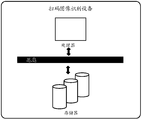
- FIG. 1 is a schematic diagram of an overall architecture involved in an implementation scenario of the present specification
- FIG. 2 is a schematic flow chart of a method for identifying a scan code image according to an embodiment of the present disclosure
- FIG. 3 is a schematic diagram of an implementation principle of a scan code image recognition method according to an embodiment of the present disclosure
- FIG. 4 is a schematic structural diagram of a scan code image recognition apparatus corresponding to FIG. 2 according to an embodiment of the present disclosure
- FIG. 5 is a schematic structural diagram of a scan code image recognition device corresponding to FIG. 2 according to an embodiment of the present disclosure.
- the embodiments of the present specification provide a method, an apparatus, and a device for scanning code image recognition.
- FIG. 1 is a schematic diagram of an overall architecture involved in an implementation scenario of the present specification.
- the overall architecture mainly involves a camera, a GPU, and a CPU on a user terminal device.
- User terminal equipment for example, includes a smart phone, a tablet computer, a merchant cash register, a point of sale (POS) machine, and the like.
- the camera is used to continuously collect scan code image frames when the user scans the code
- the GPU is used for binarizing the scan code image frames
- the CPU is used to identify the binarization results, thereby realizing the scan code image recognition.
- FIG. 2 is a schematic flowchart of a method for identifying a scanned image according to an embodiment of the present disclosure. The flow may also be performed based on a simple operation trigger of the user (such as clicking a “sweep” button), or if necessary, It may also be performed automatically at the right time.
- a simple operation trigger of the user such as clicking a “sweep” button
- the execution body of the process may be a user terminal device. From a program perspective, the execution body of the process may be a program installed in the above device, and the program may be in the form of a client, a webpage, or a server.
- the process in Figure 2 can include the following steps:
- scanning code mainly refers to scanning a two-dimensional code.
- DOI Digital Object Unique Identifier
- barcode a Uniform Resource Locator (URL), etc.
- URL Uniform Resource Locator
- the scan image frame is continuously collected by the camera on the smart phone, and the smart phone is generally operated by the user, and the focus condition and the alignment situation may change at any time during the scanning process.
- the scanned image frames continuously collected are usually different.
- the information contained in the code may be successfully identified from some scanned image frames, and the code may not be successfully identified from other scanned image frames.
- Information contained It is possible to sequentially identify each of the acquired scan image frames, and after successfully identifying the information contained in the code, stop the subsequent recognition process.
- S204 Perform a binarization process on the current scan code image frame by using a GPU to obtain a binarization result.
- the GPU is used for the CPU to share the work, and the scan code image frame to be recognized by the GPU is binarized, so that the CPU does not need to perform binarization processing, and the CPU is responsible for identifying the binarization result, thereby reducing The burden of the CPU.
- the entire scan image recognition process is only a serial operation process, and the GPU performs the scan image frame on the second.
- the value processing process is further successfully recognized by the CPU for the binarization result of the scanned image frame.
- the entire scan image recognition process is a serial work plus parallel work process, serial finger to each
- the processing process of the scan code image frames is serial
- the parallel process means that the following two processes can be parallel: the process of using the CPU to identify the binarization result of a scan code image frame, and using the GPU binarization process The process of scanning a coded image frame behind a coded image frame.
- the scan image recognition result is generally a character string included in the code, and the character string indicates, for example, a payment account, a jump URL, a business card, and the like.
- the GPU replaces the CPU for binarization processing, and the CPU only needs to further identify the binarization result, and the two processes can be executed in parallel. It is beneficial to improve the efficiency of scanning image recognition, and it is also beneficial to reduce the burden on the CPU.
- the embodiments of the present specification further provide some specific implementations of the method, and an extended solution, which will be described below.
- the work of the GPU and the CPU may be performed based on different threads or different processes without affecting each other.
- the GPU is used to perform binarization processing on the current scan code image frame, which may include: the first thread uses the GPU to perform binarization processing on the current scan code image frame.
- the identifying, by the CPU, the binarization result may include: the second thread using the CPU to identify the binarization result.
- the first thread and the second thread are different threads.
- the current one scan image frame may not be successfully identified. Therefore, after the binarization result is provided to the CPU, the step may be utilized.
- the GPU continues to binarize the next scanned image frame.
- the GPU's continuation process does not need to wait for the CPU to process the binarization result, and the process of using the CPU to identify the binarization result and the process of using the GPU binarization process to scan the coded image frame can be performed in parallel.
- the specific implementation scheme of providing the binarization result to the CPU is diverse. For example, after the CPU obtains the binarization result, and sends a corresponding notification (for example, to a function module that uses the CPU to identify the binarization result, the function module is referred to herein as a CPU identification module) so that the CPU identification module obtains the The result of the binarization in the result pool, or the binarization result may be sent to the CPU identification module actively, or the CPU identification module may not actively and only passively acquire the binarization result. After the CPU identification module obtains the binarization result, it can be provided to the CPU for use.
- a corresponding notification for example, to a function module that uses the CPU to identify the binarization result, the function module is referred to herein as a CPU identification module
- the GPU may perform binarization processing on multiple scan code image frames, and accordingly, multiple binarization results are obtained.
- these binarization results can be uniformly saved.
- a result pool can be established for storing the binarization results for use by the CPU, and the result pool is not limited in position, such as in memory or cache.
- the volatile memory it can also be in a non-volatile memory such as a hard disk or a flash memory.
- the providing the binarization result to the CPU may include: saving the binarization result in a result pool, and sending a corresponding notification for the CPU to obtain the location in the result pool.
- the binarization result is described. Further, if the CPU fails to identify the binarization result, the CPU may be used to obtain the next binarization result from the result pool for identification until the recognition is successful.
- each scan code image frame is continuously binarized by the GPU, and the obtained binarization results are saved in the result pool, when there is a new binarization result in the binarization result pool.
- the CPU identification module uses the CPU to identify the binarization result, and if the recognition is successful, the result is returned, and if the recognition fails, the next binarization result is obtained from the result pool to continue to identify Until the recognition is successful.
- the embodiment of the present specification further provides a device and a device corresponding to the foregoing method, as shown in FIG. 4 and FIG. 5.
- FIG. 4 is a schematic structural diagram of a scan code image recognition apparatus corresponding to FIG. 2 according to an embodiment of the present disclosure, where the apparatus includes:
- Obtaining module 401 acquiring a current scan code image frame
- the binarization module 402 performs binarization processing on the current scan code image frame by using a GPU to obtain a binarization result
- the identification module 403 provides the binarization result to the CPU to identify the binarization result by the CPU to obtain a scan image recognition result.
- the binarization module 402 performs a binarization process on the current scan code image frame by using a GPU, and specifically includes:
- the binarization module 402 performs binarization processing on the current scan code image frame by using a GPU through a first thread
- the identification module 403 uses the CPU to identify the binarization result, and specifically includes:
- the identification module 403 identifies the binarization result by using the CPU by using a second thread, where the first thread and the second thread are different threads.
- the binarization module 402 performs binarization processing on the next scan image frame by using the GPU, where The process of the CPU identifying the binarization result and the process of scanning the coded image frame by the GPU binarization process can be performed in parallel.
- the identifying module 403 provides the binarization result to the CPU, and specifically includes:
- the identification module 403 saves the binarization result in the result pool, and sends a corresponding notification for the CPU to obtain the binarization result in the result pool.
- the identifying module 403 uses the CPU to acquire the next binarization result from the result pool for identification.
- the scan code comprises scanning a two-dimensional code.
- FIG. 5 is a schematic structural diagram of a scan code image recognition device corresponding to FIG. 2 according to an embodiment of the present disclosure, where the device includes:
- At least one processor and,
- the memory stores instructions executable by the at least one processor, the instructions being executed by the at least one processor to enable the at least one processor to:
- the binarization result is provided to the CPU to identify the binarization result by the CPU, and obtain a scan image recognition result.
- the embodiment of the present specification further provides a non-volatile computer storage medium corresponding to FIG. 2, which stores computer executable instructions, and the computer executable instructions are set as:
- the binarization result is provided to the CPU to identify the binarization result by the CPU, and obtain a scan image recognition result.
- the device, the device, the non-volatile computer storage medium and the method provided by the embodiments of the present specification are corresponding, and therefore, the device, the device, and the non-volatile computer storage medium also have similar beneficial technical effects as the corresponding method, since The beneficial technical effects of the method are described in detail, and therefore, the beneficial technical effects of the corresponding device, device, and non-volatile computer storage medium are not described herein.
- PLD Programmable Logic Device
- FPGA Field Programmable Gate Array
- HDL Hardware Description Language
- the controller can be implemented in any suitable manner, for example, the controller can take the form of, for example, a microprocessor or processor and a computer readable medium storing computer readable program code (eg, software or firmware) executable by the (micro)processor.
- computer readable program code eg, software or firmware
- examples of controllers include, but are not limited to, the following microcontrollers: ARC 625D, Atmel AT91SAM, The Microchip PIC18F26K20 and the Silicone Labs C8051F320, the memory controller can also be implemented as part of the memory's control logic.
- the controller can be logically programmed by means of logic gates, switches, ASICs, programmable logic controllers, and embedding.
- Such a controller can therefore be considered a hardware component, and the means for implementing various functions included therein can also be considered as a structure within the hardware component.
- a device for implementing various functions can be considered as a software module that can be both a method of implementation and a structure within a hardware component.
- the system, device, module or unit illustrated in the above embodiments may be implemented by a computer chip or an entity, or by a product having a certain function.
- a typical implementation device is a computer.
- the computer can be, for example, a personal computer, a laptop computer, a cellular phone, a camera phone, a smart phone, a personal digital assistant, a media player, a navigation device, an email device, a game console, a tablet computer, a wearable device, or A combination of any of these devices.
- embodiments of the specification can be provided as a method, system, or computer program product.
- embodiments of the present specification can take the form of an entirely hardware embodiment, an entirely software embodiment, or a combination of software and hardware.
- embodiments of the present specification can take the form of a computer program product embodied on one or more computer usable storage media (including but not limited to disk storage, CD-ROM, optical storage, etc.) including computer usable program code.
- the computer program instructions can also be stored in a computer readable memory that can direct a computer or other programmable data processing device to operate in a particular manner, such that the instructions stored in the computer readable memory produce an article of manufacture comprising the instruction device.
- the apparatus implements the functions specified in one or more blocks of a flow or a flow and/or block diagram of the flowchart.
- These computer program instructions can also be loaded onto a computer or other programmable data processing device such that a series of operational steps are performed on a computer or other programmable device to produce computer-implemented processing for execution on a computer or other programmable device.
- the instructions provide steps for implementing the functions specified in one or more of the flow or in a block or blocks of a flow diagram.
- a computing device includes one or more processors (CPUs), input/output interfaces, network interfaces, and memory.
- processors CPUs
- input/output interfaces network interfaces
- memory volatile and non-volatile memory
- the memory may include non-persistent memory, random access memory (RAM), and/or non-volatile memory in a computer readable medium, such as read only memory (ROM) or flash memory.
- RAM random access memory
- ROM read only memory
- Memory is an example of a computer readable medium.
- Computer readable media includes both permanent and non-persistent, removable and non-removable media.
- Information storage can be implemented by any method or technology.
- the information can be computer readable instructions, data structures, modules of programs, or other data.
- Examples of computer storage media include, but are not limited to, phase change memory (PRAM), static random access memory (SRAM), dynamic random access memory (DRAM), other types of random access memory (RAM), read only memory. (ROM), electrically erasable programmable read only memory (EEPROM), flash memory or other memory technology, compact disk read only memory (CD-ROM), digital versatile disk (DVD) or other optical storage, Magnetic tape cartridges, magnetic tape storage or other magnetic storage devices or any other non-transportable media can be used to store information that can be accessed by a computing device.
- computer readable media does not include temporary storage of computer readable media, such as modulated data signals and carrier waves.
- embodiments of the present description can be provided as a method, system, or computer program product. Accordingly, the present description may take the form of an entirely hardware embodiment, an entirely software embodiment or an embodiment in combination of software and hardware. Moreover, the description may take the form of a computer program product embodied on one or more computer-usable storage media (including but not limited to disk storage, CD-ROM, optical storage, etc.) including computer usable program code.
- computer-usable storage media including but not limited to disk storage, CD-ROM, optical storage, etc.
- program modules include routines, programs, objects, components, data structures, and the like that perform particular tasks or implement particular abstract data types.
- the present specification can also be practiced in distributed computing environments where tasks are performed by remote processing devices that are connected through a communication network.
- program modules can be located in both local and remote computer storage media including storage devices.
Landscapes
- Physics & Mathematics (AREA)
- Engineering & Computer Science (AREA)
- Electromagnetism (AREA)
- Computer Vision & Pattern Recognition (AREA)
- Theoretical Computer Science (AREA)
- General Physics & Mathematics (AREA)
- General Health & Medical Sciences (AREA)
- Artificial Intelligence (AREA)
- Toxicology (AREA)
- Health & Medical Sciences (AREA)
- Multimedia (AREA)
- Character Discrimination (AREA)
- Container Filling Or Packaging Operations (AREA)
- Image Processing (AREA)
- Image Analysis (AREA)
Abstract
La présente invention concerne un procédé, un appareil et un dispositif de reconnaissance d'image de balayage de code. Le procédé comprend les étapes suivantes : lorsqu'une image de balayage de code est reconnue, une GPU effectue un traitement de binarisation sur une trame d'image de balayage de code actuelle, fournit ensuite un résultat de binarisation à une UCT, puis traite en continu une trame d'image à balayage de code suivante; pendant ce temps, l'UCT est capable de reconnaître le résultat de binarisation, et si la reconnaissance échoue, tente de reconnaître le résultat de binarisation suivant jusqu'à ce qu'il soit reconnu.
Applications Claiming Priority (2)
| Application Number | Priority Date | Filing Date | Title |
|---|---|---|---|
| CN201810186076.6 | 2018-03-07 | ||
| CN201810186076.6A CN108537085A (zh) | 2018-03-07 | 2018-03-07 | 一种扫码图像识别方法、装置以及设备 |
Publications (1)
| Publication Number | Publication Date |
|---|---|
| WO2019169965A1 true WO2019169965A1 (fr) | 2019-09-12 |
Family
ID=63486463
Family Applications (1)
| Application Number | Title | Priority Date | Filing Date |
|---|---|---|---|
| PCT/CN2019/072772 Ceased WO2019169965A1 (fr) | 2018-03-07 | 2019-01-23 | Procédé, appareil et dispositif de reconnaissance d'image de balayage de code |
Country Status (3)
| Country | Link |
|---|---|
| CN (1) | CN108537085A (fr) |
| TW (1) | TWI769360B (fr) |
| WO (1) | WO2019169965A1 (fr) |
Cited By (1)
| Publication number | Priority date | Publication date | Assignee | Title |
|---|---|---|---|---|
| CN114723766A (zh) * | 2022-04-14 | 2022-07-08 | 润芯微科技(江苏)有限公司 | 一种二维码提取与展示的方法及电子设备 |
Families Citing this family (5)
| Publication number | Priority date | Publication date | Assignee | Title |
|---|---|---|---|---|
| CN108537085A (zh) * | 2018-03-07 | 2018-09-14 | 阿里巴巴集团控股有限公司 | 一种扫码图像识别方法、装置以及设备 |
| CN110516739B (zh) * | 2019-08-27 | 2022-12-27 | 创新先进技术有限公司 | 一种证件识别方法、装置及设备 |
| CN110610080B (zh) * | 2019-09-19 | 2022-02-22 | 武汉统信软件技术有限公司 | 应用的隔离实现方法、移动终端、计算机设备和存储介质 |
| EP4246369A4 (fr) * | 2020-11-30 | 2024-02-28 | Huawei Technologies Co., Ltd. | Procédé et appareil de balayage de code |
| CN113963352B (zh) * | 2021-09-22 | 2022-08-02 | 支付宝(杭州)信息技术有限公司 | 识别图片和训练神经网络的方法和装置 |
Citations (4)
| Publication number | Priority date | Publication date | Assignee | Title |
|---|---|---|---|---|
| CN104851081A (zh) * | 2015-05-15 | 2015-08-19 | 南京信息工程大学 | 一种基于gpu的并行拉普拉斯图像锐化方法 |
| CN105894514A (zh) * | 2016-04-06 | 2016-08-24 | 广东工业大学 | 一种基于gpu并行运算的印刷品缺陷检测方法及系统 |
| CN107609446A (zh) * | 2017-07-31 | 2018-01-19 | 努比亚技术有限公司 | 一种码图识别方法、终端及计算机可读存储介质 |
| CN108537085A (zh) * | 2018-03-07 | 2018-09-14 | 阿里巴巴集团控股有限公司 | 一种扫码图像识别方法、装置以及设备 |
Family Cites Families (6)
| Publication number | Priority date | Publication date | Assignee | Title |
|---|---|---|---|---|
| CN103824257A (zh) * | 2012-11-16 | 2014-05-28 | 无锡汉兴电子有限公司 | 一种二维码图像预处理方法 |
| CN103955660B (zh) * | 2014-04-22 | 2017-02-22 | 广州闪购软件服务有限公司 | 一种批量二维码图像识别方法 |
| CN104125220A (zh) * | 2014-07-08 | 2014-10-29 | 上海仪电智能电子有限公司 | 一种实现手机应用和后台数据库进行快速数据交换和响应的方法 |
| CN104933731A (zh) * | 2015-04-17 | 2015-09-23 | 阔地教育科技有限公司 | 一种基于图形处理器的运动目标检测方法及装置 |
| CN108573186A (zh) * | 2016-03-31 | 2018-09-25 | 青岛海信移动通信技术股份有限公司 | 二维码图片识别方法及装置 |
| CN106095536B (zh) * | 2016-06-22 | 2019-06-11 | 福建联迪商用设备有限公司 | 基于多核mpu的多线程解码方法及系统 |
-
2018
- 2018-03-07 CN CN201810186076.6A patent/CN108537085A/zh active Pending
- 2018-12-27 TW TW107147331A patent/TWI769360B/zh active
-
2019
- 2019-01-23 WO PCT/CN2019/072772 patent/WO2019169965A1/fr not_active Ceased
Patent Citations (4)
| Publication number | Priority date | Publication date | Assignee | Title |
|---|---|---|---|---|
| CN104851081A (zh) * | 2015-05-15 | 2015-08-19 | 南京信息工程大学 | 一种基于gpu的并行拉普拉斯图像锐化方法 |
| CN105894514A (zh) * | 2016-04-06 | 2016-08-24 | 广东工业大学 | 一种基于gpu并行运算的印刷品缺陷检测方法及系统 |
| CN107609446A (zh) * | 2017-07-31 | 2018-01-19 | 努比亚技术有限公司 | 一种码图识别方法、终端及计算机可读存储介质 |
| CN108537085A (zh) * | 2018-03-07 | 2018-09-14 | 阿里巴巴集团控股有限公司 | 一种扫码图像识别方法、装置以及设备 |
Non-Patent Citations (1)
| Title |
|---|
| WANG, PENG ET AL.: "Research of Barcode Recognition Technology Based on CPU&GPU in Aviation Information System", COMPUTER SCIENCE, vol. 40, no. 11A, 30 November 2013 (2013-11-30), pages 357 - 358, 378 * |
Cited By (1)
| Publication number | Priority date | Publication date | Assignee | Title |
|---|---|---|---|---|
| CN114723766A (zh) * | 2022-04-14 | 2022-07-08 | 润芯微科技(江苏)有限公司 | 一种二维码提取与展示的方法及电子设备 |
Also Published As
| Publication number | Publication date |
|---|---|
| TWI769360B (zh) | 2022-07-01 |
| TW201939356A (zh) | 2019-10-01 |
| CN108537085A (zh) | 2018-09-14 |
Similar Documents
| Publication | Publication Date | Title |
|---|---|---|
| WO2019169965A1 (fr) | Procédé, appareil et dispositif de reconnaissance d'image de balayage de code | |
| CN107609437B (zh) | 一种目标图形码识别方法和装置 | |
| TWI717644B (zh) | 業務資訊獲取方法、裝置以及設備 | |
| EP3425581B1 (fr) | Procédé et dispositif d'affichage d'informations | |
| CN107480587B (zh) | 一种模型配置以及图像识别的方法及装置 | |
| WO2019179233A1 (fr) | Procédé et appareil d'identification et de lecture de qr code, et dispositif | |
| WO2019149020A1 (fr) | Procédé et système de reconnaissance d'informations, et serveur et client | |
| WO2019141108A1 (fr) | Procédé, appareil, et dispositif de traitement d'informations fondés sur un balayage de doi | |
| WO2018099314A1 (fr) | Procédé et appareil de traitement de données de service, et client | |
| WO2019205761A1 (fr) | Dispositif intelligent, procédé, dispositif et appareil de prise d'inventaire | |
| EP3611684A1 (fr) | Procédé et dispositif de création de compte, de remplissage de compte et de synchronisation de données | |
| WO2019179243A1 (fr) | Procédé, appareil et dispositif d'affichage d'informations | |
| WO2019179234A1 (fr) | Dispositif, appareil, et procédé d'identification d'image | |
| CN108427525B (zh) | 应用的识别码的展示方法及装置 | |
| WO2019165871A1 (fr) | Procédé et appareil d'affichage d'identifiant d'objet numérique | |
| TW201913490A (zh) | 應用於客戶端、服務端的業務執行方法、裝置以及設備 | |
| WO2019214305A1 (fr) | Procédé, appareil et dispositif de paiement fondés sur un doi | |
| WO2019137357A1 (fr) | Procédé, appareil et dispositif d'acquisition de code de paiement et de réponse de requête de paiement | |
| WO2019233144A1 (fr) | Procédé de décodage de code graphique et client | |
| WO2019165870A1 (fr) | Procédé, appareil et dispositif de reconnaissance de code à barres | |
| WO2019179255A1 (fr) | Procédé et système d'application d'un code à barres, et serveur | |
| HK1258942A1 (zh) | 一种扫码图像识别方法、装置以及设备 | |
| HK40093273A (zh) | 一种码显示页面的显示方法、装置、设备及介质 | |
| HK1256979A1 (zh) | 基於扫描doi的信息处理方法、装置及设备 | |
| HK1259036A1 (zh) | 一种识别条码的方法、装置及设备 |
Legal Events
| Date | Code | Title | Description |
|---|---|---|---|
| 121 | Ep: the epo has been informed by wipo that ep was designated in this application |
Ref document number: 19764375 Country of ref document: EP Kind code of ref document: A1 |
|
| NENP | Non-entry into the national phase |
Ref country code: DE |
|
| 122 | Ep: pct application non-entry in european phase |
Ref document number: 19764375 Country of ref document: EP Kind code of ref document: A1 |