WO2019187175A1 - Plaque métallique revêtue et dispositif d'assemblage la comprenant - Google Patents
Plaque métallique revêtue et dispositif d'assemblage la comprenant Download PDFInfo
- Publication number
- WO2019187175A1 WO2019187175A1 PCT/JP2018/020256 JP2018020256W WO2019187175A1 WO 2019187175 A1 WO2019187175 A1 WO 2019187175A1 JP 2018020256 W JP2018020256 W JP 2018020256W WO 2019187175 A1 WO2019187175 A1 WO 2019187175A1
- Authority
- WO
- WIPO (PCT)
- Prior art keywords
- metal plate
- coating layer
- coated metal
- joiner
- vinyl acetate
- Prior art date
- Legal status (The legal status is an assumption and is not a legal conclusion. Google has not performed a legal analysis and makes no representation as to the accuracy of the status listed.)
- Ceased
Links
Images

Classifications
-
- E—FIXED CONSTRUCTIONS
- E04—BUILDING
- E04F—FINISHING WORK ON BUILDINGS, e.g. STAIRS, FLOORS
- E04F13/00—Coverings or linings, e.g. for walls or ceilings
- E04F13/07—Coverings or linings, e.g. for walls or ceilings composed of covering or lining elements; Sub-structures therefor; Fastening means therefor
- E04F13/08—Coverings or linings, e.g. for walls or ceilings composed of covering or lining elements; Sub-structures therefor; Fastening means therefor composed of a plurality of similar covering or lining elements
- E04F13/0889—Coverings or linings, e.g. for walls or ceilings composed of covering or lining elements; Sub-structures therefor; Fastening means therefor composed of a plurality of similar covering or lining elements characterised by the joints between neighbouring elements, e.g. with joint fillings or with tongue and groove connections
-
- B—PERFORMING OPERATIONS; TRANSPORTING
- B05—SPRAYING OR ATOMISING IN GENERAL; APPLYING FLUENT MATERIALS TO SURFACES, IN GENERAL
- B05D—PROCESSES FOR APPLYING FLUENT MATERIALS TO SURFACES, IN GENERAL
- B05D7/00—Processes, other than flocking, specially adapted for applying liquids or other fluent materials to particular surfaces or for applying particular liquids or other fluent materials
- B05D7/14—Processes, other than flocking, specially adapted for applying liquids or other fluent materials to particular surfaces or for applying particular liquids or other fluent materials to metal, e.g. car bodies
-
- B—PERFORMING OPERATIONS; TRANSPORTING
- B32—LAYERED PRODUCTS
- B32B—LAYERED PRODUCTS, i.e. PRODUCTS BUILT-UP OF STRATA OF FLAT OR NON-FLAT, e.g. CELLULAR OR HONEYCOMB, FORM
- B32B15/00—Layered products comprising a layer of metal
- B32B15/04—Layered products comprising a layer of metal comprising metal as the main or only constituent of a layer, which is next to another layer of the same or of a different material
- B32B15/06—Layered products comprising a layer of metal comprising metal as the main or only constituent of a layer, which is next to another layer of the same or of a different material of natural rubber or synthetic rubber
-
- B—PERFORMING OPERATIONS; TRANSPORTING
- B32—LAYERED PRODUCTS
- B32B—LAYERED PRODUCTS, i.e. PRODUCTS BUILT-UP OF STRATA OF FLAT OR NON-FLAT, e.g. CELLULAR OR HONEYCOMB, FORM
- B32B15/00—Layered products comprising a layer of metal
- B32B15/04—Layered products comprising a layer of metal comprising metal as the main or only constituent of a layer, which is next to another layer of the same or of a different material
- B32B15/08—Layered products comprising a layer of metal comprising metal as the main or only constituent of a layer, which is next to another layer of the same or of a different material of synthetic resin
-
- B—PERFORMING OPERATIONS; TRANSPORTING
- B32—LAYERED PRODUCTS
- B32B—LAYERED PRODUCTS, i.e. PRODUCTS BUILT-UP OF STRATA OF FLAT OR NON-FLAT, e.g. CELLULAR OR HONEYCOMB, FORM
- B32B15/00—Layered products comprising a layer of metal
- B32B15/04—Layered products comprising a layer of metal comprising metal as the main or only constituent of a layer, which is next to another layer of the same or of a different material
- B32B15/08—Layered products comprising a layer of metal comprising metal as the main or only constituent of a layer, which is next to another layer of the same or of a different material of synthetic resin
- B32B15/085—Layered products comprising a layer of metal comprising metal as the main or only constituent of a layer, which is next to another layer of the same or of a different material of synthetic resin comprising polyolefins
-
- B—PERFORMING OPERATIONS; TRANSPORTING
- B32—LAYERED PRODUCTS
- B32B—LAYERED PRODUCTS, i.e. PRODUCTS BUILT-UP OF STRATA OF FLAT OR NON-FLAT, e.g. CELLULAR OR HONEYCOMB, FORM
- B32B25/00—Layered products comprising a layer of natural or synthetic rubber
- B32B25/20—Layered products comprising a layer of natural or synthetic rubber comprising silicone rubber
-
- B—PERFORMING OPERATIONS; TRANSPORTING
- B32—LAYERED PRODUCTS
- B32B—LAYERED PRODUCTS, i.e. PRODUCTS BUILT-UP OF STRATA OF FLAT OR NON-FLAT, e.g. CELLULAR OR HONEYCOMB, FORM
- B32B27/00—Layered products comprising a layer of synthetic resin
-
- B—PERFORMING OPERATIONS; TRANSPORTING
- B32—LAYERED PRODUCTS
- B32B—LAYERED PRODUCTS, i.e. PRODUCTS BUILT-UP OF STRATA OF FLAT OR NON-FLAT, e.g. CELLULAR OR HONEYCOMB, FORM
- B32B27/00—Layered products comprising a layer of synthetic resin
- B32B27/28—Layered products comprising a layer of synthetic resin comprising synthetic resins not wholly covered by any one of the sub-groups B32B27/30 - B32B27/42
-
- B—PERFORMING OPERATIONS; TRANSPORTING
- B32—LAYERED PRODUCTS
- B32B—LAYERED PRODUCTS, i.e. PRODUCTS BUILT-UP OF STRATA OF FLAT OR NON-FLAT, e.g. CELLULAR OR HONEYCOMB, FORM
- B32B7/00—Layered products characterised by the relation between layers; Layered products characterised by the relative orientation of features between layers, or by the relative values of a measurable parameter between layers, i.e. products comprising layers having different physical, chemical or physicochemical properties; Layered products characterised by the interconnection of layers
- B32B7/02—Physical, chemical or physicochemical properties
- B32B7/025—Electric or magnetic properties
-
- C—CHEMISTRY; METALLURGY
- C09—DYES; PAINTS; POLISHES; NATURAL RESINS; ADHESIVES; COMPOSITIONS NOT OTHERWISE PROVIDED FOR; APPLICATIONS OF MATERIALS NOT OTHERWISE PROVIDED FOR
- C09D—COATING COMPOSITIONS, e.g. PAINTS, VARNISHES OR LACQUERS; FILLING PASTES; CHEMICAL PAINT OR INK REMOVERS; INKS; CORRECTING FLUIDS; WOODSTAINS; PASTES OR SOLIDS FOR COLOURING OR PRINTING; USE OF MATERIALS THEREFOR
- C09D123/00—Coating compositions based on homopolymers or copolymers of unsaturated aliphatic hydrocarbons having only one carbon-to-carbon double bond; Coating compositions based on derivatives of such polymers
- C09D123/02—Coating compositions based on homopolymers or copolymers of unsaturated aliphatic hydrocarbons having only one carbon-to-carbon double bond; Coating compositions based on derivatives of such polymers not modified by chemical after-treatment
- C09D123/04—Homopolymers or copolymers of ethene
- C09D123/08—Copolymers of ethene
-
- C—CHEMISTRY; METALLURGY
- C09—DYES; PAINTS; POLISHES; NATURAL RESINS; ADHESIVES; COMPOSITIONS NOT OTHERWISE PROVIDED FOR; APPLICATIONS OF MATERIALS NOT OTHERWISE PROVIDED FOR
- C09D—COATING COMPOSITIONS, e.g. PAINTS, VARNISHES OR LACQUERS; FILLING PASTES; CHEMICAL PAINT OR INK REMOVERS; INKS; CORRECTING FLUIDS; WOODSTAINS; PASTES OR SOLIDS FOR COLOURING OR PRINTING; USE OF MATERIALS THEREFOR
- C09D183/00—Coating compositions based on macromolecular compounds obtained by reactions forming in the main chain of the macromolecule a linkage containing silicon, with or without sulfur, nitrogen, oxygen, or carbon only; Coating compositions based on derivatives of such polymers
-
- E—FIXED CONSTRUCTIONS
- E04—BUILDING
- E04F—FINISHING WORK ON BUILDINGS, e.g. STAIRS, FLOORS
- E04F13/00—Coverings or linings, e.g. for walls or ceilings
- E04F13/07—Coverings or linings, e.g. for walls or ceilings composed of covering or lining elements; Sub-structures therefor; Fastening means therefor
- E04F13/08—Coverings or linings, e.g. for walls or ceilings composed of covering or lining elements; Sub-structures therefor; Fastening means therefor composed of a plurality of similar covering or lining elements
-
- E—FIXED CONSTRUCTIONS
- E04—BUILDING
- E04F—FINISHING WORK ON BUILDINGS, e.g. STAIRS, FLOORS
- E04F13/00—Coverings or linings, e.g. for walls or ceilings
- E04F13/07—Coverings or linings, e.g. for walls or ceilings composed of covering or lining elements; Sub-structures therefor; Fastening means therefor
- E04F13/08—Coverings or linings, e.g. for walls or ceilings composed of covering or lining elements; Sub-structures therefor; Fastening means therefor composed of a plurality of similar covering or lining elements
- E04F13/12—Coverings or linings, e.g. for walls or ceilings composed of covering or lining elements; Sub-structures therefor; Fastening means therefor composed of a plurality of similar covering or lining elements of metal or with an outer layer of metal or enameled metal
Definitions
- the present invention relates to a coated metal plate and a joiner having the same.
- Joiners are used at joints between exterior boards in the building exterior.
- the joiner has a function of holding the exterior board at regular intervals.
- the joints between the outer wall boards are filled with caulking material to ensure waterproofness and airtightness.
- caulking material bonded to the side surfaces of the two exterior boards and the joiner, the exterior board expands and contracts in response to changes in the external environment (especially temperature changes). It cannot follow the expansion and contraction of the board, the stress due to the expansion and contraction of the exterior board concentrates on the caulking material, and the caulking material easily breaks.
- the caulking material is bonded to the side end surfaces of two adjacent exterior boards, but is not bonded to the joiner, that is, two-sided bonding is performed. ing.
- a method of bonding to two surfaces a method of forming a coating film having low adhesiveness to the caulking material on the surface (the receiving portion of the caulking material) in contact with the caulking material of the joiner has been studied.
- a joiner (see Patent Document 1) having a coating film containing a specific fluororesin on a surface in contact with a caulking material or a joiner (see Patent Document 2) having a coating film containing low-density polyethylene or polypropylene is disclosed. Yes.
- the present invention has been made in view of the above circumstances, and provides a coated metal plate capable of maintaining low adhesion to a caulking material even after being left outdoors and a joiner having the same. Objective.
- the present invention relates to a coated metal plate having the following configuration and a joiner using the same.
- a volume resistivity measured according to JIS C 2139: 2008 having a metal plate and a resin-containing coating layer disposed on the surface of the metal plate is 1 0.0 ⁇ 10 17 ⁇ ⁇ cm or less and the surface free energy calculated from the Kaelble-Uy equation based on the contact angle measured in accordance with JIS R 3257: 1999 is 36.6 mJ / m 2 or less.
- the resin is an ethylene / vinyl acetate copolymer or silicone rubber.
- the resin is an ethylene / vinyl acetate copolymer, and the content ratio of structural units derived from vinyl acetate in the ethylene / vinyl acetate copolymer is the total structure of the ethylene / vinyl acetate copolymer.
- the joiner includes a ridge portion and a substrate portion connected to a base end portion of the ridge portion, and at least a surface of the ridge portion for supporting the caulking material is provided on the surface.
- the present invention it is possible to provide a coated metal plate that can maintain non-adhesiveness to a caulking material and a joiner having the same even after being left outdoors.
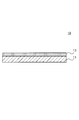
- FIG. 1 is a cross-sectional view illustrating a configuration example of a coated metal plate according to the present embodiment.
- FIG. 2 is a partial perspective view showing an example of the use state of the joiner.
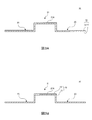
- 3A and 3B are cross-sectional views of the joiner.
- ethylene / vinyl acetate copolymer is usually a material that is generally used for sealants and adhesive applications, but when left outdoors, It has been found that dirt is particularly difficult to adhere to the surface of the coating film, and the non-adhesiveness with the caulking material can be maintained well.
- the present invention has been made based on such knowledge.
- FIG. 1 is a cross-sectional view showing the configuration of the coated metal plate of the present embodiment.
- the coated metal plate 10 of the present embodiment includes a metal plate 11 and a coating layer 13 disposed on the surface thereof.
- the metal plate 11 used as a coating original plate can be suitably selected according to the use of a coating metal plate.
- the metal plate 11 include galvanized steel sheets, Zn—Al alloy plated steel sheets, Zn—Al—Mg alloy plated steel sheets, aluminum plated steel sheets, etc .; cold-rolled steel sheets, stainless steel sheets (austenitic, martensitic, Steel sheets such as ferritic and ferritic martensite two-phase systems); aluminum plates; aluminum alloy plates; and copper plates.
- the metal plate 11 is preferably a plated steel plate, and more preferably a hot dip plated steel plate.
- the plating adhesion amount of the plated steel sheet is not particularly limited, but may be, for example, 30 to 500 g / m 2 .
- the surface of the metal plate 11 may be subjected to chemical conversion treatment from the viewpoint of enhancing the corrosion resistance and coating film adhesion of the coated steel plate.
- chemical conversion treatment may be a chromate treatment, a chromium free treatment, and a phosphate treatment.
- the thickness of the metal plate 11 may be set according to the application and workability, and is not particularly limited. However, for example, from the viewpoint of obtaining workability and mechanical strength required for a joiner, 0.3 to 0.00. It is preferable that it is 6 mm.
- the chemical conversion treatment can be performed by a known method.
- the chemical conversion solution may be applied to the surface of the steel sheet by a roll coating method, a spin coating method, a spray method, or the like, and dried without being washed with water.
- the drying temperature and drying time are not particularly limited as long as moisture can be evaporated. From the viewpoint of productivity, the drying temperature is preferably in the range of 60 to 150 ° C. as the ultimate plate temperature, and the drying time is preferably in the range of 2 to 10 seconds.
- the adhesion amount of the chemical conversion treatment film is not particularly limited as long as it is within a range effective for improving corrosion resistance and coating film adhesion.
- the adhesion amount may be adjusted so that the total Cr conversion adhesion amount is 5 to 100 mg / m 2 .
- the Ti-Mo composite coating has a range of 10 to 500 mg / m 2
- the fluoroacid-based coating has a fluorine equivalent or total metal element equivalent deposit of 3 to 100 mg / m 2.
- the adhesion amount may be adjusted.
- the adhesion amount may be adjusted so as to be 5 to 500 mg / m 2 .
- the covering layer 13 is a layer (resin layer) containing a resin disposed on at least a part of the surface of the metal plate 11.
- the coating layer 13 is the outermost layer of the coated metal plate 10.
- the coating layer 13 is adjusted to have a volume resistivity of 1.0 ⁇ 10 17 ⁇ ⁇ cm or less and a surface free energy of 36.6 mJ / m 2 or less from the viewpoint of maintaining non-adhesiveness with the caulking material. ing.
- the volume resistivity of the covering layer 13 is 1.0 ⁇ 10 17 ⁇ ⁇ cm or less, the covering layer 13 is difficult to be charged, so that static electricity is not easily generated, and dirt or the like adheres while exposed to the outdoors. Can be difficult.
- the volume resistivity of the covering layer 13 is more preferably 4.0 ⁇ 10 16 ⁇ ⁇ cm or less.
- the volume resistivity of the coating layer 13 can be measured in accordance with JIS C 2139: 2008 “Solid Electrical Insulating Material—Method of Measuring Volume Resistivity and Surface Resistivity” (IEC 60093: 1980). Specifically, it can be measured under the following conditions. (Test conditions) Test equipment: Digital ultra-high resistance / micro ammeter 8340A type (manufactured by ADC) Electrode size: Main electrode 50 mm ⁇ , guard electrode inner diameter 60 mm ⁇ , outer diameter 80 mm ⁇ Applied voltage: 100V, 500V (DC) Application time: 60 sec Test environment: temperature 23 ⁇ 2 ° C, humidity 50 ⁇ 5% RH Test specimen dimensions: 100 mm x 100 mm
- the surface free energy of the coating layer 13 is 36.6 mJ / m 2 or less, the surface of the coating layer 13 has low reactivity, so even if dirt is attached to the coating layer 13 while exposed to the outdoors, Since the reactivity of the surface is low, it is difficult to fix the dirt.
- the surface free energy of the coating layer 13 is more preferably 34.2 mJ / m 2 or less.
- the surface free energy of the coating layer 13 can be calculated based on a contact angle measured in accordance with JIS R 3257: 1999 (IEC62073). Specifically, it can be measured by the following procedure. 1) Measure the contact angles of pure water and methylene iodide according to JIS R 3257: 1999 “Testing method for wettability of substrate glass surface”. As the measuring apparatus, a portable contact angle meter PCA-1 (manufactured by Kyowa Interface Science Co., Ltd.) can be used.
- the volume resistivity and surface free energy of the coating layer 13 can be adjusted by the composition of the coating layer 13, particularly the type of resin.
- the resin constituting the coating layer 13 is not particularly limited as long as the volume resistivity and surface free energy satisfy the above ranges, and may be ethylene / vinyl acetate copolymer, silicone rubber, or the like.
- the ethylene / vinyl acetate copolymer includes a structural unit derived from ethylene and a structural unit derived from vinyl acetate.
- the content ratio of the structural unit derived from vinyl acetate may be such that it does not exhibit adhesiveness and low chargeability is obtained, and is 5 mass% with respect to all structural units constituting the ethylene / vinyl acetate copolymer.
- the content is preferably less than 20% by mass.
- the content ratio of the structural unit derived from vinyl acetate is 5% by mass or more, a low volume resistivity is easily obtained, so that low chargeability is easily obtained, and dirt can be hardly adhered to the surface of the coating layer 13.
- the content ratio of the structural unit derived from vinyl acetate is 20% by mass or less, the tackiness is hardly expressed, and thus the surface of the coating layer 13 can be hardly adhered.
- the content ratio of the structural units derived from vinyl acetate is more preferably 5 to 17% by mass with respect to all the structural units constituting the ethylene / vinyl acetate copolymer.
- the ethylene / vinyl acetate copolymer may further contain structural units derived from monomers other than ethylene and vinyl acetate.
- monomers other than ethylene and vinyl acetate.
- examples of other monomers include 3 carbon atoms such as propylene, 1-butene, 3-methyl-1-butene, 1-pentene, 4-methyl-1-pentene, 1-hexene, 1-octene and 1-decene. -20 ⁇ -olefins, (meth) acrylic acid, (meth) acrylic acid esters, and styrene.
- the content ratio of the structural units derived from other monomers is preferably 10% by mass or less, and more preferably 0% by mass with respect to all the structural units constituting the ethylene / vinyl acetate copolymer.
- the melt flow rate (JIS K7210-1999, 190 ° C., 2160 g load) of the ethylene / vinyl acetate copolymer is preferably 1 to 20 g / 10 min.
- the MFR of the ethylene / vinyl acetate copolymer is more preferably 5 to 15 g / 10 min.
- the silicone rubber is not particularly limited, and may be a cured product of an addition reaction curing type or condensation curing type silicone rubber composition.
- a cured product of an addition reaction curable silicone rubber composition is a silicone rubber composition comprising a polyorganosiloxane having two or more alkenyl groups (preferably vinyl groups) in one molecule as a crosslinkable reactive group, and a curing agent. Can be obtained by curing (addition curing).
- the polyorganosiloxane having two or more alkenyl groups (preferably vinyl groups) in one molecule as a crosslinkable reactive group is preferably an organopolysiloxane represented by the following formula (1).
- R n SiO (4-n) / 2 (1)
- R is a substituted or unsubstituted monovalent hydrocarbon group having 1 to 12 carbon atoms.
- at least two of the plurality of R are alkenyl groups (preferably vinyl groups).
- the monovalent hydrocarbon group include an alkyl group having 1 to 8 carbon atoms, a cycloalkyl group, an alkenyl group, a cycloalkenyl group, an aryl group, an aralkyl group, and at least a part of the hydrogen atoms of these groups are halogen atoms.
- a methyl group, a vinyl group, a phenyl group, or a trifluoropropyl group and more preferably a methyl group.
- R may mutually be the same and may differ.
- n is a positive number from 1.95 to 2.05.
- the curing agent can be an addition reaction curing agent.
- the addition reaction curing agent can be a silane compound such as an organohydrogenpolysiloxane.
- the silicone rubber composition may further contain a reaction catalyst, silicone oil and the like as necessary.
- the reaction catalyst includes platinum-based catalysts such as platinum metal particles, platinous chloride, and chloroplatinic acid.
- Silicone oils are liquid silicone oils with polyorganosiloxane as the main skeleton. Examples include dimethyl silicone oils that have only methyl groups as organo groups; some methyl groups are phenyl groups, vinyl groups, alkyl groups. Modified silicone oils substituted with groups, aralkyl groups, amino groups, carboxyl groups, epoxy groups, hydroxyl groups, polyoxyalkylene groups and the like are included. The total amount of these components may be 10% by mass or less based on the total solid content of the silicone rubber composition.
- a cured product of the condensation curable silicone rubber composition comprises a polydiorganopolysiloxane having two or more silicon atoms bonded to a hydroxyl group in one molecule, a silane compound having three or more condensable functional groups in one molecule, It can be obtained by curing (condensation curing) a silicone rubber composition containing a condensation catalyst.
- the organic group bonded to the Si atom is an alkyl group such as a methyl group or an ethyl group; an aryl group such as a phenyl group or a tolyl group; Included are diorganopolysiloxanes that are cycloalkyl groups such as cyclohexyl groups.
- the silane compound is a polyfunctional silane compound having a hydrolyzable group, and is preferably a silane compound represented by the following general formula (2).
- R 1 represents a methyl group, a vinyl group or a phenyl group.
- X represents an alkoxy group having 1 to 5 carbon atoms, a methyl ethyl ketoxime group, a propenyloxy group or an acetoxy group.
- N represents 3 or 4. However, when m is 0, n is 4, and when m is 1, n is 3.
- condensation catalyst examples include titanium compounds such as tetraisopropoxy titanium and tetra-n-butoxy titanium.
- silicone rubber composition examples include S coat 57 manufactured by Shin-Etsu Chemical Co., Ltd.
- the resin constituting the coating layer 13 is preferably an ethylene / vinyl acetate copolymer because non-adhesiveness to the caulking material is easily obtained.
- composition of the coating layer 13 is not limited to these.
- the resin has a volume resistivity not satisfying the above range (for example, polyethylene or polypropylene)
- the volume resistivity and the surface free energy as the whole coating layer 13 are combined with a conductive material such as carbon black. The range may be satisfied.
- the coating layer 13 may further include other components than the above-mentioned resin as long as the effects of the present invention are not impaired.
- other components include coloring pigments, extender pigments, and aggregates.
- coloring pigments include inorganic pigments such as titanium oxide, calcium carbonate, carbon black, iron black, titanium yellow, bengara, bitumen, cobalt blue, cerulean blue, ultramarine blue, cobalt green, and molybdenum red; CoAl, CoCrAl, CoCrZnMgAl, Composite oxide calcined pigments containing metallic components such as CoNiZnTi, CoCrZnTi, NiSbTi, CrSbTi, FeCrZnNi, MnSbTi, FeCr, FeCrNi, FeNi, FeCrNiMn, CoCr, Mn, Co, SnZnTi; Metallic pigments such as Al, resin-coated Al, Ni ; And Resol Red B, Brilliant Scarlet G, Pigment Scarlet 3B, Brilliant Carmine 6B, Lake Red C, Lake Red D, Permanentre 4R, Bordeaux 10B, Fast Yellow G, Fast Yellow 10G, Para Red, Watching Red,
- extender pigments include barium sulfate, titanium oxide, silica, and calcium carbonate.
- aggregates include resin particles and inorganic particles made of inorganic compounds such as glass, silicon carbide, boron nitride, zirconia, alumina, and silica.
- silicone rubber silicone oil etc. may be contained as another component. The total amount of these other components may be 10% by mass or less with respect to the coating layer 13.
- the thickness of the coating layer 13 is not particularly limited as long as it can maintain non-adhesiveness to the caulking material when used as a joiner, but is preferably 3 to 120 ⁇ m.
- the thickness of the coating layer 13 is 3 ⁇ m or more, when used as a joiner, it is easy to maintain good non-adhesiveness to the caulking material, and when it is 120 ⁇ m or less, for example, when the coating layer 13 is formed by coating, It is easy to suppress the appearance defect of the coated metal plate 10 due to the occurrence of cracks during drying.
- the thickness of the covering layer 13 is more preferably 5 to 100 ⁇ m from the above viewpoint.
- the coated metal plate 10 of the present invention may further include another layer (not shown) such as an undercoat coating film or an adhesive layer between the metal plate 11 and the coating layer 13 as necessary.
- the undercoat film can be disposed on the surface of the metal plate or the chemical conversion film.
- the undercoat coating film can improve the adhesion of the coating layer and the corrosion resistance of the coated metal plate.
- the type of resin (base resin) constituting the undercoat coating film is not particularly limited.
- the resin constituting the undercoat coating include epoxy resin, acrylic resin, and polyester resin.
- the undercoat coating film may further contain an aggregate, a rust preventive pigment, and the like as necessary.
- Such an undercoat coating film can be formed by applying an undercoat paint on a metal plate and baking at 200 to 250 ° C. for 30 to 120 seconds.
- the adhesive layer is not particularly limited, but may be a cured product of a thermosetting adhesive such as a melamine adhesive or an epoxy adhesive, or various elastomer adhesives.
- the manufacturing method of a covering metal plate The covering metal plate of this invention can be manufactured by arbitrary methods.
- the coated metal plate 10 of the present invention may be obtained, for example, by laminating a film as a resin composition for a coating layer on the metal plate 11 and then forming the coating layer 13 by thermocompression bonding (thermal lamination). (The thermocompression bonding method); the film may be laminated on the metal plate 11 via an adhesive to form the coating layer 13 (adhesion method); the coating layer on the metal plate 11 It may be obtained by casting a melt of the resin composition for cooling and then forming the coating layer 13 by cooling (extrusion casting method); coating the resin composition for the coating layer on the metal plate 11 Thereafter, the coating layer 13 may be formed by drying or heating (coating method).
- the coating layer 13 containing an ethylene / vinyl acetate copolymer is formed by thermocompression bonding a film containing an ethylene / vinyl acetate copolymer on the metal plate 11 (thermocompression bonding method), or ethylene / vinyl acetate copolymer. After melt-casting the resin composition for coating layer containing the coalescence, it can be formed by cooling (extrusion casting method).
- the thermocompression bonding conditions in the thermocompression bonding method are not particularly limited, but may be, for example, 100 to 200 ° C.
- the coating layer 13 containing silicone rubber can be formed by applying a resin composition for a coating layer containing the above-mentioned silicone-based coating composition on the metal plate 11 and then drying at room temperature or curing by heating.
- the coating method of the resin composition for coating layers is not specifically limited, For example, a roll coat method, a flow coat method, a curtain flow method, and a spray method may be used.
- the heat curing conditions may be such that the reaction-curable silicone rubber in the coating layer resin composition is sufficiently cured, and may be, for example, 25 to 300 ° C.
- the coating layer 13 may be disposed on the entire surface of the metal plate 11, or only a portion (a top surface 21 ⁇ / b> A of the ridge portion 21, which will be described later) serving as a receiving portion for the caulking material when the joiner 20 is described later. May be arranged.
- Such a coated metal plate can be preferably used, for example, as a coated metal plate for a joiner.
- joiner of the present invention is a joiner (joint material) for being arranged at a joint portion of an adjacent exterior material, and includes the coated metal plate of the present invention.
- FIG. 2 is a partial perspective view showing an example of the use state of the joiner 20.
- 3A and 3B are cross-sectional views illustrating a configuration example of the joiner 20.
- the joiner 20 has a covered metal plate 10 having a hat-shaped cross section. Such a joiner 20 is also referred to as a hat joiner.
- the joiner 20 has a ridge portion 21 and two substrate portions 23 connected to the base end portion of the ridge portion 21.
- the ridge portion 21 is disposed on the joint portion 30 of the building exterior and can support the caulking material 40 (can be a receiving portion of the caulking material 40).
- substrate parts 23 can hold
- the covering layer 13 should just be arrange
- the coating layer 13 may be disposed on the entire surface of the joiner 20 (see FIG. 3A), or may be disposed only on the surface (top surface) 21A that supports the caulking material of the ridge portion 21. (See FIG. 3B).
- Joiner 20 can be manufactured by any method.
- the joiner 20 may be obtained by molding the coated metal plate 10 having the metal plate 11 and the coating layer 13 described above by pressing or the like;
- the covering layer 13 may be formed on the top surface 21A of the strip 21.
- compositions of films 1 to 7 are shown in Table 1.
- melt flow rate (JIS K7210-1999, 190 ° C., 2160 g load) of the film 3 was 9.0 g / 10 minutes.
- Film 8-13 Film 8: Polystyrene film (PS) (Asahi Kasei Chemicals, OPS (registered trademark) film, thickness 50 ⁇ m) Film 9: High-density polyethylene film (HDPE) (manufactured by Nitto L Material, polyethylene masker, thickness 10 ⁇ m) Film 10: Polyvinylidene chloride film (PVdC) (Asahi Kasei Corporation, Saran (registered trademark) UB, thickness 25 ⁇ m) Film 11: Polypropylene film (PP) (manufactured by Toray Film Processing Co., Ltd., Treffan (registered trademark) NO, thickness 50 ⁇ m) Film 12: Polymethyl methacrylate film (PMMA) (manufactured by Mitsubishi Chemical Co., Ltd., Acryprene TM, thickness 50 ⁇ m) Film 13: Polycarbonate film (PC) (manufactured by Teijin Limited, Pure Ace (registered trademark), thickness 100 ⁇
- Paint 1 Silicone paint (Shin-Etsu Chemical Co., silicone rubber S coat 57)
- Paint 2 Silicone paint (Shin-Etsu Chemical Co., Ltd., silicone resin KR-300)
- Paint 3 Epoxy resin paint (Nippe Power Bind made by Nippon Paint Industrial Coatings Co., Ltd.)
- Coated metal plates 6, 12, and 14 were obtained in the same manner as the coated metal plate 1 except that the ethylene / vinyl acetate copolymer film 1 was changed to the film shown in Table 2.
- the thermal lamination was performed at the glass transition temperature (Tg) of the resin + 40 ° C., and the heating in the oven was performed at the glass transition temperature (Tg) of the resin + 80 ° C.
- the volume resistivity and surface free energy of the coating layer were measured by the following methods.
- the non-adhesiveness of the coated metal plates 1 to 16 after exposure to the caulking material was measured by the following method.
- Non-adhesiveness to caulking material The obtained coated metal plate was exposed to the outdoors for 2 weeks with an exposure angle of 35 degrees and an installation direction facing south according to JIS Z 2381.
- a primer for caulking material was applied to the coated metal plate after outdoor exposure with a brush and dried at room temperature for 30 minutes.
- a caulking material was applied to the surface of the primer and dried at room temperature for 1 week. The dried caulking material was peeled off from the coated metal plate by hand, and those that were easily peeled were evaluated as “ ⁇ ”, and those that did not peel were evaluated as “x”.
- the caulking material As the caulking material, a one-component modified silicone caulking material (SR seal S70; Sunrise MSI Co., Ltd.) or a urethane caulking material (FC700; Nichiha Corp.) was used.
- the primer was applied in order to make the conditions close to the actual construction conditions in consideration of the fact that the primer is often applied unintentionally to the surface that will receive the caulking material during actual construction. It is.
- coated metal plates 1 to 5 having a coating layer having a volume resistivity of 1.0 ⁇ 10 17 ⁇ ⁇ cm or less and a surface free energy of 36.6 mJ / m 2 or less are as follows: It can be seen that the non-adhesiveness after exposure is good for both the urethane-based caulking material and the silicone-based caulking material.
- coated metal plates 6 to 16 having a coating layer in which at least one of volume resistivity and surface free energy is outside the scope of the present application are exposed to both urethane-based caulking materials and silicone-based caulking materials. It can be seen that the subsequent non-adhesiveness is low.
- a coated metal plate that maintains non-adhesiveness to a caulking material even after being left outdoors.
- Such a coated metal plate can favorably maintain non-adhesiveness to the caulking material and is suitable as a joiner that can suppress three-sided adhesion.
Landscapes
- Engineering & Computer Science (AREA)
- Architecture (AREA)
- Chemical & Material Sciences (AREA)
- Life Sciences & Earth Sciences (AREA)
- Wood Science & Technology (AREA)
- Civil Engineering (AREA)
- Structural Engineering (AREA)
- Organic Chemistry (AREA)
- Materials Engineering (AREA)
- Chemical Kinetics & Catalysis (AREA)
- Laminated Bodies (AREA)
- Building Environments (AREA)
- Finishing Walls (AREA)
- Vessels, Lead-In Wires, Accessory Apparatuses For Cathode-Ray Tubes (AREA)
- Adhesives Or Adhesive Processes (AREA)
- Adhesive Tapes (AREA)
Abstract
La présente invention a pour but de pourvoir à une plaque métallique revêtue qui puisse conserver une non-adhésivité relativement à un matériau de calfeutrage même après avoir été laissée à l'extérieur. Pour atteindre ce but, une plaque métallique revêtue selon la présente invention comprend : une plaque métallique ; et une couche de revêtement disposée sur une surface de la plaque métallique et contenant une résine. La couche de revêtement présente une résistivité volumique inférieure ou égale à 1,0 × 10¹⁷ Ω·cm, telle que mesurée conformément à la norme JIS C 2139: 2008, et présente une tension superficielle inférieure ou égale à 36,6 mJ/m2, telle que calculée sur la base d'un angle de contact mesuré conformément à la norme JIS R 3257: 1999.
Priority Applications (2)
| Application Number | Priority Date | Filing Date | Title |
|---|---|---|---|
| CN201880087460.9A CN111886132B (zh) | 2018-03-29 | 2018-05-28 | 被覆金属板及具有该被覆金属板的接合件 |
| KR1020207027671A KR102660604B1 (ko) | 2018-03-29 | 2018-05-28 | 피복 금속판 및 그것을 가지는 조이너 |
Applications Claiming Priority (2)
| Application Number | Priority Date | Filing Date | Title |
|---|---|---|---|
| JP2018065011 | 2018-03-29 | ||
| JP2018-065011 | 2018-03-29 |
Publications (1)
| Publication Number | Publication Date |
|---|---|
| WO2019187175A1 true WO2019187175A1 (fr) | 2019-10-03 |
Family
ID=68058083
Family Applications (1)
| Application Number | Title | Priority Date | Filing Date |
|---|---|---|---|
| PCT/JP2018/020256 Ceased WO2019187175A1 (fr) | 2018-03-29 | 2018-05-28 | Plaque métallique revêtue et dispositif d'assemblage la comprenant |
Country Status (5)
| Country | Link |
|---|---|
| JP (1) | JP7206982B2 (fr) |
| KR (1) | KR102660604B1 (fr) |
| CN (1) | CN111886132B (fr) |
| TW (1) | TWI809072B (fr) |
| WO (1) | WO2019187175A1 (fr) |
Families Citing this family (1)
| Publication number | Priority date | Publication date | Assignee | Title |
|---|---|---|---|---|
| WO2024204591A1 (fr) | 2023-03-31 | 2024-10-03 | 東洋鋼鈑株式会社 | Feuille métallique revêtue de résine et procédé de production de feuille métallique revêtue de résine |
Citations (6)
| Publication number | Priority date | Publication date | Assignee | Title |
|---|---|---|---|---|
| JP2000063765A (ja) * | 1998-08-19 | 2000-02-29 | Mitsubishi Chemicals Corp | 撥水性及び導電性を有する塗膜及び該塗膜を有する成形体 |
| JP2004068464A (ja) * | 2002-08-08 | 2004-03-04 | Joto Techno Co Ltd | 目地材 |
| JP2010042617A (ja) * | 2008-08-14 | 2010-02-25 | Furukawa-Sky Aluminum Corp | 撥水性、耐塵埃付着性に優れたアルミニウム塗装材 |
| JP2012030564A (ja) * | 2010-08-03 | 2012-02-16 | Toyo Kohan Co Ltd | ノートパソコン用化粧フィルム、その化粧フィルムを積層したノートパソコン用化粧金属板及びその化粧金属板を用いたノートパソコンのトップカバー又はキーボード枠 |
| JP2013188990A (ja) * | 2012-03-15 | 2013-09-26 | Nisshin Steel Co Ltd | 塗装金属板およびそれを有するジョイナー |
| JP2014105309A (ja) * | 2012-11-29 | 2014-06-09 | Shin Etsu Chem Co Ltd | シリコーンゴム組成物及びシリコーンゴム成形物 |
Family Cites Families (24)
| Publication number | Priority date | Publication date | Assignee | Title |
|---|---|---|---|---|
| JPS5795453A (en) * | 1980-12-05 | 1982-06-14 | Sumitomo Chemical Co | Metallic structure coated with resin |
| JPS5922903A (ja) * | 1982-07-28 | 1984-02-06 | Mitsubishi Petrochem Co Ltd | 樹脂水性分散液組成物 |
| JPS6144936A (ja) * | 1984-08-10 | 1986-03-04 | Dainichi Seika Kogyo Kk | 導電性樹脂組成物 |
| JP2978528B2 (ja) * | 1990-04-24 | 1999-11-15 | 日本石油化学株式会社 | 複合板の製造方法 |
| CN1099513C (zh) * | 1994-11-02 | 2003-01-22 | 三菱化学株式会社 | 房屋壁板 |
| JP3975326B2 (ja) * | 2001-11-01 | 2007-09-12 | 株式会社ブリヂストン | 導電部材及び電子写真装置 |
| JP4105588B2 (ja) * | 2003-05-16 | 2008-06-25 | シャープ株式会社 | 電子写真感光体およびそれを備える画像形成装置 |
| US20100143724A1 (en) * | 2005-03-24 | 2010-06-10 | Johnson Michael A | Corrosion resistant metallized films and methods of making the same |
| WO2008149717A1 (fr) * | 2007-06-08 | 2008-12-11 | Toyo Kohan Co., Ltd. | Plaque réfléchissant la lumière, procédé de fabrication de celle-ci, et dispositif réfléchissant la lumière |
| JP5065816B2 (ja) * | 2007-09-05 | 2012-11-07 | 日鉄住金鋼板株式会社 | 塗装板及びジョイナー |
| KR20100087703A (ko) * | 2007-11-29 | 2010-08-05 | 도요 고한 가부시키가이샤 | 키친 패널용 재료, 키친 패널용 재료의 제조 방법 및 키친 패널 |
| JP5211729B2 (ja) * | 2008-02-07 | 2013-06-12 | 株式会社リコー | 積層構造体及びその製造方法 |
| FR2927332B1 (fr) * | 2008-02-13 | 2010-04-30 | Arkema France | Liant a base de copolymere ethylene-ester vinylique d'acide carboxylique et de polyolefine contenant un monomere fonctionnel |
| CN101245659A (zh) * | 2008-03-21 | 2008-08-20 | 朱金龙 | 纳米氟碳自洁金属复合板及其制造方法 |
| JP5488190B2 (ja) * | 2010-05-12 | 2014-05-14 | 株式会社リコー | 画像形成装置及び記録液 |
| KR101346416B1 (ko) * | 2010-05-19 | 2014-01-02 | 도카이 고무 고교 가부시키가이샤 | 도전막, 및 그것을 사용한 트랜스듀서, 플렉시블 배선판 |
| JP4942233B2 (ja) * | 2010-09-27 | 2012-05-30 | キヤノン株式会社 | 帯電部材、プロセスカートリッジおよび電子写真装置 |
| JP5482772B2 (ja) * | 2011-12-12 | 2014-05-07 | コニカミノルタ株式会社 | ベルト部材、定着装置および画像形成装置 |
| CN103360762B (zh) * | 2012-03-27 | 2017-07-18 | 富士施乐株式会社 | 树脂材料、环形带、辊、图像定影单元以及成像装置 |
| JP6083233B2 (ja) * | 2012-12-19 | 2017-02-22 | Jnc株式会社 | インモールド成形用転写フィルム、インモールド成形体の製造方法および成形体 |
| FR2999980A1 (fr) * | 2012-12-20 | 2014-06-27 | Bluestar Silicones France | Article presentant des proprietes antisalissures et destine a etre utilise dans des applications aquatiques en particulier marines |
| CN104231782A (zh) * | 2013-06-13 | 2014-12-24 | 江苏无锡交通设施有限公司 | 一种高速公路护栏用防护漆的制备方法 |
| WO2016043235A1 (fr) * | 2014-09-18 | 2016-03-24 | 三井・デュポンポリケミカル株式会社 | Matériau d'étanchéité pour cellules solaires et module de cellules solaires |
| CN107710028A (zh) * | 2015-06-26 | 2018-02-16 | 日本瑞翁株式会社 | 防静电膜及其制造方法、偏振片以及液晶显示装置 |
-
2018
- 2018-05-28 WO PCT/JP2018/020256 patent/WO2019187175A1/fr not_active Ceased
- 2018-05-28 CN CN201880087460.9A patent/CN111886132B/zh active Active
- 2018-05-28 KR KR1020207027671A patent/KR102660604B1/ko active Active
-
2019
- 2019-02-07 JP JP2019020827A patent/JP7206982B2/ja active Active
- 2019-03-28 TW TW108111004A patent/TWI809072B/zh active
Patent Citations (6)
| Publication number | Priority date | Publication date | Assignee | Title |
|---|---|---|---|---|
| JP2000063765A (ja) * | 1998-08-19 | 2000-02-29 | Mitsubishi Chemicals Corp | 撥水性及び導電性を有する塗膜及び該塗膜を有する成形体 |
| JP2004068464A (ja) * | 2002-08-08 | 2004-03-04 | Joto Techno Co Ltd | 目地材 |
| JP2010042617A (ja) * | 2008-08-14 | 2010-02-25 | Furukawa-Sky Aluminum Corp | 撥水性、耐塵埃付着性に優れたアルミニウム塗装材 |
| JP2012030564A (ja) * | 2010-08-03 | 2012-02-16 | Toyo Kohan Co Ltd | ノートパソコン用化粧フィルム、その化粧フィルムを積層したノートパソコン用化粧金属板及びその化粧金属板を用いたノートパソコンのトップカバー又はキーボード枠 |
| JP2013188990A (ja) * | 2012-03-15 | 2013-09-26 | Nisshin Steel Co Ltd | 塗装金属板およびそれを有するジョイナー |
| JP2014105309A (ja) * | 2012-11-29 | 2014-06-09 | Shin Etsu Chem Co Ltd | シリコーンゴム組成物及びシリコーンゴム成形物 |
Also Published As
| Publication number | Publication date |
|---|---|
| CN111886132A (zh) | 2020-11-03 |
| JP7206982B2 (ja) | 2023-01-18 |
| CN111886132B (zh) | 2022-12-06 |
| TW201941943A (zh) | 2019-11-01 |
| TWI809072B (zh) | 2023-07-21 |
| KR20200138239A (ko) | 2020-12-09 |
| KR102660604B1 (ko) | 2024-04-24 |
| JP2019173544A (ja) | 2019-10-10 |
Similar Documents
| Publication | Publication Date | Title |
|---|---|---|
| JP5216868B2 (ja) | 鋼板、及び鋼板表面処理組成物 | |
| TW201923005A (zh) | 補強膜 | |
| MX2007000531A (es) | Medio de revestimiento anticorrosivo para piezas de trabajo metalicas y metodo para producirlo. | |
| CN102267267A (zh) | 含氟树脂被覆材料及其制造方法 | |
| TW200918304A (en) | Pre-coated metal plate and method for fabricating the same | |
| KR101143212B1 (ko) | 다중가공부 가공성이 우수한 수지코팅 강판, 이에 사용되는수지코팅 조성물 및 밀착성 개선 조성물 | |
| WO2019187175A1 (fr) | Plaque métallique revêtue et dispositif d'assemblage la comprenant | |
| JP2009126105A (ja) | プレコート金属板およびその製造方法 | |
| CN108367548B (zh) | 层叠体及其制造方法 | |
| KR101069950B1 (ko) | 전기전도성이 개선된 강판 및 이에 사용되는 수지 조성물 | |
| JPS63151380A (ja) | 表面処理金属板 | |
| KR101115745B1 (ko) | 흑색수지 강판, 이에 사용되는 내지문성 흑색수지 조성물 및 밀착성 수지 조성물 | |
| KR101091339B1 (ko) | 전기전도성 및 방열특성이 우수한 강판 | |
| CN102470640B (zh) | 预涂层金属板 | |
| JP7381852B2 (ja) | ジョイナーの製造方法およびその製造装置、被覆金属素形材の製造方法およびその製造装置 | |
| JP2005325242A (ja) | 塗料組成物およびコーティング層 | |
| TWI638868B (zh) | 塗料及塗膜 | |
| JP2015196262A (ja) | 剥離フィルム、および粘着体 | |
| KR101445758B1 (ko) | 절연 수지 조성물 및 이를 이용한 절연품 | |
| JPH06212113A (ja) | 耐熱性塗料 | |
| JP2004017606A (ja) | 耐熱性に優れた塗装金属板 | |
| JP2013244630A (ja) | 塗装金属板およびそれを有するジョイナー | |
| JPH03281248A (ja) | フッ素樹脂被覆層の補修剤及び補修方法 | |
| JP3092096B2 (ja) | 被覆用組成物および被覆物品 | |
| JPH0459079A (ja) | 耐熱性プレコート金属板およびその製造方法 |
Legal Events
| Date | Code | Title | Description |
|---|---|---|---|
| 121 | Ep: the epo has been informed by wipo that ep was designated in this application |
Ref document number: 18912900 Country of ref document: EP Kind code of ref document: A1 |
|
| ENP | Entry into the national phase |
Ref document number: 20207027671 Country of ref document: KR Kind code of ref document: A |
|
| NENP | Non-entry into the national phase |
Ref country code: DE |
|
| 122 | Ep: pct application non-entry in european phase |
Ref document number: 18912900 Country of ref document: EP Kind code of ref document: A1 |