WO2019187341A1 - Dispositif de calcul d'indice, système de prédiction, procédé d'évaluation de prédiction de progression, et programme - Google Patents
Dispositif de calcul d'indice, système de prédiction, procédé d'évaluation de prédiction de progression, et programme Download PDFInfo
- Publication number
- WO2019187341A1 WO2019187341A1 PCT/JP2018/043910 JP2018043910W WO2019187341A1 WO 2019187341 A1 WO2019187341 A1 WO 2019187341A1 JP 2018043910 W JP2018043910 W JP 2018043910W WO 2019187341 A1 WO2019187341 A1 WO 2019187341A1
- Authority
- WO
- WIPO (PCT)
- Prior art keywords
- prediction
- series data
- data
- invalidity
- value
- Prior art date
- Legal status (The legal status is an assumption and is not a legal conclusion. Google has not performed a legal analysis and makes no representation as to the accuracy of the status listed.)
- Ceased
Links
Images






Classifications
-
- G—PHYSICS
- G06—COMPUTING OR CALCULATING; COUNTING
- G06F—ELECTRIC DIGITAL DATA PROCESSING
- G06F17/00—Digital computing or data processing equipment or methods, specially adapted for specific functions
- G06F17/10—Complex mathematical operations
- G06F17/15—Correlation function computation including computation of convolution operations
-
- G—PHYSICS
- G06—COMPUTING OR CALCULATING; COUNTING
- G06N—COMPUTING ARRANGEMENTS BASED ON SPECIFIC COMPUTATIONAL MODELS
- G06N20/00—Machine learning
-
- G—PHYSICS
- G06—COMPUTING OR CALCULATING; COUNTING
- G06N—COMPUTING ARRANGEMENTS BASED ON SPECIFIC COMPUTATIONAL MODELS
- G06N5/00—Computing arrangements using knowledge-based models
- G06N5/04—Inference or reasoning models
-
- G—PHYSICS
- G06—COMPUTING OR CALCULATING; COUNTING
- G06Q—INFORMATION AND COMMUNICATION TECHNOLOGY [ICT] SPECIALLY ADAPTED FOR ADMINISTRATIVE, COMMERCIAL, FINANCIAL, MANAGERIAL OR SUPERVISORY PURPOSES; SYSTEMS OR METHODS SPECIALLY ADAPTED FOR ADMINISTRATIVE, COMMERCIAL, FINANCIAL, MANAGERIAL OR SUPERVISORY PURPOSES, NOT OTHERWISE PROVIDED FOR
- G06Q10/00—Administration; Management
- G06Q10/04—Forecasting or optimisation specially adapted for administrative or management purposes, e.g. linear programming or "cutting stock problem"
-
- G—PHYSICS
- G06—COMPUTING OR CALCULATING; COUNTING
- G06Q—INFORMATION AND COMMUNICATION TECHNOLOGY [ICT] SPECIALLY ADAPTED FOR ADMINISTRATIVE, COMMERCIAL, FINANCIAL, MANAGERIAL OR SUPERVISORY PURPOSES; SYSTEMS OR METHODS SPECIALLY ADAPTED FOR ADMINISTRATIVE, COMMERCIAL, FINANCIAL, MANAGERIAL OR SUPERVISORY PURPOSES, NOT OTHERWISE PROVIDED FOR
- G06Q10/00—Administration; Management
- G06Q10/06—Resources, workflows, human or project management; Enterprise or organisation planning; Enterprise or organisation modelling
- G06Q10/067—Enterprise or organisation modelling
-
- G—PHYSICS
- G16—INFORMATION AND COMMUNICATION TECHNOLOGY [ICT] SPECIALLY ADAPTED FOR SPECIFIC APPLICATION FIELDS
- G16H—HEALTHCARE INFORMATICS, i.e. INFORMATION AND COMMUNICATION TECHNOLOGY [ICT] SPECIALLY ADAPTED FOR THE HANDLING OR PROCESSING OF MEDICAL OR HEALTHCARE DATA
- G16H50/00—ICT specially adapted for medical diagnosis, medical simulation or medical data mining; ICT specially adapted for detecting, monitoring or modelling epidemics or pandemics
- G16H50/30—ICT specially adapted for medical diagnosis, medical simulation or medical data mining; ICT specially adapted for detecting, monitoring or modelling epidemics or pandemics for calculating health indices; for individual health risk assessment
Definitions
- the present invention relates to an index calculation apparatus for determining the validity of series data in a transition graph or the like whose value changes with time, and a prediction system using the index calculation apparatus.
- the present invention also relates to a progress prediction evaluation method and a progress prediction evaluation program for evaluating the validity of a progress prediction including predicted values at two or more time points of a variable whose value changes with time.
- predicting aging changes such as test values of employees measured by health checkups and the onset probability of lifestyle-related diseases based on them, and giving advice to employees on health.
- future conditions such as changes in test values over time and onset probability
- future conditions such as changes in test values over time and onset probability
- the following method can be considered as a method for obtaining the transition of the predicted value.
- a prediction model for obtaining a predicted value of one year ahead from past data is learned. For example, using training data that correlates with actual values (test values) of past prediction targets and further correlates with past test values, attributes of the target of prediction (age, etc.) and lifestyle at that time.
- a prediction model is learned in which an item to be predicted one year later is an objective variable, and other items that can be correlated with it are explanatory variables.
- the process which inputs an explanatory variable and obtains the predicted value of one year ahead is changed for several years, changing the time (prediction time) which obtains the value of prediction object with respect to the obtained prediction model.
- the time predicted time
- Non-patent Document 1 describes an example of a health risk prediction system that predicts a health risk based on the results of a health check and a lifestyle as a technology related to health prediction and health support.
- the health risk prediction system described in Non-Patent Document 1 includes two subsystems: a test value prediction system and an onset prediction system.
- the test value prediction system indicates the degree of improvement in test results accompanying lifestyle improvements for people who have minor test abnormalities at the present time and who have problems with lifestyles.
- the onset prediction system predicts the disease incidence when continuing an undesirable lifestyle and improving the lifestyle for people who do not have any abnormal testing at the present time but are biased in their lifestyle. is there.
- health support by any subsystem is interactively performed between a medical worker and a examinee, and the examinee can recognize the effect of his / her behavior change. .
- the transition of the obtained predicted value may show a change different from general knowledge.
- Patent Document 1 describes a method for evaluating a demand prediction model.
- the method described in Patent Literature 1 takes the actual demand value and the predicted demand value during the evaluation period of the demand prediction model, calculates the deviation value between the actual demand value and the predicted demand value for each supply cycle of the product.
- the demand forecast model is evaluated based on the deviation value.
- Patent Document 1 performs comprehensive evaluation of past predicted values using actual values, and is based on the premise that at least actual values at the time of prediction are obtained.
- the progress prediction in which the values at a plurality of future points in time are predicted using the assumptions as described above, not all of the conditions assumed at that point are necessarily met. That is, it is not always possible to obtain an actual value that matches all the conditions at the time of prediction.
- the method of patent document 1 which makes a determination after obtaining a track record value cannot be applied to the use etc. which judge the validity automatically before displaying a prediction result.
- invalid means at least uncertain in the knowledge of the person who handles the predicted value (in the above example, the occupational physician who provides health guidance, the insurer, the person who performs the self-check, etc.) (Impossible).
- the onset probability of lifestyle-related disease and the transition of the test value related to it gradually approach some value. Is natural.
- the method of visually determining the output of the prediction result by the domain expert has a problem that it takes not only cost but also time to output.
- the method of visually determining the output of the prediction result by the domain expert has a problem that it takes not only cost but also time to output.
- the method of visually determining the output of the prediction result by the domain expert has a problem that it takes not only cost but also time to output.
- the present invention provides an index calculation device, a prediction system, a progress prediction evaluation method, and a progress prediction evaluation program that can automatically determine the invalidity of series data including a prediction value obtained based on an assumed condition.
- the purpose is to provide.
- the index calculation device is a series of predetermined prediction target item data, which is three or more data indicating the value of the prediction target item in association with time, and at least one of which indicates the prediction value
- an invalidity score which is an index indicating the invalidity of the series data
- the present invention is characterized by comprising invalidity score output means for outputting an invalidity score based on.
- the prediction system obtains a predicted value at a predetermined prediction time point using a learned prediction model for a predetermined prediction target item, and is series data including the obtained predicted value and corresponds to time.
- a prediction means for generating series data including three or more pieces of data indicating the value of the prediction target item, at least one of which indicates the predicted value, and an index indicating the invalidity of the series data An invalidity score calculation means for calculating an invalidity score based on an error between a curve model obtained by fitting the series data into a predetermined function form and the series data, and an invalidity score
- evaluation means for evaluating a series data, a prediction value included in the series data, or a prediction model that obtains the prediction value.
- the information processing apparatus is series data of a predetermined prediction target item, and is three or more pieces of data indicating the value of the prediction target item in association with time, of which When series data including data indicating at least one prediction value is input, it is an invalidity score that is an index indicating the invalidity of the series data, and is obtained by fitting the series data into a predetermined function form. Calculates invalidity score based on error between curve model and series data, and evaluates prediction model that obtained prediction value or prediction value included in series data or series data based on invalidity score And
- the progress prediction evaluation program is a series of predetermined prediction target item data stored in a computer, and includes at least one of three or more pieces of data indicating the value of the prediction target item in association with time.
- the series data including the data showing the predicted value is input, it is an invalidity score that is an index indicating the invalidity of the series data, and is obtained by fitting the series data into a predetermined function form
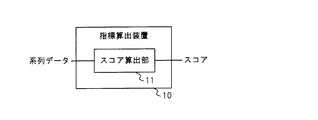
- FIG. 1 is a block diagram illustrating a configuration example of an index calculation apparatus according to the present embodiment.
- the index calculation device 10 illustrated in FIG. 1 includes a score calculation unit 11.
- the score calculation unit 11 receives, as input, series data including three or more pieces of data indicating the value of the prediction target item in association with time, and at least one of which indicates the predicted value.
- An invalidity score which is an index representing sex, is calculated and output.
- the invalidity score is calculated as an index indicating how far the input series data is from a predetermined asymptotic model.
- the score calculation unit 11 calculates the unexplainable degree (invalidity score) of the input predicted value series based on the error between the input series data and a predetermined asymptotic model (see FIG. 2).
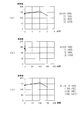
- FIG. 2 is an explanatory diagram showing an outline of the invalidity score.
- FIG. 2A is an example when the invalid validity cocoa is small
- FIG. 2B is an example when the invalid validity cocoa is large. It is.
- the shaded area represents the normal range of the inspection value.
- the asymptotic model is a curve model representing a curve having an asymptote parallel to the X axis when time is the X axis and the prediction item is the Y axis, more specifically, y ( x)
- x represents a point (coordinate) on the time axis corresponding to each data in the series data
- y (x) represents a predicted item value at time point x.
- the asymptotic model may be a curved model represented by a function that satisfies at least the condition represented by the following formula (1).
- a is an arbitrary constant. Note that the number of asymptotes present is not limited to one, but includes, for example, those represented by functions having two asymptotes such as functions called logistic functions and arctangent functions.
- the score calculation unit 11 can use a curve model represented by a predetermined function form as an asymptotic model. For example, the score calculation unit 11 can input two or more predetermined functions satisfying the above conditions. A model obtained by fitting into a shape may be used.
- the fitting may be performed, for example, by searching for a solution (model with hat) of the model parameter ⁇ that minimizes a predetermined loss function as shown in the following equation (2).
- n represents the time point of the value to be fitted
- loss () represents the error function
- f () represents the function form of the fitting destination.
- f (x n , ⁇ ) represents an output when an arbitrary time point x n and a set of model parameters ⁇ are given to the function form f (), and f (x n , ⁇ ⁇ ) It represents the output of an arbitrary time point xn in the asymptotic model obtained by fitting.
- the square loss is used as the error function, but the error function is not limited to the square loss.
- the score calculation unit 11 may calculate, for example, an error between the asymptotic model obtained in this way and the series data of the input predicted value and output it as an invalidity score.
- the score calculation unit 11 may output, for example, an error value (error) represented by the following expression (3) as an invalidity score.
- the score calculation unit 11 may independently specify data used for fitting and data used for error calculation.
- the score calculation part 11 can also receive those designation
- N ′ (where N ′ ⁇ N) data in the first half, and error calculation is performed on the remaining data (N ⁇ N).
- N ′ where N ′ ⁇ N
- 'Number' or all data (N) values may be used.
- fitting can be performed using data that is not continuous in the series data, such as first, third, and fifth data, and error calculation can be performed using all data. It is.
- the score calculation unit 11 may perform fitting and error calculation as follows, for example.
- the number of data (number of predicted values) Np included in the series data input to the score calculation unit 11 is not particularly limited, but at least one is included.
- the series data includes at least data indicating predicted values for the number of time points at which progress prediction is performed.
- the series data may include data indicating past performance values, and in this case, the above N represents the total number of data including data indicating past performance values.
- N is assumed to be 3 or more, but from the viewpoint of fitting accuracy, for example, 4 or more is more preferable.
- the error may be calculated using only the data showing the predicted value.
- the score calculation unit 11 may rescale the x-coordinate that is the value of the X-axis (a value representing the time corresponding to the value of each prediction item) before performing the fitting.
- the unit of scale on the vertical axis (Y axis: predicted value) is 50
- the unit of scale on the horizontal axis (X axis: time) is 1, and so on.
- the numerical unit scale width
- an asymptotic model as expected by a viewer cannot be obtained even if fitting is performed using the numerical values as they are. This is because, as shown in FIG.
- the time value (x coordinate) associated with each data included in the series data is rescaled in accordance with the actual display. It is preferable to perform the fitting above.
- the score calculation unit 11 has an X-axis main scale width of the Y-axis main scale.
- the x coordinate may be converted so as to be the same unit as the width (50 units in the example of FIG. 3C).
- the x coordinate is also made 50 times.
- the magnification at the time of rescaling of the x axis may be referred to as a rescale parameter x_scale.
- the score calculation unit 11 can obtain the rescale parameter x_scale as follows.
- the score calculation unit 11 inputs display parameters that are parameters for displaying the series data together with the series data, and calculates a rescale parameter xscale based on the information obtained from the series data and the display parameters. Is also possible.
- the following formula (4) is an example of a formula for calculating the rescale parameter x_scale.
- y max and y mim represent the maximum value and the minimum value of the prediction items included in the series data.
- N d represents the number of data included in the series data (the number of prediction items to be displayed).
- Ar represents the aspect ratio Ar (that is, the ratio of the width to the height) of the display graph of the series data.
- 0.8 represents the vertical display ratio
- 0.9 represents the horizontal display ratio.
- x_scale ((y max ⁇ y min ) /0.8*Ar*0.9) / (N d ⁇ 1)) ... (4)
- y max , y mim and N d correspond to information obtained from the series data
- Ar the vertical display ratio and the horizontal display ratio correspond to display parameters.
- x_scale ((y max ⁇ y min ) /0.8*2*0.9) / 4)
- x_scale is set to y-axis. It is calculated as an index representing the interval in the x direction of each data expressed in units. Therefore, when the unit of time in the series data is other than the predicted unit time, or when the unit of the interval in the x direction when displaying is other than 1, the x coordinate associated with each data is set to the predicted unit time or The x-axis unit may be multiplied by x_scale after dividing the x-axis unit by 1 in the x-direction interval.
- the score calculation unit 11 can accept the designation of x_scale.
- the score calculation unit 11 may input x_scale together with the series data.
- the score calculation unit 11 can also calculate the x_scale by inputting the display parameters as described above together with the series data.
- FIG. 5 is a flowchart illustrating an example of the operation of the index calculation apparatus according to the first embodiment.
- the score calculation unit 11 inputs the series data to be evaluated (step S101).
- the score calculation unit 11 acquires the rescale parameter x_scale (step S102).
- x_scale may be input together with the series data, or may be calculated based on the display parameters as described above.
- the score calculation unit 11 performs rescale on the time value (x coordinate) associated with each data included in the series data based on the acquired rescale parameter x_scale (step S103).
- the score calculation unit 11 learns an asymptotic model using the rescaled series data (step S104).
- the score calculation unit 11 calculates an error between the rescaled series data and the learned asymptotic model (step S105).
- the error the sum of the outputs of the error function loss () for each designated time point in the series data is obtained.
- the score calculation unit 11 outputs an invalidity score based on the calculated error (step S106).
- the score calculation unit 11 may output the error as an invalidity score as it is, or, for example, from the calculated error, an average at each time point (time point average) or an average (for example, three time point intervals) ( (Interval average) may be calculated and output as an invalidity score.
- an invalidity score that is an objective index that can determine the invalidity of input series data without using actual values. For this reason, if the invalidity score output by this embodiment is utilized, the invalidity of the series data including the predicted value obtained based on the hypothetical condition can be automatically determined.
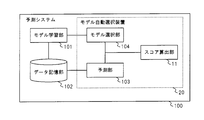
- FIG. 6 is a block diagram illustrating a configuration example of the prediction system of the present embodiment.
- the prediction system 100 illustrated in FIG. 6 includes a model learning unit 101, a data storage unit 102, a prediction unit 103, a model selection unit 104, and a score calculation unit 11.
- the model automatic selection device 20 including the model selection unit 104, the prediction unit 103, and the score calculation unit 11 is used for the prediction system 100 including the model learning unit 101 and the data storage unit 102.
- the model selection unit 104, the prediction unit 103, and the score calculation unit 11 are not necessarily limited to a configuration that is mounted on one device.
- the model learning unit 101 learns a plurality of model candidates that are candidates for a prediction model that predicts a value of a predetermined prediction target item such as a value of a certain inspection item. For example, the model learning unit 101 may learn a plurality of model candidates having different combinations of explanatory variables, constraint conditions, and various model parameters as prediction model candidates for predicting the value of the designated prediction target item.
- the data storage unit 102 stores learning data used for model learning by the model learning unit 101 and information on prediction model candidates learned by the model learning unit 101.
- the data storage unit 102 is data to be input to each model candidate in order to obtain a predicted value from each of a plurality of learned model candidates, and is a data set of explanatory variables used for each model candidate.
- the use of the predicted value obtained from the prediction data is not particularly limited.
- the prediction data may be verification data for verifying a prediction model candidate, or a prediction value actually used during operation of the prediction system, such as a future inspection value of an actual user. It may be prediction target data to be obtained (for example, a data set of explanatory variables including past test values of actual users and values of one or more inquiry items related to lifestyle habits).
- the prediction unit 103 performs progress prediction using each of a plurality of learned model candidates and the prediction data stored in the data storage unit 102, and generates series data of prediction target items for each model candidate. .
- the progress prediction is a period including at least two time points in a predetermined prediction time unit from a predetermined reference point that is a time point having at least an actual value, and at least one time point being a prediction time point. Is an evaluation target period, and the prediction value at each prediction time point included in the evaluation target period is obtained.
- the prediction time unit is a standard that can output a prediction value determined in advance as a prediction model or a prediction model candidate, such as “1 year” if the prediction model obtains a prediction value every year. Any time interval may be used.
- the prediction unit 103 applies the prediction data stored in the data storage unit 102 to each of a plurality of learned model candidates, and obtains a prediction value at each prediction time point included in a predetermined evaluation target period. . Then, the prediction unit 103 may generate, for each model candidate, series data including three or more data indicating the value of the prediction target item in association with time, together with the data indicating the obtained predicted value. Good.
- the prediction unit 103 applies the prediction data to each model candidate under the condition that some values of the explanatory variables included in the prediction data are constant when performing the progress prediction, and the prediction value at each prediction time point To generate series data including the obtained predicted value.
- the prediction unit 103 applies prediction data in which items related to lifestyle are fixed to each model candidate that predicts a predetermined inspection value, and predicts a prediction value (inspection value) at each prediction time point as a prediction result. You may get In that case, series data including the obtained predicted values (test values) at the respective prediction points is generated.
- the series data may include actual measurement values used for prediction.
- the score calculation unit 11 receives the series data acquired as a prediction result for each prediction model candidate by the prediction unit 103, and calculates an invalidity score for each series data.
- the model selection unit 104 selects a prediction model for obtaining a prediction value from a plurality of prediction model candidates based on the invalidity score for each series data calculated by the score calculation unit 11. For example, the model selection unit 104 may select a model having the lowest invalidity score. Note that the number of prediction models selected by the model selection unit 104 is not limited to one. For example, the model selection unit 104 may select a predetermined number of prediction models in ascending order of the invalidity score, for example. It is also possible to select all models whose invalidity score is a predetermined threshold value or less.
- the model selection unit 104 selects the plurality of series. It is also possible to select a model by combining the invalidity scores for the data. In that case, the model selection unit 104 may select a model by the following method, for example.
- the model selection unit 104 when selecting a prediction model, the model selection unit 104 generates a prediction model (in this example, a plurality of prediction model candidates) that generates an invalidity score of each series data and a prediction value included in each series data. It is also possible to select a prediction model that obtains a prediction value from among a plurality of prediction model candidates based on the prediction accuracy of (). By adding not only the evaluation regarding the graph shape (invalidity score) but also the evaluation regarding the prediction accuracy, it is possible to select a model having a good balance between the prediction accuracy and the number of defective samples.
- a prediction model in this example, a plurality of prediction model candidates
- the model selection unit 104 is obtained, for example, by applying predetermined verification data (for example, a data set including a combination of explanatory variables whose target variable values are known) to each prediction model to be evaluated. Based on the difference between the predicted value and the target value, the prediction accuracy (for example, mean square error square root (RMSE), correlation coefficient, etc.) may be calculated. In addition, for example, the model selection unit 104 may perform model selection based on an invalidity score from prediction models having a prediction accuracy equal to or higher than a predetermined threshold.
- predetermined verification data for example, a data set including a combination of explanatory variables whose target variable values are known
- the prediction accuracy for example, mean square error square root (RMSE), correlation coefficient, etc.
- RMSE mean square error square root
- the model selection unit 104 may perform model selection based on an invalidity score from prediction models having a prediction accuracy equal to or higher than a predetermined threshold.
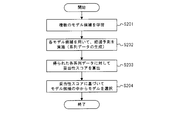
- FIG. 7 is a flowchart showing an example of the operation of the prediction system of the present embodiment.
- the model learning unit 101 learns a plurality of model candidates for one prediction target item (step S201).
- the prediction unit 103 performs progress prediction on each of the plurality of model candidates learned by the model learning unit 101, and generates series data including the obtained predicted value for each model candidate (step S202). .
- the score calculation unit 11 calculates an invalidity score for the series data for each model candidate obtained by the prediction unit 103 (step S203).
- the model selection unit 104 selects a prediction model that obtains a prediction value from among a plurality of model candidates based on the invalidity score calculated by the score calculation unit 11 (step S204).
- a model that automatically outputs a more appropriate progress prediction is output from among a plurality of prediction model candidates, or a model that outputs an invalid progress prediction. Can be excluded.
- the model selection unit 103 selects at least one model (prediction model candidate). However, the model selection unit 103 obtains, for example, a plurality of prediction model candidates from them. It is also possible to determine whether or not shipment is possible based on the invalidity score of the series data including the predicted value. In that case, for example, the model selection unit 103 performs a threshold determination on the invalidity score of the series data including the predicted value obtained from each of the plurality of prediction model candidates, and if it is equal to or less than the predetermined threshold, the shipment is OK. Otherwise, it may be shipped NG.
- the model selection unit 103 performs threshold determination on the total number of defective samples, the sum of invalidity scores, and the maximum value for each model. If it is equal to or less than a predetermined threshold, the shipment is OK, and otherwise, the shipment is NG. In this example, it is also possible to make a shipping decision based on the invalid score and the prediction accuracy. In that case, for example, the model selection unit 103 may determine that shipment is OK when the prediction accuracy is equal to or higher than a predetermined threshold and the invalidity score satisfies the above condition, and may be determined as shipment NG otherwise.
- the model selection unit 103 may ship the model (predicted model candidate) (output to the outside), and if the shipment is NG, a predetermined alert process may be performed.
- alert processing for example, it is output to a predetermined server or display device together with the identifier of the model determined as shipment NG, the series data at that time, its invalidity score, etc. It may be requested to determine availability. Further, a determination result of whether or not shipment is possible manually may be accepted.
- FIG. 8 is a block diagram illustrating a configuration example of the prediction system of the present embodiment.
- the prediction system 100 illustrated in FIG. 8 includes a data storage unit 102, one or more prediction units 103, a prediction result input unit 105, a shipping determination unit 106, and a score calculation unit 11.
- FIG. 8 is a semi-automatic shipping determination device 30 including a prediction result input unit 105, a shipping determination unit 106, and a score calculation unit 11 for the prediction system 100 including the data storage unit 102 and the prediction unit 103.
- the prediction result input unit 105, the shipping determination unit 106, and the score calculation unit 11 are not necessarily limited to a configuration that is mounted on one device.
- the data storage unit 102 stores learned prediction model information corresponding to one or more prediction target items. Further, the data storage unit 102 is data to be input to each prediction model in order to obtain a prediction value from the learned prediction models, and is a prediction data (prediction) that is a data set of explanatory variables used for each prediction model. Memorize the sample). Note that the prediction data is not limited to one, and may be a plurality. For example, the data storage unit 102 may store a plurality of pieces of prediction data corresponding to each of one or more designated or predetermined prediction subjects.
- Each prediction unit 103 is associated with one prediction target item, and performs progress prediction using the learned prediction model and prediction data of the corresponding prediction target item stored in the data storage unit 102.
- the series data of the corresponding prediction target item is generated.
- each of the prediction units 103 reads a learned prediction model of a corresponding prediction target item stored in the data storage unit 102, and stores the corresponding prediction target stored in the data storage unit 102 in the prediction model. By applying the item prediction data, a prediction value at each prediction point included in a predetermined evaluation target period is obtained for the corresponding prediction target item. Then, each of the prediction units 103 may generate series data including three or more data indicating the value of the prediction target item in association with time together with the data indicating the obtained predicted value. Note that, when a plurality of pieces of prediction data are stored, each of the prediction units 103 generates series data including data indicating prediction values obtained by applying a prediction model for each prediction data. That's fine.
- each of the prediction units 103 sets the prediction data in the prediction model under the condition that some values of the explanatory variables included in the prediction data are constant when performing the progress prediction. Application is performed to obtain a prediction value at each prediction point, and series data including the obtained prediction value is generated.
- Each of the prediction units 103 applies, for example, prediction data in which items related to lifestyle are fixed to each model candidate that predicts a corresponding predetermined test value, and a prediction value at each prediction time point as a prediction result (The above inspection value) may be obtained. In that case, series data including the obtained predicted values (test values) at the respective prediction points is generated.
- the series data may include actual measurement values used for prediction.
- the prediction result input unit 105 inputs the series data of each prediction target item obtained from each of the prediction units 103.
- the score calculation unit 11 calculates an invalidity score for the series data of each prediction target item input from the prediction result input unit 105.
- the shipment determination unit 106 determines whether or not the predicted value can be shipped based on the invalidity score for the series data of each prediction target item calculated by the score calculation unit 11. For example, when a plurality of series data (for example, series data corresponding to a plurality of prediction samples) is obtained from one prediction model, the shipping determination unit 106 determines that the invalidity score of all the series data is a predetermined threshold value. If it is below, the predicted value included in each series data may be determined as shipping OK, and otherwise, a predetermined alert process may be performed. In addition, for example, when the series data is obtained from a plurality of prediction target items, the shipping determination unit 106 may individually evaluate them, or may collectively evaluate them (batch evaluation). Is possible. As an example, the shipping determination unit 106 may collectively evaluate series data including the predicted value in the shipping unit for each shipping unit (for example, a prediction target person) that is a unit in which the predicted value is shipped. .
- alert processing for example, whether it is possible to ship manually by outputting it to a predetermined server or display device together with the identifier of the model determined as shipment NG, the series data at that time, its invalidity score, etc. A determination may be requested. Further, a determination result of whether or not shipment is possible manually may be accepted.
- the shipment determination unit 106 may output a predicted value to the outside if the shipment is finally OK as a result of the final shipment determination.
- the shipment determination unit 106 determines shipment of a predicted value
- the predicted value is based not only on the invalidity score of each series data but also on the prediction accuracy of the prediction model that generated the predicted value. It is also possible to determine whether or not shipment is possible. By adding not only the evaluation related to the graph shape (invalidity score) but also the evaluation related to the prediction accuracy, it is possible to ship a predicted value with a good balance between the prediction accuracy and the number of defective samples. Note that the method for calculating the prediction accuracy may be the same as in the second embodiment.
- FIG. 9 is a flowchart showing an example of the operation of the prediction system of the present embodiment.
- each of the prediction units 103 performs progress prediction on a corresponding prediction target item using a learned prediction model, and generates series data including the obtained predicted value (step). S301).
- the prediction result input unit 105 inputs the series data including the prediction result of the prediction unit 103 corresponding to each prediction target item (step S302).
- the score calculation unit 11 calculates an invalidity score for each input series data (step S303).
- the shipping determination unit 106 determines shipping of the obtained predicted value based on the invalidity score of each series data (step S304).
- the shipping determination unit 106 primarily determines whether or not shipping is possible depending on whether or not the invalidity scores of all the series data are equal to or less than a predetermined threshold.
- step S305 If the result of shipment judgment is shipment OK (Yes in step S305), the obtained predicted value is shipped (output to the outside) (step S306).
- step S307 a predetermined alert process is performed.
- the shipping determination unit 106 determines whether or not the predicted value can be shipped. However, as in the second embodiment, the shipping determination unit 106 determines whether or not the predicted model can be shipped. It is also possible to do. In that case, the shipping determination unit 106, for example, the invalidity calculated for one or more series data including a predicted value obtained by applying predetermined verification data to the prediction model to be determined. Whether or not the prediction model can be shipped may be determined based on the score. Also in this example, the shipment determination unit 106 may determine whether or not the prediction model can be shipped based on not only the invalidity score but also the prediction accuracy of the prediction model.
- the shipping determination unit 106 performs the shipping determination by comprehensively analyzing the series data including the predicted values in each sample. is there. Note that, for example, when the series data is obtained from a plurality of prediction target items, the shipping determination unit 106 may evaluate them individually or collectively (evaluate them collectively). Is possible. Further, the shipping determination unit 106 may collectively evaluate the series data including the predicted value in the shipping unit for each shipping unit that is a unit in which the predicted value or the predicted model is shipped.
- the method of evaluating the invalidity of the test value series data including the predicted value of the test item when the items related to the lifestyle are fixed is exemplified.
- the hypothetical conditions are not limited to these.
- the asymptotic model is exemplified as the model to be compared.
- the model to be compared may be other than the asymptotic model. That is, when a function form that is valid in advance is determined for the input series data, fitting to a function form that is valid in the same way is performed to obtain a curve model to be compared. The same effect can be obtained.
- FIG. 10 is a schematic block diagram showing a configuration example of a computer according to the embodiment of the present invention.
- the computer 1000 includes a CPU 1001, a main storage device 1002, an auxiliary storage device 1003, an interface 1004, a display device 1005, and an input device 1006.
- the system, server, and other devices in the above embodiment may be mounted on the computer 1000.
- the operation of each device may be stored in the auxiliary storage device 1003 in the form of a program.
- the CPU 1001 reads a program from the auxiliary storage device 1003 and develops it in the main storage device 1002, and executes predetermined processing in each embodiment according to the program.
- the CPU 1001 is an example of an information processing apparatus that operates according to a program.
- a CPU Central Processing Unit
- MPU Micro Processing Unit
- MCU Memory Control Unit
- GPU Graphics Processing Unit
- the auxiliary storage device 1003 is an example of a tangible medium that is not temporary.
- Other examples of the non-temporary tangible medium include a magnetic disk, a magneto-optical disk, a CD-ROM, a DVD-ROM, and a semiconductor memory connected via the interface 1004.
- the computer that has received the distribution may develop the program in the main storage device 1002 and execute the predetermined processing in each embodiment.
- the program may be for realizing a part of the predetermined processing in the above embodiment. Furthermore, the program may be a difference program that realizes predetermined processing in each embodiment in combination with another program already stored in the auxiliary storage device 1003.
- the interface 1004 transmits / receives information to / from other devices.
- the display device 1005 presents information to the user.
- the input device 1006 accepts input of information from the user.
- some elements of the computer 1000 may be omitted. For example, if the computer 1000 does not present information to the user, the display device 1005 can be omitted. For example, if the computer 1000 does not accept information input from the user, the input device 1006 can be omitted.
- circuitry general-purpose or dedicated circuits
- processors processors
- the like or combinations thereof. These may be constituted by a single chip or may be constituted by a plurality of chips connected via a bus.
- some or all of the constituent elements of the above embodiments may be realized by a combination of the above-described circuit and the like and a program.
- the plurality of information processing apparatuses and circuits may be centrally arranged or distributedly arranged. May be.
- the information processing apparatus, the circuit, and the like may be realized as a form in which each is connected via a communication network, such as a client and server system and a cloud computing system.
- FIG. 11 is a block diagram showing an outline of the index calculation apparatus of the present invention.
- the index calculation device 60 shown in FIG. 11 includes invalidity score output means 61.
- the invalidity score output means 61 (for example, the score calculation unit 11) is series data of a predetermined prediction target item, and is three or more pieces of data indicating the value of the prediction target item in association with time.
- an invalidity score which is an index indicating the invalidity of the series data, is obtained by fitting the series data into a predetermined function form. The invalidity score based on the error between the obtained curve model and the series data is output.
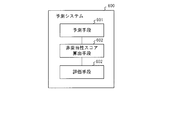
- FIG. 12 is a block diagram showing an outline of the prediction system of the present invention.
- a prediction system 600 illustrated in FIG. 12 includes a prediction unit 601, an invalidity score calculation unit 602, and an evaluation unit 603.
- the invalidity score calculation unit 602 may be realized by the invalidity score output unit 61 included in the index calculation device 60 described above.
- the prediction unit 601 (for example, the prediction unit 103) obtains a prediction value at a predetermined prediction time point using a learned prediction model for a predetermined prediction target item, and is series data including the obtained prediction value. Then, data series data is generated that is three or more data indicating the value of the prediction target item in association with time, and at least one of which indicates the predicted value.
- the invalidity score calculation means 602 (for example, the score calculation unit 11) is an invalidity score that is an index indicating the invalidity of the series data, and is a curve obtained by fitting the series data into a predetermined function form. An invalidity score based on the error between the model and the series data is calculated.
- the evaluation unit 603 (for example, the model selection unit 104 or the shipment determination unit 106) uses the series data, the predicted value or the predicted value included in the series data. The prediction model obtained is evaluated.
- (Supplementary note 1) Series data of a predetermined prediction target item, which is three or more data indicating the value of the prediction target item in association with time, at least one of which includes data indicating the prediction value Is input, an invalidity score, which is an index indicating the invalidity of the series data, and an error between the curve model obtained by fitting the series data into a predetermined function form and the series data.
- An index calculation apparatus comprising: an invalidity score output means for outputting an invalid validity score based thereon.
- the invalidity score output means performs fitting to the predetermined function form using data belonging to a predetermined first group among the series data, and a predetermined second group among the series data. An error with the curve model obtained by the fitting is calculated using data belonging to, and the invalidity score is output based on the calculated error, and the data belonging to the first group and the second.
- the index calculation apparatus according to Supplementary Note 1 or Supplementary Note 2, wherein the data belonging to the group does not completely match.
- the invalidity score output means displays the time value associated with each data included in the series data before the fitting to the predetermined function form. 5.
- the index calculation device according to any one of supplementary notes 1 to 4, wherein conversion is performed according to a scale.
- Prediction means for generating series data including three or more data indicating item values, at least one of which is data indicating a predicted value, and an invalidity score that is an index indicating the invalidity of the series data
- An invalidity score calculating means for calculating an invalidity score based on an error between a curve model obtained by fitting the series data into a predetermined function form and the series data, the series data, the series Evaluation means for performing an evaluation based on the invalidity score with respect to a prediction value included in data or a prediction model that obtains the prediction value.
- Prediction system for generating series data including three or more data indicating item values, at least one of which is data indicating a predicted value, and an invalidity score that is an index indicating the invalidity of the series data
- An invalidity score calculating means for calculating an invalidity score based on an error between a curve model obtained by fitting the series data into a predetermined function form and the series data, the series data, the series Evaluation means for performing an evaluation based on the invalidity score with respect to
- the said evaluation means is calculated using the said invalidity score and predetermined
- a model learning unit that learns a plurality of model candidates for the predetermined prediction target item, the prediction unit obtains the predicted value using each of the plurality of model candidates, and the plurality of the plurality of model candidates. Generating series data including the obtained predicted value for each model candidate, the invalidity score calculating means calculates the invalidity score for the series data for each of the plurality of model candidates, The evaluation means performs the evaluation on the plurality of model candidates, and selects a model for obtaining a predicted value of the prediction target item from the plurality of model candidates based on the evaluation result.
- One or more prediction means are provided corresponding to each of one or more prediction target items, and the invalidity score output means is the prediction target obtained from the one or more prediction means.
- the invalidity score is calculated for the series data for each item, and the evaluation means performs the evaluation on the series data for each prediction target item, and determines whether to ship the predicted value based on the evaluation result.
- the information processing apparatus is series data of a predetermined prediction target item, and is three or more pieces of data indicating the value of the prediction target item in association with time, at least one of which indicates the prediction value
- series data including data is input, an invalidity score that is an index indicating the invalidity of the series data, the curve model obtained by fitting the series data into a predetermined function form, and the series Calculating an invalidity score based on an error from the data, and evaluating the series data or a prediction value included in the series data or a prediction model that obtains the prediction value based on the invalidity score.
- prescribed prediction object item Comprising: It is 3 or more data which show the value of a prediction object item in correlation with time, The data from which at least 1 of them shows a prediction value are shown.
- series data including is input, an invalidity score that is an index indicating the invalidity of the series data, the curve model obtained by fitting the series data into a predetermined function form, and the series data
- a process of calculating an invalidity score based on the error of the error and a process of evaluating the series data or a prediction value included in the series data or a prediction model that obtains the prediction value based on the invalidity score Program to evaluate progress.
- series data including predicted values obtained based on hypothetical conditions, but also a reasonable function form is provided for series data including three or more data indicating values of prediction target items in association with time. If it can be applied, it can be suitably applied.
Landscapes
- Engineering & Computer Science (AREA)
- Physics & Mathematics (AREA)
- Theoretical Computer Science (AREA)
- Business, Economics & Management (AREA)
- General Physics & Mathematics (AREA)
- Strategic Management (AREA)
- Human Resources & Organizations (AREA)
- Data Mining & Analysis (AREA)
- Economics (AREA)
- Mathematical Physics (AREA)
- Software Systems (AREA)
- Entrepreneurship & Innovation (AREA)
- General Engineering & Computer Science (AREA)
- Computing Systems (AREA)
- Medical Informatics (AREA)
- Quality & Reliability (AREA)
- Marketing (AREA)
- Pure & Applied Mathematics (AREA)
- Mathematical Optimization (AREA)
- Mathematical Analysis (AREA)
- Computational Mathematics (AREA)
- General Business, Economics & Management (AREA)
- Development Economics (AREA)
- Tourism & Hospitality (AREA)
- Operations Research (AREA)
- Databases & Information Systems (AREA)
- Evolutionary Computation (AREA)
- Game Theory and Decision Science (AREA)
- Artificial Intelligence (AREA)
- Public Health (AREA)
- Health & Medical Sciences (AREA)
- Computational Linguistics (AREA)
- Educational Administration (AREA)
- Algebra (AREA)
- Biomedical Technology (AREA)
- Pathology (AREA)
- Primary Health Care (AREA)
- General Health & Medical Sciences (AREA)
- Epidemiology (AREA)
- Computer Vision & Pattern Recognition (AREA)
Abstract
La présente invention a notamment pour objet de déterminer automatiquement l'invalidité de données séquentielles comprenant une valeur de prédiction obtenue sur la base d'une condition hypothétique. L'invention concerne un dispositif de calcul d'indice comprenant un moyen de sortie de score d'invalidité qui, lorsque des données séquentielles d'un article prescrit à prédire sont entrées, délivre un score d'invalidité qui est un indice indiquant l'invalidité des données séquentielles. Les données séquentielles comprennent au moins trois instances de données indiquant une valeur de l'article à prédire en association avec le temps, et au moins l'une des trois instances ou plus de données indiquant une valeur de prédiction. Le score d'invalidité est basé sur la différence entre les données séquentielles et un modèle curviligne obtenu par ajustement des données séquentielles à une forme de fonction prescrite.
Priority Applications (4)
| Application Number | Priority Date | Filing Date | Title |
|---|---|---|---|
| JP2020509617A JP7140410B2 (ja) | 2018-03-30 | 2018-11-29 | 予測システム、予測方法および予測プログラム |
| CN201880091870.0A CN111937012A (zh) | 2018-03-30 | 2018-11-29 | 指标计算设备、预测系统、进度预测评估方法和程序 |
| EP18911933.2A EP3779812A4 (fr) | 2018-03-30 | 2018-11-29 | Dispositif de calcul d'indice, système de prédiction, procédé d'évaluation de prédiction de progression, et programme |
| US16/977,248 US20210042700A1 (en) | 2018-03-30 | 2018-11-29 | Index computation device, prediction system, progress prediction evaluation method, and program |
Applications Claiming Priority (2)
| Application Number | Priority Date | Filing Date | Title |
|---|---|---|---|
| JP2018-067622 | 2018-03-30 | ||
| JP2018067622 | 2018-03-30 |
Publications (1)
| Publication Number | Publication Date |
|---|---|
| WO2019187341A1 true WO2019187341A1 (fr) | 2019-10-03 |
Family
ID=68061178
Family Applications (1)
| Application Number | Title | Priority Date | Filing Date |
|---|---|---|---|
| PCT/JP2018/043910 Ceased WO2019187341A1 (fr) | 2018-03-30 | 2018-11-29 | Dispositif de calcul d'indice, système de prédiction, procédé d'évaluation de prédiction de progression, et programme |
Country Status (5)
| Country | Link |
|---|---|
| US (1) | US20210042700A1 (fr) |
| EP (1) | EP3779812A4 (fr) |
| JP (1) | JP7140410B2 (fr) |
| CN (1) | CN111937012A (fr) |
| WO (1) | WO2019187341A1 (fr) |
Cited By (2)
| Publication number | Priority date | Publication date | Assignee | Title |
|---|---|---|---|---|
| WO2024070126A1 (fr) * | 2022-09-27 | 2024-04-04 | 株式会社Nttドコモ | Dispositif de génération de modèle de prévision de la demande |
| CN119005684A (zh) * | 2024-07-29 | 2024-11-22 | 广东信仕德建设项目管理有限公司 | 项目风险评估方法、系统、设备及存储介质 |
Families Citing this family (8)
| Publication number | Priority date | Publication date | Assignee | Title |
|---|---|---|---|---|
| US11783949B2 (en) * | 2018-11-30 | 2023-10-10 | Ariel Precision Medicine, Inc. | Methods and systems for severity calculator |
| US20210150335A1 (en) * | 2019-11-20 | 2021-05-20 | International Business Machines Corporation | Predictive model performance evaluation |
| US20220059238A1 (en) * | 2020-08-24 | 2022-02-24 | GE Precision Healthcare LLC | Systems and methods for generating data quality indices for patients |
| TWI827974B (zh) * | 2021-09-08 | 2024-01-01 | 財團法人工業技術研究院 | 虛擬功能效能分析系統及其分析方法 |
| CN116796652B (zh) * | 2023-08-25 | 2023-12-26 | 国网浙江省电力有限公司电力科学研究院 | 湿热地区配电变压器密封橡胶垫圈劣化失效预测方法 |
| CN117390937B (zh) * | 2023-12-12 | 2024-03-05 | 华中科技大学 | 一种快充条件下含缺陷储氢气瓶损伤预测方法及系统 |
| CN117574682B (zh) * | 2024-01-11 | 2024-03-26 | 华中科技大学 | 一种核壳ncm电极颗粒机械失效预测方法及系统 |
| CN120850177B (zh) * | 2025-09-23 | 2025-11-28 | 江苏汉灿过滤设备科技有限公司 | 基于多维参数分析的滤芯失效预警方法及装置 |
Citations (7)
| Publication number | Priority date | Publication date | Assignee | Title |
|---|---|---|---|---|
| JPH10228463A (ja) | 1997-02-17 | 1998-08-25 | Hitachi Ltd | 需要予測モデル評価方法 |
| JP2005063208A (ja) * | 2003-08-14 | 2005-03-10 | Nippon Telegr & Teleph Corp <Ntt> | ソフトウェア信頼度成長モデル選択方法、ソフトウェア信頼度成長モデル選択装置、ソフトウェア信頼度成長モデル選択プログラム、およびプログラム記録媒体 |
| WO2005031278A1 (fr) * | 2003-09-29 | 2005-04-07 | Nozzle Network Co., Ltd. | Programme de creation graphique |
| JP2011176984A (ja) * | 2010-02-25 | 2011-09-08 | Toshiba Corp | エネルギー配分計算装置 |
| JP2016201869A (ja) * | 2015-04-07 | 2016-12-01 | レモンガス株式会社 | エネルギマネジメント方法およびエネルギマネジメントシステム |
| JP2017049677A (ja) * | 2015-08-31 | 2017-03-09 | 富士通株式会社 | 機械学習管理プログラム、機械学習管理装置および機械学習管理方法 |
| JP2018067622A (ja) | 2016-10-19 | 2018-04-26 | 日立化成株式会社 | 太陽電池セル及び太陽電池モジュール |
Family Cites Families (14)
| Publication number | Priority date | Publication date | Assignee | Title |
|---|---|---|---|---|
| JP5071851B2 (ja) * | 2007-10-31 | 2012-11-14 | 日本電信電話株式会社 | 時間情報を用いた予測装置、予測方法、予測プログラムおよびそのプログラムを記録した記録媒体 |
| CN101929994A (zh) * | 2010-08-24 | 2010-12-29 | 昆明理工大学 | 一种预测多相混合均匀性的时间序列模型和方法 |
| CN102200759A (zh) * | 2011-05-28 | 2011-09-28 | 东华大学 | 一种非线性核化自适应预测方法 |
| US20130194271A1 (en) * | 2012-01-30 | 2013-08-01 | Sap Ag | Visualization of Uncertain Times Series |
| JP5392444B1 (ja) * | 2012-04-26 | 2014-01-22 | 日本電気株式会社 | 保健指導対象者選定条件作成支援装置 |
| CN103093287B (zh) * | 2013-01-29 | 2017-02-08 | 广东电网公司电力调度控制中心 | 电网指标预测误差评估方法和系统 |
| JP6109037B2 (ja) * | 2013-10-23 | 2017-04-05 | 本田技研工業株式会社 | 時系列データ予測装置、時系列データ予測方法、及びプログラム |
| CN103942457B (zh) * | 2014-05-09 | 2017-04-12 | 浙江师范大学 | 基于关联向量机回归的水质参数时间序列预测方法 |
| US10558924B2 (en) * | 2014-05-23 | 2020-02-11 | DataRobot, Inc. | Systems for second-order predictive data analytics, and related methods and apparatus |
| JP5698860B1 (ja) * | 2014-08-22 | 2015-04-08 | 株式会社アールファイブ | 在庫管理システム、在庫管理方法、及びプログラム |
| JP6384590B2 (ja) * | 2015-03-26 | 2018-09-05 | 日本電気株式会社 | 学習モデル生成システム、方法およびプログラム |
| JP6734582B2 (ja) * | 2015-12-22 | 2020-08-05 | 国立研究開発法人理化学研究所 | リスク評価方法、リスク評価装置及びリスク評価プログラム |
| JP6742894B2 (ja) * | 2016-06-09 | 2020-08-19 | 株式会社日立製作所 | データ予測システムおよびデータ予測方法 |
| CN107491830B (zh) * | 2017-07-03 | 2021-03-26 | 北京奇艺世纪科技有限公司 | 一种时间序列曲线的处理方法和装置 |
-
2018
- 2018-11-29 WO PCT/JP2018/043910 patent/WO2019187341A1/fr not_active Ceased
- 2018-11-29 CN CN201880091870.0A patent/CN111937012A/zh active Pending
- 2018-11-29 EP EP18911933.2A patent/EP3779812A4/fr not_active Withdrawn
- 2018-11-29 US US16/977,248 patent/US20210042700A1/en not_active Abandoned
- 2018-11-29 JP JP2020509617A patent/JP7140410B2/ja active Active
Patent Citations (7)
| Publication number | Priority date | Publication date | Assignee | Title |
|---|---|---|---|---|
| JPH10228463A (ja) | 1997-02-17 | 1998-08-25 | Hitachi Ltd | 需要予測モデル評価方法 |
| JP2005063208A (ja) * | 2003-08-14 | 2005-03-10 | Nippon Telegr & Teleph Corp <Ntt> | ソフトウェア信頼度成長モデル選択方法、ソフトウェア信頼度成長モデル選択装置、ソフトウェア信頼度成長モデル選択プログラム、およびプログラム記録媒体 |
| WO2005031278A1 (fr) * | 2003-09-29 | 2005-04-07 | Nozzle Network Co., Ltd. | Programme de creation graphique |
| JP2011176984A (ja) * | 2010-02-25 | 2011-09-08 | Toshiba Corp | エネルギー配分計算装置 |
| JP2016201869A (ja) * | 2015-04-07 | 2016-12-01 | レモンガス株式会社 | エネルギマネジメント方法およびエネルギマネジメントシステム |
| JP2017049677A (ja) * | 2015-08-31 | 2017-03-09 | 富士通株式会社 | 機械学習管理プログラム、機械学習管理装置および機械学習管理方法 |
| JP2018067622A (ja) | 2016-10-19 | 2018-04-26 | 日立化成株式会社 | 太陽電池セル及び太陽電池モジュール |
Non-Patent Citations (1)
| Title |
|---|
| HIDETAKA TAKAHASHIKATSUMI YOSHIDA: "HRA (Health Risk Appraisal System) for Lifestyle Improvement", JOURNAL OF JAPAN SOCIETY OF HUMAN DOCK (JHD, vol. 11, no. 4, 1997, pages 123 - 128 |
Cited By (2)
| Publication number | Priority date | Publication date | Assignee | Title |
|---|---|---|---|---|
| WO2024070126A1 (fr) * | 2022-09-27 | 2024-04-04 | 株式会社Nttドコモ | Dispositif de génération de modèle de prévision de la demande |
| CN119005684A (zh) * | 2024-07-29 | 2024-11-22 | 广东信仕德建设项目管理有限公司 | 项目风险评估方法、系统、设备及存储介质 |
Also Published As
| Publication number | Publication date |
|---|---|
| JP7140410B2 (ja) | 2022-09-21 |
| EP3779812A4 (fr) | 2021-12-29 |
| CN111937012A (zh) | 2020-11-13 |
| EP3779812A1 (fr) | 2021-02-17 |
| JPWO2019187341A1 (ja) | 2021-02-12 |
| US20210042700A1 (en) | 2021-02-11 |
Similar Documents
| Publication | Publication Date | Title |
|---|---|---|
| WO2019187341A1 (fr) | Dispositif de calcul d'indice, système de prédiction, procédé d'évaluation de prédiction de progression, et programme | |
| JP7007027B2 (ja) | 予測システム、モデル生成システム、方法およびプログラム | |
| CN108597617B (zh) | 流行病分级预测方法及装置、计算机装置和可读存储介质 | |
| US20120271612A1 (en) | Predictive modeling | |
| US10699225B2 (en) | Production management support apparatus, production management support method, and production management support program | |
| JP2019128904A (ja) | 予測システム、シミュレーションシステム、方法およびプログラム | |
| CN115049315A (zh) | 一种用电安全风险评估方法、装置、设备及存储介质 | |
| KR20160135451A (ko) | 학과계열 선정 시스템 및 그 방법 | |
| Alghawli et al. | A fuzzy MCDM approach for structured comparison of the health literacy level of hospitals | |
| US20190371473A1 (en) | System and method for evaluating vascular risks | |
| Basakha et al. | Health care cost disease as a threat to Iranian aging society | |
| Topsakal et al. | Utilization of machine learning for the objective assessment of rhinoplasty outcomes | |
| WO2019181517A1 (fr) | Dispositif de test de champ visuel, sa méthode de contrôle, et programme de test de champ visuel | |
| CN110009161A (zh) | 供水预测方法及装置 | |
| CN118071213A (zh) | 基于并行操作和权值更新的人才评价方法、系统及介质 | |
| CN112581070A (zh) | 一种青少年学习生涯与职业定位测评装置及方法 | |
| JP6604032B2 (ja) | 評価支援装置、評価支援プログラム及び評価支援システム | |
| CN115409225A (zh) | 配送时长确定方法、装置、电子设备及可读存储介质 | |
| CN112330461A (zh) | 一种基于网络平台投资的智能投顾系统 | |
| JP7740372B2 (ja) | ストレス推定方法 | |
| WO2023223533A1 (fr) | Dispositif d'estimation, procédé d'estimation et programme | |
| US20160224912A1 (en) | Information processing apparatus, and non-transitory recording medium | |
| JP2022175422A (ja) | コンピュータプログラム、情報処理装置、及び情報処理方法 | |
| US20170249575A1 (en) | Multi criteria decision analysis for mitigating of crowding | |
| WO2023238574A1 (fr) | Dispositif d'analyse de contrainte de fatigue |
Legal Events
| Date | Code | Title | Description |
|---|---|---|---|
| 121 | Ep: the epo has been informed by wipo that ep was designated in this application |
Ref document number: 18911933 Country of ref document: EP Kind code of ref document: A1 |
|
| ENP | Entry into the national phase |
Ref document number: 2020509617 Country of ref document: JP Kind code of ref document: A |
|
| WWE | Wipo information: entry into national phase |
Ref document number: 2018911933 Country of ref document: EP |