WO2019187696A1 - Dispositif de vectorisation, procédé de traitement de langue et programme - Google Patents
Dispositif de vectorisation, procédé de traitement de langue et programme Download PDFInfo
- Publication number
- WO2019187696A1 WO2019187696A1 PCT/JP2019/004603 JP2019004603W WO2019187696A1 WO 2019187696 A1 WO2019187696 A1 WO 2019187696A1 JP 2019004603 W JP2019004603 W JP 2019004603W WO 2019187696 A1 WO2019187696 A1 WO 2019187696A1
- Authority
- WO
- WIPO (PCT)
- Prior art keywords
- vector
- vectorization
- character string
- word
- processing unit
- Prior art date
- Legal status (The legal status is an assumption and is not a legal conclusion. Google has not performed a legal analysis and makes no representation as to the accuracy of the status listed.)
- Ceased
Links
Images






Classifications
-
- G—PHYSICS
- G06—COMPUTING OR CALCULATING; COUNTING
- G06F—ELECTRIC DIGITAL DATA PROCESSING
- G06F40/00—Handling natural language data
- G06F40/20—Natural language analysis
- G06F40/237—Lexical tools
-
- G—PHYSICS
- G06—COMPUTING OR CALCULATING; COUNTING
- G06F—ELECTRIC DIGITAL DATA PROCESSING
- G06F40/00—Handling natural language data
- G06F40/20—Natural language analysis
- G06F40/263—Language identification
-
- G—PHYSICS
- G06—COMPUTING OR CALCULATING; COUNTING
- G06F—ELECTRIC DIGITAL DATA PROCESSING
- G06F40/00—Handling natural language data
- G06F40/20—Natural language analysis
- G06F40/279—Recognition of textual entities
- G06F40/284—Lexical analysis, e.g. tokenisation or collocates
-
- G—PHYSICS
- G06—COMPUTING OR CALCULATING; COUNTING
- G06F—ELECTRIC DIGITAL DATA PROCESSING
- G06F40/00—Handling natural language data
- G06F40/20—Natural language analysis
- G06F40/279—Recognition of textual entities
- G06F40/289—Phrasal analysis, e.g. finite state techniques or chunking
-
- G—PHYSICS
- G06—COMPUTING OR CALCULATING; COUNTING
- G06F—ELECTRIC DIGITAL DATA PROCESSING
- G06F40/00—Handling natural language data
- G06F40/30—Semantic analysis
-
- G—PHYSICS
- G06—COMPUTING OR CALCULATING; COUNTING
- G06N—COMPUTING ARRANGEMENTS BASED ON SPECIFIC COMPUTATIONAL MODELS
- G06N3/00—Computing arrangements based on biological models
- G06N3/02—Neural networks
- G06N3/04—Architecture, e.g. interconnection topology
-
- G—PHYSICS
- G06—COMPUTING OR CALCULATING; COUNTING
- G06N—COMPUTING ARRANGEMENTS BASED ON SPECIFIC COMPUTATIONAL MODELS
- G06N3/00—Computing arrangements based on biological models
- G06N3/02—Neural networks
- G06N3/04—Architecture, e.g. interconnection topology
- G06N3/045—Combinations of networks
-
- G—PHYSICS
- G06—COMPUTING OR CALCULATING; COUNTING
- G06N—COMPUTING ARRANGEMENTS BASED ON SPECIFIC COMPUTATIONAL MODELS
- G06N3/00—Computing arrangements based on biological models
- G06N3/02—Neural networks
- G06N3/04—Architecture, e.g. interconnection topology
- G06N3/0464—Convolutional networks [CNN, ConvNet]
-
- G—PHYSICS
- G06—COMPUTING OR CALCULATING; COUNTING
- G06N—COMPUTING ARRANGEMENTS BASED ON SPECIFIC COMPUTATIONAL MODELS
- G06N3/00—Computing arrangements based on biological models
- G06N3/02—Neural networks
- G06N3/08—Learning methods
- G06N3/09—Supervised learning
-
- G—PHYSICS
- G06—COMPUTING OR CALCULATING; COUNTING
- G06N—COMPUTING ARRANGEMENTS BASED ON SPECIFIC COMPUTATIONAL MODELS
- G06N3/00—Computing arrangements based on biological models
- G06N3/02—Neural networks
- G06N3/08—Learning methods
Definitions
- the present disclosure relates to a vectorization device that generates a vector according to a character string, a language processing method and a program that perform language processing based on the character string.
- Non-Patent Document 1 discloses a convolutional neural network (CNN) model in which a task of classifying sentences in machine learning is learned.
- the CNN model disclosed in Non-Patent Document 1 has one convolution layer.
- the convolution layer generates a feature amount map by applying a filter to the connection of word vectors corresponding to a plurality of words in a sentence.
- Non-Patent Document 1 employs word2vec, which is a well-known technique using machine learning, as a method for obtaining a word vector corresponding to a sentence to be classified.
- This disclosure provides a vectorization apparatus and a language processing method that can facilitate language processing using vectors according to character strings.
- the vectorization apparatus generates a vector corresponding to a character string.
- the vectorization apparatus includes an acquisition unit, a storage unit, and an arithmetic processing unit.
- the acquisition unit acquires a character string.
- the storage unit stores vectorization information indicating a relationship between a character string and a vector.
- the arithmetic processing unit generates a vector corresponding to the acquired character string based on the vectorization information.
- the vectorization information sets an order having a predetermined cycle between a plurality of vector elements included in each vector.
- the vectorization apparatus and the language processing method of the present disclosure it is possible to easily perform language processing using vectors according to character strings according to the period of each vector.
- FIG. 1 is a block diagram illustrating a configuration of a vectorization device according to a first embodiment.
- the figure for demonstrating the data structure of the word vector dictionary in a vectorization apparatus Illustration for explaining the classification of vocabulary in the word vector dictionary 6 is a flowchart illustrating a language processing method according to the first embodiment.
- FIG. Flowchart for explaining CNN processing in the first embodiment The figure for demonstrating the convolution of CNN in Embodiment 1.
- the chart which shows the experimental result of the language processing method concerning Embodiment 1 6 is a flowchart illustrating a word vector calculation process according to the first embodiment.
- the figure for demonstrating the calculation process of the word vector in Embodiment 1. Flowchart illustrating processing for determining vocabulary list Flowchart for explaining a modification of the word vector calculation process The figure for demonstrating the modification of the calculation process of a word vector
- the CNN is a neural network mainly used in the field of image processing such as image recognition (see Patent Document 1).
- the CNN in image processing convolves an image to be processed using a filter having a size of several pixels, for example. According to the convolution of the image, a feature amount map indicating the feature amount for each region of interest corresponding to the size of the filter in the image is generated two-dimensionally. Furthermore, it is known that the image processing CNN improves the performance by deepening the generated feature map.
- Non-Patent Document 1 a filter having a size corresponding to a plurality of word vectors corresponding to a word is used, and the obtained feature map is one-dimensional (for example, Non-Patent Document 1). .
- the inventor of the present application pays attention to the fact that the above-mentioned filter is too large and it is difficult to deepen the CNN, and as a result of repeated studies on the use of a smaller size filter, the following problems have been revealed.
- the region of interest divides the inside of the word vector.
- word vectorization techniques such as word2vec
- word2vec the significance of using the region of interest as a processing unit. It is difficult to find. From this, in the prior art, it has become clear that it is difficult to improve the performance by deepening the CNN of natural language processing.
- the inventors of the present invention have made extensive studies on the above problems, and as a result, have come up with a vectorization method that provides periodicity in the order of vector elements in a word vector. According to this method, it is possible to give significance to the attention area when the filter is reduced in accordance with the periodicity of the word vector and to improve the performance of the CNN.
- Embodiment 1 of the vectorization apparatus and language processing method based on the above vectorization technique will be described below.
- FIG. 1 is a diagram for explaining the outline of the language processing method according to the present embodiment.
- the language processing method performs document classification on, for example, the document data D1 using the CNN 10 of natural language processing in machine learning.
- the document data D1 is text data including a plurality of words constituting the document.
- a word in the document data D1 is an example of a character string in the present embodiment.
- the vectorization device 2 applies the vectorization method described above to the document data D1 as preprocessing of the CNN 10 in the language processing method.
- the vectorization device 2 performs word vectorization (that is, word embedding) in the document data D1 to generate a word vector V1.
- the word vector V1 includes a vector element V10 for each dimension set in advance. Word vectors V1 corresponding to different words can be identified by the difference in the values of at least one vector element V10.
- the vectorization device 2 of the present embodiment refers to, for example, the word vector dictionary D2, sets the arrangement order of the vector elements V10 so as to have a period N in the X direction, and inputs the word vector V1 to the CNN 10.
- the period N is an integer that is 2 or more and less than or equal to half the number of dimensions of the word vector V1.
- the vectorization apparatus 2 of the present embodiment it is meaningful to set the attention area of the CNN 10 so as to internally divide the preprocessed document data D10 in the X direction according to the period N in the word vector V1.
- language processing by machine learning can be facilitated, such as improving the performance by deepening the CNN 10.
- FIG. 2 is a block diagram illustrating the configuration of the vectorization device 2.
- the vectorization device 2 is constituted by an information processing device such as a PC or various information terminals. As shown in FIG. 2, the vectorization device 2 includes an arithmetic processing unit 20, a storage unit 21, a device interface 22, and a network interface 23. Hereinafter, “interface” is abbreviated as “I / F”. The vectorization device 2 includes an operation unit 24 and a display unit 25.
- the arithmetic processing unit 20 includes, for example, a CPU or MPU that realizes a predetermined function in cooperation with software, and controls the overall operation of the vectorization device 2.
- the arithmetic processing unit 20 reads out data and programs stored in the storage unit 21 and performs various arithmetic processes to realize various functions.
- the arithmetic processing unit 20 executes a program that realizes the vectorization method of the present embodiment or a language processing method based on the method.
- the above program may be provided from various communication networks, or may be stored in a portable recording medium.
- the arithmetic processing unit 20 may be a hardware circuit such as a dedicated electronic circuit or a reconfigurable electronic circuit designed to realize a predetermined function.
- the arithmetic processing unit 20 may be configured by various semiconductor integrated circuits such as a CPU, MPU, GPU, GPGPU, TPU, microcomputer, DSP, FPGA, and ASIC.
- the storage unit 21 is a storage medium that stores programs and data necessary for realizing the functions of the vectorization device 2. As shown in FIG. 2, the storage unit 21 includes a storage unit 21a and a temporary storage unit 21b.
- the storage unit 21a stores parameters, data, a control program, and the like for realizing a predetermined function.
- the storage unit 21a is configured with, for example, an HDD or an SSD.
- the storage unit 21a stores a word vector dictionary D2 and the like.
- the word vector dictionary D2 is an example of vectorization information in the present embodiment.
- the word vector dictionary D2 will be described later.
- the temporary storage unit 21b is configured by a RAM such as a DRAM or an SRAM, for example, and temporarily stores (that is, holds) data.
- the temporary storage unit 21b may function as a work area for the arithmetic processing unit 20 or may be configured by a storage area in the internal memory of the arithmetic processing unit 20.
- the device I / F 22 is a circuit for connecting an external device to the vectorization device 2.
- the device I / F 22 is an example of an acquisition unit that performs communication according to a predetermined communication standard.
- the predetermined standard includes USB, HDMI (registered trademark), IEEE 1395, WiFi, Bluetooth (registered trademark), and the like.
- the network I / F 23 is a circuit for connecting the vectorization device 2 to a communication network via a wireless or wired communication line.
- the network I / F 23 is an example of an acquisition unit that performs communication based on a predetermined communication standard.
- the predetermined communication standard includes communication standards such as IEEE802.3, IEEE802.11a / 11b / 11g / 11ac.
- the operation unit 24 is a user interface that is operated by a user.
- the operation unit 24 includes, for example, a keyboard, a touch pad, a touch panel, buttons, switches, and combinations thereof.
- the operation unit 24 is an example of an acquisition unit that acquires various information input by a user.
- the acquisition unit in the vectorization apparatus 2 acquires various information by reading various information stored in various storage media (for example, the storage unit 21a) into a work area (for example, the temporary storage unit 21b) of the arithmetic processing unit 20, for example. It may be what performs.
- the display unit 25 is composed of, for example, a liquid crystal display or an organic EL display.
- the display unit 25 displays various information such as information input from the operation unit 24 and information indicating processing results such as document classification by language processing according to the present embodiment.
- the vectorization device 2 configured by a PC or the like has been described.
- the vectorization device 2 according to the present disclosure is not limited to this, and may be various information processing devices (that is, computers).
- the vectorization device 2 may be one or a plurality of server devices such as an ASP server.
- the language processing method according to the present disclosure may be realized in a computer cluster or cloud computing.
- the vectorization device 2 may acquire document data D1 (FIG. 1) input from the outside via a communication network by the network I / F 23 and execute vectorization of character strings such as words.
- the vectorization apparatus 2 may transmit the vectorized document data D10 to the outside, or may transmit the processing result of the CNN 10 for the data D10.
- the period N is realized by using a vocabulary classification that gives linguistic meaning to each dimension of the word vector V1.
- the classification of the word vector dictionary D2 and vocabulary will be described with reference to FIGS.
- FIG. 3 is a diagram for explaining the data structure of the word vector dictionary D2 in the vectorization apparatus 2.
- FIG. 4 is a diagram for explaining the classification of the vocabulary V0 in the word vector dictionary D2.
- FIG. 3A shows an example of the word vector dictionary D2.
- FIG. 3B shows an example of the word vector dictionary D2 in the word vector dictionary D2 of FIG.
- the word vector dictionary D2 records “words” and “word vectors” in association with each other.
- a word vector V1 corresponding to the word “Paris” and a word vector V1 corresponding to the word “batter” are recorded in the word vector dictionary D2.
- FIG. 3B illustrates the word vector V1 of the word “Paris”.
- Each vector element V10 has a value within a predetermined range such as 0 to 1 or -1 to 1, for example.
- the word vector dictionary D2 of this embodiment is defined by a vocabulary V0 that includes words for the dimensions of the word vector V1.
- the vocabulary V0 of the word vector dictionary D2 includes six words “Paris”, “baseball”, “election”, “Tokyo”, “player”, and “congress”.
- Each word of the vocabulary V0 is an example of a vocabulary element associated with the vector element V10 of each dimension of the word vector V1.
- each vector element V10 in the word vector V1 indicates a degree of similarity that is a degree of similarity between the word in the word vector V1 and each word in the vocabulary V0.
- the first vector element V10 in the word vector V1 indicates the similarity to the first word “Paris” in the vocabulary V0
- the second vector element V10 indicates the second word “baseball” in the vocabulary V0.
- the similarity to is shown. From this, in the word vector V1 (FIG. 3B) corresponding to the word “Paris”, the first vector element V10 is “1”, while the second vector element V10 is “0.1”. It has become.
- the words in the vocabulary V0 are classified into N classes.
- the classification of the vocabulary V0 will be described with reference to FIG.
- the words in the vocabulary V0 are classified into first to third classes c1, c2, and c3.
- the first class c1 is a class to which words related to place names belong.
- the first class c1 includes “Paris” and “Tokyo”.
- the second class c2 is a class to which words related to sports belong, and includes, for example, “baseball” and “player”.
- the third class c3 is a class to which words related to politics belong, and includes, for example, “election” and “parliament”.
- the words of the vocabulary V0 as described above are arranged one by one in order from the first to third classes c1 to c3 in the X direction of the word vector dictionary D2 (FIG. 3A).
- the first word of the vocabulary V0 in the word vector dictionary D2 is “Paris” belonging to the first class c1
- the second word is “baseball” of the second class c2
- the third word is the first word It is an “election” of 3 classes c3.
- the fourth word of the vocabulary V0 in the word vector dictionary D2 belongs to the first class c1 and is “Tokyo” different from the first “Paris”.
- the word vector dictionary D2 manages the order of vector elements V10 arranged in each word vector V1 in accordance with the order of words in the vocabulary V0 as described above.
- the vector element V10 indicating the degree of similarity regarding each of the classes c1 to c3 is repeated every period N. That is, N vector elements V10 adjacent in the word vector V1, that is, N-dimensional subvectors, have a complete meaning such as the similarity of the words of the word vector V1 with respect to all classes c1 to c3. It is done.
- the significance for each period N can be given to the word vector V1 based on the linguistic meaning classification and managed, for example, in the word vector dictionary D2.
- the classification of the vocabulary V0 is not limited to a linguistic meaning, and may be performed from various viewpoints.
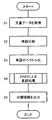
- FIG. 5 is a flowchart illustrating the language processing method according to this embodiment. Each process of the flowchart shown in FIG. 5 is executed by the arithmetic processing unit 20 of the vectorization apparatus 2.
- the arithmetic processing unit 20 of the vectorization apparatus 2 acquires the document data D1 (FIG. 1) via any of the various acquisition units (device interface 22, network interface 23, operation unit 24) (S1). ).
- the user can input the document data D ⁇ b> 1 by operating the operation unit 24.
- the arithmetic processing unit 20 performs word division so that the word is recognized as a character string to be vectorized in the acquired document data D1 (S2).
- the arithmetic processing unit 20 detects a word break in the document data D1, such as a space between words.
- the arithmetic processing unit 20 may extract a word of the target part of speech from the document data D1.
- the arithmetic processing unit 20 executes vectorization of words in the document data D1 as the vectorization device 2 (S3).
- the arithmetic processing unit 20 refers to the word vector dictionary D2 stored in the storage unit 21 and generates a word vector V1 corresponding to each word.
- the arithmetic processing unit 20 arranges the word vector V1 in the Y direction as shown in FIG. 1 according to the order of the words recognized in the acquired document data D1, for example. Generate. By the process of step S3, a common cycle N is set for each word vector V1 in the X direction of the document data D10 that has been vectorized.
- the arithmetic processing unit 20 performs language processing by the CNN 10 based on the generated word vector V1 (S4).
- CNN 10 a specific parameter for designating a convolution filter is set in advance according to the cycle N of the word vector V1 before learning.
- the arithmetic processing unit 20 inputs the document data D10 that has been word-vectorized into the CNN 10 that has learned the document classification, and executes the document classification processing by the CNN 10. Details of step S4 and CNN 10 will be described later.
- the arithmetic processing unit 20 outputs, for example, the classification information of the document data D1 based on the processing result by the CNN 10 (S5).
- the classification information indicates a class in which the document data D1 is classified in a predetermined plurality of classes.
- the arithmetic processing unit 20 displays the classification information on the display unit 25.
- the cycle N is set in the word vector V1 in the language processing by the CNN 10 such as document classification.
- CNN10 can be constructed
- FIG. 6 is a diagram for explaining the network structure of the CNN 10 in the present embodiment.
- FIG. 7 is a flowchart for explaining the processing of the CNN 10 in the present embodiment.
- FIG. 8 is a diagram for explaining the convolution of the CNN 10.
- the CNN 10 in the present embodiment includes, in order from the input side to the output side, the first convolution layer 11, the second convolution layer 12, the pooling layer 15, and the total coupling layer 16. including.
- the CNN 10 includes an input layer and an output layer for inputting / outputting data, for example.
- the processing executed by the arithmetic processing unit 20 in step S4 in FIG. 5 as the CNN 10 including the above layers will be described with reference to FIG.
- the arithmetic processing unit 20 inputs the document data D10 in which words are vectorized in step S3 of FIG. 5 to the temporary storage unit 21b or the like (S11).
- the arithmetic processing unit 20 performs a convolution operation on the vectorized document data D10 to generate a feature amount map D11 (S12).
- convolution is performed using a filter 11 f having a size that is an integral multiple of the period N and a stride width that is an integral multiple of the period N (see FIG. 8).
- a feature amount map D11 indicating a two-dimensional distribution of the feature amount D11a is generated. Details of convolution in CNN 10 will be described later.
- the arithmetic processing unit 20 performs a convolution on the feature amount map D11 in the first convolution layer 11 as the second convolution layer 12, and generates a new feature amount map D12 (S13).
- the feature amount map D12 in the second convolution layer 12 may be one-dimensional.
- the size and stride width of the filter 12f in the second convolution layer 12 are not particularly limited and can be set to various values.
- the arithmetic processing unit 20 performs an operation as the pooling layer 15 based on the generated feature amount map D12, and generates feature amount data D15 indicating the operation result (S14). For example, the arithmetic processing unit 20 calculates maximum pooling, average pooling, or the like on the feature amount map D12.
- the arithmetic processing unit 20 performs an operation as the all combined layer 16 using the entire generated feature data D15, and generates output data D3 indicating a processing result by the CNN 10 (S15).
- the arithmetic processing unit 20 performs an operation in which the determination criterion of each class is learned by an activation function for each class of document classification.
- each value of the output data D3 corresponds to a value belonging to each class of document classification.
- the arithmetic processing unit 20 holds the output data D3 generated in step S15 in the temporary storage unit 21b as an output layer, and completes the process of step S4 in FIG. Thereafter, the arithmetic processing unit 20 performs the process of step S5 based on the held output data D3.
- the document data D10 vectorized by the vectorization device 2 is input to the CNN 10 constructed in accordance with the period N of the word vector V1, and sequentially convolved in the two convolution layers 11 and 12. (S12, S13). Details of convolution in the CNN 10 of the present embodiment will be described with reference to FIG.
- FIG. 8A shows an example of the filter 11 f of the first convolution layer 11.
- the filter 11f is defined by a matrix of filter coefficients F11 to F23.
- the filter coefficients F11 to F23 are set to respective values by machine learning within a range of 0 to 1, for example.
- the size of the filter 11f in the Y direction is set to two lines for two words.
- the size of the filter 11f in the Y direction is not particularly limited, and may be set to one line corresponding to one word, or may be set to three or more lines.
- FIG. 8B shows an example of a region of interest R1 for the filter 11f shown in FIG.
- FIG. 8C shows an example of the attention area R1 shifted from the state of FIG.
- the attention area R1 is set so that the filter 11f is superimposed on the vectorized document data D10 as shown in FIG.
- the arithmetic processing unit 20 serving as the first convolution layer 11 weights and adds the corresponding vector elements V10 in the attention area R1 with the filter coefficients F11 to F23, thereby obtaining the feature quantity D11a of one attention area R1.
- the arithmetic processing unit 20 as the first convolution layer 11 repeatedly sets the attention area R1 while shifting the filter 11f for each stride width W1, as shown in FIG. 8C, for example.
- the feature amount D11a of each attention area R1 is sequentially calculated.
- the feature amount map D11 is generated so as to have a size in the X direction smaller than the document data D10 before convolution by an integer multiple of the period N.
- the size of the filter 11f and the stride width W1 in the X direction of the first convolution layer 11 are set to integer multiples of the period N, respectively.
- the vectorized document data D10 is convolved so as to internally divide the X direction in the attention area R1 having the period N as a minimum unit, and the feature quantity map of the feature quantity D11a considered to be meaningful according to the period N D11 can be obtained.
- the number of the filters 11f of the first convolution layer 11 may be one or plural. As many feature maps D11 as the number of filters 11f can be obtained.
- the size and stride width of each filter 11f can be set separately.
- the stride width in the Y direction is not particularly limited and can be set as appropriate.
- the second convolution layer 12 includes, for example, a filter 12f having two or more rows in the X direction as shown in FIG.
- the arithmetic processing unit 20 as the second convolution layer 12 calculates convolution using one or a plurality of filters 12f on the feature amount map D11 generated by the first convolution layer 11, as in step S12. Then, a new feature map D12 is calculated for each filter 12f (S13).
- the feature quantity D11a for each region of interest R1 obtained independently while internally dividing each word vector V1 in the first convolution layer 11 is the filter 12f of the second convolution layer 12. Integrated by size. Thereby, integrated analysis like so-called ensemble learning can be realized.
- the same periodicity as that of the word vector V1 to be input to the learned CNN 10 is set for the learning word vector.
- the same period N as the vectorized document data D1 in step S3 in FIG. 5 is set in the training data used for causing the CNN 10 to learn.
- the training data can be created, for example, by using the word vector dictionary D2 or the vectorization device 2 for document data that has been previously classified.
- the same processing as in FIG. 7 is repeated while inputting the training data in step S11, and an error back propagation method or the like is applied based on the output data in step S15 and the correct answer of the training data classification. Can be done.
- the filter sizes and stride widths of the convolution layers 11 and 12 determined in advance, the parameters to be learned such as the filter coefficients of the filters and the weighting coefficients of the all coupling layers 16 are adjusted.
- each feature quantity D11a of the feature quantity map D11 in the first convolution layer 11 can be treated like a weak learner in ensemble learning that expresses the property of the attention area R1 independently of each other. it can.
- learning which produces an effect like an ensemble can be performed. That is, since the learning can be performed by further integrating the feature amounts D11a of the first convolution layer 11, the property of the attention area R1 can be understood more deeply.
- the number of convolution layers in the CNN 10 is two layers of the first and second convolution layers 11 and 12 has been described.
- the number of convolution layers in the CNN 10 of the present embodiment is not limited to two layers, but may be three layers or four or more layers. Further, in the CNN 10 of the present embodiment, a pooling layer or the like may be appropriately provided between the plurality of convolution layers. By increasing the number of layers such as the convolution layer of the CNN 10, it is possible to deepen the CNN 10 and improve the processing accuracy of natural language processing.
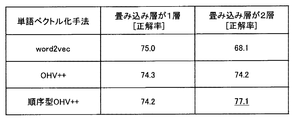
- FIG. 9 is a chart showing experimental results of the language processing method according to the present embodiment.
- Fig. 9 a confirmation experiment was conducted in the document classification task.
- data-web-snippets which is open data, was used.
- the task of classifying documents into 8 classes by CNN was performed.
- OHV ++ indicates a vectorization method by the vectorization apparatus 2 of the present embodiment.
- OHV ++ indicates a vectorization method when no periodicity is provided in the same vectorization method as in this embodiment.
- a CNN having two convolution layers is an example of the CNN 10 shown in FIG. 6 in the present embodiment.
- the size of the filter in the X direction was set to “40” for the first layer and “8” for the second layer.
- the size of the filter in the X direction is set to “320”, which is the same as the number of dimensions of the word vector.
- FIG. 10 is a flowchart illustrating the calculation process of the word vector V1 in the present embodiment.
- FIG. 11 is a diagram for explaining the calculation processing of the word vector V1.
- the arithmetic processing unit 20 of the vectorization apparatus 2 executes each process of the flowchart shown in FIG. This flowchart is started, for example, in a state before the word vector dictionary D2 is created.
- the arithmetic processing unit 20 determines an N class vocabulary list (S20).
- the vocabulary list is a list that defines vocabulary elements for calculating the word vector V1.
- FIG. 11A shows an example of the vocabulary list V2.
- the arithmetic processing unit 20 inputs a word to be vectorized via any of various acquisition units (device interface 22, network interface 23, operation unit 24) (S21).
- the arithmetic processing unit 20 calculates the score of the input word for each vocabulary element V20 in the vocabulary list V2 using, for example, a predetermined arithmetic expression (S22).
- the score calculation formula is stored in advance in the storage unit 21, and for example, the similarity between two words is calculated.
- PMI self-mutual information amount
- co-occurrence probability may be used, or matrix decomposition may be used.
- the arithmetic processing unit 20 arranges the calculated scores in accordance with the arrangement order of the vocabulary elements V20 in the vocabulary list V2, that is, outputs the arrangement of the scores of the period N as a word vector (S23).
- FIG. 11B shows an example of the output word vector V1.
- FIG. 11B illustrates the word vector V1 when the word “Paris” is input in step S21.
- the arithmetic processing unit 20 calculates a score for each vocabulary element V20 in the vocabulary list V2 in FIG. 11A (S22), and generates and outputs a word vector V1 (S23).
- the arithmetic processing unit 20 ends the flowchart shown in FIG. 10 by outputting the word vector V1.
- the word vector V1 is calculated based on the vocabulary list V2 and the like, and the order having the period N between the vector elements V10 can be set.
- the vocabulary list V2, the arithmetic expression of the score, and the like are examples of vectorization information in the present embodiment.
- the word vector dictionary D2 can be created by repeatedly executing the process of FIG. 10 for a plurality of words.
- a value is set for each vocabulary element V20 of the word vector V1 according to the similarity to the vocabulary element V20 in the vocabulary list V2.
- the value “1” is set in the vector element V10 of “Paris” which is the same as the word to which the vocabulary element V20 is input, as in the so-called one-hot vector.
- Non-zero values are set for the other vector elements V10.
- step S22 another word vectorization method may be used to generate a vector in an intermediate state different from the word vector V1 output in step S23.
- the arithmetic processing unit 20 can generate a vector corresponding to the word in the vocabulary list V2 and a vector corresponding to the input word in word2vec, and calculate the inner product of the generated vectors as a score. .
- the vocabulary element V20 constituting the vocabulary list V2 is a word.
- the vocabulary element V20 is not limited to a word and may be various elements, for example, a document.
- the arithmetic processing unit 20 may calculate the score of the corresponding vector element by counting the word of interest in the document as the vocabulary element.
- FIG. 12 is a flowchart illustrating the process (S20) for determining the vocabulary list V2.
- the arithmetic processing unit 20 transmits a word group or a document group including candidates for the vocabulary element V20 in the vocabulary list V2 via any of various acquisition units (device interface 22, network interface 23, operation unit 24).
- Information is acquired (S30).
- the information acquired in step S30 may be predetermined training data, for example.
- the arithmetic processing unit 20 classifies elements such as words indicated by the acquired information into the same number of classes as the cycle N (S31).
- various classification methods such as the K-means method or LDA (latent Dirichlet distribution method) can be used.
- the class of the vocabulary V0 for example, the same class as the document classification by the CNN 10 may be used, or a class different from the document classification may be used.
- the arithmetic processing unit 20 selects one of the N classes in order from the first class (S32).
- the arithmetic processing unit 20 extracts one element such as a word in the selected class as a vocabulary element V20 (S33).
- the arithmetic processing unit 20 records the extracted vocabulary element V20 in the vocabulary list V2 (S34).
- the arithmetic processing unit 20 repeats the processes of steps S32 to S35 until the number of vocabulary elements V20 in the vocabulary list V2 reaches a predetermined number (NO in S35).
- the predetermined number indicates the number of dimensions of the desired word vector.
- the arithmetic processing unit 20 selects from the first class to the Nth class in order, and selects the first class next to the Nth class.
- the arithmetic processing unit 20 records the vocabulary elements V20 extracted every step S33 in order in the vocabulary list V2 in step S34.
- the arithmetic processing unit 20 stores, for example, the vocabulary list V2 in the storage unit 21a (S36). Thereby, the arithmetic processing part 20 complete
- vocabulary list V2 having period N can be generated by classifying vocabulary element V20 candidates into N classes and extracting vocabulary element V20 in order from each class.
- iDF inverse document frequency
- the arithmetic processing unit 20 calculates a difference between the iDF in the information acquired in step S30 and the iDF in the class selected in step S32 for each word.
- the arithmetic processing unit 20 sequentially extracts the words having the large differences in each class (S33). As a result, a representative word that appears to be characteristic in each class can be extracted as the vocabulary element V20.
- the vectorization device 2 generates the word vector V1 that is a vector corresponding to the character string for each word.
- the vectorization apparatus 2 includes an acquisition unit (device interface 22, network interface 23, operation unit 24), a storage unit 21, and an arithmetic processing unit 20.
- the acquisition unit acquires a character string such as a word (S1).
- the storage unit 21 stores a word vector dictionary D2 and the like as an example of vectorized information indicating a relationship between a character string and a vector.
- the arithmetic processing unit 20 generates a word vector V1 corresponding to the acquired word based on the vectorization information (S3).
- the vectorization information sets an order having a predetermined period N between a plurality of vector elements V10 included in each word vector V1.
- each word vector V1 an internal periodicity, for example, it is possible to give the significance of reducing the attention area R1 of the CNN 10 and to facilitate language processing by the CNN 10.
- vectorization information such as the word vector dictionary D2 is defined by a plurality of vocabulary elements V20 corresponding to a plurality of vector elements V10 in the word vector V1.
- the vocabulary element V20 is classified into the number of classes corresponding to the period N.
- the vectorization information sets the above order so that each class of vocabulary element V20 is repeated every period N. This makes it possible to form the attention area R1 having similar properties repeatedly every period N, and to make it easy to handle the word vector V1 in the CNN 10 or the like.
- each vector element V10 of the word vector V1 corresponding to the word indicates a score for each vocabulary element V20 related to the word. Sparsity can be avoided by setting a non-zero value to a large number of vector elements V10 according to the score for each vocabulary element V20.
- the classes c1 to c3 of the vocabulary V0 indicate the classification of the vocabulary element V20 based on the linguistic meaning. Thereby, it is possible to give meaning to the cycle N of the word vector V1 from the viewpoint of linguistic meaning.
- the arithmetic processing unit 20 executes language processing by the CNN 10 based on the generated word vector V1 (S4).
- the CNN 10 has a filter 11f corresponding to the period N and a stride width W1. Thereby, the language processing by the CNN 10 can be accurately performed in accordance with the cycle N of the word vector V.
- the CNN 10 includes a filter 11f having a size that is an integral multiple of the period N, a first convolution layer 11 that performs a convolution based on a stride width W1 that is an integral multiple of the period N, and a first convolution. And a second convolution layer 12 that convolves the operation result in the layer 11.
- the language processing CNN 10 can perform the language processing with high accuracy using the plurality of convolution layers 11 and 12.
- the CNN 10 may include additional convolution layers and the like.
- the language processing method in the present embodiment is a method in which a computer such as the vectorization apparatus 2 performs language processing based on a character string.
- the computer acquires a character string (S1), and the computer processing unit 20 calculates a vector corresponding to the acquired character string based on the vectorization information indicating the relationship between the character string and the vector.
- Generating step (S3) The method includes a step (S4) in which the arithmetic processing unit 20 executes language processing by the CNN 10 based on the generated vector.
- the arithmetic processing unit 20 sets an order having a predetermined period N among a plurality of vector elements included in each vector based on the vectorization information, and inputs the generated vector to the CNN 10 (S11).
- a program for causing a computer to execute the language processing method is provided.
- the above program may be provided by being stored in various non-transitory computer-readable recording media. By causing the computer to execute the program, language processing can be facilitated.
- the word vector V1 has periodicity based on the vocabulary V0.
- a modification example in which a word vector has a periodicity without using the vocabulary V0 will be described with reference to FIGS.
- FIG. 13 is a flowchart for explaining a modification of the calculation processing of the word vector V3.
- FIG. 14 is a diagram for explaining a modification of the calculation process of the word vector V3.
- the arithmetic processing unit 20 generates a plurality of N-dimensional vectors independent of each other based on the input word (S42).
- the process of step S42 can be performed using various word vectorization techniques such as Word2Vec and GloVe.
- the process of step S42 may be performed so that a plurality of learners are learned independently in advance, and each learner generates an N-dimensional vector corresponding to the word input in step S41.
- the arithmetic processing unit 20 concatenates the calculated N-dimensional vectors 31 to 33 to calculate one word vector V3 (S43). Also by the above processing, the period N corresponding to each N-dimensional vector can be set in the calculated word vector V3.
- a word vector dictionary based on the word vectors calculated as described above may be used.
- the example has been described in which the vectorization device 2 vectorizes a word into a word vector, but the vectorization target is not limited to a word.
- the character string that is vectorized by the vectorization apparatus of the present embodiment may include at least one of a character, a word, a phrase, a sentence, and a document.
- vectorization may be performed using a predetermined plurality of characters as processing units.
- vectorization of various character strings by setting the period N in the same manner as described above, it is possible to facilitate language processing based on vectors corresponding to character strings.
- the CNN 10 is used for language processing by a vector generated according to a character string.
- the CNN is not necessarily used.
- Data obtained by vectorizing a character string with a period N may be used for language processing different from CNN.
- document classification has been described as an example of language processing.
- the language processing method of this embodiment is not limited to document classification, and may be applied to various language processing, for example, machine translation.
- This disclosure is applicable to various natural language processing such as various document classifications and machine translation.
Landscapes
- Engineering & Computer Science (AREA)
- Theoretical Computer Science (AREA)
- Physics & Mathematics (AREA)
- General Health & Medical Sciences (AREA)
- Health & Medical Sciences (AREA)
- Artificial Intelligence (AREA)
- Computational Linguistics (AREA)
- General Physics & Mathematics (AREA)
- General Engineering & Computer Science (AREA)
- Audiology, Speech & Language Pathology (AREA)
- Biomedical Technology (AREA)
- Molecular Biology (AREA)
- Computing Systems (AREA)
- Evolutionary Computation (AREA)
- Data Mining & Analysis (AREA)
- Mathematical Physics (AREA)
- Software Systems (AREA)
- Biophysics (AREA)
- Life Sciences & Earth Sciences (AREA)
- Information Retrieval, Db Structures And Fs Structures Therefor (AREA)
- Machine Translation (AREA)
Abstract
L'invention concerne un dispositif de vectorisation (2) qui génère des vecteurs selon une chaîne de caractères Le dispositif de vectorisation comporte des unités d'acquisition 22 ~ 24, une unité de stockage (21) et une unité de traitement de calcul (20). L'unité d'acquisition acquiert une chaîne de caractères. L'unité de stockage stocke des informations de vectorisation (D2) qui indiquent une relation entre la chaîne de caractères et les vecteurs. L'unité de traitement de calcul génère, sur la base des informations de vectorisation, un vecteur (V1) qui correspond à la chaîne de caractères acquise Les informations de vectorisation définissent un ordre ayant une période prescrite (N) entre une pluralité d'éléments de vecteur inclus dans chacun des vecteurs.
Priority Applications (2)
| Application Number | Priority Date | Filing Date | Title |
|---|---|---|---|
| JP2020510371A JPWO2019187696A1 (ja) | 2018-03-27 | 2019-02-08 | ベクトル化装置、言語処理方法及びプログラム |
| US17/028,743 US20210004534A1 (en) | 2018-03-27 | 2020-09-22 | Vectorization device and language processing method |
Applications Claiming Priority (2)
| Application Number | Priority Date | Filing Date | Title |
|---|---|---|---|
| JP2018060518 | 2018-03-27 | ||
| JP2018-060518 | 2018-03-27 |
Related Child Applications (1)
| Application Number | Title | Priority Date | Filing Date |
|---|---|---|---|
| US17/028,743 Continuation US20210004534A1 (en) | 2018-03-27 | 2020-09-22 | Vectorization device and language processing method |
Publications (1)
| Publication Number | Publication Date |
|---|---|
| WO2019187696A1 true WO2019187696A1 (fr) | 2019-10-03 |
Family
ID=68058741
Family Applications (1)
| Application Number | Title | Priority Date | Filing Date |
|---|---|---|---|
| PCT/JP2019/004603 Ceased WO2019187696A1 (fr) | 2018-03-27 | 2019-02-08 | Dispositif de vectorisation, procédé de traitement de langue et programme |
Country Status (3)
| Country | Link |
|---|---|
| US (1) | US20210004534A1 (fr) |
| JP (1) | JPWO2019187696A1 (fr) |
| WO (1) | WO2019187696A1 (fr) |
Families Citing this family (5)
| Publication number | Priority date | Publication date | Assignee | Title |
|---|---|---|---|---|
| US12211276B2 (en) * | 2020-11-16 | 2025-01-28 | Qualcomm Technologies, Inc. | Lingually constrained tracking of visual objects |
| CN113627722B (zh) * | 2021-07-02 | 2024-04-02 | 湖北美和易思教育科技有限公司 | 基于关键字分词的简答题评分方法、终端及可读存储介质 |
| US11755626B1 (en) * | 2021-07-30 | 2023-09-12 | Splunk Inc. | Systems and methods for classifying data objects |
| US12547829B2 (en) * | 2022-01-21 | 2026-02-10 | Disney Enterprises, Inc. | Extended vocabulary including similarity-weighted vector representations |
| US12361924B2 (en) * | 2022-12-28 | 2025-07-15 | Ringcentral, Inc. | Systems and methods for audio transcription switching based on real-time identification of languages in an audio stream |
-
2019
- 2019-02-08 WO PCT/JP2019/004603 patent/WO2019187696A1/fr not_active Ceased
- 2019-02-08 JP JP2020510371A patent/JPWO2019187696A1/ja active Pending
-
2020
- 2020-09-22 US US17/028,743 patent/US20210004534A1/en not_active Abandoned
Non-Patent Citations (3)
| Title |
|---|
| 11 March 2016 (2016-03-11), Retrieved from the Internet <URL:http://tkengolgithub.io/blog/2016/03/11/understanding-convolutional-neural-networks-for-nlp> [retrieved on 20190416] * |
| HOTTA , HAJIME ET AL.: "Word Vectorization Using Relations among Words for Neural Network", 1 January 2010 (2010-01-01), pages 75 - 82 * |
| OKAZAKI, NAOAKI: "Frontiers in Distributed Representations for Natural Language Processing", JOURNAL OF THE JAPANESE SOCIETY FOR ARTIFICIAL INTELLIGENCE, 1 March 2016 (2016-03-01), pages 189 - 201, XP009511145 * |
Also Published As
| Publication number | Publication date |
|---|---|
| JPWO2019187696A1 (ja) | 2021-03-18 |
| US20210004534A1 (en) | 2021-01-07 |
Similar Documents
| Publication | Publication Date | Title |
|---|---|---|
| US12169698B2 (en) | Systems and methods for reading comprehension for a question answering task | |
| Wilf et al. | Computer vision cracks the leaf code | |
| US10997503B2 (en) | Computationally efficient neural network architecture search | |
| JP6910012B2 (ja) | 文章評価装置、及び文章評価方法 | |
| WO2019187696A1 (fr) | Dispositif de vectorisation, procédé de traitement de langue et programme | |
| CN109844773B (zh) | 使用卷积神经网络处理序列 | |
| Donoho | 50 years of data science | |
| CN105701120B (zh) | 确定语义匹配度的方法和装置 | |
| CN108334499A (zh) | 一种文本标签标注设备、方法和计算设备 | |
| JP7596549B2 (ja) | 自己注意動作および相互注意動作を使用して潜在的埋め込みを豊かにすることによってニューラルネットワーク出力を生成すること | |
| Kim et al. | Graphical causal inference and copula regression model for apple keywords by text mining | |
| JP6954004B2 (ja) | 畳み込みニューラルネットワークモデルの決定装置及び決定方法 | |
| Bao et al. | Robust image analysis with sparse representation on quantized visual features | |
| CN113722512A (zh) | 基于语言模型的文本检索方法、装置、设备及存储介质 | |
| Zhang et al. | Advancing 3D medical image analysis with variable dimension transform based supervised 3D pre-training | |
| CN116884072B (zh) | 一种基于多层级和多尺度注意机制的面部表情识别方法 | |
| CN109740158A (zh) | 一种文本语义解析方法及装置 | |
| WO2021176714A1 (fr) | Dispositif d'apprentissage, dispositif de traitement d'informations, procédé d'apprentissage, procédé de traitement d'informations et programme | |
| CN110297897A (zh) | 问答处理方法及相关产品 | |
| CN111488460A (zh) | 数据处理方法、装置和计算机可读存储介质 | |
| CN111858947A (zh) | 自动知识图谱嵌入方法和系统 | |
| Dhand et al. | Creating realities: an in-depth study of AI-driven image generation with generative adversarial networks | |
| CN111859947B (zh) | 一种文本处理装置、方法、电子设备及存储介质 | |
| CN113010687A (zh) | 一种习题标签预测方法、装置、存储介质以及计算机设备 | |
| CN114647717A (zh) | 一种智能问答方法及装置 |
Legal Events
| Date | Code | Title | Description |
|---|---|---|---|
| 121 | Ep: the epo has been informed by wipo that ep was designated in this application |
Ref document number: 19778246 Country of ref document: EP Kind code of ref document: A1 |
|
| ENP | Entry into the national phase |
Ref document number: 2020510371 Country of ref document: JP Kind code of ref document: A |
|
| NENP | Non-entry into the national phase |
Ref country code: DE |
|
| 122 | Ep: pct application non-entry in european phase |
Ref document number: 19778246 Country of ref document: EP Kind code of ref document: A1 |