WO2019188773A1 - 植物用抵抗性誘導剤 - Google Patents
植物用抵抗性誘導剤 Download PDFInfo
- Publication number
- WO2019188773A1 WO2019188773A1 PCT/JP2019/012056 JP2019012056W WO2019188773A1 WO 2019188773 A1 WO2019188773 A1 WO 2019188773A1 JP 2019012056 W JP2019012056 W JP 2019012056W WO 2019188773 A1 WO2019188773 A1 WO 2019188773A1
- Authority
- WO
- WIPO (PCT)
- Prior art keywords
- algae
- culture
- mass
- nbrc
- polysaccharide
- Prior art date
- Legal status (The legal status is an assumption and is not a legal conclusion. Google has not performed a legal analysis and makes no representation as to the accuracy of the status listed.)
- Ceased
Links
Images
Classifications
-
- A—HUMAN NECESSITIES
- A01—AGRICULTURE; FORESTRY; ANIMAL HUSBANDRY; HUNTING; TRAPPING; FISHING
- A01N—PRESERVATION OF BODIES OF HUMANS OR ANIMALS OR PLANTS OR PARTS THEREOF; BIOCIDES, e.g. AS DISINFECTANTS, AS PESTICIDES OR AS HERBICIDES; PEST REPELLANTS OR ATTRACTANTS; PLANT GROWTH REGULATORS
- A01N65/00—Biocides, pest repellants or attractants, or plant growth regulators containing material from algae, lichens, bryophyta, multi-cellular fungi or plants, or extracts thereof
- A01N65/03—Algae
-
- C—CHEMISTRY; METALLURGY
- C12—BIOCHEMISTRY; BEER; SPIRITS; WINE; VINEGAR; MICROBIOLOGY; ENZYMOLOGY; MUTATION OR GENETIC ENGINEERING
- C12N—MICROORGANISMS OR ENZYMES; COMPOSITIONS THEREOF; PROPAGATING, PRESERVING, OR MAINTAINING MICROORGANISMS; MUTATION OR GENETIC ENGINEERING; CULTURE MEDIA
- C12N1/00—Microorganisms; Compositions thereof; Processes of propagating, maintaining or preserving microorganisms or compositions thereof; Processes of preparing or isolating a composition containing a microorganism; Culture media therefor
- C12N1/12—Unicellular algae; Culture media therefor
-
- C—CHEMISTRY; METALLURGY
- C12—BIOCHEMISTRY; BEER; SPIRITS; WINE; VINEGAR; MICROBIOLOGY; ENZYMOLOGY; MUTATION OR GENETIC ENGINEERING
- C12N—MICROORGANISMS OR ENZYMES; COMPOSITIONS THEREOF; PROPAGATING, PRESERVING, OR MAINTAINING MICROORGANISMS; MUTATION OR GENETIC ENGINEERING; CULTURE MEDIA
- C12N1/00—Microorganisms; Compositions thereof; Processes of propagating, maintaining or preserving microorganisms or compositions thereof; Processes of preparing or isolating a composition containing a microorganism; Culture media therefor
- C12N1/12—Unicellular algae; Culture media therefor
- C12N1/125—Unicellular algae isolates
-
- C—CHEMISTRY; METALLURGY
- C12—BIOCHEMISTRY; BEER; SPIRITS; WINE; VINEGAR; MICROBIOLOGY; ENZYMOLOGY; MUTATION OR GENETIC ENGINEERING
- C12R—INDEXING SCHEME ASSOCIATED WITH SUBCLASSES C12C - C12Q, RELATING TO MICROORGANISMS
- C12R2001/00—Microorganisms ; Processes using microorganisms
- C12R2001/89—Algae ; Processes using algae
Definitions
- This technique relates to a PR1 gene expression inducing activator, a plant resistance inducing agent, and a plant disease preventing agent.
- Salicylic acid, probenazole, validamycin A and the like are known as plant resistance-inducing compounds, and these compounds have already been put into practical use and are distributed in the market as plant resistance-inducing agents.
- a plant using this plant resistance inducer senses an attack of a plant-acquired resistance pathogen, it increases the salicylic acid concentration in the plant, and then expresses a PR gene group through NPR1, which is a transcriptional regulator. It is generally said that resistance to pathogens increases. That is, the plant resistance inducer switches on the PR gene group of the plant body to acquire resistance to the pathogen throughout the plant body.
- Patent Document 1 has found that a heterocyclic compound having a halogen and an oxo group has a PR-1 ⁇ gene expression enhancing action, and this expression enhancing action enables expression of a PR protein having a broad antibacterial spectrum. Can be induced or promoted and can be induced for plant resistance.
- the main object of the present technology is to provide a component having a resistance-inducing action for plants.
- the present inventors have found a compound having a PR1 gene expression inducing activity involved in plant resistance induction using the PR-1 ⁇ gene expression inducing activity test.
- this is a culture of unicellular algae having a green photosynthetic pigment, that the culture contains an extracellular polysaccharide, and that the culture is a PR-1 ⁇ gene. It has been found that it has an expression-inducing activity action and a plant resistance-inducing action, and the present invention has been completed.
- the present invention is as follows.
- a PR1 gene expression inducing agent comprising, as an active ingredient, a culture of unicellular algae having a green photosynthetic pigment.
- the extracellular polysaccharide in the culture contains at least 5 to 40% by mass of uronic acid and a neutral monosaccharide, and the neutral monosaccharide is selected from mannose, galactose, and rhamnose.
- the PR1 gene activator according to any one of (1) to (4), wherein the PR1 gene activator is one or more species.
- the algal body is [1] Chlorophyceae Uronema sp. (NBRC 113204) algae strain; [2] Trebouxiophyceae Geminella sp. (NBRC 113205) algae strain; [3] Chlorophyceae Chlorococcum sp.
- NBRC 113206 algae strain
- a plant resistance inducer comprising, as an active ingredient, a culture of unicellular algae having a green photosynthetic pigment.
- a plant disease prevention / amelioration agent comprising, as an active ingredient, a culture of unicellular algae having a green photosynthetic pigment.
- a method for producing a resistance-inducing component for plants comprising culturing unicellular algae having a green photosynthetic pigment under aerobic conditions to obtain a culture containing an extracellular polysaccharide. (10) Use of unicellular algae having a green photosynthetic pigment to produce a resistance-inducing component for plants.
- a component having a plant resistance-inducing action can be provided.
- the effects described here are not necessarily limited, and may be any of the effects described in the present specification.
- the present invention relates to a PR1 gene expression inducing active agent, a plant resistance inducing agent, or a plant disease preventing agent, comprising as an active ingredient a culture of unicellular algae having a green photosynthetic pigment. is there.
- the culture of the present technology has a PR1 gene expression inducing activity, a plant resistance inducing activity, or a plant disease preventing effect.
- the culture preferably contains an extracellularly produced polysaccharide.
- a culture of unicellular algae having a green photosynthetic pigment of the present technology (hereinafter also referred to as “green unicellular algae”) can be produced using the green algae as follows, but is limited to this production method. Will never be done.
- algae having a green photosynthetic pigment has a broad meaning of an algae having a green appearance, and includes chlorophyll a and b as photosynthesis pigments, but has other chlorophylls and pigments. It may be.
- the unicellular algae are not limited to a single cell state, and may be in a state of a group organism during culture.
- the green unicellular algae used in the present technology are not particularly limited, and examples thereof include Chlorophyceae (Green Algae) algae and / or Trebouxiophyceae (Trevoxia algae) algae.
- the green unicellular algae used by this technique are not specifically limited, For example, it is 1 type (s) or 2 or more types selected from Euglena, Chlorella, Uronema, Chlorococcum, Geminella, and Chlorodium. Of these, one or more selected from Geminera, Uronema, Chlorococcum and Chlorodium are preferred.
- these various algae strains are stored as culture collections (for example, NBRC (NITE Biological Resource Center) Culture Collection, ATCC (American Type Culture Collection), etc.) at microorganism preservation organizations, and are included in commercially available products.
- the purpose of this technology is the algae strains that have been preserved as trust stocks at international depository institutions (for example, NITE (National Institute of Technology and Evaluation), etc.) under the Budapest Treaty.
- Algae strains that produce a culture exhibiting the PR1 gene activation action which is the effect of
- algae strains can be obtained from the culture collection of NBRC (NITE Biological Resource Center), and one or more of them can be used.
- NBRC NITE Biological Resource Center
- Trebouxiophyceae Geminella sp. (NBRC 113205) Algae strain is NBRC 113205 Geminella sp.
- NBRC NITE Biological Resource Center
- Chlorophyceae algae examples include Chlorophyceae Uronema algae, Chlorophyceae Chlorococcum algae, and the like.
- Examples of the Trebouxiophyceae algae include Trebouxiophyceae Geminella algae, Trebouxiophyceae Chloroidium algae, and the like.
- Chloroidium algae are preferable from the viewpoint that the effect of the present technology can be satisfactorily exhibited.
- chloroidium Trebouxiophyceae Chloroidium saccharophilum (NBRC 113207) is preferable.
- Euglena algae are preferable from the viewpoint that the effect of the present technology can be satisfactorily exhibited.
- the Euglena is preferably Euglena gracilis, for example.
- chlorella a chlorella algae is preferable from the viewpoint that the effect of the present technology can be satisfactorily exhibited.
- Examples of chlorella include Chlorella vulgaris and the like, and Chlorella vulgaris Chikugo strain (Chikugo strain: Chlorella Kogyo) is preferred.
- Uronema algae are preferable from the viewpoint that the effect of the present technology can be satisfactorily exhibited.
- uronema Chlorophyceae Uronema sp. (NBRC 113204) and the like are preferable.
- chlorococcum algae are preferable from the viewpoint that the effect of the present technology can be satisfactorily exhibited.
- chlorocockham Chlorophyceae Chlorococcum sp. (NBRC 113206) and the like are preferable.
- Geminella algae are preferable from the viewpoint that the effect of the present technology can be satisfactorily exhibited.
- Geminera Trebouxiophyceae Geminella sp. (NBRC 113205) is preferable.
- Chloroidium algae are preferable from the viewpoint that the effect of the present technology can be satisfactorily exhibited.
- Chlorodium Trebouxiophyceae Chloroidium saccharophilum YAMA (NBRC 113207) (YAMA-Mizu-03-3) (hereinafter also referred to as YAMA) and / or Trebouxiophyceae Chloroidium saccharophilum KAMI (NBRCchar113807) (KAMI-04- (3))
- YAMA Trebouxiophyceae Chloroidium saccharophilum KAMI
- KAMI KAMI
- any algae strain that is substantially the same quality as the algae strain described above may be used.
- the substantially homogeneous algal strain is a base sequence of the 18S rRNA gene (eg, SEQ ID NOs: 1 to 5) of 99.5% or more (preferably 99.8% or more, more preferably 100%). Consistent and preferably have the same algaeological properties (morphological observation and extracellular polysaccharide production) as the algal strains described above.
- the algal strain of the present technology may be mutated, gene-set from the above-described algal strain or substantially the same algal strain.
- an algae strain bred by selection of a natural mutant strain or the like may be used.
- a basal medium capable of culturing general unicellular algae is suitable.
- trace inorganic components such as KH 2 PO 4 and MgSO 4 are included as inorganic salts, and ammonium sulfate, urea and the like are included as nitrogen sources.
- the content of each component in the basal medium is preferably in the range of ⁇ 10%. More specifically, examples of the basal medium include an AF6 medium, a BG11 medium, and a KO2 medium as shown in [Examples] below.
- chlorella chlorococcum, geminella, chloroidinium, Euglena and the like are preferable.
- BG11 medium Uronema, Chlorodium, etc. are preferred.
- a KO2 medium Euglena or the like is preferable.
- a culture containing the polysaccharide can be stably produced.
- Aeration culture is preferable from the viewpoint of improving the productivity of polysaccharides.
- the aeration means include stirring, shaking, aeration, and bubbling. These can be performed alone or in combination of two or more. Thereby, an appropriate gas comes to be mixed in the culture medium.
- the culture temperature is not particularly limited, but may be about normal temperature of 5 to 40 ° C.
- the pH (20 ° C.) in the culture medium is preferably ⁇ 2 of the pH of the medium composition to be used, more preferably pH ⁇ 1.
- the pH in the culture medium is preferably 1.5 to 9.5.
- the pH in the culture medium is more preferably 6 to 9 in the case of Uronema, Chlorococcum, Geminella, Chlorodium and Chlorella.
- the culture period is not particularly limited, but a cycle of about 4 days to 3 weeks is suitable for producing a polysaccharide. More preferably, it may be about 7 days to 2 weeks.
- the illuminance of the culture is not particularly limited, but 1500 to 10,000 lux is preferable from the viewpoint of easily obtaining a culture containing a polysaccharide.
- sunlight when increasing the number of algal bodies under autotrophic culture conditions, it is possible to use sunlight; light from artificial light sources such as lamps for plant cultivation and LEDs, and supply and agitate carbon dioxide. Is preferred.
- the present technology is not limited to a method for producing a culture by autotrophic culture, and a culture containing a polysaccharide is prepared by adding a carbon source such as glucose to a basic medium in which general unicellular algae can be cultured. It may be produced.
- the culture medium should just contain the carbon source, the nitrogen source, and phosphorus, and the digestive liquid (liquid fertilizer) produced in a sewage or a methane fermenter may be used as a culture medium used for this technique.
- the culture production method of the present technology may be either a batch type or a continuous type, but the continuous type is preferable for improving productivity.
- any of open system culture and closed system culture may be sufficient, for example, closed culture in a culture tank, open system open culture, etc. are mentioned. Closed culture is preferable from the viewpoint of culture condition management.
- the culture containing polysaccharides is separated from the alga body by physical means and chemical means such as aqueous solution washing, ultrasonic wave, centrifugation, and filtration, It is preferable to obtain a supernatant containing the polysaccharide.
- various algal metabolites for example, proteins, Various peptides, amino acids, nucleic acids, organic acids, lipids, etc. may be included.
- the culture of the present technology since a metabolite outside the alga can be used as the culture of the present technology, it is possible to continuously obtain a culture while separating polysaccharides from the surface of the alga after culturing. From the viewpoint of culturing, the algae of the present technology are excellent.
- a method for continuously obtaining a culture for example, centrifugation (preferably 5000 to 9000 rpm for about 5 minutes) and filtration (for example, a filter aid and a filter) can be used alone or in combination.
- the obtained culture may be appropriately adjusted to a diluted solution, concentrated solution, dried product or the like.
- freeze-drying is preferable.
- the culture of the present technology preferably includes at least a polysaccharide, and a substance other than a carbohydrate (eg, protein, peptide, amino acid, nucleic acid, organic acid, lipid, etc.) is included in the polysaccharide.
- a substance other than a carbohydrate eg, protein, peptide, amino acid, nucleic acid, organic acid, lipid, etc.
- the polysaccharide may be bound within the range not impairing the effect of the above, and examples of such polysaccharide include glycoprotein, peptidoglycan, glycolipid and the like.
- the yield of the polysaccharide of the present technology can be obtained in a culture solution of 20 mg / L or more, more preferably 50 mg / L or more, and further preferably 100 mg / L or more. This technique can increase the yield from 300 to 500 mg / L.
- chlorococcum and chloroidinium are suitable.
- chlorococcum and uronema are suitable as algae that produce highly effective polysaccharides.
- the polysaccharide is contained in an algal culture in an amount of 20% by mass or more, more preferably 20% by mass or more in terms of dry matter.
- the polysaccharide in the algal culture preferably contains uronic acid in an amount of preferably 5% by mass or more, more preferably 10% by mass or more, and preferably has an upper limit of 40% by mass or less.
- it is contained in an amount of 35% by mass or less, more preferably 30% by mass or less, and even more preferably 25% by mass or less, and more preferably 5-30% by mass as the numerical range.
- the polysaccharide is more preferable because the extracellular polysaccharide can be expected to have high production efficiency such as easy recovery and high yield.
- the polysaccharide produced by the green unicellular algae of the present technology is not particularly limited, but it is desirable that at least uronic acid is included as a constituent monosaccharide of the polysaccharide of the present technology,
- the uronic acid is preferably glucuronic acid, but is not limited thereto. Thereby, the effect of this technique, such as PR1 gene activation mentioned later, can be expected.
- hexasaccharide preferably aldohexose
- the neutral monosaccharide it is desirable that at least one of mannose, galactose, and rhamnose is at least a main constituent monosaccharide from the viewpoint of the effectiveness of the present technology. Furthermore, it is desirable from the viewpoint of the efficacy of the present technology that at least mannose or rhamnose is included in the neutral monosaccharide.
- the extracellular polysaccharide in the culture of the present technology preferably contains at least uronic acid, and further, uronic acid and neutral monosaccharide are used as the constituent monosaccharides of the polysaccharide of the present technology to the polysaccharide of the present technology. More preferably included. Thereby, the effect of this technique, such as PR1 gene activation mentioned later, can be expected.
- the neutral monosaccharide at this time is more preferably one or more selected from mannose, galactose and rhamnose.
- the polysaccharides contained in the culture produced by the algae as one or more selected from Uronema, Chlorococcum, Geminella and Chlorodium described above have good efficacy of the present technology. ,preferable.
- the yield of the polysaccharide produced by uronema is preferably 20 mg / L or more in the culture solution.
- the extracellular polysaccharide (hereinafter also referred to as “uronema polysaccharide”) in the uronema product preferably contains uronic acid, and the lower limit thereof is preferably 5% by mass or more, more preferably 10%.
- the upper limit thereof is preferably 35% by mass or less, more preferably 30% by mass or less, and the numerical range is more preferably 10 to 30% by mass, more preferably 15% by mass or more. % By mass.
- glucuronic acid is contained in the uronema polysaccharide, and the lower limit is preferably 5% by mass or more, more preferably 10% by mass or more, and the upper limit is preferably 30% by mass or less. More preferably, it is 20% by mass or less, and the numerical range is more preferably 5 to 15% by mass, and further preferably 10 to 15% by mass.
- the polysaccharide in the uronema product preferably contains 20% by mass or more as a neutral monosaccharide and preferably 70% by mass or less as other components. More preferably, in the culture of uronema, mannose 0 to 4% by mass, arabinose 0 to 1.5% by mass, galactose 0 to 1.5% by mass, xylose 0 to 2% by mass, glucose 0 to 6% by mass, Rhamnose is 5 to 20% by mass (more preferably 5 to 15% by mass), ribose is 0 to 1% by mass, fucose is 0 to 1% by mass, and uronic acid is 15 to 30% by mass. Any one or a combination of these may be used.
- the extracellular polysaccharide in the product of uronema preferably contains at least mannose and / or rhamnose among neutral sugars, and preferably contains rhamnose as a main component.
- the yield of the polysaccharide produced by chlorococcum is preferably 50 mg / L or more in the culture solution.
- the extracellular polysaccharide in the chlorococcam product (hereinafter also referred to as “chlorococcum polysaccharide”) preferably contains uronic acid, and the lower limit thereof is preferably 5% by mass or more, more preferably 10%.
- the upper limit thereof is preferably 25% by mass or less, more preferably 20% by mass or less, and the numerical range is more preferably 10 to 20% by mass.
- the chlorococcum polysaccharide contains glucuronic acid, and the lower limit is preferably 5% by mass or more, more preferably 10% by mass or more, and the upper limit is preferably 25% by mass or less. More preferably, it is 20% by mass or less, and the numerical range is more preferably 10 to 20% by mass.
- the polysaccharide in the chlorococcum product is preferably contained in an amount of 60% by mass (more preferably 70% by mass) or more as a neutral monosaccharide, and preferably 30% by mass or less as other components. . More preferably, 10-30% by mass of mannose (more preferably 14-25% by mass), 10-30% by mass of arabinose (more preferably 20-30% by mass), galactose 10 To 30% by mass (more preferably 17 to 30% by mass), xylose 0 to 5% by mass, glucose 0 to 1% by mass, rhamnose 0 to 2% by mass, ribose 0 to 1% by mass, fucose 0 to 1% by mass
- uronic acid is 10 to 20% by mass. Any one or a combination of these may be used.
- the extracellular polysaccharide in the chlorococcum product preferably contains mannose, arabinose, and galactose among neutral sugars, and preferably contains mannose, arabinose, and galactose as main components.
- the yield of the polysaccharide produced by Geminella is preferably 20 mg / L or more in the culture solution.
- the extracellular polysaccharide in the Geminera product (hereinafter also referred to as “Geminella polysaccharide”) preferably contains uronic acid, and its lower limit is preferably 5% by mass or more, and its upper limit is The content is preferably 20% by mass or less, and more preferably 5 to 15% by mass in the numerical range. More preferably, the geminella polysaccharide contains glucuronic acid, and the lower limit is preferably 5% by mass or more, and the upper limit is preferably 20% by mass or less, more preferably 15% by mass or less. In the numerical range, 5 to 15% by mass is more preferable.
- the polysaccharide in the Geminera product is preferably contained in an amount of 35% by mass (more preferably 40% by mass) or more as a neutral monosaccharide and preferably 60% by mass or less as the other components.
- mannose 0-30% by mass preferably 9-25% by mass
- arabinose 0-8% by mass preferably 9-25% by mass
- galactose 3-20% by mass preferably 9-25% by mass
- xylose 0-3% by mass glucose 0 to 1% by mass
- rhamnose 2 to 20% by mass ribose 0 to 1% by mass
- fucose 0 to 4% by mass uronic acid 5 to 15% by mass. Any one or a combination of these may be used.
- the extracellular polysaccharide in the Geminera product is preferably composed mainly of mannose, galactose and rhamnose among neutral sugars.
- the yield of the polysaccharide produced by Chlorodium is preferably 250 mg / L or more in the culture solution.
- the extracellular polysaccharide in the chloroidinium product (hereinafter, also referred to as “chloroidinium polysaccharide”) preferably contains uronic acid, and the lower limit thereof is preferably 5% by mass or more, more preferably. Is 10 mass% or more, and the upper limit thereof is preferably 30 mass% or less, more preferably 25 mass% or less, and the numerical range is more preferably 10 to 25 mass%.
- the chloroidinium polysaccharide contains glucuronic acid, and the lower limit is preferably 5% by mass or more, more preferably 10% by mass or more, and the upper limit is preferably 25% by mass or less. More preferably, it is 20% by mass or less, and the numerical range is more preferably 5 to 15% by mass, and further preferably 10 to 15% by mass.
- the chloroidinium-producing polysaccharide is preferably 30% by mass (more preferably 34% by mass) or more as a neutral monosaccharide, and preferably 70% by mass or less as other components. More preferably, in the culture of chloroidium, mannose 3 to 18% by mass, arabinose 3 to 12% by mass, galactose 0 to 20% by mass (more preferably 5 to 15% by mass), xylose 0 to 9% by mass %, Glucose 0-5 mass%, rhamnose 0-5 mass%, ribose 0-1 mass%, fucose 0-1 mass%, uronic acid 10-30 mass% (more preferably 15-25 mass%) It is. Any one or a combination of these may be used.
- the extracellular polysaccharide in the Chlorodium product is preferably composed mainly of mannose, arabinose, galactose, glucose and xylose among neutral sugars.
- the uronic acid in the chloroidium YAMA polysaccharide is preferably 10 to 20% by mass.
- the culture of the present technology appropriately removes inactive impurities by a known separation / purification technique such as liquid-liquid separation, solid-liquid separation, filtration membrane, activated carbon, adsorption resin, ion exchange resin, and the like. It may be purified. Polysaccharides may be further recovered from the culture of the present technology. As a method for recovering the polysaccharide, a known polysaccharide separation method may be used. When obtaining a water-soluble polysaccharide, for example, it is preferable to dissolve the culture in an aqueous solution, then remove the insoluble fraction and collect the water-soluble fraction. It is preferable to mix when dissolving in water.
- the water temperature during the treatment is preferably 5 to 40 ° C.
- the insoluble fraction is preferably removed by physical means such as centrifugation and ultrafiltration membrane. Thereby, since a polysaccharide with higher water solubility and higher purity can be obtained, it can be used for various applications.
- the culture of the present technology has a PR1 gene expression-inducing activity as shown in [Examples], and therefore induces or promotes expression of PR proteins (pathogenesis-related proteins) and the like. be able to.
- the PR protein is a generic name for proteins that themselves have antibacterial activity and proteins that can produce other antibacterial substances.
- PR proteins produced by plants have a very broad antibacterial spectrum, so that cultures of the present technology can be used for pathogenic microorganisms (eg, filamentous fungi (eg, Colletotrichum sp.), Bacteria (eg, Pseudomonas sp.), Etc. , Viruses) and the like.
- the culture of this technology induces plant resistance by artificially turning on the PR-1a gene, which is one of the stress tolerance genes.
- the culture of this technique can draw out the stress tolerance which a plant originally has.
- causes of the stress include illness (inflammation, infection, etc.), environment (coldness, drought, light, nutrients, salt concentration, drugs, etc.) and the like.
- the stress resistance includes, for example, (1) resistance to diseases such as promotion of hypersensitive cell death, promotion of antibacterial substances, improvement of cell wall effect, (2) control of stomatal opening and closing, root elongation Examples include durability against the environment such as promotion.
- PR-1a gene promoter expression In the induction of PR-1a gene promoter expression, when a secondary stimulus such as salicylic acid is added, a rapid and strong inducing activity may be observed. This is attributed to the fact that the salicylic acid (SA) signaling pathway that induces PR-1 ⁇ gene expression is induced by secondary stimulation. Since the culture of the present technology is expressed without secondary stimulation, it is considered that the defense response gene can be strongly induced in advance and the resistance of the plant can be enhanced. Since the resistance of the plant can be increased in this way, the culture of the present technology is considered to be usable for preventing diseases or the onset thereof such as preventing pathogen infection or onset.
- SA salicylic acid
- the culture of the present technology has a PR-1a gene expression inducing action
- the present technology can be used even when a plant is infected by appropriately adjusting the dosage (for example, addition time, added concentration, etc.). It is possible to create a ready state that can respond quickly, and that it can also be used for treatment after illness or onset.
- the culture of the present technology since the culture of the present technology has the PR1 gene expression inducing activity as described above, it can exhibit the plant resistance inducing activity and the plant disease preventing activity.
- the culture of the present technology can be used as an active ingredient such as a PR1 gene expression inducing activator, a plant resistance inducing agent, or a plant disease preventing agent containing the culture.
- the culture of this technique can be used in order to exhibit these effects mentioned above.
- the culture of this technique can be used as a component for using these preparations or compositions, and can also be used for manufacturing these preparations or compositions.
- the culture of this technique can also use arbitrary components together according to the objective,
- the component which enhances the effect of this technique is preferable as this arbitrary component.
- the enhancing component of the present technology include seaweed-derived extracts, microorganism-derived extracts, and the like, and those containing polysaccharides as the extract are suitable.
- the culture method, collection method, extraction method and the like for obtaining these are not particularly limited, and known methods can be used as appropriate.
- seaweeds brown algae (e.g., sea bream, kombu, hijiki, hibamata, honda walla, mozuku, trumpet, seaweed etc.), red algae (e.g. , Mill, etc.).
- microorganisms include fungi such as mushrooms, bacteria such as bacteria, and molds. One or more of these may be selected and used.
- laminarin is more preferable because it has a delayed action of PR1 gene expression inducing activity.
- laminarin has a slow-acting effect, so when used in combination with the green unicellular algae culture of this technology, it is possible to adjust the time of onset and sustainability of the efficacy, and to improve the efficacy of this technology. It can be made better.
- Laminarin is contained in brown algae such as kombu and is a straight-chain polysaccharide composed of a ⁇ 1-3 bond and a ⁇ 1-6 bond glucose main chain, and usually has a ratio of ⁇ 1-3 bond to ⁇ 1-6 bond. Is about 3: 1.
- laminarin is also called laminan, ⁇ -glucan, ⁇ 1,3-glucan, and a commercially available product of laminarin may be used.
- one or more selected from geminella extract, uronema extract, chlorococcum extract and chloroidium extract are combined with laminarin from the viewpoint of having a rapid effect as compared with laminarin. It is preferable to blend brown algae extract or laminarin containing
- the types of diseases and pathogens targeted by the culture of the present technology are not particularly limited.
- expression of PR-1 ⁇ gene which is an index for acquiring resistance in plants, was improved in Arabidopsis thaliana plants. Therefore, it is preferable that the prevention or improvement method of the plant disease concerning this technique is performed in order to prevent or improve the disease by the infection of a pathogenic filamentous fungus.
- pathogenic filamentous fungi examples include blue mold disease, red blight disease, groove rot, red coat disease caused by fungal fungus and rust fungus, red star disease, gray mold disease, red burning disease, yellow patch, yellowing disease, Dwarf disease, powdery mildew, purple mold disease, ringworm disease, ash spot disease, horn spot disease, brown rot caused by fungal fungi, brown round spot disease, brown round spot disease, brown spot disease, brown spot disease, perforation Filamentous fungi that cause brown spot disease, browning disease, brown coat disease, strain rot, etc.
- C. higginsianum Colletotrichum higginsianum
- Bacteria causing black rot, soft rot, spotted bacterial diseases and the like are preferred as bacterial diseases.
- the type of plant to be used in the present technology is not particularly limited, and may be a land plant or an aquatic plant.
- land plants angiosperms and gymnosperms are suitable, Asteraceae, Orchidaceae, Lilyaceae, Legumeaceae, Gramineae, Rubiaceae, Euphorbiaceae, Cyperaceae, Ceramaceae, Perillaceae, Cucurbitaceae, Eggplant Family And Brassicaceae are more preferred, and Eggplant and Brassicaceae are more preferred.
- the plant which can acquire resistance by the SAR model mentioned above is suitable.
- Examples of the lily family (broad sense) plants include onions (genus Allium).
- An example of the leguminous plant is soybean.
- An example of the celery family plant is carrot.
- Examples of the gramineous plant include rice, corn, and wheat.
- Examples of the cucurbitaceae plant include melon, watermelon, winter melon, cucumber, and pumpkin.
- Examples of the solanaceous plant include tobacco, tomato, potato, eggplant and bell pepper.
- Examples of the Brassicaceae plants include, for example, Nazuna, Brassica, Cabbage, Kale, Chinese cabbage, turnip, Japanese radish, Wasabi and mustard.
- a part to be used for a plant is not particularly limited, and can be used for, for example, an above-ground part (such as a leaf and a trunk) and an underground part (such as a root and a rhizome).
- an above-ground part such as a leaf and a trunk
- an underground part such as a root and a rhizome.
- the polysaccharide since the polysaccharide is contained in the culture, it is preferably used in the underground part from the viewpoint of compost use and effect maintenance.
- the use to the above-ground part is preferable from a viewpoint of the cost of usage-amount.
- the use of this technology may be performed by using a general pesticide, for example, spraying, pouring, coating, or embedding.
- the said formulation or composition may be for agricultural chemicals for plants, or may be a material or formulation used by blending with agricultural materials such as agricultural chemicals and compost.
- Examples of the usage method of the present technology include a method of exposing to a target plant. By this method, resistance to diseases can be induced for the target plant.
- the specific operation and means for exposing to the target plant in the present technology are not particularly limited.
- a medicinal solution dissolved at a concentration capable of becoming an active ingredient is prepared, and the medicinal solution is sprayed on the plant body by spraying, gauze soaked with the medicinal solution is adhered to the plant body, or the medicinal solution is injected with a syringe.
- Examples of the operation include injecting into the stem of a plant body or instilling the chemical solution onto the root of the plant body using an infusion device.
- preparation (preparation) of the formulation or composition at the time of using this technique can be performed by a well-known method similarly to the conventional plant resistance inducer etc.
- the solvent used in the preparation is not particularly limited as long as it can dissolve the culture of the present technology at a concentration capable of becoming an active ingredient, and a known solvent can be used.
- the solvent is preferably one that has no or little harm to plants.
- the culture of the present technology can be suspended or dissolved in water, and since water can be easily obtained and has high safety, it is more preferable to use water.
- the concentration range in which the present technology can be an active ingredient is not particularly limited. Moreover, the use period of this technique is not specifically limited.
- the culture of this technology is mainly composed of polysaccharide carbohydrates, so even if it is used in large quantities, it has little effect on the plant itself, the environment, the sprayer and animals, and is naturally decomposed and reused as fertilizer.
- the usage period of the present technology can be continuously used for a long period of time, and since the peak of post-use efficacy is about 5 to 8 days, it is preferably 3 days or more, more preferably 5 days or more. It is desirable to use it.
- the concentration range of the present technology can be determined by, for example, examining the plant resistance induction method described in Examples described later.
- the lower limit of the concentration is preferably 0.01 mg / L or more, more preferably 0.1 mg / L or more, and still more preferably 1 mg / L or more from the viewpoint of exhibiting efficacy.
- the upper limit of the concentration is preferably 10 g / L or less, more preferably 5 g / L or less, and further preferably 1 g / L or less from the viewpoint of cost.
- the concentration range is more preferably 0.02 mg / L to 10 g / L, still more preferably 0.2 mg / L to 5 g / L.
- a PR1 gene expression inducing activator, a plant resistance inducing agent, or a plant disease preventing / ameliorating agent comprising, as an active ingredient, a culture of unicellular algae having a green photosynthetic pigment.
- a culture of unicellular algae having a green photosynthetic pigment and a seaweed extract or laminarin are used in combination.
- the algal polysaccharide in the culture contains at least uronic acid. More preferably, the polysaccharide in the culture contains at least 5 to 40% by mass of uronic acid.
- the algal polysaccharide in the culture contains at least uronic acid and a neutral sugar. More preferably, the neutral sugar is one or more selected from mannose, galactose and rhamnose.
- the algal body is Trebouxiophyceae (Trevoxia algae) algae and / or Chlorophyceae (Green algae) algae.
- the algae is one or more selected from Euglena, Uronema, Chlorococcum, Geminella, Chlorodium and Chlorella. It is. More preferably, it is 1 type (s) or 2 or more types selected from Geminera, Uronema, Chlorococcum and Chlorodium.
- one or more selected from geminella extract, uronema extract, chlorococcum extract and chloroidium extract are used as a quick-effect from the viewpoint of having a quick-action compared to laminarin. Is preferred.
- it is preferably one or more selected from the following (a) to (d).
- the uronema is Chlorophyceae Uronema sp. (NBRC 113204).
- Chlorococcum is Chlorophyceae Chlorococcum sp. (NBRC 113206).
- C Geminella is Trebouxiophyceae Geminella sp. (NBRC 113205).
- Chlorodium is Trebouxiophyceae Chloroidium saccharophilum YAMA (NBRC 113207) and / or Trebouxiophyceae Chloroidium saccharophilum KAMI (NBRC 113807).
- the algal body is [1] Chlorophyceae Uronema sp. (NBRC 113204) algae strain; [2] Trebouxiophyceae Geminella sp. (NBRC 113205) Algae strain; [3] Chlorophyceae Chlorococcum sp.
- NBRC 113206 Algae strain
- a single cell algae having a green photosynthetic pigment is cultured under aerobic conditions to obtain a culture containing an extracellular polysaccharide, a plant resistance-inducing component, a PR1 gene expression-inducing active component, or plant disease prevention /
- a method for producing an improved component Preferably, it is an autotrophic culture medium.
- the algal body is preferably a Chlorophyceae algae and / or a Trebouxiophyceae algae.
- the algae is one or more selected from Euglena, Uronema, Chlorococcum, Geminella, Chlorodium and Chlorella. It is. More preferably, it is 1 type (s) or 2 or more types selected from Uronema, Chlorococcum, Geminera, and Chlorodium.
- it is preferably one or more selected from the following (a) to (d).
- the uronema is Chlorophyceae Uronema sp. (NBRC 113204).
- Chlorococcum is Chlorophyceae Chlorococcum sp. (NBRC 113206).
- Geminella is Trebouxiophyceae Geminella sp. (NBRC 113205).
- Chlorodium is Trebouxiophyceae Chloroidium saccharophilum YAMA (NBRC 113207) and / or Trebouxiophyceae Chloroidium saccharophilum KAMI (NBRC 113807).
- the algal body is (1) Chlorophyceae Uronema sp. (NBRC 113204) algae strain; (2) Trebouxiophyceae Geminella sp. 113205) Algae strain; (3) Chlorophyceae Chlorococcum sp. (NBRC 113206) Algae strain; (4) Trebouxiophyceae Chloroidium saccharophilum YAMA (NBRC 113207) Algae strain; (5) Trebouxiophyceae Chloroidium saccharophilum KAMI (NBRC 113807) Algae strain selected One type or two or more types.
- the culture temperature is preferably 5 to 40 ° C.
- the pH of the culture is 1.5 to 10.
- the algal bodies are removed by centrifuging and filtration alone or in combination of two kinds.
- the algal bodies are removed, freeze-dried, and further dissolved in an aqueous solution, and then the water-soluble fraction is recovered.
- the method for producing an algal culture preferably a polysaccharide or the algal culture obtained by using the algae (preferably Is a polysaccharide).
- the algae strains of Uronema algae, Chlorococcum algae, Geminella algae, Chlorodium YAMA algae and Chlorodium KAMI algae used were obtained from NBRC Culture Collection (see Table 1). Each 18srRNA is disclosed in Tables 2 to 5 (SEQ ID NOs: 1 to 4) and Table 12 (SEQ ID NO: 5).
- ⁇ Production Examples 1 to 4 Method for producing algae-derived culture (culture containing polysaccharides) and analysis of the culture> ⁇ Method for producing algae-derived culture (culture containing polysaccharide)> ⁇ Production Example 1> A slant medium (50 mL) containing “urine algae strains” shown in Tables 1 and 6 is added to 100 mL (300 mL Erlenmeyer flask) of a basal medium shown in Tables 7 and 8, and an illuminance of 1500 to Pre-cultured at 10000 lux and 23 ° C. at 120 rpm for 12 days. In addition, you may increase the number of algal bodies preliminarily before preculture.
- the culture conditions at this time were aerobic conditions with an illuminance of 1500 to 10,000 lux, 23 ° C., 200 rpm, and aeration of 0.56 vvm, and were performed under autotrophic culture conditions.
- AF6 medium was used for the chlorococcum algae strain, the Geminella algae strain, the chlorella algae strain, and the Euglena algae strain (Table 7).
- the BG11 medium was used for the Uronema algae strain and the Chlorodium algae strain (Table 8).
- the culture solution 1 derived from the uronema was centrifuged (7000 rpm (6500 G), 25 ° C.) to separate into a supernatant containing extracellular polysaccharides and algal bodies. Furthermore, using a UF membrane with a molecular weight cut off of 5000, the culture solution was concentrated to 400 mL and freeze-dried to obtain a culture 1 containing a polysaccharide derived from uronema.
- each algae shown in Table 6 is obtained from the culture solutions 2 to 4 derived from each algae strain (derived from the chlorococcum algae strain, the Geminella algae strain, and the Chloridium algae strain). Cultures 2 to 4 containing strain-derived polysaccharides were obtained. In addition, the production amount of polysaccharides (mg / culture supernatant 1 L) in each algal strain was determined by phenol sulfate coloration method (standard: glucose) for the supernatant liquid after separation of the algal bodies, and the results are shown in Table 6. Show.
- Each culture 1 to 4 derived from each algal strain was freeze-dried to obtain a powder.
- Each of the cultures 1 to 4 is a Uronema-derived culture 1, a chlorococcum-derived culture 2, a Geminera-derived culture 3, and a chloroidinium-derived culture 4.
- Each powder was subjected to an acid hydrolysis method (for example, hydrolysis conditions: 72% aqueous sulfuric acid solution, stirred at room temperature for 1 hour, adjusted to 4% aqueous sulfuric acid solution, and then autoclaved with 4% aqueous sulfuric acid solution (121 ° C., 1 hour).
- Chlorophyceae Uronema sp. (NBRC 113204) Algae strain: 25% by mass of neutral monosaccharide measured in uronema culture is contained, and the main constituent sugar in the neutral sugar in this culture is 13% by mass of rhamnose The glucose was 5.5% by mass.
- Chlorophyceae Chlorococcum sp. (NBRC 113206) Algae strain: 71% by mass of neutral monosaccharide measured in chlorococcum culture is contained, and the main constituent sugar in this culture is 20 mass of mannose. %, Arabinose 23 mass%, and galactose 24 mass%. 3) Trebouxiophyceae Geminella sp.
- NBRC 113205 Algae strain: 41% by mass of neutral monosaccharides measured in the Geminella culture (1st) are contained, and the main constituent sugars in the neutral sugars in this culture was 7% by mass of arabinose, 13% by mass of galactose, and 15% by mass of rhamnose. 25% by mass of neutral monosaccharides measured in the Geminella culture (second time) were contained, and the main constituent sugars in the neutral sugars in this culture were mannose 10% by mass, galactose 4% by mass, rhamnose 3 The content was 3% by mass and 3% by mass of fucose.
- Trebouxiophyceae Chloroidium saccharophilum (NBRC 113207) Algae strain: 34% by mass of neutral monosaccharide measured in chloroidium culture is contained, and the main constituent sugar in the neutral sugar in this culture is 8 mass of mannose. %, Arabinose 7% by mass, and galactose 11% by mass.
- PR-1a gene promoter expression induction test Arabidopsis seeds introduced with a plasmid construct (PR-1a :: Fluc + ) linked with a firefly luciferase gene downstream of the PR-1a gene promoter were seeded on a 96-well plate with 100 ⁇ L of sterilized water and subjected to vernalization for 5 days. Later, a final concentration of 0.1 mM luciferin was added and placed in a Biotron (light condition 12 hours, dark condition 12 hours, relative humidity 100%).
- the present embodiment can be performed with reference to Patent Documents 1 and 2 and Non-Patent Document 1.
- a fusion in which a firefly luciferase gene (Firefly luciferase; F-luc) is linked downstream of a tobacco pathogenesis-related gene 1a (PR-1a) gene promoter in accordance with the contents shown in Non-Patent Document 1.
- a plasmid having the gene (PR-1a :: F-luc) can be obtained.
- the plasmid is introduced into Arabidopsis thaliana via Agrobacterium (Agrobacterium tumefaciens LBA4404) to obtain transformed Arabidopsis seeds (PR-1a :: F-luc) having PR-1a :: F-luc.
- the cultures 1 to 4 obtained from each alga body described above were used.
- the cultures 1 to 4 are the above-described Uronema-derived culture 1, Chlorococcum-derived culture 2, Geminera-derived culture 3, and Chlorodium-derived culture 4, respectively.
- Samples of each culture 1 to 4 adjusted with sterilized water after germination were added to each well in an amount of 1/10 to obtain a final concentration.
- the final concentration in each plate was plate 1 (Example 1): 0.02 wt% (200 ⁇ g / mL) and plate 2 (Example 2): 0.002 wt% (20 ⁇ g / mL).
- the sample was prepared by adjusting the culture powder to a 1% (10 mg / mL) solution with sterilized water and storing it at ⁇ 20 ° C. Each treatment section of each sample was repeated 12 times, and PR-1a promoter expression induction was evaluated using Fluc luminescence activity as an index. The intensity of the plant was monitored over time as the gene expression-inducing activity was the amount of luminescence of the plant by treatment. Each sample is measured by measuring the light intensity in each well and measuring the expression level of F-luc as a reporter using the photocounting device GaAsP IMAGE INTENSIFIER UNIT C8600 (Hamamatsu Photonics Co., Ltd.) and analysis software Wasabi. The PR-1a gene expression inducing activity was evaluated.
- the culture containing the polysaccharide is a product derived from Uronema, Chlorococcum, Geminella, Chlorodium. They are also Chlorophyceae algae and / or Trebouxiophyceae algae. From this, it is considered that PR-1a gene expression induction is activated mainly due to polysaccharides produced by unicellular algae having a green photosynthetic pigment outside the alga.
- any one or more of mannose, rhamnose and / or galactose is used as a neutral sugar as a constituent monosaccharide, they are considered to be involved in some effect.
- the polysaccharide derived from uronema has rhamnose and glucose as main constituent monosaccharides in neutral sugars. It is considered that polysaccharides including this main constituent monosaccharide are involved in activation of PR-1a gene expression induction.
- the polysaccharide derived from chlorococcum has neutral saccharides containing galactose, arabinose, and mannose as main constituent monosaccharides.
- polysaccharides including this main constituent monosaccharide are involved in activation of PR-1a gene expression induction.
- Geminera-derived polysaccharides are neutral sugars, and mannose, rhamnose, and galactose are the main constituent monosaccharides. It is considered that polysaccharides including this main constituent monosaccharide are involved in activation of PR-1a gene expression induction.
- the polysaccharide derived from Chlorodium is a neutral sugar, and galactose, mannose, arabinose, and xylose are the main constituent monosaccharides. It is considered that polysaccharides including this main constituent monosaccharide are involved in activation of PR-1a gene expression induction.
- Example 3 Physiological activity test> ⁇ Algae strain used in Examples 3 to 4>
- a Chlorophyceae Uronema sp. (NBRC 113204) algae strain was used as a uroema algae strain.
- Chlorophyceae Chlorococcum sp. (NBRC 113206) algae strain was used as the chlorococcum algae strain.
- Trebouxiophyceae Geminella sp. (NBRC 113205) algae strain was used as the Geminella algae strain.
- Example 3 Trebouxiophyceae Chloroidium saccharophilum KAMI (NBRC 113807) algae strain was obtained from the NBRC Culture Collection (see Table 1), and this 18srRNA was disclosed in Table 12 (SEQ ID NO: 5) as a chlorococcam KAMI algae strain. used. .
- a Euglena algae strain collected in May 2005 at Katanuma, Naruko, Osaki, Miyagi, Japan was used.
- laminarin manufactured by SIGMA was used as a positive control.
- Example 4 Chlorophyceae Chlorococcum sp. (NBRC 113206) algae strain was used as a chlorococcum algae strain.
- Chlorella vulgaris Chikugo strain Chikugo strain: Chlorella Kogyo was used as a chlorella algae strain.
- AF6 medium was used for chlorococcum algae strain, Geminella algae strain, Chloridium YAMA algae strain, Chlorella algae strain (Table 7), and Uronema algae strain, Chlorodium KAMI algae strain, BG11 medium was used (Table 8), and Euglena algae strains were cultured using KO2 medium and referring to the above Production Examples 1 to 4, respectively, to obtain cultures containing polysaccharides. It was. In this way, as a sample of Example 3, a uronema-derived culture 5, a chlorococcum-derived culture 6, a Geminera-derived culture 7, a chloroidium KAMI-derived culture 8, and a Euglena-derived culture 9 were obtained.
- Example 4 a chloroidium YAMA-derived culture 10 and a chlorella-derived culture 11 were obtained.
- the amount of polysaccharide produced in Chlorodium KAMI algae strain was determined by phenol sulfate coloration method (standard: glucose) for the supernatant after separation of alga bodies, and 300mg / L Met.
- [KO2 medium composition] Sodium nitrate 85 mg: Ammonium sulfate 66 mg: Potassium dihydrogen phosphate 27 mg: Magnesium phosphate heptahydrate 25 mg: Calcium chloride dihydrate 11 mg: Iron sulfate heptahydrate 2 mg: EDTA-2Na 3 mg: N1 Metals solution * 10 1 mL: distilled water 99 mL: pH 2: preparation amount 100 mL.
- PR-1a gene promoter expression induction test> The PR-1a gene promoter expression induction test in Examples 3 to 4 was carried out in the same manner as in ⁇ Examples 1-2: PR-1a gene promoter expression induction test>, and expression induction was confirmed for each sample.
- the concentration used at this time was 0.02 mg / mL.
- Analysis time points for monitoring over time were set at 0.24, 48, 72, 96, 120, 144, 168, 192, 216, 240, 264 hours.
- a relative value with a light emission amount of 0 hours as 1 was defined as a relative light emission amount.
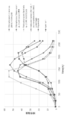
- the results of each sample of Example 3 in the PR-1a gene promoter expression induction test are shown in Table 13 and FIG. 1, and the results of each sample of Example 4 are shown in Table 14.
- the culture containing the polysaccharide is a product derived from uronema, chlorococcum, geminella, chloroidium (preferably KAMI), euglena, or chlorella. These products were shown to have an effect of activating PR-1a gene promoter expression induction.
- these algae-derived cultures are the same macromolecular polysaccharide as laminarin, but are fast-acting because of these excellent advantages. Moreover, it is easy to adjust a time of action by using both each product and laminarin together.
- Example 3 ⁇ Analysis of each culture derived from each algal strain of Examples 3 to 4> Each culture derived from each algal strain of Examples 3 to 4 was analyzed. Specifically, as the sample of Example 3, the uronema-derived culture 5, the chlorococcum-derived culture 6, the Geminella-derived culture 7, the chloroidium KAMI-derived culture 8, and the sample of Example 4 A culture 10 derived from Roydium YAMA was used.
- Man Mannose
- Ara Arabinose
- Gal Gal
- Gal Gal
- Gal Gal
- Gal Gal
- Gal Gal
- Gal Gal
- Gal Gal
- Gal Gal
- Gal Gal
- Gal Gal
- Gal Gal
- Gal Gal
- Gal Gal
- Gal Gal
- Gal Gal
- Gal Gal
- Gal Gal
- Gal Gal
- Gal Gal
- Gal Gal
- Gal Gal
- Gal Gal
- Gal Gal
- Gal Gal
- Gal Gal
- GlcUA glucuronic acid.
- MilliQ water was added to the sample to prepare a 10 mg / mL solution, and 10 ⁇ L of the solution was used as a hydrolysis sample. Specifically, 10 ⁇ L of each sample was dispensed into tubes, TFA (trifluoroacetic acid) was added to each collected tube, stirred and centrifuged, and then heated at 100 ° C. for 3 hours. After air cooling, the mixture was centrifuged and dried with SpeedVac. After adding 2-propanol and stirring, pyridine / methanol and acetic anhydride were added to the sample dried to speedVac, and reacted at room temperature for 30 minutes. The solution was dried to SpeedVac and proceeded to ABEE labeling.
- TFA trifluoroacetic acid
- ABEE labeling reagent (ABEE, sodium cyanoborohydride, acetic acid, methanol) was added and reacted at 80 ° C. for 1 hour. Post-treatment was carried out with 200 ⁇ L of MQW and 200 ⁇ L of chloroform, and the aqueous layer was collected and injected into HPLC. A calibration curve for each monosaccharide was created from the peak area, and the monosaccharide contained in the sample was quantified.
- the dry culture was adjusted to 100 ⁇ g / mL, and uronic acid in each culture was analyzed.
- Table 16 shows the results of uronic acid content (in terms of GalUA) in each sample.
- Table 15 shows the results of sugar analysis by the ABEE labeling method, and Table 16 shows the results of uronic acid.
- Table 15 shows the monosaccharide composition of each polysaccharide contained in the culture of each of the Algal strains of Geminera, Uronema, Chlorococcum and Chlorodium.
- Uronema-derived polysaccharides are mainly composed of rhamnose, mannose and glucuronic acid.
- the polysaccharide derived from chlorococcum contains mannose, arabinose, galactose, and glucuronic acid as main constituent monosaccharides.
- Geminera-derived polysaccharides are mainly composed of mannose and glucuronic acid.
- the polysaccharide derived from Chlorodium KAMI contains mannose, arabinose, galactose, xylose, rhamnose and glucuronic acid as the main constituent monosaccharides.
- the polysaccharide derived from Chlorodium YAMA contains mannose, galactose, and glucose as main constituent monosaccharides.
- each polysaccharide contained in the cultures of each of the algae strains of Geminera, Uronema, Chlorococcum and Chlorodium contains uronic acid, and the uronic acid (GalUA equivalent) content is as shown in Table 16. Met. Therefore, the polysaccharide produced by unicellular algae having a green photosynthetic pigment outside the alga contains uronic acid, and therefore induces PR-1a gene expression inducing action different from laminarin not containing uronic acid (for example, , Efficacy rate, etc.). As described above, each of the polysaccharides has uronic acid and neutral monosaccharide as described above as constituent monosaccharides, so that it is considered that PR-1a gene expression induction is involved in activation.
- the culture of this technique is a culture of a unicellular alga having a green photosynthetic pigment, it is considered that it does not show direct insecticidal / bactericidal properties. And since the culture of this technology does not show direct insecticidal / bactericidal properties, the resistant bacteria appearance rate is low, the application amount can be suppressed with a small amount, the effect is sustained, and it is outside the control purpose. We think that there is little influence on creature. In addition, since the culture of the present technology contains abundant polysaccharide carbon sources and can also contain various components in the culture, it can be expected to have a fertilizing effect on plants. it can.
- the culture of the present technology is obtained by liquid culture, it is highly water-soluble and can be easily used by mixing with irrigation water such as farms.
- the culture of the present technology is considered to gradually decompose after application such as spraying even when insoluble components are contained, so that long-term efficacy can be expected, while the environmental load is considered low.
- the culture of the present technology can be used for necessary crops at the necessary place when necessary, and is considered to be highly versatile.
Landscapes
- Life Sciences & Earth Sciences (AREA)
- Engineering & Computer Science (AREA)
- Health & Medical Sciences (AREA)
- Biotechnology (AREA)
- Chemical & Material Sciences (AREA)
- Zoology (AREA)
- Wood Science & Technology (AREA)
- General Health & Medical Sciences (AREA)
- Organic Chemistry (AREA)
- Genetics & Genomics (AREA)
- Bioinformatics & Cheminformatics (AREA)
- Microbiology (AREA)
- Cell Biology (AREA)
- Biomedical Technology (AREA)
- Biochemistry (AREA)
- Botany (AREA)
- General Engineering & Computer Science (AREA)
- Medicinal Chemistry (AREA)
- Tropical Medicine & Parasitology (AREA)
- Virology (AREA)
- Agronomy & Crop Science (AREA)
- Dentistry (AREA)
- Mycology (AREA)
- Environmental Sciences (AREA)
- Plant Pathology (AREA)
- Natural Medicines & Medicinal Plants (AREA)
- Preparation Of Compounds By Using Micro-Organisms (AREA)
- Agricultural Chemicals And Associated Chemicals (AREA)
- Micro-Organisms Or Cultivation Processes Thereof (AREA)
- Breeding Of Plants And Reproduction By Means Of Culturing (AREA)
Abstract
植物用抵抗性誘導作用を有する成分を有する成分を提供すること。 緑色の光合成色素を有する単細胞藻類の培養物を有効成分とする、PR1遺伝子発現誘導活性剤;緑色の光合成色素を有する単細胞藻類の培養物を有効成分とする、植物用抵抗性誘導剤;緑色の光合成色素を有する単細胞藻類の培養物を有効成分とする、植物病害予防・改善剤;緑色の光合成色素を有する単細胞藻類を、好気的条件下において培養して、細胞外多糖体を含む培養物を得る、植物用抵抗性誘導成分の製造方法。
Description
本技術は、PR1遺伝子発現誘導活性剤、植物用抵抗性誘導剤、及び植物病害予防剤に関する。
農作物及び園芸用植物等の農業関連分野において、病原菌による病害を低減し、生育又は収穫を向上させるために、農薬が多用されている。しかし、農薬使用による被爆、環境負荷及び残留の懸念から、農薬の使用量の低減が求められている。
また、近年では、遺伝子組換えによる害虫抵抗性(Bt)と除草剤耐性の品種も普及しつつあるが、このような品種は限定的な品種に限られている。また、遺伝子組換えでない農作物や園芸用植物等が好まれる傾向にある。
また、近年では、遺伝子組換えによる害虫抵抗性(Bt)と除草剤耐性の品種も普及しつつあるが、このような品種は限定的な品種に限られている。また、遺伝子組換えでない農作物や園芸用植物等が好まれる傾向にある。
このような要請に応える農薬を得るために植物用抵抗性誘導剤の開発が進められている。植物用抵抗性誘導作用は、病原体を死滅させる作用ではなく、植物が本来有する防御機構を活性化させる作用である。この活性化により植物自体が病原体を退けることができる。この植物用抵抗性誘導作用を有する化合物は、殺虫・殺菌活性に頼らないため、耐性菌の出現率が低い、使用量が少量でよい、効果が持続する、防除目的以外の生物に対する影響がない等の利点があると一般的に云われている。また、この植物用抵抗性誘導化合物は、品種改良や遺伝子組換え作物とは異なり、必要なときに必要な場所で必要な植物(例えば、農作物、園芸用植物等)に使用でき、汎用性も高いという利点があると一般的に云われている。
植物用抵抗性誘導化合物として、サリチル酸、プロベナゾール、バリダマイシンA等が知られており、これら化合物は既に実用化され、植物用抵抗性誘導剤として市場で流通されている。この植物用抵抗性誘導剤を使用した植物は、植物の全身獲得抵抗病原体の攻撃を感知すると、植物体中のサリチル酸濃度を高め、次いで転写制御因子であるNPR1を介してPR遺伝子群を発現し、病原体に対する抵抗性が高まると一般的に云われている。すなわち、植物用抵抗性誘導剤が、植物体のPR遺伝子群のスイッチをオンにし、病原体に対する抵抗性を植物体全体に獲得させている。
また、新たな植物用抵抗性誘導剤を探索するために、SARモデルに基づいて、PR-1α遺伝子の発現モニタリング系を利用したスクリーニング方法の開発が進められている。
例えば、特許文献1には、ハロゲン及びオキソ基を有する複素環系化合物等にPR-1α遺伝子の発現増強作用があることを見出したこと、この発現増強作用により広い抗菌スペクトルを有するPRタンパク質の発現が誘導又は促進できること及び植物用抵抗性誘導ができることが開示されている。
例えば、特許文献1には、ハロゲン及びオキソ基を有する複素環系化合物等にPR-1α遺伝子の発現増強作用があることを見出したこと、この発現増強作用により広い抗菌スペクトルを有するPRタンパク質の発現が誘導又は促進できること及び植物用抵抗性誘導ができることが開示されている。
Evaluation of the Use of the Tobacco PR-1α Promoter to Monitor Defense Gene Expression by the Luciferase Bioluminescence Reporter System, Biosci. Biotechnol. Biochem., 75(9), 1796-1800 (2011).
しかしながら、植物用抵抗性誘導剤の研究開発の知見はいまだ十分とは云えない。このため、植物用抵抗性誘導作用を有する成分について種々検討がなされている。このような成分は、植物の抵抗性を高める方向に誘導するための成分であるので、植物の生育阻害等を引き起こすデメリットが少ないと本発明者らは考えた。
そこで、本技術は、植物用抵抗性誘導作用を有する成分を提供することを主な目的とする。
そこで、本技術は、植物用抵抗性誘導作用を有する成分を提供することを主な目的とする。
そして、本発明者らは、PR-1α遺伝子発現誘導活性試験を用いて、植物用抵抗性誘導に関与するPR1遺伝子発現誘導活性作用を有する化合物を見出した。
本発明者らは、鋭意検討した結果、緑色の光合成色素を有する単細胞藻類の培養物であり、当該培養物には細胞外多糖体が含まれていること、当該培養物が、PR-1α遺伝子発現誘導活性作用及び植物用抵抗性誘導作用を有することを見出し、本発明を完成させた。本発明は以下のとおりである。
本発明者らは、鋭意検討した結果、緑色の光合成色素を有する単細胞藻類の培養物であり、当該培養物には細胞外多糖体が含まれていること、当該培養物が、PR-1α遺伝子発現誘導活性作用及び植物用抵抗性誘導作用を有することを見出し、本発明を完成させた。本発明は以下のとおりである。
(1) 緑色の光合成色素を有する単細胞藻類の培養物を有効成分とする、PR1遺伝子発現誘導活性剤。
(2) 前記藻類が、Trebouxiophyceae(トレボキシア藻綱)藻類及び/又はChlorophyceae(緑藻綱)藻類である、前記〔1〕記載のPR1遺伝子活性化剤。
(3) 前記藻類が、ジェミネラ、ウロネマ、クロロコッカム及びクロロイディウムから選択される1種又は2種以上である、前記(1)又は(2)記載のPR1遺伝子活性化剤。
(4) 前記培養物中の細胞外多糖体が、ウロン酸を少なくとも含むものである、前記(1)~(3)のいずれか記載のPR1遺伝子活性化剤。
(5) 前記培養物中の細胞外多糖体が、ウロン酸5~40質量%と中性単糖とを少なくとも含み、当該中性単糖がマンノース、ガラクトース及びラムノースから選択される1種又は2種以上のものである、前記(1)~(4)のいずれか記載のPR1遺伝子活性化剤。
(6) 前記藻体が、[1]Chlorophyceae Uronema sp. (NBRC 113204)藻株;[2]Trebouxiophyceae Geminella sp. (NBRC 113205)藻株;[3]Chlorophyceae Chlorococcum sp. (NBRC 113206)藻株;[4]Trebouxiophyceae Chloroidium saccharophilum YAMA (NBRC 113207)藻株;[5]Trebouxiophyceae Chloroidium saccharophilum KAMI (NBRC 113807)藻株から選択される1種又は2種以上のものである、前記(1)~(5)のいずれか記載のPR1遺伝子活性化剤。
(7) 緑色の光合成色素を有する単細胞藻類の培養物を有効成分とする、植物用抵抗性誘導剤。
(8) 緑色の光合成色素を有する単細胞藻類の培養物を有効成分とする、植物病害予防・改善剤。
(9) 緑色の光合成色素を有する単細胞藻類を、好気的条件下で培養をし、細胞外多糖体を含む培養物を得る、植物用抵抗性誘導成分の製造方法。
(10) 植物用抵抗性誘導成分を製造するための、緑色の光合成色素を有する単細胞藻類の使用。
(2) 前記藻類が、Trebouxiophyceae(トレボキシア藻綱)藻類及び/又はChlorophyceae(緑藻綱)藻類である、前記〔1〕記載のPR1遺伝子活性化剤。
(3) 前記藻類が、ジェミネラ、ウロネマ、クロロコッカム及びクロロイディウムから選択される1種又は2種以上である、前記(1)又は(2)記載のPR1遺伝子活性化剤。
(4) 前記培養物中の細胞外多糖体が、ウロン酸を少なくとも含むものである、前記(1)~(3)のいずれか記載のPR1遺伝子活性化剤。
(5) 前記培養物中の細胞外多糖体が、ウロン酸5~40質量%と中性単糖とを少なくとも含み、当該中性単糖がマンノース、ガラクトース及びラムノースから選択される1種又は2種以上のものである、前記(1)~(4)のいずれか記載のPR1遺伝子活性化剤。
(6) 前記藻体が、[1]Chlorophyceae Uronema sp. (NBRC 113204)藻株;[2]Trebouxiophyceae Geminella sp. (NBRC 113205)藻株;[3]Chlorophyceae Chlorococcum sp. (NBRC 113206)藻株;[4]Trebouxiophyceae Chloroidium saccharophilum YAMA (NBRC 113207)藻株;[5]Trebouxiophyceae Chloroidium saccharophilum KAMI (NBRC 113807)藻株から選択される1種又は2種以上のものである、前記(1)~(5)のいずれか記載のPR1遺伝子活性化剤。
(7) 緑色の光合成色素を有する単細胞藻類の培養物を有効成分とする、植物用抵抗性誘導剤。
(8) 緑色の光合成色素を有する単細胞藻類の培養物を有効成分とする、植物病害予防・改善剤。
(9) 緑色の光合成色素を有する単細胞藻類を、好気的条件下で培養をし、細胞外多糖体を含む培養物を得る、植物用抵抗性誘導成分の製造方法。
(10) 植物用抵抗性誘導成分を製造するための、緑色の光合成色素を有する単細胞藻類の使用。
本技術によれば、植物用抵抗性誘導作用を有する成分を提供することができる。なお、ここに記載された効果は、必ずしも限定されるものではなく、本明細書中に記載されたいずれかの効果であってもよい。
次に、本技術の好ましい実施形態について説明する。ただし、本技術は以下の好ましい実施形態に限定されず、本技術の範囲内で自由に変更することができるものである。尚、本明細書において百分率は特に断りのない限り質量による表示である。
1.緑色藻類の培養物及びこの製造方法
本技術は、緑色の光合成色素を有する単細胞藻類の培養物を有効成分とする、PR1遺伝子発現誘導活性剤、植物用抵抗性誘導剤、又は植物病害予防剤である。
本技術の培養物は、後述するように、PR1遺伝子発現誘導活性作用、植物用抵抗性誘導作用、又は植物病害予防作用を有するものである。当該培養物には、細胞外産生の多糖体が含まれることが好適である。
本技術は、緑色の光合成色素を有する単細胞藻類の培養物を有効成分とする、PR1遺伝子発現誘導活性剤、植物用抵抗性誘導剤、又は植物病害予防剤である。
本技術の培養物は、後述するように、PR1遺伝子発現誘導活性作用、植物用抵抗性誘導作用、又は植物病害予防作用を有するものである。当該培養物には、細胞外産生の多糖体が含まれることが好適である。
本技術の緑色の光合成色素を有する単細胞藻類(以下、「緑色単細胞藻類」ともいう)の培養物は、当該緑色藻類を用いて以下のようにして製造することができるが、この製造方法に限定されることはない。
本明細書における「緑色の光合成色素を有する藻類」は、外観上緑色を有する藻類という広義の意味であり、光合成色素として、クロロフィルa及びbを含むものであるが、これ以外のクロロフィルや色素を有していてもよい。また、当該単細胞藻類は、単細胞の状態に限定されず、培養中に群生体の状態になってもよい。
本技術で使用される緑色単細胞藻類は、特に限定されず、例えば、Chlorophyceae(緑藻綱)藻類及び/又はTrebouxiophyceae(トレボキシア藻綱)藻類等が挙げられる。
また、本技術で使用される緑色単細胞藻類は、特に限定されず、例えば、ユーグレナ、クロレラ、ウロネマ、クロロコッカム、ジェミネラ及びクロロイディウムから選択される1種又は2種以上である。このうち、ジェミネラ、ウロネマ、クロロコッカム及びクロロイディウムから選択される1種又は2種以上のものが好ましい。また、これら各種藻株は、市販の製品に含まれる藻株、微生物保存機関でカルチャー・コレクション(例えば、NBRC(NITE Biological Resource Center) Culture Collection、ATCC(American Type Culture Collection)等)として保存されている藻株、ブダペスト条約に基づく国際寄託機関(例えば、NITE (National Institute of Technology and Evaluation)等)で受託株として保存されている藻株、将来見出される藻株等が挙げられ、本技術の目的とする効果であるPR1遺伝子活性化作用を奏する培養物を産生する藻株を選択することができる。
また、本技術で使用される緑色単細胞藻類は、特に限定されず、例えば、ユーグレナ、クロレラ、ウロネマ、クロロコッカム、ジェミネラ及びクロロイディウムから選択される1種又は2種以上である。このうち、ジェミネラ、ウロネマ、クロロコッカム及びクロロイディウムから選択される1種又は2種以上のものが好ましい。また、これら各種藻株は、市販の製品に含まれる藻株、微生物保存機関でカルチャー・コレクション(例えば、NBRC(NITE Biological Resource Center) Culture Collection、ATCC(American Type Culture Collection)等)として保存されている藻株、ブダペスト条約に基づく国際寄託機関(例えば、NITE (National Institute of Technology and Evaluation)等)で受託株として保存されている藻株、将来見出される藻株等が挙げられ、本技術の目的とする効果であるPR1遺伝子活性化作用を奏する培養物を産生する藻株を選択することができる。
例えば、NBRC(NITE Biological Resource Center)のカルチャー・コレクションより、以下の~[1]~[5]の藻株を入手でき、これらから1種又は2種以上のものを使用できる。
[1]Chlorophyceae Uronema sp. (NBRC 113204)藻株は、NBRC 113204 Uronema sp.(http://www.nbrc.nite.go.jp/NBRC2/NBRCCatalogueDetailServlet?ID=NBRC&CAT=00113204)/公開2018/03/29;
[2]Trebouxiophyceae Geminella sp. (NBRC 113205)藻株は、NBRC 113205 Geminella sp.(http://www.nbrc.nite.go.jp/NBRC2/NBRCCatalogueDetailServlet?ID=NBRC&CAT=00113205)/公開2018/03/29;
[3]Chlorophyceae Chlorococcum sp. (NBRC 113206)藻株は、NBRC 113206 Chlorococcum sp.(http://www.nbrc.nite.go.jp/NBRC2/NBRCCatalogueDetailServlet?ID=NBRC&CAT=00113206)/公開2018/03/29;
[4]Trebouxiophyceae Chloroidium saccharophilum YAMA (NBRC 113207) (YAMA-Mizu-03-3)藻株は、NBRC 113207 Chloroidium saccharophilum(http://www.nbrc.nite.go.jp/NBRC2/NBRCCatalogueDetailServlet?ID=NBRC&CAT=00113207)/公開2018/03/29;
[5]Trebouxiophyceae Chloroidium saccharophilum KAMI (NBRC 113807)(KAMI-04(3))藻株は、NBRC 113807 Chloroidium saccharophilum(http://www.nbrc.nite.go.jp/NBRC2/NBRCCatalogueDetailServlet?ID=NBRC&CAT=00113807)/公開2019/02/25。
なお、NBRC(NITE Biological Resource Center)のホームページアドレスは、2019年3月に、「http://www.nbrc.nite.go.jp/NBRC2/NBRCCatalogueDetailServlet?ID=NBRC&CAT==00******(*はNBRC No.です)から、「https://www.nite.go.jp/nbrc/catalogue/NBRCCatalogueDetailServlet?ID=NBRC&CAT=00******」に変更される。
[1]Chlorophyceae Uronema sp. (NBRC 113204)藻株は、NBRC 113204 Uronema sp.(http://www.nbrc.nite.go.jp/NBRC2/NBRCCatalogueDetailServlet?ID=NBRC&CAT=00113204)/公開2018/03/29;
[2]Trebouxiophyceae Geminella sp. (NBRC 113205)藻株は、NBRC 113205 Geminella sp.(http://www.nbrc.nite.go.jp/NBRC2/NBRCCatalogueDetailServlet?ID=NBRC&CAT=00113205)/公開2018/03/29;
[3]Chlorophyceae Chlorococcum sp. (NBRC 113206)藻株は、NBRC 113206 Chlorococcum sp.(http://www.nbrc.nite.go.jp/NBRC2/NBRCCatalogueDetailServlet?ID=NBRC&CAT=00113206)/公開2018/03/29;
[4]Trebouxiophyceae Chloroidium saccharophilum YAMA (NBRC 113207) (YAMA-Mizu-03-3)藻株は、NBRC 113207 Chloroidium saccharophilum(http://www.nbrc.nite.go.jp/NBRC2/NBRCCatalogueDetailServlet?ID=NBRC&CAT=00113207)/公開2018/03/29;
[5]Trebouxiophyceae Chloroidium saccharophilum KAMI (NBRC 113807)(KAMI-04(3))藻株は、NBRC 113807 Chloroidium saccharophilum(http://www.nbrc.nite.go.jp/NBRC2/NBRCCatalogueDetailServlet?ID=NBRC&CAT=00113807)/公開2019/02/25。
なお、NBRC(NITE Biological Resource Center)のホームページアドレスは、2019年3月に、「http://www.nbrc.nite.go.jp/NBRC2/NBRCCatalogueDetailServlet?ID=NBRC&CAT==00******(*はNBRC No.です)から、「https://www.nite.go.jp/nbrc/catalogue/NBRCCatalogueDetailServlet?ID=NBRC&CAT=00******」に変更される。
前記Chlorophyceae(緑藻綱)藻類として、例えば、Chlorophyceae Uronema(ウロネマ)藻類、Chlorophyceae Chlorococcum(クロロコッカム)藻類等が挙げられる。
前記Trebouxiophyceae(トレボキシア藻綱)藻類として、例えば、Trebouxiophyceae Geminella(ジェミネラ)藻類、Trebouxiophyceae Chloroidium(クロロイディウム)藻類等が挙げられる。
前記Trebouxiophyceae(トレボキシア藻綱)藻類として、例えば、Trebouxiophyceae Geminella(ジェミネラ)藻類、Trebouxiophyceae Chloroidium(クロロイディウム)藻類等が挙げられる。
クロロイディウムとして、本技術の効能を良好に発揮し得る観点から、クロロイディウム属(Chloroidium)藻が好ましい。クロロイディウムとして、Trebouxiophyceae Chloroidium saccharophilum (NBRC 113207)等が好ましい。
ユーグレナとして、本技術の効能を良好に発揮し得る観点から、ユーグレナ属(Euglena)藻が好ましい。ユーグレナとして、例えばユーグレナ・グラシリス等が好ましい。
クロレラとして、本技術の効能を良好に発揮し得る観点から、クロレラ属(Chlorella)藻が好ましい。クロレラとして、例えば、クロレラ・ブルガリス等が挙げられ、さらに、Chlorella vulgaris Chikugo株(チクゴ株:クロレラ工業)等が好ましい。
ウロネマとして、本技術の効能を良好に発揮し得る観点から、ウロネマ属(Uronema)藻が好ましい。ウロネマとして、Chlorophyceae Uronema sp.(NBRC 113204)等が好ましい。
クロロコッカムとして、本技術の効能を良好に発揮し得る観点から、クロロコッカム(Chlorococcum)藻が好ましい。クロロコッカムとして、Chlorophyceae Chlorococcum sp.(NBRC 113206)等が好ましい。
ジェミネラとして、本技術の効能を良好に発揮し得る観点から、ジェミネラ属(Geminella)藻が好ましい。ジェミネラとして、Trebouxiophyceae Geminella sp. (NBRC 113205)等が好ましい。
クロロイディウムとして、本技術の効能を良好に発揮し得る観点から、クロロイディウム属(Chloroidium)藻が好ましい。クロロイディウムとして、Trebouxiophyceae Chloroidium saccharophilum YAMA (NBRC 113207)(YAMA-Mizu-03-3)(以下、YAMAともいう)及び/又はTrebouxiophyceae Chloroidium saccharophilum KAMI (NBRC 113807)(KAMI-04-(3))(以下、KAMIともいう)等が好ましく、より好ましくは、生産性の観点から、Trebouxiophyceae Chloroidium saccharophilum KAMI (NBRC 113807)である。
本技術において、上述した藻株と実質的に同質の藻株であればよい。実質的に同質の藻株とは、その18SrRNA遺伝子の塩基配列(例えば、配列番号1~5)が、それぞれ99.5%以上(好適には99.8%以上、さらに好適には100%)一致し、、かつ好ましくは上述した藻株と同一の藻類学的性質(形態観察及び細胞外多糖体産生)を有する。さらに本技術の藻株は、本技術の効果(特にPR1遺伝子活性化作用成分の産生能)が損なわれない限り、上述した藻株又はそれと実質的に同質の藻株から、変異処理、遺伝子組換え、自然変異株の選択等によって育種された藻株であってもよい。
本技術の緑色単細胞藻類を培養して培養物を製造させる際に用いる培地として、一般的な単細胞藻類が培養可能な基礎培地が好適である。
一般的な単細胞藻類が培養可能な基礎培地中には、例えば、無機塩としてKH2PO4、MgSO4等の微量無機成分が挙げられ、窒素源として硫酸アンモニウム、尿素等が含まれている。当該基礎培地中の各成分の含有量は±10%の範囲であることが好ましい。
前記基礎培地として、より具体的には、例えば、後記〔実施例〕に示すような、AF6培地、BG11培地、KO2培地等が挙げられる。このうち、AF6培地を使用する場合、クロレラ、クロロコッカム、ジェミネラ、クロロイディウム、ユーグレナ等が好適である。BG11培地を使用する場合、ウロネマ、クロロイディウム等が好適である。KO2培地の場合、ユーグレナ等が好適である。
一般的な単細胞藻類が培養可能な基礎培地中には、例えば、無機塩としてKH2PO4、MgSO4等の微量無機成分が挙げられ、窒素源として硫酸アンモニウム、尿素等が含まれている。当該基礎培地中の各成分の含有量は±10%の範囲であることが好ましい。
前記基礎培地として、より具体的には、例えば、後記〔実施例〕に示すような、AF6培地、BG11培地、KO2培地等が挙げられる。このうち、AF6培地を使用する場合、クロレラ、クロロコッカム、ジェミネラ、クロロイディウム、ユーグレナ等が好適である。BG11培地を使用する場合、ウロネマ、クロロイディウム等が好適である。KO2培地の場合、ユーグレナ等が好適である。
本技術の培養物を製造するための培養に際し、好気的な条件下で培養することが、上記多糖体を含む培養物を安定的に生産させることができるので好適である。通気培養することが、多糖体の生産性を向上させる点で、好ましい。通気手段として、例えば、撹拌、振盪、通気及びバブリング等が挙げられる。これらを単独で又は2種以上組み合わせて行うことが可能である。これにより、培養培地中に適度な気体が混合されるようになる。
培養温度は、特に限定されないが、5~40℃の常温程度であればよい。
また、培養培地中のpH(20℃)は、使用する培地組成のpHの±2が好ましく、より好ましくはpH±1である。また、培養培地中のpHは、好ましくは1.5~9.5である。培養培地中のpHは、ウロネマ、クロロコッカム、ジェミネラ、クロロイディウム及びクロレラの場合、より好ましくは6~9である。
培養期間は、特に限定されないが、4日~3週間程度を1サイクルとするのが、多糖体を産出させるのに好適である。より好ましくは、7日~2週間程度であればよい。
培養の照度は、特に限定されないが、多糖体を含む培養物を得やすい観点から、1500~10000luxが好適である。
また、独立栄養培養条件下にて藻体数を多くする場合、太陽光;植物栽培用ランプ、LED等の人工光源等の光を用いることが可能であり、炭酸ガスの補給と撹拌をすることが好ましい。
また、培養培地中のpH(20℃)は、使用する培地組成のpHの±2が好ましく、より好ましくはpH±1である。また、培養培地中のpHは、好ましくは1.5~9.5である。培養培地中のpHは、ウロネマ、クロロコッカム、ジェミネラ、クロロイディウム及びクロレラの場合、より好ましくは6~9である。
培養期間は、特に限定されないが、4日~3週間程度を1サイクルとするのが、多糖体を産出させるのに好適である。より好ましくは、7日~2週間程度であればよい。
培養の照度は、特に限定されないが、多糖体を含む培養物を得やすい観点から、1500~10000luxが好適である。
また、独立栄養培養条件下にて藻体数を多くする場合、太陽光;植物栽培用ランプ、LED等の人工光源等の光を用いることが可能であり、炭酸ガスの補給と撹拌をすることが好ましい。
なお、本技術の緑色単細胞藻類(好適には、クロレラ、クロロコッカム、ジェミネラ、ユーグレナ、ウロネマ、クロロイディウム)を用いて多糖体を含む培養物を産生させる場合、独立栄養培養が可能であり、このことは本技術の利点でもある。
また、本技術は独立栄養培養での培養物の生産方法に限定されず、一般的な単細胞藻類が培養可能な基礎培地に、グルコース等の炭素源を含有させて、多糖体を含む培養物を産生させもよい。また、培地は炭素源、窒素源、リンが含まれていればよく、本技術に用いる培地として下水やメタン発酵槽で生じる消化液(液肥)を用いてもよい。
また、本技術は独立栄養培養での培養物の生産方法に限定されず、一般的な単細胞藻類が培養可能な基礎培地に、グルコース等の炭素源を含有させて、多糖体を含む培養物を産生させもよい。また、培地は炭素源、窒素源、リンが含まれていればよく、本技術に用いる培地として下水やメタン発酵槽で生じる消化液(液肥)を用いてもよい。
また、本技術の培養物の生産方法は、バッチ式、連続式の何れでもよいが、連続式が生産性向上のため好ましい。また、開放系培養及び閉鎖系培養の何れでもよく、例えば、培養タンク内の密閉培養及び開放系の露天培養等が挙げられる。培養条件管理の点で、閉鎖系培養が好ましい。
本技術の培養物を前記単細胞緑藻類に産生させた後に、水溶液洗浄、超音波、遠心分離、ろ過等の物理的手段及び化学的手段にて、藻体から多糖体を含む培養物を分離し、多糖体が含まれる上清液を得るのが好適である。
本技術では、藻体外の代謝産物が、本技術の効果に何らか寄与していると推測されるため、当該培養物には、多糖体以外に、種々の藻類の代謝産物(例えば、タンパク質、ペプチド、アミノ酸、核酸、有機酸、脂質等)が種々含まれていてもよい。
また、本技術の培養物として、藻体外の代謝産物を使用することができるので、培養後の藻体表面から多糖体を分離しながら、連続的に培養物を得ることが可能であり、連続培養できる観点で本技術の藻類は優れているといえる。連続的に培養物を得る方法として、例えば、遠心分離(好適には、5000~9000rpm、5分間程度)及びろ過(例えば、濾過助剤及びろ過フィルター等)を単独で又は組み合わせて用いることができる。
得られた培養物は、希釈液、濃縮液又は乾燥物等の状態に適宜調整してもよい。乾燥手段として凍結乾燥が好ましい。
本技術では、藻体外の代謝産物が、本技術の効果に何らか寄与していると推測されるため、当該培養物には、多糖体以外に、種々の藻類の代謝産物(例えば、タンパク質、ペプチド、アミノ酸、核酸、有機酸、脂質等)が種々含まれていてもよい。
また、本技術の培養物として、藻体外の代謝産物を使用することができるので、培養後の藻体表面から多糖体を分離しながら、連続的に培養物を得ることが可能であり、連続培養できる観点で本技術の藻類は優れているといえる。連続的に培養物を得る方法として、例えば、遠心分離(好適には、5000~9000rpm、5分間程度)及びろ過(例えば、濾過助剤及びろ過フィルター等)を単独で又は組み合わせて用いることができる。
得られた培養物は、希釈液、濃縮液又は乾燥物等の状態に適宜調整してもよい。乾燥手段として凍結乾燥が好ましい。
本技術の培養物には、少なくとも多糖体が含まれることが好適であり、当該多糖体に、糖質以外の物質(例えば、タンパク質、ペプチド、アミノ酸、核酸、有機酸、脂質等)が本技術の効果を損なわない範囲において結合していてもよく、このような多糖体として、例えば、糖タンパク質、ペプチドグリカン、糖脂質等が挙げられる。
本技術の多糖体の収量は、培養液中に、20mg/L以上得ることができ、より好適には50mg/L以上、さらに好適には100mg/L以上である。本技術は300~500mg/Lまで収量を高めることが可能である。
多糖体の生産性が高い藻類として、クロロコッカム及びクロロイディウムが好適である。また、効能の高い多糖体を生産する藻類として、クロロコッカム及びウロネマが好適である。
多糖体の生産性が高い藻類として、クロロコッカム及びクロロイディウムが好適である。また、効能の高い多糖体を生産する藻類として、クロロコッカム及びウロネマが好適である。
本技術において、藻類の培養物中に多糖体が、乾燥物換算で20質量%以上含まれることが好ましく、中性単糖が20質量%以上含まれることがより好ましい。
また、藻類の培養物中の多糖体は、ウロン酸が好適には5質量%以上、より好適には10質量%以上含まれることが好ましく、その上限値として好適には40質量%以下、より好適には35質量%以下、さらに好適には30質量%以下、よりさらに好適には25質量%以下含まれることが好ましく、当該数値範囲として5~30質量%含まれることがより好ましい。当該多糖体は、細胞外多糖体が、回収容易等の高い生産効率及び高い収量が望めるので、より好ましい。
また、藻類の培養物中の多糖体は、ウロン酸が好適には5質量%以上、より好適には10質量%以上含まれることが好ましく、その上限値として好適には40質量%以下、より好適には35質量%以下、さらに好適には30質量%以下、よりさらに好適には25質量%以下含まれることが好ましく、当該数値範囲として5~30質量%含まれることがより好ましい。当該多糖体は、細胞外多糖体が、回収容易等の高い生産効率及び高い収量が望めるので、より好ましい。
本技術の緑色単細胞藻類(好適には、Chlorophyceae藻類及び/又はTrebouxiophyceae藻類)が産生する多糖体は、特に限定されないが、本技術の多糖体の構成単糖として少なくともウロン酸を含むことが望ましく、当該ウロン酸はグルクロン酸が好ましいがこれに限定されない。これにより、後述するPR1遺伝子活性化等の本技術の効能を期待できる。
また、本技術の多糖体に含まれる中性単糖として六単糖(好適にはアルドヘキソース)を含むことが好適である。当該中性単糖として、より具体的には、マンノース、ガラクトース及びラムノースのいずれか1又は2以上を少なくとも主な構成単糖とすることが、本技術の効能の観点から、望ましい。さらに、当該中性単糖のうち、少なくともマンノース又はラムノースを含むことが、本技術の効能の観点から望ましい。
また、本技術の多糖体に含まれる中性単糖として六単糖(好適にはアルドヘキソース)を含むことが好適である。当該中性単糖として、より具体的には、マンノース、ガラクトース及びラムノースのいずれか1又は2以上を少なくとも主な構成単糖とすることが、本技術の効能の観点から、望ましい。さらに、当該中性単糖のうち、少なくともマンノース又はラムノースを含むことが、本技術の効能の観点から望ましい。
本技術の培養物中の細胞外多糖体は、ウロン酸を少なくとも含むことが好適であり、さらに、ウロン酸及び中性単糖を本技術の多糖体の構成単糖として本技術の多糖体に含まれることがより望ましい。これにより、後述するPR1遺伝子活性化等の本技術の効能を期待できる。このときの中性単糖は、マンノース、ガラクトース及びラムノースから選択される1種又は2種以上のものがよりさらに好適である。
さらに、上述した、ウロネマ、クロロコッカム、ジェミネラ及びクロロイディウムから選択される1種又は2種以上である藻類が生産する培養物に含まれる多糖体が、本技術の良好な効能を奏する観点から、好ましい。
さらに、上述した、ウロネマ、クロロコッカム、ジェミネラ及びクロロイディウムから選択される1種又は2種以上である藻類が生産する培養物に含まれる多糖体が、本技術の良好な効能を奏する観点から、好ましい。
前記ウロネマの産生する多糖体の収量として、培養液中に、20mg/L以上が好ましい。
ウロネマ産生物中の細胞外多糖体(以下、「ウロネマ多糖体」ともいう)は、ウロン酸が含まれることが好適であり、その下限値として好ましくは5質量%以上であり、より好ましくは10質量%以上、さらに好ましくは15質量%以上であり、また、その上限値として好ましくは35質量%以下であり、より好ましくは30質量%以下であり、当該数値範囲として、より好ましくは10~30質量%である。当該ウロネマ多糖体に、グルクロン酸が含まれることがより好適であり、下限値として好ましくは5質量%以上、より好ましくは10質量%以上であり、また、上限値として好ましくは30質量%以下、より好ましくは20質量%以下であり、当該数値範囲として、より好ましくは5~15質量%、さらに好ましくは10~15質量%含まれることが好適である。
ウロネマ産生物中の細胞外多糖体(以下、「ウロネマ多糖体」ともいう)は、ウロン酸が含まれることが好適であり、その下限値として好ましくは5質量%以上であり、より好ましくは10質量%以上、さらに好ましくは15質量%以上であり、また、その上限値として好ましくは35質量%以下であり、より好ましくは30質量%以下であり、当該数値範囲として、より好ましくは10~30質量%である。当該ウロネマ多糖体に、グルクロン酸が含まれることがより好適であり、下限値として好ましくは5質量%以上、より好ましくは10質量%以上であり、また、上限値として好ましくは30質量%以下、より好ましくは20質量%以下であり、当該数値範囲として、より好ましくは5~15質量%、さらに好ましくは10~15質量%含まれることが好適である。
ウロネマ産生物中の多糖体は、中性単糖として好適には20質量%以上含まれ、その他成分として好適には70質量%以下が含まれるものである。
さらに好ましくは、ウロネマの培養物中に、マンノース0~4質量%、アラビノース0~1.5質量%、ガラクトース0~1.5質量%、キシロース0~2質量%、グルコース0~6質量%、ラムノース5~20質量%(より好適には5~15質量%)、リボース0~1質量%、フコース0~1質量%であり、またウロン酸が15~30質量%である。これらからいずれか又は複数を組み合わせでもよい。
さらに好ましくは、ウロネマの培養物中に、マンノース0~4質量%、アラビノース0~1.5質量%、ガラクトース0~1.5質量%、キシロース0~2質量%、グルコース0~6質量%、ラムノース5~20質量%(より好適には5~15質量%)、リボース0~1質量%、フコース0~1質量%であり、またウロン酸が15~30質量%である。これらからいずれか又は複数を組み合わせでもよい。
ウロネマ産生物中の細胞外多糖体は、中性糖のうちで、マンノース及び/又はラムノースを少なくとも含むことが好適であり、さらにラムノースを主な成分とすることが好ましい。
ウロネマ多糖体中の中性糖の主な構成単糖比は、マンノース(Man):ラムノース(Rha):グルコース(Glc)=1~10:5~20:1~10が好ましく、Man:Rha:Glc=0~1:1~3:0~1がより好ましい。また、ウロネマ多糖体中の中性糖の主な構成単糖比は、Man:Rha=1~1/3:1がより好ましい。
また、ウロネマ多糖体中の主な構成単糖比は、ラムノース(Rha):ウロン酸(UA)=1~4:1~6が好ましく、Rha:UA=1~2:1~3がより好ましい。
ウロネマ多糖体中の中性糖の主な構成単糖比は、マンノース(Man):ラムノース(Rha):グルコース(Glc)=1~10:5~20:1~10が好ましく、Man:Rha:Glc=0~1:1~3:0~1がより好ましい。また、ウロネマ多糖体中の中性糖の主な構成単糖比は、Man:Rha=1~1/3:1がより好ましい。
また、ウロネマ多糖体中の主な構成単糖比は、ラムノース(Rha):ウロン酸(UA)=1~4:1~6が好ましく、Rha:UA=1~2:1~3がより好ましい。
前記クロロコッカムの産生する多糖体の収量として、培養液中に、50mg/L以上が好ましい。
クロロコッカム産生物中の細胞外多糖体(以下、「クロロコッカム多糖体」ともいう)は、ウロン酸が含まれることが好適であり、その下限値として好ましくは5質量%以上、より好ましくは10質量%以上であり、また、その上限値として好ましくは25質量%以下、より好ましくは20質量%以下であり、当該数値範囲として、より好ましくは10~20質量%である。当該クロロコッカム多糖体に、グルクロン酸が含まれることがより好適であり、下限値として好ましくは5質量%以上、より好ましくは10質量%以上であり、また、上限値として好ましくは25質量%以下、より好ましくは20質量%以下であり、当該数値範囲として、より好ましくは10~20質量%含まれることが好適である。
クロロコッカム産生物中の細胞外多糖体(以下、「クロロコッカム多糖体」ともいう)は、ウロン酸が含まれることが好適であり、その下限値として好ましくは5質量%以上、より好ましくは10質量%以上であり、また、その上限値として好ましくは25質量%以下、より好ましくは20質量%以下であり、当該数値範囲として、より好ましくは10~20質量%である。当該クロロコッカム多糖体に、グルクロン酸が含まれることがより好適であり、下限値として好ましくは5質量%以上、より好ましくは10質量%以上であり、また、上限値として好ましくは25質量%以下、より好ましくは20質量%以下であり、当該数値範囲として、より好ましくは10~20質量%含まれることが好適である。
クロロコッカム産生物中の多糖体は、中性単糖として好適には60質量%(より好適には70質量%)以上含まれ、その他成分として好適には30質量%以下が含まれるものである。
さらに好ましくは、クロロコッカムの培養物中に、マンノース10~30質量%(より好適には14~25質量%)、アラビノース10~30質量%(より好適には20~30質量%)、ガラクトース10~30質量%(より好適には17~30質量%)、キシロース0~5質量%、グルコース0~1質量%、ラムノース0~2質量%、リボース0~1質量%、フコース0~1質量%であり、またウロン酸は、10~20質量%である。これらからいずれか又は複数を組み合わせでもよい。
さらに好ましくは、クロロコッカムの培養物中に、マンノース10~30質量%(より好適には14~25質量%)、アラビノース10~30質量%(より好適には20~30質量%)、ガラクトース10~30質量%(より好適には17~30質量%)、キシロース0~5質量%、グルコース0~1質量%、ラムノース0~2質量%、リボース0~1質量%、フコース0~1質量%であり、またウロン酸は、10~20質量%である。これらからいずれか又は複数を組み合わせでもよい。
クロロコッカム産生物中の細胞外多糖体は、中性糖のうちで、マンノース、アラビノース、及びガラクトースを含むことが好適であり、さらにマンノース、アラビノース、及びガラクトースを主な成分とすることが好ましい。
クロロコッカム多糖体中の中性糖の主な構成単糖比は、マンノース(Man):アラビノース(Ara):ガラクトース(Gal)=1~3:1~3:1~3が好ましく、Man:Ara:Gal=1~2:1~2:1~2がより好ましい。また、クロロコッカム多糖体中の中性糖の主な構成単糖比は、Man:Ara:Gal=1:1~2:1~2がより好ましい。
また、クロロコッカム多糖体中の主な構成単糖比は、マンノース(Man):アラビノース(Ara):ガラクトース(Gal):ウロン酸(UA)=1~3:1~3:1~3:1~3が好ましく、Man:Ara:Gal:UA=1~2:1~2:1~2:1~2がより好ましい。
クロロコッカム多糖体中の中性糖の主な構成単糖比は、マンノース(Man):アラビノース(Ara):ガラクトース(Gal)=1~3:1~3:1~3が好ましく、Man:Ara:Gal=1~2:1~2:1~2がより好ましい。また、クロロコッカム多糖体中の中性糖の主な構成単糖比は、Man:Ara:Gal=1:1~2:1~2がより好ましい。
また、クロロコッカム多糖体中の主な構成単糖比は、マンノース(Man):アラビノース(Ara):ガラクトース(Gal):ウロン酸(UA)=1~3:1~3:1~3:1~3が好ましく、Man:Ara:Gal:UA=1~2:1~2:1~2:1~2がより好ましい。
前記ジェミネラの産生する多糖体の収量として、培養液中に、20mg/L以上が好ましい。
ジェミネラ産生物中の細胞外多糖体(以下、「ジェミネラ多糖体」ともいう)は、ウロン酸が含まれることが好適であり、その下限値として好ましくは5質量%以上であり、その上限値として好ましくは20質量%以下であり、当該数値範囲として、より好ましくは5~15質量%である。当該ジェミネラ多糖体に、グルクロン酸が含まれることがより好適であり、下限値として好ましくは5質量%以上であり、また、上限値として好ましくは20質量%以下、より好ましくは15質量%以下であり、当該数値範囲として、より好ましくは5~15質量%含まれることが好適である。
ジェミネラ産生物中の多糖体は、中性単糖として好適には35質量%(より好適には40質量%)以上含まれ、その他成分として好適には60質量%以下が含まれるものである。
ジェミネラ産生物中の細胞外多糖体(以下、「ジェミネラ多糖体」ともいう)は、ウロン酸が含まれることが好適であり、その下限値として好ましくは5質量%以上であり、その上限値として好ましくは20質量%以下であり、当該数値範囲として、より好ましくは5~15質量%である。当該ジェミネラ多糖体に、グルクロン酸が含まれることがより好適であり、下限値として好ましくは5質量%以上であり、また、上限値として好ましくは20質量%以下、より好ましくは15質量%以下であり、当該数値範囲として、より好ましくは5~15質量%含まれることが好適である。
ジェミネラ産生物中の多糖体は、中性単糖として好適には35質量%(より好適には40質量%)以上含まれ、その他成分として好適には60質量%以下が含まれるものである。
さらに好ましくは、ジェミネラの培養物中に、マンノース0~30質量%(好適には9~25質量%)、アラビノース0~8質量%、ガラクトース3~20質量%、キシロース0~3量%、グルコース0~1質量%、ラムノース2~20質量%、リボース0~1質量%、フコース0~4質量%であり、また、ウロン酸は5~15質量%である。これらからいずれか又は複数を組み合わせでもよい。
ジェミネラ産生物中の細胞外多糖体は、中性糖のうちでマンノース、ガラクトース及びラムノースを主な成分とすることが好ましい。
ジェミネラ多糖体中の中性糖の主な構成単糖比は、マンノース(Man):アラビノース(Ara):ガラクトース(Gal):ラムノース(Rha)=1~6:0~1:1~3:1~3が好ましく、Man:Gal:Rha=1~6:1~2:1~2がより好ましい。また、ジェミネラ多糖体中の中性糖の主な構成単糖比は、Man:Gal:Rha=1:0~2/5:0~3/10が好ましく、実質的にManからなることがより好ましい。
ジェミネラ多糖体中の主な構成単糖比は、マンノース(Man):ガラクトース(Gal):ラムノース(Rha):ウロン酸(UA)=1~6:0~1:1~3:1~3:1~4が好ましく、Man:UA=1~2:1~2がより好ましい。
ジェミネラ産生物中の細胞外多糖体は、中性糖のうちでマンノース、ガラクトース及びラムノースを主な成分とすることが好ましい。
ジェミネラ多糖体中の中性糖の主な構成単糖比は、マンノース(Man):アラビノース(Ara):ガラクトース(Gal):ラムノース(Rha)=1~6:0~1:1~3:1~3が好ましく、Man:Gal:Rha=1~6:1~2:1~2がより好ましい。また、ジェミネラ多糖体中の中性糖の主な構成単糖比は、Man:Gal:Rha=1:0~2/5:0~3/10が好ましく、実質的にManからなることがより好ましい。
ジェミネラ多糖体中の主な構成単糖比は、マンノース(Man):ガラクトース(Gal):ラムノース(Rha):ウロン酸(UA)=1~6:0~1:1~3:1~3:1~4が好ましく、Man:UA=1~2:1~2がより好ましい。
前記クロロイディウムの産生する多糖体の収量として、培養液中に、250mg/L以上が好ましい。
クロロイディウム産生物中の細胞外多糖体(以下、「クロロイディウム多糖体」ともいう)は、ウロン酸が含まれることが好適であり、その下限値として好ましくは5質量%以上、より好ましくは10質量%以上であり、また、その上限値として、好ましくは30質量%以下、より好ましくは25質量%以下であり、当該数値範囲として、より好ましくは10~25質量%である。当該クロロイディウム多糖体にグルクロン酸が含まれることがより好適であり、下限値として好ましくは5質量%以上、より好ましくは10質量%以上であり、また上限値として好ましくは25質量%以下、より好ましくは20質量%以下であり、当該数値範囲として、より好ましくは5~15質量%、さらに好ましくは10~15質量%含まれることが好適である。
クロロイディウム産生物中の細胞外多糖体(以下、「クロロイディウム多糖体」ともいう)は、ウロン酸が含まれることが好適であり、その下限値として好ましくは5質量%以上、より好ましくは10質量%以上であり、また、その上限値として、好ましくは30質量%以下、より好ましくは25質量%以下であり、当該数値範囲として、より好ましくは10~25質量%である。当該クロロイディウム多糖体にグルクロン酸が含まれることがより好適であり、下限値として好ましくは5質量%以上、より好ましくは10質量%以上であり、また上限値として好ましくは25質量%以下、より好ましくは20質量%以下であり、当該数値範囲として、より好ましくは5~15質量%、さらに好ましくは10~15質量%含まれることが好適である。
クロロイディウム産生多糖体は、中性単糖として好適には30質量%(より好適には34質量%)以上含まれ、その他成分として好適には70質量%以下が含まれるものである。
さらに好ましくは、クロロイディウムの培養物中に、マンノース3~18質量%、アラビノース3~12質量%、ガラクトース0~20質量%(より好適には5~15質量%)、キシロース0~9質量%、グルコース0~5質量%、ラムノース0~5質量%、リボース0~1質量%、フコース0~1質量%であり、ウロン酸10~30質量%(より好適には15~25質量%)である。これらからいずれか又は複数を組み合わせでもよい。
さらに好ましくは、クロロイディウムの培養物中に、マンノース3~18質量%、アラビノース3~12質量%、ガラクトース0~20質量%(より好適には5~15質量%)、キシロース0~9質量%、グルコース0~5質量%、ラムノース0~5質量%、リボース0~1質量%、フコース0~1質量%であり、ウロン酸10~30質量%(より好適には15~25質量%)である。これらからいずれか又は複数を組み合わせでもよい。
クロロイディウム産生物中の細胞外多糖体は、中性糖のうちでマンノース、アラビノース、ガラクトース、グルコース及びキシロースを主な成分とすることが好ましい。
クロロイディウム多糖体の中性糖の主な構成単糖比は、マンノース(Man):アラビノース(Ara):ガラクトース(Gal):グルコース(Glc):キシロース(Xyl)=1~2:1~2:1~3:0~1:0~1が好ましい。
クロロイディウム多糖体の中性糖の主な構成単糖比は、マンノース(Man):アラビノース(Ara):ガラクトース(Gal):グルコース(Glc):キシロース(Xyl)=1~2:1~2:1~3:0~1:0~1が好ましい。
クロロイディウム多糖体の主な構成単糖比は、マンノース(Man):アラビノース(Ara):ガラクトース(Gal):キシロース(Xyl):グルコース(Glc):ウロン酸(UA)=1~2:0~2:1~3:0~1:0~1:1~4が好ましい。さらに、クロロイディウム多糖体の主な構成単糖比は、Man:Ara:Gal:Xyl:UA=1~2:0~1:1~2:0~1:1~3がより好ましい。
クロロイディウムKAMI藻体の多糖体(以下、「クロロイディウムKAMI多糖体」ともいう)の中性糖の主な構成単糖比は、Man:Ara:Gal:Xyl:Rha=1~2:1~2:1~2:1~2:0~1が、さらにより好ましい。
また、クロロイディウムKAMI多糖体中のウロン酸は好ましくは5~30質量%、10~30質量%であることがより好ましく、また、グルクロン酸は5~15質量%であることがより好ましい。
また、クロロイディウムKAMI多糖体の主な構成単糖比は、Man:Ara:Gal:Xyl:Rha:UA=1~4:1~2:1~2:1~2:0~1:1~5がより好ましい。
また、クロロイディウムKAMI多糖体中のウロン酸は好ましくは5~30質量%、10~30質量%であることがより好ましく、また、グルクロン酸は5~15質量%であることがより好ましい。
また、クロロイディウムKAMI多糖体の主な構成単糖比は、Man:Ara:Gal:Xyl:Rha:UA=1~4:1~2:1~2:1~2:0~1:1~5がより好ましい。
クロロイディウムYAMA藻体の多糖体(以下、「クロロイディウムYAMA多糖体」ともいう)の中性糖の主な構成単糖比は、Man:Gal:Glc=1~2:1~2:1が、さらにより好ましい。
また、クロロイディウムYAMA多糖体の多糖体中のウロン酸は10~20質量%であることが好ましい。
また、クロロイディウムYAMA多糖体の主な構成単糖比は、Man:Gal:Glc:UA=1~2:1~2:0~1:1~3がより好ましく、Man:Gal:UA=1~2:1~2:1~3がより好ましい。
また、クロロイディウムYAMA多糖体の多糖体中のウロン酸は10~20質量%であることが好ましい。
また、クロロイディウムYAMA多糖体の主な構成単糖比は、Man:Gal:Glc:UA=1~2:1~2:0~1:1~3がより好ましく、Man:Gal:UA=1~2:1~2:1~3がより好ましい。
本技術の培養物は、適宜公知の分離・精製技術、例えば液々分液、固液分液、濾過膜、活性炭、吸着樹脂、イオン交換樹脂等の方法によって不活性な不純物を除去し、更に精製してもよい。
本技術の培養物から多糖体をさらに回収してもよい。多糖体を回収する方法として、公知の多糖体の分離方法を用いればよい。水溶性多糖体を得る場合には、例えば、培養物を水溶液に溶解後、不溶性画分を除去し、水溶性画分を回収することが好適である。水に溶解の際に混合することが好ましい。処理する際の水温は、5~40℃であるのが好ましい。溶解後、低温(例えば1~10℃)に放置(例えば5~15時間)することが好ましい。不溶性画分の除去は、遠心分離及び限界ろ過膜等の物理的手段にて行うことが好ましい。これにより、より水溶性の高く、純度の高い多糖体を得ることができるので、種々の用途にも利用可能である。
本技術の培養物から多糖体をさらに回収してもよい。多糖体を回収する方法として、公知の多糖体の分離方法を用いればよい。水溶性多糖体を得る場合には、例えば、培養物を水溶液に溶解後、不溶性画分を除去し、水溶性画分を回収することが好適である。水に溶解の際に混合することが好ましい。処理する際の水温は、5~40℃であるのが好ましい。溶解後、低温(例えば1~10℃)に放置(例えば5~15時間)することが好ましい。不溶性画分の除去は、遠心分離及び限界ろ過膜等の物理的手段にて行うことが好ましい。これにより、より水溶性の高く、純度の高い多糖体を得ることができるので、種々の用途にも利用可能である。
2.本技術の培養物の用途
本技術の培養物は、後記〔実施例〕に示すように、PR1遺伝子発現誘導活性作用を有するので、PRタンパク質(pathogenesis-related proteins)等の発現を誘導又は促進することができる。ここで、PRタンパク質は、それ自体が抗菌活性を有するタンパク質、及び他の抗菌性物質を生成し得るタンパク質の総称である。一般に、植物が生成するPRタンパク質は非常に広い抗菌スペクトラムを有するので、本技術の培養物は、病原性の微生物(例えば、糸状菌(例えば、Colletotrichum属等)、細菌(例えば、Pseudomonas属等)、ウイルス)等に対しても有効であると考えられる。
本技術の培養物は、後記〔実施例〕に示すように、PR1遺伝子発現誘導活性作用を有するので、PRタンパク質(pathogenesis-related proteins)等の発現を誘導又は促進することができる。ここで、PRタンパク質は、それ自体が抗菌活性を有するタンパク質、及び他の抗菌性物質を生成し得るタンパク質の総称である。一般に、植物が生成するPRタンパク質は非常に広い抗菌スペクトラムを有するので、本技術の培養物は、病原性の微生物(例えば、糸状菌(例えば、Colletotrichum属等)、細菌(例えば、Pseudomonas属等)、ウイルス)等に対しても有効であると考えられる。
本技術の培養物は、ストレス耐性遺伝子の1種であるPR-1a遺伝子を人為的にONにすることで植物用抵抗性誘導を起こす。これにより、本技術の培養物は、植物が本来持っているストレス耐性を引き出すことができる。当該ストレスの原因として、病気(炎症、感染等)、環境(寒暖、干ばつ、光、栄養成分、塩濃度、薬物等)等が挙げられる。当該ストレス耐性として、より具体的には、例えば、(1)過敏感細胞死の促進、抗菌物質生成の促進、細胞壁の効果の向上といった病気に対する耐性、(2)気孔開閉の制御、根伸長の促進等といった環境に対する耐久性等が挙げられる。
PR-1a遺伝子プロモーター発現誘導において、サリチル酸等の二次刺激を加えた場合に迅速で強い誘導活性が見られることがある。これは、PR-1α遺伝子発現を誘導するサリチル酸(SA)シグナル伝達経路等が二次刺激により誘導されることに起因するものとされている。本技術の培養物は、二次刺激がなくとも発現していることから、あらかじめ防御応答遺伝子を強く発現誘導し、植物の抵抗性を高めておくことができると考える。このようにして植物の抵抗性を高めることができるので、本技術の培養物は病原体感染又は発症を防ぐといった病気又はその発症の予防にも使用できると考えられる。
また、本技術の培養物はPR-1a遺伝子発現誘導作用を有することから、用法用量(例えば、添加時期や添加濃度等)を適宜調整することによって、本技術は植物が感染を受けた場合でも迅速に応答できる準備状態を作り出すことも可能であり、また病気又は発症後の治療にも使用できると考える。
また、本技術の培養物はPR-1a遺伝子発現誘導作用を有することから、用法用量(例えば、添加時期や添加濃度等)を適宜調整することによって、本技術は植物が感染を受けた場合でも迅速に応答できる準備状態を作り出すことも可能であり、また病気又は発症後の治療にも使用できると考える。
従って、本技術の培養物は、上述のようにPR1遺伝子発現誘導活性作用を有するので、植物用抵抗性誘導作用及び植物病害予防作用を発揮することができる。
そして、本技術の培養物は、当該培養物を含有するPR1遺伝子発現誘導活性剤、植物用抵抗性誘導剤又は植物病害予防剤等の有効成分として使用することができる。また、本技術の培養物は、上述したこれら作用を発揮させる目的で使用することができる。また、本技術の培養物は、これら製剤又は組成物に用いるための成分として使用することができ、またこれら製剤又は組成物を製造するために使用することができる。
そして、本技術の培養物は、当該培養物を含有するPR1遺伝子発現誘導活性剤、植物用抵抗性誘導剤又は植物病害予防剤等の有効成分として使用することができる。また、本技術の培養物は、上述したこれら作用を発揮させる目的で使用することができる。また、本技術の培養物は、これら製剤又は組成物に用いるための成分として使用することができ、またこれら製剤又は組成物を製造するために使用することができる。
さらに、本技術の培養物は、目的に応じて任意成分を併用することも可能であり、この任意成分として、本技術の効能を増強させる成分が好ましい。
本技術の増強成分として、例えば、海藻由来抽出物、微生物由来抽出物等が挙げられ、抽出物として多糖体を含むものが好適である。これらを得る際の培養方法や採取方法、抽出方法等は、特に限定されず、公知の方法を適宜用いることができる。
海藻として、褐藻類(例えば、ウミトラノオ、コンブ、ヒジキ、ヒバマタ、ホンダワラ、モズク、ラッパモク、ワカメ等)、紅藻類(例えば、アサクサノリ、テングサ等)、緑藻類(例えば、アオサ、アオノリ、カサノリ、サボテングサ、フサイワヅタ、ミル等)が挙げられる。
微生物として、例えば、キノコ等の菌、細菌、麹等のカビ等が挙げられる。
これらから1種又は2種以上を選択して使用してもよい。
本技術の増強成分として、例えば、海藻由来抽出物、微生物由来抽出物等が挙げられ、抽出物として多糖体を含むものが好適である。これらを得る際の培養方法や採取方法、抽出方法等は、特に限定されず、公知の方法を適宜用いることができる。
海藻として、褐藻類(例えば、ウミトラノオ、コンブ、ヒジキ、ヒバマタ、ホンダワラ、モズク、ラッパモク、ワカメ等)、紅藻類(例えば、アサクサノリ、テングサ等)、緑藻類(例えば、アオサ、アオノリ、カサノリ、サボテングサ、フサイワヅタ、ミル等)が挙げられる。
微生物として、例えば、キノコ等の菌、細菌、麹等のカビ等が挙げられる。
これらから1種又は2種以上を選択して使用してもよい。
このうち、コンブ由来の抽出物が好適であり、このなかでさらにラミナリンが、遅効性のPR1遺伝子発現誘導活性作用を有するので、好適である。後記実施例に示すように、ラミナリンは遅効作用があるため、本技術の緑色単細胞藻類培養物と併用することで、効能の発現時期や持続性等を調整することができ、本技術の効能をより良好なものにすることができる。
なお、ラミナリンは、コンブ等の褐藻類に含まれており、β1-3結合とβ1-6結合のグルコース主鎖からなる直鎖の多糖であり、通常β1-3結合とβ1-6結合の比は約3:1である。また、ラミナリンは、ラミナン、β-グルカン、β1,3-グルカンとも呼ばれており、当該ラミナリンは市販品を用いてもよい。
また、ジェミネラ抽出物、ウロネマ抽出物、クロロコッカム抽出物及びクロロイディウム抽出物から選択される1種又は2種以上のものを、ラミナリンと比較して速効性を有する観点から、これらに、ラミナリンを含む褐藻類抽出物又はラミナリンを配合することが好適である。
なお、ラミナリンは、コンブ等の褐藻類に含まれており、β1-3結合とβ1-6結合のグルコース主鎖からなる直鎖の多糖であり、通常β1-3結合とβ1-6結合の比は約3:1である。また、ラミナリンは、ラミナン、β-グルカン、β1,3-グルカンとも呼ばれており、当該ラミナリンは市販品を用いてもよい。
また、ジェミネラ抽出物、ウロネマ抽出物、クロロコッカム抽出物及びクロロイディウム抽出物から選択される1種又は2種以上のものを、ラミナリンと比較して速効性を有する観点から、これらに、ラミナリンを含む褐藻類抽出物又はラミナリンを配合することが好適である。
本技術の培養物が対象とする病害の種類及び病原菌の種類は、特に制限されない。後述する実施例ではアブラナ科植物であるシロイヌナズナにおいて、植物の抵抗性獲得の指標となるPR-1α遺伝子の発現が向上していた。よって、本技術にかかる植物病害の予防又は改善方法は、病原性糸状菌の感染による病害を予防又は改善する目的で行われることが好ましい。
前記病原性の糸状菌としては、例えば、青かび病、赤枯病、溝腐病、糸状菌性やさび病菌による赤衣病、赤星病、灰色かび病、赤焼病、イエローパッチ、萎黄病、萎凋病、うどんこ病、紫かび病、輪紋病、灰斑病、角斑病、糸状菌性による褐色腐敗病、褐色円斑病、褐色円星病、褐点病、褐斑病、せん孔褐斑病、褐変病、褐紋病、株腐病などを引き起こす糸状菌が好ましく、Colletotrichum属の糸状菌がより好ましく、Colletotrichum higginsianum(以下、C. higginsianumという。)がさらに好ましい。細菌病としては黒腐病、軟腐病、斑点細菌病などを引き起こす細菌が好ましい。
本技術の使用対象となる植物の種類は、特に制限されず、陸上植物であっても水生植物であってもよい。陸上植物としては、被子植物、裸子植物が好適であり、キク科、ラン科、ユリ科、マメ科、イネ科、アカネ科、トウダイグサ科、カヤツリグサ科、セリ科、シソ科、ウリ科、ナス科、及びアブラナ科がより好適であり、ナス科及びアブラナ科が更に好適である。このうち、上述したSARモデル(例えば、非特許文献1参照)により抵抗性を獲得できる植物が好適である。
前記ユリ科(広義)の植物としては、タマネギ(ネギ属)が例示できる。前記マメ科の植物としては、大豆が例示できる。
前記セリ科の植物としては、ニンジンが例示できる。前記イネ科の植物としては、例えば、イネ、トウモロコシ、ムギ等が挙げられる。
前記ウリ科の植物としては、例えばメロン、スイカ、冬瓜、キュウリ、カボチャなどが挙げられる。前記ナス科の植物としては、例えばタバコ、トマト、ジャガイモ、ナス、ピーマンなどが挙げられる。
前記アブラナ科の植物としては、例えばナズナ、アブラナ、キャベツ、ケール、ハクサイ、カブ、ダイコン、ワサビ、カラシなどが挙げられる。
このうち、後記〔実施例〕に示すように、アブラナ科植物であるシロイヌナズナにおいて、病害に対する抵抗性の指標となるPR-1α遺伝子の発現が向上していたので、アブラナ科植物に対して使用されることが好ましいと考える。
前記セリ科の植物としては、ニンジンが例示できる。前記イネ科の植物としては、例えば、イネ、トウモロコシ、ムギ等が挙げられる。
前記ウリ科の植物としては、例えばメロン、スイカ、冬瓜、キュウリ、カボチャなどが挙げられる。前記ナス科の植物としては、例えばタバコ、トマト、ジャガイモ、ナス、ピーマンなどが挙げられる。
前記アブラナ科の植物としては、例えばナズナ、アブラナ、キャベツ、ケール、ハクサイ、カブ、ダイコン、ワサビ、カラシなどが挙げられる。
このうち、後記〔実施例〕に示すように、アブラナ科植物であるシロイヌナズナにおいて、病害に対する抵抗性の指標となるPR-1α遺伝子の発現が向上していたので、アブラナ科植物に対して使用されることが好ましいと考える。
本技術における植物又は当該植物の病害及びこの原因となる病原菌に対する使用方法は、特に制限されない。
本技術は、植物に対して使用する部位は特に限定されず、例えば、地上部(葉や幹等)及び地下部(根、根茎等)に対して、使用することができる。。
本技術において、培養物中に多糖体を含むために堆肥利用及び効果維持の観点から、地下部への使用が好ましい。また、本技術において、使用量のコスト面の観点から地上部への使用が好ましい。
本技術は、植物に対して使用する部位は特に限定されず、例えば、地上部(葉や幹等)及び地下部(根、根茎等)に対して、使用することができる。。
本技術において、培養物中に多糖体を含むために堆肥利用及び効果維持の観点から、地下部への使用が好ましい。また、本技術において、使用量のコスト面の観点から地上部への使用が好ましい。
本技術の使用は、一般的な農薬使用で行えばよく、例えば、散布、注入、塗布又は埋設等が挙げられる。また、前記製剤又は組成物は、植物のための農薬用であってもよく、或いは農薬や堆肥等農業資材に配合して使用される素材又は製剤であってもよい。
本技術の使用方法として、例えば、対象となる植物に曝露させる方法等が挙げられる。当該方法によって、対象となる植物に対して、病害に対する抵抗性を誘導することができる。
本技術において対象となる植物に暴露する具体的な操作や手段は特に制限されない。例えば、有効成分となりうる濃度で溶解させた薬液を調製し、該薬液を霧吹き等で植物体に噴霧したり、該薬液を浸みこませたガーゼを植物体に密着させたり、該薬液を注射器によって植物体の茎に注入したり、点滴器具を用いて該薬液を植物体の根に点滴したりする操作が例示できる。
本技術において対象となる植物に暴露する具体的な操作や手段は特に制限されない。例えば、有効成分となりうる濃度で溶解させた薬液を調製し、該薬液を霧吹き等で植物体に噴霧したり、該薬液を浸みこませたガーゼを植物体に密着させたり、該薬液を注射器によって植物体の茎に注入したり、点滴器具を用いて該薬液を植物体の根に点滴したりする操作が例示できる。
なお、本技術を使用する際の製剤又は組成物の調製(調剤)は、従来の植物抵抗性誘導剤等と同様に公知の方法で行うことができる。
当該調製に用いる溶媒は、本技術の培養物を有効成分となりうる濃度で溶解できるものであれば特に制限されず、公知の溶媒を用いることができる。前記溶媒は植物に対して害が無い又は害が少ないものが好ましい。本技術の培養物は水に懸濁又は溶解できると共に、水は容易に取得できかつ安全性も高いので、水を使用することがより好ましい。
当該調製に用いる溶媒は、本技術の培養物を有効成分となりうる濃度で溶解できるものであれば特に制限されず、公知の溶媒を用いることができる。前記溶媒は植物に対して害が無い又は害が少ないものが好ましい。本技術の培養物は水に懸濁又は溶解できると共に、水は容易に取得できかつ安全性も高いので、水を使用することがより好ましい。
本技術を有効成分となりうる濃度範囲として、特に限定されない。また、本技術の使用期間は、特に限定されない。本技術の培養物は、多糖体の炭水化物が主体であるので、大量に使用しても植物自身、環境、散布者及び動物に対しても影響が少なくまた自然に分解されて肥料として再利用される。
本技術の使用期間は、長期間継続的に使用することができ、また使用後効能発揮のピークが5~8日程度であることから、好ましくは3日以上、より好ましくは5日以上継続的に使用することが望ましい。
本技術の濃度範囲は、例えば後述の実施例で説明する植物用抵抗性誘導方法により検討して決定することができる。当該濃度の下限値として、効能発揮の観点から、好ましくは0.01mg/L以上、より好ましくは0.1mg/L以上、さらに好ましくは1mg/L以上である。また、当該濃度の上限値として、コストの観点から、好ましくは10g/L以下、より好ましくは5g/L以下、さらに好ましくは1g/L以下である。当該濃度範囲として、より好ましくは0.02mg/L~10g/L、さらに好ましくは0.2mg/L~5g/Lである。
本技術の使用期間は、長期間継続的に使用することができ、また使用後効能発揮のピークが5~8日程度であることから、好ましくは3日以上、より好ましくは5日以上継続的に使用することが望ましい。
本技術の濃度範囲は、例えば後述の実施例で説明する植物用抵抗性誘導方法により検討して決定することができる。当該濃度の下限値として、効能発揮の観点から、好ましくは0.01mg/L以上、より好ましくは0.1mg/L以上、さらに好ましくは1mg/L以上である。また、当該濃度の上限値として、コストの観点から、好ましくは10g/L以下、より好ましくは5g/L以下、さらに好ましくは1g/L以下である。当該濃度範囲として、より好ましくは0.02mg/L~10g/L、さらに好ましくは0.2mg/L~5g/Lである。
本技術は、以下の構成を採用することができる。
〔1〕
緑色の光合成色素を有する単細胞藻類の培養物を有効成分とする、PR1遺伝子発現誘導活性剤、植物用抵抗性誘導剤、又は植物病害予防・改善剤。
〔2〕
PR1遺伝子発現誘導活性のための、植物用抵抗性誘導のための、又は植物病害予防・改善のための、緑色の光合成色素を有する単細胞藻類の培養物又はその使用。
〔3〕
緑色の光合成色素を有する単細胞藻類の培養物を有効成分とする、PR1遺伝子発現誘導活性方法、植物用抵抗性誘導方法、又は植物病害予防・改善方法。
〔4〕
PR1遺伝子発現誘導活性剤、植物用抵抗性誘導剤、又は植物病害予防・改善剤を製造するための、緑色の光合成色素を有する単細胞藻類の培養物の使用。
〔1〕
緑色の光合成色素を有する単細胞藻類の培養物を有効成分とする、PR1遺伝子発現誘導活性剤、植物用抵抗性誘導剤、又は植物病害予防・改善剤。
〔2〕
PR1遺伝子発現誘導活性のための、植物用抵抗性誘導のための、又は植物病害予防・改善のための、緑色の光合成色素を有する単細胞藻類の培養物又はその使用。
〔3〕
緑色の光合成色素を有する単細胞藻類の培養物を有効成分とする、PR1遺伝子発現誘導活性方法、植物用抵抗性誘導方法、又は植物病害予防・改善方法。
〔4〕
PR1遺伝子発現誘導活性剤、植物用抵抗性誘導剤、又は植物病害予防・改善剤を製造するための、緑色の光合成色素を有する単細胞藻類の培養物の使用。
〔5〕 前記〔1〕~〔4〕のいずれか1つにおいて、好適には、緑色の光合成色素を有する単細胞藻類の培養物と、海藻類抽出物又はラミナリンとを、併用することである。
〔6〕 前記〔1〕~〔5〕のいずれか1つにおいて、好適には、前記培養物中の藻類多糖体が、ウロン酸を少なくとも含むものである。より好適には、当該培養物中の多糖体が、少なくともウロン酸を5~40質量%含むものである。
〔7〕 前記〔1〕~〔6〕のいずれか1つにおいて、好適には、前記培養物中の藻類多糖体が、ウロン酸と中性糖とを少なくとも含むことである。さらに好適には、当該中性糖が、マンノース、ガラクトース及びラムノースから選択される1種又は2種以上のものである。
〔8〕 前記〔1〕~〔7〕のいずれか1つにおいて、好適には、前記藻体が、Trebouxiophyceae(トレボキシア藻綱)藻類及び/又はChlorophyceae(緑藻綱)藻類である。
〔9〕 前記〔1〕~〔8〕のいずれか1つにおいて、好適には、前記藻類が、ユーグレナ、ウロネマ、クロロコッカム、ジェミネラ、クロロイディウム及びクロレラから選択される1種又は2種以上である。より好適には、ジェミネラ、ウロネマ、クロロコッカム及びクロロイディウムから選択される1種又は2種以上である。
また、ジェミネラ抽出物、ウロネマ抽出物、クロロコッカム抽出物及びクロロイディウム抽出物から選択される1種又は2種以上のものを、ラミナリンと比較して速効性を有する観点から、速効用として用いることが好適である。
〔10〕 前記〔1〕~〔9〕のいずれか1つにおいて、好適には、以下の(a)~(d)から選択される1種又は2種以上である。
(a)ウロネマが、Chlorophyceae Uronema sp. (NBRC 113204)である。
(b)クロロコッカムが、Chlorophyceae Chlorococcum sp. (NBRC 113206)である。
(c)ジェミネラが、Trebouxiophyceae Geminella sp. (NBRC 113205)である。
(d)クロロイディウムが、Trebouxiophyceae Chloroidium saccharophilum YAMA(NBRC 113207)及び/又はTrebouxiophyceae Chloroidium saccharophilum KAMI (NBRC 113807)である。
〔11〕 前記〔1〕~〔10〕のいずれか1つにおいて、好適には、前記藻体が、[1]Chlorophyceae Uronema sp. (NBRC 113204)藻株;[2]Trebouxiophyceae Geminella sp. (NBRC 113205)藻株;[3]Chlorophyceae Chlorococcum sp. (NBRC 113206)藻株;[4]Trebouxiophyceae Chloroidium saccharophilum YAMA (NBRC 113207)藻株;[5]Trebouxiophyceae Chloroidium saccharophilum KAMI (NBRC 113807)藻株から選択される1種又は2種以上のものである。
〔6〕 前記〔1〕~〔5〕のいずれか1つにおいて、好適には、前記培養物中の藻類多糖体が、ウロン酸を少なくとも含むものである。より好適には、当該培養物中の多糖体が、少なくともウロン酸を5~40質量%含むものである。
〔7〕 前記〔1〕~〔6〕のいずれか1つにおいて、好適には、前記培養物中の藻類多糖体が、ウロン酸と中性糖とを少なくとも含むことである。さらに好適には、当該中性糖が、マンノース、ガラクトース及びラムノースから選択される1種又は2種以上のものである。
〔8〕 前記〔1〕~〔7〕のいずれか1つにおいて、好適には、前記藻体が、Trebouxiophyceae(トレボキシア藻綱)藻類及び/又はChlorophyceae(緑藻綱)藻類である。
〔9〕 前記〔1〕~〔8〕のいずれか1つにおいて、好適には、前記藻類が、ユーグレナ、ウロネマ、クロロコッカム、ジェミネラ、クロロイディウム及びクロレラから選択される1種又は2種以上である。より好適には、ジェミネラ、ウロネマ、クロロコッカム及びクロロイディウムから選択される1種又は2種以上である。
また、ジェミネラ抽出物、ウロネマ抽出物、クロロコッカム抽出物及びクロロイディウム抽出物から選択される1種又は2種以上のものを、ラミナリンと比較して速効性を有する観点から、速効用として用いることが好適である。
〔10〕 前記〔1〕~〔9〕のいずれか1つにおいて、好適には、以下の(a)~(d)から選択される1種又は2種以上である。
(a)ウロネマが、Chlorophyceae Uronema sp. (NBRC 113204)である。
(b)クロロコッカムが、Chlorophyceae Chlorococcum sp. (NBRC 113206)である。
(c)ジェミネラが、Trebouxiophyceae Geminella sp. (NBRC 113205)である。
(d)クロロイディウムが、Trebouxiophyceae Chloroidium saccharophilum YAMA(NBRC 113207)及び/又はTrebouxiophyceae Chloroidium saccharophilum KAMI (NBRC 113807)である。
〔11〕 前記〔1〕~〔10〕のいずれか1つにおいて、好適には、前記藻体が、[1]Chlorophyceae Uronema sp. (NBRC 113204)藻株;[2]Trebouxiophyceae Geminella sp. (NBRC 113205)藻株;[3]Chlorophyceae Chlorococcum sp. (NBRC 113206)藻株;[4]Trebouxiophyceae Chloroidium saccharophilum YAMA (NBRC 113207)藻株;[5]Trebouxiophyceae Chloroidium saccharophilum KAMI (NBRC 113807)藻株から選択される1種又は2種以上のものである。
〔12〕
緑色の光合成色素を有する単細胞藻類を、好気的条件下で培養をし、細胞外多糖体を含む培養物を得る、植物用抵抗性誘導成分、PR1遺伝子発現誘導活性成分、又は植物病害予防・改善成分の製造方法。好適には、独立栄養培養培地である。
〔13〕
植物用抵抗性誘導成分、PR1遺伝子発現誘導活性成分、又は植物病害予防・改善成分を製造するための、緑色の光合成色素を有する単細胞藻類又はその使用。
緑色の光合成色素を有する単細胞藻類を、好気的条件下で培養をし、細胞外多糖体を含む培養物を得る、植物用抵抗性誘導成分、PR1遺伝子発現誘導活性成分、又は植物病害予防・改善成分の製造方法。好適には、独立栄養培養培地である。
〔13〕
植物用抵抗性誘導成分、PR1遺伝子発現誘導活性成分、又は植物病害予防・改善成分を製造するための、緑色の光合成色素を有する単細胞藻類又はその使用。
〔14〕 前記〔12〕又は〔13〕において、好適には、前記藻体が、Chlorophyceae(緑藻綱)藻類及び/又はTrebouxiophyceae(トレボキシア藻綱)藻類である。
〔15〕 前記〔12〕~〔14〕のいずれか1つにおいて、好適には、前記藻類が、ユーグレナ、ウロネマ、クロロコッカム、ジェミネラ、クロロイディウム及びクロレラから選択される1種又は2種以上である。より好適には、ウロネマ、クロロコッカム、ジェミネラ及びクロロイディウムから選択される1種又は2種以上である。
〔16〕 前記〔12〕~〔15〕のいずれか1つにおいて、好適には、以下の(a)~(d)から選択される1種又は2種以上である。
(a)ウロネマが、Chlorophyceae Uronema sp. (NBRC 113204)である。
(b)クロロコッカムが、Chlorophyceae Chlorococcum sp. (NBRC 113206)である。
(c)ジェミネラが、Trebouxiophyceae Geminella sp. (NBRC 113205)である。
(d)クロロイディウムが、Trebouxiophyceae Chloroidium saccharophilum YAMA(NBRC 113207)及び/又はTrebouxiophyceae Chloroidium saccharophilum KAMI (NBRC 113807)である。
〔17〕 前記〔12〕~〔15〕のいずれか1つにおいて、好適には、前記藻体が、(1)Chlorophyceae Uronema sp. (NBRC 113204)藻株;(2)Trebouxiophyceae Geminella sp. (NBRC 113205)藻株;(3)Chlorophyceae Chlorococcum sp. (NBRC 113206)藻株;(4)Trebouxiophyceae Chloroidium saccharophilum YAMA (NBRC 113207)藻株;(5)Trebouxiophyceae Chloroidium saccharophilum KAMI (NBRC 113807)藻株から選択される1種又は2種以上のものである。
〔18〕 前記〔12〕~〔17〕のいずれか1つにおいて、好適には、前記培養の温度が、5~40℃である。
〔19〕 前記〔12〕~〔18〕のいずれか1つにおいて、好適には、前記培養のpHが、1.5~10である。
〔20〕 前記〔12〕~〔19〕のいずれか1つにおいて、好適には、前記培養後、遠心分離及びろ過を単独で又は2種組み合わせて藻体を除去することである。
〔21〕 前記〔12〕~〔20〕のいずれか1つにおいて、好適には、前記藻体を除去した後に凍結乾燥し、さらに水溶液に溶解後、水溶性画分を回収することである。
〔22〕 前記〔12〕~〔21〕のいずれか1つにおいて、好適には、藻類培養物(好適には多糖体)の製造方法又は藻類の使用にて得られた藻類培養物(好適には多糖体)。
〔15〕 前記〔12〕~〔14〕のいずれか1つにおいて、好適には、前記藻類が、ユーグレナ、ウロネマ、クロロコッカム、ジェミネラ、クロロイディウム及びクロレラから選択される1種又は2種以上である。より好適には、ウロネマ、クロロコッカム、ジェミネラ及びクロロイディウムから選択される1種又は2種以上である。
〔16〕 前記〔12〕~〔15〕のいずれか1つにおいて、好適には、以下の(a)~(d)から選択される1種又は2種以上である。
(a)ウロネマが、Chlorophyceae Uronema sp. (NBRC 113204)である。
(b)クロロコッカムが、Chlorophyceae Chlorococcum sp. (NBRC 113206)である。
(c)ジェミネラが、Trebouxiophyceae Geminella sp. (NBRC 113205)である。
(d)クロロイディウムが、Trebouxiophyceae Chloroidium saccharophilum YAMA(NBRC 113207)及び/又はTrebouxiophyceae Chloroidium saccharophilum KAMI (NBRC 113807)である。
〔17〕 前記〔12〕~〔15〕のいずれか1つにおいて、好適には、前記藻体が、(1)Chlorophyceae Uronema sp. (NBRC 113204)藻株;(2)Trebouxiophyceae Geminella sp. (NBRC 113205)藻株;(3)Chlorophyceae Chlorococcum sp. (NBRC 113206)藻株;(4)Trebouxiophyceae Chloroidium saccharophilum YAMA (NBRC 113207)藻株;(5)Trebouxiophyceae Chloroidium saccharophilum KAMI (NBRC 113807)藻株から選択される1種又は2種以上のものである。
〔18〕 前記〔12〕~〔17〕のいずれか1つにおいて、好適には、前記培養の温度が、5~40℃である。
〔19〕 前記〔12〕~〔18〕のいずれか1つにおいて、好適には、前記培養のpHが、1.5~10である。
〔20〕 前記〔12〕~〔19〕のいずれか1つにおいて、好適には、前記培養後、遠心分離及びろ過を単独で又は2種組み合わせて藻体を除去することである。
〔21〕 前記〔12〕~〔20〕のいずれか1つにおいて、好適には、前記藻体を除去した後に凍結乾燥し、さらに水溶液に溶解後、水溶性画分を回収することである。
〔22〕 前記〔12〕~〔21〕のいずれか1つにおいて、好適には、藻類培養物(好適には多糖体)の製造方法又は藻類の使用にて得られた藻類培養物(好適には多糖体)。
以下に実施例等を用いて本技術をさらに詳しく説明するが、本技術はこれら実施例に限定されるものではない。
<使用藻株>
使用するウロネマ藻株、クロロコッカム藻株、ジェミネラ藻株、クロロイディウムYAMA藻株、クロロイディウムKAMI藻株の各藻株は、NBRC Culture Collectionから入手した(表1参照)。また、それぞれの18srRNAについて、表2~5(配列番号1~4)及び表12(配列番号5)に開示する。
1)Chlorophyceae Uronema sp. (NBRC 113204):(公開日2018年3月29日/ウェブサイトURL:http://www.nbrc.nite.go.jp/NBRC2/NBRCCatalogueDetailServlet?ID=NBRC&CAT=00113204、ウェブサイト印刷日2018年3月29日)
2)Chlorophyceae Chlorococcum sp. (NBRC 113206):(公開日2018年3月29日/ウェブサイトURL:http://www.nbrc.nite.go.jp/NBRC2/NBRCCatalogueDetailServlet?ID=NBRC&CAT=00113206、ウェブサイト印刷日2018年3月29日)
3)Trebouxiophyceae Geminella sp. (NBRC 113205):(公開日2018年3月29日/ウェブサイトURL:http://www.nbrc.nite.go.jp/NBRC2/NBRCCatalogueDetailServlet?ID=NBRC&CAT=00113205、ウェブサイト印刷日2018年3月29日)
4)Trebouxiophyceae Chloroidium saccharophilum YAMA (NBRC 113207):(公開日2018年3月29日/ウェブサイトURL:http://www.nbrc.nite.go.jp/NBRC2/NBRCCatalogueDetailServlet?ID=NBRC&CAT=00113207、ウェブサイト印刷日2018年3月29日)
2)Chlorophyceae Chlorococcum sp. (NBRC 113206):(公開日2018年3月29日/ウェブサイトURL:http://www.nbrc.nite.go.jp/NBRC2/NBRCCatalogueDetailServlet?ID=NBRC&CAT=00113206、ウェブサイト印刷日2018年3月29日)
3)Trebouxiophyceae Geminella sp. (NBRC 113205):(公開日2018年3月29日/ウェブサイトURL:http://www.nbrc.nite.go.jp/NBRC2/NBRCCatalogueDetailServlet?ID=NBRC&CAT=00113205、ウェブサイト印刷日2018年3月29日)
4)Trebouxiophyceae Chloroidium saccharophilum YAMA (NBRC 113207):(公開日2018年3月29日/ウェブサイトURL:http://www.nbrc.nite.go.jp/NBRC2/NBRCCatalogueDetailServlet?ID=NBRC&CAT=00113207、ウェブサイト印刷日2018年3月29日)

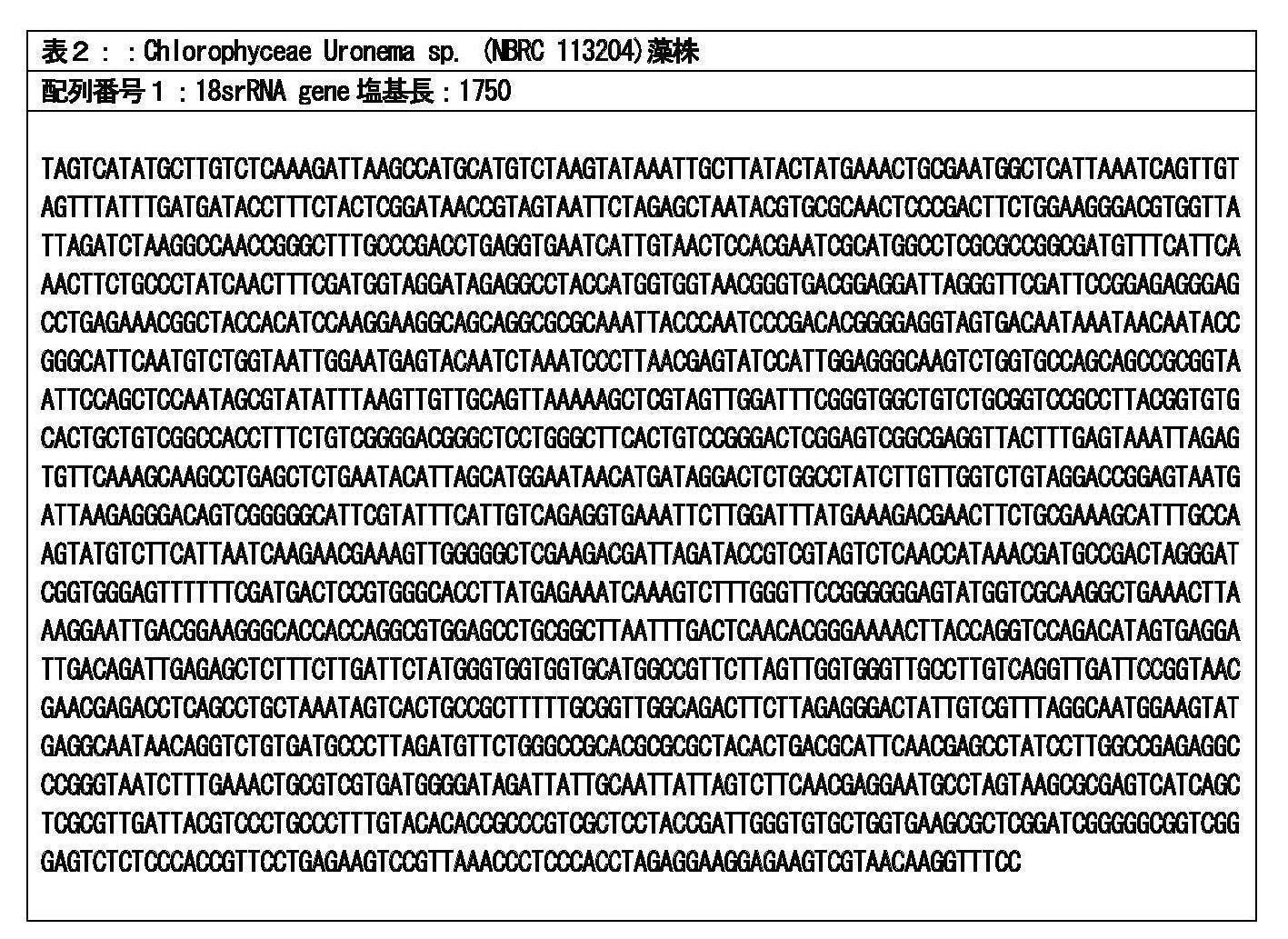
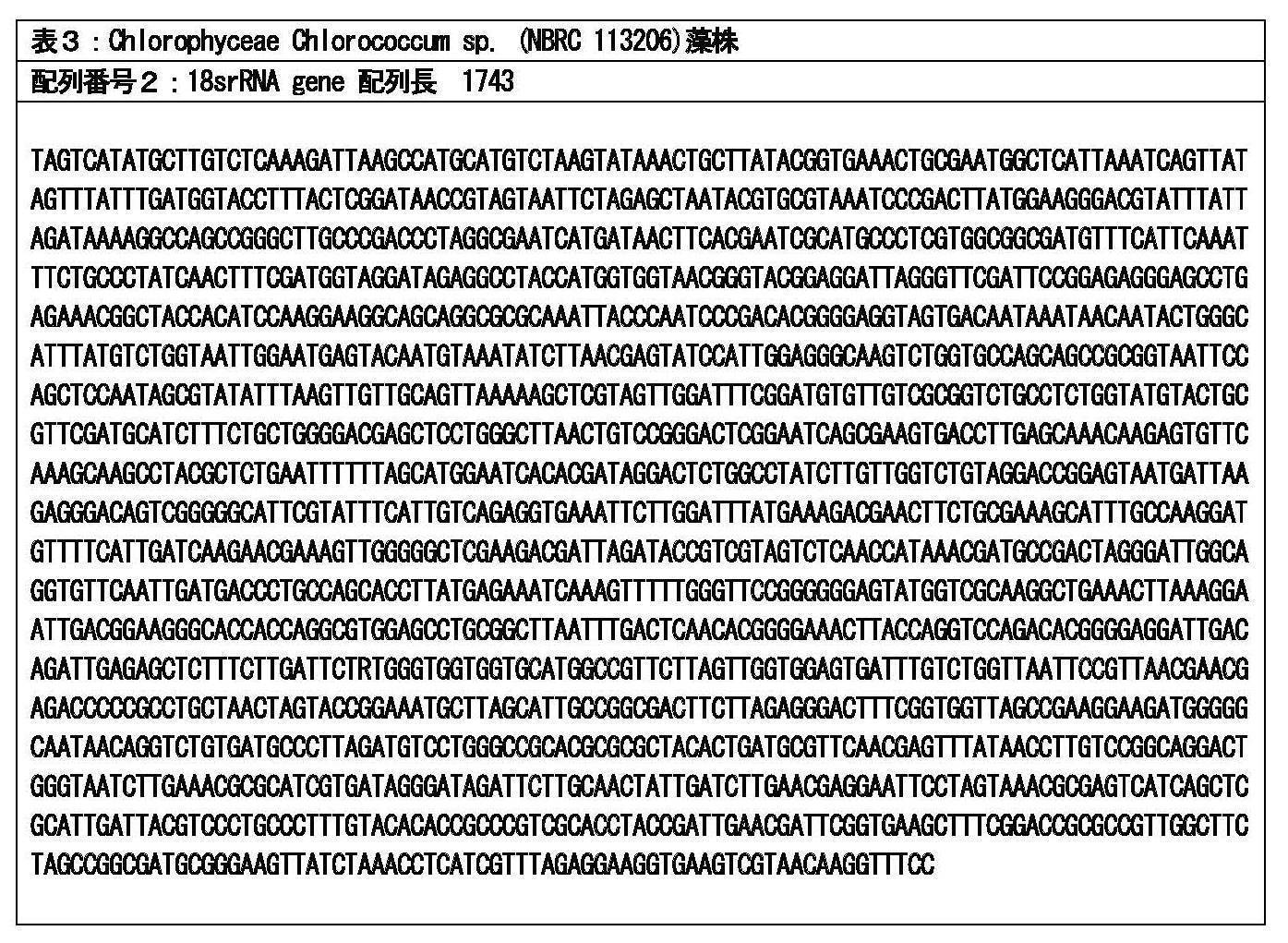
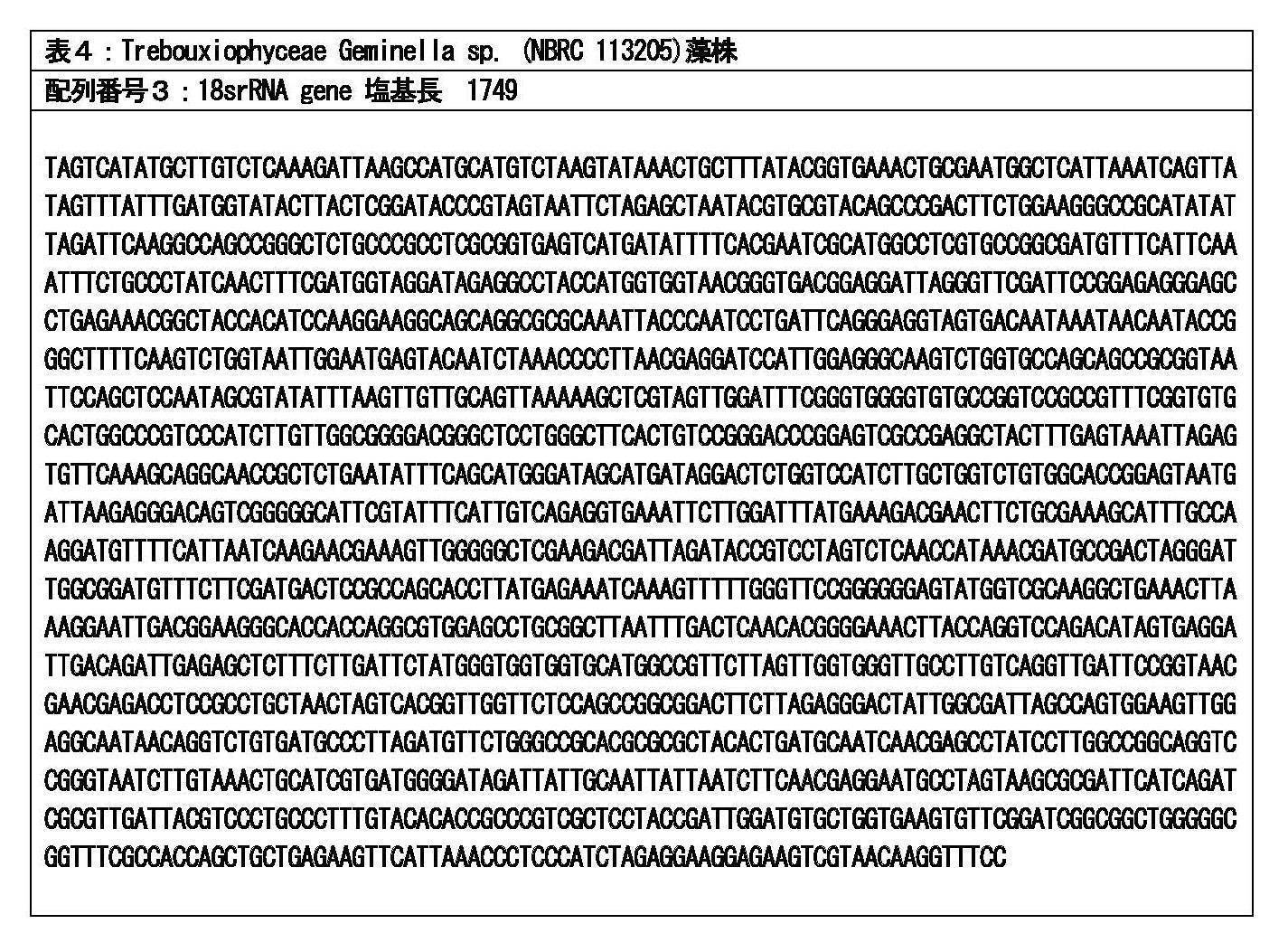
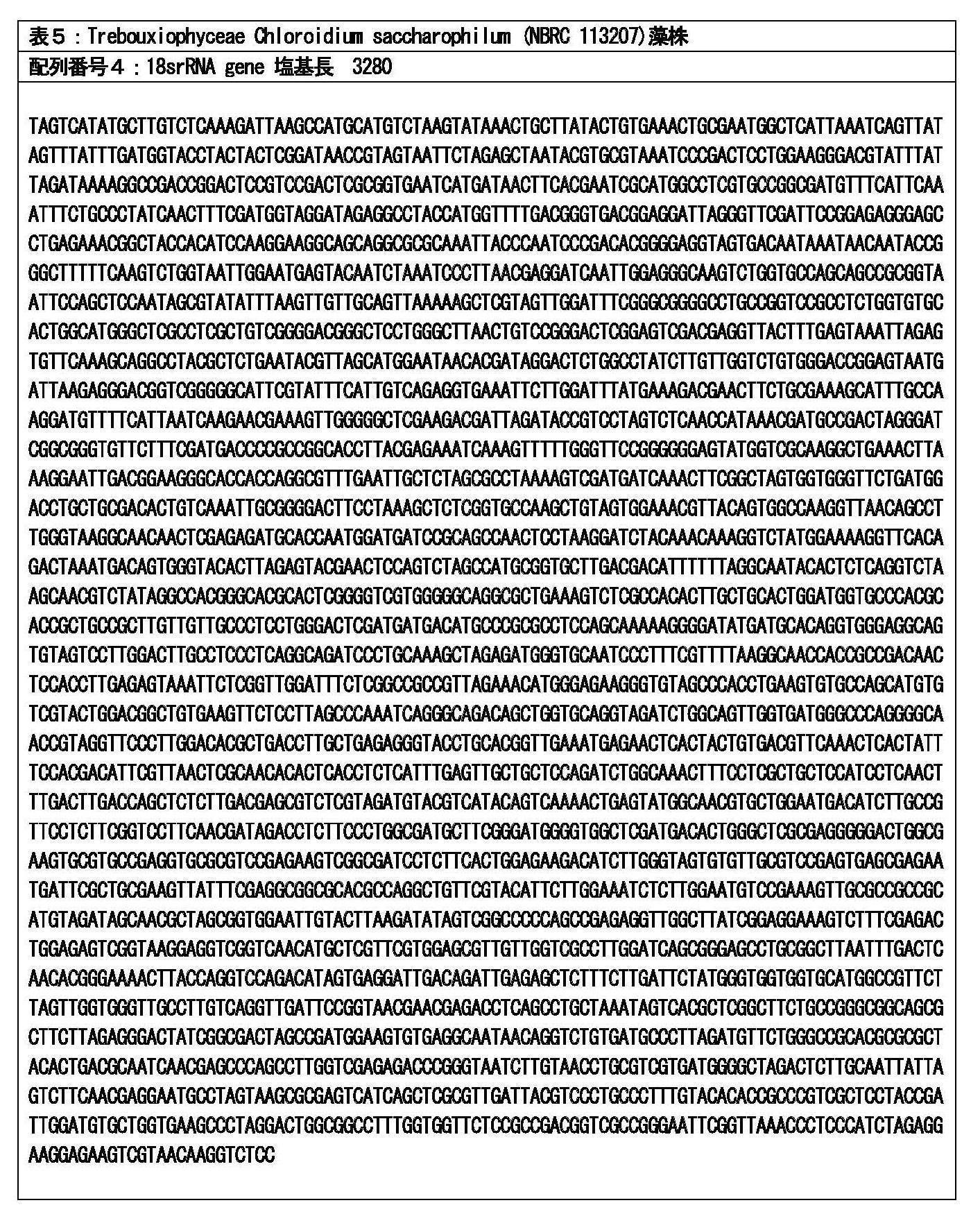
<製造例1~4:藻類由来の培養物(多糖体を含む培養物)の製造方法及び当該培養物の分析>
<藻類由来の培養物(多糖体を含む培養物)の製造方法>
<製造例1>
表1及び6に示す「ウロネマ藻株」を含むスラント状培地(50mL)を、表7又は8に示す基礎培地100mL(300mL容三角フラスコ)に添加し、独立栄養培養条件下で、照度1500~10000lux、23℃で、120rpmにて12日間前培養した。なお、前培養前に、予備的に藻体数を増やしてもよい。
さらに、予備的培養後の培養液1Lを10L容のジャーファメンターに移して12日間本培養を行い、これを本培養後の培養液1とした。このときの培養条件は、照度1500~10000lux、23℃、200rpm、通気0.56vvmの好気的な条件にし、独立栄養培養条件下で行った。
<藻類由来の培養物(多糖体を含む培養物)の製造方法>
<製造例1>
表1及び6に示す「ウロネマ藻株」を含むスラント状培地(50mL)を、表7又は8に示す基礎培地100mL(300mL容三角フラスコ)に添加し、独立栄養培養条件下で、照度1500~10000lux、23℃で、120rpmにて12日間前培養した。なお、前培養前に、予備的に藻体数を増やしてもよい。
さらに、予備的培養後の培養液1Lを10L容のジャーファメンターに移して12日間本培養を行い、これを本培養後の培養液1とした。このときの培養条件は、照度1500~10000lux、23℃、200rpm、通気0.56vvmの好気的な条件にし、独立栄養培養条件下で行った。
<製造例2~4>
表1及び6に示す、「クロロコッカム藻株」、「ジェミネラ藻株」、「クロロイディウム藻株」の各藻株(表1参照)について、上記「ウロネマ藻株」の多糖体の製造方法と同様にして、それぞれ培養を行い、本培養後の培養液2~4を得た。
表1及び6に示す、「クロロコッカム藻株」、「ジェミネラ藻株」、「クロロイディウム藻株」の各藻株(表1参照)について、上記「ウロネマ藻株」の多糖体の製造方法と同様にして、それぞれ培養を行い、本培養後の培養液2~4を得た。
クロロコッカム藻株、ジェミネラ藻株、クロレラ藻株、ユーグレナ藻株には、AF6培地を使用した(表7)。ウロネマ藻株、クロロイディウム藻株には、BG11培地を使用した(表8)。
<製造例1~4の藻類由来の培養物1~4の回収>
前記ウロネマ由来の培養液1を、遠心分離(7000rpm(6500G)、25℃)し、細胞外多糖体を含有する上清液と、藻体とに分離した。
さらに分画分子量5000のUF膜を用いて、培養液を400mLまで濃縮し、凍結乾燥して、ウロネマ由来の多糖体を含む培養物1を得た。
また、ウロネマ由来の培養物1の方法と同様にして、各藻株由来(クロロコッカム藻株、ジェミネラ藻株、クロロイディウム藻株由来)の培養液2~4から、表6に示す各藻株由来の多糖体を含む培養物2~4を得た。
また、各藻株における多糖体の生産量(mg/培養上清1L)は、藻体分離後の上清液についてフェノール硫酸発色法(標品:グルコース)にて行い、その結果を表6に示す。
前記ウロネマ由来の培養液1を、遠心分離(7000rpm(6500G)、25℃)し、細胞外多糖体を含有する上清液と、藻体とに分離した。
さらに分画分子量5000のUF膜を用いて、培養液を400mLまで濃縮し、凍結乾燥して、ウロネマ由来の多糖体を含む培養物1を得た。
また、ウロネマ由来の培養物1の方法と同様にして、各藻株由来(クロロコッカム藻株、ジェミネラ藻株、クロロイディウム藻株由来)の培養液2~4から、表6に示す各藻株由来の多糖体を含む培養物2~4を得た。
また、各藻株における多糖体の生産量(mg/培養上清1L)は、藻体分離後の上清液についてフェノール硫酸発色法(標品:グルコース)にて行い、その結果を表6に示す。
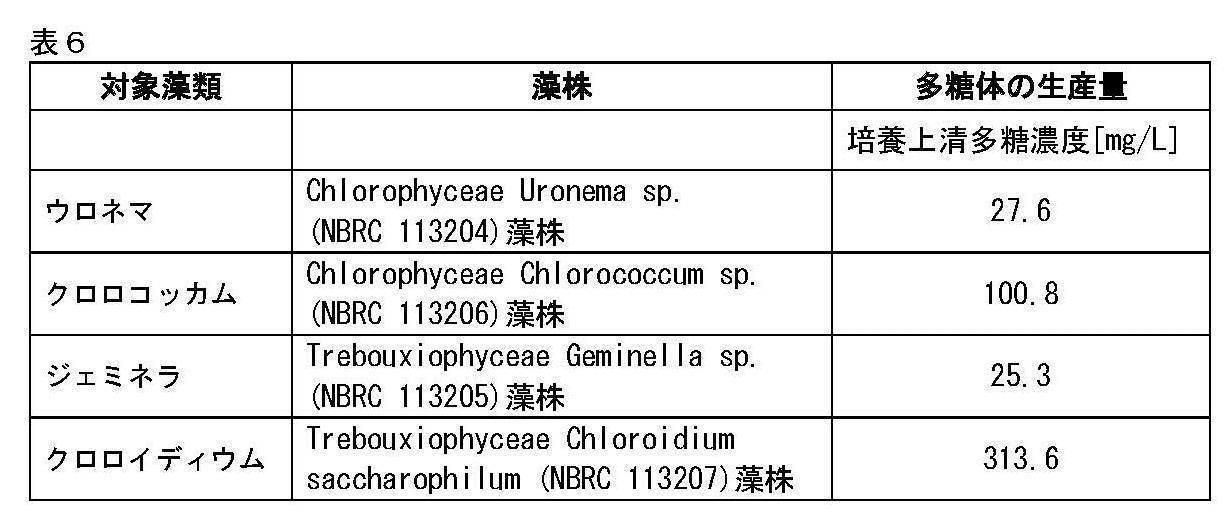
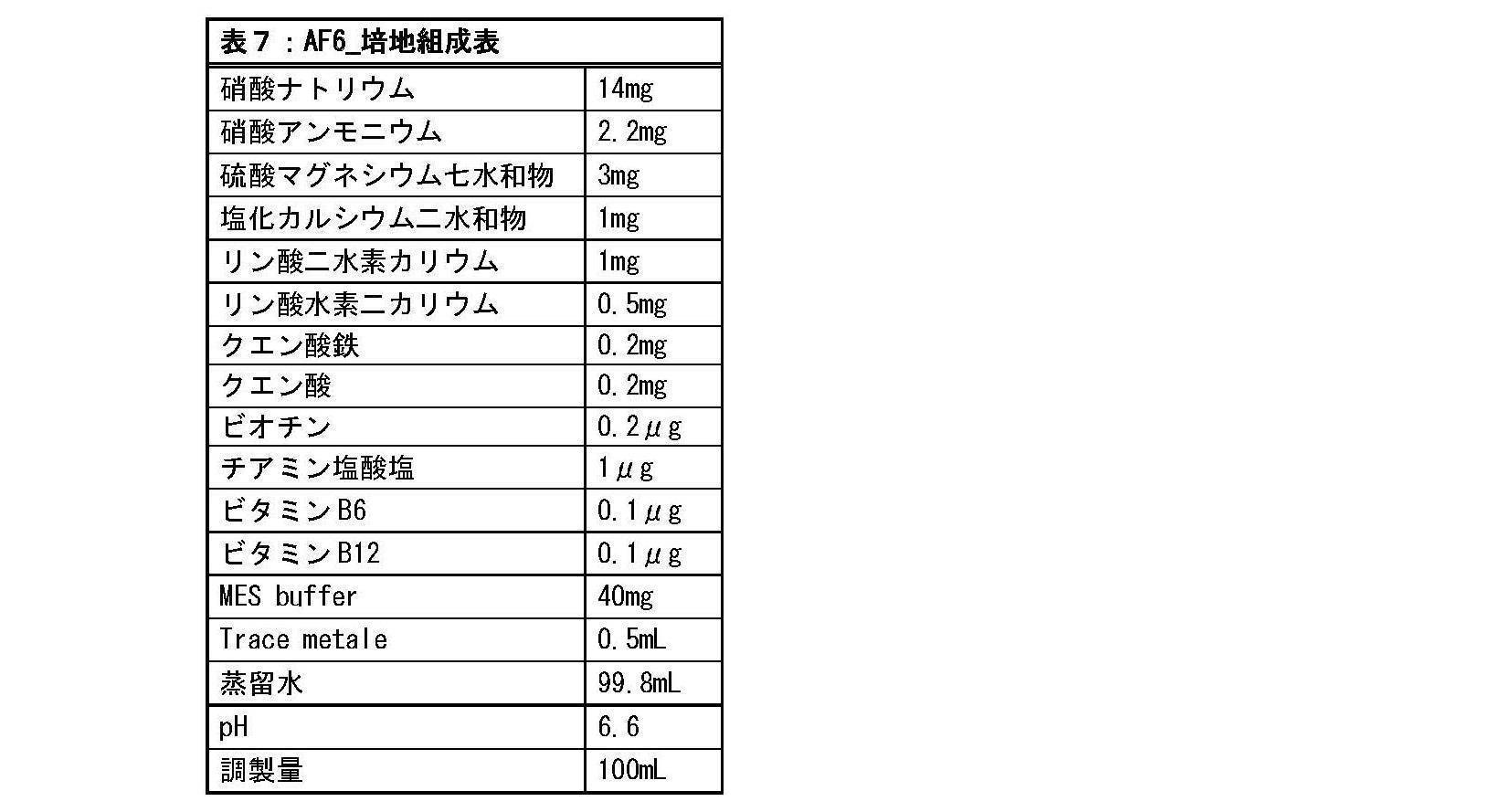

<製造例1~4の各藻株由来の各培養物分析>
各藻株由来の各培養物1~4を凍結乾燥して粉末を得た。各培養物1~4は、ウロネマ由来培養物1、クロロコッカム由来培養物2、ジェミネラ由来培養物3、クロロイディウム由来培養物4である。
各粉末を、酸加水分解法(例えば、加水分解条件:72%硫酸水溶液、室温で1時間攪拌後、4%硫酸水溶液に調整した後、4%硫酸水溶液でオートクレーブ処理(121℃、1時間))HPLC分析、各種糖分析等にて、各培養物中の構成単糖(中性単糖:マンノース、アラビノース、ガラクトース、キシロース、グルコース、ラムノース、リボース、フコース)の測定を行った。その結果、各藻株の培養物に含まれる多糖体の中性糖構成は表9のとおりであった。
各藻株由来の各培養物1~4を凍結乾燥して粉末を得た。各培養物1~4は、ウロネマ由来培養物1、クロロコッカム由来培養物2、ジェミネラ由来培養物3、クロロイディウム由来培養物4である。
各粉末を、酸加水分解法(例えば、加水分解条件:72%硫酸水溶液、室温で1時間攪拌後、4%硫酸水溶液に調整した後、4%硫酸水溶液でオートクレーブ処理(121℃、1時間))HPLC分析、各種糖分析等にて、各培養物中の構成単糖(中性単糖:マンノース、アラビノース、ガラクトース、キシロース、グルコース、ラムノース、リボース、フコース)の測定を行った。その結果、各藻株の培養物に含まれる多糖体の中性糖構成は表9のとおりであった。
1)Chlorophyceae Uronema sp. (NBRC 113204)藻株:ウロネマ培養物中に測定された中性単糖が25質量%含まれ、この培養物中の中性糖において主な構成糖はラムノース13質量%、グルコース5.5質量%であった。
2)Chlorophyceae Chlorococcum sp. (NBRC 113206)藻株:クロロコッカム培養物中に測定された中性単糖が71質量%含まれ、この培養物中の中性糖において主な構成糖はマンノース20質量%、アラビノース23質量%、ガラクトース24質量%であった。
3)Trebouxiophyceae Geminella sp. (NBRC 113205)藻株:ジェミネラ培養物(第1回目)中に測定された中性単糖が41質量%含まれ、この培養物中の中性糖において主な構成糖はアラビノース7質量%、ガラクトース13質量%、ラムノース15質量%であった。
ジェミネラ培養物(第2回目)中で測定された中性単糖が25質量%含まれ、この培養物中の中性糖において主な構成糖はマンノース10質量%、ガラクトース4質量%、ラムノース3質量%、フコース3質量%であった。
4)Trebouxiophyceae Chloroidium saccharophilum (NBRC 113207)藻株:クロロイディウム培養物中に測定された中性単糖が34質量%含まれ、この培養物中の中性糖において主な構成糖はマンノース8質量%、アラビノース7質量%、ガラクトース11質量%であった。
2)Chlorophyceae Chlorococcum sp. (NBRC 113206)藻株:クロロコッカム培養物中に測定された中性単糖が71質量%含まれ、この培養物中の中性糖において主な構成糖はマンノース20質量%、アラビノース23質量%、ガラクトース24質量%であった。
3)Trebouxiophyceae Geminella sp. (NBRC 113205)藻株:ジェミネラ培養物(第1回目)中に測定された中性単糖が41質量%含まれ、この培養物中の中性糖において主な構成糖はアラビノース7質量%、ガラクトース13質量%、ラムノース15質量%であった。
ジェミネラ培養物(第2回目)中で測定された中性単糖が25質量%含まれ、この培養物中の中性糖において主な構成糖はマンノース10質量%、ガラクトース4質量%、ラムノース3質量%、フコース3質量%であった。
4)Trebouxiophyceae Chloroidium saccharophilum (NBRC 113207)藻株:クロロイディウム培養物中に測定された中性単糖が34質量%含まれ、この培養物中の中性糖において主な構成糖はマンノース8質量%、アラビノース7質量%、ガラクトース11質量%であった。
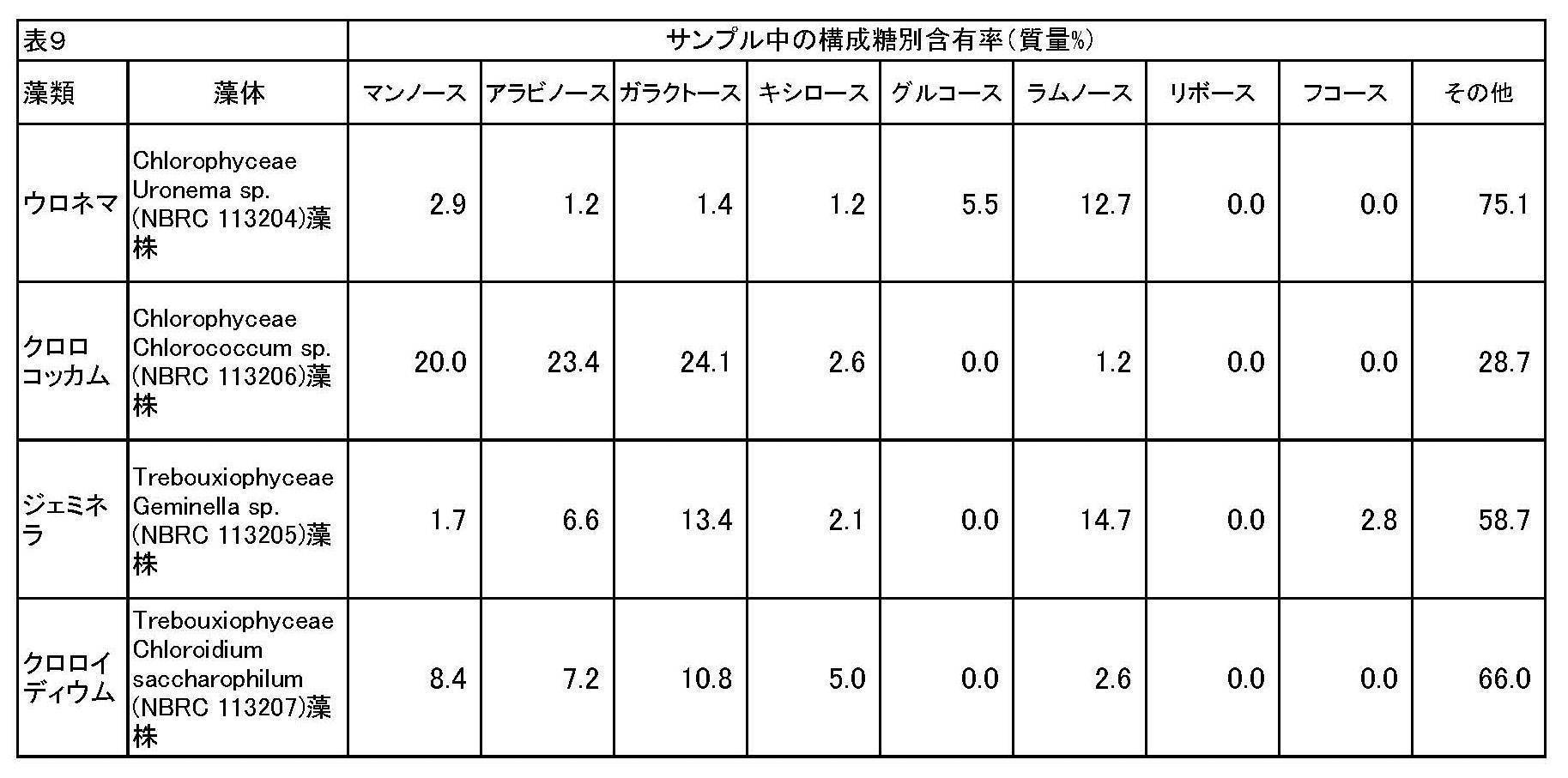
<実施例1~2:PR-1a遺伝子プロモーター発現誘導試験>
PR-1a遺伝子プロモーターの下流にホタルルシフェラーゼ遺伝子を連結したプラスミドコンストラクト(PR-1a::Fluc+)を導入したシロイヌナズナ種子を100μLの滅菌水とともに96Wellプレートに播種し、5日間の春化処理をした後に終濃度0.1mMのルシフェリンを添加し、バイオトロン(明条件12時間、暗条件12時間、相対湿度100%)に置いた。
なお、本実施例は、特許文献1及び2、非特許文献1を参照にして行うことが可能である。また、非特許文献1に示された内容に沿って、タバコ由来のPathogenesis-related gene 1a(PR-1a)遺伝子プロモーターの下流に、ホタルルシフェラーゼ遺伝子(Firefly luciferase; F-luc)を連結させた融合遺伝子(PR-1a::F-luc)を有するプラスミドを得ることができる。当該プラスミドをアグロバクテリウム(Agrobacterium tumefaciens LBA4404)を介してシロイヌナズナに導入し、PR-1a::F-lucを有する形質転換シロイヌナズナ種子(PR-1a::F-luc)を得ることができる。
PR-1a遺伝子プロモーターの下流にホタルルシフェラーゼ遺伝子を連結したプラスミドコンストラクト(PR-1a::Fluc+)を導入したシロイヌナズナ種子を100μLの滅菌水とともに96Wellプレートに播種し、5日間の春化処理をした後に終濃度0.1mMのルシフェリンを添加し、バイオトロン(明条件12時間、暗条件12時間、相対湿度100%)に置いた。
なお、本実施例は、特許文献1及び2、非特許文献1を参照にして行うことが可能である。また、非特許文献1に示された内容に沿って、タバコ由来のPathogenesis-related gene 1a(PR-1a)遺伝子プロモーターの下流に、ホタルルシフェラーゼ遺伝子(Firefly luciferase; F-luc)を連結させた融合遺伝子(PR-1a::F-luc)を有するプラスミドを得ることができる。当該プラスミドをアグロバクテリウム(Agrobacterium tumefaciens LBA4404)を介してシロイヌナズナに導入し、PR-1a::F-lucを有する形質転換シロイヌナズナ種子(PR-1a::F-luc)を得ることができる。
PR-1a遺伝子プロモーター発現誘導試験の試料として、上述した各藻体から得られた培養物1~4を用いた。各培養物1~4は、上述したウロネマ由来培養物1、クロロコッカム由来培養物2、ジェミネラ由来培養物3、クロロイディウム由来培養物4である。
発芽後に滅菌水で調整した各培養物1~4の試料を、各Wellに1/10量添加し、最終濃度とした。各プレートにおける最終濃度は、プレート1(実施例1):0.02wt%(200μg/mL)、プレート2(実施例2):0.002wt%(20μg/mL)とした。なお、試料は、培養物粉末を滅菌水にて1%(10mg/mL)溶液に調整し、-20℃にて保管したものである。
各試料の各処理区につき、12反復行い、PR-1aプロモーター発現誘導はFluc発光活性を指標として評価した。処理による植物体の発光量を遺伝子発現誘導活性として、その強度を経時的にモニタリングした。
フォトカウンティング装置GaAsP IMAGE INTENSIFIER UNIT C8600(浜松フォトニクス株式会社)及び解析ソフトWasabiを使用して、各ウェル内の発光強度を測定してレポーターであるF-lucの発現量を測定することで、各試料のPR-1a遺伝子発現誘導活性についてそれぞれ評価した。
経時的モニタリングの解析タイムポイントは、0.24、48、72、96、120、144、168、192、216時間に設定した。0時間の発光量を1とした相対値を、相対発光量とし、120時間の結果を表10及び11に示した。
発芽後に滅菌水で調整した各培養物1~4の試料を、各Wellに1/10量添加し、最終濃度とした。各プレートにおける最終濃度は、プレート1(実施例1):0.02wt%(200μg/mL)、プレート2(実施例2):0.002wt%(20μg/mL)とした。なお、試料は、培養物粉末を滅菌水にて1%(10mg/mL)溶液に調整し、-20℃にて保管したものである。
各試料の各処理区につき、12反復行い、PR-1aプロモーター発現誘導はFluc発光活性を指標として評価した。処理による植物体の発光量を遺伝子発現誘導活性として、その強度を経時的にモニタリングした。
フォトカウンティング装置GaAsP IMAGE INTENSIFIER UNIT C8600(浜松フォトニクス株式会社)及び解析ソフトWasabiを使用して、各ウェル内の発光強度を測定してレポーターであるF-lucの発現量を測定することで、各試料のPR-1a遺伝子発現誘導活性についてそれぞれ評価した。
経時的モニタリングの解析タイムポイントは、0.24、48、72、96、120、144、168、192、216時間に設定した。0時間の発光量を1とした相対値を、相対発光量とし、120時間の結果を表10及び11に示した。
表10及び11に示すように、各藻類の藻体外に生産された多糖体を含む培養物に、顕著なPR-1a遺伝子発現誘導活性を有することが示唆された。当該多糖体を含む培養物は、ウロネマ、クロロコッカム、ジェミネラ、クロロイディウム由来の産生物である。またこれらは、Chlorophyceae(緑藻綱)藻類及び/又はTrebouxiophyceae(トレボキシア藻綱)藻類でもある。
このことから、緑色の光合成色素を有する単細胞藻類が藻体外に生産する多糖体を主な起因として、PR-1a遺伝子発現誘導を活性化させていると考える。これら培養物には、中性糖としてマンノース、ラムノース及び/又はガラクトースのいずれか1又は2以上を構成単糖とすることで共通するので、これらが何らかの効能に関与していると考える。
また、ウロネマ由来の多糖体は、中性糖において、ラムノース、グルコースを主な構成単糖としている。この主な構成単糖を含む多糖体がPR-1a遺伝子発現誘導を活性化に関与していると考える。
また、クロロコッカム由来の多糖体は、中性糖において、ガラクトース、アラビノース、マンノースを主な構成単糖としている。この主な構成単糖を含む多糖体がPR-1a遺伝子発現誘導を活性化に関与していると考える。
ジェミネラ由来の多糖体は、中性糖において、マンノース、ラムノース、ガラクトースを主な構成単糖としている。この主な構成単糖を含む多糖体がPR-1a遺伝子発現誘導を活性化に関与していると考える。
クロロイディウム由来の多糖体は、中性糖において、ガラクトース、マンノース、アラビノース、キシロースを主な構成単糖としている。この主な構成単糖を含む多糖体がPR-1a遺伝子発現誘導を活性化に関与していると考える。
このことから、緑色の光合成色素を有する単細胞藻類が藻体外に生産する多糖体を主な起因として、PR-1a遺伝子発現誘導を活性化させていると考える。これら培養物には、中性糖としてマンノース、ラムノース及び/又はガラクトースのいずれか1又は2以上を構成単糖とすることで共通するので、これらが何らかの効能に関与していると考える。
また、ウロネマ由来の多糖体は、中性糖において、ラムノース、グルコースを主な構成単糖としている。この主な構成単糖を含む多糖体がPR-1a遺伝子発現誘導を活性化に関与していると考える。
また、クロロコッカム由来の多糖体は、中性糖において、ガラクトース、アラビノース、マンノースを主な構成単糖としている。この主な構成単糖を含む多糖体がPR-1a遺伝子発現誘導を活性化に関与していると考える。
ジェミネラ由来の多糖体は、中性糖において、マンノース、ラムノース、ガラクトースを主な構成単糖としている。この主な構成単糖を含む多糖体がPR-1a遺伝子発現誘導を活性化に関与していると考える。
クロロイディウム由来の多糖体は、中性糖において、ガラクトース、マンノース、アラビノース、キシロースを主な構成単糖としている。この主な構成単糖を含む多糖体がPR-1a遺伝子発現誘導を活性化に関与していると考える。


<実施例3~4:生理活性試験>
<実施例3~4で使用する藻株>
実施例3では、Chlorophyceae Uronema sp. (NBRC 113204)藻株を、ウロネマ藻株として使用した。
実施例3では、Chlorophyceae Chlorococcum sp. (NBRC 113206)藻株を、クロロコッカム藻株として使用した。
実施例3では、Trebouxiophyceae Geminella sp. (NBRC 113205)藻株を、ジェミネラ藻株として使用した。
実施例3では、NBRC Culture Collectionから、Trebouxiophyceae Chloroidium saccharophilum KAMI (NBRC 113807)藻株を入手し(表1参照)、この18srRNAについて、表12(配列番号5)に開示し、クロロコッカムKAMI藻株として使用した。
。
実施例3では、2005年5月に、現在の日本国宮城県大崎市鳴子の潟沼(Katanuma)にて採取したユーグレナ藻株を使用した。
実施例3では、ポジティブコントロールとして、ラミナリン(SIGMA社製)を使用した。
<実施例3~4で使用する藻株>
実施例3では、Chlorophyceae Uronema sp. (NBRC 113204)藻株を、ウロネマ藻株として使用した。
実施例3では、Chlorophyceae Chlorococcum sp. (NBRC 113206)藻株を、クロロコッカム藻株として使用した。
実施例3では、Trebouxiophyceae Geminella sp. (NBRC 113205)藻株を、ジェミネラ藻株として使用した。
実施例3では、NBRC Culture Collectionから、Trebouxiophyceae Chloroidium saccharophilum KAMI (NBRC 113807)藻株を入手し(表1参照)、この18srRNAについて、表12(配列番号5)に開示し、クロロコッカムKAMI藻株として使用した。
。
実施例3では、2005年5月に、現在の日本国宮城県大崎市鳴子の潟沼(Katanuma)にて採取したユーグレナ藻株を使用した。
実施例3では、ポジティブコントロールとして、ラミナリン(SIGMA社製)を使用した。
実施例4では、Chlorophyceae Chlorococcum sp. (NBRC 113206)藻株を、クロロコッカム藻株として使用した。
実施例4では、Chlorella vulgaris Chikugo株(チクゴ株:クロレラ工業)を、クロレラ藻株として、使用した。
実施例4では、Chlorella vulgaris Chikugo株(チクゴ株:クロレラ工業)を、クロレラ藻株として、使用した。
5)Trebouxiophyceae Chloroidium saccharophilum KAMI (NBRC 113807):(公開日2019年2月25日/ウェブサイトURL:http://www.nbrc.nite.go.jp/NBRC2/NBRCCatalogueDetailServlet?ID=NBRC&CAT=00113807、ウェブサイト印刷日2019年2月25日)
採取地(株の由来) 北海道斜里郡清里町神の子池)Kaminoko Pond, Shari-gun, Kiyosato-cho, Hokkaido)採集日:2012/5/7。
採取地(株の由来) 北海道斜里郡清里町神の子池)Kaminoko Pond, Shari-gun, Kiyosato-cho, Hokkaido)採集日:2012/5/7。

<実施例3~4で使用する試料>
上述した<製造例1~4:藻類由来の培養物(多糖体を含む培養物)の製造方法及び当該培養物の分析><藻類由来の培養物(多糖体を含む培養物)の製造方法>と同様にして、<実施例3~4で使用する藻株>記載の各藻株から各培養物を得、これを各試料とした。
具体的には、クロロコッカム藻株、ジェミネラ藻株、クロロイディウムYAMA藻株、クロレラ藻株には、AF6培地を使用し(表7)、ウロネマ藻株、クロロイディウムKAMI藻株には、BG11培地を使用し(表8)、ユーグレナ藻株には、KO2培地を使用し上記製造例1~4を参考にして各藻株に適した培養を行い、多糖体を含む培養物をそれぞれ得た。
このようにして、実施例3の試料として、ウロネマ由来培養物5、クロロコッカム由来培養物6、ジェミネラ由来培養物7、クロロイディウムKAMI由来培養物8、ユーグレナ由来培養物9を得た。また、実施例4の試料として、クロロイディウムYAMA由来培養物10、クロレラ由来培養物11を得た。
このときクロロイディウムKAMI藻株における多糖体の生産量(mg/培養上清1L)は、藻体分離後の上清液についてフェノール硫酸発色法(標品:グルコース)にて行い、300mg/Lであった。
上述した<製造例1~4:藻類由来の培養物(多糖体を含む培養物)の製造方法及び当該培養物の分析><藻類由来の培養物(多糖体を含む培養物)の製造方法>と同様にして、<実施例3~4で使用する藻株>記載の各藻株から各培養物を得、これを各試料とした。
具体的には、クロロコッカム藻株、ジェミネラ藻株、クロロイディウムYAMA藻株、クロレラ藻株には、AF6培地を使用し(表7)、ウロネマ藻株、クロロイディウムKAMI藻株には、BG11培地を使用し(表8)、ユーグレナ藻株には、KO2培地を使用し上記製造例1~4を参考にして各藻株に適した培養を行い、多糖体を含む培養物をそれぞれ得た。
このようにして、実施例3の試料として、ウロネマ由来培養物5、クロロコッカム由来培養物6、ジェミネラ由来培養物7、クロロイディウムKAMI由来培養物8、ユーグレナ由来培養物9を得た。また、実施例4の試料として、クロロイディウムYAMA由来培養物10、クロレラ由来培養物11を得た。
このときクロロイディウムKAMI藻株における多糖体の生産量(mg/培養上清1L)は、藻体分離後の上清液についてフェノール硫酸発色法(標品:グルコース)にて行い、300mg/Lであった。
〔KO2培地組成〕
硝酸ナトリウム 85mg:硫酸アンモニウム 66mg:リン酸二水素カリウム 27mg:リン酸マグネシウム七水和物 25mg:塩化カルシウム二水和物 11mg:硫酸鉄七水和物 2mg:EDTA-2Na 3mg:N1 Metals solution ※1 0.1mL:蒸留水 99mL:pH 2:調製量 100mL。
※1[N1 Metals solution組成]
ホウ酸 2.86g:塩化マンガン四水和物 1.81g:硫酸亜鉛七水和物 0.22g:硫酸銅五水和物 0.08g:三酸化モリブデン 15mg:蒸留水 1000mL:調製量 1000mL。
硝酸ナトリウム 85mg:硫酸アンモニウム 66mg:リン酸二水素カリウム 27mg:リン酸マグネシウム七水和物 25mg:塩化カルシウム二水和物 11mg:硫酸鉄七水和物 2mg:EDTA-2Na 3mg:N1 Metals solution ※1 0.1mL:蒸留水 99mL:pH 2:調製量 100mL。
※1[N1 Metals solution組成]
ホウ酸 2.86g:塩化マンガン四水和物 1.81g:硫酸亜鉛七水和物 0.22g:硫酸銅五水和物 0.08g:三酸化モリブデン 15mg:蒸留水 1000mL:調製量 1000mL。
<実施例3~4:PR-1a遺伝子プロモーター発現誘導試験>
実施例3~4のPR-1a遺伝子プロモーター発現誘導試験は、<実施例1~2:PR-1a遺伝子プロモーター発現誘導試験>と同様にして、各試料についての発現誘導を確認した。このときの使用した濃度は、0.02mg/mLであった。
経時的モニタリングの解析タイムポイントは、0.24、48、72、96、120、144、168、192、216、240、264時間に設定した。0時間の発光量を1とした相対値を、相対発光量とした。
PR-1a遺伝子プロモーター発現誘導試験における、実施例3の各試料の結果を表13及び図1に示し、実施例4の各試料の結果を表14に示した。
実施例3~4のPR-1a遺伝子プロモーター発現誘導試験は、<実施例1~2:PR-1a遺伝子プロモーター発現誘導試験>と同様にして、各試料についての発現誘導を確認した。このときの使用した濃度は、0.02mg/mLであった。
経時的モニタリングの解析タイムポイントは、0.24、48、72、96、120、144、168、192、216、240、264時間に設定した。0時間の発光量を1とした相対値を、相対発光量とした。
PR-1a遺伝子プロモーター発現誘導試験における、実施例3の各試料の結果を表13及び図1に示し、実施例4の各試料の結果を表14に示した。
表13及び14に示すように、各藻類の藻体外に生産された多糖体を含む培養物に、顕著なPR-1a遺伝子発現誘導活性を有することが示唆された。当該多糖体を含む培養物は、ウロネマ由来、クロロコッカム由来、ジェミネラ由来、クロロイディウム(好適にはKAMI)由来、ユーグレナ由来、クロレラ由来の産生物である。これら産生物は、PR-1a遺伝子プロモーター発現誘導を活性化させる作用があることが示された。
このうち、ウロネマ由来(1.35倍)、クロロコッカム由来(1.11倍)、ジェミネラ由来(1.37倍)、クロロイディウムKAMI由来(1.12倍)、ユーグレナ由来(1.10倍)の産生物は、ラミナリンよりも、Maxピーク(活性)値が高かった。また、これら産生物のMaxピーク値は、ラミナリンのMaxピーク値よりも前にシフトしており、この時間の差は、ラミナリンのMaxピーク時間の0.67~0.78になっており、ラミナリンと比較して速効型といえる。これら藻類由来の培養物中の活性物質について検討中であるが、通常多糖体は高分子であるため遅効的であることが多い。しかし、これら藻類由来の培養物は、ラミナリンと同じ高分子の多糖体でありながら、速効的であることは、これらの優れた利点といえる。また、各産生物とラミナリンとの両者を併用することで、作用時期を調整することが容易である。


<実施例3~4の各藻株由来の各培養物分析>
実施例3~4の各藻株由来の各培養物分析を行った。具体的には、実施例3の試料として、ウロネマ由来培養物5、クロロコッカム由来培養物6、ジェミネラ由来培養物7、クロロイディウムKAMI由来培養物8、また、実施例4の試料として、クロロイディウムYAMA由来培養物10を使用した。
実施例3~4の各藻株由来の各培養物分析を行った。具体的には、実施例3の試料として、ウロネマ由来培養物5、クロロコッカム由来培養物6、ジェミネラ由来培養物7、クロロイディウムKAMI由来培養物8、また、実施例4の試料として、クロロイディウムYAMA由来培養物10を使用した。
これら藻株由来の各培養物について、以下のように、ABEE標識化法を用いて、各培養物中の構成単糖の分析を行った(Yasuno, S., et al., Biosci. Biotechnol. Biochem., 61, 1944(1997)、Yasuno, S., et al., Biosci. Biotechnol. Biochem., 63, 1353(1999))。
Man:マンノース、Ara:アラビノース、Gal:ガラクトース、Xyl:キシロース、Glc:グルコース、Rha:ラムノース、Rib:リボース、Fuc:フコース、NAc-GlcN:Nアセチルグルコサミン、NAc-GalN:Nアセチルガラクトサミン、NAc-ManN:Nアセチルマンノサミン、GalUA:ガラクツロン酸、GlcUA:グルクロン酸。
1)HPLC装置
ACQUITY UPLC H Classシステム(製造元Waters) ACQUITY UPLC BEH C18 Column,1.7 μm, 2.1 x 100 mm(製造元:J-オイルミルズ)、カラム温度:50℃、移動相:A/B=0.2MPotassium borate(pH 8.9)/ACN、流速:0.7mL/min、検出:蛍光(Ex.305nm,Em.360nm)。
Man:マンノース、Ara:アラビノース、Gal:ガラクトース、Xyl:キシロース、Glc:グルコース、Rha:ラムノース、Rib:リボース、Fuc:フコース、NAc-GlcN:Nアセチルグルコサミン、NAc-GalN:Nアセチルガラクトサミン、NAc-ManN:Nアセチルマンノサミン、GalUA:ガラクツロン酸、GlcUA:グルクロン酸。
1)HPLC装置
ACQUITY UPLC H Classシステム(製造元Waters) ACQUITY UPLC BEH C18 Column,1.7 μm, 2.1 x 100 mm(製造元:J-オイルミルズ)、カラム温度:50℃、移動相:A/B=0.2MPotassium borate(pH 8.9)/ACN、流速:0.7mL/min、検出:蛍光(Ex.305nm,Em.360nm)。
試料にMilliQ水(MQW)を添加して10mg/mL溶液を調製し、当該溶液10μLを加水分解試料とした。具体的には、各試料を10μLずつチューブに分取し、分取した各チューブへTFA(トリフルオロ酢酸)を加え、撹拌、遠心した後、100℃で3時間加熱した。空冷した後、遠心処理し、SpeedVacにて乾固させた。2-プロパノールを加え、撹拌した後、SpeedVacにより乾固させた試料にピリジン/メタノール及び、無水酢酸を加え、室温で30分反応させた。溶液をSpeedVacにより乾固させ、ABEE標識化へと進めた。ABEE標識化試薬(ABEE、シアノ水素化ホウ素ナトリウム、酢酸、メタノール)を加え、80℃、1時間反応させた。MQW 200μL、クロロホルム200μLにて後処理を実施し、水層を回収し、HPLCにインジェクトした。ピーク面積から各単糖の検量線を作成するとともに、サンプル中に含まれる単糖を定量した。
さらに、カルバゾール硫酸発色法(GalUA換算)を用いて、乾燥培養物100μg/mLに調整して各培養物中のウロン酸の分析を行った。各試料中のウロン酸含有量(GalUA換算)の結果を、表16に示す。
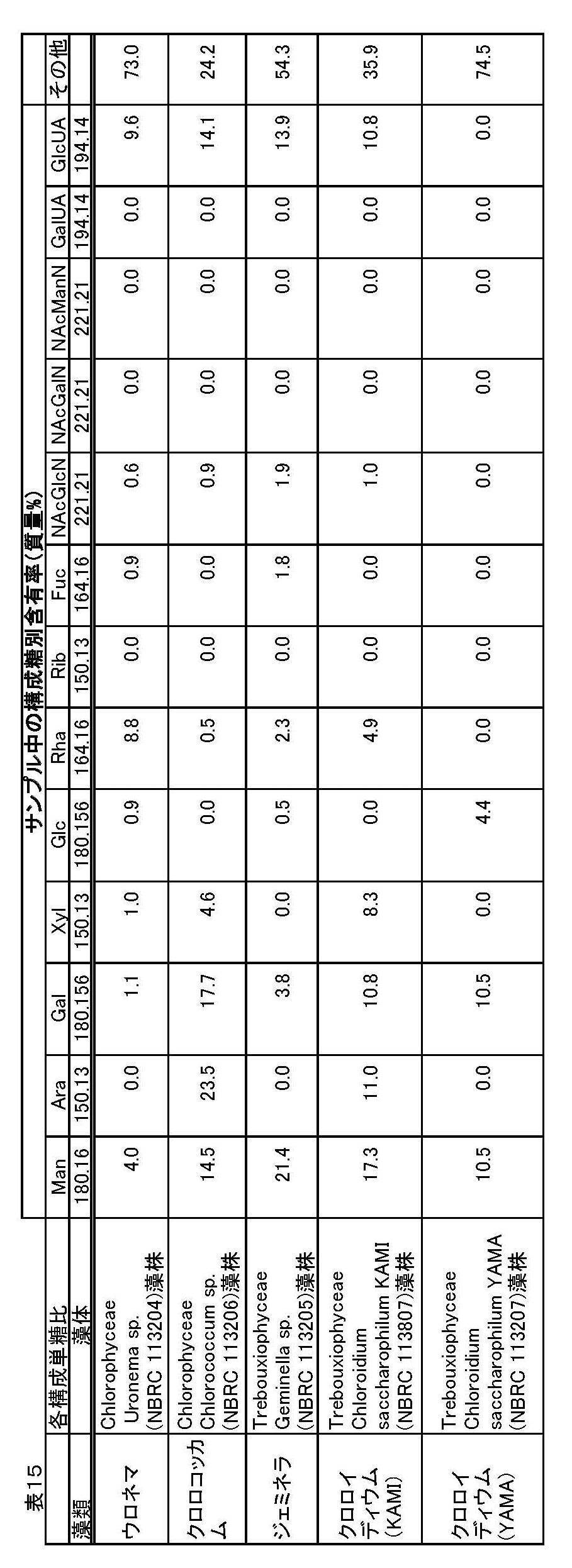

表15にABEE標識化法による糖分析の結果、表16にウロン酸の結果を示す。
ジェミネラ、ウロネマ、クロロコッカム及びクロロイディウムの各藻株の培養物に含まれる各多糖体における単糖構成は表15のとおりであった。
ウロネマ由来の多糖体は、ラムノース、マンノース、グルクロン酸を主な構成単糖としている。
クロロコッカム由来の多糖体は、マンノース、アラビノース、ガラクトース、グルクロン酸を主な構成単糖としている。
ジェミネラ由来の多糖体は、マンノース、グルクロン酸を主な構成単糖としている。
クロロイディウムKAMI由来の多糖体は、マンノース、アラビノース、ガラクトース、キシロース、ラムノース及びグルクロン酸を主な構成単糖としている。
クロロイディウムYAMA由来の多糖体は、マンノース、ガラクトース、及びグルコースを主な構成単糖としている。
ジェミネラ、ウロネマ、クロロコッカム及びクロロイディウムの各藻株の培養物に含まれる各多糖体における単糖構成は表15のとおりであった。
ウロネマ由来の多糖体は、ラムノース、マンノース、グルクロン酸を主な構成単糖としている。
クロロコッカム由来の多糖体は、マンノース、アラビノース、ガラクトース、グルクロン酸を主な構成単糖としている。
ジェミネラ由来の多糖体は、マンノース、グルクロン酸を主な構成単糖としている。
クロロイディウムKAMI由来の多糖体は、マンノース、アラビノース、ガラクトース、キシロース、ラムノース及びグルクロン酸を主な構成単糖としている。
クロロイディウムYAMA由来の多糖体は、マンノース、ガラクトース、及びグルコースを主な構成単糖としている。
ジェミネラ、ウロネマ、クロロコッカム及びクロロイディウムの各藻株の培養物に含まれる各多糖体中には、ウロン酸が含まれており、当該ウロン酸(GalUA換算)含有率は、表16のとおりであった。このことから、緑色の光合成色素を有する単細胞藻類が藻体外に生産する多糖体にはウロン酸が含まれていることで、ウロン酸を含まないラミナリンとは違うPR-1a遺伝子発現誘導作用(例えば、効能速度等)を有すると考える。
上述のように、上記各多糖体は、構成単糖として上述のようなウロン酸及び中性単糖を有することで、PR-1a遺伝子発現誘導を活性化に関与していると考える。
上述のように、上記各多糖体は、構成単糖として上述のようなウロン酸及び中性単糖を有することで、PR-1a遺伝子発現誘導を活性化に関与していると考える。
本技術の培養物は、緑色の光合成色素を有する単細胞藻類の培養物であるため、直接的な殺虫・殺菌性を示さないと考える。そして、本技術の培養物は、直接的な殺虫・殺菌性を示さないことから、耐性菌出現率が低く、施用量も少量で抑えることができ、効果も持続的であり、防除目的外の生物に対する影響も少ないと考える。
また、本技術の培養物は、多糖体の炭素源を豊富に含み、また、当該培養物中に種々の成分を含むことも可能であることから、植物の施肥的な効能も期待することができる。
本技術の培養物は、液体培養によって得られるものであるため、水溶性が高く農場等の灌漑水と混合させて簡便に使用することができる。また、本技術の培養物は、不溶性成分が含まれている場合でも散布等の施用後に次第に分解していくと考えるので、長期的な効能発揮が期待でき、一方で環境負荷が低いと考える。また、施用時に、化学農薬のような体内被爆のおそれも少ない利点がある。
また、本技術の培養物は、必要なときに必要な場所で必要な作物に使用でき、汎用性が高いと考える。
また、本技術の培養物は、多糖体の炭素源を豊富に含み、また、当該培養物中に種々の成分を含むことも可能であることから、植物の施肥的な効能も期待することができる。
本技術の培養物は、液体培養によって得られるものであるため、水溶性が高く農場等の灌漑水と混合させて簡便に使用することができる。また、本技術の培養物は、不溶性成分が含まれている場合でも散布等の施用後に次第に分解していくと考えるので、長期的な効能発揮が期待でき、一方で環境負荷が低いと考える。また、施用時に、化学農薬のような体内被爆のおそれも少ない利点がある。
また、本技術の培養物は、必要なときに必要な場所で必要な作物に使用でき、汎用性が高いと考える。
Claims (10)
- 緑色の光合成色素を有する単細胞藻類の培養物を有効成分とする、PR1遺伝子発現誘導活性剤。
- 前記藻類が、Trebouxiophyceae(トレボキシア藻綱)藻類及び/又はChlorophyceae(緑藻綱)藻類である、請求項1記載のPR1遺伝子活性化剤。
- 前記藻類が、ジェミネラ、ウロネマ、クロロコッカム及びクロロイディウムから選択される1種又は2種以上である、請求項1又は2記載のPR1遺伝子活性化剤。
- 前記培養物中の細胞外多糖体が、ウロン酸を少なくとも含むものである、請求項1~3のいずれか記載のPR1遺伝子活性化剤。
- 前記培養物中の細胞外多糖体が、ウロン酸5~40質量%と中性単糖とを少なくとも含み、当該中性単糖がマンノース、ガラクトース及びラムノースから選択される1種又は2種以上のものである、請求項1~4のいずれか記載のPR1遺伝子活性化剤。
- 前記藻体が、[1]Chlorophyceae Uronema sp. (NBRC 113204)藻株;[2]Trebouxiophyceae Geminella sp. (NBRC 113205)藻株;[3]Chlorophyceae Chlorococcum sp. (NBRC 113206)藻株;[4]Trebouxiophyceae Chloroidium saccharophilum YAMA (NBRC 113207)藻株;[5]Trebouxiophyceae Chloroidium saccharophilum KAMI (NBRC 113807)藻株から選択される1種又は2種以上のものである、請求項1~5のいずれか記載のPR1遺伝子活性化剤。
- 緑色の光合成色素を有する単細胞藻類の培養物を有効成分とする、植物用抵抗性誘導剤。
- 緑色の光合成色素を有する単細胞藻類の培養物を有効成分とする、植物病害予防・改善剤。
- 緑色の光合成色素を有する単細胞藻類を、好気的条件下で培養をし、細胞外多糖体を含む培養物を得る、植物用抵抗性誘導成分の製造方法。
- 植物用抵抗性誘導成分を製造するための、緑色の光合成色素を有する単細胞藻類の使用。
Priority Applications (4)
| Application Number | Priority Date | Filing Date | Title |
|---|---|---|---|
| EP19775007.8A EP3777539A4 (en) | 2018-03-30 | 2019-03-22 | RESISTANCE INDUCER FOR PLANTS |
| US16/977,466 US11659839B2 (en) | 2018-03-30 | 2019-03-22 | Resistance inducing agent for plants |
| CN201980017742.6A CN112334006B (zh) | 2018-03-30 | 2019-03-22 | 植物用抗性诱导剂 |
| JP2020509955A JP7116961B2 (ja) | 2018-03-30 | 2019-03-22 | 植物用抵抗性誘導剤 |
Applications Claiming Priority (2)
| Application Number | Priority Date | Filing Date | Title |
|---|---|---|---|
| JP2018067567 | 2018-03-30 | ||
| JP2018-067567 | 2018-03-30 |
Publications (1)
| Publication Number | Publication Date |
|---|---|
| WO2019188773A1 true WO2019188773A1 (ja) | 2019-10-03 |
Family
ID=68061946
Family Applications (1)
| Application Number | Title | Priority Date | Filing Date |
|---|---|---|---|
| PCT/JP2019/012056 Ceased WO2019188773A1 (ja) | 2018-03-30 | 2019-03-22 | 植物用抵抗性誘導剤 |
Country Status (5)
| Country | Link |
|---|---|
| US (1) | US11659839B2 (ja) |
| EP (1) | EP3777539A4 (ja) |
| JP (1) | JP7116961B2 (ja) |
| CN (1) | CN112334006B (ja) |
| WO (1) | WO2019188773A1 (ja) |
Cited By (1)
| Publication number | Priority date | Publication date | Assignee | Title |
|---|---|---|---|---|
| WO2021110648A1 (fr) * | 2019-12-02 | 2021-06-10 | Mytamar Gmbh | Utilisation de saccharides de dattes seuls ou en melange avec des polyphenols pour proteger les plantes contre des pathogenes |
Citations (4)
| Publication number | Priority date | Publication date | Assignee | Title |
|---|---|---|---|---|
| JP2013124241A (ja) | 2011-12-15 | 2013-06-24 | Yokohama National Univ | 植物抵抗性誘導剤、植物の抵抗性誘導方法、及び植物病害の予防方法 |
| WO2017044774A1 (en) * | 2015-09-11 | 2017-03-16 | Heliae Development, Llc | Microalgae based compositions and methods for application to plants |
| US20170226509A1 (en) * | 2014-08-06 | 2017-08-10 | Valagro S.P.A. | Method for modulating plant processes |
| JP2017197456A (ja) | 2016-04-26 | 2017-11-02 | 国立大学法人横浜国立大学 | 植物抵抗性誘導制御剤、植物抵抗性誘導制御方法、及び植物病害の防除方法 |
Family Cites Families (11)
| Publication number | Priority date | Publication date | Assignee | Title |
|---|---|---|---|---|
| JPH0748214A (ja) * | 1993-08-05 | 1995-02-21 | Mitsui Eng & Shipbuild Co Ltd | 病原菌に対する植物抵抗性増強剤 |
| GB9611089D0 (en) * | 1996-05-28 | 1996-07-31 | Sandoz Ltd | Organic compounds |
| ITMI20040402A1 (it) * | 2004-03-03 | 2004-06-03 | Isagro Spa | Miscele e metodo per l'induzione di resistenza nella pianta |
| WO2010037714A1 (en) * | 2008-09-30 | 2010-04-08 | Basf Plant Science Gmbh | Method for producing a transgenic plant cell, a plant or a part thereof with increased resistance biotic stress |
| CN101638662B (zh) * | 2009-09-02 | 2013-04-17 | 山东农业大学 | 辣椒疫霉多聚半乳糖醛酸酶Pcipg5基因、蛋白制备方法及其应用 |
| WO2012101459A2 (en) * | 2011-01-28 | 2012-08-02 | Algaecytes Limited | Process for production of microalgae, cyanobacteria and metabolites thereof |
| CN103160494B (zh) * | 2013-02-01 | 2015-10-21 | 安徽农业大学 | 一种提高小球藻光合作用效率的化学复合诱变方法 |
| CN105685766B (zh) * | 2014-11-27 | 2020-11-27 | 丰益(上海)生物技术研发中心有限公司 | 微藻发酵液胞外多糖、其制备方法及用途 |
| CN104531656B (zh) * | 2015-01-05 | 2018-02-09 | 安徽省农业科学院水稻研究所 | 一种来自小球藻的磷酸甘露糖异构酶基因及其应用 |
| US20180289016A1 (en) * | 2015-04-30 | 2018-10-11 | Micoperi Blue Growth S.R.L. | Microalgae extract for agricultural use |
| WO2017218896A1 (en) * | 2016-06-16 | 2017-12-21 | Heliae Development, Llc | Microalgae-based composition, and methods of its preparation and application to plants |
-
2019
- 2019-03-22 WO PCT/JP2019/012056 patent/WO2019188773A1/ja not_active Ceased
- 2019-03-22 JP JP2020509955A patent/JP7116961B2/ja active Active
- 2019-03-22 CN CN201980017742.6A patent/CN112334006B/zh active Active
- 2019-03-22 US US16/977,466 patent/US11659839B2/en active Active
- 2019-03-22 EP EP19775007.8A patent/EP3777539A4/en active Pending
Patent Citations (4)
| Publication number | Priority date | Publication date | Assignee | Title |
|---|---|---|---|---|
| JP2013124241A (ja) | 2011-12-15 | 2013-06-24 | Yokohama National Univ | 植物抵抗性誘導剤、植物の抵抗性誘導方法、及び植物病害の予防方法 |
| US20170226509A1 (en) * | 2014-08-06 | 2017-08-10 | Valagro S.P.A. | Method for modulating plant processes |
| WO2017044774A1 (en) * | 2015-09-11 | 2017-03-16 | Heliae Development, Llc | Microalgae based compositions and methods for application to plants |
| JP2017197456A (ja) | 2016-04-26 | 2017-11-02 | 国立大学法人横浜国立大学 | 植物抵抗性誘導制御剤、植物抵抗性誘導制御方法、及び植物病害の防除方法 |
Non-Patent Citations (16)
| Title |
|---|
| "Evaluation of the Use of the Tobacco PR-1a Promoter to Monitor Defense Gene Expression by the Luciferase Bioluminescence Reporter System", BIOSCI. BIOTECHNOL. BIOCHEM, vol. 75, no. 9, 2011, pages 1796 - 1800 |
| CHLOROPHYCEAE CHLOROCOCCUM SP. (NBRC 113206) ALGA STRAIN, 29 March 2018 (2018-03-29), Retrieved from the Internet <URL:http://www.nbrc.nite.go.jp/NBRC2/NBRCCatalogueDetailServlet?ID=NBRC&CAT=00113206> |
| CHLOROPHYCEAE CHLOROCOCCUM SP. (NBRC 113206, 29 March 2018 (2018-03-29), Retrieved from the Internet <URL:http://www.nbrc.nite.go.ip/NBRC2/NBRCCataloqueDetailServlet?ID=NBRC&CAT=00113206> |
| CHLOROPHYCEAE URONEMA SP. (NBRC 113204) ALGA STRAIN, 29 March 2018 (2018-03-29), Retrieved from the Internet <URL:http://www.nbrc.nite.go.jp/NBRC2/NBRCCatalogueDetailServlet?ID=NBRC&CAT=00113204> |
| CHLOROPHYCEAE URONEMA SP. (NBRC 113204, 29 March 2018 (2018-03-29), Retrieved from the Internet <URL:http://www.nbrc.nite.go.ip/NBRC2/NBRCCataloqueDetailServlet?ID=NBRC&CAT=00113204> |
| KLARZYNSKI, OLIVIER ET AL.: "Sulfated fucan oligosaccharides elicit defense responses in tobacco and local and systemic resistance against tobacco mosaic virus", MOLECULAR PLANT-MICROBE INTERACTIONS, vol. 16, no. 2, 2003, pages 115 - 122, XP002355214 * |
| See also references of EP3777539A4 |
| STADNIK, MARCIEL J. ET AL.: "Algal polysaccharides as source of plant resistance inducers", TROPICAL PLANT PATHOLOGY, vol. 39, no. 2, 2014, pages 111 - 118, XP055205439, doi:10.1590/S1982-56762014000200001 * |
| TREBOUXIOPHYCEAE CHLOROIDIUM SACCHAROPHILUM KAMI (NBRC 113807) (KAMI-04 (3) ) ALGA STRAIN, 25 February 2019 (2019-02-25), Retrieved from the Internet <URL:http://www.nbrc.nite.go.jp/NBRC2/NBRCCatalogueDetailServlet?ID=NBRC&CAT=00113807> |
| TREBOUXIOPHYCEAE CHLOROIDIUM SACCHAROPHILUM KAMI (NBRC 113807, 25 February 2019 (2019-02-25), Retrieved from the Internet <URL:http://www.nbrc.nite.go.ip/NBRC2/NBRCCataloqueDetailServlet?ID=NBRC&CAT=00113807> |
| TREBOUXIOPHYCEAE CHLOROIDIUM SACCHAROPHILUM YAMA (NBRC 113207) (YAMA-MIZU-03-3) ALGA STRAIN, 29 March 2018 (2018-03-29), Retrieved from the Internet <URL:http://www.nbrc.nite.go.jp/NBRC2/NBRCCatalogueDetailServlet?ID=NBRC&CAT=00113207> |
| TREBOUXIOPHYCEAE CHLOROIDIUM SACCHAROPHILUM YAMA (NBRC 113207, 29 March 2018 (2018-03-29), Retrieved from the Internet <URL:http://www.nbrc.nite.go.ip/NBRC2/NBRCCatalogueDetailServlet?ID=NBRC&CAT=00113207> |
| TREBOUXIOPHYCEAE GEMINELLA SP. (NBRC 113205) ALGA STRAIN, 29 March 2018 (2018-03-29), Retrieved from the Internet <URL:http://www.nbrc.nite.go.jp/NBRC2/NBRCCatalogueDetailServlet?ID=NBRC&CAT=00113205> |
| TREBOUXIOPHYCEAE GEMINELLA SP. (NBRC 113205, 29 March 2018 (2018-03-29), Retrieved from the Internet <URL:http://www.nbrc.nite.go.ip/NBRC2/NBRCCataloqueDetailServlet?ID=NBRC&CAT=00113205> |
| YASUNO, S. ET AL., BIOSCI. BIOTECHNOL. BIOCHEM., vol. 61, 1997, pages 1944 |
| YASUNO, S. ET AL., BIOSCI. BIOTECHNOL. BIOCHEM., vol. 63, 1999, pages 1353 |
Cited By (2)
| Publication number | Priority date | Publication date | Assignee | Title |
|---|---|---|---|---|
| WO2021110648A1 (fr) * | 2019-12-02 | 2021-06-10 | Mytamar Gmbh | Utilisation de saccharides de dattes seuls ou en melange avec des polyphenols pour proteger les plantes contre des pathogenes |
| CN115151134A (zh) * | 2019-12-02 | 2022-10-04 | 米塔玛有限公司 | 椰枣糖的单独使用或与多酚的混合使用以保护植物免受病原体侵害 |
Also Published As
| Publication number | Publication date |
|---|---|
| JP7116961B2 (ja) | 2022-08-12 |
| CN112334006B (zh) | 2022-03-04 |
| US20210360935A1 (en) | 2021-11-25 |
| US11659839B2 (en) | 2023-05-30 |
| EP3777539A4 (en) | 2022-03-09 |
| EP3777539A1 (en) | 2021-02-17 |
| CN112334006A (zh) | 2021-02-05 |
| JPWO2019188773A1 (ja) | 2020-12-03 |
Similar Documents
| Publication | Publication Date | Title |
|---|---|---|
| Wang et al. | Study on the biocontrol potential of antifungal peptides produced by Bacillus velezensis against Fusarium solani that infects the passion fruit Passiflora edulis | |
| Metwally et al. | Potential use of beneficial fungal microorganisms and C-phycocyanin extract for enhancing seed germination, seedling growth and biochemical traits of Solanum lycopersicum L. | |
| US12543742B2 (en) | Method for prophylaxis of infections in crops and ornamentals, preferably in viticulture, and in woody plants | |
| KR102604427B1 (ko) | 트리코더마 롱기브라키아툼 균주를 포함하는 식물병 방제용 조성물 및 이를 이용한 식물병 방제 방법 | |
| Rahman et al. | Induction of systemic resistance in cotton by the plant growth promoting rhizobacterium and seaweed against charcoal rot disease | |
| Ponmurugan et al. | Evaluation of fungicides and biocontrol agents against Phomopsis canker of tea under field conditions | |
| KR20190042920A (ko) | 스트렙토마이세스 속(Streptomyces sp.) G-0299 균주 및 이의 용도 | |
| Cavalcanti et al. | Chlorella vulgaris lectin kills Aedes aegypti larvae | |
| Ziane et al. | Biocontrol of tomato Verticillium wilt disease by plant growth-promoting bacteria encapsulated in alginate extracted from brown seaweed | |
| Do Prado et al. | Aspergillus flavipes as a novel biostimulant for rooting-enhancement of Eucalyptus | |
| CN101011069A (zh) | 一种微生物杀线虫剂及其应用 | |
| JP7116961B2 (ja) | 植物用抵抗性誘導剤 | |
| US8932844B2 (en) | Process for stimulating the defense mechanism of a plant using a bacterial extract elicitor | |
| JP2022509922A (ja) | 硫酸化ガラクトースを含む組成物、及びその実施 | |
| Saleh et al. | The effect of termites extract on inhibition of growth of some pathogenic bacteria and synthesis of biofilm | |
| Jain et al. | Identification of etiological agent of Telya disease of Pomegranate, its pathogenesis and control using integrated management approach. Res J Biotechnol 18 | |
| Khalil | Utilization of biomaterials as soil amendments and crop protection agents in integrated nematode management | |
| Karim et al. | First Report of Rhizoctonia solani Kuhn. Isolated from Parthenium Weed (Parthenium hysterophorus L.) in Malaysia. | |
| Sattar et al. | THE CONTROL OF SOME FUNGI THAT CAUSE TOMATO ROOT ROT DISEASE BY EM1 AND NORMAL AND NANO-CHITOSAN | |
| Sarahinobar et al. | Dual functional role of Salicylic acid against Fusarium; long lasting priming and direct immediate effect | |
| Velu et al. | Chapter-1 Insight of Algal Metabolites in Agriculture: Mechanisms and Applications | |
| Theer et al. | Macrophomina phaseolina (Tassi) Goid culture filtrates is a lucrative source for weed control | |
| Karamchandani et al. | Engineering Precision Defense: Fusaric Acid-Based Wilt Screening and Chitosan Nanoparticles in Resistance Induction in Sugarcane | |
| Suwanchaikasem et al. | Fungal infections in Cannabis sativa and bio-stimulants to boost plant defence | |
| Galieva et al. | SUPPRESSION OF FUNGAL PHYTOPATHOGENS (FUSARIUM SPP AND ALTERNARIA SPP) ON THE TOMATO LEAVES BY THE RHAMNOLIPIDS PRODUCED BY PSEUDOMONAS AERUGINOSA PAO1 |
Legal Events
| Date | Code | Title | Description |
|---|---|---|---|
| 121 | Ep: the epo has been informed by wipo that ep was designated in this application |
Ref document number: 19775007 Country of ref document: EP Kind code of ref document: A1 |
|
| ENP | Entry into the national phase |
Ref document number: 2020509955 Country of ref document: JP Kind code of ref document: A |
|
| WWE | Wipo information: entry into national phase |
Ref document number: 2019775007 Country of ref document: EP |