WO2019189026A1 - Procédé de traitement et dispositif de traitement l'utilisant - Google Patents
Procédé de traitement et dispositif de traitement l'utilisant Download PDFInfo
- Publication number
- WO2019189026A1 WO2019189026A1 PCT/JP2019/012593 JP2019012593W WO2019189026A1 WO 2019189026 A1 WO2019189026 A1 WO 2019189026A1 JP 2019012593 W JP2019012593 W JP 2019012593W WO 2019189026 A1 WO2019189026 A1 WO 2019189026A1
- Authority
- WO
- WIPO (PCT)
- Prior art keywords
- image
- processing
- unit
- patterns
- processing unit
- Prior art date
- Legal status (The legal status is an assumption and is not a legal conclusion. Google has not performed a legal analysis and makes no representation as to the accuracy of the status listed.)
- Ceased
Links
Images



Classifications
-
- G—PHYSICS
- G06—COMPUTING OR CALCULATING; COUNTING
- G06V—IMAGE OR VIDEO RECOGNITION OR UNDERSTANDING
- G06V10/00—Arrangements for image or video recognition or understanding
- G06V10/70—Arrangements for image or video recognition or understanding using pattern recognition or machine learning
- G06V10/82—Arrangements for image or video recognition or understanding using pattern recognition or machine learning using neural networks
-
- G—PHYSICS
- G06—COMPUTING OR CALCULATING; COUNTING
- G06N—COMPUTING ARRANGEMENTS BASED ON SPECIFIC COMPUTATIONAL MODELS
- G06N3/00—Computing arrangements based on biological models
- G06N3/02—Neural networks
- G06N3/08—Learning methods
-
- G—PHYSICS
- G06—COMPUTING OR CALCULATING; COUNTING
- G06F—ELECTRIC DIGITAL DATA PROCESSING
- G06F18/00—Pattern recognition
- G06F18/20—Analysing
- G06F18/23—Clustering techniques
- G06F18/232—Non-hierarchical techniques
-
- G—PHYSICS
- G06—COMPUTING OR CALCULATING; COUNTING
- G06N—COMPUTING ARRANGEMENTS BASED ON SPECIFIC COMPUTATIONAL MODELS
- G06N3/00—Computing arrangements based on biological models
- G06N3/02—Neural networks
- G06N3/04—Architecture, e.g. interconnection topology
- G06N3/045—Combinations of networks
-
- G—PHYSICS
- G06—COMPUTING OR CALCULATING; COUNTING
- G06N—COMPUTING ARRANGEMENTS BASED ON SPECIFIC COMPUTATIONAL MODELS
- G06N3/00—Computing arrangements based on biological models
- G06N3/02—Neural networks
- G06N3/04—Architecture, e.g. interconnection topology
- G06N3/0464—Convolutional networks [CNN, ConvNet]
-
- G—PHYSICS
- G06—COMPUTING OR CALCULATING; COUNTING
- G06N—COMPUTING ARRANGEMENTS BASED ON SPECIFIC COMPUTATIONAL MODELS
- G06N3/00—Computing arrangements based on biological models
- G06N3/02—Neural networks
- G06N3/08—Learning methods
- G06N3/09—Supervised learning
-
- G—PHYSICS
- G06—COMPUTING OR CALCULATING; COUNTING
- G06T—IMAGE DATA PROCESSING OR GENERATION, IN GENERAL
- G06T7/00—Image analysis
-
- G—PHYSICS
- G06—COMPUTING OR CALCULATING; COUNTING
- G06V—IMAGE OR VIDEO RECOGNITION OR UNDERSTANDING
- G06V30/00—Character recognition; Recognising digital ink; Document-oriented image-based pattern recognition
- G06V30/40—Document-oriented image-based pattern recognition
- G06V30/42—Document-oriented image-based pattern recognition based on the type of document
- G06V30/422—Technical drawings; Geographical maps
Definitions
- the present disclosure relates to a processing technique, particularly a processing method for executing processing on an image, and a processing apparatus using the processing method.
- construction drawings are easily created using a CAD (Computer-Aided Design) system or the like.
- the construction drawing data is not compatible depending on the created system, and may not be available due to the passage of time or change of contractor. Therefore, it takes a lot of work to extract an electrical symbol from a construction drawing that has already been created.
- the contour data of the image is created based on the run data of the image image data obtained by reading the image of the construction drawing, and the circularity of the contour loop with respect to the contour data is a threshold value.
- a process of regarding the above contour data as an electrical symbol is executed (see, for example, Patent Document 1).
- Neural networks can be used to extract patterns such as electrical symbols from images such as architectural drawings. If a pattern can be extracted, a plurality of patterns included in the image can be integrated for each type of pattern. However, since there are many types of patterns, it is difficult to learn a neural network for all patterns. On the other hand, if the learning is insufficient, the accuracy of the process is lowered.
- the present disclosure has been made in view of such a situation, and an object thereof is to provide a technique for suppressing a decrease in processing accuracy while suppressing an increase in a learning work amount.
- a processing device that integrates a plurality of patterns included in an image for each type of pattern, and includes an input unit that inputs an image, and an input unit By executing the processing of the neural network that trained as a teacher data the number of types of patterns less than the number of pattern types, which is a system in which the type of pattern is classified for the image input to A first processing unit that detects each of a plurality of patterns included in the image as one of the systems, and a portion including the system from the image based on the position of each system detected in the first processing unit.
- a plurality of extraction units and a system in which the types of patterns are classified into a plurality of parts extracted by the extraction unit and less than the number of types of patterns are taught.
- a second processing unit that acquires intermediate data of a specific intermediate layer for each system, and a pattern type for the intermediate data acquired in the second processing unit
- a clustering unit that performs clustering in accordance with the number of nodes, and a calculation unit that calculates the number of patterns included in each cluster as a result of clustering in the clustering unit.
- This method is a processing method for accumulating a plurality of patterns included in an image for each pattern type, and is a system in which the type of pattern is classified with respect to the step of inputting an image and the input image.
- a neural network process in which less number of patterns than the number of patterns is learned as teacher data, each of a plurality of patterns included in the image is detected as one of the systems.
- a step of extracting a plurality of parts including the system from the image, and a system that classifies the types of patterns for the extracted parts In addition, by executing neural network processing in which less than the number of pattern types is learned as teacher data, Acquiring intermediate data of a specific intermediate layer, performing clustering according to the number of pattern types on the acquired intermediate data, and the pattern included in each cluster as a result of clustering Calculating a number.
- FIGS. 3A to 3B are diagrams illustrating the configuration of the processing apparatus according to the embodiment.
- FIG. 4 is a diagram showing an outline of processing in the processing unit of FIGS. It is a figure which shows the data structure of the teacher data input into the 1st input part of Fig.3 (a).
- FIGS. 6A to 6B are diagrams showing the processing results obtained by the processing apparatus of FIG. It is a figure which shows the outline
- the embodiment relates to a processing apparatus for accumulating the number for each type of electrical symbol from a construction drawing showing a plurality of electrical symbols.
- a processing apparatus for accumulating the number for each type of electrical symbol from a construction drawing showing a plurality of electrical symbols.
- neural networks In order to improve the accuracy of extracting electrical symbols from construction drawings, it is useful to use neural networks.
- there are many types of electrical symbols such as several tens or more, and there are electrical symbols with similar shapes. For this reason, it is difficult to learn a neural network for all electrical symbols, and erroneous determination may occur when a new electrical symbol appears. Furthermore, erroneous determination may occur even if learning is insufficient.
- the present embodiment uses the fact that a plurality of patterns are classified into groups of fewer types than types of electrical symbols by grouping together similar shaped electrical symbols as a group.
- the electrical symbol is called “pattern”, the group is called “system”, and the construction drawing is called “image”.
- patterns are classified into three types of systems: an interphone system, a differential smoke detector system, and a photoelectric smoke detector system.
- the neural network in the processing apparatus is learned for these systems.
- each system shown in the image is detected by the processing of the neural network, and the position of each system is specified.
- the processing device extracts a part including each system from the image based on the position of each system.
- the processing device outputs intermediate data of a specific intermediate layer by executing neural network processing on each extracted portion. Further, the processing device calculates the number of patterns included in each cluster after performing clustering on the intermediate data.
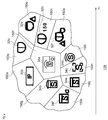
- FIG. 1 shows an image 10 to be processed.
- An example of the image 10 is a construction drawing as described above.
- the image 10 includes a first pattern 20a to a 26th pattern 20z, a 27th pattern 20aa, a 28th pattern 20ab, a 29th pattern 20ac, and a 30th pattern 20ad, which are collectively referred to as a pattern 20.
- Each pattern 20 is an electrical symbol.
- the pattern 20 included in the image 10 is “30”, but is not limited thereto.
- the shape of the pattern 20 is different, another electrical symbol is shown, which corresponds to another device.
- the fifth pattern 20e and the sixth pattern 20f have the same shape, but the fifth pattern 20e and the first pattern 20a have different shapes.
- the user needs to count the number of patterns 20 for each type of pattern 20. As the size of the image 10 increases and the number of patterns 20 included in the image 10 increases, the labor required for the work increases.
- FIG. 2 shows patterns 20 and systems that can be included in the image 10. Similar patterns 20 are defined for similar devices. Here, patterns 20 having similar shapes are collected as a system. As shown in the figure, three types of systems are defined: an interphone system, a differential smoke detector system, and a photoelectric smoke detector system.
- the interphone system includes the first interphone 30a to the fourth interphone 30d, which are collectively referred to as the interphone 30.
- the differential smoke detector system includes a first differential smoke detector 32a to a sixth differential smoke detector 32f, which are collectively referred to as a differential smoke detector 32.
- the photoelectric smoke detector system includes a first photoelectric smoke detector 34a to a sixth photoelectric smoke detector 34f collectively referred to as a photoelectric smoke detector 34.
- An interphone 30, a differential smoke detector 32, and a photoelectric smoke detector 34 are also one of the patterns 20.
- the first pattern 20a in FIG. 1 is the second intercom 30b
- the second pattern 20b is the sixth photoelectric smoke detector 34f.
- the system classifies the types of the patterns 20.
- the number of types of systems is smaller than the number of types of patterns 20.
- FIG. 3A to 3B show the configuration of the processing apparatus 100.
- FIG. 3A shows a configuration for learning processing
- FIG. 3B shows a configuration for integration processing.
- the integration process is to integrate a plurality of patterns 20 included in the image 10 for each type of pattern 20 while executing a process of classifying the patterns 20 into systems by using a neural network for the image 10. It is processing.
- the processing apparatus 100 in FIG. 3A and the processing apparatus 100 in FIG. 3B may be the same apparatus or different apparatuses.
- the processing device 100 includes a first input unit 110, a second input unit 112, and a processing unit 114 as a configuration for learning processing, and an input unit 120, a processing unit 114, an extraction unit 124, as configurations for integration processing, A clustering unit 128, a calculation unit 130, and an output unit 132 are included.
- the processing unit 114 includes a first processing unit 122 and a second processing unit 126. Here, the processing unit 114 is learned in the learning process, and the processing unit 114 is used in the integration process. Before describing the configuration of the processing apparatus 100, the configuration of the processing unit 114 will be described.
- FIG. 4 shows an outline of processing in the processing unit 114.
- the processing unit 114 includes a first convolution layer 142a, a second convolution layer 142b, a third convolution layer 142c, a fourth convolution layer 142d, a fifth convolution layer 142e, a sixth convolution layer 142f, and a pooling layer 144, which are collectively referred to as a convolution layer 142.
- a convolution layer 142 includes a first pooling layer 144a, a second pooling layer 144b, a third pooling layer 144c, a fourth pooling layer 144d, and a fifth pooling layer 144e.
- Such a convolution layer 142 and a pooling layer 144 show an image of a block that executes each process.
- the input image 140 is an image to be processed in the processing apparatus 100. Since the neural network in the processing unit 114 does not include the entire connection layer, there is no restriction on the size of the input image 140. Therefore, the input image 140 may be the image 10 described above.
- the input image 140 is input to the first convolution layer 142a.
- Each convolution layer 142 is shown by a hexahedron.
- the size of the square surface having the depth direction and the height direction of the convolution layer 142 indicates the size of the spatial dimension of the image processed in the convolution layer 142, that is, the size of the image.
- the convolution layer 142 performs spatial filtering on the image while shifting a spatial filter having a size smaller than the size of the image. Since spatial filtering is a well-known technique, description thereof is omitted here, but this spatial filtering corresponds to convolution processing, and image feature amounts are extracted by convolution processing. Padding or the like may be performed in the convolution layer 142.
- the convolution layer 142 may perform a plurality of spatial filtering operations in parallel on the image using a plurality of spatial filters in parallel. Such parallel use of a plurality of spatial filters increases the image.
- the number of spatial filters used in parallel in the convolution layer 142 is called the number of channels, and this is indicated by the length of the convolution layer 142 in the left-right direction.
- Each pooling layer 144 is configured similarly to the convolution layer 142.
- the pooling layer 144 reduces the size of the image by combining a plurality of pixels included in an arbitrary region in the image into one pixel.
- average pooling or maximum pooling is performed to combine a plurality of pixels into one pixel.
- average pooling an average value of a plurality of pixel values in a region is used for one pixel
- maximum pooling a maximum value of a plurality of pixel values in the region is used for one pixel.
- the pooling process is performed to enhance the robustness with respect to the translation of the representative value or the average value in the region of interest.
- the fifth convolution layer 142e, the fifth pooling layer 144e, and the sixth convolution layer 142f are sequentially disposed. That is, the convolution process and the pooling process are repeatedly executed. Further, by repeating the convolution process and the pooling process, the size of the image is sequentially reduced, and the sixth pooling layer 144f outputs an image having the number of channels of 1 or more (hereinafter referred to as “output image”).
- output image the number of channels of 1 or more
- the first input unit 110 receives teacher data that is a known output image
- the second input unit 112 receives an image for learning corresponding to the teacher data received by the first input unit 110.
- the processing unit 114 has the configuration of FIG. 4, and the spatial filter of each convolutional layer 142 is based on the teacher data received by the first input unit 110 and the learning image received by the second input unit 112. Train the coefficients.
- the learning image includes any pattern 20 of the interphone 30, the differential smoke detector 32, and the photoelectric smoke detector 34.
- the teacher data is an intercom system when the intercom 30 is included in the learning image, and a differential smoke detector system when the differential smoke detector 32 is included as the learning image.
- the photoelectric smoke detector 34 is included as a learning image, the photoelectric smoke detector system is used.
- FIG. 5 shows a data structure of teacher data input to the first input unit 110.
- the teacher data has three channels, and any one of an interphone system, a differential smoke sensor system, and a photoelectric smoke sensor system is indicated according to the learning image.
- the size of the teacher data has a 1 ⁇ 1 spatial dimension. Therefore, the teacher data does not have the position information of the pattern 20 included in the learning image, and the teacher data for one channel is any of the interphone system, the differential smoke detector system, and the photoelectric smoke sensor system. It just shows that.
- the learning image is an original image from which teacher data is output when the integration process is accurately executed, and the size thereof is determined so that the teacher data has a 1 ⁇ 1 spatial dimension.
- the learning image and the input image 140 may have different sizes.
- a known technique may be used for learning the coefficients of the spatial filter in a situation where such teacher data and learning images are used, and the description thereof is omitted here.
- the coefficients of the spatial filter derived by learning for the processing unit 114 in FIG. It is set in the processing unit 114 in b).
- the input unit 120 receives the image 10.
- the input unit 120 outputs the image 10 to the first processing unit 122.
- the first processing unit 122 receives the image 10 from the input unit 120.
- the first processing unit 122 has the configuration shown in FIG. 4, and the received image 10 corresponds to the input image 140. Therefore, hereinafter, the image 10 is referred to as an input image 140.
- the first processing unit 122 performs a convolutional neural network process on the input image 140 from which all connection layers are excluded. In the convolutional neural network in the first processing unit 122, the spatial filter of the convolutional layer 142 is learned with respect to the teacher data for the number of types of systems smaller than the number of types of patterns 20.
- the learning of the spatial filter of the convolution layer 142 is performed for a system corresponding to 3 channels on a one-to-one basis.
- the first processing unit 122 detects each of the plurality of patterns 20 included in the image 10 as one of the systems.
- the first processing unit 122 since the size of the image 10 is larger than the size of the learning image, the first processing unit 122 also detects the position of the system.
- FIGS. 6A to 6B show the processing results obtained by the processing apparatus 100.
- FIG. FIG. 6A shows the number of systems detected when the processing of the first processing unit 122 is performed on the image 10 of FIG. FIG. 6B returns to FIG. 3B described later.
- the first processing unit 122 outputs a plurality of combinations of the detected system and position to the extraction unit 124.
- the extraction unit 124 receives a plurality of combinations from the first processing unit 122.
- the extraction unit 124 acquires the detected system and position from each combination, and extracts a portion including the pattern 20 corresponding to the system from the image 10.
- the said part has arbitrary shapes and arbitrary sizes centering on the pattern 20 corresponding to a system
- the size of the part is smaller than the size of the image 10. Further, the size of the portion may be larger than the size of the learning image.
- the extraction unit 124 extracts a plurality of portions.
- the extraction unit 124 outputs a plurality of parts to the second processing unit 126.
- the second processing unit 126 shares a neural network with the first processing unit 122, the neural network used in the first processing unit 122 is used.
- the second processing unit 126 performs neural network processing on the plurality of portions extracted by the extraction unit 124. Since the processing of the neural network is the same as the processing in the first processing unit 122, description thereof is omitted here.
- the second processing unit 126 acquires intermediate data 148 of a specific intermediate layer for each part.
- the intermediate data 148 is data output from one or two intermediate layers before the output of the second processing unit 126, and is an n-dimensional data like (v 1 , v 2 ,..., V n ). Shown as data.
- the second processing unit 126 outputs the intermediate data 148 to the clustering unit 128 for each part, that is, for each detected system.
- the clustering unit 128 performs clustering on the plurality of intermediate data 148 acquired by the second processing unit 126 according to the number of types of patterns 20.
- the K-means method, the self-organizing map, the minimum mean variance method, the NN (Nearest Neighbor) method, the shortest distance method, the K-NN (K Nearest Neighbor) method, the Ward method, etc. are used for clustering. Is done. Since these are known techniques, description thereof is omitted here.
- FIG. 7 shows an outline of processing in the clustering unit 128.
- the intermediate data 148 is two-dimensional data of (v 1 , v 2 ).
- the clustering unit 128 arranges a plurality of intermediate data 148 in an orthogonal coordinate system with v 1 and v 2 as axes.
- the clustering unit 128 generates the eleventh cluster 150k from the first cluster 150a, which is collectively referred to as the cluster 150, by performing clustering on the plurality of intermediate data 148 arranged in the orthogonal coordinate system.
- Each cluster 150 corresponds to one of the patterns 20.
- the first cluster 150a corresponds to the second intercom 30b.
- the calculation unit 130 calculates the number of patterns 20 included in each cluster as a result of clustering in the clustering unit 128.
- FIG. 6B shows a calculation result in the calculation unit 130.
- One second intercom 30b and eight second differential smoke detectors 32b are calculated.
- the output unit 132 outputs the calculation result in the calculation unit 130.
- the subject of the apparatus, system, or method in the present disclosure includes a computer.
- the computer executes the program, the main function of the apparatus, system, or method according to the present disclosure is realized.
- the computer includes a processor that operates according to a program as a main hardware configuration.
- the processor may be of any type as long as the function can be realized by executing the program.
- the processor includes one or a plurality of electronic circuits including a semiconductor integrated circuit (IC) or an LSI (Large Scale Integration).
- the plurality of electronic circuits may be integrated on one chip or provided on a plurality of chips.
- the plurality of chips may be integrated into one device, or may be provided in a plurality of devices.
- the program is recorded on a non-transitory recording medium such as a ROM, an optical disk, or a hard disk drive that can be read by a computer.
- the program may be stored in advance in a recording medium, or may be supplied to the recording medium via a wide area communication network including the Internet.
- FIG. 8 is a flowchart showing a processing procedure in the processing apparatus 100.
- the input unit 120 inputs the image 10 (S10).
- the first processing unit 122 detects the system (S12).
- the extraction unit 124 extracts a part including the system (S14).
- the second processing unit 126 acquires intermediate data 148 of the intermediate layer (S16).
- the clustering unit 128 executes clustering (S18).
- the calculation unit 130 calculates the number of patterns 20 (S20).
- the influence of the pattern other than the pattern 20 included in the image 10 can be reduced.
- the influence other than the pattern 20 included in the image 10 is reduced, the processing accuracy can be improved.
- the intermediate data 148 in the neural network processing is acquired, the amount of information can be increased.
- the amount of information is increased, the processing accuracy can be improved.
- the number of patterns 20 included in each cluster 150 is calculated by performing clustering on the intermediate data 148, a decrease in processing accuracy is suppressed while an increase in learning workload is suppressed. it can.
- the intermediate data 148 of the intermediate layer one or two before the output is acquired, data with high accuracy and a large amount of information can be acquired.
- the second processing unit 126 uses the neural network used in the first processing unit 122, the learning result can be shared.
- the convolutional neural network in which the spatial filter of the convolution layer 142 is learned is used for the teacher data having 1 ⁇ 1 spatial dimension, the workload for creating the teacher data can be reduced.
- the workload for creating teacher data is reduced, an increase in the workload for learning can be suppressed.
- the number of teacher data can be increased.
- the accuracy of learning can be improved.
- a processing device (100) is a processing device (100) that accumulates a plurality of patterns included in an image (10) for each pattern type, and an input unit that inputs the image (10) (120) and the number of types less than the number of types of patterns (20) in the system in which the types of patterns (20) are classified with respect to the image (10) input to the input unit (120)
- the extraction unit (124) for extracting a plurality of parts including the system from the image (10), and the extraction unit (124) Extraction Processing of a neural network in which a plurality of types of patterns (20) are classified into less than the number of types of patterns (20) as learning data
- the clustering unit (128) that performs clustering according to the number of types of patterns (20), and the number of patterns (20) included in each cluster (150) that is the result of clustering in the clustering unit (128) are calculated. And a calculation unit (130).
- the second processing unit (126) may acquire the intermediate data (148) of the intermediate layer one or two before the output.
- the second processing unit (126) may use the neural network used in the first processing unit (122).
- the neural network used in the first processing unit (122) and the second processing unit (126) is a convolutional neural network that includes a convolutional layer (142) and a pooling layer (144), and excludes all the connection layers.
- the filter of the convolutional layer (142) may be learned for the processing result having a 1 ⁇ 1 spatial dimension.
- This method is a processing method for accumulating a plurality of patterns (20) included in an image (10) for each type of pattern (20), and includes a step of inputting the image (10) and an input image (10 ), A neural network process is performed in which the number of types of patterns (20) is less than the number of types of patterns (20) is learned as teacher data.
- the system is included from the image (10).
- a plurality of extracted parts, a system in which the types of patterns (20) are classified for the extracted plurality of parts, and the number of types less than the number of types of patterns (20) A step of acquiring intermediate data (148) of a specific intermediate layer for each system by executing processing of a neural network that has learned the system of the system as teacher data, and a pattern for the acquired intermediate data (148)
- the step of performing clustering according to the number of types of (20) and the step of calculating the number of patterns (20) included in each cluster (150) as a result of clustering are included.
- the processing unit 114 In the configuration of the processing unit 114 in this embodiment, a plurality of convolution layers 142 and a plurality of pooling layers 144 are alternately arranged.
- the processing unit 114 may have a configuration such as a GoogleLeNet system, a DenseNet system, or the like. According to this modification, the degree of freedom of configuration can be improved.
- the processing unit 114 uses a convolutional neural network from which all coupling layers are excluded, that is, a complete convolutional neural network.
- a convolutional neural network including all connection layers may be used.
- the image 10 is divided into fixed sizes and input to the input unit 120. According to this modification, the degree of freedom of configuration can be improved.
Landscapes
- Engineering & Computer Science (AREA)
- Theoretical Computer Science (AREA)
- Physics & Mathematics (AREA)
- General Physics & Mathematics (AREA)
- Data Mining & Analysis (AREA)
- Evolutionary Computation (AREA)
- Artificial Intelligence (AREA)
- Computer Vision & Pattern Recognition (AREA)
- Life Sciences & Earth Sciences (AREA)
- General Engineering & Computer Science (AREA)
- Health & Medical Sciences (AREA)
- Software Systems (AREA)
- Computing Systems (AREA)
- General Health & Medical Sciences (AREA)
- Mathematical Physics (AREA)
- Biomedical Technology (AREA)
- Biophysics (AREA)
- Computational Linguistics (AREA)
- Molecular Biology (AREA)
- Multimedia (AREA)
- Evolutionary Biology (AREA)
- Bioinformatics & Computational Biology (AREA)
- Bioinformatics & Cheminformatics (AREA)
- Databases & Information Systems (AREA)
- Medical Informatics (AREA)
- Image Analysis (AREA)
- Image Processing (AREA)
Abstract
Une première unité de traitement 122 exécute un traitement de réseau neuronal sur une image, ce qui permet de détecter, en tant que système, chaque motif d'une pluralité de motifs contenus dans l'image. Sur la base de la position de chaque système détecté, une unité d'extraction 124 extrait, à partir de l'image, une pluralité de parties dans lesquelles le système est inclus. Une seconde unité de traitement 126 exécute un traitement de réseau neuronal sur la pluralité de parties extraites, acquérant ainsi des données intermédiaires d'une couche intermédiaire spécifique pour chaque système. Une unité de regroupement 128 effectue un regroupement sur les données intermédiaires acquises conformément au nombre de types de motifs. Une unité de calcul 130 calcule le nombre de motifs contenus dans chaque grappe, qui est le résultat de regroupement.
Priority Applications (4)
| Application Number | Priority Date | Filing Date | Title |
|---|---|---|---|
| JP2019546265A JP6803578B2 (ja) | 2018-03-26 | 2019-03-25 | 処理方法およびそれを利用した処理装置 |
| US17/040,478 US11816569B2 (en) | 2018-03-26 | 2019-03-25 | Processing method and processing device using same |
| CN201980021870.8A CN111902827B (zh) | 2018-03-26 | 2019-03-25 | 一种处理方法及利用了它的处理装置 |
| EP19776893.0A EP3779805B1 (fr) | 2018-03-26 | 2019-03-25 | Procédé de traitement et dispositif de traitement l'utilisant |
Applications Claiming Priority (2)
| Application Number | Priority Date | Filing Date | Title |
|---|---|---|---|
| JP2018058736 | 2018-03-26 | ||
| JP2018-058736 | 2018-03-26 |
Publications (1)
| Publication Number | Publication Date |
|---|---|
| WO2019189026A1 true WO2019189026A1 (fr) | 2019-10-03 |
Family
ID=68061789
Family Applications (1)
| Application Number | Title | Priority Date | Filing Date |
|---|---|---|---|
| PCT/JP2019/012593 Ceased WO2019189026A1 (fr) | 2018-03-26 | 2019-03-25 | Procédé de traitement et dispositif de traitement l'utilisant |
Country Status (5)
| Country | Link |
|---|---|
| US (1) | US11816569B2 (fr) |
| EP (1) | EP3779805B1 (fr) |
| JP (2) | JP6803578B2 (fr) |
| CN (1) | CN111902827B (fr) |
| WO (1) | WO2019189026A1 (fr) |
Cited By (1)
| Publication number | Priority date | Publication date | Assignee | Title |
|---|---|---|---|---|
| JPWO2021209867A1 (fr) * | 2020-04-17 | 2021-10-21 |
Families Citing this family (2)
| Publication number | Priority date | Publication date | Assignee | Title |
|---|---|---|---|---|
| US11113838B2 (en) * | 2019-03-26 | 2021-09-07 | Nec Corporation | Deep learning based tattoo detection system with optimized data labeling for offline and real-time processing |
| WO2021152416A1 (fr) | 2020-01-31 | 2021-08-05 | 株式会社半導体エネルギー研究所 | Dispositif de génération de données de formation et système de discrimination de défauts |
Citations (3)
| Publication number | Priority date | Publication date | Assignee | Title |
|---|---|---|---|---|
| JPH10111937A (ja) | 1996-10-04 | 1998-04-28 | Ricoh Co Ltd | 建設図面の電気記号抽出方法及びその装置 |
| JP2017084320A (ja) * | 2015-03-06 | 2017-05-18 | パナソニックIpマネジメント株式会社 | 学習方法およびプログラム |
| JP2017194782A (ja) * | 2016-04-19 | 2017-10-26 | ソニー株式会社 | 情報処理装置及び情報処理方法 |
Family Cites Families (5)
| Publication number | Priority date | Publication date | Assignee | Title |
|---|---|---|---|---|
| JPH0498378A (ja) | 1990-08-10 | 1992-03-31 | Fujitsu Ltd | 図形分類を行うニューラルネットワーク |
| JP3240303B2 (ja) * | 1992-01-09 | 2001-12-17 | 新日鉄ソリューションズ株式会社 | シンボル認識システム |
| JPH06348849A (ja) * | 1993-06-01 | 1994-12-22 | Nippon Steel Corp | 画像シンボル認識方法 |
| JPH09322354A (ja) | 1996-05-30 | 1997-12-12 | Ohbayashi Corp | 住戸内弱電ケーブルの配線構造 |
| US11295123B2 (en) * | 2017-09-14 | 2022-04-05 | Chevron U.S.A. Inc. | Classification of character strings using machine-learning |
-
2019
- 2019-03-25 CN CN201980021870.8A patent/CN111902827B/zh active Active
- 2019-03-25 WO PCT/JP2019/012593 patent/WO2019189026A1/fr not_active Ceased
- 2019-03-25 US US17/040,478 patent/US11816569B2/en active Active
- 2019-03-25 EP EP19776893.0A patent/EP3779805B1/fr active Active
- 2019-03-25 JP JP2019546265A patent/JP6803578B2/ja active Active
-
2020
- 2020-11-16 JP JP2020190224A patent/JP2021028841A/ja active Pending
Patent Citations (3)
| Publication number | Priority date | Publication date | Assignee | Title |
|---|---|---|---|---|
| JPH10111937A (ja) | 1996-10-04 | 1998-04-28 | Ricoh Co Ltd | 建設図面の電気記号抽出方法及びその装置 |
| JP2017084320A (ja) * | 2015-03-06 | 2017-05-18 | パナソニックIpマネジメント株式会社 | 学習方法およびプログラム |
| JP2017194782A (ja) * | 2016-04-19 | 2017-10-26 | ソニー株式会社 | 情報処理装置及び情報処理方法 |
Non-Patent Citations (3)
| Title |
|---|
| NOBUYUKI SHINOHARA; KENTA OKUGAWA; MANABU HASHIMOTO: "Automatic determination of matching parameters using DNN to cope with complex disturbances", THE 23RD SYMPOSIUM ON SENSING VIA IMAGE INFORMATION ( SSII2017), vol. 23, 7 June 2017 (2017-06-07), pages 1 - 8, XP009524115 * |
| See also references of EP3779805A4 |
| ZHOU, BOLEI ET AL.: "Object Detectors Emerge in Deep Scene CNNs", ICLR 2015 CONFERENCE PAPER, ARXIV, 15 April 2015 (2015-04-15), pages 1 - 12, XP055528912, Retrieved from the Internet <URL:URL:https://arxiv.org/abs/1412.6856> [retrieved on 20190426] * |
Cited By (5)
| Publication number | Priority date | Publication date | Assignee | Title |
|---|---|---|---|---|
| JPWO2021209867A1 (fr) * | 2020-04-17 | 2021-10-21 | ||
| WO2021209867A1 (fr) * | 2020-04-17 | 2021-10-21 | 株式会社半導体エネルギー研究所 | Dispositif de classification, procédé de classification d'image et dispositif d'inspection de motif |
| JP7595649B2 (ja) | 2020-04-17 | 2024-12-06 | 株式会社半導体エネルギー研究所 | パターン検査装置 |
| JP2025022978A (ja) * | 2020-04-17 | 2025-02-14 | 株式会社半導体エネルギー研究所 | パターン検査装置 |
| US12462533B2 (en) | 2020-04-17 | 2025-11-04 | Semiconductor Energy Laboratory Co., Ltd. | Classification device, image classification method, and pattern inspection device |
Also Published As
| Publication number | Publication date |
|---|---|
| JP2021028841A (ja) | 2021-02-25 |
| US20210027095A1 (en) | 2021-01-28 |
| CN111902827B (zh) | 2024-11-05 |
| JPWO2019189026A1 (ja) | 2020-04-30 |
| JP6803578B2 (ja) | 2020-12-23 |
| CN111902827A (zh) | 2020-11-06 |
| US11816569B2 (en) | 2023-11-14 |
| EP3779805B1 (fr) | 2026-05-06 |
| EP3779805A1 (fr) | 2021-02-17 |
| EP3779805A4 (fr) | 2021-05-05 |
Similar Documents
| Publication | Publication Date | Title |
|---|---|---|
| US11315235B2 (en) | Processing method for performing process on image and processing device using the processing method | |
| CN112861729B (zh) | 一种基于伪深度图引导的实时深度补全方法 | |
| CN109859091B (zh) | 基于Gabor滤波和卷积神经网络的图像隐写检测方法 | |
| JP2021028841A (ja) | 処理方法およびそれを利用した処理装置 | |
| CN110544202B (zh) | 一种基于模板匹配与特征聚类的视差图像拼接方法及系统 | |
| CN113313031B (zh) | 一种基于深度学习的车道线检测和车辆横向定位方法 | |
| WO2019054092A1 (fr) | Dispositif et procédé de génération d'image | |
| CN112396167B (zh) | 一种外观相似度与空间位置信息融合的回环检测方法 | |
| JP2021119474A (ja) | 処理方法およびそれを利用した処理装置 | |
| CN109978077A (zh) | 视觉识别方法、装置和系统及存储介质 | |
| CN108335327B (zh) | 摄像机姿态估计方法和摄像机姿态估计装置 | |
| CN116051915B (zh) | 基于聚类与几何残差的动态场景rgb-d slam方法 | |
| CN110598771A (zh) | 一种基于深度语义分割网络的视觉目标识别方法和装置 | |
| CN112818965A (zh) | 多尺度影像目标检测方法、系统、电子设备及存储介质 | |
| JP7209238B2 (ja) | 処理装置および処理方法 | |
| CN112598043A (zh) | 一种基于弱监督学习的协同显著性检测方法 | |
| CN113947756B (zh) | 一种基于迭代设计的目标检测方法 | |
| JP7277855B2 (ja) | 被写体別特徴点分離装置、被写体別特徴点分離方法及びコンピュータプログラム | |
| JP7668460B2 (ja) | 処理方法およびそれを利用した処理装置 | |
| Ochotorena et al. | Gradient-guided filtering of depth maps using deep neural networks | |
| CN116490878A (zh) | 处理方法以及利用它的处理装置 | |
| JP2018049396A (ja) | 形状推定方法、形状推定装置および形状推定プログラム | |
| JP7462168B2 (ja) | 処理方法およびそれを利用した処理装置 | |
| Luo et al. | Multi-View RGB-D Based 3D Point Cloud Face Model Reconstruction System | |
| CN119866518A (zh) | 处理方法及利用了它的处理装置 |
Legal Events
| Date | Code | Title | Description |
|---|---|---|---|
| ENP | Entry into the national phase |
Ref document number: 2019546265 Country of ref document: JP Kind code of ref document: A |
|
| 121 | Ep: the epo has been informed by wipo that ep was designated in this application |
Ref document number: 19776893 Country of ref document: EP Kind code of ref document: A1 |
|
| NENP | Non-entry into the national phase |
Ref country code: DE |
|
| ENP | Entry into the national phase |
Ref document number: 2019776893 Country of ref document: EP Effective date: 20201026 |