WO2019189425A1 - リチウム金属複合酸化物粉末、リチウム二次電池用正極活物質、リチウム二次電池用正極、及びリチウム二次電池 - Google Patents
リチウム金属複合酸化物粉末、リチウム二次電池用正極活物質、リチウム二次電池用正極、及びリチウム二次電池 Download PDFInfo
- Publication number
- WO2019189425A1 WO2019189425A1 PCT/JP2019/013297 JP2019013297W WO2019189425A1 WO 2019189425 A1 WO2019189425 A1 WO 2019189425A1 JP 2019013297 W JP2019013297 W JP 2019013297W WO 2019189425 A1 WO2019189425 A1 WO 2019189425A1
- Authority
- WO
- WIPO (PCT)
- Prior art keywords
- lithium
- metal composite
- positive electrode
- composite oxide
- oxide powder
- Prior art date
- Legal status (The legal status is an assumption and is not a legal conclusion. Google has not performed a legal analysis and makes no representation as to the accuracy of the status listed.)
- Ceased
Links
Images


Classifications
-
- C—CHEMISTRY; METALLURGY
- C01—INORGANIC CHEMISTRY
- C01G—COMPOUNDS CONTAINING METALS NOT COVERED BY SUBCLASSES C01D OR C01F
- C01G53/00—Compounds of nickel
- C01G53/40—Complex oxides containing nickel and at least one other metal element
- C01G53/42—Complex oxides containing nickel and at least one other metal element containing alkali metals, e.g. LiNiO2
- C01G53/44—Complex oxides containing nickel and at least one other metal element containing alkali metals, e.g. LiNiO2 containing manganese
- C01G53/50—Complex oxides containing nickel and at least one other metal element containing alkali metals, e.g. LiNiO2 containing manganese of the type (MnO2)n-, e.g. Li(NixMn1-x)O2 or Li(MyNixMn1-x-y)O2
-
- H—ELECTRICITY
- H01—ELECTRIC ELEMENTS
- H01M—PROCESSES OR MEANS, e.g. BATTERIES, FOR THE DIRECT CONVERSION OF CHEMICAL ENERGY INTO ELECTRICAL ENERGY
- H01M4/00—Electrodes
- H01M4/02—Electrodes composed of, or comprising, active material
- H01M4/13—Electrodes for accumulators with non-aqueous electrolyte, e.g. for lithium-accumulators; Processes of manufacture thereof
- H01M4/134—Electrodes based on metals, Si or alloys
-
- C—CHEMISTRY; METALLURGY
- C01—INORGANIC CHEMISTRY
- C01G—COMPOUNDS CONTAINING METALS NOT COVERED BY SUBCLASSES C01D OR C01F
- C01G53/00—Compounds of nickel
- C01G53/40—Complex oxides containing nickel and at least one other metal element
- C01G53/42—Complex oxides containing nickel and at least one other metal element containing alkali metals, e.g. LiNiO2
-
- H—ELECTRICITY
- H01—ELECTRIC ELEMENTS
- H01M—PROCESSES OR MEANS, e.g. BATTERIES, FOR THE DIRECT CONVERSION OF CHEMICAL ENERGY INTO ELECTRICAL ENERGY
- H01M10/00—Secondary cells; Manufacture thereof
- H01M10/05—Accumulators with non-aqueous electrolyte
- H01M10/052—Li-accumulators
-
- H—ELECTRICITY
- H01—ELECTRIC ELEMENTS
- H01M—PROCESSES OR MEANS, e.g. BATTERIES, FOR THE DIRECT CONVERSION OF CHEMICAL ENERGY INTO ELECTRICAL ENERGY
- H01M10/00—Secondary cells; Manufacture thereof
- H01M10/05—Accumulators with non-aqueous electrolyte
- H01M10/052—Li-accumulators
- H01M10/0525—Rocking-chair batteries, i.e. batteries with lithium insertion or intercalation in both electrodes; Lithium-ion batteries
-
- H—ELECTRICITY
- H01—ELECTRIC ELEMENTS
- H01M—PROCESSES OR MEANS, e.g. BATTERIES, FOR THE DIRECT CONVERSION OF CHEMICAL ENERGY INTO ELECTRICAL ENERGY
- H01M4/00—Electrodes
- H01M4/02—Electrodes composed of, or comprising, active material
- H01M4/13—Electrodes for accumulators with non-aqueous electrolyte, e.g. for lithium-accumulators; Processes of manufacture thereof
- H01M4/131—Electrodes based on mixed oxides or hydroxides, or on mixtures of oxides or hydroxides, e.g. LiCoOx
-
- H—ELECTRICITY
- H01—ELECTRIC ELEMENTS
- H01M—PROCESSES OR MEANS, e.g. BATTERIES, FOR THE DIRECT CONVERSION OF CHEMICAL ENERGY INTO ELECTRICAL ENERGY
- H01M4/00—Electrodes
- H01M4/02—Electrodes composed of, or comprising, active material
- H01M4/13—Electrodes for accumulators with non-aqueous electrolyte, e.g. for lithium-accumulators; Processes of manufacture thereof
- H01M4/139—Processes of manufacture
- H01M4/1391—Processes of manufacture of electrodes based on mixed oxides or hydroxides, or on mixtures of oxides or hydroxides, e.g. LiCoOx
-
- H—ELECTRICITY
- H01—ELECTRIC ELEMENTS
- H01M—PROCESSES OR MEANS, e.g. BATTERIES, FOR THE DIRECT CONVERSION OF CHEMICAL ENERGY INTO ELECTRICAL ENERGY
- H01M4/00—Electrodes
- H01M4/02—Electrodes composed of, or comprising, active material
- H01M4/36—Selection of substances as active materials, active masses, active liquids
- H01M4/48—Selection of substances as active materials, active masses, active liquids of inorganic oxides or hydroxides
- H01M4/50—Selection of substances as active materials, active masses, active liquids of inorganic oxides or hydroxides of manganese
- H01M4/505—Selection of substances as active materials, active masses, active liquids of inorganic oxides or hydroxides of manganese of mixed oxides or hydroxides containing manganese for inserting or intercalating light metals, e.g. LiMn2O4 or LiMn2OxFy
-
- H—ELECTRICITY
- H01—ELECTRIC ELEMENTS
- H01M—PROCESSES OR MEANS, e.g. BATTERIES, FOR THE DIRECT CONVERSION OF CHEMICAL ENERGY INTO ELECTRICAL ENERGY
- H01M4/00—Electrodes
- H01M4/02—Electrodes composed of, or comprising, active material
- H01M4/36—Selection of substances as active materials, active masses, active liquids
- H01M4/48—Selection of substances as active materials, active masses, active liquids of inorganic oxides or hydroxides
- H01M4/52—Selection of substances as active materials, active masses, active liquids of inorganic oxides or hydroxides of nickel, cobalt or iron
- H01M4/525—Selection of substances as active materials, active masses, active liquids of inorganic oxides or hydroxides of nickel, cobalt or iron of mixed oxides or hydroxides containing iron, cobalt or nickel for inserting or intercalating light metals, e.g. LiNiO2, LiCoO2 or LiCoOxFy
-
- C—CHEMISTRY; METALLURGY
- C01—INORGANIC CHEMISTRY
- C01P—INDEXING SCHEME RELATING TO STRUCTURAL AND PHYSICAL ASPECTS OF SOLID INORGANIC COMPOUNDS
- C01P2002/00—Crystal-structural characteristics
- C01P2002/20—Two-dimensional structures
-
- C—CHEMISTRY; METALLURGY
- C01—INORGANIC CHEMISTRY
- C01P—INDEXING SCHEME RELATING TO STRUCTURAL AND PHYSICAL ASPECTS OF SOLID INORGANIC COMPOUNDS
- C01P2002/00—Crystal-structural characteristics
- C01P2002/50—Solid solutions
- C01P2002/52—Solid solutions containing elements as dopants
- C01P2002/54—Solid solutions containing elements as dopants one element only
-
- C—CHEMISTRY; METALLURGY
- C01—INORGANIC CHEMISTRY
- C01P—INDEXING SCHEME RELATING TO STRUCTURAL AND PHYSICAL ASPECTS OF SOLID INORGANIC COMPOUNDS
- C01P2002/00—Crystal-structural characteristics
- C01P2002/70—Crystal-structural characteristics defined by measured X-ray, neutron or electron diffraction data
- C01P2002/72—Crystal-structural characteristics defined by measured X-ray, neutron or electron diffraction data by d-values or two theta-values, e.g. as X-ray diagram
-
- C—CHEMISTRY; METALLURGY
- C01—INORGANIC CHEMISTRY
- C01P—INDEXING SCHEME RELATING TO STRUCTURAL AND PHYSICAL ASPECTS OF SOLID INORGANIC COMPOUNDS
- C01P2002/00—Crystal-structural characteristics
- C01P2002/70—Crystal-structural characteristics defined by measured X-ray, neutron or electron diffraction data
- C01P2002/74—Crystal-structural characteristics defined by measured X-ray, neutron or electron diffraction data by peak-intensities or a ratio thereof only
-
- C—CHEMISTRY; METALLURGY
- C01—INORGANIC CHEMISTRY
- C01P—INDEXING SCHEME RELATING TO STRUCTURAL AND PHYSICAL ASPECTS OF SOLID INORGANIC COMPOUNDS
- C01P2002/00—Crystal-structural characteristics
- C01P2002/70—Crystal-structural characteristics defined by measured X-ray, neutron or electron diffraction data
- C01P2002/76—Crystal-structural characteristics defined by measured X-ray, neutron or electron diffraction data by a space-group or by other symmetry indications
-
- C—CHEMISTRY; METALLURGY
- C01—INORGANIC CHEMISTRY
- C01P—INDEXING SCHEME RELATING TO STRUCTURAL AND PHYSICAL ASPECTS OF SOLID INORGANIC COMPOUNDS
- C01P2002/00—Crystal-structural characteristics
- C01P2002/70—Crystal-structural characteristics defined by measured X-ray, neutron or electron diffraction data
- C01P2002/77—Crystal-structural characteristics defined by measured X-ray, neutron or electron diffraction data by unit-cell parameters, atom positions or structure diagrams
-
- C—CHEMISTRY; METALLURGY
- C01—INORGANIC CHEMISTRY
- C01P—INDEXING SCHEME RELATING TO STRUCTURAL AND PHYSICAL ASPECTS OF SOLID INORGANIC COMPOUNDS
- C01P2004/00—Particle morphology
- C01P2004/30—Particle morphology extending in three dimensions
- C01P2004/45—Aggregated particles or particles with an intergrown morphology
-
- C—CHEMISTRY; METALLURGY
- C01—INORGANIC CHEMISTRY
- C01P—INDEXING SCHEME RELATING TO STRUCTURAL AND PHYSICAL ASPECTS OF SOLID INORGANIC COMPOUNDS
- C01P2004/00—Particle morphology
- C01P2004/51—Particles with a specific particle size distribution
-
- C—CHEMISTRY; METALLURGY
- C01—INORGANIC CHEMISTRY
- C01P—INDEXING SCHEME RELATING TO STRUCTURAL AND PHYSICAL ASPECTS OF SOLID INORGANIC COMPOUNDS
- C01P2004/00—Particle morphology
- C01P2004/54—Particles characterised by their aspect ratio, i.e. the ratio of sizes in the longest to the shortest dimension
-
- C—CHEMISTRY; METALLURGY
- C01—INORGANIC CHEMISTRY
- C01P—INDEXING SCHEME RELATING TO STRUCTURAL AND PHYSICAL ASPECTS OF SOLID INORGANIC COMPOUNDS
- C01P2004/00—Particle morphology
- C01P2004/60—Particles characterised by their size
- C01P2004/61—Micrometer sized, i.e. from 1-100 micrometer
-
- C—CHEMISTRY; METALLURGY
- C01—INORGANIC CHEMISTRY
- C01P—INDEXING SCHEME RELATING TO STRUCTURAL AND PHYSICAL ASPECTS OF SOLID INORGANIC COMPOUNDS
- C01P2004/00—Particle morphology
- C01P2004/60—Particles characterised by their size
- C01P2004/62—Submicrometer sized, i.e. from 0.1-1 micrometer
-
- C—CHEMISTRY; METALLURGY
- C01—INORGANIC CHEMISTRY
- C01P—INDEXING SCHEME RELATING TO STRUCTURAL AND PHYSICAL ASPECTS OF SOLID INORGANIC COMPOUNDS
- C01P2004/00—Particle morphology
- C01P2004/60—Particles characterised by their size
- C01P2004/64—Nanometer sized, i.e. from 1-100 nanometer
-
- C—CHEMISTRY; METALLURGY
- C01—INORGANIC CHEMISTRY
- C01P—INDEXING SCHEME RELATING TO STRUCTURAL AND PHYSICAL ASPECTS OF SOLID INORGANIC COMPOUNDS
- C01P2006/00—Physical properties of inorganic compounds
- C01P2006/80—Compositional purity
-
- H—ELECTRICITY
- H01—ELECTRIC ELEMENTS
- H01M—PROCESSES OR MEANS, e.g. BATTERIES, FOR THE DIRECT CONVERSION OF CHEMICAL ENERGY INTO ELECTRICAL ENERGY
- H01M4/00—Electrodes
- H01M4/02—Electrodes composed of, or comprising, active material
- H01M2004/026—Electrodes composed of, or comprising, active material characterised by the polarity
- H01M2004/028—Positive electrodes
-
- Y—GENERAL TAGGING OF NEW TECHNOLOGICAL DEVELOPMENTS; GENERAL TAGGING OF CROSS-SECTIONAL TECHNOLOGIES SPANNING OVER SEVERAL SECTIONS OF THE IPC; TECHNICAL SUBJECTS COVERED BY FORMER USPC CROSS-REFERENCE ART COLLECTIONS [XRACs] AND DIGESTS
- Y02—TECHNOLOGIES OR APPLICATIONS FOR MITIGATION OR ADAPTATION AGAINST CLIMATE CHANGE
- Y02E—REDUCTION OF GREENHOUSE GAS [GHG] EMISSIONS, RELATED TO ENERGY GENERATION, TRANSMISSION OR DISTRIBUTION
- Y02E60/00—Enabling technologies; Technologies with a potential or indirect contribution to GHG emissions mitigation
- Y02E60/10—Energy storage using batteries
Definitions
- the present invention relates to a lithium metal composite oxide powder, a positive electrode active material for a lithium secondary battery, a positive electrode for a lithium secondary battery, and a lithium secondary battery.
- Lithium metal composite oxide powder is used for the positive electrode active material for lithium secondary batteries.
- Lithium secondary batteries have already been put into practical use not only for small power supplies for mobile phones and laptop computers, but also for medium and large power supplies for automobiles and power storage.
- Patent Document 1 For the purpose of improving packing density and thermal stability, it has a hexagonal crystal structure, and the half width of the peak of the (003) plane in the X-ray diffraction spectrum is 0.120 to 0.125 °. Describes a positive electrode active material containing a nickel-based lithium transition metal oxide having a c-axis length of 14.228 to 14.229 mm. Patent Document 2 discloses an X-ray as a method for judging the quality of overcharge safety of a lithium secondary battery in a composite oxide comprising lithium and at least one transition metal element selected from the group consisting of Co, Ni and Mn. An invention that defines the half width of the (003) plane in diffraction measurement is described.
- Patent Document 1 or 2 has not been studied from the viewpoint of suppressing self-discharge when stored for a long time in a charged state, and there is room for further improvement.
- the present invention has been made in view of the above circumstances, and can provide a lithium secondary battery having a low self-discharge amount, a lithium metal composite oxide powder, a positive electrode active material for a lithium secondary battery, and a lithium secondary battery.
- An object is to provide a positive electrode and a lithium secondary battery with a low self-discharge amount.
- the present invention includes the following [1] to [12].
- [1] Lithium metal composite oxide powder containing primary particles and secondary particles that are aggregates of the primary particles, and having an ⁇ -NaFeO 2 type crystal structure and using powdered CuK ⁇ rays In diffraction measurement, the half width (A) of the diffraction peak in the range of 2 ⁇ 18.7 ⁇ 1 ° is 0.135 ° or more and 0.165 ° or less, and the lattice constant of ⁇ -NaFeO 2 type crystal structure, A lithium metal composite oxide powder having a c-axis of 14.178 mm or more and 14.235 mm or less.
- a lithium metal composite oxide powder capable of obtaining a lithium secondary battery having a low self-discharge amount, a positive electrode active material for a lithium secondary battery, a positive electrode for a lithium secondary battery, and lithium having a low self-discharge amount A secondary battery can be provided.
- the lithium metal composite oxide powder of the present embodiment is a lithium metal composite oxide powder containing primary particles and secondary particles that are aggregates of the primary particles, and has an ⁇ -NaFeO 2 type crystal structure.
- the half-value width (A) of the diffraction peak in the range of 2 ⁇ 18.7 ⁇ 1 ° is 0.135 ° or more and 0.165 ° or less, and ⁇ -NaFeO
- the lattice constant of the type 2 crystal structure, the c-axis is not less than 14.17817 and not more than 14.235 ⁇ .
- the lithium metal composite oxide having an ⁇ -NaFeO 2 type crystal structure has a crystal structure in which layers formed from lithium atoms, transition metal atoms, and oxygen atoms are laminated.
- the smallest unit in the crystal structure is called a unit cell.
- Primary particles are formed by connecting the unit cells. If the unit cell series is regular, primary particles with high crystallinity are formed, and if the unit cell series regularity is poor, primary particles with low crystallinity are formed. In addition, stacking faults occur at locations where the series of unit cells are discontinuous.
- the particle surface of the lithium metal composite oxide powder is in contact with the electrolytic solution.
- lithium ions are desorbed from the inside of the lithium metal composite oxide powder, that is, from the ⁇ -NaFeO 2 type crystal structure.
- the crystal structure of the lithium metal composite oxide powder affects the desorption of lithium ions.
- the lithium metal composite oxide powder of this embodiment controls the crystal axis length of the unit cell of the ⁇ -NaFeO 2 type crystal structure and the regularity of the unit cell sequence, thereby improving the stability of the battery in the charged state. It is a thing.
- the full width at half maximum (A) reflects the regularity of unit cell series in the stacking direction of layers formed of lithium atoms, transition metal atoms, and oxygen atoms in the ⁇ -NaFeO 2 type crystal structure.
- the half width (A) is 0.135 ° or more, preferably 0.140 ° or more, more preferably 0.145 ° or more, and further preferably 0.150 ° or more. Moreover, it is 0.165 degrees or less, 0.160 degrees or less are preferable and 0.157 degrees or less are more preferable.
- the upper limit value and the lower limit value can be arbitrarily combined.
- it is 0.135 ° or more and 0.165 ° or less, preferably 0.140 ° or more and 0.165 ° or less, more preferably 0.145 ° or more and 0.160 ° or less, and 0.150 °. More preferably, it is 0.157 ° or less.
- the c-axis is the length in the stacking direction of layers formed from lithium atoms, transition metal atoms, and oxygen atoms in the unit cell of the ⁇ -NaFeO 2 type crystal structure.
- the c-axis is 14.178 mm, preferably 14.183 mm or more, more preferably 14.185 mm or more, and still more preferably 14.188 mm or more.
- it is 14.235 or less, 14.230 or less is preferable, 14.227 or less is more preferable, 14.225 or less is further more preferable.
- the upper limit value and the lower limit value can be arbitrarily combined.
- it is 14.178 mm or more and 14.235 mm or less, preferably 14.183 mm or more and 14.230 mm or less, more preferably 14.185 mm or more and 14.227 mm or less, and particularly preferably 14.188 mm or more and 14.225 mm or less. preferable.
- the value width (B) is preferably 0.170 ° or more and 0.240 ° or less.
- the half width (B) is preferably 0.172 ° or more, more preferably 0.174 ° or more, and further preferably 0.176 ° or more.
- 0.235 degrees or less are preferable, 0.230 degrees or less are more preferable, and 0.225 degrees or less are more preferable.
- the upper limit value and the lower limit value can be arbitrarily combined.
- the angle is from 0 ° to 0.225 °.
- the full width at half maximum (B) in the above range, a lithium metal composite oxide powder in which unit cells are appropriately linked is obtained, and the stability of the crystal structure during charging is excellent.
- the full width at half maximum (A), the c-axis, and the full width at half maximum (B) can be obtained from an X-ray diffraction pattern obtained by powder X-ray diffraction measurement described in Examples described later.
- the half-value width (A) from a diffraction peak in the range of 2 ⁇ 18.7 ⁇ 1 ° from the X-ray diffraction pattern
- the c-axis can be calculated by refining the crystal structure with a hexagonal crystal structure ( ⁇ -NaFeO 2 type structure) belonging to the space group R-3m.
- composition formula (I) The lithium metal composite oxide powder of this embodiment is preferably represented by the following composition formula (I). Li [Li x (Ni (1-yzw) Co y Mn z M w ) 1-x ] O 2 (I) (However, ⁇ 0.1 ⁇ x ⁇ 0.2, 0 ⁇ y ⁇ 0.4, 0 ⁇ z ⁇ 0.4, 0 ⁇ w ⁇ 0.1, y + z + w ⁇ 1, M is Mg, Ca, Sr, Ba, Zn, B, Al, Ga, Ti, Zr, Ge, Fe, Cu, Cr, V, W, Mo, Sc, Y, Nb, La, Ta, Tc, Ru, Rh, Pd, Ag, Cd, Represents one or more elements selected from the group consisting of In and Sn.)
- x in the composition formula (I) is preferably more than 0, more preferably 0.01 or more, and further preferably 0.02 or more. . Further, from the viewpoint of obtaining a lithium secondary battery having higher initial Coulomb efficiency, x in the composition formula (I) is preferably 0.1 or less, more preferably 0.08 or less, and 0.06. More preferably, it is as follows.
- the upper limit value and the lower limit value of x can be arbitrarily combined. In the present embodiment, 0 ⁇ x ⁇ 0.2 is preferable, and 0 ⁇ x ⁇ 0.1 is more preferable.
- the “cycle characteristics” means a characteristic in which the battery capacity decreases due to repeated charge and discharge, and means a capacity ratio at the time of re-measurement with respect to the initial capacity.
- 0 ⁇ y + z + w ⁇ 0.3 is preferable, 0 ⁇ y + z + w ⁇ 0.2 is more preferable, and 0 ⁇ More preferably, y + z + w ⁇ 0.15.
- y in the composition formula (I) is preferably 0.005 or more, more preferably 0.01 or more, and 0.05 More preferably, it is the above. Further, from the viewpoint of obtaining a lithium secondary battery having high thermal stability, y in the composition formula (I) is more preferably 0.35 or less, and further preferably 0.33 or less.
- the upper limit value and the lower limit value of y can be arbitrarily combined. In the present embodiment, 0 ⁇ y ⁇ 0.4 is preferable, 0.005 or more and 0.35 or less is more preferable, 0.01 or more and 0.35 or less is more preferable, and 0 It is particularly preferable that the ratio be from .05 to 0.33.
- z in the composition formula (I) is preferably 0.01 or more, more preferably 0.02 or more, and 0.1 or more. More preferably it is. Further, from the viewpoint of obtaining a lithium secondary battery having high storage stability at a high temperature (for example, in an environment of 60 ° C.), z in the composition formula (I) is preferably 0.39 or less, and is 0.38 or less. Is more preferable, and it is still more preferable that it is 0.35 or less.
- the upper limit value and lower limit value of z can be arbitrarily combined. For example, z is preferably 0.01 or more and 0.39 or less, more preferably 0.02 or more and 0.38 or less, and further preferably 0.1 or more and 0.35 or less.
- w in the composition formula (I) is preferably more than 0, more preferably 0.0005 or more, and 0.001 or more. More preferably. Further, from the viewpoint of obtaining a lithium secondary battery having a large discharge capacity at a high current rate, w in the composition formula (I) is preferably 0.09 or less, more preferably 0.08 or less, and 0 More preferably, it is 0.07 or less.
- the upper limit value and the lower limit value of w can be arbitrarily combined. For example, w is preferably more than 0 and 0.09 or less, more preferably from 0.0005 to 0.08, and even more preferably from 0.001 to 0.07.
- M in the composition formula (I) is Mg, Ca, Sr, Ba, Zn, B, Al, Ga, Ti, Zr, Ge, Fe, Cu, Cr, V, W, Mo, Sc, Y, Nb, La Represents one or more elements selected from the group consisting of Ta, Tc, Ru, Rh, Pd, Ag, Cd, In, and Sn.
- M in the composition formula (I) is preferably one or more elements selected from the group consisting of Ti, Mg, Al, W, B, and Zr. From the viewpoint of obtaining a lithium secondary battery with high thermal stability, it is preferably one or more elements selected from the group consisting of Al, W, B, and Zr.
- w, x, y, and z in the composition formula (I) are obtained by dissolving a powder of a lithium composite metal compound in hydrochloric acid, and then using an inductively coupled plasma emission spectrometer (SII Nanotechnology, Inc.). It can be determined by conducting an analysis using SPS3000).
- the lithium metal composite oxide powder preferably includes single particles.
- the “primary particle” means a particle that does not have a grain boundary on the appearance and constitutes a secondary particle.
- secondary particles are particles formed by aggregation of the primary particles. That is, the “secondary particles” are aggregates of the primary particles.
- the term “single particle” means a particle that exists independently of the secondary particle and has no grain boundary on the appearance, and has a particle diameter of 0.5 ⁇ m or more.
- Single particles are particles produced by the growth of a single crystal nucleus. Usually, the aspect ratio of “single particles” is 1.5 or less.
- the particles do not grow greatly, and the particle diameter is about 0.1 ⁇ m or more and less than 0.5 ⁇ m.
- particles having a particle size of less than 0.5 ⁇ m are defined as primary particles, and particles having a particle size of 0.5 ⁇ m or more are defined as single particles.
- the single particles have a small surface energy and excellent stability compared to secondary particles that are fine primary particles or aggregates of primary particles. Therefore, it is presumed that the irreversible reaction such as decomposition of the electrolytic solution is suppressed on the surface of the single particle, and the lithium metal composite oxide powder is less likely to cause self-discharge.
- primary particles, single particles, and secondary particles can be confirmed by the following method.
- a lithium metal composite oxide powder is placed on a conductive sheet affixed on a sample stage, and scanned electrons.
- SEM a microscope
- an electron beam with an acceleration voltage of 20 kV is irradiated to perform SEM observation.
- particles having grain boundaries can be confirmed as secondary particles.
- Particles having no grain boundary are extracted from an image (SEM photograph) obtained by SEM observation, and for each particle, the maximum distance between two parallel straight lines sandwiching the projected image of the particle is measured as the particle diameter of the particle. .
- particles having a particle diameter of less than 0.5 ⁇ m can be identified as primary particles, and particles having a particle diameter of 0.5 ⁇ m or more can be identified as single particles.
- the aspect ratio of the particle is determined by measuring the maximum distance and the minimum distance of two parallel straight lines sandwiching the projected image of the particle confirmed by the SEM observation described above, and the maximum distance is the minimum distance. It can obtain by dividing by.
- the amount of lithium hydroxide obtained as a converted value from the result of neutralization titration is 0.3% by mass or less based on the total mass of the lithium metal composite oxide powder.
- 0.25 mass% or less is more preferable, 0.20 mass% or less is particularly preferable, and 0.15 mass% or less is further preferable.
- the amount of lithium hydroxide with respect to the total mass of the lithium metal composite oxide powder is preferably 0, but is usually 0.01 mass or more, preferably 0.02 mass% or more, more preferably 0.04 mass%. .
- the upper limit value and the lower limit value of the lithium hydroxide content can be arbitrarily combined.
- the lithium hydroxide content is preferably 0 to 0.3% by mass, more preferably 0.01 to 0.20% by mass, and 0.02% by mass or more. More preferably, it is 0.15 mass% or less.
- Content of lithium hydroxide with respect to the total mass of lithium metal complex oxide powder can be measured by the method as described in the below-mentioned Example.
- the lithium metal oxide powder of this embodiment contains the above-described lithium metal composite oxide as a main component.
- the lithium metal oxide powder of this embodiment contains a small amount of impurities derived from the substances used in the production process of the lithium metal composite oxide powder such as raw materials and solvents.
- the impurities include the above-described lithium hydroxide and lithium carbonate.
- the content of the compound represented by the formula (I) with respect to the total mass of the lithium metal oxide powder of the present embodiment is 98% by mass or more. It is preferably less than 100% by mass, more preferably 99% by mass or more and less than 100% by mass, and further preferably 99.5% by mass or more and less than 100% by mass.
- the particle size distribution of the lithium metal composite oxide powder is measured by a laser diffraction scattering method. First, 0.1 g of lithium metal composite oxide powder is put into 50 ml of a 0.2 mass% sodium hexametaphosphate aqueous solution to obtain a dispersion in which the powder is dispersed. Next, the particle size distribution of the obtained dispersion is measured using a laser diffraction / scattering particle size distribution measuring device (Microtrack MT3300EXII manufactured by Microtrack Bell Co., Ltd.) to obtain a volume-based cumulative particle size distribution curve.
- a laser diffraction / scattering particle size distribution measuring device Microtrack MT3300EXII manufactured by Microtrack Bell Co., Ltd.
- the lithium metal composite oxide powder of the present embodiment preferably has a 50% cumulative volume particle size D 50 of 100 nm or more and 10 ⁇ m or less.
- D 50 is preferably 200 nm or more, more preferably 0.5 ⁇ m or more, and further preferably 1 ⁇ m or more. Further, D 50 is more preferably 8 ⁇ m or less, particularly preferably 6 ⁇ m or less, and particularly preferably 5 ⁇ m or less.
- the upper limit value and the lower limit value can be arbitrarily combined. In the present embodiment, it is particularly preferable that D 50 of the lithium metal composite oxide powder is 0.5 ⁇ m or more and 5.0 ⁇ m or less.
- the lithium metal composite oxide powder of the present embodiment preferably has a minimum cumulative volume particle size Dmin of 50 nm or more and 2 ⁇ m or less.
- D min is more preferably 100 nm or more, particularly preferably 150 nm or more, and particularly preferably 200 nm or more.
- D min is more preferably 1.5 ⁇ m or less, further preferably 1.2 ⁇ m or less, and particularly preferably 1.0 ⁇ m or less.
- the upper limit value and the lower limit value can be arbitrarily combined.
- the Dmin of the lithium metal composite oxide powder is 10 nm or more and 20 ⁇ m or less.
- the crystal structure of the lithium metal composite oxide powder has an ⁇ -NaFeO 2 type crystal structure.
- the ⁇ -NaFeO 2 type crystal structure is a layered structure, a hexagonal crystal structure, and is assigned to the R-3m space group.
- the lithium metal composite oxide powder of this embodiment has the above crystal structure, a lithium secondary battery having a high discharge capacity can be obtained.
- the lithium metal composite oxide powder of this embodiment having such a crystal structure is excellent in stability of the crystal structure in a charged state, and it is presumed that lithium ions are easily inserted into the crystal structure during discharge. For these reasons, it is considered that the self-discharge can be suppressed according to the lithium metal composite oxide powder of the present embodiment.
- the suppression effect of the self-discharge of the lithium metal composite oxide powder of the present embodiment can be evaluated by the self-discharge rate (%) obtained according to the method described in the examples described later.
- the self-discharge rate of the lithium metal composite oxide powder of this embodiment is preferably 0 to 15%, more preferably 0 to 10%, and further preferably 0 to 7%.
- This embodiment is a positive electrode active material for a lithium secondary battery containing the lithium metal composite oxide powder of the present invention.
- a metal other than lithium that is, Ni as an essential metal and Co, Mn as optional metals, and Mg, Ca, Sr, Ba, Zn, B, Al, Ga, Ti, Zr, Ge, Fe, Cu, Cr, V, W, Mo, Sc, Y, Nb, La, Ta, Tc, Ru, Rh, Pd, Ag, Cd, In, and Sn
- a metal complex compound a metal complex hydroxide or a metal complex oxide is preferable.
- the metal complex compound can be produced by a generally known batch coprecipitation method or continuous coprecipitation method.
- the manufacturing method will be described in detail by taking a metal composite hydroxide containing nickel, cobalt, and manganese as an example.
- a nickel salt solution, a cobalt salt solution, a manganese salt solution, and a complexing agent are reacted by a coprecipitation method, and Ni (1-yzw) Co y Mn z (OH) 2 (where 0 ⁇ A nickel cobalt manganese composite hydroxide represented by y ⁇ 0.4, 0 ⁇ z ⁇ 0.4, 0 ⁇ w ⁇ 0.1) is produced.
- the continuous method described in JP-A-2002-201028 can be preferably used.
- nickel salt which is a solute of the said nickel salt solution For example, any 1 type, or 2 or more types in nickel sulfate, nickel nitrate, nickel chloride, and nickel acetate can be used.
- cobalt salt which is a solute of the cobalt salt solution for example, any one or more of cobalt sulfate, cobalt nitrate, cobalt chloride, and cobalt acetate can be used.
- manganese salt that is the solute of the manganese salt solution for example, any one or more of manganese sulfate, manganese nitrate, manganese chloride, and manganese acetate can be used.
- the above metal salt is used in a proportion corresponding to the composition ratio of Ni (1-yzw) Co y Mn z (OH) 2 . That is, the molar ratio of nickel, cobalt, and manganese in the mixed solution containing the metal salt corresponds to (1-yzw): y: z in the composition formula (I) of the lithium metal composite oxide. Stipulate the amount of each metal salt. Moreover, water is used as a solvent.
- the complexing agent can form a complex with nickel, cobalt, and manganese ions in an aqueous solution.
- an ammonium ion supplier ammonium hydroxide, ammonium sulfate, ammonium chloride, ammonium carbonate, ammonium fluoride, etc.
- Ammonium salt hydrazine, ethylenediaminetetraacetic acid, nitrilotriacetic acid, uracil diacetic acid, and glycine.
- the complexing agent may not be included if desired.
- the complexing agent contained in the nickel salt solution, the cobalt salt solution, the manganese salt solution, and the mixed solution containing the complexing agent is included.
- the molar ratio of the metal salt to the total number of moles of the metal salt is greater than 0 and 2.0 or less.
- an alkali metal hydroxide for example, sodium hydroxide or potassium hydroxide
- an alkali metal hydroxide for example, sodium hydroxide or potassium hydroxide
- nickel, cobalt salt solution, and manganese salt solution when a complexing agent is continuously supplied to the reaction vessel, nickel, cobalt, and manganese react to produce nickel cobalt manganese composite hydroxide.
- the temperature of the reaction vessel is controlled within a range of, for example, 20 ° C. to 80 ° C., preferably 30 to 70 ° C.
- the pH value in the reaction vessel is preferably pH 9 or more and pH 12.5 or less at 40 ° C., for example, and more preferably controlled within the range of pH 9.5 or more and pH 12.5 or less.
- a metal composite compound having a regular crystal structure can be produced.
- the lithium metal composite oxide powder having a specific crystal structure of the present invention can be obtained.
- the substance in the reaction vessel is appropriately stirred.
- the reaction vessel may be of a type that overflows the formed reaction precipitate for separation.
- the secondary particle diameter of the lithium metal composite oxide finally obtained in the following steps by appropriately controlling the concentration of metal salt to be supplied to the reaction tank, the stirring speed, the reaction temperature, the reaction pH, the firing conditions described later, etc.
- Various physical properties such as pore radius can be controlled.
- various gases for example, an inert gas such as nitrogen, argon, carbon dioxide, an oxidizing gas such as air, oxygen, or a mixed gas thereof may be supplied into the reaction vessel.
- Use peroxides such as hydrogen peroxide, peroxides such as permanganate, perchlorates, hypochlorites, nitric acid, halogens, ozone, etc. to promote the oxidation state in addition to gases. be able to.
- organic acids such as oxalic acid and formic acid, sulfites, hydrazine and the like can be used to promote the reduced state.
- the obtained reaction precipitate is washed with water and then dried to isolate nickel cobalt manganese hydroxide as a nickel cobalt manganese composite compound. Moreover, you may wash
- the nickel cobalt manganese composite hydroxide is manufactured.
- the nickel cobalt manganese composite oxide may be prepared by heat-treating the nickel cobalt manganese composite hydroxide.
- the ratio of the number of lithium atoms to the number of metal atoms contained in the metal composite oxide or metal composite hydroxide is 1.0.
- the ratio of the number of lithium atoms to the number of metal atoms is preferably 1.10 or more, and more preferably 1.15 or more.
- the drying conditions are not particularly limited.
- the metal composite oxide or the metal composite hydroxide is not oxidized / reduced (that is, the oxide is maintained as an oxide, and the hydroxide is hydroxylated).
- Conditions under which the metal composite hydroxide is oxidized ie, conditions under which the hydroxide is oxidized into an oxide
- conditions under which the metal composite oxide is reduced ie, the oxide is hydroxylated
- Any condition of (reduction condition to product) may be used.
- An inert gas such as nitrogen, helium and argon may be used for conditions where oxidation / reduction is not performed, and oxygen or air may be used for conditions where the metal composite hydroxide is oxidized.
- a reducing agent such as hydrazine or sodium sulfite may be used in an inert gas atmosphere.
- the lithium salt any one of lithium carbonate, lithium nitrate, lithium acetate, lithium hydroxide, lithium hydroxide hydrate, lithium oxide, or a mixture of two or more can be used.
- Classification may be appropriately performed after drying the metal composite oxide or metal composite hydroxide.
- the lithium salt and the metal composite compound are used in consideration of the composition ratio of the final target product.
- the lithium salt and the metal composite hydroxide are used in a proportion corresponding to the composition ratio of the formula (I).
- a lithium-nickel cobalt manganese composite oxide is obtained by firing a mixture of a nickel cobalt manganese metal composite hydroxide and a lithium salt. For the firing, dry air, an oxygen atmosphere, an inert atmosphere, or the like is used according to a desired composition, and a plurality of heating steps are performed if necessary.
- the crystallization reaction of the mixture can be promoted by firing the mixture in the presence of an inert melting agent.
- the inert melting agent may remain in the fired lithium metal composite oxide powder, or may be removed by washing with a cleaning liquid after firing.
- the fired lithium metal composite oxide powder is preferably cleaned using pure water, an alkaline cleaning solution, or the like.
- the particle size distribution of the lithium obtained metal composite oxide (D 50, etc.) can be controlled in a preferable range of the present embodiment.
- the higher the holding temperature the larger the particle size of the lithium metal composite oxide, and the BET specific surface area tends to decrease. What is necessary is just to adjust suitably the holding temperature in baking according to the kind of transition metal element to be used, the kind of precipitation agent, and the kind and quantity of an inert melting agent.
- the holding temperature may be set in consideration of the melting point of the inert melting agent described later, and is set in the range of the melting point of the inert melting agent minus 100 ° C. or higher and the melting point of the inert melting agent plus 100 ° C. or lower. It is preferable.
- Specific examples of the holding temperature include a range of 200 ° C. to 1150 ° C., preferably 300 ° C. to 1050 ° C., and more preferably 500 ° C. to 1000 ° C.
- the holding time at the holding temperature may be 0.1 hour or more and 20 hours or less, preferably 0.5 hour or more and 10 hours or less.
- the temperature rising rate to the holding temperature is usually 50 ° C./hour or more and 400 ° C./hour or less, and the temperature lowering rate from the holding temperature to room temperature is usually 10 ° C./hour or more and 400 ° C./hour or less.
- As the firing atmosphere air, oxygen, nitrogen, argon, or a mixed gas thereof can be used.
- the lithium metal composite oxide obtained by firing is appropriately classified after pulverization, and is used as a positive electrode active material applicable to a lithium secondary battery.
- the inert melting agent that can be used in the present embodiment is not particularly limited as long as it is difficult to react with the mixture during firing.
- a fluoride of one or more elements selected from the group consisting of Na, K, Rb, Cs, Ca, Mg, Sr, and Ba (hereinafter referred to as “A”), and a chloride of A.
- A a fluoride of one or more elements selected from the group consisting of Na, K, Rb, Cs, Ca, Mg, Sr, and Ba
- A a fluoride of one or more elements selected from the group consisting of Na, K, Rb, Cs, Ca, Mg, Sr, and Ba
- A a chloride of A.
- NaF (melting point: 993 ° C.), KF (melting point: 858 ° C.), RbF (melting point: 795 ° C.), CsF (melting point: 682 ° C.), CaF 2 (melting point: 1402 ° C.), MgF 2 (Melting point: 1263 ° C.), SrF 2 (melting point: 1473 ° C.) and BaF 2 (melting point: 1355 ° C.).
- Examples of the chloride of A include NaCl (melting point: 801 ° C.), KCl (melting point: 770 ° C.), RbCl (melting point: 718 ° C.), CsCl (melting point: 645 ° C.), CaCl 2 (melting point: 782 ° C.), MgCl 2 (Melting point: 714 ° C.), SrCl 2 (melting point: 857 ° C.) and BaCl 2 (melting point: 963 ° C.).
- Na 2 SO 4 (melting point: 884 ° C.), K 2 SO 4 (melting point: 1069 ° C.), Rb 2 SO 4 (melting point: 1066 ° C.), Cs 2 SO 4 (melting point: 1005 ° C.) , CaSO 4 (melting point: 1460 ° C.), MgSO 4 (melting point: 1137 ° C.), SrSO 4 (melting point: 1605 ° C.) and BaSO 4 (melting point: 1580 ° C.).
- NaNO 3 (melting point: 310 ° C.), KNO 3 (melting point: 337 ° C.), RbNO 3 (melting point: 316 ° C.), CsNO 3 (melting point: 417 ° C.), Ca (NO 3 ) 2 (melting point) : 561 ° C.), Mg (NO 3 ) 2 , Sr (NO 3 ) 2 (melting point: 645 ° C.) and Ba (NO 3 ) 2 (melting point: 596 ° C.).
- Na 3 PO 4 (melting point: 75 ° C.), K 3 PO 4 (melting point: 1340 ° C.), Rb 3 PO 4 , Cs 3 PO 4 , Ca 3 (PO 4 ) 2 (melting point: 1670 ° C.), Mg 3 (PO 4 ) 2 (melting point: 1184 ° C.), Sr 3 (PO 4 ) 2 (melting point: 1727 ° C.) and Ba 3 (PO 4 ) 2 (melting point: 1767 ° C.).
- Na 2 MoO 4 (melting point: 698 ° C.), K 2 MoO 4 (melting point: 919 ° C.), Rb 2 MoO 4 (melting point: 958 ° C.), Cs 2 MoO 4 (melting point: 956 ° C.) ), CaMoO 4 (melting point: 1520 ° C.), MgMoO 4 (melting point: 1060 ° C.), SrMoO 4 (melting point: 1040 ° C.) and BaMoO 4 (melting point: 1460 ° C.).
- Na 2 WO 4 (melting point: 687 ° C.), K 2 WO 4 (melting point: 933 ° C.), Rb 2 WO 4 , Cs 2 WO 4 , CaWO 4 (melting point 1620 °), MgWO 4 , SrWO 4 (melting point: 1400 ° C.) and BaWO 4 .
- the inert melting agent for obtaining a lithium metal composite oxide powder having higher crystallinity includes A hydroxide, A carbonate, sulfate, and A chlorination. It is preferable that it is either of the thing or its combination.
- A it is preferable that they are any one or both of sodium (Na) and potassium (K). That is, among the above, particularly preferable inert melting agents are selected from the group consisting of NaOH, KOH, NaCl, KCl, Na 2 CO 3 , K 2 CO 3 , Na 2 SO 4 , and K 2 SO 4. More than a seed.
- the half-value width (A) and half-value width of the obtained lithium metal composite oxide powder (B) can be controlled within the preferred range of this embodiment.
- the amount of the inert melting agent at the time of firing may be appropriately selected.
- the amount of the inert melting agent during firing is 0.1 parts by mass or more with respect to 100 parts by mass of the lithium compound. It is preferable that it is 1 mass part or more.
- the melting agent include ammonium salts such as NH 4 Cl and NH 4 F.
- Pure water or an alkaline cleaning liquid can be used for cleaning the inert melting agent remaining in the sintered lithium metal composite oxide powder.
- the alkaline cleaning liquid include LiOH (lithium hydroxide), NaOH (sodium hydroxide), KOH (potassium hydroxide), Li 2 CO 3 (lithium carbonate), Na 2 CO 3 (sodium carbonate), and K 2 CO 3.
- Mention may be made of one or more anhydrides selected from the group consisting of (potassium carbonate) and (NH 4 ) 2 CO 3 (ammonium carbonate), and aqueous solutions of the hydrates thereof.
- ammonia can also be used as an alkali.
- the temperature of the cleaning liquid used for cleaning is preferably 15 ° C. or lower, more preferably 10 ° C. or lower, and further preferably 8 ° C. or lower.
- the cleaning liquid and the lithium metal composite oxide powder are brought into contact with each other by, for example, charging the lithium metal composite oxide powder into the aqueous solution of each cleaning liquid and stirring, or using the aqueous solution of each cleaning liquid as shower water.
- a method of applying to the lithium metal composite oxide, and after stirring the lithium metal composite oxide powder in the aqueous solution of the cleaning liquid, the lithium metal composite oxide powder is separated from the aqueous solution of each cleaning liquid An example is a method in which the aqueous solution of the cleaning liquid is used as shower water and is applied to the lithium metal composite oxide powder after separation.
- a step of separating the lithium positive electrode active material from the cleaning liquid by filtration or the like and drying it may be performed.
- Lithium secondary battery> Next, while explaining the configuration of the lithium secondary battery, the positive electrode using the positive electrode active material for the lithium secondary battery containing the lithium metal composite oxide powder of the present embodiment, and the lithium secondary battery having the positive electrode will be described. To do.
- An example of the lithium secondary battery of the present embodiment includes a positive electrode and a negative electrode, a separator sandwiched between the positive electrode and the negative electrode, and an electrolytic solution disposed between the positive electrode and the negative electrode.
- FIG. 1A and 1B are schematic views showing an example of the lithium secondary battery of the present embodiment.
- the cylindrical lithium secondary battery 10 of this embodiment is manufactured as follows.
- a pair of separators 1 having a strip shape, a strip-like positive electrode 2 having a positive electrode lead 21 at one end, and a strip-like negative electrode 3 having a negative electrode lead 31 at one end, a separator 1, a positive electrode 2, and a separator 1 and negative electrode 3 are laminated in this order and wound to form electrode group 4.
- the lithium secondary battery 10 can be manufactured by sealing the upper part of the battery can 5 with the top insulator 7 and the sealing body 8.
- a columnar shape in which the cross-sectional shape when the electrode group 4 is cut in a direction perpendicular to the winding axis is a circle, an ellipse, a rectangle, or a rectangle with rounded corners. Can be mentioned.
- a shape of the lithium secondary battery having such an electrode group 4 a shape defined by IEC 60086 or JIS C 8500 which is a standard for a battery defined by the International Electrotechnical Commission (IEC) can be adopted. .
- IEC 60086 or JIS C 8500 which is a standard for a battery defined by the International Electrotechnical Commission (IEC)
- cylindrical shape, square shape, etc. can be mentioned.
- the lithium secondary battery is not limited to the above-described wound type configuration, and may have a stacked type configuration in which a stacked structure of a positive electrode, a separator, a negative electrode and a separator is repeatedly stacked.
- Examples of the stacked lithium secondary battery include so-called coin-type batteries, button-type batteries, and paper-type (or sheet-type) batteries.
- the positive electrode of this embodiment can be manufactured by first adjusting a positive electrode mixture containing a positive electrode active material, a conductive material and a binder, and supporting the positive electrode mixture on a positive electrode current collector.
- a carbon material As the conductive material included in the positive electrode of the present embodiment, a carbon material can be used.
- the carbon material include graphite powder, carbon black (for example, acetylene black), and a fibrous carbon material. Since carbon black is fine and has a large surface area, by adding a small amount to the positive electrode mixture, the conductivity inside the positive electrode can be improved and the charge / discharge efficiency and output characteristics can be improved. Both the binding force between the positive electrode mixture and the positive electrode current collector and the binding force inside the positive electrode mixture are reduced, which causes an increase in internal resistance.
- the proportion of the conductive material in the positive electrode mixture is preferably 5 parts by mass or more and 20 parts by mass or less with respect to 100 parts by mass of the positive electrode active material.
- a fibrous carbon material such as graphitized carbon fiber or carbon nanotube is used as the conductive material, this ratio can be lowered.
- thermoplastic resin As the binder included in the positive electrode of the present embodiment, a thermoplastic resin can be used.
- the thermoplastic resin include polyvinylidene fluoride (hereinafter sometimes referred to as PVdF), polytetrafluoroethylene (hereinafter sometimes referred to as PTFE), tetrafluoroethylene, hexafluoropropylene, and vinylidene fluoride.
- fluororesins such as copolymers, propylene hexafluoride / vinylidene fluoride copolymers, tetrafluoroethylene / perfluorovinyl ether copolymers; polyolefin resins such as polyethylene and polypropylene.
- thermoplastic resins may be used as a mixture of two or more.
- a fluororesin and a polyolefin resin as a binder, the ratio of the fluororesin to the total positive electrode mixture is 1% by mass to 10% by mass, and the ratio of the polyolefin resin is 0.1% by mass to 2% by mass.
- a positive electrode mixture having both high adhesion to the current collector and high bonding strength inside the positive electrode mixture can be obtained.
- a band-shaped member made of a metal material such as Al, Ni, and stainless steel can be used as the positive electrode current collector included in the positive electrode of the present embodiment.
- a material that is made of Al and formed into a thin film is preferable because it is easy to process and inexpensive.
- Examples of the method of supporting the positive electrode mixture on the positive electrode current collector include a method of pressure-molding the positive electrode mixture on the positive electrode current collector. Also, the positive electrode mixture is made into a paste using an organic solvent, and the resulting positive electrode mixture paste is applied to at least one surface side of the positive electrode current collector, dried, pressed and fixed, whereby the positive electrode current collector is bonded to the positive electrode current collector. A mixture may be supported.
- organic solvents that can be used include amine solvents such as N, N-dimethylaminopropylamine and diethylenetriamine; ether solvents such as tetrahydrofuran; ketone solvents such as methyl ethyl ketone; methyl acetate And amide solvents such as dimethylacetamide and N-methyl-2-pyrrolidone (hereinafter sometimes referred to as NMP).
- amine solvents such as N, N-dimethylaminopropylamine and diethylenetriamine
- ether solvents such as tetrahydrofuran
- ketone solvents such as methyl ethyl ketone
- amide solvents such as dimethylacetamide and N-methyl-2-pyrrolidone (hereinafter sometimes referred to as NMP).
- Examples of the method of applying the positive electrode mixture paste to the positive electrode current collector include a slit die coating method, a screen coating method, a curtain coating method, a knife coating method, a gravure coating method, and an electrostatic spray method.
- a positive electrode can be manufactured by the method mentioned above.
- the negative electrode included in the lithium secondary battery of this embodiment is only required to be able to dope and dedope lithium ions at a lower potential than the positive electrode, and the negative electrode mixture containing the negative electrode active material is supported on the negative electrode current collector. And an electrode composed of the negative electrode active material alone.
- Negative electrode active material examples of the negative electrode active material possessed by the negative electrode include carbon materials, chalcogen compounds (oxides, sulfides, etc.), nitrides, metals, and alloys that can be doped and dedoped with lithium ions at a lower potential than the positive electrode. It is done.
- Examples of carbon materials that can be used as the negative electrode active material include graphite such as natural graphite and artificial graphite, cokes, carbon black, pyrolytic carbons, carbon fibers, and organic polymer compound fired bodies.
- the oxide can be used as an anode active material, (wherein, x represents a positive real number) SiO 2, SiO, etc. formula SiO x oxides of silicon represented by; TiO 2, TiO, etc. formula TiO x (wherein , X is a positive real number); oxide of titanium represented by formula VO x (where x is a positive real number) such as V 2 O 5 and VO 2 ; Fe 3 O 4 , Fe 2 O 3 , FeO, etc. Iron oxide represented by the formula FeO x (where x is a positive real number); SnO 2 , SnO, etc.
- Examples of sulfides that can be used as the negative electrode active material include titanium sulfides represented by the formula TiS x (where x is a positive real number) such as Ti 2 S 3 , TiS 2 , and TiS; V 3 S 4 , VS 2, VS and other vanadium sulfides represented by the formula VS x (where x is a positive real number); Fe 3 S 4 , FeS 2 , FeS and other formulas FeS x (where x is a positive real number) Iron sulfide represented; Mo 2 S 3 , MoS 2 and the like MoS x (where x is a positive real number) Molybdenum sulfide; SnS 2, SnS and other formula SnS x (where, a sulfide of tin represented by x is a positive real number; a sulfide of tungsten represented by a formula WS x (where x is a positive real number) such as WS 2
- Examples of the nitride that can be used as the negative electrode active material include Li 3 N and Li 3-x A x N (where A is one or both of Ni and Co, and 0 ⁇ x ⁇ 3). And lithium-containing nitrides.
- These carbon materials, oxides, sulfides and nitrides may be used alone or in combination of two or more. These carbon materials, oxides, sulfides and nitrides may be crystalline or amorphous.
- examples of the metal that can be used as the negative electrode active material include lithium metal, silicon metal, and tin metal.
- Alloys that can be used as the negative electrode active material include lithium alloys such as Li—Al, Li—Ni, Li—Si, Li—Sn, and Li—Sn—Ni; silicon alloys such as Si—Zn; Sn—Mn, Sn -Tin alloys such as Co, Sn-Ni, Sn-Cu, Sn-La; alloys such as Cu 2 Sb, La 3 Ni 2 Sn 7 ;
- These metals and alloys are mainly used alone as electrodes after being processed into a foil shape, for example.
- carbon materials containing graphite as a main component such as natural graphite and artificial graphite, are preferably used.
- the shape of the carbon material may be any of a flake shape such as natural graphite, a spherical shape such as mesocarbon microbeads, a fibrous shape such as graphitized carbon fiber, or an aggregate of fine powder.
- the negative electrode mixture may contain a binder as necessary.
- the binder include thermoplastic resins, and specific examples include PVdF, thermoplastic polyimide, carboxymethyl cellulose, polyethylene, and polypropylene.
- the negative electrode current collector of the negative electrode examples include a band-shaped member made of a metal material such as Cu, Ni, and stainless steel. In particular, it is preferable to use Cu as a forming material and process it into a thin film from the viewpoint that it is difficult to make an alloy with lithium and it is easy to process.
- Examples of the separator included in the lithium secondary battery of the present embodiment include a porous film, a nonwoven fabric, a woven fabric, and the like made of a material such as a polyolefin resin such as polyethylene and polypropylene, a fluororesin, and a nitrogen-containing aromatic polymer. A material having the following can be used. Moreover, a separator may be formed by using two or more of these materials, or a separator may be formed by laminating these materials.
- the separator allows the electrolyte to permeate well when the battery is used (during charging / discharging). Therefore, the air resistance according to the Gurley method defined in JIS P 8117: 2009 is 50 seconds / 100 cc or more, 300 seconds. / 100 cc or less, more preferably 50 seconds / 100 cc or more and 200 seconds / 100 cc or less.
- the porosity of the separator is preferably 30% by volume or more and 80% by volume or less, more preferably 40% by volume or more and 70% by volume or less with respect to the total volume of the separator.
- the separator may be a laminate of separators having different porosity.
- the electrolyte solution included in the lithium secondary battery of this embodiment contains an electrolyte and an organic solvent.
- the electrolyte contained in the electrolyte includes LiClO 4 , LiPF 6 , LiAsF 6 , LiSbF 6 , LiBF 4 , LiCF 3 SO 3 , LiN (SO 2 CF 3 ) 2 , LiN (SO 2 C 2 F 5 ) 2 , LiN (SO 2 CF 3 ) (COCF 3 ), Li (C 4 F 9 SO 3 ), LiC (SO 2 CF 3 ) 3 , Li 2 B 10 Cl 10 , LiBOB (where BOB is bis (oxalato) borate LiFSI (here, FSI is bis (fluorosulfonyl) imide), lithium salt such as lower aliphatic carboxylic acid lithium salt, LiAlCl 4, and a mixture of two or more of these May be used.
- BOB bis (oxalato) borate LiFSI (here, FSI is bis (fluorosulfonyl) imide)
- lithium salt such as lower aliphatic
- the electrolyte at least selected from the group consisting of LiPF 6 , LiAsF 6 , LiSbF 6 , LiBF 4 , LiCF 3 SO 3 , LiN (SO 2 CF 3 ) 2 and LiC (SO 2 CF 3 ) 3 containing fluorine. It is preferable to use one containing one kind.
- Examples of the organic solvent contained in the electrolyte include propylene carbonate, ethylene carbonate, dimethyl carbonate, diethyl carbonate, ethyl methyl carbonate, 4-trifluoromethyl-1,3-dioxolan-2-one, and 1,2-di- Carbonates such as (methoxycarbonyloxy) ethane; 1,2-dimethoxyethane, 1,3-dimethoxypropane, pentafluoropropyl methyl ether, 2,2,3,3-tetrafluoropropyl difluoromethyl ether, tetrahydrofuran, 2- Ethers such as methyltetrahydrofuran; Esters such as methyl formate, methyl acetate and ⁇ -butyrolactone; Nitriles such as acetonitrile and butyronitrile; N, N-dimethylformamide, N, N-dimethyla Amides such as toamide; carbamates such as 3-methyl-2-oxazolidone;
- a mixed solvent containing carbonates is preferable, and a mixed solvent of cyclic carbonate and acyclic carbonate and a mixed solvent of cyclic carbonate and ethers are more preferable.
- a mixed solvent of a cyclic carbonate and an acyclic carbonate a mixed solvent containing ethylene carbonate, dimethyl carbonate and ethyl methyl carbonate is preferable.
- the electrolyte using such a mixed solvent has a wide operating temperature range, hardly deteriorates even when charged and discharged at a high current rate, hardly deteriorates even when used for a long time, and natural graphite as an active material of the negative electrode. Even when a graphite material such as artificial graphite is used, it has many features that it is hardly decomposable.
- an electrolytic solution containing a lithium salt containing fluorine such as LiPF 6 and an organic solvent having a fluorine substituent because the safety of the obtained lithium secondary battery is increased.
- a mixed solvent containing ethers having fluorine substituents such as pentafluoropropyl methyl ether and 2,2,3,3-tetrafluoropropyl difluoromethyl ether and dimethyl carbonate is capable of capacity even when charging / discharging at a high current rate. Since the maintenance rate is high, it is more preferable.
- a solid electrolyte may be used instead of the above electrolytic solution.
- the solid electrolyte for example, an organic polymer electrolyte such as a polyethylene oxide polymer compound, a polymer compound containing at least one of a polyorganosiloxane chain or a polyoxyalkylene chain can be used.
- maintained the non-aqueous electrolyte in the high molecular compound can also be used.
- Li 2 S—SiS 2 , Li 2 S—GeS 2 , Li 2 S—P 2 S 5 , Li 2 S—B 2 S 3 , Li 2 S—SiS 2 —Li 3 PO 4 , Li 2 S—SiS 2 -Li 2 SO 4, Li 2 S-GeS 2 -P 2 S 5 inorganic solid electrolytes containing a sulfide, and the like, may be used a mixture of two or more thereof. By using these solid electrolytes, the safety of the lithium secondary battery may be further improved.
- the solid electrolyte when a solid electrolyte is used, the solid electrolyte may serve as a separator, and in that case, the separator may not be required.
- the half width (B) was calculated from the diffraction peak.
- the crystal structure was refined with a hexagonal crystal structure ( ⁇ -NaFeO 2 type structure) belonging to the space group R-3m, and the c-axis was calculated.
- a laser diffraction / scattering particle size distribution measuring device Microtrack MT3300EXII manufactured by Microtrack Bell Co., Ltd.
- composition analysis of the lithium composite metal oxide produced by the method described below is performed by dissolving the obtained lithium composite metal oxide powder in hydrochloric acid and then using an inductively coupled plasma emission spectrometer (made by SII NanoTechnology Co., Ltd.). , SPS3000).
- ⁇ Amount of lithium hydroxide contained in lithium metal composite oxide powder 20 g of lithium metal composite oxide powder and 100 g of pure water were placed in a 100 mL beaker and stirred for 5 minutes. After stirring, the lithium metal composite oxide was filtered, 0.1 mol / L hydrochloric acid was added dropwise to 60 g of the remaining filtrate, and the pH of the filtrate was measured with a pH meter.
- Lithium metal composite oxide powder is placed on a conductive sheet affixed on the sample stage, and SEM observation is performed using an SEM (JSM-5510, manufactured by JEOL Ltd.) and irradiating an electron beam with an acceleration voltage of 20 kV. went.
- SEM observation particles having grain boundaries were confirmed as secondary particles.
- Particles having no grain boundary were extracted from an image (SEM photograph) obtained by SEM observation, and the maximum distance between two parallel straight lines sandwiching the projected image of the particles was measured as the particle diameter of each particle. .
- particles having a particle diameter of less than 0.5 ⁇ m were primary particles, and particles having a particle diameter of 0.5 ⁇ m or more were single particles.
- the self-discharge ratio was measured by the following method.
- a lithium secondary battery (coin-type cell) was produced using a positive electrode active material obtained by a method described later.
- the obtained paste-like positive electrode mixture was applied to an Al foil having a thickness of 40 ⁇ m serving as a current collector and vacuum-dried at 150 ° C. for 8 hours to obtain a positive electrode for a lithium secondary battery.
- the electrode area of the positive electrode for the lithium secondary battery was 1.65 cm 2 .
- the aluminum foil surface of the positive electrode for the lithium secondary battery is placed on the lower lid of a coin cell (made by Hosen Co., Ltd.) for the coin-type battery R2032, and a laminated film separator (polypropylene porous film) is placed thereon.
- a heat-resistant porous layer was laminated (thickness 25 ⁇ m).
- 300 microliters of electrolyte solution was inject
- the electrolytic solution to be used was prepared by dissolving LiPF 6 in a 30:35:35 (volume ratio) mixed solution of ethylene carbonate, dimethyl carbonate and ethyl methyl carbonate so as to be 1.0 mol / L.
- the negative electrode is placed on the upper side of the laminated film separator, covered with a gasket, and caulked with a caulking machine to form a lithium secondary battery (coin-type battery R2032, hereinafter “coin-type”).
- the battery was sometimes referred to as “battery”.
- the test was performed as follows using the obtained coin cell. That is, the battery was charged at a test temperature of 25 ° C. until the current value reached 0.05 CA in a maximum charging voltage of 4.35 V, a charging current of 0.2 CA, and a constant current / constant voltage mode. Thereafter, constant current discharge was performed at 25 ° C. to a discharge current value of 0.2 CA up to 2.8 V, and the discharge capacity before storage was measured. Next, after charging until the current value reaches 0.05 CA in a test temperature of 25 ° C., a maximum charging voltage of 4.35 V, a charging current of 0.2 CA, and a constant current / constant voltage mode, the charged coin cell is tested at a temperature of 60 ° C. And stored for 14 days.
- Self-discharge rate (%) (self-discharge capacity / discharge capacity before storage) ⁇ 100
- Example 1 Manufacture of positive electrode active material A1 After putting water in the reaction tank provided with the stirrer and the overflow pipe, the sodium hydroxide aqueous solution was added and liquid temperature was hold
- a nickel sulfate aqueous solution, a cobalt sulfate aqueous solution, and a manganese sulfate aqueous solution are mixed so that the atomic ratio of nickel atoms, cobalt atoms, and manganese atoms is 0.88: 0.08: 0.04.
- the mixed raw material solution and the aqueous ammonium sulfate solution were continuously added as a complexing agent to the reaction vessel with stirring.
- a sodium hydroxide aqueous solution is dropped in a timely manner so that the pH of the solution in the reaction tank becomes 12.4 to obtain nickel cobalt manganese composite hydroxide particles, washed, dehydrated with a centrifuge, washed, dehydrated,
- the nickel cobalt manganese composite hydroxide 1 was obtained by isolating and drying at 105 ° C.
- the slurry prepared by mixing the powder and pure water whose liquid temperature was adjusted to 5 ° C.
- Table 1 shows the analysis results and self-discharge ratio measurement results of the positive electrode active material A1.
- the full width at half maximum (A) of the positive electrode active material A1 was 0.149 °, the c-axis length was 14.193 mm, and the presence of single particles independent of primary particles or secondary particles was confirmed.
- the self-discharge ratio was 12.1%.
- Example 2 >> 1. Manufacture of positive electrode active material A2 After putting water in the reaction tank provided with the stirrer and the overflow pipe, the sodium hydroxide aqueous solution was added and liquid temperature was hold
- a nickel sulfate aqueous solution and a cobalt sulfate aqueous solution were mixed so that the atomic ratio of nickel atoms to cobalt atoms was 0.90: 0.07 to prepare a mixed raw material liquid.
- the mixed raw material solution, 24.2 mass% aluminum sulfate aqueous solution, and ammonium sulfate aqueous solution were continuously added to the reaction vessel as a complexing agent with stirring.
- the flow rate of the aluminum sulfate aqueous solution was adjusted so that the atomic ratio of nickel atoms, cobalt atoms, and aluminum atoms was 0.90: 0.07: 0.03.
- a sodium hydroxide aqueous solution is added dropwise at an appropriate time so that the pH of the solution in the reaction vessel becomes 12.03, and nickel cobalt aluminum composite hydroxide particles are obtained and washed, then dehydrated with a centrifuge, washed, dehydrated, The nickel cobalt aluminum composite hydroxide 1 was obtained by isolation and drying at 105 ° C.
- the slurry prepared by mixing the powder and pure water whose liquid temperature was adjusted to 5 ° C.
- the positive electrode active material A2 was obtained by rinsing with pure water whose liquid temperature was twice the weight of the above powder and adjusting the temperature to 5 ° C, followed by drying at 150 ° C.
- Table 1 shows the analysis results and the self-discharge ratio measurement results of the positive electrode active material A2.
- the full width at half maximum (A) of the positive electrode active material A2 was 0.154 °, the c-axis length was 14.188 mm, and the presence of single particles independent of primary particles or secondary particles was confirmed.
- the self-discharge ratio was 10.7%.
- Table 1 shows the analysis results of the positive electrode active material A3 and the self-discharge ratio measurement results.
- the full width at half maximum (A) of the positive electrode active material A3 was 0.152 °
- the c-axis length was 14.188 mm
- the self-discharge ratio was 6.9%.
- Table 1 shows the analysis results and the self-discharge ratio measurement results of the positive electrode active material A4.
- the full width at half maximum (A) of the positive electrode active material A4 was 0.156 °, the c-axis length was 14.187 mm, and the presence of single particles independent of primary particles or secondary particles was confirmed.
- the self-discharge ratio was 11.9%.
- Table 1 shows the analysis results of the positive electrode active material A5 and the self-discharge ratio measurement results.
- the full width at half maximum (A) of the positive electrode active material A5 was 0.158 °, the c-axis length was 14.188 mm, and the presence of single particles independent of primary particles or secondary particles was confirmed.
- the self-discharge ratio was 13.6%.
- Example 6 Manufacture of positive electrode active material A6 After putting water in the reaction tank provided with the stirrer and the overflow pipe, the sodium hydroxide aqueous solution was added and liquid temperature was hold
- a nickel sulfate aqueous solution, a cobalt sulfate aqueous solution, and a manganese sulfate aqueous solution are mixed so that the atomic ratio of nickel atoms, cobalt atoms, and manganese atoms is 0.60: 0.20: 0.20. Prepared.
- the mixed raw material solution and the aqueous ammonium sulfate solution were continuously added as a complexing agent to the reaction vessel with stirring.
- a sodium hydroxide aqueous solution is dropped in a timely manner so that the pH of the solution in the reaction vessel becomes 11.90 to obtain nickel cobalt manganese composite hydroxide particles, washed, and then dehydrated with a centrifuge, washed, dehydrated,
- the nickel cobalt manganese composite hydroxide 2 was obtained by isolating and drying at 105 ° C.
- the slurry prepared by mixing the powder and pure water whose liquid temperature was adjusted to 5 ° C.
- the positive electrode active material A6 was obtained by rinsing with pure water whose liquid temperature was twice the weight of the above powder and adjusting the temperature to 5 ° C, followed by drying at 150 ° C.
- Table 1 shows the analysis results and the self-discharge ratio measurement results of the positive electrode active material A6.
- the full width at half maximum (A) of the positive electrode active material A6 was 0.161 °, the c-axis length was 14.235 mm, and the presence of single particles independent of primary particles or secondary particles was confirmed.
- the self-discharge ratio was 11.3%.
- ⁇ Comparative example 1 ⁇ Production of Positive Electrode Active Material C1
- the slurry prepared by mixing the powder and pure water whose liquid temperature was adjusted to 5 ° C. so that the ratio of the powder weight to the total amount was 0.25 was stirred for 20 minutes, then dehydrated,
- the positive electrode active material C1 was obtained by isolating and drying at 150 degreeC.
- Table 1 shows the analysis results and the self-discharge ratio measurement results of the positive electrode active material C1.
- the full width at half maximum (A) of the positive electrode active material C1 was 0.180 °, the c-axis length was 14.196 mm, and the presence of single particles independent of primary particles or secondary particles was confirmed.
- the self-discharge ratio was 38.1%.
- the positive electrode active material C2 was obtained by rinsing with pure water whose liquid temperature was 10 times the weight of the above powder and adjusting it to 25 ° C., followed by drying at 150 ° C.
- the analysis results and self-discharge ratio measurement results of the positive electrode active material C2 are shown in Table 1.
- the positive electrode active material C2 had a full width at half maximum (A) of 0.132 ° and a c-axis length of 14.178 mm, and the presence of single particles independent of primary particles or secondary particles was confirmed.
- the self-discharge ratio was 22.2%.
- a nickel sulfate aqueous solution, a cobalt sulfate aqueous solution, a manganese sulfate aqueous solution, and an aluminum sulfate aqueous solution have an atomic ratio of nickel atom, cobalt atom, manganese atom, and aluminum atom of 0.90: 0.07: 0.02: 0.01. It mixed so that the mixed raw material liquid might be prepared.
- the mixed raw material solution and the aqueous ammonium sulfate solution were continuously added to the reaction vessel as a complexing agent with stirring.
- a sodium hydroxide aqueous solution is dropped in a timely manner so that the pH of the solution in the reaction vessel becomes 11.35 to obtain nickel cobalt manganese composite hydroxide particles, washed, dehydrated with a centrifuge, washed, dehydrated,
- the nickel cobalt manganese aluminum composite hydroxide 1 was obtained by isolation and drying at 105 ° C.
- the positive electrode active material C3 was obtained by separating and drying at 150 ° C.
- Table 1 shows analysis results and self-discharge ratio measurement results of the positive electrode active material C3.
- the full width at half maximum (A) of the positive electrode active material C3 was 0.169 °, the c-axis length was 14.175 mm, and the presence of single particles independent of primary particles or secondary particles was confirmed.
- the self-discharge ratio was 16.2%.
- Table 1 shows the analysis results and the self-discharge ratio measurement results of the positive electrode active material C4.
- the full width at half maximum (A) of the positive electrode active material C4 was 0.161 °, the c-axis length was 14.244 mm, and the presence of single particles independent of primary particles or secondary particles was confirmed.
- the self-discharge ratio was 17.6%.
Landscapes
- Chemical & Material Sciences (AREA)
- Chemical Kinetics & Catalysis (AREA)
- Electrochemistry (AREA)
- General Chemical & Material Sciences (AREA)
- Inorganic Chemistry (AREA)
- Organic Chemistry (AREA)
- Engineering & Computer Science (AREA)
- Materials Engineering (AREA)
- Manufacturing & Machinery (AREA)
- Inorganic Compounds Of Heavy Metals (AREA)
- Battery Electrode And Active Subsutance (AREA)
Abstract
Description
本願は、2018年3月29日に、日本に出願された特願2018-064749号に基づき優先権を主張し、その内容をここに援用する。
リチウム二次電池は、既に携帯電話用途やノートパソコン用途などの小型電源だけでなく、自動車用途や電力貯蔵用途などの中型又は大型電源においても、実用化が進んでいる。
また特許文献2には、Co、Ni及びMnからなる群から選ばれる少なくとも一種の遷移金属元素とリチウムからなる複合酸化物において、リチウム二次電池の過充電安全性の良否判断手法として、X線回折測定における(003)面の半値幅を規定した発明が記載されている。
[1]一次粒子と、前記一次粒子の凝集体である二次粒子とを含むリチウム金属複合酸化物粉末であって、α-NaFeO2型結晶構造を有し、CuKα線を使用した粉末X線回折測定において、2θ=18.7±1°の範囲内の回折ピークの半値幅(A)が0.135°以上0.165°以下であり、α-NaFeO2型結晶構造の格子定数で、c軸が14.178Å以上14.235Å以下である、リチウム金属複合酸化物粉末。
[2]CuKα線を使用した粉末X線回折測定において、2θ=44.4±1°の範囲の回折ピークの半値幅(B)が0.170°以上0.240°以下である、[1]に記載のリチウム金属複合酸化物粉末。
[3]下記式(I)を満たす[1]又は[2]に記載のリチウム金属複合酸化物粉末。
Li[Lix(Ni(1-y-z-w)CoyMnzMw)1-x]O2 ・・・(I)
(-0.1≦x≦0.2、0≦y≦0.4、0≦z≦0.4、0≦w≦0.1、y+z+w<1、MはMg、Ca、Sr、Ba、Zn、B、Al、Ga、Ti、Zr、Ge、Fe、Cu、Cr、V、W、Mo、Sc、Y、Nb、La、Ta、Tc、Ru、Rh、Pd、Ag、Cd、In、及びSnからなる群より選択される1種以上の元素を表す。)
[4]前記式(I)のxが0<x≦0.2である、[3]に記載のリチウム金属複合酸化物粉末。
[5]前記式(I)のy+z+wが0<y+z+w≦0.3である、[3]又は[4]に記載のリチウム金属複合酸化物粉末。
[6]さらに単粒子を含む、[1]~[5]のいずれか1つに記載のリチウム金属複合酸化物粉末。
[7]中和滴定の結果から換算値として求められる水酸化リチウム量がリチウム金属複合酸化物粉末の総質量に対して0.3質量%以下である[1]~[6]のいずれか1つに記載のリチウム金属複合酸化物粉末。
[8]粒度分布測定における平均粒子径(D50)が100nm以上10μm以下である、[1]~[7]のいずれか1つに記載のリチウム金属複合酸化物粉末。
[9]粒度分布測定における最小粒子径(Dmin)が50nm以上2μm以下である、[1]~[8]のいずれか1つに記載のリチウム金属複合酸化物粉末。
[10][1]~[9]のいずれか1つに記載のリチウム金属複合酸化物粉末を含有するリチウム二次電池用正極活物質。
[11][10]に記載のリチウム二次電池用正極活物質を含有するリチウム二次電池用正極。
[12][11]に記載のリチウム二次電池用正極を有するリチウム二次電池。
本実施形態のリチウム金属複合酸化物粉末は、一次粒子と、前記一次粒子の凝集体である二次粒子とを含むリチウム金属複合酸化物粉末であって、α-NaFeO2型結晶構造を有し、CuKα線を使用した粉末X線回折測定において、2θ=18.7±1°の範囲内の回折ピークの半値幅(A)が0.135°以上0.165°以下であり、α-NaFeO2型結晶構造の格子定数で、c軸が14.178Å以上14.235Å以下である。
上記上限値及び下限値は任意に組み合わせることができる。本実施形態においては、0.135°以上0.165°以下であり、0.140°以上0.165°以下が好ましく、0.145°以上0.160°以下がより好ましく、0.150°以上0.157°以下がさらに好ましい。
半値幅(A)を上記範囲とすることで、単位格子が適切に連なったリチウム金属複合酸化物粉末となり、充電時の結晶構造の安定性に優れる。
上記上限値及び下限値は任意に組み合わせることができる。本実施形態においては、14.178Å以上14.235Å以下であり、14.183Å以上14.230Å以下が好ましく、14.185Å以上14.227Å以下がより好ましく、14.188Å以上14.225Å以下が特に好ましい。
c軸を上記範囲とすることで、充電状態で保存された際のリチウム二次電池の抵抗増加を抑制できる。
上記上限値及び下限値は任意に組み合わせることができる。
本実施形態においては、0.170°以上0.240°以下が好ましく、0.172°以上0.235°以下がより好ましく、0.174°以上0.230°以下がさらに好ましく、0.176°以上0.225°以下が特に好ましい。
半値幅(B)を上記範囲とすることで、単位格子が適切に連なったリチウム金属複合酸化物粉末となり、充電時の結晶構造の安定性に優れる。
本明細書において、前記半値幅(A)、前記c軸、及び前記半値幅(B)は後述の実施例に記載の粉末X線回折測定により得られたX線回折パターンから求めることができる。具体的にはX線解析ソフトウェア(例えば、統合粉末X線解析ソフトウェアJADE)を用い、前記X線回折パターンから2θ=18.7±1°の範囲内の回折ピークから半値幅(A)を、2θ=44.4±1°の範囲の回折ピークから半値幅(B)を算出することができる。また、空間群R-3mに帰属される六方晶型の結晶構造(α-NaFeO2型構造)で結晶構造精密化を行い、c軸を算出することができる。
本実施形態のリチウム金属複合酸化物粉末は、下記組成式(I)で表されることが好ましい。
Li[Lix(Ni(1-y-z-w)CoyMnzMw)1-x]O2 ・・・(I)
(ただし、-0.1≦x≦0.2、0≦y≦0.4、0≦z≦0.4、0≦w≦0.1、y+z+w<1、MはMg、Ca、Sr、Ba、Zn、B、Al、Ga、Ti、Zr、Ge、Fe、Cu、Cr、V、W、Mo、Sc、Y、Nb、La、Ta、Tc、Ru、Rh、Pd、Ag、Cd、In、及びSnからなる群より選択される1種以上の元素を表す。)
xの上限値と下限値は任意に組み合わせることができる。
本実施形態においては、0<x≦0.2であることが好ましく、0<x≦0.1であることがより好ましい。
本明細書において、「サイクル特性」とは、充放電の繰り返しにより、電池容量が低下する特性を意味し、初期容量に対する再測定時の容量比を意味する。
yの上限値と下限値は任意に組み合わせることができる。
本実施形態においては、0<y≦0.4であることが好ましく、0.005以上0.35以下であることがより好ましく、0.01以上0.35以下であることがさらに好ましく、0.05以上0.33以下であることが特に好ましい。
zの上限値と下限値は任意に組み合わせることができる。
例えば、前記zは0.01以上0.39以下であることが好ましく、0.02以上0.38以下であることがより好ましく、0.1以上0.35以下であることがさらに好ましい。
wの上限値と下限値は任意に組み合わせることができる。
例えば、前記wは0超0.09以下であることが好ましく、0.0005以上0.08以下であることがより好ましく、0.001以上0.07以下であることがさらに好ましい。
本発明において、「二次粒子」とは、前記一次粒子が凝集することにより形成された粒子である。すなわち、「二次粒子」とは、前記一次粒子の凝集体である。
本発明において、「単粒子」とは、前記二次粒子とは独立して存在し、外観上に粒界が存在しない粒子であって、粒子径が0.5μm以上の粒子を意味する。単粒子は単一の結晶核の成長によって生成した粒子である。通常、「単粒子」のアスペクト比は1.5以下である。
一次粒子は、二次粒子を構成するために凝集するため、粒子が大きく成長したものではなく、その粒子径は0.1μm以上0.5μm未満程度である。本明細書において、粒子径が0.5μm未満のものを一次粒子とし、0.5μm以上のものを単粒子とする。
まず、リチウム金属複合酸化物粉末を、サンプルステージ上に貼った導電性シート上に載せ、走査型電子顕微鏡(以下、「SEM」ともいう。例えば、日本電子株式会社製JSM-5510)を用いて、加速電圧が20kVの電子線を照射してSEM観察を行う。SEM観察により、粒界が存在する粒子を二次粒子と確認することができる。SEM観察により得られた画像(SEM写真)から粒界が存在しない粒子を抽出し、それぞれの粒子について、粒子の投影像を挟む2本の平行な直線の最大距離を粒子の粒子径として測定する。このとき、粒子径が0.5μm未満のものを一次粒子とし、0.5μm以上のものを単粒子と同定することができる。
また、本実施形態において、粒子のアスペクト比は、上述のSEM観察により確認される粒子の投影像を挟む2本の平行な直線の最大距離及び最小距離を測定し、前記最大距離を前記最小距離で除することにより得ることができる。
リチウム金属複合酸化物粉末の総質量に対する水酸化リチウム量は0であることが好ましいが、通常は0.01質量以上であり、0.02質量%以上が好ましく、0.04質量%がより好ましい。
水酸化リチウムの含有量の上限値と下限値は任意に組み合わせることができる。
例えば、前記水酸化リチウムの含有量は0質量%以上0.3質量%以下であることが好ましく、0.01質量以上0.20質量%以下であることがより好ましく、0.02質量%以上0.15質量%以下であることがさらに好ましい。
リチウム金属複合酸化物粉末の総質量に対する水酸化リチウムの含有量は、後述の実施例に記載の方法によって測定することができる。
本実施形態のリチウム金属複合酸化物粉末が上記不純物を含む場合、本実施形態のリチウム金属酸化物粉末の総質量に対する、前記式(I)で表される化合物の含有量は、98質量%以上100質量%未満であることが好ましく、99質量%以上100質量%未満であることがより好ましく、99.5質量%以上100質量%未満であることがさらに好ましい。
次に、得られた分散液についてレーザー回折散乱粒度分布測定装置(マイクロトラック・ベル株式会社製マイクロトラックMT3300EXII)を用いて、粒度分布を測定し、体積基準の累積粒度分布曲線を得る。
そして、得られた累積粒度分布曲線において、全体を100%としたときに、微小粒子側からの累積体積が50%となる点の粒子径の値が50%累積体積粒度D50(μm)、最小の粒子径の値が最小累積体積粒度Dmin(μm)である。
またD50は8μm以下がさらに好ましく、6μm以下が特に好ましく、5μm以下が殊更好ましい。
上記上限値及び下限値は任意に組み合わせることができる。本実施形態においては、中でもリチウム金属複合酸化物粉末のD50が、0.5μm以上5.0μm以下であることが好ましい。D50を上記範囲とすることで、リチウム金属複合酸化物粉末をリチウム電池用正極活物質として用いた際、電極密度の高いリチウム二次電池用正極が得られやすい。
またDminは1.5μm以下であることがより好ましく、1.2μm以下であることがさらに好ましく、1.0μm以下であることが殊更好ましい。
上記上限値及び下限値は任意に組み合わせることができる。本実施形態においては、中でもリチウム金属複合酸化物粉末のDminが、10nm以上20μm以下であることが好ましい。Dminを上記範囲とすることで、リチウム金属複合酸化物粉末をリチウム電池用正極活物質として用いた際、正極活物質上での電解液の分解等の不可逆な反応を抑制できる。
本実施形態において、リチウム金属複合酸化物粉末の結晶構造は、α-NaFeO2型結晶構造を有する。α-NaFeO2型結晶構造は、層状構造であり、六方晶型の結晶構造であり、R-3mの空間群に帰属される。
さらに、本実施形態のリチウム金属複合酸化物粉末は、2θ=18.7±1°の範囲の回折ピークの半値幅(A)が特定の範囲内である。これは、一次粒子の結晶構造が規則的に成長し、劣化の起点となりうる積層欠陥が少ないことを意味する。
このような結晶構造を有する本実施形態のリチウム金属複合酸化物粉末は、充電状態での結晶構造の安定性に優れ、また放電時には結晶構造内にリチウムイオンが挿入しやすいと推察される。このような理由から、本実施形態のリチウム金属複合酸化物粉末によれば、自己放電を抑制できると考えられる。
本実施形態のリチウム金属複合酸化物粉末の自己放電率としては、0~15%が好ましく、0~10%がより好ましく、0~7%がさらに好ましい。
本実施形態は、前記本発明のリチウム金属複合酸化物粉末を含有するリチウム二次電池用正極活物質である。
本実施形態のリチウム金属複合酸化物粉末を製造するにあたって、まず、リチウム以外の金属、すなわち、必須金属であるNiと、任意金属であるCo、Mn、並びにMg、Ca、Sr、Ba、Zn、B、Al、Ga、Ti、Zr、Ge、Fe、Cu、Cr、V、W、Mo、Sc、Y、Nb、La、Ta、Tc、Ru、Rh、Pd、Ag、Cd、In、及びSnからなる群より選択される1種以上の元素を含む金属複合化合物を調製し、前記金属複合化合物を適当なリチウム塩と、不活性溶融剤と焼成することが好ましい。金属複合化合物としては、金属複合水酸化物又は金属複合酸化物が好ましい。以下に、リチウム金属複合酸化物粉末の製造方法の一例を、金属複合化合物の製造工程と、リチウム金属複合酸化物の製造工程とに分けて説明する。
金属複合化合物は、通常公知のバッチ共沈殿法又は連続共沈殿法により製造することが可能である。以下、金属として、ニッケル、コバルト及びマンガンを含む金属複合水酸化物を例に、その製造方法を詳述する。
また、溶媒として水が使用される。
上記金属複合化合物(金属複合酸化物又は金属複合水酸化物)を乾燥した後、前記金属複合酸化物又は金属複合水酸化物に含まれる金属原子の数に対するリチウム原子の数の比が1.0より大きくなるようにリチウム塩と混合する。金属原子の数に対するリチウム原子の数の比は、1.10以上が好ましく、1.15以上がより好ましい。また、本実施形態において、この混合と同時に不活性溶融剤を混合することが好ましい。
金属複合酸化物若しくは金属複合水酸化物、リチウム塩及び不活性溶融剤を含む、不活性溶融剤含有混合物を焼成することにより、不活性溶融剤の存在下で、混合物を焼成することになる。不活性溶融剤の存在下で焼成することにより、一次粒子同士が焼結して二次粒子が生成することを抑制できる。また、単粒子の成長を促進できる。
通常、保持温度が高くなればなるほど、リチウム金属複合酸化物の粒子径は大きくなり、BET比表面積は小さくなる傾向にある。焼成における保持温度は、用いる遷移金属元素の種類、沈殿剤、不活性溶融剤の種類、量に応じて適宜調整すればよい。
本実施形態においては、保持温度の設定は、後述する不活性溶融剤の融点を考慮すればよく、不活性溶融剤の融点マイナス100℃以上不活性溶融剤の融点プラス100℃以下の範囲で行うことが好ましい。
保持温度として、具体的には、200℃以上1150℃以下の範囲を挙げることができ、300℃以上1050℃以下が好ましく、500℃以上1000℃以下がより好ましい。
これらの不活性溶融剤を用いることにより、リチウム金属複合酸化物粉末の半値幅(A)、半値幅(B)を制御することができる。
アルカリ性洗浄液としては、例えば、LiOH(水酸化リチウム)、NaOH(水酸化ナトリウム)、KOH(水酸化カリウム)、Li2CO3(炭酸リチウム)、Na2CO3(炭酸ナトリウム)、K2CO3(炭酸カリウム)及び(NH4)2CO3(炭酸アンモニウム)からなる群より選ばれる1種以上の無水物並びにその水和物の水溶液を挙げることができる。また、アルカリとして、アンモニアを使用することもできる。
次いで、リチウム二次電池の構成を説明しながら、本実施形態のリチウム金属複合酸化物粉末を含有するリチウム二次電池用正極活物質を用いた正極、及びこの正極を有するリチウム二次電池について説明する。
(正極)
本実施形態の正極は、まず正極活物質、導電材及びバインダーを含む正極合剤を調整し、正極合剤を正極集電体に担持させることで製造することができる。
本実施形態の正極が有する導電材としては、炭素材料を用いることができる。炭素材料として黒鉛粉末、カーボンブラック(例えばアセチレンブラック)、繊維状炭素材料などを挙げることができる。カーボンブラックは、微粒で表面積が大きいため、少量を正極合剤中に添加することにより正極内部の導電性を高め、充放電効率及び出力特性を向上させることができるが、多く入れすぎるとバインダーによる正極合剤と正極集電体との結着力、及び正極合剤内部の結着力がいずれも低下し、かえって内部抵抗を増加させる原因となる。
本実施形態の正極が有するバインダーとしては、熱可塑性樹脂を用いることができる。
この熱可塑性樹脂としては、ポリフッ化ビニリデン(以下、PVdFということがある。)、ポリテトラフルオロエチレン(以下、PTFEということがある。)、四フッ化エチレン・六フッ化プロピレン・フッ化ビニリデン系共重合体、六フッ化プロピレン・フッ化ビニリデン系共重合体、四フッ化エチレン・パーフルオロビニルエーテル系共重合体などのフッ素樹脂;ポリエチレン、ポリプロピレンなどのポリオレフィン樹脂;を挙げることができる。
本実施形態の正極が有する正極集電体としては、Al、Ni、ステンレスなどの金属材料を形成材料とする帯状の部材を用いることができる。なかでも、加工しやすく、安価であるという点でAlを形成材料とし、薄膜状に加工したものが好ましい。
(負極)
本実施形態のリチウム二次電池が有する負極は、正極よりも低い電位でリチウムイオンのドープかつ脱ドープが可能であればよく、負極活物質を含む負極合剤が負極集電体に担持されてなる電極、及び負極活物質単独からなる電極を挙げることができる。
負極が有する負極活物質としては、炭素材料、カルコゲン化合物(酸化物、硫化物など)、窒化物、金属又は合金で、正極よりも低い電位でリチウムイオンのドープかつ脱ドープが可能な材料が挙げられる。
負極が有する負極集電体としては、Cu、Ni、ステンレスなどの金属材料を形成材料とする帯状の部材を挙げることができる。なかでも、リチウムと合金を作り難く、加工しやすいという点で、Cuを形成材料とし、薄膜状に加工したものが好ましい。
本実施形態のリチウム二次電池が有するセパレータとしては、例えば、ポリエチレン、ポリプロピレンなどのポリオレフィン樹脂、フッ素樹脂、含窒素芳香族重合体などの材質からなる、多孔質膜、不織布、織布などの形態を有する材料を用いることができる。また、これらの材質を2種以上用いてセパレータを形成してもよいし、これらの材料を積層してセパレータを形成してもよい。
本実施形態のリチウム二次電池が有する電解液は、電解質及び有機溶媒を含有する。
粉末X線回折測定は、X線回折装置(株式会社リガク製UltimaIV)を用いて行った。リチウム複合金属化合物粉末を専用の基板に充填し、Cu-Kα線源を用いて、回折角2θ=10°~90°、サンプリング幅0.02°、スキャンスピード4°/minの条件にて測定を行うことで、粉末X線回折パターンを得た。
統合粉末X線解析ソフトウェアJADEを用い、前記粉末X線回折パターンから2θ=18.7±1°の範囲内の回折ピークから半値幅(A)を、2θ=44.4±1°の範囲の回折ピークから半値幅(B)を算出した。また空間群R-3mに帰属される六方晶型の結晶構造(α-NaFeO2型構造)で結晶構造精密化を行い、c軸を算出した。
リチウム金属複合酸化物粉末0.1gを、0.2質量%ヘキサメタりん酸ナトリウム水溶液50mlに投入し、前記粉末を分散させた分散液を得た。次に、得られた分散液についてレーザー回折散乱粒度分布測定装置(マイクロトラック・ベル株式会社製マイクロトラックMT3300EXII)を用いて、粒度分布を測定し、体積基準の累積粒度分布曲線を得た。そして、得られた累積粒度分布曲線において、全体を100%としたときに、微小粒子側からの累積体積が50%となる点の粒子径の値を50%累積体積粒度D50(μm)、最小の粒子径の値を最小累積体積粒度Dmin(μm)として求めた。
後述の方法で製造されるリチウム複合金属酸化物の組成分析は、得られたリチウム複合金属酸化物の粉末を塩酸に溶解させた後、誘導結合プラズマ発光分析装置(エスアイアイ・ナノテクノロジー株式会社製、SPS3000)を用いて行った。
リチウム金属複合酸化物粉末20gと純水100gを100mLビーカーに入れ、5分間撹拌した。撹拌後、リチウム金属複合酸化物を濾過し、残った濾液の60gに0.1mol/L塩酸を滴下し、pHメーターにて濾液のpHを測定した。pH=8.3±0.1時の塩酸の滴定量をAmL、pH=4.5±0.1時の塩酸の滴定量をBmLとして、下記の計算式より、リチウム金属複合酸化物中に含まれる水酸化リチウム濃度を算出した。
下記の式中、水酸化リチウムの分子量は、各原子量を、Li;6.941、C;12、O;16、として算出した。
水酸化リチウム量(質量%)=0.1×(2A-B)/1000×23.941/(20×60/100)×100
リチウム金属複合酸化物粉末を、サンプルステージ上に貼った導電性シート上に載せ、SEM(日本電子株式会社製JSM-5510)を用いて、加速電圧が20kVの電子線を照射してSEM観察を行った。SEM観察により、粒界が存在する粒子を二次粒子と確認した。SEM観察により得られた画像(SEM写真)から粒界が存在しない粒子を抽出し、それぞれの粒子について、粒子の投影像を挟む2本の平行な直線の最大距離を粒子の粒子径として測定した。このとき、粒子径が0.5μm未満のものを一次粒子、0.5μm以上のものを単粒子とした。
自己放電割合は、以下の方法により測定した。
後述の方法により得られた正極活物質を用いてリチウム二次電池(コイン型セル)を作製した。正極は、後述の方法により得られた正極活物質と導電材(アセチレンブラック)とバインダー(PVdF)とを、リチウム二次電池用正極活物質:導電材:バインダー=92:5:3(質量比)の組成となるように加えて混練することにより、ペースト状の正極合剤を調製した。
得られたペースト状の正極合剤を、集電体となる厚さ40μmのAl箔に塗布して150℃で8時間真空乾燥を行い、リチウム二次電池用正極を得た。このリチウム二次電池用正極の電極面積は1.65cm2とした。
次に、負極として金属リチウムを用いて、前記負極を積層フィルムセパレータの上側に置き、ガスケットを介して上蓋をし、かしめ機でかしめてリチウム二次電池(コイン型電池R2032。以下、「コイン型電池」と称することがある。)を作製した。
即ち、試験温度25℃で、充電最大電圧4.35V、充電電流0.2CA、定電流定電圧モードで電流値が0.05CAになるまで充電した。その後、25℃で2.8Vまで放電電流値0.2CAで定電流放電を行い、保存前放電容量を測定した。
次いで、試験温度25℃で、充電最大電圧4.35V、充電電流0.2CA、定電流定電圧モードで電流値が0.05CAになるまで充電後、充電状態のコイン型セルを試験温度60℃で14日間保存した。保存後、25℃で2.8Vまで放電電流値0.2CAで定電流放電を行い、保存容量を測定した。自己放電率は以下の式から算出した。
自己放電率(%)=(自己放電容量/保存前放電容量)×100
1.正極活物質A1の製造
攪拌器及びオーバーフローパイプを備えた反応槽内に水を入れた後、水酸化ナトリウム水溶液を添加し、液温を50℃に保持した。
正極活物質A1の分析結果及び自己放電割合測定結果を表1に示す。正極活物質A1の半値幅(A)は0.149°、c軸長は14.193Åであり、一次粒子又は二次粒子とは独立した単粒子の存在を確認した。また自己放電割合は12.1%であった。
1.正極活物質A2の製造
攪拌器及びオーバーフローパイプを備えた反応槽内に水を入れた後、水酸化ナトリウム水溶液を添加し、液温を40℃に保持した。
正極活物質A2の分析結果及び自己放電割合測定結果を表1に示す。正極活物質A2の半値幅(A)は0.154°、c軸長は14.188Åであり、一次粒子又は二次粒子とは独立した単粒子の存在を確認した。また自己放電割合は10.7%であった。
1.正極活物質A3の製造
実施例2に記載のニッケルコバルトアルミニウム複合水酸化物1と水酸化リチウム一水和物粉末と硫酸カリウム粉末を、Li/(Ni+Co+Al)=1.26、K2SO4/(LiOH+K2SO4)=0.1(mol/mol)となるように秤量した以外は、実施例2と同様の方法で、正極活物質A3を得た。
正極活物質A3の分析結果及び自己放電割合測定結果を表1に示す。正極活物質A3の半値幅(A)は0.152°、c軸長は14.188Åであり、一次粒子又は二次粒子とは独立した単粒子の存在を確認した。また自己放電割合は6.9%であった。
1.正極活物質A4の製造
実施例2に記載のニッケルコバルトアルミニウム複合水酸化物1と水酸化リチウム一水和物粉末を、Li/(Ni+Co+Al)=1.26、K2SO4を未添加として秤量した以外は、実施例2と同様の方法で、正極活物質A4を得た。
正極活物質A4の分析結果及び自己放電割合測定結果を表1に示す。正極活物質A4の半値幅(A)は0.156°、c軸長は14.187Åであり、一次粒子又は二次粒子とは独立した単粒子の存在を確認した。また自己放電割合は11.9%であった。
1.正極活物質A5の製造
実施例2に記載のニッケルコバルトアルミニウム複合水酸化物1と水酸化リチウム一水和物粉末を、Li/(Ni+Co+Al)=1.46、K2SO4を未添加として秤量した以外は、実施例2と同様の方法で、正極活物質A5を得た。
正極活物質A5の分析結果及び自己放電割合測定結果を表1に示す。正極活物質A5の半値幅(A)は0.158°、c軸長は14.188Åであり、一次粒子又は二次粒子とは独立した単粒子の存在を確認した。また自己放電割合は13.6%であった。
1.正極活物質A6の製造
攪拌器及びオーバーフローパイプを備えた反応槽内に水を入れた後、水酸化ナトリウム水溶液を添加し、液温を30℃に保持した。
正極活物質A6の分析結果及び自己放電割合測定結果を表1に示す。正極活物質A6の半値幅(A)は0.161°、c軸長は14.235Åであり、一次粒子又は二次粒子とは独立した単粒子の存在を確認した。また自己放電割合は11.3%であった。
1.正極活物質C1の製造
ニッケルコバルトマンガン複合水酸化物1と水酸化リチウム一水和物粉末を、Li/(Ni+Co+Mn)=1.10、K2SO4を未添加として秤量して混合した後、酸素雰囲気下760℃で6時間焼成して、リチウム金属複合酸化物粉末を得た。上記粉末と液温を5℃に調整した純水とを、全体量に対して上記粉末重量の割合が0.25になるように混合し作製したスラリーを20分間撹拌させた後、脱水し、単離し、150℃で乾燥することで正極活物質C1を得た。
正極活物質C1の分析結果及び自己放電割合測定結果を表1に示す。正極活物質C1の半値幅(A)は0.180°、c軸長は14.196Åであり、一次粒子又は二次粒子とは独立した単粒子の存在を確認した。また自己放電割合は38.1%であった。
1.正極活物質C2の製造
ニッケルコバルトアルミニウム複合水酸化物1と水酸化リチウム一水和物粉末を、Li/(Ni+Co+Al)=1.26、K2SO4/(LiOH+K2SO4)=0.1(mol/mol)となるように秤量して混合した後、酸素雰囲気下780℃で10時間焼成して、リチウム金属複合酸化物粉末を得た。上記粉末と液温を25℃に調整した純水とを、全体量に対して上記粉末重量の割合が0.3になるように混合し作製したスラリーを10分間撹拌させた後、脱水し、さらに上記粉末の10倍の重量の液温を25℃に調整した純水でリンス後、単離し、150℃で乾燥することで正極活物質C2を得た。
正極活物質C2の分析結果及び自己放電割合測定結果を表1に示す。正極活物質C2の半値幅(A)は0.132°、c軸長は14.178Åであり、一次粒子又は二次粒子とは独立した単粒子の存在を確認した。また自己放電割合は22.2%であった。
1.正極活物質C3の製造
攪拌器及びオーバーフローパイプを備えた反応槽内に水を入れた後、水酸化ナトリウム水溶液を添加し、液温を60℃に保持した。
ニッケルコバルトマンガンアルミニウム複合水酸化物1と水酸化リチウム一水和物粉末を、Li/(Ni+Co+Mn+Al)=1.10、K2SO4を未添加として秤量して混合した後、酸素雰囲気下750℃で10時間焼成して、リチウム金属複合酸化物粉末を得た。上記粉末と液温を25℃に調整した純水とを、全体量に対して上記粉末重量の割合が0.3になるように混合し作製したスラリーを10分間撹拌させた後、脱水、単離し、150℃で乾燥することで正極活物質C3を得た。
正極活物質C3の分析結果及び自己放電割合測定結果を表1に示す。正極活物質C3の半値幅(A)は0.169°、c軸長は14.175Åであり、一次粒子又は二次粒子とは独立した単粒子の存在を確認した。また自己放電割合は16.2%であった。
1.正極活物質C4の製造
ニッケルコバルトマンガン複合水酸化物2と水酸化リチウム一水和物粉末を、Li/(Ni+Co+Mn)=1.05、K2SO4を未添加として秤量して混合した後、酸素雰囲気下940℃で5時間焼成して、正極活物質C4を得た。
正極活物質C4の分析結果及び自己放電割合測定結果を表1に示す。正極活物質C4の半値幅(A)は0.161°、c軸長は14.244Åであり、一次粒子又は二次粒子とは独立した単粒子の存在を確認した。また自己放電割合は17.6%であった。
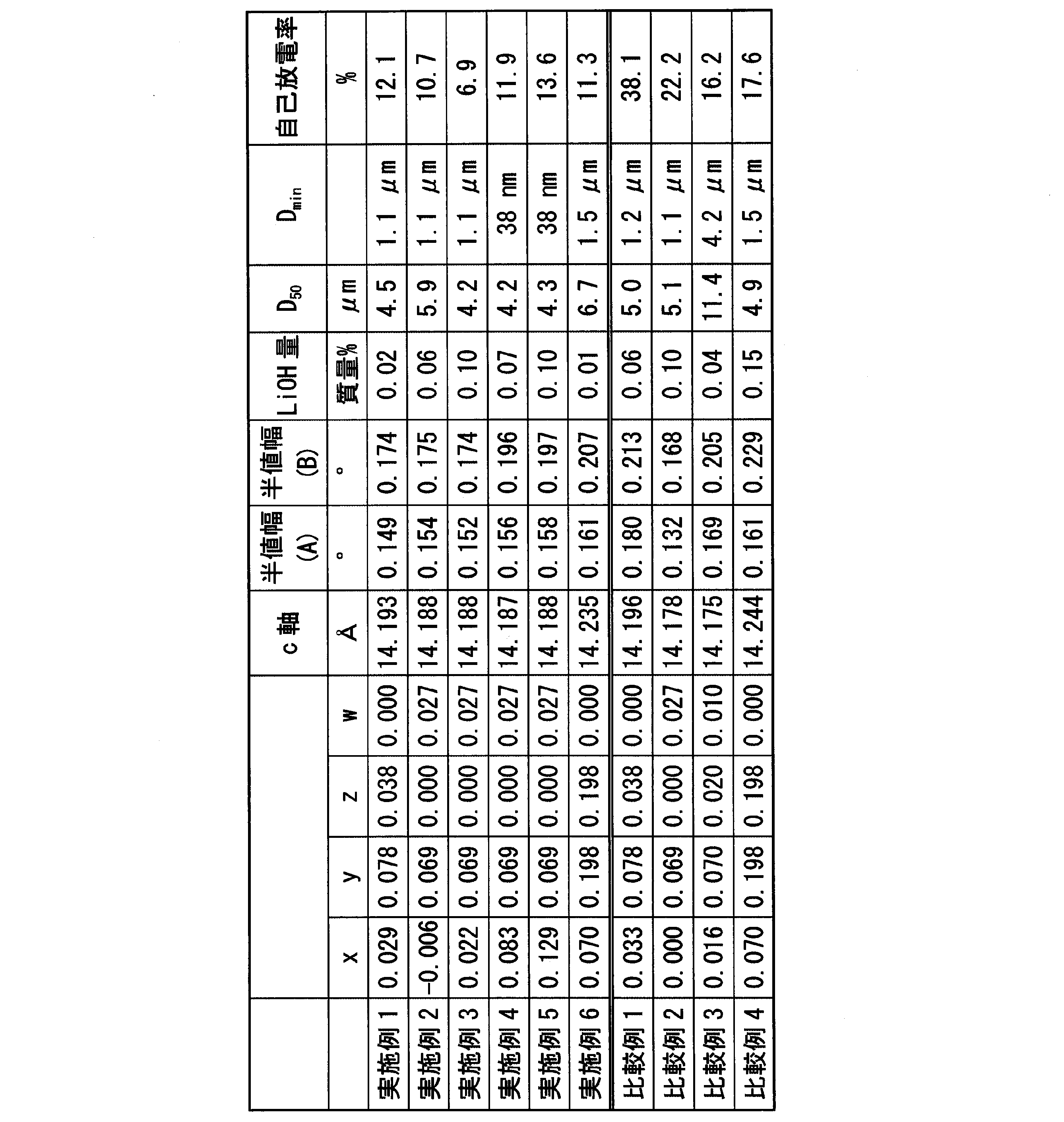
Claims (12)
- 一次粒子と、前記一次粒子の凝集体である二次粒子とを含むリチウム金属複合酸化物粉末であって、
α-NaFeO2型結晶構造を有し、CuKα線を使用した粉末X線回折測定において、2θ=18.7±1°の範囲内の回折ピークの半値幅(A)が0.135°以上0.165°以下であり、
α-NaFeO2型結晶構造の格子定数で、c軸が14.178Å以上14.235Å以下である、リチウム金属複合酸化物粉末。 - CuKα線を使用した粉末X線回折測定において、2θ=44.4±1°の範囲の回折ピークの半値幅(B)が0.170°以上0.240°以下である、請求項1に記載のリチウム金属複合酸化物粉末。
- 下記式(I)を満たす請求項1又は2に記載のリチウム金属複合酸化物粉末。
Li[Lix(Ni(1-y-z-w)CoyMnzMw)1-x]O2 ・・・(I)
(-0.1 ≦x≦0.2、0 ≦y≦0.4、0 ≦z≦0.4、0≦w≦0.1、y+z+w<1、M はMg、Ca、Sr、Ba、Zn、B、Al、Ga、Ti、Zr、Ge、Fe、Cu、Cr、V、W、Mo、Sc、Y、Nb、La、Ta、Tc、Ru、Rh、Pd、Ag、Cd、In、及びSnからなる群より選択される1種以上の元素を表す。) - 前記式(I)のxが0<x≦0.2である、請求項3に記載のリチウム金属複合酸化物粉末。
- 前記式(I)のy+z+wが0<y+z+w≦0.3である、請求項3又は4に記載のリチウム金属複合酸化物粉末。
- さらに単粒子を含む、請求項1~5のいずれか1項に記載のリチウム金属複合酸化物粉末。
- 中和滴定の結果から換算値として求められる水酸化リチウム量がリチウム金属複合酸化物粉末の総質量に対して0.3質量%以下である請求項1~6のいずれか1項に記載のリチウム金属複合酸化物粉末。
- 粒度分布測定における平均粒子径(D50)が100nm以上10μm以下である、請求項1~7のいずれか1項に記載のリチウム金属複合酸化物粉末。
- 粒度分布測定における最小粒子径(Dmin)が50nm以上2μm以下である、請求項1~8のいずれか1項に記載のリチウム金属複合酸化物粉末。
- 請求項1~9のいずれか1項に記載のリチウム金属複合酸化物粉末を含有するリチウム二次電池用正極活物質。
- 請求項10に記載のリチウム二次電池用正極活物質を含有するリチウム二次電池用正極。
- 請求項11に記載のリチウム二次電池用正極を有するリチウム二次電池。
Priority Applications (4)
| Application Number | Priority Date | Filing Date | Title |
|---|---|---|---|
| KR1020207027036A KR102959934B1 (ko) | 2018-03-29 | 2019-03-27 | 리튬 금속 복합 산화물 분말, 리튬 이차 전지용 정극 활물질, 리튬 이차 전지용 정극, 및 리튬 이차 전지 |
| CN201980022041.1A CN111902366A (zh) | 2018-03-29 | 2019-03-27 | 锂金属复合氧化物粉末、锂二次电池用正极活性物质、锂二次电池用正极以及锂二次电池 |
| US17/042,734 US11961995B2 (en) | 2018-03-29 | 2019-03-27 | Lithium metal composite oxide powder, positive electrode active substance for lithium secondary battery, positive electrode for lithium secondary battery, and lithium secondary battery |
| EP19775866.7A EP3778492A4 (en) | 2018-03-29 | 2019-03-27 | LITHIUM METAL COMPOUND OXIDE POWDER, LITHIUM SECONDARY BATTERY POSITIVE ELECTRODE ACTIVE MATERIAL, LITHIUM SECONDARY BATTERY POSITIVE ELECTRODE AND LITHIUM SECONDARY BATTERY |
Applications Claiming Priority (2)
| Application Number | Priority Date | Filing Date | Title |
|---|---|---|---|
| JP2018064749A JP6542421B1 (ja) | 2018-03-29 | 2018-03-29 | リチウム金属複合酸化物粉末、リチウム二次電池用正極活物質、リチウム二次電池用正極、及びリチウム二次電池 |
| JP2018-064749 | 2018-03-29 |
Publications (1)
| Publication Number | Publication Date |
|---|---|
| WO2019189425A1 true WO2019189425A1 (ja) | 2019-10-03 |
Family
ID=67212231
Family Applications (1)
| Application Number | Title | Priority Date | Filing Date |
|---|---|---|---|
| PCT/JP2019/013297 Ceased WO2019189425A1 (ja) | 2018-03-29 | 2019-03-27 | リチウム金属複合酸化物粉末、リチウム二次電池用正極活物質、リチウム二次電池用正極、及びリチウム二次電池 |
Country Status (6)
| Country | Link |
|---|---|
| US (1) | US11961995B2 (ja) |
| EP (1) | EP3778492A4 (ja) |
| JP (1) | JP6542421B1 (ja) |
| KR (1) | KR102959934B1 (ja) |
| CN (1) | CN111902366A (ja) |
| WO (1) | WO2019189425A1 (ja) |
Cited By (1)
| Publication number | Priority date | Publication date | Assignee | Title |
|---|---|---|---|---|
| JP2024504139A (ja) * | 2021-01-20 | 2024-01-30 | ビーエーエスエフ ソシエタス・ヨーロピア | 粒子状(オキシ)水酸化物の製造方法 |
Families Citing this family (14)
| Publication number | Priority date | Publication date | Assignee | Title |
|---|---|---|---|---|
| CN112996753A (zh) * | 2018-11-09 | 2021-06-18 | 巴斯夫公司 | 制备锂代过渡金属氧化物颗粒的方法以及根据所述方法制备的颗粒 |
| WO2021109080A1 (zh) * | 2019-12-05 | 2021-06-10 | 宁德时代新能源科技股份有限公司 | 锂离子电池、用于锂离子电池的正极极片及装置 |
| JP6742547B1 (ja) * | 2020-01-17 | 2020-08-19 | 住友化学株式会社 | 全固体リチウムイオン電池用正極活物質、電極及び全固体リチウムイオン電池 |
| US12537196B2 (en) * | 2020-01-29 | 2026-01-27 | Lg Energy Solution, Ltd. | Positive electrode active material for secondary battery and lithium secondary battery including the same |
| US20230286825A1 (en) * | 2020-08-20 | 2023-09-14 | Semiconductor Energy Laboratory Co., Ltd. | Manufacturing method of positive electrode active material |
| KR102604722B1 (ko) * | 2021-04-29 | 2023-11-22 | 포스코홀딩스 주식회사 | 리튬 이차 전지용 양극 활물질과 이의 제조 방법 및 리튬 이차 전지 |
| US12308429B2 (en) | 2021-10-14 | 2025-05-20 | Lg Energy Solution, Ltd. | Lithium secondary battery |
| CN118160128A (zh) * | 2021-10-14 | 2024-06-07 | 株式会社Lg新能源 | 锂二次电池 |
| KR102673253B1 (ko) * | 2021-10-14 | 2024-06-12 | 주식회사 엘지에너지솔루션 | 리튬 이차 전지 |
| KR102701053B1 (ko) * | 2021-10-14 | 2024-09-03 | 주식회사 엘지에너지솔루션 | 리튬 이차 전지 |
| KR102686803B1 (ko) * | 2021-10-15 | 2024-07-22 | 주식회사 엘지에너지솔루션 | 리튬 이차 전지 |
| KR102715643B1 (ko) * | 2022-06-21 | 2024-10-11 | 포스코홀딩스 주식회사 | 리튬 이차 전지용 양극 활물질 및 이의 제조 방법 |
| JP2024115038A (ja) * | 2023-02-14 | 2024-08-26 | トヨタ自動車株式会社 | 非水電解質二次電池 |
| WO2024225858A1 (ko) * | 2023-04-28 | 2024-10-31 | 주식회사 엘지화학 | 양극 활물질, 양극 및 리튬이차전지 |
Citations (7)
| Publication number | Priority date | Publication date | Assignee | Title |
|---|---|---|---|---|
| JPH09298061A (ja) * | 1996-03-04 | 1997-11-18 | Sharp Corp | 非水系二次電池 |
| JP2001110419A (ja) | 1999-10-13 | 2001-04-20 | Nichia Chem Ind Ltd | リチウムイオン二次電池用正極活物質の過充電安全性の評価方法 |
| JP2002201028A (ja) | 2000-11-06 | 2002-07-16 | Tanaka Chemical Corp | 高密度コバルトマンガン共沈水酸化ニッケル及びその製造法 |
| WO2002086993A1 (en) * | 2001-04-20 | 2002-10-31 | Yuasa Corporation | Anode active matter and production method therefor, non- aqueous electrolyte secondary battery-use anode, and non-aqueous electrolyte secondary battery |
| JP2015018803A (ja) | 2013-07-08 | 2015-01-29 | 三星エスディアイ株式会社Samsung SDI Co.,Ltd. | 正極活物質、その製造方法、それを採用した正極及びリチウム二次電池 |
| WO2017078136A1 (ja) * | 2015-11-05 | 2017-05-11 | 住友化学株式会社 | リチウム二次電池用正極活物質、リチウム二次電池用正極活物質の製造方法、リチウム二次電池用正極及びリチウム二次電池 |
| JP2018064749A (ja) | 2016-10-19 | 2018-04-26 | 株式会社アガツマ | ヘリコプタ玩具及びヘリコプタ玩具用平衡装置 |
Family Cites Families (9)
| Publication number | Priority date | Publication date | Assignee | Title |
|---|---|---|---|---|
| US5792574A (en) | 1996-03-04 | 1998-08-11 | Sharp Kabushiki Kaisha | Nonaqueous secondary battery |
| JPWO2004082046A1 (ja) | 2003-03-14 | 2006-06-15 | セイミケミカル株式会社 | リチウム二次電池用正極活物質粉末 |
| US20050220700A1 (en) | 2003-03-14 | 2005-10-06 | Seimi Chemical Co., Ltd. | Positive electrode active material powder for lithium secondary battery |
| US20090011334A1 (en) | 2005-02-08 | 2009-01-08 | Mitsubishi Chemical Corporation | Lithium secondary battery and positive electrode material thereof |
| JP4984478B2 (ja) | 2005-10-04 | 2012-07-25 | 住友化学株式会社 | 正極活物質および非水電解質二次電池 |
| JP2008147068A (ja) | 2006-12-12 | 2008-06-26 | Ise Chemicals Corp | 非水電解液二次電池用リチウム複合酸化物 |
| KR102202822B1 (ko) | 2013-07-17 | 2021-01-14 | 스미토모 긴조쿠 고잔 가부시키가이샤 | 비수계 전해질 이차전지용 정극 활물질, 이러한 비수계 전해질 이차전지용 정극 활물질의 제조 방법 및 이러한 비수계 전해질 이차전지용 정극 활물질을 이용한 비수계 전해질 이차전지 |
| KR102379798B1 (ko) | 2014-05-29 | 2022-03-28 | 스미또모 가가꾸 가부시끼가이샤 | 리튬 이차 전지용 정극 활물질, 리튬 이차 전지용 정극 및 리튬 이차 전지 |
| CN106532005B (zh) | 2016-12-16 | 2020-06-09 | 贵州振华新材料有限公司 | 球形或类球形锂电池正极材料、电池及制法和应用 |
-
2018
- 2018-03-29 JP JP2018064749A patent/JP6542421B1/ja active Active
-
2019
- 2019-03-27 EP EP19775866.7A patent/EP3778492A4/en active Pending
- 2019-03-27 US US17/042,734 patent/US11961995B2/en active Active
- 2019-03-27 WO PCT/JP2019/013297 patent/WO2019189425A1/ja not_active Ceased
- 2019-03-27 KR KR1020207027036A patent/KR102959934B1/ko active Active
- 2019-03-27 CN CN201980022041.1A patent/CN111902366A/zh active Pending
Patent Citations (7)
| Publication number | Priority date | Publication date | Assignee | Title |
|---|---|---|---|---|
| JPH09298061A (ja) * | 1996-03-04 | 1997-11-18 | Sharp Corp | 非水系二次電池 |
| JP2001110419A (ja) | 1999-10-13 | 2001-04-20 | Nichia Chem Ind Ltd | リチウムイオン二次電池用正極活物質の過充電安全性の評価方法 |
| JP2002201028A (ja) | 2000-11-06 | 2002-07-16 | Tanaka Chemical Corp | 高密度コバルトマンガン共沈水酸化ニッケル及びその製造法 |
| WO2002086993A1 (en) * | 2001-04-20 | 2002-10-31 | Yuasa Corporation | Anode active matter and production method therefor, non- aqueous electrolyte secondary battery-use anode, and non-aqueous electrolyte secondary battery |
| JP2015018803A (ja) | 2013-07-08 | 2015-01-29 | 三星エスディアイ株式会社Samsung SDI Co.,Ltd. | 正極活物質、その製造方法、それを採用した正極及びリチウム二次電池 |
| WO2017078136A1 (ja) * | 2015-11-05 | 2017-05-11 | 住友化学株式会社 | リチウム二次電池用正極活物質、リチウム二次電池用正極活物質の製造方法、リチウム二次電池用正極及びリチウム二次電池 |
| JP2018064749A (ja) | 2016-10-19 | 2018-04-26 | 株式会社アガツマ | ヘリコプタ玩具及びヘリコプタ玩具用平衡装置 |
Non-Patent Citations (1)
| Title |
|---|
| See also references of EP3778492A4 |
Cited By (1)
| Publication number | Priority date | Publication date | Assignee | Title |
|---|---|---|---|---|
| JP2024504139A (ja) * | 2021-01-20 | 2024-01-30 | ビーエーエスエフ ソシエタス・ヨーロピア | 粒子状(オキシ)水酸化物の製造方法 |
Also Published As
| Publication number | Publication date |
|---|---|
| US11961995B2 (en) | 2024-04-16 |
| JP2019172530A (ja) | 2019-10-10 |
| US20210098776A1 (en) | 2021-04-01 |
| JP6542421B1 (ja) | 2019-07-10 |
| KR102959934B1 (ko) | 2026-04-30 |
| EP3778492A4 (en) | 2022-01-12 |
| EP3778492A1 (en) | 2021-02-17 |
| CN111902366A (zh) | 2020-11-06 |
| KR20200135356A (ko) | 2020-12-02 |
Similar Documents
| Publication | Publication Date | Title |
|---|---|---|
| JP6600734B1 (ja) | リチウム金属複合酸化物粉末、リチウム二次電池用正極活物質、正極、及びリチウム二次電池 | |
| JP6542421B1 (ja) | リチウム金属複合酸化物粉末、リチウム二次電池用正極活物質、リチウム二次電池用正極、及びリチウム二次電池 | |
| JP6412094B2 (ja) | リチウム二次電池用正極活物質、リチウム二次電池用正極及びリチウム二次電池 | |
| JP6256956B1 (ja) | リチウム金属複合酸化物粉末、リチウム二次電池用正極活物質、リチウム二次電池用正極及びリチウム二次電池 | |
| JP6337360B2 (ja) | リチウム二次電池用正極活物質、リチウム二次電池用正極及びリチウム二次電池 | |
| JP6836369B2 (ja) | リチウム二次電池用正極活物質前駆体、リチウム二次電池用正極活物質の製造方法 | |
| WO2019177032A1 (ja) | リチウム金属複合酸化物粉末、リチウム二次電池用正極活物質、正極、及びリチウム二次電池 | |
| JP6368022B1 (ja) | リチウム二次電池用正極活物質、リチウム二次電池用正極及びリチウム二次電池 | |
| JP6630865B1 (ja) | リチウム複合金属酸化物粉末及びリチウム二次電池用正極活物質 | |
| WO2019177014A1 (ja) | リチウム金属複合酸化物粉末、リチウム二次電池用正極活物質、正極、及びリチウム二次電池 | |
| JP6630864B1 (ja) | リチウム金属複合酸化物粉末、リチウム二次電池用正極活物質、及びリチウム金属複合酸化物粉末の製造方法 | |
| JP2019003955A (ja) | リチウム二次電池用正極活物質、リチウム二次電池用正極及びリチウム二次電池 | |
| WO2020130123A1 (ja) | リチウム金属複合酸化物粉末、リチウム二次電池用正極活物質、リチウム二次電池用正極及びリチウム二次電池 | |
| WO2017078136A1 (ja) | リチウム二次電池用正極活物質、リチウム二次電池用正極活物質の製造方法、リチウム二次電池用正極及びリチウム二次電池 | |
| WO2018181530A1 (ja) | リチウム金属複合酸化物の製造方法 | |
| WO2019177023A1 (ja) | リチウム金属複合酸化物粉末、リチウム二次電池用正極活物質、正極及びリチウム二次電池 | |
| JP6659894B1 (ja) | リチウム金属複合酸化物粉末、リチウム二次電池用正極活物質、及びリチウム金属複合酸化物粉末の製造方法 | |
| JP2020011892A (ja) | リチウム金属複合酸化物粉末、リチウム二次電池用正極活物質、正極、及びリチウム二次電池 | |
| JP6600066B1 (ja) | リチウム複合金属酸化物粉末、リチウム二次電池用正極活物質、リチウム二次電池用正極及びリチウム二次電池 | |
| JP2019153435A (ja) | リチウム金属複合酸化物、リチウム二次電池用正極活物質、正極及びリチウム二次電池 | |
| JP6360374B2 (ja) | リチウム含有複合金属酸化物の製造方法 | |
| JP2018095546A (ja) | リチウム金属複合酸化物粉末、リチウム二次電池用正極活物質、リチウム二次電池用正極及びリチウム二次電池 | |
| JP2019172573A (ja) | リチウム金属複合酸化物粉末、リチウム二次電池用正極活物質、リチウム二次電池用正極、及びリチウム二次電池 | |
| JP2021098631A (ja) | リチウム金属複合酸化物、リチウム二次電池用正極活物質、リチウム二次電池用正極及びリチウム二次電池 |
Legal Events
| Date | Code | Title | Description |
|---|---|---|---|
| 121 | Ep: the epo has been informed by wipo that ep was designated in this application |
Ref document number: 19775866 Country of ref document: EP Kind code of ref document: A1 |
|
| ENP | Entry into the national phase |
Ref document number: 20207027036 Country of ref document: KR Kind code of ref document: A |
|
| NENP | Non-entry into the national phase |
Ref country code: DE |
|
| WWE | Wipo information: entry into national phase |
Ref document number: 2019775866 Country of ref document: EP |
|
| ENP | Entry into the national phase |
Ref document number: 2019775866 Country of ref document: EP Effective date: 20201029 |
|
| WWR | Wipo information: refused in national office |
Ref document number: 1020207027036 Country of ref document: KR |