WO2019193630A1 - Ni基超合金鋳造材およびそれを用いたNi基超合金製造物 - Google Patents
Ni基超合金鋳造材およびそれを用いたNi基超合金製造物 Download PDFInfo
- Publication number
- WO2019193630A1 WO2019193630A1 PCT/JP2018/014117 JP2018014117W WO2019193630A1 WO 2019193630 A1 WO2019193630 A1 WO 2019193630A1 JP 2018014117 W JP2018014117 W JP 2018014117W WO 2019193630 A1 WO2019193630 A1 WO 2019193630A1
- Authority
- WO
- WIPO (PCT)
- Prior art keywords
- mass
- less
- base superalloy
- component
- casting material
- Prior art date
- Legal status (The legal status is an assumption and is not a legal conclusion. Google has not performed a legal analysis and makes no representation as to the accuracy of the status listed.)
- Ceased
Links
Images

Classifications
-
- B—PERFORMING OPERATIONS; TRANSPORTING
- B22—CASTING; POWDER METALLURGY
- B22D—CASTING OF METALS; CASTING OF OTHER SUBSTANCES BY THE SAME PROCESSES OR DEVICES
- B22D21/00—Casting non-ferrous metals or metallic compounds so far as their metallurgical properties are of importance for the casting procedure; Selection of compositions therefor
- B22D21/02—Casting exceedingly oxidisable non-ferrous metals, e.g. in inert atmosphere
- B22D21/025—Casting heavy metals with high melting point, i.e. 1000 - 1600 degrees C, e.g. Co 1490 degrees C, Ni 1450 degrees C, Mn 1240 degrees C, Cu 1083 degrees C
-
- C—CHEMISTRY; METALLURGY
- C22—METALLURGY; FERROUS OR NON-FERROUS ALLOYS; TREATMENT OF ALLOYS OR NON-FERROUS METALS
- C22C—ALLOYS
- C22C19/00—Alloys based on nickel or cobalt
- C22C19/03—Alloys based on nickel or cobalt based on nickel
- C22C19/05—Alloys based on nickel or cobalt based on nickel with chromium
-
- C—CHEMISTRY; METALLURGY
- C22—METALLURGY; FERROUS OR NON-FERROUS ALLOYS; TREATMENT OF ALLOYS OR NON-FERROUS METALS
- C22C—ALLOYS
- C22C19/00—Alloys based on nickel or cobalt
- C22C19/03—Alloys based on nickel or cobalt based on nickel
- C22C19/05—Alloys based on nickel or cobalt based on nickel with chromium
- C22C19/051—Alloys based on nickel or cobalt based on nickel with chromium and Mo or W
- C22C19/056—Alloys based on nickel or cobalt based on nickel with chromium and Mo or W with the maximum Cr content being at least 10% but less than 20%
-
- C—CHEMISTRY; METALLURGY
- C22—METALLURGY; FERROUS OR NON-FERROUS ALLOYS; TREATMENT OF ALLOYS OR NON-FERROUS METALS
- C22F—CHANGING THE PHYSICAL STRUCTURE OF NON-FERROUS METALS AND NON-FERROUS ALLOYS
- C22F1/00—Changing the physical structure of non-ferrous metals or alloys by heat treatment or by hot or cold working
- C22F1/10—Changing the physical structure of non-ferrous metals or alloys by heat treatment or by hot or cold working of nickel or cobalt or alloys based thereon
-
- F—MECHANICAL ENGINEERING; LIGHTING; HEATING; WEAPONS; BLASTING
- F01—MACHINES OR ENGINES IN GENERAL; ENGINE PLANTS IN GENERAL; STEAM ENGINES
- F01D—NON-POSITIVE DISPLACEMENT MACHINES OR ENGINES, e.g. STEAM TURBINES
- F01D5/00—Blades; Blade-carrying members; Heating, heat-insulating, cooling or antivibration means on the blades or the members
- F01D5/12—Blades
- F01D5/28—Selecting particular materials; Particular measures relating thereto; Measures against erosion or corrosion
- F01D5/286—Particular treatment of blades, e.g. to increase durability or resistance against corrosion or erosion
-
- F—MECHANICAL ENGINEERING; LIGHTING; HEATING; WEAPONS; BLASTING
- F05—INDEXING SCHEMES RELATING TO ENGINES OR PUMPS IN VARIOUS SUBCLASSES OF CLASSES F01-F04
- F05D—INDEXING SCHEME FOR ASPECTS RELATING TO NON-POSITIVE-DISPLACEMENT MACHINES OR ENGINES, GAS-TURBINES OR JET-PROPULSION PLANTS
- F05D2300/00—Materials; Properties thereof
- F05D2300/10—Metals, alloys or intermetallic compounds
- F05D2300/17—Alloys
- F05D2300/175—Superalloys
-
- F—MECHANICAL ENGINEERING; LIGHTING; HEATING; WEAPONS; BLASTING
- F05—INDEXING SCHEMES RELATING TO ENGINES OR PUMPS IN VARIOUS SUBCLASSES OF CLASSES F01-F04
- F05D—INDEXING SCHEME FOR ASPECTS RELATING TO NON-POSITIVE-DISPLACEMENT MACHINES OR ENGINES, GAS-TURBINES OR JET-PROPULSION PLANTS
- F05D2300/00—Materials; Properties thereof
- F05D2300/60—Properties or characteristics given to material by treatment or manufacturing
- F05D2300/606—Directionally-solidified crystalline structures
-
- Y—GENERAL TAGGING OF NEW TECHNOLOGICAL DEVELOPMENTS; GENERAL TAGGING OF CROSS-SECTIONAL TECHNOLOGIES SPANNING OVER SEVERAL SECTIONS OF THE IPC; TECHNICAL SUBJECTS COVERED BY FORMER USPC CROSS-REFERENCE ART COLLECTIONS [XRACs] AND DIGESTS
- Y02—TECHNOLOGIES OR APPLICATIONS FOR MITIGATION OR ADAPTATION AGAINST CLIMATE CHANGE
- Y02T—CLIMATE CHANGE MITIGATION TECHNOLOGIES RELATED TO TRANSPORTATION
- Y02T50/00—Aeronautics or air transport
- Y02T50/60—Efficient propulsion technologies, e.g. for aircraft
Definitions
- the present invention relates to a technology of a Ni (nickel) base superalloy material, and in particular, a Ni base superalloy casting material excellent in mechanical properties and corrosion resistance at high temperatures and capable of reducing costs, and the Ni base superalloy.
- the present invention relates to a product using a cast material.
- Turbine high-temperature members for example, turbine blades (moving blades, stationary blades), turbine disks, combustor members, boiler members
- mechanical properties e.g., creep properties, tensile properties, fatigue properties
- the turbine high-temperature member has excellent corrosion resistance (including oxidation resistance) in order to withstand the high temperature main fluid.
- corrosion resistance including oxidation resistance
- Ni-based superalloy materials are currently widely used as materials.
- a precision casting material is generally used as a member having a complicated shape (for example, a turbine blade) from the viewpoint of shape controllability and manufacturing cost.
- the precision cast material includes an ordinary precision cast material having a metal structure consisting of an assembly of equiaxed crystals, a unidirectional solidified material having a metal structure consisting of an aggregate of columnar crystals aligned in the major axis direction, and the entire member. There is a single crystal solidified material having a metal structure composed of one crystal.
- a unidirectional solidified material and a single crystal solidified member that eliminate the grain boundary that divides the longitudinal direction of the member, which is considered a weakening factor, are advantageous.
- ordinary precision cast materials are advantageous from the viewpoint of manufacturing cost and corrosion resistance, but have weak points from the viewpoint of creep characteristics. Therefore, various research and development have been conducted to improve mechanical properties such as creep properties while maintaining the advantages of ordinary precision cast materials.
- Patent Document 1 Japanese Patent Laid-Open No. 2003-013161
- the remaining components are substantially made of Ni (nickel),
- the sum of the contents of Al, Ti, Nb and Ta is 1 to 5.5 atomic%,
- Patent Document 2 Japanese Patent Application Laid-Open No. 2004-197131
- 3.4 to 4.6 wt% Al 0.5 to 1.6 wt% Nb, 0.05 to 0.16 wt% C, 0.005 to 0.025 wt% B , 0 to 2.0 wt% Hf (hafnium), 0 to 0.5 wt% Re, 0 to 0.05 wt% or less Zr, 0 to 0.005 wt% O (oxygen), 0 to 0.005 wt% N (nitrogen) , 0-0.01 wt% Si, 0-0.2 wt% Mn, 0-0.01 wt% P (phosphorus), 0-0.01 wt% S (sulfur), and Ti, Ta, Mo, W,
- a Ni-base heat-resistant alloy characterized by being made of a Ni-base superalloy having a Ti Eq in
- Patent Document 1 it is said that an austenitic low thermal expansion Ni-base superalloy having high temperature strength, corrosion resistance and oxidation resistance equivalent to those of an austenitic heat resistant alloy can be provided.
- Patent Document 2 it is said that a Ni-based heat-resistant alloy for ordinary casting or unidirectional solidification having excellent high-temperature creep rupture strength, oxidation resistance and corrosion resistance can be provided.
- the high temperature turbine member can secure high corrosion resistance that can withstand the use of a fuel with a relatively low degree of purification (a fuel containing a relatively large amount of impurities), the turbine can be operated by using the high temperature member.
- a secondary effect that costs can be reduced can also be expected.
- the present invention has been made in view of the problems as described above, and its purpose is to achieve corrosion resistance equivalent to or higher than that of conventional materials while maintaining mechanical properties equivalent to those of conventional ordinary precision cast materials, Another object of the present invention is to provide a Ni-base superalloy casting material that can be manufactured at a lower cost than conventional materials and a Ni-base superalloy product using the same.
- Ni-base superalloy is 12.1% to 16% Cr, 4 to 16% by mass of Co, Al of 3 mass% or more and 5 mass% or less, 2.1 mass% or more and 3.3 mass% or less of Ti, 3.5 wt% to 9 wt% W; 1 to 2.4% by mass of Mo, 1.2 mass% or less of Nb, 0.005 mass% or more and 0.05 mass% or less B, 0.03 mass% or more and 0.2 mass% or less of C, O and more than 0 mass% 0.005 mass% or less O,
- the present invention provides a Ni-base superalloy casting material characterized in that the balance has a chemical composition comprising Ni and impurities.
- the present invention can add the following improvements and changes to the Ni-base superalloy casting material (I).
- the impurities include 0.1% by mass or less of Ta, 0.05% by mass or less of Hf, 0.05% by mass or less of Re, 0.01% by mass or less of Zr, 0.005% by mass or less of N, and 0.01% by mass.
- P and 0.01 mass% or less S are included.
- the Cr is 13.1% by mass to 16% by mass
- the Co is 5.1% by mass to 15% by mass
- the Al is 3.6% by mass to 5% by mass
- Ti is 2.2% by mass to 3.3% by mass
- W is 4.5% by mass to 9% by mass
- Mo is 1.4% by mass to 2.4% by mass
- Nb is 0.5% by mass or less
- B is 0.01 mass% or more and 0.03 mass% or less
- the C is 0.05 mass% or more and 0.15 mass% or less
- the O is 0.001 mass% or more and 0.005 mass% or less.
- the Cr is 13.1 to 14.5% by mass
- the Co is 6 to 12% by mass
- the Al is 3.8 to 4.8% by mass
- Ti is 2.3 mass% or more and 3.3 mass% or less
- W is 5 mass% or more and 9 mass% or less
- Mo is 1.8 mass% or more and 2.4 mass% or less
- Nb is 0.1 mass% or less
- B is 0.01 mass% or more and 0.02 mass% or less
- the C is 0.05 mass% or more and 0.12 mass% or less
- the O is 0.001 mass% or more and 0.004 mass% or less.
- Ni-base superalloy cast material is the above-mentioned Ni-base superalloy cast material, and has a metal structure composed of an equiaxed crystal aggregate or a columnar crystal aggregate aligned in the major axis direction.
- a featured Ni-base superalloy product is provided.
- the present invention can add the following improvements and changes to the Ni-base superalloy product (II).
- the product is a turbine high temperature member.
- the turbine high temperature member is a turbine blade.
- a Ni-base superalloy casting that achieves corrosion resistance equal to or higher than that of the conventional material while maintaining the mechanical properties equivalent to those of the conventional ordinary precision cast material, and can be produced at a lower cost than the conventional material.
- a material and a Ni-base superalloy product using the same can be provided.
- the present invention is directed to a Ni-based superalloy polycrystalline cast material that can be suitably used as a Ni-based superalloy product such as a turbine high-temperature member.
- the present invention is equivalent to a conventional ordinary precision cast material.
- the objective is to provide a Ni-base superalloy casting material that achieves corrosion resistance (including oxidation resistance) equal to or higher than that of conventional materials while maintaining mechanical properties, and can be manufactured at a lower cost than conventional materials.
- the present inventors examined the component balance (namely, alloy composition) of Ni base superalloy in detail.
- Ni-base superalloy casting material (Chemical composition of Ni-base superalloy)
- the composition (each component) of the Ni-base superalloy used in the present invention will be described.
- Cr component 12.1% to 16% by mass Cr component dissolves in the ⁇ phase to improve mechanical properties (eg, creep strength) (also referred to as “solid solution strengthening”) and superalloy casting There is an effect of improving the corrosion resistance (particularly, molten salt corrosion resistance) by forming an oxide film (for example, Cr 2 O 3 ) on the surface of the material.
- the Cr content is preferably 12.1% by mass to 16% by mass, more preferably 13.1% by mass to 16% by mass, and further preferably 13.1% by mass to 14.5% by mass.
- the Cr content is less than 12.1% by mass, the above-mentioned effects cannot be obtained sufficiently.
- the Cr content exceeds 16% by mass, the topologically close packed phase (TCP phase, for example, ⁇ phase, ⁇ phase), which is an embrittlement phase, is likely to precipitate and mechanical properties and corrosion resistance are greatly reduced.
- TCP phase for example, ⁇ phase, ⁇ phase
- the effect of solid solution strengthening may be reduced by reducing the solid solution possible amount of other solid solution strengthening elements (for example, W, Mo).
- Co component 4% to 16% by mass
- Co component is an element close to Ni and replaces Ni to form a solid solution in the ⁇ phase, improving mechanical properties (eg, creep strength) and corrosion resistance. There is an effect to improve.
- the Co content is preferably 4% by mass to 16% by mass, more preferably 5.1% by mass to 15% by mass, and still more preferably 6% by mass to 12% by mass.
- Al component 3 or more wt% 5 wt% or less, gamma 'phase (e.g., Ni 3 Al phase) is an essential component for forming.
- the Al component also has an effect of improving the corrosion resistance (including oxidation resistance) by forming an oxide film (for example, Al 2 O 3 ) on the surface of the superalloy casting material.
- the Al content is preferably 3% by mass or more and 5% by mass or less, more preferably 3.6% by mass or more and 5% by mass or less, and further preferably 3.8% by mass or more and 4.8% by mass or less.
- Ti component 2.1 mass% or more and 3.3 mass% or less Ti component forms a ⁇ 'phase (for example, Ni 3 (Al, Ti) phase) together with Al component, and improves mechanical properties (for example, creep strength). effective. Further, the Ti component has an effect of greatly improving the corrosion resistance (for example, corrosion resistance against molten salt corrosion) of the Ni-based alloy at a high temperature.
- the Ti content is preferably 2.1% by mass to 3.3% by mass, more preferably 2.2% by mass to 3.3% by mass, and still more preferably 2.3% by mass to 3.3% by mass.
- the Ti content is less than 2.1% by mass, the above-described effects cannot be obtained sufficiently.
- the Ti content exceeds 3.3% by mass, the oxidation resistance of the Ni-based alloy is deteriorated and the ⁇ phase which is an embrittlement phase (D0 24 type Ni-based intermetallic compound phase, for example, Ni 3 Ti phase) hardly precipitates and mechanical properties (for example, creep strength) decrease.
- embrittlement phase D0 24 type Ni-based intermetallic compound phase, for example, Ni 3 Ti phase
- the W component has an effect of solid solution strengthening by solid solution in the ⁇ phase or ⁇ ′ phase.
- the W content is preferably 3.5% by mass to 9% by mass, more preferably 4.5% by mass to 9% by mass, and further preferably 5% by mass to 9% by mass.
- Mo component 1% by mass or more and 2.4% by mass or less
- the Mo component has the effect of increasing the solid solution temperature of the ⁇ ′ phase and the effect of strengthening the solid solution similarly to the W component.
- Mo has a lower specific gravity than W, considering that a part of the W component is replaced with the Mo component, there is an advantage that the weight of the superalloy casting material is suppressed.
- the Mo content is preferably 1% by mass to 2.4% by mass, more preferably 1.4% by mass to 2.4% by mass, and still more preferably 1.8% by mass to 2.4% by mass.
- the Mo content is less than 1% by mass, the above-mentioned effects cannot be obtained sufficiently.
- the Mo content exceeds 2.4% by mass, the oxidation resistance (particularly, oxidation resistance) decreases.
- Nb component 1.2 mass% or less Nb component forms ⁇ 'phase (for example, Ni 3 (Al, Nb, Ti) phase) together with Al component and Ti component, and improves mechanical properties (for example, creep strength). There is a working effect. In addition, there is an effect of slightly improving the high temperature corrosion resistance.
- the Nb component is not an essential component. Therefore, when the Nb component is contained, the content is preferably 1.2% by mass or less, more preferably 0.5% by mass or less, and further preferably 0.1% by mass or less.
- the Nb component is not an essential component, no particular problem will occur even if it is not included.
- the ⁇ phase which is an embrittlement phase, easily precipitates and mechanical properties (for example, creep strength) are lowered.
- Component B 0.005 mass% or more and 0.05 mass% or less
- the component B has an effect of segregating at the grain boundary and contributing to improvement of the grain boundary strength.
- the B content is preferably 0.005 mass% or more and 0.05 mass% or less, more preferably 0.01 mass% or more and 0.03 mass% or less, and 0.01 mass% or more and 0.02 mass% or less. The following is more preferable.
- C component 0.03 to 0.2 mass% C component is also an important component for achieving both the creep strength and the grain boundary strength, and segregates at the grain boundary to contribute to the improvement of the grain boundary strength. There is a working effect.
- the C content is preferably 0.03% by mass to 0.2% by mass, more preferably 0.05% by mass to 0.15% by mass, and more preferably 0.05% by mass to 0.12% by mass. The following is more preferable.
- the O component is an essential component for forming an oxide film (for example, Cr 2 O 3 , Al 2 O 3 ) that contributes to an improvement in corrosion resistance.
- the O component is also an impurity that lowers the mechanical properties (for example, creep strength and ductility) of the superalloy casting material when coarse oxide particles are formed.
- the O content is preferably more than 0% by mass and 0.005% by mass or less, more preferably 0.001% by mass to 0.005% by mass, and still more preferably 0.001% by mass to 0.004% by mass.
- Ni and impurities The Ni component is the main component (the component with the maximum content), and as a result of the balance with the various components described above, the Ni content is preferably 51% by mass or more and 74% by mass or less, More preferably, it is at least 70% by mass.
- the impurity in the present invention is not a component that is intentionally added and contained, but a component that is desired to reduce its content as much as possible.
- impurities in the superalloy casting of the present invention include Ta, Hf, Re, Zr, N, P, and S.
- 0.1 mass% or less Ta, 0.05 mass% or less Hf, 0.05 mass% or less Re, 0.01 mass% or less Zr, 0.005 mass% or less N, 0.01 mass% or less P, and 0.01 mass% or less S is the allowable range of contamination.
- Ta component 0.1% by mass or less Ta component forms a ⁇ 'phase (for example, Ni 3 (Al, Ta, Ti) phase) together with Al and Ti components, and improves mechanical properties (for example, creep strength). There is a working effect.
- ⁇ 'phase for example, Ni 3 (Al, Ta, Ti) phase
- mechanical properties for example, creep strength
- the use of expensive raw materials is avoided (not intentionally added) in order to reduce the cost of the superalloy casting material, so that the Ta component is treated as an impurity as described above. That is, it is preferable that substantially no Ta component is contained.
- the Ta content is preferably 0.1% by mass or less, and more preferably 0.05% by mass or less.
- Hf component 0.05 mass% or less
- the Hf component improves corrosion resistance at high temperatures by improving the adhesion of oxide films (eg, Cr 2 O 3 , Al 2 O 3 ) formed on the surface of superalloy castings. There is an effect to improve.
- oxide films eg, Cr 2 O 3 , Al 2 O 3
- the use of an expensive raw material is avoided (not intentionally added) in order to reduce the cost of the superalloy casting material, so that the Hf component is treated as an impurity as described above. That is, it is preferable that substantially no Hf component is contained.
- the Hf content is preferably 0.05% by mass or less, and more preferably 0.01% by mass or less.
- Re component 0.05% by mass or less
- the Re component has the effect of enhancing the corrosion resistance while strengthening the ⁇ phase in the same manner as W.
- the Re component is treated as an impurity as described above. That is, it is preferable that the Re component is not substantially contained.
- the Re content is preferably 0.05% by mass or less, more preferably 0.01% by mass or less.
- the Zr component has an effect of segregating at the grain boundary and contributing to improvement of the grain boundary strength if it is extremely small.
- the Zr component easily forms a Ni-based intermetallic compound phase (for example, Ni 3 Zr phase), and has a great demerit that the solidus temperature (so-called melting point) of the superalloy is lowered and the mechanical properties are lowered. It is also an impurity.
- the Zr content is more preferably 0.005% by mass or less.
- N component 0.005% by mass or less
- N component is combined with a superalloy constituent component to form fine particles of nitride (for example, Cr nitride or Al nitride) if it is extremely small, and mechanical properties (for example, , There is an effect of improving the hardness).
- the N component is also an impurity that lowers the mechanical properties (for example, creep strength and ductility) of the superalloy casting material when coarse nitride particles are formed.
- the N content is more preferably 0.004% by mass or less.
- the P component is an impurity that easily segregates at the crystal grain boundaries of the superalloy casting material and lowers the mechanical properties and the corrosion resistance of the crystal grain boundaries. By controlling the P content to 0.01% by mass or less, those negative effects can be suppressed.
- the P content is more preferably 0.008% by mass or less, and further preferably 0.005% by mass or less.
- the S component is an impurity that easily forms a sulfide having a relatively low melting point when combined with a constituent component of the superalloy, and lowers the mechanical properties of the superalloy casting material.
- the S content is more preferably 0.008% by mass or less, and further preferably 0.005% by mass or less.
- the Ni-base superalloy casting material according to the present invention has desirable mechanical properties without intentionally adding expensive elements such as Ta, Hf, and Re in order to realize cost reduction in the alloy composition.
- the contents of W, Mo and Ti are optimized.
- a normal precision cast material having a metal structure composed of an equiaxed crystal aggregate and a unidirectional solidified material having a metal structure composed of a columnar crystal aligned in the major axis direction are suitable. It is. In the case where production cost and corrosion resistance are given higher priority, ordinary precision cast material is preferable. When mechanical properties such as creep properties are given higher priority, a unidirectional solidified material is preferable.
- the Ni-base superalloy product of the present invention has a good balance between mechanical properties (for example, creep strength) and corrosion resistance at high temperature (including oxidation resistance), and more than conventional materials. The cost can be reduced. Therefore, the Ni-base superalloy product of the present invention can be suitably used as a turbine high temperature member used in a high temperature / corrosive environment.
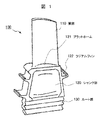
- FIG. 1 is a schematic perspective view showing an example of a turbine rotor blade as an example of a Ni-base superalloy product according to the present invention.
- the turbine rotor blade 100 generally includes a blade portion 110, a shank portion 120, and a root portion (also referred to as a dovetail portion) 130.
- the shank unit 120 includes a platform 121 and a radial fin 122.
- the size (length in the vertical direction in the drawing) of the turbine rotor blade 100 is about 10 to 100 cm, and the weight is about 1 to 10 kg.
- FIG. 2 is a schematic perspective view showing an example of a turbine stationary blade as another example of the Ni-base superalloy product according to the present invention.
- the turbine stationary blade 200 is generally configured by an inner ring side end wall 210, a blade part 220, and an outer ring side end wall 230.
- the length of the blade portion 220 of the turbine stationary blade 200 is about 170 mm.
- the conventional cast material CCA-1 is a Ni-base alloy cast material prepared with reference to Japanese Patent Publication No. 46-27144
- the conventional cast material CCA-2 is a Ni-base alloy prepared with reference to JP-A-51-34819.
- the conventional cast material CCA-3 is a Ni-based alloy cast material prepared with reference to JP-A-6-57359
- the conventional cast material CCA-4 is a Ni material prepared with reference to JP-A 2004-197131. It is a base alloy casting material.
- the inventive casting materials ICA-1 to ICA-10 do not intentionally contain Ta, Hf and Re, and the conventional casting materials in terms of the content balance of W, Mo and Ti. It can be seen that there is a difference from CCA-1 to CCA-4.
- Oxidation resistance evaluation ICA-1 to ICA-10 and CCA-1 to CCA-4 prepared in Experiment 1 were machined and oxidized specimens (width 10 mm, length 25 mm, thickness 1.5 mm). Next, each oxidation test piece was subjected to a high-temperature repeated oxidation test (held in air at 1373 K for 20 hours, repeated 12 times), and the mass change per unit surface area of the oxidation test piece (mg / cm 2 ) was measured. The smaller the mass change amount (the smaller the absolute value of the negative number), the higher the oxidation resistance.
- a mass change of -15 mg / cm 2 or less (weight loss of 15 mg / cm 2 or less) is judged as “accepted”, and a weight change of more than -15 mg / cm 2 (weight loss is over 15 mg / cm 2 ) is rejected.
- the results are also shown in Table 3.
- Mass variation is -10 mg / cm 2 within the (weight loss 10 mg / cm 2 or less) is determined as "pass", -10 mg / cm 2 than the (weight loss 10 mg / cm 2 greater) "fail Was determined. The results are also shown in Table 3.
- the conventional cast material CCA-1 has passed mechanical properties, but has a great weak point in oxidation resistance and molten salt corrosion resistance (that is, corrosion resistance).
- Conventional cast material CCA-2 exhibits good molten salt corrosion resistance but fails mechanical properties and oxidation resistance.
- Conventional cast material CCA-3 exhibits excellent mechanical properties and excellent oxidation resistance, but fails in molten salt corrosion resistance.
- Conventional cast material CCA-4 passes mechanical properties and oxidation resistance, but fails molten salt corrosion resistance.
- the inventive cast materials ICA-1 to ICA-10 are found to pass all of the mechanical properties, oxidation resistance and molten salt corrosion resistance. That is, it is confirmed that the cast material of the present invention balances mechanical properties, oxidation resistance, and molten salt corrosion resistance at a high level as compared with conventional cast materials.
- the cast material of the present invention does not use expensive elements (Ta, Hf, Re, etc.) as described above, the cost can be reduced as compared with the conventional cast material.
- the inventive cast material ICA-1-2 was subjected to the same creep test, high temperature repeated oxidation test, and molten salt immersion test as in Experiment 2 to obtain mechanical properties, oxidation resistance and molten salt corrosion resistance. Evaluated. As a result, it was confirmed that the creep strength was significantly improved over ICA-1 while maintaining the oxidation resistance and molten salt corrosion resistance equivalent to those of the inventive casting material ICA-1.
- Turbine blade 110 ... Wing part, 120 ... Shank part, 121 ... Platform, 122 ... Radial fin, 130 ... Root part, 200 ... Turbine vane, 210 ... End ring side wall, 220 ... Wing part, 230 ... Outer ring side end wall.
Landscapes
- Chemical & Material Sciences (AREA)
- Engineering & Computer Science (AREA)
- Mechanical Engineering (AREA)
- Materials Engineering (AREA)
- Metallurgy (AREA)
- Organic Chemistry (AREA)
- Physics & Mathematics (AREA)
- Thermal Sciences (AREA)
- Crystallography & Structural Chemistry (AREA)
- General Engineering & Computer Science (AREA)
- Turbine Rotor Nozzle Sealing (AREA)
Abstract
本発明は、従来の普通精密鋳造材と同等の機械的特性を維持しながら、従来材と同等以上の耐食性を達成し、かつ従来材よりも低コスト化が可能なNi基超合金鋳造材を提供することを目的とする。本発明に係るNi基超合金鋳造材は、Ni基超合金の多結晶鋳造材であって、前記Ni基超合金は、質量%で、12.1~16%のCrと、4~16%のCoと、3~5%のAlと、2.1~3.3%のTiと、3.5~9%のWと、1~2.4%のMoと、1.2%以下のNbと、0.005~0.05%のBと、0.03~0.2%のCと、0%超0.005%以下のOとを含み、残部がNiおよび不純物からなる化学組成を有することを特徴とする。
Description
本発明は、Ni(ニッケル)基超合金材の技術に係り、特に、高温での機械的特性と耐食性とに優れ、かつ低コスト化が可能なNi基超合金鋳造材および該Ni基超合金鋳造材を用いた製造物に関するものである。
航空機や火力発電プラントのタービン(ガスタービン、蒸気タービン)において、熱効率向上を目指した主流体温度の高温化は一つの技術トレンドになっている。主流体温度の高温化によって最も過酷な環境に曝されるタービン高温部材(例えば、タービン翼(動翼、静翼)、タービンディスク、燃焼器部材、ボイラー部材)は、運転中の回転遠心力や振動や起動/停止に伴う熱応力を繰り返し受けることから、優れた機械的特性(例えば、クリープ特性、引張特性、疲労特性)を有することが非常に重要である。
同時に、高温化された主流体に耐えるため、タービン高温部材は優れた耐食性(耐酸化性を含む)を有することも非常に重要である。そして、タービン高温部材に要求される種々の機械的特性および耐食性を満たすため、その材料としては、現在、Ni基超合金材が広く利用されている。
タービン高温部材を製造するにあたり、複雑な形状を有する部材(例えば、タービン翼)は、形状制御性および製造コストの観点から、精密鋳造材が一般的に利用される。精密鋳造材には、等軸晶の集合体からなる金属組織を有する普通精密鋳造材と、長軸方向が揃った柱状晶の集合体からなる金属組織を有する一方向凝固材と、部材全体が一つの結晶からなる金属組織を有する単結晶凝固材とがある。
クリープ特性の観点からは、弱化因子と考えられている部材長手方向を分断する結晶粒界を排除した一方向凝固材および単結晶凝固部材が有利であるが、一方向凝固材および単結晶凝固部材は、製造コスト(例えば、製造歩留まり、製造に要する時間)の観点で弱点がある。一方、普通精密鋳造材は、製造コストおよび耐食性の観点から有利であるが、クリープ特性の観点で弱点がある。そこで、普通精密鋳造材の利点を維持しながら、クリープ特性などの機械的特性を向上させる種々の研究開発が行われてきた。
例えば、特許文献1(特開2003-013161)には、
0.15質量%以下のC(炭素)、1質量%以下のSi(ケイ素)、1質量%以下のMn(マンガン)、5~20質量%のCr(クロム)、17~26質量%のMo(モリブデン)、0.1~2.0質量%のAl(アルミニウム)、0.1~2.0質量%のTi(チタン)、10質量%以下のFe(鉄)、0.02質量%以下のB(ホウ素)、0.2質量%以下のZr(ジルコニウム)、Nb(ニオブ)、Ta(タンタル)、W(タングステン)、Re(レニウム)を含み、残部の成分は、実質的にNi(ニッケル)からなり、
Al、Ti、NbおよびTaの含有量の和は、1~5.5原子%であり、
次式:「17≦Mo+(W+Re)/2≦27」、Mo:モリブデンの含有質量%、W:タングステンの含有質量%、Re:レニウムの含有質量%、を満たし、
次式:「Nb+Ta/2≦1.5」、Nb:ニオブの含有質量%、Ta:タンタルの含有質量%、を満たし、
金属間化合物Ni3Al、Ni3(Al,Nb,Ta)またはNi3(Al,Ti)からなるγ’相と、金属間化合物Ni2(Mo,Cr)からなるA2B相とが複合析出しているオーステナイト系低熱膨張Ni基超合金が、開示されている。
0.15質量%以下のC(炭素)、1質量%以下のSi(ケイ素)、1質量%以下のMn(マンガン)、5~20質量%のCr(クロム)、17~26質量%のMo(モリブデン)、0.1~2.0質量%のAl(アルミニウム)、0.1~2.0質量%のTi(チタン)、10質量%以下のFe(鉄)、0.02質量%以下のB(ホウ素)、0.2質量%以下のZr(ジルコニウム)、Nb(ニオブ)、Ta(タンタル)、W(タングステン)、Re(レニウム)を含み、残部の成分は、実質的にNi(ニッケル)からなり、
Al、Ti、NbおよびTaの含有量の和は、1~5.5原子%であり、
次式:「17≦Mo+(W+Re)/2≦27」、Mo:モリブデンの含有質量%、W:タングステンの含有質量%、Re:レニウムの含有質量%、を満たし、
次式:「Nb+Ta/2≦1.5」、Nb:ニオブの含有質量%、Ta:タンタルの含有質量%、を満たし、
金属間化合物Ni3Al、Ni3(Al,Nb,Ta)またはNi3(Al,Ti)からなるγ’相と、金属間化合物Ni2(Mo,Cr)からなるA2B相とが複合析出しているオーステナイト系低熱膨張Ni基超合金が、開示されている。
また、特許文献2(特開2004-197131)には、
12.0~16.0重量%のCr,4.0~9.0重量%のCo(コバルト),3.4~4.6重量%のAl,0.5~1.6重量%のNb,0.05~0.16重量%のC,0.005~0.025重量%のB,0~2.0重量%のHf(ハフニウム),0~0.5重量%のRe,0~0.05重量%以下のZr,0~0.005重量%のO(酸素),0~0.005重量%のN(窒素),0~0.01重量%のSi,0~0.2重量%のMn,0~0.01重量%のP(リン),0~0.01重量%のS(硫黄)、及びTi,Ta,Mo,Wを含み、所定の関係式で求められるTi Eqが4.0~6.0の範囲、Mo Eqが5.0~8.0の範囲にあり、γ’相が析出したNi基超合金よりなることを特徴とするNi基耐熱合金。
12.0~16.0重量%のCr,4.0~9.0重量%のCo(コバルト),3.4~4.6重量%のAl,0.5~1.6重量%のNb,0.05~0.16重量%のC,0.005~0.025重量%のB,0~2.0重量%のHf(ハフニウム),0~0.5重量%のRe,0~0.05重量%以下のZr,0~0.005重量%のO(酸素),0~0.005重量%のN(窒素),0~0.01重量%のSi,0~0.2重量%のMn,0~0.01重量%のP(リン),0~0.01重量%のS(硫黄)、及びTi,Ta,Mo,Wを含み、所定の関係式で求められるTi Eqが4.0~6.0の範囲、Mo Eqが5.0~8.0の範囲にあり、γ’相が析出したNi基超合金よりなることを特徴とするNi基耐熱合金。
特許文献1によると、オーステナイト系耐熱合金と同等の高温強度と耐食性・耐酸化性を有するオーステナイト系低熱膨張Ni基超合金を提供できるとされている。特許文献2によると、優れた高温クリープ破断強度と耐酸化性及び耐食性を併せ持った普通鋳造用又は一方向凝固用のNi基耐熱合金を提供できるとされている。
前述したように、タービン高温部材において主流体温度の高温化に耐えられる機械的特性および耐食性の確保は、必達の課題である。
一方、工業製品に対しては、当然のことながら低コスト化の強い要求があり、製品を低コストで提供する技術の確立は、最重要課題のうちの一つである。低コスト化の観点においては、普通精密鋳造材に好適に利用できるNi基超合金であって、その成分として高価な元素(例えば、Re、Hf、Ta)を意図的には添加しないことが好ましいことは明らかである。
さらに、タービン高温部材が、精製度合の比較的低い燃料(不純物を比較的多く含む燃料)の使用にも耐えられるような高い耐食性を確保することができれば、該高温部材を用いることによってタービンの運転コストを低減することができるという副次的な効果も期待できる。
本発明は、上記のような課題に鑑みてなされたものであり、その目的は、従来の普通精密鋳造材と同等の機械的特性を維持しながら、従来材と同等以上の耐食性を達成し、かつ従来材よりも低コスト化が可能なNi基超合金鋳造材およびそれを用いたNi基超合金製造物を提供することにある。
(I)本発明の一態様は、Ni基超合金の多結晶鋳造材であって、
前記Ni基超合金は、
12.1質量%以上16質量%以下のCrと、
4質量%以上16質量%以下のCoと、
3質量%以上5質量%以下のAlと、
2.1質量%以上3.3質量%以下のTiと、
3.5質量%以上9質量%以下のWと、
1質量%以上2.4質量%以下のMoと、
1.2質量%以下のNbと、
0.005質量%以上0.05質量%以下のBと、
0.03質量%以上0.2質量%以下のCと、
0質量%超0.005質量%以下のOとを含み、
残部がNiおよび不純物からなる化学組成を有することを特徴とするNi基超合金鋳造材を、提供するものである。
前記Ni基超合金は、
12.1質量%以上16質量%以下のCrと、
4質量%以上16質量%以下のCoと、
3質量%以上5質量%以下のAlと、
2.1質量%以上3.3質量%以下のTiと、
3.5質量%以上9質量%以下のWと、
1質量%以上2.4質量%以下のMoと、
1.2質量%以下のNbと、
0.005質量%以上0.05質量%以下のBと、
0.03質量%以上0.2質量%以下のCと、
0質量%超0.005質量%以下のOとを含み、
残部がNiおよび不純物からなる化学組成を有することを特徴とするNi基超合金鋳造材を、提供するものである。
本発明は、上記のNi基超合金鋳造材(I)において、以下のような改良や変更を加えることができる。
(i)前記不純物は、0.1質量%以下のTaと、0.05質量%以下のHfと、0.05質量%以下のReと、0.01質量%以下のZrと、0.005質量%以下のNと、0.01質量%以下のPと、0.01質量%以下のSとを含む。
(ii)前記Ni基超合金は、前記Crが13.1質量%以上16質量%以下で、前記Coが5.1質量%以上15質量%以下で、前記Alが3.6質量%以上5質量%以下で、前記Tiが2.2質量%以上3.3質量%以下で、前記Wが4.5質量%以上9質量%以下で、前記Moが1.4質量%以上2.4質量%以下で、前記Nbが0.5質量%以下で、前記Bが0.01質量%以上0.03質量%以下で、前記Cが0.05質量%以上0.15質量%以下で、前記Oが0.001質量%以上0.005質量%以下である。
(iii)前記Ni基超合金は、前記Crが13.1質量%以上14.5質量%以下で、前記Coが6質量%以上12質量%以下で、前記Alが3.8質量%以上4.8質量%以下で、前記Tiが2.3質量%以上3.3質量%以下で、前記Wが5質量%以上9質量%以下で、前記Moが1.8質量%以上2.4質量%以下で、前記Nbが0.1質量%以下で、前記Bが0.01質量%以上0.02質量%以下で、前記Cが0.05質量%以上0.12質量%以下で、前記Oが0.001質量%以上0.004質量%以下である。
(i)前記不純物は、0.1質量%以下のTaと、0.05質量%以下のHfと、0.05質量%以下のReと、0.01質量%以下のZrと、0.005質量%以下のNと、0.01質量%以下のPと、0.01質量%以下のSとを含む。
(ii)前記Ni基超合金は、前記Crが13.1質量%以上16質量%以下で、前記Coが5.1質量%以上15質量%以下で、前記Alが3.6質量%以上5質量%以下で、前記Tiが2.2質量%以上3.3質量%以下で、前記Wが4.5質量%以上9質量%以下で、前記Moが1.4質量%以上2.4質量%以下で、前記Nbが0.5質量%以下で、前記Bが0.01質量%以上0.03質量%以下で、前記Cが0.05質量%以上0.15質量%以下で、前記Oが0.001質量%以上0.005質量%以下である。
(iii)前記Ni基超合金は、前記Crが13.1質量%以上14.5質量%以下で、前記Coが6質量%以上12質量%以下で、前記Alが3.8質量%以上4.8質量%以下で、前記Tiが2.3質量%以上3.3質量%以下で、前記Wが5質量%以上9質量%以下で、前記Moが1.8質量%以上2.4質量%以下で、前記Nbが0.1質量%以下で、前記Bが0.01質量%以上0.02質量%以下で、前記Cが0.05質量%以上0.12質量%以下で、前記Oが0.001質量%以上0.004質量%以下である。
(II)本発明の他の一態様は、Ni基超合金鋳造材を用いた製造物であって、
前記Ni基超合金鋳造材は、上記のNi基超合金鋳造材であり、等軸晶の集合体からなる金属組織または長軸方向が揃った柱状晶の集合体からなる金属組織を有することを特徴とするNi基超合金製造物を、提供するものである。
前記Ni基超合金鋳造材は、上記のNi基超合金鋳造材であり、等軸晶の集合体からなる金属組織または長軸方向が揃った柱状晶の集合体からなる金属組織を有することを特徴とするNi基超合金製造物を、提供するものである。
本発明は、上記のNi基超合金製造物(II)において、以下のような改良や変更を加えることができる。
(iv)前記製造物が、タービン高温部材である。
(v)前記タービン高温部材が、タービン翼である。
(iv)前記製造物が、タービン高温部材である。
(v)前記タービン高温部材が、タービン翼である。
本発明によれば、従来の普通精密鋳造材と同等の機械的特性を維持しながら、従来材と同等以上の耐食性を達成し、かつ従来材よりも低コスト化が可能なNi基超合金鋳造材およびそれを用いたNi基超合金製造物を提供することができる。
(本発明の基本思想)
前述したように、本発明は、タービン高温部材などのNi基超合金製造物として好適に利用できるNi基超合金の多結晶鋳造材を対象としており、特に、従来の普通精密鋳造材と同等の機械的特性を維持しながら従来材と同等以上の耐食性(耐酸化性を含む)を達成し、かつ従来材よりも低コスト化が可能なNi基超合金鋳造材の提供を目的としている。そして、当該目的を達成するため、本発明者等は、Ni基超合金の成分バランス(すなわち合金組成)を詳細に検討した。
前述したように、本発明は、タービン高温部材などのNi基超合金製造物として好適に利用できるNi基超合金の多結晶鋳造材を対象としており、特に、従来の普通精密鋳造材と同等の機械的特性を維持しながら従来材と同等以上の耐食性(耐酸化性を含む)を達成し、かつ従来材よりも低コスト化が可能なNi基超合金鋳造材の提供を目的としている。そして、当該目的を達成するため、本発明者等は、Ni基超合金の成分バランス(すなわち合金組成)を詳細に検討した。
概略的には、まず、低コスト化を実現するために、高価な元素(例えば、Re、Hf、Ta)を意図的に含有させることを控えることにした(合金原料から不可避的に混入することは許容する)。ただし、それらの元素は、従来技術において高温での機械的特性の向上に必要とされてきた成分であるため、機械的特性の低下が懸念された。
そこで、望ましい機械的特性を達成するために、固溶強化の作用効果があるとされるWおよびMoの含有率の最適化を検討した。さらに、望ましい耐食性を達成するために、TiおよびMoの含有率の最適化を検討した。言い換えると、従来技術に比して、Re、Hf、Taなどの高価な元素を意図的には含有させない代わりに、W、MoおよびTiの含有率の最適化を鋭意研究した。
その結果、本明細書で規定する化学組成(合金組成とも言う)を有するNi基超合金を用いることによって、上記目的を達成する多結晶鋳造材が得られることを見出した。本発明は、当該知見に基づいて完成されたものである。
以下、本発明の実施形態について、図面を参照しながら具体的に説明する。ただし、本発明は、ここで取り挙げた実施形態に限定されるものではなく、発明の技術的思想を逸脱しない範囲で、公知技術と適宜組み合わせたり公知技術に基づいて改良したりすることが可能である。
[Ni基超合金鋳造材]
(Ni基超合金の化学組成)
以下、本発明で用いるNi基超合金の組成(各成分)について説明する。
(Ni基超合金の化学組成)
以下、本発明で用いるNi基超合金の組成(各成分)について説明する。
Cr成分:12.1質量%以上16質量%以下
Cr成分は、γ相中に固溶して機械的特性(例えば、クリープ強度)を向上させる(「固溶強化する」とも言う)とともに、超合金鋳造材の表面に酸化物被膜(例えば、Cr2O3)を形成して耐食性(特に、耐溶融塩腐食)を向上させる作用効果がある。Cr含有率は、12.1質量%以上16質量%以下が好ましく、13.1質量%以上16質量%以下がより好ましく、13.1質量%以上14.5質量%以下が更に好ましい。
Cr成分は、γ相中に固溶して機械的特性(例えば、クリープ強度)を向上させる(「固溶強化する」とも言う)とともに、超合金鋳造材の表面に酸化物被膜(例えば、Cr2O3)を形成して耐食性(特に、耐溶融塩腐食)を向上させる作用効果がある。Cr含有率は、12.1質量%以上16質量%以下が好ましく、13.1質量%以上16質量%以下がより好ましく、13.1質量%以上14.5質量%以下が更に好ましい。
Cr含有率が12.1質量%未満になると、上記の作用効果が十分に得られない。一方、Cr含有率が16質量%超になると、脆化相であるトポロジー最密充填相(TCP相、例えばσ相、μ相)が析出し易くなって機械的特性や耐食性が大きく低下したり、他の固溶強化元素(例えば、W、Mo)の固溶可能量を低下させて固溶強化の効果が低下したりする。
Co成分:4質量%以上16質量%以下
Co成分は、Niに近い元素でありNiと置換する形でγ相中に固溶し、機械的特性(例えば、クリープ強度)を向上させるとともに、耐食性を向上させる作用効果がある。Co含有率は、4質量%以上16質量%以下が好ましく、5.1質量%以上15質量%以下がより好ましく、6質量%以上12質量%以下が更に好ましい。
Co成分は、Niに近い元素でありNiと置換する形でγ相中に固溶し、機械的特性(例えば、クリープ強度)を向上させるとともに、耐食性を向上させる作用効果がある。Co含有率は、4質量%以上16質量%以下が好ましく、5.1質量%以上15質量%以下がより好ましく、6質量%以上12質量%以下が更に好ましい。
Co含有率が4質量%未満になると、上記の作用効果が十分に得られない。一方、Co含有率が16質量%超になると、高温での機械的強化因子であるγ’相(L12型のNi基金属間化合物相)の析出が抑制され易くなり、機械的特性(例えば、クリープ強度)が低下する。
Al成分:3質量%以上5質量%以下
Al成分は、γ’相(例えば、Ni3Al相)を形成するための必須成分である。また、Al成分は、超合金鋳造材の表面に酸化物被膜(例えば、Al2O3)を形成することで耐食性(耐酸化性を含む)を向上させる作用効果もある。Al含有率は、3質量%以上5質量%以下が好ましく、3.6質量%以上5質量%以下がより好ましく、3.8質量%以上4.8質量%以下が更に好ましい。
Al成分は、γ’相(例えば、Ni3Al相)を形成するための必須成分である。また、Al成分は、超合金鋳造材の表面に酸化物被膜(例えば、Al2O3)を形成することで耐食性(耐酸化性を含む)を向上させる作用効果もある。Al含有率は、3質量%以上5質量%以下が好ましく、3.6質量%以上5質量%以下がより好ましく、3.8質量%以上4.8質量%以下が更に好ましい。
Al含有率が3質量%未満になると、上記の作用効果が十分に得られない。一方、Al含有率が5質量%超になると、鋳造凝固時に共晶γ’相(溶体化-時効処理により析出するγ’相と形態が異なる相)の結晶粒が生成・成長し易くなる。粗大な共晶γ’相粒はクリープ現象での亀裂の起点となり易いため、機械的特性(例えば、クリープ強度)が低下する。また、他の金属成分(例えば、Cr成分)との複合酸化物を形成すると、耐食性低下の要因となる。
Ti成分:2.1質量%以上3.3質量%以下
Ti成分は、Al成分と共にγ’相(例えば、Ni3(Al,Ti)相)を形成し、機械的特性(例えば、クリープ強度)を向上させる作用効果がある。さらに、Ti成分は、Ni基合金の高温における耐食性(例えば、溶融塩腐食に対する耐食性)を大きく向上させる作用効果がある。Ti含有率は、2.1質量%以上3.3質量%以下が好ましく、2.2質量%以上3.3質量%以下がより好ましく、2.3質量%以上3.3質量%以下が更に好ましい。
Ti成分は、Al成分と共にγ’相(例えば、Ni3(Al,Ti)相)を形成し、機械的特性(例えば、クリープ強度)を向上させる作用効果がある。さらに、Ti成分は、Ni基合金の高温における耐食性(例えば、溶融塩腐食に対する耐食性)を大きく向上させる作用効果がある。Ti含有率は、2.1質量%以上3.3質量%以下が好ましく、2.2質量%以上3.3質量%以下がより好ましく、2.3質量%以上3.3質量%以下が更に好ましい。
Ti含有率が2.1質量%未満になると、上記の作用効果が十分に得られない。一方、Ti含有率が3.3質量%超になると、Ni基合金の耐酸化性を劣化させるとともに、脆化相であるη相(D024型のNi基金属間化合物相、例えばNi3Ti相)が析出し易くなって機械的特性(例えば、クリープ強度)が低下する。
W成分:3.5質量%以上9質量%以下
W成分は、γ相中やγ’相中に固溶して固溶強化する作用効果がある。W含有率は、3.5質量%以上9質量%以下が好ましく、4.5質量%以上9質量%以下がより好ましく、5質量%以上9質量%以下が更に好ましい。
W成分は、γ相中やγ’相中に固溶して固溶強化する作用効果がある。W含有率は、3.5質量%以上9質量%以下が好ましく、4.5質量%以上9質量%以下がより好ましく、5質量%以上9質量%以下が更に好ましい。
W含有率が3.5質量%未満になると、上記の作用効果が十分に得られない。一方、W含有率が9質量%超になると、Wを主成分とする針状の析出物(例えば、α-酸化タングステン)が析出し易くなって機械的特性および耐食性が低下する。
Mo成分:1質量%以上2.4質量%以下
Mo成分は、γ’相の固溶温度を上昇させる作用効果とともに、W成分と同様に固溶強化する作用効果がある。また、MoはWに比して比重が小さいため、W成分の一部をMo成分で置き換えると考えると、超合金鋳造材の重量化を抑制しているという利点もある。加えて、Cr成分と同様に耐食性を向上させる作用効果もある。Mo含有率は、1質量%以上2.4質量%以下が好ましく、1.4質量%以上2.4質量%以下がより好ましく、1.8質量%以上2.4質量%以下が更に好ましい。
Mo成分は、γ’相の固溶温度を上昇させる作用効果とともに、W成分と同様に固溶強化する作用効果がある。また、MoはWに比して比重が小さいため、W成分の一部をMo成分で置き換えると考えると、超合金鋳造材の重量化を抑制しているという利点もある。加えて、Cr成分と同様に耐食性を向上させる作用効果もある。Mo含有率は、1質量%以上2.4質量%以下が好ましく、1.4質量%以上2.4質量%以下がより好ましく、1.8質量%以上2.4質量%以下が更に好ましい。
Mo含有率が1質量%未満になると、上記の作用効果が十分に得られない。一方、Mo含有率が2.4質量%超になると、かえって耐酸化性(特に、耐酸化性)が低下する。
Nb成分:1.2質量%以下
Nb成分は、Al成分とTi成分と共にγ’相(例えば、Ni3(Al,Nb,Ti)相)を形成し、機械的特性(例えば、クリープ強度)を向上させる作用効果がある。また、高温耐食性を少し改善する作用効果もある。本発明の超合金鋳造材において、Nb成分は必須の構成成分ではない。よって、Nb成分を含有させる場合、その含有率は、1.2質量%以下が好ましく、0.5質量%以下がより好ましく、0.1質量%以下が更に好ましい。
Nb成分は、Al成分とTi成分と共にγ’相(例えば、Ni3(Al,Nb,Ti)相)を形成し、機械的特性(例えば、クリープ強度)を向上させる作用効果がある。また、高温耐食性を少し改善する作用効果もある。本発明の超合金鋳造材において、Nb成分は必須の構成成分ではない。よって、Nb成分を含有させる場合、その含有率は、1.2質量%以下が好ましく、0.5質量%以下がより好ましく、0.1質量%以下が更に好ましい。
Nb成分が必須の構成成分でないことから、含有させなくても特段の問題は生じない。一方、Nb含有率が1.2質量%超にすると、脆化相であるη相が析出し易くなって機械的特性(例えば、クリープ強度)が低下する。
B成分:0.005質量%以上0.05質量%以下
B成分は、結晶粒界に偏析して結晶粒界強度の向上に寄与する作用効果がある。クリープ強度と結晶粒界強度とをバランスさせるためには、B含有率は、0.005質量%以上0.05質量%以下が好ましく、0.01質量%以上0.03質量%以下がより好ましく、0.01質量%以上0.02質量%以下が更に好ましい。
B成分は、結晶粒界に偏析して結晶粒界強度の向上に寄与する作用効果がある。クリープ強度と結晶粒界強度とをバランスさせるためには、B含有率は、0.005質量%以上0.05質量%以下が好ましく、0.01質量%以上0.03質量%以下がより好ましく、0.01質量%以上0.02質量%以下が更に好ましい。
B含有率が0.005質量%未満になると、上記の作用効果が十分に得られない。一方、B含有率が0.05質量%超になると、過剰のホウ化物を形成し、本超合金の固相線温度(いわゆる融点)が大きく低下するため、クリープ強度が著しく低下する。
C成分:0.03質量%以上0.2質量%以下
C成分も、クリープ強度と結晶粒界強度との両立を図る上で重要な成分であり、結晶粒界に偏析して結晶粒界強度の向上に寄与する作用効果がある。クリープ強度と結晶粒界強度とをバランスさせるためには、C含有率は、0.03質量%以上0.2質量%以下が好ましく、0.05質量%以上0.15質量%以下がより好ましく、0.05質量%以上0.12質量%以下が更に好ましい。
C成分も、クリープ強度と結晶粒界強度との両立を図る上で重要な成分であり、結晶粒界に偏析して結晶粒界強度の向上に寄与する作用効果がある。クリープ強度と結晶粒界強度とをバランスさせるためには、C含有率は、0.03質量%以上0.2質量%以下が好ましく、0.05質量%以上0.15質量%以下がより好ましく、0.05質量%以上0.12質量%以下が更に好ましい。
C含有率が0.03質量%未満になると、上記の作用効果が十分に得られない。一方、C含有率が0.2質量%超になると、過剰の炭化物を形成し、機械的特性(例えば、クリープ強度、延性)が低下するとともに、耐食性も低下する。
O成分:0質量%超0.005質量%以下
O成分は、耐食性の向上に寄与する酸化物被膜(例えば、Cr2O3、Al2O3)を形成するための必須成分である。一方、O成分は、酸化物の粗大粒子を形成した場合に、超合金鋳造材の機械的特性(例えば、クリープ強度、延性)を低下させる不純物でもある。O成分の含有率を0.005質量%以下に制御することで、負の影響を抑制することができる。O含有率は、0質量%超0.005質量%以下が好ましく、0.001質量%以上0.005質量%以下がより好ましく、0.001質量%以上0.004質量%以下が更に好ましい。
O成分は、耐食性の向上に寄与する酸化物被膜(例えば、Cr2O3、Al2O3)を形成するための必須成分である。一方、O成分は、酸化物の粗大粒子を形成した場合に、超合金鋳造材の機械的特性(例えば、クリープ強度、延性)を低下させる不純物でもある。O成分の含有率を0.005質量%以下に制御することで、負の影響を抑制することができる。O含有率は、0質量%超0.005質量%以下が好ましく、0.001質量%以上0.005質量%以下がより好ましく、0.001質量%以上0.004質量%以下が更に好ましい。
残部成分:Niおよび不純物
Ni成分は、主成分(最大含有率の成分)であり、上述した各種構成成分とのバランスの結果、Ni含有率は、51質量%以上74質量%以下が好ましく、55質量%以上70質量%以下がより好ましい。
Ni成分は、主成分(最大含有率の成分)であり、上述した各種構成成分とのバランスの結果、Ni含有率は、51質量%以上74質量%以下が好ましく、55質量%以上70質量%以下がより好ましい。
本発明における不純物は、意図的に添加・含有させる成分ではなく、その含有率をできるだけ少なくしたい成分を意味する。本発明の超合金鋳造材の不純物としては、例えば、Ta、Hf、Re、Zr、N、P、Sが挙げられる。なお、0.1質量%以下のTa、0.05質量%以下のHf、0.05質量%以下のRe、0.01質量%以下のZr、0.005質量%以下のN、0.01質量%以下のP、および0.01質量%以下のSは、混入許容の範囲である。
Ta成分:0.1質量%以下
Ta成分は、Al成分とTi成分と共にγ’相(例えば、Ni3(Al,Ta,Ti)相)を形成し、機械的特性(例えば、クリープ強度)を向上させる作用効果がある。ただし、本発明においては、超合金鋳造材の低コスト化のために高価な原料の使用を避ける(意図的には添加しない)ことから、上述したようにTa成分を不純物として扱う。すなわち、実質的にTa成分を含有しないことが好ましい。
Ta成分は、Al成分とTi成分と共にγ’相(例えば、Ni3(Al,Ta,Ti)相)を形成し、機械的特性(例えば、クリープ強度)を向上させる作用効果がある。ただし、本発明においては、超合金鋳造材の低コスト化のために高価な原料の使用を避ける(意図的には添加しない)ことから、上述したようにTa成分を不純物として扱う。すなわち、実質的にTa成分を含有しないことが好ましい。
なお、他成分の原料や製造工程(例えば、坩堝、鋳型)に起因して混入する結果的なTa含有を否定するものではない。例えば、Ta含有率は、0.1質量%以下が好ましい許容範囲であり、0.05質量%以下がより好ましい許容範囲である。
Hf成分:0.05質量%以下
Hf成分は、超合金鋳造材の表面に形成される酸化物被膜(例えば、Cr2O3、Al2O3)の密着性を向上させることで、高温での耐食性を向上させる作用効果がある。ただし、本発明においては、超合金鋳造材の低コスト化のために高価な原料の使用を避ける(意図的には添加しない)ことから、上述したようにHf成分を不純物として扱う。すなわち、実質的にHf成分を含有しないことが好ましい。
Hf成分は、超合金鋳造材の表面に形成される酸化物被膜(例えば、Cr2O3、Al2O3)の密着性を向上させることで、高温での耐食性を向上させる作用効果がある。ただし、本発明においては、超合金鋳造材の低コスト化のために高価な原料の使用を避ける(意図的には添加しない)ことから、上述したようにHf成分を不純物として扱う。すなわち、実質的にHf成分を含有しないことが好ましい。
なお、他成分の原料や製造工程(例えば、坩堝、鋳型)に起因して混入する結果的なHf含有を否定するものではない。例えば、Hf含有率は、0.05質量%以下が好ましい許容範囲であり、0.01質量%以下がより好ましい許容範囲である。
Re成分:0.05質量%以下
Re成分は、Wと同様にγ相を固溶強化するとともに、耐食性を向上させる作用効果がある。ただし、本発明においては、超合金鋳造材の低コスト化のために高価な原料の使用を避ける(意図的には添加しない)ことから、上述したようにRe成分を不純物として扱う。すなわち、実質的にRe成分を含有しないことが好ましい。
Re成分は、Wと同様にγ相を固溶強化するとともに、耐食性を向上させる作用効果がある。ただし、本発明においては、超合金鋳造材の低コスト化のために高価な原料の使用を避ける(意図的には添加しない)ことから、上述したようにRe成分を不純物として扱う。すなわち、実質的にRe成分を含有しないことが好ましい。
なお、他成分の原料や製造工程(例えば、坩堝、鋳型)に起因して混入する結果的なRe含有を否定するものではない。例えば、Re含有率は、0.05質量%以下が好ましい許容範囲であり、0.01質量%以下がより好ましい許容範囲である。
Zr成分:0.01質量%以下
Zr成分は、極微量であれば結晶粒界に偏析して結晶粒界強度の向上に寄与する作用効果がある。一方、Zr成分は、Ni基金属間化合物相(例えば、Ni3Zr相)を形成し易く、本超合金の固相線温度(いわゆる融点)を低下させて機械的特性が低下するデメリットが大きい不純物でもある。Zr含有率を0.01質量%以下に制御することで、負の影響を抑制することができる。Zr含有率は0.005質量%以下がより好ましい。
Zr成分は、極微量であれば結晶粒界に偏析して結晶粒界強度の向上に寄与する作用効果がある。一方、Zr成分は、Ni基金属間化合物相(例えば、Ni3Zr相)を形成し易く、本超合金の固相線温度(いわゆる融点)を低下させて機械的特性が低下するデメリットが大きい不純物でもある。Zr含有率を0.01質量%以下に制御することで、負の影響を抑制することができる。Zr含有率は0.005質量%以下がより好ましい。
N成分:0.005質量%以下
N成分は、極微量であれば超合金の構成成分と化合して窒化物(例えば、Cr窒化物やAl窒化物)の微細粒子を形成して機械的特性(例えば、硬さ)を向上させる作用効果がある。一方、N成分は、窒化物の粗大粒子を形成した場合に、超合金鋳造材の機械的特性(例えば、クリープ強度、延性)を低下させる不純物でもある。N成分の含有率を0.005質量%以下に制御することで、負の影響を抑制することができる。N含有率は0.004質量%以下がより好ましい。
N成分は、極微量であれば超合金の構成成分と化合して窒化物(例えば、Cr窒化物やAl窒化物)の微細粒子を形成して機械的特性(例えば、硬さ)を向上させる作用効果がある。一方、N成分は、窒化物の粗大粒子を形成した場合に、超合金鋳造材の機械的特性(例えば、クリープ強度、延性)を低下させる不純物でもある。N成分の含有率を0.005質量%以下に制御することで、負の影響を抑制することができる。N含有率は0.004質量%以下がより好ましい。
P:0.01質量%以下
P成分は、超合金鋳造材の結晶粒界に偏析し易く、機械的特性や結晶粒界の耐食性を低下させる不純物である。P含有率を0.01質量%以下に制御することで、それらの負の影響を抑制することができる。P含有率は、0.008質量%以下がより好ましく、0.005質量%以下が更に好ましい。
P成分は、超合金鋳造材の結晶粒界に偏析し易く、機械的特性や結晶粒界の耐食性を低下させる不純物である。P含有率を0.01質量%以下に制御することで、それらの負の影響を抑制することができる。P含有率は、0.008質量%以下がより好ましく、0.005質量%以下が更に好ましい。
S:0.01質量%以下
S成分は、超合金の構成成分と化合して比較的低融点の硫化物を生成し易く、超合金鋳造材の機械的特性を低下させる不純物である。S成分の含有率を0.01質量%以下に制御することで、それらの負の影響を抑制することができる。S含有率は、0.008質量%以下がより好ましく、0.005質量%以下が更に好ましい。
S成分は、超合金の構成成分と化合して比較的低融点の硫化物を生成し易く、超合金鋳造材の機械的特性を低下させる不純物である。S成分の含有率を0.01質量%以下に制御することで、それらの負の影響を抑制することができる。S含有率は、0.008質量%以下がより好ましく、0.005質量%以下が更に好ましい。
[Ni基超合金鋳造材を用いた製造物]
前述したように、本発明のNi基超合金鋳造材は、その合金組成において、低コスト化を実現するためにTa、HfおよびReなどの高価な元素を意図的に添加せず、望ましい機械的特性と望ましい耐食性とを達成するためにW、MoおよびTiの含有率の最適化を図ったものである。
前述したように、本発明のNi基超合金鋳造材は、その合金組成において、低コスト化を実現するためにTa、HfおよびReなどの高価な元素を意図的に添加せず、望ましい機械的特性と望ましい耐食性とを達成するためにW、MoおよびTiの含有率の最適化を図ったものである。
また、鋳造材の種類としては、等軸晶の集合体からなる金属組織を有する普通精密鋳造材や、長軸方向が揃った柱状晶の集合体からなる金属組織を有する一方向凝固材が好適である。製造コストおよび耐食性をより優先する場合は、普通精密鋳造材が好ましい。クリープ特性などの機械的特性をより優先する場合は、一方向凝固材が好ましい。
これら技術思想の結果、本発明のNi基超合金製造物は、機械的特性(例えば、クリープ強度)と高温での耐食性(耐酸化性を含む)とが良くバランスしており、かつ従来材よりも低コスト化が可能である。そのため、本発明のNi基超合金製造物は、高温・腐食環境で使用されるタービン高温部材として好適に利用できる。
図1は、本発明に係るNi基超合金製造物の一例としてのタービン動翼の例を示す斜視模式図である。図1に示したように、タービン動翼100は、概略的に、翼部110とシャンク部120とルート部(ダブティル部とも言う)130とから構成される。シャンク部120は、プラットホーム121とラジアルフィン122とを備えている。なお、発電用ガスタービンの場合、例えば、タービン動翼100の大きさ(図中縦方向の長さ)は10~100 cm程度、重量は1~10 kg程度である。
図2は、本発明に係るNi基超合金製造物の他の一例としてのタービン静翼の例を示す斜視模式図である。図2に示したように、タービン静翼200は、概略的に、内輪側エンドウォール210と翼部220と外輪側エンドウォール230とから構成される。なお、発電用ガスタービンの場合、例えば、タービン静翼200の翼部220の長さ(両エンドウォールの間の距離)は170 mm程度である。
以下、実験例により本発明をさらに具体的に説明する。なお、本発明はこれらの実験例に限定されるものではない。
[実験1]
(発明鋳造材ICA-1~ICA-10および従来鋳造材CCA-1~CCA-4の作製)
耐火坩堝と真空誘導炉とを用いて、本発明で規定する合金組成を有するNi基超合金および従来技術の合金組成を有するNi基超合金を溶製・鋳造して、マスターインゴット(それぞれ直径80 mm、長さ300 mm)を用意した。次に、各マスターインゴットをアルミナ坩堝内で真空溶解し、1273 Kに加熱したセラミック鋳型に鋳込んで円柱状鋳物(それぞれ直径20 mm、長さ150 mm)を用意した。次に、各円柱状鋳物に対して、表1に示す条件の溶体化処理および時効処理を行って、発明鋳造材ICA-1~ICA-10および従来鋳造材CCA-1~CCA-4を作製した。
(発明鋳造材ICA-1~ICA-10および従来鋳造材CCA-1~CCA-4の作製)
耐火坩堝と真空誘導炉とを用いて、本発明で規定する合金組成を有するNi基超合金および従来技術の合金組成を有するNi基超合金を溶製・鋳造して、マスターインゴット(それぞれ直径80 mm、長さ300 mm)を用意した。次に、各マスターインゴットをアルミナ坩堝内で真空溶解し、1273 Kに加熱したセラミック鋳型に鋳込んで円柱状鋳物(それぞれ直径20 mm、長さ150 mm)を用意した。次に、各円柱状鋳物に対して、表1に示す条件の溶体化処理および時効処理を行って、発明鋳造材ICA-1~ICA-10および従来鋳造材CCA-1~CCA-4を作製した。

得られた発明鋳造材ICA-1~ICA-10および従来鋳造材CCA-1~CCA-4のそれぞれから合金組成分析用の試験片を採取し、化学分析を行って合金組成の定量分析を行った。結果を表2に示す。

表2において、Ni成分の「Bal.」は、表に記載の成分以外の不純物を含むものとする。なお、従来鋳造材CCA-1は特公昭46-27144を参照して用意したNi基合金鋳造材であり、従来鋳造材CCA-2は特開昭51-34819を参照して用意したNi基合金鋳造材であり、従来鋳造材CCA-3は特開平6-57359を参照して用意したNi基合金鋳造材であり、従来鋳造材CCA-4は特開2004-197131を参照して用意したNi基合金鋳造材である。
表2に示したように、発明鋳造材ICA-1~ICA-10は、Ta、HfおよびReを意図的に含有させていないことや、W、MoおよびTiの含有率バランスにおいて、従来鋳造材CCA-1~CCA-4と差異があることが判る。
[実験2]
(ICA-1~ICA-10およびCCA-1~CCA-4に対する試験・評価)
(1)機械的特性評価
実験1で作製したICA-1~ICA-10およびCCA-1~CCA-4に対して機械加工を施して、クリープ試験片(平行部直径6 mm、長さ30 mm)を用意した。次に、各クリープ試験片に対して、クリープ試験(1255 K、138 MPa)を行い、クリープ破断時間を測定した。
(ICA-1~ICA-10およびCCA-1~CCA-4に対する試験・評価)
(1)機械的特性評価
実験1で作製したICA-1~ICA-10およびCCA-1~CCA-4に対して機械加工を施して、クリープ試験片(平行部直径6 mm、長さ30 mm)を用意した。次に、各クリープ試験片に対して、クリープ試験(1255 K、138 MPa)を行い、クリープ破断時間を測定した。
クリープ破断時間が150時間以上を「合格」と判定し、150時間未満を「不合格」と判定した。結果を後述する表3に示す。
(2)耐酸化性評価
実験1で作製したICA-1~ICA-10およびCCA-1~CCA-4に対して機械加工を施して、酸化試験片(幅10 mm、長さ25 mm、厚さ1.5 mm)を用意した。次に、各酸化試験片に対して、高温繰り返し酸化試験(大気中、1373 Kで20時間保持、12回繰り返し)を行い、酸化試験片の単位表面積あたりの質量変化量(mg/cm2)を測定した。質量変化量が小さいほど(負数の絶対値が小さいほど)耐酸化性が高いことを意味する。
実験1で作製したICA-1~ICA-10およびCCA-1~CCA-4に対して機械加工を施して、酸化試験片(幅10 mm、長さ25 mm、厚さ1.5 mm)を用意した。次に、各酸化試験片に対して、高温繰り返し酸化試験(大気中、1373 Kで20時間保持、12回繰り返し)を行い、酸化試験片の単位表面積あたりの質量変化量(mg/cm2)を測定した。質量変化量が小さいほど(負数の絶対値が小さいほど)耐酸化性が高いことを意味する。
質量変化量が-15 mg/cm2以内(減量が15 mg/cm2以下)を「合格」と判定し、-15 mg/cm2超(減量が15 mg/cm2超)を「不合格」と判定した。結果を表3に併記する。
(3)耐溶融塩腐食性評価
実験1で作製したICA-1~ICA-10およびCCA-1~CCA-4に対して機械加工を施して、腐食試験片(一辺14 mmの立方体)を用意した。次に、各腐食試験片に対して、溶融塩浸漬試験(NaCl:Na2SO4=1 mol:3 molの混合溶融塩に浸漬、1133 Kで50時間保持)を行い、腐食試験片の単位表面積あたりの質量変化量(mg/cm2)を測定した。質量変化量が小さいほど(負数の絶対値が小さいほど)耐溶融塩腐食性が高いことを意味する。
実験1で作製したICA-1~ICA-10およびCCA-1~CCA-4に対して機械加工を施して、腐食試験片(一辺14 mmの立方体)を用意した。次に、各腐食試験片に対して、溶融塩浸漬試験(NaCl:Na2SO4=1 mol:3 molの混合溶融塩に浸漬、1133 Kで50時間保持)を行い、腐食試験片の単位表面積あたりの質量変化量(mg/cm2)を測定した。質量変化量が小さいほど(負数の絶対値が小さいほど)耐溶融塩腐食性が高いことを意味する。
質量変化量が-10 mg/cm2以内(減量が10 mg/cm2以下)を「合格」と判定し、-10 mg/cm2超(減量が10 mg/cm2超)を「不合格」と判定した。結果を表3に併記する。
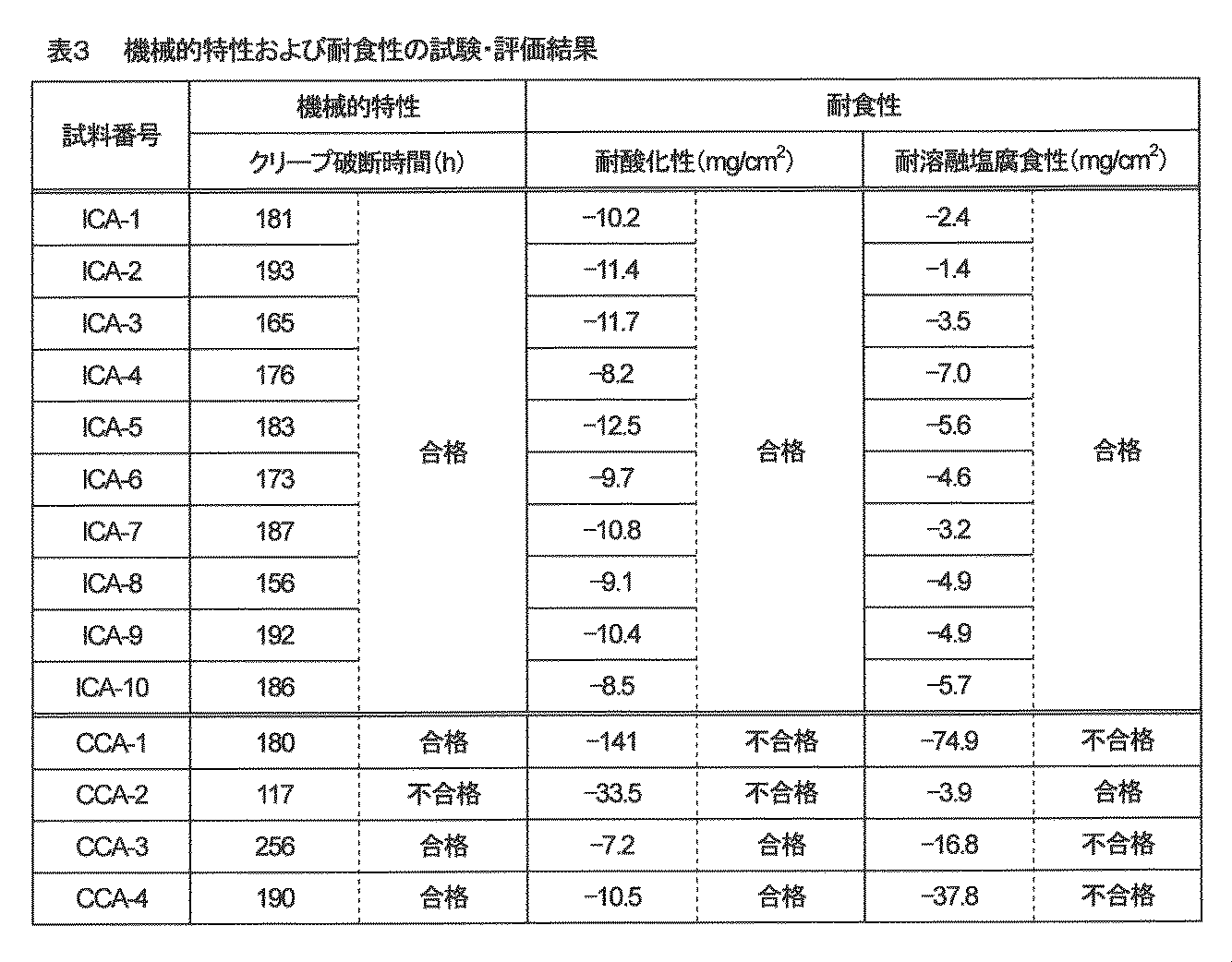
表3に示したように、従来鋳造材CCA-1は、機械的特性が合格であるが、耐酸化性および耐溶融塩腐食性(すなわち耐食性)に大きな弱点を有する。従来鋳造材CCA-2は、良好な耐溶融塩腐食性を示すが、機械的特性および耐酸化性が不合格である。従来鋳造材CCA-3は、優れた機械的特性および優れた耐酸化性を示すが、耐溶融塩腐食性が不合格である。従来鋳造材CCA-4は、機械的特性および耐酸化性が合格であるが、耐溶融塩腐食性が不合格である。
これら従来鋳造材に対し、発明鋳造材ICA-1~ICA-10は、機械的特性、耐酸化性および耐溶融塩腐食性の全てにおいて合格であることが判る。すなわち、本発明鋳造材は、従来鋳造材に比して、機械的特性、耐酸化性および耐溶融塩腐食性が高いレベルでバランスしていることが確認される。また、本発明鋳造材は、前述したように高価な元素(Ta、HfおよびReなど)を利用しないことから、従来鋳造材に比して低コスト化が可能である。
[実験3]
(一方向凝固材の作製と試験・評価)
上述の発明鋳造材ICA-1と同じマスターインゴットを用いて、一方向凝固鋳造により板状鋳物(幅100 mm、長さ200 mm、厚さ15 mm)を用意した(長さ方向が凝固方向である)。次に、該板状鋳物に対して、実験1と同様の溶体化処理および時効処理を行って、発明鋳造材ICA-1-2を作製した。
(一方向凝固材の作製と試験・評価)
上述の発明鋳造材ICA-1と同じマスターインゴットを用いて、一方向凝固鋳造により板状鋳物(幅100 mm、長さ200 mm、厚さ15 mm)を用意した(長さ方向が凝固方向である)。次に、該板状鋳物に対して、実験1と同様の溶体化処理および時効処理を行って、発明鋳造材ICA-1-2を作製した。
次に、発明鋳造材ICA-1-2に対して、実験2と同様のクリープ試験、高温繰り返し酸化試験、および溶融塩浸漬試験を行って、機械的特性、耐酸化性および耐溶融塩腐食性を評価した。その結果、発明鋳造材ICA-1と同等の耐酸化性および耐溶融塩腐食性を維持しながら、クリープ強度がICA-1よりも大幅に向上することが確認された。
上述した実施形態や実験例は、本発明の理解を助けるために説明したものであり、本発明は、記載した具体的な構成のみに限定されるものではない。例えば、実施形態の構成の一部を当業者の技術常識の構成に置き換えることが可能であり、また、実施形態の構成に当業者の技術常識の構成を加えることも可能である。すなわち、本発明は、本明細書の実施形態や実験例の構成の一部について、発明の技術的思想を逸脱しない範囲で、削除・他の構成に置換・他の構成の追加をすることが可能である。
100…タービン動翼、110…翼部、120…シャンク部、121…プラットホーム、122…ラジアルフィン、130…ルート部、200…タービン静翼、210…内輪側エンドウォール、220…翼部、230…外輪側エンドウォール。
Claims (7)
- Ni基超合金の多結晶鋳造材であって、
前記Ni基超合金は、
12.1質量%以上16質量%以下のCrと、
4質量%以上16質量%以下のCoと、
3質量%以上5質量%以下のAlと、
2.1質量%以上3.3質量%以下のTiと、
3.5質量%以上9質量%以下のWと、
1質量%以上2.4質量%以下のMoと、
1.2質量%以下のNbと、
0.005質量%以上0.05質量%以下のBと、
0.03質量%以上0.2質量%以下のCと、
0質量%超0.005質量%以下のOとを含み、
残部がNiおよび不純物からなる化学組成を有することを特徴とするNi基超合金鋳造材。 - 請求項1に記載のNi基超合金鋳造材において、
前記不純物は、0.1質量%以下のTaと、0.05質量%以下のHfと、0.05質量%以下のReと、0.05質量%以下のZrと、0.005質量%以下のNと、0.01質量%以下のPと、0.01質量%以下のSとを含むことを特徴とするNi基超合金鋳造材。 - 請求項1または請求項2に記載のNi基超合金鋳造材において、
前記Ni基超合金は、
前記Crが13.1質量%以上16質量%以下で、
前記Coが5.1質量%以上15質量%以下で、
前記Alが3.6質量%以上5質量%以下で、
前記Tiが2.2質量%以上3.3質量%以下で、
前記Wが4.5質量%以上9質量%以下で、
前記Moが1.4質量%以上2.4質量%以下で、
前記Nbが0.5質量%以下で、
前記Bが0.01質量%以上0.03質量%以下で、
前記Cが0.05質量%以上0.15質量%以下で、
前記Oが0.001質量%以上0.005質量%以下であることを特徴とするNi基超合金鋳造材。 - 請求項1または請求項2に記載のNi基超合金鋳造材において、
前記Ni基超合金は、
前記Crが13.1質量%以上14.5質量%以下で、
前記Coが6質量%以上12質量%以下で、
前記Alが3.8質量%以上4.8質量%以下で、
前記Tiが2.3質量%以上3.3質量%以下で、
前記Wが5質量%以上9質量%以下で、
前記Moが1.8質量%以上2.4質量%以下で、
前記Nbが0.1質量%以下で、
前記Bが0.01質量%以上0.02質量%以下で、
前記Cが0.05質量%以上0.12質量%以下で、
前記Oが0.001質量%以上0.004質量%以下であることを特徴とするNi基超合金鋳造材。 - Ni基超合金鋳造材を用いた製造物であって、
前記Ni基超合金鋳造材は、請求項1から請求項4のいずれか一項に記載のNi基超合金鋳造材であり、等軸晶の集合体からなる金属組織または長軸方向が揃った柱状晶の集合体からなる金属組織を有することを特徴とするNi基超合金製造物。 - 請求項5に記載のNi基超合金製造物において、
前記製造物が、タービン高温部材であることを特徴とするNi基超合金製造物。 - 請求項6に記載のNi基超合金製造物において、
前記タービン高温部材が、タービン翼であることを特徴とするNi基超合金製造物。
Priority Applications (4)
| Application Number | Priority Date | Filing Date | Title |
|---|---|---|---|
| US17/043,250 US11268169B2 (en) | 2018-04-02 | 2018-04-02 | Ni-based superalloy cast article and Ni-based superalloy product using same |
| JP2020512117A JP6982172B2 (ja) | 2018-04-02 | 2018-04-02 | Ni基超合金鋳造材およびそれを用いたNi基超合金製造物 |
| EP18913750.8A EP3778943A4 (en) | 2018-04-02 | 2018-04-02 | GROUP NI SUPERALLY CASTING MATERIAL AND GROUP NI SUPERALLY PRODUCT USING IT |
| PCT/JP2018/014117 WO2019193630A1 (ja) | 2018-04-02 | 2018-04-02 | Ni基超合金鋳造材およびそれを用いたNi基超合金製造物 |
Applications Claiming Priority (1)
| Application Number | Priority Date | Filing Date | Title |
|---|---|---|---|
| PCT/JP2018/014117 WO2019193630A1 (ja) | 2018-04-02 | 2018-04-02 | Ni基超合金鋳造材およびそれを用いたNi基超合金製造物 |
Publications (1)
| Publication Number | Publication Date |
|---|---|
| WO2019193630A1 true WO2019193630A1 (ja) | 2019-10-10 |
Family
ID=68100590
Family Applications (1)
| Application Number | Title | Priority Date | Filing Date |
|---|---|---|---|
| PCT/JP2018/014117 Ceased WO2019193630A1 (ja) | 2018-04-02 | 2018-04-02 | Ni基超合金鋳造材およびそれを用いたNi基超合金製造物 |
Country Status (4)
| Country | Link |
|---|---|
| US (1) | US11268169B2 (ja) |
| EP (1) | EP3778943A4 (ja) |
| JP (1) | JP6982172B2 (ja) |
| WO (1) | WO2019193630A1 (ja) |
Families Citing this family (2)
| Publication number | Priority date | Publication date | Assignee | Title |
|---|---|---|---|---|
| CN113862590B (zh) * | 2021-07-16 | 2022-04-22 | 北京科技大学 | 一种提高gh4738合金疲劳寿命的热处理工艺 |
| CN113802030A (zh) * | 2021-10-14 | 2021-12-17 | 上海交通大学 | 一种稀土高温合金构筑材料及其超限精密铸造方法 |
Citations (7)
| Publication number | Priority date | Publication date | Assignee | Title |
|---|---|---|---|---|
| JPS5134819A (ja) | 1974-07-17 | 1976-03-24 | Gen Electric | |
| JPH0657359A (ja) | 1991-06-27 | 1994-03-01 | Mitsubishi Materials Corp | Ni基耐熱合金 |
| WO2000044949A1 (en) * | 1999-01-28 | 2000-08-03 | Siemens Aktiengesellschaft | Nickel base superalloy with good machinability |
| JP2003013161A (ja) | 2001-06-28 | 2003-01-15 | Mitsubishi Heavy Ind Ltd | オーステナイト系低熱膨張Ni基超合金およびその製造方法 |
| JP2004197131A (ja) | 2002-12-17 | 2004-07-15 | Hitachi Ltd | ニッケル基耐熱合金及びガスタービン翼 |
| JP2013199680A (ja) * | 2012-03-26 | 2013-10-03 | Hitachi Ltd | ニッケル基合金、鋳造品、ガスタービン翼及びガスタービン |
| JP2015165046A (ja) * | 2014-02-28 | 2015-09-17 | ゼネラル・エレクトリック・カンパニイ | 物品及び物品の製造方法 |
Family Cites Families (5)
| Publication number | Priority date | Publication date | Assignee | Title |
|---|---|---|---|---|
| US4629521A (en) * | 1984-12-10 | 1986-12-16 | Special Metals Corporation | Nickel base alloy |
| US20090000706A1 (en) | 2007-06-28 | 2009-01-01 | General Electric Company | Method of controlling and refining final grain size in supersolvus heat treated nickel-base superalloys |
| US20100329876A1 (en) * | 2009-06-30 | 2010-12-30 | General Electric Company | Nickel-base superalloys and components formed thereof |
| US20110062220A1 (en) | 2009-09-15 | 2011-03-17 | General Electric Company | Superalloy composition and method of forming a turbine engine component |
| JP5597598B2 (ja) * | 2011-06-10 | 2014-10-01 | 株式会社日立製作所 | Ni基超合金と、それを用いたガスタービンのタービン動・静翼 |
-
2018
- 2018-04-02 WO PCT/JP2018/014117 patent/WO2019193630A1/ja not_active Ceased
- 2018-04-02 JP JP2020512117A patent/JP6982172B2/ja not_active Expired - Fee Related
- 2018-04-02 EP EP18913750.8A patent/EP3778943A4/en not_active Withdrawn
- 2018-04-02 US US17/043,250 patent/US11268169B2/en not_active Expired - Fee Related
Patent Citations (7)
| Publication number | Priority date | Publication date | Assignee | Title |
|---|---|---|---|---|
| JPS5134819A (ja) | 1974-07-17 | 1976-03-24 | Gen Electric | |
| JPH0657359A (ja) | 1991-06-27 | 1994-03-01 | Mitsubishi Materials Corp | Ni基耐熱合金 |
| WO2000044949A1 (en) * | 1999-01-28 | 2000-08-03 | Siemens Aktiengesellschaft | Nickel base superalloy with good machinability |
| JP2003013161A (ja) | 2001-06-28 | 2003-01-15 | Mitsubishi Heavy Ind Ltd | オーステナイト系低熱膨張Ni基超合金およびその製造方法 |
| JP2004197131A (ja) | 2002-12-17 | 2004-07-15 | Hitachi Ltd | ニッケル基耐熱合金及びガスタービン翼 |
| JP2013199680A (ja) * | 2012-03-26 | 2013-10-03 | Hitachi Ltd | ニッケル基合金、鋳造品、ガスタービン翼及びガスタービン |
| JP2015165046A (ja) * | 2014-02-28 | 2015-09-17 | ゼネラル・エレクトリック・カンパニイ | 物品及び物品の製造方法 |
Non-Patent Citations (1)
| Title |
|---|
| See also references of EP3778943A4 |
Also Published As
| Publication number | Publication date |
|---|---|
| US11268169B2 (en) | 2022-03-08 |
| JPWO2019193630A1 (ja) | 2021-04-08 |
| EP3778943A4 (en) | 2021-10-20 |
| US20210025032A1 (en) | 2021-01-28 |
| JP6982172B2 (ja) | 2021-12-17 |
| EP3778943A1 (en) | 2021-02-17 |
Similar Documents
| Publication | Publication Date | Title |
|---|---|---|
| JP2881626B2 (ja) | 単結晶ニッケル・ベース超合金 | |
| CN102002612B (zh) | 镍基超合金及其制品 | |
| RU2433197C2 (ru) | Жаропрочный сплав на основе никеля, способ изготовления детали и деталь турбомашины | |
| AU2007345231C1 (en) | Nickel-base alloy for gas turbine applications | |
| US9574451B2 (en) | Ni-based superalloy, and turbine rotor and stator blades for gas turbine using the same | |
| RU2567759C2 (ru) | Суперсплав на основе никеля | |
| RU2295585C2 (ru) | Высокопрочный, стойкий к высокотемпературной коррозии и окислению суперсплав на основе никеля и направленно отвержденное изделие из этого суперсплава | |
| JPWO2008032751A1 (ja) | Ni基単結晶超合金 | |
| CN111172430A (zh) | 镍基超合金和制品 | |
| EP2420584B1 (en) | Nickel-based single crystal superalloy and turbine blade incorporating this superalloy | |
| US20100047110A1 (en) | Ni-base superalloy and gas turbine component using the same | |
| US20050139295A1 (en) | Method for selecting a reduced-tantalum superalloy composition of matter and article made therefrom | |
| WO2019193630A1 (ja) | Ni基超合金鋳造材およびそれを用いたNi基超合金製造物 | |
| JPH0841567A (ja) | 高温腐食抵抗性の単結晶ニッケル系スーパーアロイ | |
| JP6970438B2 (ja) | Ni基超合金 | |
| CA2586974A1 (en) | Nickel-base superalloy | |
| JP5595495B2 (ja) | ニッケル基超合金 | |
| JPWO2006104059A1 (ja) | コバルトフリーのNi基超合金 | |
| JPH09184035A (ja) | ニッケル基超合金の製造方法および高温耐食性と高温強度に優れたニッケル基超合金 | |
| EP4043600B1 (en) | Nickel-based superalloy | |
| JPH07207391A (ja) | ガスタービンのタービン翼の合金材料 | |
| US9499886B2 (en) | Ni-based single crystal superalloy and turbine blade incorporating the same | |
| JP3209902B2 (ja) | 高温腐食抵抗性の単結晶ニッケル系スーパーアロイ | |
| JP2023018394A (ja) | Ni基超合金及びタービンホイール | |
| KR20250119623A (ko) | 니켈 기반 초합금, 원료, 부품 및 방법 |
Legal Events
| Date | Code | Title | Description |
|---|---|---|---|
| 121 | Ep: the epo has been informed by wipo that ep was designated in this application |
Ref document number: 18913750 Country of ref document: EP Kind code of ref document: A1 |
|
| ENP | Entry into the national phase |
Ref document number: 2020512117 Country of ref document: JP Kind code of ref document: A |
|
| NENP | Non-entry into the national phase |
Ref country code: DE |
|
| ENP | Entry into the national phase |
Ref document number: 2018913750 Country of ref document: EP Effective date: 20201102 |