WO2019193902A1 - Courroie crantée - Google Patents
Courroie crantée Download PDFInfo
- Publication number
- WO2019193902A1 WO2019193902A1 PCT/JP2019/008684 JP2019008684W WO2019193902A1 WO 2019193902 A1 WO2019193902 A1 WO 2019193902A1 JP 2019008684 W JP2019008684 W JP 2019008684W WO 2019193902 A1 WO2019193902 A1 WO 2019193902A1
- Authority
- WO
- WIPO (PCT)
- Prior art keywords
- toothed belt
- cloth
- rubber
- tooth
- belt
- Prior art date
- Legal status (The legal status is an assumption and is not a legal conclusion. Google has not performed a legal analysis and makes no representation as to the accuracy of the status listed.)
- Ceased
Links
Images

Classifications
-
- F—MECHANICAL ENGINEERING; LIGHTING; HEATING; WEAPONS; BLASTING
- F16—ENGINEERING ELEMENTS AND UNITS; GENERAL MEASURES FOR PRODUCING AND MAINTAINING EFFECTIVE FUNCTIONING OF MACHINES OR INSTALLATIONS; THERMAL INSULATION IN GENERAL
- F16G—BELTS, CABLES, OR ROPES, PREDOMINANTLY USED FOR DRIVING PURPOSES; CHAINS; FITTINGS PREDOMINANTLY USED THEREFOR
- F16G1/00—Driving-belts
- F16G1/28—Driving-belts with a contact surface of special shape, e.g. toothed
-
- B—PERFORMING OPERATIONS; TRANSPORTING
- B32—LAYERED PRODUCTS
- B32B—LAYERED PRODUCTS, i.e. PRODUCTS BUILT-UP OF STRATA OF FLAT OR NON-FLAT, e.g. CELLULAR OR HONEYCOMB, FORM
- B32B25/00—Layered products comprising a layer of natural or synthetic rubber
- B32B25/10—Layered products comprising a layer of natural or synthetic rubber next to a fibrous or filamentary layer
-
- B—PERFORMING OPERATIONS; TRANSPORTING
- B32—LAYERED PRODUCTS
- B32B—LAYERED PRODUCTS, i.e. PRODUCTS BUILT-UP OF STRATA OF FLAT OR NON-FLAT, e.g. CELLULAR OR HONEYCOMB, FORM
- B32B25/00—Layered products comprising a layer of natural or synthetic rubber
- B32B25/14—Layered products comprising a layer of natural or synthetic rubber comprising synthetic rubber copolymers
-
- B—PERFORMING OPERATIONS; TRANSPORTING
- B32—LAYERED PRODUCTS
- B32B—LAYERED PRODUCTS, i.e. PRODUCTS BUILT-UP OF STRATA OF FLAT OR NON-FLAT, e.g. CELLULAR OR HONEYCOMB, FORM
- B32B25/00—Layered products comprising a layer of natural or synthetic rubber
- B32B25/16—Layered products comprising a layer of natural or synthetic rubber comprising polydienes homopolymers or poly-halodienes homopolymers
-
- B—PERFORMING OPERATIONS; TRANSPORTING
- B32—LAYERED PRODUCTS
- B32B—LAYERED PRODUCTS, i.e. PRODUCTS BUILT-UP OF STRATA OF FLAT OR NON-FLAT, e.g. CELLULAR OR HONEYCOMB, FORM
- B32B3/00—Layered products comprising a layer with external or internal discontinuities or unevennesses, or a layer of non-planar shape; Layered products comprising a layer having particular features of form
- B32B3/02—Layered products comprising a layer with external or internal discontinuities or unevennesses, or a layer of non-planar shape; Layered products comprising a layer having particular features of form characterised by features of form at particular places, e.g. in edge regions
- B32B3/08—Layered products comprising a layer with external or internal discontinuities or unevennesses, or a layer of non-planar shape; Layered products comprising a layer having particular features of form characterised by features of form at particular places, e.g. in edge regions characterised by added members at particular parts
-
- B—PERFORMING OPERATIONS; TRANSPORTING
- B32—LAYERED PRODUCTS
- B32B—LAYERED PRODUCTS, i.e. PRODUCTS BUILT-UP OF STRATA OF FLAT OR NON-FLAT, e.g. CELLULAR OR HONEYCOMB, FORM
- B32B3/00—Layered products comprising a layer with external or internal discontinuities or unevennesses, or a layer of non-planar shape; Layered products comprising a layer having particular features of form
- B32B3/26—Layered products comprising a layer with external or internal discontinuities or unevennesses, or a layer of non-planar shape; Layered products comprising a layer having particular features of form characterised by a particular shape of the outline of the cross-section of a continuous layer; characterised by a layer with cavities or internal voids ; characterised by an apertured layer
- B32B3/30—Layered products comprising a layer with external or internal discontinuities or unevennesses, or a layer of non-planar shape; Layered products comprising a layer having particular features of form characterised by a particular shape of the outline of the cross-section of a continuous layer; characterised by a layer with cavities or internal voids ; characterised by an apertured layer characterised by a layer formed with recesses or projections, e.g. hollows, grooves, protuberances, ribs
-
- B—PERFORMING OPERATIONS; TRANSPORTING
- B32—LAYERED PRODUCTS
- B32B—LAYERED PRODUCTS, i.e. PRODUCTS BUILT-UP OF STRATA OF FLAT OR NON-FLAT, e.g. CELLULAR OR HONEYCOMB, FORM
- B32B5/00—Layered products characterised by the non- homogeneity or physical structure, i.e. comprising a fibrous, filamentary, particulate or foam layer; Layered products characterised by having a layer differing constitutionally or physically in different parts
- B32B5/02—Layered products characterised by the non- homogeneity or physical structure, i.e. comprising a fibrous, filamentary, particulate or foam layer; Layered products characterised by having a layer differing constitutionally or physically in different parts characterised by structural features of a fibrous or filamentary layer
- B32B5/022—Non-woven fabric
-
- B—PERFORMING OPERATIONS; TRANSPORTING
- B32—LAYERED PRODUCTS
- B32B—LAYERED PRODUCTS, i.e. PRODUCTS BUILT-UP OF STRATA OF FLAT OR NON-FLAT, e.g. CELLULAR OR HONEYCOMB, FORM
- B32B5/00—Layered products characterised by the non- homogeneity or physical structure, i.e. comprising a fibrous, filamentary, particulate or foam layer; Layered products characterised by having a layer differing constitutionally or physically in different parts
- B32B5/02—Layered products characterised by the non- homogeneity or physical structure, i.e. comprising a fibrous, filamentary, particulate or foam layer; Layered products characterised by having a layer differing constitutionally or physically in different parts characterised by structural features of a fibrous or filamentary layer
- B32B5/024—Woven fabric
-
- B—PERFORMING OPERATIONS; TRANSPORTING
- B32—LAYERED PRODUCTS
- B32B—LAYERED PRODUCTS, i.e. PRODUCTS BUILT-UP OF STRATA OF FLAT OR NON-FLAT, e.g. CELLULAR OR HONEYCOMB, FORM
- B32B5/00—Layered products characterised by the non- homogeneity or physical structure, i.e. comprising a fibrous, filamentary, particulate or foam layer; Layered products characterised by having a layer differing constitutionally or physically in different parts
- B32B5/02—Layered products characterised by the non- homogeneity or physical structure, i.e. comprising a fibrous, filamentary, particulate or foam layer; Layered products characterised by having a layer differing constitutionally or physically in different parts characterised by structural features of a fibrous or filamentary layer
- B32B5/026—Knitted fabric
-
- B—PERFORMING OPERATIONS; TRANSPORTING
- B32—LAYERED PRODUCTS
- B32B—LAYERED PRODUCTS, i.e. PRODUCTS BUILT-UP OF STRATA OF FLAT OR NON-FLAT, e.g. CELLULAR OR HONEYCOMB, FORM
- B32B7/00—Layered products characterised by the relation between layers; Layered products characterised by the relative orientation of features between layers, or by the relative values of a measurable parameter between layers, i.e. products comprising layers having different physical, chemical or physicochemical properties; Layered products characterised by the interconnection of layers
- B32B7/04—Interconnection of layers
- B32B7/12—Interconnection of layers using interposed adhesives or interposed materials with bonding properties
-
- F—MECHANICAL ENGINEERING; LIGHTING; HEATING; WEAPONS; BLASTING
- F16—ENGINEERING ELEMENTS AND UNITS; GENERAL MEASURES FOR PRODUCING AND MAINTAINING EFFECTIVE FUNCTIONING OF MACHINES OR INSTALLATIONS; THERMAL INSULATION IN GENERAL
- F16G—BELTS, CABLES, OR ROPES, PREDOMINANTLY USED FOR DRIVING PURPOSES; CHAINS; FITTINGS PREDOMINANTLY USED THEREFOR
- F16G1/00—Driving-belts
- F16G1/06—Driving-belts made of rubber
- F16G1/08—Driving-belts made of rubber with reinforcement bonded by the rubber
- F16G1/10—Driving-belts made of rubber with reinforcement bonded by the rubber with textile reinforcement
-
- F—MECHANICAL ENGINEERING; LIGHTING; HEATING; WEAPONS; BLASTING
- F16—ENGINEERING ELEMENTS AND UNITS; GENERAL MEASURES FOR PRODUCING AND MAINTAINING EFFECTIVE FUNCTIONING OF MACHINES OR INSTALLATIONS; THERMAL INSULATION IN GENERAL
- F16H—GEARING
- F16H1/00—Toothed gearings for conveying rotary motion
- F16H1/28—Toothed gearings for conveying rotary motion with gears having orbital motion
-
- B—PERFORMING OPERATIONS; TRANSPORTING
- B32—LAYERED PRODUCTS
- B32B—LAYERED PRODUCTS, i.e. PRODUCTS BUILT-UP OF STRATA OF FLAT OR NON-FLAT, e.g. CELLULAR OR HONEYCOMB, FORM
- B32B2250/00—Layers arrangement
- B32B2250/02—2 layers
-
- B—PERFORMING OPERATIONS; TRANSPORTING
- B32—LAYERED PRODUCTS
- B32B—LAYERED PRODUCTS, i.e. PRODUCTS BUILT-UP OF STRATA OF FLAT OR NON-FLAT, e.g. CELLULAR OR HONEYCOMB, FORM
- B32B2260/00—Layered product comprising an impregnated, embedded, or bonded layer wherein the layer comprises an impregnation, embedding, or binder material
- B32B2260/02—Composition of the impregnated, bonded or embedded layer
- B32B2260/021—Fibrous or filamentary layer
-
- B—PERFORMING OPERATIONS; TRANSPORTING
- B32—LAYERED PRODUCTS
- B32B—LAYERED PRODUCTS, i.e. PRODUCTS BUILT-UP OF STRATA OF FLAT OR NON-FLAT, e.g. CELLULAR OR HONEYCOMB, FORM
- B32B2260/00—Layered product comprising an impregnated, embedded, or bonded layer wherein the layer comprises an impregnation, embedding, or binder material
- B32B2260/04—Impregnation, embedding, or binder material
- B32B2260/048—Natural or synthetic rubber
-
- B—PERFORMING OPERATIONS; TRANSPORTING
- B32—LAYERED PRODUCTS
- B32B—LAYERED PRODUCTS, i.e. PRODUCTS BUILT-UP OF STRATA OF FLAT OR NON-FLAT, e.g. CELLULAR OR HONEYCOMB, FORM
- B32B2262/00—Composition or structural features of fibres which form a fibrous or filamentary layer or are present as additives
- B32B2262/02—Synthetic macromolecular fibres
- B32B2262/0261—Polyamide fibres
-
- B—PERFORMING OPERATIONS; TRANSPORTING
- B32—LAYERED PRODUCTS
- B32B—LAYERED PRODUCTS, i.e. PRODUCTS BUILT-UP OF STRATA OF FLAT OR NON-FLAT, e.g. CELLULAR OR HONEYCOMB, FORM
- B32B2262/00—Composition or structural features of fibres which form a fibrous or filamentary layer or are present as additives
- B32B2262/02—Synthetic macromolecular fibres
- B32B2262/0261—Polyamide fibres
- B32B2262/0269—Aromatic polyamide fibres
-
- B—PERFORMING OPERATIONS; TRANSPORTING
- B32—LAYERED PRODUCTS
- B32B—LAYERED PRODUCTS, i.e. PRODUCTS BUILT-UP OF STRATA OF FLAT OR NON-FLAT, e.g. CELLULAR OR HONEYCOMB, FORM
- B32B2262/00—Composition or structural features of fibres which form a fibrous or filamentary layer or are present as additives
- B32B2262/02—Synthetic macromolecular fibres
- B32B2262/0276—Polyester fibres
-
- B—PERFORMING OPERATIONS; TRANSPORTING
- B32—LAYERED PRODUCTS
- B32B—LAYERED PRODUCTS, i.e. PRODUCTS BUILT-UP OF STRATA OF FLAT OR NON-FLAT, e.g. CELLULAR OR HONEYCOMB, FORM
- B32B2262/00—Composition or structural features of fibres which form a fibrous or filamentary layer or are present as additives
- B32B2262/06—Vegetal fibres
- B32B2262/062—Cellulose fibres, e.g. cotton
-
- B—PERFORMING OPERATIONS; TRANSPORTING
- B32—LAYERED PRODUCTS
- B32B—LAYERED PRODUCTS, i.e. PRODUCTS BUILT-UP OF STRATA OF FLAT OR NON-FLAT, e.g. CELLULAR OR HONEYCOMB, FORM
- B32B2270/00—Resin or rubber layer containing a blend of at least two different polymers
-
- B—PERFORMING OPERATIONS; TRANSPORTING
- B32—LAYERED PRODUCTS
- B32B—LAYERED PRODUCTS, i.e. PRODUCTS BUILT-UP OF STRATA OF FLAT OR NON-FLAT, e.g. CELLULAR OR HONEYCOMB, FORM
- B32B2307/00—Properties of the layers or laminate
- B32B2307/70—Other properties
- B32B2307/732—Dimensional properties
-
- B—PERFORMING OPERATIONS; TRANSPORTING
- B32—LAYERED PRODUCTS
- B32B—LAYERED PRODUCTS, i.e. PRODUCTS BUILT-UP OF STRATA OF FLAT OR NON-FLAT, e.g. CELLULAR OR HONEYCOMB, FORM
- B32B2413/00—Belts
-
- B—PERFORMING OPERATIONS; TRANSPORTING
- B32—LAYERED PRODUCTS
- B32B—LAYERED PRODUCTS, i.e. PRODUCTS BUILT-UP OF STRATA OF FLAT OR NON-FLAT, e.g. CELLULAR OR HONEYCOMB, FORM
- B32B2433/00—Closed loop articles
- B32B2433/04—Driving belts
Definitions
- This disclosure relates to a toothed belt.
- Toothed belts are used for power transmission in general industrial applications, electric power steering, etc.
- the tooth portion is covered with a canvas.
- Patent Document 1 discloses a toothed belt in which a tooth portion is covered with a tooth cloth. Furthermore, the dimensions of each part of the toothed belt are defined, and it is disclosed that 0.65 ⁇ D / 2 + T ⁇ 0.85 is satisfied particularly when the diameter of the core wire is Dmm and the thickness of the tooth cloth is Tmm. Yes.
- An object of the present disclosure is to improve durability in a toothed belt, particularly a small pitch toothed belt used for noise reduction.
- the toothed belt body is formed of a rubber composition, and has a flat belt-like base portion and an interval in the belt length direction on one surface of the base portion. And a plurality of rubber tooth portions provided integrally with each other.
- the reinforcing cloth is attached to the toothed belt main body so as to cover the tooth side surface.
- the ratio of the volume of the reinforcing cloth to the volume of the cloth-covered tooth portion is 60% or more.
- FIG. 1 is a perspective view schematically illustrating a configuration of an exemplary toothed belt of the present disclosure.
- FIG. 2 is a side view of the toothed belt of FIG.
- FIG. 3 is a diagram for explaining a method of manufacturing the toothed belt of FIG.
- FIG. 4 is a diagram for explaining a manufacturing method of the toothed belt of FIG. 1 following FIG. 3.
- FIG. 5 is a diagram for explaining a manufacturing method of the toothed belt of FIG. 1 following FIG. 4.
- FIG. 6 is a diagram for explaining a manufacturing method of the toothed belt of FIG. 1 following FIG. 5.
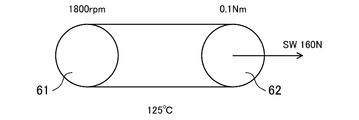
- FIG. 7 is a diagram illustrating a pulley layout of the heat-resistant running test machine used in the present disclosure.
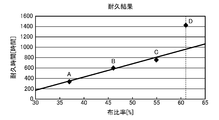
- FIG. 8 is a diagram illustrating a durability test result of the prototype evaluation belt according to the present disclosure.
- FIG. 1 is a perspective view schematically showing an exemplary toothed belt B of the present embodiment.
- the toothed belt B includes an endless toothed belt body 10 formed of a rubber composition.
- the toothed belt main body 10 includes a flat belt-like base portion 11a, and a plurality of rubber tooth portions 11b integrally provided at a constant pitch at intervals in the belt length direction on one side thereof, that is, the inner peripheral surface.
- a tooth side reinforcing cloth 12 is stuck so as to cover the tooth side surface.
- a core wire 13 is embedded on the inner peripheral side of the base 11a in the toothed belt body 10 so as to form a spiral having a pitch in the belt width direction.
- the toothed belt B according to the first embodiment is suitably used as a power transmission member of a belt transmission device in a machine tool or the like, in particular, a belt transmission device in a machine tool.
- the toothed belt B according to the embodiment has, for example, a belt length of 70 to 3000 mm, a belt width of 6 to 200 mm, and a belt thickness of 1 to 20 mm.
- the rubber tooth portion 11b has, for example, a width of 0.63 to 16.46 mm, a height of 0.37 to 9.6 mm, and a pitch of 1.0 to 31.75 mm.
- the belt length is desirably 250 to 400 mm.
- the belt width is preferably 10 to 40 mm.
- the belt thickness is preferably 1.3 to 3.0 mm.
- the width of the rubber tooth portion 11b is desirably 1.3 to 2.6 mm.
- the height of the rubber tooth portion 11b is desirably 0.7 to 1.4 mm.
- the pitch of the rubber teeth 11b is desirably 2.0 to 3.0 mm.
- the rubber tooth portion 11b of the toothed belt body 10 may be a trapezoidal tooth having a trapezoidal shape when viewed from the side, may be a semicircular round tooth, and may have other shapes. Also good.
- the rubber tooth portion 11b may be formed so as to extend in the belt width direction, or may be a helical tooth formed so as to extend in a direction inclined with respect to the belt width direction.
- Examples of the rubber component of the rubber composition forming the toothed belt body 10 include hydrogenated acrylonitrile rubber (H-NBR), hydrogenated acrylonitrile rubber reinforced with unsaturated carboxylic acid metal salt (H-NBR), ethylene, and the like.
- -Ethylene- ⁇ -olefin elastomers such as propylene copolymer (EPR), ethylene-propylene-diene terpolymer (EPDM), ethylene-octene copolymer, ethylene-butene copolymer, chloroprene rubber (CR), and chlorosulfonated polyethylene rubber (CSM) ) And the like.
- the rubber component of the rubber composition forming the toothed belt body 10 is preferably one or more of these blend rubbers. Of these, H-NBR is preferred.
- examples of the unsaturated carboxylic acid include methacrylic acid and acrylic acid, and examples of the metal include zinc, calcium, magnesium, aluminum and the like. Is mentioned.
- rubber compounding agents include reinforcing materials, processing aids, vulcanization acceleration aids, plasticizers, co-crosslinking agents, crosslinking agents, vulcanization accelerators, anti-aging agents, and the like.
- a reinforcing material for example, carbon black, channel black; furnace black such as SAF, ISAF, N-339, HAF, N-351, MAF, FEF, SRF, GPF, ECF, N-234; FT, MT, etc. Thermal black; acetylene black and the like.
- Silica is also mentioned as the reinforcing material. It is preferable that a reinforcing material is 1 type, or 2 or more types among these.
- the content of the reinforcing material is, for example, 20 to 60 parts by mass with respect to 100 parts by mass of the rubber component of the rubber composition.
- processing aids include stearic acid, polyethylene wax, and fatty acid metal salts.
- the processing aid is preferably one or more.
- the content of the processing aid is, for example, 0.5 to 2 parts by mass with respect to 100 parts by mass of the rubber component of the rubber composition.
- the vulcanization acceleration aid examples include metal oxides such as zinc oxide (zinc white) and magnesium oxide, metal carbonates, fatty acids and derivatives thereof.
- the vulcanization acceleration aid is preferably one or more.
- the content of the vulcanization acceleration aid is, for example, 3 to 7 parts by mass with respect to 100 parts by mass of the rubber component of the rubber composition.
- plasticizer examples include dialkyl phthalates such as dibutyl phthalate (DBP) and dioctyl phthalate (DOP), dialkyl adipates such as dioctyl adipate (DOA), and dialkyl sebacates such as dioctyl sebacate (DOS). It is preferable that a plasticizer is 1 type, or 2 or more types among these.
- the plasticizer content is, for example, 0.1 to 40 parts by mass with respect to 100 parts by mass of the rubber component.
- co-crosslinking agent examples include liquid rubber such as liquid NBR.
- the co-crosslinking agent is preferably one type or two or more types.
- the content of the co-crosslinking agent is, for example, 3 to 7 parts by mass with respect to 100 parts by mass of the rubber component.
- crosslinking agent examples include sulfur and organic peroxides.
- sulfur may be blended, an organic peroxide may be blended, or both of them may be used in combination.
- the amount of the crosslinking agent is, for example, 1 to 5 parts by mass with respect to 100 parts by mass of the rubber component of the rubber composition in the case of sulfur, and 100 parts by mass of the rubber component of the rubber composition with respect to the organic peroxide. For example, 1 to 5 parts by mass.
- vulcanization accelerator examples include thiuram (eg, TETD, TT, TRA, etc.), thiazole (eg, MBT, MBTS, etc.), sulfenamide (eg, CZ), dithiocarbamate (eg, BZ-P). Etc.). It is preferable that a vulcanization accelerator is 1 type, or 2 or more types among these. The content of the vulcanization accelerator is, for example, 2 to 5 parts by mass with respect to 100 parts by mass of the rubber component of the rubber composition.
- anti-aging agent examples include amine-ketone anti-aging agents, diamine anti-aging agents, phenol anti-aging agents and the like. It is preferable that an anti-aging agent is 1 type, or 2 or more types among these.
- the content of the anti-aging agent is, for example, 0.1 to 5 parts by mass with respect to 100 parts by mass of the rubber component.
- the rubber composition forming the toothed belt body 10 may contain short fibers having a fiber diameter of 10 ⁇ m or more.
- the core wire 13 is composed of a twisted yarn formed of glass fiber, aramid fiber, polyamide fiber, polyester fiber or the like. Preferably, glass fiber is used.
- the diameter of the core wire 13 is, for example, 0.2 to 2.5 mm, and the dimension between adjacent core wire centers in the cross section is, for example, 0.5 to 1.0 mm.
- the core wire 13 is subjected to an adhesion treatment for imparting adhesiveness to the toothed belt body 10.
- the tooth side reinforcing cloth 12 is made of a cloth material such as a woven cloth, a knitted cloth, or a non-woven cloth formed of, for example, cotton, polyamide fiber, polyester fiber, aramid fiber or the like. It is preferable to use a nylon fiber thread which is a kind of polyamide fiber. It is preferable that the tooth part side reinforcement cloth 12 has extensibility.
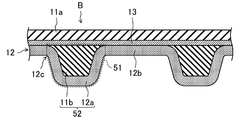
- the tooth side reinforcing cloth 12 occupies a predetermined volume in the tooth part. This will be described with reference to FIG.
- FIG. 2 is a diagram schematically showing a state where the toothed belt B of FIG. 1 is viewed from the side. As described with reference to FIG. 1, the tooth side reinforcing cloth 12 is attached to the rubber tooth portion 11 b side (lower side in the figure) of the toothed belt body 10.
- the rubber tooth part 11b and the tooth part side reinforcing cloth 12 covering the rubber tooth part 11b (this is called the tooth cloth 12a, and the part covering the base part 11a where the rubber tooth part 11b is not provided is the base cloth 12b.
- the cloth-covered tooth portion 52 is called.
- the durability of the toothed belt B is improved by increasing the ratio of the volume occupied by the tooth cloth 12a (hereinafter sometimes referred to as the cloth ratio).
- the cloth ratio becomes 60% or more
- the durability is remarkably improved.
- the toothed belt B breaks down after being used for a long time, a failure due to wear of the tooth side reinforcing fabric 12 occurs rather than a crack in the belt body. This is desirable as a form of toothed belt failure.
- the cloth ratio in the cloth covering tooth portion 52 can be calculated based on, for example, the area occupied by the tooth portion cloth 12a on the side surface of the belt.
- the shape of the rubber tooth portion 11b and the tooth cloth 12a is the same at any position in the width direction of the belt. Accordingly, in FIG. 2, the ratio of the area occupied by the tooth cloth 12a (the portion within the range indicated by the broken line 51 of the tooth side reinforcing cloth 12) to the cloth-covered tooth part 52 (the part surrounded by the broken line 51). Is obtained, the ratio of the volume occupied by the tooth cloth 12a in the cloth covering tooth 52 can be calculated.
- the ratio of the area occupied by the tooth cloth 12a on the side surface and the ratio of the volume occupied by the tooth cloth 12a in the cloth-coated tooth portion 52 are as follows. It may not match. However, also in this case, it is possible to calculate the necessary cloth ratio in consideration of the shape of the cloth-coated tooth portion 52.
- a boundary 12c between the tooth cloth 12a covering the rubber tooth 11b and the base cloth 12b covering the base 11a is perpendicular to the surface of the base 11a. Further, although the tooth cloth 12a is bent in an arc shape at the base of the rubber tooth portion 11b, it is considered that the boundary 12c is located at a point where the arc ends.
- the area of each part on the side surface of the toothed belt B can be obtained, for example, by taking a photograph and measuring it on the image.
- the thickness of the tooth cloth 12a (the tooth side reinforcing cloth 12).
- the difference in the type of knitting of the knitted fabric (plain knitting, rubber knitting, etc.) and the type of weaving of the woven fabric (plain weaving, twill weaving, etc.) also affects the thickness of the fabric.
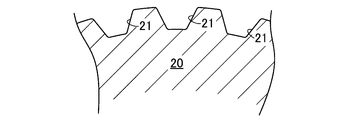
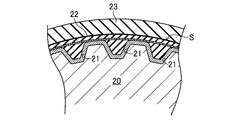
- FIG. 3 shows a belt forming die 20 used for manufacturing the toothed belt B according to the first embodiment.
- the belt forming die 20 has a cylindrical shape, and tooth portion forming grooves 21 extending in the axial direction are formed on the outer peripheral surface thereof at a constant pitch with intervals in the circumferential direction.
- the method for manufacturing a toothed belt according to Embodiment 1 includes a material preparation process, a molding process, a crosslinking process, and a finishing process.
- ⁇ Material preparation process> Uncrosslinked rubber sheet 11 'for base and teeth- Various rubber compounding agents are added to the kneaded rubber component and kneading is continued.
- the obtained uncrosslinked rubber composition is formed into a sheet shape by calendar molding or the like to produce an uncrosslinked rubber sheet 11 ′ for the base and teeth.
- ⁇ Tooth side reinforcement cloth 12' ⁇ Adhesive treatment is applied to the tooth side reinforcing cloth 12 '.
- the tooth side reinforcing cloth 12 ′ is subjected to an RFL adhesion treatment in which it is immersed in an RFL aqueous solution and heated.
- a base adhesion treatment in which the substrate is immersed in a base adhesion treatment solution and heated is performed before the RFL adhesion treatment.
- a soaking rubber paste bonding treatment in which the surface is on the toothed belt body 10 side is dried after being immersed in rubber paste after the RFL bonding treatment and / or dried. Apply adhesive treatment.
- both ends of the tooth side reinforcing cloth 12 ′ subjected to the adhesion treatment are joined to form a cylinder.
- an adhesive treatment is applied to the core wire 13 '.
- the core wire 13 ′ is subjected to an RFL adhesion treatment in which it is immersed in a resorcin / formalin / latex aqueous solution (hereinafter referred to as “RFL aqueous solution”) and heated.
- RFL aqueous solution a resorcin / formalin / latex aqueous solution
- a base adhesive treatment in which the substrate is immersed in a base adhesive treatment solution and heated before the RFL adhesive treatment and / or a rubber paste adhesive treatment in which the RFL adhesive treatment is immersed in rubber paste and dried are performed.
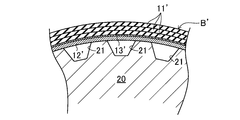
- a cylindrical tooth portion side reinforcing cloth 12 ' is placed on the outer periphery of the belt mold 20, and a core wire 13' is spirally wound from above, and further, an uncrosslinked rubber sheet 11 'is wound thereon. Wrap.
- a laminated molded body B ′ is formed on the belt mold 20.
- the uncrosslinked rubber sheet 11 ′ may be used so that the running direction corresponds to the belt length direction, or may be used so that the running direction corresponds to the belt width direction. .
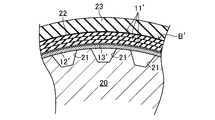
- the uncrosslinked rubber sheet in the laminated molded body B ′ flows while pressing the tooth side reinforcing cloth 12 ′ and flows into the tooth portion forming groove 21 of the belt mold 20, and the crosslinking proceeds, And the tooth part side reinforcing cloth 12 'and the core wire 13' are combined and integrated, and finally a cylindrical belt slab S is formed as shown in FIG.
- the molding temperature of the belt slab S is, for example, 100 to 180 ° C.
- the molding pressure is, for example, 0.5 to 2.0 MPa
- the molding time is, for example, 10 to 60 minutes.
- ⁇ Finishing process> The inside of the vulcanizing can is depressurized to release the seal, the belt slab S molded between the belt mold 20 and the rubber sleeve 23 is taken out and demolded, and the back side is polished to adjust the thickness. After that, the toothed belt B is manufactured by cutting into a predetermined width.
- the rubber 1 of the uncrosslinked rubber composition for forming the toothed belt body and the rubber 2 of the uncrosslinked rubber composition for the rubber adhesive bonding layer of the tooth side reinforcing fabric were prepared as follows.
- H-NBR (trade name: Zetpol 2020 manufactured by Nippon Zeon Co., Ltd.) is kneaded and 40 parts of FEF carbon black (trade name: Seast SO manufactured by Tokai Carbon Co., Ltd.) as a reinforcing material is added to 100 parts by mass of H-NBR.
- Table 1 shows the yarn fineness and the number of driven yarns for the fabrics a to d.
- the fabric a has a warp yarn with a fineness of 44 dt (decitex) and a placement number of 428 pieces / 5 cm, a weft yarn with a fineness of 78 dt and a placement number of 170 pieces / 5 cm.
- the fabric b has a warp yarn with a fineness of 44 dt and a driving number of 392 pieces / 5 cm, and a weft yarn with a fineness of 156 dt and a driving number of 174 pieces / 5 cm.
- the fabric c has a warp yarn with a fineness of 44 dt and a driving number of 370 pieces / 5 cm, and a weft yarn with a fineness of 312 dt and a driving number of 130 yarns / 5 cm.
- the fabric d has a warp yarn having a fineness of 210 dt and a number of driven yarns of 177 pieces / 5 cm, and a weft yarn having a fineness of 155 dt and a driven yarn number of 191 yarns / 5 cm.
- Such twill fabrics a to d were each subjected to an RFL adhesion treatment that was heated after being immersed in an RFL aqueous solution. Further, the twill woven fabrics a to d subjected to the RFL adhesion treatment were subjected to a soaking rubber glue adhesion treatment in which they were immersed in rubber glue and dried.
- the rubber paste a rubber paste having a solid content concentration of 10% by mass obtained by dissolving rubber 1 in toluene as a solvent was used. The liquid temperature of the rubber paste was 25 ° C. The immersion time in the rubber paste was 5 seconds. The drying temperature after immersion in rubber paste was 100 ° C. and the drying time was 40 seconds.
- Core wire As the core wire, one made of glass fiber was used.
- Toothed belt for prototype evaluation Using the rubber 1 as the uncrosslinked rubber composition forming the toothed belt body and the twill woven fabrics a, b, c, and d as the tooth reinforcing fabric, four prototype evaluations with different thicknesses of the tooth reinforcing fabric 12 Toothed belts A, B, C and D were prepared.
- the belt width is 6 mm and the belt length is 330 mm.
- FIG. 7 shows a pulley layout of the heat resistant running test machine.
- a driving pulley 61 and a driven pulley 62 which are S2M type and 41-tooth timing pulleys are arranged side by side in the horizontal direction.
- a load of 160 N was applied to the driven pulley 62 on the opposite side of the driving pulley 61, and the belt was run under conditions of a torque of 0.1 Nm and a rotation speed of 1800 rpm.
- the ambient temperature is 125 ° C.
- the endurance times with respect to the cloth ratio are arranged on a straight line L for the toothed belts A, B and C (fabric ratio 37%, 46% and 55%) for trial evaluation.
- the trial evaluation toothed belt D having a cloth ratio of 61% deviates from the straight line L, and the durability time is significantly improved. Specifically, if it is placed on the straight line L, it is expected that the durability time is about 950 hours at a cloth ratio of 61%, but the test result of the toothed belt D for trial evaluation exceeds 1400 hours.
- the durability of the toothed belt is improved.
- the volume ratio (cloth ratio) occupied by the tooth cloth 12a in the cloth-covered tooth section 52 including the rubber tooth section 11b and the tooth cloth 12a is preferably 60% or more.
- the belt failure was caused by a crack. That is, in these toothed belts, cracks occurred in the toothed belt body 10 before the tooth side reinforcing cloth 12 was worn.
- the failure of the belt was due to wear of the tooth side reinforcing cloth 12. That is, in the toothed belt D for trial evaluation, the tooth side reinforcing cloth 12 was worn before the toothed belt body 10 was cracked.
- a failure due to wear of the tooth side reinforcing cloth 12 occurs rather than a failure due to a crack.
- the fabric ratio is less than 60% (toothed belts A to C for trial evaluation)
- the load is high, the rubber of the tooth side reinforcing fabric 12 is broken and not torn due to the deterioration of rubber.
- the effect is concentrated on the toothed belt body 10 and cracks are caused. In this case, the wear resistance function of the tooth side reinforcing fabric 12 is not effectively used.
- the tooth side reinforcing fabric 12 exhibits a wear resistance function, and as a result, the tooth side reinforcing fabric 12 is worn. And it has broken down. Thus, the failure caused by the wear of the tooth side reinforcing cloth 12 indicates that the tooth side reinforcing cloth 12 is functioning. Therefore, also in this respect, the trial evaluation toothed belt D having a cloth ratio of 60% or more is more desirable.
- the toothed belt of the present disclosure has high durability, and when it breaks down, the toothed belt is likely to break down due to wear of the tooth portion, and thus is useful for various power transmissions.
Landscapes
- Engineering & Computer Science (AREA)
- General Engineering & Computer Science (AREA)
- Mechanical Engineering (AREA)
- Textile Engineering (AREA)
- Compositions Of Macromolecular Compounds (AREA)
Abstract
La présente invention concerne une courroie crantée B pourvue d'un corps de courroie crantée (10) et d'un tissu renforcé (12), le corps de courroie crantée (10) étant formé à partir d'une composition de caoutchouc, et ayant une partie de base en forme de courroie plate (11a), et une pluralité de parties de dents en caoutchouc (11b) disposées d'un seul tenant sur la surface sur un côté de la partie de base (11a) à des intervalles dans une direction de longueur de courroie. Le tissu renforcé (12) est collé au corps de courroie crantée (10) de manière à recouvrir la surface côté partie de dents. Dans des parties de dents recouvertes de tissu (52) où les parties de dents de caoutchouc (11b) sont recouvertes par le tissu renforcé (12), le rapport du volume du tissu renforcé (12) au volume des parties de dents recouvertes de tissu (52) est supérieur ou égal à 60 %.
Priority Applications (5)
| Application Number | Priority Date | Filing Date | Title |
|---|---|---|---|
| JP2019518572A JP6609395B1 (ja) | 2018-04-04 | 2019-03-05 | 歯付ベルト |
| CN201980004656.1A CN111108306B (zh) | 2018-04-04 | 2019-03-05 | 齿形带 |
| KR1020207009688A KR102760738B1 (ko) | 2018-04-04 | 2019-03-05 | 이붙이 벨트 |
| DE112019001775.6T DE112019001775T5 (de) | 2018-04-04 | 2019-03-05 | Zahnriemen |
| US16/852,210 US11566684B2 (en) | 2018-04-04 | 2020-04-17 | Toothed belt |
Applications Claiming Priority (2)
| Application Number | Priority Date | Filing Date | Title |
|---|---|---|---|
| JP2018-072201 | 2018-04-04 | ||
| JP2018072201 | 2018-04-04 |
Related Child Applications (1)
| Application Number | Title | Priority Date | Filing Date |
|---|---|---|---|
| US16/852,210 Continuation US11566684B2 (en) | 2018-04-04 | 2020-04-17 | Toothed belt |
Publications (1)
| Publication Number | Publication Date |
|---|---|
| WO2019193902A1 true WO2019193902A1 (fr) | 2019-10-10 |
Family
ID=68100334
Family Applications (1)
| Application Number | Title | Priority Date | Filing Date |
|---|---|---|---|
| PCT/JP2019/008684 Ceased WO2019193902A1 (fr) | 2018-04-04 | 2019-03-05 | Courroie crantée |
Country Status (6)
| Country | Link |
|---|---|
| US (1) | US11566684B2 (fr) |
| JP (1) | JP6609395B1 (fr) |
| KR (1) | KR102760738B1 (fr) |
| CN (1) | CN111108306B (fr) |
| DE (1) | DE112019001775T5 (fr) |
| WO (1) | WO2019193902A1 (fr) |
Cited By (1)
| Publication number | Priority date | Publication date | Assignee | Title |
|---|---|---|---|---|
| US20220316552A1 (en) * | 2019-08-12 | 2022-10-06 | Contitech Antriebssysteme Gmbh | Helically toothed drive belt |
Families Citing this family (3)
| Publication number | Priority date | Publication date | Assignee | Title |
|---|---|---|---|---|
| WO2019193902A1 (fr) * | 2018-04-04 | 2019-10-10 | バンドー化学株式会社 | Courroie crantée |
| EP4348075A1 (fr) * | 2021-05-24 | 2024-04-10 | Dayco Europe S.R.L. | Courroie de transmission |
| JP7406051B1 (ja) * | 2022-07-28 | 2023-12-26 | バンドー化学株式会社 | 歯付ベルト |
Citations (2)
| Publication number | Priority date | Publication date | Assignee | Title |
|---|---|---|---|---|
| WO2014024377A1 (fr) * | 2012-08-09 | 2014-02-13 | バンドー化学株式会社 | Courroies crantées et engrenages réducteurs à courroie comportant celles-ci |
| WO2017019618A1 (fr) * | 2015-07-29 | 2017-02-02 | Gates Corporation | Courroie synchrone à tissu résistant |
Family Cites Families (33)
| Publication number | Priority date | Publication date | Assignee | Title |
|---|---|---|---|---|
| JPS62159827A (ja) * | 1985-12-27 | 1987-07-15 | Yunitsuta Kk | 歯付きベルト |
| JPS63246532A (ja) * | 1987-03-31 | 1988-10-13 | Bando Chem Ind Ltd | 伝動ベルト |
| US5268221A (en) * | 1990-02-23 | 1993-12-07 | Bando Chemical Industries, Ltd. | Fiber reinforced rubber articles |
| US5545097A (en) * | 1993-11-19 | 1996-08-13 | Mitsuboshi Belting Ltd. | Power transmission belt with facing fabric and method of forming the belt |
| JP3468265B2 (ja) * | 1996-11-25 | 2003-11-17 | ゲイツ・ユニッタ・アジア株式会社 | 帆布およびこの帆布を用いた歯付きベルト |
| JPH10299836A (ja) | 1997-04-18 | 1998-11-13 | Mitsuboshi Belting Ltd | 歯付ベルト |
| DE69936520T2 (de) * | 1998-05-22 | 2007-10-18 | Bando Chemical Industries Ltd., Kobe | Lastaufnahmeelement für riemen und damit hergestellter riemen |
| US6432013B1 (en) * | 1999-05-24 | 2002-08-13 | Bando Chemical Industries, Ltd. | Power transmission belt and method for fabricating the same |
| US7025699B2 (en) * | 2003-04-23 | 2006-04-11 | Dayco Products, Llc | Elastomer composition for power transmission belt tooth facing |
| JP2006153038A (ja) * | 2004-11-25 | 2006-06-15 | Mitsuboshi Belting Ltd | 伝動用ベルト |
| JP2007232208A (ja) * | 2006-01-31 | 2007-09-13 | Mitsuboshi Belting Ltd | 歯付ベルト及びそれに使用する歯布 |
| US8932165B2 (en) * | 2006-03-31 | 2015-01-13 | The Gates Corporation | Toothed power transmission belt |
| JP5236980B2 (ja) * | 2007-04-26 | 2013-07-17 | 三ツ星ベルト株式会社 | ベルト及びベルトの製造方法 |
| US9291237B2 (en) * | 2007-06-20 | 2016-03-22 | Mitsuboshi Belting Ltd. | Toothed power transmission belt |
| JP2010190373A (ja) * | 2009-02-20 | 2010-09-02 | Harmonic Drive Syst Ind Co Ltd | 波動歯車装置 |
| CN102472363A (zh) * | 2009-07-02 | 2012-05-23 | 盖茨公司 | 改善的用于齿动力传动带的织物和带 |
| JP5116791B2 (ja) * | 2010-03-23 | 2013-01-09 | 株式会社椿本チエイン | 歯付ベルト |
| FR2969219B1 (fr) * | 2010-12-20 | 2013-01-11 | Valeo Equip Electr Moteur | Ensemble pour reducteur de vitesse d'une machine electrique tournante et demarreur pour moteur thermique associe |
| KR101796843B1 (ko) * | 2012-06-24 | 2017-11-10 | 게이츠 코포레이션 | 보강된 고무 제품을 위한 탄소 코드 및 제품 |
| KR102070476B1 (ko) * | 2012-07-06 | 2020-01-29 | 반도 카가쿠 가부시키가이샤 | 전동 벨트 |
| DE202012102734U1 (de) * | 2012-07-20 | 2012-08-22 | Ningbo Gul Tz Rubber Belt Co., Ltd. | Zahnriemen |
| CN104508322B (zh) * | 2012-08-02 | 2016-03-30 | 阪东化学株式会社 | 传动带及其制造方法 |
| CN103075464B (zh) * | 2012-12-05 | 2015-01-28 | 宁波丰茂远东橡胶有限公司 | 浸油用汽车正时传动带 |
| JP6157876B2 (ja) * | 2013-02-28 | 2017-07-05 | バンドー化学株式会社 | 伝動ベルト |
| JP6275585B2 (ja) * | 2013-08-30 | 2018-02-07 | 三ツ星ベルト株式会社 | 歯付ベルト |
| JP6486156B2 (ja) * | 2014-03-28 | 2019-03-20 | 三ツ星ベルト株式会社 | 歯付ベルト及びその製造方法 |
| JP6324336B2 (ja) * | 2014-03-31 | 2018-05-16 | 三ツ星ベルト株式会社 | 歯付きベルト |
| JP6529323B2 (ja) * | 2015-04-24 | 2019-06-12 | バンドー化学株式会社 | 歯付ベルト |
| CN107614558B (zh) * | 2015-05-26 | 2020-12-25 | 阪东化学株式会社 | 氨基甲酸酯组合物、聚氨酯弹性体和传送带 |
| JP6612827B2 (ja) * | 2016-10-20 | 2019-11-27 | 三ツ星ベルト株式会社 | 諸撚りコード及びその製造方法並びに伝動ベルト及びその使用方法 |
| US10844931B2 (en) * | 2017-04-27 | 2020-11-24 | Gates Corporation | Synchronous belt with unidirectional fabric reinforcement |
| JP6660997B2 (ja) * | 2017-12-26 | 2020-03-11 | 三ツ星ベルト株式会社 | 両面歯付ベルト |
| WO2019193902A1 (fr) * | 2018-04-04 | 2019-10-10 | バンドー化学株式会社 | Courroie crantée |
-
2019
- 2019-03-05 WO PCT/JP2019/008684 patent/WO2019193902A1/fr not_active Ceased
- 2019-03-05 KR KR1020207009688A patent/KR102760738B1/ko active Active
- 2019-03-05 DE DE112019001775.6T patent/DE112019001775T5/de active Pending
- 2019-03-05 JP JP2019518572A patent/JP6609395B1/ja active Active
- 2019-03-05 CN CN201980004656.1A patent/CN111108306B/zh active Active
-
2020
- 2020-04-17 US US16/852,210 patent/US11566684B2/en active Active
Patent Citations (2)
| Publication number | Priority date | Publication date | Assignee | Title |
|---|---|---|---|---|
| WO2014024377A1 (fr) * | 2012-08-09 | 2014-02-13 | バンドー化学株式会社 | Courroies crantées et engrenages réducteurs à courroie comportant celles-ci |
| WO2017019618A1 (fr) * | 2015-07-29 | 2017-02-02 | Gates Corporation | Courroie synchrone à tissu résistant |
Cited By (1)
| Publication number | Priority date | Publication date | Assignee | Title |
|---|---|---|---|---|
| US20220316552A1 (en) * | 2019-08-12 | 2022-10-06 | Contitech Antriebssysteme Gmbh | Helically toothed drive belt |
Also Published As
| Publication number | Publication date |
|---|---|
| JPWO2019193902A1 (ja) | 2020-04-30 |
| CN111108306B (zh) | 2024-07-26 |
| US20200240488A1 (en) | 2020-07-30 |
| KR102760738B1 (ko) | 2025-02-03 |
| DE112019001775T5 (de) | 2020-12-17 |
| CN111108306A (zh) | 2020-05-05 |
| KR20200139659A (ko) | 2020-12-14 |
| JP6609395B1 (ja) | 2019-11-20 |
| US11566684B2 (en) | 2023-01-31 |
Similar Documents
| Publication | Publication Date | Title |
|---|---|---|
| JP6221011B1 (ja) | 歯付ベルト | |
| EP2175163B1 (fr) | Courroie de transmission à friction et unité de transmission à courroie d'entraînement auxiliaire d'automobile utilisant celle-ci | |
| JP6609395B1 (ja) | 歯付ベルト | |
| CN106233036B (zh) | 传动带以及相关联的传动系统 | |
| JP6158465B1 (ja) | 歯付ベルト及びその製造方法 | |
| WO2010007741A1 (fr) | Courroie de transmission | |
| JPWO2014006916A1 (ja) | 伝動ベルト | |
| JP6082853B1 (ja) | 摩擦伝動ベルト | |
| JP7406050B1 (ja) | 歯付ベルト | |
| JP6598777B2 (ja) | 摩擦伝動ベルト及びその製造方法、並びにベルト伝動装置 | |
| JP6529323B2 (ja) | 歯付ベルト | |
| JP6383135B1 (ja) | 伝動ベルト及びその製造方法 | |
| KR102745454B1 (ko) | 마찰 전동 벨트 | |
| JP2018165514A (ja) | 歯付ベルト | |
| JP7685679B1 (ja) | 歯付ベルト | |
| JP7703808B1 (ja) | 伝動システム | |
| JP6635753B2 (ja) | ベルト | |
| WO2025074952A1 (fr) | Courroie dentée | |
| WO2025229968A1 (fr) | Courroie dentée et système de transmission | |
| WO2025074953A1 (fr) | Courroie dentée | |
| TW202508836A (zh) | 傳動帶 | |
| WO2024185792A1 (fr) | Courroie dentée et système de transmission de puissance | |
| WO2010004733A1 (fr) | Courroie plate |
Legal Events
| Date | Code | Title | Description |
|---|---|---|---|
| ENP | Entry into the national phase |
Ref document number: 2019518572 Country of ref document: JP Kind code of ref document: A |
|
| 121 | Ep: the epo has been informed by wipo that ep was designated in this application |
Ref document number: 19780878 Country of ref document: EP Kind code of ref document: A1 |
|
| 122 | Ep: pct application non-entry in european phase |
Ref document number: 19780878 Country of ref document: EP Kind code of ref document: A1 |