WO2019194062A1 - Paenibacillus pabuli由来のガラクトオリゴ糖を製造可能な酵素、およびガラクトオリゴ糖を製造する方法 - Google Patents
Paenibacillus pabuli由来のガラクトオリゴ糖を製造可能な酵素、およびガラクトオリゴ糖を製造する方法 Download PDFInfo
- Publication number
- WO2019194062A1 WO2019194062A1 PCT/JP2019/013549 JP2019013549W WO2019194062A1 WO 2019194062 A1 WO2019194062 A1 WO 2019194062A1 JP 2019013549 W JP2019013549 W JP 2019013549W WO 2019194062 A1 WO2019194062 A1 WO 2019194062A1
- Authority
- WO
- WIPO (PCT)
- Prior art keywords
- enzyme
- paenibacillus
- amino acid
- acid sequence
- galactooligosaccharide
- Prior art date
- Legal status (The legal status is an assumption and is not a legal conclusion. Google has not performed a legal analysis and makes no representation as to the accuracy of the status listed.)
- Ceased
Links
Images


Classifications
-
- C—CHEMISTRY; METALLURGY
- C12—BIOCHEMISTRY; BEER; SPIRITS; WINE; VINEGAR; MICROBIOLOGY; ENZYMOLOGY; MUTATION OR GENETIC ENGINEERING
- C12N—MICROORGANISMS OR ENZYMES; COMPOSITIONS THEREOF; PROPAGATING, PRESERVING, OR MAINTAINING MICROORGANISMS; MUTATION OR GENETIC ENGINEERING; CULTURE MEDIA
- C12N9/00—Enzymes; Proenzymes; Compositions thereof; Processes for preparing, activating, inhibiting, separating or purifying enzymes
- C12N9/14—Hydrolases (3)
- C12N9/24—Hydrolases (3) acting on glycosyl compounds (3.2)
- C12N9/2402—Hydrolases (3) acting on glycosyl compounds (3.2) hydrolysing O- and S- glycosyl compounds (3.2.1)
- C12N9/2468—Hydrolases (3) acting on glycosyl compounds (3.2) hydrolysing O- and S- glycosyl compounds (3.2.1) acting on beta-galactose-glycoside bonds, e.g. carrageenases (3.2.1.83; 3.2.1.157); beta-agarase (3.2.1.81)
- C12N9/2471—Beta-galactosidase (3.2.1.23), i.e. exo-(1-->4)-beta-D-galactanase
-
- C—CHEMISTRY; METALLURGY
- C12—BIOCHEMISTRY; BEER; SPIRITS; WINE; VINEGAR; MICROBIOLOGY; ENZYMOLOGY; MUTATION OR GENETIC ENGINEERING
- C12N—MICROORGANISMS OR ENZYMES; COMPOSITIONS THEREOF; PROPAGATING, PRESERVING, OR MAINTAINING MICROORGANISMS; MUTATION OR GENETIC ENGINEERING; CULTURE MEDIA
- C12N9/00—Enzymes; Proenzymes; Compositions thereof; Processes for preparing, activating, inhibiting, separating or purifying enzymes
- C12N9/14—Hydrolases (3)
- C12N9/24—Hydrolases (3) acting on glycosyl compounds (3.2)
- C12N9/2402—Hydrolases (3) acting on glycosyl compounds (3.2) hydrolysing O- and S- glycosyl compounds (3.2.1)
-
- C—CHEMISTRY; METALLURGY
- C12—BIOCHEMISTRY; BEER; SPIRITS; WINE; VINEGAR; MICROBIOLOGY; ENZYMOLOGY; MUTATION OR GENETIC ENGINEERING
- C12P—FERMENTATION OR ENZYME-USING PROCESSES TO SYNTHESISE A DESIRED CHEMICAL COMPOUND OR COMPOSITION OR TO SEPARATE OPTICAL ISOMERS FROM A RACEMIC MIXTURE
- C12P19/00—Preparation of compounds containing saccharide radicals
-
- C—CHEMISTRY; METALLURGY
- C12—BIOCHEMISTRY; BEER; SPIRITS; WINE; VINEGAR; MICROBIOLOGY; ENZYMOLOGY; MUTATION OR GENETIC ENGINEERING
- C12P—FERMENTATION OR ENZYME-USING PROCESSES TO SYNTHESISE A DESIRED CHEMICAL COMPOUND OR COMPOSITION OR TO SEPARATE OPTICAL ISOMERS FROM A RACEMIC MIXTURE
- C12P19/00—Preparation of compounds containing saccharide radicals
- C12P19/04—Polysaccharides, i.e. compounds containing more than five saccharide radicals attached to each other by glycosidic bonds
-
- C—CHEMISTRY; METALLURGY
- C12—BIOCHEMISTRY; BEER; SPIRITS; WINE; VINEGAR; MICROBIOLOGY; ENZYMOLOGY; MUTATION OR GENETIC ENGINEERING
- C12P—FERMENTATION OR ENZYME-USING PROCESSES TO SYNTHESISE A DESIRED CHEMICAL COMPOUND OR COMPOSITION OR TO SEPARATE OPTICAL ISOMERS FROM A RACEMIC MIXTURE
- C12P19/00—Preparation of compounds containing saccharide radicals
- C12P19/14—Preparation of compounds containing saccharide radicals produced by the action of a carbohydrase (EC 3.2.x), e.g. by alpha-amylase, e.g. by cellulase, hemicellulase
-
- C—CHEMISTRY; METALLURGY
- C12—BIOCHEMISTRY; BEER; SPIRITS; WINE; VINEGAR; MICROBIOLOGY; ENZYMOLOGY; MUTATION OR GENETIC ENGINEERING
- C12Y—ENZYMES
- C12Y302/00—Hydrolases acting on glycosyl compounds, i.e. glycosylases (3.2)
- C12Y302/01—Glycosidases, i.e. enzymes hydrolysing O- and S-glycosyl compounds (3.2.1)
- C12Y302/01023—Beta-galactosidase (3.2.1.23), i.e. exo-(1-->4)-beta-D-galactanase
-
- C—CHEMISTRY; METALLURGY
- C12—BIOCHEMISTRY; BEER; SPIRITS; WINE; VINEGAR; MICROBIOLOGY; ENZYMOLOGY; MUTATION OR GENETIC ENGINEERING
- C12Y—ENZYMES
- C12Y302/00—Hydrolases acting on glycosyl compounds, i.e. glycosylases (3.2)
- C12Y302/01—Glycosidases, i.e. enzymes hydrolysing O- and S-glycosyl compounds (3.2.1)
- C12Y302/01108—Lactase (3.2.1.108)
Definitions
- the present invention relates to an enzyme capable of producing a galactooligosaccharide.
- the present invention also relates to DNA encoding the enzyme and a method for producing galactooligosaccharides using the enzyme.
- the present invention also relates to a method for producing a galactooligosaccharide.
- Galactoligosaccharide is useful as a nutrient source for useful bacteria such as bifidobacteria that inhabit human intestinal bacterial flora. For this reason, various methods have been proposed for producing galactooligosaccharides (for example, Patent Documents 1 to 6).
- the enzyme used therein is lactase
- the microorganism used therein is a lactase-producing microorganism. Lactase ( ⁇ -galactosidase) hydrolyzes lactose into ⁇ -galactose and glucose.
- a reaction of transferring a ⁇ -galactosyl group obtained by degrading a lactose molecule to another lactose molecule or the like can be caused, and a galactooligosaccharide can be produced by this reaction.
- lactase for producing galactooligosaccharides that is commercially available mainly is lactase derived from Bacillus circulans.
- the lactase derived from Bacillus circulans has the advantage that the production efficiency of galactooligosaccharide is relatively high.
- this lactase has a demerit that it is easy to produce galactooligosaccharides having 4 or more sugars.
- a galactooligosaccharide having 4 or more sugars has a lower yield than a trisaccharide galactooligosaccharide.
- the present application is derived from microorganisms other than Bacillus circulans, has high production selectivity for trisaccharide galactooligosaccharides, and can efficiently produce galactooligosaccharides and galactooligosaccharides using the same.
- the first object is to provide a manufacturing method.
- galactooligosaccharide production methods include a method using a lactase-producing microorganism and a method using lactase purified from the microorganism.
- the production method using lactase-producing microorganisms eliminates the step of enzyme purification, and can be removed by assimilating monosaccharides such as glucose as a side reaction product. There are advantages such as certain points. However, the examination is still insufficient.
- the genus Bacillus is well known as a galactooligosaccharide-producing microorganism, but many species of pathogenicity such as Bacillus anthracis and Bacillus cereus are also known in the genus Bacillus, and a safer galactooligosaccharide-producing bacterium is desired. It has been.
- the second object of the present application is to identify a microorganism suitable for the production of galactooligosaccharide and to provide a method for producing a galactooligosaccharide using this microorganism.
- an enzyme having an amino acid sequence selected from the group consisting of the following (a) to (f) is provided.
- the amino acid sequence of an enzyme having galactooligosaccharide production activity (d) An amino acid sequence in which 1 to 10 amino acids are substituted, deleted, or inserted in the amino acid sequence shown in SEQ ID NO: 2,
- DNA encoding the enzyme is also provided.
- a DNA having a base sequence selected from the group consisting of the following (A) to (G) is provided.
- F A base sequence that hybridizes with a base sequence complementary to the base sequence shown in SEQ ID NO: 6 under stringent conditions and encodes Containing nucleo
- the stringent condition may be a condition of washing at a salt concentration and temperature corresponding to 60 ° C., 1 ⁇ SSC, 0.1% SDS.
- an enzyme having galactooligosaccharide production activity encoded by the DNA is also provided.
- a recombinant vector containing the DNA is provided.
- a transformant having the DNA or the recombinant vector is also provided.
- a method for preparing an enzyme having galactooligosaccharide production activity comprising the steps of culturing the transformant and recovering an enzyme having galactooligosaccharide production activity from the cultured transformant. Is done.
- an enzyme-containing composition comprising the enzyme as an active ingredient.
- a method for producing a galactooligosaccharide comprising contacting lactose with an enzyme having a galactooligosaccharide-producing activity produced by Paenibacillus pabuli.
- a method for producing a galactooligosaccharide comprising contacting lactose with the enzyme.
- the present inventors have identified a microorganism that has not been known to produce galactooligosaccharides, and further produces galactooligosaccharides in the entire genus to which the microorganism belongs. As a result, the present invention has been completed.
- the present invention 2 is a method for producing a galacto-oligosaccharide comprising contacting bacterial cells belonging to the genus Paenibacillus and / or a galactooligosaccharide-producing enzyme of the bacterium with lactose.
- the bacteria belonging to the genus Paenibacillus may be Paenibacillus-themophilus, Paenibacillus-popilliae, Paenibacillus-thiaminolyticus, Paenibacillus-pabuli, Paenibacillus-alvei, Paenibacillus-polymyxa.
- the production selectivity of a trisaccharide galactooligosaccharide is high, and a galactooligosaccharide can be produced with high efficiency.
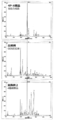
- the left lane is a marker.
- the left lane is a marker. It is the chart which showed the comparison of GOS produced
- oligosaccharide means a polysaccharide compound having 3 to 10 sugars.
- galacto-oligosaccharide mainly means an oligosaccharide represented by the following general formula.
- GOS oligosaccharide represented by the following general formula.
- Gal represents a galactose residue
- Glc represents a glucose residue
- n is an integer of 1 to 8, particularly an integer of 1 to 3.
- the binding mode of each bond between sugars is not particularly limited, but is typically a ⁇ -1,4-glycoside bond.
- the bonding mode between sugars may be ⁇ -1,3-glycoside bonding.
- the yield (mass%) of galactooligosaccharide means a percentage obtained by dividing “production amount of galactooligosaccharide” by “consumption amount of lactose”.
- the lactase activity of an enzyme is defined by one of the following two methods.
- An enzyme to be measured is added to a lactose solution (lactose concentration 10%), and the amount of glucose produced under conditions of pH 6.5 and 40 ° C. is measured and quantified.
- the enzyme activity that produces 1 ⁇ mol of glucose per minute is defined as 1 LU.
- the enzyme to be measured was added to an o-nitrophenyl- ⁇ -galactopyranoside (ONPG) solution (ONPG concentration 1.65 mM), and the amount of o-nitrophenyl produced under conditions of pH 6.5 and 40 ° C. was measured. To quantify.
- the enzymatic activity that produces 1 ⁇ mol of o-nitrophenyl per minute is defined as 1 OU.
- the enzyme may be determined to be lactase. More specifically, lactase may be determined if it is 0.2 LU / mL or more or 0.5 OU / mL or more.
- the enzyme has lactase activity, it does not necessarily have galactooligosaccharide production activity (also referred to as GOS production activity).
- the galactooligosaccharide production activity of the enzyme is evaluated by the method described below.
- lactose concentration 60% lactose concentration 60%
- GOS GOS is produced from lactose during this period.
- the reaction solution is analyzed by HPLC.
- Examples of columns used in HPLC include Transgenec's CARBOSep CHO-620 ⁇ 6.5 ⁇ ⁇ 300 mm.
- the mobile phase is water, the flow rate is 0.4 mL / min, the temperature is 85 ° C., and the detection is performed under RI conditions.
- the reference value is usually 1%.
- the larger the ratio the higher the enzyme has a galactooligosaccharide production activity.
- a high reference value may be set. Therefore, the reference value may be set to 1%, 3%, 5%, 10%, 20%, 25%, 30%, 35%, 40%.
- BgaD is currently the most commercially available lactase for producing GOS and is a lactase derived from Bacillus circulans. From the studies so far, BgaD has been classified into four types of enzymes having different molecular weights: a lactase having a molecular weight of 195 kDa (BgaD-A, SEQ ID NO: 3, GenBank code: BAJ61032), a lactase having a molecular weight of 160 kDa (BgaD-B), and a molecular weight of 135 kDa.
- BgaD-C lactase
- BgaD-D molecular weight 86 kDa lactase
- SEQ ID NO: 4 a molecular weight 86 kDa lactase
- BgaD-D of the smallest size is known to have the highest GOS production activity, and is also included in many of the lactase preparations “Biolacta” for GOS production sold by Amano Enzyme.
- the GOS yield when BgaD-D is used as a lactase for GOS production is about 60 to 70%.
- GOS yield (%) is the percentage of GOS production / lactose consumption.
- the amount of GOS produced and the amount of lactose consumed can be determined by HPLC analysis.
- the production selectivity of trisaccharide GOS when BgaD-D is used as a lactase for GOS production is about 60% at the maximum.
- the production selectivity (%) of trisaccharide GOS means the percentage of the production amount of trisaccharide GOS with respect to the total production amount of GOS. A higher value means that trisaccharide GOS is mainly produced.
- the total amount of GOS produced and the amount of trisaccharide GOS produced can be determined by HPLC analysis.
- the production selectivity of the trisaccharide GOS is preferably 60% or more, more preferably 70% or more, further preferably 75% or more, and particularly preferably 80% or more.
- a novel enzyme having galactooligosaccharide production activity and DNA encoding the enzyme are provided.
- the present inventors have found an enzyme that has low homology with BgaD, which is a Bacillus circulans-derived GOS-producing enzyme, and has high yield and high GOS production selectivity.
- the enzyme is an enzyme consisting of the amino acid sequence shown in SEQ ID NO: 1, an enzyme consisting of the amino acid sequence shown in SEQ ID NO: 2 and homologues thereof.
- the enzyme consisting of the amino acid sequence shown in SEQ ID NO: 1 and the enzyme consisting of the amino acid sequence shown in SEQ ID NO: 2 are both enzymes produced by Paenibacillus pabuli. These amino acid sequences are first identified and reported by the present inventors.
- the molecular weight of the enzyme consisting of the amino acid sequence shown in SEQ ID NO: 1 is about 114 kDa (see FIG. 1A).
- the homology to BgaD-D is about 15%.
- This enzyme is an enzyme that functions as a lactase and was found to be usable for GOS production using lactose as a raw material.
- the GOS yield is about 45 to about 60% when an enzyme consisting of the amino acid sequence shown in SEQ ID NO: 1 is used as the lactase for GOS production.
- the production selectivity of trisaccharide GOS among the GOS produced is about 75% or more.
- the enzyme is superior to BgaD-D in Km value indicating the performance of the enzyme.
- Enzyme comprising the amino acid sequence shown in SEQ ID NO: 2 The molecular weight of the enzyme consisting of the amino acid sequence shown in SEQ ID NO: 2 is about 50 kDa (see FIG. 1B). The homology to BgaD-D is about 8%.
- This enzyme is an enzyme that functions as a lactase and was found to be usable for GOS production using lactose as a raw material.
- the GOS yield is about 60 to about 70% when an enzyme consisting of the amino acid sequence shown in SEQ ID NO: 2 is used as the lactase for GOS production. Moreover, the production selectivity of trisaccharide GOS is about 80% or more.
- the enzyme consisting of the amino acid sequence shown in SEQ ID NO: 2 transfers a ⁇ -galactosyl group ( ⁇ -galactose residue) to a sugar (eg, lactose) highly selectively so as to form a ⁇ -1,3-glycoside bond.
- a sugar eg, lactose
- GOS trisaccharide GOS in which ⁇ -galactosyl groups are linked by ⁇ -1,3-glycosides.
- enterobacteria only Bifidobacterium can degrade ⁇ -1,3-glycosidic bonds.
- the galactosyl group is bonded to lactose by forming a ⁇ -1,4-glycoside bond or a ⁇ -1,6-glycoside bond.
- the enzyme consisting of the amino acid sequence shown in SEQ ID NO: 1 and the enzyme consisting of the amino acid sequence shown in SEQ ID NO: 2 have high enzyme chemical properties and high trisaccharide GOS selectivity while realizing a high GOS yield. Both are compatible.
- these enzymes derived from Paenibacillus pabuli it is possible to reduce the generation of GOS of 4 or more sugars that cause a deterioration in yield as compared with the conventional case.
- the enzyme may have an additional region as long as the function is not impaired.
- additional regions include regions such as tag domains.
- the position to which these are added may be either one or both of the N-terminal and C-terminal.
- an enzyme consisting of the amino acid sequence shown in SEQ ID NO: 1 an enzyme consisting of the amino acid sequence shown in SEQ ID NO: 2 (3) a family enzyme (or homologue) of the enzyme consisting of the amino acid sequence shown in SEQ ID NO: 1 (4) Family enzyme (or homologue) of the enzyme consisting of the amino acid sequence shown in SEQ ID NO: 2 (5)
- An enzyme E1 is a family (or homologue) of another enzyme E2 means that homology (or may be expressed as identity or similarity) based on the amino acid sequence of E1 and E2 is 80% or more, 85 % Or more, 90% or more, 91% or more, 92% or more, 93% or more, 94% or more, 95% or more, 96% or more, 97% or more, 98% or more, or 99% or more To do.
- E1 is a family (or homologue) of another enzyme E2 means that homology (or may be expressed as identity or similarity) based on the amino acid sequence of E1 and E2 is 80% or more, 85 % Or more, 90% or more, 91% or more, 92% or more, 93% or more, 94% or more, 95% or more, 96% or more, 97% or more, 98% or more, or 99% or more To do.
- An enzyme E1 is a family (or homologue) of another enzyme E2, in particular, when the amino acid sequence of the enzyme E1 is a substitution or deletion of 1 to 10 amino acids relative to the amino acid sequence of the enzyme E2.
- Substitution means that an amino acid at a specific site has been replaced with another amino acid.
- Deletion means deletion of an amino acid at a specific site.
- Insertion means that a non-existing amino acid is added inside the amino acid sequence.
- an enzyme E1 and another enzyme E2 are a family (or a homolog) means that the enzyme E1 and the enzyme E2 can exhibit the same function.
- the activity ratio in this function is no particular limitation. For example, when the more active enzyme is E1 and the activity is 100%, the activity of the less active enzyme E2 is 1% or more, 5% or more, 10% or more, 20% or more, 30% or more, 40% % Or more, 50% or more, 60% or more, 70% or more, 80% or more, or 90% or more.
- the family enzyme of the enzyme consisting of the amino acid sequence shown in SEQ ID NO: 1 means an enzyme having 80% or more and less than 100% homology to the amino acid sequence shown in SEQ ID NO: 1 and having galactooligosaccharide production activity To do.
- it means an enzyme having an amino acid sequence in which 1 to 10 amino acids are substituted, deleted or inserted in the amino acid sequence shown in SEQ ID NO: 1 and having galactooligosaccharide production activity.
- the family enzyme of the enzyme consisting of the amino acid sequence shown in SEQ ID NO: 1 has a lower limit of homology to the amino acid sequence shown in SEQ ID NO: 1 of 85% or more, 90% or more, 91% or more, 92% or more, 93% or more, It may be 94% or more, 95% or more, 96% or more, 97% or more, 98% or more, or 99% or more. Even in these cases where the lower limit of homology is, the upper limit is less than 100%.
- the family enzyme of the enzyme consisting of the amino acid sequence shown in SEQ ID NO: 2 has a homology of 80% or more and less than 100% with respect to the amino acid sequence shown in SEQ ID NO: 2, and has a galactooligosaccharide-producing activity.
- the family enzyme of the enzyme consisting of the amino acid sequence shown in SEQ ID NO: 2 has a lower limit of homology to the amino acid sequence shown in SEQ ID NO: 2 of 85%, 90%, 91%, 92%, 93%, It may be 94% or more, 95% or more, 96% or more, 97% or more, 98% or more, or 99% or more. Even in these cases where the lower limit of homology is, the upper limit is less than 100%.
- an enzyme consisting of the amino acid sequence shown in SEQ ID NO: 1 (2) An enzyme consisting of the amino acid sequence shown in SEQ ID NO: 2 (3) 1-10 amino acids are substituted, deleted or inserted in the amino acid sequence shown in SEQ ID NO: 1
- An enzyme having a galactooligosaccharide production activity (4) an enzyme having an amino acid sequence in which 1 to 10 amino acids are substituted, deleted, or inserted in the amino acid sequence shown in SEQ ID NO: 2 ,
- An enzyme having galactooligosaccharide production activity (5) an enzyme comprising an amino acid sequence having an amino acid sequence of 80% or more and less than 100% with respect to the amino acid sequence shown in SEQ ID NO: 1, and having a galactooligosaccharide production activity (6)
- SEQ ID NO: 2 an enzyme comprising an amino acid sequence having a homology of 80% or more and less than 100% to the amino acid sequence shown in Enzyme (7) said with
- an enzyme having the following amino acid sequences (a) to (f) or consisting of the amino acid sequences (a) to (f) is provided as the first aspect of the present invention.
- the amino acid sequence of an enzyme having galactooligosaccharide production activity (d) An amino acid sequence in which 1 to 10 amino acids are substituted, deleted, or inserted in the amino acid sequence shown in SEQ ID NO: 2, Amino acid sequence (e) Amino acid sequence having 80% or more and less than 100% homology to the amino acid sequence shown in SEQ ID NO: 1, and an amino acid sequence of an enzyme having galactooligosaccharide production activity (f)
- the first aspect of the present invention also provides DNA encoding the enzyme as described above.
- DNA having any base sequence is within the scope of the present invention.
- a DNA having a base sequence described in detail below is a typical example of such a DNA.
- the DNA consisting of the base sequence shown in SEQ ID NO: 5 encodes an enzyme consisting of the amino acid sequence shown in SEQ ID NO: 1 (including the 3 'terminal codon).
- the DNA consisting of the base sequence shown in SEQ ID NO: 6 encodes the enzyme consisting of the amino acid sequence shown in SEQ ID NO: 2 (including the 3 'terminal termination codon).
- both of the enzymes consisting of the amino acid sequences shown in SEQ ID NO: 1 and SEQ ID NO: 2 have good galactooligosaccharide production activity. Therefore, an enzyme encoded by a DNA consisting of a base sequence highly homologous to these base sequences is an enzyme having a galactooligosaccharide production activity with high probability.
- DNA comprising a base sequence in which conservative base substitution is performed on the above DNA is also included in the present invention.
- the conservative base substitution of the base sequence means a substitution in which the amino acid sequence of the encoded enzyme does not change among the substitutions of the base in the base sequence. That is, it means that two or more DNAs are in a relationship in which each base sequence is different from each other but encodes an enzyme having the same amino acid sequence.
- the DNA may have an additional region as long as it does not impair the function of itself or the encoded enzyme.
- additional region include a repeat structure of the DNA itself, a stop codon, an operator sequence, a region corresponding to a tag peptide, and the like. The position where these are added may be either one or both of the 5 'end and the 3' end.
- DNA consisting of the base sequence shown in SEQ ID NO: 5 (2) DNA consisting of the base sequence shown in SEQ ID NO: 6 (3) DNA consisting of a base sequence having high homology to the base sequence shown in SEQ ID NO: 5, wherein the encoding enzyme has galactooligosaccharide production activity (4) DNA consisting of a base sequence having high homology to the base sequence shown in SEQ ID NO: 6, wherein the encoding enzyme has galactooligosaccharide production activity (5) DNA comprising a base sequence in which conservative base substitutions are made for any of the base sequences of (1) to (4) above (6) A DNA obtained by adding the DNA of (1) to (5), a stop codon, an operator sequence, etc. to the DNA of (1) to (5), wherein the encoded enzyme has galactooligosaccharide production activity.
- a DNA consisting of a base sequence having high homology (or may be expressed as identity or similarity) to the base sequence of a certain DNA has a homology to the base sequence of a certain DNA of 80% or more, 85% or more, It means DNA having a base sequence of 90% or more, 91% or more, 92% or more, 93% or more, 94% or more, 95% or more, 96% or more, 97% or more, 98% or more, or 99% or more.
- the upper limit is not particularly limited and is less than 100%.
- the base sequence homology of DNA can be easily calculated using known software using the BLAST algorithm and the BLAST 2.0 algorithm.
- a DNA comprising a base sequence having high homology to the base sequence of a certain DNA is a stringent condition on a DNA comprising a base sequence complementary to the base sequence of the certain DNA. It means DNA that hybridizes underneath or is capable of hybridizing.
- stringent conditions mean conditions under which so-called specific hybrids are formed and non-specific hybrids are not formed. Hybridization stringency is primarily determined by temperature, ionic strength, and denaturant conditions. Examples of stringent conditions include washing conditions at a salt concentration and a temperature corresponding to 60 ° C., 1 ⁇ SSC, and 0.1% SDS. Washing at a salt concentration and temperature corresponding to 60 ° C., 0.1 ⁇ SSC, 0.1% SDS, washing at a salt concentration and temperature corresponding to 68 ° C., 0.1 ⁇ SSC, 0.1% SDS It is good also as conditions.
- DNA (1) to (8) are provided as the first aspect of the present invention.
- DNA consisting of the base sequence shown in SEQ ID NO: 5 (2) DNA consisting of the base sequence shown in SEQ ID NO: 6 (3) DNA comprising a base sequence having a homology of 80% or more and less than 100% to the base sequence shown in SEQ ID NO: 5, wherein the encoding enzyme has galactooligosaccharide production activity (4) DNA comprising a base sequence having a homology of 80% or more and less than 100% to the base sequence shown in SEQ ID NO: 6, wherein the encoded enzyme has galactooligosaccharide production activity (5) DNA comprising a base sequence complementary to the base sequence shown in SEQ ID NO: 5 and a base sequence that hybridizes under stringent conditions, wherein the encoding enzyme has galactooligosaccharide-producing activity (6) A DNA comprising a base sequence complementary to the base sequence shown in SEQ ID NO: 6 and a base sequence that hybridizes under stringent conditions, wherein the encoding
- a DNA having the following base sequences (A) to (G) or consisting of the base sequences (A) to (G) is provided as the first aspect of the present invention.
- A a base sequence shown in SEQ ID NO: 5
- B a base sequence shown in SEQ ID NO: 6
- C a base sequence having a homology of 80% or more and less than 100% to the base sequence shown in SEQ ID NO: 5
- D a nucleotide sequence having a homology of 80% or more and less than 100% to the nucleotide sequence shown in SEQ ID NO: 6, wherein the encoding enzyme is a galactooligosaccharide producing activity
- E a base sequence that hybridizes with a base sequence complementary to the base sequence shown in SEQ ID NO: 5 under stringent conditions, wherein the encoding enzyme has a galactooligosaccharide producing activity
- F A base sequence that hybridizes with a base sequence complementary to the base sequence shown in SEQ ID NO: 6 under
- the DNA as described above can be obtained, for example, by collecting genomic DNA from Paenibacillus genus bacteria (particularly Paenibacillus pabuli) and then using PCR as a template.
- Primer 1 5'-GAACACAAGGTCATGAAAGCAGCAAAGGCAGAT-3
- Primer 2 5'-CATCCTGTTAAGCTTTTACAATGCCCGAATGAC-3 '
- Primer 3 5'-GAACACAAGGTCATGACCATTTTTCAATTTCCG-3 '
- Primer 4 5'-CATCCTGTTAAGCTTTTAACGGATTTCCAGCCAATTG-3 '
- an enzyme consisting of the amino acid sequence shown in SEQ ID NO: 1 and a structural gene encoding the homologue thereof for example, DNA consisting of the base sequence shown in SEQ ID NO: 5
- an enzyme consisting of the amino acid sequence shown in SEQ ID NO: 2 and homologues thereof A structural gene encoding the body (for example, DNA comprising the base sequence shown in SEQ ID NO: 6) can be obtained.
- a recombinant vector comprising the DNA of the first aspect.
- This recombinant vector makes it possible to produce a transformant and to express a large amount of enzyme.
- vector there are no particular restrictions on the vector, and any commonly used vector can be used.
- plasmid bacteriophage, cosmid, phagemid and the like can be mentioned.
- plasmids examples include pK4, pRK401, pRF31, pBR322, pBR325, pUC118, pUC119, pUC18, pBIC, pUB110, pTP5, YEp13, YEp24, and YCp50.
- phage examples include ⁇ phage ( ⁇ gt10, ⁇ gt11, ⁇ ZAP, etc.).
- animal viruses such as retrovirus or vaccinia virus, and insect virus vectors such as baculovirus can also be used.
- Cis-elements such as promoters and enhancers, splicing signals, poly A addition signals, selection markers, ribosome binding sequences (SD sequences), start codons, stop codons, and the like can be linked to the vector.
- a tag sequence for facilitating purification of the enzyme to be produced can also be linked.
- a known tag such as a His tag, a GST tag, or an MBP tag can be used.
- the vector may also contain an antibiotic resistance gene for selection.
- the method for inserting DNA into the vector there is no particular limitation on the method for inserting DNA into the vector, and any commonly used method can be used. Usually, the following method is used. First, the purified DNA is cleaved with an appropriate restriction enzyme, inserted into a restriction enzyme site of a vector DNA or a multicloning site, and ligated to a vector.
- a transformant comprising (or introduced) the DNA of the first aspect and / or the recombinant vector of the second aspect.
- any of prokaryotes, archaea, and eukaryotes can be used, and examples include eubacteria (such as E. coli), yeast, plant cells, animal cells (such as COS cells and CHO cells), and insect cells.
- Bacillus genus Bacillus genus, Paenibacillus genus, Brevibacillus genus (eg Brevibacillus chosinensis), Escherichia genus (eg Escherichia coli), Corynebacterium genus, Saccharomyces genus, Shizosaccharomyces genus, Kluyveromyces genus, Pichia genus, Pichia genus, Pichia And microorganisms of the genus.
- microorganisms with food experience such as lactic acid bacteria and acetic acid bacteria, are mentioned.
- the method for introducing DNA and / or recombinant vectors into these hosts includes an electroporation method, a spheroplast method, a lithium acetate method, a calcium phosphate method, and a lipofection method. It may be inserted or added into the host genome using homologous recombination or the like.
- any method can be used for confirming whether DNA or a recombinant vector has been introduced into the host.
- it can be performed by PCR method, Southern hybridization method, Northern hybridization method and the like.
- the enzyme of the present invention and a composition containing the same can be prepared by a conventionally known method using the transformant. For example, it can be prepared by the method described below.
- the above transformant introduced with the target gene is cultured in a large volume in a liquid medium.
- a predetermined inducer may be administered to the transformant to induce expression of the target gene.
- IPTG can be administered to induce expression of the target gene.
- the culture supernatant or the disrupted solution obtained by disrupting the cells with ultrasound or cell wall lysing enzyme is collected.
- the supernatant and crushed liquid contain a large amount of the enzyme of the present invention.
- the supernatant or crushed liquid may be used as it is as an enzyme-containing liquid composition, or the liquid composition may be subjected to a purification treatment and recovered as a purified enzyme.
- This purification treatment can be performed, for example, by salting out, membrane separation, or column chromatography. One or more of these operations can be combined.
- the type of column chromatography is not limited, but a column containing an antibody that specifically acts on these enzymes may be used, or a column capable of interacting with a tag domain such as a His tag previously added to the enzyme. May be used.
- an enzyme consisting of the amino acid sequence shown in SEQ ID NO: 1 or a homologue thereof, or an enzyme consisting of the amino acid sequence shown in SEQ ID NO: 2 or a homologue thereof can be prepared in large quantities. These enzymes can be used for the production of galactooligosaccharides.
- GOS can be produced from lactose using this.
- the method and conditions for manufacturing GOS are not limited. One example will be described below, but the present invention is not limited to this.
- the method for producing GOS of the present invention includes a step of bringing an enzyme into contact with lactose and a step of producing GOS by this contact. A step of isolating and purifying the optionally produced GOS may be included.
- the GOS production method of the present invention includes contacting the above enzyme with lactose.
- the enzyme that is brought into contact with lactose may be purified from a microorganism that produces the enzyme (purified enzyme).
- the microorganism itself may be brought into contact with lactose, or a mixture containing other factors such as a crushed microorganism or an extract may be brought into contact with lactose. It is preferable to contact the purified enzyme with lactose in terms of preventing side reactions.
- Purified enzyme means an enzyme solution or an enzyme solid obtained by a predetermined purification treatment. It means that it is substantially free of enzymes other than that enzyme, or other enzymes are reduced.
- a reaction system (a mixture containing a solvent, lactose and the enzyme of the present invention) is formed by mixing an enzyme or the like with a solution containing lactose or by mixing lactose with a solution containing the enzyme or the like. Is done.
- the solvent is arbitrary, but is usually water or an aqueous solvent containing water as a main component.
- the content of lactose in the reaction system is not particularly limited and can be arbitrarily set. For example, it may be 1 to 80% by mass, 2 to 70% by mass, or 4 to 60% by mass based on the total amount of the reaction system. In an embodiment, the content may be further 4 to 50% by mass, 4 to 40% by mass, 4 to 30% by mass, 4 to 20% by mass, and 4 to 10% by mass.
- an enzyme consisting of the amino acid sequence shown in SEQ ID NO: 1 and its family enzyme are preferably used. This is because these are excellent in Km value and have sufficient activity even at a low substrate concentration.
- it may be 5 to 60% by mass, 10 to 60% by mass, 20 to 60% by mass, 30 to 60% by mass, or 40 to 60% by mass.
- an enzyme comprising the amino acid sequence shown in SEQ ID NO: 2 and its family enzyme are preferably used. These have both good GOS production activity and trisaccharide GOS selection activity, and can produce a large amount of trisaccharide GOS in a short time.
- the content of the enzyme of the present invention in the reaction system is not particularly limited and can be arbitrarily set. In the reaction system, for example, it may be 0.1 to 10 LU / mL or 0.1 to 10 OU / mL.
- the content of the enzyme of the present invention may be determined as follows.
- a first step in a specific reaction system (lactose content, content of the enzyme of the present invention, reaction pH, reaction temperature, reaction time, etc.), the amount of GOS produced relative to the content of the enzyme of the present invention is confirmed.
- the lactase activity at least one of LU / mL or OU / mL
- the amount of the enzyme of the present invention contained in the reaction system is adjusted using the lactase activity measured in the second step as an index (the content of the enzyme of the present invention is increased or decreased).
- a 4th process it is included so that it may become the value which adjusted content of the enzyme of this invention contained in a reaction system. In addition, you may perform said 1st process and 2nd process reversely.
- the pH of the reaction system is not particularly limited and can be set arbitrarily. For example, it may be 3 to 9, 4 to 8, or 5 to 7. Of course, the pH may be constant or may vary.
- the temperature of the reaction system is not particularly limited and can be set arbitrarily.
- the temperature may be 20 to 75 ° C, 30 to 75 ° C, 40 to 75 ° C, 50 to 70 ° C, or 60 to 70 ° C.
- the temperature may be constant or variable. It is preferable to select a temperature at which lactose contained in the reaction system is dissolved.
- the reaction time is not particularly limited and can be set arbitrarily. For example, it may be 1 to 100 hours, 12 to 60 hours, or 24 to 48 hours.
- These series of manufacturing methods may be either batch type or continuous type.
- a predetermined amount of enzyme and raw lactose are charged into a reactor to generate GOS for a predetermined time, and then a mixture containing GOS is recovered from the reactor.
- the enzyme and / or raw lactose are continuously or intermittently charged into the reactor. And while producing
- the state of lactose used as a raw material is not particularly limited.
- a lactose solution dissolved in an arbitrary solvent may be used.
- GOS solution may be used as it is, or GOS may be purified from this.
- the method for purifying GOS is not particularly limited, and any method can be adopted.
- each fraction can be separated by column chromatography using a cation exchange resin coordinated with activated carbon or metal ions, or a gel filtration resin.
- oligosaccharide means a polysaccharide compound having 3 to 10 sugars.
- galacto-oligosaccharide mainly means an oligosaccharide represented by the following general formula.
- GOS oligosaccharide represented by the following general formula.
- Gal represents a glassose residue
- Glc represents a glucose residue
- n is an integer of 1 to 8, particularly an integer of 1 to 3.
- the binding mode of each bond between sugars is not particularly limited, but is typically a ⁇ -1,4-glycoside bond.
- the method for producing a galactooligosaccharide of the present invention uses a bacterium belonging to the genus Paenibacillus as a lactase-producing microorganism. It has not been reported so far that bacteria of the genus Paenibacillus generally produce galactooligosaccharides.
- bacteria belonging to the genus Paenibacillus include the following bacteria. Any of the following bacteria can be isolated from soil, deposited in a public institution, or easily available to those skilled in the art.
- Paenibacillus themophilus eg deposit number DSM 24746)
- Paenibacillus popilliae eg deposit number DSM 22700
- Paenibacillus thiaminolyticus eg deposit number NBRC 15656
- Paenibacillus pabuli eg deposit number NBRC 13638
- Paenibacillus alvei eg deposit number NBRC 3343
- Paenibacillus alginolyticus eg deposit number NBRC 15375
- Paenibacillus chibensis eg deposit number NBRC 15958)
- Paenibacillus chitinolyticus eg deposit number NBRC 15660
- Paenibacillus chondroitinus eg deposit number NBRC
- microorganisms produce oligosaccharides is to make sugar difficult to be assimilated by different microorganisms by changing sugar to oligosaccharides, and to store oligosaccharides as storage substances during rich nutrition and to use these oligosaccharides during poor nutrition. It is possible to prevent / reduce osmotic pressure change accompanying lactose decomposition. Neighboring species of microorganisms can carry out similar survival strategies with similar genes, and therefore neighboring species of microorganisms are considered to be capable of producing similar oligosaccharides. From these facts, it was speculated that galactooligosaccharides were produced in all microorganisms belonging to the genus Paenibacillus. It is also possible to use mutants of these Paenibacillus bacteria, recombinants produced by genetic recombination techniques, and the like.
- Paenibacillus bacteria generally have a fast growth rate. In addition, it has antibacterial properties against various microorganisms. Therefore, when producing galactooligosaccharides, it is easier to cultivate these bacteria in large quantities compared to yeast and the like.
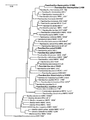
- Fig. 4 shows the phylogenetic tree analyzed for these Paenibacillus and Bacillus bacteria.
- the genus Paenibacillus is a genus that clearly branches from the genus Bacillus.
- a galactooligosaccharide is produced by bringing bacterial cells of the genus Paenibacillus and / or a galactooligosaccharide-producing enzyme of the bacterium into contact with lactose.
- a galactooligosaccharide-producing enzyme a purified enzyme may be used.
- the enzyme-containing mixture include processed microbial cells such as crushed cells and extracts.
- the processed product may be solid or liquid.
- These series of manufacturing methods may be either batch type or continuous type.
- a predetermined amount of Paenibacillus genus bacteria and raw lactose are charged into a reactor to generate GOS for a predetermined time, and then a mixture containing GOS is recovered from the reactor.
- a mixture containing GOS is recovered from the reactor.
- Paenibacillus genus bacteria and their enzymes and / or raw lactose are continuously or intermittently charged into the reactor. And while producing
- the state of lactose used as a raw material is not particularly limited.
- a lactose solution dissolved in an arbitrary solvent may be used.
- lactose or Paenibacillus genus and / or galactooligosaccharide-producing enzyme is preferably fluidized with an appropriate solvent for convenience of operation.
- the solvent is optional, but is typically water or an aqueous solvent containing water as a main component.
- bacteria of the genus Paenibacillus are cultured before contacting with lactose.
- the culture conditions for Paenibacillus bacteria are not limited and are arbitrary.
- the cells may be cultured at about 30 ° C. for about 3 days in a liquid medium under anaerobic or aerobic conditions.
- limiting in the kind of liquid culture medium Arbitrary things can be used.
- soy bean casein digest (SCD) medium, brain heart infusion (BHI) medium, and the like can be mentioned.
- a Paenibacillus genus bacterium obtained by culturing can be advantageously used regardless of whether it is live or dead.
- the culture may be concentrated.
- a liquid culture medium and a microbial cell are isolate
- examples of the treated product of the culture include a sonicated product, a lysed enzyme-treated product, a surfactant-treated product, and a mechanically ground treated product. These can be suspended in a suitable solvent to obtain a fluid containing bacteria and / or enzymes of the genus Paenibacillus.
- a reaction system (a mixture containing a solvent, lactose, cells of Paenibacillus bacteria and / or enzymes) for producing galactooligosaccharide is formed by mixing lactose and Paenibacillus bacteria.
- the content of Paenibacillus bacteria in the reaction system is not particularly limited and can be appropriately set.
- the wet cell may be 10 to 200 g / L, 30 to 150 g / L, 50 to 100 g / L.
- the enzyme is contained using an enzyme-containing mixture such as a crushed material, an extract, or a culture medium, the content may be adjusted to an amount such that the original strain falls within the above range.
- the content of lactose in the reaction system is not particularly limited and can be appropriately set. For example, it may be 5 to 60% by mass or 30 to 60% by mass based on the total amount of the reaction system. As the lactose is consumed, the lactose may be appropriately supplemented.
- the ratio (kg / kg) of the Paenibacillus genus content to the lactose content in the reaction system is not particularly limited and can be appropriately set. For example, it may be 1/30 to 1/1, 1/20 to 1/2, or 1/10 to 1/5 with respect to the amount of lactose.
- the enzyme is contained using an enzyme-containing mixture such as a crushed material, an extract, or a culture medium, the content may be adjusted to an amount such that the original strain falls within the above range.
- the temperature of the reaction system is not particularly limited and can be set as appropriate.
- the temperature may be 10 to 75 ° C, 20 to 60 ° C, or 30 to 50 ° C.
- the temperature may be constant or variable.
- the pH of the reaction system is not particularly limited and can be set as appropriate. For example, it may be 3 to 9, 5 to 8, 6 to 8, 6 to 7.5, or 6 to 7. Of course, the pH may be constant or may vary.
- the reaction time of the reaction system is not particularly limited and can be set as appropriate. For example, it may be 1 to 50 hours, 5 to 30 hours, or 12 to 24 hours.
- the reaction system may contain inorganic salts and the like.
- the content of inorganic salts and the like is, for example, 0.00001 to 10% by mass and 0.0001 to 1% by mass based on the total amount of the reaction system.
- a liquid medium such as an SCD medium and a BHI medium may be used as the solvent containing inorganic salts.
- the microbial cell-containing GOS solution may be used as it is, or the microbial cell may be removed and used as a GOS solution, or GOS may be purified from this.
- the method for removing the bacterial cells from the bacterial cell-containing GOS solution is arbitrary. Examples thereof include sterilization by centrifugation, filtering, heating, and the like.
- the method for purifying GOS is not particularly limited, and any method can be adopted. Each fraction can be separated by column chromatography using a cation exchange resin coordinated with activated carbon or metal ions, or a gel filtration resin.
- Examples 1-2 Enzymes consisting of the amino acid sequences shown in SEQ ID NO: 1 and SEQ ID NO: 2
- Genomic DNA was collected from Paenibacillus pabuli, and DNAs (structural genes) encoding enzymes having the amino acid sequences shown in SEQ ID NO: 1 and SEQ ID NO: 2 were amplified by PCR using the DNA as a template.
- primer pair used to amplify the structural gene encoding the enzyme consisting of the amino acid sequence shown in SEQ ID NO: 1 (that is, the DNA consisting of the base sequence shown in SEQ ID NO: 5) is primers 1 and 2.
- Primer 1 5'-GAACACAAGGTCATGAAAGCAGCAAAGGCAGAT-3
- Primer 2 5'-CATCCTGTTAAGCTTTTACAATGCCCGAATGAC-3 '
- primers 3 and 4 The pair of primers used to amplify the structural gene encoding the enzyme consisting of the amino acid sequence shown in SEQ ID NO: 2 (that is, the DNA consisting of the base sequence shown in SEQ ID NO: 6) is primers 3 and 4.
- Primer 3 5'-GAACACAAGGTCATGACCATTTTTCAATTTCCG-3 '
- Primer 4 5'-CATCCTGTTAAGCTTTTAACGGATTTCCAGCCAATTG-3 '
- Each amplified structural gene was inserted into plasmid pBIC by homologous recombination using BIC System (TaKaRa). Each plasmid was introduced into Brevibacillus chosinensis to express a large amount of the enzyme.
- FIG. 1A shows the result of SDS-PAGE of an enzyme having the amino acid sequence shown in SEQ ID NO: 1
- FIG. 1B shows the enzyme consisting of the amino acid sequence shown in SEQ ID NO: 2.
- the prepared cell lysate was ultrafiltered as necessary to concentrate the enzyme.
- An enzyme-enriched disruption solution consisting of the amino acid sequence shown in SEQ ID NO: 1 was used in Example 1, and an enzyme-enriched disruption solution consisting of the amino acid sequence shown in SEQ ID NO: 2 was used as Example 2.
- the lactose decomposition activity of Example 1 was 0.4 LU / mL, and the ONPG decomposition activity was 11.7 OU / mL.
- the lactase activity of Example 2 the lactose decomposition activity was 51.7 LU / mL, and the ONPG decomposition activity was 240 OU / mL.
- the reaction rate parameter when ONPG of the enzyme of Example 1 was used as a substrate was determined by the following method.
- the specific activity ( ⁇ mol / mg protein / min) when reacted at 40 ° C. for 10 minutes at a substrate concentration of 0.075 to 7.5 mM was calculated, and the specific activity was plotted against each substrate concentration. At this time, 100 mM sodium phosphate (pH 6.5) was used as a buffer solution.
- ⁇ -galII is an enzyme obtained by purifying only a low molecular weight lactase from a culture solution of Bacillus circulans, and is a main enzyme of Biolacta (manufactured by Amano Enzyme Co., Ltd.) (Non-patent Document 1).
- the enzyme of Example 1 has the same maximum reaction rate as that of the enzyme contained in violacta, but the K m representing the affinity for the substrate ONPG is remarkably low. Therefore, using the enzyme of the present invention, it is considered that GOS can be efficiently produced even at a lower substrate concentration than violacter.
- an enzyme consisting of the amino acid sequence shown in SEQ ID NO: 4 (Bacillus circulans-derived lactase BgaD-D) was used.
- genomic DNA was collected from Bacillus sp. ATCC 31382 (former name: Bacillus circulans), and a structural gene encoding an enzyme consisting of the amino acid sequence shown in SEQ ID NO: 4 was amplified by PCR using this as a template. did.
- a start codon was added to the N-terminal side of this gene and a stop codon was added to the C-terminal side, which was introduced into Brevibacillus chosinensis to express a large amount of the enzyme. After production of the enzyme, this transformant was sonicated to obtain a cell lysate.
- Example 2 The GOS generating ability of each sample of Example 1, Example 2 and Comparative Example was evaluated.
- lactose was added to 0.1 M potassium phosphate buffer (pH 6.5) containing 1 mM magnesium sulfate and 0.064 mM EDTA so that the final concentration was 30% by mass based on the total amount of the system, and the activity The enzyme was added so as to be 1.5 LU / mL.
- lactose was added to 0.1 M sodium phosphate buffer (pH 6.5) so that the final concentration was 60% by mass based on the total amount of the system, and the activity was 5.0 LU. Enzyme was added to make / mL.
- the reaction temperature was 30 ° C. for the enzyme of Example 1 and 50 ° C. for the enzymes of Example 2 and Comparative Example, and the GOS production reaction was performed for 24 hours. After a predetermined time, a 20 wt% sulfosalicylic acid solution was added to 1/20 of the reaction solution to stop the reaction.
- HPLC HPLC was performed on each sample of Examples 1 and 2 and the comparative example, and the amount of produced GOS was analyzed.
- As the column CARBOSep CHO-620 6.5 ⁇ ⁇ 300 mm manufactured by Transgenomic was used, the mobile phase was water, the flow rate was 0.4 mL / min, the temperature was 85 ° C., and the detection was performed under RI conditions.
- Table 2 shows the HPLC results of each sample.
- GOS in Table 2 means the GOS content ratio. More specifically, it is the percentage of the HPLC area of GOS with respect to the total HPLC area of GOS (pentose, tetrasaccharide, trisaccharide), disaccharide (unreacted lactose or transfer disaccharide), and monosaccharide (glucose, galactose). . “Yield” means GOS production efficiency. More specifically, it is the percentage of GOS production / lactose consumption (GOS production and lactose consumption are calculated from HPLC). In addition, sugars having 6 or more sugars could not be confirmed in Examples 1 and 2 and the comparative example.
- the enzymes of Examples 1 and 2 have higher selectivity for trisaccharide GOS than the enzymes of Comparative Examples. It was revealed that the enzyme of the present invention has a good function in this respect.
- the enzyme of Example 2 has the same GOS yield as that of the enzyme of the comparative example, and can achieve both high GOS production yield and trisaccharide selectivity.
- GOS sugar composition There are 3 types of GOS in human breast milk: 4'-GL (Gal ⁇ 1-4Gal ⁇ 1-4Glc), 3'-GL (Gal ⁇ 1-3Gal ⁇ 1-4Glc) and 6'-GL (Gal ⁇ 1-6Gal ⁇ 1-4Glc) It is known that most of the commercially available lactases for producing GOS mainly produce 4′-GL and 6′-GL. On the other hand, many bifidobacteria constantly express transporters that take 3′-GL into the cells (Non-patent Document 2). That is, the merit of GOS containing 3′-GL is that Bifidobacteria are easy to grow.
- HPAEC-PAD high performance anion exchange chromatography-pulsed amperometric detection
- ICS-3000 Thermo Scientific
- CarboPac PA1 ⁇ 4 mm x 250 mm, Thermo Scientific
- the mobile phase is 100 mM sodium hydroxide solution (A), 100 mM sodium hydroxide-containing 600 mM sodium acetate solution B (B), water syrup (C), 50 mM sodium acetate solution (D) did.
- the conditions are shown in Table 3.
- the reaction solution was prepared so that the sugar concentration was 0.5 mg / mL and used as a sample for analysis. This was analyzed with a flow rate of 1.0 mL / min, an injection volume of 25 ⁇ L, a column temperature of 20 ° C., and a detector PAD.
- the main GOS produced by the lactase of Example 2 may be 3′-GL from its peak position, unlike the GOS produced by the lactase of the comparative example in which 4′-GL is the main sugar. It turned out to be expensive (Table 4). Further, among the GOS produced by the lactase of Example 2, the structure was analyzed by separating three sugars, and the 1 H-NMR spectrum and the 13 C-NMR spectrum were consistent with the 3′-GL pattern. Non-patent document 3). From this, it was considered that the main GOS produced by this enzyme is 3′-GL.
- each platinum strain is inoculated into 0.5 mL of SCD medium containing 2% lactose placed in a 48-well plate and cultured for 4 days with shaking at 30 ° C. and 500 rpm (amplitude 2 mm). The culture broth was collected.
- a lactose solution dissolved with 0.2 M acetate buffer (pH 6.0) was added so that the final concentration of lactose was 25 to 30% by mass. Thereafter, a transfer reaction was performed at 30 ° C. and 500 rpm for 24 hours.
- the reaction solution was centrifuged and the supernatant was collected.
- a sample diluted appropriately with pure water was used as an analytical sample.
- the amount of GOS in each sample was measured by HPLC analysis (column is Transgenec CARBOSep CHO-620 6.5 ⁇ ⁇ 300 mm, mobile phase is water, flow rate is 0.5 mL / min, temperature is 85 ° C., detection is RI). .
- the presence of GOS in a sample means that the strain of the sample has GOS transfer ability. Thus, a strain having GOS transfer ability was selected.
- Some of the resulting strains were Paenibacillus popilliae, Paenibacillus themophilus, Paenibacillus pabuli, Paenibacillus alvei, Paenibacillus thiaminolyticus. That is, it was suggested that bacteria belonging to the genus Paenibacillus have the ability to produce GOS from lactose.
- GOS in Table 5 means the GOS content ratio. More specifically, it is the percentage of the HPLC area of GOS with respect to the total HPLC area of GOS (3 or more sugars, mainly 5 sugars, 4 sugars and 3 sugars), lactose, glucose and galactose.
- Yield in Table 5 means GOS production efficiency. More specifically, it is the percentage of GOS production / lactose consumption (GOS production and lactose consumption are calculated from HPLC).
- the homology rate in the column of “homology search (BLAST)” in Table 5 is the highest when the BLAST search is performed on the 16S rDNA base sequence of each strain using the site of DNA Data Bank of Japan. Means homology with other species (corresponding strain). A species was identified when it showed a homology of 99.5% or higher.
- FIG. 4 shows a simple molecular phylogenetic tree based on the 16S rDNA partial nucleotide sequences of the genus Paenibacillus and Bacillus.
Landscapes
- Chemical & Material Sciences (AREA)
- Organic Chemistry (AREA)
- Life Sciences & Earth Sciences (AREA)
- Engineering & Computer Science (AREA)
- Zoology (AREA)
- Wood Science & Technology (AREA)
- Health & Medical Sciences (AREA)
- Bioinformatics & Cheminformatics (AREA)
- Genetics & Genomics (AREA)
- General Health & Medical Sciences (AREA)
- General Engineering & Computer Science (AREA)
- Biochemistry (AREA)
- Biotechnology (AREA)
- Microbiology (AREA)
- General Chemical & Material Sciences (AREA)
- Chemical Kinetics & Catalysis (AREA)
- Medicinal Chemistry (AREA)
- Molecular Biology (AREA)
- Biomedical Technology (AREA)
- Preparation Of Compounds By Using Micro-Organisms (AREA)
- Enzymes And Modification Thereof (AREA)
- Micro-Organisms Or Cultivation Processes Thereof (AREA)
Abstract
【課題】バチルス・サーキュランス以外の微生物に由来する、3糖ガラクトオリゴ糖の製造選択性が高く、かつ、高効率にガラクトオリゴ糖を製造できる新規の酵素と、ガラクトオリゴ糖を製造し得る新規の方法とを提供する。 【解決手段】以下の(a)~(f)からなる群より選択されるアミノ酸配列を有する酵素と、Paenibacillus属に属する細菌の菌体および/または前記細菌のガラクトオリゴ糖生産酵素を乳糖に接触させることを含むガラクトオリゴ糖の製造方法。 (a)配列番号1に示すアミノ酸配列 (b)配列番号2に示すアミノ酸配列 (c)配列番号1に示すアミノ酸配列において1~10個のアミノ酸が置換、削除、挿入されたアミノ酸配列であって、ガラクトオリゴ糖生産活性を有する酵素のアミノ酸配列 (d)配列番号2に示すアミノ酸配列において1~10個のアミノ酸が置換、削除、挿入されたアミノ酸配列であって、ガラクトオリゴ糖生産活性を有する酵素のアミノ酸配列 (e)配列番号1に示すアミノ酸配列に対する相同性が80%以上100%未満のアミノ酸配列であって、ガラクトオリゴ糖生産活性を有する酵素のアミノ酸配列 (f)配列番号2に示すアミノ酸配列に対する相同性が80%以上100%未満のアミノ酸配列であって、ガラクトオリゴ糖生産活性を有する酵素のアミノ酸配列
Description
本発明は、ガラクトオリゴ糖を製造可能な酵素に関する。また本発明は、この酵素をコードしているDNAおよびこの酵素を用いたガラクトオリゴ糖の製造方法に関する。また本発明は、ガラクトオリゴ糖を製造する方法に関する。
ガラクトオリゴ糖は、ヒト腸内細菌フローラに生息するビフィズス菌などの有用細菌の栄養源として重宝される。そのためガラクトオリゴ糖の製造方法として種々の方法が提案されている(例えば特許文献1~6)。この中で使用されている酵素はラクターゼであり、この中で使用されている微生物はラクターゼ産生微生物である。ラクターゼ(β-ガラクトシダーゼ)は乳糖をβ-ガラクトースとグルコースに加水分解する。ここで、ラクターゼによっては乳糖分子を分解して得られたβ-ガラクトシル基を別の乳糖分子などに転移させる反応を起こし得、この反応によってガラクトオリゴ糖を生産し得る。
Z. Mozaffar, K. Nakanishi, R. Matsuno and T. Kamikubo, Purification and Properties of β-Galactosidases from Bacillus circulans, Agric. biol. chem., 48, 3053-3061 (1986)
Sotoya et al., Identification of genes involved in galactooligosaccharide utilization in Bifidobacterium breve strain YIT 4014T., Microbiology, 163, 1420-1428. (2017)
Van Leeuwen, S. S., 1H NMR analysis of the lactose/β-galactosidase-derived galacto-oligosaccharide components of Vivinal(R) GOS up to DP5., Carbohydrates. Res., 400, 59-73. (2014)
T. Moriya, N. Nagahata, R. Odaka, H. Nakamura, J. Yoshikawa, K. Kurashima, T. Saito, Synthesis of an allergy inducing tetrasaccharide "4P-X"., Carbohydrates. Res., 439, 44-49. (2017)
現在、商業的に実用されているガラクトオリゴ糖製造のためのラクターゼは、主としてバチルス・サーキュランス(Bacillus circulans)由来のラクターゼである。バチルス・サーキュランス由来のラクターゼは、ガラクトオリゴ糖の製造効率が比較的高いという利点がある。しかしながら、このラクターゼは4糖以上のガラクトオリゴ糖を製造し易いというデメリットがある。4糖以上のガラクトオリゴ糖は3糖のガラクトオリゴ糖に比べ収率が低くなる。
本願は、このような背景に基づき、バチルス・サーキュランス以外の微生物に由来し、3糖のガラクトオリゴ糖の製造選択性が高く、高効率にガラクトオリゴ糖を製造できる酵素およびそれを用いたガラクトオリゴ糖の製造方法を提供することを第一の目的とする。
また、ガラクトオリゴ糖の製造方法には、ラクターゼ産生微生物を用いる方法とその微生物から精製したラクターゼを使用する方法とが存在する。ラクターゼ産生微生物を用いる製造方法には、精製ラクターゼを用いる場合と比較して、酵素精製の工程を省ける点、副反応生成物であるグルコースなどの単糖を微生物が資化することで除去可能である点などの利点がある。しかしその検討は依然として不十分である。
さらに、ガラクトオリゴ糖産生微生物としてバチルス属が良く知られているが、バチルス属の中には炭疽菌やセレウス菌など病原性を示す種も多く知られており、より安全なガラクトオリゴ糖産生菌が求められている。
さらに、ガラクトオリゴ糖産生微生物としてバチルス属が良く知られているが、バチルス属の中には炭疽菌やセレウス菌など病原性を示す種も多く知られており、より安全なガラクトオリゴ糖産生菌が求められている。
本願は、このような背景に基づき、ガラクトオリゴ糖の製造に適した微生物を同定し、この微生物を利用したガラクトオリゴ糖の製造方法を提供することを第二の目的とする。
本発明者らは前記第一の目的について鋭意研究した結果、本発明を完成するに至った。
すなわち、本発明1によれば、以下の(a)~(f)からなる群より選択されるアミノ酸配列を有する酵素が提供される。
(a)配列番号1に示すアミノ酸配列
(b)配列番号2に示すアミノ酸配列
(c)配列番号1に示すアミノ酸配列において1~10個のアミノ酸が置換、削除、挿入されたアミノ酸配列であって、ガラクトオリゴ糖生産活性を有する酵素のアミノ酸配列
(d)配列番号2に示すアミノ酸配列において1~10個のアミノ酸が置換、削除、挿入されたアミノ酸配列であって、ガラクトオリゴ糖生産活性を有する酵素のアミノ酸配列
(e)配列番号1に示すアミノ酸配列に対する相同性が80%以上100%未満のアミノ酸配列であって、ガラクトオリゴ糖生産活性を有する酵素のアミノ酸配列
(f)配列番号2に示すアミノ酸配列に対する相同性が80%以上100%未満のアミノ酸配列であって、ガラクトオリゴ糖生産活性を有する酵素のアミノ酸配列
(a)配列番号1に示すアミノ酸配列
(b)配列番号2に示すアミノ酸配列
(c)配列番号1に示すアミノ酸配列において1~10個のアミノ酸が置換、削除、挿入されたアミノ酸配列であって、ガラクトオリゴ糖生産活性を有する酵素のアミノ酸配列
(d)配列番号2に示すアミノ酸配列において1~10個のアミノ酸が置換、削除、挿入されたアミノ酸配列であって、ガラクトオリゴ糖生産活性を有する酵素のアミノ酸配列
(e)配列番号1に示すアミノ酸配列に対する相同性が80%以上100%未満のアミノ酸配列であって、ガラクトオリゴ糖生産活性を有する酵素のアミノ酸配列
(f)配列番号2に示すアミノ酸配列に対する相同性が80%以上100%未満のアミノ酸配列であって、ガラクトオリゴ糖生産活性を有する酵素のアミノ酸配列
また、本発明によれば、前記酵素をコードしているDNAも提供される。
本発明によれば、以下の(A)~(G)からなる群より選択される塩基配列を有するDNAが提供される。
(A)配列番号5に示す塩基配列
(B)配列番号6に示す塩基配列
(C)配列番号5に示す塩基配列に対する相同性が80%以上100%未満である塩基配列であって、コードしている酵素がガラクトオリゴ糖生産活性を有する塩基配列
(D)配列番号6に示す塩基配列に対する相同性が80%以上100%未満である塩基配列であって、コードしている酵素がガラクトオリゴ糖生産活性を有する塩基配列
(E)配列番号5に示す塩基配列に相補的な塩基配列とストリンジェントな条件下でハイブリダイズする塩基配列であって、コードしている酵素がガラクトオリゴ糖生産活性を有する塩基配列
(F)配列番号6に示す塩基配列に相補的な塩基配列とストリンジェントな条件下でハイブリダイズする塩基配列であって、コードしている酵素がガラクトオリゴ糖生産活性を有する塩基配列
(G)前記(A)~(F)のDNAのいずれかの塩基配列に対して保存的塩基置換されている塩基配列
(A)配列番号5に示す塩基配列
(B)配列番号6に示す塩基配列
(C)配列番号5に示す塩基配列に対する相同性が80%以上100%未満である塩基配列であって、コードしている酵素がガラクトオリゴ糖生産活性を有する塩基配列
(D)配列番号6に示す塩基配列に対する相同性が80%以上100%未満である塩基配列であって、コードしている酵素がガラクトオリゴ糖生産活性を有する塩基配列
(E)配列番号5に示す塩基配列に相補的な塩基配列とストリンジェントな条件下でハイブリダイズする塩基配列であって、コードしている酵素がガラクトオリゴ糖生産活性を有する塩基配列
(F)配列番号6に示す塩基配列に相補的な塩基配列とストリンジェントな条件下でハイブリダイズする塩基配列であって、コードしている酵素がガラクトオリゴ糖生産活性を有する塩基配列
(G)前記(A)~(F)のDNAのいずれかの塩基配列に対して保存的塩基置換されている塩基配列
ここで、ストリンジェントな条件とは、60℃、1×SSC、0.1%SDSに相当する塩濃度および温度で洗浄する条件であってもよい。
また、本発明によれば、前記DNAがコードしている、ガラクトオリゴ糖生産活性を有する酵素も提供される。
さらに本発明によれば、前記DNAを含む組換えベクターが提供される。前記DNAまたはこの組換えベクターを有する形質転換体も提供される。
さらに本発明によれば、前記形質転換体を培養する工程と、培養した形質転換体からガラクトオリゴ糖生産活性を有する酵素を回収する工程と、を含むガラクトオリゴ糖生産活性を有する酵素の調製方法が提供される。
さらに本発明によれば、前記酵素を有効成分として含む、酵素含有組成物が提供される。
さらに本発明によれば、乳糖と、パエニバチルス・パブリ(Paenibacillus pabuli)が生産するガラクトオリゴ糖生産活性を有する酵素と、を接触させることを含むガラクトオリゴ糖の製造方法が提供される。
さらに本発明によれば、乳糖と、前記酵素と、を接触させることを含むガラクトオリゴ糖の製造方法が提供される。
また、本発明者らは前記第二の目的について鋭意研究した結果、これまでガラクトオリゴ糖を生産することが知られていなかった微生物を同定し、さらにこの微生物が属する属全体においてガラクトオリゴ糖を生産することを見出し、本発明を完成するに至った。
すなわち、本発明2は、Paenibacillus属に属する細菌の菌体および/または前記細菌のガラクトオリゴ糖生産酵素を乳糖に接触させることを含むガラクトオリゴ糖の製造方法である。
Paenibacillus属に属する細菌は、Paenibacillus themophilus、Paenibacillus popilliae、Paenibacillus thiaminolyticus、Paenibacillus pabuli、Paenibacillus alvei、Paenibacillus alginolyticus、Paenibacillus chibensis、Paenibacillus chitinolyticus、Paenibacillus chondroitinus、Paenibacillus glucanolyticus、Paenibacillus lautus、Paenibacillus macerans、Paenibacillus peoriae、Paenibacillus polymyxa、Paenibacillus validus、Paenibacillus apiarius、Paenibacillus jamilae、Paenibacillus kribbensis、Paenibacillus terraeであってもよい。
Paenibacillus属に属する細菌は、Paenibacillus themophilus、Paenibacillus popilliae、Paenibacillus thiaminolyticus、Paenibacillus pabuli、Paenibacillus alvei、Paenibacillus polymyxaであってもよい。
本発明1によれば、パエニバチルス・パブリ由来のガラクトオリゴ糖生産活性を有する酵素を用いて、3糖のガラクトオリゴ糖の製造選択性が高く、高効率にガラクトオリゴ糖を製造することが可能となった。
本発明2により、ガラクトオリゴ糖を製造し得る微生物を利用したガラクトオリゴ糖の製造方法を提供することが可能となった。
≪本発明1≫
以下、本発明1について詳述する。
以下、本発明1について詳述する。
本発明においてオリゴ糖とは3糖から10糖の多糖化合物を意味する。
本発明においてガラクトオリゴ糖(GOSとも表記する)とは、下記一般式で表せるオリゴ糖を主として意味する。
(Gal)n-Gal-Glc
ここで、Galはガラクトース残基、Glcはグルコース残基を表し、nは1~8の整数、特に1~3の整数である。糖間の各結合の結合様式は特に制限されないが、典型的にはβ-1,4-グリコシド結合である。糖間(特にGal-Gal間)の結合様式はβ-1,3-グリコシド結合であってもよい。
(Gal)n-Gal-Glc
ここで、Galはガラクトース残基、Glcはグルコース残基を表し、nは1~8の整数、特に1~3の整数である。糖間の各結合の結合様式は特に制限されないが、典型的にはβ-1,4-グリコシド結合である。糖間(特にGal-Gal間)の結合様式はβ-1,3-グリコシド結合であってもよい。
ラクターゼとは、乳糖をβ-ガラクトースとグルコースに加水分解できる酵素である。この分解の際、β-ガラクトシル基を他の分子に転移させることができる。水に転移させればβ-ガラクトースを生じるが、乳糖(Gal-Glc)に転移させれば3糖(上記式のnが1)のガラクトオリゴ糖(Gal-Gal-Glc)を生じる。
このβ-ガラクトシル基の転移反応が3糖(上記式のnが1)のガラクトオリゴ糖(Gal-Gal-Glc)に対して起これば、4糖(上記式のnが2)のガラクトオリゴ糖((Gal)2-Gal-Glc)が生じる。同様に、4糖(上記式のnが2)のガラクトオリゴ糖に対して起これば、5糖(上記式のnが3)のガラクトオリゴ糖が生じる。
3糖のガラクトオリゴ糖を製造する場合、2分子の乳糖から1分子のグルコース及び1分子の3糖のガラクトオリゴ糖が生じる。この時のガラクトオリゴ糖の理論収率は約74質量%である。
4糖のガラクトオリゴ糖を製造する場合、3分子の乳糖から2分子のグルコース及び1分子の4糖のガラクトオリゴ糖が生じる。この時のガラクトオリゴ糖の理論収率は約65質量%である。
したがって乳糖からガラクトオリゴ糖を製造する場合、3糖のガラクトオリゴ糖のみを製造することが収率の点で最も効率的である。ここでガラクトオリゴ糖の収率(質量%)とは、「ガラクトオリゴ糖の生成量」を「乳糖の消費量」で除した百分率を意味する。
本発明において酵素のラクターゼ活性は、以下の挙げる2つの方法のいずれかによって定義される。
乳糖溶液(乳糖濃度10%)に測定対象の酵素を添加し、pH6.5、40℃の条件下におけるグルコース生成量を測定して定量する。1分間に1μmolのグルコースを生成する酵素活性が1LUと定義される。
o-ニトロフェニル-β-ガラクトピラノシド(ONPG)溶液(ONPG濃度1.65mM)に測定対象の酵素を添加し、pH6.5、40℃の条件下におけるo-ニトロフェニル生成量を測定して定量する。1分間に1μmolのo-ニトロフェニルを生成する酵素活性が1OUと定義される。
この2つの方法の少なくとも一方で活性が測定可能であれば、その酵素はラクターゼであると判断してよい。より具体的には、0.2LU/mL以上または0.5OU/mL以上であれば、ラクターゼと判断してよい。
ただし、酵素がラクターゼ活性を有しても、ガラクトオリゴ糖生産活性(GOS生産活性とも表記する)を必ずしも有するわけではない。酵素のガラクトオリゴ糖生産活性は、以下に説明する方法によって評価される。
乳糖溶液(乳糖濃度60%)に測定対象の酵素を添加し、pH6.5、50℃の条件下において所定時間に亘って静置または振とうする。酵素がGOS生産活性を有している場合、この間に乳糖からGOSを生産する。所定時間経過後、反応溶液をHPLCによって解析する。
HPLCで使用するカラムはTransgenomic社製CARBOSep CHO-620 6.5φ×300mm等が挙げられる。移動相は水、流速は0.4mL/min、温度は85℃、検出はRIの条件にて分析する。
単糖および2糖ならびにGOS(3糖以上、主として3~5糖)のピーク面積の合計値に対して、GOSのHPLCピーク面積の合計値が占める割合が、基準値以上であればガラクトオリゴ糖生産活性ありと判断してよい。当該基準値は通常1%である。当然のことながら、この割合が大きいほどその酵素は高いガラクトオリゴ糖生産活性を有している。高いガラクトオリゴ糖生成活性を有する酵素を取得したい場合には高い基準値を設定してよい。よって当該基準値を1%、3%、5%、10%、20%、25%、30%、35%、40%と設定してもよい。
(BgaD)
BgaDは現在、商業的に最も利用されているGOS製造用ラクターゼであり、Bacillus circulans 由来ラクターゼである。これまでの研究から、BgaDは、分子量の異なる4種類の酵素、即ち、分子量195kDaのラクターゼ(BgaD-A、配列番号3、GenBank code:BAJ61032)、分子量160kDaのラクターゼ(BgaD-B)、分子量135kDaのラクターゼ(BgaD-C)、及び分子量86kDaのラクターゼ(BgaD-D、配列番号4)で構成されていることが知られている(特許文献3)。この中で最小サイズのBgaD-Dが、最もGOS生産活性が高いことが知られており、天野エンザイム株式会社が販売するGOS製造用ラクターゼ製剤「ビオラクタ」にも多く含まれている。
BgaDは現在、商業的に最も利用されているGOS製造用ラクターゼであり、Bacillus circulans 由来ラクターゼである。これまでの研究から、BgaDは、分子量の異なる4種類の酵素、即ち、分子量195kDaのラクターゼ(BgaD-A、配列番号3、GenBank code:BAJ61032)、分子量160kDaのラクターゼ(BgaD-B)、分子量135kDaのラクターゼ(BgaD-C)、及び分子量86kDaのラクターゼ(BgaD-D、配列番号4)で構成されていることが知られている(特許文献3)。この中で最小サイズのBgaD-Dが、最もGOS生産活性が高いことが知られており、天野エンザイム株式会社が販売するGOS製造用ラクターゼ製剤「ビオラクタ」にも多く含まれている。
下記する本発明のGOS製造方法において、GOS製造用ラクターゼとしてBgaD-Dを用いた場合のGOS収率は、約60~70%である。
GOS収率(%)とはGOS生成量/ラクトース消費量の百分率である。GOS生成量およびラクトース消費量はHPLC解析によって求めることができる。
下記する本発明のGOS製造方法において、GOS製造用ラクターゼとしてBgaD-Dを用いた場合の3糖GOSの製造選択性は最大で約60%である。
3糖GOSの製造選択性(%)とは、GOSの全生成量に対する3糖GOSの生成量の百分率を意味する。この数値が高ければ高いほど3糖GOSを主に生成していることを意味する。GOSの全生成量および3糖GOSの生成量はHPLC解析によって求めることができる。3糖GOSの製造選択性は60%以上であることが好ましく、70%以上であることがより好ましく、75%以上であることがさらに好ましく、80%以上であることが特に好ましい。
BgaD-Dを使用してGOSを製造した場合、4糖以上のGOSも多く製造される。
<GOS生産活性を有する酵素およびそれをコードしているDNA>
本発明の第1の態様によれば、ガラクトオリゴ糖生産活性を有する新規の酵素およびその酵素をコードしているDNAが提供される。
本発明の第1の態様によれば、ガラクトオリゴ糖生産活性を有する新規の酵素およびその酵素をコードしているDNAが提供される。
本発明者らは、Bacillus circulans由来GOS生産酵素であるBgaDとは相同性の低い酵素であって、高い収率かつ高いGOS製造選択性を奏する酵素を見出した。その酵素とは配列番号1に示すアミノ酸配列からなる酵素および配列番号2に示すアミノ酸配列からなる酵素およびそれらの相同体である。
配列番号1に示すアミノ酸配列からなる酵素および配列番号2に示すアミノ酸配列からなる酵素は、いずれもPaenibacillus pabuliが産生する酵素である。いずれのアミノ酸配列も本発明者らが初めて特定し、報告するものである。
(配列番号1に示すアミノ酸配列からなる酵素)
配列番号1に示すアミノ酸配列からなる酵素の分子量は約114kDaである(図1A参照)。BgaD-Dに対する相同性は約15%である。この酵素はラクターゼとして機能する酵素であり、乳糖を原料としたGOS製造に使用可能であることが分かった。
配列番号1に示すアミノ酸配列からなる酵素の分子量は約114kDaである(図1A参照)。BgaD-Dに対する相同性は約15%である。この酵素はラクターゼとして機能する酵素であり、乳糖を原料としたGOS製造に使用可能であることが分かった。
下記する本発明のGOS製造方法において、GOS製造用ラクターゼとして配列番号1に示すアミノ酸配列からなる酵素を用いた場合のGOS収率は、約45~約60%である。しかし、製造されるGOSのうち3糖GOSの製造選択性は約75%以上である。さらに当該酵素は酵素の性能を示すKm値がBgaD-Dよりも優れている。
(配列番号2に示すアミノ酸配列からなる酵素)
配列番号2に示すアミノ酸配列からなる酵素の分子量は約50kDaである(図1B参照)。BgaD-Dに対する相同性は約8%である。この酵素はラクターゼとして機能する酵素であり、乳糖を原料としたGOS製造に使用可能であることが分かった。
配列番号2に示すアミノ酸配列からなる酵素の分子量は約50kDaである(図1B参照)。BgaD-Dに対する相同性は約8%である。この酵素はラクターゼとして機能する酵素であり、乳糖を原料としたGOS製造に使用可能であることが分かった。
下記する本発明のGOS製造方法において、GOS製造用ラクターゼとして配列番号2に示すアミノ酸配列からなる酵素を用いた場合のGOS収率は、約60~約70%である。また製造されるGOSのうち3糖GOSの製造選択性は約80%以上である。
配列番号2に示すアミノ酸配列からなる酵素は、β-1,3-グリコシド結合を形成するように、β-ガラクトシル基(β-ガラクトース残基)を糖(例えば乳糖)に高度に選択的に転移させる。すなわち、配列番号2に示すアミノ酸配列からなる酵素によって製造されるGOSの多くは、β-ガラクトシル基間がβ-1,3-グリコシド結合している3糖GOSである。一般的な腸内細菌の中ではビフィズス菌のみがβ-1,3-グリコシド結合を分解することができる。そのためこのような糖を多く含むGOSを摂取した場合、腸内においてビフィズス菌が優先的にこのGOSを資化し、増殖することができると想定される。なお従来の多くのGOSでは、ガラクトシル基は乳糖にβ-1,4-グリコシド結合またはβ-1,6-グリコシド結合を形成して結合している。
このように、配列番号1に示すアミノ酸配列からなる酵素および配列番号2に示すアミノ酸配列からなる酵素は、高いGOS収率を実現しながら、高い酵素化学的性質や高い3糖GOS選択性をも両立している。Paenibacillus pabuliに由来するこれら酵素の使用によって、収率の悪化を招く4糖以上のGOSの発生を従来よりも低減できる。
当然のことながら、配列番号1に示すアミノ酸配列からなる酵素のファミリー酵素および配列番号2に示すアミノ酸配列からなる酵素のファミリー酵素も同様の効果を奏するものと推論される。
なお当然のことながら、その機能を害しない限り、上記酵素は付加領域を有していてもよい。このような付加領域としては、例えば、タグドメイン等の領域が挙げられる。これらが付加される位置はN末端、C末端の一方または双方のいずれでもよい。
したがって、本発明の第1の態様として、以下の酵素(1)~(5)が提供される。
(1)配列番号1に示すアミノ酸配列からなる酵素
(2)配列番号2に示すアミノ酸配列からなる酵素
(3)配列番号1に示すアミノ酸配列からなる酵素のファミリー酵素(または相同体)
(4)配列番号2に示すアミノ酸配列からなる酵素のファミリー酵素(または相同体)
(5)前記(1)~(4)の酵素にペプチド等を付加した酵素であって、ガラクトオリゴ糖生産活性を有する酵素
(1)配列番号1に示すアミノ酸配列からなる酵素
(2)配列番号2に示すアミノ酸配列からなる酵素
(3)配列番号1に示すアミノ酸配列からなる酵素のファミリー酵素(または相同体)
(4)配列番号2に示すアミノ酸配列からなる酵素のファミリー酵素(または相同体)
(5)前記(1)~(4)の酵素にペプチド等を付加した酵素であって、ガラクトオリゴ糖生産活性を有する酵素
ある酵素E1が別の酵素E2のファミリー(または相同体)であるとは、E1とE2のアミノ酸配列に基づく相同性(または同一性、類似性と表現してもよい)が80%以上、85%以上、90%以上、91%以上、92%以上、93%以上、94%以上、95%以上、96%以上、97%以上、98%以上または99%以上を有していることを意味する。上限値に特に制限はないが100%未満である。すなわち、少なくとも1以上のアミノ酸残基の置換、削除、挿入が存在する。アミノ酸配列相同性はBLASTアルゴリズムおよびBLAST2.0アルゴリズムを用いた公知のソフトウェアなどを用いて容易に算出することができる。
ある酵素E1が別の酵素E2のファミリー(または相同体)であるとは、特に、酵素E1のアミノ酸配列が、酵素E2のアミノ酸配列に対して1個以上10個以下のアミノ酸の置換、削除、挿入によって達成できることを意味する。置換とは、特定部位のアミノ酸が別のアミノ酸へ置き換えられたことを意味する。削除とは、特定部位のアミノ酸を欠失していることを意味する。挿入とは、存在しなかったアミノ酸がアミノ酸配列の内部に追加されていることを意味する。
これに加えて、ある酵素E1と別の酵素E2とがファミリー(または相同体)であるとは、酵素E1と酵素E2とが同一の機能を発揮できることを意味する。この機能における活性比に特に制限はない。例えば、より活性の高い酵素をE1とし、その活性を100%としたとき、より活性の低い酵素E2の活性は1%以上、5%以上、10%以上、20%以上、30%以上、40%以上、50%以上、60%以上、70%以上、80%以上または90%以上である。
配列番号1に示すアミノ酸配列からなる酵素のファミリー酵素とは、配列番号1に示すアミノ酸配列に対して80%以上100%未満の相同性を有し、かつ、ガラクトオリゴ糖生産活性を有する酵素を意味する。特に、配列番号1に示すアミノ酸配列において1~10個のアミノ酸が置換、削除、挿入されたアミノ酸配列からなり、かつ、ガラクトオリゴ糖生産活性を有する酵素を意味する。配列番号1に示すアミノ酸配列からなる酵素のファミリー酵素は、配列番号1に示すアミノ酸配列に対する相同性の下限値が、85%以上、90%以上、91%以上、92%以上、93%以上、94%以上、95%以上、96%以上、97%以上、98%以上または99%以上であってもよい。相同性の下限値がこれらの場合においても、上限値はいずれも100%未満である。
同様に、配列番号2に示すアミノ酸配列からなる酵素のファミリー酵素とは、配列番号2に示すアミノ酸配列に対して80%以上100%未満の相同性を有し、かつ、ガラクトオリゴ糖生産活性を有する酵素を意味する。特に、配列番号2に示すアミノ酸配列において1~10個のアミノ酸が置換、削除、挿入されたアミノ酸配列からなり、かつ、ガラクトオリゴ糖生産活性を有する酵素を意味する。配列番号2に示すアミノ酸配列からなる酵素のファミリー酵素は、配列番号2に示すアミノ酸配列に対する相同性の下限値が、85%以上、90%以上、91%以上、92%以上、93%以上、94%以上、95%以上、96%以上、97%以上、98%以上または99%以上であってもよい。相同性の下限値がこれらの場合においても、上限値はいずれも100%未満である。
したがってより具体的には、本発明の第1の態様として、以下の酵素(1)~(7)が提供される。
(1)配列番号1に示すアミノ酸配列からなる酵素
(2)配列番号2に示すアミノ酸配列からなる酵素
(3)配列番号1に示すアミノ酸配列において1~10個のアミノ酸が置換、削除、挿入されたアミノ酸配列からなる酵素であって、ガラクトオリゴ糖生産活性を有する酵素
(4)配列番号2に示すアミノ酸配列において1~10個のアミノ酸が置換、削除、挿入されたアミノ酸配列からなる酵素であって、ガラクトオリゴ糖生産活性を有する酵素
(5)配列番号1に示すアミノ酸配列に対する相同性が80%以上100%未満のアミノ酸配列からなる酵素であって、ガラクトオリゴ糖生産活性を有する酵素
(6)配列番号2に示すアミノ酸配列に対する相同性が80%以上100%未満のアミノ酸配列からなる酵素であって、ガラクトオリゴ糖生産活性を有する酵素
(7)前記(1)~(6)の酵素にペプチド等を付加した酵素であって、ガラクトオリゴ糖生産活性を有する酵素
(1)配列番号1に示すアミノ酸配列からなる酵素
(2)配列番号2に示すアミノ酸配列からなる酵素
(3)配列番号1に示すアミノ酸配列において1~10個のアミノ酸が置換、削除、挿入されたアミノ酸配列からなる酵素であって、ガラクトオリゴ糖生産活性を有する酵素
(4)配列番号2に示すアミノ酸配列において1~10個のアミノ酸が置換、削除、挿入されたアミノ酸配列からなる酵素であって、ガラクトオリゴ糖生産活性を有する酵素
(5)配列番号1に示すアミノ酸配列に対する相同性が80%以上100%未満のアミノ酸配列からなる酵素であって、ガラクトオリゴ糖生産活性を有する酵素
(6)配列番号2に示すアミノ酸配列に対する相同性が80%以上100%未満のアミノ酸配列からなる酵素であって、ガラクトオリゴ糖生産活性を有する酵素
(7)前記(1)~(6)の酵素にペプチド等を付加した酵素であって、ガラクトオリゴ糖生産活性を有する酵素
別の表現をすれば、本発明の第1の態様として、以下のアミノ酸配列(a)~(f)を有する、またはアミノ酸配列(a)~(f)からなる酵素が提供される。
(a)配列番号1に示すアミノ酸配列
(b)配列番号2に示すアミノ酸配列
(c)配列番号1に示すアミノ酸配列において1~10個のアミノ酸が置換、削除、挿入されたアミノ酸配列であって、ガラクトオリゴ糖生産活性を有する酵素のアミノ酸配列
(d)配列番号2に示すアミノ酸配列において1~10個のアミノ酸が置換、削除、挿入されたアミノ酸配列であって、ガラクトオリゴ糖生産活性を有する酵素のアミノ酸配列
(e)配列番号1に示すアミノ酸配列に対する相同性が80%以上100%未満のアミノ酸配列であって、ガラクトオリゴ糖生産活性を有する酵素のアミノ酸配列
(f)配列番号2に示すアミノ酸配列に対する相同性が80%以上100%未満のアミノ酸配列であって、ガラクトオリゴ糖生産活性を有する酵素のアミノ酸配列
(a)配列番号1に示すアミノ酸配列
(b)配列番号2に示すアミノ酸配列
(c)配列番号1に示すアミノ酸配列において1~10個のアミノ酸が置換、削除、挿入されたアミノ酸配列であって、ガラクトオリゴ糖生産活性を有する酵素のアミノ酸配列
(d)配列番号2に示すアミノ酸配列において1~10個のアミノ酸が置換、削除、挿入されたアミノ酸配列であって、ガラクトオリゴ糖生産活性を有する酵素のアミノ酸配列
(e)配列番号1に示すアミノ酸配列に対する相同性が80%以上100%未満のアミノ酸配列であって、ガラクトオリゴ糖生産活性を有する酵素のアミノ酸配列
(f)配列番号2に示すアミノ酸配列に対する相同性が80%以上100%未満のアミノ酸配列であって、ガラクトオリゴ糖生産活性を有する酵素のアミノ酸配列
また本発明の第1の態様は、上記したような酵素をコードしているDNAも提供する。上述した酵素をコードしていれば、いかなる塩基配列からなるDNAも本発明の範囲内である。特に、以下に詳しく説明する塩基配列からなるDNAが、そのようなDNAの典型例である。
配列番号5に示す塩基配列からなるDNAは配列番号1に示すアミノ酸配列からなる酵素をコードしている(3’末端の終始コドンを含む)。配列番号6に示す塩基配列からなるDNAは配列番号2に示すアミノ酸配列からなる酵素をコードしている(3’末端の終始コドンを含む)。上述したように配列番号1および配列番号2に示すアミノ酸配列からなる酵素はいずれも良好なガラクトオリゴ糖生産活性を有している。よってこれら塩基配列と相同性の高い塩基配列からなるDNAがコードする酵素は、高確率でガラクトオリゴ糖生産活性を有する酵素である。
また上記DNAに対して、保存的塩基置換されている塩基配列からなるDNAも本発明に含まれる。塩基配列の保存的塩基置換とは、塩基配列における塩基の置換のうち、コードする酵素のアミノ酸配列が変化しない置換を意味する。すなわち、2以上のDNAが、それぞれの塩基配列は相互に異なるが同一アミノ酸配列の酵素をコードしている関係にあることを意味する。
なお当然のことながら、自身またはコードしている酵素の機能を害しない限り、上記DNAは、付加領域を有していてもよい。このような付加領域としては、例えば、そのDNA自身の繰り返し構造や、終止コドンやオペレーター配列、タグペプチドに対応する領域等が挙げられる。これらが付加される位置は5’末端、3’末端の一方または双方のいずれでもよい。
したがって、本発明の第1の態様として、以下のDNA(1)~(6)が提供される。
(1)配列番号5に示す塩基配列からなるDNA
(2)配列番号6に示す塩基配列からなるDNA
(3)配列番号5に示す塩基配列に高い相同性を有する塩基配列からなるDNAであって、コードしている酵素がガラクトオリゴ糖生産活性を有しているDNA
(4)配列番号6に示す塩基配列に高い相同性を有する塩基配列からなるDNAであって、コードしている酵素がガラクトオリゴ糖生産活性を有しているDNA
(5)前記(1)~(4)のDNAのいずれかの塩基配列に対して保存的塩基置換されている塩基配列からなるDNA
(6)前記(1)~(5)のDNAに前記(1)~(5)のDNA、終止コドンやオペレーター配列等を付加したDNAであって、コードしている酵素がガラクトオリゴ糖生産活性を有しているDNA
(1)配列番号5に示す塩基配列からなるDNA
(2)配列番号6に示す塩基配列からなるDNA
(3)配列番号5に示す塩基配列に高い相同性を有する塩基配列からなるDNAであって、コードしている酵素がガラクトオリゴ糖生産活性を有しているDNA
(4)配列番号6に示す塩基配列に高い相同性を有する塩基配列からなるDNAであって、コードしている酵素がガラクトオリゴ糖生産活性を有しているDNA
(5)前記(1)~(4)のDNAのいずれかの塩基配列に対して保存的塩基置換されている塩基配列からなるDNA
(6)前記(1)~(5)のDNAに前記(1)~(5)のDNA、終止コドンやオペレーター配列等を付加したDNAであって、コードしている酵素がガラクトオリゴ糖生産活性を有しているDNA
あるDNAの塩基配列に高い相同性(または同一性、類似性と表現してもよい)を有する塩基配列からなるDNAとは、あるDNAの塩基配列に対する相同性が80%以上、85%以上、90%以上、91%以上、92%以上、93%以上、94%以上、95%以上、96%以上、97%以上、98%以上または99%以上である塩基配列からなるDNAを意味する。上限値は特に制限はなく100%未満である。DNAの塩基配列相同性はBLASTアルゴリズムおよびBLAST2.0アルゴリズムを用いた公知のソフトウェアなどを用いて容易に算出することができる。
これとは別に/これに加えて、あるDNAの塩基配列に高い相同性を有する塩基配列からなるDNAとは、当該あるDNAの塩基配列に相補的な塩基配列からなるDNAに、ストリンジェントな条件下でハイブリダイズする、またはハイブリダイズできるDNAを意味する。
ここで、『ストリンジェントな条件』とは、いわゆる特異的なハイブリッドが形成され、非特異的なハイブリッドが形成されない条件を意味する。ハイブリダイゼーションのストリンジェンシーは、主に、温度、イオン強度、および変性剤の条件によって決定される。ストリンジェントな条件としては、例えば、60℃、1×SSC、0.1%SDSに相当する塩濃度および温度で洗浄する条件が挙げられる。60℃、0.1×SSC、0.1%SDSに相当する塩濃度および温度で洗浄する条件、68℃、0.1×SSC、0.1%SDSに相当する塩濃度および温度で洗浄する条件としてもよい。
したがってより具体的には、本発明の第1の態様として、以下のDNA(1)~(8)が提供される。
(1)配列番号5に示す塩基配列からなるDNA
(2)配列番号6に示す塩基配列からなるDNA
(3)配列番号5に示す塩基配列に対する相同性が80%以上100%未満である塩基配列からなるDNAであって、コードしている酵素がガラクトオリゴ糖生産活性を有するDNA
(4)配列番号6に示す塩基配列に対する相同性が80%以上100%未満である塩基配列からなるDNAであって、コードしている酵素がガラクトオリゴ糖生産活性を有するDNA
(5)配列番号5に示す塩基配列に相補的な塩基配列とストリンジェントな条件下でハイブリダイズする塩基配列からなるDNAであって、コードしている酵素がガラクトオリゴ糖生産活性を有するDNA
(6)配列番号6に示す塩基配列に相補的な塩基配列とストリンジェントな条件下でハイブリダイズする塩基配列からなるDNAであって、コードしている酵素がガラクトオリゴ糖生産活性を有するDNA
(7)前記(1)~(6)のDNAのいずれかの塩基配列に対して保存的塩基置換されている塩基配列からなるDNA
(8)前記(1)~(7)のDNAに前記(1)~(7)のDNAの繰り返し構造、終止コドンやオペレーター配列等を付加したDNAであって、コードしている酵素がガラクトオリゴ糖生産活性を有しているDNA
(1)配列番号5に示す塩基配列からなるDNA
(2)配列番号6に示す塩基配列からなるDNA
(3)配列番号5に示す塩基配列に対する相同性が80%以上100%未満である塩基配列からなるDNAであって、コードしている酵素がガラクトオリゴ糖生産活性を有するDNA
(4)配列番号6に示す塩基配列に対する相同性が80%以上100%未満である塩基配列からなるDNAであって、コードしている酵素がガラクトオリゴ糖生産活性を有するDNA
(5)配列番号5に示す塩基配列に相補的な塩基配列とストリンジェントな条件下でハイブリダイズする塩基配列からなるDNAであって、コードしている酵素がガラクトオリゴ糖生産活性を有するDNA
(6)配列番号6に示す塩基配列に相補的な塩基配列とストリンジェントな条件下でハイブリダイズする塩基配列からなるDNAであって、コードしている酵素がガラクトオリゴ糖生産活性を有するDNA
(7)前記(1)~(6)のDNAのいずれかの塩基配列に対して保存的塩基置換されている塩基配列からなるDNA
(8)前記(1)~(7)のDNAに前記(1)~(7)のDNAの繰り返し構造、終止コドンやオペレーター配列等を付加したDNAであって、コードしている酵素がガラクトオリゴ糖生産活性を有しているDNA
別の表現をすれば、本発明の第1の態様として、以下の塩基配列(A)~(G)を有する、または塩基配列(A)~(G)からなるDNAが提供される。
(A)配列番号5に示す塩基配列
(B)配列番号6に示す塩基配列
(C)配列番号5に示す塩基配列に対する相同性が80%以上100%未満である塩基配列であって、コードしている酵素がガラクトオリゴ糖生産活性を有する塩基配列
(D)配列番号6に示す塩基配列に対する相同性が80%以上100%未満である塩基配列であって、コードしている酵素がガラクトオリゴ糖生産活性を有する塩基配列
(E)配列番号5に示す塩基配列に相補的な塩基配列とストリンジェントな条件下でハイブリダイズする塩基配列であって、コードしている酵素がガラクトオリゴ糖生産活性を有する塩基配列
(F)配列番号6に示す塩基配列に相補的な塩基配列とストリンジェントな条件下でハイブリダイズする塩基配列であって、コードしている酵素がガラクトオリゴ糖生産活性を有する塩基配列
(G)(A)~(F)のDNAのいずれかの塩基配列に対して保存的塩基置換されている塩基配列
(A)配列番号5に示す塩基配列
(B)配列番号6に示す塩基配列
(C)配列番号5に示す塩基配列に対する相同性が80%以上100%未満である塩基配列であって、コードしている酵素がガラクトオリゴ糖生産活性を有する塩基配列
(D)配列番号6に示す塩基配列に対する相同性が80%以上100%未満である塩基配列であって、コードしている酵素がガラクトオリゴ糖生産活性を有する塩基配列
(E)配列番号5に示す塩基配列に相補的な塩基配列とストリンジェントな条件下でハイブリダイズする塩基配列であって、コードしている酵素がガラクトオリゴ糖生産活性を有する塩基配列
(F)配列番号6に示す塩基配列に相補的な塩基配列とストリンジェントな条件下でハイブリダイズする塩基配列であって、コードしている酵素がガラクトオリゴ糖生産活性を有する塩基配列
(G)(A)~(F)のDNAのいずれかの塩基配列に対して保存的塩基置換されている塩基配列
なお、前記したようなDNAは、例えば、Paenibacillus属の細菌(特にPaenibacillus pabuli)からゲノムDNAを回収した後、これを鋳型とするPCRによって得ることができる。
配列番号1に示すアミノ酸配列からなる酵素やその相同体をコードしている構造遺伝子を増幅するためのプライマーのペアとしては、例えば、プライマー1およびプライマー2が挙げられる。
プライマー1:5’-GAACACAAGGTCATGAAAGCAGCAAAGGCAGAT-3’
プライマー2:5’-CATCCTGTTAAGCTTTTACAATGCCCGAATGAC-3’
プライマー1:5’-GAACACAAGGTCATGAAAGCAGCAAAGGCAGAT-3’
プライマー2:5’-CATCCTGTTAAGCTTTTACAATGCCCGAATGAC-3’
配列番号2に示すアミノ酸配列からなる酵素やその相同体をコードしている構造遺伝子を増幅するためのプライマーのペアとしては、例えば、プライマー3およびプライマー4が挙げられる。
プライマー3:5’-GAACACAAGGTCATGACCATTTTTCAATTTCCG-3’
プライマー4:5’-CATCCTGTTAAGCTTTTAACGGATTTCCAGCCAATTG-3’
プライマー3:5’-GAACACAAGGTCATGACCATTTTTCAATTTCCG-3’
プライマー4:5’-CATCCTGTTAAGCTTTTAACGGATTTCCAGCCAATTG-3’
こうして、配列番号1に示すアミノ酸配列からなる酵素やその相同体をコードしている構造遺伝子(例えば配列番号5に示す塩基配列からなるDNA)や配列番号2に示すアミノ酸配列からなる酵素やその相同体をコードしている構造遺伝子(例えば配列番号6に示す塩基配列からなるDNA)を取得することができる。
<ベクター>
本発明の第2の態様として、第1の態様のDNAを含む組換えベクターが提供される。この組換えベクターによって形質転換体の作製および酵素の大量発現が可能となる。
本発明の第2の態様として、第1の態様のDNAを含む組換えベクターが提供される。この組換えベクターによって形質転換体の作製および酵素の大量発現が可能となる。
ベクターとしては特に制限はなく通常使用されるものが使用できる。例えば、プラスミド、バクテリオファージ、コスミド、ファージミドなどが挙げられる。
プラスミドとしては、例えば、pK4、pRK401、pRF31、pBR322、pBR325、pUC118、pUC119、pUC18、pBIC、pUB110、pTP5、YEp13、YEp24、YCp50などが挙げられる。
ファージとしてはλファージ(λgt10、λgt11、λZAP等)が挙げられる。さらに、レトロウイルス又はワクシニアウイルスなどの動物ウイルス、バキュロウイルスなどの昆虫ウイルスベクターを用いることもできる。
ベクターには、プロモーター、エンハンサーなどのシスエレメント、スプライシングシグナル、ポリA付加シグナル、選択マーカー、リボソーム結合配列(SD配列)、開始コドン、終止コドンなどを連結することができる。また、製造する酵素の精製を容易にするためのタグ配列を連結することもできる。タグとしては、Hisタグ、GSTタグ、MBPタグなどの公知のタグを利用できる。またベクターはセレクションのための抗生物質耐性遺伝子などを含んでもよい。
ベクターにDNAを挿入する手法に特に制限はなく通常使用されるものが使用できる。通常は以下の手法によって行われる。まず、精製されたDNAを適切な制限酵素で切断し、ベクターDNAの制限酵素部位またはマルチクローニングサイトに挿入してベクターに連結する。
<形質転換体>
本発明の第3の態様によれば、第1の態様のDNAおよび/または第2の態様の組換えベクターを含む(または導入させた)形質転換体が提供される。
本発明の第3の態様によれば、第1の態様のDNAおよび/または第2の態様の組換えベクターを含む(または導入させた)形質転換体が提供される。
形質転換体の宿主となる生物に特に制限はなく通常使用されるものが使用できる。原核生物、古細菌、真核生物のいずれも使用可能であり、例えば、真正細菌(大腸菌等)、酵母、植物細胞、動物細胞(COS細胞、CHO細胞等)、昆虫細胞が挙げられる。
宿主としては、特に、Bacillus属、Paenibacillus属、Brevibacillus属(例えばBrevibacillus chosinensis)、Escherichia属(例えばEscherichia coli)、Corynebacterium属、Saccharomyces属、Shizosaccharomyces属、Kluyveromyces属、Pichia属、Aspergillus属、Penicillium属、Trichoderma属の微生物が挙げられる。また、乳酸菌や酢酸菌といった食経験のある微生物が挙げられる。
DNAおよび/または組換えベクターをこれら宿主に導入させる手法に特に制限はない。例えばエレクトロポレーション法、スフェロプラスト法、酢酸リチウム法、リン酸カルシウム法、リポフェクション法等が挙げられる。相同組換え等を利用して宿主のゲノム中に挿入または付加してもよい。
なお、DNAや組換えベクターが宿主に導入されたか否かの確認手法は任意の手法が使用可能である。例えば、PCR法、サザンハイブリダイゼーション法、ノーザンハイブリダイゼーション法等により行うことができる。
前記形質転換体を利用して従来周知な方法によって本発明の酵素やそれを含む組成物を調製することができる。例えば、以下に説明する方法によって調製することができる。
対象遺伝子を導入した前記形質転換体を液体培地で大量培養する。大量培養後、所定の誘導剤を形質転換体に投与して対象遺伝子の発現を誘導させてもよい。例えば、ベクターがLacオペロンを使用している場合にはIPTGを投与して対象遺伝子の発現を誘導させることができる。
大量発現後、培養上清、もしくは細胞を超音波や細胞壁溶解酵素などによって破砕することで得られる破砕液を回収する。この上清や破砕液には本発明の酵素が大量に含まれている。この上清や破砕液を酵素含有液体組成物としてそのまま使用してもよいし、この液体組成物について精製処理を施して精製酵素として回収してもよい。
この精製処理は例えば塩析や膜分離、カラムクロマトグラフィーによって実行できる。これら操作は一種もしくは複数を組み合わせることもできる。カラムクロマトグラフィーの種類に制限はないが、これら酵素に特異的に作用する抗体などを含むカラムを使用してもよいし、予め酵素に付加させたHisタグなどのタグドメインと相互作用可能なカラムを使用してもよい。
このような方法によって、配列番号1に示すアミノ酸配列からなる酵素もしくはその相同体または配列番号2に示すアミノ酸配列からなる酵素もしくはその相同体を大量に調製することが可能である。これら酵素はガラクトオリゴ糖の製造に用いることができる。
<GOSの製造方法>
本発明の第4の態様によれば、上述の酵素などのPaenibacillus pabuli由来ラクターゼを用いたGOSの製造方法が提供される。
本発明の第4の態様によれば、上述の酵素などのPaenibacillus pabuli由来ラクターゼを用いたGOSの製造方法が提供される。
本発明の第1の態様で詳述した酵素などのPaenibacillus pabuli由来ラクターゼはガラクトオリゴ糖生産活性を有しているため、これを用いて乳糖からGOSを製造することができる。GOS製造の手法や条件は制限されない。1例を挙げて以下に説明するが本発明はこれに制限されない。
本発明のGOSの製造方法は、酵素と乳糖とを接触させる工程、この接触によってGOSを製造する工程を含む。任意に製造されたGOSを単離精製する工程を含んでもよい。
本発明のGOS製造方法は、上述の酵素と乳糖とを接触させることを含む。乳糖と接触させる酵素は、その酵素を産生する微生物から精製した状態(精製酵素)であってもよい。あるいはその微生物自体と乳糖とを接触させてもよいし、微生物の破砕物や抽出物などの他の因子も混在する混合物と乳糖とを接触させてもよい。副反応を予防する点で精製酵素を乳糖に接触させることが好ましい。
精製酵素とは、所定の精製処理を経ることで得られる酵素溶液または酵素固形物を意味する。主にその酵素以外の酵素を実質的に含まないか、もしくは他の酵素が低減されていることを意味する。
乳糖を含有する溶液に酵素等を混合するか、または酵素等を含む溶液に乳糖を混合することでガラクトオリゴ糖を製造するための反応系(溶媒、乳糖、本発明の酵素を含む混合物)が形成される。溶媒は任意であるが、通常は水または水を主成分とする水性溶媒である。
反応系の乳糖の含有率は、特に制限はなく任意に設定し得る。反応系全量基準で例えば1~80質量%、2~70質量%または4~60質量%としてもよい。
ある実施態様においては、さらに4~50質量%、4~40質量%、4~30質量%、4~20質量%、4~10質量%としてもよい。このような比較的低基質濃度の領域においては、配列番号1に示すアミノ酸配列からなる酵素やそのファミリー酵素が好ましく使用される。これらはKm値に優れており、低基質濃度においても十分な活性を有するからである。
別の実施態様では、5~60質量%、10~60質量%、20~60質量%、30~60質量%、40~60質量%としてもよい。このような比較的高基質濃度の領域においては、配列番号2に示すアミノ酸配列からなる酵素やそのファミリー酵素が好ましく使用される。これらは良好なGOS生産活性と3糖GOS選択活性を両立しており、短時間に大量の3糖GOSを製造することができる。
ある実施態様においては、さらに4~50質量%、4~40質量%、4~30質量%、4~20質量%、4~10質量%としてもよい。このような比較的低基質濃度の領域においては、配列番号1に示すアミノ酸配列からなる酵素やそのファミリー酵素が好ましく使用される。これらはKm値に優れており、低基質濃度においても十分な活性を有するからである。
別の実施態様では、5~60質量%、10~60質量%、20~60質量%、30~60質量%、40~60質量%としてもよい。このような比較的高基質濃度の領域においては、配列番号2に示すアミノ酸配列からなる酵素やそのファミリー酵素が好ましく使用される。これらは良好なGOS生産活性と3糖GOS選択活性を両立しており、短時間に大量の3糖GOSを製造することができる。
反応系の本発明の酵素の含有量は、特に制限はなく任意に設定し得る。反応系において例えば0.1~10LU/mLまたは0.1~10OU/mLとしてもよい。
GOS生産活性は反応系によって異なる。本発明の酵素の含有量は次のように決定すればよい。
第一工程として、特定の反応系(乳糖の含有率、本発明の酵素の含有量、反応pH、反応温度、反応時間等)において、本発明の酵素の含有量に対するGOS生産量を確認する。
第二工程として、先の反応系に含まれる、本発明の酵素のラクターゼ活性(LU/mLまたはOU/mLの少なくとも一方)を測定する。
第三工程として、第二工程で測定したラクターゼ活性を指標にして、反応系に含まれる本発明の酵素量を調整する(本発明の酵素の含有量を増加または低減する)。
第四工程として、反応系に含まれる本発明の酵素の含有量を調整した値になるよう含ませる。
なお、上記の第一工程と第二工程は逆に行っても良い。
第一工程として、特定の反応系(乳糖の含有率、本発明の酵素の含有量、反応pH、反応温度、反応時間等)において、本発明の酵素の含有量に対するGOS生産量を確認する。
第二工程として、先の反応系に含まれる、本発明の酵素のラクターゼ活性(LU/mLまたはOU/mLの少なくとも一方)を測定する。
第三工程として、第二工程で測定したラクターゼ活性を指標にして、反応系に含まれる本発明の酵素量を調整する(本発明の酵素の含有量を増加または低減する)。
第四工程として、反応系に含まれる本発明の酵素の含有量を調整した値になるよう含ませる。
なお、上記の第一工程と第二工程は逆に行っても良い。
反応系のpHは、特に制限はなく任意に設定し得る。例えば3~9、4~8または5~7としてもよい。当然のことながら、pHは一定でもよいし変動してもよい。
反応系の温度は、特に制限はなく任意に設定し得る。例えば20~75℃、30~75℃、40~75℃、50~70℃または60~70℃としてもよい。当然のことながら、温度は一定でもよいし変動してもよい。反応系に含まれる乳糖が溶解する温度を選択することが好ましい。
反応時間は、特に制限はなく任意に設定し得る。例えば、1~100時間、12~60時間または24~48時間としてもよい。
これら一連の製造方法は、回分式でも連続式のいずれでもよい。回分式では、反応器に所定量の酵素と原料乳糖とを投入し、所定時間GOSを生成させた後、GOSを含む混合物を反応器から回収する。連続式では、反応器に酵素および/または原料乳糖を連続的または断続的に投入する。そしてGOSを生成させつつ、GOSを含む混合物を反応器から回収する。
本発明において、原料とする乳糖の状態は特に制限はない。任意の溶媒に溶解させた乳糖溶液でも良い。また凝乳した上清であるホエーならびにその濃縮物や脱脂粉乳などの乳糖を含んだ混合物を乳糖原料として使用してもよい。
上述した工程の終了時点では、反応系には単糖、二糖、GOSが混在する。そのままGOS溶液として使用しても良いし、これからGOSを精製しても良い。GOSを精製する手法は特に制限はなく任意のものを採用し得る。例えば、活性炭や金属イオンを配位した陽イオン交換樹脂、ゲル濾過用樹脂を使用するカラムクロマトグラフィーによってそれぞれの画分に分離することができる。
カラムクロマトグラフィーにおけるカラムのサイズ、溶媒の種類、溶媒の流量などの条件も任意に調整し得るものである。
≪本発明2≫
以下、本発明2について詳述する。
以下、本発明2について詳述する。
本発明においてオリゴ糖とは3糖から10糖の多糖化合物を意味する。
本発明においてガラクトオリゴ糖(GOSとも表記する)とは、下記一般式で表せるオリゴ糖を主として意味する。
(Gal)n-Gal-Glc
ここで、Galはガラストース残基、Glcはグルコース残基を表し、nは1~8の整数、特に1~3の整数である。糖間の各結合の結合様式は特に制限されないが、典型的にはβ-1,4-グリコシド結合である。
(Gal)n-Gal-Glc
ここで、Galはガラストース残基、Glcはグルコース残基を表し、nは1~8の整数、特に1~3の整数である。糖間の各結合の結合様式は特に制限されないが、典型的にはβ-1,4-グリコシド結合である。
ラクターゼとは、乳糖をβ-ガラクトースとグルコースに加水分解できる酵素である。この分解の際、β-ガラクトシル基を他の分子に転移させることができる。水に転移させればβ-ガラクトースを生じるが、乳糖(Gal-Glc)に転移させれば3糖(上記式のnが1)のガラクトオリゴ糖(Gal-Gal-Glc)を生じる。
このβ-ガラクトシル基の転移反応が3糖(上記式のnが1)のガラクトオリゴ糖(Gal-Gal-Glc)に対して起これば、4糖(上記式のnが2)のガラクトオリゴ糖((Gal)2-Gal-Glc)が生じる。同様に、4糖(上記式のnが2)のガラクトオリゴ糖に対して起これば、5糖(上記式のnが3)のガラクトオリゴ糖が生じる。
本発明のガラクトオリゴ糖の製造方法は、ラクターゼ産生微生物としてPaenibacillus属の細菌を使用する。Paenibacillus属の細菌が一般的にガラクトオリゴ糖を産生するとはこれまで報告されていなかった。
Paenibacillus属の細菌としては、例えば、以下の細菌が挙げられる。下記する細菌はいずれも、土壌などから単離できたり、公的機関に寄託されていたり、当業者であれば容易に入手可能である。
・Paenibacillus themophilus(例えば、寄託番号DSM 24746)
・Paenibacillus popilliae(例えば、寄託番号DSM 22700)
・Paenibacillus thiaminolyticus(例えば、寄託番号NBRC 15656)
・Paenibacillus pabuli(例えば、寄託番号NBRC 13638)
・Paenibacillus alvei(例えば、寄託番号NBRC 3343)
・Paenibacillus alginolyticus(例えば、寄託番号NBRC 15375)
・Paenibacillus chibensis(例えば、寄託番号NBRC 15958)
・Paenibacillus chitinolyticus(例えば、寄託番号NBRC 15660)
・Paenibacillus chondroitinus(例えば、寄託番号NBRC 15376)
・Paenibacillus glucanolyticus(例えば、寄託番号NBRC 15330)
・Paenibacillus lautus(例えば、寄託番号NBRC 15380)
・Paenibacillus macerans(例えば、寄託番号NBRC 15307)
・Paenibacillus peoriae(例えば、寄託番号NBRC 15541)
・Paenibacillus polymyxa(例えば、寄託番号NBRC 15309および寄託番号JCM 2507)
・Paenibacillus validus(例えば、寄託番号NBRC 15382)
・Paenibacillus apiarius(例えば、寄託番号DSM 5581)
・Paenibacillus jamilae(例えば、寄託番号DSM 13815)
・Paenibacillus kribbensis(例えば、寄託番号JCM 11465)
・Paenibacillus terrae(例えば、寄託番号JCM 11466)
・Paenibacillus themophilus(例えば、寄託番号DSM 24746)
・Paenibacillus popilliae(例えば、寄託番号DSM 22700)
・Paenibacillus thiaminolyticus(例えば、寄託番号NBRC 15656)
・Paenibacillus pabuli(例えば、寄託番号NBRC 13638)
・Paenibacillus alvei(例えば、寄託番号NBRC 3343)
・Paenibacillus alginolyticus(例えば、寄託番号NBRC 15375)
・Paenibacillus chibensis(例えば、寄託番号NBRC 15958)
・Paenibacillus chitinolyticus(例えば、寄託番号NBRC 15660)
・Paenibacillus chondroitinus(例えば、寄託番号NBRC 15376)
・Paenibacillus glucanolyticus(例えば、寄託番号NBRC 15330)
・Paenibacillus lautus(例えば、寄託番号NBRC 15380)
・Paenibacillus macerans(例えば、寄託番号NBRC 15307)
・Paenibacillus peoriae(例えば、寄託番号NBRC 15541)
・Paenibacillus polymyxa(例えば、寄託番号NBRC 15309および寄託番号JCM 2507)
・Paenibacillus validus(例えば、寄託番号NBRC 15382)
・Paenibacillus apiarius(例えば、寄託番号DSM 5581)
・Paenibacillus jamilae(例えば、寄託番号DSM 13815)
・Paenibacillus kribbensis(例えば、寄託番号JCM 11465)
・Paenibacillus terrae(例えば、寄託番号JCM 11466)
上述したPaenibacillus属の細菌は、乳糖を原料としてガラクトオリゴ糖を製造することができることが分かった。一般的に、ラクターゼ活性があってもガラクトオリゴ糖を生産するとは限らない。ガラクトオリゴ糖の生産性は、遺伝子配列から確認することができないため、ガラクトオリゴ糖の生産性を確認するには実際に試験を行って、ガラクトオリゴ糖の生産性を確認する必要がある。上述した多くのPaenibacillus属において、ガラクトオリゴ糖の生産性を確認できた。また、微生物がオリゴ糖を生産する理由は、糖をオリゴ糖に変えることによって糖を異種微生物に資化され難くすること、富栄養時にオリゴ糖を貯蔵物質として蓄え貧栄養時にこのオリゴ糖を資化すること、乳糖分解に伴う浸透圧変化を予防/低減することが考えられる。近傍種の微生物は同様の遺伝子によって同様の生存戦略を行い得るから、近傍種の微生物は同様のオリゴ糖を生産する能力があると考えられる。これらのことから、Paenibacillus属に属する微生物全般において、ガラクトオリゴ糖が生産されることが推測された。またこれらPaenibacillus属細菌の突然変異株や遺伝子組み換え技術により製造した組換え体等も用いることが可能である。
Paenibacillus属の細菌は一般に生育速度が速い。また多様な微生物に対して抗菌性を有する。よってガラクトオリゴ糖の製造に際し、これら細菌を大量に培養することは酵母などと比べて容易である。
他方、Bacillus属の細菌とは異なり、人体に対する病原性を示すPaenibacillus属の細菌は知られておらず、操作中の安全性も高いものと考えられる。
これらPaenibacillus属の細菌およびBacillus属の細菌について解析した系統樹が図4である。図4からわかる通り、Paenibacillus属はBacillus属と明確に分岐した属である。
本発明のガラクトオリゴ糖の製造方法では、これらPaenibacillus属の細菌の菌体および/または前記細菌のガラクトオリゴ糖生産酵素を乳糖に接触させてガラクトオリゴ糖を製造する。ガラクトオリゴ糖生産酵素は、精製された酵素を使用してもよい。また、この酵素を含有する混合物(酵素含有混合物)を使用してもよい。酵素含有混合物としては、菌体の破砕物や抽出物などの菌体の処理物が挙げられる。処理物は固形でも液状でもよい。細菌が該酵素を菌体外に分泌する場合には菌体を除去した培地も酵素含有混合物として使用できる。
より具体的には、本発明のガラクトオリゴ糖の製造方法の典型的な実施形態では、
Paenibacillus属の細菌を培養する任意の工程(培養工程)、
Paenibacillus属の細菌の菌体および/またはそのガラクトオリゴ糖生産酵素と原料乳糖を接触させる工程(混合工程)、
原料乳糖からガラクトオリゴ糖を製造させ、ガラクトオリゴ糖混合物を得る工程(ガラクトオリゴ糖生成工程)、
前記GOS混合物からガラクトオリゴ糖を精製する任意の工程(ガラクトオリゴ糖精製工程)、
といった工程が実行される。
Paenibacillus属の細菌を培養する任意の工程(培養工程)、
Paenibacillus属の細菌の菌体および/またはそのガラクトオリゴ糖生産酵素と原料乳糖を接触させる工程(混合工程)、
原料乳糖からガラクトオリゴ糖を製造させ、ガラクトオリゴ糖混合物を得る工程(ガラクトオリゴ糖生成工程)、
前記GOS混合物からガラクトオリゴ糖を精製する任意の工程(ガラクトオリゴ糖精製工程)、
といった工程が実行される。
これら一連の製造方法は、回分式でも連続式のいずれでもよい。回分式では、反応器に所定量のPaenibacillus属の細菌と原料乳糖とを投入し、所定時間GOSを生成させた後、GOSを含む混合物を反応器から回収する。連続式では、反応器にPaenibacillus属の細菌やその酵素および/または原料乳糖を連続的または断続的に投入する。そしてGOSを生成させつつ、GOSを含む混合物を反応器から回収する。
本発明において、原料とする乳糖の状態は特に制限はない。任意の溶媒に溶解させた乳糖溶液でも良い。また凝乳した上清であるホエーならびにその濃縮物や脱脂粉乳などの乳糖を含んだ混合物を乳糖原料として使用してもよい。
接触させる際は操作の利便性のため乳糖もしくはPaenibacillus属の細菌および/またはそのガラクトオリゴ糖生産酵素は適切な溶媒によって流体とすることが好ましい。溶媒は任意であるが、典型的には水または水を主成分とする水性溶媒である。
通常、Paenibacillus属の細菌は乳糖に接触させるより前に培養を行う。Paenibacillus属の細菌の培養条件に何ら制限はなく任意である。例えば、嫌気的または好気的条件下において液体培地中で約30℃、約3日間培養してもよい。液体培地の種類に何ら制限はなく任意のものが使用可能である。例えば、ソイビーンカゼインダイジェスト(SCD)培地やブレインハートインヒュージョン(BHI)培地などが挙げられる。
培養により得られたPaenibacillus属の細菌は、生死を問わず、培養物あるいはその処理物も有利に用いることができる。培養物を濃縮してもよい。遠心分離により液体培地と菌体を分離し、生理食塩水、蒸留水等で洗浄して湿菌体を得ることができる。その他、培養物の処理物としては、超音波処理物、溶菌酵素処理物、界面活性剤処理物、機械的磨砕処理物等が挙げられる。これらを適切な溶媒に懸濁させて、Paenibacillus属の細菌の菌体および/または酵素を含む流体とすることができる。
乳糖とPaenibacillus属の細菌とを混合することでガラクトオリゴ糖を製造するための反応系(溶媒、乳糖、Paenibacillus属の細菌の菌体および/または酵素を含む混合物)が形成される。
反応系のPaenibacillus属の細菌の菌体の含有量は、特に制限はなく適宜設定し得る。例えば湿菌体で10~200g/L、30~150g/L、50~100g/Lとしてもよい。破砕物、抽出物、培地などの酵素含有混合物を使用して酵素を含有させる場合、その含有量は、元の菌株が上記範囲になるような量に調整すればよい。
反応系の乳糖の含有量は、特に制限はなく適宜設定し得る。例えば反応系全量基準で5~60質量%または30~60質量%としてもよい。乳糖の消費に伴い、適宜乳糖を補充してもよい。
反応系の乳糖の含有量に対するPaenibacillus属の細菌の含有量の比率(kg/kg)は、特に制限はなく適宜設定し得る。例えば、乳糖量に対して湿菌体で1/30~1/1、1/20~1/2、1/10~1/5としてもよい。破砕物、抽出物、培地などの酵素含有混合物を使用して酵素を含有させる場合、その含有量は、元の菌株が上記範囲になるような量に調整すればよい。
反応系の温度は、特に制限はなく適宜設定し得る。例えば10~75℃、20~60℃または30~50℃としてもよい。当然のことながら、温度は一定でもよいし変動してもよい。
反応系のpHは、特に制限はなく適宜設定し得る。例えば3~9、5~8、6~8、6~7.5または6~7としてもよい。当然のことながら、pHは一定でもよいし変動してもよい。
反応系の反応時間は、特に制限はなく適宜設定し得る。例えば1~50時間、5~30時間または12~24時間としてもよい。
ガラクトオリゴ糖の製造を効率的に行うため、反応系は無機塩類などを含有してもよい。無機塩類などの含有量は例えば反応系全量基準で0.00001~10質量%、0.0001~1質量%である。無機塩類を含むような溶媒として、SCD培地とBHI培地などの液体培地を使用してもよい。
上述した工程の終了時点では、反応系には単糖、二糖、GOSが混在する。そのまま菌体含有GOS溶液として使用しても良いし、菌体を除去してGOS溶液として使用しても良いし、これからGOSを精製しても良い。菌体含有GOS溶液から菌体を除去する方法は任意である。例えば遠心分離、フィルタリング、加熱などによる滅菌処理などが挙げられる。GOSを精製する手法は特に制限はなく任意のものを採用し得る。活性炭や金属イオンを配位した陽イオン交換樹脂、ゲル濾過用樹脂を使用するカラムクロマトグラフィーによってそれぞれの画分に分離することができる。
カラムクロマトグラフィーにおけるカラムのサイズ、溶媒の種類、溶媒の流量などの条件も任意に調整し得るものである。
≪本発明1≫
以下に実施例を挙げて本発明1を具体的に説明するが、本発明はこれらの実施例に限定されるものではない。
以下に実施例を挙げて本発明1を具体的に説明するが、本発明はこれらの実施例に限定されるものではない。
(実施例1~2:配列番号1および配列番号2に示すアミノ酸配列からなる酵素)
Paenibacillus pabuliからゲノムDNAを採取し、これを鋳型にPCRによって配列番号1および配列番号2に示すアミノ酸配列からなる酵素をコードしているDNA(構造遺伝子)をそれぞれ増幅した。
Paenibacillus pabuliからゲノムDNAを採取し、これを鋳型にPCRによって配列番号1および配列番号2に示すアミノ酸配列からなる酵素をコードしているDNA(構造遺伝子)をそれぞれ増幅した。
配列番号1に示すアミノ酸配列からなる酵素をコードしている構造遺伝子(即ち、配列番号5に示す塩基配列からなるDNA)を増幅するために使用したプライマーのペアはプライマー1および2である。
プライマー1:5’-GAACACAAGGTCATGAAAGCAGCAAAGGCAGAT-3’
プライマー2:5’-CATCCTGTTAAGCTTTTACAATGCCCGAATGAC-3’
プライマー1:5’-GAACACAAGGTCATGAAAGCAGCAAAGGCAGAT-3’
プライマー2:5’-CATCCTGTTAAGCTTTTACAATGCCCGAATGAC-3’
配列番号2に示すアミノ酸配列からなる酵素をコードしている構造遺伝子(即ち、配列番号6に示す塩基配列からなるDNA)を増幅するために使用したプライマーのペアはプライマー3および4である。
プライマー3:5’-GAACACAAGGTCATGACCATTTTTCAATTTCCG-3’
プライマー4:5’-CATCCTGTTAAGCTTTTAACGGATTTCCAGCCAATTG-3’
プライマー3:5’-GAACACAAGGTCATGACCATTTTTCAATTTCCG-3’
プライマー4:5’-CATCCTGTTAAGCTTTTAACGGATTTCCAGCCAATTG-3’
増幅したそれぞれの構造遺伝子をBIC System(TaKaRa)を用いて、相同組換えによりプラスミドpBICに挿入した。それぞれのプラスミドをBrevibacillus chosinensisに導入させ、酵素を大量発現させた。
各酵素の産生後、この形質転換体を超音波破砕して細胞破砕液を得た。この破砕液のSDS-PAGEの結果を図1に示す。図1Aは配列番号1に示すアミノ酸配列を有する酵素、図1Bは配列番号2に示すアミノ酸配列からなる酵素のSDS-PAGEの結果である。調製した細胞破砕液は、必要に応じて限外ろ過し、酵素を濃縮した。配列番号1に示すアミノ酸配列からなる酵素の濃縮破砕液を実施例1、配列番号2に示すアミノ酸配列からなる酵素の濃縮破砕液を実施例2とした。
実施例1のラクターゼ活性は、乳糖分解活性が0.4LU/mLであり、ONPG分解活性が11.7OU/mLであった。
実施例2のラクターゼ活性は、乳糖分解活性が51.7LU/mLであり、ONPG分解活性が240OU/mLであった。
実施例2のラクターゼ活性は、乳糖分解活性が51.7LU/mLであり、ONPG分解活性が240OU/mLであった。
(検証1:反応速度パラメーターの解析)
実施例1の酵素のONPGを基質とした時の反応速度パラメーターを以下の方法により求めた。0.075~7.5mMの基質濃度で40℃、10分反応させた時の比活性(μmol/mg protein/min)を算出し、各基質濃度に対し比活性をプロットした。このとき、緩衝液には100mMリン酸ナトリウム(pH6.5)を用いた。上記方法により測定した基質飽和曲線から、ミカエリス・メンテンの式に則り、酵素と基質の親和性を表すKm(ミカエリス・メンテン定数)と酵素1mgあたり、1分間に何μmolの基質を触媒するか、を示すVmax(最大反応速度)を算出した。これとβ-galIIの性能と比較したのが表1である。β-galIIはBacillus circulansの培養液から低分子のラクターゼのみを精製した酵素であり、ビオラクタ(天野エンザイム株式会社製)の主要酵素である(非特許文献1)。
実施例1の酵素のONPGを基質とした時の反応速度パラメーターを以下の方法により求めた。0.075~7.5mMの基質濃度で40℃、10分反応させた時の比活性(μmol/mg protein/min)を算出し、各基質濃度に対し比活性をプロットした。このとき、緩衝液には100mMリン酸ナトリウム(pH6.5)を用いた。上記方法により測定した基質飽和曲線から、ミカエリス・メンテンの式に則り、酵素と基質の親和性を表すKm(ミカエリス・メンテン定数)と酵素1mgあたり、1分間に何μmolの基質を触媒するか、を示すVmax(最大反応速度)を算出した。これとβ-galIIの性能と比較したのが表1である。β-galIIはBacillus circulansの培養液から低分子のラクターゼのみを精製した酵素であり、ビオラクタ(天野エンザイム株式会社製)の主要酵素である(非特許文献1)。
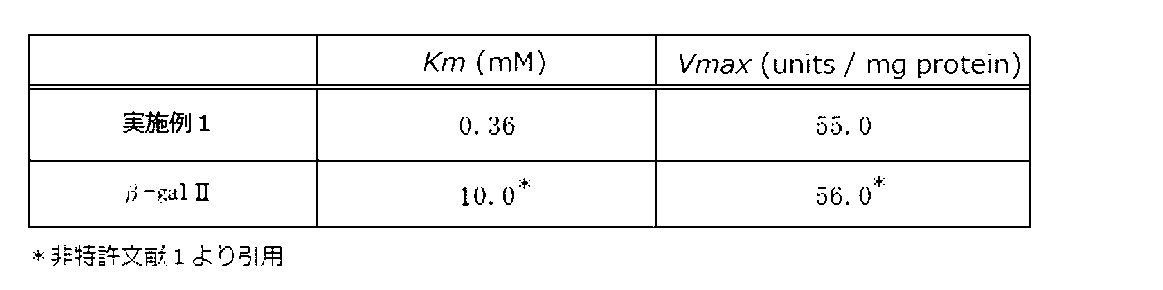
表1から明らかな通り、実施例1の酵素はビオラクタに含まれる酵素と最大反応速度は同等であるが、基質ONPGに対する親和性を表すKmが著しく低い。したがって、本発明の酵素を用いれば、ビオラクタよりも低基質濃度においても効率よくGOSを製造することが可能であると考えられる。
(比較例)
比較例として、配列番号4に示すアミノ酸配列からなる酵素(Bacillus circulans由来ラクターゼBgaD-D)を使用した。本酵素を取得するため、Bacillus sp. ATCC 31382株(旧名Bacillus circulans)からゲノムDNAを採取し、これを鋳型にPCRによって配列番号4に示すアミノ酸配列からなる酵素をコードしている構造遺伝子を増幅した。本遺伝子のN末端側に開始コドン、C末端側に終止コドンを付加し、Brevibacillus chosinensisに導入させ、酵素を大量発現させた。酵素の産生後、この形質転換体を超音波破砕して細胞破砕液を得た。
比較例として、配列番号4に示すアミノ酸配列からなる酵素(Bacillus circulans由来ラクターゼBgaD-D)を使用した。本酵素を取得するため、Bacillus sp. ATCC 31382株(旧名Bacillus circulans)からゲノムDNAを採取し、これを鋳型にPCRによって配列番号4に示すアミノ酸配列からなる酵素をコードしている構造遺伝子を増幅した。本遺伝子のN末端側に開始コドン、C末端側に終止コドンを付加し、Brevibacillus chosinensisに導入させ、酵素を大量発現させた。酵素の産生後、この形質転換体を超音波破砕して細胞破砕液を得た。
(検証2:GOS製造能力の解析)
実施例1、実施例2および比較例の各サンプルのGOS生成能を評価した。実施例1の酵素では、1mM硫酸マグネシウムおよび0.064mM EDTAを含む0.1Mリン酸カリウム緩衝液(pH6.5)に終濃度が系全量基準で30質量%となるよう乳糖を配合し、活性が1.5LU/mLとなるように酵素を添加した。実施例2の酵素および比較例の各酵素では、0.1Mリン酸ナトリウム緩衝液(pH6.5)に終濃度が系全量基準で60質量%となるよう乳糖を配合し、活性が5.0LU/mLとなるように酵素を添加した。
実施例1、実施例2および比較例の各サンプルのGOS生成能を評価した。実施例1の酵素では、1mM硫酸マグネシウムおよび0.064mM EDTAを含む0.1Mリン酸カリウム緩衝液(pH6.5)に終濃度が系全量基準で30質量%となるよう乳糖を配合し、活性が1.5LU/mLとなるように酵素を添加した。実施例2の酵素および比較例の各酵素では、0.1Mリン酸ナトリウム緩衝液(pH6.5)に終濃度が系全量基準で60質量%となるよう乳糖を配合し、活性が5.0LU/mLとなるように酵素を添加した。
反応温度を実施例1の酵素では30℃、実施例2および比較例の酵素では50℃として24時間、GOS製造反応を行わせた。所定時間経過後、20wt%スルホサリチル酸溶液を反応液の1/20量添加して反応を停止させた。
実施例1~2および比較例の各サンプルについてHPLCを行い、製造されたGOSの量を解析した。カラムはTransgenomic社製CARBOSep CHO-620 6.5φ×300mmを使用し、移動相は水、流速は0.4mL/min、温度は85℃、検出はRIの条件にて分析を行った。各サンプルのHPLCの結果を表2に示す。
表2中の「GOS」とはGOS含有割合を意味する。より具体的にはGOS(5糖、4糖、3糖)、2糖(未反応ラクトースや転移2糖)、単糖(グルコース、ガラクトース)の合計HPLC面積に対する、GOSのHPLC面積の百分率である。
「収率」とはGOSの生成効率を意味する。より具体的にはGOS生成量/ラクトース消費量の百分率である(HPLCからGOS生成量およびラクトース消費量が算出される)。
なお、6糖以上の糖は実施例1~2及び比較例で確認することはできなかった。
「収率」とはGOSの生成効率を意味する。より具体的にはGOS生成量/ラクトース消費量の百分率である(HPLCからGOS生成量およびラクトース消費量が算出される)。
なお、6糖以上の糖は実施例1~2及び比較例で確認することはできなかった。
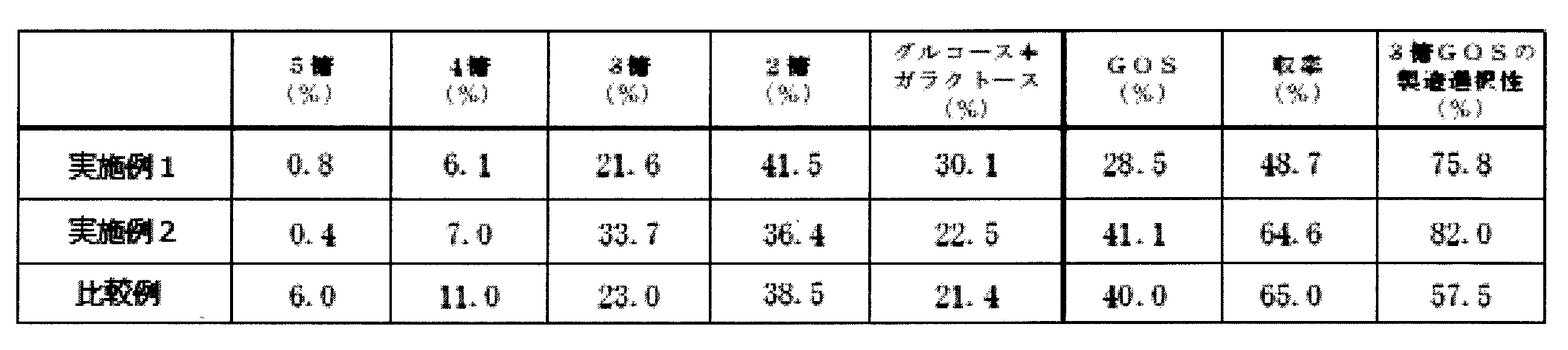
表2から明らかな通り、実施例1~2の酵素は比較例の酵素よりも3糖GOSの選択性が高い。本発明の酵素はこの点において良好な機能を有していることが明らかとなった。
特に実施例2の酵素はGOSの収率が比較例の酵素と同程度であり、高いGOS製造収率と3糖選択性を両立することができる。
特に実施例2の酵素はGOSの収率が比較例の酵素と同程度であり、高いGOS製造収率と3糖選択性を両立することができる。
(検証3:GOSの糖構成)
ヒト母乳中のGOSは、結合様式の違いから4’-GL (Galβ1-4Galβ1-4Glc)、3’-GL (Galβ1-3Galβ1-4Glc) および6’-GL (Galβ1-6Galβ1-4Glc) の3種類の構造が存在し、市販されているGOS製造用ラクターゼの多くは、4’-GLおよび6’-GLをメインとして生成することが知られている。一方、ビフィズス菌の多くは恒常的に3’-GLを菌体内に取り込むトランスポーターを発現している (非特許文献2)。即ち、3’-GLを含むGOSのメリットは、ビフィズス菌が増殖し易い。
ヒト母乳中のGOSは、結合様式の違いから4’-GL (Galβ1-4Galβ1-4Glc)、3’-GL (Galβ1-3Galβ1-4Glc) および6’-GL (Galβ1-6Galβ1-4Glc) の3種類の構造が存在し、市販されているGOS製造用ラクターゼの多くは、4’-GLおよび6’-GLをメインとして生成することが知られている。一方、ビフィズス菌の多くは恒常的に3’-GLを菌体内に取り込むトランスポーターを発現している (非特許文献2)。即ち、3’-GLを含むGOSのメリットは、ビフィズス菌が増殖し易い。
これを踏まえ、比較例のBgaD-Dおよび実施例2のラクターゼによるGOSをHPAEC-PAD (Thermo Fisher Scientific; ICS-3000+, Dionex CarboPac PA1カラム) により分析した (図2)。尚、糖組成の分析条件は下記の通りである。
・分析条件:HPAEC-PAD(high performance anion exchange chromatography - pulsed amperometric detection)では、装置にイオンクロマトグラフ ICS-3000 (Thermo Scientific社製) 、カラムにCarboPac PA1 (φ4 mm x 250 mm, Thermo Scientific社製) を用いた。移動相は100 mM 水酸化ナトリウム溶液 (A)、100 mM 水酸化ナトリウム含有600 mM 酢酸ナトリウム溶液 (B)、水 (C)、50 mM 酢酸ナトリウム溶液 (D) を用い、グラジエントにて糖を分離した。条件を表3に示す。反応液の糖濃度を0.5 mg/mLとなるように調製し、分析用サンプルとした。これを流速1.0 mL/min、注入量25 μL、カラム温度 20℃、検出器PADにて分析した。
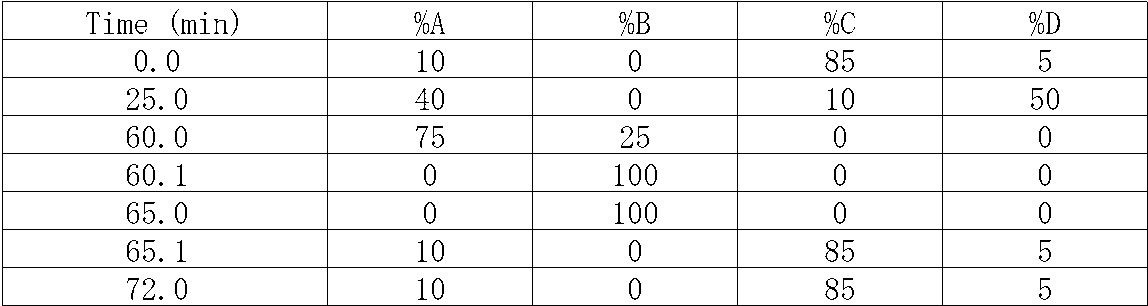
その結果、実施例2のラクターゼが生成する主要なGOSは、4’-GLが主要糖である比較例のラクターゼによって生成するGOSとは異なり、そのピーク位置から3’-GLである可能性が高いことがわかった (表4)。また、実施例2のラクターゼによって生成されるGOSのうち、3糖を分離して構造解析を行ったところ、1H-NMRスペクトルおよび13C-NMRスペクトルが3’-GLのパターンと一致した (非特許文献3)。このことから、本酵素によって生成される主要GOSは3’-GLであると考えられた。

次に、アレルゲン性が高い、通称4P-Xと称される4糖 ([Galβ1-4 (Galβ1-4Galβ1-6) Glc] の含有確認試験を、比較例のラクターゼにより生成されたGOSと実施例2の酵素により生成されたGOSとに関して実施した。具体的には、これら酵素によって生成されるGOSのうち4糖をBio-Gel P2 Gel (Bio-Rad) を用いたゲルろ過クロマトグラフィーにより分離し、これをHPAEC-PADを用いて分析した。このとき、当社で合成した4P-Xを多く含む標品と比較した (非特許文献4)。その結果、実施例2の酵素により生成されたGOSのみ、4P-Xの位置にピークは確認されなかった (図3)。このことから、実施例2の酵素によって生成されるGOSは4P-Xを含まないことがわかった。
≪本発明2≫
以下に実施例を挙げて本発明2を具体的に説明するが、本発明はこれらの実施例に限定されるものではない。
以下に実施例を挙げて本発明2を具体的に説明するが、本発明はこれらの実施例に限定されるものではない。
(GOS転移能を有する微生物のスクリーニング)
任意の土壌を乳糖1%を含むSCD培地に加え、30℃、250spmで7日間振とう培養した。この培養液0.1mLを同組成の培地10mLに移植し、30℃、250spmで7日間振とう培養した。次いで、培養液を同組成の寒天培地に塗布し、30℃、5日間程度培養を行った。
また、任意の土壌を乳糖0.1%を含むSCD寒天培地に塗布し、30℃、7日間程度、同様に培養を行った。
任意の土壌を乳糖1%を含むSCD培地に加え、30℃、250spmで7日間振とう培養した。この培養液0.1mLを同組成の培地10mLに移植し、30℃、250spmで7日間振とう培養した。次いで、培養液を同組成の寒天培地に塗布し、30℃、5日間程度培養を行った。
また、任意の土壌を乳糖0.1%を含むSCD寒天培地に塗布し、30℃、7日間程度、同様に培養を行った。
得られた各コロニーについて、48ウェルプレートに入れた乳糖2%を含むSCD培地0.5mLに一白金耳接種し、30℃、500rpm(振幅2mm)で4日間振とう培養することでそれぞれの菌株の培養液を回収した。
各菌株の培養液について、0.2M酢酸緩衝液(pH6.0)を用いて溶解した乳糖溶液を、乳糖の終濃度が25~30質量%となるよう加えた。その後、30℃、500rpmで24時間転移反応を行った。
反応終了後、反応液を遠心分離し、上清液を回収した。これを純水で適宜希釈したものを分析用試料とした。HPLC分析法(カラムはTransgenomic社製CARBOSep CHO-620 6.5φ×300mm、移動相は水、流速は0.5mL/min、温度は85℃、検出はRI)によって各試料のGOS量を測定した。試料にGOSが存在することは、その試料の菌株がGOS転移能を有することを意味する。こうしてGOS転移能を有する菌株を選別した。
その結果得られた菌株の一部が、Paenibacillus popilliae、Paenibacillus themophilus、Paenibacillus pabuli、Paenibacillus alvei、Paenibacillus thiaminolyticus、であった。すなわちPaenibacillus属に属する細菌は乳糖からGOSを製造する能力を有することが示唆された。
各菌株について、24φ×200mm試験管に入れた乳糖2%を含むSCD培地と乳糖2%を含むBHI培地、それぞれの培地10mLに一白金耳接種し、30℃、250spmで4日間振とう培養した。対照として、Bacillus属に属する細菌(寄託番号ATCC 31382株:旧名Bacillus circulans)を利用して同一条件にて培養した。
培養終了後、培養液0.5mLを48ウェルプレートに移した。これに0.2M酢酸緩衝液(pH6.0)に乳糖濃度が30質量%となるよう乳糖を溶解させた乳糖溶液0.5mLを加え、30℃、500rpmで24時間転移反応を行った。
反応終了後、反応液中のGOSや乳糖の含有量をHPLCによって各成分のピーク面積を解析して、各菌株のGOS製造能力を評価した。その結果を表5に示す。
培養終了後、培養液0.5mLを48ウェルプレートに移した。これに0.2M酢酸緩衝液(pH6.0)に乳糖濃度が30質量%となるよう乳糖を溶解させた乳糖溶液0.5mLを加え、30℃、500rpmで24時間転移反応を行った。
反応終了後、反応液中のGOSや乳糖の含有量をHPLCによって各成分のピーク面積を解析して、各菌株のGOS製造能力を評価した。その結果を表5に示す。

表5中の「GOS」とはGOS含有割合を意味する。より具体的にはGOS(3糖以上、主として5糖、4糖、3糖)、ラクトース、グルコース、ガラクトースの合計HPLC面積に対する、GOSのHPLC面積の百分率である。
表5中の「収率」とはGOSの生成効率を意味する。より具体的にはGOS生成量/ラクトース消費量の百分率である(HPLCからGOS生成量およびラクトース消費量が算出される)。
表5中の「相同性検索(BLAST)」の欄における相同率は、各strainの16S rDNA塩基配列をDNA Data Bank of Japanのサイトなどを利用してBLAST検索を行った時に最も相同性が高かった種(該当菌株)との相同性を意味する。相同性99.5%以上を示した場合にその種と同定した。
表5中の「収率」とはGOSの生成効率を意味する。より具体的にはGOS生成量/ラクトース消費量の百分率である(HPLCからGOS生成量およびラクトース消費量が算出される)。
表5中の「相同性検索(BLAST)」の欄における相同率は、各strainの16S rDNA塩基配列をDNA Data Bank of Japanのサイトなどを利用してBLAST検索を行った時に最も相同性が高かった種(該当菌株)との相同性を意味する。相同性99.5%以上を示した場合にその種と同定した。
表5中の各strain及び該当菌株、同定された種の基準株、GOS転移能を有するPaenibacillus属、代表的なBacillus属を用い、アウトグループとしてAneurinibacillus aneurinilyticus DSM 5562を指定し、これらの16S rDNA塩基配列をDNA Data Bank of Japanのサイトなどを利用してアライメントし、系統樹を作成した。系統樹の作成は、遺伝情報処理ソフトウェアであるGENETYX(ゼネティックス社製)を用いた。Paenibacillus属とBacillus属の16S rDNA部分塩基配列に基づく簡易分子系統樹を図4に示す。
表5からわかる通り、これらPaenibacillus属の細菌は高い生成割合と収率でGOSを製造することができることがわかった。またこれらのPaenibacillus属の細菌は、対照であるBacillus属の細菌よりも良好な効率でGOSを製造できることが分かった。
この知見から、Paenibacillus属の他の細菌についても同様の条件下でGOSの製造能力を評価した。使用した菌株とその結果を表6に示す。

表6中の「GOS」の欄における数値はGOS生成割合を意味し、「++」はGOS生成割合が1%以上であったこと、「+」はGOS生成割合が1%未満であったこと、「-」は実施していないことを意味する。表6中の「収率」は表5のものと同じ意味である。
表6の結果から明らかな通り、Paenibacillus属の細菌はGOSを製造する能力があることが分かった。またBacillus circulansは2種類の培地でGOS製造能力に大きな差異は生じなかったが、Paenibacillus属の細菌は2種類の培地でGOS製造能力に大きな差異が生じる場合があることがわかった。この結果はPaenibacillus属の細菌は、培地などの条件を変えることでGOSの製造能力が大きく左右されることを示唆している。このことから、Paenibacillus属の各細菌に対して最適な条件を設定することで、従来よりも良好なGOS製造量および/またはGOS収率を得られる可能性があることが示唆された。Paenibacillus属がGOS製造に使用可能であることや、その収率が従来よりも良好なものとなり得ることは自明なことではなく、驚くべきことである。
Claims (14)
- 以下の(a)~(f)からなる群より選択されるアミノ酸配列を有する酵素。
(a)配列番号1に示すアミノ酸配列
(b)配列番号2に示すアミノ酸配列
(c)配列番号1に示すアミノ酸配列において1~10個のアミノ酸が置換、削除、挿入されたアミノ酸配列であって、ガラクトオリゴ糖生産活性を有する酵素のアミノ酸配列
(d)配列番号2に示すアミノ酸配列において1~10個のアミノ酸が置換、削除、挿入されたアミノ酸配列であって、ガラクトオリゴ糖生産活性を有する酵素のアミノ酸配列
(e)配列番号1に示すアミノ酸配列に対する相同性が80%以上100%未満のアミノ酸配列であって、ガラクトオリゴ糖生産活性を有する酵素のアミノ酸配列
(f)配列番号2に示すアミノ酸配列に対する相同性が80%以上100%未満のアミノ酸配列であって、ガラクトオリゴ糖生産活性を有する酵素のアミノ酸配列 - 請求項1に記載の酵素をコードしているDNA。
- 以下の(A)~(G)からなる群より選択される塩基配列を有するDNA。
(A)配列番号5に示す塩基配列
(B)配列番号6に示す塩基配列
(C)配列番号5に示す塩基配列に対する相同性が80%以上100%未満である塩基配列であって、コードしている酵素がガラクトオリゴ糖生産活性を有する塩基配列
(D)配列番号6に示す塩基配列に対する相同性が80%以上100%未満である塩基配列であって、コードしている酵素がガラクトオリゴ糖生産活性を有する塩基配列
(E)配列番号5に示す塩基配列に相補的な塩基配列とストリンジェントな条件下でハイブリダイズする塩基配列であって、コードしている酵素がガラクトオリゴ糖生産活性を有する塩基配列
(F)配列番号6に示す塩基配列に相補的な塩基配列とストリンジェントな条件下でハイブリダイズする塩基配列であって、コードしている酵素がガラクトオリゴ糖生産活性を有する塩基配列
(G)前記(A)~(F)のDNAのいずれかの塩基配列に対して保存的塩基置換されている塩基配列 - ストリンジェントな条件が、60℃、1×SSC、0.1%SDSに相当する塩濃度および温度で洗浄する条件であることを特徴とする請求項3に記載のDNA。
- 請求項3または4に記載のDNAがコードしている、ガラクトオリゴ糖生産活性を有する酵素。
- 請求項2~4のいずれか1項に記載のDNAを含む組換えベクター。
- 請求項2~4のいずれか1項に記載のDNAまたは請求項6に記載の組換えベクターを有する形質転換体。
- 請求項7に記載の形質転換体を培養する工程と、培養した形質転換体からガラクトオリゴ糖生産活性を有する酵素を回収する工程と、を含むガラクトオリゴ糖生産活性を有する酵素の調製方法。
- 請求項1または5に記載の酵素を有効成分として含む、酵素含有組成物。
- 乳糖と、パエニバチルス・パブリ(Paenibacillus pabuli)が生産するガラクトオリゴ糖生産活性を有する酵素と、を接触させることを含むガラクトオリゴ糖の製造方法。
- 乳糖と、請求項1または5に記載の酵素と、を接触させることを含むガラクトオリゴ糖の製造方法。
- Paenibacillus属に属する細菌の菌体および/または前記細菌のガラクトオリゴ糖生産酵素を乳糖に接触させることを含むガラクトオリゴ糖の製造方法。
- Paenibacillus属に属する細菌が、
Paenibacillus themophilus、
Paenibacillus popilliae、
Paenibacillus thiaminolyticus、
Paenibacillus pabuli、
Paenibacillus alvei、
Paenibacillus alginolyticus、
Paenibacillus chibensis、
Paenibacillus chitinolyticus、
Paenibacillus chondroitinus、
Paenibacillus glucanolyticus、
Paenibacillus lautus、
Paenibacillus macerans、
Paenibacillus peoriae、
Paenibacillus polymyxa、
Paenibacillus validus、
Paenibacillus apiarius、
Paenibacillus jamilae、
Paenibacillus kribbensis、
Paenibacillus terrae、
から成る群より選択される1以上の細菌であることを特徴とする、請求項12に記載の方法。 - Paenibacillus属に属する細菌が、
Paenibacillus themophilus、
Paenibacillus popilliae、
Paenibacillus thiaminolyticus、
Paenibacillus pabuli、
Paenibacillus alvei、
Paenibacillus polymyxa、
から成る群より選択される1以上の細菌であることを特徴とする、請求項12に記載の方法。
Priority Applications (4)
| Application Number | Priority Date | Filing Date | Title |
|---|---|---|---|
| JP2020512196A JP7344195B2 (ja) | 2018-04-05 | 2019-03-28 | Paenibacillus pabuli由来のガラクトオリゴ糖を製造可能な酵素、およびガラクトオリゴ糖を製造する方法 |
| US17/045,149 US12012622B1 (en) | 2018-04-05 | 2019-03-28 | Paenibacillus pabuli-derived enzyme capable of producing galacto-oligosaccharide, and method for producing galacto-oligosaccharide |
| CN201980024686.9A CN112351990B (zh) | 2018-04-05 | 2019-03-28 | 来自饲料类芽孢杆菌(Paenibacillus pabuli)的能够制造低聚半乳糖的酶及制造低聚半乳糖的方法 |
| EP19782446.9A EP3778625A4 (en) | 2018-04-05 | 2019-03-28 | ENZYME DERIVED FROM PAENIBACILLUS PABULI FOR THE PRODUCTION OF GALACTOOLIGOSACCHARIDE AND PROCESS FOR THE PRODUCTION OF GALACTOOLIGOSACCHARIDE |
Applications Claiming Priority (4)
| Application Number | Priority Date | Filing Date | Title |
|---|---|---|---|
| JP2018-073181 | 2018-04-05 | ||
| JP2018073181 | 2018-04-05 | ||
| JP2018-073180 | 2018-04-05 | ||
| JP2018073180 | 2018-04-05 |
Publications (1)
| Publication Number | Publication Date |
|---|---|
| WO2019194062A1 true WO2019194062A1 (ja) | 2019-10-10 |
Family
ID=68100501
Family Applications (1)
| Application Number | Title | Priority Date | Filing Date |
|---|---|---|---|
| PCT/JP2019/013549 Ceased WO2019194062A1 (ja) | 2018-04-05 | 2019-03-28 | Paenibacillus pabuli由来のガラクトオリゴ糖を製造可能な酵素、およびガラクトオリゴ糖を製造する方法 |
Country Status (5)
| Country | Link |
|---|---|
| US (1) | US12012622B1 (ja) |
| EP (1) | EP3778625A4 (ja) |
| JP (1) | JP7344195B2 (ja) |
| CN (1) | CN112351990B (ja) |
| WO (1) | WO2019194062A1 (ja) |
Cited By (4)
| Publication number | Priority date | Publication date | Assignee | Title |
|---|---|---|---|---|
| JP2021093954A (ja) * | 2019-12-17 | 2021-06-24 | 合同酒精株式会社 | ガラクトオリゴ糖を製造可能な酵素、およびガラクトオリゴ糖を製造する方法 |
| CN114574409A (zh) * | 2022-05-07 | 2022-06-03 | 广东省科学院微生物研究所(广东省微生物分析检测中心) | 一株假芽孢杆菌和其发酵产物及其在溶藻中的应用 |
| EP3926043A4 (en) * | 2020-09-29 | 2023-02-08 | Tianjin University Of Science And Technology | SPECIAL ENZYME FOR THE PRODUCTION, MANUFACTURE AND USE THEREOF OF GALACTOOLIGOSACCHARIDS |
| WO2023038057A1 (ja) | 2021-09-07 | 2023-03-16 | 合同酒精株式会社 | ラクターゼ、ラクターゼ製剤、遺伝子、組み換えベクターおよび形質転換体 |
Families Citing this family (5)
| Publication number | Priority date | Publication date | Assignee | Title |
|---|---|---|---|---|
| CN113667661B (zh) * | 2021-07-26 | 2023-11-07 | 青岛大学 | 一种β-葡萄糖苷酶及其在制备葡萄糖和昆布寡糖中的应用 |
| CN118056903B (zh) * | 2022-11-20 | 2025-04-08 | 山东恒鲁生物科技有限公司 | 一种合成寡糖的成熟多肽 |
| CN118931882A (zh) * | 2023-05-11 | 2024-11-12 | 山东恒鲁生物科技有限公司 | 一种改良的成熟多肽 |
| EP4533961A1 (en) | 2023-10-04 | 2025-04-09 | FrieslandCampina Nederland B.V. | Preparation for use in the prevention and treatment of a pathogenic enterococcus faecalis infection |
| CN117987395B (zh) * | 2024-02-18 | 2025-08-26 | 中国农业科学院农产品加工研究所 | β-半乳糖苷酶突变体及其应用 |
Citations (4)
| Publication number | Priority date | Publication date | Assignee | Title |
|---|---|---|---|---|
| JPS5643756B2 (ja) | 1973-12-22 | 1981-10-14 | ||
| JPH05236981A (ja) | 1992-02-28 | 1993-09-17 | Ajinomoto Co Inc | ガラクトオリゴ糖の製造方法 |
| JP2652049B2 (ja) | 1988-10-06 | 1997-09-10 | 株式会社ヤクルト本社 | ガラクトオリゴ糖の製造法 |
| JP2739335B2 (ja) | 1989-02-17 | 1998-04-15 | 株式会社ヤクルト本社 | ガラクトオリゴ糖の製造法 |
Family Cites Families (15)
| Publication number | Priority date | Publication date | Assignee | Title |
|---|---|---|---|---|
| NZ230882A (en) | 1988-10-06 | 1992-09-25 | Yakult Honsha Kk | Preparation of a mixture of related galactooligosaccharides by fermentation of lactose with beta-galactosidase, having sweetening properties |
| JP2008199963A (ja) * | 2007-02-20 | 2008-09-04 | Nippon Shokubai Co Ltd | ネガティブ選択マーカー遺伝子およびその利用 |
| BRPI0813359A2 (pt) * | 2007-05-22 | 2014-10-14 | Ls9 Inc | Ácidos nucleicos isolados, vetor, células, métodos para produzir um hidrocarboneto, para produzir uma cetona alifática, para produzir um polipeptídeo purificado, para produzir um hidrocarboneto, para produzir biocombustíveis, hidrocarboneto, biocombustível, polipeptídeo isolado, ácido nucleico isolado, organismos geneticamente engenheirados, método para identificar uma enzima útil para a produção de hidrocarbonetos |
| US10676751B2 (en) * | 2008-02-29 | 2020-06-09 | The Trustees Of The University Of Pennsylvania | Production and use of plant degrading materials |
| EP2252699B1 (en) | 2008-03-12 | 2015-05-27 | Tata Chemicals Limited | Production of galactooligosaccharides by Bullera singularis and Saccharomyces sp. |
| CA2747223C (en) * | 2008-12-23 | 2020-07-21 | Danisco A/S | Polypeptides with xylanase activity |
| CA2751957C (en) * | 2009-02-10 | 2018-07-24 | Peter Stougaard | Cold-active beta-galactosidase, a method of producing same and use of such enzyme |
| AU2010255150B2 (en) | 2009-06-05 | 2014-02-27 | Amano Enzyme Inc. | Beta-galactosidase derived from Bacillus circulans |
| US9974318B2 (en) | 2009-06-05 | 2018-05-22 | Amano Enzyme Inc. | Method for producing a low-lactose milk, medicine, supplement, or galacto-oligosaccharide |
| IT1395068B1 (it) | 2009-08-07 | 2012-09-05 | Inalco Spa | Processo per la produzione di galatto-oligosaccaridi ultrapuri |
| JP2013168438A (ja) * | 2012-02-14 | 2013-08-29 | Elpida Memory Inc | 半導体装置の製造方法 |
| JP6096179B2 (ja) * | 2012-05-10 | 2017-03-15 | 国立大学法人岩手大学 | ラクターゼ活性を有するタンパク質、該タンパク質をコードする遺伝子、該遺伝子を含有する組み換えベクター、形質転換体、及びその製造方法並びに用途 |
| CN104877942B (zh) * | 2015-06-11 | 2018-04-06 | 上海大学 | 类芽孢杆菌新菌种及其培养方法和应用 |
| WO2017091533A1 (en) * | 2015-11-26 | 2017-06-01 | E. I. Du Pont De Nemours And Company | Polypeptides capable of producing glucans having alpha-1,2 branches and use of the same |
| CN106957832A (zh) | 2016-01-08 | 2017-07-18 | 中国农业大学 | 一种细菌β-半乳糖苷酶及其编码基因与应用 |
-
2019
- 2019-03-28 EP EP19782446.9A patent/EP3778625A4/en active Pending
- 2019-03-28 WO PCT/JP2019/013549 patent/WO2019194062A1/ja not_active Ceased
- 2019-03-28 US US17/045,149 patent/US12012622B1/en active Active
- 2019-03-28 JP JP2020512196A patent/JP7344195B2/ja active Active
- 2019-03-28 CN CN201980024686.9A patent/CN112351990B/zh active Active
Patent Citations (4)
| Publication number | Priority date | Publication date | Assignee | Title |
|---|---|---|---|---|
| JPS5643756B2 (ja) | 1973-12-22 | 1981-10-14 | ||
| JP2652049B2 (ja) | 1988-10-06 | 1997-09-10 | 株式会社ヤクルト本社 | ガラクトオリゴ糖の製造法 |
| JP2739335B2 (ja) | 1989-02-17 | 1998-04-15 | 株式会社ヤクルト本社 | ガラクトオリゴ糖の製造法 |
| JPH05236981A (ja) | 1992-02-28 | 1993-09-17 | Ajinomoto Co Inc | ガラクトオリゴ糖の製造方法 |
Non-Patent Citations (13)
| Title |
|---|
| "GenBank", Database accession no. BAJ61032 |
| BENESOVA, EVA ET AL.: "beta -D-Galactosidase from Paenibacillus thiaminolyticus catalyzing transfucosylation reactions", GLYCOBIOLOGY, vol. 20, 2010, pages 442 - 451, XP055645233 * |
| ISORNA, PABLO ET AL.: "Crystal Structures of Paenibacillus polymyxa beta -Glucosidase B Complexes Reveal the Molecular Basis of Substrate Specificity and Give New Insights into the Catalytic Machinery of Family I Glycosidases", J. MOL. BIOL., vol. 371, 2007, pages 1204 - 1218, XP022189922 * |
| IVY, REID A. ET AL.: "Identification and Characterization of Psychrotolerant Sporeformers Associated with Fluid Milk Production and Processing", APPLIED AND ENVIRONMENTAL MICROBIOLOGY, vol. 78, 2012, pages 1853 - 1864, XP055645260 * |
| LEE, JAE-CHAN ET AL.: "Paenibacillus woosongensis sp. nov. , a xylanolytic bacterium isolated from forest soil", INTERNATIONAL JOURNAL OF SYSTEMATIC AND EVOLUTIONARY MICROBIOLOGY, vol. 58, 2008, pages 612 - 616, XP055429335 * |
| LIU, YU ET AL.: "Biochemical characterization of a novel beta -galactosidase from Paenibacillus barengoltzii suitable for lactose hydrolysis and galactooligosaccharides synthesis", INTERNATIONAL JOURNAL OF BIOLOGICAL MACROMOLECULES, vol. 104, 2017, pages 1055 - 1063, XP085163373 * |
| RIVAS, RAUL ET AL.: "Paenibacillus xylanilyticus sp. nov. , an airborne xylanolytic bacterium", INTERNATIONAL JOURNAL OF SYSTEMATIC AND EVOLUTIONARY MICROBIOLOGY, vol. 55, 2005, pages 405 - 408, XP055645243 * |
| See also references of EP3778625A4 |
| SOTOYA ET AL.: "Identification of genes involved in galacto-oligosaccharide utilization in Bifidobacterium breve strain YIT 4014T.", MICROBIOLOGY, vol. 163, 2017, pages 1420 - 1428 |
| SUMIDA, TOMOMI ET AL.: "Utilization of Ganglioside-Degrading Paenibacillus sp. Strain TS12 for Production of Glucosylceramide", APPLIED AND ENVIRONMENTAL MICROBIOLOGY, vol. 68, 2002, pages 5241 - 5248, XP055645271 * |
| T. MORIYAN. NAGAHATAR. ODAKAH. NAKAMURAJ. YOSHIKAWAK. KURASHIMAT. SAITO: "Synthesis of an allergy inducing tetrasaccharide ''4P-X''.", CARBOHYDRATES. RES., vol. 439, 2017, pages 44 - 49, XP029901089, DOI: 10.1016/j.carres.2016.11.013 |
| VAN LEEUWEN, S. S.: "1H NMR analysis of the lactose/0-galactosidase-derived galacto-oligosaccharide components of Vivinal(R) GOS up to DP5.", CARBOHYDRATES. RES., vol. 400, 2014, pages 59 - 73, XP055393241, DOI: 10.1016/j.carres.2014.08.012 |
| Z. MOZAFFARK. NAKANISHIR. MATSUNOT. KAMIKUBO: "Purification and Properties of β-Galactosidases from Bacillus circulans", AGRIC. BIOL. CHEM., vol. 48, 1986, pages 3053 - 3061, XP001312745 |
Cited By (6)
| Publication number | Priority date | Publication date | Assignee | Title |
|---|---|---|---|---|
| JP2021093954A (ja) * | 2019-12-17 | 2021-06-24 | 合同酒精株式会社 | ガラクトオリゴ糖を製造可能な酵素、およびガラクトオリゴ糖を製造する方法 |
| JP7553238B2 (ja) | 2019-12-17 | 2024-09-18 | 合同酒精株式会社 | ガラクトオリゴ糖を製造可能な酵素、およびガラクトオリゴ糖を製造する方法 |
| EP3926043A4 (en) * | 2020-09-29 | 2023-02-08 | Tianjin University Of Science And Technology | SPECIAL ENZYME FOR THE PRODUCTION, MANUFACTURE AND USE THEREOF OF GALACTOOLIGOSACCHARIDS |
| WO2023038057A1 (ja) | 2021-09-07 | 2023-03-16 | 合同酒精株式会社 | ラクターゼ、ラクターゼ製剤、遺伝子、組み換えベクターおよび形質転換体 |
| CN114574409A (zh) * | 2022-05-07 | 2022-06-03 | 广东省科学院微生物研究所(广东省微生物分析检测中心) | 一株假芽孢杆菌和其发酵产物及其在溶藻中的应用 |
| CN114574409B (zh) * | 2022-05-07 | 2022-07-26 | 广东省科学院微生物研究所(广东省微生物分析检测中心) | 一株假芽孢杆菌和其发酵产物及其在溶藻中的应用 |
Also Published As
| Publication number | Publication date |
|---|---|
| JPWO2019194062A1 (ja) | 2021-07-01 |
| JP7344195B2 (ja) | 2023-09-13 |
| EP3778625A1 (en) | 2021-02-17 |
| CN112351990A (zh) | 2021-02-09 |
| EP3778625A4 (en) | 2022-02-09 |
| US12012622B1 (en) | 2024-06-18 |
| CN112351990B (zh) | 2024-04-26 |
Similar Documents
| Publication | Publication Date | Title |
|---|---|---|
| JP7344195B2 (ja) | Paenibacillus pabuli由来のガラクトオリゴ糖を製造可能な酵素、およびガラクトオリゴ糖を製造する方法 | |
| JP5643756B2 (ja) | バチルス・サーキュランス由来のβ−ガラクトシダーゼ | |
| CN108699549B (zh) | β-半乳糖苷酶 | |
| AU2015223025B2 (en) | Enzymatic hydrolysis of disaccharides and oligosaccharides using alpha-glucosidase enzymes | |
| RU2435856C2 (ru) | Бета-галактозидаза с трансгалактозилирующей активностью | |
| CN115003814A (zh) | Hmo产生 | |
| JP2003534007A (ja) | Bifidobacteriumから単離された新たな酵素 | |
| US11248246B2 (en) | Beta-glucosidase for producing glucose and laminarioligosaccharide from sea weed | |
| TWI363093B (ja) | ||
| US9974318B2 (en) | Method for producing a low-lactose milk, medicine, supplement, or galacto-oligosaccharide | |
| NO341882B1 (no) | DNA sekvens, β galaktosidase, rekombinant vektor, vertscelle og enzym samt anvendelse derav, samt fremgangsmåte for fremstilling av en blanding av oligosakkarider og enzym. | |
| JP7535620B2 (ja) | ガラクトオリゴ糖の製造方法 | |
| KR20160141123A (ko) | 고당전이 활성의 베타-갈락토시다제 변이체 및 그 용도 | |
| JP2004313074A (ja) | 新規α−1,2−マンノシダーゼおよびその遺伝子、ならびに該酵素を用いたα−マンノシル糖化合物の製造方法 | |
| WO2024043297A1 (ja) | 組成物の製造方法、それにより得られるオリゴ糖含有組成物、及びそれらの利用 | |
| JP7553238B2 (ja) | ガラクトオリゴ糖を製造可能な酵素、およびガラクトオリゴ糖を製造する方法 | |
| KR20110115905A (ko) | 신규한 베타-아가라제 및 그 용도 | |
| WO2005003343A1 (ja) | 新規微生物、マルトースホスホリラーゼおよびトレハロースホスホリラーゼ並びにその製造方法 | |
| CN117980483A (zh) | 乳糖酶、乳糖酶制剂、基因、重组载体和转化体 | |
| JP3557271B2 (ja) | 酵素をコードするdnaとそれを含む組換えdna並びに形質転換体 | |
| JP5858566B2 (ja) | ヒアルロン酸の製造方法 | |
| KR20150102394A (ko) | 덱스트라나아제 활성을 갖는 신규 미생물 및 이의 용도 | |
| JPH0819393A (ja) | β−ガラクトシダーゼ |
Legal Events
| Date | Code | Title | Description |
|---|---|---|---|
| 121 | Ep: the epo has been informed by wipo that ep was designated in this application |
Ref document number: 19782446 Country of ref document: EP Kind code of ref document: A1 |
|
| ENP | Entry into the national phase |
Ref document number: 2020512196 Country of ref document: JP Kind code of ref document: A |
|
| NENP | Non-entry into the national phase |
Ref country code: DE |
|
| ENP | Entry into the national phase |
Ref document number: 2019782446 Country of ref document: EP Effective date: 20201105 |