WO2019194192A1 - 非水系二次電池機能層用バインダー組成物、非水系二次電池機能層用スラリー組成物、非水系二次電池部材、および非水系二次電池 - Google Patents
非水系二次電池機能層用バインダー組成物、非水系二次電池機能層用スラリー組成物、非水系二次電池部材、および非水系二次電池 Download PDFInfo
- Publication number
- WO2019194192A1 WO2019194192A1 PCT/JP2019/014672 JP2019014672W WO2019194192A1 WO 2019194192 A1 WO2019194192 A1 WO 2019194192A1 JP 2019014672 W JP2019014672 W JP 2019014672W WO 2019194192 A1 WO2019194192 A1 WO 2019194192A1
- Authority
- WO
- WIPO (PCT)
- Prior art keywords
- polymer
- secondary battery
- functional layer
- aqueous secondary
- mass
- Prior art date
- Legal status (The legal status is an assumption and is not a legal conclusion. Google has not performed a legal analysis and makes no representation as to the accuracy of the status listed.)
- Ceased
Links
Classifications
-
- H—ELECTRICITY
- H01—ELECTRIC ELEMENTS
- H01M—PROCESSES OR MEANS, e.g. BATTERIES, FOR THE DIRECT CONVERSION OF CHEMICAL ENERGY INTO ELECTRICAL ENERGY
- H01M4/00—Electrodes
- H01M4/02—Electrodes composed of, or comprising, active material
- H01M4/62—Selection of inactive substances as ingredients for active masses, e.g. binders, fillers
- H01M4/621—Binders
- H01M4/622—Binders being polymers
-
- C—CHEMISTRY; METALLURGY
- C08—ORGANIC MACROMOLECULAR COMPOUNDS; THEIR PREPARATION OR CHEMICAL WORKING-UP; COMPOSITIONS BASED THEREON
- C08F—MACROMOLECULAR COMPOUNDS OBTAINED BY REACTIONS ONLY INVOLVING CARBON-TO-CARBON UNSATURATED BONDS
- C08F236/00—Copolymers of compounds having one or more unsaturated aliphatic radicals, at least one having two or more carbon-to-carbon double bonds
- C08F236/02—Copolymers of compounds having one or more unsaturated aliphatic radicals, at least one having two or more carbon-to-carbon double bonds the radical having only two carbon-to-carbon double bonds
- C08F236/04—Copolymers of compounds having one or more unsaturated aliphatic radicals, at least one having two or more carbon-to-carbon double bonds the radical having only two carbon-to-carbon double bonds conjugated
-
- C—CHEMISTRY; METALLURGY
- C08—ORGANIC MACROMOLECULAR COMPOUNDS; THEIR PREPARATION OR CHEMICAL WORKING-UP; COMPOSITIONS BASED THEREON
- C08F—MACROMOLECULAR COMPOUNDS OBTAINED BY REACTIONS ONLY INVOLVING CARBON-TO-CARBON UNSATURATED BONDS
- C08F297/00—Macromolecular compounds obtained by successively polymerising different monomer systems using a catalyst of the ionic or coordination type without deactivating the intermediate polymer
- C08F297/02—Macromolecular compounds obtained by successively polymerising different monomer systems using a catalyst of the ionic or coordination type without deactivating the intermediate polymer using a catalyst of the anionic type
- C08F297/04—Macromolecular compounds obtained by successively polymerising different monomer systems using a catalyst of the ionic or coordination type without deactivating the intermediate polymer using a catalyst of the anionic type polymerising vinyl aromatic monomers and conjugated dienes
-
- C—CHEMISTRY; METALLURGY
- C08—ORGANIC MACROMOLECULAR COMPOUNDS; THEIR PREPARATION OR CHEMICAL WORKING-UP; COMPOSITIONS BASED THEREON
- C08F—MACROMOLECULAR COMPOUNDS OBTAINED BY REACTIONS ONLY INVOLVING CARBON-TO-CARBON UNSATURATED BONDS
- C08F297/00—Macromolecular compounds obtained by successively polymerising different monomer systems using a catalyst of the ionic or coordination type without deactivating the intermediate polymer
- C08F297/02—Macromolecular compounds obtained by successively polymerising different monomer systems using a catalyst of the ionic or coordination type without deactivating the intermediate polymer using a catalyst of the anionic type
- C08F297/04—Macromolecular compounds obtained by successively polymerising different monomer systems using a catalyst of the ionic or coordination type without deactivating the intermediate polymer using a catalyst of the anionic type polymerising vinyl aromatic monomers and conjugated dienes
- C08F297/046—Macromolecular compounds obtained by successively polymerising different monomer systems using a catalyst of the ionic or coordination type without deactivating the intermediate polymer using a catalyst of the anionic type polymerising vinyl aromatic monomers and conjugated dienes polymerising vinyl aromatic monomers and isoprene, optionally with other conjugated dienes
-
- C—CHEMISTRY; METALLURGY
- C08—ORGANIC MACROMOLECULAR COMPOUNDS; THEIR PREPARATION OR CHEMICAL WORKING-UP; COMPOSITIONS BASED THEREON
- C08K—Use of inorganic or non-macromolecular organic substances as compounding ingredients
- C08K3/00—Use of inorganic substances as compounding ingredients
- C08K3/01—Use of inorganic substances as compounding ingredients characterized by their specific function
-
- C—CHEMISTRY; METALLURGY
- C08—ORGANIC MACROMOLECULAR COMPOUNDS; THEIR PREPARATION OR CHEMICAL WORKING-UP; COMPOSITIONS BASED THEREON
- C08L—COMPOSITIONS OF MACROMOLECULAR COMPOUNDS
- C08L47/00—Compositions of homopolymers or copolymers of compounds having one or more unsaturated aliphatic radicals, at least one having two or more carbon-to-carbon double bonds; Compositions of derivatives of such polymers
-
- C—CHEMISTRY; METALLURGY
- C08—ORGANIC MACROMOLECULAR COMPOUNDS; THEIR PREPARATION OR CHEMICAL WORKING-UP; COMPOSITIONS BASED THEREON
- C08L—COMPOSITIONS OF MACROMOLECULAR COMPOUNDS
- C08L53/00—Compositions of block copolymers containing at least one sequence of a polymer obtained by reactions only involving carbon-to-carbon unsaturated bonds; Compositions of derivatives of such polymers
- C08L53/02—Compositions of block copolymers containing at least one sequence of a polymer obtained by reactions only involving carbon-to-carbon unsaturated bonds; Compositions of derivatives of such polymers of vinyl-aromatic monomers and conjugated dienes
-
- H—ELECTRICITY
- H01—ELECTRIC ELEMENTS
- H01M—PROCESSES OR MEANS, e.g. BATTERIES, FOR THE DIRECT CONVERSION OF CHEMICAL ENERGY INTO ELECTRICAL ENERGY
- H01M10/00—Secondary cells; Manufacture thereof
- H01M10/05—Accumulators with non-aqueous electrolyte
- H01M10/052—Li-accumulators
-
- H—ELECTRICITY
- H01—ELECTRIC ELEMENTS
- H01M—PROCESSES OR MEANS, e.g. BATTERIES, FOR THE DIRECT CONVERSION OF CHEMICAL ENERGY INTO ELECTRICAL ENERGY
- H01M10/00—Secondary cells; Manufacture thereof
- H01M10/05—Accumulators with non-aqueous electrolyte
- H01M10/052—Li-accumulators
- H01M10/0525—Rocking-chair batteries, i.e. batteries with lithium insertion or intercalation in both electrodes; Lithium-ion batteries
-
- H—ELECTRICITY
- H01—ELECTRIC ELEMENTS
- H01M—PROCESSES OR MEANS, e.g. BATTERIES, FOR THE DIRECT CONVERSION OF CHEMICAL ENERGY INTO ELECTRICAL ENERGY
- H01M4/00—Electrodes
- H01M4/02—Electrodes composed of, or comprising, active material
- H01M4/04—Processes of manufacture in general
- H01M4/0402—Methods of deposition of the material
- H01M4/0404—Methods of deposition of the material by coating on electrode collectors
-
- H—ELECTRICITY
- H01—ELECTRIC ELEMENTS
- H01M—PROCESSES OR MEANS, e.g. BATTERIES, FOR THE DIRECT CONVERSION OF CHEMICAL ENERGY INTO ELECTRICAL ENERGY
- H01M4/00—Electrodes
- H01M4/02—Electrodes composed of, or comprising, active material
- H01M4/13—Electrodes for accumulators with non-aqueous electrolyte, e.g. for lithium-accumulators; Processes of manufacture thereof
-
- H—ELECTRICITY
- H01—ELECTRIC ELEMENTS
- H01M—PROCESSES OR MEANS, e.g. BATTERIES, FOR THE DIRECT CONVERSION OF CHEMICAL ENERGY INTO ELECTRICAL ENERGY
- H01M4/00—Electrodes
- H01M4/02—Electrodes composed of, or comprising, active material
- H01M4/13—Electrodes for accumulators with non-aqueous electrolyte, e.g. for lithium-accumulators; Processes of manufacture thereof
- H01M4/139—Processes of manufacture
-
- H—ELECTRICITY
- H01—ELECTRIC ELEMENTS
- H01M—PROCESSES OR MEANS, e.g. BATTERIES, FOR THE DIRECT CONVERSION OF CHEMICAL ENERGY INTO ELECTRICAL ENERGY
- H01M4/00—Electrodes
- H01M4/02—Electrodes composed of, or comprising, active material
- H01M4/62—Selection of inactive substances as ingredients for active masses, e.g. binders, fillers
-
- H—ELECTRICITY
- H01—ELECTRIC ELEMENTS
- H01M—PROCESSES OR MEANS, e.g. BATTERIES, FOR THE DIRECT CONVERSION OF CHEMICAL ENERGY INTO ELECTRICAL ENERGY
- H01M50/00—Constructional details or processes of manufacture of the non-active parts of electrochemical cells other than fuel cells, e.g. hybrid cells
- H01M50/40—Separators; Membranes; Diaphragms; Spacing elements inside cells
- H01M50/403—Manufacturing processes of separators, membranes or diaphragms
-
- H—ELECTRICITY
- H01—ELECTRIC ELEMENTS
- H01M—PROCESSES OR MEANS, e.g. BATTERIES, FOR THE DIRECT CONVERSION OF CHEMICAL ENERGY INTO ELECTRICAL ENERGY
- H01M50/00—Constructional details or processes of manufacture of the non-active parts of electrochemical cells other than fuel cells, e.g. hybrid cells
- H01M50/40—Separators; Membranes; Diaphragms; Spacing elements inside cells
- H01M50/409—Separators, membranes or diaphragms characterised by the material
- H01M50/411—Organic material
- H01M50/414—Synthetic resins, e.g. thermoplastics or thermosetting resins
-
- H—ELECTRICITY
- H01—ELECTRIC ELEMENTS
- H01M—PROCESSES OR MEANS, e.g. BATTERIES, FOR THE DIRECT CONVERSION OF CHEMICAL ENERGY INTO ELECTRICAL ENERGY
- H01M50/00—Constructional details or processes of manufacture of the non-active parts of electrochemical cells other than fuel cells, e.g. hybrid cells
- H01M50/40—Separators; Membranes; Diaphragms; Spacing elements inside cells
- H01M50/409—Separators, membranes or diaphragms characterised by the material
- H01M50/443—Particulate material
-
- H—ELECTRICITY
- H01—ELECTRIC ELEMENTS
- H01M—PROCESSES OR MEANS, e.g. BATTERIES, FOR THE DIRECT CONVERSION OF CHEMICAL ENERGY INTO ELECTRICAL ENERGY
- H01M50/00—Constructional details or processes of manufacture of the non-active parts of electrochemical cells other than fuel cells, e.g. hybrid cells
- H01M50/40—Separators; Membranes; Diaphragms; Spacing elements inside cells
- H01M50/409—Separators, membranes or diaphragms characterised by the material
- H01M50/449—Separators, membranes or diaphragms characterised by the material having a layered structure
-
- H—ELECTRICITY
- H01—ELECTRIC ELEMENTS
- H01M—PROCESSES OR MEANS, e.g. BATTERIES, FOR THE DIRECT CONVERSION OF CHEMICAL ENERGY INTO ELECTRICAL ENERGY
- H01M50/00—Constructional details or processes of manufacture of the non-active parts of electrochemical cells other than fuel cells, e.g. hybrid cells
- H01M50/40—Separators; Membranes; Diaphragms; Spacing elements inside cells
- H01M50/46—Separators, membranes or diaphragms characterised by their combination with electrodes
- H01M50/461—Separators, membranes or diaphragms characterised by their combination with electrodes with adhesive layers between electrodes and separators
-
- H—ELECTRICITY
- H01—ELECTRIC ELEMENTS
- H01M—PROCESSES OR MEANS, e.g. BATTERIES, FOR THE DIRECT CONVERSION OF CHEMICAL ENERGY INTO ELECTRICAL ENERGY
- H01M4/00—Electrodes
- H01M4/02—Electrodes composed of, or comprising, active material
- H01M2004/021—Physical characteristics, e.g. porosity, surface area
-
- H—ELECTRICITY
- H01—ELECTRIC ELEMENTS
- H01M—PROCESSES OR MEANS, e.g. BATTERIES, FOR THE DIRECT CONVERSION OF CHEMICAL ENERGY INTO ELECTRICAL ENERGY
- H01M2300/00—Electrolytes
- H01M2300/0017—Non-aqueous electrolytes
-
- Y—GENERAL TAGGING OF NEW TECHNOLOGICAL DEVELOPMENTS; GENERAL TAGGING OF CROSS-SECTIONAL TECHNOLOGIES SPANNING OVER SEVERAL SECTIONS OF THE IPC; TECHNICAL SUBJECTS COVERED BY FORMER USPC CROSS-REFERENCE ART COLLECTIONS [XRACs] AND DIGESTS
- Y02—TECHNOLOGIES OR APPLICATIONS FOR MITIGATION OR ADAPTATION AGAINST CLIMATE CHANGE
- Y02E—REDUCTION OF GREENHOUSE GAS [GHG] EMISSIONS, RELATED TO ENERGY GENERATION, TRANSMISSION OR DISTRIBUTION
- Y02E60/00—Enabling technologies; Technologies with a potential or indirect contribution to GHG emissions mitigation
- Y02E60/10—Energy storage using batteries
Definitions
- the present invention relates to a binder composition for a non-aqueous secondary battery functional layer, a slurry composition for a non-aqueous secondary battery functional layer, a non-aqueous secondary battery member, and a non-aqueous secondary battery.
- Non-aqueous secondary batteries such as lithium ion secondary batteries (hereinafter sometimes simply referred to as “secondary batteries”) have the characteristics of being small and light, having high energy density, and capable of repeated charge and discharge. Yes, it is used for a wide range of purposes.
- the secondary battery is generally an electrode (positive electrode and negative electrode) and a non-aqueous secondary battery member such as a separator that separates the positive electrode and the negative electrode (hereinafter sometimes simply referred to as “battery member”). It has.
- the battery member of the secondary battery includes a binder, and optionally includes particles (hereinafter, referred to as “functional particles”) that are blended for causing the battery member to exhibit a desired function.
- a member including a functional layer for a non-aqueous secondary battery (hereinafter, simply referred to as “functional layer” in some cases) is used.
- a separator for a secondary battery a separator having an adhesive layer containing a binder and a porous film layer containing a binder and non-conductive particles as functional particles on a separator substrate. Is used.
- an electrode provided with an electrode mixture layer containing a binder and electrode active material particles as functional particles on a current collector, or an electrode mixture on a current collector an electrode provided with the above-mentioned adhesive layer and porous membrane layer is used on an electrode substrate provided with a layer.
- Patent Document 1 includes a particulate polymer A having a volume average particle diameter of 0.6 ⁇ m to 2.5 ⁇ m and a particulate polymer B having a volume average particle diameter of 0.01 ⁇ m to 0.5 ⁇ m, A binder composition for a non-aqueous secondary battery electrode is described in which the content ratio of the particulate polymer A is more than 30 mass% and not more than 90 mass% of the total content of the particulate polymer A and the particulate polymer B. ing. And according to patent document 1, by forming the electrode compound-material layer using the said binder composition, the peeling strength of an electrode can be raised and the cycling characteristics excellent in the secondary battery can be exhibited.
- the electrode active material particles accept well charge carriers such as lithium ions under low temperature conditions (that is, charge at low temperature). Excellent carrier acceptability). Furthermore, there is a problem that the secondary battery swells after repeated charging / discharging (cycle), and it is also required to suppress such swelling after the cycle.
- the present invention provides a non-aqueous secondary battery functional layer capable of forming a functional layer capable of suppressing the swollenness of the non-aqueous secondary battery after cycling and improving the charge carrier acceptability at a low temperature of the non-aqueous secondary battery.
- An object of the present invention is to provide a binder composition for a battery and a slurry composition for a non-aqueous secondary battery functional layer.
- the present invention also provides a non-aqueous secondary battery member having a functional layer that can suppress swelling after cycling of the non-aqueous secondary battery and can improve charge carrier acceptability at low temperatures of the non-aqueous secondary battery.
- An object of the present invention is to provide a non-aqueous secondary battery in which swelling after cycling is suppressed and charge carrier acceptability at a low temperature is excellent.
- the present inventor has intensively studied for the purpose of solving the above problems. Then, the present inventor, when using a binder composition containing a predetermined block copolymer, a predetermined random copolymer, and a solvent, suppresses swelling after the cycle of the non-aqueous secondary battery, and non- The inventors have found that a functional layer capable of improving the charge carrier acceptability at a low temperature of an aqueous secondary battery can be formed, and the present invention has been completed.
- the binder composition for non-aqueous secondary battery functional layers of this invention is the 1st polymer, the 2nd polymer, And a solvent-containing binder composition for a secondary battery functional layer, wherein the first polymer comprises a block region comprising an aromatic vinyl monomer unit, an aliphatic conjugated diene monomer unit, and a fat.
- a block copolymer having a block region composed of an aromatic vinyl monomer unit and a block region composed of an aliphatic conjugated diene monomer unit and / or an aliphatic conjugated diene monomer hydride unit.
- Binder composition comprising a certain first polymer, a second polymer which is a random copolymer containing at least one of 1,3-pentadiene monomer units and 1,3-pentadiene hydride units, and a solvent If a functional layer is formed using an object, a battery member including the functional layer can suppress swelling after the secondary battery is cycled and can improve charge carrier acceptability at a low temperature.
- the “monomer unit” of the polymer means “a repeating unit derived from the monomer contained in the polymer obtained by using the monomer”.
- the “monomer hydride unit” of the polymer means “a repeating unit formed by hydrogenating a monomer unit derived from the monomer”.
- the polymer “has a block region composed of an aromatic vinyl monomer unit” means that “in the polymer, as a repeating unit, only an aromatic vinyl monomer unit is connected and linked.
- the polymer “has a block region composed of at least one of an aliphatic conjugated diene monomer unit and an aliphatic conjugated diene monomer hydride unit” means “in the polymer, repeated. As a unit, it means that there is a portion in which only at least one of an aliphatic conjugated diene monomer unit and an aliphatic conjugated diene monomer hydride unit is connected and connected.
- the content ratio of the aromatic vinyl monomer unit in the first polymer is 10% by mass or more and 50% by mass or less. Is preferred. If the 1st polymer whose content rate of an aromatic vinyl monomer unit exists in the range mentioned above is used, the swelling after the cycle of a secondary battery can be suppressed further.
- the “content ratio (mass%)” of each repeating unit in the polymer can be measured using a nuclear magnetic resonance (NMR) method such as 1 H-NMR.
- the binder composition for a non-aqueous secondary battery functional layer of the present invention includes the content ratio of the 1,3-pentadiene monomer unit in the second polymer and the 1,3-pentadiene hydride unit. It is preferable that the sum total of the content ratio is 20 mass% or more and 70 mass% or less. If a second polymer in which the total content of 1,3-pentadiene monomer units and the content of 1,3-pentadiene hydride units is within the above-described range is used, swelling after the secondary battery cycle Can be further suppressed.
- the softening point temperature of the second polymer is preferably 70 ° C or higher and 170 ° C or lower. If the second polymer having a softening point temperature within the above-described range is used, it is possible to further suppress the swelling after the secondary battery cycle and to further improve the charge carrier acceptability at a low temperature.
- the “softening point temperature” of the polymer can be measured according to JIS K 6863.
- the acid value of the second polymer is preferably 1 KOHmg / g or more and 20 KOHmg / g or less. If the 2nd polymer whose acid value is in the range mentioned above is used, stability of the slurry composition prepared using a binder composition can be improved.
- the “acid value” of the polymer can be measured according to JIS K 0070.
- the content of the second polymer is 0. 0 of the total content of the first polymer and the second polymer. It is preferable that it is 1 mass% or more and less than 10.0 mass%. If a binder composition in which the proportion of the second polymer content in the total content of the first polymer and the second polymer is within the above-described range is used, swelling after the secondary battery cycle In addition, the charge carrier acceptability at a low temperature can be further enhanced.
- the slurry composition for non-aqueous secondary battery functional layers of this invention is for any non-aqueous secondary battery function mentioned above.
- a binder composition is included.
- the battery member including the functional layer suppresses swelling after the secondary battery cycle, and the low temperature.
- the charge carrier acceptability can be improved.
- the slurry composition for a non-aqueous secondary battery functional layer of the present invention may further include electrode active material particles. If an electrode mixture layer is formed using a slurry composition for non-aqueous secondary battery functional layers (slurry composition for non-aqueous secondary battery electrodes) containing electrode active material particles as functional particles, the electrode mixture The electrode including the layer can suppress swelling after the secondary battery is cycled, and can improve charge carrier acceptability at a low temperature.
- the slurry composition for non-aqueous secondary battery functional layers of this invention can contain a nonelectroconductive particle further. If a porous film layer is formed using a slurry composition for a non-aqueous secondary battery functional layer (non-aqueous secondary battery porous film layer slurry composition) containing non-conductive particles as functional particles, the porous film The separator or electrode provided with the layer can suppress swelling after the secondary battery is cycled and can improve charge carrier acceptability at a low temperature.
- the non-aqueous secondary battery member of this invention is the slurry composition for non-aqueous secondary battery functional layers mentioned above.
- a functional layer for a non-aqueous secondary battery formed by using the non-aqueous secondary battery is provided. According to the battery member including the functional layer formed from the slurry composition described above, it is possible to suppress swelling after the secondary battery is cycled and to improve charge carrier acceptability at a low temperature.
- the present invention aims to solve the above-mentioned problem advantageously, and the non-aqueous secondary battery of the present invention is characterized by comprising the above-described non-aqueous secondary battery member.
- the secondary battery including the above-described battery member is excellent in charge carrier acceptability at a low temperature while suppressing swelling after cycling.
- the functional layer including the binder and the electrode active material particles is referred to as the “electrode mixture layer”, and the functional layer including the binder and the non-conductive particles is referred to as the “porous film layer”.
- a functional layer containing a material and containing neither electrode active material particles nor non-conductive particles is referred to as an “adhesion layer”.
- a non-aqueous secondary battery functional layer capable of forming a functional layer capable of suppressing the swollenness after cycling of the non-aqueous secondary battery and enhancing the charge carrier acceptability at a low temperature of the non-aqueous secondary battery.
- a slurry composition for a non-aqueous secondary battery functional layer can be provided.
- a non-aqueous secondary battery member having a functional layer capable of suppressing swelling after cycling of the non-aqueous secondary battery and improving charge carrier acceptability at a low temperature of the non-aqueous secondary battery. can be provided. According to the present invention, it is possible to provide a non-aqueous secondary battery in which swelling after cycling is suppressed and charge carrier acceptability at low temperatures is excellent.
- the binder composition for a non-aqueous secondary battery functional layer of the present invention can be used for the preparation of the slurry composition for a non-aqueous secondary battery functional layer of the present invention.
- the slurry composition for a non-aqueous secondary battery functional layer according to the present invention has an arbitrary functional layer (for example, an electrode mixture layer) that has functions such as electron transfer, reinforcement, or adhesion in the non-aqueous secondary battery. , Porous membrane layer, adhesive layer).
- the non-aqueous secondary battery member of this invention is equipped with the functional layer formed from the slurry composition for non-aqueous secondary battery functional layers of this invention.
- the non-aqueous secondary battery of this invention is equipped with the non-aqueous secondary battery member of this invention.
- the binder composition of the present invention includes a first polymer, a second polymer, and a solvent, and optionally further includes other components that can be blended in the functional layer of the secondary battery.
- the binder composition of the present invention is:
- the first polymer has a block region composed of an aromatic vinyl monomer unit (hereinafter sometimes abbreviated as “aromatic vinyl block region”), an aliphatic conjugated diene monomer unit, and an aliphatic conjugate.
- a block copolymer having a block region composed of at least one of diene monomer hydride units (hereinafter sometimes abbreviated as “aliphatic conjugated diene (hydride) block region”), and
- the second polymer is a random copolymer comprising at least one of 1,3-pentadiene units and 1,3-pentadiene hydride units; It is characterized by.
- the binder composition of this invention contains the 1st polymer and 2nd polymer which were mentioned above in the solvent, if a functional layer is formed using the slurry composition containing the said binder composition.
- the functional layer of the battery member is formed using the binder composition containing the predetermined first polymer and the predetermined second polymer in the solvent, thereby suppressing the swelling after the secondary battery cycle.
- the aromatic vinyl block region contained in the first polymer attracts the battery members to each other through the functional layer because these regions attract each other in the functional layer and form a pseudo-crosslinked structure, This contributes to suppression of swelling of the secondary battery.
- the aliphatic conjugated diene (hydride) block region contained in the first polymer is composed only of an aliphatic conjugated diene monomer unit and / or an aliphatic conjugated diene monomer hydride unit having excellent binding properties. Since it is comprised, like the aromatic vinyl block area
- the 1st polymer can make the shape follow the adhesion
- the functional layer is pressurized (for example, the pressure of the electrode for the purpose of increasing the density of the electrode mixture layer or the secondary battery)
- the first polymer may be excessively crushed. If the first polymer is excessively crushed, the first polymer may cover the surface of the electrode active material particles more than necessary, or may block the charge carrier movement path in the functional layer. There is a possibility that the carrier acceptability is lowered.
- the binder composition of the present invention is a second copolymer which is a random copolymer containing at least one of 1,3-pentadiene units and 1,3-pentadiene hydride units in addition to the first polymer described above. Including polymers.
- the 1,3-pentadiene unit and the 1,3-pentadiene hydride unit contained in the second polymer can impart heat deterioration resistance to the second polymer, so even when the functional layer is pressurized.
- the second polymer is relatively difficult to deform. Therefore, if the functional layer is formed using a binder composition containing not only the first polymer but also the second polymer, the second property having the above-described properties even when the functional layer is pressurized.
- the binder composition of the present invention including the first polymer and the second polymer, the battery member is firmly bonded via the functional layer, thereby suppressing swelling after the secondary battery cycle.
- the charge carrier acceptability at a low temperature of the secondary battery can be sufficiently secured by suppressing the first polymer from being excessively crushed.
- the first polymer is a block copolymer having an aromatic vinyl block region and an aliphatic conjugated diene (hydride) block region.
- the first polymer is a polymer in which a repeating unit other than an aromatic vinyl monomer unit, an aliphatic conjugated diene monomer unit, and an aliphatic conjugated diene monomer hydride unit is linked. It may have a chain portion (hereinafter sometimes abbreviated as “other region”).
- the first polymer may have only one aromatic vinyl block region, may have a plurality, and has only one aliphatic conjugated diene (hydride) block region. Alternatively, it may have a plurality, and it may have only one other region or a plurality of other regions.
- the aromatic vinyl block region is a region containing only an aromatic vinyl monomer unit as a repeating unit.
- one aromatic vinyl block region may be composed of only one type of aromatic vinyl monomer unit, or may be composed of a plurality of types of aromatic vinyl monomer units. It is preferably composed of only one kind of aromatic vinyl monomer unit.
- one aromatic vinyl block region may include a coupling site (that is, the aromatic vinyl monomer unit constituting one aromatic vinyl block region has an intervening coupling site. May be connected).
- the types and ratios of the aromatic vinyl monomer units constituting the plurality of aromatic vinyl block regions may be the same or different. Are preferably the same.
- the ratio of the aromatic vinyl monomer unit in the first polymer is the total repeating unit in the first polymer (including the monomer unit and the monomer hydride unit, and the polymer is grafted).
- the repeating unit of the graft portion is also included.
- the amount is 100% by mass, it is preferably 10% by mass or more, and more preferably 12% by mass or more. 14% by mass or more, more preferably 15% by mass or more, particularly preferably 50% by mass or less, more preferably 40% by mass or less, and 35% by mass or less. More preferably, it is particularly preferably 32% by mass or less.
- the ratio of the aromatic vinyl monomer unit in the first polymer is 10% by mass or more, the battery members are more firmly bonded to each other through the functional layer, and the swelling after the secondary battery is cycled. Further suppression can be achieved.
- the ratio of the aromatic vinyl monomer unit in the first polymer is 50% by mass or less, the functional layer was pressurized without the first polymer becoming excessively rigid. In this case, the shape can be made to follow an adhering object adjacent to the extent that the function as the binder can be sufficiently expressed. Therefore, the battery members can be more firmly bonded to each other through the functional layer, and the swelling after the secondary battery can be further suppressed.
- the ratio for which an aromatic vinyl monomer unit accounts in a 1st polymer corresponds with the ratio for which an aromatic vinyl block area
- the aliphatic conjugated diene (hydride) block region has, as a repeating unit, only an aliphatic conjugated diene monomer unit, only an aliphatic conjugated diene monomer hydride unit, or an aliphatic conjugated diene monomer unit and an aliphatic conjugated diene monomer unit. This is a region containing only a conjugated diene monomer hydride unit.
- aliphatic conjugated diene monomer unit and “aliphatic conjugated diene monomer hydride unit” may be collectively referred to as “aliphatic conjugated diene monomer (hydride) unit”.
- one aliphatic conjugated diene (hydride) block region may be composed of only one type of aliphatic conjugated diene monomer (hydride) unit, or a plurality of types of aliphatic conjugated diene units. Although it may be composed of a monomer (hydride) unit, it is preferably composed of only one kind of aliphatic conjugated diene monomer (hydride) unit.
- one aliphatic conjugated diene (hydride) block region may include a coupling site (that is, an aliphatic conjugated diene unit constituting one aliphatic conjugated diene (hydride) block region. The monomer (hydride) unit may be connected through a coupling site).
- the aliphatic conjugated diene monomer (hydride) constituting the plurality of aliphatic conjugated diene (hydride) block regions
- the types and proportions of units may be the same or different, but are preferably the same.
- the aliphatic conjugated diene monomer (hydride) unit constituting the aliphatic conjugated diene (hydride) block region of the first polymer can form, for example, 1,3- Examples thereof include conjugated diene compounds having 4 or more carbon atoms such as butadiene, isoprene, 2,3-dimethyl-1,3-butadiene, and 1,3-pentadiene. Of these, 1,3-butadiene and isoprene are preferred. These can be used singly or in combination of two or more, but it is preferable to use one alone.
- the proportion of the aliphatic conjugated diene monomer (hydride) unit in the first polymer is 50% by mass or more when the amount of all repeating units in the first polymer is 100% by mass. It is preferably 60% by mass or more, more preferably 65% by mass or more, particularly preferably 68% by mass or more, and preferably 90% by mass or less, 88 It is more preferably at most mass%, more preferably at most 86 mass%, particularly preferably at most 85 mass%.
- the proportion of the aliphatic conjugated diene monomer (hydride) unit in the first polymer is 50% by mass or more, the flexibility of the first polymer is ensured and the functional layer is pressurized.
- the shape can be made to follow an adhering object adjacent to the extent that the function as the binder can be sufficiently expressed. Therefore, the battery members can be more firmly bonded to each other through the functional layer, and the swelling after the secondary battery can be further suppressed.
- the proportion of the aliphatic conjugated diene monomer (hydride) unit in the first polymer is 90% by mass or less, the battery members are more firmly bonded to each other through the functional layer. Swelling after cycling of the battery can be further suppressed.
- the proportion of the aliphatic conjugated diene monomer (hydride) unit in the first polymer is usually the same as the proportion of the aliphatic conjugated diene (hydride) block region in the first polymer. To do.
- Other regions include repeating units other than aromatic vinyl monomer units, aliphatic conjugated diene monomer units, and aliphatic conjugated diene monomer hydride units (hereinafter referred to as “other repeating units”). It may be abbreviated as “).
- one other region may be composed of one type of other repeating unit, or may be composed of a plurality of types of other repeating units.
- one other region may include a coupling site (that is, other repeating units constituting one other region may be linked with each other through a coupling site). .
- the types and ratios of the other repeating units constituting the plurality of other regions may be the same or different.
- Acid group-containing monomer unit Although it does not specifically limit as another repeating unit which comprises the other area
- Examples of the acidic group-containing monomer that can form an acidic group-containing monomer unit include a carboxyl group-containing monomer, a sulfonic acid group-containing monomer, and a phosphoric acid group-containing monomer.
- Examples of the carboxyl group-containing monomer include monocarboxylic acids and derivatives thereof, dicarboxylic acids and acid anhydrides, and derivatives thereof.
- Examples of monocarboxylic acids include acrylic acid, methacrylic acid, and crotonic acid.
- Examples of monocarboxylic acid derivatives include 2-ethylacrylic acid, isocrotonic acid, ⁇ -acetoxyacrylic acid, ⁇ -trans-aryloxyacrylic acid, ⁇ -chloro- ⁇ -E-methoxyacrylic acid and the like.
- Examples of the dicarboxylic acid include maleic acid, fumaric acid, itaconic acid and the like.
- Dicarboxylic acid derivatives include methylmaleic acid, dimethylmaleic acid, phenylmaleic acid, chloromaleic acid, dichloromaleic acid, fluoromaleic acid, nonyl maleate, decyl maleate, dodecyl maleate, octadecyl maleate, fluoro maleate And maleic acid monoesters such as alkyl.
- the acid anhydride of dicarboxylic acid include maleic anhydride, acrylic anhydride, methyl maleic anhydride, and dimethyl maleic anhydride.
- an acid anhydride that generates a carboxyl group by hydrolysis can also be used.
- sulfonic acid group-containing monomer examples include styrene sulfonic acid, vinyl sulfonic acid (ethylene sulfonic acid), methyl vinyl sulfonic acid, (meth) allyl sulfonic acid, and 3-allyloxy-2-hydroxypropane sulfonic acid.
- styrene sulfonic acid vinyl sulfonic acid (ethylene sulfonic acid), methyl vinyl sulfonic acid, (meth) allyl sulfonic acid, and 3-allyloxy-2-hydroxypropane sulfonic acid.
- (meth) allyl means allyl and / or methallyl.
- examples of the phosphoric acid group-containing monomer include phosphoric acid-2- (meth) acryloyloxyethyl phosphate, methyl-2- (meth) acryloyloxyethyl phosphate, and ethyl phosphate- (meth) acryloyloxyethyl phosphate.
- (meth) acryloyl means acryloyl and / or methacryloyl.
- the acidic group-containing monomer forming the acidic group-containing monomer unit may be used alone or in combination of two or more.
- methacrylic acid, itaconic acid, and acrylic acid are more preferable, and methacrylic acid is more preferable.
- the 1st polymer may contain the graft part as another area
- the above-mentioned acidic group-containing monomer unit is preferably exemplified.
- the acidic group containing monomer which forms the acidic group containing monomer contained in the graft part of the 1st polymer may be used individually by 1 type, and may be used in combination of 2 or more types. .
- the acidic group-containing monomer units methacrylic acid, itaconic acid, and acrylic acid are more preferable, and methacrylic acid is still more preferable.
- the ratio of the graft part in a 1st polymer is 0 when the quantity of all the repeating units in a 1st polymer is 100 mass%. It is preferably 1% by mass or more, more preferably 0.5% by mass or more, further preferably 1% by mass or more, preferably 20% by mass or less, and 18% by mass or less. More preferably, it is more preferably 15% by mass or less.
- the method for preparing the first polymer that is the predetermined block copolymer is not particularly limited.
- the first polymer is obtained by adding a second monomer component different from the first monomer component to a solution obtained by polymerizing the first monomer component in the presence of an organic solvent. Polymerization can be performed by repeating the addition of the monomer component and the polymerization (block copolymerization) as necessary.
- the organic solvent used as a reaction solvent is not particularly limited, and can be appropriately selected according to the type of the monomer.
- the obtained polymer is subjected to a coupling reaction using a coupling agent.
- the coupling reaction for example, the ends of diblock structures contained in the block copolymer can be combined with a coupling agent to be converted into a triblock structure.
- the coupling agent that can be used for the coupling reaction is not particularly limited, and for example, a bifunctional coupling agent, a trifunctional coupling agent, a tetrafunctional coupling agent, and a 5-functional or higher cup.
- a ring agent is mentioned.
- bifunctional coupling agent examples include bifunctional halogenated silanes such as dichlorosilane, monomethyldichlorosilane, and dichlorodimethylsilane; bifunctional halogenated alkanes such as dichloroethane, dibromoethane, methylene chloride, and dibromomethane; dichlorotin Bifunctional tin halides such as monomethyldichlorotin, dimethyldichlorotin, monoethyldichlorotin, diethyldichlorotin, monobutyldichlorotin, dibutyldichlorotin, and the like.
- bifunctional halogenated silanes such as dichlorosilane, monomethyldichlorosilane, and dichlorodimethylsilane
- bifunctional halogenated alkanes such as dichloroethane, dibromoethane, methylene chloride, and dibromomethane
- trifunctional coupling agent examples include trifunctional halogenated alkanes such as trichloroethane and trichloropropane; trifunctional halogenated silanes such as methyltrichlorosilane and ethyltrichlorosilane; methyltrimethoxysilane, phenyltrimethoxysilane, And trifunctional alkoxysilanes such as phenyltriethoxysilane.
- tetrafunctional coupling agent examples include tetrafunctional halogenated alkanes such as carbon tetrachloride, carbon tetrabromide, and tetrachloroethane; tetrafunctional halogenated silanes such as tetrachlorosilane and tetrabromosilane; tetramethoxysilane, Tetrafunctional alkoxysilanes such as tetraethoxysilane; tetrafunctional tin halides such as tetrachlorotin and tetrabromotin;
- pentafunctional or higher functional coupling agent examples include 1,1,1,2,2-pentachloroethane, perchloroethane, pentachlorobenzene, perchlorobenzene, octabromodiphenyl ether, and decabromodiphenyl ether.
- a coupling site derived from the coupling agent is introduced into a polymer chain (for example, a triblock structure) constituting the block copolymer.
- the hydrogenation and / or graft polymerization may be performed before the coupling reaction or after the coupling reaction.
- the hydrogenation and / or graft polymerization may be performed before the coupling reaction or after the coupling reaction.
- by performing hydrogenation at least a part of the aliphatic conjugated diene monomer unit is converted into an aliphatic conjugated diene monomer hydride unit, and the aliphatic conjugated diene (hydride) block region is converted into an aliphatic group.
- a first polymer containing conjugated diene monomer hydride units can be obtained.
- the selective hydrogenation of the aliphatic conjugated diene monomer unit can be performed using a known method such as an oil layer hydrogenation method or an aqueous layer hydrogenation method.
- region can be obtained by performing graft polymerization.
- the method of graft polymerization is not particularly limited. For example, a polymer having an aromatic vinyl block region and an aliphatic conjugated diene (hydride) block region containing an aliphatic conjugated diene monomer unit is prepared, and the acidic group described above using the polymer as a trunk portion.
- a block copolymer having a structure in which the polymer of the graft portion is bonded to the aliphatic conjugated diene monomer unit of the trunk portion polymer is obtained by graft polymerization of the containing monomer using a known method. be able to.
- the weight average molecular weight of the first polymer that can be prepared as described above is preferably 50,000 or more, more preferably 60,000 or more, and 70,000 or more. More preferably, it is preferably 1,000,000 or less, more preferably 900,000 or less, and still more preferably 850,000 or less. If the weight average molecular weight of the first polymer is 50,000 or more, the polymer strength is ensured, and the collapse of the first polymer when the functional layer is pressurized can be suppressed. Therefore, the charge carrier acceptability at a low temperature of the secondary battery can be further improved.
- the weight average molecular weight of the first polymer is 1,000,000 or less, the flexibility of the first polymer is ensured, and when the functional layer is pressurized, it functions as a binder.
- the shape can be made to follow the adhering object adjacent to the extent that can be fully expressed. Therefore, the battery members can be more firmly bonded to each other through the functional layer, and the swelling after the secondary battery can be further suppressed.
- the “weight average molecular weight” of the first polymer can be measured using the method described in the Examples of the present specification.
- the coupling rate of the first polymer is preferably 60% by mass or more, more preferably 65% by mass or more, further preferably 70% by mass or more, and 92% by mass or less. Preferably, it is 90% by mass or less, more preferably 88% by mass or less.
- the coupling rate of the first polymer is 60% by mass or more, the polymer strength is ensured, and the collapse of the first polymer when the functional layer is pressurized can be suppressed. Therefore, the charge carrier acceptability at a low temperature of the secondary battery can be further improved.
- the “coupling ratio” means a structure having a coupling site in the entire polymer structure (diblock structure, triblock structure, etc.) obtained through the coupling reaction. Say percentage (mass%).
- the "coupling rate" of a 1st polymer can be measured using the method as described in the Example of this specification. Moreover, a coupling rate can be adjusted by changing the quantity of the coupling agent used for a coupling reaction, for example.
- the second polymer comprises at least one of 1,3-pentadiene units and 1,3-pentadiene hydride units (hereinafter referred to as “1,3-pentadiene units” and “1,3-pentadiene hydride units”). And a repeating unit other than 1,3-pentadiene (hydride) unit (hereinafter referred to as “other repeating unit”). ) Containing a random copolymer.
- 1,3-pentadiene (hydride) units (repeating units derived from 1,3-pentadiene) and other repeating units (1,3-pentadiene). And repeating units derived from other monomers) are randomly linked.
- the 1,3-pentadiene (hydride) units may be distributed uniformly or in a tapered shape.
- 1,3-pentadiene (hydride) unit the second polymer needs to contain 1,3-pentadiene (hydride) units.
- the proportion of 1,3-pentadiene (hydride) units in the second polymer is 20% by mass or more when the total number of repeating units in the second polymer is 100% by mass. It is preferably 30% by mass or more, more preferably 35% by mass or more, particularly preferably 41% by mass or more, preferably 70% by mass or less, and 65% by mass or less. Is more preferably 60% by mass or less, and particularly preferably 59% by mass or less.
- the proportion of 1,3-pentadiene (hydride) units in the second polymer (that is, the sum of the proportion of 1,3-pentadiene monomer units and the proportion of 1,3-pentadiene hydride units) ) Is 20% by mass or more, the battery members can be more firmly bonded to each other through the functional layer, and swelling after the secondary battery can be further suppressed.
- the heat deterioration resistance of the second polymer is improved, and deformation of the second polymer can be further suppressed when the functional layer is pressurized. Therefore, as a result, it is possible to sufficiently suppress the first polymer from being excessively crushed and further improve the charge carrier acceptability at a low temperature of the secondary battery.
- the 1,3-pentadiene used for the formation of the 1,3-pentadiene (hydride) unit may be any of cis-1,3-pentadiene and trans-1,3-pentadiene. It can also be used. From the viewpoint of increasing the softening point temperature of the second polymer and further improving the charge carrier acceptability at a low temperature of the secondary battery, trans-1,3-pentadiene is used alone as 1,3-pentadiene. Or a mixture of cis-1,3-pentadiene and trans-1,3-pentadiene is preferably used.
- repeat units are not particularly limited.
- alicyclic monoolefin monomer units having 4 to 6 carbon atoms acyclic monoolefin monomer units having 4 to 8 carbon atoms, and aromatics.
- Monoolefin monomer unit, alicyclic diolefin monomer unit, alicyclic diolefin monomer hydride unit hereinafter referred to as “alicyclic diolefin monomer unit” and "alicyclic diolefin monomer unit”
- the “mer hydride unit” may be collectively referred to as “alicyclic diolefin monomer (hydride) unit”), and carboxyl group-containing monomer units.
- the alicyclic monoolefin monomer having 4 to 6 carbon atoms that can form an alicyclic monoolefin monomer unit having 4 to 6 carbon atoms has one ethylenically unsaturated bond in its molecular structure. It is a hydrocarbon compound having 4 to 6 carbon atoms and having a non-aromatic ring structure.
- Specific examples of the alicyclic monoolefin monomer having 4 to 6 carbon atoms include cyclobutene, cyclopentene, cyclohexene, methylcyclobutene, and methylcyclopentene. These can be used alone or in combination of two or more.
- the ratio of the C4-C6 alicyclic monoolefin monomer unit in the second polymer is, when the amount of all repeating units in the second polymer is 100% by mass, It is preferably 10% by mass or more, more preferably 15% by mass or more, further preferably 20% by mass or more, preferably 35% by mass or less, and preferably 30% by mass or less. More preferably, it is further preferably 27.5% by mass or less.
- An acyclic monoolefin monomer having 4 to 8 carbon atoms that can form an acyclic monoolefin monomer unit having 4 to 8 carbon atoms has one ethylenically unsaturated bond in its molecular structure. It is a chain hydrocarbon compound having 4 to 8 carbon atoms and having no ring structure.
- acyclic monoolefin monomer having 4 to 8 carbon atoms include 1-butene, 2-butene, isobutylene (2-methylpropene), 1-pentene, 2-pentene, 2-methyl-1 -Butene, 3-methyl-1-butene, 2-methyl-2-butene, 1-hexene, 2-hexene, 2-methyl-1-pentene, 1-heptene, 2-heptene, 2-methyl-1-hexene 1-octene, 2-octene, 2-methyl-1-heptene, diisobutylene (2,4,4-trimethyl-1-pentene and 2,4,4-trimethyl-1-pentene). These can be used alone or in combination of two or more.
- the ratio of 4 to 8 carbon atoms acyclic monoolefin monomer units in the second polymer when the amount of all repeating units in the second polymer is 100% by mass, It is preferably 5% by mass or more, preferably 30% by mass or less, more preferably 25% by mass or less, and further preferably 20% by mass or less.
- An aromatic monoolefin monomer capable of forming an aromatic monoolefin monomer unit is an aromatic compound having one ethylenically unsaturated bond in its molecular structure.
- Specific examples of the aromatic monoolefin monomer include styrene, ⁇ -methylstyrene, vinyltoluene, indene, and coumarone. These can be used alone or in combination of two or more.
- the ratio of the aromatic monoolefin monomer unit in a 2nd polymer is 10 mass% or more when the quantity of all the repeating units in a 2nd polymer is 100 mass%.
- it is 12 mass% or more, more preferably 13 mass% or more, preferably 40 mass% or less, more preferably 30 mass% or less, and 25 mass% or less. More preferably it is.
- An alicyclic diolefin monomer capable of forming an alicyclic diolefin monomer (hydride) unit has two or more ethylenically unsaturated bonds and a non-aromatic ring structure in its molecular structure. It is a hydrocarbon compound having Specific examples of the alicyclic diolefin monomer include multimers of cyclopentadiene such as cyclopentadiene and dicyclopentadiene, and multimers of methylcyclopentadiene and methylcyclopentadiene. These can be used alone or in combination of two or more.
- the ratio of the alicyclic diolefin monomer (hydride) unit in a 2nd polymer is 0 mass% when the quantity of all the repeating units in a 2nd polymer is 100 mass%. It is above, it is preferable that it is 1 mass% or less, it is more preferable that it is 0.8 mass% or less, and it is still more preferable that it is 0.5 mass% or less.
- carboxyl group-containing monomer unit Specific examples of the carboxyl group-containing monomer capable of forming the carboxyl group-containing monomer unit include those exemplified as the “carboxyl group-containing monomer” in the section “First polymer”, and 3, 6 -Diels-Alder adducts of conjugated dienes such as endomethylene-1,2,3,6-tetrahydrophthalic acid and ⁇ , ⁇ -unsaturated dicarboxylic acids having 8 or less carbon atoms. These can be used alone or in combination of two or more.
- the ratio of the carboxyl group-containing monomer unit in the second polymer is 0.5% by mass or more when the amount of all repeating units in the second polymer is 100% by mass. Is preferably 1% by mass or more, more preferably 1.5% by mass or more, preferably 7% by mass or less, more preferably 6% by mass or less, and 5% by mass. % Or less is more preferable.
- the method for preparing the second polymer is not particularly limited.
- the second polymer can be produced by randomly polymerizing a monomer composition containing the above-described monomer, for example, in an organic solvent and optionally performing hydrogenation. At this time, the content ratio of each monomer in the monomer composition can be determined according to the content ratio of each monomer unit (and hydride unit) in the second polymer. Any known method can be used as the polymerization mode, polymerization reaction, and hydrogenation method.
- the organic solvent used as the reaction solvent is not particularly limited, and can be appropriately selected according to the type of the monomer. More specifically, the second polymer is obtained by randomly polymerizing a monomer composition containing 1,3-pentadiene in an organic solvent, and then acid-modifying it by adding a carboxyl group-containing monomer. It is preferable to prepare.
- the softening point temperature of the second polymer that can be prepared as described above is preferably 70 ° C or higher, more preferably 80 ° C or higher, still more preferably 85 ° C or higher, It is particularly preferably 95 ° C. or higher, preferably 170 ° C. or lower, more preferably 150 ° C. or lower, and further preferably 130 ° C. or lower. If the softening point temperature of the second polymer is 70 ° C. or higher, deformation of the second polymer can be further suppressed when the functional layer is pressurized. Therefore, as a result, it is possible to sufficiently suppress the first polymer from being excessively crushed and further improve the charge carrier acceptability at a low temperature of the secondary battery. On the other hand, if the softening point temperature of the second polymer is 170 ° C. or lower, the battery members can be more firmly bonded to each other via the functional layer, and the swelling after the secondary battery can be further suppressed.
- the acid value of the second polymer is preferably 1 KOH mg / g or more, more preferably 3 KOH mg / g or more, still more preferably 4 KOH mg / g or more, and 10 KOH mg / g or more. Particularly preferred is 20 KOH mg / g or less, more preferred is 18 KOH mg / g or less, and further more preferred is 17 KOH mg / g or less. If the acid value of the second polymer is within the above-described range, the stability of the slurry composition prepared using the binder composition can be improved.
- the number average molecular weight of the second polymer is preferably 300 or more, more preferably 500 or more, further preferably 700 or more, preferably 2500 or less, and preferably 2300 or less. Is more preferable, and it is still more preferable that it is 2200 or less. If the number average molecular weight of the second polymer is within the above-described range, the compatibility between the first polymer and the second polymer is improved, and the battery members are more firmly bonded via the functional layer. can do. Therefore, the swelling after the cycle of the secondary battery can be further suppressed. In addition, the number average molecular weight of a 2nd polymer can be measured using the method as described in the Example of this specification.
- the weight average molecular weight of the second polymer is preferably 500 or more, more preferably 1000 or more, further preferably 2000 or more, preferably 5500 or less, and preferably 5000 or less. Is more preferable and 4800 or less is still more preferable. If the weight average molecular weight of the second polymer is within the above-described range, the compatibility between the first polymer and the second polymer is improved, and the battery members are more firmly bonded via the functional layer. can do. Therefore, the swelling after the cycle of the secondary battery can be further suppressed. In addition, the weight average molecular weight of a 2nd polymer can be measured using the method as described in the Example of this specification.
- the Z average molecular weight of the second polymer is preferably 1000 or more, more preferably 2000 or more, still more preferably 3000 or more, and preferably 12000 or less, and 11000 or less. Is more preferable, and it is still more preferable that it is 10,000 or less. If the Z average molecular weight of the second polymer is within the above-mentioned range, the compatibility between the first polymer and the second polymer is improved, and the battery members are more firmly bonded via the functional layer. can do. Therefore, the swelling after the cycle of the secondary battery can be further suppressed. In addition, the Z average molecular weight of a 2nd polymer can be measured using the method as described in the Example of this specification.
- the ratio of the weight average molecular weight to the number average molecular weight is preferably 1.0 or more, more preferably 1.2 or more, and 1.4 or more. Is more preferably 4.0 or less, more preferably 3.5 or less, and even more preferably 3.0 or less. If Mw / Mn of the second polymer is within the above-described range, the compatibility between the first polymer and the second polymer is improved, and the battery members are more firmly bonded to each other through the functional layer. can do. Therefore, the swelling after the cycle of the secondary battery can be further suppressed.
- the ratio of the Z average molecular weight to the weight average molecular weight is preferably 1.0 or more, preferably 4.0 or less, and 3.5 or less. Is more preferable and 3.3 or less is still more preferable. If Mz / Mw of the second polymer is within the above-described range, the compatibility between the first polymer and the second polymer is improved, and the battery members are more firmly bonded to each other via the functional layer. can do. Therefore, the swelling after the cycle of the secondary battery can be further suppressed.
- the content ratio (in terms of solid content) of the first polymer and the second polymer in the binder composition of the present invention is not particularly limited.
- the content of the second polymer in the binder composition of the present invention is preferably 0.1% by mass or more of the total content of the first polymer and the second polymer. More preferably 3% by mass or more, still more preferably 0.5% by mass or more, particularly preferably 5.0% by mass or more, and preferably less than 10.0% by mass, More preferably, it is 0.0 mass% or less, and it is still more preferable that it is 8.0 mass% or less.
- the charge carrier acceptability at a low temperature of the secondary battery is further improved. Can be made.
- the content of the second polymer in the total content of the first polymer and the second polymer is less than 10.0% by mass, the battery members are further strengthened through the functional layer. By adhering, it is possible to further suppress swelling after the secondary battery cycle.
- the solvent which the binder composition of this invention contains is not specifically limited, It is preferable that water is included.
- the binder composition of this invention may contain the organic solvent as a reaction solvent used for preparation of a 1st polymer or a 2nd polymer as a solvent.
- the binder composition of the present invention can contain components other than the above components (other components).
- the binder composition includes a polymer component not corresponding to the first polymer and the second polymer described above, for example, a known particulate binder such as a styrene-butadiene random copolymer or an acrylic polymer. May be.
- the binder composition may contain a known additive. Examples of such known additives include antioxidants, antifoaming agents, and dispersing agents.
- other components may be used individually by 1 type, and may be used combining 2 or more types by arbitrary ratios.
- the binder composition of this invention is not specifically limited, It can mix and prepare the component mentioned above.
- the binder composition of this invention when preparing a binder composition containing water as a solvent, it is preferable to subject the polymers (first polymer and second polymer) obtained as a solution containing an organic solvent to an emulsification step.
- the emulsification method in the emulsification step is not particularly limited. For example, a method of phase inversion emulsification of a premix of a solution containing a polymer and an organic solvent (polymer solution) and an aqueous solution of an emulsifier is preferable.
- phase inversion emulsification for example, a known emulsifier and an emulsifying disperser can be used. Then, an aqueous dispersion of the polymer can be obtained from the emulsion obtained after phase inversion emulsification, if necessary, by removing the organic solvent by a known method.
- emulsification may be performed simultaneously with the first polymer and the second polymer, or the first polymer and the second polymer may be performed separately.
- the above-mentioned emulsification may be performed using a polymer solution containing both the first polymer and the second polymer, or the polymer solution containing the first polymer and the second polymer After emulsifying each of the polymer solutions containing the polymer, the obtained first polymer aqueous dispersion and second polymer aqueous dispersion may be mixed.
- the slurry composition of the present invention is a composition used for forming a functional layer, includes the binder composition described above, and optionally further contains functional particles. That is, the slurry composition of the present invention contains the first polymer, the second polymer, and the solvent described above, and optionally further contains functional particles and other components. And since the slurry composition of this invention contains the binder composition mentioned above, according to the battery member provided with the functional layer formed from the said slurry composition, the swelling after the cycle of a secondary battery is suppressed. At the same time, the charge carrier acceptability at a low temperature can be improved.
- the binder composition As the binder composition, the above-described binder composition of the present invention containing a predetermined first polymer and a predetermined second polymer in a solvent is used.
- the compounding quantity of the binder composition in a slurry composition is not specifically limited.
- the blending amount of the binder composition is the total amount of the first polymer and the second polymer in terms of solid content per 100 parts by mass of the electrode active material particles. Can be set to an amount of 0.5 parts by mass to 15 parts by mass.
- the blending amount of the binder composition is the first polymer and the second polymer in terms of solid content per 100 parts by mass of the non-conductive particles.
- the total amount can be 0.2 parts by mass or more and 30 parts by mass or less.
- the functional particles for causing the functional layer to exhibit the intended function for example, when the functional layer is an electrode mixture layer, electrode active material particles may be mentioned, and the functional layer may be a porous membrane layer. In some cases, non-conductive particles may be mentioned.
- Electrode active material particles >> And as an electrode active material particle, the particle
- the electrode active material particles that can be used in the electrode mixture layer of a lithium ion secondary battery as an example of a secondary battery are not particularly limited, and particles made of the following electrode active materials Can be used.
- Examples of the positive electrode active material compounded in the positive electrode mixture layer of the positive electrode of the lithium ion secondary battery include, for example, compounds containing transition metals, such as transition metal oxides, transition metal sulfides, and composites of lithium and transition metals.
- a metal oxide or the like can be used.
- a transition metal Ti, V, Cr, Mn, Fe, Co, Ni, Cu, Mo etc. are mentioned, for example.
- the positive electrode active material is not particularly limited, and lithium-containing cobalt oxide (LiCoO 2 ), lithium manganate (LiMn 2 O 4 ), lithium-containing nickel oxide (LiNiO 2 ), Co— Ni—Mn lithium-containing composite oxide, Ni—Mn—Al lithium-containing composite oxide, Ni—Co—Al lithium-containing composite oxide, olivine-type lithium iron phosphate (LiFePO 4 ), olivine-type manganese phosphate Lithium (LiMnPO 4 ), Li 1 + x Mn 2 ⁇ x O 4 (0 ⁇ X ⁇ 2), an excess lithium spinel compound, Li [Ni 0.17 Li 0.2 Co 0.07 Mn 0.56 ] O 2, LiNi 0.5 Mn 1.5 O 4 and the like.
- the positive electrode active material mentioned above may be used individually by 1 type, and may be used in combination of 2 or more types.
- the carbon-based negative electrode active material refers to an active material having carbon as a main skeleton, into which lithium can be inserted (also referred to as “dope”).
- the carbon-based negative electrode active material specifically, coke, mesocarbon microbeads (MCMB), mesophase pitch-based carbon fiber, pyrolytic vapor-grown carbon fiber, phenol resin fired body, polyacrylonitrile-based carbon fiber, Examples thereof include carbonaceous materials such as pseudo-isotropic carbon, a furfuryl alcohol resin fired body (PFA) and hard carbon, and graphite materials such as natural graphite and artificial graphite.
- the metal-based negative electrode active material is an active material containing a metal, and usually includes an element capable of inserting lithium in the structure, and the theoretical electric capacity per unit mass when lithium is inserted is 500 mAh / The active material which is more than g.
- the metal-based active material examples include lithium metal and a single metal capable of forming a lithium alloy (for example, Ag, Al, Ba, Bi, Cu, Ga, Ge, In, Ni, P, Pb, Sb, Si). , Sn, Sr, Zn, Ti, etc.) and their oxides, sulfides, nitrides, silicides, carbides, phosphides and the like. Furthermore, oxides, such as lithium titanate, can be mentioned.
- the negative electrode active material mentioned above may be used individually by 1 type, and may be used in combination of 2 or more types.
- Non-conductive particles As a nonelectroconductive particle mix
- the non-conductive particles include both inorganic fine particles and organic fine particles (excluding those corresponding to the first polymer, the second polymer, and the particulate binder described above). Usually, inorganic fine particles are used.
- the material which exists stably in the use environment of a secondary battery, and is electrochemically stable is preferable.
- non-conductive particles include aluminum oxide (alumina), hydrated aluminum oxide (boehmite), silicon oxide, magnesium oxide (magnesia), calcium oxide, titanium oxide (titania), BaTiO. 3 , oxide particles such as ZrO, alumina-silica composite oxide; nitride particles such as aluminum nitride and boron nitride; covalently bonded crystal particles such as silicon and diamond; barium sulfate, calcium fluoride, barium fluoride, etc. Insoluble ion crystal particles; clay fine particles such as talc and montmorillonite; In addition, these particles may be subjected to element substitution, surface treatment, solid solution, or the like, if necessary. In addition, the nonelectroconductive particle mentioned above may be used individually by 1 type, and may be used in combination of 2 or more types.
- Other components that can be blended in the slurry composition are not particularly limited, and examples thereof include those similar to other components that can be blended in the binder composition of the present invention.
- the other component may be used individually by 1 type, and may be used combining two or more types by arbitrary ratios.
- the method for preparing the slurry composition is not particularly limited.
- the binder composition, the electrode active material particles, and other components used as necessary are mixed in the presence of an aqueous medium to form a slurry composition.
- Product can be prepared.
- the slurry composition is a slurry composition for a porous membrane layer, the binder composition, non-conductive particles, and other components used as necessary are mixed in the presence of an aqueous medium.
- a slurry composition can be prepared.
- a binder composition can be used as a slurry composition as it is or diluted with an aqueous medium, and a binder composition and as needed.
- Other components used can be mixed in the presence of an aqueous medium to prepare a slurry composition.
- what was contained in the binder composition is also contained in the aqueous medium used in the case of preparation of a slurry composition.
- the mixing method is not particularly limited, but the mixing is performed using a stirrer or a disperser that can be usually used.
- the battery member of the present invention is a member having a functional layer, and specifically includes an electrode or a separator.
- the functional layer is a layer responsible for functions such as electron transfer, reinforcement, or adhesion in the secondary battery.
- the functional layer include an electrode mixture layer that transfers electrons via an electrochemical reaction. And a porous film layer that improves heat resistance and strength, and an adhesive layer that improves adhesiveness.
- the functional layer which the battery member of this invention has is formed from the slurry composition of this invention mentioned above, for example, apply
- the functional layer of the battery member of the present invention is composed of a dried product of the slurry composition described above, and usually contains at least the first polymer and the second polymer described above. Contains particles and other ingredients.
- a suitable abundance ratio of each component is a suitable presence of each component in the slurry composition. It is the same as the ratio.
- the battery member of the present invention may include a plurality of functional layers formed from the slurry composition of the present invention.
- an electrode as a battery member of the present invention includes an electrode mixture layer formed from the slurry composition for an electrode of the present invention on a current collector, and the porous film of the present invention on the electrode mixture layer
- a porous film layer and / or an adhesive layer formed from the slurry composition for the layer and / or the adhesive layer may be provided.
- a separator as a battery member of the present invention includes a porous film layer formed from the slurry composition for a porous film layer of the present invention on a separator substrate, and the adhesion of the present invention on the porous film layer.
- the battery member of this invention may be equipped with components other than the functional layer formed from the slurry composition of this invention mentioned above, and a base material.
- a constituent element include, but are not limited to, an electrode mixture layer, a porous film layer, and an adhesive layer that do not correspond to the functional layer formed from the slurry composition of the present invention.
- the battery member of this invention is equipped with the functional layer formed from the slurry composition of this invention containing the binder composition of this invention, according to the said battery member, the swelling after the cycle of a secondary battery is carried out. As well as the charge carrier acceptability at low temperatures.
- Base material there is no restriction
- the functional layer peeled off from the mold release substrate can be used as a self-supporting film for forming a battery member of a secondary battery.
- the slurry composition in preparing the electrode mixture layer, it is preferable to apply the slurry composition onto a current collector as a substrate. Moreover, when preparing a porous membrane layer or an adhesive layer, it is preferable to apply the slurry composition onto a separator substrate or an electrode substrate.
- the current collector an electrically conductive and electrochemically durable material is used.
- a current collector made of iron, copper, aluminum, nickel, stainless steel, titanium, tantalum, gold, platinum, or the like can be used.
- a copper foil is particularly preferable as the current collector used for the negative electrode.
- the current collector used for the positive electrode is particularly preferably an aluminum foil.
- the said material may be used individually by 1 type, and may be used combining two or more types by arbitrary ratios.
- the organic separator substrate is a porous member made of an organic material.
- Examples of the organic separator substrate include a microporous membrane or a nonwoven fabric containing a polyolefin resin such as polyethylene and polypropylene, an aromatic polyamide resin, and the like. From the viewpoint of excellent strength, a polyethylene microporous film or nonwoven fabric is preferred.
- Electrode substrate Although it does not specifically limit as an electrode base material (a positive electrode base material and a negative electrode base material), The electrode base material layer in which the electrode compound-material layer containing an electrode active material particle and a binder was formed on the electrical power collector mentioned above. Can be mentioned. It does not specifically limit as an electrode active material particle and a binder contained in the electrode compound-material layer in an electrode base material, A well-known thing can be used. Moreover, you may use the electrode mixture layer formed from the slurry composition containing the binder composition of this invention as an electrode mixture layer in an electrode base material.
- Examples of a method for producing a battery member by forming a functional layer on a substrate such as the current collector, separator substrate, or electrode substrate described above include the following methods. 1) A method in which the slurry composition of the present invention is applied to the surface of a substrate (in the case of an electrode substrate, the surface on the electrode mixture layer side, the same shall apply hereinafter) and then dried; 2) A method in which the substrate is dipped in the slurry composition of the present invention and then dried; and 3) The slurry composition of the present invention is applied on a release substrate and dried to produce a functional layer. A method of transferring the functional layer formed onto the surface of the substrate.
- the method 1) is particularly preferable because the layer thickness of the functional layer can be easily controlled.
- the method 1) includes a step of applying the slurry composition on the substrate (application step) and a step of forming the functional layer by drying the slurry composition applied on the substrate (function). Layer forming step).
- the method for coating the slurry composition on the substrate is not particularly limited. The method is mentioned.
- ⁇ Functional layer formation process it does not specifically limit as a method of drying the slurry composition on a base material.
- a well-known method can be used. Examples of the drying method include drying with warm air, hot air, low-humidity air, vacuum drying, and drying by irradiation with infrared rays, electron beams, or the like.
- the electrode compound-material layer when preparing the electrode compound-material layer as a functional layer, the electrode compound-material layer can be pressurized with a roll press etc. after the drying mentioned above, and the density of an electrode compound-material layer can be raised.
- the electrode as the battery member of the present invention has a structure in which the electrode mixture layer is formed from the slurry composition containing the binder composition of the present invention.
- the secondary battery can exhibit excellent charge carrier acceptability at a low temperature.
- the density of a negative mix layer can be 1.60 g / m ⁇ 2 > or more, and can be 1.70 g / m ⁇ 2 > or more.
- the upper limit of the density of a negative electrode compound-material layer is not specifically limited, For example, it can be 2.00 g / m ⁇ 2 > or less. If the negative electrode mixture layer is formed from the slurry composition containing the binder composition of the present invention, even when the negative electrode mixture layer is densified as described above, the secondary battery is excellent in charge at a low temperature. Carrier acceptability can be exhibited.
- the “density” of the negative electrode mixture layer can be calculated using the mass and thickness of the negative electrode mixture layer per unit area.
- the secondary battery of the present invention comprises the above-described battery member of the present invention. More specifically, the secondary battery of the present invention includes a positive electrode, a negative electrode, a separator, and an electrolytic solution, and at least one of the positive electrode, the negative electrode, and the separator is the battery member described above.
- the secondary battery of the present invention is suppressed from swelling after cycling and has excellent charge carrier acceptability at low temperatures.
- At least one of the positive electrode, the negative electrode, and the separator used in the secondary battery of the present invention is the above-described battery member of the present invention.
- the positive electrode, the negative electrode, and the separator other than the battery member of the present invention are not particularly limited, and are known positive electrodes, negative electrodes, and separators. Can be used.
- an organic electrolytic solution in which a supporting electrolyte is dissolved in an organic solvent is usually used.
- a lithium salt is used in a lithium ion secondary battery.
- the lithium salt include LiPF 6 , LiAsF 6 , LiBF 4 , LiSbF 6 , LiAlCl 4 , LiClO 4 , CF 3 SO 3 Li, C 4 F 9 SO 3 Li, CF 3 COOLi, (CF 3 CO) 2 NLi , (CF 3 SO 2 ) 2 NLi, (C 2 F 5 SO 2 ) NLi, and the like.
- LiPF 6 , LiClO 4 , and CF 3 SO 3 Li are preferable because they are easily dissolved in a solvent and exhibit a high degree of dissociation.
- electrolyte may be used individually by 1 type and may be used in combination of 2 or more types.
- the lithium ion conductivity tends to increase as the supporting electrolyte having a higher degree of dissociation is used, so that the lithium ion conductivity can be adjusted depending on the type of the supporting electrolyte.
- the organic solvent used in the electrolytic solution is not particularly limited as long as it can dissolve the supporting electrolyte.
- Carbonates such as propylene carbonate (PC), butylene carbonate (BC), ethyl methyl carbonate (EMC), vinylene carbonate (VC); esters such as ⁇ -butyrolactone and methyl formate; 1,2-dimethoxyethane, tetrahydrofuran, etc. Ethers; sulfur-containing compounds such as sulfolane and dimethyl sulfoxide; and the like are preferably used.
- liquid mixture of these solvents you may use the liquid mixture of these solvents.
- carbonates are preferable because they have a high dielectric constant and a wide stable potential region.
- the lower the viscosity of the solvent used the higher the lithium ion conductivity tends to be, so the lithium ion conductivity can be adjusted depending on the type of solvent.
- the concentration of the electrolyte in the electrolytic solution can be adjusted as appropriate.
- a positive electrode and a negative electrode are overlapped via a separator, and this is wound, folded, compressed, etc., if necessary, and placed in a battery container.
- at least 1 battery member be a battery member of this invention provided with the functional layer formed from the slurry composition of this invention among a positive electrode, a negative electrode, and a separator.
- an expanded metal, an overcurrent prevention element such as a fuse or a PTC element, a lead plate, or the like may be placed in the battery container to prevent an increase in pressure inside the battery or overcharge / discharge.
- the shape of the battery may be any of a coin shape, a button shape, a sheet shape, a cylindrical shape, a square shape, a flat shape, and the like.
- the weight average molecular weight and coupling rate of a 1st polymer (block copolymer); Number average molecular weight of a 2nd polymer (random copolymer), a weight average molecular weight, Z Average molecular weight, ratio of weight average molecular weight to number average molecular weight (Mw / Mn), and ratio of Z average molecular weight to weight average molecular weight (Mz / Mw); lithium ion acceptability at low temperature of lithium ion secondary battery and after cycle Inhibition of swelling was evaluated by the following method.
- the weight average molecular weight of the first polymer was measured as a polystyrene-equivalent molecular weight using high performance liquid chromatography (apparatus: model number “HLC8220” manufactured by Tosoh Corporation). For measurement, three connected columns (manufactured by Showa Denko KK, model number “Shodex KF-404HQ”, column temperature: 40 ° C., carrier: tetrahydrofuran at a flow rate of 0.35 ml / min), and differential refraction as a detector are used. A meter and an ultraviolet detector were used.
- the molecular weight was calibrated at 12 points of standard polystyrene (manufactured by Polymer Laboratories, Inc., standard molecular weight: 500 to 3000000). Then, the weight average molecular weight of the first polymer is specified from the chart obtained by the high performance liquid chromatography, and the peak is assigned to each structure (for example, a diblock structure and a triblock structure). The coupling ratio (% by mass) was calculated from the area ratio of these peaks.
- the second polymer (random copolymer) is subjected to gel permeation chromatography analysis to determine the number average molecular weight (Mn), weight average molecular weight (Mw) and Z average molecular weight (Mz) in terms of standard polystyrene. In addition, Mw / Mn and Mz / Mw were calculated.
- the gel permeation chromatography analysis uses “HLC-8320GPC” manufactured by Tosoh Corporation as a measuring device, and the column uses three connected “TSKgel SuperMultipore HZ” manufactured by Tosoh Corporation, with tetrahydrofuran as a solvent. , 40 ° C. and a flow rate of 1.0 mL / min. ⁇ Lithium ion acceptability at low temperature>
- the prepared lithium ion secondary battery was allowed to stand for 24 hours in an environment at 25 ° C., and then charged at a constant current at 1.0 C for 1 hour in an environment at 25 ° C. (C0) was measured.
- C1 / C0 is 0.65 or more and 1 or less
- B: C1 / C0 is 0.5 or more and less than 0.65
- C1 / C0 is less than 0.5 ⁇ Swelling suppression after cycle>
- the prepared lithium ion secondary battery was allowed to stand in an environment of 25 ° C. for 5 hours, and then the thickness (d0) of the battery was measured.
- CC-CV charge cut condition 0.05C
- the thickness increase rate after the cycle ⁇ (d1 ⁇ d0) / d0 ⁇ ⁇ 100 (%) was obtained and evaluated according to the following criteria. It shows that the swelling after the cycle of a secondary battery is suppressed, so that the value of the thickness increase rate after a cycle is small.
- Example 1 Preparation of first polymer> To the pressure-resistant reactor, 233.3 kg of cyclohexane, 54.2 mmol of N, N, N ′, N′-tetramethylethylenediamine (TMEDA), and 25.0 kg of styrene as an aromatic vinyl monomer were added. Then, while stirring at 40 ° C., 1806.5 mmol of n-butyllithium as a polymerization initiator was added, and polymerization was carried out for 1 hour while raising the temperature to 50 ° C. The polymerization conversion of styrene was 100%.
- TEDA N, N ′, N′-tetramethylethylenediamine
- an aqueous sodium hydroxide solution was added to the polymerization reactor to stop the polymerization reaction.
- the resulting polymer solution was charged into a distillation kettle and heated in a nitrogen atmosphere to remove the polymerization solvent and unreacted monomers.
- the low molecular weight oligomer component was distilled off while blowing saturated water vapor at 240 ° C. or higher. After distilling off after the low molecular weight oligomer component, 3.1 parts of maleic anhydride (carboxyl group-containing monomer) was added to 100 parts of the molten polymer, followed by addition reaction at 230 ° C. for 1 hour. .
- the second polymer is a random copolymer having a number average molecular weight of 1,400, a weight average molecular weight of 2,400, a Z average molecular weight of 5,400, Mw / Mn of 1.7, and Mz / Mw. 2.3, the softening point temperature was 95 ° C., and the acid value was 10 KOH mg / g. Further, 30 kg of the obtained molten resin containing the second polymer was dissolved in 70 kg of cyclohexane to obtain a polymer solution S2.
- ⁇ Preparation of binder composition for secondary battery negative electrode> Sodium alkylbenzene sulfonate was dissolved in ion exchange water to prepare an aqueous solution having a total solid content of 2%. 500 g of this aqueous solution, 475 g of the polymer solution S1, and 25 g of the polymer solution S2 were put in the tank and stirred to perform preliminary mixing. Subsequently, the preliminary mixture was transferred from the tank to a continuous high-efficiency emulsifier / disperser (product name “Milder MDN303V”, manufactured by Taiheiyo Kiko Co., Ltd.) at a rate of 100 g / min.
- a continuous high-efficiency emulsifier / disperser product name “Milder MDN303V”, manufactured by Taiheiyo Kiko Co., Ltd.
- the resulting mixture was adjusted to a solid content concentration of 60% with ion-exchanged water, and then mixed at 25 ° C. for 60 minutes. Next, after adjusting the solid content concentration to 52% with ion-exchanged water, the mixture was further mixed at 25 ° C. for 15 minutes to obtain a mixed solution.
- the obtained mixed liquid was charged with 2.2 parts of the binder composition for a negative electrode of the secondary battery prepared as described above in an amount corresponding to the solid content and ion-exchanged water so that the final solid content concentration was adjusted to 48%. . Furthermore, after mixing for 10 minutes, the slurry composition for secondary battery negative electrodes with sufficient fluidity
- the obtained slurry composition for secondary battery negative electrode was applied on a copper foil having a thickness of 20 ⁇ m as a current collector with a comma coater so that the basis weight after drying was 14 mg / cm 2 and dried. It was. This drying was performed by conveying the copper foil in an oven at 60 ° C. at a speed of 0.5 m / min for 2 minutes. Thereafter, heat treatment was performed at 120 ° C. for 2 minutes to obtain a negative electrode raw material. And the negative electrode original fabric was rolled with the roll press, and the thickness of the negative electrode compound material layer obtained the negative electrode of 80 micrometers.
- the obtained slurry composition for a secondary battery positive electrode was applied with a comma coater onto an aluminum foil having a thickness of 20 ⁇ m as a current collector so that the film thickness after drying was about 150 ⁇ m and dried. .
- This drying was performed by transporting the aluminum foil in an oven at 60 ° C. at a speed of 0.5 m / min for 2 minutes. Thereafter, heat treatment was performed at 120 ° C. for 2 minutes to obtain a positive electrode raw material.
- the positive electrode original fabric was rolled with the roll press, and the positive electrode provided with a positive electrode compound material layer was obtained.
- separator a single-layer polypropylene separator (manufactured by Celgard, product name “Celgard 2500”) was used.
- a separator cut into 120 cm ⁇ 5.5 cm on the positive electrode mixture layer was used. It arrange
- the obtained negative electrode is cut into a 50 ⁇ 5.2 cm rectangle, and is arranged on the separator so that the surface on the negative electrode mixture layer side faces the separator and the negative electrode is located on the right side in the longitudinal direction of the separator. did.
- the obtained laminated body was wound with the winding machine, and the wound body was obtained.
- lithium ion acceptability at low temperatures and swelling suppression after cycling were evaluated. The results are shown in Table 1.
- Example 2 In the same manner as in Example 1, except that the addition amount of styrene was changed to 15.0 kg and the addition amount of isoprene was changed to 85.0 kg at the time of preparing the first polymer, A second polymer, a secondary battery negative electrode binder composition, a secondary battery negative electrode slurry composition, a negative electrode, a positive electrode, a separator, and a lithium ion secondary battery were prepared or produced. Then, evaluation was performed in the same manner as in Example 1. The results are shown in Table 1. In the obtained block copolymer (first polymer), the content of styrene units was 15%, the content of isoprene units was 85%, the coupling rate was 84%, and the weight average molecular weight was 142,000. Met.
- Example 3 In the same manner as in Example 1, except that the addition amount of styrene was changed to 32.0 kg and the addition amount of isoprene was changed to 68.0 kg at the time of preparing the first polymer, the first polymer, A second polymer, a secondary battery negative electrode binder composition, a secondary battery negative electrode slurry composition, a negative electrode, a positive electrode, a separator, and a lithium ion secondary battery were prepared or produced. Then, evaluation was performed in the same manner as in Example 1. The results are shown in Table 1. In the obtained block copolymer (first polymer), the content of styrene units was 32%, the content of isoprene units was 68%, the coupling rate was 79%, and the weight average molecular weight was 136,000. Met.
- Example 4 During the preparation of the second polymer, the addition amount of 1,3-pentadiene was changed to 65.0 parts, the addition amount of cyclopentene was 14.4 parts, the addition amount of isobutylene was 4.3 parts, and styrene
- the first polymer and the second polymer were the same as in Example 1 except that the addition amount of C4 to C6 was changed to 12.9 parts and the addition amount of C4-C6 unsaturated hydrocarbon to 0.3 parts.
- a secondary battery negative electrode binder composition, a secondary battery negative electrode slurry composition, a negative electrode, a positive electrode, a separator, and a lithium ion secondary battery were prepared or produced. Then, evaluation was performed in the same manner as in Example 1.
- the results are shown in Table 1.
- the proportion of 1,3-pentadiene units in the obtained second polymer was 65%.
- the second polymer is a random copolymer with a number average molecular weight of 2100, a weight average molecular weight of 3600, a Z average molecular weight of 7200, Mw / Mn of 1.7, Mz / Mw of 2.0, and softening.
- the point temperature was 131 ° C. and the acid value was 10 KOH mg / g.
- Example 5 When preparing the binder composition for the secondary battery negative electrode, the amount of the second polymer is changed by changing the input amounts of the polymer solution S1 and the polymer solution S2. In the same manner as in Example 1, except that the ratio of the total content in each was changed to 9.0% (Example 5) and 0.3% (Example 6), respectively, the first polymer, A second polymer, a secondary battery negative electrode binder composition, a secondary battery negative electrode slurry composition, a negative electrode, a positive electrode, a separator, and a lithium ion secondary battery were prepared or prepared. Then, evaluation was performed in the same manner as in Example 1. The results are shown in Table 1.
- Example 7 ⁇ Preparation of first polymer and second polymer> In the same manner as in Example 1, a first polymer and a second polymer were prepared. ⁇ Preparation of binder composition for secondary battery porous membrane layer> A latex containing a first polymer and a second polymer was prepared in the same manner as in “Binder composition for secondary battery negative electrode” in Example 1, and this was used as a binder composition for a secondary battery porous membrane layer. .
- ⁇ Preparation of slurry composition for secondary battery porous membrane layer 100 parts by weight of an aqueous dispersion of alumina (product name “AKP3000”, manufactured by Sumitomo Chemical Co., Ltd.) as non-conductive particles and 0.5 parts by weight of carboxymethylcellulose (Daicel Finechem 1380),
- the secondary battery porous membrane layer slurry composition for secondary battery porous membrane layers was prepared by mixing 10 parts of the binder composition for secondary battery porous membrane layers obtained above with a ball mill.
- the slurry composition for a secondary battery porous membrane layer obtained above is applied to one surface of a single-layer polypropylene separator (manufactured by Celgard, product name “Celgard 2500”) as a separator substrate, and 50 ° C. For 3 minutes. Thereafter, the slurry composition for a secondary battery porous membrane layer obtained above is also applied to the other surface of the separator and dried at 50 ° C. for 3 minutes to form porous membrane layers (thickness of 1 ⁇ m each) on both sides. A separator with a porous membrane layer provided was obtained.
- the resulting mixture was adjusted to a solid content concentration of 60% with ion-exchanged water, and then mixed at 25 ° C. for 60 minutes. Next, after adjusting the solid content concentration to 52% with ion-exchanged water, the mixture was further mixed at 25 ° C. for 15 minutes to obtain a mixed solution. To the obtained mixed liquid, 2.2 parts of a binder composition for a secondary battery negative electrode prepared in the same manner as in Comparative Example 3 described later in an amount corresponding to the solid content, and ion-exchanged water were added, and the final solid content concentration was 48. % Was adjusted. Furthermore, after mixing for 10 minutes, the slurry composition for secondary battery negative electrodes with sufficient fluidity
- a positive electrode was produced.
- the obtained positive electrode was cut into a 49 cm ⁇ 5 cm rectangle and placed so that the surface on the positive electrode mixture layer side was on the upper side, and a separator with a porous membrane layer cut out to 120 cm ⁇ 5.5 cm on the positive electrode mixture layer, It arrange
- the obtained negative electrode was cut into a 50 ⁇ 5.2 cm rectangle, and on the separator, the negative electrode composite layer side surface was opposed to the separator with the porous membrane layer, and the negative electrode was the longitudinal length of the separator with the porous membrane layer.
- Example 8 A latex containing a first polymer and a second polymer was prepared in the same manner as in “Binder composition for secondary battery negative electrode” in Example 4, and this was used as a binder composition for a secondary battery porous membrane layer. . And the slurry composition for secondary battery porous membrane layers was carried out in the same manner as in Example 7 except that this binder composition for secondary battery porous membrane layers was used when preparing the slurry composition for secondary battery porous membrane layers. Product, negative electrode, positive electrode, separator with porous membrane layer, and lithium ion secondary battery were prepared. Then, evaluation was performed in the same manner as in Example 1. The results are shown in Table 1.
- the second polymer is not prepared, and the polymer solution S1 containing the first polymer is not introduced at the time of preparing the secondary battery negative electrode binder composition, without introducing the polymer solution S2 containing the second polymer.
- the first polymer, the secondary battery negative electrode binder composition, the secondary battery negative electrode slurry composition, the negative electrode, the positive electrode, the separator, and A lithium ion secondary battery was prepared or manufactured. Then, evaluation was performed in the same manner as in Example 1. The results are shown in Table 1.
- the first polymer is not prepared, and at the time of preparing the secondary battery negative electrode binder composition, the polymer solution S1 containing the first polymer is not charged and the polymer solution S2 containing the second polymer is not introduced.
- a second polymer, a secondary battery negative electrode binder composition, and a secondary battery negative electrode slurry composition were prepared in the same manner as in Example 1 except that the amount of input was changed to 500 g. I tried to make it. However, without the first polymer, the negative electrode mixture layer did not adhere well to the current collector, and a negative electrode usable for the production of a secondary battery could not be produced.
- ⁇ Preparation of styrene-butadiene random copolymer> 150 parts of ion-exchanged water, 25 parts of sodium dodecylbenzenesulfonate aqueous solution (concentration 10%) as an emulsifier, 36 parts of styrene as an aromatic vinyl monomer, itacon as a monomer having a carboxylic acid group 3 parts of an acid, 1 part of 2-hydroxyethyl acrylate as a monomer having a hydroxyl group, and 0.5 part of t-dodecyl mercaptan as a molecular weight modifier were added in this order.
- Comparative Example 4 A latex containing the first polymer was prepared in the same manner as the “secondary battery negative electrode binder composition” in Comparative Example 1, and this was used as a secondary battery porous film layer binder composition. And the slurry composition for secondary battery porous membrane layers was carried out in the same manner as in Example 7 except that this binder composition for secondary battery porous membrane layers was used when preparing the slurry composition for secondary battery porous membrane layers. Product, negative electrode, positive electrode, separator with porous membrane layer, and lithium ion secondary battery were prepared. Then, evaluation was performed in the same manner as in Example 1. The results are shown in Table 1.
- Example 5 A latex containing a second polymer was prepared in the same manner as the “secondary battery negative electrode binder composition” in Comparative Example 2, and this was used as a secondary battery porous film layer binder composition. And the slurry composition for secondary battery porous membrane layers was carried out in the same manner as in Example 7 except that this binder composition for secondary battery porous membrane layers was used when preparing the slurry composition for secondary battery porous membrane layers. Product, negative electrode, positive electrode, separator with porous membrane layer, and lithium ion secondary battery were prepared. Then, evaluation was performed in the same manner as in Example 1. The results are shown in Table 1.
- Comparative Example 2 which attempted to form a negative electrode mixture layer as a functional layer using a binder composition containing a predetermined second polymer but not containing a predetermined first polymer, as described above. A negative electrode could not be produced.
- Comparative Example 3 in which a negative electrode composite material layer as a functional layer was formed using a binder composition containing a styrene-butadiene random copolymer instead of the predetermined first polymer, the secondary battery was cycled. It can be seen that the blister cannot be suppressed.
- Comparative Example 4 in which a porous film layer as a functional layer was formed using a binder composition containing a predetermined first polymer but not containing a predetermined second polymer, the low temperature of the secondary battery was used. It can be seen that the lithium ion acceptability of the is reduced. Further, in Comparative Example 5 in which the porous film layer as the functional layer was formed using the binder composition containing the predetermined second polymer but not including the predetermined first polymer, the secondary battery was cycled. It can be seen that the blister cannot be suppressed.
- a non-aqueous secondary battery functional layer capable of forming a functional layer capable of suppressing the swollenness after cycling of the non-aqueous secondary battery and enhancing the charge carrier acceptability at a low temperature of the non-aqueous secondary battery.
- a slurry composition for a non-aqueous secondary battery functional layer can be provided.
- a non-aqueous secondary battery member having a functional layer capable of suppressing swelling after cycling of the non-aqueous secondary battery and improving charge carrier acceptability at a low temperature of the non-aqueous secondary battery. can be provided. According to the present invention, it is possible to provide a non-aqueous secondary battery in which swelling after cycling is suppressed and charge carrier acceptability at low temperatures is excellent.
Landscapes
- Chemical & Material Sciences (AREA)
- Chemical Kinetics & Catalysis (AREA)
- Electrochemistry (AREA)
- General Chemical & Material Sciences (AREA)
- Engineering & Computer Science (AREA)
- Medicinal Chemistry (AREA)
- Health & Medical Sciences (AREA)
- Polymers & Plastics (AREA)
- Organic Chemistry (AREA)
- Materials Engineering (AREA)
- Manufacturing & Machinery (AREA)
- Inorganic Chemistry (AREA)
- Battery Electrode And Active Subsutance (AREA)
- Cell Separators (AREA)
- Graft Or Block Polymers (AREA)
- Addition Polymer Or Copolymer, Post-Treatments, Or Chemical Modifications (AREA)
- Secondary Cells (AREA)
Abstract
Description
具体的に、二次電池のセパレータとしては、セパレータ基材の上に、結着材を含む接着層や、結着材と機能性粒子としての非導電性粒子とを含む多孔膜層を備えるセパレータが使用されている。また、二次電池の電極としては、集電体の上に、結着材と機能性粒子としての電極活物質粒子とを含む電極合材層を備える電極や、集電体上に電極合材層を備える電極基材の上に、更に上述した接着層や多孔膜層を備える電極が使用されている。
特許文献1には、体積平均粒子径が0.6μm以上2.5μm以下の粒子状重合体Aと、体積平均粒子径が0.01μm以上0.5μm以下の粒子状重合体Bとを含み、粒子状重合体Aの含有割合が、粒子状重合体Aと粒子状重合体Bの合計含有量の30質量%超90質量%以下である、非水系二次電池電極用バインダー組成物が記載されている。そして、特許文献1によれば、当該バインダー組成物を用いて電極合材層を形成することで、電極のピール強度を高めて二次電池に優れたサイクル特性を発揮させることができる。
また、本発明は、非水系二次電池のサイクル後の膨れを抑制すると共に、非水系二次電池の低温での電荷担体受入れ性を高めうる機能層を備える非水系二次電池部材の提供を目的とする。
そして、本発明は、サイクル後の膨れが抑制され、また低温での電荷担体受入れ性に優れる非水系二次電池の提供を目的とする。
なお、本発明において、重合体の「単量体単位」とは、「その単量体を用いて得た重合体中に含まれる、当該単量体由来の繰り返し単位」を意味する。
また、本発明において、重合体の「単量体水素化物単位」とは、「その単量体に由来する単量体単位が水素化されてなる繰り返し単位」を意味する。
そして、本発明において、重合体が「芳香族ビニル単量体単位からなるブロック領域を有する」とは、「その重合体中に、繰り返し単位として、芳香族ビニル単量体単位のみが連なって結合した部分が存在する」ことを意味する。
また、本発明において、重合体が「脂肪族共役ジエン単量体単位および脂肪族共役ジエン単量体水素化物単位の少なくとも一方からなるブロック領域を有する」とは、「その重合体中に、繰り返し単位として、脂肪族共役ジエン単量体単位および脂肪族共役ジエン単量体水素化物単位の少なくとも一方のみが連なって結合した部分が存在する」ことを意味する。
なお、本発明において、重合体中の各繰り返し単位の「含有割合(質量%)」は、1H-NMRなどの核磁気共鳴(NMR)法を用いて測定することができる。
なお、本発明において、重合体の「軟化点温度」は、JIS K 6863に従い測定することができる。
なお、本発明において、重合体の「酸価」は、JIS K 0070に従い測定することができる。
また、本発明によれば、非水系二次電池のサイクル後の膨れを抑制すると共に、非水系二次電池の低温での電荷担体受入れ性を高めうる機能層を備える非水系二次電池部材を提供することができる。
そして、本発明によれば、サイクル後の膨れが抑制され、また低温での電荷担体受入れ性に優れる非水系二次電池を提供することができる。
ここで、本発明の非水系二次電池機能層用バインダー組成物は、本発明の非水系二次電池機能層用スラリー組成物の調製に用いることができる。そして、本発明の非水系二次電池機能層用スラリー組成物は、非水系二次電池内において電子の授受、または補強若しくは接着などの機能を担う、任意の機能層(例えば、電極合材層、多孔膜層、接着層)の形成に用いることができる。また、本発明の非水系二次電池部材は、本発明の非水系二次電池機能層用スラリー組成物から形成される機能層を備える。そして、本発明の非水系二次電池は、本発明の非水系二次電池部材を備える。
本発明のバインダー組成物は、第一の重合体、第二の重合体、および溶媒を含み、任意に、二次電池の機能層に配合され得るその他の成分を更に含有する。
そして、本発明のバインダー組成物は、
第一の重合体が、芳香族ビニル単量体単位からなるブロック領域(以下、「芳香族ビニルブロック領域」と略記する場合がある。)と、脂肪族共役ジエン単量体単位および脂肪族共役ジエン単量体水素化物単位の少なくとも一方からなるブロック領域(以下、「脂肪族共役ジエン(水素化物)ブロック領域」と略記する場合がある。)とを有するブロック共重合体であること、および、
第二の重合体が、1,3-ペンタジエン単位および1,3-ペンタジエン水素化物単位の少なくとも一方を含むランダム共重合体であること、
を特徴とする。
まず、第一の重合体が含む芳香族ビニルブロック領域は、機能層中においてこれらの領域が引き合い擬似的な架橋構造をとるため、機能層を介して電池部材同士を強固に接着させ、サイクル後の二次電池の膨れ抑制に寄与する。一方で、第一の重合体が含む脂肪族共役ジエン(水素化物)ブロック領域は、結着性に優れる脂肪族共役ジエン単量体単位および/または脂肪族共役ジエン単量体水素化物単位のみで構成されているため、上述した芳香族ビニルブロック領域同様、機能層に接着性を付与してサイクル後の二次電池の膨れ抑制に貢献する一方で、柔軟性にも優れる。このように柔軟性に優れる領域を有することで、第一の重合体はその形状を隣接する接着対象に良好に追従させることができ、結着材としての良好な性状を発現することができる。しかしながら、結着材としての第一の重合体が柔軟性を有することで、機能層を加圧(例えば、電極合材層の高密度化を目的とした電極の加圧や、二次電池のエネルギー密度向上を目的としたセルの圧縮)した際に第一の重合体が過度に潰れてしまう場合がある。第一の重合体が過度に潰れると、第一の重合体が電極活物質粒子の表面を必要以上に覆ったり機能層中での電荷担体の移動経路を塞いだりなどして、低温での電荷担体受入れ性が低下する虞がある。
ここで、本発明のバインダー組成物は、上述した第一の重合体に加え、1,3-ペンタジエン単位および1,3-ペンタジエン水素化物単位の少なくとも一方を含むランダム共重合体である第二の重合体を含む。第二の重合体に含まれる1,3-ペンタジエン単位および1,3-ペンタジエン水素化物単位は、第二の重合体に耐熱劣化性を付与しうるため、機能層が加圧された際にも、第二の重合体は、比較的変形し難い。そのため、第一の重合体のみならず第二の重合体を含むバインダー組成物を用いて機能層を形成すれば、機能層が加圧された場合であっても、上述した性状を有する第二の重合体の寄与により、第一の重合体が過度に潰れるのを抑制することができる。
従って、第一の重合体および第二の重合体を含む本発明のバインダー組成物によれば、機能層を介して電池部材を強固に接着させることで二次電池のサイクル後の膨れを抑制しつつ、第一の重合体が過度に潰れるのを抑制することで二次電池の低温での電荷担体受入れ性を十分に確保することができると考えられる。
第一の重合体は、芳香族ビニルブロック領域と、脂肪族共役ジエン(水素化物)ブロック領域とを有する、ブロック共重合体である。ここで、第一の重合体は、任意に、芳香族ビニル単量体単位、脂肪族共役ジエン単量体単位、および脂肪族共役ジエン単量体水素化物単位以外の繰り返し単位が連なった高分子鎖部分(以下、「その他の領域」と略記する場合がある。)を有していてもよい。
なお、第一の重合体は、芳香族ビニルブロック領域を1つのみ有していてもよく、複数有していてもよく、脂肪族共役ジエン(水素化物)ブロック領域を1つのみ有していてもよく、複数有していてもよく、そして、その他の領域を1つのみ有していてもよく、複数有していてもよい。
芳香族ビニルブロック領域は、繰り返し単位として、芳香族ビニル単量体単位のみを含む領域である。
ここで、1つの芳香族ビニルブロック領域は、1種の芳香族ビニル単量体単位のみで構成されていてもよいし、複数種の芳香族ビニル単量体単位で構成されていてもよいが、1種の芳香族ビニル単量体単位のみで構成されていることが好ましい。
また、1つの芳香族ビニルブロック領域には、カップリング部位が含まれていてもよい(すなわち、1つの芳香族ビニルブロック領域を構成する芳香族ビニル単量体単位は、カップリング部位が介在して連なっていてもよい)。
そして、第一の重合体が複数の芳香族ビニルブロック領域を有する場合、それら複数の芳香族ビニルブロック領域を構成する芳香族ビニル単量体単位の種類および割合は、同一でも異なっていてもよいが、同一であることが好ましい。
なお、本発明において「芳香族ビニル単量体」に該当する化合物は、後述する「酸性基含有単量体」には該当しないものとする。
なお、芳香族ビニル単量体単位が第一の重合体中に占める割合は、通常、芳香族ビニルブロック領域が第一の重合体中に占める割合と一致する。
脂肪族共役ジエン(水素化物)ブロック領域は、繰り返し単位として、脂肪族共役ジエン単量体単位のみ、脂肪族共役ジエン単量体水素化物単位のみ、または、肪族共役ジエン単量体単位と脂肪族共役ジエン単量体水素化物単位のみを含む領域である。(以下、「脂肪族共役ジエン単量体単位」と「脂肪族共役ジエン単量体水素化物単位」を、纏めて「脂肪族共役ジエン単量体(水素化物)単位」と表記する場合がある。)
ここで、1つの脂肪族共役ジエン(水素化物)ブロック領域は、1種の脂肪族共役ジエン単量体(水素化物)単位のみで構成されていてもよいし、複数種の脂肪族共役ジエン単量体(水素化物)単位で構成されていてもよいが、1種の脂肪族共役ジエン単量体(水素化物)単位のみで構成されていることが好ましい。
また、1つの脂肪族共役ジエン(水素化物)ブロック領域には、カップリング部位が含まれていてもよい(すなわち、1つの脂肪族共役ジエン(水素化物)ブロック領域を構成する脂肪族共役ジエン単量体(水素化物)単位は、カップリング部位が介在して連なっていてもよい)。
そして、第一の重合体が複数の脂肪族共役ジエン(水素化物)ブロック領域を有する場合、それら複数の脂肪族共役ジエン(水素化物)ブロック領域を構成する脂肪族共役ジエン単量体(水素化物)単位の種類および割合は、同一でも異なっていてもよいが、同一であることが好ましい。
なお、脂肪族共役ジエン単量体(水素化物)単位が第一の重合体中に占める割合は、通常、脂肪族共役ジエン(水素化物)ブロック領域が第一の重合体中に占める割合と一致する。
その他の領域は、繰り返し単位として、芳香族ビニル単量体単位、脂肪族共役ジエン単量体単位、および脂肪族共役ジエン単量体水素化物単位以外の繰り返し単位(以下、「その他の繰り返し単位」と略記する場合がある。)で構成される領域である。
ここで、1つのその他の領域は、1種のその他の繰り返し単位で構成されていてもよいし、複数種のその他の繰り返し単位で構成されていてもよい。
また、1つのその他の領域には、カップリング部位が含まれていてもよい(すなわち、1つのその他の領域を構成するその他の繰り返し単位は、カップリング部位が介在して連なっていてもよい)。
そして、第一の重合体が複数のその他の領域を有する場合、それら複数のその他の領域を構成するその他の繰り返し単位の種類および割合は、同一でも異なっていてもよい。
第一の重合体のその他の領域を構成するその他の繰り返し単位としては、特に限定されないが、例えば、酸性基含有単量体単位が挙げられる。
モノカルボン酸としては、アクリル酸、メタクリル酸、クロトン酸などが挙げられる。
モノカルボン酸誘導体としては、2-エチルアクリル酸、イソクロトン酸、α-アセトキシアクリル酸、β-trans-アリールオキシアクリル酸、α-クロロ-β-E-メトキシアクリル酸などが挙げられる。
ジカルボン酸としては、マレイン酸、フマル酸、イタコン酸などが挙げられる。
ジカルボン酸誘導体としては、メチルマレイン酸、ジメチルマレイン酸、フェニルマレイン酸、クロロマレイン酸、ジクロロマレイン酸、フルオロマレイン酸や、マレイン酸ノニル、マレイン酸デシル、マレイン酸ドデシル、マレイン酸オクタデシル、マレイン酸フルオロアルキルなどのマレイン酸モノエステルが挙げられる。
ジカルボン酸の酸無水物としては、無水マレイン酸、アクリル酸無水物、メチル無水マレイン酸、ジメチル無水マレイン酸などが挙げられる。
また、カルボキシル基含有単量体としては、加水分解によりカルボキシル基を生成する酸無水物も使用できる。
なお、本発明において、「(メタ)アリル」とは、アリルおよび/またはメタリルを意味する。
なお、本発明において、「(メタ)アクリロイル」とは、アクリロイルおよび/またはメタクリロイルを意味する。
また、第一の重合体は、上述したその他の領域として、グラフト部分を含んでいてもよい。すなわち、第一の重合体は、幹部分となる重合体に対してグラフト部分となる重合体が結合した構造を有していてもよい。
第一の重合体のグラフト部分に含まれる繰り返し単位としては、上述した酸性基含有単量体単位が好ましく挙げられる。そして、第一の重合体のグラフト部分に含まれる酸性基含有単量体を形成する酸性基含有単量体は、1種類を単独で用いてもよく、2種類以上を組み合わせて用いてもよい。そして酸性基含有単量体単位の中でも、メタクリル酸、イタコン酸、アクリル酸がより好ましく、メタクリル酸が更に好ましい。
所定のブロック共重合体である第一の重合体の調製方法は、特に限定されない。第一の重合体は、例えば、有機溶媒の存在下、第一の単量体成分を重合させて得られる溶液に、第一の単量体成分とは異なる第二の単量体成分を加えて重合を行い、必要に応じて、単量体成分の添加と重合とを更に繰り返す(ブロック共重合)ことより、調製することができる。なお、反応溶媒として使用される有機溶媒も特に限定されず、単量体の種類等に応じて適宜選択することができる。
2官能のカップリング剤としては、例えば、ジクロロシラン、モノメチルジクロロシラン、ジクロロジメチルシラン等の2官能性ハロゲン化シラン;ジクロロエタン、ジブロモエタン、メチレンクロライド、ジブロモメタン等の2官能性ハロゲン化アルカン;ジクロロスズ、モノメチルジクロロスズ、ジメチルジクロロスズ、モノエチルジクロロスズ、ジエチルジクロロスズ、モノブチルジクロロスズ、ジブチルジクロロスズ等の2官能性ハロゲン化スズ;が挙げられる。
3官能のカップリング剤としては、例えば、トリクロロエタン、トリクロロプロパンなどの3官能性ハロゲン化アルカン;メチルトリクロロシラン、エチルトリクロロシランなどの3官能性ハロゲン化シラン;メチルトリメトキシシラン、フェニルトリメトキシシラン、フェニルトリエトキシシランなどの3官能性アルコキシシラン;が挙げられる。
4官能のカップリング剤としては、例えば、四塩化炭素、四臭化炭素、テトラクロロエタンなどの4官能性ハロゲン化アルカン;テトラクロロシラン、テトラブロモシランなどの4官能性ハロゲン化シラン;テトラメトキシシラン、テトラエトキシシランなどの4官能性アルコキシシラン;テトラクロロスズ、テトラブロモスズなどの4官能性ハロゲン化スズ;が挙げられる。
5官能以上のカップリング剤としては、例えば、1,1,1,2,2-ペンタクロロエタン,パークロロエタン、ペンタクロロベンゼン、パークロロベンゼン、オクタブロモジフェニルエーテル、デカブロモジフェニルエーテルが挙げられる。
これらは1種を単独で、または、2種以上を組み合わせて用いることができる。
そしてこれらの中でも、ジクロロジメチルシランが好ましい。カップリング剤を用いたカップリング反応によれば、当該カップリング剤に由来するカップリング部位が、ブロック共重合体を構成する高分子鎖(例えば、トリブロック構造体)に導入される。
ここで、水素化を行うことにより、脂肪族共役ジエン単量体単位の少なくとも一部を脂肪族共役ジエン単量体水素化物単位に変換し、脂肪族共役ジエン(水素化物)ブロック領域に脂肪族共役ジエン単量体水素化物単位を含む第一の重合体を得ることができる。ここで、脂肪族共役ジエン単量体単位の選択的な水素化は、油層水素化法や水層水素化法などの公知の方法を用いて行なうことができる。
また、グラフト重合を行うことにより、その他の領域として上述したグラフト部分を含む第一の重合体を得ることができる。ここで、グラフト重合の方法は特に限定されない。例えば、芳香族ビニルブロック領域と、脂肪族共役ジエン単量体単位を含む脂肪族共役ジエン(水素化物)ブロック領域とを有する重合体を調製し、当該重合体を幹部分として、上述した酸性基含有単量体などを既知の方法を用いてグラフト重合することで、幹部分の重合体の脂肪族共役ジエン単量体単位にグラフト部分の重合体が結合した構造を有するブロック共重合体を得ることができる。
そして、上述のようにして調製し得る第一の重合体の重量平均分子量は、50,000以上であることが好ましく、60,000以上であることがより好ましく、70,000以上であることが更に好ましく、1,000,000以下であることが好ましく、900,000以下であることがより好ましく、850,000以下であることが更に好ましい。第一の重合体の重量平均分子量が50,000以上であれば、ポリマー強度が確保され、機能層を加圧した際の、第一の重合体の潰れを抑制することができる。そのため、二次電池の低温での電荷担体受入れ性を更に向上させることができる。一方、第一の重合体の重量平均分子量が1,000,000以下であれば、第一の重合体の柔軟性が確保され、機能層が加圧された場合に、結着材としての機能を十分発現できる程度に、その形状を隣接する接着対象に追従させることができる。そのため、機能層を介して電池部材同士を更に強固に接着させ、二次電池のサイクル後の膨れを一層抑制することができる。
なお、本発明において、第一の重合体の「重量平均分子量」は、本明細書の実施例に記載の方法を用いて測定することができる。
<<カップリング率>>
また、第一の重合体のカップリング率は、60質量%以上であることが好ましく、65質量%以上であることがより好ましく、70質量%以上であることが更に好ましく、92質量%以下であることが好ましく、90質量%以下であることがより好ましく、88質量%以下であることが更に好ましい。第一の重合体のカップリング率が60質量%以上であれば、ポリマー強度が確保され、機能層を加圧した際の、第一の重合体の潰れを抑制することができる。そのため、二次電池の低温での電荷担体受入れ性を更に向上させることができる。一方、第一の重合体のカップリング率が92質量%以下であれば、第一の重合体の柔軟性が確保され、機能層が加圧された場合に、結着材としての機能を十分発現できる程度に、その形状を隣接する接着対象に追従させることができる。そのため、機能層を介して電池部材同士を更に強固に接着させ、二次電池のサイクル後の膨れを一層抑制することができる。
なお、本発明において、「カップリング率」とは、カップリング反応を経て得られる重合体の全構造体(ジブロック構造体、トリブロック構造体など)中に占めるカップリング部位を有する構造体の割合(質量%)を言う。そして、第一の重合体の「カップリング率」は、本明細書の実施例に記載の方法を用いて測定することができる。
また、カップリング率は、例えばカップリング反応に用いるカップリング剤の量を変更することで調整することができる。
第二の重合体は、1,3-ペンタジエン単位および1,3-ペンタジエン水素化物単位の少なくとも一方(以下、「1,3-ペンタジエン単位」と「1,3-ペンタジエン水素化物単位」を、纏めて「1,3-ペンタジエン(水素化物)単位」と表記する場合がある。)を含み、1,3-ペンタジエン(水素化物)単位以外の繰り返し単位(以下、「その他の繰り返し単位」と言う。)を含む、ランダム共重合体である。なお、ランダム共重合体である第二の重合体中では、1,3-ペンタジエン(水素化物)単位(1,3-ペンタジエンに由来する繰り返し単位)と、その他の繰り返し単位(1,3-ペンタジエン以外の単量体に由来する繰り返し単位)とが、ランダムに連なっている。そして、当該重合体中において、1,3-ペンタジエン(水素化物)単位は、均一に分布していてもよいし、テーパー状に分布していてもよい。
第二の重合体は、上述した通り、1,3-ペンタジエン(水素化物)単位を含むことが必要である。そして、第二の重合体の中の1,3-ペンタジエン(水素化物)単位の割合は、第二の重合体中の全繰り返し単位を100質量%とした場合に、20質量%以上であることが好ましく、30質量%以上であることがより好ましく、35質量%以上であることが更に好ましく、41質量%以上であることが特に好ましく、70質量%以下であることが好ましく、65質量%以下であることがより好ましく、60質量%以下であることが更に好ましく、59質量%以下であることが特に好ましい。第二の重合体中に占める1,3-ペンタジエン(水素化物)単位の割合(即ち、1、3-ペンタジエン単量体単位の含有割合と、1,3-ペンタジエン水素化物単位の含有割合の合計)が20質量%以上であれば、機能層を介して電池部材同士を更に強固に接着させ、二次電池のサイクル後の膨れを一層抑制することができる。加えて、第二の重合体の耐熱劣化性が向上し、機能層を加圧した際に第二の重合体の変形を更に抑制することができる。そのため、結果として第一の重合体が過度に潰れることを十分に抑制して、二次電池の低温での電荷担体受入れ性を一層向上させることができる。一方、第二の重合体中に占める1,3-ペンタジエン(水素化物)単位の割合が70質量%以下であれば、機能層を介して電池部材同士を更に強固に接着させ、二次電池のサイクル後の膨れを一層抑制することができる。
なお、1,3-ペンタジエン(水素化物)単位の形成に用いる1,3-ペンタジエンは、シス-1,3-ペンタジエンおよびトランス-1,3-ペンタジエンの何れを用いることができ、これらの混合物を用いることもできる。そして、第二の重合体の軟化点温度を高めて二次電池の低温での電荷担体受入れ性を一層向上させる観点からは、1,3-ペンタジエンとしては、トランス-1,3-ペンタジエンを単独で用いるか、シス-1,3-ペンタジエンおよびトランス-1,3-ペンタジエンの混合物を用いることが好ましい。
その他の繰り返し単位としては、特に限定されないが、例えば、炭素数4以上6以下の脂環式モノオレフィン単量体単位、炭素数4以上8以下の非環式モノオレフィン単量体単位、芳香族モノオレフィン単量体単位、脂環式ジオレフィン単量体単位、脂環式ジオレフィン単量体水素化物単位(以下、「脂環式ジオレフィン単量体単位」と「脂環式ジオレフィン単量体水素化物単位」を、纏めて「脂環式ジオレフィン単量体(水素化物)単位」と表記する場合がある。)、カルボキシル基含有単量体単位が挙げられる。
炭素数4以上6以下の脂環式モノオレフィン単量体単位を形成しうる炭素数4以上6以下の脂環式モノオレフィン単量体は、その分子構造中にエチレン性不飽和結合を1つと非芳香族性の環構造とを有する炭素数が4以上6以下の炭化水素化合物である。
炭素数4以上6以下の脂環式モノオレフィン単量体の具体例としては、シクロブテン、シクロペンテン、シクロヘキセン、メチルシクロブテン、メチルシクロペンテンを挙げることができる。これらは1種を単独で、または、2種以上を組み合わせて用いることができる。
炭素数4以上8以下の非環式モノオレフィン単量体単位を形成しうる炭素数4以上8以下の非環式モノオレフィン単量体は、その分子構造中にエチレン性不飽和結合1つを有し、環構造を有さない炭素数が4以上8以下の鎖状炭化水素化合物である。
炭素数4以上8以下の非環式モノオレフィン単量体の具体例としては、1-ブテン、2-ブテン、イソブチレン(2-メチルプロペン)、1-ペンテン、2-ペンテン、2-メチル-1-ブテン、3-メチル-1-ブテン、2-メチル-2-ブテン、1-ヘキセン、2-ヘキセン、2-メチル-1-ペンテン、1-ヘプテン、2-ヘプテン、2-メチル-1-ヘキセン、1-オクテン、2-オクテン、2-メチル-1-ヘプテン、ジイソブチレン(2,4,4-トリメチル-1-ペンテン及び2,4,4-トリメチル-1-ペンテン)を挙げることができる。これらは1種を単独で、または、2種以上を組み合わせて用いることができる。
芳香族モノオレフィン単量体単位を形成しうる芳香族モノオレフィン単量体は、その分子構造中にエチレン性不飽和結合1つを有する芳香族化合物である。
芳香族モノオレフィン単量体の具体例としては、スチレン、α-メチルスチレン、ビニルトルエン、インデン、クマロンを挙げることができる。これらは1種を単独で、または、2種以上を組み合わせて用いることができる。
脂環式ジオレフィン単量体(水素化物)単位を形成しうる脂環式ジオレフィン単量体は、その分子構造中にエチレン性不飽和結合を2つ以上と非芳香族性の環構造とを有する炭化水素化合物である。
脂環式ジオレフィン単量体の具体例としては、シクロペンタジエン、ジシクロペンタジエンなどのシクロペンタジエンの多量体、メチルシクロペンタジエン、メチルシクロペンタジエンの多量体を挙げることができる。これらは1種を単独で、または、2種以上を組み合わせて用いることができる。
カルボキシル基含有単量体単位を形成しうるカルボキシル基含有単量体の具体例としては、「第一の重合体」の項で「カルボキシル基含有単量体」として例示したものや、3,6-エンドメチレン-1,2,3,6-テトラヒドロフタル酸のような共役ジエンと炭素数8以下のα,β-不飽和ジカルボン酸とのディールス・アルダー付加物を挙げることができる。これらは1種を単独で、または、2種以上を組み合わせて用いることができる。
第二の重合体の調製方法は特に限定されない。第二の重合体は、上述した単量体を含む単量体組成物を、例えば有機溶媒中でランダム重合し、任意に水素化を行うことで製造し得る。この際、単量体組成物中の各単量体の含有割合は、第二の重合体中の各単量体単位(および水素化物単位)の含有割合に準じて定めることができる。なお、重合様式、重合反応、水素化の方法は何れも既知の方法を用いることができる。また、反応溶媒として使用される有機溶媒も特に限定されず、単量体の種類等に応じて適宜選択することができる。
より具体的には、第二の重合体は、1,3-ペンタジエンを含む単量体組成物を有機溶媒中でランダム重合した後、カルボキシル基含有単量体を添加することで酸変性して調製することが好ましい。
そして、上述のようにして調製し得る第二の重合体の軟化点温度は、70℃以上であることが好ましく、80℃以上であることがより好ましく、85℃以上であることが更に好ましく、95℃以上であることが特に好ましく、170℃以下であることが好ましく、150℃以下であることがより好ましく、130℃以下であることが更に好ましい。第二の重合体の軟化点温度が70℃以上であれば、機能層を加圧した際に第二の重合体の変形を更に抑制することができる。そのため、結果として第一の重合体が過度に潰れることを十分に抑制して、二次電池の低温での電荷担体受入れ性を一層向上させることができる。一方、第二の重合体の軟化点温度が170℃以下であれば、機能層を介して電池部材同士を更に強固に接着させ、二次電池のサイクル後の膨れを一層抑制することができる。
第二の重合体の酸価は、1KOHmg/g以上であることが好ましく、3KOHmg/g以上であることがより好ましく、4KOHmg/g以上であることが更に好ましく、10KOHmg/g以上であることが特に好ましく、20KOHmg/g以下であることが好ましく、18KOHmg/g以下であることがより好ましく、17KOHmg/g以下であることが更に好ましい。第二の重合体の酸価が上述した範囲内であれば、バインダー組成物を用いて調製されるスラリー組成物の安定性を向上させることができる。
第二の重合体の数平均分子量は、300以上であることが好ましく、500以上であることがより好ましく、700以上であることが更に好ましく、2500以下であることが好ましく、2300以下であることがより好ましく、2200以下であることが更に好ましい。第二の重合体の数平均分子量が上述した範囲内であれば、第一の重合体と第二の重合体の相溶性が向上して、機能層を介して更に強固に電池部材同士を接着することができる。そのため、二次電池のサイクル後の膨れを一層抑制することができる。
なお、第二の重合体の数平均分子量は、本明細書の実施例に記載の方法を用いて測定することができる。
第二の重合体の重量平均分子量は、500以上であることが好ましく、1000以上であることがより好ましく、2000以上であることが更に好ましく、5500以下であることが好ましく、5000以下であることがより好ましく、4800以下であることが更に好ましい。第二の重合体の重量平均分子量が上述した範囲内であれば、第一の重合体と第二の重合体の相溶性が向上して、機能層を介して更に強固に電池部材同士を接着することができる。そのため、二次電池のサイクル後の膨れを一層抑制することができる。
なお、第二の重合体の重量平均分子量は、本明細書の実施例に記載の方法を用いて測定することができる。
第二の重合体のZ平均分子量は、1000以上であることが好ましく、2000以上であることがより好ましく、3000以上であることが更に好ましく、12000以下であることが好ましく、11000以下であることがより好ましく、10000以下であることが更に好ましい。第二の重合体のZ平均分子量が上述した範囲内であれば、第一の重合体と第二の重合体の相溶性が向上して、機能層を介して更に強固に電池部材同士を接着することができる。そのため、二次電池のサイクル後の膨れを一層抑制することができる。
なお、第二の重合体のZ平均分子量は、本明細書の実施例に記載の方法を用いて測定することができる。
第二の重合体は、数平均分子量に対する重量平均分子量の比(Mw/Mn)が、1.0以上であることが好ましく、1.2以上であることがより好ましく、1.4以上であることが更に好ましく、4.0以下であることが好ましく、3.5以下であることがより好ましく、3.0以下であることが更に好ましい。第二の重合体のMw/Mnが上述した範囲内であれば、第一の重合体と第二の重合体の相溶性が向上して、機能層を介して更に強固に電池部材同士を接着することができる。そのため、二次電池のサイクル後の膨れを一層抑制することができる。
第二の重合体は、重量平均分子量に対するZ平均分子量の比(Mz/Mw)が、1.0以上であることが好ましく、4.0以下であることが好ましく、3.5以下であることがより好ましく、3.3以下であることが更に好ましい。第二の重合体のMz/Mwが上述した範囲内であれば、第一の重合体と第二の重合体の相溶性が向上して、機能層を介して更に強固に電池部材同士を接着することができる。そのため、二次電池のサイクル後の膨れを一層抑制することができる。
本発明のバインダー組成物における第一の重合体と第二の重合体との含有量比(固形分換算)は特に限定されない。例えば、本発明のバインダー組成物中の第二の重合体の含有量は、第一の重合体と第二の重合体の合計含有量の0.1質量%以上であることが好ましく、0.3質量%以上であることがより好ましく、0.5質量%以上であることが更に好ましく、5.0質量%以上であることが特に好ましく、10.0質量%未満であることが好ましく、9.0質量%以下であることがより好ましく、8.0質量%以下であることが更に好ましい。第一の重合体と第二の重合体の合計含有量に占める第二の重合体の含有量が0.1質量%以上であれば、二次電池の低温での電荷担体受入れ性を更に向上させることができる。一方、第一の重合体と第二の重合体の合計含有量に占める第二の重合体の含有量が10.0質量%未満であれば、機能層を介して電池部材同士を更に強固に接着させ、二次電池のサイクル後の膨れを一層抑制することができる。
本発明のバインダー組成物が含有する溶媒は、特に限定されないが、水を含むことが好ましい。また、本発明のバインダー組成物は、溶媒として、第一の重合体や第二の重合体の調製に用いた反応溶媒としての有機溶媒を含んでいてもよい。
本発明のバインダー組成物は、上記成分以外の成分(その他の成分)を含有することができる。バインダー組成物は、上述した第一の重合体および第二の重合体に該当しない重合体成分、例えば、スチレン-ブタジエンランダム共重合体、アクリル重合体などの既知の粒子状結着材を含んでいてもよい。また、バインダー組成物は、既知の添加剤を含んでいてもよい。このような既知の添加剤としては、例えば、酸化防止剤、消泡剤、分散剤が挙げられる。なお、その他の成分は、1種を単独で用いてもよく、2種以上を任意の比率で組み合わせて用いてもよい。
そして、本発明のバインダー組成物は、特に限定されることなく、上述した成分を混合して調製することができる。ここで、例えば、溶媒として水を含むバインダー組成物を調製する場合、有機溶媒を含む溶液として得られる重合体(第一の重合体および第二の重合体)を、乳化工程に供することが好ましい。
乳化工程における乳化の方法は、特に限定されないが、例えば、重合体と、有機溶媒とを含む溶液(重合体溶液)と、乳化剤の水溶液との予備混合物を転相乳化する方法が好ましい。ここで、転相乳化には、例えば既知の乳化剤および乳化分散機を用いることができる。
そして、転相乳化後に得られる乳化液から、必要に応じて、既知の方法により有機溶媒を除去する等して、重合体の水分散液を得ることができる。
なお、乳化は、第一の重合体と第二の重合体とを同時に行ってもよいし、第一の重合体と第二の重合体を個別に行ってもよい。換言すると、第一の重合体と第二の重合体の双方を含む重合体溶液を用いて上述した乳化を行ってもよいし、第一の重合体を含む重合体溶液と、第二の重合体を含む重合体溶液のそれぞれについて乳化を行った後、得られる第一の重合体の水分散液と第二の重合体の水分散液を混合してもよい。
本発明のスラリー組成物は、機能層の形成用途に用いられる組成物であり、上述したバインダー組成物を含み、任意に、機能性粒子を更に含有する。すなわち、本発明のスラリー組成物は、上述した第一の重合体、第二の重合体、および溶媒を含有し、任意に、機能性粒子およびその他の成分を更に含有する。そして、本発明のスラリー組成物は、上述したバインダー組成物を含んでいるので、当該スラリー組成物から形成される機能層を備える電池部材によれば、二次電池のサイクル後の膨れを抑制すると共に、低温での電荷担体受入れ性を高めることができる。
バインダー組成物としては、所定の第一の重合体および所定の第二の重合体を溶媒中に含む、上述した本発明のバインダー組成物を用いる。
なお、スラリー組成物中のバインダー組成物の配合量は、特に限定されない。例えばスラリー組成物が電極用スラリー組成物である場合、バインダー組成物の配合量は、電極活物質粒子100質量部当たり、固形分換算で、第一の重合体と第二の重合体の合計量が0.5質量部以上15質量部以下となる量とすることができる。また例えばスラリー組成物が多孔膜層用スラリー組成物である場合、バインダー組成物の配合量は、非導電性粒子100質量部当たり、固形分換算で、第一の重合体と第二の重合体の合計量が0.2質量部以上30質量部以下となる量とすることができる。
ここで、機能層に所期の機能を発揮させるための機能性粒子としては、例えば、機能層が電極合材層である場合には電極活物質粒子が挙げられ、機能層が多孔膜層である場合には非導電性粒子が挙げられる。
そして、電極活物質粒子としては、特に限定されることなく、二次電池に用いられる既知の電極活物質よりなる粒子を挙げることができる。具体的には、例えば、二次電池の一例としてのリチウムイオン二次電池の電極合材層において使用し得る電極活物質粒子としては、特に限定されることなく、以下の電極活物質よりなる粒子を用いることができる。
リチウムイオン二次電池の正極の正極合材層に配合される正極活物質としては、例えば、遷移金属を含有する化合物、例えば、遷移金属酸化物、遷移金属硫化物、リチウムと遷移金属との複合金属酸化物などを用いることができる。なお、遷移金属としては、例えば、Ti、V、Cr、Mn、Fe、Co、Ni、Cu、Mo等が挙げられる。
具体的には、正極活物質としては、特に限定されることなく、リチウム含有コバルト酸化物(LiCoO2)、マンガン酸リチウム(LiMn2O4)、リチウム含有ニッケル酸化物(LiNiO2)、Co-Ni-Mnのリチウム含有複合酸化物、Ni-Mn-Alのリチウム含有複合酸化物、Ni-Co-Alのリチウム含有複合酸化物、オリビン型リン酸鉄リチウム(LiFePO4)、オリビン型リン酸マンガンリチウム(LiMnPO4)、Li1+xMn2-xO4(0<X<2)で表されるリチウム過剰のスピネル化合物、Li[Ni0.17Li0.2Co0.07Mn0.56]O2、LiNi0.5Mn1.5O4等が挙げられる。
なお、上述した正極活物質は、1種類を単独で使用してもよいし、2種類以上を組み合わせて用いてもよい。
リチウムイオン二次電池の負極の負極合材層に配合される負極活物質としては、例えば、炭素系負極活物質、金属系負極活物質、および、これらを組み合わせた負極活物質などが挙げられる。
ここで、炭素系負極活物質とは、リチウムを挿入(「ドープ」ともいう。)可能な、炭素を主骨格とする活物質をいう。そして、炭素系負極活物質としては、具体的には、コークス、メソカーボンマイクロビーズ(MCMB)、メソフェーズピッチ系炭素繊維、熱分解気相成長炭素繊維、フェノール樹脂焼成体、ポリアクリロニトリル系炭素繊維、擬等方性炭素、フルフリルアルコール樹脂焼成体(PFA)およびハードカーボンなどの炭素質材料、並びに、天然黒鉛および人造黒鉛などの黒鉛質材料が挙げられる。
また、金属系負極活物質とは、金属を含む活物質であり、通常は、リチウムの挿入が可能な元素を構造に含み、リチウムが挿入された場合の単位質量当たりの理論電気容量が500mAh/g以上である活物質をいう。そして、金属系活物質としては、例えば、リチウム金属、リチウム合金を形成し得る単体金属(例えば、Ag、Al、Ba、Bi、Cu、Ga、Ge、In、Ni、P、Pb、Sb、Si、Sn、Sr、Zn、Tiなど)およびそれらの酸化物、硫化物、窒化物、ケイ化物、炭化物、燐化物などが挙げられる。さらに、チタン酸リチウムなどの酸化物を挙げることができる。
なお、上述した負極活物質は、1種類を単独で使用してもよいし、2種類以上を組み合わせて用いてもよい。
また、多孔膜層に配合される非導電性粒子としては、特に限定されることなく、二次電池に用いられる既知の非導電性粒子を挙げることができる。
具体的には、非導電性粒子としては、無機微粒子と有機微粒子(上述した第一の重合体、第二の重合体、および粒子状結着材に該当するものを除く。)との双方を用いることができるが、通常は無機微粒子が用いられる。なかでも、非導電性粒子の材料としては、二次電池の使用環境下で安定に存在し、電気化学的に安定である材料が好ましい。このような観点から非導電性粒子の好ましい例を挙げると、酸化アルミニウム(アルミナ)、水和アルミニウム酸化物(ベーマイト)、酸化ケイ素、酸化マグネシウム(マグネシア)、酸化カルシウム、酸化チタン(チタニア)、BaTiO3、ZrO、アルミナ-シリカ複合酸化物等の酸化物粒子;窒化アルミニウム、窒化ホウ素等の窒化物粒子;シリコン、ダイヤモンド等の共有結合性結晶粒子;硫酸バリウム、フッ化カルシウム、フッ化バリウム等の難溶性イオン結晶粒子;タルク、モンモリロナイト等の粘土微粒子;などが挙げられる。また、これらの粒子は必要に応じて元素置換、表面処理、固溶体化等が施されていてもよい。
なお、上述した非導電性粒子は、1種類を単独で使用してもよいし、2種類以上を組み合わせて用いてもよい。
スラリー組成物に配合し得るその他の成分としては、特に限定することなく、本発明のバインダー組成物に配合し得るその他の成分と同様のものが挙げられる。なお、その他の成分は、1種類を単独で用いてもよく、2種類以上を任意の比率で組み合わせて用いてもよい。
スラリー組成物の調製方法は、特に限定はされない。
例えば、スラリー組成物が電極用スラリー組成物である場合は、バインダー組成物と、電極活物質粒子と、必要に応じて用いられるその他の成分とを、水系媒体の存在下で混合してスラリー組成物を調製することができる。
また、スラリー組成物が多孔膜層用スラリー組成物である場合は、バインダー組成物と、非導電性粒子と、必要に応じて用いられるその他の成分とを、水系媒体の存在下で混合してスラリー組成物を調製することができる。
そして、スラリー組成物が接着層用スラリー組成物である場合は、バインダー組成物をそのまま、または水系媒体で希釈してスラリー組成物として使用することもできるし、バインダー組成物と、必要に応じて用いられるその他の成分とを、水系媒体の存在下で混合してスラリー組成物を調製することもできる。
なお、スラリー組成物の調製の際に用いる水系媒体は、バインダー組成物に含まれていたものも含まれる。また、混合方法は特に制限されないが、通常用いられうる撹拌機や、分散機を用いて混合を行う。
本発明の電池部材は、機能層を備える部材であり、具体的には、電極又はセパレータが挙げられる。
ここで、機能層は、二次電池内において電子の授受または補強若しくは接着などの機能を担う層であり、機能層としては、例えば、電気化学反応を介して電子の授受を行う電極合材層や、耐熱性や強度を向上させる多孔膜層や、接着性を向上させる接着層などが挙げられる。
そして、本発明の電池部材が有する機能層は、上述した本発明のスラリー組成物から形成されたものであり、例えば、上述したスラリー組成物を適切な基材の表面に塗布して塗膜を形成した後、形成した塗膜を乾燥することにより、形成することができる。即ち、本発明の電池部材が有する機能層は、上述したスラリー組成物の乾燥物よりなり、通常、少なくとも、上述した第一の重合体および第二の重合体を含有し、任意に、機能性粒子やその他の成分を含有する。なお、機能層中に含まれている各成分は、上記スラリー組成物中に含まれていたものであるため、それら各成分の好適な存在比は、スラリー組成物中の各成分の好適な存在比と同じである。
また、本発明の電池部材は、上述した本発明のスラリー組成物から形成される機能層と、基材以外の構成要素を備えていてもよい。このような構成要素としては、特に限定されることなく、本発明のスラリー組成物から形成される機能層に該当しない電極合材層、多孔膜層、および接着層などが挙げられる。
ここで、スラリー組成物を塗布する基材に制限は無く、例えば、離型基材の表面にスラリー組成物の塗膜を形成し、その塗膜を乾燥して機能層を形成し、機能層から離型基材を剥がすようにしてもよい。このように、離型基材から剥がされた機能層を、自立膜として二次電池の電池部材の形成に用いることもできる。
しかし、機能層を剥がす工程を省略して電池部材の製造効率を高める観点からは、基材として、集電体、セパレータ基材、または電極基材を用いることが好ましい。具体的には、電極合材層の調製の際には、スラリー組成物を、基材としての集電体上に塗布することが好ましい。また、多孔膜層や接着層を調製する際には、スラリー組成物を、セパレータ基材または電極基材上に塗布することが好ましい。
集電体としては、電気導電性を有し、かつ、電気化学的に耐久性のある材料が用いられる。具体的には、集電体としては、例えば、鉄、銅、アルミニウム、ニッケル、ステンレス鋼、チタン、タンタル、金、白金などからなる集電体を用い得る。中でも、負極に用いる集電体としては銅箔が特に好ましい。また、正極に用いる集電体としては、アルミニウム箔が特に好ましい。なお、前記の材料は、1種類を単独で用いてもよく、2種類以上を任意の比率で組み合わせて用いてもよい。
セパレータ基材としては、特に限定されないが、有機セパレータ基材などの既知のセパレータ基材が挙げられる。有機セパレータ基材は、有機材料からなる多孔性部材であり、有機セパレータ基材の例を挙げると、ポリエチレン、ポリプロピレン等のポリオレフィン樹脂、芳香族ポリアミド樹脂などを含む微多孔膜または不織布などが挙げられ、強度に優れることからポリエチレン製の微多孔膜や不織布が好ましい。
電極基材(正極基材および負極基材)としては、特に限定されないが、上述した集電体上に、電極活物質粒子および結着材を含む電極合材層が形成された電極基材が挙げられる。
電極基材中の電極合材層に含まれる電極活物質粒子および結着材としては、特に限定されず、既知のものを用いることができる。また、電極基材中の電極合材層として、本発明のバインダー組成物を含むスラリー組成物から形成される電極合材層を使用してもよい。
上述した集電体、セパレータ基材、電極基材などの基材上に機能層を形成して電池部材を製造する方法としては、以下の方法が挙げられる。
1)本発明のスラリー組成物を基材の表面(電極基材の場合は電極合材層側の表面、以下同じ)に塗布し、次いで乾燥する方法;
2)本発明のスラリー組成物に基材を浸漬後、これを乾燥する方法;および
3)本発明のスラリー組成物を離型基材上に塗布し、乾燥して機能層を製造し、得られた機能層を基材の表面に転写する方法。
これらの中でも、前記1)の方法が、機能層の層厚制御をしやすいことから特に好ましい。前記1)の方法は、詳細には、スラリー組成物を基材上に塗布する工程(塗布工程)と、基材上に塗布されたスラリー組成物を乾燥させて機能層を形成する工程(機能層形成工程)を含む。
そして、塗布工程において、スラリー組成物を基材上に塗布する方法としては、特に制限は無く、例えば、ドクターブレード法、リバースロール法、ダイレクトロール法、グラビア法、エクストルージョン法、ハケ塗り法などの方法が挙げられる。
また、機能層形成工程において、基材上のスラリー組成物を乾燥する方法としては、特に限定されず公知の方法を用いることができる。乾燥法としては、例えば、温風、熱風、低湿風による乾燥、真空乾燥、赤外線や電子線などの照射による乾燥が挙げられる。
なお、本発明において、負極合材層の「密度」は、単位面積当たりの負極合材層の質量と厚みとを用いて算出することができる。
本発明の二次電池は、上述した本発明の電池部材を備えるものである。より具体的には、本発明の二次電池は、正極、負極、セパレータ、および電解液を備え、正極、負極、セパレータの少なくとも何れかが、上述した電池部材である。そして、本発明の二次電池は、サイクル後の膨れが抑制され、また低温での電荷担体受入れ性に優れる。
本発明の二次電池に用いる正極、負極およびセパレータは、少なくとも一つが、上述した本発明の電池部材である。なお、本発明の電池部材以外の(すなわち、本発明のスラリー組成物から形成される機能層を備えない)正極、負極およびセパレータとしては、特に限定されることなく、既知の正極、負極およびセパレータを用いることができる。
電解液としては、通常、有機溶媒に支持電解質を溶解した有機電解液が用いられる。支持電解質としては、例えば、リチウムイオン二次電池においてはリチウム塩が用いられる。リチウム塩としては、例えば、LiPF6、LiAsF6、LiBF4、LiSbF6、LiAlCl4、LiClO4、CF3SO3Li、C4F9SO3Li、CF3COOLi、(CF3CO)2NLi、(CF3SO2)2NLi、(C2F5SO2)NLiなどが挙げられる。なかでも、溶媒に溶けやすく高い解離度を示すので、LiPF6、LiClO4、CF3SO3Liが好ましい。なお、電解質は1種類を単独で用いてもよく、2種類以上を組み合わせて用いてもよい。通常は、解離度の高い支持電解質を用いるほどリチウムイオン伝導度が高くなる傾向があるので、支持電解質の種類によりリチウムイオン伝導度を調節することができる。
なお、電解液中の電解質の濃度は適宜調整することができる。また、電解液には、既知の添加剤を添加してもよい。
上述した本発明の二次電池は、例えば、正極と負極とをセパレータを介して重ね合わせ、これを必要に応じて、巻く、折る、圧縮するなどして電池容器に入れ、電池容器に電解液を注入して封口することで製造することができる。なお、正極、負極、セパレータのうち、少なくとも一つの電池部材を、本発明のスラリー組成物から形成される機能層を備える本発明の電池部材とする。また、電池容器には、必要に応じてエキスパンドメタルや、ヒューズ、PTC素子などの過電流防止素子、リード板などを入れ、電池内部の圧力上昇、過充放電の防止をしてもよい。電池の形状は、例えば、コイン型、ボタン型、シート型、円筒型、角形、扁平型など、何れであってもよい。
また、複数種類の単量体を重合して製造される重合体において、ある単量体を重合して形成される単量体単位の前記重合体における割合は、別に断らない限り、通常は、その重合体の重合に用いる全単量体に占める当該ある単量体の比率(仕込み比)と一致する。
そして、実施例および比較例において、第一の重合体(ブロック共重合体)の重量平均分子量およびカップリング率;第二の重合体(ランダム共重合体)の数平均分子量、重量平均分子量、Z平均分子量、数平均分子量に対する重量平均分子量の比(Mw/Mn)、および重量平均分子量に対するZ平均分子量の比(Mz/Mw);リチウムイオン二次電池の低温でのリチウムイオン受入れ性およびサイクル後の膨れ抑制;は、以下の方法で評価した。
第一の重合体(ブロック共重合体)の重量平均分子量は、高速液体クロマトグラフィー(装置:東ソー社製、型番「HLC8220」)を用いて、ポリスチレン換算分子量として測定した。なお、測定には、3本連結したカラム(昭和電工社製、型番「Shodex KF-404HQ」、カラム温度:40℃、キャリア:流速0.35ml/分のテトラヒドロフラン)、並びに、検出器として示差屈折計および紫外検出器を用いた。また、分子量の較正は、標準ポリスチレン(ポリマーラボラトリー社製、標準分子量:500~3000000)の12点で実施した。そして、上記高速液体クロマトグラフィーにより得られたチャートから第一の重合体の重量平均分子量を特定し、また当該ピークを各構造体(例えば、ジブロック構造体およびトリブロック構造体など)に帰属し、これらピークの面積比からカップリング率(質量%)を算出した。
<第二の重合体の数平均分子量、重量平均分子量、Z平均分子量、Mw/MnおよびMz/Mw>
第二の重合体(ランダム共重合体)について、ゲル・パーミエーション・クロマトグラフィー分析し、標準ポリスチレン換算値の数平均分子量(Mn)、重量平均分子量(Mw)およびZ平均分子量(Mz)を求め、またMw/MnおよびMz/Mwを算出した。なお、ゲル・パーミエーション・クロマトグラフィー分析は、測定装置として、東ソー社製「HLC-8320GPC」を使用し、カラムは東ソー社製「TSKgel SuperMultiporeHZ」を3本連結したものを用い、テトラヒドロフランを溶媒として、40℃、1.0mL/分の流量で測定した。
<低温でのリチウムイオン受入れ性>
作製したリチウムイオン二次電池を、25℃の環境下で24時間静置させた後に、25℃の環境下で、1.0Cにて定電流で1時間の充電の操作を行い、常温充電容量(C0)を測定した。その後、25℃の環境下で、0.1Cの定電流で放電を行い3Vに達した時点で、放電を停止した。次に、-10℃環境下で、1.0Cにて定電流で1時間の充電を行い、低温充電容量(C1)を測定した。そして、C0に対するC1の比(C1/C0)を算出し、以下の基準により評価した。C1/C0の値が大きいほど、二次電池が低温でのリチウムイオン受入れ性に優れることを示す。
A:C1/C0が0.65以上1以下
B:C1/C0が0.5以上0.65未満
C:C1/C0が0.5未満
<サイクル後の膨れ抑制>
作製したリチウムイオン二次電池を、25℃環境下で5時間静置させた後、電池の厚み(d0)を測定した。次いで、1Cで4.2V(カット条件0.05C)まで定電流-定電圧充電(CC-CV充電)し、1Cで3Vまで定電流放電(CC放電)する操作を25℃の環境下で250サイクル行った。
250サイクル終了後、25℃環境下で、1Cにて4.2VまでCC-CV充電(カット条件0.05C)を行い、充電状態の電池の厚み(d1)を測定した。そして、サイクル後の厚み増加率={(d1-d0)/d0}×100(%)を求め、以下の基準により評価した。サイクル後の厚み増加率の値が小さいほど、二次電池のサイクル後の膨れが抑制されていることを示す。
A:サイクル後の厚み増加率が8%未満
B:サイクル後の厚み増加率が8%以上12%未満
C:サイクル後の厚み増加率が12%以上
<第一の重合体の調製>
耐圧反応器に、シクロヘキサン233.3kg、N,N,N’,N’-テトラメチルエチレンジアミン(TMEDA)54.2mmol、および芳香族ビニル単量体としてのスチレン25.0kgを添加した。そしてこれらを40℃で攪拌しているところに、重合開始剤としてのn-ブチルリチウム1806.5mmolを添加し、50℃に昇温しながら1時間重合した。スチレンの重合転化率は100%であった。引き続き、50~60℃を保つように温度制御しながら、耐圧反応器に、脂肪族共役ジエン単量体としてのイソプレン75.0kgを1時間にわたり連続的に添加した。イソプレンの添加を完了後、重合反応を更に1時間継続した。イソプレンの重合転化率は100%であった。次いで、耐圧反応器に、カップリング剤としてのジクロロジメチルシラン740.6mmolを添加して2時間カップリング反応を行った。その後、活性末端を失活させるべく、反応液にメタノール3612.9mmolを添加してよく混合した。次いで、この反応液100部(重合体成分を30.0部含有)に、酸化防止剤として、2,6-ジ-tert-ブチル-p-クレゾール0.3部を加えて混合し、第一の重合体(ブロック共重合体)の溶液(重合体溶液S1)を得た。得られたブロック共重合体中のスチレン単位の含有割合は25%、イソプレン単位の含有割合は75%、カップリング率は82%、重量平均分子量は140,000であった。
<第二の重合体の調製>
重合反応器にシクロペンタン56.1部及びシクロペンテン(炭素数4以上6以下の脂環式モノオレフィン単量体)24.6部の混合物を重合反応器に仕込み、60℃に昇温した後、塩化アルミニウム0.6部を添加した(混合物M1)。引き続き、1,3-ペンタジエン41.4部、イソブチレン(炭素数4以上8以下の非環式モノオレフィン単量体)8.4部、スチレン(芳香族モノオレフィン単量体)22.0部、C4-C6不飽和炭化水素(1,3-ペンタジエンを除く。以下同じ。)0.5部、及びC4-C6飽和炭化水素7.2部からなる混合物a1と、t-ブチルクロライド0.2部とを、それぞれ、別のラインを通して、60分間に亘り温度(60℃)を維持して、前記混合物M1を含む重合反応器に連続的に添加しながら重合を行った。その後、水酸化ナトリウム水溶液を重合反応器に添加して、重合反応を停止した。重合停止により生成した沈殿物をろ過により除去した後、得られた重合体の溶液を蒸留釜に仕込み、窒素雰囲気下で加熱し、重合溶媒と未反応単量体を除去した。さらに、240℃以上で、飽和水蒸気を吹き込みながら、低分子量のオリゴマー成分を留去した。
低分子量のオリゴマー成分後の留去後、溶融状態の重合体100部に対して、無水マレイン酸(カルボキシル基含有単量体)3.1部を添加し、230℃で1時間付加反応させた。この付加反応後、酸化防止剤としてのペンタエリスリトールテトラキス[3-(3,5-ジ-t-ブチル-4-ヒドロキシフェニル)プロピオネート](BASF社製、商品名:イルガノックス1010)0.2部を添加し、混合した。その後、蒸留釜から溶融樹脂を取り出し、室温まで放冷して、第二の重合体を含む溶融樹脂を得た。
なお、得られた第二の重合体中の1,3-ペンタジエン単位の割合は41%であった。また、第二の重合体はランダム共重合体であり、数平均分子量は1,400、重量平均分子量は2,400、Z平均分子量は5,400、Mw/Mnは1.7、Mz/Mwは2.3、軟化点温度は95℃、酸価は10KOHmg/gであった。
さらに得られた第二の重合体を含む溶融樹脂30kgをシクロヘキサン70kgに溶解させ、重合体溶液S2を得た。
<二次電池負極用バインダー組成物の調製>
直鎖アルキルベンゼンスルホン酸ナトリウムをイオン交換水に溶解し、全固形分2%の水溶液を調製した。
この水溶液500gと、475gの重合体溶液S1と、25gの重合体溶液S2とをタンク内に投入し撹拌させることで予備混合を行った。続いて、タンク内から、予備混合物を、定量ポンプを用いて100g/分の速度で連続式高能率乳化分散機(太平洋機工社製、製品名「マイルダー MDN303V」)へ移送し、回転数15000rpmで撹拌することにより、予備混合物を転相乳化した乳化液を得た。
次に、得られた乳化液中のシクロヘキサンをロータリーエバポレータにて減圧留去した。その後、留去した乳化液をコック付きのクロマトカラム中で1日静置分離させ、分離後の下層部分を除去することで濃縮を行った。
最後に、上層部分を100メッシュの金網で濾過し、第一の重合体と第二の重合体を含有するラテックス(二次電池負極用バインダー組成物、固形分濃度:40%、第二の重合体の含有量が第一の重合体と第二の重合体の合計含有量の合計中に占める割合:5.0%)を得た。
<二次電池負極用スラリー組成物の調製>
ディスパー付きのプラネタリーミキサーに、負極活物質粒子としての人造黒鉛(日立化成社製、製品名「MAG-E」)70部および天然黒鉛(日本カーボン社製、製品名「604A」)25.6部、導電材としてのカーボンブラック(TIMCAL社製、製品名「Super C65」)1部、増粘剤としてのカルボキシメチルセルロース(日本製紙ケミカル社製、製品名「MAC-350HC」)の2%水溶液を固形分相当で1.2部加えて混合物を得た。得られた混合物をイオン交換水で固形分濃度60%に調整した後、25℃で60分間混合した。次に、イオン交換水で固形分濃度52%に調整した後、さらに25℃で15分間混合し混合液を得た。得られた混合液に、上述で調製した二次電池負極用バインダー組成物を固形分相当量で2.2部、およびイオン交換水を入れ、最終固形分濃度が48%となるように調整した。さらに10分間混合した後、減圧下で脱泡処理することにより、流動性の良い二次電池負極用スラリー組成物を得た。
<負極の作製>
得られた二次電池負極用スラリー組成物を、コンマコーターで、集電体である厚さ20μmの銅箔の上に、乾燥後の目付が14mg/cm2になるように塗布し、乾燥させた。この乾燥は、銅箔を0.5m/分の速度で60℃のオーブン内を2分間かけて搬送することにより行った。その後、120℃にて2分間加熱処理して、負極原反を得た。そして、負極原反をロールプレスで圧延して、負極合材層の厚みが80μmの負極を得た。
<正極の作製>
正極活物質粒子としての体積平均粒子径12μmのLiCoO2を100部と、導電材としてのアセチレンブラック(電気化学工業社製、製品名「HS-100」)を2部と、結着材としてのポリフッ化ビニリデン(クレハ社製、製品名「#7208」)を固形分相当で2部と、溶媒としてのN-メチルピロリドンとを混合して全固形分濃度を70%とした。これらをプラネタリーミキサーにより混合し、二次電池正極用スラリー組成物を得た。
得られた二次電池正極用スラリー組成物を、コンマコーターで、集電体である厚さ20μmのアルミ箔の上に、乾燥後の膜厚が150μm程度になるように塗布し、乾燥させた。この乾燥は、アルミ箔を0.5m/分の速度で60℃のオーブン内を2分間かけて搬送することにより行った。その後、120℃にて2分間加熱処理して、正極原反を得た。
そして、正極原反をロールプレスで圧延して、正極合材層を備える正極を得た。
<セパレータの準備>
セパレータとしては、単層のポリプロピレン製セパレータ(セルガード社製、製品名「セルガード2500」)を用いた。
<リチウムイオン二次電池の作製>
得られた正極を49cm×5cmの長方形に切り出して正極合材層側の表面が上側になるように置き、その正極合材層上に120cm×5.5cmに切り出したセパレータを、正極がセパレータの長手方向左側に位置するように配置した。更に、得られた負極を50×5.2cmの長方形に切り出し、セパレータ上に、負極合材層側の表面がセパレータに向かい合うように、かつ、負極がセパレータの長手方向右側に位置するように配置した。そして、得られた積層体を捲回機により捲回し、捲回体を得た。この捲回体を電池の外装としてのアルミ包材外装で包み、電解液(溶媒:エチレンカーボネート/ジエチルカーボネート/ビニレンカーボネート=68.5/30/1.5(体積比)、電解質:濃度1MのLiPF6)を空気が残らないように注入し、更にアルミ包材外装の開口を150℃のヒートシールで閉口して、容量800mAhの捲回型リチウムイオン二次電池を製造した。得られたリチウムイオン二次電池を用いて、低温でのリチウムイオン受入れ性およびサイクル後の膨れ抑制を評価した。結果を表1に示す。
第一の重合体の調製時に、スチレンの添加量を15.0kgに変更し、イソプレンの添加量を85.0kgに変更した以外は、実施例1と同様にして、第一の重合体、第二の重合体、二次電池負極用バインダー組成物、二次電池負極用スラリー組成物、負極、正極、セパレータ、およびリチウムイオン二次電池を準備または作製した。そして、実施例1と同様にして評価を行った。結果を表1に示す。
なお、得られたブロック共重合体(第一の重合体)中のスチレン単位の含有割合は15%、イソプレン単位の含有割合は85%、カップリング率は84%、重量平均分子量は142,000であった。
第一の重合体の調製時に、スチレンの添加量を32.0kgに変更し、イソプレンの添加量を68.0kgに変更した以外は、実施例1と同様にして、第一の重合体、第二の重合体、二次電池負極用バインダー組成物、二次電池負極用スラリー組成物、負極、正極、セパレータ、およびリチウムイオン二次電池を準備または作製した。そして、実施例1と同様にして評価を行った。結果を表1に示す。
なお、得られたブロック共重合体(第一の重合体)中のスチレン単位の含有割合は32%、イソプレン単位の含有割合は68%、カップリング率は79%、重量平均分子量は136,000であった。
第二の重合体の調製時に、1,3-ペンタジエンの添加量を65.0部に変更すると共に、シクロペンテンの添加量を14.4部に、イソブチレンの添加量を4.3部に、スチレンの添加量を12.9部に、C4-C6不飽和炭化水素の添加量を0.3部に変更した以外は、実施例1と同様にして、第一の重合体、第二の重合体、二次電池負極用バインダー組成物、二次電池負極用スラリー組成物、負極、正極、セパレータ、およびリチウムイオン二次電池を準備または作製した。そして、実施例1と同様にして評価を行った。結果を表1に示す。
なお、得られた第二の重合体中の1,3-ペンタジエン単位の割合は65%であった。また、第二の重合体はランダム共重合体であり、数平均分子量は2100、重量平均分子量は3600、Z平均分子量は7200、Mw/Mnは1.7、Mz/Mwは2.0、軟化点温度は131℃、酸価は10KOHmg/gであった。
二次電池負極用バインダー組成物の調製時に、重合体溶液S1と重合体溶液S2の投入量を変更することで、第二の重合体の含有量が第一の重合体と第二の重合体の合計含有量中に占める割合を、それぞれ9.0%(実施例5)、0.3%(実施例6)に変更した以外は、実施例1と同様にして、第一の重合体、第二の重合体、二次電池負極用バインダー組成物、二次電池負極用スラリー組成物、負極、正極、セパレータ、およびリチウムイオン二次電池を準備または作製した。そして、実施例1と同様にして評価を行った。結果を表1に示す。
<第一の重合体および第二の重合体の調製>
実施例1と同様にして、第一の重合体および第二の重合体を調製した。
<二次電池多孔膜層用バインダー組成物の調製>
実施例1の「二次電池負極用バインダー組成物」と同様に第一の重合体と第二の重合体を含有するラテックスを調製し、これを二次電池多孔膜層用バインダー組成物とした。
<二次電池多孔膜層用スラリー組成物の調製>
非導電性粒子としてのアルミナ(住友化学社製、製品名「AKP3000」)の水分散液を固形分相当で100部とカルボキシメチルセルロース(ダイセルファインケム社製1380)を固形分相当で0.5部、上記で得られた二次電池多孔膜層用バインダー組成物を固形分相当で10部とをボールミルを用いて混合することにより、二次電池多孔膜層用スラリー組成物を調製した。
<多孔膜層付きセパレータの作製>
セパレータ基材としての単層のポリプロピレン製セパレータ(セルガード社製、製品名「セルガード2500」)の一方の面に、上述で得られた二次電池多孔膜層用スラリー組成物を塗布し、50℃で3分間乾燥させた。その後、上記セパレータの他方の面にも上述で得られた二次電池多孔膜層用スラリー組成物を塗布し、50℃で3分間乾燥させて、両面に多孔膜層(厚みはそれぞれ1μm)を備える多孔膜層付きセパレータを得た。
<負極の作製>
ディスパー付きのプラネタリーミキサーに、負極活物質粒子としての人造黒鉛(日立化成社製、製品名「MAG-E」)70部および天然黒鉛(日本カーボン社製、製品名「604A」)25.6部、導電材としてのカーボンブラック(TIMCAL社製、製品名「Super C65」)1部、増粘剤としてのカルボキシメチルセルロース(日本製紙ケミカル社製、製品名「MAC-350HC」)の2%水溶液を固形分相当で1.2部加えて混合物を得た。得られた混合物をイオン交換水で固形分濃度60%に調整した後、25℃で60分間混合した。次に、イオン交換水で固形分濃度52%に調整した後、さらに25℃で15分間混合し混合液を得た。得られた混合液に、後述する比較例3と同様にして調製した二次電池負極用バインダー組成物を固形分相当量で2.2部、およびイオン交換水を入れ、最終固形分濃度が48%となるように調整した。さらに10分間混合した後、減圧下で脱泡処理することにより、流動性の良い二次電池負極用スラリー組成物を得た。
<正極の作製>
実施例1と同様にして、正極を作製した。
<リチウムイオン二次電池の作製>
得られた正極を49cm×5cmの長方形に切り出して正極合材層側の表面が上側になるように置き、その正極合材層上に120cm×5.5cmに切り出した多孔膜層付きセパレータを、正極がセパレータの長手方向左側に位置するように配置した。更に、得られた負極を50×5.2cmの長方形に切り出し、セパレータ上に、負極合材層側の表面が多孔膜層付きセパレータに向かい合うように、かつ、負極が多孔膜層付きセパレータの長手方向右側に位置するように配置した。そして、得られた積層体を捲回機により捲回し、捲回体を得た。この捲回体を電池の外装としてのアルミ包材外装で包み、電解液(溶媒:エチレンカーボネート/ジエチルカーボネート/ビニレンカーボネート=68.5/30/1.5(体積比)、電解質:濃度1MのLiPF6)を空気が残らないように注入し、更にアルミ包材外装の開口を150℃のヒートシールで閉口して、容量800mAhの捲回型リチウムイオン二次電池を製造した。得られたリチウムイオン二次電池を用いて、低温でのリチウムイオン受入れ性およびサイクル後の膨れ抑制を評価した。結果を表1に示す。
実施例4の「二次電池負極用バインダー組成物」と同様に第一の重合体と第二の重合体を含有するラテックスを調製し、これを二次電池多孔膜層用バインダー組成物とした。そして、二次電池多孔膜層用スラリー組成物の調製時に、この二次電池多孔膜層用バインダー組成物を用いた以外は、実施例7と同様にして、二次電池多孔膜層用スラリー組成物、負極、正極、多孔膜層付きセパレータ、およびリチウムイオン二次電池を作製した。そして、実施例1と同様にして評価を行った。結果を表1に示す。
第二の重合体を調製せず、また二次電池負極用バインダー組成物の調製時に、第二の重合体を含む重合体溶液S2を投入せず、第一の重合体を含む重合体溶液S1の投入量を500gに変更した以外は、実施例1と同様にして、第一の重合体、二次電池負極用バインダー組成物、二次電池負極用スラリー組成物、負極、正極、セパレータ、およびリチウムイオン二次電池を準備または作製した。そして、実施例1と同様にして評価を行った。結果を表1に示す。
第一の重合体を調製せず、また二次電池負極用バインダー組成物の調製時に、第一の重合体を含む重合体溶液S1を投入せず、第二の重合体を含む重合体溶液S2の投入量を500gに変更した以外は、実施例1と同様にして、第二の重合体、二次電池負極用バインダー組成物、二次電池負極用スラリー組成物を調製し、そして、負極の作製を試みた。しかしながら、第一の重合体なしでは負極合材層が集電体に良好に接着せず、二次電池の製造に使用可能な負極を作製することができなかった。
二次電池負極用バインダー組成物の調製時に、第一の重合体(および重合体溶液S1)に替えて以下のようにして調製したスチレン-ブタジエンランダム共重合体(および当該共重合体を含む重合体溶液)を用いた以外は、実施例1と同様にして、第二の重合体、二次電池負極用バインダー組成物、二次電池負極用スラリー組成物、負極、正極、セパレータ、およびリチウムイオン二次電池を準備または作製した。そして、実施例1と同様にして評価を行った。結果を表1に示す。
<スチレン-ブタジエンランダム共重合体の調製>
反応器に、イオン交換水150部、乳化剤としてのドデシルベンゼンスルホン酸ナトリウム水溶液(濃度10%)25部、芳香族ビニル単量体としてのスチレン36部、カルボン酸基を有する単量体としてのイタコン酸3部、水酸基を有する単量体としての2-ヒドロキシエチルアクリレート1部、および、分子量調整剤としてのt-ドデシルメルカプタン0.5部を、この順に投入した。次いで、反応器内部の気体を窒素で3回置換した後、脂肪族共役ジエン単量体としての1,3-ブタジエン61部を投入した。60℃に保った反応器に、重合開始剤としての過硫酸カリウム0.5部を投入して重合反応を開始し、撹拌しながら重合反応を継続した。重合転化率が96%になった時点で冷却し、重合停止剤としてのハイドロキノン水溶液(濃度10%)0.1部を加えて重合反応を停止した。その後、水温60℃のロータリーエバポレータを用いて残留単量体を除去し、粒子状重合体の水分散液(スチレン-ブタジエンランダム共重合体を含む重合体溶液)を得た。
比較例1の「二次電池負極用バインダー組成物」と同様に第一の重合体を含有するラテックスを調製し、これを二次電池多孔膜層用バインダー組成物とした。そして、二次電池多孔膜層用スラリー組成物の調製時に、この二次電池多孔膜層用バインダー組成物を用いた以外は、実施例7と同様にして、二次電池多孔膜層用スラリー組成物、負極、正極、多孔膜層付きセパレータ、およびリチウムイオン二次電池を作製した。そして、実施例1と同様にして評価を行った。結果を表1に示す。
比較例2の「二次電池負極用バインダー組成物」と同様に第二の重合体を含有するラテックスを調製し、これを二次電池多孔膜層用バインダー組成物とした。そして、二次電池多孔膜層用スラリー組成物の調製時に、この二次電池多孔膜層用バインダー組成物を用いた以外は、実施例7と同様にして、二次電池多孔膜層用スラリー組成物、負極、正極、多孔膜層付きセパレータ、およびリチウムイオン二次電池を作製した。そして、実施例1と同様にして評価を行った。結果を表1に示す。
「ST」は、スチレン単位を示し、
「IP」は、イソプレン単位を示し、
「BD」は、1,3-ブタジエン単位を示し、
「Gr」は、グラファイト(黒鉛)を示し、
「Al2O3」は、アルミナ(酸化アルミニウム)を示し、
「第二の重合体/(第一の重合体+第二の重合体)」は、第二の重合体の含有量が第一の重合体と第二の重合体の合計含有量中に占める割合を示す。
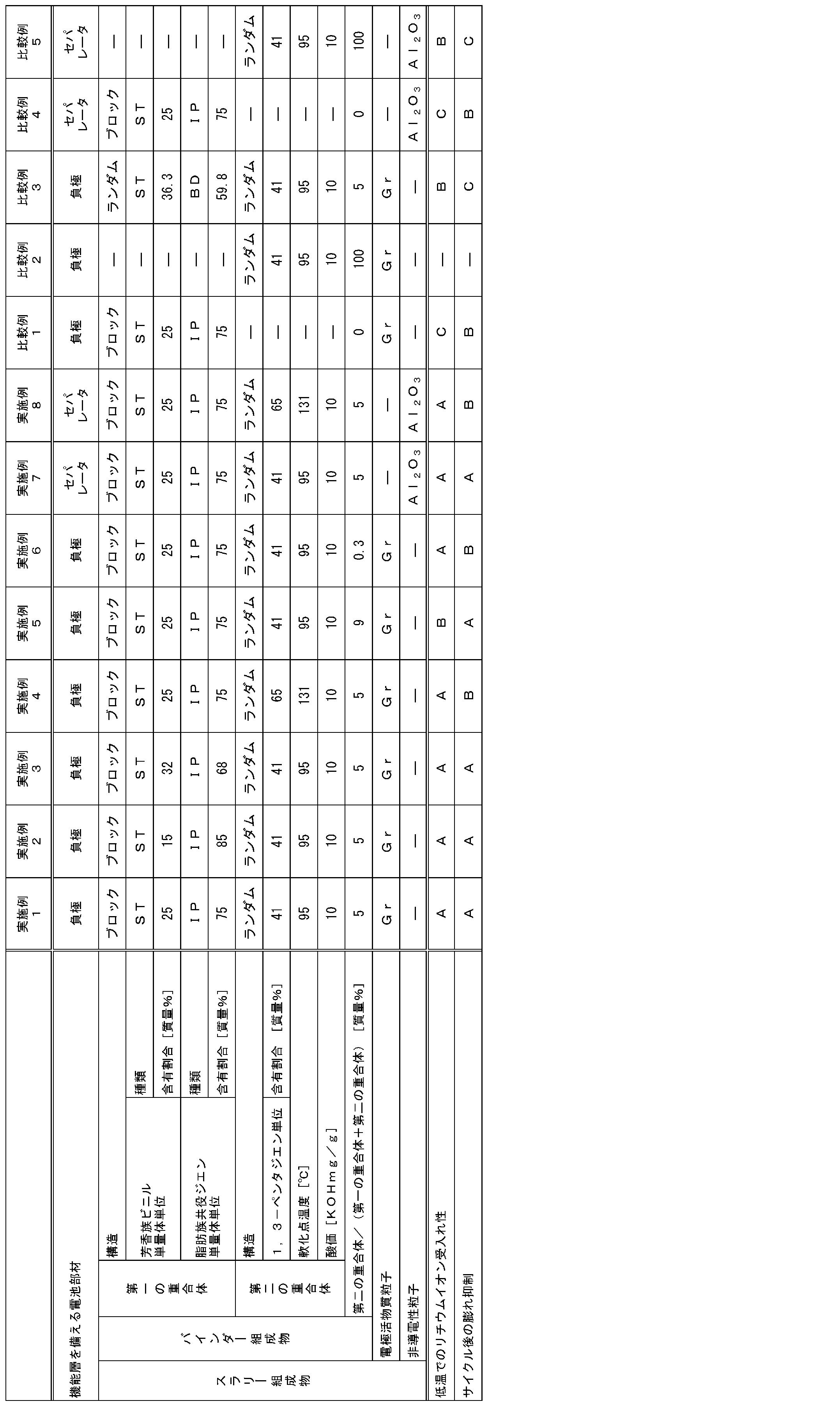
一方、所定の第一の重合体を含むが、所定の第二の重合体を含まないバインダー組成物を用いて機能層としての負極合材層を形成した比較例1では、二次電池の低温でのリチウムイオン受入れ性が低下することが分かる。
また、所定の第二の重合体を含むが、所定の第一の重合体を含まないバインダー組成物を用いて機能層としての負極合材層の形成を試みた比較例2では、上述の通り負極を作製することができなかった。
そして、所定の第一の重合体に替えて、スチレン-ブタジエンランダム共重合体を含むバインダー組成物を用いて機能層としての負極合材層を形成した比較例3では、二次電池のサイクル後の膨れを抑制できないことが分かる。
更に、所定の第一の重合体を含むが、所定の第二の重合体を含まないバインダー組成物を用いて機能層としての多孔膜層を形成した比較例4では、二次電池の低温でのリチウムイオン受入れ性が低下することが分かる。
また、所定の第二の重合体を含むが、所定の第一の重合体を含まないバインダー組成物を用いて機能層としての多孔膜層を形成した比較例5では、二次電池のサイクル後の膨れを抑制できないことが分かる。
また、本発明によれば、非水系二次電池のサイクル後の膨れを抑制すると共に、非水系二次電池の低温での電荷担体受入れ性を高めうる機能層を備える非水系二次電池部材を提供することができる。
そして、本発明によれば、サイクル後の膨れが抑制され、また低温での電荷担体受入れ性に優れる非水系二次電池を提供することができる。
Claims (11)
- 第一の重合体、第二の重合体、および溶媒を含む非水系二次電池機能層用バインダー組成物であって、
前記第一の重合体が、芳香族ビニル単量体単位からなるブロック領域と、脂肪族共役ジエン単量体単位および脂肪族共役ジエン単量体水素化物単位の少なくとも一方からなるブロック領域とを有するブロック共重合体であり、
前記第二の重合体が、1、3-ペンタジエン単位および1,3-ペンタジエン水素化物単位の少なくとも一方を含むランダム共重合体である、非水系二次電池機能層用バインダー組成物。 - 前記第一の重合体の前記芳香族ビニル単量体単位の含有割合が、10質量%以上50質量%以下である、請求項1に記載の非水系二次電池機能層用バインダー組成物。
- 前記第二の重合体の、前記1、3-ペンタジエン単量体単位の含有割合と、前記1,3-ペンタジエン水素化物単位の含有割合の合計が、20質量%以上70質量%以下である、請求項1または2に記載の非水系二次電池機能層用バインダー組成物。
- 前記第二の重合体の軟化点温度が70℃以上170℃以下である、請求項1~3の何れかに記載の非水系二次電池機能層用バインダー組成物。
- 前記第二の重合体の酸価が1KOHmg/g以上20KOHmg/g以下である、請求項1~4の何れかに記載の非水系二次電池機能層用バインダー組成物。
- 前記第二の重合体の含有量が、前記第一の重合体と前記第二の重合体の合計含有量の0.1質量%以上10.0質量%未満である、請求項1~5の何れかに記載の非水系二次電池機能層用バインダー組成物。
- 請求項1~6の何れかに記載の非水系二次電池用バインダー組成物を含む、非水系二次電池機能層用スラリー組成物。
- 更に電極活物質粒子を含む、請求項7に記載の非水系二次電池機能層用スラリー組成物。
- 更に非導電性粒子を含む、請求項7に記載の非水系二次電池機能層用スラリー組成物。
- 請求項7~9の何れかに記載の非水系二次電池機能層用スラリー組成物を用いて形成された非水系二次電池用機能層を備える、非水系二次電池部材。
- 請求項10に記載の非水系二次電池部材を備える、非水系二次電池。
Priority Applications (5)
| Application Number | Priority Date | Filing Date | Title |
|---|---|---|---|
| JP2020512266A JP7235045B2 (ja) | 2018-04-03 | 2019-04-02 | 非水系二次電池機能層用バインダー組成物、非水系二次電池機能層用スラリー組成物、非水系二次電池部材、および非水系二次電池 |
| KR1020207027308A KR20200138225A (ko) | 2018-04-03 | 2019-04-02 | 비수계 이차 전지 기능층용 바인더 조성물, 비수계 이차 전지 기능층용 슬러리 조성물, 비수계 이차 전지 부재, 및 비수계 이차 전지 |
| EP19780636.7A EP3780187A4 (en) | 2018-04-03 | 2019-04-02 | COMPOSITION OF BINDER FOR FUNCTIONAL LAYER OF NON-AQUEOUS SECONDARY BATTERY, COMPOSITION OF SLOT FOR FUNCTIONAL LAYER OF NON-AQUEOUS SECONDARY BATTERY, ELEMENT OF NON-AQUEOUS SECONDARY BATTERY, AND NON-AQUEOUS SECONDARY BATTERY |
| US17/040,980 US11831019B2 (en) | 2018-04-03 | 2019-04-02 | Binder composition for non-aqueous secondary battery functional layer, slurry composition for non-aqueous secondary battery functional layer, non-aqueous secondary battery member, and non-aqueous secondary battery |
| CN201980021392.0A CN111886727B (zh) | 2018-04-03 | 2019-04-02 | 非水系二次电池功能层用粘结剂组合物、非水系二次电池功能层用浆料组合物、非水系二次电池构件及非水系二次电池 |
Applications Claiming Priority (2)
| Application Number | Priority Date | Filing Date | Title |
|---|---|---|---|
| JP2018071839 | 2018-04-03 | ||
| JP2018-071839 | 2018-04-03 |
Publications (1)
| Publication Number | Publication Date |
|---|---|
| WO2019194192A1 true WO2019194192A1 (ja) | 2019-10-10 |
Family
ID=68100234
Family Applications (1)
| Application Number | Title | Priority Date | Filing Date |
|---|---|---|---|
| PCT/JP2019/014672 Ceased WO2019194192A1 (ja) | 2018-04-03 | 2019-04-02 | 非水系二次電池機能層用バインダー組成物、非水系二次電池機能層用スラリー組成物、非水系二次電池部材、および非水系二次電池 |
Country Status (6)
| Country | Link |
|---|---|
| US (1) | US11831019B2 (ja) |
| EP (1) | EP3780187A4 (ja) |
| JP (1) | JP7235045B2 (ja) |
| KR (1) | KR20200138225A (ja) |
| CN (1) | CN111886727B (ja) |
| WO (1) | WO2019194192A1 (ja) |
Cited By (1)
| Publication number | Priority date | Publication date | Assignee | Title |
|---|---|---|---|---|
| JPWO2021187273A1 (ja) * | 2020-03-17 | 2021-09-23 |
Families Citing this family (2)
| Publication number | Priority date | Publication date | Assignee | Title |
|---|---|---|---|---|
| KR102594515B1 (ko) * | 2018-10-26 | 2023-10-27 | 주식회사 엘지에너지솔루션 | 리튬 이차 전지용 전극의 제조방법 및 이를 이용하여 제조한 리튬 이차 전지용 전극 |
| CN118738393A (zh) * | 2023-03-31 | 2024-10-01 | 宁德时代新能源科技股份有限公司 | 复合粘结剂及制备方法和应用 |
Citations (5)
| Publication number | Priority date | Publication date | Assignee | Title |
|---|---|---|---|---|
| WO2000045452A1 (fr) * | 1999-01-28 | 2000-08-03 | Nippon Zeon Co., Ltd. | Composition de liant pour electrode d'accumulateur a ions lithium, et son utilisation |
| JP2012181967A (ja) * | 2011-02-28 | 2012-09-20 | Sanyo Electric Co Ltd | 非水電解質二次電池の製造方法および非水電解質二次電池用塗布極板の乾燥装置 |
| JP2014011019A (ja) * | 2012-06-29 | 2014-01-20 | Nippon Zeon Co Ltd | 二次電池電極用バインダー、二次電池電極用スラリー、二次電池電極及び二次電池 |
| JP2016066515A (ja) * | 2014-09-25 | 2016-04-28 | Jsr株式会社 | 蓄電デバイスセパレータ用不織布、蓄電デバイス、および樹脂組成物 |
| WO2017056404A1 (ja) | 2015-09-30 | 2017-04-06 | 日本ゼオン株式会社 | 非水系二次電池電極用バインダー組成物、非水系二次電池電極用スラリー組成物、非水系二次電池用電極、および非水系二次電池 |
Family Cites Families (11)
| Publication number | Priority date | Publication date | Assignee | Title |
|---|---|---|---|---|
| US4446180A (en) * | 1982-06-08 | 1984-05-01 | Mobil Oil Corp. | Adhesive composition, film laminate and product pouch or tube therefrom |
| DE3434975A1 (de) * | 1984-09-24 | 1986-04-03 | Basf Ag, 6700 Ludwigshafen | Thermoplastische formmassen |
| JP4430761B2 (ja) * | 1999-08-12 | 2010-03-10 | 三井化学株式会社 | 軟質ポリプロピレン組成物からなる層を含む積層体 |
| CN103563133B (zh) * | 2011-05-31 | 2016-08-17 | 日本瑞翁株式会社 | 锂二次电池正极用复合粒子、锂二次电池正极用复合粒子的制造方法、锂二次电池用正极的制造方法、锂二次电池用正极、及锂二次电池 |
| JP6506553B2 (ja) * | 2012-04-23 | 2019-04-24 | 日本ゼオン株式会社 | リチウムイオン二次電池 |
| WO2015098008A1 (ja) * | 2013-12-26 | 2015-07-02 | 日本ゼオン株式会社 | リチウムイオン二次電池負極用バインダー組成物、リチウムイオン二次電池負極用スラリー組成物、リチウムイオン二次電池用負極およびリチウムイオン二次電池 |
| JP6221875B2 (ja) * | 2014-03-24 | 2017-11-01 | 日本ゼオン株式会社 | 非水系二次電池多孔膜用バインダー、非水系二次電池多孔膜用組成物、非水系二次電池用多孔膜および非水系二次電池 |
| JP5979177B2 (ja) * | 2014-05-14 | 2016-08-24 | トヨタ自動車株式会社 | 正極ペースト及びその製造方法 |
| HUE044740T2 (hu) * | 2014-11-25 | 2019-11-28 | Zeon Corp | Kötõanyag nemvizes elektrolitos újratölthetõ telephez, összetétel nemvizes elektrolitos újratölthetõ telep funkcionális rétegeihez, funkcionális réteg nemvizes elektrolitos újratölthetõ telepekhez, valamint nemvizes elektrolitos újratölthetõ telep |
| WO2016104502A1 (ja) * | 2014-12-25 | 2016-06-30 | リケンテクノス株式会社 | 電池パック保護部材用熱可塑性エラストマー組成物 |
| US10833313B2 (en) * | 2015-10-22 | 2020-11-10 | Maxell Holdings, Ltd. | Positive electrode for nonaqeous electrolyte secondary battery and a nonaqueous electrolyte secondary battery |
-
2019
- 2019-04-02 EP EP19780636.7A patent/EP3780187A4/en not_active Withdrawn
- 2019-04-02 KR KR1020207027308A patent/KR20200138225A/ko active Pending
- 2019-04-02 JP JP2020512266A patent/JP7235045B2/ja active Active
- 2019-04-02 US US17/040,980 patent/US11831019B2/en active Active
- 2019-04-02 WO PCT/JP2019/014672 patent/WO2019194192A1/ja not_active Ceased
- 2019-04-02 CN CN201980021392.0A patent/CN111886727B/zh not_active Expired - Fee Related
Patent Citations (5)
| Publication number | Priority date | Publication date | Assignee | Title |
|---|---|---|---|---|
| WO2000045452A1 (fr) * | 1999-01-28 | 2000-08-03 | Nippon Zeon Co., Ltd. | Composition de liant pour electrode d'accumulateur a ions lithium, et son utilisation |
| JP2012181967A (ja) * | 2011-02-28 | 2012-09-20 | Sanyo Electric Co Ltd | 非水電解質二次電池の製造方法および非水電解質二次電池用塗布極板の乾燥装置 |
| JP2014011019A (ja) * | 2012-06-29 | 2014-01-20 | Nippon Zeon Co Ltd | 二次電池電極用バインダー、二次電池電極用スラリー、二次電池電極及び二次電池 |
| JP2016066515A (ja) * | 2014-09-25 | 2016-04-28 | Jsr株式会社 | 蓄電デバイスセパレータ用不織布、蓄電デバイス、および樹脂組成物 |
| WO2017056404A1 (ja) | 2015-09-30 | 2017-04-06 | 日本ゼオン株式会社 | 非水系二次電池電極用バインダー組成物、非水系二次電池電極用スラリー組成物、非水系二次電池用電極、および非水系二次電池 |
Non-Patent Citations (1)
| Title |
|---|
| See also references of EP3780187A4 |
Cited By (3)
| Publication number | Priority date | Publication date | Assignee | Title |
|---|---|---|---|---|
| JPWO2021187273A1 (ja) * | 2020-03-17 | 2021-09-23 | ||
| WO2021187273A1 (ja) * | 2020-03-17 | 2021-09-23 | Jsr株式会社 | 全固体二次電池用バインダー組成物、全固体二次電池用スラリー、全固体二次電池用固体電解質シート及びその製造方法、並びに全固体二次電池及びその製造方法 |
| JP7763749B2 (ja) | 2020-03-17 | 2025-11-04 | 株式会社Eneosマテリアル | 全固体二次電池用バインダー組成物、全固体二次電池用スラリー、全固体二次電池用固体電解質シート及びその製造方法、並びに全固体二次電池及びその製造方法 |
Also Published As
| Publication number | Publication date |
|---|---|
| KR20200138225A (ko) | 2020-12-09 |
| JP7235045B2 (ja) | 2023-03-08 |
| JPWO2019194192A1 (ja) | 2021-04-15 |
| US20210098789A1 (en) | 2021-04-01 |
| EP3780187A4 (en) | 2021-11-17 |
| EP3780187A1 (en) | 2021-02-17 |
| US11831019B2 (en) | 2023-11-28 |
| CN111886727B (zh) | 2024-03-22 |
| CN111886727A (zh) | 2020-11-03 |
Similar Documents
| Publication | Publication Date | Title |
|---|---|---|
| JP7120249B2 (ja) | 非水系二次電池電極用バインダー組成物、非水系二次電池電極用スラリー組成物、非水系二次電池用電極、及び非水系二次電池 | |
| KR102724530B1 (ko) | 비수계 이차 전지용 바인더 조성물, 비수계 이차 전지 기능층용 슬러리 조성물, 비수계 이차 전지용 기능층, 비수계 이차 전지용 전지 부재, 및 비수계 이차 전지 | |
| CN107925089A (zh) | 非水系二次电池电极用粘结剂组合物、非水系二次电池电极用浆料组合物、非水系二次电池用电极及非水系二次电池 | |
| WO2019107229A1 (ja) | 非水系二次電池用バインダー組成物、非水系二次電池機能層用スラリー組成物、非水系二次電池用機能層、非水系二次電池用電池部材および非水系二次電池 | |
| CN111418099A (zh) | 非水系二次电池电极用粘结剂组合物、非水系二次电池电极用浆料组合物、非水系二次电池用电极及非水系二次电池 | |
| WO2018168420A1 (ja) | 非水系二次電池電極用バインダー組成物、非水系二次電池電極用スラリー組成物、非水系二次電池用電極、非水系二次電池用負極および非水系二次電池、並びに、非水系二次電池用電極の製造方法 | |
| CN113302219B (zh) | 非水系二次电池电极用粘结剂组合物、非水系二次电池电极用浆料组合物、非水系二次电池用电极、以及非水系二次电池 | |
| JP7235045B2 (ja) | 非水系二次電池機能層用バインダー組成物、非水系二次電池機能層用スラリー組成物、非水系二次電池部材、および非水系二次電池 | |
| CN114365311B (zh) | 非水系二次电池用粘结剂组合物及其制造方法 | |
| WO2020246222A1 (ja) | 非水系二次電池電極用バインダー組成物、非水系二次電池電極用スラリー組成物、非水系二次電池用電極、および非水系二次電池 | |
| JP7823582B2 (ja) | 非水系二次電池電極用バインダー組成物、非水系二次電池電極用スラリー組成物、非水系二次電池用電極、及び、非水系二次電池 | |
| JP7405073B2 (ja) | 非水系二次電池用バインダー組成物、非水系二次電池機能層用スラリー組成物、非水系二次電池用機能層、非水系二次電池用電池部材および非水系二次電池 | |
| US12051808B2 (en) | Composition for non-aqueous secondary battery functional layer, non-aqueous secondary battery member, and non-aqueous secondary battery |
Legal Events
| Date | Code | Title | Description |
|---|---|---|---|
| 121 | Ep: the epo has been informed by wipo that ep was designated in this application |
Ref document number: 19780636 Country of ref document: EP Kind code of ref document: A1 |
|
| ENP | Entry into the national phase |
Ref document number: 2020512266 Country of ref document: JP Kind code of ref document: A |
|
| NENP | Non-entry into the national phase |
Ref country code: DE |
|
| ENP | Entry into the national phase |
Ref document number: 2019780636 Country of ref document: EP Effective date: 20201103 |
|
| WWW | Wipo information: withdrawn in national office |
Ref document number: 2019780636 Country of ref document: EP |