WO2019198191A1 - Poudre d'alliage ta-nb et procédé destiné à sa production, et élément d'anode destiné à un condensateur électrolytique solide - Google Patents
Poudre d'alliage ta-nb et procédé destiné à sa production, et élément d'anode destiné à un condensateur électrolytique solide Download PDFInfo
- Publication number
- WO2019198191A1 WO2019198191A1 PCT/JP2018/015321 JP2018015321W WO2019198191A1 WO 2019198191 A1 WO2019198191 A1 WO 2019198191A1 JP 2018015321 W JP2018015321 W JP 2018015321W WO 2019198191 A1 WO2019198191 A1 WO 2019198191A1
- Authority
- WO
- WIPO (PCT)
- Prior art keywords
- mass
- alloy powder
- content
- oxide film
- heat treatment
- Prior art date
- Legal status (The legal status is an assumption and is not a legal conclusion. Google has not performed a legal analysis and makes no representation as to the accuracy of the status listed.)
- Ceased
Links
Images


Classifications
-
- B—PERFORMING OPERATIONS; TRANSPORTING
- B22—CASTING; POWDER METALLURGY
- B22F—WORKING METALLIC POWDER; MANUFACTURE OF ARTICLES FROM METALLIC POWDER; MAKING METALLIC POWDER; APPARATUS OR DEVICES SPECIALLY ADAPTED FOR METALLIC POWDER
- B22F1/00—Metallic powder; Treatment of metallic powder, e.g. to facilitate working or to improve properties
- B22F1/16—Metallic particles coated with a non-metal
-
- H—ELECTRICITY
- H01—ELECTRIC ELEMENTS
- H01G—CAPACITORS; CAPACITORS, RECTIFIERS, DETECTORS, SWITCHING DEVICES, LIGHT-SENSITIVE OR TEMPERATURE-SENSITIVE DEVICES OF THE ELECTROLYTIC TYPE
- H01G9/00—Electrolytic capacitors, rectifiers, detectors, switching devices, light-sensitive or temperature-sensitive devices; Processes of their manufacture
- H01G9/004—Details
- H01G9/04—Electrodes or formation of dielectric layers thereon
- H01G9/048—Electrodes or formation of dielectric layers thereon characterised by their structure
- H01G9/052—Sintered electrodes
Definitions
- the present invention relates to a Ta—Nb alloy powder suitable for use as an anode element for a small-sized and large-capacity solid electrolytic capacitor mainly used in electronic devices such as personal computers and mobile phones, a production method thereof, and an alloy powder thereof.
- the present invention relates to an anode element for the solid electrolytic capacitor used.
- Capacitors are a type of electronic component used in various electronic devices such as personal computers and mobile phones, and basically have a structure in which a dielectric is sandwiched between two opposing electrode plates. When applied, charge is stored in each electrode by the polarization action of the dielectric.
- capacitors There are many types of capacitors, but at present, aluminum electrolytic capacitors, multilayer ceramic capacitors, tantalum electrolytic capacitors, and film capacitors are mainly used.
- Ta tantalum solid electrolytic capacitor
- This Ta capacitor utilizes the fact that tantalum pentoxide (Ta 2 O 5 ), which is an anodic oxide film of Ta, is excellent as a dielectric, and compression molding Ta powder and sintering it in a high vacuum. After producing a porous element, a chemical conversion treatment (anodic oxidation treatment) is performed, and an amorphous oxide film (Ta 2 O 5 film) having excellent insulating properties, that is, a dielectric film is applied to the surface of the Ta powder.
- Ta 2 O 5 tantalum pentoxide
- Ta 2 O 5 film amorphous oxide film having excellent insulating properties
- the anode in the device is impregnated with a manganese nitrate solution, and the thermal decomposition process is repeated several times to form a MnO 2 layer (electrolyte) on the anodized film to serve as the cathode.
- MnO 2 layer electrophilic layer
- it is generally manufactured by a series of processes in which lead wires are connected with graphite, silver paste or the like and then covered with resin or the like.
- a highly conductive polymer material such as polypyrrole or polyaniline is used to lower ESR (equivalent series resistance), stabilize temperature characteristics, improve safety, A product with a long life has been developed and put into practical use.
- a CV value ( ⁇ F ⁇ V / g), which is the product of capacitance and formation voltage, is generally used.
- commercially available Ta powder has a CV value of 50 to 150 kF / V / g, that is, about 50 to 150 kCV, and even a high-capacity product has a value of only 100 to 250 kF / V / g. Therefore, development of a tantalum powder having a higher CV value, specifically, 250 kCV or more, further 300 kCV or more is strongly desired.
- S electrode area (m 2 )
- t distance between electrodes (m)
- ⁇ dielectric constant (F / m)
- ⁇ s relative dielectric constant of dielectric (Ta oxide film: about 27)
- ⁇ 0 Vacuum induction electric power (8.855 ⁇ 10 ⁇ 12 F / m)
- the anode area S that is, the surface area of the Ta powder constituting the anode is increased, or the interelectrode distance t, that is, the film thickness of the anodic oxide film Ta 2 O 5 is decreased.
- the interelectrode distance t that is, the film thickness of the anodic oxide film Ta 2 O 5 is decreased.
- the primary particle size of Ta powder has been miniaturized with the recent demand for larger capacity.
- the bonding part (neck part) of the metal particles formed when sintered into an element is weakened. Therefore, the bonding part is broken by the growth of the oxide film by the chemical conversion treatment, and the static part is static. There is a problem in that the capacity decreases. Therefore, it is desirable that the Ta powder has a size of a certain level or more, specifically, a size of 30 nm or more.
- the film thickness of the anodized film can be adjusted by the chemical conversion voltage, but reducing this film thickness causes various problems.
- an amorphous natural oxide film having a thickness of about 2 to 3 nm formed during the production of the powder exists on the surface of the Ta powder.
- This oxide film often contains impurities and defects, and is inferior in characteristics and adhesion as a dielectric, thus deteriorating electrical characteristics.
- This problem is not particularly apparent when the chemical conversion treatment is performed at a high voltage because it is buried in a thick anodic oxide film (dielectric).
- the anodic oxide film is made thinner for higher capacity, defects in the natural oxide film will be exposed on the surface. As a result, the leakage current (LC) increases or the life of the capacitor is adversely affected. Therefore, there is a limit to increasing the capacity by reducing the thickness of the anodized film.
- Ta is a rare metal with a small reserve, it is difficult to stably supply, is expensive, and has a large price fluctuation. Therefore, there is an increasing need for a solid electrolytic capacitor using a metal other than Ta. Therefore, development and research of a niobium solid electrolytic capacitor using Nb, which has similar chemical characteristics and physical properties to Ta, is rich in reserves and is inexpensive, and has been put to practical use.
- the dielectric of the niobium solid electrolytic capacitor (hereinafter also referred to as “Nb capacitor”) is an oxide (niobium pentoxide Nb 2 O 5 ), and its dielectric constant is tantalum. Since it is 41, which is about 1.5 times that of the oxide Ta 2 O 5, a higher CV value can be obtained than a Ta capacitor.
- the Nb capacitor has a poor thermal stability of the dielectric layer, and the dielectric layer changes in quality due to thermal stress during heat treatment when forming the cathode or reflow processing when the capacitor is mounted. It has been pointed out that the characteristics such as the leakage current are deteriorated, in particular, the latter leakage current is increased.
- the cause of thermal instability when using niobium metal powder as the anode material of the capacitor is that Nb is more reactive than Ta, and niobium oxide is less stable than tantalum oxide. 2 O 5 ) oxygen is diffused toward the Nb metal side of the anode, which is considered to be caused by defects in the dielectric or formation of a conductive oxide layer. Yes.
- Patent Document 3 discloses that the composition of the dielectric oxide film and the thermal strain between the niobium powder and the niobium monoxide powder include niobium monoxide powder and hexaniobium monoxide in the niobium powder. Is a technique for relaxing the dielectric oxide film and suppressing deterioration of the dielectric oxide film.
- Patent Document 4 discloses a method such as liquid nitriding, ion nitriding, gas nitriding to niobium powder having an average particle size of 0.2 ⁇ m or more and less than 3 ⁇ m.
- Patent Document 5 Mn is contained in a contact portion between an anode containing Nb and a dielectric layer formed in close contact with the anode, so that the number of oxygen atoms bonded to Nb is kept constant.
- Patent Document 6 discloses that a dielectric layer is formed by including fluorine in a dielectric layer formed on the surface of an anode containing an oxide made of niobium monoxide or niobium dioxide and a metal made of niobium or a niobium alloy.
- Patent Documents 3 to 6 require that the anode raw material manufacturer or the capacitor manufacturer perform special treatment on the Nb powder or the anode element manufactured from the powder. However, it has the problem of incurring an increase in raw material costs and manufacturing costs.
- an object of the present invention is to provide a Ta—Nb alloy powder for a solid electrolytic capacitor that is stable and has a high capacity and a small leakage current even after being subjected to a heat treatment such as a reflow process, and a method for producing the same.
- the object is to propose an anode element for a solid electrolytic capacitor using an alloy powder.
- a specific development target of the present invention is to develop an anode element having a capacitance of 300 kCV / g or more after heat treatment, that is, after mounting, and a leakage current of 50 ⁇ A / ⁇ FV ⁇ 10 ⁇ 4 or less. .
- the inventors have conducted intensive studies focusing on the influence of the oxide film formed on the surface of the alloy powder on the characteristics of the capacitor when producing Ta—Nb alloy powder (primary particles). Piled up. As a result, the ultrafine Ta—Nb alloy powder (primary particles) produced using the thermal CVD method is oxidized to enrich the oxygen content to an appropriate amount according to the Nb content. By forming an oxide film consisting only of amorphous on the surface of the alloy powder, it is suitable for use as an anode element for a solid electrolytic capacitor having a high capacity and a small leakage current even after being subjected to a heat treatment such as a reflow process. The present inventors have found that Ta—Nb alloy powder can be obtained and have completed the present invention.
- the present invention provides a Ta—Nb alloy powder having an Nb content of 10 to 80 mass% and a primary particle diameter of 30 to 200 nm. It has a coating layer, and the content of O is related to the content of Nb (Nb: 10 mass%, O: 4.5 mass%), (Nb: 20 mass%, O: 5.5 mass%), ( Nb: 40 mass%, O: 7.3 mass%), (Nb: 60 mass%, O: 7.5 mass%), (Nb: 80 mass%, O: 7.5 mass%), (Nb: 80 mass%, O: 6 .5 mass%), (Nb: 60 mass%, O: 6.0 mass%), (Nb: 40 mass%, O: 4.8 mass%), (Nb: 20 mass%, O: 3.5 mass%) and (Nb: 10mass%, O: 3.0mass%) is Ta-Nb alloy powder, characterized in that in the range surrounded by points.
- the Nb content refers to the mass ratio of Nb to the total mass
- the Ta—Nb alloy powder of the present invention when subjected to a heat treatment at 850 to 1500 ° C. ⁇ 5 to 60 min, has a crystalline portion formed on the metal portion at the center of the Ta—Nb alloy and the surface (outside) thereof. It has a three-layer structure composed of monoxide (Ta, Nb) O and a natural oxide film formed on its surface (outermost surface).
- the present invention provides an oxidation treatment of Ta—Nb alloy powder produced by a thermal CVD method and having a Nb content of 10 to 80 mass% and a primary particle diameter in the range of 30 to 200 nm.
- Nb content (Nb: 10 mass%, O: 4.5 mass%), (Nb: 20 mass%, O: 5.5 mass%), (Nb: 40 mass%, O: 7) .3 mass%), (Nb: 60 mass%, O: 7.5 mass%), (Nb: 80 mass%, O: 7.5 mass%), (Nb: 80 mass%, O: 6.5 mass%), (Nb: 60 mass%, O: 6.0 mass%), (Nb: 40 mass%, O: 4.8 mass%), (Nb: 20 mass%, O: 3.5 mass%) and (Nb: 10 mass%, O: Proposed method for producing Ta-Nb alloy powder, characterized by forming an oxide film layer consisting only of amorphous material on the surface of the alloy powder of primary particles.
- the oxidation treatment is performed in an inert gas atmosphere containing water vapor at a temperature of 150 to 400 ° C. and a water content of 6.1 to 51.1 g / m 3. It is characterized by performing.
- the method for producing the Ta—Nb alloy powder of the present invention is characterized in that the oxidation treatment is performed in an inert gas atmosphere containing a temperature of 100 to 250 ° C. and oxygen of 0.1 to 5 vol%. To do.
- the present invention is an anode element for a solid electrolytic capacitor, characterized by comprising the above Ta—Nb alloy powder.
- the anode element of the present invention is, after the chemical conversion treatment, the metal portion at the center of the Ta—Nb alloy powder, the crystalline monoxide (Ta, Nb) O formed on the surface (outside), Further, it has a three-layer structure composed of an amorphous oxide film (Ta, Nb) 2 O 5 formed on the surface (outermost surface).
- the anode element of the present invention has a CV value per unit mass of 300 kCV / g or more and a leakage current of 50 ⁇ A / ⁇ FV ⁇ 10 ⁇ 4 or less after heat treatment under vacuum at 260 ° C. for 30 minutes. It is characterized by being.
- the present invention it is possible to provide a Ta-Nb alloy powder that is excellent in thermal stability of a dielectric layer formed by chemical conversion treatment, so that even after being subjected to heat treatment such as reflow treatment during capacitor mounting, A solid electrolytic capacitor having a high capacity and a small leakage current can be stably manufactured, which greatly contributes to downsizing and large capacity of electronic equipment.
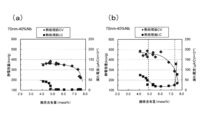
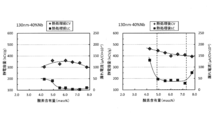
- 6 is a graph showing the influence of oxygen content on the electrostatic properties of Ta-40 mass% Nb alloy powder having a primary particle size of 130 nm.
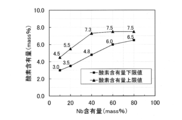
- 6 is a graph showing a range of oxygen content in a Ta—Nb alloy powder in which a capacitance after heat treatment is 300 kCV / g or more and a leakage current is 50 ⁇ A / ⁇ FV ⁇ 10 ⁇ 4 or less.
- the reason why the thermal stability of the solid electrolytic capacitor using the Ta—Nb alloy powder is unstable is that the anodic oxide film formed by chemical conversion treatment is included in (Ta, Nb) 2 O 5 . This is considered to be because the oxygen atoms move to the metal side inside the particles by heat treatment such as reflow treatment, and the anodic oxide film is altered.
- an amorphous oxide film formed at the time of powder production exists on the surface of Ta—Nb alloy particles after being formed into an anode element shape and before being sintered.
- the amorphous oxide film after being molded into the anode element shape and before sintering is formed by the properties of the oxide film after being molded into the anode element and sintered, and the subsequent anodizing (chemical conversion treatment).
- Thermal stability of the amorphous oxide film (dielectric layer) formed that is, the capacitance after receiving heat treatment such as heat treatment during anode formation and reflow treatment during mounting after forming a solid electrolytic capacitor
- a Ta—Nb alloy powder having a Nb content of 40 mass% and a primary particle diameter of 70 nm is manufactured using a thermal CVD method (vapor phase reduction method) in which Ta and Nb chloride vapor is reduced with hydrogen gas.
- the alloy powder is exposed to high temperature steam containing 150 to 500 ° C. of water containing 12.8 to 39.6 g / m 3 (15 to 35 ° C. saturated water vapor) of moisture in Ar gas for various times.
- Experiments were carried out to enrich the various amounts of oxygen and to form oxide films having various thicknesses on the surface of the Ta—Nb alloy powder by performing the oxidation treatment.
- the oxygen content of the Ta—Nb alloy powder used in the experiment before the oxidation treatment was 4.1 mass%.
- the Nb content (mass%) in the Ta—Nb alloy powder refers to the mass ratio of Nb to the total mass of Ta and Nb, and the oxygen content (mass%) in the Ta—Nb alloy powder. ) Means the mass ratio of O to the total mass of Ta, Nb and O (hereinafter the same).
- the primary particle size of the Ta—Nb alloy powder used in the present invention is 1000 or more primary particle sizes from particle images taken with a scanning electron microscope SEM or the like. This is the number-based average particle diameter measured using -View) (hereinafter the same).
- FIG. 1 (a) shows the relationship between the oxidation treatment conditions (water vapor temperature, holding time) and the oxygen content after the oxidation treatment. From this figure, it can be seen that the oxygen content of the Ta—Nb alloy powder can be arbitrarily adjusted by adjusting the temperature and holding time of the water vapor.
- the Ta—Nb alloy powder having the oxygen content of 4.1 mass%, the Nb content of 40 mass%, and the primary particle size of 70 nm immediately after being manufactured by the thermal CVD method is the same as the alloy powder used in Experiment 1 above.
- the oxygen content can be reduced by performing an oxidation treatment for holding at various times under high temperature steam at a temperature of 200 to 250 ° C. containing 12.8 to 39.6 g / m 3 of moisture in the Ar gas.
- Various different Ta—Nb alloy powders were produced.
- the oxidized Ta—Nb alloy powder is compression-molded to form a cylindrical element shape of 3 mm ⁇ ⁇ 4.5 mm (density: 2.9 g / mm 3 ) at a temperature of 1100 ° C. in a vacuum atmosphere.
- a chemical conversion treatment was performed for 2 hours at a voltage of 10 V in a 0.05 mass% phosphoric acid aqueous solution at 80 ° C. to produce an anode element.
- an anode element was produced in the same manner for a Ta—Nb alloy powder (oxygen content: 4.1 mass%) without oxidation treatment.
- the reason why the heat treatment conditions are harsher than the actual reflow treatment is that, when manufacturing a solid electrolytic capacitor, in addition to the above reflow treatment, a plurality of heat treatments are performed at a temperature close to 250 ° C. at the time of cathode formation. This is because of taking into account the fact that the element is applied and the individual difference (variation) of the elements.
- FIG. 2 shows the oxygen content after oxidation treatment on the capacitance and leakage current before and after the heat treatment (hereinafter also simply referred to as “electrostatic characteristics”) in Ta-40 mass% Nb alloy powder having a primary particle diameter of 70 nm. The effect of quantity was shown.
- FIG. 2 (a) shows the measurement results of the electrostatic properties before the heat treatment. From this figure, the capacitance before the heat treatment gradually decreases as the oxygen content increases. When it exceeds 7 mass%, it rapidly decreases and becomes the development target of 300 kCV / g or less.
- the leakage current shows a relatively high value of 50 ⁇ m / CV ⁇ 10 ⁇ 4 or less, which is the development target, before the oxidation treatment, but it decreases as the oxygen content increases and shows a stable low value.
- FIG. 2 (b) shows the measurement results of the electrostatic properties after the heat treatment, and the capacitance after the heat treatment shows a higher value than before the heat treatment.
- the oxygen content gradually decreases as the oxygen content increases, and if it exceeds about 7 mass%, it becomes a value lower than the development target of 300 kCV / g.
- the leakage current shows the same tendency as before the heat treatment in the region where the oxygen content is about 7 mass% or less, but increases as a whole by the heat treatment, and on the low oxygen side of about 5 mass% or less, the development target is 50 ⁇ m. A value larger than / CV ⁇ 10 ⁇ 4 .
- the leakage current increases rapidly, and shows a value greatly exceeding 50 ⁇ m / CV ⁇ 10 ⁇ 4 .
- an amorphous oxide film having a thickness of 2.9 nm was formed on the surface of the Ta—Nb alloy powder having an oxygen content of 4.1 mass% as produced by the thermal CVD method.
- the surface of the Ta—Nb alloy powder after compression molding into an element shape and sintering is between the Ta—Nb alloy portion (metal portion) inside the particles and the amorphous oxide film on the outermost layer.
- a thin crystalline layer made of monoxide (Ta, Nb) O was formed. Further, after the chemical conversion treatment is performed on this, the crystalline layer of monoxide (Ta, Nb) O is reduced, and an amorphous oxide having a thickness of 33 nm serving as a capacitor dielectric layer is formed thereon.
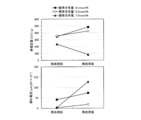
- a film (Ta—Nb) 2 O 5 was formed. Further, after the chemical conversion treatment, after the heat treatment at 250 ° C. for 30 minutes, no particular change was observed in the structure of the oxide film as far as it was observed by TEM. However, as shown in FIG. 3, with this heat treatment, the electrostatic characteristics of the anode element increased the leakage current from 42 ⁇ A / ⁇ FV ⁇ 10 ⁇ 4 to 74 ⁇ A / ⁇ FV ⁇ 10 ⁇ 4 , and the oxygen content increased. It was confirmed that the thermal stability of the anode element was inferior at 4.1 mass%.
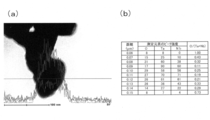
- FIG. 4 (a) shows the Ta—Nb alloy powder after sintering by line analysis with EDX attached to the transmission electron microscope TEM, and Ta, Nb and O in one particle of the alloy powder. The result of having measured the density distribution of this is shown. From this figure, it can be seen that the concentrations of Ta and Nb increase as they go to the center of the particle, whereas the concentration of O shows a trapezoidal distribution.
- the table of FIG. 4B shows the result of obtaining the ratio (O / (Ta + Nb)) between the measured intensity of O in the particle and (measured intensity of Ta + measured intensity of Nb) from the above measurement results. Is.
- FIG. 5 is a TEM image obtained by observing the surface layer portion of the sintered Ta—Nb alloy powder with TEM. From this figure, the sintered Ta—Nb alloy powder particles consist of a metal part in the center, a crystalline oxide layer formed on the surface, and an amorphous oxide formed on the surface. It can be seen that the structure is a three-layer structure. It has been confirmed from the XRD measurement results that the crystalline oxide is monoxide (Ta, Nb) O. The presence of the metal portion in the central portion makes it easier to form a neck than particles having no metal portion in the central portion (particles that are entirely oxide) when the anode element is molded and sintered.
- the uppermost amorphous oxide was not confirmed by XRD, but is considered to be a natural oxide film formed after sintering. This natural oxide film has the effect of suppressing rapid additional oxidation when exposed to the atmosphere.
- the Ta—Nb alloy powder produced by the thermal CVD method is subjected to an oxidation treatment, and in the alloy powder enriched with an oxygen content of 5.5 mass%, the amorphous oxide film after the oxidation treatment has a thickness of Has grown to 4.5 nm. Then, the surface of the alloy powder after compression molding into an element shape and sintering is between the Ta—Nb alloy and the amorphous oxide film, and is thicker than the above-described oxidation treatment without the oxidation treatment. A (Ta, Nb) O layer was formed.
- a crystalline layer of monoxide (Ta, Nb) O remains with a certain thickness, and a thickness of 34 nm as a dielectric layer is formed on the crystalline layer.
- An amorphous oxide film (Ta—Nb) 2 O 5 was formed. Furthermore, no apparent change was observed in the structure of the oxide film after the heat treatment at 250 ° C. for 30 minutes was performed on the oxide film after the chemical conversion treatment.
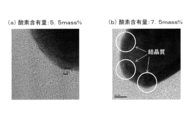
- FIG. 6 shows a photograph of the surface layer of Ta—Nb alloy powder having an oxygen content of 5.5 mass% and 7.5 mass% observed with a TEM.
- the surface layer portion of the Ta—Nb alloy powder having an oxygen content of 5.5 mass% is formed only of an amorphous oxide film, but the Ta—Nb alloy powder having an oxygen content of 7.5 mass% has an oxide film.
- the inventors consider the change in the thermal stability of the anode element depending on the oxygen content as follows.
- the surface layer of the metal portion of the Ta—Nb alloy powder is formed by sintering.
- this amorphous oxide film (Ta, Nb) 2 O 5 contains Nb, when it is subjected to heat treatment, it releases O like the dielectric layer Nb 2 O 5 in the Nb capacitor. In addition, it is transformed into a low oxide index suboxide, and the released O diffuses into the Ta—Nb alloy side (metal part side) inside the particle, and a new low oxide index suboxide is added to the Ta—Nb alloy. Form. Since these suboxides are conductive, they do not function as a dielectric layer. As a result, the dielectric layer after the heat treatment becomes thinner than that before the heat treatment, so that a leak occurs locally and the leakage current increases.
- the surface layer of the metal portion of Ta—Nb alloy powder is moderately produced by sintering.
- an oxide film made of thick crystalline monoxide (Ta, Nb) O and an amorphous (Ta, Nb) 2 O 5 layer serving as a dielectric is formed thereon.
- the amorphous oxide film (Ta, Nb) 2 O 5 releases O and attempts to be transformed into a suboxide having a low oxidation index.
- the oxide (Ta, Nb) O layer suppresses the diffusion of the released O to the Ta—Nb alloy side, and also suppresses the formation of new suboxides in the Ta—Nb alloy. . For this reason, the thickness of the amorphous (Ta, Nb) 2 O 5 layer that becomes a dielectric decreases even after heat treatment, but a necessary and sufficient amount remains as a capacitor. Can be suppressed.
- the Ta—Nb alloy powder having an oxygen content of 4.1 mass% not subjected to the oxidation treatment and the oxygen content subjected to the oxidation treatment of 5.5 mass%.
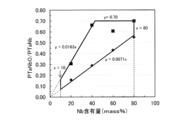
- the value of (P TaNbO / P TaNb ) tends to increase with an increase in oxygen content, but both are 0.4 or less.
- the value of (P TaNbO / P TaNb ) is higher than 0.6. There was a big difference between the two.
- the (P TaNbO / P TaNb ) value in the present invention is a condition that is maintained at a temperature of 850 to 1500 ° C. for 5 to 60 minutes under a vacuum of 10 ⁇ 4 to 10 ⁇ 5 Pa in accordance with the above conditions.
- the measured value of the Ta—Nb alloy powder after heat treatment may be any value, and not only the anode element sintered under the above conditions after being formed into an element shape, but also the Ta—Nb alloy powder as a raw material. It may be Ta—Nb alloy powder that has been subjected to heat treatment under conditions. That is, the above value does not need to be measured after being molded into an anode element and then sintered, and is measured after heat treatment of 850 to 1500 ° C. ⁇ 5 to 60 min is applied to the raw material Ta—Nb alloy powder. Also good.
- the value of (P TaNbO / P TaNb ) is significantly lower than after the sintering, but the same tendency is observed.
- the value of ( PTaNbO 2 / P TaNb ) increases the oxygen content.
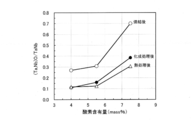
- FIG. 9A shows the measurement results of the electrostatic characteristics before the oxidation treatment
- FIG. 9B shows the measurement results of the electrostatic characteristics after the oxidation treatment.
- the capacitance the tendency to improve by heat treatment as compared with that before heat treatment is the same as that when the primary particle size is 70 nm.
- the primary particle size is 130 nm, the rapid decrease in the region where the oxygen content is high is The capacitance after heat treatment was 300 kCV / g or more in all the ranges tested. Therefore, the range of the appropriate oxygen content with a primary particle size of 130 nm is determined by the leakage current.
- the primary particle diameter is 130 nm
- the inventors consider the reason why a rapid decrease in capacitance is not recognized even when the oxygen content is excessive.
- the primary particle diameter is relatively small, such as 70 nm
- non-conductive (Ta, Nb) O 2 formed by excessive oxygen treatment or (Ta, Nb) 2 O 5 increases the frequency with which the bond between alloy particles is broken.
- the primary particle diameter is as large as 130 nm
- the bonding portion between the alloy particles is strong, and therefore bonding by non-conductive (Ta, Nb) O 2 or (Ta, Nb) 2 O 5
- the division is less likely to occur. For this reason, it is considered that a rapid decrease in capacitance is suppressed.
- the inventors have described that the metal part and I think that it is in the balance of the oxide part.
- the surface area per unit mass of Ta—Nb alloy particles having a primary particle size of 130 nm is calculated to decrease by about 54% with respect to the primary particle size of 70 nm. Therefore, when the amount of oxygen is the same, the thickness of the oxide formed on the surface of the alloy particle having a primary particle size of 130 nm is about 1.9 times that of the primary particle size of 70 nm.
- the volume of the Ta—Nb alloy that accepts oxygen O released during the heat treatment from amorphous (Ta, Nb) 2 O 5 formed by the chemical conversion treatment is also about 6.4 times.
- the role of the monoxide (Ta, Nb) O layer formed on the surface of the Ta—Nb alloy particles during the sintering is the amorphous (Ta, Nb) formed by the chemical conversion treatment.
- the primary particle diameter is changed from 70 nm to 130 nm. Since the volume of the alloy is about 6.4 times, in order to suppress oxygen diffusion and prevent sub-oxidation of amorphous (Ta, Nb) 2 O 5 , monoxide (Ta, Nb)
- the thickness of the O layer is also required to be thick as such. That is, as the primary particle size increases, it is necessary to increase the thickness of the oxide layer formed by the oxidation treatment, and as a result, the range of the appropriate oxygen amount is constant regardless of the primary particle size. It is considered to be.
- the optimum oxygen content range in which the capacitance after heat treatment is 300 kCV / g or more and the leakage current is 50 ⁇ A / ⁇ FV ⁇ 10 ⁇ 4 or less is in all regions where the Nb content is 10 to 80 mass%. It has been found that the optimum range depends on the Nb content and becomes higher as the Nb content increases. Specifically, as shown in FIG.
- the inventors consider the reason why the range of the appropriate oxygen content is increased as the Nb content is increased as follows.
- the atomic weight of Ta is 180.95 and the specific gravity is 16.65
- the atomic weight of Nb is 92.91 and the specific gravity is only 8.57. That is, since Nb atoms are only about half as heavy as Ta atoms, when compared with the same mass, the number of Nb atoms contained therein is about twice that of Ta.
- the number of oxygen bonded to Ta and Nb is the same as TaO 2 and NbO 2 , Ta 2 O 5 and Nb 2 O 5 . Therefore, if the affinity of Ta and Nb for oxygen is the same, the oxygen content contained in the Ta—Nb alloy having the same mass increases as the Nb content increases.
- the present invention has been completed by further studying the above findings.
- Ta—Nb alloy powder material suitable for use in the anode element of the solid electrolytic capacitor of the present invention
- the Ta—Nb alloy powder (raw material) used as a raw material for the anode element in the present invention is preferably produced by a thermal CVD method (vapor phase reduction method).
- the thermal CVD method is the only method that can stably produce ultrafine Ta—Nb alloy powder at the present time, and it is easy to adjust the alloy components and produce an alloy powder with a small composition fluctuation range. Because it can be done.
- the specific method and conditions of the above thermal CVD method are not particularly limited, but for example, any method disclosed in Japanese Patent Application Laid-Open No. 2004-52026 can be suitably used. However, as long as an alloy powder of nm unit can be easily obtained, it is needless to say that those manufactured by other methods may be used.
- the Ta—Nb alloy powder (raw material) of the present invention is required to have an average primary particle size in the range of 30 to 200 nm. If the average particle size is less than 30 nm, the bonding between the particles formed when the Ta—Nb alloy powder is sintered is weak, so there is an oxide film formed by excessive oxidation treatment or an amorphous oxide film formed by chemical conversion treatment. The joint portion is broken, resulting in a decrease in conductivity and a decrease in capacitance. On the other hand, if the average particle size exceeds 200 nm and becomes too large, the surface area of the Ta—Nb alloy powder decreases, making it difficult to stably secure the target CV value (300 k ⁇ F ⁇ V / g or more). It is.
- one particle of Ta—Nb alloy powder has an average particle size in the range of 50 to 150 nm, and 70 to 130 nm. More preferably, it is the range.
- the average particle diameter of the Ta—Nb alloy powder is the number-based average particle diameter measured with a scanning electron microscope SEM or the like.
- the Ta—Nb alloy powder (raw material) of the present invention has a Nb content in the range of 10 to 80 mass%.
- the Nb content is less than 10 mass%, the effect of increasing the capacitance by adding Nb is small.
- the content of Nb exceeds 80 mass%, the characteristics of Nb itself become remarkable, and even if the oxidation treatment of the present invention is performed, an increase in leakage current cannot be suppressed.
- the Nb content is in the range of 20 to 70 mass%.
- the range of 20 to 60 mass% is more preferable, and the range of 30 to 60 mass% is more preferable.
- the Ta—Nb alloy powder of the present invention is obtained by subjecting the above Ta—Nb alloy powder material to an oxidation treatment and enriching it with an appropriate amount of oxygen, so that only the surface of the Ta—Nb alloy powder material is amorphous. It can obtain by forming the oxide film which consists of.
- the appropriate range for enriching oxygen varies depending on the Nb content (Nb: 10 mass%, O: 4.5 mass%), (Nb: 20 mass%, O: 5.5 mass%).
- Conductive oxides (Ta, Nb) O 2 and (Ta, Nb) 2 O 5 are formed, which adversely affects the amorphous oxide film to be formed later, such as reflow treatment. This is because the leakage current after the heat treatment increases rapidly.
- the preferred oxygen content is (Nb: 10 mass%, O: 4.2 mass%), (Nb: 20 mass%, O: 5.2 mass%), (Nb: 40 mass%, O: 7.0 mass%), (Nb: 60 mass%, O: 7.2 mass%), (Nb: 80 mass%, O: 7.2 mass%), (Nb: 80 mass%, O: 6.7 mass%), (Nb: 60 mass%, O: 6.2 mass%), (Nb: 40 mass%, O: 5.0 mass%), (Nb: 20 mass%, O: 3.7 mass%) and (Nb: 10 mass%, O: 3.2 mass%) Within the enclosed range.
- the thickness of the amorphous oxide film at the oxygen content stipulated by the present invention is different, although there is a difference depending on the particle diameter.
- the thickness is approximately 4.0 to 13.0 nm, and the thickness of the amorphous oxide film at a preferable oxygen content is approximately 4.5 to 11.5 nm.
- the method for the oxidation treatment is not particularly limited as long as it can form an amorphous oxide film on the surface of the Ta—Nb alloy powder.
- a method of exposing to a water vapor-containing inert gas atmosphere for a predetermined time can be used.
- He, Ne, Ar gas or the like can be used as the inert gas in the water vapor-containing inert gas atmosphere, but Ar gas is preferable in terms of cost.
- the content of water vapor as described above is preferably in the range of 6.1 ⁇ 51.1g / m 3 in the water content, more preferably in the range of 17.3 ⁇ 30.4g / m 3.
- the temperature of the water vapor is preferably in the range of 150 to 400 ° C, more preferably in the range of 200 to 300 ° C. This is because within this range, it is easy to control the oxygen content when industrially carried out.
- the oxidation rate (the increase rate of O content) in the preferable temperature range and the more preferable temperature range that can be read from FIG. 1A are 0.07 to 7.42 mass% / hr and 0.67 to 3.21 mass, respectively. % / Hr.
- an oxygen-containing inert gas atmosphere may be used instead of the water vapor-containing atmosphere.
- the oxygen content is preferably in the range of 0.1 to 5 vol%, and the temperature is preferably in the range of 100 to 250 ° C. More preferably, the oxygen content is in the range of 1 to 3 vol% and the temperature is in the range of 125 to 230 ° C.
- FIG. 1B the change in oxygen content (oxidation rate) was measured when the oxidation treatment was performed by changing the temperature of the Ar gas atmosphere containing 2 vol% oxygen in the range of 125 to 250 ° C. The results are shown.
- Ta—Nb alloy powder material
- the Ta—Nb alloy powder (primary particles) produced by the thermal CVD method has a fine particle diameter, a low bulk density, and a large pushing allowance, the density of the molded body serving as the anode element is not uniform. Easy to be.
- alkaline earth metals such as Mg
- the method of adding and granulating binders such as an acrylic type, polyvinyl alcohol (PVA), and polyvinyl butyral (PVB)
- PVA polyvinyl alcohol
- PVB polyvinyl butyral
- the oxidation treatment for the Ta—Nb alloy powder of the present invention may be performed at either the primary particle stage of the Ta—Nb alloy powder or after the above granulation process, and the same effect can be obtained. Can do.
- Ta—Nb alloy powders (materials) in which the Nb content was changed to various values in the range of 0 to 100 mass% and the average particle size was changed in the range of 20 to 220 nm. ) Is produced by a thermal CVD method, and then held for 1 to 16 hours in an argon gas atmosphere at a temperature of 200 to 250 ° C. containing 12.8 to 39.6 g / m 3 of water vapor with respect to the alloy powder (material).
- Ta—Nb alloy powders having various oxygen contents were produced.
- the Ta—Nb alloy powder after the oxidation treatment As for the Ta—Nb alloy powder after the oxidation treatment, an amorphous oxide film on the particle surface is observed with a TEM, and crystalline (Ta, Nb) O 2 , (Ta, Nb) 2 O 5, etc. The presence or absence was confirmed.
- the molding density of the element is in the range of 2.2 to 3.5 (2.3 to 4.2) g / cm 3 which is 1/4 of the specific gravity according to the Nb content described above.
- a preliminary experiment was conducted in a temperature range of 850 to 1500 ° C., which is a sintering temperature of a general element, and a temperature at which the highest capacitance was obtained was adopted as the sintering temperature.
- the molding density is a “relaxed bulk density” measured according to JIS Z2504.
- the element was subjected to a chemical conversion treatment at a voltage of 10 V for 2 hours in a 0.05 mass% phosphoric acid solution having a temperature of 80 ° C. to form an anodic oxide film on the surface of the metal particles, and then described in EIAJ RC-2361A
- the capacitance CV and the leakage current LC were measured according to the method.
- the capacitance CV was measured in a 41 mass% sulfuric acid solution at a voltage of 1 V, a bias voltage of 1.5 Vdc, and a frequency of 120 Hz.
- 7V voltage was applied over 1 minute as leakage current LC, and the leakage current after 2 minutes was measured.
- the element after the above measurement was subjected to a heat treatment simulating a reflow process at 250 ° C. for 30 minutes in a vacuum atmosphere, and the capacitance CV and the leakage current LC after the heat treatment were measured under the same conditions as described above. .
- Ta—Nb alloy powder consisting only of an amorphous oxide film formed on the surface of the powder particles after the oxidation treatment can be obtained, and this Ta—Nb alloy powder can be used as an anode raw material. It can be seen that a solid electrolytic capacitor having a capacitance after reflow treatment of 300 kCV / g or more and a leakage current of 50 ⁇ A / ⁇ FV ⁇ 10 ⁇ 4 or less can be obtained stably.
Landscapes
- Engineering & Computer Science (AREA)
- Power Engineering (AREA)
- Microelectronics & Electronic Packaging (AREA)
- Powder Metallurgy (AREA)
Abstract
Le but de la présente invention est de fournir : une poudre d'alliage Ta-Nb destinée à un condensateur électrolytique solide qui possède une capacité élevée et qui démontre un faible courant de fuite même après avoir subi un traitement de refusion ; un procédé destiné à la production de la poudre d'alliage Ta-Nb ; et un élément d'anode utilisant la poudre d'alliage. La poudre d'alliage Ta-Nb est produite en soumettant une poudre d'alliage Ta-Nb, qui est produite par un procédé CVD thermique, qui contient du Nb en une quantité de 10 à 80 % en masse et qui possède un diamètre de particule primaire de 30 à 200 nm, à un traitement d'oxydation, de façon à concentrer la teneur en O par rapport à la quantité totale des particules dans une zone entourée par un point (Nb : 10 %, O : 4,5 %), un point (Nb : 20 %, O : 5,5 %), un point (Nb : 40 %, O : 7,3 %), un point (Nb : 60 %, O : 7,5 %), un point (Nb : 80 %, O : 7,5 %), un point (Nb : 80 %, O : 6,5 %), un point (Nb : 60 %, O : 6,0 %), un point (Nb : 40 %, O : 4,8 %), un point (Nb : 20 %, O : 3,5 %) et un point (Nb : 10 %, O : 3,0 %), tous en % en masse, dans la relation avec la teneur en Nb. Dans la poudre d'alliage Ta-Nb, une couche de film de revêtement d'oxyde composée uniquement d'un matériau amorphe est disposée sur la surface de chacune des particules primaires.
Priority Applications (1)
| Application Number | Priority Date | Filing Date | Title |
|---|---|---|---|
| PCT/JP2018/015321 WO2019198191A1 (fr) | 2018-04-12 | 2018-04-12 | Poudre d'alliage ta-nb et procédé destiné à sa production, et élément d'anode destiné à un condensateur électrolytique solide |
Applications Claiming Priority (1)
| Application Number | Priority Date | Filing Date | Title |
|---|---|---|---|
| PCT/JP2018/015321 WO2019198191A1 (fr) | 2018-04-12 | 2018-04-12 | Poudre d'alliage ta-nb et procédé destiné à sa production, et élément d'anode destiné à un condensateur électrolytique solide |
Publications (1)
| Publication Number | Publication Date |
|---|---|
| WO2019198191A1 true WO2019198191A1 (fr) | 2019-10-17 |
Family
ID=68164196
Family Applications (1)
| Application Number | Title | Priority Date | Filing Date |
|---|---|---|---|
| PCT/JP2018/015321 Ceased WO2019198191A1 (fr) | 2018-04-12 | 2018-04-12 | Poudre d'alliage ta-nb et procédé destiné à sa production, et élément d'anode destiné à un condensateur électrolytique solide |
Country Status (1)
| Country | Link |
|---|---|
| WO (1) | WO2019198191A1 (fr) |
Citations (3)
| Publication number | Priority date | Publication date | Assignee | Title |
|---|---|---|---|---|
| JP2002544375A (ja) * | 1998-05-06 | 2002-12-24 | エイチ・シー・スタルク・インコーポレーテツド | 気体状マグネシウムを用いる酸化物の還元により製造される金属粉末 |
| WO2014199480A1 (fr) * | 2013-06-13 | 2014-12-18 | 石原ケミカル株式会社 | POUDRE DE Ta, SON PROCÉDÉ DE FABRICATION ET POUDRE GRANULÉE DE Ta |
| WO2016038711A1 (fr) * | 2014-09-11 | 2016-03-17 | 石原ケミカル株式会社 | POUDRE D'ALLIAGE Ta-Nb ET ÉLÉMENT D'ANODE POUR CONDENSATEUR À ÉLECTROLYTIQUE SOLIDE |
-
2018
- 2018-04-12 WO PCT/JP2018/015321 patent/WO2019198191A1/fr not_active Ceased
Patent Citations (3)
| Publication number | Priority date | Publication date | Assignee | Title |
|---|---|---|---|---|
| JP2002544375A (ja) * | 1998-05-06 | 2002-12-24 | エイチ・シー・スタルク・インコーポレーテツド | 気体状マグネシウムを用いる酸化物の還元により製造される金属粉末 |
| WO2014199480A1 (fr) * | 2013-06-13 | 2014-12-18 | 石原ケミカル株式会社 | POUDRE DE Ta, SON PROCÉDÉ DE FABRICATION ET POUDRE GRANULÉE DE Ta |
| WO2016038711A1 (fr) * | 2014-09-11 | 2016-03-17 | 石原ケミカル株式会社 | POUDRE D'ALLIAGE Ta-Nb ET ÉLÉMENT D'ANODE POUR CONDENSATEUR À ÉLECTROLYTIQUE SOLIDE |
Non-Patent Citations (1)
| Title |
|---|
| KREHL, M. ET AL.: "SINTERING OF PREALLOYED Nb-Ta POWDERS FOR USE IN ELECTROLYTIC CAPACITORS", MOD DEV POWDER METALL, vol. 17, 1985, pages 629 - 640 * |
Similar Documents
| Publication | Publication Date | Title |
|---|---|---|
| JP6141318B2 (ja) | Ta粉末の製造方法およびTa造粒粉の製造方法 | |
| KR101129764B1 (ko) | 아산화 니오븀의 제조 방법 | |
| RU2230031C2 (ru) | Способ частичного восстановления оксида металла и оксид металла с пониженным содержанием кислорода | |
| RU2439731C2 (ru) | Полуфабрикаты со структурированной активной в агломерации поверхностью и способ их производства | |
| US6521013B1 (en) | Niobium sintered body for capacitor and replace with process for producing same | |
| WO2001082318A2 (fr) | Corps fritte a base de niobium, son procede de production et condensateur l'utilisant | |
| RU2414990C2 (ru) | Танталовый порошок для изготовления конденсаторов с твердым электролитом | |
| US10329644B2 (en) | Ta—Nb alloy powder and anode element for solid electrolytic capacitor | |
| US7729104B2 (en) | Tantalum powder and solid electrolyte capacitor including the same | |
| CN103717329A (zh) | 由阀金属粉末制造电解电容器的方法 | |
| US9704652B2 (en) | Method for manufacturing tungsten-based capacitor element | |
| US20040107797A1 (en) | Niobium powder for capacitor, sintered body thereof and capacitor using the sintered body | |
| MX2007015004A (es) | Capacitor. | |
| JP5289669B2 (ja) | Nb化合物の微粉末の製造方法、Nb化合物の微粉末を用いた固体電解コンデンサの製造方法 | |
| TWI266661B (en) | Niobium powder and solid electrolytic capacitor | |
| EP1227508A1 (fr) | Poudre de niobium et anode fabriquée a partir de celle ci pour un condensateur à électrolyte solide | |
| JP2009152273A (ja) | 電解コンデンサ用多孔質電極およびその製造方法 | |
| JP2003342603A (ja) | ニオブ粉末及び固体電解コンデンサ | |
| JP4947888B2 (ja) | 固体電解コンデンサの製造方法 | |
| JP5497076B2 (ja) | Nb化合物の微粉末、多孔質焼結体、これを用いた固体電解コンデンサ、およびこれらの製造方法 | |
| CN102737856B (zh) | 固体电解电容器及其制造方法 | |
| JP2004035989A (ja) | ニオブ粉末、固体電解コンデンサ用アノード及び固体電解コンデンサ | |
| JP2001073001A (ja) | ニッケル粉の製造方法およびニッケル粉 | |
| JPS63268233A (ja) | 固体電解コンデンサの製造法 | |
| HK1218434B (en) | Method for producing low-oxygen valve-metal sintered bodies having a large surface area |
Legal Events
| Date | Code | Title | Description |
|---|---|---|---|
| 121 | Ep: the epo has been informed by wipo that ep was designated in this application |
Ref document number: 18914176 Country of ref document: EP Kind code of ref document: A1 |
|
| NENP | Non-entry into the national phase |
Ref country code: DE |
|
| 122 | Ep: pct application non-entry in european phase |
Ref document number: 18914176 Country of ref document: EP Kind code of ref document: A1 |
|
| NENP | Non-entry into the national phase |
Ref country code: JP |