WO2019203210A1 - Composition d'huile lubrifiante et modificateur de viscosité pour huile lubrifiante - Google Patents
Composition d'huile lubrifiante et modificateur de viscosité pour huile lubrifiante Download PDFInfo
- Publication number
- WO2019203210A1 WO2019203210A1 PCT/JP2019/016255 JP2019016255W WO2019203210A1 WO 2019203210 A1 WO2019203210 A1 WO 2019203210A1 JP 2019016255 W JP2019016255 W JP 2019016255W WO 2019203210 A1 WO2019203210 A1 WO 2019203210A1
- Authority
- WO
- WIPO (PCT)
- Prior art keywords
- lubricating oil
- copolymer
- viscosity
- oil composition
- ethylene
- Prior art date
- Legal status (The legal status is an assumption and is not a legal conclusion. Google has not performed a legal analysis and makes no representation as to the accuracy of the status listed.)
- Ceased
Links
Images
Classifications
-
- C—CHEMISTRY; METALLURGY
- C10—PETROLEUM, GAS OR COKE INDUSTRIES; TECHNICAL GASES CONTAINING CARBON MONOXIDE; FUELS; LUBRICANTS; PEAT
- C10M—LUBRICATING COMPOSITIONS; USE OF CHEMICAL SUBSTANCES EITHER ALONE OR AS LUBRICATING INGREDIENTS IN A LUBRICATING COMPOSITION
- C10M143/00—Lubricating compositions characterised by the additive being a macromolecular hydrocarbon or such hydrocarbon modified by oxidation
- C10M143/08—Lubricating compositions characterised by the additive being a macromolecular hydrocarbon or such hydrocarbon modified by oxidation containing aliphatic monomer having more than 4 carbon atoms
-
- C—CHEMISTRY; METALLURGY
- C10—PETROLEUM, GAS OR COKE INDUSTRIES; TECHNICAL GASES CONTAINING CARBON MONOXIDE; FUELS; LUBRICANTS; PEAT
- C10M—LUBRICATING COMPOSITIONS; USE OF CHEMICAL SUBSTANCES EITHER ALONE OR AS LUBRICATING INGREDIENTS IN A LUBRICATING COMPOSITION
- C10M107/00—Lubricating compositions characterised by the base-material being a macromolecular compound
- C10M107/02—Hydrocarbon polymers; Hydrocarbon polymers modified by oxidation
- C10M107/04—Polyethylene
-
- C—CHEMISTRY; METALLURGY
- C08—ORGANIC MACROMOLECULAR COMPOUNDS; THEIR PREPARATION OR CHEMICAL WORKING-UP; COMPOSITIONS BASED THEREON
- C08L—COMPOSITIONS OF MACROMOLECULAR COMPOUNDS
- C08L23/00—Compositions of homopolymers or copolymers of unsaturated aliphatic hydrocarbons having only one carbon-to-carbon double bond; Compositions of derivatives of such polymers
- C08L23/02—Compositions of homopolymers or copolymers of unsaturated aliphatic hydrocarbons having only one carbon-to-carbon double bond; Compositions of derivatives of such polymers not modified by chemical after-treatment
- C08L23/04—Homopolymers or copolymers of ethene
- C08L23/08—Copolymers of ethene
- C08L23/0807—Copolymers of ethene with unsaturated hydrocarbons only containing four or more carbon atoms
- C08L23/0815—Copolymers of ethene with unsaturated hydrocarbons only containing four or more carbon atoms with aliphatic 1-olefins containing one carbon-to-carbon double bond
-
- C—CHEMISTRY; METALLURGY
- C08—ORGANIC MACROMOLECULAR COMPOUNDS; THEIR PREPARATION OR CHEMICAL WORKING-UP; COMPOSITIONS BASED THEREON
- C08L—COMPOSITIONS OF MACROMOLECULAR COMPOUNDS
- C08L91/00—Compositions of oils, fats or waxes; Compositions of derivatives thereof
-
- C—CHEMISTRY; METALLURGY
- C10—PETROLEUM, GAS OR COKE INDUSTRIES; TECHNICAL GASES CONTAINING CARBON MONOXIDE; FUELS; LUBRICANTS; PEAT
- C10M—LUBRICATING COMPOSITIONS; USE OF CHEMICAL SUBSTANCES EITHER ALONE OR AS LUBRICATING INGREDIENTS IN A LUBRICATING COMPOSITION
- C10M143/00—Lubricating compositions characterised by the additive being a macromolecular hydrocarbon or such hydrocarbon modified by oxidation
- C10M143/02—Polyethylene
-
- C—CHEMISTRY; METALLURGY
- C10—PETROLEUM, GAS OR COKE INDUSTRIES; TECHNICAL GASES CONTAINING CARBON MONOXIDE; FUELS; LUBRICANTS; PEAT
- C10M—LUBRICATING COMPOSITIONS; USE OF CHEMICAL SUBSTANCES EITHER ALONE OR AS LUBRICATING INGREDIENTS IN A LUBRICATING COMPOSITION
- C10M2203/00—Organic non-macromolecular hydrocarbon compounds and hydrocarbon fractions as ingredients in lubricant compositions
- C10M2203/10—Petroleum or coal fractions, e.g. tars, solvents, bitumen
- C10M2203/102—Aliphatic fractions
- C10M2203/1025—Aliphatic fractions used as base material
-
- C—CHEMISTRY; METALLURGY
- C10—PETROLEUM, GAS OR COKE INDUSTRIES; TECHNICAL GASES CONTAINING CARBON MONOXIDE; FUELS; LUBRICANTS; PEAT
- C10M—LUBRICATING COMPOSITIONS; USE OF CHEMICAL SUBSTANCES EITHER ALONE OR AS LUBRICATING INGREDIENTS IN A LUBRICATING COMPOSITION
- C10M2205/00—Organic macromolecular hydrocarbon compounds or fractions, whether or not modified by oxidation as ingredients in lubricant compositions
- C10M2205/02—Organic macromolecular hydrocarbon compounds or fractions, whether or not modified by oxidation as ingredients in lubricant compositions containing acyclic monomers
- C10M2205/022—Ethene
-
- C—CHEMISTRY; METALLURGY
- C10—PETROLEUM, GAS OR COKE INDUSTRIES; TECHNICAL GASES CONTAINING CARBON MONOXIDE; FUELS; LUBRICANTS; PEAT
- C10M—LUBRICATING COMPOSITIONS; USE OF CHEMICAL SUBSTANCES EITHER ALONE OR AS LUBRICATING INGREDIENTS IN A LUBRICATING COMPOSITION
- C10M2205/00—Organic macromolecular hydrocarbon compounds or fractions, whether or not modified by oxidation as ingredients in lubricant compositions
- C10M2205/02—Organic macromolecular hydrocarbon compounds or fractions, whether or not modified by oxidation as ingredients in lubricant compositions containing acyclic monomers
- C10M2205/022—Ethene
- C10M2205/0225—Ethene used as base material
-
- C—CHEMISTRY; METALLURGY
- C10—PETROLEUM, GAS OR COKE INDUSTRIES; TECHNICAL GASES CONTAINING CARBON MONOXIDE; FUELS; LUBRICANTS; PEAT
- C10M—LUBRICATING COMPOSITIONS; USE OF CHEMICAL SUBSTANCES EITHER ALONE OR AS LUBRICATING INGREDIENTS IN A LUBRICATING COMPOSITION
- C10M2209/00—Organic macromolecular compounds containing oxygen as ingredients in lubricant compositions
- C10M2209/02—Macromolecular compounds obtained by reactions only involving carbon-to-carbon unsaturated bonds
- C10M2209/08—Macromolecular compounds obtained by reactions only involving carbon-to-carbon unsaturated bonds containing monomers having an unsaturated radical bound to a carboxyl radical, e.g. acrylate type
- C10M2209/084—Acrylate; Methacrylate
-
- C—CHEMISTRY; METALLURGY
- C10—PETROLEUM, GAS OR COKE INDUSTRIES; TECHNICAL GASES CONTAINING CARBON MONOXIDE; FUELS; LUBRICANTS; PEAT
- C10M—LUBRICATING COMPOSITIONS; USE OF CHEMICAL SUBSTANCES EITHER ALONE OR AS LUBRICATING INGREDIENTS IN A LUBRICATING COMPOSITION
- C10M2223/00—Organic non-macromolecular compounds containing phosphorus as ingredients in lubricant compositions
- C10M2223/02—Organic non-macromolecular compounds containing phosphorus as ingredients in lubricant compositions having no phosphorus-to-carbon bonds
- C10M2223/04—Phosphate esters
- C10M2223/045—Metal containing thio derivatives
-
- C—CHEMISTRY; METALLURGY
- C10—PETROLEUM, GAS OR COKE INDUSTRIES; TECHNICAL GASES CONTAINING CARBON MONOXIDE; FUELS; LUBRICANTS; PEAT
- C10N—INDEXING SCHEME ASSOCIATED WITH SUBCLASS C10M RELATING TO LUBRICATING COMPOSITIONS
- C10N2010/00—Metal present as such or in compounds
- C10N2010/02—Groups 1 or 11
-
- C—CHEMISTRY; METALLURGY
- C10—PETROLEUM, GAS OR COKE INDUSTRIES; TECHNICAL GASES CONTAINING CARBON MONOXIDE; FUELS; LUBRICANTS; PEAT
- C10N—INDEXING SCHEME ASSOCIATED WITH SUBCLASS C10M RELATING TO LUBRICATING COMPOSITIONS
- C10N2010/00—Metal present as such or in compounds
- C10N2010/04—Groups 2 or 12
-
- C—CHEMISTRY; METALLURGY
- C10—PETROLEUM, GAS OR COKE INDUSTRIES; TECHNICAL GASES CONTAINING CARBON MONOXIDE; FUELS; LUBRICANTS; PEAT
- C10N—INDEXING SCHEME ASSOCIATED WITH SUBCLASS C10M RELATING TO LUBRICATING COMPOSITIONS
- C10N2020/00—Specified physical or chemical properties or characteristics, i.e. function, of component of lubricating compositions
- C10N2020/01—Physico-chemical properties
- C10N2020/011—Cloud point
-
- C—CHEMISTRY; METALLURGY
- C10—PETROLEUM, GAS OR COKE INDUSTRIES; TECHNICAL GASES CONTAINING CARBON MONOXIDE; FUELS; LUBRICANTS; PEAT
- C10N—INDEXING SCHEME ASSOCIATED WITH SUBCLASS C10M RELATING TO LUBRICATING COMPOSITIONS
- C10N2020/00—Specified physical or chemical properties or characteristics, i.e. function, of component of lubricating compositions
- C10N2020/01—Physico-chemical properties
- C10N2020/02—Viscosity; Viscosity index
-
- C—CHEMISTRY; METALLURGY
- C10—PETROLEUM, GAS OR COKE INDUSTRIES; TECHNICAL GASES CONTAINING CARBON MONOXIDE; FUELS; LUBRICANTS; PEAT
- C10N—INDEXING SCHEME ASSOCIATED WITH SUBCLASS C10M RELATING TO LUBRICATING COMPOSITIONS
- C10N2030/00—Specified physical or chemical properties which is improved by the additive characterising the lubricating composition, e.g. multifunctional additives
- C10N2030/02—Pour-point; Viscosity index
-
- C—CHEMISTRY; METALLURGY
- C10—PETROLEUM, GAS OR COKE INDUSTRIES; TECHNICAL GASES CONTAINING CARBON MONOXIDE; FUELS; LUBRICANTS; PEAT
- C10N—INDEXING SCHEME ASSOCIATED WITH SUBCLASS C10M RELATING TO LUBRICATING COMPOSITIONS
- C10N2030/00—Specified physical or chemical properties which is improved by the additive characterising the lubricating composition, e.g. multifunctional additives
- C10N2030/08—Resistance to extreme temperature
-
- C—CHEMISTRY; METALLURGY
- C10—PETROLEUM, GAS OR COKE INDUSTRIES; TECHNICAL GASES CONTAINING CARBON MONOXIDE; FUELS; LUBRICANTS; PEAT
- C10N—INDEXING SCHEME ASSOCIATED WITH SUBCLASS C10M RELATING TO LUBRICATING COMPOSITIONS
- C10N2030/00—Specified physical or chemical properties which is improved by the additive characterising the lubricating composition, e.g. multifunctional additives
- C10N2030/68—Shear stability
-
- C—CHEMISTRY; METALLURGY
- C10—PETROLEUM, GAS OR COKE INDUSTRIES; TECHNICAL GASES CONTAINING CARBON MONOXIDE; FUELS; LUBRICANTS; PEAT
- C10N—INDEXING SCHEME ASSOCIATED WITH SUBCLASS C10M RELATING TO LUBRICATING COMPOSITIONS
- C10N2040/00—Specified use or application for which the lubricating composition is intended
- C10N2040/25—Internal-combustion engines
-
- C—CHEMISTRY; METALLURGY
- C10—PETROLEUM, GAS OR COKE INDUSTRIES; TECHNICAL GASES CONTAINING CARBON MONOXIDE; FUELS; LUBRICANTS; PEAT
- C10N—INDEXING SCHEME ASSOCIATED WITH SUBCLASS C10M RELATING TO LUBRICATING COMPOSITIONS
- C10N2040/00—Specified use or application for which the lubricating composition is intended
- C10N2040/25—Internal-combustion engines
- C10N2040/252—Diesel engines
-
- C—CHEMISTRY; METALLURGY
- C10—PETROLEUM, GAS OR COKE INDUSTRIES; TECHNICAL GASES CONTAINING CARBON MONOXIDE; FUELS; LUBRICANTS; PEAT
- C10N—INDEXING SCHEME ASSOCIATED WITH SUBCLASS C10M RELATING TO LUBRICATING COMPOSITIONS
- C10N2040/00—Specified use or application for which the lubricating composition is intended
- C10N2040/25—Internal-combustion engines
- C10N2040/255—Gasoline engines
-
- C—CHEMISTRY; METALLURGY
- C10—PETROLEUM, GAS OR COKE INDUSTRIES; TECHNICAL GASES CONTAINING CARBON MONOXIDE; FUELS; LUBRICANTS; PEAT
- C10N—INDEXING SCHEME ASSOCIATED WITH SUBCLASS C10M RELATING TO LUBRICATING COMPOSITIONS
- C10N2040/00—Specified use or application for which the lubricating composition is intended
- C10N2040/25—Internal-combustion engines
- C10N2040/255—Gasoline engines
- C10N2040/26—Two-strokes or two-cycle engines
-
- C—CHEMISTRY; METALLURGY
- C10—PETROLEUM, GAS OR COKE INDUSTRIES; TECHNICAL GASES CONTAINING CARBON MONOXIDE; FUELS; LUBRICANTS; PEAT
- C10N—INDEXING SCHEME ASSOCIATED WITH SUBCLASS C10M RELATING TO LUBRICATING COMPOSITIONS
- C10N2070/00—Specific manufacturing methods for lubricant compositions
Definitions
- the present invention relates to a lubricating oil composition and a viscosity modifier for lubricating oil.
- Petroleum products generally have a so-called temperature dependency of viscosity, in which the viscosity changes greatly when the temperature changes.
- a temperature dependence of viscosity in which the viscosity changes greatly when the temperature changes.
- a certain polymer that is soluble in the lubricating base oil is used as a viscosity modifier.
- An ethylene / ⁇ -olefin copolymer is widely used as a viscosity modifier for lubricating oil, and various improvements have been made to further improve the performance balance of the lubricating oil (see, for example, Patent Document 1).
- lowering the kinematic viscosity at 100 ° C. of the lubricating oil is effective for improving fuel efficiency.
- power loss in the engine and transmission can be divided into friction loss at the sliding part and stirring loss due to the viscosity of the lubricating oil.
- one of the measures for reducing fuel consumption by using engine oil is to reduce these losses. Lowering the viscosity is effective in reducing these losses in engine oil.
- Patent Document 1 is not an engine lubricating oil but a power transmission system lubricating oil such as an automobile / industrial transmission oil, a power steering oil, a hydraulic fluid. Since the power transmission system lubricant is not frequently replaced, high durability is required. On the other hand, the lubricating oil for engines requires a low amount of the viscosity modifier for lubricating oil from the viewpoint of cost, and it is necessary to achieve both low temperature and high temperature lubricating characteristics from the viewpoint of fuel efficiency. Because it is high, it is not as durable as the power transmission system lubricant. Therefore, both require different performance.
- An object of the present invention is to provide a lubricating oil composition having a reduced viscosity.
- an object of the present invention is to provide a lubricating oil composition having excellent shear stability and a low kinematic viscosity at 100 ° C., and a viscosity modifier for lubricating oil.
- the present invention provides an engine lubricating oil composition that is low in cost and capable of achieving both well-balanced lubrication characteristics in a temperature range from low to high temperatures, and thus excellent in fuel efficiency, and engine lubricating oil. It is also an object to provide a viscosity modifier for the purpose.
- the present inventors have studied to solve the above problems. As a result, the inventors have found that the above problems can be solved by the lubricating oil composition described below, and have completed the present invention.
- the present invention relates to the following [1] to [11], for example.
- [1] Contains an ethylene / ⁇ -olefin copolymer (A) having an ethylene-derived constituent unit content of 70 to 90 mol% and an intrinsic viscosity [ ⁇ ] of 0.3 to 1.0 dl / g A lubricating oil composition.
- the content ratio of the structural unit derived from ethylene is more than 70 mol% and 90 mol% or less, and the intrinsic viscosity [ ⁇ ] is 0.3 to 1.0 dl / g.
- the copolymer (A) is a copolymer having a melting point measured by a differential scanning calorimeter (DSC) of 100 ° C. or lower or a melting point not observed.
- DSC differential scanning calorimeter
- the content ratio of the structural unit derived from ethylene is more than 70 mol% and 90 mol% or less, and the intrinsic viscosity [ ⁇ ] is 0.3 to 1.0 dl / g.
- the copolymer (A) is a copolymer having a melting point measured by a differential scanning calorimeter (DSC) of 100 ° C. or lower or a melting point not observed, and used for engines [1] Or the lubricating oil composition as described in [7].
- DSC differential scanning calorimeter
- An engine comprising an ethylene / ⁇ -olefin copolymer having an ethylene-containing constituent unit content of 79 to 90 mol% and an intrinsic viscosity [ ⁇ ] of 0.3 to 1.0 dl / g Viscosity modifier for lubricating oil.
- a lubricating oil composition having a reduced viscosity can be provided.
- a lubricating oil composition having excellent shear stability and a low kinematic viscosity at 100 ° C. and a viscosity modifier suitably used for the production of such a lubricating oil composition. it can.
- an engine lubricating oil composition that is low in cost and capable of achieving both well-balanced lubrication characteristics in a temperature range from low temperature to high temperature, and thus excellent in fuel saving, and engine lubrication. Viscosity modifiers for oils can be provided.
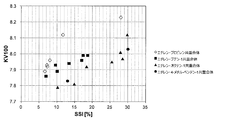
- FIG. 1 is a graph plotting shear stability (SSI) and kinematic viscosity (KV100) at 100 ° C. for the lubricating oil compositions obtained in Example B, Example C and Comparative Example B.
- SSI shear stability
- KV100 kinematic viscosity
- n 1 to n 2 means n 1 or more and n 2 or less.
- n 1 is a lower limit value of the numerical range
- n 2 is an upper limit value of the numerical range.
- the lubricating oil composition of the present invention contains a specific ethylene / ⁇ -olefin copolymer (A), and preferably further contains a lubricating base oil (B).
- the copolymer (A) can function as a viscosity modifier for lubricating oil.
- the lubricating oil composition of the present invention is for an engine in one embodiment.
- the copolymer (A) can function as a viscosity modifier for engine lubricating oil.
- the ethylene / ⁇ -olefin copolymer (A) (hereinafter also referred to as “copolymer (A)”) used in the present invention will be described.
- the copolymer (A) has a content ratio of structural units derived from ethylene of 70 to 90 mol% and an intrinsic viscosity [ ⁇ ] of 0.3 to 1.0 dl / g.
- the copolymer (A) is a copolymer of at least ethylene and an ⁇ -olefin having 4 or more carbon atoms.
- the copolymer (A) having a structural unit derived from an ⁇ -olefin having 4 or more carbon atoms as a comonomer unit, a lubricating oil composition having excellent shear stability and a low kinematic viscosity at 100 ° C. can be obtained. There is a tendency.
- Examples of the ⁇ -olefin having 4 or more carbon atoms constituting the copolymer (A) in the first embodiment include butene-1, pentene-1, hexene-1, 4-methyl-pentene-1, and heptene-1.
- Examples thereof include ⁇ -olefins having 4 to 20 carbon atoms, preferably 4 to 12 carbon atoms, and more preferably 5 to 8 carbon atoms. Further, the ⁇ -olefin may be linear or branched. Of the ⁇ -olefins, butene-1, octene-1, 4-methyl-pentene-1 are preferred in terms of giving the lubricating oil composition a low kinematic viscosity at 100 ° C. and good shear stability. 1,4-methyl-pentene-1 is more preferred.
- the copolymer (A) can have one or more structural units derived from ⁇ -olefin.
- the content ratio of the structural unit derived from ethylene (ethylene unit) is more than 70 mol% and 90 mol% or less, preferably 72 mol% or more, more preferably 74. In addition, it is preferably not more than 89 mol%, more preferably not more than 88 mol%. If this content is above the lower limit, the lubricating oil composition tends to have high shear stability, and if it is below the upper limit, it tends to be excellent in oil solubility and low-temperature storage stability. .
- the content ratio of the constituent unit derived from ⁇ -olefin having 4 or more carbon atoms is preferably 10 mol% or more and less than 30 mol%, and more Preferably it is 11 mol% or more, More preferably, it is 12 mol% or more; More preferably, it is 28 mol% or less, More preferably, it is 26 mol% or less.
- the copolymer (A) is a copolymer of at least ethylene and an ⁇ -olefin.
- the copolymer (A) of the second aspect is preferable as a component of the engine lubricating oil composition.
- Examples of the ⁇ -olefin constituting the copolymer (A) in the second embodiment include propylene, butene-1, pentene-1, hexene-1, 4-methyl-pentene-1, heptene-1, octene- 1, decene-1, undecene-1, dodecene-1, tridecene-1, tetradecene-1, pentadecene-1, hexadecene-1, heptadecene-1, octadecene-1, nonadecene-1, eicosene-1, etc.
- ⁇ -olefins having ⁇ 20, preferably 3 to 12 carbon atoms are mentioned. Further, the ⁇ -olefin may be linear or branched.
- propylene is preferable because it gives good low temperature viscosity characteristics and shear stability to the engine lubricating oil composition.
- the copolymer (A) can have one or more structural units derived from ⁇ -olefin.
- the content ratio of the structural unit derived from ethylene (ethylene unit) is 70 to 90 mol%, preferably more than 70 mol%, more preferably 72 mol% or more, Preferably it is 74 mol% or more, Especially preferably, it is 79 mol% or more; Preferably it is 89 mol% or less, More preferably, it is 88 mol% or less, More preferably, it is 86 mol% or less.
- this content is above the lower limit, the lubricating oil composition tends to have a low CCS viscosity and high shear stability. When the content is below the upper limit, solubility in oil and low temperature It tends to be excellent in storage stability.
- the content ratio of the structural unit derived from ⁇ -olefin ( ⁇ -olefin unit) is preferably 10 to 30 mol%, more preferably 11 mol% or more, Preferably, it is at least 12 mol%, particularly preferably at least 14 mol%; it is preferably less than 30 mol%, more preferably at most 28 mol%, even more preferably at most 26 mol%, particularly preferably at most 21 mol%. is there.
- the content ratio of the structural unit derived from ethylene is the total amount of the structural unit derived from the monomer constituting the copolymer (A) (for example, ethylene, ⁇ -olefin having 4 or more carbon atoms, ⁇ -olefin, and other monomers). It is a value when it is 100 mol%.
- Examples of other monomers include cyclic olefins, aromatic vinyl compounds, conjugated dienes, non-conjugated polyenes, functionalized vinyl compounds, hydroxyl group-containing olefins, and halogenated olefins.
- Examples of the cyclic olefin, aromatic vinyl compound, conjugated diene, non-conjugated polyene, functionalized vinyl compound, hydroxyl group-containing olefin and halogenated olefin are described in, for example, paragraphs [0035] to [0041] of JP2013-169585A. The compound of this is mentioned.
- the copolymer (A) has an intrinsic viscosity [ ⁇ ] of 0.3 to 1.0 dl / g, preferably 0.3 dl / g or more and less than 1.0 dl / g, more preferably 0.35 to 0.001. 99 dl / g, particularly preferably 0.40 to 0.98 dl / g.
- the intrinsic viscosity [ ⁇ ] is equal to or higher than the lower limit, the addition of a small amount of the copolymer (A) tends to increase the HTHS viscosity described later of the lubricating oil composition, and the CCS viscosity tends to decrease. If it is not more than the upper limit, the shear stability of the lubricating oil composition tends to be high, and the 100 ° C. kinematic viscosity tends to be low.
- the intrinsic viscosity [ ⁇ ] is measured at 135 ° C. in decalin.
- the copolymer (A) according to the first embodiment wherein the content of the structural unit derived from ethylene is more than 70 mol% and 90 mol% or less, and the intrinsic viscosity [ ⁇ ] is 0.3 to 1.0 dl / g. Since the viscosity adjustment effect can be sufficiently exerted even if the amount added to the lubricating oil composition is small, it is excellent in terms of cost.
- the copolymer of the second embodiment in which the content ratio of the structural unit derived from ethylene is 70 to 90 mol%, particularly 79 to 90 mol%, and the intrinsic viscosity [ ⁇ ] is 0.3 to 1.0 dl / g ( A) is excellent in terms of cost since the viscosity adjusting effect can be sufficiently exhibited even if the amount added to the lubricating oil composition is small.
- the copolymer (A) is preferably a copolymer having a melting point measured by a differential scanning calorimeter (DSC) of 100 ° C. or lower or a melting point not observed, and a melting point of 95 ° C. or lower, More preferred is a copolymer whose melting point is not observed.
- DSC differential scanning calorimeter
- the copolymer (A) is, for example, a catalyst containing a compound containing a transition metal such as vanadium, zirconium, titanium, hafnium, and at least one selected from an organoaluminum compound, an organoaluminum oxy compound, and an ionized ionic compound.
- a catalyst containing a compound containing a transition metal such as vanadium, zirconium, titanium, hafnium
- at least one selected from an organoaluminum compound, an organoaluminum oxy compound, and an ionized ionic compound can be produced by copolymerizing at least ethylene and an ⁇ -olefin.
- Examples of the olefin polymerization catalyst used at this time include the catalysts described in International Publication No. 00/34420.
- the copolymer (A) can be used alone or in combination of two or more.
- the content ratio of the copolymer (A) in the lubricating oil composition of the present invention is usually 0.1 to 5.0% by mass, preferably 0.2 to 0.2% by mass of the total amount of the composition. 4.0% by mass, particularly preferably 0.3 to 3.0% by mass.
- a sufficient effect can be obtained only by using a small amount of the copolymer (A), and is therefore preferable from the viewpoint of cost.
- the lubricating oil composition of the present invention for example, an engine lubricating oil composition, preferably further contains a lubricating base oil (B) (hereinafter also referred to as “base oil (B)”).
- base oil (B) those usually used as a lubricating base oil such as an engine lubricating base oil can be used without limitation, and examples thereof include mineral oil and synthetic oil.
- base oil (B) a blend of mineral oil and synthetic oil may be used.
- the kinematic viscosity at 100 ° C. of the base oil (B) is usually 1 to 50 mm 2 / s, preferably 1.5 to 40 mm 2 / s, more preferably 2 to 30 mm 2 / s.
- Mineral oil is generally used through a refining process such as dewaxing, and there are several grades depending on the refining method, and this grade is defined by API (American Petroleum Institute) classification.
- mineral oils containing 0.5 to 10% by weight of wax are used.
- a highly refined oil having a composition mainly composed of isoparaffin having a low pour point and a high viscosity index produced by a hydrocracking refining method can be used.
- a mineral oil having a kinematic viscosity at 40 ° C. of 10 to 200 mm 2 / s is generally used.
- synthetic oils include poly ⁇ -olefins; diesters such as polyol esters, dioctyl phthalate, and dioctyl sebacate; and polyalkylene glycols.
- Table 1 shows the characteristics of lubricant base oils classified into each group.
- the poly- ⁇ -olefin in Table 1 is a hydrocarbon polymer obtained by polymerizing an ⁇ -olefin having 10 or more carbon atoms at least as a raw material monomer, and examples thereof include polydecene obtained by polymerizing decene-1. .
- the base oil (B) is preferably a mineral oil belonging to group (II) or group (III) or a poly- ⁇ -olefin belonging to group (IV).
- Group (II) and group (III) tend to have a lower wax concentration than group (I).
- the mineral oils belonging to Group (II) or Group (III) those having a kinematic viscosity at 100 ° C. of 1 to 50 mm 2 / s are preferable.
- the base oil (B) preferably has one or both properties selected from the following (B0-1) to (B0-2) particularly from the viewpoint of low-temperature properties.
- the kinematic viscosity at 100 ° C. is 2 to 10 mm 2 / s, preferably 3 to 8 mm 2 / s.
- the resulting lubricating oil composition is excellent in fluidity and lubricity.
- the obtained engine lubricating oil composition is excellent in CCS viscosity.
- the viscosity index is 90 or more, preferably 100 or more. Although there is no restriction
- Viscosity index The method described in ASTM D2270 (JIS K2283).
- the base oil (B) can be used alone or in combination of two or more.
- the content ratio of the base oil (B) in the lubricating oil composition of the present invention is usually 50% by mass or more, preferably 70% by mass or more, particularly preferably 80% by mass of the total amount of the composition. %, And the upper limit of the content ratio of the base oil (B) is defined by the amount of the copolymer (A) and the additive.
- the lubricating oil composition of the present invention When used as a lubricating oil additive composition (so-called concentrate), the lubricating oil composition comprises 1 to 50 parts by mass of the copolymer (A) and 50 base oil (B). These can be contained in a ratio of ⁇ 99 parts by mass (provided that the total of the copolymer (A) and the base oil (B) is 100 parts by mass). The ratio is preferably in the range of 2 to 40 parts by weight of the copolymer (A) and 60 to 98 parts by weight of the base oil (B), more preferably 3 to 30 parts by weight of the copolymer (A). The base oil (B) is in the range of 70 to 97 parts by mass.
- the lubricating oil composition of the present invention when used as a lubricating oil additive composition (so-called concentrate), it usually does not contain an additive which will be described later, or 0.01% of an antioxidant which will be described later if necessary.
- the content is generally in the range of ⁇ 1% by mass, preferably 0.05 to 0.5% by mass. You may use it as lubricating oil compositions, such as a lubricating oil composition for engines, by mix
- the lubricating oil composition of the present invention can contain other components (additives) other than the copolymer (A) and the base oil (B).
- Other components include, for example, other viscosity modifiers other than the copolymer (A), pour point depressants, cleaning dispersants, antiwear agents, antifoaming agents, antioxidants, friction modifiers, color stabilizers. Rust inhibitors, corrosion inhibitors and metal deactivators.
- viscosity modifiers include, for example, polyisobutenes, polymethacrylates, diene polymers, polyalkylstyrenes, esterified styrene-maleic anhydride copolymers, alkenyl arene conjugated diene copolymers And polymers such as polyolefins, hydrogenated SBR (styrene butadiene rubber) and SEBS (styrene ethylene butylene styrene block copolymer). Multifunctional viscosity modifiers that also have dispersibility and / or antioxidant properties are known and may be used arbitrarily.
- pour point depressants examples include alkylated naphthalene, (co) polymer of alkyl (meth) acrylate, copolymer of alkyl fumarate and vinyl acetate, ⁇ -olefin polymer, ⁇ -olefin and styrene. A copolymer is mentioned. In particular, (co) polymers of alkyl (meth) acrylates are preferred.
- detergent dispersant examples include sulfonates such as calcium sulfonate and magnesium sulfonate; finates; salicylates; succinimides; benzylamines.
- the amount of the typical detergent and dispersant in the lubricating oil composition is not particularly limited as long as the effect of the present invention is exhibited, but is usually 1 to 10% by mass, preferably 1.5 to 9.0% by mass, more preferably Is 2.0 to 8.0% by mass. All of these amounts are based on the absence of oil in the cleaning dispersant (ie, no diluent oil conventionally supplied to them).
- Antiwear agents include metal thiophosphates, phosphate esters and salts thereof, phosphorus-containing carboxylic acids, esters, ethers, amides; and phosphorus-containing wear inhibitors such as phosphites / An extreme pressure agent is mentioned.
- the antiwear agent is a zinc dialkyldithiophosphate (ZDP).
- ZDP zinc dialkyldithiophosphate
- a typical ZDP may contain 11% by weight of P (calculated based on the absence of oil), with a suitable amount of 0.09 to 0.82% by weight.
- Antiwear agents that do not contain phosphorus include boric acid esters (including boric acid epoxides), dithiocarbamate compounds, molybdenum-containing compounds, and sulfurized olefins.
- the phosphorus-containing antiwear agent is not particularly limited as long as the effect of the present invention is exhibited, but is usually 0.01 to 0.2% by mass, preferably 0.015 to 0.15% by mass, and more preferably 0.8. It may be present in an amount to provide 02-0.1% by weight, more preferably 0.025-0.08% by weight phosphorus.
- antifoaming agent examples include silicon-based antifoaming agents such as dimethylsiloxane and silica gel dispersion; alcohols and ester-based antifoaming agents.
- antioxidants examples include phenol-based antioxidants such as 2,6-di-t-butyl-4-methylphenol; and amine-based antioxidants such as dioctyldiphenylamine.
- the typical amount of antioxidant will of course depend on the specific antioxidant and its individual effectiveness, but exemplary total amounts are 0.01-5% by weight, preferably 0.15 It can be -4.5% by mass, more preferably 0.2-4% by mass.
- one or more antioxidants may be present and these particular combinations can be synergistic to the overall effect of combining them.
- Examples of the rust inhibitor include carboxylic acid, carboxylate, ester, and phosphoric acid.
- Examples of the corrosion inhibitor include benzotriazole, thiadiazole, and imidazole compounds.
- the content ratio when the lubricating oil composition of the present invention (for example, the lubricating oil composition for an engine) contains an additive is not particularly limited, but the total of the base oil (B) and all the additives is 100% by mass.
- the total content of additives is usually more than 0% by weight, preferably 1% by weight or more, more preferably 3% by weight or more; usually 40% by weight or less, preferably It is 30 mass% or less, More preferably, it is 20 mass% or less.
- the lubricating oil composition of the present invention for example, the lubricating oil composition for engines, is prepared by a conventionally known method, for example, by mixing the copolymer (A), the base oil (B) and additives as necessary. be able to.
- the copolymer (A) may be arbitrarily supplied as a concentrate in the base oil (B) because it is easy to handle.
- the lubricating oil composition of the present invention preferably has a low viscosity under a high temperature and low shear rate, for example, in order to improve fuel efficiency during engine operation at a high temperature. That is, the kinematic viscosity at 100 ° C. of the lubricating oil composition of the present invention is usually 50 mm 2 / s or less, preferably 1 to 40 mm 2 / s, more preferably 2 to 30 mm 2 / s.
- the lubricating oil composition of the present invention has stability against a shearing force at the time of starting the engine and during operation, for example (evaluated by, for example, Shear Stability Index (SSI) described later).
- SSI Shear Stability Index
- Lubricant for engine has viscosity that can maintain lubricity (hold oil film) under high temperature and high shear rate to protect sliding part during engine operation at high temperature (for example, High Temperature High Shear (HTHS) described later) (Evaluated by viscosity) is preferred.
- HTHS High Temperature High Shear
- the lubricating oil composition of the present invention is excellent in the balance of the above physical properties, and specifically has a low 100 ° C. kinematic viscosity and Has good shear stability.
- the lubricating oil composition of the present invention includes, for example, automotive engine oil, lubricating oil for heavy-duty diesel engines, lubricating oil for marine diesel engines, lubricating oil for two-stroke engines, automatic transmissions and As a lubricating oil for manual transmission, a gear lubricating oil, grease, etc., it can be applied to any of various known mechanical devices.
- the engine lubricating oil composition (hereinafter also referred to as “the engine lubricating oil composition of the present invention”) containing the copolymer (A) of the second aspect will be described.
- the engine lubricating oil preferably has a small friction loss at the sliding portion and a stirring loss due to the viscosity of the lubricating oil.
- Lubricant for engine has viscosity that can maintain lubricity (hold oil film) under high temperature and high shear rate to protect sliding part during engine operation at high temperature (for example, High Temperature High Shear (HTHS) described later)
- HTHS High Temperature High Shear
- the viscosity at a low temperature and a high shear rate is small (for example, evaluated by a Cold Cranking Simulator (CCS) viscosity described later). Is preferred.
- the viscosity under a high temperature and low shear rate is in a specific range.
- the lower the kinematic viscosity the lower the viscous resistance, which is effective in reducing fuel consumption.
- the kinematic viscosity is too low, the oil film becomes thin and the lubricity may be poor.
- the kinematic viscosity at 100 ° C. be in a specific range. That is, the engine lubricating oil composition of the present invention has a kinematic viscosity at 100 ° C. of usually 7.4 to 14.7 mm 2 / s, preferably 7.5 to 14.5 mm 2 / s, more preferably Is 7.6 to 14.0 mm 2 / s.
- the engine lubricating oil has stability against a shearing force at the time of starting the engine and during operation (e.g., evaluated by Shear Stability Index (SSI) described later).
- SSI Shear Stability Index
- the engine lubricating oil composition of the present invention is excellent in the balance of the above physical properties, and particularly has a low CCS viscosity, a specific kinematic viscosity and good shear stability. Therefore, the engine lubricating oil composition of the present invention is useful as, for example, engine oils such as gasoline engine oil and diesel engine oil, and specifically, for gasoline engines for automobiles, gasoline engines for motorcycles, and large vehicles. It is useful as an engine oil for engines such as diesel engines and marine diesel engines.
- the viscosity modifier for lubricating oil of the present invention contains the copolymer (A) of ethylene and an ⁇ -olefin having 4 or more carbon atoms according to the first aspect described above.
- the preferable requirements for the copolymer (A) of the first aspect are as described above.
- the content ratio of the copolymer (A) of the first aspect in the viscosity modifier for lubricating oil of the present invention is usually 5% by mass or more, preferably 25% by mass or more, more preferably 50% by mass or more.
- the viscosity modifier for lubricating oil of the present invention can further contain at least one selected from the base oil (B) and additives described above. .
- the viscosity modifier for an engine lubricating oil of the present invention contains the ethylene / ⁇ -olefin copolymer (A) of the second aspect described above.
- the content ratio of the structural unit derived from ethylene in the copolymer (A) is 79 to 90 mol%.
- Other preferable requirements for the copolymer (A) are as described above.
- the content ratio of the copolymer (A) of the second aspect in the viscosity modifier of the present invention is usually 5% by mass or more, preferably 25% by mass or more, more preferably 50% by mass or more.
- the viscosity modifier of the present invention may further contain at least one selected from the above-described base oil (B) and additives as long as the content ratio of the copolymer (A) is in the above range.
- [ ⁇ ] lim ( ⁇ sp / C) (C ⁇ 0) ⁇ Content of ethylene unit (C2 content)>
- the content ratio of the structural unit derived from ethylene and the content ratio (mol%) of the structural unit derived from ⁇ -olefin in the ethylene / ⁇ -olefin copolymer were determined by analysis of 13 C-NMR spectrum.
- AVANCE III500 CryoProbe Prodigy type nuclear magnetic resonance apparatus manufactured by Bruker Biospin (Measurement conditions) Measurement nucleus: 13 C (125 MHz), measurement mode: single pulse proton broadband decoupling, pulse width: 45 ° (5.00 ⁇ sec), number of points: 64 k, measurement range: 250 ppm ( ⁇ 55 to 195 ppm), repetition time: 5.5 seconds, number of integration: 512 times, measurement solvent: orthodichlorobenzene / benzene-d 6 (4/1 v / v), sample concentration: ca. 60 mg / 0.6 mL, measurement temperature: 120 ° C., window function: exponential (BF: 1.0 Hz), chemical shift standard: benzene-d 6 (128.0 ppm).
- ⁇ DSC measurement> The melting point of the ethylene / ⁇ -olefin copolymer was measured as follows using a differential scanning calorimeter (X-DSC7000) manufactured by SII calibrated with an indium standard.
- a measurement sample (ethylene / ⁇ -olefin copolymer) was weighed on an aluminum DSC pan so as to be about 10 mg.
- the lid was crimped onto the pan to create a sealed atmosphere to obtain a sample pan.
- a sample pan was placed in the DSC cell and an empty aluminum pan was placed as a reference.
- the DSC cell was heated from 30 ° C. (room temperature) to 150 ° C. at 10 ° C./min in a nitrogen atmosphere (first temperature raising process). Next, after holding at 150 ° C. for 5 minutes, the temperature was lowered at 10 ° C./min, and the DSC cell was cooled to ⁇ 100 ° C. (temperature lowering process). After maintaining at ⁇ 100 ° C. for 5 minutes, the DSC cell was heated to 150 ° C. at 10 ° C./min (second temperature raising process).
- the melting peak top temperature of the enthalpy curve obtained in the second temperature raising process was defined as the melting point (Tm).
- Tm melting point
- the maximum peak temperature was defined as Tm.
- melting fusing point is not observed means that it is amorphous.
- HTHS High Temperature High Shear
- CCS Cold Cranking Simulator
- the CCS viscosity ( ⁇ 35 ° C.) of the lubricating oil composition was measured based on ASTM D5393.
- the CCS viscosity is used for evaluation of slidability (startability) at a low temperature on the crankshaft. It shows that the low temperature viscosity (low temperature characteristic) of lubricating oil is excellent, so that CCS viscosity is small.
- the smaller the CCS viscosity of the lubricating oil composition the better the lubricating oil composition is in fuel efficiency at low temperatures (low temperature startability).
- SSI Shear Stability Index
- SSI (%) 100 ⁇ (Vo ⁇ Vs) / (Vo ⁇ Vb)
- Vo 100 ° C.
- Vs Kinematic viscosity at 100 ° C. after ultrasonic irradiation (mm 2 / s)
- Vb 100 ° C.
- a lubricating oil composition or engine oil (lubricating oil composition) prepared by adjusting the component amount of the viscosity modifier for lubricating oil (ethylene / ⁇ -olefin copolymer obtained in the following polymerization example) to 0% by mass Kinematic viscosity (mm 2 / s) [Polymerization Examples 1A, 1B]
- polymerization examples of the ethylene / ⁇ -olefin copolymer will be described.
- a plurality of polymerizations may be performed.
- the compound (1) represented by the following formula used as a catalyst was synthesized by a known method.
- a hexane solution (0.020 mmol / L) of the above compound (1), triphenylcarbenium tetrakis (pentafluoro) is fed into one feed port of a 0.95 L stirring blade pressure-added continuous polymerization reactor sufficiently purged with nitrogen.
- ethylene was continuously supplied to another supply port of the continuous polymerization reactor at a flow rate of 251 g / hour, propylene at a flow rate of 122 g / hour, and hydrogen at a flow rate of 6.2 NL / hour.
- the heat of polymerization reaction was removed by circulating a refrigerant through a jacket provided on the outer periphery of the polymerization reactor.
- the hexane solution containing the ethylene / propylene copolymer produced by performing the polymerization under the above-described conditions is passed through the discharge port provided at the top of the polymerization reactor so that the pressure is maintained at 3.6 MPa-G. -It was continuously discharged as a propylene copolymer at a rate of 189 kg / hour.
- the resulting polymerization solution was put into a large amount of methanol to precipitate an ethylene / propylene copolymer. Then, the ethylene / propylene copolymer was dried under reduced pressure at 180 ° C. for 1 hour. Properties of the resulting polymers are shown in Table 2A and Table 2-1B.
- Polymerization Examples 2A to 10A It carried out like polymerization example 1A except having changed polymerization conditions as indicated in Table 2A. However, in Polymerization Examples 7A and 8A, a hexane solution (0.038 mmol / L) of the above compound (1), a hexane solution of Ph 3 CB (C 6 F 5 ) 4 (0.30 mmol / L), iBu 3 Al A hexane solution (5.0 mmol / L) was used.
- Polymerization Examples 2B to 22B The same procedure as in Polymerization Example 1B was conducted except that the polymerization conditions were changed as described in Tables 2-1B and 2-2B. However, in Polymerization Example 6B, a hexane solution (0.038 mmol / L) of the above compound (1), a hexane solution of Ph 3 CB (C 6 F 5 ) 4 (0.30 mmol / L), and a hexane solution of iBu 3 Al. (5.0 mmol / L) was used.
- polymerization examples 21B and 22B a hexane solution (0.015 mmol / L) of the above compound (1), a hexane solution (1.2 mmol / L) of Ph 3 CB (C 6 F 5 ) 4 , iBu 3 Al A hexane solution (5.0 mmol / L) was used.
- propylene butene-1 was used as a comonomer in polymerization examples 7B to 13B, octene-1 was used as polymerization examples 14B to 20B, and 4-methyl-pentene-1 was used as polymerization examples 21B and 22B.
- Example A and Comparative Example A A lubricating oil composition was prepared using the ethylene / propylene copolymer obtained in the above polymerization example as a viscosity modifier for lubricating oil. The addition amount of the ethylene / propylene copolymer was adjusted so that the HTHS at 150 ° C. of the lubricating oil composition was about 2.6 mPa ⁇ s.
- the formulation composition is as follows.
- Additive * 8.64% by mass
- Pour point depressant 0.3% by mass
- Ethylene / propylene copolymer 0.53 to 2.92% by mass (as shown in Table 3A) Total 100.0 (mass%)
- Additive Ca and Na overbased detergent, N-containing dispersant, aminic and phenolic antioxidants, zinc dialkyldithiophosphates, friction modifiers, and antifoam agents Including conventional GF-5 engine oil additive package.
- Example B A lubricating oil composition was prepared using the ethylene / ⁇ -olefin copolymer obtained in the above polymerization example as a viscosity modifier for lubricating oil.
- the addition amount of the ethylene / ⁇ -olefin copolymer was adjusted so that the HTHS at 150 ° C. of the lubricating oil composition was about 2.6 mPa ⁇ s.
- the formulation composition is as follows.
- API group (III) base oil (“Yubase-4”, manufactured by SK Lubricants, kinematic viscosity at 100 ° C .: 4.212 mm 2 / s, viscosity index: 123)
- Additive * 8.64% by mass
- Pour point depressant 0.3% by mass
- Ethylene / ⁇ -olefin copolymer 0.63 to 1.44% by mass (as shown in Table 3B) Total 100.0 (mass%)
- Additive Ca and Na overbased detergent, N-containing dispersant, aminic and phenolic antioxidants, zinc dialkyldithiophosphates, friction modifiers, and antifoam agents Including conventional GF-5 engine oil additive package.
- FIG. 1 shows a graph plotting shear stability (SSI) and kinematic viscosity (KV100) at 100 ° C. for the lubricating oil compositions obtained in Example B, Example C and Comparative Example B.
- Example B ethylene-butene-1 copolymer, ethylene-octene-1 copolymer, ethylene-4-methyl-pentene-1 copolymer having comparable shear stability (SSI) and Example
- SSI shear stability
- Example B ethylene / propylene copolymer
Landscapes
- Chemical & Material Sciences (AREA)
- Chemical Kinetics & Catalysis (AREA)
- Organic Chemistry (AREA)
- Oil, Petroleum & Natural Gas (AREA)
- General Chemical & Material Sciences (AREA)
- Health & Medical Sciences (AREA)
- Medicinal Chemistry (AREA)
- Polymers & Plastics (AREA)
- Lubricants (AREA)
Abstract
L'invention concerne une composition d'huile lubrifiante contenant un copolymère éthylène-alpha-oléfine (A) ayant une teneur en unités structurales dérivées de l'éthylène de 70 à 90 % en moles et une viscosité intrinsèque [η] de 0,3 à 1,0 dL/g.
Priority Applications (4)
| Application Number | Priority Date | Filing Date | Title |
|---|---|---|---|
| CN201980016497.7A CN111801405A (zh) | 2018-04-17 | 2019-04-16 | 润滑油组合物及润滑油用粘度调节剂 |
| JP2020514385A JP7189941B2 (ja) | 2018-04-17 | 2019-04-16 | 潤滑油組成物および潤滑油用粘度調整剤 |
| US17/044,846 US11655428B2 (en) | 2018-04-17 | 2019-04-16 | Lubricating oil compositions and lubricating oil viscosity modifiers |
| EP19787977.8A EP3783087B1 (fr) | 2018-04-17 | 2019-04-16 | Composition d'huile lubrifiante et modificateur de viscosité pour huile lubrifiante |
Applications Claiming Priority (4)
| Application Number | Priority Date | Filing Date | Title |
|---|---|---|---|
| JP2018-079175 | 2018-04-17 | ||
| JP2018079176 | 2018-04-17 | ||
| JP2018-079176 | 2018-04-17 | ||
| JP2018079175 | 2018-04-17 |
Publications (1)
| Publication Number | Publication Date |
|---|---|
| WO2019203210A1 true WO2019203210A1 (fr) | 2019-10-24 |
Family
ID=68240138
Family Applications (1)
| Application Number | Title | Priority Date | Filing Date |
|---|---|---|---|
| PCT/JP2019/016255 Ceased WO2019203210A1 (fr) | 2018-04-17 | 2019-04-16 | Composition d'huile lubrifiante et modificateur de viscosité pour huile lubrifiante |
Country Status (5)
| Country | Link |
|---|---|
| US (1) | US11655428B2 (fr) |
| EP (1) | EP3783087B1 (fr) |
| JP (1) | JP7189941B2 (fr) |
| CN (1) | CN111801405A (fr) |
| WO (1) | WO2019203210A1 (fr) |
Cited By (1)
| Publication number | Priority date | Publication date | Assignee | Title |
|---|---|---|---|---|
| JP2020176178A (ja) * | 2019-04-16 | 2020-10-29 | 三井化学株式会社 | 潤滑油用粘度調整剤および潤滑油組成物 |
Families Citing this family (1)
| Publication number | Priority date | Publication date | Assignee | Title |
|---|---|---|---|---|
| WO2023054440A1 (fr) | 2021-09-30 | 2023-04-06 | 三井化学株式会社 | Composition d'huile lubrifiante |
Citations (10)
| Publication number | Priority date | Publication date | Assignee | Title |
|---|---|---|---|---|
| JPH07150181A (ja) * | 1993-11-30 | 1995-06-13 | Mitsui Petrochem Ind Ltd | 潤滑油添加剤組成物およびその製造方法 |
| WO1998033872A1 (fr) * | 1997-01-31 | 1998-08-06 | Mitsui Chemicals, Inc. | Huile lubrifiante ou composition d'huile lubrifiante et composition de fioul |
| JP2000072825A (ja) * | 1998-06-19 | 2000-03-07 | Idemitsu Petrochem Co Ltd | エチレン系共重合体、その製造方法並びにそれを含む樹脂組成物、成形体および潤滑油 |
| WO2000034420A1 (fr) | 1998-12-09 | 2000-06-15 | Mitsui Chemicals, Inc. | Modificateur de viscosite pour huile lubrifiante et composition d'huile lubrifiante |
| WO2003038017A1 (fr) * | 2001-11-01 | 2003-05-08 | Mitsui Chemicals, Inc. | Additif pour huile lubrifiante et composition d'huile lubrifiante |
| JP2005307099A (ja) * | 2004-04-26 | 2005-11-04 | Mitsui Chemicals Inc | 駆動系潤滑油組成物 |
| WO2006101206A1 (fr) | 2005-03-25 | 2006-09-28 | Mitsui Chemicals, Inc. | Agent de controle de la viscosite d’un lubrifiant pour systeme de transfert d’energie et composition lubrifiante pour systeme de transfert d’energie |
| JP2013169685A (ja) | 2012-02-20 | 2013-09-02 | Mitsui Chemicals Inc | 表面保護フィルム、これを用いた半導体装置の製造方法 |
| WO2015147215A1 (fr) * | 2014-03-28 | 2015-10-01 | 三井化学株式会社 | Copolymère d'éthylène/alpha-oléfine et huile lubrifiante |
| WO2017082182A1 (fr) * | 2015-11-09 | 2017-05-18 | 三井化学株式会社 | Modificateur de viscosité pour huiles lubrifiantes, composition d'additif pour huiles lubrifiantes, et compositions d'huiles lubrifiantes |
Family Cites Families (1)
| Publication number | Priority date | Publication date | Assignee | Title |
|---|---|---|---|---|
| US10077412B2 (en) * | 2014-03-28 | 2018-09-18 | Mitsui Chemicals, Inc. | Viscosity modifier for lubricating oils, additive composition for lubricating oils, and lubricating oil composition |
-
2019
- 2019-04-16 WO PCT/JP2019/016255 patent/WO2019203210A1/fr not_active Ceased
- 2019-04-16 EP EP19787977.8A patent/EP3783087B1/fr active Active
- 2019-04-16 CN CN201980016497.7A patent/CN111801405A/zh active Pending
- 2019-04-16 US US17/044,846 patent/US11655428B2/en active Active
- 2019-04-16 JP JP2020514385A patent/JP7189941B2/ja active Active
Patent Citations (10)
| Publication number | Priority date | Publication date | Assignee | Title |
|---|---|---|---|---|
| JPH07150181A (ja) * | 1993-11-30 | 1995-06-13 | Mitsui Petrochem Ind Ltd | 潤滑油添加剤組成物およびその製造方法 |
| WO1998033872A1 (fr) * | 1997-01-31 | 1998-08-06 | Mitsui Chemicals, Inc. | Huile lubrifiante ou composition d'huile lubrifiante et composition de fioul |
| JP2000072825A (ja) * | 1998-06-19 | 2000-03-07 | Idemitsu Petrochem Co Ltd | エチレン系共重合体、その製造方法並びにそれを含む樹脂組成物、成形体および潤滑油 |
| WO2000034420A1 (fr) | 1998-12-09 | 2000-06-15 | Mitsui Chemicals, Inc. | Modificateur de viscosite pour huile lubrifiante et composition d'huile lubrifiante |
| WO2003038017A1 (fr) * | 2001-11-01 | 2003-05-08 | Mitsui Chemicals, Inc. | Additif pour huile lubrifiante et composition d'huile lubrifiante |
| JP2005307099A (ja) * | 2004-04-26 | 2005-11-04 | Mitsui Chemicals Inc | 駆動系潤滑油組成物 |
| WO2006101206A1 (fr) | 2005-03-25 | 2006-09-28 | Mitsui Chemicals, Inc. | Agent de controle de la viscosite d’un lubrifiant pour systeme de transfert d’energie et composition lubrifiante pour systeme de transfert d’energie |
| JP2013169685A (ja) | 2012-02-20 | 2013-09-02 | Mitsui Chemicals Inc | 表面保護フィルム、これを用いた半導体装置の製造方法 |
| WO2015147215A1 (fr) * | 2014-03-28 | 2015-10-01 | 三井化学株式会社 | Copolymère d'éthylène/alpha-oléfine et huile lubrifiante |
| WO2017082182A1 (fr) * | 2015-11-09 | 2017-05-18 | 三井化学株式会社 | Modificateur de viscosité pour huiles lubrifiantes, composition d'additif pour huiles lubrifiantes, et compositions d'huiles lubrifiantes |
Non-Patent Citations (1)
| Title |
|---|
| See also references of EP3783087A4 |
Cited By (2)
| Publication number | Priority date | Publication date | Assignee | Title |
|---|---|---|---|---|
| JP2020176178A (ja) * | 2019-04-16 | 2020-10-29 | 三井化学株式会社 | 潤滑油用粘度調整剤および潤滑油組成物 |
| JP7291525B2 (ja) | 2019-04-16 | 2023-06-15 | 三井化学株式会社 | 潤滑油用粘度調整剤および潤滑油組成物 |
Also Published As
| Publication number | Publication date |
|---|---|
| JP7189941B2 (ja) | 2022-12-14 |
| EP3783087A4 (fr) | 2021-12-29 |
| EP3783087B1 (fr) | 2022-11-09 |
| US11655428B2 (en) | 2023-05-23 |
| JPWO2019203210A1 (ja) | 2021-04-01 |
| EP3783087A1 (fr) | 2021-02-24 |
| CN111801405A (zh) | 2020-10-20 |
| US20210130725A1 (en) | 2021-05-06 |
Similar Documents
| Publication | Publication Date | Title |
|---|---|---|
| JP5584766B2 (ja) | 潤滑油用粘度調整剤、潤滑油用添加剤組成物、および潤滑油組成物 | |
| RU2638542C2 (ru) | Смазочная композиция для двигателя | |
| JP4634300B2 (ja) | 潤滑油組成物および内燃機関用潤滑油 | |
| JP2019157140A (ja) | 潤滑油用粘度調整剤、潤滑油用添加剤組成物、および潤滑油組成物 | |
| US8410035B2 (en) | Viscosity modifier of lubricating oil for power transmission system and lubricating oil composition for power transmission system | |
| JP7189941B2 (ja) | 潤滑油組成物および潤滑油用粘度調整剤 | |
| JP7752693B2 (ja) | 潤滑油組成物 | |
| CN111621355A (zh) | 用于齿轮油的润滑剂组合物 | |
| JP2013147531A (ja) | 潤滑油用粘度指数向上剤、潤滑油用添加剤組成物および潤滑油組成物 | |
| JP4620966B2 (ja) | 駆動系潤滑油組成物 | |
| US11873462B2 (en) | Lubricating oil composition | |
| CN1333057C (zh) | 润滑油组合物和适用于内燃机的润滑油 | |
| JP7291525B2 (ja) | 潤滑油用粘度調整剤および潤滑油組成物 | |
| JP7219663B2 (ja) | 潤滑油用粘度調整剤および潤滑油組成物 | |
| JP2012172013A (ja) | 潤滑油粘度調整剤、潤滑油用添加剤組成物および潤滑油組成物 | |
| JP2026005766A (ja) | 自動車エンジン用潤滑油組成物 | |
| JP5138965B2 (ja) | 潤滑油組成物、ミスト発生抑制剤 | |
| CN111621352A (zh) | 用于液压油的润滑剂组合物 |
Legal Events
| Date | Code | Title | Description |
|---|---|---|---|
| 121 | Ep: the epo has been informed by wipo that ep was designated in this application |
Ref document number: 19787977 Country of ref document: EP Kind code of ref document: A1 |
|
| ENP | Entry into the national phase |
Ref document number: 2020514385 Country of ref document: JP Kind code of ref document: A |
|
| NENP | Non-entry into the national phase |
Ref country code: DE |
|
| ENP | Entry into the national phase |
Ref document number: 2019787977 Country of ref document: EP Effective date: 20201117 |