WO2019203302A1 - ヘモグロビン分析方法 - Google Patents
ヘモグロビン分析方法 Download PDFInfo
- Publication number
- WO2019203302A1 WO2019203302A1 PCT/JP2019/016633 JP2019016633W WO2019203302A1 WO 2019203302 A1 WO2019203302 A1 WO 2019203302A1 JP 2019016633 W JP2019016633 W JP 2019016633W WO 2019203302 A1 WO2019203302 A1 WO 2019203302A1
- Authority
- WO
- WIPO (PCT)
- Prior art keywords
- eluent
- hemoglobin
- mosm
- buffer
- osmotic pressure
- Prior art date
- Legal status (The legal status is an assumption and is not a legal conclusion. Google has not performed a legal analysis and makes no representation as to the accuracy of the status listed.)
- Ceased
Links
Images

Classifications
-
- G—PHYSICS
- G01—MEASURING; TESTING
- G01N—INVESTIGATING OR ANALYSING MATERIALS BY DETERMINING THEIR CHEMICAL OR PHYSICAL PROPERTIES
- G01N30/00—Investigating or analysing materials by separation into components using adsorption, absorption or similar phenomena or using ion-exchange, e.g. chromatography or field flow fractionation
- G01N30/02—Column chromatography
- G01N30/88—Integrated analysis systems specially adapted therefor, not covered by a single one of the groups G01N30/04 - G01N30/86
-
- G—PHYSICS
- G01—MEASURING; TESTING
- G01N—INVESTIGATING OR ANALYSING MATERIALS BY DETERMINING THEIR CHEMICAL OR PHYSICAL PROPERTIES
- G01N30/00—Investigating or analysing materials by separation into components using adsorption, absorption or similar phenomena or using ion-exchange, e.g. chromatography or field flow fractionation
- G01N30/02—Column chromatography
-
- G—PHYSICS
- G01—MEASURING; TESTING
- G01N—INVESTIGATING OR ANALYSING MATERIALS BY DETERMINING THEIR CHEMICAL OR PHYSICAL PROPERTIES
- G01N33/00—Investigating or analysing materials by specific methods not covered by groups G01N1/00 - G01N31/00
- G01N33/48—Biological material, e.g. blood, urine; Haemocytometers
- G01N33/50—Chemical analysis of biological material, e.g. blood, urine; Testing involving biospecific ligand binding methods; Immunological testing
- G01N33/72—Chemical analysis of biological material, e.g. blood, urine; Testing involving biospecific ligand binding methods; Immunological testing involving blood pigments, e.g. haemoglobin, bilirubin or other porphyrins; involving occult blood
- G01N33/721—Haemoglobin
-
- G—PHYSICS
- G01—MEASURING; TESTING
- G01N—INVESTIGATING OR ANALYSING MATERIALS BY DETERMINING THEIR CHEMICAL OR PHYSICAL PROPERTIES
- G01N30/00—Investigating or analysing materials by separation into components using adsorption, absorption or similar phenomena or using ion-exchange, e.g. chromatography or field flow fractionation
- G01N30/02—Column chromatography
- G01N30/04—Preparation or injection of sample to be analysed
- G01N30/06—Preparation
- G01N2030/067—Preparation by reaction, e.g. derivatising the sample
-
- G—PHYSICS
- G01—MEASURING; TESTING
- G01N—INVESTIGATING OR ANALYSING MATERIALS BY DETERMINING THEIR CHEMICAL OR PHYSICAL PROPERTIES
- G01N30/00—Investigating or analysing materials by separation into components using adsorption, absorption or similar phenomena or using ion-exchange, e.g. chromatography or field flow fractionation
- G01N30/02—Column chromatography
- G01N30/88—Integrated analysis systems specially adapted therefor, not covered by a single one of the groups G01N30/04 - G01N30/86
- G01N2030/8809—Integrated analysis systems specially adapted therefor, not covered by a single one of the groups G01N30/04 - G01N30/86 analysis specially adapted for the sample
- G01N2030/8813—Integrated analysis systems specially adapted therefor, not covered by a single one of the groups G01N30/04 - G01N30/86 analysis specially adapted for the sample biological materials
- G01N2030/8822—Integrated analysis systems specially adapted therefor, not covered by a single one of the groups G01N30/04 - G01N30/86 analysis specially adapted for the sample biological materials involving blood
-
- G—PHYSICS
- G01—MEASURING; TESTING
- G01N—INVESTIGATING OR ANALYSING MATERIALS BY DETERMINING THEIR CHEMICAL OR PHYSICAL PROPERTIES
- G01N30/00—Investigating or analysing materials by separation into components using adsorption, absorption or similar phenomena or using ion-exchange, e.g. chromatography or field flow fractionation
- G01N30/02—Column chromatography
- G01N30/26—Conditioning of the fluid carrier; Flow patterns
- G01N30/28—Control of physical parameters of the fluid carrier
- G01N30/34—Control of physical parameters of the fluid carrier of fluid composition, e.g. gradient
-
- G—PHYSICS
- G01—MEASURING; TESTING
- G01N—INVESTIGATING OR ANALYSING MATERIALS BY DETERMINING THEIR CHEMICAL OR PHYSICAL PROPERTIES
- G01N30/00—Investigating or analysing materials by separation into components using adsorption, absorption or similar phenomena or using ion-exchange, e.g. chromatography or field flow fractionation
- G01N30/96—Investigating or analysing materials by separation into components using adsorption, absorption or similar phenomena or using ion-exchange, e.g. chromatography or field flow fractionation using ion-exchange
Definitions
- the present invention relates to a method for analyzing hemoglobin.
- Hemoglobin is a chromoprotein composed of hem (pigment part) that binds to oxygen and globin that holds heme, and is involved in the transport of oxygen to cells throughout the body.
- a normal human globin polypeptide has four types of subunits, ⁇ , ⁇ , ⁇ , and ⁇ chains, which constitute a tetramer composed of two ⁇ chains and two non- ⁇ chains.
- HbA mainly includes HbA0 and glycated HbA1c, and HbA1c is used as a marker for diabetes and the like.
- An abnormality in the three-dimensional structure of the globin subunit causes abnormal Hb disease, while dysplasia of the globin subunit causes thalassemia, all of which cause anemia and, in severe cases, hemolysis, growth failure and bone deformation.
- Abnormal Hb disease is generally diagnosed by detecting abnormal Hb such as HbS, HbC, HbE, HbD.
- Thalassemia is roughly classified into ⁇ -thalassemia due to poor formation of ⁇ -chain and ⁇ -thalassemia due to poor formation of ⁇ -chain, and is generally diagnosed using high values such as HbA2 and HbF as indicators.
- Patent Document 2 describes that HbA0, HbS, and HbC were separated by ion exchange liquid chromatography using an eluent containing an ion-pairing reagent and having a pH in the range of 7.1 to 7.3. ing. According to Patent Document 3, hemoglobin S is analyzed using a pH 6.88 to 7.50 eluent or hemoglobin A2 using a pH 6.60 to 6.80 eluent by cation exchange high performance liquid chromatography. How to do is described.
- the present invention relates to a method for separating and detecting various hemoglobins including abnormal hemoglobin and thalassemia marker from a blood sample.
- the present invention provides the following.
- a method for analyzing hemoglobin Separating hemoglobin in the sample by cation exchange chromatography, In the separation of the hemoglobin, an eluent having a pH of 8.1 or more and an osmotic pressure of 40 mOsm / kg or less is used.
- Method. [2] The method according to [1], wherein the eluent contains a buffer containing no metal ions. [3] The method according to [2], wherein the buffer is Bicine, Tricine or TES. [4] The method according to [2] or [3], wherein the concentration of the buffer in the eluent is 2 to 17 mmol / L.
- [5] The method according to any one of [1] to [4], wherein the eluent contains a hemoglobin denaturant.
- [6] The method according to any one of [1] to [5], wherein hemoglobin is separated by gradient elution using the eluent.
- [7] The method according to [6], wherein the ratio of the eluent is increased from 0% to 100% in the gradient.
- [8] The method according to any one of [1] to [7], wherein at least one abnormal hemoglobin selected from the group consisting of HbS, HbC, HbE, HbD, and HbO-Arab is separated.
- [17] Use of a liquid composition having a pH of 8.1 or more and an osmotic pressure of 40 mOsm / kg or less for producing an eluent for separating hemoglobin by cation exchange chromatography.
- the buffer is Bicine, Tricine or TES.
- the use according to [18] or [19], wherein the concentration of the buffer in the liquid composition is 2 to 17 mmol / L.
- HbA1c, abnormal Hb, thalassemia marker, and the like can be rapidly and highly sensitively separated from a blood sample in addition to HbA0, which is the main hemoglobin.
- the present invention is useful for simple, rapid and highly sensitive diagnosis of abnormal Hb disease or thalassemia.
- the hemoglobin analysis method of the present invention includes separating hemoglobin in a sample by ion exchange chromatography.
- a sample used in the method of the present invention a blood sample containing hemoglobin used for normal hemoglobin analysis can be used.
- a blood sample obtained by hemolyzing or diluting blood collected from a human can be used.
- the chromatography performed by the method of the present invention is preferably liquid chromatography, more preferably high performance liquid chromatography (HPLC).
- HPLC high performance liquid chromatography
- the ion exchange chromatography in the present invention can be performed using a known liquid chromatography system, that is, an ion exchange column connected to a system including a pump, a sampler, a detector and the like for feeding an eluent.
- the ion exchange chromatography performed by the method of the present invention is cation exchange chromatography using a cation exchange column.
- the cation exchange column used in the method of the present invention may be a column packed with a stationary phase having a cation exchange group.
- the cation exchange group include a carboxyl group, a phosphoric acid group, and a sulfonic acid group, and among these, a sulfonic acid group is preferable.
- Examples of the stationary phase of the cation exchange column include filler particles and porous bodies, and filler particles are preferred.
- the filler particles include inorganic particles and organic particles.
- Examples of the inorganic particles include particles composed of silica, zirconia and the like.
- Examples of the organic particles include natural polymer particles such as cellulose, polyamino acid and chitosan, and synthetic polymer particles such as polystyrene and polyacrylate.
- a preferred example of the stationary phase having a cation exchange group is obtained by polymerizing a mixture of a non-crosslinkable hydrophilic acrylic monomer and a polyglycidyl ether disclosed in JP 2011-047858 A. And a filler containing a layer of an acrylic monomer having a cation exchange group polymerized on the surface of the crosslinked polymer particle.
- the eluent used in the hemoglobin analysis method of the present invention is an eluent used for hemoglobin separation by ion exchange chromatography. More preferably, the eluent is an eluent used for elution of hemoglobin from a cation exchange column in cation exchange chromatography.
- an eluent having a high pH and a low osmotic pressure is used as compared with the conventional hemoglobin analysis method.
- the eluent used in the present invention preferably has a pH of 8.1 or higher. More specifically, the pH of the eluent is preferably 8.1 or higher, more preferably 8.2 or higher, even more preferably 8.3 or higher, while preferably 10.0 or lower, more preferably Is 9.0 or less, more preferably 8.6 or less. If the eluent is less than pH 8.1, hemoglobin, particularly HbC, may be insufficiently eluted from the column, while if it exceeds pH 10, separation of HbS and HbC may be particularly insufficient.
- the pH range of the eluent used in the present invention includes pH 8.1 to 10.0, pH 8.1 to 9.0, pH 8.1 to 8.6, pH 8.2 to 10.0, pH 8.2. -9.0, pH 8.2-8.6, pH 8.3-10.0, pH 8.3-9.0, and pH 8.3-8.6.
- the pH of the eluent used in the conventional hemoglobin analysis method is usually about pH 5.0 to 8.0.
- the osmotic pressure of the eluent used in the present invention is preferably 40 mOsm / kg or less. More specifically, the osmotic pressure of the eluent is preferably 40 mOsm / kg or less, more preferably 37 mOsm / kg or less, still more preferably 36 mOsm / kg or less, while preferably 15 mOsm / kg or more, more preferably 19 mOsm / kg or more, more preferably 26 mOsm / kg or more.
- the osmotic pressure of the eluent is less than 15 mOsm / kg, hemoglobin, particularly HbA0 and HbA2, may be insufficiently eluted. On the other hand, if it exceeds 40 mOsm / kg, hemoglobin species, particularly HbA0 and HbA2, The separation of becomes worse.
- the osmotic pressure ranges of the eluent used in the present invention are 15-40 mOsm / kg, 15-37 mOsm / kg, 15-36 mOsm / kg, 19-40 mOsm / kg, 19-37 mOsm / kg, 19-36 mOsm.
- the composition of the eluent has not been designed from the viewpoint of adjusting the osmotic pressure, and the pH of the eluent conventionally used is usually 125 to 570 mOsm / kg. Degree.
- the value of the osmotic pressure in this specification means the value of the osmotic pressure measured by the freezing point depression method.
- the osmotic pressure can be measured using a commercially available osmometer, for example, an osmometer 3250 (manufactured by Advanced Instruments). Further, in the present specification, the unit of osmotic pressure mOsm / kg means mOsm / kgH 2 O, which is sometimes expressed as mOsm / L or mOsm.
- the eluent contains a buffer that does not contain metal ions. Since a buffer solution generally used in a conventional eluent such as a phosphate buffer contains a metal ion, it is difficult to realize high pH and low osmotic pressure at the same time. Examples of the buffering agent not containing the metal ion include a Good buffering agent.
- Bicine N, N-bis (2-hydroxyethyl) glycine
- Tricine N- [tris (hydroxymethyl) methyl) Glycine
- TES N-tris (hydroxymethyl) methyl-2-aminoethanesulfonic acid
- TES is more preferred.
- the concentration of the above-mentioned buffering agent in the eluent used in the present invention should be such that the pH and osmotic pressure of the final eluent can be adjusted to the above ranges in consideration of the effects of additives and the like described later. That's fine.
- the concentration of the buffer in the eluent is preferably 2 mmol / L or more, more preferably 2.5 mmol / L or more, even more preferably 5 mmol / L or more, while preferably 17 mmol / L or less, more preferably 15 mmol / L or less, more preferably 12.5 mmol / L or less.
- the concentration range of the buffer in the eluent used in the present invention is 2 to 17 mmol / L, 2 to 15 mmol / L, 2 to 12.5 mmol / L, 2.5 to 17 mmol / L, and 2. 5-15 mmol / L, 2.5-12.5 mmol / L, 5-17 mmol / L, 5-15 mmol / L, and 5-12.5 mmol / L.
- the eluent used in the present invention is a solution liquid composition containing Bicine, Tricine or TES as a buffering agent.
- concentration of the buffer in the eluent is 2 to 17 mmol / L
- the eluent has an osmotic pressure of 15 to 40 mOsm / kg, and a pH of preferably 8.1 to 10.0.
- the pH is preferably 8.2 to 9.0, more preferably pH 8.2 to 8.6, and still more preferably pH 8.3 to 8.6.
- the eluent used in the present invention contains Bicine, Tricine or TES as a buffer, and the concentration of the buffer in the eluent is 2.5 to 15 mmol / L.
- the solution has an osmotic pressure of 15 to 37 mOsm / kg, and a pH of preferably 8.1 to 10.0, more preferably pH 8.2 to 9.0, still more preferably pH 8.2 to 8.6, The pH is preferably 8.3 to 8.6.
- the eluent used in the present invention contains Bicine, Tricine or TES as a buffer, and the concentration of the buffer in the eluent is 5 to 15 mmol / L.
- the osmotic pressure is 19 to 37 mOsm / kg, and the pH is preferably 8.1 to 10.0, more preferably pH 8.2 to 9.0, still more preferably pH 8.2 to 8.6, still more preferably. Has a pH of 8.3 to 8.6.
- the eluent used in the present invention contains Bicine, Tricine or TES as a buffer, and the concentration of the buffer in the eluent is 5 to 15 mmol / L.
- the eluent used in the present invention contains Bicine, Tricine or TES as a buffer, and the concentration of the buffer in the eluent is 5 to 12.5 mmol / L.
- the liquid has an osmotic pressure of 26 to 36 mOsm / kg and a pH of 8.3 to 8.6.
- the eluent used in the present invention contains a solvent and additives such as a hemoglobin modifier, a binder to trivalent heme iron, a pH adjuster, and a surfactant in addition to the above-described buffer. Also good.
- the eluent used in the present invention contains a hemoglobin denaturant.
- the hemoglobin denaturing agent may be any oxidizing agent capable of generating methemoglobin by changing the hemoglobin of hemoglobin from divalent to trivalent.
- examples of such an oxidizing agent include nitrite, potassium ferricyanide, methylene blue, hydrogen peroxide, ascorbic acid, hydrogen sulfide and the like. Of these, nitrite is preferable, and sodium nitrite or potassium nitrite is more preferable.
- the concentration of the hemoglobin denaturing agent in the eluent is preferably 0.05 to 15 mmol / L, more preferably 1.0 to 10 mmol / L.
- the eluent used in the present invention contains a binder to trivalent heme iron.
- the binding agent to the trivalent heme iron stabilizes methemoglobin produced by the hemoglobin denaturant and stabilizes its elution behavior.
- the binder to the trivalent heme iron include azide and cyanide.
- azides include sodium azide, diphenyl phosphate azide, 4-dodecylbenzenesulfonyl azide, 4-acetylaminobenzenesulfonyl azide, potassium azide, lithium azide, iron azide, hydrogen azide, lead azide , Mercury azide, copper azide, silver azide and the like.
- cyanide examples include potassium cyanide, hydrogen cyanide, sodium cyanide, silver cyanide, mercury cyanide, copper cyanide, lead cyanide, iron cyanide, lithium cyanide, ammonium cyanide and the like.
- the binder to trivalent heme iron is an azide, more preferably sodium azide.
- the concentration of the binder to the trivalent heme iron in the eluent is preferably 0.05 to 15 mmol / L, more preferably 0.5 to 10 mmol / L.
- Examples of the pH adjuster include known acids and bases.
- Examples of the acid include hydrochloric acid, phosphoric acid, nitric acid, sulfuric acid and the like.
- Examples of the base include sodium hydroxide, potassium hydroxide, water. Examples thereof include lithium oxide, magnesium hydroxide, barium hydroxide, and calcium hydroxide.
- the solvent examples include water-soluble organic solvents such as methanol, ethanol, acetonitrile, and acetone.
- concentration of the solvent is preferably such that salts and the like do not precipitate. For example, 80% (v / v) or less is preferable, and a more preferable range is 0.1% (w / w) to 50% (w / w). )
- hemoglobin is separated by gradient elution using the eluent.
- the eluent is the eluent B (hereinafter referred to as B liquid or simply B), and another eluent is the eluent A (hereinafter referred to as A liquid or simply A).
- B liquid or simply B the eluent B
- a liquid or simply A another eluent
- a gradient is applied between the liquid A and the liquid B so that the ratio of the liquid B increases stepwise.
- the eluent A only needs to contain a buffer containing a known salt compound.
- the buffer that can be contained in the eluent A include a buffer containing an organic acid or an inorganic acid.
- organic acids include citric acid, succinic acid, tartaric acid, malic acid, and salts thereof
- inorganic acids include hydrochloric acid, nitric acid, sulfuric acid, phosphoric acid, boric acid, acetic acid, perchlorine. Examples include acids and the like, and salts thereof.
- the buffer used in the eluent A can contain any one or a combination of two or more of these organic acids and inorganic acids.
- a buffer solution containing phosphate, succinate or perchlorate is preferable.
- the phosphate include sodium salt and potassium salt, and monosodium phosphate and disodium phosphate are preferable.
- succinate include sodium and potassium salts, with monosodium succinate and disodium succinate being preferred.
- An example of a perchlorate is sodium perchlorate.
- the eluent A is the same solvent and additive as those that can be contained in the above-described eluent B (for example, the above-described hemoglobin denaturing agent, binder to trivalent heme iron, pH adjusting agent) , A surfactant, etc.).
- the pH of the eluent A is preferably 5.0 or higher, more preferably 5.2 or higher, preferably 6.0 or lower, more preferably 5.8 or lower.
- the pH range of the eluent A is preferably 5.0 to 6.0, more preferably 5.2 to 5.8.
- the osmotic pressure of the eluent A is preferably 130 mOsm / kg or more, more preferably 150 mOsm / kg or more, preferably 210 mOsm / kg or less, more preferably 190 mOsm / kg or less.
- the range of the osmotic pressure of the eluent A is preferably 130 to 210 mOsm / kg, more preferably 150 to 190 mOsm / kg.
- the eluent A has a pH of 5.0 to 6.0 and an osmotic pressure of 130 to 210 mOsm / kg, more preferably 150 to 190 mOsm / kg.
- the eluent A has a pH of 5.2 to 5.8 and an osmotic pressure of 130 to 210 mOsm / kg, more preferably 150 to 190 mOsm / kg.
- the liquid A is passed through 100% (liquid B 0%), then the gradient is applied to increase the ratio of liquid B, and the ratio of liquid B is increased to 100%. increase.
- the size of the gradient may be adjusted as appropriate according to the performance of the column, and is not particularly limited.
- the hemoglobin analysis method of the present invention is used for detection of abnormal hemoglobin.
- the abnormal hemoglobin detected by the method of the present invention includes at least one selected from the group consisting of HbS, HbC, HbE, HbD, and HbO-Arab, preferably selected from the group consisting of HbC and HbS. At least one kind.
- each of the abnormal hemoglobins listed above can be separated and detected by a single analysis.
- the hemoglobin analysis method of the present invention is used for detecting thalassemia markers.
- the thalassemia marker detected by the method of the present invention includes at least one selected from the group consisting of HbA2, HbF, HbH, HbBart ', and HbConstant Spring, preferably HbA2.
- HbA2 the group consisting of HbA2, HbF, HbH, HbBart ', and HbConstant Spring, preferably HbA2.
- each of the thalassemia markers listed above can be separated and detected by a single analysis.
- both the abnormal hemoglobin and the thalassemia marker listed above can be detected. Furthermore, the abnormal hemoglobin and / or thalassemia marker can be detected, and HbA0 or glycated hemoglobin HbA1c can be detected. Therefore, by the hemoglobin analysis method of the present invention, the presence or absence of abnormal hemoglobin and thalassemia marker in the sample can be analyzed at once, and the presence or absence of abnormal hemoglobin, thalassemia marker, and HbA1c in the sample can also be analyzed at once. Is possible. Therefore, since the method of the present invention can detect various types of hemoglobin with a single analysis, it enables simple and rapid diagnosis of abnormal Hb disease and thalassemia.
- the obtained mixture was dispersed in 5 L of an aqueous solution of 4% by weight of polyvinyl alcohol (“GOHSENOL GH-20” manufactured by Nippon Synthetic Chemical Industry Co., Ltd.), heated to 80 ° C. in a nitrogen atmosphere with stirring, and polymerized for 1 hour. Reaction was performed. After cooling the temperature to 30 ° C., 100 g of 2-methacrylamide-2-methylpropanesulfonic acid (manufactured by Toa Gosei Co., Ltd.) as an acrylic monomer having a cation exchange group was added to the reaction system, and the mixture was again heated to 80 ° C. The polymerization reaction was carried out for 1 hour with warming.
- polyvinyl alcohol (“GOHSENOL GH-20” manufactured by Nippon Synthetic Chemical Industry Co., Ltd.
- the obtained crosslinked polymer particles were washed with ion exchanged water and acetone to obtain crosslinked polymer particles having sulfonic acid groups introduced therein.
- the obtained column filler for separating hemoglobin was packed into a stainless steel column having an inner diameter of 4 mm and a length of 20 mm to prepare a cation exchange column for separating hemoglobin.
- Sample A A sample was prepared by appropriately diluting a blood sample collected from a healthy person with a phosphate buffer solution (pH 7.00) containing 0.1% Triton X-100.
- Specimen B Lyphocheck (registered trademark) Hemoglobin A2 Control Level 2 (manufactured by Bio-Rad, containing HbA0, HbA2, and HbS) is appropriately diluted with a phosphate buffer (pH 7.00) containing 0.1% Triton X-100.
- a sample was prepared.
- Specimen C A specimen was prepared by appropriately diluting AFSC hemocontrol (manufactured by Helena Laboratories, Inc., containing HbA0, HbS and HbC) with a phosphate buffer solution (pH 7.00) containing 0.1% Triton X-100.
- Sample D A sample was prepared by appropriately diluting Hemoglobin A2 (manufactured by Sigma Aldrich, containing HbA2) with a phosphate buffer solution (pH 7.00) containing 0.1% Triton X-100.
- Table 3 shows the analysis results of Samples A to C in Examples 1 to 6.
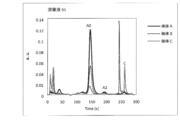
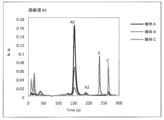
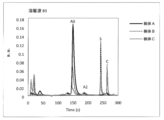
- the chromatograms of specimens A to C obtained in Examples 1, 2, and 3 are shown in FIGS. 1, 2, and 3, respectively.
- HbA0, HbA2, HbS, and HbC were detected as separate peaks. From this result, it was shown that HbA0, HbA2, HbS, and HbC can be detected by using an eluent containing a buffering agent TES, Tricine, or Bicine.
- Test 2 The samples A to C prepared in Reference Example 2 were subjected to hemoglobin analysis. Conditions other than the eluent B and gradient conditions were the same as in Test 1. As the eluent B, the eluents listed in Tables 4 to 6 were used. As the gradient conditions, the mixing ratio of the eluent A and the eluent B was appropriately determined so that HbA0 was eluted at 2.1 min. In order to confirm HbC elution, the time for the eluent B concentration of 100% was appropriately extended.
- Test 3 The specimen B and specimen D prepared in Reference Example 2 were subjected to hemoglobin analysis.
- the analysis conditions other than the gradient and eluent B were the same as those in Test 1.
- the eluent B an eluent containing a buffer containing sodium phosphate and sodium perchlorate having pH and osmotic pressure shown in Table 7 was used.
- the composition of the eluent shown in Table 7 was based on the composition of the eluent containing a phosphate buffer generally used in conventional hemoglobin analysis.
- the gradient conditions were as shown in Table 8.
- Table 7 shows the analysis results.
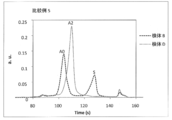
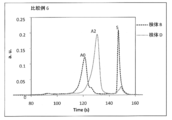
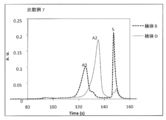
- the chromatograms of Comparative Examples 5 to 8 are shown in FIGS.
- Sample B contained about 5 to 7% by mass of HbA2, but in Comparative Examples 5 to 8, the HbA0 peak and the HbA2 peak overlapped, and the peaks of both types were not sufficiently separated. From this result, it was shown that HbA0 and HbA2 could not be sufficiently detected with a conventionally used eluent having a pH of 8.0 or less and an osmotic pressure of 130 mOsm / kg or more.
- Test 4 The samples A to C prepared in Reference Example 2 were subjected to hemoglobin analysis using the eluent B containing the phosphate buffer described in Table 9. Conditions other than the eluent B were the same as in Test 2. As the eluent B, an eluent containing a phosphate buffer described in Table 9 was used.
- Table 9 shows the analysis results.
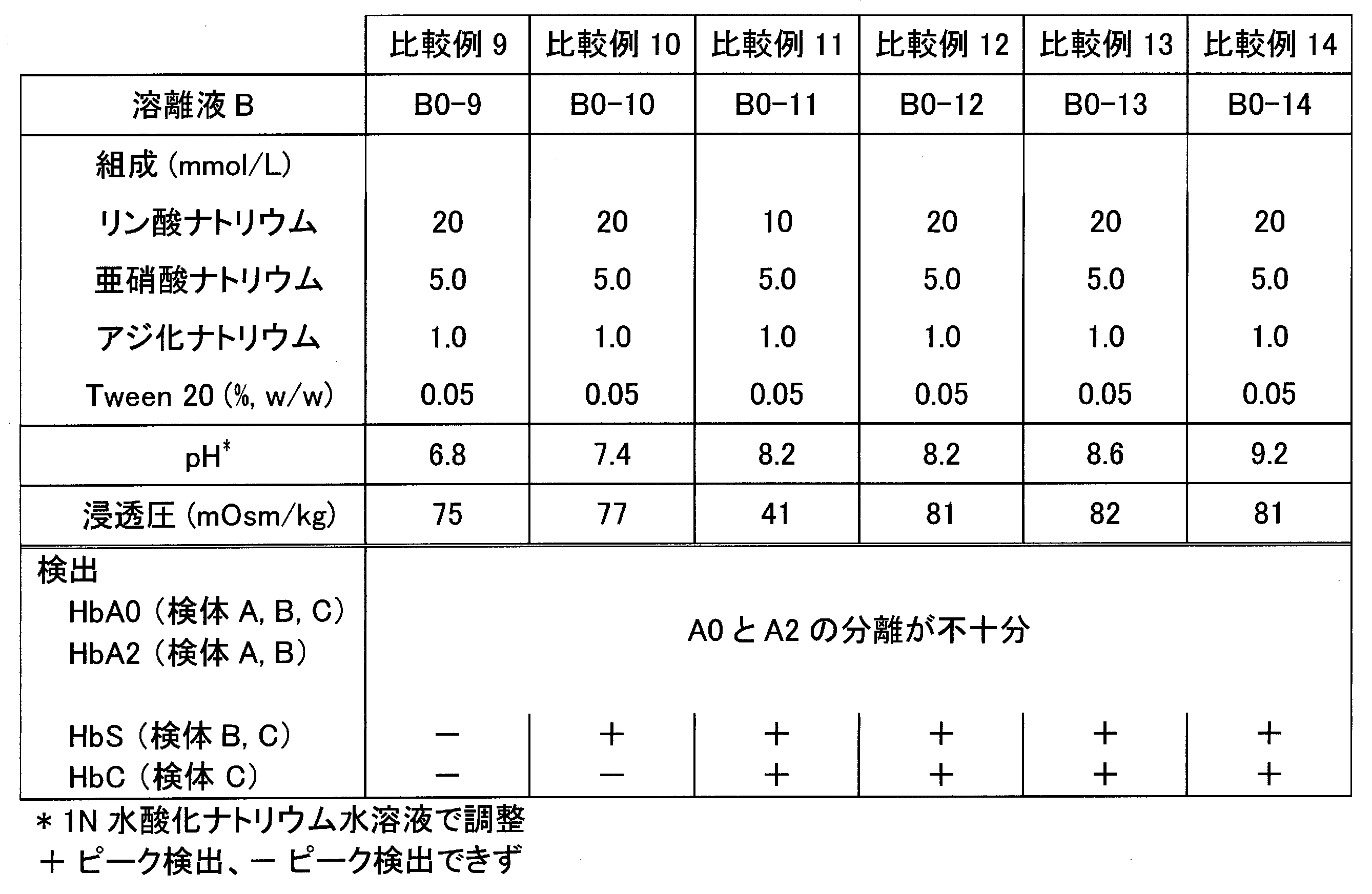
- Comparative Examples 9 and 10 the separation of the peaks of HbA0 and HbA2 was not sufficient, and either or both of HbS and HbC were not detected.
- Comparative Examples 11 to 14 HbS and HbC were detected, but the peaks of HbA0 and HbA2 were not sufficiently separated.
- the eluent B of Comparative Examples 9 to 14 has a higher osmotic pressure and higher or lower pH than the eluents of the above-described examples, and is a condition of pH 8.0 or higher and osmotic pressure 40 mOsm / kg or lower. Can not be achieved. This was considered to have led to insufficient hemoglobin detection in Comparative Examples 9-14.
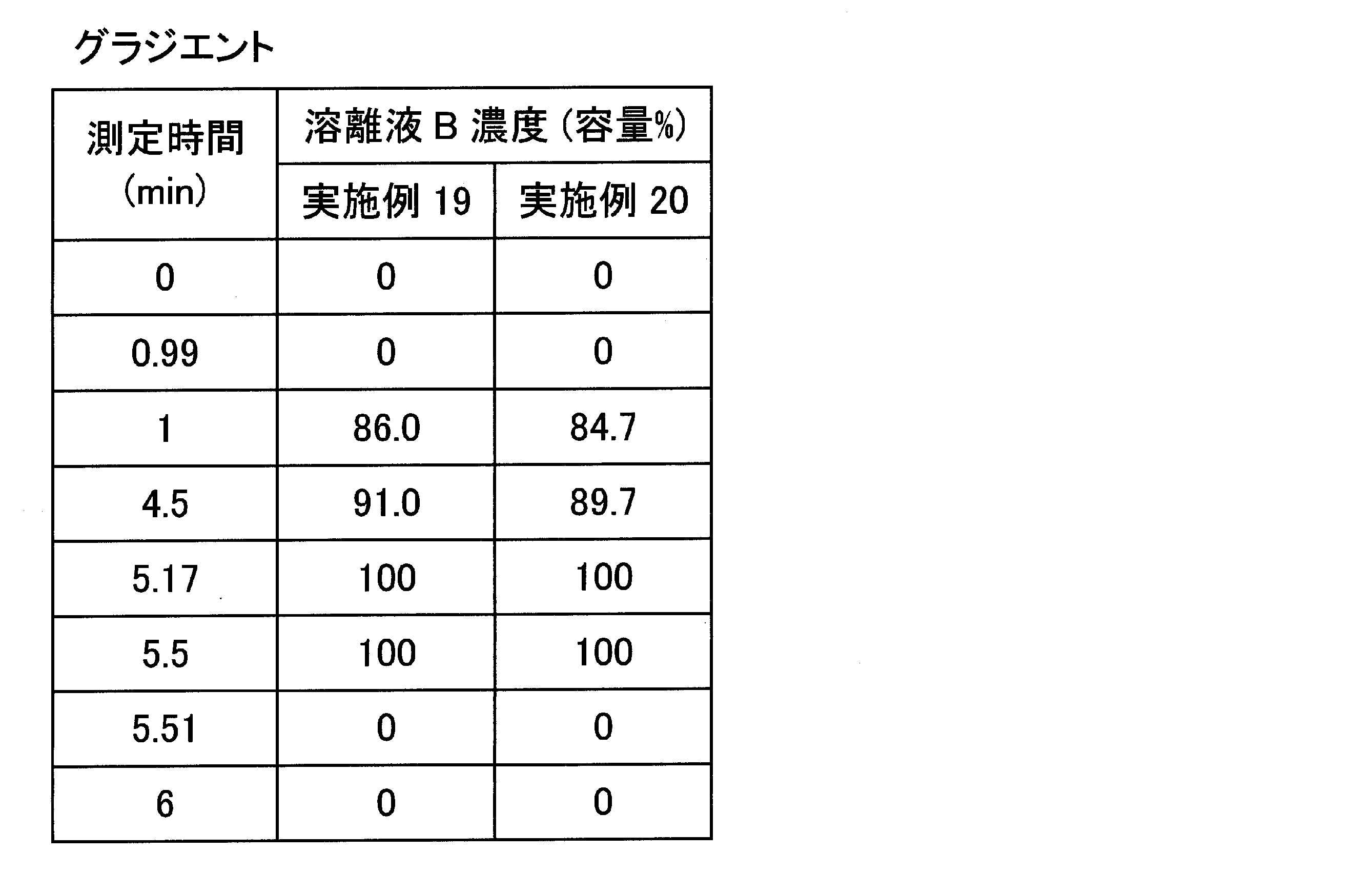
- Test 5 The samples A to C prepared in Reference Example 2 were subjected to hemoglobin analysis. Conditions other than the eluent B and gradient conditions were the same as in Test 1. As the eluent B, the eluents listed in Table 10 were used. The gradient conditions were as shown in Table 11. The analysis results are shown in Table 10. In both Examples 19 and 20, the peaks of HbA0 and HbA2 were well separated, and the peaks of HbS and HbC were also well separated, and HbA0, HbA2, HbS and HbC could be detected.
Landscapes
- Health & Medical Sciences (AREA)
- Life Sciences & Earth Sciences (AREA)
- Immunology (AREA)
- Chemical & Material Sciences (AREA)
- Engineering & Computer Science (AREA)
- Hematology (AREA)
- Biochemistry (AREA)
- General Physics & Mathematics (AREA)
- General Health & Medical Sciences (AREA)
- Pathology (AREA)
- Physics & Mathematics (AREA)
- Analytical Chemistry (AREA)
- Molecular Biology (AREA)
- Biomedical Technology (AREA)
- Urology & Nephrology (AREA)
- Biotechnology (AREA)
- Cell Biology (AREA)
- Microbiology (AREA)
- Food Science & Technology (AREA)
- Medicinal Chemistry (AREA)
- Investigating Or Analysing Biological Materials (AREA)
Abstract
異常ヘモグロビン及びサラセミアマーカーを含む各種ヘモグロビンを分離及び検出する方法の提供。ヘモグロビン分析方法であって、カチオン交換クロマトグラフィーにより試料中のヘモグロビンを分離することを含み、該ヘモグロビンの分離において、pH8.1以上、浸透圧40mOsm/kg以下の溶離液が用いられる、方法。
Description
本発明は、ヘモグロビンの分析方法に関する。
ヘモグロビン(Hb)は、酸素と結合するヘム(色素部分)と、ヘムを抱えるグロビンからなる色素タンパク質であり、全身の細胞への酸素の運搬に関わる。正常ヒトグロビンのポリペプチドには、α、β、γ、δ鎖という4種類のサブユニットがあり、これらが2本のα鎖と2本の非α鎖からなるテトラマーを構成する。正常ヒトHbにはHbA(α2β2)、HbA2(α2δ2)及びHbF(α2γ2)の3種類が存在するが、その大部分はHbAである。HbAには主にHbA0と糖化したHbA1cが含まれ、HbA1cは糖尿病などのマーカーとして使用される。
グロビンサブユニットの立体構造の異常は異常Hb症を、一方、グロビンサブユニットの形成不全はサラセミアを引き起こし、いずれも貧血や、さらに重症例では溶血、発育不全、骨変形などをもたらす。異常Hb症は、一般にHbS、HbC、HbE、HbDなどの異常Hbを検出することで診断される。サラセミアは、α鎖の形成不全によるαサラセミアとβ鎖の形成不全によるβサラセミアに大別され、一般にHbA2、HbFなどの高値を指標に診断される。
高速液体クロマトグラフィー(HPLC)を用いてヘモグロビンの異常を検出する方法がある。特許文献1には、リン酸1水素・2アルカリ金属塩(成分1)及びリン酸2水素・1アルカリ金属塩(成分2)を異なる比率で含む複数の溶離液を順次送液するグラジエント溶出を用いたHPLCにより、異常HbであるHbS、HbC、HbE及びHbDや、サラセミアマーカーHbA2及びHbFを分離可能であることが記載されている。特許文献2には、イオン対試薬を含有し、pHが7.1~7.3の範囲にある溶離液を用いたイオン交換液体クロマトグラフィーにより、HbA0、HbS及びHbCを分離したことが記載されている。特許文献3には、カチオン交換高速液体クロマトグラフィーにより、pH6.88~7.50の溶離液を用いてヘモグロビンSを分析、又はpH6.60~6.80の溶離液を用いてヘモグロビンA2を分析する方法が記載されている。
本発明は、血液試料から、異常ヘモグロビン及びサラセミアマーカーを含む各種ヘモグロビンを分離及び検出する方法に関する。
したがって、本発明は、以下を提供する。
〔1〕ヘモグロビン分析方法であって、
カチオン交換クロマトグラフィーにより試料中のヘモグロビンを分離することを含み、
該ヘモグロビンの分離において、pH8.1以上、浸透圧40mOsm/kg以下の溶離液が用いられる、
方法。
〔2〕前記溶離液が金属イオンを含まない緩衝剤を含有する、〔1〕記載の方法。
〔3〕前記緩衝剤がBicine、Tricine又はTESである、〔2〕記載の方法。
〔4〕前記溶離液中の前記緩衝剤の濃度が2~17mmol/Lである、〔2〕又は〔3〕記載の方法。
〔5〕前記溶離液がヘモグロビン変性剤を含有する、〔1〕~〔4〕のいずれか1項記載の方法。
〔6〕前記溶離液を用いたグラジエント溶離によりヘモグロビンを分離する、〔1〕~〔5〕のいずれか1項記載の方法。
〔7〕前記グラジエントにおいて前記溶離液の割合が0%から100%まで増加する、〔6〕記載の方法。
〔8〕HbS、HbC、HbE、HbD、及びHbO-Arabからなる群より選択される少なくとも1種の異常ヘモグロビンを分離する、〔1〕~〔7〕のいずれか1項記載の方法。
〔9〕HbA2、HbF、HbH、HbBart’、及びHbConstant Springからなる群より選択される少なくとも1種のサラセミアマーカーを分離する、〔1〕~〔8〕のいずれか1項記載の方法。
〔10〕前記クロマトグラフィーが高速液体クロマトグラフィーである、〔1〕~〔9〕のいずれか1項記載の方法。
〔11〕pH8.1以上、浸透圧40mOsm/kg以下である、カチオン交換クロマトグラフィーによるヘモグロビン分離用溶離液。
〔12〕金属イオンを含まない緩衝剤を含有する、〔11〕記載の溶離液。
〔13〕前記緩衝剤がBicine、Tricine又はTESである、〔12〕記載の溶離液。
〔14〕前記溶離液中の前記緩衝剤の濃度が2~17mmol/Lである、〔12〕又は〔13〕記載の溶離液。
〔15〕前記溶離液がヘモグロビン変性剤を含有する、〔11〕~〔14〕のいずれか1項記載の溶離液。
〔16〕pH8.1以上、浸透圧40mOsm/kg以下である液体組成物の、カチオン交換クロマトグラフィーによるヘモグロビン分離用溶離液としての使用。
〔17〕pH8.1以上、浸透圧40mOsm/kg以下である液体組成物の、カチオン交換クロマトグラフィーによるヘモグロビン分離用溶離液の製造のための使用。
〔18〕前記液体組成物が金属イオンを含まない緩衝剤を含有する、〔16〕又は〔17〕記載の使用。
〔19〕前記緩衝剤がBicine、Tricine又はTESである、〔18〕記載の使用。
〔20〕前記液体組成物中の前記緩衝剤の濃度が2~17mmol/Lである、〔18〕又は〔19〕記載の使用。
〔21〕前記液体組成物がヘモグロビン変性剤を含有する、〔16〕~〔20〕のいずれか1項記載の使用。
〔1〕ヘモグロビン分析方法であって、
カチオン交換クロマトグラフィーにより試料中のヘモグロビンを分離することを含み、
該ヘモグロビンの分離において、pH8.1以上、浸透圧40mOsm/kg以下の溶離液が用いられる、
方法。
〔2〕前記溶離液が金属イオンを含まない緩衝剤を含有する、〔1〕記載の方法。
〔3〕前記緩衝剤がBicine、Tricine又はTESである、〔2〕記載の方法。
〔4〕前記溶離液中の前記緩衝剤の濃度が2~17mmol/Lである、〔2〕又は〔3〕記載の方法。
〔5〕前記溶離液がヘモグロビン変性剤を含有する、〔1〕~〔4〕のいずれか1項記載の方法。
〔6〕前記溶離液を用いたグラジエント溶離によりヘモグロビンを分離する、〔1〕~〔5〕のいずれか1項記載の方法。
〔7〕前記グラジエントにおいて前記溶離液の割合が0%から100%まで増加する、〔6〕記載の方法。
〔8〕HbS、HbC、HbE、HbD、及びHbO-Arabからなる群より選択される少なくとも1種の異常ヘモグロビンを分離する、〔1〕~〔7〕のいずれか1項記載の方法。
〔9〕HbA2、HbF、HbH、HbBart’、及びHbConstant Springからなる群より選択される少なくとも1種のサラセミアマーカーを分離する、〔1〕~〔8〕のいずれか1項記載の方法。
〔10〕前記クロマトグラフィーが高速液体クロマトグラフィーである、〔1〕~〔9〕のいずれか1項記載の方法。
〔11〕pH8.1以上、浸透圧40mOsm/kg以下である、カチオン交換クロマトグラフィーによるヘモグロビン分離用溶離液。
〔12〕金属イオンを含まない緩衝剤を含有する、〔11〕記載の溶離液。
〔13〕前記緩衝剤がBicine、Tricine又はTESである、〔12〕記載の溶離液。
〔14〕前記溶離液中の前記緩衝剤の濃度が2~17mmol/Lである、〔12〕又は〔13〕記載の溶離液。
〔15〕前記溶離液がヘモグロビン変性剤を含有する、〔11〕~〔14〕のいずれか1項記載の溶離液。
〔16〕pH8.1以上、浸透圧40mOsm/kg以下である液体組成物の、カチオン交換クロマトグラフィーによるヘモグロビン分離用溶離液としての使用。
〔17〕pH8.1以上、浸透圧40mOsm/kg以下である液体組成物の、カチオン交換クロマトグラフィーによるヘモグロビン分離用溶離液の製造のための使用。
〔18〕前記液体組成物が金属イオンを含まない緩衝剤を含有する、〔16〕又は〔17〕記載の使用。
〔19〕前記緩衝剤がBicine、Tricine又はTESである、〔18〕記載の使用。
〔20〕前記液体組成物中の前記緩衝剤の濃度が2~17mmol/Lである、〔18〕又は〔19〕記載の使用。
〔21〕前記液体組成物がヘモグロビン変性剤を含有する、〔16〕~〔20〕のいずれか1項記載の使用。
本発明によれば、血液試料から、主要なヘモグロビンであるHbA0に加えて、HbA1c、異常Hb、サラセミアマーカーなどを迅速かつ高感度に分離することができる。本発明は、異常Hb症又はサラセミアの簡便、迅速かつ高感度な診断に有用である。
本明細書中で引用された全ての特許文献、非特許文献、及びその他の刊行物は、その全体が本明細書中において参考として援用される。
本発明のヘモグロビン分析方法は、イオン交換クロマトグラフィーにより試料中のヘモグロビンを分離することを含む。当該本発明の方法に用いられる試料としては、通常のヘモグロビン分析に用いられるヘモグロビンを含む血液試料を用いることができる。例えば、ヒトから採取した血液を溶血又は希釈した血液試料を用いることができる。
本発明の方法で行われるクロマトグラフィーは、好ましくは液体クロマトグラフィーであり、より好ましくは高速液体クロマトグラフィー(HPLC)である。本発明におけるイオン交換クロマトグラフィーは、公知の液体クロマトグラフィーシステム、すなわち、溶離液送液用のポンプ、サンプラ、検出器等を備えたシステムに接続したイオン交換カラムを用いて行うことができる。
好ましくは、本発明の方法で行われるイオン交換クロマトグラフィーは、カチオン交換カラムを用いた、カチオン交換クロマトグラフィーである。本発明の方法で用いられるカチオン交換カラムは、カチオン交換基を有する固定相が充填されたカラムであればよい。該カチオン交換基としては、カルボキシル基、リン酸基、スルホン酸基などが挙げられ、このうちスルホン酸基が好ましい。
該カチオン交換カラムの固定相としては、充填剤粒子、多孔質体等が挙げられ、充填剤粒子が好ましい。該充填剤粒子としては、無機系粒子、有機系粒子等が挙げられる。該無機系粒子としては、シリカ、ジルコニア等で構成される粒子が挙げられる。該有機系粒子としては、セルロース、ポリアミノ酸、キトサン等の天然高分子粒子や、ポリスチレン、ポリアクリル酸エステル等の合成高分子粒子が挙げられる。該カチオン交換基を有する固定相の好ましい例として、特開2011-047858号公報に開示されている、非架橋性の親水性アクリル系単量体とポリグリシジルエーテル類との混合物を重合して得られる架橋重合体粒子と、該架橋重合体粒子の表面に重合されたカチオン交換基を有するアクリル系単量体の層とを含む充填剤が挙げられる。
本発明のヘモグロビン分析方法では、従来のイオン交換クロマトグラフィーによるヘモグロビン分析と同様に、試料中のヘモグロビンをイオン交換カラムに吸着させた後、該カラムに溶離液を流して該カラムからヘモグロビンを溶離させることにより、試料中のヘモグロビンを分離する。したがって、本発明のヘモグロビン分析方法で使用される溶離液は、イオン交換クロマトグラフィーによるヘモグロビン分離のために使用される溶離液である。より好ましくは、該溶離液は、カチオン交換クロマトグラフィーにおいて、カチオン交換カラムからのヘモグロビンの溶離のために使用される溶離液である。
本発明のヘモグロビン分析方法では、従来のヘモグロビン分析方法と比べて高pHかつ低浸透圧の溶離液を用いる。本発明で使用される該溶離液は、pH8.1以上が好適である。より詳細には、該溶離液のpHは、好ましくは8.1以上、より好ましくは8.2以上であり、さらに好ましくは8.3以上であり、一方、好ましくは10.0以下、より好ましくは9.0以下、さらに好ましくは8.6以下である。該溶離液がpH8.1未満であると、カラムからのヘモグロビン、特にHbCの溶出が不十分になることがあり、一方、pH10を超えると、特にHbSとHbCの分離が不十分になることがある。本発明で使用される該溶離液のpH範囲としては、pH8.1~10.0、pH8.1~9.0、pH8.1~8.6、pH8.2~10.0、pH8.2~9.0、pH8.2~8.6、pH8.3~10.0、pH8.3~9.0、及びpH8.3~8.6が挙げられる。一方、従来のヘモグロビン分析方法で用いられていた溶離液のpHは、通常pH5.0~8.0程度である。
本発明で使用される該溶離液の浸透圧は、40mOsm/kg以下が好適である。より詳細には、該溶離液の浸透圧は、好ましくは40mOsm/kg以下、より好ましくは37mOsm/kg以下、さらに好ましくは36mOsm/kg以下であり、一方、好ましくは15mOsm/kg以上、より好ましくは19mOsm/kg以上、さらに好ましくは26mOsm/kg以上である。該溶離液の浸透圧が15mOsm/kg未満であると、ヘモグロビン、特にHbA0とHbA2の溶出が不十分になることがあり、一方、40mOsm/kgを超えると、ヘモグロビン種間、特にHbA0とHbA2との分離が悪くなる。本発明で使用される該溶離液の浸透圧の範囲としては、15~40mOsm/kg、15~37mOsm/kg、15~36mOsm/kg、19~40mOsm/kg、19~37mOsm/kg、19~36mOsm/kg、26~40mOsm/kg、26~37mOsm/kg、及び26~36mOsm/kgが挙げられる。一方、従来のクロマトグラフィーによるヘモグロビン分離において、浸透圧調整の観点で溶離液の組成を設計することは行われておらず、また従来用いられていた溶離液のpHは、通常125~570mOsm/kg程度である。本明細書における浸透圧の値は、凝固点降下法により測定された浸透圧の値をいう。浸透圧は、市販の浸透圧計、例えばオズモメーター3250(Advanced Instruments製)等を用いて測定することができる。また本明細書において、浸透圧の単位mOsm/kgとは、mOsm/kgH2Oを意味し、これはmOsm/L又はmOsmとも表記されることがある。
上記のpHと浸透圧の範囲を有する溶離液を調製するために、本発明においては、該溶離液に金属イオンを含まない緩衝剤を含有させる。リン酸緩衝液等の従来の溶離液で一般に使用されている緩衝液は、金属イオンを含むため、高pH性と低浸透圧性を同時に実現することは困難である。該金属イオンを含まない緩衝剤の例としては、グッド緩衝剤が挙げられ、なかでも、Bicine(N,N-ビス(2-ヒドロキシエチル)グリシン)、Tricine(N-[トリス(ヒドロキシメチル)メチル]グリシン)、又はTES(N-トリス(ヒドロキシメチル)メチル-2-アミノエタンスルホン酸)が好ましく、TESがより好ましい。
本発明で使用される該溶離液における上述した緩衝剤の濃度は、後述する添加剤等の影響を考慮した上で、最終的な溶離液のpH及び浸透圧を上記範囲に調整できる濃度であればよい。該溶離液における該緩衝剤の濃度は、好ましくは2mmol/L以上、より好ましくは2.5mmol/L以上、さらに好ましくは5mmol/L以上であり、一方、好ましくは17mmol/L以下、より好ましくは15mmol/L以下、さらに好ましくは12.5mmol/L以下である。本発明で使用される該溶離液における該緩衝剤の濃度の範囲としては、2~17mmol/L、2~15mmol/L、2~12.5mmol/L、2.5~17mmol/L、2.5~15mmol/L、2.5~12.5mmol/L、5~17mmol/L、5~15mmol/L、及び5~12.5mmol/Lが挙げられる。
好ましくは、本発明で使用される該溶離液は、緩衝剤としてBicine、Tricine又はTESを含有する溶液状の液体組成物である。該溶離液中の該緩衝剤の濃度は2~17mmol/Lであり、該溶離液は、浸透圧が15~40mOsm/kgであり、かつpHが、好ましくは8.1~10.0、より好ましくはpH8.2~9.0、さらに好ましくはpH8.2~8.6、なお好ましくはpH8.3~8.6である。
より好ましくは、本発明で使用される該溶離液は、緩衝剤としてBicine、Tricine又はTESを含有し、該溶離液中の該緩衝剤の濃度は2.5~15mmol/Lであり、該溶離液は、浸透圧が15~37mOsm/kgであり、かつpHが、好ましくは8.1~10.0、より好ましくはpH8.2~9.0、さらに好ましくはpH8.2~8.6、なお好ましくはpH8.3~8.6である。
さらに好ましくは、本発明で使用される該溶離液は、緩衝剤としてBicine、Tricine又はTESを含有し、該溶離液中の該緩衝剤の濃度は5~15mmol/Lであり、該溶離液は、浸透圧が19~37mOsm/kgであり、かつpHが、好ましくは8.1~10.0、より好ましくはpH8.2~9.0、さらに好ましくはpH8.2~8.6、なお好ましくはpH8.3~8.6である。
さらにより好ましくは、本発明で使用される該溶離液は、緩衝剤としてBicine、Tricine又はTESを含有し、該溶離液中の該緩衝剤の濃度は5~15mmol/Lであり、該溶離液は、浸透圧が26~36mOsm/kgであり、かつpHが好ましくはpH8.2~9.0、さらに好ましくはpH8.2~8.6、なお好ましくはpH8.3~8.6である。
なお好ましくは、本発明で使用される該溶離液は、緩衝剤としてBicine、Tricine又はTESを含有し、該溶離液中の該緩衝剤の濃度は5~12.5mmol/Lであり、該溶離液は、浸透圧が26~36mOsm/kgであり、かつpHがpH8.3~8.6である。
本発明で使用される該溶離液は、上述した緩衝剤以外に、溶媒、及びヘモグロビン変性剤、三価ヘム鉄への結合剤、pH調整剤、界面活性剤などの添加剤を含有していてもよい。
好ましくは、本発明で使用される該溶離液は、ヘモグロビン変性剤を含有する。ヘモグロビン変性剤は、ヘモグロビンのヘム鉄を二価から三価に変化させ、メトヘモグロビンを生成することができる酸化剤であればよい。そのような酸化剤の例としては、亜硝酸塩、フェリシアン化カリウム、メチレンブルー、過酸化水素、アスコルビン酸、硫化水素などが挙げられる。このうち、亜硝酸塩が好ましく、亜硝酸ナトリウム又は亜硝酸カリウムがより好ましい。該溶離液における該ヘモグロビン変性剤の濃度は、好ましくは0.05~15mmol/L、より好ましくは1.0~10mmol/Lである。
また好ましくは、本発明で使用される該溶離液は、三価ヘム鉄への結合剤を含有する。該三価ヘム鉄への結合剤は、該ヘモグロビン変性剤により生成されたメトヘモグロビンを安定化させて、その溶出挙動を安定化させる。該三価ヘム鉄への結合剤の例としては、アジ化物、シアン化物等が挙げられる。アジ化物の例としては、アジ化ナトリウム、ジフェニルリン酸アジド、4-ドデシルベンゼンスルフォニルアジド、4-アセチルアミノベンゼンスルフォニルアジド、アジ化カリウム、アジ化リチウム、アジ化鉄、アジ化水素、アジ化鉛、アジ化水銀、アジ化銅、アジ化銀等が挙げられる。シアン化物の例としては、シアン化カリウム、シアン化水素、シアン化ナトリウム、シアン化銀、シアン化水銀、シアン化銅、シアン化鉛、シアン化鉄、シアン化リチウム、シアン化アンモニウム等が挙げられる。好ましくは、該三価のヘム鉄への結合剤はアジ化物であり、より好ましくはアジ化ナトリウムである。該溶離液における該三価ヘム鉄への結合剤の濃度は、好ましくは0.05~15mmol/L、より好ましくは0.5~10mmol/Lである。
該pH調整剤としては、公知の酸及び塩基が挙げられ、酸の例としては、塩酸、リン酸、硝酸、硫酸などが挙げられ、塩基の例としては、水酸化ナトリウム、水酸化カリウム、水酸化リチウム、水酸化マグネシウム、水酸化バリウム、水酸化カルシウムなどが挙げられる。
該溶媒としては、メタノール、エタノール、アセトニトリル、アセトン等の水溶性有機溶媒が挙げられる。該溶媒の濃度は、塩等が析出しない程度であることが好ましく、例えば80%(v/v)以下が好ましく、より好ましい範囲は0.1%(w/w)以上50%(w/w)以下である。
好ましくは、本発明のヘモグロビン分析方法では、上記溶離液を用いたグラジエント溶離により、ヘモグロビンを分離する。好ましくは、本発明の方法では、上記溶離液を溶離液B(以下、B液、又は単にBと称する)とし、別の溶離液を溶離液A(以下、A液、又は単にAと称する)として、B液の割合が段階的に高くなるように、A液とB液の間でグラジエントをかける。
溶離液Aは、公知の塩化合物を含む緩衝剤を含有するものであればよい。該溶離液Aに含まれ得る緩衝剤の例としては、有機酸又は無機酸を含む緩衝液が挙げられる。有機酸の例としては、クエン酸、コハク酸、酒石酸、リンゴ酸等、及びこれらの塩が挙げられ、無機酸の例としては、塩酸、硝酸、硫酸、リン酸、ホウ酸、酢酸、過塩素酸等、及びこれらの塩が挙げられる。該溶離液Aに用いられる緩衝液は、これらの有機酸及び無機酸のいずれか1種又は2種以上を組み合わせて含有することができる。このうち、リン酸塩、コハク酸塩、又は過塩素酸塩を含む緩衝液が好ましい。リン酸塩の例としては、ナトリウム塩及びカリウム塩などが挙げられ、リン酸一ナトリウム、リン酸二ナトリウムが好ましい。コハク酸塩の例としては、ナトリウム塩及びカリウム塩などが挙げられ、コハク酸一ナトリウム、コハク酸二ナトリウムが好ましい。過塩素酸塩の例としては、過塩素酸ナトリウムが挙げられる。これらのリン酸塩、コハク酸塩及び過塩素酸塩は、単独で用いられてもよく、2種以上で併用されてもよい。
溶離液Aは、上述した緩衝剤以外に、上述した溶離液Bに含有され得るものと同様の溶媒、及び添加剤(例えば上述したヘモグロビン変性剤、三価ヘム鉄への結合剤、pH調整剤、界面活性剤など)を含有していてもよい。
溶離液AのpHは、好ましくは5.0以上、より好ましくは5.2以上であり、好ましくは6.0以下、より好ましくは5.8以下である。溶離液AのpH範囲は、好ましくは5.0~6.0であり、より好ましくは5.2~5.8である。また、溶離液Aの浸透圧は、好ましくは130mOsm/kg以上、より好ましくは150mOsm/kg以上であり、好ましくは210mOsm/kg以下、より好ましくは190mOsm/kg以下である。溶離液Aの浸透圧の範囲は、好ましくは130~210mOsm/kgであり、より好ましくは150~190mOsm/kgである。好ましい実施形態において、溶離液Aは、pH5.0~6.0であり、かつ浸透圧が130~210mOsm/kg、より好ましくは150~190mOsm/kgである。より好ましい実施形態において、溶離液Aは、pH5.2~5.8であり、かつ浸透圧が130~210mOsm/kg、より好ましくは150~190mOsm/kgである。
好ましくは、本発明の方法におけるグラジエント溶離では、まず、A液100%(B液0%)で通液し、次いでグラジエントをかけてB液の割合を増加させ、B液の割合を100%まで上げる。グラジエントの大きさは、カラムの性能等に合わせて適宜調整すればよく、特に限定されない。グラジエントの一例は、A:B=100:0 → Bの割合を50~98容量%(好ましくは70~95容量%)まで増加 → 段階的にBの割合をさらに増加 → A:B=0:100である。グラジエントの別の一例は、A:B=100:0 → 溶離液が全体でpH6.5~8.0、浸透圧20~100mOsm/kgになるようBの割合を増加 → 段階的にBの割合をさらに増加 → A:B=0:100である。必要に応じて、この後に再びA:B=100:0の通液時間を設けてもよい。
一実施形態において、本発明のヘモグロビン分析方法は、異常ヘモグロビンの検出に利用される。本発明の方法で検出される異常ヘモグロビンとしては、HbS、HbC、HbE、HbD、及びHbO-Arabからなる群より選択される少なくとも1種が挙げられ、好ましくはHbC及びHbSからなる群より選択される少なくとも1種である。本発明の方法においては、上記に挙げた異常ヘモグロビンの各々を、一度の分析で全て分離検出することが可能である。
別の一実施形態において、本発明のヘモグロビン分析方法は、サラセミアマーカーの検出に利用される。本発明の方法で検出されるサラセミアマーカーとしては、HbA2、HbF、HbH、HbBart’、及びHbConstant Springからなる群より選択される少なくとも1種が挙げられ、好ましくはHbA2である。本発明の方法においては、上記に挙げたサラセミアマーカーの各々を、一度の分析で全て分離検出することが可能である。
さらに、本発明のヘモグロビン分析方法においては、上記に挙げた異常ヘモグロビン及びサラセミアマーカーの両方を検出することができる。さらに、該異常ヘモグロビン及び/又はサラセミアマーカーを検出するとともに、HbA0、又は糖化ヘモグロビンHbA1cを検出することができる。したがって、本発明のヘモグロビン分析方法により、試料中における異常ヘモグロビン及びサラセミアマーカーの有無を一度に分析することができ、さらに試料中における異常ヘモグロビン、サラセミアマーカー、及びHbA1cの有無を一度に分析することも可能である。したがって、本発明の方法は、一度の分析で多種のヘモグロビンを検出することができるので、異常Hb症やサラセミアの簡便かつ迅速な診断を可能にする。
以下、実施例により本発明を詳細に説明するが、本発明は以下の実施例に限定されるものではない。
(参考例1:ヘモグロビン分離用カラムの調製)
非架橋性の親水性アクリル系単量体としてテトラエチレングリコールモノメタクリレート(日油社製)200g、及び、ポリグリシジルエーテル類としてポリエチレングリコールジグリシジルエーテル(日油社製)200gを混合した単量体混合物に、重合開始剤として過酸化ベンゾイル(ナカライテスク社製)1.0gを溶解した。得られた混合物を、4重量%のポリビニルアルコール(日本合成化学工業社製、「ゴーセノールGH-20」)水溶液5Lに分散させ、攪拌しながら窒素雰囲気下で80℃に加温し、1時間重合反応を行なった。温度を30℃に冷却した後、カチオン交換基を有するアクリル系単量体として2-メタクリルアミド-2-メチルプロパンスルホン酸(東亜合成社製)100gを反応系に添加し、再び80℃に加温して1時間重合反応を行なった。得られた架橋重合体粒子をイオン交換水及びアセトンで洗浄することにより、スルホン酸基が導入された架橋重合体粒子を得た。得られたヘモグロビン分離用カラム充填剤を、内径4mm、長さ20mmのステンレス製カラムに充填し、ヘモグロビン分離用カチオン交換カラムを調製した。
非架橋性の親水性アクリル系単量体としてテトラエチレングリコールモノメタクリレート(日油社製)200g、及び、ポリグリシジルエーテル類としてポリエチレングリコールジグリシジルエーテル(日油社製)200gを混合した単量体混合物に、重合開始剤として過酸化ベンゾイル(ナカライテスク社製)1.0gを溶解した。得られた混合物を、4重量%のポリビニルアルコール(日本合成化学工業社製、「ゴーセノールGH-20」)水溶液5Lに分散させ、攪拌しながら窒素雰囲気下で80℃に加温し、1時間重合反応を行なった。温度を30℃に冷却した後、カチオン交換基を有するアクリル系単量体として2-メタクリルアミド-2-メチルプロパンスルホン酸(東亜合成社製)100gを反応系に添加し、再び80℃に加温して1時間重合反応を行なった。得られた架橋重合体粒子をイオン交換水及びアセトンで洗浄することにより、スルホン酸基が導入された架橋重合体粒子を得た。得られたヘモグロビン分離用カラム充填剤を、内径4mm、長さ20mmのステンレス製カラムに充填し、ヘモグロビン分離用カチオン交換カラムを調製した。
(参考例2:検体の調製)
検体A:健常人から採取した血液検体を0.1%トリトンX-100含有リン酸緩衝液(pH7.00)で適宜希釈して検体を調製した。
検体B:Lyphocheck(登録商標)Hemoglobin A2 Control Level 2(Bio-Rad社製、HbA0、HbA2及びHbS含有)を0.1%トリトンX-100含有リン酸緩衝液(pH7.00)で適宜希釈して検体を調製した。
検体C:AFSCヘモコントロール(ヘレナ研究所社製、HbA0、HbS及びHbC含有)を0.1%トリトンX-100含有リン酸緩衝液(pH7.00)で適宜希釈して検体を調製した。
検体D:Hemoglobin A2(Sigma Aldrich社製、HbA2含有)を0.1%トリトンX-100含有リン酸緩衝液(pH7.00)で適宜希釈して検体を調製した。
検体A:健常人から採取した血液検体を0.1%トリトンX-100含有リン酸緩衝液(pH7.00)で適宜希釈して検体を調製した。
検体B:Lyphocheck(登録商標)Hemoglobin A2 Control Level 2(Bio-Rad社製、HbA0、HbA2及びHbS含有)を0.1%トリトンX-100含有リン酸緩衝液(pH7.00)で適宜希釈して検体を調製した。
検体C:AFSCヘモコントロール(ヘレナ研究所社製、HbA0、HbS及びHbC含有)を0.1%トリトンX-100含有リン酸緩衝液(pH7.00)で適宜希釈して検体を調製した。
検体D:Hemoglobin A2(Sigma Aldrich社製、HbA2含有)を0.1%トリトンX-100含有リン酸緩衝液(pH7.00)で適宜希釈して検体を調製した。
(試験1)
参考例2で調製した検体A~Cについてヘモグロビン分析を行った。分析条件を以下に示す。
HPLC装置:Prominence20Aシリーズ(島津製作所社製)
検出器:SPD-M20A(島津製作所社製)
送液ポンプ:LC-20AD(島津製作所社製)
脱気ユニット:DGU-20A5R(島津製作所社製)
カラムオーブン:CTO-20AC(島津製作所社製)
オートサンプラー:SIL-20AC(島津製作所社製)
カラム:参考例1で作成したヘモグロビン分離用カチオン交換カラム
流速:1.1mL/min
検出波長:415nm
試料注入量:10μL
溶離液
溶離液A:40mmol/Lコハク酸ナトリウム、45mmol/L過塩素酸ナトリウム、1mmol/Lアジ化ナトリウムを含有する緩衝液(pH5.3、浸透圧170mOsm/kg)
溶離液B:溶離液B1~B6(表1)
グラジエント:表2のとおり
pHメーター:F-52(堀場製作所製)
浸透圧計:オズモメーター3250(Advanced Instruments製)
参考例2で調製した検体A~Cについてヘモグロビン分析を行った。分析条件を以下に示す。
HPLC装置:Prominence20Aシリーズ(島津製作所社製)
検出器:SPD-M20A(島津製作所社製)
送液ポンプ:LC-20AD(島津製作所社製)
脱気ユニット:DGU-20A5R(島津製作所社製)
カラムオーブン:CTO-20AC(島津製作所社製)
オートサンプラー:SIL-20AC(島津製作所社製)
カラム:参考例1で作成したヘモグロビン分離用カチオン交換カラム
流速:1.1mL/min
検出波長:415nm
試料注入量:10μL
溶離液
溶離液A:40mmol/Lコハク酸ナトリウム、45mmol/L過塩素酸ナトリウム、1mmol/Lアジ化ナトリウムを含有する緩衝液(pH5.3、浸透圧170mOsm/kg)
溶離液B:溶離液B1~B6(表1)
グラジエント:表2のとおり
pHメーター:F-52(堀場製作所製)
浸透圧計:オズモメーター3250(Advanced Instruments製)

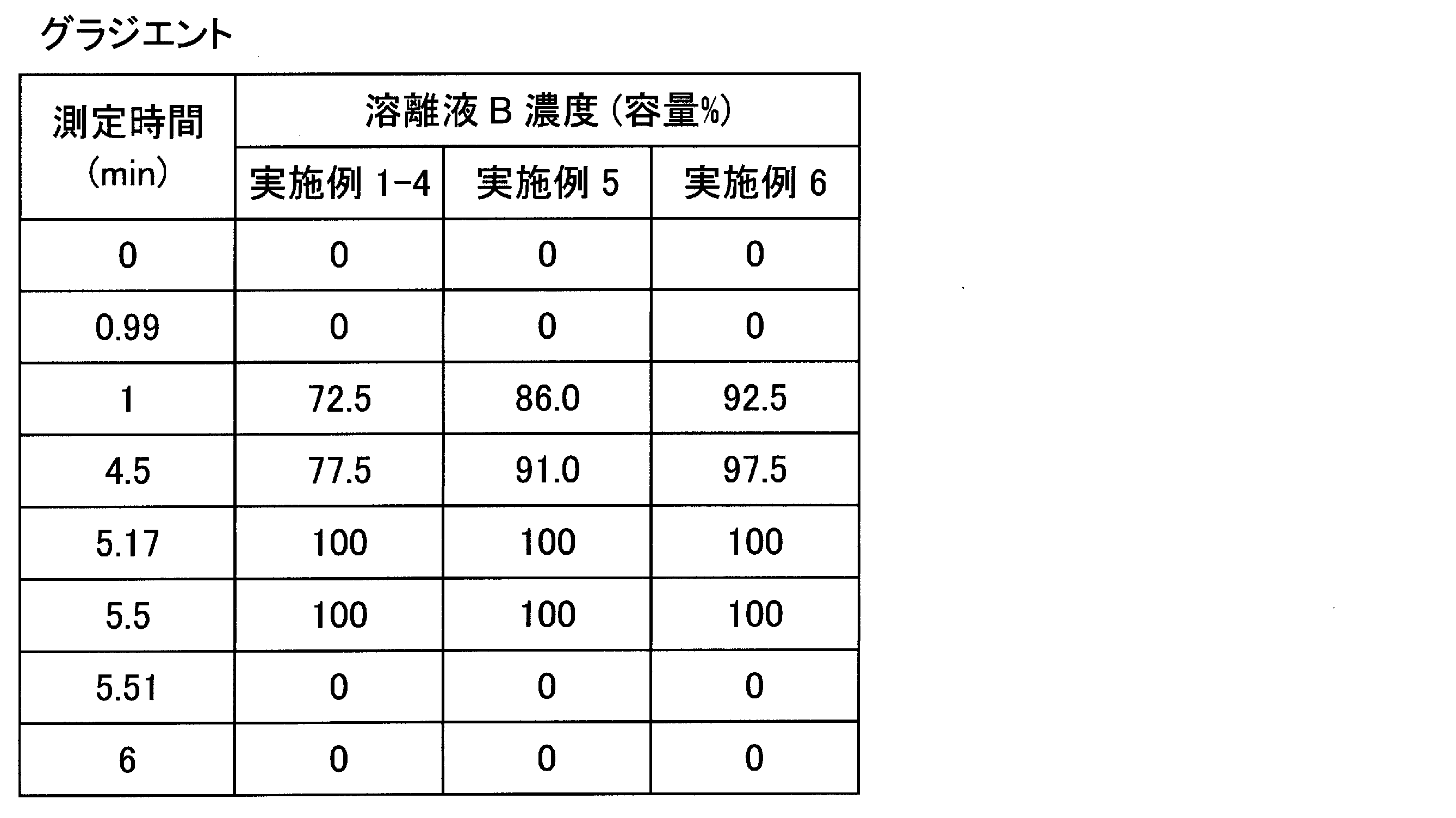
実施例1~6での検体A~Cの分析結果を表3に示す。また、実施例1、2及び3で得られた検体A~Cのクロマトグラムを図1、図2、及び図3にそれぞれ示す。実施例1~6において、HbA0、HbA2、HbS、及びHbCがそれぞれ別個のピークとして検出された。本結果より、緩衝剤TES、Tricien又はBicineを含む溶離液を用いることで、HbA0、HbA2、HbS、及びHbCを検出できることが示された。
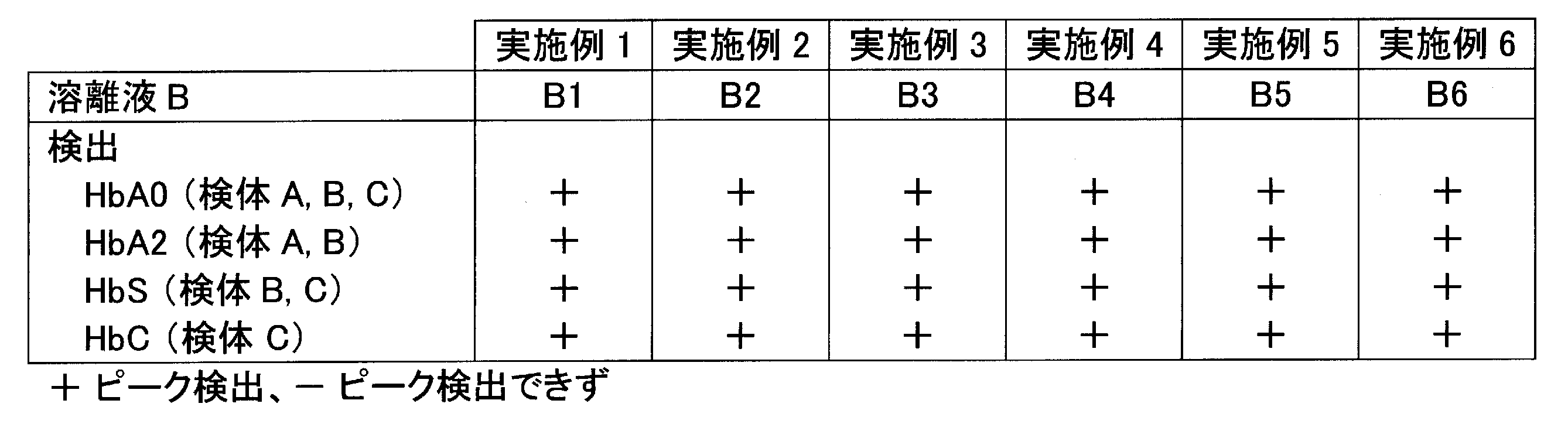
(試験2)
参考例2で調製した検体A~Cについてヘモグロビン分析を行った。溶離液B及びグラジエント条件以外の条件は、試験1と同様にした。溶離液Bとしては、表4~6に記載の溶離液を用いた。グラジエント条件は、HbA0を2.1minに溶出させるよう、溶離液Aと溶離液Bの混合割合を適宜決定した。また、HbC溶出確認のため、溶離液B濃度100%の時間を適宜延長した。
参考例2で調製した検体A~Cについてヘモグロビン分析を行った。溶離液B及びグラジエント条件以外の条件は、試験1と同様にした。溶離液Bとしては、表4~6に記載の溶離液を用いた。グラジエント条件は、HbA0を2.1minに溶出させるよう、溶離液Aと溶離液Bの混合割合を適宜決定した。また、HbC溶出確認のため、溶離液B濃度100%の時間を適宜延長した。
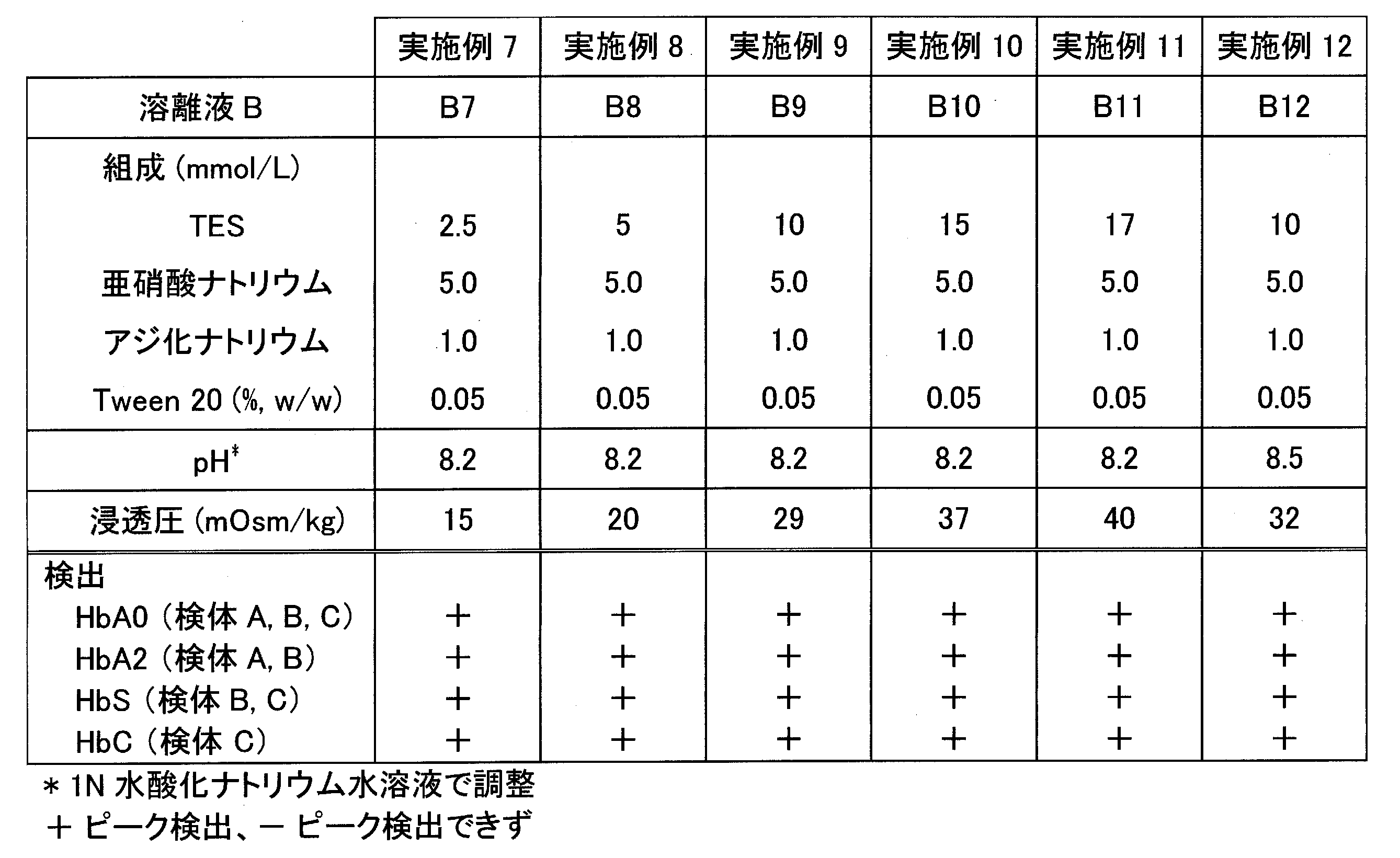
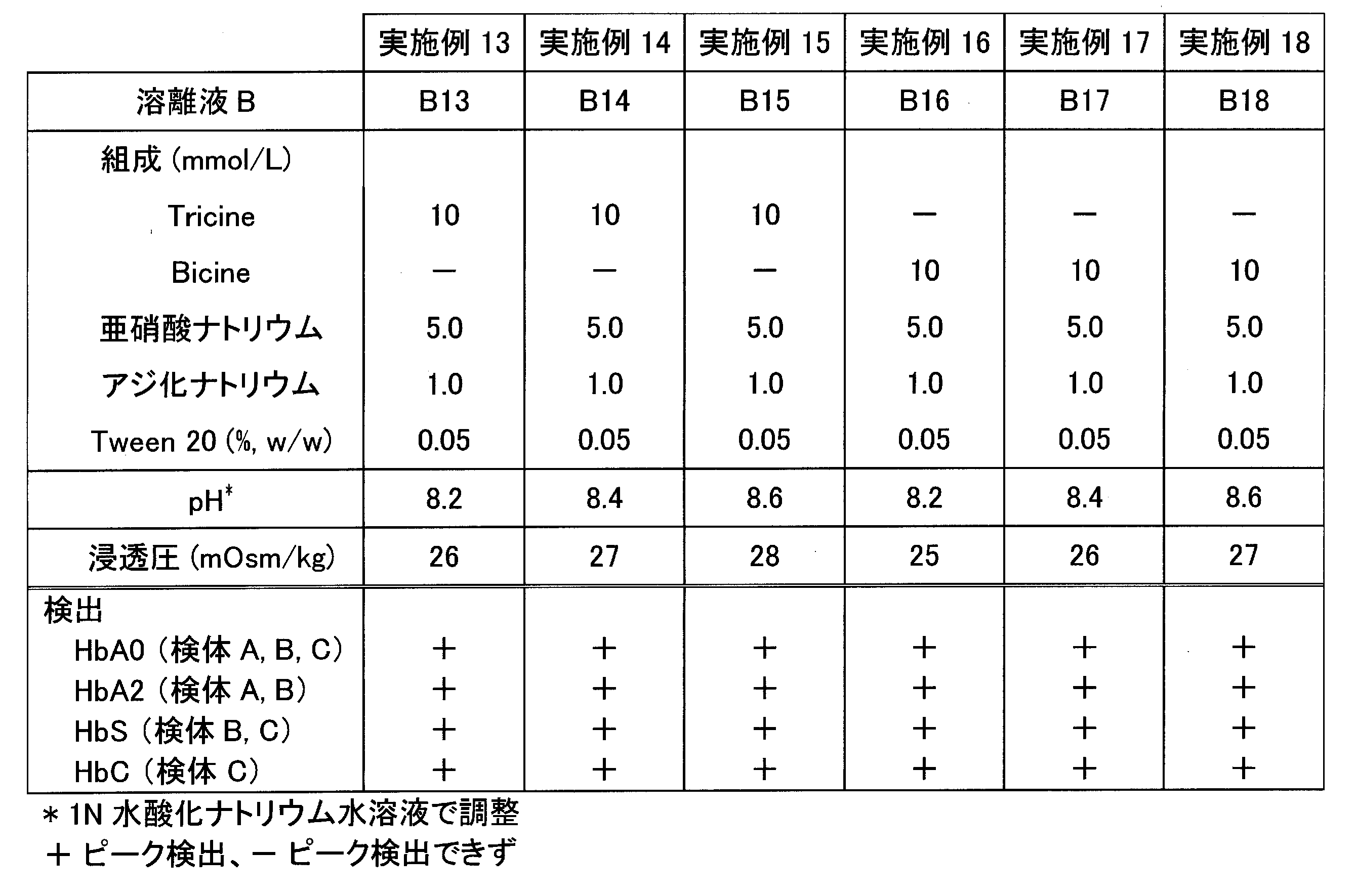
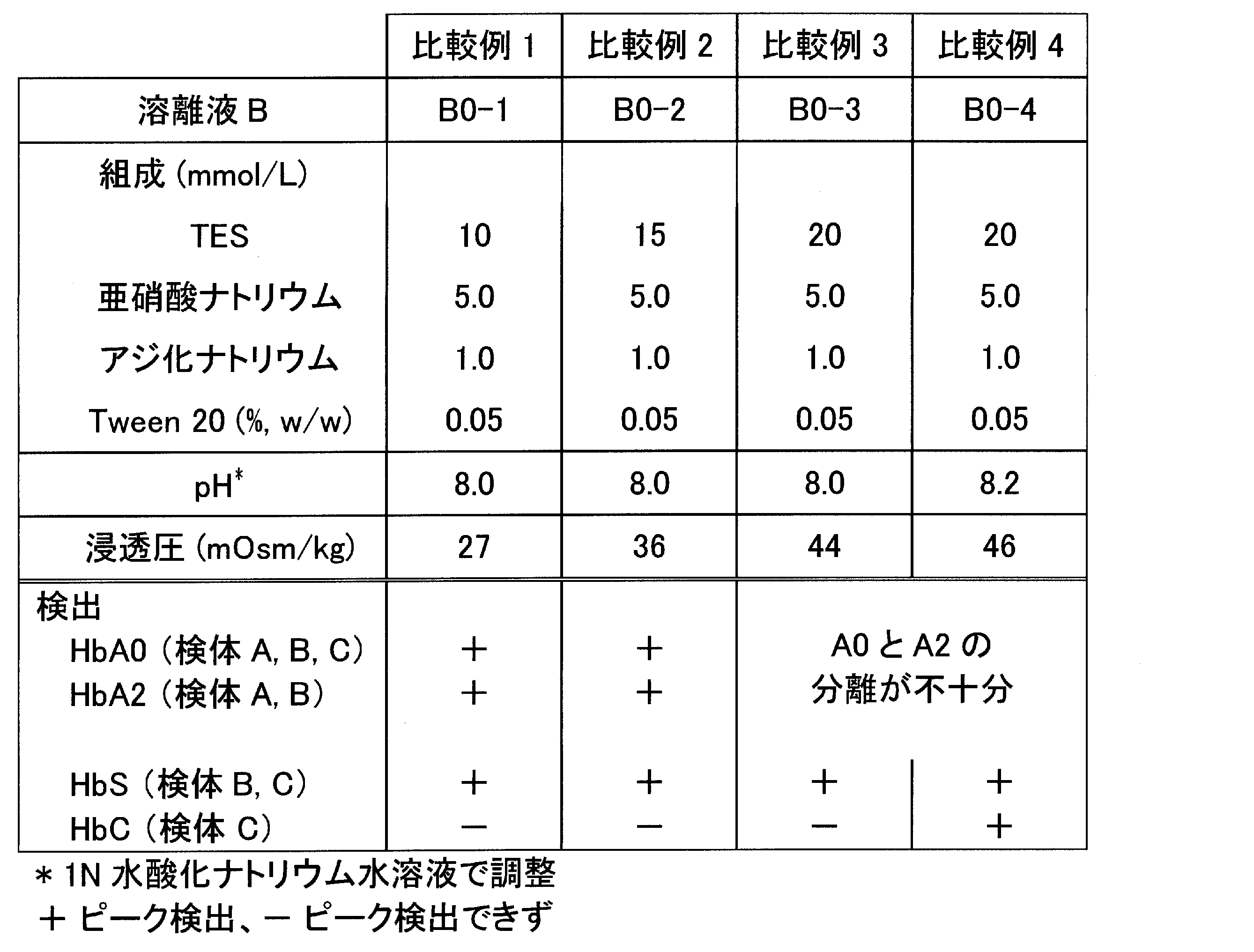
分析結果を表4~6に示す。表6に示すとおり、pH8.0の溶離液Bを用いた比較例1~3ではHbCが検出されなかった。また、浸透圧が40mOsm/kgを超える溶離液Bを用いた比較例3~4では、HbA0のピークショルダーにHbA2が重なり、両種のピークが十分に分離されなかった。一方、表4~5に示すとおり、pHが8.0より高く、かつ浸透圧が40mOsm/kg以下である実施例7~18では、HbA0、HbA2、HbS及びHbCがそれぞれ検出された。ただし実施例10、11では、HbA2の溶出がやや早くなり、HbA0とHbA2のピークが接近する傾向がみられた(データ示さず)。これらの結果より、pH8.1以上、かつ浸透圧40mOsm/kg以下の溶離液Bが、各種ヘモグロビンの分析に適していることが示された。
(試験3)
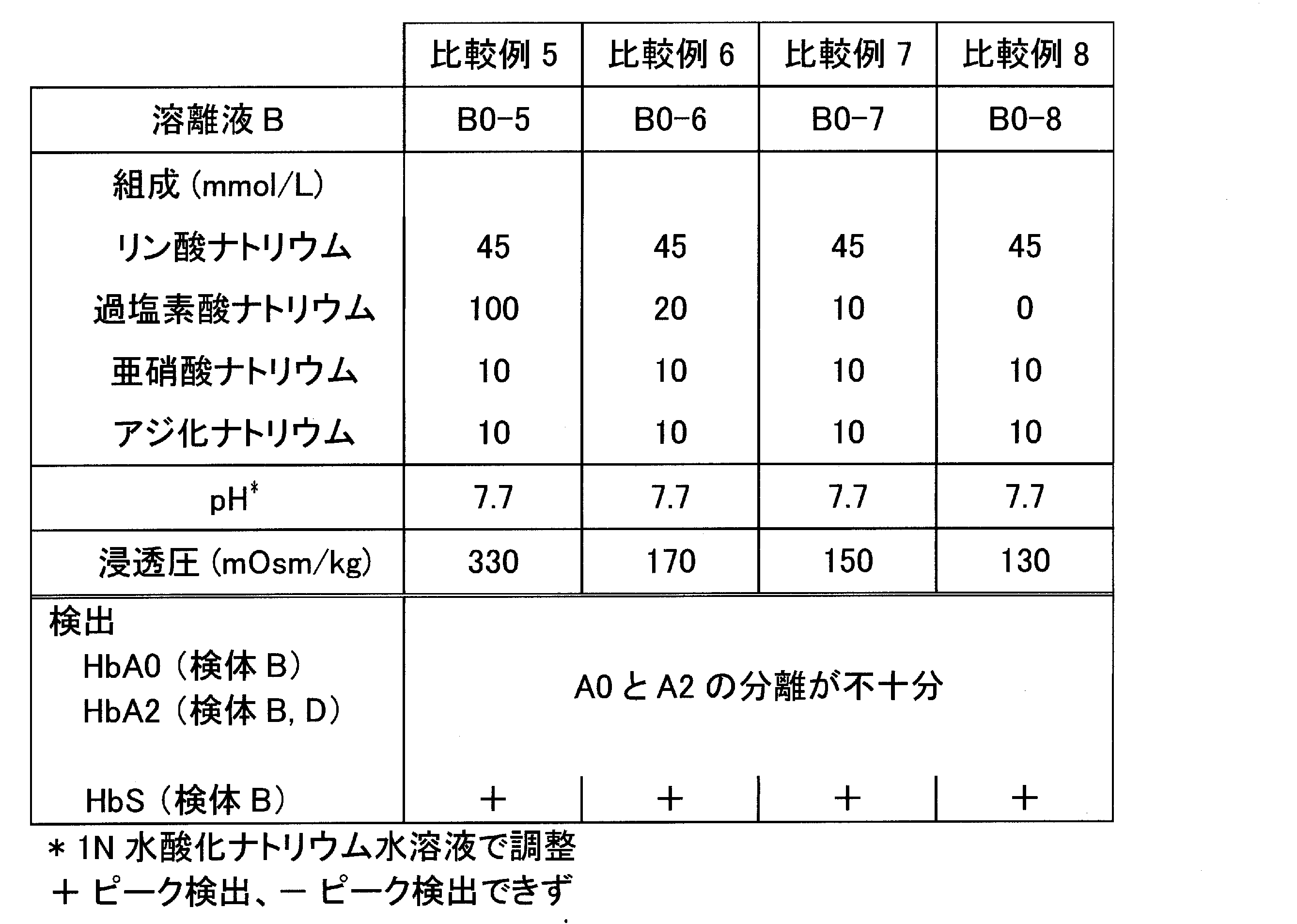
参考例2で調製した検体B及び検体Dについてヘモグロビン分析を行った。グラジエントと溶離液B以外の分析条件は、試験1と同じとした。溶離液Bには、表7に記載のpH及び浸透圧を有するリン酸ナトリウムと過塩素酸ナトリウムを含有する緩衝液を含む溶離液を用いた。なお、表7に記載の溶離液の組成は、従来のヘモグロビン分析で一般的に用いられているリン酸緩衝液を含む溶離液の組成を基にした。グラジエント条件は表8に示すとおりとした。
参考例2で調製した検体B及び検体Dについてヘモグロビン分析を行った。グラジエントと溶離液B以外の分析条件は、試験1と同じとした。溶離液Bには、表7に記載のpH及び浸透圧を有するリン酸ナトリウムと過塩素酸ナトリウムを含有する緩衝液を含む溶離液を用いた。なお、表7に記載の溶離液の組成は、従来のヘモグロビン分析で一般的に用いられているリン酸緩衝液を含む溶離液の組成を基にした。グラジエント条件は表8に示すとおりとした。
分析結果を表7に示す。また比較例5~8のクロマトグラムを図4~7に示す。検体BにはHbA2が5~7質量%程度含有されていたが、比較例5~8では、HbA0のピークとHbA2のピークが重なり、両種のピークが十分に分離されなかった。この結果より、pH8.0以下、浸透圧が130mOsm/kg以上であるような従来使用される溶離液では、HbA0とHbA2を十分に検出できないことが示された。

参考例2で調製した検体A~Cについて、表9に記載のリン酸緩衝液を含む溶離液Bを用いてヘモグロビン分析を行った。溶離液B以外の条件は試験2と同様にした。溶離液Bとしては、表9に記載のリン酸緩衝液を含む溶離液を用いた。
分析結果を表9に示す。比較例9、10では、HbA0とHbA2とのピークの分離が十分でなく、さらにHbS及びHbCのいずれか又は両方が検出されなかった。比較例11~14では、HbS及びHbCは検出されたが、HbA0とHbA2とのピークの分離が十分でなかった。比較例9~14の溶離液Bは、上述した実施例の溶離液と比べて浸透圧が高く、またpHもより高いか又はより低くなり、pH8.0以上、浸透圧40mOsm/kg以下の条件を達成することができなかった。このことが、比較例9~14における不十分なヘモグロビン検出につながったと考えられた。
(試験5)
参考例2で調製した検体A~Cについてヘモグロビン分析を行った。溶離液B及びグラジエント条件以外の条件は試験1と同様にした。溶離液Bとしては表10に記載の溶離液を用いた。グラジエント条件は表11のとおりとした。分析結果を表10に示す。実施例19及び20の両方で、HbA0とHbA2のピークが良好に分離され、かつHbSとHbCのピークも良好に分離され、HbA0、HbA2、HbS及びHbCを検出することができた。
参考例2で調製した検体A~Cについてヘモグロビン分析を行った。溶離液B及びグラジエント条件以外の条件は試験1と同様にした。溶離液Bとしては表10に記載の溶離液を用いた。グラジエント条件は表11のとおりとした。分析結果を表10に示す。実施例19及び20の両方で、HbA0とHbA2のピークが良好に分離され、かつHbSとHbCのピークも良好に分離され、HbA0、HbA2、HbS及びHbCを検出することができた。

Claims (21)
- ヘモグロビン分析方法であって、
カチオン交換クロマトグラフィーにより試料中のヘモグロビンを分離することを含み、
該ヘモグロビンの分離において、pH8.1以上、浸透圧40mOsm/kg以下の溶離液が用いられる、
方法。 - 前記溶離液が金属イオンを含まない緩衝剤を含有する、請求項1記載の方法。
- 前記緩衝剤がBicine、Tricine又はTESである、請求項2記載の方法。
- 前記溶離液中の前記緩衝剤の濃度が2~17mmol/Lである、請求項2又は3記載の方法。
- 前記溶離液がヘモグロビン変性剤を含有する、請求項1~4のいずれか1項記載の方法。
- 前記溶離液を用いたグラジエント溶離によりヘモグロビンを分離する、請求項1~5のいずれか1項記載の方法。
- 前記グラジエントにおいて前記溶離液の割合が0%から100%まで増加する、請求項6記載の方法。
- HbS、HbC、HbE、HbD、及びHbO-Arabからなる群より選択される少なくとも1種の異常ヘモグロビンを分離する、請求項1~7のいずれか1項記載の方法。
- HbA2、HbF、HbH、HbBart’、及びHbConstant Springからなる群より選択される少なくとも1種のサラセミアマーカーを分離する、請求項1~8のいずれか1項記載の方法。
- 前記クロマトグラフィーが高速液体クロマトグラフィーである、請求項1~9のいずれか1項記載の方法。
- pH8.1以上、浸透圧40mOsm/kg以下である、カチオン交換クロマトグラフィーによるヘモグロビン分離用溶離液。
- 金属イオンを含まない緩衝剤を含有する、請求項11記載の溶離液。
- 前記緩衝剤がBicine、Tricine又はTESである、請求項12記載の溶離液。
- 前記溶離液中の前記緩衝剤の濃度が2~17mmol/Lである、請求項12又は13記載の溶離液。
- 前記溶離液がヘモグロビン変性剤を含有する、請求項11~14のいずれか1項記載の溶離液。
- pH8.1以上、浸透圧40mOsm/kg以下である液体組成物の、カチオン交換クロマトグラフィーによるヘモグロビン分離用溶離液としての使用。
- pH8.1以上、浸透圧40mOsm/kg以下である液体組成物の、カチオン交換クロマトグラフィーによるヘモグロビン分離用溶離液の製造のための使用。
- 前記液体組成物が金属イオンを含まない緩衝剤を含有する、請求項16又は17記載の使用。
- 前記緩衝剤がBicine、Tricine又はTESである、請求項18記載の使用。
- 前記液体組成物中の前記緩衝剤の濃度が2~17mmol/Lである、請求項18又は19記載の使用。
- 前記液体組成物がヘモグロビン変性剤を含有する、請求項16~20のいずれか1項記載の使用。
Priority Applications (5)
| Application Number | Priority Date | Filing Date | Title |
|---|---|---|---|
| EP19788856.3A EP3783359B1 (en) | 2018-04-18 | 2019-04-18 | Haemoglobin analysis method |
| US16/971,393 US12203945B2 (en) | 2018-04-18 | 2019-04-18 | Haemoglobin analysis method for detecting abnormal haemoglobins and/or thalassemia markers |
| JP2019543132A JP6600123B1 (ja) | 2018-04-18 | 2019-04-18 | ヘモグロビン分析方法 |
| CN201980026091.7A CN111989568B (zh) | 2018-04-18 | 2019-04-18 | 血红蛋白分析方法 |
| ES19788856T ES2982322T3 (es) | 2018-04-18 | 2019-04-18 | Método de análisis de hemoglobina |
Applications Claiming Priority (2)
| Application Number | Priority Date | Filing Date | Title |
|---|---|---|---|
| JP2018079937 | 2018-04-18 | ||
| JP2018-079937 | 2018-04-18 |
Publications (1)
| Publication Number | Publication Date |
|---|---|
| WO2019203302A1 true WO2019203302A1 (ja) | 2019-10-24 |
Family
ID=68240296
Family Applications (1)
| Application Number | Title | Priority Date | Filing Date |
|---|---|---|---|
| PCT/JP2019/016633 Ceased WO2019203302A1 (ja) | 2018-04-18 | 2019-04-18 | ヘモグロビン分析方法 |
Country Status (6)
| Country | Link |
|---|---|
| US (1) | US12203945B2 (ja) |
| EP (1) | EP3783359B1 (ja) |
| JP (1) | JP6600123B1 (ja) |
| CN (1) | CN111989568B (ja) |
| ES (1) | ES2982322T3 (ja) |
| WO (1) | WO2019203302A1 (ja) |
Cited By (4)
| Publication number | Priority date | Publication date | Assignee | Title |
|---|---|---|---|---|
| JPWO2021182599A1 (ja) * | 2020-03-13 | 2021-09-16 | ||
| JP2021179337A (ja) * | 2020-05-12 | 2021-11-18 | 積水メディカル株式会社 | ヘモグロビン分析方法 |
| WO2023223176A1 (en) * | 2022-05-14 | 2023-11-23 | Shanmukha Innovations Private Limited | An apparatus, kit and methods for detecting thalassemia hemoglobin in a sample |
| WO2024241529A1 (ja) * | 2023-05-24 | 2024-11-28 | 東ソー株式会社 | ヘモグロビンの分離用溶離液およびその分離方法 |
Citations (12)
| Publication number | Priority date | Publication date | Assignee | Title |
|---|---|---|---|---|
| JPH10227780A (ja) * | 1997-02-14 | 1998-08-25 | Sekisui Chem Co Ltd | 糖化ヘモグロビンの測定方法および装置 |
| US5801053A (en) * | 1996-05-06 | 1998-09-01 | Primus Corporation | Chromatographic method for the identification and characterization of hemoglobin variants in blood |
| JPH11295286A (ja) * | 1998-04-10 | 1999-10-29 | Sekisui Chem Co Ltd | ヘモグロビン類の測定方法 |
| JP2001221788A (ja) * | 2000-02-07 | 2001-08-17 | Sekisui Chem Co Ltd | ヘモグロビン類の測定方法 |
| JP2002520338A (ja) * | 1998-07-10 | 2002-07-09 | バイオピュア コーポレーション | ヘモグロビンの精製方法 |
| JP2010237110A (ja) | 2009-03-31 | 2010-10-21 | Sekisui Medical Co Ltd | ヘモグロビン類の分析方法及び蛋白質の分析方法 |
| JP2011047858A (ja) | 2009-08-28 | 2011-03-10 | Sekisui Medical Co Ltd | ヘモグロビン類分離用カラム充填剤、ヘモグロビンA1cの測定方法、ヘモグロビンA1c及び異常ヘモグロビン類の測定方法、並びに、ヘモグロビン類分離用カラム充填剤の製造方法 |
| WO2011096420A1 (ja) | 2010-02-02 | 2011-08-11 | 積水メディカル株式会社 | ヘモグロビンsの分析方法、ヘモグロビンa2の分析方法、及び、ヘモグロビンa0の分析方法 |
| WO2011125484A1 (ja) * | 2010-03-31 | 2011-10-13 | 積水メディカル株式会社 | ヘモグロビン類の分析方法 |
| JP2012168055A (ja) * | 2011-02-15 | 2012-09-06 | Sekisui Medical Co Ltd | 液体クロマトグラフィー用カラム充填剤の製造方法、液体クロマトグラフィーによる試料の測定方法、及び、ヘモグロビン類の測定方法 |
| JP2012168054A (ja) * | 2011-02-15 | 2012-09-06 | Sekisui Medical Co Ltd | 液体クロマトグラフィー用カラム充填剤、液体クロマトグラフィー用カラム充填剤の製造方法、及び、ヘモグロビン類の測定方法 |
| JP2016027326A (ja) | 2014-06-26 | 2016-02-18 | アークレイ株式会社 | 測定方法、測定装置および溶離液 |
Family Cites Families (35)
| Publication number | Priority date | Publication date | Assignee | Title |
|---|---|---|---|---|
| US3763136A (en) * | 1971-12-07 | 1973-10-02 | Diagnostic Data Inc | One step chromatographic isolation of orgotein |
| US3763137A (en) * | 1971-12-07 | 1973-10-02 | Diagnostic Data Inc | Isolation of orgotein from red blood cells |
| US4108603A (en) * | 1977-05-18 | 1978-08-22 | Purdue Research Foundation | Method for rapid analysis of hemoglobin variants by high speed liquid chromatography |
| US4246084A (en) * | 1979-05-29 | 1981-01-20 | Beckman Instruments, Inc. | Electrophoretic technique for assaying the relative distribution of lactate dehydrogenase isoenztimes and buffers for use therein |
| US4407961A (en) * | 1981-03-16 | 1983-10-04 | Sanders James L | Ion-exchange system and method for isolation and determination of glycosylated hemoglobin in human blood |
| US4517241A (en) * | 1982-12-02 | 1985-05-14 | Alpert Andrew J | Chromatographic support material |
| CA1312009C (en) * | 1986-11-10 | 1992-12-29 | Carl W. Rausch | Extra pure semi-synthetic blood substitute |
| US4970171A (en) * | 1987-11-09 | 1990-11-13 | Miles Inc. | Denaturant reagents for convenient determination of hemoglobin derivatives in blood |
| US6150506A (en) * | 1989-05-10 | 2000-11-21 | Baxter Biotech Technology Sarl | Modified hemoglobin-like compounds and methods of purifying same |
| US6828125B1 (en) * | 1989-05-10 | 2004-12-07 | Baxter Biotech Technology, S.A.R.L. | DNA encoding fused di-alpha globins and use thereof |
| JP2619537B2 (ja) * | 1989-09-18 | 1997-06-11 | 株式会社日立製作所 | 液体クロマトグラフの方法,その装置,そのシステム,及びその分離カラム |
| CZ281912B6 (cs) * | 1990-11-29 | 1997-03-12 | The Upjohn Company | Směs hemoglobinu síťovaného imidoesterem a způso b její výroby |
| US5260419A (en) * | 1991-03-20 | 1993-11-09 | The Dupont Merck Pharmaceutical Company | Purification of active and inactive/latent forms of plasminogen activator inhibitor-1 |
| JPH05113440A (ja) * | 1991-04-17 | 1993-05-07 | Tosoh Corp | 糖化ヘモグロビンの分析方法 |
| JP2669255B2 (ja) * | 1992-04-01 | 1997-10-27 | 株式会社日立製作所 | ヘモグロビン類の分析方法,分析装置およびそれに用いるカラム劣化抑制液 |
| US5264555A (en) * | 1992-07-14 | 1993-11-23 | Enzon, Inc. | Process for hemoglobin extraction and purification |
| CA2106612C (en) * | 1993-09-21 | 2001-02-06 | Diana Pliura | Displacement chromatography process |
| US5753465A (en) * | 1994-08-30 | 1998-05-19 | Carnegie Mellon University | Unmodified recombinant human adult hemoglobin production |
| US5843888A (en) * | 1995-05-01 | 1998-12-01 | Carnegie Mellon University | Low oxygen affinity mutant hemoglobin |
| US5691453A (en) * | 1995-06-07 | 1997-11-25 | Biopure Corporation | Separation of polymerized hemoglobin from unpolymerized hemoglobin on hydroxyapatite using HPLC |
| WO1999004269A1 (en) * | 1997-07-17 | 1999-01-28 | Primus Corporation | High speed chromatographic method for hemoglobin variants screening and quantification of hemoglobins a2 and f |
| IT1294312B1 (it) * | 1997-08-07 | 1999-03-24 | Sgs Thomson Microelectronics | Processo per la fabbricazione di un dispositivo di memoria non volatile programmabile elettricamente |
| JPH11304782A (ja) * | 1998-04-24 | 1999-11-05 | Sekisui Chem Co Ltd | 液体クロマトグラフによる試料の分離方法 |
| EP1103812B1 (en) * | 1998-08-07 | 2015-11-18 | Sekisui Chemical Co., Ltd. | Method for determining hemoglobins |
| JP4094776B2 (ja) * | 1999-07-06 | 2008-06-04 | 積水化学工業株式会社 | 溶血試薬及びこれを用いたヘモグロビン類の測定方法 |
| JP4420539B2 (ja) * | 1999-09-24 | 2010-02-24 | 積水化学工業株式会社 | ヘモグロビンa2の分離方法 |
| JP2003014714A (ja) * | 2001-06-29 | 2003-01-15 | Sekisui Chem Co Ltd | ヘモグロビン類の測定方法 |
| JP4139333B2 (ja) * | 2001-11-09 | 2008-08-27 | キネティック バイオシステムズ インコーポレイテッド | クロマトグラフィー用の方法及び組成物 |
| HUE034672T2 (hu) * | 2003-05-01 | 2018-02-28 | Merial Inc | Kutya GHRH-gén, polipeptidek és eljárások alkalmazásukra |
| FR2878033B1 (fr) | 2004-11-18 | 2007-05-04 | Sebia Sa | Procede d'analyse de l'hemoglobine par electrophorese capillaire, trousse pour electrophorese capillaire et utilisation de ralentisseur de flux dans un tel procede |
| CN101198350A (zh) | 2005-06-17 | 2008-06-11 | 巴克斯特国际公司 | 含胃动素样肽的稳定的缓冲的药物组合物 |
| AU2008266938A1 (en) * | 2007-06-13 | 2008-12-24 | Opk Biotech Llc | Targeted oxygen delivery via intravenous or intra-arterial infusion of oxygenated polymerized hemoglobin solutions |
| JP6370792B2 (ja) * | 2012-10-03 | 2018-08-08 | ツェー・エス・エル・ベーリング・アクチエンゲゼルシャフト | タンパク質の精製方法 |
| WO2018012607A1 (ja) * | 2016-07-13 | 2018-01-18 | キッコーマン株式会社 | 反応促進剤 |
| US11208675B2 (en) * | 2016-07-13 | 2021-12-28 | Kikkoman Corporation | Reaction accelerating agent |
-
2019
- 2019-04-18 WO PCT/JP2019/016633 patent/WO2019203302A1/ja not_active Ceased
- 2019-04-18 JP JP2019543132A patent/JP6600123B1/ja active Active
- 2019-04-18 CN CN201980026091.7A patent/CN111989568B/zh active Active
- 2019-04-18 EP EP19788856.3A patent/EP3783359B1/en active Active
- 2019-04-18 US US16/971,393 patent/US12203945B2/en active Active
- 2019-04-18 ES ES19788856T patent/ES2982322T3/es active Active
Patent Citations (12)
| Publication number | Priority date | Publication date | Assignee | Title |
|---|---|---|---|---|
| US5801053A (en) * | 1996-05-06 | 1998-09-01 | Primus Corporation | Chromatographic method for the identification and characterization of hemoglobin variants in blood |
| JPH10227780A (ja) * | 1997-02-14 | 1998-08-25 | Sekisui Chem Co Ltd | 糖化ヘモグロビンの測定方法および装置 |
| JPH11295286A (ja) * | 1998-04-10 | 1999-10-29 | Sekisui Chem Co Ltd | ヘモグロビン類の測定方法 |
| JP2002520338A (ja) * | 1998-07-10 | 2002-07-09 | バイオピュア コーポレーション | ヘモグロビンの精製方法 |
| JP2001221788A (ja) * | 2000-02-07 | 2001-08-17 | Sekisui Chem Co Ltd | ヘモグロビン類の測定方法 |
| JP2010237110A (ja) | 2009-03-31 | 2010-10-21 | Sekisui Medical Co Ltd | ヘモグロビン類の分析方法及び蛋白質の分析方法 |
| JP2011047858A (ja) | 2009-08-28 | 2011-03-10 | Sekisui Medical Co Ltd | ヘモグロビン類分離用カラム充填剤、ヘモグロビンA1cの測定方法、ヘモグロビンA1c及び異常ヘモグロビン類の測定方法、並びに、ヘモグロビン類分離用カラム充填剤の製造方法 |
| WO2011096420A1 (ja) | 2010-02-02 | 2011-08-11 | 積水メディカル株式会社 | ヘモグロビンsの分析方法、ヘモグロビンa2の分析方法、及び、ヘモグロビンa0の分析方法 |
| WO2011125484A1 (ja) * | 2010-03-31 | 2011-10-13 | 積水メディカル株式会社 | ヘモグロビン類の分析方法 |
| JP2012168055A (ja) * | 2011-02-15 | 2012-09-06 | Sekisui Medical Co Ltd | 液体クロマトグラフィー用カラム充填剤の製造方法、液体クロマトグラフィーによる試料の測定方法、及び、ヘモグロビン類の測定方法 |
| JP2012168054A (ja) * | 2011-02-15 | 2012-09-06 | Sekisui Medical Co Ltd | 液体クロマトグラフィー用カラム充填剤、液体クロマトグラフィー用カラム充填剤の製造方法、及び、ヘモグロビン類の測定方法 |
| JP2016027326A (ja) | 2014-06-26 | 2016-02-18 | アークレイ株式会社 | 測定方法、測定装置および溶離液 |
Non-Patent Citations (1)
| Title |
|---|
| See also references of EP3783359A4 |
Cited By (9)
| Publication number | Priority date | Publication date | Assignee | Title |
|---|---|---|---|---|
| JPWO2021182599A1 (ja) * | 2020-03-13 | 2021-09-16 | ||
| WO2021182599A1 (ja) | 2020-03-13 | 2021-09-16 | 積水メディカル株式会社 | ヘモグロビン分析方法 |
| CN115315626A (zh) * | 2020-03-13 | 2022-11-08 | 积水医疗株式会社 | 血红蛋白分析方法 |
| CN115315626B (zh) * | 2020-03-13 | 2024-08-20 | 积水医疗株式会社 | 血红蛋白分析方法 |
| JP7694887B2 (ja) | 2020-03-13 | 2025-06-18 | 積水メディカル株式会社 | ヘモグロビン分析方法 |
| JP2021179337A (ja) * | 2020-05-12 | 2021-11-18 | 積水メディカル株式会社 | ヘモグロビン分析方法 |
| JP7355471B2 (ja) | 2020-05-12 | 2023-10-03 | 積水メディカル株式会社 | ヘモグロビン分析方法 |
| WO2023223176A1 (en) * | 2022-05-14 | 2023-11-23 | Shanmukha Innovations Private Limited | An apparatus, kit and methods for detecting thalassemia hemoglobin in a sample |
| WO2024241529A1 (ja) * | 2023-05-24 | 2024-11-28 | 東ソー株式会社 | ヘモグロビンの分離用溶離液およびその分離方法 |
Also Published As
| Publication number | Publication date |
|---|---|
| US20200393472A1 (en) | 2020-12-17 |
| JPWO2019203302A1 (ja) | 2020-04-30 |
| ES2982322T3 (es) | 2024-10-15 |
| CN111989568B (zh) | 2024-05-28 |
| CN111989568A (zh) | 2020-11-24 |
| US12203945B2 (en) | 2025-01-21 |
| EP3783359A1 (en) | 2021-02-24 |
| EP3783359B1 (en) | 2024-03-27 |
| JP6600123B1 (ja) | 2019-10-30 |
| EP3783359A4 (en) | 2022-01-19 |
Similar Documents
| Publication | Publication Date | Title |
|---|---|---|
| JP6600123B1 (ja) | ヘモグロビン分析方法 | |
| JP5875160B2 (ja) | ヘモグロビン類の分析方法 | |
| WO2000008460A1 (en) | Method for determining hemoglobins | |
| JP2016027326A (ja) | 測定方法、測定装置および溶離液 | |
| JP2010164579A (ja) | ヘモグロビン類の測定方法 | |
| CN112742359B (zh) | 糖化血红蛋白分析用柱填料的制造方法 | |
| WO2018008447A1 (ja) | ヘモグロビン調製液及びヘモグロビン類測定液体クロマトグラフィー法 | |
| JP2001159625A (ja) | ヘモグロビンa2の分離方法 | |
| JP7694887B2 (ja) | ヘモグロビン分析方法 | |
| JP7355471B2 (ja) | ヘモグロビン分析方法 | |
| JP4404429B2 (ja) | ヘモグロビン類の測定方法 | |
| JP5013560B2 (ja) | ヘモグロビンsの分析方法、及び、ヘモグロビンa2の分析方法 | |
| JP4094776B2 (ja) | 溶血試薬及びこれを用いたヘモグロビン類の測定方法 | |
| JPH11295286A (ja) | ヘモグロビン類の測定方法 | |
| JP3429679B2 (ja) | 安定型ヘモグロビンA1cの測定方法 | |
| JP4404428B2 (ja) | ヘモグロビン類の測定方法 | |
| JP3429683B2 (ja) | ヘモグロビン類の測定方法 | |
| JP4109395B2 (ja) | ヘモグロビン類の測定方法 | |
| JP4571046B2 (ja) | ヘモグロビン類の測定方法 | |
| JP5248257B2 (ja) | イオン交換液体クロマトグラフィーを用いた蛋白質の分析方法、及び、ヘモグロビン類の分離、定量方法 | |
| JP2000081423A (ja) | 液体クロマトグラフィー用充填剤 | |
| JP2001349894A (ja) | ヘモグロビン類の測定方法 |
Legal Events
| Date | Code | Title | Description |
|---|---|---|---|
| ENP | Entry into the national phase |
Ref document number: 2019543132 Country of ref document: JP Kind code of ref document: A |
|
| 121 | Ep: the epo has been informed by wipo that ep was designated in this application |
Ref document number: 19788856 Country of ref document: EP Kind code of ref document: A1 |
|
| NENP | Non-entry into the national phase |
Ref country code: DE |
|
| ENP | Entry into the national phase |
Ref document number: 2019788856 Country of ref document: EP Effective date: 20201118 |