WO2019207645A1 - Programme informatique - Google Patents
Programme informatique Download PDFInfo
- Publication number
- WO2019207645A1 WO2019207645A1 PCT/JP2018/016609 JP2018016609W WO2019207645A1 WO 2019207645 A1 WO2019207645 A1 WO 2019207645A1 JP 2018016609 W JP2018016609 W JP 2018016609W WO 2019207645 A1 WO2019207645 A1 WO 2019207645A1
- Authority
- WO
- WIPO (PCT)
- Prior art keywords
- visitor
- information
- reliability
- activity
- website
- Prior art date
- Legal status (The legal status is an assumption and is not a legal conclusion. Google has not performed a legal analysis and makes no representation as to the accuracy of the status listed.)
- Ceased
Links
Images




Classifications
-
- G—PHYSICS
- G06—COMPUTING OR CALCULATING; COUNTING
- G06Q—INFORMATION AND COMMUNICATION TECHNOLOGY [ICT] SPECIALLY ADAPTED FOR ADMINISTRATIVE, COMMERCIAL, FINANCIAL, MANAGERIAL OR SUPERVISORY PURPOSES; SYSTEMS OR METHODS SPECIALLY ADAPTED FOR ADMINISTRATIVE, COMMERCIAL, FINANCIAL, MANAGERIAL OR SUPERVISORY PURPOSES, NOT OTHERWISE PROVIDED FOR
- G06Q30/00—Commerce
- G06Q30/02—Marketing; Price estimation or determination; Fundraising
Definitions
- the present invention is a computer program for causing a computer to process information related to a visitor terminal that can access a website.
- Patent Literature 1 by transmitting a media tag in which processing for advertisement redistribution (for example, retargeting) is described according to a user segment to a user terminal that has accessed the information providing site, It is described that the advertisement redistribution that matches the user operating the user terminal is effectively performed.
- processing for advertisement redistribution for example, retargeting
- ad fraud automatically patrols a website on the internet, for example, called an internet bot.
- Activity to fraudulently squeeze advertising costs from advertisers by using a traveling computer program that executes tasks have become popular.
- Such ad fraud is a big problem for the advertising industry.
- evaluation information on Web visitors (visitor terminals) that are not performing in-website activities by the above-described traveling computer program based on quantitative evaluation indexes, such as advertisers, and It is desirable to provide it to an advertisement distribution manager.
- the object of the present invention has been made in view of the above-mentioned problems, and that a visitor terminal does not perform activities in a website according to a patrol computer program that automatically patrols the Internet and executes tasks.
- the object is to provide a computer program that can be evaluated by a quantitative evaluation index.
- the computer program of the present invention acquires activity history information in a website of a plurality of visitor terminals that can access a website managed by one or more data providing servers, and the web of the plurality of visitor terminals. Identifying information on difficult-to-automate activities that are difficult to execute in a traveling computer program in which each visitor terminal automatically circulates the Internet and executes a task based on the activity history information in the site; Based on the information relating to each of the plurality of visitor terminals, calculating a reliability obtained by quantifying the reliability that each visitor terminal is not automatically performing an activity in the website according to the traveling computer program; Identification of one or more visitor terminals whose reliability is equal to or higher than a predetermined reliability A computer program for executing the method comprising: extracting and outputting broadcast, to the computer.
- FIG. 1 is a diagram schematically showing an advertisement distribution system 1 to which the present invention is applicable.
- FIG. 2 is a diagram illustrating a schematic hardware configuration of the visitor evaluation server 10.
- FIG. 3 is a diagram for explaining a specific example of managing visitor IDs.
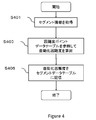
- FIG. 4 is a flowchart showing a specific example of the flow of processing performed by the difficult automation activity specifying unit 120.
- FIG. 5 is an example of a selection screen 500 displayed by the advertiser client device 3.
- FIG. 6 is a diagram schematically illustrating the correspondence between segments and audiences.
- FIG. 7 is a flowchart showing the main processing flow of the advertisement distribution system 1 centered on the visitor evaluation server 10.
- ad fraud In such “real-time bidding”, “malicious media (advertising website operator) called ad fraud automatically visits websites on the Internet, for example, called Internet bots. "Activities that illegally exploit advertising expenses from advertisers using a traveling computer program that executes tasks" have become popular. Such ad fraud is a major problem for the advertising industry. In order to prevent ad fraud in advance, evaluation information on Web visitors (visitor terminals) that are not performing in-website activities by the above-described traveling computer program based on quantitative evaluation indexes, such as advertisers, and It is desirable to provide it to an advertisement distribution manager.
- the purpose of this embodiment is to evaluate, based on a quantitative evaluation index, that a visitor terminal is not performing an activity in a website according to a patrol computer program that automatically patrols and executes a task. .
- FIG. 1 is a diagram schematically showing an advertisement distribution system 1 to which the present invention is applicable.
- the advertisement distribution system 1 includes, for example, a medium management server 30, an ad exchange management server 40, an advertiser management server 50, a visitor evaluation server 10, and a data providing server 20.
- the medium management server 30 is connected to, for example, the media 31 to 35 that operate a web page having the advertisement space 30A via the Internet.
- visitor terminals 2a and 2b (generally referred to as visitor terminal 2), which are web visitors, access a web page of the media 35, from the medium management server 30 via the ad exchange management server 40.
- a request for bidding an advertisement is issued to the management server 50 for advertisers.
- the advertisement data of the advertiser client device 3 managed by the advertiser management server 50 (for example, the advertisement of company X, which is a life insurance company) is displayed in the advertisement space 30A.
- the advertisement data of the advertiser client device 3 managed by the advertiser management server 50 for example, the advertisement of company X, which is a life insurance company
- the visitor terminal 2a accesses the web page of the media 35 in response to an operation by a human and receives the advertisement data in the advertisement space 30A.
- the visitor terminal 2b automatically (human operation) by executing a traveling computer program that automatically circulates the Internet and executes a task, such as an Internet bot, Web bot, or simply bot.
- a task such as an Internet bot, Web bot, or simply bot.
- the web page of the medium 35 is accessed as described above, and the advertisement data is received in the advertisement space 30A.
- the advertisement data is notified to a person, so that a certain advertisement effect can be expected.
- the visitor terminal 2b receives the advertisement data, no advertising effect can be expected. If anything, the advertising costs are illegally exploited from the advertiser.
- the visitor evaluation server 10 uses the quantitative evaluation index to obtain information related to the reliability of the visitor terminal 2 that is not performing activities in the website by the traveling computer program, for example, the advertiser client device 3 and the advertiser management server. 50 and so on. By using such evaluation information, advertisements can be prevented from being displayed on a visitor terminal (for example, visitor terminal 2b) that is automatically operated by the traveling computer program. Costs can be reduced.
- the three data providing servers 20 manage web logs and CRM data related to visitor terminals that have accessed the sites 21, 22, and 23 operated by each of the three data providing servers 20.
- the site 21 is a site for providing electronic commerce (EC) by, for example, a company A which is a home appliance mass retailer.
- the site 22 is a site for providing information related to childcare and education, for example, by Company B, which is an information provider related to childcare and education.
- the site 23 is a site for the company C, which is a real estate related information provider, to provide real estate related information.
- the data providing server 20 manages web logs and CRM data related to visitor terminals that have accessed the sites 21, 22, and 23, and provides segment information to be described later to the visitor evaluation server 10 based on the web logs and CRM data. To do.
- FIG. 2 is a diagram illustrating a schematic hardware configuration of the visitor evaluation server 10.
- the visitor evaluation server 10 communicates with the advertiser client device 3, the advertiser management server 50, the data providing server 20, and the like via a communication network such as the Internet as shown in FIG.
- a communication interface unit 11 an arithmetic processing unit 12 such as a CPU for performing various arithmetic processes, a main memory 13 such as SRAM or DRAM for temporarily storing arithmetic processing data, and a hard disk in which application programs and various data are stored And the like.
- the visitor evaluation server 10 having the above-described hardware configuration installs a computer program (application program) for performing visitor evaluation, so that, for example, functional blocks as shown in FIG. Is done. That is, the information acquisition unit 110, the difficult automation activity identification unit 120, the reliability calculation unit 130, and the identification information extraction unit 140 are realized in the arithmetic processing unit 12.
- a computer program application program
- the visitor evaluation server 10 (information acquisition unit 110) is a web of a plurality of visitor terminals (for example, visitor terminals 2) that can access a website managed by one or more data provision servers (for example, the data provision server 20). Get site activity history information. Then, the visitor evaluation server 10 (automated difficult activity specifying unit 120) determines that each visitor terminal (for example, visitor terminals 2a and 2b) is based on the activity history information in the website of the plurality of visitor terminals. Information on difficult-to-automate activities that are difficult to automatically execute according to the traveling computer program is specified.
- the visitor evaluation server 10 (reliability calculation unit 130) automatically causes each visitor terminal (for example, visitor terminals 2a and 2b) to automatically follow the traveling computer program based on the information related to the activity that is difficult to automate. Calculate the reliability of quantifying the credibility of not doing in-website activities. Then, the visitor evaluation server 10 (identification information extraction unit 140) has at least one of the identification information of the plurality of visitor terminals (for example, visitor terminal 2) whose reliability is equal to or higher than a predetermined reliability. The identification information of the visitor terminal (for example, visitor terminal 2a) is extracted and output.
- Website activity history information The visitor evaluation server 10 (information acquisition unit 110) is associated with one or more segments classified for each visitor terminal based on activity attributes of website activities. Acquire internal activity information.
- on-site activity information refers to access to pages related to products to be purchased, access to pages related to purchase processing, writing and transmission of text data such as blogs and comments, browsing of blogs and comments, etc. , Information about the activities that take place on the site.
- the site activity information is held as web log data in the data providing server 20, for example.
- a segment is a visitor classified based on activity attributes of website activities such as “daily goods buyer on EC site”, “community site contributor”, “birth category article viewer”, etc.
- a group of terminals is a group of terminals.
- the intra-site activity information (hereinafter also referred to as segment information) associated with the segment includes, for example, segment detailed information and segment characteristic information.
- segment detailed information is, for example, “customers who purchased daily commodities of 1000 yen or more within the past year”.
- the segment characteristic information includes, for example, “activity history that requires login to a website”, “activity history that requires the use of a credit card”, “activity history that requires the use of a credit card”, “long-term continuous This is information indicating an activity history corresponding to a target visitor terminal among “activity history requiring purchase of product” and “activity history requiring purchase of expensive product”.
- Such segment information is acquired by the information acquisition unit 110 by being transmitted from the data providing server 20.
- the data providing server 20 performs segment registration processing on the visitor evaluation server 10, thereby providing segment information and a visitor ID (identification information of a visitor terminal) belonging to a segment corresponding to the segment information. Are sent to the visitor evaluation server 10.
- the visitor ID is identification information of a visitor terminal that can be recognized in common by the data providing server 20 and the visitor evaluation server 10.
- the visitor ID is an identifier that can be commonly identified among a plurality of data providing servers.
- FIG. 3 is a diagram for explaining a specific example of managing visitor IDs. That is, for example, as shown in FIG. 3, by incorporating a tag into a Web site, the same terminal (the same visitor terminal) can be connected to the same browser even between a plurality of sites 21, 22, and 23 having different domains. If the access is made at, the same visitor ID (for example, global_id: AAAA) is set to the terminal. The visitor ID is held as a part of the access log by the data providing server 20 that manages each of the sites 21, 22, and 23.
- the data providing server 20 that manages each of the sites 21, 22, and 23.
- the visitor evaluation server 10 (automatic automation activity specifying unit 120) specifies information on difficult automation activities corresponding to one or more segments.
- information regarding the difficult automation activity for example, a value obtained by quantifying (pointing) the type and number of difficult automation activities (hereinafter also referred to as automation difficulty) is used.
- the visitor evaluation server 10 (automated difficult activity specifying unit 120)
- the degree of difficulty in automation is specified with reference to information stored in the storage unit 15 as a data table.
- the difficulty level point data table is information regarding points corresponding to, for example, segment characteristic information.
- 1 point is set for “Activity history that requires login to website”
- 2 points are set for “Activity history that requires credit card use”
- “Long-term continuous 3 points are set in “Activity history that requires purchase of expensive products”
- 3 points are set in “Action history that requires purchase of expensive products”.
- FIG. 4 is a flowchart showing a specific example of the flow of processing performed by the automation difficult activity identification unit 120.
- the difficult automation activity specifying unit 120 acquires segment information from the information acquisition unit 110, for example (step S401).
- the segment information is information related to “daily goods buyers on the EC site”, and the segment characteristics include “activity history that requires login to the Web site” and “use of a credit card are required. It is assumed that “activity history” is selected.
- the difficult automation activity specifying unit 120 stores the calculated difficulty level in a segment data table for managing segment information in the storage unit 15. (Step S405), the process shown in FIG.
- the difficult-to-automate activity identifying unit 120 can identify the information related to the difficult-to-automate activity by calculating the degree of difficulty in automation by performing the process shown in FIG. 4 for each segment for each visitor terminal.
- the visitor evaluation server 10 calculates the reliability based on the aggregate information of the information related to the difficult automation activity corresponding to the one or more segments.
- the visitor evaluation server 10 determines the reliability of each visitor terminal identified by the visitor ID based on the degree of automation difficulty corresponding to one or more segments to which the visitor terminal belongs. To calculate.
- the reliability can be set, for example, in the range of 1 to 10, and is defined such that the larger the value, the lower the possibility that the visitor terminal is the Internet. Further, the calculated reliability of each visitor terminal is held in the storage unit 15 as a reliability data table.
- the reliability calculation unit 130 can calculate the reliability by the following calculation process as in the following equation.
- i belongs to the segment set to which visitor A belongs.
- the reliability of the visitor terminal A the total difficulty of the visitor terminal A
- the reliability can be calculated by the calculation steps 1 and 2 described above.
- the degree of automation difficulty corresponding to the segment of “daily purchaser on EC site” is 3 points
- the degree of automation difficulty of the segment corresponding to “community site poster” is 1 point
- a value “4” obtained by adding the points is calculated as the reliability.
- the visitor evaluation server 10 (identification information extraction unit 140) has one or more website activities that are classified into a predetermined segment with the reliability being equal to or higher than a predetermined value.
- the user terminal identification information is extracted and output. Specifically, the identification information of the one or more user terminals is transmitted to an advertiser management server 50 that is a management device that manages web advertisement distribution.
- the predetermined segment is, for example, one or more segments that the advertiser desires to distribute the advertisement.
- the predetermined value is, for example, a lower limit value of reliability serving as a reference for an advertisement distribution target desired by an advertiser.
- FIG. 5 is an example of a selection screen 500 displayed by the advertiser client apparatus 3.
- the advertiser client device 3 selects the segment selection information to be targeted for advertisement display from all the segments managed by the visitor evaluation server 10 according to the operation input by the advertiser according to the selection screen shown in FIG.
- the information on the lower threshold of the visitor reliability is transmitted to the visitor evaluation server 10.
- segments for example, three candidate segments
- the selection information of the segment to be targeted for the advertisement display is set.
- FIG. 5 shows an example in which the segment “birth category article viewer” is selected.
- a volume type user interface for selecting the lower limit threshold value of the reliability of the visitor to be distributed is displayed.
- information on the lower limit threshold value of the reliability of a visitor to be distributed is set by an indication position of a volume type user interface determined by a drag operation by an advertiser.
- FIG. 5 shows an example in which the reliability corresponding to 6 steps out of a total of 10 steps is designated as the lower limit threshold value.
- the visitor evaluation server 10 calculates the number of visitors that meet the condition based on the selection information of the segment to be targeted for advertisement display and the information on the lower threshold of the reliability of the visitor to be distributed. Then, information on the number of visitors is transmitted to the advertiser client device 3. By transmitting information on the number of visitors to the advertiser client device 3 in this way, for example, the number of target visitors is displayed in the image area 530 of the selection screen 500. For example, FIG. 5 shows that the number of target visitors is “36,000 IDs”, that is, 36,000 users.
- the visitor evaluation server 10 selects a list of visitor IDs (hereinafter referred to as “target visits”) that are targeted for advertisement distribution based on conditions finally determined by the advertiser. And the target visitor ID list is stored in the storage unit 15.
- the visitor evaluation server 10 (identification information extraction unit 140) manages the above-described target visitor ID list with the ID conversion correspondence data table, and manages it by the advertiser management server 50.
- the converted visitor ID is stored as the converted visitor ID.
- the ID conversion correspondence data table is, for example, information in which the management information of the visitor evaluation server 10 and the management information of the external advertiser management server 50 are linked.
- the ID conversion correspondence data table is information in which the visitor ID managed by the visitor evaluation server 10 is associated with the visitor ID managed by the advertiser management server 50 in a one-to-one correspondence. 15 is stored.
- the visitor evaluation server 10 specifies a unique audience for the converted target visitor ID list, and sets the audience ID.
- the audience is a group of visitor IDs managed by the advertiser management server 50 at the time of advertisement distribution.
- the audience ID is an identifier of an audience that can be identified by the management server 50 for advertisers.
- FIG. 6 is a diagram schematically showing the correspondence between segments and audiences. That is, the visitor evaluation server 10 (identification information extracting unit 140) corresponds to the two visitor ID lists 610 corresponding to the three segments 611, 612, and 612, as shown in FIG. The converted visitor ID list 620 is converted. Then, the visitor evaluation server 10 (identification information extracting unit 140) transmits the audience ID and the converted target visitor ID list to the management server 50 for advertisers.
- the advertiser management server 50 manages the audience based on the audience ID and the target visitor ID list after conversion, and performs the activities in the website by the above-mentioned traveling computer program based on the quantitative evaluation index.
- the advertisement display is performed only on the non-visitor terminal (for example, the visitor terminal 2a).
- FIG. 7 is a flowchart showing a main process flow of the advertisement distribution system 1 centered on the visitor evaluation server 10.
- step ST 1-1 the data providing server 20 performs segment registration with the visitor evaluation server 10. That is, the data providing server 20 transmits the segment information and the visitor ID list to the visitor evaluation server 10.
- step ST1-2 the visitor evaluation server 10 sets a segment ID that can be uniquely identified for the segment information and the visitor ID list transmitted from the data providing server 20.
- step ST1-3 the visitor evaluation server 10 calculates the automation difficulty level for each segment for each visitor ID, and stores it in the storage unit 15 as segment information.
- step ST1-4 the visitor evaluation server 10 calculates the reliability of each visitor based on the degree of automation difficulty, and stores it in the storage unit 15 in association with the visitor ID list.
- step ST1-5 the visitor evaluation server 10 notifies the segment registration completion notification to the data providing server 20, thereby completing the segment registration.
- step ST 2-1 the advertiser client apparatus 3 performs advertisement distribution target registration with respect to the visitor evaluation server 10. That is, the advertiser client device 3 transmits to the visitor evaluation server 10 information on selection of a segment to be targeted for advertisement display and information on a lower threshold of reliability of a visitor to be distributed.
- step ST2-2 the visitor evaluation server 10 determines the distribution target based on the selection information of the segment desired to be the target of advertisement display and the information on the lower threshold of the reliability of the visitor targeted for distribution.
- the visitor ID is extracted.
- step ST2-3 the visitor evaluation server 10 converts the visitor ID into a visitor ID (post-conversion visitor ID) managed by the advertiser management server 50.
- step ST2-4 the visitor evaluation server 10 requests the advertiser management server 50 to add an audience. That is, the visitor evaluation server 10 transmits the audience ID and the converted visitor ID list corresponding to the audience ID to the management server 50 for advertisers.
- step ST2-5 the management server for advertiser 50 adds an audience according to the audience ID and the converted visitor ID list corresponding to the audience ID.
- step ST2-6 the management server for advertisers 50 notifies the visitor evaluation server 10 of a registration completion notification indicating that the additional registration of the audience has been completed.
- the registration completion notification is notified to the advertiser client device 3 via the visitor evaluation server 10. Thereafter, the process shown in FIG. 7 ends.
- the visitor evaluation server 10 can evaluate, based on a quantitative evaluation index, that the visitor terminal is not performing an activity in the website by the traveling computer program. And the reliability which is the said evaluation parameter
- the management server 50 for advertisers may not be operated by the above-mentioned traveling computer program among visitor terminals that have newly accessed the media 31-35 using the quantitative evaluation index “reliability”. It becomes possible to provide advertisement data only to a visitor terminal having a certain property, that is, a visitor terminal having a certain degree of reliability.
- the advertiser can display advertisements only to visitors who have a low possibility of in-website activity according to the above-mentioned traveling computer program by specifying both the segment and the reliability when distributing the advertisement. . In other words, the advertiser can improve the advertising cost effectiveness.
- the present invention also provides a system or apparatus with a non-temporary recording medium in which a software program that implements the functions of the first embodiment is recorded, and the computer of the system or apparatus, that is, a CPU or MPU. Alternatively, it may be realized by reading and executing a program recorded in the non-temporary recording medium.
- the program read from the non-temporary recording medium realizes the functions of the above-described embodiment. Therefore, the program and a non-transitory recording medium on which the program is recorded are also one embodiment of the present invention.
- Non-temporary recording media that provide the program include flexible disks, hard disks, magneto-optical disks, CD-ROMs, CD-Rs, CD-RWs, DVD-ROMs, DVD-RAMs, DVD-RWs, DVD + RWs, etc. Includes optical disks, magnetic tapes, non-volatile memory cards, and ROMs.
- the program may be downloadable via the Internet, which is a communication network.
- the function of the above embodiment is not only for the computer to read and execute the program, but also to an operating system (OS) operating on the computer or the like to perform part or all of the actual operation based on the instruction of the program. It may be realized by executing.
- OS operating system
- the function of the above embodiment is that a program read from a non-temporary recording medium is stored in an expansion board inserted into a computer or a memory provided in an expansion device connected to the computer. It may also be realized by causing the CPU or the like provided in the expansion board or expansion device to execute all or part of the actual processing based on the instructions of the program.
Landscapes
- Business, Economics & Management (AREA)
- Engineering & Computer Science (AREA)
- Accounting & Taxation (AREA)
- Development Economics (AREA)
- Strategic Management (AREA)
- Finance (AREA)
- Game Theory and Decision Science (AREA)
- Entrepreneurship & Innovation (AREA)
- Economics (AREA)
- Marketing (AREA)
- Physics & Mathematics (AREA)
- General Business, Economics & Management (AREA)
- General Physics & Mathematics (AREA)
- Theoretical Computer Science (AREA)
- Management, Administration, Business Operations System, And Electronic Commerce (AREA)
Abstract
Le problème décrit par la présente invention est d'évaluer, à l'aide d'indices d'évaluation quantitative, si un terminal visiteur n'a pas effectué d'activités intra-site web suivant un programme informatique d'exploration qui parcourt automatiquement l'internet et exécute des tâches. Selon la solution de l'invention, une unité d'acquisition d'informations 110 acquiert des informations d'historique d'activités intra-site web concernant une pluralité de terminaux visiteurs 2 qui peuvent accéder à des sites web ; sur la base des informations d'historique d'activités intra-site web, une unité d'identification d'activités difficiles à automatiser 120 identifie des informations relatives à des activités difficiles à automatiser qui sont difficiles à effectuer par chaque terminal visiteur 2 suivant un programme informatique d'exploration ; sur la base des informations relatives aux activités difficiles à automatiser, une unité de calcul de degré de fiabilité 130 calcule un degré de fiabilité pour chaque terminal visiteur 2 par quantification de la fiabilité avec laquelle le terminal visiteur 2 n'a pas effectué d'activités intra-site web suivant un programme informatique d'exploration ; et une unité d'extraction d'informations d'identification 140 extrait, à partir d'informations d'identification concernant la pluralité de terminaux visiteurs 2, des informations d'identification concernant un ou plusieurs terminaux visiteurs 2 pour lesquels le degré de fiabilité calculé est supérieur ou égal à un degré de fiabilité prédéterminé, et délivre en sortie les informations d'identification extraites.
Priority Applications (2)
| Application Number | Priority Date | Filing Date | Title |
|---|---|---|---|
| PCT/JP2018/016609 WO2019207645A1 (fr) | 2018-04-24 | 2018-04-24 | Programme informatique |
| JP2020515340A JP7189942B2 (ja) | 2018-04-24 | 2018-04-24 | コンピュータプログラム |
Applications Claiming Priority (1)
| Application Number | Priority Date | Filing Date | Title |
|---|---|---|---|
| PCT/JP2018/016609 WO2019207645A1 (fr) | 2018-04-24 | 2018-04-24 | Programme informatique |
Publications (1)
| Publication Number | Publication Date |
|---|---|
| WO2019207645A1 true WO2019207645A1 (fr) | 2019-10-31 |
Family
ID=68293520
Family Applications (1)
| Application Number | Title | Priority Date | Filing Date |
|---|---|---|---|
| PCT/JP2018/016609 Ceased WO2019207645A1 (fr) | 2018-04-24 | 2018-04-24 | Programme informatique |
Country Status (2)
| Country | Link |
|---|---|
| JP (1) | JP7189942B2 (fr) |
| WO (1) | WO2019207645A1 (fr) |
Citations (6)
| Publication number | Priority date | Publication date | Assignee | Title |
|---|---|---|---|---|
| JP2003523578A (ja) * | 2000-02-14 | 2003-08-05 | オーバーチュア サービシズ インコーポレイテッド | ネットワーク上の対話の妥当性を決定するためのシステムおよび方法 |
| US20070192190A1 (en) * | 2005-12-06 | 2007-08-16 | Authenticlick | Method and system for scoring quality of traffic to network sites |
| JP2008176787A (ja) * | 2007-01-16 | 2008-07-31 | Nhn Corp | 不正クリック監視方法及び装置 |
| US20080270154A1 (en) * | 2007-04-25 | 2008-10-30 | Boris Klots | System for scoring click traffic |
| US20100082400A1 (en) * | 2008-09-29 | 2010-04-01 | Yahoo! Inc.. | Scoring clicks for click fraud prevention |
| JP2016517094A (ja) * | 2013-03-15 | 2016-06-09 | マックスポイント インタラクティブ, インコーポレイテッド | オーディエンスターゲティングのためのシステムおよび方法 |
-
2018
- 2018-04-24 WO PCT/JP2018/016609 patent/WO2019207645A1/fr not_active Ceased
- 2018-04-24 JP JP2020515340A patent/JP7189942B2/ja active Active
Patent Citations (6)
| Publication number | Priority date | Publication date | Assignee | Title |
|---|---|---|---|---|
| JP2003523578A (ja) * | 2000-02-14 | 2003-08-05 | オーバーチュア サービシズ インコーポレイテッド | ネットワーク上の対話の妥当性を決定するためのシステムおよび方法 |
| US20070192190A1 (en) * | 2005-12-06 | 2007-08-16 | Authenticlick | Method and system for scoring quality of traffic to network sites |
| JP2008176787A (ja) * | 2007-01-16 | 2008-07-31 | Nhn Corp | 不正クリック監視方法及び装置 |
| US20080270154A1 (en) * | 2007-04-25 | 2008-10-30 | Boris Klots | System for scoring click traffic |
| US20100082400A1 (en) * | 2008-09-29 | 2010-04-01 | Yahoo! Inc.. | Scoring clicks for click fraud prevention |
| JP2016517094A (ja) * | 2013-03-15 | 2016-06-09 | マックスポイント インタラクティブ, インコーポレイテッド | オーディエンスターゲティングのためのシステムおよび方法 |
Also Published As
| Publication number | Publication date |
|---|---|
| JPWO2019207645A1 (ja) | 2021-04-22 |
| JP7189942B2 (ja) | 2022-12-14 |
Similar Documents
| Publication | Publication Date | Title |
|---|---|---|
| US11610232B2 (en) | Systems and methods for using server side cookies by a demand side platform | |
| Vieira et al. | In pursuit of an effective B2B digital marketing strategy in an emerging market | |
| JP5562328B2 (ja) | インターネットベースの広告の自動監視および照合 | |
| US8244578B2 (en) | Methods and systems to facilitate keyword bid arbitrage with multiple advertisement placement providers | |
| US9159073B2 (en) | System and method for advertisement management | |
| US10037546B1 (en) | Honeypot web page metrics | |
| US20100235256A1 (en) | System for online contents marketplace and the operation method thereof | |
| US20140040020A1 (en) | Measuring effect of impressions on social media networks | |
| US8682714B2 (en) | Location analytics systems and methods | |
| US10262339B2 (en) | Externality-based advertisement bid and budget allocation adjustment | |
| WO2014133968A1 (fr) | Fourniture de contenu publicitaire par l'intermédiaire d'un serveur mandataire de publicités | |
| US20130013428A1 (en) | Method and apparatus for presenting offers | |
| US9846895B1 (en) | Automatic generation and management of advertising campaigns based on third-party listings | |
| JP2009265833A (ja) | 広告システム及び広告方法 | |
| JP2016505941A (ja) | モバイル・アプリケーションにおけるターゲット設定された情報アイテム | |
| US20170091811A1 (en) | Systems, methods, and devices for customized data event attribution and bid determination | |
| US20150206197A1 (en) | Analyzing the advertisement bidding-chain | |
| JP7157570B2 (ja) | サーバ | |
| HK1221056A1 (zh) | 用於確定次佳出價的方法和系統 | |
| CN106709749B (zh) | 媒体信息的投放方法及服务器 | |
| JP6282965B2 (ja) | 受付装置、受付方法及び受付プログラム | |
| US12555134B2 (en) | System of determining advertising incremental lift | |
| JP7189942B2 (ja) | コンピュータプログラム | |
| US20130211921A1 (en) | System and method for providing affiliate marketing service in integrated marketplace | |
| JP7765867B1 (ja) | 情報処理装置、情報処理方法及び情報処理プログラム |
Legal Events
| Date | Code | Title | Description |
|---|---|---|---|
| 121 | Ep: the epo has been informed by wipo that ep was designated in this application |
Ref document number: 18916906 Country of ref document: EP Kind code of ref document: A1 |
|
| ENP | Entry into the national phase |
Ref document number: 2020515340 Country of ref document: JP Kind code of ref document: A |
|
| NENP | Non-entry into the national phase |
Ref country code: DE |
|
| 122 | Ep: pct application non-entry in european phase |
Ref document number: 18916906 Country of ref document: EP Kind code of ref document: A1 |