WO2019208232A1 - Engin de chantier - Google Patents
Engin de chantier Download PDFInfo
- Publication number
- WO2019208232A1 WO2019208232A1 PCT/JP2019/015748 JP2019015748W WO2019208232A1 WO 2019208232 A1 WO2019208232 A1 WO 2019208232A1 JP 2019015748 W JP2019015748 W JP 2019015748W WO 2019208232 A1 WO2019208232 A1 WO 2019208232A1
- Authority
- WO
- WIPO (PCT)
- Prior art keywords
- weight
- mounting
- counterweight
- unit
- strain gauge
- Prior art date
- Legal status (The legal status is an assumption and is not a legal conclusion. Google has not performed a legal analysis and makes no representation as to the accuracy of the status listed.)
- Ceased
Links
Images









Classifications
-
- B—PERFORMING OPERATIONS; TRANSPORTING
- B66—HOISTING; LIFTING; HAULING
- B66C—CRANES; LOAD-ENGAGING ELEMENTS OR DEVICES FOR CRANES, CAPSTANS, WINCHES, OR TACKLES
- B66C23/00—Cranes comprising essentially a beam, boom, or triangular structure acting as a cantilever and mounted for translatory of swinging movements in vertical or horizontal planes or a combination of such movements, e.g. jib-cranes, derricks, tower cranes
- B66C23/62—Constructional features or details
- B66C23/72—Counterweights or supports for balancing lifting couples
- B66C23/74—Counterweights or supports for balancing lifting couples separate from jib
Definitions
- the present invention relates to a work machine.
- a crane provided with a lower traveling body, an upper turning body, and an undulating member is known as a work machine.
- the hoisting member is attached to the front part of the upper swing body so as to be hoistable.
- the lifting operation of the suspended load is performed by the hook suspended from the tip of the hoisting member.
- a counterweight is disposed at the rear of the upper swing body. The counterweight has a function of maintaining the balance of the crane.
- Patent Document 1 discloses a detection device that detects a mounting state of a counterweight on an upper swing body.
- the crane includes a frame of the upper swing body, a weight bracket that is disposed at a rear end portion of the frame and allows a counterweight to be placed thereon, and a load cell that receives a load of the counterweight.
- the weight bracket is connected to the rear end portion of the frame by a plurality of pins, and the load cell is fixed to the pins.
- Patent Document 2 discloses a technique in which an RFID tag is attached to a counterweight, and information stored in the RFID tag is read by a reading device provided in the work machine. The type of counterweight can be detected based on previously stored ID information.
- the technique described in Patent Document 1 it may be difficult to stably detect the mounting state of the counterweight.
- the technique described in Patent Document 1 has a problem that the load cell for detecting the mounting state of the counterweight and the electric wiring connected to the load cell are easily damaged.
- the load cell is fixed to a pin that connects the weight bracket and the frame. Since the weight bracket directly receives the load of the counterweight, the load cell is likely to receive a large impact when mounted. For this reason, breakage of the load cell is likely to occur during repeated mounting of the counterweight. Further, since the load cell is fixed to the detachable pin, the electric wiring connected to the load cell is likely to be damaged while the detachment operation of the pin is repeated.
- Patent Document 2 has a problem that the mounting state of the counterweight cannot be detected stably when the RFID tag is damaged or dropped.
- the inventors of the present invention newly found out that the load applied to the upper body is dominant due to the mounting of the counterweight during the assembly work of the work machine. That is, even if the weight mounting portion is not equipped with a detection device such as a load cell as in the prior art, by disposing the detection device (displacement amount detection portion) in the front portion of the upper body relative to the weight mounting portion, It was found that the presence or absence could be detected.
- This finding focuses on the fact that the periphery of the swivel bearing of the upper body functions as a fixed end of the cantilever and the periphery of the weight mounting portion functions as a free end of the cantilever.
- a work machine provided by the present invention based on the above-mentioned viewpoint is an upper body, and the upper machine has a weight mounting portion disposed at a rear end portion of the upper body.
- a driver's cab permitting to do so, a hoisting member mounted on the front portion of the upper body so as to be raised and lowered, a first ring portion fixed to the upper body, and a second ring portion fixed to the lower body.
- the first ring portion is rotatable relative to the second ring portion about the pivot axis, and a detachable mount mounted on the weight mounting portion of the upper body.
- a weight, a deformation amount detection unit that is mounted on a front portion of the upper body relative to the weight mounting unit, and detects a deformation amount of the upper body when the counterweight is mounted on the weight mounting unit; and the deformation A mounting determination unit that determines that the counterweight is mounted on the weight mounting unit based on the deformation amount detected by the amount detection unit.
- FIG. 1 is a schematic side view of a work machine according to a first embodiment of the present invention. It is a section perspective view of the revolving frame of the work machine concerning a 1st embodiment of the present invention. It is a side view of the turning frame of the working machine according to the first embodiment of the present invention. It is a sectional side view of the turning frame of the working machine which concerns on 1st Embodiment of this invention. It is a top view of the revolving frame of the working machine which concerns on 1st Embodiment of this invention.
- FIG. 3 is an enlarged bottom view of a turning frame of the working machine according to the first embodiment of the present invention, and is an enlarged view of the periphery of a bearing mounting portion.
- FIG. 3 is an enlarged cross-sectional perspective view of the periphery of the deformable member in FIG. 2. It is sectional drawing to which the periphery of the deformation
- FIG. 1 is a side view of a crane 1 (work machine) according to an embodiment of the present invention.
- a crane 1 work machine
- directions of “up”, “down”, “left”, “right”, “front” and “rear” are shown, but the directions are related to the present embodiment. It is shown for convenience in order to describe the structure of the crane 1 and the assembling method, and does not limit the moving direction or usage of the working machine according to the present invention.
- the crane 1 includes a lower traveling body 10 (lower body), an upper swing body 20, a swing bearing 21, a cab 25 (operating room), a counterweight 30, and a boom 31 (raising and lowering member).
- the lower traveling body 10 is disposed on the ground G, and supports a turning frame 22 described later of the upper turning body 20 so that the upper turning body 20 can turn around a turning center CL extending in the vertical direction.
- the lower traveling body 10 includes a car body 11 and a pair of left and right crawler frames 12.
- the car body 11 is disposed at the center of the lower traveling body 10 in the left-right direction (the direction orthogonal to the paper surface of FIG. 1), and supports the upper revolving body 20 so as to be turnable.
- the pair of left and right crawler frames 12 are connected to the car body 11 from both sides in the left-right direction.
- the crawler frame 12 extends longer than the car body 11 in the front-rear direction, and a driving roller 122 and an idler roller 123 are rotatably supported on the front end portion and the rear end portion of the crawler frame 12. Further, as shown in FIG. 1, the crawler 121 is disposed so as to be able to go around the crawler frame 12 while being supported by the drive roller 122 and the idler roller 123. When the drive roller 122 is rotated by a drive mechanism (not shown), the crane 1 can travel.
- the turning bearing 21 is interposed between the lower traveling body 10 and the upper turning body 20 and allows the upper turning body 20 to turn.
- the cab 25 is disposed at the front end of the upper swing body 20.
- the cab 25 is disposed on the upper swing body 20 in front of the weight mounting portion, corresponds to the cab of the crane 1, and allows an operator who operates the crane 1 to board.
- the cab 25 is provided with an operation lever operated by the worker, a display unit 61 (FIG. 10) for displaying work information visually recognized by the worker, and the like.
- the boom 31 is mounted on the front end portion (front portion) of the upper swing body 20 (the swing frame 22) so as to be able to undulate around a horizontal rotation axis.
- a hook is attached to a main winding rope (not shown) suspended from the tip of the boom 31.
- the counterweight 30 is attached to the rear end portion of the upper swing body 20.
- the counterweight 30 is a weight for maintaining the balance of the crane 1. As shown in FIG. 1, the counterweight 30 is configured by sequentially laminating a plurality of thin plate-like weight bodies 300.
- the winch (not shown) is mounted on the crane 1. Specifically, a boom hoisting winch for hoisting the boom 31 and a main winding winch for hoisting and lowering the suspended load are mounted.
- the boom hoisting winch winds and unwinds the boom hoisting rope (not shown), so that the boom 31 rotates in the hoisting direction.
- the main winding winch performs hoisting and lowering of the suspended load by the main winding rope.
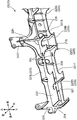
- FIG. 2 is a cross-sectional perspective view of the turning frame 22 of the crane 1 according to the present embodiment.
- 3 to 5 are a side view, a side sectional view, and a plan view of the revolving frame 22, respectively.
- the upper swing body 20 has a swing frame 22 (upper main body).
- the turning frame 22 constitutes a main body portion of the upper turning body 20 and is formed by welding a plurality of plate materials.
- the front-back direction (longitudinal direction of the turning frame 22) and the left-right direction (width direction of the turning frame 22) shown in each figure are directions based on the turning frame 22 (upper turning body 20).
- the revolving frame 22 includes a bottom wall 221, an upper wall 222, a pair of left and right side walls 223, a rear wall 224, a front wall 220, a plurality of inner walls 225, and a plurality of inner walls 225.
- An inner rib 226 and a central rib 22H are provided.
- the pair of left and right side walls 223 extend along the front-rear direction of the swivel frame 22 and are spaced apart from each other in the left-right direction of the swivel frame 22.
- the side wall 223 faces the left-right direction.
- the pair of left and right side walls 223 includes a left side wall 223L (FIG. 2) and a right side wall 223R (FIG. 3). In FIG. 2, only the left side wall 223L appears, but the right side wall 223R (FIG. 3) also has the same structure as the left side wall 223L.
- Each of the pair of left and right side walls 223 includes a central protrusion 223T and a weight mounting portion 22S (weight mounting portion).
- the central protruding portion 223T is a portion in which a substantially central portion in the front-rear direction of the side wall 223 protrudes upward.
- a mast (not shown) that supports the boom 31 so as to be raised and lowered is attached to the central projecting portion 223T.
- the weight mounting portion 22S is disposed at the rear end portion of the side wall 223 (the turning frame 22).
- the weight mounting portion 22S has a U-shape, and the counterweight 30 is detachably mounted on the pair of left and right weight mounting portions 22S.
- the counterweight 30 has an engaging portion (not shown) that can engage with the weight mounting portion 22S.
- the aforementioned cab 25 is disposed on the turning frame 22 in front of the weight mounting portion 22S.
- the bottom wall 221 is a plate material that defines the lower surface of the revolving frame 22.
- the bottom wall 221 is disposed so as to face the vertical direction between the pair of left and right side walls 223 and connects the pair of left and right side walls 223 in the left and right direction.
- the bottom wall 221 extends in the front-rear direction from the front end portion to the rear end portion of the side wall 223.
- a bottom wall front opening 221S and a bottom wall rear opening 221T are opened in the bottom wall 221 (FIG. 2).
- the bottom wall front opening portion 221S is an opening portion opened to the bottom wall 221 in front of the central projecting portion 223T.
- the bottom wall rear opening 221T is an opening that is opened in the bottom wall 221 behind the central protrusion 223T.
- the bottom wall front opening 221S and the bottom wall rear opening 221T are both opened in the shape of a long hole extending in the front-rear direction.
- the upper wall 222 is a plate material that defines the upper surface of the revolving frame 22.
- the upper wall 222 is disposed above the bottom wall 221 with a space therebetween.
- the upper wall 222 is disposed so as to face the vertical direction between the pair of left and right side walls 223 and connects the pair of left and right side walls 223 in the left and right direction.
- openings are formed in the upper wall 222 above the bottom wall front opening 221 ⁇ / b> S and the bottom wall rear opening 221 ⁇ / b> T, respectively.
- the rear wall 224 connects the rear end of the pair of left and right side walls 223, the rear end of the bottom wall 221 and the rear end of the upper wall 222.
- the rear wall 224 extends along the vertical direction.
- the front wall 220 connects the front end portions of the pair of left and right side walls 223, the front end portion of the bottom wall 221, and the front end portion of the upper wall 222.
- the bottom wall 221, the upper wall 222, the pair of side walls 223, the front wall 220 and the rear wall 224 form a box shape of the revolving frame 22. As shown in FIG. 2, an elliptical opening is formed in the rear wall 224.
- the plurality of inner walls 225 extend along the vertical direction between the pair of left and right side walls 223 and are spaced apart from each other in the front-rear direction. Both ends in the left-right direction of the plurality of inner walls 225 are connected to a pair of left and right side walls 223, respectively. In addition, lower end portions and upper end portions of the plurality of inner walls 225 are connected to the bottom wall 221 and the upper wall 222, respectively. An elliptical opening is formed in the plurality of inner walls 225.
- the plurality of inner walls 225 include a first inner wall 225A, a second inner wall 225B, a third inner wall 225C, and a fourth inner wall 225D.
- the first inner wall 225A is disposed near the front end of the bottom wall front opening 221S
- the second inner wall 225B is disposed near the rear end of the bottom wall front opening 221S.
- the third inner wall 225C is disposed behind the second inner wall 225B and in the vicinity of the front end portion of the bottom wall rear opening 221T.
- the fourth inner wall 225D is disposed in the vicinity of the rear end portion of the bottom wall rear opening 221T.
- the rear wall 224, the third inner wall 225C, and the fourth inner wall 225D constitute a plurality of vertical plates of the present invention.
- the 3rd inner wall 225C comprises one vertical board of the present invention.
- the third inner wall 225C is disposed at a position closest to the turning bearing 21 (first ring portion 21A) among the plurality of vertical plates.
- the plurality of inner ribs 226 are fixed to the inner surface of the side wall 223, and are disposed so as to connect the bottom wall 221 and the upper wall 222 along the vertical direction.
- the plurality of inner walls 225 and the plurality of inner ribs 226 ensure the rigidity of the turning frame 22.
- the central rib 22H is disposed inside the central protrusion 223T and prevents the central protrusion 223T from falling down.
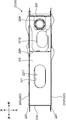
- FIG. 6 is an enlarged bottom view of the turning frame 22 of the crane 1 according to the present embodiment, and is an enlarged view of the periphery of the bearing mounting portion 21S.
- FIG. 7 is a cross-sectional view of the upper revolving structure 20 (the revolving frame 22) and the lower traveling structure 10 around the bearing mounting portion 21S.
- the slewing bearing 21 has a circular first ring portion 21A and a circular second ring portion 21B (FIG. 7).
- the first ring portion 21 ⁇ / b> A is fixed to a bearing mounting portion 21 ⁇ / b> S formed on the bottom wall 221 of the turning frame 22.
- the second ring portion 21B is disposed on the radially inner side of the first ring portion 21A and is fixed to a bearing mounting portion 110S (FIG. 7) formed on the upper surface portion 110 (FIG. 7) of the lower traveling body 10.
- the first ring portion 21A is rotatable relative to the second ring portion 21B around the pivot axis CL.
- a plurality of gear teeth 21C are formed along the circumferential direction on the inner peripheral surface of the second ring portion 21B.
- the crane 1 has the turning motor M (FIG. 7) fixed to the turning motor mounting part 22M of the bottom wall 221.
- the pinion gear MP of the turning motor M is engaged with the gear teeth 21C of the second ring portion 21B.
- the turning frame 20 further includes a pair of left and right measurement abutments 50 (deformable members).
- the crane 1 also includes a pair of left and right strain gauges 51 (deformation amount detection unit).
- FIG. 8 is an enlarged cross-sectional perspective view of the periphery of the measurement support 50 shown in FIG.
- FIG. 9 is a schematic cross-sectional view in which the periphery of the measurement support 50 is enlarged.
- FIG. 8 only the left measurement abutment 50 and the strain gauge 51 among the pair of left and right measurement abutments 50 and the strain gauge 51 appear, but the right measurement abutment 50 and the strain gauge 51 are shown in FIG.
- Nine measurement abutments 50 and strain gauges 51 are arranged at positions spaced to the right.
- the structure of the revolving frame 22 is arranged symmetrically about a center line (not shown) that extends in the front-rear direction through the center of the revolving frame 22 in the left-right direction.
- the measurement abutment 50 is disposed in the revolving frame 22 at a position behind the first ring portion 21A and in front of the weight mounting portion 22S and closer to the first ring portion 21A than the weight mounting portion 22S. ing.
- the measurement abutment 50 is disposed at a corner formed by the bottom wall 221 and the third inner wall 225C.
- the measurement support 50 receives a force from members around the turning frame 22 and deforms together with these members.
- the strain gauge 51 is attached to the measurement abutment 50, and outputs a signal corresponding to the strain amount (deformation amount) of the measurement abutment 50 (swivel frame 22) when the counterweight 30 is attached (detects the deformation amount). .
- the aforementioned third inner wall 225 ⁇ / b> C has a rear surface portion 225 ⁇ / b> C ⁇ b> 1 facing in the rear direction of the turning frame 22.
- the bottom wall 221 has an upper surface portion 221A facing upward.
- the upper surface portion 221A and the rear surface portion 225C1 are connected to each other to form a corner portion to which the measurement support 50 is fixed.
- the measurement abutment 50 is made of a plate material extending in the vertical direction and the front-rear direction. That is, the dimension of the measurement support 50 in the left-right direction is set to be smaller than the dimensions of the measurement support 50 in the front-rear direction and the vertical direction.
- the measurement support 50 has a first surface 50A, a second surface 50B, and a holding surface 50C.
- the first surface 50A is a front surface portion of the measurement support 50, and is connected to the rear surface portion 225C1 (FIG. 9) of the third inner wall 225C along the vertical direction.
- the second surface 50B is a lower surface portion of the measurement abutment 50, and is connected to the upper surface portion 221A (FIG.
- the holding surface 50C connects the first surface 50A and the second surface 50B, and holds the strain gauge 51.
- the holding surface 50 ⁇ / b> C has an inclined surface that inclines upward toward the front of the revolving frame 22 and holds the strain gauge 51. As shown in FIG. 9, in the present embodiment, the inclined surface is an arcuate curved surface.
- the strain gauge 51 receives the signal according to the expansion and contraction (arrow D2 in FIG. 9) of the holding surface 50C on a reference plane (a plane parallel to the paper in FIG. 9) including the front-rear direction and the vertical direction. Is held on the holding surface 50C. That is, the strain gauge 51 outputs a signal corresponding to the strain amount of the portion of the revolving frame 20 where the strain gauge 51 is mounted.
- the strain gauge 51 is detachably fixed to the holding surface 50C.
- the left side wall 223L is arranged to face the strain gauge 51 in the left-right direction. Further, the upper wall 222 (upper plate) is disposed so as to cover the strain gauge 51 from above.
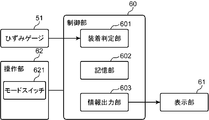
- the crane 1 further includes a control unit 60.
- FIG. 10 is a block diagram of the control unit 60 of the crane 1 according to the present embodiment.
- the control unit 60 includes a CPU (Central Processing Unit), a ROM (Read Only Memory) that stores a control program, a RAM (Random Access Memory) used as a work area of the CPU, and the like. Further, in addition to the strain gauge 51 described above, a display unit 61 (notification unit) and an operation unit 62 (information input unit) are electrically connected to the control unit 60.
- a display unit 61 notification unit
- an operation unit 62 information input unit
- the display unit 61 is a liquid crystal panel arranged in front of the driver's seat in the cab 25, and notifies the operator of work information of the crane 1 and the like.
- the display unit 61 receives information based on a signal output from the strain gauge 51, and notifies an operator in the cab 25 that the counterweight 30 is mounted on the weight mounting unit 22S.
- the above information may be notified by a speaker that generates a buzzer sound, a lamp that emits light, or the like.
- the operation unit 62 is provided in the cab 25 and is operated by an operator.
- the operation unit 62 includes an operation lever (not shown) for operating the crane 1 and a mode switch 621.
- the mode switch 621 is also operated by an operator. In this embodiment, when the “automatic detection mode” for detecting whether or not the counterweight 30 is mounted on the weight mounting portion 22S is started.
- the mode switch 621 is pressed by the operator. When the mode switch 621 is pressed, a predetermined command signal is input to the control unit 60.
- the control unit 60 detects that the counterweight 30 is mounted on the weight mounting unit 22S based on the signal output from the strain gauge 51.
- the control unit 60 includes a mounting determination unit 601, a storage unit 602, and an information output unit 603 (warning information output unit, erroneous loading information output unit) by the CPU executing a control program stored in the ROM. Function.
- the mounting determination unit 601 receives a signal output from the strain gauge 51 and determines whether or not the counterweight 30 is mounted on the weight mounting unit 22S according to the magnitude of the signal.
- the storage unit 602 stores and outputs a threshold value corresponding to the weight of the counterweight 30 in advance.
- the mounting determination unit 601 compares the strain amount detected by the strain gauge 51 with the threshold value output from the storage unit 602 to determine whether or not the counterweight 30 is mounted on the weight mounting unit 22S. Determine.
- the information output unit 603 When the mounting determination unit 601 determines that the counterweight 30 is mounted on the weight mounting unit 22S, the information output unit 603 outputs “counterweight mounting completion information” to the display unit 61, and the information is output. It is displayed on the display unit 61. Further, as described later, the information output unit 603 outputs “warning information” when the counterweight 30 having a weight different from the set counterweight 30 is mounted on the weight mounting unit 22S, and is displayed on the display unit 61. Display.
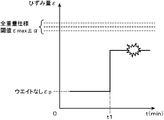
- FIG. 11 is a graph showing the transition of the strain amount when the counterweight 30 is mounted in the crane 1 according to this embodiment.
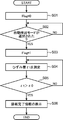
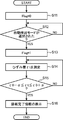
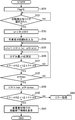
- FIG. 12 is a flowchart showing how the crane 1 detects the mounting of the counterweight 30.
- the counterweight 30 is integrally configured by previously laminating a plurality of weight bodies 300 on the ground in the assembly stage of the crane 1. Thereafter, the counterweight 30 (a plurality of weight bodies 300) is mounted on the weight mounting portion 22S (FIG. 2) by an auxiliary crane (not shown) as indicated by the arrow in FIG.
- step S01 when the assembly operation of crane 1 is started, mounting determination unit 601 of control unit 60 resets Flag stored in storage unit 602 to 0 (zero) (step S01).
- step S02 when the operator presses the mode switch 621 of the operation unit 62, the automatic detection mode of the counterweight 30 is selected (YES in step S02).
- the attachment determination unit 601 repeats step S02 until the mode switch 621 is pressed (NO in step S02).
- step S03 the mounting determination part 601 measures the distortion amount (epsilon) t of the measurement support 50 by receiving the signal output from the strain gauge 51 (step S04).
- the measurement of the strain amount ⁇ t is continuously executed at predetermined time intervals. During this time, the mounting determination unit 601 compares the magnitude relationship between the strain amount ⁇ t and the threshold value ⁇ 0 set in advance according to the weight of the counterweight 30 (step S05).
- Table 1 shows information stored in the storage unit 602 in the present embodiment.
- the weight of the counterweight 30 is 100 t.
- the threshold ⁇ 0 is set to 60%. .
- step S05 when ⁇ t> ⁇ 0 (YES in step S05), that is, when the strain amount ⁇ t detected by the strain gauge 51 exceeds the threshold value ⁇ 0, the mounting determination unit 601 determines that the counterweight 30 is the weight mounting unit 22S. It is determined that it is attached to. Then, the information output unit 603 outputs “counterweight mounting completion information” to the display unit 61, and displays the information on the display unit 61 (step S06).
- the strain amount ⁇ t detected by the strain gauge 51 increases from ⁇ p in the no-weight state and exceeds the threshold value ⁇ 0.
- the mounting determination unit 601 can determine that the counterweight 30 is mounted on the weight mounting unit 22S.
- step S05 if ⁇ t ⁇ ⁇ 0 (NO in step S05), steps S04 and S05 are repeated.
- the strain gauge 51 when the counterweight 30 is mounted on the weight mounting portion 22S, the strain gauge 51 outputs a signal corresponding to the deformation amount of the measurement support 50 on the turning frame 22.
- the control unit 60 receives the signal output from the strain gauge 51 and detects that the counterweight 30 is mounted on the weight mounting unit 22S. For this reason, the mounting of the counterweight 30 can be detected based on the deformation of the front portion of the turning frame 22 relative to the weight mounting portion 22S.
- the measurement support 50 is arranged in front of the weight mounting portion 22S, particularly at a position closer to the turning bearing 21 (first ring portion 21A) than the weight mounting portion 22S.
- the crane 1 which can detect the mounting state of the counterweight 30 stably can be provided. Further, as compared with a technique in which the mounting state of the counterweight 30 is detected according to the information of the RFID tag mounted on the counterweight 30, erroneous detection due to tag damage or detachment is prevented.
- the mounting determination unit 601 compares the strain amount ⁇ t detected by the strain gauge 51 with the threshold value ⁇ 0 output from the storage unit 602, so that the counterweight 30 has the weight. It is determined whether or not the mounting portion 22S is mounted. For this reason, the mounting of the counterweight 30 can be detected according to the change in the strain amount ⁇ t detected by the strain gauge 51. Furthermore, it is possible to quickly determine whether the counterweight 30 is mounted in response to the detected strain amount ⁇ t exceeding the threshold value ⁇ 0.
- the first ring portion 21A of the swing bearing 21 functions as a fixed end
- the periphery of the weight mounting portion 22S functions as a free end that can move up and down. Therefore, when the counterweight 30 is mounted on the weight mounting portion 22S, a load is applied downward on the bottom wall 221 to which the second surface 50B of the measurement support 50 is connected, as indicated by an arrow D1 in FIG. Is granted.
- the first surface 50A of the measurement support 50 is connected to the third inner wall 225C, it is difficult to move in the front-rear direction.
- a tensile stress as indicated by an arrow D2 is generated on the holding surface 50C that holds the strain gauge 51.
- the strain gauge 51 inputs a signal (voltage) corresponding to the deformation amount of the holding surface 50 ⁇ / b> C to the mounting determination unit 601 (FIG. 10) of the control unit 60. Then, as described above, when the signal (strain amount ⁇ t) exceeds a preset threshold value ⁇ 0, the mounting determination unit 601 determines that the counterweight 30 is mounted on the weight mounting unit 22S, and the information is The information is output from the information output unit 603 and displayed on the display unit 61. For this reason, it is possible for the operator who is riding on the cab 25 facing forward to recognize that the counterweight 30 is mounted on the weight mounting portion 22S behind the cab 25.
- the strain gauge 51 detects that the weight of the counterweight 30 is applied to the rear end of the swivel frame 22 as the amount of deformation of the holding surface 50C of the measurement support 50. For this reason, the mounting state of the counterweight 30 can be detected easily and at a low cost without providing a load meter corresponding to the large weight of the counterweight 30.
- the measurement abutment 50 includes a first surface 50A connected to the third inner wall 225C, a second surface 50B connected to the bottom wall 221, and a first surface. 50A and the 2nd surface 50B are connected, and it has the holding surface 50C holding the strain gauge 51.
- the strain gauge 51 is held by the holding surface 50C so as to output the signal according to the expansion and contraction of the holding surface 50C on the reference plane including the front-rear direction and the vertical direction. For this reason, when a load corresponding to the weight of the counterweight 30 is applied to the weight mounting portion 22S, a large stress is generated on the holding surface 50C, and the strain gauge 51 increases the amount of deformation of the holding surface 50C according to the stress.
- the measurement support 50 when the measurement support 50 is provided, the arrangement, shape, and material of the measurement support 50 are adjusted and the deformation of the measurement support 50 is compared with the case where the strain gauge 51 is directly attached to the revolving frame 22. By increasing the amount, it can be accurately determined that the counterweight 30 is mounted.
- the measurement support 50 (strain gauge 51) is a third vertical plate located behind the slewing bearing 21 and positioned closest to the slewing bearing 21 (first ring portion 21A). It is attached to the inner wall 225C.
- the periphery of the first ring portion 21A of the turning frame 22 functions as a fixed end
- the periphery of the weight mounting portion 22S functions as a free end.
- the third inner wall 225C to which the measurement abutment 50 is attached is disposed at a position close to the fixed end. Therefore, a large downward force is applied to the second surface 50B of the measurement support 50 (arrow D1 in FIG. 9), and the deformation amount of the holding surface 50C can be set large. For this reason, the strain gauge 51 can stably detect the deformation amount of the holding surface 50C.
- a pair of left and right side walls 223 are disposed on both sides of the measurement support 50 (strain gauge 51) in the left-right direction, and an upper wall 222 is disposed above the measurement support 50. For this reason, the deformation detection operation of the strain gauge 51 is not easily influenced by the environment outside the crane 1 such as rain and wind. Further, it is possible to prevent an object from colliding with the strain gauge 51 and damaging the strain gauge 51.
- the dimension in the left-right direction of the measurement support 50 is set smaller than the dimensions of the measurement support 50 in the front-rear direction and the vertical direction. That is, the measurement abutment 50 is a plate material extending along the front-rear direction and the vertical direction, and the holding surface 50C corresponds to a thickness portion of the plate material. In this case, since the deformation of the holding surface 50C in the left-right direction is small, the strain gauge 51 can accurately detect the deformation amount of the holding surface 50C along the arrow D2 direction in FIG.
- the strain gauge 51 is detachable from the holding surface 50C.
- the strain gauge 51 is fixed to the holding surface 50C with an adhesive.
- the strain gauge 51 can be peeled off from the holding surface 50C by using another solvent that dissolves the adhesive. For this reason, even when the assembly work of the crane 1, in other words, the attachment / detachment work of the counterweight 30 is repeated, even when the sensitivity of the strain gauge 51 is lowered, the strain gauge 51 can be easily replaced.
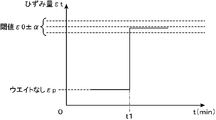
- FIG. 13 is a graph showing the transition of the strain amount when the counterweight 30 is mounted in the crane 1 according to this embodiment.
- FIG. 14 is a flowchart showing a state in which mounting of the counterweight 30 is detected in the crane 1 according to the present embodiment.
- mounting determination unit 601 of control unit 60 resets Flag stored in storage unit 602 to 0 (zero) (step S11).
- the automatic detection mode of the counterweight 30 is selected (YES in step S12).
- the mounting determination unit 601 repeats step S12 until the mode switch 621 is pressed (NO in step S12).
- the mounting determination unit 601 updates the flag stored in the storage unit 602 to 1 (step S13).
- the attachment determination part 601 measures the distortion amount (epsilon) t of the measurement support 50 by receiving the signal output from the strain gauge 51 (step S14).
- the measurement of the strain amount ⁇ t is continuously executed at predetermined time intervals.
- the attachment determination unit 601 compares the magnitude relationship between the strain amount ⁇ t and the threshold value ⁇ 0 set in advance according to the weight of the counterweight 30 (step S15).
- the error ⁇ is set to the threshold value ⁇ 0 in consideration of the variation in weight associated with the manufacturing error of the counterweight 30. That is, the threshold value ⁇ 0 ⁇ ⁇ corresponds to the weight of the counterweight 30.
- ⁇ is set to ⁇ 10% with respect to a strain amount of 100% corresponding to the weight 100 t of the counterweight 30.
- the mounting determination unit 601 It is determined that the counterweight 30 is attached to the weight attachment portion 22S. Then, the information output unit 603 outputs “counterweight mounting completion information” to the display unit 61, and displays the information on the display unit 61 (step S16).
- the strain amount ⁇ t detected by the strain gauge 51 increases from ⁇ p and falls within the range of the threshold value ⁇ 0 ⁇ ⁇ .
- step S15 if ⁇ p ⁇ t ⁇ 0- ⁇ or ⁇ 0 + ⁇ ⁇ t (NO in step S15), steps S14 and S15 are repeated.
- the threshold value set according to the weight of the counterweight 30 includes a preset lower limit value ( ⁇ 0 ⁇ ) and an upper limit value ( ⁇ 0 + ⁇ ). Then, when the strain amount ⁇ t detected by the strain gauge 51 is included between the lower limit value and the upper limit value, the attachment determination unit 601 determines that the counterweight 30 is attached to the weight attachment unit 22S. For this reason, even when the weight of the counterweight 30 varies due to manufacturing errors, it is possible to stably detect that the counterweight 30 is mounted on the weight mounting portion 22S, and to prevent erroneous detection.
- the information output unit 603 may output predetermined warning information (error information). In this case, when the weight of the mounted counterweight 30 exceeds a predetermined error range, warning information can be output promptly.
- FIGS. 15 to 17 are graphs showing changes in the strain amount when the counterweight 30 is mounted in the crane 1 according to this embodiment.
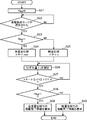
- FIG. 18 is a flowchart showing a state in which mounting of the counterweight 30 is detected in the crane 1 according to the present embodiment.
- step S21 when the assembly work of crane 1 is started, mounting determination unit 601 of control unit 60 resets Flag stored in storage unit 602 to 0 (zero) (step S21).
- step S21 when the operator presses the mode switch 621 of the operation unit 62, the automatic detection mode of the counterweight 30 is selected (YES in step S22). Also in this embodiment, the mounting determination unit 601 repeats step S22 until the mode switch 621 is pressed (NO in step S22).
- the mode switch 621 can select a mode from two mode menus. One mode is a full weight specification mode (maximum mounting mode), and the other mode is a lightweight specification mode (partial mounting mode).
- the mounting determination unit 601 updates the flag in the storage unit 602 to 1, and when the worker selects the lightweight specification mode, the mounting determination unit 601 sets the flag in the storage unit 602 to 2. Update. If the updated flag is 1 (YES in step S23), the attachment determination unit 601 selects ⁇ max as the threshold value ⁇ 0 stored in the storage unit 602 (step S24). On the other hand, if the updated Flag is not 1 (NO in step S23), the attachment determination unit 601 selects ⁇ a as the threshold value ⁇ 0 stored in the storage unit 602 (step S25).
- the threshold value ⁇ max is a threshold value corresponding to the total weight of all the weight bodies 300 among the plurality of weight bodies 300.
- the threshold value ⁇ a is the threshold value corresponding to the total weight of some weight bodies 300 used in the lightweight specification mode among the plurality of weight bodies 300. At this time, the weight body 300 used in the lightweight specification mode is determined in advance. Table 2 shows information stored in the storage unit 602 in the present embodiment.
- the weight of the counterweight 30 is 100 t, and the strain amount threshold value ⁇ 0 (threshold value ⁇ max) detected by the strain gauge 51 is set to 100%.
- the weight of the counterweight 30 is 80 t, and the strain amount threshold value ⁇ 0 (threshold value ⁇ a) detected by the strain gauge 51 is set to 80%.
- ⁇ is set to 10%
- ⁇ is set to 8%.
- the attachment determination unit 601 receives the signal output from the strain gauge 51 to measure the strain amount ⁇ t of the measurement support 50 (step S26). Then, the attachment determination unit 601 compares the magnitude relationship between the strain amount ⁇ t and the threshold value ⁇ 0 set in advance according to the weight of the counterweight 30 (step S27). Also in this embodiment, the error ⁇ is set to the threshold value ⁇ 0 as in the second embodiment.
- the mounting determination unit 601 determines that the counterweight 30 is attached to the weight attachment portion 22S. Further, the mounting determination unit 601 confirms the value of Flag (step S28), and when the flag is 1 (YES in step S28), the information output unit 603 displays “Counterweight mounting complete in full weight specification mode” "Information” is output to the display unit 61, and the information is displayed on the display unit 61 (step S29).
- Step S28 the information output unit 603 outputs “counterweight loading completion information in the lightweight specification mode” to the display unit 61, and the information is displayed. It is displayed on the display unit 61 (step S30).
- the strain amount ⁇ t detected by the strain gauge 51 at time t1 increases from ⁇ p in the no-weight state and is included in the range of the threshold ⁇ max ⁇ ⁇ .
- “Counterweight loading completion information” is displayed on the display unit 61.
- the mounting determination unit 601 can detect that the counterweight 30 is mounted on the weight mounting unit 22S. In this embodiment, if ⁇ t ⁇ 0 ⁇ or ⁇ 0 + ⁇ ⁇ t in step S27 (NO in step S27), steps S26 and S27 are repeated.
- the mode switch 621 of the operation unit 62 receives mode information related to the number of weight bodies 300 mounted on the weight mounting unit 22S.
- the mode switch 621 can selectively accept at least the full weight specification mode and the light weight specification mode. In the full weight specification mode, all the weight bodies 300 of the plurality of weight bodies 300 are attached to the weight mounting portion 22S. In the lightweight specification mode, a part of the plurality of weight bodies 300 is mounted on the weight mounting portion 22S.
- the attachment determination unit 601 compares the strain amount ⁇ t detected by the strain gauge 51 with the full weight threshold value ⁇ max output from the storage unit 602. Then, it is determined whether or not all the weight bodies 300 are mounted on the weight mounting portion 22S.
- the wearing determination unit 601 compares the strain amount ⁇ t detected by the strain gauge 51 with the partial weight threshold value ⁇ a output from the storage unit 602. It is determined whether or not the partial weight body 300 is mounted on the weight mounting portion 22S. Therefore, whether or not the full weight specification mode or the light weight specification mode is selected in the crane 1, an appropriate threshold value regarding the weight of the weight body 300 is adopted, and whether or not the weight body 300 is attached. Can be determined.
- the information output unit 603 may output predetermined warning information (error information). Also in this case, if the weight of the mounted counterweight 30 exceeds a predetermined error range, warning information can be output promptly.
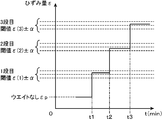
- FIG. 19 is a graph showing the transition of the strain amount when the counterweight 30 is mounted in the crane 1 according to this embodiment.
- FIG. 20 is a flowchart showing a state in which mounting of the counterweight 30 is detected in the crane 1 according to the present embodiment.
- the weight bodies 300 are stacked one by one on the weight mounting portion 22S.
- the number of weight bodies 300 to be mounted on the weight mounting unit 22S (the number N of stages, the planned number of stacks) is set in advance, and the operator inputs the number N of stages from the operation unit 62.
- step S31 when the assembly operation of crane 1 is started, mounting determination unit 601 of control unit 60 resets Flag stored in storage unit 602 to 0 (zero) (step S31).
- step S32 when the operator presses the mode switch 621 of the operation unit 62, the automatic detection mode of the counterweight 30 is selected (YES in step S32). Also in this embodiment, the mounting determination unit 601 repeats step S32 until the mode switch 621 is pressed (NO in step S32).
- the attachment determination unit 601 updates the variable n, the threshold value ⁇ 0, and the error variable ⁇ 0 that are stored in the storage unit 602, respectively, to 0 (step S33).
- the number N (maximum number) of the weight bodies 300 is input by the operator through the operation unit 62 (step S34).
- the number N of steps corresponds to information on the number of weight bodies 300 that are scheduled to be mounted on the weight mounting portion 22S.
- Table 3 shows information stored in the storage unit 602 in the present embodiment.
- the stage number N is set to be selectable up to 9, and the weight of each weight body 300 is set in the range of 8t to 15t.
- the strain amount ⁇ t of the strain gauge 51 with respect to the total weight is 100%
- the strain amount of the strain gauge 51 with respect to each weight body 300 ⁇ 0 is set in the range of 8% to 15%.
- Table 3 shows the accumulated strain amount of the strain gauge 51 when the weight bodies 300 are stacked in order from the first stage.
- the information is also stored in the storage unit 602. In either case, ⁇ is set to ⁇ 1%.
- the step number N input by the operator in step S34 is stored in the storage unit 602 as Nmax.
- ⁇ (n) and ⁇ (n) are both a threshold value (distortion amount) and an error set in advance corresponding to the n-th weight body 300.
- information regarding the threshold value and error is stored in advance in the storage unit 602 together with information regarding the order in which the weight bodies 300 are stacked.
- the attachment determination unit 601 receives the signal output from the strain gauge 51 to measure the strain amount ⁇ t of the measurement support 50 (step S36).
- the measurement of the strain amount ⁇ t is continuously executed at predetermined time intervals.
- the mounting determination unit 601 compares the magnitude relationship between the strain amount ⁇ t and the threshold value ⁇ 0 set in advance according to the weight of the counterweight 30 (step S37).
- the mounting determination unit 601 It is determined that the n-th weight body 300 is mounted on the weight mounting portion 22S.
- the mounting determination unit 601 determines whether n is equal to the maximum number of steps Nmax stored in the storage unit 602 (step S38).
- n Nmax (YES in step S38)
- the attachment determination unit 601 updates the threshold value ⁇ 0 and the error variable ⁇ 0 to ⁇ max and ⁇ max, respectively (step S39).
- the threshold value ⁇ max and the error ⁇ max are a threshold value (strain amount) and an error corresponding to the total weight of all the weight bodies 300, and are stored in the storage unit 602 in advance.
- the storage unit 602 compares the magnitude of the strain amount ⁇ t detected by the strain gauge 51 with a threshold value ⁇ 0 ( ⁇ max) set in advance according to the total weight of the counterweight 30 (step S40).
- the strain amount ⁇ t with respect to the total weight of all the loaded weight bodies 300 is evaluated.
- the mounting determination unit 601 It is determined that all scheduled weight bodies 300 are properly mounted on the weight mounting portion 22S.
- the information output unit 603 outputs “counterweight loading completion information in the full weight specification mode” to the display unit 61, and displays the information on the display unit 61 (step S41).
- FIG. 19 shows a state in which the weights 300 from the first stage to the third stage are sequentially stacked on the weight mounting portion 22S after the number of stages N (Nmax) is set to 3 by the operator. . That is, at time t1, the strain amount ⁇ t detected by the strain gauge 51 increases from ⁇ p and is included in the range of threshold ⁇ (1) ⁇ ⁇ . By the change in the strain amount ⁇ t, the attachment determination unit 601 can determine that the first-stage weight body 300 is attached to the weight attachment unit 22S. Similarly, at times t2 and t3, the strain amount ⁇ t is included in the range of the threshold value ⁇ (2) ⁇ ⁇ and the threshold value ⁇ (3) ⁇ ⁇ .
- the attachment determination unit 601 can determine that the second-stage and third-stage weight bodies 300 are attached to the weight attachment part 22S.
- the mounting determination unit 601 can store in the storage unit 602 how many weight bodies 300 are stacked on the weight mounting unit 22S.
- the information output unit 603 causes the display unit 61 to display the information on the number of stacked sheets, so that the operator can be notified of the information.
- step S40 when ⁇ p ⁇ t ⁇ 0 ⁇ 0 or ⁇ 0 + ⁇ 0 ⁇ t in step S40 (NO in step S40), the attachment determination unit 601 executes predetermined error processing (step S42). .
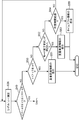
- FIG. 21 is a flowchart showing error processing when the mounting of the counterweight 30 is detected in the crane 1 according to the present embodiment.
- mounting determination unit 601 determines whether ⁇ t> ⁇ 0 + ⁇ 0 in step S50. Determine whether or not. If ⁇ t> ⁇ 0 + ⁇ 0 (YES in step S50), the weight of the counterweight 30 loaded exceeds the preset threshold value as shown in FIG.
- the “overweight information” (warning information) is output, and the information is displayed on the display unit 61.
- the mounting determination unit 601 checks the output of the mode switch 621 and determines whether or not the end button of the automatic detection mode has been pressed by the operator (step S52).
- the information output unit 603 outputs “weight not reached information” (warning information) to the display unit 61. The information is displayed (step S53).
- the attachment determination unit 601 determines whether a predetermined time has elapsed (step S54).
- the predetermined time has elapsed (YES in step S54)
- the weight of the loaded counterweight 30 has not reached the predetermined threshold value, and the operator is on standby waiting for the loading work to be completed. Equivalent to. Therefore, the information output unit 603 outputs “timeout information” to the display unit 61, and displays the information on the display unit 61 (step S55). In this case, by recognizing that the weight of the counterweight 30 has been left for a predetermined time in a state where the weight of the counterweight 30 has not been reached, it is possible to check the cause of the work restart or the error.
- step S51, S53, and S55 the attachment determination unit 601 ends the automatic detection mode. If the predetermined time has not elapsed in step S54 (NO in step S54), the attachment determination unit 601 repeats step S36 and subsequent steps.
- the storage unit 602 loads the weight unit threshold value ⁇ (n) corresponding to the weight of each weight body 300 out of the plurality of weight bodies 300 and each weight body 300.
- the order in which they are performed is stored.
- the attachment determination unit 601 detects the weight body 300 loaded on the nth (n is a natural number) by the strain gauge 51 from the state in which the (n ⁇ 1) th weight body 300 is loaded. By comparing the increment (change amount) of the strain amount ⁇ t with the weight single unit threshold value ⁇ (n) of the nth weight body 300 output from the storage unit 602, each weight body 300 has the weight mounting portion 22S. It is determined whether or not it is attached to the camera.
- the attachment determination unit 601 compares the strain amount ⁇ t detected by the strain gauge 51 with the sum (cumulative value) of the first to nth threshold values for the single weight output from the storage unit 602. Thus, it may be determined whether or not each weight body 300 is mounted on the weight mounting portion 22S. According to such a configuration, it is possible to accurately determine that each weight body 300 is mounted on the weight mounting portion 22S individually.
- the attachment determination unit 601 compares the amount of change in the strain amount ⁇ t detected by the strain gauge 51 with the weight single unit threshold value output from the storage unit 602 or the strain detected by the strain gauge 51. By comparing the amount ⁇ t and the sum of the plurality of weight single unit threshold values output from the storage unit 602, it is determined whether or not each weight body 300 is mounted on the weight mounting unit 22S.
- the information output unit 603 may output predetermined erroneous loading information. In this case, when a weight body 300 different from the nth weight body 300 to be mounted is mounted, erroneous loading information can be output promptly.
- the method of detecting the counterweight 30 of the crane 1 according to the present embodiment is such that the swivel frame 22 is attached to the front portion of the swivel frame 22 with respect to the weight mounting portion 22S.
- the mounting of the counterweight 30 can be detected based on the deformation of the swivel frame 22 in front of the weight mounting portion 22S. Further, when the counterweight 30 is mounted, a direct impact corresponding to the weight of the counterweight 30 is not applied to the strain gauge 51.
- each characteristic of the crane 1 in said embodiment is also contained in the said detection method.
- the strain gauge 51 is used as the deformation amount detection unit.
- the deformation amount detection unit is a sensor other than the strain gauge 51, such as a semiconductor strain gauge, an optical fiber, or a load cell. Also good.
- the measurement abutment 50 is described as being fixed to the third inner wall 225C, the bottom wall 221, the upper wall 222, and a pair of left and right are positioned closer to the first ring portion 21A than the weight mounting portion 22S. It may be fixed to the side wall 223, the second inner wall 225B, the third inner wall 225, or the like.
- the strain gauge 51 is directly attached to the bottom wall 221, the upper wall 222, the pair of left and right side walls 223, the second inner wall 225 ⁇ / b> B, the third inner wall 225, and the like without being attached to the measurement support 50. Attached).
- the arrangement, shape, and material of the measurement support 50 can be adjusted to increase the amount of deformation of the measurement support 50. It is possible to determine with higher accuracy that the counterweight 30 is mounted than when the strain gauge 51 is directly mounted on the revolving frame 22.
- the number of the measurement abutments 50 and the strain gauges 51 is not limited to two (a pair of left and right), and one or three or more measurement abutments 50 and the strain gauges 51 may be arranged.
- FIG. 22 is a cross-sectional perspective view of the revolving frame 22 according to the first modified embodiment of the present invention.
- a pair of upper and lower strain gauges 50 ⁇ / b> L are directly attached to the bottom wall 221 and the upper wall 222.
- transformation amount detection part (strain gauge) which concerns on this invention may be the aspect with which it mounts
- FIG. 23 and FIG. 24 are enlarged perspective sectional views of the measurement supports 50M and 50N according to the second and third modified embodiments of the present invention, respectively.
- the holding surface 50C of the measurement abutment 50 has been described as being a curved surface.
- the holding surface 50C may be an inclined plane.
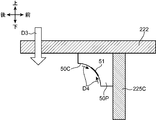
- FIG. 25 is an enlarged cross-sectional view of the measurement support 50P according to the fourth modified embodiment of the present invention.
- the measurement support 50P is disposed at a corner where the upper end of the third inner wall 225C and the upper wall 222 intersect.
- a force is applied to the upper wall 222 along the direction of arrow D3 in FIG.
- a compressive stress as indicated by an arrow D4 is generated on the holding surface 50C of the measurement support 50P.
- the strain gauge 51 detects the amount of deformation of the holding surface 50C due to the compressive stress.
- the strain gauge 51 can accurately detect the deformation amount of the holding surface 50C along the direction of the arrow D4 in FIG.
- the work machine is an upper body having a weight mounting portion disposed at a rear end portion of the upper body
- the upper body includes: A lower body that supports the upper body so as to be pivotable about a pivot axis that extends in the vertical direction, and a cab that is disposed on the upper body in front of the weight mounting portion and allows an operator to board the cabin.
- a raising and lowering member that is detachably attached to a front portion of the upper body, a first ring portion that is fixed to the upper body, and a second ring portion that is fixed to the lower body.
- the ring portion is rotatable relative to the second ring portion around the pivot axis, a swing bearing, a counterweight detachably mounted on the weight mounting portion of the upper body, and the upper book
- a deformation amount detection unit that is mounted in a front portion of the weight mounting unit and detects a deformation amount of the upper body when the counterweight is mounted on the weight mounting unit, and is detected by the deformation amount detection unit.
- a mounting determination unit that determines that the counterweight is mounted on the weight mounting unit based on the deformation amount.
- the deformation amount detection unit detects the deformation amount of the upper body.
- the mounting determination unit determines that the counterweight is mounted on the weight mounting unit based on the deformation amount detected by the deformation amount detection unit. For this reason, the mounting of the counterweight can be detected based on the deformation of the front portion of the upper body relative to the weight mounting portion. Further, according to the above configuration, when the counterweight is mounted on the weight mounting portion, a direct impact corresponding to the weight of the counterweight is not applied to the deformation amount detection portion. Therefore, even when the assembly work of the work machine is repeatedly performed, the deformation amount detection unit is prevented from being damaged.
- the deformation amount detection unit is arranged in the weight mounting unit, it is possible to prevent the electrical wiring extending from the deformation amount detection unit from being damaged by coming into contact with the counterweight. In this way, it is possible to provide a work machine capable of stably detecting the mounting state of the counterweight. Furthermore, compared with a technique in which the mounting state of the counterweight is detected according to the information of the RFID tag mounted on the counterweight, erroneous detection due to tag damage or detachment is prevented.
- the deformation amount detection unit includes a strain gauge, and the strain gauge detects a strain amount of a portion of the upper body where the strain gauge is mounted as the deformation amount.
- the mounting state of the counterweight can be detected easily and at a low cost without providing a load meter corresponding to the large weight of the counterweight.
- the above configuration further includes a storage unit that stores and outputs a threshold value corresponding to the weight of the counterweight in advance, and the mounting determination unit outputs the strain amount detected by the strain gauge and the storage unit. It is desirable to determine whether or not the counterweight is mounted on the weight mounting portion by comparing the threshold value.
- the mounting determination unit determines that the counter weight is mounted on the weight mounting unit when the strain amount detected by the strain gauge exceeds the threshold value.
- the threshold value includes a lower limit value and an upper limit value that are set in advance according to the weight of the counterweight, and the mounting determination unit determines that the strain amount detected by the strain gauge is equal to the lower limit value.
- the mounting determination unit determines that the strain amount detected by the strain gauge is equal to the lower limit value.
- a warning information output unit that outputs predetermined warning information when the amount of strain detected by the strain gauge is smaller than the lower limit value or larger than the upper limit value.
- the counterweight has a plurality of weight bodies that can be stacked in the vertical direction on the weight mounting portion, and a mode relating to the number of the weight bodies mounted on the weight mounting portion.
- An information input unit for receiving information wherein the information input unit is capable of selectively receiving at least a maximum mounting mode and a partial mounting mode, and in the maximum mounting mode, all weight bodies among the plurality of weight bodies.
- an information input unit is further provided, wherein a part of the plurality of weight bodies is mounted on the weight mounting unit, and the storage unit includes A threshold for all weights that is the threshold corresponding to the total weight of all the weight bodies among the plurality of weight bodies; A partial weight threshold that is the threshold corresponding to the total weight of the part of the weights is stored in advance, and the mounting determination unit receives the maximum mounting mode from the information input unit. And determining whether or not all the weight bodies are mounted on the weight mounting portion by comparing the amount of strain detected by the strain gauge and the threshold for all weights output from the storage unit.
- the partial weight body is configured to compare the strain amount detected by the strain gauge with the partial weight threshold output from the storage unit. It is desirable to determine whether or not the weight is mounted on the weight mounting portion.
- the counterweight has a plurality of weight bodies that can be sequentially stacked on the weight mounting portion in the vertical direction, and is scheduled to be mounted on the weight mounting portion.
- An information input unit that receives information on the number of weights that is the number of weight bodies is further included, and the storage unit has a weight single-unit threshold value that is the threshold value corresponding to the weight of each weight body among the plurality of weight bodies.
- the mounting determination unit compares the change amount of the strain amount detected by the strain gauge with the threshold value for the single weight output from the storage unit, or by the strain gauge. By comparing the detected strain amount with the sum of the plurality of weight single-use threshold values output from the storage unit, It is desirable that the bets body to determine whether mounted in the weight mounting portion.
- the storage unit further stores information on the order in which each of the plurality of weight bodies is stacked, and the mounting determination unit loads nth (n is a natural number).
- n is a natural number
- the attachment determination is made that the nth weight body is not attached to the weight attachment portion even though the strain amount has changed after the (n ⁇ 1) th weight body is attached. It is desirable to further include an erroneous loading information output unit that outputs predetermined erroneous loading information when the unit determines.
- the upper main body is disposed in a position closer to the first ring portion than the weight mounting portion in the upper main body, and the upper main body is attached along with mounting of the counterweight to the weight mounting portion. It is preferable that a deformation member that further deforms is further provided, and the deformation amount detection unit is mounted on the deformation member, and detects the deformation amount of the deformation member accompanying the mounting of the counterweight.
Landscapes
- Engineering & Computer Science (AREA)
- Mechanical Engineering (AREA)
- Jib Cranes (AREA)
Abstract
L'invention concerne un engin de chantier dans lequel l'état de montage d'un contrepoids peut être détecté de manière systématique. L'engin de chantier (1) comporte un corps supérieur (22), un corps inférieur (10), un palier de rotation (21), un contrepoids (30), une unité de détection de quantité de déformation (51) et une unité de détermination de montage (601). Le contrepoids (30) est monté amovible sur l'unité de montage de poids (22S) d'un cadre rotatif (22). L'unité de détection de quantité de déformation (51) est montée sur la partie du cadre rotatif (22) qui est située devant l'unité de montage de poids (22S), et l'unité de détection de quantité de déformation (51) détecte la quantité de déformation du corps supérieur (22) provoquée par le montage du contrepoids (30). L'unité de détermination de montage (601) détermine, sur la base de la quantité de déformation du corps supérieur (22) détectée par l'unité de détection de quantité de déformation (51), que le contrepoids (30) a été monté sur l'unité de montage de poids (22S).
Applications Claiming Priority (2)
| Application Number | Priority Date | Filing Date | Title |
|---|---|---|---|
| JP2018083847A JP7119538B2 (ja) | 2018-04-25 | 2018-04-25 | 作業機械 |
| JP2018-083847 | 2018-04-25 |
Publications (1)
| Publication Number | Publication Date |
|---|---|
| WO2019208232A1 true WO2019208232A1 (fr) | 2019-10-31 |
Family
ID=68295432
Family Applications (1)
| Application Number | Title | Priority Date | Filing Date |
|---|---|---|---|
| PCT/JP2019/015748 Ceased WO2019208232A1 (fr) | 2018-04-25 | 2019-04-11 | Engin de chantier |
Country Status (2)
| Country | Link |
|---|---|
| JP (1) | JP7119538B2 (fr) |
| WO (1) | WO2019208232A1 (fr) |
Families Citing this family (1)
| Publication number | Priority date | Publication date | Assignee | Title |
|---|---|---|---|---|
| CN112875538B (zh) * | 2021-01-05 | 2022-05-24 | 上海市机械施工集团有限公司 | 一种预制装配式高架箱梁吊装工艺 |
Citations (7)
| Publication number | Priority date | Publication date | Assignee | Title |
|---|---|---|---|---|
| JPH0434290U (fr) * | 1990-07-20 | 1992-03-23 | ||
| JPH1072187A (ja) * | 1996-08-29 | 1998-03-17 | Sumitomo Constr Mach Co Ltd | 移動式クレーンの転倒防止装置 |
| JP2007016895A (ja) * | 2005-07-07 | 2007-01-25 | Thermatronics Boeki Kk | 移動荷重を支える構造物及び該構造物を用いた装置 |
| JP2014218374A (ja) * | 2013-05-03 | 2014-11-20 | マニトワック・クレーン・グループ・フランス・ソシエテ・パール・アクシオン・サンプリフィエManitowoc Crane Group France SAS | クレーンの組立カウンタウェイトを確認及び監視するための装置及び方法 |
| JP2017095218A (ja) * | 2015-11-20 | 2017-06-01 | コベルコクレーン株式会社 | 作業機械のカウンタウエイト個数検出装置 |
| WO2017159321A1 (fr) * | 2016-03-18 | 2017-09-21 | 株式会社タダノ | Dispositif d'assistance d'assemblage de contrepoids |
| JP2018016442A (ja) * | 2016-07-27 | 2018-02-01 | 日立住友重機械建機クレーン株式会社 | クレーン |
-
2018
- 2018-04-25 JP JP2018083847A patent/JP7119538B2/ja active Active
-
2019
- 2019-04-11 WO PCT/JP2019/015748 patent/WO2019208232A1/fr not_active Ceased
Patent Citations (7)
| Publication number | Priority date | Publication date | Assignee | Title |
|---|---|---|---|---|
| JPH0434290U (fr) * | 1990-07-20 | 1992-03-23 | ||
| JPH1072187A (ja) * | 1996-08-29 | 1998-03-17 | Sumitomo Constr Mach Co Ltd | 移動式クレーンの転倒防止装置 |
| JP2007016895A (ja) * | 2005-07-07 | 2007-01-25 | Thermatronics Boeki Kk | 移動荷重を支える構造物及び該構造物を用いた装置 |
| JP2014218374A (ja) * | 2013-05-03 | 2014-11-20 | マニトワック・クレーン・グループ・フランス・ソシエテ・パール・アクシオン・サンプリフィエManitowoc Crane Group France SAS | クレーンの組立カウンタウェイトを確認及び監視するための装置及び方法 |
| JP2017095218A (ja) * | 2015-11-20 | 2017-06-01 | コベルコクレーン株式会社 | 作業機械のカウンタウエイト個数検出装置 |
| WO2017159321A1 (fr) * | 2016-03-18 | 2017-09-21 | 株式会社タダノ | Dispositif d'assistance d'assemblage de contrepoids |
| JP2018016442A (ja) * | 2016-07-27 | 2018-02-01 | 日立住友重機械建機クレーン株式会社 | クレーン |
Also Published As
| Publication number | Publication date |
|---|---|
| JP7119538B2 (ja) | 2022-08-17 |
| JP2019189397A (ja) | 2019-10-31 |
Similar Documents
| Publication | Publication Date | Title |
|---|---|---|
| FI122872B (fi) | Menetelmä punnitusjärjestelmän tarkistuspunnituksessa ja ohjelmistotuote sekä järjestely punnitusjärjestelmän tarkistuspunnituksessa ja materiaalinkäsittelykone | |
| KR20040094850A (ko) | 조작지원장치 | |
| CN112313166B (zh) | 起重机以及起重机的姿势变更方法 | |
| CN115140654B (zh) | 绞车卷筒的监视装置 | |
| JP2014091632A (ja) | アウトリガパッド監視装置 | |
| EP3307667A1 (fr) | Système et procédé de calcul de graphiques de capacité au niveau de positions intermédiaires de contrepoids | |
| WO2019208232A1 (fr) | Engin de chantier | |
| JP2015157695A (ja) | 吊荷重演算装置 | |
| US11235961B2 (en) | Height adjustment assistance device, crane comprising same, and height adjustment method | |
| JP7102881B2 (ja) | 作業機械 | |
| JP2020007143A (ja) | 移動式クレーン | |
| JP2017043430A (ja) | 移動式クレーンのウェイト浮き量調整装置及びウェイト浮き量調整方法 | |
| JP6708987B2 (ja) | クレーンおよびクレーンの姿勢変更方法 | |
| JP2022018775A (ja) | 建設機械の重量計測装置及び建設機械 | |
| EP3805142B1 (fr) | Grue mobile | |
| JP2005289600A (ja) | 操作履歴保存装置 | |
| JP6984174B2 (ja) | クレーン | |
| US12139381B2 (en) | Mobile crane | |
| JP2001031389A (ja) | ブーム式作業車における支持荷重検出装置 | |
| JP7467835B2 (ja) | 移動式クレーン | |
| JP5025579B2 (ja) | カウンタウエイト着脱装置およびトラッククレーン | |
| JP2020011796A (ja) | 移動式クレーン | |
| JP2021191707A (ja) | 補助シリンダ制御装置、それを備えた作業機械、および、補助シリンダ制御方法 | |
| JP2021014346A (ja) | 移動式クレーン | |
| JP7067377B2 (ja) | 作業機械の荷重表示装置 |
Legal Events
| Date | Code | Title | Description |
|---|---|---|---|
| 121 | Ep: the epo has been informed by wipo that ep was designated in this application |
Ref document number: 19792617 Country of ref document: EP Kind code of ref document: A1 |
|
| NENP | Non-entry into the national phase |
Ref country code: DE |
|
| 122 | Ep: pct application non-entry in european phase |
Ref document number: 19792617 Country of ref document: EP Kind code of ref document: A1 |