WO2019208704A1 - 水性インク - Google Patents
水性インク Download PDFInfo
- Publication number
- WO2019208704A1 WO2019208704A1 PCT/JP2019/017663 JP2019017663W WO2019208704A1 WO 2019208704 A1 WO2019208704 A1 WO 2019208704A1 JP 2019017663 W JP2019017663 W JP 2019017663W WO 2019208704 A1 WO2019208704 A1 WO 2019208704A1
- Authority
- WO
- WIPO (PCT)
- Prior art keywords
- water
- monomer
- copolymer
- based ink
- meth
- Prior art date
- Legal status (The legal status is an assumption and is not a legal conclusion. Google has not performed a legal analysis and makes no representation as to the accuracy of the status listed.)
- Ceased
Links
Classifications
-
- C—CHEMISTRY; METALLURGY
- C09—DYES; PAINTS; POLISHES; NATURAL RESINS; ADHESIVES; COMPOSITIONS NOT OTHERWISE PROVIDED FOR; APPLICATIONS OF MATERIALS NOT OTHERWISE PROVIDED FOR
- C09D—COATING COMPOSITIONS, e.g. PAINTS, VARNISHES OR LACQUERS; FILLING PASTES; CHEMICAL PAINT OR INK REMOVERS; INKS; CORRECTING FLUIDS; WOODSTAINS; PASTES OR SOLIDS FOR COLOURING OR PRINTING; USE OF MATERIALS THEREFOR
- C09D11/00—Inks
- C09D11/02—Printing inks
- C09D11/10—Printing inks based on artificial resins
- C09D11/102—Printing inks based on artificial resins containing macromolecular compounds obtained by reactions other than those only involving unsaturated carbon-to-carbon bonds
-
- C—CHEMISTRY; METALLURGY
- C09—DYES; PAINTS; POLISHES; NATURAL RESINS; ADHESIVES; COMPOSITIONS NOT OTHERWISE PROVIDED FOR; APPLICATIONS OF MATERIALS NOT OTHERWISE PROVIDED FOR
- C09D—COATING COMPOSITIONS, e.g. PAINTS, VARNISHES OR LACQUERS; FILLING PASTES; CHEMICAL PAINT OR INK REMOVERS; INKS; CORRECTING FLUIDS; WOODSTAINS; PASTES OR SOLIDS FOR COLOURING OR PRINTING; USE OF MATERIALS THEREFOR
- C09D11/00—Inks
- C09D11/02—Printing inks
- C09D11/10—Printing inks based on artificial resins
- C09D11/106—Printing inks based on artificial resins containing macromolecular compounds obtained by reactions only involving carbon-to-carbon unsaturated bonds
- C09D11/107—Printing inks based on artificial resins containing macromolecular compounds obtained by reactions only involving carbon-to-carbon unsaturated bonds from unsaturated acids or derivatives thereof
Definitions
- the present invention relates to an aqueous ink.
- This application claims priority based on Japanese Patent Application No. 2018-087623 filed in Japan on April 27, 2018, the contents of which are incorporated herein by reference.
- Patent Document 1 discloses a composition obtained by mixing an aqueous solution of a vinyl polymer and an aqueous dispersion of a urethane polymer.
- Patent Document 2 describes a composition produced by the presence of a urethane polymer in the polymerization process of a vinyl monomer.
- the water-based ink obtained by adding a pigment to the composition described in Patent Document 1 has a tendency that the smoothness and gloss of the resulting coating film are low.
- the water-based ink obtained by adding a pigment to the composition described in Patent Document 2 has insufficient pigment dispersibility.
- An object of the present invention is to provide a water-based ink having high dispersibility of the pigment and high smoothness and gloss of the resulting coating film.
- a water-based ink containing a pigment, a vehicle and water The vehicle includes an alkali-soluble resin (I) and a composite resin (II), The water-based ink, wherein the composite resin (II) is a composite resin of a urethane polymer (e) and an acrylic polymer (f).
- the composite resin (II) is an emulsion resin.
- the alkali-soluble resin (I) is a neutralized product of the copolymer (I ′) with a base,
- the copolymer (I ′) has a monomer unit derived from the styrene derivative (a) and a monomer unit derived from the acid group-containing vinyl compound (b), according to [1] or [2].
- Water-based ink [4] The water-based ink according to [3], wherein the copolymer (I ′) further has a monomer unit derived from methyl methacrylate (c).
- the copolymer (I ′) is a monomer unit derived from the styrene derivative (a), a monomer unit derived from the acid group-containing vinyl compound (b), and methyl methacrylate (c).
- the aqueous ink of the present invention has high pigment dispersibility, and the resulting coating film has high smoothness and gloss.
- (meth) acrylate is a general term for acrylate and methacrylate.
- (Meth) acrylic acid is a general term for acrylic acid and methacrylic acid.
- the “(meth) acryloyl group” is a general term for an acryloyl group and a methacryloyl group.
- “Monomer unit” means a structural unit derived from a monomer constituting a polymer.
- the water-based ink of the present invention contains a pigment, a vehicle and water.
- the pigment contained in the aqueous ink of the present invention is a colorant, and may be either an inorganic pigment or an organic pigment, or both.
- inorganic pigments include titanium oxide, petals, extender pigments, and the like.
- organic pigment include azo, polycyclic, and dye lake organic pigments.
- the content of the pigment contained in the water-based ink of the present invention varies depending on the type of pigment, but is preferably 10 to 1000 parts by mass when the vehicle is 100 parts by mass, and more preferably 20 to 1000 parts by mass in the case of inorganic pigments.
- 10 to 600 parts by mass is more preferable.
- titanium oxide 20 to 60 parts by mass is preferable, and 30 to 40 parts by mass is more preferable.
- the vehicle contained in the aqueous ink of the present invention contains an alkali-soluble resin (I) and a composite resin (II).
- the alkali-soluble resin (I) is not particularly limited as long as it is an alkali-soluble resin, but the monomer unit derived from the styrene derivative (a) and the single monomer derived from the acid group-containing vinyl compound (b).
- a neutralized product of the copolymer (I ′) having a body unit with a base is preferable.
- the composite resin (II) is a polymer in which the urethane polymer (e) and the acrylic polymer (f) are combined, that is, a composite resin.
- the vehicle may further include a vehicle other than the alkali-soluble resin (I) and the composite resin (II).
- the alkali-soluble resin (I) is, for example, a neutralized product of the copolymer (I ′) with a base, and the copolymer (I ′) is a single monomer derived from the acid group-containing vinyl compound (b). Since it has a body unit, it has an acid group.
- the copolymer which is an alkali-soluble resin (I), which has been converted to a salt by neutralization of the copolymer (I ′), has improved water solubility and can be dissolved in water.
- the acid groups of the copolymer (I ′) need not all be neutralized, and the neutralization rate is preferably 30% or more, more preferably 70% or more.
- the neutralization rate is the ratio (%) of the number of moles of acid groups neutralized with a base to the number of moles of all acid groups in the copolymer (I ′).
- the copolymer (I ′) is also referred to as a monomer unit derived from the styrene derivative (a) (hereinafter also referred to as “monomer (a)”) (hereinafter referred to as “monomer (a) unit”). And a monomer unit derived from an acid group-containing vinyl compound (b) (hereinafter also referred to as “monomer (b)”) (hereinafter also referred to as “monomer (b) unit”). Is a copolymer.
- the copolymer (I ′) is derived from methyl methacrylate (c) (hereinafter also referred to as “monomer (c)”) in addition to the monomer (a) unit and the monomer (b) unit.
- the monomer unit hereinafter also referred to as “monomer (c) unit”.
- the copolymer (I ′) is a monomer that can be copolymerized with the monomer (a) and the monomer (b) in addition to the monomer (a) unit and the monomer (b) unit.
- Vinyl monomer (d) other than (a) and monomer (b) (hereinafter referred to as “monomer (d)”) (copolymer (I ′) is a monomer (c) unit Is further derived from the monomer (a), the monomer (b) and the vinyl monomer other than the monomer (c)) that can be copolymerized with the monomer (c). It may have a monomer unit (hereinafter also referred to as “monomer (d) unit”).
- the copolymer (I ′) has both a monomer (c) unit and a monomer (d) unit in addition to the monomer (a) unit and the monomer (b) unit. Also good.
- the monomer (a) unit imparts gloss to the aqueous ink coating. Moreover, a monomer (a) unit contributes to the compatibility improvement of alkali-soluble resin (I) with respect to composite resin (II).
- the monomer (a) examples include styrene, ⁇ -methylstyrene, p-methylstyrene, and the like.
- Monomer (a) may be used individually by 1 type, and may use 2 or more types together.
- styrene is preferable from the viewpoint of ease of polymerization when producing the copolymer (I ′).
- the monomer unit derived from the monomer (b) gives an acid group to the copolymer (I ′).
- the monomer (b) is, for example, a vinyl compound having an acid group such as carboxylic acid or sulfonic acid, and specific examples thereof include monobasic acids such as acrylic acid, methacrylic acid, and crotonic acid; fumaric acid and maleic acid And dibasic acids such as itaconic acid; anhydrides of these monobasic acids and dibasic acids; and partial esters of these dibasic acids.
- a monomer (b) may be used individually by 1 type, and may use 2 or more types together.
- a monomer having a carboxylic acid is preferable from the viewpoint of water solubility of the alkali-soluble resin (I).
- the monomers having carboxylic acid methacrylic acid and acrylic acid are preferable.
- the monomer (c) unit contributes to improving the hardness of the alkali-soluble resin (I). Therefore, according to the water-based ink containing the alkali-soluble resin (I) having the monomer (c) unit, the hardness of the ink coating film can be improved.
- a monomer (d) unit is used when adjusting the physical property and characteristic of polymer (I) with the quantity and kind.
- the monomer (d) is a monomer copolymerizable with the monomer (a), the monomer (b) and, if necessary, the monomer (c), and the monomer (a) Monomers other than the monomer (b) and the monomer (c).
- the monomer (d) include, for example, alkyl (meth) acrylates having 2 to 18 carbon atoms in the alkyl group, hydroxyalkyl (meth) acrylate, glycol di (meth) acrylate, and alkylamino (meth) acrylate. And other (meth) acrylates and vinyl monomers other than (meth) acrylates.
- alkyl (meth) acrylate having an alkyl group having 2 to 18 carbon atoms examples include ethyl (meth) acrylate, n-butyl (meth) acrylate, i-butyl (meth) acrylate, t-butyl (meth) acrylate, Examples include cyclohexyl (meth) acrylate, 2-ethylhexyl (meth) acrylate, lauryl (meth) acrylate, stearyl (meth) acrylate, and the like.
- Examples of the hydroxyalkyl (meth) acrylate examples include 2-hydroxyethyl (meth) acrylate and 2-hydroxypropyl (meth) acrylate.
- glycol di (meth) acrylate examples include ethylene glycol di (meth) acrylate and butylene glycol (meth) acrylate.
- alkylamino (meth) acrylate examples include dimethylaminoethyl (meth) acrylate.
- Examples of other (meth) acrylates include dimethylaminoethyl (meth) acrylate methyl chloride salt, cyclohexyl (meth) acrylate, allyl (meth) acrylate, trimethylolpropane tri (meth) acrylate, and glycidyl (meth) acrylate.
- Examples of vinyl monomers other than (meth) acrylate include vinyl acetate, vinyl propionate, and (meth) acrylonitrile.
- Monomer (d) may be used alone or in combination of two or more.
- the monomer (d) preferably contains an alkyl (meth) acrylate having 4 to 15 carbon atoms in the alkyl group.
- the copolymer (I ′) has an alkyl (meth) acrylate unit, the greater the carbon number of the alkyl group of the alkyl (meth) acrylate, the more compatible the alkali-soluble resin (I) with the composite resin (II). Tend to be higher.
- the hardness of alkali-soluble resin (I) to become high, so that carbon number of the alkyl group of alkyl (meth) acrylate is small.
- the copolymer (I ′) preferably contains an alkyl (meth) acrylate unit having an alkyl group having 4 to 15 carbon atoms.
- the monomer (d) is an alkyl having 4 to 6 carbon atoms in terms of improving the solubility of the alkali-soluble resin (I) in water when producing a water-based ink.
- (Meth) acrylate is more preferred.
- the monomer (d) is more preferably an alkyl (meth) acrylate having an alkyl group having 7 to 10 carbon atoms.
- the monomer (d) preferably includes both an alkyl (meth) acrylate having 4 to 6 carbon atoms in the alkyl group and an alkyl (meth) acrylate having 7 to 10 carbon atoms in the alkyl group.
- an alkyl (meth) acrylate having an alkyl group having 4 to 6 carbon atoms and an alkyl (meth) acrylate having an alkyl group having 7 to 10 carbon atoms are used in combination, the smoothness and gloss of the aqueous ink coating film are further improved. be able to.
- the copolymer (I ′) has a monomer (a) unit, a monomer (b) unit, a monomer (c) unit, and a monomer (d) unit
- Preferable content ratios of the monomer units are as follows.
- the content ratio of the monomer (a) unit in the copolymer (I ′) is preferably 5 to 30% by mass, and 8 to 20% by mass with respect to the mass (100% by mass) of the copolymer (I ′). % Is more preferable. If the content ratio of the monomer (a) unit is not less than the lower limit, the gloss of the ink coating film can be further improved. Moreover, if the content rate of a monomer (a) unit is below the said upper limit, the water solubility of alkali-soluble resin (I) can be improved more.
- the content ratio of the monomer (b) unit in the copolymer (I ′) is preferably 4 to 20% by mass, preferably 7 to 18% by mass with respect to the mass (100% by mass) of the copolymer (I ′). % Is more preferable. If the content rate of a monomer (b) unit is more than the said lower limit, the water solubility of alkali-soluble resin (I) can be improved more. If the content rate of a monomer (b) unit is below the said upper limit, the smoothness and gloss of an ink coating film can be improved more.
- the content ratio of the monomer (c) unit in the copolymer (I ′) is preferably 5 to 70% by mass with respect to the mass (100% by mass) of the copolymer (I ′), and is preferably 10 to 60% by mass. % Is more preferable. If the content rate of a monomer (c) unit is more than the said lower limit, the hardness of alkali-soluble resin (I) can be improved more. If the content rate of a monomer (c) unit is below the said upper limit, the water solubility of alkali-soluble resin (I) can be improved more.
- the content ratio of the monomer (d) unit in the copolymer (I ′) is preferably 10 to 70% by mass, and preferably 20 to 60% by mass with respect to the mass (100% by mass) of the copolymer (I ′). % Is more preferable. If the content ratio of the monomer (d) unit is within the above range, the monomer (a) unit and the monomer (b ) Unit and the monomer (c) unit, the effects of having the unit can be sufficiently exhibited.
- copolymer (I ′) Monomer mixture containing styrene as monomer (a), (meth) acrylic acid as monomer (b), and (meth) acrylic acid ester as monomers (c) and (d) was copolymerized.
- Styrene-acrylic resin Monomer containing styrene as monomer (a), maleic anhydride and (meth) acrylic acid as monomer (b), and (meth) acrylic acid ester as monomer (c) and monomer (d).
- Styrene-maleic acid-acrylic acid resin copolymerized with a monomer mixture;
- examples thereof include a styrene-maleic acid resin obtained by copolymerizing a monomer mixture containing styrene as the monomer (a) and maleic anhydride as the monomer (b).
- the secondary transition temperature of the copolymer (I ′), that is, the glass transition temperature is preferably 10 to 150 ° C., more preferably 20 to 110 ° C., and further preferably 25 to 60 ° C.
- the second order transition temperature of the copolymer (I ′) is determined by differential scanning calorimetry (DSC).
- the secondary transition temperature of the copolymer (I ′) When the secondary transition temperature of the copolymer (I ′) is equal to or higher than the lower limit, the tackiness of the ink coating film is lowered, so that the stain resistance and blocking resistance of the printed matter tend to be improved. When the secondary transition temperature of the copolymer (I ′) is not more than the above upper limit value, the ink coating film tends to be soft and the adhesion to the printing medium tends to be improved.
- the secondary transition temperature of the copolymer (I ′) can be adjusted by, for example, the composition of monomer units constituting the copolymer (I ′).
- the weight average molecular weight of the copolymer (I ′) is preferably from 5000 to 30000, more preferably from 6000 to 25000, and even more preferably from 6000 to 10,000.
- the weight average molecular weight of the copolymer (I ′) is a value obtained by measurement using gel permeation chromatography (GPC) and using standard polystyrene having a known molecular weight.
- the average molecular weight of the copolymer (I ′) can be adjusted, for example, by appropriately adding a chain transfer agent such as n-dodecyl mercaptan, 1-octane thiol, 2-ethylhexyl thioglycolate at the time of polymerization.
- a chain transfer agent such as n-dodecyl mercaptan, 1-octane thiol, 2-ethylhexyl thioglycolate at the time of polymerization.
- the acid value of the copolymer (I ′) is preferably 35 to 200 mgKOH / g, more preferably 40 to 150 mgKOH / g, and even more preferably 50 to 100 mgKOH / g.
- the acid value of the copolymer (I ′) is determined by adding potassium hydroxide (KOH) dissolved in ethanol dropwise to the aqueous solution of the copolymer (I ′) and titrating with reference to the discoloration point of phenolphthalein. This is a value expressed in mg of KOH necessary for neutralizing 1 g of the polymer (I ′).
- the acid value of the copolymer (I ′) is not less than the lower limit, the water solubility of the copolymer (I) is further improved.
- the acid value of the copolymer (I ′) is not more than the above upper limit, the compatibility of the alkali-soluble resin (I) with the composite resin (II) and the water resistance of the coating film tend to be further improved. .
- the acid value of the copolymer (I ′) increases as the content ratio of the monomer (b) unit in the copolymer (I ′) increases.
- the copolymer (I ′) can be produced by polymerizing the monomer (a), the monomer (b) and, if necessary, the monomer (c) or the monomer (d).
- a polymerization method for producing the copolymer (I ′) various polymerization methods such as a suspension polymerization method, a solution polymerization method and a bulk polymerization method can be applied. Among these polymerization methods, the suspension polymerization method is preferable. By applying the suspension polymerization method, it is possible to easily produce an alkali-soluble resin (I) having excellent pigment dispersibility and excellent compatibility with the composite resin (II).
- Examples of the base used for neutralization of the copolymer (I ′) for producing the alkali-soluble resin (I) include organic metal hydroxides, ammonia, amine compounds, morpholine, and the like.
- Examples of the organic metal hydroxide include lithium hydroxide, sodium hydroxide, potassium hydroxide and the like.
- the amine compound include triethylamine, propylamine, diethylamine, tripropylamine, dibutylamine, amylamine, 1-aminooctane, 2-dimethylaminoethanol, ethylaminoethanol, 2-diethylaminoethanol, 1-amino-2-propanol. 2-amino-1-propanol, 3-amino-1-propanol, 1-dimethylamino-2-propanol, 3-dimethylamino-1-propanol, 2-propylaminoethanol, ethoxypropylamine, aminobenzyl alcohol, etc. Can be mentioned.
- a base may be used individually by 1 type and may use 2 or more types together.
- the composite resin (II) is composed of a urethane polymer (e) (hereinafter also referred to as “polymer (e)”) and an acrylic polymer (f) (hereinafter also referred to as “polymer (f)”). It is a polymer.
- the combination of the polymer (e) and the polymer (f) means that the polymer (e) and the polymer (f) are in close contact.
- a polymer (f) is formed by polymerizing a (meth) acrylic monomer in the presence of the polymer (e), and the polymer (f) is adhered to the polymer (e).
- a polymer in which the polymer (e) and the polymer (f) are combined can be obtained.
- Polymer (e) is a urethane polymer obtained by reacting polyol and polyisocyanate. That is, the polymer (e) is a reaction product of a polyol and a polyisocyanate.
- Polyol is an organic compound having two or more hydroxy groups in one molecule, and various polyols including known polyols can be used.
- polystyrene resin examples include a low molecular weight polyol having a number average molecular weight of 500 or less, a polyether diol, a polyester polyol, a polyether polyol, a polycarbonate polyol, a polybutadiene polyol, a hydrogenated polybutadiene polyol, and a polyacrylate polyol.
- Examples of the low molecular weight polyol include ethylene glycol, propylene glycol, 1,3-propanediol, 1,4-butanediol, 1,5-pentanediol, 3-methyl-1,5-pentanediol, 1,6- Examples include hexanediol, neopentyl glycol, diethylene glycol, trimethylene glycol, triethylene glycol, tetraethylene glycol, dipropylene glycol, tripropylene glycol, hexanediol, and cyclohexanedimethanol.
- polyether diol examples include polyols obtained by addition polymerization of at least one of the low molecular weight polyols with ethylene oxide, propylene oxide, tetrahydrofuran and the like.
- polyester polyol examples include a polyol obtained by polycondensation of at least one of the low molecular weight polyols with a dicarboxylic acid such as adipic acid, sebacic acid, itaconic acid, maleic anhydride, terephthalic acid, and isophthalic acid. It is done.
- the polyether polyol examples include polyethylene glycol, polypropylene glycol, polycaprolactone polyol, and polytetramethylene ether polyol.
- Polyol may be used alone or in combination of two or more.
- Polyisocyanate is an organic compound having two or more isocyanate groups in one molecule, and various polyisocyanates including known polyisocyanates can be used.
- polyisocyanate examples include aliphatic polyisocyanate, alicyclic polyisocyanate, and aromatic polyisocyanate.
- aliphatic polyisocyanates include ethylene diisocyanate, tetramethylene diisocyanate, hexamethylene diisocyanate (HDI), dodecamethylene diisocyanate, 1,6,11-undecane triisocyanate, 2,2,4-trimethylhexamethylene diisocyanate, and lysine diisocyanate.
- 2,6-diisocyanatomethylcaproate bis (2-isocyanatoethyl) fumarate, bis (2-isocyanatoethyl) carbonate, 2-isocyanatoethyl-2,6-diisocyanatohexanoate, etc.
- alicyclic polyisocyanate examples include isophorone diisocyanate (IPDI), 4,4′-dicyclohexylmethane diisocyanate (hydrogenated MDI), cyclohexylene diisocyanate, methylcyclohexylene diisocyanate (hydrogenated TDI), and bis (2-isocyanato).
- aromatic polyisocyanate examples include 1,3-phenylene diisocyanate, 1,4-phenylene diisocyanate, 2,4-tolylene diisocyanate (TDI), 2,6-tolylene diisocyanate, 4,4′-diphenylmethane diisocyanate ( MDI), 2,4-diphenylmethane diisocyanate, 4,4′-diisocyanatobiphenyl, 3,3′-dimethyl-4,4′-diisocyanatobiphenyl, 3,3′-dimethyl-4,4′-diisocyanatobiphenyl, 3,3′-dimethyl-4,4′-di Examples include isocyanatodiphenylmethane, 1,5-naphthylene diisocyanate, 4,4 ′, 4 ′′ -triphenylmethane triis
- Polyisocyanate may be used alone or in combination of two or more.
- the polymer (f) is a polymer having a structural unit derived from a (meth) acrylic monomer.
- the (meth) acrylic monomer means a monomer having a (meth) acryloyl group.
- (meth) acrylic monomers examples include alkyl (meth) acrylate, hydroxyalkyl (meth) acrylate, and (meth) acrylic acid.
- alkyl (meth) acrylate examples include methyl (meth) acrylate, ethyl (meth) acrylate, propyl (meth) acrylate, n-butyl (meth) acrylate, isobutyl (meth) acrylate, t-butyl (meth) acrylate, Examples include cyclohexyl (meth) acrylate, 2-ethylhexyl (meth) acrylate, lauryl (meth) acrylate, stearyl (meth) acrylate, and the like.
- Examples of the hydroxyalkyl (meth) acrylate examples include 2-hydroxyethyl (meth) acrylate and 2-hydroxypropyl (meth) acrylate.
- (meth) acrylic acid examples include acrylic acid and methacrylic acid.
- (Meth) acrylic monomers may be used alone or in combination of two or more.
- the polymer (f) may have a radical polymerizable monomer unit other than the monomer unit derived from the (meth) acrylic monomer.
- a radical polymerizable monomer is a monomer having a radical polymerizable group.
- the radically polymerizable group is a group containing a radically polymerizable carbon-carbon unsaturated double bond, a radically polymerizable carbon-carbon unsaturated triple bond, a radical capable of radical ring-opening polymerization, and the like.
- radical polymerizable monomers other than (meth) acrylic monomers include aromatic vinyl compounds such as styrene and vinyl cyanide compounds such as acrylonitrile.
- the radically polymerizable monomer unit other than the monomer unit derived from the (meth) acrylic monomer in the polymer (f) is preferably 30% by mass or less, and more preferably 10% by mass or less. More preferably, it is 5 mass% or less.
- the content ratio of the polymer (e) and the polymer (f) in the composite resin (II) is such that when the polymer (e) is 100 parts by mass, the content of the polymer (f) is 10 to 900 parts by mass. It is preferably 30 to 300 parts by mass, and more preferably 50 to 200 parts. If the content of the polymer (f) with respect to 100 parts by mass of the polymer (e) is in the above range, the performance of each component can be sufficiently exerted, and the pigment dispersibility, the smoothness of the coating film and the improvement of the gloss can be improved. Contribute.
- the composite resin (II) is preferably an aqueous dispersion dispersed in water, that is, an emulsion type resin.
- Examples of the method for producing the aqueous dispersion of the composite resin (II) include a method described in JP2010-163612A. Specifically, a radical polymerization monomer other than the (meth) acrylic monomer and, if necessary, the (meth) acrylic monomer is added to the aqueous dispersion of the polymer (e), and radical polymerization is performed. By doing this, a polymer (f) is formed and composite resin (II) is obtained.
- aqueous dispersion of the polymer (e) a commercially available urethane resin emulsion may be used, or the polymer (e) may be produced to prepare an aqueous dispersion of the polymer (e).
- Examples of the method for producing the polymer (e) include a method in which a polyol and a polyisocyanate are reacted in an ether such as dioxane. In the reaction, a urethanization catalyst such as dibutyltin dilaurate may be used.
- the aqueous dispersion of the polymer (e) is prepared by emulsifying the polymer (e).
- the method for emulsifying the polymer (e) include a method of introducing a carboxy group into the polymer (e) and dispersing it in water, and a method of dispersing the polymer (e) in water using an emulsifier.
- An aqueous dispersion of the polymer (e) may be obtained by introducing a carboxy group into the polymer (e) and dispersing the polymer (e) in water using an emulsifier.
- the emulsifier may be any of an anionic surfactant, a cationic surfactant, a nonionic surfactant, and an amphoteric surfactant.
- the addition amount of the emulsifier is preferably 0.05 to 10 parts by mass, and preferably 0.1 to 5 parts by mass with respect to 100 parts by mass of the total monomers.
- the said emulsifier may be used individually by 1 type, and may use 2 or more types together.
- the polymer (e) is in the form of particles.
- the volume average particle diameter of the polymer (e) particles contained in the aqueous dispersion of the polymer (e) is preferably 30 nm or more.
- the volume average particle diameter of the polymer (e) particles is not less than the lower limit, the viscosity of the aqueous dispersion is lowered and the fluidity is increased.
- the volume average particle diameter of the polymer (e) particles is preferably 300 nm or less, and more preferably 150 nm or less. If the volume average particle diameter of the polymer (e) particles is not more than the above upper limit value, it is possible to prevent the average particle diameter of the resulting composite resin (II) from becoming coarse and improve the storage stability.
- the solid content of the aqueous dispersion of the polymer (e) is preferably 10 to 70% by mass, and more preferably 25 to 60% by mass. If the solid content of the aqueous dispersion of the polymer (e) is not less than the lower limit, the solid content of the aqueous ink can be easily increased. If the solid content of the aqueous dispersion of the polymer (e) is not more than the upper limit, the viscosity of the aqueous ink can be easily lowered. When the polymer (e) is produced in the presence of an organic solvent, it is preferable to remove the organic solvent from the aqueous dispersion.
- a radically polymerizable monomer other than the (meth) acrylic monomer and, if necessary, a (meth) acrylic monomer is added to perform radical polymerization.
- the method of adding the monomer to the polymer (e) may be a method of adding all at once, a method of adding continuously, or a method of adding sequentially.
- a radical polymerization initiator is added and heated to polymerize the monomer.
- a polymer (f) is formed by this polymerization, and a composite resin (II) in which the polymer (e) and the polymer (f) are combined is obtained.
- the radical polymerization initiator known radical polymerization initiators such as azo compounds, persulfates and organic peroxides can be used without limitation.
- the addition amount of the radical polymerization initiator is preferably 0.01 to 5 parts by mass, and preferably 0.05 to 2% by mass with respect to 100 parts by mass of all monomers.
- the heating temperature is usually in the range of 30 to 90 ° C.
- the (meth) acrylic monomer when added to the aqueous dispersion of the polymer (e) and polymerized, the (meth) acrylic monomer is polymerized in the presence of the polymer (e).
- the polymer (f) can be formed and the polymer (f) can be adhered to the polymer (e). Therefore, a polymer in which the polymer (e) and the polymer (f) are combined, that is, the composite resin (II) can be easily obtained.
- the alkali-soluble resin (I) and the composite resin (II) are mixed into a mass ratio of the copolymer (I ′) and the composite resin (II) [the mass of the copolymer (I ′) / the composite resin.
- the mass of (II) is preferably 5/95 to 95/5, more preferably 20/80 to 65/35. If the mass ratio of the copolymer (I ′) and the composite resin (II) is not less than the lower limit value, that is, if the copolymer (I ′) is not less than a certain amount, the pigment dispersibility becomes higher.
- the mass ratio of the copolymer (I ′) and the composite resin (II) is not more than the upper limit value, that is, if the composite resin (II) is contained in a certain amount or more, the strength of the coating film becomes high, and alkali-soluble The compatibility between the mold resin (I) and the composite resin (II) is further improved.
- the other vehicle is a polymer other than the alkali-soluble resin (I) and the composite resin (II).
- examples of other vehicles include natural resins such as acrylic resins not containing monomer (a) units, casein resins, and shellac resins.
- Other vehicles include emulsion type resins other than the composite resin (II), colloidal dispersion type resins, and the like.
- Another vehicle may be used individually by 1 type, and may use 2 or more types together.
- the aqueous ink of the present invention contains water.
- water is used as a solvent, but may contain a solvent other than water.
- solvents other than water include alcohol solvents, glycol solvents, carbitol solvents, and the like. Solvents other than water may be used alone or in combination of two or more.
- the content of the solvent other than water is preferably 3 to 60% by mass, and preferably 5 to 50% by mass when the mass of all the solvents is 100% by mass. More preferred.
- the content ratio of the solvent other than water is not less than the lower limit, the dispersibility of the vehicle in the water-based ink can be further improved. If the content of the solvent other than water is equal to or less than the upper limit, it can be said to be aqueous.
- the water-based ink of the present invention may contain an auxiliary agent other than a solvent containing a pigment, a vehicle and water.
- auxiliary agents include antifoaming agents such as silicone resins, leveling agents such as lubricants such as polyethylene waxes, surfactants, pigment dispersing agents and preservatives for further improving pigment dispersibility. .
- the aqueous ink of the present invention is produced by mixing a pigment, a vehicle and water.
- a method having the following varnish production process, pigment dispersion process and product finishing process can be mentioned.
- the method for producing the water-based ink of the present invention is not limited to the following production method.
- a varnish manufacturing process includes mixing of copolymer (I '), alcohol aqueous solution, and a base for manufacturing a water-soluble varnish.
- the copolymer (I ′) is neutralized with a base to become an alkali-soluble resin (I), and the alkali-soluble resin (I) is dissolved in water.
- An aqueous solution of the alkali-soluble resin (I) is referred to as a water-soluble varnish.
- it may be heated or may not be heated.
- the concentration of the water-soluble varnish is preferably 20 to 40% by mass because the pigment paste has a viscosity that can be easily handled in the pigment dispersion step described later.
- the pH of the water-soluble varnish is preferably 6 to 9 so that the alkali-soluble resin (I) can be stably dissolved.
- the pigment dispersion step includes mixing the pigment and the water-soluble varnish and kneading the resulting premix using a disperser to produce the premix.
- a disperser By kneading, the agglomerated pigment is dispersed to produce a pigment paste in which the copolymer (I ′) is adsorbed on the surface of the pigment.
- the disperser used at the time of kneading include a bead mill, a sand mill, a ball mill, an attritor, and a roll mill.
- the product finishing process involves mixing a pigment paste and an aqueous dispersion of composite resin (II) to produce an aqueous ink.
- a diluent comprising at least one of water and an organic solvent may be added to adjust the solid content concentration of the water-based ink.
- an auxiliary agent is included in the water-based ink, the auxiliary agent is appropriately blended in this product finishing step. However, you may mix
- the water-based ink of the present invention is printed on the surface of a printing medium such as a resin film, a resin molding, and paper.
- a printing medium such as a resin film, a resin molding, and paper.
- An ink coating is formed by printing to color the substrate.
- the printing method for example, gravure printing method, offset printing method, flexographic printing method, inkjet printing method, spray coating method, roller coating method, bar coating method, air knife coating method, casting method, brush coating method, dipping method Etc.
- the water-based ink of the present invention can be suitably used for gravure printing. That is, the aqueous ink of the present invention is preferably a gravure printing ink.
- the water-based ink of the present invention contains an alkali-soluble resin (I) and a composite resin (II) as a vehicle, and the composite resin (II) is a composite resin of the polymer (e) and the polymer (f). According to the water-based ink of the present invention, the dispersibility of the pigment can be increased, and the smoothness and gloss of the resulting ink coating can be increased.
- part and % mean “part by mass” and “% by mass”, respectively.
- surface shows a mass part, respectively.
- the weight average molecular weight, acid value, secondary transition temperature, and water solubility of the polymer were measured or evaluated by the following methods.
- the viscosity of the water-soluble varnish in which the polymer was dissolved in water was measured by the following method.
- the column attached to the GPC unit connects two TSKgel superHZM-M (4.6 mmID ⁇ 15 cmL) manufactured by Tosoh Corporation and one TSKgel HZ2000 (4.6 mmID ⁇ 15 cmL) manufactured by Tosoh Corporation. Used. Tetrahydrofuran (containing the stabilizer dibutylhydroxytoluene) was used as the eluent used for the measurement.
- the measurement conditions were eluent flow rate 0.35 ml / min, measurement sample inlet temperature 40 ° C., oven temperature 40 ° C., and RI temperature 40 ° C.
- a measurement sample a solution prepared by adding tetrahydrofuran so that the resin content was 0.2% by mass was used. 10 ⁇ l of the measurement sample solution was injected into the measurement sample injection port of the GPC apparatus, the elution curve was measured, and the weight average molecular weight of the measurement sample was calculated based on a standard polystyrene calibration curve.
- the acid value of the polymer was measured as follows. About 0.2 g of the measurement sample was weighed (A (g)), the measurement sample was placed in a branched Erlenmeyer flask, and 10 ml of propylene glycol monomethyl ether (PGM) was added to dissolve the measurement sample. . After dissolution, 10 ml of toluene, 20 ml of ethanol and a few drops of a phenolphthalein solution were added and titrated with a 0.02 N potassium hydroxide solution (KOH solution).
- KOH solution potassium hydroxide solution
- the secondary transition temperature of the polymer was determined by using a differential differential calorimeter (manufactured by Rigaku, “Thermo plus EVO”), and the baseline of the chart at a heating rate of 10 ° C./min. Measured from the intersection of the endothermic curve and the tangent. As a measurement sample, a polymer was weighed in an aluminum pan to be 3 mg ⁇ 0.5 mg, melted at 100 ° C. above the glass transition temperature for 10 minutes, and then rapidly cooled using dry ice. .
- Dispersant 1 In a polymerization apparatus equipped with a stirrer, a condenser, and a thermometer, 900 parts of deionized water, 60 parts of sodium 2-sulfoethyl methacrylate, 10 parts of potassium methacrylate and 12 parts of methyl methacrylate were added. The mixture was stirred and heated to 50 ° C. while purging the inside of the polymerization apparatus with nitrogen. Thereto was added 0.08 part of 2,2′-azobis (2-methylpropionamidine) dihydrochloride as a polymerization initiator, and the temperature was further raised to 60 ° C.
- methyl methacrylate was continuously added dropwise at a rate of 0.24 parts / minute for 75 minutes using a dropping pump.
- the total amount of methyl methacrylate added by this dropwise addition is 18 parts.
- the reaction solution was held at 60 ° C. for 6 hours, and then cooled to room temperature to obtain Dispersant 1 having a solid content of 10%, which was a transparent aqueous solution.
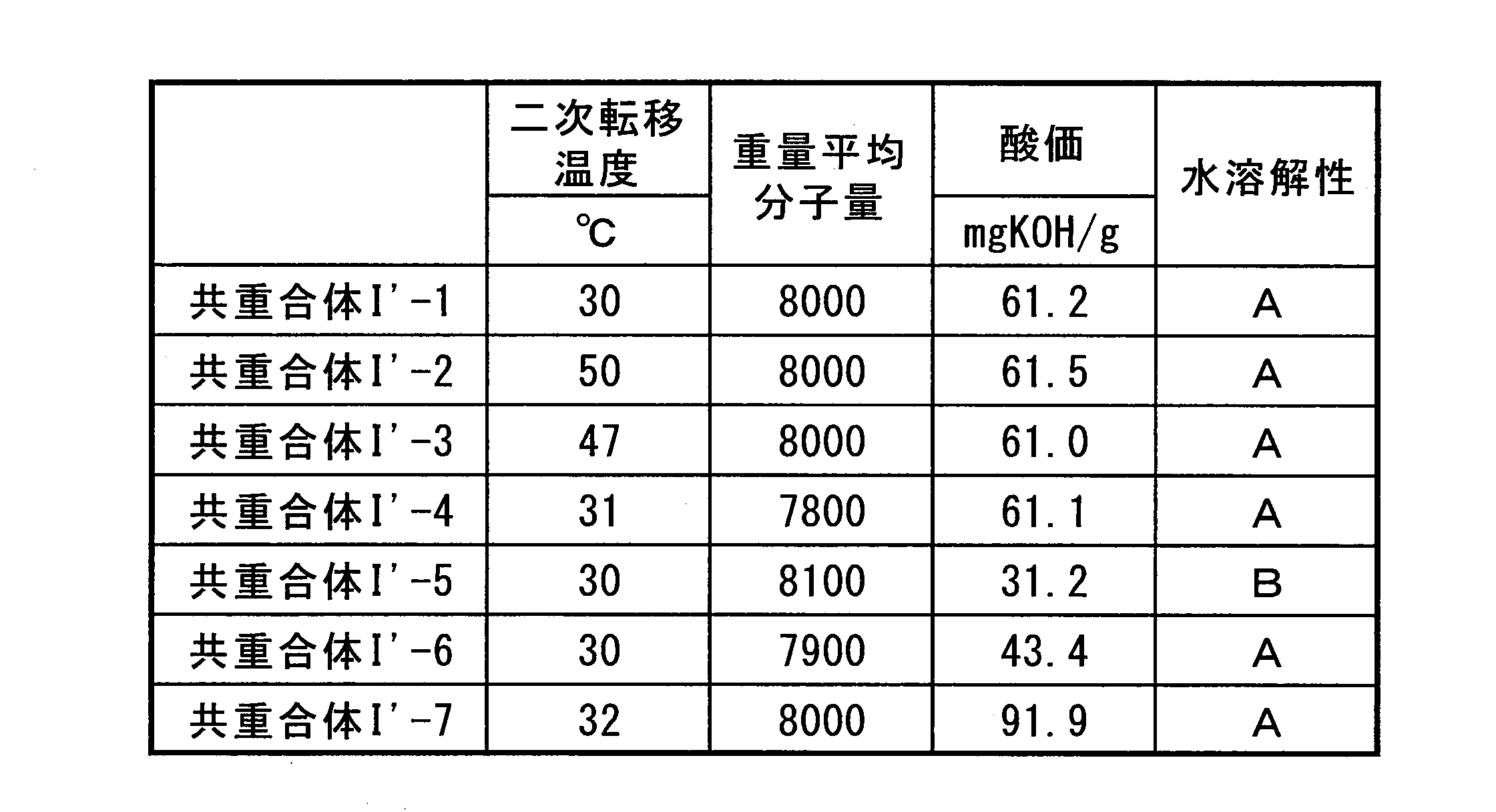
- Table 2 shows the secondary transition temperature, weight average molecular weight, acid value, and water solubility of the obtained copolymers (I′-2) to (I′-7).
- alkali-soluble resin (I-1) In a 200 ml flask equipped with a stirrer and a thermometer, 30 g of copolymer (I′-1), 27.1 g of isopropyl alcohol (IPA) and 40 g of deionized water was added. Next, stirring was started at an internal temperature of 25 ° C., 2.9 g of 2-dimethylaminoethanol (DMAE) was gradually added into the flask, and stirring was continued at room temperature for 2 hours thereafter until the copolymer (I ′ A water-soluble varnish containing an alkali-soluble resin (I-1) which is a neutralized product of base -1) with DMAE was obtained.
- DMAE 2-dimethylaminoethanol
- the neutralization rate of the copolymer (I′-1) was 100%.
- the amount of DMAE used (unit: g) necessary to achieve a neutralization rate of 100% is the acid value (mgKOH / g) of copolymer (I′-1) ⁇ 56.1 ⁇ 1000 ⁇ 30 ⁇ 89. 14 was obtained.
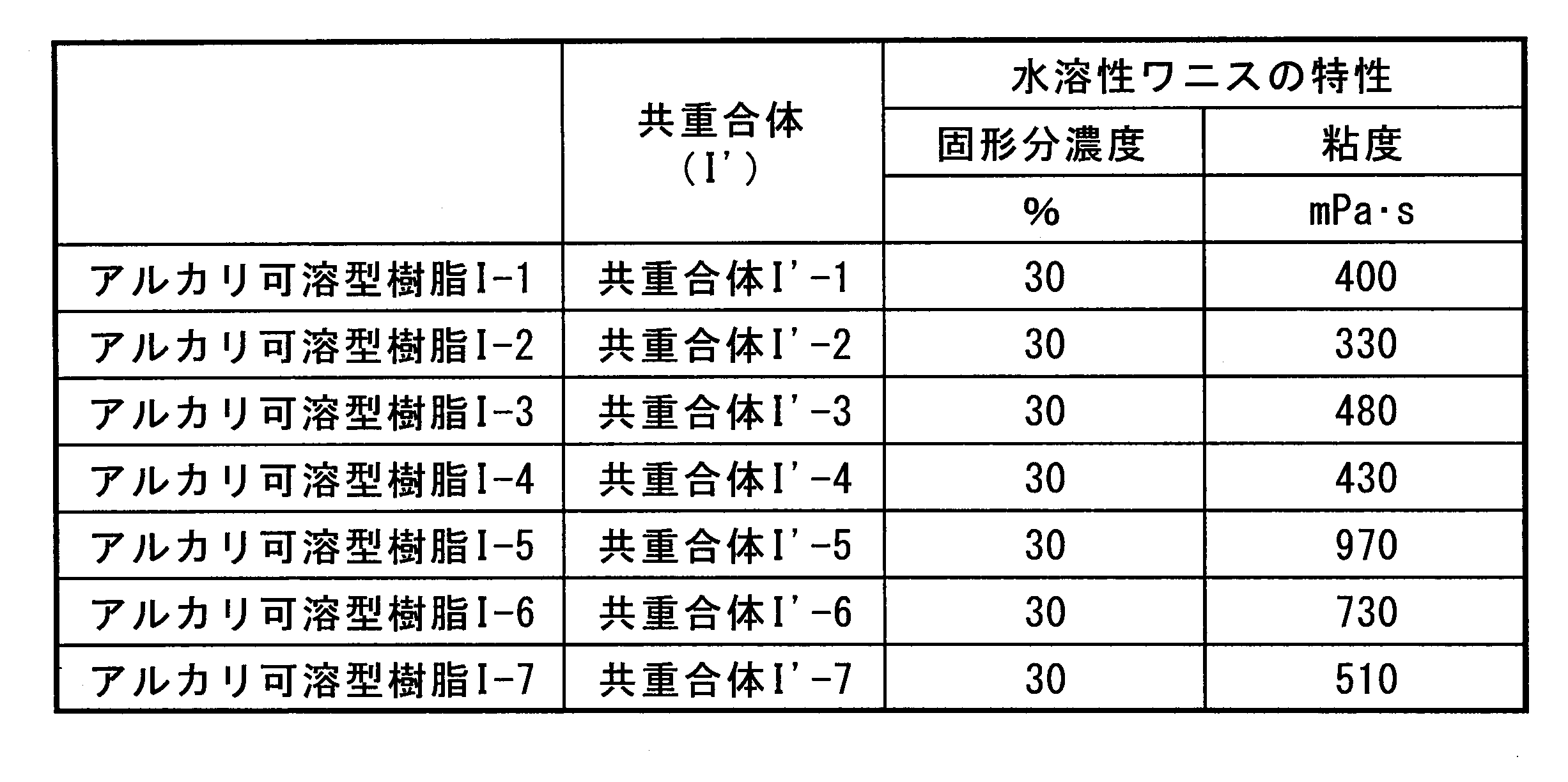
- Table 3 shows the solid content concentration and viscosity of water-soluble varnish containing alkali-soluble resin (I-2) to alkali-soluble resin (I-7).
- t-butyl hydroperoxide aqueous solution (trade name: Perbutyl H69, solid content: 69%) as a radical polymerization initiator, 0.0002 part of ferrous sulfate as a reducing agent, ethylenediamine 0.00027 parts tetraacetic acid (EDTA), 0.041 parts sodium isoascorbate monohydrate, and 1 part deionized water were added.
- EDTA ethylenediamine 0.00027 parts tetraacetic acid
- sodium isoascorbate monohydrate 0.041 parts sodium isoascorbate monohydrate
- the reaction solution thus obtained was cooled to obtain an aqueous resin dispersion (emulsion type resin) in which the composite resin (II-1) of the urethane polymer (e) and the acrylic polymer (f) was dispersed in water.
- the solid content of this aqueous resin dispersion was 35%.
- Example 1 37.5 parts of a water-soluble varnish containing an alkali-soluble resin (I-1), 2.5 g of a pigment dispersant (trade name: TEGO740, manufactured by Evonik), pigment (titanium oxide manufactured by Ishihara Sangyo Co., Ltd., trade name) : CR-90), 45 g of IPA, 15 g of IPA and 60 g of glass beads were added in this order, and mixed and stirred to obtain a premix. The obtained premix was kneaded for 1 hour using a sand mill to obtain a pigment paste. 40 parts of the composite resin (II-1) was added to 60 parts of the obtained pigment paste and diluted with 24 g of IPA and 6 g of deionized water to produce an aqueous ink 1 for gravure printing.
- a pigment dispersant trade name: TEGO740, manufactured by Evonik
- pigment titanium oxide manufactured by Ishihara Sangyo Co., Ltd., trade name
- CR-90
- the obtained water-based ink 1 was printed on the corona-treated surface of an OPP film (manufactured by Toyobo Co., Ltd., product name: P-2108) using a gravure printing machine (product of UK RK, product name: GP-100). An ink coating film having a thickness of 1 ⁇ m to 10 ⁇ m was formed. The ink coating film was dried at 25 ° C. for 1 hour.
- the dispersity of the pigment paste was confirmed using a particle gauge (NO120302 manufactured by Chuo Seimitsu Co., Ltd.) and evaluated according to the following criteria.
- A The leveling property on the surface of the ink coating film is high, there is no unevenness or aggregate, and the smoothness is excellent.
- B The leveling property of the ink coating film surface is slightly inferior to that of A, but there are no irregularities or aggregates and the smoothness is good.
- C The leveling property of the ink coating film surface is low, or there are irregularities and aggregates, and the smoothness is low.
- Gloss of ink film Gloss (60 °) of ink film after drying was measured using a variable angle gloss meter (trade name: GLOSS METER VG7000, manufactured by Nippon Denshoku Industries Co., Ltd.) Evaluated.
- Examples 2-11 and Comparative Examples 1-2 A water-based ink was produced and evaluated in the same manner as in Example 1 except that the composition was changed as shown in Table 4. The evaluation results are shown in Table 4.
Landscapes
- Chemical & Material Sciences (AREA)
- Chemical Kinetics & Catalysis (AREA)
- Life Sciences & Earth Sciences (AREA)
- Engineering & Computer Science (AREA)
- Materials Engineering (AREA)
- Wood Science & Technology (AREA)
- Organic Chemistry (AREA)
- Inks, Pencil-Leads, Or Crayons (AREA)
- Printing Methods (AREA)
Abstract
Description
本願は、2018年4月27日に、日本に出願された特願2018-087623号に基づき優先権を主張し、その内容をここに援用する。
また、特許文献2には、ビニル系単量体の重合過程でウレタン系重合体を存在させて製造した組成物が記載されている。
また、特許文献2に記載の組成物に顔料を添加した水性インクは、顔料の分散性が不十分であった。
[1]顔料、ビヒクル及び水を含む水性インクであって、
前記ビヒクルとして、アルカリ可溶型樹脂(I)及び複合樹脂(II)を含み、
前記複合樹脂(II)がウレタン重合体(e)及びアクリル系重合体(f)の複合樹脂である、水性インク。
[2]前記複合樹脂(II)は、エマルション型樹脂である、[1]に記載の水性インク。
[3]前記アルカリ可溶型樹脂(I)は、共重合体(I’)の塩基による中和物であり、
前記共重合体(I’)は、スチレン誘導体(a)に由来する単量体単位及び酸基含有ビニル化合物(b)に由来する単量体単位を有する、[1]又は[2]に記載の水性インク。
[4]前記共重合体(I’)は、メチルメタクリレート(c)に由来する単量体単位をさらに有する、[3]に記載の水性インク。
[5]前記共重合体(I’)は、前記スチレン誘導体(a)に由来する単量体単位、酸基含有ビニル化合物(b)に由来する単量体単位、及びメチルメタクリレート(c)に由来する単量体以外のビニル系単量体(d)に由来する単量体単位をさらに有する、[4]に記載の水性インク。
[6]前記共重合体(I’)の質量(100質量%)に対して、
スチレン誘導体(a)に由来する単量体単位の含有割合が5~30質量%であり、
酸基含有ビニル化合物(b)に由来する単量体単位の含有割合が4~20質量%であり、
メチルメタクリレート(c)に由来する単量体単位の含有割合が5~70質量%であり、
ビニル系単量体(d)に由来する単量体単位の含有割合が10~70質量%である、[5]に記載の水性インク。
[7]前記ビニル系単量体(d)が、アルキル基の炭素数が4~15のアルキル(メタ)アクリレートを含む、[5]又は[6]に記載の水性インク。
[8]前記ビニル系単量体(d)が、アルキル基の炭素数が4~6のアルキル(メタ)アクリレートを含む、[5]又は[6]に記載の水性インク。
[9]前記ビニル系単量体(d)が、アルキル基の炭素数が7~10のアルキル(メタ)アクリレートを含む、[5]又は[6]に記載の水性インク。
[10]前記ビニル系単量体(d)が、アルキル基の炭素数が7~10のアルキル(メタ)アクリレートをさらに含む、[8]に記載の水性インク。
[11]前記共重合体(I’)の二次転移温度が10~150℃である、[3]~[10]のいずれかに記載の水性インク。
[12]前記共重合体(I’)の重量平均分子量が5000~30000である、[3]~[11]のいずれかに記載の水性インク。
[13]前記共重合体(I’)の酸価が35~200mgKOH/gである、[3]~[12]のいずれかに記載の水性インク。
[14]前記共重合体(I’)と前記複合樹脂(II)との質量比[共重合体(I’)の質量/複合樹脂(II)の質量]が5/95~95/5である、[3]~[13]のいずれかに記載の水性インク。
[15]水性インクがグラビア印刷用インクである、[1]~[14]のいずれかに記載の水性インク。
「単量体単位」は、重合体を構成する単量体由来の構成単位を意味する。
本発明の水性インクに含まれる顔料は着色剤であり、無機顔料、有機顔料のいずれであってもよいし、両方であってもよい。
無機顔料としては、例えば、酸化チタン、弁柄、体質顔料等が挙げられる。有機顔料としては、アゾ系、多環系、及び染色レーキ系等の有機顔料が挙げられる。
水性インクにおける顔料の含有量が前記下限値以上であれば、水性インクから形成される塗膜を充分に着色でき、前記上限値以下であれば、顔料の凝集を防止しやすい。
本発明の水性インクに含まれるビヒクルは、アルカリ可溶型樹脂(I)と複合樹脂(II)とを含む。
アルカリ可溶型樹脂(I)は、アルカリに可溶な樹脂であれば特に限定されないが、スチレン誘導体(a)に由来する単量体単位及び酸基含有ビニル化合物(b)に由来する単量体単位を有する共重合体(I’)の塩基による中和物であることが好ましい。
複合樹脂(II)は、ウレタン重合体(e)及びアクリル重合体(f)が複合化した重合体、すなわち複合樹脂である。
アルカリ可溶型樹脂(I)は、たとえば、共重合体(I’)の塩基による中和物であり、共重合体(I’)は、酸基含有ビニル化合物(b)に由来する単量体単位を有するため酸基を有する。
この場合、共重合体(I’)の中和により塩となった、アルカリ可溶型樹脂(I)である共重合体は水溶性が向上し、水に溶解可能となる。共重合体(I’)の酸基は全てが中和される必要はなく、中和率は30%以上が好ましく、70%以上がより好ましい。ここで、中和率とは、共重合体(I’)中の全酸基のモル数に対する、塩基により中和された酸基のモル数の割合(%)である。
共重合体(I’)は、スチレン誘導体(a)(以下、「単量体(a)」とも言う。)に由来する単量体単位(以下、「単量体(a)単位」とも言う。)と、酸基含有ビニル化合物(b)(以下、「単量体(b)」とも言う。)に由来する単量体単位(以下、「単量体(b)単位」とも言う。)とを有する共重合体である。
共重合体(I’)は、単量体(a)単位及び単量体(b)単位に加えて、単量体(a)及び単量体(b)と共重合可能な、単量体(a)及び単量体(b)以外のビニル系単量体(d)(以下、「単量体(d)」という。)(共重合体(I’)が単量体(c)単位をさらに含む場合には、単量体(c)とも共重合可能な、単量体(a)、単量体(b)及び単量体(c)以外のビニル系単量体)に由来する単量体単位(以下、「単量体(d)単位」とも言う。)を有していてもよい。
共重合体(I’)は、単量体(a)単位及び単量体(b)単位に加えて、単量体(c)単位及び単量体(d)単位の両方を有していてもよい。
単量体(a)は1種を単独で使用してもよいし、2種以上を併用してもよい。
単量体(a)のなかでも、共重合体(I’)を製造する際の重合のしやすさの観点からスチレンが好ましい。
単量体(b)は1種を単独で使用してもよいし、2種以上を併用してもよい。
単量体(b)のなかでも、アルカリ可溶型樹脂(I)の水溶性の観点から、カルボン酸を有する単量体が好ましい。カルボン酸を有する単量体のなかでも、メタクリル酸、アクリル酸が好ましい。
ヒドロキシアルキル(メタ)アクリレートとしては、例えば、2-ヒドロキシエチル(メタ)アクリレート、2-ヒドロキシプロピル(メタ)アクリレート等が挙げられる。
グリコールジ(メタ)アクリレートとしては、例えば、エチレングリコールジ(メタ)アクリレート、ブチレングリコール(メタ)アクリレート等が挙げられる。
アルキルアミノ(メタ)アクリレートとしては、例えば、ジメチルアミノエチル(メタ)アクリレート等が挙げられる。
(メタ)アクリレート以外のビニル単量体としては、例えば、酢酸ビニル、プロピオン酸ビニル、(メタ)アクリロニトリル等が挙げられる。
また、水性インクの顔料の分散性がさらに向上する点では、単量体(d)としては、アルキル基の炭素数が7~10のアルキル(メタ)アクリレートがより好ましい。
アルキル基の炭素数が4~6のアルキル(メタ)アクリレートとアルキル基の炭素数が7~10のアルキル(メタ)アクリレートとを併用すると、水性インクの塗膜の平滑性及び光沢をより向上させることができる。
単量体(a)単位の含有割合が前記下限値以上であれば、インク塗膜の光沢をより向上させることができる。
また、単量体(a)単位の含有割合が前記上限値以下であれば、アルカリ可溶型樹脂(I)の水溶性をより向上させることができる。
単量体(b)単位の含有割合が前記下限値以上であれば、アルカリ可溶型樹脂(I)の水溶性をより向上させることができる。
単量体(b)単位の含有割合が前記上限値以下であれば、インク塗膜の平滑性及び光沢をより向上させることができる。
単量体(c)単位の含有割合が前記下限値以上であれば、アルカリ可溶型樹脂(I)の硬度をより向上させることができる。
単量体(c)単位の含有割合が前記上限値以下であれば、アルカリ可溶型樹脂(I)の水溶性をより向上させることができる。
単量体(d)単位の含有割合が前記範囲内であれば、単量体(d)単位を有することによる効果を充分に発揮できつつ、単量体(a)単位、単量体(b)単位及び単量体(c)単位を有することによる効果も充分に発揮できる。
単量体(a)としてスチレン、単量体(b)として(メタ)アクリル酸、並びに単量体(c)及び(d)として(メタ)アクリル酸エステルを含む単量体混合物を共重合したスチレン-アクリル系樹脂;
単量体(a)としてスチレン、単量体(b)として無水マレイン酸及び(メタ)アクリル酸、並びに単量体(c)及び単量体(d)として(メタ)アクリル酸エステルを含む単量体混合物を共重合したスチレン-マレイン酸-アクリル酸系樹脂;
単量体(a)としてスチレン及び単量体(b)として無水マレイン酸を含む単量体混合物を共重合したスチレン-マレイン酸系樹脂;等が挙げられる。
共重合体(I’)の二次転移温度は、示差走査熱量測定(DSC)によって求められる。
共重合体(I’)の二次転移温度が前記上限値以下であると、インク塗膜が柔らかくなり、被印刷体との密着性が向上する傾向がある。
共重合体(I’)の重量平均分子量は、ゲル・パーミエーション・クロマトグラフィ(GPC)を用いて測定し、分子量が既知の標準ポリスチレンを用いて求めた値である。
共重合体(I’)の重量平均分子量が前記上限値以下であると、アルカリ可溶型樹脂(I)の複合樹脂(II)との相溶性が向上する傾向がある。
共重合体(I’)の酸価は、共重合体(I’)の水溶液に、エタノールに溶解した水酸化カリウム(KOH)を滴下し、フェノールフタレインの変色点を基準として滴定し、共重合体(I’)1gを中和するに必要なKOHのmg数で示した値である。
共重合体(I’)の酸価が前記上限値以下であると、アルカリ可溶型樹脂(I)の複合樹脂(II)との相溶性及び塗膜の耐水性がより向上する傾向がある。
共重合体(I’)を製造する際の重合方法としては、懸濁重合法、溶液重合法、塊状重合法等の各種の重合方法が適用できる。これら重合方法のなかでも、懸濁重合法が好ましい。
懸濁重合法を適用すれば、顔料分散性に優れると共に複合樹脂(II)との相溶性に優れたアルカリ可溶型樹脂(I)を容易に製造できる。
アルカリ可溶型樹脂(I)を製造するための共重合体(I’)の中和に用いられる塩基としては、例えば、有機金属水酸化物、アンモニア、アミン化合物、モルホリン等が挙げられる。
アミン化合物としては、例えば、トリエチルアミン、プロピルアミン、ジエチルアミン、トリプロピルアミン、ジブチルアミン、アミルアミン、1-アミノオクタン、2-ジメチルアミノエタノール、エチルアミノエタノール、2-ジエチルアミノエタノール、1-アミノ-2-プロパノール、2-アミノ-1-プロパノール、3-アミノ-1-プロパノール、1-ジメチルアミノ-2-プロパノール、3-ジメチルアミノ-1-プロパノール、2-プロピルアミノエタノール、エトキシプロピルアミン、アミノベンジルアルコール等が挙げられる。
塩基は1種を単独で使用してもよいし、2種以上を併用してもよい。
複合樹脂(II)は、ウレタン重合体(e)(以下、「重合体(e)」とも言う。)及びアクリル重合体(f)(以下、「重合体(f)」とも言う。)が複合化した重合体である。
例えば、重合体(e)の存在下で(メタ)アクリル系単量体を重合して重合体(f)を形成すると共に重合体(e)に重合体(f)を密着させることにより、重合体(e)及び重合体(f)が複合化した重合体を得ることができる。
低分子量ポリオールとしては、例えば、エチレングリコール、プロピレングリコール、1,3-プロパンジオール、1,4-ブタンジオール、1,5-ペンタンジオール、3-メチル-1,5-ペンタンジオール、1,6-ヘキサンジオール、ネオペンチルグリコール、ジエチレングリコール、トリメチレングリコール、トリエチレングリコール、テトラエチレングリコール、ジプロピレングリコール、トリプロピレングリコール、ヘキサンジオール、シクロヘキサンジメタノール等が挙げられる。
ポリエステルポリオールとしては、例えば、前記低分子量ポリオールの少なくとも1種と、アジピン酸、セバシン酸、イタコン酸、無水マレイン酸、テレフタル酸、イソフタル酸等のジカルボン酸とを重縮合して得られるポリオールが挙げられる。
ポリエーテルポリオールとしては、例えば、ポリエチレングリコール、ポリプロピレングリコール、ポリカプロラクトンポリオール、ポリテトラメチレンエーテルポリオール等が挙げられる。
脂肪族ポリイソシアネートとしては、例えば、エチレンジイソシアネート、テトラメチレンジイソシアネート、ヘキサメチレンジイソシアネート(HDI)、ドデカメチレンジイソシアネート、1,6,11-ウンデカントリイソシアネート、2,2,4-トリメチルヘキサメチレンジイソシアネート、リジンジイソシアネート、2,6-ジイソシアナトメチルカプロエート、ビス(2-イソシアナトエチル)フマレート、ビス(2-イソシアナトエチル)カーボネート、2-イソシアナトエチル-2,6-ジイソシアナトヘキサノエート等が挙げられる。
脂環式ポリイソシアネートとしては、例えば、イソホロンジイソシアネート(IPDI)、4,4’-ジシクロヘキシルメタンジイソシアネート(水素添加MDI)、シクロヘキシレンジイソシアネート、メチルシクロヘキシレンジイソシアネート(水素添加TDI)、ビス(2-イソシアナトエチル)-4-シクロヘキセン-1,2-ジカルボキシレート、2,5-ノルボルナンジイソシアネート、2,6-ノルボルナンジイソシアネート等が挙げられる。
芳香族ポリイソシアネートとしては、例えば、1,3-フェニレンジイソシアネート、1,4-フェニレンジイソシアネート、2,4-トリレンジイソシアネート(TDI)、2,6-トリレンジイソシアネート、4,4’-ジフェニルメタンジイソシアネート(MDI)、2,4-ジフェニルメタンジイソシアネート、4,4’-ジイソシアナトビフェニル、3,3’-ジメチル-4,4’-ジイソシアナトビフェニル、3,3’-ジメチル-4,4’-ジイソシアナトジフェニルメタン、1,5-ナフチレンジイソシアネート、4,4’,4’’-トリフェニルメタントリイソシアネート、m-イソシアナトフェニルスルホニルイソシアネート、p-イソシアナトフェニルスルホニルイソシアネート等が挙げられる。
(メタ)アクリル系単量体は、(メタ)アクリロイル基を有する単量体を意味する。
ヒドロキシアルキル(メタ)アクリレートとしては、例えば、2-ヒドロキシエチル(メタ)アクリレート、2-ヒドロキシプロピル(メタ)アクリレート等が挙げられる。
(メタ)アクリル酸としては、アクリル酸、メタクリル酸が挙げられる。
ラジカル重合性単量体とは、ラジカル重合性基を有する単量体である。ラジカル重合性基とは、ラジカル重合可能な炭素-炭素不飽和二重結合、ラジカル重合可能な炭素-炭素不飽和三重結合、ラジカル開環重合可能な環などを含む基のことである。
重合体(e)の100質量部に対する重合体(f)の含有量が前記範囲にあれば、各成分が有する性能を充分に発揮でき、顔料分散性、塗膜の平滑性及び光沢の向上により寄与する。
具体的には、重合体(e)の水性分散体に(メタ)アクリル系単量体及び必要に応じて(メタ)アクリル系単量体以外のラジカル重合性単量体を添加し、ラジカル重合することにより、重合体(f)を形成し、複合樹脂(II)を得る。
重合体(e)を乳化する方法としては、重合体(e)にカルボキシ基を導入し、水に分散させる方法、乳化剤を用いて重合体(e)を水に分散させる方法が挙げられる。
重合体(e)にカルボキシ基を導入し、且つ、乳化剤を用いて重合体(e)を水に分散させて、重合体(e)の水性分散体を得てもよい。
乳化剤の添加量は、全単量体100質量部に対して、0.05~10質量部であることが好ましく、0.1~5質量部であることが好ましい。
前記の乳化剤は1種を単独で使用してもよいし、2種以上を併用してもよい。
重合体(e)粒子の体積平均粒子径が前記下限値以上であれば、水性分散体の粘度が低くなり、流動性が高くなる。
一方、重合体(e)粒子の体積平均粒子径は300nm以下であることが好ましく、150nm以下であることがより好ましい。重合体(e)粒子の体積平均粒子径が前記上限値以下であれば、得られる複合樹脂(II)の平均粒子径の粗大化を防ぎ、保存安定性を向上させることができる。
重合体(e)の水性分散体の固形分含有量が前記下限値以上であれば、水性インクの固形分含有量を容易に高くできる。
重合体(e)の水性分散体の固形分含有量が前記上限値以下であれば、水性インクの粘度を容易に低くできる。
重合体(e)の生成を有機溶剤の存在下で行った場合には、水性分散体から有機溶剤を除去することが好ましい。
ラジカル重合の際には、ラジカル重合開始剤を添加し、加熱して、単量体を重合する。この重合により重合体(f)を形成させて、重合体(e)と重合体(f)が複合化した複合樹脂(II)を得る。
ラジカル重合開始剤としては、アゾ系化合物、過硫酸塩、有機過酸化物等、公知のラジカル重合開始剤を制限なく使用できる。ラジカル重合開始剤の添加量は、全単量体100質量部に対して0.01~5質量部であることが好ましく、0.05~2質量%であることが好ましい。
加熱温度は、通常、30~90℃の範囲とする。
ビヒクルにおいては、アルカリ可溶型樹脂(I)及び複合樹脂(II)を、共重合体(I’)と複合樹脂(II)との質量比[共重合体(I’)の質量/複合樹脂(II)の質量]が5/95~95/5で含有することが好ましく、20/80~65/35がより好ましい。
共重合体(I’)と複合樹脂(II)との質量比が下限値以上、すなわち共重合体(I’)が一定以上含まれていれば、顔料分散性がより高くなる。
共重合体(I’)と複合樹脂(II)との質量比が上限値以下、すなわち複合樹脂(II)が一定以上含まれていれば、塗膜の強度が高くなり、また、アルカリ可溶型樹脂(I)と複合樹脂(II)との相溶性がより向上する。
他のビヒクルは、アルカリ可溶型樹脂(I)及び複合樹脂(II)以外の重合体である。
他のビヒクルとしては、単量体(a)単位を含まないアクリル系樹脂、ガゼイン樹脂及びシェラック樹脂等の天然樹脂等が挙げられる。また、他のビヒクルとして、複合樹脂(II)以外のエマルション型樹脂、及びコロイダルディスパージョン型樹脂等が挙げられる。
他のビヒクルは1種を単独で使用してもよいし、2種以上を併用してもよい。
本発明の水性インクは水を含む。本発明の水性インクにおいて、水は溶剤として用いられるが、水以外の溶剤を含んでもよい。
水以外の溶剤としては、例えば、アルコール系溶剤、グリコール系溶剤、カルビトール系溶剤等が挙げられる。
水以外の溶剤は1種を単独で使用してもよいし、2種以上を併用してもよい。
水以外の溶剤の含有割合が前記下限値以上であれば、水性インクにおけるビヒクルの分散性をより向上させることができる。
水以外の溶剤の含有割合が前記上限値以下であれば、水性と言えるものとなる。
本発明の水性インクは、顔料、ビヒクル及び水を含む溶剤以外の補助剤を含んでいてもよい。
補助剤としては、例えば、シリコン系樹脂等の消泡剤、ポリエチレン系ワックス等の滑剤、界面活性剤等などレベリング剤、顔料分散性をさらに向上させるための顔料分散剤、防腐剤等が挙げられる。
本発明の水性インクは、顔料、ビヒクル及び水を混合して製造される。
本発明の水性インクの製造方法の一例としては、例えば、下記のワニス製造工程、顔料分散工程及び製品仕上げ工程を有する方法が挙げられる。但し、本発明の水性インクを製造する方法は、下記の製造方法に限定されない。
ワニス製造工程は、水溶性ワニスを製造するための、共重合体(I’)とアルコール水溶液と塩基との混合を含む。
この工程により、共重合体(I’)は塩基により中和されてアルカリ可溶型樹脂(I)になり、アルカリ可溶型樹脂(I)が水に溶解する。アルカリ可溶型樹脂(I)の水溶液を水溶性ワニスという。前記混合の際には、加熱してもよいし、加熱しなくてもよい。
また、水溶性ワニスのpHは、アルカリ可溶型樹脂(I)が安定に溶解状態を保つことができる6~9が好ましい。
顔料分散工程は、プレミックスを製造するための、顔料と水溶性ワニスとの混合及び分散機を用いた得られたプレミックスの混練りを含む。
混練りすることにより、凝集していた顔料を分散させ、顔料の表面に共重合体(I’)が吸着した顔料ペーストを製造する。
混練りの際に使用する分散機としては、例えば、ビーズミル、サンドミル、ボールミル、アトライター、ロールミル等が挙げられる。
製品仕上げ工程は、水性インクを製造するための、顔料ペーストと複合樹脂(II)の水性分散体との混合を含む。
製品仕上げ工程では、必要に応じて、水及び有機溶剤の少なくとも一方からなる希釈剤を添加して、水性インクの固形分濃度を調整してもよい。
水性インクに補助剤を含有させる場合には、この製品仕上げ工程において、補助剤も適宜配合する。但し、補助剤は製品仕上げ工程より前の工程で配合しても構わない。
本発明の水性インクは、例えば、樹脂フィルム、樹脂成形体及び紙等の被印刷体の表面に印刷される。印刷によってインク塗膜を形成して被印刷体を着色する。
本発明の水性インクは、グラビア印刷に好適に用いられ得る。すなわち、本発明の水性インクは、グラビア印刷用インクであることが好ましい。
例えば、樹脂フィルムにグラビア印刷した場合、20~60℃の温度範囲で10秒~10時間乾燥することが好ましい。
共重合体(I)の塩基としてアンモニア又はアミン化合物を使用した場合には、インク塗膜を形成した後の乾燥の際に塩基が容易に揮発する。そのため、アルカリ可溶型樹脂(I)及び複合樹脂(II)を含有する水性インクから形成したインク塗膜は、共重合体(I’)及び複合樹脂(II)を含有する塗膜となる。
本発明の水性インクは、ビヒクルとして、アルカリ可溶型樹脂(I)及び複合樹脂(II)を含み、複合樹脂(II)は重合体(e)及び重合体(f)の複合樹脂である。
本発明の水性インクによれば、顔料の分散性を高くでき、また、得られるインク塗膜の平滑性及び光沢を高くできる。
なお、下記の例における「部」及び「%」は、各々、「質量部」及び「質量%」を意味する。
また、表中における各成分に係る数値は、それぞれ質量部を示す。
下記の例では、重合体の重量平均分子量、酸価、二次転移温度、及び水溶解性を、以下の方法で測定又は評価した。また、重合体を水に溶解させた水溶性ワニスの粘度を、下記の方法で測定した。
重合体の重量平均分子量の測定には、東ソー株式会社製高速ゲル浸透クロマトグラフィ装置HLC-8120GPC型(以下、「GPC装置」という。)を用いた。また、検出器としては、示差屈折検出器(RI検出器)を用いた。GPC装置に取り付けたカラムは、東ソー株式会社製、TSKgel superHZM-M(4.6mmID×15cmL)を2本と、東ソー株式会社製、TSKgel HZ2000(4.6mmID×15cmL)を1本とを連結して用いた。
測定の際に使用した溶離液はテトラヒドロフラン(安定剤のジブチルヒドロキシトルエンを含む)を用いた。測定条件は、溶離液の流速0.35ml/分、測定用試料注入口温度40℃、オーブン温度40℃、RI温度40℃とした。測定用試料としては、樹脂分が0.2質量%になるようテトラヒドロフランを添加して調整した溶液を用いた。
GPC装置の測定用試料注入口に、測定用試料の溶液10μlを注入し、溶出曲線を測定し、標準ポリスチレンによる検量線を基に測定サンプルの重量平均分子量を算出した。
重合体の酸価は、以下のようにして測定した。
測定用試料約0.2gを秤量し(A(g))、その測定用試料を枝付き三角フラスコ内に入れ、さらにプロピレングリコールモノメチルエーテル(PGM)10mlを加えて、測定用試料を溶解させた。溶解後、トルエン10ml、エタノール20ml、フェノールフタレイン溶液数滴を加え、0.02規定の水酸化カリウム溶液(KOH溶液)によって滴定した。滴定量をB(ml)、KOH溶液の力価をpとし、ブランク測定を同様に行い、滴定量をC(ml)とし、以下の式に従って酸価を算出した。
酸価(mgKOH/g)={(B-C)×0.02×56.11×p}/A
重合体の二次転移温度は、示差走差熱量計(Rigaku製、「Thermo plusEVO」)を用いて、昇温速度10℃/minにおけるチャートのベースラインと吸熱カーブの接線との交点から測定した。測定試料としては、重合体を3mg±0.5mgとなるようにアルミパン内に計量し、ガラス転移温度以上の100℃で10分融解後、ドライアイスを用いて急冷却処理した試料を用いた。
水溶性ワニスの粘度は、B型(トキメック社製ブルックフィールド型)粘度計を用いて、23℃における粘度(60rpmのときの粘度)を測定した。
水溶性ワニスの状態を目視で観察して次の基準で水溶解性を評価した。水性インクは透明であるほど、水溶解性が高い。
A:透明である。
B:沈殿はないが、濁りがある。
C:沈殿がある。
攪拌機、冷却管、温度計を備えた重合装置中に、脱イオン水900部、メタクリル酸2-スルホエチルナトリウム60部、メタクリル酸カリウム10部及びメチルメタクリレート12部を入れて撹拌し、重合装置内を窒素置換しながら、50℃に昇温した。その中に、重合開始剤として2,2’-アゾビス(2-メチルプロピオンアミジン)二塩酸塩0.08部を添加し、さらに60℃に昇温した。昇温後、滴下ポンプを使用して、メチルメタクリレートを0.24部/分の速度で75分間連続的に滴下した。この滴下により添加したメチルメタクリレートの合計量は18部である。滴下終了後、反応溶液を60℃で6時間保持した後、室温に冷却して、透明な水溶液である固形分10%の分散剤1を得た。
攪拌機、冷却管、温度計を備えた重合装置中に、脱イオン水145部、硫酸ナトリウム0.1部及び分散剤1(固形分10%)0.25部を入れて撹拌し、均一な水溶液とした。
次に、重合装置内に、メチルメタクリレート(MMA)43部、スチレン(St)10部、n-ブチルメタクリレート(n-BMA)17部、エチルヘキシルアクリレート(EHA)20部、メタクリル酸(MAA)10部を加えた。
次いで、攪拌を開始し、2,2’-ジメチル-2,2’-ジアゼンジイルジブタンニトリル(AMBN)0.5部及びn-ドデシルメルカプタン(n-DM)1.9部、1-オクタンチオール(n-OM)1.9部、チオグリコール酸2-エチルヘキシル(OTG)1.9部を加え80℃に昇温した。
反応温度を80~85℃の範囲内で維持するように2時間反応させ、その後95℃に昇温し1時間維持し、反応を終了させた。
得られた共重合体(I’-1)の重量平均分子量は8000、酸価は61.2mgKOH/g、二次転移温度は30℃であった。
単量体の添加量を表1に示すように変更した以外は共重合体(I’-1)の製造方法と同様にして、共重合体(I’-2)~共重合体(I’-7)を製造した。

攪拌機、温度計を備えた200mlフラスコに、共重合体(I’-1)30g、イソプロピルアルコール(IPA)27.1g及び脱イオン水40gの混合溶液を投入した。
次いで、内温25℃で撹拌を開始し、2-ジメチルアミノエタノール(DMAE)2.9gをフラスコ内に徐々に添加し、その後も室温で2時間撹拌を継続して、共重合体(I’-1)の塩基(DMAE)による中和物であるアルカリ可溶型樹脂(I-1)を含む水溶性ワニスを得た。
なお、共重合体(I’-1)の中和率は100%であった。中和率100%とするのに必要なDMAEの使用量(単位:g)は、共重合体(I’-1)の酸価(mgKOH/g)÷56.1÷1000×30×89.14で求めた。
共重合体(I’-1)に代えて共重合体(I’-2)~共重合体(I’-7)を用いたこと以外はアルカリ可溶型樹脂(I-1)を含む水溶性ワニスの製造方法と同様にして、アルカリ可溶型樹脂(I-2)~アルカリ可溶型樹脂(I-7)を含む水溶性ワニスを得た。
攪拌機、還流冷却管、温度制御装置及び滴下ポンプを備えたフラスコに、ウレタン重合体としてアニオン系水系ウレタン樹脂エマルション(第一工業製薬株式会社製、商品名:F-2170D、固形分25.6%)390.6部(固形分100.0部)と、脱イオン水67部と、MMA65.5部、エチルアクリレート(EA)34.5部からなる(メタ)アクリル系単量体とを仕込み、フラスコの内温を40℃に昇温した。
その後、ラジカル重合開始剤としてt-ブチルヒドロパーオキサイド水溶液(日油株式会社製、商品名:パーブチルH69、固形分69%)0.02部、還元剤として硫酸第一鉄0.0002部、エチレンジアミン四酢酸(EDTA)0.00027部、イソアスコルビン酸ナトリウム一水和物0.041部、及び脱イオン水1部を添加した。重合発熱によるピークトップ温度を確認後、フラスコの内温を75℃に昇温し、t-ブチルヒドロパーオキサイド水溶液0.03部及び脱イオン水10部をさらに加えた。
これにより得た反応液を冷却して、ウレタン重合体(e)及びアクリル重合体(f)の複合樹脂(II-1)が水に分散した水性樹脂分散体(エマルション型樹脂)を得た。
この水性樹脂分散体の固形分は35%であった。
MMA 65.5部、EA 34.5部からなる(メタ)アクリル系単量体の代わりにMMA 25.9部、ブチルアクリレート(BA) 74.1部からなる(メタ)アクリル系単量体を用いたこと以外は、複合樹脂(II-1)の製造方法と同様にして、ウレタン重合体(e)及びアクリル重合体(f)の複合樹脂(II-2)が水に分散した水性樹脂分散体(エマルション型樹脂)を得た。
この水性樹脂分散体の固形分は35%であった。
アニオン系水系ウレタン樹脂エマルション(第一工業製薬株式会社製、商品名:F-2170D、固形分25.6%)390.6部(固形分100.0部)と、脱イオン水67部の代わりにアニオン系水系ウレタン樹脂エマルション(日華化学株式会社製、商品名:X-7096、固形分36.6%)273.2部(固形分100.0部)と、脱イオン水204部を用いたこと以外は、複合樹脂(II-1)の製造方法と同様にして、ウレタン重合体(e)及びアクリル重合体(f)の複合樹脂(II-3)が水に分散した水性樹脂分散体(エマルション型樹脂)を得た。
この水性樹脂分散体の固形分は34%であった。
アルカリ可溶型樹脂(I-1)を含む水溶性ワニス37.5部に、顔料分散剤(エボニック社製、商品名:TEGO740)2.5g、顔料(石原産業株式会社製酸化チタン、商品名:CR-90)45g、IPA 15g、ガラスビーズ60gをこの順で添加し、混合及び撹拌してプレミックスを得た。
得られたプレミックスを、サンドミルを使用して1時間混練りして顔料ペーストを得た。
得られた顔料ペースト60部に複合樹脂(II-1)40部を添加し、IPA 24g及び脱イオン水6gで希釈してグラビア印刷用の水性インク1を製造した。
顔料ペーストにおける酸化チタンの分散性、並びにインク塗膜の平滑性及び光沢を、以下のように評価した。
評価結果を表4に示す。
顔料ペーストの分散度を粒ゲージ(中央精密機器株式会社製NO120302)を用いて確認し、次の基準で評価した。
A:粒ゲージで評価した際の結果が10μm未満となる。
B:粒ゲージで評価した際の結果が10μm~20μmとなる。
C:粒ゲージで評価した際の結果が20μm超となる。
乾燥したインク塗膜の表面のレベリング性とブツや凝集物の有無を目視で観察し、次の基準で平滑性を評価した。
A:インク塗膜表面のレベリング性が高く、ブツや凝集物もなく、平滑性に優れている。
B:インク塗膜表面のレベリング性は前記Aに比べてやや劣るが、ブツや凝集物はなく、平滑性が良好である。
C:インク塗膜表面のレベリング性が低い、又はブツや凝集物が存在し、平滑性が低い。
乾燥後のインク塗膜の光沢(60°)を変角光沢計(日本電色工業株式会社製、商品名:GLOSS METER VG7000)を用いて測定し、次の基準で光沢を評価した。
A:光沢(60°)が30超である。
B:光沢(60°)が10~20である。
C:光沢(60°)が10未満である。
組成を表4に示すように変更した以外は、実施例1と同様にして水性インクを製造し、評価した。
評価結果を表4に示す。
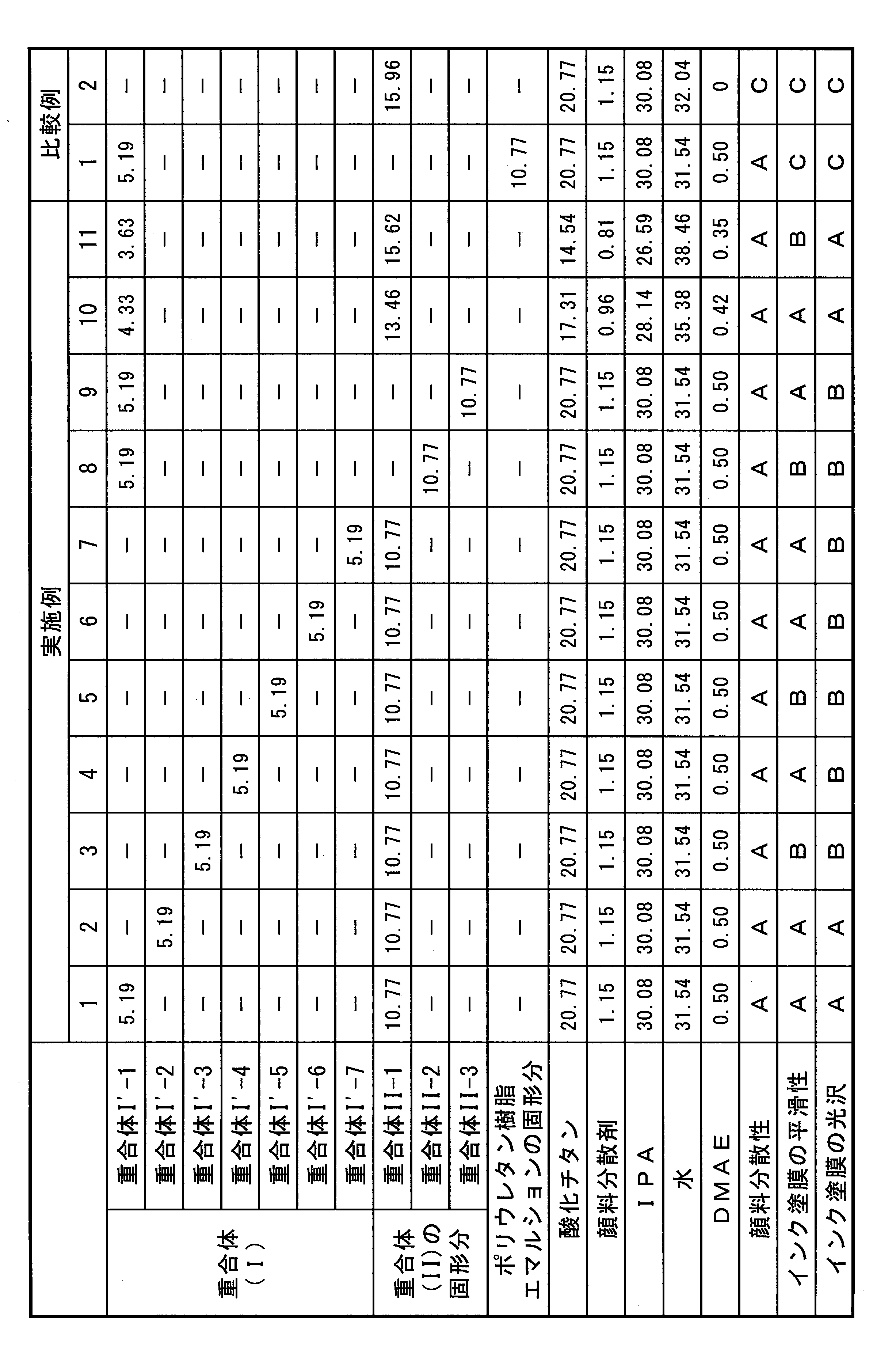
複合樹脂(II)を含まない比較例1は、インク塗膜の平滑性及び光沢が低かった。
アルカリ可溶型樹脂(I)を含まない比較例2は、顔料分散性、インク塗膜の平滑性及び光沢のいずれもが低かった。
Claims (15)
- 顔料、ビヒクル及び水を含む水性インクであって、
前記ビヒクルとして、アルカリ可溶型樹脂(I)及び複合樹脂(II)を含み、
前記複合樹脂(II)がウレタン重合体(e)及びアクリル系重合体(f)の複合樹脂である、
水性インク。 - 前記複合樹脂(II)は、エマルション型樹脂である、請求項1に記載の水性インク。
- 前記アルカリ可溶型樹脂(I)は、共重合体(I’)の塩基による中和物であり、
前記共重合体(I’)は、スチレン誘導体(a)に由来する単量体単位及び酸基含有ビニル化合物(b)に由来する単量体単位を有する、請求項1又は2に記載の水性インク。 - 前記共重合体(I’)は、メチルメタクリレート(c)に由来する単量体単位をさらに有する、請求項3に記載の水性インク。
- 前記共重合体(I’)は、前記スチレン誘導体(a)に由来する単量体単位、酸基含有ビニル化合物(b)に由来する単量体単位及びメチルメタクリレート(c)に由来する単量体以外のビニル系単量体(d)に由来する単量体単位をさらに有する、請求項4に記載の水性インク。
- 前記共重合体(I’)の質量(100質量%)に対して、
スチレン誘導体(a)に由来する単量体単位の含有割合が5~30質量%であり、
酸基含有ビニル化合物(b)に由来する単量体単位の含有割合が4~20質量%であり、
メチルメタクリレート(c)に由来する単量体単位の含有割合が5~70質量%であり、
ビニル系単量体(d)に由来する単量体単位の含有割合が10~70質量%である、請求項5に記載の水性インク。 - 前記ビニル系単量体(d)が、アルキル基の炭素数が4~15のアルキル(メタ)アクリレートを含む、請求項5又は6に記載の水性インク。
- 前記ビニル系単量体(d)が、アルキル基の炭素数が4~6のアルキル(メタ)アクリレートを含む、請求項5又は6に記載の水性インク。
- 前記ビニル系単量体(d)が、アルキル基の炭素数が7~10のアルキル(メタ)アクリレートを含む、請求項5又は6に記載の水性インク。
- 前記ビニル系単量体(d)が、アルキル基の炭素数が7~10のアルキル(メタ)アクリレートをさらに含む、請求項8に記載の水性インク。
- 前記共重合体(I’)の二次転移温度が10~150℃である、請求項3~10のいずれか一項に記載の水性インク。
- 前記共重合体(I’)の重量平均分子量が5000~30000である、請求項3~11のいずれか一項に記載の水性インク。
- 前記共重合体(I’)の酸価が35~200mgKOH/gである、請求項3~12のいずれか一項に記載の水性インク。
- 前記共重合体(I’)と前記複合樹脂(II)との質量比[共重合体(I’)の質量/複合樹脂(II)の質量]が5/95~95/5である、請求項3~13のいずれか一項に記載の水性インク。
- 水性インクがグラビア印刷用インクである、請求項1~14のいずれか一項に記載の水性インク。
Priority Applications (4)
| Application Number | Priority Date | Filing Date | Title |
|---|---|---|---|
| CN201980017972.2A CN111836862A (zh) | 2018-04-27 | 2019-04-25 | 水性油墨 |
| JP2020515569A JP7460520B2 (ja) | 2018-04-27 | 2019-04-25 | 水性インク |
| EP19794056.2A EP3786240A4 (en) | 2018-04-27 | 2019-04-25 | WATER BASED INK |
| US17/022,258 US20210040340A1 (en) | 2018-04-27 | 2020-09-16 | Water-based ink |
Applications Claiming Priority (2)
| Application Number | Priority Date | Filing Date | Title |
|---|---|---|---|
| JP2018-087623 | 2018-04-27 | ||
| JP2018087623 | 2018-04-27 |
Related Child Applications (1)
| Application Number | Title | Priority Date | Filing Date |
|---|---|---|---|
| US17/022,258 Continuation US20210040340A1 (en) | 2018-04-27 | 2020-09-16 | Water-based ink |
Publications (1)
| Publication Number | Publication Date |
|---|---|
| WO2019208704A1 true WO2019208704A1 (ja) | 2019-10-31 |
Family
ID=68295540
Family Applications (1)
| Application Number | Title | Priority Date | Filing Date |
|---|---|---|---|
| PCT/JP2019/017663 Ceased WO2019208704A1 (ja) | 2018-04-27 | 2019-04-25 | 水性インク |
Country Status (5)
| Country | Link |
|---|---|
| US (1) | US20210040340A1 (ja) |
| EP (1) | EP3786240A4 (ja) |
| JP (1) | JP7460520B2 (ja) |
| CN (1) | CN111836862A (ja) |
| WO (1) | WO2019208704A1 (ja) |
Citations (15)
| Publication number | Priority date | Publication date | Assignee | Title |
|---|---|---|---|---|
| JPH0441517A (ja) | 1990-06-08 | 1992-02-12 | Asahi Chem Ind Co Ltd | エマルジョン組成物及びその製造方法 |
| JPH04198373A (ja) * | 1990-11-28 | 1992-07-17 | Dainippon Ink & Chem Inc | 処理プラスチック用水性印刷インキ |
| JPH0748538A (ja) | 1993-08-04 | 1995-02-21 | Mitsubishi Rayon Co Ltd | 水性塗料およびインク用組成物 |
| JPH07188353A (ja) * | 1993-12-27 | 1995-07-25 | Taisei Kako Kk | 水性アクリル−ウレタン複合体にもとづく常温硬化性水性樹脂組成物及びこれを用いたコーティング剤又はインキ |
| JPH07242850A (ja) * | 1994-03-04 | 1995-09-19 | The Inctec Inc | 水性グラビア印刷インキ |
| JPH10204367A (ja) * | 1997-01-17 | 1998-08-04 | Sakata Corp | ラミネート用水性印刷インキ組成物およびそれを用いた印刷物のラミネート方法 |
| JPH1110799A (ja) * | 1997-06-20 | 1999-01-19 | Dainippon Printing Co Ltd | 積層材およびそれを使用した包装用袋 |
| JP2002088215A (ja) * | 2000-09-14 | 2002-03-27 | Chuo Rika Kogyo Corp | 水性エマルジョン系樹脂組成物 |
| JP2002226758A (ja) * | 2001-02-01 | 2002-08-14 | Toyo Ink Mfg Co Ltd | 水性バインダー、水性インキ組成物及びそのラミネート加工物 |
| JP2004306424A (ja) * | 2003-04-07 | 2004-11-04 | Toohoo Kako Kk | 印刷方法及び印刷物 |
| JP2006131791A (ja) * | 2004-11-08 | 2006-05-25 | Dainippon Ink & Chem Inc | 水性グラビアインキ用顔料分散体、水性グラビアインキ及びその製造方法 |
| JP2010163612A (ja) | 2008-12-16 | 2010-07-29 | Chuo Rika Kogyo Corp | ウレタン−(メタ)アクリル複合樹脂の製造方法 |
| JP2012184321A (ja) * | 2011-03-04 | 2012-09-27 | Toyo Ink Sc Holdings Co Ltd | 水性白インキ組成物 |
| JP2017101212A (ja) * | 2015-12-04 | 2017-06-08 | 株式会社リコー | インク、インク収容容器、画像形成方法、液体を吐出する装置、及び画像 |
| JP2018087623A (ja) | 2016-11-30 | 2018-06-07 | 住友理工株式会社 | 流体封入式筒形防振装置 |
Family Cites Families (11)
| Publication number | Priority date | Publication date | Assignee | Title |
|---|---|---|---|---|
| JPS61138667A (ja) * | 1984-12-11 | 1986-06-26 | Dainichi Seika Kogyo Kk | 顔料組成物およびその製造方法 |
| US5955063A (en) * | 1997-01-03 | 1999-09-21 | Brody; Donald E. | Water-based fingernail coating |
| EP0875544B1 (en) * | 1997-04-28 | 2002-12-11 | Seiko Epson Corporation | Ink composition capable of realizing light fast image |
| EP1288269A1 (en) * | 2001-08-28 | 2003-03-05 | Sicpa Holding S.A. | Water-based screen printing ink |
| JP4899289B2 (ja) * | 2003-04-07 | 2012-03-21 | セイコーエプソン株式会社 | 水性インク組成物およびその製造方法 |
| US7759296B2 (en) * | 2003-06-19 | 2010-07-20 | Lubrizol Advanced Materials, Inc. | Cationic polymers and fixative application therefor |
| JP4690006B2 (ja) * | 2004-10-06 | 2011-06-01 | 理想科学工業株式会社 | 孔版印刷用水性インキおよび孔版印刷方法 |
| EP2423270A4 (en) * | 2009-04-23 | 2013-06-26 | Konica Minolta Ij Technologies | INK FOR INK JET PRINTING AND INK JET PRINTING METHOD |
| CN102741367B (zh) * | 2010-02-01 | 2015-04-08 | Dic株式会社 | 喷墨记录用油墨组合物 |
| CN103992691B (zh) * | 2014-05-15 | 2015-08-05 | 湖南中烟工业有限责任公司 | 一种水性油墨及其制备方法 |
| JP2017193615A (ja) * | 2016-04-20 | 2017-10-26 | 三菱ケミカル株式会社 | 水性反応性重合体、その製造方法、及び光硬化性水性組成物 |
-
2019
- 2019-04-25 JP JP2020515569A patent/JP7460520B2/ja active Active
- 2019-04-25 CN CN201980017972.2A patent/CN111836862A/zh active Pending
- 2019-04-25 EP EP19794056.2A patent/EP3786240A4/en not_active Withdrawn
- 2019-04-25 WO PCT/JP2019/017663 patent/WO2019208704A1/ja not_active Ceased
-
2020
- 2020-09-16 US US17/022,258 patent/US20210040340A1/en not_active Abandoned
Patent Citations (15)
| Publication number | Priority date | Publication date | Assignee | Title |
|---|---|---|---|---|
| JPH0441517A (ja) | 1990-06-08 | 1992-02-12 | Asahi Chem Ind Co Ltd | エマルジョン組成物及びその製造方法 |
| JPH04198373A (ja) * | 1990-11-28 | 1992-07-17 | Dainippon Ink & Chem Inc | 処理プラスチック用水性印刷インキ |
| JPH0748538A (ja) | 1993-08-04 | 1995-02-21 | Mitsubishi Rayon Co Ltd | 水性塗料およびインク用組成物 |
| JPH07188353A (ja) * | 1993-12-27 | 1995-07-25 | Taisei Kako Kk | 水性アクリル−ウレタン複合体にもとづく常温硬化性水性樹脂組成物及びこれを用いたコーティング剤又はインキ |
| JPH07242850A (ja) * | 1994-03-04 | 1995-09-19 | The Inctec Inc | 水性グラビア印刷インキ |
| JPH10204367A (ja) * | 1997-01-17 | 1998-08-04 | Sakata Corp | ラミネート用水性印刷インキ組成物およびそれを用いた印刷物のラミネート方法 |
| JPH1110799A (ja) * | 1997-06-20 | 1999-01-19 | Dainippon Printing Co Ltd | 積層材およびそれを使用した包装用袋 |
| JP2002088215A (ja) * | 2000-09-14 | 2002-03-27 | Chuo Rika Kogyo Corp | 水性エマルジョン系樹脂組成物 |
| JP2002226758A (ja) * | 2001-02-01 | 2002-08-14 | Toyo Ink Mfg Co Ltd | 水性バインダー、水性インキ組成物及びそのラミネート加工物 |
| JP2004306424A (ja) * | 2003-04-07 | 2004-11-04 | Toohoo Kako Kk | 印刷方法及び印刷物 |
| JP2006131791A (ja) * | 2004-11-08 | 2006-05-25 | Dainippon Ink & Chem Inc | 水性グラビアインキ用顔料分散体、水性グラビアインキ及びその製造方法 |
| JP2010163612A (ja) | 2008-12-16 | 2010-07-29 | Chuo Rika Kogyo Corp | ウレタン−(メタ)アクリル複合樹脂の製造方法 |
| JP2012184321A (ja) * | 2011-03-04 | 2012-09-27 | Toyo Ink Sc Holdings Co Ltd | 水性白インキ組成物 |
| JP2017101212A (ja) * | 2015-12-04 | 2017-06-08 | 株式会社リコー | インク、インク収容容器、画像形成方法、液体を吐出する装置、及び画像 |
| JP2018087623A (ja) | 2016-11-30 | 2018-06-07 | 住友理工株式会社 | 流体封入式筒形防振装置 |
Non-Patent Citations (1)
| Title |
|---|
| See also references of EP3786240A4 |
Also Published As
| Publication number | Publication date |
|---|---|
| EP3786240A1 (en) | 2021-03-03 |
| US20210040340A1 (en) | 2021-02-11 |
| EP3786240A4 (en) | 2021-05-26 |
| CN111836862A (zh) | 2020-10-27 |
| JPWO2019208704A1 (ja) | 2021-02-12 |
| JP7460520B2 (ja) | 2024-04-02 |
Similar Documents
| Publication | Publication Date | Title |
|---|---|---|
| US9688804B2 (en) | Polymeric beads, process and composition | |
| JP2014511916A (ja) | 水性多段ポリマー分散液、その製造方法および前記分散液の下地被覆のための結合剤としての使用 | |
| CN103649247A (zh) | 多成分系的水性着色底涂层涂料组合物 | |
| JP6399548B2 (ja) | 水性着色ベース塗料組成物及びそれを用いた補修塗装方法 | |
| CN113646396B (zh) | 水性涂料组合物 | |
| JP2020514517A (ja) | ポリマーを含む水性効果顔料ペースト、およびそれから製造されるベースコート | |
| US11952505B1 (en) | One component self-crosslinking coatings | |
| JP7460520B2 (ja) | 水性インク | |
| CN102144008A (zh) | 含水涂料组合物 | |
| JP2882732B2 (ja) | 水性被覆用組成物 | |
| US7833584B2 (en) | Aqueous vinyl coating compositions | |
| JPH0853598A (ja) | 水分散性のアクリル系グラフト共重合体、製造方法および水性塗料 | |
| CN100422218C (zh) | 水性树脂分散体的制备方法 | |
| JP7663115B2 (ja) | 水性樹脂分散体、その製造方法及び前記分散体を含有するインク | |
| JP2882733B2 (ja) | 水性被覆用組成物 | |
| JP7679719B2 (ja) | メタリック塗料用水分散体及び水性メタリック塗料 | |
| JP7338807B2 (ja) | メタリック塗料用水分散体及び水性メタリック塗料 | |
| JPH0827412A (ja) | 水性被覆組成物 | |
| JP2017145350A (ja) | 顔料分散体、および積層体 | |
| US20260109865A1 (en) | Water-borne coating composition | |
| JPS6213991B2 (ja) | ||
| JPH10183065A (ja) | 塗料用樹脂組成物 | |
| JP2000309727A (ja) | 艶消し塗料用樹脂組成物及び塗料 | |
| JPH11279466A (ja) | 水性樹脂および該樹脂を用いたインキ | |
| JPH11286655A (ja) | 水性被覆用組成物 |
Legal Events
| Date | Code | Title | Description |
|---|---|---|---|
| 121 | Ep: the epo has been informed by wipo that ep was designated in this application |
Ref document number: 19794056 Country of ref document: EP Kind code of ref document: A1 |
|
| ENP | Entry into the national phase |
Ref document number: 2020515569 Country of ref document: JP Kind code of ref document: A |
|
| NENP | Non-entry into the national phase |
Ref country code: DE |
|
| WWE | Wipo information: entry into national phase |
Ref document number: 2019794056 Country of ref document: EP |
|
| WWW | Wipo information: withdrawn in national office |
Ref document number: 2019794056 Country of ref document: EP |