WO2019208802A1 - 複合粒子、複合粒子の製造方法および乾燥粉体、並びに皮膚塗布用組成物および当該皮膚塗布用組成物の製造方法 - Google Patents
複合粒子、複合粒子の製造方法および乾燥粉体、並びに皮膚塗布用組成物および当該皮膚塗布用組成物の製造方法 Download PDFInfo
- Publication number
- WO2019208802A1 WO2019208802A1 PCT/JP2019/018047 JP2019018047W WO2019208802A1 WO 2019208802 A1 WO2019208802 A1 WO 2019208802A1 JP 2019018047 W JP2019018047 W JP 2019018047W WO 2019208802 A1 WO2019208802 A1 WO 2019208802A1
- Authority
- WO
- WIPO (PCT)
- Prior art keywords
- cellulose
- dispersion
- compound
- particles
- polymer
- Prior art date
- Legal status (The legal status is an assumption and is not a legal conclusion. Google has not performed a legal analysis and makes no representation as to the accuracy of the status listed.)
- Ceased
Links
Images


Classifications
-
- A—HUMAN NECESSITIES
- A61—MEDICAL OR VETERINARY SCIENCE; HYGIENE
- A61K—PREPARATIONS FOR MEDICAL, DENTAL OR TOILETRY PURPOSES
- A61K8/00—Cosmetics or similar toiletry preparations
- A61K8/18—Cosmetics or similar toiletry preparations characterised by the composition
- A61K8/72—Cosmetics or similar toiletry preparations characterised by the composition containing organic macromolecular compounds
- A61K8/73—Polysaccharides
- A61K8/731—Cellulose; Quaternized cellulose derivatives
-
- A—HUMAN NECESSITIES
- A61—MEDICAL OR VETERINARY SCIENCE; HYGIENE
- A61K—PREPARATIONS FOR MEDICAL, DENTAL OR TOILETRY PURPOSES
- A61K8/00—Cosmetics or similar toiletry preparations
- A61K8/18—Cosmetics or similar toiletry preparations characterised by the composition
- A61K8/30—Cosmetics or similar toiletry preparations characterised by the composition containing organic compounds
- A61K8/33—Cosmetics or similar toiletry preparations characterised by the composition containing organic compounds containing oxygen
- A61K8/34—Alcohols
- A61K8/347—Phenols
-
- A—HUMAN NECESSITIES
- A61—MEDICAL OR VETERINARY SCIENCE; HYGIENE
- A61K—PREPARATIONS FOR MEDICAL, DENTAL OR TOILETRY PURPOSES
- A61K8/00—Cosmetics or similar toiletry preparations
- A61K8/02—Cosmetics or similar toiletry preparations characterised by special physical form
- A61K8/0216—Solid or semisolid forms
- A61K8/022—Powders; Compacted Powders
-
- A—HUMAN NECESSITIES
- A61—MEDICAL OR VETERINARY SCIENCE; HYGIENE
- A61K—PREPARATIONS FOR MEDICAL, DENTAL OR TOILETRY PURPOSES
- A61K8/00—Cosmetics or similar toiletry preparations
- A61K8/18—Cosmetics or similar toiletry preparations characterised by the composition
- A61K8/72—Cosmetics or similar toiletry preparations characterised by the composition containing organic macromolecular compounds
- A61K8/84—Cosmetics or similar toiletry preparations characterised by the composition containing organic macromolecular compounds obtained by reactions otherwise than those involving only carbon-carbon unsaturated bonds
- A61K8/85—Polyesters
-
- A—HUMAN NECESSITIES
- A61—MEDICAL OR VETERINARY SCIENCE; HYGIENE
- A61Q—SPECIFIC USE OF COSMETICS OR SIMILAR TOILETRY PREPARATIONS
- A61Q1/00—Make-up preparations; Body powders; Preparations for removing make-up
- A61Q1/02—Preparations containing skin colorants, e.g. pigments
-
- A—HUMAN NECESSITIES
- A61—MEDICAL OR VETERINARY SCIENCE; HYGIENE
- A61Q—SPECIFIC USE OF COSMETICS OR SIMILAR TOILETRY PREPARATIONS
- A61Q1/00—Make-up preparations; Body powders; Preparations for removing make-up
- A61Q1/12—Face or body powders for grooming, adorning or absorbing
-
- A—HUMAN NECESSITIES
- A61—MEDICAL OR VETERINARY SCIENCE; HYGIENE
- A61Q—SPECIFIC USE OF COSMETICS OR SIMILAR TOILETRY PREPARATIONS
- A61Q19/00—Preparations for care of the skin
-
- A—HUMAN NECESSITIES
- A61—MEDICAL OR VETERINARY SCIENCE; HYGIENE
- A61Q—SPECIFIC USE OF COSMETICS OR SIMILAR TOILETRY PREPARATIONS
- A61Q19/00—Preparations for care of the skin
- A61Q19/02—Preparations for care of the skin for chemically bleaching or whitening the skin
-
- C—CHEMISTRY; METALLURGY
- C08—ORGANIC MACROMOLECULAR COMPOUNDS; THEIR PREPARATION OR CHEMICAL WORKING-UP; COMPOSITIONS BASED THEREON
- C08B—POLYSACCHARIDES; DERIVATIVES THEREOF
- C08B11/00—Preparation of cellulose ethers
- C08B11/02—Alkyl or cycloalkyl ethers
- C08B11/04—Alkyl or cycloalkyl ethers with substituted hydrocarbon radicals
- C08B11/10—Alkyl or cycloalkyl ethers with substituted hydrocarbon radicals substituted with acid radicals
- C08B11/12—Alkyl or cycloalkyl ethers with substituted hydrocarbon radicals substituted with acid radicals substituted with carboxylic radicals, e.g. carboxymethylcellulose [CMC]
-
- C—CHEMISTRY; METALLURGY
- C08—ORGANIC MACROMOLECULAR COMPOUNDS; THEIR PREPARATION OR CHEMICAL WORKING-UP; COMPOSITIONS BASED THEREON
- C08B—POLYSACCHARIDES; DERIVATIVES THEREOF
- C08B15/00—Preparation of other cellulose derivatives or modified cellulose, e.g. complexes
- C08B15/02—Oxycellulose; Hydrocellulose; Cellulosehydrate, e.g. microcrystalline cellulose
- C08B15/04—Carboxycellulose, e.g. prepared by oxidation with nitrogen dioxide
-
- C—CHEMISTRY; METALLURGY
- C08—ORGANIC MACROMOLECULAR COMPOUNDS; THEIR PREPARATION OR CHEMICAL WORKING-UP; COMPOSITIONS BASED THEREON
- C08B—POLYSACCHARIDES; DERIVATIVES THEREOF
- C08B5/00—Preparation of cellulose esters of inorganic acids, e.g. phosphates
-
- C—CHEMISTRY; METALLURGY
- C08—ORGANIC MACROMOLECULAR COMPOUNDS; THEIR PREPARATION OR CHEMICAL WORKING-UP; COMPOSITIONS BASED THEREON
- C08F—MACROMOLECULAR COMPOUNDS OBTAINED BY REACTIONS ONLY INVOLVING CARBON-TO-CARBON UNSATURATED BONDS
- C08F112/00—Homopolymers of compounds having one or more unsaturated aliphatic radicals, each having only one carbon-to-carbon double bond, and at least one being terminated by an aromatic carbocyclic ring
- C08F112/34—Monomers containing two or more unsaturated aliphatic radicals
- C08F112/36—Divinylbenzene
-
- C—CHEMISTRY; METALLURGY
- C08—ORGANIC MACROMOLECULAR COMPOUNDS; THEIR PREPARATION OR CHEMICAL WORKING-UP; COMPOSITIONS BASED THEREON
- C08F—MACROMOLECULAR COMPOUNDS OBTAINED BY REACTIONS ONLY INVOLVING CARBON-TO-CARBON UNSATURATED BONDS
- C08F2/00—Processes of polymerisation
- C08F2/44—Polymerisation in the presence of compounding ingredients, e.g. plasticisers, dyestuffs, fillers
-
- C—CHEMISTRY; METALLURGY
- C08—ORGANIC MACROMOLECULAR COMPOUNDS; THEIR PREPARATION OR CHEMICAL WORKING-UP; COMPOSITIONS BASED THEREON
- C08F—MACROMOLECULAR COMPOUNDS OBTAINED BY REACTIONS ONLY INVOLVING CARBON-TO-CARBON UNSATURATED BONDS
- C08F251/00—Macromolecular compounds obtained by polymerising monomers on to polysaccharides or derivatives thereof
- C08F251/02—Macromolecular compounds obtained by polymerising monomers on to polysaccharides or derivatives thereof on to cellulose or derivatives thereof
-
- C—CHEMISTRY; METALLURGY
- C08—ORGANIC MACROMOLECULAR COMPOUNDS; THEIR PREPARATION OR CHEMICAL WORKING-UP; COMPOSITIONS BASED THEREON
- C08J—WORKING-UP; GENERAL PROCESSES OF COMPOUNDING; AFTER-TREATMENT NOT COVERED BY SUBCLASSES C08B, C08C, C08F, C08G or C08H
- C08J3/00—Processes of treating or compounding macromolecular substances
- C08J3/12—Powdering or granulating
- C08J3/126—Polymer particles coated by polymer, e.g. core shell structures
-
- C—CHEMISTRY; METALLURGY
- C08—ORGANIC MACROMOLECULAR COMPOUNDS; THEIR PREPARATION OR CHEMICAL WORKING-UP; COMPOSITIONS BASED THEREON
- C08L—COMPOSITIONS OF MACROMOLECULAR COMPOUNDS
- C08L1/00—Compositions of cellulose, modified cellulose or cellulose derivatives
- C08L1/08—Cellulose derivatives
- C08L1/10—Esters of organic acids, i.e. acylates
- C08L1/14—Mixed esters, e.g. cellulose acetate-butyrate
-
- C—CHEMISTRY; METALLURGY
- C08—ORGANIC MACROMOLECULAR COMPOUNDS; THEIR PREPARATION OR CHEMICAL WORKING-UP; COMPOSITIONS BASED THEREON
- C08L—COMPOSITIONS OF MACROMOLECULAR COMPOUNDS
- C08L1/00—Compositions of cellulose, modified cellulose or cellulose derivatives
- C08L1/08—Cellulose derivatives
- C08L1/16—Esters of inorganic acids
-
- C—CHEMISTRY; METALLURGY
- C08—ORGANIC MACROMOLECULAR COMPOUNDS; THEIR PREPARATION OR CHEMICAL WORKING-UP; COMPOSITIONS BASED THEREON
- C08L—COMPOSITIONS OF MACROMOLECULAR COMPOUNDS
- C08L1/00—Compositions of cellulose, modified cellulose or cellulose derivatives
- C08L1/08—Cellulose derivatives
- C08L1/26—Cellulose ethers
- C08L1/28—Alkyl ethers
- C08L1/286—Alkyl ethers substituted with acid radicals, e.g. carboxymethyl cellulose [CMC]
-
- C—CHEMISTRY; METALLURGY
- C09—DYES; PAINTS; POLISHES; NATURAL RESINS; ADHESIVES; COMPOSITIONS NOT OTHERWISE PROVIDED FOR; APPLICATIONS OF MATERIALS NOT OTHERWISE PROVIDED FOR
- C09D—COATING COMPOSITIONS, e.g. PAINTS, VARNISHES OR LACQUERS; FILLING PASTES; CHEMICAL PAINT OR INK REMOVERS; INKS; CORRECTING FLUIDS; WOODSTAINS; PASTES OR SOLIDS FOR COLOURING OR PRINTING; USE OF MATERIALS THEREFOR
- C09D101/00—Coating compositions based on cellulose, modified cellulose, or cellulose derivatives
- C09D101/02—Cellulose; Modified cellulose
- C09D101/04—Oxycellulose; Hydrocellulose
-
- A—HUMAN NECESSITIES
- A61—MEDICAL OR VETERINARY SCIENCE; HYGIENE
- A61K—PREPARATIONS FOR MEDICAL, DENTAL OR TOILETRY PURPOSES
- A61K2800/00—Properties of cosmetic compositions or active ingredients thereof or formulation aids used therein and process related aspects
- A61K2800/40—Chemical, physico-chemical or functional or structural properties of particular ingredients
- A61K2800/54—Polymers characterized by specific structures/properties
- A61K2800/542—Polymers characterized by specific structures/properties characterized by the charge
- A61K2800/5424—Polymers characterized by specific structures/properties characterized by the charge anionic
-
- A—HUMAN NECESSITIES
- A61—MEDICAL OR VETERINARY SCIENCE; HYGIENE
- A61K—PREPARATIONS FOR MEDICAL, DENTAL OR TOILETRY PURPOSES
- A61K2800/00—Properties of cosmetic compositions or active ingredients thereof or formulation aids used therein and process related aspects
- A61K2800/40—Chemical, physico-chemical or functional or structural properties of particular ingredients
- A61K2800/60—Particulates further characterized by their structure or composition
- A61K2800/61—Surface treated
- A61K2800/62—Coated
- A61K2800/624—Coated by macromolecular compounds
-
- A—HUMAN NECESSITIES
- A61—MEDICAL OR VETERINARY SCIENCE; HYGIENE
- A61K—PREPARATIONS FOR MEDICAL, DENTAL OR TOILETRY PURPOSES
- A61K2800/00—Properties of cosmetic compositions or active ingredients thereof or formulation aids used therein and process related aspects
- A61K2800/40—Chemical, physico-chemical or functional or structural properties of particular ingredients
- A61K2800/60—Particulates further characterized by their structure or composition
- A61K2800/65—Characterized by the composition of the particulate/core
- A61K2800/654—The particulate/core comprising macromolecular material
-
- A—HUMAN NECESSITIES
- A61—MEDICAL OR VETERINARY SCIENCE; HYGIENE
- A61K—PREPARATIONS FOR MEDICAL, DENTAL OR TOILETRY PURPOSES
- A61K2800/00—Properties of cosmetic compositions or active ingredients thereof or formulation aids used therein and process related aspects
- A61K2800/80—Process related aspects concerning the preparation of the cosmetic composition or the storage or application thereof
- A61K2800/805—Corresponding aspects not provided for by any of codes A61K2800/81 - A61K2800/95
-
- C—CHEMISTRY; METALLURGY
- C08—ORGANIC MACROMOLECULAR COMPOUNDS; THEIR PREPARATION OR CHEMICAL WORKING-UP; COMPOSITIONS BASED THEREON
- C08J—WORKING-UP; GENERAL PROCESSES OF COMPOUNDING; AFTER-TREATMENT NOT COVERED BY SUBCLASSES C08B, C08C, C08F, C08G or C08H
- C08J2300/00—Characterised by the use of unspecified polymers
- C08J2300/16—Biodegradable polymers
-
- C—CHEMISTRY; METALLURGY
- C08—ORGANIC MACROMOLECULAR COMPOUNDS; THEIR PREPARATION OR CHEMICAL WORKING-UP; COMPOSITIONS BASED THEREON
- C08J—WORKING-UP; GENERAL PROCESSES OF COMPOUNDING; AFTER-TREATMENT NOT COVERED BY SUBCLASSES C08B, C08C, C08F, C08G or C08H
- C08J2367/00—Characterised by the use of polyesters obtained by reactions forming a carboxylic ester link in the main chain; Derivatives of such polymers
- C08J2367/02—Polyesters derived from dicarboxylic acids and dihydroxy compounds
-
- C—CHEMISTRY; METALLURGY
- C08—ORGANIC MACROMOLECULAR COMPOUNDS; THEIR PREPARATION OR CHEMICAL WORKING-UP; COMPOSITIONS BASED THEREON
- C08J—WORKING-UP; GENERAL PROCESSES OF COMPOUNDING; AFTER-TREATMENT NOT COVERED BY SUBCLASSES C08B, C08C, C08F, C08G or C08H
- C08J2367/00—Characterised by the use of polyesters obtained by reactions forming a carboxylic ester link in the main chain; Derivatives of such polymers
- C08J2367/04—Polyesters derived from hydroxy carboxylic acids, e.g. lactones
-
- C—CHEMISTRY; METALLURGY
- C08—ORGANIC MACROMOLECULAR COMPOUNDS; THEIR PREPARATION OR CHEMICAL WORKING-UP; COMPOSITIONS BASED THEREON
- C08J—WORKING-UP; GENERAL PROCESSES OF COMPOUNDING; AFTER-TREATMENT NOT COVERED BY SUBCLASSES C08B, C08C, C08F, C08G or C08H
- C08J2401/00—Characterised by the use of cellulose, modified cellulose or cellulose derivatives
- C08J2401/02—Cellulose; Modified cellulose
-
- C—CHEMISTRY; METALLURGY
- C08—ORGANIC MACROMOLECULAR COMPOUNDS; THEIR PREPARATION OR CHEMICAL WORKING-UP; COMPOSITIONS BASED THEREON
- C08J—WORKING-UP; GENERAL PROCESSES OF COMPOUNDING; AFTER-TREATMENT NOT COVERED BY SUBCLASSES C08B, C08C, C08F, C08G or C08H
- C08J2401/00—Characterised by the use of cellulose, modified cellulose or cellulose derivatives
- C08J2401/02—Cellulose; Modified cellulose
- C08J2401/04—Oxycellulose; Hydrocellulose
Definitions
- the present invention relates to composite particles of finely divided cellulose and a compound having biodegradability, a method for producing composite particles of finely divided cellulose and a compound having biodegradability, a dry powder containing the composite particles, and
- the present invention relates to a composition for skin application comprising finely divided cellulose / polymer composite particles and a method for producing the composition for skin application.
- a composition in which various functional materials are added to the dispersion solvent which is a combination of water, alcohol or oil in any combination Things are used.
- These functional additives are used in order to satisfy various required characteristics such as moisture retention, dispersion stability, shape retention after application to the skin, and improvement in use feeling when touching the skin.
- CNF fine cellulose fibers
- wood blender or grinder on wood cellulose.
- CNF obtained by this method has been reported to have a short axis diameter of 10 to 50 nm and a long axis diameter ranging from 1 ⁇ m to 10 mm.
- This CNF is 1/5 lighter than steel, has a strength five times higher, and has an enormous specific surface area of 250 m 2 / g or more, so it is expected to be used as a resin reinforcing filler and adsorbent. ing.
- Non-Patent Document 1 discloses a method for selectively subjecting the fine fiber surface of cellulose to a phosphoric esterification treatment using a phosphoric esterification treatment.
- Patent Document 2 discloses a method for carrying out carboxymethylation by reacting cellulose with monochloroacetic acid or sodium monochloroacetate in a high-concentration aqueous alkali solution.
- a carboxy group may be introduced by directly reacting a carboxylic anhydride compound such as maleic acid or phthalic acid gasified in an autoclave with cellulose.
- TEMPO 2,2,6,6-tetramethylpiperidinyl-1-oxy radical
- Oxidation reaction using TEMPO as a catalyst can be chemically modified in an environmentally friendly manner that proceeds in water, at room temperature, and at normal pressure. When applied to cellulose in wood, there is a reaction inside the crystal. Without proceeding, only the alcoholic primary carbon possessed by the cellulose molecular chain on the crystal surface can be selectively converted into a carboxy group.
- CSNF Cellulose single nanofibers
- CSNF Cellulose single nanofibers
- Wood-derived CSNF obtained from wood by TEMPO oxidation reaction is a structure having a high aspect ratio with a minor axis diameter of around 3 nm and a major axis diameter ranging from several tens of nm to several ⁇ m. Has been reported to have high transparency.
- Patent Document 4 reports that a laminated film obtained by applying and drying a CSNF dispersion has gas barrier properties.
- Patent Document 6 discloses a skin external preparation containing TEMPO-oxidized cellulose nanofibers, and reports that it has high moisturizing properties and excellent usability. Has been.
- the problem is that the solid content concentration of the obtained CNF dispersion is as low as about 0.1 to 5%.
- the addition efficiency is deteriorated due to low solid content and that it is difficult to make a composite when water as a solvent is not compatible with the resin.
- the water-containing CNF dispersion may be spoiled, so measures such as refrigeration storage and antiseptic treatment are required, and the cost may increase.
- the fall of the addition efficiency by a low solid content becomes a problem.
- microparticles and microcapsules have been put to practical use as functional materials in various fields (for example, products for skin application).
- microparticles are microsize order particles formed from various polymers such as polyethylene and polypropylene, and are used as, for example, fillers, spacers, abrasives, and the like.
- Other uses of microparticles are widely used for skin application, such as being used as a base material for foundations, or used as a facial cleanser as an exfoliating agent.
- a conventional method for producing a resin powder for example, a method in which a monomer emulsified using a surfactant is polymerized, or a resin mass is cooled to a low temperature of ⁇ 50 to ⁇ 180 ° C.
- Examples include a method of obtaining fine powder by mechanical pulverization and classification (Patent Document 5).
- the former for example, causes foam troubles due to foaming in each step such as stirring operation, transfer, auxiliary agent addition, coating, etc., leading to a decrease in production efficiency, and wastewater load due to outflow of surfactants. It is a problem. In the latter case, for example, a long time is required for the pulverization / classification work, and there is a problem that the shape of the powder is not uniform.
- microcapsule structure in which microparticles are used as a core substance and the particle surface is covered with a wall film.
- functional materials such as magnetic substances, pharmaceuticals, agricultural chemicals, fragrances, adhesives, enzymes, pigments, and dyes
- the functional properties are obtained by microencapsulation. It is possible to protect the material and control the release behavior. It is also possible to further add a functional material to the wall film itself covering the core substance.
- a powder having biodegradability which is environmentally friendly and can be decomposed by natural microorganisms after use and eventually become water and carbon dioxide.
- micro-sized micro particles are generally easily aggregated due to their high specific surface area, and dispersion stability is a problem. Therefore, it is also strongly desired to provide new microparticles that have good dispersion stability and can be applied to products for skin application.
- JP 2010-216021 A International Publication No. 2014/088072 JP 2008-001728 A International Publication No. 2013/042654 JP 2001/288273 A JP 2017-109946 A
- the present invention has been made in view of such circumstances.
- New composite particles that are easy to handle, have biodegradability while maintaining the properties of cellulose nanofibers, a method for producing the composite particles, and composites thereof The object is to provide a dry powder containing particles.
- Another object of the present invention is to solve the problem of excessive solvent of cellulose nanofibers and to provide a composition for skin application containing microparticles of a new mode that can be produced by a simple method.
- the composite particles according to one embodiment of the present invention include particles containing at least one type of biodegradable compound, and fine cellulose that covers at least part of the surface of the particles containing the biodegradable compound, The particles containing the biodegradable compound and the fine cellulose are in an indivisible state.
- the method for producing composite particles according to one aspect of the present invention includes a first step of obtaining a fine cellulose dispersion by defibrating a cellulose raw material in a solvent, and a biodegradable compound in the dispersion. A second step of covering at least a part of the surface of the droplet containing the liquid with the micronized cellulose and stabilizing the liquid droplet containing the biodegradable compound as an emulsion, and the biodegradable compound.
- the droplet containing the biodegradable compound is solidified to form a polymer particle, whereby at least the surface of the polymer particle is A third step of covering a part with the finely divided cellulose and making the polymer particles and the finely divided cellulose indivisible.
- a mixture of the biodegradable compound containing an initiator and a polymerizable monomer is added to the fine cellulose dispersion.
- a step of emulsifying, a step of adding the biodegradable compound dissolved in a solvent having low compatibility with the finely divided cellulose dispersion to the finely divided cellulose dispersion, and emulsifying Using any of the steps of adding the biodegradable compound that is solid at room temperature to the finely divided cellulose dispersion and heating it to the melting point or higher of the biodegradable compound to make it emulsify May be.
- the dry powder according to one embodiment of the present invention includes the above-described composite particles and has a solid content of 80% or more.
- composition for skin application is a composite particle comprising at least one type of polymer particles, and having a coating layer composed of finely divided cellulose on the surface of the polymer particles, It is characterized by comprising composite particles in which polymer particles and the finely divided cellulose are combined and in an inseparable state.
- the method for producing a composition for skin application comprises a first step of defibrating a cellulose raw material in a solvent to obtain a finely divided cellulose dispersion, and the surface of polymer droplets in the dispersion is finely divided.
- new composite particles that are biodegradable and easy to handle while maintaining the properties of cellulose nanofibers, a method for producing the composite particles, and drying including the composite particles Powders can be provided.
- a new handling mode that can be easily handled while maintaining the characteristics of CNF is provided, the dispersion stability is good, and a new type that can be applied to products for skin application.
- Microparticles can be provided.
- FIG. 1 shows an outline of an O / W-type pickering emulsion using cellulose nanofiber (hereinafter also referred to as CNF or cellulose) 1 and a composite particle 5 obtained by solidifying a compound having biodegradability inside the emulsion.
- CNF or cellulose cellulose nanofiber
- FIG. 1 The term “micronized cellulose” as used herein means fibrous cellulose having a number average minor axis diameter in the range of 1 nm to 1000 nm in terms of minor axis diameter.
- biodegradable as used herein means decomposing and disappearing in the earth environment such as soil and seawater.
- polymers and the like are decomposed and disappeared by enzymes of microorganisms in soil and seawater, whereas they are decomposed and disappeared by physicochemical hydrolysis without requiring enzymes in vivo.
- the composite particle 5 includes the compound particle 3 that is a particle containing at least one kind of biodegradable compound, and the surface of the biodegradable compound particle 3 is constituted by the refined cellulose 1. It is a composite particle in which the compound particles 3 having biodegradability and the refined cellulose 1 are in an inseparable state. As shown in FIG. 1, O / W-type Pickering emulsion is obtained by adsorbing fine cellulose 1 on the interface of compound droplet 2 which is a droplet containing a biodegradable compound dispersed in dispersion 4. The composite particles 5 using the emulsion as a template are produced by solidifying the biodegradable compound in the emulsion while maintaining the stabilized state.
- “Inseparable” as used herein refers to, for example, an operation of purifying and washing the composite particles 5 by centrifuging the dispersion containing the composite particles 5 to remove the supernatant, and further adding a solvent and redispersing, or Even after repeated washing with a solvent by filtration washing using a membrane filter, the refined cellulose 1 and the biodegradable compound particles 3 are not separated, and the biodegradability by the refined cellulose 1 is not separated. This means that the covering state of the compound particles 3 having the above is maintained. The coating state can be confirmed, for example, by observing the surface of the composite particle 5 with a scanning electron microscope.
- the micronized cellulose 1 is physically fixed to the compound particle 3 having biodegradability after solidification, and finally the compound particle 3 having biodegradability and the micronized cellulose 1 are inseparable. It is inferred that it will reach a new state.
- the O / W type emulsion is also referred to as oil-in-water type, and has water as a continuous phase in which oil is dispersed as oil droplets (oil particles). .
- the composite particle 5 is produced using an O / W emulsion stabilized by the refined cellulose 1 as a template, the shape of the composite particle 5 is a true sphere derived from the O / W emulsion. is there. Specifically, the coating layer made of the finely divided cellulose 1 is formed on the surface of the true spherical biodegradable compound particles 3 with a relatively uniform thickness.
- the average thickness of the coating layer is obtained by, for example, scanning a scanning electron microscope after cutting the composite particle 5 fixed with an embedding resin with a microtome, and measuring the thickness of the coating layer in the cross-sectional image of the composite particle 5 in the image. It can be calculated by measuring 100 locations at random and taking an average value.
- the composite particles 5 are characterized by being uniformly coated with a coating layer having a relatively uniform thickness. Specifically, the coefficient of variation of the above-described coating layer thickness value is 0.5 or less. Is more preferable and 0.4 or less is more preferable. When the variation coefficient of the thickness value of the coating layer containing the micronized cellulose 1 exceeds 0.5, for example, it may be difficult to collect the composite particles 5.
- the refined cellulose 1 has a fiber shape derived from a microfibril structure.
- the refined cellulose 1 is fibrous, the number average minor axis diameter is 1 nm or more and 1000 nm or less, the number average major axis diameter is 50 nm or more, and the number average major axis diameter is the number average minor axis diameter. It is preferable that it is 5 times or more.
- the crystal structure of the refined cellulose 1 is cellulose I type.
- a cellulose raw material is defibrated in a solvent to obtain a dispersion 4 of fine cellulose 1 (first process), and in the dispersion 4 of fine cellulose 1 Covering at least a part of the surface of the compound droplet 2 having biodegradability with the micronized cellulose 1 and stabilizing the compound droplet 2 having biodegradability as an emulsion (second step); In a state where at least a part of the surface of the compound droplet 2 is covered with the fine cellulose 1, the compound droplet 2 having biodegradability is solidified to form the compound particle 3 having biodegradability.
- a step of covering at least a part of the surface of the decomposable compound particles 3 with the finely divided cellulose 1 and making the compound particles 3 having the biodegradability and the finely divided cellulose 1 inseparable (third step); Have That is a method of producing composite particles 5.
- the composite particles 5 obtained by the above production method are obtained as a dispersion in a solvent. Further, it is obtained as a dry solid by removing the solvent.
- the method for removing the solvent is not particularly limited, and for example, excess water can be removed by a centrifugal separation method or a filtration method, and further dried by heat in an oven to obtain a dry solid. At this time, the obtained dry solid does not form a film or an aggregate, but is obtained as a fine powder. The reason for this is not clear, but it is generally known that when the solvent is removed from the refined cellulose dispersion, the refined cellulose strongly aggregates and forms a film.
- the refined cellulose 1 is a true spherical composite particle fixed on the surface, the refined cellulose 1 does not aggregate even if the solvent is removed. It is thought that the dry solid is obtained as a fine powder because it only touches the points between the particles. Further, since there is no aggregation between the composite particles 5, it is easy to re-disperse the composite particles 5 obtained as a dry powder in the solvent again, and the fine particles bonded to the surface of the composite particles 5 after the re-dispersion.
- the dispersion stability derived from cellulose 1 is shown.
- the dry powder of the composite particles 5 is a dry solid characterized by containing almost no solvent and being redispersible in the solvent.
- the solid content may be 80% or more. Further, it can be 90% or more, and can be 95% or more. Since the solvent can be almost removed, for example, favorable effects are obtained from the viewpoints of reducing transportation costs, preventing spoilage, improving the addition rate, and improving the kneading efficiency with the resin.
- the solid content rate is increased to 80% or more by the drying treatment, the refined cellulose 1 easily absorbs moisture, so that moisture in the air may be adsorbed and the solid content rate may decrease with time.
- the solid content ratio of the dry powder containing the composite particles 5 is 80%.
- a dry solid produced by the dry solid production method including the steps described above is defined as being included in the technical scope of the present invention.
- the first step is a step in which a cellulose raw material is defibrated in a solvent to obtain a fine cellulose dispersion.
- various cellulose raw materials are dispersed in a solvent to form a suspension.
- the concentration of the cellulose raw material in the suspension is preferably 0.1% or more and less than 10%. If the concentration of the cellulose raw material in the suspension is less than 0.1%, the solvent is excessive and the productivity tends to be impaired, which is not preferable. Further, if the concentration of the cellulose raw material in the suspension is 10% or more, the suspension is rapidly thickened along with the defibration of the cellulose raw material, and it tends to be difficult to perform a uniform defibrating process. .
- the solvent used for preparing the suspension preferably contains 50% or more of water.
- the proportion of water in the suspension is less than 50%, the dispersion of the fine cellulose 1 tends to be inhibited in the step of defibrating the cellulose raw material described later in a solvent to obtain a fine cellulose dispersion.
- a hydrophilic solvent is preferable as a solvent contained other than water.
- the hydrophilic solvent is not particularly limited, but for example, alcohols such as methanol, ethanol and isopropanol; and cyclic ethers such as tetrahydrofuran are preferable.
- the pH of the suspension may be adjusted, for example, in order to increase the dispersibility of the cellulose and the refined cellulose 1 to be produced.
- alkaline aqueous solution used for pH adjustment examples include sodium hydroxide aqueous solution, lithium hydroxide aqueous solution, potassium hydroxide aqueous solution, ammonia aqueous solution, tetramethylammonium hydroxide aqueous solution, tetraethylammonium hydroxide aqueous solution, tetrabutylammonium hydroxide aqueous solution, And organic alkalis such as benzyltrimethylammonium hydroxide aqueous solution.
- a sodium hydroxide aqueous solution is preferable from the viewpoint of cost.
- the method of physical fibrillation treatment is not particularly limited.
- Nanogenizer mechanical treatment such as underwater collision.
- a dispersion of cellulose 1 (a refined cellulose dispersion) that is refined until at least one side of the structure is on the order of nanometers is obtained.
- the obtained dispersion can be used as a stabilizer for an O / W emulsion, which will be described later, as it is or after being diluted, concentrated or the like.
- the refined cellulose dispersion may contain other components other than the components used for adjusting the pH and cellulose as long as the effects of the present invention are not impaired.
- the other components are not particularly limited, and can be appropriately selected from known additives depending on the use of the composite particle 5 and the like.
- organometallic compounds such as alkoxysilanes or hydrolysates thereof, inorganic layered compounds, inorganic needle minerals, antifoaming agents, inorganic particles, organic particles, lubricants, antioxidants, antistatic agents, UV absorber, stabilizer, magnetic powder, alignment accelerator, plasticizer, crosslinking agent, magnetic substance, pharmaceutical, agricultural chemical, fragrance, adhesive, enzyme, pigment, dye, deodorant, metal, metal oxide, inorganic An oxide etc. are mentioned.
- the refined cellulose 1 used in the production method of the present embodiment preferably has a fiber shape in the following range. That is, the shape of the refined cellulose 1 is preferably fibrous. Further, the fibrous refined cellulose 1 may have a number average minor axis diameter of 1 nm or more and 1000 nm or less, preferably 2 nm or more and 500 nm or less in terms of minor axis diameter.
- the number average minor axis diameter is not particularly limited, but is preferably 5 times or more the number average minor axis diameter. If the number average major axis diameter is less than 5 times the number average minor axis diameter, it is not preferable because it tends to be difficult to sufficiently control the size and shape of the composite particles 5.
- the number average short axis diameter of the refined cellulose fiber is obtained, for example, by measuring the short axis diameter (minimum diameter) of 100 fibers by observation with a transmission electron microscope or atomic force microscope, and obtaining the average value.
- the number average major axis diameter of the refined cellulose fiber is obtained as an average value by measuring the major axis diameter (maximum diameter) of 100 fibers by observation with a transmission electron microscope or atomic force microscope, for example. .
- the type and crystal structure of cellulose that can be used as a raw material for the refined cellulose 1 are not particularly limited.
- a raw material comprising cellulose I-type crystals for example, in addition to wood-based natural cellulose, non-wood-based natural cellulose such as cotton linter, bamboo, hemp, bagasse, kenaf, bacterial cellulose, squirt cellulose, and valonia cellulose Can be used.
- crystallization, and a cupra fiber can also be used.
- wood-based natural cellulose is not particularly limited, and for example, those generally used for producing cellulose nanofibers such as softwood pulp, hardwood pulp, and waste paper pulp can be used. Softwood pulp is preferred because it is easily refined and refined.
- the refined cellulose raw material is preferably chemically modified. More specifically, an anionic functional group is preferably introduced on the crystal surface of the refined cellulose raw material. This is because the introduction of an anionic functional group on the surface of the cellulose crystal makes it easier for the solvent to enter between the cellulose crystals due to the osmotic pressure effect, and the refining of the cellulose raw material easily proceeds.
- the type and introduction method of the anionic functional group introduced into the crystal surface of cellulose are not particularly limited, but a carboxy group or a phosphate group is preferable. In view of ease of selective introduction to the cellulose crystal surface, a carboxy group is more preferable.
- the method for introducing a carboxy group into the cellulose fiber surface is not particularly limited. Specifically, for example, carboxymethylation may be performed by reacting cellulose with monochloroacetic acid or sodium monochloroacetate in a high-concentration aqueous alkaline solution. Alternatively, a carboxy group may be introduced by directly reacting a carboxylic anhydride compound such as maleic acid or phthalic acid gasified in an autoclave with cellulose. Furthermore, a co-oxidant is used in the presence of an N-oxyl compound such as TEMPO that has a high selectivity to the oxidation of alcoholic primary carbon while maintaining the structure as much as possible under relatively mild conditions in water. The method used may be used. Oxidation using an N-oxyl compound is more preferable for the selectivity of the carboxy group introduction site and the reduction of environmental burden.
- examples of the N-oxyl compound include TEMPO (2,2,6,6-tetramethylpiperidinyl-1-oxy radical), 2,2,6,6-tetramethyl-4-hydroxypiperidine- 1-oxyl, 4-methoxy-2,2,6,6-tetramethylpiperidine-N-oxyl, 4-ethoxy-2,2,6,6-tetramethylpiperidine-N-oxyl, 4-acetamido-2, 2,6,6-tetramethylpiperidine-N-oxyl, and the like.
- TEMPO having high reactivity is preferable.
- the amount of the N-oxyl compound used is not particularly limited, and may be an amount as a catalyst. Usually, it is about 0.01 to 5.0% by mass with respect to the solid content of wood-based natural cellulose to be oxidized.
- Examples of the oxidation method using the N-oxyl compound include a method in which wood-based natural cellulose is dispersed in water and oxidized in the presence of the N-oxyl compound. At this time, it is preferable to use a co-oxidant together with the N-oxyl compound.
- the N-oxyl compound is sequentially oxidized by a co-oxidant to produce an oxoammonium salt, and cellulose is oxidized by the oxoammonium salt.
- the oxidation reaction proceeds smoothly even under mild conditions, and the introduction efficiency of the carboxy group is improved.
- the oxidation treatment is performed under mild conditions, it is easy to maintain the crystal structure of cellulose.
- the co-oxidant for example, it is possible to promote an oxidation reaction such as halogen, hypohalous acid, halous acid or perhalogen acid, or a salt thereof, halogen oxide, nitrogen oxide, peroxide or the like. Any oxidizing agent can be used if present. Sodium hypochlorite is preferred because of its availability and reactivity.
- the amount of the co-oxidant used is not particularly limited, and may be an amount that can promote the oxidation reaction. Usually, it is about 1 to 200% by mass relative to the solid content of wood-based natural cellulose to be oxidized.
- At least one compound selected from the group consisting of bromide and iodide may be used in combination with the N-oxyl compound and the co-oxidant.
- an oxidation reaction can be advanced smoothly and the introduction efficiency of a carboxy group can be improved.
- sodium bromide or lithium bromide is preferable, and sodium bromide is more preferable from the viewpoint of cost and stability.
- the amount of the compound used is not particularly limited, and may be an amount that can promote the oxidation reaction. Usually, it is about 1 to 50% by mass relative to the solid content of wood-based natural cellulose to be oxidized.
- the reaction temperature of the oxidation reaction is preferably 4 ° C. or higher and 80 ° C. or lower, and more preferably 10 ° C. or higher and 70 ° C. or lower.
- the reaction temperature of the oxidation reaction is less than 4 ° C., the reactivity of the reagent tends to decrease and the reaction time tends to be long.
- the reaction temperature of the oxidation reaction exceeds 80 ° C., the side reaction is promoted to lower the molecular weight of the cellulose as a sample, and the highly crystalline rigid finely divided cellulose fiber structure is collapsed, and the stabilizer for the O / W emulsion. Tends to be difficult to use.
- the reaction time for the oxidation treatment can be appropriately set in consideration of the reaction temperature, the desired amount of carboxy group, and the like, and is not particularly limited, but is usually about 10 minutes to 5 hours.
- the pH of the reaction system during the oxidation reaction is not particularly limited, but is preferably 9 to 11.
- the pH is 9 or more, the reaction can be efficiently carried out. If the pH exceeds 11, side reactions may proceed, and the decomposition of cellulose as a sample may be accelerated.
- the pH in the system decreases due to the formation of carboxy groups. Therefore, it is preferable to maintain the pH of the reaction system at 9 to 11 during the oxidation treatment.
- Examples of a method for maintaining the pH of the reaction system at 9 to 11 include a method of adding an alkaline aqueous solution in accordance with a decrease in pH.
- alkaline aqueous solution examples include sodium hydroxide aqueous solution, lithium hydroxide aqueous solution, potassium hydroxide aqueous solution, ammonia aqueous solution, tetramethylammonium hydroxide aqueous solution, tetraethylammonium hydroxide aqueous solution, tetrabutylammonium hydroxide aqueous solution, and benzyltrimethylammonium hydroxide.
- An organic alkali such as an aqueous solution may be mentioned.
- a sodium hydroxide aqueous solution is preferable from the viewpoint of cost.
- the oxidation reaction with the N-oxyl compound can be stopped, for example, by adding alcohol to the reaction system.
- the pH of the reaction system is preferably maintained within the above range.
- a low molecular weight alcohol such as methanol, ethanol, propanol or the like is preferable in order to quickly terminate the reaction, and ethanol is particularly preferable from the viewpoint of safety of by-products generated by the reaction.
- the reaction solution after the oxidation treatment may be directly subjected to a refinement process, but in order to remove a catalyst such as an N-oxyl compound, impurities, etc., the oxidized cellulose contained in the reaction solution is recovered and washed with a washing solution. It is preferable.
- the collection of the oxidized cellulose can be carried out by a known method such as filtration using a glass filter or a nylon mesh having a pore diameter of 20 ⁇ m.
- As a cleaning liquid used for cleaning oxidized cellulose pure water is preferable.
- CSNF cellulose single nanofibers having a uniform fiber width of about 3 nm are obtained.
- CSNF cellulose single nanofibers
- the CSNF used in the present embodiment can be obtained by the step of oxidizing the cellulose raw material and the step of refining it into a dispersion liquid.
- transduced into CSNF 0.1 mmol / g or more and 5.0 mmol / g or less are preferable, and 0.5 mmol / g or more and 2.0 mmol / g or less are more preferable.
- the amount of carboxy group is less than 0.1 mmol / g, the solvent invasion action due to the osmotic pressure effect does not work between the cellulose microfibrils, so that it tends to be difficult to make the cellulose finely dispersed uniformly.
- step 2 At least a part of the surface of the biodegradable compound droplet 2 in the dispersion 4 of the micronized cellulose 1 is coated with the micronized cellulose 1 to form the biodegradable compound droplet 2.
- this step 2 at least a part of the surface of the decomposable compound droplet 2 is coated with the refined cellulose 1 to produce an O / W emulsion stabilized by the refined cellulose 1.
- a method for preparing an O / W type emulsion for example, a method of adding a mixture of a biodegradable compound containing an initiator and a polymerizable monomer to a finely divided cellulose dispersion and emulsifying the same, biodegradability can be achieved.
- a method of emulsifying a compound obtained by dissolving a compound with a solvent having low compatibility with the fine cellulose dispersion into the fine cellulose dispersion, and having a biodegradability that is solid at room temperature in the fine cellulose dispersion There is a method in which a compound is added and heated to the melting point or higher of the compound having biodegradability and melted to form an emulsion.
- the biodegradable compound is preferably not compatible with the fine cellulose dispersion.
- compatibility it becomes difficult to form droplets of a compound having biodegradability in the finely divided cellulose dispersion, and it tends to be difficult to obtain a composite.
- a biodegradable compound that can be used in a method of emulsification by adding a mixture of a biodegradable compound containing an initiator and a polymerizable monomer to a finely divided cellulose dispersion is a resin that does not dissolve in water.
- cellulose acetate derivatives such as cellulose acetate, cellulose acetate butyrate, cellulose acetate propionate, polysaccharides such as chitin and chitosan, polylactic acid, lactic acid and others
- Polylactic acid such as copolymer of hydroxycarboxylic acid, dibasic polyester such as polybutylene succinate, polyethylene succinate, polybutylene adipate, polycaprolactone, copolymer of caprolactone and hydroxycarboxylic acid, etc.
- Polycaprolactones polyhydroxy Polyhydroxybutyrates such as tyrates, copolymers of polyhydroxybutyrate and hydroxycarboxylic acids, aliphatic polyesters such as polyhydroxybutyric acid, copolymers of polyhydroxybutyric acid and other hydroxycarboxylic acids, polyamino acids , Natural resins such as polyester polycarbonate and rosin. Moreover, these can be used 1 type or in combination of 2 or more types.
- the biodegradable compound described above is preferably soluble in a polymerizable monomer described later.
- the type of polymerizable monomer that can be used in the second step is a polymer monomer that has a polymerizable functional group in its structure, is liquid at room temperature, and is completely compatible with water. There is no particular limitation as long as it does not melt and can form a polymer (polymer) by a polymerization reaction.
- the polymerizable monomer has at least one polymerizable functional group.
- a polymerizable monomer having one polymerizable functional group is also referred to as a monofunctional monomer.
- a polymerizable monomer having two or more polymerizable functional groups is also referred to as a polyfunctional monomer.
- polymerizable monomer for example, a (meth) acrylic-type monomer, a vinyl-type monomer, etc. are mentioned.
- a polymerizable monomer having a cyclic ether structure such as an epoxy group or an oxetane structure (for example, ⁇ -caprolactone, etc.) can be used.
- the notation “(meth) acrylate” includes both “acrylate” and “methacrylate”.
- monofunctional (meth) acrylic monomers examples include 2-hydroxyethyl (meth) acrylate, 2-hydroxypropyl (meth) acrylate, 2-hydroxybutyl (meth) acrylate, n-butyl (meth) acrylate, and isobutyl.
- bifunctional (meth) acrylic monomer examples include ethylene glycol di (meth) acrylate, diethylene glycol di (meth) acrylate, butanediol di (meth) acrylate, hexanediol di (meth) acrylate, and nonanediol di (meth) ) Acrylate, ethoxylated hexanediol di (meth) acrylate, propoxylated hexanediol di (meth) acrylate, diethylene glycol di (meth) acrylate, polyethylene glycol di (meth) acrylate, tripropylene glycol di (meth) acrylate, polypropylene glycol di (Meth) acrylate, neopentyl glycol di (meth) acrylate, ethoxylated neopentyl glycol di (meth) acrylate, tripropylene glycol Distearate (meth) acrylate, di
- Examples of the tri- or more functional (meth) acrylic monomer include trimethylolpropane tri (meth) acrylate, ethoxylated trimethylolpropane tri (meth) acrylate, propoxylated trimethylolpropane tri (meth) acrylate, and tris 2-hydroxy.
- Trifunctional (meth) acrylate compounds pentaerythritol tetra (meth) acrylate, ditrimethylolpropane tetra (meth) acrylate, dipentaerythritol tet Trifunctional or more polyfunctional (meta) such as (meth) acrylate, dipentaerythritol penta (meth) acrylate, ditrimethylolpropane penta (meth) acrylate, dipentaerythritol hexa (meth) acrylate, ditrimethylolpropane hexa (meth) acrylate ) Acrylate compounds and polyfunctional (meth) acrylate compounds in which a part of these (meth) acrylates is substituted with an alkyl group or ⁇ -caprolactone.
- the monofunctional vinyl monomer for example, a liquid that is not compatible with water at room temperature, such as vinyl ether, vinyl ester, and aromatic vinyl, particularly styrene and styrene monomers, is preferable.
- examples of (meth) acrylate include methyl (meth) acrylate, ethyl (meth) acrylate, butyl (meth) acrylate, t-butyl (meth) acrylate, 2-ethylhexyl (meth) acrylate, Lauryl (meth) acrylate, alkyl (meth) acrylate, tridecyl (meth) acrylate, stearyl (meth) acrylate, cyclohexyl (meth) acrylate, benzyl (meth) acrylate, isobornyl (meth) acrylate, glycidyl (meth) acrylate, tetrahydrofur Furyl (meth)
- Monofunctional aromatic vinyl monomers include, for example, styrene, ⁇ -methylstyrene, o-methylstyrene, m-methylstyrene, p-methylstyrene, ethylstyrene, isopropenyltoluene, isobutyltoluene, tert-butylstyrene. Vinyl naphthalene, vinyl biphenyl, 1,1-diphenylethylene and the like.
- a polyfunctional vinyl-type monomer the polyfunctional group which has unsaturated bonds, such as divinylbenzene, is mentioned, for example. A liquid that is incompatible with water at room temperature is preferred.
- polyfunctional vinyl monomers include (1) divinyls such as divinylbenzene, 1,2,4-trivinylbenzene, 1,3,5-trivinylbenzene, and (2) ethylene glycol. Dimethacrylate, diethylene glycol dimethacrylate, triethylene glycol dimethacrylate, polyethylene glycol dimethacrylate, 1,3-propylene glycol dimethacrylate, 1,4-butylene glycol dimethacrylate, 1,6-hexamethylene glycol dimethacrylate, neopentyl glycol dimethacrylate Dimethacrylates such as methacrylate, dipropylene glycol dimethacrylate, polypropylene glycol dimethacrylate, 2,2-bis (4-methacryloxydiethoxyphenyl) propane, (3 Trimethacrylates such as trimethylolpropane trimethacrylate, triethylolethane trimethacrylate, (4) ethylene glycol diacrylate, diethylene glycol diethylene glycol di
- specific functional styrenic monomers include divinylbenzene, trivinylbenzene, divinyltoluene, divinylnaphthalene, divinylxylene, divinylbiphenyl, bis (vinylphenyl) methane, bis (vinylphenyl) ethane, and bis (vinyl). Phenyl) propane, bis (vinylphenyl) butane and the like.
- polyether resins polyester resins, polyurethane resins, epoxy resins, alkyd resins, spiroacetal resins, polybutadiene resins, polythiol polyene resins, etc. having at least one polymerizable functional group.
- the material is not particularly limited.
- the said polymerizable monomer may be used independently and may be used in combination of 2 or more type.
- the mixing ratio of the biodegradable compound and the polymerizable monomer is within the range of 10/90 to 85/15, preferably 15/85 to 15 by weight ratio of the biodegradable compound / polymerizable monomer. It is within the range of 70/30.
- the polymerization monomer may contain a polymerization initiator in advance.
- general polymerization initiators include radical initiators such as organic peroxides and azo polymerization initiators.
- the organic peroxide include peroxyketal, hydroperoxide, dialkyl peroxide, diacyl peroxide, peroxycarbonate, and peroxyester.
- the azo polymerization initiator include ADVN and AIBN.
- a polymerizable monomer that contains a polymerization initiator in advance is used in the second step, polymerizable monomer droplets (biodegradable compound droplets) inside the emulsion particles when an O / W emulsion is formed. Since a polymerization initiator is contained in 2, the polymerization reaction easily proceeds when the monomer inside the emulsion is polymerized in the third step described later.
- the weight ratio of the polymerizable monomer and the polymerization initiator that can be used in the second step is not particularly limited, but the polymerization initiator is usually 0.1 parts by mass or more with respect to 100 parts by mass of the polymerizable monomer. preferable. If the polymerizable monomer is less than 0.1 part by mass, the polymerization reaction does not proceed sufficiently and the yield of the composite particles 5 tends to decrease, such being undesirable.
- a compound having biodegradability is dissolved in a solvent having low compatibility with the fine cellulose dispersion and added to the fine cellulose dispersion to be emulsified.
- dissolves the compound which has biodegradability the solvent with low compatibility to a refined cellulose dispersion liquid is preferable.
- the solubility in water is high, the solvent easily dissolves from the biodegradable compound phase into the aqueous phase, and thus emulsification tends to be difficult.
- there is no solubility in water the solvent cannot move from the compound phase, so that it tends to be extremely difficult to obtain composite particles.
- dissolves the compound which has biodegradability has a boiling point of 90 degrees C or less.
- the boiling point is higher than 90 ° C.
- the fine cellulose dispersion liquid evaporates before the solvent that dissolves the biodegradable compound, and it tends to be extremely difficult to obtain composite particles.
- the solvent for dissolving the biodegradable compound include dichloromethane, chloroform, 1,2-dichloroethane, benzene and the like.
- a solid that dissolves when heated and has a melting point of 40 ° C. or higher and 90 ° C. or lower is preferable.
- the melting point of the biodegradable compound is less than 40 ° C., it is difficult to solidify at room temperature, and it tends to be extremely difficult to obtain a composite.
- the melting point of the biodegradable compound is 90 ° C.
- the biodegradable compounds that can be used in the present embodiment are specifically pentaerythritol tetrastearate, pentaerythritol distearate, pentaerythritol tristearate, stearyl stearate, stearic acid stearate, stearic acid Stearyl, myristyl myristate, cetyl palmitate, ethylene glycol distearate, behenyl alcohol, microcrystalline wax, paraffin wax, hydrocarbon wax, fatty acid alkyl ester, polyol fatty acid ester, mixture of fatty acid ester and wax, mixture of fatty acid ester, glycerin mono Palmitate (/ stearic acid monoglyceride), glycerin mono distearate (/ glycerin
- a functional component may be contained in the compound having biodegradability.
- Specific examples include magnetic materials, pharmaceuticals, agricultural chemicals, fragrances, adhesives, enzymes, pigments, dyes, deodorants, metals, metal oxides, and inorganic oxides.
- the weight ratio of the finely divided cellulose dispersion that can be used in the second step, the biodegradable compound, and the mixture of the biodegradable compound and the polymerizable monomer is not particularly limited, but is 100 mass of fine cellulose fiber.
- the amount of the biodegradable compound and the mixture of the biodegradable compound and the polymerizable monomer is preferably 1 part by mass or more and 50 parts by mass or less with respect to parts. When the amount of the biodegradable compound and the mixed solution of the biodegradable compound and additive is less than 1 part by mass, the yield of the composite particles 5 tends to decrease, such being undesirable.
- the amount of the biodegradable compound and the mixture of the biodegradable compound and the polymerizable monomer exceeds 50 parts by mass, the compound droplet 2 having biodegradability can be uniformly coated with the fine cellulose 1. This tends to be difficult and is not preferable.
- a high pressure homogenizer an ultra high pressure homogenizer
- examples include mechanical processing such as ball mill, roll mill, cutter mill, planetary mill, jet mill, attritor, grinder, juicer mixer, homomixer, ultrasonic homogenizer, nanogenizer, underwater collision, paint shaker, and the like.
- a plurality of mechanical processes may be used in combination.
- the ultrasonic homogenizer when used, a polymerizable monomer is added to the fine cellulose dispersion obtained in the first step to form a mixed solvent, and the ultrasonic homogenizer is inserted into the mixed solvent for ultrasonic treatment. carry out.
- the processing conditions of the ultrasonic homogenizer are not particularly limited.
- the frequency is generally 20 kHz or higher, and the output is generally 10 W / cm 2 or higher.
- the processing time is not particularly limited, but is usually about 10 seconds to 1 hour.
- the compound droplet 2 having biodegradability is dispersed in the fine cellulose dispersion and the emulsion progresses, and further the liquid of the compound droplet 2 having biodegradability and the fine cellulose dispersion is obtained.
- the compound droplet 2 having biodegradability is coated with the refined cellulose 1 to form a stable structure as an O / W emulsion.
- an emulsion in which a solid substance is adsorbed and stabilized at the liquid / liquid interface is academically called a “Pickering emulsion”.
- the mechanism by which the pickering emulsion is formed by the refined cellulose fiber is not clear, but cellulose has a hydrophilic site derived from a hydroxyl group and a hydrophobic site derived from a hydrocarbon group in its molecular structure. Therefore, it is considered that it is adsorbed on the liquid / liquid interface between the hydrophobic monomer and the hydrophilic solvent due to the amphiphilicity.
- the O / W type emulsion structure can be confirmed, for example, by observation with an optical microscope.
- the particle size of the O / W type emulsion is not particularly limited, but is usually about 0.1 ⁇ m to 1000 ⁇ m.
- the thickness of the fine cellulose layer (coating layer) formed on the surface layer of the biodegradable compound droplet 2 is not particularly limited, but is usually about 3 nm to 1000 nm.
- the thickness of the fine cellulose layer can be measured using, for example, a cryo TEM.
- the third step is a step of solidifying the compound droplet 2 having biodegradability to obtain composite particles 5 in which the compound particles 3 having biodegradability are coated with the refined cellulose 1. More specifically, the third step is a compound containing a compound having biodegradability in a state in which at least a part of the surface of the compound droplet 2 containing the compound having biodegradability is covered with the finely divided cellulose 1.
- the finely divided cellulose 1 By solidifying the droplets 2 into compound particles 3 having biodegradability, at least a part of the surface of the compound particles 3 having biodegradability is covered with the fine cellulose 1, and the compound particles having biodegradability are covered.
- 3 is a process of bringing the finely divided cellulose 1 into an indivisible state.
- biodegradable compound and polymerizability when using a method of adding a mixture of a biodegradable compound containing an initiator and a polymerizable monomer to the finely divided cellulose dispersion and emulsifying it, biodegradable compound and polymerizability are used.
- the method for polymerizing the monomer is not particularly limited, and can be appropriately selected depending on the type of polymerizable monomer used and the type of polymerization initiator. Examples of a method for polymerizing the aforementioned biodegradable compound and polymerizable monomer include suspension polymerization.
- the specific suspension polymerization method is also not particularly limited, and can be carried out using a known method.
- the O / W emulsion prepared by the second step and stabilized by coating the compound droplet 2 containing the biodegradable compound containing the polymerization initiator and the polymerizable monomer with the fine cellulose 1 is stirred. It can be carried out by heating while heating.
- the stirring method is not particularly limited, and a known method can be used. Specifically, a disper or a stirring bar can be used. Further, only heat treatment may be performed without stirring.
- the temperature condition during heating can be appropriately set depending on the type of the polymerizable monomer and the type of the polymerization initiator, but is preferably 20 degrees or more and 90 degrees or less.
- the polymerization reaction rate tends to decrease, which is not preferable. If it exceeds 90 degrees, the fine cellulose dispersion tends to evaporate.
- the time for the polymerization reaction can be appropriately set depending on the kind of the polymerizable monomer and the kind of the polymerization initiator, but is usually about 1 to 24 hours.
- the polymerization reaction may be carried out by ultraviolet irradiation treatment which is a kind of electromagnetic waves. In addition to electromagnetic waves, particle beams such as electron beams may be used.
- the emulsion is heated, By volatilizing the solvent in which the compound having decomposability is dissolved, the compound having biodegradability can be solidified.
- the temperature condition at the time of heating can be appropriately set depending on the type of solvent to be dissolved, but is preferably from the boiling point of the solvent to 90 ° C. If the temperature at the time of heating is less than the boiling point of the solvent, the solvent will slowly move to the aqueous phase, and if it exceeds 90 degrees, the fine cellulose dispersion tends to evaporate.
- the biodegradable compound When using a method of adding a biodegradable compound that is solid at room temperature to the finely divided cellulose dispersion in the second step and heating it to the melting point of the compound having biodegradability to melt and emulsify the emulsion, Is cooled to below the melting point of the biodegradable compound, the biodegradable compound can be solidified.
- the state immediately after the completion of the solidification reaction is a state in which a large amount of water and free fine cellulose 1 that does not contribute to the formation of the coating layer of the composite particles 5 are mixed in the dispersion of the composite particles 5. Yes. Therefore, it is necessary to collect and purify the produced composite particles 5, and as a recovery and purification method, washing by centrifugation or filtration washing is preferable.
- washing method by centrifugation a known method can be used. Specifically, the operation of sedimenting the composite particles 5 by centrifugation to remove the supernatant and redispersing in a water / methanol mixed solvent is repeated. In addition, the composite solvent 5 can be recovered by removing the residual solvent from the sediment obtained by centrifugation.
- a known method can also be used for filtration and washing.
- a PTFE membrane filter having a pore size of 0.1 ⁇ m is repeatedly subjected to suction filtration with water and methanol, and finally the residual solvent is further removed from the paste remaining on the membrane filter.
- the method for removing the residual solvent is not particularly limited, and for example, it can be carried out by air drying or heat drying in an oven.
- the dried solid material containing the composite particles 5 obtained in this way is not a film or an aggregate as described above, but is obtained as a fine powder.
- the composite particle 5 according to the present embodiment is a novel composite particle derived from the refined cellulose 1 on the surface of the composite particle 5 and having good biocompatibility and good dispersion stability that does not aggregate even in a solvent.
- the dry solid substance containing the composite particle 5 which concerns on this embodiment is obtained as a fine powder, and there is no aggregation of particles. For this reason, it is easy to re-disperse the composite particles 5 obtained as a dry powder in the solvent again, and the dispersion derived from the coating layer of the fine cellulose 1 bonded to the surface of the composite particles 5 after the re-dispersion. Shows stability.
- the manufacturing method of the composite particle 5 which concerns on this embodiment the load to an environment is low and the manufacturing method of the novel composite particle 5 which can be provided by a simple method can be provided.
- the dry solid containing the composite of the refined cellulose 1 according to the present embodiment can be provided in a form that can be redispersed in a solvent.
- the composite particles 5 according to the present embodiment since the solvent can be almost removed, the transportation cost is reduced, the risk of corruption is reduced, the addition efficiency as an additive is improved, and the kneading into the hydrophobic resin is performed. The effect of improving efficiency can be expected.
- the concrete structure is not restricted to this embodiment, The design change etc. of the range which does not deviate from the summary of this invention are included.
- the constituent elements shown in the first embodiment and the modifications described above can be combined as appropriate.
- FIG. 1 shows an O / W-type pickering emulsion using cellulose nanofiber (hereinafter also referred to as CNF or cellulose) 1 and polymerizable monomer droplets and / or polymer droplets 2 (hereinafter simply referred to as “droplets”) inside the emulsion.
- FIG. 2 is a schematic view of composite particles 5 obtained by solidifying 2).
- the composite particle 5 includes at least one kind of polymer particle 3, and has a coating layer composed of the refined cellulose 1 on the surface of the polymer particle 3, and the polymer particle 3 and the refined cellulose 1 are combined to be inseparable. It is the composite particle in the state of. As shown in FIG. 1, the cellulose 1 adsorbs on the interface between the polymerizable monomer droplets and / or the polymer droplets 2 dispersed in the dispersion liquid 4, thereby stabilizing the O / W-type pickering emulsion and stabilizing the state.
- the composite particles 5 using the emulsion as a template are produced by solidifying the droplets 2 inside the emulsion while maintaining the above.
- Solidification of polymerizable monomer droplets and / or polymer droplets 2 means (1) polymerization of polymerizable monomer droplets, (2) solidification of polymer droplets, and (3) polymerizability. Solidifying the monomer droplets and the polymer droplets.
- “Inseparable” as used herein refers to an operation of purifying and washing the composite particles 5 by centrifuging the dispersion containing the composite particles 5 to remove the supernatant, and further redispersing by adding a solvent, or a membrane filter Even after the operation of repeatedly washing with a solvent by filtration and washing using a filter, the refined cellulose 1 and the polymer particles 3 are not separated, and the coating state of the polymer particles 3 with the refined cellulose 1 is maintained. Means that. Confirmation of the covering state can be confirmed by observing the surface of the composite particle 5 with a scanning electron microscope.
- the composite particle 5 is prepared using an O / W emulsion stabilized by the refined cellulose 1 as a template.
- the O / W type emulsion is also referred to as oil-in-water type, and has water as a continuous phase in which oil is dispersed as oil droplets (oil particles). .
- the shape of the composite particle 5 is a true sphere derived from the O / W emulsion. is there.
- the coating layer made of the finely divided cellulose 1 is formed on the surface of the spherical polymer particles 3 with a relatively uniform thickness.
- the average thickness of the coating layer is obtained by cutting the composite particle 5 fixed with the embedding resin with a microtome and observing it with a scanning electron microscope.
- the thickness of the coating layer in the cross-sectional image of the composite particle 5 in the image is 100 on the image. It can be calculated by measuring at random points and taking the average value.
- the composite particles 5 are characterized by being uniformly coated with a coating layer having a relatively uniform thickness.
- the coefficient of variation of the above-described coating layer thickness value is 0.5 or less. Is more preferable and 0.4 or less is more preferable.
- the refined cellulose 1 in this embodiment is not particularly limited, the crystal surface has an anionic functional group, and the content of the anionic functional group is 0.1 mmol or more and 5.0 mmol or less per 1 g of cellulose. It is preferable that Furthermore, it is preferable that the refined cellulose 1 has a fiber shape derived from a microfibril structure. Specifically, the refined cellulose 1 is fibrous, the number average minor axis diameter is 1 nm or more and 1000 nm or less, the number average major axis diameter is 50 nm or more, and the number average major axis diameter is the number average minor axis diameter. It is preferable that it is 5 times or more. Moreover, it is preferable that the crystal structure of the refined cellulose 1 is cellulose I type.
- the method for producing composite particles according to the present embodiment includes a step (first step) in which a cellulose raw material is fibrillated in a solvent to obtain a fine cellulose dispersion, and a polymerizable monomer liquid in the fine cellulose dispersion.
- the surface of the droplet and / or the polymer droplet 2 is coated with the refined cellulose 1 and stabilized as an emulsion (second step), and the droplet 2 is solidified and the polymer particle 3 is coated with the refined cellulose 1 And a step of obtaining composite particles 5 (third step).
- the composite particles 5 obtained by the above production method are obtained as a dispersion. Further, it is obtained as a dry solid by removing the solvent.
- the method for removing the solvent is not particularly limited, and for example, excess water can be removed by a centrifugal separation method or a filtration method, and further dried by heat in an oven to obtain a dry solid. At this time, the obtained dry solid does not form a film or an aggregate, but is obtained as a fine powder. The reason for this is not clear, but it is generally known that when the solvent is removed from the refined cellulose dispersion, the refined cellulose strongly aggregates and forms a film.
- the refined cellulose 1 is a true spherical composite particle fixed on the surface, the refined cellulose 1 does not aggregate even if the solvent is removed. It is thought that the dry solid is obtained as a fine powder because it only touches the points between the particles.
- the composite particle of this invention can be utilized as a fine powder, it is suitable as a composition for powder type foundations, for example. Further, since there is no aggregation between the composite particles 5, it is easy to re-disperse the composite particles 5 obtained as a dry powder in the solvent again, and the fine particles bonded to the surface of the composite particles 5 after the re-dispersion.
- the dispersion stability derived from cellulose 1 is shown.
- the anionic functional group is introduced on the crystal surface of the refined cellulose 1 to be used, the anionic functional group is selectively arranged on the surface of the composite particle, and the osmotic pressure effect causes the inter-composite particle to It is preferable because the solvent can easily enter the layer and the dispersion stability is further improved.
- the dry powder of the composite particles 5 is a dry solid characterized by containing almost no solvent and being redispersible in the solvent.
- the solid content may be 80% or more. Further, it can be 90% or more, and can be 95% or more. Since the solvent can be almost removed, a favorable effect is obtained from the viewpoints of reducing transportation costs, preventing spoilage, and improving the addition rate.
- the refined cellulose 1 when the solid content rate is increased to 80% or more by the drying treatment, the refined cellulose 1 easily absorbs moisture, so that moisture in the air may be adsorbed and the solid content rate may decrease with time.
- the solid content ratio of the dry powder containing the composite particles 5 is 80% or more. It is defined that it is included in the technical scope of the present invention if it is a dry solid including the step.
- the first step is a step in which a cellulose raw material is defibrated in a solvent to obtain a fine cellulose dispersion.
- various cellulose raw materials are dispersed in a solvent to form a suspension.
- the concentration of the cellulose raw material in the suspension is preferably 0.1% or more and less than 10%. If it is less than 0.1%, the solvent is excessive and the productivity is impaired. If it is 10% or more, the suspension is rapidly thickened as the cellulose raw material is defibrated, and it is difficult to perform a uniform defibrating treatment.
- the solvent used for preparing the suspension preferably contains 50% or more of water.
- the dispersion of the fine cellulose 1 is inhibited in a step of defibrating a cellulose raw material described later in a solvent to obtain a fine cellulose dispersion.
- a hydrophilic solvent is preferable as a solvent contained other than water.
- the hydrophilic solvent is not particularly limited, but alcohols such as methanol, ethanol and isopropanol; cyclic ethers such as tetrahydrofuran are preferred.
- the pH of the suspension may be adjusted in order to increase the dispersibility of the cellulose and the refined cellulose 1 to be produced.
- alkaline aqueous solution used for pH adjustment examples include sodium hydroxide aqueous solution, lithium hydroxide aqueous solution, potassium hydroxide aqueous solution, ammonia aqueous solution, tetramethylammonium hydroxide aqueous solution, tetraethylammonium hydroxide aqueous solution, tetrabutylammonium hydroxide aqueous solution, hydroxide Organic alkalis such as benzyltrimethylammonium aqueous solution and the like can be mentioned.
- a sodium hydroxide aqueous solution is preferable from the viewpoint of cost.
- the suspension is physically defibrated to refine the cellulose raw material.
- the method of physical fibrillation treatment is not particularly limited, but high-pressure homogenizer, ultra-high pressure homogenizer, ball mill, roll mill, cutter mill, planetary mill, jet mill, attritor, grinder, juicer mixer, homomixer, ultrasonic homogenizer, nanogenizer And mechanical treatment such as underwater collision.
- the cellulose in the suspension is refined, and a dispersion of cellulose 1 that is refined until at least one side of the structure is on the order of nanometers can be obtained.
- the number average minor axis diameter and the number average major axis diameter of the fine cellulose 1 obtained can be adjusted by the time and number of times of physical fibrillation treatment at this time.
- a dispersion of cellulose 1 (a refined cellulose dispersion) that is refined until at least one side of the structure is on the order of nanometers is obtained.
- the obtained dispersion can be used as a stabilizer for an O / W emulsion, which will be described later, as it is or after being diluted, concentrated or the like.
- the finely divided cellulose dispersion may contain other components other than the components used for adjusting the pH and the cellulose as long as the effects of the present invention are not impaired.
- the other components are not particularly limited, and can be appropriately selected from known additives depending on the use of the composite particle 5 and the like.
- organometallic compounds such as alkoxysilanes or hydrolysates thereof, inorganic layered compounds, inorganic needle minerals, antifoaming agents, inorganic particles, organic particles, lubricants, antioxidants, antistatic agents, UV absorbers, stabilizers, magnetic powders, alignment promoters, plasticizers, crosslinking agents, magnetic substances, pharmaceuticals, agricultural chemicals, fragrances, adhesives, enzymes, pigments, dyes, deodorants, metals, metal oxides, inorganic oxidation Thing etc. are mentioned.
- the refined cellulose 1 used in the production method of the present embodiment preferably has a fiber shape in the following range. That is, the shape of the refined cellulose 1 is preferably fibrous. Further, the fibrous refined cellulose 1 may have a number average minor axis diameter of 1 nm or more and 1000 nm or less, preferably 2 nm or more and 500 nm or less in terms of minor axis diameter.
- the number average minor axis diameter is not particularly limited, but is preferably 5 times or more the number average minor axis diameter. If the number average major axis diameter is less than five times the number average minor axis diameter, the size and shape of the composite particles 5 cannot be sufficiently controlled, which is not preferable.
- the number average minor axis diameter of the refined cellulose fiber is obtained as an average value obtained by measuring the minor axis diameter (minimum diameter) of 100 fibers by observation with a transmission electron microscope and atomic force microscope.
- the number average major axis diameter of the fine cellulose fibers is obtained as an average value obtained by measuring the major axis diameter (maximum diameter) of 100 fibers by observation with a transmission electron microscope and observation with an atomic force microscope.
- the type and crystal structure of cellulose that can be used as a raw material for the refined cellulose 1 are not particularly limited.
- a raw material comprising cellulose I-type crystals for example, in addition to wood-based natural cellulose, non-wood-based natural cellulose such as cotton linter, bamboo, hemp, bagasse, kenaf, bacterial cellulose, squirt cellulose, and valonia cellulose Can be used.
- crystallization, and a cupra fiber can also be used.
- wood-based natural cellulose is not particularly limited, and those generally used for producing cellulose nanofibers such as softwood pulp, hardwood pulp, and waste paper pulp can be used. Softwood pulp is preferred because it is easily refined and refined.
- the refined cellulose raw material is preferably chemically modified. More specifically, an anionic functional group is preferably introduced on the crystal surface of the refined cellulose raw material. This is because the introduction of an anionic functional group on the surface of the cellulose crystal makes it easier for the solvent to enter between the cellulose crystals due to the osmotic pressure effect, and the refining of the cellulose raw material easily proceeds.
- the type and introduction method of the anionic functional group introduced into the crystal surface of cellulose are not particularly limited, but a carboxy group or a phosphate group is preferable. A carboxy group is preferred because of the ease of selective introduction to the cellulose crystal surface.
- the method for introducing a carboxy group into the cellulose fiber surface is not particularly limited. Specifically, for example, carboxymethylation may be performed by reacting cellulose with monochloroacetic acid or sodium monochloroacetate in a high-concentration aqueous alkaline solution. Alternatively, a carboxy group may be introduced by directly reacting a carboxylic anhydride compound such as maleic acid or phthalic acid gasified in an autoclave with cellulose. Furthermore, a co-oxidant is used in the presence of an N-oxyl compound such as TEMPO that has a high selectivity to the oxidation of alcoholic primary carbon while maintaining the structure as much as possible under relatively mild conditions in water. The method used may be used. Oxidation using an N-oxyl compound is more preferable for the selectivity of the carboxy group introduction site and the reduction of environmental burden.
- N-oxyl compound TEMPO (2,2,6,6-tetramethylpiperidinyl-1-oxy radical), 2,2,6,6-tetramethyl-4-hydroxypiperidine-1- Oxyl, 4-methoxy-2,2,6,6-tetramethylpiperidine-N-oxyl, 4-ethoxy-2,2,6,6-tetramethylpiperidine-N-oxyl, 4-acetamido-2,2, 6,6-tetramethylpiperidine-N-oxyl and the like.
- TEMPO having high reactivity is preferable.
- the amount of the N-oxyl compound used is not particularly limited, and may be an amount as a catalyst. Usually, it is about 0.01 to 5.0% by mass with respect to the solid content of wood-based natural cellulose to be oxidized.
- Examples of the oxidation method using the N-oxyl compound include a method in which wood-based natural cellulose is dispersed in water and oxidized in the presence of the N-oxyl compound. At this time, it is preferable to use a co-oxidant together with the N-oxyl compound.
- the N-oxyl compound is sequentially oxidized by a co-oxidant to produce an oxoammonium salt, and cellulose is oxidized by the oxoammonium salt.
- the oxidation reaction proceeds smoothly even under mild conditions, and the introduction efficiency of the carboxy group is improved.
- the oxidation treatment is performed under mild conditions, it is easy to maintain the crystal structure of cellulose.
- Co-oxidants include halogens, hypohalous acids, halous acids and perhalogen acids, or salts thereof, halogen oxides, nitrogen oxides, peroxides, etc., as long as they can promote the oxidation reaction. Any oxidizing agent can be used. Sodium hypochlorite is preferred because of its availability and reactivity.
- the amount of the co-oxidant used is not particularly limited, and may be an amount that can promote the oxidation reaction. Usually, it is about 1 to 200% by mass relative to the solid content of wood-based natural cellulose to be oxidized.
- At least one compound selected from the group consisting of bromide and iodide may be used in combination with the N-oxyl compound and the co-oxidant.
- an oxidation reaction can be advanced smoothly and the introduction efficiency of a carboxy group can be improved.
- sodium bromide or lithium bromide is preferable, and sodium bromide is more preferable from the viewpoint of cost and stability.
- the amount of the compound used is not particularly limited, and may be an amount that can promote the oxidation reaction. Usually, it is about 1 to 50% by mass relative to the solid content of wood-based natural cellulose to be oxidized.
- the reaction temperature of the oxidation reaction is preferably 4 to 80 ° C, more preferably 10 to 70 ° C. If it is lower than 4 ° C., the reactivity of the reagent is lowered and the reaction time is prolonged. If the temperature exceeds 80 ° C., the side reaction is promoted, the sample is reduced in molecular weight, and the highly crystalline, rigid, finely divided cellulose fiber structure is collapsed and cannot be used as a stabilizer for the O / W emulsion.
- the reaction time for the oxidation treatment can be appropriately set in consideration of the reaction temperature, the desired amount of carboxy group, and the like, and is not particularly limited, but is usually about 10 minutes to 5 hours.
- the pH of the reaction system during the oxidation reaction is not particularly limited, but is preferably 9 to 11.
- the pH is 9 or more, the reaction can be efficiently carried out. If the pH exceeds 11, side reactions may progress and the decomposition of the sample may be accelerated.
- the pH in the system decreases due to the formation of carboxy groups. Therefore, it is preferable to maintain the pH of the reaction system at 9 to 11 during the oxidation treatment.
- Examples of a method for maintaining the pH of the reaction system at 9 to 11 include a method of adding an alkaline aqueous solution in accordance with a decrease in pH.
- alkaline aqueous solutions include sodium hydroxide aqueous solution, lithium hydroxide aqueous solution, potassium hydroxide aqueous solution, ammonia aqueous solution, tetramethylammonium hydroxide aqueous solution, tetraethylammonium hydroxide aqueous solution, tetrabutylammonium hydroxide aqueous solution, and benzyltrimethylammonium hydroxide aqueous solution.
- organic alkalis A sodium hydroxide aqueous solution is preferable from the viewpoint of cost.
- the oxidation reaction with the N-oxyl compound can be stopped by adding alcohol to the reaction system. At this time, the pH of the reaction system is preferably maintained within the above range.
- the alcohol to be added is preferably a low molecular weight alcohol such as methanol, ethanol or propanol in order to quickly terminate the reaction, and ethanol is particularly preferred from the viewpoint of safety of by-products generated by the reaction.
- the reaction solution after the oxidation treatment may be directly subjected to a refinement process, but in order to remove a catalyst such as an N-oxyl compound, impurities, etc., the oxidized cellulose contained in the reaction solution is recovered and washed with a washing solution. It is preferable. Oxidized cellulose can be collected by a known method such as filtration using a glass filter or a nylon mesh having a 20 ⁇ m pore size. As a cleaning liquid used for cleaning oxidized cellulose, pure water is preferable.
- CSNF cellulose single nanofibers
- the CSNF used in the present embodiment can be obtained by the step of oxidizing the cellulose raw material and the step of refining it into a dispersion liquid.
- transduced into CSNF 0.1 mmol / g or more and 5.0 mmol / g or less are preferable, and 0.5 mmol / g or more and 2.0 mmol / g or less are more preferable.
- the amount of the carboxy group is less than 0.1 mmol / g, the solvent entering action due to the osmotic pressure effect does not work between the cellulose microfibrils, so it is difficult to make the cellulose finely dispersed uniformly.
- the second step is a step in which the surface of the polymerizable monomer droplet and / or the polymer droplet 2 is coated with the fine cellulose 1 in the fine cellulose dispersion and stabilized as an emulsion. Specifically, a polymerizable monomer and / or molten polymer is added to the fine cellulose dispersion obtained in the first step, and the polymerizable monomer and / or molten polymer is further added as droplets 2 in the fine cellulose dispersion. In this process, the surface of the droplets 2 is further dispersed, and the surface of the droplets 2 is coated with the refined cellulose 1 to produce an O / W type emulsion stabilized by the refined cellulose 1.
- a high pressure homogenizer an ultra high pressure homogenizer
- examples include mechanical processing such as ball mill, roll mill, cutter mill, planetary mill, jet mill, attritor, grinder, juicer mixer, homomixer, ultrasonic homogenizer, nanogenizer, underwater collision, paint shaker, and the like.
- a plurality of mechanical processes may be used in combination.
- the processing conditions of the ultrasonic homogenizer are not particularly limited.
- the frequency is generally 20 kHz or higher
- the output is generally 10 W / cm 2 or higher.
- the processing time is not particularly limited, but is usually about 10 seconds to 1 hour.
- the polymerizable monomer droplets and / or the polymer droplets 2 are dispersed in the fine cellulose dispersion and the emulsion progresses, and the liquid / liquid interface between the liquid droplets 2 and the fine cellulose dispersion is further increased.
- the droplets 2 are coated with the refined cellulose 1 to form a stable structure as an O / W emulsion.
- an emulsion in which a solid substance is adsorbed and stabilized at the liquid / liquid interface is academically called a “Pickering emulsion”.
- the mechanism by which the pickering emulsion is formed by the refined cellulose fiber is not clear, but cellulose has a hydrophilic site derived from a hydroxyl group and a hydrophobic site derived from a hydrocarbon group in its molecular structure. Therefore, it is considered that it is adsorbed on the liquid / liquid interface between the hydrophobic monomer and the hydrophilic solvent due to the amphiphilicity.
- the O / W type emulsion structure can be confirmed by observation with an optical microscope.
- the particle size of the O / W type emulsion is not particularly limited, but is usually about 0.1 ⁇ m to 1000 ⁇ m.
- the thickness of the refined cellulose layer formed on the surface layer of the droplet 2 is not particularly limited, but is usually about 3 nm to 1000 nm.
- the thickness of the fine cellulose layer can be measured using, for example, a cryo TEM.
- the type of polymerizable monomer that can be used in the second step is a polymer monomer that has a polymerizable functional group in its structure, is liquid at room temperature, and is compatible with water.
- the polymer is not particularly limited as long as it can form a polymer (polymer) by a polymerization reaction.
- the polymerizable monomer has at least one polymerizable functional group.
- a polymerizable monomer having one polymerizable functional group is also referred to as a monofunctional monomer.
- a polymerizable monomer having two or more polymerizable functional groups is also referred to as a polyfunctional monomer.
- polymerizable monomer for example, a (meth) acrylic-type monomer, a vinyl-type monomer, etc. are mentioned.
- a polymerizable monomer having a cyclic ether structure such as an epoxy group or an oxetane structure (for example, ⁇ -caprolactone, etc.) can be used.
- the notation “(meth) acrylate” includes both “acrylate” and “methacrylate”.
- Monofunctional (meth) acrylic monomer bifunctional (meth) acrylic monomer, trifunctional or higher (meth) acrylic monomer, monofunctional vinyl monomer, monofunctional aromatic vinyl monomer, polyfunctional vinyl
- the system monomer and the functional styrene monomer include those listed in the first embodiment.
- polyether resins polyester resins, polyurethane resins, epoxy resins, alkyd resins, spiroacetal resins, polybutadiene resins, polythiol polyene resins, etc. having at least one polymerizable functional group.
- the material is not particularly limited.
- the said polymerizable monomer may be used independently and may be used in combination of 2 or more type.
- the weight ratio of the finely divided cellulose fiber dispersion and the polymerizable monomer that can be used in the second step is not particularly limited, but the polymerizable monomer is 1 part by mass or more and 50 parts by mass or less with respect to 100 parts by mass of the finely divided cellulose fiber. It is preferable that When the amount of the polymerizable monomer is 1 part by mass or less, the yield of the composite particle 5 is decreased, which is not preferable. When the amount exceeds 50 parts by mass, it is difficult to uniformly coat the polymerizable monomer droplets with the finely divided cellulose 1.
- the polymerization monomer may contain a polymerization initiator in advance. Typical polymerization initiators include radical initiators such as organic peroxides and azo polymerization initiators. Examples of the organic peroxide and the azo polymerization initiator include those listed in the first embodiment.
- the polymerization initiator is contained in the polymerizable monomer droplets inside the emulsion particles when an O / W type emulsion is formed.
- the polymerization reaction easily proceeds when the monomer inside the emulsion is polymerized and solidified.
- the weight ratio of the polymerizable monomer and the polymerization initiator that can be used in the second step is not particularly limited.
- the polymerizable initiator is 0.1 part by mass or more with respect to 100 parts by mass of the polymerizable monomer. Is preferred. When the polymerizable monomer is less than 0.1 part by mass, the polymerization reaction does not proceed sufficiently and the yield of the composite particles 5 is lowered, which is not preferable.
- a dissolved polymer droplet obtained by dissolving an existing polymer using various solvents can be used.
- an existing polymer is dissolved with a solvent having low compatibility with the fine cellulose dispersion to obtain a solution, and the solution is added to the CNF dispersion while being subjected to mechanical treatment with an ultrasonic homogenizer or the like as described above.
- Specific polymers include, for example, cellulose acetate derivatives such as cellulose acetate, cellulose acetate butyrate, and cellulose acetate propionate, polysaccharides such as chitin and chitosan, polylactic acid, and copolymers of lactic acid and other hydroxycarboxylic acids.
- Polylactic acid such as polybutylene succinate, polyethylene succinate, dibasic acid polyester such as polybutylene adipate, polycaprolactone, polycaprolactone such as copolymer of caprolactone and hydroxycarboxylic acid, polyhydroxybutyrate, Polyhydroxybutyrates such as copolymers of polyhydroxybutyrate and hydroxycarboxylic acid, aliphatic polyesters such as polyhydroxybutyrate, copolymers of polyhydroxybutyric acid and other hydroxycarboxylic acids, poly Mino acids, polyesters polycarbonates, natural resins, and the like of the rosin, and these can be used in combination one or more.
- a polymer that is particularly suitable for a composition for skin application is, for example, polylactic acid that is derived from plants, is biodegradable and is also used as a medical material.
- the solvent for dissolving the polymer a solvent having low compatibility with the fine cellulose dispersion is preferable.
- the solvent easily dissolves from the dissolved polymer droplet layer into the aqueous phase, making it difficult to emulsify.
- the composite particles cannot be obtained because the solvent cannot move from the dissolved polymer droplet phase to the fine cellulose dispersion liquid phase.
- the solvent preferably has a boiling point of 90 ° C. or lower. When the boiling point is higher than 90 ° C., the finely divided cellulose dispersion evaporates before the solvent, and composite particles cannot be obtained.
- Specific examples of the solvent that can be used include dichloromethane, chloroform, 1,2-dichloroethane, and benzene.
- molten polymer droplets obtained by melting the polymer itself without using a solvent.
- a solid polymer is melted at room temperature to form a liquid, and the melt is subjected to mechanical treatment with an ultrasonic homogenizer or the like as described above, and then heated to a temperature at which the polymer can be maintained in a molten state.
- the molten polymer droplets that can be used in the second step are preferably those having low solubility in the finely divided cellulose aqueous dispersion.
- the solubility in water is high, since the polymer is easily dissolved from the molten polymer droplet layer into the aqueous phase, emulsification becomes difficult.
- the molten polymer preferably has a melting point of 90 ° C. or lower. When the melting point is higher than 90 ° C., the water in the finely divided cellulose dispersion evaporates, making emulsification difficult.
- the polymerizable monomer droplet and / or the polymer droplet 2 may contain a functional component other than the polymerization initiator in advance.
- a functional component other than the polymerization initiator include magnetic materials, pharmaceuticals, agricultural chemicals, fragrances, adhesives, enzymes, pigments, dyes, deodorants, metals, metal oxides, and inorganic oxides.
- the functional monomer other than the polymerization initiator is included in advance in the polymerizable monomer, the functional component described above can be contained inside the particle when it is formed as the composite particle 5, depending on the application. Functional expression is possible.
- the resulting composite particle is composed of the biodegradable resin of the inner core and the CNF of the outer shell. It is also possible to provide composite particles having high environmental harmony.
- the third step is a step of solidifying the polymerizable monomer droplets and / or the polymer droplets 2 to obtain composite particles 5 in which the polymer particles 3 are coated with the finely divided cellulose 1.
- the method for solidifying the polymerizable monomer droplets is not particularly limited and can be appropriately selected depending on the type of the polymerizable monomer used and the type of the polymerization initiator, and examples thereof include a suspension polymerization method.
- the specific suspension polymerization method is also not particularly limited, and can be carried out using a known method. For example, it can be carried out by heating the O / W type emulsion prepared in the second step and coated with the finely divided cellulose 1 and containing the polymerization initiator, while stirring, while stirring.
- the stirring method is not particularly limited, and a known method can be used. Specifically, a disper or a stirring bar can be used. Further, only heat treatment may be performed without stirring.
- the temperature condition during heating can be appropriately set depending on the type of the polymerizable monomer and the type of the polymerization initiator, but is preferably 20 degrees or more and 150 degrees or less.
- the reaction rate of the polymerization decreases, which is not preferable, and if it exceeds 150 degrees, there is a possibility that the refined cellulose 1 may be modified.
- the time for the polymerization reaction can be appropriately set depending on the kind of the polymerizable monomer and the kind of the polymerization initiator, but is usually about 1 to 24 hours.
- the polymerization reaction may be carried out by ultraviolet irradiation treatment which is a kind of electromagnetic waves. In addition to electromagnetic waves, particle beams such as electron beams may be used.
- the method of solidifying a polymer droplet does not specifically limit about the method of solidifying a polymer droplet.
- the solvent having low solubility in water diffuses into the aqueous phase over time as described above.
- the dissolved polymer precipitates and can be solidified as particles.
- the emulsion is cooled to solidify the molten polymer droplets as particles. can do.
- the state immediately after the completion of the solidification treatment of the droplet 2 is a state in which a large amount of water and free fine cellulose 1 that does not contribute to the formation of the coating layer of the composite particle 5 are mixed in the dispersion of the composite particle 5. It has become. Therefore, it is necessary to collect and purify the produced composite particles 5, and as a recovery and purification method, washing by centrifugation or filtration washing is preferable.
- washing method by centrifugation a known method can be used. Specifically, the operation of sedimenting the composite particles 5 by centrifugation to remove the supernatant and redispersing in a water / methanol mixed solvent is repeated.
- the composite solvent 5 can be recovered by removing the residual solvent from the sediment obtained by centrifugation.
- a known method can also be used for filtration and washing. For example, a PTFE membrane filter having a pore size of 0.1 ⁇ m is repeatedly subjected to suction filtration with water and methanol, and finally the residual solvent is further removed from the paste remaining on the membrane filter. Thus, the composite particles 5 can be recovered.
- the method for removing the residual solvent is not particularly limited, and can be carried out by simple heat drying such as air drying or oven.
- the dried solid material containing the composite particles 5 obtained in this way is not a film or an aggregate as described above, but is obtained as a fine powder.
- the form of the composition for skin application in this invention is a composition containing the said composite particle 5, it will not specifically limit.
- the composite particles 5 can be provided as a dispersion in which the composite particles 5 are dispersed in an appropriate dispersion medium.
- the dispersion may contain components other than the composite particles 5, for example, organometallic compounds such as alkoxysilanes or hydrolysates thereof, inorganic layered compounds, inorganic needle minerals, antifoaming agents, inorganic particles, organic particles.
- organometallic compounds such as alkoxysilanes or hydrolysates thereof, inorganic layered compounds, inorganic needle minerals, antifoaming agents, inorganic particles, organic particles.
- the composite particles can be provided for skin application as a fine powder that does not contain a solvent. More specifically, it can be provided as a composition for a powder-type foundation for cosmetics. Further, the powder may contain components other than the composite particles 5, for example, organometallic compounds such as alkoxysilanes or hydrolysates thereof, inorganic layered compounds, inorganic needle minerals, antifoaming agents, inorganic particles, organic particles.
- organometallic compounds such as alkoxysilanes or hydrolysates thereof, inorganic layered compounds, inorganic needle minerals, antifoaming agents, inorganic particles, organic particles.
- composition for skin application of this invention can be used not only as a product applied to skin, but also as a component of products such as toothpaste used in the oral cavity and hair care products used on hair.
- the composition for skin application containing the composite particles 5 according to the present embodiment has a good dispersion stability that is derived from the refined cellulose 1 on the surface of the composite particles 5 and has high biocompatibility and does not aggregate even in a solvent.
- a composition for skin application comprising the novel composite particles can be provided.
- the dry solid containing the composite particles 5 according to the present embodiment is obtained as a fine powder and there is no aggregation between the particles, the composite particles 5 obtained as a dry powder are redispersed in a solvent again.
- Example 1> (First step: step of obtaining a cellulose nanofiber dispersion) (TEMPO oxidation of wood cellulose) 70 g of softwood kraft pulp was suspended in 3500 g of distilled water, and a solution of 0.7 g of TEMPO and 7 g of sodium bromide dissolved in 350 g of distilled water was added and cooled to 20 ° C. 450 g of sodium hypochlorite aqueous solution having a concentration of 2 mol / L and a density of 1.15 g / mL was added dropwise thereto to initiate an oxidation reaction.
- TEMPO oxidation of wood cellulose 70 g of softwood kraft pulp was suspended in 3500 g of distilled water, and a solution of 0.7 g of TEMPO and 7 g of sodium bromide dissolved in 350 g of distilled water was added and cooled to 20 ° C.
- the temperature in the system was always kept at 20 ° C., and the decrease in pH during the reaction was kept at pH 10 by adding a 0.5N aqueous sodium hydroxide solution.
- a 0.5N aqueous sodium hydroxide solution When the total amount of sodium hydroxide added reached 3.50 mmol / g based on the weight of cellulose, about 100 mL of ethanol was added to stop the reaction. Thereafter, filtration and washing with distilled water were repeated using a glass filter to obtain oxidized pulp.
- Oxidized pulp and re-oxidized pulp obtained by the TEMPO oxidation were weighed in an amount of 0.1 g by solid content, dispersed in water at a concentration of 1%, and hydrochloric acid was added to adjust the pH to 2.5. Thereafter, the amount of carboxy groups (mmol / g) was determined by conductivity titration using a 0.5 M aqueous sodium hydroxide solution. The result was 1.6 mmol / g.
- FIG. 2 shows the result of measuring the spectral transmission spectrum using a spectrophotometer (manufactured by Shimadzu Corporation, “UV-3600”) after placing the CSNF dispersion in a quartz cell having an optical path length of 1 cm.
- a spectrophotometer manufactured by Shimadzu Corporation, “UV-3600”
- the number average minor axis diameter of CSNF contained in the CSNF aqueous dispersion was 3 nm, and the number average major axis diameter was 1110 nm. Furthermore, the result of having performed steady-state viscoelasticity measurement using the rheometer is shown in FIG. As apparent from FIG. 3, the CSNF dispersion showed thixotropic properties.
- the CAB / DVB / ADVN mixed solution and the CSNF dispersion were separated into two layers in a highly transparent state.
- an ultrasonic homogenizer shaft was inserted from the upper surface of the mixed liquid in the state where the two layers were separated, and an ultrasonic homogenizer treatment was performed for 3 minutes under the conditions of a frequency of 24 kHz and an output of 400 W.
- the appearance of the mixed solution after the ultrasonic homogenizer treatment was like a cloudy emulsion.
- a drop of the mixture was dropped on a slide glass, sealed with a cover glass, and observed with an optical microscope.
- the dispersion stabilized as an O / W emulsion. was confirmed.
- the supernatant was removed by decantation, and the precipitate was collected, and further washed repeatedly with pure water and methanol using a PTFE membrane filter having a pore size of 0.1 ⁇ m.
- the purified / recovered material thus obtained was redispersed at a concentration of 1%, and the particle size was evaluated using a particle size distribution meter (NANOTRAC UPA-EX150, Nikkiso Co., Ltd.). The average particle size was 2.1 ⁇ m.
- the purified / recovered product was air-dried and further subjected to vacuum drying treatment at room temperature of 25 ° C. for 24 hours to obtain a fine dry powder (composite particle 5).
- FIGS. Shape observation with a scanning electron microscope
- FIGS. 4 The results of observing the obtained dry powder with a scanning electron microscope are shown in FIGS.
- FIG. 4 an infinite number of true spherical composite particles 5 derived from the shape of the emulsion droplets were formed by carrying out the polymerization reaction using the O / W emulsion droplets as a template. confirmed. Further, as shown in FIG. 5, it was confirmed that the surface was uniformly coated with CNF having a width of several nm.
- the monomer ( The compound particles 3) and the CNF that is the refined cellulose 1 may be bonded to each other, indicating that the compound particles 3 and the refined cellulose 1 are in an indivisible state.
- Example 2 ⁇ Example 2>
- polybutylene succinate (trade name BioPBS, Mitsubishi Chemical, hereinafter also referred to as PBS) is used instead of CBA
- diethylene glycol diacrylate (trade name FA-222A, Hitachi Chemical, hereinafter FA-) is used instead of DVB.
- the composite particles 5 according to Example 2 were produced under the same conditions as in Example 1 except that each of them was also used.
- Example 3 In Example 1, instead of TEMPO oxidation, a C-merified CNF dispersion obtained by performing carboxymethylation (hereinafter also referred to as CM) treatment according to Patent Document 2 listed as the prior art document was used. Under the same conditions as in Example 1, composite particles 5 according to Example 3 were produced, and various evaluations were similarly performed.
- CM carboxymethylation
- Example 1 is the same as Example 1 except that instead of TEMPO oxidation, a phosphate esterified CNF dispersion obtained by performing a phosphate esterification treatment according to Non-Patent Document 1 listed as the prior art document is used.
- the composite particles 5 according to Example 4 were produced under the same conditions, and various evaluations were performed in the same manner.
- Example 5 As a biodegradable compound, 6 g of polylactic acid (trade name Terramac TE4000, hereinafter referred to as PLA) was dissolved in 4 g of dichloromethane (boiling point: 39.6 ° C.). The total amount of the polylactic acid / dichloromethane mixed solution was added to 40 g of the CSNF dispersion used in Example 1. Next, the mixture was subjected to ultrasonic homogenizer treatment for 3 minutes under the conditions of a frequency of 24 kHz and an output of 400 W in the same manner as in Example 1 to obtain an O / W emulsion dispersion. Next, the O / W type emulsion dispersion was supplied into a 70 ° C.
- PLA polylactic acid
- Example 5 a dry powder (composite particle 5) according to Example 5.
- Example 6 ⁇ Example 6>
- polycaprolactone trade name TONE, UCC, hereinafter also referred to as PCL
- chloroform was used instead of dichloromethane. 6 was produced, and various evaluations were performed in the same manner.
- Example 7 As a biodegradable compound, 10 g of stearic acid (melting point: 69.6 ° C.) was added to 40 g of the CSNF dispersion used in Example 1. Next, the mixture was heated to 80 ° C. using a water bath to melt the stearic acid, and then subjected to ultrasonic homogenizer treatment for 3 minutes under the conditions of a frequency of 24 kHz and an output of 400 W as in Example 1. And an O / W emulsion dispersion was obtained. Next, the O / W emulsion dispersion was cooled to room temperature. Finally, the dispersion was treated in the same manner as in Example 1 to obtain a dry powder (composite particle 5) according to Example 7.
- a dry powder composite particle 5
- Example 8 ⁇ Example 8>
- paraffin wax trade name: paraffin wax 135 ° F., melting point: 57.2 ° C., Sankei Sangyo, hereinafter also referred to as paraffin
- the composite particles 5 according to Example 8 were produced under the same conditions, and various evaluations were performed in the same manner.
- Comparative Example 3 A composite according to Comparative Example 3 under the same conditions as in Example 1 except that a dispersion obtained by dispersing commercially available polylactic acid fine particles (trade name Trepearl PLA, Toray) at a concentration of 1% was used instead of the composite particles of the present invention. Attempts were made to produce particles.
- a dispersion obtained by dispersing commercially available polylactic acid fine particles (trade name Trepearl PLA, Toray) at a concentration of 1% was used instead of the composite particles of the present invention. Attempts were made to produce particles.
- Example 6 A comparison was made under the same conditions as in Example 7 except that amide wax (trade name ITOHWAX-J630, melting point: 135 ° C., Sankei Sangyo, hereinafter referred to as ITOWAX) was used instead of stearic acid in Example 7. An attempt was made to produce composite particles according to Example 6.
- amide wax trade name ITOHWAX-J630, melting point: 135 ° C., Sankei Sangyo, hereinafter referred to as ITOWAX
- the emulsion stabilizer is an additive used to stabilize the O / W emulsion in the second step, and corresponds to, for example, the refined cellulose 1 in the present embodiment. To do.
- biodegradability was evaluated based on JIS standard “JIS K6950: 2000 Plastic—How to determine the aerobic ultimate biodegradability in aqueous culture medium—Method of measuring oxygen consumption using a closed respirometer”.
- the composite particles 5 and activated sludge are added to an inorganic salt medium so as to be 100 mg / L and 30 mg / L, respectively, the amount of oxygen consumed is measured, and the oxygen consumption biochemical oxygen demand (BOD; chemical substance or organic substance is The mass concentration of dissolved oxygen consumed by aerobic biooxidation in water under specific conditions was calculated.
- an inorganic salt medium not containing the composite particles 5 was used as a control.
- the amount of oxygen (theoretical oxygen demand, ThOD) required for converting all of the composite particles 5 into water and carbon dioxide was calculated from the polymer composition formula.
- the hatched notation in each cell in the comparative example of Table 1 indicates that the process cannot be performed during each process, and the subsequent process is not performed.
- the type of refined cellulose 1 TEMPO oxidized CNF, CCM CNF, phosphate ester CNF
- the type of biodegradable compound and polymerization It was confirmed that the composite particles 5 having biodegradability could be produced regardless of the type of the functional monomer, and that the problems in the present invention were successfully solved.
- Comparative Example 1 it was impossible to perform the second step. Specifically, even when the ultrasonic homogenizer treatment was performed, the monomer layer and the CNF dispersion layer remained separated from each other, making it impossible to produce an O / W emulsion.
- Comparative Example 3 commercially available PLA fine particles not coated with CNF were used in a similar configuration, but it was not possible to observe a state where fine cellulose was coated on the surface of the fine particles by SEM shape observation. . Moreover, in Comparative Example 4, it was possible to form an O / W emulsion in the second step. However, in removing the xylene in the third step, since the water used for the CNF dispersion cannot be made higher than the boiling point of xylene, the biodegradable compound droplet 2 can be solidified. The composite particles could not be obtained.
- Comparative Example 5 it was possible to form an O / W emulsion in the second step.
- oleic acid did not solidify, the compound droplet 2 having biodegradability could not be solidified, and composite particles could not be obtained.
- Comparative Example 6 since it cannot be made higher than the boiling point of water used in the CNF dispersion in the second step and ITOWAX cannot be melted, an O / W emulsion is formed. I could't.
- Example 9> (First step: step of obtaining a cellulose nanofiber dispersion) (TEMPO oxidation of wood cellulose) 70 g of softwood kraft pulp was suspended in 3500 g of distilled water, and a solution of 0.7 g of TEMPO and 7 g of sodium bromide dissolved in 350 g of distilled water was added and cooled to 20 ° C. 450 g of sodium hypochlorite aqueous solution having a concentration of 2 mol / L and a density of 1.15 g / mL was added dropwise thereto to initiate an oxidation reaction.
- TEMPO oxidation of wood cellulose 70 g of softwood kraft pulp was suspended in 3500 g of distilled water, and a solution of 0.7 g of TEMPO and 7 g of sodium bromide dissolved in 350 g of distilled water was added and cooled to 20 ° C.
- the temperature in the system was always kept at 20 ° C., and the decrease in pH during the reaction was kept at pH 10 by adding a 0.5N aqueous sodium hydroxide solution.
- a 0.5N aqueous sodium hydroxide solution When the total amount of sodium hydroxide added reached 3.50 mmol / g based on the weight of cellulose, about 100 mL of ethanol was added to stop the reaction. Thereafter, filtration and washing with distilled water were repeated using a glass filter to obtain oxidized pulp.
- Oxidized pulp and re-oxidized pulp obtained by the TEMPO oxidation were weighed in an amount of 0.1 g by solid content, dispersed in water at a concentration of 1%, and hydrochloric acid was added to adjust the pH to 2.5. Thereafter, the amount of carboxy groups (mmol / g) was determined by conductivity titration using a 0.5 M aqueous sodium hydroxide solution. The result was 1.6 mmol / g.
- FIG. 2 shows the result of measuring the spectral transmission spectrum using a spectrophotometer (manufactured by Shimadzu Corporation, “UV-3600”) after placing the CSNF dispersion in a quartz cell having an optical path length of 1 cm.
- a spectrophotometer manufactured by Shimadzu Corporation, “UV-3600”
- the number average minor axis diameter of CSNF contained in the CSNF aqueous dispersion was 3 nm, and the number average major axis diameter was 1110 nm. Furthermore, the result of having performed steady-state viscoelasticity measurement using the rheometer is shown in FIG. As apparent from FIG. 3, the CSNF dispersion showed thixotropic properties.
- the purified / recovered material thus obtained was redispersed at a concentration of 1%, and the particle size was evaluated using a particle size distribution meter (NANOTRAC UPA-EX150, Nikkiso Co., Ltd.). The average particle size was 2.1 ⁇ m.
- the purified / recovered product was air-dried and further subjected to vacuum drying treatment at room temperature of 25 ° C. for 24 hours to obtain a fine dry powder (composite particle 5).
- FIGS. Shape observation with a scanning electron microscope
- FIGS. 6 The results of observing the obtained dry powder with a scanning electron microscope are shown in FIGS.
- the polymerization reaction was carried out using O / W emulsion droplets as a template, so that innumerable spherical composite particles 5 derived from the shape of the emulsion droplets were formed.
- FIG. 7 it was confirmed that the surface was uniformly coated with CNF having a width of several nm.
- the surface of the composite particle 5 is uniformly and uniformly coated with CNF 1 even though it is repeatedly cleaned by filtration and cleaning, in the composite particle 5 of the present invention, the monomer and CNF inside the composite particle are combined. It was shown to be inseparable.
- the dry powder (composite particles 5) was applied to the inner side of the lower arm of a subject (30's female) in a room with an air temperature of 20 ° C and a humidity of 40% RH. Specifically, 0.1 g of the dry powder was spread with a finger in a circular shape having a diameter of about 5 cm. After 30 minutes from the application, the moisture content of the skin where dry powder was applied was measured with a moisture checker MY-707S (SCARA Co., Ltd.). Moreover, the usability when applied to the skin was determined as follows. ⁇ : The familiarity with the skin is good and the skin is less irritating. X: The familiarity with skin is bad, and irritation
- Example 10 the composite particles 5 were prepared under the same conditions as in Example 9, except that polycaprolactone (trade name TONE, UCC, hereinafter also referred to as PCL) was used instead of polylactic acid, and chloroform was used instead of dichloromethane. It produced and similarly evaluated variously.
- polycaprolactone trade name TONE, UCC, hereinafter also referred to as PCL
- chloroform was used instead of dichloromethane. It produced and similarly evaluated variously.
- Example 11 In Example 9, except that the second step and the third step were changed as described below, composite particles 5 were prepared under the same conditions as in Example 9, and various evaluations were performed in the same manner.
- CSNF aqueous dispersion was freeze-dried to obtain a dried product, and further, various evaluations were performed in the same manner as in Example 9 using a CSNF powdered product obtained by freeze-grinding. did.
- the shape of the powdered product was confirmed with an optical microscope, the obtained particles were irregularly shaped particles with a large variation in particle diameter of about 10 to 100 ⁇ m.
- the emulsion stabilizer is an additive used to stabilize the O / W emulsion in the second step, and corresponds to, for example, the refined cellulose 1 in the present invention.
- the moisture content of the skin when applied to the skin as a powder is 60% or more regardless of the composition of the droplet 2, and good moisture retention is achieved. Indicated. This is thought to be due to the moisturizing property being improved by the fine composite particles having hydrophilic CNF bonded to the surface, which are adapted to the skin. The redispersibility was also good, which is considered to be because water easily entered between the composite particles due to the osmotic pressure effect derived from the anionic functional group of the TEMPO-oxidized CNF on the composite particle surface. In addition, since it is a finely textured powder, it is well-familiar with the skin and has an excellent feeling of use. For example, since a powder type foundation has a problem that it is easy to dry after application to the skin, the powder containing the composite particles 5 of the present invention has been shown to be suitable as a composition for application to the skin.
- Comparative Example 7 re-dispersion was difficult because CNFs were aggregated and keratinized by freeze-drying.
- the moisturizing property was inferior to Examples 9 to 11 because of the poor fit to the skin.
- Comparative Example 8 commercially available beads having a spherical shape and a uniform particle size were used, and the familiarity with the skin was very good and the usability was excellent.
- the commercially available beads were not bonded to the surface with highly hydrophilic CNF fibers, so that the moisture retention performance could not be exhibited and the skin moisture content was reduced to 46%.
- TEMPO-oxidized CNF was not arranged on the surface, the redispersibility was inferior.
- composition containing the composite particles 5 in Examples 9 to 11 succeeded in solving the problems in the present invention as a composition for skin application.
- the composite particles of the present invention have favorable effects from the viewpoint of industrial implementation, such as the addition efficiency as an additive, the kneading efficiency with the resin, and also contribute to cost reduction from the viewpoint of improving transport efficiency and preventing spoilage. It is done. Further, since the compound having biodegradability, which is a feature of the composite particles of the present invention, is included, and CNF covering the compound is also a biodegradable material, it is an environmentally friendly material.
- this composite particle makes use of the characteristics of finely divided cellulose on the particle surface and the polymer contained therein, thereby allowing coloring materials, adsorbents, cosmetic pigments, sustained-release materials, deodorants, antibacterial medical parts, personal care products
- coloring materials adsorbents, cosmetic pigments, sustained-release materials, deodorants, antibacterial medical parts, personal care products
- packaging materials dye-sensitized solar cells, photoelectric conversion materials, photothermal conversion materials, heat shielding materials, optical filters, Raman enhancement elements, image display elements, magnetic powders, catalyst carriers, drug delivery systems, etc. Can be applied.
- the composition for skin application containing the composite particles of the present invention can easily remove the solvent while maintaining the characteristics of CNF, and thus contributes to cost reduction from the viewpoint of addition efficiency and prevention of corruption. A favorable effect is obtained from the viewpoint.
- the composite particles contained in the composition for skin application of the present invention are intended for products for skin application by making use of the characteristics of finely divided cellulose on the particle surface, functional materials further imparted to the finely divided cellulose, and encapsulated polymers. It can be applied to color materials, adsorbents, cosmetic pigments, sustained-release materials, deodorants, antibacterial members, packaging materials, catalyst carriers, drug delivery systems, and the like.
Landscapes
- Health & Medical Sciences (AREA)
- Chemical & Material Sciences (AREA)
- Life Sciences & Earth Sciences (AREA)
- General Health & Medical Sciences (AREA)
- Public Health (AREA)
- Organic Chemistry (AREA)
- Veterinary Medicine (AREA)
- Animal Behavior & Ethology (AREA)
- Medicinal Chemistry (AREA)
- Polymers & Plastics (AREA)
- Chemical Kinetics & Catalysis (AREA)
- Epidemiology (AREA)
- Birds (AREA)
- Materials Engineering (AREA)
- Engineering & Computer Science (AREA)
- Dermatology (AREA)
- Biochemistry (AREA)
- Emergency Medicine (AREA)
- Crystallography & Structural Chemistry (AREA)
- Wood Science & Technology (AREA)
- Inorganic Chemistry (AREA)
- Compositions Of Macromolecular Compounds (AREA)
- Processes Of Treating Macromolecular Substances (AREA)
- Cosmetics (AREA)
Abstract
セルロースナノファイバーの特性を維持しつつ、生分解性を備えた、取り扱いが容易な新たな複合粒子、その複合粒子の製造方法、およびその複合粒子を含んだ乾燥粉体、並びに皮膚塗布用組成物および皮膚塗布用組成物の製造方法を提供する。そのために、例えば複合粒子(5)は、少なくとも一種類の粒子(3)と、粒子(3)の表面の少なくとも一部を覆う微細化セルロース(1)とを有し、粒子(3)と微細化セルロース(1)とが不可分の状態にある。
Description
本発明は、微細化セルロースと生分解性を有した化合物との複合粒子、微細化セルロースと生分解性を有した化合物との複合粒子の製造方法およびその複合粒子を含んだ乾燥粉体、並びに微細化セルロース/ポリマー複合粒子を含む皮膚塗布用組成物および当該皮膚塗布用組成物の製造方法に関する。
スキンケアやメークアップなどを目的としたパーソナルケア製品等の皮膚塗布用製品には、水、アルコールあるいはオイル等を任意の配合で組み合わせた分散溶媒分に対し、様々な機能性材料が添加された組成物が用いられている。これらの機能性添加剤は、保湿性、分散安定性、皮膚などに塗布後の保形性、肌に触れた際の使用感向上、といった各種要求特性を満たすために使用される。
一方、近年、木材中のセルロース繊維を、その構造の少なくとも一辺がナノメートルオーダーになるまで微細化し、新規な機能性材料として利用しようとする試みが活発に行われている。
一方、近年、木材中のセルロース繊維を、その構造の少なくとも一辺がナノメートルオーダーになるまで微細化し、新規な機能性材料として利用しようとする試みが活発に行われている。
例えば、特許文献1に示されるように、木材セルロースに対しブレンダーやグラインダーによる機械処理を繰り返すことで、微細化セルロース繊維、すなわちセルロースナノファイバー(以下、CNFとも称する)が得られることが開示されている。この方法で得られるCNFは、短軸径が10~50nm、長軸径が1μmから10mmに及ぶことが報告されている。このCNFは、鋼鉄の1/5の軽さで5倍以上の強さを誇り、250m2/g以上の膨大な比表面積を有することから、樹脂強化用フィラーや吸着剤としての利用が期待されている。
また、木材中のセルロース繊維を微細化しやすいように予め化学処理したのち、家庭用ミキサー程度の低エネルギー機械処理により微細化してCNFを製造する試みが活発に行われている。上記化学処理の方法は特に限定されないが、セルロース繊維にアニオン性官能基を導入して微細化しやすくする方法が好ましい。セルロース繊維にアニオン性官能基が導入されることによってセルロースミクロフィブリル構造間に浸透圧効果で溶媒が浸入しやすくなり、セルロース原料の微細化に要するエネルギーを大幅に減少することができる。上記アニオン性官能基の導入方法としては特に限定されないが、例えば非特許文献1にはリン酸エステル化処理を用いて、セルロースの微細繊維表面を選択的にリン酸エステル化処理する方法が開示されている。また、特許文献2には、高濃度アルカリ水溶液中でセルロースをモノクロロ酢酸又はモノクロロ酢酸ナトリウムと反応させることによりカルボキシメチル化を行う方法が開示されている。また、オートクレーブ中でガス化したマレイン酸やフタル酸等の無水カルボン酸系化合物とセルロースを直接反応させてカルボキシ基を導入してもよい。
また、比較的安定なN-オキシル化合物である2,2,6,6-テトラメチルピペリジニル-1-オキシラジカル(TEMPO)を触媒として用い、セルロースの微細繊維表面を選択的に酸化する方法も報告されている(例えば、特許文献3を参照)。TEMPOを触媒として用いる酸化反応(TEMPO酸化反応)は、水系、常温、常圧で進行する環境調和型の化学改質が可能であり、木材中のセルロースに適用した場合、結晶内部には反応が進行せず、結晶表面のセルロース分子鎖が持つアルコール性1級炭素のみを選択的にカルボキシ基へと変換することができる。
TEMPO酸化によって選択的に結晶表面に導入されたカルボキシ基同士の電離に伴う浸透圧効果により、溶媒中で一本一本のセルロースミクロフィブリル単位に分散させた、セルロースシングルナノファイバー(以下、CSNFとも称する)を得ることが可能となる。CSNFは表面のカルボキシ基に由来した高い分散安定性を示す。木材からTEMPO酸化反応によって得られる木材由来のCSNFは、短軸径が3nm前後、長軸径が数十nm~数μmに及ぶ高アスペクト比を有する構造体であり、その水分散液および成形体は高い透明性を有することが報告されている。また、特許文献4にはCSNF分散液を塗布乾燥して得られる積層膜が、ガスバリア性を有することが報告されている。
微細化セルロースを用いた皮膚塗布用製品向け組成物の例としては、例えば特許文献6にTEMPO酸化セルロースナノファイバーを含む皮膚外用剤が開示されており、保湿性が高く使用感に優れることが報告されている。
微細化セルロースを用いた皮膚塗布用製品向け組成物の例としては、例えば特許文献6にTEMPO酸化セルロースナノファイバーを含む皮膚外用剤が開示されており、保湿性が高く使用感に優れることが報告されている。
ここで、CNFの実用化に向けては、得られるCNF分散液の固形分濃度が0.1~5%程度と低くなってしまうことが課題となっている。例えば微細化セルロース分散体を輸送しようとした場合、大量の溶媒を輸送するに等しいため輸送費の高騰を招き、事業性が著しく損なわれるという問題がある。また、樹脂強化用の添加剤として用いる際にも、固形分が低いことによる添加効率の悪化や、溶媒である水が樹脂と馴染まない場合には複合化が困難となるといった問題がある。また、含水状態で取り扱う場合、含水CNF分散体の腐敗の恐れもあるため、冷蔵保管や防腐処理などの対策が必要となり、コストが増加する恐れもある。また、前述のようにCNFを化粧料組成物として用いる際にも、固形分が低いことによる添加効率の低下が問題となる。
また、化粧料においては水無し、あるいは低含水率の、パウダータイプのファンデーションのように、溶媒に分散させずに用いる形態も想定される。
しかしながら、単純に熱乾燥などで微細化セルロース分散液の溶媒を除去してしまうと、微細化セルロース同士が凝集・角質化し、あるいは膜化してしまい、添加剤として安定な機能発現が困難になってしまう。さらにCNFの固形分濃度が低いため、乾燥による溶媒除去工程自体に多大なエネルギーがかかってしまうことも事業性を損なう一因となる。
しかしながら、単純に熱乾燥などで微細化セルロース分散液の溶媒を除去してしまうと、微細化セルロース同士が凝集・角質化し、あるいは膜化してしまい、添加剤として安定な機能発現が困難になってしまう。さらにCNFの固形分濃度が低いため、乾燥による溶媒除去工程自体に多大なエネルギーがかかってしまうことも事業性を損なう一因となる。
このように、CNFを分散液の状態で取り扱うこと自体が事業性を損なう原因となるため、CNFを容易に取り扱うことができる新たな取り扱い様態を提供することが強く望まれている。
以上例示したように、カーボンニュートラル材料であるCNFまたはCSNFをはじめとする、微細化セルロースに新たな機能性を付与する高機能部材開発に関して様々な検討がなされている。
また、このように、CNFが分散液の状態のままであると溶媒過多となり、皮膚塗布用製品向けの組成物として利用する際に大きく事業性を損なう原因となる。すなわち、CNFの特性を維持したままで容易に取り扱うことができる新たな取り扱い様態を提供することが強く望まれている。
以上例示したように、カーボンニュートラル材料であるCNFまたはCSNFをはじめとする、微細化セルロースに新たな機能性を付与する高機能部材開発に関して様々な検討がなされている。
また、このように、CNFが分散液の状態のままであると溶媒過多となり、皮膚塗布用製品向けの組成物として利用する際に大きく事業性を損なう原因となる。すなわち、CNFの特性を維持したままで容易に取り扱うことができる新たな取り扱い様態を提供することが強く望まれている。
一方、従来から様々な分野(例えば、皮膚塗布用製品)における機能性材料として、各種マイクロ粒子やマイクロカプセルが実用化されている。通常マイクロ粒子はポリエチレン、ポリプロピレン、といった各種ポリマーから形成されたマイクロサイズオーダーの粒子であり、例えば、充填材、スペーサー、研磨剤等として利用されている。マイクロ粒子の他の用途としては、ファンデーションの母材として用いられたり、あるいは角質除去剤として洗顔料に用いられたり、といったように、皮膚塗布用途向けに広範に利用されている。従来の樹脂粉体の作製方法としては、例えば、界面活性剤を用いてエマルション化させたモノマーを重合させて作製する方法や、樹脂の塊状物を-50~-180℃の低温に冷却しながら機械粉砕・分級して微細な粉体を得る方法(特許文献5)などが挙げられる。しかしながら、前者は、例えば、攪拌操作や移送、助剤添加、塗工などの各工程で、発泡による泡トラブルを引き起こし、生産効率の低下を招いたり、界面活性剤の系外流出による廃水負荷も問題となっている。また、後者は、例えば、粉砕・分級作業には多くの時間が必要であり、粉体の形状が均一ではないという課題がある。
また、マイクロ粒子を芯物質として粒子表面を壁膜で被覆したマイクロカプセル構造とすることにより、さらなる機能性の付与・発現が試みられている。具体的には、例えば、芯物質内に磁性体、医薬品、農薬、香料、接着剤、酵素、顔料、染料等の機能性材料を取込ませた上でマイクロカプセル化することで、該機能性材料の保護や、放出挙動の制御などが可能となる。芯物質を覆う壁膜自体に機能性材料をさらに付与することも可能である。また近年では環境に配慮した、使用後は自然界の微生物によって分解され、最終的には水と二酸化炭素になることができる生分解性を有する粉体が強く望まれている。
このように、生分解性を有するマイクロ粒子を容易に取り扱うことができる新たな取り扱い様態を提供することが強く望まれている。
また、マイクロサイズオーダーのマイクロ粒子は高比表面積のため一般的に凝集しやすく、分散安定性が課題となっている。よって、分散安定性が良く、皮膚塗布用製品に適用可能な新たなマイクロ粒子を提供することも、同様に強く望まれている。
また、マイクロサイズオーダーのマイクロ粒子は高比表面積のため一般的に凝集しやすく、分散安定性が課題となっている。よって、分散安定性が良く、皮膚塗布用製品に適用可能な新たなマイクロ粒子を提供することも、同様に強く望まれている。
NoguchiY,HommaI,MatsubaraY.Completenanofibrillationofcellulosepreparedbyphosphorylation.Cellulose.2017;24:1295.10.1007/s10570-017-1191-3
本発明はかかる事情を鑑みてなされたものであり、セルロースナノファイバーの特性を維持しつつ、生分解性を備えた、取り扱いが容易な新たな複合粒子、その複合粒子の製造方法、およびその複合粒子を含んだ乾燥粉体を提供することを目的としている。
また、本発明は、セルロースナノファイバーの溶媒過多の問題を解決すると共に、簡便な方法で製造可能な新たな様態のマイクロ粒子を含む皮膚塗布用組成物を提供することを目的としている。
また、本発明は、セルロースナノファイバーの溶媒過多の問題を解決すると共に、簡便な方法で製造可能な新たな様態のマイクロ粒子を含む皮膚塗布用組成物を提供することを目的としている。
上記課題を解決するために、本発明は以下の手段を提案している。
本発明の一態様に係る複合粒子は、少なくとも一種類の生分解性を有した化合物を含む粒子と、前記生分解性を有した化合物を含む粒子の表面の少なくとも一部を覆う微細化セルロースとを有し、前記生分解性を有した化合物を含む粒子と前記微細化セルロースとが不可分の状態にある。
本発明の一態様に係る複合粒子は、少なくとも一種類の生分解性を有した化合物を含む粒子と、前記生分解性を有した化合物を含む粒子の表面の少なくとも一部を覆う微細化セルロースとを有し、前記生分解性を有した化合物を含む粒子と前記微細化セルロースとが不可分の状態にある。
本発明の一態様に係る複合粒子の製造方法は、セルロース原料を溶媒中で解繊して微細化セルロースの分散液を得る第1工程と、前記分散液中において生分解性を有した化合物を含む液滴の表面の少なくとも一部を前記微細化セルロースで覆い、前記生分解性を有した化合物を含む液滴をエマルションとして安定化させる第2工程と、前記生分解性を有した化合物を含む液滴の表面の少なくとも一部が前記微細化セルロースで覆われた状態で、前記生分解性を有した化合物を含む液滴を固体化してポリマー粒子とすることで、前記ポリマー粒子の表面の少なくとも一部を前記微細化セルロースで覆い、かつ前記ポリマー粒子と前記微細化セルロースとを不可分の状態にする第3工程と、を有する。
本発明の一態様に係る複合粒子の製造方法の前記第2工程では、前記微細化セルロースの分散液に開始剤を含む前記生分解性を有する化合物と重合性モノマーとを混合したものを添加しエマルション化させる工程、前記生分解性を有する化合物を前記微細化セルロースの分散液への相溶性が低い溶媒で溶解したものを前記微細化セルロースの分散液に添加しエマルション化させる工程、および、前記微細化セルロースの分散液に常温にて固体である前記生分解性を有する化合物を添加し前記生分解性を有する化合物の融点以上に加熱し融解させエマルション化させる工程のうちいずれかの工程を用いてもよい。
本発明の一態様に係る乾燥粉体は、上述の複合粒子を含み、固形分率が80%以上である。
また、本発明の他の態様に係る皮膚塗布用組成物は、少なくとも一種類のポリマー粒子を含み、前記ポリマー粒子の表面に微細化セルロースにより構成された被覆層を有する複合粒子であって、前記ポリマー粒子と前記微細化セルロースとが結合して不可分の状態にある複合粒子を含むことを特徴とする。
本発明に係る皮膚塗布用組成物の製造方法は、セルロース原料を溶媒中で解繊して微細化セルロースの分散液を得る第1工程と、前記分散液中においてポリマー液滴の表面を前記微細化セルロースで被覆し、エマルションとして安定化させる第2工程と、前記ポリマー液滴を固体化して前記微細化セルロースでポリマーが被覆された複合粒子を得る第3工程と、を具備する。
本発明の一態様によれば、セルロースナノファイバーの特性を維持しつつ、生分解性を備えた、取り扱いが容易な新たな複合粒子、その複合粒子の製造方法、およびその複合粒子を含んだ乾燥粉体を提供することができる。
また、本発明の他の態様によれば、CNFの特性を維持したままで容易に取り扱うことができる新たな取り扱い様態を提供するとともに、分散安定性が良く、皮膚塗布用製品に適用可能な新たなマイクロ粒子を提供することができる。
また、本発明の他の態様によれば、CNFの特性を維持したままで容易に取り扱うことができる新たな取り扱い様態を提供するとともに、分散安定性が良く、皮膚塗布用製品に適用可能な新たなマイクロ粒子を提供することができる。
以下、本発明の実施形態について、図面を用いて説明する。ただし、以下に説明する各図において相互に対応する部分には同一符号を付し、重複部分においては後述での説明を適宜省略する。また、本実施形態は、本発明の技術的思想を具体化するための構成を例示するものであって、各部の材質、形状、構造、配置、寸法等を下記のものに特定するものでない。本発明の技術的思想は、特許請求の範囲に記載された請求項が規定する技術的範囲内において、種々の変更を加えることができる。
[第一実施形態]
<微細化セルロース/生分解性を有する化合物複合粒子>
まず、本発明の第一実施形態に係る微細化セルロース/生分解性を有する化合物粒子の複合粒子5について説明する。図1はセルロースナノファイバー(以下、CNFもしくはセルロースとも称する)1を用いたO/W型ピッカリングエマルションと、エマルション内部の生分解性を有する化合物を固体化することで得られる複合粒子5の概略図である。なお、ここで言う「微細化セルロース」とは、短軸径において数平均短軸径が1nm以上1000nm以下の範囲内である繊維状セルロースを意味する。また、ここで言う「生分解性」とは、土壌や海水中などの地球環境において分解して消滅することを意味する。一般的に、土壌や海水中では微生物がもつ酵素によりポリマー等は分解され消滅するのに対し、生体内では酵素を必要とせず物理化学的な加水分解により分解され消滅する。
<微細化セルロース/生分解性を有する化合物複合粒子>
まず、本発明の第一実施形態に係る微細化セルロース/生分解性を有する化合物粒子の複合粒子5について説明する。図1はセルロースナノファイバー(以下、CNFもしくはセルロースとも称する)1を用いたO/W型ピッカリングエマルションと、エマルション内部の生分解性を有する化合物を固体化することで得られる複合粒子5の概略図である。なお、ここで言う「微細化セルロース」とは、短軸径において数平均短軸径が1nm以上1000nm以下の範囲内である繊維状セルロースを意味する。また、ここで言う「生分解性」とは、土壌や海水中などの地球環境において分解して消滅することを意味する。一般的に、土壌や海水中では微生物がもつ酵素によりポリマー等は分解され消滅するのに対し、生体内では酵素を必要とせず物理化学的な加水分解により分解され消滅する。
複合粒子5は、少なくとも一種類の生分解性を有する化合物を含んだ粒子である化合物粒子3を含有し、生分解性を有する化合物粒子3の表面に、微細化セルロース1により構成された被覆層を有し、生分解性を有する化合物粒子3と微細化セルロース1とが結合して不可分の状態にある複合粒子である。
図1に示すように、分散液4に分散した生分解性を有する化合物を含んだ液滴である化合物液滴2の界面に微細化セルロース1が吸着することによって、O/W型ピッカリングエマルションが安定化し、安定化状態を維持したままエマルション内部の生分解性を有する化合物を固体化することによって、エマルションを鋳型とした複合粒子5が作成される。
図1に示すように、分散液4に分散した生分解性を有する化合物を含んだ液滴である化合物液滴2の界面に微細化セルロース1が吸着することによって、O/W型ピッカリングエマルションが安定化し、安定化状態を維持したままエマルション内部の生分解性を有する化合物を固体化することによって、エマルションを鋳型とした複合粒子5が作成される。
ここで言う「不可分」とは、例えば、複合粒子5を含む分散液を遠心分離処理して上澄みを除去し、さらに溶媒を加えて再分散することで複合粒子5を精製・洗浄する操作、あるいはメンブレンフィルターを用いたろ過洗浄によって繰り返し溶媒による洗浄する操作を繰り返した後であっても、微細化セルロース1と生分解性を有する化合物粒子3とが分離せず、微細化セルロース1による生分解性を有する化合物粒子3の被覆状態が保たれることを意味する。被覆状態の確認は、例えば、走査型電子顕微鏡による複合粒子5の表面観察により確認することができる。なお、複合粒子5において微細化セルロース1と生分解性を有する化合物粒子3の結合メカニズムについては定かではないが、複合粒子5が微細化セルロース1によって安定化されたO/W型エマルションを鋳型として作製されるため、エマルション内部の生分解性を有する化合物液滴2に微細化セルロース1が接触した状態で生分解性を有する化合物液滴2が固体化するために、固体化後に得られる複合粒子5において、コアとなる生分解性を有する化合物粒子3の表面に存在する微細化セルロース1の少なくとも一部が生分解性を有する化合物粒子3の内部に取り込まれた状態となることが予想される。以上の理由により、物理的に微細化セルロース1が固体化後の生分解性を有する化合物粒子3に固定化されて、最終的に生分解性を有する化合物粒子3と微細化セルロース1とが不可分な状態に至ると推察される。
ここで、O/W型エマルションは、水中油滴型(Oil-in-Water)とも言われ、水を連続相とし、その中に油が油滴(油粒子)として分散しているものである。
また、複合粒子5は微細化セルロース1によって安定化されたO/W型エマルションを鋳型として作製されるため、複合粒子5の形状はO/W型エマルションに由来した真球状となることが特徴である。詳細には、真球状の生分解性を有する化合物粒子3の表面に微細化セルロース1からなる被覆層が比較的均一な厚みで形成された様態となる。被覆層の平均厚みは、例えば、複合粒子5を包埋樹脂で固定したものをミクロトームで切削して走査型電子顕微鏡観察を行い、画像中の複合粒子5の断面像における被覆層の厚みを画像上で100箇所ランダムに測定し、平均値を取ることで算出できる。また、複合粒子5は比較的揃った厚みの被覆層で均一に被覆されていることが特徴であり、具体的には上述した被覆層の厚みの値の変動係数は0.5以下となることが好ましく、0.4以下となることがより好ましい。微細化セルロース1を含む被覆層の厚みの値の変動係数が0.5を超える場合には、例えば、複合粒子5の回収が困難となることがある。
また、複合粒子5は微細化セルロース1によって安定化されたO/W型エマルションを鋳型として作製されるため、複合粒子5の形状はO/W型エマルションに由来した真球状となることが特徴である。詳細には、真球状の生分解性を有する化合物粒子3の表面に微細化セルロース1からなる被覆層が比較的均一な厚みで形成された様態となる。被覆層の平均厚みは、例えば、複合粒子5を包埋樹脂で固定したものをミクロトームで切削して走査型電子顕微鏡観察を行い、画像中の複合粒子5の断面像における被覆層の厚みを画像上で100箇所ランダムに測定し、平均値を取ることで算出できる。また、複合粒子5は比較的揃った厚みの被覆層で均一に被覆されていることが特徴であり、具体的には上述した被覆層の厚みの値の変動係数は0.5以下となることが好ましく、0.4以下となることがより好ましい。微細化セルロース1を含む被覆層の厚みの値の変動係数が0.5を超える場合には、例えば、複合粒子5の回収が困難となることがある。
さらに、微細化セルロース1は、ミクロフィブリル構造由来の繊維形状であることが好ましい。具体的には、微細化セルロース1は繊維状であって、数平均短軸径が1nm以上1000nm以下、数平均長軸径が50nm以上であり、かつ数平均長軸径が数平均短軸径の5倍以上であることが好ましい。また、微細化セルロース1の結晶構造は、セルロースI型であることが好ましい。
<複合粒子の製造方法>
次に、本実施形態の複合粒子の製造方法について説明する。本実施形態に係る複合粒子の製造方法は、セルロース原料を溶媒中で解繊して微細化セルロース1の分散液4を得る工程(第1工程)と、微細化セルロース1の分散液4中において生分解性を有する化合物液滴2の表面の少なくとも一部を微細化セルロース1で覆い、生分解性を有する化合物液滴2をエマルションとして安定化させる工程(第2工程)と、生分解性を有する化合物液滴2の表面の少なくとも一部が微細化セルロース1で覆われた状態で、生分解性を有する化合物液滴2を固体化して生分解性を有する化合物粒子3とすることで、生分解性を有する化合物粒子3の表面の少なくとも一部を微細化セルロース1で覆い、かつ生分解性を有する化合物粒子3と微細化セルロース1とを不可分の状態にする工程(第3工程)と、を有する複合粒子5の製造方法である。
次に、本実施形態の複合粒子の製造方法について説明する。本実施形態に係る複合粒子の製造方法は、セルロース原料を溶媒中で解繊して微細化セルロース1の分散液4を得る工程(第1工程)と、微細化セルロース1の分散液4中において生分解性を有する化合物液滴2の表面の少なくとも一部を微細化セルロース1で覆い、生分解性を有する化合物液滴2をエマルションとして安定化させる工程(第2工程)と、生分解性を有する化合物液滴2の表面の少なくとも一部が微細化セルロース1で覆われた状態で、生分解性を有する化合物液滴2を固体化して生分解性を有する化合物粒子3とすることで、生分解性を有する化合物粒子3の表面の少なくとも一部を微細化セルロース1で覆い、かつ生分解性を有する化合物粒子3と微細化セルロース1とを不可分の状態にする工程(第3工程)と、を有する複合粒子5の製造方法である。
上記製造方法により得られた複合粒子5は溶媒中の分散体として得られる。さらに溶媒を除去することにより乾燥固形物として得られる。溶媒の除去方法は特に限定されず、例えば遠心分離法やろ過法によって余剰の水分を除去し、さらにオーブンで熱乾燥することで乾燥固形物として得ることができる。この際、得られる乾燥固形物は膜状や凝集体状にはならず、肌理細やかな粉体として得られる。この理由としては定かではないが、通常微細化セルロース分散体から溶媒を除去すると、微細化セルロース同士が強固に凝集、膜化することが知られている。一方、複合粒子5を含む分散液の場合、微細化セルロース1が表面に固定化された真球状の複合粒子であるため、溶媒を除去しても微細化セルロース1同士が凝集することなく、複合粒子間の点と点で接するのみであるため、その乾燥固形物は肌理細やかな粉体として得られると考えられる。また、複合粒子5同士の凝集がないため、乾燥粉体として得られた複合粒子5を再び溶媒に再分散することも容易であり、再分散後も複合粒子5の表面に結合された微細化セルロース1に由来した分散安定性を示す。
なお、複合粒子5の乾燥粉体は溶媒をほとんど含まず、さらに溶媒に再分散可能であることを特長とする乾燥固形物であり、具体的には固形分率を80%以上とすることができ、さらに90%以上とすることができ、さらに95%以上とすることができる。溶媒をほぼ除去することができるため、例えば、輸送費の削減、腐敗防止、添加率向上、樹脂との混練効率向上、といった観点から好ましい効果を得る。なお、乾燥処理により固形分率を80%以上にした際、微細化セルロース1は吸湿しやすいため、空気中の水分を吸着して固形分率が経時的に低下する可能性がある。しかしながら、複合粒子5は乾燥粉体として容易に得られ、さらに再分散させ得ることが特長である本発明の技術的思想を考慮すると、複合粒子5を含む乾燥粉体の固形分率を80%以上とする工程を含む乾燥固形物の製造方法により製造された乾燥固形物であれば、本発明の技術的範囲に含まれると定義する。
以下に、各工程について、詳細に説明する。
(第1工程)
第1工程はセルロース原料を溶媒中で解繊して微細化セルロース分散液を得る工程である。まず、各種セルロース原料を溶媒中に分散し、懸濁液とする。懸濁液中のセルロース原料の濃度としては0.1%以上10%未満が好ましい。懸濁液中のセルロース原料の濃度が0.1%未満であると、溶媒過多となり生産性を損なう傾向があるため好ましくない。また、懸濁液中のセルロース原料の濃度が10%以上になると、セルロース原料の解繊に伴い懸濁液が急激に増粘し、均一な解繊処理が困難となる傾向があるため好ましくない。懸濁液作製に用いる溶媒としては、水を50%以上含むことが好ましい。懸濁液中の水の割合が50%未満になると、後述するセルロース原料を溶媒中で解繊して微細化セルロース分散液を得る工程において、微細化セルロース1の分散が阻害される傾向がある。また、水以外に含まれる溶媒としては親水性溶媒が好ましい。親水性溶媒については特に制限はないが、例えば、メタノール、エタノール、イソプロパノールなどのアルコール類;テトラヒドロフラン等の環状エーテル類が好ましい。必要に応じて、セルロースや生成する微細化セルロース1の分散性を上げるために、例えば、懸濁液のpH調整を行ってもよい。pH調整に用いられるアルカリ水溶液としては、例えば、水酸化ナトリウム水溶液、水酸化リチウム水溶液、水酸化カリウム水溶液、アンモニア水溶液、水酸化テトラメチルアンモニウム水溶液、水酸化テトラエチルアンモニウム水溶液、水酸化テトラブチルアンモニウム水溶液、水酸化ベンジルトリメチルアンモニウム水溶液などの有機アルカリなどが挙げられる。コストなどの面から水酸化ナトリウム水溶液が好ましい。
(第1工程)
第1工程はセルロース原料を溶媒中で解繊して微細化セルロース分散液を得る工程である。まず、各種セルロース原料を溶媒中に分散し、懸濁液とする。懸濁液中のセルロース原料の濃度としては0.1%以上10%未満が好ましい。懸濁液中のセルロース原料の濃度が0.1%未満であると、溶媒過多となり生産性を損なう傾向があるため好ましくない。また、懸濁液中のセルロース原料の濃度が10%以上になると、セルロース原料の解繊に伴い懸濁液が急激に増粘し、均一な解繊処理が困難となる傾向があるため好ましくない。懸濁液作製に用いる溶媒としては、水を50%以上含むことが好ましい。懸濁液中の水の割合が50%未満になると、後述するセルロース原料を溶媒中で解繊して微細化セルロース分散液を得る工程において、微細化セルロース1の分散が阻害される傾向がある。また、水以外に含まれる溶媒としては親水性溶媒が好ましい。親水性溶媒については特に制限はないが、例えば、メタノール、エタノール、イソプロパノールなどのアルコール類;テトラヒドロフラン等の環状エーテル類が好ましい。必要に応じて、セルロースや生成する微細化セルロース1の分散性を上げるために、例えば、懸濁液のpH調整を行ってもよい。pH調整に用いられるアルカリ水溶液としては、例えば、水酸化ナトリウム水溶液、水酸化リチウム水溶液、水酸化カリウム水溶液、アンモニア水溶液、水酸化テトラメチルアンモニウム水溶液、水酸化テトラエチルアンモニウム水溶液、水酸化テトラブチルアンモニウム水溶液、水酸化ベンジルトリメチルアンモニウム水溶液などの有機アルカリなどが挙げられる。コストなどの面から水酸化ナトリウム水溶液が好ましい。
続いて、懸濁液に物理的解繊処理を施して、セルロース原料を微細化する。物理的解繊処理の方法としては特に限定されないが、例えば、高圧ホモジナイザー、超高圧ホモジナイザー、ボールミル、ロールミル、カッターミル、遊星ミル、ジェットミル、アトライター、グラインダー、ジューサーミキサー、ホモミキサー、超音波ホモジナイザー、ナノジナイザー、水中対向衝突などの機械的処理が挙げられる。このような物理的解繊処理を行うことで、懸濁液中のセルロースが微細化され、その構造の少なくとも一辺がナノメートルオーダーになるまで微細化されたセルロース(微細化セルロース)1の分散液を得ることができる。また、このときの物理的解繊処理の時間や回数により、得られる微細化セルロース1の数平均短軸径および数平均長軸径を調整することができる。
上記のようにして、その構造の少なくとも一辺がナノメートルオーダーになるまで微細化されたセルロース1の分散体(微細化セルロース分散液)が得られる。得られた分散体は、そのまま、または希釈、濃縮等を行って、後述するO/W型エマルションの安定化剤として用いることができる。
また、微細化セルロース分散体は、必要に応じて、本発明の効果を損なわない範囲で、セルロースおよびpH調整に用いた成分以外の他の成分を含有してもよい。上記他の成分としては、特に限定されず、複合粒子5の用途等に応じて、公知の添加剤のなかから適宜選択できる。具体的には、アルコキシシラン等の有機金属化合物またはその加水分解物、無機層状化合物、無機針状鉱物、消泡剤、無機系粒子、有機系粒子、潤滑剤、酸化防止剤、帯電防止剤、紫外線吸収剤、安定化剤、磁性粉、配向促進剤、可塑剤、架橋剤、磁性体、医薬品、農薬、香料、接着剤、酵素、顔料、染料、消臭剤、金属、金属酸化物、無機酸化物等が挙げられる。
また、微細化セルロース分散体は、必要に応じて、本発明の効果を損なわない範囲で、セルロースおよびpH調整に用いた成分以外の他の成分を含有してもよい。上記他の成分としては、特に限定されず、複合粒子5の用途等に応じて、公知の添加剤のなかから適宜選択できる。具体的には、アルコキシシラン等の有機金属化合物またはその加水分解物、無機層状化合物、無機針状鉱物、消泡剤、無機系粒子、有機系粒子、潤滑剤、酸化防止剤、帯電防止剤、紫外線吸収剤、安定化剤、磁性粉、配向促進剤、可塑剤、架橋剤、磁性体、医薬品、農薬、香料、接着剤、酵素、顔料、染料、消臭剤、金属、金属酸化物、無機酸化物等が挙げられる。
通常、微細化セルロース1は、ミクロフィブリル構造由来の繊維形状であるため、本実施形態の製造方法に用いる微細化セルロース1としては、以下に示す範囲にある繊維形状のものが好ましい。すなわち、微細化セルロース1の形状としては、繊維状であることが好ましい。また、繊維状の微細化セルロース1は、短軸径において数平均短軸径が1nm以上1000nm以下であればよく、好ましくは2nm以上500nm以下であればよい。ここで、数平均短軸径が1nm未満では高結晶性の剛直な微細化セルロース繊維構造をとることができず、エマルションの安定化と、エマルションを鋳型とした重合反応とを実施することが困難となる傾向がある。一方、短軸径において数平均短軸径が1000nmを超えると、エマルションを安定化させるにはサイズが大きくなり過ぎるため、得られる複合粒子5のサイズや形状を制御することが困難となる傾向がある。また、数平均長軸径においては特に制限はないが、好ましくは数平均短軸径の5倍以上であればよい。数平均長軸径が数平均短軸径の5倍未満であると、複合粒子5のサイズや形状を十分に制御することが困難となる傾向があるために好ましくない。
なお、微細化セルロース繊維の数平均短軸径は、例えば、透過型電子顕微鏡観察または原子間力顕微鏡観察により100本の繊維の短軸径(最小径)を測定し、その平均値として求められる。一方、微細化セルロース繊維の数平均長軸径は、例えば、透過型電子顕微鏡観察または原子間力顕微鏡観察により100本の繊維の長軸径(最大径)を測定し、その平均値として求められる。
微細化セルロース1の原料として用いることができるセルロースの種類や結晶構造も特に限定されない。具体的には、セルロースI型結晶からなる原料としては、例えば、木材系天然セルロースに加えて、コットンリンター、竹、麻、バガス、ケナフ、バクテリアセルロース、ホヤセルロース、バロニアセルロースといった非木材系天然セルロースを用いることができる。さらには、セルロースII型結晶からなるレーヨン繊維、キュプラ繊維に代表される再生セルロースも用いることができる。材料調達の容易さから、木材系天然セルロースを原料とすることが好ましい。木材系天然セルロースとしては、特に限定されず、例えば、針葉樹パルプや広葉樹パルプ、古紙パルプ、など、一般的にセルロースナノファイバーの製造に用いられるものを用いることができる。精製および微細化のしやすさから、針葉樹パルプが好ましい。
さらに微細化セルロース原料は化学改質されていることが好ましい。より具体的には、微細化セルロース原料の結晶表面にアニオン性官能基が導入されていることが好ましい。セルロース結晶表面にアニオン性官能基が導入されていることによって浸透圧効果でセルロース結晶間に溶媒が浸入しやすくなり、セルロース原料の微細化が進行しやすくなるためである。
セルロースの結晶表面に導入されるアニオン性官能基の種類や導入方法は特に限定されないが、カルボキシ基やリン酸基が好ましい。セルロース結晶表面への選択的な導入のしやすさから、カルボキシ基がより好ましい。
セルロースの結晶表面に導入されるアニオン性官能基の種類や導入方法は特に限定されないが、カルボキシ基やリン酸基が好ましい。セルロース結晶表面への選択的な導入のしやすさから、カルボキシ基がより好ましい。
セルロースの繊維表面にカルボキシ基を導入する方法は、特に限定されない。具体的には、例えば、高濃度アルカリ水溶液中でセルロースをモノクロロ酢酸またはモノクロロ酢酸ナトリウムと反応させることによりカルボキシメチル化を行ってもよい。また、オートクレーブ中でガス化したマレイン酸やフタル酸等の無水カルボン酸系化合物とセルロースを直接反応させてカルボキシ基を導入してもよい。さらには、水系の比較的温和な条件で、可能な限り構造を保ちながら、アルコール性一級炭素の酸化に対する選択性が高い、TEMPOをはじめとするN-オキシル化合物の存在下、共酸化剤を用いた手法を用いてもよい。カルボキシ基導入部位の選択性および環境負荷低減のためにはN-オキシル化合物を用いた酸化がより好ましい。
ここで、N-オキシル化合物としては、例えば、TEMPO(2,2,6,6-テトラメチルピペリジニル-1-オキシラジカル)、2,2,6,6-テトラメチル-4-ヒドロキシピペリジン-1-オキシル、4-メトキシ-2,2,6,6-テトラメチルピペリジン-N-オキシル、4-エトキシ-2,2,6,6-テトラメチルピペリジン-N-オキシル、4-アセトアミド-2,2,6,6-テトラメチルピペリジン-N-オキシル、等が挙げられる。そのなかでも、反応性が高いTEMPOが好ましい。N-オキシル化合物の使用量は、触媒としての量でよく、特に限定されない。通常、酸化処理する木材系天然セルロースの固形分に対して0.01~5.0質量%程度である。
N-オキシル化合物を用いた酸化方法としては、例えば木材系天然セルロースを水中に分散させ、N-オキシル化合物の共存下で酸化処理する方法が挙げられる。このとき、N-オキシル化合物とともに、共酸化剤を併用することが好ましい。この場合、反応系内において、N-オキシル化合物が順次共酸化剤により酸化されてオキソアンモニウム塩が生成し、上記オキソアンモニウム塩によりセルロースが酸化される。この酸化処理によれば、温和な条件でも酸化反応が円滑に進行し、カルボキシ基の導入効率が向上する。酸化処理を温和な条件で行うと、セルロースの結晶構造を維持しやすい。
共酸化剤としては、例えば、ハロゲン、次亜ハロゲン酸、亜ハロゲン酸や過ハロゲン酸、またはそれらの塩、ハロゲン酸化物、窒素酸化物、過酸化物など、酸化反応を推進することが可能であれば、いずれの酸化剤も用いることができる。入手の容易さや反応性から、次亜塩素酸ナトリウムが好ましい。上記共酸化剤の使用量は、酸化反応を促進することができる量でよく、特に限定されない。通常、酸化処理する木材系天然セルロースの固形分に対して1~200質量%程度である。
また、N-オキシル化合物および共酸化剤とともに、臭化物およびヨウ化物からなる群から選ばれる少なくとも1種の化合物をさらに併用してもよい。これにより、酸化反応を円滑に進行させることができ、カルボキシ基の導入効率を改善することができる。このような化合物としては、臭化ナトリウムまたは臭化リチウムが好ましく、コストや安定性から、臭化ナトリウムがより好ましい。化合物の使用量は、酸化反応を促進することができる量でよく、特に限定されない。通常、酸化処理する木材系天然セルロースの固形分に対して1~50質量%程度である。
酸化反応の反応温度は、4℃以上80℃以下が好ましく、10℃以上70℃以下がより好ましい。酸化反応の反応温度が4℃未満であると、試薬の反応性が低下し反応時間が長くなってしまう傾向がある。酸化反応の反応温度が80℃を超えると副反応が促進して試料であるセルロースが低分子化して高結晶性の剛直な微細化セルロース繊維構造が崩壊し、O/W型エマルションの安定化剤として用いることが困難となる傾向がある。
また、酸化処理の反応時間は、反応温度、所望のカルボキシ基量等を考慮して適宜設定でき、特に限定されないが、通常、10分~5時間程度である。
また、酸化処理の反応時間は、反応温度、所望のカルボキシ基量等を考慮して適宜設定でき、特に限定されないが、通常、10分~5時間程度である。
酸化反応時の反応系のpHは特に限定されないが、9~11が好ましい。pHが9以上であると反応を効率良く進めることができる。pHが11を超えると副反応が進行し、試料であるセルロースの分解が促進されてしまうおそれがある。また、酸化処理においては、酸化が進行するにつれて、カルボキシ基が生成することにより系内のpHが低下してしまうため、酸化処理中、反応系のpHを9~11に保つことが好ましい。反応系のpHを9~11に保つ方法としては、例えば、pHの低下に応じてアルカリ水溶液を添加する方法が挙げられる。
アルカリ水溶液としては、例えば、水酸化ナトリウム水溶液、水酸化リチウム水溶液、水酸化カリウム水溶液、アンモニア水溶液、水酸化テトラメチルアンモニウム水溶液、水酸化テトラエチルアンモニウム水溶液、水酸化テトラブチルアンモニウム水溶液、水酸化ベンジルトリメチルアンモニウム水溶液などの有機アルカリなどが挙げられる。コストなどの面から水酸化ナトリウム水溶液が好ましい。
N-オキシル化合物による酸化反応は、例えば、反応系にアルコールを添加することにより停止させることができる。このとき、反応系のpHは上記の範囲内に保つことが好ましい。添加するアルコールとしては、例えば、反応をすばやく終了させるためメタノール、エタノール、プロパノールなどの低分子量のアルコールが好ましく、反応により生成される副産物の安全性などから、エタノールが特に好ましい。
N-オキシル化合物による酸化反応は、例えば、反応系にアルコールを添加することにより停止させることができる。このとき、反応系のpHは上記の範囲内に保つことが好ましい。添加するアルコールとしては、例えば、反応をすばやく終了させるためメタノール、エタノール、プロパノールなどの低分子量のアルコールが好ましく、反応により生成される副産物の安全性などから、エタノールが特に好ましい。
酸化処理後の反応液は、そのまま微細化工程に供してもよいが、N-オキシル化合物等の触媒、不純物等を除去するために、反応液に含まれる酸化セルロースを回収し、洗浄液で洗浄することが好ましい。酸化セルロースの回収は、例えば、ガラスフィルターや20μm孔径のナイロンメッシュを用いたろ過等の公知の方法により実施できる。酸化セルロースの洗浄に用いる洗浄液としては純水が好ましい。
得られたTEMPO酸化セルロースに対し解繊処理を行うと、3nm前後の均一な繊維幅を有するセルロースシングルナノファイバー(CSNF)が得られる。CSNFを複合粒子5の微細化セルロース1の原料として用いると、その均一な構造に由来して、得られるO/W型エマルションの粒径も均一になりやすい。
得られたTEMPO酸化セルロースに対し解繊処理を行うと、3nm前後の均一な繊維幅を有するセルロースシングルナノファイバー(CSNF)が得られる。CSNFを複合粒子5の微細化セルロース1の原料として用いると、その均一な構造に由来して、得られるO/W型エマルションの粒径も均一になりやすい。
以上のように、本実施形態で用いられるCSNFは、セルロース原料を酸化する工程と、微細化して分散液化する工程と、によって得ることができる。また、CSNFに導入するカルボキシ基の含有量としては、0.1mmol/g以上5.0mmol/g以下が好ましく、0.5mmol/g以上2.0mmol/g以下がより好ましい。ここで、カルボキシ基量が0.1mmol/g未満であると、セルロースミクロフィブリル間に浸透圧効果による溶媒進入作用が働かないため、セルロースを微細化して均一に分散させることが困難となる傾向がある。また、カルボキシ基量が5.0mmol/gを超えると化学処理に伴う副反応によりセルロースミクロフィブリルが低分子化するため、高結晶性の剛直な微細化セルロース繊維構造をとることができず、O/W型エマルションの安定化剤として用いることが困難となる傾向がある。
(第2工程)
第2工程は、微細化セルロース1の分散液4中において生分解性を有する化合物液滴2の表面の少なくとも一部を微細化セルロース1で被覆して、生分解性を有する化合物液滴2をエマルションとして安定化させる工程である。
具体的には第1工程で得られた微細化セルロース分散液に生分解性を有する化合物を添加し、さらに生分解性を有する化合物を微細化セルロース分散液中に液滴として分散させ、さらに生分解性を有する化合物液滴2の表面の少なくとも一部を微細化セルロース1によって被覆し、微細化セルロース1によって安定化されたO/W型エマルションを作製する工程である。
第2工程は、微細化セルロース1の分散液4中において生分解性を有する化合物液滴2の表面の少なくとも一部を微細化セルロース1で被覆して、生分解性を有する化合物液滴2をエマルションとして安定化させる工程である。
具体的には第1工程で得られた微細化セルロース分散液に生分解性を有する化合物を添加し、さらに生分解性を有する化合物を微細化セルロース分散液中に液滴として分散させ、さらに生分解性を有する化合物液滴2の表面の少なくとも一部を微細化セルロース1によって被覆し、微細化セルロース1によって安定化されたO/W型エマルションを作製する工程である。
O/W型エマルションを作製する方法としては、例えば、微細化セルロース分散液に開始剤を含む生分解性を有する化合物と重合性モノマーを混合したものを添加しエマルション化させる方法、生分解性を有する化合物を微細化セルロース分散液への相溶性が低い溶媒で溶解したものを微細化セルロース分散液に添加しエマルション化させる方法、微細化セルロース分散液に常温にて固体である生分解性を有する化合物を添加し生分解性を有する化合物の融点以上に加熱し融解させエマルション化させる方法がある。いずれの方法においても生分解性を有する化合物は微細化セルロース分散液に対して相溶性がないものが好ましい。相溶性がある場合は微細化セルロース分散液中にて生分解性を有する化合物の液滴を形成することが困難となり、複合体を得ることが困難となる傾向がある。
微細化セルロース分散液に開始剤を含む生分解性を有する化合物と重合性モノマーを混合したものを添加しエマルション化させる方法に用いることができる生分解性を有する化合物としては、水に溶解しない樹脂であれば制限されることはなく使用でき、具体的には、セルロースアセテート、セルロースアセテートブチレート、セルロースアセテートプロピオネート等のセルロースアセテート誘導体、キチン、キトサン等の多糖類、ポリ乳酸、乳酸と他のヒドロキシカルボン酸との共重合体等のポリ乳酸類;ポリブチレンサクシネート、ポリエチレンサクシネート、ポリブチレンアジペート等の二塩基酸ポリエステル類、ポリカプロラクトン、カプロラクトンとヒドロキシカルボン酸との共重合体等のポリカプロラクトン類、ポリヒドロキシブチレート、ポリヒドロキシブチレートとヒドロキシカルボン酸との共重合体等のポリヒドロキシブチレート類、ポリヒドロキシ酪酸、ポリヒドロキシ酪酸と他のヒドロキシカルボン酸との共重合体等の脂肪族ポリエステル類、ポリアミノ酸類、ポリエステルポリカーボネート類、ロジン等の天然樹脂等が挙げられる。また、これらは1種または2種以上を併用して用いることができる。
また、前述の生分解性を有する化合物としては、後述する重合性モノマーに溶解可能であることが好ましい。
また、前述の生分解性を有する化合物としては、後述する重合性モノマーに溶解可能であることが好ましい。
次いで、第2工程で用いることのできる重合性モノマーについて説明する。
第2工程で用いることのできる重合性モノマーの種類としては、ポリマーの単量体であって、その構造中に重合性の官能基を有し、常温で液体であって、水と完全に相溶せず、重合反応によってポリマー(高分子重合体)を形成できるものであれば特に限定されない。重合性モノマーは少なくとも一つの重合性官能基を有する。重合性官能基を一つ有する重合性モノマーは単官能モノマーとも称する。また、重合性官能基を二つ以上有する重合性モノマーは多官能モノマーとも称する。重合性モノマーの種類としては特に限定されないが、例えば、(メタ)アクリル系モノマー、ビニル系モノマーなどが挙げられる。また、エポキシ基やオキセタン構造などの環状エーテル構造を有する重合性モノマー(例えばε-カプロラクトン等、)を用いることも可能である。
なお、「(メタ)アクリレート」の表記は、「アクリレート」と「メタクリレート」との両方を含むこと示す。
第2工程で用いることのできる重合性モノマーの種類としては、ポリマーの単量体であって、その構造中に重合性の官能基を有し、常温で液体であって、水と完全に相溶せず、重合反応によってポリマー(高分子重合体)を形成できるものであれば特に限定されない。重合性モノマーは少なくとも一つの重合性官能基を有する。重合性官能基を一つ有する重合性モノマーは単官能モノマーとも称する。また、重合性官能基を二つ以上有する重合性モノマーは多官能モノマーとも称する。重合性モノマーの種類としては特に限定されないが、例えば、(メタ)アクリル系モノマー、ビニル系モノマーなどが挙げられる。また、エポキシ基やオキセタン構造などの環状エーテル構造を有する重合性モノマー(例えばε-カプロラクトン等、)を用いることも可能である。
なお、「(メタ)アクリレート」の表記は、「アクリレート」と「メタクリレート」との両方を含むこと示す。
単官能の(メタ)アクリル系モノマーとしては、例えば、2-ヒドロキシエチル(メタ)アクリレート、2-ヒドロキシプロピル(メタ)アクリレート、2-ヒドロキシブチル(メタ)アクリレート、n-ブチル(メタ)アクリレート、イソブチル(メタ)アクリレート、t-ブチル(メタ)アクリレート、グリシジル(メタ)アクリレート、アクリロイルモルフォリン、N-ビニルピロリドン、テトラヒドロフルフリールアクリレート、シクロヘキシル(メタ)アクリレート、2-エチルヘキシル(メタ)アクリレート、イソボルニル(メタ)アクリレート、イソデシル(メタ)アクリレート、ラウリル(メタ)アクリレート、トリデシル(メタ)アクリレート、セチル(メタ)アクリレート、ステアリル(メタ)アクリレート、ベンジル(メタ)アクリレート、2-エトキシエチル(メタ)アクリレート、3-メトキシブチル(メタ)アクリレート、エチルカルビトール(メタ)アクリレート、リン酸(メタ)アクリレート、エチレンオキサイド変性リン酸(メタ)アクリレート、フェノキシ(メタ)アクリレート、エチレンオキサイド変性フェノキシ(メタ)アクリレート、プロピレンオキサイド変性フェノキシ(メタ)アクリレート、ノニルフェノール(メタ)アクリレート、エチレンオキサイド変性ノニルフェノール(メタ)アクリレート、プロピレンオキサイド変性ノニルフェノール(メタ)アクリレート、メトキシジエチレングリコール(メタ)アクリレート、メトキシポリチレングリコール(メタ)アクリレート、メトキシプロピレングリコール(メタ)アクリレート、2-(メタ)アクリロイルオキシエチル-2-ヒドロキシプロピルフタレート、2-ヒドロキシ-3-フェノキシプロピル(メタ)アクリレート、2-(メタ)アクリロイルオキシエチルハイドロゲンフタレート、2-(メタ)アクリロイルオキシプロピルハイドロゲンフタレート、2-(メタ)アクリロイルオキシプロピルヘキサヒドロハイドロゲンフタレート、2-(メタ)アクリロイルオキシプロピルテトラヒドロハイドロゲンフタレート、ジメチルアミノエチル(メタ)アクリレート、トリフルオロエチル(メタ)アクリレート、テトラフルオロプロピル(メタ)アクリレート、ヘキサフルオロプロピル(メタ)アクリレート、オクタフルオロプロピル(メタ)アクリレート、オクタフルオロプロピル(メタ)アクリレート、2-アダマンタンおよびアダマンタンジオールから誘導される1価のモノ(メタ)アクリレートを有するアダマンチルアクリレートなどのアダマンタン誘導体モノ(メタ)アクリレート等が挙げられる。
2官能の(メタ)アクリル系モノマーとしては、例えば、エチレングリコールジ(メタ)アクリレート、ジエチレングリコールジ(メタ)アクリレート、ブタンジオールジ(メタ)アクリレート、ヘキサンジオールジ(メタ)アクリレート、ノナンジオールジ(メタ)アクリレート、エトキシ化ヘキサンジオールジ(メタ)アクリレート、プロポキシ化ヘキサンジオールジ(メタ)アクリレート、ジエチレングリコールジ(メタ)アクリレート、ポリエチレングリコールジ(メタ)アクリレート、トリプロピレングリコールジ(メタ)アクリレート、ポリプロピレングリコールジ(メタ)アクリレート、ネオペンチルグリコ-ルジ(メタ)アクリレート、エトキシ化ネオペンチルグリコールジ(メタ)アクリレート、トリプロピレングリコールジ(メタ)アクリレート、ヒドロキシピバリン酸ネオペンチルグリコールジ(メタ)アクリレートなどのジ(メタ)アクリレート等が挙げられる。
3官能以上の(メタ)アクリル系モノマーとしては、例えば、トリメチロールプロパントリ(メタ)アクリレート、エトキシ化トリメチロールプロパントリ(メタ)アクリレート、プロポキシ化トリメチロールプロパントリ(メタ)アクリレート、トリス2-ヒドロキシエチルイソシアヌレートトリ(メタ)アクリレート、グリセリントリ(メタ)アクリレート等のトリ(メタ)アクリレート、ペンタエリスリトールトリ(メタ)アクリレート、ジペンタエリスリトールトリ(メタ)アクリレート、ジトリメチロールプロパントリ(メタ)アクリレート等の3官能の(メタ)アクリレート化合物や、ペンタエリスリトールテトラ(メタ)アクリレート、ジトリメチロールプロパンテトラ(メタ)アクリレート、ジペンタエリスリトールテトラ(メタ)アクリレート、ジペンタエリスリトールペンタ(メタ)アクリレート、ジトリメチロールプロパンペンタ(メタ)アクリレート、ジペンタエリスリトールヘキサ(メタ)アクリレート、ジトリメチロールプロパンヘキサ(メタ)アクリレート等の3官能以上の多官能(メタ)アクリレート化合物や、これら(メタ)アクリレートの一部をアルキル基やε-カプロラクトンで置換した多官能(メタ)アクリレート化合物等が挙げられる。
単官能のビニル系モノマーとしては例えば、ビニルエーテル系、ビニルエステル系、芳香族ビニル系、特にスチレンおよびスチレン系モノマーなど、常温で水と相溶しない液体が好ましい。
単官能ビニル系モノマーのうち(メタ)アクリレートとしては、例えば、メチル(メタ)アクリレート、エチル(メタ)アクリレート、ブチル(メタ)アクリレート、t-ブチル(メタ)アクリレート、2-エチルヘキシル(メタ)アクリレート、ラウリル(メタ)アクリレート、アルキル(メタ)アクリレート、トリデシル(メタ)アクリレート、ステアリル(メタ)アクリレート、シクロヘキシル(メタ)アクリレート、ベンジル(メタ)アクリレート、イソボルニル(メタ)アクリレート、グリシジル(メタ)アクリレート、テトラヒドロフルフリル(メタ)アクリレート、アリル(メタ)アクリレート、ジエチルアミノエチル(メタ)アクリレート、トリフルオロエチル(メタ)アクリレート、ヘプタフルオロデシル(メタ)アクリレート、ジシクロペンテニル(メタ)アクリレート、ジシクロペンテニルオキシエチル(メタ)アクリレート、トリシクロデカニル(メタ)アクリレートなどが挙げられる。
単官能ビニル系モノマーのうち(メタ)アクリレートとしては、例えば、メチル(メタ)アクリレート、エチル(メタ)アクリレート、ブチル(メタ)アクリレート、t-ブチル(メタ)アクリレート、2-エチルヘキシル(メタ)アクリレート、ラウリル(メタ)アクリレート、アルキル(メタ)アクリレート、トリデシル(メタ)アクリレート、ステアリル(メタ)アクリレート、シクロヘキシル(メタ)アクリレート、ベンジル(メタ)アクリレート、イソボルニル(メタ)アクリレート、グリシジル(メタ)アクリレート、テトラヒドロフルフリル(メタ)アクリレート、アリル(メタ)アクリレート、ジエチルアミノエチル(メタ)アクリレート、トリフルオロエチル(メタ)アクリレート、ヘプタフルオロデシル(メタ)アクリレート、ジシクロペンテニル(メタ)アクリレート、ジシクロペンテニルオキシエチル(メタ)アクリレート、トリシクロデカニル(メタ)アクリレートなどが挙げられる。
また、単官能芳香族ビニル系モノマーとしては、例えば、スチレン、α-メチルスチレン、o-メチルスチレン、m-メチルスチレン、p-メチルスチレン、エチルスチレン、イソプロペニルトルエン、イソブチルトルエン、tert-ブチルスチレン、ビニルナフタレン、ビニルビフェニル、1,1-ジフェニルエチレンなどが挙げられる。
多官能のビニル系モノマーとしては、例えば、ジビニルベンゼンなどの不飽和結合を有する多官能基が挙げられる。常温で水と相溶しない液体が好ましい。
多官能のビニル系モノマーとしては、例えば、ジビニルベンゼンなどの不飽和結合を有する多官能基が挙げられる。常温で水と相溶しない液体が好ましい。
例えば多官能性ビニル系モノマーとしては、具体的には、(1)ジビニルベンゼン、1,2,4-トリビニルベンゼン、1,3,5-トリビニルベンゼン等のジビニル類、(2)エチレングリコールジメタクリレート、ジエチレングリコールジメタクリレート、トリエチレングリコールジメタクリレート、ポリエチレングリコールジメタクリレート、1,3-プロピレングリコールジメタクリレート、1,4-ブチレングリコールジメタクリレート、1,6-ヘキサメチレングリコールジメタクリレート、ネオペンチルグリコールジメタクリレート、ジプロピレングリコールジメタクリレート、ポリプロピレングリコールジメタクリレート、2,2-ビス(4-メタクリロキシジエトキシフェニル)プロパン等のジメタクリレート類、(3)トリメチロールプロパントリメタクリレート、トリエチロールエタントリメタクリレート等のトリメタクリレート類、(4)エチレングリコールジアクリレート、ジエチレングリコールジアクリレート、トリエチレングリコールジアクリレート、ポリエチレングリコールジアクリレート、1,3-ジプロピレングリコールジアクリレート、1,4-ジブチレングリコールジアクリレート、1,6-ヘキシレングリコールジアクリレート、ネオペンチルグリコールジアクリレート、ジプロピレングリコールジアクリレート、ポリプロピレングリコールジアクリレート、2,2-ビス(4-アクリロキシプロポキシフェニル)プロパン、2,2-ビス(4-アクリロキシジエトキシフェニル)プロパン等のジアクリレート類、(5)トリメチロールプロパントリアクリレート、トリエチロールエタントリアクリレート等のトリアクリレート類、(6)テトラメチロールメタンテトラアクリレート等のテトラアクリレート類、(7)その他に、例えばテトラメチレンビス(エチルフマレート)、ヘキサメチレンビス(アクリルアミド)、トリアリルシアヌレート、トリアリルイソシアヌレートが挙げられる。
例えば官能性スチレン系モノマーとしては、具体的には、ジビニルベンゼン、トリビニルベンゼン、ジビニルトルエン、ジビニルナフタレン、ジビニルキシレン、ジビニルビフェニル、ビス(ビニルフェニル)メタン、ビス(ビニルフェニル)エタン、ビス(ビニルフェニル)プロパン、ビス(ビニルフェニル)ブタン等が挙げられる。
また、これらの他にも重合性の官能基を少なくとも1つ以上有するポリエーテル樹脂、ポリエステル樹脂、ポリウレタン樹脂、エポキシ樹脂、アルキッド樹脂、スピロアセタール樹脂、ポリブタジエン樹脂、ポリチオールポリエン樹脂等を使用することができ、特にその材料を限定しない。
上記重合性モノマーは単独で用いてもよく、2種類以上を組み合わせて用いてもよい。
また、これらの他にも重合性の官能基を少なくとも1つ以上有するポリエーテル樹脂、ポリエステル樹脂、ポリウレタン樹脂、エポキシ樹脂、アルキッド樹脂、スピロアセタール樹脂、ポリブタジエン樹脂、ポリチオールポリエン樹脂等を使用することができ、特にその材料を限定しない。
上記重合性モノマーは単独で用いてもよく、2種類以上を組み合わせて用いてもよい。
生分解性を有する化合物と重合性モノマーの混合比としては、生分解性を有する化合物/重合性モノマーの重量比で、10/90~85/15の範囲内であり、好ましくは15/85~70/30の範囲内である。生分解性を有する化合物量が10より低い場合、生分解性が弱く、重合性モノマー量が15より低い場合、重合体を構成することが難しくなる傾向がある。
また、重合性モノマーには予め重合開始剤が含まれていてもよい。一般的な重合開始剤としては、例えば、有機過酸化物やアゾ重合開始剤などのラジカル開始剤が挙げられる。
有機過酸化物としては、例えばパーオキシケタール、ハイドロパーオキサイド、ジアルキルパーオキサイド、ジアシルパーオキサイド、パーオキシカーボネート、パーオキシエステルなどが挙げられる。
アゾ重合開始剤としては、例えばADVN、AIBNが挙げられる。
また、重合性モノマーには予め重合開始剤が含まれていてもよい。一般的な重合開始剤としては、例えば、有機過酸化物やアゾ重合開始剤などのラジカル開始剤が挙げられる。
有機過酸化物としては、例えばパーオキシケタール、ハイドロパーオキサイド、ジアルキルパーオキサイド、ジアシルパーオキサイド、パーオキシカーボネート、パーオキシエステルなどが挙げられる。
アゾ重合開始剤としては、例えばADVN、AIBNが挙げられる。
例えば2,2-アゾビス(イソブチロニトリル)(AIBN)、2,2-アゾビス(2-メチルブチロニトリル)(AMBN)、2,2-アゾビス(2,4-ジメチルバレロニトリル)(ADVN)、1,1-アゾビス(1-シクロヘキサンカルボニトリル)(ACHN)、ジメチル-2,2-アゾビスイソブチレート(MAIB)、4,4-アゾビス(4-シアノバレリアン酸)(ACVA)、1,1-アゾビス(1-アセトキシ-1-フェニルエタン)、2,2-アゾビス(2-メチルブチルアミド)、2,2-アゾビス(4-メトキシ-2,4-ジメチルバレロニトリル)、2,2-アゾビス(2-メチルアミジノプロパン)二塩酸塩、2,2-アゾビス[2-(2-イミダゾリン-2-イル)プロパン]、2,2-アゾビス[2-メチル-N-(2-ヒドロキシエチル)プロピオンアミド]、2,2-アゾビス(2,4,4-トリメチルペンタン)、2-シアノ-2-プロピルアゾホルムアミド、2,2-アゾビス(N-ブチル-2-メチルプロピオンアミド)、2,2-アゾビス(N-シクロヘキシル-2-メチルプロピオンアミド)等が挙げられる。
第2工程において予め重合開始剤が含まれた状態の重合性モノマーを用いれば、O/W型エマルションを形成した際にエマルション粒子内部の重合性モノマー液滴(生分解性を有する化合物液滴)2中に重合開始剤が含まれるため、後述の第3工程においてエマルション内部のモノマーを重合させる際に重合反応が進行しやすくなる。
第2工程において用いることができる重合性モノマーと重合開始剤の重量比については特に限定されないが、通常、重合性モノマー100質量部に対し、重合開始剤が0.1質量部以上であることが好ましい。重合性モノマーが0.1質量部未満となると重合反応が充分に進行せずに複合粒子5の収量が低下する傾向があるため好ましくない。
第2工程において用いることができる重合性モノマーと重合開始剤の重量比については特に限定されないが、通常、重合性モノマー100質量部に対し、重合開始剤が0.1質量部以上であることが好ましい。重合性モノマーが0.1質量部未満となると重合反応が充分に進行せずに複合粒子5の収量が低下する傾向があるため好ましくない。
生分解性を有する化合物を微細化セルロース分散液への相溶性が低い溶媒で溶解し微細化セルロース分散液に添加しエマルション化させる方法に用いることができるものとしては、前述の生分解性を有する化合物が挙げられる。また、生分解性を有する化合物を溶解する溶媒としては微細化セルロース分散液への相溶性が低い溶媒が好ましい。水への溶解度が高い場合、生分解性を有する化合物相から水相へ溶媒が容易に溶解してしまうため、エマルション化が困難となる傾向がある。水への溶解性がない場合は化合物相から溶媒が移動することができないため、複合粒子を得ることが極めて困難となる傾向がある。また、生分解性を有する化合物を溶解する溶媒は沸点が90℃以下であることが好ましい。沸点が90℃より高い場合、生分解性を有する化合物を溶解する溶媒よりも先に微細化セルロース分散液が蒸発してしまい複合粒子を得ることが極めて困難となる傾向がある。生分解性を有する化合物を溶解する溶媒としては、具体的にはジクロロメタン、クロロホルム、1,2-ジクロロエタン、ベンゼンなどが挙げられる。
微細化セルロース分散液に常温にて固体である生分解性を有する化合物を添加し生分解性を有する化合物の融点以上に加熱し融解させエマルション化させる方法に用いることができるものとしては、常温で固体であり、加熱することで溶解するものであり、融点が40℃以上90℃以下のものが好ましい。生分解性を有する化合物の融点が40℃未満である場合、常温で固体化することが難しいため、複合体を得ることが極めて困難となる傾向がある。また、生分解性を有する化合物の融点が90℃以上である場合、生分解性を有する化合物が溶解するよりも、一緒に加熱する微細化セルロース分散液の溶媒である水が気化してしまいエマルション化することが困難となる傾向がある。このため、本実施形態において使用できる生分解性を有する化合物としては、具体的にはペンタエリスリトールテトラステアレート、ペンタエリスリトールジステアレート、ペンタエリスリトールトリステアレート、ステアリルステアレート、ステアリン酸バチル、ステアリン酸ステアリル、ミリスチン酸ミリスチル、パルミチン酸セチル、ジステアリン酸エチレングリコール、ベヘニルアルコール、マイクロクリスタリンワックス、パラフィンワックス、炭化水素ワックス、脂肪酸アルキルエステル、ポリオール脂肪酸エステル、脂肪酸エステルとワックスの混合物、脂肪酸エステルの混合物、グリセリンモノパルミテート(/ステアリン酸モノグリセライド)、グリセリンモノ・ジステアレート(/グリセリンステアレート)、グリセリンモノアセトモノステアレート(/グリセリン脂肪酸エステル)、コハク酸脂肪族モノグリセライド(/グリセリン脂肪酸エステル)、クエン酸飽和脂肪族モノグリセライド、ソルビタンモノステアレート、ソルビタン脂肪酸エステル、ソルビタントリベヘネート、プロピレングリコールモノベヘネート(/プロピレングリコール脂肪酸エステル)、アジピン酸ペンタエリスリトールポリマーのステアレート、ペンタエリスリトールテトラステアレート、ジペンタエリスリトールヘキサステアレート、ステアリルシトレート、ペンタエリスリトール脂肪酸エステル、グリセリン脂肪酸エステル、超淡色ロジン、ロジン含有ジオール、超淡色ロジン金属塩、水素化石油樹脂、ロジンエステル、水素化ロジンエステル、特殊ロジンエステル、ノボラック、結晶性ポリαオレフィン、ポリアルキレングリコール、ポリアルキレングリコールエステル、ポリオキシアルキレンエーテル等を主成分とするものが挙げられる。
また、生分解性を有する化合物には機能性成分が含まれていてもよい。具体的には磁性体、医薬品、農薬、香料、接着剤、酵素、顔料、染料、消臭剤、金属、金属酸化物、無機酸化物、等が挙げられる。生分解性を有する化合物に、予め機能性成分が含まれている場合、複合粒子5として形成した際の粒子内部に上述の機能性成分を含有させることができ、用途に応じた機能発現が可能となる。
第2工程において用いることができる微細化セルロース分散液と生分解性を有する化合物および生分解性を有する化合物と重合性モノマーの混合液の重量比については特に限定されないが、微細化セルロース繊維100質量部に対し、生分解性を有する化合物および生分解性を有する化合物と重合性モノマーの混合液が1質量部以上50質量部以下であることが好ましい。生分解性を有する化合物および生分解性を有する化合物と添加物の混合液が1質量部未満となると複合粒子5の収量が低下する傾向があるため好ましくない。また、生分解性を有する化合物および生分解性を有する化合物と重合性モノマーの混合液が50質量部を超えると生分解性を有する化合物液滴2を微細化セルロース1で均一に被覆することが困難となる傾向があり好ましくない。
O/W型エマルションを作製する方法としては特に限定されないが、一般的な乳化処理、例えば各種ホモジナイザー処理や機械攪拌処理を用いることができ、具体的には高圧ホモジナイザー、超高圧ホモジナイザー、万能ホモジナイザー、ボールミル、ロールミル、カッターミル、遊星ミル、ジェットミル、アトライター、グラインダー、ジューサーミキサー、ホモミキサー、超音波ホモジナイザー、ナノジナイザー、水中対向衝突、ペイントシェイカーなどの機械的処理が挙げられる。また、複数の機械的処理を組み合わせて用いてもよい。
例えば超音波ホモジナイザーを用いる場合、第1工程にて得られた微細化セルロース分散液に対し重合性モノマーを添加して混合溶媒とし、混合溶媒に超音波ホモジナイザーの先端を挿入して超音波処理を実施する。超音波ホモジナイザーの処理条件としては特に限定されないが、例えば周波数は20kHz以上が一般的であり、出力は10W/cm2以上が一般的である。処理時間についても特に限定されないが、通常10秒から1時間程度である。
上記超音波処理により、微細化セルロース分散液中に生分解性を有する化合物液滴2が分散してエマルション化が進行し、さらに生分解性を有する化合物液滴2と微細化セルロース分散液の液/液界面に選択的に微細化セルロース1が吸着することで、生分解性を有する化合物液滴2が微細化セルロース1で被覆されO/W型エマルションとして安定した構造を形成する。このように、液/液界面に固体物が吸着して安定化したエマルションは、学術的には「ピッカリングエマルション」と呼称されている。前述のように微細化セルロース繊維によってピッカリングエマルションが形成されるメカニズムは定かではないが、セルロースはその分子構造において水酸基に由来する親水性サイトと炭化水素基に由来する疎水性サイトとを有することから両親媒性を示すため、両親媒性に由来して疎水性モノマーと親水性溶媒の液/液界面に吸着すると考えられる。
O/W型エマルション構造は、例えば、光学顕微鏡観察により確認することができる。O/W型エマルションの粒径サイズは特に限定されないが、通常0.1μm~1000μm程度である。
O/W型エマルション構造において、生分解性を有する化合物液滴2の表層に形成された微細化セルロース層(被覆層)の厚みは特に限定されないが、通常3nm~1000nm程度である。微細化セルロース層の厚みは、例えばクライオTEMを用いて計測することができる。
O/W型エマルション構造において、生分解性を有する化合物液滴2の表層に形成された微細化セルロース層(被覆層)の厚みは特に限定されないが、通常3nm~1000nm程度である。微細化セルロース層の厚みは、例えばクライオTEMを用いて計測することができる。
(第3工程)
第3工程は、生分解性を有する化合物液滴2を固体化して微細化セルロース1で生分解性を有する化合物粒子3が被覆された複合粒子5を得る工程である。より詳しくは、第3工程は、生分解性を有した化合物を含む化合物液滴2の表面の少なくとも一部が微細化セルロース1で覆われた状態で、生分解性を有した化合物を含む化合物液滴2を固体化して生分解性を有する化合物粒子3とすることで、生分解性を有する化合物粒子3の表面の少なくとも一部を微細化セルロース1で覆い、かつ生分解性を有する化合物粒子3と微細化セルロース1とを不可分の状態にする工程である。
第2工程にて微細化セルロース分散液に開始剤を含む生分解性を有する化合物と重合性モノマーを混合したものを添加しエマルション化させる方法を用いた場合、生分解性を有する化合物と重合性モノマーを重合する方法については特に限定されず、用いた重合性モノマーの種類および重合開始剤の種類によって適宜選択可能である。前述の生分解性を有する化合物と重合性モノマーを重合する方法としては、例えば懸濁重合法が挙げられる。
第3工程は、生分解性を有する化合物液滴2を固体化して微細化セルロース1で生分解性を有する化合物粒子3が被覆された複合粒子5を得る工程である。より詳しくは、第3工程は、生分解性を有した化合物を含む化合物液滴2の表面の少なくとも一部が微細化セルロース1で覆われた状態で、生分解性を有した化合物を含む化合物液滴2を固体化して生分解性を有する化合物粒子3とすることで、生分解性を有する化合物粒子3の表面の少なくとも一部を微細化セルロース1で覆い、かつ生分解性を有する化合物粒子3と微細化セルロース1とを不可分の状態にする工程である。
第2工程にて微細化セルロース分散液に開始剤を含む生分解性を有する化合物と重合性モノマーを混合したものを添加しエマルション化させる方法を用いた場合、生分解性を有する化合物と重合性モノマーを重合する方法については特に限定されず、用いた重合性モノマーの種類および重合開始剤の種類によって適宜選択可能である。前述の生分解性を有する化合物と重合性モノマーを重合する方法としては、例えば懸濁重合法が挙げられる。
具体的な懸濁重合の方法についても特に限定されず、公知の方法を用いて実施することができる。例えば第2工程で作製された、重合開始剤を含む生分解性を有する化合物と重合性モノマーとを含有する化合物液滴2が微細化セルロース1によって被覆され安定化したO/W型エマルションを攪拌しながら加熱することによって実施することができる。攪拌の方法は特に限定されず、公知の方法を用いることができ、具体的にはディスパーや攪拌子を用いることができる。また、攪拌せずに加熱処理のみでもよい。また、加熱時の温度条件については重合性モノマーの種類および重合開始剤の種類によって適宜設定することが可能であるが、20度以上90度以下が好ましい。加熱時の温度が20度未満であると重合の反応速度が低下する傾向があるため好ましくなく、90度を超えると微細化セルロース分散液が蒸発してしまう傾向があるため好ましくない。重合反応に供する時間は重合性モノマーの種類および重合開始剤の種類によって適宜設定することが可能であるが、通常1時間~24時間程度である。また、重合反応は電磁波の一種である紫外線照射処理によって実施してもよい。また、電磁波以外にも電子線などの粒子線を用いてもよい。
第2工程にて生分解性を有する化合物を微細化セルロース分散液への相溶性が低い溶媒で溶解し微細化セルロース分散液に添加しエマルション化させる方法を用いた場合、エマルションを加熱し、生分解性を有する化合物を溶解した溶媒を揮発させることで生分解性を有する化合物を固体化させることができる。加熱時の温度条件については溶解する溶媒の種類によって適宜設定することが可能であるが、溶媒の沸点以上90度以下が好ましい。加熱時の温度が溶媒の沸点未満であると溶媒が水相へ移動するのが遅くなり、90度を超えると微細化セルロース分散液が蒸発してしまう傾向があるため好ましくない。
第2工程にて微細化セルロース分散液に常温にて固体である生分解性を有する化合物を添加し生分解性を有する化合物の融点以上に加熱し融解させエマルション化させる方法を用いた場合、エマルションを冷却し、生分解性を有する化合物の融点以下にすることで生分解性を有する化合物を固体化することができる。
上述の工程を経て、生分解性を有する化合物粒子3が微細化セルロース1によって被覆された真球状の複合粒子5を作製することができる。
上述の工程を経て、生分解性を有する化合物粒子3が微細化セルロース1によって被覆された真球状の複合粒子5を作製することができる。
なお、固体化の反応終了直後の状態は、複合粒子5の分散液中に多量の水と複合粒子5の被覆層に形成に寄与していない遊離した微細化セルロース1が混在した状態となっている。そのため、作製した複合粒子5を回収・精製する必要があり、回収・精製方法としては、遠心分離による洗浄またはろ過洗浄が好ましい。遠心分離による洗浄方法としては公知の方法を用いることができ、具体的には遠心分離によって複合粒子5を沈降させて上澄みを除去し、水・メタノール混合溶媒に再分散する操作を繰り返し、最終的に遠心分離によって得られた沈降物から残留溶媒を除去して複合粒子5を回収することができる。ろ過洗浄についても公知の方法を用いることができ、例えば孔径0.1μmのPTFEメンブレンフィルターを用いて水とメタノールで吸引ろ過を繰り返し、最終的にメンブレンフィルター上に残留したペーストからさらに残留溶媒を除去して複合粒子5を回収することができる。
残留溶媒の除去方法は特に限定されず、例えば、風乾やオーブンで熱乾燥にて実施することが可能である。こうして得られた複合粒子5を含む乾燥固形物は上述のように膜状や凝集体状にはならず、肌理細やかな粉体として得られる。
残留溶媒の除去方法は特に限定されず、例えば、風乾やオーブンで熱乾燥にて実施することが可能である。こうして得られた複合粒子5を含む乾燥固形物は上述のように膜状や凝集体状にはならず、肌理細やかな粉体として得られる。
(実施形態の効果)
本実施形態に係る複合粒子5は、複合粒子5の表面の微細化セルロース1に由来した、生体親和性が高く溶媒中でも凝集することない良好な分散安定性を有する、新規な複合粒子である。
また、本実施形態に係る複合粒子5を含む乾燥固形物は肌理細やかな粉体として得られ、粒子同士の凝集がない。このため、乾燥粉体として得られた複合粒子5を再び溶媒に再分散することも容易であり、再分散後も複合粒子5の表面に結合された微細化セルロース1の被覆層に由来した分散安定性を示す。
また、本実施形態に係る複合粒子5の製造方法によれば、環境への負荷が低く、簡便な方法で提供することが可能な新規な複合粒子5の製造方法を提供することができる。
本実施形態に係る複合粒子5は、複合粒子5の表面の微細化セルロース1に由来した、生体親和性が高く溶媒中でも凝集することない良好な分散安定性を有する、新規な複合粒子である。
また、本実施形態に係る複合粒子5を含む乾燥固形物は肌理細やかな粉体として得られ、粒子同士の凝集がない。このため、乾燥粉体として得られた複合粒子5を再び溶媒に再分散することも容易であり、再分散後も複合粒子5の表面に結合された微細化セルロース1の被覆層に由来した分散安定性を示す。
また、本実施形態に係る複合粒子5の製造方法によれば、環境への負荷が低く、簡便な方法で提供することが可能な新規な複合粒子5の製造方法を提供することができる。
また、本実施形態に係る微細化セルロース1の複合体を含む乾燥固形物によれば、乾燥固形物を溶媒に再分散可能な形で提供することができる。
また、本実施形態に係る複合粒子5によれば、溶媒をほとんど除去することが可能なため、輸送費の削減、腐敗リスクの低減、添加剤としての添加効率の向上、疎水性樹脂への混練効率向上といった効果が期待できる。
以上、本発明の実施形態について図面を参照して詳述したが、具体的な構成はこの実施形態に限られるものではなく、本発明の要旨を逸脱しない範囲の設計変更等も含まれる。また、上述の第一実施形態および変形例において示した構成要素は適宜に組み合わせて構成することが可能である。
また、本実施形態に係る複合粒子5によれば、溶媒をほとんど除去することが可能なため、輸送費の削減、腐敗リスクの低減、添加剤としての添加効率の向上、疎水性樹脂への混練効率向上といった効果が期待できる。
以上、本発明の実施形態について図面を参照して詳述したが、具体的な構成はこの実施形態に限られるものではなく、本発明の要旨を逸脱しない範囲の設計変更等も含まれる。また、上述の第一実施形態および変形例において示した構成要素は適宜に組み合わせて構成することが可能である。
[第二実施形態]
<微細化セルロース/ポリマー複合粒子>
まず、本発明の第二実施形態に係る皮膚塗布用組成物に含まれる微細化セルロース/ポリマー粒子の複合粒子5について説明する。図1はセルロースナノファイバー(以下、CNFもしくはセルロースとも称する)1を用いたO/W型ピッカリングエマルションと、エマルション内部の重合性モノマー液滴および/またはポリマー液滴2(以下、単に「液滴2」とも称する)を固体化することで得られる複合粒子5の概略図である。
<微細化セルロース/ポリマー複合粒子>
まず、本発明の第二実施形態に係る皮膚塗布用組成物に含まれる微細化セルロース/ポリマー粒子の複合粒子5について説明する。図1はセルロースナノファイバー(以下、CNFもしくはセルロースとも称する)1を用いたO/W型ピッカリングエマルションと、エマルション内部の重合性モノマー液滴および/またはポリマー液滴2(以下、単に「液滴2」とも称する)を固体化することで得られる複合粒子5の概略図である。
複合粒子5は、少なくとも一種類のポリマー粒子3を含み、ポリマー粒子3の表面に、微細化セルロース1により構成された被覆層を有し、ポリマー粒子3と微細化セルロース1とが結合して不可分の状態にある複合粒子である。
図1に示すように、分散液4に分散した重合性モノマー液滴および/またはポリマー液滴2の界面にセルロース1が吸着することによって、O/W型ピッカリングエマルションが安定化し、安定化状態を維持したままエマルション内部の液滴2を固体化することによって、エマルションを鋳型とした複合粒子5が作製される。
なお、重合性モノマー液滴および/またはポリマー液滴2を固体化とは、(1)重合性モノマー液滴を重合すること、(2)ポリマー液滴を固体化すること、(3)重合性モノマー液滴およびポリマー液滴を固体化することを含む。
図1に示すように、分散液4に分散した重合性モノマー液滴および/またはポリマー液滴2の界面にセルロース1が吸着することによって、O/W型ピッカリングエマルションが安定化し、安定化状態を維持したままエマルション内部の液滴2を固体化することによって、エマルションを鋳型とした複合粒子5が作製される。
なお、重合性モノマー液滴および/またはポリマー液滴2を固体化とは、(1)重合性モノマー液滴を重合すること、(2)ポリマー液滴を固体化すること、(3)重合性モノマー液滴およびポリマー液滴を固体化することを含む。
ここで言う「不可分」とは、複合粒子5を含む分散液を遠心分離処理して上澄みを除去し、さらに溶媒を加えて再分散することで複合粒子5を精製・洗浄する操作、あるいはメンブレンフィルターを用いたろ過洗浄によって繰り返し溶媒による洗浄する操作を繰り返した後であっても、微細化セルロース1とポリマー粒子3とが分離せず、微細化セルロース1によるポリマー粒子3の被覆状態が保たれることを意味する。被覆状態の確認は走査型電子顕微鏡による複合粒子5の表面観察により確認することができる。複合粒子5において微細化セルロース1とポリマー粒子3の結合メカニズムについては定かではないが、複合粒子5が微細化セルロース1によって安定化されたO/W型エマルションを鋳型として作成されるため、エマルション内部の液滴2に微細化セルロース1が接触した状態で液滴2の固体化が進むために、物理的に微細化セルロース1が固体化する液滴2に固定化されて、最終的にポリマー粒子3と微細化セルロース1とが不可分な状態に至ると推察される。
ここで、O/W型エマルションは、水中油滴型(Oil-in-Water)とも言われ、水を連続相とし、その中に油が油滴(油粒子)として分散しているものである。
ここで、O/W型エマルションは、水中油滴型(Oil-in-Water)とも言われ、水を連続相とし、その中に油が油滴(油粒子)として分散しているものである。
また、複合粒子5は微細化セルロース1によって安定化されたO/W型エマルションを鋳型として作製されるため、複合粒子5の形状はO/W型エマルションに由来した真球状となることが特徴である。詳細には、真球状のポリマー粒子3の表面に微細化セルロース1からなる被覆層が比較的均一な厚みで形成された様態となる。被覆層の平均厚みは複合粒子5を包埋樹脂で固定したものをミクロトームで切削して走査型電子顕微鏡観察を行い、画像中の複合粒子5の断面像における被覆層の厚みを画像上で100箇所ランダムに測定し、平均値を取ることで算出できる。また、複合粒子5は比較的揃った厚みの被覆層で均一に被覆されていることが特徴であり、具体的には上述した被覆層の厚みの値の変動係数は0.5以下となることが好ましく、0.4以下となることがより好ましい。
なお、本実施形態における微細化セルロース1は特に限定されないが、結晶表面にアニオン性官能基を有しており、当該アニオン性官能基の含有量が、セルロース1g当たり0.1mmol以上5.0mmol以下であることが好ましい。
さらに、微細化セルロース1は、ミクロフィブリル構造由来の繊維形状であることが好ましい。具体的には、微細化セルロース1は繊維状であって、数平均短軸径が1nm以上1000nm以下、数平均長軸径が50nm以上であり、かつ数平均長軸径が数平均短軸径の5倍以上であることが好ましい。また、微細化セルロース1の結晶構造は、セルロースI型であることが好ましい。
さらに、微細化セルロース1は、ミクロフィブリル構造由来の繊維形状であることが好ましい。具体的には、微細化セルロース1は繊維状であって、数平均短軸径が1nm以上1000nm以下、数平均長軸径が50nm以上であり、かつ数平均長軸径が数平均短軸径の5倍以上であることが好ましい。また、微細化セルロース1の結晶構造は、セルロースI型であることが好ましい。
<複合粒子の製造方法>
次に、本実施形態の皮膚塗布用組成物に含まれる複合粒子の製造方法について説明する。本実施形態に係る複合粒子の製造方法は、セルロース原料を溶媒中で解繊して微細化セルロースの分散液を得る工程(第1工程)と、微細化セルロースの分散液中において重合性モノマー液滴および/またはポリマー液滴2の表面を微細化セルロース1で被覆し、エマルションとして安定化させる工程(第2工程)と、液滴2を固体化して微細化セルロース1でポリマー粒子3が被覆された複合粒子5を得る工程(第3工程)と、を具備する複合粒子5の製造方法である。
次に、本実施形態の皮膚塗布用組成物に含まれる複合粒子の製造方法について説明する。本実施形態に係る複合粒子の製造方法は、セルロース原料を溶媒中で解繊して微細化セルロースの分散液を得る工程(第1工程)と、微細化セルロースの分散液中において重合性モノマー液滴および/またはポリマー液滴2の表面を微細化セルロース1で被覆し、エマルションとして安定化させる工程(第2工程)と、液滴2を固体化して微細化セルロース1でポリマー粒子3が被覆された複合粒子5を得る工程(第3工程)と、を具備する複合粒子5の製造方法である。
上記製造方法により得られた複合粒子5は分散体として得られる。さらに溶媒を除去することにより乾燥固形物として得られる。溶媒の除去方法は特に限定されず、例えば遠心分離法やろ過法によって余剰の水分を除去し、さらにオーブンで熱乾燥することで乾燥固形物として得ることができる。この際、得られる乾燥固形物は膜状や凝集体状にはならず、肌理細やかな粉体として得られる。この理由としては定かではないが、通常微細化セルロース分散体から溶媒を除去すると、微細化セルロース同士が強固に凝集、膜化することが知られている。一方、複合粒子5を含む分散液の場合、微細化セルロース1が表面に固定化された真球状の複合粒子であるため、溶媒を除去しても微細化セルロース1同士が凝集することなく、複合粒子間の点と点で接するのみであるため、その乾燥固形物は肌理細やかな粉体として得られると考えられる。このように本発明の複合粒子は肌理細やかな粉体として利用可能であるため、例えばパウダータイプのファンデーション向け組成物として好適である。また、複合粒子5同士の凝集がないため、乾燥粉体として得られた複合粒子5を再び溶媒に再分散することも容易であり、再分散後も複合粒子5の表面に結合された微細化セルロース1に由来した分散安定性を示す。この際、用いる微細化セルロース1の結晶表面にアニオン性官能基が導入されていると、複合粒子の表面にアニオン性官能基が選択的に配置されることになり、浸透圧効果により複合粒子間に溶媒が侵入しやすくなり分散安定性がより向上するため好ましい。
なお、複合粒子5の乾燥粉体は溶媒をほとんど含まず、さらに溶媒に再分散可能であることを特長とする乾燥固形物であり、具体的には固形分率を80%以上とすることができ、さらに90%以上とすることができ、さらに95%以上とすることができる。溶媒をほぼ除去することができるため、輸送費の削減、腐敗防止、添加率向上、といった観点から好ましい効果を得る。なお、乾燥処理により固形分率を80%以上にした際、微細化セルロース1は吸湿しやすいため、空気中の水分を吸着して固形分率が経時的に低下する可能性がある。しかしながら、複合粒子5は乾燥粉体として容易に得られ、さらに再分散させ得ることが特長である本発明の技術思想を考慮すると、複合粒子5を含む乾燥粉体の固形分率を80%以上とする工程を含む乾燥固形物であれば、本発明の技術的範囲に含まれると定義する。
以下に、各工程について、詳細に説明する。
(第1工程)
第1工程はセルロース原料を溶媒中で解繊して微細化セルロース分散液を得る工程である。まず、各種セルロース原料を溶媒中に分散し、懸濁液とする。懸濁液中のセルロース原料の濃度としては0.1%以上10%未満が好ましい。0.1%未満であると、溶媒過多となり生産性を損なうため好ましくない。10%以上になると、セルロース原料の解繊に伴い懸濁液が急激に増粘し、均一な解繊処理が困難となるため好ましくない。懸濁液作製に用いる溶媒としては、水を50%以上含むことが好ましい。懸濁液中の水の割合が50%以下になると、後述するセルロース原料を溶媒中で解繊して微細化セルロース分散液を得る工程において、微細化セルロース1の分散が阻害される。また、水以外に含まれる溶媒としては親水性溶媒が好ましい。親水性溶媒については特に制限はないが、メタノール、エタノール、イソプロパノールなどのアルコール類;テトラヒドロフラン等の環状エーテル類が好ましい。必要に応じて、セルロースや生成する微細化セルロース1の分散性を上げるために、懸濁液のpH調整を行ってもよい。pH調整に用いられるアルカリ水溶液としては、水酸化ナトリウム水溶液、水酸化リチウム水溶液、水酸化カリウム水溶液、アンモニア水溶液、水酸化テトラメチルアンモニウム水溶液、水酸化テトラエチルアンモニウム水溶液、水酸化テトラブチルアンモニウム水溶液、水酸化ベンジルトリメチルアンモニウム水溶液などの有機アルカリなどが挙げられる。コストなどの面から水酸化ナトリウム水溶液が好ましい。
第1工程はセルロース原料を溶媒中で解繊して微細化セルロース分散液を得る工程である。まず、各種セルロース原料を溶媒中に分散し、懸濁液とする。懸濁液中のセルロース原料の濃度としては0.1%以上10%未満が好ましい。0.1%未満であると、溶媒過多となり生産性を損なうため好ましくない。10%以上になると、セルロース原料の解繊に伴い懸濁液が急激に増粘し、均一な解繊処理が困難となるため好ましくない。懸濁液作製に用いる溶媒としては、水を50%以上含むことが好ましい。懸濁液中の水の割合が50%以下になると、後述するセルロース原料を溶媒中で解繊して微細化セルロース分散液を得る工程において、微細化セルロース1の分散が阻害される。また、水以外に含まれる溶媒としては親水性溶媒が好ましい。親水性溶媒については特に制限はないが、メタノール、エタノール、イソプロパノールなどのアルコール類;テトラヒドロフラン等の環状エーテル類が好ましい。必要に応じて、セルロースや生成する微細化セルロース1の分散性を上げるために、懸濁液のpH調整を行ってもよい。pH調整に用いられるアルカリ水溶液としては、水酸化ナトリウム水溶液、水酸化リチウム水溶液、水酸化カリウム水溶液、アンモニア水溶液、水酸化テトラメチルアンモニウム水溶液、水酸化テトラエチルアンモニウム水溶液、水酸化テトラブチルアンモニウム水溶液、水酸化ベンジルトリメチルアンモニウム水溶液などの有機アルカリなどが挙げられる。コストなどの面から水酸化ナトリウム水溶液が好ましい。
続いて、懸濁液に物理的解繊処理を施して、セルロース原料を微細化する。物理的解繊処理の方法としては特に限定されないが、高圧ホモジナイザー、超高圧ホモジナイザー、ボールミル、ロールミル、カッターミル、遊星ミル、ジェットミル、アトライター、グラインダー、ジューサーミキサー、ホモミキサー、超音波ホモジナイザー、ナノジナイザー、水中対向衝突などの機械的処理が挙げられる。このような物理的解繊処理を行うことで、懸濁液中のセルロースが微細化され、その構造の少なくとも一辺がナノメートルオーダーになるまで微細化されたセルロース1の分散液を得ることができる。また、このときの物理的解繊処理の時間や回数により、得られる微細化セルロース1の数平均短軸径および数平均長軸径を調整することができる。
上記のようにして、その構造の少なくとも一辺がナノメートルオーダーになるまで微細化されたセルロース1の分散体(微細化セルロース分散液)が得られる。得られた分散体は、そのまま、または希釈、濃縮等を行って、後述するO/W型エマルションの安定化剤として用いることができる。
また、微細化セルロース分散体は、必要に応じて、本発明の効果を損なわない範囲で、セルロースおよびpH調整に用いた成分以外の他の成分を含有してもよい。上記他の成分としては、特に限定されず、複合粒子5の用途等に応じて、公知の添加剤のなかから適宜選択できる。具体的には、アルコキシシラン等の有機金属化合物またはその加水分解物、無機層状化合物、無機針状鉱物、消泡剤、無機系粒子、有機系粒子、潤滑剤、酸化防止剤、帯電防止剤、紫外線吸収剤、安定剤、磁性粉、配向促進剤、可塑剤、架橋剤、磁性体、医薬品、農薬、香料、接着剤、酵素、顔料、染料、消臭剤、金属、金属酸化物、無機酸化物等が挙げられる。
通常、微細化セルロース1は、ミクロフィブリル構造由来の繊維形状であるため、本実施形態の製造方法に用いる微細化セルロース1としては、以下に示す範囲にある繊維形状のものが好ましい。すなわち、微細化セルロース1の形状としては、繊維状であることが好ましい。また、繊維状の微細化セルロース1は、短軸径において数平均短軸径が1nm以上1000nm以下であればよく、好ましくは2nm以上500nm以下であればよい。ここで、数平均短軸径が1nm未満では高結晶性の剛直な微細化セルロース繊維構造をとることができず、エマルションの安定化と、エマルションを鋳型とした重合反応とを実施することができない。一方、1000nmを超えると、エマルションを安定化させるにはサイズが大きくなり過ぎるため、得られる複合粒子5のサイズや形状を制御することが困難となる。また、数平均長軸径においては特に制限はないが、好ましくは数平均短軸径の5倍以上であればよい。数平均長軸径が数平均短軸径の5倍未満であると、複合粒子5のサイズや形状を十分に制御することができないために好ましくない。
なお、微細化セルロース繊維の数平均短軸径は、透過型電子顕微鏡観察および原子間力顕微鏡観察により100本の繊維の短軸径(最小径)を測定し、その平均値として求められる。一方、微細化セルロース繊維の数平均長軸径は、透過型電子顕微鏡観察および原子間力顕微鏡観察により100本の繊維の長軸径(最大径)を測定し、その平均値として求められる。
微細化セルロース1の原料として用いることができるセルロースの種類や結晶構造も特に限定されない。具体的には、セルロースI型結晶からなる原料としては、例えば、木材系天然セルロースに加えて、コットンリンター、竹、麻、バガス、ケナフ、バクテリアセルロース、ホヤセルロース、バロニアセルロースといった非木材系天然セルロースを用いることができる。さらには、セルロースII型結晶からなるレーヨン繊維、キュプラ繊維に代表される再生セルロースも用いることができる。材料調達の容易さから、木材系天然セルロースを原料とすることが好ましい。木材系天然セルロースとしては、特に限定されず、針葉樹パルプや広葉樹パルプ、古紙パルプ、など、一般的にセルロースナノファイバーの製造に用いられるものを用いることができる。精製および微細化のしやすさから、針葉樹パルプが好ましい。
さらに微細化セルロース原料は化学改質されていることが好ましい。より具体的には、微細化セルロース原料の結晶表面にアニオン性官能基が導入されていることが好ましい。セルロース結晶表面にアニオン性官能基が導入されていることによって浸透圧効果でセルロース結晶間に溶媒が浸入しやすくなり、セルロース原料の微細化が進行しやすくなるためである。
セルロースの結晶表面に導入されるアニオン性官能基の種類や導入方法は特に限定されないが、カルボキシ基やリン酸基が好ましい。セルロース結晶表面への選択的な導入のしやすさから、カルボキシ基が好ましい。
セルロースの結晶表面に導入されるアニオン性官能基の種類や導入方法は特に限定されないが、カルボキシ基やリン酸基が好ましい。セルロース結晶表面への選択的な導入のしやすさから、カルボキシ基が好ましい。
セルロースの繊維表面にカルボキシ基を導入する方法は、特に限定されない。具体的には、例えば、高濃度アルカリ水溶液中でセルロースをモノクロロ酢酸またはモノクロロ酢酸ナトリウムと反応させることによりカルボキシメチル化を行ってもよい。また、オートクレーブ中でガス化したマレイン酸やフタル酸等の無水カルボン酸系化合物とセルロースを直接反応させてカルボキシ基を導入してもよい。さらには、水系の比較的温和な条件で、可能な限り構造を保ちながら、アルコール性一級炭素の酸化に対する選択性が高い、TEMPOをはじめとするN-オキシル化合物の存在下、共酸化剤を用いた手法を用いてもよい。カルボキシ基導入部位の選択性および環境負荷低減のためにはN-オキシル化合物を用いた酸化がより好ましい。
ここで、N-オキシル化合物としては、TEMPO(2,2,6,6-テトラメチルピペリジニル-1-オキシラジカル)、2,2,6,6-テトラメチル-4-ヒドロキシピペリジン-1-オキシル、4-メトキシ-2,2,6,6-テトラメチルピペリジン-N-オキシル、4-エトキシ-2,2,6,6-テトラメチルピペリジン-N-オキシル、4-アセトアミド-2,2,6,6-テトラメチルピペリジン-N-オキシル、等が挙げられる。そのなかでも、反応性が高いTEMPOが好ましい。N-オキシル化合物の使用量は、触媒としての量でよく、特に限定されない。通常、酸化処理する木材系天然セルロースの固形分に対して0.01~5.0質量%程度である。
N-オキシル化合物を用いた酸化方法としては、例えば木材系天然セルロースを水中に分散させ、N-オキシル化合物の共存下で酸化処理する方法が挙げられる。このとき、N-オキシル化合物とともに、共酸化剤を併用することが好ましい。この場合、反応系内において、N-オキシル化合物が順次共酸化剤により酸化されてオキソアンモニウム塩が生成し、上記オキソアンモニウム塩によりセルロースが酸化される。この酸化処理によれば、温和な条件でも酸化反応が円滑に進行し、カルボキシ基の導入効率が向上する。酸化処理を温和な条件で行うと、セルロースの結晶構造を維持しやすい。
共酸化剤としては、ハロゲン、次亜ハロゲン酸、亜ハロゲン酸や過ハロゲン酸、またはそれらの塩、ハロゲン酸化物、窒素酸化物、過酸化物など、酸化反応を推進することが可能であれば、いずれの酸化剤も用いることができる。入手の容易さや反応性から、次亜塩素酸ナトリウムが好ましい。上記共酸化剤の使用量は、酸化反応を促進することができる量でよく、特に限定されない。通常、酸化処理する木材系天然セルロースの固形分に対して1~200質量%程度である。
また、N-オキシル化合物および共酸化剤とともに、臭化物およびヨウ化物からなる群から選ばれる少なくとも1種の化合物をさらに併用してもよい。これにより、酸化反応を円滑に進行させることができ、カルボキシ基の導入効率を改善することができる。このような化合物としては、臭化ナトリウムまたは臭化リチウムが好ましく、コストや安定性から、臭化ナトリウムがより好ましい。化合物の使用量は、酸化反応を促進することができる量でよく、特に限定されない。通常、酸化処理する木材系天然セルロースの固形分に対して1~50質量%程度である。
酸化反応の反応温度は、4~80℃が好ましく、10~70℃がより好ましい。4℃未満であると、試薬の反応性が低下し反応時間が長くなってしまう。80℃を超えると副反応が促進して試料が低分子化して高結晶性の剛直な微細化セルロース繊維構造が崩壊し、O/W型エマルションの安定化剤として用いることができない。
また、酸化処理の反応時間は、反応温度、所望のカルボキシ基量等を考慮して適宜設定でき、特に限定されないが、通常、10分~5時間程度である。
また、酸化処理の反応時間は、反応温度、所望のカルボキシ基量等を考慮して適宜設定でき、特に限定されないが、通常、10分~5時間程度である。
酸化反応時の反応系のpHは特に限定されないが、9~11が好ましい。pHが9以上であると反応を効率良く進めることができる。pHが11を超えると副反応が進行し、試料の分解が促進されてしまうおそれがある。また、酸化処理においては、酸化が進行するにつれて、カルボキシ基が生成することにより系内のpHが低下してしまうため、酸化処理中、反応系のpHを9~11に保つことが好ましい。反応系のpHを9~11に保つ方法としては、pHの低下に応じてアルカリ水溶液を添加する方法が挙げられる。
アルカリ水溶液としては、水酸化ナトリウム水溶液、水酸化リチウム水溶液、水酸化カリウム水溶液、アンモニア水溶液、水酸化テトラメチルアンモニウム水溶液、水酸化テトラエチルアンモニウム水溶液、水酸化テトラブチルアンモニウム水溶液、水酸化ベンジルトリメチルアンモニウム水溶液などの有機アルカリなどが挙げられる。コストなどの面から水酸化ナトリウム水溶液が好ましい。
N-オキシル化合物による酸化反応は、反応系にアルコールを添加することにより停止させることができる。このとき、反応系のpHは上記の範囲内に保つことが好ましい。添加するアルコールとしては、反応をすばやく終了させるためメタノール、エタノール、プロパノールなどの低分子量のアルコールが好ましく、反応により生成される副産物の安全性などから、エタノールが特に好ましい。
N-オキシル化合物による酸化反応は、反応系にアルコールを添加することにより停止させることができる。このとき、反応系のpHは上記の範囲内に保つことが好ましい。添加するアルコールとしては、反応をすばやく終了させるためメタノール、エタノール、プロパノールなどの低分子量のアルコールが好ましく、反応により生成される副産物の安全性などから、エタノールが特に好ましい。
酸化処理後の反応液は、そのまま微細化工程に供してもよいが、N-オキシル化合物等の触媒、不純物等を除去するために、反応液に含まれる酸化セルロースを回収し、洗浄液で洗浄することが好ましい。酸化セルロースの回収は、ガラスフィルターや20μm孔径のナイロンメッシュを用いたろ過等の公知の方法により実施できる。酸化セルロースの洗浄に用いる洗浄液としては純水が好ましい。
得られたTEMPO酸化セルロースに対し解繊処理を行うと、3nmの均一な繊維幅を有するセルロースシングルナノファイバー(CSNF)が得られる。CSNFを複合粒子5の微細化セルロース1の原料として用いると、その均一な構造に由来して、得られるO/W型エマルションの粒径も均一になりやすい。
得られたTEMPO酸化セルロースに対し解繊処理を行うと、3nmの均一な繊維幅を有するセルロースシングルナノファイバー(CSNF)が得られる。CSNFを複合粒子5の微細化セルロース1の原料として用いると、その均一な構造に由来して、得られるO/W型エマルションの粒径も均一になりやすい。
以上のように、本実施形態で用いられるCSNFは、セルロース原料を酸化する工程と、微細化して分散液化する工程と、によって得ることができる。また、CSNFに導入するカルボキシ基の含有量としては、0.1mmol/g以上5.0mmol/g以下が好ましく、0.5mmol/g以上2.0mmol/g以下がより好ましい。ここで、カルボキシ基量が0.1mmol/g未満であると、セルロースミクロフィブリル間に浸透圧効果による溶媒進入作用が働かないため、セルロースを微細化して均一に分散させることは難しい。また、5.0mmol/gを超えると化学処理に伴う副反応によりセルロースミクロフィブリルが低分子化するため、高結晶性の剛直な微細化セルロース繊維構造をとることができず、O/W型エマルションの安定化剤として用いることができない。
(第2工程)
第2工程は、微細化セルロースの分散液中において重合性モノマー液滴および/またはポリマー液滴2の表面を微細化セルロース1で被覆して、エマルションとして安定化させる工程である。
具体的には第1工程で得られた微細化セルロース分散液に重合性モノマーおよび/または溶融ポリマーを添加し、さらに重合性モノマーおよび/または溶融ポリマーを微細化セルロース分散液中に液滴2として分散させ、さらに液滴2の表面を微細化セルロース1によって被覆し、微細化セルロース1によって安定化されたO/W型エマルションを作製する工程である。
第2工程は、微細化セルロースの分散液中において重合性モノマー液滴および/またはポリマー液滴2の表面を微細化セルロース1で被覆して、エマルションとして安定化させる工程である。
具体的には第1工程で得られた微細化セルロース分散液に重合性モノマーおよび/または溶融ポリマーを添加し、さらに重合性モノマーおよび/または溶融ポリマーを微細化セルロース分散液中に液滴2として分散させ、さらに液滴2の表面を微細化セルロース1によって被覆し、微細化セルロース1によって安定化されたO/W型エマルションを作製する工程である。
O/W型エマルションを作製する方法としては特に限定されないが、一般的な乳化処理、例えば各種ホモジナイザー処理や機械攪拌処理を用いることができ、具体的には高圧ホモジナイザー、超高圧ホモジナイザー、万能ホモジナイザー、ボールミル、ロールミル、カッターミル、遊星ミル、ジェットミル、アトライター、グラインダー、ジューサーミキサー、ホモミキサー、超音波ホモジナイザー、ナノジナイザー、水中対向衝突、ペイントシェイカーなどの機械的処理が挙げられる。また、複数の機械的処理を組み合わせて用いてもよい。
例えば超音波ホモジナイザーを用いる場合、第1工程にて得られた微細化セルロース分散液に対し重合性モノマーおよび/または溶融ポリマーを添加して混合溶媒とし、混合溶媒に超音波ホモジナイザーの先端を挿入して超音波処理を実施する。超音波ホモジナイザーの処理条件としては特に限定されないが、例えば周波数は20kHz以上が一般的であり、出力は10W/cm2以上が一般的である。処理時間についても特に限定されないが、通常10秒から1時間程度である。
上記超音波処理により、微細化セルロース分散液中に重合性モノマー液滴および/またはポリマー液滴2が分散してエマルション化が進行し、さらに液滴2と微細化セルロース分散液の液/液界面に選択的に微細化セルロース1が吸着することで、液滴2が微細化セルロース1で被覆されO/W型エマルションとして安定した構造を形成する。このように、液/液界面に固体物が吸着して安定化したエマルションは、学術的には「ピッカリングエマルション」と呼称されている。前述のように微細化セルロース繊維によってピッカリングエマルションが形成されるメカニズムは定かではないが、セルロースはその分子構造において水酸基に由来する親水性サイトと炭化水素基に由来する疎水性サイトとを有することから両親媒性を示すため、両親媒性に由来して疎水性モノマーと親水性溶媒の液/液界面に吸着すると考えられる。
O/W型エマルション構造は、光学顕微鏡観察により確認することができる。O/W型エマルションの粒径サイズは特に限定されないが、通常0.1μm~1000μm程度である。
O/W型エマルション構造において、液滴2の表層に形成された微細化セルロース層の厚みは特に限定されないが、通常3nm~1000nm程度である。微細化セルロース層の厚みは、例えばクライオTEMを用いて計測することができる。
O/W型エマルション構造において、液滴2の表層に形成された微細化セルロース層の厚みは特に限定されないが、通常3nm~1000nm程度である。微細化セルロース層の厚みは、例えばクライオTEMを用いて計測することができる。
第2工程で用いることができる重合性モノマーの種類としては、ポリマーの単量体であって、その構造中に重合性の官能基を有し、常温で液体であって、水と相溶せず、重合反応によってポリマー(高分子重合体)を形成できるものであれば特に限定されない。重合性モノマーは少なくとも一つの重合性官能基を有する。重合性官能基を一つ有する重合性モノマーは単官能モノマーとも称する。また、重合性官能基を二つ以上有する重合性モノマーは多官能モノマーとも称する。重合性モノマーの種類としては特に限定されないが、例えば、(メタ)アクリル系モノマー、ビニル系モノマーなどが挙げられる。また、エポキシ基やオキセタン構造などの環状エーテル構造を有する重合性モノマー(例えばε-カプロラクトン等、)を用いることも可能である。
なお、「(メタ)アクリレート」の表記は、「アクリレート」と「メタクリレート」との両方を含むこと示す。
なお、「(メタ)アクリレート」の表記は、「アクリレート」と「メタクリレート」との両方を含むこと示す。
単官能の(メタ)アクリル系モノマー、2官能の(メタ)アクリル系モノマー、3官能以上の(メタ)アクリル系モノマー、単官能のビニル系モノマー、単官能芳香族ビニル系モノマー、多官能のビニル系モノマー、官能性スチレン系モノマーとしては、上述の第一実施形態において列挙したものが挙げられる。
また、これらの他にも重合性の官能基を少なくとも1つ以上有するポリエーテル樹脂、ポリエステル樹脂、ポリウレタン樹脂、エポキシ樹脂、アルキッド樹脂、スピロアセタール樹脂、ポリブタジエン樹脂、ポリチオールポリエン樹脂等を使用することができ、特にその材料を限定しない。
上記重合性モノマーは単独で用いてもよく、2種類以上を組み合わせて用いてもよい。
また、これらの他にも重合性の官能基を少なくとも1つ以上有するポリエーテル樹脂、ポリエステル樹脂、ポリウレタン樹脂、エポキシ樹脂、アルキッド樹脂、スピロアセタール樹脂、ポリブタジエン樹脂、ポリチオールポリエン樹脂等を使用することができ、特にその材料を限定しない。
上記重合性モノマーは単独で用いてもよく、2種類以上を組み合わせて用いてもよい。
第2工程において用いることができる微細化セルロース繊維分散液と重合性モノマーの重量比については特に限定されないが、微細化セルロース繊維100質量部に対し、重合性モノマーが1質量部以上50質量部以下であることが好ましい。重合性モノマーが1質量部以下となると複合粒子5の収量が低下するため好ましくなく、50質量部を超えると重合性モノマー液滴を微細化セルロース1で均一に被覆することが困難となり好ましくない。
また、重合性モノマーには予め重合開始剤が含まれていてもよい。一般的な重合開始剤としては有機過酸化物やアゾ重合開始剤などのラジカル開始剤が挙げられる。
有機過酸化物、アゾ重合開始剤としては、上述の第一実施形態において列挙したものが挙げられる。
また、重合性モノマーには予め重合開始剤が含まれていてもよい。一般的な重合開始剤としては有機過酸化物やアゾ重合開始剤などのラジカル開始剤が挙げられる。
有機過酸化物、アゾ重合開始剤としては、上述の第一実施形態において列挙したものが挙げられる。
第2工程において予め重合開始剤が含まれた状態の重合性モノマーを用いれば、O/W型エマルションを形成した際にエマルション粒子内部の重合性モノマー液滴中に重合開始剤が含まれるため、後述の第3工程においてエマルション内部のモノマーを重合させて固体化する際に重合反応が進行しやすくなる。
第2工程において用いることができる重合性モノマーと重合開始剤の重量比については特に限定されないが、通常、重合性モノマー100質量部に対し、重合性開始剤が0.1質量部以上であることが好ましい。重合性モノマーが0.1質量部未満となると重合反応が充分に進行せずに複合粒子5の収量が低下するため好ましくない。
第2工程において用いることができる重合性モノマーと重合開始剤の重量比については特に限定されないが、通常、重合性モノマー100質量部に対し、重合性開始剤が0.1質量部以上であることが好ましい。重合性モノマーが0.1質量部未満となると重合反応が充分に進行せずに複合粒子5の収量が低下するため好ましくない。
また、第2工程で用いることができる液滴2としては、既存ポリマーを、各種溶媒を用いて溶解させた、溶解ポリマー液滴を用いることも可能である。例えば既存のポリマーを微細化セルロース分散液への相溶性が低い溶媒で溶解させて溶解液とし、該溶解液を前述のように超音波ホモジナイザー等による機械処理を加えながらCNF分散液に添加することによって、CNF分散液中でポリマー液滴をO/W型エマルションとして安定化することが好ましい。
具体的なポリマーとしては、例えばセルロースアセテート、セルロースアセテートブチレート、セルロースアセテートプロピオネート等のセルロースアセテート誘導体、キチン、キトサン等の多糖類、ポリ乳酸、乳酸と他のヒドロキシカルボン酸との共重合体等のポリ乳酸類;ポリブチレンサクシネート、ポリエチレンサクシネート、ポリブチレンアジペート等の二塩基酸ポリエステル類、ポリカプロラクトン、カプロラクトンとヒドロキシカルボン酸との共重合体等のポリカプロラクトン類、ポリヒドロキシブチレート、ポリヒドロキシブチレートとヒドロキシカルボン酸との共重合体等のポリヒドロキシブチレート類、ポリヒドロキシ酪酸、ポリヒドロキシ酪酸と他のヒドロキシカルボン酸との共重合体等の脂肪族ポリエステル類、ポリアミノ酸類、ポリエステルポリカーボネート類、ロジン等の天然樹脂等が挙げられ、これらは1種又は2種以上を併用して用いることができる。
皮膚塗布用組成物に特に適したポリマーは、例えば植物由来であり生分解性を有し、医療用材料としても使用されているポリ乳酸である。
皮膚塗布用組成物に特に適したポリマーは、例えば植物由来であり生分解性を有し、医療用材料としても使用されているポリ乳酸である。
また、前記ポリマーを溶解させる溶媒としては、微細化セルロース分散液への相溶性が低い溶媒が好ましい。水への溶解度が高い場合、溶解ポリマー液滴層から水相へ溶媒が容易に溶解してしまうため、エマルション化が困難となる。一方で、水への溶解性がない溶媒の場合、溶解ポリマー液滴相から溶媒が微細化セルロース分散液相に移動することができないため、複合粒子を得ることができない。また、前記溶媒は沸点が90℃以下が好ましい。沸点が90℃より高い場合、前記溶媒よりも先に微細化セルロース分散液が蒸発してしまい複合粒子を得ることができない。用いることができる溶媒として、具体的にはジクロロメタン、クロロホルム、1,2-ジクロロエタン、ベンゼンなどが挙げられる。
さらに、第2工程においては溶媒を用いずにポリマーそのものを溶融させた溶融ポリマー液滴を用いることも可能である。例えば常温で固体のポリマーを溶融させて液体とし、該溶融液を前述のように超音波ホモジナイザー等による機械処理を加えながら、ポリマーの溶融状態を維持可能な温度にまで加熱されたCNF分散液に添加することによって、CNF分散液中でポリマー液滴をO/W型エマルションとして安定化することが好ましい。
第2工程で用いることができる溶融ポリマー液滴としては、微細化セルロース水分散液への溶解性が低いものが好ましい。水への溶解度が高い場合、溶融ポリマー液滴層から水相へポリマーが容易に溶解してしまうため、エマルション化が困難となる。また、溶融ポリマーは融点が90℃以下が好ましい。融点が90℃より高い場合、微細化セルロース分散液中の水が蒸発してしまい、エマルション化が困難となる。具体的には、ペンタエリスリトールテトラステアレート、ペンタエリスリトールジステアレート、ペンタエリスリトールトリステアレート、ステアリルステアレート、ステアリン酸バチル、ステアリン酸ステアリル、ミリスチン酸ミリスチル、パルミチン酸セチル、ジステアリン酸エチレングリコール、ベヘニルアルコール、マイクロクリスタリンワックス、パラフィンワックス、炭化水素ワックス、脂肪酸アルキルエステル、ポリオール脂肪酸エステル、脂肪酸エステルとワックスの混合物、脂肪酸エステルの混合物、グリセリンモノパルミテート(/ステアリン酸モノグリセライド)、グリセリンモノ・ジステアレート(/グリセリンステアレート)、グリセリンモノアセトモノステアレート(/グリセリン脂肪酸エステル)、コハク酸脂肪族モノグリセライド(/グリセリン脂肪酸エステル)、クエン酸飽和脂肪族モノグリセライド、ソルビタンモノステアレート、ソルビタン脂肪酸エステル、ソルビタントリベヘネート、プロピレングリコールモノベヘネート(/プロピレングリコール脂肪酸エステル)、アジピン酸ペンタエリスリトールポリマーのステアレート、ペンタエリスリトールテトラステアレート、ジペンタエリスリトールヘキサステアレート、ステアリルシトレート、ペンタエリスリトール脂肪酸エステル、グリセリン脂肪酸エステル、超淡色ロジン、ロジン含有ジオール、超淡色ロジン金属塩、水素化石油樹脂、ロジンエステル、水素化ロジンエステル、特殊ロジンエステル、ノボラック、結晶性ポリαオレフィン、ポリアルキレングリコール、ポリアルキレングリコールエステル、ポリオキシアルキレンエーテル、ポリ乳酸、乳酸と他のヒドロキシカルボン酸との共重合体等のポリ乳酸類;ポリブチレンサクシネート、ポリエチレンサクシネート、ポリブチレンアジペート等の二塩基酸ポリエステル類、ポリカプロラクトン、カプロラクトンとヒドロキシカルボン酸との共重合体等のポリカプロラクトン類、ポリヒドロキシブチレート、ポリヒドロキシブチレートとヒドロキシカルボン酸との共重合体等のポリヒドロキシブチレート類、ポリヒドロキシ酪酸、ポリヒドロキシ酪酸と他のヒドロキシカルボン酸との共重合体等の脂肪族ポリエステル類、ポリアミノ酸類、ポリエステルポリカーボネート類、ロジン等の天然樹脂等を用いることができる。
また、重合性モノマー液滴および/またはポリマー液滴2には予め重合開始剤以外の他の機能性成分が含まれていてもよい。具体的には磁性体、医薬品、農薬、香料、接着剤、酵素、顔料、染料、消臭剤、金属、金属酸化物、無機酸化物、等が挙げられる。重合性モノマーに、予め重合開始剤以外の他の機能性成分が含まれている場合、複合粒子5として形成した際の粒子内部に上述の機能性成分を含有させることができ、用途に応じた機能発現が可能となる。
さらに、重合性モノマーおよび溶解・溶融ポリマーを併用して用いて液滴2を形成し、エマルション化することも可能である。また、本複合粒子のコアとなるポリマー種として生分解性樹脂を選択した場合、得られる複合粒子は内部コアの生分解性樹脂および外部シェルのCNFで構成されることにより、生分解性材料を有する環境調和性の高い複合粒子として提供することも可能である。
さらに、重合性モノマーおよび溶解・溶融ポリマーを併用して用いて液滴2を形成し、エマルション化することも可能である。また、本複合粒子のコアとなるポリマー種として生分解性樹脂を選択した場合、得られる複合粒子は内部コアの生分解性樹脂および外部シェルのCNFで構成されることにより、生分解性材料を有する環境調和性の高い複合粒子として提供することも可能である。
(第3工程)
第3工程は、重合性モノマー液滴および/またはポリマー液滴2を固体化して微細化セルロース1でポリマー粒子3が被覆された複合粒子5を得る工程である。
重合性モノマー液滴を固体化する方法については特に限定されず、用いた重合性モノマーの種類および重合開始剤の種類によって適宜選択可能であるが、例えば懸濁重合法が挙げられる。
第3工程は、重合性モノマー液滴および/またはポリマー液滴2を固体化して微細化セルロース1でポリマー粒子3が被覆された複合粒子5を得る工程である。
重合性モノマー液滴を固体化する方法については特に限定されず、用いた重合性モノマーの種類および重合開始剤の種類によって適宜選択可能であるが、例えば懸濁重合法が挙げられる。
具体的な懸濁重合の方法についても特に限定されず、公知の方法を用いて実施することができる。例えば第2工程で作製された、重合開始剤を含むモノマー液滴が微細化セルロース1によって被覆され安定化したO/W型エマルションを攪拌しながら加熱することによって実施することができる。攪拌の方法は特に限定されず、公知の方法を用いることができ、具体的にはディスパーや攪拌子を用いることができる。また、攪拌せずに加熱処理のみでもよい。また、加熱時の温度条件については重合性モノマーの種類および重合開始剤の種類によって適宜設定することが可能であるが、20度以上150度以下が好ましい。20度未満であると重合の反応速度が低下するため好ましくなく、150度を超えると微細化セルロース1が変性する可能性があるため好ましくない。重合反応に供する時間は重合性モノマーの種類および重合開始剤の種類によって適宜設定することが可能であるが、通常1時間~24時間程度である。また、重合反応は電磁波の一種である紫外線照射処理によって実施してもよい。また、電磁波以外にも電子線などの粒子線を用いても良い。
また、ポリマー液滴を固体化する方法については特に限定されない。例えば溶媒を用いた溶解ポリマー液滴を用いる場合、CNF分散液中でO/W型エマルションを形成した後、前述のように水への溶解性の低い溶媒が経時的に水相へと拡散して行くことで、溶解ポリマーが析出して粒子として固体化させることができる。また、例えばポリマーを加熱して液体化した溶融ポリマー液滴を用いる場合、CNF分散液中でO/W型エマルションを形成した後、該エマルションを冷却することにより溶融ポリマー液滴を粒子として固体化することができる。
上述の工程を経て、ポリマー粒子3が微細化セルロース1によって被覆された真球状の複合粒子5を作製することができる。
上述の工程を経て、ポリマー粒子3が微細化セルロース1によって被覆された真球状の複合粒子5を作製することができる。
なお、液滴2の固体化処理終了直後の状態は、複合粒子5の分散液中に多量の水と複合粒子5の被覆層に形成に寄与していない遊離した微細化セルロース1が混在した状態となっている。そのため、作製した複合粒子5を回収・精製する必要があり、回収・精製方法としては、遠心分離による洗浄またはろ過洗浄が好ましい。遠心分離による洗浄方法としては公知の方法を用いることができ、具体的には遠心分離によって複合粒子5を沈降させて上澄みを除去し、水・メタノール混合溶媒に再分散する操作を繰り返し、最終的に遠心分離によって得られた沈降物から残留溶媒を除去して複合粒子5を回収することができる。ろ過洗浄についても公知の方法を用いることができ、例えば孔径0.1μmのPTFEメンブレンフィルターを用いて水とメタノールで吸引ろ過を繰り返し、最終的にメンブレンフィルター上に残留したペーストからさらに残留溶媒を除去して複合粒子5を回収することができる。
残留溶媒の除去方法は特に限定されず、風乾やオーブンなどの簡便な熱乾燥にて実施することが可能である。こうして得られた複合粒子5を含む乾燥固形物は上述のように膜状や凝集体状にはならず、肌理細やかな粉体として得られる。
なお、本発明における皮膚塗布用組成物の形態は、前記複合粒子5を含む組成物であれば特に限定されるものではない。
例えば前記複合粒子5を適当な分散媒に分散させた分散液として提供可能である。さらに前記分散液は複合粒子5以外の成分を含んでも良く、例えばアルコキシシラン等の有機金属化合物またはその加水分解物、無機層状化合物、無機針状鉱物、消泡剤、無機系粒子、有機系粒子、潤滑剤、酸化防止剤、帯電防止剤、紫外線吸収剤、安定剤、磁性粉、配向促進剤、可塑剤、架橋剤、磁性体、医薬品、農薬、香料、接着剤、酵素、顔料、染料、消臭剤、金属、金属酸化物、無機酸などが挙げられる。
なお、本発明における皮膚塗布用組成物の形態は、前記複合粒子5を含む組成物であれば特に限定されるものではない。
例えば前記複合粒子5を適当な分散媒に分散させた分散液として提供可能である。さらに前記分散液は複合粒子5以外の成分を含んでも良く、例えばアルコキシシラン等の有機金属化合物またはその加水分解物、無機層状化合物、無機針状鉱物、消泡剤、無機系粒子、有機系粒子、潤滑剤、酸化防止剤、帯電防止剤、紫外線吸収剤、安定剤、磁性粉、配向促進剤、可塑剤、架橋剤、磁性体、医薬品、農薬、香料、接着剤、酵素、顔料、染料、消臭剤、金属、金属酸化物、無機酸などが挙げられる。
例えば前記複合粒子を、溶媒を含まない肌理細やかな粉体として、皮膚塗布用途での提供が可能である。さらに具体的には化粧料のパウダー型ファンデーション用組成物として提供可能である。さらに前記粉体は複合粒子5以外の成分を含んでも良く、例えばアルコキシシラン等の有機金属化合物またはその加水分解物、無機層状化合物、無機針状鉱物、消泡剤、無機系粒子、有機系粒子、潤滑剤、酸化防止剤、帯電防止剤、紫外線吸収剤、安定剤、磁性粉、配向促進剤、可塑剤、架橋剤、磁性体、医薬品、農薬、香料、接着剤、酵素、顔料、染料、消臭剤、金属、金属酸化物、無機酸などが挙げられる。
なお、本発明の皮膚塗布用組成物は、肌に塗布する製品だけではなく、口腔で使用する歯磨き粉等の製品、毛髪に使用するヘアケア製品の成分としても使用することができる。
なお、本発明の皮膚塗布用組成物は、肌に塗布する製品だけではなく、口腔で使用する歯磨き粉等の製品、毛髪に使用するヘアケア製品の成分としても使用することができる。
(本実施形態の効果)
本実施形態に係る複合粒子5を含む皮膚塗布用組成物は、複合粒子5の表面の微細化セルロース1に由来した、生体親和性が高く溶媒中でも凝集することない良好な分散安定性を有する、新規な複合粒子を含む皮膚塗布用組成物を提供することができる。
また、本実施形態に係る複合粒子5を含む乾燥固形物は肌理細やかな粉体として得られ、粒子同士の凝集がないため、乾燥粉体として得られた複合粒子5を再び溶媒に再分散することも容易であり、再分散後も複合粒子5の表面に結合されたCNF1の被覆層に由来した分散安定性を示すため、CNFの特性を活用するとともに溶媒過多の問題を解決された新規な複合粒子を含む皮膚塗布用組成物を提供することができる。
本実施形態に係る複合粒子5を含む皮膚塗布用組成物は、複合粒子5の表面の微細化セルロース1に由来した、生体親和性が高く溶媒中でも凝集することない良好な分散安定性を有する、新規な複合粒子を含む皮膚塗布用組成物を提供することができる。
また、本実施形態に係る複合粒子5を含む乾燥固形物は肌理細やかな粉体として得られ、粒子同士の凝集がないため、乾燥粉体として得られた複合粒子5を再び溶媒に再分散することも容易であり、再分散後も複合粒子5の表面に結合されたCNF1の被覆層に由来した分散安定性を示すため、CNFの特性を活用するとともに溶媒過多の問題を解決された新規な複合粒子を含む皮膚塗布用組成物を提供することができる。
以上、本発明の一実施形態について図面を参照して詳述したが、具体的な構成はこの実施形態に限られるものではなく、本発明の要旨を逸脱しない範囲の設計変更等も含まれる。また、上述の第二実施形態および変形例において示した構成要素は適宜に組み合わせて構成することが可能である。
以下、第一実施形態に沿って本発明を実施例に基づいて詳細に説明するが、本発明の技術的範囲はこれらの実施例に限定されるものではない。以下の各例において、「%」は、特に断りのない限り、質量%(w/w%)を示す。
<実施例1>
(第1工程:セルロースナノファイバー分散液を得る工程)
(木材セルロースのTEMPO酸化)
針葉樹クラフトパルプ70gを蒸留水3500gに懸濁し、蒸留水350gにTEMPOを0.7g、臭化ナトリウムを7g溶解させた溶液を加え、20℃まで冷却した。ここに2mol/L、密度1.15g/mLの次亜塩素酸ナトリウム水溶液450gを滴下により添加し、酸化反応を開始した。系内の温度は常に20℃に保ち、反応中のpHの低下は0.5Nの水酸化ナトリウム水溶液を添加することでpH10に保ち続けた。セルロースの重量に対して、水酸化ナトリウムの添加量の合計が3.50mmol/gに達した時点で、約100mLのエタノールを添加し反応を停止させた。その後、ガラスフィルターを用いて蒸留水によるろ過洗浄を繰り返し、酸化パルプを得た。
(第1工程:セルロースナノファイバー分散液を得る工程)
(木材セルロースのTEMPO酸化)
針葉樹クラフトパルプ70gを蒸留水3500gに懸濁し、蒸留水350gにTEMPOを0.7g、臭化ナトリウムを7g溶解させた溶液を加え、20℃まで冷却した。ここに2mol/L、密度1.15g/mLの次亜塩素酸ナトリウム水溶液450gを滴下により添加し、酸化反応を開始した。系内の温度は常に20℃に保ち、反応中のpHの低下は0.5Nの水酸化ナトリウム水溶液を添加することでpH10に保ち続けた。セルロースの重量に対して、水酸化ナトリウムの添加量の合計が3.50mmol/gに達した時点で、約100mLのエタノールを添加し反応を停止させた。その後、ガラスフィルターを用いて蒸留水によるろ過洗浄を繰り返し、酸化パルプを得た。
(酸化パルプのカルボキシ基量測定)
上記TEMPO酸化で得た酸化パルプおよび再酸化パルプを固形分重量で0.1g量りとり、1%濃度で水に分散させ、塩酸を加えてpHを2.5とした。その後0.5M水酸化ナトリウム水溶液を用いた電導度滴定法により、カルボキシ基量(mmol/g)を求めた。結果は1.6mmol/gであった。
上記TEMPO酸化で得た酸化パルプおよび再酸化パルプを固形分重量で0.1g量りとり、1%濃度で水に分散させ、塩酸を加えてpHを2.5とした。その後0.5M水酸化ナトリウム水溶液を用いた電導度滴定法により、カルボキシ基量(mmol/g)を求めた。結果は1.6mmol/gであった。
(酸化パルプの解繊処理)
上記TEMPO酸化で得た酸化パルプ1gを99gの蒸留水に分散させ、ジューサーミキサーで30分間微細化処理し、CSNF濃度1%のCSNF水分散液を得た。CSNF分散液を光路長1cmの石英セルに入れ、分光光度計(島津製作所社製、「UV-3600」)を用いて分光透過スペクトルの測定を行った結果を図2に示す。図2から明らかなように、CSNF水分散液は高い透明性を示した。また、CSNF水分散液に含まれるCSNFの数平均短軸径は3nm、数平均長軸径は1110nmであった。さらに、レオメーターを用いて定常粘弾性測定を行った結果を図3に示す。図3から明らかなように、CSNF分散液はチキソトロピック性を示した。
上記TEMPO酸化で得た酸化パルプ1gを99gの蒸留水に分散させ、ジューサーミキサーで30分間微細化処理し、CSNF濃度1%のCSNF水分散液を得た。CSNF分散液を光路長1cmの石英セルに入れ、分光光度計(島津製作所社製、「UV-3600」)を用いて分光透過スペクトルの測定を行った結果を図2に示す。図2から明らかなように、CSNF水分散液は高い透明性を示した。また、CSNF水分散液に含まれるCSNFの数平均短軸径は3nm、数平均長軸径は1110nmであった。さらに、レオメーターを用いて定常粘弾性測定を行った結果を図3に示す。図3から明らかなように、CSNF分散液はチキソトロピック性を示した。
(第2工程:O/W型エマルションを作製する工程)
次に、生分解性を有する化合物であるセルロースアセテートブチレート(商品名CAB-551-0.2以下、CABとも称する。)1g、重合性モノマーであるジビニルベンゼン(以下、DVBとも称する。)9gに対し、重合開始剤である2、2-アゾビス-2、4-ジメチルバレロニトリル(以下、ADVNとも称する。)を1g溶解させた。CAB/DVB/ADVN混合溶液全量を、CSNF濃度1%のCSNF分散液40gに対し添加したところ、CAB/DVB/ADVN混合溶液とCSNF分散液はそれぞれ透明性の高い状態で2層に分離した。
次に、上記2層分離した状態の混合液における上層の液面から超音波ホモジナイザーのシャフトを挿入し、周波数24kHz、出力400Wの条件で、超音波ホモジナイザー処理を3分間行った。超音波ホモジナイザー処理後の混合液の外観は白濁した乳化液の様態であった。混合液一滴をスライドグラスに滴下し、カバーガラスで封入して光学顕微鏡で観察したところ、1~数μm程度のエマルション液滴が無数に生成し、O/W型エマルションとして分散安定化している様子が確認された。
次に、生分解性を有する化合物であるセルロースアセテートブチレート(商品名CAB-551-0.2以下、CABとも称する。)1g、重合性モノマーであるジビニルベンゼン(以下、DVBとも称する。)9gに対し、重合開始剤である2、2-アゾビス-2、4-ジメチルバレロニトリル(以下、ADVNとも称する。)を1g溶解させた。CAB/DVB/ADVN混合溶液全量を、CSNF濃度1%のCSNF分散液40gに対し添加したところ、CAB/DVB/ADVN混合溶液とCSNF分散液はそれぞれ透明性の高い状態で2層に分離した。
次に、上記2層分離した状態の混合液における上層の液面から超音波ホモジナイザーのシャフトを挿入し、周波数24kHz、出力400Wの条件で、超音波ホモジナイザー処理を3分間行った。超音波ホモジナイザー処理後の混合液の外観は白濁した乳化液の様態であった。混合液一滴をスライドグラスに滴下し、カバーガラスで封入して光学顕微鏡で観察したところ、1~数μm程度のエマルション液滴が無数に生成し、O/W型エマルションとして分散安定化している様子が確認された。
(第3工程:重合反応によりCNFで被覆された複合粒子5を得る工程)
O/W型エマルション分散液を、ウォーターバスを用いて70℃の湯浴中に供し、攪拌子で攪拌しながら8時間処理し、重合反応を実施した。8時間処理後に上記分散液を室温まで冷却した。重合反応の前後で分散液の外観に変化はなかった。得られた分散液に対し、遠心力75,000g(gは重力加速度)で5分間処理したところ、沈降物を得た。デカンテーションにより上澄みを除去して沈降物を回収し、さらに孔径0.1μmのPTFEメンブレンフィルターを用いて、純水とメタノールで繰り返し洗浄した。こうして得られた精製・回収物を1%濃度で再分散させ、粒度分布計(NANOTRAC UPA-EX150、日機装株式会社)を用いて粒径を評価したところ平均粒径2.1μmであった。次に精製・回収物を風乾し、さらに室温25度にて真空乾燥処理を24時間実施したところ、肌理細やかな乾燥粉体(複合粒子5)を得た。
O/W型エマルション分散液を、ウォーターバスを用いて70℃の湯浴中に供し、攪拌子で攪拌しながら8時間処理し、重合反応を実施した。8時間処理後に上記分散液を室温まで冷却した。重合反応の前後で分散液の外観に変化はなかった。得られた分散液に対し、遠心力75,000g(gは重力加速度)で5分間処理したところ、沈降物を得た。デカンテーションにより上澄みを除去して沈降物を回収し、さらに孔径0.1μmのPTFEメンブレンフィルターを用いて、純水とメタノールで繰り返し洗浄した。こうして得られた精製・回収物を1%濃度で再分散させ、粒度分布計(NANOTRAC UPA-EX150、日機装株式会社)を用いて粒径を評価したところ平均粒径2.1μmであった。次に精製・回収物を風乾し、さらに室温25度にて真空乾燥処理を24時間実施したところ、肌理細やかな乾燥粉体(複合粒子5)を得た。
(走査型電子顕微鏡による形状観察)
得られた乾燥粉体を走査型電子顕微鏡にて観察した結果を図4および図5に示す。図4から明らかなように、O/W型エマルション液滴を鋳型として重合反応を実施したことにより、エマルション液滴の形状に由来した、真球状の複合粒子5が無数に形成していることが確認された。さらに図5に示されるように、その表面は幅数nmのCNFによって均一に被覆されていることが確認された。また、ろ過洗浄によって繰り返し洗浄したにも拘らず、複合粒子5の表面は等しく均一に微細化セルロース1によって被覆されていることから、本実施形態の複合粒子5において、複合粒子5内部のモノマー(化合物粒子3)と微細化セルロース1であるCNFは結合している可能性があり、化合物粒子3と微細化セルロース1とが不可分の状態にあることが示された。
得られた乾燥粉体を走査型電子顕微鏡にて観察した結果を図4および図5に示す。図4から明らかなように、O/W型エマルション液滴を鋳型として重合反応を実施したことにより、エマルション液滴の形状に由来した、真球状の複合粒子5が無数に形成していることが確認された。さらに図5に示されるように、その表面は幅数nmのCNFによって均一に被覆されていることが確認された。また、ろ過洗浄によって繰り返し洗浄したにも拘らず、複合粒子5の表面は等しく均一に微細化セルロース1によって被覆されていることから、本実施形態の複合粒子5において、複合粒子5内部のモノマー(化合物粒子3)と微細化セルロース1であるCNFは結合している可能性があり、化合物粒子3と微細化セルロース1とが不可分の状態にあることが示された。
(再分散性の評価)
複合粒子5の乾燥粉体を1%の濃度で純水に添加し、攪拌子で再分散させたところ、容易に再分散し、凝集も見られなかった。また、粒度分布計を用いて粒径を評価したところ、平均粒径は乾燥前と同様に2.1μmとなり、粒度分布計のデータにおいても凝集を示すようなシグナルは存在しなかった。
以上のことから、複合粒子5は、その表面がCNFで被覆されているにもかかわらず、乾燥によって膜化することなく粉体として得られ、かつ再分散性も良好であることが示された。
複合粒子5の乾燥粉体を1%の濃度で純水に添加し、攪拌子で再分散させたところ、容易に再分散し、凝集も見られなかった。また、粒度分布計を用いて粒径を評価したところ、平均粒径は乾燥前と同様に2.1μmとなり、粒度分布計のデータにおいても凝集を示すようなシグナルは存在しなかった。
以上のことから、複合粒子5は、その表面がCNFで被覆されているにもかかわらず、乾燥によって膜化することなく粉体として得られ、かつ再分散性も良好であることが示された。
<実施例2>
実施例1においてCBAの代わりにポリブチレンサクシネート(商品名BioPBS、三菱ケミカル、以下、PBSとも称する。)を、DVBの代わりにジエチレングリコールジアクリレート(商品名FA-222A、日立化成、以下、FA-222Aとも称する。)をそれぞれ用いたこと以外は実施例1と同様の条件で、実施例2に係る複合粒子5を作製し、同様に各種評価を実施した。
実施例1においてCBAの代わりにポリブチレンサクシネート(商品名BioPBS、三菱ケミカル、以下、PBSとも称する。)を、DVBの代わりにジエチレングリコールジアクリレート(商品名FA-222A、日立化成、以下、FA-222Aとも称する。)をそれぞれ用いたこと以外は実施例1と同様の条件で、実施例2に係る複合粒子5を作製し、同様に各種評価を実施した。
<実施例3>
実施例1においてTEMPO酸化の代わりに、先行技術文献として挙げた特許文献2に従いカルボキシメチル化(以下、CM化とも称する。)処理を行って得られたCM化CNF分散液を用いたこと以外は実施例1と同様の条件で、実施例3に係る複合粒子5を作製し、同様に各種評価を実施した。
実施例1においてTEMPO酸化の代わりに、先行技術文献として挙げた特許文献2に従いカルボキシメチル化(以下、CM化とも称する。)処理を行って得られたCM化CNF分散液を用いたこと以外は実施例1と同様の条件で、実施例3に係る複合粒子5を作製し、同様に各種評価を実施した。
<実施例4>
実施例1においてTEMPO酸化の代わりに、先行技術文献として挙げた非特許文献1に従いリン酸エステル化処理を行って得られたリン酸エステル化CNF分散液を用いたこと以外は実施例1と同様の条件で、実施例4に係る複合粒子5を作製し、同様に各種評価を実施した。
実施例1においてTEMPO酸化の代わりに、先行技術文献として挙げた非特許文献1に従いリン酸エステル化処理を行って得られたリン酸エステル化CNF分散液を用いたこと以外は実施例1と同様の条件で、実施例4に係る複合粒子5を作製し、同様に各種評価を実施した。
<実施例5>
生分解性を有する化合物としてポリ乳酸(商品名テラマックTE4000、以下、PLAと称する。)6gをジクロロメタン(沸点:39.6℃)4gに溶解させた。ポリ乳酸/ジクロロメタン混合溶液全量を、実施例1にて使用したCSNF分散液40gに対し添加した。
次に、上記混合液に対して実施例1と同様に周波数24kHz、出力400Wの条件で、超音波ホモジナイザー処理を3分間行い、O/W型エマルション分散液を得た。
次に、O/W型エマルション分散液を、ウォーターバスを用いて70℃の湯浴中に供し、攪拌子で攪拌しながら8時間処理し、ジクロロメタンを揮発させた。8時間処理後に上記分散液を実施例1と同様に処理を行い、実施例5に係る乾燥粉体(複合粒子5)を得た。
生分解性を有する化合物としてポリ乳酸(商品名テラマックTE4000、以下、PLAと称する。)6gをジクロロメタン(沸点:39.6℃)4gに溶解させた。ポリ乳酸/ジクロロメタン混合溶液全量を、実施例1にて使用したCSNF分散液40gに対し添加した。
次に、上記混合液に対して実施例1と同様に周波数24kHz、出力400Wの条件で、超音波ホモジナイザー処理を3分間行い、O/W型エマルション分散液を得た。
次に、O/W型エマルション分散液を、ウォーターバスを用いて70℃の湯浴中に供し、攪拌子で攪拌しながら8時間処理し、ジクロロメタンを揮発させた。8時間処理後に上記分散液を実施例1と同様に処理を行い、実施例5に係る乾燥粉体(複合粒子5)を得た。
<実施例6>
実施例5においてポリ乳酸の代わりにポリカプロラクトン(商品名TONE、UCC、以下、PCLとも称する。)を、ジクロロメタンの代わりにクロロホルムをそれぞれ用いたこと以外は実施例5と同様の条件で、実施例6に係る複合粒子5を作製し、同様に各種評価を実施した。
実施例5においてポリ乳酸の代わりにポリカプロラクトン(商品名TONE、UCC、以下、PCLとも称する。)を、ジクロロメタンの代わりにクロロホルムをそれぞれ用いたこと以外は実施例5と同様の条件で、実施例6に係る複合粒子5を作製し、同様に各種評価を実施した。
<実施例7>
生分解性を有する化合物としてステアリン酸(融点:69.6℃)10gを、実施例1にて使用したCSNF分散液40gに対し添加した。
次に、上記混合液を、ウォーターバスを用いて80℃に加温し、ステアリン酸を融解させた後、実施例1と同様に周波数24kHz、出力400Wの条件で、超音波ホモジナイザー処理を3分間行い、O/W型エマルション分散液を得た。
次に、O/W型エマルション分散液を、室温まで冷却させた。
最後に、上記分散液を実施例1と同様に処理を行い、実施例7に係る乾燥粉体(複合粒子5)を得た。
生分解性を有する化合物としてステアリン酸(融点:69.6℃)10gを、実施例1にて使用したCSNF分散液40gに対し添加した。
次に、上記混合液を、ウォーターバスを用いて80℃に加温し、ステアリン酸を融解させた後、実施例1と同様に周波数24kHz、出力400Wの条件で、超音波ホモジナイザー処理を3分間行い、O/W型エマルション分散液を得た。
次に、O/W型エマルション分散液を、室温まで冷却させた。
最後に、上記分散液を実施例1と同様に処理を行い、実施例7に係る乾燥粉体(複合粒子5)を得た。
<実施例8>
実施例7においてステアリン酸の代わりに、パラフィンワックス(商品名パラフィンワックス135°F、融点:57.2℃、山桂産業、以下、パラフィンとも称する。)を用いたこと以外は実施例7と同様の条件で、実施例8に係る複合粒子5を作製し、同様に各種評価を実施した。
実施例7においてステアリン酸の代わりに、パラフィンワックス(商品名パラフィンワックス135°F、融点:57.2℃、山桂産業、以下、パラフィンとも称する。)を用いたこと以外は実施例7と同様の条件で、実施例8に係る複合粒子5を作製し、同様に各種評価を実施した。
<比較例1>
実施例1においてCSNF分散液の代わりに純水を用いたこと以外は実施例1と同様の条件で、比較例1に係る複合粒子の作製を試みた。
実施例1においてCSNF分散液の代わりに純水を用いたこと以外は実施例1と同様の条件で、比較例1に係る複合粒子の作製を試みた。
<比較例2>
実施例1においてCSNF分散液の代わりにカルボキシメチルセルロース(以下、CMCとも称する。)水溶液を用いたこと以外は実施例1と同様の条件で、比較例2に係る複合粒子の作製を試みた。
実施例1においてCSNF分散液の代わりにカルボキシメチルセルロース(以下、CMCとも称する。)水溶液を用いたこと以外は実施例1と同様の条件で、比較例2に係る複合粒子の作製を試みた。
<比較例3>
本発明の複合粒子ではなく、市販のポリ乳酸微粒子(商品名トレパールPLA、東レ)を1%濃度で分散させた分散液を用いた以外実施例1と同様の条件で、比較例3に係る複合粒子の作製を試みた。
本発明の複合粒子ではなく、市販のポリ乳酸微粒子(商品名トレパールPLA、東レ)を1%濃度で分散させた分散液を用いた以外実施例1と同様の条件で、比較例3に係る複合粒子の作製を試みた。
<比較例4>
実施例5においてジクロロメタンの代わりにキシレン(沸点144℃)を用いたこと以外は実施例5と同様の条件で、比較例4に係る複合粒子の作製を試みた。
実施例5においてジクロロメタンの代わりにキシレン(沸点144℃)を用いたこと以外は実施例5と同様の条件で、比較例4に係る複合粒子の作製を試みた。
<比較例5>
実施例7においてステアリン酸の代わりにオレイン酸(融点:13.4℃)を用いたこと以外は実施例7と同様の条件で、比較例5に係る複合粒子の作製を試みた。
実施例7においてステアリン酸の代わりにオレイン酸(融点:13.4℃)を用いたこと以外は実施例7と同様の条件で、比較例5に係る複合粒子の作製を試みた。
<比較例6>
実施例7においてステアリン酸の代わりにアミド系ワックス(商品名ITOHWAX-J630、融点:135℃、山桂産業、以下ITOWAXと称する。)を用いたこと以外は実施例7と同様の条件で、比較例6に係る複合粒子の作製を試みた。
実施例7においてステアリン酸の代わりにアミド系ワックス(商品名ITOHWAX-J630、融点:135℃、山桂産業、以下ITOWAXと称する。)を用いたこと以外は実施例7と同様の条件で、比較例6に係る複合粒子の作製を試みた。
以上の実施例および比較例を用いた評価結果については、以下の表1にまとめて掲載した。

なお、表1において、エマルションの安定化剤とは、第2工程においてO/W型エマルションを安定化させるために用いた添加剤のことであって、例えば本実施形態における微細化セルロース1が相当する。
〔評価基準〕
表1において、第2工程の可否については、以下のように判定した。
○:O/W型エマルションの形成が可能
×:O/W型エマルションの形成が不可能
また、第3工程の可否については、以下のように判定した。
○:第3工程のエマルション鋳型とした真球状の粒子が得られた
×:上記粒子は得られなかった
また、再分散性に関しては、以下のように判定した。
○:得られた複合粒子が溶媒(水)に、凝集することなく分散した
×:分散せずに凝集した
表1において、第2工程の可否については、以下のように判定した。
○:O/W型エマルションの形成が可能
×:O/W型エマルションの形成が不可能
また、第3工程の可否については、以下のように判定した。
○:第3工程のエマルション鋳型とした真球状の粒子が得られた
×:上記粒子は得られなかった
また、再分散性に関しては、以下のように判定した。
○:得られた複合粒子が溶媒(水)に、凝集することなく分散した
×:分散せずに凝集した
また、生分解性に関してはJIS規格「JIS K6950:2000 プラスチック-水系培養液中の好気的究極生分解度の求め方-閉鎖呼吸計を用いる酸素消費量の測定による方法」に基づき評価した。複合粒子5と活性汚泥をそれぞれ100mg/L、30mg/Lになるように無機塩培地に添加し、酸素の消費量を測定し、酸素消費生物化学的酸素要求量(BOD;化学物質又は有機物が、特定条件下で、水中での好気的生物酸化によって消費された溶存酸素の質量濃度)を算出した。
コントロールとして複合粒子5が入っていない無機塩培地を用いた。複合粒子5の全てが水と炭酸ガスにまで変換されるのに必要な酸素量(理論酸素要求量、ThOD)をポリマー組成式から算出した。生分解度は、理論酸素要求量に対する生物化学的酸素要求量として算出した(生分解度=BOD/ThOD×100)。なお、生分解性を以下の基準で判定した。
〇:試験開始から28日後の生分解度が80%以上であった。
×:試験開始から28日後の生分解度が80%未満であった。
〇:試験開始から28日後の生分解度が80%以上であった。
×:試験開始から28日後の生分解度が80%未満であった。
また、表1の比較例中の各セルにおける斜線表記は、各工程実施中に工程の遂行が不可能となり、その後の工程を実施していないことを示している。
表1の実施例1~8の評価結果において明らかなように、微細化セルロース1の種類(TEMPO酸化CNF、CM化CNF、リン酸エステル化CNF)、または生分解性を有する化合物の種類や重合性モノマーの種類に拠らず、生分解性を有する複合粒子5を作製可能であり、本発明における課題解決に奏功することが確認された。
一方、比較例1においては、第2工程の遂行が不可能であった。具体的には、超音波ホモジナイザー処理を実施してもモノマー層とCNF分散液層が2層分離したままの状態となり、O/W型エマルションの作製自体が不可能であった。
表1の実施例1~8の評価結果において明らかなように、微細化セルロース1の種類(TEMPO酸化CNF、CM化CNF、リン酸エステル化CNF)、または生分解性を有する化合物の種類や重合性モノマーの種類に拠らず、生分解性を有する複合粒子5を作製可能であり、本発明における課題解決に奏功することが確認された。
一方、比較例1においては、第2工程の遂行が不可能であった。具体的には、超音波ホモジナイザー処理を実施してもモノマー層とCNF分散液層が2層分離したままの状態となり、O/W型エマルションの作製自体が不可能であった。
また、比較例2においては、第2工程におけるO/W型エマルションの形成は可能であった。これはCMCが微細化セルロースと同様に両親媒性を示したため、エマルションの安定化剤として機能したと考えられる。しかしながら、続く第3工程において重合反応を実施すると、エマルションが崩壊してしまい、O/W型エマルションを鋳型とした複合粒子を得ることができなかった。この理由としては定かではないが、CMCは水溶性であるため、重合反応中もエマルション形状を維持するための被覆層としては脆弱である可能性が高く、そのため重合反応中にエマルションが崩壊したと考えられる。
また、比較例3においては、類似の構成でCNFに被覆されていない市販のPLA微粒子を用いたが、SEMによる形状観察により、微粒子表面に微細化セルロースが被覆している様子は観察できなかった。
また、比較例4においては、第2工程におけるO/W型エマルションの形成は可能であった。しかし、第3工程においてキシレンを除去するにあたり、CNF分散液に水を使用しているためにキシレンの沸点以上にすることができないため、生分解性を有する化合物液滴2を固体化することができず、複合粒子を得ることができなかった。
また、比較例4においては、第2工程におけるO/W型エマルションの形成は可能であった。しかし、第3工程においてキシレンを除去するにあたり、CNF分散液に水を使用しているためにキシレンの沸点以上にすることができないため、生分解性を有する化合物液滴2を固体化することができず、複合粒子を得ることができなかった。
また、比較例5においては、第2工程におけるO/W型エマルションの形成は可能であった。しかし、第3工程において室温まで冷却してもオレイン酸は凝固することがなく、生分解性を有する化合物液滴2を固体化することができず、複合粒子を得ることができなかった。
また、比較例6においては、第2工程においてCNF分散液に使用している水の沸点よりも高温にすることができず、ITOWAXを融解させることができないため、O/W型エマルションの形成することができなかった。
また、比較例6においては、第2工程においてCNF分散液に使用している水の沸点よりも高温にすることができず、ITOWAXを融解させることができないため、O/W型エマルションの形成することができなかった。
以下、第二実施形態に沿って本発明を実施例に基づいて詳細に説明するが、本発明の技術的範囲はこれらの実施例に限定されるものではない。以下の各例において、「%」は、特に断りのない限り、質量%(w/w%)を示す。
<実施例9>
(第1工程:セルロースナノファイバー分散液を得る工程)
(木材セルロースのTEMPO酸化)
針葉樹クラフトパルプ70gを蒸留水3500gに懸濁し、蒸留水350gにTEMPOを0.7g、臭化ナトリウムを7g溶解させた溶液を加え、20℃まで冷却した。ここに2mol/L、密度1.15g/mLの次亜塩素酸ナトリウム水溶液450gを滴下により添加し、酸化反応を開始した。系内の温度は常に20℃に保ち、反応中のpHの低下は0.5Nの水酸化ナトリウム水溶液を添加することでpH10に保ち続けた。セルロースの重量に対して、水酸化ナトリウムの添加量の合計が3.50mmol/gに達した時点で、約100mLのエタノールを添加し反応を停止させた。その後、ガラスフィルターを用いて蒸留水によるろ過洗浄を繰り返し、酸化パルプを得た。
(第1工程:セルロースナノファイバー分散液を得る工程)
(木材セルロースのTEMPO酸化)
針葉樹クラフトパルプ70gを蒸留水3500gに懸濁し、蒸留水350gにTEMPOを0.7g、臭化ナトリウムを7g溶解させた溶液を加え、20℃まで冷却した。ここに2mol/L、密度1.15g/mLの次亜塩素酸ナトリウム水溶液450gを滴下により添加し、酸化反応を開始した。系内の温度は常に20℃に保ち、反応中のpHの低下は0.5Nの水酸化ナトリウム水溶液を添加することでpH10に保ち続けた。セルロースの重量に対して、水酸化ナトリウムの添加量の合計が3.50mmol/gに達した時点で、約100mLのエタノールを添加し反応を停止させた。その後、ガラスフィルターを用いて蒸留水によるろ過洗浄を繰り返し、酸化パルプを得た。
(酸化パルプのカルボキシ基量測定)
上記TEMPO酸化で得た酸化パルプおよび再酸化パルプを固形分重量で0.1g量りとり、1%濃度で水に分散させ、塩酸を加えてpHを2.5とした。その後0.5M水酸化ナトリウム水溶液を用いた電導度滴定法により、カルボキシ基量(mmol/g)を求めた。結果は1.6mmol/gであった。
上記TEMPO酸化で得た酸化パルプおよび再酸化パルプを固形分重量で0.1g量りとり、1%濃度で水に分散させ、塩酸を加えてpHを2.5とした。その後0.5M水酸化ナトリウム水溶液を用いた電導度滴定法により、カルボキシ基量(mmol/g)を求めた。結果は1.6mmol/gであった。
(酸化パルプの解繊処理)
上記TEMPO酸化で得た酸化パルプ1gを99gの蒸留水に分散させ、ジューサーミキサーで30分間微細化処理し、CSNF濃度1%のCSNF水分散液を得た。CSNF分散液を光路長1cmの石英セルに入れ、分光光度計(島津製作所社製、「UV-3600」)を用いて分光透過スペクトルの測定を行った結果を図2に示す。図2から明らかなように、CSNF水分散液は高い透明性を示した。また、CSNF水分散液に含まれるCSNFの数平均短軸径は3nm、数平均長軸径は1110nmであった。さらに、レオメーターを用いて定常粘弾性測定を行った結果を図3に示す。図3から明らかなように、CSNF分散液はチキソトロピック性を示した。
上記TEMPO酸化で得た酸化パルプ1gを99gの蒸留水に分散させ、ジューサーミキサーで30分間微細化処理し、CSNF濃度1%のCSNF水分散液を得た。CSNF分散液を光路長1cmの石英セルに入れ、分光光度計(島津製作所社製、「UV-3600」)を用いて分光透過スペクトルの測定を行った結果を図2に示す。図2から明らかなように、CSNF水分散液は高い透明性を示した。また、CSNF水分散液に含まれるCSNFの数平均短軸径は3nm、数平均長軸径は1110nmであった。さらに、レオメーターを用いて定常粘弾性測定を行った結果を図3に示す。図3から明らかなように、CSNF分散液はチキソトロピック性を示した。
(第2工程:O/W型エマルションを作製する工程)
ポリ乳酸(商品名テラマックTE4000、以下、PLAと称する。)6gをジクロロメタン(沸点:39.6℃)4gに溶解し、さらに該ポリ乳酸/ジクロロメタン混合溶液全量を、CSNF分散液40gに対し添加した。
前記混合液に対して周波数24kHz、出力400Wの条件で、超音波ホモジナイザー処理を3分間行い、O/W型エマルション分散液を得た。
ポリ乳酸(商品名テラマックTE4000、以下、PLAと称する。)6gをジクロロメタン(沸点:39.6℃)4gに溶解し、さらに該ポリ乳酸/ジクロロメタン混合溶液全量を、CSNF分散液40gに対し添加した。
前記混合液に対して周波数24kHz、出力400Wの条件で、超音波ホモジナイザー処理を3分間行い、O/W型エマルション分散液を得た。
(第3工程:エマルション内部液滴を固体化し、複合粒子5を得る工程)
前記O/W型エマルション分散液を、ウォーターバスを用いて70℃の湯浴中に供し、攪拌子で攪拌しながら8時間処理し、ジクロロメタンを揮発させた。8時間処理後に上記分散液に対し、遠心力75,000gで5分間処理したところ、沈降物を得た。デカンテーションにより上澄みを除去して沈降物を回収し、さらに孔径0.1μmのPTFEメンブレンフィルターを用いて、純水とメタノールで繰り返し洗浄した。こうして得られた精製・回収物を1%濃度で再分散させ、粒度分布計(NANOTRAC UPA-EX150、日機装株式会社)を用いて粒径を評価したところ平均粒径2.1μmであった。次に精製・回収物を風乾し、さらに室温25度にて真空乾燥処理を24時間実施したところ、肌理細やかな乾燥粉体(複合粒子5)を得た。
前記O/W型エマルション分散液を、ウォーターバスを用いて70℃の湯浴中に供し、攪拌子で攪拌しながら8時間処理し、ジクロロメタンを揮発させた。8時間処理後に上記分散液に対し、遠心力75,000gで5分間処理したところ、沈降物を得た。デカンテーションにより上澄みを除去して沈降物を回収し、さらに孔径0.1μmのPTFEメンブレンフィルターを用いて、純水とメタノールで繰り返し洗浄した。こうして得られた精製・回収物を1%濃度で再分散させ、粒度分布計(NANOTRAC UPA-EX150、日機装株式会社)を用いて粒径を評価したところ平均粒径2.1μmであった。次に精製・回収物を風乾し、さらに室温25度にて真空乾燥処理を24時間実施したところ、肌理細やかな乾燥粉体(複合粒子5)を得た。
(走査型電子顕微鏡による形状観察)
得られた乾燥粉体を走査型電子顕微鏡にて観察した結果を図6および図7に示す。図6から明らかなように、O/W型エマルション液滴を鋳型として重合反応を実施したことにより、エマルション液滴の形状に由来した、真球状の複合粒子5が無数に形成していることが確認され、さらに図7に示されるように、その表面は幅数nmのCNFによって均一に被覆されていることが確認された。また、ろ過洗浄によって繰り返し洗浄したにも拘らず、複合粒子5の表面は等しく均一にCNF1によって被覆されていることから、本発明の複合粒子5において、複合粒子内部のモノマーとCNFは結合しており、不可分の状態にあることが示された。
得られた乾燥粉体を走査型電子顕微鏡にて観察した結果を図6および図7に示す。図6から明らかなように、O/W型エマルション液滴を鋳型として重合反応を実施したことにより、エマルション液滴の形状に由来した、真球状の複合粒子5が無数に形成していることが確認され、さらに図7に示されるように、その表面は幅数nmのCNFによって均一に被覆されていることが確認された。また、ろ過洗浄によって繰り返し洗浄したにも拘らず、複合粒子5の表面は等しく均一にCNF1によって被覆されていることから、本発明の複合粒子5において、複合粒子内部のモノマーとCNFは結合しており、不可分の状態にあることが示された。
(再分散性の評価)
複合粒子5の乾燥粉体を1%の濃度で純水に添加し、攪拌子で再分散させたところ、容易に再分散し、凝集も見られなかった。また、粒度分布計を用いて粒径を評価したところ、平均粒径は2.1μmとなり、粒度分布計のデータにおいても凝集を示すようなシグナルは存在しなかった。以上のことから、複合粒子5はその表面がCNFで被覆されているにもかかわらず、乾燥によって膜化することなく粉体として得られ、かつ再分散性も良好であることが示された。
複合粒子5の乾燥粉体を1%の濃度で純水に添加し、攪拌子で再分散させたところ、容易に再分散し、凝集も見られなかった。また、粒度分布計を用いて粒径を評価したところ、平均粒径は2.1μmとなり、粒度分布計のデータにおいても凝集を示すようなシグナルは存在しなかった。以上のことから、複合粒子5はその表面がCNFで被覆されているにもかかわらず、乾燥によって膜化することなく粉体として得られ、かつ再分散性も良好であることが示された。
(保湿性および使用感の評価)
気温20℃、湿度40%RHの室内において、被験者(30代女性)の下腕の内側に前記乾燥粉体(複合粒子5)を塗布した。具体的には乾燥粉体0.1gを直径5cm程度の円状に指で塗り広げた。塗布してから30分経過したのち、モイスチャーチェッカーMY-707S(スカラ株式会社)にて、乾燥粉体塗布箇所の肌の水分量を測定した。また、肌に塗布した際の使用感について、以下のように判定した。
○:肌に対するなじみが良く、肌への刺激が少ない。
×:肌に対するなじみが悪く、肌への刺激を感じる。
気温20℃、湿度40%RHの室内において、被験者(30代女性)の下腕の内側に前記乾燥粉体(複合粒子5)を塗布した。具体的には乾燥粉体0.1gを直径5cm程度の円状に指で塗り広げた。塗布してから30分経過したのち、モイスチャーチェッカーMY-707S(スカラ株式会社)にて、乾燥粉体塗布箇所の肌の水分量を測定した。また、肌に塗布した際の使用感について、以下のように判定した。
○:肌に対するなじみが良く、肌への刺激が少ない。
×:肌に対するなじみが悪く、肌への刺激を感じる。
<実施例10>
実施例9においてポリ乳酸の代わりにポリカプロラクトン(商品名TONE、UCC、以下、PCLとも称する。)、ジクロロメタンの代わりにクロロホルムを用いたこと以外は、実施例9と同様の条件で複合粒子5を作製し、同様に各種評価を実施した。
実施例9においてポリ乳酸の代わりにポリカプロラクトン(商品名TONE、UCC、以下、PCLとも称する。)、ジクロロメタンの代わりにクロロホルムを用いたこと以外は、実施例9と同様の条件で複合粒子5を作製し、同様に各種評価を実施した。
<実施例11>
実施例9において、第2工程および第3工程を後述のように変更したこと以外は、実施例9と同様の条件で複合粒子5を作成し、同様に各種評価を実施した。
実施例9において、第2工程および第3工程を後述のように変更したこと以外は、実施例9と同様の条件で複合粒子5を作成し、同様に各種評価を実施した。
(第2工程:O/W型エマルションを作製する工程)
ステアリン酸(融点:69.6℃)10gを、CSNF分散液40gに対し添加した。次に、上記混合液をウォーターバスを用いて80℃に加温し、ステアリン酸を融解させた後、実施例9と同様に周波数24kHz、出力400Wの条件で、超音波ホモジナイザー処理を3分間行い、O/W型エマルション分散液を得た。
ステアリン酸(融点:69.6℃)10gを、CSNF分散液40gに対し添加した。次に、上記混合液をウォーターバスを用いて80℃に加温し、ステアリン酸を融解させた後、実施例9と同様に周波数24kHz、出力400Wの条件で、超音波ホモジナイザー処理を3分間行い、O/W型エマルション分散液を得た。
(第3工程:エマルション内部液滴を固体化し、複合粒子5を得る工程)
前記O/W型エマルション分散液を、室温まで冷却させることにより、溶融したステアリン酸液滴2を固体化した。前記分散液を実施例9と同様に処理し、乾燥粉体(複合粒子5)を得た。
前記O/W型エマルション分散液を、室温まで冷却させることにより、溶融したステアリン酸液滴2を固体化した。前記分散液を実施例9と同様に処理し、乾燥粉体(複合粒子5)を得た。
<比較例7>
本発明の複合粒子5の代わりに、CSNF水分散液を凍結乾燥して乾燥体とし、さらに凍結粉砕処理を施して得られたCSNF粉体化物を用い、実施例9と同様に各種評価を実施した。なお、該粉体化物の形状を光学顕微鏡で確認したところ、得られた粒子は異形粒子であり、粒子径も10~100μm程度とばらつきが大きかった。
本発明の複合粒子5の代わりに、CSNF水分散液を凍結乾燥して乾燥体とし、さらに凍結粉砕処理を施して得られたCSNF粉体化物を用い、実施例9と同様に各種評価を実施した。なお、該粉体化物の形状を光学顕微鏡で確認したところ、得られた粒子は異形粒子であり、粒子径も10~100μm程度とばらつきが大きかった。
<比較例8>
本発明の複合粒子5の代わりに、市販のスチレン-ジビニルベンゼン共重合マイクロビーズ(粒子径4.5μm、テクノケミカル)を用い、実施例9と同様に各種評価を実施した。
本発明の複合粒子5の代わりに、市販のスチレン-ジビニルベンゼン共重合マイクロビーズ(粒子径4.5μm、テクノケミカル)を用い、実施例9と同様に各種評価を実施した。
以上の実施例および比較例を用いた評価結果については、以下の表2にまとめて掲載した。
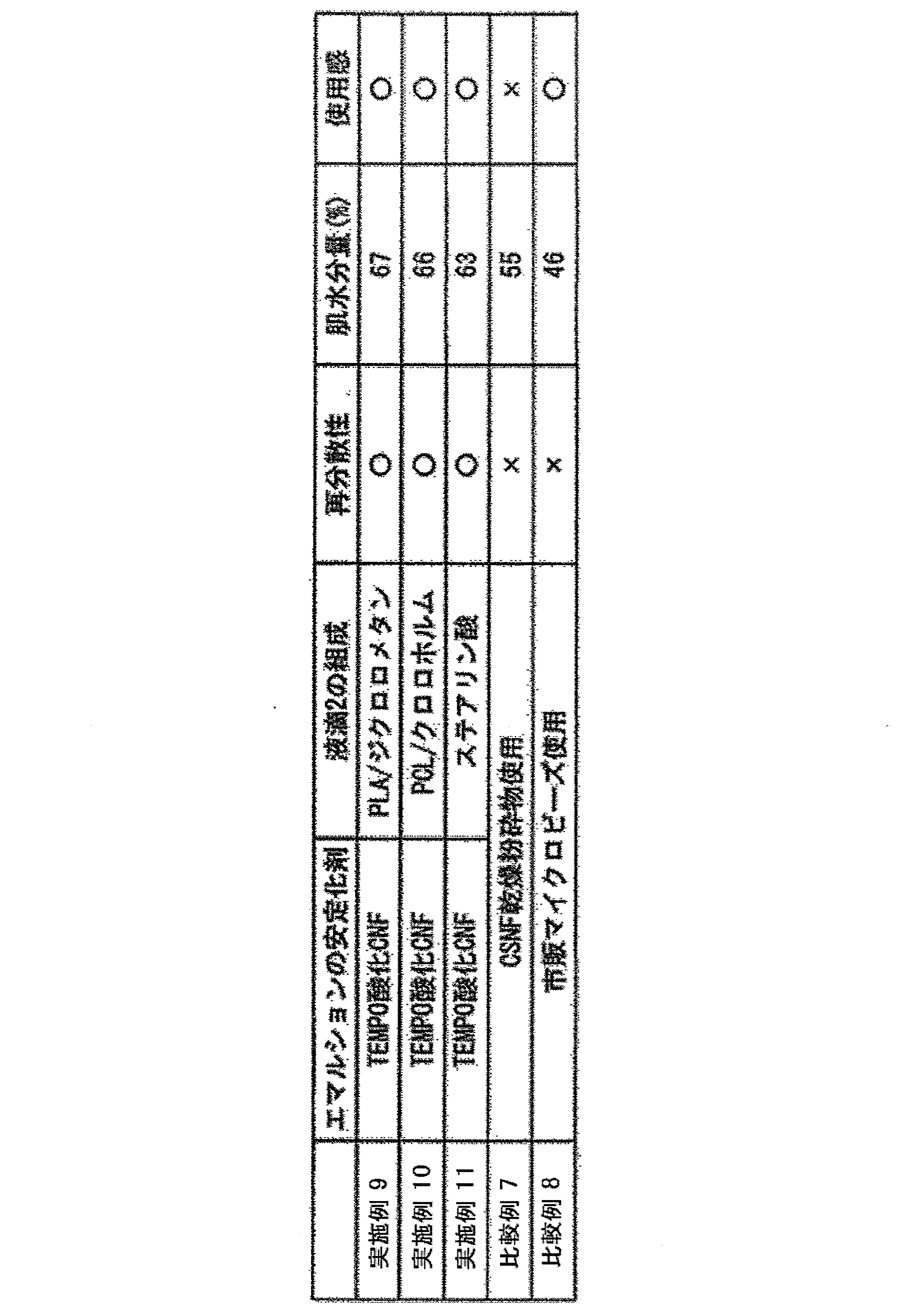
なお、表2において、エマルションの安定化剤とは第2工程においてO/W型エマルションを安定化させるために用いた添加剤のことであって、例えば本発明における微細化セルロース1が相当する。
表2の実施例9~11の評価結果において明らかなように、液滴2の組成に拠らず、粉体として肌に塗布した際の肌水分量が60%以上となり、良好な保湿性が示された。これは親水性のCNFが表面に結合した決め細やかな複合粒子が肌に馴染むことにより、保湿性が向上したと考えられる。また、再分散性も良好であったが、これは複合粒子表面のTEMPO酸化CNFのアニオン性官能基に由来した浸透圧効果により複合粒子間に水が侵入しやすくなったためと考えられる。また、肌理細やかな粉体であるため肌への馴染みが良く使用感も非常に優れていた。例えばパウダータイプのファンデーションは、肌塗布後に乾燥しやすいことが課題とされるため、本発明の複合粒子5を含む粉体は、皮膚塗布用組成物として好適であることが示された。
一方、比較例7においては凍結乾燥処理によりCNF同士が凝集、角質化してしまったためか、再分散が困難であった。また、粒子形状および粒径にばらつきがあるため肌へのなじみが悪く、使用感を満足させるものではなかった。肌へのなじみが悪いためか、実施例9~11に比較して保湿性も劣る結果であった。
また、比較例8においては、真球状で粒径の揃った肌理細やかな市販のビーズを使用しており、肌への馴染みは非常に良く使用感に優れていた。しかしながら該市販ビーズは実施例9~11と異なり、親水性の高いCNF繊維が表面に結合していないため、保湿性能を発揮することができず肌水分量が46%にまで低下した。また、実施例9~11と比較して表面にTEMPO酸化CNFが配されていないため、再分散性にも劣る結果であった。
また、比較例8においては、真球状で粒径の揃った肌理細やかな市販のビーズを使用しており、肌への馴染みは非常に良く使用感に優れていた。しかしながら該市販ビーズは実施例9~11と異なり、親水性の高いCNF繊維が表面に結合していないため、保湿性能を発揮することができず肌水分量が46%にまで低下した。また、実施例9~11と比較して表面にTEMPO酸化CNFが配されていないため、再分散性にも劣る結果であった。
以上の様に、実施例9~11における複合粒子5を含む組成物が、皮膚塗布用組成物として、本発明における課題解決に奏功することが確認された。
本発明の複合粒子は、添加剤としての添加効率、樹脂との混練効率が向上し、また輸送効率向上や腐敗防止の観点からコスト削減にも寄与するなど、産業実施の観点から好ましい効果が得られる。さらに本発明の複合粒子の特徴である生分解性を有する化合物を内包しており、化合物を被覆しているCNFも生分解性材料であるため、環境に配慮した材料である。また、本複合粒子は粒子表面の微細化セルロースや内包されたポリマーの特性を活かすことによって、色材、吸着剤、化粧顔料、徐放材、消臭剤、抗菌性医療用部材、パーソナルケア用品向け抗菌性物品、包装材料、色素増感太陽電池、光電変換材料、光熱変換材料、遮熱材料、光学フィルター、ラマン増強素子、画像表示素子、磁性粉、触媒担持体、ドラッグデリバリーシステム、などに適用することができる。
また、本発明の複合粒子を含む皮膚塗布用組成物は、CNFの特性を維持しながら簡便に溶媒を除去できるため、添加効率や腐敗防止の観点からコスト削減にも寄与するなど、産業実施の観点から好ましい効果が得られる。本発明の皮膚塗布用組成物に含まれる複合粒子は粒子表面の微細化セルロースや微細化セルロースにさらに付与された機能性材料、および内包されたポリマーの特性を活かすことによって、皮膚塗布用製品向けの色材、吸着剤、化粧顔料、徐放材、消臭剤、抗菌性部材、包装材料、触媒担持体、ドラッグデリバリーシステム、などに適用することができる。
1 セルロースナノファイバー(微細化セルロース)
2 生分解性を有する化合物液滴(重合性モノマー液滴および/またはポリマー液滴)
3 生分解性を有する化合物粒子(ポリマー粒子)
4 分散液
5 複合粒子
2 生分解性を有する化合物液滴(重合性モノマー液滴および/またはポリマー液滴)
3 生分解性を有する化合物粒子(ポリマー粒子)
4 分散液
5 複合粒子
Claims (16)
- 少なくとも一種類の生分解性を有した化合物を含む粒子と、前記生分解性を有した化合物を含む粒子の表面の少なくとも一部を覆う微細化セルロースとを有し、前記生分解性を有した化合物を含む粒子と前記微細化セルロースとが不可分の状態にあることを特徴とする複合粒子。
- セルロース原料を溶媒中で解繊して微細化セルロースの分散液を得る第1工程と、
前記分散液中において生分解性を有した化合物を含む液滴の表面の少なくとも一部を前記微細化セルロースで覆い、前記生分解性を有した化合物を含む液滴をエマルションとして安定化させる第2工程と、
前記生分解性を有した化合物を含む液滴の表面の少なくとも一部が前記微細化セルロースで覆われた状態で、前記生分解性を有した化合物を含む液滴を固体化してポリマー粒子とすることで、前記ポリマー粒子の表面の少なくとも一部を前記微細化セルロースで覆い、かつ前記ポリマー粒子と前記微細化セルロースとを不可分の状態にする第3工程と、を有することを特徴とする複合粒子の製造方法。 - 前記第2工程では、
前記微細化セルロースの分散液に開始剤を含む前記生分解性を有する化合物と重合性モノマーとを混合したものを添加しエマルション化させる工程、前記生分解性を有する化合物を前記微細化セルロースの分散液への相溶性が低い溶媒で溶解したものを前記微細化セルロースの分散液に添加しエマルション化させる工程、および、前記微細化セルロースの分散液に常温にて固体である前記生分解性を有する化合物を添加し前記生分解性を有する化合物の融点以上に加熱し融解させエマルション化させる工程のうちいずれかの工程を用いることを特徴とする請求項2に記載の複合粒子の製造方法。 - 請求項1に記載の複合粒子を含み、固形分率が80%以上であることを特徴とする乾燥粉体。
- 少なくとも一種類のポリマー粒子を含み、前記ポリマー粒子の表面に微細化セルロースにより構成された被覆層を有する複合粒子であって、前記ポリマー粒子と前記微細化セルロースとが結合して不可分の状態にある複合粒子を含むことを特徴とする皮膚塗布用組成物。
- 前記微細化セルロースの結晶表面にアニオン性官能基が導入されている
請求項5に記載の皮膚塗布用組成物。 - 前記ポリマー粒子が、ビニル基を有するモノマーを重合して得られたものである
請求項5又は6に記載の皮膚塗布用組成物。 - 前記ポリマー粒子が、(メタ)アクリル基を有するモノマーを重合して得られたものである
請求項5から7のいずれか一項に記載の皮膚塗布用組成物。 - 前記ポリマー粒子が、2つ以上の重合性官能基を有する多官能モノマーを重合して得られたものである、
請求項5から8のいずれか一項に記載の皮膚塗布用組成物。 - 前記多官能モノマーが有する2つ以上の重合性官能基の少なくとも一つがビニル基である
請求項9に記載の皮膚塗布用組成物。 - 前記多官能モノマーが有する2つ以上の重合性官能基の少なくとも一つが(メタ)アクリル基である
請求項10に記載の皮膚塗布用組成物。 - 前記多官能モノマーがジビニルベンゼンである
請求項11に記載の皮膚塗布用組成物。 - 前記ポリマー粒子が生分解性ポリマーであることを特徴とする
請求項5又は6に記載の皮膚塗布用組成物。 - 前記生分解性ポリマーがポリカプロラクトンであることを特徴とする
請求項13に記載の皮膚塗布用組成物。 - セルロース原料を溶媒中で解繊して微細化セルロースの分散液を得る第1工程と、
前記分散液中においてポリマー液滴の表面を前記微細化セルロースで被覆し、エマルションとして安定化させる第2工程と、
前記ポリマー液滴を固体化して前記微細化セルロースでポリマーが被覆された複合粒子を得る第3工程と、を具備する
皮膚塗布用組成物の製造方法。 - セルロース原料を溶媒中で解繊して微細化セルロースの分散液を得る第1工程と、
前記分散液中において重合性モノマーおよびポリマー液滴の表面を前記微細化セルロースで被覆し、エマルションとして安定化させる第2工程と、
前記重合性モノマーおよびポリマー液滴を固体化して前記微細化セルロースでポリマーが被覆された複合粒子を得る第3工程と、を具備する
皮膚塗布用組成物の製造方法。
Priority Applications (4)
| Application Number | Priority Date | Filing Date | Title |
|---|---|---|---|
| EP19792001.0A EP3786232A4 (en) | 2018-04-27 | 2019-04-26 | COMPOUND PARTICLES, METHOD FOR THE PREPARATION OF COMPOUND PARTICLES, DRY POWDER, COMPOSITION FOR APPLICATION ON THE SKIN AND METHOD FOR PREPARING THE COMPOSITION FOR USE ON THE SKIN |
| CN201980027557.5A CN112292424A (zh) | 2018-04-27 | 2019-04-26 | 复合颗粒、复合颗粒的制造方法、干燥粉体、皮肤涂布用组合物以及该皮肤涂布用组合物的制造方法 |
| US17/010,121 US20200397687A1 (en) | 2018-04-27 | 2020-09-02 | Composite particles, method of producing composite particles and dry powder of composite particles, skin application composition and method of producing the skin application composition |
| US18/199,345 US20230320972A1 (en) | 2018-04-27 | 2023-05-18 | Composite particles, method of producing composite particles and dry powder of composite particles, skin application composition and method of producing the skin application composition |
Applications Claiming Priority (4)
| Application Number | Priority Date | Filing Date | Title |
|---|---|---|---|
| JP2018-087500 | 2018-04-27 | ||
| JP2018087500A JP7067246B2 (ja) | 2018-04-27 | 2018-04-27 | 複合粒子、複合粒子の製造方法および乾燥粉体 |
| JP2018193407A JP7342350B2 (ja) | 2018-10-12 | 2018-10-12 | 皮膚塗布用組成物および皮膚塗布用組成物の製造方法 |
| JP2018-193407 | 2018-10-12 |
Related Child Applications (1)
| Application Number | Title | Priority Date | Filing Date |
|---|---|---|---|
| US17/010,121 Continuation US20200397687A1 (en) | 2018-04-27 | 2020-09-02 | Composite particles, method of producing composite particles and dry powder of composite particles, skin application composition and method of producing the skin application composition |
Publications (1)
| Publication Number | Publication Date |
|---|---|
| WO2019208802A1 true WO2019208802A1 (ja) | 2019-10-31 |
Family
ID=68295582
Family Applications (1)
| Application Number | Title | Priority Date | Filing Date |
|---|---|---|---|
| PCT/JP2019/018047 Ceased WO2019208802A1 (ja) | 2018-04-27 | 2019-04-26 | 複合粒子、複合粒子の製造方法および乾燥粉体、並びに皮膚塗布用組成物および当該皮膚塗布用組成物の製造方法 |
Country Status (4)
| Country | Link |
|---|---|
| US (2) | US20200397687A1 (ja) |
| EP (1) | EP3786232A4 (ja) |
| CN (1) | CN112292424A (ja) |
| WO (1) | WO2019208802A1 (ja) |
Cited By (5)
| Publication number | Priority date | Publication date | Assignee | Title |
|---|---|---|---|---|
| JP2019181398A (ja) * | 2018-04-13 | 2019-10-24 | 学校法人福岡大学 | マイクロカプセル被膜、マイクロカプセル製剤およびマイクロカプセル製剤の製造方法 |
| WO2020170995A1 (ja) * | 2019-02-19 | 2020-08-27 | 凸版印刷株式会社 | 複合粒子、複合粒子組成物および複合粒子組成物の製造方法 |
| WO2021002290A1 (ja) * | 2019-07-01 | 2021-01-07 | 凸版印刷株式会社 | 複合粒子および複合粒子の製造方法 |
| JP2022030885A (ja) * | 2020-08-07 | 2022-02-18 | 国立大学法人広島大学 | セルロース/磁性体複合体粒子及びその製造方法 |
| WO2023276585A1 (ja) * | 2021-06-28 | 2023-01-05 | 凸版印刷株式会社 | 複合粒子の製造方法および複合粒子 |
Families Citing this family (3)
| Publication number | Priority date | Publication date | Assignee | Title |
|---|---|---|---|---|
| US12098275B2 (en) * | 2021-07-21 | 2024-09-24 | Xerox Corporation | Biodegradable polymer particulates and methods for production and use thereof |
| KR102833239B1 (ko) * | 2022-02-22 | 2025-07-14 | 주식회사 코스메카코리아 | 천연 유래 레진이 표면처리된 복합분체 제조방법 및 그에 의해 제조된 복합분체를 함유하는 화장료 조성물 |
| CN115386208B (zh) * | 2022-08-11 | 2025-06-24 | 长兴电子(苏州)有限公司 | 可降解微珠及其制备方法与应用 |
Citations (12)
| Publication number | Priority date | Publication date | Assignee | Title |
|---|---|---|---|---|
| JP2001288273A (ja) | 2000-04-04 | 2001-10-16 | Kanebo Ltd | ポリ乳酸系樹脂粉末およびその製法、並びにそれによって得られる接着剤 |
| WO2007136086A1 (ja) * | 2006-05-23 | 2007-11-29 | Kyushu University, National University Corporation | ポリ乳酸とセルロース繊維とを含有する材料 |
| JP2008001728A (ja) | 2006-06-20 | 2008-01-10 | Asahi Kasei Corp | 微細セルロース繊維 |
| JP2010216021A (ja) | 2009-03-13 | 2010-09-30 | Kyoto Univ | セルロースナノファイバーの製造方法 |
| WO2013042654A1 (ja) | 2011-09-22 | 2013-03-28 | 凸版印刷株式会社 | 膜形成用組成物、積層体、膜、シート基材、包装材、膜形成用組成物の製造方法、セルロース分散液の製造方法 |
| WO2014088072A1 (ja) | 2012-12-07 | 2014-06-12 | 日本製紙株式会社 | カルボキシメチル化セルロースの繊維 |
| JP2016155897A (ja) * | 2015-02-23 | 2016-09-01 | 日本製紙株式会社 | 複合体の製造方法 |
| JP2017061594A (ja) * | 2015-09-24 | 2017-03-30 | 日本製紙株式会社 | 複合体の製造方法 |
| JP2017109946A (ja) | 2015-12-16 | 2017-06-22 | 第一工業製薬株式会社 | 皮膚外用剤 |
| JP2017114768A (ja) * | 2015-12-21 | 2017-06-29 | 株式会社ファンケル | ジェル状化粧料 |
| WO2018110245A1 (ja) * | 2016-12-16 | 2018-06-21 | 住友化学株式会社 | ラテックス、セルロースナノファイバー含有樹脂、成形体及びこれらの製造方法 |
| JP2019038949A (ja) * | 2017-08-25 | 2019-03-14 | 国立研究開発法人森林研究・整備機構 | 複合粒子の製造方法とその製造方法で得られる複合粒子 |
Family Cites Families (13)
| Publication number | Priority date | Publication date | Assignee | Title |
|---|---|---|---|---|
| DE3875749T3 (de) * | 1987-01-28 | 2000-02-10 | Kao Corp., Tokio/Tokyo | Verfahren zur Herstellung einer absorbierenden Zusammensetzung |
| US5250236A (en) * | 1991-08-05 | 1993-10-05 | Gasco Maria R | Method for producing solid lipid microspheres having a narrow size distribution |
| DE102007058713A1 (de) * | 2007-12-06 | 2009-06-10 | Evonik Goldschmidt Gmbh | Silicon(meth-)acrylat-Partikel, Verfahren zu deren Herstellung sowie deren Verwendung |
| FR2962662B1 (fr) * | 2010-07-19 | 2012-08-24 | Agronomique Inst Nat Rech | Composition sous forme d'emulsion, comprenant une phase hydrophobe dispersee dans une phase aqueuse |
| JP5923370B2 (ja) * | 2011-06-07 | 2016-05-24 | 花王株式会社 | 樹脂改質用添加剤及びその製造方法 |
| KR20150040308A (ko) * | 2012-07-31 | 2015-04-14 | 허큘레스 인코포레이티드 | 안정화된 다상 수성 조성물 |
| JP6168401B2 (ja) * | 2012-07-31 | 2017-07-26 | 東レ株式会社 | ポリ乳酸系樹脂微粒子およびそれを用いてなる分散液、ならびにポリ乳酸系樹脂微粒子の製造方法 |
| FI127526B (en) * | 2012-11-03 | 2018-08-15 | Upm Kymmene Corp | Method for producing nanofibrillar cellulose |
| CN103665398B (zh) * | 2013-12-15 | 2015-12-09 | 桂林理工大学 | 可完全生物降解和生物相容的复合微球的制备方法 |
| JP6690531B2 (ja) * | 2014-05-09 | 2020-04-28 | 凸版印刷株式会社 | 複合体、複合体の製造方法、分散液、分散液の製造方法および光学材料 |
| CN107412193A (zh) * | 2017-03-29 | 2017-12-01 | 华南理工大学 | 以麦羟硅钠石为乳化剂的Pickering乳液模板法制备的纳米杂化药物载体及其制法 |
| CN107823145A (zh) * | 2017-11-22 | 2018-03-23 | 天津双硕医药科技有限公司 | 一种注射用伊潘立酮plga微球及制备工艺 |
| EP3736297B1 (en) * | 2018-01-05 | 2024-10-16 | Toppan Printing Co., Ltd. | Composite particles, production method for composite particles, dry powder, and resin composition for molding |
-
2019
- 2019-04-26 EP EP19792001.0A patent/EP3786232A4/en active Pending
- 2019-04-26 WO PCT/JP2019/018047 patent/WO2019208802A1/ja not_active Ceased
- 2019-04-26 CN CN201980027557.5A patent/CN112292424A/zh active Pending
-
2020
- 2020-09-02 US US17/010,121 patent/US20200397687A1/en not_active Abandoned
-
2023
- 2023-05-18 US US18/199,345 patent/US20230320972A1/en not_active Abandoned
Patent Citations (12)
| Publication number | Priority date | Publication date | Assignee | Title |
|---|---|---|---|---|
| JP2001288273A (ja) | 2000-04-04 | 2001-10-16 | Kanebo Ltd | ポリ乳酸系樹脂粉末およびその製法、並びにそれによって得られる接着剤 |
| WO2007136086A1 (ja) * | 2006-05-23 | 2007-11-29 | Kyushu University, National University Corporation | ポリ乳酸とセルロース繊維とを含有する材料 |
| JP2008001728A (ja) | 2006-06-20 | 2008-01-10 | Asahi Kasei Corp | 微細セルロース繊維 |
| JP2010216021A (ja) | 2009-03-13 | 2010-09-30 | Kyoto Univ | セルロースナノファイバーの製造方法 |
| WO2013042654A1 (ja) | 2011-09-22 | 2013-03-28 | 凸版印刷株式会社 | 膜形成用組成物、積層体、膜、シート基材、包装材、膜形成用組成物の製造方法、セルロース分散液の製造方法 |
| WO2014088072A1 (ja) | 2012-12-07 | 2014-06-12 | 日本製紙株式会社 | カルボキシメチル化セルロースの繊維 |
| JP2016155897A (ja) * | 2015-02-23 | 2016-09-01 | 日本製紙株式会社 | 複合体の製造方法 |
| JP2017061594A (ja) * | 2015-09-24 | 2017-03-30 | 日本製紙株式会社 | 複合体の製造方法 |
| JP2017109946A (ja) | 2015-12-16 | 2017-06-22 | 第一工業製薬株式会社 | 皮膚外用剤 |
| JP2017114768A (ja) * | 2015-12-21 | 2017-06-29 | 株式会社ファンケル | ジェル状化粧料 |
| WO2018110245A1 (ja) * | 2016-12-16 | 2018-06-21 | 住友化学株式会社 | ラテックス、セルロースナノファイバー含有樹脂、成形体及びこれらの製造方法 |
| JP2019038949A (ja) * | 2017-08-25 | 2019-03-14 | 国立研究開発法人森林研究・整備機構 | 複合粒子の製造方法とその製造方法で得られる複合粒子 |
Non-Patent Citations (1)
| Title |
|---|
| NOGUCHI YHOMMA IMATSUBARA Y: "Complete nanofibrillation of cellulose prepa red by phosphorylation", CELLULOSE, vol. 24, 2017 |
Cited By (9)
| Publication number | Priority date | Publication date | Assignee | Title |
|---|---|---|---|---|
| JP2019181398A (ja) * | 2018-04-13 | 2019-10-24 | 学校法人福岡大学 | マイクロカプセル被膜、マイクロカプセル製剤およびマイクロカプセル製剤の製造方法 |
| JP7068692B2 (ja) | 2018-04-13 | 2022-05-17 | 学校法人福岡大学 | マイクロカプセル被膜、マイクロカプセル製剤およびマイクロカプセル製剤の製造方法 |
| WO2020170995A1 (ja) * | 2019-02-19 | 2020-08-27 | 凸版印刷株式会社 | 複合粒子、複合粒子組成物および複合粒子組成物の製造方法 |
| US12195608B2 (en) | 2019-02-19 | 2025-01-14 | Toppan Inc. | Composite particles, composite-particle composition, and method for producing composite-particle composition |
| WO2021002290A1 (ja) * | 2019-07-01 | 2021-01-07 | 凸版印刷株式会社 | 複合粒子および複合粒子の製造方法 |
| JP2022030885A (ja) * | 2020-08-07 | 2022-02-18 | 国立大学法人広島大学 | セルロース/磁性体複合体粒子及びその製造方法 |
| JP7649508B2 (ja) | 2020-08-07 | 2025-03-21 | 国立大学法人広島大学 | セルロース/磁性体複合体粒子及びその製造方法 |
| WO2023276585A1 (ja) * | 2021-06-28 | 2023-01-05 | 凸版印刷株式会社 | 複合粒子の製造方法および複合粒子 |
| JP2023005014A (ja) * | 2021-06-28 | 2023-01-18 | 凸版印刷株式会社 | 複合粒子の製造方法および複合粒子 |
Also Published As
| Publication number | Publication date |
|---|---|
| EP3786232A1 (en) | 2021-03-03 |
| US20230320972A1 (en) | 2023-10-12 |
| CN112292424A (zh) | 2021-01-29 |
| EP3786232A4 (en) | 2021-06-09 |
| US20200397687A1 (en) | 2020-12-24 |
Similar Documents
| Publication | Publication Date | Title |
|---|---|---|
| US20230320972A1 (en) | Composite particles, method of producing composite particles and dry powder of composite particles, skin application composition and method of producing the skin application composition | |
| JP7501712B2 (ja) | 複合粒子の製造方法 | |
| JP7067246B2 (ja) | 複合粒子、複合粒子の製造方法および乾燥粉体 | |
| US12195608B2 (en) | Composite particles, composite-particle composition, and method for producing composite-particle composition | |
| JP7234590B2 (ja) | 塗工用組成物 | |
| JP7363120B2 (ja) | 化学物質吸着性複合粒子、化学物質吸着性複合粒子の製造方法、化学物質吸着性複合粒子を含む乾燥粉体、繊維シートおよび多孔体 | |
| JP7463676B2 (ja) | 複合粒子、複合粒子の製造方法、複合粒子を含むパーソナルケア製品 | |
| JP7472446B2 (ja) | 機能性複合粒子及びその製造方法 | |
| JP2020076002A (ja) | 徐放性複合粒子、徐放性複合粒子の製造方法及び乾燥粉体 | |
| JP2020200246A (ja) | パーソナルケア用粒子、パーソナルケア用粒子の製造方法、パーソナルケア用品、パーソナルケア用組成物 | |
| JP7420336B2 (ja) | 複合粒子の製造方法 | |
| US20220106412A1 (en) | Composite particles and method for producing composite particles | |
| US20220087910A1 (en) | Composite particles and method of producing the same, personal care product, personal care particles and method of producing the same, personal care article, and personal care composition | |
| JP2020183499A (ja) | 徐放性複合粒子、成形体および徐放性複合粒子の製造方法 | |
| JP7342350B2 (ja) | 皮膚塗布用組成物および皮膚塗布用組成物の製造方法 | |
| JP2022063042A (ja) | 複合粒子、複合粒子の製造方法、パーソナルケア用品、及びパーソナルケア用組成物 | |
| JP7581650B2 (ja) | 複合粒子および複合粒子の製造方法 | |
| JP2021049487A (ja) | 徐放性複合粒子及びその製造方法並びにこの粒子を利用する乾燥粉体 | |
| JP2022065470A (ja) | 溶剤溶解性複合粒子、溶剤溶解性複合粒子の製造方法および溶剤溶解性複合粒子混合樹脂組成物 | |
| WO2023276585A1 (ja) | 複合粒子の製造方法および複合粒子 |
Legal Events
| Date | Code | Title | Description |
|---|---|---|---|
| 121 | Ep: the epo has been informed by wipo that ep was designated in this application |
Ref document number: 19792001 Country of ref document: EP Kind code of ref document: A1 |
|
| NENP | Non-entry into the national phase |
Ref country code: DE |
|
| WWE | Wipo information: entry into national phase |
Ref document number: 2019792001 Country of ref document: EP |