WO2019214871A1 - Mittel zum färben von haaren enthaltend mindestens eine organische siliciumverbindung, eine farbgebende verbindung und ein filmbildendes, hydrophiles polymer - Google Patents

Mittel zum färben von haaren enthaltend mindestens eine organische siliciumverbindung, eine farbgebende verbindung und ein filmbildendes, hydrophiles polymer Download PDF

Info

Publication number
WO2019214871A1
WO2019214871A1 PCT/EP2019/057027 EP2019057027W WO2019214871A1 WO 2019214871 A1 WO2019214871 A1 WO 2019214871A1 EP 2019057027 W EP2019057027 W EP 2019057027W WO 2019214871 A1 WO2019214871 A1 WO 2019214871A1
Authority
WO
WIPO (PCT)
Prior art keywords
group
acid
agent
organic silicon
red
Prior art date
Legal status (The legal status is an assumption and is not a legal conclusion. Google has not performed a legal analysis and makes no representation as to the accuracy of the status listed.)
Ceased
Application number
PCT/EP2019/057027
Other languages
English (en)
French (fr)
Inventor
Torsten LECHNER
Marc NOWOTTNY
Juergen Schoepgens
Current Assignee (The listed assignees may be inaccurate. Google has not performed a legal analysis and makes no representation or warranty as to the accuracy of the list.)
Henkel AG and Co KGaA
Original Assignee
Henkel AG and Co KGaA
Priority date (The priority date is an assumption and is not a legal conclusion. Google has not performed a legal analysis and makes no representation as to the accuracy of the date listed.)
Filing date
Publication date
Application filed by Henkel AG and Co KGaA filed Critical Henkel AG and Co KGaA
Priority to CN201980029654.8A priority Critical patent/CN112074324A/zh
Priority to JP2020562604A priority patent/JP2021523141A/ja
Priority to US17/052,085 priority patent/US11439578B2/en
Priority to EP19712981.0A priority patent/EP3790630B1/de
Publication of WO2019214871A1 publication Critical patent/WO2019214871A1/de
Anticipated expiration legal-status Critical
Ceased legal-status Critical Current

Links

Classifications

    • AHUMAN NECESSITIES
    • A61MEDICAL OR VETERINARY SCIENCE; HYGIENE
    • A61QSPECIFIC USE OF COSMETICS OR SIMILAR TOILETRY PREPARATIONS
    • A61Q5/00Preparations for care of the hair
    • A61Q5/10Preparations for permanently dyeing the hair
    • AHUMAN NECESSITIES
    • A61MEDICAL OR VETERINARY SCIENCE; HYGIENE
    • A61KPREPARATIONS FOR MEDICAL, DENTAL OR TOILETRY PURPOSES
    • A61K8/00Cosmetics or similar toiletry preparations
    • A61K8/18Cosmetics or similar toiletry preparations characterised by the composition
    • A61K8/19Cosmetics or similar toiletry preparations characterised by the composition containing inorganic ingredients
    • A61K8/26Aluminium; Compounds thereof
    • AHUMAN NECESSITIES
    • A61MEDICAL OR VETERINARY SCIENCE; HYGIENE
    • A61KPREPARATIONS FOR MEDICAL, DENTAL OR TOILETRY PURPOSES
    • A61K8/00Cosmetics or similar toiletry preparations
    • A61K8/18Cosmetics or similar toiletry preparations characterised by the composition
    • A61K8/30Cosmetics or similar toiletry preparations characterised by the composition containing organic compounds
    • A61K8/33Cosmetics or similar toiletry preparations characterised by the composition containing organic compounds containing oxygen
    • A61K8/34Alcohols
    • A61K8/342Alcohols having more than seven atoms in an unbroken chain
    • AHUMAN NECESSITIES
    • A61MEDICAL OR VETERINARY SCIENCE; HYGIENE
    • A61KPREPARATIONS FOR MEDICAL, DENTAL OR TOILETRY PURPOSES
    • A61K8/00Cosmetics or similar toiletry preparations
    • A61K8/18Cosmetics or similar toiletry preparations characterised by the composition
    • A61K8/30Cosmetics or similar toiletry preparations characterised by the composition containing organic compounds
    • A61K8/33Cosmetics or similar toiletry preparations characterised by the composition containing organic compounds containing oxygen
    • A61K8/34Alcohols
    • A61K8/345Alcohols containing more than one hydroxy group
    • AHUMAN NECESSITIES
    • A61MEDICAL OR VETERINARY SCIENCE; HYGIENE
    • A61KPREPARATIONS FOR MEDICAL, DENTAL OR TOILETRY PURPOSES
    • A61K8/00Cosmetics or similar toiletry preparations
    • A61K8/18Cosmetics or similar toiletry preparations characterised by the composition
    • A61K8/30Cosmetics or similar toiletry preparations characterised by the composition containing organic compounds
    • A61K8/33Cosmetics or similar toiletry preparations characterised by the composition containing organic compounds containing oxygen
    • A61K8/36Carboxylic acids; Salts or anhydrides thereof
    • A61K8/365Hydroxycarboxylic acids; Ketocarboxylic acids
    • AHUMAN NECESSITIES
    • A61MEDICAL OR VETERINARY SCIENCE; HYGIENE
    • A61KPREPARATIONS FOR MEDICAL, DENTAL OR TOILETRY PURPOSES
    • A61K8/00Cosmetics or similar toiletry preparations
    • A61K8/18Cosmetics or similar toiletry preparations characterised by the composition
    • A61K8/30Cosmetics or similar toiletry preparations characterised by the composition containing organic compounds
    • A61K8/33Cosmetics or similar toiletry preparations characterised by the composition containing organic compounds containing oxygen
    • A61K8/37Esters of carboxylic acids
    • A61K8/375Esters of carboxylic acids the alcohol moiety containing more than one hydroxy group
    • AHUMAN NECESSITIES
    • A61MEDICAL OR VETERINARY SCIENCE; HYGIENE
    • A61KPREPARATIONS FOR MEDICAL, DENTAL OR TOILETRY PURPOSES
    • A61K8/00Cosmetics or similar toiletry preparations
    • A61K8/18Cosmetics or similar toiletry preparations characterised by the composition
    • A61K8/30Cosmetics or similar toiletry preparations characterised by the composition containing organic compounds
    • A61K8/33Cosmetics or similar toiletry preparations characterised by the composition containing organic compounds containing oxygen
    • A61K8/39Derivatives containing from 2 to 10 oxyalkylene groups
    • AHUMAN NECESSITIES
    • A61MEDICAL OR VETERINARY SCIENCE; HYGIENE
    • A61KPREPARATIONS FOR MEDICAL, DENTAL OR TOILETRY PURPOSES
    • A61K8/00Cosmetics or similar toiletry preparations
    • A61K8/18Cosmetics or similar toiletry preparations characterised by the composition
    • A61K8/30Cosmetics or similar toiletry preparations characterised by the composition containing organic compounds
    • A61K8/40Cosmetics or similar toiletry preparations characterised by the composition containing organic compounds containing nitrogen
    • A61K8/44Aminocarboxylic acids or derivatives thereof, e.g. aminocarboxylic acids containing sulfur; Salts; Esters or N-acylated derivatives thereof
    • A61K8/442Aminocarboxylic acids or derivatives thereof, e.g. aminocarboxylic acids containing sulfur; Salts; Esters or N-acylated derivatives thereof substituted by amido group(s)
    • AHUMAN NECESSITIES
    • A61MEDICAL OR VETERINARY SCIENCE; HYGIENE
    • A61KPREPARATIONS FOR MEDICAL, DENTAL OR TOILETRY PURPOSES
    • A61K8/00Cosmetics or similar toiletry preparations
    • A61K8/18Cosmetics or similar toiletry preparations characterised by the composition
    • A61K8/30Cosmetics or similar toiletry preparations characterised by the composition containing organic compounds
    • A61K8/58Cosmetics or similar toiletry preparations characterised by the composition containing organic compounds containing atoms other than carbon, hydrogen, halogen, oxygen, nitrogen, sulfur or phosphorus
    • A61K8/585Organosilicon compounds
    • AHUMAN NECESSITIES
    • A61MEDICAL OR VETERINARY SCIENCE; HYGIENE
    • A61KPREPARATIONS FOR MEDICAL, DENTAL OR TOILETRY PURPOSES
    • A61K8/00Cosmetics or similar toiletry preparations
    • A61K8/18Cosmetics or similar toiletry preparations characterised by the composition
    • A61K8/72Cosmetics or similar toiletry preparations characterised by the composition containing organic macromolecular compounds
    • A61K8/81Cosmetics or similar toiletry preparations characterised by the composition containing organic macromolecular compounds obtained by reactions involving only carbon-to-carbon unsaturated bonds
    • A61K8/8164Compositions of homopolymers or copolymers of compounds having one or more unsaturated aliphatic radicals, each having only one carbon-to-carbon double bond, and at least one being terminated by a carboxyl radical, and containing at least one other carboxyl radical in the molecule, or of salts, anhydrides, esters, amides, imides or nitriles thereof; Compositions of derivatives of such polymers, e.g. poly (methyl vinyl ether-co-maleic anhydride)
    • AHUMAN NECESSITIES
    • A61MEDICAL OR VETERINARY SCIENCE; HYGIENE
    • A61KPREPARATIONS FOR MEDICAL, DENTAL OR TOILETRY PURPOSES
    • A61K8/00Cosmetics or similar toiletry preparations
    • A61K8/18Cosmetics or similar toiletry preparations characterised by the composition
    • A61K8/72Cosmetics or similar toiletry preparations characterised by the composition containing organic macromolecular compounds
    • A61K8/81Cosmetics or similar toiletry preparations characterised by the composition containing organic macromolecular compounds obtained by reactions involving only carbon-to-carbon unsaturated bonds
    • A61K8/817Compositions of homopolymers or copolymers of compounds having one or more unsaturated aliphatic radicals, each having only one carbon-to-carbon double bond, and at least one being terminated by a single or double bond to nitrogen or by a heterocyclic ring containing nitrogen; Compositions or derivatives of such polymers, e.g. vinylimidazol, vinylcaprolactame, allylamines (Polyquaternium 6)
    • A61K8/8176Homopolymers of N-vinyl-pyrrolidones. Compositions of derivatives of such polymers
    • AHUMAN NECESSITIES
    • A61MEDICAL OR VETERINARY SCIENCE; HYGIENE
    • A61KPREPARATIONS FOR MEDICAL, DENTAL OR TOILETRY PURPOSES
    • A61K8/00Cosmetics or similar toiletry preparations
    • A61K8/18Cosmetics or similar toiletry preparations characterised by the composition
    • A61K8/72Cosmetics or similar toiletry preparations characterised by the composition containing organic macromolecular compounds
    • A61K8/81Cosmetics or similar toiletry preparations characterised by the composition containing organic macromolecular compounds obtained by reactions involving only carbon-to-carbon unsaturated bonds
    • A61K8/817Compositions of homopolymers or copolymers of compounds having one or more unsaturated aliphatic radicals, each having only one carbon-to-carbon double bond, and at least one being terminated by a single or double bond to nitrogen or by a heterocyclic ring containing nitrogen; Compositions or derivatives of such polymers, e.g. vinylimidazol, vinylcaprolactame, allylamines (Polyquaternium 6)
    • A61K8/8182Copolymers of vinyl-pyrrolidones. Compositions of derivatives of such polymers
    • AHUMAN NECESSITIES
    • A61MEDICAL OR VETERINARY SCIENCE; HYGIENE
    • A61QSPECIFIC USE OF COSMETICS OR SIMILAR TOILETRY PREPARATIONS
    • A61Q5/00Preparations for care of the hair
    • A61Q5/12Preparations containing hair conditioners
    • AHUMAN NECESSITIES
    • A61MEDICAL OR VETERINARY SCIENCE; HYGIENE
    • A61KPREPARATIONS FOR MEDICAL, DENTAL OR TOILETRY PURPOSES
    • A61K2800/00Properties of cosmetic compositions or active ingredients thereof or formulation aids used therein and process related aspects
    • A61K2800/40Chemical, physico-chemical or functional or structural properties of particular ingredients
    • A61K2800/42Colour properties
    • A61K2800/43Pigments; Dyes
    • A61K2800/432Direct dyes
    • A61K2800/4324Direct dyes in preparations for permanently dyeing the hair
    • AHUMAN NECESSITIES
    • A61MEDICAL OR VETERINARY SCIENCE; HYGIENE
    • A61KPREPARATIONS FOR MEDICAL, DENTAL OR TOILETRY PURPOSES
    • A61K2800/00Properties of cosmetic compositions or active ingredients thereof or formulation aids used therein and process related aspects
    • A61K2800/40Chemical, physico-chemical or functional or structural properties of particular ingredients
    • A61K2800/42Colour properties
    • A61K2800/43Pigments; Dyes
    • A61K2800/436Interference pigments, e.g. Iridescent, Pearlescent
    • AHUMAN NECESSITIES
    • A61MEDICAL OR VETERINARY SCIENCE; HYGIENE
    • A61KPREPARATIONS FOR MEDICAL, DENTAL OR TOILETRY PURPOSES
    • A61K2800/00Properties of cosmetic compositions or active ingredients thereof or formulation aids used therein and process related aspects
    • A61K2800/80Process related aspects concerning the preparation of the cosmetic composition or the storage or application thereof
    • A61K2800/87Application Devices; Containers; Packaging
    • AHUMAN NECESSITIES
    • A61MEDICAL OR VETERINARY SCIENCE; HYGIENE
    • A61KPREPARATIONS FOR MEDICAL, DENTAL OR TOILETRY PURPOSES
    • A61K2800/00Properties of cosmetic compositions or active ingredients thereof or formulation aids used therein and process related aspects
    • A61K2800/80Process related aspects concerning the preparation of the cosmetic composition or the storage or application thereof
    • A61K2800/88Two- or multipart kits
    • A61K2800/884Sequential application

Definitions

  • the present application is an agent for dyeing keratinischem material, in particular human hair, which in a cosmetic carrier (a) at least one specific organic silicon compound, (b) at least one coloring compound from the group of pigments and / or direct dyes and (C) contains at least one film-forming, hydrophilic polymer.
  • a further subject of this application is a multi-component packaging unit (kit-of-parts) for dyeing keratinic material, in particular human hair, which, packaged separately from one another, comprises the agents (I), (II) and (III) in three different containers.
  • the agent (I) contains at least one organic silicon compound (a)
  • the agent (II) contains water
  • the agent (III) contains at least one substantive dye (b) and at least one film-forming, hydrophilic polymer (c).
  • a third object of the present invention is a method of coloring keratinous material, which comprises the use of a pretreatment agent (V) followed by the use of a colorant (F).
  • the pretreatment agent (V) in an aqueous cosmetic carrier contains at least one specific organic silicon compound (a).
  • the colorant (F) is characterized by its content of at least one substantive dye (b) and at least one film-forming, hydrophilic polymer (c).
  • oxidation colorants usually contain oxidation dye precursors, so-called developer components and coupler components, which under the influence of oxidizing agents such as hydrogen peroxide among themselves form the actual dyes. Oxidation dyes are characterized by very long-lasting dyeing results.
  • Color pigments are generally understood to be insoluble, coloring substances. These are undissolved in the form of small particles in the coloring formulation before and are deposited only from the outside on the hair fibers and / or the skin surface. As a result, they can usually be removed without leaving any residue by a few washes with surfactant-containing cleaning agents. Under the name hair mascara, various products of this type are available on the market.
  • EP 2168633 B1 deals with the task of producing long-lasting hair dyeings using pigments.
  • the reference teaches that when using a combination of pigment, organic silicon compound, hydrophobic polymer and a solvent on hair, dyeings can be produced that are particularly resistant to shampooing.
  • keratinic materials in particular human hair, are dyed with an agent which contains in a cosmetic carrier at least one specific organic silicon compound, at least one coloring compound from the group of pigments and / or the substantive dyes and at least one film-forming, hydrophilic polymer.
  • a first object of the present invention is therefore an agent for coloring keratinic material, in particular human hair, contained in a cosmetic carrier
  • Keratinic material is hair, the skin, the nails (such as fingernails and / or toenails) to understand. Furthermore, wool, furs and feathers also fall under the definition of keratinic material.
  • Keratinic material is preferably understood to mean human hair, human skin and human nails, in particular fingernails and toenails. Most preferably, keratinic material is understood to mean human hair.
  • the agents according to the invention contain the compounds (a), (b) and (c) essential to the invention in a cosmetic carrier, preferably in a suitable aqueous or aqueous-alcoholic carrier.
  • a cosmetic carrier preferably in a suitable aqueous or aqueous-alcoholic carrier.
  • a suitable aqueous or aqueous-alcoholic carrier for the purpose of hair coloring
  • such carriers are, for example, creams, emulsions, gels or surfactant-containing foaming solutions, such as shampoos, foam aerosols, foam formulations or other preparations which are suitable for use on the hair.
  • the cosmetic carrier is preferably water-containing, which means that the carrier contains - based on its weight - at least 2 wt .-% water.
  • the water content is preferably above 5% by weight, more preferably above 10% by weight, even more preferably above 15% by weight.
  • the cosmetic carrier may also be aqueous-alcoholic.
  • aqueous-alcoholic solutions are to be understood as meaning aqueous solutions containing from 2 to 70% by weight of a C 1 -C 4 -alcohol, in particular ethanol or isopropanol.
  • the compositions of the invention may additionally contain other organic solvents, such as methoxybutanol, benzyl alcohol, ethyl diglycol or 1, 2-propylene glycol. Preference is given to all water-soluble organic solvents.
  • coloring agent is used in the context of this invention for a coloring of the keratin material, in particular the hair, caused by the use of pigments and / or substantive dyes.
  • the abovementioned coloring compounds deposit in a particularly homogeneous and smooth film on the surface of the keratin material or diffuse into the keratin fiber.
  • the film is formed in situ by the oligomerization or polymerization of the organic silicon compound (s), and by the interaction of the colorant compound and organic silicon compound with the film-forming, hydrophilic polymer.
  • the compositions according to the invention contain at least one organic silicon compound selected from silanes having one, two or three silicon atoms, wherein the organic silicon compound additionally comprises an or a plurality of basic chemical functions and one or more hydroxyl groups or hydrolyzable groups per molecule.
  • Organic silicon compounds which are alternatively referred to as organosilicon compounds, are compounds which have either a direct silicon-carbon bond (Si-C) or in which the carbon via an oxygen, nitrogen or sulfur atom to the silicon Atom is linked.
  • the organic silicon compounds of the present invention are compounds containing one to three silicon atoms. Most preferably, the organic silicon compounds contain one or two silicon atoms.
  • the organic silicon compounds (a) comprise at least one basic group.
  • This basic group may be, for example, an amino group, an alkylamino group or a dialkylamino group, which is preferably linked via a linker to a silicon atom.
  • the organic silicon compounds comprise at least one hydroxy group or a hydrolyzable group.
  • the hydrolyzable group or groups is preferably a C 1 -C 6 -alkoxy group, in particular an ethoxy group or a methoxy group. It is preferred if the hydrolyzable group is bonded directly to the silicon atom.
  • the organic silicon compound preferably contains a structural unit R'R "R" 'Si-O-CH 2 -CH 3.
  • the radicals R ', R "and R"' represent here the three remaining free valences of the silicon atom.
  • compositions according to the invention contain at least one organic silicon compound (a) of the formula (I) and / or (II).
  • an agent according to the invention is characterized in that it comprises at least one organic silicon compound (a) of the formula (I) and / or (II),
  • R 1, R 2 independently of one another represent a hydrogen atom or a C 1 -C 6 -alkyl group
  • L is a linear or branched, divalent C 1 -C 20 -alkylene group
  • R 3 represents a hydrogen atom or a C 1 -C 6 -alkyl group
  • R4 is a Ci-C6-alkyl group
  • - a stands for an integer from 1 to 3
  • - b is the integer 3 - a
  • R5, R5 ', R5 "independently of one another represent a hydrogen atom or a C1-C6-alkyl group
  • R 6, R 6 'and R 6 independently of one another represent a C 1 -C 6 -alkyl group
  • A, A ', A ", A"' and A “" independently of one another represent a linear or branched, divalent C 1 -C 20 -alkylene group
  • R7 and Re independently of one another represent a hydrogen atom, a C 1 -C 6 -alkyl group, a hydroxy-C 1 -C 6 -alkyl group, a C 2 -C 6 -alkenyl group, an aminoC 1 -C 6 -alkyl group or a grouping of the formula (III ) stand
  • c is an integer from 1 to 3
  • c ' is an integer from 1 to 3
  • c is an integer from 1 to 3
  • Examples of a C 1 -C 6 -alkyl group are the groups methyl, ethyl, propyl, isopropyl, n-butyl, s-butyl and t-butyl, n-pentyl and n-hexyl. Propyl, ethyl and methyl are preferred alkyl radicals.
  • Examples of a C2-C6 alkenyl group are vinyl, allyl, but-2-enyl, but-3-enyl and isobutenyl, preferred C2-C6 alkenyl radicals are vinyl and allyl.
  • a hydroxy-C 1 -C 6 -alkyl group are a hydroxymethyl, a 2-hydroxyethyl, a 2-hydroxypropyl, a 3-hydroxypropyl, a 4-hydroxybutyl, a 5-hydroxypentyl and a 6- hydroxyhexyl; a 2-hydroxyethyl group is particularly preferred.
  • Examples of an amino-Ci-C6-alkyl group are the Aminomethyl group, the 2-aminoethyl group, the 3-aminopropyl group. The 2-aminoethyl group is particularly preferred.
  • Examples of a linear divalent C 1 -C 20 -alkylene group are, for example, the methylene group (-CH 2 -), the ethylene group (-CH 2 -CH 2 -), the propylene group (- CH 2 -CH 2 -CH 2 -) and the Butylene group (-CH2-CH2-CH2-CH2-).
  • the propylene group (-CH 2 -CH 2 -CH 2 -) is particularly preferred.
  • bivalent alkylene groups may also be branched. Examples of branched, divalent C 3 -C 2 o-alkylene groups are (-CH 2 - CH (CH 3 ) -) and (-CH 2 -CH (CH 3 ) -CH 2 -).
  • the radicals Ri and R 2 independently of one another represent a hydrogen atom or a C 1 -C 6 -alkyl group. Most preferably, the radicals R 1 and R 2 are both a hydrogen atom.
  • the linker -L- is a linear or branched, divalent Ci-C 2 o-alkylene group.
  • -L- is a linear, divalent Ci-C 2 o-alkylene group. More preferably, -L- is a linear divalent C 1 -C 6 -alkylene group. Particularly preferably -L- is a methylene group (-CH 2 -), an ethylene group (-CH 2 -CH 2 -), a propylene group (-CH 2 -CH 2 -CH 2 -) or a butylene group (-CH 2 -CH 2 -CH 2 - CH 2 -). Most preferably, L is a propylene group (-CH 2 -CH 2 -CH 2 -).
  • an agent according to the invention is characterized in that it contains (a) at least one organic silicon compound of the formula (I),
  • L is a linear, divalent C 1 -C 6 -alkylene group, preferably a propylene group (-CH 2 -CH 2 -CH 2 -) or an ethylene group (-CH 2 -CH 2 -).
  • Ri R2N-L-Si (OR3) a (R4) b (l), each carrying a one end of the silicon-containing group is -Si (OR 3) a (R 4) b.
  • the radical R3 represents a hydrogen atom or a Ci-C6-alkyl group
  • the radical R4 represents a Ci-C6-alkyl group.
  • R 3 and R 4 independently of one another are a methyl group or an ethyl group.
  • a is an integer from 1 to 3
  • b is the integer 3 - a. If a stands for the number 3, then b is 0. If a stands for the number 2, then b equals 1. If a stands for the number 1, then b is equal to 2.
  • composition according to the invention contains at least one organic silicon compound of the formula (I) in which the radicals R 3 , R 4 independently of one another represent a methyl group or an ethyl group.
  • composition according to the invention contains at least one organic silicon compound of the formula (I) in which the radical a is the number 3.
  • the rest b stands for the number 0.
  • an agent according to the invention is characterized in that it contains (a) at least one organic silicon compound of the formula (I),
  • R 3 , R 4 independently of one another represent a methyl group or an ethyl group
  • an agent according to the invention is characterized in that it contains (a) at least one organic silicon compound of the formula (I) which is selected from the group consisting of
  • (3-aminopropyl) trimethoxysilane may be purchased from Sigma-Aldrich.
  • (3-aminopropyl) triethoxysilane is commercially available from Sigma-Aldrich.
  • the agent according to the invention comprises at least one organic silicon compound of the formula (II)
  • organosilicon compounds of the formula (II) according to the invention each carry at their two ends the silicon-containing groups (RsO) c (R6) d Si and -Si (R6 ') d' (OR5 ') c ⁇
  • each of the radicals e, f, g and are h independently of one another represent the number 0 or 1, with the proviso is that at least one of e, f, g, and is different h of 0th
  • an inventive organic Silicon compound of the formula (II) at least one grouping from the group consisting of - (A) - and - [NR 7 - (A ')] - and - [0- (A ")] - and - [NR 8 - (A'")] -.
  • radicals R5, R5', R5 independently of one another represent a hydrogen atom or a Ci-C6- alkyl group.
  • the radicals R6, R6 'and R6 are each independently a Ci-C6-alkyl group.
  • c stands for an integer from 1 to 3, and d stands for the integer 3 - c. If c stands for the number 3, then d is 0. If c stands for the number 2, then d is 1. If c stands for the number 1, then d is equal to 2.
  • c ' is an integer from 1 to 3
  • d' is the integer 3 - c '. If c 'stands for the number 3, then d' is equal to 0. If c 'stands for the number 2, then d' is equal to 1. If c 'stands for the number 1, then d' is equal to 2.
  • an agent according to the invention is characterized in that it contains (a) at least one organic silicon compound of the formula (II),
  • R5 and R5 'independently of one another represent a methyl group or an ethyl group
  • the radicals e, f, g and h can independently of one another stand for the number 0 or 1, where at least one radical from e, f, g and h is different from zero.
  • the abbreviations e, f, g and h thus define which of the groupings - (A) e - and - [NR7- (A ')] f - and - [0- (A ")] g - and - [ NR8- (A "')] h - are in the middle part of the organic silicon compound of the formula (II).
  • the presence of certain groupings has proved to be particularly advantageous with regard to increasing the wash fastness. Particularly good results could be obtained if at least two of the radicals e, f, g and h are the number 1. Most preferably, e and f both represent the number 1. Furthermore, g and h are very particularly preferably the number 0.
  • the radicals A, A ', A “, A”' and A “” independently of one another represent a linear or branched, divalent C 1 -C 20 -alkylene group.
  • the radicals A, A ', A “, A”' and A “” are preferably, independently of one another, a linear, divalent C 1 -C 20 -alkylene group. More preferably, the radicals A, A ', A ", A"' and A "" independently of one another are a linear divalent C 1 -C 6 -alkylene group.
  • the radicals A, A ', A ", A”' and A “" independently of one another represent a methylene group (-CH 2 -), an ethylene group (-CH 2 -CH 2 -), a propylene group (-CH 2 -CH 2 -CH 2 -) or a butylene group (-CH 2 -CH 2 -CH 2 -CH 2 -).
  • the radicals A, A ', A ", A"' and A "" represent a propylene group (-CH 2 -CH 2 -CH 2 -).
  • Silicon compound of formula (II) a structural grouping - [NR7- (A ')] -.
  • Silicon compound of the formula (II) a structural grouping - [NR8- (A '')] -.
  • radicals R7 and Rs independently of one another represent a hydrogen atom, a C 1 -C 6 -alkyl group, a hydroxy-C 1 -C 6 -alkyl group, a C 2 -C 6 -alkenyl group, an aminoC 1 -C 6 -alkyl group or a group of the formula (III)
  • radicals R7 and R8 independently of one another represent a hydrogen atom, a methyl group, a 2-hydroxyethyl group, a 2-alkenyl group, a 2-aminoethyl group or a group of the formula (III).
  • the organic silicon compound according to the invention contains the moiety [NR7- (A ')], but not the moiety - [NR8- (A'''']. If the radical R 7 is now a group of the formula (III), the pretreatment agent (A) contains an organic silicon compound having 3 reactive silane groups.
  • an agent according to the invention is characterized in that it contains (a) at least one organic silicon compound of the formula (II),
  • R7 represents a hydrogen atom, a methyl group, a 2-hydroxyethyl group, a 2-alkenyl group, a 2-aminoethyl group or a group of the formula (III).
  • an agent according to the invention is characterized in that it contains (a) at least one organic silicon compound of the formula (II)
  • a and A 'independently of one another are a methylene group (-CH 2 -), an ethylene group (-CH 2 -CH 2 -) or a propylene group (-CH 2 -CH 2 -CH 2),
  • R7 represents a hydrogen atom, a methyl group, a 2-hydroxyethyl group, a 2-alkenyl group, a 2-aminoethyl group or a group of the formula (III).
  • Bis (trimethoxysilylpropyl) amines with CAS number 82985-35-1 can be purchased, for example, from Sigma-Aldrich.
  • bis [3- (triethoxysilyl) propyl] amine having CAS number 13497-18-2 can be purchased from Sigma-Aldrich.
  • N-methyl-3- (trimethoxysilyl) -N- [3- (trimethoxysilyl) propyl] -1-propanamine is alternatively referred to as bis (3-trimethoxysilylpropyl) -N-methylamine and may be purchased commercially from Sigma-Aldrich or Fluorochem ,
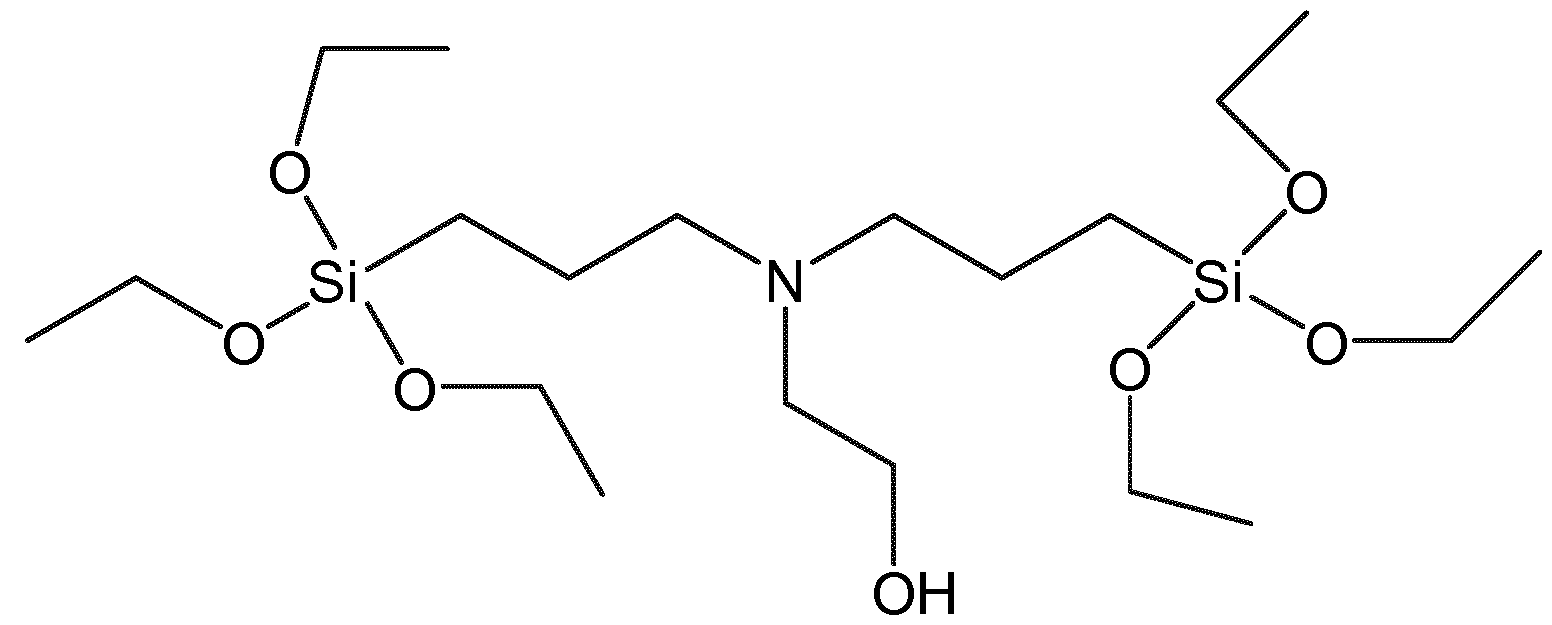
  • 3- (triethoxysilyl) -N, N-bis [3- (triethoxysilyl) propyl] -1-propanamine CAS number 18784-74-2 can be purchased from Fluorochem or Sigma-Aldrich.
  • an agent according to the invention is characterized in that it contains (a) at least one organic silicon compound of the formula (II) which is selected from the group consisting of
  • the organic silicon compounds of formula (I) and (II) are reactive compounds.
  • the agent according to the invention - based on its total weight - one or more organic silicon compounds (a) in a total amount of 0, 1 to 20.0 wt .-%, preferably 0.2 to 15 , 0 wt .-% and particularly preferably 0.2 to 2.0 wt .-%.
  • the agent according to the invention - based on its total weight - one or more organic silicon compounds (a) of the formula (I) and / or (II) in a total amount of 0, 1 to 20, 0% by weight, preferably 0.2 to 15.0% by weight and particularly preferably 0.2 to 2.0% by weight. It has been found to be particularly suitable to use at least one organic silicon compound of the formula (I) in the composition according to the invention.
  • an agent according to the invention is characterized in that it contains (a) at least one organic silicon compound of the formula (I).
  • compositions according to the invention contain at least one coloring compound from the group of pigments and / or substantive dyes.
  • pigments are understood as meaning colorant compounds which have a solubility of less than 0.5 g / L, preferably less than 0.1 g / L, even more preferably less than 0, at 25 ° C. in water. Own 05 g / L.
  • the water solubility can be carried out, for example, by the method described below: 0.5 g of the pigment are weighed in a beaker. A stir bar is added. Then one liter of distilled water is added. This mixture is heated with stirring on a magnetic stirrer for one hour at 25 ° C. If undissolved components of the pigment are still visible in the mixture after this period, the solubility of the pigment is below 0.5 g / L.
  • the mixture is filtered. If a proportion of undissolved pigments remains on the filter paper, the solubility of the pigment is below 0.5 g / l.
  • Suitable color pigments may be of inorganic and / or organic origin.
  • an agent according to the invention is characterized in that it contains (b) at least one coloring compound from the group of inorganic and / or organic pigments.
  • Preferred color pigments are selected from synthetic or natural inorganic pigments.
  • Inorganic color pigments of natural origin can be prepared, for example, from chalk, ocher, umber, green earth, baked Terra di Siena or graphite.
  • black pigments such as inorganic color pigments
  • B. iron oxide black colored pigments such as ultramarine or iron oxide red and fluorescent or Phosphoreszenzpigmente be used.
  • Particularly suitable are colored metal oxides, hydroxides and oxide hydrates, mixed phase pigments, sulfur-containing silicates, silicates, metal sulfides, complex metal cyanides, metal sulfates, chromates and / or molybdate.
  • Particularly preferred color pigments are black iron oxide (CI 77499), yellow iron oxide (CI 77492), red and brown iron oxide (CI 77491), manganese violet (CI 77742), ultramarines (sodium aluminum sulfosilicates, CI 77007, Pigment Blue 29), chromium oxide hydrate (CI77289 ), Iron blue (Ferric Ferrocyanide, CI77510) and / or Carmine (Cochineal).
  • Color pigments which are likewise particularly preferred according to the invention are colored pearlescent pigments. These are usually based on mica and / or mica and may be coated with one or more metal oxides. Mica belongs to the layer silicates. The most important representatives of these silicates are muscovite, phlogopite, paragonite, biotite, lepidolite and margarite. To produce the pearlescent pigments in conjunction with metal oxides, the mica, predominantly muscovite or phlogopite, is coated with a metal oxide.
  • pearlescent pigments are based on natural or synthetic mica (mica) and are coated with one or more of the abovementioned metal oxides.
  • the color of the respective pigments can be varied by varying the layer thickness of the metal oxide (s).
  • an agent according to the invention is characterized in that it contains (b) at least one coloring compound from the group of pigments selected from the group of colored metal oxides, metal hydroxides, metal oxide hydrates, silicates, metal sulfides, complex metal cyanides, metal sulfates , Bronze pigments and / or colored pigments based on mica or mica, which are coated with at least one metal oxide and / or a metal oxychloride.
  • an agent according to the invention is characterized in that it contains (b) at least one coloring compound selected from the group of pigments selected from mica or mica based pigments containing one or more metal oxides selected from the group consisting of titanium dioxide (CI 77891), black iron oxide (CI 77499), yellow iron oxide (CI 77492), red and / or brown iron oxide (CI 77491, CI 77499), manganese violet (CI 77742), ultramarines (sodium aluminum sulfosilicates, CI 77007, Pigment Blue 29), chromium oxide hydrate (CI 77289), chromium oxide (CI 77288) and / or iron blue (Ferric Ferrocyanide, CI 77510) are coated.
  • color pigments are commercially available, for example, from the company under the trade names Rona®, Colorona®, Xirona®, Dichrona® and Timiron® Merck, Ariabel® and Unipure® from Sensient, Prestige® from Eckart Cosmetic Colors and Sunshine® from Sunstar.
  • Colorona® Very particularly preferred color pigments with the trade name Colorona® are, for example:
  • color pigments with the trade name Xirona® are, for example:
  • color pigments with the trade name Unipure® are, for example:
  • composition according to the invention may also contain (b) one or more coloring compounds from the group of organic pigments
  • the organic pigments of the invention are correspondingly insoluble, organic dyes or lakes, for example from the group of nitroso, nitro, azo, xanthene, anthraquinone, isoindolinone, isoindoline, quinacridone, perinone, perylene , Diketopyrrolopyorrol, indigo, thioindido, dioxazine, and / or triarylmethane compounds may be selected.
  • Examples of particularly suitable organic pigments are carmine, quinacridone, phthalocyanine, sorghum, blue pigments with the Color Index numbers CI 42090, CI 69800, CI 69825, CI 73000, CI 74100, CI 74160, yellow pigments with the Color Index numbers CI 1 1680, CI 1 1710, CI 15985, CI 19140, CI 20040, CI 21 100, CI 21 108, CI 47000, CI 47005, green pigments with the Color Index numbers CI 61565, CI 61570, CI 74260, orange pigments with the Color Index numbers CI 1 1725, CI 15510, CI 45370, CI 71 105, red pigments with the Color Index numbers CI 12085, CI 12120, CI 12370, CI 12420, CI 12490, CI 14700, CI 15525, CI 15580, CI 15620, CI 15630, CI 15800, CI
  • an agent according to the invention is characterized in that it contains (b) at least one coloring compound from the group of organic pigments which is selected from the group of carmine, quinacridone, phthalocyanine, sorghum, blue pigments with the color Index numbers CI 42090, CI 69800, CI 69825, CI 73000, CI 74100, CI 74160, yellow pigments with the Color Index numbers CI 1 1680, CI 1 1710, CI 15985, CI 19140, CI 20040, CI 21 100, CI 21 108, CI 47000, CI 47005, green pigments with the Color Index numbers CI 61565, CI 61570, CI 74260, orange pigments with the Color Index numbers CI 1 1725, CI 15510, CI 45370, CI 71 105, red pigments with the Color Index numbers CI 12085, CI 12120, CI 12370, CI 12420, CI 12490,
  • the organic pigment may also be a colored lake.
  • the term color coat is understood as meaning particles which comprise a layer of absorbed dyes, the unit of particle and dye being among the above-mentioned. Conditions is insoluble.
  • the particles may be, for example, inorganic substrates, which may be aluminum, silica, calcium borosilicate, calcium aluminum borosilicate or else aluminum.
  • the alizarin lake can be used as a color coat.
  • the use of the aforementioned pigments in the compositions according to the invention is particularly preferred. Furthermore, it is preferred if the pigments used have a certain particle size. On the one hand, this particle size leads to a uniform distribution of the pigments in the polymer film formed and, on the other hand, avoids a rough hair or skin feeling after the application of the cosmetic product. It is therefore advantageous according to the invention if the at least one pigment has an average particle size D 50 of from 1.0 to 50 ⁇ m, preferably from 5.0 to 45 ⁇ m, preferably from 10 to 40 ⁇ m, in particular from 14 to 30 ⁇ m.
  • the average particle size Dso can be determined, for example, using dynamic light scattering (DLS).
  • the pigment or pigments (b) can be used in an amount of from 0.001 to 20% by weight, in particular from 0.05 to 5% by weight, based in each case on the total weight of the composition according to the invention.
  • the agents according to the invention may also contain one or more substantive dyes.
  • Direct dyes are dyes that are applied directly to the hair and not an oxidative process to form the color need. Direct dyes are usually nitrophenylenediamines, nitroaminophenols, azo dyes, anthraquinones, triarylmethane dyes or indophenols.
  • the substantive dyes according to the present invention have a solubility in water (760 mmHg) at 25 ° C of more than 0.5 g / L and are therefore not to be regarded as pigments.
  • the substantive dyes preferably have a solubility in water (760 mmHg) at 25 ° C. of more than 1.0 g / l.
  • Direct dyes can be subdivided into anionic, cationic and nonionic substantive dyes.
  • an agent according to the invention is characterized in that it contains as the coloring compound (b) at least one anionic, cationic and / or nonionic substantive dye.
  • an agent according to the invention is characterized in that it contains (b) at least one anionic, cationic and / or nonionic substantive dye.
  • Suitable cationic substantive dyes are Basic Blue 7, Basic Blue 26, Basic Violet 2 and Basic Violet 14, Basic Yellow 57, Basic Red 76, Basic Blue 16, Basic Blue 347 (Cationic Blue 347 / Dystar), HC Blue No. 16, Basic Blue 99, Basic Brown 16, Basic Brown 17, Basic Yellow 57, Basic Yellow 87, Basic Orange 31, Basic Red 51 Basic Red 76
  • nonionic substantive dyes examples include nonionic nitro and quinone dyes and neutral azo dyes.
  • Geeigente nonionic direct dyes are those under the international names or trade names HC Yellow 2, HC Yellow 4, HC Yellow 5, HC Yellow 6, HC Yellow 12, HC Orange 1, Disperse Orange 3, HC Red 1, HC Red 3, HC Red 10, HC Red 1, HC Red 13, HC Red BN, HC Blue 2, HC Blue 1 1, HC Blue 12, Disperse Blue 3, HC Violet 1, Disperse Violet 1, Disperse Violet 4, Disperse Black 9 known compounds and 1,4-diamino-2-nitrobenzene, 2-amino-4-nitrophenol, 1,4-bis (2-hydroxyethyl) amino-2-nitrobenzene, 3-nitro-4- (2-hydroxyethyl) - aminophenol, 2- (2-hydroxyethyl) amino-4,6-dinitrophenol, 4 - [(2-hydroxyethyl) amino] -3-nitro-1-methylbenzene, 1-amino
  • an agent according to the invention is therefore characterized in that it contains (b) at least one anionic substantive dye.
  • Acid dyes are understood to mean direct dyes having at least one carboxylic acid group (-COOH) and / or one sulfonic acid group (-SO3H).
  • -COOH carboxylic acid group
  • -SO3H sulfonic acid group
  • the protonated forms (-COOH, -SO3H) of the carboxylic acid or sulfonic acid groups with their deprotonated forms (-COO, -SO3 before) are in equilibrium.
  • the proportion of protonated forms increases.
  • Acid dyestuffs according to the invention can also be used in the form of their sodium salts and / or their potassium salts.
  • the acid dyes according to the present invention have a solubility in water (760 mmHg) at 25 ° C of more than 0.5 g / L and are therefore not to be regarded as pigments.
  • the acid dyes according to the present invention have a solubility in water (760 mmHg) at 25 ° C of more than 1, 0 g / L.
  • alkaline earth salts such as calcium salts and magnesium salts
  • aluminum salts of acid dyes often have a lower solubility than the corresponding alkali metal salts. If the solubility of these salts is below 0.5 g / L (25 ° C, 760 mmHg), they do not fall within the definition of a direct dye.
  • acid dyes are their ability to form anionic charges, the carboxylic acid or sulfonic acid groups responsible for this usually being linked to different chromophore systems.
  • Suitable chromophore systems are found, for example, in the structures of nitrophenylenediamines, nitroaminophenols, azo dyes, anthraquinone dyes, triarylmethane dyes, xanthene dyes, rhodamine dyes, oxazine dyes and / or indophenol dyes.
  • a means for dyeing keratinic material which is characterized in that it (b) contains at least one anionic substantive dye selected from the group consisting of nitrophenylenediamines, nitroaminophenols, azo dyes, anthraquinone dyes, triarylmethane dyes, xanthene dyes, rhodamine dyes, oxazine dyes and / or indophenol dyes in which the dyes from the abovementioned group each have at least one carboxylic acid group (--COOH), a sodium carboxylate group (--COONa), a potassium carboxylate group (--COOK), a sulphonic acid group (--SO.sub.3H), a sodium sulphonate group (--SO.sub.Na) and / or a potassium sulphonate group (-. SO3K).
  • anionic substantive dye selected from the group consisting of nitrophenylenediamines, nitroamino
  • one or more compounds from the following group can be selected as acid dyes which are particularly suitable: Acid Yellow 1 (D & C Yellow 7, Citronin A, Ext. D & C Yellow No. 7, Japan Yellow 403, CI 10316, COLIPA n ° B001), Acid Yellow 3 (COLIPA n °: C 54, D & C Yellow N ° 10, Quinoline Yellow, E104, Food Yellow 13), Acid Yellow 9 (CI 13015), Acid Yellow 17 (CI 18965), Acid Yellow 23 (COLIPA n ° C 29, Covacap Jaune W 1 100 (LCW), Sicovit Tartrazine 85 E 102 (BASF), Tartrazine, Food Yellow 4, Japan Yellow 4, FD & C Yellow No.
  • Acid Yellow 36 (CI 13065), Acid Yellow 121 ( CI 18690), Acid Orange 6 (CI 14270), Acid Orange 7 (2-naphthol orange, Orange II, CI 15510, D & C Orange 4, COLIPA n ° C015), Acid Orange 10 (Cl 16230, Orange G sodium salt), Acid Orange 1 1 (CI 45370), Acid Orange 15 (CI 50120), Acid Orange 20 (CI 14600), Acid Orange 24 (BROWN 1; CI 20170; KATSU201; nosodiumsalt; Brown No.201; RESORCIN BROWN; ACID ORANGE 24 Japan Brown 201; D & C Brown No.1), Acid Red 14 (Cl14720), Acid Red 18 (E124, Red 18; CI 16255), Acid Red 27 (E 123, CI 16185, C Red 46, Fast Red D, FD & C Red No.2, Food Red 9, Naphthol Red S), Acid Red 33 (Red 33, Fuchsia Red, D & C Red 33, CI 17
  • the water solubility of the anionic direct dyes can be determined, for example, in the following way. 0.1 g of the anionic substantive dye is placed in a beaker. A stirring fish is added. Then 100 ml of water are added. This mixture is heated to 25 ° C. with stirring on a magnetic stirrer. It is stirred for 60 minutes. Thereafter, the aqueous mixture is visually evaluated. Are still undissolved residues present, the amount of water - for example, in steps of 10 ml - increased. It is as long as water is added until the dye used has completely dissolved. If the dye / water mixture can not be assessed visually due to the high intensity of the dye, the mixture is filtered.
  • the solubility test is repeated with a higher amount of water. Dissolve 0, 1 g of the anionic substantive dye at 25 ° C in 100 ml of water, the solubility of the dye is at 1, 0 g / L.
  • Acid Yellow 1 is named 8-hydroxy-5,7-dinitro-2-naphthalenesulfonic acid disodium salt and has a solubility in water of at least 40 g / L (25 ° C).
  • Acid Yellow 3 is a mixture of the sodium salts of mono- and sisulfonic acids of 2- (2-quinolyl) -1H-indene-1,3 (2H) -dione and has a water solubility of 20 g / L (25 ° C).
  • Acid Yellow 9 is the disodium salt of 8-hydroxy-5,7-dinitro-2-naphthalenesulfonic acid, its water solubility is above 40 g / L (25 ° C).
  • Acid Yellow 23 is the trisodium salt of 4,5-dihydro-5-oxo-1- (4-sulfophenyl) -4- ((4-sulfophenyl) azo) -1H-pyrazole-3-carboxylic acid and is well in at 25 ° C Water soluble.
  • Acid Orange 7 is the sodium salt of 4 - [(2-hydroxy-1-naphthyl) azo] benzenesulfonate. Its water solubility is more than 7 g / L (25 ° C).
  • Acid red 18 is the trinatirum salt of 7-hydroxy-8 - [(E) - (4-sulfonato-1-naphthyl) -diazenyl)] - 1, 3-naphthalenedisulfonate and has a very high water solubility of more than 20% by weight. %.
  • Acid Red 33 is the diantrium salt of 5-amino-4-hydroxy-3- (phenylazo) naphthalene-2,7-disulphonate, its water solubility is 2.5 g / L (25 ° C).
  • Acid Red 92 is the disodium salt of 3,4,5,6-tetrachloro-2- (1, 4,5,8-tetrabromo-6-hydroxy-3-oxoxanthen-9-yl) benzoic acid, its water solubility greater than 10 g / L (25 ° C).
  • Acid Blue 9 is the disodium salt of 2 - ( ⁇ 4- [N-ethyl (3-sulfonatobenzyl) amino] phenyl ⁇ ⁇ 4 - [(N-ethyl (3-sulfonatobenzyl) imino] -2,5-cyclohexadiene-1 ylidene ⁇ methyl) benzene sulfonate and has a water solubility of more than 20 wt .-% (25 ° C).
  • a very particularly preferred agent according to the invention is therefore characterized in that it contains (b) at least one anionic substantive dye selected from Acid Yellow 1, Acid Yellow 3, Acid Yellow 9, Acid Yellow 17, Acid Yellow 23, Acid Yellow 36, Acid Yellow 121, Acid Orange 6, Acid Orange 7, Acid Orange 10, Acid Orange 1 1, Acid Orange 15, Acid Orange 20, Acid Acid Red 14, Acid Red, Acid Red 27, Acid Red 33, Acid Red 35, Acid Red 35, Acid Red 51, Acid Red 52, Acid Red 73, Acid Red 87, Acid Red 92, Acid Red 95, Acid Red 184, Acid Red.
  • at least one anionic substantive dye selected from Acid Yellow 1, Acid Yellow 3, Acid Yellow 9, Acid Yellow 17, Acid Yellow 23, Acid Yellow 36, Acid Yellow 121, Acid Orange 6, Acid Orange 7, Acid Orange 10, Acid Orange 1 1, Acid Orange 15, Acid Orange 20, Acid Acid Red 14, Acid Red, Acid Red 27, Acid Red 33, Acid Red 35, Acid Red 35, Acid Red 51, Acid Red 52, Acid Red 73, Acid Red 87, Acid Red 92, Acid Red 95, Acid Red 184, Acid Red.
  • the direct-acting dye (s), in particular the anionic substantive dyes, can be used in various amounts in the composition according to the invention, depending on the desired color intensity. Particularly good results could be obtained if the agent according to the invention - based on its total weight - one or more substantive dyes (b) in a total amount of 0.01 to 10.0 wt .-%, preferably from 0, 1 to 8.0 Wt .-%, more preferably from 0.2 to 6.0 wt .-% and most preferably from 0.5 to 4.5 wt .-%.
  • an agent according to the invention is characterized in that it contains, based on its total weight, one or more substantive dyes (b) in a total amount of from 0.01 to 10.0% by weight, preferably from 0.1 to 8.0 wt .-%, more preferably from 0.2 to 6.0 wt .-% and most preferably from 0.5 to 4.5 wt .-%.
  • an agent according to the invention is characterized in that it contains, based on its total weight, one or more anionic substantive dyes (b) in a total amount of from 0.01 to 10.0% by weight, preferably of 0.1 to 8.0 wt .-%, more preferably from 0.2 to 6.0 wt .-% and most preferably from 0.5 to 4.5 wt .-%. film-forming, hydrophilic polymer
  • compositions according to the invention contain at least one film-forming, hydrophilic polymer.
  • polymers are meant macromolecules having a molecular weight of at least 1000 g / mol, preferably of at least 2500 g / mol, more preferably of at least 5000 g / mol, which consist of identical, repeating organic units.
  • the polymers of the present invention may be synthetically prepared polymers prepared by polymerization of a monomer type or by polymerization of various structurally distinct monomer types. If the polymer is prepared by polymerization of a monomer type, one speaks of homo-polymers. Become structurally different monomer types used in the polymerization, the resulting polymer is referred to as a copolymer.
  • the maximum molecular weight of the polymer depends on the degree of polymerization (number of polymerized monomers) and the batch size and is determined by the polymerization method. For the purposes of the present invention, it is preferable that the maximum molecular weight of the film forming, hydrophobic polymer (c) not more than 10 7 g / mol, preferably not more than 10 ® g / mol and particularly preferably not more than 10 5 g / mol is.
  • hydrophilic polymer a polymer having a solubility in water at 25 ° C (760 mmHg) of greater than 1% by weight, preferably greater than 2% by weight.
  • the water solubility of the film-forming hydrophilic polymer can be determined, for example, in the following way. 1, 0 g of the polymer are placed in a beaker. With water is made up to 100 g. A stir bar is added and the mixture is heated to 25 ° C with stirring on a magnetic stirrer. It is stirred for 60 minutes. Thereafter, the aqueous mixture is visually evaluated. A completely dissolved polymer appears to be homogeneous in the liver. If the polymer-water mixture can not be visually assessed due to high turbidity of the mixture, the mixture is filtered. If no undissolved polymer remains on the filter paper, the solubility of the polymer is more than 1% by weight.
  • a film-forming polymer is understood as meaning a polymer which is capable of forming a film on a substrate, for example on a keratinic material or a keratinic fiber.
  • the formation of a film can be detected, for example, by observing the polymer-treated keratin material under a microscope.
  • hydrophilic polymers nonionic, anionic and cationic polymers can be used.
  • Suitable film-forming, hydrophilic polymers may, for example, from the group of polyvinylpyrrolidone (co) polymers, the polyvinyl alcohol (co) polymers, the vinyl acetate (co) polymers, the carboxyvinyl (co) polymers, the acrylic acid (Co Polyme, methacrylic acid (co) polymers, natural gums, polysaccharides and / or acrylamide (co) polymers are selected.
  • an agent according to the invention is characterized in that it contains (c) at least one film-forming, hydrophilic polymer which is selected from the group consisting of polyvinylpyrrolidone (PVP) and the copolymers of polyvinylpyrrolidone.
  • the composition according to the invention contains polyvinylpyrrolidone (PVP) as the film-forming, hydrophilic polymer (c).
  • PVP polyvinylpyrrolidone
  • Polyvinylpyrrolidone as a film-forming, hydrophilic polymer (c) was very easy and easy to dissolve in water and also held larger amounts of pigments stable for a long time in dispersion. Surprisingly, the washfastness of the dyeings which could be obtained with PVP-containing formulations was also very good.
  • polyvinylpyrrolidones are obtainable, for example, under the name Luviskol® K from BASF SE, in particular LuviskofoK 90 or Luviskofe K 85 from BASF SE.
  • PVP polyvinylpyrrolidone
  • PVP K30 which is sold by Ashland (ISP, POI Chemical).
  • PVP K 30 is a very soluble in cold water polyvinylpyrrolidone, which has the CAS number 9003-39-8.
  • the molecular weight of PVP K 30 is about 40000 g / mol.
  • polyvinylpyrrolidones are those known under the trade names LUVITEC K 17, LUVITEC K 30, LUVITEC K 60, LUVITEC K 80, LUVITEC K 85, LUVITEC K 90 and LUVITEC K 1 15 and available from BASF.
  • film-forming hydrophilic polymers (c) from the group of copolymers of polyvinylpyrrolidone has also led to particularly good and true color results. Also, the storage stabilities of the formulations containing one or more copolymers of polyvinylpyrrolidone (c) were very good.
  • hydrophilic polymers may be mentioned in this context vinylpyrrolidone-vinyl ester copolymers, such as those sold for example under the trademark Luviskol ® (BASF). Luviskol ® VA 64 and Luviskol ® VA 73, each vinylpyrrolidone / vinyl acetate copolymers are particularly preferred non-ionic polymers.
  • vinylpyrrolidone-containing copolymers very particular preference is given to a styrene / VP copolymer and / or a vinylpyrrolidone / vinyl acetate copolymer and / or a VP / DMAPA acrylate Copolymer and / or a VP / vinyl caprolactam / DMAPA acrylate copolymer used in the cosmetic compositions.
  • Vinylpyrrolidone-vinyl acetate copolymers are sold under the name Luviskol® VA by BASF SE.
  • a VP / vinyl caprolactam / DMAPA acrylate copolymer is sold under the trade name Aquaflex® SF-40 by Ashland Inc.
  • a VP / DMAPA acrylate copolymer is marketed by Ashland under the name Styleze CC-10 and is a most preferred vinylpyrrolidone-containing copolymer.
  • copolymers of polyvinylpyrrolidone (c) may also be mentioned the copolymers obtained by reacting N-vinylpyrrolidone with at least one further monomer from the group consisting of V-vinylformamide, vinyl acetate, ethylene, propylene, acrylamide, vinylcaprolactam, vinylcaprolactone and / or Be obtained ethanol.
  • an agent according to the invention is characterized in that it contains (c) at least one film-forming, hydrophilic polymer which is selected from the group consisting of polyvinylpyrrolidone (PVP), vinylpyrrolidone / vinyl acetate copolymers, vinylpyrrolidone / styrene copolymers , Vinylpyrrolidone / ethylene copolymers, vinylpyrrolidone / propylene copolymers, vinylpyrrolidone / vinylcaprolactam copolymers,
  • PVP polyvinylpyrrolidone
  • vinylpyrrolidone / vinyl acetate copolymers vinylpyrrolidone / styrene copolymers
  • Vinylpyrrolidone / ethylene copolymers vinylpyrrolidone / propylene copolymers
  • vinylpyrrolidone / vinylcaprolactam copolymers vinylpyrrolidone / vinylcaprolactam copolymers
  • Vinylpyrrolidone / vinylformamide copolymers and / or vinylpyrrolidone / vinyl alcohol copolymers are examples of vinylpyrrolidone / vinylformamide copolymers and / or vinylpyrrolidone / vinyl alcohol copolymers.
  • Another suitable copolymer of vinylpyrrolidone is the polymer known under the INCI name Maltodextrin / VP Copolymer.
  • an agent according to the invention is characterized in that it contains (c) at least one nonionic, film-forming, hydrophilic polymer.
  • a nonionic polymer is understood as meaning a polymer which, in standard conditions, carries no structural units in a protic solvent-such as water-having permanently cationic or anionic groups which have to be compensated by counterions while maintaining the electroneutrality. Quaternized ammonium groups, however, do not include protonated amines under cationic groups. Examples of anionic groups include carboxyl and sulfonic acid groups. Very particular preference is given to the compositions which comprise as nonionic, film-forming, hydrophilic polymer at least one polymer which is selected from the group consisting of
  • the molar ratio of the structural units comprised of the monomer N-vinylpyrrolidone to the structural units of the polymer comprised of the monomer vinyl acetate is in the range from 20:80 to 80:20, in particular from 30 to 70 to 60 to 40, lies.
  • Suitable copolymers of vinylpyrrolidone and vinyl acetate are available, for example, under the trademarks Luviskol® VA 37, Luviskol® VA 55, Luviskol® VA 64 and Luviskol® VA 73 from the company BASF SE.
  • Another particularly preferred polymer is selected from the polymers of the INCI name VP / methacrylamide / vinyl imidazole copolymer, which are available, for example, under the trade name Luviset Clear from BASF SE.
  • Another particularly preferred nonionic, film-forming, hydrophilic polymer st a copolymer of N-vinylpyrrolidone and N, N-dimethylaminiopropylmethacrylamide, which, for example, with the INCI name VP / DMAPA Acrylates Copolymer z. B. sold under the trade name Styleze®CC 10 by the company ISP.
  • a cationic polymer according to the invention is the copolymer of N-vinylpyrrolidone, N-vinylcaprolactam, N- (3-dimethylaminopropyl) methacrylamide and 3- (methacryloylamino) propyl lauryl-dimethylammonium chloride (INCI name: Polyquaternium-69), which is available, for example, under the trade name aquastyle ® 300 (28-32 wt .-% of active substance in ethanol-water mixture, molecular weight 350000) is sold by the company ISP.
  • Vinylpyrrolidone vinylimidazoliummethochloride copolymers such as those offered under the names Luviquat.RTM ® FC 370, FC 550 and the INCI name Polyquaternium-16 and FC 905 and HM 552, Vinylpyrrolidone-vinylcaprolactam-acrylate terpolymers, such as those offered with acrylic acid esters and acrylamides as the third monomer building commercially, for example, under the name Aquaflex ® SF 40.
  • Polyquaternium-1 1 is the reaction product of diethyl sulfate with a copolymer of vinylpyrrolidone and dimethylaminoethyl methacrylate.
  • Suitable commercial products are available, for example, under the names Dehyquart® CC 1 1 and Luviquat® PQ 1 1 PN from BASF SE or Gafquat 440, Gafquat 734, Gafquat 755 or Gafquat 755N from Ashland Inc.
  • Polyquaternium-46 is the reaction product of vinylcaprolactam and vinylpyrrolidone with methylvinylimidazolium methosulfate and is available, for example, under the name Luviquat® Hold from BASF SE. Polyquaternium-46 is preferably used in an amount of 1 to 5 wt .-% - based on the total weight of the cosmetic composition. It is most preferred that Polyquaternium-46 be used in combination with a cationic guar compound. It is even more preferred that Polyquaternium-46 be used in combination with a cationic guar compound and Polyquaternium-11.
  • hydrophilic polymers for example, acrylic acid polymers can be used, which may be present in uncrosslinked or crosslinked form.
  • Corresponding products are commercially sold, for example, under the trade names Carbopol 980, 981, 954, 2984 and 5984 by the company Lubrizol or else under the name Synthalen M and Synthalen K by the company 3V Sigma (The Sun Chemicals, Inter Harz).
  • Suitable film-forming, hydrophilic polymers from the group of natural gums are xanthan gum, gellan gum, carob gum.
  • Suitable film-forming, hydrophilic polymers from the group of polysaccharides are hydroxyethyl cellulose, hydroxypropyl cellulose, ethyl cellulose and carboxymethyl cellulose.
  • Suitable film-forming, hydrophilic polymers from the group of acrylamides are, for example, polymers which are prepared starting from monomers of the (methy) acrylamido-C 1 -C 4 -alkyl sulfonic acid or the salts thereof.
  • Corresponding polymers may be selected from the polymers of polyacrylamidomethanesulfonic acid, polyacrylamidoethanesulfonic acid, polyacrylamidopropanesulfonic acid, poly-2-acrylamido-2-methylpropanesulfonic acid, poly-2-methylacrylamido-2-methylpropanesulfonic acid and / or poly-2-methylacrylamido-n-butanesulfonic acid.
  • Preferred polyesters of poly (meth) arylamido-C 1 -C 4 -alkyl sulfonic acids are crosslinked and neutralized to at least 90%. These polymers may be crosslinked or uncrosslinked.
  • Crosslinked and completely or partially neutralized polymers of the poly-2-acrylamido-2-methylpropanesulfonic acid type are known by the INCI names "ammonium polyacrylamido-2-methylpropanesulphonate” or "ammonium polyacryldimethyltauramide”.
  • Another preferred polymer of this type is the crosslinked poly-2-acrylamido-2-methyl-propanesulphonic acid polymer sold by Clamant under the tradename Hostacerin AMPS and partially neutralized with ammonia.
  • the film-forming hydrophilic polymer or polymers (c) according to the invention are preferably used in certain amounts in the composition according to the invention.
  • the agent - based on its total weight - one or more polymers in a total amount of 0.1 to 25.0 wt .-%, preferably from 0.2 to 20.0% by weight, more preferably from 0.5 to 15.0% by weight and most preferably from 1, 0 to 7.0% by weight.
  • an agent according to the invention is characterized in that it contains, based on its total weight, one or more film-forming hydrophobic hydrophilic polymers (c) in a total amount of from 0.1 to 25.0% by weight, preferably from 0, From 2 to 20.0% by weight, more preferably from 0.5 to 15.0% by weight and most preferably from 1, 0 to 7.0% by weight.
  • the agent according to the invention contains the essential ingredients (a), (b) and (c) in a cosmetic carrier, preferably in an aqueous or aqueous cosmetic carrier.
  • the composition - based on its total weight - a water content of 15 to 95 wt .-%, preferably from 20 to 95% by weight, more preferably from 25 to 95 wt.
  • an agent according to the invention is characterized in that, based on its total weight, it has a water content of from 15 to 95% by weight, preferably from 20 to 95% by weight, more preferably from 25 to 95% Wt .-%, even more preferably from 30 to 95 wt .-% and most preferably from 45 to 95 wt .-% has.
  • Multi-component packaging unit (kit-of-parts)
  • the above-described means of the first subject of the invention is the ready-to-use colorant.
  • This contains with the organic silicon compound or compounds (a) a class of reactive compounds which, as described above, can undergo hydrolysis and / or oligomerization in the presence of water.
  • the user is preferably provided in the form of a multi-component packaging unit (kit-of-parts). Shortly before application to the keratinous material, the user can mix the various components of this packaging unit to produce the ready-to-use colorant.
  • kit-of-parts Shortly before application to the keratinous material, the user can mix the various components of this packaging unit to produce the ready-to-use colorant.
  • a second object of the present invention is a kit of parts for dyeing keratinous material, in particular human hair, which is made up separately
  • a third container comprising a cosmetic agent (III),
  • the agent (I) contains at least one organic silicon compound (a), as has already been disclosed in detail in the description of the first subject of the invention,
  • the agent (III) contains at least one coloring compound from the group of pigments and / or direct dyes (b) and at least one film-forming, hydrophilic polymer (c), as disclosed in detail in the description of the first subject of the invention.
  • the ready-to-use colorant is prepared by mixing the agents (I), (II) and (III).
  • all three agents (I), (II) and (III) are applied simultaneously to the keratinic material.
  • the user may first stir or shed the agent (I) containing the organic silicon compound (s) (a) with the hydrous agent (II). Thereafter, the user may add the agent (III) containing the coloring compound (s) (b) and the film-forming hydrophilic polymer (s) to the mixture of (I) and (II) and mixing all three agents together ,
  • the user may first stir or shed the agent (I) containing the organic silicon compound (s) (a) with the hydrous agent (II).
  • the user can apply this mixture of (I) and (II) to the keratin materials either directly after their preparation or after a short reaction time of 10 seconds to 20 minutes. Thereafter, the user can now apply the agent (III) containing the coloring compounds (b) and the film-forming hydrophilic polymer (c) to the keratin material.
  • the agent (I) contains at least one organic silicon compound (a) as disclosed in detail already in the description of the first subject of the invention.
  • the agent (I) contains at least one organic silicon compound of the formula (I) and / or (II), where the radicals may stand for the already mentioned, the preferred and the particularly preferred substituents.
  • the organic silicon compound (a) the above-mentioned substances can also be used.
  • the agent (I) itself is preferably made up in a low-water or anhydrous form.
  • a kit of parts according to the invention is characterized in that the agent (I) has a water content of less than 10% by weight, based on the total weight of the agent (I), preferably less than 5% by weight, more preferably less than 1% by weight, even more preferably less than 0.1% by weight and most preferably less than 0.01% by weight.
  • the agent (II) contains water.
  • a kit of parts according to the invention is characterized in that the agent (II) - based on the total weight of the agent (II) - a water content of 15 to 100 wt .-%, preferably from 35 to 100 wt .-%, more preferably from 55 to 100 wt .-%, still more preferably from 65 to 100 wt .-% and most preferably from 75 to 100 wt .-% has.
  • the agent (III) contains at least one coloring compound (b) and at least one film-forming, hydrophilic polymer (c), as disclosed in detail in the description of the first subject of the invention.
  • the agent (III) contains the already mentioned, the preferred and the particularly preferred pigments (b).
  • a multi-component packaging unit is characterized in that the agent (III) - based on the total weight of the agent (III) - one or more coloring compounds (b) in a total amount of 0.01 to 10.0 Wt .-%, preferably from 0.1 to 8.0 wt .-%, more preferably from 0.2 to 6.0 wt .-% and most preferably from 0.5 to 4.5 wt .-% ,
  • the agent (III) contains the abovementioned, the preferred and the particularly preferred film-forming, hydrophilic polymers (c).
  • a multicomponent packaging unit is characterized in that the agent (III) - based on the total weight of the agent (III) - one or more film-forming hydrophobic polymers (b) in a total amount of 0, 1 to 25, 0 wt .-%, preferably from 0.2 to 20.0 wt%, more preferably from 0.5 to 15.0 wt .-% and most preferably from 1, 0 to 7.0 wt .-% ,
  • the agents (I) and (II) or the agents (I), (II) and (III) can be mixed together in various amounts.
  • the first container may contain from 5 g to 200 g of the agent (I).
  • the second container may contain from 5 g to 200 g of the agent (II).
  • the third container may contain 5 b to 200 g of the agent (III).
  • the means previously described i. the ready-for-use agent of the first subject of the invention, and also the agents (I), (II) and (III) of the inventive kit of the second subject of the invention may further contain one or more optional ingredients.
  • the agents may additionally contain one or more surfactants.
  • surfactants is understood to mean surface-active substances. A distinction is made between anionic surfactants consisting of a hydrophobic radical and a negatively charged hydrophilic head group, amphoteric surfactants which carry both a negative and a compensating positive charge, cationic Surfactants which have a hydrophilic group in addition to a positively charged hydrophilic group, and nonionic surfactants which have no charges but strong dipole moments and are highly hydrated in aqueous solution.
  • Zwitterionic surfactants are surface-active compounds which carry at least one quaternary ammonium group and at least one -COO () or -SO 3 ( - ) group in the molecule.
  • Particularly suitable zwitterionic surfactants are the so-called betaines such as N-alkyl-N, N-dimethylammonium glycinates, for example cocoalkyldimethylammonium glycineate, N-acylaminopropyl-N, N-dimethylammonium glycinates, for example cocoacylaminopropyl-dimethylammonium glycinate, and 2-alkyl-3-carboxymethyl-3-hydroxyethyl imidazolines having in each case 8 to 18 C atoms in the alkyl or acyl group, and the cocoacylamino-ethylhydroxyethylcarboxymethylglycinate.
  • a preferred zwitterionic surfactant is the fatty acid amide derivative known
  • Ampholytic surfactants are understood as meaning those surface-active compounds which, apart from a Cs-C24-alkyl or -acyl group in the molecule, contain at least one free amino group and at least one -COOH or -SOsH group and are capable of forming internal salts.
  • ampholytic surfactants are N-alkylglycines, N-alkylpropionic acids, N-alkylaminobutyric acids, N-alkyliminodipropionic acids, N-hydroxyethyl-N-alkylamidopropylglycines, N-alkyltaurines, N-alkylsarcosines, 2-alkylaminopropionic acids and alkylaminoacetic acids each having about 8 to 24 C Atoms in the alkyl group.
  • amphoteric or zwitterionic surfactants are alkylbetaines, alkylamidobetaines, amino-propionates, aminoglycinates, imidazolinium betaines and sulfobetaines.
  • ampholytic surfactants are N-cocoalkylaminopropionate, cocoacylaminoethylaminopropionate and C12-cis-acylsarcosine.
  • the agents may additionally contain at least one nonionic surfactant.
  • Suitable nonionic surfactants are alkyl polyglycosides and alkylene oxide addition products of fatty alcohols and fatty acids with in each case 2 to 30 moles of ethylene oxide per mole of fatty alcohol or fatty acid. Preparations having good properties are also obtained when they contain as nonionic surfactants fatty acid esters of ethoxylated glycerol which have been reacted with at least 2 moles of ethylene oxide.
  • the nonionic surfactants are used in a total amount of 0, 1 to 45 wt .-%, preferably 1 to 30 wt .-% and most preferably from 1 to 15 wt .-% - based on the total weight of the respective agent - used.
  • the agents may additionally contain at least one cationic surfactant.
  • Cationic surfactants are surfactants, ie surface-active compounds, each having one or more positive charges understood. Cationic surfactants contain only positive charges. Usually, these surfactants are composed of a hydrophobic part and a hydrophilic head group, wherein the hydrophobic part usually consists of a hydrocarbon skeleton (eg consisting of one or two linear or branched alkyl chains), and the positive charge (s) are located in the hydrophilic head group. Examples of cationic surfactants are examples of cationic surfactants.
  • quaternary ammonium compounds which as hydrophobic radicals can carry one or two alkyl chains having a chain length of 8 to 28 carbon atoms,
  • quaternary phosphonium salts substituted with one or more alkyl chains having a chain length of 8 to 28 C atoms or
  • the cationic charge may also be in the form of an onium structure as part of a heterocyclic ring (e.g., an imidazolium ring or a pyridinium ring).
  • the cationic surfactant may also contain other uncharged functional groups, as is the case, for example, with esterquats.
  • the cationic surfactants are used in a total amount of 0, 1 to 45 wt .-%, preferably 1 to 30 wt .-% and most preferably from 1 to 15 wt .-% - based on the total weight of the respective agent - used.
  • the agents according to the invention may also contain at least one anionic surfactant.
  • Anionic surfactants are surfactants with exclusively anionic charges (neutralized by a corresponding counter cation).
  • anionic surfactants are fatty acids, alkyl sulfates, alkyl ether sulfates and ether carboxylic acids having 12 to 20 carbon atoms in the alkyl group and up to 16 glycol ether groups in the molecule.
  • the anionic surfactants are used in a total amount of 0, 1 to 45 wt .-%, preferably 1 to 30 wt .-% and most preferably from 1 to 15 wt .-% - based on the total weight of the respective agent - used.
  • compositions may also contain other active ingredients, auxiliaries and additives, such as solvents, fatty components such as the Cs-C30 fatty alcohols, C8-C30 fatty acid triglycerides, Cs-Cso fatty acid monoglycerides, Cs-Cso fatty acid diglycerides and / or the hydrocarbons; Structurants such as glucose, maleic acid and lactic acid, hair conditioning compounds such as phospholipids, for example, lecithin and cephalins; Perfume oils, dimethylisosorbide and cyclodextrins; fiber structure improving agents, in particular mono-, di- and oligosaccharides such as glucose, galactose, fructose, fructose and lactose; Dyes for staining the agent; Anti-dandruff agents such as Piroctone Olamine, Zinc Omadine and Climbazole; Amino acids and oligopeptides; Protein hydrolysates on animal and / or vegetable
  • the choice of these other substances will be made by those skilled in the art according to the desired properties of the agents.
  • the additional active ingredients and auxiliaries are preferably used in the preparations according to the invention in amounts of from 0.0001 to 25% by weight, in particular from 0.0005 to 15% by weight, based on the total weight of the respective agent.
  • a third aspect of the present invention is a process for dyeing keratinous material, in particular human hair, comprising the following steps in the order given:
  • a third aspect of the present invention is a process for dyeing keratinous material, in particular human hair, comprising the following steps in the order given:
  • a pretreatment agent (V) on the keratinic material wherein the pretreatment agent (V) in a water-containing cosmetic carrier at least one organic silicon compound (a) selected from silanes having one, two or three silicon atoms, wherein the organic Silicon compound further comprises one or more basic chemical functions and one or more hydroxyl groups or hydrolyzable groups per molecule, and
  • a third aspect of the present invention is a process for dyeing keratinous material, in particular human hair, comprising the following steps in the order given:
  • a pretreatment agent (V) on the keratinic material wherein the pretreatment agent (V) in a water-containing cosmetic carrier at least one organic silicon compound (a) selected from silanes having one, two or three silicon atoms, wherein the organic Silicon compound further comprises one or more basic chemical functions and one or more hydroxyl groups or hydrolyzable groups per molecule, and
  • the keratin materials in particular the human hair, are first treated with a pretreatment agent (V).
  • a pretreatment agent V
  • the actual colorant (F) which contains the colorant or compounds in addition to the film-forming hydrophilic polymer-is applied to the keratin materials.
  • the pretreatment agent (V) itself preferably contains no dyes or no coloring compounds. Characteristic of the pretreatment agent (V) is its content of at least one reactive organic silicon compound (a). The reactive organic silicon compound or compounds (a) functionalize the hair surface as soon as they come into contact with it. In this way, a first, still undyed film is formed.
  • a colorant (F) applied to the hair.
  • a film formation also takes place on the - already functionalized - hair surface, whereby now the coloring compounds embedded in the film and deposited in this way on the hair.
  • the film produced in this way "in situ", in which the coloring compound is embedded, is characterized by outstanding wash fastness and a homogeneous color result.
  • the pretreatment agent (V) represents the ready-to-use pretreatment agent (V).
  • the pretreatment agent (V) is the mixture of the agents (I) and (II) of the multicomponent packaging unit according to the invention.
  • the pretreatment agent (V) thus contains at least one organic silicon compound (a) selected from silanes having one, two or three silicon atoms, wherein the organic silicon compound further comprises one or more basic chemical functions and one or more hydroxyl groups or hydrolyzable groups per molecule ,
  • the pretreatment agent (V) preferably contains at least one organic silicon compound (a) of the above-described formula (I) and / or (II)
  • radicals may stand for the already mentioned, the preferred and the particularly preferred substituents.
  • the pretreatment agent (V) contains water, the water being derived from the agent (II) of the kit-of-parts according to the invention.
  • a method according to the invention is characterized in that the pretreatment agent (V) is prepared before application to the keratinic material by mixing a first agent (I) and a second agent (II)
  • the agent (I) contains at least one organic silicon compound (a) as disclosed in detail in the description of the first and second objects of the invention, and
  • the agent (II) contains water.
  • the pretreatment agent (V) - based on the total weight of the pretreatment agent (V) - a water content of 15 to 95 wt .-%, preferably from 20 to 95 wt .-%, more preferably from 25 to 95 wt. -%, even more preferably from 30 to 95 wt .-% and most preferably from 45 to 95 wt .-% has.
  • a method according to the invention is characterized in that the pretreatment agent (V) - based on the total weight of the pretreatment agent - a water content of 15 to 95 wt .-%, preferably from 20 to 95% by weight, more preferably from 25 to 95% by weight, still more preferably from 30 to 95% by weight and most preferably from 45 to 95% by weight.
  • the pretreatment agent (V) preferably has a pH of from 7.0 to 11.5, preferably from 7.5 to 110, and more preferably from 8.0 to 10.5.
  • a method according to the invention is characterized in that the pretreatment agent (V) has a pH of from 7.0 to 11.5, preferably from 7.5 to 110, and particularly preferably from 8, 0 to 10.5 has.
  • the pretreatment agent (V) preferably contains at least one alkalizing agent, which is added in an amount which ensures the adjustment of the optimal pH for the respective hair treatment.
  • the pH values are pH values which were measured at a temperature of 22 ° C.
  • the amount of alkalizing agent added may vary, usually amounts of from 0.01 to 15% by weight are necessary ,
  • the pretreatment agent (V) may contain, for example, ammonia, alkanolamines and / or basic amino acids.
  • alkanolamines which can be used in the agent according to the invention are preferably selected from primary amines having a C 2 -C 6 -alkyl basic body which carries at least one hydroxyl group.
  • Preferred alkanolamines are selected from the group consisting of 2-aminoethane-1-ol (monoethanolamine), 3-aminopropan-1-ol, 4-aminobutan-1-ol, 5-aminopentan-1-ol, 1-aminopropane -2-ol, 1-aminobutan-2-ol, 1-aminopentan-2-ol, 1-aminopentan-3-ol, 1-aminopentan-4-ol, 3-amino-2-methylpropan-1-ol, 1 -Amino-2-methylpropan-2-ol, 3-aminopropane-1, 2-diol, 2-amino-2-methylpropane-1,3-diol.
  • Alkanolamines which are particularly preferred according to the invention are selected from 2-aminoethane-1-ol and / or 2-amino-2-methylpropan-1-ol.
  • a particularly preferred embodiment is therefore characterized in that the agent according to the invention contains as alkalizing agent an alkanolamine selected from 2-aminoethane-1-ol and / or 2-amino-2-methylpropan-1-ol.
  • An amino acid in the context of the invention is an organic compound which contains in its structure at least one protonatable amino group and at least one -COOH or -SO 3 H group.
  • Preferred amino acids are aminocarboxylic acids, in particular a- (alpha) -amino-carboxylic acids and w-aminocarboxylic acids, with a-aminocarboxylic acids being particularly preferred.
  • Basic amino acids according to the invention are to be understood as meaning those amino acids which have an isoelectric point p1 of greater than 7.0.
  • Basic ⁇ -aminocarboxylic acids contain at least one asymmetric carbon atom.
  • both possible enantiomers can be used equally as a specific compound or else mixtures thereof, in particular as racemates.
  • the basic amino acids are preferably selected from the group consisting of arginine, lysine, ornithine and histidine, more preferably arginine and lysine.
  • an agent according to the invention is therefore characterized in that the alkalizing agent is a basic amino acid from the group arginine, lysine, ornithine and / or histidine.
  • the agent may contain further alkalizing agents, in particular inorganic alkalizing agents.
  • inorganic alkalizing agents usable in the present invention are preferably selected from the group consisting of sodium hydroxide, potassium hydroxide, calcium hydroxide, barium hydroxide, sodium phosphate, potassium phosphate, sodium silicate, sodium metasilicate, potassium silicate, sodium carbonate and potassium carbonate.
  • Very particularly preferred alkalizing agents are ammonia, 2-aminoethane-1-ol (monoethanolamine), 3-aminopropan-1-ol, 4-aminobutan-1-ol, 5-aminopentan-1-ol, 1-aminopropan-2-ol, 1-aminobutan-2-ol, 1-aminopentan-2-ol, 1-aminopentan-3-ol, 1-aminopentan-4-ol, 3-amino-2-methylpropan-1-ol, 1-amino-2-ol methylpropan-2-ol, 3-aminopropane-1, 2-diol, 2-amino-2-methylpropane-1,3-diol, arginine, lysine, ornithine, histidine, sodium hydroxide, potassium hydroxide, calcium hydroxide, barium hydroxide, sodium phosphate, potassium phosphate, Sodium silicate, sodium metasilicate, potassium silicate, sodium carbonate and potassium carbon
  • a process according to the invention is characterized in that the pretreatment agent (V) comprises at least one alkalizing agent which is preferably selected from the group of ammonia, 2-aminoethane-1-ol (monoethanolamine), 3-aminopropane 1-ol, 4-aminobutan-1-ol, 5-aminopentan-1-ol, 1-aminopropan-2-ol, 1-aminobutan-2-ol, 1-aminopentan-2-ol, 1-aminopentan-3-ol, 1-aminopentan-4-ol, 3-amino-2-methylpropan-1 ol, 1-amino-2-methylpropan-2-ol, 3-aminopropane-1, 2-diol, 2-amino-2-methylpropane-1, 3-diol, arginine, lysine, ornithine, histidine, sodium hydroxide, potassium hydroxide, Calcium hydroxide, barium hydroxide
  • Acidifying agents which are preferred according to the invention are pleasure acids, such as, for example, citric acid, acetic acid, malic acid or tartaric acid, and also dilute mineral acids.
  • the colorant (F) is applied to the keratin materials.
  • the colorant (F) is the ready-to-use colorant (F).
  • the colorant (F) contains the substantive dye (s) (b) and the hydrophobic film-forming polymer or polymers (c) in a cosmetic carrier, preferably in an aqueous cosmetic carrier.
  • a method according to the invention is characterized in that the colorant (F) - based on the total weight of the colorant (F) - has a water content of 15 to 95% by weight, preferably from 20 to 95% by weight. %, more preferably from 25 to 95% by weight, still more preferably from 30 to 95% by weight and most preferably from 45 to 95% by weight.
  • the colorant (F) is set to alkaline and a pH of 7.0 to 1 1, 5, preferably from 7.5 to 1 1 , 0 and more preferably from 8.0 to 10.5.
  • a process according to the invention is characterized in that the colorant (F) has a pH of from 7.0 to 11.5, preferably from 7.5 to 1.1, and particularly preferably from 8, 0 to 10.5 has.
  • the colorant (F) also preferably contains at least one alkalizing agent which is added in an amount which ensures the adjustment of the optimum pH for the respective hair treatment.
  • the pH values are pH values which were measured at a temperature of 22 ° C.
  • the colorant (F) may contain at least one alkalizing agent from the aforementioned group.
  • the colorant (F) contains at least one alkalizing agent, which is preferably selected from the group of ammonia, 2-aminoethane-1-ol (monoethanolamine), 3-aminopropan-1-ol, 4-aminobutan-1-ol, 5-aminopentan-1-ol, 1-aminopropan-2-ol, 1-aminobutan-2-ol, 1-aminopentan-2-ol, 1-aminopentan-3-ol, 1-aminopentan-4-ol, 3 amino-2-methylpropan-1-ol,
  • alkalizing agent which is preferably selected from the group of ammonia, 2-aminoethane-1-ol (monoethanolamine), 3-aminopropan-1-ol, 4-aminobutan-1-ol, 5-aminopentan-1-ol, 1-aminopropan-2-ol, 1-aminobutan-2-ol, 1-aminopentan-2-ol, 1-aminopentan-3
  • a process according to the invention is characterized in that the colorant (F) comprises at least one alkalizing agent which is preferably selected from the group of ammonia, 2-aminoethane-1-ol (monoethanolamine), 3-aminopropane 1-ol, 4-aminobutan-1-ol, 5-aminopentan-1-ol, 1-aminopropane
  • alkalizing agent which is preferably selected from the group of ammonia, 2-aminoethane-1-ol (monoethanolamine), 3-aminopropane 1-ol, 4-aminobutan-1-ol, 5-aminopentan-1-ol, 1-aminopropane
  • the performance properties of the resulting color can be further improved by choosing the optimal process conditions.
  • the pretreatment agent (V) is first applied to the keratin materials, in particular the human hair.
  • the pretreatment agent (V) is allowed to act on the keratin materials.
  • exposure times of 10 seconds to 10 minutes, preferably from 20 seconds to 5 minutes and most preferably from 30 seconds to 2 minutes on the hair have proven to be particularly advantageous.
  • a method according to the invention is characterized by
  • the pretreatment agent (V) can now be rinsed off the keratin materials before the dyeing agent (F) is applied to the hair in the subsequent step.
  • Dyeings also having good wash fastness were obtained when the colorant (F) was applied to the keratin materials still exposed to the pretreatment agent (V).
  • step (4) the colorant (F) is then applied to the keratin materials. After the orders, the colorant (F) is now allowed to act on the hair.
  • the inventive method allows even with a short exposure time of the colorant (F) the production of dyeings with particularly good intensity and wash fastness. Contact times of 10 seconds to 10 minutes, preferably from 20 seconds to 5 minutes and most preferably from 30 seconds to 3 minutes on the hair have been found to be particularly advantageous.
  • a method according to the invention is characterized by
  • an optional conditioner can now be used.
  • the conditioner preferably contains at least one cationic and / or nonionic surfactant.
  • the use of the conditioner - especially if it contains at least one cationic surfactant - may improve the authenticity of the dyeings obtained even further and additionally intensifies the color result.
  • a method according to the invention is characterized in that the conditioner contains at least one cationic and / or nonionic surfactant.
  • a method according to the invention is characterized in that the conditioner contains at least one cationic surfactant.
  • a method according to the invention is characterized in that the pretreatment agent (V) and the dyeing agent (F) within a period of not more than 48 hours, preferably not more than 24 hours, more preferably not more than 12 hours and most preferably not more than 6 Hours are applied to the hair.
  • the pretreatment agent (V) and the dyeing agent (F) within a period of not more than 48 hours, preferably not more than 24 hours, more preferably not more than 12 hours and most preferably not more than 6 Hours are applied to the hair.
  • the ready-to-use pretreatment agent (V) was prepared. In this case, the agents (I) and (II) were shaken together for 3 minutes. Then, the pretreatment agent (V) was allowed to stand for about 5 minutes. The pH of the ready-to-use pretreatment agent (V) was about 10.
  • the hair strands were each wetted with a small amount of conditioner and then washed with water and dried. Afterwards, the strands were visually evaluated.
  • each of the color creams F1 to F4 100 g were filled into a glass container. Then the glass container was closed. Each container was then stored at room temperature for 4 weeks. After this storage period, the stability of the formulation was visually evaluated.

Landscapes

  • Health & Medical Sciences (AREA)
  • Life Sciences & Earth Sciences (AREA)
  • Animal Behavior & Ethology (AREA)
  • General Health & Medical Sciences (AREA)
  • Public Health (AREA)
  • Veterinary Medicine (AREA)
  • Birds (AREA)
  • Epidemiology (AREA)
  • Emergency Medicine (AREA)
  • Chemical & Material Sciences (AREA)
  • Inorganic Chemistry (AREA)
  • Dermatology (AREA)
  • Cosmetics (AREA)
  • Compositions Of Macromolecular Compounds (AREA)

Abstract

Gegenstand der vorliegenden Erfindung ist ein Mittel zum Färben von keratinischem Material, insbesondere menschlichen Haaren, enthaltend in einem kosmetischen Träger (a) mindestens eine organische Siliciumverbindung, die aus Silanen mit einem, zwei oder drei Siliciumatomen ausgewählt ist, wobei die organische Siliciumverbindung außerdem eine oder mehrere basische chemische Funktionen und eine oder mehrere Hydroxylgruppen oder hydrolysierbare Gruppen pro Molekül umfasst, (b) mindestens eine farbgebende Verbindung aus der Gruppe der Pigmente und/oder der direktziehenden Farbstoffe, und (c) mindestens ein filmbildendes, hydrophiles Polymer.

Description

“Mittel zum Färben von Haaren enthaltend mindestens eine organische Siliciumverbindung, eine farbgebende Verbindung und ein filmbildendes, hydrophiles Polymer“
Gegenstand der vorliegenden Anmeldung ist ein Mittel zum Färben von keratinischem Material, insbesondere menschlichen Haaren, welches in einem kosmetischen Träger (a) mindestens eine spezielle organische Siliciumverbindung, (b) mindestens eine farbgebende Verbindung aus der Gruppe der Pigmente und/oder der direktziehenden Farbstoffe und (c) mindestens ein filmbildendes, hydrophiles Polymer enthält.
Ein weiterer Gegenstand dieser Anmeldung ist eine Mehrkomponenten-Verpackungseinheit (Kit-of- parts) zum Färben von keratinischem Material, insbesondere menschlichen Haaren, welche getrennt voneinander konfektioniert in drei verschiedenen Containern die Mittel (I), (II) und (III) umfasst. Hierbei enthält das Mittel (I) mindestens eine organische Siliciumverbindung (a), das Mittel (II) enthält Wasser und das Mittel (III) enthält mindestens einen direktziehenden Farbstoff (b) und mindestens ein filmbildendes, hydrophiles Polymer (c).
Ein dritter Gegenstand der vorliegenden Erfindung ist ein Verfahren zum Färben von keratinischem Material, welches die Anwendung eines Vorbehandlungsmittels (V) und im Anschluss daran die Anwendung eines Färbemittels (F) umfasst. Hierbei enthält das Vorbehandlungsmittel (V) in einem wasserhaltigen kosmetischen Träger mindestens eine spezielle organische Siliciumverbindung (a). Das Färbemittel (F) ist gekennzeichnet durch seinen Gehalt an mindestens einem direktziehenden Farbstoff (b) und mindestens einem filmbildenden, hydrophilen Polymer (c).
Die Veränderung von Form und Farbe von keratinischen Fasern, insbesondere von Haaren, stellt einen wichtigen Bereich der modernen Kosmetik dar. Zur Veränderung der Haarfarbe kennt der Fachmann je nach Anforderung an die Färbung diverse Färbesysteme. Für permanente, intensive Färbungen mit guten Echtheitseigenschaften und guter Grauabdeckung werden üblicherweise Oxidationsfärbemittel verwendet. Solche Färbemittel enthalten üblicherweise Oxidationsfarbstoffvorprodukte, sogenannte Entwicklerkomponenten und Kupplerkomponenten, die unter dem Einfluss von Oxidationsmitteln wie beispielsweise Wasserstoffperoxid untereinander die eigentlichen Farbstoffe ausbilden. Oxidationsfärbemittel zeichnen sich durch sehr langanhaltende Färbeergebnisse aus.
Bei dem Einsatz von direktziehenden Farbstoffen diffundieren bereits fertig ausgebildete Farbstoffe aus dem Färbemittel in die Haarfaser hinein. Im Vergleich zur oxidativen Haarfärbung weisen die mit direktziehenden Farbstoffen erhaltenen Färbungen eine geringere Haltbarkeit und schnellere Aus- Waschbarkeit auf. Färbungen mit direktziehenden Farbstoffen verbleiben üblicherweise für einen Zeitraum zwischen 5 und 20 Haarwäschen auf dem Haar.
Für kurzzeitige Farbveränderungen auf dem Haar und/oder der Haut ist der Einsatz von Farbpigmenten bekannt. Unter Farbpigmenten werden im Allgemeinen unlösliche, farbgebende Substanzen verstanden. Diese liegen ungelöst in Form kleiner Partikel in der Färbeformulierung vor und lagern sich lediglich von außen auf den Haarfasern und/oder der Hautoberfläche ab. Daher lassen sie sich in der Regel durch einige Wäschen mit tensidhaltigen Reinigungsmitteln wieder rückstandslos entfernen. Unter dem Namen Haar-Mascara sind verschiedene Produkte dieses Typs auf dem Markt erhältlich.
Wünscht sich der Anwender besonders langanhaltende Färbungen, so ist die Verwendung von oxidativen Färbemitteln bislang seine einzige Option. Doch trotz vielfacher Optimierungsversuche lässt sich bei der oxidativen Haarfärbung ein unangenehmer Ammoniakgeruch bzw. Amingeruch nicht vollständig vermeiden. Auch die mit dem Einsatz der oxidativen Färbemittel nach wie vor verbundene Haarschädigung wirkt sich auf das Haar des Anwenders nachteilig aus.
EP 2168633 B1 beschäftigt sich mit der Aufgabenstellung, langanhaltende Haarfärbungen unter Einsatz von Pigmenten zu erzeugen. Die Schrift lehrt, dass sich bei Verwendung einer Kombination aus Pigment, organischer Silicium-Verbindung, hydrophobem Polymer und einem Lösungsmittel auf Haaren Färbungen erzeugen lassen, die gegenüber Shampoonierungen besonders widerstandsfähig sind.
Bei der Nacharbeitung der Lehre der EP 2168633 B1 wurden deren Formulierungen nachgestellt. Hierbei hat sich gezeigt, dass ein Nachteil dieser Formulierungen in ihrer mangelhaften Lagerstabilität besteht. Mit den Pigmenten und den hydrophoben Polymeren beinhalten die Formulierungen sehr schlecht lösliche Substanzen, die bei Herstellung der Formulierungen zwar kurzzeitig in Dispersion gebracht werden konnten, über längere Lagerzeiträume jedoch konglomerierten, sich absetzten oder von der Wasserphase separierten. Abhängig von der gewählten Einsatzkonzentration an Pigment und hydrophobem Polymer hat es sich auch direkt bei der Herstellung als schwierig erwiesen, die schlecht löslichen Substanzen ausreichend feinverteilt in Dispersion zu bekommen.
Es war die Aufgabe der vorliegenden Erfindung, ein Färbesystem bereitzustellen, dass mit der oxidativen Färbung vergleichbare Echtheitseigenschaften besitzt. Insbesondere die Waschechtheiten sollten herausragend sein, hierbei sollte jedoch auf den Einsatz der sonst zu diesem Zweck üblicherweise eingesetzten Oxidationsfarbstoffvorprodukte verzichtet werden. Es wurde nach einer Technologie gesucht, die es ermöglicht, die aus dem Stand der Technik bekannten farbgebenden Verbindungen (wie beispielsweise Pigmente und direktziehende Farbstoffe) in extrem dauerhafter Weise auf den Haaren zu fixieren. Hierbei sollte eine ausreichend hohe Lagerstablität der Formulierungen gewährleistet sein. Darüber hinaus sollte auch das Produktionsverfahren der Formulierungen vereinfacht bzw. optimiert werden.
Überraschenderweise hat sich nun herausgestellt, dass die vorgenannte Aufgabe hervorragend gelöst werden kann, wenn keratinische Materialien, insbesondere menschliche Haare, mit einem Mittel gefärbt werden, welches in einem kosmetischen Träger mindestens eine bestimmte organische Siliciumverbindung, mindestens eine farbgebende Verbindung aus der Gruppe der Pigmente und/oder der direktziehenden Farbstoffe und mindestens ein filmbildendes, hydrophiles Polymer enthält.
Ein erster Gegenstand der vorliegenden Erfindung ist daher ein Mittel zum Färben von keratinischem Material, insbesondere menschlichen Haaren, enthaltend in einem kosmetischen Träger
(a) mindestens eine organische Siliciumverbindung, die aus Silanen mit einem, zwei oder drei Siliciumatomen ausgewählt ist, wobei die organische Siliciumverbindung außerdem eine oder mehrere basische chemische Funktionen und eine oder mehrere Hydroxylgruppen oder hydrolysierbare Gruppen pro Molekül umfasst,
(b) mindestens eine farbgebende Verbindung aus der Gruppe der Pigmente und/oder der direktziehenden Farbstoffe, und
(c) mindestens ein filmbildendes, hydrophiles Polymer.
Im Rahmen der zu dieser Erfindung führenden Arbeiten hat sich herausgestellt, dass die Einarbeitung der erfindungsgemäßen, organischen Siliciumverbindungen (a), der farbgebenden Verbindungen (b) und der filmbildenden, hydrophilen Polymeren (c) in einen kosmetischen Träger zu Formulierungen mit ausgezeichneter Lagerstabilität führte. Ohne auf diese Theorie eingeschränkt zu sein, wird in diesem Zusammenhang vermutet, dass die gut löslichen, filmbildenden Polymere (c) die farbgebenden Verbindungen in Dispersion halten bzw. ihr Absetzen oder Separieren verhindern. Auch die Herstellung der Formulierungen war vereinfacht, da die hydrophilen Polymere infolge ihrer guten Wasserlöslichkeit sehr einfach in Lösung zu bringen waren. Als besonders vorteilhaft hat sich herausgestellt, dass auf diesem Wege auch ohne den Einsatz großer Mengen an Tensiden besonders stabile Formulierungen erzeugt werden konnten.
Überraschenderweise konnte weiterhin gefunden werden, dass trotz Einsatz eines hydrophilen, d.h. eigentlich gut wasserlöslichen Polymers (c) zusammen mit den weiteren Inhaltsstoffen (a) und (b) ein sehr resistenter Film auf dem keratinischen Material erzeugt werden konnte. Aus diesem Grund wurden auf dem keratinischen Material überaus waschechte Färbungen mit guter Resistenz gegenüber Shampoonierungen erhalten. Mittel zum Färben von keratinischem Material
Unter keratinischem Material sind Haare, die Haut, die Nägel (wie beispielsweise Fingernägel und/oder Fußnägel) zu verstehen. Weiterhin fallen auch Wolle, Pelze und Federn unter die Definition des keratinischen Materials.
Bevorzugt werden unter keratinischem Material das menschliche Haar, die menschliche Haut und menschliche Nägel, insbesondere Finger- und Fußnägel, verstanden. Ganz besonders bevorzugt wird unter keratinischem Material das menschliche Haar verstanden.
Die erfindungsgemäßen Mittel enthalten die erfindungswesentlichen Verbindungen (a), (b) und (c) in einem kosmetischen Träger, bevorzugt in einem geeigneten wässrigen oder wässrig-alkoholischen Träger. Zum Zwecke der Haarfärbung sind solche Träger beispielsweise Cremes, Emulsionen, Gele oder auch tensidhaltige schäumende Lösungen, wie beispielsweise Shampoos, Schaumaerosole, Schaum-formulierungen oder andere Zubereitungen, die für die Anwendung auf dem Haar geeignet sind.
Der kosmetische Träger ist bevorzugt wasserhaltig, was bedeutet, dass der Träger - bezogen auf sein Gewicht - mindestens 2 Gew.-% Wasser enthält. Bevorzugt liegt der Wassergehalt oberhalb von 5 Gew.-%, weiter bevorzugt oberhalb von 10 Gew.-% noch weiter bevorzugt oberhalb von 15 Gew.-%. Der kosmetische Träger kann auch wässrig-alkoholisch sein. Unter wässrig-alkoholischen Lösungen sind im Sinne der vorliegenden Erfindung wässrige Lösungen enthaltend 2 bis 70 Gew.- % eines Ci-C4-Alkohols, insbesondere Ethanol bzw. Isopropanol, zu verstehen. Die erfindungsgemäßen Mittel können zusätzlich weitere organische Lösemittel, wie beispielsweise Methoxybutanol, Benzylalkohol, Ethyldiglykol oder 1 ,2-Propylenglykol, enthalten. Bevorzugt sind dabei alle wasserlöslichen organischen Lösemittel.
Der Begriff „Mittel zur Färbung“ wird im Rahmen dieser Erfindung für eine durch Einsatz von Pigmenten und/oder direktziehenden Farbstoffen hervorgerufene Farbgebung des Keratinmaterials, insbesondere des Haares, verwendet. Bei dieser Färbung lagern sich die vorgenannten farbgebenden Verbindungen in einem besonders homogenen und glatten Film an der Oberfläche des Keratinmaterials ab oder diffundieren in die Keratinfaser hinein. Der Film bildet sich in situ durch Oligomerisierung bzw. Polymerisierung des oder der organischen Siliciumverbindungen, und durch die Wechselwirkung von farbgebender Verbindung und organischer Silicumverbindung mit dem filmbildenden, hydrophilen Polymer.
Organische Siliciumverbindunqen
Als ersten erfindungswesentlichen Bestandteil (a) enthalten die erfindungsgemäßen Mittel mindestens eine organische Siliciumverbindung, die aus Silanen mit einem, zwei oder drei Siliciumatomen ausgewählt ist, wobei die organische Siliciumverbindung außerdem eine oder mehrere basische chemische Funktionen und eine oder mehrere Hydroxylgruppen oder hydrolysierbare Gruppen pro Molekül umfasst.
Organische Siliciumverbindungen, die alternativ auch als siliciumorganische Verbindungen bezeichnet werden, sind Verbindungen, die entweder eine direkte Silicium-Kohlenstoff-Bindung (Si- C) aufweisen oder in denen der Kohlenstoff über ein Sauerstoff-, Stickstoff- oder Schwefel-Atom an das Silicium-Atom geknüpft ist. Die erfindungsgemäßen organische Siliciumverbindungen sind Verbindungen, die eine bis drei Silicumatome enthalten. Besonders bevorzugt enthalten die organische Siliciumverbindungen ein oder zwei Siliciumatome.
Die organischen Siliciumverbindungen (a) umfassen mindestens eine basische Gruppe. Bei dieser basischen Gruppe kann es sich beispielsweise um eine Aminogruppe, eine Alkylaminogruppe oder um eine Dialkylaminogruppe handeln, die bevorzugt über einen Linker mit einem Siliciumatom verbunden ist.
Weiterhin umfassen die organischen Siliciumverbindungen mindestens eine Hydroxygruppe oder eine hydrolysierbare Gruppe. Bei der oder den hydrolysierbaren Gruppen handelt es sich bevorzugt um eine Ci-C6-Alkoxygruppe, insbesondere um eine Ethoxygruppe oder um eine Methoxygruppe. Es ist bevorzugt, wenn die hydrolysierbare Gruppe direkt an das Siliciumatom gebunden vorliegt. Handelt es sich beispielsweise bei der hydrolysierbaren Gruppe um eine Ethoxygruppe, so enthält die organische Siliciumverbindung bevorzugt eine Struktureinheit R’R“R“‘Si-0-CH2-CH3. Die Reste R‘, R“ und R“‘ stellen hierbei die drei übrigen freien Valenzen des Siliciumatoms dar.
Ganz besonders gute Ergebnisse konnten erhalten werden, wenn die erfindungsgemäßen Mittel mindestens eine organische Siliciumverbindung (a) der Formel (I) und/oder (II) enthalten.
In einer weiteren bevorzugten Ausführungsform ist ein erfindungsgemäßes Mittel dadurch gekennzeichnet, dass es mindestens eine organische Siliciumverbindung (a) der Formel (I) und/oder (II) enthält,
Ri R2N-L-Si(OR3)a(R4)b (l),
wobei
- Ri , R2 unabhängig voneinander für ein Wasserstoffatom oder eine Ci-C6-Alkylgruppe stehen,
- L für eine lineare oder verzweigte, zweiwertige Ci-C2o-Alkylengruppe steht,
- R3 für ein Wasserstoffatom oder eine Ci-C6-Alkylgruppe steht,
- R4 für eine Ci-C6-Alkylgruppe steht
- a, für eine ganze Zahl von 1 bis 3 steht, und - b für die ganze Zahl 3 - a steht,
(R50)c(R6)dSi-(A)e-[NR7-(A’)]f-[0-(A”)]g-[NR8-(A’”)]h-Si(R6’)d (0R5’)c’ (ll), wobei
- R5, R5‘, R5“ unabhängig voneinander für ein Wasserstoffatom oder für eine C1-C6- Alkylgruppe stehen,
- R6, R6‘ und R6“ unabhängig voneinander für eine Ci-C6-Alkylgruppe stehen,
- A, A‘, A“, A“‘ und A““ unabhängig voneinander für eine lineare oder verzweigte, zweiwertige Ci-C2o-Alkylengruppe stehen,
- R7 und Re unabhängig voneinander für ein Wasserstoffatom, eine Ci-C6-Alkylgruppe, eine Hydroxy-Ci-C6-alkylgruppe, eine C2-C6-Alkenylgruppe, eine Amino-Ci-C6-alkyl-gruppe oder eine Gruppierung der Formel (III) stehen
- (A““)-Si(R6“)d“(OR5“)c“ (III),
- c, für eine ganze Zahl von 1 bis 3 steht,
- d für die ganze Zahl 3 - c steht,
- c‘ für eine ganze Zahl von 1 bis 3 steht,
- d‘ für die ganze Zahl 3 - c‘ steht,
- c“ für eine ganze Zahl von 1 bis 3 steht,
- d“ für die ganze Zahl 3 - c“ steht,
- e für 0 oder 1 steht,
- f für 0 oder 1 steht,
- g für 0 oder 1 steht,
- h für 0 oder 1 steht,
- mit der Maßgabe, dass mindestens einer der Reste aus e, f, g und h von 0 verschieden ist.
Die Substituenten Ri, R2, R3, R4, Rs, Rs‘, Rs“, R6, R6 , Re“, R7, Rs, L, A, A‘, A“, A“‘ und A““ in den Verbindungen der Formel (I) und (II) sind nachstehend beispielhaft erläutert:
Beispiele für eine Ci-C6-Alkylgruppe sind die Gruppen Methyl, Ethyl, Propyl, Isopropyl, n-Butyl, s- Butyl und t-Butyl, n-Pentyl und n-Hexyl. Propyl, Ethyl und Methyl sind bevorzugte Alkylreste. Beispiele für eine C2-C6-Alkenylgruppe sind Vinyl, Allyl, But-2-enyl, But-3-enyl sowie Isobutenyl, bevorzugte C2-C6-Alkenylreste sind Vinyl und Allyl. Bevorzugte Beispiele für eine Hydroxy-Ci-C6- alkylgruppe sind eine Hydroxymethyl-, eine 2-Hydroxyethyl-, eine 2-Hydroxy propyl, eine 3-Hydroxy- propyl-, eine 4-Hydroxybutylgruppe, eine 5-Hydroxypentyl- und eine 6-Hydroxyhexylgruppe; eine 2- Hydroxyethylgruppe ist besonders bevorzugt. Beispiele für eine Amino-Ci-C6-alkyl-gruppe sind die Aminomethylgruppe, die 2-Aminoethylgruppe, die 3-Aminopropylgruppe. Die 2-Aminoethylgruppe ist besonders bevorzugt. Beispiele für eine lineare zweiwertige Ci-C2o-Alkylengruppe sind beispielsweise die Methylen-gruppe (-CH2-), die Ethylengruppe (-CH2-CH2-), die Propylengruppe (- CH2-CH2-CH2-) und die Butylengruppe (-CH2-CH2-CH2-CH2-). Die Propylengruppe (-CH2-CH2-CH2-) ist besonders bevorzugt. Ab einer Kettenlänge von 3 C-Atomen können zweiwertige Alkylengruppen auch verzweigt sein. Beispiele für verzweigte, zweiwertige C3-C2o-Alkylengruppen sind (-CH2- CH(CH3)-) und (-CH2-CH(CH3)-CH2-).
In den organischen Siliciumverbindungen der Formel (I)
Ri R2N-L-Si(OR3)a(R4)b (l), stehen die Reste Ri und R2 unabhängig voneinander für ein Wasserstoffatom oder eine C1-C6- Alkylgruppe. Ganz besonders bevorzugt stehen die Reste Ri und R2 beide für ein Wasserstoffatom.
Im Mittelteil der organischen Siliciumverbindung befindet sich die Struktureinheit oder der Linker -L- der für eine lineare oder verzweigte, zweiwertige Ci-C2o-Alkylengruppe steht.
Bevorzugt steht -L- für eine lineare, zweiwertige Ci-C2o-Alkylengruppe. Weiter bevorzugt steht -L- für eine lineare zweiwertige Ci-C6-Alkylengruppe. Besonders bevorzugt steht -L- für eine Methylengruppe (-CH2-), eine Ethylengruppe (-CH2-CH2-), eine Propylengruppe (-CH2-CH2-CH2-) oder eine Butylengruppe (-CH2-CH2-CH2-CH2-). Ganz besonders bevorzugt steht L für eine Propylengruppe (-CH2-CH2-CH2-).
In einer weiteren bevorzugten Ausführungsform ist ein erfindungsgemäßes Mittel dadurch gekennzeichnet, dass es (a) mindestens eine organische Siliciumverbindung der Formel (I) enthält,
Ri R2N-L-Si(OR3)a(R4)b (l),
wobei
- Ri , R2 beide für ein Wasserstoffatom stehen, und
- L für eine lineare, zweiwertige Ci-C6-Alkylengruppe, bevorzugt für eine Propylengruppe (- CH2-CH2-CH2-) oder für eine Ethylengruppe (-CH2-CH2-), steht.
Die erfindungsgemäßen organischen Siliciumverbindungen der Formel (I)
Ri R2N-L-Si(OR3)a(R4)b (l), tragen jeweils ein einem Ende die Silicium-haltige Gruppierung -Si(OR3)a(R4)b. In der endständigen Struktureinheit -Si(OR3)a(R4)b steht der Rest R3 für ein Wasserstoffatom oder eine Ci-C6-Alkylgruppe, und der Rest R4 steht für eine Ci-C6-Alkylgruppe. Besonders bevorzugt stehen R3 und R4 unabhängig voneinander für eine Methylgruppe oder eine Ethylgruppe.
Hierbei steht a für eine ganze Zahl von 1 bis 3, und b steht für die ganze Zahl 3 - a. Wenn a für die Zahl 3 steht, dann ist b gleich 0. Wenn a für die Zahl 2 steht, dann ist b gleich 1 . Wenn a für die Zahl 1 steht, dann ist b gleich 2.
Färbungen mit den besten Waschechtheiten konnten erhalten werden, wenn das erfindungsgemäße Mittel mindestens eine organische Siliciumverbindung der Formel (I) enthält, in welcher die Reste R3, R4 unabhängig voneinander für eine Methylgruppe oder für eine Ethylgruppe stehen.
Weiterhin konnten Färbungen mit den besten Waschechtheiten erhalten werden, wenn das erfindungsgemäße Mittel mindestens eine organische Siliciumverbindung der Formel (I) enthält, in welcher der Rest a für die Zahl 3 steht. In diesem Fall steht der Rest b für die Zahl 0.
In einer weiteren bevorzugten Ausführungsform ist ein erfindungsgemäßes Mittel dadurch gekennzeichnet, dass es (a) mindestens eine organische Siliciumverbindung der Formel (I) enthält,
wobei
- R3, R4 unabhängig voneinander für eine Methylgruppe oder für eine Ethylgruppe stehen und
- a für die Zahl 3 steht und
- b für die Zahl 0 steht.
Zur Lösung der erfindungsgemäßen Aufgabenstellung besonders gut geeignete organische Silicumverbindungen der Formel (I) sind
- (3-Aminopropyl)triethoxysilan
Figure imgf000009_0001
- (3-Aminopropyl)trimethoxysilan
Figure imgf000010_0003
- (2-Aminoethyl)triethoxysilan
Figure imgf000010_0001
- (2-Aminoethyl)trimethoxysilan
Figure imgf000010_0002
- (3-Dimethylaminopropyl)triethoxysilan
Figure imgf000011_0001
- (3-Dimethylaminopropyl)trimethoxysilan
Figure imgf000011_0002
-1 -(3-Dimethylaminopropyl)silantriol
Figure imgf000011_0003
- (2-Dimethylaminoethyl)triethoxysilan.
Figure imgf000011_0004
- (2-Dimethylaminoethyl)trimethoxysilan und/oder
Figure imgf000011_0005
-1 -(2-Dimethylaminoethyl)silantriol
Figure imgf000012_0001
In einer weiteren bevorzugten Ausführungsform ist ein erfindungsgemäßes Mittel dadurch gekennzeichnet, dass es (a) mindestens eine organische Siliciumverbindung der Formel (I) enthält, die ausgewählt ist aus der Gruppe aus
- (3-Aminopropyl)triethoxysilan
- (3-Aminopropyl)trimethoxysilan
-1 -(3-Aminopropyl)silantriol
- (2-Aminoethyl)triethoxysilan
- (2-Aminoethyl)trimethoxysilan
-1 -(2-Aminoethyl)silantriol
- (3-Dimethylaminopropyl)triethoxysilan
- (3-Dimethylaminopropyl)trimethoxysilan
-1-(3-Dimethylaminopropyl)silantriol
- (2-Dimethylaminoethyl)triethoxysilan.
- (2-Dimethylaminoethyl)trimethoxysilan und/oder
-1-(2-Dimethylaminoethyl)silantriol.
Die vorgenannten organische Siliciumverbindung der Formel (I) sind kommerziell erhältlich.
(3-Aminopropyl)trimethoxysilan kann beispielsweise von Sigma-Aldrich käuflich erworben werden. Auch (3-Aminopropyl)triethoxysilan ist kommerziell bei der Firma Sigma-Aldrich erwerblich.
Im Rahmen einer weiteren Ausführungsform enthält das erfindungsgemäße Mittel mindestens eine organische Siliciumverbindung der Formel (II)
(R50)c(R6)dSi-(A)e-[NR7-(A’)]f-[0-(A”)]g-[NR8-(A’”)]h-Si(R6’)d (0R5’)c’ (ll).
Die erfindungsgemäßen siliciumorganischen Verbindungen der Formel (II) tragen jeweils an ihren beiden Enden die Silicium-haltigen Gruppierungen (RsO)c(R6)dSi- und -Si(R6’)d'(OR5’)c\
Im Mittelteil des Moleküls der Formel (II) befinden sich die Gruppierungen -(A)e- und -[NR7-(A’)]f- und -[0-(A”)]g- und -[NR8-(A’”)]h- Hierbei kann jeder der Reste e, f, g und h unabhängig voneinander für die Zahl 0 oder 1 stehen, wobei die Maßgabe besteht, dass mindestens einer der Reste e, f, g und h von 0 verschieden ist. Mit anderen Worten enthält eine erfindungsgemäße organischen Siliciumverbindung der Formel (II) mindestens eine Gruppierung aus der Gruppe aus -(A)- und - [NR7-(A’)]- und -[0-(A”)]- und -[NR8-(A’”)]-.
In den beiden endständigen Struktureinheiten (R50)c(R6)dSi- und - Si(R6’)d (OR5’)c' stehen die Reste R5, R5‘, R5“ unabhängig voneinander für ein Wasserstoffatom oder für eine Ci-C6-Alkylgruppe. Die Reste R6, R6‘ und R6“ stehen unabhängig voneinander für eine Ci-C6-Alkylgruppe.
Hierbei steht c für eine ganze Zahl von 1 bis 3, und d steht für die ganze Zahl 3 - c. Wenn c für die Zahl 3 steht, dann ist d gleich 0. Wenn c für die Zahl 2 steht, dann ist d gleich 1. Wenn c für die Zahl 1 steht, dann ist d gleich 2.
Analog steht c‘ für eine ganze Zahl von 1 bis 3, und d‘ steht für die ganze Zahl 3 - c‘. Wenn c‘ für die Zahl 3 steht, dann ist d‘ gleich 0. Wenn c‘ für die Zahl 2 steht, dann ist d‘ gleich 1. Wenn c‘ für die Zahl 1 steht, dann ist d‘ gleich 2.
Färbungen mit den besten Waschechtheiten konnten erhalten werden, wenn die Reste c und c‘ beide für die Zahl 3 stehen. In diesem Fall stehen d und d‘ beide für die Zahl 0.
In einer weiteren bevorzugten Ausführungsform ist ein erfindungsgemäßes Mittel dadurch gekennzeichnet, dass es (a) mindestens eine organische Siliciumverbindung der Formel (II) enthält,
(R50)c(R6)dSi-(A)e-[NR7-(A’)]f-[0-(A”)]g-[NR8-(A’”)]h-Si(R6’)d (0R5’)c’ (ll), wobei
- R5 und R5‘ unabhängig voneinander für eine Methylgruppe oder eine Ethylgruppe stehen,
- c und c‘ beide für die Zahl 3 stehen und
- d und d‘ beide für die Zahl 0 stehen.
Wenn c und c‘ beide für die Zahl 3 stehen und d und d‘ beide für die Zahl 0 stehen, entsprechen die erfindungsgemäßen organischen Siliciumverbindung der Formel (lla)
(R50)3Si-(A)e-[NR7-(A’)]f-[0-(A”)]g-[NR8-(A’”)]h-Si(0R5’)3 (lla).
Die Reste e, f, g und h können unabhängig voneinander für die Zahl 0 oder 1 stehen, wobei mindestens ein Rest aus e, f, g und h von null verschieden ist. Durch die Kürzel e, f, g und h wird demnach definiert, welche der Gruppierungen -(A)e- und -[NR7-(A’)]f- und -[0-(A”)]g- und -[NR8-(A”’)]h- sich im Mittelteil der organischen Siliciumverbindung der Formel (II) befinden. In diesem Zusammenhang hat sich die Anwesenheit bestimmter Gruppierungen als besonders vorteilhaft im Hinblick auf die Erhöhung der Waschechtheit erwiesen. Besonders gute Ergebnisse konnten erhalten werden, wenn mindestens zwei der Reste e, f, g und h für die Zahl 1 stehen. Ganz besonders bevorzugt stehen e und f beide für die Zahl 1. Weiterhin ganz besonders bevorzugt stehen g und h beide für die Zahl 0.
Wenn e und f beide für die Zahl 1 stehen und g und h beide für die Zahl 0 stehen, entsprechen die erfindungsgemäßen organischen Siliciumverbindung der Formel (Mb)
(R50)c(R6)dSi-(A)-[NR7-(A’)]-Si(R6’)d (0R5’)c’ (Mb).
Die Reste A, A‘, A“, A“‘ und A““ stehen unabhängig voneinander für eine lineare oder verzweigte, zweiwertige Ci-C2o-Alkylengruppe. Bevorzugt stehen die Reste A, A‘, A“, A“‘ und A““ unabhängig voneinander für eine lineare, zweiwertige Ci-C2o-Alkylengruppe. Weiter bevorzugt stehen die Reste A, A‘, A“, A“‘ und A““ unabhängig voneinander für eine lineare zweiwertige Ci-C6-Alkylengruppe. Besonders bevorzugt stehen die Reste A, A‘, A“, A“‘ und A““ unabhängig voneinander für eine Methylengruppe (-CH2-), eine Ethylengruppe (-CH2-CH2-), eine Propylengruppe (-CH2-CH2-CH2-) oder eine Butylengruppe (-CH2-CH2-CH2-CH2-). Ganz besonders bevorzugt stehen die Reste A, A‘, A“, A“‘ und A““ für eine Propylengruppe (-CH2-CH2-CH2-).
Wenn der Rest f für die Zahl 1 steht, dann enthält die erfindungsgemäße organische
Siliciumverbindung der Formel (II) eine strukturelle Gruppierung -[NR7-(A’)]-.
Wenn der Rest h für die Zahl 1 steht, dann enthält die erfindungsgemäße organische
Siliciumverbindung der Formel (II) eine strukturelle Gruppierung -[NR8-(A”’)]-.
Hierbei stehen die Reste R7 und Rs unabhängig voneinander für ein Wasserstoffatom, eine Ci-Ce- Alkylgruppe, eine Hydroxy-Ci-C6-alkylgruppe, eine C2-C6-Alkenylgruppe, eine Amino-Ci-C6-alkyl- gruppe oder eine Gruppierung der Formel (III)
- (A““)-Si(R6“)d“(OR5“)c“ (III).
Ganz besonders bevorzugt stehen die Reste R7 und R8 unabhängig voneinander für ein Wasserstoffatom, eine Methylgruppe, eine 2-Hydroxyethylgruppe, eine 2-Alkenylgruppe, eine 2- Aminoethylgruppe oder für eine Gruppierung der Formel (III).
Wenn der Rest f für die Zahl 1 steht und der Rest h für die Zahl 0 steht, enthält die erfindungsgemäße organische Silicumverbindung die Gruppierung [NR7-(A’)], aber nicht die Gruppierung -[NR8-(A’”)]. Steht nun der Rest R7 für eine Gruppierung der Formel (III), so enthält das Vorbehandlungsmittel (A) eine organische Silicumverbindung mit 3 reaktiven Silan-Gruppen.
In einer weiteren bevorzugten Ausführungsform ist ein erfindungsgemäßes Mittel dadurch gekennzeichnet, dass es (a) mindestens eine organische Siliciumverbindung der Formel (II) enthält,
(R50)c(R6)dSi-(A)e-[NR7-(A’)]f-[0-(A”)]g-[NR8-(A’”)]h-Si(R6’)d (0R5’)c’ (ll), wobei
- e und f beide für die Zahl 1 stehen,
- g und h beide für die Zahl 0 stehen,
- A und A‘ unabhängig voneinander für eine lineare, zweiwertige Ci-C6-Alkylengruppe stehen und
- R7 für ein Wasserstoffatom, eine Methylgruppe, eine 2-Hydroxyethylgruppe, eine 2-Alkenylgruppe, eine 2-Aminoethylgruppe oder für eine Gruppierung der Formel (III) steht.
In einer weiteren bevorzugten Ausführungsform ist ein erfindungsgemäßes Mittel dadurch gekennzeichnet, dass es (a) mindestens eine organische Siliciumverbindung der Formel (II) enthält, wobei
- e und f beide für die Zahl 1 stehen,
- g und h beide für die Zahl 0 stehen,
- A und A‘ unabhängig voneinander für eine Methylengruppe (-CH2-), eine Ethylengruppe (-CH2-CH2- ) oder eine Propylengruppe (-CH2-CH2-CH2) stehen,
und
- R7 für ein Wasserstoffatom, eine Methylgruppe, eine 2-Hydroxyethylgruppe, eine 2-Alkenylgruppe, eine 2-Aminoethylgruppe oder für eine Gruppierung der Formel (III) steht.
Zur Lösung der erfindungsgemäßen Aufgabenstellung besonders gut geeignete organische Silicumverbindungen der Formel (II) sind
- 3-(Trimethoxysilyl)-N-[3-(trimethoxysilyl)propyl]-1 -propanamin
Figure imgf000015_0001
- 3-(Triethoxysilyl)-N-[3-(triethoxysilyl)propyl]-1 -propanamin
Figure imgf000016_0001
-N-Methyl-3-(trimethoxysilyl)-N-[3-(trimethoxysilyl)propyl]-1 -propanamin
Figure imgf000016_0002
-N-Methyl-3-(triethoxysilyl)-N-[3-(triethoxysilyl)propyl]-1 -propanamin
Figure imgf000016_0003
- 2-[Bis[3-(trimethoxysilyl)propyl]amino]-ethanol
Figure imgf000016_0004
- 2-[Bis[3-(triethoxysilyl)propyl]amino]-ethanol
Figure imgf000017_0001
- 3-(Trimethoxysilyl)-N,N-bis[3-(trimethoxysilyl)propyl]-1 -propanamin
Figure imgf000017_0002
- 3-(Triethoxysilyl)-N,N-bis[3-(triethoxysilyl)propyl]-1 -propanamin
Figure imgf000017_0003
- N1 ,N1-Bis[3-(trimethoxysilyl)propyl]-1 ,2-ethanediamin,
Figure imgf000018_0001
- N 1 , N 1 -Bis[3-(triethoxysilyl)propyl]-1 ,2-ethanediamin,
Figure imgf000018_0002
- N,N-Bis[3-(trimethoxysilyl)propyl]-2-propen-1-amin
Figure imgf000018_0003
- N,N-Bis[3-(triethoxysilyl)propyl]-2-propen-1-amin
Figure imgf000018_0004
Die vorgenannten organische Siliciumverbindung der Formel (II) sind kommerziell erhältlich.
Bis(trimethoxysilylpropyl)amine mit der CAS-Nummer 82985-35-1 kann beispielsweise von Sigma- Aldrich käuflich erworben werden.
Bis[3-(triethoxysilyl)propyl]amine mit der CAS-Nummer 13497-18-2 kann zum Beispiel von Sigma- Aldrich käuflich erworben werden.
N-Methyl-3-(trimethoxysilyl)-N-[3-(trimethoxysilyl)propyl]- 1 -propanamin wird alternativ auch als Bis(3-trimethoxysilylpropyl)-N-methylamin bezeichnet und kann bei Sigma-Aldrich oder Fluorochem kommerziell erworben werden.
3-(Triethoxysilyl)-N,N-bis[3-(triethoxysilyl)propyl]-1-propanamin mit der CAS-Nummer 18784-74-2 kann beispielsweise von Fluorochem oder Sigma-Aldrich käuflich erworben werden.
In einer weiteren bevorzugten Ausführungsform ist ein erfindungsgemäßes Mittel gekennzeichnet, dass es (a) mindestens eine organische Siliciumverbindung der Formel (II) enthält, die ausgewählt ist aus der Gruppe aus
- 3-(Trimethoxysilyl)-N-[3-(trimethoxysilyl)propyl]-1 -propanamin
- 3-(Triethoxysilyl)-N-[3-(triethoxysilyl)propyl]-1 -propanamin
- N-Methyl-3-(trimethoxysilyl)-N-[3-(trimethoxysilyl)propyl]-1 -propanamin
- N-Methyl-3-(triethoxysilyl)-N-[3-(triethoxysilyl)propyl]-1 -propanamin
- 2-[Bis[3-(trimethoxysilyl)propyl]amino]-ethanol
- 2-[Bis[3-(triethoxysilyl)propyl]amino]-ethanol
- 3-(Trimethoxysilyl)-N,N-bis[3-(trimethoxysilyl)propyl]-1 -Propanamin
- 3-(Triethoxysilyl)-N,N-bis[3-(triethoxysilyl)propyl]-1 -Propanamin
- N1 ,N1-Bis[3-(trimethoxysilyl)propyl]-1 ,2-Ethanediamin,
- N 1 , N 1 -Bis[3-(triethoxysilyl)propyl]-1 ,2-Ethanediamin,
- N,N-Bis[3-(trimethoxysilyl)propyl]-2-Propen-1-amin und/oder
- N,N-Bis[3-(triethoxysilyl)propyl]-2-Propen-1-amin.
Bei den organische Siliciumverbindungen der Formel (I) und (II) handelt es sich um reaktive Verbindungen. In diesem Zusammenhang hat es sich als bevorzugt herausgestellt, wenn das erfindungsgemäße Mittel - bezogen auf sein Gesamtgewicht - eine oder mehrere organische Siliciumverbindungen (a) in einer Gesamtmenge von 0, 1 bis 20,0 Gew.-%, bevorzugt 0,2 bis 15,0 Gew.-% und besonders bevorzugt 0,2 bis 2,0 Gew.-% enthält.
In diesem Zusammenhang hat es sich als besonders bevorzugt herausgestellt, wenn das erfindungsgemäße Mittel - bezogen auf sein Gesamtgewicht - eine oder mehrere organische Siliciumverbindungen (a) der Formel (I) und/oder (II) in einer Gesamtmenge von 0, 1 bis 20,0 Gew.- %, bevorzugt 0,2 bis 15,0 Gew.-% und besonders bevorzugt 0,2 bis 2,0 Gew.-% enthält. Es hat sich als ganz besonders gut geeignet herausgestellt, im erfindungsgemäßen Mittel mindestens eine organische Silicumverbindung der Formel (I) einzusetzen.
In einer weiteren bevorzugten Ausführungsform ist ein erfindungsgemäßes Mittel dadurch gekennzeichnet, dass es (a) mindestens eine organische Silicumverbindung der Formel (I) enthält.
Farbgebende Verbindungen aus der Gruppe der Pigmente und/oder der direktziehenden Farbstoffe
Als zweiten erfindungswesentlichen Inhaltsstoff (b) enthalten die erfindungsgemäßen Mittel mindestens eine farbgebende Verbindung aus der Gruppe der Pigmente und/oder der direktziehenden Farbstoffe.
Unter Pigmenten im Sinne der vorliegenden Erfindung werden farbgebende Verbindungen verstanden, welche bei 25 °C in Wasser eine Löslichkeit von weniger als 0,5 g/L, bevorzugt von weniger als 0, 1 g/L, noch weiter bevorzugt von weniger als 0,05 g/L besitzen. Die Wasserlöslichkeit kann beispielsweise mittels der nachfolgend beschriebenen Methode erfolgen: 0,5 g des Pigments werden in einem Becherglas abgewogen. Ein Rührfisch wird hinzugefügt. Dann wird ein Liter destilliertes Wasser hinzugegeben. Dieses Gemisch wird unter Rühren auf einem Magnetrührer für eine Stunde auf 25 °C erhitzt. Sind in der Mischung nach diesem Zeitraum noch ungelöste Bestandteile des Pigments sichtbar, so liegt die Löslichkeit des Pigments unterhalb von 0,5 g/L. Sofern sich die Pigment-Wasser-Mischung aufgrund der hohen Intensität des gegebenenfalls feindispergiert vorliegenden Pigments nicht visuell beurteilten lässt, wird die Mischung filtriert. Bleibt auf dem Filterpapier ein Anteil an ungelösten Pigmenten zurück, so liegt die Löslichkeit des Pigments unterhalb von 0,5 g/L.
Geeignete Farbpigmente können anorganischen und/oder organischen Ursprungs sein.
In einer bevorzugten Ausführungsform ist en erfindungsgemäßes Mittel dadurch gekennzeichnet, dass es (b) mindestens eine farbgebende Verbindung aus der Gruppe der anorganischen und/oder organischen Pigmente enthält.
Bevorzugte Farbpigmente sind ausgewählt aus synthetischen oder natürlichen anorganischen Pigmenten. Anorganische Farbpigmente natürlichen Ursprungs können beispielsweise aus Kreide, Ocker, Umbra, Grünerde, gebranntem Terra di Siena oder Graphit hergestellt werden. Weiterhin können als anorganische Farbpigmente Schwarzpigmente wie z. B. Eisenoxidschwarz, Buntpigmente wie z. B. Ultramarin oder Eisenoxidrot sowie Fluoreszenz- oder Phosphoreszenzpigmente eingesetzt werden. Besonders geeignet sind farbige Metalloxide, -hydroxide und -oxidhydrate, Mischphasenpigmente, schwefelhaltige Silicate, Silicate, Metallsulfide, komplexe Metallcyanide, Metallsulfate, -chromate und/oder -molybdate. Insbesondere bevorzugte Farbpigmente sind schwarzes Eisenoxid (CI 77499), gelbes Eisenoxid (CI 77492), rotes und braunes Eisenoxid (CI 77491 ), Manganviolett (CI 77742), Ultramarine (Natrium-Aluminiumsulfosilikate, CI 77007, Pigment Blue 29), Chromoxidhydrat (CI77289), Eisenblau (Ferric Ferrocyanide, CI77510) und/oder Carmine (Cochineal).
Erfindungsgemäß ebenfalls besonders bevorzugte Farbpigmente sind farbige Perlglanzpigmente. Diese basieren üblicherweise auf Mica- und/oder Glimmerbasis und können mit einem oder mehreren Metalloxiden beschichtet sein. Glimmer gehört zu den Schicht-Silicaten. Die wichtigsten Vertreter dieser Silicate sind Muscovit, Phlogopit, Paragonit, Biotit, Lepidolith und Margarit. Zur Herstellung der Perlglanzpigmente in Verbindung mit Metalloxiden wird der Glimmer, überwiegend Muscovit oder Phlogopit, mit einem Metalloxid beschichtet.
Alternativ zu natürlichem Glimmer kann auch ggfs mit einem oder mehrere Metalloxide(en) beschichtetes, synthetisches Mica als Perlglanzpigment verwendet werden. Besonders bevorzugte Perlglanzpigmente basieren auf natürlichem oder synthetischem Mica (Glimmer) und sind mit einem oder mehreren der zuvor genannten Metalloxide beschichtet. Die Farbe der jeweiligen Pigmente kann durch Variation der Schichtdicke des oder der Metalloxids(e) variiert werden.
In einer weiteren bevorzugten Ausführungsform ist ein erfindungsgemäßes Mittel dadurch gekennzeichnet, dass es (b) mindestens eine farbgebende Verbindung aus der Gruppe der Pigmente enthält, die ausgewählt ist aus der Gruppe der farbigen Metalloxide, Metallhydroxide, Metalloxidhydrate, Silicate, Metallsulfide, komplexen Metallcyanide, Metallsulfate, Bronzepigmente und/oder aus farbigen Pigmenten auf Mica- oder Glimmerbasis, die mit mindestens einem Metalloxid und/oder einem Metalloxychlorid beschichtet sind.
In einer weiteren bevorzugten Ausführungsform ist ein erfindungsgemäßes Mittel dadurch gekennzeichnet, dass es (b) mindestens eine farbgebende Verbindung aus der Gruppe der Pigmente enthält, die ausgewählt ist aus Pigmenten auf Mica- oder Glimmerbasis, die mit einem oder mehreren Metalloxiden aus der Gruppe aus Titandioxid (CI 77891 ), schwarzem Eisenoxid (CI 77499), gelbem Eisenoxid (CI 77492), rotem und/oder braunem Eisenoxid (CI 77491 , CI 77499), Manganviolett (CI 77742), Ultramarine (Natrium-Aluminiumsulfosilikate, CI 77007, Pigment Blue 29), Chromoxidhydrat (CI 77289), Chromoxid (CI 77288) und/oder Eisenblau (Ferric Ferrocyanide, CI 77510) beschichtet sind.
Beispiele für besonders geeignete Farbpigmente sind im Handel beispielsweise unter den Handelsbezeichnungen Rona®, Colorona®, Xirona®, Dichrona® und Timiron® von der Firma Merck, Ariabel® und Unipure® von der Firma Sensient, Prestige® von der Firma Eckart Cosmetic Colors und Sunshine® von der Firma Sunstar erhältlich.
Ganz besonders bevorzugte Farbpigmente mit der Handelsbezeichnung Colorona® sind beispielsweise:
Colorona Copper, Merck, MICA, CI 77491 (IRON OXIDES)
Colorona Passion Orange, Merck, Mica, CI 77491 (Iran Oxides), Alumina
Colorona Patina Silver, Merck, MICA, CI 77499 (IRON OXIDES), CI 77891 (TITANIUM DIOXIDE)
Colorona RY, Merck, CI 77891 (TITANIUM DIOXIDE), MICA, CI 75470 (CARMINE)
Colorona Oriental Beige, Merck, MICA, CI 77891 (TITANIUM DIOXIDE), CI 77491 (IRON OXIDES) Colorona Dark Blue, Merck, MICA, TITANIUM DIOXIDE, FERRIC FERROCYANIDE
Colorona Chameleon, Merck, CI 77491 (IRON OXIDES), MICA
Colorona Aborigine Amber, Merck, MICA, CI 77499 (IRON OXIDES), CI 77891 (TITANIUM DIOXIDE)
Colorona Blackstar Blue, Merck, CI 77499 (IRON OXIDES), MICA
Colorona Patagonian Purple, Merck, MICA, CI 77491 (IRON OXIDES), CI 77891 (TITANIUM DIOXIDE), CI 77510 (FERRIC FERROCYANIDE)
Colorona Red Brown, Merck, MICA, CI 77491 (IRON OXIDES), CI 77891 (TITANIUM DIOXIDE) Colorona Russet, Merck, CI 77491 (TITANIUM DIOXIDE), MICA, CI 77891 (IRON OXIDES) Colorona Imperial Red, Merck, MICA, TITANIUM DIOXIDE (CI 77891 ), D&C RED NO. 30 (CI 73360) Colorona Majestic Green, Merck, CI 77891 (TITANIUM DIOXIDE), MICA, CI 77288 (CHROMIUM OXIDE GREENS)
Colorona Light Blue, Merck, MICA, TITANIUM DIOXIDE (CI 77891 ), FERRIC FERROCYANIDE (CI 77510)
Colorona Red Gold, Merck, MICA, CI 77891 (TITANIUM DIOXIDE), CI 77491 (IRON OXIDES) Colorona Gold Plus MP 25, Merck, MICA, TITANIUM DIOXIDE (CI 77891 ), IRON OXIDES (CI 77491 )
Colorona Carmine Red, Merck, MICA, TITANIUM DIOXIDE, CARMINE
Colorona Blackstar Green, Merck, MICA, CI 77499 (IRON OXIDES)
Colorona Bordeaux, Merck, MICA, CI 77491 (IRON OXIDES)
Colorona Bronze, Merck, MICA, CI 77491 (IRON OXIDES)
Colorona Bronze Fine, Merck, MICA, CI 77491 (IRON OXIDES)
Colorona Fine Gold MP 20, Merck, MICA, CI 77891 (TITANIUM DIOXIDE), CI 77491 (IRON OXIDES)
Colorona Sienna Fine, Merck, CI 77491 (IRON OXIDES), MICA
Colorona Sienna, Merck, MICA, CI 77491 (IRON OXIDES)
Colorona Precious Gold, Merck, Mica, CI 77891 (Titanium dioxide), Silica, CI 77491 (Iran oxides), Tin oxide Colorona Sun Gold Sparkle MP 29, Merck, MICA, TITANIUM DIOXIDE, IRON OXIDES, MICA, CI 77891 , CI 77491 (EU)
Colorona Mica Black, Merck, CI 77499 (Iran oxides), Mica, CI 77891 (Titanium dioxide)
Colorona Bright Gold, Merck, Mica, CI 77891 (Titanium dioxide), CI 77491 (Iran oxides)
Colorona Blackstar Gold, Merck, MICA, CI 77499 (IRON OXIDES)
Weiterhin besonders bevorzugte Farbpigmente mit der Handelsbezeichnung Xirona® sind beispielsweise:
Xirona Golden Sky, Merck, Silica, CI 77891 (Titanium Dioxide), Tin Oxide
Xirona Caribbean Blue, Merck, Mica, CI 77891 (Titanium Dioxide), Silica, Tin Oxide
Xirona Kiwi Rose, Merck, Silica, CI 77891 (Titanium Dioxide), Tin Oxide
Xirona Magic Mauve, Merck, Silica, CI 77891 (Titanium Dioxide), Tin Oxide.
Zudem sind besonders bevorzugte Farbpigmente mit der Handelsbezeichnung Unipure® beispielsweise:
Unipure Red LC 381 EM, Sensient CI 77491 (Iran Oxides), Silica
Unipure Black LC 989 EM, Sensient, CI 77499 (Iran Oxides), Silica
Unipure Yellow LC 182 EM, Sensient, CI 77492 (Iran Oxides), Silica
Im Rahmen einer weiteren Ausführungsform kann das erfindungsgemäße Mittel auch (b) ein oder mehrere farbgebende Verbindungen aus der Gruppe der organischen Pigmente enthalten
Bei den erfindungsgemäßen organischen Pigmenten handelt es sich um entsprechend unlösliche, organische Farbstoffe oder Farblacke, die beispielsweise aus der Gruppe der Nitroso-, Nitro- Azo-, Xanthen-, Anthrachinon-, Isoindolinon-, Isoindolin-, Chinacridon-, Perinon-, Perylen- , Diketo- pyrrolopyorrol-, Indigo-, Thioindido-, Dioxazin-, und/oder Triarylmethan-Verbindungen ausgewählt sein können.
Als besonders gut geeignete organische Pigmente können beispielsweise Carmin, Chinacridon, Phthalocyanin, Sorgho, blaue Pigmente mit den Color Index Nummern CI 42090, CI 69800, CI 69825, CI 73000, CI 74100, CI 74160, gelbe Pigmente mit den Color Index Nummern CI 1 1680, CI 1 1710, CI 15985, CI 19140, CI 20040, CI 21 100, CI 21 108, CI 47000, CI 47005, grüne Pigmente mit den Color Index Nummern CI 61565, CI 61570, CI 74260, orange Pigmente mit den Color Index Nummern CI 1 1725, CI 15510, CI 45370, CI 71 105, rote Pigmente mit den Color Index Nummern CI 12085, CI 12120, CI 12370, CI 12420, CI 12490, CI 14700, CI 15525, CI 15580, CI 15620, CI 15630, CI 15800, CI 15850, CI 15865, CI 15880, CI 17200, CI 26100, CI 45380, CI 45410, CI 58000, CI 73360, CI 73915 und/oder CI 75470 genannt werden. In einer weiteren besonders bevorzugten Ausführungsform ist ein erfindungsgemäßes Mittel dadurch gekennzeichnet, dass es (b) mindestens eine farbgebende Verbindungen aus der Gruppe der organischen Pigmente enthält, die ausgewählt ist aus der Gruppe aus Carmin, Chinacridon, Phthalocyanin, Sorgho, blaue Pigmente mit den Color Index Nummern CI 42090, CI 69800, CI 69825, CI 73000, CI 74100, CI 74160, gelbe Pigmente mit den Color Index Nummern CI 1 1680, CI 1 1710, CI 15985, CI 19140, CI 20040, CI 21 100, CI 21 108, CI 47000, CI 47005, grüne Pigmente mit den Color Index Nummern CI 61565, CI 61570, CI 74260, orange Pigmente mit den Color Index Nummern CI 1 1725, CI 15510, CI 45370, CI 71 105, rote Pigmente mit den Color Index Nummern CI 12085, CI 12120, CI 12370, CI 12420, CI 12490, CI 14700, CI 15525, CI 15580, CI 15620, CI 15630, CI 15800, CI 15850, CI 15865, CI 15880, CI 17200, CI 26100, CI 45380, CI 45410, CI 58000, CI 73360, CI 73915 und/oder CI 75470.
Bei dem organischen Pigment kann es sich weiterhin auch um einen Farblack handeln. Unter der Bezeichnung Farblack wird im Sinn der Erfindung Partikel verstanden, welche eine Schicht aus absorbierten Farbstoffen umfassen, wobei die Einheit aus Partikel und Farbstoff unter den o.g. Bedingungen unlöslich ist. Bei den Partikeln kann es sich beispielsweise um anorganische Substrate handeln, die Aluminium, Silica, Calciumborosilkat, Calciumaluminiumborosilikat oder auch Aluminium sein können.
Als Farblack kann beispielsweise der Alizarin-Farblack eingesetzt werden.
Aufgrund ihrer ausgezeichneten Licht- und Temperaturbeständigkeit ist die Verwendung der zuvor genannten Pigmente in dem erfindungsgemäßen Mitteln besonders bevorzugt. Weiterhin ist es bevorzugt, wenn die eingesetzten Pigmente eine bestimmte Teilchengröße aufweisen. Diese Teilchengröße führt einerseits zu einer gleichmäßigen Verteilung der Pigmente in dem gebildeten Polymerfilm und vermeidet andererseits ein raues Haar- oder Hautgefühl nach dem Aufträgen des kosmetischen Mittels. Es ist daher erfindungsgemäß vorteilhaft, wenn das mindestens eine Pigment eine mittlere Teilchengröße Dso von 1 ,0 bis 50 pm, vorzugsweise von 5,0 bis 45 pm, bevorzugt von 10 bis 40 pm, insbesondere von 14 bis 30 pm, aufweist. Die mittlere Teilchengröße Dso kann beispielsweise unter Verwendung von dynamischer Lichtstreuung (DLS) bestimmt werden.
Das oder die Pigmente (b) können in einer Menge von 0,001 bis 20 Gew.-%, insbesondere von 0,05 bis 5 Gew.-%, jeweils bezogen auf das Gesamtgewicht des erfindungsgemäßen Mittels, eingesetzt werden.
Als farbgebende Verbindungen (b) können die erfindungsgemäßen Mittel auch einen oder mehrere direktziehende Farbstoffe enthalten. Bei direktziehende Farbstoffenhandelt es sich um Farbstoffe, die direkt auf das Haar aufziehen und keinen oxidativen Prozess zur Ausbildung der Farbe benötigen. Direktziehende Farbstoffe sind üblicherweise Nitrophenylendiamine, Nitroaminophenole, Azofarbstoffe, Anthrachinone, Triarylmethanfarbstoffe oder Indophenole.
Die direktziehenden Farbstoffe im Sinne der vorliegenden Erfindung besitzen eine Löslichkeit in Wasser (760 mmHg) bei 25 °C von mehr als 0,5 g/L und sind daher nicht als Pigmente anzusehen. Bevorzugt besitzen die direktziehenden Farbstoffe im Sinne der vorliegenden Erfindung eine Löslichkeit in Wasser (760 mmHg) bei 25 °C von mehr als 1 ,0 g/L.
Direktziehende Farbstoffe können in anionische, kationische und nichtionische direktziehende Farbstoffe unterteilt werden.
In einer weiteren bevorzugten Ausführungsform ist ein erfindungsgemäßes Mittel dadurch gekennzeichnet, dass es als farbgebende Verbindung (b) mindestens einen anionischen, kationischen und/oder nichtionischen direktziehenden Farbstoff enthält.
In einer weiteren bevorzugten Ausführungsform ist ein erfindungsgemäßes Mittel dadurch gekennzeichnet, dass es (b) mindestens einen anionischen, kationischen und/oder nichtionischen direktziehenden Farbstoff enthält.
Geeignete kationische direktziehende Farbstoffe sind beispielsweise Basic Blue 7, Basic Blue 26, Basic Violet 2 und Basic Violet 14, Basic Yellow 57, Basic Red 76, Basic Blue 16, Basic Blue 347 (Cationic Blue 347 / Dystar), HC Blue No. 16, Basic Blue 99, Basic Brown 16, Basic Brown 17, Basic Yellow 57, Basic Yellow 87, Basic Orange 31 , Basic Red 51 Basic Red 76
Als nichtionische direktziehende Farbstoffe können beipsielsweise nichtionische Nitro- und Chinonfarbstoffe und neutrale Azofarbstoffe eingesetzt werden. Geeigente nichtionische direktziehende Farbstoffe sind die unter den internationalen Bezeichnungen bzw. Handelsnamen HC Yellow 2, HC Yellow 4, HC Yellow 5, HC Yellow 6, HC Yellow 12, HC Orange 1 , Disperse Orange 3, HC Red 1 , HC Red 3, HC Red 10, HC Red 1 1 , HC Red 13, HC Red BN, HC Blue 2, HC Blue 1 1 , HC Blue 12, Disperse Blue 3, HC Violet 1 , Disperse Violet 1 , Disperse Violet 4, Disperse Black 9 bekannten Verbindungen, sowie 1 ,4-Diamino-2-nitrobenzol, 2-Amino-4-nitrophenol, 1 ,4-Bis-(2- hydroxyethyl)-amino-2-nitrobenzol, 3-Nitro-4-(2-hydroxyethyl)-aminophenol, 2-(2-Hydroxyethyl)- amino-4,6-dinitrophenol, 4-[(2-Hydroxyethyl)amino]-3-nitro-1-methylbenzol, 1-Amino-4-(2-hydroxy- ethyl)-amino-5-chlor-2-nitrobenzol, 4-Amino-3-nitrophenol, 1-(2'-Ureidoethyl)amino-4-nitrobenzol, 2- [(4-Amino-2-nitrophenyl)amino]-benzoesäure, 6-Nitro-1 ,2,3,4-tetrahydrochinoxalin, 2-Hydroxy-1 ,4- naphthochinon, Pikraminsäure und deren Salze, 2-Amino-6-chloro-4-nitrophenol, 4-Ethylamino-3- nitrobenzoesäure und 2-Chlor-6-ethylamino-4-nitrophenol. Im Zuge der zu dieser Erfindung führenden Arbeiten hat sich herausgestellt, dass insbesondere mit Mitteln, die (b) mindestens einen anionischen direktziehenden Farbstoff enthalten, Färbungen mit besonders hoher Farbintensität erzeugt werden können.
In einer explizit ganz besonders bevorzugten Ausführungsform ist ein erfindungsgemäßes Mittel daher dadurch gekennzeichnet, dass es (b) mindestens einen anionischen direktziehenden Farbstoff enthält.
Anionische direktziehende Farbstoffe werden auch als Säurefarbstoffe bezeichnet. Unter Säurefarbstoffen werden direktziehende Farbstoffe verstanden, die mindestens eine Carbonsäuregruppierung (-COOH) und/oder eine Sulfonsäuregruppierung (-SO3H) besitzen. In Abhängigkeit vom pH-Wert liegen die protonierten Formen (-COOH, -SO3H) der Carbonsäure- bzw. Sulfonsäuregruppierungen mit ihren deprotonierten Formen (-COO , -SO3 vor) im Gleichgewicht vor. Mit abnehmendem pH- Wert steigt der Anteil der protonierten Formen. Werden direktziehende Farbstoffe in Form ihrer Salze eingesetzt, so liegen die Carbonsäuregruppen bzw. Sulfonsäuregruppen in deprotonierter Form vor und sind zur Einhaltung der Elektroneutralität mit entsprechenden stöchiometrischen Äquivalente an Kationen neutralisiert. Erfindungsgemäße Säurefarbstoffe können auch in Form ihrer Natriumsalze und/oder ihrer Kaliumsalze eingesetzt werden.
Die Säurefarbstoffe im Sinne der vorliegenden Erfindung besitzen eine Löslichkeit in Wasser (760 mmHg) bei 25 °C von mehr als 0,5 g/L und sind daher nicht als Pigmente anzusehen. Bevorzugt besitzen die Säurefarbstoffe im Sinne der vorliegenden Erfindung besitzen eine Löslichkeit in Wasser (760 mmHg) bei 25 °C von mehr als 1 ,0 g/L.
Die Erdalkalisalze (wie beispielsweise Calciumsalze und Magnesiumsalze) bzw. Aluminiumsalze von Säurefarbstoffen besitzen oftmals eine schlechtere Löslichkeit als die entsprechenden Alkalisalze. Sofern die Löslichkeit dieser Salze unterhalb von 0,5 g/L (25 °C, 760 mmHg) liegt, fallen diese nicht unter die Definition eines direktziehenden Farbstoffes.
Ein wesentliches Merkmal der Säurefarbstoffe ist ihr Vermögen, anionische Ladungen auszubilden, wobei die hierfür verantwortlichen Carbonsäure- bzw. Sulfonsäuregruppen üblicherweise an verschiedene Chromophore Systeme geknüpft sind. Geeignete Chromophore Systeme finden sich beispielsweise in den Strukturen von Nitrophenylendiaminen, Nitroaminophenolen, Azofarbstoffen, Anthrachinonfarbstoffen, Triarylmethanfarbstoffen, Xanthen-Farbstoffen, Rhodamin-Farbstoffen, Oxazinfarbstoffen und/oder Indophenolfarbstoffen.
Im Rahmen einer Ausführungsform bevorzugt ist damit ein Mittel zum Färben von keratinischem Material, welches dadurch gekennzeichnet ist, dass es (b) mindestens einen anionischen direktziehenden Farbstoff enthält, der ausgewählt ist aus der Gruppe der Nitrophenylendiamine, der Nitroaminophenole, der Azofarbstoffe, der Anthrachinon- farbstoffe, der Triarylmethanfarbstoffe, der Xanthen-Farbstoffe, der Rhodamin-Farbstoffe, der Oxazinfarbstoffen und/oder der Indophenolfarbstoffe, wobei die Farbstoffe aus der vorgenannten Gruppe jeweils mindestens eine Carbonsäuregruppe (-COOH), eine Natriumcarboxylatgruppe (- COONa), eine Kaliumcarboxylatgruppe (-COOK), eine Sulfonsäuregruppe (-SO3H) eine Natriumsulfonatgruppe (-SOsNa) und/oder eine Kaliumsulfonatgruppe (-SO3K) besitzen.
Als besonders gut geeignete Säurefarbstoffe können beispielsweise eine oder mehrere Verbindungen aus der folgenden Gruppe ausgewählt werden: Acid Yellow 1 (D&C Yellow 7, Citronin A, Ext. D&C Yellow No. 7, Japan Yellow 403, CI 10316, COLIPA n° B001 ), Acid Yellow 3 (COLIPA n° : C 54, D&C Yellow N° 10, Quinoline Yellow, E104, Food Yellow 13), Acid Yellow 9 (CI 13015), Acid Yellow 17 (CI 18965), Acid Yellow 23 (COLIPA n° C 29, Covacap Jaune W 1 100 (LCW), Sicovit Tartrazine 85 E 102 (BASF), Tartrazine, Food Yellow 4, Japan Yellow 4, FD&C Yellow No. 5), Acid Yellow 36 (CI 13065), Acid Yellow 121 (CI 18690), Acid Orange 6 (CI 14270), Acid Orange 7 (2- Naphthol orange, Orange II, CI 15510, D&C Orange 4, COLIPA n° C015), Acid Orange 10 (C.l. 16230; Orange G sodium salt), Acid Orange 1 1 (CI 45370), Acid Orange 15 (CI 50120), Acid Orange 20 (CI 14600), Acid Orange 24 (BROWN 1 ;CI 20170;KATSU201 ;nosodiumsalt;Brown No.201 ;RESORCIN BROWN;ACID ORANGE 24;Japan Brown 201 ;D & C Brown No.1 ), Acid Red 14 (C.l.14720), Acid Red 18 (E124, Red 18; CI 16255), Acid Red 27 (E 123, CI 16185, C-Rot 46, Echtrot D, FD&C Red Nr.2, Food Red 9, Naphtholrot S), Acid Red 33 (Red 33, Fuchsia Red, D&C Red 33, CI 17200), Acid Red 35 (CI C.l.18065), Acid Red 51 (CI 45430, Pyrosin B, Tetraiodfluorescein, Eosin J, lodeosin), Acid Red 52 (CI 45100, Food Red 106, Solar Rhodamine B, Acid Rhodamine B, Red n° 106 Pontacyl Brilliant Pink), Acid Red 73 (CI CI 27290), Acid Red 87 (Eosin, CI 45380), Acid Red 92 (COLIPA n° C53, CI 45410), Acid Red 95 (CI 45425, Erythtosine,Simacid Erythrosine Y), Acid Red 184 (CI 15685), Acid Red 195, Acid Violet 43 (Jarocol Violet 43, Ext. D&C Violet n° 2, C.l. 60730, COLIPA n° C063), Acid Violet 49 (CI 42640), Acid Violet 50 (CI 50325), Acid Blue 1 (Patent Blue, CI 42045), Acid Blue 3 (Patent Blau V, CI 42051 ), Acid Blue 7 (CI 42080), Acid Blue 104 (CI 42735), Acid Blue 9 (E 133, Patentblau AE, Amidoblau AE, Erioglaucin A, CI 42090, C.l. Food Blue 2), Acid Blue 62 (CI 62045), Acid Blue 74 (E 132, CI 73015), Acid Blue 80 (CI 61585), Acid Green 3 (CI 42085, Foodgreenl ), Acid Green 5 (CI 42095), Acid Green 9 (C.l.42100), Acid Green 22 (C.l.42170), Acid Green 25 (CI 61570, Japan Green 201 , D&C Green No. 5), Acid Green 50 (Brillantsäuregrün BS, C.l. 44090, Acid Brilliant Green BS, E 142), Acid Black 1 (Black n° 401 , Naphthalene Black 10B, Amido Black 10B, CI 20 470, COLIPA n° B15), Acid Black 52 (CI 1571 1 ), Food Yellow 8 (CI 14270), Food Blue 5, D&C Yellow 8, D&C Green 5, D&C Orange 10, D&C Orange 1 1 , D&C Red 21 , D&C Red 27, D&C Red 33, D&C Violet 2 und/oder D&C Brown 1 . Die Wasserlöslichkeit der anionischen direktziehenden Farbstoffe kann beispielsweise auf dem folgenden Weg bestimmt werden. 0,1 g des anionischen direktziehenden Farbstoffes werden in ein Becherglas gegeben. Es wird ein Rührfisch hinzugegeben. Dann werden 100 ml Wasser hinzugefügt. Diese Mischung wird auf einem Magnetrührer unter Rühren auf 25 °C erwärmt. Es wird für 60 Minuten gerührt. Danach wird die wässrige Mischung visuell beurteilt. Sind noch ungelöste Reste vorhanden, wird die Wassermenge - beispielsweise in Schritten von 10 ml - erhöht. Es wird solange Wasser zugegeben, bis sich die eingesetzte Farbstoff menge komplett gelöst hat. Sofern sich die Farbstoff-Wasser-Mischung aufgrund der hohen Intenstität des Farbstoffes nicht visuell beurteilten lässt, wird die Mischung filtriert. Bleibt auf dem Filterpapier ein Anteil an ungelösten Farbstoffen zurück, wird der Löslichkeitsversuch mit einer höheren Wassermenge wiederholt. Lösen sich 0, 1 g des anionischen direktziehenden Farbstoffes bei 25 °C in 100 ml Wasser, so liegt die Löslichkeit des Farbstoffes bei 1 ,0 g/L.
Acid Yellow 1 trägt den Namen 8-Hydroxy-5,7-dinitro-2-naphthalenesulfonsäure Dinatriumsalz und besitzt eine Löslichkeit in Wasser von mindestens 40 g/L (25°C).
Acid Yellow 3 ist ein Gemisch der Natriuimsalze von Mono- und Sisulfonsäuren von 2-(2-Chinolyl)- 1 H-indene-1 ,3(2H)-dion und besitzt eine Wasserlöslichkeit von 20 g/L (25 °C).
Acid Yellow 9 ist das Dinatriumsalz der 8-Hydroxy-5,7-dinitro-2-naphthalenesulfonsäure, seine Wasserlöslichkeit liegt oberhalb von 40 g/L (25 °C).
Acid Yellow 23 ist das Trinatriumsalz der4,5-Dihydro-5-oxo-1-(4-sulfophenyl)-4-((4-sulfophenyl)azo)- 1 H-pyrazole-3-carbonsäure und bei 25 °C gut in Wasser löslich.
Acid Orange 7 ist das Natriumsalz des 4-[(2-Hydroxy-1-naphthyl)azo]benzensulfonats. Seine Wasserlöslichkeit beträgt mehr als 7 g/L (25 °C).
Acid Red 18 ist das Trinatirumsalz von 7-Hydroxy-8-[(E)-(4-sulfonato-1-naphthyl)-diazenyl)]-1 ,3- naphthalenedisulfonat und besitzt eine sehr hohe Wasserlöslichkeit von mehr als 20 GEw.-%.
Acid Red 33 ist das Diantriumsalz des 5-Amino-4-hydroxy-3-(phenylazo)-naphthalene-2,7- disulphonats, seine Wasserlöslichkeit liegt bei 2,5 g/L (25 °C).
Bei Acid Red 92 handelt es sich um das Dinatriumsalz der 3,4,5,6-Tetrachloro-2-(1 ,4,5,8-tetrabromo- 6-hydroxy-3-oxoxanthen-9-yl)benzoesäure, dessen Wasserlöslichkeit mit größer 10 g/L angegeben wird (25 °C).
Acid Blue 9 ist das Dinatriumsalz von 2-({4-[N-ethyl(3-sulfonatobenzyl]amino]phenyl}{4-[(N-ethyl(3- sulfonatobenzyl)imino]-2,5-cyclohexadien-1-ylidene}methyl)-benzenesulfonat und besitzt eine Wasserlöslichkeit von mehr als 20 Gew.-% (25 °C).
Ein ganz besonders bevorzugtes erfindungsgemäßes Mittel ist daher dadurch gekennzeichnet, dass es (b) mindestens einen anionischen direktziehenden Farbstoff aus der Gruppe aus Acid Yellow 1 , Acid Yellow 3, Acid Yellow 9, Acid Yellow 17, Acid Yellow 23, Acid Yellow 36, Acid Yellow 121 , Acid Orange 6, Acid Orange 7, Acid Orange 10, Acid Orange 1 1 , Acid Orange 15, Acid Orange 20, Acid Orange 24, Acid Red 14, Acid Red, Acid Red 27, Acid Red 33, Acid Red 35, Acid Red 51 , Acid Red 52, Acid Red 73, Acid Red 87, Acid Red 92, Acid Red 95, Acid Red 184, Acid Red 195, Acid Violet 43, Acid Violet 49, Acid Violet 50, Acid Blue 1 , Acid Blue 3, Acid Blue 7, Acid Blue 104, Acid Blue 9, Acid Blue 62, Acid Blue 74, Acid Blue 80, Acid Green 3, Acid Green 5, Acid Green 9, Acid Green 22, Acid Green 25, Acid Green 50, Acid Black 1 , Acid Black 52, Food Yellow 8, Food Blue 5, D&C Yellow 8, D&C Green 5, D&C Orange 10, D&C Orange 1 1 , D&C Red 21 , D&C Red 27, D&C Red 33, D&C Violet 2 und/oder D&C Brown 1 enthält.
Der oder die direktziehenden Farbstoffe, insbesondere die anionischen direktziehenden Farbstoffe, können je nach erwünschter Farbintensität in verschiedenen Mengen im erfindungsgemäßen Mittel eingesetzt werden. Besonders gute Ergebnisse konnten erhalten werden, wenn das erfindungsgemäße Mittel - bezogen auf sein Gesamtgewicht - ein oder mehrere direktziehende Farbstoffe (b) in einer Gesamtmenge von 0,01 bis 10,0 Gew.-%, bevorzugt von 0, 1 bis 8,0 Gew.-%, weiter bevorzugt von 0,2 bis 6,0 Gew.-% und ganz besonders bevorzugt von 0,5 bis 4,5 Gew.-% enthält.
In einer weiteren bevorzugten Ausführungsform ist ein erfindungsgemäßes Mittel dadurch gekennzeichnet, dass es - bezogen auf sein Gesamtgewicht - ein oder mehrere direktziehende Farbstoffe (b) in einer Gesamtmenge von 0,01 bis 10,0 Gew.-%, bevorzugt von 0, 1 bis 8,0 Gew.-%, weiter bevorzugt von 0,2 bis 6,0 Gew.-% und ganz besonders bevorzugt von 0,5 bis 4,5 Gew.-% enthält.
In einer weiteren bevorzugten Ausführungsform ist ein erfindungsgemäßes Mittel dadurch gekennzeichnet, dass es - bezogen auf sein Gesamtgewicht - ein oder mehrere anionische direktziehende Farbstoffe (b) in einer Gesamtmenge von 0,01 bis 10,0 Gew.-%, bevorzugt von 0,1 bis 8,0 Gew.-%, weiter bevorzugt von 0,2 bis 6,0 Gew.-% und ganz besonders bevorzugt von 0,5 bis 4,5 Gew.-% enthält. filmbildendes, hydrophiles Polymer
Als dritten erfindungswesentlichen Inhaltsstoff (c) enthalten die erfindungsgemäßen Mittel mindestens ein filmbildendes, hydrophiles Polymer.
Unter Polymeren werden Makromoleküle mit einem Molekulargewicht von mindestens 1000 g/mol, bevorzugt von mindestens 2500 g/mol, besonders bevorzugt von mindestens 5000 g/mol, verstanden, welche aus gleichen, sich wiederholenden organischen Einheiten bestehen. Bei den Polymeren der vorliegenden Erfindung kann es sich um synthetisch hergestellte Polymere handeln, die durch Polymerisation eines Monomertyps oder durch Polymerisation verschiedener, strukturell voneinander unterschiedlicher Monomertypen hergestellt werden. Wird das Polymer durch Polymerisation eines Monomertyps hergestellt, spricht man von Homo-Polymeren. Werden strukturell unterschiedliche Monomertypen in der Polymerisation eingesetzt, wird das resultierende Polymer als Copolymer bezeichnet.
Das maximale Molekulargewicht des Polymers hängt von dem Polymerisationsgrad (Anzahl der polymerisierten Monomere) und der Ansatzgröße ab und wird durch die Polymerisationsmethode mitbestimmt. Im Sinne der vorliegenden Erfindung ist es bevorzugt, wenn das maximale Molekulargewicht des filmbildenden, hydrophoben Polymers (c) nicht mehr als 107 g/mol, bevorzugt nicht mehr als 10® g/mol und besonders bevorzugt nicht mehr als 105 g/mol beträgt.
Unter einem hydrophilen Polymer wird ein Polymer verstanden, dass eine Löslichkeit in Wasser bei 25 °C (760 mmHg) von mehr als 1 Gew .-%, bevorzugt von mehr als 2 Gew.-%, besitzt.
Die Wasserlöslichkeit des filmbildenden, hydrophilen Polymers kann beispielsweise auf dem folgenden Weg bestimmt werden. 1 ,0 g des Polymers werden in ein Becherglas gegeben. Mit Wasser wird auf 100 g aufgefüllt. Es wird ein Rührfisch hinzugegeben, und die Mischung wird auf einem Magnetrührer unter Rühren auf 25 °C erwärmt. Es wird für 60 Minuten gerührt. Danach wird die wässrige Mischung visuell beurteilt. Ein vollständig gelöstes Polymer erscheint markoskopisch homogen. Sofern sich die Polymer-Wasser-Mischung aufgrund einer hohen Trübung des Gemisches nicht visuell beurteilten lässt, wird die Mischung filtriert. Bleibt auf dem Filterpapier kein ungelöstes Polymer zurück, dann liegt die Löslichkeit des Polymers bei mehr als 1 Gew.-%.
Unter einem filmbildenden Polymer wird im Sinne der Erfindung ein Polymer verstanden, welches in der Lage ist, auf einem Substrat, beispielsweise auf einem keratinischen Material oder einer keratinischen Faser, einen Film auszubilden. Die Ausbildung eines Films kann beispielsweise durch Betrachtung des mit dem Polymer behandelten Keratinmaterials unter einem Mikroskop nachgewiesen werden.
Als filmbildende, hydrophile Polymere können nichtionische, anionische und kationische Polymere eingesetzt werden.
Geeignete filmbildende, hydrophile Polymere können beispielsweise aus der Gruppe der Polyvinyl- pyrrolidon-(Co)Polymere, der Polyvinylalkohol-(Co)Polymere, der Vinylacetat-(Co)Polymere, der Carboxyvinyl-(Co)Polymere, der Acrylsä ure-(Co)Poly me re, der Methacrylsäure-(Co)Polymere, der natürlichen Gummen, der Polysaccharide und/oder der Acrylamid-(Co)Polymere ausgewählt werden.
Weiterhin ist es ganz besonders bevorzugt, als filmbildendes hydrophiles Polymer Polyvinylpyrrolidon (PVP) und/oder ein Vinylpyrrolidon-haltiges Copolymer einzusetzen. In einer weiteren ganz besonders bevorzugten Ausführungsform ist ein erfindungsgemäßes Mittel dadurch gekennzeichnet, dass es (c) mindestens ein filmbildendes, hydrophiles Polymer enthält, das ausgewählt ist aus der Gruppe aus Polyvinylpyrrolidon (PVP) und den Copolymeren des Polyvinyl- pyrrolidons.
Es ist explizit am allermeisten bevorzugt, wenn das erfindungsgemäße Mittel als filmbildendes, hydrophiles Polymer (c) Polyvinylpyrrolidon (PVP) enthält. Polyvinylpyrrolidon als filmbildendes, hydrophiles Polymer (c) ließ sich sehr einfach und leicht in Wasser lösen und hielt auch größere Einsatzmengen an Pigmenten über lange Zeit stabil in Dispersion. Überraschenderweise war auch die Waschechtheit der Färbungen, die mit mit PVP-haltigen Formulierungen erhalten werden konnten, sehr gut.
Besonders gut geeignete Polyvinylpyrrolidone sind beispielsweise unter der Bezeichnung Luviskol® K von der BASF SE erhältlich, insbesondere LuviskofoK 90 oder Luviskofe K 85 der Firma BASF SE.
Als weiteres explizit ganz besonders gut geeignetes Polyvinylpyrrolidon (PVP) kann auch das Polymer PVP K30 eingesetzt werden, das von der Firma Ashland (ISP, POI Chemical) vertrieben wird. PVP K 30 ist ein in kaltem Wasser sehr gut lösliches Polyvinylpyrrolidon, welches die CAS- Nummer 9003-39-8 besitzt. Das Molgewicht von PVP K 30 liegt bei ca. 40000 g/mol.
Weitere ganz besonders gut geeignete Polyvinylpyrrolidone sind die unter den Handelsnamen LUVITEC K 17, LUVITEC K 30, LUVITEC K 60, LUVITEC K 80, LUVITEC K 85, LUVITEC K 90 und LUVITEC K 1 15 bekannten und von der BASF erhältlichen Substanzen.
Der Einsatz von filmbildenden hydrophilen Polymeren (c) aus der Gruppe der Copolymere des Polyvinylpyrrolidons hat ebenfalls zu besonders guten und waschechten Farbergebnissen geführt. Auch die Lagerstabilitäten der Formulierungen, die ein oder mehrere Copolymere des Polyvinylpyrrolidons (c) enthielten, waren sehr gut.
Als besonders gut geeignete filmbildende, hydrophile Polymere können in diesem Zusammenhang Vinylpyrrolidon-Vinylester-Copolymere genannt werden, wie sie beispielsweise unter dem Warenzeichen Luviskol® (BASF) vertrieben werden. Luviskol® VA 64 und Luviskol® VA 73, jeweils Vinylpyrrolidon/Vinylacetat-Copolymere, sind besonders bevorzugte nichtionische Polymere.
Von den Vinylpyrrolidon-haltigen Copolymeren werden ganz besonders bevorzugt ein Styrene/VP Copolymer und/oder ein Vinylpyrrolidon-Vinylacetat-Copolymer und/oder ein VP/DMAPA Acrylates Copolymer und/oder ein VP/Vinyl Caprolactam/DMAPA Acrylates Copolymer in den kosmetischen Zusammensetzungen eingesetzt.
Vinylpyrrolidon-Vinylacetat-Copolymere werden unter der Bezeichnung Luviskol® VA von der BASF SE vertrieben. Ein VP/Vinyl Caprolactam/DMAPA Acrylates Copolymer wird beispielsweise unter dem Handelsnamen Aquaflex® SF-40 von Ashland Inc. vertrieben. Ein VP/DMAPA Acrylates Copolymer wird beispielsweise unter der Bezeichnung Styleze CC-10 von Ashland vertrieben und ist ein höchst bevorzugtes Vinylpyrrolidon-haltiges Copolymer.
Als weitere geeignete Copolymere des Polyvinylpyrrolidons (c) können auch die Copolymere genannt werden, die durch Umsetzung von N-Vinylpyrrolidon mit mindestens einem weiteren Monomer aus der Gruppe aus V-Vinylformamid, Vinylacetat, Ethylen, Propylen, Acrylamid, Vinylcaprolactam, Vinylcaprolacton und/oder Vinylalkohol erhalten werden.
In einer weiteren ganz besonders bevorzugten Ausführungsform ist ein erfindungsgemäßes Mittel dadurch gekennzeichnet, dass es (c) mindestens ein filmbildendes, hydrophiles Polymer enthält, das ausgewählt ist aus der Gruppe aus Polyvinylpyrrolidon (PVP), Vinylpyrrolidon/Vinylacetat- Copolymeren, Vinylpyrrolidon/Styren-Copolymeren, Vinylpyrrolidon/Ethylen-Copoylmeren, Vinylpyrrolidon/Propylen-Copolymeren, Vinylpyrrolidon/Vinylcaprolactam-Copolymeren,
Vinylpyrrolidon/Vinylformamid-Copolymeren und/oder Vinylpyrrolidon/Vinylalkohol-Copolymeren.
Ein weiteres geeigetes Copolymer des Vinylpyrrolidons ist das unter der INCI Bezeichnung Maltodextrin/VP Copolymer bekannte Polymer.
Weiterhin konnte intensiv gefärbtes Keratinmaterial, insbesondere Haare, mit sehr guten Waschechtheiten erhalten werden, wenn als filmbildendes, hydrophiles Polymer ein nichtionisches, filmbildendes, hydrophiles Polymer eingesetzt wurde.
In einer ganz besonders bevorzugten Ausführungsform ist ein erfindungsgemäßes Mittel dadurch gekennzeichnet, dass es (c) mindestens ein nichtionisches, filmbildendes, hydrophiles Polymer enthält.
Unter einem nichtionischen Polymer wird erfindungsgemäß ein Polymer verstanden, das in einem protischen Lösemittel - wie beispielsweise Wasser - bei Standardbedingungen keine Struktureinheiten mit permanent kationischen oder anionischen Gruppen trägt, welche durch Gegenionen unter Erhaltung der Elektroneutralität kompensiert werden müssen. Unter kationische Gruppen fallen beispielsweise quaternisierte Ammoniumgruppen jedoch keine protonierten Amine. Unter anionische Gruppen fallen beispielsweise Carboxyl- und Sulfonsäuregruppen. Es sind die Mittel ganz besonders bevorzugt, die als nichtionisches, filmbildendes, hydrophiles Polymer mindestens ein Polymer enthalten, das ausgewählt ist aus der Gruppe aus
- Polyvinylpyrrolidon,
- Copolymeren aus N-Vinylpyrrolidon und Vinylestern von Carbonsäuren mit 2 bis 18 Kohlenstoffatomen, insbesondere aus N-Vinylpyrrolidon und Vinylacetat,
- Copolymeren aus N-Vinylpyrrolidon und N-Vinylimidazol und Methacrylamid,
- Copolymeren aus N-Vinylpyrrolidon und N-Vinylimidazol und Acrylamid,
- Copolymeren aus N-Vinylpyrrolidon mit N,N-Di(Ci bis C4)-Alkylamino-(C2 bis C4)-alkylacrylamid.
Kommen Copolymere aus N-Vinylpyrrolidon und Vinylacetat zum Einsatz, ist es wiederum bevorzugt, wenn das Molverhältnis der aus dem Monomer N-Vinylpyrrolidon enthaltenen Struktureinheiten zu den aus dem Monomer Vinylacetat enthaltenen Struktureinheiten des Polymers im Bereich von 20 zu 80 bis 80 zu 20, insbesondere von 30 zu 70 bis 60 zu 40, liegt. Geeignete Copolymerisate aus Vinylpyrrolidon und Vinylacetat sind beispielsweise unter dem Warenzeichen Luviskol® VA 37, Luviskol® VA 55, Luviskol® VA 64 und Luviskol® VA 73 von der Firme BASF SE erhältlich.
Ein weiteres besonders bevorzugtes Polymer wird dabei ausgewählt aus den Polymeren der INCI- Bezeichnung VP/Methacrylamide/Vinyl Imidazole Copolymer, die beispielsweise unter dem Handelsnamen Luviset Clear von der Fa. BASF SE erhältlich sind.
Ein weiteres ganz besonders bevorzugtes nichtionisches, filmbildendes, hydrophiles Polymer st ein Copolymer aus N-Vinylpyrrolidon und N,N-Dimethylaminiopropylmethacrylamid, welches beispielsweise mit der INCI-Bezeichnung VP/DMAPA Acrylates Copolymer z. B. unter der Handelsbezeichnung Styleze®CC 10 von der Firma ISP verkauft wird.
Ein kationisches erfindungsgemäßes Polymer ist das Copolymer aus N-Vinylpyrrolidon, N- Vinylcaprolactam, N-(3-Dimethylaminopropyl)methacrylamid und 3-(Methacryloylamino)propyl- lauryl-dimethylammoniumchlorid (INCI-Bezeichnung: Polyquaternium-69), welches beispielsweise unter dem Handelsnamen AquaStyle® 300 (28-32 Gew.-% Aktivsubstanz in Ethanol-Wasser- Gemisch, Molekulargewicht 350000) von der Firma ISP vertrieben wird.
Weitere geeignete filmbildende, hydrophile Polymere sind beispielsweise
Vinylpyrrolidon-Vinylimidazoliummethochlorid-Copolymere, wie sie unter den Bezeichnungen Luviquat® FC 370, FC 550 und der INCI-Bezeichnung Polyquaternium-16 sowie FC 905 und HM 552 angeboten werden, Vinylpyrrolidon-Vinylcaprolactam-Acrylat-Terpolymere, wie sie mit Acrylsäureestern und Acrylsäureamiden als dritter Monomerbaustein im Handel beispielsweise unter der Bezeichnung Aquaflex® SF 40 angeboten werden.
Polyquaternium-1 1 ist das Reaktionsprodukt von Diethylsulfat mit einem Copolymer von Vinylpyrrolidon und Dimethylaminoethylmethacrylat. Geeignete Handelsprodukte sind beispielsweise unter den Bezeichnungen Dehyquart® CC 1 1 und Luviquat® PQ 1 1 PN von der BASF SE oder Gafquat 440, Gafquat 734, Gafquat 755 oder Gafquat 755N von Ashland Inc. erhältlich.
Polyquaternium-46 ist das Reaktionsprodukt von Vinylcaprolactam und Vinylpyrrolidon mit Methylvinylimidazoliummethosulfat und ist beispielsweise unter der Bezeichnung Luviquat® Hold von der BASF SE erhältlich. Polyquaternium-46 wird bevorzugt in einer Menge von 1 bis 5 Gew.-% - bezogen auf das Gesamtgewicht der kosmetischen Zusammensetzung - eingesetzt. Es ganz besonders bevorzugt, dass Polyquaternium-46 in Kombination mit einer kationischen Guar- Verbindung eingesetzt wird. Es ist sogar höchst bevorzugt, dass Polyquaternium-46 in Kombination mit einer kationischen Guar-Verbindung und Polyquaternium-1 1 eingesetzt wird.
Als geeignete anionische filmbildende, hydrophile Polymere können zum Beispiel Acrylsäure- Polymere eingesetzt werden, die in unvernetzter oder vernetzter Form vorliegen können. Entsprechende Produkte werden beispielsweise unter den Handelsnamen Carbopol 980, 981 , 954, 2984 and 5984 von der Firma Lubrizol oder auch unter den Namen Synthalen M and Synthalen K von der Firma 3V Sigma (The Sun Chemicals, Inter Harz) kommerziell vertrieben.
Beispiele für geeignete filmbildende, hydrophile Polymere aus der Gruppe der natürlichen Gums sind Xanthan Gum, Gellan Gum, Carob Gum .
Beispiele für geeignete filmbildende, hydrophile Polymere aus der Gruppe der Polysaccharide sind Hydroxyethylcellulose, Hydroxypropylcellulose, Ethylcellulose und Carboxymethyl-Cellulose.
Geeignete filmbildende, hydrophile Polymere aus der Gruppe der Acrylamde sind beispielsweise Polymere, welche ausgehend von Monomeren der (Methy)Acrylamido-C1-C4-alkyl-sulfonsäure bzw. der Salze hiervon hergestellt werden. Entsprechende Polymere können ausgewählt sein aus den Polymeren von Polyacrylamidomethansulfonsäure, Polyacrylamidoethansulfonsäure, Polyacrylamidopropansulfonsäure, Poly2-acrylamido-2-methylpropansulfonsäure, Poly-2- Methylacrylamido-2-methylpropansulfonsäure und/oder Poly-2-methylacrylamido-n- butansulfonsäure. Bevorzugte Polyemre der Poly(meth)arylamido-C1-C4-alkyl-sulfonsäuren sind vernetzt und zu mindestens 90 % neutralisiert. Diese Poylmere können vernetzt oder auch unvernetzt sein.
Vernetzte und ganz oder teilweise neutraliserte Poylmere des Typs der Poly-2-acrylamido-2- methylpropansulfonsäuren sind unter den INCI-Namen "Ammonium Polyacrylamido-2-methyl- propanesulphonate" oder„Ammonium Polyacryldimethyltauramide" bekannt.
Ein weiteres bevorzugtes Polymer dieses Typs ist das der Firma Clamant unter dem Handelsnamen Hostacerin AMPS vertriebene vernetzte Poly-2-acrylamido-2methyl-propanesulphonsäure-Polymer, das teilweise mit Ammoniak neutralisiert ist.
Das oder die erfindungsgemäßen filmbildenden hydrophilen Polymere (c) werden bevorzugt in bestimmten Mengenbereichen im erfindungsgemäßen Mittel eingesetzt. In diesem Zusammenhang hat es sich zur Lösung der erfindungsgemäßen Aufgabenstellung als besonders bevorzugt erwiesen, wenn das Mittel - bezogen auf sein Gesamtgewicht - ein oder mehrere Polymere in einer Gesamtmenge von 0,1 bis 25,0 Gew.-%, bevorzugt von 0,2 bis 20,0 Gew-%, weiter bevorzugt von 0,5 bis 15,0 Gew.-% und ganz besonders bevorzugt von 1 ,0 bis 7,0 Gew.-% enthält.
In einer weiteren bevorzugten Ausführungsform ist ein erfindungsgemäßes Mittel dadurch gekennzeichnet, dass es - bezogen auf sein Gesamtgewicht - ein oder mehrere filmbildende hydrophobe hydrophile Polymere (c) in einer Gesamtmenge von 0,1 bis 25,0 Gew.-%, bevorzugt von 0,2 bis 20,0 Gew-%, weiter bevorzugt von 0,5 bis 15,0 Gew.-% und ganz besonders bevorzugt von 1 ,0 bis 7,0 Gew.-% enthält.
Wassergehalt der Mittel
Das erfindungsgemäße Mittel enthält die wesentlichen Inhaltsstoffe (a), (b) und (c) in einem kosmetischen Träger, bevorzugt in einem wässrigen oder wasserhaltigen kosmetischen Träger.
Ohne an diese Theorie gebunden zu sein, wird vermutet, dass die organische Siliciumverbindung
(a),
die eine oder mehrere Hydroxylgruppen oder hydrolysierbare Gruppen pro Molekül umfasst, in Anwesenheit des Wassers hydrolysiert und/oder oligomerisiert. Die auf diese Weise entstehenden Hydrolyseprodukte bzw. Oligomere besitzen eine besonders hohe Affinität zur Oberfläche des Keatinmaterials. Mit den farbgebenden Verbindungen (b) kann sich auf diese Weise zusammen mit dem filmbildenden, hydrophilen Polymer (c) ein stabiler und resistenter Film ausbilden. Als ganz besonders bevorzugt hat es sich in diesem Zusammenhang erwiesen, wenn das Mittel - bezogen auf sein Gesamtgewicht - einen Wassergehalt von 15 bis 95 Gew.-%, bevorzugt von 20 bis 95 Gew.- %, weiter bevorzugt von 25 bis 95 Gew.-%, noch weiter bevorzugt von 30 bis 95 Gew.-% und ganz besonders bevorzugt von 45 bis 95 Gew.-% besitzt. In einer weiteren explizit ganz besonders bevorzugten Ausführungsform ist ein erfindungsgemäßes Mittel dadurch gekennzeichnet, dass es - bezogen auf sein Gesamtgewicht - einen Wassergehalt von 15 bis 95 Gew.-%, bevorzugt von 20 bis 95 Gew.-%, weiter bevorzugt von 25 bis 95 Gew.-%, noch weiter bevorzugt von 30 bis 95 Gew.-% und ganz besonders bevorzugt von 45 bis 95 Gew.-% besitzt.
Mehrkomponenten-Verpackunqseinheit (Kit-of-parts)
Bei dem zuvor beschriebenen Mittel des ersten Erfindungsgegenstands handelt es sich um das anwendungsbereite Färbemittel. Dieses enthält mit der oder den organischen Siliciumverbindungen (a) eine Klasse von reaktiven Verbindungen, die wie zuvor beschriebenen in Anwesenheit von Wasser eine Hydrolyse und/oder Oligomerisierung eingehen können.
Zur Erhöhung der Lagerstabilität wird dieses Mittel dem Anwender bevorzugt in Form einer Mehrkomponenten-Verpackungseinheit (Kit-of-parts) zur Verfügung gestellt. Kurz vor der Anwendung auf dem keratinischen Material kann der Anwender die verschiedenen Komponenten dieser Verpackungseinheit vermischen und auf diese Weise das anwendungsbereite Färbemittel hersteilen.
Ein zweiter Gegenstand der vorliegenden Erfindung ist eine Mehrkomponenten-Verpackungseinheit (Kit-of-parts) zum Färben von keratinischem Material, insbesondere menschlichen Haaren, welche getrennt voneinander konfektioniert
- einen ersten Container enthaltend ein kosmetisches Mittel (I) und
- einen zweiten Container enthaltend ein kosmetisches Mittel (II) und
- einen dritten Container enthaltend ein kosmetisches Mittel (III) umfasst,
wobei
- das Mittel (I) mindestens eine organische Siliciumverbindung (a) enthält, wie sie im Detail bereits bei der Beschreibung des ersten Erfindungsgegenstands offenbart wurde,
- das Mittel (II) Wasser enthält und
- das Mittel (III) mindestens eine farbgebende Verbindung aus der Gruppe der Pigmente und/oder der direktziehenden Farbstoffe (b) und mindestens ein filmbildendes, hydrophiles Polymer (c) enthält, wie sie im Detail bereits bei der Beschreibung des ersten Erfindungsgegenstands offenbart wurden.
In einer besonders bevorzugten Ausführungsform wird das anwendungsbereite Färbemittel durch Vermischen der Mittel (I), (II) und (III) hergestellt. Im Rahmen dieser Ausführungsform werden alle drei Mittel (I), (II) und (III) gleichzeitig auf dem keratinischen Material appliziert. Beispielsweise kann der Anwender das Mittel (I), welches die organische Siliciumverbindung(en) (a) enthält, zunächst mit dem wasserhaltigen Mittel (II) verrühren oder verschüttein. Danach kann der Anwender das Mittel (III), welches den oder die farbgebenden Verbindungen (b) und das oder die filmbildenden, hydrophilen Polymeren (c) enthält, zu dem Gemisch aus (I) und (II) hinzufügen und alle drei Mittel miteinander vermengen.
In einer weiteren ganz besonders bevorzugten Ausführungsform ist es ebenfalls möglich, die Mittel (I), (II) und (III) sukzessive auf dem keratinischen Material anzuwenden, so dass die Mittel erst auf dem Keratinmaterial miteinander interagieren.
Beispielsweise kann der Anwender das Mittel (I), welches die organische Siliciumverbindung(en) (a) enthält, zunächst mit dem wasserhaltigen Mittel (II) verrühren oder verschüttein. Diese Mischung aus (I) und (II) kann der Anwender nun - entweder direkt nach ihrer Herstellung oder nach einer kurzen Reaktionszeit von 10 Sekunden bis 20 Minuten - auf die Keratinmaterialien applizieren. Danach kann der Anwender nun das Mittel (III), welches die farbgebenden Verbindungen (b) und das filmbildende, hydrophile Polymer (c) enthält, auf dem Keratinmaterial anwenden.
Das Mittel (I) enthält mindestens eine organische Siliciumverbindung (a), wie sie im Detail bereits bei der Beschreibung des ersten Erfindungsgegenstands offenbart wurde. Bevorzugt enthält das Mittel (I) mindestens eine organische Siliciumverbindung der Formel (I) und/oder (II), wobei die Reste für die bereits genannten, die bevorzugten und die besonders bevorzugten Substitutenten stehen können. Als organische Siliciumverbindung (a) können ebenfalls die bereits genannten Substanzen verwendet werden.
Um eine möglichst lagerstabile Formulierung bereitstellen zu können, wird das Mittel (I) selbst bevorzugt wasserarm oder wasserfrei konfektioniert.
In einer bevorzugten Ausführungsform ist eine erfindungsgemäße Mehrkomponenten-Verpackungs- einheit (Kit-of-parts) dadurch gekennzeichnet, dass das Mittel (I) - bezogen auf das Gesamtgewicht des Mittels (I) - einen Wassergehalt von weniger als 10 Gew.-%, bevorzugt von weniger als 5 Gew.- %, weiter bevorzugt von weniger als 1 Gew.-%, noch weiter bevorzugt von weniger als 0, 1 Gew.-% und ganz besonders bevorzugt von weniger als 0,01 Gew.-% enthält.
Das Mittel (II) enthält Wasser. In einer bevorzugten Ausführungsform ist eine erfindungsgemäße Mehrkomponenten-Verpackungseinheit (Kit-of-parts) dadurch gekennzeichnet, dass das Mittel (II) - bezogen auf das Gesamtgewicht des Mittels (II) - einen Wassergehalt von 15 bis 100 Gew.-%, bevorzugt von 35 bis 100 Gew.-%, weiter bevorzugt von 55 bis 100 Gew.-%, noch weiter bevorzugt von 65 bis 100 Gew.-% und ganz besonders bevorzugt von 75 bis 100 Gew.-% besitzt. Das Mittel (III) enthält mindestens eine farbgebende Verbindung (b) und mindestens ein filmbildendes, hydrophiles Polymer (c), wie sie im Detail bereits bei der Beschreibung des ersten Erfindungsgegenstands offenbart wurden.
In einer besonders bevorzugten Ausführungsform enthält das Mittel (III) die bereits genannten, die bevorzugten und die besonders bevorzugten Pigmente (b).
In einer weiteren bevorzugten Ausführungsform ist eine erfindungsgemäße Mehrkomponenten- Verpackungseinheit dadurch gekennzeichnet, dass das Mittel (III) - bezogen auf das Gesamtgewicht des Mittels (III) - ein oder mehrere farbgebende Verbindungen (b) in einer Gesamtmenge von 0,01 bis 10,0 Gew.-%, bevorzugt von 0,1 bis 8,0 Gew.-%, weiter bevorzugt von 0,2 bis 6,0 Gew.-% und ganz besonders bevorzugt von 0,5 bis 4,5 Gew.-% enthält.
In einer besonders bevorzugten Ausführungsform enthält das Mittel (III) die bereits genannten, die bevorzugten und die besonders bevorzugten filmbildenden, hydrophilen Polymere (c).
In einer weiteren bevorzugten Ausführungsform ist eine erfindungsgemäße Mehrkomponenten- Verpackungseinheit dadurch gekennzeichnet, dass das Mittel (III) - bezogen auf das Gesamtgewicht des Mittels (III) - ein oder mehrere filmbildende hydrophobe Polymere (b) in einer Gesamtmenge von 0, 1 bis 25,0 Gew.-%, bevorzugt von 0,2 bis 20,0 Gew-%, weiter bevorzugt von 0,5 bis 15,0 Gew.- % und ganz besonders bevorzugt von 1 ,0 bis 7,0 Gew.-% enthält.
Die Mittel (I) und (II) bzw. die Mittel (I), (II) und (III) können in verschiedenen Mengen miteinander vermischt werden. So kann beispielsweise der erste Container 5 g bis 200 g des Mittels (I) enthalten. Der zweite Container kann 5 g bis 200 g des Mittels (II) enthalten. Der dritte Container kann 5 b bis 200 g des Mittels (III) enthalten.
Weitere Inhaltsstoffe
Die zuvor beschriebenen Mittel, d.h. das anwendungsbereite Mittel des ersten Erfindungsgegenstands, und auch die Mittel (I), (II) und (III) des erfindungsgemäßen Kits des zweiten Erfindungsgegenstands, können ferner auch noch ein oder mehrere optionale Inhaltsstoffe enthalten.
Die Mittel können zusätzlich ein oder mehrere Tenside enthalten. Unter dem Begriff Tenside werden grenzflächenaktive Substanzen verstanden. Man unterscheidet anionische Tenside bestehend aus einem hydrophoben Rest und einer negativ geladenen hydrophilen Kopfgruppe, amphotere Tenside, welche sowohl eine negative als auch eine kompensierende positive Ladung tragen, kationische Tenside, welche neben einem hydrophoben Rest eine positiv geladene hydrophile Gruppe aufweisen, und nichtionische Tenside, welche keine Ladungen sondern starke Dipolmomente aufweisen und in wässriger Lösung stark hydratisiert sind.
Als zwitterionische Tenside werden solche oberflächenaktiven Verbindungen bezeichnet, die im Molekül mindestens eine quartäre Ammoniumgruppe und mindestens eine -COO( ) - oder -S03(_) - Gruppe tragen. Besonders geeignete zwitterionische Tenside sind die sogenannten Betaine wie die N-Alkyl-N,N-dimethylammonium-glycinate, beispielsweise das Kokosalkyl-dimethylammoniumgly- cinat, N-Acyl-aminopropyl-N,N-dimethylammoniumglycinate, beispielsweise das Ko- kosacylaminopropyl-dimethylammoniumglycinat, und 2-Alkyl-3-carboxymethyl-3-hydroxyethyl- imidazoline mit jeweils 8 bis 18 C-Atomen in der Alkyl- oder Acylgruppe sowie das Kokosacylamino- ethylhydroxyethylcarboxymethylglycinat. Ein bevorzugtes zwitterionisches Tensid ist das unter der INCI-Bezeichnung Cocamidopropyl Betaine bekannte Fettsäureamid-Derivat.
Unter ampholytischen Tensiden werden solche oberflächenaktiven Verbindungen verstanden, die außer einer Cs - C24 - Alkyl- oder -Acylgruppe im Molekül mindestens eine freie Aminogruppe und mindestens eine -COOH- oder -SOsH-Gruppe enthalten und zur Ausbildung innerer Salze befähigt sind. Beispiele für geeignete ampholytische Tenside sind N-Alkylglycine, N-Alkylpropionsäuren, N- Alkylaminobuttersäuren, N-Alkyliminodipropionsäuren, N-Hydroxyethyl-N-alkylamidopropylglycine, N-Alkyltaurine, N-Alkylsarcosine, 2-Alkylaminopropionsäuren und Alkylaminoessigsäuren mit jeweils etwa 8 bis 24 C-Atomen in der Alkylgruppe. Typische Beispiele für amphotere bzw. zwitterionische Tenside sind Alkylbetaine, Alkylamidobetaine, Amino-propionate, Aminoglycinate, Imidazo- liniumbetaine und Sulfobetaine.
Besonders bevorzugte ampholytische Tenside sind das N-Kokosalkylaminopropionat, das Kokos- acylaminoethylaminopropionat und das C12 - Cis - Acylsarcosin.
Die Mittel können auch zusätzlich mindestens ein nichtionisches Tensid enthalten. Geeignete nichtionische Tenside sind Alkylpolyglykoside sowie Alkylenoxid-Anlagerungsprodukte an Fettalkohole und Fettsäuren mit jeweils 2 bis 30 Mol Ethylenoxid pro Mol Fettalkohol bzw. Fettsäure erwiesen. Zubereitungen mit guten Eigenschaften werden ebenfalls erhalten, wenn sie als nichtionische Tenside Fettsäureester von ethoxyliertem Glycerin enthalten, die mit mindestens 2 Mol Ethylenoxid umgesetzt wurden. Die nichtionischen Tenside werden in einer Gesamtmenge von 0, 1 bis 45 Gew.-%, bevorzugt 1 bis 30 Gew.-% und ganz besonders bevorzugt von 1 bis 15 Gew.-% - bezogen auf das Gesamtgewicht des jeweiligen Mittels - eingesetzt.
Weiterhin können die Mittel zusätzlich auch mindestens ein kationisches Tensid enthalten. Unter kationischen Tensiden werden Tenside, also grenzflächenaktive Verbindungen, mit jeweils einer oder mehreren positiven Ladungen verstanden. Kationische Tenside enthalten ausschließlich positive Ladungen. Üblicherweise sind diese Tenside aus einem hydrophoben Teil und einer hydrophilen Kopfgruppe aufgebaut, wobei der hydrophobe Teil in der Regel aus einem Kohlenwasserstoff-Gerüst (z.B. bestehend aus einer oder zwei linearen oder verzweigten Alkylketten) besteht, und die positive(n) Ladung(en) in der hydrophilen Kopfgruppe lokalisiert sind. Beispiele für kationische Tenside sind
- quartäre Ammoniumverbindungen, die als hydrophobe Reste ein oder zwei Alkylketten mit einer Kettenlänge von 8 bis 28 C-Atomen tragen können,
- quartäre Phosphoniumsalze, substituiert mit einer oder mehreren Alkylketten mit einer Kettenlänge von 8 bis 28 C-Atomen oder
- tertiäre Sulfonium-Salze.
Weiterhin kann die kationische Ladung auch in Form einer Onium-Struktur Bestandteil eines heterozyklischen Ringes (z.B. eines Imidazoliumringe oder einer Pyridiniumringes) sein. Neben der funktionellen Einheit, welche die kationische Ladung trägt, kann das kationische Tensid auch weitere ungeladene funktionelle Gruppen beinhalten, wie dies beispielsweise bei Esterquats der Fall ist. Die kationischen Tenside werden in einer Gesamtmenge von 0, 1 bis 45 Gew.-%, bevorzugt 1 bis 30 Gew.-% und ganz besonders bevorzugt von 1 bis 15 Gew.-% - bezogen auf das Gesamtgewicht des jeweiligen Mittels - eingesetzt.
Weiterhin können die erfindungsgemäßen Mittel auch mindestens ein anionisches Tensid enthalten. Als anionische Tenside werden oberflächenaktive Mittel mit ausschließlich anionischen Ladungen (neutralisiert durch ein entsprechendes Gegenkation) bezeichnet. Beispiele für anionische Tenside sind Fettsäuren, Alkylsulfate, Alkylethersulfate und Ethercarbonsäuren mit 12 bis 20 C-Atomen in der Alkylgruppe und bis zu 16 Glykolethergruppen im Molekül.
Die anionischen Tenside werden in einer Gesamtmenge von 0, 1 bis 45 Gew.-%, bevorzugt 1 bis 30 Gew.-% und ganz besonders bevorzugt von 1 bis 15 Gew.-% - bezogen auf das Gesamtgewicht des jeweiligen Mittels - eingesetzt.
Die Mittel können ferner auch noch weitere Wirk-, Hilfs- und Zusatzstoffe enthalten, wie beispielsweise Lösungsmittel, Fettbestandteile wie beispielsweise der Cs-C30-Fettalkohole, der C8-C30- Fettsäuretriglyceride, der Cs-Cso-Fettsäuremonoglyceride, der Cs-Cso-Fettsäurediglyceride und/oder der Kohlenwasserstoffe; Strukturanten wie Glucose, Maleinsäure und Milchsäure, haarkonditionierende Verbindungen wie Phospholipide, beispielsweise Lecitin und Kephaline; Parfümöle, Dimethylisosorbid und Cyclodextrine; faserstrukturverbessernde Wirkstoffe, insbesondere Mono-, Di- und Oligosaccharide wie beispielsweise Glucose, Galactose, Fructose, Fruchtzucker und Lactose; Farbstoffe zum Anfärben des Mittels; Antischuppenwirkstoffe wie Piroctone Olamine, Zink Omadine und Climbazol; Aminosäuren und Oligopeptide; Proteinhydrolysate auf tierischer und/oder pflanzlicher Basis, sowie in Form ihrer Fettsäure-Kondensationsprodukte oder gegebenenfalls anionisch oder kationisch modifizierten Derivate; pflanzliche Öle; Lichtschutzmittel und UV-Blocker; Wirkstoffe wie Panthenol, Pantothensäure, Pantolacton, Allantoin, Pyrrolidinoncarbonsäuren und deren Salze sowie Bisabolol; Polyphenole, insbesondere Hydroxy- zimtsäuren, 6,7-Dihydroxycumarine, Hydroxybenzoesäuren, Catechine, Tannine, Leukoanthocyanidine, Anthocyanidine, Flavanone, Flavone und Flavonole; Ceramide oder Pseudoceramide; Vitamine, Provitamine und Vitaminvorstufen; Pflanzenextrakte; Fette und Wachse wie Fettalkohole, Bienenwachs, Montanwachs und Paraffine; Quell- und Penetrationsstoffe wie Glycerin, Propylenglykolmonoethylether, Carbonate, Hydrogencarbonate, Guanidine, Harnstoffe sowie primäre, sekundäre und tertiäre Phosphate; Trübungsmittel wie Latex, Styrol/PVP- und Styrol/Acrylamid-Copolymere; Perlglanzmittel wie Ethylenglykolmono- und -distearat sowie PEG-3- distearat; sowie Treibmittel wie Propan-Butan-Gemische, N2O, Dimethylether, CO2 und Luft.
Die Auswahl dieser weiteren Stoffe wird der Fachmann gemäß der gewünschten Eigenschaften der Mittel treffen. Bezüglich weiterer fakultativer Komponenten sowie der eingesetzten Mengen dieser Komponenten wird ausdrücklich auf die dem Fachmann bekannten einschlägigen Handbücher verwiesen. Die zusätzlichen Wirk- und Hilfsstoffe werden in den erfindungsgemäßen Zubereitungen bevorzugt in Mengen von jeweils 0,0001 bis 25 Gew.-%, insbesondere von 0,0005 bis 15 Gew.-%, bezogen auf das Gesamtgewicht des jeweiligen Mittels, eingesetzt.
Verfahren zum Färben von Keratinmaterialien
Die zuvor beschriebenen Mittel - sowohl das anwendungsbereite Mittel des ersten Erfindungsgegenstandes als auch die Mittel der erfindungsgemäßen Mehrkomponenten-Verpackungseinheit des zweiten Erfindungsgegenstandes - werden in Verfahren zum Färben von keratinischen Materialien, insbesondere zum Färben von menschlichen Haaren, eingesetzt.
Ein dritter Gegenstand der vorliegenden Erfindung ist ein Verfahren zum Färben von keratinischem Material, insbesondere menschlichen Haaren, umfassend die folgenden Schritte in der angegebenen Reihenfolge:
(1 ) Anwendung eines Vorbehandlungsmittels (V) auf dem keratinischen Material, wobei das Vorbehandlungsmittel (V) in einem wasserhaltigen kosmetischen Träger mindestens eine organische Siliciumverbindung (a) enthält, wie sie im Detail bereits bei der Beschreibung des ersten Erfindungsgegenstands offenbart wurde,
(2) Anwendung eines Färbemittels (F) auf dem keratinischen Material, wobei das Färbemittel mindestens eine farbgebende Verbindung aus der Gruppe der Pigmente und/oder der direktziehenden Farbstoffe (b) und mindestens ein filmbildendes, hydrophiles Polymer (c) enthält, wie sie im Detail bereits bei der Beschreibung des ersten Erfindungsgegenstands offenbart wurden. Mit anderen Worten ist ein dritter Gegenstand der vorliegenden Erfindung ist ein Verfahren zum Färben von keratinischem Material, insbesondere menschlichen Haaren, umfassend die folgenden Schritte in der angegebenen Reihenfolge:
(1 ) Anwendung eines Vorbehandlungsmittels (V) auf dem keratinischen Material, wobei das Vorbehandlungsmittel (V) in einem wasserhaltigen kosmetischen Träger mindestens eine organische Siliciumverbindung (a) enthält, die aus Silanen mit einem, zwei oder drei Siliciumatomen ausgewählt ist, wobei die organische Siliciumverbindung außerdem eine oder mehrere basische chemische Funktionen und eine oder mehrere Hydroxylgruppen oder hydrolysierbare Gruppen pro Molekül umfasst, und
(2) Anwendung eines Färbemittels (F) auf dem keratinischen Material, wobei das Färbemittel mindestens ein Pigment und/oder der direktziehenden Farbstoffe (b) und mindestens ein filmbildendes, hydrophiles Polymer (c) enthält, wie sie im Detail bereits bei der Beschreibung des ersten Erfindungsgegenstands offenbart wurden.
Mit anderen Worten ist ein dritter Gegenstand der vorliegenden Erfindung ist ein Verfahren zum Färben von keratinischem Material, insbesondere menschlichen Haaren, umfassend die folgenden Schritte in der angegebenen Reihenfolge:
(1 ) Anwendung eines Vorbehandlungsmittels (V) auf dem keratinischen Material, wobei das Vorbehandlungsmittel (V) in einem wasserhaltigen kosmetischen Träger mindestens eine organische Siliciumverbindung (a) enthält, die aus Silanen mit einem, zwei oder drei Siliciumatomen ausgewählt ist, wobei die organische Siliciumverbindung außerdem eine oder mehrere basische chemische Funktionen und eine oder mehrere Hydroxylgruppen oder hydrolysierbare Gruppen pro Molekül umfasst, und
(2) Anwendung eines Färbemittels (F) auf dem keratinischen Material, wobei das Färbemittel mindestens ein Pigment (b) und mindestens ein filmbildendes, hydrophiles Polymer (c) enthält, wie sie im Detail bereits bei der Beschreibung des ersten Erfindungsgegenstands offenbart wurden.
Im Rahmen des erfindungsgemäßen Verfahrens werden die Keratinmaterialien, insbesondere die menschlichen Haare, zunächst mit einem Vorbehandlungsmittel (V) behandelt. Im Anschluss daran wird das eigentliche Färbemittel (F) - welches neben dem filmbildenden hydrophilen Polymer den oder die farbgebenden Verbindungen enthält - auf die Keratinmaterialien gegeben.
Bevorzugt enthält das Vorbehandlungsmittel (V) selbst keine Farbstoffe bzw. keine farbgebenden Verbindungen. Kennzeichnend für das Vorbehandlungsmittel (V) ist sein Gehalt an mindestens einer eine reaktiven organische Siliciumverbindung (a). Das oder die reaktiven organischen Siliciumverbindungen (a) funktionalisieren die Haaroberfläche, sobald sie mit dieser in Kontakt kommen. Auf diesem Wege wird ein erster, noch ungefärbter Film ausgebildet. Im zweiten Schritt des Verfahrens wird nun ein Färbemittel (F) auf die Haare aufgetragen. Während der Anwendung des Färbemittels (F) auf den Keratinmaterialien erfolgt ebenfalls eine Filmbildung auf der - nun bereits funktionalisierten - Haaroberfläche, wobei nun die farbgebenden Verbindungen in den Film eingebettet und auf diese Weise auf den Haaren abgeschieden werden. Der auf diese Weise„in situ“ hergestellte Film, in den die farbgebende Verbindung eingebettet ist, zeichnet sich durch eine herausragende Waschechtheit und ein homogenes Farbergebnis aus.
Das Vorbehandlungsmittel (V) stellt das anwendungsbereite Vorbehandlungsmittel (V) dar. Ganz besonders bevorzugt handelt es sich bei dem Vorbehandlungsmittel (V) um die Mischung der Mittel (I) und (II) des erfindungsgemäßen Mehrkomponenten-Verpackungseinheit. Das Vorbehandlungsmittel (V) enthält somit mindestens eine organische Siliciumverbindung (a), die aus Silanen mit einem, zwei oder drei Siliciumatomen ausgewählt ist, wobei die organische Siliciumverbindung außerdem eine oder mehrere basische chemische Funktionen und eine oder mehrere Hydroxylgruppen oder hydrolysierbare Gruppen pro Molekül umfasst. Bevorzugt enthält das Vorbehandlungsmittel (V) mindestens eine organische Siliciumverbindung (a) der zuvor beschriebenen Formel (I) und/oder (II),
wobei die Reste für die bereits genannten, die bevorzugten und die besonders bevorzugten Substitutenten stehen können.
Weiterhin enthält das Vorbehandlungsmittel (V) Wasser, wobei das Wasser aus dem Mittel (II) des erfindungsgemäßen Kit-of-parts stammt.
In einer ganz besonders bevorzugten Ausführungsform ist ein erfindungsgemäßes Verfahren dadurch gekennzeichnet, dass das Vorbehandlungsmittel (V) vor der Anwendung auf dem keratinischen Material durch Vermischen eines ersten Mittels (I) und eines zweiten Mittels (II) hergestellt wird, wobei
- das Mittel (I) mindestens eine organische Siliciumverbindung (a) enthält, wie sie bei der Beschreibung des ersten und des zweiten Erfindungsgegenstands, im Detail offenbart wurden und
- das Mittel (II) Wasser enthält.
Es ist bevorzugt, wenn das Vorbehandlungsmittel (V) - bezogen auf das Gesamtgewicht des Vorbehandlungsmittels (V) - einen Wassergehalt von 15 bis 95 Gew.-%, bevorzugt von 20 bis 95 Gew.-%, weiter bevorzugt von 25 bis 95 Gew.-%, noch weiter bevorzugt von 30 bis 95 Gew.-% und ganz besonders bevorzugt von 45 bis 95 Gew.-% besitzt.
In einer weiteren ganz besonders bevorzugten Ausführungsform ist ein erfindungsgemäßes Verfahren dadurch gekennzeichnet, dass das Vorbehandlungsmittel (V) - bezogen auf das Gesamtgewicht des Vorbehandlungsmittels - einen Wassergehalt von 15 bis 95 Gew.-%, bevorzugt von 20 bis 95 Gew.-%, weiter bevorzugt von 25 bis 95 Gew.-%, noch weiter bevorzugt von 30 bis 95 Gew.-% und ganz besonders bevorzugt von 45 bis 95 Gew.-% besitzt.
Besonders resistente Färbungen konnten bei Anwendung eines alkalisch eingestellten Vorbehandlungsmittels (V) erhalten werden. Bevorzugt besitzt das Vorbehandlungsmittel (V) einen pH-Wert von 7,0 bis 1 1 ,5, bevorzugt von 7,5 bis 1 1 ,0 und besonders bevorzugt von 8,0 bis 10,5.
In einer weiteren ganz besonders bevorzugten Ausführungsform ist ein erfindungsgemäßes Verfahren dadurch gekennzeichnet, dass das Vorbehandlungsmittel (V) einen pH-Wert von 7,0 bis 1 1 ,5, bevorzugt von 7,5 bis 1 1 ,0 und besonders bevorzugt von 8,0 bis 10,5 besitzt.
Zur Einstellung dieses alkalischen pH-Wertes enthält das Vorbehandlungsmittel (V) bevorzugt mindestens ein Alkalisierungsmittel, die in einer Menge zugesetzt werden, die die Einstellung des für die jeweilige Haarbehandlung optimalen pH-Wertes gewährleistet. Bei den pH-Werten im Sinne der vorliegenden Erfindung handelt es sich um pH-Werte, die bei einer Temperatur von 22°C gemessen wurden.
Je nach Wahl des gewünschten pH-Wertes und abhängig vom Vorhandensein weiterer Komponenten im erfindungsgemäßen Mittel, wie beispielsweise saurer oder basischer Salze oder Pufferkomponenten, kann die Menge es zugesetzten Alkalisierungsmittel variieren, üblicherweise sind hierfür Mengen von 0,01 bis 15 Gew.-% notwendig.
Als Alkalisierungsmittel kann das Vorbehandlungsmittel (V) beispielsweise Ammoniak, Alkanolamine und/oder basische Aminosäuren enthalten.
Die in dem erfindungsgemäßen Mittel einsetzbaren Alkanolamine werden bevorzugt ausgewählt aus primären Aminen mit einem C2-C6-Alkylgrundkörper, der mindestens eine Hydroxylgruppe trägt. Bevorzugte Alkanolamine werden aus der Gruppe ausgewählt, die gebildet wird aus 2-Aminoethan- 1 -ol (Monoethanolamin), 3-Aminopropan-1-ol, 4-Aminobutan-1-ol, 5-Aminopentan-1-ol, 1- Aminopropan-2-ol, 1-Aminobutan-2-ol, 1-Aminopentan-2-ol, 1-Aminopentan-3-ol, 1-Aminopentan-4- ol, 3-Amino-2-methylpropan-1-ol, 1-Amino-2-methylpropan-2-ol, 3-Aminopropan-1 ,2-diol, 2-Amino- 2-methylpropan-1 ,3-diol.
Erfindungsgemäß besonders bevorzugte Alkanolamine werden ausgewählt aus 2-Aminoethan-1-ol und/oder 2-Amino-2-methylpropan-1-ol. Eine besonders bevorzugte Ausführungsform ist daher dadurch gekennzeichnet, dass das erfindungsgemäße Mittel als Alkalisierungsmittel ein Alkanolamin ausgewählt aus 2-Aminoethan-1-ol und/oder 2-Amino-2-methylpropan-1-ol enthält. Als Aminosäure im Sinne der Erfindung gilt eine organische Verbindung, die in ihrer Struktur mindestens eine protonierbare Aminogruppe und mindestens eine -COOH- oder eine -S03H-Gruppe enthält. Bevorzugte Aminosäuren sind Aminocarbonsäuren, insbesondere a-(alpha)-Amino- carbonsäuren und w-Aminocarbonsäuren, wobei a-Ami nocarbonsäuren besonders bevorzugt sind.
Unter basischen Aminosäuren sind erfindungsgemäß solche Aminosäuren zu verstehen, welche einen isoelektrischen Punkt pl von größer 7,0 besitzen.
Basische a-Aminocarbonsäuren enthalten mindestens ein asymmetrisches Kohlenstoffatom. Im Rahmen der vorliegenden Erfindung können beide möglichen Enantiomere als spezifische Verbindung oder auch deren Gemische, insbesondere als Racemate, gleichermaßen eingesetzt werden. Es ist jedoch besonders vorteilhaft, die natürlich bevorzugt vorkommende Isomerenform, üblicherweise in L-Konfiguration, einzusetzen.
Die basischen Aminosäuren werden bevorzugt ausgewählt aus der Gruppe, die gebildet wird aus Arginin, Lysin, Ornithin und Histidin, besonders bevorzugt aus Arginin und Lysin. In einer weiteren besonders bevorzugten Ausführungsform ist ein erfindungsgemäßes Mittel daher dadurch gekennzeichnet, dass es sich bei dem Alkalisierungsmittel um eine basische Aminosäure aus der Gruppe Arginin, Lysin, Ornithin und/oder Histidin handelt.
Darüber hinaus kann das Mittel weitere Alkalisierungsmittel, insbesondere anorganische Alkalisierungsmittel enthalten. Erfindungsgemäß einsetzbare, anorganische Alkalisierungsmittel sind bevorzugt ausgewählt aus der Gruppe, die gebildet wird aus Natriumhydroxid, Kaliumhydroxid, Calciumhydroxid, Bariumhydroxid, Natriumphosphat, Kaliumphosphat, Natriumsilicat, Natriummetasilicat, Kaliumsilicat, Natriumcarbonat und Kaliumcarbonat.
Ganz besonders bevorzugte Alkalisierungsmittel sind Ammoniak, 2-Aminoethan-1-ol (Monoethanolamin), 3-Aminopropan-1-ol, 4-Aminobutan-1-ol, 5-Aminopentan-1-ol, 1 -Aminopropan- 2-ol, 1-Aminobutan-2-ol, 1-Aminopentan-2-ol, 1 -Aminopentan-3-ol, 1-Aminopentan-4-ol, 3-Amino-2- methylpropan-1-ol, 1 -Amino-2-methylpropan-2-ol, 3-Aminopropan-1 ,2-diol, 2-Amino-2- methylpropan-1 ,3-diol, Arginin, Lysin, Ornithin, Histidin, Natriumhydroxid, Kaliumhydroxid, Calciumhydroxid, Bariumhydroxid, Natriumphosphat, Kaliumphosphat, Natriumsilicat, Natriummetasilicat, Kaliumsilicat, Natriumcarbonat und Kaliumcarbonat.
In einer weiteren ganz besonders bevorzugten Ausführungsform ist ein erfindungsgemäßes Verfahren dadurch gekennzeichnet, dass das Vorbehandlungsmittel (V) mindestens ein Alkalisierungsmittel enthält, das bevorzugt ausgewählt ist aus der Gruppe aus Ammoniak, 2- Aminoethan-1-ol (Monoethanolamin), 3-Aminopropan-1-ol, 4-Aminobutan-1-ol, 5-Aminopentan-1-ol, 1-Aminopropan-2-ol, 1-Aminobutan-2-ol, 1-Aminopentan-2-ol, 1-Aminopentan-3-ol, 1-Aminopentan- 4-ol, 3-Amino-2-methylpropan-1-ol, 1-Amino-2-methylpropan-2-ol, 3-Aminopropan-1 ,2-diol, 2- Amino-2-methylpropan-1 ,3-diol, Arginin, Lysin, Ornithin, Histidin, Natriumhydroxid, Kaliumhydroxid, Calciumhydroxid, Bariumhydroxid, Natriumphosphat, Kaliumphosphat, Natriumsilicat, Natriummetasilicat, Kaliumsilicat, Natriumcarbonat und Kaliumcarbonat.
Neben den zuvor beschriebenen Alkalisierunsmitteln sind dem Fachmann zur Feineinstellung des pH-Wertes gängige Acidifizierungsmittel geläufig. Erfindungsgemäß bevorzugte Acidifizierungsmittel sind Genuss-Säuren, wie beispielsweise Zitronensäure, Essigsäure, Äpfelsäure oder Weinsäure, sowie verdünnte Mineralsäuren.
Im Anschluss an die Anwendung des Vorbehandlungsmittels (V) wird das Färbemittel (F) auf den Keratinmaterialien appliziert. Bei dem Färbemittel (F) handelt es sich um das anwendungsbereite Färbemittel (F).
Das Färbemittel (F) enthält den oder die direktziehenden Farbstoffe (b) und das oder die hydrophoben filmbildenden Polymere (c) in einem kosmetischen Träger, bevorzugt in einem wasserhaltigen kosmetischen Träger.
In einer weiteren ganz besonders bevorzugten Ausführungsform ist ein erfindungsgemäßes Verfahren dadurch gekennzeichnet, dass das Färbemittel (F) - bezogen auf das Gesamtgewicht des Färbemittels (F) - einen Wassergehalt von 15 bis 95 Gew.-%, bevorzugt von 20 bis 95 Gew.-%, weiter bevorzugt von 25 bis 95 Gew.-%, noch weiter bevorzugt von 30 bis 95 Gew.-% und ganz besonders bevorzugt von 45 bis 95 Gew.-% besitzt.
Zur Erzeugung von ganz besonders waschechten Färbungen hat es sich weiterhin als ganz besonders bevorzugt herausgestellt, wenn auch das Färbemittel (F) alkalisch eingestellt ist und einen pH-Wert von 7,0 bis 1 1 ,5, bevorzugt von 7,5 bis 1 1 ,0 und besonders bevorzugt von 8,0 bis 10,5 besitzt.
In einer weiteren ganz besonders bevorzugten Ausführungsform ist ein erfindungsgemäßes Verfahren dadurch gekennzeichnet, dass das Färbemittel (F) einen pH-Wert von 7,0 bis 1 1 ,5, bevorzugt von 7,5 bis 1 1 ,0 und besonders bevorzugt von 8,0 bis 10,5 besitzt.
Zur Einstellung dieses alkalischen pH-Wertes enthält auch das Färbemittel (F) bevorzugt mindestens ein Alkalisierungsmittel, die in einer Menge zugesetzt werden, die die Einstellung des für die jeweilige Haarbehandlung optimalen pH-Wertes gewährleistet. Bei den pH-Werten im Sinne der vorliegenden Erfindung handelt es sich um pH-Werte, die bei einer Temperatur von 22°C gemessen wurden. Das Färbemittel (F) kann mindestens ein Alkalisierungsmittel aus der zuvor genannten Gruppe. Besonders bevorzugt enthält das Färbemittel (F) mindestens ein Alkalisierungsmittel enthält, das bevorzugt ausgewählt ist aus der Gruppe aus Ammoniak, 2-Aminoethan-1-ol (Monoethanolamin), 3-Aminopropan-1-ol, 4-Aminobutan-1 -ol, 5-Aminopentan-1 -ol, 1-Aminopropan-2-ol, 1-Aminobutan- 2-ol, 1-Aminopentan-2-ol, 1-Aminopentan-3-ol, 1 -Aminopentan-4-ol, 3-Amino-2-methylpropan-1-ol,
1-Amino-2-methylpropan-2-ol, 3-Aminopropan-1 ,2-diol, 2-Amino-2-methylpropan-1 ,3-diol, Arginin, Lysin, Ornithin, Histidin, Natriumhydroxid, Kaliumhydroxid, Calciumhydroxid, Bariumhydroxid, Natriumphosphat, Kaliumphosphat, Natriumsilicat, Natriummetasilicat, Kaliumsilicat, Natriumcarbonat und Kaliumcarbonat.
In einer weiteren ganz besonders bevorzugten Ausführungsform ist ein erfindungsgemäßes Verfahren dadurch gekennzeichnet, dass das Färbemittel (F) mindestens ein Alkalisierungsmittel enthält, das bevorzugt ausgewählt ist aus der Gruppe aus Ammoniak, 2-Aminoethan-1-ol (Monoethanolamin), 3-Aminopropan-1-ol, 4-Aminobutan-1-ol, 5-Aminopentan-1-ol, 1 -Aminopropan-
2-ol, 1-Aminobutan-2-ol, 1-Aminopentan-2-ol, 1 -Aminopentan-3-ol, 1-Aminopentan-4-ol, 3-Amino-2- methylpropan-1-ol, 1 -Amino-2-methylpropan-2-ol, 3-Aminopropan-1 ,2-diol, 2-Amino-2- methylpropan-1 ,3-diol, Arginin, Lysin, Ornithin, Histidin, Natriumhydroxid, Kaliumhydroxid, Calciumhydroxid, Bariumhydroxid, Natriumphosphat, Kaliumphosphat, Natriumsilicat, Natriummetasilicat, Kaliumsilicat, Natriumcarbonat und Kaliumcarbonat.
Verfahrensschritte
Die anwendungstechnischen Eigenschaften der resultierenden Färbung können durch Wahl der optimalen Verfahrensbedingungen noch weiter verbessert werden.
Im Rahmen einerweiteren Ausführungsform ganz besonders bevorzugt ist ein Verfahren, umfassend die folgenden Schritte in der angegebenen Reihenfolge
(1 ) Anwendung des Vorbehandlungsmittels (V) auf dem keratinischen Material,
(2) Einwirken lassen des Vorbehandlungsmittels (V) für einen Zeitraum von 10 Sekunden bis 10 Minuten, bevorzugt von 10 Sekunden bis 5 Minuten,
(3) gegebenenfalls Ausspülen des Vorbehandlungsmittels (V),
(4) Anwendung des Färbemittels (F) auf dem keratinischen Material,
(5) Einwirken lassen des Färbemittels (F) für einen Zeitraum von 30 Sekunden bis 30 Minuten, bevorzugt von 30 Sekunden bis 10 Minuten, und
(6) gegebenenfalls Anwendung eines Conditioners und
(7) Ausspülen des keratinischen Materials. In einem Schritt (1 ) wird zunächst das Vorbehandlungsmittel (V) auf die Keratinmaterialien, insbesondere die menschlichen Haare, appliziert.
Nach dem Aufträgen wird das Vorbehandlungsmittel (V) auf die Keratinmaterialien einwirken gelassen. In diesem Zusammenhang haben sich Einwirkzeiten von 10 Sekunden bis 10 Minuten, bevorzugt von 20 Sekunden bis 5 Minuten und ganz besonders bevorzugt von 30 Sekunden bis 2 Minuten auf den Haaren haben sich als besonders vorteilhaft erwiesen.
In einer weiteren bevorzugten Ausführungsform ist ein erfindungsgemäßes Verfahren gekennzeichnet durch das
(2) Einwirken lassen des Vorbehandlungsmittels (V) für einen Zeitraum von 10 Sekunden bis 10 Minuten, bevorzugt 10 Sekunden bis 5 Minuten und ganz besonders bevorzugt von 30 Sekunden bis 2 Minuten auf die Keratinmaterialien.
Im Rahmen einer bevorzugten Ausführungsform des erfindungsgemäßen Verfahrens kann das Vorbehandlungsmittel (V) nun von den Keratinmaterialien ausgespült werden, bevor das Färbemittel (F) im nachfolgenden Schritt auf die Haare appliziert wird.
In einer weiteren Ausführungsform ganz besonders bevorzugt ist ein Verfahren, umfassend die folgenden Schritte in der angegebenen Reihenfolge
(1 ) Anwendung des Vorbehandlungsmittels (V) auf dem keratinischen Material,
(2) Einwirken lassen des Vorbehandlungsmittels (V) für einen Zeitraum von 10 Sekunden bis 10 Minuten, bevorzugt von 10 Sekunden bis 5 Minuten,
(3) Ausspülen des Vorbehandlungsmittels (V),
(4) Anwendung des Färbemittels (F) auf dem keratinischen Material,
(5) Einwirken lassen des Färbemittels (F) für einen Zeitraum von 30 Sekunden bis 30 Minuten, bevorzugt von 30 Sekunden bis 10 Minuten, und
(6) gegebenenfalls Anwendung eines Conditioners und
(7) Ausspülen des keratinischen Materials.
Färbungen mit ebenfalls guten Waschechtheiten wurden erhalten, wenn das Färbemittel (F) auf die Keratinmaterialien appliziert wurde, die noch mit dem Vorbehandlungsmittel (V) beaufschlagt waren.
In einer weiteren Ausführungsform ganz besonders bevorzugt ist ein Verfahren, umfassend die folgenden Schritte in der angegebenen Reihenfolge
(1 ) Anwendung des Vorbehandlungsmittels (V) auf dem keratinischen Material,
(2) Einwirken lassen des Vorbehandlungsmittels (V) für einen Zeitraum von 10 Sekunden bis 10 Minuten, bevorzugt von 10 Sekunden bis 5 Minuten, (3) kein Ausspülen des Vorbehandlungsmittels (V),
(4) Anwendung des Färbemittels (F) auf dem keratinischen Material,
(5) Einwirken lassen des Färbemittels (F) für einen Zeitraum von 30 Sekunden bis 30 Minuten, bevorzugt von 30 Sekunden bis 10 Minuten, und
(6) gegebenenfalls Anwendung eines Conditioners und
(7) Ausspülen des keratinischen Materials.
In Schritt (4) wird nun das Färbemittel (F) auf die Keratinmaterialien appliziert. Nach dem Aufträgen wird nun das Färbemittel (F) auf die Haare einwirken gelassen.
Das erfindungsgemäße Verfahren erlaubt selbst bei kurzer Einwirkzeit des Färbemittels (F) die Erzeugung von Färbungen mit besonders guter Intensität und Waschechtheit. Einwirkzeiten von 10 Sekunden bis 10 Minuten, bevorzugt von 20 Sekunden bis 5 Minuten und ganz besonders bevorzugt von 30 Sekunden bis 3 Minuten auf den Haaren haben sich als besonders vorteilhaft erwiesen.
In einer weiteren bevorzugten Ausführungsform ist ein erfindungsgemäßes Verfahren gekennzeichnet durch das
(5) Einwirken lassen des Färbemittels (F) für einen Zeitraum von 10 Sekunden bis 10 Minuten, bevorzugt von 20 Sekunden bis 5 Minuten und ganz besonders bevorzugt von 30 Sekunden bis 3 Minuten auf die Haare.
In einer weiteren Ausführungsform ganz besonders bevorzugt ist ein Verfahren, umfassend die folgenden Schritte in der angegebenen Reihenfolge
(1 ) Anwendung des Vorbehandlungsmittels (V) auf dem keratinischen Material,
(2) Einwirken lassen des Vorbehandlungsmittels (V) für einen Zeitraum von 10 Sekunden bis 10 Minuten, bevorzugt von 10 Sekunden bis 5 Minuten,
(3) Ausspülen des Vorbehandlungsmittels (V),
(4) Anwendung des Färbemittels (F) auf dem keratinischen Material,
(5) Einwirken lassen des Färbemittels (F) für einen Zeitraum von 10 Sekunden bis 10 Minuten, bevorzugt von 20 Sekunden bis 5 Minuten und ganz besonders bevorzugt von 30 Sekunden bis 3 Minuten auf die Haare, und
(6) gegebenenfalls Anwendung eines Conditioners und
(7) Ausspülen des keratinischen Materials.
Nach dem Einwirken des Färbemittel (F) kann nun optional ein Conditioner zur Anwendung kommen.
In einer weiteren Ausführungsform ganz besonders bevorzugt ist ein Verfahren, umfassend die folgenden Schritte in der angegebenen Reihenfolge (1 ) Anwendung des Vorbehandlungsmittels (V) auf dem keratinischen Material,
(2) Einwirken lassen des Vorbehandlungsmittels (V) für einen Zeitraum von 10 Sekunden bis 10 Minuten, bevorzugt von 10 Sekunden bis 5 Minuten,
(3) Ausspülen des Vorbehandlungsmittels (V),
(4) Anwendung des Färbemittels (F) auf dem keratinischen Material,
(5) Einwirken lassen des Färbemittels (F) für einen Zeitraum von 10 Sekunden bis 10 Minuten, bevorzugt von 20 Sekunden bis 5 Minuten und ganz besonders bevorzugt von 30 Sekunden bis 3 Minuten auf die Haare, und
(6) Anwendung eines Conditioners und
(7) Ausspülen des keratinischen Materials.
Bevorzugt enthält der Conditioner mindestens ein kationisches und/oder nichtionisches Tensid.
Überraschenderweise hat sich hierbei herausgestellt, dass der Einsatz des Conditioners - insbesondere wenn dieser mindestens ein kationisches Tensid enthält - die Echtheit der erhaltenen Färbungen noch weiter zu verbessern mag und das Farbergebnis zusätzlich intensiviert.
In einer weiteren bevorzugten Ausführungsform ist ein erfindungsgemäßes Verfahren dadurch gekennzeichnet, dass der Conditioner mindestens ein kationisches und/oder nichtionisches Tensid enthält.
In einer weiteren ganz besonders bevorzugten Ausführungsform ist ein erfindungsgemäßes Verfahren dadurch gekennzeichnet, dass der Conditioner mindestens ein kationisches Tensid enthält.
Um eine möglichst homogene und widerstandsfähige Färbung zu erhalten, hat es sich als besonders bevorzugt herausgestellt, wenn zwischen der Anwendung des Vorbehandlungsmittels (V) und der Anwendung des Färbemittels (F) ein Zeitraum von maximal 48 Stunden, bevorzugt maximal 24 Stunden, weiter bevorzugt von maximal 12 Stunden und ganz besonders bevorzugt von maximal 6 Stunden liegt.
In einer weiteren bevorzugten Ausführungsform ist ein erfindungsgemäßes Verfahren dadurch gekennzeichnet, dass das Vorbehandlungsmittel (V) und das Färbemittel (F) innerhalb eines Zeitraums von maximal 48 Stunden, bevorzugt maximal 24 Stunden, weiter bevorzugt von maximal 12 Stunden und ganz besonders bevorzugt von maximal 6 Stunden auf die Haare appliziert werden. Betreffend die weiteren bevorzugten Ausführungsformen der erfindungsgemäßen Mehrkomponenten-Verpackungseinheit und der erfindungsgemäßen Verfahren gilt mutatis mutantis das zum erfindungsgemäßen Mittel gesagte.
Beispiele
1. Formulierungen
Es wurden die folgenden Formulierungen hergestellt (sofern nichts anderes angegeben ist, sind alle Angaben in Gew.-%)
Vorbehandlungsmittel (V)
Figure imgf000052_0001
Figure imgf000052_0002
Durch Vermischen von 0,3 g des Mittels (I) und 100 g des Mittels (II) wurde das anwendungsbereite Vorbehandlungsmittel (V) hergestellt. Hierbei wurden die Mittel (I) und (II) für 3 Minuten miteinander verschüttelt. Dann wurde das Vorbehandlungsmittel (V) für ca. 5 Minuten stehen gelassen. Der pH- Wert des anwendungsbereiten Vorbehandlungsmittels (V) lag bei ca. 10.
Färbemittel (F)
Figure imgf000052_0003
V = Vergleich
E = erfindungsgemäß
Conditioner (C)
Figure imgf000053_0001
2. Anwendung
Jeweils eine Haarsträhne (Kerling, Euronaturhaar weiß) wurde in das Vorbehandlungsmittel (V) getaucht und für 1 Minuten darin belassen. Danach wurde überflüssiges Vorbehandlungsmittel von jeder Haarsträhne gestreift. Jede Haarsträhne wurde mit Wasser ausgewaschen. Überschüssiges Wasser wurde von jeder Haarsträhne gestreift.
Im Anschluss daran wurden die Haarsträhnen jeweils in eines der Färbemittel (F) getaucht und für 1 Minute darin belassen.
Danach wurden die die Haarsträhnen jeweils mit einer kleinen Menge des Conditioners benetzt und anschließend mit Wasser ausgewaschen und getrocknet. Im Anschluss daran wurden die Strähen visuell bewertet.
Figure imgf000053_0002
Figure imgf000054_0001
3. Messung der Laqerstabiltät
Von jeder der Farbcremes F1 bis F4 wurden 100 g in einen Glasbehälter abgefüllt. Dann wurde der Glasbehälter verschlossen. Anschließend wurde jeder Behälter bei Raumtemperatur für 4 Wochen gelagert. Nach diesem Lagerzeitraum wurde die Stabilität der Formulierung optisch bewertet.
Figure imgf000054_0002

Claims

Patentansprüche
1. Mittel zum Färben von keratinischem Material, insbesondere menschlichen Haaren, enthaltend in einem kosmetischen Träger
(a) mindestens eine organische Siliciumverbindung, die aus Silanen mit einem, zwei oder drei Siliciumatomen ausgewählt ist, wobei die organische Siliciumverbindung außerdem eine oder mehrere basische chemische Funktionen und eine oder mehrere Hydroxylgruppen oder hydrolysierbare Gruppen pro Molekül umfasst,
(b) mindestens eine farbgebende Verbindung aus der Gruppe der Pigmente und/oder der direktziehenden Farbstoffe, und
(c) mindestens ein filmbildendes, hydrophiles Polymer.
2. Mittel nach Anspruch 1 , dadurch gekennzeichnet, dass es (a) mindestens eine organische Siliciumverbindung der Formel (I) und/oder (II) enthält,
Ri R2N-L-Si(OR3)a(R4)b (l),
wobei
- Ri , R2 unabhängig voneinander für ein Wasserstoffatom oder eine Ci-C6-Alkylgruppe stehen,
- L für eine lineare oder verzweigte, zweiwertige Ci-C2o-Alkylengruppe steht,
- R3 für ein Wasserstoffatom oder eine Ci-C6-Alkylgruppe steht,
- R4 für eine Ci-C6-Alkylgruppe steht
- a, für eine ganze Zahl von 1 bis 3 steht, und
- b für die ganze Zahl 3 - a steht,
(R50)c(R6)dSi-(A)e-[NR7-(A’)]f-[0-(A”)]g-[NR8-(A’”)]h-Si(R6’)d (0R5’)c’ (ll), wobei
- R5, R5‘, R5“ unabhängig voneinander für ein Wasserstoffatom oder für eine C1-C6- Alkylgruppe stehen,
- R6, R6‘ und R6“ unabhängig voneinander für eine Ci-C6-Alkylgruppe stehen,
- A, A‘, A“, A“‘ und A““ unabhängig voneinander für eine lineare oder verzweigte, zweiwertige Ci-C2o-Alkylengruppe stehen,
- R7 und Re unabhängig voneinander für ein Wasserstoffatom, eine Ci-C6-Alkylgruppe, eine Hydroxy-Ci-C6-alkylgruppe, eine C2-C6-Alkenylgruppe, eine Amino-Ci-C6-alkyl- gruppe oder eine Gruppierung der Formel (III) stehen
- (A““)-Si(R6“)d“(OR5“)c“ (Hl), - c, für eine ganze Zahl von 1 bis 3 steht,
- d für die ganze Zahl 3 - c steht,
- c‘ für eine ganze Zahl von 1 bis 3 steht,
- d‘ für die ganze Zahl 3 - c‘ steht,
- c“ für eine ganze Zahl von 1 bis 3 steht,
- d“ für die ganze Zahl 3 - c“ steht,
- e für 0 oder 1 steht,
- f für 0 oder 1 steht,
- g für 0 oder 1 steht,
- h für 0 oder 1 steht,
- mit der Maßgabe, dass mindestens einer der Reste aus e, f, g und h von 0 verschieden ist.
3. Mittel nach einem der Ansprüche 1 bis 2, dadurch gekennzeichnet, dass es (a) mindestens eine organische Siliciumverbindung der Formel (I) enthält,
Ri R2N-L-Si(OR3)a(R4)b (l),
wobei
- Ri , R2 beide für ein Wasserstoffatom stehen, und
- L für eine lineare, zweiwertige Ci-C6-Alkylengruppe, bevorzugt für eine Propylengruppe (-CH2-CH2-CH2-) oder für eine Ethylengruppe (-CH2-CH2-), steht.
4. Mittel nach einem der Ansprüche 1 bis 3, dadurch gekennzeichnet, dass es (a) mindestens eine organische Siliciumverbindung der Formel (I) enthält,
wobei
- R3, R4 unabhängig voneinander für eine Methylgruppe oder für eine Ethylgruppe stehen und
- a für die Zahl 3 steht und
- b für die Zahl 0 steht.
5. Mittel nach einem der Ansprüche 1 bis 4, dadurch gekennzeichnet, dass es (a) mindestens eine organische Siliciumverbindung der Formel (I) enthält, die ausgewählt ist aus der Gruppe aus
- (3-Aminopropyl)triethoxysilan
- (3-Aminopropyl)trimethoxysilan
-1-(3-Aminopropyl)silantriol
- (2-Aminoethyl)triethoxysilan - (2-Aminoethyl)trimethoxysilan
-1-(2-Aminoethyl)silantriol
- (3-Dimethylaminopropyl)triethoxysilan
- (3-Dimethylaminopropyl)trimethoxysilan
-1-(3-Dimethylaminopropyl)silantriol
- (2-Dimethylaminoethyl)triethoxysilan.
- (2-Dimethylaminoethyl)trimethoxysilan und/oder
-1-(2-Dimethylaminoethyl)silantriol.
6. Mittel nach einem der Ansprüche 1 bis 5, dadurch gekennzeichnet, dass es (a) mindestens eine organische Siliciumverbindung der Formel (II) enthält,
wobei
- R5 und R5‘ unabhängig voneinander für eine Methylgruppe oder eine Ethylgruppe stehen,
- c und c‘ beide für die Zahl 3 stehen und
- d und d‘ beide für die Zahl 0 stehen.
7. Mittel nach einem der Ansprüche 1 bis 6, dadurch gekennzeichnet, dass es (a) mindestens eine organische Siliciumverbindung der Formel (II) enthält,
(R50)c(R6)dSi-(A)e-[NR7-(A’)]f-[0-(A”)]g-[NR8-(A’”)]h-Si(R6’)d (0R5’)c’ (ll), wobei
- e und f beide für die Zahl 1 stehen,
- g und h beide für die Zahl 0 stehen,
- A und A‘ unabhängig voneinander für eine lineare, zweiwertige Ci-C6-Alkylengruppe stehen und
- R7 für ein Wasserstoffatom, eine Methylgruppe, eine 2-Hydroxyethylgruppe, eine 2- Alkenylgruppe, eine 2-Aminoethylgruppe oder für eine Gruppierung der Formel (III) steht.
8. Mittel nach einem der Ansprüche 1 bis 7, dadurch gekennzeichnet, dass es (a) mindestens eine organische Siliciumverbindung der Formel (II) enthält, die ausgewählt ist aus der Gruppe aus
- 3-(Trimethoxysilyl)-N-[3-(trimethoxysilyl)propyl]-1 -propanamin
- 3-(Triethoxysilyl)-N-[3-(triethoxysilyl)propyl]-1 -propanamin
- N-Methyl-3-(trimethoxysilyl)-N-[3-(trimethoxysilyl)propyl]-1 -propanamin
- N-Methyl-3-(triethoxysilyl)-N-[3-(triethoxysilyl)propyl]-1 -propanamin
- 2-[Bis[3-(trimethoxysilyl)propyl]amino]-ethanol
- 2-[Bis[3-(triethoxysilyl)propyl]amino]-ethanol
- 3-(Trimethoxysilyl)-N,N-bis[3-(trimethoxysilyl)propyl]-1 -Propanamin - 3-(Triethoxysilyl)-N,N-bis[3-(triethoxysilyl)propyl]-1 -Propanamin
- N1 ,N1 -Bis[3-(trimethoxysilyl)propyl]-1 ,2-Ethanediamin,
- N1 ,N 1 -Bis[3-(triethoxysilyl)propyl]-1 ,2-Ethanediamin,
- N,N-Bis[3-(trimethoxysilyl)propyl]-2-Propen-1-amin und/oder
- N,N-Bis[3-(triethoxysilyl)propyl]-2-Propen-1-amin.
9. Mittel nach einem der Ansprüche 1 bis 8, dadurch gekennzeichnet, dass es
(b) mindestens eine farbgebende Verbindung aus der Gruppe der anorganischen und/oder organischen Pigmente enthält.
10. Mittel nach einem der Ansprüche 1 bis 9, dadurch gekennzeichnet, dass es
(b) mindestens eine farbgebende Verbindung aus der Gruppe der Pigmente enthält, die ausgewählt ist aus der Gruppe der farbigen Metalloxide, Metallhydroxide, Metalloxidhydrate, Silicate, Metallsulfide, komplexen Metallcyanide, Metallsulfate, Bronzepigmente und/oder aus farbigen Pigmenten auf Mica- oder Glimmerbasis, die mit mindestens einem Metalloxid und/oder einem Metalloxychlorid beschichtet sind.
1 1. Mittel nach einem der Ansprüche 1 bis 10, dadurch gekennzeichnet, dass es
(b) mindestens eine farbgebende Verbindung aus der Gruppe der Pigmente enthält, die ausgewählt ist aus Pigmenten auf Mica- oder Glimmerbasis, die mit einem oder mehreren Metalloxiden aus der Gruppe aus Titandioxid (CI 77891 ), schwarzem Eisenoxid (CI 77499), gelbem Eisenoxid (CI 77492), rotem und/oder braunem Eisenoxid (CI 77491 , CI 77499), Manganviolett (CI 77742), Ultramarine (Natrium-Aluminiumsulfosilikate, CI 77007, Pigment Blue 29), Chromoxidhydrat (CI 77289), Chromoxid (CI 77288) und/oder Eisenblau (Ferric Ferrocyanide, CI 77510) beschichtet sind.
12. Mittel nach einem der Ansprüche 1 bis 1 1 , dadurch gekennzeichnet, dass es
(b) mindestens eine farbgebende Verbindungen aus der Gruppe der organischen Pigmente enthält, die ausgewählt ist aus der Gruppe aus Carmin, Chinacridon, Phthalocyanin, Sorgho, CI 42090, CI 69800, CI 69825, CI 73000, CI 74100, CI 74160, CI 1 1680, CI 1 1710, CI 15985,
CI 19140, CI 20040, CI 21 100, CI 21 108, CI 47000, CI 47005, CI 61565, CI 61570, CI 74260,
CI 1 1725, CI 15510, CI 45370, CI 71 105, CI 12085, CI 12120, CI 12370, CI 12420, CI 12490,
CI 14700, CI 15525, CI 15580, CI 15620, CI 15630, CI 15800, CI 15850, CI 15865, CI 15880,
CI 17200, CI 26100, CI 45380, CI 45410, CI 58000, CI 73360, CI 73915 und/oder CI 75470.
13. Mittel nach einem der Ansprüche 1 bis 12, dadurch gekennzeichnet, dass es (b) mindestens einen anionischen, kationischen und/oder nichtionischen direktziehenden Farbstoff enthält.
14. Mittel nach einem der Ansprüche 1 bis 13, dadurch gekennzeichnet, dass es
(b) mindestens einen anionischen direktziehenden Farbstoff enthält, der ausgewählt ist aus der Gruppe der Nitrophenylendiamine, der Nitroaminophenole, der Azofarbstoffe, der Anthrachinonfarbstoffe, der Triarylmethanfarbstoffe, der Xanthen-Farbstoffe, der Rhodamin- Farbstoffe, der Oxazinfarbstoffen und/oder der Indophenolfarbstoffe, wobei die Farbstoffe aus der vorgenannten Gruppe jeweils mindestens eine Carbonsäuregruppe (-COOH), eine Natriumcarboxylatgruppe (-COONa), eine Kaliumcarboxylatgruppe (-COOK), eine Sulfonsäuregruppe (-SO3H) eine Natriumsulfonatgruppe (-SOsNa) und/oder eine Kaliumsulfonatgruppe (-SO3K) besitzen.
15. Mittel nach einem der Ansprüche 1 bis 14, dadurch gekennzeichnet, dass es (b) mindestens einen anionischen direktziehenden Farbstoff enthält, der ausgewählt ist aus der Gruppe aus Acid Yellow 1 , Acid Yellow 3, Acid Yellow 9, Acid Yellow 17, Acid Yellow 23, Acid Yellow 36, Acid Yellow 121 , Acid Orange 6, Acid Orange 7, Acid Orange 10, Acid Orange 1 1 , Acid Orange 15, Acid Orange 20, Acid Orange 24, Acid Red 14, Acid Red, Acid Red 27, Acid Red 33, Acid Red 35, Acid Red 51 , Acid Red 52, Acid Red 73, Acid Red 87, Acid Red 92, Acid Red 95, Acid Red 184, Acid Red 195, Acid Violet 49, Acid Violet 50, Acid Blue 1 , Acid Blue 3, Acid Blue 7, Acid Blue 104, Acid Blue 9, Acid Blue 62, Acid Blue 74, Acid Blue 80, Acid Green 3, Acid Green 5, Acid Green 9, Acid Green 22, Acid Green 25, Acid Green 50, Acid Black 1 , Acid Black 52, Food Yellow 8, Food Blue 5, D&C Yellow 8, D&C Green 5, D&C Orange 10, D&C Orange 1 1 , D&C Red 21 , D&C Red 27, D&C Red 33, D&C Violet 2 und/oder D&C Brown 1.
16. Mittel nach einem der Ansprüche 1 bis 15, dadurch gekennzeichnet, dass es (c) mindestens ein filmbildendes, hydrophiles Polymer enthält, das ausgewählt ist aus der Gruppe aus Polyvinylpyrrolidon (PVP) und den Copolymeren des Polyvinylpyrrolidons.
17. Mittel nach einem der Ansprüche 1 bis 16, dadurch gekennzeichnet, dass es (c) mindestens ein filmbildendes, hydrophiles Polymer enthält, das ausgewählt ist aus der Gruppe aus Polyvinylpyrrolidon (PVP), Vinylpyrrolidon/Vinylacetat-Copolymeren, Vinylpyrrolidon/Styren- Copolymeren, Vinylpyrrolidon/Ethylen-Copolymeren, Vinylpyrrolidon/Propylen-Copolymeren, Vinylpyrrolidon/Vinylcaprolactam-Copolymeren, Vinylpyrrolidon/Vinylformamid-Copolymeren und/oder Vinylpyrrolidon/Vinylalkohol-Copolymeren, explizit ganz besonders bevorzugt Polyvinylpyrrolidon (PVP).
18. Mittel nach einem der Ansprüche 1 bis 17, dadurch gekennzeichnet, dass es (c) mindestens ein nichtionisches, filmbildendes, hydrophiles Polymer enthält.
19. Mittel nach einem der Ansprüche 1 bis 18, dadurch gekennzeichnet, dass es - bezogen auf sein Gesamtgewicht - einen Wassergehalt von 15 bis 95 Gew.-%, bevorzugt von 20 bis 95 Gew.-%, weiter bevorzugt von 25 bis 95 Gew.-%, noch weiter bevorzugt von 30 bis 95 Gew.- % und ganz besonders bevorzugt von 45 bis 95 Gew.-% besitzt.
20. Mehrkomponenten-Verpackungseinheit (Kit-of-parts) zum Färben von keratinischem Material, insbesondere menschlichen Haaren, welche getrennt voneinander konfektioniert
- einen ersten Container enthaltend ein kosmetisches Mittel (I) und
- einen zweiten Container enthaltend ein kosmetisches Mittel (II) und
- einen dritten Container enthaltend ein kosmetisches Mittel (III) umfasst,
wobei
- das Mittel (I) mindestens eine organische Siliciumverbindung (a) enthält, wie sie in einem der Ansprüche 1 , 2, 3, 4, 5, 6, 7 und/oder 8 definiert ist,
- das Mittel (II) Wasser enthält und
- das Mittel (III) mindestens eine farbgebende Verbindung aus der Gruppe der Pigmente und/oder der direktziehenden Farbstoffe (b) und mindestens ein filmbildendes, hydrophiles Polymer (c) enthält, wie sie ein einem der Ansprüche 1 , 9, 10, 1 1 , 13, 14, 15, 16, 17 und/oder 18 definiert sind.
21. Verfahren zum Färben von keratinischem Material, insbesondere menschlichen Haaren, umfassend die folgenden Schritte in der angegebenen Reihenfolge:
(1 ) Anwendung eines Vorbehandlungsmittels (V) auf dem keratinischen Material, wobei das Vorbehandlungsmittel (V) in einem wasserhaltigen kosmetischen Träger mindestens eine organische Siliciumverbindung (a) enthält, wie sie in einem der Ansprüche 1 , 2, 3, 4, 5, 6, 7 und/oder 8 definiert ist, und
(2) Anwendung eines Färbemittels (F) auf dem keratinischen Material, wobei das Färbemittel mindestens eine farbgebende Verbindung aus der Gruppe der Pigmente und/oder der direktziehenden Farbstoffe (b) und mindestens ein filmbildendes, hydrophiles Polymer (c) enthält, wie sie in den Ansprüchen 1 , 9, 10, 1 1 , 13, 14, 15, 16, 17 und/oder 18 definiert sind.
22. Verfahren nach Anspruch 21 , dadurch gekennzeichnet, dass das Vorbehandlungsmittel (V) vor der Anwendung auf dem keratinischen Material durch Vermischen eines ersten Mittels (I) und eines zweiten Mittels (II) hergestellt wird, wobei
- das Mittel (I) mindestens eine organische Siliciumverbindung (a) enthält, wie sie in einem der Ansprüche 1 , 2, 3, 4, 5, 6, 7 und/oder 8 definiert ist, und
- das Mittel (II) Wasser enthält.
23. Verfahren nach einem der Ansprüche 21 bis 22, dadurch gekennzeichnet, dass das Vorbehandlungsmittel (V) - bezogen auf das Gesamtgewicht des Vorbehandlungsmittels - einen Wassergehalt von 15 bis 95 Gew.-%, bevorzugt von 20 bis 95 Gew.-%, weiter bevorzugt von 25 bis 95 Gew.-%, noch weiter bevorzugt von 30 bis 95 Gew.-% und ganz besonders bevorzugt von 45 bis 95 Gew.-% besitzt.
24. Verfahren nach einem der Ansprüche 21 bis 24, umfassend die folgenden Schritte in der angegebenen Reihenfolge
(1 ) Anwendung des Vorbehandlungsmittels (V) auf dem keratinischen Material,
(2) Einwirken lassen des Vorbehandlungsmittels (V) für einen Zeitraum von 10 Sekunden bis 10 Minuten, bevorzugt von 10 Sekunden bis 5 Minuten,
(3) gegebenenfalls Ausspülen des Vorbehandlungsmittels (V),
(4) Anwendung des Färbemittels (F) auf dem keratinischen Material,
(5) Einwirken lassen des Färbemittels (F) für einen Zeitraum von 30 Sekunden bis 30 Minuten, bevorzugt von 30 Sekunden bis 10 Minuten, und
(6) gegebenenfalls Anwendung eines Conditioners und
(7) Ausspülen des keratinischen Materials.
25. Verfahren nach Anspruch 25, dadurch gekennzeichnet, dass der Conditioner mindestens ein kationisches und/oder nichtionisches Tensid enthält.
26. Verfahren nach einem der Ansprüche 21 bis 25, dadurch gekennzeichnet, dass das Vorbehandlungsmittel (V) und das Färbemittel (F) innerhalb eines Zeitraums von maximal 48 Stunden, bevorzugt maximal 24 Stunden, weiter bevorzugt von maximal 12 Stunden und ganz besonders bevorzugt von maximal 6 Stunden auf den Haaren angewendet werden.
PCT/EP2019/057027 2018-03-07 2019-03-21 Mittel zum färben von haaren enthaltend mindestens eine organische siliciumverbindung, eine farbgebende verbindung und ein filmbildendes, hydrophiles polymer Ceased WO2019214871A1 (de)

Priority Applications (4)

Application Number Priority Date Filing Date Title
CN201980029654.8A CN112074324A (zh) 2018-05-07 2019-03-21 含有至少一种有机硅化合物、着色化合物和成膜亲水性聚合物的染发试剂
JP2020562604A JP2021523141A (ja) 2018-05-07 2019-03-21 少なくとも1つの有機ケイ素化合物、着色剤化合物及び皮膜形成親水性ポリマーを含む毛髪染色組成物
US17/052,085 US11439578B2 (en) 2018-03-07 2019-03-21 Agent for dyeing hair, containing at least one organic silicon compound, a coloring compound and a film-forming, hydrophilic polymer
EP19712981.0A EP3790630B1 (de) 2018-05-07 2019-03-21 Mittel zum färben von haaren enthaltend ein filmbildendes, hydrophiles polymer

Applications Claiming Priority (2)

Application Number Priority Date Filing Date Title
DE102018207025.3 2018-03-07
DE102018207025.3A DE102018207025A1 (de) 2018-05-07 2018-05-07 Mittel zum Färben von Haaren enthaltend mindestens eine organische Siliciumverbindung, eine farbgebende Verbindung und ein filmbildendes, hydrophiles Polymer

Publications (1)

Publication Number Publication Date
WO2019214871A1 true WO2019214871A1 (de) 2019-11-14

Family

ID=65904423

Family Applications (1)

Application Number Title Priority Date Filing Date
PCT/EP2019/057027 Ceased WO2019214871A1 (de) 2018-03-07 2019-03-21 Mittel zum färben von haaren enthaltend mindestens eine organische siliciumverbindung, eine farbgebende verbindung und ein filmbildendes, hydrophiles polymer

Country Status (6)

Country Link
US (1) US11439578B2 (de)
EP (1) EP3790630B1 (de)
JP (1) JP2021523141A (de)
CN (1) CN112074324A (de)
DE (1) DE102018207025A1 (de)
WO (1) WO2019214871A1 (de)

Cited By (8)

* Cited by examiner, † Cited by third party
Publication number Priority date Publication date Assignee Title
WO2020200546A1 (de) * 2019-04-04 2020-10-08 Henkel Ag & Co. Kgaa Erhöhung der stabilität von mitteln zur behandlung von keratinmaterial
WO2020200543A1 (de) * 2019-04-04 2020-10-08 Henkel Ag & Co. Kgaa Erhöhung der stabilität von mitteln zur behandlung von keratinmaterial
WO2020200544A1 (de) * 2019-04-04 2020-10-08 Henkel Ag & Co. Kgaa Erhöhung der stabilität von mitteln zur behandlung von keratinmaterial
WO2021018447A1 (de) * 2019-08-01 2021-02-04 Henkel Ag & Co. Kgaa Verfahren zur färbung von keratinmaterial, umfassend die anwendung eines organischen c1-c6-alkoxy-silans und eines alkalisierungsmittels
JP2023503492A (ja) * 2019-11-26 2023-01-30 ヘンケル・アクチェンゲゼルシャフト・ウント・コムパニー・コマンディットゲゼルシャフト・アウフ・アクチェン 染色されたケラチン物質、特にヒトの毛髪のグリップを改善するための方法
JP2023506076A (ja) * 2019-12-16 2023-02-14 ヘンケル・アクチェンゲゼルシャフト・ウント・コムパニー・コマンディットゲゼルシャフト・アウフ・アクチェン オルガノシリコン化合物、着色化合物および前処理剤の使用を含む、ケラチン性物質の着色方法
JP2023506857A (ja) * 2019-12-16 2023-02-20 ヘンケル・アクチェンゲゼルシャフト・ウント・コムパニー・コマンディットゲゼルシャフト・アウフ・アクチェン オルガノシリコン化合物、ヒドロキシカルボン酸エステル、ジオールおよび着色化合物の使用を含む、ケラチン性物質を染色するための方法
JP2023517694A (ja) * 2020-03-13 2023-04-26 ヘンケル・アクチェンゲゼルシャフト・ウント・コムパニー・コマンディットゲゼルシャフト・アウフ・アクチェン オルガノシリコン化合物、2つの着色剤化合物および後処理剤の使用を含むケラチン物質の着色方法

Families Citing this family (12)

* Cited by examiner, † Cited by third party
Publication number Priority date Publication date Assignee Title
DE102019203669A1 (de) * 2019-03-19 2020-09-24 Henkel Ag & Co. Kgaa Verfahren zum Färben von keratinischem Material, umfassend die Anwendung von einer siliciumorganischen Verbindung, eines Effektpigments und eines filmbildenden Polymers I
DE102019203671A1 (de) * 2019-03-19 2020-09-24 Henkel Ag & Co. Kgaa Verfahren zum Färben von keratinischem Material, umfassend die Anwendung von einer siliciumorganischen Verbindung, eines Effektpigments, einer weiteren farbgebenden Verbindung und eines filmbildenden Polymers III
DE102019203675A1 (de) * 2019-03-19 2020-09-24 Henkel Ag & Co. Kgaa Verfahren zum Färben von keratinischem Material, umfassend die Anwendung von einer siliciumorganischen Verbindung, eines Effektpigments und eines filmbildenden Polymers V
DE102019203670A1 (de) * 2019-03-19 2020-09-24 Henkel Ag & Co. Kgaa Verfahren zum Färben von keratinischem Material, umfassend die Anwendung von einer siliciumorganischen Verbindung, eines Effektpigments und eines filmbildenden Polymers III
DE102019203695A1 (de) * 2019-03-19 2020-09-24 Henkel Ag & Co. Kgaa Verfahren zum Färben von keratinischem Material, umfassend die Anwendung von einer siliciumorganischen Verbindung, eines Effektpigments, einer weiteren farbgebenden Verbindung und eines filmbildenden Polymers I
DE102019203676A1 (de) * 2019-03-19 2020-09-24 Henkel Ag & Co. Kgaa Verfahren zum Färben von keratinischem Material, umfassend die Anwendung von einer siliciumorganischen Verbindung, eines Effektpigments, einer weiteren farbgebenden Verbindung und eines filmbildenden Polymers II
DE102019203677A1 (de) 2019-03-19 2020-09-24 Henkel Ag & Co. Kgaa Verfahren zum Färben von keratinischem Material, umfassend die Anwendung von einer siliciumorganischen Verbindung, eines Effektpigments und eines filmbildenden Polymers II
DE102019219712A1 (de) * 2019-12-16 2021-06-17 Henkel Ag & Co. Kgaa Pigmentsuspension und ein Verfahren zum Färben von keratinischem Material unter Einsatz der Pigmentsuspension
DE102021201098A1 (de) * 2021-02-05 2022-08-11 Henkel Ag & Co. Kgaa Verfahren zur Behandlung von menschlichen Haaren mit Mitteln enthaltend Gemische aus organischen C1-C6-Alkoxy-Siloxanen
DE102023203839A1 (de) * 2023-04-26 2024-10-31 Henkel Ag & Co. Kgaa Verfahren zum Färben von Keratinfasern umfassend die Anwendung eines alkalischen Vorbehandlungsmittels und die Anwendung eines Färbemittels mit Chitosan und farbgebender Verbindung
CN116716047B (zh) * 2023-06-20 2026-02-10 万华化学集团电子材料有限公司 一种硅晶圆化学机械抛光液、制备方法及其应用
WO2025221085A1 (ko) * 2024-04-19 2025-10-23 주식회사 엘지화학 모발용 조성물

Citations (3)

* Cited by examiner, † Cited by third party
Publication number Priority date Publication date Assignee Title
DE10200185A1 (de) * 2001-01-05 2002-07-11 Kao Corp Semipermanente Haarfärbezusammensetzung
EP1532967A1 (de) * 2003-11-18 2005-05-25 L'oreal Kosmetische Zusammensetzung enthaltend Gellangummi oder ein Derivat davon, ein Feststoff und ein Alkohol, Verfahren auf Basis dieser Zusammensetzung und Anwendungen
EP2168633A2 (de) 2008-09-30 2010-03-31 L'oreal Verwendung einer kosmetischen Zusammensetzung enthaltend organische Silicium-Derivate mit einer basischen Gruppe als Vorprodukt vor einer Zusammensetzung enthaltend ein filmbildneres hydrophobisches Polymer, ein Pigment und ein Lösungsmittel

Family Cites Families (3)

* Cited by examiner, † Cited by third party
Publication number Priority date Publication date Assignee Title
FR2895251B1 (fr) * 2005-12-22 2008-04-04 Oreal Composition cosmetique comprenant au moins un poly(vinyllactame) cationique, au moins un alcool gras et au moins une silicone aminee, procede de traitement cosmetique et utilisation de la composition
FR3009680B1 (fr) * 2013-08-13 2018-05-18 L'oreal Composition comprenant un silane, un polymere fixant particulier et un polymere epaississant cellulosique
FR3009679B1 (fr) * 2013-08-13 2018-03-16 L'oreal Composition comprenant un silane et un polymere epaississant particulier

Patent Citations (3)

* Cited by examiner, † Cited by third party
Publication number Priority date Publication date Assignee Title
DE10200185A1 (de) * 2001-01-05 2002-07-11 Kao Corp Semipermanente Haarfärbezusammensetzung
EP1532967A1 (de) * 2003-11-18 2005-05-25 L'oreal Kosmetische Zusammensetzung enthaltend Gellangummi oder ein Derivat davon, ein Feststoff und ein Alkohol, Verfahren auf Basis dieser Zusammensetzung und Anwendungen
EP2168633A2 (de) 2008-09-30 2010-03-31 L'oreal Verwendung einer kosmetischen Zusammensetzung enthaltend organische Silicium-Derivate mit einer basischen Gruppe als Vorprodukt vor einer Zusammensetzung enthaltend ein filmbildneres hydrophobisches Polymer, ein Pigment und ein Lösungsmittel

Cited By (11)

* Cited by examiner, † Cited by third party
Publication number Priority date Publication date Assignee Title
WO2020200546A1 (de) * 2019-04-04 2020-10-08 Henkel Ag & Co. Kgaa Erhöhung der stabilität von mitteln zur behandlung von keratinmaterial
WO2020200543A1 (de) * 2019-04-04 2020-10-08 Henkel Ag & Co. Kgaa Erhöhung der stabilität von mitteln zur behandlung von keratinmaterial
WO2020200544A1 (de) * 2019-04-04 2020-10-08 Henkel Ag & Co. Kgaa Erhöhung der stabilität von mitteln zur behandlung von keratinmaterial
US12576020B2 (en) 2019-04-04 2026-03-17 Henkel Ag & Co. Kgaa Increasing the stability of agents for the treatment of keratinous material
WO2021018447A1 (de) * 2019-08-01 2021-02-04 Henkel Ag & Co. Kgaa Verfahren zur färbung von keratinmaterial, umfassend die anwendung eines organischen c1-c6-alkoxy-silans und eines alkalisierungsmittels
JP2023503492A (ja) * 2019-11-26 2023-01-30 ヘンケル・アクチェンゲゼルシャフト・ウント・コムパニー・コマンディットゲゼルシャフト・アウフ・アクチェン 染色されたケラチン物質、特にヒトの毛髪のグリップを改善するための方法
JP2023506076A (ja) * 2019-12-16 2023-02-14 ヘンケル・アクチェンゲゼルシャフト・ウント・コムパニー・コマンディットゲゼルシャフト・アウフ・アクチェン オルガノシリコン化合物、着色化合物および前処理剤の使用を含む、ケラチン性物質の着色方法
JP2023506857A (ja) * 2019-12-16 2023-02-20 ヘンケル・アクチェンゲゼルシャフト・ウント・コムパニー・コマンディットゲゼルシャフト・アウフ・アクチェン オルガノシリコン化合物、ヒドロキシカルボン酸エステル、ジオールおよび着色化合物の使用を含む、ケラチン性物質を染色するための方法
JP7772699B2 (ja) 2019-12-16 2025-11-18 ヘンケル・アクチェンゲゼルシャフト・ウント・コムパニー・コマンディットゲゼルシャフト・アウフ・アクチェン オルガノシリコン化合物、ヒドロキシカルボン酸エステル、ジオールおよび着色化合物の使用を含む、ケラチン性物質を染色するための方法
JP2023517694A (ja) * 2020-03-13 2023-04-26 ヘンケル・アクチェンゲゼルシャフト・ウント・コムパニー・コマンディットゲゼルシャフト・アウフ・アクチェン オルガノシリコン化合物、2つの着色剤化合物および後処理剤の使用を含むケラチン物質の着色方法
JP7719088B2 (ja) 2020-03-13 2025-08-05 ヘンケル・アクチェンゲゼルシャフト・ウント・コムパニー・コマンディットゲゼルシャフト・アウフ・アクチェン オルガノシリコン化合物、2つの着色剤化合物および後処理剤の使用を含むケラチン物質の着色方法

Also Published As

Publication number Publication date
CN112074324A (zh) 2020-12-11
JP2021523141A (ja) 2021-09-02
US11439578B2 (en) 2022-09-13
US20210361551A1 (en) 2021-11-25
DE102018207025A1 (de) 2019-11-07
EP3790630B1 (de) 2025-10-15
EP3790630A1 (de) 2021-03-17

Similar Documents

Publication Publication Date Title
EP3790630A1 (de) Mittel zum färben von haaren enthaltend mindestens eine organische siliciumverbindung, eine farbgebende verbindung und ein filmbildendes, hydrophiles polymer
EP3790631A1 (de) Mittel zum färben von haaren enthaltend einen direktziehenden farbstoff und ein filmbildendes hydrophobes polymer
EP3873402A1 (de) Verfahren zum behandeln von haaren umfassend die anwendung einer organischen siliciumverbindung, einem alkalisierungsmittel und einem filmbildenden polymer
EP3897565A1 (de) Verfahren zum färben von keratinischem material mit färbemittel und saurem nachbehandlungsmittel
DE102021202088A1 (de) Verfahren zum Färben von keratinischem Material, umfassend die Anwendung von einer siliciumorganischen Verbindung, einer farbgebenden Verbindung, eines Versiegelungsreagenz und eines Vorbehandlungsmittels
WO2020126140A9 (de) Mittel zum färben von haaren enthaltend mindestens eine organische siliciumverbindung i
WO2021180369A1 (de) Verfahren zum färben von keratinischem material, umfassend die anwendung von einer siliciumorganischen verbindung, alginsäure(salz), einer farbgebenden verbindung und eines nachbehandlungsmittels
WO2021121723A1 (de) Verfahren zum färben von keratinischem material, umfassend die anwendung von einer siliciumorganischen verbindung, eines hydroxycarbonsäureesters, eines diols und einer farbgebenden verbindung
WO2023280469A1 (de) Verfahren zum färben von keratinischem material, umfassend die anwendung von einer siliciumorganischen verbindung, einer farbgebenden verbindung, eines versiegelungsreagenz und eines alkalischen vorbehandlungsmittels
EP4301322A1 (de) Verfahren zum färben von keratinischem material, umfassend die anwendung von einer siliciumorganischen verbindung, einer farbgebenden verbindung, eines versiegelungsreagenz und eines vorbehandlungsmittels
WO2022161663A1 (de) Verfahren zum färben von keratinischem material, umfassend die anwendung von einer siliciumorganischen verbindung, einer farbgebenden verbindung, einem versiegelungsreagenz und einem nachbehandlungsmittel
DE102021207096A1 (de) Verfahren zum Färben von keratinischem Material, umfassend die Anwendung von einer siliciumorganischen Verbindung, Polyethylenglycolen, einer farbgebenden Verbindung und eines Nachbehandlungsmittels
EP4167946A1 (de) Verfahren zum färben von keratinischem material, umfassend die anwendung von einer siliciumorganischen verbindung, ein alkyl(poly)glycosid, einer farbgebenden verbindung und eines nachbehandlungsmittels
WO2021121721A1 (de) Verfahren zum färben von keratinischem material, umfassend die anwendung von einer siliciumorganischen verbindung, einer farbgebenden verbindung und eines vorbehandlungsmittels
EP4301321B1 (de) Verfahren zum färben von keratinischem material, umfassend die anwendung von einer siliciumorganischen verbindung, einer farbgebenden verbindung, einem versiegelungsreagenz und einem polymer-haltigen nachbehandlungsmittel
EP4117614B1 (de) Verfahren zum färben von keratinischem material, umfassend die anwendung von einer siliciumorganischen verbindung, eines glycerinesters, einer farbgebenden verbindung und eines nachbehandlungsmittels
DE102021202045A1 (de) Verfahren zum Färben von keratinischem Material, umfassend die Anwendung von einer siliciumorganischen Verbindung, einer farbgebenden Verbindung und eines Polymer-haltigen Vorbehandlungsmittels
DE102021210422A1 (de) Verfahren zum Färben von keratinischem Material, umfassend die Anwendung von einer siliciumorganischen Verbindung, einem Hydroxyacetophenon, einer farbgebenden Verbindung und eines Nachbehandlungsmittels
WO2021121716A1 (de) Verfahren zum färben von keratinischem material, umfassend die anwendung von einer siliciumorganischen verbindung, schellack, einer farbgebenden verbindung und eines nachbehandlungsmittels
WO2021121715A1 (de) Verfahren zum färben von keratinischem material, umfassend die anwendung von einer siliciumorganischen verbindung, eines hydroxycarbonsäureesters, einer farbgebenden verbindung und eines nachbehandlungsmittels
WO2021259539A1 (de) Verfahren zum färben von keratinischem material mit hilfe eines polyethylenglycolethers eines propylenglycolfettsäureesters
WO2021121722A1 (de) Verfahren zum färben von keratinischem material, umfassend die anwendung von einer siliciumorganischen verbindung, eines hydroxycarbonsäureesters, c1-c10-alkohols und einer farbgebenden verbindung

Legal Events

Date Code Title Description
121 Ep: the epo has been informed by wipo that ep was designated in this application

Ref document number: 19712981

Country of ref document: EP

Kind code of ref document: A1

ENP Entry into the national phase

Ref document number: 2020562604

Country of ref document: JP

Kind code of ref document: A

NENP Non-entry into the national phase

Ref country code: DE

ENP Entry into the national phase

Ref document number: 2019712981

Country of ref document: EP

Effective date: 20201207

WWG Wipo information: grant in national office

Ref document number: 2019712981

Country of ref document: EP