WO2019229856A1 - Procédé de production d'acide acétique - Google Patents
Procédé de production d'acide acétique Download PDFInfo
- Publication number
- WO2019229856A1 WO2019229856A1 PCT/JP2018/020602 JP2018020602W WO2019229856A1 WO 2019229856 A1 WO2019229856 A1 WO 2019229856A1 JP 2018020602 W JP2018020602 W JP 2018020602W WO 2019229856 A1 WO2019229856 A1 WO 2019229856A1
- Authority
- WO
- WIPO (PCT)
- Prior art keywords
- acetic acid
- stream
- concentration
- mass ppm
- distillation column
- Prior art date
- Legal status (The legal status is an assumption and is not a legal conclusion. Google has not performed a legal analysis and makes no representation as to the accuracy of the status listed.)
- Ceased
Links
Images



Classifications
-
- C—CHEMISTRY; METALLURGY
- C07—ORGANIC CHEMISTRY
- C07C—ACYCLIC OR CARBOCYCLIC COMPOUNDS
- C07C51/00—Preparation of carboxylic acids or their salts, halides or anhydrides
- C07C51/42—Separation; Purification; Stabilisation; Use of additives
- C07C51/43—Separation; Purification; Stabilisation; Use of additives by change of the physical state, e.g. crystallisation
- C07C51/44—Separation; Purification; Stabilisation; Use of additives by change of the physical state, e.g. crystallisation by distillation
- C07C51/445—Separation; Purification; Stabilisation; Use of additives by change of the physical state, e.g. crystallisation by distillation by steam distillation
-
- C—CHEMISTRY; METALLURGY
- C07—ORGANIC CHEMISTRY
- C07C—ACYCLIC OR CARBOCYCLIC COMPOUNDS
- C07C51/00—Preparation of carboxylic acids or their salts, halides or anhydrides
- C07C51/10—Preparation of carboxylic acids or their salts, halides or anhydrides by reaction with carbon monoxide
- C07C51/12—Preparation of carboxylic acids or their salts, halides or anhydrides by reaction with carbon monoxide on an oxygen-containing group in organic compounds, e.g. alcohols
-
- C—CHEMISTRY; METALLURGY
- C07—ORGANIC CHEMISTRY
- C07C—ACYCLIC OR CARBOCYCLIC COMPOUNDS
- C07C51/00—Preparation of carboxylic acids or their salts, halides or anhydrides
- C07C51/42—Separation; Purification; Stabilisation; Use of additives
- C07C51/43—Separation; Purification; Stabilisation; Use of additives by change of the physical state, e.g. crystallisation
- C07C51/44—Separation; Purification; Stabilisation; Use of additives by change of the physical state, e.g. crystallisation by distillation
-
- C—CHEMISTRY; METALLURGY
- C07—ORGANIC CHEMISTRY
- C07C—ACYCLIC OR CARBOCYCLIC COMPOUNDS
- C07C53/00—Saturated compounds having only one carboxyl group bound to an acyclic carbon atom or hydrogen
- C07C53/08—Acetic acid
-
- Y—GENERAL TAGGING OF NEW TECHNOLOGICAL DEVELOPMENTS; GENERAL TAGGING OF CROSS-SECTIONAL TECHNOLOGIES SPANNING OVER SEVERAL SECTIONS OF THE IPC; TECHNICAL SUBJECTS COVERED BY FORMER USPC CROSS-REFERENCE ART COLLECTIONS [XRACs] AND DIGESTS
- Y02—TECHNOLOGIES OR APPLICATIONS FOR MITIGATION OR ADAPTATION AGAINST CLIMATE CHANGE
- Y02P—CLIMATE CHANGE MITIGATION TECHNOLOGIES IN THE PRODUCTION OR PROCESSING OF GOODS
- Y02P20/00—Technologies relating to chemical industry
- Y02P20/50—Improvements relating to the production of bulk chemicals
- Y02P20/584—Recycling of catalysts
Definitions
- the present invention relates to a method for producing acetic acid.
- a methanol carbonylation process (methanol acetic acid process) is known as an industrial production method of acetic acid.
- methanol and carbon monoxide are reacted in the presence of a catalyst in a reaction vessel to produce acetic acid, the reaction mixture is evaporated in an evaporation vessel, and the vapor phase is removed from a low boiling tower followed by dehydration.
- Acetic acid is commercialized by purification in the tower, or acetic acid is commercialized via the dehigh-boiling tower or further through the product tower following the dehydration tower.
- acetaldehyde produced by reduction of methyl iodide becomes crotonaldehyde by aldol condensation, which deteriorates the potassium permanganate test value (permanganate time) of the product acetic acid. Furthermore, crotonaldehyde undergoes aldol condensation with acetaldehyde to 2-ethylcrotonaldehyde, but 2-ethylcrotonaldehyde also exacerbates the potassium permanganate test value of the product acetic acid.
- crotonaldehyde has a greater degree of deterioration of the potassium permanganate test value per mass unit than 2-ethylcrotonaldehyde, and when crotonaldehyde is contained in the product acetic acid, the deterioration of quality becomes more remarkable.
- alkanes are generated as impurities in the methanol acetic acid process. These alkanes have 3 or more carbon atoms and are higher boiling impurities than methyl iodide and methyl acetate. Although it is mainly a saturated or unsaturated hydrocarbon, it may contain an oxygen atom or an iodine atom in the molecule.
- JP-A-4-295445 in order to remove these alkanes, the organic phase of the condensate at the top of the deboiling tower is distilled in a distillation tower (dealkane tower), and methyl iodide, methyl acetate and The top distillate containing carbonyl impurities is recycled to the reactor or supplied to the deacetaldehyde tower, and water is added to the bottom bottom effluent containing alkanes, water and acetic acid to extract and contain acetic acid.
- a technology is disclosed in which an aqueous phase is recycled to a reactor and an organic phase containing alkanes is used as waste.
- this document does not disclose or suggest how to improve the potassium permanganate test value of the product acetic acid.
- an object of the present invention is to provide a method capable of industrially and efficiently producing acetic acid having a good potassium permanganate test value without incurring great costs.
- the present inventors have determined that the reflux ratio of the delow boiling tower (first distillation tower) is not less than a specific value in the methanol carbonylation process, and A distillation column (decrotonaldehyde aldehyde column) for treating the organic phase of the top condensate is provided, the operating conditions of the decrotonaldehyde column are defined, and the acetic acid stream obtained by delow boiling in the delow boiling column (first The concentration of crotonaldehyde in the acetic acid stream) is controlled below a specific value and / or the reflux ratio of the dehydration tower (second distillation column) is above a specific value, and the first acetic acid stream and / or the first acetic acid stream By reducing the ratio of crotonaldehyde concentration to 2-ethylcrotonaldehyde concentration and / or the ratio of crotonaldehyde concentration to butyl acetate concentration in a stream rich
- the boiling point of crotonaldehyde (104 ° C.) is lower than the boiling point of acetic acid (117 ° C.), so that crotonaldehyde is concentrated at the top of the distillation column.
- this concentrated crotonaldehyde is recycled to the reaction vessel, it reacts with acetaldehyde in the reaction vessel to produce 2-ethylcrotonaldehyde.
- crotonaldehyde reacts with hydrogen in the reaction vessel to produce butanol, which reacts with acetic acid to butyl acetate.
- 2-Ethylcrotonaldehyde has less effect on the potassium permanganate test value than crotonaldehyde, butanol and butyl acetate have no effect on the potassium permanganate test value and are harmless. For this reason, the conversion of crotonaldehyde to 2-ethylcrotonaldehyde and the conversion of crotonaldehyde to butyl acetate via butanol proceed to further increase the crotonaldehyde concentration in the acetic acid-rich stream from the deboiling tower.
- the boiling points of 2-ethylcrotonaldehyde and butyl acetate are 137 ° C. and 126 ° C., respectively, which are higher than the boiling points of acetic acid (117 ° C.).
- the concentration is further lowered and recycled from the bottom of the deboiling tower to the reaction system and concentrated, or a part is sent from the side cut higher than the feed liquid supply position to the next process or contained in the product acetic acid.
- crotonaldehyde when the reflux ratio of the dehydration tower is controlled to a specific value or more, crotonaldehyde has a boiling point lower than that of acetic acid.
- the crotonaldehyde concentration in the diacetic acid stream can be significantly reduced.
- the overhead stream (second overhead stream) at the top of the dehydration tower concentrated with crotonaldehyde is recycled to the reaction vessel, as described above, crotonaldehyde is less harmful to the potassium permanganate test value.
- the quality of acetic acid is further improved because it is converted into harmless butyl acetate.
- methyl iodide and unnecessary crotonaldehyde can be separated efficiently by subjecting the decondensation tower top condensate enriched with crotonaldehyde to a distillation treatment separately from the deacetaldehyde treatment. That is, for example, when the organic phase is distilled from the low-boiling tower top condensate, methyl iodide is obtained as a top distillate together with methyl acetate. This can be recycled to a decanter or reaction tank for storing the condensed liquid at the top of the delow boiling tower.
- Crotonaldehyde can be obtained as a bottom bottom effluent together with other high-boiling impurities (2-ethylcrotonaldehyde, butyl acetate, alkanes, etc.) and acetic acid.
- the bottoms are removed from the system and discarded. Water may be concentrated at the top of the tower or withdrawn from the bottom.
- a conventionally known dealkane tower as a decrotonaldehyde tower.
- the dealkane tower may be operated constantly, but may be operated in a batch mode when the production rate of alkanes is slow.
- the product peracetic acid potassium permanganate test value decreases, so it is necessary to maintain product quality by deacetaldehyde treatment, ozone treatment, changes in operating conditions, and the like.
- 2-ethylcrotonaldehyde is also present in a very small amount at the top of the deboiling tower, and, like crotonaldehyde, it can be discharged out of the system by the above operation, thereby improving the potassium permanganate test value.
- the effect of the high boiling point 2-ethylcrotonaldehyde is limited because it is difficult to concentrate at the top of the deboiling tower.
- the organic phase is mainly supplied to the decrotonaldehyde tower from the condensed liquid at the top of the low-boiling tower, but in addition to or instead of the water phase from the condensed liquid at the top of the low-boiling tower.
- the potassium permanganate test value of the product acetic acid can be easily improved, it is possible to eliminate or reduce the scale of the deacetaldehyde facility and the ozone treatment facility, and to reduce the steam and electricity costs.
- the present invention has been completed through further studies based on these findings.
- the present invention relates to a catalyst system comprising a metal catalyst and methyl iodide, and a carbonylation reaction step in which acetic acid is produced by reacting methanol and carbon monoxide in a reaction vessel in the presence of acetic acid, methyl acetate and water.
- a stream containing a metal catalyst, an acetic acid stream rich in acetic acid, and a lower boiling component than the acetic acid stream using one or more evaporation tanks and / or distillation towers.
- a separation step of separating and obtaining a rich stream A recycling step of recycling at least a portion of the low-boiling component rich stream to a reaction vessel; A decrotonaldehyde step in which at least a part of the remaining stream rich in low boiling components is treated in a distillation column to separate and remove crotonaldehyde;
- a method for producing acetic acid comprising: The separation step separates the first acetic acid stream rich in acetic acid and the overhead stream richer in lower boiling components than the first acetic acid stream by the first distillation column, and condenses the overhead stream to obtain a condensate.
- the condensate is separated to form an aqueous phase and an organic phase.
- the reflux ratio of the aqueous phase is 2 or more
- the reflux ratio of the organic phase is 1 or more
- the total reflux ratio of the aqueous phase and the organic phase is 1.5 or more.
- the crotonaldehyde concentration in the first acetic acid stream is controlled to 2.2 mass ppm or less, and the crotonaldehyde concentration C CR (mass ppm) and the 2-ethylcrotonaldehyde concentration C ECR (mass ppm) in the first acetic acid stream are Ratio (C CR / C ECR ), ratio (C CR / C BA ) of crotonaldehyde concentration C CR (mass ppm) to butyl acetate concentration C BA (mass ppm) in the first acetic acid stream, the first acetic acid
- the ratio (C CR / C ECR ) of the crotonaldehyde concentration C CR (mass ppm) to the 2-ethylcrotonaldehyde concentration C ECR (mass ppm) in the acetic acid-rich stream obtained by further purification of the stream; crotonaldehyde in stream rich in
- the reflux ratio of the distillation column is 0.01 or more.
- the present invention also provides a catalyst system comprising a metal catalyst and methyl iodide, and a carbonylation reaction step in which methanol and carbon monoxide are reacted in a reaction vessel in the presence of acetic acid, methyl acetate and water to produce acetic acid.
- a stream containing a metal catalyst, an acetic acid stream rich in acetic acid, and a lower boiling component than the acetic acid stream using one or more evaporation tanks and / or distillation towers.
- a separation step of separating and obtaining a rich stream A recycling step of recycling at least a portion of the low-boiling component rich stream to a reaction vessel; A decrotonaldehyde step in which at least another part of the remaining stream rich in low boiling components is treated in a distillation column to separate and remove crotonaldehyde;
- a method for producing acetic acid comprising: The separation step separates the first acetic acid stream rich in acetic acid and the overhead stream richer in lower boiling components than the first acetic acid stream by the first distillation column, and condenses the overhead stream to obtain a condensate.
- a first separation step, and a second separation step of further purifying acetic acid by subjecting the first acetic acid stream to a second distillation column Regarding the reflux ratio of the first distillation column, the condensate is separated to form an aqueous phase and an organic phase.
- the reflux ratio of the aqueous phase is 2 or more
- the reflux ratio of the organic phase is 1 or more
- the total reflux ratio of the aqueous phase and the organic phase is 1.5 or more.
- the distillation column When refluxing without separation, the distillation column is operated so that the reflux ratio is 1.5 or more and at least one of the following conditions (i) to (iii) is satisfied in the decrotonaldehyde step.
- the crotonaldehyde concentration in the first acetic acid stream is controlled to 2.2 mass ppm or less and / or the reflux ratio of the second distillation column is controlled to 0.1 or more, and the crotonaldehyde concentration in the first acetic acid stream Ratio (C CR / C ECR ) between C CR (mass ppm) and 2-ethylcrotonaldehyde concentration C ECR (mass ppm), crotonaldehyde concentration C CR (mass ppm) and butyl acetate concentration C in the first acetic acid stream BA (mass ppm) ratio (C CR / C BA ), crotonaldehyde concentration C CR (mass ppm) and 2-eth
- the reflux ratio of the distillation column is 0.01 or more.
- the separation step includes an evaporation step of separating the reaction mixture obtained in the carbonylation reaction step into a vapor stream and a residual liquid stream in an evaporation tank, and a first separation.
- the vapor stream is separated by a first distillation column into a first overhead stream rich in at least one low-boiling component selected from methyl iodide and acetaldehyde and a first acetic acid stream rich in acetic acid; A deboiling step of condensing the overhead stream.
- the delow boiling step may include separating the condensed first overhead stream to form an aqueous phase and an organic phase.
- the decrotonaldehyde step includes a condensate obtained by condensing the first overhead stream, an aqueous phase obtained by separating the condensate, and the condensate. It may include separating and removing crotonaldehyde by treating at least a part of one or more liquids selected from the group consisting of organic phases obtained by liquid separation in a distillation column.
- the condensate obtained by condensing the first overhead stream, the aqueous phase obtained by separating the condensate, and the condensate are obtained.
- an acetaldehyde separation and removal step for separating and removing acetaldehyde by distilling at least a part of one or more liquids selected from the group consisting of organic phases.
- acetaldehyde is obtained from at least a part of one or more liquids selected from the group consisting of the condensate, an aqueous phase obtained by separating the condensate, and an organic phase obtained by separating the condensate. You may recycle at least one part of the residual liquid after isolate
- the separation step in the separation step, as the second separation step, the first acetic acid stream is separated from the second overhead stream rich in water by the second distillation column and the acetic acid is more concentrated than the first acetic acid stream.
- the recycling step includes a condensed liquid obtained by condensing the first overhead stream, an aqueous phase or an organic phase obtained by separating the condensed liquid, and the second Recycling at least a portion of the one or more liquids selected from the group consisting of overhead streams to the reaction vessel may be included.
- the reflux ratio of the second distillation column may be, for example, 0.1 or more.
- the crotonaldehyde concentration in the second acetic acid stream is, for example, 2.0 mass ppm or less.
- the concentration of 2-ethylcrotonaldehyde in the second acetic acid stream is, for example, 3.0 mass ppm or less.
- the ratio (C CR / C ECR ) between the crotonaldehyde concentration C CR (mass ppm) and the 2-ethylcrotonaldehyde concentration C ECR (mass ppm) in the second acetic acid stream is, for example, 50 or less.
- the butyl acetate concentration in the second acetic acid stream is, for example, 15 ppm by mass or less.
- the ratio (C CR / C BA ) between the crotonaldehyde concentration C CR (mass ppm) and the butyl acetate concentration C BA (mass ppm) in the second acetic acid stream is, for example, 2.0 or less.
- the crotonaldehyde concentration in the second acetic acid stream is, for example, 0.98 mass ppm or less.
- the 2-ethylcrotonaldehyde concentration is, for example, 1.0 mass ppm or less.
- the butyl acetate concentration is, for example, 15 mass ppm or less.
- the potassium permanganate test value of the second acetic acid stream preferably exceeds 50 minutes.
- the catalyst system may further contain ionic iodide.
- the hydrogen partial pressure in the reaction tank is, for example, 0.001 MPa (absolute pressure) or more.
- the concentration of acetaldehyde in the reaction mixture in the reaction vessel is, for example, 500 ppm by mass or less.
- the concentration of 2-ethylcrotonaldehyde in the first acetic acid stream is, for example, 3.0 mass ppm or less.
- the ratio (C CR / C ECR ) between the crotonaldehyde concentration C CR (mass ppm) and the 2-ethylcrotonaldehyde concentration C ECR (mass ppm) in the first acetic acid stream is, for example, 50 or less.
- the butyl acetate concentration in the first acetic acid stream is, for example, 15 ppm by mass or less.
- the ratio (C CR / C BA ) between the crotonaldehyde concentration C CR (mass ppm) and the butyl acetate concentration C BA (mass ppm) in the first acetic acid stream is, for example, 2.0 or less.
- the crotonaldehyde concentration in the first acetic acid stream is, for example, 1.3 mass ppm or less.
- the 2-ethylcrotonaldehyde concentration is, for example, 1.0 mass ppm or less.
- the butyl acetate concentration is, for example, 15 mass ppm or less.
- the crotonaldehyde concentration in the steam flow supplied to the first distillation column is, for example, 0 to 5.0 ppm by mass.
- the concentration of 2-ethylcrotonaldehyde is, for example, 0 to 3.0 ppm by mass.
- the butyl acetate concentration is, for example, 0.1 to 13.0 ppm by mass.
- the crotonaldehyde concentration in the distillation column charge in the decrotonaldehyde process is, for example, 0.01 to 50 ppm by mass.
- distillation may be performed in a batch process.
- the treatment amount of the distillation column in the decrotonaldehyde process may be, for example, 0.0001 to 50 parts by mass with respect to 100 parts by mass of the steam flow supplied to the first distillation column.
- the reflux ratio of the deboiling tower can be set to a specific value or more, and crotonaldehyde can be efficiently removed by the decrotonaldehyde step, and acetic acid obtained in the deboiling tower is obtained.
- the concentration of crotonaldehyde in the stream (first acetic acid stream) is controlled below a specified value and / or the reflux ratio of the dehydration tower is controlled above a specified value and the crotonaldehyde concentration in the first acetic acid stream and 2-ethyl
- a catalyst system containing a metal catalyst and methyl iodide, and methanol and carbon monoxide are reacted in a reaction vessel in the presence of acetic acid, methyl acetate and water to produce acetic acid.
- a carbonylation reaction step to be produced a reaction mixture obtained in the carbonylation reaction step, using one or more evaporation tanks and / or distillation towers, a stream containing a metal catalyst, an acetic acid stream rich in acetic acid, A separation step for separating and obtaining a stream rich in low boiling components than an acetic acid stream, a recycling step for recycling at least a portion of the low boiling component rich stream to a reaction vessel, and the remaining low boiling component rich stream.
- a decrotonaldehyde step for separating and removing crotonaldehyde by treating at least a portion thereof with a distillation column, wherein the separation step includes a first acetic acid stream rich in acetic acid by the first distillation column, and the first acetic acid.
- the reflux ratio of the aqueous phase is set to 2 or more, and when only the organic phase is refluxed, the reflux ratio of the organic phase is 1 When the water phase and the organic phase are refluxed together, the total reflux ratio of the water phase and the organic phase is 1.5 or more.
- the distillation tower is operated so as to satisfy at least one of the following conditions (i) to (iii) in the decrotonaldehyde step, and the crotonaldehyde concentration in the first acetic acid stream is 2.2 mass:
- the crotonaldehyde concentration in the first acetic acid stream is 2.2 mass:
- C CR mass ppm
- 2-ethyl crotonaldehyde concentration C ECR mass ppm
- crotonaldehyde concentration of the first acid stream The ratio of C CR (mass ppm) to butyl acetate concentration C BA (mass ppm) (C CR / C BA ), the crotonaldehyde concentration C CR in the acetic acid-rich stream obtained by further purification of the first acetic acid stream.
- permanganate (mass ppm) and butyl acetate concentration C BA (mass ppm) and the ratio (C CR / C BA) to reduce the one or more ratios selected from the group consisting of by products acetate Improve the potassium phosphate test value.
- the reflux ratio of the distillation column is 0.01 or more.
- a catalyst system containing a metal catalyst and methyl iodide, and methanol and carbon monoxide are reacted in a reaction vessel in the presence of acetic acid, methyl acetate and water.
- a decrotonaldehyde step of separating and removing crotonaldehyde by treating at least a part of the remaining portion with a distillation column wherein the separation step includes a first acetic acid stream rich in acetic acid by the first distillation column, A first separation step of separating an overhead stream richer in lower boiling components than an acetic acid stream, condensing the overhead stream to obtain a condensate, and subjecting the first acetic acid stream to a second distillation column to further add acetic acid
- the reflux ratio of the aqueous phase is 2 or more
- the reflux ratio of the organic phase is 1 or more when only the organic phase is refluxed
- the total of the aqueous and organic phases is refluxed when both the aqueous phase and the organic phase are refluxed.
- the reflux ratio is 1.5 or more
- the decrotonaldehyde step the following (i) to (iii) Operating the distillation column to satisfy at least one condition,
- the crotonaldehyde concentration in the first acetic acid stream is controlled to 2.2 mass ppm or less and / or the reflux ratio of the second distillation column is controlled to 0.1 or more.
- the reflux ratio of the distillation column is 0.01 or more.
- the catalyst system may further contain ionic iodide.
- the ionic iodide functions as a promoter.
- the separation step includes, for example, an evaporation step of separating the reaction mixture obtained in the carbonylation reaction step into a vapor stream and a residual liquid stream in the evaporation tank, and a first separation step.
- the vapor stream is subjected to distillation to separate a stream having a lower boiling component than in the first acetic acid (eg, an overhead stream, specifically, a first overhead stream) and a first acetic acid stream rich in acetic acid.
- a second separation step wherein the first acetic acid stream is subjected to distillation to provide a water-rich overhead stream (second overhead stream) and a second acetic acid stream richer in acetic acid than the first acetic acid stream.
- the distillation column used in the delowing step may be referred to as a first distillation column (delowing boiling column), and the distillation column used in the dehydration step may be referred to as a second distillation column (dehydration column).
- the separation step instead of the evaporation step and the delow boiling step, the reaction mixture obtained in the carbonylation reaction step is divided into a flow containing the metal catalyst and a flow rich in the low boiling component (for example, An overhead stream) and a first acetic acid stream rich in acetic acid (evaporative de-boiling step) may be provided.
- the separation step is a delowing boiling step (so-called delowing boiling dehydration step) having a function of the dehydration step instead of the delowing low boiling step and dehydration step, that is, subjecting the vapor stream to distillation.
- the evaporative de-low boiling step may be a step (evaporative de-low boiling dehydration step) having the function of the dehydration step.
- the acetic acid stream rich in acetic acid obtained from the de-low boiling dehydration process and the evaporative de-low boiling dehydration process corresponds to the second acetic acid stream.
- the distillation column used in the evaporative de-low boiling step, the de-low boiling dehydration step, and the evaporative de-low boiling dehydration step corresponds to the first distillation column.
- the separation step includes an evaporation step in which the reaction mixture obtained in the carbonylation reaction step is separated into a vapor stream and a residual liquid stream in an evaporation tank, and as a first separation step, the vapor stream is converted into iodine by a first distillation column. Separating a first overhead stream rich in at least one low-boiling component selected from methyl chloride and acetaldehyde and a first acetic acid stream rich in acetic acid, and a de-low boiling step for condensing the first overhead stream It may be.
- the separation step is a dehydration step in which the first acetic acid stream is further separated into a second overhead stream rich in water and a second acetic acid stream richer in acetic acid than the first acetic acid stream by a second distillation column as a second separation step. You may have.
- the de-low boiling step may include separating the condensed first overhead stream to form an aqueous phase and an organic phase.
- the flow rich in low boiling components is condensed to generate a condensate, and at least a part of the condensate is recycled to the reaction vessel.
- the recycling step includes at least one liquid selected from the group consisting of a condensed liquid obtained by condensing the first overhead stream, an aqueous phase or an organic phase obtained by separating the condensed liquid, and the second overhead stream. Recycling at least a portion of this to the reaction vessel.
- the decrotonaldehyde process at least a part of the remaining stream rich in low boiling components is treated in a distillation column to separate and remove crotonaldehyde.
- the decrotonaldehyde step is selected from the group consisting of a condensed liquid obtained by condensing the first overhead stream, an aqueous phase obtained by separating the condensed liquid, and an organic phase obtained by separating the condensed liquid.
- the method may comprise a step that may comprise treating at least a portion of the one or more liquids to be removed in a distillation column to separate and remove crotonaldehyde.
- one or more selected from the group consisting of the condensate, an aqueous phase obtained by separating the condensate, and an organic phase obtained by separating the condensate may be provided.
- An acetaldehyde separation and removal step for separating and removing acetaldehyde by distilling at least a part of the liquid may be provided.
- at least a part of the residual liquid after separating and removing acetaldehyde from at least a part of one or more liquids selected from the group consisting of the condensed liquid, the aqueous phase, and the organic phase is recycled to the reaction tank. May be.
- acetaldehyde generated in the reaction system can be separated and removed efficiently.
- useful methyl iodide etc. can be utilized effectively by recycling the residual liquid after separating and removing acetaldehyde to a reaction tank.
- the crotonaldehyde in the second acetic acid stream obtained by separating and removing water in the dehydration step can be reduced to, for example, 2.0 mass ppm or less, and the potassium permanganate test value of the second acetic acid stream can be increased. Therefore, the deacetaldehyde facility and the ozone treatment facility that have been conventionally used for improving the potassium permanganate test value can be reduced in size or omitted.
- acetic acid with a high potassium permanganate test value can be obtained simply by passing through the low deboiling tower and the dehydration tower. It becomes.
- the crotonaldehyde concentration in the first acetic acid stream is preferably 2.0 mass ppm or less, more preferably 1.8 mass ppm or less, still more preferably 1.5 mass ppm or less, and particularly preferably 1.2 mass ppm or less ( For example, it is 1.0 mass ppm or less, or 0.8 mass ppm or less, especially 0.5 mass ppm or less.
- the crotonaldehyde concentration in the first acetic acid stream is, for example, Although it may be 5 ppm by mass or less (particularly 2.5 ppm by mass or less), the above range is preferred.
- the crotonaldehyde concentration in the first acetic acid stream is, for example, 1.3 mass ppm or less, preferably 1.0 mass ppm or less, more preferably 0.85 mass ppm or less, and particularly preferably 0.5 mass ppm or less. (For example, 0.25 mass ppm or less).
- the lower limit value of the crotonaldehyde concentration in the first acetic acid stream may be 0 mass ppm, but may be, for example, 0.01 mass ppm (or 0.10 mass ppm).
- crotonaldehyde concentration in the first acetic acid stream for example, increasing the hydrogen partial pressure in the reaction vessel can be mentioned.
- crotonaldehyde is hydrogenated and converted to butanol, and the concentration of crotonaldehyde in the reaction mixture (liquid phase of the reaction mixture; reaction medium) decreases.
- the crotonaldehyde concentration in the column charge is also lowered, and thus the crotonaldehyde concentration in the first acetic acid stream obtained by deboiling in the first distillation column is also lowered.
- the hydrogen partial pressure in the reaction tank is, for example, 0.001 MPa (absolute pressure) or more [eg, 0.005 MPa or more], preferably 0.01 MPa (absolute pressure) or more [eg, 0.015 MPa or more], more preferably 0.02 MPa ( Absolute pressure) or more, more preferably 0.04 MPa (absolute pressure) or more, particularly preferably 0.06 MPa (absolute pressure) or more [for example, 0.07 MPa (absolute pressure) or more].
- the upper limit of the hydrogen partial pressure in the reaction tank is, for example, 0.5 MPa (absolute pressure) [particularly 0.2 MPa (absolute pressure)].
- Another method for reducing the crotonaldehyde concentration in the first acetic acid stream is to increase the reflux ratio of the deboiling tower. Since crotonaldehyde (boiling point 104 ° C.) has a lower boiling point than acetic acid (boiling point 117 ° C.), by increasing the reflux ratio of the deboiling tower, crotonaldehyde is more concentrated at the top of the distillation column. The crotonaldehyde concentration in the first acetic acid stream obtained as a stream or as a bottom stream is reduced. As a result, a product acetic acid having a good potassium permanganate test value can be obtained.
- crotonaldehyde is recovered in the reaction vessel. Reacts with acetaldehyde to produce 2-ethylcrotonaldehyde.
- crotonaldehyde reacts with hydrogen in the reaction vessel to produce butanol, which reacts with acetic acid to butyl acetate.
- 2-Ethylcrotonaldehyde has a smaller effect on the potassium permanganate test value than crotonaldehyde, and butyl acetate has no effect on the potassium permanganate test value.
- the reflux ratio of the delow boiling tower when only the aqueous phase of the condensate of the first overhead stream is refluxed to the delow boiling tower, the reflux ratio of the aqueous phase (the reflux amount of the aqueous phase / the distillate amount of the aqueous phase). ) Is, for example, 2 or more, preferably 3 or more, more preferably 4 or more, still more preferably 8 or more, and particularly preferably 10 or more.
- the reflux ratio of the organic phase is, for example, 1 or more, preferably Is 1.5 or more, more preferably 2 or more, still more preferably 4 or more, and particularly preferably 5 or more.
- the reflux ratio of the sum of the aqueous phase and the organic phase (the sum of the reflux amounts of the aqueous phase and the organic phase / water
- the sum of the distillate amounts of the phase and the organic phase is, for example, 1.5 or more, preferably 2.3 or more, more preferably 3 or more, still more preferably 6 or more, and particularly preferably 7.5 or more.
- the reflux ratio of the aqueous phase is preferably 2 or more, more preferably 3 or more, Preferably it is 5 or more, particularly preferably 8 or more, especially 12 or more.
- the condensate reflux ratio is 1.5 or more, preferably 2.3 or more, more preferably 3.5 or more, and even more preferably 6 or more. Especially preferably, it is 8.5 or more.
- the reflux ratio of the dehydration tower is controlled to 0.1 or more
- the reflux ratio of the deboiling tower is, for example, 0.5 or more regardless of whether the upper phase or the lower phase is refluxed.
- the upper limit of the reflux ratio of the delow boiling tower may be, for example, 3000 (particularly 1000) or 100 (particularly 30).
- reflux ratio in the distillation column means “reflux amount / distillation amount”.
- the “reflux amount” refers to the amount of liquid returned to the distillation column in the top liquid of the distillation column
- distillation amount refers to the distillation column in the top liquid of the distillation column. The amount of liquid discharged outside the distillation column without being returned to the above.
- Still another method for reducing the crotonaldehyde concentration in the first acetic acid stream is to reduce the concentration of acetaldehyde present in the reaction mixture (reaction medium) in the reaction vessel. Since the formation of crotonaldehyde due to aldol condensation of acetaldehyde is suppressed by lowering the acetaldehyde concentration in the reaction mixture in the reaction tank, the crotonaldehyde concentration in the first distillation column charge is lowered, and thus the first distillation column The crotonaldehyde concentration in the first acetic acid stream obtained by deboiling at 1 is also reduced.
- the acetaldehyde concentration in the reaction mixture in the reaction tank is, for example, 500 ppm by mass or less, preferably 450 ppm by mass or less, more preferably 400 ppm by mass or less, further preferably 350 ppm by mass or less, and particularly preferably 300 ppm by mass or less (for example, 250 ppm by mass or less).
- the acetaldehyde concentration in the reaction mixture in the reaction vessel can be lowered, for example, by increasing the CO partial pressure in the reaction vessel or increasing the methyl acetate concentration in the reaction mixture in the reaction vessel.
- the concentration of acetaldehyde in the reaction mixture in the reaction vessel is increased in the proportion supplied to the acetaldehyde separation and removal step in the condensed liquid (aqueous phase and / or organic phase) of the first overhead liquid obtained in the first distillation column. It can be lowered by reducing the rate of recycling to the reaction vessel.
- the first acetic acid stream is separated by a second distillation column into a second overhead stream rich in water and a second acetic acid stream richer in acetic acid than the first acetic acid stream.
- a second acetic acid stream having a low water content can be obtained as a bottoms or side cut liquid from the bottom of the tower or an intermediate portion of the tower.
- the second acetic acid stream can be made into product acetic acid as it is or by further purification as required.
- the reflux ratio of the second distillation column is, for example, 0.1 or more, preferably 0.3 or more, more preferably 0.32 or more, further preferably 1.0 or more, particularly preferably 5.0 or more, Above all, it is 10 or more (for example, 12 or more).
- the upper limit of the reflux ratio of the second distillation column may be, for example, about 3000 (or 1000) or 200 (or 100).
- crotonaldehyde has a boiling point lower than that of acetic acid as described above.
- the crotonaldehyde concentration in the second acetic acid stream obtained as a stream can be significantly reduced.
- crotonaldehyde is converted into harmless 2-ethylcrotonaldehyde and harmless butyl acetate as described above. The quality of acetic acid is further improved.
- the reflux ratio of the dehydrating tower is, for example, 0.1 or more, preferably 0.3 or more (for example, 0.32 or more), more preferably 0.4 or more, still more preferably 1 or more, particularly preferably 2 or more. It is.
- the reflux ratio of the dehydration tower is, for example, 0.1 or more (particularly 0.3 or more, for example, 0.32 or more).
- the upper limit of the reflux ratio of the dehydration tower is, for example, 3000 (particularly 1000), and may be about 100 or 10.
- the reflux ratio of the first distillation column is increased to concentrate crotonaldehyde at the top of the column, and at least a part of the delow boiling column top condensate (also simply referred to as condensate) in which crotonaldehyde is concentrated is distilled. It has a decrotonaldehyde step for separating and removing crotonaldehyde by treating with a tower. Further, in the decrotonaldehyde step, the condensed liquid may be separated to form an aqueous phase and an organic phase, and at least a part of the aqueous phase and / or the organic phase may be recycled to the reaction vessel.
- crotonaldehyde Since crotonaldehyde is concentrated at the top of the column, the concentration of crotonaldehyde in the first acetic acid stream is lowered, and as a result, product acetic acid having a good potassium permanganate test value can be obtained.
- crotonaldehyde recycled to the reaction vessel is compared to the potassium permanganate test value by the reaction of crotonaldehyde + acetaldehyde ⁇ 2-ethylcrotonaldehyde, crotonaldehyde + hydrogen ⁇ butyl alcohol, butyl alcohol + acetic acid ⁇ butyl acetate.
- the condensate in which the crotonaldehyde is concentrated, an aqueous phase obtained by separating the condensate, and an organic phase obtained by separating the condensate are selected.
- the boiling point of crotonaldehyde is as high as 104 ° C, so it is extracted as a high boiling point compound together with acetic acid and alkanes to the can side and discharged out of the system.
- the potassium permanganate test value of product acetic acid can be further improved. Since the tower top condensate of the decrotonaldehyde tower contains useful components (for example, methyl iodide, methyl acetate, etc.), it can be recycled to a decanter or a reaction tank storing the tower bottom condensate.
- useful components for example, methyl iodide, methyl acetate, etc.
- the reflux ratio of the first distillation column when the condensed liquid is separated to form an aqueous phase and an organic phase, and only the aqueous phase is refluxed to the first distillation column, the reflux ratio of the aqueous phase (water The reflux amount of the phase / the distillate amount of the aqueous phase) is 2 or more, preferably 3 or more, more preferably 5 or more, still more preferably 8 or more, and particularly preferably 12 or more.
- the reflux ratio of the organic phase is 1 or more, preferably 1.5 or more.
- the reflux ratio of the sum of the aqueous phase and the organic phase (sum of the reflux amount of the aqueous phase and the organic phase / distillation of the aqueous phase and the organic phase) (Total amount) is 1.5 or more, preferably 2.3 or more, more preferably 3.5 or more, still more preferably 6 or more, and particularly preferably 8.5 or more.
- the reflux ratio of the aqueous phase is preferably 2 or more, more preferably 3 or more, More preferably, it is 5 or more, particularly preferably 8 or more, especially 12 or more.
- the condensate reflux ratio is 1.5 or more, preferably 2.3 or more, more preferably 3.5 or more, and even more preferably 6 or more. Especially preferably, it is 8.5 or more.
- the condensate is refluxed without being separated is exemplified by the case where the condensed liquid is not separated because it is in a uniform state.
- the upper limit of the reflux ratio of the first distillation column may be, for example, 3000 (particularly 1000) or 100 (particularly 30).
- the reflux ratio of the decrotonaldehyde aldehyde column is preferably 0.05 or more, more preferably 0.5 or more, still more preferably 5 or more, and particularly preferably 20 or more (for example, 30 or more).
- the upper limit of the reflux ratio of the decrotonaldehyde tower is, for example, 1000.
- the ratio (the former / the latter) of the crotonaldehyde concentration (mass ppm) in the distillate of the decrotonaldehyde tower to the crotonaldehyde concentration (mass ppm) in the charged solution is preferably 0.95.
- the ratio (the former / the latter) of the crotonaldehyde concentration (mass ppm) in the bottoms of the decrotonaldehyde tower and the crotonaldehyde concentration (mass ppm) in the charged solution is preferably 1.2. More preferably, it is 1.5 or more, more preferably 2.0 or more, particularly preferably 3.0 or more (for example, 4.0 or more, especially 5.0 or more), especially 10 or more (for example, 20 or more).
- the crotonaldehyde tower When the decrotonaldehyde tower is operated so as to satisfy at least one of the above conditions (i) to (iii), the crotonaldehyde is concentrated at the bottom of the tower and is discharged together with other high-boiling impurities such as alkane and acetic acid. Can be discharged outside the system.
- the ratio (C CR / C BA ) of (C CR / C ECR ) and / or crotonaldehyde concentration C CR (mass ppm) and butyl acetate concentration C BA (mass ppm) is decreased. Thereby, the potassium permanganate test value of product acetic acid can be improved.
- the concentration of 2-ethylcrotonaldehyde in the first acetic acid stream is, for example, 3.0 mass ppm or less, preferably 2.0 mass ppm or less, more preferably 1.0 mass ppm or less, and still more preferably 0.8 mass ppm. It is mass ppm or less (for example, 0.5 mass ppm or less).
- the concentration of 2-ethylcrotonaldehyde in the first acetic acid stream is, for example, 1.0 mass ppm or less, preferably 0.50 mass ppm or less.
- concentration in the first acetic acid stream is, for example, 1.0 mass ppm or less, preferably 0.50 mass ppm or less.
- the ratio (C CR / C ECR ) between the crotonaldehyde concentration C CR (mass ppm) and the 2-ethylcrotonaldehyde concentration C ECR (mass ppm) in the first acetic acid stream is, for example, 50 or less, preferably 35 or less, more preferably Is 25 or less, more preferably 20 or less, and particularly preferably 15 or less.
- the lower limit of the ratio may be, for example, 0.01, 0.05, 0.1, 0.3, or 0.5.
- the butyl acetate concentration in the first acetic acid stream is, for example, 15 mass ppm or less, preferably 12 mass ppm or less, more preferably 10 mass ppm or less, and even more preferably 8 mass ppm or less.
- the concentration of butyl acetate in the first acetic acid stream is, for example, 15 mass ppm or less, preferably 10 mass ppm or less, more preferably 8 mass ppm or less, and particularly preferably 5 mass ppm or less (for example, 3 mass ppm or less). is there.
- the lower limit of the butyl acetate concentration in the second acetic acid stream may be, for example, 0 mass ppm, or 0.1 mass ppm (for example, 0.3 mass ppm or 1.0 mass ppm).
- the ratio (C CR / C BA ) between the crotonaldehyde concentration C CR (mass ppm) and the butyl acetate concentration C BA (mass ppm) in the first acetic acid stream is, for example, 2.0 or less, preferably 1.5 or less. Preferably it is 1.0 or less, More preferably, it is 0.6 or less.
- the lower limit of the ratio may be, for example, 0.001, 0.01, 0.02, 0.05, or 0.1.
- crotonaldehyde concentration C CR (mass ppm) and 2-ethylcrotonaldehyde concentration C ECR (mass ppm) in an acetic acid rich stream (eg, second acetic acid stream) obtained by further purifying the first acetic acid stream.
- ratio of (C CR / C ECR) and / or by reducing the crotonaldehyde concentration C CR (ratio of mass ppm) and butyl acetate concentration C BA (mass ppm) (C CR / C BA) The potassium permanganate test value of product acetic acid can be improved.
- the ratio in the acetic acid-rich stream is, for example, the ratio (C CR / C ECR ) between the crotonaldehyde concentration C CR (mass ppm) and the 2-ethylcrotonaldehyde concentration C ECR (mass ppm) in the first acetic acid stream.
- the crotonaldehyde concentration in the acetic acid-rich stream obtained by further purification of the first acetic acid stream is, for example, 2.0 ppm by mass or less, preferably 1.8 ppm by mass or less, More preferably, it is 1.5 mass ppm or less, More preferably, it is 1.2 mass ppm or less, Especially preferably, it is 0.7 mass ppm or less (for example, 0.5 mass ppm or less).
- the crotonaldehyde concentration in the acetic acid-rich stream (eg, the second acetic acid stream) obtained by further purification of the first acetic acid stream is, for example, 0.98 ppm by weight or less, preferably 0.80 ppm by weight or less, Preferably it is 0.50 mass ppm or less, More preferably, it is 0.30 mass ppm or less.
- the crotonaldehyde concentration in the acetic acid-rich stream (for example, the second acetic acid stream) obtained by further purifying the first acetic acid stream can be remarkably reduced.
- the potassium permanganate test value for acetic acid-rich streams obtained by further purification of one acetic acid stream can be greatly improved.
- the lower limit of the crotonaldehyde concentration may be 0 mass ppm, but may be, for example, 0.01 mass ppm (or 0.10 mass ppm).
- the concentration of 2-ethylcrotonaldehyde in the acetic acid-rich stream obtained by further purification of the first acetic acid stream is, for example, 3.0 ppm by mass or less, preferably 2.0 ppm by mass or less, more preferably Is 1.0 mass ppm or less, more preferably 0.8 mass ppm or less (for example, 0.5 mass ppm or less).
- the concentration of 2-ethylcrotonaldehyde in the acetic acid-rich stream (eg, the second acetic acid stream) obtained by further purification of the first acetic acid stream is, for example, 1.00 ppm by mass or less, preferably 0.50 ppm by mass. Below, more preferably 0.30 mass ppm or less, and still more preferably 0.20 mass ppm or less.
- the lower limit value of the 2-ethylcrotonaldehyde concentration may be, for example, 0 mass ppm, or 0.01 mass ppm (for example, 0.10 mass ppm).
- Ratio of crotonaldehyde concentration C CR (mass ppm) to 2-ethylcrotonaldehyde concentration C ECR (mass ppm) in an acetic acid-rich stream obtained by further purification of the first acetic acid stream (eg, second acetic acid stream) is, for example, 50 or less, preferably 35 or less, more preferably 25 or less, still more preferably 20 or less, and particularly preferably 15 or less.
- the lower limit of the ratio may be, for example, 0.01, 0.05, 0.1, 0.3, or 0.5.
- the concentration of butyl acetate in the acetic acid-rich stream obtained by further purifying the first acetic acid stream is, for example, 15 ppm by mass or less, preferably 12 ppm by mass or less, more preferably 10 ppm by mass or less, Preferably it is 8 mass ppm or less.
- the butyl acetate concentration in the acetic acid-rich stream (eg, the second acetic acid stream) obtained by further purification of the first acetic acid stream is, for example, 15 ppm by mass, preferably 10 ppm by mass, more preferably 8 ppm. ppm or less, particularly preferably 5 mass ppm or less (for example, 3 mass ppm or less).
- the lower limit value of the butyl acetate concentration may be, for example, 0 mass ppm, or 0.1 mass ppm (for example, 0.3 mass ppm or 1.0 mass ppm).
- BA is, for example, 2.0 or less, preferably 1.5 or less, more preferably 1.0 or less, and even more preferably 0.6 or less.
- the lower limit of the ratio may be, for example, 0.001, 0.01, 0.02, 0.05, or 0.1.
- the potassium permanganate test value of the acetic acid-rich stream obtained by further purification of the first acetic acid stream is preferably greater than 50 minutes, more preferably 60 minutes or more, and even more preferably 100 Minutes or more, particularly preferably 120 minutes or more (for example, 180 minutes or more, particularly 240 minutes or more, especially 360 minutes or more).
- the potassium permanganate test value is also stipulated in the Japanese Industrial Standards (JIS) using the quality of product acetic acid as one of the indexes for management. As described above, the potassium permanganate test value is industrially used for quality control of product acetic acid, and can be said to be a preferable index for easily confirming the purity of product acetic acid.
- the potassium permanganate test value is a value measured according to the procedure of the visual colorimetric method of JIS K1351 (1993).
- the crotonaldehyde concentration in the steam stream supplied to the first distillation column is, for example, 0 to 5.0 ppm by mass (eg 0.01 to 4.0 ppm by mass), preferably 0.1 to 3.0 ppm by mass, The content is preferably 0.2 to 2.0 ppm by mass.
- the concentration of 2-ethylcrotonaldehyde in the vapor stream is, for example, 0 to 3.0 mass ppm (for example, 0.01 to 2.5 mass ppm), preferably 0.02 to 2.0 mass ppm, more preferably 0.00. It is 03 to 0.8 ppm by mass.
- the concentration of butyl acetate in the vapor stream is, for example, 0.1 to 13.0 mass ppm, preferably 0.2 to 12.0 mass ppm, and more preferably 0.3 to 9.0 mass ppm.
- the concentration of crotonaldehyde in the distillation column charge in the decrotonaldehyde process is usually 0.01 to 50 ppm by mass (for example, 0.1 to 50 ppm by mass), preferably 0.3 to 30 ppm by mass, more preferably 0.8. It is 5 to 10 ppm by mass, more preferably 0.8 to 7.0 ppm by mass (for example, 1.0 to 5.0 ppm by mass).
- the distillation column it is preferable to operate the distillation column so as to satisfy all the conditions (i) to (iii).
- the decrotonaldehyde tower so as to satisfy all the conditions (i) to (iii) above, the removal efficiency of crotonaldehyde can be remarkably improved, and the potassium permanganate test value of product acetic acid can be remarkably increased. it can.
- distillation may be performed by batch processing. If batchwise distillation is performed when crotonaldehyde has accumulated to some extent in at least a part of the remaining one or more liquids selected from the group consisting of the condensate, the aqueous phase, and the organic phase, the energy cost can be reduced. You can save.
- the throughput of the distillation column in the decrotonaldehyde step is, for example, 0.0001 to 50 parts by mass, preferably 0.001 to 30 parts by mass with respect to 100 parts by mass of the steam flow supplied to the first distillation column ( For example, 0.01 to 10 parts by mass, particularly 0.1 to 5 parts by mass).
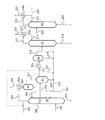
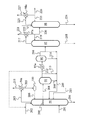
- FIG. 1 is an example of an acetic acid production flow diagram (methanol carbonylation process) showing an embodiment of the present invention.
- the acetic acid production apparatus according to this acetic acid production flow includes a reaction tank 1, an evaporation tank 2, a distillation tower 3, a decanter 4, a distillation tower 5, a distillation tower 6, an ion exchange resin tower 7, and a scrubber system 8.
- the acetaldehyde separation and removal system 9 the distillation column 10, the condensers 1a, 2a, 3a, 5a, 6a, 10a, the heat exchanger 2b, the reboilers 3b, 5b, 6b, 10b, and the lines 11 to 56, 58.
- a reaction process and an evaporation process Flash step
- first distillation step corresponds to the first separation step
- second distillation step corresponds to the second separation step.
- the first distillation step is also called a delow boiling step
- the second distillation step is also called a dehydration step
- the third distillation step is also called a dehigh boiling step.
- the process is not limited to the above, and for example, the equipment of the distillation tower 5, the distillation tower 6, the ion exchange resin tower 7, and the acetaldehyde separation / removal system 9 (such as a deacetaldehyde tower) may not be attached. Further, as will be described later, a product tower may be provided downstream of the ion exchange resin tower 7.
- the reaction tank 1 is a unit for performing a reaction process.
- This reaction step is a step for continuously generating acetic acid by a reaction (methanol carbonylation reaction) represented by the following chemical formula (1).
- a reaction mixture that is stirred by, for example, a stirrer exists in the reaction tank 1.
- the reaction mixture contains methanol and carbon monoxide as raw materials, a metal catalyst, a cocatalyst, water, acetic acid for production purposes, and various by-products, and the liquid phase and the gas phase are in an equilibrium state. It is in. CH 3 OH + CO ⁇ CH 3 COOH (1)
- the raw materials in the reaction mixture are liquid methanol and gaseous carbon monoxide.
- Methanol is continuously supplied from the methanol reservoir (not shown) to the reaction tank 1 through the line 11 at a predetermined flow rate.
- Carbon monoxide is continuously supplied from the carbon monoxide reservoir (not shown) to the reaction tank 1 through the line 12 at a predetermined flow rate.
- Carbon monoxide is not necessarily pure carbon monoxide, and contains a small amount (for example, 5% by mass or less, preferably 1% by mass or less) of other gases such as nitrogen, hydrogen, carbon dioxide, and oxygen. Also good.
- the metal catalyst in the reaction mixture is for accelerating the carbonylation reaction of methanol.
- a rhodium catalyst or an iridium catalyst can be used.
- the rhodium catalyst for example, the formula [Rh (CO) 2 I 2 ] - rhodium complex represented by the can be used.
- the iridium catalyst such as chemical formulas [Ir (CO) 2 I 2 ] - iridium complex represented by the can be used.
- a metal complex catalyst is preferable as the metal catalyst.
- the concentration of the catalyst in the reaction mixture is, for example, 100 to 10000 mass ppm, preferably 200 to 5000 mass ppm, more preferably 400 to 3000 mass ppm, with respect to the entire liquid phase of the reaction mixture.
- the cocatalyst is an iodide for assisting the action of the above-described catalyst.
- methyl iodide or ionic iodide is used.
- Methyl iodide can exhibit an action of promoting the catalytic action of the above-described catalyst.
- the concentration of methyl iodide is, for example, 1 to 20% by mass with respect to the entire liquid phase of the reaction mixture.
- the ionic iodide is an iodide (in particular, an ionic metal iodide) that generates iodide ions in the reaction solution, and can exhibit an effect of stabilizing the above-described catalyst and an effect of suppressing side reactions.
- the ionic iodide examples include alkali metal iodides such as lithium iodide, sodium iodide, and potassium iodide.
- concentration of the ionic iodide in the reaction mixture is, for example, 1 to 25% by mass, preferably 5 to 20% by mass, based on the entire liquid phase of the reaction mixture.
- a ruthenium compound or an osmium compound can also be used as a promoter.
- the total amount of these compounds used is, for example, 0.1 to 30 mol (metal conversion), preferably 0.5 to 15 mol (metal conversion) with respect to 1 mol of iridium (metal conversion).
- Water in the reaction mixture is a component necessary for generating acetic acid in the reaction mechanism of the carbonylation reaction of methanol, and is also a component necessary for solubilization of water-soluble components in the reaction system.
- the concentration of water in the reaction mixture is, for example, 0.1 to 15% by mass, preferably 0.8 to 10% by mass, more preferably 1 to 6% by mass, based on the entire liquid phase of the reaction mixture.
- the amount is preferably 1.5 to 4% by mass.
- the water concentration is preferably 15% by mass or less in order to suppress the energy required for water removal during the purification process of acetic acid and promote the efficiency of acetic acid production.
- a predetermined flow rate of water may be continuously supplied to the reaction tank 1.
- Acetic acid in the reaction mixture contains acetic acid that is charged in advance in the reaction tank 1 before the operation of the acetic acid production apparatus, and acetic acid generated as a main product of methanol carbonylation reaction. Such acetic acid can function as a solvent in the reaction system.
- the concentration of acetic acid in the reaction mixture is, for example, 50 to 90% by mass, preferably 60 to 80% by mass, based on the entire liquid phase of the reaction mixture.
- Examples of main by-products contained in the reaction mixture include methyl acetate. This methyl acetate can be generated by the reaction of acetic acid and methanol.
- the concentration of methyl acetate in the reaction mixture is, for example, 0.1 to 30% by mass, preferably 1 to 10% by mass, with respect to the entire liquid phase of the reaction mixture.
- Examples of by-products contained in the reaction mixture include hydrogen iodide. This hydrogen iodide is inevitably generated due to the reaction mechanism of the carbonylation reaction of methanol when the above-described catalyst or promoter is used.
- the concentration of hydrogen iodide in the reaction mixture is, for example, 0.01 to 2% by mass with respect to the entire liquid phase of the reaction mixture.
- Examples of by-products include hydrogen, methane, carbon dioxide, acetaldehyde, crotonaldehyde, 2-ethylcrotonaldehyde, butyl acetate, dimethyl ether, alkanes, formic acid, and propionic acid, as well as ethyl iodide and iodide.
- alkyl iodides such as propyl, butyl iodide, hexyl iodide and decyl iodide.
- the acetaldehyde concentration in the reaction mixture is, for example, 500 ppm by mass or less, preferably 450 ppm by mass or less, more preferably 400 ppm by mass or less, further preferably 350 ppm by mass or less, and particularly preferably 300 ppm by mass or less (for example, 250 ppm by mass).
- the lower limit of the acetaldehyde concentration in the reaction mixture is, for example, 1 mass ppm (or 10 mass ppm).
- the crotonaldehyde concentration in the reaction mixture is, for example, 5 mass ppm or less, preferably 3 mass ppm or less, and more preferably 2 mass ppm or less.
- the lower limit of the crotonaldehyde concentration in the reaction mixture is 0 ppm, but may be, for example, 0.1 mass ppm (or 0.2 mass ppm).
- the concentration of 2-ethylcrotonaldehyde in the reaction mixture is, for example, 5 ppm by mass or less, preferably 3 ppm by mass or less, and more preferably 2 ppm by mass or less.
- the lower limit of the 2-ethylcrotonaldehyde concentration in the reaction mixture is 0 ppm, but may be, for example, 0.1 mass ppm or 0.2 mass ppm.
- the reflux ratio of the delow boiling tower is controlled to a specific value or more and is extracted from the delow boiling tower.
- concentration of crotonaldehyde in the first acetic acid stream is controlled to a specific value or less, or the reflux ratio of the dehydration tower is controlled to a specific value or more.
- reaction Increase the hydrogen partial pressure in the tank or increase the reflux ratio in the deboiling tower.
- reflux ratio of the deboiling tower or dehydration tower is increased, crotonaldehyde is concentrated at the top of each distillation tower.
- the crotonaldehyde When this concentrated crotonaldehyde is recycled to the reaction vessel, the crotonaldehyde is hydrogenated to butyl alcohol, which in turn reacts with acetic acid to be converted to butyl acetate, rendering it harmless to the potassium permanganate test. Is done. Further, when the hydrogen partial pressure in the reaction vessel is increased, crotonaldehyde in the reaction vessel is easily hydrogenated, and is converted into harmless butyl acetate via butyl alcohol as described above. Therefore, in the present invention, the butyl acetate concentration in the reaction mixture tends to increase. However, increasing the butyl acetate concentration may lead to a decrease in the purity of the product acetic acid. Therefore, the butyl acetate concentration in the reaction mixture is preferably controlled to, for example, 0.1 to 15 mass ppm (particularly 1 to 12 mass ppm, especially 2 to 9 mass ppm).
- the reaction mixture contains metals such as iron, nickel, chromium, manganese, and molybdenum [corrosive metal (also called corrosive metal)] generated by corrosion of the apparatus, and other metals such as cobalt, zinc, and copper. obtain.
- the corrosive metal and other metals may be collectively referred to as “corrosive metal or the like”.
- the reaction temperature is set to 150 to 250 ° C., for example, and the reaction pressure as the total pressure is set to 2.0 to 3.5 MPa (absolute pressure), for example.
- the carbon monoxide partial pressure is set to, for example, 0.4 to 1.8 MPa (absolute pressure), preferably 0.6 to 1.6 MPa (absolute pressure), more preferably 0.9 to 1.4 MPa (absolute pressure). Is done.
- carbon monoxide, hydrogen, methane, carbon dioxide, nitrogen, oxygen, methyl iodide, hydrogen iodide, water, methyl acetate, acetic acid, dimethyl ether can be used as the vapor in the gas phase in the reaction tank 1 when the apparatus is in operation.
- Methanol, acetaldehyde, formic acid, propionic acid, and the like In addition to being contained in carbon monoxide used as a raw material, hydrogen is generated by a shift reaction (CO + H 2 O ⁇ H 2 + CO 2 ) occurring in the reaction vessel 1.
- the hydrogen partial pressure in the reaction tank 1 is, for example, 0.001 MPa (absolute pressure) or more [eg, 0.005 MPa or more], preferably 0.01 MPa (absolute pressure) or more [eg, 0.015 MPa or more], more preferably 0.02 MPa. (Absolute pressure) or more, more preferably 0.04 MPa (absolute pressure) or more, particularly preferably 0.06 MPa (absolute pressure) or more [for example, 0.07 MPa (absolute pressure) or more].
- the upper limit of the hydrogen partial pressure in the reaction tank is, for example, 0.5 MPa (absolute pressure) [particularly 0.2 MPa (absolute pressure)].
- the partial pressure of hydrogen in the reactor is increased too much, the amount of acetaldehyde produced will increase and crotonaldehyde will increase due to aldol condensation. Conversely, if it is too small, the reaction of crotonaldehyde ⁇ butanol will hardly occur, but there will be slight fluctuations in hydrogen. As a result, the reaction rate fluctuates greatly and the operation becomes unstable.
- the vapor in the gas phase in the reaction vessel 1 can be extracted from the reaction vessel 1 through the line 13. It is possible to control the pressure in the reaction tank 1 by adjusting the amount of steam extracted. For example, the pressure in the reaction tank 1 is maintained constant. The steam extracted from the reaction tank 1 is introduced into the condenser 1a.
- the condenser 1a divides the vapor from the reaction vessel 1 into a condensed component and a gas component by cooling and partially condensing.
- the condensate contains, for example, methyl iodide, hydrogen iodide, water, methyl acetate, acetic acid, dimethyl ether, methanol, acetaldehyde, formic acid and propionic acid, and is introduced from the condenser 1a to the reaction tank 1 through the line 14 and recycled. Is done.
- the gas component includes, for example, carbon monoxide, hydrogen, methane, carbon dioxide, nitrogen, oxygen, methyl iodide, hydrogen iodide, water, methyl acetate, acetic acid, dimethyl ether, methanol, acetaldehyde, and formic acid.
- useful components for example, methyl iodide, water, methyl acetate, acetic acid, etc.
- a wet method is used for this separation and recovery, which is performed using an absorbent for collecting useful components in the gas component.
- an absorbing solvent containing at least acetic acid and / or methanol is preferable.
- the absorbing solution may contain methyl acetate.
- a condensate of vapor from the later-described distillation column 6 can be used as the absorbing liquid.
- a pressure fluctuation adsorption method may be used.
- Separated and recovered useful components are introduced from the scrubber system 8 into the reaction tank 1 through the recycling line 48 and recycled.
- the gas after collecting useful components is discarded through line 49.
- the gas discharged from the line 49 can be used as a CO source to be introduced into the bottom of the evaporation tank 2 described later or the residual liquid flow recycling lines 18 and 19.
- the processing in the scrubber system 8 and the subsequent recycling and disposal to the reaction vessel 1 are the same for the gas components described later supplied from other capacitors to the scrubber system 8.
- the production method of the present invention preferably has a scrubber step of absorbing off-gas from the process with an absorption solvent containing at least acetic acid to separate a stream rich in carbon monoxide and a stream rich in acetic acid.
- acetic acid is continuously produced in the reaction tank 1 when the apparatus is in operation.
- a reaction mixture containing such acetic acid is continuously withdrawn from the reaction tank 1 at a predetermined flow rate and introduced into the next evaporation tank 2 through a line 16.
- the evaporation tank 2 is a unit for performing an evaporation process (flash process).
- a vapor stream (volatile phase) and a residual liquid stream (low volatile phase) are obtained by partially evaporating the reaction mixture continuously introduced into the evaporation tank 2 through the line 16 (reaction mixture supply line). It is a process for dividing into. Evaporation may be caused by reducing the pressure without heating the reaction mixture, or evaporation may be caused by reducing the pressure while heating the reaction mixture.
- the temperature of the vapor stream is, for example, 100 to 260 ° C., preferably 120 to 200 ° C.
- the temperature of the residual liquid stream is, for example, 80 to 200 ° C., preferably 100 to 180 ° C.
- the pressure in the tank is, for example, 50 to 1000 kPa (absolute pressure).
- the ratio of the vapor flow and the residual liquid flow separated in the evaporation step is, for example, 10/90 to 50/50 (vapor flow / residual liquid flow) in mass ratio.
- the vapor generated in this step is, for example, methyl iodide, hydrogen iodide, water, methyl acetate, acetic acid, dimethyl ether, methanol, acetaldehyde, crotonaldehyde, 2-ethylcrotonaldehyde, butyl acetate, propionic acid, and iodide. It contains alkyl iodide such as ethyl, propyl iodide, butyl iodide, hexyl iodide, and decyl iodide, and is continuously extracted from the evaporation tank 2 to a line 17 (vapor flow discharge line).
- alkyl iodide such as ethyl, propyl iodide, butyl iodide, hexyl iodide, and decyl iodide
- the acetic acid concentration of the vapor stream is, for example, 50 to 85% by mass, preferably 55 to 75% by mass
- the methyl iodide concentration is, for example, 2 to 50% by mass (preferably 5 to 30% by mass)
- the water concentration is For example, 0.2 to 20% by mass (preferably 1 to 15% by mass)
- the methyl acetate concentration is, for example, 0.2 to 50% by mass (preferably 2 to 30% by mass).
- the crotonaldehyde concentration in the vapor stream is, for example, 0 to 5.0 mass ppm (eg, 0.01 to 4.0 mass ppm), preferably 0.1 to 3.0 mass ppm, more preferably 0.2 to 2 ppm. 0.0 ppm by mass.
- the concentration of 2-ethylcrotonaldehyde in the vapor stream is, for example, 0 to 3.0 ppm by mass (for example, 0.01 to 2.5 ppm by mass), preferably 0.02 to 2.0 ppm by mass, and more preferably 0.8. It is 03 to 0.8 ppm by mass.
- the concentration of butyl acetate in the vapor stream is, for example, 0.1 to 13 ppm by mass, preferably 0.2 to 12 ppm by mass, and more preferably 0.3 to 9 ppm by mass.
- the residual liquid stream generated in this step is the catalyst and cocatalyst (methyl iodide, lithium iodide, etc.) contained in the reaction mixture, water remaining without volatilization in this step, methyl acetate, acetic acid, crotonaldehyde. , 2-ethylcrotonaldehyde, butyl acetate, formic acid, propionic acid, and the like, and are continuously introduced from the evaporation tank 2 to the heat exchanger 2b through the line 18 using the pump 57.
- the heat exchanger 2b cools the residual liquid stream from the evaporation tank 2.
- the cooled residual liquid stream is continuously introduced from the heat exchanger 2b to the reaction tank 1 through the line 19 and recycled.
- the line 18 and the line 19 are collectively referred to as a residual liquid flow recycling line.
- the acetic acid concentration in the residual stream is, for example, 55 to 90% by mass, preferably 60 to 85% by mass.
- the condenser 2a divides the vapor flow from the evaporation tank 2 into a condensed component and a gas component by cooling and partially condensing.
- Condensed components include, for example, methyl iodide, hydrogen iodide, water, methyl acetate, acetic acid, dimethyl ether, methanol, acetaldehyde, crotonaldehyde, 2-ethylcrotonaldehyde, butyl acetate, formic acid, propionic acid, etc., and capacitor 2a To the reaction tank 1 through the lines 22 and 23 and recycled.
- the gas component includes, for example, carbon monoxide, hydrogen, methane, carbon dioxide, nitrogen, oxygen, methyl iodide, hydrogen iodide, water, methyl acetate, acetic acid, dimethyl ether, methanol, acetaldehyde, formic acid, etc., and capacitor 2a
- the acetic acid production reaction in the above reaction step is an exothermic reaction, and part of the heat accumulated in the reaction mixture is transferred to the vapor generated from the reaction mixture in the evaporation step (flash step).
- the condensed matter generated by the cooling of the steam in the condenser 2 a is recycled to the reaction tank 1. That is, in this acetic acid production apparatus, heat generated by the carbonylation reaction of methanol is efficiently removed by the capacitor 2a.
- the distillation column 3 is a unit for performing the first distillation step, and is positioned as a so-called deboiling tower in this embodiment.
- the first distillation step is a step of separating and removing low boiling components by distillation treatment of the steam stream continuously introduced into the distillation column 3. More specifically, in the first distillation step, the vapor stream is distilled and separated into an overhead stream rich in at least one low-boiling component selected from methyl iodide and acetaldehyde, and an acetic acid stream rich in acetic acid.
- the distillation column 3 is composed of, for example, a rectification column such as a plate column and a packed column. When a plate column is employed as the distillation column 3, the theoretical plate is, for example, 5 to 50 plates.
- the column top pressure is set to, for example, 80 to 160 kPa (gauge pressure), and the column bottom pressure is higher than the column top pressure, for example, 85 to 180 kPa (gauge pressure).
- the column top temperature is set to 90 to 130 ° C., for example, lower than the boiling point of acetic acid at the set column top pressure
- the column bottom temperature is set to, for example, the set column bottom pressure.
- the temperature is equal to or higher than the boiling point of acetic acid and is set to 120 to 165 ° C. (preferably 125 to 160 ° C.).
- the vapor flow from the evaporation tank 2 is continuously introduced through the line 21, and the vapor as an overhead flow is continuously extracted from the top of the distillation column 3 to the line 24. From the bottom of the distillation column 3, the bottoms are continuously extracted into the line 25.
- 3b is a reboiler.
- An acetic acid stream (first acetic acid stream; liquid) as a side stream is continuously extracted from the line 27 from a height position between the top and bottom of the distillation column 3.
- the steam withdrawn from the top of the distillation column 3 contains a larger amount of components having a lower boiling point than that of acetic acid (low-boiling components) compared to the bottoms and side stream from the distillation column 3, such as methyl iodide, Including hydrogen iodide, water, methyl acetate, dimethyl ether, methanol, acetaldehyde, crotonaldehyde, and formic acid. This vapor also contains acetic acid.
- Such steam is continuously introduced into the condenser 3a through the line 24.
- the condenser 3a cools and partially condenses the vapor from the distillation tower 3 to divide it into a condensed component and a gas component.
- the condensate includes, for example, methyl iodide, hydrogen iodide, water, methyl acetate, acetic acid, dimethyl ether, methanol, acetaldehyde, crotonaldehyde, and formic acid, and is continuously introduced from the capacitor 3a to the decanter 4 through the line 28. Is done.
- the condensed matter introduced into the decanter 4 is separated into an aqueous phase (upper phase) and an organic phase (methyl iodide phase; lower phase).
- the aqueous phase includes water and, for example, methyl iodide, hydrogen iodide, methyl acetate, acetic acid, dimethyl ether, methanol, acetaldehyde, crotonaldehyde, and formic acid.
- the organic phase includes methyl iodide and, for example, hydrogen iodide, water, methyl acetate, acetic acid, dimethyl ether, methanol, acetaldehyde, crotonaldehyde, and formic acid.
- a part of the aqueous phase is refluxed to the distillation column 3 through the line 29, and the other part of the aqueous phase is introduced into the reaction tank 1 through the lines 29, 30, and 23 and recycled.
- a part of the organic phase is introduced into the reaction vessel 1 through lines 31 and 23 and recycled.
- the other part of the organic phase and / or the other part of the aqueous phase is introduced into the acetaldehyde separation and removal system 9 through the lines 31, 50 and / or the lines 30, 51.
- a part of the organic phase may be refluxed to the distillation column 3.
- the reflux ratio of the distillation column 3 will be described below.
- the reflux ratio of the aqueous phase (the reflux amount of the aqueous phase / the distillate amount of the aqueous phase) is, for example, 2 or more. Preferably it is 3 or more, more preferably 4 or more, still more preferably 8 or more, and particularly preferably 10 or more.
- the reflux ratio of the organic phase (the reflux amount of the organic phase / the distillate amount of the organic phase) is, for example, 1 or more, preferably 1.
- the reflux ratio of the sum of the water phase and the organic phase (the sum of the reflux amounts of the water phase and the organic phase / the water phase and the organic phase).
- the total amount of distillates of the phases is, for example, 1.5 or more, preferably 2.3 or more, more preferably 3 or more, still more preferably 6 or more, and particularly preferably 7.5 or more.
- the reflux ratio of the aqueous phase (the reflux amount of the aqueous phase / the distillate amount of the aqueous phase) is preferably 2 or more, more preferably 3 or more, even more preferably. Is 5 or more, particularly preferably 8 or more, especially 12 or more.
- the condensate reflux ratio is 1.5 or more, preferably 2.3 or more, more preferably 3.5 or more, and even more preferably 6 or more. Especially preferably, it is 8.5 or more.
- the reflux ratio of the distillation column 3 may be either the upper phase or the lower phase. Regardless of the reflux, it may be 0.5 or more, for example.
- the upper limit of the reflux ratio of the distillation column 3 may be 3000 (particularly 1000) or 100 (particularly 30), for example.
- crotonaldehyde (boiling point 104 ° C.) has a lower boiling point than acetic acid (boiling point 117 ° C.)
- crotonaldehyde is more concentrated at the top of the distillation column 3 by increasing the reflux ratio of the distillation column 3.
- the crotonaldehyde concentration in the first acetic acid stream obtained as a side stream is reduced.
- the condensate (water phase and / or organic phase) of the first overhead stream in which crotonaldehyde is concentrated by increasing the reflux ratio of the distillation column 3 is recycled to the reaction tank 1, the crotonaldehyde in the reaction tank 1 is recycled.
- a part of the organic phase is introduced into the distillation column 10 (decrotonaldehyde aldehyde column) through lines 31, 50 and 58, and crotonaldehyde is separated and removed by distillation.
- This distillation may be performed either continuously (continuous operation) or batch (batch treatment).
- a processing amount preparation amount
- the processing amount in the distillation column 10 is, for example, 0.0001 to 50 parts by mass (for example, 0.005) when the charged amount of the distillation column 3 (first distillation column; delow boiling column) is 100 parts by mass. (001 to 30 parts by mass), or 0.01 to 10 parts by mass (for example, 0.1 to 5 parts by mass).
- the distillation column 10 is composed of a rectifying column such as a plate column and a packed column, for example.
- the theoretical plate of the distillation column 10 is, for example, 1 to 100 plates, preferably 2 to 50 plates, more preferably 4 to 30 plates, and further preferably 5 to 20 plates (eg 6 to 15 plates).
- the feed position of the feed liquid to the distillation column 10 is an intermediate position in the height direction of the distillation column (between the first column from the column top to the lower first column and the first column from the column bottom). However, it may be about 20% down to 80% down (2/10 to 8/10) from above. If the charging position is too low, the loss of methyl iodide increases, and if it is too high, the removal amount of crotonaldehyde (and the removal amount of alkanes) decreases.
- the crotonaldehyde concentration in the supply liquid (feed liquid) to the distillation column 10 is usually 0.01 to 50 ppm by mass (for example, 0.1 to 50 ppm by mass), preferably 0.3 to 30 ppm by mass, more preferably It is 0.5 to 10 ppm by mass, more preferably 0.8 to 7.0 ppm by mass (for example, 1.0 to 5.0 ppm by mass).
- the top vapor of the distillation column 10 is introduced into the condenser 10a through the line 59 and condensed. A part of the condensate is refluxed to the distillation column 10 through the line 61, and the rest of the condensate is withdrawn as a distillate through the line 62.
- the distillate mainly contains methyl iodide and methyl acetate, and also contains dimethyl ether and low boiling alkanes.
- the distillate can be recycled to the decanter 4 or the reaction tank 1, for example.
- the gas component that has not been condensed in the condenser 10 a in the tower top vapor is sent to, for example, the scrubber system 8 through the line 63.
- the bottoms is withdrawn from the bottom of the distillation column 10 through a line 60.
- the bottoms mainly contain high boiling impurities such as crotonaldehyde, 2-ethylcrotonaldehyde, butyl acetate, alkanes, and acetic acid. This bottoms is usually discarded.
- Water contained in a trace amount in the organic phase may be concentrated at the top of the column or withdrawn from the bottom.
- the aqueous phase may be introduced into the distillation column 10 through the lines 30, 51 and 58.
- a distillate containing water is obtained from the top of the distillation column 10
- a bottoms containing high-boiling impurities such as crotonaldehyde and acetic acid is obtained from the bottom of the column.
- crotonaldehyde can be efficiently removed by treating the aqueous phase and / or the organic phase with the distillation column 10, thereby improving the potassium permanganate test value of the product acetic acid.
- the reflux ratio (reflux amount / distillation amount) of the distillation column 10 is, for example, 0.01 or more, preferably 0.05 or more, more preferably 0.5 or more, further preferably 5 or more, particularly preferably 20 or more (for example, 30 or more).
- the upper limit of the reflux ratio of the distillation column 10 is, for example, 1000 (or 100). If the reflux ratio of the distillation column 10 is too large, the crotonaldehyde concentrated on the bottom of the column is concentrated on the top of the column and the concentration of acetic acid having a higher boiling point becomes higher. Is preferred.
- the ratio (the former / the latter) of the crotonaldehyde concentration (mass ppm) in the distillate of the distillation column 10 to the crotonaldehyde concentration (mass ppm) in the charged solution is, for example, 1 Less than, preferably 0.95 or less, more preferably 0.80 or less, further preferably 0.70 or less, particularly preferably 0.60 or less (for example 0.50 or less, especially 0.30 or less, especially 0.20 or less. ).
- the ratio (the former / the latter) of the crotonaldehyde concentration (mass ppm) in the bottoms of the distillation column 10 to the crotonaldehyde concentration (mass ppm) in the charged solution is greater than 1, for example, preferably 1.2. More preferably, it is 1.5 or more, more preferably 2.0 or more, particularly preferably 3.0 or more (for example, 4.0 or more, especially 5.0 or more), especially 10 or more (for example, 20 or more).
- acetaldehyde separation / removal step using the acetaldehyde separation / removal system 9 a known method, for example, acetaldehyde contained in at least a part of one or more liquids selected from the group consisting of the condensate, the organic phase, and the aqueous phase, for example, , Distillation, extraction or a combination thereof.
- the separated acetaldehyde is discharged out of the apparatus through a line 53.
- useful components such as methyl iodide contained in the condensate, the organic phase, and the aqueous phase are recycled to the reaction vessel 1 through the lines 52 and 23 and reused.
- FIG. 2 is a schematic flow diagram showing an example of an acetaldehyde separation and removal system.
- the organic phase is fed to the distillation column (first deacetaldehyde column) 91 through the line 101 and distilled, and an overhead stream rich in acetaldehyde is obtained. (Line 102) and a residual stream rich in methyl iodide (line 103).
- the overhead stream is condensed in the condenser 91a, a part of the condensate is refluxed to the top of the distillation column 91 (line 104), and the other part of the condensate is supplied to the extraction tower 92 (line 105).
- the condensate supplied to the extraction tower 92 is extracted with water introduced from the line 109.
- the extract obtained by the extraction process is supplied to a distillation tower (second deacetaldehyde tower) 93 through a line 107 and distilled, and an overhead stream rich in acetaldehyde (line 112) and a residual liquid stream rich in water (line 113) To separate.
- the overhead stream rich in acetaldehyde is condensed by the condenser 93a, a part of the condensate is refluxed to the top of the distillation column 93 (line 114), and the other part of the condensate is discharged out of the system (line 115). ).
- a methyl iodide-rich residual liquid stream that is the bottoms of the first deacetaldehyde column 91, a methyl iodide-rich raffinate obtained in the extraction column 92 (line 108), and a second deacetaldehyde column 93 can
- the water-rich residual liquid stream that is the effluent is recycled to the reaction vessel 1 through lines 103, 111, and 113, respectively, or recycled to an appropriate location in the process and reused.
- the methyl iodide rich raffinate obtained in extraction column 92 can be recycled to distillation column 91 through line 110.
- the liquid 113 is usually discharged to the outside as waste water. Gases (lines 106, 116) that have not been condensed by the condensers 91a, 93a are absorbed by the scrubber system 8 or disposed of.
- the aqueous phase is supplied to the distillation column (first deacetaldehyde column) 91 through the line 101 and distilled to enrich the acetaldehyde.
- the overhead stream (line 102) is separated into a water-rich residual liquid stream (line 103).
- the overhead stream is condensed in the condenser 91a, a part of the condensate is refluxed to the top of the distillation column 91 (line 104), and the other part of the condensate is supplied to the extraction tower 92 (line 105).
- the condensate supplied to the extraction tower 92 is extracted with water introduced from the line 109.
- the extract obtained by the extraction process is supplied to a distillation tower (second deacetaldehyde tower) 93 through a line 107 and distilled, and an overhead stream rich in acetaldehyde (line 112) and a residual liquid stream rich in water (line 113) To separate.
- the overhead stream rich in acetaldehyde is condensed by the condenser 93a, a part of the condensate is refluxed to the top of the distillation column 93 (line 114), and the other part of the condensate is discharged out of the system (line 115). ).
- a water-rich residual stream that is the bottoms of the first deacetaldehyde tower 91, a methyl iodide-rich raffinate obtained from the extraction tower 92 (line 108), and a bottoms of the second deacetaldehyde tower 93
- the water-rich residual liquid stream is recycled to the reaction tank 1 through the lines 103, 111, and 113, or recycled to an appropriate part of the process and reused.
- the methyl iodide rich raffinate obtained in extraction column 92 can be recycled to distillation column 91 through line 110.
- the liquid 113 is usually discharged to the outside as waste water. Gases (lines 106, 116) that have not been condensed by the condensers 91a, 93a are absorbed by the scrubber system 8 or disposed of.
- Acetaldehyde derived from a process stream containing at least water, acetic acid (AC), methyl iodide (MeI) and acetaldehyde (AD) can be separated and removed using extractive distillation in addition to the above method.
- the organic phase and / or the aqueous phase (feed solution) obtained by separating the process stream is supplied to a distillation column (extraction distillation column), and methyl iodide and acetaldehyde in the distillation column are concentrated.
- An extraction solvent usually water
- is introduced into the concentration area for example, the space from the top of the column to the feed liquid supply position
- the liquid descending from the concentration area extraction liquid is extracted as a side flow (side cut flow).
- Acetaldehyde can be discharged out of the system by separating the side stream into an aqueous phase and an organic phase and distilling the aqueous phase. If a relatively large amount of water is present in the distillation column, the liquid descending from the concentration zone may be withdrawn as a side stream without introducing the extraction solvent into the distillation column.
- a unit such as a chimney tray
- the extraction solvent introduction position is preferably above the feed liquid supply position, and more preferably near the top of the column.
- the side stream extraction position is preferably lower than the extraction solvent introduction position and higher than the feed liquid supply position in the height direction of the column.
- a high concentration of acetaldehyde can be extracted from the concentrate of methyl iodide and acetaldehyde with an extraction solvent (usually water), and the area between the extraction solvent introduction site and the side cut site is used as an extraction zone. Therefore, acetaldehyde can be extracted efficiently with a small amount of extraction solvent. Therefore, for example, the number of stages of the distillation column can be greatly reduced and the steam load can be reduced as compared with a method of extracting the extract by extraction distillation from the bottom of the distillation column (extraction distillation column).
- the ratio (MeI / AD ratio) of methyl iodide with respect to acetaldehyde in a water extract can be made smaller than the method of combining dealdehyde distillation and water extraction of FIG. 2 using a small amount of extraction solvent, Acetaldehyde can be removed under conditions that can prevent loss of methyl iodide to the outside of the system.
- the concentration of acetaldehyde in the side stream is much higher than the concentration of acetaldehyde in the charged solution and bottoms (bottom solution).
- the ratio of the acetaldehyde with respect to the methyl iodide in the said side stream is larger than the ratio of the acetaldehyde with respect to the methyl iodide in the preparation liquid and the bottom liquid.
- the organic phase (methyl iodide phase) obtained by separating the side stream may be recycled to this distillation column.
- the recycling position of the organic phase obtained by separating the side flow is preferably lower than the side flow extraction position in the height direction of the tower, and preferably higher than the feed liquid supply position.
- a miscible solvent for components (for example, methyl acetate) constituting the organic phase obtained by separating the process stream may be introduced into this distillation column (extraction distillation column).
- miscible solvent examples include acetic acid and ethyl acetate.
- the introduction position of the miscible solvent is preferably lower than the side flow extraction position and higher than the feed liquid supply position in the height direction of the tower.
- the introduction position of the miscible solvent is preferably lower than the recycling position when the organic phase obtained by separating the side stream is recycled to the distillation column. Recycling the organic phase obtained by separating the side stream into a distillation column or introducing the miscible solvent into the distillation column can reduce the methyl acetate concentration in the extract extracted as a side stream.
- the concentration of methyl acetate in the aqueous phase obtained by separating the extract can be reduced, so that the mixing of methyl iodide into the aqueous phase can be suppressed.
- the theoretical column of the distillation column is, for example, 1 to 100 plate, preferably 2 to 50 plate, more preferably 3 to 30 plate, particularly preferably 5 to 20 plate, and is used for conventional deacetaldehyde.
- acetaldehyde can be separated and removed efficiently with a small number of stages.
- the mass ratio (the former / the latter) of the flow rate of the extraction solvent and the flow rate of the feed liquid (the organic phase and / or the aqueous phase obtained by separating the process stream) is in the range of 0.0001 / 100 to 100/100.
- the top temperature of the distillation column is, for example, 15 to 120 ° C., preferably 20 to 90 ° C., more preferably 20 to 80 ° C., and further preferably 25 to 70 ° C.
- the tower top pressure is an absolute pressure, for example, about 0.1 to 0.5 MPa.
- Other conditions for the distillation column may be the same as those for the conventional distillation column and extraction distillation column used for deacetaldehyde.
- FIG. 3 is a schematic flow diagram showing an example of an acetaldehyde separation / removal system using the extractive distillation.
- the organic phase and / or the aqueous phase (feed solution) obtained by separating the process stream is supplied to the middle stage of the distillation column 94 (position between the top and the bottom) through the supply line 201.
- water is introduced from the vicinity of the top of the column through the line 202, and extractive distillation is performed in the distillation column 94 (extraction distillation column).
- a chimney tray 200 for receiving a liquid (extracted liquid) descending from a concentration area where methyl iodide and acetaldehyde in the tower are concentrated is disposed above the supply position of the charged liquid in the distillation column 94. .
- the entire amount of the liquid on the chimney tray 200 is preferably withdrawn and introduced into the decanter 95 through the line 208 for liquid separation.
- the aqueous phase (including acetaldehyde) in the decanter 95 is introduced into the cooling cooler 95 a through the line 212 and cooled, and the two phases of methyl iodide dissolved in the aqueous phase are separated and separated in the decanter 96.
- the aqueous phase in the decanter 96 is fed to the distillation column 97 (deacetaldehyde column) through the line 216 and distilled, and the vapor at the top of the column is led to the condenser 97a through the line 217 to be condensed and condensed (mainly acetaldehyde and methyl iodide). ) Is refluxed to the top of the distillation column 97 and the rest is discarded or supplied to the distillation column 98 (extraction distillation column) through the line 220. Water is introduced from the vicinity of the top of the distillation column 98 through the line 222, and extractive distillation is performed.
- the vapor at the top of the column is led to the condenser 98a through the line 223 to be condensed, a part of the condensate (mainly methyl iodide) is refluxed to the top of the column, and the rest is recycled to the reaction system through the line 226.
- the entire amount of the organic phase (methyl iodide phase) in the decanter 95 is preferably recycled below the position of the chimney tray 200 in the distillation column 94 through lines 209 and 210.
- a part of the aqueous phase of the decanter 95 and the organic phase of the decanter 96 are recycled to the distillation column 94 through lines 213 and 210 and lines 214 and 210, respectively, but may not be recycled.
- a part of the aqueous phase of the decanter 95 may be used as an extraction solvent (water) in the distillation column 94.
- a portion of the aqueous phase of the decanter 96 may be recycled to the distillation column 94 through line 210.
- a miscible solvent acetic acid, etc.
- components for example, methyl acetate constituting the organic phase obtained by separating the process stream.
- Ethyl acetate, etc. can be charged into the distillation column 94 through the line 215 to improve the distillation efficiency.
- the supply position of the miscible solvent to the distillation column 94 is above the feed liquid supply unit (connection part of the line 201) and below the connection part of the recycle line 210.
- the bottoms of the distillation column 94 is recycled to the reaction system.
- the vapor at the top of the distillation column 94 is led to the condenser 94a through the line 203 to condense, the condensate is separated by the decanter 99, the organic phase is refluxed to the top of the distillation column 94 through the line 206, and the water phase is the line.
- Guide to decanter 95 through 207 is described by decanter 95 through 207.
- the bottoms of the distillation tower 97 (water is the main component) and the bottoms of the distillation tower 98 (extraction distillation tower) (water containing a small amount of acetaldehyde) are removed from the system through lines 218 and 224, respectively, or the reaction system. Recycle to. Gases (lines 211, 2221 and 227) which have not been condensed by the condensers 94a, 97a and 98a are absorbed by the scrubber system 8 or disposed of.
- FIG. 4 is a schematic flow diagram showing another example of an acetaldehyde separation and removal system using the extractive distillation.
- the vapor condensate at the top of the distillation column 94 is led to the hold tank 100, and the entire amount is refluxed to the top of the distillation column 94 through the line 206.
- the rest is the same as the example of FIG.
- FIG. 5 is a schematic flow diagram showing still another example of the acetaldehyde separation and removal system using the extractive distillation.
- the entire amount of the liquid on the chimney tray 200 is extracted, and directly introduced into the cooling cooler 95 a through the line 208 without passing through the decanter 95, cooled, and supplied to the decanter 96.
- the rest is the same as the example of FIG.
- the gas generated in the capacitor 3a is, for example, carbon monoxide, hydrogen, methane, carbon dioxide, nitrogen, oxygen, methyl iodide, hydrogen iodide, water, methyl acetate, acetic acid, dimethyl ether, methanol, acetaldehyde. , And formic acid, etc., and supplied to the scrubber system 8 through the lines 32 and 15 from the condenser 3a.
- Methyl iodide, hydrogen iodide, water, methyl acetate, acetic acid, dimethyl ether, methanol, acetaldehyde, formic acid, and the like in the gas component that has reached the scrubber system 8 are absorbed by the absorbing solution in the scrubber system 8.
- Hydrogen iodide is produced by reaction with methanol or methyl acetate in the absorbing solution. Then, the liquid containing useful components such as methyl iodide is recycled from the scrubber system 8 to the reaction tank 1 through the recycling lines 48 and 23 and reused.
- the bottoms extracted from the bottom of the distillation column 3 contains a larger amount of components having higher boiling points than acetic acid (high-boiling components) in comparison with the overhead stream and side stream from the distillation column 3, for example, propionic acid.
- the above-mentioned catalyst and cocatalyst accompanied by droplets are included.
- the bottoms include acetic acid, methyl iodide, methyl acetate, crotonaldehyde, 2-ethylcrotonaldehyde, butyl acetate, water and the like.
- a part of such bottoms is continuously introduced into the evaporation tank 2 through the lines 25 and 26 and recycled, and the other part of the bottoms is passed through the lines 25 and 23. It is continuously introduced into the reaction tank 1 and recycled.
- the first acetic acid stream continuously withdrawn from the distillation column 3 as a side stream is richer in acetic acid than the vapor stream continuously introduced into the distillation column 3. That is, the acetic acid concentration of the first acetic acid stream is higher than the acetic acid concentration of the vapor stream.
- the concentration of acetic acid in the first acetic acid stream is, for example, 90 to 99.9% by mass, preferably 93 to 99% by mass.
- the first acetic acid stream may be, for example, methyl iodide, hydrogen iodide, water, methyl acetate, dimethyl ether, methanol, acetaldehyde, crotonaldehyde, 2-ethylcrotonaldehyde, butyl acetate, formic acid, and propion.
- Acids, and alkyl iodides such as ethyl iodide, propyl iodide, butyl iodide, hexyl iodide, and decyl iodide.
- the methyl iodide concentration is, for example, 0.1 to 8% by mass, preferably 0.2 to 5% by mass
- the water concentration is, for example, 0.1 to 8% by mass, preferably 0.2 to
- the concentration of 5% by mass and the methyl acetate concentration is, for example, 0.1 to 8% by mass, preferably 0.2 to 5% by mass.
- the crotonaldehyde concentration in the first acetic acid stream is controlled to 2.2 mass ppm or less.
- the crotonaldehyde concentration in the second acetic acid stream obtained by separating and removing water in the dehydration step can be reduced, and the potassium permanganate test value of the second acetic acid stream can be increased.
- the deacetaldehyde facility and the ozone treatment facility that have been conventionally used for improving the potassium permanganate test value can be reduced in size or omitted.
- acetic acid with a high potassium permanganate test value can be obtained simply by passing through the low deboiling tower and the dehydration tower. It becomes.
- the crotonaldehyde concentration in the first acetic acid stream is preferably 2.0 mass ppm or less, more preferably 1.8 mass ppm or less, still more preferably 1.5 mass ppm or less, and particularly preferably 1.2 mass ppm or less ( For example, it is 1.0 mass ppm or less, or 0.8 mass ppm or less, especially 0.5 mass ppm or less.
- the reflux ratio of the distillation column 5 described later is controlled to 0.1 or more (for example, 0.3 or more, preferably 0.32 or more)
- the crotonaldehyde concentration in the first acetic acid stream is limited to the above. For example, it may be 5 ppm by mass or less (particularly 2.5 ppm by mass or less), but is preferably in the above range.
- the concentration of 2-ethylcrotonaldehyde in the first acetic acid stream is, for example, 3.0 mass ppm or less, preferably 2.0 mass ppm or less, more preferably 1.0 mass ppm or less, and even more preferably 0.8 mass ppm or less ( For example, 0.5 mass ppm or less).
- C CR / C ECR the ratio between the crotonaldehyde concentration C CR (mass ppm) and the 2-ethylcrotonaldehyde concentration C ECR (mass ppm) in the first acetic acid stream. Since crotonaldehyde has a greater negative effect on the potassium permanganate test value than 2-ethylcrotonaldehyde, reducing this ratio (C CR / C ECR ) will reduce the potassium permanganate test for product acetic acid. The value is improved.
- the ratio (C CR / C ECR ) between the crotonaldehyde concentration C CR (mass ppm) and the 2-ethylcrotonaldehyde concentration C ECR (mass ppm) in the first acetic acid stream is, for example, 50 or less, preferably 35 or less, more preferably Is 25 or less, more preferably 20 or less, and particularly preferably 15 or less.
- the lower limit of the ratio may be, for example, 0.01, 0.05, 0.1, 0.3, or 0.5.
- the butyl acetate concentration in the first acetic acid stream is, for example, 15 mass ppm or less, preferably 12 mass ppm or less, more preferably 10 mass ppm or less, and even more preferably 8 mass ppm or less.
- the lower limit of the butyl acetate concentration in the first acetic acid stream is, for example, 0 mass ppm (or 0.1 mass ppm).
- C CR / C BA the ratio between the crotonaldehyde concentration C CR (mass ppm) and the butyl acetate concentration C BA (mass ppm) in the first acetic acid stream. Since butyl acetate is harmless to the potassium permanganate test, reducing this ratio (C CR / C BA ) improves the potassium permanganate test value of the product acetic acid.
- the ratio (C CR / C BA ) between the crotonaldehyde concentration C CR (mass ppm) and the butyl acetate concentration C BA (mass ppm) in the first acetic acid stream is, for example, 2.0 or less, preferably 1.5 or less. Preferably it is 1.0 or less, More preferably, it is 0.6 or less.
- the lower limit of the ratio may be, for example, 0.001, 0.01, 0.02, 0.05, or 0.1.
- the reflux ratio of the first distillation column is set to a specific value or more, crotonaldehyde is concentrated at the top of this distillation column. For this reason, the crotonaldehyde concentration in the 1st acetic acid stream extracted as a side stream of the 1st distillation column is low.
- the crotonaldehyde concentration in the first acetic acid stream is, for example, 1.3 ppm by mass or less, preferably 1.0 ppm by mass or less, more preferably 0.85 ppm by mass or less, and particularly preferably 0.5 ppm by mass or less (for example, 0.8 ppm). 25 ppm by mass or less).
- the crotonaldehyde concentration in the first acetic acid stream By setting the crotonaldehyde concentration in the first acetic acid stream to 1.3 ppm by mass or less, the crotonaldehyde concentration in the second acetic acid stream described later can be remarkably reduced, and the potassium permanganate test value in the second acetic acid stream is greatly increased. Can be improved.
- the lower limit value of the crotonaldehyde concentration in the first acetic acid stream may be 0 mass ppm, but may be, for example, 0.01 mass ppm (or 0.10 mass ppm).
- the concentration of 2-ethylcrotonaldehyde in the first acetic acid stream is, for example, 1.0 mass ppm or less, preferably 0.50 mass ppm or less.
- the concentration of 2-ethylcrotonaldehyde in the first acetic acid stream By setting the concentration of 2-ethylcrotonaldehyde in the first acetic acid stream to 1.0 mass ppm or less, the potassium permanganate test value of the second acetic acid stream described later can be further improved.
- the lower limit of the 2-ethylcrotonaldehyde concentration in the first acetic acid stream may be, for example, 0 mass ppm, or 0.01 mass ppm (or 0.10 mass ppm).
- the concentration of butyl acetate in the first acetic acid stream is, for example, 15 ppm by mass or less, preferably 10 ppm by mass or less, more preferably 8 ppm by mass or less, and particularly preferably 5 ppm by mass or less (for example, 3 ppm by mass or less).
- the lower limit value of the butyl acetate concentration in the first acetic acid stream may be, for example, 0 mass ppm, or 0.1 mass ppm (for example, 0.3 mass ppm or 1.0 mass ppm).
- the connecting position of the line 27 to the distillation column 3 may be higher than the connecting position of the line 21 to the distillation column 3 in the height direction of the distillation column 3, as shown in the figure. It may be lower than the connection position of the line 21 with respect to, or may be the same as the connection position of the line 21 with respect to the distillation column 3.
- the first acetic acid stream from the distillation column 3 is continuously introduced into the next distillation column 5 through the line 27 at a predetermined flow rate.
- the material of the distillation column 5 of the line 27 (at least the material of the liquid contact and gas contact part) may be stainless steel, but in order to suppress corrosion inside the pipe by hydrogen iodide or acetic acid, It is preferable to use a highly corrosion-resistant metal such as zirconium.
- bottoms extracted from the bottom of the distillation column 3 or the first acetic acid flow extracted as a side stream from the distillation column 3 can be used as product acetic acid as long as the quality is acceptable.
- Potassium hydroxide can be supplied or added to the first acetic acid stream flowing through the line 27 through a line 55 (potassium hydroxide introduction line). Potassium hydroxide can be supplied or added as a solution such as an aqueous solution. Hydrogen iodide in the first acetic acid stream can be reduced by supplying or adding potassium hydroxide to the first acetic acid stream. Specifically, hydrogen iodide reacts with potassium hydroxide to produce potassium iodide and water. As a result, corrosion of a device such as a distillation tower caused by hydrogen iodide can be reduced. In addition, potassium hydroxide can be supplied or added to an appropriate place where hydrogen iodide is present in this process. Note that potassium hydroxide added during the process also reacts with acetic acid to produce potassium acetate.
- the distillation column 5 is a unit for performing the second distillation step, and is positioned as a so-called dehydration column in this embodiment.
- the second distillation step is a step for further purifying acetic acid by subjecting the first acetic acid stream continuously introduced into the distillation column 5 to a distillation treatment.
- the material of the distillation column 5 (at least the material in contact with the liquid and the gas contact part) is preferably a nickel-based alloy or zirconium. By using such a material, corrosion inside the distillation column due to hydrogen iodide or acetic acid can be suppressed, and elution of corrosive metal ions can be suppressed.
- the feed liquid of the distillation column 5 includes at least a part of the first acetic acid stream (line 27), and a stream other than the first acetic acid stream [for example, a recycle stream from a downstream process (for example, line 42)] is added. Also good.
- the distillation column 5 is composed of, for example, a rectification column such as a plate column and a packed column. When a plate column is employed as the distillation column 5, the theoretical plate has, for example, 5 to 50 plates.
- the reflux ratio of the distillation column 5 is controlled to 0.1 or more (for example, 0.3 or more, preferably 0.32 or more).
- crotonaldehyde has a boiling point lower than that of acetic acid. The concentration of crotonaldehyde in the second acetic acid stream obtained as a side stream or bottom stream can be significantly reduced.
- the reflux ratio of the distillation column 5 is preferably 0.1 or more (for example, 0.3 or more, preferably 0.32 or more), more preferably 0.35 or more, further preferably 0.4 or more, and particularly preferably 1 or more. Above all, it is 2 or more.
- the reflux ratio of the distillation column 5 is, for example, 0.1 or more (preferably 0.2 or more, particularly 0.3 or more. For example, 0.32 or more).
- the upper limit of the reflux ratio of the distillation column 5 is, for example, 3000 (particularly 1000), and may be about 100 or 10.
- the reflux ratio of the distillation column 5 is, for example, 0.1 or more, preferably 0.3 or more (for example, 0.32 or more), more preferably 1.0 or more, still more preferably 5.0 or more, particularly Preferably it is 10 or more (for example, 12 or more).
- the upper limit of the reflux ratio of the distillation column 5 may be, for example, about 3000 (or 1000) or 200 (or 100).
- crotonaldehyde has a lower boiling point than acetic acid. The concentration of crotonaldehyde in the second acetic acid stream obtained as a side stream or bottom stream can be significantly reduced.
- the top pressure is, for example, 0.01 to 0.50 MPa (gauge pressure), 10 to 0.28 MPa (gauge pressure), preferably 0.15 to 0.23 MPa. (Gauge pressure), more preferably 0.17 to 0.21 MPa (gauge pressure).
- the tower bottom pressure is higher than the tower top pressure, for example, 0.13 to 0.31 MPa (gauge pressure), preferably 0.18 to 0.26 MPa (gauge pressure), more preferably 0.20 to 0.24 MPa (gauge). Pressure).
- the column top temperature is preferably less than 175 ° C. (preferably less than 165 ° C.) and the column bottom temperature is less than 185 ° C.
- the column top temperature is more preferably less than 163 ° C, even more preferably less than 161 ° C, particularly preferably less than 160 ° C, and particularly preferably less than 155 ° C.
- the lower limit of the tower top temperature is, for example, 110 ° C.
- the column bottom temperature is more preferably less than 173 ° C, further preferably less than 171 ° C, and particularly preferably less than 166 ° C.
- the lower limit of the tower bottom temperature is, for example, 120 ° C.
- the vapor extracted from the top of the distillation column 5 contains more components having a lower boiling point than that of acetic acid (low-boiling components) compared to the above-mentioned bottoms from the distillation column 5, such as methyl iodide and iodide.
- acetic acid low-boiling components
- iodide iodide
- iodide iodide
- Such steam is continuously introduced into the condenser 5a through the line 33.
- the condenser 5a cools and partially condenses the steam from the distillation column 5 to separate it into a condensed component and a gas component.
- the condensate includes, for example, water and acetic acid.
- a part of the condensate is continuously refluxed from the condenser 5a through the line 35 to the distillation column 5.
- the other part of the condensate is continuously introduced from the condenser 5a into the reaction tank 1 through the lines 35, 36 and 23 and recycled.
- the gas generated in the capacitor 5a is, for example, carbon monoxide, hydrogen, methane, carbon dioxide, nitrogen, oxygen, methyl iodide, hydrogen iodide, water, methyl acetate, acetic acid, dimethyl ether, methanol, acetaldehyde, formic acid, etc. And is supplied from the capacitor 5a to the scrubber system 8 through lines 37 and 15.
- Hydrogen iodide in the gas component that has reached the scrubber system 8 is absorbed by the absorption liquid in the scrubber system 8, and methyl iodide is generated by the reaction of hydrogen iodide in the absorption liquid with methanol or methyl acetate, and The liquid containing useful components such as methyl iodide is recycled from the scrubber system 8 to the reaction tank 1 through the recycling lines 48 and 23 and reused.
- the bottoms extracted from the bottom of the distillation column 5 or the side stream (second acetic acid stream) extracted from the middle position of the column is enriched with acetic acid than the first acetic acid stream continuously introduced into the distillation column 5. ing. That is, the acetic acid concentration in the second acetic acid stream is higher than the acetic acid concentration in the first acetic acid stream.
- the acetic acid concentration of the second acetic acid stream is, for example, 99.1 to 99.99% by mass as long as it is higher than the acetic acid concentration of the first acetic acid stream.
- the side stream extraction position from the distillation column 5 is lower than the introduction position of the first acetic acid stream into the distillation column 5 in the height direction of the distillation column 5.
- the second acetic acid stream since the second acetic acid stream has a high potassium permanganate test value, it can be used as the product acetic acid as it is.
- trace amounts of impurities for example, crotonaldehyde, 2-ethylcrotonaldehyde, butyl acetate, propionic acid, potassium acetate (when potassium hydroxide is supplied to line 27 etc.), hydrogen iodide, Catalyst, cocatalyst, etc.]. Therefore, the bottoms or side stream may be continuously introduced into the distillation column 6 through the line 34 and distilled.
- the crotonaldehyde concentration in the second acetic acid stream is, for example, 2.0 mass ppm or less, preferably 1.8 mass ppm or less, more preferably 1.5 mass ppm or less, still more preferably 1.2 mass ppm or less, particularly preferably. Is 0.7 mass ppm or less (for example, 0.5 mass ppm or less).
- concentration of 2-ethylcrotonaldehyde in the second acetic acid stream is, for example, 3.0 mass ppm or less, preferably 2.0 mass ppm or less, more preferably 1.0 mass ppm or less, and even more preferably 0.8 mass ppm or less ( For example, 0.5 mass ppm or less).
- C CR / C ECR the ratio between the crotonaldehyde concentration C CR (mass ppm) and the 2-ethylcrotonaldehyde concentration C ECR (mass ppm) in the second acetic acid stream. Since crotonaldehyde has a greater negative effect on the potassium permanganate test value than 2-ethylcrotonaldehyde, reducing this ratio (C CR / C ECR ) will reduce the potassium permanganate test for product acetic acid. The value is improved.
- the ratio (C CR / C ECR ) between the crotonaldehyde concentration C CR (mass ppm) and the 2-ethylcrotonaldehyde concentration C ECR (mass ppm) in the second acetic acid stream is, for example, 50 or less, preferably 35 or less, more preferably Is 25 or less, more preferably 20 or less, and particularly preferably 15 or less.
- the lower limit of the ratio may be, for example, 0.01, 0.05, 0.1, 0.3, or 0.5.
- the butyl acetate concentration in the second acetic acid stream is, for example, 15 ppm by mass or less, preferably 12 ppm by mass or less, more preferably 10 ppm by mass or less, and further preferably 8 ppm by mass or less.
- the lower limit of the butyl acetate concentration in the second acetic acid stream is, for example, 0 mass ppm (or 0.1 mass ppm).
- C CR / C BA the ratio between the crotonaldehyde concentration C CR (mass ppm) and the butyl acetate concentration C BA (mass ppm) in the second acetic acid stream. Since butyl acetate is harmless to the potassium permanganate test, reducing this ratio (C CR / C BA ) improves the potassium permanganate test value of the product acetic acid.
- the ratio (C CR / C BA ) between the crotonaldehyde concentration C CR (mass ppm) and the butyl acetate concentration C BA (mass ppm) in the second acetic acid stream is, for example, 2.0 or less, preferably 1.5 or less. Preferably it is 1.0 or less, More preferably, it is 0.6 or less. Since butyl acetate is harmless to the potassium permanganate test, the smaller this ratio (C CR / C BA ), the better the potassium permanganate test value of the product acetic acid.
- the lower limit of the ratio may be, for example, 0.001, 0.01, 0.02, 0.05, or 0.1.
- the crotonaldehyde concentration in the second acetic acid stream is, for example, 0.98 mass ppm or less, preferably 0.80 mass ppm or less, more preferably 0.50 mass ppm or less, and even more preferably 0.30 mass ppm. Hereinafter, it is particularly preferably 0.17 mass ppm or less.
- the lower limit value of the crotonaldehyde concentration in the second acetic acid stream may be 0 mass ppm, but may be, for example, 0.01 mass ppm (or 0.10 mass ppm).
- the concentration of 2-ethylcrotonaldehyde in the second acetic acid stream is, for example, 1.0 mass ppm or less, preferably 0.50 mass ppm or less, more preferably 0.30 mass ppm or less, and even more preferably 0.20.
- the mass is ppm or less.
- the concentration of butyl acetate in the second acetic acid stream is, for example, 15 mass ppm or less, preferably 10 mass ppm or less, more preferably 8 mass ppm or less, and particularly preferably 5 mass ppm or less (for example, 3 mass ppm or less). is there.
- the lower limit of the butyl acetate concentration in the second acetic acid stream may be, for example, 0 mass ppm, or 0.1 mass ppm (for example, 0.3 mass ppm or 1.0 mass ppm).
- the potassium permanganate test value of the second acetic acid stream is preferably more than 50 minutes, more preferably 60 minutes or more, even more preferably 100 minutes or more, particularly preferably 120 minutes or more (eg 180 minutes or more, especially 240 minutes). Above, in particular, 360 minutes or more).
- Potassium hydroxide can be supplied or added to the second acetic acid stream flowing through the line 34 through a line 56 (potassium hydroxide introduction line). Potassium hydroxide can be supplied or added as a solution such as an aqueous solution. Hydrogen iodide in the second acetic acid stream can be reduced by supplying or adding potassium hydroxide to the second acetic acid stream. Specifically, hydrogen iodide reacts with potassium hydroxide to produce potassium iodide and water. As a result, corrosion of a device such as a distillation tower caused by hydrogen iodide can be reduced.
- the distillation column 6 is a unit for performing the third distillation step, and is positioned as a so-called dehigh boiling tower in this embodiment.
- the third distillation step is a step for further purifying acetic acid by purifying the second acetic acid stream continuously introduced into the distillation column 6. In the present embodiment, this is not necessarily a necessary process.
- the distillation column 6 includes a rectifying column such as a plate column and a packed column. When a plate column is employed as the distillation column 6, the theoretical plate has, for example, 5 to 50 plates, and the reflux ratio is, for example, 0.2 to 3000 depending on the number of theoretical plates.
- the column top pressure is set to, for example, ⁇ 100 to 150 kPa (gauge pressure), and the column bottom pressure is higher than the column top pressure, for example, ⁇ 90 to 180 kPa (gauge pressure).
- the column top temperature is set to 50 to 150 ° C., for example, higher than the boiling point of water and lower than the boiling point of acetic acid at the set column top pressure.
- the bottom temperature is, for example, a temperature higher than the boiling point of acetic acid at the set tower bottom pressure and is set to 70 to 160 ° C.
- connection position of the line 46 to the distillation column 6 may be higher than the connection position of the line 34 to the distillation column 6, as shown in the figure. The position may be lower than the connection position of 34, or may be the same as the connection position of the line 34 to the distillation column 6.
- the steam extracted from the top of the distillation column 6 contains a larger amount of components having a lower boiling point than that of acetic acid (low boiling point components) compared to the above-mentioned bottoms from the distillation column 6, and in addition to acetic acid, for example, iodination Including methyl, hydrogen iodide, water, methyl acetate, dimethyl ether, methanol, formic acid and the like.
- acetic acid for example, iodination Including methyl, hydrogen iodide, water, methyl acetate, dimethyl ether, methanol, formic acid and the like.
- Such steam is continuously introduced into the condenser 6a through the line 38.
- the condenser 6a divides the vapor from the distillation column 6 into a condensed component and a gas component by cooling and partially condensing.
- the condensate contains, for example, methyl iodide, hydrogen iodide, water, methyl acetate, dimethyl ether, methanol, formic acid and the like in addition to acetic acid.
- At least a part of the condensate is continuously refluxed from the condenser 6 a to the distillation column 6 through the line 40.
- a part of the condensate (distillate) can be recycled from the condenser 6a through the lines 40, 41 and 42 to the first acetic acid stream in the line 27 before being introduced into the distillation column 5. is there.
- a part of the condensate is transferred from the condenser 6a through the lines 40, 41, 43 to the steam flow in the line 21 before being introduced into the distillation column 3. And can be recycled. Further, a part of the condensed portion (distilled portion) may be recycled to the reaction tank 1 from the condenser 6a through the lines 40, 44, and 23. Further, as described above, a part of the distillate from the condenser 6a can be supplied to the scrubber system 8 and used as an absorbing liquid in the system.
- the gas component after absorbing the useful component is discharged out of the apparatus, and the liquid component containing the useful component is introduced or recycled from the scrubber system 8 to the reaction tank 1 through the recycle lines 48 and 23. Reused.
- a part of the distillate from the condenser 6a may be led to various pumps (not shown) operating in the apparatus through a line outside the figure and used as a sealing liquid for the pump.
- a part of the distillate from the condenser 6a may be regularly extracted out of the apparatus through an extraction line attached to the line 40, or unsteadily extracted out of the apparatus when necessary. May be.
- the amount of distillate (distillation) is 0.01 to 30 of the condensate produced in the condenser 6a, for example. % By mass, preferably 0.1 to 10% by mass, more preferably 0.3 to 5% by mass, and more preferably 0.5 to 3% by mass.
- the gas generated in the capacitor 6a is, for example, carbon monoxide, hydrogen, methane, carbon dioxide, nitrogen, oxygen, methyl iodide, hydrogen iodide, water, methyl acetate, acetic acid, dimethyl ether, methanol, acetaldehyde, and formic acid. And the like, and is supplied from the capacitor 6a to the scrubber system 8 through lines 45 and 15.
- the bottoms extracted from the bottom of the distillation column 6 through the line 39 contains a higher boiling point component than acetic acid (high boiling point component) compared to the overhead stream from the distillation column 6, such as propionic acid, An acetate salt such as potassium acetate (when an alkali such as potassium hydroxide is supplied to the line 34 or the like) is included.
- the bottoms extracted from the bottom of the distillation column 6 through the line 39 are corrosive metals such as free metal generated on the inner walls of the components of the acetic acid production apparatus, iodine derived from corrosive iodine, Also includes compounds with corrosive metals. Such bottoms are discharged out of the acetic acid production apparatus in this embodiment.
- the side stream continuously extracted from the distillation column 6 to the line 46 is continuously introduced into the next ion exchange resin column 7 as a third acetic acid stream.
- This third acetic acid stream is richer in acetic acid than the second acetic acid stream continuously introduced into the distillation column 6. That is, the acetic acid concentration in the third acetic acid stream is higher than the acetic acid concentration in the second acetic acid stream.
- the acetic acid concentration of the third acetic acid stream is, for example, 99.8 to 99.999% by mass as long as it is higher than the acetic acid concentration of the second acetic acid stream.
- the position for extracting the side stream from the distillation column 6 is higher than the position for introducing the second acetic acid stream into the distillation column 6 in the height direction of the distillation column 6.
- the side stream extraction position from the distillation column 6 is the same as or lower than the introduction position of the second acetic acid stream into the distillation column 6 in the height direction of the distillation column 6.
- the distillation column 6 can be replaced by a single distiller (evaporator).
- the distillation column 6 can be omitted because acetic acid having a very high potassium permanganate test value is obtained by the distillation treatment in the distillation column 5.
- the ion exchange resin tower 7 is a purification unit for performing an adsorption removal process.
- This adsorption and removal step is mainly performed by alkyl iodide (for example, ethyl iodide, propyl iodide, butyl iodide, hexyl iodide, etc.) contained in a trace amount in the third acetic acid stream continuously introduced into the ion exchange resin column 7.
- This is a process for further purifying acetic acid by adsorbing and removing decyl iodide and the like.
- the distillation column 6 may be omitted, and the second acetic acid stream from the distillation column 5 may be supplied to the ion exchange resin column 7.
- the adsorption removal process using the ion exchange resin tower 7 does not necessarily need to be provided.
- an ion exchange resin having an adsorption ability for alkyl iodide is filled in the tower to form an ion exchange resin bed.
- an ion exchange resin for example, a cation exchange resin in which a part of the detachable proton in the sulfonic acid group, carboxyl group, phosphonic acid group or the like which is an exchange group is substituted with a metal such as silver or copper. Can be mentioned.
- a third acetic acid stream flows through the inside of the ion exchange resin tower 7 filled with such an ion exchange resin, and in the flow process, the alkyl iodide in the third acetic acid stream is passed. And the like are adsorbed on the ion exchange resin and removed from the third acetic acid stream.
- the internal temperature is, for example, 18 to 100 ° C.
- the acetic acid flow rate [acetic acid treatment amount per m 3 of resin volume (m 3 / h)] is, for example, 3 ⁇ 15 m 3 / h ⁇ m 3 (resin volume).
- the fourth acetic acid flow is continuously led out from the lower end of the ion exchange resin tower 7 to the line 47.
- the acetic acid concentration in the fourth acetic acid stream is higher than the acetic acid concentration in the third acetic acid stream. That is, the fourth acetic acid stream is richer in acetic acid than the third acetic acid stream that is continuously introduced into the ion exchange resin tower 7.
- the acetic acid concentration of the fourth acetic acid stream is, for example, 99.9 to 99.999% by mass or more as long as it is higher than the acetic acid concentration of the third acetic acid stream.
- this fourth acetic acid stream can be stored in a product tank (not shown).
- a so-called product tower or finishing tower which is a distillation tower may be provided as a purification unit for further purifying the fourth acetic acid stream from the ion exchange resin tower 7.
- the product column is composed of a rectification column such as a plate column and a packed column.
- the theoretical plate has, for example, 5 to 50 plates, and the reflux ratio is, for example, 0.5 to 3000 depending on the number of theoretical plates.
- the column top pressure is set to, for example, -195 to 150 kPa (gauge pressure)
- the column bottom pressure is set to be higher than the column top pressure, for example, -190 to 180 kPa (gauge pressure).
- the inside the product column the column top temperature is set to, for example, 50 to 150 ° C. higher than the boiling point of water and lower than the boiling point of acetic acid at the set column top pressure
- the column bottom temperature is set to, for example, The temperature is higher than the boiling point of acetic acid at the bottom pressure and is set to 70 to 160 ° C.
- the product tower or finishing tower can be replaced by a simple distiller (evaporator).
- all or part of the fourth acetic acid stream (liquid) from the ion exchange resin tower 7 is continuously introduced into the product tower.
- steam as an overhead stream containing trace amounts of low-boiling components (eg methyl iodide, water, methyl acetate, dimethyl ether, crotonaldehyde, acetaldehyde, and formic acid) continuously Extracted.
- This steam is divided into a condensate and a gas by a predetermined condenser. A part of the condensate may be continuously refluxed to the product column and the other part of the condensate may be recycled to the reactor 1 and / or discarded outside the system.
- the gas component is supplied to the scrubber system 8. From the bottom of the product column, bottoms containing a trace amount of high-boiling components are continuously withdrawn, and this bottoms, for example, into the second acetic acid stream in the line 34 before being introduced into the distillation column 6. And recycled.
- a side stream (liquid) is continuously withdrawn as a fifth acetic acid stream from a height position between the tower top and the tower bottom in the product tower. The extraction position of the side stream from the product tower is lower in the height direction of the product tower, for example, than the introduction position of the fourth acetic acid stream into the product tower.
- the fifth acetic acid stream is richer in acetic acid than the fourth acetic acid stream that is continuously introduced into the product column.
- the acetic acid concentration in the fifth acetic acid stream is higher than the acetic acid concentration in the fourth acetic acid stream.
- the acetic acid concentration of the fifth acetic acid stream is, for example, 99.9 to 99.999% by mass or more as long as it is higher than the acetic acid concentration of the fourth acetic acid stream.
- This fifth acetic acid stream is stored, for example, in a product tank (not shown).
- the ion exchange resin tower 7 may be installed downstream of the product tower to treat the acetic acid stream discharged from the product tower.
- the component composition, operating conditions, etc. in the implementation are very specific numerical values, but the present invention is not limited to these numerical values.
- the component composition in the system reacts under the influence of hydrogen, oxygen, etc., and the composition may slightly fluctuate. Therefore, the numerical value of the Example shown to a table
- surface represents the numerical value at the time of implementation. Parts,%, ppm and ppb are all based on mass.
- the water concentration was measured by Karl Fischer moisture measurement, the metal ion concentration was measured by ICP analysis (or atomic absorption analysis), and the concentrations of other components were measured by gas chromatography.
- the potassium permanganate test value was measured according to the procedure of the visual colorimetric method of JIS K 1351 (1993).
- Comparative Example 1 The following experiment was conducted in a methanol acetic acid pilot plant (see FIG. 1). Reaction mixture obtained in a reaction vessel [total pressure 2.8 MPa (absolute pressure), carbon monoxide partial pressure 1.4 MPa (absolute pressure), hydrogen partial pressure 0.04 MPa (absolute pressure), reaction temperature 187 ° C.] Composition: methyl iodide (MeI) 7.9%, methyl acetate (MA) 2.1%, water (H 2 O) 2.5%, rhodium complex 910 ppm (in terms of Rh), lithium iodide (LiI) 14.
- Evaporation tank vapor [composition: methyl iodide 28.1%, methyl acetate 4.9%, water 1.9%, propionic acid 73ppm, formic acid 85ppm, acetaldehyde 1500ppm, crotonaldehyde 2.0ppm, 2-ethylcrotonaldehyde 0 0.02 ppm, butyl acetate 5.4 ppm, remaining acetic acid (however, including a small amount of impurities)] is removed from the low-boiling tower [actual plate number 20 stages, two stages from the bottom of the feed position, top pressure 250 kPa (absolute pressure), The tower top temperature is 140 ° C., the tower top vapor is condensed and separated into an aqueous phase and an organic phase, and then a part (11 parts) of the organic phase is removed from the deacetaldehyde tower [actual stage number of 80, 11 from below the charging position.
- Comparative Example 2 The same experiment as in Comparative Example 1 was conducted except that the amount of the organic phase of the condensed liquid at the top of the deboiling tower was 21 parts. In addition, the composition of each process liquid changed by this change. As a result, the crotonaldehyde concentration in the side cut of the deboiling tower was 1.1 ppm, C CR / C ECR was 5.5, and C CR / C BA was 1.83.
- the crotonaldehyde concentration in the product acetic acid obtained from the bottom of the dehydration tower is 0.99 ppm
- the 2-ethylcrotonaldehyde concentration is 0.29 ppm
- the butyl acetate concentration is 0.76 ppm
- C CR / C ECR is 3. 4.
- C CR / C BA was 1.30.
- the permanganate time (chameleon time) of the product acetic acid was measured and found to be 50 minutes. The results are shown in Table 1.
- Example 1 The reflux ratio of the deboiling tower is 15, the reflux ratio of the dehydration tower is 10, and the organic phase recycled directly to the reaction tank in the above Comparative Example 1 [Composition: Alkanes 0.3%, acetaldehyde 1300 ppm, methyl acetate 12.
- the composition of each process liquid changed by this change.
- the crotonaldehyde concentration in the side cut of the deboiling tower was 1.9 ppm, and compared with Comparative Example 1, C CR / C ECR was lowered to 38 and C CR / C BA was lowered to 0.23, respectively. It was.
- the crotonaldehyde concentration in the product acetic acid obtained from the bottom of the dehydration tower was 0.75 ppm
- the 2-ethylcrotonaldehyde concentration was 0.07 ppm
- the butyl acetate concentration was 10.0 ppm.
- the CR / C ECR 10.7, reduced respectively C CR / C BA 0.08.
- the permanganate time (chameleon time) of the product acetic acid was measured and found to be 80 minutes. The results are shown in Table 1.
- Example 2 The same experiment as in Example 1 was performed except that the reflux ratio of the deboiling tower was 20 and the reflux ratio of the dehydration tower was 15. In addition, the composition of each process liquid changed by this change. As a result, the crotonaldehyde concentration in the side cut of the deboiling tower was 1.8 ppm, and C CR / C ECR was 22.5 and C CR / C BA was 0.24 compared to Comparative Example 1, respectively. Reduced. The crotonaldehyde concentration in the product acetic acid obtained from the bottom of the dehydration tower was 0.67 ppm, the 2-ethylcrotonaldehyde concentration was 0.12 ppm, and the butyl acetate concentration was 10.7 ppm. the CR / C ECR 5.6, reduced respectively C CR / C BA 0.06. It was 100 minutes when the permanganate time (chameleon time) of the product acetic acid was measured. The results are shown in Table 1.
- Example 3 The same experiment as in Example 1 was performed except that the reflux ratio of the deboiling tower was 25 and the reflux ratio of the dehydration tower was 20. In addition, the composition of each process liquid changed by this change. As a result, the crotonaldehyde concentration in the side cut of the deboiling tower was 1.7 ppm, and C CR / C ECR was 8.5 and C CR / C BA was 0.17, respectively, for Comparative Example 1. Reduced. The crotonaldehyde concentration in the product acetic acid obtained from the bottom of the dehydration tower was 0.62 ppm, the 2-ethylcrotonaldehyde concentration was 0.28 ppm, and the butyl acetate concentration was 11.5 ppm. the CR / C ECR to 2.2, reduced respectively C CR / C BA 0.05. The permanganate time (chameleon time) of the product acetic acid was measured and found to be 120 minutes. The results are shown in Table 1.
- Example 4 The same experiment as in Example 1 was performed, except that the amount of the organic phase of the condensed liquid at the top of the deboiling tower was changed to 21 parts and the reflux ratio of the decrotonaldehyde tower was set to 10. . In addition, the composition of each process liquid changed by this change. As a result, the crotonaldehyde concentration in the side cut of the deboiling tower was 0.2 ppm, and C CR / C ECR was 0.7 and C CR / C BA was 0.15 compared to Comparative Example 1, respectively. Reduced.
- the crotonaldehyde concentration in the product acetic acid obtained from the bottom of the dehydration tower was 0.18 ppm
- the 2-ethylcrotonaldehyde concentration was 0.42 ppm
- the butyl acetate concentration was 1.8 ppm.
- the CR / C ECR 0.4 reduced respectively C CR / C BA 0.10.
- the permanganate time (chameleon time) of the product acetic acid was measured and found to be 360 minutes. The results are shown in Table 1.
- Example 5 The reflux ratio of the delowing tower is 20, the reflux ratio of the dehydrating tower is 20, and the supply amount of the organic phase of the condensed liquid at the top of the delowing tower to the deacetaldehyde tower is changed to 21 parts.
- the same experiment as in Example 1 was performed except that the reflux ratio was set to 10.
- the crotonaldehyde concentration in the side cut of the deboiling tower was 0.2 ppm
- C CR / C ECR was set to 0.4
- C CR / C BA was set to 0.11 with respect to Comparative Example 1, respectively. Reduced.
- the crotonaldehyde concentration in the product acetic acid obtained from the bottom of the dehydration tower was 0.13 ppm
- the 2-ethylcrotonaldehyde concentration was 0.47 ppm
- the butyl acetate concentration was 2.1 ppm.
- CAD acetaldehyde concentration
- CCR crotonaldehyde concentration
- CECR 2-ethylcrotonaldehyde concentration
- CBA butyl acetate concentration.
- the distillate [CR] / feed solution [CR] represents the ratio (the former / the latter) of the crotonaldehyde concentration (mass ppm) in the distillate and the crotonaldehyde concentration (mass ppm) in the feed solution.
- the bottom liquid [CR] / feed liquid [CR] represents the ratio (the former / the latter) of the crotonaldehyde concentration (mass ppm) in the bottom liquid and the crotonaldehyde concentration (mass ppm) in the bottom liquid.
- the crotonaldehyde concentration in the delow boiling tower side cut liquid (first acetic acid stream) is selectively reduced with respect to the butyl acetate concentration, and C CR / C in the side cut of the delow boiling tower BA, C CR / C ECR in product acetic acid obtained from the bottom of the dehydration column, and C CR / C BA decreases, crotonic aldehyde concentration in the second acid stream obtained by dehydration tower decreases as a result This is thought to be due to an increase in product chameleon time.
- C CR / C in the side cut of the deboiling tower can be increased by increasing the supply amount to the deacetaldehyde tower without performing the decrotonaldehyde process.
- ECR and reduces the C CR / C ECR in product acetic acid obtained from the bottom of the dehydration column, reduces the crotonaldehyde concentration in the product acetic acid, it has been shown to improved chameleon time.
- Comparative Examples 1 and 2 and from comparison of Example 1, C in the product acetic acid obtained in Example 1, from C CR / C ECR, and the bottom of the dehydration column in the sidecut de low boiling column CR
- the degree of decrease in / C ECR from Comparative Example 1 is smaller than that of Comparative Example 2 in Comparative Example 2
- the chameleon time is further improved due to the synergistic effect with the decrotonaldehyde step. I understand that.
- C CR / C ECR and / or C CR / C BA in the product acetic acid can be lowered, the crotonaldehyde concentration in the product acetic acid is lowered, and the chameleon time is also improved.
- the organic phase for acetaldehyde separation and removal is increased, the amount of acetaldehyde recycled to the reaction tank or the like is reduced, and the amount of crotonaldehyde produced in the reaction tank is reduced.
- crotonaldehyde when the reflux ratio of the decrotonaldehyde tower is increased, crotonaldehyde is concentrated at the bottom of the decrotonaldehyde tower, and a top liquid from which crotonaldehyde is efficiently separated can be obtained.
- crotonaldehyde present in the reaction vessel or the like is reduced.
- the crotonaldehyde concentration in the deboiling tower side cut liquid (first acetic acid stream) is selectively reduced with respect to the 2-ethylcrotonaldehyde concentration, and C CR / C ECR in the deboiling tower side cut is reduced.
- C CR / C ECR and / or C CR / C BA in the product acetic acid obtained from the bottom of the dehydration tower is lowered, and as a result, the concentration of crotonaldehyde in the second acetic acid stream obtained in the dehydration tower is reduced. This is thought to be due to a decrease in product chameleon time.
- Example 1 and Examples 4 and 5 the reflux ratio of the deboiling tower and dehydration tower is not less than a specific value, the hydrogen partial pressure of the reaction vessel is maintained high, and the decrotonaldehyde tower specific under the conditions of operation under the conditions, to increase the organic phase to perform acetaldehyde separation and removal, and C CR / C ECR and C CR in only with de low boiling column side-cut to increase the reflux ratio of the de crotonaldehyde tower Rather than lowering C / C BA , the dehydration tower reflux ratio is increased to further reduce C CR / CECR and C CR / C BA in the low-boiling tower side cut because of a synergistic effect. It can be seen that the concentration of crotonaldehyde in acetic acid is lowered and the chameleon time is further improved.
- Example 2 From the comparison between Example 1 and Example 2, when the reflux amount of the deboiling tower and / or dehydration tower is increased, crotonaldehyde is concentrated at the top of the tower, and the crotonaldehyde concentration in the reaction vessel recycle liquid is increased.
- the reaction of crotonaldehyde + acetaldehyde ⁇ 2-ethylcrotonaldehyde increases 2-ethylcrotonaldehyde.
- the concentration of 2-ethylcrotonaldehyde in the deboiling tower feed liquid, the first acetic acid stream, and the second acetic acid stream increases, and the C CR / C ECR in the first acetic acid stream and the second acetic acid stream decreases, Since the sensitivity of 2-ethylcrotonaldehyde to chameleon time is low compared to crotonaldehyde, the overall product chameleon time increases.
- a catalyst system including a metal catalyst and methyl iodide, and a carbonylation reaction step of reacting methanol and carbon monoxide in a reaction vessel in the presence of acetic acid, methyl acetate and water to produce acetic acid; From the reaction mixture obtained in the carbonylation reaction step, a stream containing a metal catalyst, an acetic acid stream rich in acetic acid, and a lower boiling component than the acetic acid stream using one or more evaporation tanks and / or distillation towers.
- a separation step of separating and obtaining a rich stream A recycling step of recycling at least a portion of the low-boiling component rich stream to a reaction vessel; A decrotonaldehyde step in which at least a part of the remaining stream rich in low boiling components is treated in a distillation column to separate and remove crotonaldehyde;
- a method for producing acetic acid comprising: The separation step separates the first acetic acid stream rich in acetic acid and the overhead stream richer in lower boiling components than the first acetic acid stream by the first distillation column, and condenses the overhead stream to obtain a condensate.
- the condensate is separated to form an aqueous phase and an organic phase.
- the reflux ratio of the aqueous phase is 2 or more
- the reflux ratio of the organic phase is 1 or more
- the total reflux ratio of the aqueous phase and the organic phase is 1.5 or more.
- the crotonaldehyde concentration in the first acetic acid stream is controlled to 2.2 mass ppm or less, and the crotonaldehyde concentration C CR (mass ppm) and the 2-ethylcrotonaldehyde concentration C ECR (mass ppm) in the first acetic acid stream are Ratio (C CR / C ECR ), ratio (C CR / C BA ) of crotonaldehyde concentration C CR (mass ppm) to butyl acetate concentration C BA (mass ppm) in the first acetic acid stream, the first acetic acid
- the ratio (C CR / C ECR ) of the crotonaldehyde concentration C CR (mass ppm) to the 2-ethylcrotonaldehyde concentration C ECR (mass ppm) in the acetic acid-rich stream obtained by further purification of the stream; crotonaldehyde in stream rich in
- the reflux ratio of the distillation column is 0.01 or more.
- a catalyst system comprising a metal catalyst and methyl iodide, and a carbonylation reaction step of reacting methanol and carbon monoxide in a reaction vessel in the presence of acetic acid, methyl acetate and water to produce acetic acid; From the reaction mixture obtained in the carbonylation reaction step, a stream containing a metal catalyst, an acetic acid stream rich in acetic acid, and a lower boiling component than the acetic acid stream using one or more evaporation tanks and / or distillation towers.
- a separation step of separating and obtaining a rich stream A recycling step of recycling at least a portion of the low-boiling component rich stream to a reaction vessel; A decrotonaldehyde step in which at least a part of the remaining stream rich in low boiling components is treated in a distillation column to separate and remove crotonaldehyde;
- a method for producing acetic acid comprising: The separation step separates the first acetic acid stream rich in acetic acid and the overhead stream richer in lower boiling components than the first acetic acid stream by the first distillation column, and condenses the overhead stream to obtain a condensate.
- a first separation step, and a second separation step of further purifying acetic acid by subjecting the first acetic acid stream to a second distillation column Regarding the reflux ratio of the first distillation column, the condensate is separated to form an aqueous phase and an organic phase.
- the reflux ratio of the aqueous phase is 2 or more
- the reflux ratio of the organic phase is 1 or more
- the total reflux ratio of the aqueous phase and the organic phase is 1.5 or more.
- the distillation column When refluxing without separation, the distillation column is operated so that the reflux ratio is 1.5 or more and at least one of the following conditions (i) to (iii) is satisfied in the decrotonaldehyde step.
- the crotonaldehyde concentration in the first acetic acid stream is controlled to 2.2 mass ppm or less and / or the reflux ratio of the second distillation column is controlled to 0.1 or more, and the crotonaldehyde concentration in the first acetic acid stream Ratio (C CR / C ECR ) between C CR (mass ppm) and 2-ethylcrotonaldehyde concentration C ECR (mass ppm), crotonaldehyde concentration C CR (mass ppm) and butyl acetate concentration C in the first acetic acid stream BA (mass ppm) ratio (C CR / C BA ), crotonaldehyde concentration C CR (mass ppm) and 2-eth
- the reflux ratio of the distillation column is 0.01 or more.
- the separation step includes an evaporation step of separating the reaction mixture obtained in the carbonylation reaction step into a vapor stream and a residual liquid stream in an evaporation tank;
- a first separation step the vapor stream is separated by a first distillation column into a first overhead stream rich in at least one low-boiling component selected from methyl iodide and acetaldehyde and a first acetic acid stream rich in acetic acid;
- the delow boiling step includes separating the condensed first overhead stream to form an aqueous phase and an organic phase.
- the method for producing acetic acid according to [3] [5] The decrotonaldehyde The step is one or more selected from the group consisting of a condensed liquid obtained by condensing the first overhead stream, an aqueous phase obtained by separating the condensed liquid, and an organic phase obtained by separating the condensed liquid.
- the method for producing acetic acid according to [6] wherein at least a part of the residual liquid after separation and removal is recycled to the reaction vessel.
- the separation step as the second separation step, the first acetic acid stream is separated by a second distillation column into a second overhead stream rich in water and a second acetic acid stream richer in acetic acid than the first acetic acid stream.
- the recycling step is selected from the group consisting of a condensed liquid obtained by condensing the first overhead stream, an aqueous phase or an organic phase obtained by separating the condensed liquid, and the second overhead stream.
- the method for producing acetic acid according to [8] comprising recycling at least a part of the liquid to the reaction vessel.
- the reflux ratio of the second distillation column is 0.1 or more (for example, 0.3 or more, preferably 0.32 or more, more preferably 1.0 or more, still more preferably 5.0 or more, particularly preferably 10 or more.
- the crotonaldehyde concentration in the second acetic acid stream is 2.0 mass ppm or less (preferably 1.8 mass ppm or less, more preferably 1.5 mass ppm or less, still more preferably 1.2 mass ppm or less, particularly preferably Is 0.7 mass ppm or less, particularly 0.5 mass ppm or less).
- the method for producing acetic acid according to any one of [8] to [11].
- the concentration of 2-ethylcrotonaldehyde in the second acetic acid stream is 3.0 mass ppm or less (preferably 1.8 mass ppm or less, more preferably 1.5 mass ppm or less, further preferably 1.2 mass ppm or less).
- Ratio (C CR / C ECR ) of crotonaldehyde concentration C CR (mass ppm) to 2-ethylcrotonaldehyde concentration C ECR (mass ppm) in the second acetic acid stream is 50 or less (preferably 35 or less, more
- the concentration of butyl acetate in the second acetic acid stream is 15 ppm by mass or less (preferably 12 ppm by mass or less, more preferably 10 ppm by mass or less, and further preferably 8 ppm by mass or less).
- the manufacturing method of acetic acid as described in any one.
- the ratio (C CR / C BA ) between the crotonaldehyde concentration C CR (mass ppm) and the butyl acetate concentration C BA (mass ppm) in the second acetic acid stream is 2.0 or less (preferably 1.5 or less,
- the crotonaldehyde concentration in the second acetic acid stream is 0.98 mass ppm or less (preferably 0.80 mass ppm or less, more preferably 0.50 mass ppm or less, further preferably 0.30 mass ppm or less) and / or Alternatively, the 2-ethylcrotonaldehyde concentration is 1.0 mass ppm or less (preferably 0.50 mass ppm or less, more preferably 0.30 mass ppm or less, further preferably 0.20 mass ppm or less) and / or the butyl acetate concentration.
- Any one of [8] to [16] is 15 mass ppm or less (preferably 10 mass ppm or less, more preferably 8 mass ppm or less, further preferably 5 mass ppm or less, particularly preferably 3 mass ppm or less).
- Potassium permanganate test value of the second acetic acid stream exceeds 50 minutes (preferably 60 minutes or more, more preferably 100 minutes or more, further preferably 120 minutes or more, particularly preferably 180 minutes or more, especially 240 minutes.
- the hydrogen partial pressure in the reaction tank is 0.001 MPa (absolute pressure) or more (preferably 0.005 MPa or more, more preferably 0.01 MPa (absolute pressure) or more [eg, 0.015 MPa or more], more preferably 0). 0.02 MPa (absolute pressure) or more, particularly preferably 0.04 MPa (absolute pressure) or more, particularly 0.06 MPa (absolute pressure) or more [eg 0.07 MPa (absolute pressure) or more]) [1] to [19] The manufacturing method of acetic acid as described in any one of these.
- the crotonaldehyde concentration in the reaction mixture in the reaction tank is 5 ppm by mass or less (preferably 3 ppm by mass or less, more preferably 2 ppm by mass or less).
- Any of [1] to [23], wherein the concentration of 2-ethylcrotonaldehyde in the reaction mixture in the reaction vessel is 5 ppm by mass or less (preferably 3 ppm by mass or less, more preferably 2 ppm by mass or less).
- the manufacturing method of acetic acid as described in one.
- the concentration of butyl acetate in the reaction mixture in the reaction vessel is 0.1 to 15 ppm by mass (preferably 1 to 12 ppm by mass, more preferably 2 to 9 ppm by mass).
- the concentration of 2-ethylcrotonaldehyde in the first acetic acid stream is 3.0 mass ppm or less (preferably 2.0 mass ppm or less, more preferably 1.0 mass ppm or less, more preferably 0.8 mass ppm or less).
- the method for producing acetic acid according to any one of [1] to [25], particularly preferably 0.5 mass ppm or less.
- the ratio (C CR / C ECR ) between the crotonaldehyde concentration C CR (mass ppm) and the 2-ethylcrotonaldehyde concentration C ECR (mass ppm) in the first acetic acid stream is 50 or less (preferably 35 or less, more
- the concentration of butyl acetate in the first acetic acid stream is 15 ppm by mass or less (preferably 12 ppm by mass or less, more preferably 10 ppm by mass or less, and even more preferably 8 ppm by mass or less).
- the ratio (C CR / C BA ) between the crotonaldehyde concentration C CR (mass ppm) and the butyl acetate concentration C BA (mass ppm) in the first acetic acid stream is 2.0 or less (preferably 1.5 or less,
- the concentration of crotonaldehyde in the first acetic acid stream is 2.0 mass ppm or less (preferably 1.8 mass ppm or less, more preferably 1.5 mass ppm or less, further preferably 1.2 mass ppm or less, particularly
- the crotonaldehyde concentration in the first acetic acid stream is 1.3 mass ppm or less (preferably 1.0 mass ppm or less, more preferably 0.85 mass ppm or less, still more preferably 0.5 mass ppm or less, particularly preferably 0.25 mass ppm or less) and / or 2-ethylcrotonaldehyde concentration is 1.0 mass ppm or less (preferably 0.50 mass ppm or less) and / or butyl acetate concentration is 15 mass ppm or less (preferably 10 masses).
- the crotonaldehyde concentration in the steam stream supplied to the first distillation column is 0 to 5.0 mass ppm (preferably 0.01 to 4.0 mass ppm, more preferably 0.1 to 3.0 mass ppm). More preferably 0.2 to 2.0 mass ppm) and / or 2-ethylcrotonaldehyde concentration of 0 to 3.0 mass ppm (preferably 0.01 to 2.5 mass ppm, more preferably 0.02).
- the concentration of crotonaldehyde in the distillation column charge in the decrotonaldehyde step is 0.01 to 50 ppm by mass (preferably 0.1 to 50 ppm by mass, more preferably 0.3 to 30 ppm by mass, more preferably Is 0.5 to 10 ppm by mass, particularly preferably 0.8 to 7.0 ppm by mass, especially 1.0 to 5.0 ppm by mass), according to any one of [1] to [32] A method for producing acetic acid.
- the reflux ratio of the first distillation column when only the aqueous phase is refluxed to the first distillation column, the reflux ratio of the aqueous phase is 3 or more (preferably 5 or more, more preferably 8 or more, and still more preferably 12).
- the reflux ratio of the first distillation column when only the organic phase is refluxed to the first distillation column, the reflux ratio of the organic phase is 1.5 or more (preferably 2 or more, more preferably 4 or more, still more preferably Is a method of producing acetic acid according to any one of [1] to [38].
- the total reflux ratio of the aqueous phase and the organic phase is 2.3 or more (preferably 3.5).
- the reflux ratio of the distillation column is set to 0.05 or more (preferably 0.5 or more, more preferably 5 or more, further preferably 20 or more, particularly preferably 30 or more).
- the ratio (the former / the latter) of the crotonaldehyde concentration (mass ppm) in the distillate of the distillation column and the crotonaldehyde concentration (mass ppm) in the charged solution is 0.95 or less ( Preferably, it is 0.80 or less, more preferably 0.70 or less, even more preferably 0.60 or less, particularly preferably 0.50 or less, especially 0.30 or less, especially 0.20 or less. 43].
- the method for producing acetic acid according to any one of [43].
- the ratio (former / latter) of the crotonaldehyde concentration (mass ppm) in the bottoms of the distillation column to the crotonaldehyde concentration (mass ppm) in the charged solution is 1.2 or more ( Preferably 1.5 or more, more preferably 2.0 or more, still more preferably 3.0 or more, particularly preferably 4.0 or more, especially 5.0 or more, especially 10 or more, especially 20 or more) [1] The method for producing acetic acid according to any one of [44].
- the concentration of 2-ethylcrotonaldehyde in the vapor stream is 0 to 3 ppm by mass (preferably 0.02 to 2 ppm by mass, more preferably 0.03 to 0.8 ppm by mass). 51].
- the concentration of butyl acetate in the vapor stream is 0.1 to 13 mass ppm (preferably 0.2 to 12 mass ppm, more preferably 0.3 to 9 mass ppm).
- the method for producing acetic acid according to the present invention can be used as an industrial method for producing acetic acid by a methanol carbonylation process (methanol acetic acid process).
Landscapes
- Chemical & Material Sciences (AREA)
- Organic Chemistry (AREA)
- Engineering & Computer Science (AREA)
- Oil, Petroleum & Natural Gas (AREA)
- Crystallography & Structural Chemistry (AREA)
- Chemical Kinetics & Catalysis (AREA)
- Organic Low-Molecular-Weight Compounds And Preparation Thereof (AREA)
Abstract
Priority Applications (9)
| Application Number | Priority Date | Filing Date | Title |
|---|---|---|---|
| US16/334,673 US10752572B2 (en) | 2018-05-29 | 2018-05-29 | Method for producing acetic acid |
| KR1020207037079A KR102591297B1 (ko) | 2018-05-29 | 2018-05-29 | 아세트산의 제조 방법 |
| CN201880007970.0A CN110785398B (zh) | 2018-05-29 | 2018-05-29 | 乙酸的制备方法 |
| PCT/JP2018/020602 WO2019229856A1 (fr) | 2018-05-29 | 2018-05-29 | Procédé de production d'acide acétique |
| MYPI2020005552A MY201648A (en) | 2018-05-29 | 2018-05-29 | Method for producing acetic acid |
| JP2018545407A JP6588658B1 (ja) | 2018-05-29 | 2018-05-29 | 酢酸の製造方法 |
| EP18855140.2A EP3599231B1 (fr) | 2018-05-29 | 2018-05-29 | Procédé de production d'acide acétique |
| ARP190101014A AR114490A1 (es) | 2018-05-29 | 2019-04-17 | Método para la producción de ácido acético |
| TW108115509A TWI776054B (zh) | 2018-05-29 | 2019-05-06 | 醋酸之製造方法 |
Applications Claiming Priority (1)
| Application Number | Priority Date | Filing Date | Title |
|---|---|---|---|
| PCT/JP2018/020602 WO2019229856A1 (fr) | 2018-05-29 | 2018-05-29 | Procédé de production d'acide acétique |
Publications (1)
| Publication Number | Publication Date |
|---|---|
| WO2019229856A1 true WO2019229856A1 (fr) | 2019-12-05 |
Family
ID=68159707
Family Applications (1)
| Application Number | Title | Priority Date | Filing Date |
|---|---|---|---|
| PCT/JP2018/020602 Ceased WO2019229856A1 (fr) | 2018-05-29 | 2018-05-29 | Procédé de production d'acide acétique |
Country Status (9)
| Country | Link |
|---|---|
| US (1) | US10752572B2 (fr) |
| EP (1) | EP3599231B1 (fr) |
| JP (1) | JP6588658B1 (fr) |
| KR (1) | KR102591297B1 (fr) |
| CN (1) | CN110785398B (fr) |
| AR (1) | AR114490A1 (fr) |
| MY (1) | MY201648A (fr) |
| TW (1) | TWI776054B (fr) |
| WO (1) | WO2019229856A1 (fr) |
Cited By (2)
| Publication number | Priority date | Publication date | Assignee | Title |
|---|---|---|---|---|
| JP2022034958A (ja) * | 2020-08-19 | 2022-03-04 | 株式会社ダイセル | 酢酸の製造方法 |
| JP2022034959A (ja) * | 2020-08-19 | 2022-03-04 | 株式会社ダイセル | 酢酸の製造方法 |
Citations (11)
| Publication number | Priority date | Publication date | Assignee | Title |
|---|---|---|---|---|
| JPS53116314A (en) * | 1977-03-19 | 1978-10-11 | Mitsui Petrochem Ind Ltd | Separation of acetic acid and water |
| JPH04295445A (ja) | 1991-01-28 | 1992-10-20 | Hoechst Celanese Corp | カルボニル化プロセス流からのカルボニル不純物の除去 |
| JPH0725813A (ja) | 1993-07-08 | 1995-01-27 | Daicel Chem Ind Ltd | 高純度酢酸の製造方法 |
| JPH07133249A (ja) * | 1993-09-17 | 1995-05-23 | Daicel Chem Ind Ltd | 高純度酢酸の製造方法 |
| JPH0867650A (ja) * | 1994-06-15 | 1996-03-12 | Daicel Chem Ind Ltd | 高純度酢酸の製造方法 |
| WO1996033965A1 (fr) * | 1995-04-27 | 1996-10-31 | Daicel Chemical Industries, Ltd. | Procede de production d'acide acetique |
| JP2001508405A (ja) | 1996-10-18 | 2001-06-26 | セラニーズ・インターナショナル・コーポレーション | カルボニル化処理の流れからの過マンガン酸塩還元化合物及びアルキルヨウ化物の除去 |
| WO2006070632A1 (fr) * | 2004-12-27 | 2006-07-06 | Daicel Chemical Industries, Ltd. | Procédé servant à produire de l'acide acétique |
| WO2013137236A1 (fr) * | 2012-03-14 | 2013-09-19 | 株式会社ダイセル | Procédé de production de l'acide acétique |
| JP2016117709A (ja) * | 2014-11-14 | 2016-06-30 | セラニーズ・インターナショナル・コーポレーション | 低い酢酸ブチル含量を有する酢酸生成物の製造方法 |
| WO2017149856A1 (fr) * | 2016-03-01 | 2017-09-08 | 株式会社ダイセル | Procédé de production d'acide acétique |
Family Cites Families (5)
| Publication number | Priority date | Publication date | Assignee | Title |
|---|---|---|---|---|
| TW283702B (fr) | 1993-07-08 | 1996-08-21 | Daicel Chem | |
| EP0645362A1 (fr) | 1993-09-17 | 1995-03-29 | Daicel Chemical Industries, Ltd. | Procédé de production d'acide acétique de haute pureté |
| US5625095A (en) | 1994-06-15 | 1997-04-29 | Daicel Chemical Industries, Ltd. | Process for producing high purity acetic acid |
| SG189063A1 (en) * | 2010-10-06 | 2013-05-31 | Daicel Corp | Process for producing acetic acid |
| EP3333147B1 (fr) | 2016-10-28 | 2019-07-10 | Daicel Corporation | Procédé de production d'acide acétique |
-
2018
- 2018-05-29 WO PCT/JP2018/020602 patent/WO2019229856A1/fr not_active Ceased
- 2018-05-29 JP JP2018545407A patent/JP6588658B1/ja active Active
- 2018-05-29 US US16/334,673 patent/US10752572B2/en active Active
- 2018-05-29 KR KR1020207037079A patent/KR102591297B1/ko active Active
- 2018-05-29 MY MYPI2020005552A patent/MY201648A/en unknown
- 2018-05-29 EP EP18855140.2A patent/EP3599231B1/fr active Active
- 2018-05-29 CN CN201880007970.0A patent/CN110785398B/zh active Active
-
2019
- 2019-04-17 AR ARP190101014A patent/AR114490A1/es not_active Application Discontinuation
- 2019-05-06 TW TW108115509A patent/TWI776054B/zh active
Patent Citations (11)
| Publication number | Priority date | Publication date | Assignee | Title |
|---|---|---|---|---|
| JPS53116314A (en) * | 1977-03-19 | 1978-10-11 | Mitsui Petrochem Ind Ltd | Separation of acetic acid and water |
| JPH04295445A (ja) | 1991-01-28 | 1992-10-20 | Hoechst Celanese Corp | カルボニル化プロセス流からのカルボニル不純物の除去 |
| JPH0725813A (ja) | 1993-07-08 | 1995-01-27 | Daicel Chem Ind Ltd | 高純度酢酸の製造方法 |
| JPH07133249A (ja) * | 1993-09-17 | 1995-05-23 | Daicel Chem Ind Ltd | 高純度酢酸の製造方法 |
| JPH0867650A (ja) * | 1994-06-15 | 1996-03-12 | Daicel Chem Ind Ltd | 高純度酢酸の製造方法 |
| WO1996033965A1 (fr) * | 1995-04-27 | 1996-10-31 | Daicel Chemical Industries, Ltd. | Procede de production d'acide acetique |
| JP2001508405A (ja) | 1996-10-18 | 2001-06-26 | セラニーズ・インターナショナル・コーポレーション | カルボニル化処理の流れからの過マンガン酸塩還元化合物及びアルキルヨウ化物の除去 |
| WO2006070632A1 (fr) * | 2004-12-27 | 2006-07-06 | Daicel Chemical Industries, Ltd. | Procédé servant à produire de l'acide acétique |
| WO2013137236A1 (fr) * | 2012-03-14 | 2013-09-19 | 株式会社ダイセル | Procédé de production de l'acide acétique |
| JP2016117709A (ja) * | 2014-11-14 | 2016-06-30 | セラニーズ・インターナショナル・コーポレーション | 低い酢酸ブチル含量を有する酢酸生成物の製造方法 |
| WO2017149856A1 (fr) * | 2016-03-01 | 2017-09-08 | 株式会社ダイセル | Procédé de production d'acide acétique |
Cited By (4)
| Publication number | Priority date | Publication date | Assignee | Title |
|---|---|---|---|---|
| JP2022034958A (ja) * | 2020-08-19 | 2022-03-04 | 株式会社ダイセル | 酢酸の製造方法 |
| JP2022034959A (ja) * | 2020-08-19 | 2022-03-04 | 株式会社ダイセル | 酢酸の製造方法 |
| JP7636747B2 (ja) | 2020-08-19 | 2025-02-27 | 株式会社ダイセル | 酢酸の製造方法 |
| JP7651274B2 (ja) | 2020-08-19 | 2025-03-26 | 株式会社ダイセル | 酢酸の製造方法 |
Also Published As
| Publication number | Publication date |
|---|---|
| US10752572B2 (en) | 2020-08-25 |
| AR114490A1 (es) | 2020-09-09 |
| TWI776054B (zh) | 2022-09-01 |
| JP6588658B1 (ja) | 2019-10-09 |
| US20200123093A1 (en) | 2020-04-23 |
| CN110785398B (zh) | 2022-12-02 |
| EP3599231A1 (fr) | 2020-01-29 |
| MY201648A (en) | 2024-03-07 |
| EP3599231A4 (fr) | 2020-01-29 |
| TW202003436A (zh) | 2020-01-16 |
| EP3599231B1 (fr) | 2021-07-14 |
| CN110785398A (zh) | 2020-02-11 |
| KR102591297B1 (ko) | 2023-10-20 |
| KR20210015887A (ko) | 2021-02-10 |
| JPWO2019229856A1 (ja) | 2020-06-18 |
Similar Documents
| Publication | Publication Date | Title |
|---|---|---|
| JP6481042B2 (ja) | 酢酸の製造方法 | |
| JP6481041B2 (ja) | 酢酸の製造方法 | |
| WO2018135015A1 (fr) | Procédé de production d'acide acétique | |
| JP6481040B2 (ja) | 酢酸の製造方法 | |
| JP6626988B1 (ja) | 酢酸の製造方法 | |
| JP6481043B1 (ja) | 酢酸の製造方法 | |
| JP6588658B1 (ja) | 酢酸の製造方法 | |
| WO2018163448A1 (fr) | Procédé de production d'acide acétique | |
| JP6529592B2 (ja) | 酢酸の製造方法 | |
| JP6626987B1 (ja) | 酢酸の製造方法 | |
| JP6588656B1 (ja) | 酢酸の製造方法 |
Legal Events
| Date | Code | Title | Description |
|---|---|---|---|
| ENP | Entry into the national phase |
Ref document number: 2018545407 Country of ref document: JP Kind code of ref document: A |
|
| ENP | Entry into the national phase |
Ref document number: 2018855140 Country of ref document: EP Effective date: 20190320 |
|
| ENP | Entry into the national phase |
Ref document number: 2018855140 Country of ref document: EP Effective date: 20190320 |
|
| NENP | Non-entry into the national phase |
Ref country code: DE |
|
| ENP | Entry into the national phase |
Ref document number: 20207037079 Country of ref document: KR Kind code of ref document: A |