WO2019245308A1 - 리튬 이차 전지용 양극 활물질 및 리튬 이차 전지 - Google Patents
리튬 이차 전지용 양극 활물질 및 리튬 이차 전지 Download PDFInfo
- Publication number
- WO2019245308A1 WO2019245308A1 PCT/KR2019/007456 KR2019007456W WO2019245308A1 WO 2019245308 A1 WO2019245308 A1 WO 2019245308A1 KR 2019007456 W KR2019007456 W KR 2019007456W WO 2019245308 A1 WO2019245308 A1 WO 2019245308A1
- Authority
- WO
- WIPO (PCT)
- Prior art keywords
- lithium
- transition metal
- metal oxide
- composite transition
- secondary battery
- Prior art date
- Legal status (The legal status is an assumption and is not a legal conclusion. Google has not performed a legal analysis and makes no representation as to the accuracy of the status listed.)
- Ceased
Links
Images




Classifications
-
- H—ELECTRICITY
- H01—ELECTRIC ELEMENTS
- H01M—PROCESSES OR MEANS, e.g. BATTERIES, FOR THE DIRECT CONVERSION OF CHEMICAL ENERGY INTO ELECTRICAL ENERGY
- H01M4/00—Electrodes
- H01M4/02—Electrodes composed of, or comprising, active material
- H01M4/36—Selection of substances as active materials, active masses, active liquids
- H01M4/48—Selection of substances as active materials, active masses, active liquids of inorganic oxides or hydroxides
- H01M4/50—Selection of substances as active materials, active masses, active liquids of inorganic oxides or hydroxides of manganese
- H01M4/505—Selection of substances as active materials, active masses, active liquids of inorganic oxides or hydroxides of manganese of mixed oxides or hydroxides containing manganese for inserting or intercalating light metals, e.g. LiMn2O4 or LiMn2OxFy
-
- H—ELECTRICITY
- H01—ELECTRIC ELEMENTS
- H01M—PROCESSES OR MEANS, e.g. BATTERIES, FOR THE DIRECT CONVERSION OF CHEMICAL ENERGY INTO ELECTRICAL ENERGY
- H01M4/00—Electrodes
- H01M4/02—Electrodes composed of, or comprising, active material
- H01M4/36—Selection of substances as active materials, active masses, active liquids
- H01M4/48—Selection of substances as active materials, active masses, active liquids of inorganic oxides or hydroxides
- H01M4/52—Selection of substances as active materials, active masses, active liquids of inorganic oxides or hydroxides of nickel, cobalt or iron
- H01M4/525—Selection of substances as active materials, active masses, active liquids of inorganic oxides or hydroxides of nickel, cobalt or iron of mixed oxides or hydroxides containing iron, cobalt or nickel for inserting or intercalating light metals, e.g. LiNiO2, LiCoO2 or LiCoOxFy
-
- C—CHEMISTRY; METALLURGY
- C01—INORGANIC CHEMISTRY
- C01G—COMPOUNDS CONTAINING METALS NOT COVERED BY SUBCLASSES C01D OR C01F
- C01G53/00—Compounds of nickel
- C01G53/40—Complex oxides containing nickel and at least one other metal element
- C01G53/42—Complex oxides containing nickel and at least one other metal element containing alkali metals, e.g. LiNiO2
- C01G53/44—Complex oxides containing nickel and at least one other metal element containing alkali metals, e.g. LiNiO2 containing manganese
- C01G53/50—Complex oxides containing nickel and at least one other metal element containing alkali metals, e.g. LiNiO2 containing manganese of the type (MnO2)n-, e.g. Li(NixMn1-x)O2 or Li(MyNixMn1-x-y)O2
-
- H—ELECTRICITY
- H01—ELECTRIC ELEMENTS
- H01M—PROCESSES OR MEANS, e.g. BATTERIES, FOR THE DIRECT CONVERSION OF CHEMICAL ENERGY INTO ELECTRICAL ENERGY
- H01M10/00—Secondary cells; Manufacture thereof
- H01M10/05—Accumulators with non-aqueous electrolyte
-
- H—ELECTRICITY
- H01—ELECTRIC ELEMENTS
- H01M—PROCESSES OR MEANS, e.g. BATTERIES, FOR THE DIRECT CONVERSION OF CHEMICAL ENERGY INTO ELECTRICAL ENERGY
- H01M10/00—Secondary cells; Manufacture thereof
- H01M10/05—Accumulators with non-aqueous electrolyte
- H01M10/052—Li-accumulators
-
- H—ELECTRICITY
- H01—ELECTRIC ELEMENTS
- H01M—PROCESSES OR MEANS, e.g. BATTERIES, FOR THE DIRECT CONVERSION OF CHEMICAL ENERGY INTO ELECTRICAL ENERGY
- H01M10/00—Secondary cells; Manufacture thereof
- H01M10/05—Accumulators with non-aqueous electrolyte
- H01M10/052—Li-accumulators
- H01M10/0525—Rocking-chair batteries, i.e. batteries with lithium insertion or intercalation in both electrodes; Lithium-ion batteries
-
- H—ELECTRICITY
- H01—ELECTRIC ELEMENTS
- H01M—PROCESSES OR MEANS, e.g. BATTERIES, FOR THE DIRECT CONVERSION OF CHEMICAL ENERGY INTO ELECTRICAL ENERGY
- H01M4/00—Electrodes
- H01M4/02—Electrodes composed of, or comprising, active material
- H01M4/36—Selection of substances as active materials, active masses, active liquids
- H01M4/48—Selection of substances as active materials, active masses, active liquids of inorganic oxides or hydroxides
- H01M4/485—Selection of substances as active materials, active masses, active liquids of inorganic oxides or hydroxides of mixed oxides or hydroxides for inserting or intercalating light metals, e.g. LiTi2O4 or LiTi2OxFy
-
- C—CHEMISTRY; METALLURGY
- C01—INORGANIC CHEMISTRY
- C01P—INDEXING SCHEME RELATING TO STRUCTURAL AND PHYSICAL ASPECTS OF SOLID INORGANIC COMPOUNDS
- C01P2006/00—Physical properties of inorganic compounds
- C01P2006/32—Thermal properties
-
- C—CHEMISTRY; METALLURGY
- C01—INORGANIC CHEMISTRY
- C01P—INDEXING SCHEME RELATING TO STRUCTURAL AND PHYSICAL ASPECTS OF SOLID INORGANIC COMPOUNDS
- C01P2006/00—Physical properties of inorganic compounds
- C01P2006/40—Electric properties
-
- H—ELECTRICITY
- H01—ELECTRIC ELEMENTS
- H01M—PROCESSES OR MEANS, e.g. BATTERIES, FOR THE DIRECT CONVERSION OF CHEMICAL ENERGY INTO ELECTRICAL ENERGY
- H01M4/00—Electrodes
- H01M4/02—Electrodes composed of, or comprising, active material
- H01M2004/021—Physical characteristics, e.g. porosity, surface area
-
- H—ELECTRICITY
- H01—ELECTRIC ELEMENTS
- H01M—PROCESSES OR MEANS, e.g. BATTERIES, FOR THE DIRECT CONVERSION OF CHEMICAL ENERGY INTO ELECTRICAL ENERGY
- H01M4/00—Electrodes
- H01M4/02—Electrodes composed of, or comprising, active material
- H01M2004/026—Electrodes composed of, or comprising, active material characterised by the polarity
- H01M2004/028—Positive electrodes
-
- H—ELECTRICITY
- H01—ELECTRIC ELEMENTS
- H01M—PROCESSES OR MEANS, e.g. BATTERIES, FOR THE DIRECT CONVERSION OF CHEMICAL ENERGY INTO ELECTRICAL ENERGY
- H01M4/00—Electrodes
- H01M4/02—Electrodes composed of, or comprising, active material
- H01M4/13—Electrodes for accumulators with non-aqueous electrolyte, e.g. for lithium-accumulators; Processes of manufacture thereof
- H01M4/131—Electrodes based on mixed oxides or hydroxides, or on mixtures of oxides or hydroxides, e.g. LiCoOx
-
- Y—GENERAL TAGGING OF NEW TECHNOLOGICAL DEVELOPMENTS; GENERAL TAGGING OF CROSS-SECTIONAL TECHNOLOGIES SPANNING OVER SEVERAL SECTIONS OF THE IPC; TECHNICAL SUBJECTS COVERED BY FORMER USPC CROSS-REFERENCE ART COLLECTIONS [XRACs] AND DIGESTS
- Y02—TECHNOLOGIES OR APPLICATIONS FOR MITIGATION OR ADAPTATION AGAINST CLIMATE CHANGE
- Y02E—REDUCTION OF GREENHOUSE GAS [GHG] EMISSIONS, RELATED TO ENERGY GENERATION, TRANSMISSION OR DISTRIBUTION
- Y02E60/00—Enabling technologies; Technologies with a potential or indirect contribution to GHG emissions mitigation
- Y02E60/10—Energy storage using batteries
Definitions
- the present invention relates to a lithium secondary battery, and more particularly, to a lithium secondary battery having excellent electrochemical properties even at high temperature and / or high voltage driving.
- Lithium transition metal composite oxide is used as a positive electrode active material of a lithium secondary battery.
- a lithium cobalt composite metal oxide of LiCoO 2 having a high operating voltage and excellent capacity characteristics is mainly used.
- LiCoO 2 is very poor in thermal properties due to destabilization of crystal structure due to de-lithium and is expensive, there is a limit to using LiCoO 2 as a power source in fields such as electric vehicles.
- LiNiO 2 lithium manganese composite metal oxides (such as LiMnO 2 or LiMn 2 O 4 ), lithium iron phosphate compounds (such as LiFePO 4 ), or lithium nickel composite metal oxides (such as LiNiO 2 ) have been developed.
- LiNiO 2 has a poor thermal stability as compared to LiCoO 2, and when an internal short circuit occurs due to pressure from the outside in a charged state, the positive electrode active material itself is decomposed to cause the battery to rupture and ignite.
- NCM-based lithium oxide has a problem that structural instability increases as a result of repeating the insertion and desorption process of lithium ions through charge and discharge, resulting in a change in the structure of the oxide to reduce the life characteristics, such a phenomenon is high temperature And / or especially severely during high voltage driving.
- the charging voltage affects the degree of desorption of lithium ions in the positive electrode active material, which directly affects surface instability due to side reactions with the electrolyte and structural collapse of the lithium-transition metal layer in the positive electrode active material.
- the present invention is to solve the above problems, to provide a lithium secondary battery having excellent electrochemical characteristics even at high temperature and / or high voltage driving.
- the present invention is a lithium secondary battery comprising a positive electrode, a negative electrode, a separator interposed between the positive electrode and the negative electrode, and an electrolyte
- the positive electrode has a layered structure as a positive electrode active material and the content of nickel in the total transition metal
- the lithium composite transition metal oxide powder comprising at least 50 atm%, wherein the lithium composite transition metal oxide powder provides a lithium secondary battery, wherein the lithium-oxygen interlayer distance change amount ⁇ T 1 represented by the following formula (1) is 0 or more. do.
- T f is the lithium-oxygen interlayer distance in the fully charged lithium composite transition metal oxide
- T O is the lithium-oxygen interlayer distance in the lithium composite transition metal oxide before charging.
- the lithium composite transition metal oxide powder may have a lithium-oxygen interlayer distance change rate ⁇ T 2 represented by the following formula (2) of 9% or less.
- T max is the maximum value of the lithium-oxygen interlayer distance measured in the state of charging the lithium composite transition metal oxide with SOC 0 to 100%
- T O is the lithium composite transition metal oxide before charging Lithium-oxygen interlayer distance within.
- the lithium composite transition metal oxide powder may have a lithium-oxygen interlayer distance change rate ⁇ T 3 represented by Formula (3) below 9%.
- T max is the maximum value of the lithium-oxygen interlayer distance measured in the state of charging the lithium composite transition metal oxide with SOC 0 to 100%
- T f is the fully charged lithium composite transition metal. Lithium-oxygen interlayer distance in the oxide.
- lithium composite transition metal oxide may be represented by the following formula (1).
- M is W, Cu, Fe, V, Cr, Ti, Zr, Zn, Al, In, Ta, Y, La, Sr, Ga, Sc, Gd, Sm, Ca, Ce, Nb, At least one element selected from the group consisting of Mg, B, Mo, and Co, preferably Zr, W, Al, Ti, Mg and Co may include two or more elements selected from the group consisting of.
- Chemical Formula 1 0.9 ⁇ x ⁇ 1.2, 0.50 ⁇ a ⁇ 0.99, 0 ⁇ b ⁇ 0.4, 0 ⁇ c ⁇ 0.4, and 0 ⁇ d ⁇ 0.2.
- the lithium composite transition metal oxide is Al, Ti, W, B, F, P, Mg, Ni, Co, Fe, Cr, V, Cu, Ca, Zn, Zr, Nb. It may include a coating layer containing at least one element selected from the group consisting of at least one element selected from the group consisting of Mo, Sr, Sb, Bi, Si, and S.
- the present invention includes a lithium composite transition metal oxide powder having a layered structure and having a nickel content of 50 atm% or more in the total transition metal, wherein the lithium composite transition metal oxide powder is represented by the following formula (1):
- the lithium composite transition metal oxide powder is represented by the following formula (1):
- a positive electrode active material for a lithium secondary battery in which the amount of change in the oxygen interlayer distance ⁇ T 1 is 0 or more.
- T f is the lithium-oxygen interlayer distance in the fully charged lithium composite transition metal oxide
- T O is the lithium-oxygen interlayer distance in the lithium composite transition metal oxide before charging.
- the lithium secondary battery according to the present invention exhibits excellent electrochemical characteristics even at high temperatures and / or high voltages by using a positive electrode including a positive electrode active material having a lithium-oxygen interlayer distance at full charge being greater than or equal to a lithium-oxygen interlayer distance before charging.
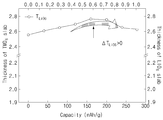
- 3 is a graph showing the distance between lithium and oxygen layers according to the state of charge of the positive electrode active material prepared in Preparation Example 3.
- 5 is a graph showing the distance between lithium and oxygen layers according to the state of charge of the positive electrode active material prepared in Preparation Example 5.
- FIG. 6 is a graph showing the distance between lithium and oxygen layers according to the state of charge of the positive electrode active material prepared in Preparation Example 6.
- the particle diameter Dn means a particle diameter at an n% point of the particle number cumulative distribution according to the particle size. That is, D50 is the particle size at 50% of the particle number cumulative distribution according to the particle size, D90 is the particle diameter at the 90% point of the particle number cumulative distribution according to the particle size, and D10 is 10% of the particle number cumulative distribution according to the particle size. It is the particle size at the point.
- the Dn may be measured by using a laser diffraction method.
- the powder to be measured is dispersed in a dispersion medium, and then introduced into a commercially available laser diffraction particle size measuring apparatus (for example, Microtrac S3500) to measure the particle size distribution by measuring the diffraction pattern according to the particle size as the particles pass through the laser beam.
- a commercially available laser diffraction particle size measuring apparatus for example, Microtrac S3500
- Calculate D10, D50, and D90 can be measured by calculating the particle diameter at the points which become 10%, 50%, and 90% of the particle number cumulative distribution according to the particle size in the measuring device.
- the present inventors have studied to develop a lithium secondary battery having excellent electrochemical performance at high temperature and / or high voltage, and as a result, the inter-layer distance of lithium-oxygen in the fully charged state is determined by the lithium-oxygen interlayer distance in the uncharged state.
- the positive electrode active material not reduced compared with the present invention it was found that the above object can be achieved.
- the inventors measured the high resolution powder diffraction (hereinafter referred to as HRPD) data using Synchroton Radiation to measure the crystal structure change of the positive electrode active material according to the state of charge, and through this, the lithium-oxygen interlayer of the positive electrode active material in the state of full charge.
- HRPD high resolution powder diffraction
- the mechanism by which the high-temperature / high-voltage driving characteristics vary depending on the interlayer distance of lithium-oxygen in the fully charged state is not clear, but is estimated as follows.
- the lithium composite transition metal oxide having a layered crystal structure is formed by alternately stacking a lithium-oxygen layer and a transition metal-oxygen layer, and compensates for lithium ions that have escaped as lithium is detached from the lithium-oxygen layer during charging. Charge compensation results in a change in the lithium-oxygen interlayer distance.
- the lithium-oxygen interlayer distance increases from 50% to 60% of SOC, and the interlayer distance decreases as charging progresses further.
- the passage of lithium ions is reduced, thereby reducing lithium mobility, which may deteriorate the capacity and life characteristics of the lithium secondary battery. .
- the present invention provides a lithium secondary battery having excellent performance even at high temperature and / or high voltage conditions by applying a positive electrode active material having a lithium-oxygen interlayer distance greater than or equal to a lithium-oxygen interlayer distance in an uncharged state. .
- the lithium secondary battery of the present invention includes a positive electrode, a negative electrode, a separator interposed between the positive electrode and the negative electrode, and an electrolyte, wherein the positive electrode has a layered structure as a positive electrode active material and the nickel of the entire transition metal
- T f is the lithium-oxygen interlayer distance in the fully charged lithium composite transition metal oxide
- T O is the lithium-oxygen interlayer distance in the lithium composite transition metal oxide before charging.
- the positive electrode according to the present invention includes a positive electrode active material layer, and the positive electrode active material layer has a layered structure as a positive electrode active material, and contains lithium composite transition metal oxide powder having a nickel content of 50 atm% or more in the total transition metal.
- the lithium composite transition metal oxide may be, for example, represented by the following formula (1).
- M is a doping element substituted in the transition metal site, and serves to improve the structural stability of the positive electrode active material.
- M is, for example, W, Cu, Fe, V, Cr, Ti, Zr, Zn, Al, In, Ta, Y, La, Sr, Ga, Sc, Gd, Sm, Ca, Ce, Nb, It may be one or more elements selected from the group consisting of Mg, B, Mo and Co.
- M may be one containing two or more elements selected from the group consisting of Zr, W, Al, Ti, Mg and Co.
- X denotes an atomic fraction of lithium in the lithium composite transition metal oxide, and may be 0.9 ⁇ x ⁇ 1.2, preferably 1.0 ⁇ x ⁇ 1.2, and more preferably 1.0 ⁇ x ⁇ 1.1.
- nickel is included in a high content as described above, excellent capacity characteristics can be obtained.
- B denotes an atomic fraction of cobalt in the lithium composite transition metal oxide, and may be 0 ⁇ b ⁇ 0.40, for example, 0 ⁇ b ⁇ 0.30, 0 ⁇ b ⁇ 0.20 or 0 ⁇ b ⁇ 0.15. .
- C denotes an atomic fraction of manganese in the lithium composite transition metal oxide, and may be 0 ⁇ c ⁇ 0.40, for example, 0 ⁇ c ⁇ 0.30, 0 ⁇ c ⁇ 0.20 or 0 ⁇ c ⁇ 0.15 .
- D denotes an atomic fraction of the doping element M in the lithium composite transition metal oxide, and may be 0 ⁇ d ⁇ 0.2, preferably 0 ⁇ d ⁇ 0.15.
- the lithium composite transition metal oxide is Al, Ti, W, B, F, P, Mg, Ni, Co, Fe, Cr, V, Cu, Ca, Zn, Zr, Nb. It may include a coating layer containing at least one element selected from the group consisting of at least one element selected from the group consisting of Mo, Sr, Sb, Bi, Si, and S.
- the coating layer as described above is included, the contact between the transition metal and the electrolyte in the lithium composite transition metal oxide is suppressed, thereby preventing the structural stability of the lithium composite transition metal oxide from being lowered by the reaction with the electrolyte.
- the content of the transition metal elements in the lithium composite transition metal oxide may be constant regardless of the position, the content of one or more transition metal elements may be changed depending on the position inside the particle.
- the lithium composite transition metal oxide may have a concentration gradient in which at least one component of Ni, Mn, and Co gradually changes.
- the "gradually changing concentration gradient" means that the concentration of the components are present in a concentration distribution that continuously changes in stages in the entire particle or a specific region.
- the lithium composite transition metal oxide powder has a lithium-oxygen interlayer distance change amount ⁇ T 1 represented by the following formula (1): 0 or more.
- T f means the lithium-oxygen interlayer distance in the fully charged lithium composite transition metal oxide
- T O means the lithium-oxygen interlayer distance in the lithium composite transition metal oxide before charging.
- the lithium-oxygen interlayer distance in a full charge state is greater than or equal to the lithium-oxygen interlayer distance in an uncharged state.
- the lithium-oxygen interlayer distance in the fully charged state is secured to be greater than the lithium-oxygen interlayer distance before charging, lithium mobility is improved, thereby improving the electrochemical characteristics of the lithium secondary battery.
- the lithium composite transition metal oxide powder may have a lithium-oxygen interlayer distance change rate ⁇ T 2 represented by the following formula (2) of 9% or less, preferably 8% or less, and more preferably 7% or less.
- T max means the maximum value of the lithium-oxygen interlayer distance measured in the state of charging the lithium composite transition metal oxide with SOC 0 to 100%, wherein T O is the lithium composite transition before charging By lithium-oxygen interlayer distance in the metal oxide.
- ⁇ T 2 When the ⁇ T 2 is 9% or less, the cycle characteristics at high temperature and / or high voltage driving are excellent. When ⁇ T 2 exceeds 9%, the lithium-oxygen interlayer distance increases rapidly during charging, causing strain on the lattice structure, causing lithium-oxygen to move, resulting in a lithium path. Some of the blockage may block the lithium ion mobility.
- the lithium composite transition metal oxide powder may have a lithium-oxygen interlayer distance change rate ⁇ T 3 represented by the following formula (3) of 9% or less, preferably 8% or less, and more preferably 6% or less.
- the T max means the maximum value of the lithium-oxygen interlayer distance measured in the state of charging a lithium composite transition metal oxide with SOC 0 to 100%, wherein T f is a fully charged lithium composite By lithium-oxygen interlayer distance in the transition metal oxide.
- ⁇ T 3 When ⁇ T 3 is 9% or less, cycle characteristics at high temperature and / or high voltage driving are excellent. If ⁇ T 3 exceeds 9%, the lithium-oxygen interlayer distance is drastically reduced, resulting in a strain in the lattice structure, and the lithium-ion mobility may be reduced due to insufficient lithium-oxygen interlayer distance during full charge. have.
- the lithium-oxygen interlayer distances T 0 , T max , and T f according to the state of charge are measured by high resolution powder diffraction (hereinafter referred to as HRPD) data using Synchroton Radiation, and then the measured data are measured according to the Rietveld method. It can measure by analyzing.
- the lithium-oxygen interlayer distance according to the state of charge may be measured by the following method. First, a coin-type half cell is manufactured through a separator between a positive electrode including a lithium composite transition metal oxide to be measured as a positive electrode active material and a lithium metal negative electrode. A plurality of coin-type half cells prepared as described above are charged with different capacities. Then, each secondary battery is disassembled to separate the positive electrode.
- the positive electrode active material layer was scraped from the separated positive electrode to obtain a lithium composite transition metal oxide powder in a charged state, which was then put into Synchroton Radiation to obtain high resolution powder diffraction (hereinafter referred to as HRPD) data.
- HRPD Synchroton Radiation
- the lithium-oxygen interlayer distance of the lithium composite transition metal oxide powder in each state of charge can be measured by analyzing according to the crystal structure analysis by the Rietveld method when used for the crystal structure model.
- the lithium-oxygen interlayer distance change of the lithium composite transition metal oxide powder during the charging process is determined by the complex action of the composition of the lithium composite transition metal oxide powder, the type of doping and coating elements, and the particle size. It is not just determined by one factor.
- the positive electrode active material may be included in the amount of 80 to 99% by weight, more specifically 85 to 98.5% by weight based on the total weight of the positive electrode active material layer.
- the positive electrode active material is included in the above range, it can exhibit excellent capacity characteristics.
- the positive electrode of the present invention may further include a conductive material and / or a binder in addition to the positive electrode active material.
- the conductive material is used to impart conductivity to the electrode, and in the battery constituted, any conductive material can be used without particular limitation as long as it has electronic conductivity without causing chemical change. Specific examples thereof include graphite such as natural graphite and artificial graphite; Carbon-based materials such as carbon black, acetylene black, ketjen black, channel black, furnace black, lamp black, summer black and carbon fiber; Metal powder or metal fibers such as copper, nickel, aluminum, and silver; Conductive whiskeys such as zinc oxide and potassium titanate; Conductive metal oxides such as titanium oxide; Or conductive polymers such as polyphenylene derivatives, and the like, or a mixture of two or more kinds thereof may be used.
- the conductive material may be included in an amount of 0.1 to 15% by weight based on the total weight of the positive electrode active material layer.
- the binder serves to improve adhesion between the positive electrode active material particles and the adhesion between the positive electrode active material and the current collector.
- specific examples of the binder include polyvinylidene fluoride (PVDF), vinylidene fluoride-hexafluoropropylene copolymer (PVDF-co-HFP), polyvinyl alcohol, polyacrylonitrile, carboxymethyl cellulose Woods (CMC), starch, hydroxypropylcellulose, regenerated cellulose, polyvinylpyrrolidone, tetrafluoroethylene, polyethylene, polypropylene, ethylene-propylene-diene polymer (EPDM), sulfonated-EPDM, Styrene butadiene rubber (SBR), fluorine rubber, various copolymers thereof, and the like, and one or a mixture of two or more thereof may be used.
- the binder may be included in an amount of 0.1 to 15% by weight based on the total weight of the positive electrode active material layer.
- the positive electrode as described above may be manufactured according to a conventional positive electrode manufacturing method, for example, after applying a positive electrode mixture prepared by dissolving or dispersing a positive electrode active material, a binder and / or a conductive material in a solvent on a positive electrode current collector It can manufacture by drying and rolling.
- the solvent may be a solvent generally used in the art, and may include dimethyl sulfoxide (DMSO), isopropyl alcohol, N-methylpyrrolidone (NMP), acetone or water These etc. can be mentioned, 1 type of these, or a mixture of 2 or more types can be used.
- the amount of the solvent used may be any level that can be adjusted so that the positive electrode mixture has an appropriate viscosity in consideration of the coating thickness of the positive electrode mixture, production yield, workability, and the like, and is not particularly limited.
- the positive electrode current collector is not particularly limited as long as it has conductivity without causing chemical change in the battery, for example, stainless steel, aluminum, nickel, titanium, calcined carbon or carbon, nickel on the surface of aluminum or stainless steel Surface treated with titanium, silver, or the like can be used.
- the positive electrode current collector may have a thickness of about 3 to 500 ⁇ m, and may form fine irregularities on the surface of the current collector to increase adhesion of the positive electrode material.
- it can be used in various forms, such as a film, a sheet, a foil, a net, a porous body, a foam, a nonwoven body.
- the positive electrode may be prepared by casting the positive electrode mixture on a separate support and then laminating the film obtained by peeling from the support onto a positive electrode current collector.
- the negative electrode may be used without particular limitation as long as it is normally used as a separator in a lithium secondary battery, and may include, for example, a negative electrode current collector and a negative electrode active material layer positioned on the negative electrode current collector.
- the negative electrode current collector is not particularly limited as long as it has high conductivity without causing chemical change in the battery.
- the negative electrode current collector may be formed on a surface of copper, stainless steel, aluminum, nickel, titanium, calcined carbon, copper, or stainless steel. Surface-treated with carbon, nickel, titanium, silver, and the like, aluminum-cadmium alloy and the like can be used.
- the negative electrode current collector may have a thickness of 3 ⁇ m to 500 ⁇ m, and similarly to the positive electrode current collector, fine concavities and convexities may be formed on the surface of the current collector to enhance the bonding force of the negative electrode active material.
- it can be used in various forms, such as a film, a sheet, a foil, a net, a porous body, a foam, a nonwoven body.
- the negative electrode active material layer optionally includes a binder and a conductive material together with the negative electrode active material.
- the negative electrode active material various negative electrode active materials used in the art may be used, and are not particularly limited.
- the negative electrode active material include carbonaceous materials such as artificial graphite, natural graphite, graphitized carbon fibers, and amorphous carbon;
- Metallic compounds capable of alloying with lithium such as Si, Al, Sn, Pb, Zn, Bi, In, Mg, Ga, Cd, Si alloys, Sn alloys or Al alloys;
- Metal oxides capable of doping and undoping lithium such as SiOy (0 ⁇ y ⁇ 2), SnO 2 , vanadium oxide, lithium vanadium oxide;
- a composite including the metallic compound and the carbonaceous material such as a Si-C composite or a Sn-C composite, and any one or a mixture of two or more thereof may be used.
- a metal lithium thin film may be used as the anode active material.
- the negative electrode active material may be included in an amount of 80 wt% to 99 wt% based on the total weight of the negative electrode active material layer.
- the binder is a component that assists the bonding between the conductive material, the active material and the current collector, and is typically added in an amount of 0.1 wt% to 10 wt% based on the total weight of the negative electrode active material layer.
- binders include polyvinylidene fluoride (PVDF), polyvinyl alcohol, carboxymethyl cellulose (CMC), starch, hydroxypropyl cellulose, regenerated cellulose, polyvinylpyrrolidone, tetrafluoro Low ethylene, polyethylene, polypropylene, ethylene-propylene-diene polymer (EPDM), sulfonated-EPDM, styrene-butadiene rubber, nitrile-butadiene rubber, fluorine rubber, various copolymers thereof and the like.
- PVDF polyvinylidene fluoride
- CMC carboxymethyl cellulose
- EPDM ethylene-propylene-diene polymer
- sulfonated-EPDM
- the conductive material is a component for further improving the conductivity of the negative electrode active material, and may be added in an amount of 10 wt% or less, preferably 5 wt% or less, based on the total weight of the negative electrode active material layer.
- a conductive material is not particularly limited as long as it has conductivity without causing chemical change in the battery.
- Examples of the conductive material include graphite such as natural graphite and artificial graphite; Carbon blacks such as acetylene black, Ketjen black, channel black, furnace black, lamp black and thermal black; Conductive fibers such as carbon fibers and metal fibers; Metal powders such as carbon fluoride powder, aluminum powder and nickel powder; Conductive whiskeys such as zinc oxide and potassium titanate; Conductive metal oxides such as titanium oxide; Conductive materials such as polyphenylene derivatives and the like can be used.
- graphite such as natural graphite and artificial graphite
- Carbon blacks such as acetylene black, Ketjen black, channel black, furnace black, lamp black and thermal black
- Conductive fibers such as carbon fibers and metal fibers
- Metal powders such as carbon fluoride powder, aluminum powder and nickel powder
- Conductive whiskeys such as zinc oxide and potassium titanate
- Conductive metal oxides such as titanium oxide
- Conductive materials such as polyphenylene derivatives and the like can be used.
- the negative electrode active material layer is prepared by applying and drying a negative electrode active material, and a negative electrode active material layer forming composition prepared by dissolving or dispersing a binder and a conductive material in a solvent on a negative electrode current collector, or optionally, or for forming the negative electrode active material layer
- the composition can be prepared by casting on a separate support and then laminating the film obtained by peeling from the support onto a negative electrode current collector.
- the separator is interposed between the negative electrode and the positive electrode to separate the positive electrode and the negative electrode and to provide a passage for the movement of lithium ions, and can be used without particular limitation as long as the separator is used as a separator in a lithium secondary battery. It is preferable that it is low resistance and excellent in electrolyte solution moisture-wetting ability.
- a porous polymer film for example, a porous polymer film made of a polyolefin-based polymer such as ethylene homopolymer, propylene homopolymer, ethylene / butene copolymer, ethylene / hexene copolymer and ethylene / methacrylate copolymer, or the like Laminate structures of two or more layers may be used.
- porous nonwoven fabrics such as nonwoven fabrics made of high melting point glass fibers, polyethylene terephthalate fibers and the like may be used.
- a coated separator including a ceramic component or a polymer material may be used to secure heat resistance or mechanical strength, and may be optionally used as a single layer or a multilayer structure.
- the electrolyte may be an organic liquid electrolyte, an inorganic liquid electrolyte, a solid polymer electrolyte, a gel polymer electrolyte, a solid inorganic electrolyte, a molten inorganic electrolyte, or the like that can be used in a lithium secondary battery, and are not particularly limited.
- the electrolyte may include an organic solvent and a lithium salt.
- the organic solvent may be used without particular limitation as long as it can serve as a medium through which ions involved in the electrochemical reaction of the battery can move.
- the organic solvent may be an ester solvent such as methyl acetate, ethyl acetate, ⁇ -butyrolactone or ⁇ -caprolactone; Ether solvents such as dibutyl ether or tetrahydrofuran; Ketone solvents such as cyclohexanone; Aromatic hydrocarbon solvents such as benzene and fluorobenzene; Dimethylcarbonate (DMC), diethylcarbonate (DEC), methylethylcarbonate (MEC), ethylmethylcarbonate (EMC), ethylene carbonate (EC), propylene carbonate, Carbonate solvents such as PC); Alcohol solvents such as ethyl alcohol and isopropyl alcohol; Nitriles, such as Ra-CN (Ra is a C2-C20 linear, branched, or ring-shaped hydrocarbon group, and may
- the lithium salt may be used, without limitation, those which are commonly used in a lithium secondary battery electrolyte, such as an anion, and containing the Li + in the lithium salt cation is F -, Cl -, Br -, I -, NO 3 -, N (CN) 2 -, BF 4 -, ClO 4 -, AlO 4 -, AlCl 4 -, PF 6 -, SbF 6 -, AsF 6 -, BF 2 C 2 O 4 -, BC 4 O 8 -, PF 4 C 2 O 4 -, PF 2 C 4 O 8 -, (CF 3) 2 PF 4 -, (CF 3) 3 PF 3 -, (CF 3) 4 PF 2 -, (CF 3) 5 PF -, (CF 3) 6 P -, CF 3 SO 3 -, C 4 F 9 SO 3 -, CF 3 CF 2 SO 3 -, (CF 3 SO 2) 2 N -, (FSO 2) 2 N -
- the lithium salt is LiCl, LiBr, LiI, LiClO 4 , LiBF 4 , LiB 10 Cl 10 , LiPF 6 , LiCF 3 SO 3 , LiCH 3 CO 2 , LiCF 3 CO 2 , LiAsF 6 , LiSbF 6 , LiAlCl 4 , LiAlO 4 , and LiCH 3 SO 3
- It may include a single material or a mixture of two or more, and in addition to these LiBTI (lithium bisperfluoroethanesulfonimide, LiN (SO 2 C 2 F) commonly used in the electrolyte of a lithium secondary battery 5 ) without limitation, electrolyte salts such as lithium imide salts represented by 2 ), LiFSI (lithium fluorosulfonyl imide, LiN (SO 2 F) 2 ), and LiTFSI (lithium (bis) trifluoromethanesulfonimide, LiN (SO 2 CF 3 ) 2 ) Can be used.
- the electrolyte salt is a single or two or more selected from the group consisting of LiPF 6 , LiBF 4 , LiCH 3 CO 2 , LiCF 3 CO 2 , LiCH 3 SO 3 , LiFSI, LiTFSI and LiN (C 2 F 5 SO 2 ) 2 Mixtures may be included.
- the lithium salt may be appropriately changed within a usable range, but specifically, may be included in the electrolyte solution 0.8 M to 3M, specifically 0.1M to 2.5M.
- various additives may be used in the electrolyte for the purpose of improving the life characteristics of the battery, reducing the battery capacity, and improving the discharge capacity of the battery.
- the additive examples include imide salts such as lithium bis (fluorosulfonyl) imide (LiFSI), lithium bis (trifluoromethyl sulfonyl) imide, and the like; Borate salts such as lithium bis (oxalato) borate (LiBOB), lithium difluoro (oxalato) borate (LiOdFB), tris (trimethylsilyl) borate (TMSB) and the like; Phosphate salts such as difluorophosphate and tris (trimethylsilyl) phosphate; Haloalkylene carbonate compounds such as difluoroethylene carbonate and the like; Or pyridine, triethylphosphite, triethanolamine, cyclic ether, ethylene diamine, n-glyme, hexaphosphate triamide, nitrobenzene derivative, sulfur, quinone imine dye, N-substituted oxazolidinone, N, N -Substitute
- the lithium secondary battery according to the present invention can be usefully used in the field of electric vehicles, such as mobile phones, notebook computers, digital cameras, portable devices, and hybrid electric vehicles (HEV).
- electric vehicles such as mobile phones, notebook computers, digital cameras, portable devices, and hybrid electric vehicles (HEV).
- HEV hybrid electric vehicles
- the external shape of the lithium secondary battery of the present invention is not particularly limited, but may be cylindrical, square, pouch type, or coin type using a can.
- the lithium secondary battery according to the present invention may not only be used in a battery cell used as a power source for a small device, but may also be preferably used as a unit battery in a medium-large battery module including a plurality of battery cells.
- the prepared lithium composite transition metal oxide powder had a unimodal particle size distribution having a D50 of 12 ⁇ m.
- the prepared lithium composite transition metal oxide powder had a unimodal particle size distribution having a D50 of 12 ⁇ m.
- the lithium composite transition metal oxide prepared as described above and B 4 C were mixed and then heat-treated at 350 ° C. for 10 hours to form a coating layer containing B on the surface of the lithium composite transition metal oxide.
- the prepared lithium composite transition metal oxide powder had a unimodal particle size distribution having a D50 of 12 ⁇ m.
- the prepared lithium composite transition metal oxide powder had a unimodal particle size distribution having a D50 of 12 ⁇ m.
- the prepared lithium composite transition metal oxide powder had a bimodal particle size distribution in which particles of 16 ⁇ m and particles of 5 ⁇ m were mixed.
- the prepared lithium composite transition metal oxide powder had a unimodal particle size distribution having a D50 of 5 ⁇ m.
- the prepared lithium composite transition metal oxide powder had a unimodal particle size distribution having a D50 of 16 ⁇ m.
- the prepared lithium composite transition metal oxide powder had a unimodal particle size distribution having a D50 of 16 ⁇ m.
- Each of the lithium composite transition metal oxides prepared in Preparation Examples 1 to 8, and the carbon black conductive material and the PVdF binder were mixed in an N-methylpyrrolidone solvent in a ratio of 96: 2: 2 by weight to mix the positive electrode mixture. After the preparation, it was applied to one surface of the aluminum current collector, dried at 130 ° C., and rolled to prepare a positive electrode.
- a lithium secondary battery (coin-type half cell) is manufactured by manufacturing an electrode assembly through a separator of porous polyethylene between the positive electrode and the negative electrode prepared as described above, placing the electrode assembly inside the case, and injecting electrolyte into the case. Was prepared.
- the electrolyte solution was an electrolyte solution in which 1 M lithium hexafluorophosphate (LiFP 6 ) was dissolved in an organic solvent in which ethylene carbonate: dimethyl carbonate: ethyl methyl carbonate was mixed at a volume ratio of 3: 4: 3. Was used.
- LiFP 6 lithium hexafluorophosphate
- lithium secondary batteries were prepared for each lithium composite transition metal oxide, and each lithium secondary battery was prepared at 0 mA / g, 40 mA / g, 80 mA / g, 120 mA / g, 160 mA / g, 200 mA / g, 240 mA / g.
- the positive electrode active material layer was scraped off to collect a lithium composite transition metal oxide powder.
- the lithium composite transition metal oxide powder thus obtained was placed in a radiation accelerator and subjected to X-ray analysis to measure the lithium-oxygen interlayer distance according to the state of charge.
- the measurement results are shown in FIGS. 1 to 8.
- the lithium-oxygen interlayer distance (T 0 ) before charging the lithium-oxygen interlayer distance (Tf) and the maximum lithium-oxygen interlayer distance (Tmax) at full charge are shown in Tables 1 and 2. Indicated.
- Preparation Example 1 Preparation Example 2
- Preparation Example 3 Preparation Example 4 T 0 [ ⁇ ] 2.5615 2.6072 2.5402 2.5658 T Max [ ⁇ ] 2.7589 2.7337 2.7631 2.7659 T f [ ⁇ ] 2.6245 2.6209 2.6062 2.6317 ⁇ T 1 [ ⁇ ] 0.024004572 0.00522721 0.02532423 0.02504085 ⁇ T 2 [%] 7.7% 4.8% 8.8% 7.8% ⁇ T 3 [%] 5.1% 4.3% 6.0% 5.1%
- Preparation Example 5 Preparation Example 6
- Preparation Example 7 Preparation Example 8 T 0 [ ⁇ ] 2.6756 2.6767 2.6765 2.6767 T Max [ ⁇ ] 2.9063 2.9179 2.9084 2.908 T f [ ⁇ ] 2.6932 2.6768 2.644 2.6527 ⁇ T 1 [ ⁇ ] 0.00653498 3.7358E-05 -0.012292 -0.009047 ⁇ T 2 [%] 8.6% 9.0% 8.6% 8.6% ⁇ T 3 [%] 7.9% 9.0% 10% 9.6%
- the lithium composite transition metal oxides of Preparation Examples 1 to 6 are lithium-oxygen interlayers in a lithium-oxygen interlayer distance T f in an uncharged state. A distance T 0 or more appeared.
- the lithium composite transition metal oxides prepared by Preparation Examples 7 and 8 showed that the lithium-oxygen interlayer distance T f in the full charge state was smaller than the lithium-oxygen interlayer distance T 0 in the uncharged state.
- a lithium composite transition metal oxide, a carbon black conductive material, and a PVdF binder prepared in Preparation Example 1 were mixed in an N-methylpyrrolidone solvent in a ratio of 96: 2: 2 by weight to prepare a positive electrode mixture, This was applied to one surface of an aluminum current collector, dried at 130 ° C., and then rolled to prepare a positive electrode.
- a lithium secondary battery (coin-type half cell) is manufactured by manufacturing an electrode assembly through a separator of porous polyethylene between the positive electrode and the negative electrode prepared as described above, placing the electrode assembly inside the case, and injecting electrolyte into the case. Was prepared.
- the electrolyte solution was an electrolyte solution in which 1 M lithium hexafluorophosphate (LiFP 6 ) was dissolved in an organic solvent in which ethylene carbonate: dimethyl carbonate: ethyl methyl carbonate was mixed at a volume ratio of 3: 4: 3. Was used.
- LiFP 6 lithium hexafluorophosphate
- a lithium secondary battery was manufactured in the same manner as in Example 1, except that a lithium composite transition metal oxide prepared in Preparation Example 2 was used as the cathode active material.
- a lithium secondary battery was manufactured in the same manner as in Example 1, except that the lithium composite transition metal oxide prepared in Preparation Example 3 was used as the cathode active material.
- a lithium secondary battery was manufactured in the same manner as in Example 1, except that a lithium composite transition metal oxide prepared in Preparation Example 4 was used as the cathode active material.
- a lithium secondary battery was manufactured in the same manner as in Example 1, except that a lithium composite transition metal oxide prepared in Preparation Example 5 was used as the cathode active material.
- a lithium secondary battery was manufactured in the same manner as in Example 1, except that a lithium composite transition metal oxide prepared in Preparation Example 6 was used as the cathode active material.
- a lithium secondary battery was manufactured in the same manner as in Example 1, except that a lithium composite transition metal oxide prepared in Preparation Example 7 was used as the cathode active material.
- a lithium secondary battery was manufactured in the same manner as in Example 1, except that a lithium composite transition metal oxide prepared in Preparation Example 8 was used as the cathode active material.
- the high temperature life characteristics of the lithium secondary batteries of Examples 1 to 6 and Comparative Examples 1 and 2 were measured by the following method.
- the lithium secondary batteries of Examples 1 to 6 and Comparative Examples 1 to 2 were charged and discharged in a constant temperature chamber at 45 ° C. in order to remove variables caused by temperature during the insertion and desorption of lithium ions.
- the charging and discharging conditions are based on a reference capacity of 200mAh / g, the current value is calculated as 0.3C during the first charge and discharge, and the calculated current value is applied through the charger / discharger to charge up to 4.25V. After hold
Landscapes
- Chemical & Material Sciences (AREA)
- Chemical Kinetics & Catalysis (AREA)
- Electrochemistry (AREA)
- General Chemical & Material Sciences (AREA)
- Inorganic Chemistry (AREA)
- Engineering & Computer Science (AREA)
- Manufacturing & Machinery (AREA)
- Organic Chemistry (AREA)
- Materials Engineering (AREA)
- Battery Electrode And Active Subsutance (AREA)
- Secondary Cells (AREA)
Abstract
Description
| 제조예 1 | 제조예 2 | 제조예 3 | 제조예 4 | |
| T0 [Å] | 2.5615 | 2.6072 | 2.5402 | 2.5658 |
| TMax [Å] | 2.7589 | 2.7337 | 2.7631 | 2.7659 |
| Tf [Å] | 2.6245 | 2.6209 | 2.6062 | 2.6317 |
| ΔT1 [Å] | 0.024004572 | 0.00522721 | 0.02532423 | 0.02504085 |
| ΔT2 [%] | 7.7% | 4.8% | 8.8% | 7.8% |
| ΔT3 [%] | 5.1% | 4.3% | 6.0% | 5.1% |
| 제조예 5 | 제조예 6 | 제조예 7 | 제조예 8 | |
| T0 [Å] | 2.6756 | 2.6767 | 2.6765 | 2.6767 |
| TMax [Å] | 2.9063 | 2.9179 | 2.9084 | 2.908 |
| Tf [Å] | 2.6932 | 2.6768 | 2.644 | 2.6527 |
| ΔT1 [Å] | 0.00653498 | 3.7358E-05 | -0.012292 | -0.009047 |
| ΔT2 [%] | 8.6% | 9.0% | 8.6% | 8.6% |
| ΔT3 [%] | 7.9% | 9.0% | 10% | 9.6% |
| 수명 특성(%) | |
| 실시예 1 | 97.8 |
| 실시예 2 | 97.9 |
| 실시예 3 | 96.9 |
| 실시예 4 | 95.8 |
| 실시예 5 | 94.9 |
| 실시예 6 | 96.7 |
| 비교예 1 | 92.1 |
| 비교예 2 | 88.7 |
| 수명 특성(%) | |
| 실시예 1 | 96.0 |
| 실시예 2 | 96.5 |
| 실시예 3 | 95.9 |
| 실시예 4 | 95.1 |
| 실시예 5 | 94.2 |
| 실시예 6 | 95.6 |
| 비교예 1 | 90.1 |
| 비교예 2 | 86.9 |
Claims (9)
- 양극, 음극, 상기 양극 및 음극 사이에 개재되는 분리막, 및 전해질을 포함하는 리튬 이차 전지에 있어서,상기 양극은, 양극 활물질로 층상 구조를 가지며 전체 전이금속 중 니켈의 함유량이 50atm% 이상인 리튬 복합 전이금속 산화물 분말을 포함하고,상기 리튬 복합 전이금속 산화물 분말은 하기 식 (1)로 표시되는 리튬-산소 층간 거리 변화량 ΔT1이 0 이상인 리튬 이차 전지.식 (1): ΔT1 = Tf-T0상기 식 (1)에서, 상기 Tf는 만충전된 리튬 복합 전이금속 산화물 내의 리튬-산소 층간 거리이며, 상기 TO는 충전 전의 리튬 복합 전이금속 산화물 내의 리튬-산소 층간 거리임.
- 제1항에 있어서,상기 리튬 복합 전이금속 산화물 분말은 하기 식 (2)로 표시되는 리튬-산소 층간 거리 변화율 ΔT2가 9% 이하인 리튬 이차 전지.식 (2): ΔT2 = {(Tmax - T0)/T0} Х100상기 식 (2)에서, 상기 Tmax는 리튬 복합 전이금속 산화물을 SOC 0 내지 100%으로 충전한 상태에서 측정한 리튬-산소 층간 거리의 최대값이며, 상기 TO는 충전 전의 리튬 복합 전이금속 산화물 내의 리튬-산소 층간 거리임.
- 제1항에 있어서,상기 리튬 복합 전이금속 산화물 분말은 하기 식 (3)으로 표시되는 리튬-산소 층간 거리 변화율 ΔT3가 9% 이하인 리튬 이차 전지.식 (3): ΔT3 = {(Tmax - Tf)/Tf} Х100상기 식 (3)에서, 상기 Tmax는 리튬 복합 전이금속 산화물을 SOC 0 내지 100%으로 충전한 상태에서 측정한 리튬-산소 층간 거리의 최대값이며, 상기 Tf는 만충전된 리튬 복합 전이금속 산화물 내의 리튬-산소 층간 거리임.
- 제1항에 있어서,상기 리튬 복합 전이금속 산화물은 하기 화학식 1로 표시되는 것인 리튬 이차 전지:[화학식 1]Lix[NiaCobMncMd]O2상기 화학식 1에서,상기 M은 W, Cu, Fe, V, Cr, Ti, Zr, Zn, Al, In, Ta, Y, La, Sr, Ga, Sc, Gd, Sm, Ca, Ce, Nb, Mg, B, Mo 및 Co로 이루어진 군에서 선택되는 1종 이상의 원소이고,0.9≤x≤1.2, 0.50≤a≤0.99, 0<b<0.4, 0<c<0.4, 0<d<0.2임.
- 제4항에 있어서,상기 리튬 전이금속 산화물은 M은 Zr, W, Al, Ti, Mg 및 Co로 이루어진 군에서 선택되는 2종 이상의 원소를 포함하는 것인 리튬 이차 전지.
- 제4항에 있어서,상기 화학식 1에서, 0.50≤a≤0.75인 리튬 이차 전지.
- 제4항에 있어서,상기 화학식 1에서, 0.80≤a≤0.99인 리튬 이차 전지.
- 제1항에 있어서,상기 리튬 복합 전이금속 산화물은 그 표면에 Al, Ti, W, B, F, P, Mg, Ni, Co, Fe, Cr, V, Cu, Ca, Zn, Zr, Nb. Mo, Sr, Sb, Bi, Si, 및 S로 이루어진 군으로부터 선택된 1종 이상의 원소로 이루어진 군으로부터 선택된 1종 이상의 원소를 포함하는 코팅층을 포함하는 것인 리튬 이차 전지.
- 층상 구조를 가지며 전체 전이금속 중 니켈의 함유량이 50atm% 이상인 리튬 복합 전이금속 산화물 분말을 포함하는 리튬 이차 전지용 양극 활물질이며,상기 리튬 복합 전이금속 산화물 분말은 하기 식 (1)로 표시되는 리튬-산소 층간 거리 변화량 ΔT1이 0 이상인 양극 활물질.식 (1): ΔT1 = Tf-T0상기 식 (1)에서, 상기 Tf는 만충전된 리튬 복합 전이금속 산화물 내의 리튬-산소 층간 거리이며, 상기 TO는 충전 전의 리튬 복합 전이금속 산화물 내의 리튬-산소 층간 거리임.
Priority Applications (4)
| Application Number | Priority Date | Filing Date | Title |
|---|---|---|---|
| EP19822262.2A EP3787075A4 (en) | 2018-06-20 | 2019-06-20 | POSITIVE ACTIVE ELECTRODE MATERIAL FOR LITHIUM SECONDARY BATTERY AND LITHIUM SECONDARY BATTERY |
| JP2020566270A JP7357991B2 (ja) | 2018-06-20 | 2019-06-20 | リチウム二次電池用正極活物質及びリチウム二次電池 |
| US17/058,851 US12283690B2 (en) | 2018-06-20 | 2019-06-20 | Positive electrode active material for lithium secondary battery and lithium secondary battery |
| CN201980034514.XA CN112154558A (zh) | 2018-06-20 | 2019-06-20 | 锂二次电池用正极活性材料和锂二次电池 |
Applications Claiming Priority (2)
| Application Number | Priority Date | Filing Date | Title |
|---|---|---|---|
| KR10-2018-0071057 | 2018-06-20 | ||
| KR1020180071057A KR102288295B1 (ko) | 2018-06-20 | 2018-06-20 | 리튬 이차 전지용 양극 활물질 및 리튬 이차 전지 |
Publications (1)
| Publication Number | Publication Date |
|---|---|
| WO2019245308A1 true WO2019245308A1 (ko) | 2019-12-26 |
Family
ID=68983314
Family Applications (1)
| Application Number | Title | Priority Date | Filing Date |
|---|---|---|---|
| PCT/KR2019/007456 Ceased WO2019245308A1 (ko) | 2018-06-20 | 2019-06-20 | 리튬 이차 전지용 양극 활물질 및 리튬 이차 전지 |
Country Status (6)
| Country | Link |
|---|---|
| US (1) | US12283690B2 (ko) |
| EP (1) | EP3787075A4 (ko) |
| JP (1) | JP7357991B2 (ko) |
| KR (1) | KR102288295B1 (ko) |
| CN (1) | CN112154558A (ko) |
| WO (1) | WO2019245308A1 (ko) |
Families Citing this family (3)
| Publication number | Priority date | Publication date | Assignee | Title |
|---|---|---|---|---|
| CA3242587A1 (en) * | 2021-12-16 | 2023-06-22 | Umicore | A positive electrode active material for rechargeable solid-state batteries |
| EP4593113A4 (en) * | 2022-12-01 | 2025-11-19 | Contemporary Amperex Technology Hong Kong Ltd | POSITIVE ELECTRODE MATERIAL, ITS PREPARATION PROCESS, AND SECONDARY BATTERY AND ELECTRICAL DEVICE INCLUDING IT |
| JP7768267B2 (ja) * | 2024-02-08 | 2025-11-12 | トヨタ自動車株式会社 | 正極活物質、正極、リチウムイオン電池、及び正極活物質の製造方法 |
Citations (5)
| Publication number | Priority date | Publication date | Assignee | Title |
|---|---|---|---|---|
| KR20130046810A (ko) * | 2011-10-28 | 2013-05-08 | 삼성에스디아이 주식회사 | 리튬 이차 전지용 니켈 복합 수산화물, 이로부터 형성된 리튬 이차 전지용 리튬 복합 산화물, 그 제조방법, 이를 포함하는 리튬 이차 전지용 양극 및 이를 구비한 리튬 이차 전지 |
| KR20150050458A (ko) * | 2013-10-29 | 2015-05-08 | 주식회사 엘지화학 | 양극 활물질의 제조방법, 및 이에 의해 제조된 리튬 이차전지용 양극 활물질 |
| JP2017043496A (ja) * | 2015-08-24 | 2017-03-02 | 新日本電工株式会社 | リチウム遷移金属複合酸化物及びその製造方法 |
| CN106532005A (zh) * | 2016-12-16 | 2017-03-22 | 贵州振华新材料有限公司 | 球形或类球形锂电池正极材料、电池及制法和应用 |
| WO2018016525A1 (ja) * | 2016-07-22 | 2018-01-25 | ユミコア | リチウム金属複合酸化物粉末 |
Family Cites Families (28)
| Publication number | Priority date | Publication date | Assignee | Title |
|---|---|---|---|---|
| CN1146062C (zh) | 1998-02-10 | 2004-04-14 | 三星电管株式会社 | 正极活性材料及其制造方法以及使用该材料的锂二次电池 |
| JP2002124261A (ja) | 1999-11-29 | 2002-04-26 | Mitsui Chemicals Inc | リチウム二次電池用正極活物質および電池 |
| JP2005327521A (ja) | 2004-05-13 | 2005-11-24 | Shin Kobe Electric Mach Co Ltd | 非水電解液二次電池の製造方法及び使用方法 |
| JP2010073370A (ja) | 2008-09-16 | 2010-04-02 | Mitsui Mining & Smelting Co Ltd | リチウム電池用正極活物質材料 |
| CN102356487A (zh) | 2009-06-17 | 2012-02-15 | 日立麦克赛尔能源株式会社 | 电化学元件用电极及使用其的电化学元件 |
| JP5695373B2 (ja) * | 2009-09-09 | 2015-04-01 | 日立マクセル株式会社 | 電気化学素子用電極及びそれを用いた電気化学素子 |
| JP5627250B2 (ja) * | 2010-02-25 | 2014-11-19 | 日立オートモティブシステムズ株式会社 | リチウムイオン電池 |
| KR101802517B1 (ko) * | 2011-01-20 | 2017-11-30 | 한양대학교 산학협력단 | 양극 활물질, 이의 제조 방법, 및 이를 포함하는 리튬 이차 전지 |
| WO2013145290A1 (ja) | 2012-03-30 | 2013-10-03 | トヨタ自動車株式会社 | リチウムイオン二次電池 |
| KR101479559B1 (ko) | 2012-05-23 | 2015-01-08 | 순천대학교 산학협력단 | 리튬이차전지용 양극 활물질과 이를 포함하는 리튬이차전지 및 리튬이차전지용 양극 활물질의 제조방법 |
| HUE062621T2 (hu) | 2012-10-02 | 2023-11-28 | Massachusetts Inst Technology | Nagykapacitású pozitív elektród aktív anyaga |
| CN104078669B (zh) | 2013-03-29 | 2018-07-27 | 北京当升材料科技股份有限公司 | 一种多元正极材料的制备方法 |
| JP6524651B2 (ja) | 2013-12-13 | 2019-06-05 | 日亜化学工業株式会社 | 非水電解液二次電池用正極活物質及びその製造方法 |
| JP5999208B2 (ja) | 2014-04-25 | 2016-09-28 | 住友金属鉱山株式会社 | 非水系電解質二次電池用正極活物質とその製造方法、および該正極活物質を用いた非水系電解質二次電池 |
| KR101747140B1 (ko) * | 2014-08-29 | 2017-06-14 | 주식회사 엘 앤 에프 | 리튬 이차 전지용 니켈계 복합 산화물, 및 이를 포함하는 리튬 이차 전지 |
| KR20180031739A (ko) | 2015-08-04 | 2018-03-28 | 가부시키가이샤 히다치 하이테크놀로지즈 | 리튬 이차 전지용 비수 전해액, 리튬 이차 전지용 정극 및 그 제조 방법, 그리고, 리튬 이차 전지 |
| CN106602004A (zh) | 2015-10-19 | 2017-04-26 | 河南科隆新能源股份有限公司 | 一种高安全的动力锂离子二次电池复合正极材料及其制备方法 |
| KR102088508B1 (ko) | 2015-10-22 | 2020-03-12 | 주식회사 엘지화학 | 다층 구조의 금속 산화물들을 포함하는 양극 활물질 제조용 전구체 및 이를 사용하여 제조된 리튬 이차전지용 양극 활물질 |
| KR101927295B1 (ko) * | 2015-11-30 | 2018-12-10 | 주식회사 엘지화학 | 이차전지용 양극활물질 및 이를 포함하는 이차전지 |
| KR102004457B1 (ko) | 2015-11-30 | 2019-07-29 | 주식회사 엘지화학 | 이차전지용 양극활물질 및 이를 포함하는 이차전지 |
| US10763497B2 (en) | 2015-11-30 | 2020-09-01 | Lg Chem, Ltd. | Positive electrode active material for secondary battery, and secondary battery comprising the same |
| WO2017095134A1 (ko) | 2015-11-30 | 2017-06-08 | 주식회사 엘지화학 | 이차전지용 양극활물질 및 이를 포함하는 이차전지 |
| WO2017095152A1 (ko) | 2015-11-30 | 2017-06-08 | 주식회사 엘지화학 | 이차전지용 양극활물질 및 이를 포함하는 이차전지 |
| KR20160075404A (ko) * | 2016-06-02 | 2016-06-29 | 주식회사 포스코이에스엠 | 리튬 이차 전지용 양극활물질의 제조 방법 및 이에 의하여 제조된 리튬 이차 전지용 양극활물질 |
| KR102413743B1 (ko) | 2016-12-07 | 2022-06-27 | 스미또모 가가꾸 가부시끼가이샤 | 리튬 이차 전지용 정극 활물질의 제조 방법 |
| KR102290959B1 (ko) | 2018-06-20 | 2021-08-19 | 주식회사 엘지화학 | 리튬 이차 전지용 양극 활물질 및 리튬 이차 전지 |
| KR102288293B1 (ko) | 2018-06-20 | 2021-08-10 | 주식회사 엘지화학 | 리튬 이차 전지용 양극 활물질 및 리튬 이차 전지 |
| KR102288294B1 (ko) | 2018-06-20 | 2021-08-10 | 주식회사 엘지화학 | 리튬 이차 전지용 양극 활물질 및 리튬 이차 전지 |
-
2018
- 2018-06-20 KR KR1020180071057A patent/KR102288295B1/ko active Active
-
2019
- 2019-06-20 JP JP2020566270A patent/JP7357991B2/ja active Active
- 2019-06-20 EP EP19822262.2A patent/EP3787075A4/en active Pending
- 2019-06-20 CN CN201980034514.XA patent/CN112154558A/zh active Pending
- 2019-06-20 US US17/058,851 patent/US12283690B2/en active Active
- 2019-06-20 WO PCT/KR2019/007456 patent/WO2019245308A1/ko not_active Ceased
Patent Citations (5)
| Publication number | Priority date | Publication date | Assignee | Title |
|---|---|---|---|---|
| KR20130046810A (ko) * | 2011-10-28 | 2013-05-08 | 삼성에스디아이 주식회사 | 리튬 이차 전지용 니켈 복합 수산화물, 이로부터 형성된 리튬 이차 전지용 리튬 복합 산화물, 그 제조방법, 이를 포함하는 리튬 이차 전지용 양극 및 이를 구비한 리튬 이차 전지 |
| KR20150050458A (ko) * | 2013-10-29 | 2015-05-08 | 주식회사 엘지화학 | 양극 활물질의 제조방법, 및 이에 의해 제조된 리튬 이차전지용 양극 활물질 |
| JP2017043496A (ja) * | 2015-08-24 | 2017-03-02 | 新日本電工株式会社 | リチウム遷移金属複合酸化物及びその製造方法 |
| WO2018016525A1 (ja) * | 2016-07-22 | 2018-01-25 | ユミコア | リチウム金属複合酸化物粉末 |
| CN106532005A (zh) * | 2016-12-16 | 2017-03-22 | 贵州振华新材料有限公司 | 球形或类球形锂电池正极材料、电池及制法和应用 |
Also Published As
| Publication number | Publication date |
|---|---|
| US12283690B2 (en) | 2025-04-22 |
| JP7357991B2 (ja) | 2023-10-10 |
| EP3787075A4 (en) | 2021-06-23 |
| KR102288295B1 (ko) | 2021-08-10 |
| CN112154558A (zh) | 2020-12-29 |
| KR20190143294A (ko) | 2019-12-30 |
| US20210226204A1 (en) | 2021-07-22 |
| EP3787075A1 (en) | 2021-03-03 |
| JP2021527920A (ja) | 2021-10-14 |
Similar Documents
| Publication | Publication Date | Title |
|---|---|---|
| WO2023063778A1 (ko) | 리튬 이차전지용 양극 활물질 및 이의 제조방법 | |
| WO2019103463A1 (ko) | 리튬이차전지용 양극재, 이를 포함하는 양극 및 리튬이차전지 | |
| WO2020145639A1 (ko) | 양극 활물질, 상기 양극 활물질의 제조 방법, 상기 양극 활물질을 포함하는 양극 및 리튬 이차전지 | |
| WO2021154035A1 (ko) | 리튬 이차전지용 양극 활물질 및 이의 제조 방법 | |
| WO2019194554A1 (ko) | 리튬 이차전지용 음극 활물질, 이의 제조방법, 이를 포함하는 리튬 이차전지용 음극, 및 리튬 이차전지 | |
| WO2020122497A1 (ko) | 리튬 이차전지용 양극재, 이를 포함하는 양극 및 리튬 이차전지 | |
| WO2019147017A1 (ko) | 이차전지용 양극 활물질, 그 제조방법 및 이를 포함하는 리튬 이차전지 | |
| WO2021049918A1 (ko) | 이차전지용 양극재 및 이를 포함하는 리튬 이차전지 | |
| WO2018143753A1 (ko) | 이차전지용 양극 활물질, 그 제조방법 및 이를 포함하는 리튬 이차전지 | |
| WO2019117531A1 (ko) | 리튬 이차전지용 양극 활물질, 이의 제조방법, 이를 포함하는 리튬 이차전지용 양극 및 리튬 이차전지 | |
| WO2020180160A1 (ko) | 리튬 이차전지 | |
| WO2021125873A1 (ko) | 리튬 이차전지용 양극, 상기 양극을 포함하는 리튬 이차전지 | |
| WO2020111543A1 (ko) | 팔면체 구조의 리튬 망간계 양극 활물질, 이를 포함하는 양극 및 리튬 이차전지 | |
| WO2021040386A1 (ko) | 리튬 이차전지 및 이의 제조 방법 | |
| WO2021015511A1 (ko) | 리튬 이차전지용 양극 활물질의 제조 방법 및 상기 제조 방법에 의해 제조된 양극 활물질 | |
| WO2021112606A1 (ko) | 리튬 이차전지용 양극 활물질, 상기 양극 활물질의 제조 방법 | |
| WO2023200082A1 (ko) | 상태 추정이 용이한 리튬 이차전지 | |
| WO2024005553A1 (ko) | 양극 활물질, 이의 제조방법, 및 이를 포함하는 양극 및 리튬 이차전지 | |
| WO2019245284A1 (ko) | 리튬 이차 전지용 양극 활물질 및 리튬 이차 전지 | |
| WO2020067830A1 (ko) | 이차전지용 양극 활물질, 그 제조방법 및 이를 포함하는 리튬 이차전지 | |
| WO2022154309A1 (ko) | 이차전지의 충방전 방법 | |
| WO2023096381A1 (ko) | 리튬 이차전지용 양극 활물질의 제조방법, 리튬 이차전지용 양극 활물질, 이를 포함하는 리튬 이차전지용 양극 및 리튬 이차전지 | |
| WO2021141463A1 (ko) | 리튬 이차전지용 양극 활물질의 제조 방법, 상기 제조 방법에 의해 제조된 양극 활물질을 포함하는 리튬 이차전지용 양극 및 리튬 이차전지 | |
| WO2020180125A1 (ko) | 리튬 이차전지 | |
| WO2019245286A1 (ko) | 리튬 이차 전지용 양극 활물질 및 리튬 이차 전지 |
Legal Events
| Date | Code | Title | Description |
|---|---|---|---|
| 121 | Ep: the epo has been informed by wipo that ep was designated in this application |
Ref document number: 19822262 Country of ref document: EP Kind code of ref document: A1 |
|
| ENP | Entry into the national phase |
Ref document number: 2020566270 Country of ref document: JP Kind code of ref document: A |
|
| ENP | Entry into the national phase |
Ref document number: 2019822262 Country of ref document: EP Effective date: 20201123 |
|
| NENP | Non-entry into the national phase |
Ref country code: DE |
|
| WWG | Wipo information: grant in national office |
Ref document number: 17058851 Country of ref document: US |