WO2020002320A1 - Novel pyridine and pyrazine compounds as inhibitors of cannabinoid receptor 2 - Google Patents

Novel pyridine and pyrazine compounds as inhibitors of cannabinoid receptor 2 Download PDF

Info

Publication number
WO2020002320A1
WO2020002320A1 PCT/EP2019/066811 EP2019066811W WO2020002320A1 WO 2020002320 A1 WO2020002320 A1 WO 2020002320A1 EP 2019066811 W EP2019066811 W EP 2019066811W WO 2020002320 A1 WO2020002320 A1 WO 2020002320A1
Authority
WO
WIPO (PCT)
Prior art keywords
cyclopropylmethoxy
pyridine
carboxamide
methoxyazetidin
pyrrolidin
Prior art date
Legal status (The legal status is an assumption and is not a legal conclusion. Google has not performed a legal analysis and makes no representation as to the accuracy of the status listed.)
Ceased
Application number
PCT/EP2019/066811
Other languages
French (fr)
Inventor
Luca Gobbi
Uwe Grether
Julian KRETZ
Simon M. AMETAMEY
Current Assignee (The listed assignees may be inaccurate. Google has not performed a legal analysis and makes no representation or warranty as to the accuracy of the list.)
F Hoffmann La Roche AG
Eidgenoessische Technische Hochschule Zurich ETHZ
Hoffmann La Roche Inc
Original Assignee
F Hoffmann La Roche AG
Eidgenoessische Technische Hochschule Zurich ETHZ
Hoffmann La Roche Inc
Priority date (The priority date is an assumption and is not a legal conclusion. Google has not performed a legal analysis and makes no representation as to the accuracy of the date listed.)
Filing date
Publication date
Priority to JP2020568525A priority Critical patent/JP7445610B2/en
Priority to EP19733484.0A priority patent/EP3814329B1/en
Priority to KR1020217001909A priority patent/KR102790077B1/en
Priority to AU2019294256A priority patent/AU2019294256B2/en
Priority to MX2020012760A priority patent/MX2020012760A/en
Priority to SG11202009103WA priority patent/SG11202009103WA/en
Priority to IL279725A priority patent/IL279725B2/en
Priority to CR20200643A priority patent/CR20200643A/en
Priority to BR112020025013-9A priority patent/BR112020025013A2/en
Priority to CA3096777A priority patent/CA3096777A1/en
Priority to CN201980025482.7A priority patent/CN112262132A/en
Application filed by F Hoffmann La Roche AG, Eidgenoessische Technische Hochschule Zurich ETHZ, Hoffmann La Roche Inc filed Critical F Hoffmann La Roche AG
Priority to PE2020001433A priority patent/PE20210368A1/en
Priority to CN202411199620.2A priority patent/CN119161323A/en
Publication of WO2020002320A1 publication Critical patent/WO2020002320A1/en
Priority to ZA2020/05426A priority patent/ZA202005426B/en
Priority to CONC2020/0011855A priority patent/CO2020011855A2/en
Priority to PH12020552152A priority patent/PH12020552152A1/en
Priority to US17/125,650 priority patent/US12071420B2/en
Anticipated expiration legal-status Critical
Priority to US18/785,279 priority patent/US20240383872A1/en
Priority to AU2024219640A priority patent/AU2024219640A1/en
Ceased legal-status Critical Current

Links

Classifications

    • CCHEMISTRY; METALLURGY
    • C07ORGANIC CHEMISTRY
    • C07DHETEROCYCLIC COMPOUNDS
    • C07D401/00Heterocyclic compounds containing two or more hetero rings, having nitrogen atoms as the only ring hetero atoms, at least one ring being a six-membered ring with only one nitrogen atom
    • C07D401/02Heterocyclic compounds containing two or more hetero rings, having nitrogen atoms as the only ring hetero atoms, at least one ring being a six-membered ring with only one nitrogen atom containing two hetero rings
    • C07D401/04Heterocyclic compounds containing two or more hetero rings, having nitrogen atoms as the only ring hetero atoms, at least one ring being a six-membered ring with only one nitrogen atom containing two hetero rings directly linked by a ring-member-to-ring-member bond
    • AHUMAN NECESSITIES
    • A61MEDICAL OR VETERINARY SCIENCE; HYGIENE
    • A61KPREPARATIONS FOR MEDICAL, DENTAL OR TOILETRY PURPOSES
    • A61K31/00Medicinal preparations containing organic active ingredients
    • A61K31/33Heterocyclic compounds
    • A61K31/395Heterocyclic compounds having nitrogen as a ring hetero atom, e.g. guanethidine or rifamycins
    • A61K31/435Heterocyclic compounds having nitrogen as a ring hetero atom, e.g. guanethidine or rifamycins having six-membered rings with one nitrogen as the only ring hetero atom
    • A61K31/44Non condensed pyridines; Hydrogenated derivatives thereof
    • A61K31/4427Non condensed pyridines; Hydrogenated derivatives thereof containing further heterocyclic ring systems
    • AHUMAN NECESSITIES
    • A61MEDICAL OR VETERINARY SCIENCE; HYGIENE
    • A61KPREPARATIONS FOR MEDICAL, DENTAL OR TOILETRY PURPOSES
    • A61K31/00Medicinal preparations containing organic active ingredients
    • A61K31/33Heterocyclic compounds
    • A61K31/395Heterocyclic compounds having nitrogen as a ring hetero atom, e.g. guanethidine or rifamycins
    • A61K31/435Heterocyclic compounds having nitrogen as a ring hetero atom, e.g. guanethidine or rifamycins having six-membered rings with one nitrogen as the only ring hetero atom
    • A61K31/44Non condensed pyridines; Hydrogenated derivatives thereof
    • A61K31/4427Non condensed pyridines; Hydrogenated derivatives thereof containing further heterocyclic ring systems
    • A61K31/4439Non condensed pyridines; Hydrogenated derivatives thereof containing further heterocyclic ring systems containing a five-membered ring with nitrogen as a ring hetero atom, e.g. omeprazole
    • AHUMAN NECESSITIES
    • A61MEDICAL OR VETERINARY SCIENCE; HYGIENE
    • A61PSPECIFIC THERAPEUTIC ACTIVITY OF CHEMICAL COMPOUNDS OR MEDICINAL PREPARATIONS
    • A61P1/00Drugs for disorders of the alimentary tract or the digestive system
    • AHUMAN NECESSITIES
    • A61MEDICAL OR VETERINARY SCIENCE; HYGIENE
    • A61PSPECIFIC THERAPEUTIC ACTIVITY OF CHEMICAL COMPOUNDS OR MEDICINAL PREPARATIONS
    • A61P1/00Drugs for disorders of the alimentary tract or the digestive system
    • A61P1/16Drugs for disorders of the alimentary tract or the digestive system for liver or gallbladder disorders, e.g. hepatoprotective agents, cholagogues, litholytics
    • AHUMAN NECESSITIES
    • A61MEDICAL OR VETERINARY SCIENCE; HYGIENE
    • A61PSPECIFIC THERAPEUTIC ACTIVITY OF CHEMICAL COMPOUNDS OR MEDICINAL PREPARATIONS
    • A61P11/00Drugs for disorders of the respiratory system
    • AHUMAN NECESSITIES
    • A61MEDICAL OR VETERINARY SCIENCE; HYGIENE
    • A61PSPECIFIC THERAPEUTIC ACTIVITY OF CHEMICAL COMPOUNDS OR MEDICINAL PREPARATIONS
    • A61P13/00Drugs for disorders of the urinary system
    • A61P13/12Drugs for disorders of the urinary system of the kidneys
    • AHUMAN NECESSITIES
    • A61MEDICAL OR VETERINARY SCIENCE; HYGIENE
    • A61PSPECIFIC THERAPEUTIC ACTIVITY OF CHEMICAL COMPOUNDS OR MEDICINAL PREPARATIONS
    • A61P17/00Drugs for dermatological disorders
    • A61P17/02Drugs for dermatological disorders for treating wounds, ulcers, burns, scars, keloids, or the like
    • AHUMAN NECESSITIES
    • A61MEDICAL OR VETERINARY SCIENCE; HYGIENE
    • A61PSPECIFIC THERAPEUTIC ACTIVITY OF CHEMICAL COMPOUNDS OR MEDICINAL PREPARATIONS
    • A61P19/00Drugs for skeletal disorders
    • A61P19/08Drugs for skeletal disorders for bone diseases, e.g. rachitism, Paget's disease
    • AHUMAN NECESSITIES
    • A61MEDICAL OR VETERINARY SCIENCE; HYGIENE
    • A61PSPECIFIC THERAPEUTIC ACTIVITY OF CHEMICAL COMPOUNDS OR MEDICINAL PREPARATIONS
    • A61P23/00Anaesthetics
    • A61P23/02Local anaesthetics
    • AHUMAN NECESSITIES
    • A61MEDICAL OR VETERINARY SCIENCE; HYGIENE
    • A61PSPECIFIC THERAPEUTIC ACTIVITY OF CHEMICAL COMPOUNDS OR MEDICINAL PREPARATIONS
    • A61P25/00Drugs for disorders of the nervous system
    • AHUMAN NECESSITIES
    • A61MEDICAL OR VETERINARY SCIENCE; HYGIENE
    • A61PSPECIFIC THERAPEUTIC ACTIVITY OF CHEMICAL COMPOUNDS OR MEDICINAL PREPARATIONS
    • A61P27/00Drugs for disorders of the senses
    • A61P27/02Ophthalmic agents
    • AHUMAN NECESSITIES
    • A61MEDICAL OR VETERINARY SCIENCE; HYGIENE
    • A61PSPECIFIC THERAPEUTIC ACTIVITY OF CHEMICAL COMPOUNDS OR MEDICINAL PREPARATIONS
    • A61P27/00Drugs for disorders of the senses
    • A61P27/02Ophthalmic agents
    • A61P27/06Antiglaucoma agents or miotics
    • AHUMAN NECESSITIES
    • A61MEDICAL OR VETERINARY SCIENCE; HYGIENE
    • A61PSPECIFIC THERAPEUTIC ACTIVITY OF CHEMICAL COMPOUNDS OR MEDICINAL PREPARATIONS
    • A61P29/00Non-central analgesic, antipyretic or antiinflammatory agents, e.g. antirheumatic agents; Non-steroidal antiinflammatory drugs [NSAID]
    • AHUMAN NECESSITIES
    • A61MEDICAL OR VETERINARY SCIENCE; HYGIENE
    • A61PSPECIFIC THERAPEUTIC ACTIVITY OF CHEMICAL COMPOUNDS OR MEDICINAL PREPARATIONS
    • A61P3/00Drugs for disorders of the metabolism
    • A61P3/08Drugs for disorders of the metabolism for glucose homeostasis
    • A61P3/10Drugs for disorders of the metabolism for glucose homeostasis for hyperglycaemia, e.g. antidiabetics
    • AHUMAN NECESSITIES
    • A61MEDICAL OR VETERINARY SCIENCE; HYGIENE
    • A61PSPECIFIC THERAPEUTIC ACTIVITY OF CHEMICAL COMPOUNDS OR MEDICINAL PREPARATIONS
    • A61P35/00Antineoplastic agents
    • AHUMAN NECESSITIES
    • A61MEDICAL OR VETERINARY SCIENCE; HYGIENE
    • A61PSPECIFIC THERAPEUTIC ACTIVITY OF CHEMICAL COMPOUNDS OR MEDICINAL PREPARATIONS
    • A61P37/00Drugs for immunological or allergic disorders
    • A61P37/02Immunomodulators
    • A61P37/06Immunosuppressants, e.g. drugs for graft rejection
    • AHUMAN NECESSITIES
    • A61MEDICAL OR VETERINARY SCIENCE; HYGIENE
    • A61PSPECIFIC THERAPEUTIC ACTIVITY OF CHEMICAL COMPOUNDS OR MEDICINAL PREPARATIONS
    • A61P7/00Drugs for disorders of the blood or the extracellular fluid
    • A61P7/02Antithrombotic agents; Anticoagulants; Platelet aggregation inhibitors
    • AHUMAN NECESSITIES
    • A61MEDICAL OR VETERINARY SCIENCE; HYGIENE
    • A61PSPECIFIC THERAPEUTIC ACTIVITY OF CHEMICAL COMPOUNDS OR MEDICINAL PREPARATIONS
    • A61P9/00Drugs for disorders of the cardiovascular system
    • AHUMAN NECESSITIES
    • A61MEDICAL OR VETERINARY SCIENCE; HYGIENE
    • A61PSPECIFIC THERAPEUTIC ACTIVITY OF CHEMICAL COMPOUNDS OR MEDICINAL PREPARATIONS
    • A61P9/00Drugs for disorders of the cardiovascular system
    • A61P9/04Inotropic agents, i.e. stimulants of cardiac contraction; Drugs for heart failure
    • AHUMAN NECESSITIES
    • A61MEDICAL OR VETERINARY SCIENCE; HYGIENE
    • A61PSPECIFIC THERAPEUTIC ACTIVITY OF CHEMICAL COMPOUNDS OR MEDICINAL PREPARATIONS
    • A61P9/00Drugs for disorders of the cardiovascular system
    • A61P9/10Drugs for disorders of the cardiovascular system for treating ischaemic or atherosclerotic diseases, e.g. antianginal drugs, coronary vasodilators, drugs for myocardial infarction, retinopathy, cerebrovascula insufficiency, renal arteriosclerosis
    • YGENERAL TAGGING OF NEW TECHNOLOGICAL DEVELOPMENTS; GENERAL TAGGING OF CROSS-SECTIONAL TECHNOLOGIES SPANNING OVER SEVERAL SECTIONS OF THE IPC; TECHNICAL SUBJECTS COVERED BY FORMER USPC CROSS-REFERENCE ART COLLECTIONS [XRACs] AND DIGESTS
    • Y02TECHNOLOGIES OR APPLICATIONS FOR MITIGATION OR ADAPTATION AGAINST CLIMATE CHANGE
    • Y02ATECHNOLOGIES FOR ADAPTATION TO CLIMATE CHANGE
    • Y02A50/00TECHNOLOGIES FOR ADAPTATION TO CLIMATE CHANGE in human health protection, e.g. against extreme weather
    • Y02A50/30Against vector-borne diseases, e.g. mosquito-borne, fly-borne, tick-borne or waterborne diseases whose impact is exacerbated by climate change

Definitions

  • the present invention relates to organic compounds useful for therapy and/or prophylaxis in a mammal, and in particular to compounds that are preferential agonists of the Cannabinoid Receptor 2.
  • the invention relates in particular to a compound of formula (I)
  • R 1 is alkoxyazetidinyl, dihaloazetidinyl or pyrrolidinyl;
  • R 2 and R 3 are independently selected from hydrogen and alkyl; A 1 is -CH- or nitrogen;
  • a 2 is -CH 2 - or carbonyl
  • X is halogen; n is 0 to 3; and m is 0 or 1 ; provided that m and n are not both 0 at the same time; or a pharmaceutically acceptable salt thereof.
  • Novel pyridine and pyrazine derivatives that have high affinity and great selectivity towards the cannabinoid CB2 receptor have been found. These compounds have a modulatory effect on the activity of the CB2 receptor.
  • modulatory effect especially means agonist, antagonist and/or inverse agonist effects.
  • Agonists of the Cannabinoid Receptor 2 are useful for therapy and/or prophylaxis in a mammal.
  • the compound of formula (I) is particularly useful in the treatment or prophylaxis of e.g. pain, atherosclerosis, age-related macular degeneration, diabetic retinopathy, glaucoma, diabetes mellitus, inflammation, inflammatory bowel disease, ischemia-reperfusion injury, acute liver failure, liver fibrosis, lung fibrosis, kidney fibrosis, systemic fibrosis, acute allograft rejection, chronic allograft nephropathy, diabetic nephropathy, glomerulonephropathy, cardiomyopathy, heart failure, myocardial ischemia/infarction, systemic sclerosis, thermal injury, burning, hypertrophic scars, keloids, gingivitis pyrexia, liver cirrhosis or tumors, regulation of bone mass,
  • Inverse agonists of the Cannabinoid Receptor 2 are useful for therapy and/or prophylaxis in a mammal.
  • the compound of formula (I) is particularly useful in the treatment or prophylaxis of pain, neuropathic pain, asthma, osteoporosis, inflammation, psychiatric diseases, psychosis, oncology, encephalitis, malaria, allergy, immunological disorders, arthritis, gastrointestinal disorders, psychiatric disorders rheumatoid arthritis, psychosis and allergy.
  • the cannabinoid receptors are a class of cell membrane receptors belonging to the G protein-coupled receptor superfamily. There are currently two known subtypes, termed Cannabinoid Receptor 1 (CB1) and Cannabinoid Receptor 2 (CB2).
  • CB1 receptor is mainly expressed in the central nervous (i.e. amygdala cerebellum, hippocampus) system and to a lesser amount in the periphery.
  • CB2 which is encoded by the CNR2 gene, is mostly expressed peripherally, on cells of the immune system, such as macrophages and T-cells (Ashton, J. C. et al. Curr Neuropharmacol 2007, 5(2), 73-80; Miller, A. M.
  • Modulators of the Cannabinoid Receptor 2 are useful for therapy and/or prophylaxis in a mammal.
  • the interest in CB2 receptor agonists has been steadily on the rise during the last decade (currently 30-40 patent applications/year) due to the fact that several of the early compounds have been shown to have beneficial effects in pre-clinical models for a number of human diseases including chronic pain (Beltramo, M. Mini Rev Med Chem 2009, 9(1), 11-25), atherosclerosis (Mach, F. et al. J Neuroendocrinol 2008, 20 Suppl 1, 53-7), regulation of bone mass (Bab, I. et al. Br J Pharmacol 2008, 153(2), 182-8),
  • ischemia/reperfusion injury Pacher, P. et al. Br J Pharmacol 2008, 153(2), 252-62
  • systemic fibrosis Akhmetshina, A. et al. Arthritis Rheum 2009, 60(4), 1129-36; Garcia- Gonzalez, E. et al. Rheumatology (Oxford) 2009, 48(9), 1050-6
  • liver fibrosis Julien, B. et al. Gastroenterology 2005, 128(3), 742-55; Munoz-Luque, J. et al. J Pharmacol Exp Ther 2008, 324(2), 475-83).
  • Ischemia/reperfusion (I/R) injury is the principal cause of tissue damage occurring in conditions such as stroke, myocardial infarction, cardiopulmonary bypass and other vascular surgeries, and organ transplantation, as well as a major mechanism of end-organ damage complicating the course of circulatory shock of various etiologies. All these conditions are characterized by a disruption of normal blood supply resulting in an insufficient tissue oxygenation. Re -oxygenation e.g., reperfusion is the ultimate treatment to restore normal tissue oxygenation. However the absence of oxygen and nutrients from blood creates a condition in which the restoration of circulation results in further tissue damage. The damage of reperfusion injury is due in part to the inflammatory response of damaged tissues.
  • White blood cells carried to the area by the newly returning blood, release a host of inflammatory factors such as interleukins as well as free radicals in response to tissue damage.
  • the restored blood flow reintroduces oxygen within cells that damages cellular proteins, DNA, and the plasma membrane.
  • Remote ischemic preconditioning represents a strategy for harnessing the body’s endogenous protective capabilities against the injury incurred by ischemia and reperfusion. It describes the interesting phenomenon in which transient non-lethal ischemia and reperfusion of one organ or tissue confers resistance to a subsequent episode of “lethal” ischemia reperfusion injury in a remote organ or tissue. The actual mechanism through which transient ischemia and reperfusion of an organ or tissue confers protection is currently unknown although several hypotheses have been proposed.
  • the humoral hypothesis proposes that the endogenous substance (such as adenosine, bradykinin, opioids, CGRP, endocannabinoids, Angiotensin I or some other as yet unidentified humoral factor) generated in the remote organ or tissue enters the blood stream and activates its respective receptor in the target tissue and thereby recruiting the various intracellular pathways of cardioprotection implicated in ischemicpreconditioning.
  • endogenous substance such as adenosine, bradykinin, opioids, CGRP, endocannabinoids, Angiotensin I or some other as yet unidentified humoral factor
  • CB2 can also be of interest in sub-chronic and chronic setting.
  • Specific upregulation of CB1 and CB2 has been shown to be associated in animal models of chronic diseases associated with fibrosis (Garcia-Gonzalez, E. et al. Rheumatology (Oxford) 2009, 48(9), 1050-6; Yang, Y. Y. et al. Liver Int 2009, 29(5), 678-85) with a relevant expression of CB2 in myofibroblasts, the cells responsible for fibrosis progression.
  • CB2 receptor Activation of CB2 receptor by selective CB2 agonist has in fact been shown to exert anti-fibrotic effect in diffuse systemic sclerosis (Garcia-Gonzalez, E. et al. Rheumatology (Oxford) 2009, 48(9), 1050-6) and CB2 receptor has emerged as a critical target in experimental dermal fibrosis (Akhmetshina, A. et al. Arthritis Rheum 2009, 60(4), 1129- 36) and in in liver pathophysiology, including fibrogenesis associated with chronic liver diseases (Lotersztajn, S. et al. Gastroenterol Clin Biol 2007, 31(3), 255-8; Mallat, A. et al. Expert Opin Ther Targets 2007, 11(3), 403-9; Lotersztajn, S. et al. Br J Pharmacol 2008, 153(2), 286-9).
  • Inverse agonists of the Cannabinoid Receptor 2 are useful for therapy and/or prophylaxis in a mammal.
  • the compound of formula (I) is particularly useful in the treatment or prophylaxis of pain, neuropathic pain, asthma, osteoporosis, inflammation, psychiatric diseases, psychosis, oncology, encephalitis, malaria, allergy, immunological disorders, arthritis, gastrointestinal disorders, psychiatric disorders rheumatoid arthritis, psychosis and allergy.
  • CB2 receptor ligands The interest in CB2 receptor ligands has been steadily on the rise during the last decade (currently 30-40 patent applications/year).
  • CB2 inverse agonists/antagonists Its modulation by either selective CB2 receptor agonists or inverse agonists/antagonists (depending on the disease and its stage) holds unique therapeutic potential in a huge number of diseases.
  • CB2 inverse agonists/antagonists therapeutic opportunities have been demonstrated for many pathological conditions including pain (Pasquini, S. J Med Chem 2012, 55(11): 5391), neuropathic pain (Garcia-Gutierrez, M.S. Br J Pharmacol 2012, 165(4): 951), psychiatric disorders (Garcia-Gutierrez, M.S. Br J Pharmacol 2012, 165(4): 951), psychosis (Garcia-Gutierrez, M.S.
  • the compounds of the invention bind to and modulate the CB2 receptor and have lower CB 1 receptor activity.
  • alkyl signifies a straight-chain or branched-chain alkyl group with 1 to 8 carbon atoms, particularly a straight or branched-chain alkyl group with 1 to 6 carbon atoms and more particularly a straight or branched-chain alkyl group with 1 to 4 carbon atoms.
  • Examples of straight- chain and branched-chain C1-C8 alkyl groups are methyl, ethyl, propyl, isopropyl, butyl, isobutyl, tert.-butyl, the isomeric pentyls, the isomeric hexyls, the isomeric heptyls and the isomeric octyls, particularly methyl, ethyl, propyl, butyl and pentyl.
  • Particular examples of alkyl are methyl, ethyl, isopropyl, butyl, isobutyl, tert.-butyl and pentyl.
  • Methyl, ethyl and propyl are particular examples of“alkyl” in the compound of formula (I).
  • alkoxy or“alkyloxy”, alone or in combination, signifies a group of the formula alkyl-O- in which the term "alkyl” has the previously given significance, such as methoxy, ethoxy, n-propoxy, isopropoxy, n-butoxy, isobutoxy, sec-butoxy and tert.- butoxy.
  • alkyl has the previously given significance, such as methoxy, ethoxy, n-propoxy, isopropoxy, n-butoxy, isobutoxy, sec-butoxy and tert.- butoxy.
  • a particular examples of“alkoxy” is methoxy.
  • halogen or“halo”, alone or in combination, signifies fluorine, chlorine, bromine or iodine and particularly fluorine, chlorine or bromine, more particularly fluorine.
  • carbonyl alone or in combination, signifies the -C(O)- group.
  • salts refers to those salts which retain the biological effectiveness and properties of the free bases or free acids, which are not biologically or otherwise undesirable.
  • the salts are formed with inorganic acids such as hydrochloric acid, hydrobromic acid, sulfuric acid, nitric acid, phosphoric acid, particularly hydrochloric acid, and organic acids such as acetic acid, propionic acid, glycolic acid, pyruvic acid, oxalic acid, maleic acid, malonic acid, succinic acid, fumaric acid, tartaric acid, citric acid, benzoic acid, cinnamic acid, mandelic acid, methanesulfonic acid, ethanesulfonic acid, p-toluenesulfonic acid, salicylic acid, N-acetylcystein.
  • salts derived from an inorganic base include, but are not limited to, the sodium, potassium, lithium, ammonium, calcium, magnesium salts.
  • Salts derived from organic bases include, but are not limited to salts of primary, secondary, and tertiary amines, substituted amines including naturally occurring substituted amines, cyclic amines and basic ion exchange resins, such as isopropylamine, trimethylamine, diethylamine, triethylamine, tripropylamine, ethanolamine, lysine, arginine, N-ethylpiperidine, piperidine, poly amine resins.
  • the compound of formula (I) can also be present in the form of zwitterions.
  • Particularly preferred pharmaceutically acceptable salts of compounds of formula (I) are the salts of hydrochloric acid, hydrobromic acid, sulfuric acid, phosphoric acid and methanesulfonic acid.
  • one of the starting materials or compounds of formula (I) contain one or more functional groups which are not stable or are reactive under the reaction conditions of one or more reaction steps
  • appropriate protecting groups as described e.g. in“Protective Groups in Organic Chemistry” by T. W. Greene and P. G. M. Wuts, 3rd Ed., 1999, Wiley, New York
  • Such protecting groups can be removed at a later stage of the synthesis using standard methods described in the literature.
  • protecting groups are tert-butoxycarbonyl (Boc), 9-fluorenylmethyl carbamate (Fmoc), 2-trimethylsilylethyl carbamate (Teoc), carbobenzyloxy (Cbz) and p-methoxybenzyloxycarbonyl (Moz).
  • the compound of formula (I) can contain several asymmetric centers and can be present in the form of optically pure enantiomers, mixtures of enantiomers such as, for example, racemates, mixtures of diastcrcoNsomcrs, diastereoisomeric racemates or mixtures of diastereoisomeric racemates.
  • asymmetric carbon atom means a carbon atom with four different substituents. According to the Cahn-Ingold-Prelog Convention an asymmetric carbon atom can be of the“R” or“S” configuration.
  • the invention relates in particular to:
  • R 1 is methoxyazetidinyl, difluoroazetidinyl or pyrrolidinyl.
  • R 2 and R 3 are independently selected from hydrogen, ethyl and butyl.
  • R 2 and R 3 are both ethyl at the same time, or one of R 2 and R 3 is hydrogen and the other one is butyl.
  • a compound according to the invention wherein A 1 is -CH-.
  • the invention further relates to a compound or formula (I) selected from: fluoromethyl 2- ⁇ [6-(cyclopropylmethoxy)-5 -(3 -methoxyazetidin- 1 -yl)pyridine-2- carbonyl] amino ⁇ -2-ethylbutanoate;
  • the invention further relates to a compound according to the invention selected from:
  • the invention also relates in particular to 6-(cyclopropylmethoxy)-N-[(2S)-l-(2- fluoroethoxy)-4-methylpentan-2-yl]-5-(pyrrolidin-l-yl)pyridine-2-carboxamide.
  • the synthesis of the compounds with the general structure I can, for example, be accomplished according to the following schemes.
  • Compound AB can be prepared from AA by oxidation with a suitable oxidizing reagent under conditions known to a person skilled in the art (step a), e.g. by treatment with 3-chloro perbenzoic acid in dichloromethane at ambient temperature.
  • a suitably substituted primary or secondary alcohol AD such as cyclopropylmethanol in the presence of a base, for example sodium hydride, with or without an inert solvent, for example dimethylformamide
  • TBTU tetrafluoroborate
  • HBTU 0-bcnzotriazolc-X,X,X’,A'”-tctramcthyl-uronium- hexafluoro-phosphate
  • a convenient method is to use for example HBTU and a base, for example N- methylmorpholine in an inert solvent such as for example dimethylformamide at room temperature.
  • Amines III and alcohols AD are either commercially available, described in the literature, can be synthesized by a person skilled in the art or as described in the experimental part.
  • one of the starting materials, compounds of formulae AA, AD or III contains one or more functional groups which are not stable or are reactive under the reaction conditions of one or more reaction steps
  • appropriate protecting groups P
  • protecting groups can be introduced before the critical step applying methods well known in the art.
  • Such protecting groups can be removed at a later stage of the synthesis using standard methods known in the art.
  • picolines of formula I can be obtained as mixtures of diastereomers or enantiomers, which can be separated by methods well known in the art, e.g. (chiral) HPLC or crystallization. Racemic compounds can e.g. be separated into their antipodes via diastereomeric salts by crystallization or by separation of the antipodes by specific chromatographic methods using either a chiral adsorbent or a chiral eluent.
  • Compound AC’ can be prepared from BA by coupling with an amine BB (M is H) by methods well known to a person skilled in the art, e.g. using a palladium catalyst such as tris(dibenzylideneacetone)dipalladium / dimethylbisdiphenyl-phosphinoxanthene and a base such as cesium carbonate in a solvent such as 1 ,4-dioxane, preferentially at the boiling point of the solvent (step a).
  • a palladium catalyst such as tris(dibenzylideneacetone)dipalladium / dimethylbisdiphenyl-phosphinoxanthene
  • a base such as cesium carbonate
  • solvent such as 1 ,4-dioxane
  • compound BA can be converted into compound BC by treatment with compound AD as described in step c of scheme 1 (step b).
  • step iii) and step iv) can be interchanged.
  • protecting groups as described e.g. in T.W. Greene et al., Protective Groups in Organic Chemistry, John Wiley and Sons Inc. New York 1999, 3 rd edition
  • P protecting groups
  • picolines of formula AC’ and AE can be obtained as mixtures of diastereomers or enantiomers, which can be separated by methods well known in the art, e.g. (chiral) HPLC or crystallization. Racemic compounds can e.g. be separated into their antipodes via diastereomeric salts by crystallization or by separation of the antipodes by specific chromatographic methods using either a chiral adsorbent or a chiral eluent.
  • the invention also relates to a process for the preparation of a compound of formula (I) comprising one of the following steps:
  • the coupling agent of step (b) is conveniently an amide bond forming agent, like e.g. A, A’ - c a r b o n y l - d i i m i d a z o l c (CDI), AA’-dicyclohexylcarbodiimide (DCC), l-(3- dimethylaminopropyl)-3-ethylcarbodiimide hydrochloride (EDCI), l-[bis(dimethylamino)- mcthylcnc]-/A- 1 ,2,3-triazolo[4,5-b]pyridinium-3-oxidc hexafluorophosphate (HATU), 1- hydroxy- 1 ,2,3-benzotriazole (HOBT), O-benzotriazol- 1 -y 1- , A, A’-tctramcthy 1 uron i urn tetrafluo
  • HBTU can advantageously be used in combination with /V-mcthyl morpholine in step
  • step (b) can advantageously be dimethylformamide.
  • the palladium catalyst can be for example
  • the base can be e.g. cesium carbonate.
  • the solvent is advantageously l,4-dioxane.
  • Y can conveniently be bromine.
  • the invention also relates to a compound according to the invention when manufactured according to a process of the invention.
  • compositions or medicament containing a compound of the invention and a therapeutically inert carrier, diluent or excipient, as well as a method of using the compounds of the invention to prepare such composition and medicament.
  • the compound of formula (I) may be formulated by mixing at ambient temperature at the appropriate pH, and at the desired degree of purity, with physiologically acceptable carriers, i.e., carriers that are non-toxic to recipients at the dosages and concentrations employed into a galenical administration form.
  • physiologically acceptable carriers i.e., carriers that are non-toxic to recipients at the dosages and concentrations employed into a galenical administration form.
  • the pH of the formulation depends mainly on the particular use and the concentration of compound, but preferably ranges anywhere from about 3 to about 8.
  • a compound of formula (I) is formulated in an acetate buffer, at pH 5.
  • the compound of formula (I) is sterile.
  • the compound may be stored, for example, as a solid or amorphous composition, as a lyophilized formulation or as an aqueous solution.
  • Compositions are formulated, dosed, and administered in a fashion consistent with good medical practice. Factors for consideration in this context include the particular disorder being treated, the particular mammal being treated, the clinical condition of the individual patient, the cause of the disorder, the site of delivery of the agent, the method of administration, the scheduling of administration, and other factors known to medical practitioners.
  • the compounds of the invention may be administered by any suitable means, including oral, topical (including buccal and sublingual), rectal, vaginal, transdermal, parenteral, subcutaneous, intraperitoneal, intrapulmonary, intradermal, intrathecal and epidural and intranasal, and, if desired for local treatment, intralesional administration.
  • Parenteral infusions include intramuscular, intravenous, intraarterial, intraperitoneal, or subcutaneous administration.
  • the compounds of the present invention may be administered in any convenient administrative form, e.g., tablets, powders, capsules, solutions, dispersions, suspensions, syrups, sprays, suppositories, gels, emulsions, patches, etc.
  • Such compositions may contain components conventional in pharmaceutical preparations, e.g., diluents, carriers, pH modifiers, sweeteners, bulking agents, and further active agents.
  • a typical formulation is prepared by mixing a compound of the present invention and a carrier or excipient.
  • Suitable carriers and excipients are well known to those skilled in the art and are described in detail in, e.g., Ansel, Howard C., et ah, Ansel’s
  • the formulations may also include one or more buffers, stabilizing agents, surfactants, wetting agents, lubricating agents, emulsifiers, suspending agents,
  • preservatives antioxidants, opaquing agents, glidants, processing aids, colorants, sweeteners, perfuming agents, flavoring agents, diluents and other known additives to provide an elegant presentation of the drug (i.e., a compound of the present invention or pharmaceutical composition thereof) or aid in the manufacturing of the pharmaceutical product (i.e., medicament).
  • the invention also relates in particular to:
  • a compound of formula (I) for the treatment or prophylaxis of pain, atherosclerosis, age-related macular degeneration, diabetic retinopathy, glaucoma, diabetes mellitus, inflammation, inflammatory bowel disease, ischemia-reperfusion injury, acute liver failure, liver fibrosis, lung fibrosis, kidney fibrosis, systemic fibrosis, acute allograft rejection, chronic allograft nephropathy, diabetic nephropathy, glomerulonephropathy, cardiomyopathy, heart failure, myocardial ischemia, myocardial infarction, systemic sclerosis, thermal injury, burning, hypertrophic scars, keloids, gingivitis pyrexia, liver cirrhosis or tumors, regulation of bone mass, neurodegeneration, stroke, transient ischemic attack or uveitis;
  • a compound according of formula (I) for the preparation of a medicament for the treatment or prophylaxis of pain, atherosclerosis, age-related macular degeneration, diabetic retinopathy, glaucoma, diabetes mellitus, inflammation, inflammatory bowel disease, ischemia-reperfusion injury, acute liver failure, liver fibrosis, lung fibrosis, kidney fibrosis, systemic fibrosis, acute allograft rejection, chronic allograft nephropathy, diabetic nephropathy, glomerulonephropathy, cardiomyopathy, heart failure, myocardial ischemia, myocardial infarction, systemic sclerosis, thermal injury, burning, hypertrophic scars, keloids, gingivitis pyrexia, liver cirrhosis or tumors, regulation of bone mass,
  • the invention particularly relates to a compound of formula (I) for the treatment or prophylaxis of ischemia, reperfusion injury, liver fibrosis or kidney fibrosis, in particular ischemia or reperfusion injury.
  • CAN chemical abstracts service number
  • DIPEA N-ethyl-N-isopropylpropan-2-amine
  • DMF dimethylformamide
  • EtOAc ethyl acetate
  • hept. heptane
  • ISP ion spray, corresponds to ESI (electrospray)
  • MS mass spectrometry
  • NMR data are reported in parts per million (d) relative to internal tetramethylsilane and are referenced to the deuterium lock signal from the sample solvent (d6-DMSO unless otherwise stated)
  • coupling constants (J) are in Hertz
  • RT room temperature
  • TBTU 0-(benzotriazol-l-yl)-A,A,A)A’-tetramethyl-uronium- tetrafluoroborate
  • THF tetrahydrofuran
  • tlc thin layer chromatography.
  • 6-(cyclopropylmethoxy)-5-(pyrrolidin-l-yl)picolinic acid (CAN 1415898-45-1, 295 mg, 1.12 mmol, Eq: 1) was combined with DMF (15 mL) to give a yellow solution.
  • DIPEA (727 mg, 982 pL, 5.62 mmol, Eq: 5) and TBTU (397 mg, 1.24 mmol, Eq: 1.1) were added.
  • L-Valinol (CAN 2026-48-4, 174 mg, 1.69 mmol, Eq: 1.5) was added and the mixture was stirred at ambient temperature for 1 h.
  • 6-(cyclopropylmethoxy)-5-(3-fluoro-3-methylazetidin-l- yl)picolinic acid (CAN 1812888-92-8, 5 mg, 17.8 pmol, Eq: 1.0)
  • 2-amino-2-ethyl-N-(3- fluoropropyl)butanamide hydrochloride (CAN 1613239-88-5, 4.45 mg, 19.6 pmol, Eq: 1.10)
  • 2-bromo-l-ethylpyridinium tetrafluoroborate 5.37 mg, 19.6 pmol, Eq: 1.10)
  • DIPEA 8.07 mg, 10.7 pL, 62.4 pmol, Eq: 3.50
  • the affinity of the compounds of the invention for cannabinoid CB1 receptors was determined using recommended amounts of membrane preparations (PerkinElmer) of human embryonic kidney (HEK) cells expressing the human CNR1 or CNR2 receptors in conjunction with 1.5 or 2.6 nM [3H]-CP-55,940 (Perkin Elmer) as radioligand, respectively.
  • Binding was performed in binding buffer (50 mM Tris, 5 mM MgCl2, 2.5 mM EDTA, and 0.5% (wt/vol) fatty acid free BSA, pH 7.4 for CB1 receptor and 50 mM Tris, 5 mM MgCl2, 2.5 mM EGTA, and 0.1% (wt/vol) fatty acid free BSA, pH 7.4 for CB2 receptor) in a total volume of 0.2 ml for lh at 30°C shaking. The reaction was terminated by rapid filtration through micro filtration plates coated with 0.5%
  • the compounds according to formula (I) have an activity in the above assay (Ki) between 0.5 nM and 10 mM. Particular compounds of formula (I) have an activity in the above assay (Ki) between 0.5 nM and 3 mM. Other particular compounds of formula (I) have an activity in the above assay (Ki) between 0.5 nM and 100 nM.
  • CHO cells expressing human CB1 or CB2 receptors are seeded 17-24 hours prior to the experiment 50.000 cells per well in a black 96 well plate with flat clear bottom (Coming Costar #3904) in DMEM (Invitrogen No. 31331), lx HT supplement, with 10 % fetal calf serum and incubated at 5% CO2 and 37°C in a humidified incubator.
  • the growth medium was exchanged with Krebs Ringer Bicarbonate buffer with 1 mM IBMX and incubated at 30°C for 30 min. Compounds were added to a final assay volume of 100 m ⁇ and incubated for 30 min at 30°C.
  • the assay (Roche)
  • the plate is measured twice with the excitation at 355 nm and at the emission with a delay of 100 ns and a gate of 100 ns, total exposure time 10s at 730 (bandwidth 30 nm) or 645 nm (bandwidth 75 nm), respectively.
  • cAMP content is determined from the function of a standard curve spanning from 10 mM to 0.13 nM cAMP.
  • EC50 values were determined using Activity Base analysis (ID Business Solution,
  • the compounds according to the invention have a human CB2 EC50 which is between 0.5 nM and 10 mM.
  • Particular compounds according to the invention have a human CB2 EC50 between 0.5 nM and 1 mM.
  • Further particular compounds according to the invention have a human CB2 EC50 between 0.5 nM and 100 nM. They exhibit at least 10 fold selectivity against the human CB1 receptor in, either both of the radioligand and cAMP assay, or in one of these two assays.

Landscapes

  • Health & Medical Sciences (AREA)
  • Chemical & Material Sciences (AREA)
  • Organic Chemistry (AREA)
  • Pharmacology & Pharmacy (AREA)
  • Life Sciences & Earth Sciences (AREA)
  • Veterinary Medicine (AREA)
  • Public Health (AREA)
  • General Health & Medical Sciences (AREA)
  • Animal Behavior & Ethology (AREA)
  • Medicinal Chemistry (AREA)
  • Chemical Kinetics & Catalysis (AREA)
  • Nuclear Medicine, Radiotherapy & Molecular Imaging (AREA)
  • General Chemical & Material Sciences (AREA)
  • Engineering & Computer Science (AREA)
  • Bioinformatics & Cheminformatics (AREA)
  • Cardiology (AREA)
  • Ophthalmology & Optometry (AREA)
  • Heart & Thoracic Surgery (AREA)
  • Diabetes (AREA)
  • Epidemiology (AREA)
  • Rheumatology (AREA)
  • Anesthesiology (AREA)
  • Urology & Nephrology (AREA)
  • Pain & Pain Management (AREA)
  • Immunology (AREA)
  • Hematology (AREA)
  • Gastroenterology & Hepatology (AREA)
  • Vascular Medicine (AREA)
  • Physical Education & Sports Medicine (AREA)
  • Biomedical Technology (AREA)
  • Obesity (AREA)
  • Emergency Medicine (AREA)
  • Endocrinology (AREA)
  • Transplantation (AREA)
  • Neurosurgery (AREA)
  • Pulmonology (AREA)
  • Neurology (AREA)
  • Hospice & Palliative Care (AREA)
  • Orthopedic Medicine & Surgery (AREA)
  • Dermatology (AREA)

Abstract

The invention relates to a compound of formula (I) wherein A, A2, X and R1-R3 are as defined in the description and in the claims. The compound of formula (I) can be used as a medicament, due to its inhibition of cannabinoid receptor 2.

Description

NOVEL PYRIDINE AND PYRAZINE COMPOUNDS
AS INHIBITORS OF CANNABINOID RECEPTOR 2
The present invention relates to organic compounds useful for therapy and/or prophylaxis in a mammal, and in particular to compounds that are preferential agonists of the Cannabinoid Receptor 2. The invention relates in particular to a compound of formula (I)
Figure imgf000002_0001
wherein
R1 is alkoxyazetidinyl, dihaloazetidinyl or pyrrolidinyl;
R2 and R3 are independently selected from hydrogen and alkyl; A1 is -CH- or nitrogen;
A2 is -CH2- or carbonyl;
X is halogen; n is 0 to 3; and m is 0 or 1 ; provided that m and n are not both 0 at the same time; or a pharmaceutically acceptable salt thereof. Novel pyridine and pyrazine derivatives that have high affinity and great selectivity towards the cannabinoid CB2 receptor have been found. These compounds have a modulatory effect on the activity of the CB2 receptor. The term‘modulatory effect’ especially means agonist, antagonist and/or inverse agonist effects.
Agonists of the Cannabinoid Receptor 2 are useful for therapy and/or prophylaxis in a mammal. The compound of formula (I) is particularly useful in the treatment or prophylaxis of e.g. pain, atherosclerosis, age-related macular degeneration, diabetic retinopathy, glaucoma, diabetes mellitus, inflammation, inflammatory bowel disease, ischemia-reperfusion injury, acute liver failure, liver fibrosis, lung fibrosis, kidney fibrosis, systemic fibrosis, acute allograft rejection, chronic allograft nephropathy, diabetic nephropathy, glomerulonephropathy, cardiomyopathy, heart failure, myocardial ischemia/infarction, systemic sclerosis, thermal injury, burning, hypertrophic scars, keloids, gingivitis pyrexia, liver cirrhosis or tumors, regulation of bone mass,
neurodegeneration, stroke, transient ischemic attack or uveitis.
Inverse agonists of the Cannabinoid Receptor 2 are useful for therapy and/or prophylaxis in a mammal.
The compound of formula (I) is particularly useful in the treatment or prophylaxis of pain, neuropathic pain, asthma, osteoporosis, inflammation, psychiatric diseases, psychosis, oncology, encephalitis, malaria, allergy, immunological disorders, arthritis, gastrointestinal disorders, psychiatric disorders rheumatoid arthritis, psychosis and allergy.
The cannabinoid receptors are a class of cell membrane receptors belonging to the G protein-coupled receptor superfamily. There are currently two known subtypes, termed Cannabinoid Receptor 1 (CB1) and Cannabinoid Receptor 2 (CB2). The CB1 receptor is mainly expressed in the central nervous (i.e. amygdala cerebellum, hippocampus) system and to a lesser amount in the periphery. CB2, which is encoded by the CNR2 gene, is mostly expressed peripherally, on cells of the immune system, such as macrophages and T-cells (Ashton, J. C. et al. Curr Neuropharmacol 2007, 5(2), 73-80; Miller, A. M. et al. Br J Pharmacol 2008, 153(2), 299-308; Centonze, D., et al. Curr Pharm Des 2008, 14(23), 2370-42), and in the gastrointestinal system (Wright, K. L. et al. Br J Pharmacol 2008, 153(2), 263-70). The CB2 receptor is also widely distributed in the brain where it is found primarily on microglia and not neurons (Cabral, G. A. et al. Br J Pharmacol 2008, 153(2): 240-51).
Modulators of the Cannabinoid Receptor 2 are useful for therapy and/or prophylaxis in a mammal. The interest in CB2 receptor agonists has been steadily on the rise during the last decade (currently 30-40 patent applications/year) due to the fact that several of the early compounds have been shown to have beneficial effects in pre-clinical models for a number of human diseases including chronic pain (Beltramo, M. Mini Rev Med Chem 2009, 9(1), 11-25), atherosclerosis (Mach, F. et al. J Neuroendocrinol 2008, 20 Suppl 1, 53-7), regulation of bone mass (Bab, I. et al. Br J Pharmacol 2008, 153(2), 182-8),
neuroinflammation (Cabral, G. A. et al. J Leukoc Biol 2005, 78(6), 1192-7),
ischemia/reperfusion injury (Pacher, P. et al. Br J Pharmacol 2008, 153(2), 252-62), systemic fibrosis (Akhmetshina, A. et al. Arthritis Rheum 2009, 60(4), 1129-36; Garcia- Gonzalez, E. et al. Rheumatology (Oxford) 2009, 48(9), 1050-6), liver fibrosis (Julien, B. et al. Gastroenterology 2005, 128(3), 742-55; Munoz-Luque, J. et al. J Pharmacol Exp Ther 2008, 324(2), 475-83).
Ischemia/reperfusion (I/R) injury is the principal cause of tissue damage occurring in conditions such as stroke, myocardial infarction, cardiopulmonary bypass and other vascular surgeries, and organ transplantation, as well as a major mechanism of end-organ damage complicating the course of circulatory shock of various etiologies. All these conditions are characterized by a disruption of normal blood supply resulting in an insufficient tissue oxygenation. Re -oxygenation e.g., reperfusion is the ultimate treatment to restore normal tissue oxygenation. However the absence of oxygen and nutrients from blood creates a condition in which the restoration of circulation results in further tissue damage. The damage of reperfusion injury is due in part to the inflammatory response of damaged tissues. White blood cells, carried to the area by the newly returning blood, release a host of inflammatory factors such as interleukins as well as free radicals in response to tissue damage. The restored blood flow reintroduces oxygen within cells that damages cellular proteins, DNA, and the plasma membrane.
Remote ischemic preconditioning (RIPC) represents a strategy for harnessing the body’s endogenous protective capabilities against the injury incurred by ischemia and reperfusion. It describes the intriguing phenomenon in which transient non-lethal ischemia and reperfusion of one organ or tissue confers resistance to a subsequent episode of “lethal” ischemia reperfusion injury in a remote organ or tissue. The actual mechanism through which transient ischemia and reperfusion of an organ or tissue confers protection is currently unknown although several hypotheses have been proposed.
The humoral hypothesis proposes that the endogenous substance (such as adenosine, bradykinin, opioids, CGRP, endocannabinoids, Angiotensin I or some other as yet unidentified humoral factor) generated in the remote organ or tissue enters the blood stream and activates its respective receptor in the target tissue and thereby recruiting the various intracellular pathways of cardioprotection implicated in ischemicpreconditioning. Recent data indicates that endocannabinnoids and their receptors, in particular CB2 might be involved in pre-conditioning and contribute to prevent reperfusion injury by downregulation of the inflammatory response (Pacher, P. et al. Br J Pharmacol 2008, 153(2), 252-62). Specifically, recent studies using CB2 tool agonists demonstrated the efficacy of this concept for reducing the I/R injury in the heart (Defer, N. et al. Faseb J
2009, 23(7), 2120-30), the brain (Zhang, M. et al. J Cereb Blood Flow Metab 2007, 27(7), 1387-96), the liver (Batkai, S. et al. Faseb J 2007, 21(8), 1788-800) and the kidney (Feizi, A. et al. Exp Toxicol Pathol 2008, 60(4-5), 405-10).
Moreover, over the last few years, a growing body of literature indicates that CB2 can also be of interest in sub-chronic and chronic setting. Specific upregulation of CB1 and CB2 has been shown to be associated in animal models of chronic diseases associated with fibrosis (Garcia-Gonzalez, E. et al. Rheumatology (Oxford) 2009, 48(9), 1050-6; Yang, Y. Y. et al. Liver Int 2009, 29(5), 678-85) with a relevant expression of CB2 in myofibroblasts, the cells responsible for fibrosis progression. Activation of CB2 receptor by selective CB2 agonist has in fact been shown to exert anti-fibrotic effect in diffuse systemic sclerosis (Garcia-Gonzalez, E. et al. Rheumatology (Oxford) 2009, 48(9), 1050-6) and CB2 receptor has emerged as a critical target in experimental dermal fibrosis (Akhmetshina, A. et al. Arthritis Rheum 2009, 60(4), 1129- 36) and in in liver pathophysiology, including fibrogenesis associated with chronic liver diseases (Lotersztajn, S. et al. Gastroenterol Clin Biol 2007, 31(3), 255-8; Mallat, A. et al. Expert Opin Ther Targets 2007, 11(3), 403-9; Lotersztajn, S. et al. Br J Pharmacol 2008, 153(2), 286-9).
Inverse agonists of the Cannabinoid Receptor 2 are useful for therapy and/or prophylaxis in a mammal. The compound of formula (I) is particularly useful in the treatment or prophylaxis of pain, neuropathic pain, asthma, osteoporosis, inflammation, psychiatric diseases, psychosis, oncology, encephalitis, malaria, allergy, immunological disorders, arthritis, gastrointestinal disorders, psychiatric disorders rheumatoid arthritis, psychosis and allergy.
The interest in CB2 receptor ligands has been steadily on the rise during the last decade (currently 30-40 patent applications/year). Evidence from different sources support the view that lipid endocannabinoid signaling through CB2 receptors represents an aspect of the mammalian protective armamentarium (Pacher, P. Prog Lipid Res 2011, 50, 193).
Its modulation by either selective CB2 receptor agonists or inverse agonists/antagonists (depending on the disease and its stage) holds unique therapeutic potential in a huge number of diseases. For CB2 inverse agonists/antagonists therapeutic opportunities have been demonstrated for many pathological conditions including pain (Pasquini, S. J Med Chem 2012, 55(11): 5391), neuropathic pain (Garcia-Gutierrez, M.S. Br J Pharmacol 2012, 165(4): 951), psychiatric disorders (Garcia-Gutierrez, M.S. Br J Pharmacol 2012, 165(4): 951), psychosis (Garcia-Gutierrez, M.S. Br J Pharmacol 2012, 165(4): 951), osteoporosis and inflammation (Sophocleous, A. Calcif Tissue Int 2008, 82(Suppl. l):Abst OC18), psychiatric diseases and psychosis (Garcia-Gutierrez, M.S. Br J Pharmacol 2012, 165(4): 951), oncology (Preet, A. Cancer Prev Res 2011, 4: 65), encephalitis and malaria (Zimmer, A. WO 2011045068), allergy and inflammation (Ueda, Y. Life Sci 2007, 80(5): 414), encephalitis and malaria (Zimmer, WO 2011045068), asthma (Lunn, C.A. J
Pharmacol Exp Ther 2006, 316(2): 780), immunological disorders (Fakhfouri, G.
Neuropharmacology 2012, 63(4): 653), rheumatoid arthritis (Chackalamannil, S. US 7776889), arthritis (Lunn, C.A. J Pharmacol Exp Ther 2006, 316(2): 780), and
gastrointestinal disorders (Barth, F. FR 2887550 ).
The compounds of the invention bind to and modulate the CB2 receptor and have lower CB 1 receptor activity.
In the present description the term“alkyl”, alone or in combination, signifies a straight-chain or branched-chain alkyl group with 1 to 8 carbon atoms, particularly a straight or branched-chain alkyl group with 1 to 6 carbon atoms and more particularly a straight or branched-chain alkyl group with 1 to 4 carbon atoms. Examples of straight- chain and branched-chain C1-C8 alkyl groups are methyl, ethyl, propyl, isopropyl, butyl, isobutyl, tert.-butyl, the isomeric pentyls, the isomeric hexyls, the isomeric heptyls and the isomeric octyls, particularly methyl, ethyl, propyl, butyl and pentyl. Particular examples of alkyl are methyl, ethyl, isopropyl, butyl, isobutyl, tert.-butyl and pentyl. Methyl, ethyl and propyl are particular examples of“alkyl” in the compound of formula (I).
The term“alkoxy” or“alkyloxy”, alone or in combination, signifies a group of the formula alkyl-O- in which the term "alkyl" has the previously given significance, such as methoxy, ethoxy, n-propoxy, isopropoxy, n-butoxy, isobutoxy, sec-butoxy and tert.- butoxy. A particular examples of“alkoxy” is methoxy.
The term“oxy”, alone or in combination, signifies the -O- group.
The terms“halogen” or“halo”, alone or in combination, signifies fluorine, chlorine, bromine or iodine and particularly fluorine, chlorine or bromine, more particularly fluorine. The term“halo”, in combination with another group, denotes the substitution of said group with at least one halogen, particularly substituted with one to five halogens, particularly one to four halogens, i.e. one, two, three or four halogens. Fluoro is a particular halogen. The term“carbonyl”, alone or in combination, signifies the -C(O)- group.
The term“pharmaceutically acceptable salts” refers to those salts which retain the biological effectiveness and properties of the free bases or free acids, which are not biologically or otherwise undesirable. The salts are formed with inorganic acids such as hydrochloric acid, hydrobromic acid, sulfuric acid, nitric acid, phosphoric acid, particularly hydrochloric acid, and organic acids such as acetic acid, propionic acid, glycolic acid, pyruvic acid, oxalic acid, maleic acid, malonic acid, succinic acid, fumaric acid, tartaric acid, citric acid, benzoic acid, cinnamic acid, mandelic acid, methanesulfonic acid, ethanesulfonic acid, p-toluenesulfonic acid, salicylic acid, N-acetylcystein. In addition these salts may be prepared form addition of an inorganic base or an organic base to the free acid. Salts derived from an inorganic base include, but are not limited to, the sodium, potassium, lithium, ammonium, calcium, magnesium salts. Salts derived from organic bases include, but are not limited to salts of primary, secondary, and tertiary amines, substituted amines including naturally occurring substituted amines, cyclic amines and basic ion exchange resins, such as isopropylamine, trimethylamine, diethylamine, triethylamine, tripropylamine, ethanolamine, lysine, arginine, N-ethylpiperidine, piperidine, poly amine resins. The compound of formula (I) can also be present in the form of zwitterions. Particularly preferred pharmaceutically acceptable salts of compounds of formula (I) are the salts of hydrochloric acid, hydrobromic acid, sulfuric acid, phosphoric acid and methanesulfonic acid.
If one of the starting materials or compounds of formula (I) contain one or more functional groups which are not stable or are reactive under the reaction conditions of one or more reaction steps, appropriate protecting groups (as described e.g. in“Protective Groups in Organic Chemistry” by T. W. Greene and P. G. M. Wuts, 3rd Ed., 1999, Wiley, New York) can be introduced before the critical step applying methods well known in the art. Such protecting groups can be removed at a later stage of the synthesis using standard methods described in the literature. Examples of protecting groups are tert-butoxycarbonyl (Boc), 9-fluorenylmethyl carbamate (Fmoc), 2-trimethylsilylethyl carbamate (Teoc), carbobenzyloxy (Cbz) and p-methoxybenzyloxycarbonyl (Moz).
The compound of formula (I) can contain several asymmetric centers and can be present in the form of optically pure enantiomers, mixtures of enantiomers such as, for example, racemates, mixtures of diastcrcoNsomcrs, diastereoisomeric racemates or mixtures of diastereoisomeric racemates.
The term“asymmetric carbon atom” means a carbon atom with four different substituents. According to the Cahn-Ingold-Prelog Convention an asymmetric carbon atom can be of the“R” or“S” configuration. The invention relates in particular to:
A compound according to the invention wherein R1 is methoxyazetidinyl, difluoroazetidinyl or pyrrolidinyl.
A compound according to the invention wherein R2 and R3 are independently selected from hydrogen, ethyl and butyl.
A compound according to the invention wherein R2 and R3 are both ethyl at the same time, or one of R2 and R3 is hydrogen and the other one is butyl.
A compound according to the invention wherein A1 is -CH-.
A compound according to the invention wherein X is fluorine; and A compound according to the invention wherein n is 1 , 2 or 3.
The invention further relates to a compound or formula (I) selected from: fluoromethyl 2- { [6-(cyclopropylmethoxy)-5 -(3 -methoxyazetidin- 1 -yl)pyridine-2- carbonyl] amino } -2-ethylbutanoate;
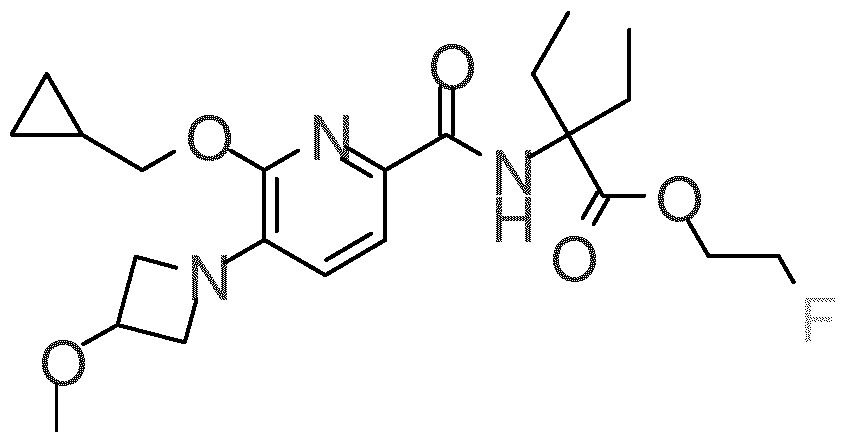
2-fluoroethyl 2- {[6-(cyclopropylmethoxy)-5 -(3 -methoxyazetidin- l-yl)pyridine -2- carbonyl] amino } -2-ethylbutanoate;
3 -fluoropropyl 2- { [6-(cyclopropylmethoxy)-5 -(3 -methoxyazetidin- 1 -y l)pyridine-2- carbonyl] amino } -2-ethylbutanoate; fluoromethyl 2- { [6-(cyclopropylmethoxy)-5 -(3 ,3 -difluoroazetidin- 1 -yl)pyridine-2- carbonyl] amino } -2-ethylbutanoate; 2-fluoroethyl 2-{[6-(cyclopropylmethoxy)-5-(3,3-difluoroazetidin-l-yl)pyridine-2- carbonyl] amino } -2-ethylbutanoate;
3 -fluoropropyl 2- {[6-(cyclopropylmethoxy)-5 -(3, 3 -difluoroazetidin- l-yl)pyridine-2- carbonyl] amino } -2-ethylbutanoate;
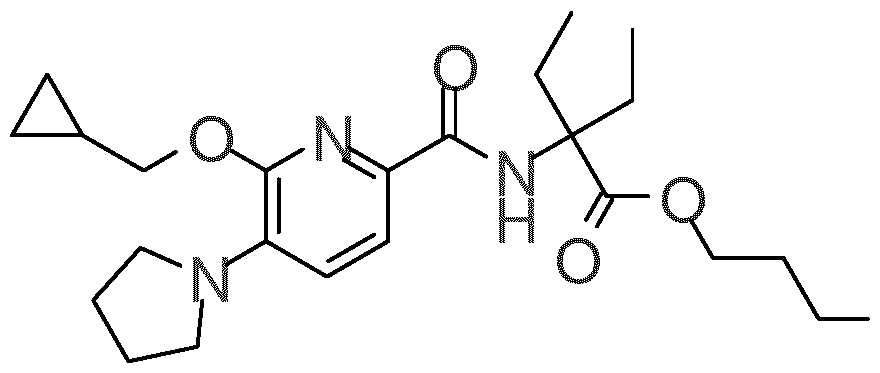
3 -fluoropropyl 2- { [6-(cyclopropylmethoxy)-5 -(pyrrolidin- 1 -yl)pyridine-2- carbonyl] amino } -2-ethylbutanoate; fluoromethyl 2-{[6-(cyclopropylmethoxy)-5-(pyrrolidin-l-yl)pyridine-2- carbonyl] amino } -2-ethylbutanoate; 2-fluoroethyl 2-{[6-(cyclopropylmethoxy)-5-(pyrrolidin-l-yl)pyridine-2- carbonyl] amino } -2-ethylbutanoate; fluoromethyl N-[6-(cyclopropylmethoxy)-5-(3-methoxyazetidin- 1 -yl)pyridine-2- carbonyl]-L-leucinate; 2-fluoroethyl N-[6-(cyclopropylmethoxy)-5-(3-methoxyazetidin-l-yl)pyridine-2- carbonyl]-L-leucinate;
3-fluoropropyl N-[6-(cyclopropylmethoxy)-5-(3-methoxyazetidin- 1 -yl)pyridine-2- carbonyl]-L-leucinate; fluoromethyl N-[6-(cyclopropylmethoxy)-5-(pyrrolidin-l-yl)pyridine-2-carbonyl]-L- leucinate;
2-fluoroethyl N-[6-(cyclopropylmethoxy)-5-(pyrrolidin- 1 -yl)pyridine-2-carbonyl]-L- leucinate;
3-fluoropropyl N-[6-(cyclopropylmethoxy)-5-(pyrrolidin- 1 -yl)pyridine-2-carbonyl]- L-leucinate; 6-(cyclopropylmethoxy)-N-[(2S)- 1 -(fluoromethoxy)-4-methylpentan-2-yl]-5-
(pyrrolidin- 1 -yl)pyridine-2-carboxamide;
6-(cyclopropylmethoxy)-N-[(2R)-l-(2-fluoroethoxy)-4-methylpentan-2-yl]-5- (pyrrolidin- 1 -yl)pyridine-2-carboxamide;
6-(cyclopropylmethoxy)-N-[(2S)-l-(2-fluoroethoxy)-4-methylpentan-2-yl]-5- (pyrrolidin- 1 -yl)pyridine-2-carboxamide;
6-(cyclopropylmethoxy)-N-[(2S)-l-(3-fluoropropoxy)-4-methylpentan-2-yl]-5- (pyrrolidin- 1 -yl)pyridine-2-carboxamide;
6-(cyclopropylmethoxy)-N-[(2S)-l-(fluoromethoxy)-3-methylbutan-2-yl]-5- (pyrrolidin- 1 -yl)pyridine-2-carboxamide; 6-(cyclopropylmethoxy)-N-[(2S)- 1 -(2-fluoroethoxy)-3-methylbutan-2-yl]-5-
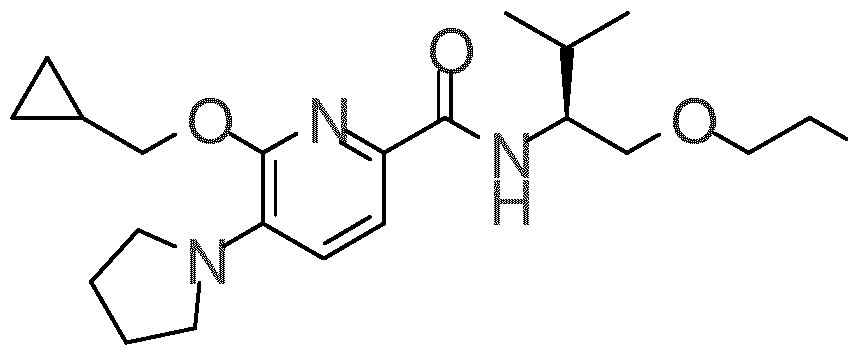
(pyrrolidin- 1 -yl)pyridine-2-carboxamide;
6-(cyclopropylmethoxy)-N-[(2S)-l-(3-fluoropropoxy)-3-methylbutan-2-yl]-5- (pyrrolidin- 1 -yl)pyridine-2-carboxamide; 6-(cyclopropylmethoxy)-N-[(2S)- 1 -(fluoromethoxy)propan-2-yl]-5-(pyrrolidin- 1 - yl)pyridine -2-carboxamide;
6-(cyclopropylmethoxy)-N-[(2S)- 1 -(2-fluoroethoxy)propan-2-yl]-5-(pyrrolidin- 1 - yl)pyridine -2-carboxamide; 6-(cyclopropylmethoxy)-N-[(2S)-l-(3-fluoropropoxy)propan-2-yl]-5-(pyrrolidin-l- yl)pyridine -2-carboxamide;
6-(cyclopropylmethoxy)-N-[(2S)-l-(fluoromethoxy)-4-methylpentan-2-yl]-5-(3- methoxyazetidin- 1 -yl)pyridine -2-carboxamide;
6-(cyclopropylmethoxy)-5-(3,3-difluoroazetidin- 1 -yl)-N-[(2S)- 1 -(2-fluoroethoxy)-4- methylpentan-2-yl]pyridine-2-carboxamide;
6-(cyclopropylmethoxy)-N-[(2R)-l-(2-fluoroethoxy)-4-methylpentan-2-yl]-5-(3- methoxyazetidin- 1 -yl)pyridine -2-carboxamide;
6-(cyclopropylmethoxy)-N-[(2S)-l-(2-fluoroethoxy)-4-methylpentan-2-yl]-5-(3- methoxyazetidin- 1 -yl)pyridine -2-carboxamide; 6-(cyclopropylmethoxy)-N-[(2S)- 1 -(3-fluoropropoxy)-4-methylpentan-2-yl]-5-(3- methoxyazetidin- 1 -yl)pyridine -2-carboxamide;
6-(cyclopropylmethoxy)-N-[(2S)-l-(fluoromethoxy)-3-methylbutan-2-yl]-5-(3- methoxyazetidin- 1 -yl)pyridine -2-carboxamide;
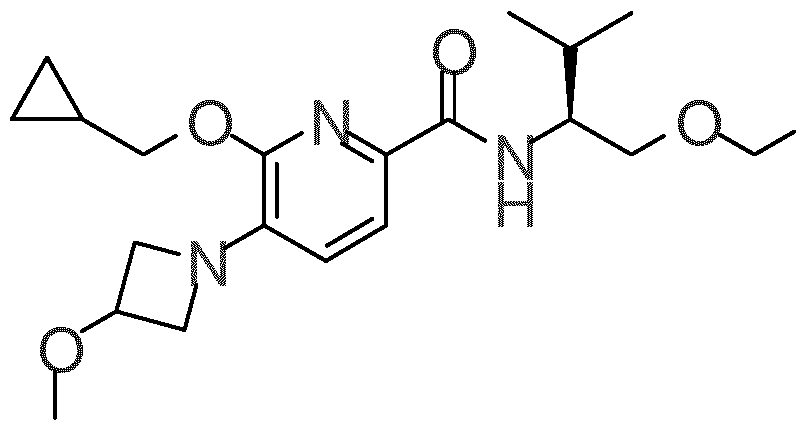
6-(cyclopropylmethoxy)-N-[(2S)-l-(2-fluoroethoxy)-3-methylbutan-2-yl]-5-(3- methoxyazetidin- 1 -yl)pyridine -2-carboxamide;
6-(cyclopropylmethoxy)-N-[(2S)-l-(3-fluoropropoxy)-3-methylbutan-2-yl]-5-(3- methoxyazetidin- 1 -yl)pyridine -2-carboxamide;
6-(cyclopropylmethoxy)-N-[(2S)-l-(2-fluoroethoxy)propan-2-yl]-5-(3- methoxyazetidin- 1 -yl)pyridine -2-carboxamide; 6-(cyclopropylmethoxy)-N-[(2S)- 1 -(3-fluoropropoxy)propan-2-yl]-5-(3- methoxyazetidin- 1 -yl)pyridine -2-carboxamide;
6-(cyclopropylmethoxy)-N- {3 - [(fluoromethoxy)methyl]pentan-3 -y 1} -5 -(pyrrolidin- 1 -yl)pyridine-2-carboxamide; 6-(cyclopropylmethoxy)-N-{3-[(2-fluoroethoxy)methyl]pentan-3-yl}-5-(pyrrolidin- 1 -yl)pyridine-2-carboxamide;
6-(cyclopropylmethoxy)-N- {3 - [(3 -fluoropropoxy)methyl]pentan-3 -yl} -5 - (pyrrolidin- 1 -yl)pyridine-2-carboxamide; 6-(cyclopropylmethoxy)-N- {3-[(fluoromethoxy)methyl]pentan-3-yl} -5-(3- methoxyazetidin- 1 -yl)pyridine -2-carboxamide;
6-(cyclopropylmethoxy)-N-{3-[(2-fluoroethoxy)methyl]pentan-3-yl}-5-(3- methoxyazetidin- 1 -yl)pyridine-2-carboxamide;
6-(cyclopropylmethoxy)-N- {3 - [(3 -fluoropropoxy)methyl]pentan-3 -yl} -5 -(3 - methoxyazetidin- 1 -yl)pyridine -2-carboxamide; fluoromethyl 2- { [6-(cyclopropylmethoxy)-5 -(3 -methoxyazetidin- 1 -yl)pyrazine-2- carbonyl] amino } -2-ethylbutanoate;
2-fluoroethyl 2- { [6-(cyclopropylmethoxy)-5 -(3 -methoxyazetidin- l-yl)pyrazine-2- carbonyl] amino } -2-ethylbutanoate; 3 -fluoropropyl 2- { [6-(cyclopropylmethoxy)-5 -(3 -methoxyazetidin- 1 -yl)pyrazine-2- carbonyl] amino } -2-ethylbutanoate; fluoro(dideuterio)methyl 2-{[6-(cyclopropylmethoxy)-5-(3-methoxyazetidin-l- yl)pyridine-2-carbonyl] amino } -2-ethylbutanoate;
2-fluoro(2,2-dideuterio)ethyl 2- { [6-(cyclopropylmethoxy)-5 -(3 -methoxyazetidin- 1- yl)pyridine-2-carbonyl] amino } -2-ethylbutanoate;
3 -fluoro(3 ,3 -dideuterio)propyl 2- { [6-(cyclopropylmethoxy)-5 -(3 -methoxyazetidin- 1 - yl)pyridine-2-carbonyl] amino } -2-ethylbutanoate; fluoro(dideuterio)methyl 2- { [6-(cyclopropylmethoxy)-5 -(3 ,3 -difluoroazetidin- 1 - yl)pyridine-2-carbonyl] amino } -2-ethylbutanoate; 2-fluoro(2,2-dideuterio)ethyl 2-{[6-(cyclopropylmethoxy)-5-(3,3-difluoroazetidin-l- yl)pyridine-2-carbonyl] amino } -2-ethylbutanoate;
3-fluoro(3,3-dideuterio)propyl 2-{[6-(cyclopropylmethoxy)-5-(3,3-difluoroazetidin- 1 -y l)pyridine-2-carbonyl] amino } -2-ethylbutanoate; 3-fluoro(3,3-dideuterio)propyl 2- {[6-(cyclopropylmethoxy)-5 -(pyrrolidin- 1- yl)pyridine-2-carbonyl] amino } -2-ethylbutanoate; fluoro(dideuterio)methyl 2- { [6-(cyclopropylmethoxy)-5 -(pyrrolidin- 1 -yl)pyridine-2- carbonyl] amino } -2-ethylbutanoate; 2-fluoro(2,2-dideuterio)ethyl 2- {[6-(cyclopropylmethoxy)-5 -(pyrrolidin- 1 - yl)pyridine-2-carbonyl] amino } -2-ethylbutanoate;
6-(cyclopropylmethoxy)-N-[(2S)- 1 - { [fluoro(dideuterio)methyl]oxy } -4- methylpentan-2-yl]-5-(pyrrolidin-l-yl)pyridine-2-carboxamide;
6-(cyclopropylmethoxy)-N-[(2S)- 1 - { [2-fluoro(2,2-dideuterio)ethyl]oxy } -4- methylpentan-2-yl]-5-(pyrrolidin-l -yl)pyridine-2-carboxamide;
6-(cyclopropylmethoxy)-N-[(2S)-l-{[3-fluoro(3,3-dideuterio)propyl]oxy}-4- methylpentan-2-yl]-5-(pyrrolidin-l-yl)pyridine-2-carboxamide;
6-(cyclopropylmethoxy)-N-[(2S)-l-{[fluoro(dideuterio)methyl]oxy}-3-methylbutan-
2-yl]-5-(pyrrolidin-l-yl)pyridine-2-carboxamide; 6-(cyclopropylmethoxy)-N-[(2S)- 1 - { [2-fluoro(2,2-dideuterio)ethyl]oxy } -3- methylbutan-2-yl]-5-(pyrrolidin-l-yl)pyridine -2-carboxamide;
6-(cyclopropylmethoxy)-N-[(2S)-l-{[3-fluoro(3,3- dideuterio)propyl]oxy}-3- methylbutan-2-yl]-5-(pyrrolidin-l-yl)pyridine -2-carboxamide;
6-(cyclopropylmethoxy)-N-[(2S)-l-{[fluoro(dideuterio)methyl]oxy}propan-2-yl]-5- (pyrrolidin- 1 -yl)pyridine-2-carboxamide;
6-(cyclopropylmethoxy)-N-[(2S)-l-{[2-fluoro(2,2-dideuterio)ethyl]oxy}propan-2- yl]-5-(pyrrolidin- 1 -yl)pyridine-2-carboxamide;
6-(cyclopropylmethoxy)-N-[(2S)-l-{[3-fluoro(3,3-dideuterio)propyl]oxy}propan-2- yl]-5-(pyrrolidin- 1 -yl)pyridine-2-carboxamide; 6-(cyclopropylmethoxy)-N-[(2S)- 1 - { [fluoro(dideuterio)methyl]oxy } -4- methylpentan-2-yl]-5-(3-methoxyazetidin-l-yl)pyridine-2-carboxamide;
6-(cyclopropylmethoxy)-N-[(2S)- 1 - { [2-fluoro(2,2-dideuterio)ethyl]oxy } -4- methylpentan-2-yl]-5-(3-methoxyazetidin-l-yl)pyridine-2-carboxamide; 6-(cyclopropylmethoxy)-N-[(2S)-l-{[3-fluoro(3,3-dideuterio)propyl]oxy}-4- methylpentan-2-yl]-5-(3-methoxyazetidin-l-yl)pyridine-2-carboxamide;
6-(cyclopropylmethoxy)-N-[(2S)-l-{[fluoro(dideuterio)methyl]oxy}-3-methylbutan-
2-yl]-5-(3-methoxyazetidin-l-yl)pyridine-2-carboxamide; 6-(cyclopropylmethoxy)-N-[(2S)- 1 - { [2-fluoro(2,2-dideuterio)ethyl]oxy } -3- methylbutan-2-yl] -5 -(3 -methoxyazetidin- 1 -yl)pyridine -2-carboxamide;
6-(cyclopropylmethoxy)-N-[(2S)-l-{[3-fluoro(3,3-dideuterio)propyl]oxy}-3- methylbutan-2-yl] -5 -(3 -methoxyazetidin- 1 -yl)pyridine -2-carboxamide;
6-(cyclopropylmethoxy)-N-[(2S)-l-{[2-fluoro(2,2-dideuterio)ethyl]oxy}propan-2- yl]-5-(3-methoxyazetidin- 1 -yl)pyridine-2-carboxamide;
6-(cyclopropylmethoxy)-N-[(2S)-l-{[3-fluoro(3,3- dideuterio)propyl]oxy}propan-2- yl]-5-(3-methoxyazetidin- 1 -yl)pyridine-2-carboxamide;
6-(cyclopropylmethoxy)-N-[3-({[fluoro(dideuterio)methyl]oxy}methyl)pentan-3- yl]-5-(pyrrolidin- 1 -yl)pyridine-2-carboxamide; 6-(cyclopropylmethoxy)-N-[3-({[2-fluoro(2,2-dideuterio)ethyl]oxy}methyl)pentan-
3 -y 1] -5 -(pyrrolidin- 1 -yl)pyridine-2-carboxamide;
6-(cyclopropylmethoxy)-N- [3 -( { [3 -fluoro(3 ,3 -dideuterio)propyl]oxy } methyl)pentan- 3 -yl] -5 -(pyrrolidin- 1 -yl)pyridine-2-carboxamide;
6-(cyclopropylmethoxy)-N-[3-({[fluoro(dideuterio)methyl]oxy}methyl)pentan-3- yl]-5-(3-methoxyazetidin- 1 -yl)pyridine-2-carboxamide;
6-(cyclopropylmethoxy)-N-[3-({[2-fluoro(2,2-dideuterio)ethyl]oxy}methyl)pentan- 3 -y 1] -5 -(3 -methoxyazetidin- 1 -yl)pyridine-2-carboxamide;
6-(cyclopropylmethoxy)-N- [3 -( { [3 -fluoro(3 ,3 -dideuterio)propyl]oxy } methyl)pentan- 3 -y 1] -5 -(3 -methoxyazetidin- 1 -yl)pyridine-2-carboxamide; ethyl 2- { [6-(cyclopropylmethoxy)-5 -(3 -methoxyazetidin- 1 -yl)pyridine-2- carbonyl]amino}-2-ethyl-4-fluoro(4,4-dideuterio)butanoate; ethyl 2- { [6-(cyclopropylmethoxy)-5 -(3 -methoxyazetidin- 1 -yl)pyridine-2- carbonyl]amino}-2-ethyl-4-fluoro(4,4-dideuterio)butanoate; 6-(cyclopropylmethoxy)-5-(3-fluoro-3-methylazetidin-l-yl)-N-(3-(3- fluoropropylcarbamoyl)pentan-3-yl)picolinamide; ethyl 2- { [6-(cyclopropylmethoxy)-5 -(3 -methoxyazetidin- 1 -yl)pyridine-2- carbonyl] amino } -2-ethyl-4-fluorobutanoate; ethyl 2- { [6-(cyclopropylmethoxy)-5 -(3 -methoxyazetidin- 1 -yl)pyridine-2- carbonyl] amino } -2-ethyl-3 -fluorobutanoate; ethyl 2- { [6-(cyclopropylmethoxy)-5 -(3 -methoxyazetidin- 1 -yl)pyridine-2- carbonyl] amino } -2-ethyl-4-fluorobutanoate; and ethyl 2- { [6-(cyclopropylmethoxy)-5 -(3 -methoxyazetidin- 1 -yl)pyridine-2- carbonyl] amino} -2-ethyl-3-fluorobutanoate.
The invention further relates to a compound according to the invention selected from:
2-fluoroethyl 2- {[6-(cyclopropylmethoxy)-5 -(3 -methoxyazetidin- l-yl)pyridine -2- carbonyl] amino } -2-ethylbutanoate; 3 -fluoropropyl 2- { [6-(cyclopropylmethoxy)-5 -(3 -methoxyazetidin- 1 -y l)pyridine-2- carbonyl] amino } -2-ethylbutanoate;
2-fluoroethyl N-[6-(cyclopropylmethoxy)-5-(3-methoxyazetidin-l-yl)pyridine-2- carbonyl]-L-leucinate;
2-fluoroethyl N-[6-(cyclopropylmethoxy)-5-(pyrrolidin- 1 -yl)pyridine-2-carbonyl]-L- leucinate;
6-(cyclopropylmethoxy)-N-[(2S)-l-(fluoromethoxy)-4-methylpentan-2-yl]-5- (pyrrolidin- 1 -yl)pyridine-2-carboxamide;
6-(cyclopropylmethoxy)-N-[(2S)-l-(2-fluoroethoxy)-4-methylpentan-2-yl]-5- (pyrrolidin- 1 -yl)pyridine-2-carboxamide; 6-(cyclopropylmethoxy)-N-[(2S)- 1 -(fluoromethoxy)-4-methylpentan-2-yl]-5-(3- methoxyazetidin- 1 -yl)pyridine -2-carboxamide;
6-(cyclopropylmethoxy)-5-(3,3-difluoroazetidin- 1 -yl)-N-[(2S)- 1 -(2-fluoroethoxy)-4- methylpentan-2-yl]pyridine-2-carboxamide; and 6-(cyclopropylmethoxy)-N-[(2S)-l-(2-fluoroethoxy)-4-methylpentan-2-yl]-5-(3- methoxyazetidin- 1 -yl)pyridine-2-carboxamide.
The invention also relates in particular to 6-(cyclopropylmethoxy)-N-[(2S)-l-(2- fluoroethoxy)-4-methylpentan-2-yl]-5-(pyrrolidin-l-yl)pyridine-2-carboxamide. The synthesis of the compounds with the general structure I can, for example, be accomplished according to the following schemes.
Following the procedure according to scheme 1, compound AA (R’ = H, methyl, ethyl, isopropyl, tert. butyl or another suitable protecting group described for example in T.W. Greene et ah, Protective Groups in Organic Chemistry, John Wiley and Sons Inc. New York 1999, 3rd edition) can be used as starting material. AA is either commercially available, described in the literature or can be synthesized by a person skilled in the art.
Scheme 1
Figure imgf000015_0001
Compound AB can be prepared from AA by oxidation with a suitable oxidizing reagent under conditions known to a person skilled in the art (step a), e.g. by treatment with 3-chloro perbenzoic acid in dichloromethane at ambient temperature.
Conversion of compound AB to 6-chloro or 6-bromo-picoline AC (X = Cl, Br) can be achieved e.g. by treatment with phosphoryl trichloride or tribromide either without an additional solvent or in a suitable solvent such as chloroform at temperatures between 20 °C and the boiling point of the solvent, or by using other conditions known in the literature (step b). 6-Chloro- or bromo-picoline AC (X = Cl, Br) can be transformed to compound AE by reaction with a suitably substituted primary or secondary alcohol AD such as cyclopropylmethanol in the presence of a base, for example sodium hydride, with or without an inert solvent, for example dimethylformamide, at temperatures ranging from room temperature to the reflux temperature of the solvent, particularly at room temperature (step c).
The saponification of the ester of general formula AE (R’ ¹ H) by methods well known to the ones skilled in the art - using e.g. aqueous LiOH, NaOH or KOH in tetrahydrofuran / ethanol or another suitable solvent at temperatures between 0 °C and the reflux temperature of the solvent employed - leads to an acid of general formula II (step d).
Compound I (R’’ = cyclopropylmethyloxy) can be prepared from II and the corresponding amine of formula III by suitable amide bond forming reactions (step e). These reactions are known in the art. For example coupling reagents like X,A"”-carbonyl- diimidazole (CDI), /V, A'” - d i c y c l o h c x y l c a rb o d i i m i d c (DCC), l-(3-dimethylaminopropyl)-3- ethylcarbodiimide hydrochloride (EDCI), l-[bis(dimethylamino)-methylene]-i/ - 1,2,3- triazolo[4,5-b]pyridinium-3-oxide hexafluorophosphate (HATU), 1 -hydroxy- 1,2,3 - benzotriazole (HOBT), O-benzotriazol- 1 -yl-A'A'V, A'”,A” -tetramethyluronium
tetrafluoroborate (TBTU), and 0-bcnzotriazolc-X,X,X’,A'”-tctramcthyl-uronium- hexafluoro-phosphate (HBTU) can be employed to affect such transformation. A convenient method is to use for example HBTU and a base, for example N- methylmorpholine in an inert solvent such as for example dimethylformamide at room temperature.
Alternatively, compound AC (R’ = methyl, ethyl, isopropyl, tert. butyl or another suitable protecting group described for example in T.W. Greene et ah, Protective Groups in Organic Chemistry, John Wiley and Sons Inc. New York 1999, 3rd edition) can be: i) converted into its acid congener AC (R’ = H) as described in step d; ii) transformed into the corresponding amide by treatment with amine III as described in step e; and iii) reacted with alcohol AD as described in step c to arrive at compound I.
Amines III and alcohols AD are either commercially available, described in the literature, can be synthesized by a person skilled in the art or as described in the experimental part.
If one of the starting materials, compounds of formulae AA, AD or III, contains one or more functional groups which are not stable or are reactive under the reaction conditions of one or more reaction steps, appropriate protecting groups (P) (as described e.g. in T.W. Greene et ah, Protective Groups in Organic Chemistry, John Wiley and Sons Inc. New York 1999, 3rd edition) can be introduced before the critical step applying methods well known in the art. Such protecting groups can be removed at a later stage of the synthesis using standard methods known in the art. If one or more compounds of formulae AA to AE, AD, II or III contain chiral centers, picolines of formula I can be obtained as mixtures of diastereomers or enantiomers, which can be separated by methods well known in the art, e.g. (chiral) HPLC or crystallization. Racemic compounds can e.g. be separated into their antipodes via diastereomeric salts by crystallization or by separation of the antipodes by specific chromatographic methods using either a chiral adsorbent or a chiral eluent.
Following the procedure according to scheme 2, compound BA (R’ = H, methyl, ethyl, isopropyl, tert. butyl or another suitable protecting group described for example in T.W. Greene et ah, Protective Groups in Organic Chemistry, John Wiley and Sons Inc. New York 1999, 3rd edition) can be used as starting material. BA is either commercially available (e.g. for R’ = methyl: 5-bromo-6-chloro-pyridine-2-carboxylic acid methyl ester CAN 1214353-79-3), described in the literature or can be synthesized by a person skilled in the art.
Scheme 2
Figure imgf000017_0001
AE
Compound AC’ can be prepared from BA by coupling with an amine BB (M is H) by methods well known to a person skilled in the art, e.g. using a palladium catalyst such as tris(dibenzylideneacetone)dipalladium / dimethylbisdiphenyl-phosphinoxanthene and a base such as cesium carbonate in a solvent such as 1 ,4-dioxane, preferentially at the boiling point of the solvent (step a).
Compound AC’ can be further elaborated to compound I (R’’ =
cyclopropylmethyloxy) by: i) reaction with compound AD to form compound AE as described in step c of scheme 1; ii) saponification as described in step d of scheme 1; and iii) amide bond formation as described in step e of scheme 1.
Furthermore, compound BA can be converted into compound BC by treatment with compound AD as described in step c of scheme 1 (step b).
Subsequent transformation of compound BC into compound AE can be achieved as discussed for the conversion of BA into AC’ (step a).
Compound AE can be further elaborated to compound I (R’’ =
cyclopropylmethyloxy) by: i) saponification as described in step d of scheme 1; ii) amide bond formation as described in step e of scheme 1.
Alternatively, compound BC (R’ = methyl, ethyl, isopropyl, tert. butyl or another suitable protecting group described for example in T.W. Greene et ah, Protective Groups in Organic Chemistry, John Wiley and Sons Inc. New York 1999, 3rd edition) can be: i) converted into its acid congener BC (R’ = H) as described in step d of scheme 1; ii) transformed into the corresponding amide BD by treatment with amine III as described in step e of scheme 1 ; and iii) reacted with BB as described in step a to arrive at compound I (R” = cyclopropylmethyloxy).
Furthermore, compound I can also be synthesized applying the following reaction sequence: i) saponification of compound BA (R’ = methyl, ethyl, isopropyl, tert. butyl or another suitable protecting group described for example in T.W. Greene et al., Protective Groups in Organic Chemistry, John Wiley and Sons Inc. New York 1999, 3rd edition) to its acid congener BA (R’ = H) as described in step d of scheme 1; ii) conversion to the corresponding amide by treatment with amine III as described in step e of scheme 1 ; iii) reaction with compound BB as described in step a; and iv) reaction with compound AD as described in step b. Optionally step iii) and step iv) can be interchanged.
If one of the starting materials, compounds of formulae CA, CB or BC contains one or more functional groups which are not stable or are reactive under the reaction conditions of one or more reaction steps, appropriate protecting groups (P) (as described e.g. in T.W. Greene et al., Protective Groups in Organic Chemistry, John Wiley and Sons Inc. New York 1999, 3rd edition) can be introduced before the critical step applying methods well known in the art. Such protecting groups can be removed at a later stage of the synthesis using standard methods known in the art.
If one or more compounds of formulae BA, BB or AD contain chiral centers, picolines of formula AC’ and AE can be obtained as mixtures of diastereomers or enantiomers, which can be separated by methods well known in the art, e.g. (chiral) HPLC or crystallization. Racemic compounds can e.g. be separated into their antipodes via diastereomeric salts by crystallization or by separation of the antipodes by specific chromatographic methods using either a chiral adsorbent or a chiral eluent.
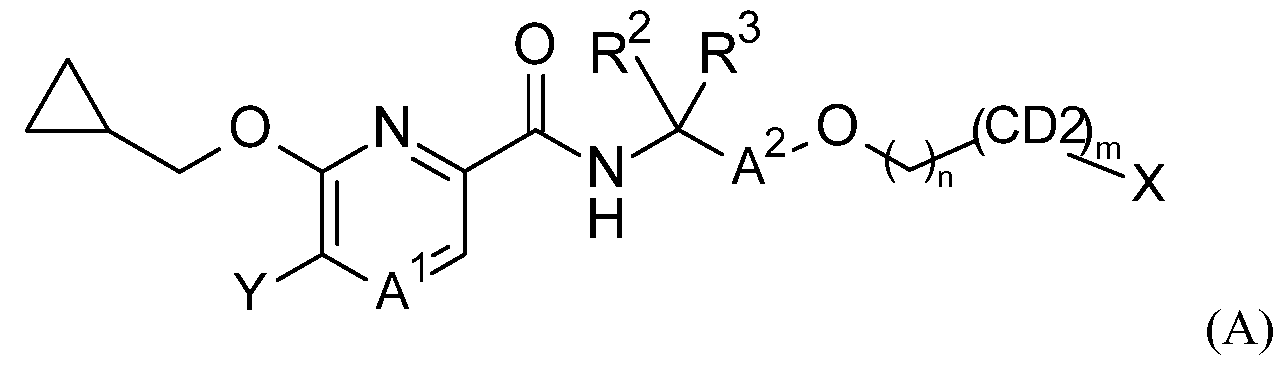
The invention also relates to a process for the preparation of a compound of formula (I) comprising one of the following steps:
(a) the reaction of a compound of formula (A)
Figure imgf000019_0001
in the presence of R^H, a palladium catalyst and a base;
(b) the reaction of a compound of formula (B)
Figure imgf000019_0002
in the presence of NH2-C(R2R3)-A2-0-(CH2)n-(CD2)m-X, a coupling agent and a base; wherein A1, A2, X, R '-R', m and n are as defined above and Y is halogen.
The coupling agent of step (b) is conveniently an amide bond forming agent, like e.g. A, A’ - c a r b o n y l - d i i m i d a z o l c (CDI), AA’-dicyclohexylcarbodiimide (DCC), l-(3- dimethylaminopropyl)-3-ethylcarbodiimide hydrochloride (EDCI), l-[bis(dimethylamino)- mcthylcnc]-/A- 1 ,2,3-triazolo[4,5-b]pyridinium-3-oxidc hexafluorophosphate (HATU), 1- hydroxy- 1 ,2,3-benzotriazole (HOBT), O-benzotriazol- 1 -y 1- , A, A A’-tctramcthy 1 uron i urn tetrafluoroborate (TBTU) or and O-bcnzotriazolc- , A, A A’-tctramcthy 1-uron i um- hexafluoro-phosphate (HBTU). A-mcthyl morpholine is a convenient base for step (b).
HBTU can advantageously be used in combination with /V-mcthyl morpholine in step
The solvent of step (b) can advantageously be dimethylformamide. In step (a), the palladium catalyst can be for example
tris(dibenzylideneacetone)dipalladium / dimethylbisdiphenyl-phosphinoxanthene.
In step (a) the base can be e.g. cesium carbonate.
In step (a), the solvent is advantageously l,4-dioxane.
In step (a), Y can conveniently be bromine. The invention also relates to a compound according to the invention when manufactured according to a process of the invention.
Another embodiment of the invention provides a pharmaceutical composition or medicament containing a compound of the invention and a therapeutically inert carrier, diluent or excipient, as well as a method of using the compounds of the invention to prepare such composition and medicament. In one example, the compound of formula (I) may be formulated by mixing at ambient temperature at the appropriate pH, and at the desired degree of purity, with physiologically acceptable carriers, i.e., carriers that are non-toxic to recipients at the dosages and concentrations employed into a galenical administration form. The pH of the formulation depends mainly on the particular use and the concentration of compound, but preferably ranges anywhere from about 3 to about 8.
In one example, a compound of formula (I) is formulated in an acetate buffer, at pH 5. In another embodiment, the compound of formula (I) is sterile. The compound may be stored, for example, as a solid or amorphous composition, as a lyophilized formulation or as an aqueous solution. Compositions are formulated, dosed, and administered in a fashion consistent with good medical practice. Factors for consideration in this context include the particular disorder being treated, the particular mammal being treated, the clinical condition of the individual patient, the cause of the disorder, the site of delivery of the agent, the method of administration, the scheduling of administration, and other factors known to medical practitioners.
The compounds of the invention may be administered by any suitable means, including oral, topical (including buccal and sublingual), rectal, vaginal, transdermal, parenteral, subcutaneous, intraperitoneal, intrapulmonary, intradermal, intrathecal and epidural and intranasal, and, if desired for local treatment, intralesional administration. Parenteral infusions include intramuscular, intravenous, intraarterial, intraperitoneal, or subcutaneous administration.
The compounds of the present invention may be administered in any convenient administrative form, e.g., tablets, powders, capsules, solutions, dispersions, suspensions, syrups, sprays, suppositories, gels, emulsions, patches, etc. Such compositions may contain components conventional in pharmaceutical preparations, e.g., diluents, carriers, pH modifiers, sweeteners, bulking agents, and further active agents.
A typical formulation is prepared by mixing a compound of the present invention and a carrier or excipient. Suitable carriers and excipients are well known to those skilled in the art and are described in detail in, e.g., Ansel, Howard C., et ah, Ansel’s
Pharmaceutical Dosage Forms and Drug Delivery Systems. Philadelphia: Lippincott, Williams & Wilkins, 2004; Gennaro, Alfonso R., et al. Remington: The Science and Practice of Pharmacy. Philadelphia: Lippincott, Williams & Wilkins, 2000; and Rowe, Raymond C. Handbook of Pharmaceutical Excipients. Chicago, Pharmaceutical Press, 2005. The formulations may also include one or more buffers, stabilizing agents, surfactants, wetting agents, lubricating agents, emulsifiers, suspending agents,
preservatives, antioxidants, opaquing agents, glidants, processing aids, colorants, sweeteners, perfuming agents, flavoring agents, diluents and other known additives to provide an elegant presentation of the drug (i.e., a compound of the present invention or pharmaceutical composition thereof) or aid in the manufacturing of the pharmaceutical product (i.e., medicament).
The invention also relates in particular to:
The use of a compound of formula (I) for the treatment or prophylaxis of pain, atherosclerosis, age-related macular degeneration, diabetic retinopathy, glaucoma, diabetes mellitus, inflammation, inflammatory bowel disease, ischemia-reperfusion injury, acute liver failure, liver fibrosis, lung fibrosis, kidney fibrosis, systemic fibrosis, acute allograft rejection, chronic allograft nephropathy, diabetic nephropathy, glomerulonephropathy, cardiomyopathy, heart failure, myocardial ischemia, myocardial infarction, systemic sclerosis, thermal injury, burning, hypertrophic scars, keloids, gingivitis pyrexia, liver cirrhosis or tumors, regulation of bone mass, neurodegeneration, stroke, transient ischemic attack or uveitis;
The use of a compound according of formula (I) for the preparation of a medicament for the treatment or prophylaxis of pain, atherosclerosis, age-related macular degeneration, diabetic retinopathy, glaucoma, diabetes mellitus, inflammation, inflammatory bowel disease, ischemia-reperfusion injury, acute liver failure, liver fibrosis, lung fibrosis, kidney fibrosis, systemic fibrosis, acute allograft rejection, chronic allograft nephropathy, diabetic nephropathy, glomerulonephropathy, cardiomyopathy, heart failure, myocardial ischemia, myocardial infarction, systemic sclerosis, thermal injury, burning, hypertrophic scars, keloids, gingivitis pyrexia, liver cirrhosis or tumors, regulation of bone mass,
neurodegeneration, stroke, transient ischemic attack or uveitis;
A compound of formula (I) for use in the treatment or prophylaxis of pain, atherosclerosis, age-related macular degeneration, diabetic retinopathy, glaucoma, diabetes mellitus, inflammation, inflammatory bowel disease, ischemia-reperfusion injury, acute liver failure, liver fibrosis, lung fibrosis, kidney fibrosis, systemic fibrosis, acute allograft rejection, chronic allograft nephropathy, diabetic nephropathy, glomerulonephropathy, cardiomyopathy, heart failure, myocardial ischemia, myocardial infarction, systemic sclerosis, thermal injury, burning, hypertrophic scars, keloids, gingivitis pyrexia, liver cirrhosis or tumors, regulation of bone mass, neurodegeneration, stroke, transient ischemic attack or uveitis; and
A method for the treatment or prophylaxis of pain, atherosclerosis, age-related macular degeneration, diabetic retinopathy, glaucoma, diabetes mellitus, inflammation, inflammatory bowel disease, ischemia-reperfusion injury, acute liver failure, liver fibrosis, lung fibrosis, kidney fibrosis, systemic fibrosis, acute allograft rejection, chronic allograft nephropathy, diabetic nephropathy, glomerulonephropathy, cardiomyopathy, heart failure, myocardial ischemia, myocardial infarction, systemic sclerosis, thermal injury, burning, hypertrophic scars, keloids, gingivitis pyrexia, liver cirrhosis or tumors, regulation of bone mass, neurodegeneration, stroke, transient ischemic attack or uveitis, which method comprises administering an effective amount of a compound of formula (I) to a patient in need thereof.
The invention particularly relates to a compound of formula (I) for the treatment or prophylaxis of ischemia, reperfusion injury, liver fibrosis or kidney fibrosis, in particular ischemia or reperfusion injury.
The invention will now be illustrated by the following examples which have no limiting character. Examples
Abbreviations
CAN = chemical abstracts service number; DIPEA = N-ethyl-N-isopropylpropan-2-amine; DMF = dimethylformamide; EtOAc = ethyl acetate; hept. = heptane; HPLC = LC = high performance liquid chromatography; ISP = ion spray, corresponds to ESI (electrospray); MS = mass spectrometry; NMR data are reported in parts per million (d) relative to internal tetramethylsilane and are referenced to the deuterium lock signal from the sample solvent (d6-DMSO unless otherwise stated); coupling constants (J) are in Hertz; RT = room temperature; TBTU = 0-(benzotriazol-l-yl)-A,A,A)A’-tetramethyl-uronium- tetrafluoroborate; THF = tetrahydrofuran; tlc = thin layer chromatography.
Example 1
Fluoromethyl 2-{[6-(cyclopropylmethoxy)-5-(3-methoxyazetidin-l-yl)pyridine-2- carbonyl]amino}-2-ethylbutanoate
Figure imgf000023_0001
a) 2-(6-(Cyclopropylmethoxy)-5-(3-methoxyazetidin- 1 -yl)picolinamido)-2-ethylbutanoic acid
Figure imgf000023_0002
In a 25 mL round-bottomed flask, ethyl 2-(6-(cyclopropylmethoxy)-5-(3-methoxyazetidin- l-yl)picolinamido)-2-ethylbutanoate (CAN 1778678-14-0, 210 mg, 501 pmol, Eq: 1) was combined with THF (3 mL) and MeOH (3.3 mL) to give a colorless solution. KOH (140 mg, 2.5 mmol, Eq: 5), dissolved in water (3 mL) was added and the reaction mixture was stirred at 100 °C for 19 h. KOH (75 mg) and 1 mL THF, MeOH and water were added and stirring was continued at 100 °C for 3 h. The organic solvent was removed under reduced pressure and the aqueous phase was acidified (1 N HC1). The resulting white suspension was extracted with EtOAc (3 x 25 mL). The combined organic layers were washed with brine (1 x 20 mL), dried over Na2S04 and concentrated in vacuo to give the crude title compound as light brown oil which was used in the next step without further purification, MS (ISP): 392.314 [MH+] b) Fluoromethyl 2- { [6-(cyclopropylmethoxy)-5 -(3 -methoxyazetidin- 1 -yl)pyridine-2- carbonyl]amino}-2-ethylbutanoate
In a 10 mL round-bottomed flask, 2-(6-(cyclopropylmethoxy)-5 -(3 -methoxyazetidin- 1- yl)picolinamido)-2-ethylbutanoic acid (37 mg, 94.5 pmol, Eq: 1) was combined with DMF (500 pL) to give a light brown solution. K2CO3 (65.3 mg, 473 pmol, Eq: 5) and fluoro- iodo-methane (76.3 mg, 32.2 pL, 473 pmol, Eq: 5) were added. The reaction mixture was stirred at RT for 30 min, diluted with EtOAc and washed with sat. NaCl (3 x 10 mL). The organic layer was dried over Na2S04 and concentrated in vacuo. The crude product was purified by column chromatography (Si02, 5 g, hept./ EtOAc) to give the title compound (27 mg, 68%) as colorless oil, MS (ISP): 424.341 [MEL]
Example 2
2-Fluoroethyl 2-{[6-(cyclopropylmethoxy)-5-(3-methoxyazetidin-l-yl)pyridine-2- carbonyl]amino}-2-ethylbutanoate
Figure imgf000024_0001
In analogy to the procedure described in example 1 b, 2-(6-(cyclopropylmethoxy)-5-(3- methoxyazetidin-l-yl)picolinamido)-2-ethylbutanoic acid (example 1 a) was reacted with fluoro-iodo-methane to give the title compound as colorless oil, MS (ISP): 438.346 [MEL]
Example 3
3-Fluoropropyl 2-{[6-(cyclopropylmethoxy)-5-(3-methoxyazetidin-l-yl)pyridine-2- carbonyl] amino}-2-ethylbutanoate
Figure imgf000025_0001
In analogy to the procedure described in example 1 b, 2-(6-(cyclopropylmethoxy)-5-(3- methoxyazetidin-l-yl)picolinamido)-2-ethylbutanoic acid (example 1 a) was reacted with l-iodo-3-fluoropropane to give the title compound as colorless oil, MS (ISP): 452.4
[MH+]
Example 4
Fluoromethyl 2-{[6-(cyclopropylmethoxy)-5-(3,3-difluoroazetidin-l-yl)pyridine-2- carbonyl]amino}-2-ethylbutanoate
Figure imgf000025_0002
In analogy to the procedure described in example 1 b, 2-(6-(cyclopropylmethoxy)-5-(3,3- difluoroazetidin-l-yl)picolinamido)-2-ethylbutanoic acid (CAN 1415896-50-2) was reacted with fluoro-iodo-methane to give the title compound as colorless oil, LC-MS (UV peak area/ESI) 100%, 430.1952 [MH+]
Example 5 2-Fluoroethyl 2-{[6-(cyclopropylmethoxy)-5-(3,3-difluoroazetidin-l-yl)pyridine-2- carbonyl]amino}-2-ethylbutanoate
Figure imgf000025_0003
In analogy to the procedure described in example 1 b, 2-(6-(cyclopropylmethoxy)-5-(3,3- difluoroazetidin-l-yl)picolinamido)-2-ethylbutanoic acid (CAN 1415896-50-2) was reacted with fluoro-iodo-ethane to give the title compound as colorless oil, LC-MS (UV peak area/ESI) 100%, 444.2109 [MH+] Example 6
3-Fluoropropyl 2-{[6-(cyclopropylmethoxy)-5-(3,3-difluoroazetidin-l-yl)pyridine-2- carbonyl]amino}-2-ethylbutanoate
Figure imgf000026_0001
In analogy to the procedure described in example 1 b, 2-(6-(cyclopropylmethoxy)-5-(3,3- difluoroazetidin-l-yl)picolinamido)-2-ethylbutanoic acid (CAN 1415896-50-2) was reacted with l-iodo-3-fluoropropane to give the title compound as colorless oil, LC-MS (UV peak area/ESI) 100%, 458.2263 [MEL]
Example 7
3-Fluoropropyl 2-{[6-(cyclopropylmethoxy)-5-(pyrrolidin-l-yl)pyridine-2- carbonyl] amino}-2-ethylbutanoate
Figure imgf000026_0002
In analogy to the procedure described in example 1 b, 2-(6-(cyclopropylmethoxy)-5- (pyrrolidin-l-yl)picolinamido)-2-ethylbutanoic acid (CAN 1415897-34-5) was reacted with l-iodo-3-fluoropropane to give the title compound as colorless oil, LC-MS (UV peak area/ESI) 98%, 436.2615 [MH+]
Example 8
Fluoromethyl 2-{[6-(cyclopropylmethoxy)-5-(pyrrolidin-l-yl)pyridine-2- carbonyl]amino}-2-ethylbutanoate
Figure imgf000027_0001
In analogy to the procedure described in example 1 b, 2-(6-(cyclopropylmethoxy)-5- (pyrrolidin-l-yl)picolinamido)-2-ethylbutanoic acid (CAN 1415897-34-5) was reacted with fluoro-iodo-methane to give the title compound as colorless oil, LC-MS (UV peak area/ESI) 96%, 408.2301 [MH+]
Example 9
2-Fluoroethyl 2-{[6-(cyclopropylmethoxy)-5-(pyrrolidin-l-yl)pyridine-2- carbonyl]amino}-2-ethylbutanoate
Figure imgf000027_0002
In analogy to the procedure described in example 1 b, 2-(6-(cyclopropylmethoxy)-5- (pyrrolidin-l-yl)picolinamido)-2-ethylbutanoic acid (CAN 1415897-34-5) was reacted with fluoro-iodo-ethane to give the title compound as colorless oil, LC-MS (UV peak area/ESI) 97%, 422.2463 [MH+]
Example 10 Fluoromethyl N-[6-(cyclopropylmethoxy)-5-(3-methoxyazetidin-l-yl)pyridine-2- carbonyl] -L-leucinate
Figure imgf000027_0003
a) (S)-Methyl 2-(5-bromo-6-(cyclopropylmethoxy)picolinamido)-4-methylpentanoate
Figure imgf000028_0001
In a 100 mL round-bottomed flask, 5-bromo-6-(cyclopropylmethoxy)picolinic acid (CAN 1415898-37-1, 850 mg, 3.12 mmol, Eq: 1) was combined with DMF (15 mL) to give a light yellow solution. TBTU (1.1 g, 3.44 mmol, Eq: 1.1), DIPEA (1.61 g, 2.18 mL, 12.5 mmol, Eq: 4) and L-leucine methyl ester hydrochloride (CAN 7517-19-3, 794 mg, 4.37 mmol, Eq: 1.4) were added and the mixture was stirred at RT for 30 min. The solvent was removed under reduced pressure and the residue dissolved in EtOAc. The organic layers were combined, washed with sat. NaHC03 (3 x 20 mL), 1 M HC1 (3 x 20 mL), and sat. NaCl (3 x 20 mL). The organic layers were dried over Na2S04 and concentrated in vacuo to obtain crude title product (1.1 g, 88%) as light brown oil which was used in the next reaction step without further purificaition, MS (ISP): 399.162 [MEL] b) (S)-Methyl 2-(6-(cyclopropylmethoxy)-5-(3-methoxyazetidin- 1 -yl)picolinamido)-4- methylpentanoate
Figure imgf000028_0002
In a 20 mL sealed tube, (S)-methyl 2-(5-bromo-6-(cyclopropylmethoxy)picolinamido)-4- methylpentanoate (385 mg, 964 pmol, Eq: 1) was combined with toluene (10 mL) to give a colorless solution. 3-Methoxyazetidine hydrochloride (CAN 148644-09-1, 179 mg, 1.45 mmol, Eq: 1.5) and CS2CO3 (943 mg, 2.89 mmol, Eq: 3) were added rac-2,2'- Bis(diphenylphosphino)-l,r-binaphthyl (120 mg, 193 mhioΐ, Eq: 0.2) and palladium(II) acetate (43.3 mg, 193 pmol, Eq: 0.2) were added. The white suspension was heated to 110 °C for 1 h, diluted with EtOAc and filtered through celite. The organic layers were combined, washed with 1 M HC1 (3 x 50 mL) and sat. NaCl (1 x 100 mL). The organic layers were dried over Na2S04 and concentrated in vacuo. The crude product was purified by column chromatography (S1O2, 50 g, hept./EtOAc) to give the title compound (287 mg, 73%) as light yellow oil, MS (ISP): 406.319 [MH+] c) (S)-2-(6-(Cyclopropylmethoxy)-5-(3-methoxyazetidin-l-yl)picolinamido)-4- methylpentanoic acid
Figure imgf000029_0001
In a 25 mL round-bottomed flask, (S)-methyl 2-(6-(cyclopropylmethoxy)-5-(3- methoxyazetidin-l-yl)picolinamido)-4-methylpentanoate (270 mg, 666 pmol, Eq: 1) was combined with THF (2 mL), water (2 mL) and MeOH (2 mL) to give a light yellow solution. KOH (112 mg, 2 mmol, Eq: 3) was added and the mixture was stirred for 1 h at RT. The organic solvent was removed under reduced pressure. The aqueous phase was adjusted to pH 2 with 1 M HC1 and extracted with EtOAc (3 x 20 mL) and brine (1 x 25 mL). The organic layers were dried over Na2S04 and concentrated in vacuo to give crude title compound (quant.) as light brown oil which was used in the next reaction step without further purification, MS (ISP): 392.316 [MH+] d) Fluoromethyl N-[6-(cyclopropylmethoxy)-5-(3-methoxyazetidin-l-yl)pyridine-2- carbonyl]-L-leucinate In analogy to the procedure described in example 1 b, (S)-2-(6-(cyclopropylmethoxy)-5- (3-methoxyazetidin-l-yl)picolinamido)-4-methylpentanoic acid was reacted with fluoro- iodo-methane to give the title compound as colorless oil, MS (ISP): 424.289 [MH+]
Example 11
2-Fluoroethyl N-[6-(cyclopropylmethoxy)-5-(3-methoxyazetidin-l-yl)pyridine-2- carbonyl] -L-leucinate
Figure imgf000029_0002
In analogy to the procedure described in example 1 b, (S)-2-(6-(cyclopropylmethoxy)-5- (3-methoxyazetidin-l-yl)picolinamido)-4-methylpentanoic acid (example 10 c) was reacted with fluoro-iodo-ethane to give the title compound as colorless oil, MS (ISP): 438.294 [MH+] Example 12
3-Fluoropropyl N-[6-(cyclopropylmethoxy)-5-(3-methoxyazetidin-l-yl)pyridine-2- carbonyl] -L-leucinate
Figure imgf000030_0001
In analogy to the procedure described in example 1 b, (S)-2-(6-(cyclopropylmethoxy)-5- (3-methoxyazetidin-l-yl)picolinamido)-4-methylpentanoic acid (example 10 c) was reacted with l-fluoro-3-iodopropane to give the title compound as colorless oil, MS (ISP): 452.351 [MH+]
Example 13
Fluoromethyl N- [6-(cyclopropylmethoxy)-5-(pyrrolidin-l-yl)pyridine-2-carbonyl] -L- leucinate
Figure imgf000030_0002
a) (S)-Methyl 2-(6-(cyclopropylmethoxy)-5-(pyrrolidin- 1 -yl)picolinamido)-4- methylpentanoate
Figure imgf000031_0001
In analogy to the procedure described in example 10 b, (S)-methyl 2-(5-bromo-6- (cyclopropylmethoxy)picolinamido)-4-methylpentanoate (example 10 a) was reacted with pyrrolidine to give the title compound as light yellow oil, LC-MS (UV peak area/ESI) 95%, 390.2403 [MH+] b) (S)-2-(6-(Cyclopropylmethoxy)-5-(pyrrolidin- 1 -yl)picolinamido)-4-methylpentanoic acid
Figure imgf000031_0002
In analogy to the procedure described in example 10 c, (S)-methyl 2-(6- (cy clopropylmethoxy)-5 -(pyrrolidin- 1 -y l)picolinamido)-4-methylpentanoate was hydrolyzed with KOH to give the title compound as brown oil which was used in the next reaction step without further purification, MS (ISP): 376.307 [MH+] c) Fluoromethyl N-[6-(cyclopropylmethoxy)-5-(pyrrolidin- 1 -yl)pyridine-2-carbonyl]-L- leucinate In analogy to the procedure described in example 1 b, (S)-2-(6-(cyclopropylmethoxy)-5- (pyrrolidin-l-yl)picolinamido)-4-methylpentanoic acid was reacted with fluoro-iodo- methane to give the title compound as light yellow oil, MS (ISP): 408.276 [MH+]
Example 14
2-Fluoroethyl N-[6-(cyclopropylmethoxy)-5-(pyrrolidin-l-yl)pyridine-2-carbonyl]-L- leucinate
Figure imgf000032_0001
In analogy to the procedure described in example 1 b, (S)-2-(6-(cyclopropylmethoxy)-5- (pyrrolidin-l-yl)picolinamido)-4-methylpentanoic acid (example 13 b) was reacted with fluoro-iodo-ethane to give the title compound as light brown oil, MS (ISP): 422.332
[MH+]
Example 15
3-Fluoropropyl N-[6-(cyclopropylmethoxy)-5-(pyrrolidin-l-yl)pyridine-2-carbonyl]- L-leucinate
Figure imgf000032_0002
In analogy to the procedure described in example 1 b, (S)-2-(6-(cyclopropylmethoxy)-5- (pyrrolidin-l-yl)picolinamido)-4-methylpentanoic acid (example 13 b) was reacted with 1- fluoro-3-iodopropane to give the title compound as light brown oil, MS (ISP): 436.338 [MH+]
Example 16 6-(Cyclopropylmethoxy)-N-[(2S)-l-(fluoromethoxy)-4-methylpentan-2-yl]-5- (pyrrolidin-l-yl)pyridine-2-carboxamide
Figure imgf000032_0003
In a 5 mL round-bottomed flask, (S)-6-(cyclopropylmethoxy)-N-(l-hydroxy-4- methylpentan-2-yl)-5-(pyrrolidin-l-yl)picolinamide (CAN 1415894-55-1, 40 mg, 111 pmol, Eq: 1) was combined with DMF (1 mL) to give a colorless solution which was cooled to 0 °C. Sodium hydride on mineral oil (22.1 mg, 553 pmol, Eq: 5) was added and stirring was continued for 30 min. Fluoro-iodo-methane (88.5 mg, 37.3 pL, 553 pmol, Eq: 5) was added, the mixture was allowed to warm to ambient temperature and stirring was continued for 1 h. The reaction mixture was diluted with EtOAc. The organic layers were combined and washed with sat. NaCl (3 x 25 mL). The organic layers were dried over Na2S04 and concentrated in vacuo. The crude product was purified by column
chromatography (S1O2, 5 g, hept./EtOAc) to give the title compound (24 mg, 55%) as white solid, MS (ISP): 394.271 [MH+]
Example 17
6-(Cyclopropylmethoxy)-N-[(2S)-l-(2-fluoroethoxy)-4-methylpentan-2-yl]-5-
(pyrrolidin-l-yl)pyridine-2-carboxamide
Figure imgf000033_0001
In analogy to the procedure described in example 16, (S)-6-(cyclopropylmethoxy)-N-(l- hydroxy-4-methylpentan-2-yl)-5-(pyrrolidin-l-yl)picolinamide (CAN 1415894-55-1) was reacted with l-fluoro-2-iodoethane to give the title compound as colorless oil, MS (ISP): 408.327 [MH+]
Example 18
6-(Cyclopropylmethoxy)-N-[(2S)-l-(3-fluoropropoxy)-4-methylpentan-2-yl]-5-
(pyrrolidin-l-yl)pyridine-2-carboxamide
Figure imgf000033_0002
In analogy to the procedure described in example 16, (S)-6-(cyclopropylmethoxy)-N-(l- hydroxy-4-methylpentan-2-yl)-5-(pyrrolidin-l-yl)picolinamide (CAN 1415894-55-1) was reacted with l-fluoro-3-fluoropropane to give the title compound as colorless oil, MS (ISP): 422.332 [MH+]
Example 19
6-(Cylopropylmethoxy)-N-[(2S)-l-(fluoromethoxy)-3-methylbutan-2-yl]-5-
(pyrrolidin-l-yl)pyridine-2-carboxamide
Figure imgf000034_0001
a) (S)-6-(Cyclopropylmethoxy)-N-( 1 -hydroxy-3 -methylbutan-2-yl)-5 -(pyrrolidin- 1 - yl)picolinamide
Figure imgf000034_0002
In a 50 mL round-bottomed flask, 6-(cyclopropylmethoxy)-5-(pyrrolidin-l-yl)picolinic acid (CAN 1415898-45-1, 295 mg, 1.12 mmol, Eq: 1) was combined with DMF (15 mL) to give a yellow solution. DIPEA (727 mg, 982 pL, 5.62 mmol, Eq: 5) and TBTU (397 mg, 1.24 mmol, Eq: 1.1) were added. L-Valinol (CAN 2026-48-4, 174 mg, 1.69 mmol, Eq: 1.5) was added and the mixture was stirred at ambient temperature for 1 h. EtOAc was added and the solution was washed with sat. NaEfCCh (3 x 20 mL), 1 M HC1 (3 x 20 mL), and sat. NaCl (3 x 20 mL). The organic layer was dried over Na2S04 and concentrated in vacuo to give the title compound (240 mg, 61%) as light yellow oil which was used in the next step without further purification, MS (ISP): 348.239 [MEL] b) 6-(Cylopropylmethoxy)-N-[(2S)- 1 -(fluoromethoxy)-3-methylbutan-2-yl]-5-(pyrrolidin- 1 -yl)pyridine-2-carboxamide
In analogy to the procedure described in example 16, (S)-6-(cyclopropylmethoxy)-N-(l- hydroxy-3-methylbutan-2-yl)-5-(pyrrolidin-l-yl)picolinamide was reacted with fluoro- iodo-methane to give the title compound as colorless oil, MS (ISP): 380.265 [MEL] Example 20
6-(Cyclopropylmethoxy)-N-[(2S)-l-(2-fluoroethoxy)-3-methylbutan-2-yl]-5-
(pyrrolidin-l-yl)pyridine-2-carboxamide
Figure imgf000035_0001
In analogy to the procedure described in example 16, (S)-6-(cyclopropylmethoxy)-N-(l- hydroxy-3-methylbutan-2-yl)-5-(pyrrolidin-l-yl)picolinamide (example 19 a) was reacted with l-fluoro-2-iodoethane to give the title compound as colorless oil, MS (ISP): 394.326 [MH+]
Example 21 6-(Cyclopropylmethoxy)-N-[(2S)-l-(3-fluoropropoxy)-3-methylbutan-2-yl]-5- (pyrrolidin-l-yl)pyridine-2-carboxamide
Figure imgf000035_0002
In analogy to the procedure described in example 16, (S)-6-(cyclopropylmethoxy)-N-(l- hydroxy-3-methylbutan-2-yl)-5-(pyrrolidin-l-yl)picolinamide (example 19 a) was reacted with l-iodo-3-fluoropropane to give the title compound as colorless oil, MS (ISP):
408.391 [MH+]
Example 22
6-(Cyclopropylmethoxy)-N-[(2S)-l-(fluoromethoxy)propan-2-yl]-5-(pyrrolidin-l- yl)pyridine-2-carboxamide
Figure imgf000035_0003
a) (S)-6-(Cyclopropylmethoxy)-N-(l -hydroxypropan-2-yl)-5-(pyrrolidin- 1 - yl)picolinamide
Figure imgf000036_0001
In analogy to the procedure described in example 19 a, 6-(cyclopropylmethoxy)-5- (pyrrolidin-l-yl)picolinic acid (CAN 1415898-45-1) was reacted with L-alaninol (CAN 2749-11-3) to give the title compound as light yellow oil, MS (ISP): 320.209 [MH+] b) 6-(Cyclopropylmethoxy)-N-[(2S)- 1 -(fluoromethoxy)propan-2-yl]-5-(pyrrolidin- 1 - yl)pyridine-2-carboxamide
In analogy to the procedure described in example 16, (S)-6-(cyclopropylmethoxy)-N-(l- hydroxypropan-2-yl)-5 -(pyrrolidin- 1 -yl)picolinamide was reacted with fluoro-iodo- methane to give the title compound as colorless oil, MS (ISP): 352.204 [MH+]
Example 23
6-(Cyclopropylmethoxy)-N-[(2S)-l-(2-fluoroethoxy)propan-2-yl]-5-(pyrrolidin-l- yl)pyridine-2-carboxamide
Figure imgf000036_0002
In analogy to the procedure described in example 16, (S)-6-(cyclopropylmethoxy)-N-(l- hydroxypropan-2-yl)-5-(pyrrolidin-l-yl)picolinamide (example 22 a) was reacted with 1- fluoro-2-iodoethane to give the title compound as colorless oil, MS (ISP): 366.298 [MH+]
Example 24 6-(Cyclopropylmethoxy)-N-[(2S)-l-(3-fluoropropoxy)propan-2-yl]-5-(pyrrolidin-l- yl)pyridine-2-carboxamide
Figure imgf000037_0001
In analogy to the procedure described in example 16, (S)-6-(cyclopropylmethoxy)-N-(l- hydroxypropan-2-yl)-5-(pyrrolidin-l-yl)picolinamide (example 22 a) was reacted with 1- iodo-3-fluoropropane to give the title compound as colorless oil, MS (ISP): 380.265
[MH+]
Example 25
6-(Cyclopropylmethoxy)-N-[(2S)-l-(fluoromethoxy)-4-methylpentan-2-yl]-5-(3- methoxyazetidin-l-yl)pyridine-2-carboxamide
Figure imgf000037_0002
a) (S)-6-(Cyclopropylmethoxy)-N-(l-hydroxy-4-methylpentan-2-yl)-5-(3- methoxyazetidin- 1 -yl)picolinamide
Figure imgf000037_0003
In analogy to the procedure described in example 19 a, 6-(cyclopropylmethoxy)-5-(3- methoxyazetidin-l-yl)picolinic acid (CAN 1613292-59-3) was condensed with L-leucinol (CAN 7533-40-6) to give the title compound as light yellow oil, MS (ISP): 378.309
[MH+] b) 6-(Cyclopropylmethoxy)-N-[(2S)- 1 -(fluoromethoxy)-4-methylpentan-2-yl]-5-(3- methoxyazetidin- 1 -yl)pyridine-2-carboxamide
In analogy to the procedure described in example 16, (S)-6-(cyclopropylmethoxy)-N-(l- hydroxy-4-methylpentan-2-yl)-5-(3-methoxyazetidin-l-yl)picolinamide was reacted with fluoro-iodo-methane to give the title compound as colorless oil, LC-MS (UV peak area/ESI) 100%, 380.265 [MH+]
Example 26
6-(Cyclopropylmethoxy)-5-(3,3-difluoroazetidin-l-yl)-N-[(2S)-l-(2-fluoroethoxy)-4- methylpentan-2-yl]pyridine-2-carboxamide
Figure imgf000038_0001
a) (S)-6-(Cyclopropylmethoxy)-5-(3 ,3-difluoroazetidin- 1 -yl)-N-(l -hydroxy-4- methylpentan-2-yl)picolinamide
Figure imgf000038_0002
In analogy to the procedure described in example 19 a, 6-(cyclopropylmethoxy)-5-(3,3- difluoroazetidin-l-yl)picolinic acid (CAN 1415898-88-2) was condensed with L-leucinol (CAN 7533-40-6) to give the title compound as light yellow oil, MS (ISP): 384.279
[MH+] b) 6-(Cyclopropylmethoxy)-5-(3,3-difluoroazetidin- 1 -yl)-N-[(2S)- 1 -(2-fluoroethoxy)-4- methylpentan-2-yl]pyridine-2-carboxamide In analogy to the procedure described in example 16, (S)-6-(cyclopropylmethoxy)-5-(3,3- difluoroazetidin-l-yl)-N-(l-hydroxy-4-methylpentan-2-yl)picolinamide was reacted with l-fluoro-2-iodoethane to give the title compound as colorless oil, MS (ISP): 430.338. [MH+]
Example 27
6-(Cyclopropylmethoxy)-N-[(2S)-l-(2-fluoroethoxy)-4-methylpentan-2-yl]-5-(3- methoxyazetidin-l-yl)pyridine-2-carboxamide
Figure imgf000039_0001
In analogy to the procedure described in example 16, (S)-6-(cyclopropylmethoxy)-N-(l- hydroxy-4-methylpentan-2-yl)-5-(3-methoxyazetidin-l-yl)picolinamide (example 25 a) was reacted with l-fluoro-2-iodoethane to give the title compound as colorless oil, MS (ISP): 424.362 [MH+]
Example 28
6-(Cyclopropylmethoxy)-N-[(2S)-l-(3-fluoropropoxy)-4-methylpentan-2-yl]-5-(3- methoxyazetidin-l-yl)pyridine-2-carboxamide
Figure imgf000039_0002
In analogy to the procedure described in example 16, (S)-6-(cyclopropylmethoxy)-N-(l- hydroxy-4-methylpentan-2-yl)-5-(3-methoxyazetidin-l-yl)picolinamide (example 25 a) was reacted with l-iodo-3-fluoropropane to give the title compound as colorless oil, MS (ISP): 438.375 [MH+]
Example 29 6-(Cyclopropylmethoxy)-N-[(2S)-l-(fluoromethoxy)-3-methylbutan-2-yl]-5-(3- methoxyazetidin-l-yl)pyridine-2-carboxamide
Figure imgf000040_0001
a) (S)-6-(Cyclopropylmethoxy)-N-(l-hydroxy-3-methylbutan-2-yl)-5-(3-methoxyazetidin- l-yl)picolinamide
Figure imgf000040_0002
In analogy to the procedure described in example 19 a, 6-(cyclopropylmethoxy)-5-(3- methoxyazetidin-l-yl)picolinic acid (CAN 1613292-59-3) was condensed with L-valinol (CAN 2026-48-4) to give the title compound as light yellow oil, MS (ISP): 364.252
[MH+] b) 6-(Cyclopropylmethoxy)-N-[(2S)- 1 -(fluoromethoxy)-3-methylbutan-2-yl]-5-(3- methoxyazetidin- 1 -yl)pyridine-2-carboxamide
In analogy to the procedure described in example 16, (S)-6-(cyclopropylmethoxy)-N-(l- hydroxy-3-methylbutan-2-yl)-5-(3-methoxyazetidin-l-yl)picolinamide was reacted with fluoro-iodo-methane to give the title compound as colorless oil, MS (ISP): 396.3 [MH+]
Example 30
6-(Cyclopropylmethoxy)-N-[(2S)-l-(2-fluoroethoxy)-3-methylbutan-2-yl]-5-(3- methoxyazetidin-l-yl)pyridine-2-carboxamide
Figure imgf000041_0003
In analogy to the procedure described in example 16, (S)-6-(cyclopropylmethoxy)-N-(l- hydroxy-3-methylbutan-2-yl)-5-(3-methoxyazetidin-l-yl)picolinamide (example 29 b) was reacted with l-fluoro-2-iodoethane to give the title compound as colorless oil, MS (ISP): 410.335 [MH+]
Example 31
6-(Cyclopropylmethoxy)-N-[(2S)-l-(3-fluoropropoxy)-3-methylbiitan-2-yl]-5-(3- methoxyazetidin-l-yl)pyridine-2-carboxamide
Figure imgf000041_0001
In analogy to the procedure described in example 16, (S)-6-(cyclopropylmethoxy)-N-(l- hydroxy-3-methylbutan-2-yl)-5-(3-methoxyazetidin-l-yl)picolinamide (example 29 b) was reacted with l-iodo-3-fluoropropane to give the title compound as colorless oil, MS (ISP): 424.362 [MH+]
Example 32 6-(Cyclopropylmethoxy)-N-[(2S)-l-(2-fluoroethoxy)propan-2-yl]-5-(3- methoxyazetidin-l-yl)pyridine-2-carboxamide
Figure imgf000041_0002
a) 6-(Cyclopropylmethoxy)-N- [( 1 S)-2-hydroxy- 1 -methyl-ethyl] -5 -(3 -methoxyazetidin- 1 - yl)pyridine-2-carboxamide
Figure imgf000042_0001
In analogy to the procedure described in example 19 a, 6-(cyclopropylmethoxy)-5-(3- methoxyazetidin- 1 -yl)picolinic acid (CAN 1613292-59-3) was condensed with L-alaninol (CAN 2749-11-3) to give the title compound as light yellow oil, MS (ISP): 336.242
[MH+] b) 6-(Cyclopropylmethoxy)-N-[(2S)- 1 -(2-fluoroethoxy)propan-2-yl]-5-(3- methoxyazetidin- 1 -yl)pyridine-2-carboxamide In analogy to the procedure described in example 16, 6-(cyclopropylmethoxy)-N-[(lS)-2- hydroxy- 1 -methyl-ethyl]-5-(3-methoxyazetidin-l -yl)pyridine-2-carboxamide was reacted with l-fluoro-2-iodoethane to give the title compound as colorless oil, MS (ISP): 382.270 [MH+]
Example 33 6-(Cyclopropylmethoxy)-N-[(2S)-l-(3-fluoropropoxy)propan-2-yl]-5-(3- methoxyazetidin-l-yl)pyridine-2-carboxamide
Figure imgf000042_0002
In analogy to the procedure described in example 16, 6-(cyclopropylmethoxy)-N-[(lS)-2- hydroxy-l-methyl-ethyl]-5-(3-methoxyazetidin-l-yl)pyridine-2-carboxamide (example 32 a) was reacted with l-iodo-3-fluoropropane to give the title compound as colorless oil, MS (ISP): 396.279 [MH+]
Example 34 6-(Cyclopropylmethoxy)-N-{3-[(fluoromethoxy)methyl]pentan-3-yl}-5-(3- methoxyazetidin-l-yl)pyridine-2-carboxamide
Figure imgf000043_0001
a) 6-(Cyclopropylmethoxy)-N-(3 -(hydroxymethyl)pentan-3 -yl)-5 -(3 -methoxyazetidin- 1 - yl)picolinamide
Figure imgf000043_0002
In analogy to the procedure described in example 19 a, 6-(cyclopropylmethoxy)-5-(3- methoxyazetidin-l-yl)picolinic acid (CAN 1613292-59-3) was condensed with 2-amino-2- ethylbutan-l-ol (CAN 19792-52-0) to give the title compound as light yellow oil, MS (ISP): 378.303 [MH+] b) 6-(Cyclopropylmethoxy)-N- {3-[(fluoromethoxy)methyl]pentan-3-yl} -5-(3- methoxyazetidin- 1 -yl)pyridine-2-carboxamide
In analogy to the procedure described in example 16, 6-(cyclopropylmethoxy)-N-(3- (hydroxymethyl)pentan-3-yl)-5-(3-methoxyazetidin-l-yl)picolinamide was reacted with fluoro-iodo-methane to give the title compound as colorless oil, MS (ISP): 410.348 [MH+]
Example 35
6-(Cyclopropylmethoxy)-N-{3-[(2-fluoroethoxy)methyl]pentan-3-yl}-5-(3- methoxyazetidin-l-yl)pyridine-2-carboxamide
Figure imgf000044_0001
In analogy to the procedure described in example 16, 6-(cyclopropylmethoxy)-N-(3- (hydroxymethyl)pentan-3-yl)-5-(3-methoxyazetidin-l-yl)picolinamide (example 34 a) was reacted with l-fluoro-2-iodoethane to give the title compound as light brown oil, MS (ISP): 424.362 [MH+]
Example 36
6-(Cyclopropylmethoxy)-N- (3- [(3-fluoropropoxy)methyl] pentan-3-yl}-5-(3- methoxyazetidin-l-yl)pyridine-2-carboxamide
Figure imgf000044_0002
In analogy to the procedure described in example 16, 6-(cyclopropylmethoxy)-N-(3-
(hydroxymethyl)pentan-3-yl)-5-(3-methoxyazetidin-l-yl)picolinamide (example 34 a) was reacted with l-iodo-3-fluoropropane to give the title compound as light brown oil, MS (ISP): 438.346 [MH+]
Example 37 6-(Cyclopropylmethoxy)-N-[(2R)-l-(2-fluoroethoxy)-4-methylpentan-2-yl]-5- (pyrrolidin-l-yl)pyridine-2-carboxamide
Figure imgf000044_0003
a) (R)-6-(Cyclopropylmethoxy)-N-(l-hydroxy-4-methylpentan-2-yl)-5-(pyrrolidin-l- yl)picolinamide
Figure imgf000045_0001
In analogy to the procedure described in example 19 a, 6-(cyclopropylmethoxy)-5- (pyrrolidin-l-yl)picolinic acid (CAN 1415898-45-1) was condensed with D-leucinol (CAN 53448-09-2) to give the title compound as colorless oil, MS (ISP): 362.725. [MH+] b) 6-(Cyclopropylmethoxy)-N-[(2R)-l-(2-fluoroethoxy)-4-methylpentan-2-yl]-5- (pyrrolidin- 1 -yl)pyridine-2-carboxamide
In analogy to the procedure described in example 16, (R)-6-(cyclopropylmethoxy)-N-(l- hydroxy-4-methylpentan-2-yl)-5 -(pyrrolidin- 1 -yl)picolinamide was reacted with 1 -fluoro- 2-iodoethane to give the title compound as colorless oil, MS (ISP): 408.359 [MH+]
Example 38
6-(Cyclopropylmethoxy)-N-[(2R)-l-(2-fluoroethoxy)-4-methylpentan-2-yl]-5-(3- methoxyazetidin-l-yl)pyridine-2-carboxamide
Figure imgf000045_0002
a) (R)-6-(Cyclopropylmethoxy)-N-(l-hydroxy-4-methylpentan-2-yl)-5-(3- methoxyazetidin- 1 -yl)picolinamide
Figure imgf000046_0001
In analogy to the procedure described in example 19 a, 6-(cyclopropylmethoxy)-5-(3- methoxyazetidin-l-yl)picolinic acid (CAN 1613292-59-3) was condensed with D-leucinol (CAN 53448-09-2) to give the title compound as light yellow oil, MS (ISP): 378.3 [MH+] b) 6-(Cyclopropylmethoxy)-N-[(2R)-l-(2-fluoroethoxy)-4-methylpentan-2-yl]-5-(3- methoxyazetidin- 1 -yl)pyridine-2-carboxamide
In analogy to the procedure described in example 16, (R)-6-(cyclopropylmethoxy)-N-(l- hydroxy-4-methylpentan-2-yl)-5-(3-methoxyazetidin-l-yl)picolinamide was reacted with l-fluoro-2-iodoethane to give the title compound as colorless oil, MS (ISP): 424.327
[MH+]
Example 39
6-(Cyclopropylmethoxy)-5-(3-fluoro-3-methylazetidin-l-yl)-N-(3-(3- fluoropropylcarbamoyl)pentan-3-yl)picolinamide
Figure imgf000046_0002
In a 5 mL pear-shaped flask, 6-(cyclopropylmethoxy)-5-(3-fluoro-3-methylazetidin-l- yl)picolinic acid (CAN 1812888-92-8, 5 mg, 17.8 pmol, Eq: 1.0), 2-amino-2-ethyl-N-(3- fluoropropyl)butanamide hydrochloride (CAN 1613239-88-5, 4.45 mg, 19.6 pmol, Eq: 1.10), 2-bromo-l-ethylpyridinium tetrafluoroborate (5.37 mg, 19.6 pmol, Eq: 1.10) and DIPEA (8.07 mg, 10.7 pL, 62.4 pmol, Eq: 3.50) were combined with l,4-dioxane (100 pL) to give a light yellow solution. The reaction mixture was stirred for 16 h at ambient temperature and brought to dryness. The crude was purified by preparative TLC (silica gel, EtOAc, elution with CEkCk/EtOAc 1 : 1) to give the title compound (5 mg, 62%) as white solid, MS (ESI): 453.3 [MH+]
Example 40
Pharmacological tests
The following tests were carried out in order to determine the activity of the compounds of formula I:
Radioligand binding assay
The affinity of the compounds of the invention for cannabinoid CB1 receptors was determined using recommended amounts of membrane preparations (PerkinElmer) of human embryonic kidney (HEK) cells expressing the human CNR1 or CNR2 receptors in conjunction with 1.5 or 2.6 nM [3H]-CP-55,940 (Perkin Elmer) as radioligand, respectively. Binding was performed in binding buffer (50 mM Tris, 5 mM MgCl2, 2.5 mM EDTA, and 0.5% (wt/vol) fatty acid free BSA, pH 7.4 for CB1 receptor and 50 mM Tris, 5 mM MgCl2, 2.5 mM EGTA, and 0.1% (wt/vol) fatty acid free BSA, pH 7.4 for CB2 receptor) in a total volume of 0.2 ml for lh at 30°C shaking. The reaction was terminated by rapid filtration through micro filtration plates coated with 0.5%
polyethylenimine (UniFilter GF/B filter plate; Packard). Bound radioactivity was analyzed for Ki using nonlinear regression analysis (Activity Base, ID Business Solution, Limited), with the Kd values for [3H]CP55,940 determined from saturation experiments. The compounds of formula (I) show an excellent affinity for the CB2 receptor.
The compounds according to formula (I) have an activity in the above assay (Ki) between 0.5 nM and 10 mM. Particular compounds of formula (I) have an activity in the above assay (Ki) between 0.5 nM and 3 mM. Other particular compounds of formula (I) have an activity in the above assay (Ki) between 0.5 nM and 100 nM. cAMP Assay
CHO cells expressing human CB1 or CB2 receptors are seeded 17-24 hours prior to the experiment 50.000 cells per well in a black 96 well plate with flat clear bottom (Coming Costar #3904) in DMEM (Invitrogen No. 31331), lx HT supplement, with 10 % fetal calf serum and incubated at 5% CO2 and 37°C in a humidified incubator. The growth medium was exchanged with Krebs Ringer Bicarbonate buffer with 1 mM IBMX and incubated at 30°C for 30 min. Compounds were added to a final assay volume of 100 mΐ and incubated for 30 min at 30°C. Using the cAMP-Nano-TRF detection kit the assay (Roche
Diagnostics) was stopped by the addition of 50 mΐ lysis reagent (Tris, NaCl, 1.5% Triton XI 00, 2.5% NP40, 10% NaNq and 50 mΐ detection solutions (20 mM mAb Alexa700- cAMP 1 :1, and 48 mM Ruthenium-2-AHA-cAMP) and shaken for 2h at room temperature. The time-resolved energy transfer is measured by a TRF reader (Evotec Technologies GmbH), equipped with a ND:YAG laser as excitation source. The plate is measured twice with the excitation at 355 nm and at the emission with a delay of 100 ns and a gate of 100 ns, total exposure time 10s at 730 (bandwidth 30 nm) or 645 nm (bandwidth 75 nm), respectively. The FRET signal is calculated as follows: FRET = T730-Alexa730-P(T645- B645) with P = Ru730-B730/Ru645-B645, where T730 is the test well measured at 730 nM, T645 is the test well measured at 645 nm, B730 and B645 are the buffer controls at 730 nm and 645 nm, respectively. cAMP content is determined from the function of a standard curve spanning from 10 mM to 0.13 nM cAMP.
EC50 values were determined using Activity Base analysis (ID Business Solution,
Limited). The EC50 values for a wide range of cannabinoid agonists generated from this assay for reference compounds were in agreement with the values published in the scientific literature.
In the foregoing assay, the compounds according to the invention have a human CB2 EC50 which is between 0.5 nM and 10 mM. Particular compounds according to the invention have a human CB2 EC50 between 0.5 nM and 1 mM. Further particular compounds according to the invention have a human CB2 EC50 between 0.5 nM and 100 nM. They exhibit at least 10 fold selectivity against the human CB1 receptor in, either both of the radioligand and cAMP assay, or in one of these two assays.
Results obtained for representative compounds of the invention are given in the following table.
Figure imgf000048_0001
Figure imgf000049_0001
Figure imgf000050_0001

Claims

Claims
1. A compound of formula (I)
Figure imgf000051_0001
wherein
R1 is alkoxyazetidinyl, dihaloazetidinyl or pyrrolidinyl;
R2 and R3 are independently selected from hydrogen and alkyl;
A1 is -CH- or nitrogen;
A2 is -CH2- or carbonyl;
X is halogen; n is 0 to 3; and m is 0 or 1 ; provided that m and n are not both 0 at the same time; or a pharmaceutically acceptable salt thereof.
2. A compound according to claim 1 , wherein R1 is methoxyazetidinyl,
difluoroazetidinyl or pyrrolidinyl.
3. A compound according to claim 1 or 2, wherein R2 and R3 are independently
selected from hydrogen, ethyl and butyl.
4. A compound according to any one of claims 1 to 3, wherein R2 and R3 are both ethyl at the same time, or one of R2 and R3 is hydrogen and the other one is butyl.
5. A compound according to any one of claims 1 to 4, wherein A1 is -CH-.
6. A compound according to any one of claims 1 to 5, wherein X is fluorine.
7. A compound according to any one of claims 1 to 6, wherein n is 1, 2 or 3.
8. A compound according to any one of claims 1 to 7 selected from fluoromethyl 2- { [6-(cyclopropylmethoxy)-5 -(3 -methoxyazetidin- 1 -yl)pyridine-2- carbonyl] amino } -2-ethylbutanoate;
2-fluoroethyl 2- {[6-(cyclopropylmethoxy)-5 -(3 -methoxyazetidin- l-yl)pyridine -2- carbonyl] amino } -2-ethylbutanoate; 3 -fluoropropyl 2- { [6-(cyclopropylmethoxy)-5 -(3 -methoxyazetidin- 1 -y l)pyridine-2- carbonyl] amino } -2-ethylbutanoate; fluoromethyl 2- { [6-(cyclopropylmethoxy)-5 -(3 ,3 -difluoroazetidin- 1 -yl)pyridine-2- carbonyl] amino } -2-ethylbutanoate;
2-fluoroethyl 2-{[6-(cyclopropylmethoxy)-5-(3,3-difluoroazetidin-l-yl)pyridine-2- carbonyl] amino } -2-ethylbutanoate;
3 -fluoropropyl 2- {[6-(cyclopropylmethoxy)-5 -(3, 3 -difluoroazetidin- l-yl)pyridine-2- carbonyl] amino } -2-ethylbutanoate;
3 -fluoropropyl 2- { [6-(cyclopropylmethoxy)-5 -(pyrrolidin- 1 -yl)pyridine-2- carbonyl] amino } -2-ethylbutanoate; fluoromethyl 2- { [6-(cyclopropylmethoxy)-5 -(pyrrolidin- 1 -yl)pyridine-2- carbonyl] amino } -2-ethylbutanoate;
2-fluoroethyl 2- {[6-(cyclopropylmethoxy)-5 -(pyrrolidin- 1 -yl)pyridine-2- carbonyl] amino } -2-ethylbutanoate; fluoromethyl N-[6-(cyclopropylmethoxy)-5-(3-methoxyazetidin- 1 -yl)pyridine-2- carbonyl]-L-leucinate;
2-fluoroethyl N-[6-(cyclopropylmethoxy)-5-(3-methoxyazetidin-l-yl)pyridine-2- carbonyl]-L-leucinate;
3 -fluoropropyl N-[6-(cyclopropylmethoxy)-5-(3-methoxyazetidin- 1 -yl)pyridine-2- carbonyl]-L-leucinate; fluoromethyl N-[6-(cyclopropylmethoxy)-5-(pyrrolidin-l-yl)pyridine-2-carbonyl]-L- leucinate;
2-fluoroethyl N-[6-(cyclopropylmethoxy)-5-(pyrrolidin- 1 -yl)pyridine-2-carbonyl]-L- leucinate; 3-fluoropropyl N-[6-(cyclopropylmethoxy)-5-(pyrrolidin- 1 -yl)pyridine-2-carbonyl]- L-leucinate;
6-(cyclopropylmethoxy)-N-[(2S)-l-(fluoromethoxy)-4-methylpentan-2-yl]-5- (pyrrolidin- 1 -yl)pyridine-2-carboxamide; 6-(cyclopropylmethoxy)-N-[(2R)- 1 -(2-fluoroethoxy)-4-methylpentan-2-yl]-5-
(pyrrolidin- 1 -yl)pyridine-2-carboxamide;
6-(cyclopropylmethoxy)-N-[(2S)-l-(2-fluoroethoxy)-4-methylpentan-2-yl]-5- (pyrrolidin- 1 -yl)pyridine-2-carboxamide;
6-(cyclopropylmethoxy)-N-[(2S)-l-(3-fluoropropoxy)-4-methylpentan-2-yl]-5- (pyrrolidin- 1 -yl)pyridine-2-carboxamide;
6-(cyclopropylmethoxy)-N-[(2S)-l-(fluoromethoxy)-3-methylbutan-2-yl]-5- (pyrrolidin- 1 -yl)pyridine-2-carboxamide;
6-(cyclopropylmethoxy)-N-[(2S)-l-(2-fluoroethoxy)-3-methylbutan-2-yl]-5- (pyrrolidin- 1 -yl)pyridine-2-carboxamide; 6-(cyclopropylmethoxy)-N-[(2S)- 1 -(3-fluoropropoxy)-3-methylbutan-2-yl]-5-
(pyrrolidin- 1 -yl)pyridine-2-carboxamide;
6-(cyclopropylmethoxy)-N-[(2S)- 1 -(fluoromethoxy)propan-2-yl] -5 -(pyrrolidin- 1 - yl)pyridine -2-carboxamide;
6-(cyclopropylmethoxy)-N-[(2S)- 1 -(2-fluoroethoxy)propan-2-yl]-5-(pyrrolidin- 1 - yl)pyridine -2-carboxamide;
6-(cyclopropylmethoxy)-N-[(2S)-l-(3-fluoropropoxy)propan-2-yl]-5-(pyrrolidin-l- yl)pyridine -2-carboxamide;
6-(cyclopropylmethoxy)-N-[(2S)-l-(fluoromethoxy)-4-methylpentan-2-yl]-5-(3- methoxyazetidin- 1 -yl)pyridine -2-carboxamide; 6-(cyclopropylmethoxy)-5-(3,3-difluoroazetidin- 1 -yl)-N-[(2S)- 1 -(2-fluoroethoxy)-4- methylpentan-2-yl]pyridine-2-carboxamide;
6-(cyclopropylmethoxy)-N-[(2R)-l-(2-fluoroethoxy)-4-methylpentan-2-yl]-5-(3- methoxyazetidin- 1 -yl)pyridine -2-carboxamide; 6-(cyclopropylmethoxy)-N-[(2S)-l-(2-fluoroethoxy)-4-methylpentan-2-yl]-5-(3- methoxyazetidin- 1 -yl)pyridine -2-carboxamide;
6-(cyclopropylmethoxy)-N-[(2S)-l-(3-fluoropropoxy)-4-methylpentan-2-yl]-5-(3- methoxyazetidin- 1 -yl)pyridine -2-carboxamide; 6-(cyclopropylmethoxy)-N-[(2S)- 1 -(fluoromethoxy)-3-methylbutan-2-yl]-5-(3- methoxyazetidin- 1 -yl)pyridine -2-carboxamide;
6-(cyclopropylmethoxy)-N-[(2S)-l-(2-fluoroethoxy)-3-methylbutan-2-yl]-5-(3- methoxyazetidin- 1 -yl)pyridine -2-carboxamide;
6-(cyclopropylmethoxy)-N-[(2S)-l-(3-fluoropropoxy)-3-methylbutan-2-yl]-5-(3- methoxyazetidin- 1 -yl)pyridine -2-carboxamide;
6-(cyclopropylmethoxy)-N-[(2S)-l-(2-fluoroethoxy)propan-2-yl]-5-(3- methoxyazetidin- 1 -yl)pyridine -2-carboxamide;
6-(cyclopropylmethoxy)-N-[(2S)-l-(3-fluoropropoxy)propan-2-yl]-5-(3- methoxyazetidin- 1 -yl)pyridine-2-carboxamide; 6-(cyclopropylmethoxy)-N- {3-[(fluoromethoxy)methyl]pentan-3-yl} -5-(pyrrolidin-
1 -yl)pyridine-2-carboxamide;
6-(cyclopropylmethoxy)-N-{3-[(2-fluoroethoxy)methyl]pentan-3-yl}-5-(pyrrolidin- 1 -yl)pyridine-2-carboxamide;
6-(cyclopropylmethoxy)-N- {3 - [(3 -fluoropropoxy)methyl]pentan-3 -yl} -5 - (pyrrolidin- 1 -yl)pyridine-2-carboxamide;
6-(cyclopropylmethoxy)-N- {3 - [(fluoromethoxy)methyl]pentan-3 -y 1} -5 -(3 - methoxyazetidin- 1 -yl)pyridine -2-carboxamide;
6-(cyclopropylmethoxy)-N-{3-[(2-fluoroethoxy)methyl]pentan-3-yl}-5-(3- methoxyazetidin- 1 -yl)pyridine-2-carboxamide; 6-(cyclopropylmethoxy)-N-{3-[(3-fluoropropoxy)methyl]pentan-3-yl}-5-(3- methoxyazetidin- 1 -yl)pyridine -2-carboxamide; fluoromethyl 2- { [6-(cyclopropylmethoxy)-5 -(3 -methoxyazetidin- 1 -yl)pyrazine-2- carbonyl] amino } -2-ethylbutanoate; 2-fluoroethyl 2- {[6-(cyclopropylmethoxy)-5 -(3 -methoxyazetidin- l-yl)pyrazine-2- carbonyl] amino } -2-ethylbutanoate;
3 -fluoropropyl 2- { [6-(cyclopropylmethoxy)-5 -(3 -methoxyazetidin- 1 -yl)pyrazine-2- carbonyl] amino } -2-ethylbutanoate; fluoro(dideuterio)methyl 2-{[6-(cyclopropylmethoxy)-5-(3-methoxyazetidin-l- yl)pyridine-2-carbonyl] amino } -2-ethylbutanoate;
2-fluoro(2,2-dideuterio)ethyl 2- {[6-(cyclopropylmethoxy)-5 -(3 -methoxyazetidin- 1- yl)pyridine-2-carbonyl] amino } -2-ethylbutanoate;
3 -fluoro(3 ,3 -dideuterio)propyl 2- { [6-(cyclopropylmethoxy)-5 -(3 -methoxyazetidin- 1 - yl)pyridine-2-carbonyl] amino } -2-ethylbutanoate; fluoro(dideuterio)methyl 2- { [6-(cyclopropylmethoxy)-5 -(3 ,3 -difluoroazetidin- 1 - yl)pyridine-2-carbonyl] amino } -2-ethylbutanoate;
2-fluoro(2,2-dideuterio)ethyl 2-{[6-(cyclopropylmethoxy)-5-(3,3-difluoroazetidin-l- yl)pyridine-2-carbonyl] amino } -2-ethylbutanoate; 3-fluoro(3,3-dideuterio)propyl 2- {[6-(cyclopropylmethoxy)-5-(3,3-difluoroazetidin-
1 -y l)pyridine-2-carbonyl] amino } -2-ethylbutanoate;
3-fluoro(3,3-dideuterio)propyl 2- {[6-(cyclopropylmethoxy)-5 -(pyrrolidin- 1- yl)pyridine-2-carbonyl] amino } -2-ethylbutanoate; fluoro(dideuterio)methyl 2- { [6-(cyclopropylmethoxy)-5 -(pyrrolidin- 1 -yl)pyridine-2- carbonyl] amino } -2-ethylbutanoate;
2-fluoro(2,2-dideuterio)ethyl 2- {[6-(cyclopropylmethoxy)-5 -(pyrrolidin- 1 - yl)pyridine-2-carbonyl] amino } -2-ethylbutanoate;
6-(cyclopropylmethoxy)-N-[(2S)- 1 - { [fluoro(dideuterio)methyl]oxy } -4- methylpentan-2-yl]-5-(pyrrolidin-l-yl)pyridine-2-carboxamide; 6-(cyclopropylmethoxy)-N-[(2S)-l-{[2-fluoro(2,2-dideuterio)ethyl]oxy}-4- methylpentan-2-yl]-5-(pyrrolidin-l-yl)pyridine-2-carboxamide;
6-(cyclopropylmethoxy)-N-[(2S)-l-{[3-fluoro(3,3-dideuterio)propyl]oxy}-4- methylpentan-2-yl]-5-(pyrrolidin-l-yl)pyridine-2-carboxamide; 6-(cyclopropylmethoxy)-N-[(2S)-l-{[fluoro(dideuterio)methyl]oxy}-3-methylbutan-
2-yl]-5-(pyrrolidin-l-yl)pyridine-2-carboxamide;
6-(cyclopropylmethoxy)-N-[(2S)- 1 - { [2-fluoro(2,2-dideuterio)ethyl]oxy } -3- methylbutan-2-yl]-5-(pyrrolidin-l-yl)pyridine -2-carboxamide; 6-(cyclopropylmethoxy)-N-[(2S)-l-{[3-fluoro(3,3- dideuterio)propyl]oxy}-3- methylbutan-2-yl]-5-(pyrrolidin-l-yl)pyridine -2-carboxamide;
6-(cyclopropylmethoxy)-N-[(2S)-l-{[fluoro(dideuterio)methyl]oxy}propan-2-yl]-5- (pyrrolidin- 1 -yl)pyridine-2-carboxamide;
6-(cyclopropylmethoxy)-N-[(2S)-l-{[2-fluoro(2,2-dideuterio)ethyl]oxy}propan-2- yl]-5-(pyrrolidin- 1 -yl)pyridine-2-carboxamide;
6-(cyclopropylmethoxy)-N-[(2S)-l-{[3-fluoro(3,3-dideuterio)propyl]oxy}propan-2- yl]-5-(pyrrolidin- 1 -yl)pyridine-2-carboxamide;
6-(cyclopropylmethoxy)-N-[(2S)- 1 - { [fluoro(dideuterio)methyl]oxy } -4- methylpentan-2-yl]-5-(3-methoxyazetidin-l-yl)pyridine-2-carboxamide; 6-(cyclopropylmethoxy)-N-[(2S)- 1 - { [2-fluoro(2,2-dideuterio)ethyl]oxy } -4- methylpentan-2-yl]-5-(3-methoxyazetidin-l-yl)pyridine-2-carboxamide;
6-(cyclopropylmethoxy)-N-[(2S)-l-{[3-fluoro(3,3-dideuterio)propyl]oxy}-4- methylpentan-2-yl]-5-(3-methoxyazetidin-l-yl)pyridine-2-carboxamide;
6-(cyclopropylmethoxy)-N-[(2S)-l-{[fluoro(dideuterio)methyl]oxy}-3-methylbutan- 2-yl]-5-(3-methoxyazetidin-l-yl)pyridine-2-carboxamide;
6-(cyclopropylmethoxy)-N-[(2S)- 1 - { [2-fluoro(2,2-dideuterio)ethyl]oxy } -3- methylbutan-2-yl] -5 -(3 -methoxyazetidin- 1 -yl)pyridine -2-carboxamide;
6-(cyclopropylmethoxy)-N-[(2S)-l-{[3-fluoro(3,3-dideuterio)propyl]oxy}-3- methylbutan-2-yl] -5 -(3 -methoxyazetidin- 1 -yl)pyridine -2-carboxamide; 6-(cyclopropylmethoxy)-N-[(2S)-l-{[2-fluoro(2,2-dideuterio)ethyl]oxy}propan-2- yl]-5-(3-methoxyazetidin- 1 -yl)pyridine-2-carboxamide;
6-(cyclopropylmethoxy)-N-[(2S)-l-{[3-fluoro(3,3- dideuterio)propyl]oxy}propan-2- yl]-5-(3-methoxyazetidin- 1 -yl)pyridine-2-carboxamide; 6-(cyclopropylmethoxy)-N-[3-({[fluoro(dideuterio)methyl]oxy}methyl)pentan-3- yl]-5-(pyrrolidin- 1 -yl)pyridine-2-carboxamide;
6-(cyclopropylmethoxy)-N-[3-({[2-fluoro(2,2-dideuterio)ethyl]oxy}methyl)pentan- 3 -y 1] -5 -(pyrrolidin- 1 -yl)pyridine-2-carboxamide; 6-(cyclopropylmethoxy)-N- [3 -( { [3 -fluoro(3 ,3 -dideuterio)propyl]oxy } methyl)pentan-
3 -yl] -5 -(pyrrolidin- 1 -yl)pyridine-2-carboxamide;
6-(cyclopropylmethoxy)-N-[3-({[fluoro(dideuterio)methyl]oxy}methyl)pentan-3- yl]-5-(3-methoxyazetidin- 1 -yl)pyridine-2-carboxamide;
6-(cyclopropylmethoxy)-N-[3-({[2-fluoro(2,2-dideuterio)ethyl]oxy}methyl)pentan- 3 -y 1] -5 -(3 -methoxyazetidin- 1 -yl)pyridine-2-carboxamide;
6-(cyclopropylmethoxy)-N- [3 -( { [3 -fluoro(3 ,3 -dideuterio)propyl]oxy } methyl)pentan- 3 -y 1] -5 -(3 -methoxyazetidin- 1 -yl)pyridine-2-carboxamide; ethyl 2- { [6-(cyclopropylmethoxy)-5 -(3 -methoxyazetidin- 1 -yl)pyridine-2- carbonyl]amino}-2-ethyl-4-fluoro(4,4-dideuterio)butanoate; ethyl 2- { [6-(cyclopropylmethoxy)-5 -(3 -methoxyazetidin- 1 -yl)pyridine-2- carbonyl]amino}-2-ethyl-4-fluoro(4,4-dideuterio)butanoate;
6-(cyclopropylmethoxy)-5-(3-fluoro-3-methylazetidin-l-yl)-N-(3-(3- fluoropropylcarbamoyl)pentan-3-yl)picolinamide; ethyl 2- { [6-(cyclopropylmethoxy)-5 -(3 -methoxyazetidin- 1 -yl)pyridine-2- carbonyl] amino } -2-ethyl-4-fluorobutanoate; ethyl 2- { [6-(cyclopropylmethoxy)-5 -(3 -methoxyazetidin- 1 -yl)pyridine-2- carbonyl] amino } -2-ethyl-3 -fluorobutanoate; ethyl 2- { [6-(cyclopropylmethoxy)-5 -(3 -methoxyazetidin- 1 -yl)pyridine-2- carbonyl] amino } -2-ethyl-4-fluorobutanoate; and ethyl 2- { [6-(cyclopropylmethoxy)-5 -(3 -methoxyazetidin- 1 -yl)pyridine-2- carbonyl] amino } -2-ethyl-3 -fluorobutanoate.
9. A compound according to any one of claims 1 to 8 selected from
2-fluoroethyl 2- {[6-(cyclopropylmethoxy)-5 -(3 -methoxyazetidin- l-yl)pyridine -2- carbonyl] amino } -2-ethylbutanoate; 3 -fluoropropyl 2- { [6-(cyclopropylmethoxy)-5 -(3 -methoxyazetidin- 1 -y l)pyridine-2- carbonyl] amino } -2-ethylbutanoate;
2-fluoroethyl N-[6-(cyclopropylmethoxy)-5-(3-methoxyazetidin-l-yl)pyridine-2- carbonyl]-L-leucinate; 2-fluoroethyl N-[6-(cyclopropylmethoxy)-5-(pyrrolidin- 1 -yl)pyridine-2-carbonyl]-L- leucinate;
6-(cyclopropylmethoxy)-N-[(2S)-l-(fluoromethoxy)-4-methylpentan-2-yl]-5- (pyrrolidin- 1 -yl)pyridine-2-carboxamide;
6-(cyclopropylmethoxy)-N-[(2S)-l-(2-fluoroethoxy)-4-methylpentan-2-yl]-5- (pyrrolidin- 1 -yl)pyridine-2-carboxamide;
6-(cyclopropylmethoxy)-N-[(2S)-l-(fluoromethoxy)-4-methylpentan-2-yl]-5-(3- methoxyazetidin- 1 -yl)pyridine -2-carboxamide;
6-(cyclopropylmethoxy)-5-(3,3-difluoroazetidin- 1 -yl)-N-[(2S)- 1 -(2-fluoroethoxy)-4- methylpentan-2-yl]pyridine-2-carboxamide; and 6-(cyclopropylmethoxy)-N-[(2S)-l-(2-fluoroethoxy)-4-methylpentan-2-yl]-5-(3- methoxyazetidin- 1 -yl)pyridine-2-carboxamide.
10. A process for the preparation of a compound according to any one of claims 1 to 9, comprising one of the following steps:
(a) the reaction of a compound of formula (A)
Figure imgf000058_0001
in the presence of Rl-H, a palladium catalyst and a base;
(b) the reaction of a compound of formula (B)
Figure imgf000058_0002
in the presence of NH2-C(R2R3)-A2-0-(CH2)n-(CD2)m-X, a coupling agent and a base; wherein A1, A2, X, R'-R', m and n are as defined in any one of claims 1 to 7 and Y is halogen.
11. A compound according to any one of claims 1 to 9, when manufactured according to a process of claim 10.
12. A compound according to any one of claims 1 to 9 for use as therapeutically active substance.
13. A pharmaceutical composition comprising a compound in accordance with any one of claims 1 to 9 and a therapeutically inert carrier.
14. The use of a compound according to any one of claims 1 to 9 for the treatment or prophylaxis of pain, atherosclerosis, age-related macular degeneration, diabetic retinopathy, glaucoma, diabetes mellitus, inflammation, inflammatory bowel disease, ischemia-reperfusion injury, acute liver failure, liver fibrosis, lung fibrosis, kidney fibrosis, systemic fibrosis, acute allograft rejection, chronic allograft nephropathy, diabetic nephropathy, glomerulonephropathy, cardiomyopathy, heart failure, myocardial ischemia, myocardial infarction, systemic sclerosis, thermal injury, burning, hypertrophic scars, keloids, gingivitis pyrexia, liver cirrhosis or tumors, regulation of bone mass, neurodegeneration, stroke, transient ischemic attack or uveitis.
15. The use of a compound according to any one of claims 1 to 9 for the preparation of a medicament for the treatment or prophylaxis of pain, atherosclerosis, age-related macular degeneration, diabetic retinopathy, glaucoma, diabetes mellitus,
inflammation, inflammatory bowel disease, ischemia-reperfusion injury, acute liver failure, liver fibrosis, lung fibrosis, kidney fibrosis, systemic fibrosis, acute allograft rejection, chronic allograft nephropathy, diabetic nephropathy,
glomerulonephropathy, cardiomyopathy, heart failure, myocardial ischemia, myocardial infarction, systemic sclerosis, thermal injury, burning, hypertrophic scars, keloids, gingivitis pyrexia, liver cirrhosis or tumors, regulation of bone mass, neurodegeneration, stroke, transient ischemic attack or uveitis.
16. A compound according to any one of claims 1 to 9 for use in the treatment or
prophylaxis of pain, atherosclerosis, age-related macular degeneration, diabetic retinopathy, glaucoma, diabetes mellitus, inflammation, inflammatory bowel disease, ischemia-reperfusion injury, acute liver failure, liver fibrosis, lung fibrosis, kidney fibrosis, systemic fibrosis, acute allograft rejection, chronic allograft nephropathy, diabetic nephropathy, glomerulonephropathy, cardiomyopathy, heart failure, myocardial ischemia, myocardial infarction, systemic sclerosis, thermal injury, burning, hypertrophic scars, keloids, gingivitis pyrexia, liver cirrhosis or tumors, regulation of bone mass, neurodegeneration, stroke, transient ischemic attack or uveitis.
17. A method for the treatment or prophylaxis of pain, atherosclerosis, age-related
macular degeneration, diabetic retinopathy, glaucoma, diabetes mellitus,
inflammation, inflammatory bowel disease, ischemia-reperfusion injury, acute liver failure, liver fibrosis, lung fibrosis, kidney fibrosis, systemic fibrosis, acute allograft rejection, chronic allograft nephropathy, diabetic nephropathy,
glomerulonephropathy, cardiomyopathy, heart failure, myocardial ischemia, myocardial infarction, systemic sclerosis, thermal injury, burning, hypertrophic scars, keloids, gingivitis pyrexia, liver cirrhosis or tumors, regulation of bone mass, neurodegeneration, stroke, transient ischemic attack or uveitis, which method comprises administering an effective amount of a compound as defined in any one of claims 1 to 9 to a patient in need thereof.
18. The invention as hereinbefore described.
PCT/EP2019/066811 2018-06-27 2019-06-25 Novel pyridine and pyrazine compounds as inhibitors of cannabinoid receptor 2 Ceased WO2020002320A1 (en)

Priority Applications (19)

Application Number Priority Date Filing Date Title
CN201980025482.7A CN112262132A (en) 2018-06-27 2019-06-25 Novel pyridine and pyrazine compounds as inhibitors of cannabinoid receptor 2
KR1020217001909A KR102790077B1 (en) 2018-06-27 2019-06-25 Novel pyridine and pyrazine compounds as inhibitors of cannabinoid receptor 2
AU2019294256A AU2019294256B2 (en) 2018-06-27 2019-06-25 Novel pyridine and pyrazine compounds as inhibitors of cannabinoid receptor 2
MX2020012760A MX2020012760A (en) 2018-06-27 2019-06-25 Novel pyridine and pyrazine compounds as inhibitors of cannabinoid receptor 2.
SG11202009103WA SG11202009103WA (en) 2018-06-27 2019-06-25 Novel pyridine and pyrazine compounds as inhibitors of cannabinoid receptor 2
IL279725A IL279725B2 (en) 2018-06-27 2019-06-25 Pyridine and pyrazine compounds as cannabinoid receptor 2 inhibitors
PE2020001433A PE20210368A1 (en) 2018-06-27 2019-06-25 NEW PYRIDINE AND PIRAZINE COMPOUNDS AS CANNABINOID RECEPTOR 2 INHIBITORS
EP19733484.0A EP3814329B1 (en) 2018-06-27 2019-06-25 Novel pyridine and pyrazine compounds as inhibitors of cannabinoid receptor 2
CA3096777A CA3096777A1 (en) 2018-06-27 2019-06-25 Novel pyridine and pyrazine compounds as inhibitors of cannabinoid receptor 2
JP2020568525A JP7445610B2 (en) 2018-06-27 2019-06-25 New compounds useful in medicine
BR112020025013-9A BR112020025013A2 (en) 2018-06-27 2019-06-25 new pyridine and pyrazine compounds as cannabinoid receptor 2 inhibitors
CR20200643A CR20200643A (en) 2018-06-27 2019-06-25 Novel pyridine and pyrazine compounds as inhibitors of cannabinoid receptor 2
CN202411199620.2A CN119161323A (en) 2018-06-27 2019-06-25 Novel pyridine and pyrazine compounds as inhibitors of cannabinoid receptor 2
ZA2020/05426A ZA202005426B (en) 2018-06-27 2020-08-31 Novel pyridine and pyrazine compounds as inhibitors of cannabinoid receptor 2
CONC2020/0011855A CO2020011855A2 (en) 2018-06-27 2020-09-24 New pyridine and pyrazine compounds as cannabinoid receptor 2 inhibitors
PH12020552152A PH12020552152A1 (en) 2018-06-27 2020-12-14 Novel pyridine and pyrazine compounds as inhibitors of cannabinoid receptor 2
US17/125,650 US12071420B2 (en) 2018-06-27 2020-12-17 Pyridine and pyrazine compounds as inhibitors of cannabinoid receptor 2
US18/785,279 US20240383872A1 (en) 2018-06-27 2024-07-26 Novel pyridine and pyrazine compounds as inhibitors of cannabinoid receptor 2
AU2024219640A AU2024219640A1 (en) 2018-06-27 2024-09-12 Novel pyridine and pyrazine compounds as inhibitors of cannabinoid receptor 2

Applications Claiming Priority (2)

Application Number Priority Date Filing Date Title
EP18180137.4 2018-06-27
EP18180137 2018-06-27

Related Child Applications (1)

Application Number Title Priority Date Filing Date
US17/125,650 Continuation US12071420B2 (en) 2018-06-27 2020-12-17 Pyridine and pyrazine compounds as inhibitors of cannabinoid receptor 2

Publications (1)

Publication Number Publication Date
WO2020002320A1 true WO2020002320A1 (en) 2020-01-02

Family

ID=62814868

Family Applications (1)

Application Number Title Priority Date Filing Date
PCT/EP2019/066811 Ceased WO2020002320A1 (en) 2018-06-27 2019-06-25 Novel pyridine and pyrazine compounds as inhibitors of cannabinoid receptor 2

Country Status (19)

Country Link
US (2) US12071420B2 (en)
EP (1) EP3814329B1 (en)
JP (1) JP7445610B2 (en)
KR (1) KR102790077B1 (en)
CN (2) CN112262132A (en)
AU (2) AU2019294256B2 (en)
BR (1) BR112020025013A2 (en)
CA (1) CA3096777A1 (en)
CL (1) CL2020003331A1 (en)
CO (1) CO2020011855A2 (en)
CR (1) CR20200643A (en)
IL (1) IL279725B2 (en)
MA (1) MA53002A (en)
MX (1) MX2020012760A (en)
PE (1) PE20210368A1 (en)
PH (1) PH12020552152A1 (en)
SG (1) SG11202009103WA (en)
WO (1) WO2020002320A1 (en)
ZA (1) ZA202005426B (en)

Cited By (4)

* Cited by examiner, † Cited by third party
Publication number Priority date Publication date Assignee Title
DE102006030671A1 (en) 2006-07-04 2008-01-10 Moeller Gmbh Breaker short-O combination
WO2023077038A2 (en) 2021-10-28 2023-05-04 Genentech, Inc. Systems and methods to identify mhc-associated antigens for therapeutic intervention
US12071420B2 (en) 2018-06-27 2024-08-27 Hoffmann-La Roche Inc. Pyridine and pyrazine compounds as inhibitors of cannabinoid receptor 2
US12617768B2 (en) 2018-06-27 2026-05-05 Hoffmann-La Roche Inc. Radiolabeled cannabinoid receptor 2 ligand

Families Citing this family (4)

* Cited by examiner, † Cited by third party
Publication number Priority date Publication date Assignee Title
TW201904943A (en) 2017-06-20 2019-02-01 瑞士商赫孚孟拉羅股份公司 Novel pyridine derivatives
CN112638430B (en) 2018-06-27 2023-05-16 豪夫迈·罗氏有限公司 Radiolabeled cannabinoid receptor 2 ligands
EP3814337B1 (en) 2018-06-27 2025-05-14 F. Hoffmann-La Roche AG Pyridine and pyrazine derivatives as preferential cannabinoid 2 agonists
JP7478672B2 (en) 2018-06-27 2024-05-07 エフ. ホフマン-ラ ロシュ アーゲー Novel azetidine-substituted pyridine and pyrazine compounds as inhibitors of cannabinoid receptor 2

Citations (6)

* Cited by examiner, † Cited by third party
Publication number Priority date Publication date Assignee Title
FR2887550A1 (en) 2005-06-24 2006-12-29 Sanofi Aventis Sa New 1-benzylpyrazole-3-acetamide compounds are cannabinoids receptor antagonists useful to treat/prevent immune disorders, pain, gastrointestinal disturbances, cardiovascular/kidney disorders and in cancer chemotherapy
US7776889B2 (en) 2005-03-31 2010-08-17 Schering Corporation Spirocyclic thrombin receptor antagonists
WO2011045068A2 (en) 2009-10-15 2011-04-21 Rheinische Friedrich-Wilhelms- Universität Bonn Pharmaceutical composition containing cannabinoid-receptor antagonists
WO2012168350A1 (en) * 2011-06-10 2012-12-13 F. Hoffmann-La Roche Ag Pyridin- 2 -amides useful as cb2 agonists
WO2013060751A1 (en) * 2011-10-28 2013-05-02 F. Hoffmann-La Roche Ag Novel pyrazine derivatives
WO2015150438A1 (en) * 2014-04-04 2015-10-08 F. Hoffmann-La Roche Ag 5,6-disubstituted pyridine-2-carboxamides as cannabinoid receptor agonists

Family Cites Families (27)

* Cited by examiner, † Cited by third party
Publication number Priority date Publication date Assignee Title
JP3775685B2 (en) 1993-07-28 2006-05-17 ローン−プーラン・ロレ・リミテツド PDE IV and compounds as TNF inhibitors
GB0222493D0 (en) * 2002-09-27 2002-11-06 Glaxo Group Ltd Compounds
US7572799B2 (en) 2003-11-24 2009-08-11 Pfizer Inc Pyrazolo[4,3-d]pyrimidines as Phosphodiesterase Inhibitors
DE602005009500D1 (en) * 2004-02-24 2008-10-16 Glaxo Group Ltd Pyridine derivatives and their use as modulators of the CB2 receptor
GB0418047D0 (en) 2004-08-12 2004-09-15 Syngenta Participations Ag Fungicidal compositions
DK1940821T3 (en) 2005-10-19 2013-06-10 Gruenenthal Gmbh Novel vanilloid receptor ligands and their use in the manufacture of drugs.
CN101522644B (en) * 2006-10-04 2013-04-24 霍夫曼-拉罗奇有限公司 Pyrazine-2-carboxamide derivatives as cb2 receptor modulators
BR112014004310B8 (en) 2011-08-25 2023-04-18 Merck Sharp & Dohme PHOSPHODIESTERASE 10 ENZYME INHIBITOR PYRMIDINE COMPOUND, PHARMACEUTICAL COMPOSITION, USE OF A COMPOUND
WO2014071361A1 (en) 2012-11-05 2014-05-08 Rubicon Genomics Barcoding nucleic acids
SI2928882T1 (en) 2012-12-07 2017-05-31 F. Hoffmann-La Roche Ag Pyrazine derivatives as cb2 receptor agonists
HRP20171459T1 (en) 2012-12-07 2017-11-03 F. Hoffmann - La Roche Ag Pyridine-2-amides useful as cb2 agonists
HRP20180672T1 (en) 2012-12-07 2018-06-01 F. Hoffmann - La Roche Ag NEW PYRIDINE DERIVATIVES
JP6426619B2 (en) * 2012-12-07 2018-11-21 エフ.ホフマン−ラ ロシュ アーゲーF. Hoffmann−La Roche Aktiengesellschaft Pyridine-2-amides useful as CB2 agonists
PE20151559A1 (en) 2013-03-26 2015-11-05 Hoffmann La Roche NEW PYRIDINE DERIVATIVES
CN106132958A (en) 2014-04-04 2016-11-16 豪夫迈·罗氏有限公司 Pyridine 2 amides compound as CB2 agonist
WO2016066534A1 (en) 2014-10-27 2016-05-06 F. Hoffmann-La Roche Ag Radiolabeled cannabinoid receptor 2 ligand
JO3705B1 (en) 2014-11-26 2021-01-31 Bayer Pharma AG Novel substituted indazoles, processes for preparation thereof, pharmaceutical preparations comprising them and use thereof for production of medicaments
SI3386951T1 (en) 2015-12-09 2020-07-31 F. Hoffmann-La Roche Ag Phenyl derivatives as cannabinoid receptor 2 agonists
IL269431B2 (en) 2017-03-23 2025-05-01 Univ Washington Methods for targeted nucleic acid sequence enrichment with applications to error-corrected nucleic acid sequencing
TW201906818A (en) 2017-05-31 2019-02-16 美商511製藥公司 Novel erbium-substituted positron emission tomography (PET) developer and its pharmacological application
TW201904943A (en) 2017-06-20 2019-02-01 瑞士商赫孚孟拉羅股份公司 Novel pyridine derivatives
KR20210010475A (en) 2018-05-15 2021-01-27 룬드벡 라 졸라 리서치 센터 인코포레이티드 MAGL inhibitor
CN112638430B (en) 2018-06-27 2023-05-16 豪夫迈·罗氏有限公司 Radiolabeled cannabinoid receptor 2 ligands
EP3814337B1 (en) 2018-06-27 2025-05-14 F. Hoffmann-La Roche AG Pyridine and pyrazine derivatives as preferential cannabinoid 2 agonists
CA3096777A1 (en) 2018-06-27 2020-02-02 F. Hoffmann-La Roche Ag Novel pyridine and pyrazine compounds as inhibitors of cannabinoid receptor 2
JP7478672B2 (en) 2018-06-27 2024-05-07 エフ. ホフマン-ラ ロシュ アーゲー Novel azetidine-substituted pyridine and pyrazine compounds as inhibitors of cannabinoid receptor 2
TWI687701B (en) 2018-12-05 2020-03-11 宏碁股份有限公司 Method for determining state of charge and electronic device thereof

Patent Citations (6)

* Cited by examiner, † Cited by third party
Publication number Priority date Publication date Assignee Title
US7776889B2 (en) 2005-03-31 2010-08-17 Schering Corporation Spirocyclic thrombin receptor antagonists
FR2887550A1 (en) 2005-06-24 2006-12-29 Sanofi Aventis Sa New 1-benzylpyrazole-3-acetamide compounds are cannabinoids receptor antagonists useful to treat/prevent immune disorders, pain, gastrointestinal disturbances, cardiovascular/kidney disorders and in cancer chemotherapy
WO2011045068A2 (en) 2009-10-15 2011-04-21 Rheinische Friedrich-Wilhelms- Universität Bonn Pharmaceutical composition containing cannabinoid-receptor antagonists
WO2012168350A1 (en) * 2011-06-10 2012-12-13 F. Hoffmann-La Roche Ag Pyridin- 2 -amides useful as cb2 agonists
WO2013060751A1 (en) * 2011-10-28 2013-05-02 F. Hoffmann-La Roche Ag Novel pyrazine derivatives
WO2015150438A1 (en) * 2014-04-04 2015-10-08 F. Hoffmann-La Roche Ag 5,6-disubstituted pyridine-2-carboxamides as cannabinoid receptor agonists

Non-Patent Citations (29)

* Cited by examiner, † Cited by third party
Title
AKHMETSHINA, A. ET AL., ARTHRITIS RHEUM, vol. 60, no. 4, 2009, pages 1129 - 36
ANSEL, HOWARD C. ET AL.: "Ansel's Pharmaceutical Dosage Forms and Drug Delivery Systems", 2004, LIPPINCOTT, WILLIAMS & WILKINS
ASHTON, J. C. ET AL., CURR NEUROPHARMACOL, vol. 5, no. 2, 2007, pages 73 - 80
BATKAI, S. ET AL., FASEB J, vol. 21, no. 8, 2007, pages 1788 - 800
BELTRAMO, M., MINI REV MED CHEM, vol. 9, no. 1, 2009, pages 11 - 25
CABRAL, G. A. ET AL., J LEUKOC BIOL, vol. 78, no. 6, 2005, pages 1192 - 7
CENTONZE, D. ET AL., CURR PHARM DES, vol. 14, no. 23, 2008, pages 2370 - 42
DEFER, N. ET AL., FASEB J, vol. 23, no. 7, 2009, pages 2120 - 30
FAKHFOURI, G., NEUROPHARMACOLOGY, vol. 63, no. 4, 2012, pages 653
FEIZI, A. ET AL., EXP TOXICOL PATHOL, vol. 60, no. 4-5, 2008, pages 405 - 10
GARCIA-GONZALEZ, E. ET AL., RHEUMATOLOGY (OXFORD, vol. 48, no. 9, 2009, pages 1050 - 6
GARCIA-GUTIERREZ, M.S., BR J PHARMACOL, vol. 165, no. 4, 2012, pages 951
GENNARO, ALFONSO R. ET AL.: "Remington: The Science and Practice of Pharmacy", 2000, LIPPINCOTT, WILLIAMS & WILKINS
JULIEN, B. ET AL., GASTROENTEROLOGY, vol. 128, no. 3, 2005, pages 742 - 55
LOTERSZTAJN, S. ET AL., BR J PHARMACOL, vol. 153, no. 2, 2008, pages 286 - 308
LOTERSZTAJN, S. ET AL., GASTROENTEROL CLIN BIOL, vol. 31, no. 3, 2007, pages 255 - 8
LUNN, C.A., J PHARMACOL EXP THER, vol. 316, no. 2, 2006, pages 780
MACH, F. ET AL., J NEUROENDOCRINOL, vol. 20, no. 1, 2008, pages 53 - 7
MALLAT, A. ET AL., EXPERT OPIN THER TARGETS, vol. 11, no. 3, 2007, pages 403 - 9
MUNOZ-LUQUE, J. ET AL., J PHARMACOL EXP THER, vol. 324, no. 2, 2008, pages 475 - 83
PACHER, P., PROG LIPID RES, vol. 50, 2011, pages 193
PASQUINI, S., J MED CHEM, vol. 55, no. 11, 2012, pages 5391
PREET, A., CANCER PREV RES, vol. 4, 2011, pages 65
ROWE, RAYMOND C.: "Handbook of Pharmaceutical Excipients", 2005, PHARMACEUTICAL PRESS
SOPHOCLEOUS, A., CALCIF TISSUE INT, vol. 82, no. 1, 2008
T. W. GREENEP. G. M. WUTS: "Protective Groups in Organic Chemistry", 1999, JOHN WILEY AND SONS INC.
UEDA, Y., LIFE SCI, vol. 80, no. 5, 2007, pages 414
YANG, Y. Y. ET AL., LIVER INT, vol. 29, no. 5, 2009, pages 678 - 85
ZHANG, M. ET AL., J CEREB BLOOD FLOW METAB, vol. 27, no. 7, 2007, pages 1387 - 96

Cited By (4)

* Cited by examiner, † Cited by third party
Publication number Priority date Publication date Assignee Title
DE102006030671A1 (en) 2006-07-04 2008-01-10 Moeller Gmbh Breaker short-O combination
US12071420B2 (en) 2018-06-27 2024-08-27 Hoffmann-La Roche Inc. Pyridine and pyrazine compounds as inhibitors of cannabinoid receptor 2
US12617768B2 (en) 2018-06-27 2026-05-05 Hoffmann-La Roche Inc. Radiolabeled cannabinoid receptor 2 ligand
WO2023077038A2 (en) 2021-10-28 2023-05-04 Genentech, Inc. Systems and methods to identify mhc-associated antigens for therapeutic intervention

Also Published As

Publication number Publication date
ZA202005426B (en) 2025-06-25
PH12020552152A1 (en) 2021-07-05
MX2020012760A (en) 2021-03-25
KR20210028202A (en) 2021-03-11
AU2019294256A1 (en) 2020-09-24
CR20200643A (en) 2021-05-11
SG11202009103WA (en) 2020-10-29
KR102790077B1 (en) 2025-04-03
US20240383872A1 (en) 2024-11-21
AU2024219640A1 (en) 2024-10-03
US12071420B2 (en) 2024-08-27
CN112262132A (en) 2021-01-22
IL279725B1 (en) 2023-12-01
EP3814329C0 (en) 2024-01-17
CA3096777A1 (en) 2020-02-02
EP3814329B1 (en) 2024-01-17
CO2020011855A2 (en) 2020-10-20
EP3814329A1 (en) 2021-05-05
MA53002A (en) 2021-05-05
IL279725A (en) 2021-03-01
AU2019294256B2 (en) 2024-06-20
JP2021529157A (en) 2021-10-28
IL279725B2 (en) 2024-04-01
CL2020003331A1 (en) 2021-05-07
PE20210368A1 (en) 2021-02-26
CN119161323A (en) 2024-12-20
BR112020025013A2 (en) 2021-03-23
JP7445610B2 (en) 2024-03-07
US20210115011A1 (en) 2021-04-22

Similar Documents

Publication Publication Date Title
US12071420B2 (en) Pyridine and pyrazine compounds as inhibitors of cannabinoid receptor 2
AU2013354278B2 (en) Novel pyridine derivatives
DK2928882T3 (en) PYRAZINE DERIVATIVES AS CB2 RECEPTOR AGONISTS
EP3814337B1 (en) Pyridine and pyrazine derivatives as preferential cannabinoid 2 agonists
US12180196B2 (en) Azetidine-substituted pyridine and pyrazine compounds as inhibitors of cannabinoid receptor 2
RU2797345C2 (en) New pyridine and pyrazine compounds as cannabinoid receptor 2 inhibitors
NZ767476A (en) Novel pyridine and pyrazine compounds as inhibitors of cannabinoid receptor 2
HK40035615A (en) Novel pyridine and pyrazine compounds as inhibitors of cannabinoid receptor 2
HK40035571A (en) Novel azetidine-substituted pyridine and pyrazine compounds as inhibitors of cannabinoid receptor 2
HK40113994A (en) Novel pyridine and pyrazine compounds as inhibitors of cannabinoid receptor 2

Legal Events

Date Code Title Description
121 Ep: the epo has been informed by wipo that ep was designated in this application

Ref document number: 19733484

Country of ref document: EP

Kind code of ref document: A1

ENP Entry into the national phase

Ref document number: 2019294256

Country of ref document: AU

Date of ref document: 20190625

Kind code of ref document: A

WWE Wipo information: entry into national phase

Ref document number: NC2020/0011855

Country of ref document: CO

ENP Entry into the national phase

Ref document number: 3096777

Country of ref document: CA

WWP Wipo information: published in national office

Ref document number: NC2020/0011855

Country of ref document: CO

ENP Entry into the national phase

Ref document number: 2020568525

Country of ref document: JP

Kind code of ref document: A

WWE Wipo information: entry into national phase

Ref document number: 139950140003008289

Country of ref document: IR

REG Reference to national code

Ref country code: BR

Ref legal event code: B01A

Ref document number: 112020025013

Country of ref document: BR

NENP Non-entry into the national phase

Ref country code: DE

ENP Entry into the national phase

Ref document number: 20217001909

Country of ref document: KR

Kind code of ref document: A

ENP Entry into the national phase

Ref document number: 2019733484

Country of ref document: EP

Effective date: 20210127

ENP Entry into the national phase

Ref document number: 112020025013

Country of ref document: BR

Kind code of ref document: A2

Effective date: 20201208

WWG Wipo information: grant in national office

Ref document number: NC2020/0011855

Country of ref document: CO

WWR Wipo information: refused in national office

Ref document number: 001433-2020

Country of ref document: PE

WWW Wipo information: withdrawn in national office

Ref document number: NC2020/0011855

Country of ref document: CO