WO2020002765A1 - Conjugates - Google Patents

Conjugates Download PDF

Info

Publication number
WO2020002765A1
WO2020002765A1 PCT/FI2019/050480 FI2019050480W WO2020002765A1 WO 2020002765 A1 WO2020002765 A1 WO 2020002765A1 FI 2019050480 W FI2019050480 W FI 2019050480W WO 2020002765 A1 WO2020002765 A1 WO 2020002765A1
Authority
WO
WIPO (PCT)
Prior art keywords
group
substituted
galectin
alkyl
phenyl
Prior art date
Legal status (The legal status is an assumption and is not a legal conclusion. Google has not performed a legal analysis and makes no representation as to the accuracy of the status listed.)
Ceased
Application number
PCT/FI2019/050480
Other languages
French (fr)
Inventor
Tero Satomaa
Juhani Saarinen
Current Assignee (The listed assignees may be inaccurate. Google has not performed a legal analysis and makes no representation or warranty as to the accuracy of the list.)
Glykos Biomedical Oy
Original Assignee
Glykos Biomedical Oy
Priority date (The priority date is an assumption and is not a legal conclusion. Google has not performed a legal analysis and makes no representation as to the accuracy of the date listed.)
Filing date
Publication date
Application filed by Glykos Biomedical Oy filed Critical Glykos Biomedical Oy
Priority to AU2019293857A priority Critical patent/AU2019293857A1/en
Priority to JP2020570178A priority patent/JP2021529163A/en
Priority to CN201980040247.7A priority patent/CN112672765A/en
Priority to US17/251,660 priority patent/US20210138080A1/en
Priority to CA3102155A priority patent/CA3102155A1/en
Priority to EP19735612.4A priority patent/EP3813883A1/en
Publication of WO2020002765A1 publication Critical patent/WO2020002765A1/en
Anticipated expiration legal-status Critical
Ceased legal-status Critical Current

Links

Classifications

    • AHUMAN NECESSITIES
    • A61MEDICAL OR VETERINARY SCIENCE; HYGIENE
    • A61KPREPARATIONS FOR MEDICAL, DENTAL OR TOILETRY PURPOSES
    • A61K47/00Medicinal preparations characterised by the non-active ingredients used, e.g. carriers or inert additives; Targeting or modifying agents chemically bound to the active ingredient
    • A61K47/50Medicinal preparations characterised by the non-active ingredients used, e.g. carriers or inert additives; Targeting or modifying agents chemically bound to the active ingredient the non-active ingredient being chemically bound to the active ingredient, e.g. polymer-drug conjugates
    • A61K47/51Medicinal preparations characterised by the non-active ingredients used, e.g. carriers or inert additives; Targeting or modifying agents chemically bound to the active ingredient the non-active ingredient being chemically bound to the active ingredient, e.g. polymer-drug conjugates the non-active ingredient being a modifying agent
    • A61K47/68Medicinal preparations characterised by the non-active ingredients used, e.g. carriers or inert additives; Targeting or modifying agents chemically bound to the active ingredient the non-active ingredient being chemically bound to the active ingredient, e.g. polymer-drug conjugates the non-active ingredient being a modifying agent the modifying agent being an antibody, an immunoglobulin or a fragment thereof, e.g. an Fc-fragment
    • A61K47/6801Drug-antibody or immunoglobulin conjugates defined by the pharmacologically or therapeutically active agent
    • A61K47/6803Drugs conjugated to an antibody or immunoglobulin, e.g. cisplatin-antibody conjugates
    • A61K47/6807Drugs conjugated to an antibody or immunoglobulin, e.g. cisplatin-antibody conjugates the drug or compound being a sugar, nucleoside, nucleotide, nucleic acid, e.g. RNA antisense
    • AHUMAN NECESSITIES
    • A61MEDICAL OR VETERINARY SCIENCE; HYGIENE
    • A61KPREPARATIONS FOR MEDICAL, DENTAL OR TOILETRY PURPOSES
    • A61K47/00Medicinal preparations characterised by the non-active ingredients used, e.g. carriers or inert additives; Targeting or modifying agents chemically bound to the active ingredient
    • A61K47/50Medicinal preparations characterised by the non-active ingredients used, e.g. carriers or inert additives; Targeting or modifying agents chemically bound to the active ingredient the non-active ingredient being chemically bound to the active ingredient, e.g. polymer-drug conjugates
    • A61K47/51Medicinal preparations characterised by the non-active ingredients used, e.g. carriers or inert additives; Targeting or modifying agents chemically bound to the active ingredient the non-active ingredient being chemically bound to the active ingredient, e.g. polymer-drug conjugates the non-active ingredient being a modifying agent
    • A61K47/68Medicinal preparations characterised by the non-active ingredients used, e.g. carriers or inert additives; Targeting or modifying agents chemically bound to the active ingredient the non-active ingredient being chemically bound to the active ingredient, e.g. polymer-drug conjugates the non-active ingredient being a modifying agent the modifying agent being an antibody, an immunoglobulin or a fragment thereof, e.g. an Fc-fragment
    • A61K47/6835Medicinal preparations characterised by the non-active ingredients used, e.g. carriers or inert additives; Targeting or modifying agents chemically bound to the active ingredient the non-active ingredient being chemically bound to the active ingredient, e.g. polymer-drug conjugates the non-active ingredient being a modifying agent the modifying agent being an antibody, an immunoglobulin or a fragment thereof, e.g. an Fc-fragment the modifying agent being an antibody or an immunoglobulin bearing at least one antigen-binding site
    • A61K47/6851Medicinal preparations characterised by the non-active ingredients used, e.g. carriers or inert additives; Targeting or modifying agents chemically bound to the active ingredient the non-active ingredient being chemically bound to the active ingredient, e.g. polymer-drug conjugates the non-active ingredient being a modifying agent the modifying agent being an antibody, an immunoglobulin or a fragment thereof, e.g. an Fc-fragment the modifying agent being an antibody or an immunoglobulin bearing at least one antigen-binding site the antibody targeting a determinant of a tumour cell
    • A61K47/6855Medicinal preparations characterised by the non-active ingredients used, e.g. carriers or inert additives; Targeting or modifying agents chemically bound to the active ingredient the non-active ingredient being chemically bound to the active ingredient, e.g. polymer-drug conjugates the non-active ingredient being a modifying agent the modifying agent being an antibody, an immunoglobulin or a fragment thereof, e.g. an Fc-fragment the modifying agent being an antibody or an immunoglobulin bearing at least one antigen-binding site the antibody targeting a determinant of a tumour cell the tumour determinant being from breast cancer cell
    • AHUMAN NECESSITIES
    • A61MEDICAL OR VETERINARY SCIENCE; HYGIENE
    • A61KPREPARATIONS FOR MEDICAL, DENTAL OR TOILETRY PURPOSES
    • A61K45/00Medicinal preparations containing active ingredients not provided for in groups A61K31/00 - A61K41/00
    • A61K45/06Mixtures of active ingredients without chemical characterisation, e.g. antiphlogistics and cardiaca
    • AHUMAN NECESSITIES
    • A61MEDICAL OR VETERINARY SCIENCE; HYGIENE
    • A61KPREPARATIONS FOR MEDICAL, DENTAL OR TOILETRY PURPOSES
    • A61K47/00Medicinal preparations characterised by the non-active ingredients used, e.g. carriers or inert additives; Targeting or modifying agents chemically bound to the active ingredient
    • A61K47/50Medicinal preparations characterised by the non-active ingredients used, e.g. carriers or inert additives; Targeting or modifying agents chemically bound to the active ingredient the non-active ingredient being chemically bound to the active ingredient, e.g. polymer-drug conjugates
    • A61K47/51Medicinal preparations characterised by the non-active ingredients used, e.g. carriers or inert additives; Targeting or modifying agents chemically bound to the active ingredient the non-active ingredient being chemically bound to the active ingredient, e.g. polymer-drug conjugates the non-active ingredient being a modifying agent
    • A61K47/68Medicinal preparations characterised by the non-active ingredients used, e.g. carriers or inert additives; Targeting or modifying agents chemically bound to the active ingredient the non-active ingredient being chemically bound to the active ingredient, e.g. polymer-drug conjugates the non-active ingredient being a modifying agent the modifying agent being an antibody, an immunoglobulin or a fragment thereof, e.g. an Fc-fragment
    • A61K47/6835Medicinal preparations characterised by the non-active ingredients used, e.g. carriers or inert additives; Targeting or modifying agents chemically bound to the active ingredient the non-active ingredient being chemically bound to the active ingredient, e.g. polymer-drug conjugates the non-active ingredient being a modifying agent the modifying agent being an antibody, an immunoglobulin or a fragment thereof, e.g. an Fc-fragment the modifying agent being an antibody or an immunoglobulin bearing at least one antigen-binding site
    • A61K47/6851Medicinal preparations characterised by the non-active ingredients used, e.g. carriers or inert additives; Targeting or modifying agents chemically bound to the active ingredient the non-active ingredient being chemically bound to the active ingredient, e.g. polymer-drug conjugates the non-active ingredient being a modifying agent the modifying agent being an antibody, an immunoglobulin or a fragment thereof, e.g. an Fc-fragment the modifying agent being an antibody or an immunoglobulin bearing at least one antigen-binding site the antibody targeting a determinant of a tumour cell
    • A61K47/6865Medicinal preparations characterised by the non-active ingredients used, e.g. carriers or inert additives; Targeting or modifying agents chemically bound to the active ingredient the non-active ingredient being chemically bound to the active ingredient, e.g. polymer-drug conjugates the non-active ingredient being a modifying agent the modifying agent being an antibody, an immunoglobulin or a fragment thereof, e.g. an Fc-fragment the modifying agent being an antibody or an immunoglobulin bearing at least one antigen-binding site the antibody targeting a determinant of a tumour cell the tumour determinant being from skin, nerves or brain cancer cell
    • AHUMAN NECESSITIES
    • A61MEDICAL OR VETERINARY SCIENCE; HYGIENE
    • A61PSPECIFIC THERAPEUTIC ACTIVITY OF CHEMICAL COMPOUNDS OR MEDICINAL PREPARATIONS
    • A61P35/00Antineoplastic agents
    • CCHEMISTRY; METALLURGY
    • C07ORGANIC CHEMISTRY
    • C07HSUGARS; DERIVATIVES THEREOF; NUCLEOSIDES; NUCLEOTIDES; NUCLEIC ACIDS
    • C07H19/00Compounds containing a hetero ring sharing one ring hetero atom with a saccharide radical; Nucleosides; Mononucleotides; Anhydro-derivatives thereof
    • C07H19/02Compounds containing a hetero ring sharing one ring hetero atom with a saccharide radical; Nucleosides; Mononucleotides; Anhydro-derivatives thereof sharing nitrogen
    • C07H19/04Heterocyclic radicals containing only nitrogen atoms as ring hetero atom
    • C07H19/056Triazole or tetrazole radicals

Definitions

  • the present disclosure relates to a conjugate.
  • Immunotherapy for cancer may employ the body's own immune system to recognize and eradicate cancer cells.
  • tumour cells such as cancer cells
  • Means for decreasing the immunosuppressive ac tivity of malignant or cancer cells and/or for boosting immune responses of the subject may therefore improve cancer immunother apy (Pardoll, Nat. Rev. Cancer 12:252-64, 2012).
  • Combination of targeted therapy to immunotherapy may further improve treatment outcomes (Vanneman & Dranoff, Nat. Rev. Cancer 12:237-51, 2012).
  • a conjugate is disclosed.
  • the conjugate may comprise a targeting unit for delivery to a target tissue, and a Galectin inhibitor for inhibiting Galectin interaction within the target tissue.
  • the Galectin inhibitor may be conjugated to the targeting unit .
  • Fig. 1 illustrates the MALDI-TOF mass spectrum of 6- succinyl-33DFTG reaction products, showing expected mass for both mono-6-succinyl-33DFTG at m/ z 771 [M+Na] + and di-6-succinyl-33DFTG at m/ z 871 [M+Na] + .
  • Fig. 2 shows the MALDI-TOF mass spectrum of purified di- 6-succinyl-33DFTG, with the product ion at m/ z 871 [M+Na] + .
  • Fig. 3 shows the MALDI-TOF mass spectrum of di-DBCO-di- 6-succinyl-33DFTG, with the product ion at m/ z 1387 [M+Na] + .
  • Fig. 4 shows the successful generation of azide- modified trastuzumab, 2 azides/antibody, wherein N- azidoacetylgalactosamine (GalNAz) residues were transferred to N- glycan core N-acetylglucosamine residues with mutant galactosyltransferase reaction after cleaving the N-glycans by endoglycosidase S2.
  • GalNAz N- azidoacetylgalactosamine
  • the MALDI-TOF mass spectrum of the heavy chain Fc domain was recorded after isolation of the fragments by Fabricator enzyme digestion, showing the expected m/ z values after (A) endoglycosidase digestion and (B) galactosyltransferase reaction. Closed square, GlcNAc; open square with azide, GalNAz; closed triangle, fucose; gray ovals, heavy chain Fc domain fragment .
  • Fig. 5 shows effective inhibition of Galectin-1 (A and B) and Galectin-3 (C and D) binding to SKOV3 cancer cells by the Galectin inhibitor 33DFTG, as detected with Alexa Fluor 488- conjugated Galectin-1 and Galectin-3 by FACS.
  • Galectin staining drops after incubation with the inhibitor (B and D) compared to untreated cells (A and C) .
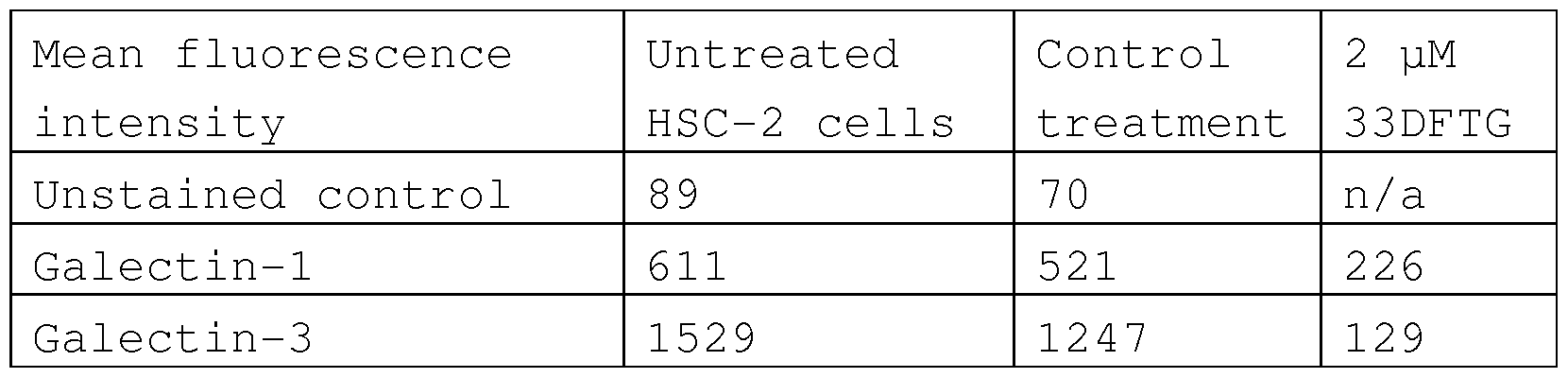
  • Fig. 6 shows effective inhibition of Galectin-1 (A and B) and Galectin-3 (C and D) binding to HSC-2 cancer cells by the Galectin inhibitor 33DFTG, as detected with Alexa Fluor 488- conjugated Galectin-1 and Galectin-3 by FACS.
  • Galectin staining drops after incubation with the inhibitor (B and D) compared to untreated cells (A and C) .
  • Fig. 7 shows the successful generation of galectin inhibitor-trastuzumab ADCs analyzed by Fabricator digestion of the ADC and MALDI-TOF MS of the isolated antibody fragments as described in Satomaa et al . 2018, Antibodies 7(2) : 15.
  • Fourth panel shows Fc domain of trastuzumab antibody, wherein the N-glycan was labeled with 1 or 2 azides by reaction with UDP- GAlNAz and Y289L-mutant bovine b ⁇ , 4-galactosyltransferase 1 (Thermo Fisher Scientific) .
  • First panel shows successful conjugation of the Fc domain heavy chain with either 1 or 2 payloads (PL) with structure as shown in Scheme E8-4, DBCO-PEG4- VC-PAB-DMAE-33DFTG .
  • Second panel shows successful conjugation of the Fc domain heavy chain with either 1 or 2 payloads (PL) with structure as shown in Scheme E8-6, DBCO-PEG4-VC-PAB-DMAE- ( 6- acetyl ) 33DFTG .
  • Third panel shows successful conjugation of the Fc domain heavy chain with either 1 or 2 payloads (PL) with structure as shown in Scheme E8-5, DBCO-PEG4-VC-PAB-DMAE- ( 6-succinyl ) 33DFTG .
  • Fig. 8 shows HIC-HPLC of galectin inhibitor-trastuzumab ADC, performed as in Satomaa et al . 2018.
  • the conjugate may comprise
  • a targeting unit for delivery to a target tissue, and a Galectin inhibitor for inhibiting Galectin interaction within the target tissue.
  • Galectins are a class of proteins that are capable of binding specifically to b-galactoside sugars.
  • the structures of the b-galactose binding sites of Galectin-1, 2 and 3 have been described (Lobsanov and Rini, Trends Glycosci Glycotech 1997, 45, 145-154; Seetharaman et al . , J Biol Chem 1998, 273, 13047- 13052; Saraboji et al . , Biochemistry 2012, 51, 296-306).
  • the term "Galectin” may be understood as referring to any S-type lectin, which is a galactoside-recognizing receptor.
  • Galectins there are at least 15 Galectins discovered in mammals, encoded by the LGALS genes, of which at least Galectin-1, -2, -3, -4, -7, -8, -9, -10, -12 and - 13 have been identified in humans (Essentials of Glycobiology 2017; Chapter 36) .
  • Several Galectins have been found or at least implicated to play a role in diseases such as cancer, HIV, autoimmune disease, chronic inflammation, graft vs host disease and allergic reactions. For example, tumours may evade immune responses through Galectin interactions.
  • the roles Galectin interactions may play in e.g. cancer may be quite complex and depend on the specific Galectin.
  • the Galectin inhibitor may be conjugated to the targeting unit.
  • the Galectin inhibitor may be conjugated to the targeting unit at least partially covalently. For example, it may be conjugated covalently, or partially non-covalently (and partially covalently) .
  • target tissue may refer to any target tissue, for example tumour tissue, to which the conjugate is to be delivered and within which Galectin inhibition is desired.
  • the target tissue is a tumour tissue.
  • a tumour tissue may comprise or be at least partially formed of tumour cells .
  • tumours and tumour tissues are known to be formed of not only malignant or cancer cells, but also of non-malignant or non-cancer cells of the subject having the tumour.
  • non-malignant or non-cancer cells may be migrated to the tumour tissue, so that they are located within the tumour or the tumour microenvironment or otherwise be intimately associated with the tumour.
  • non-malignant or non-cancer cells may be located between the malignant or cancer cells, or they may be in direct physical contact with the malignant or cancer cells.
  • tumour cell may refer to any cell of any cell type that forms a part of or is associated with a tumour or tumour tissue.
  • the term may encompass malignant or cancer cells and, additionally or alternatively, non-cancer or non-malignant cells that form a part of or are associated with the tumour.
  • the term may also encompass any non-cancer or non-malignant cell present in the tumour microenvironment.
  • the tumour cells may include, for example, cells of the immune system. Examples of such tumour cells may include tumour infiltrating immune cells, such as tumour infiltrating lymphocytes, cells of the immune system, cells of the tumour vasculature and lymphatics, as well as fibroblasts, pericytes and adipocytes.
  • non-cancer tumour cells may include T cells (T lymphocytes); CD8+ cells including cytotoxic CD8+ T cells; CD4+ cells including T helper 1 (TH1) cells, TH2 cells, TH17 cells, Tregs; gd T lymphocytes; B lymphocytes including B cells and Bregs (B10 cells); NK cells; NKT cells; tumour-associated macrophages (TAMs); myeloid-derived suppressor cells (MDSCs); dendritic cells (DCs); tumour-associated neutrophils (TANs); CDllb+ bone-marrow-derived myeloid cells; fibroblasts including myofibroblasts and cancer-associated fibroblasts; endothelial cells; smooth muscle cells; myoepithelial cells; stem cells including multipotent stem cells, lineage- specific stem cells, progenitor cells, pluripotent stem cells, cancer stem cells (cancer-initiating cells), mesenchymal stem cells and hematopoietic stem cells; adipocyte
  • the tumour cells which thus may form a tumour, may comprise at least malignant or cancer cells and non cancer or non-malignant cells that form a part of or are associated with the tumour.
  • the target cell may be at least one of the malignant or cancer cells or the non-cancer or non-malignant cells (for example, cells of the immune system) .
  • the second tumour cell may be at least one of the malignant or cancer cells or the non-cancer or non-malignant cells (for example, cells of the immune system) .
  • the targeting unit may be suitable for delivery to the target tissue, e.g. a tumour tissue, in various ways, for example by being suitable for binding the target tissue, e.g. a cell of the target tissue or a molecule within the target tissue.
  • the targeting unit may bind or be capable of binding to a molecule of the target tissue, for example a tumour molecule, thereby facilitating the delivery of the conjugate to the target tissue or to any cells of the target tissue .
  • molecule of the target tissue may refer to any molecule of any molecule type that forms a part of or is associated (for example, intimately associated) with the target tissue.
  • tumour molecule may refer to any molecule of any molecule type that forms a part of or is associated (for example, intimately associated) with a tumour or tumour tissue.
  • the term may encompass molecules produced by the malignant or cancer cells and, additionally or alternatively, molecules produced by the non-cancer or non- malignant cells that form a part of or are associated with the tumour or tumour tissue and, additionally or alternatively, molecules that are produced by non-tumour cells and that form a part of or are associated with the tumour or tumour tissue.
  • the term may also encompass any molecule present in the tumour microenvironment.
  • the tumour molecules may include, for example, proteins, lipids, glycans, nucleic acids, or combinations thereof.
  • the tumour molecule may, in some embodiments, be specific to the tumour or tumour tissue or be enriched in the tumour or tumour tissue .
  • the conjugate may release the Galectin inhibitor, such that the Galectin inhibitor may, for example, enter or otherwise interact with one or more cells of the target tissue.
  • the conjugate is suitable for decreasing, or configured to decrease, Galectin-Galectin ligand interactions .
  • the conjugate may be suitable for decreasing, or configured to decrease, interactions between tumour cells, for example between cancer or malignant cells, and cells of the immune system.
  • the conjugate may also be suitable for inhibiting, or configured to inhibit, other Galectin functions.
  • a Galectin that has been secreted into an extracellular space of the target tissue may bind to a surface of a cell, for example of a cell of the target tissue.
  • a Galectin inhibitor may thus be suitable for inhibiting, or configured to inhibit, such binding of the secreted Galectin to the surface of the cell.
  • the conjugate is a conjugate for decreasing the immunosuppressive activity of cells of the target tissue, for example cells of a tumour tissue.
  • tumour may refer to a solid tumour, a diffuse tumour, a metastasis, a tumour microenvironment, a group of tumour cells, a single tumour cell or a circulating tumour cell.
  • tumour tissue may, in the context of this specification, refer to a tissue forming at least a part of a tumour.
  • the conjugate is a conjugate for inhibition of inflammation, inhibition of fibrosis, inhibition of angiogenesis, inhibition of infection, inhibition of HIV-1 infection, or inhibition of autoimmune disease or autoimmune reactions in the target tissue.
  • the conjugate is a conjugate for inhibition of any Galectin-mediated condition in the target tissue .
  • Galectin inhibitor may refer to a molecule capable of specifically binding one or more Galectins.
  • the Galectin inhibitor may thereby be capable of inhibiting the function of the Galectin to which it binds or interactions of the Galectin, to which it binds, with one or more other molecules.
  • the Galectin inhibitor may directly bind to and/or interact with a Galectin, for example by attaching, i.e. directly binding, to a Galectin.
  • the Galectin inhibitor may directly bind to and/or interact with the Galectin by non-covalent interactions, such as hydrogen bonds, hydrophobic interactions and/or ionic bonds.
  • the Galectin inhibitor may be capable of specifically binding to a b-galactose binding site or a Galectin.
  • the Galectin inhibitor may, in an embodiment, be capable of reversibly binding to and thereby inhibiting the Galectin.
  • the Galectin inhibitor may, in an embodiment, be capable of non-covalently binding to and thereby inhibiting a Galectin.
  • the Galectin inhibitor may be capable of binding irreversibly and/or covalently to a Galectin, thereby inhibiting the Galectin.
  • the Galectin inhibitor is not capable of inhibiting glycosylation (at least not to a significant extent) .
  • Galectins are Galectin-1, Galectin-2, Galectin-3, Galectin-4, Galectin-5, Galectin-6, Galectin-7, Galectin-8, Galectin-9, Galectin-10, Galectin-11, Galectin-12, Galectin-13, Galectin-14, and Galectin-15.
  • the Galectin inhibitor may be capable of specifically binding to and inhibiting one or more of these Galectins.
  • the Galectin inhibitor is a Galectin-3 inhibitor.
  • Galectin-3 may be expressed at high levels in various cancers and may thus be considered to be a tumour marker.
  • Galectin- 3 may be associated with immunosuppression and thus its inhibition may decrease immunosuppression.
  • the Galectin inhibitor is a Galectin-1 inhibitor.
  • Galectin-1 may be expressed at high levels in various cancers and may thus be considered to be a tumour marker.
  • Galectin- 1 is associated with immunosuppression and thus its inhibition may decrease immunosuppression.
  • the Galectin inhibitor is a Galectin-9 inhibitor.
  • Galectin-9 may be expressed at high levels in various cancers and may thus be considered to be a tumour marker.
  • Galectin- 9 is associated with immunosuppression and thus its inhibition may decrease immunosuppression.
  • the Galectin inhibitor has an ability to inhibit a plurality of Galectins. In an embodiment, the Galectin inhibitor inhibits a plurality of Galectins including at least Galectin-1 and Galectin-3. In an embodiment, the Galectin inhibitor inhibits a plurality of Galectins including at least Galectin-1 and Galectin-9. In an embodiment, the Galectin inhibitor inhibits a plurality of Galectins including at least Galectin-3 and Galectin-9. In an embodiment, the Galectin inhibitor inhibits a plurality of Galectins including at least Galectin-3 and Galectin-9.
  • the Galectin inhibitor inhibits a plurality of Galectins including at least Galectin-1, Galectin-3 and Galectin-9.
  • a plurality of Galectins may refer to at least two, i.e. two or more, Galectins; or in some embodiments, at least three Galectins.
  • the Galectin inhibitor has an ability to specifically inhibit a Galectin or a group of Galectins; in other words it has substantially higher affinity to the Galectin or the group of Galectins than to other Galectins.
  • the Galectin inhibitor is a specific inhibitor of Galectin-1. In an embodiment, the Galectin inhibitor is a specific inhibitor of Galectin-3. In an embodiment, the Galectin inhibitor is a specific inhibitor of Galectin-9. In an embodiment, the Galectin inhibitor is a specific inhibitor of Galectin-1 and Galectin-3. In an embodiment, the Galectin inhibitor is a specific inhibitor of Galectin-1 and Galectin-9. In an embodiment, the Galectin inhibitor is a specific inhibitor of Galectin-3 and Galectin-9. In an embodiment, the Galectin inhibitor is a specific inhibitor of Galectin-1, Galectin-3 and Galectin-9. In an embodiment, the Galectin inhibitor is a specific inhibitor of Galectin-1, Galectin-3 and Galectin-9.
  • the term “substantially higher affinity” means that there is large difference in the dissociation constants (Kd) between the two affinities in question.
  • the difference between the Kd values is at least 5-fold.
  • the difference between the Kd values is at least 10-fold, at least 100-fold, at least 1000-fold, at least 10000-fold, at least 100000-fold, or at least 1000000-fold.
  • targeting unit may refer to a group, moiety or molecule capable of recognizing and optionally binding to the target tissue or to a target molecule, for example to a cell of or within the target tissue .
  • the Galectin inhibitor and the targeting unit may assist in delivering the Galectin inhibitor to the target tissue.
  • the conjugate may also exhibit improved pharmacodynamics and/or pharmacokinetics. Preparing of the conjugate may also be relatively feasible and cost-effective.
  • the conjugate may cause fewer side effects in vivo than e.g. the Galectin inhibitor administered in a non-conjugated or systemic form.
  • the term "to conjugate” or “conjugated” may be understood as referring to linking groups, moieties or molecules to each other at least partially covalently, however such that the linking may, in some embodiments, be arranged at least partially non-covalently .
  • the targeting unit and the Galectin inhibitor may be conjugated via a linker unit, the ends of which are conjugated covalently to the targeting unit and to the Galectin inhibitor.
  • linker unit may comprise units, groups, moieties or mole cules that are linked non-covalently, for example via a non-cova lent interaction.
  • linker unit may comprise units, groups, moieties or mole cules that are linked non-covalently, for example via a non-cova lent interaction.
  • An example of such a non-covalent interaction may be biotin-avidin interaction or other non-covalent interaction with a sufficient affinity.
  • a sufficient affinity for the non-covalent linkage or non-covalent interaction may be e.g. one having a dissociation constant (Kd) in the order of nanomolar Kd, picomolar Kd, femtomolar Kd, attomolar Kd, or smaller.
  • the affinity is substantially the same as the affinity of biotin- avidin interaction.
  • the affinity may be an affinity with a Kd of about 10 14 mol/1, or to a Kd between I Ch 15 mol/1 and I Ch 12 mol/1 (femtomolar), or a Kd below I Ch 15 mol/1 (attomolar) .
  • the affinity is substantially the same as the affinity of an antibody-antigen interaction, such as an affinity having a Kd of about I Ch 9 mol/1, or a Kd of between I Ch 12 mol/1 and I Ch 9 mol/1 (picomolar), or a Kd of between I Ch 9 mol/1 and I Ch 7 mol/1 (nanomolar) .
  • the affinity may be an affinity with a Kd that is below I Ch 7 mol/1, below I Ch 8 mol/1, below I Ch 9 mol/1, below I Ch 10 mol/1, below I Ch 11 mol/1, below I Ch 12 mol/1, below I Ch 13 mol/1, below I Ch 14 mol/1, or below I Ch 15 mol/1.
  • the conjugate may comprise one or more chemical substituents as described by the variables of the chemical formulas of the present disclosure.
  • a person skilled in the art is able to determine what structures are encompassed in the specific substituents based on their names.
  • the term "to substitute” or “substituted” may be understood as referring to a parent group which bears one or more substituents.
  • substituted is used herein in the conventional sense and refers to a chemical moiety which is covalently attached to, or if appropriate, fused to, a parent group.
  • substituents are well known, and methods for their formation and introduction into a variety of parent groups are also well known to a person skilled in the art.
  • substituents may further comprise certain chemical structures as described in the following embodiments.
  • alkyl means a monovalent moiety obtained or obtainable by removing a hydrogen atom from a carbon atom of a hydrocarbon compound, which may be aliphatic or alicyclic, and which may be saturated or unsaturated (e.g. partially unsaturated, fully unsaturated) .
  • alkyl includes the sub-classes alkenyl, alkynyl, cycloalkyl, and the like.
  • C 1-12 alkyl means an alkyl moiety having from 1 to 12 carbon atoms.
  • saturated alkyl groups include, but are not limited to, methyl (Ci) , ethyl (C2) , propyl (C3) , butyl (C 4 ) , pentyl (C5) , hexyl (Ce) and heptyl (C7) .
  • saturated linear alkyl groups include, but are not limited to, methyl (Ci) , ethyl (C2) , n-propyl (C3) , n-butyl (C 4 ) , n-pentyl (amyl) (C5) , n-hexyl (C 6 ) and n-heptyl (C7) .
  • saturated branched alkyl groups include iso propyl (C3) , iso-butyl (C 4 ) , sec-butyl (C 4 ) , tert-butyl (C 4 ) , iso pentyl (C5) , and neo-pentyl (C5) ⁇
  • alkenyl means an alkyl group having one or more carbon-carbon double bonds.
  • C 2-12 alkenyl means an alkenyl moiety having from 2 to 12 carbon atoms.
  • alkynyl means an alkyl group having one or more carbon-carbon triple bonds.
  • C 2-12 alkynyl means an alkynyl moiety having from 2 to 12 carbon atoms.
  • cycloalkyl means an alkyl group which is also a cyclyl group; that is, a monovalent moiety obtained by removing a hydrogen atom from an alicyclic ring atom of a cyclic hydrocarbon (carbocyclic) compound.
  • C3-20 cycloalkyl means a cycloalkyl moiety having from 3 to 20 carbon atoms, including from 3 to 8 ring atoms.
  • cycloalkyl groups include, but are not limited to, those derived from:
  • cyclopropane (C3) cyclobutane (C 4 ) , cyclopentane (C5) , cyclohexane (C 6 ) , cycloheptane (C 7 ) , methylcyclopropane (C 4 ) , dimethylcyclopropane (C5) , methylcyclobutane (C5) , dimethylcyclobutane (C 6 ) , methylcyclopentane (C 6 ) , dimethylcyclopentane (C 7 ) and methylcyclohexane (C 7 ) ;
  • unsaturated monocyclic hydrocarbon compounds cyclopropene (C3) , cyclobutene (C 4 ) , cyclopentene (C5) , cyclohexene (C 6 ) , methylcyclopropene (C 4 ) , dimethylcyclopropene (C5) , methylcyclobutene (C5) , dimethylcyclobutene (C 6 ) , methylcyclopentene (C 6 ) , dimethylcyclopentene (C 7 ) and methylcyclohexene (C 7 ) ; and
  • heterocyclyl means a monovalent moiety obtained by removing a hydrogen atom from a ring atom of a heterocyclic compound, which moiety has from 3 to 20 ring atoms, of which from 1 to 10 are ring heteroatoms. In an embodiment, each ring has from 3 to 8 ring atoms, of which from 1 to 4 are ring heteroatoms.
  • the prefixes e.g. C3-20, C3-8, C5-6, etc.
  • the term “C5-6 heterocyclyl” means a heterocyclyl group having 5 or 6 ring atoms.
  • monocyclic heterocyclyl groups include, but are not limited to, those derived from:
  • Ni aziridine (C3) , azetidine (C 4 ) , pyrrolidine (tetrahydropyrrole) (C5) , pyrroline (e.g., 3-pyrroline, 2,5- dihydropyrrole ) (C5) , 2H-pyrrole or 3H-pyrrole (isopyrrole, isoazole) (C5) , piperidine (C 6 ) , dihydropyridine (C 6 ) , tetrahydropyridine (C 6 ) , azepine (C 7 ) ; Oi : oxirane (C 3 ) , oxetane (C 4 ) , oxolane
  • N2 imidazolidine (Cs) , pyrazolidine (diazolidine ) (Cs) , imidazoline (C5) , pyrazoline (dihydropyrazole ) (C5) , piperazine
  • N 1 O 1 tetrahydrooxazole (Cs) , dihydrooxazole (Cs) , tetrahydroisoxazole (C5) , dihydroisoxazole (C5) , morpholine (C 6 ) , tetrahydrooxazine (C 6 ) , dihydrooxazine (C 6 ) , oxazine (C 6 ) ;
  • N 1 S 1 thiazoline (C5) , thiazolidine (C5) , thiomorpholine
  • O 1 S 1 oxathiole (C5) and oxathiane (thioxane) (C 6 ) ; and,
  • substituted monocyclic heterocyclyl groups include those derived from saccharides, in cyclic form, for example, furanoses (C 5 ) , such as arabinofuranose, ribofuranose, and xylofuranose, and pyranoses (Ce) , such as fucopyranose, glucopyranose , mannopyranose, idopyranose, and galactopyranose .
  • the term / aryl means a monovalent moiety obtained by removing a hydrogen atom from an aromatic ring atom of an aromatic compound, which moiety has from 3 to 20 ring atoms.
  • each ring may have from 5 to 8 ring atoms.
  • the prefixes e.g. C3-20, C5-8, etc.
  • the term / Cs- 6 aryl as used herein, means an aryl group having 5 or 6 ring atoms.
  • the ring atoms may be all carbon atoms, as in "carboaryl groups".
  • carboaryl groups include, but are not limited to, those derived from benzene (i.e. phenyl) (Ce) , naphthalene (C 10 ) , azulene (C 10 ) , anthracene (Ci 4 ) , phenanthrene (Ci 4 ) , naphthacene (Cis) , and pyrene (Ci6) ⁇
  • aryl groups which comprise fused rings include, but are not limited to, groups derived from indane (e.g. 2 , 3-dihydro-lH- indene) (C 9 ) , indene (C 9 ) , isoindene (C 9 ) , tetraline (1,2, 3, 4- tetrahydronaphthalene (C 10 ) , acenaphthene (C 12 ) , fluorene (C 13 ) , phenalene (C 13 ) , acephenanthrene (C 15 ) , and aceanthrene (Ci6) ⁇
  • the ring atoms may include one or more heteroatoms, as in "heteroaryl groups".
  • heteroaryl groups include, but are not limited to, those derived from:
  • N1O1 oxazole (C5) , isoxazole (C5) , isoxazine (C 6 ) ;
  • N3O 1 oxatriazole (C5) ;
  • N 1 S 1 thiazole (C5) , isothiazole (C5) ;
  • N2 imidazole (1,3-diazole) (C5) , pyrazole (1,2-diazole) (C5) , pyridazine ( 1 , 2-diazine ) (C 6 ) , pyrimidine ( 1 , 3-diazine ) (C 6 )
  • N4 tetrazole (C5) .
  • heteroaryls which comprise fused rings, include, but are not limited to:
  • C 13 (with 3 fused rings) derived from carbazole (Ni) , dibenzofuran (Oi) , dibenzothiophene (Si), carboline (N 2 ) , perimidine (N2) , pyridoindole (N2) ; and, C 14 (with 3 fused rings) derived from acridine (Ni) , xanthene (Oi) , thioxanthene (Si), oxanthrene (O 2 ) , phenoxathiin (O 1 S 1 ) , phenazine (N2) , phenoxazine (N 1 O 1 ) , phenothiazine (N2S 1 ) , thianthrene (S2), phenanthridine (Ni) , phenanthroline (N2) , phenazine (N2) .
  • Halo —F, —Cl, —Br, and —I.
  • Ether —OR, wherein R is an ether substituent, for example, a Ci- 10 alkyl group (also referred to as a Ci- 10 alkoxy group, discussed below) , a C 3-20 heterocyclyl group (also referred to as a C 3-20 heterocyclyloxy group) , or a C 5-20 aryl group (also referred to as a C5-20 aryloxy group), preferably a Ci- 10 alkyl group.
  • a Ci- 10 alkyl group also referred to as a Ci- 10 alkoxy group, discussed below
  • C 3-20 heterocyclyl group also referred to as a C 3-20 heterocyclyloxy group
  • C 5-20 aryl group also referred to as a C5-20 aryloxy group
  • Ci- 10 alkoxy groups include, but are not limited to, —OMe (methoxy) , —OEt (ethoxy), —O(nPr) (n- propoxy) , —O(iPr) ( isopropoxy ) , —O(nBu) (n-butoxy) , —O(sBu) (sec- butoxy) , —O(iBu) (isobutoxy), and —O(tBu) (tert-butoxy) .
  • Acetal —CH(OR'i) (OR'2), wherein R'i and R'2 are independently acetal substituents, for example, a Ci- 10 alkyl group, a C3-20 heterocyclyl group, or a C5-20 aryl group, preferably a Ci- 10 alkyl group, or, in the case of a “cyclic" acetal group, R'i and R' 2 , taken together with the two oxygen atoms to which they are attached, and the carbon atoms to which they are attached, form a heterocyclic ring having from 4 to 8 ring atoms.
  • acetal groups include, but are not limited to, —CH(OMe)2, —CH(OEt)2, and -CH (OMe) (OEt) .
  • Hemiacetal —CH(OH) (OR'i), wherein R'i is a hemiacetal substituent, for example, a Ci- 10 alkyl group, a C 3-20 heterocyclyl group, or a C 5-20 aryl group, preferably a Ci- 10 alkyl group.
  • R'i is a hemiacetal substituent, for example, a Ci- 10 alkyl group, a C 3-20 heterocyclyl group, or a C 5-20 aryl group, preferably a Ci- 10 alkyl group.
  • hemiacetal groups include, but are not limited to, —CH(OH) (OMe) and -CH (OH) (OEt) .
  • Ketal —CR' (OR'i) (OR'2) , where R'iand R'2 are as defined for acetals, and R' is a ketal substituent other than hydrogen, for example, a Ci- 10 alkyl group, a C 3-20 heterocyclyl group, or a C 5-20 aryl group, preferably a Ci- 10 alkyl group.
  • ketal groups include, but are not limited to, —C(Me) (OMe) 2 , —C(Me) (OEt) 2 , -C (Me) (OMe) ( OEt ) , -C (Et ) (OMe) 2 , -C (Et ) (OEt ) 2 , and -C(Et) (OMe)
  • hemiacetal groups include, but are not limited to, —C(Me) (OH) (OMe), -C (Et ) (OH) (OMe) , -C (Me) (OH) (OEt ) , and -C (Et ) (OH) (OEt ) .
  • Imino (imine) : NR'
  • R' is an imino substituent, for example, hydrogen, a Ci- 10 alkyl group, a 0 3-20 heterocyclyl group, or a Cs- 2 o aryl group, preferably a Ci- 10 alkyl group.
  • R' is an acyl substituent, for example, a Ci- 10 alkyl group (also referred to as Ci- 10 alkylacyl or Ci- 10 alkanoyl), a 0 3-20 heterocyclyl group (also referred to as C 3-20 heterocyclylacyl ) , or a C 5-20 aryl group (also referred to as C5-20 arylacyl), preferably a Ci- 10 alkyl group.
  • a Ci- 10 alkyl group also referred to as Ci- 10 alkylacyl or Ci- 10 alkanoyl
  • a 0 3-20 heterocyclyl group also referred to as C 3-20 heterocyclylacyl
  • C 5-20 aryl group also referred to as C5-20 arylacyl
  • Carboxy (carboxylic acid): —C( 0)0H.
  • Ester (carboxylate, carboxylic acid ester, oxycarbonyl ) : —C( 0)0R', wherein R' is an ester substituent, for example, a Ci- 10 alkyl group, a C 3-20 heterocyclyl group, or a C 5-20 aryl group, preferably a Ci- 10 alkyl group.
  • R' is an acyloxy substituent, for example, a Ci-io alkyl group, a C 3-20 heterocyclyl group, or a C 5-20 aryl group, preferably a Ci- 10 alkyl group.
  • R'i and R'2 are independently amino substituents, for example, hydrogen, a Ci- 10 alkyl group (also referred to as Ci- 10 alkylamino or di-Ci- 10 alkylamino) , a C3-20 heterocyclyl group, or a C 5-20 aryl group, preferably H or a Ci- 10 alkyl group, or, in the case of a “cyclic" amino group, R'i and R' 2 , taken together with the nitrogen atom to which they are attached, form a heterocyclic ring having from 4 to 8 ring atoms.
  • Amino groups may be primary (—NH 2 ) , secondary (—NHR'i), or tertiary (—NHR ' iR ' 2 ) , and in cationic form, may be quaternary (—NR ' iR ' 2 R ' 3 ) .
  • Examples of amino groups include, but are not limited to, —NH 2 , — NHCH 3 , -NHC(CH 3 )2, -N(CH 3 )2, -N(CH 2 CH 3 )2, and —NHPh .
  • Examples of cyclic amino groups include, but are not limited to, aziridino, azetidino, pyrrolidino, piperidino, piperazino, morpholino, and thiomorpholino .
  • R'i is an amide substituent, for example, hydrogen, a Ci- 10 alkyl group, a C 3- 20 heterocyclyl group, or a C 5-20 aryl group, preferably hydrogen or a Ci- 10 alkyl group
  • R' 2 is an acyl substituent, for example, hydrogen, a Ci- 10 alkyl group, a C3-20 heterocyclyl group, or a C
  • R'i and R' 2 may together form a cyclic structure, as in, for example, succinimidyl , maleimidyl, and phthalimidyl :
  • R'2 and R'3 are independently amino substituents, as defined for amino groups, and R'i is a ureido substituent, for example, hydrogen, a Ci- 10 alkyl group, a C 3-20 heterocyclyl group, or a C 5-20 aryl group, preferably hydrogen or a Ci- 10 alkyl group.
  • ureido groups include, but are not limited to, —NHC0NH 2 , —NHCONHMe , —NHCONHEt , —NHC0NMe 2 , —NHC0NEt 2 , NMeC0NH 2 , —NMeCONHMe , —NMeCONHEt , —NMeC0NMe 2 , and -
  • Tetrazolyl a five membered aromatic ring having four nitrogen atoms and one carbon atom.
  • Imino: NR'
  • R' is an imino substituent, for example, for example, hydrogen, a Ci- 10 alkyl group, a C 3-20 heterocyclyl group, or a C 5-20 aryl group, preferably hydrogen or a Ci- 10 alkyl group.
  • Amidine (amidino) : —C ( NR'i) NRO, wherein each R'i is an amidine substituent, for example, hydrogen, a Ci- 10 alkyl group, a C 3-20 heterocyclyl group, or a C 5-20 aryl group, preferably hydrogen or a Ci- 10 alkyl group.
  • Nitroso —NO.
  • Cyano (nitrile, carbonitrile) —ON.
  • Isocyano —NC.
  • Isothiocyano ( isothiocyanato ) : —NCS .
  • Thioether (sulfide) —SR', wherein R' is a thioether substituent, for example, a Ci-io alkyl group (also referred to as a Ci-io alkylthio group) , a C3-20 heterocyclyl group, or a C5-20 aryl group, preferably a Ci- 10 alkyl group.
  • Ci- 10 alkylthio groups include, but are not limited to, —SCH 3 and —SCH 2 CH 3 .
  • Disulfide —SS—R', wherein R' is a disulfide substituent, for example, a Ci- 10 alkyl group, a C 3-20 heterocyclyl group, or a C 5-20 aryl group, preferably a Ci- 10 alkyl group (also referred to herein as Ci- 10 alkyl disulfide) .
  • Ci- 10 alkyl disulfide groups include, but are not limited to, —SSCH3 and —SSCH2CH3.
  • Sulfine (sulfinyl, sulfoxide): —S( 0)R', wherein R' is a sulfine substituent, for example, a Ci- 10 alkyl group, a C 3-20 heterocyclyl group, or a C 5-20 aryl group, preferably a Ci- 10 alkyl group.
  • R' is a sulfine substituent, for example, a Ci- 10 alkyl group, a C 3-20 heterocyclyl group, or a C 5-20 aryl group, preferably a Ci- 10 alkyl group.
  • R' is a sulfonate substituent, for example, a Ci- 10 alkyl group, a C 3- 20 heterocyclyl group, or a C 5-20 aryl group, preferably a Ci- 10 alkyl group.
  • R is a sulfinyloxy substituent, for example, a Ci-10 alkyl group, a C3-20 heterocyclyl group, or a C5-20 aryl group, preferably a Ci-10 alkyl group.
  • R' is a sulfonyloxy substituent, for example, a Ci- 10 alkyl group, a C 3-20 heterocyclyl group, or a C 5-20 aryl group, preferably a Ci- 10 alkyl group.
  • R' is a sulfate substituent, for example, a Ci- 10 alkyl group, a C 3-20 heterocyclyl group, or a C 5-20 aryl group, preferably a Ci- 10 alkyl group.
  • Sulfonamino: — NR'iS ( 0) 2 R , 2 , wherein R'i is an amino substituent, as defined for amino groups, and RO is a sulfonamino substituent, for example, a Ci-io alkyl group, a C 3-20 heterocyclyl group, or a C 5-20 aryl group, preferably a Ci- 10 alkyl group.
  • Phosphino (phosphine) —P(R') 2 , wherein R' is a phosphino substituent, for example, a Ci- 10 alkyl group, a C 3-2 o heterocyclyl group, or a C 5-20 aryl group, preferably hydrogen, a Ci- 10 alkyl group, or a C 5-20 aryl group.
  • phosphino groups include, but are not limited to, —PH 2 , —P(CH 3)2 , —P(CH 2 CH 3)2 , —P(t—Bu) 2 , and —P (Ph) 2 ⁇
  • R' is a phosphinyl substituent, for example, a Ci-10 alkyl group, a C 3- 2o heterocyclyl group, or a C5-20 aryl group, preferably a Ci-10 alkyl group or a C5-20 aryl group.
  • R' is a phosphonate substituent, for example, hydrogen, a Ci-10 alkyl group, a C 3- 2o heterocyclyl group, or a C5-20 aryl group, preferably hydrogen, a Ci-10 alkyl group, or a C5-20 aryl group.
  • R' is a phosphate substituent, for example, hydrogen, a Ci-10 alkyl group, a C 3- 2o heterocyclyl group, or a C5-20 aryl group, preferably hydrogen, a Ci-10 alkyl group, or a C5-20 aryl group.
  • Phosphorous acid —OP (OH) 2 .
  • Phosphite —OP (OR') 2 , where R' is a phosphite substituent, for example, hydrogen, a Ci-10 alkyl group, a C 3- 2o heterocyclyl group, or a C5-20 aryl group, preferably hydrogen, a Ci-10 alkyl group, or a C5-20 aryl group.
  • R' is a phosphite substituent, for example, hydrogen, a Ci-10 alkyl group, a C 3- 2o heterocyclyl group, or a C5-20 aryl group, preferably hydrogen, a Ci-10 alkyl group, or a C5-20 aryl group.
  • Examples of phosphite groups include, but are not limited to, — OP(OCH3)2, —OP (OCH2CH3) 2, —0P(0— t—BU)2, and —OP(OPh)2.
  • Phosphoramidite —OP (OR ' 1 )—N (R ' 2 ) 2 , where R'i and R' 2 are phosphoramidite substituents, for example, hydrogen, a (optionally substituted) Ci- 10 alkyl group, a C3-20 heterocyclyl group, or a C5- 20 aryl group, preferably hydrogen, a Ci- 10 alkyl group, or a C 5-20 aryl group.
  • Examples of phosphoramidite groups include, but are not limited to, -OP (OCH2CH3) -N (CH 3 ) 2, -OP (OCH2CH3 ) -N ( i-Pr ) 2, and - OP (OCH 2 CH 2 CN)-N (i-Pr) 2.
  • alkylene means a bidentate moiety obtained by removing two hydrogen atoms, either both from the same carbon atom, or one from each of two different carbon atoms, of a hydrocarbon compound, which may be aliphatic or alicyclic, and which may be saturated, partially unsaturated, or fully unsaturated.
  • alkylene includes the sub classes alkenylene, alkynylene, cycloalkylene, etc., discussed below .
  • linear saturated C 3-12 alkylene groups include, but are not limited to, — (Cfhi n— where n is an integer from 3 to 12, for example, —CH2CH2CH2— (propylene), —CH2CH2CH2CH2— (butylene), -CH 2 CH 2 CH 2 CH 2 CH 2 - (pentylene ) and —CH 2 CH 2 CH 2 CH 2 CH 2 CH 2—
  • Examples of branched saturated C 3-12 alkylene groups include, but are not limited to, —CH (CH3) CH2—, —CH (CH3) CH2CH2—, — CH (CH 3 ) CH2CH2CH2—, —CH 2 CH (CH 3 ) CH 2— , -CH2CH (CH 3 ) CH2CH2-, -CH (CH2CH3)-, -CH (CH2CH3) CH 2— , and -CH2CH ( CH2CH3 ) CH 2— .
  • C3- 12 cycloalkylenes examples include, but are not limited to, cyclopentylene (e.g. cyclopent-1 , 3-ylene ) , and cyclohexylene (e.g. cyclohex-1 , 4- ylene) .
  • C3-12 cycloalkylenes examples include, but are not limited to, cyclopentenylene (e.g. 4-cyclopenten-l , 3-ylene ) , cyclohexenylene (e.g. 2-cyclohexen-l , 4-ylene ; 3-cyclohexen-l , 2-ylene ; 2,5- cyclohexadien-1 , 4-ylene ) .
  • cyclopentenylene e.g. 4-cyclopenten-l , 3-ylene
  • cyclohexenylene e.g. 2-cyclohexen-l , 4-ylene ; 3-cyclohexen-l , 2-ylene ; 2,5- cyclohexadien-1 , 4-ylene
  • glycoside means a carbohydrate or glycan moiety that is joined by a glycosidic bond.
  • the glycosidic bond may be an 0-, N-, C- or S-glycosidic bond, meaning that the bond is formed to the anomeric carbon of the glycan moiety by an oxygen, nitrogen, carbon or sulphur atom, respectively.
  • the glycosidic bond may be an acetal bond.
  • the glycan may be any monosaccharide, disaccharide, oligosaccharide or polysaccharide, and it may be further substituted by any of the substituents listed above.
  • glycoside groups include, but are not limited to, b-D-O-galactoside, N-acetyl ⁇ -D-O-galactosaminide, N-acetyl- -D-O-galactosaminide, N-acetyl ⁇ -D-O-glucosaminide, N-acetyl-b- D-N-glucosaminide, b-D-O-glucuronide, -L-O-iduronide, -D-O- galactoside, -D-O-glucoside, -D-C-glucoside, b-D-O-glucoside, -D-O-mannoside, b-D-O-mannoside, b-D-C-mannoside, cx-L-O- fucoside, b-D-O-xyloside, N-acetyl- -D-neuraminide, lactoside, maltoside, dextran
  • an anomeric bond of a glycan moiety may be represented by a wavy line, which indicates that the stereochemistry of the anomeric carbon is not defined and it may exist in either the R or S configuration, in other words beta or alpha configuration, meaning that when the glycan is drawn as a ring the bond may be directed either above or below the ring.
  • the anomeric carbon is drawn with a wavy bond to a hydroxyl group (thus forming a hemiacetal) the wavy bond indicates that the glycan can also exist in the open-ring form (aldehyde or ketone) .
  • polyethylene glycol means a polymer comprising repeating "PEG" units of the formula [CfhCfhOl n .
  • PEG 1-50 means polyethylene glycol moiety having from 1 to 50 PEG units.
  • substituted polyethylene glycol means a polyethylene glycol substituted with one or more of the substituents listed above.
  • branched polyethylene glycol means a polyethylene glycol moiety substituted with one or more of polyethylene glycol substituents forming a branched structure.
  • the conjugate may be represented by formula I:
  • each D may, in principle, be selected independently.
  • Each L may likewise be selected independently .
  • n may be an integer, for example an integer of at least 1.
  • n may be in the range of 1 to about 20, or 1 to about 15, or 1 to about 10, or 2 to 10, or 2 to 6, or 2 to 5, or 2 to 4, or 3 to about 20, or 3 to about 15, or 3 to about 10, or 3 to about 9, or 3 to about 8, or 3 to about 7, or 3 to about 6, or 3 to 5, or 3 to 4, or 4 to about 20, or 4 to about 15, or 4 to about 10, or 4 to about 9, or 4 to about 8, or 4 to about 7, or 4 to about 6, or 4 to 5; or about 7-9; or about 8, or 1, 2, 3, 4, 5, 6, 7, 8, 9, 10, 11, 12, 13, 14, 15, 16, 17, 18, 19, or 20; or in the range of 1 to about 1000, or 1 to about 2000, or 1 to about 400, or 1 to about 200, or 1 to about 100; or 100 to about 1000, or 200 to about 1000, or 400 to about 1000, or 600 to about 1000, or 800 to about 1000; 100 to about 800, or 200 to about 600, or 300 to about 500; or 20 to about 200, or 30 to about 150, or 40 to about 120,
  • Galectin inhibitors may be known, examples and embodiments of which are described below. However, other Galectin inhibitors may also be contemplated.
  • the Galectin inhibitor is selected from the group of galactose, a 3-substituted galactose, a b-D- galactoside, a galactoside, a 3-substituted galactoside, a b-D- galactoside, a 3-substituted b-D-galactoside, lactose, a 3'- substituted lactose, a lactoside, a 3 ' -substituted lactoside, N- acetyllactosamine, a 3 ' -substituted N-acetyllactosamine, an N- acetyllactosaminide, a 3 ' -substituted N-acetyllactosaminide, N, N ' -di-N-acetyllactosediamine, a 3 ' -substituted N,N'-di-N-
  • the multivalent combination is a dimer of a galectin inhibitor.
  • the dimer of a galectin inhibitor is dimer of 33DFTG, dimer of 6-succinyl-33DFTG or dimer of 6-acetyl-33DFTG .
  • the dimer is conjugated (i.e. the two Galectin inhibitor moieties are conjugated) with a spacer.
  • the spacer is a polyethylene glycol (PEG) chain.
  • the multivalent combination is a trimer of a galectin inhibitor.
  • the trimer of a galectin inhibitor is trimer of 33DFTG, trimer of 6-succinyl-33DFTG or trimer of 6-acetyl-33DFTG .
  • the trimer is conjugated with a spacer.
  • the spacer is a polyethylene glycol (PEG) chain.
  • the multivalent combination is a tetramer of a galectin inhibitor.
  • the tetramer of a galectin inhibitor is tetramer of 33DFTG, tetramer of 6- succinyl-33DFTG or tetramer of 6-acetyl-33DFTG .
  • the tetramer is conjugated with a spacer.
  • the spacer is a polyethylene glycol (PEG) chain.
  • the term "3- substituted” or “6-substituted” may mean that the structure has a substituent joined to the atom in the 3-position or 6-position, respectively, of either the central ring of a monosaccharide inhibitor or a monosaccharide analog inhibitor, or the reducing terminal ring (drawn on the right-hand side in molecular structures) of a disaccharide inhibitor or a disaccharide analog inhibitor.
  • the term "3'- substituted” or “6 -substituted” may mean that the structure has a substituent joined to the atom in the 3-position or 6-position, respectively, of the non-reducing terminal ring (drawn on the left- hand side in molecular structures) of a disaccharide inhibitor or a disaccharide analog inhibitor.
  • the term “3 , 3 -disubstituted” or 6 6 disubstituted” means that the structure has a substituent joined to the atom in the 3-position or 6-position, respectively, of the both rings of the disaccharide inhibitor or the disaccharide analog inhibitor .
  • the Galectin inhibitor is selected from the group of molecules described in Blanchard et al . 2016 (Expert Opinion on Therapeutic Patents 26, issue 5; text, Figure 1 and Table 1 ) .
  • the Galectin inhibitor is selected from the group of molecules described in any of the patent documents US20030109464, US9050352, US6849607B2, US7700763, US20140336146 , W02014067986, US7012068, US7893252, US8722645, US8658787, US8962824, US20140086932 , US20140235571 , US20150147338 , US8877263, US20150133399 , US20030004132, US20040121981 , US20060014719, US20060074050 , US2007010438 , W02006128027 , US7339023, US8716343, W02012131079, W02014070214 , EP2 8586 8 1 , WO2012061395, US9034325, W02015013388 , US8968740, US7662385, US7964575, EP2771367, US20070185014 , US20100004163 ,
  • the Galectin inhibitor is represented by formula I I :
  • W is 0, S, NH, NYi, CH 2 , CYiH or C(Yi) 2 ;
  • Ri is H, a saccharide, a saccharide substituted with L ' , Z, M, a Ci-Cio alkyl, a substituted Ci-Cio alkyl, a C 2 -Cio alkenyl, a substituted C 2 -Cio alkenyl, a C 2 -Cio alkynyl, a substituted C 2 -Cio alkynyl, a C 6- C 2 o aryl, a substituted C 6- C 2 o aryl or L ' ;
  • R 2 is H, OH, OZ, OM, NHCOCH3, NHZ , NHM or L';
  • R 3 is H, OH, OZ, OM, NHZ, NHM, L' or Y 3 ;
  • R 4 is H, OH, OZ, OM or L';
  • R5 is H, CH 2 , a saccharide, a C1-C10 alkyl, a substituted C1-C10 alkyl, a C 2- Cio alkenyl, a substituted C 2- Cio alkenyl, a C 2 - Cio alkynyl, a substituted C2-C 10 alkynyl, a C6 -C20 aryl, a substituted C 6 -C 20 aryl or a bond;
  • Y 5 is either absent or H, OH, OZ, OM or L ' ;
  • L is a bond to L
  • M is a removable masking substituent, independently selected from the group of an acetal, hemiacetal, ketal, hemiketal, imino, formyl, acyl, carboxy, thiocarboxy, thiolocarboxy, thionocarboxy, imidic acid, hydroxamic acid, ester, acyloxy, oxycarboyloxy, amino, amido, thioamido, acylamido, aminocarbonyloxy, ureido, guanidino, tetrazolyl, imino, amidine, nitro, nitroso, azide, cyano, isocyano, cyanato, isocyanato, thiocyano, isothiocyano, sulfhydryl, thioether, disulfide, sulfine, sulfone, sulfinic acid, sulfonic acid, sulfinate, sulfonate, sulfin
  • each Yi is independently selected from a C 1- C 10 alkyl, a substituted C 1- C 10 alkyl, a C2-C 10 alkenyl, a substituted C2-C 10 alkenyl, a C2-C 10 alkynyl, a substituted C2-C 10 alkynyl, a C6-C20 aryl and a substituted C 6- C 20 aryl;
  • Y3 is a C 1 -C 10 alkyl, a substituted C 1 -C 10 alkyl, a C2-C 10 alkenyl, a substituted C 2 -C 10 alkenyl, a C 2 -C 10 alkynyl, a substituted C2-C 10 alkynyl, a C6-C20 aryl and a substituted C6-C20 aryl, an azide, or a structure described by any one of formulas FY3-A, FY3-B , FY3-C , FY3-D , FY3-E , and FY3-F :
  • R 1 , R 2 , R 3 , R 4 and R 5 are independently selected from the group of H, optionally substituted alkyl groups, halogens, optionally substituted alkoxy groups, OH, substituted carbonyl groups, optionally substituted acyloxy groups, and optionally substituted amino groups; wherein two, three, four or five of R 1 , R 2 , R 3 , R 4 and R 5 in adjacent positions may be linked to form one or more rings, and the remaining of R 1 , R 2 , R 3 , R 4 and R 5 is/are independently selected from the above group;
  • Y 3 a is either 0 or NH
  • Y 3 b is selected from the group of CO, SO2, SO, PO2, PO, and CH2, or is a bond, and
  • Y 3 c is selected from the group of:
  • an alkyl group of at least 4 carbons an alkenyl group of at least 4 carbons, an alkyl group of at least 4 carbons substituted with a carboxy group, an alkenyl group of at least 4 carbons substituted with a carboxy group, an alkyl group of at least 4 carbons substituted with an amino group, an alkenyl group of at least 4 carbons substituted with an amino group, an alkyl group of at least 4 carbons substituted with both an amino and a carboxy group, an alkenyl group of at least 4 carbons substituted with both an amino and a carboxy group, and an alkyl group substituted with one or more halogens; or
  • a naphthyl group a naphthyl group substituted with at least one carboxy group, a naphthyl group substituted with at least one halogen, a naphthyl group substituted with at least one alkoxy group, a naphthyl group substituted with at least one nitro group, a naphthyl group substituted with at least one sulfo group, a naphthyl group substituted with at least one amino group, a naphthyl group substituted with at least one alkylamino group, a naphthyl group substituted with at least one arylamino group, a naphthyl group substituted with at least one dialkylamino group, a naphthyl group substituted with at least one hydroxy group, a naphthyl group substituted with at least one carbonyl group and a naphthyl group substituted with at least one substituted carbonyl group, or
  • a heteroaryl group a heteroaryl group substituted with at least one carboxy group, a heteroaryl group substituted with at least one halogen, a heteroaryl group substituted with at least one alkoxy group, a heteroaryl group substituted with at least one nitro group, a heteroaryl group substituted with at least one sulfo group, a heteroaryl group substituted with at least one amino group, a heteroaryl group substituted with at least one alkylamino group, a heteroaryl group substituted with at least one dialkylamino group, a heteroaryl group substituted with at least one arylamino group, a heteroaryl group substituted with at least one hydroxy group, a heteroaryl group substituted with at least one carbonyl group and a heteroaryl group substituted with at least one substituted carbonyl group;
  • Y3 d is selected from the group of Ctb, CO, SO2, and phenyl or is a bond;
  • Ri a is selected from the group of D-galactose, C3- substituted D-galactose, C3-1 , 2 , 3-triazol-l-yl-substituted D- galactose, H, a C1-C10 alkyl, a C1-C10 alkenyl, a C6-C20 aryl, an imino group and a substituted imino group;
  • Y3 e is selected from the group of an amino group, a substituted amino group, an alkyl group, a substituted alkyl group, an alkoxy group, a substituted alkoxy group, an alkylamino group, a substituted alkylamino group, a substituted naphthyl group, a thienyl group, and a substituted thienyl group: wherein said substituent
  • Y 3f is either CONH or a 1H-1 , 2 , 3-triazole ring
  • Y 3g is selected from the group of an alkyl group of at least 4 carbons, an alkenyl group of at least 4 carbons, an alkynyl group of at least 4 carbons, a carbamoyl group, a carbamoyl group substituted with an alkyl group, a carbamoyl group substituted with an alkenyl group, a carbamoyl group substituted with an alkynyl group, a carbamoyl group substituted with an aryl group, a carbamoyl group substituted with an substituted alkyl group, a carbamoyl group substituted with an substituted aryl group, a phenyl group substituted with at least one carboxy group, a phenyl group substituted with at least one halogen, a phenyl group substituted with at least one alkyl group, a phenyl group substituted with at least one alkoxy group, a phenyl group substituted with at least one trifluoro
  • Y 3h is NH, CH 2 , NR X or a bond; Y 3i is CO, SO, S0 2 , PO or PO2H; Y 3j is selected from the group of an alkyl group of at least 4 carbon atoms, an alkenyl group of at least 4 carbon atoms, an alkyl or alkenyl group of at least 4 carbon atoms substituted with a carboxy group, an alkyl group of at least 4 carbon atoms substituted with both a carboxy group and an amino group, an alkyl group of at least 4 carbon atoms Substituted with a halogen, a phenyl group, a phenyl group substituted with a carboxy group, a phenyl group substituted with at least one halogen, a phenyl group substituted with an alkoxy group, a phenyl group substituted with at least one halogen and at least one carboxy group, a phenyl group substituted with at least one
  • the Galectin inhibitor is represented by formula II;
  • Y3 is a structure described by formula FY3-G:
  • Ri is selected from the group of H, a saccharide, a saccharide substituted with L ' , Z, M, a C1-C10 alkyl, a substituted C1-C10 alkyl, a C2-C10 alkenyl, a substituted C2-C10 alkenyl, a C2- C10 alkynyl, a substituted C2-C10 alkynyl, a C6-C20 aryl, a substituted C6-C20 aryl, L ' , 4-methylphenylthio, ethylthio, 3- chlorophenylthio, 4-chlorophenylthio, phenylthio, 3- bromophenylthio, 3-iodophenylthio, 3 , 4-dichlorophenylthio, 3- chloro-4-cyanophenylthio, 2 , 3-dichlorophenylthio and 3,4- dichlorophenoxy ; andX is a
  • the Galectin inhibitor is represented by formula III:
  • W' and W' ' are each independently selected from the group of 0, S, N, NH, NYi , CH, CH 2 , CYiH and C(Yi) 2 ;
  • R 2 ‘ is H, OH, OZ, OM, NHCOCH 3 , NHZ , NHM or L';
  • R 3 ‘ is H, OH, OZ, OM, NHCOCH 3 , NHZ, NHM, L' or Y 3 ' ;
  • R 4 y is either absent or H, OH, OZ, OM and L ' ;
  • R 5 ‘ and R 6 ‘ are each independently either absent or selected from the group of H, CH 2 , a saccharide, a C 1- C 10 alkyl, a substituted C 1- C 10 alkyl, a C 2- Cio alkenyl, a substituted C 2- Cio alkenyl, a C 2- Cio alkynyl, a substituted C 2- Cio alkynyl, a C6-C 2 o aryl, a substituted C 6- C 2 o aryl and a bond;
  • Y 5 y and Y 6 y are each independently either absent or selected from the group of H, OH, OZ, OM and L';
  • Y3 is a C 1- C 10 alkyl, a substituted C 1- C 10 alkyl, a C 2- Cio alkenyl, a substituted C 2- Cio alkenyl, a C 2- Cio alkynyl, a substituted C 2- Cio alkynyl, a C6-C 2 o aryl and a substituted C6-C 2 o aryl, an azide, or a structure described by any one of formulas FY3-A, FY3-B, FY3-C, FY3-D, FY3-E or FY3-F as described above in the context of Formula II;
  • the wavy bond between C-4 of the second ring and its substituent R y may point to either above or below the ring.
  • C-4 may be either in the R or S configuration.
  • the Galectin inhibitor is represented by any one of formulas IV to IX
  • R 1 , R 2 , R 3 , R 4 and R 5 are independently selected from the group of H, optionally substituted alkyl groups, halogens, optionally substituted alkoxy groups, OH, substituted carbonyl groups, optionally substituted acyloxy groups, and optionally substituted amino groups; wherein two, three, four or five of R 1 , R 2 , R 3 , R 4 and R 5 in adjacent positions may be linked to form one or more rings, and the remaining of R 1 , R 2 , R 3 , R 4 and R 5 is/are independently selected from the above group;
  • Y3b and Y3b' are independently selected from the group of CO, SO2, SO, PO2, PO, and CH2, or is a bond, and
  • Y 3C and Y 3C are independently selected from the group of: a) an alkyl group of at least 4 carbons, an alkenyl group of at least 4 carbons, an alkyl group of at least 4 carbons substituted with a carboxy group, an alkenyl group of at least 4 carbons substituted with a carboxy group, an alkyl group of at least 4 carbons substituted with an amino group, an alkenyl group of at least 4 carbons substituted with an amino group, an alkyl group of at least 4 carbons substituted with both an amino and a carboxy group, an alkenyl group of at least 4 carbons substituted with both an amino and a carboxy group, and an alkyl group substituted with one or more halogens; or
  • a naphthyl group a naphthyl group substituted with at least one carboxy group, a naphthyl group substituted with at least one halogen, a naphthyl group substituted with at least one alkoxy group, a naphthyl group substituted with at least one nitro group, a naphthyl group substituted with at least one sulfo group, a naphthyl group substituted with at least one amino group, a naphthyl group substituted with at least one alkylamino group, a naphthyl group substituted with at least one arylamino group, a naphthyl group substituted with at least one dialkylamino group, a naphthyl group substituted with at least one hydroxy group, a naphthyl group substituted with at least one carbonyl group and a naphthyl group substituted with at least one substituted carbonyl group, or d) a heteroaryl group,
  • Y 3d is selected from the group of CH 2 , CO, SO 2 , and phenyl or is a bond
  • Ri a is selected from the group of D- galactose, C3-substituted D-galactose, C3-1 , 2 , 3-triazol-l-yl- substituted D-galactose, H, a C 1- C 10 alkyl, a C 1- C 10 alkenyl, a C 6- C 20 aryl, an imino group and a substituted imino group
  • Y 3e is selected from the group of an amino group, a substituted amino group, an alkyl group, a substituted alkyl group, an alkoxy group, a substituted alkoxy group, an alkylamino group, a substituted alkylamino group, a substituted naphthyl group, a thienyl group, and a substituted thienyl group: wherein said substituent is one or more
  • Y 3f and Y3 f y are each independently either CONH or a 1H- 1,2,3-triazole ring; Y 3g and Y3 g y are each independently selected from the group of an alkyl group of at least 4 carbons, an alkenyl group of at least 4 carbons, an alkynyl group of at least 4 carbons, a carbamoyl group, a carbamoyl group substituted with an alkyl group, a carbamoyl group substituted with an alkenyl group, a carbamoyl group substituted with an alkynyl group, a carbamoyl group substituted with an aryl group, a carbamoyl group substituted with an substituted alkyl group, a carbamoyl group substituted with an substituted aryl group, a phenyl group substituted with at least one carboxy group, a phenyl group substituted with at least one halogen, a phenyl group substituted
  • Y3 h is NH, Ctb, NR X or a bond; Y3 1 is CO, SO, SO2, PO or PO2H; Y33 is selected from the group of an alkyl group of at least 4 carbon atoms, an alkenyl group of at least 4 carbon atoms, an alkyl or alkenyl group of at least 4 carbon atoms substituted with a carboxy group, an alkyl group of at least 4 carbon atoms substituted with both a carboxy group and an amino group, an alkyl group of at least 4 carbon atoms Substituted with a halogen, a phenyl group, a phenyl group substituted with a carboxy group, a phenyl group substituted with at least one halogen, a phenyl group substituted with an alkoxy group, a phenyl group substituted with at least one halogen and at least one carboxy group, a phenyl group substituted with at least one
  • the wavy bond between C-4 of the second ring and its substituent, or a wavy bond elsewhere in the present specification, means that the stereochemistry is either R or S; in other words the bond may be directed to either above or below the ring.
  • Galectin inhibitors represented by the above Formulas are described e.g. in US9353141 (Formula V of the present disclosure); WO 2005/113568 (Formula VI of the present disclosure); WO 2005/113569 (Formula VII of the present disclosure); WO 2010/126435 (Formula VIII of the present disclosure) ; US7230096 (Formula IX of the present disclosure) , which are herein incorporated in their entirety.
  • R3 and/or R3 ' may have a relatively high affinity to one or more Galectins.
  • the Galectin inhibitor is masked with a removable masking substituent (i.e. a removable group), such that the Galectin inhibitor is capable of binding to a Galectin only after removal of the removable masking substituent.
  • a removable masking substituent i.e. a removable group
  • the Galectin inhibitor D comprises a removable masking substituent M.
  • Suitable removable masking substituents or groups may include, for example, an ester group, a carbamate group, a glycoside, a hydrazone group, a peptide, a glycoside, or an acetal group .
  • the Kd of the binding of D to a Galectin is sufficiently large so that D is not capable of binding to Galectin, unless M is first removed.
  • the Galectin inhibitor D is represented by any one of Galectin inhibitors represented by Formula II, wherein Ri is M, or at least one of R 2 , R 3 , R 4 , R5 or Y5 is OM or NHM;
  • the Galectin inhibitor is represented by any one of Formulas II-IX, wherein Y5 or Y5' (where present) is OM.
  • the Galectin inhibitor is represented by any one of Formulas II-IX, wherein Y 5 is OM.
  • At least one of R2, R2 ' , R 4 , R 4 ' , Ys and Y5 ' is OM. In an embodiment, one of R2, R2 ' , R 4 , R 4 ' , Ys and Y5 ' is OM. In an embodiment, at least one of R2 and R2 ' is OM. In an embodiment, one of R2 and R2 ' is OM. In an embodiment, at least one of R4 and R4 ' is OM. In an embodiment, one of R4 and R4 ' is OM. In an embodiment, at least one of Y5 and Y5 ' is OM. In an embodiment, one of Ys and Y5 ' is OM.
  • the term “capable of binding to Galectin” may mean that the Kd of the binding interaction of the Galectin inhibitor with the Galectin is sufficiently low.
  • a sufficient affinity for being capable of binding to Galectin may be e.g. one having a dissociation constant (Kd) in the order of micromolar Kd, nanomolar Kd, picomolar Kd, or smaller.
  • the Kd is below ICh 3 mol/1 (about millimolar or smaller) .
  • the Kd is below ICh 4 mol/1, below lCb 5 mol/1, below lCb 6 mol/1, below ICh 7 mol/1, below ICh 8 mol/1, or below ICh 9 mol/1.
  • the Kd when the Galectin inhibitor comprises the removable masking substituent, the Kd may be in the order of milliomolar Kd or larger. In an embodiment, when the Galectin inhibitor comprises the removable group, the Kd is above ICh 3 mol/1 (about millimolar or larger) . In an embodiment, the Kd is above ICh 2 mol/1, above 0.1 mol/1, or above 1 mol/1.
  • Embodiments in which the Galectin inhibitor is masked with a removable group, such that the Galectin inhibitor is capable of binding to Galectin only after removal of the removable group may reduce or avoid binding of the Galectin inhibitor within tissues in which Galectin inhibition is not necessarily desired.
  • the removable group may prevent or reduce interaction of the Galectin inhibitor at off-tumour locations.
  • the removable group may be cleaved off, after which the Galectin inhibitor may bind to a Galectin within the tumour or cancer tissue.
  • Such embodiments may thus function in a prodrug-like manner.
  • the removable group may be removable within a cell, for example a cell of the target tissue.
  • the removable group may be removable by low pH, by reducing conditions, by a protease or a peptidase, or by a glycosidase; for example in a target cell, in a target cell lysosome, in a target cell cytosol, or in a target tissue.
  • the Galectin inhibitor according to one or more embodiments described in this specification may be conjugated to the targeting unit in various ways.
  • the linker unit may comprise one or more linker groups or moieties. It may also comprise one or more groups formed by a reaction between two functional groups.
  • the linker unit L may comprise one or more linker groups or moieties. It may also comprise one or more groups formed by a reaction between two functional groups.
  • the functional groups are selected from the group consisting of sulfhydryl, amino, alkenyl, alkynyl, azidyl, aldehyde, carboxyl, maleimidyl, succinimidyl and hydrox- ylamino.
  • a skilled person is capable of selecting the functional groups so that they may react in certain conditions.
  • linker unit and “linker” may be used inter changeably in this specification.
  • the linker unit may be configured to release the Galectin inhibitor after the conjugate, i.e. the targeting unit, is delivered to the target tissue, for example after the targeting unit is bound to the target tissue.
  • the linker unit may, for example, be cleavable.
  • the cleavable linker unit may be cleavable under intracellular conditions, such that the cleavage of the linker unit may release the Galectin inhibitor in the intracellular environment.
  • the cleavable linker unit may be cleavable under conditions of the tumour microenvironment, such that the cleavage of the linker unit may release the Galectin inhibitor in the tumour or tumour tissue.
  • the linker unit may be non-cleavable .
  • the linker unit may be cleavable by a cleaving agent that is present in the intracellular environment (e.g., within a lysosome or endosome) or in the tumour microenvironment.
  • the linker unit can be e.g. a peptidyl linker unit that is cleaved by an intracellular peptidase or protease enzyme, for example a lysosomal or endosomal protease, or a peptidase or a protease of the tumour microenvironment.
  • the peptidyl linker unit is at least two amino acids long or at least three amino acids long.
  • Cleaving agents can include e.g.
  • the peptidyl linker unit cleavable by an intracellular protease or a tumour microenvironment protease may be a Val-Cit linker or a Phe-Lys linker .
  • the linker unit may be cleavable by a lysosomal hydrolase or a hydrolase of the tumour microenvironment.
  • the linker unit can comprise a glycosidic bond that is cleavable by an intracellular glycosidase enzyme, for example a lysosomal or endosomal glycosidase, or a glycosidase of the tumour microenvironment.
  • the glycosidic linker unit comprises a monosaccharide residue or a larger saccharide.
  • Cleaving agents can include e.g. b-glucuronidase, b-galactosidase and b-glucosidase .
  • the glycosidic linker unit cleavable by an intracellular glycosidase or a tumour microenvironment glycosidase may be a b-D-glucuronide linker unit, a b-galactoside linker unit or a b-glucoside linker unit.
  • the cleavable linker unit may be pH-sensitive, i.e. sensitive to hydrolysis at certain pH values, for example under acidic conditions.
  • an acid-labile linker unit that is hydrolyzable in the lysosome or the tumour microenvironment ⁇ e.g., a hydrazone, semicarbazone, thiosemicarbazone, cis-aconitic amide, orthoester, acetal, ketal, or the like) can be used.
  • Such linker units are relatively stable under neutral pH conditions, such as those in the blood, but are unstable at below pH 5.5 or 5.0, or at at below pH 4.5 or 4.0, the approximate pH of the lysosome.
  • the hydrolyzable linker unit is a thioether linker unit .
  • the linker unit may be cleavable under reducing conditions, e.g. a disulfide linker unit, examples of which may include disulfide linker units that can be formed using SATA (N- succinimidyl-S-acetylthioacetate ) , SPDP (N-succinimidyl-3- ( 2- pyridyldithio ) propionate ) , SPDB (N-succinimidyl-3- ( 2- pyridyldithio ) butyrate ) and SMPT (N-succinimidyl-oxycarbonyl- alpha-methyl-alpha- ( 2- pyridyl-dithio ) toluene ) , SPDB and SMPT.
  • SATA N- succinimidyl-S-acetylthioacetate
  • SPDP N-succinimidyl-3- ( 2- pyridyldithio ) propionate
  • the linker unit may be a malonate linker, a maleimidobenzoyl linker, or a 3 ' -N-amide analog.
  • the linker unit may be configured to release the Galectin inhibitor outside of the cells of the target tissue.
  • the linker unit is configured to release the Galectin inhibitor into an extracellular space of the target tissue after the conjugate is delivered and/or bound to the target tissue .
  • L i.e. the linker unit, in Formula I may, in an embodiment, be represented by formula X
  • R7 is a group covalently bonded to the Galectin inhibitor; Li is spacer unit or absent;
  • S P is a specificity unit or absent
  • L2 is a stretcher unit covalently bonded to the targeting unit or absent
  • R 8 is absent or a group covalently bonded to the targeting unit .
  • R7 may, for example, be selected from:
  • the group —0— may in this context be understood as an oxygen atom forming a glycosidic bond between the Galectin inhibitor and Li, S P , L 2 , Rs or T (whichever present) .
  • R 8 may, for example, be selected from:
  • the group —0— may also in the context of Rs be understood as an oxygen atom forming a glycosidic bond between the targeting unit and Li, lu or S P .
  • the targeting unit is a targeting unit that is capable of binding an immune checkpoint molecule.
  • the immune checkpoint molecule is any molecule involved in immune checkpoint function.
  • the immune checkpoint molecule is a checkpoint protein as defined by the NCI Dictionary of Cancer Terms available at https : //www. cancer . gov/publications/dictionaries/cancer- terrns /def / irnmune-checkpoint -inhibitor.
  • the immune checkpoint molecule is a target molecule of an immune checkpoint inhibitor as defined by the NCI Dictionary of Cancer Terms available at https : / /www . cancer .
  • the immune checkpoint molecule is any molecule described in Marin- Acevedo et al . 2018, J Hematol Oncol 11:39.
  • the immune checkpoint molecule is selected from the group of PD-1, PD-L1, CTLA-4, lymphocyte activation gene-3 (LAG-3, CD223), T cell immunoglobulin-3 (TIM-
  • adenosine poliovirus receptor-PVR
  • CD112 PVRL2, nectin-2
  • V-domain Ig suppressor of T cell activation VISTA, also known as programmed death-1 homolog, PD-1H
  • B7 homolog 3 B7-H3, CD276
  • adenosine adenosine
  • A2a receptor (A2aR) CD73, B and T cell lymphocyte attenuator (BTLA, CD272), herpes virus entry mediator (HVEM) , transforming growth factor (TGF) ⁇ , killer immunoglobulin-like receptor (KIR, CD158), KIR2DL1/2L3, KIR3DL2, phosphoinositide 3-kinase gamma (Pl3Ky) , CD47, 0X40 (CD134), Glucocorticoid-induced TNF receptor family-related protein (GITR) , GITRL, Inducible co-stimulator (ICOS), 4-1BB (CD137), CD27, CD70, CD40, CD154, indoleamine-2 , 3- dioxygenase (IDO), toll-like receptors (TLRs), TLR1, TLR2, TLR3, TLR4 , TLR5 , TLR6 , TLR7 , TLR8 , TLR9 , interleukin 12 (IL-12),
  • IL-2R IL-2R
  • CD122 IE-2Bb
  • CD132 Y c
  • CD25 IL-2R
  • arginase an arginase
  • the targeting unit may comprise or be an antibody.
  • the targeting unit may be a tumour cell-targeting antibody, a cancer-targeting antibody and/or an immune cell targeting antibody.
  • the conjugate may therefore be an antibody- Galectin inhibitor conjugate.
  • an antibody may be understood broadly.
  • an antibody may be e.g. an scFv, a single domain antibody, an Fv, a VHH antibody, a diabody, a tandem diabody, a Fab, a Fab', a F(ab') 2 , a Db, a dAb-Fc, a taFv, a scDb, a dAb 2 , a DVD-Ig, a Bs ( scFv) 4- lgG, a taFv-Fc, a scFv-Fc- scFv, a Db-Fc, a scDb-Fc, a scDb-C H 3, or a dAb-Fc-dAb.
  • an antibody may be present in monovalent monospecific, multivalent monospecific, bivalent monospecific, or multivalent multispecific forms.
  • the targeting unit is a bispecific targeting molecule capable of binding to two different target molecules at the same time.
  • the bispecific targeting unit is a bispecific antibody.
  • the targeting unit may, alternatively or additionally, comprise or be a peptide, an aptamer, or a glycan.
  • the targeting unit may, alternatively or additionally, comprise or be a cancer-targeting molecule, such as a ligand of a cancer-associated receptor.
  • cancer-targeting molecules include but are not limited to folate.
  • the targeting unit may further comprise one or more modifications, such as one or more glycosylations or glycans .
  • modifications such as one or more glycosylations or glycans .
  • antibodies typically have one or more glycans. These glycans may be naturally occurring or modified.
  • the Galectin inhibitor may, in some embodiments, be conjugated to a glycan of the targeting unit, such as an antibody.
  • the targeting unit may comprise one or more further groups or moieties, for example a functional group or moiety (e.g. a fluorescent or otherwise detectable label).
  • the targeting unit may comprise or be, for example, a cancer-targeting antibody selected from the group of bevacizumab, tositumomab, etanercept, trastuzumab, adalimumab, alemtuzumab, gemtuzumab ozogamicin, efalizumab, rituximab, infliximab, abciximab, basiliximab, palivizumab, omalizumab, daclizumab, cetuximab, panitumumab, epratuzumab, 2G12, lintuzumab, nimotuzumab and ibritumomab tiuxetan.
  • a cancer-targeting antibody selected from the group of bevacizumab, tositumomab, etanercept, trastuzumab, adalimumab, alem
  • the targeting unit may, in an embodiment, comprise or be an antibody selected from the group of an anti-EGFRl antibody, an epidermal growth factor receptor 2 (HER2/neu) antibody, an anti- CD22 antibody, an anti-CD30 antibody, an anti-CD33 antibody, an anti-Lewis y antibody, an anti-CD20 antibody, an anti-CD3 antibody, an anti-PSMA antibody, an anti-TROP2 antibody and an anti-AXL antibody.
  • an anti-EGFRl antibody an epidermal growth factor receptor 2 (HER2/neu) antibody
  • an anti- CD22 antibody an anti-CD30 antibody, an anti-CD33 antibody, an anti-Lewis y antibody
  • an anti-CD20 antibody an anti-CD3 antibody
  • an anti-PSMA antibody an anti-TROP2 antibody
  • an anti-AXL antibody an anti-AXL antibody
  • the target molecule may, in an embodiment, comprise or be a molecule selected from the group of EGFR1, epidermal growth factor receptor 2 (HER2/neu), CD22, CD30, CD33, Lewis y, CD20, CD3, PSMA, trophoblast cell-surface antigen 2 (TROP2) and tyrosine-protein kinase receptor UFO (AXL) .
  • EGFR1 epidermal growth factor receptor 2
  • HER2/neu epidermal growth factor receptor 2
  • CD22 CD30
  • CD33 Lewis y
  • CD20 CD3, PSMA
  • trophoblast cell-surface antigen 2 TROP2
  • tyrosine-protein kinase receptor UFO AXL
  • the targeting unit may, in an embodiment, comprise or be an immune checkpoint molecule-targeting antibody selected from the group of nivolumab, pembrolizumab, ipilimumab, atezolizumab, avelumab, durvalumab, BMS-986016, LAG525, MBG453, OMP-31M32, JNJ- 61610588, enoblituzumab (MGA271), MGD009, 8H9, MEDI9447, M7824, metelimumab, fresolimumab, IMC-TR1 (LY3022859), lerdelimumab (CAT- 152), LY2382770, lirilumab, IPH4102, 9B12, MOXR 0916, PF-04518600 (PF-8600 ) , MEDI6383, MEDI0562, MEDI6469, INCAGN01949, GSK3174998, TRX-518
  • the targeting unit may comprise or be a molecule selected from the group of an immune checkpoint inhibitor, an anti-immune checkpoint molecule, anti-PD-1, anti-PD-Ll antibody, anti-CTLA-4 antibody, or an antibody targeting an immune checkpoint molecule selected from the group of: lymphocyte activation gene-3 (LAG-3, CD223), T cell immunoglobulin-3 (TIM-3), poly-N-acetyllactosamine, T ( Thomsen-Friedenreich antigen) , Globo H, Lewis c (type 1 N- acetyllactosamine) , Galectin-1, Galectin-2, Galectin-3, Galectin- 4, Galectin-5, Galectin-6, Galectin-7, Galectin-8, Galectin-9, Galectin-10, Galectin-11, Galectin-12, Galectin-13, Galectin-14, Galectin-15, Siglec-1, Siglec-2, Siglec-3, Siglec-4, Siglec-5, Siglec-6,
  • CD25 (IL-2RO)
  • arginase
  • the target molecule may comprise or be a molecule selected from the group of an immune checkpoint molecule, PD-1, PD-L1, CTLA- 4, lymphocyte activation gene-3 (LAG-3, CD223), T cell immunoglobulin-3 (TIM-3), poly-N-acetyllactosamine, T (Thomsen- Friedenreich antigen) , Globo H, Lewis c (type 1 N- acetyllactosamine) , Galectin-1, Galectin-2, Galectin-3, Galectin- 4, Galectin-5, Galectin-6, Galectin-7, Galectin-8, Galectin-9, Galectin-10, Galectin-11, Galectin-12, Galectin-13, Galectin-14, Galectin-15, Siglec-1, Siglec-2, Siglec-3, Siglec-4, Siglec-5, Siglec-6, Siglec-7, Siglec-8, Siglec-9, Siglec-10 , Siglec-11, Siglec-12, Siglec
  • stretcher unit may refer to any group, moiety or linker portion capable of linking R 7 , Li, or S P (whichever present) to Rs (if present) or to the targeting unit.
  • stretcher unit L ⁇ may have a functional group that can form a bond with a functional group of the targeting unit.
  • the stretcher unit may also have a functional group that can form a bond with a functional group of either R 7 , Li, or S P .
  • Useful functional groups that can be present on the targeting unit, either naturally or via chemical manipulation, include, but are not limited to, sulfhydryl (—SH) , amino, hydroxyl, carboxy, the anomeric hydroxyl group of a carbohydrate, and carboxyl.
  • the functional groups of the targeting unit may, in an embodiment, be sulfhydryl and amino.
  • the stretcher unit can comprise for example, a maleimide group, an aldehyde, a ketone, a carbonyl, or a haloacetamide for attachment to the targeting unit.
  • sulfhydryl groups can be generated by reduction of the intramolecular disulfide bonds of a targeting unit, such as an antibody.
  • sulfhydryl groups can be generated by reaction of an amino group of a lysine moiety of an antibody or other targeting unit with 2-iminothiolane (Traut's reagent) or other sulfhydryl generating reagents.
  • the targeting unit is a recombinant antibody and is engineered to carry one or more lysines.
  • the recombinant antibody is engineered to carry additional sulfhydryl groups, e.g. additional cysteines.
  • the stretcher unit has an electrophilic group that is reactive to a nucleophilic group present on the targeting unit (e.g. an antibody) .
  • a nucleophilic group present on the targeting unit e.g. an antibody
  • Useful nucleophilic groups on the targeting unit include but are not limited to, sulfhydryl, hydroxyl and amino groups.
  • the heteroatom of the nucleophilic group of the targeting unit is reactive to an electrophilic group on a stretcher unit and forms a covalent bond to the stretcher unit.
  • Useful electrophilic groups include, but are not limited to, maleimide and haloacetamide groups.
  • the electrophilic group may provide a convenient site for antibody attachment for those antibodies having an accessible nucleophilic group.
  • the stretcher unit has a reactive site which has a nucleophilic group that is reactive to an electrophilic group present on a targeting unit (e.g. an antibody) .
  • a targeting unit e.g. an antibody
  • Useful electrophilic groups on a targeting unit include, but are not limited to, aldehyde and ketone and carbonyl groups.
  • the heteroatom of a nucleophilic group of the stretcher unit can react with an electrophilic group on the targeting unit and form a covalent bond to the targeting unit, e.g. an antibody.
  • nucleophilic groups on the stretcher unit include, but are not limited to, hydrazide, hydroxylamine, amino, hydrazine, thiosemicarbazone, hydrazine carboxylate, and arylhydrazide .
  • the electrophilic group on the antibody may provide a convenient site for attachment to a nucleophilic stretcher unit.
  • the stretcher unit has a reactive site which has an electrophilic group that is reactive with a nucleophilic group present on a targeting unit, such as an antibody.
  • the electrophilic group provides a convenient site for the targeting unit (e.g., antibody) attachment.
  • Useful nucleophilic groups on an antibody include but are not limited to, sulfhydryl, hydroxyl and amino groups.
  • the heteroatom of the nucleophilic group of an antibody is reactive to an electrophilic group on the stretcher unit and forms a covalent bond to the stretcher unit.
  • Useful electrophilic groups include, but are not limited to, maleimide and haloacetamide groups and NHS esters.
  • a stretcher unit has a reactive site which has a nucleophilic group that is reactive with an electrophilic group present on the targeting unit.
  • the electrophilic group on the targeting unit e.g. antibody
  • Useful electrophilic groups on an antibody include, but are not limited to, aldehyde and ketone carbonyl groups.
  • the heteroatom of a nucleophilic group of the stretcher unit can react with an electrophilic group on an antibody and form a covalent bond to the antibody.
  • Useful nucleophilic groups on the stretcher unit include, but are not limited to, hydrazide, oxime, amino, hydrazine, thiosemicarbazone, hydrazine carboxylate, and arylhydrazide .
  • the stretcher unit forms a bond with a sulfur atom of the targeting unit via a maleimide group of the stretcher unit.
  • the sulfur atom can be derived from a sulfhydryl group of the targeting unit.
  • Representative stretcher units of this embodiment include those within the square brackets of Formulas Xa and Xb, wherein the wavy line indicates attachment within the conjugate and R 17 is —C 1- C 10 alkylene-, -C 1- C 10 heteroalkylene-, —C3-C8 carbocyclo-, —0— (Ci-Cs alkyl)-, -arylene-, —C1-C10 alkylene-arylene-, -arylene-Ci-Cio alkylene-, —C1-C10 alkylene- (C3-C8 carbocyclo)-, — (C3-C8 carbocyclo ) -C1-C10 alkylene-, —C3-C8 heterocyclo-, —
  • R 17 substituents can be substituted or nonsubstituted .
  • the R 17 substituents are unsubstituted.
  • the R 17 substituents are optionally substituted.
  • the R 17 groups are optionally substituted by a basic unit, e.g — ( CH 2 ) X NH 2 , — (CH 2 ) x NHR a , and — (CH 2 ) x NR a 2 , wherein x is an integer in the range of 1-4 and each R a is independently selected from the group consisting of C 1-6 alkyl and C 1-6 haloalkyl, or two R a groups are combined with the nitrogen to which they are attached to form an azetidinyl, pyrrolidinyl or piperidinyl group.
  • the wavy line may (although not necessarily) indicate attachment within the conjugate to either R 7 , Li, or S P , whichever present .
  • the free bond without the wavy line, typically at the opposite end of the stretcher unit, may indicate the bond to the targeting unit.
  • Exemplary embodiments are as follows :
  • substituted succinimide may exist in a hydrolyzed form as shown below:
  • Illustrative stretcher units prior to conjugation to the targeting unit include the following:
  • amino group of the stretcher unit may be suitably protected by a amino protecting group during synthesis, e.g., an acid labile protecting group (e.g, BOC) .
  • a amino protecting group e.g., an acid labile protecting group (e.g, BOC) .
  • the stretcher unit is linked to the targeting unit via a disulfide bond between a sulfur atom of the targeting unit and a sulfur atom of the stretcher unit.
  • a representative stretcher unit of this embodiment is depicted within the square brackets of Formula XI, wherein the wavy line indicates attachment within the conjugate and R 17 is as described above for Formula Xa and Xb.
  • the reactive group of the stretcher unit contains a reactive site that can form a bond with a primary or secondary amino group of the targeting unit.
  • reactive sites include, but are not limited to, activated esters such as succinimide esters, 4-nitrophenyl esters, pentafluorophenyl esters, tetrafluorophenyl esters, anhydrides, acid chlorides, sulfonyl chlorides, isocyanates and isothiocyanates.
  • Representative stretcher units of this embodiment are depicted within the square brackets of Formulas Xlla, Xllb, and XI Ic wherein the wavy line indicates attachment within the within the conjugate and R 17 is as described above for Formula Xa and Xb.
  • the reactive group of the stretcher unit contains a reactive site that is reactive to a modified carbohydrate's (—CHO) group that can be present on the targeting unit.
  • a carbohydrate can be mildly oxidized using a reagent such as sodium periodate and the resulting (—CHO) unit of the oxidized carbohydrate can be condensed with a stretcher unit that contains a functionality such as a hydrazide, an oxime, a primary or secondary amine, a hydrazine, a thiosemicarbazone, a hydrazine carboxylate, and an arylhydrazide .
  • Representative stretcher units of this embodiment are depicted within the square brackets of Formulas Xllla, Xlllb, and XIIIc, wherein the wavy line indicates attachment within the conjugate and R 17 is as described above for Formula Xa and Xb.
  • a stretcher unit can comprise additional components.
  • a stretcher unit can include those within the square brackets of formula XlVal :
  • R 13 is —C 1- C 6 alkylene-, —C3-C8 carbocyclo-, -arylene-, — C 1- C 10 heteroalkylene-, —C3-C8 heterocyclo-, —Ci-Cioalkylene- arylene-, -arylene-Ci-Cioalkylene-, —Ci-Cioalkylene- (C 3- C 8 carbocyclo ) -, — (C3-Cscarbocyclo) -Ci-Cioalkylene-, —Ci-Cioalkylene- (C3-C8 heterocyclo)-, or — (C3-C8 heterocyclo ) -C 1- C 10 alkylene-.
  • R 13 is —C1-C6 alkylene-.
  • the stretcher unit may, in some embodiments, have a mass of no more than about 1000 daltons, no more than about 500 daltons, no more than about 200 daltons, from about 30, 50 or 100 daltons to about 1000 daltons, from about 30, 50 or 100 daltons to about 500 daltons, or from about 30, 50 or 100 daltons to about 200 daltons .
  • the stretcher unit forms a bond with a sulfur atom of the targeting unit, for example an antibody.
  • the sulfur atom can be derived from a sulfhydryl group of the antibody.
  • Representative stretcher units of this embodiment are depicted within the square brackets of Formulas XVa and XVb, wherein R 17 is selected from —Ci-Cio alkylene-, —Ci-Cio alkenylene-, —Ci-Cio alkynylene-, carbocyclo-, —0— (Ci-Cs alkylene)-, 0— (Ci-Cs alkenylene)-, —0— (Ci-Cs alkynylene)-, -arylene-, —Ci-Cio alkylene- arylene-, —C2-C 10 alkenylene-arylene, —C2-C 10 alkynylene-arylene, - arylene-Ci-Cio alkylene-,
  • said alkyl, alkenyl, alkynyl, alkylene, alkenylene, alkynyklene, aryl, carbocyle, carbocyclo, heterocyclo, and arylene radicals, whether alone or as part of another group, are unsubstituted.
  • R 17 is selected from —Ci- C 10 alkylene-, -carbocyclo-, —0— (Ci-Cs alkylene)-, -arylene-, —Ci- C 10 alkylene-arylene-, -arylene-Ci-Cio alkylene-, —C 1 -C 10 alkylene- (carbocyclo) -, -( carbocyclo ) -C 1 -C 10 alkylene-, —C3-C8 heterocyclo- , —C 1 -C 10 alkylene- (heterocyclo) -, - (heterocyclo ) -C 1 -C 10 alkylene-, — (CH2CH2O) r— , and — (CH2CH2O) r— CH2—; and r is an integer ranging from 1-10, wherein said alkylene groups are unsubstituted and the remainder of the groups are optionally substituted.
  • n may be 1 or more .
  • An illustrative stretcher unit is that of Formula XVa wherein R 17 is — (CH2CH2O) r— CH2—; and r is 2:
  • An illustrative stretcher unit is that of Formula XVa wherein R 17 is arylene- or arylene-Ci-Cio alkylene-.
  • the aryl group is an unsubstituted phenyl group.
  • the stretcher unit is linked to the targeting unit via a disulfide bond between a sulfur atom of the targeting unit and a sulfur atom of the stretcher unit.
  • a representative stretcher unit of this embodiment is depicted in Formula XVI, wherein R 17 is as defined above.
  • Formula XVI The S moiety in the formula XVI above may refer to a sulfur atom of the targeting unit, unless otherwise indicated by context .
  • the stretcher unit contains a reactive site that can form a bond with a primary or secondary amino group of the targeting unit, such as an antibody.
  • reactive sites include, but are not limited to, activated esters such as succinimide esters, 4-nitrophenyl esters, pentafluorophenyl esters, tetrafluorophenyl esters, anhydrides, acid chlorides, sulfonyl chlorides, isocyanates and isothiocyanates.
  • Representative stretcher units of this embodiment are depicted within the square brackets of Formulas XVI Ia and XVI lb, wherein —R 17 is as defined above:
  • the stretcher unit contains a reactive site that is reactive to a modified carbohydrate's (—CHO) group that can be present on the targeting unit, for example an antibody.
  • a carbohydrate can be mildly oxidized using a reagent such as sodium periodate and the resulting (—CHO) unit of the oxidized carbohydrate can be condensed with a stretcher unit that contains a functionality such as a hydrazide, an oxime, a primary or secondary amine, a hydrazine, a thiosemicarbazone, a hydrazine carboxylate, and an arylhydrazide .
  • Representative stretcher units of this embodiment are depicted within the square brackets of Formulas XVIIIa, XVIIIb, and XVIIIc, wherein —R 17 — is as defined as above.
  • the targeting unit is a glycoprotein
  • the glycoprotein i.e. the targeting unit
  • the glycoprotein may be contacted with a suitable substrate, such as UDP-GalNAz, in the presence of a GalT or a GalT domain catalyst, for example a mutant GalT or GalT domain.
  • a suitable substrate such as UDP-GalNAz
  • the targeting unit may have a GalNAz residue incorporated therein.
  • the Galectin inhibitor may then be conjugated via a reaction with the GalNAz thus incorporated in the targeting unit.
  • WO/ 2007/095506, WO/ 2008 / 029281 and WO/2008/101024 disclose methods of forming a glycoprotein conjugate wherein the glycoprotein is contacted with UDP-GalNAz in the presence of a GalT mutant, leading to the incorporation of GalNAz at a terminal non-reducing GlcNAc of an antibody carbohydrate. Subsequent copper-catalyzed or copper-free (metal-free) click chemistry with a terminal alkyne or Staudinger ligation may then be used to conjugate a molecule of interest, in this case the Galectin inhibitor, optionally via a suitable linker unit or stretcher unit, to the attached azide moiety.
  • GlcNAc sugars such as an antibody, endoenzymes Endo H, Endo A, Endo F, Endo D, Endo T, Endo S and/or Endo M and/or a combination thereof, the selection of which depends on the nature of the glycan, may be used to generate a truncated chain which terminates with one N- acetylglucosamine residue attached in an antibody Fc region.
  • the endoglycosidase is Endo S, Endo S49, Endo F or a combination thereof.
  • the endoglycosidase is Endo S, Endo F or a combination thereof.
  • Endo S, Endo A, Endo F, Endo M, Endo D and Endo H are known to the person skilled in the art.
  • Endo S49 is described in WO/2013 / 037824 (Genovis AB) .
  • Endo S49 is isolated from Streptococcus pyogenes NZ131 and is a homologue of Endo S.
  • Endo S49 has a specific endoglycosidase activity on native IgG and cleaves a larger variety of Fc glycans than Endo S.
  • Galactosidases and/or sialidases can be used to trim galactosyl and sialic acid moieties, respectively, before attaching e.g. GalNAz moieties to terminal GlcNAcs.
  • deglycosylation steps such as defucosylation, may be applied to G2F, GIF, G0F, G2, Gl, and GO, and other glycoforms.
  • GalTs include but are not limited to bovine beta- 1, 4-galactosyltransferase I (GalTl) mutants Y289L, Y289N, and
  • GalTs (or their GalT domains) that catalyze the formation of i) a glucose-b ( 1 , 4 ) -N-acetylglucosamine bond, ii) an N-acetylgalactosamine-b ( 1 , 4 ) -N-acetylglucosamine bond, iii) a N- acetylglucosamine-b ( 1 , 4 ) -N-acetylglucosamine bond, iv) a mannose- b ( 1 , 4 ) -N-acetylglucosamine bond are disclosed in WO 2004/063344.
  • the disclosed mutant GalT (domains) may be included within full- length GalT enzymes, or in recombinant molecules containing the catalytic domains, as disclosed in W02004/063344.
  • GalT or GalT domain is for example
  • GalT or GalT domain is for example
  • R228K disclosed by Qasba et al . , Glycobiology 2002, 12, 691.
  • the mutant GalTl is a bovine b(1,4)- galactosyltransferase 1.
  • the bovine GalTl mutant is selected from the group consisting of Y289L, Y289N, Y289I, Y284L and R228K.
  • the mutant bovine GalTl or GalT domain is Y289L.
  • the GalT comprises a mutant GalT catalytic domain from a bovine b ( 1 , 4 ) -galactosyltransferase, selected from the group consisting of GalT Y289F, GalT Y289M, GalT Y289V, GalT Y289G, GalT Y289I and GalT Y289A.
  • These mutants may be provided via site-directed mutagenesis processes, in a similar manner as disclosed in WO 2004/063344, in Qasba et al . , Prot . Expr . Pur. 2003, 30, 219 and in Qasba et al . , J. Biol. Chem. 2002, 277, 20833 for Y289L, Y289N and Y289I.
  • GalT (l,3)-N- galactosyltransferase
  • (l,3)-N- acetylgalactosaminyltransferase is 3GalNAc-T as disclosed in W02009/025646. Mutation of 3Gal-T can broaden donor specificity of the enzyme, and make it an 3GalNAc-T. Mutation of 3GalNAc-T can broaden donor specificity of the enzyme. Polypeptide fragments and catalytic domains of (l,3)-N- acetylgalactosaminyltransferases are disclosed in WO/2009/025646.
  • the GalT is a wild-type galactosyltransferase.
  • the GalT is a wild-type b(1,4)- galactosyltransferase or a wild-type b(1,3)-N- galactosyltransferase.
  • GalT is b ( 1 , 4 ) -galactosyltransferase I.
  • the b ( 1 , 4 ) -galactosyltransferase is selected from the group consisting of a bovine b ( 1 , 4 ) -Gal-Tl , a human b ( 1 , 4 ) -Gal-Tl , a human b ( 1 , 4 ) -Gal-T2 , a human b(1,4)- ⁇ h1- T3, a human b ( 1 , 4 ) -Gal-T4 and b ( 1 , 3) -Gal-T5.
  • b-(1,4)-N- acetylgalactosaminyltransferase is selected from the mutants disclosed in WO 2016/170186.
  • the linker unit or the stretcher unit may comprise an alkyne group, for example a cyclic alkyne group, capable of reacting with the azide group of the GalNAz incorporated in the targeting unit, thereby forming a triazole group.
  • suitable cyclic alkyne groups may include DBCO, OCT, MOFO, DIFO, DIF02 , DIF03 , DIMAC, DIBO, ADIBO, BARAC, BCN, Sondheimer diyne, TMDIBO, S-DIBO, COMBO, PYRROC, or any modifications or analogs thereof .
  • DIFO, DIF02 and DIFO 3 are disclosed in US 2009/0068738.
  • DIBO is disclosed in WO 2009/067663.
  • DIBO may optionally be sulfated (S- DIBO ) as disclosed in J. Am. Chem. Soc. 2012, 134, 5381.
  • BARAC is disclosed in J. Am. Chem. Soc. 2010, 132, 3688 - 3690 and US 2011/0207147.
  • ADIBO derivatives are disclosed in WO/2014/ 189370.
  • the stretcher unit may thus comprise an optionally substituted triazole group formed by a reaction between a (cyclic) alkyne group and an azide group of a GalNAz group incorporated at a terminal non-reducing GlcNAc of the targeting unit.
  • specificity unit or S P may refer to any group, moiety or linker portion capable of linking R 7 or Li (if present) to L 2 (if present), to Rs (if present) or to the targeting unit.
  • the specificity unit may, in some embodiments, be cleavable. Thereby it can confer cleavability to the linker unit.
  • the specificity unit may comprise a labile bond configured to be cleavable in suitable conditions. It may thus confer specificity to the cleavability of the conjugate.
  • the stretcher unit may be cleavable only after the cleavage of the specificity unit.
  • the specificity unit can be, for example, a monopeptide, dipeptide, tripeptide, tetrapeptide, pentapeptide, hexapeptide, heptapeptide, octapeptide, nonapeptide, decapeptide, undecapeptide or dodecapeptide unit.
  • Each S P unit independently may have the formula XlXa or XlXb denoted below in the square brackets :
  • the specificity unit can be enzymatically cleavable by one or more enzymes, including a cancer or tumor-associated protease, to liberate the Galectin inhibitor.
  • the specificity unit can comprise natural amino acids. In other embodiments, the specificity unit can comprise non-natural amino acids.
  • Illustrative specificity units are represented by formulas (XX)-(XXII):
  • Exemplary specificity units include, but are not limited to, units of formula XX wherein R 20 is benzyl and R 21 is — (CtbHNIHh; R 20 is isopropyl and R 21 is — (CH 2 ) 4 NH 2 ; or R 20 is isopropyl and R 21 is — (CH 2 ) 3 NHCONH 2 .
  • Another exemplary specificity unit is a specificity unit of formula XXI wherein R 20 is benzyl, R 21 is benzyl, and R 22 is -(CH 2 ) 4 NH2.
  • Useful specificity units can be designed and optimized in their selectivity for enzymatic cleavage by a particular enzyme, for example, a tumour-associated protease.
  • the specificity unit is cleavable by cathepsin B, C and D, or a plasmin protease .
  • the specificity unit is a dipeptide, tripeptide, tetrapeptide or pentapept ide .
  • R 19 , R 20 , R 21 , R 22 or R 23 is other than hydrogen, the carbon atom to which R 19 , R 20 , R 21 , R 22 or R 23 is attached is chiral.
  • Each carbon atom to which R 19 , R 20 , R 21 , R 22 or R 23 is attached may be independently in the (S) or (R) configuration .
  • the specificity unit comprises or is valine-citrulline (vc or val-cit) . In another embodiment, the the specificity unit unit is phenylalanine-lysine (i.e. fk) . In yet another embodiment, the specificity unit comprises or is N- methylvaline-citrulline . In yet another embodiment, the specificity unit comprises or is 5-aminovaleric acid, homo phenylalanine lysine, tetraisoquinolinecarboxylate lysine, cyclohexylalanine lysine, isonepecotic acid lysine, beta- alanine lysine, glycine serine valine glutamine and isonepecotic acid .
  • spacer unit may refer to any group, moiety or linker portion capable of linking R 7 to S P (if present), Lu (if present) or the targeting unit.
  • spacer units may be suitable, and many are known in the art.
  • Spacer units may be of two general types: non self- immolative or self-immolative .
  • a non self-immolative spacer unit is one in which part or all of the spacer unit remains bound to the Galectin inhibitor moiety after cleavage, for example enzymatic cleavage, of a specificity unit from the conjugate.
  • Examples of a non self-immolative spacer unit include, but are not limited to a (glycine-glycine) spacer unit and a glycine spacer unit.
  • a conjugate containing a glycine-glycine spacer unit or a glycine spacer unit undergoes enzymatic cleavage via an enzyme (e.g., a tumour-cell associated-protease, a cancer-cell-associated protease or a lymphocyte-associated protease)
  • an enzyme e.g., a tumour-cell associated-protease, a cancer-cell-associated protease or a lymphocyte-associated protease
  • a glycine-glycine- R 7- Galectin inhibitor moiety or a glycine-R 7- Galectin inhibitor moiety is cleaved from -S p- Lu-Rs-T (whichever, if any, of S p- Lu-Rs is present) .
  • an independent hydrolysis reaction takes place within the target cell, cleaving the glycine-R 7- Galectin inhibitor moiety bond and liberating the Galectin inhibitor (and R 7 )
  • the non self-immolative spacer unit (—Li—) is -Gly-. In some embodiments, the non self-immolative spacer unit (—Li—) is -Gly-Gly-.
  • the spacer unit may also be absent.
  • a conjugate containing a self-immolative spacer unit can release -D, i.e. the Galectin inhibitor, or D-R 7- .
  • self-immolative spacer unit may refer to a bifunctional chemical moiety that is capable of covalently linking together two spaced chemical moieties into a stable tripartite molecule. It may spontaneously separate from the second chemical moiety if its bond to the first moiety is cleaved.
  • the spacer unit is a p- aminobenzyl alcohol (PAB) unit (see Schemes 1 and 2 below) the phenylene portion of which is substituted with Q m wherein Q is — Ci-Cs alkyl, —Ci-Cs alkenyl, —Ci-Cs alkynyl, —0— (Ci-Cs alkyl), —0— (Ci-Cs alkenyl), —0— (Ci-Cs alkynyl), -halogen, -nitro or -cyano; and m is an integer ranging from 0-4.
  • the alkyl, alkenyl and alkynyl groups, whether alone or as part of another group, can be optionally substituted.
  • the spacer unit is a PAB group that is linked to —S P- , -L 2- , -Rs- or -T via the amino nitrogen atom of the PAB group, and connected directly to -R 7- or to -D via a carbonate, carbamate or ether group.
  • Scheme 1 depicts a possible mechanism of release of a PAB group which is attached directly to -D or R 7 via a carbamate or carbonate group.
  • Q is —Ci-Cs alkyl, —Ci-Cs alkenyl, —Ci-Cs alkynyl, —0— (Ci-Cs alkyl), —0— (Ci-Cs alkenyl), —0— (Ci-Cs alkynyl), -halogen, -nitro or -cyano; and m is an integer ranging from 0 - 4.
  • the alkyl, alkenyl and alkynyl groups, whether alone or as part of another group, can be optionally substituted.
  • Scheme 2 depicts a possible mechanism of Galectin inhibitor release of a PAB group which is attached directly to -D or to -R 7- D via an ether or amine linkage, wherein D may include the oxygen or nitrogen group that is part of the Galectin inhibitor .
  • Q is —Ci-Cs alkyl, —Ci-Cs alkenyl, —Ci-Cs alkynyl, —0— (Ci-Cs alkyl), —0— (Ci-Cs alkenyl), —0— (Ci-Cs alkynyl), -halogen, -nitro or -cyano; and m is an integer ranging from 0-4.
  • the alkyl, alkenyl and alkynyl groups, whether alone or as part of another group, can be optionally substituted.
  • self-immolative spacer units include, but are not limited to, aromatic compounds that are electronically similar to the PAB group such as 2-aminoimidazol-5-methanol derivatives and ortho or para-aminobenzylacetals .
  • Other possible spacer units may be those that undergo cyclization upon amide bond hydrolysis, such as substituted and unsubstituted 4-aminobutyric acid amides, appropriately substituted bicyclo [ 2.2.1 ] and bicyclo [ 2.2.2 ] ring systems and 2-aminophenylpropionic acid amides. Elimination of amine-containing Galectin inhibitors that are substituted at the a- position of glycine are also examples of self-immolative spacers.
  • the spacer unit is a branched bis (hy droxymethyl ) -styrene (BHMS ) unit as depicted in Scheme 3, which can be used to incorporate and release multiple Galectin inhibi tors.
  • BHMS branched bis (hy droxymethyl ) -styrene
  • Q is —Ci-Cs alkyl, —Ci-Cs alkenyl, —Ci-Cs alkynyl, —0— (Ci-Cs alkyl), —0— (Ci-Cs alkenyl), —0— (Ci-Cs alkynyl), -halogen, -nitro or -cyano;
  • m is an integer ranging from 0-4; and
  • n is 0 or 1.
  • the alkyl, alkenyl and alkynyl groups, whether alone or as part of another group, can be optionally substituted.
  • the -D moieties are the same. In yet another embodiment, the -D moieties are different.
  • the spacer unit is represented by any one of Formulas (XXI I I ) - (XXV) :
  • Formula XXIII wherein Q is —Ci-Cs alkyl, —Ci-Cs alkenyl, —Ci-Cs alkynyl, —0— (Ci-Cs alkyl), —0— (Ci-Cs alkenyl), —0— (Ci-Cs alkynyl), -halogen, -nitro or -cyano; and m is an integer ranging from 0-4.
  • the alkyl, alkenyl and alkynyl groups, whether alone or as part of another group, can be optionally substituted;
  • the linker unit may, in some embodiments, comprise a pol ymer moiety.
  • Such polymer moieties are described e.g. in WO 2015/189478.
  • the linker unit L comprises a moiety represented by the formula XXVI, or L is represented by the formula XXVI :
  • P is a polymer selected from the group consisting of dextran, mannan, pullulan, hyaluronic acid, hydroxyethyl starch, chondroitin sulphate, heparin, heparin sulphate, polyalkylene gly col, Ficoll, polyvinyl alcohol, amylose, amylopectin, chitosan, cyclodextrin, pectin and carrageenan, or a derivative thereof;
  • o is in the range of 1 to 10;
  • q is at least 1;
  • each Y is independently selected from the group consisting of S, NH and 1 , 2 , 3-triazolyl , wherein 1 , 2 , 3-triazolyl is optionally substituted.
  • P may be linked to T and Y to D, i.e. the Galectin inhibitor.
  • Y may be linked to D directly, or further groups, moieties or units may be present between Y and D.
  • Dextran, mannan, pullulan, hyaluronic acid, hydroxyethyl starch, chondroitin sulphate, heparin, heparin sul phate, polyalkylene glycol, Ficoll, polyvinyl alcohol, amylose, amylopectin, chitosan, cyclodextrin, pectin and carrageenan each comprise at least one hydroxyl group.
  • the presence of the at least one hydroxyl group allows the linking of one or more substituents to the polymer as described herein.
  • Many of these polymers also comprise saccharide units that may be further modified, e.g. oxi datively cleaved, to introduce functional groups to the polymer.
  • P may thus also be a polymer derivative.
  • saccharide unit should be understood as referring to a single monosaccharide moiety.
  • saccharide should be understood as referring to a monosaccharide, disaccharide or an oligosaccharide .
  • q may depend e.g. on the polymer, on the Galectin inhibitor, the linker unit, and the method of preparing the conjugate. Typically, a large value of q may led to higher efficiency of the conjugate; on the other hand, a large value of q may in some cases affect other properties of the conjugate, such as pharmacokinetic properties or solubility, adversely.
  • q is in the range of 1 to about 300, or in the range of about 10 to about 200, or in the range of about 20 to about 100, or in the range of about 20 to about 150. In an embodiment, q is in the range of 1 to about 20, or in the range of 1 to about 15 or in the range of 1 to about 10.
  • q is 1, 2, 3, 4, 5, 6, 7, 8, 9, 10, 11, 12, 13, 14, 15, 16, 17, 18, 19, or 20. In an embodiment, q is 2-16. In an embodiment, q is in the range of 2 to 10. In other embodiments, q is in the range of 2 to 6; 2 to 5; 2 to 4; 2 or 3; or 3 or 4.
  • the ratio of q to the number of saccharide units of the polymer may be e.g. 1:20 to 1:3 or 1:4 to 1:2.
  • o is 1, 2, 3, 4, 5, 6, 7, 8, 9 or 10. In an embodiment, o is in the range of 2 to 9, or in the range of 3 to 8, or in the range of 4 to 7, or in the range of 1 to 6, or in the range of 2 to 5, or in the range of 1 to 4.
  • Each o may, in principle, be independently selected. Each o in a single conjugate may also be the same.
  • Y is S.
  • Y is NH .
  • Y is 1 , 2 , 3-triazolyl .
  • the term "1 , 2 , 3-triazolyl” should be understood as refer ring to 1 , 2 , 3-triazolyl , or to 1 , 2 , 3-triazolyl which is substi tuted.
  • the 1 , 2 , 3-triazolyl is a group formed by click conjugation comprising a triazole moiety. Click conjugation should be understood as referring to a reaction between an azide and an alkyne yielding a covalent product - 1 , 5-disubstituted
  • 1,2,3-triazole - such as copper ( I ) -catalysed azide-alkyne cycload dition reaction (CuAAC) .
  • Click conjugation may also refer to cop per-free click chemistry, such as a reaction between an azide and a cyclic alkyne group such as dibenzocyclooctyl (DBCO) .
  • DBCO dibenzocyclooctyl
  • 1,2,3- triazolyl may thus also refer to a group formed by a reaction between an azide and a cyclic alkyne group, such as DBCO, wherein the group comprises a 1,2,3-triazole moiety.
  • the linker unit L comprises a moiety represented by the formula XXVII, or L is represented by the for mula XXVII
  • P is a polymer selected from the group consisting of dextran, mannan, pullulan, hyaluronic acid, hydroxyethyl starch, chondroitin sulphate, heparin, heparin sulphate, polyalkylene gly col, Ficoll, polyvinyl alcohol, amylose, amylopectin, chitosan, cyclodextrin, pectin and carrageenan, or a derivative thereof;
  • q is at least 1;
  • o is in the range of 1 to 10;
  • p is in the range of 1 to 10; and each Y is independently selected from the group consisting of NH and 1 , 2 , 3-triazolyl , wherein 1,2,3-tria- zolyl is optionally substituted.
  • each of P, o and q may be as defined for Formula XXVI.
  • p is 3, 4, 5, 6, 7, 8, 9 or 10. In an embodiment, p is in the range of 3 to 4, or in the range of 3 to 5, or in the range of 3 to 6, or in the range of 3 to 7, or in the range of 3 to 8, or in the range of 3 to 9.
  • Each p may, in principle, be independently selected.
  • Each p in a single conjugate may also be the same.
  • Y' is selected from the group consisting of NH and 1 , 2 , 3-triazolyl .
  • P is a polymer derivative comprising at least one saccharide unit.
  • P is a polymer derivative comprising at least one saccharide unit, and the polymer derivative is bound to the targeting unit (for example, an antibody) via a bond formed by a reaction between at least one aldehyde group formed by oxidative cleavage of a saccharide unit of the polymer derivative and an amino group of the targeting unit.
  • the targeting unit for example, an antibody
  • the saccharide unit is a D-glucosyl, D- mannosyl, D-galactosyl , L-fucosyl, D-N-acetylglucosaminyl , D-N- acetylgalactosaminyl , D-glucuronidyl , or D-galacturonidyl unit, or a sulphated derivative thereof.
  • the D-glucosyl is D-glucopyranosyl .
  • the polymer is selected from the group consisting of dextran, mannan, pullulan, hyaluronic acid, hydrox- yethyl starch, chondroitin sulphate, heparin, heparin sulphate, amylose, amylopectin, chitosan, cyclodextrin, pectin and carra geenan.
  • These polymers have the added utility that they may be oxidatively cleaved so that aldehyde groups are formed.
  • the polymer is dextran.
  • “dextran” should be understood as referring to a branched glucan composed of chains of varying lengths, wherein the straight chain consists of a cx-1,6 glycosidic linkages between D-glucosyl (D-glucopyranosyl) units. Branches are bound via cx-1,3 glycosidic linkages and, to a lesser extent, via cx-1,2 and/or cx-1,4 glycosidic linkages. A portion of a straight chain of a dextran molecule is depicted in the schematic representation below.
  • D-glucosyl unit should be understood as referring to a single D-glucosyl molecule. Dextran thus comprises a plurality of D-glucosyl units. In dextran, each D-glucosyl unit is bound to at least one other D-glucosyl unit via a cx-1,6 glycosidic linkage, via a cx-1,3 glycosidic linkage or via both.
  • Each D-glucosyl unit of dextran comprises 6 carbon atoms, which are numbered 1 to 6 in the schematic representation below.
  • the schematic representation shows a single D-glucosyl unit bound to two other D-glucosyl units (not shown) via cx-1,6 glycosidic linkages .
  • Carbons 2, 3 and 4 may be substituted by free hydroxyl groups.
  • D-glucosyl units bound to a second D-glucosyl unit via a cx-1,3 glycosidic linkage wherein carbon 3 of the D-glucosyl unit is bound via an ether bond to carbon 1 of the second D- glucosyl unit, carbons 2 and 4 may be substituted by free hydroxyl groups.
  • D-glucosyl units bound to a second D-glucosyl unit via a cx-1,2 or cx-1,4 glycosidic linkage wherein carbon 2 or 4 of the D-glucosyl unit is bound via an ether bond to carbon 1 of the second D-glucosyl unit, carbons 3 and 4 or 2 and 3, respectively, may be substituted by free hydroxyl groups.
  • Carbohydrate nomenclature is essentially according to recommendations by the IUPAC-IUB Commission on Biochemical Nomen clature (e.g. Carbohydrate Res. 1998, 312, 167; Carbohydrate Res. 1997, 297, 1; Eur . J. Biochem. 1998, 257, 293).
  • Ficoll refers to an uncharged, highly branched polymer formed by the co-polymerisation of sucrose and epichlorohydrin .
  • the polymer is a dextran derivative comprising at least one D-glucosyl unit
  • o is in the range of 3 to 10;
  • Y is S
  • the dextran derivative comprises at least one aldehyde group formed by oxidative cleavage of a D-glucosyl unit
  • the dextran derivative is bound to the targeting unit (for example, an antibody) via a bond formed by a reaction between at least one aldehyde group of the dextran and an amino group of the targeting unit.
  • the targeting unit for example, an antibody
  • Saccharide units of the polymer may be cleaved by oxidative cleavage of a bond between two adjacent carbons substituted by a hydroxyl group.
  • the oxidative cleavage cleaves vicinal diols, such as D-glucosyl and other saccharide units in which two (free) hydroxyl groups occupy vicinal positions.
  • Saccharide units in which carbons 2, 3 and 4 are substituted by free hydroxyl groups may thus be oxida tively cleaved between carbons 2 and 3 or carbons 3 and 4.
  • a bond selected from the bond between carbons 2 and 3 and the bond between carbons 3 and 4 may be oxidatively cleaved.
  • D-glucosyl units and other saccharide units of dextran and other polymers may be cleaved by oxidative cleavage using an oxidizing agent such as sodium periodate, periodic acid and lead(IV) acetate, or any other oxidizing agent capable of oxidatively cleaving vicinal diols.
  • an oxidizing agent such as sodium periodate, periodic acid and lead(IV) acetate, or any other oxidizing agent capable of oxidatively cleaving vicinal diols.
  • Oxidative cleavage of a saccharide unit forms two alde hyde groups, one aldehyde group at each end of the chain formed by the oxidative cleavage.
  • the aldehyde groups may in principle be free aldehyde groups.
  • the presence of free aldehyde groups in the conjugate is typically undesirable. Therefore the free aldehyde groups may be capped or reacted with an amino group of the targeting unit, or e.g. with a tracking molecule .
  • the polymer derivative is bound to the targeting unit via a bond formed by a reaction between at least one aldehyde group formed by oxidative cleavage of a saccharide unit of the polymer derivative and an amino group of the targeting unit .
  • the polymer derivative may also be bound to the targeting unit via a group formed by a reaction between at least one aldehyde group formed by oxidative cleavage of a sac charide unit of the polymer derivative and an amino group of the targeting unit.
  • the aldehyde group formed by oxidative cleavage readily reacts with an amino group in solution, such as an aqueous solu tion.
  • the resulting group or bond formed may, however, vary and is not always easily predicted and/or characterised.
  • the reaction between at least one aldehyde group formed by oxidative cleavage of a saccharide unit of the polymer derivative and an amino group of the targeting unit may result e.g. in the formation of a Schiff base.
  • the group via which the polymer derivative is bound to the targeting unit may be e.g. a Schiff base (imine) or a reduced Schiff base (secondary amine) .
  • the conjugate is represented by Formula C:
  • the conjugate is according to Formula C and Table 1 and selected from the group of :
  • the conjugate may be selected from the group consisting of conjugates represented by Formulas Ca to Ce :
  • T is the targeting unit
  • n is at least 1, or about 1, 2, 3, 4, 6, 8, 10, 12, 14, 16, 18, 20, 22, 24, 28, 30, 32, 36, 40, 44, 48, 56, 64, 72, 80, 90, or 100.
  • the conjugate may be any conjugate described in this specification; a skilled person may derive various conjugates by combining any one of the above units and Galectin inhibitors described in this specification.
  • a pharmaceutical composition comprising the conjugate according to one or more embodiments described in this specification is disclosed.
  • the pharmaceutical composition may further comprise one or more further components, for example a pharmaceutically acceptable carrier.
  • suitable pharmaceutically acceptable carriers are well known in the art and may include e.g. phosphate buffered saline solutions, water, oil/water emulsions, wetting agents, and liposomes. Compositions comprising such carriers may be formulated by methods well known in the art.
  • the pharmaceutical composition may further comprise other components such as vehicles, additives, preservatives, other pharmaceutical compositions administrated concurrently, and the like .
  • the pharmaceutical composition comprises an effective amount of the conjugate according to one or more embodiments described in this specification.
  • the pharmaceutical composition comprises a therapeutically effective amount of the conjugate according to one or more embodiments described in this specification .
  • therapeutically effective amount or “effective amount” of the conjugate may be understood as referring to the dosage regimen for achieving a therapeutic effect, for example modulating the growth of cancer cells and/or treating a patient's disease.
  • the therapeutically effective amount may be selected in accordance with a variety of factors, including the age, weight, sex, diet and medical condition of the patient, the severity of the disease, and pharmacological considerations, such as the activity, efficacy, pharmacokinetic and toxicology profiles of the particular conjugate used.
  • the therapeutically effective amount can also be determined by reference to standard medical texts, such as the Physicians Desk Reference 2004.
  • the patient may be male or female, and may be an infant, child or adult.
  • treatment or "treat” is used in the conventional sense and means attending to, caring for and nursing a patient with the aim of combating, reducing, attenuating or alleviating an illness or health abnormality and improving the living conditions impaired by this illness, such as, for example, with a cancer disease.
  • the pharmaceutical composition comprises a composition for e.g. oral, parenteral, transdermal, intraluminal, intraarterial, intrathecal, intra-tumoral (i.t.), and/or intranasal administration or for direct injection into tissue.
  • Administration of the pharmaceutical composition may be effected in different ways, e.g. by intravenous, intraperitoneal , subcutaneous, intramuscular, intra-tumoral, topical or intradermal administration .
  • a conjugate according to one or more embodiments described in this specification or a pharmaceutical composition comprising the conjugate according to one or more embodiments described in this specification for use as a medicament is disclosed .
  • a conjugate according to one or more embodiments described in this specification or a pharmaceutical composition comprising the conjugate according to one or more embodiments described in this specification for use in decreasing immunosuppressive activity in a tumour is disclosed.
  • a conjugate according to one or more embodiments described in this specification or a pharmaceutical composition comprising the conjugate according to one or more embodiments described in this specification for use in the treatment, modulation and/or prophylaxis of the growth of tumour cells in a human or animal is also disclosed.
  • a conjugate according to one or more embodiments described in this specification or a pharmaceutical composition comprising the conjugate according to one or more embodiments described in this specification for use in the treatment of cancer is disclosed.
  • the cancer may be selected from the group of leukemia, lymphoma, breast cancer, prostate cancer, ovarian cancer, colorectal cancer, gastric cancer, squamous cancer, small-cell lung cancer, head-and-neck cancer, multidrug resistant cancer, glioma, melanoma, and testicular cancer.
  • leukemia lymphoma
  • breast cancer breast cancer
  • prostate cancer ovarian cancer
  • colorectal cancer gastric cancer
  • squamous cancer small-cell lung cancer
  • head-and-neck cancer multidrug resistant cancer
  • glioma melanoma
  • testicular cancer multidrug resistant cancer
  • other cancers and cancer types may also be contemplated.
  • the conjugate is a conjugate for use in the inhibition of inflammation, inhibition of fibrosis, inhibition of angiogenesis, inhibition of infection, inhibition of HIV-1 infection, or inhibition of autoimmune disease or autoimmune reactions in the target tissue.
  • the conjugate is a conjugate for use in the inhibition of any Galectin-mediated condition in the target tissue .
  • the conjugate may be administered in combination with a cancer immunotherapeutic agent.
  • the cancer immunotherapeutic agent may be any cancer immunotherapeutic agent.
  • the cancer immunotherapeutic agent is an immune receptor-targeting antibody, an immune checkpoint inhibitor, an anti-immune checkpoint molecule, anti-PD-1, anti- PD-L1 antibody, anti-CTLA-4 antibody, a cancer-targeting molecule, or a targeting unit capable of binding an immune checkpoint molecule .
  • the cancer immunotherapeutic agent is an immune receptor-targeting antibody, an immune checkpoint inhibitor, an anti-immune checkpoint molecule, anti-PD-1, anti- PD-L1 antibody, anti-CTLA-4 antibody, or a targeting unit capable of binding an immune checkpoint molecule.
  • a method of treating, modulating and/or prophylaxis of the growth of tumour cells in a human or animal is also disclosed.
  • a method of treating, modulating, prophylaxis and/or inhibiting inflammation, fibrosis, angiogenesis, infection, HIV-1 infection, or autoimmune disease or autoimmune reactions in a target tissue in a human or animal is also disclosed.
  • a method of inhibiting any Galectin-mediated condition in a target tissue in a human or animal is also disclosed.
  • the method may comprise administering the conjugate according to one or more embodiments described in this specification or the pharmaceutical composition according to one or more embodiments described in this specification to a human or animal in an effective amount.
  • tumour cells may be selected from the group of leukemia cells, lymphoma cells, breast cancer cells, prostate cancer cells, ovarian cancer cells, colorectal cancer cells, gastric cancer cells, squamous cancer cells, small-cell lung cancer cells, head-and-neck cancer cells, multidrug resistant cancer cells, and testicular cancer cells.
  • the conjugate is administered in combination with a cancer immunotherapeutic agent.
  • a method for preparing the conjugate according to one or more embodiments described in this specification is disclosed.
  • the method may comprise conjugating the Galectin inhibitor to the targeting unit.
  • the Galectin inhibitor may be any Galectin inhibitor described in this specification, for example a Galectin inhibitor represented by any one of formulas II - IX.
  • the conjugate is represented by formula I
  • the method comprises conjugating the Galectin inhibitor to the linker unit; and conjugating the targeting unit to the linker unit, thus forming a conjugate represented by formula I.
  • the conjugate is represented by formula X
  • the method comprises conjugating the Galectin inhibitor to the spacer unit; conjugating the targeting unit to the stretcher unit; and conjugating the spacer unit and the stretcher unit to each other, optionally via a specificity unit, thus forming a conjugate represented by formula X.
  • the targeting unit, the linker unit, the spacer unit, the stretcher unit, and or the specificity unit may be according to any one of the embodiments described in this specification, for example in any one of the sections II)-VIII).
  • the activity of the conjugates may be measured by their inhibition of Galectin function and/or interaction by numerous methods known in the art .
  • the ability of the Galectin inhibitor (s) to enter cells of the target tissue may be measured by various functional assays, for example by employing flow cytometry.
  • Inhibition of immune suppression may be measured by for example in vitro assays using target cells and immune cells, and measuring cell kill activity, cellular activation, cytokine production, or the like.
  • suitable immune cell assay methods are well known for a person skilled in the art.
  • the crude reaction mixture was analysed by MALDI-TOF mass spectrometry (MALDI-TOF MS) with Bruker Ultraflex III TOF/TOF instrument (Bruker Daltonics, Bremen, Germany) using 2 , 5-dihydroxybenzoic acid (DHB) matrix, showing expected masses for 6-succinyl-33DFTG ( Figure 1, m/ z 771 [M+Na] + ) and di-6-succinyl-DFTG ( Figure 1, m/ z 871 [M+Na] + ).
  • the reaction was quenched by adding 0.5 ml ethanol.
  • Scheme El-2 Synthesis if mono-DBCO-6-succinyl-33DFTG and di-DBCO-di-6-succinyl-33DFTG .
  • Scheme El-2 2 pmol di-6-succinyl-33DFTG, 3 molar excess of DBCO- amine, 5 molar excess of HBTU, 2 m ⁇ DIPEA and 100 m ⁇ DMF were stirred at RT for overnight.
  • the DBCO-di-6-succinyl-33DFTG products were purified by Akta purifier (GE Healthcare) HPLC instrument with Gemini 5 pm NX-C18 reverse phase column (4.6 x 250 mm, 110 A (Phenomenex) ) eluted with acetonitrile gradient in aqueous ammonium acetate.
  • the fractions were analysed by MALDI- TOF MS similarly as above, showing expected masses for mono-DBCO- di-6-succinyl-33DFTG (m/z 1129 [M+Na] + ) and di-DBCO-di-6-succinyl- 33DFTG (Figure 3, m/z 1387 [M+Na] + ) .
  • Scheme E2-1 4 mg of anti-HER2 antibody Trastuzumab (Herceptin,
  • Figure 4 shows the heavy chain Fc domains of trastuzumab after endoglycosidase digestion (Fig. 4A; at m/ z 24001 for the non-fucosylated glycoform and at m/ z 24148 for the fucosylated glycoform) and then after galactosyltransferase reaction (Fig. 4B; at m/ z 24249 for the non- fucosylated glycoform and at m/ z 24394 for the fucosylated glycoform) , with all the peaks arising from successfully azide- labeled antibody fragments, demonstrating that the azide-to- antibody ratio was 2.
  • Example 3 Inhibition of Galection interaction with cancer cells by 33DFTG.
  • SKOV-3 ovarian adenocarcinoma cells (ATCC, Manassas, VA, USA) were cultured according to ATCC ' s instructions and incubated in the presence of 2 mM 33DFTG for 3 days or DMSO carrier control in parallel. After the incubation, cells were stained with Alexa Fluor 488-conjugated human recombinant Galectin-1, and Alexa Fluor 488-conjugated human recombinant Galectin-3 (both from Abeam, Cambridge, United Kingdom; and both at 10 pg/ml) for 45 minutes at +4°C. Cells were washed and stored on ice in the dark until analysed by FACSAriall flow cytometer. Figure 5 and the numerical results tabulated below show that binding of the Galectins to the cells was clearly decreased by the treatment.
  • HSC-2 oral cavity squamous cell carcinoma cells (head—and-neck cancer) were cultured for two days in standard culture conditions, after which 2 mM 33DFTG was added to the cell culture medium and the cells cultured for 2 more days with the inhibitor.
  • untreated cells were cultured in normal cell culture medium.
  • cells were detached with trypsin, washed, and stained with AlexaFluor488-conjugated Galectin-1 and Galectin-3 proteins as above. FACS was performed as above.
  • Figure 6 and the numeric results tabulated below show that binding of the Galectins was clearly decreased by the treatment.
  • the ADC is internalized to the cells via binding to HER2 receptors on the cell surface and the payload is released inside the cells (Scheme E4) .
  • cells are stained with AlexaFluor488-conjugated human recombinant Galectin-1 and Galectin-3, and analyzed by FACS as above. ADC concentration is increased until detectable Galectin inhibition is reached .
  • Example 6 Maleimide-linker conjugated 33DFTG.
  • Scheme E6-1 Mono-maleimido-di-6-succinyl-33DFTG .
  • Scheme E6-1 Di-6-succinyl- 33DFTG is combined with 2 molar excess of N- ( 2-aminoethyl ) maleimide (Sigma) and 2 molar excess of HBTU in DMF with 1% DIPEA and stirred at RT overnight.
  • the products are purified by Akta purifier (GE Healthcare) HPLC instrument with Gemini 5 pm NX-C18 reverse phase column (4.6 x 250 mm, 110 A (Phenomenex) ) eluted with acetonitrile gradient in aqueous ammonium acetate buffer.
  • the fractions are analysed by MALDI-TOF MS similarly as above, showing expected mass for mono-maleimido- di-6-succinyl-33DFTG at m/ z 993 [M+Na] + .
  • DAR 2 6-succinyl-33DFTG-trastuzumab is prepared as described above .
  • HER2-positive cancer cells are cultured as described above, injected subcutaneously to mice (about 1-10 million cells/mouse in Matrigel), and allowed to form xenograft tumors of about 100 mm 3 .
  • Diamino-PEG5- di- ( 6-succinyl-33DFTG) was purified from the reaction mixture with RP-HPLC as described above and the purified product had correct m/z of 1763.31 [M+Na] + in MALDI-TOF MS.
  • Figure 7 shows the characterization of the ADCs with Fabricator digestion and MALDI-TOF MS of the isolated antibody fragments, performed essentially as in Satomaa et al . 2018, Antibodies 7(2) : 15.
  • 33DFTG-linker compounds comprising the Val-Cit dipeptide sequence were tested and found to be sensitive to cleavage by recombinant lysosomal protease cathepsin B (R&D Systems, Cat. No. 953-CY-010), liberating the free 33DFTG payload upon the enzyme treatment.
  • the enzyme was activated by 1 hour incubation with 5 mM dithiotreitol in 50 mM Na-acetate pH 5.
  • Fertilized chicken eggs were incubated at 37.5°C with 50% relative humidity for 9 days (E9), when the chorioallantoic membrane (CAM) was dropped down by drilling a small hole through the eggshell into the air sac, and a 1 cm 2 window was cut in the eggshell above the CAM.
  • the NCI-N87 cell line was cultivated in RPMI-1640 medium supplemented with 10% FBS and 1% penicillin/streptomycin .
  • E9 cells were detached by trypsin, washed with complete medium and suspended in graft medium. An inoculum of 2 million cells was added onto the CAM of each egg.
  • E10 tumors began to be detectable.
  • Living grafted eggs were randomized into groups and were then treated on day E10, Ell.5, E13, E14.5 and E17 (five doses) by dropping 100 m ⁇ of vehicle (PBS) and compounds (alone or in combination) onto the tumor.
  • PBS vehicle
  • E18 the upper portion of the CAM was removed, washed in PBS and then directly transferred in PFA (fixation for 48h) .
  • PFA fixation for 48h
  • the tumors were then carefully cut away from normal CAM tissue and weighed. Eggs were checked at each treatment time, or at least every two days, for viability during the study. At the end of the study, the number of dead embryos was counted and combined with the observation of eventual visible mac roscopic abnormalities (observation done during the sample col lection) to evaluate the toxicity.
  • the embodiments described hereinbefore may be used in any combination with each other. Several of the embodiments may be combined together to form a further embodiment.
  • a product, a method, or a use, disclosed herein may comprise at least one of the embodiments described hereinbefore. It will be understood that the benefits and advantages described above may relate to one embodiment or may relate to several embodiments. The embodiments are not limited to those that solve any or all of the stated problems or those that have any or all of the stated benefits and advantages. It will further be understood that reference to 'an' item refers to one or more of those items.
  • the term “comprising” is used in this specification to mean including the feature (s) or act(s) followed thereafter, without excluding the presence of one or more additional features or acts.

Landscapes

  • Health & Medical Sciences (AREA)
  • Life Sciences & Earth Sciences (AREA)
  • Chemical & Material Sciences (AREA)
  • Engineering & Computer Science (AREA)
  • General Health & Medical Sciences (AREA)
  • Bioinformatics & Cheminformatics (AREA)
  • Public Health (AREA)
  • Animal Behavior & Ethology (AREA)
  • Pharmacology & Pharmacy (AREA)
  • Medicinal Chemistry (AREA)
  • Veterinary Medicine (AREA)
  • Cell Biology (AREA)
  • Epidemiology (AREA)
  • Immunology (AREA)
  • Organic Chemistry (AREA)
  • Oncology (AREA)
  • Biochemistry (AREA)
  • Molecular Biology (AREA)
  • General Chemical & Material Sciences (AREA)
  • Chemical Kinetics & Catalysis (AREA)
  • Nuclear Medicine, Radiotherapy & Molecular Imaging (AREA)
  • Neurosurgery (AREA)
  • Biomedical Technology (AREA)
  • Genetics & Genomics (AREA)
  • Biotechnology (AREA)
  • Neurology (AREA)
  • Pharmaceuticals Containing Other Organic And Inorganic Compounds (AREA)
  • Medicinal Preparation (AREA)
  • Medicines That Contain Protein Lipid Enzymes And Other Medicines (AREA)
  • Medicines Containing Antibodies Or Antigens For Use As Internal Diagnostic Agents (AREA)

Abstract

A conjugate is disclosed. The conjugate may comprise a targeting unit for delivery to a target tissue, and a Galectin inhibitor for inhibiting Galectin interaction within the target tissue, wherein the Galectin inhibitor is conjugated to the targeting unit.

Description

CONJUGATES
TECHNICAL FIELD
The present disclosure relates to a conjugate.
BACKGROUND
Immunotherapy for cancer may employ the body's own immune system to recognize and eradicate cancer cells. However, tumour cells, such as cancer cells, may utilize several mechanisms to suppress the activity of cells of the immune system of the subject having the tumour. Means for decreasing the immunosuppressive ac tivity of malignant or cancer cells and/or for boosting immune responses of the subject may therefore improve cancer immunother apy (Pardoll, Nat. Rev. Cancer 12:252-64, 2012). Combination of targeted therapy to immunotherapy may further improve treatment outcomes (Vanneman & Dranoff, Nat. Rev. Cancer 12:237-51, 2012).
SUMMARY
A conjugate is disclosed. The conjugate may comprise a targeting unit for delivery to a target tissue, and a Galectin inhibitor for inhibiting Galectin interaction within the target tissue. The Galectin inhibitor may be conjugated to the targeting unit .
BRIEF DESCRIPTION OF THE DRAWINGS
The accompanying drawings, which are included to provide a further understanding of the embodiments and constitute a part of this specification, illustrate various embodiments. In the drawings :
Fig. 1 illustrates the MALDI-TOF mass spectrum of 6- succinyl-33DFTG reaction products, showing expected mass for both mono-6-succinyl-33DFTG at m/ z 771 [M+Na]+ and di-6-succinyl-33DFTG at m/ z 871 [M+Na]+.
Fig. 2 shows the MALDI-TOF mass spectrum of purified di- 6-succinyl-33DFTG, with the product ion at m/ z 871 [M+Na]+.
Fig. 3 shows the MALDI-TOF mass spectrum of di-DBCO-di- 6-succinyl-33DFTG, with the product ion at m/ z 1387 [M+Na]+. Fig. 4 shows the successful generation of azide- modified trastuzumab, 2 azides/antibody, wherein N- azidoacetylgalactosamine (GalNAz) residues were transferred to N- glycan core N-acetylglucosamine residues with mutant galactosyltransferase reaction after cleaving the N-glycans by endoglycosidase S2. The MALDI-TOF mass spectrum of the heavy chain Fc domain was recorded after isolation of the fragments by Fabricator enzyme digestion, showing the expected m/ z values after (A) endoglycosidase digestion and (B) galactosyltransferase reaction. Closed square, GlcNAc; open square with azide, GalNAz; closed triangle, fucose; gray ovals, heavy chain Fc domain fragment .
Fig. 5 shows effective inhibition of Galectin-1 (A and B) and Galectin-3 (C and D) binding to SKOV3 cancer cells by the Galectin inhibitor 33DFTG, as detected with Alexa Fluor 488- conjugated Galectin-1 and Galectin-3 by FACS. Galectin staining drops after incubation with the inhibitor (B and D) compared to untreated cells (A and C) . Untreated cells = light grey histogram; Inhibitor-treated cells = dark grey histogram; Control = black line .
Fig. 6 shows effective inhibition of Galectin-1 (A and B) and Galectin-3 (C and D) binding to HSC-2 cancer cells by the Galectin inhibitor 33DFTG, as detected with Alexa Fluor 488- conjugated Galectin-1 and Galectin-3 by FACS. Galectin staining drops after incubation with the inhibitor (B and D) compared to untreated cells (A and C) . Untreated cells = light grey histogram; Inhibitor-treated cells = dark grey histogram; Control = black line .
Fig. 7 shows the successful generation of galectin inhibitor-trastuzumab ADCs analyzed by Fabricator digestion of the ADC and MALDI-TOF MS of the isolated antibody fragments as described in Satomaa et al . 2018, Antibodies 7(2) : 15. Fourth panel (lower panel) shows Fc domain of trastuzumab antibody, wherein the N-glycan was labeled with 1 or 2 azides by reaction with UDP- GAlNAz and Y289L-mutant bovine bΐ , 4-galactosyltransferase 1 (Thermo Fisher Scientific) . First panel shows successful conjugation of the Fc domain heavy chain with either 1 or 2 payloads (PL) with structure as shown in Scheme E8-4, DBCO-PEG4- VC-PAB-DMAE-33DFTG . Second panel shows successful conjugation of the Fc domain heavy chain with either 1 or 2 payloads (PL) with structure as shown in Scheme E8-6, DBCO-PEG4-VC-PAB-DMAE- ( 6- acetyl ) 33DFTG . Third panel shows successful conjugation of the Fc domain heavy chain with either 1 or 2 payloads (PL) with structure as shown in Scheme E8-5, DBCO-PEG4-VC-PAB-DMAE- ( 6-succinyl ) 33DFTG . The generated ADCs comprised forms with DAR=2, DAR=3 and DAR=4.
Fig. 8 shows HIC-HPLC of galectin inhibitor-trastuzumab ADC, performed as in Satomaa et al . 2018. Control ADC DAR=0-8 refers to a mixture of trastuzumab-MC-VC-PAB-MMAE ADCs with drug- to-antibody ratios between 0 and 8. 33DFTG-ADC DAR=4 refers to trastuzumab-DBCO-PEG4-VC-PAB-DMAE-33DFTG DAR=4 ADC, which eluted before 10 ml, between DAR=3 and DAR=4 Control ADCs.
DETAILED DESCRIPTION
Outline of sections
I) Definitions
II) Galectin inhibitors
III) Linker units
IV) Targeting units
V) Stretcher units
VI) Specificity units
VII) Spacer units
VIII) Further linker units
IX) Conjugates
X) Compositions and methods
I) Definitions
A conjugate is disclosed. The conjugate may comprise
a targeting unit for delivery to a target tissue, and a Galectin inhibitor for inhibiting Galectin interaction within the target tissue.
Galectins are a class of proteins that are capable of binding specifically to b-galactoside sugars. The structures of the b-galactose binding sites of Galectin-1, 2 and 3 have been described (Lobsanov and Rini, Trends Glycosci Glycotech 1997, 45, 145-154; Seetharaman et al . , J Biol Chem 1998, 273, 13047- 13052; Saraboji et al . , Biochemistry 2012, 51, 296-306). The term "Galectin" may be understood as referring to any S-type lectin, which is a galactoside-recognizing receptor. There are at least 15 Galectins discovered in mammals, encoded by the LGALS genes, of which at least Galectin-1, -2, -3, -4, -7, -8, -9, -10, -12 and - 13 have been identified in humans (Essentials of Glycobiology 2017; Chapter 36) . Several Galectins have been found or at least implicated to play a role in diseases such as cancer, HIV, autoimmune disease, chronic inflammation, graft vs host disease and allergic reactions. For example, tumours may evade immune responses through Galectin interactions. The roles Galectin interactions may play in e.g. cancer may be quite complex and depend on the specific Galectin.
The Galectin inhibitor may be conjugated to the targeting unit. The Galectin inhibitor may be conjugated to the targeting unit at least partially covalently. For example, it may be conjugated covalently, or partially non-covalently (and partially covalently) .
In the context of this specification, the term “target tissue" may refer to any target tissue, for example tumour tissue, to which the conjugate is to be delivered and within which Galectin inhibition is desired.
In an embodiment, the target tissue is a tumour tissue. A tumour tissue may comprise or be at least partially formed of tumour cells .
Many tumours and tumour tissues are known to be formed of not only malignant or cancer cells, but also of non-malignant or non-cancer cells of the subject having the tumour. Such non- malignant or non-cancer cells may be migrated to the tumour tissue, so that they are located within the tumour or the tumour microenvironment or otherwise be intimately associated with the tumour. For example, such non-malignant or non-cancer cells may be located between the malignant or cancer cells, or they may be in direct physical contact with the malignant or cancer cells.
In the context of this specification, the term "tumour cell" may refer to any cell of any cell type that forms a part of or is associated with a tumour or tumour tissue. The term may encompass malignant or cancer cells and, additionally or alternatively, non-cancer or non-malignant cells that form a part of or are associated with the tumour. The term may also encompass any non-cancer or non-malignant cell present in the tumour microenvironment. The tumour cells may include, for example, cells of the immune system. Examples of such tumour cells may include tumour infiltrating immune cells, such as tumour infiltrating lymphocytes, cells of the immune system, cells of the tumour vasculature and lymphatics, as well as fibroblasts, pericytes and adipocytes. Specific examples of such non-cancer tumour cells may include T cells (T lymphocytes); CD8+ cells including cytotoxic CD8+ T cells; CD4+ cells including T helper 1 (TH1) cells, TH2 cells, TH17 cells, Tregs; gd T lymphocytes; B lymphocytes including B cells and Bregs (B10 cells); NK cells; NKT cells; tumour-associated macrophages (TAMs); myeloid-derived suppressor cells (MDSCs); dendritic cells (DCs); tumour-associated neutrophils (TANs); CDllb+ bone-marrow-derived myeloid cells; fibroblasts including myofibroblasts and cancer-associated fibroblasts; endothelial cells; smooth muscle cells; myoepithelial cells; stem cells including multipotent stem cells, lineage- specific stem cells, progenitor cells, pluripotent stem cells, cancer stem cells (cancer-initiating cells), mesenchymal stem cells and hematopoietic stem cells; adipocytes; vascular endothelial cells; stromal cells; perivascular stromal cells (pericytes); and lymphatic cells including lymphatic endothelial cells (Balkwill et al . 2012. J. Cell Sci. 125:5591-6), provided they form a part of or are associated with the tumour.
In other words, the tumour cells, which thus may form a tumour, may comprise at least malignant or cancer cells and non cancer or non-malignant cells that form a part of or are associated with the tumour. The target cell may be at least one of the malignant or cancer cells or the non-cancer or non-malignant cells (for example, cells of the immune system) . Likewise, the second tumour cell may be at least one of the malignant or cancer cells or the non-cancer or non-malignant cells (for example, cells of the immune system) .
The targeting unit may be suitable for delivery to the target tissue, e.g. a tumour tissue, in various ways, for example by being suitable for binding the target tissue, e.g. a cell of the target tissue or a molecule within the target tissue. In an embodiment, the targeting unit may bind or be capable of binding to a molecule of the target tissue, for example a tumour molecule, thereby facilitating the delivery of the conjugate to the target tissue or to any cells of the target tissue .
In the context of this specification, the term “molecule of the target tissue" may refer to any molecule of any molecule type that forms a part of or is associated (for example, intimately associated) with the target tissue.
In the context of this specification, the term "tumour molecule" may refer to any molecule of any molecule type that forms a part of or is associated (for example, intimately associated) with a tumour or tumour tissue. The term may encompass molecules produced by the malignant or cancer cells and, additionally or alternatively, molecules produced by the non-cancer or non- malignant cells that form a part of or are associated with the tumour or tumour tissue and, additionally or alternatively, molecules that are produced by non-tumour cells and that form a part of or are associated with the tumour or tumour tissue. The term may also encompass any molecule present in the tumour microenvironment. The tumour molecules may include, for example, proteins, lipids, glycans, nucleic acids, or combinations thereof. The tumour molecule may, in some embodiments, be specific to the tumour or tumour tissue or be enriched in the tumour or tumour tissue .
Upon or after delivery to the target tissue and, in some embodiments, binding to a molecule of the target tissue, the conjugate may release the Galectin inhibitor, such that the Galectin inhibitor may, for example, enter or otherwise interact with one or more cells of the target tissue.
In an embodiment, the conjugate is suitable for decreasing, or configured to decrease, Galectin-Galectin ligand interactions .
The conjugate may be suitable for decreasing, or configured to decrease, interactions between tumour cells, for example between cancer or malignant cells, and cells of the immune system.
However, additionally or alternatively, the conjugate may also be suitable for inhibiting, or configured to inhibit, other Galectin functions. For example, a Galectin that has been secreted into an extracellular space of the target tissue may bind to a surface of a cell, for example of a cell of the target tissue. A Galectin inhibitor may thus be suitable for inhibiting, or configured to inhibit, such binding of the secreted Galectin to the surface of the cell.
In an embodiment, the conjugate is a conjugate for decreasing the immunosuppressive activity of cells of the target tissue, for example cells of a tumour tissue.
In the context of this specification, the term “tumour" may refer to a solid tumour, a diffuse tumour, a metastasis, a tumour microenvironment, a group of tumour cells, a single tumour cell or a circulating tumour cell. The term "tumour tissue" may, in the context of this specification, refer to a tissue forming at least a part of a tumour.
In an embodiment, the conjugate is a conjugate for inhibition of inflammation, inhibition of fibrosis, inhibition of angiogenesis, inhibition of infection, inhibition of HIV-1 infection, or inhibition of autoimmune disease or autoimmune reactions in the target tissue.
In an embodiment, the conjugate is a conjugate for inhibition of any Galectin-mediated condition in the target tissue .
In the context of this specification, the term "Galectin inhibitor" may refer to a molecule capable of specifically binding one or more Galectins. The Galectin inhibitor may thereby be capable of inhibiting the function of the Galectin to which it binds or interactions of the Galectin, to which it binds, with one or more other molecules. The Galectin inhibitor may directly bind to and/or interact with a Galectin, for example by attaching, i.e. directly binding, to a Galectin. The Galectin inhibitor may directly bind to and/or interact with the Galectin by non-covalent interactions, such as hydrogen bonds, hydrophobic interactions and/or ionic bonds. In an embodiment, the Galectin inhibitor may be capable of specifically binding to a b-galactose binding site or a Galectin. The Galectin inhibitor may, in an embodiment, be capable of reversibly binding to and thereby inhibiting the Galectin. The Galectin inhibitor may, in an embodiment, be capable of non-covalently binding to and thereby inhibiting a Galectin. Alternatively or additionally, the Galectin inhibitor may be capable of binding irreversibly and/or covalently to a Galectin, thereby inhibiting the Galectin.
In an embodiment, the Galectin inhibitor is not capable of inhibiting glycosylation (at least not to a significant extent) .
Examples of Galectins are Galectin-1, Galectin-2, Galectin-3, Galectin-4, Galectin-5, Galectin-6, Galectin-7, Galectin-8, Galectin-9, Galectin-10, Galectin-11, Galectin-12, Galectin-13, Galectin-14, and Galectin-15. The Galectin inhibitor may be capable of specifically binding to and inhibiting one or more of these Galectins.
In an embodiment, the Galectin inhibitor is a Galectin-3 inhibitor. Galectin-3 may be expressed at high levels in various cancers and may thus be considered to be a tumour marker. Galectin- 3 may be associated with immunosuppression and thus its inhibition may decrease immunosuppression.
In an embodiment, the Galectin inhibitor is a Galectin-1 inhibitor. Galectin-1 may be expressed at high levels in various cancers and may thus be considered to be a tumour marker. Galectin- 1 is associated with immunosuppression and thus its inhibition may decrease immunosuppression.
In an embodiment, the Galectin inhibitor is a Galectin-9 inhibitor. Galectin-9 may be expressed at high levels in various cancers and may thus be considered to be a tumour marker. Galectin- 9 is associated with immunosuppression and thus its inhibition may decrease immunosuppression.
In an embodiment, the Galectin inhibitor has an ability to inhibit a plurality of Galectins. In an embodiment, the Galectin inhibitor inhibits a plurality of Galectins including at least Galectin-1 and Galectin-3. In an embodiment, the Galectin inhibitor inhibits a plurality of Galectins including at least Galectin-1 and Galectin-9. In an embodiment, the Galectin inhibitor inhibits a plurality of Galectins including at least Galectin-3 and Galectin-9. In an embodiment, the Galectin inhibitor inhibits a plurality of Galectins including at least Galectin-3 and Galectin-9. In an embodiment, the Galectin inhibitor inhibits a plurality of Galectins including at least Galectin-1, Galectin-3 and Galectin-9. In this context, the term "a plurality of Galectins" may refer to at least two, i.e. two or more, Galectins; or in some embodiments, at least three Galectins.
In an embodiment, the Galectin inhibitor has an ability to specifically inhibit a Galectin or a group of Galectins; in other words it has substantially higher affinity to the Galectin or the group of Galectins than to other Galectins.
In an embodiment, the Galectin inhibitor is a specific inhibitor of Galectin-1. In an embodiment, the Galectin inhibitor is a specific inhibitor of Galectin-3. In an embodiment, the Galectin inhibitor is a specific inhibitor of Galectin-9. In an embodiment, the Galectin inhibitor is a specific inhibitor of Galectin-1 and Galectin-3. In an embodiment, the Galectin inhibitor is a specific inhibitor of Galectin-1 and Galectin-9. In an embodiment, the Galectin inhibitor is a specific inhibitor of Galectin-3 and Galectin-9. In an embodiment, the Galectin inhibitor is a specific inhibitor of Galectin-1, Galectin-3 and Galectin-9. In the context of this specification, the term “substantially higher affinity" means that there is large difference in the dissociation constants (Kd) between the two affinities in question. In an embodiment, the difference between the Kd values is at least 5-fold. In an embodiment, the difference between the Kd values is at least 10-fold, at least 100-fold, at least 1000-fold, at least 10000-fold, at least 100000-fold, or at least 1000000-fold.
In the context of this specification, the term "targeting unit" may refer to a group, moiety or molecule capable of recognizing and optionally binding to the target tissue or to a target molecule, for example to a cell of or within the target tissue .
As the Galectin inhibitor and the targeting unit are conjugated at least partially covalently, it may assist in delivering the Galectin inhibitor to the target tissue. The conjugate may also exhibit improved pharmacodynamics and/or pharmacokinetics. Preparing of the conjugate may also be relatively feasible and cost-effective. The conjugate may cause fewer side effects in vivo than e.g. the Galectin inhibitor administered in a non-conjugated or systemic form. In the context of this specification, the term "to conjugate" or "conjugated" may be understood as referring to linking groups, moieties or molecules to each other at least partially covalently, however such that the linking may, in some embodiments, be arranged at least partially non-covalently . For example, the targeting unit and the Galectin inhibitor may be conjugated via a linker unit, the ends of which are conjugated covalently to the targeting unit and to the Galectin inhibitor.
However, they may be conjugated such that at least a part of the linker unit may comprise units, groups, moieties or mole cules that are linked non-covalently, for example via a non-cova lent interaction. An example of such a non-covalent interaction may be biotin-avidin interaction or other non-covalent interaction with a sufficient affinity.
A sufficient affinity for the non-covalent linkage or non-covalent interaction may be e.g. one having a dissociation constant (Kd) in the order of nanomolar Kd, picomolar Kd, femtomolar Kd, attomolar Kd, or smaller. In an embodiment, the affinity is substantially the same as the affinity of biotin- avidin interaction. The affinity may be an affinity with a Kd of about 10 14 mol/1, or to a Kd between I Ch15 mol/1 and I Ch12 mol/1 (femtomolar), or a Kd below I Ch15 mol/1 (attomolar) . In an embodiment, the affinity is substantially the same as the affinity of an antibody-antigen interaction, such as an affinity having a Kd of about I Ch9 mol/1, or a Kd of between I Ch12 mol/1 and I Ch9 mol/1 (picomolar), or a Kd of between I Ch9 mol/1 and I Ch7 mol/1 (nanomolar) . In an embodiment, the affinity may be an affinity with a Kd that is below I Ch7 mol/1, below I Ch8 mol/1, below I Ch9 mol/1, below I Ch10 mol/1, below I Ch11 mol/1, below I Ch12 mol/1, below I Ch13 mol/1, below I Ch14 mol/1, or below I Ch15 mol/1.
The conjugate may comprise one or more chemical substituents as described by the variables of the chemical formulas of the present disclosure. A person skilled in the art is able to determine what structures are encompassed in the specific substituents based on their names. In the context of this specification, the term "to substitute" or "substituted" may be understood as referring to a parent group which bears one or more substituents. The term "substituent" is used herein in the conventional sense and refers to a chemical moiety which is covalently attached to, or if appropriate, fused to, a parent group. A wide variety of substituents are well known, and methods for their formation and introduction into a variety of parent groups are also well known to a person skilled in the art.
In the context of the present specification, the substituents may further comprise certain chemical structures as described in the following embodiments.
In an embodiment, the term "alkyl" means a monovalent moiety obtained or obtainable by removing a hydrogen atom from a carbon atom of a hydrocarbon compound, which may be aliphatic or alicyclic, and which may be saturated or unsaturated (e.g. partially unsaturated, fully unsaturated) . Thus, the term "alkyl" includes the sub-classes alkenyl, alkynyl, cycloalkyl, and the like. In an embodiment, the term "C1-12 alkyl" means an alkyl moiety having from 1 to 12 carbon atoms.
Examples of saturated alkyl groups include, but are not limited to, methyl (Ci) , ethyl (C2) , propyl (C3) , butyl (C4) , pentyl (C5) , hexyl (Ce) and heptyl (C7) .
Examples of saturated linear alkyl groups include, but are not limited to, methyl (Ci) , ethyl (C2) , n-propyl (C3) , n-butyl (C4) , n-pentyl (amyl) (C5) , n-hexyl (C6) and n-heptyl (C7) .
Examples of saturated branched alkyl groups include iso propyl (C3) , iso-butyl (C4) , sec-butyl (C4) , tert-butyl (C4) , iso pentyl (C5) , and neo-pentyl (C5) ·
In an embodiment, the term "alkenyl" means an alkyl group having one or more carbon-carbon double bonds. In an embodiment, the term "C2-12 alkenyl" means an alkenyl moiety having from 2 to 12 carbon atoms.
Examples of unsaturated alkenyl groups include, but are not limited to, ethenyl (vinyl, —GH EH2) , 1-propenyl (—CH=CH—CH3) , 2-propenyl (allyl, —CH—GH EH2) , isopropenyl ( 1-methylvinyl, — C ( CH3 ) =CH2 ) , butenyl (C4) , pentenyl (C5) , and hexenyl (C6) .
In an embodiment, the term "alkynyl" means an alkyl group having one or more carbon-carbon triple bonds. In an embodiment, the term "C2-12 alkynyl" means an alkynyl moiety having from 2 to 12 carbon atoms.
Examples of unsaturated alkynyl groups include, but are not limited to, ethynyl (ethinyl, —C=CH) and 2-propynyl (propargyl, —CH2—C=CH) . In an embodiment, the term “cycloalkyl" means an alkyl group which is also a cyclyl group; that is, a monovalent moiety obtained by removing a hydrogen atom from an alicyclic ring atom of a cyclic hydrocarbon (carbocyclic) compound. In an embodiment, the term "C3-20 cycloalkyl" means a cycloalkyl moiety having from 3 to 20 carbon atoms, including from 3 to 8 ring atoms.
Examples of cycloalkyl groups include, but are not limited to, those derived from:
saturated monocyclic hydrocarbon compounds: cyclopropane (C3) , cyclobutane (C4) , cyclopentane (C5) , cyclohexane (C6) , cycloheptane (C7) , methylcyclopropane (C4) , dimethylcyclopropane (C5) , methylcyclobutane (C5) , dimethylcyclobutane (C6) , methylcyclopentane (C6) , dimethylcyclopentane (C7) and methylcyclohexane (C7) ;
unsaturated monocyclic hydrocarbon compounds: cyclopropene (C3) , cyclobutene (C4) , cyclopentene (C5) , cyclohexene (C6) , methylcyclopropene (C4) , dimethylcyclopropene (C5) , methylcyclobutene (C5) , dimethylcyclobutene (C6) , methylcyclopentene (C6) , dimethylcyclopentene (C7) and methylcyclohexene (C7) ; and
saturated polycyclic hydrocarbon compounds: norcarane (C7) , norpinane (C7) , norbornane (C7) ·
In an embodiment, the term "heterocyclyl" means a monovalent moiety obtained by removing a hydrogen atom from a ring atom of a heterocyclic compound, which moiety has from 3 to 20 ring atoms, of which from 1 to 10 are ring heteroatoms. In an embodiment, each ring has from 3 to 8 ring atoms, of which from 1 to 4 are ring heteroatoms.
In this context, the prefixes (e.g. C3-20, C3-8, C5-6, etc.) denote the number of ring atoms, or range of number of ring atoms, whether carbon atoms or heteroatoms. For example, the term "C5-6 heterocyclyl", means a heterocyclyl group having 5 or 6 ring atoms.
Examples of monocyclic heterocyclyl groups include, but are not limited to, those derived from:
Ni: aziridine (C3) , azetidine (C4) , pyrrolidine (tetrahydropyrrole) (C5) , pyrroline (e.g., 3-pyrroline, 2,5- dihydropyrrole ) (C5) , 2H-pyrrole or 3H-pyrrole (isopyrrole, isoazole) (C5) , piperidine (C6) , dihydropyridine (C6) , tetrahydropyridine (C6) , azepine (C7) ; Oi : oxirane (C3) , oxetane (C4) , oxolane
( tetrahydrofuran) (Cs) , oxole (dihydrofuran) (Cs) , oxane ( tetrahydropyran) (C6) , dihydropyran (C6) , pyran (C6) , oxepin (C7) ;
Si: thiirane (C3) , thietane (C4) , thiolane
(tetrahydrothiophene) (C5) , thiane ( tetrahydrothiopyran) (C6) , thiepane (C7) ;
O2 : dioxolane (Cs) , dioxane (C6) , and dioxepane (C7) ;
O3 : trioxane (C6) ;
N2 : imidazolidine (Cs) , pyrazolidine (diazolidine ) (Cs) , imidazoline (C5) , pyrazoline (dihydropyrazole ) (C5) , piperazine
(c6) ;
N1O1: tetrahydrooxazole (Cs) , dihydrooxazole (Cs) , tetrahydroisoxazole (C5) , dihydroisoxazole (C5) , morpholine (C6) , tetrahydrooxazine (C6) , dihydrooxazine (C6) , oxazine (C6) ;
N1S1: thiazoline (C5) , thiazolidine (C5) , thiomorpholine
(C6) ;
N2O1 : oxadiazine (C6) ;
O1S1: oxathiole (C5) and oxathiane (thioxane) (C6) ; and,
N1O1S1: oxathiazine (C6) ·
Examples of substituted monocyclic heterocyclyl groups include those derived from saccharides, in cyclic form, for example, furanoses (C5) , such as arabinofuranose, ribofuranose, and xylofuranose, and pyranoses (Ce) , such as fucopyranose, glucopyranose , mannopyranose, idopyranose, and galactopyranose .
In an embodiment, the term /aryl" means a monovalent moiety obtained by removing a hydrogen atom from an aromatic ring atom of an aromatic compound, which moiety has from 3 to 20 ring atoms. For example, each ring may have from 5 to 8 ring atoms.
In this context, the prefixes (e.g. C3-20, C5-8, etc.) denote the number of ring atoms, or range of number of ring atoms, whether carbon atoms or heteroatoms. For example, the term /Cs-6 aryl" as used herein, means an aryl group having 5 or 6 ring atoms.
The ring atoms may be all carbon atoms, as in "carboaryl groups". Examples of carboaryl groups include, but are not limited to, those derived from benzene (i.e. phenyl) (Ce) , naphthalene (C10) , azulene (C10) , anthracene (Ci4) , phenanthrene (Ci4) , naphthacene (Cis) , and pyrene (Ci6) ·
Examples of aryl groups which comprise fused rings, at least one of which is an aromatic ring, include, but are not limited to, groups derived from indane (e.g. 2 , 3-dihydro-lH- indene) (C9) , indene (C9) , isoindene (C9) , tetraline (1,2, 3, 4- tetrahydronaphthalene (C10) , acenaphthene (C12) , fluorene (C13) , phenalene (C13) , acephenanthrene (C15) , and aceanthrene (Ci6) ·
Alternatively, the ring atoms may include one or more heteroatoms, as in "heteroaryl groups". Examples of monocyclic heteroaryl groups include, but are not limited to, those derived from:
Ni: pyrrole (azole) (C5) , pyridine (azine) (C6) ;
Oi : furan (oxole) (C5) ;
Si: thiophene (thiole) (C5) ;
N1O1: oxazole (C5) , isoxazole (C5) , isoxazine (C6) ;
N2O1 : oxadiazole (furazan) (C5) ;
N3O1 : oxatriazole (C5) ;
N1S1: thiazole (C5) , isothiazole (C5) ;
N2 : imidazole (1,3-diazole) (C5) , pyrazole (1,2-diazole) (C5) , pyridazine ( 1 , 2-diazine ) (C6) , pyrimidine ( 1 , 3-diazine ) (C6)
(e.g., cytosine, thymine, uracil), pyrazine ( 1 , 4-diazine ) (C6) ;
N3 : triazole (C5) , triazine (C6) ; and,
N4: tetrazole (C5) .
Examples of heteroaryls which comprise fused rings, include, but are not limited to:
C9 (with 2 fused rings) derived from benzofuran (Oi) , isobenzofuran (Oi) , indole (Ni) , isoindole (ND, indolizine (Ni) , indoline (Ni) , isoindoline (Ni) , purine (N4) (e.g., adenine, guanine) , benzimidazole (N2) , indazole (N2) , benzoxazole (N1O1) , benzisoxazole (N1O1) , benzodioxole (O2) , benzofurazan (N2O1) , benzotriazole (N3) , benzothiofuran (Si), benzothiazole (N1S1) , benzothiadiazole (N2S);
C10 (with 2 fused rings) derived from chromene (Oi) , isochromene (Oi) , chroman (Oi) , isochroman (Oi) , benzodioxan (O2) quinoline (Ni) , isoquinoline (Ni) , quinolizine (Ni) , benzoxazine (N1O1) , benzodiazine (N2) , pyridopyridine (N2) , quinoxaline (N2) , quinazoline (N2) , cinnoline (N2) , phthalazine (N2) , naphthyridine (N2) , pteridine (N4) ;
C11 (with 2 fused rings) derived from benzodiazepine (N2) ;
C13 (with 3 fused rings) derived from carbazole (Ni) , dibenzofuran (Oi) , dibenzothiophene (Si), carboline (N2) , perimidine (N2) , pyridoindole (N2) ; and, C14 (with 3 fused rings) derived from acridine (Ni) , xanthene (Oi) , thioxanthene (Si), oxanthrene (O2) , phenoxathiin (O1S1) , phenazine (N2) , phenoxazine (N1O1) , phenothiazine (N2S1) , thianthrene (S2), phenanthridine (Ni) , phenanthroline (N2) , phenazine (N2) .
The above groups, whether alone or part of another substituent, may themselves optionally be substituted with one or more groups selected from themselves and the additional substituents listed below. Further, the substituents listed below may themselves be substituents.
Halo: —F, —Cl, —Br, and —I.
Hydroxy: —OH.
Ether: —OR, wherein R is an ether substituent, for example, a Ci-10 alkyl group (also referred to as a Ci-10 alkoxy group, discussed below) , a C3-20 heterocyclyl group (also referred to as a C3-20 heterocyclyloxy group) , or a C5-20 aryl group (also referred to as a C5-20 aryloxy group), preferably a Ci-10 alkyl group.
Alkoxy: —OR', wherein R' is an alkyl group, for example, a Ci-10 alkyl group. Examples of Ci-10 alkoxy groups include, but are not limited to, —OMe (methoxy) , —OEt (ethoxy), —O(nPr) (n- propoxy) , —O(iPr) ( isopropoxy ) , —O(nBu) (n-butoxy) , —O(sBu) (sec- butoxy) , —O(iBu) (isobutoxy), and —O(tBu) (tert-butoxy) .
Acetal: —CH(OR'i) (OR'2), wherein R'i and R'2 are independently acetal substituents, for example, a Ci-10 alkyl group, a C3-20 heterocyclyl group, or a C5-20 aryl group, preferably a Ci-10 alkyl group, or, in the case of a “cyclic" acetal group, R'i and R'2, taken together with the two oxygen atoms to which they are attached, and the carbon atoms to which they are attached, form a heterocyclic ring having from 4 to 8 ring atoms. Examples of acetal groups include, but are not limited to, —CH(OMe)2, —CH(OEt)2, and -CH (OMe) (OEt) .
Hemiacetal: —CH(OH) (OR'i), wherein R'i is a hemiacetal substituent, for example, a Ci-10 alkyl group, a C3-20 heterocyclyl group, or a C5-20 aryl group, preferably a Ci-10 alkyl group. Examples of hemiacetal groups include, but are not limited to, —CH(OH) (OMe) and -CH (OH) (OEt) .
Ketal: —CR' (OR'i) (OR'2) , where R'iand R'2 are as defined for acetals, and R' is a ketal substituent other than hydrogen, for example, a Ci-10 alkyl group, a C3-20 heterocyclyl group, or a C5-20 aryl group, preferably a Ci- 10 alkyl group. Examples ketal groups include, but are not limited to, —C(Me) (OMe) 2, —C(Me) (OEt) 2, -C (Me) (OMe) ( OEt ) , -C (Et ) (OMe) 2, -C (Et ) (OEt ) 2, and -C(Et) (OMe)
( OEt ) .
Hemiketal: —CR' (OH) (OR'i) , where R'i is as defined for hemiacetals, and R' is a hemiketal substituent other than hydrogen, for example, a Ci-10 alkyl group, a C3-20 heterocyclyl group, or a C5-20 aryl group, preferably a Ci-10 alkyl group. Examples of hemiacetal groups include, but are not limited to, —C(Me) (OH) (OMe), -C (Et ) (OH) (OMe) , -C (Me) (OH) (OEt ) , and -C (Et ) (OH) (OEt ) .
Oxo (keto, —one) : =0.
Thione (thioketone) : =S .
Imino (imine) : =NR', wherein R' is an imino substituent, for example, hydrogen, a Ci-10 alkyl group, a 03-20 heterocyclyl group, or a Cs-2o aryl group, preferably a Ci-10 alkyl group. Examples of imino groups include, but are not limited to, =NH, =NMe, =NEt, and =NPh.
Formyl ( carbaldehyde , carboxaldehyde) : —C(=0)H.
Acyl (keto) : —C(=0)R', wherein R' is an acyl substituent, for example, a Ci-10 alkyl group (also referred to as Ci-10 alkylacyl or Ci-10 alkanoyl), a 03-20 heterocyclyl group (also referred to as C3-20 heterocyclylacyl ) , or a C5-20 aryl group (also referred to as C5-20 arylacyl), preferably a Ci-10 alkyl group. Examples of acyl groups include, but are not limited to, —C (=0) CH3 (acetyl), — C (=0) CH2CH3 (propionyl), —C (=0) C (CH3) 3 (t-butyryl), and —C (=0) Ph (benzoyl, phenone) .
Carboxy (carboxylic acid): —C(=0)0H.
Thiocarboxy ( thiocarboxylic acid): —C(=S)SH.
Thiolocarboxy ( thiolocarboxylic acid): —C(=0)SH.
Thionocarboxy ( thionocarboxylic acid): —C(=S)OH.
Imidic acid: —C(=NH)OH.
Hydroxamic acid: —C(=NOH)OH.
Ester (carboxylate, carboxylic acid ester, oxycarbonyl ) : —C(=0)0R', wherein R' is an ester substituent, for example, a Ci- 10 alkyl group, a C3-20 heterocyclyl group, or a C5-20 aryl group, preferably a Ci-10 alkyl group. Examples of ester groups include, but are not limited to, —C(=0)0CH3, —C (=0) OCH2CH3, —C (=0) OC (CH3) 3, and —C (=0) OPh . Acyloxy (reverse ester) : —0C(=0)R', wherein R' is an acyloxy substituent, for example, a Ci-io alkyl group, a C3-20 heterocyclyl group, or a C5-20 aryl group, preferably a Ci-10 alkyl group. Examples of acyloxy groups include, but are not limited to, -0C(=0)CH3 (acetoxy), -OC (=0) CH2CH3, -OC (=0) C (CH3) 3, -OC (=0) Ph, and -OC (=0) CH2Ph .
Oxycarboyloxy : —OC (=0) OR, wherein R is an ester substituent, for example, a Ci-10 alkyl group, a C3-20 heterocyclyl group, or a C5-20 aryl group, preferably a Ci-10 alkyl group. Examples of ester groups include, but are not limited to, —0C(=0)0CH3, —
OC (=0) OCH2CH3, -OC (=0) OC (CH3) 3, and -OC (=0) OPh.
Amino: —NR'iR'2, wherein R'i and R'2 are independently amino substituents, for example, hydrogen, a Ci-10 alkyl group (also referred to as Ci-10 alkylamino or di-Ci-10 alkylamino) , a C3-20 heterocyclyl group, or a C5-20 aryl group, preferably H or a Ci-10 alkyl group, or, in the case of a “cyclic" amino group, R'i and R'2, taken together with the nitrogen atom to which they are attached, form a heterocyclic ring having from 4 to 8 ring atoms. Amino groups may be primary (—NH2) , secondary (—NHR'i), or tertiary (—NHR ' iR ' 2 ) , and in cationic form, may be quaternary (—NR ' iR ' 2R ' 3 ) . Examples of amino groups include, but are not limited to, —NH2, — NHCH3 , -NHC(CH3)2, -N(CH3)2, -N(CH2CH3)2, and —NHPh . Examples of cyclic amino groups include, but are not limited to, aziridino, azetidino, pyrrolidino, piperidino, piperazino, morpholino, and thiomorpholino .
Amido (carbamoyl, carbamyl, aminocarbonyl , carboxamide) : —C (=0) NR'iR'2, wherein R'i and R'2 are independently amino substituents, as defined for amino groups. Examples of amido groups include, but are not limited to, —C(=0)NH2, —0(=0)NH0H3, —
C (=0) N (CH3) 2, —C (=0) NHCH2CH3, and -C (=0)N (CH2CH3) 2, as well as amido groups in which R'i and R'2, together with the nitrogen atom to which they are attached, form a heterocyclic structure as in, for example, piperidinocarbonyl , morpholinocarbonyl , thiomorpholinocarbonyl , and piperazinocarbonyl .
Thioamido ( thiocarbamyl ) : —C (=S) NR'iR'2, wherein R'i and R'2 are independently amino substituents, as defined for amino groups. Examples of amido groups include, but are not limited to, -C(=S)NH2, -C(=S)NHCH3, -C (=S)N (CHS) 2, and —C (=S ) NHCH2CH3. Acylamido (acylamino) : —NR'iC (=0) RO, wherein R'i is an amide substituent, for example, hydrogen, a Ci-10 alkyl group, a C3- 20 heterocyclyl group, or a C5-20 aryl group, preferably hydrogen or a Ci-10 alkyl group, and R'2 is an acyl substituent, for example, hydrogen, a Ci-10 alkyl group, a C3-20 heterocyclyl group, or a C5-20 aryl group, preferably hydrogen or a Ci-10 alkyl group. Examples of acylamide groups include, but are not limited to, —NHC (=0) CH3 , — NHC (=0) CH2CH3, and —NHC(=0)Ph. R'i and R'2 may together form a cyclic structure, as in, for example, succinimidyl , maleimidyl, and phthalimidyl :
Aminocarbonyloxy : —OC (=0) NR'iR'2, wherein R'i and R'2 are independently amino substituents, as defined for amino groups. Examples of aminocarbonyloxy groups include, but are not limited to, -0C(=0)NH2, —OC (=0) NHMe , -0C(=0)NMe2, and -OC (=0) NEt2.
Ureido: —N (R'i) C (=0) NRORO wherein R'2 and R'3 are independently amino substituents, as defined for amino groups, and R'i is a ureido substituent, for example, hydrogen, a Ci-10 alkyl group, a C3-20 heterocyclyl group, or a C5-20 aryl group, preferably hydrogen or a Ci-10 alkyl group. Examples of ureido groups include, but are not limited to, —NHC0NH2 , —NHCONHMe , —NHCONHEt , —NHC0NMe2 , —NHC0NEt2 , NMeC0NH2 , —NMeCONHMe , —NMeCONHEt , —NMeC0NMe2 , and -
NMeC0NEt2.
Guanidino: —NH—C (=NH) NH2.
Tetrazolyl: a five membered aromatic ring having four nitrogen atoms and one carbon atom.
Imino: =NR', wherein R' is an imino substituent, for example, for example, hydrogen, a Ci-10 alkyl group, a C3-20 heterocyclyl group, or a C5-20 aryl group, preferably hydrogen or a Ci-10 alkyl group. Examples of imino groups include, but are not limited to, =NH, =NMe, and =NEt.
Amidine (amidino) : —C (=NR'i) NRO, wherein each R'i is an amidine substituent, for example, hydrogen, a Ci-10 alkyl group, a C3-20 heterocyclyl group, or a C5-20 aryl group, preferably hydrogen or a Ci-10 alkyl group. Examples of amidine groups include, but are not limited to, —C (=NR'i) NH2 , — C (=NH ) NMe2 , and —C (=NMe ) NMe2.
Nitro : —N02.
Nitroso: —NO.
Azido : —N3.
Cyano (nitrile, carbonitrile) : —ON. Isocyano: —NC.
Cyanato: —OCN.
Isocyanato: —NCO.
Thiocyano (thiocyanato) : —SCN.
Isothiocyano ( isothiocyanato ) : —NCS .
Sulfhydryl (thiol, mercapto) : —SH.
Thioether (sulfide) : —SR', wherein R' is a thioether substituent, for example, a Ci-io alkyl group (also referred to as a Ci-io alkylthio group) , a C3-20 heterocyclyl group, or a C5-20 aryl group, preferably a Ci-10 alkyl group. Examples of Ci-10 alkylthio groups include, but are not limited to, —SCH3 and —SCH2CH3.
Disulfide: —SS—R', wherein R' is a disulfide substituent, for example, a Ci-10 alkyl group, a C3-20 heterocyclyl group, or a C5-20 aryl group, preferably a Ci-10 alkyl group (also referred to herein as Ci-10 alkyl disulfide) . Examples of Ci-10 alkyl disulfide groups include, but are not limited to, —SSCH3 and —SSCH2CH3.
Sulfine (sulfinyl, sulfoxide): —S(=0)R', wherein R' is a sulfine substituent, for example, a Ci-10 alkyl group, a C3-20 heterocyclyl group, or a C5-20 aryl group, preferably a Ci-10 alkyl group. Examples of sulfine groups include, but are not limited to, -S(=0)CH3 and —S (=0) CH2CH3.
Sulfone (sulfonyl) : —S(=0)2R', wherein R' is a sulfone substituent, for example, a Ci-10 alkyl group, a C3-20 heterocyclyl group, or a C5-20 aryl group, preferably a Ci-10 alkyl group, including, for example, a fluorinated or perfluorinated Ci-10 alkyl group. Examples of sulfone groups include, but are not limited to, —S (=0) 2CH3 (methanesulfonyl , mesyl), —S (=0) 2CF3 (triflyl), — S(=0)2CH2CH3 (esyl ) , -S (=0) 2C4F9 (nonaflyl) , -S (=0) 2CH2CF3 (tresyl), —S (=0) 2CH2CH2NH2 (tauryl), —S (=0) 2Ph (phenylsulfonyl , besyl), 4-methylphenylsulfonyl (tosyl), 4-chlorophenylsulfonyl (closyl), 4-bromophenylsulfonyl (brosyl), 4-nitrophenyl (nosyl), 2-naphthalenesulfonate (napsyl), and 5-dimethylamino-naphthalen- 1-ylsulfonate (dansyl).
Sulfinic acid (sulfino): —S (=0) OH, —SO2H.
Sulfonic acid (sulfo): —S(=0)20H, —SO3H.
Sulfinate (sulfinic acid ester) : —S(=0)0R'; wherein R' is a sulfinate substituent, for example, a Ci-10 alkyl group, a C3-20 heterocyclyl group, or a C5-20 aryl group, preferably a Ci-10 alkyl group. Examples of sulfinate groups include, but are not limited to, —S (=0) OCH3 (methoxysulfinyl ; methyl sulfinate) and
S (=0) OCH2CH3 (ethoxysulfinyl ; ethyl sulfinate).
Sulfonate (sulfonic acid ester): —S(=0)20R', wherein R' is a sulfonate substituent, for example, a Ci-10 alkyl group, a C3- 20 heterocyclyl group, or a C5-20 aryl group, preferably a Ci-10 alkyl group. Examples of sulfonate groups include, but are not limited to, —S (=0) 2OCH3 (methoxysulfonyl ; methyl sulfonate) and — S (=0) 2OCH2CH3 (ethoxysulfonyl ; ethyl sulfonate).
Sulfinyloxy: —0S(=0)R', wherein R is a sulfinyloxy substituent, for example, a Ci-10 alkyl group, a C3-20 heterocyclyl group, or a C5-20 aryl group, preferably a Ci-10 alkyl group. Examples of sulfinyloxy groups include, but are not limited to, —OS (=0) CH3 and -OS (=0) CH2CH3.
Sulfonyloxy: —0S(=0)2R', wherein R' is a sulfonyloxy substituent, for example, a Ci-10 alkyl group, a C3-20 heterocyclyl group, or a C5-20 aryl group, preferably a Ci-10 alkyl group. Examples of sulfonyloxy groups include, but are not limited to, —OS (=0) 2CH3 (mesylate) and —OS (=0) 2CH2CH3 (esylate) .
Sulfate: —OS (=0) 2OR ; wherein R' is a sulfate substituent, for example, a Ci-10 alkyl group, a C3-20 heterocyclyl group, or a C5-20 aryl group, preferably a Ci-10 alkyl group. Examples of sulfate groups include, but are not limited to, —OS (=0) 2OCH3 and — SO (=0) 2OCH2CH3.
Sulfamyl (sulfamoyl; sulfinic acid amide; sulfinamide) : —S (=0) NR'iR'2, wherein R'i and RO are independently amino substituents, as defined for amino groups. Examples of sulfamyl groups include, but are not limited to, —S(=0)NH2, —S (=0) NH (CH3 ) , —S (=0) N (CH3) 2, —S (=0) NH (CH2CH3 ) , -s (=0)N (CH2CH3) 2, and -S (=0) NHPh .
Sulfonamido ( sulfinamoyl ; sulfonic acid amide; sulfonamide): —S (=0) 2NR,iR, 2, wherein R'i and RO are independently amino substituents, as defined for amino groups. Examples of sulfonamido groups include, but are not limited to, —S(=0)2NH2, — S (=0) 2NH (CH3) , -S (=0) 2N(CH3) 2, -S (=0) 2NH (CH2CH3) , —S (=0) 2N (CH2CH3) 2, and -S (=0) 2NHPh .
Sulfamino: —NR S (=0) 2OH, wherein R' is an amino substituent, as defined for amino groups. Examples of sulfamino groups include, but are not limited to, —NHS (=0) 2OH and — N(CH3) S (=0) 20H. Sulfonamino: — NR'iS (=0) 2R, 2, wherein R'i is an amino substituent, as defined for amino groups, and RO is a sulfonamino substituent, for example, a Ci-io alkyl group, a C3-20 heterocyclyl group, or a C5-20 aryl group, preferably a Ci-10 alkyl group. Examples of sulfonamino groups include, but are not limited to, -NHS(=0)2CH3 and -N (CH3) S (=0) 2C6H5.
Phosphino (phosphine) : —P(R')2, wherein R' is a phosphino substituent, for example, a Ci-10 alkyl group, a C3-2o heterocyclyl group, or a C5-20 aryl group, preferably hydrogen, a Ci-10 alkyl group, or a C5-20 aryl group. Examples of phosphino groups include, but are not limited to, —PH2, —P(CH3)2, —P(CH2CH3)2, —P(t—Bu)2, and —P (Ph) 2 ·
Phospho: —P(=0)2.
Phosphinyl (phosphine oxide) : —P (=0) (R')2, wherein R' is a phosphinyl substituent, for example, a Ci-10 alkyl group, a C3-2o heterocyclyl group, or a C5-20 aryl group, preferably a Ci-10 alkyl group or a C5-20 aryl group. Examples of phosphinyl groups include, but are not limited to, —P (=0) (CH3)2, —P (=0) (CH2CH3)2, —P (=0) (t— Bu) 2, and —P (=0) (Ph)2.
Phosphonic acid (phosphono) : —P (=0) (OH) 2.
Phosphonate (phosphono ester) : —P (=0) (OR') 2, where R' is a phosphonate substituent, for example, hydrogen, a Ci-10 alkyl group, a C3-2o heterocyclyl group, or a C5-20 aryl group, preferably hydrogen, a Ci-10 alkyl group, or a C5-20 aryl group. Examples of phosphonate groups include, but are not limited to, —P (=0) (OCH3) 2, -P(=0) (OCH2CH3) 2, -P(=0) (0—t—BU) 2, and -P (=0) (0Ph)2.
Phosphoric acid (phosphonooxy) : —OP (=0) (OH) 2.
Phosphate (phosphonooxy ester) : —OP (=0) (OR') 2, where R' is a phosphate substituent, for example, hydrogen, a Ci-10 alkyl group, a C3-2o heterocyclyl group, or a C5-20 aryl group, preferably hydrogen, a Ci-10 alkyl group, or a C5-20 aryl group. Examples of phosphate groups include, but are not limited to, —OP (=0) (OCH3) 2, -0P(=0) (OCH2CH3) 2, -0P(=0) (0—t—BU) 2, and -OP (=0) (0Ph)2.
Phosphorous acid: —OP (OH) 2.
Phosphite: —OP (OR') 2, where R' is a phosphite substituent, for example, hydrogen, a Ci-10 alkyl group, a C3-2o heterocyclyl group, or a C5-20 aryl group, preferably hydrogen, a Ci-10 alkyl group, or a C5-20 aryl group. Examples of phosphite groups include, but are not limited to, — OP(OCH3)2, —OP (OCH2CH3) 2, —0P(0— t—BU)2, and —OP(OPh)2.
Phosphoramidite : —OP (OR ' 1 )—N (R ' 2 ) 2, where R'i and R'2 are phosphoramidite substituents, for example, hydrogen, a (optionally substituted) Ci-10 alkyl group, a C3-20 heterocyclyl group, or a C5- 20 aryl group, preferably hydrogen, a Ci-10 alkyl group, or a C5-20 aryl group. Examples of phosphoramidite groups include, but are not limited to, -OP (OCH2CH3) -N (CH3) 2, -OP (OCH2CH3 ) -N ( i-Pr ) 2, and - OP (OCH2CH2CN)-N (i-Pr) 2.
Phosphoramidate : —OP (=0) (OR' 1)—N (R'2) 2, where R'i and R'2 are phosphoramidate substituents, for example, hydrogen, a (optionally substituted) Ci-10 alkyl group, a C3-20 heterocyclyl group, or a C5-20 aryl group, preferably hydrogen, a Ci-10 alkyl group, or a C5-20 aryl group. Examples of phosphoramidate groups include, but are not limited to, —OP (=0) (OCH2CH3)—N (CH3) 2, —
0P(=0) ( OCH2CH3 )—N ( i—Pr ) 2 , and -OP (=0) (OCH2CH2CN) -N ( i-Pr ) 2.
In an embodiment, the term "alkylene" means a bidentate moiety obtained by removing two hydrogen atoms, either both from the same carbon atom, or one from each of two different carbon atoms, of a hydrocarbon compound, which may be aliphatic or alicyclic, and which may be saturated, partially unsaturated, or fully unsaturated. Thus, the term "alkylene" includes the sub classes alkenylene, alkynylene, cycloalkylene, etc., discussed below .
Examples of linear saturated C3-12 alkylene groups include, but are not limited to, — (Cfhin— where n is an integer from 3 to 12, for example, —CH2CH2CH2— (propylene), —CH2CH2CH2CH2— (butylene), -CH2CH2CH2CH2CH2- (pentylene ) and —CH2CH2CH2CH2CH2CH2CH2—
(heptylene) .
Examples of branched saturated C3-12 alkylene groups include, but are not limited to, —CH (CH3) CH2—, —CH (CH3) CH2CH2—, — CH (CH3) CH2CH2CH2—, —CH2CH (CH3) CH2—, -CH2CH (CH3) CH2CH2-, -CH (CH2CH3)-, -CH (CH2CH3) CH2—, and -CH2CH ( CH2CH3 ) CH2— .
Examples of linear partially unsaturated C3-12 alkylene groups (C3-12 alkenylene, and alkynylene groups) include, but are not limited to, —CH=CH—CH2—, —CH2—CH=CH2—, —CH=CH—CH2—CH2—, —CH=CH— CH2-CH2-CH2-, —CH=CH—CH=CH—, -CH=CH-CH=CH-CH2-, -CH=CH-CH=CH-CH2-
CH2-, -CH=CH-CH2-CH=CH-, -CH=CH-CH2-CH2-CH=CH-, and -CH2-CºC-CH2- . Examples of branched partially unsaturated C3-12 alkylene groups (C3-12 alkenylene and alkynylene groups) include, but are not limited to, —C(CH3)=CH—, —C (CH3) =CH—CH2—, —CH=CH—
CH(CH3)- and -CºC-CH (CH3)-.
Examples of alicyclic saturated C3-12 alkylene groups (C3- 12 cycloalkylenes ) include, but are not limited to, cyclopentylene (e.g. cyclopent-1 , 3-ylene ) , and cyclohexylene (e.g. cyclohex-1 , 4- ylene) .
Examples of alicyclic partially unsaturated C3-12 alkylene groups (C3-12 cycloalkylenes) include, but are not limited to, cyclopentenylene (e.g. 4-cyclopenten-l , 3-ylene ) , cyclohexenylene (e.g. 2-cyclohexen-l , 4-ylene ; 3-cyclohexen-l , 2-ylene ; 2,5- cyclohexadien-1 , 4-ylene ) .
In an embodiment, the term “glycoside" means a carbohydrate or glycan moiety that is joined by a glycosidic bond. The glycosidic bond may be an 0-, N-, C- or S-glycosidic bond, meaning that the bond is formed to the anomeric carbon of the glycan moiety by an oxygen, nitrogen, carbon or sulphur atom, respectively. The glycosidic bond may be an acetal bond. The glycan may be any monosaccharide, disaccharide, oligosaccharide or polysaccharide, and it may be further substituted by any of the substituents listed above.
Examples of glycoside groups include, but are not limited to, b-D-O-galactoside, N-acetyl^-D-O-galactosaminide, N-acetyl- -D-O-galactosaminide, N-acetyl^-D-O-glucosaminide, N-acetyl-b- D-N-glucosaminide, b-D-O-glucuronide, -L-O-iduronide, -D-O- galactoside, -D-O-glucoside, -D-C-glucoside, b-D-O-glucoside, -D-O-mannoside, b-D-O-mannoside, b-D-C-mannoside, cx-L-O- fucoside, b-D-O-xyloside, N-acetyl- -D-O-neuraminide, lactoside, maltoside, dextran, and any analogue or modification thereof.
In an embodiment, an anomeric bond of a glycan moiety may be represented by a wavy line, which indicates that the stereochemistry of the anomeric carbon is not defined and it may exist in either the R or S configuration, in other words beta or alpha configuration, meaning that when the glycan is drawn as a ring the bond may be directed either above or below the ring. In a further embodiment, if the anomeric carbon is drawn with a wavy bond to a hydroxyl group (thus forming a hemiacetal) the wavy bond indicates that the glycan can also exist in the open-ring form (aldehyde or ketone) .
In an embodiment, the term “polyethylene glycol" means a polymer comprising repeating "PEG" units of the formula [CfhCfhOln. In an embodiment, the term "PEG1-50" means polyethylene glycol moiety having from 1 to 50 PEG units. In an embodiment, the term "substituted polyethylene glycol" means a polyethylene glycol substituted with one or more of the substituents listed above. In an embodiment, the term "branched polyethylene glycol" means a polyethylene glycol moiety substituted with one or more of polyethylene glycol substituents forming a branched structure.
The conjugate may be represented by formula I:
[ D-L ] n-T
Formula I wherein D is the Galectin inhibitor, T is the targeting unit, L is a linker unit linking D to T at least partially covalently, and n is at least 1.
In formula I, when n is greater than 1, each D may, in principle, be selected independently. Each L may likewise be selected independently .
In formula I, n may be an integer, for example an integer of at least 1.
In formula I, n may be in the range of 1 to about 20, or 1 to about 15, or 1 to about 10, or 2 to 10, or 2 to 6, or 2 to 5, or 2 to 4, or 3 to about 20, or 3 to about 15, or 3 to about 10, or 3 to about 9, or 3 to about 8, or 3 to about 7, or 3 to about 6, or 3 to 5, or 3 to 4, or 4 to about 20, or 4 to about 15, or 4 to about 10, or 4 to about 9, or 4 to about 8, or 4 to about 7, or 4 to about 6, or 4 to 5; or about 7-9; or about 8, or 1, 2, 3, 4, 5, 6, 7, 8, 9, 10, 11, 12, 13, 14, 15, 16, 17, 18, 19, or 20; or in the range of 1 to about 1000, or 1 to about 2000, or 1 to about 400, or 1 to about 200, or 1 to about 100; or 100 to about 1000, or 200 to about 1000, or 400 to about 1000, or 600 to about 1000, or 800 to about 1000; 100 to about 800, or 200 to about 600, or 300 to about 500; or 20 to about 200, or 30 to about 150, or 40 to about 120, or 60 to about 100; over 8, over 16, over 20, over 40, over 60, over 80, over 100, over 120, over 150, over 200, over 300, over 400, over 500, over 600, over 800, or over 1000; or about 1, 2, 3, 4, 5, 6, 7, 8, 9, 10, 11, 12, 13, 14, 15,
16, 17, 18, 19, 20, 21, 22, 23, 24, 25, 26, 27, 28, 29, 30, 32,
34, 36, 38, 40, 42, 44, 46, 48, 50, 52, 54, 56, 58, 60, 62, 63,
64, 66, 68, 70, 72, 74, 76, 78, 80, 82, 84, 86, 88, 90, 92, 94,
96, 98, 100, 110, 120, 130, 140, 150, 160, 170, 180, 190, 200,
220, 240, 260, 280, 300, 350, 400, 450, 500, 550, 600, 650, 700, 750, 800, 850, 900, 950, 1000, 1100, 1200, 1300, 1400, 1500, 1600, 1700, 1800, 1900, or 2000, or greater than 2000.
II) Galectin inhibitors
Various Galectin inhibitors may be known, examples and embodiments of which are described below. However, other Galectin inhibitors may also be contemplated.
In an embodiment, the Galectin inhibitor is selected from the group of galactose, a 3-substituted galactose, a b-D- galactoside, a galactoside, a 3-substituted galactoside, a b-D- galactoside, a 3-substituted b-D-galactoside, lactose, a 3'- substituted lactose, a lactoside, a 3 ' -substituted lactoside, N- acetyllactosamine, a 3 ' -substituted N-acetyllactosamine, an N- acetyllactosaminide, a 3 ' -substituted N-acetyllactosaminide, N, N ' -di-N-acetyllactosediamine, a 3 ' -substituted N,N'-di-N- acetyllactosediamine, an N, N ' -di-N-acetyllactosediaminide, a 3'- substituted N, N ' -di-N-acetyllactosediaminide, a taloside, a 3 substituted taloside, a b-D-taloside, a 3 ' -substituted b-D- taloside, a mannoside, a 3 ' -substituted mannoside, a b-D- mannoside, a 3 ' -substituted b-D-mannoside, thiodigalactose (TDG) , a 3-substituted thiodigalactose, a 3 , 3 ' -disubstituted thiodigalactose, 3,3r-dideoxy-3,3r-bis-[4- ( 3-fluorophenyl ) -1H- 1, 2, 3-triazol-l-yl] -1, 1 -sulfanediyl-di-b-D-galactopyranoside (33DFTG or TD139), 6-acyl-33DFTG, 6-succinyl-33DFTG, di-6-acyl- 33DFTG, di-6-succinyl-33DFTG, a 6-substituted 33DFTG, a 6,6'- disubstituted 33DFTG, (E ) -methyl-2-phenyl-4- ( b-D- galactopyranosyl ) -but-2-enoate, Ga^l-4Fuc, a 3 ' -substituted Ga^l-4Fuc, GM-CT-01, GR-MD-02, a pectin, reduced pectin, modified citrus pectin, GCS-100, a poly-N-acetyllactosaminide, lactulose, a lactuloside, a 3 ' -substituted lactulose, a 3 ' -substituted lactuloside, lactulosyl-L-leucine, a 3 ' -substituted lactulosyl-L- leucine, a Galectin-binding peptide, a Galectin-binding peptidomimetic, anginex (brer-25), 6DBF7, DB16, DB21, PTX008 ( 0118 /OTXO 08 ) , PTX009 (1097a), a Galectin-binding molecule that inhibits Galectin-Galectin ligand interaction, a Galectin-binding antibody, a Galectin-binding antibody fragment, a Galectin-binding nanobody, an RNAi inhibiting Galectin expression, a soluble Galectin, a soluble Galectin fragment, an oxidized Galectin, an oxidized Galectin fragment, GB1107, and any analog, modification, combination or multivalent combination thereof.
In an embodiment, the multivalent combination is a dimer of a galectin inhibitor. In an embodiment, the dimer of a galectin inhibitor is dimer of 33DFTG, dimer of 6-succinyl-33DFTG or dimer of 6-acetyl-33DFTG . In an embodiment, the dimer is conjugated (i.e. the two Galectin inhibitor moieties are conjugated) with a spacer. In an embodiment, the spacer is a polyethylene glycol (PEG) chain.
In an embodiment, the multivalent combination is a trimer of a galectin inhibitor. In an embodiment, the trimer of a galectin inhibitor is trimer of 33DFTG, trimer of 6-succinyl-33DFTG or trimer of 6-acetyl-33DFTG . In an embodiment, the trimer is conjugated with a spacer. In an embodiment, the spacer is a polyethylene glycol (PEG) chain.
In an embodiment, the multivalent combination is a tetramer of a galectin inhibitor. In an embodiment, the tetramer of a galectin inhibitor is tetramer of 33DFTG, tetramer of 6- succinyl-33DFTG or tetramer of 6-acetyl-33DFTG . In an embodiment, the tetramer is conjugated with a spacer. In an embodiment, the spacer is a polyethylene glycol (PEG) chain.
In the context of this specification, the term "3- substituted" or "6-substituted" may mean that the structure has a substituent joined to the atom in the 3-position or 6-position, respectively, of either the central ring of a monosaccharide inhibitor or a monosaccharide analog inhibitor, or the reducing terminal ring (drawn on the right-hand side in molecular structures) of a disaccharide inhibitor or a disaccharide analog inhibitor. In the context of this specification, the term "3'- substituted" or "6 -substituted" may mean that the structure has a substituent joined to the atom in the 3-position or 6-position, respectively, of the non-reducing terminal ring (drawn on the left- hand side in molecular structures) of a disaccharide inhibitor or a disaccharide analog inhibitor. In the context of this specification, the term "3 , 3 -disubstituted" or 6 6 disubstituted" means that the structure has a substituent joined to the atom in the 3-position or 6-position, respectively, of the both rings of the disaccharide inhibitor or the disaccharide analog inhibitor .
Figure imgf000029_0001
Formula di-6-succinyl-33DFTG In an embodiment, the Galectin inhibitor is selected from the group of molecules described in Blanchard et al . 2016 (Expert Opinion on Therapeutic Patents 26, issue 5; text, Figure 1 and Table 1 ) .
In an embodiment, the Galectin inhibitor is selected from the group of molecules described in any of the patent documents US20030109464, US9050352, US6849607B2, US7700763, US20140336146 , W02014067986, US7012068, US7893252, US8722645, US8658787, US8962824, US20140086932 , US20140235571 , US20150147338 , US8877263, US20150133399 , US20030004132, US20040121981 , US20060014719, US20060074050 , US2007010438 , W02006128027 , US7339023, US8716343, W02012131079, W02014070214 , EP2 8586 8 1 , WO2012061395, US9034325, W02015013388 , US8968740, US7662385, US7964575, EP2771367, US20070185014 , US20100004163 , W02002089831 , US5948628, US6225071, US8598323, US6890531, US8513208, US20040023855, TW201410702A, and W02018011093.
In an embodiment, the Galectin inhibitor is represented by formula I I :
Figure imgf000030_0001
Formula II wherein W is 0, S, NH, NYi, CH2, CYiH or C(Yi)2;
X is 0, S, S (=0) , S (=0) 2, NH, NYi, CH2, CYiH, C(Yi)2 or a bond;
Ri is H, a saccharide, a saccharide substituted with L ' , Z, M, a Ci-Cio alkyl, a substituted Ci-Cio alkyl, a C2-Cio alkenyl, a substituted C2-Cio alkenyl, a C2-Cio alkynyl, a substituted C2-Cio alkynyl, a C6-C2o aryl, a substituted C6-C2o aryl or L ' ;
R2 is H, OH, OZ, OM, NHCOCH3, NHZ , NHM or L';
R3 is H, OH, OZ, OM, NHZ, NHM, L' or Y3;
R4 is H, OH, OZ, OM or L';
R5 is H, CH2, a saccharide, a C1-C10 alkyl, a substituted C1-C10 alkyl, a C2-Cio alkenyl, a substituted C2-Cio alkenyl, a C2- Cio alkynyl, a substituted C2-C10 alkynyl, a C6 -C20 aryl, a substituted C6-C20 aryl or a bond;
Y5 is either absent or H, OH, OZ, OM or L ' ;
L is a bond to L;
M is a removable masking substituent, independently selected from the group of an acetal, hemiacetal, ketal, hemiketal, imino, formyl, acyl, carboxy, thiocarboxy, thiolocarboxy, thionocarboxy, imidic acid, hydroxamic acid, ester, acyloxy, oxycarboyloxy, amino, amido, thioamido, acylamido, aminocarbonyloxy, ureido, guanidino, tetrazolyl, imino, amidine, nitro, nitroso, azide, cyano, isocyano, cyanato, isocyanato, thiocyano, isothiocyano, sulfhydryl, thioether, disulfide, sulfine, sulfone, sulfinic acid, sulfonic acid, sulfinate, sulfonate, sulfinyloxy, sulfonyloxy, sulfate, sulfamyl, sulfonamido, sulfamino, sulfonamino, phospho, phosphinic acid, phosphonate, phosphoric acid, phosphate, phosphorous acid, phosphite, phosphoramidite, or phosphoramidate substituent, or a glycoside or peptide substituent ; each Z is independently selected from the group of a C1-C10 acyl or a substituted C1-C10 acyl;
each Yi is independently selected from a C1-C10 alkyl, a substituted C1-C10 alkyl, a C2-C10 alkenyl, a substituted C2-C10 alkenyl, a C2-C10 alkynyl, a substituted C2-C10 alkynyl, a C6-C20 aryl and a substituted C6-C20 aryl;
with the proviso that not more than one of Ri, R2 , R3 , R4 and Y5 is L', and that the Galectin inhibitor D contains not more than one L'; and wherein
Y3 is a C1-C10 alkyl, a substituted C1-C10 alkyl, a C2-C10 alkenyl, a substituted C2-C10 alkenyl, a C2 -C10 alkynyl, a substituted C2-C10 alkynyl, a C6-C20 aryl and a substituted C6-C20 aryl, an azide, or a structure described by any one of formulas FY3-A, FY3-B , FY3-C , FY3-D , FY3-E , and FY3-F :
Figure imgf000031_0001
Formula FY3-A
wherein the arrow shows the bond to rest of the structure
(i.e. the Galectin inhibitor);
Figure imgf000032_0001
Formula FY3-B
wherein the arrow shows the bond to rest of the structure; and
wherein R1, R2, R3, R4 and R5 are independently selected from the group of H, optionally substituted alkyl groups, halogens, optionally substituted alkoxy groups, OH, substituted carbonyl groups, optionally substituted acyloxy groups, and optionally substituted amino groups; wherein two, three, four or five of R1, R2, R3, R4 and R5 in adjacent positions may be linked to form one or more rings, and the remaining of R1, R2, R3, R4 and R5 is/are independently selected from the above group;
Figure imgf000032_0002
Formula FY3-C
wherein the arrow shows the bond to rest of the structure; and
wherein Y3a is either 0 or NH,
Y3b is selected from the group of CO, SO2, SO, PO2, PO, and CH2, or is a bond, and
Y3c is selected from the group of:
a) an alkyl group of at least 4 carbons, an alkenyl group of at least 4 carbons, an alkyl group of at least 4 carbons substituted with a carboxy group, an alkenyl group of at least 4 carbons substituted with a carboxy group, an alkyl group of at least 4 carbons substituted with an amino group, an alkenyl group of at least 4 carbons substituted with an amino group, an alkyl group of at least 4 carbons substituted with both an amino and a carboxy group, an alkenyl group of at least 4 carbons substituted with both an amino and a carboxy group, and an alkyl group substituted with one or more halogens; or
b) a phenyl group substituted with at least one carboxy group, a phenyl group substituted with at least one halogen, a phenyl group substituted with at least one alkoxy group, a phenyl group substituted with at least one nitro group, a phenyl group substituted with at least one sulfo group, a phenyl group substituted with at least one amino group, a phenyl group substituted with at least one alkylamino group, a phenyl group substituted with at least one arylamino group, a phenyl group substituted with at least one dialkylamino group, a phenyl group substituted with at least one hydroxy group, a phenyl group substituted with at least one carbonyl group and a phenyl group substituted with at least one substituted carbonyl group, or
c) a naphthyl group, a naphthyl group substituted with at least one carboxy group, a naphthyl group substituted with at least one halogen, a naphthyl group substituted with at least one alkoxy group, a naphthyl group substituted with at least one nitro group, a naphthyl group substituted with at least one sulfo group, a naphthyl group substituted with at least one amino group, a naphthyl group substituted with at least one alkylamino group, a naphthyl group substituted with at least one arylamino group, a naphthyl group substituted with at least one dialkylamino group, a naphthyl group substituted with at least one hydroxy group, a naphthyl group substituted with at least one carbonyl group and a naphthyl group substituted with at least one substituted carbonyl group, or
d) a heteroaryl group, a heteroaryl group substituted with at least one carboxy group, a heteroaryl group substituted with at least one halogen, a heteroaryl group substituted with at least one alkoxy group, a heteroaryl group substituted with at least one nitro group, a heteroaryl group substituted with at least one sulfo group, a heteroaryl group substituted with at least one amino group, a heteroaryl group substituted with at least one alkylamino group, a heteroaryl group substituted with at least one dialkylamino group, a heteroaryl group substituted with at least one arylamino group, a heteroaryl group substituted with at least one hydroxy group, a heteroaryl group substituted with at least one carbonyl group and a heteroaryl group substituted with at least one substituted carbonyl group;
Figure imgf000034_0001
Formula FY3-D
wherein the arrow shows the bond to rest of the structure; and
Y3d is selected from the group of Ctb, CO, SO2, and phenyl or is a bond; Ria is selected from the group of D-galactose, C3- substituted D-galactose, C3-1 , 2 , 3-triazol-l-yl-substituted D- galactose, H, a C1-C10 alkyl, a C1-C10 alkenyl, a C6-C20 aryl, an imino group and a substituted imino group; Y3e is selected from the group of an amino group, a substituted amino group, an alkyl group, a substituted alkyl group, an alkoxy group, a substituted alkoxy group, an alkylamino group, a substituted alkylamino group, a substituted naphthyl group, a thienyl group, and a substituted thienyl group: wherein said substituent is one or more selected from the group consisting of halogen, alkoxy, alkyl, nitro, sulfo, amino, hydroxy or carbonyl group;
Figure imgf000034_0002
Formula Y3-E
wherein the arrow shows the bond to rest of the structure; and
Y3f is either CONH or a 1H-1 , 2 , 3-triazole ring; and
Y3g is selected from the group of an alkyl group of at least 4 carbons, an alkenyl group of at least 4 carbons, an alkynyl group of at least 4 carbons, a carbamoyl group, a carbamoyl group substituted with an alkyl group, a carbamoyl group substituted with an alkenyl group, a carbamoyl group substituted with an alkynyl group, a carbamoyl group substituted with an aryl group, a carbamoyl group substituted with an substituted alkyl group, a carbamoyl group substituted with an substituted aryl group, a phenyl group substituted with at least one carboxy group, a phenyl group substituted with at least one halogen, a phenyl group substituted with at least one alkyl group, a phenyl group substituted with at least one alkoxy group, a phenyl group substituted with at least one trifluoromethyl group, a phenyl group substituted with at least one trifluoromethoxy group, a phenyl group substituted with at least one sulfo group, a phenyl group substituted with at least one hydroxy group, a phenyl group substituted with at least one carbonyl group, a phenyl group substituted with at least one substituted carbonyl group, a naphthyl group, a naphthyl group substituted with at least one carboxy group, a naphthyl group substituted with at least one halogen, a naphthyl group substituted with at least one alkyl group, a naphthyl group substituted with at least one alkoxy group, a naphthyl group substituted with at least one sulfo group, a naphthyl group substituted with at least one hydroxy group, a naphthyl group substituted with at least one carbonyl group, a naphthyl group substituted with at least one substituted carbonyl group, a heteroaryl group, a heteroaryl group substituted with at least one carboxy group, a heteroaryl group substituted with at least one halogen, a heteroaryl group substituted with at least one alkoxy group, a heteroaryl group substituted with at least one sulfo group, a heteroaryl group substituted with at least one arylamino group, a heteroaryl group substituted with at least one hydroxy group, a heteroaryl group substituted with at least one halogen, a heteroaryl group substituted with at least one carbonyl group, a heteroaryl group substituted with at least one substituted carbonyl group, a thienyl group, a thienyl group substituted with at least one carboxy group, a thienyl group substituted with at least one halogen, a thienyl thienyl group substituted with at least one alkoxy group, a thienyl group substituted with at least one sulfo group, a thienyl group substituted with at least one arylamino group, a thienyl group substituted with at least one hydroxy group, a thienyl group substituted with at least one halogen, a thienyl group substituted with at least one carbonyl group, and a thienyl group substituted with at least one substituted carbonyl group;
Y 3j - Y3' - Y3h
Formula Y3-F
wherein the arrow shows the bond to rest of the structure; and
Y3h is NH, CH2, NRX or a bond; Y3i is CO, SO, S02, PO or PO2H; Y3j is selected from the group of an alkyl group of at least 4 carbon atoms, an alkenyl group of at least 4 carbon atoms, an alkyl or alkenyl group of at least 4 carbon atoms substituted with a carboxy group, an alkyl group of at least 4 carbon atoms substituted with both a carboxy group and an amino group, an alkyl group of at least 4 carbon atoms Substituted with a halogen, a phenyl group, a phenyl group substituted with a carboxy group, a phenyl group substituted with at least one halogen, a phenyl group substituted with an alkoxy group, a phenyl group substituted with at least one halogen and at least one carboxy group, a phenyl group substituted with at least one halogen and at least one alkoxy group, a phenyl group substituted with a nitro group, a phenyl group substituted with a sulfo group, a phenyl group substituted with an amine group, a phenyl group substituted with a hydroxyl group, a phenyl group substituted with a carbonyl group, a phenyl group substituted with a substituted carbonyl group and a phenyl amino group; Rib is H, a saccharide, an alkyl group, an alkenyl group, or an aryl group and wherein Rx is H, an alkyl group, an alkenyl group, an aryl group, a heteroaryl group or a heterocycle.
In an embodiment, the Galectin inhibitor is represented by formula II;
Y3 is a structure described by formula FY3-G:
Figure imgf000036_0001
Formula FY3-G
wherein the arrow shows the bond to rest of the structure (i.e. the Galectin inhibitor);
Ri is selected from the group of H, a saccharide, a saccharide substituted with L ' , Z, M, a C1-C10 alkyl, a substituted C1-C10 alkyl, a C2-C10 alkenyl, a substituted C2-C10 alkenyl, a C2- C10 alkynyl, a substituted C2-C10 alkynyl, a C6-C20 aryl, a substituted C6-C20 aryl, L ' , 4-methylphenylthio, ethylthio, 3- chlorophenylthio, 4-chlorophenylthio, phenylthio, 3- bromophenylthio, 3-iodophenylthio, 3 , 4-dichlorophenylthio, 3- chloro-4-cyanophenylthio, 2 , 3-dichlorophenylthio and 3,4- dichlorophenoxy ; andX is a bond to Ri in either or b configuration .
In an embodiment, the Galectin inhibitor is represented by formula III:
Figure imgf000037_0001
Formula III wherein W' and W' ' are each independently selected from the group of 0, S, N, NH, NYi , CH, CH2, CYiH and C(Yi)2;
R2‘ is H, OH, OZ, OM, NHCOCH3 , NHZ , NHM or L';
R3‘ is H, OH, OZ, OM, NHCOCH3 , NHZ, NHM, L' or Y3 ' ;
R4 y is either absent or H, OH, OZ, OM and L ' ;
R5‘ and R6‘ are each independently either absent or selected from the group of H, CH2, a saccharide, a C1-C10 alkyl, a substituted C1-C10 alkyl, a C2-Cio alkenyl, a substituted C2-Cio alkenyl, a C2-Cio alkynyl, a substituted C2-Cio alkynyl, a C6-C2o aryl, a substituted C6-C2o aryl and a bond;
Y5 y and Y6 y are each independently either absent or selected from the group of H, OH, OZ, OM and L';
Y3 is a C1-C10 alkyl, a substituted C1-C10 alkyl, a C2-Cio alkenyl, a substituted C2-Cio alkenyl, a C2-Cio alkynyl, a substituted C2-Cio alkynyl, a C6-C2o aryl and a substituted C6-C2o aryl, an azide, or a structure described by any one of formulas FY3-A, FY3-B, FY3-C, FY3-D, FY3-E or FY3-F as described above in the context of Formula II;
and wherein the other substituents are as described above in the context of Formula II;
with the proviso that not more than one of Ri, R2, R3, R4, Y5 , Ri ' , R2 ' , R3 ' , R4 ' , Y5 y , and Ye ' is L ' , and that the Galectin inhibitor contains not more than one L'.
The wavy bond between C-4 of the second ring and its substituent Ry may point to either above or below the ring. In other words, C-4 may be either in the R or S configuration. In an embodiment, the Galectin inhibitor is represented by any one of formulas IV to IX
Figure imgf000038_0001
Formula V wherein R1, R2, R3, R4 and R5 are independently selected from the group of H, optionally substituted alkyl groups, halogens, optionally substituted alkoxy groups, OH, substituted carbonyl groups, optionally substituted acyloxy groups, and optionally substituted amino groups; wherein two, three, four or five of R1, R2, R3, R4 and R5 in adjacent positions may be linked to form one or more rings, and the remaining of R1, R2, R3, R4 and R5 is/are independently selected from the above group;
Figure imgf000038_0002
Formula VI wherein Y3a and Y3a' are independently either 0 or NH,
Y3b and Y3b' are independently selected from the group of CO, SO2, SO, PO2, PO, and CH2, or is a bond, and
Y3C and Y3C are independently selected from the group of: a) an alkyl group of at least 4 carbons, an alkenyl group of at least 4 carbons, an alkyl group of at least 4 carbons substituted with a carboxy group, an alkenyl group of at least 4 carbons substituted with a carboxy group, an alkyl group of at least 4 carbons substituted with an amino group, an alkenyl group of at least 4 carbons substituted with an amino group, an alkyl group of at least 4 carbons substituted with both an amino and a carboxy group, an alkenyl group of at least 4 carbons substituted with both an amino and a carboxy group, and an alkyl group substituted with one or more halogens; or
b) a phenyl group substituted with at least one carboxy group, a phenyl group substituted with at least one halogen, a phenyl group substituted with at least one alkoxy group, a phenyl group substituted with at least one nitro group, a phenyl group substituted with at least one sulfo group, a phenyl group substituted with at least one amino group, a phenyl group substituted with at least one alkylamino group, a phenyl group substituted with at least one arylamino group, a phenyl group substituted with at least one dialkylamino group, a phenyl group substituted with at least one hydroxy group, a phenyl group substituted with at least one carbonyl group and a phenyl group substituted with at least one substituted carbonyl group, or
c) a naphthyl group, a naphthyl group substituted with at least one carboxy group, a naphthyl group substituted with at least one halogen, a naphthyl group substituted with at least one alkoxy group, a naphthyl group substituted with at least one nitro group, a naphthyl group substituted with at least one sulfo group, a naphthyl group substituted with at least one amino group, a naphthyl group substituted with at least one alkylamino group, a naphthyl group substituted with at least one arylamino group, a naphthyl group substituted with at least one dialkylamino group, a naphthyl group substituted with at least one hydroxy group, a naphthyl group substituted with at least one carbonyl group and a naphthyl group substituted with at least one substituted carbonyl group, or d) a heteroaryl group, a heteroaryl group substituted with at least one carboxy group, a heteroaryl group substituted with at least one halogen, a heteroaryl group substituted with at least one alkoxy group, a heteroaryl group substituted with at least one nitro group, a heteroaryl group substituted with at least one sulfo group, a heteroaryl group substituted with at least one amino group, a heteroaryl group substituted with at least one alkylamino group, a heteroaryl group substituted with at least one dialkylamino group, a heteroaryl group substituted with at least one arylamino group, a heteroaryl group substituted with at least one hydroxy group, a heteroaryl group substituted with at least one carbonyl group and a heteroaryl group substituted with at least one substituted carbonyl group;
Figure imgf000040_0001
Formula VII wherein Y3d is selected from the group of CH2, CO, SO2, and phenyl or is a bond; Ria is selected from the group of D- galactose, C3-substituted D-galactose, C3-1 , 2 , 3-triazol-l-yl- substituted D-galactose, H, a C1-C10 alkyl, a C1-C10 alkenyl, a C6- C20 aryl, an imino group and a substituted imino group; Y3e is selected from the group of an amino group, a substituted amino group, an alkyl group, a substituted alkyl group, an alkoxy group, a substituted alkoxy group, an alkylamino group, a substituted alkylamino group, a substituted naphthyl group, a thienyl group, and a substituted thienyl group: wherein said substituent is one or more selected from the group consisting of halogen, alkoxy, alkyl, nitro, sulfo, amino, hydroxy or carbonyl group;
Figure imgf000041_0001
Formula VIII
Y3f and Y3f y are each independently either CONH or a 1H- 1,2,3-triazole ring; Y3g and Y3g y are each independently selected from the group of an alkyl group of at least 4 carbons, an alkenyl group of at least 4 carbons, an alkynyl group of at least 4 carbons, a carbamoyl group, a carbamoyl group substituted with an alkyl group, a carbamoyl group substituted with an alkenyl group, a carbamoyl group substituted with an alkynyl group, a carbamoyl group substituted with an aryl group, a carbamoyl group substituted with an substituted alkyl group, a carbamoyl group substituted with an substituted aryl group, a phenyl group substituted with at least one carboxy group, a phenyl group substituted with at least one halogen, a phenyl group substituted with at least one alkyl group, a phenyl group substituted with at least one alkoxy group, a phenyl group substituted with at least one trifluoromethyl group, a phenyl group substituted with at least one trifluoromethoxy group, a phenyl group substituted with at least one sulfo group, a phenyl group substituted with at least one hydroxy group, a phenyl group substituted with at least one carbonyl group, a phenyl group substituted with at least one substituted carbonyl group, a naphthyl group, a naphthyl group substituted with at least one carboxy group, a naphthyl group substituted with at least one halogen, a naphthyl group substituted with at least one alkyl group, a naphthyl group substituted with at least one alkoxy group, a naphthyl group substituted with at least one sulfo group, a naphthyl group substituted with at least one hydroxy group, a naphthyl group substituted with at least one carbonyl group, a naphthyl group substituted with at least one substituted carbonyl group, a heteroaryl group, a heteroaryl group substituted with at least one carboxy group, a heteroaryl group substituted with at least one halogen, a heteroaryl group substituted with at least one alkoxy group, a heteroaryl group substituted with at least one sulfo group, a heteroaryl group substituted with at least one arylamino group, a heteroaryl group substituted with at least one hydroxy group, a heteroaryl group substituted with at least one halogen, a heteroaryl group substituted with at least one carbonyl group, a heteroaryl group substituted with at least one substituted carbonyl group, a thienyl group, a thienyl group substituted with at least one carboxy group, a thienyl group substituted with at least one halogen, a thienyl thienyl group substituted with at least one alkoxy group, a thienyl group substituted with at least one sulfo group, a thienyl group substituted with at least one arylamino group, a thienyl group substituted with at least one hydroxy group, a thienyl group substituted with at least one halogen, a thienyl group substituted with at least one carbonyl group, and a thienyl group substituted with at least one substituted carbonyl group;
Figure imgf000042_0001
Formula IX wherein Y3h is NH, Ctb, NRX or a bond; Y31 is CO, SO, SO2, PO or PO2H; Y33 is selected from the group of an alkyl group of at least 4 carbon atoms, an alkenyl group of at least 4 carbon atoms, an alkyl or alkenyl group of at least 4 carbon atoms substituted with a carboxy group, an alkyl group of at least 4 carbon atoms substituted with both a carboxy group and an amino group, an alkyl group of at least 4 carbon atoms Substituted with a halogen, a phenyl group, a phenyl group substituted with a carboxy group, a phenyl group substituted with at least one halogen, a phenyl group substituted with an alkoxy group, a phenyl group substituted with at least one halogen and at least one carboxy group, a phenyl group substituted with at least one halogen and at least one alkoxy group, a phenyl group substituted with a nitro group, a phenyl group substituted with a sulfo group, a phenyl group substituted with an amine group, a phenyl group substituted with a hydroxyl group, a phenyl group substituted with a carbonyl group, a phenyl group substituted with a substituted carbonyl group and a phenyl amino group; Rib is H, a saccharide, an alkyl group, an alkenyl group, or an aryl group and wherein Rx is H, an alkyl group, an alkenyl group, an aryl group, a heteroaryl group or a heterocycle ; wherein Ys, X and Ys ' are as described above.
The wavy bond between C-4 of the second ring and its substituent, or a wavy bond elsewhere in the present specification, means that the stereochemistry is either R or S; in other words the bond may be directed to either above or below the ring.
Examples of Galectin inhibitors represented by the above Formulas are described e.g. in US9353141 (Formula V of the present disclosure); WO 2005/113568 (Formula VI of the present disclosure); WO 2005/113569 (Formula VII of the present disclosure); WO 2010/126435 (Formula VIII of the present disclosure) ; US7230096 (Formula IX of the present disclosure) , which are herein incorporated in their entirety.
The effectiveness or activity and/or selectivity of individual Galectin inhibitors may vary. For example, embodiments in which R3 and/or R3 ' , or corresponding substituents, comprise cyclic and/or hydrophobic groups or moieties, may have a relatively high affinity to one or more Galectins.
In an embodiment, the the Galectin inhibitor is masked with a removable masking substituent (i.e. a removable group), such that the Galectin inhibitor is capable of binding to a Galectin only after removal of the removable masking substituent.
In an embodiment, the Galectin inhibitor D comprises a removable masking substituent M.
Suitable removable masking substituents or groups may include, for example, an ester group, a carbamate group, a glycoside, a hydrazone group, a peptide, a glycoside, or an acetal group .
In an embodiment, when the masking moiety M is comprised in at least one of R2, R2 ' , R4, R4 ' , Ys and Y5 ' in any of the Formulas described in this specification, the Kd of the binding of D to a Galectin is sufficiently large so that D is not capable of binding to Galectin, unless M is first removed.
In an embodiment, the Galectin inhibitor D is represented by any one of Galectin inhibitors represented by Formula II, wherein Ri is M, or at least one of R2, R3, R4, R5 or Y5 is OM or NHM;
Formula III, wherein at least one of R2‘ , R3‘ , R4 y, Y5, Y5 y or Y6 y is OM or NHM;
Formula IV, Formula V, or Formula VI, wherein at least one of Y5 or Ysy is OM;
Formula VII or Formula VIII, or Formula IX, wherein Y5 is
OM.
In an embodiment, the Galectin inhibitor is represented by any one of Formulas II-IX, wherein Y5 or Y5' (where present) is OM.
In an embodiment, the Galectin inhibitor is represented by any one of Formulas II-IX, wherein Y5 is OM.
In an embodiment, at least one of R2, R2 ' , R4, R4 ' , Ys and Y5 ' is OM. In an embodiment, one of R2, R2 ' , R4, R4 ' , Ys and Y5 ' is OM. In an embodiment, at least one of R2 and R2 ' is OM. In an embodiment, one of R2 and R2 ' is OM. In an embodiment, at least one of R4 and R4 ' is OM. In an embodiment, one of R4 and R4 ' is OM. In an embodiment, at least one of Y5 and Y5 ' is OM. In an embodiment, one of Ys and Y5 ' is OM.
In the context of the present specification, the term “capable of binding to Galectin" may mean that the Kd of the binding interaction of the Galectin inhibitor with the Galectin is sufficiently low. A sufficient affinity for being capable of binding to Galectin may be e.g. one having a dissociation constant (Kd) in the order of micromolar Kd, nanomolar Kd, picomolar Kd, or smaller. In an embodiment, the Kd is below ICh3 mol/1 (about millimolar or smaller) . In an embodiment, the Kd is below ICh4 mol/1, below lCb5 mol/1, below lCb6 mol/1, below ICh7 mol/1, below ICh8 mol/1, or below ICh9 mol/1.
Conversely, in an embodiment, when the Galectin inhibitor comprises the removable masking substituent, the Kd may be in the order of milliomolar Kd or larger. In an embodiment, when the Galectin inhibitor comprises the removable group, the Kd is above ICh3 mol/1 (about millimolar or larger) . In an embodiment, the Kd is above ICh2 mol/1, above 0.1 mol/1, or above 1 mol/1. Embodiments in which the Galectin inhibitor is masked with a removable group, such that the Galectin inhibitor is capable of binding to Galectin only after removal of the removable group, may reduce or avoid binding of the Galectin inhibitor within tissues in which Galectin inhibition is not necessarily desired. The removable group may prevent or reduce interaction of the Galectin inhibitor at off-tumour locations. For example, in a target tissue such as tumour or cancer tissue, the removable group may be cleaved off, after which the Galectin inhibitor may bind to a Galectin within the tumour or cancer tissue. Such embodiments may thus function in a prodrug-like manner.
The removable group may be removable within a cell, for example a cell of the target tissue.
The removable group may be removable by low pH, by reducing conditions, by a protease or a peptidase, or by a glycosidase; for example in a target cell, in a target cell lysosome, in a target cell cytosol, or in a target tissue.
The Galectin inhibitor according to one or more embodiments described in this specification may be conjugated to the targeting unit in various ways.
Ill) Linker units
Various types of linker units may be suitable, and many are known in the art. The linker unit may comprise one or more linker groups or moieties. It may also comprise one or more groups formed by a reaction between two functional groups. A skilled person will realize that various different chemistries may be uti lized when preparing the conjugate, and thus a variety of different functional groups may be reacted to form groups comprised by the linker unit L. In an embodiment, the functional groups are selected from the group consisting of sulfhydryl, amino, alkenyl, alkynyl, azidyl, aldehyde, carboxyl, maleimidyl, succinimidyl and hydrox- ylamino. A skilled person is capable of selecting the functional groups so that they may react in certain conditions.
The terms “linker unit" and "linker" may be used inter changeably in this specification.
The linker unit may be configured to release the Galectin inhibitor after the conjugate, i.e. the targeting unit, is delivered to the target tissue, for example after the targeting unit is bound to the target tissue. The linker unit may, for example, be cleavable. The cleavable linker unit may be cleavable under intracellular conditions, such that the cleavage of the linker unit may release the Galectin inhibitor in the intracellular environment. The cleavable linker unit may be cleavable under conditions of the tumour microenvironment, such that the cleavage of the linker unit may release the Galectin inhibitor in the tumour or tumour tissue.
The linker unit may be non-cleavable .
The linker unit may be cleavable by a cleaving agent that is present in the intracellular environment (e.g., within a lysosome or endosome) or in the tumour microenvironment. The linker unit can be e.g. a peptidyl linker unit that is cleaved by an intracellular peptidase or protease enzyme, for example a lysosomal or endosomal protease, or a peptidase or a protease of the tumour microenvironment. In some embodiments, the peptidyl linker unit is at least two amino acids long or at least three amino acids long. Cleaving agents can include e.g. cathepsins B and D, plasmin, and a matrix metalloproteinase. The peptidyl linker unit cleavable by an intracellular protease or a tumour microenvironment protease may be a Val-Cit linker or a Phe-Lys linker .
The linker unit may be cleavable by a lysosomal hydrolase or a hydrolase of the tumour microenvironment. In an embodiment, the linker unit can comprise a glycosidic bond that is cleavable by an intracellular glycosidase enzyme, for example a lysosomal or endosomal glycosidase, or a glycosidase of the tumour microenvironment. In some embodiments, the glycosidic linker unit comprises a monosaccharide residue or a larger saccharide. Cleaving agents can include e.g. b-glucuronidase, b-galactosidase and b-glucosidase . The glycosidic linker unit cleavable by an intracellular glycosidase or a tumour microenvironment glycosidase may be a b-D-glucuronide linker unit, a b-galactoside linker unit or a b-glucoside linker unit.
The cleavable linker unit may be pH-sensitive, i.e. sensitive to hydrolysis at certain pH values, for example under acidic conditions. For example, an acid-labile linker unit that is hydrolyzable in the lysosome or the tumour microenvironment {e.g., a hydrazone, semicarbazone, thiosemicarbazone, cis-aconitic amide, orthoester, acetal, ketal, or the like) can be used. Such linker units are relatively stable under neutral pH conditions, such as those in the blood, but are unstable at below pH 5.5 or 5.0, or at at below pH 4.5 or 4.0, the approximate pH of the lysosome. In an embodiment, the hydrolyzable linker unit is a thioether linker unit .
The linker unit may be cleavable under reducing conditions, e.g. a disulfide linker unit, examples of which may include disulfide linker units that can be formed using SATA (N- succinimidyl-S-acetylthioacetate ) , SPDP (N-succinimidyl-3- ( 2- pyridyldithio ) propionate ) , SPDB (N-succinimidyl-3- ( 2- pyridyldithio ) butyrate ) and SMPT (N-succinimidyl-oxycarbonyl- alpha-methyl-alpha- ( 2- pyridyl-dithio ) toluene ) , SPDB and SMPT.
The linker unit may be a malonate linker, a maleimidobenzoyl linker, or a 3 ' -N-amide analog.
The linker unit may be configured to release the Galectin inhibitor outside of the cells of the target tissue.
In an embodiment, the linker unit is configured to release the Galectin inhibitor into an extracellular space of the target tissue after the conjugate is delivered and/or bound to the target tissue .
L, i.e. the linker unit, in Formula I may, in an embodiment, be represented by formula X
-R7-LI-SP-L2-R8- Formula X wherein
R7 is a group covalently bonded to the Galectin inhibitor; Li is spacer unit or absent;
SP is a specificity unit or absent; and
L2 is a stretcher unit covalently bonded to the targeting unit or absent; and
R8 is absent or a group covalently bonded to the targeting unit .
R7 may, for example, be selected from:
-C (=0) NH—,
-C(=0)0-,
—NHC (=0)-,
-OC (=0)-,
-OC (=0) 0-, —NHC (=0) 0-, -OC (=0) NH—,
—NHC (=0) NH, and
-0-,
-NH- ,
1,2,3-triazole, and
-S- .
The group —0— may in this context be understood as an oxygen atom forming a glycosidic bond between the Galectin inhibitor and Li, SP, L2, Rs or T (whichever present) .
R8 may, for example, be selected from:
-C (=0) NH—,
-C(=0)0-,
-NHC (=0)-,
-OC (=0)-,
-OC (=0) 0-,
-NHC (=0) 0-,
-OC (=0) NH—,
-NHC (=0) NH,
-NH- ,
1,2, 3-triazole,
—S— , and
0
The group —0— may also in the context of Rs be understood as an oxygen atom forming a glycosidic bond between the targeting unit and Li, lu or SP.
IV) Targeting units
In an embodiment, the targeting unit is a targeting unit that is capable of binding an immune checkpoint molecule. In an embodiment, the immune checkpoint molecule is any molecule involved in immune checkpoint function. In an embodiment, the immune checkpoint molecule is a checkpoint protein as defined by the NCI Dictionary of Cancer Terms available at https : //www. cancer . gov/publications/dictionaries/cancer- terrns /def / irnmune-checkpoint -inhibitor. In an embodiment, the immune checkpoint molecule is a target molecule of an immune checkpoint inhibitor as defined by the NCI Dictionary of Cancer Terms available at https : / /www . cancer . gov/publications /diet ionaries/cancer- terms /def/ iiratiune---checkpo int-- inhibitor . In an embodiment, the immune checkpoint molecule is any molecule described in Marin- Acevedo et al . 2018, J Hematol Oncol 11:39.
In an embodiment, the immune checkpoint molecule is selected from the group of PD-1, PD-L1, CTLA-4, lymphocyte activation gene-3 (LAG-3, CD223), T cell immunoglobulin-3 (TIM-
3), poly-N-acetyllactosamine, T (Thomsen-Friedenreich) antigen, Globo H, Lewis c (type 1 N-acetyllactosamine) , Galectin-1, Galectin-2, Galectin-3, Galectin-4, Galectin-5, Galectin-6, Galectin-7, Galectin-8, Galectin-9, Galectin-10, Galectin-11, Galectin-12, Galectin-13, Galectin-14, Galectin-15, Siglec-1, Siglec-2, Siglec-3, Siglec-4, Siglec-5, Siglec-6, Siglec-7, Siglec-8, Siglec-9, Siglec-10 , Siglec-11, Siglec-12, Siglec-13, Siglec-14, Siglec-15, Siglec-16, Siglec-17, phosphatidyl serine, CEACAM-1, T cell immunoglobulin and ITIM domain (TIGIT) , CD155
(poliovirus receptor-PVR) , CD112 (PVRL2, nectin-2), V-domain Ig suppressor of T cell activation (VISTA, also known as programmed death-1 homolog, PD-1H) , B7 homolog 3 (B7-H3, CD276), adenosine
A2a receptor (A2aR) , CD73, B and T cell lymphocyte attenuator (BTLA, CD272), herpes virus entry mediator (HVEM) , transforming growth factor (TGF)^, killer immunoglobulin-like receptor (KIR, CD158), KIR2DL1/2L3, KIR3DL2, phosphoinositide 3-kinase gamma (Pl3Ky) , CD47, 0X40 (CD134), Glucocorticoid-induced TNF receptor family-related protein (GITR) , GITRL, Inducible co-stimulator (ICOS), 4-1BB (CD137), CD27, CD70, CD40, CD154, indoleamine-2 , 3- dioxygenase (IDO), toll-like receptors (TLRs), TLR1, TLR2, TLR3, TLR4 , TLR5 , TLR6 , TLR7 , TLR8 , TLR9 , interleukin 12 (IL-12), IL-2,
IL-2R, CD122 (IE-2Bb), CD132 (Yc) , CD25 (IL-2R ), and an arginase .
The targeting unit may comprise or be an antibody. For example, the targeting unit may be a tumour cell-targeting antibody, a cancer-targeting antibody and/or an immune cell targeting antibody. The conjugate may therefore be an antibody- Galectin inhibitor conjugate.
In the context of this specification, the term “antibody" may be understood broadly. For example, an antibody may be e.g. an scFv, a single domain antibody, an Fv, a VHH antibody, a diabody, a tandem diabody, a Fab, a Fab', a F(ab')2, a Db, a dAb-Fc, a taFv, a scDb, a dAb2, a DVD-Ig, a Bs ( scFv) 4-lgG, a taFv-Fc, a scFv-Fc- scFv, a Db-Fc, a scDb-Fc, a scDb-CH3, or a dAb-Fc-dAb. Furthermore, an antibody may be present in monovalent monospecific, multivalent monospecific, bivalent monospecific, or multivalent multispecific forms.
In an embodiment, the targeting unit is a bispecific targeting molecule capable of binding to two different target molecules at the same time. In an embodiment, the bispecific targeting unit is a bispecific antibody.
The targeting unit may, alternatively or additionally, comprise or be a peptide, an aptamer, or a glycan.
The targeting unit may, alternatively or additionally, comprise or be a cancer-targeting molecule, such as a ligand of a cancer-associated receptor. Examples of such cancer-targeting molecules include but are not limited to folate.
The targeting unit may further comprise one or more modifications, such as one or more glycosylations or glycans . For example, antibodies typically have one or more glycans. These glycans may be naturally occurring or modified. The Galectin inhibitor may, in some embodiments, be conjugated to a glycan of the targeting unit, such as an antibody. In some embodiments, the targeting unit may comprise one or more further groups or moieties, for example a functional group or moiety (e.g. a fluorescent or otherwise detectable label).
The targeting unit may comprise or be, for example, a cancer-targeting antibody selected from the group of bevacizumab, tositumomab, etanercept, trastuzumab, adalimumab, alemtuzumab, gemtuzumab ozogamicin, efalizumab, rituximab, infliximab, abciximab, basiliximab, palivizumab, omalizumab, daclizumab, cetuximab, panitumumab, epratuzumab, 2G12, lintuzumab, nimotuzumab and ibritumomab tiuxetan.
The targeting unit may, in an embodiment, comprise or be an antibody selected from the group of an anti-EGFRl antibody, an epidermal growth factor receptor 2 (HER2/neu) antibody, an anti- CD22 antibody, an anti-CD30 antibody, an anti-CD33 antibody, an anti-Lewis y antibody, an anti-CD20 antibody, an anti-CD3 antibody, an anti-PSMA antibody, an anti-TROP2 antibody and an anti-AXL antibody.
The target molecule may, in an embodiment, comprise or be a molecule selected from the group of EGFR1, epidermal growth factor receptor 2 (HER2/neu), CD22, CD30, CD33, Lewis y, CD20, CD3, PSMA, trophoblast cell-surface antigen 2 (TROP2) and tyrosine-protein kinase receptor UFO (AXL) .
The targeting unit may, in an embodiment, comprise or be an immune checkpoint molecule-targeting antibody selected from the group of nivolumab, pembrolizumab, ipilimumab, atezolizumab, avelumab, durvalumab, BMS-986016, LAG525, MBG453, OMP-31M32, JNJ- 61610588, enoblituzumab (MGA271), MGD009, 8H9, MEDI9447, M7824, metelimumab, fresolimumab, IMC-TR1 (LY3022859), lerdelimumab (CAT- 152), LY2382770, lirilumab, IPH4102, 9B12, MOXR 0916, PF-04518600 (PF-8600 ) , MEDI6383, MEDI0562, MEDI6469, INCAGN01949, GSK3174998, TRX-518, BMS-986156, AMG 228, MEDI1873, MK-4166, INCAGN01876, GWN323, JTX-2011, GSK3359609, MEDI-570, utomilumab (PF-05082566 ) , urelumab, ARGX-110, BMS-936561 (MDX-1203), varlilumab, CP-870893, APX005M, ADC-1013, lucatumumab, Chi Lob 7/4, dacetuzumab, SEA- CD40 , R07009789, and MEDI9197.
The targeting unit may comprise or be a molecule selected from the group of an immune checkpoint inhibitor, an anti-immune checkpoint molecule, anti-PD-1, anti-PD-Ll antibody, anti-CTLA-4 antibody, or an antibody targeting an immune checkpoint molecule selected from the group of: lymphocyte activation gene-3 (LAG-3, CD223), T cell immunoglobulin-3 (TIM-3), poly-N-acetyllactosamine, T ( Thomsen-Friedenreich antigen) , Globo H, Lewis c (type 1 N- acetyllactosamine) , Galectin-1, Galectin-2, Galectin-3, Galectin- 4, Galectin-5, Galectin-6, Galectin-7, Galectin-8, Galectin-9, Galectin-10, Galectin-11, Galectin-12, Galectin-13, Galectin-14, Galectin-15, Siglec-1, Siglec-2, Siglec-3, Siglec-4, Siglec-5, Siglec-6, Siglec-7, Siglec-8, Siglec-9, Siglec-10 , Siglec-11, Siglec-12, Siglec-13, Siglec-14, Siglec-15, Siglec-16, Siglec-17, phosphatidyl serine, CEACAM-1, T cell immunoglobulin and ITIM domain (TIGIT) , CD155 (poliovirus receptor-PVR) , CD112 (PVRL2, nectin-2), V-domain Ig suppressor of T cell activation (VISTA, also known as programmed death-1 homolog, PD-1H) , B7 homolog 3 (B7-H3, CD276), adenosine A2a receptor (A2aR) , CD73, B and T cell lymphocyte attenuator (BTLA, CD272), herpes virus entry mediator ( HVEM) , transforming growth factor (TGF)- , killer immunoglobulin like receptor (KIR, CD158), KIR2DL1/2L3, KIR3DL2, phosphoinositide 3-kinase gamma (Rΐ3Kg) , CD47, 0X40 (CD134), Glucocorticoid-induced TNF receptor family-related protein (GITR) , GITRL, Inducible co- stimulator (ICOS), 4-1BB (CD137), CD27, CD70, CD40, CD154, indoleamine-2 , 3-dioxygenase (IDO), toll-like receptors ( TLRs ) , TLR
interleukin
Figure imgf000052_0001
CD25 (IL-2RO) , and arginase.
The target molecule may comprise or be a molecule selected from the group of an immune checkpoint molecule, PD-1, PD-L1, CTLA- 4, lymphocyte activation gene-3 (LAG-3, CD223), T cell immunoglobulin-3 (TIM-3), poly-N-acetyllactosamine, T (Thomsen- Friedenreich antigen) , Globo H, Lewis c (type 1 N- acetyllactosamine) , Galectin-1, Galectin-2, Galectin-3, Galectin- 4, Galectin-5, Galectin-6, Galectin-7, Galectin-8, Galectin-9, Galectin-10, Galectin-11, Galectin-12, Galectin-13, Galectin-14, Galectin-15, Siglec-1, Siglec-2, Siglec-3, Siglec-4, Siglec-5, Siglec-6, Siglec-7, Siglec-8, Siglec-9, Siglec-10 , Siglec-11, Siglec-12, Siglec-13, Siglec-14, Siglec-15, Siglec-16, Siglec-17, phosphatidyl serine, CEACAM-1, T cell immunoglobulin and ITIM domain (TIGIT) , CD155 (poliovirus receptor-PVR) , CD112 (PVRL2, nectin-2), V-domain Ig suppressor of T cell activation (VISTA, also known as programmed death-1 homolog, PD-1H) , B7 homolog 3 (B7-H3, CD276), adenosine A2a receptor (A2aR) , CD73, B and T cell lymphocyte attenuator (BTLA, CD272), herpes virus entry mediator ( HVEM) , transforming growth factor (TGF)- , killer immunoglobulin like receptor (KIR, CD158), KIR2DL1/2L3, KIR3DL2, phosphoinositide 3-kinase gamma (Rΐ3Kg) , CD47, 0X40 (CD134), Glucocorticoid-induced TNF receptor family-related protein (GITR) , GITRL, Inducible co stimulator (ICOS), 4-1BB (CD137), CD27, CD70, CD40, CD154, indoleamine-2 , 3-dioxygenase (IDO), toll-like receptors (TLRs), TLR1 , TLR2, interleukin 12 (IL-12),
Figure imgf000052_0002
25 (IL-2RCX), and arginase.
V) Stretcher units
The term “stretcher unit" may refer to any group, moiety or linker portion capable of linking R7, Li, or SP (whichever present) to Rs (if present) or to the targeting unit. Various types of stretcher units may be suitable, and many are known in the art. The stretcher unit Lå may have a functional group that can form a bond with a functional group of the targeting unit. The stretcher unit may also have a functional group that can form a bond with a functional group of either R7, Li, or SP. Useful functional groups that can be present on the targeting unit, either naturally or via chemical manipulation, include, but are not limited to, sulfhydryl (—SH) , amino, hydroxyl, carboxy, the anomeric hydroxyl group of a carbohydrate, and carboxyl. The functional groups of the targeting unit may, in an embodiment, be sulfhydryl and amino. The stretcher unit can comprise for example, a maleimide group, an aldehyde, a ketone, a carbonyl, or a haloacetamide for attachment to the targeting unit.
In one example, sulfhydryl groups can be generated by reduction of the intramolecular disulfide bonds of a targeting unit, such as an antibody. In another embodiment, sulfhydryl groups can be generated by reaction of an amino group of a lysine moiety of an antibody or other targeting unit with 2-iminothiolane (Traut's reagent) or other sulfhydryl generating reagents. In certain embodiments, the targeting unit is a recombinant antibody and is engineered to carry one or more lysines. In certain other embodiments, the recombinant antibody is engineered to carry additional sulfhydryl groups, e.g. additional cysteines.
In an embodiment, the stretcher unit has an electrophilic group that is reactive to a nucleophilic group present on the targeting unit (e.g. an antibody) . Useful nucleophilic groups on the targeting unit include but are not limited to, sulfhydryl, hydroxyl and amino groups. The heteroatom of the nucleophilic group of the targeting unit is reactive to an electrophilic group on a stretcher unit and forms a covalent bond to the stretcher unit. Useful electrophilic groups include, but are not limited to, maleimide and haloacetamide groups. For an antibody as the targeting unit, the electrophilic group may provide a convenient site for antibody attachment for those antibodies having an accessible nucleophilic group.
In another embodiment, the stretcher unit has a reactive site which has a nucleophilic group that is reactive to an electrophilic group present on a targeting unit (e.g. an antibody) . Useful electrophilic groups on a targeting unit include, but are not limited to, aldehyde and ketone and carbonyl groups. The heteroatom of a nucleophilic group of the stretcher unit can react with an electrophilic group on the targeting unit and form a covalent bond to the targeting unit, e.g. an antibody. Useful nucleophilic groups on the stretcher unit include, but are not limited to, hydrazide, hydroxylamine, amino, hydrazine, thiosemicarbazone, hydrazine carboxylate, and arylhydrazide . For an antibody as the targeting unit, the electrophilic group on the antibody may provide a convenient site for attachment to a nucleophilic stretcher unit.
In an embodiment, the stretcher unit has a reactive site which has an electrophilic group that is reactive with a nucleophilic group present on a targeting unit, such as an antibody. The electrophilic group provides a convenient site for the targeting unit (e.g., antibody) attachment. Useful nucleophilic groups on an antibody include but are not limited to, sulfhydryl, hydroxyl and amino groups. The heteroatom of the nucleophilic group of an antibody is reactive to an electrophilic group on the stretcher unit and forms a covalent bond to the stretcher unit. Useful electrophilic groups include, but are not limited to, maleimide and haloacetamide groups and NHS esters.
In another embodiment, a stretcher unit has a reactive site which has a nucleophilic group that is reactive with an electrophilic group present on the targeting unit. The electrophilic group on the targeting unit (e.g. antibody) provides a convenient site for attachment to the stretcher unit. Useful electrophilic groups on an antibody include, but are not limited to, aldehyde and ketone carbonyl groups. The heteroatom of a nucleophilic group of the stretcher unit can react with an electrophilic group on an antibody and form a covalent bond to the antibody. Useful nucleophilic groups on the stretcher unit include, but are not limited to, hydrazide, oxime, amino, hydrazine, thiosemicarbazone, hydrazine carboxylate, and arylhydrazide .
In some embodiments, the stretcher unit forms a bond with a sulfur atom of the targeting unit via a maleimide group of the stretcher unit. The sulfur atom can be derived from a sulfhydryl group of the targeting unit. Representative stretcher units of this embodiment include those within the square brackets of Formulas Xa and Xb, wherein the wavy line indicates attachment within the conjugate and R17 is —C1-C10 alkylene-, -C1-C10 heteroalkylene-, —C3-C8 carbocyclo-, —0— (Ci-Cs alkyl)-, -arylene-, —C1-C10 alkylene-arylene-, -arylene-Ci-Cio alkylene-, —C1-C10 alkylene- (C3-C8 carbocyclo)-, — (C3-C8 carbocyclo ) -C1-C10 alkylene-, —C3-C8 heterocyclo-, —C1-C10 alkylene- (C3-C8 heterocyclo) -, — (C3-C8 heterocyclo ) -C1-C10 alkylene-, —C1-C10 alkylene-C (=0)—, C1-C10 heteroalkylene-C (=0)—, —C3-C8 carbocyclo-C (=0)—, —0— (Ci-Cs alkyl) - C(=0)—, -arylene-C (=0)—, —C1-C10 alkylene-arylene-C (=0)—, arylene-Ci-Cio alkylene-C (=0)—, —C1-C10 alkylene- (C3-C8 carbocyclo) - C(=0)—, — (C3-C8 carbocyclo ) -C1-C10 alkylene-C (=0)—, —C3-C8 heterocyclo-C (=0)—, —C1-C10 alkylene- (C3-C8 heterocyclo ) -C (=0)—, — (C3-C8 heterocyclo ) -C1-C10 alkylene-C (=0)—, —C1-C10 alkylene-NH—, Ci- C10 heteroalkylene-NH—, —C3-C8 carbocyclo-NH—, —0— (Ci-Cs alkyl) -NH— , -arylene-NH—, —C1-C10 alkylene-arylene-NH—, -arylene-Ci-Cio alkylene-NH—, —C1-C10 alkylene- (C3-C8 carbocyclo ) -NH—, — (C3-C8 carbocyclo ) -C1-C10 alkylene-NH—, —C3-C8 heterocyclo-NH—, —C1-C10 alkylene- (C3-C8 heterocyclo ) -NH—, — (C3-C8 heterocyclo ) -C1-C10 alkylene-NH—, —C1-C10 alkylene-S—, C1-C10 heteroalkylene-S —, —C3-C8 carbocyclo-S —, —0— (Ci-Cs alkyl) -S —, -arylene-S—, —C1-C10 alkylene- arylene-S—, -arylene-Ci-Cio alkylene-S—, —C1-C10 alkylene- (C3-C8 carbocyclo ) -S—, — (C3-C8 carbocyclo ) -C1-C10 alkylene-S—, —C3-C8 heterocyclo-S—, —C1-C10 alkylene- (C3-C8 heterocyclo ) -S—, or — (C3-C8 heterocyclo ) -C1-C10 alkylene-S—. Any of the R17 substituents can be substituted or nonsubstituted . In an embodiment, the R17 substituents are unsubstituted. In another embodiment, the R17 substituents are optionally substituted. In some embodiments, the R17 groups are optionally substituted by a basic unit, e.g — ( CH2 ) XNH2 , — (CH2)xNHRa, and — (CH2)xNRa 2, wherein x is an integer in the range of 1-4 and each Ra is independently selected from the group consisting of C1-6 alkyl and C1-6 haloalkyl, or two Ra groups are combined with the nitrogen to which they are attached to form an azetidinyl, pyrrolidinyl or piperidinyl group.
Figure imgf000055_0001
Formula Xa
Figure imgf000056_0001
Formula Xb
In the context of the embodiments of the stretcher unit, the wavy line may (although not necessarily) indicate attachment within the conjugate to either R7, Li, or SP, whichever present . The free bond without the wavy line, typically at the opposite end of the stretcher unit, may indicate the bond to the targeting unit.
An illustrative stretcher unit is that of Formula Xa wherein R17 is —C2-C5 alkylene-C (=0)— wherein the alkylene is optionally substituted by a basic unit, e.g — (CtbixNIHk, — (CH2)xNHRa, and — (CH2)xNRa 2, wherein x is an integer in the range of 1-4 and each Ra is independently selected from the group consisting of Ci- 6 alkyl and C1-6 haloalkyl, or two Ra groups are combined with the nitrogen to which they are attached to form an azetidinyl, pyrrolidinyl or piperidinyl group. Exemplary embodiments are as follows :
Figure imgf000056_0002
It will be understood that the substituted succinimide may exist in a hydrolyzed form as shown below:
Figure imgf000057_0001
Illustrative stretcher units prior to conjugation to the targeting unit include the following:
Figure imgf000057_0002
It will be understood that the amino group of the stretcher unit may be suitably protected by a amino protecting group during synthesis, e.g., an acid labile protecting group (e.g, BOC) .
Yet another illustrative stretcher unit is that of Formula Xb wherein R17 is — (Ctb/s—:
Figure imgf000058_0001
In another embodiment, the stretcher unit is linked to the targeting unit via a disulfide bond between a sulfur atom of the targeting unit and a sulfur atom of the stretcher unit. A representative stretcher unit of this embodiment is depicted within the square brackets of Formula XI, wherein the wavy line indicates attachment within the conjugate and R17 is as described above for Formula Xa and Xb.
Figure imgf000058_0002
Formula XI
In yet another embodiment, the reactive group of the stretcher unit contains a reactive site that can form a bond with a primary or secondary amino group of the targeting unit. Example of these reactive sites include, but are not limited to, activated esters such as succinimide esters, 4-nitrophenyl esters, pentafluorophenyl esters, tetrafluorophenyl esters, anhydrides, acid chlorides, sulfonyl chlorides, isocyanates and isothiocyanates. Representative stretcher units of this embodiment are depicted within the square brackets of Formulas Xlla, Xllb, and XI Ic wherein the wavy line indicates attachment within the within the conjugate and R17 is as described above for Formula Xa and Xb.
Figure imgf000058_0003
Formula Xlla
Figure imgf000059_0001
Formula XIIc
In yet another embodiment, the reactive group of the stretcher unit contains a reactive site that is reactive to a modified carbohydrate's (—CHO) group that can be present on the targeting unit. For example, a carbohydrate can be mildly oxidized using a reagent such as sodium periodate and the resulting (—CHO) unit of the oxidized carbohydrate can be condensed with a stretcher unit that contains a functionality such as a hydrazide, an oxime, a primary or secondary amine, a hydrazine, a thiosemicarbazone, a hydrazine carboxylate, and an arylhydrazide . Representative stretcher units of this embodiment are depicted within the square brackets of Formulas Xllla, Xlllb, and XIIIc, wherein the wavy line indicates attachment within the conjugate and R17 is as described above for Formula Xa and Xb.
Figure imgf000059_0002
Formula Xlllb
Figure imgf000060_0001
Formula XIIIc
In some embodiments, it may be desirable to extend the length of the stretcher unit. Accordingly, a stretcher unit can comprise additional components. For example, a stretcher unit can include those within the square brackets of formula XlVal :
Figure imgf000060_0002
Formula XlVal wherein the wavy line indicates attachment to the remainder of the conjugate and the free bond to the targeting unit;
and R17 is as described above. For example, R17 may be — C2-C5 alkylene-C (=0)— wherein the alkylene is optionally substituted by a basic unit, e.g — (Cfh/xNtb, — (CH2)xNHRa, and — ( CH2 ) xNRa 2 , wherein x is an integer in the range of 1-4 and each Ra is independently selected from the group consisting of C1-6 alkyl and C1-6 haloalkyl, or two Ra groups are combined with the nitrogen to which they are attached to form an azetidinyl, pyrrolidinyl or piperidinyl group; and
R13 is —C1-C6 alkylene-, —C3-C8 carbocyclo-, -arylene-, — C1-C10 heteroalkylene-, —C3-C8 heterocyclo-, —Ci-Cioalkylene- arylene-, -arylene-Ci-Cioalkylene-, —Ci-Cioalkylene- (C3- C8carbocyclo ) -, — (C3-Cscarbocyclo) -Ci-Cioalkylene-, —Ci-Cioalkylene- (C3-C8 heterocyclo)-, or — (C3-C8 heterocyclo ) -C1-C10 alkylene-. In an embodiment, R13 is —C1-C6 alkylene-.
The stretcher unit may, in some embodiments, have a mass of no more than about 1000 daltons, no more than about 500 daltons, no more than about 200 daltons, from about 30, 50 or 100 daltons to about 1000 daltons, from about 30, 50 or 100 daltons to about 500 daltons, or from about 30, 50 or 100 daltons to about 200 daltons .
In an embodiment, the stretcher unit forms a bond with a sulfur atom of the targeting unit, for example an antibody. The sulfur atom can be derived from a sulfhydryl group of the antibody. Representative stretcher units of this embodiment are depicted within the square brackets of Formulas XVa and XVb, wherein R17 is selected from —Ci-Cio alkylene-, —Ci-Cio alkenylene-, —Ci-Cio alkynylene-, carbocyclo-, —0— (Ci-Cs alkylene)-, 0— (Ci-Cs alkenylene)-, —0— (Ci-Cs alkynylene)-, -arylene-, —Ci-Cio alkylene- arylene-, —C2-C10 alkenylene-arylene, —C2-C10 alkynylene-arylene, - arylene-Ci-Cio alkylene-, -arylene-C2-Cio alkenylene-, -arylene-C2- C10 alkynylene-, —C1-C10 alkylene- (carbocyclo) -, —C2-C10 alkenylene- (carbocyclo) -, —C2-C10 alkynylene- (carbocyclo) -, -( carbocyclo ) -Ci- C10 alkylene-, -( carbocyclo ) -C2-C10 alkenylene-, -( carbocyclo ) -C2- C10 alkynylene, -heterocyclo-, —C1-C10 alkylene- (heterocyclo) -, — C2-C10 alkenylene- (heterocyclo) -, —C2-C10 alkynylene- (heterocyclo ) - , - (heterocyclo ) -C1-C10 alkylene-, - (heterocyclo ) -C2-C10 alkenylene-, - (heterocyclo ) -C1-C10 alkynylene-, — (CH2CH2O) r—, or — (CH2CH2O) r—CH2—, and r is an integer ranging from 1-10, wherein said alkyl, alkenyl, alkynyl, alkylene, alkenylene, alkynyklene, aryl, carbocycle, carbocyclo, heterocyclo, and arylene radicals, whether alone or as part of another group, are optionally substituted. In some embodiments, said alkyl, alkenyl, alkynyl, alkylene, alkenylene, alkynyklene, aryl, carbocyle, carbocyclo, heterocyclo, and arylene radicals, whether alone or as part of another group, are unsubstituted. In some embodiments, R17 is selected from —Ci- C10 alkylene-, -carbocyclo-, —0— (Ci-Cs alkylene)-, -arylene-, —Ci- C10 alkylene-arylene-, -arylene-Ci-Cio alkylene-, —C1-C10 alkylene- (carbocyclo) -, -( carbocyclo ) -C1-C10 alkylene-, —C3-C8 heterocyclo- , —C1-C10 alkylene- (heterocyclo) -, - (heterocyclo ) -C1-C10 alkylene-, — (CH2CH2O) r—, and — (CH2CH2O) r—CH2—; and r is an integer ranging from 1-10, wherein said alkylene groups are unsubstituted and the remainder of the groups are optionally substituted.
Figure imgf000062_0001
Formula XVa
-^CH2—CONH—R17—C(0)-¾—
Formula XVb
It is to be understood from all the exemplary embodiments that even where not denoted expressly, one or more Galectin inhibitor moieties can be linked to a targeting unit, i.e. n may be 1 or more .
An illustrative stretcher unit is that of Formula XVa wherein R17 is — (CH2CH2O) r—CH2—; and r is 2:
Figure imgf000062_0002
An illustrative stretcher unit is that of Formula XVa wherein R17 is arylene- or arylene-Ci-Cio alkylene-. In some embodiments, the aryl group is an unsubstituted phenyl group.
In certain embodiments, the stretcher unit is linked to the targeting unit via a disulfide bond between a sulfur atom of the targeting unit and a sulfur atom of the stretcher unit. A representative stretcher unit of this embodiment is depicted in Formula XVI, wherein R17 is as defined above.
Figure imgf000062_0003
Formula XVI The S moiety in the formula XVI above may refer to a sulfur atom of the targeting unit, unless otherwise indicated by context .
In yet other embodiments, the stretcher unit contains a reactive site that can form a bond with a primary or secondary amino group of the targeting unit, such as an antibody. Examples of these reactive sites include, but are not limited to, activated esters such as succinimide esters, 4-nitrophenyl esters, pentafluorophenyl esters, tetrafluorophenyl esters, anhydrides, acid chlorides, sulfonyl chlorides, isocyanates and isothiocyanates. Representative stretcher units of this embodiment are depicted within the square brackets of Formulas XVI Ia and XVI lb, wherein —R17 is as defined above:
Figure imgf000063_0001
Formula XVI lb
In some embodiments, the stretcher unit contains a reactive site that is reactive to a modified carbohydrate's (—CHO) group that can be present on the targeting unit, for example an antibody. For example, a carbohydrate can be mildly oxidized using a reagent such as sodium periodate and the resulting (—CHO) unit of the oxidized carbohydrate can be condensed with a stretcher unit that contains a functionality such as a hydrazide, an oxime, a primary or secondary amine, a hydrazine, a thiosemicarbazone, a hydrazine carboxylate, and an arylhydrazide . Representative stretcher units of this embodiment are depicted within the square brackets of Formulas XVIIIa, XVIIIb, and XVIIIc, wherein —R17— is as defined as above.
Figure imgf000063_0002
Formula XVIIIa
Figure imgf000064_0001
Formula XVIIIc
In embodiments in which the targeting unit is a glycoprotein, for example an antibody, the glycoprotein, i.e. the targeting unit, may be contacted with a suitable substrate, such as UDP-GalNAz, in the presence of a GalT or a GalT domain catalyst, for example a mutant GalT or GalT domain. Thus the targeting unit may have a GalNAz residue incorporated therein. The Galectin inhibitor may then be conjugated via a reaction with the GalNAz thus incorporated in the targeting unit.
WO/ 2007/095506, WO/ 2008 / 029281 and WO/2008/101024 disclose methods of forming a glycoprotein conjugate wherein the glycoprotein is contacted with UDP-GalNAz in the presence of a GalT mutant, leading to the incorporation of GalNAz at a terminal non-reducing GlcNAc of an antibody carbohydrate. Subsequent copper-catalyzed or copper-free (metal-free) click chemistry with a terminal alkyne or Staudinger ligation may then be used to conjugate a molecule of interest, in this case the Galectin inhibitor, optionally via a suitable linker unit or stretcher unit, to the attached azide moiety.
If no terminal GlcNAc sugars are present on the targeting unit, such as an antibody, endoenzymes Endo H, Endo A, Endo F, Endo D, Endo T, Endo S and/or Endo M and/or a combination thereof, the selection of which depends on the nature of the glycan, may be used to generate a truncated chain which terminates with one N- acetylglucosamine residue attached in an antibody Fc region.
In an embodiment, the endoglycosidase is Endo S, Endo S49, Endo F or a combination thereof.
In an embodiment, the endoglycosidase is Endo S, Endo F or a combination thereof. Endo S, Endo A, Endo F, Endo M, Endo D and Endo H are known to the person skilled in the art. Endo S49 is described in WO/2013 / 037824 (Genovis AB) . Endo S49 is isolated from Streptococcus pyogenes NZ131 and is a homologue of Endo S. Endo S49 has a specific endoglycosidase activity on native IgG and cleaves a larger variety of Fc glycans than Endo S.
Galactosidases and/or sialidases can be used to trim galactosyl and sialic acid moieties, respectively, before attaching e.g. GalNAz moieties to terminal GlcNAcs. These and other deglycosylation steps, such as defucosylation, may be applied to G2F, GIF, G0F, G2, Gl, and GO, and other glycoforms.
Mutant GalTs include but are not limited to bovine beta- 1, 4-galactosyltransferase I (GalTl) mutants Y289L, Y289N, and
Y289I disclosed in Ramakrishnan and Qasba, J. Biol. Chem., 2002, vol. 277, 20833)and GalTl mutants disclosed in WO/2004/063344 and WO/2005/ 056783 and their corresponding human mutations.
Mutant GalTs (or their GalT domains) that catalyze the formation of i) a glucose-b ( 1 , 4 ) -N-acetylglucosamine bond, ii) an N-acetylgalactosamine-b ( 1 , 4 ) -N-acetylglucosamine bond, iii) a N- acetylglucosamine-b ( 1 , 4 ) -N-acetylglucosamine bond, iv) a mannose- b ( 1 , 4 ) -N-acetylglucosamine bond are disclosed in WO 2004/063344. The disclosed mutant GalT (domains) may be included within full- length GalT enzymes, or in recombinant molecules containing the catalytic domains, as disclosed in W02004/063344.
In an embodiment, GalT or GalT domain is for example
Y284L, disclosed by Bojarova et al . , Glycobiology 2009, 19, 509.
In an embodiment, GalT or GalT domain is for example
R228K, disclosed by Qasba et al . , Glycobiology 2002, 12, 691.
In an embodiment, the mutant GalTl is a bovine b(1,4)- galactosyltransferase 1.
In an embodiment, the bovine GalTl mutant is selected from the group consisting of Y289L, Y289N, Y289I, Y284L and R228K.
In an embodiment, the mutant bovine GalTl or GalT domain is Y289L.
In an embodiment, the GalT comprises a mutant GalT catalytic domain from a bovine b ( 1 , 4 ) -galactosyltransferase, selected from the group consisting of GalT Y289F, GalT Y289M, GalT Y289V, GalT Y289G, GalT Y289I and GalT Y289A. These mutants may be provided via site-directed mutagenesis processes, in a similar manner as disclosed in WO 2004/063344, in Qasba et al . , Prot . Expr . Pur. 2003, 30, 219 and in Qasba et al . , J. Biol. Chem. 2002, 277, 20833 for Y289L, Y289N and Y289I.
Another type of a suitable GalT is (l,3)-N- galactosyltransferase ( 3Gal-T) .
In an embodiment, (l,3)-N- acetylgalactosaminyltransferase is 3GalNAc-T as disclosed in W02009/025646. Mutation of 3Gal-T can broaden donor specificity of the enzyme, and make it an 3GalNAc-T. Mutation of 3GalNAc-T can broaden donor specificity of the enzyme. Polypeptide fragments and catalytic domains of (l,3)-N- acetylgalactosaminyltransferases are disclosed in WO/2009/025646.
In an embodiment, the GalT is a wild-type galactosyltransferase.
In an embodiment, the GalT is a wild-type b(1,4)- galactosyltransferase or a wild-type b(1,3)-N- galactosyltransferase.
In an embodiment, GalT is b ( 1 , 4 ) -galactosyltransferase I.
In an embodiment, the b ( 1 , 4 ) -galactosyltransferase is selected from the group consisting of a bovine b ( 1 , 4 ) -Gal-Tl , a human b ( 1 , 4 ) -Gal-Tl , a human b ( 1 , 4 ) -Gal-T2 , a human b(1,4)-ΰh1- T3, a human b ( 1 , 4 ) -Gal-T4 and b ( 1 , 3) -Gal-T5.
In an embodiment, b-(1,4)-N- acetylgalactosaminyltransferase is selected from the mutants disclosed in WO 2016/170186.
The linker unit or the stretcher unit may comprise an alkyne group, for example a cyclic alkyne group, capable of reacting with the azide group of the GalNAz incorporated in the targeting unit, thereby forming a triazole group. Examples of suitable cyclic alkyne groups may include DBCO, OCT, MOFO, DIFO, DIF02 , DIF03 , DIMAC, DIBO, ADIBO, BARAC, BCN, Sondheimer diyne, TMDIBO, S-DIBO, COMBO, PYRROC, or any modifications or analogs thereof .
BCN and its derivatives are disclosed in WO/2011 / 136645. DIFO, DIF02 and DIFO 3 are disclosed in US 2009/0068738. DIBO is disclosed in WO 2009/067663. DIBO may optionally be sulfated (S- DIBO ) as disclosed in J. Am. Chem. Soc. 2012, 134, 5381. BARAC is disclosed in J. Am. Chem. Soc. 2010, 132, 3688 - 3690 and US 2011/0207147. ADIBO derivatives are disclosed in WO/2014/ 189370. The stretcher unit may thus comprise an optionally substituted triazole group formed by a reaction between a (cyclic) alkyne group and an azide group of a GalNAz group incorporated at a terminal non-reducing GlcNAc of the targeting unit.
VI) Specificity units
The term “specificity unit" or SP may refer to any group, moiety or linker portion capable of linking R7 or Li (if present) to L2 (if present), to Rs (if present) or to the targeting unit.
The specificity unit may, in some embodiments, be cleavable. Thereby it can confer cleavability to the linker unit.
The specificity unit may comprise a labile bond configured to be cleavable in suitable conditions. It may thus confer specificity to the cleavability of the conjugate. For example, the stretcher unit may be cleavable only after the cleavage of the specificity unit.
The specificity unit can be, for example, a monopeptide, dipeptide, tripeptide, tetrapeptide, pentapeptide, hexapeptide, heptapeptide, octapeptide, nonapeptide, decapeptide, undecapeptide or dodecapeptide unit. Each SP unit independently may have the formula XlXa or XlXb denoted below in the square brackets :
F
Figure imgf000067_0001
Formula XTXb wherein R19 is hydrogen, methyl, isopropyl, isobutyl, sec-butyl, benzyl, p-hydroxybenzyl , —CH2OH, —CH(0H)CH3, -CH2CH2SCH3, -CH2CONH2, -CH2COOH, -CH2CH2CONH2, -CH2CH2COOH, - (CH2) SNHC (=NH)NH2, -(CH2)3NH2, — (CH2) 3NHCOCH3, — ( CH2 ) 3NHCHO, ( CH2 ) 4NHC (=NH) NH2 , -(CH2)4NH2, (CH2 ) 4NHCOCH3 , — (CH2 ) 4NHCHO, -
(CH2) 3NHCONH2, — (CH2) 4NHCONH2, -CH2CH2CH (OH) CH2NH2, 2-pyridylmethyl- , 3-pyridylmethyl-, 4-pyridylmethyl-, phenyl, cyclohexyl,
Figure imgf000068_0001
In some embodiments, the specificity unit can be enzymatically cleavable by one or more enzymes, including a cancer or tumor-associated protease, to liberate the Galectin inhibitor.
In certain embodiments, the specificity unit can comprise natural amino acids. In other embodiments, the specificity unit can comprise non-natural amino acids. Illustrative specificity units are represented by formulas (XX)-(XXII):
Figure imgf000069_0001
Formula XX wherein R20 and R21 are as follows:
R20 R21
Benzyl (CH2) 4NH2;
methyl ( CH2 ) 4NH2 ;
isopropyl ( CH2 ) 4NH2 ;
isopropyl (CH2) 3NHCONH2;
benzyl (CH2)3NHCONH2;
isobutyl (CH2) 3NHCONH2;
sec-butyl (CH2) 3NHCONH2;
Figure imgf000069_0002
Formula XXI wherein R20, R21 and R22 are as follows:
R20 R21 R22
benzyl benzyl (CH2)4NH2;
isopropyl benzyl (CH2)4NH2; and
H benzyl (CH2) 4NH2
Figure imgf000070_0001
Formula XXII wherein R20, R21, R22 and R23 are as follows:
R20 R21 R22 R23
H benzyl isobutyl H; and
methyl isobutyl methyl isobutyl
Exemplary specificity units include, but are not limited to, units of formula XX wherein R20 is benzyl and R21 is — (CtbHNIHh; R20 is isopropyl and R21 is — (CH2) 4NH2; or R20 is isopropyl and R21 is — (CH2) 3NHCONH2. Another exemplary specificity unit is a specificity unit of formula XXI wherein R20 is benzyl, R21 is benzyl, and R22 is -(CH2) 4NH2.
Useful specificity units can be designed and optimized in their selectivity for enzymatic cleavage by a particular enzyme, for example, a tumour-associated protease. In one embodiment, the specificity unit is cleavable by cathepsin B, C and D, or a plasmin protease .
In an embodiment, the specificity unit is a dipeptide, tripeptide, tetrapeptide or pentapept ide . When R19, R20, R21, R22 or R23 is other than hydrogen, the carbon atom to which R19, R20, R21, R22 or R23 is attached is chiral. Each carbon atom to which R19, R20, R21, R22 or R23 is attached may be independently in the (S) or (R) configuration .
In an embodiment, the specificity unit comprises or is valine-citrulline (vc or val-cit) . In another embodiment, the the specificity unit unit is phenylalanine-lysine (i.e. fk) . In yet another embodiment, the specificity unit comprises or is N- methylvaline-citrulline . In yet another embodiment, the specificity unit comprises or is 5-aminovaleric acid, homo phenylalanine lysine, tetraisoquinolinecarboxylate lysine, cyclohexylalanine lysine, isonepecotic acid lysine, beta- alanine lysine, glycine serine valine glutamine and isonepecotic acid .
VII) Spacer units
The term “spacer unit" may refer to any group, moiety or linker portion capable of linking R7 to SP (if present), Lu (if present) or the targeting unit. Various types of spacer units may be suitable, and many are known in the art.
Spacer units may be of two general types: non self- immolative or self-immolative . A non self-immolative spacer unit is one in which part or all of the spacer unit remains bound to the Galectin inhibitor moiety after cleavage, for example enzymatic cleavage, of a specificity unit from the conjugate. Examples of a non self-immolative spacer unit include, but are not limited to a (glycine-glycine) spacer unit and a glycine spacer unit. When a conjugate containing a glycine-glycine spacer unit or a glycine spacer unit undergoes enzymatic cleavage via an enzyme (e.g., a tumour-cell associated-protease, a cancer-cell-associated protease or a lymphocyte-associated protease) , a glycine-glycine- R7- Galectin inhibitor moiety or a glycine-R7-Galectin inhibitor moiety is cleaved from -Sp-Lu-Rs-T (whichever, if any, of Sp-Lu-Rs is present) . In one embodiment, an independent hydrolysis reaction takes place within the target cell, cleaving the glycine-R7- Galectin inhibitor moiety bond and liberating the Galectin inhibitor (and R7) .
In some embodiments, the non self-immolative spacer unit (—Li—) is -Gly-. In some embodiments, the non self-immolative spacer unit (—Li—) is -Gly-Gly-.
However, the spacer unit may also be absent.
Alternatively, a conjugate containing a self-immolative spacer unit can release -D, i.e. the Galectin inhibitor, or D-R7- . In the context of this specification, the term "self-immolative spacer unit" may refer to a bifunctional chemical moiety that is capable of covalently linking together two spaced chemical moieties into a stable tripartite molecule. It may spontaneously separate from the second chemical moiety if its bond to the first moiety is cleaved. In some embodiments, the spacer unit is a p- aminobenzyl alcohol (PAB) unit (see Schemes 1 and 2 below) the phenylene portion of which is substituted with Qm wherein Q is — Ci-Cs alkyl, —Ci-Cs alkenyl, —Ci-Cs alkynyl, —0— (Ci-Cs alkyl), —0— (Ci-Cs alkenyl), —0— (Ci-Cs alkynyl), -halogen, -nitro or -cyano; and m is an integer ranging from 0-4. The alkyl, alkenyl and alkynyl groups, whether alone or as part of another group, can be optionally substituted.
Figure imgf000072_0002
D (Galectin inhibitor)
Scheme 1
ic cleavage
Figure imgf000072_0001
mination
Figure imgf000073_0001
Scheme 2
In some embodiments, the spacer unit is a PAB group that is linked to —SP-, -L2-, -Rs- or -T via the amino nitrogen atom of the PAB group, and connected directly to -R7- or to -D via a carbonate, carbamate or ether group. Without being bound by any particular theory or mechanism, Scheme 1 depicts a possible mechanism of release of a PAB group which is attached directly to -D or R7 via a carbamate or carbonate group.
In Scheme 1, Q is —Ci-Cs alkyl, —Ci-Cs alkenyl, —Ci-Cs alkynyl, —0— (Ci-Cs alkyl), —0— (Ci-Cs alkenyl), —0— (Ci-Cs alkynyl), -halogen, -nitro or -cyano; and m is an integer ranging from 0 - 4. The alkyl, alkenyl and alkynyl groups, whether alone or as part of another group, can be optionally substituted.
Without being bound by any particular theory or mechanism, Scheme 2 depicts a possible mechanism of Galectin inhibitor release of a PAB group which is attached directly to -D or to -R7-D via an ether or amine linkage, wherein D may include the oxygen or nitrogen group that is part of the Galectin inhibitor .
In Scheme 2, Q is —Ci-Cs alkyl, —Ci-Cs alkenyl, —Ci-Cs alkynyl, —0— (Ci-Cs alkyl), —0— (Ci-Cs alkenyl), —0— (Ci-Cs alkynyl), -halogen, -nitro or -cyano; and m is an integer ranging from 0-4. The alkyl, alkenyl and alkynyl groups, whether alone or as part of another group, can be optionally substituted.
Other examples of self-immolative spacer units include, but are not limited to, aromatic compounds that are electronically similar to the PAB group such as 2-aminoimidazol-5-methanol derivatives and ortho or para-aminobenzylacetals . Other possible spacer units may be those that undergo cyclization upon amide bond hydrolysis, such as substituted and unsubstituted 4-aminobutyric acid amides, appropriately substituted bicyclo [ 2.2.1 ] and bicyclo [ 2.2.2 ] ring systems and 2-aminophenylpropionic acid amides. Elimination of amine-containing Galectin inhibitors that are substituted at the a- position of glycine are also examples of self-immolative spacers.
In an embodiment, the spacer unit is a branched bis (hy droxymethyl ) -styrene (BHMS ) unit as depicted in Scheme 3, which can be used to incorporate and release multiple Galectin inhibi tors.
Figure imgf000074_0002
2 D ' s (Galectin inhibitors)
Scheme 3
In Scheme 3, Q is —Ci-Cs alkyl, —Ci-Cs alkenyl, —Ci-Cs alkynyl, —0— (Ci-Cs alkyl), —0— (Ci-Cs alkenyl), —0— (Ci-Cs alkynyl), -halogen, -nitro or -cyano; m is an integer ranging from 0-4; and n is 0 or 1. The alkyl, alkenyl and alkynyl groups, whether alone or as part of another group, can be optionally substituted.
In some embodiments, the -D moieties are the same. In yet another embodiment, the -D moieties are different.
In an embodiment, the spacer unit is represented by any one of Formulas (XXI I I ) - (XXV) :
Figure imgf000074_0001
Formula XXIII wherein Q is —Ci-Cs alkyl, —Ci-Cs alkenyl, —Ci-Cs alkynyl, —0— (Ci-Cs alkyl), —0— (Ci-Cs alkenyl), —0— (Ci-Cs alkynyl), -halogen, -nitro or -cyano; and m is an integer ranging from 0-4. The alkyl, alkenyl and alkynyl groups, whether alone or as part of another group, can be optionally substituted;
Figure imgf000075_0001
Formula XXV
VIII) Further linker units
The linker unit may, in some embodiments, comprise a pol ymer moiety. Such polymer moieties are described e.g. in WO 2015/189478.
In an embodiment, the linker unit L comprises a moiety represented by the formula XXVI, or L is represented by the formula XXVI :
-Y-(CH2)o-0]q-P-
Formula XXVI wherein
P is a polymer selected from the group consisting of dextran, mannan, pullulan, hyaluronic acid, hydroxyethyl starch, chondroitin sulphate, heparin, heparin sulphate, polyalkylene gly col, Ficoll, polyvinyl alcohol, amylose, amylopectin, chitosan, cyclodextrin, pectin and carrageenan, or a derivative thereof;
o is in the range of 1 to 10;
q is at least 1; and
each Y is independently selected from the group consisting of S, NH and 1 , 2 , 3-triazolyl , wherein 1 , 2 , 3-triazolyl is optionally substituted.
In the above formula, P may be linked to T and Y to D, i.e. the Galectin inhibitor. Y may be linked to D directly, or further groups, moieties or units may be present between Y and D. Dextran, mannan, pullulan, hyaluronic acid, hydroxyethyl starch, chondroitin sulphate, heparin, heparin sul phate, polyalkylene glycol, Ficoll, polyvinyl alcohol, amylose, amylopectin, chitosan, cyclodextrin, pectin and carrageenan each comprise at least one hydroxyl group. The presence of the at least one hydroxyl group allows the linking of one or more substituents to the polymer as described herein. Many of these polymers also comprise saccharide units that may be further modified, e.g. oxi datively cleaved, to introduce functional groups to the polymer. P may thus also be a polymer derivative.
In this specification, the term “saccharide unit" should be understood as referring to a single monosaccharide moiety.
In this specification, the term "saccharide" should be understood as referring to a monosaccharide, disaccharide or an oligosaccharide .
The value of q may depend e.g. on the polymer, on the Galectin inhibitor, the linker unit, and the method of preparing the conjugate. Typically, a large value of q may led to higher efficiency of the conjugate; on the other hand, a large value of q may in some cases affect other properties of the conjugate, such as pharmacokinetic properties or solubility, adversely. In an em bodiment, q is in the range of 1 to about 300, or in the range of about 10 to about 200, or in the range of about 20 to about 100, or in the range of about 20 to about 150. In an embodiment, q is in the range of 1 to about 20, or in the range of 1 to about 15 or in the range of 1 to about 10. In an embodiment, q is 1, 2, 3, 4, 5, 6, 7, 8, 9, 10, 11, 12, 13, 14, 15, 16, 17, 18, 19, or 20. In an embodiment, q is 2-16. In an embodiment, q is in the range of 2 to 10. In other embodiments, q is in the range of 2 to 6; 2 to 5; 2 to 4; 2 or 3; or 3 or 4.
In an embodiment, about 25-45% of carbons of the polymer bearing a hydroxyl group are substituted by a substituent of the formula D-Y- (Ctb) n-0- .
In embodiments in which the polymer comprises a plurality of saccharide units, the ratio of q to the number of saccharide units of the polymer may be e.g. 1:20 to 1:3 or 1:4 to 1:2.
In an embodiment, o is 1, 2, 3, 4, 5, 6, 7, 8, 9 or 10. In an embodiment, o is in the range of 2 to 9, or in the range of 3 to 8, or in the range of 4 to 7, or in the range of 1 to 6, or in the range of 2 to 5, or in the range of 1 to 4.
Each o may, in principle, be independently selected. Each o in a single conjugate may also be the same.
In an embodiment, Y is S.
In an embodiment, Y is NH .
In an embodiment, Y is 1 , 2 , 3-triazolyl . In this specifi cation, the term "1 , 2 , 3-triazolyl" should be understood as refer ring to 1 , 2 , 3-triazolyl , or to 1 , 2 , 3-triazolyl which is substi tuted. In an embodiment, the 1 , 2 , 3-triazolyl is a group formed by click conjugation comprising a triazole moiety. Click conjugation should be understood as referring to a reaction between an azide and an alkyne yielding a covalent product - 1 , 5-disubstituted
1,2,3-triazole - such as copper ( I ) -catalysed azide-alkyne cycload dition reaction (CuAAC) . Click conjugation may also refer to cop per-free click chemistry, such as a reaction between an azide and a cyclic alkyne group such as dibenzocyclooctyl (DBCO) . "1,2,3- triazolyl" may thus also refer to a group formed by a reaction between an azide and a cyclic alkyne group, such as DBCO, wherein the group comprises a 1,2,3-triazole moiety.
In an embodiment, the linker unit L comprises a moiety represented by the formula XXVII, or L is represented by the for mula XXVII
-Y ' - ( CH2 ) p-S- (CH2) O-O] q-P-
Formula XXVII wherein
P is a polymer selected from the group consisting of dextran, mannan, pullulan, hyaluronic acid, hydroxyethyl starch, chondroitin sulphate, heparin, heparin sulphate, polyalkylene gly col, Ficoll, polyvinyl alcohol, amylose, amylopectin, chitosan, cyclodextrin, pectin and carrageenan, or a derivative thereof;
q is at least 1;
o is in the range of 1 to 10;
p is in the range of 1 to 10; and each Y is independently selected from the group consisting of NH and 1 , 2 , 3-triazolyl , wherein 1,2,3-tria- zolyl is optionally substituted.
In the context of Formula XXVII, each of P, o and q may be as defined for Formula XXVI.
In an embodiment, p is 3, 4, 5, 6, 7, 8, 9 or 10. In an embodiment, p is in the range of 3 to 4, or in the range of 3 to 5, or in the range of 3 to 6, or in the range of 3 to 7, or in the range of 3 to 8, or in the range of 3 to 9. Each p may, in principle, be independently selected. Each p in a single conjugate may also be the same.
In an embodiment, Y' is selected from the group consisting of NH and 1 , 2 , 3-triazolyl .
In an embodiment, P is a polymer derivative comprising at least one saccharide unit.
In an embodiment, P is a polymer derivative comprising at least one saccharide unit, and the polymer derivative is bound to the targeting unit (for example, an antibody) via a bond formed by a reaction between at least one aldehyde group formed by oxidative cleavage of a saccharide unit of the polymer derivative and an amino group of the targeting unit.
In an embodiment, the saccharide unit is a D-glucosyl, D- mannosyl, D-galactosyl , L-fucosyl, D-N-acetylglucosaminyl , D-N- acetylgalactosaminyl , D-glucuronidyl , or D-galacturonidyl unit, or a sulphated derivative thereof.
In an embodiment, the D-glucosyl is D-glucopyranosyl .
In an embodiment, the polymer is selected from the group consisting of dextran, mannan, pullulan, hyaluronic acid, hydrox- yethyl starch, chondroitin sulphate, heparin, heparin sulphate, amylose, amylopectin, chitosan, cyclodextrin, pectin and carra geenan. These polymers have the added utility that they may be oxidatively cleaved so that aldehyde groups are formed.
In an embodiment, the polymer is dextran.
In this specification, “dextran" should be understood as referring to a branched glucan composed of chains of varying lengths, wherein the straight chain consists of a cx-1,6 glycosidic linkages between D-glucosyl (D-glucopyranosyl) units. Branches are bound via cx-1,3 glycosidic linkages and, to a lesser extent, via cx-1,2 and/or cx-1,4 glycosidic linkages. A portion of a straight chain of a dextran molecule is depicted in the schematic representation below.
Figure imgf000079_0001
"D-glucosyl unit" should be understood as referring to a single D-glucosyl molecule. Dextran thus comprises a plurality of D-glucosyl units. In dextran, each D-glucosyl unit is bound to at least one other D-glucosyl unit via a cx-1,6 glycosidic linkage, via a cx-1,3 glycosidic linkage or via both.
Each D-glucosyl unit of dextran comprises 6 carbon atoms, which are numbered 1 to 6 in the schematic representation below. The schematic representation shows a single D-glucosyl unit bound to two other D-glucosyl units (not shown) via cx-1,6 glycosidic linkages .
Figure imgf000079_0002
Carbons 2, 3 and 4 may be substituted by free hydroxyl groups. In D-glucosyl units bound to a second D-glucosyl unit via a cx-1,3 glycosidic linkage, wherein carbon 3 of the D-glucosyl unit is bound via an ether bond to carbon 1 of the second D- glucosyl unit, carbons 2 and 4 may be substituted by free hydroxyl groups. In D-glucosyl units bound to a second D-glucosyl unit via a cx-1,2 or cx-1,4 glycosidic linkage, wherein carbon 2 or 4 of the D-glucosyl unit is bound via an ether bond to carbon 1 of the second D-glucosyl unit, carbons 3 and 4 or 2 and 3, respectively, may be substituted by free hydroxyl groups.
A skilled person will understand that other polymers de scribed in this specification also contain free hydroxyl groups bound to one or more carbon atoms and have also other similar chemical properties.
Carbohydrate nomenclature is essentially according to recommendations by the IUPAC-IUB Commission on Biochemical Nomen clature (e.g. Carbohydrate Res. 1998, 312, 167; Carbohydrate Res. 1997, 297, 1; Eur . J. Biochem. 1998, 257, 293).
In this specification, the term "Ficoll" refers to an uncharged, highly branched polymer formed by the co-polymerisation of sucrose and epichlorohydrin .
In an embodiment, the polymer is a dextran derivative comprising at least one D-glucosyl unit;
o is in the range of 3 to 10;
Y is S;
the dextran derivative comprises at least one aldehyde group formed by oxidative cleavage of a D-glucosyl unit; and
the dextran derivative is bound to the targeting unit (for example, an antibody) via a bond formed by a reaction between at least one aldehyde group of the dextran and an amino group of the targeting unit.
Saccharide units of the polymer, for instance the D-glu cosyl units of dextran, may be cleaved by oxidative cleavage of a bond between two adjacent carbons substituted by a hydroxyl group. The oxidative cleavage cleaves vicinal diols, such as D-glucosyl and other saccharide units in which two (free) hydroxyl groups occupy vicinal positions. Saccharide units in which carbons 2, 3 and 4 are substituted by free hydroxyl groups may thus be oxida tively cleaved between carbons 2 and 3 or carbons 3 and 4. Thus a bond selected from the bond between carbons 2 and 3 and the bond between carbons 3 and 4 may be oxidatively cleaved. D-glucosyl units and other saccharide units of dextran and other polymers may be cleaved by oxidative cleavage using an oxidizing agent such as sodium periodate, periodic acid and lead(IV) acetate, or any other oxidizing agent capable of oxidatively cleaving vicinal diols.
Oxidative cleavage of a saccharide unit forms two alde hyde groups, one aldehyde group at each end of the chain formed by the oxidative cleavage. In the conjugate, the aldehyde groups may in principle be free aldehyde groups. However, the presence of free aldehyde groups in the conjugate is typically undesirable. Therefore the free aldehyde groups may be capped or reacted with an amino group of the targeting unit, or e.g. with a tracking molecule .
In an embodiment, the polymer derivative is bound to the targeting unit via a bond formed by a reaction between at least one aldehyde group formed by oxidative cleavage of a saccharide unit of the polymer derivative and an amino group of the targeting unit .
In an embodiment, the polymer derivative may also be bound to the targeting unit via a group formed by a reaction between at least one aldehyde group formed by oxidative cleavage of a sac charide unit of the polymer derivative and an amino group of the targeting unit.
The aldehyde group formed by oxidative cleavage readily reacts with an amino group in solution, such as an aqueous solu tion. The resulting group or bond formed may, however, vary and is not always easily predicted and/or characterised. The reaction between at least one aldehyde group formed by oxidative cleavage of a saccharide unit of the polymer derivative and an amino group of the targeting unit may result e.g. in the formation of a Schiff base. Thus the group via which the polymer derivative is bound to the targeting unit may be e.g. a Schiff base (imine) or a reduced Schiff base (secondary amine) .
IX) Conjugates
In exemplary embodiments, the conjugate is represented by Formula C:
[D-R7-LI-SP-L2-R8-] n-T
Formula C wherein D, R7, Li, SP, Lu, Rs, n and T are selected from the embodiments described in Table 1.
Table 1. Conjugate units and embodiments.
Figure imgf000082_0001
Figure imgf000083_0001
Figure imgf000084_0001
In some embodiments, the conjugate is according to Formula C and Table 1 and selected from the group of :
[D(a)-R7(m)-Li( j)-SP(i)-L2(b)-R8(k) ]n(8)-T(a) ,
[D(a)-R7(m)-Li( j)-SP(i)-L2(b)-R8(k) ] n ( 16 ) -T (a) , [D(a)-R7(m)-Li( j)-Sp(i)-L2(b)-R8(l) ]n(2)-T(a) ,
[D(a)-R7(m)-Li( j)-Sp(i)-L2(b)-R8(l) ]n(4)-T(a) ,
[D(b)-R7(m)-Li( j)-Sp(i)-L2(b)-R8(k) ]n(8)-T(a) ,
[D(b)-R7(m)-Li( j)-Sp(i)-L2(b)-R8(k) ] n ( 16 ) -T (a) , [D(b)-R7(m)-Li( j)-Sp(i)-L2(b)-R8(l) ] n ( 2 ) -T (a) ,
[D(b)-R7(m)-Li( j)-Sp(i)-L2(b)-R8(l) ]n(4)-T(a) , [D(c)-
R7(m)-Li( j)-SP(i)-L2(b)-R8(k) ]n(8)-T(a) ,
[D(c)-R7(m)-Li( j)-SP(i)-L2(b)-R8(k) ]n(16)-T(a) , [D(c)-R7(m)-Li( j)-Sp(i)-L2(b)-R8(l) ]n(2)-T(a) ,
[D(c)-R7(m)-Li( j)-Sp(i)-L2(b)-R8(l) ]n(4)-T(a) , [D(d)-
R7(a)-Li(b)-Sp(l)-L2(k)-R8(k) ]n(8)-T(a) ,
[D(d)-R7(m)-Li( j)-Sp(l)-L2(k)-R8(k) ]n(16)-T(a) , [D(d)-R7(m)-Li( j)-Sp(l)-L2(k)-R8(l) ]n(2)-T(a) ,
[D(d)-R7(m)-Li( j)-Sp(l)-L2(k)-R8(l) ]n(4)-T(a) ,
[D(e)-R7(i)-Li( j)-Sp(l)-L2(b)-R8(k) ] n ( 8 ) -T (a) ,
[D(e)-R7(i)-Li( j)-Sp(l)-L2(b)-R8(k) ]n(16)-T(a) ,
[D (e) -R7 (i) -Li ( j ) -SP (1) -L2 (b) -R8 (1) ] n ( 2 ) -T (a) ,
[D (e) -R7 (i) -Li ( j ) -SP (1) -L2 (b) -R8 (1) ] n (4) -T (a) ;
wherein the letters in parentheses refer to the embodiments in Table 1.
The conjugate may be selected from the group consisting of conjugates represented by Formulas Ca to Ce :
Figure imgf000085_0001
Formula Cc
Figure imgf000086_0001
Formula Ce
wherein T is the targeting unit; and
n is at least 1, or about 1, 2, 3, 4, 6, 8, 10, 12, 14, 16, 18, 20, 22, 24, 28, 30, 32, 36, 40, 44, 48, 56, 64, 72, 80, 90, or 100.
The conjugate may be any conjugate described in this specification; a skilled person may derive various conjugates by combining any one of the above units and Galectin inhibitors described in this specification.
X) Compositions and methods
A pharmaceutical composition comprising the conjugate according to one or more embodiments described in this specification is disclosed.
The pharmaceutical composition may further comprise one or more further components, for example a pharmaceutically acceptable carrier. Examples of suitable pharmaceutically acceptable carriers are well known in the art and may include e.g. phosphate buffered saline solutions, water, oil/water emulsions, wetting agents, and liposomes. Compositions comprising such carriers may be formulated by methods well known in the art. The pharmaceutical composition may further comprise other components such as vehicles, additives, preservatives, other pharmaceutical compositions administrated concurrently, and the like .
In an embodiment, the pharmaceutical composition comprises an effective amount of the conjugate according to one or more embodiments described in this specification.
In an embodiment, the pharmaceutical composition comprises a therapeutically effective amount of the conjugate according to one or more embodiments described in this specification .
The term "therapeutically effective amount" or "effective amount" of the conjugate may be understood as referring to the dosage regimen for achieving a therapeutic effect, for example modulating the growth of cancer cells and/or treating a patient's disease. The therapeutically effective amount may be selected in accordance with a variety of factors, including the age, weight, sex, diet and medical condition of the patient, the severity of the disease, and pharmacological considerations, such as the activity, efficacy, pharmacokinetic and toxicology profiles of the particular conjugate used. The therapeutically effective amount can also be determined by reference to standard medical texts, such as the Physicians Desk Reference 2004. The patient may be male or female, and may be an infant, child or adult.
The term "treatment" or "treat" is used in the conventional sense and means attending to, caring for and nursing a patient with the aim of combating, reducing, attenuating or alleviating an illness or health abnormality and improving the living conditions impaired by this illness, such as, for example, with a cancer disease.
In an embodiment, the pharmaceutical composition comprises a composition for e.g. oral, parenteral, transdermal, intraluminal, intraarterial, intrathecal, intra-tumoral (i.t.), and/or intranasal administration or for direct injection into tissue. Administration of the pharmaceutical composition may be effected in different ways, e.g. by intravenous, intraperitoneal , subcutaneous, intramuscular, intra-tumoral, topical or intradermal administration . A conjugate according to one or more embodiments described in this specification or a pharmaceutical composition comprising the conjugate according to one or more embodiments described in this specification for use as a medicament is disclosed .
A conjugate according to one or more embodiments described in this specification or a pharmaceutical composition comprising the conjugate according to one or more embodiments described in this specification for use in decreasing immunosuppressive activity in a tumour is disclosed.
A conjugate according to one or more embodiments described in this specification or a pharmaceutical composition comprising the conjugate according to one or more embodiments described in this specification for use in the treatment, modulation and/or prophylaxis of the growth of tumour cells in a human or animal is also disclosed.
A conjugate according to one or more embodiments described in this specification or a pharmaceutical composition comprising the conjugate according to one or more embodiments described in this specification for use in the treatment of cancer is disclosed.
The cancer may be selected from the group of leukemia, lymphoma, breast cancer, prostate cancer, ovarian cancer, colorectal cancer, gastric cancer, squamous cancer, small-cell lung cancer, head-and-neck cancer, multidrug resistant cancer, glioma, melanoma, and testicular cancer. However, other cancers and cancer types may also be contemplated.
In an embodiment, the conjugate is a conjugate for use in the inhibition of inflammation, inhibition of fibrosis, inhibition of angiogenesis, inhibition of infection, inhibition of HIV-1 infection, or inhibition of autoimmune disease or autoimmune reactions in the target tissue.
In an embodiment, the conjugate is a conjugate for use in the inhibition of any Galectin-mediated condition in the target tissue .
The conjugate may be administered in combination with a cancer immunotherapeutic agent.
In principle, the cancer immunotherapeutic agent may be any cancer immunotherapeutic agent. In an embodiment, the cancer immunotherapeutic agent is an immune receptor-targeting antibody, an immune checkpoint inhibitor, an anti-immune checkpoint molecule, anti-PD-1, anti- PD-L1 antibody, anti-CTLA-4 antibody, a cancer-targeting molecule, or a targeting unit capable of binding an immune checkpoint molecule .
In an embodiment, the cancer immunotherapeutic agent is an immune receptor-targeting antibody, an immune checkpoint inhibitor, an anti-immune checkpoint molecule, anti-PD-1, anti- PD-L1 antibody, anti-CTLA-4 antibody, or a targeting unit capable of binding an immune checkpoint molecule.
A method of treating, modulating and/or prophylaxis of the growth of tumour cells in a human or animal is also disclosed.
A method of treating, modulating, prophylaxis and/or inhibiting inflammation, fibrosis, angiogenesis, infection, HIV-1 infection, or autoimmune disease or autoimmune reactions in a target tissue in a human or animal is also disclosed.
A method of inhibiting any Galectin-mediated condition in a target tissue in a human or animal is also disclosed.
The method may comprise administering the conjugate according to one or more embodiments described in this specification or the pharmaceutical composition according to one or more embodiments described in this specification to a human or animal in an effective amount.
The tumour cells may be selected from the group of leukemia cells, lymphoma cells, breast cancer cells, prostate cancer cells, ovarian cancer cells, colorectal cancer cells, gastric cancer cells, squamous cancer cells, small-cell lung cancer cells, head-and-neck cancer cells, multidrug resistant cancer cells, and testicular cancer cells.
In an embodiment, the conjugate is administered in combination with a cancer immunotherapeutic agent.
A method for preparing the conjugate according to one or more embodiments described in this specification is disclosed. The method may comprise conjugating the Galectin inhibitor to the targeting unit.
In the context of the method, the Galectin inhibitor may be any Galectin inhibitor described in this specification, for example a Galectin inhibitor represented by any one of formulas II - IX.
In an embodiment of the method, the conjugate is represented by formula I, and the method comprises conjugating the Galectin inhibitor to the linker unit; and conjugating the targeting unit to the linker unit, thus forming a conjugate represented by formula I.
In an embodiment of the method, the conjugate is represented by formula X, and the method comprises conjugating the Galectin inhibitor to the spacer unit; conjugating the targeting unit to the stretcher unit; and conjugating the spacer unit and the stretcher unit to each other, optionally via a specificity unit, thus forming a conjugate represented by formula X.
In the context of the method, the targeting unit, the linker unit, the spacer unit, the stretcher unit, and or the specificity unit may be according to any one of the embodiments described in this specification, for example in any one of the sections II)-VIII).
Anything disclosed above in the context of the conjugate may also be understood as being disclosed in the context of the method ( s ) .
The activity of the conjugates may be measured by their inhibition of Galectin function and/or interaction by numerous methods known in the art .
The ability of the Galectin inhibitor (s) to enter cells of the target tissue may be measured by various functional assays, for example by employing flow cytometry.
Inhibition of immune suppression may be measured by for example in vitro assays using target cells and immune cells, and measuring cell kill activity, cellular activation, cytokine production, or the like. Examples of suitable immune cell assay methods are well known for a person skilled in the art.
EXAMPLES
Example 1. Conjugation of linker to 33DFTG.
Figure imgf000091_0001
Scheme El-1. Di-6-succinyl-33DFTG .
Scheme El-1: 5.3 mg (8 mol) of 3 , 3 -dideoxy-3 , 3 -bis- [ 4- ( 3- fluorophenyl ) -1H-1, 2, 3-triazol-l-yl] -1, 1 sulfanediyl-di^-D- galactopyranoside (33DFTG, or TD139; MedChemExpress Europe, Sollentuna, Sweden), 2.8 molar excess of succinic anhydride in pyridine (21 mΐ) and 79 mΐ pyridine were stirred at room temperature (RT) for 3.5 hours. The crude reaction mixture was analysed by MALDI-TOF mass spectrometry (MALDI-TOF MS) with Bruker Ultraflex III TOF/TOF instrument (Bruker Daltonics, Bremen, Germany) using 2 , 5-dihydroxybenzoic acid (DHB) matrix, showing expected masses for 6-succinyl-33DFTG (Figure 1, m/ z 771 [M+Na]+) and di-6-succinyl-DFTG (Figure 1, m/ z 871 [M+Na]+). The reaction was quenched by adding 0.5 ml ethanol.
The products were purified by Akta purifier (GE Healthcare) HPLC instrument with Sdex peptide SE column (10 x 300 mm, 13 pm (GE Healthcare)) in aqueous ammonium acetate buffer, di- 6-succinyl-DFTG was recovered in one of the collected fractions and detected by MALDI-TOF MS similarly as above (Figure 2) .
Figure imgf000092_0001
Scheme El-2. Synthesis if mono-DBCO-6-succinyl-33DFTG and di-DBCO-di-6-succinyl-33DFTG . Scheme El-2: 2 pmol di-6-succinyl-33DFTG, 3 molar excess of DBCO- amine, 5 molar excess of HBTU, 2 mΐ DIPEA and 100 mΐ DMF were stirred at RT for overnight. The DBCO-di-6-succinyl-33DFTG products were purified by Akta purifier (GE Healthcare) HPLC instrument with Gemini 5 pm NX-C18 reverse phase column (4.6 x 250 mm, 110 A (Phenomenex) ) eluted with acetonitrile gradient in aqueous ammonium acetate. The fractions were analysed by MALDI- TOF MS similarly as above, showing expected masses for mono-DBCO- di-6-succinyl-33DFTG (m/z 1129 [M+Na]+) and di-DBCO-di-6-succinyl- 33DFTG (Figure 3, m/z 1387 [M+Na]+) .
Example 2. Conjugation of linker-modified 33DFTG to cancer targeting antibody.
Figure imgf000093_0001
Scheme E2-1. Generation f DAR=2 azido-trastuzumab with enzymatic glycoconjugation . Scheme E2-1: 4 mg of anti-HER2 antibody Trastuzumab (Herceptin,
Roche) was first digested with endoglycosidase S2 according to manufacturers instructions (Glycinator; Genovis, Lund, Sweden) and then incubated with 0.4 mg recombinant Y289L mutant bovine b1,4- galactosyltransferase and 1.3 mg UDP-GalNAz (both from Thermo, Eugene, USA) in the presence of Mn2+ containing buffer at +37°C overnight. Azide-to-antibody ratio was determined by Fabricator enzyme digestion according to manufacturer's instructions (Genovis) and MALDI-TOF MS essentially as described (Satomaa et al . 2018. Antibodies 7(2), 15). Figure 4 shows the heavy chain Fc domains of trastuzumab after endoglycosidase digestion (Fig. 4A; at m/ z 24001 for the non-fucosylated glycoform and at m/ z 24148 for the fucosylated glycoform) and then after galactosyltransferase reaction (Fig. 4B; at m/ z 24249 for the non- fucosylated glycoform and at m/ z 24394 for the fucosylated glycoform) , with all the peaks arising from successfully azide- labeled antibody fragments, demonstrating that the azide-to- antibody ratio was 2.
Figure imgf000094_0001
Scheme E2-2. DAR=2 6-succinyl-33DFTG-trastuzumab .
Scheme E2-2: DAR=2 azido-trastuzumab is incubated with 10 molar excess of mono-DBCO-di-6-succinyl-33DFTG in phosphate-buffered saline (PBS) at RT for 1 hour to react essentially all azide groups with the DBCO-linker compound via a triazole bond. Excess small molecules are removed by repeated filtration through Amicon centrifugal filter tubes with lOkDa cutoff and addition of PBS. Drug-to-antibody ratio (DAR) is determined by Fabricator enzyme digestion (Genovis, Lund, Sweden) and MALDI-TOF MS essentially as described (Satomaa et al . 2018. Antibodies 7(2), 15). The product is characterized as DAR=2 6-succinyl-33DFTG-trastuzumab by observing that all detectable heavy chain Fc fragments have gained +1107 m/ z compared to non-conjugated DAR=2 azido-trastuzumab.
Example 3. Inhibition of Galection interaction with cancer cells by 33DFTG.
SKOV-3 ovarian adenocarcinoma cells (ATCC, Manassas, VA, USA) were cultured according to ATCC ' s instructions and incubated in the presence of 2 mM 33DFTG for 3 days or DMSO carrier control in parallel. After the incubation, cells were stained with Alexa Fluor 488-conjugated human recombinant Galectin-1, and Alexa Fluor 488-conjugated human recombinant Galectin-3 (both from Abeam, Cambridge, United Kingdom; and both at 10 pg/ml) for 45 minutes at +4°C. Cells were washed and stored on ice in the dark until analysed by FACSAriall flow cytometer. Figure 5 and the numerical results tabulated below show that binding of the Galectins to the cells was clearly decreased by the treatment.
Figure imgf000095_0001
In another experiment, HSC-2 oral cavity squamous cell carcinoma cells (head—and-neck cancer) were cultured for two days in standard culture conditions, after which 2 mM 33DFTG was added to the cell culture medium and the cells cultured for 2 more days with the inhibitor. In parallel, untreated cells were cultured in normal cell culture medium. For flow cytometry analysis, cells were detached with trypsin, washed, and stained with AlexaFluor488-conjugated Galectin-1 and Galectin-3 proteins as above. FACS was performed as above. Figure 6 and the numeric results tabulated below show that binding of the Galectins was clearly decreased by the treatment.
Figure imgf000095_0002
n/a: not analyzed
Example 4. Inhibition of Galectin interaction with target cells by DAR=2 6-succinyl-33DFTG-trastuzumab .
Figure imgf000096_0001
Scheme E4. Liberation of 33DFTG from DAR=2 6-succinyl-
33DFTG-trastuzumab inside target cells. SKOV-3 ovarian carcinoma cells are cultured as described above and incubated in the presence of DAR=2 6-succinyl-33DFTG- trastuzumab for 3-4 days. The ADC is internalized to the cells via binding to HER2 receptors on the cell surface and the payload is released inside the cells (Scheme E4) . After the incubation, cells are stained with AlexaFluor488-conjugated human recombinant Galectin-1 and Galectin-3, and analyzed by FACS as above. ADC concentration is increased until detectable Galectin inhibition is reached . Example 6. Maleimide-linker conjugated 33DFTG.
Figure imgf000096_0002
Scheme E6-1. Mono-maleimido-di-6-succinyl-33DFTG . Scheme E6-1. Di-6-succinyl- 33DFTG is combined with 2 molar excess of N- ( 2-aminoethyl ) maleimide (Sigma) and 2 molar excess of HBTU in DMF with 1% DIPEA and stirred at RT overnight. The products are purified by Akta purifier (GE Healthcare) HPLC instrument with Gemini 5 pm NX-C18 reverse phase column (4.6 x 250 mm, 110 A (Phenomenex) ) eluted with acetonitrile gradient in aqueous ammonium acetate buffer. The fractions are analysed by MALDI-TOF MS similarly as above, showing expected mass for mono-maleimido- di-6-succinyl-33DFTG at m/ z 993 [M+Na]+.
Example 7. Inhibition of Galectin interaction in tumors in combination with immune checkpoint inhibition in tumour-bearing animals by DAR=2 and DAR=8 33DFTG-trastuzumab .
DAR=2 6-succinyl-33DFTG-trastuzumab is prepared as described above .
Figure imgf000097_0001
Scheme E7-1. DAR=8 maleimide-linked 6-succinyl-33DFTG- trastuzumab conjugate (n=8).
Scheme E7-1: For preparation of DAR=8 6-succinyl-33DFTG- trastuzumab conjugate, the hinge region disulphides are reduced by TCEP as described (Satomaa et al . 2018) and combined with 8 molar excess of mono-maleimido-di-6-succinyl-33DFTG in PBS at RT for 2 hours, after which unconjugated drug-linker is removed by repeated filtration through Amicon centrifugal filter tubes with lOkDa cutoff and addition of PBS.
HER2-positive cancer cells are cultured as described above, injected subcutaneously to mice (about 1-10 million cells/mouse in Matrigel), and allowed to form xenograft tumors of about 100 mm3. Mice are divided into groups that receive daily 100 mΐ intravenous injections of either I) PBS (vehicle control), II) 10 mg/kg trastuzumab in PBS (antibody control), III) 10 mg/kg DAR=2 6-succinyl-33DFTG-trastuzumab in PBS, or IV) 10 mg/kg DAR=8 6- succinyl-33DFTG-trastuzumab in PBS. Lower Galectin activity in groups III-VI compared to groups I-II is observed as sign of successful tumour-targeted inhibition of GlcNAc-transferases in vivo, leading to lower immunosuppression of antibody therapy and greater anti-cancer therapeutic activity. The ADC therapy is further combined with immune checkpoint inhibitor therapy by intravenous injection of therapeutic dose of anti-PD-1 antibody or anti-PD-Ll antibody in further groups of mice for even greater anti-cancer activity.
Example 8. Preparation of conjugates.
Figure imgf000098_0001
Scheme E8-2. 6-thiosuccinyl-33DFTG .
Schemes E8-1 and E8-2: 33DFTG was coupled with S- acetylmercaptosuccinic anhydride as described above. The product E8-1 had correct m/ z of 845.15 [M+Na]+ in MALDI-TOF MS. After selective deprotection of the thiol group with aqueous hydroxylamine the product had correct m/ z of 803.33 [M+Na]+ in MALDI-TOF MS, thus enabling it to be conjugated from the thiol group to a targeting unit.
Figure imgf000099_0001
Scheme E8-3. Diamino-PEG5-di- ( 6-succinyl-33DFTG) .
Scheme E8-3. To increase affinity especially to Galectin- 9, dimeric galectin inhibitor was prepared from 6-succinyl-33DFTG via a PEG spacer. Amino-PEG5-amine (Cat. No. CP-1115) was obtained from Conju-Probe and amidated to 6-succinyl-33DFTG essentially as described above in DMF in presence of HBTU and DIPEA. The product had correct m/ z of 1763.56 [M+Na]+ in MALDI-TOF MS. Diamino-PEG5- di- ( 6-succinyl-33DFTG) was purified from the reaction mixture with RP-HPLC as described above and the purified product had correct m/z of 1763.31 [M+Na]+ in MALDI-TOF MS.
Finally, several ADCs were prepared with DBCO-modified 33DFTG-derivative-linkers shown in Schemes E8-4 to E8-6 below, by conjugating them separately to DAR=2 and DAR=4 azide-modified trastuzumab in PBS essentially as described above.
Figure imgf000099_0002
Scheme E8-5. DBCO- PEG4-VC-PAB-DMAE- (6- succinyl) 33DFTG.
Figure imgf000100_0001
Scheme E8-6. DBCO-PEG4-VC-PAB-DMAE- ( 6-acetyl ) 33DFTG .
Figure 7 shows the characterization of the ADCs with Fabricator digestion and MALDI-TOF MS of the isolated antibody fragments, performed essentially as in Satomaa et al . 2018, Antibodies 7(2) : 15. Figure 8 shows HIC-HPLC chromatography of trastuzumab-DBCO-PEG4-VC-PAB-DMAE-33DFTG DAR=4 ADC, performed essentially as in Satomaa et al . 2018, which demonstrated that the hydrophobicity/hydrophilicity properties of the ADC were similar as that of the clinically approved ADC Adcetris.
Example 9. Functional assays.
To study if the ADCs were configured to release the ga- lectin inhibitor payload upon internalization to target cell ly- sosome, 33DFTG-linker compounds comprising the Val-Cit dipeptide sequence were tested and found to be sensitive to cleavage by recombinant lysosomal protease cathepsin B (R&D Systems, Cat. No. 953-CY-010), liberating the free 33DFTG payload upon the enzyme treatment. First, the enzyme was activated by 1 hour incubation with 5 mM dithiotreitol in 50 mM Na-acetate pH 5. Then, 11 ng of the activated enzyme (nominal activity >27 pmol/min) was incubated with 2 nmol of DBCO-PEG4-VC-PAB-DMAE-33DFTG linker-payload in 50 mM Na-acetate pH 5 for 4 hours at +37°C and additionally for 3 days at room temperature. The reaction products were analyzed by MALDI-TOF MS in DHB matrix as described above. Before the reaction, the m/ z of the linker-payload was detected at 1724.71 [M+Na]+. After the reaction, correct m/ z 831.31 [M+Na]+ of linker fragment was detected, corresponding to cleavage by the lysosomal enzyme (Scheme E9-1 ) .
Figure imgf000101_0001
Scheme E9-1. Cleavage of galectin inhibitor-linker com pound and liberation of free payload upon cathepsin B activity.
To study if the galectin inhibitor payload had activity in vivo to decrease the immunosuppressive activity of cancer cells and to boost immune responses against cancer, an in vivo trial with cancer cell xenografts was performed. It was demonstrated that the galectin inhibitor has such activity in vivo and that it could be combined with immunotherapy for improved treatment out come. The trial was performed as follows: repeated dose 1.5 mg/kg pembrolizumab (Keytruda, Merck), repeated dose 1.8 mg/kg 33DFTG and repeated dose of the combination of the above treatments were evaluated against NCI-N87 cancer cell line tumors. The study was performed by Inovotion SAS (La Tronche, France) . Fertilized chicken eggs were incubated at 37.5°C with 50% relative humidity for 9 days (E9), when the chorioallantoic membrane (CAM) was dropped down by drilling a small hole through the eggshell into the air sac, and a 1 cm2 window was cut in the eggshell above the CAM. The NCI-N87 cell line was cultivated in RPMI-1640 medium supplemented with 10% FBS and 1% penicillin/streptomycin . On day E9, cells were detached by trypsin, washed with complete medium and suspended in graft medium. An inoculum of 2 million cells was added onto the CAM of each egg. On day 10 (E10), tumors began to be detectable. Living grafted eggs were randomized into groups and were then treated on day E10, Ell.5, E13, E14.5 and E17 (five doses) by dropping 100 mΐ of vehicle (PBS) and compounds (alone or in combination) onto the tumor. On day 18 (E18) the upper portion of the CAM was removed, washed in PBS and then directly transferred in PFA (fixation for 48h) . The tumors were then carefully cut away from normal CAM tissue and weighed. Eggs were checked at each treatment time, or at least every two days, for viability during the study. At the end of the study, the number of dead embryos was counted and combined with the observation of eventual visible mac roscopic abnormalities (observation done during the sample col lection) to evaluate the toxicity.
The results of the in vivo trial are shown in Table 2 below. There were no major differences in % alive egg embryos, since the level of % alive egg embryos was deemed normal. Compared to both PBS control group and the pembrolizumab treatment group, the combination treatment group had lower mean tumor size (27.7 mg compared to 30.6 mg and 33.5 mg, respectively) and thus higher therapeutic efficacy. However, neither pembrolizumab alone or 33DFTG alone showed significant difference compared to the control group .
Table 2: in vivo trial results.
Figure imgf000102_0001
It is obvious to a person skilled in the art that with the advancement of technology, the basic idea may be implemented in various ways. The embodiments are thus not limited to the examples described above; instead they may vary within the scope of the claims.
The embodiments described hereinbefore may be used in any combination with each other. Several of the embodiments may be combined together to form a further embodiment. A product, a method, or a use, disclosed herein, may comprise at least one of the embodiments described hereinbefore. It will be understood that the benefits and advantages described above may relate to one embodiment or may relate to several embodiments. The embodiments are not limited to those that solve any or all of the stated problems or those that have any or all of the stated benefits and advantages. It will further be understood that reference to 'an' item refers to one or more of those items. The term “comprising" is used in this specification to mean including the feature (s) or act(s) followed thereafter, without excluding the presence of one or more additional features or acts.

Claims

1. A conjugate comprising
a targeting unit for delivery to a target tissue, and a Galectin inhibitor for inhibiting Galectin interaction within the target tissue, wherein
the Galectin inhibitor is conjugated to the targeting unit .
2. The conjugate according to claim 1, wherein the conjugate is represented by formula I :
[ D-L ] n-T
Formula I wherein D is the Galectin inhibitor, T is the targeting unit, L is a linker unit linking D to T at least partially covalently, and n is at least 1.
3. The conjugate according to claim 1 or 2, wherein the Galectin inhibitor is selected from the group of galactose, a 3- substituted galactose, a b-D-galactoside, a galactoside, a 3- substituted galactoside, a b-D-galactoside, a 3-substituted b-D- galactoside, lactose, a 3 ' -substituted lactose, a lactoside, a 3 ' -substituted lactoside, N-acetyllactosamine, a 3 ' -substituted N- acetyllactosamine, an N-acetyllactosaminide, a 3 ' -substituted N- acetyllactosaminide, N, N ' -di-N-acetyllactosediamine, a 3 substituted N, N ' -di-N-acetyllactosediamine, an N,N'-di-N- acetyllactosediaminide, a 3 ' -substituted N,N'-di-N- acetyllactosediaminide, a taloside, a 3 ' -substituted taloside, a b-D-taloside, a 3 ' -substituted b-D-taloside, a mannoside, a 3 substituted mannoside, a b-D-mannoside, a 3 ' -substituted b-D- mannoside, thiodigalactose (TDG) , a 3-substituted thiodigalactose, a 3 , 3 ' -disubstituted thiodigalactose, 3 , 3 r -dideoxy-3 , 3 r -bis- [ 4- ( 3-fluorophenyl ) -1H-1, 2, 3-triazol-l-yl] -1, 1 -sulfanediyl-di^-D- galactopyranoside (33DFTG or TD139), 6-acyl-33DFTG, 6-succinyl- 33DFTG, di-6-acyl-33DFTG, di-6-succinyl-33DFTG, a 6-substituted 33DFTG, a 6 , 6 ' -disubstituted 33DFTG, (E ) -methyl-2-phenyl-4- ( b- D-galactopyranosyl ) -but-2-enoate, Ga^l-4Fuc, a 3 ' -substituted Ga^l-4Fuc, GM-CT-01, GR-MD-02, a pectin, reduced pectin, modified citrus pectin, GCS-100, a poly-N-acetyllactosaminide, lactulose, a lactuloside, a 3 ' -substituted lactulose, a 3 ' -substituted lactuloside, lactulosyl-L- leucine, a 3 ' -substituted lactulosyl-L-leucine, a Galectin-binding peptide, a Galectin- binding peptidomimetic, anginex (brer-25), 6DBF7, DB16, DB21, PTX008 ( 0118 /OTXO 08 ) , PTX009 (1097a), a Galectin-binding molecule that inhibits Galectin-Galectin ligand interaction, a Galectin- binding antibody, a Galectin-binding antibody fragment, a Galectin-binding nanobody, an RNAi inhibiting Galectin expression, a soluble Galectin, a soluble Galectin fragment, an oxidized Galectin, an oxidized Galectin fragment, and any analog, modification, combination, or multivalent combination thereof.
4. The conjugate according to any one of claims 1 - 3, wherein the Galectin inhibitor is masked with a removable masking substituent, such that the Galectin inhibitor is capable of binding to a Galectin only after removal of the removable masking substituent .
5. The conjugate according to any one of claims 1 - 4, wherein the Galectin inhibitor is represented by formula II:
Figure imgf000105_0001
Formula II wherein W is 0, S, NH, NYi, CH2, CYiH or C(Yi)2;
X is 0, S, S ( =0 ) , S ( =0 ) 2 , NH, NYi, CH2, CYiH, C(Yi)2 or a bond;
Ri is H, a saccharide, a saccharide substituted with L ' , Z, M, a Ci-Cio alkyl, a substituted Ci-Cio alkyl, a C2-Cio alkenyl, a substituted C2-Cio alkenyl, a C2-Cio alkynyl, a substituted C2-Cio alkynyl, a C6-C2o aryl, a substituted C6-C2o aryl or L ' ;
R2 is H, OH, OZ, OM, NHCOCH3 , NHZ , NHM or L';
R3 is H, OH, OZ, OM, NHZ, NHM, L' or Y3;
R4 is H, OH, OZ, OM or L';
R5 is H, CH2 , a saccharide, a C1-C10 alkyl, a substituted C1-C10 alkyl, a C2-Cio alkenyl, a substituted C2-Cio alkenyl, a C2- C10 alkynyl, a substituted C2-Cio alkynyl, a Oe-O2o aryl, a substituted Oe-O2o aryl or a bond; Y5 is either absent or H, OH, OZ, OM or L ' ;
L is a bond to L;
M is a removable masking substituent, independently selected from the group of an acetal, hemiacetal, ketal, hemiketal, imino, formyl, acyl, carboxy, thiocarboxy, thiolocarboxy, thionocarboxy, imidic acid, hydroxamic acid, ester, acyloxy, oxycarboyloxy, amino, amido, thioamido, acylamido, aminocarbonyloxy, ureido, guanidino, tetrazolyl, imino, amidine, nitro, nitroso, azide, cyano, isocyano, cyanato, isocyanato, thiocyano, isothiocyano, sulfhydryl, thioether, disulfide, sulfine, sulfone, sulfinic acid, sulfonic acid, sulfinate, sulfonate, sulfinyloxy, sulfonyloxy, sulfate, sulfamyl, sulfonamido, sulfamino, sulfonamino, phospho, phosphinic acid, phosphonate, phosphoric acid, phosphate, phosphorous acid, phosphite, phosphoramidite, or phosphoramidate substituent, or a glycoside or peptide substituent;
each Z is independently selected from the group of a Ci- C10 acyl or a substituted C1-C10 acyl;
each Yi is independently selected from a C1-C10 alkyl, a substituted C1-C10 alkyl, a C2-C10 alkenyl, a substituted C2-C10 alkenyl, a C2-C10 alkynyl, a substituted C2-C10 alkynyl, a C6-C20 aryl and a substituted C6-C20 aryl;
with the proviso that the Galectin inhibitor D contains not more than one L'; and wherein
Y3 is a C1-C10 alkyl, a substituted C1-C10 alkyl, a C2-C10 alkenyl, a substituted C2-C10 alkenyl, a C2-C10 alkynyl, a substituted C2-C10 alkynyl, a C6-C20 aryl and a substituted C6-C20 aryl, an azide, or a structure described by any one of formulas FY3-A, FY3-B, FY3-C, FY3-D, FY3-E, or FY3-F :
Figure imgf000106_0001
Formula FY3-A
wherein the arrow shows the bond to rest of the structure;
Figure imgf000107_0001
Formula FY3-B
wherein the arrow shows the bond to rest of the structure; and wherein R1, R2, R3, R4 and R5 are independently selected from the group of H, optionally substituted alkyl groups, halogens, optionally substituted alkoxy groups, OH, substituted carbonyl groups, optionally substituted acyloxy groups, and optionally substituted amino groups; wherein two, three, four or five of R1, R2, R3, R4 and R5 in adjacent positions may be linked to form one or more rings, and the remaining of R1, R2, R3, R4 and R5 is/are independently selected from the above group.
Y 3c Y3b Y 3a
Formula FY3-C
wherein the arrow shows the bond to rest of the structure; and wherein
Y3a is either 0 or NH,
Y3b is selected from the group of CO, SO2, SO, PO2, PO, and CH2, or is a bond, and
Y3c is selected from the group of:
a) an alkyl group of at least 4 carbons, an alkenyl group of at least 4 carbons, an alkyl group of at least 4 carbons substituted with a carboxy group, an alkenyl group of at least 4 carbons substituted with a carboxy group, an alkyl group of at least 4 carbons substituted with an amino group, an alkenyl group of at least 4 carbons substituted with an amino group, an alkyl group of at least 4 carbons substituted with both an amino and a carboxy group, an alkenyl group of at least 4 carbons substituted with both an amino and a carboxy group, and an alkyl group substituted with one or more halogens; or
b) a phenyl group substituted with at least one carboxy group, a phenyl group substituted with at least one halogen, a phenyl group substituted with at least one alkoxy group, a phenyl group substituted with at least one nitro group, a phenyl group substituted with at least one sulfo group, a phenyl group substituted with at least one amino group, a phenyl group substituted with at least one alkylamino group, a phenyl group substituted with at least one arylamino group, a phenyl group substituted with at least one dialkylamino group, a phenyl group substituted with at least one hydroxy group, a phenyl group substituted with at least one carbonyl group and a phenyl group substituted with at least one substituted carbonyl group, or
c) a naphthyl group, a naphthyl group substituted with at least one carboxy group, a naphthyl group substituted with at least one halogen, a naphthyl group substituted with at least one alkoxy group, a naphthyl group substituted with at least one nitro group, a naphthyl group substituted with at least one sulfo group, a naphthyl group substituted with at least one amino group, a naphthyl group substituted with at least one alkylamino group, a naphthyl group substituted with at least one arylamino group, a naphthyl group substituted with at least one dialkylamino group, a naphthyl group substituted with at least one hydroxy group, a naphthyl group substituted with at least one carbonyl group and a naphthyl group substituted with at least one substituted carbonyl group, or
d) a heteroaryl group, a heteroaryl group substituted with at least one carboxy group, a heteroaryl group substituted with at least one halogen, a heteroaryl group substituted with at least one alkoxy group, a heteroaryl group substituted with at least one nitro group, a heteroaryl group substituted with at least one sulfo group, a heteroaryl group substituted with at least one amino group, a heteroaryl group substituted with at least one alkylamino group, a heteroaryl group substituted with at least one dialkylamino group, a heteroaryl group substituted with at least one arylamino group, a heteroaryl group substituted with at least one hydroxy group, a heteroaryl group substituted with at least one carbonyl group and a heteroaryl group substituted with at least one substituted carbonyl group.
Figure imgf000108_0001
Formula FY3-D wherein the arrow shows the bond to rest of the structure; andY3d is selected from the group of CH2, CO, SO2, and phenyl or is a bond; Ria is selected from the group of D-galactose, C3-substituted D-galactose, C3-1 , 2 , 3-triazol-l-yl-substituted D- galactose, H, a C1-C10 alkyl, a C1-C10 alkenyl, a C6-C20 aryl, an imino group and a substituted imino group; Y3e is selected from the group of an amino group, a substituted amino group, an alkyl group, a substituted alkyl group, an alkoxy group, a substituted alkoxy group, an alkylamino group, a substituted alkylamino group, a substituted naphthyl group, a thienyl group, and a substituted thienyl group: wherein said substituent is one or more selected from the group consisting of halogen, alkoxy, alkyl, nitro, sulfo, amino, hydroxy or carbonyl group;
Figure imgf000109_0001
Formula Y3-E
wherein the arrow shows the bond to rest of the structure; and wherein
Y3f is either CONH or a 1H-1 , 2 , 3-triazole ring; and
Y3g is selected from the group of an alkyl group of at least 4 carbons, an alkenyl group of at least 4 carbons, an alkynyl group of at least 4 carbons, a carbamoyl group, a carbamoyl group substituted with an alkyl group, a carbamoyl group substituted with an alkenyl group, a carbamoyl group substituted with an alkynyl group, a carbamoyl group substituted with an aryl group, a carbamoyl group substituted with an substituted alkyl group, a carbamoyl group substituted with an substituted aryl group, a phenyl group substituted with at least one carboxy group, a phenyl group substituted with at least one halogen, a phenyl group substituted with at least one alkyl group, a phenyl group substituted with at least one alkoxy group, a phenyl group substituted with at least one trifluoromethyl group, a phenyl group substituted with at least one trifluoromethoxy group, a phenyl group substituted with at least one sulfo group, a phenyl group substituted with at least one hydroxy group, a phenyl group substituted with at least one carbonyl group, a phenyl group substituted with at least one substituted carbonyl group, a naphthyl group, a naphthyl group substituted with at least one carboxy group, a naphthyl group substituted with at least one halogen, a naphthyl group substituted with at least one alkyl group, a naphthyl group substituted with at least one alkoxy group, a naphthyl group substituted with at least one sulfo group, a naphthyl group substituted with at least one hydroxy group, a naphthyl group substituted with at least one carbonyl group, a naphthyl group substituted with at least one substituted carbonyl group, a heteroaryl group, a heteroaryl group substituted with at least one carboxy group, a heteroaryl group substituted with at least one halogen, a heteroaryl group substituted with at least one alkoxy group, a heteroaryl group substituted with at least one sulfo group, a heteroaryl group substituted with at least one arylamino group, a heteroaryl group substituted with at least one hydroxy group, a heteroaryl group substituted with at least one halogen, a heteroaryl group substituted with at least one carbonyl group, a heteroaryl group substituted with at least one substituted carbonyl group, a thienyl group, a thienyl group substituted with at least one carboxy group, a thienyl group substituted with at least one halogen, a thienyl thienyl group substituted with at least one alkoxy group, a thienyl group substituted with at least one sulfo group, a thienyl group substituted with at least one arylamino group, a thienyl group substituted with at least one hydroxy group, a thienyl group substituted with at least one halogen, a thienyl group substituted with at least one carbonyl group, and a thienyl group substituted with at least one substituted carbonyl group;
Y 3j - Y3' - Y3h
Formula Y3-F
wherein the arrow shows the bond to rest of the structure; and wherein
Y3h is NH, CH2, NRX or a bond; Y3i is CO, SO, S02, PO or PO2H; Y3j is selected from the group of an alkyl group of at least 4 carbon atoms, an alkenyl group of at least 4 carbon atoms, an alkyl or alkenyl group of at least 4 carbon atoms substituted with a carboxy group, an alkyl group of at least 4 carbon atoms substituted with both a carboxy group and an amino group, an alkyl group of at least 4 carbon atoms Substituted with a halogen, a phenyl group, a phenyl group substituted with a carboxy group, a phenyl group substituted with at least one halogen, a phenyl group substituted with an alkoxy group, a phenyl group substituted with at least one halogen and at least one carboxy group, a phenyl group substituted with at least one halogen and at least one alkoxy group, a phenyl group substituted with a nitro group, a phenyl group substituted with a sulfo group, a phenyl group substituted with an amine group, a phenyl group substituted with a hydroxyl group, a phenyl group substituted with a carbonyl group, a phenyl group substituted with a substituted carbonyl group and a phenyl amino group; Rib is H, a saccharide, an alkyl group, an alkenyl group, or an aryl group and wherein Rx is H, an alkyl group, an alkenyl group, an aryl group, a heteroaryl group or a heterocycle .
6. The conjugate according to any one of claims 1 - 5 wherein the Galectin inhibitor is represented by formula III:
Figure imgf000111_0001
Formula III wherein W' and W are each independently selected from the group of 0, S, N, NH, NYi, CH, CH2, CYiH and C(Yi)2;
R2 is H, OH, OZ, OM, NHCOCH3 , NHZ , NHM or L';
R is H, OH, OZ, OM, NHCOCH3 , NHZ, NHM, L' or Y3 ' ;
R4 y is either absent or H, OH, OZ, OM and L ' ;
R5 and R6 are each independently either absent or selected from the group of H, CH2, a saccharide, a C1-C10 alkyl, a substituted C1-C10 alkyl, a C2-Cio alkenyl, a substituted C2-Cio alkenyl, a C2-Cio alkynyl, a substituted C2-Cio alkynyl, a C6-C2o aryl, a substituted C6-C2o aryl and a bond;
Y5 y and Y6 y are each independently either absent or selected from the group of H, OH, OZ, OM and L';
Y3 is a C1-C10 alkyl, a substituted C1-C10 alkyl, a C2-Cio alkenyl, a substituted C2-Cio alkenyl, a C2-Cio alkynyl, a substituted C2-Cio alkynyl, a C6-C2o aryl and a substituted C6-C2o aryl, an azide, or a structure described by any one of formulas FY3-A, FY3-B, FY3-C, FY3-D, FY3-E or FY3-F as described in claim
5;
and wherein the other substituents are as described in claim 5;
with the proviso that the Galectin inhibitor contains not more than one L ' .
7. The conjugate according to any one of claims 1 - 6, wherein the Galectin inhibitor is represented by any one of formulas IV to IX:
Figure imgf000112_0001
Formula V wherein R1, R2, R3, R4 and R5 are independently selected from the group of H, optionally substituted alkyl groups, halogens, optionally substituted alkoxy groups, OH, substituted carbonyl groups, optionally substituted acyloxy groups, and optionally substituted amino groups; wherein two, three, four or five of R1, R2, R3, R4 and R5 in adjacent positions may be linked to form one or more rings, and the remaining of R1, R2, R3, R4 and R5 is/are independently selected from the above group;
Figure imgf000113_0001
Formula VI wherein Y3a and Y3a' are independently either 0 or NH,
Y3b and Y3b' are independently selected from the group of CO, SO2, SO, PO2, PO, and CH2, or is a bond, and
Y3C and Y3C are independently selected from the group of: a) an alkyl group of at least 4 carbons, an alkenyl group of at least 4 carbons, an alkyl group of at least 4 carbons substituted with a carboxy group, an alkenyl group of at least 4 carbons substituted with a carboxy group, an alkyl group of at least 4 carbons substituted with an amino group, an alkenyl group of at least 4 carbons substituted with an amino group, an alkyl group of at least 4 carbons substituted with both an amino and a carboxy group, an alkenyl group of at least 4 carbons substituted with both an amino and a carboxy group, and an alkyl group substituted with one or more halogens; or
b) a phenyl group substituted with at least one carboxy group, a phenyl group substituted with at least one halogen, a phenyl group substituted with at least one alkoxy group, a phenyl group substituted with at least one nitro group, a phenyl group substituted with at least one sulfo group, a phenyl group substituted with at least one amino group, a phenyl group substituted with at least one alkylamino group, a phenyl group substituted with at least one arylamino group, a phenyl group substituted with at least one dialkylamino group, a phenyl group substituted with at least one hydroxy group, a phenyl group substituted with at least one carbonyl group and a phenyl group substituted with at least one substituted carbonyl group, or
c) a naphthyl group, a naphthyl group substituted with at least one carboxy group, a naphthyl group substituted with at least one halogen, a naphthyl group substituted with at least one alkoxy group, a naphthyl group substituted with at least one nitro group, a naphthyl group substituted with at least one sulfo group, a naphthyl group substituted with at least one amino group, a naphthyl group substituted with at least one alkylamino group, a naphthyl group substituted with at least one arylamino group, a naphthyl group substituted with at least one dialkylamino group, a naphthyl group substituted with at least one hydroxy group, a naphthyl group substituted with at least one carbonyl group and a naphthyl group substituted with at least one substituted carbonyl group, or
d) a heteroaryl group, a heteroaryl group substituted with at least one carboxy group, a heteroaryl group substituted with at least one halogen, a heteroaryl group substituted with at least one alkoxy group, a heteroaryl group substituted with at least one nitro group, a heteroaryl group substituted with at least one sulfo group, a heteroaryl group substituted with at least one amino group, a heteroaryl group substituted with at least one alkylamino group, a heteroaryl group substituted with at least one dialkylamino group, a heteroaryl group substituted with at least one arylamino group, a heteroaryl group substituted with at least one hydroxy group, a heteroaryl group substituted with at least one carbonyl group and a heteroaryl group substituted with at least one substituted carbonyl group;
Figure imgf000114_0001
Formula VII wherein Y3d is selected from the group of Ctb, CO, SO2, and phenyl or is a bond; Ria is selected from the group of D- galactose, C3-substituted D-galactose, C3-1 , 2 , 3-triazol-l-yl- substituted D-galactose, H, a C1-C10 alkyl, a C1-C10 alkenyl, a C6- C20 aryl, an imino group and a substituted imino group; Y3e is selected from the group of an amino group, a substituted amino group, an alkyl group, a substituted alkyl group, an alkoxy group, a substituted alkoxy group, an alkylamino group, a substituted alkylamino group, a substituted naphthyl group, a thienyl group, and a substituted thienyl group: wherein said substituent is one or more selected from the group consisting of halogen, alkoxy, alkyl, nitro, sulfo, amino, hydroxy or carbonyl group;
Figure imgf000115_0001
Formula VIII
Y3f and Y3f y are each independently either CONH or a 1H- 1,2,3-triazole ring; Y3g and Y3g y are each independently selected from the group of an alkyl group of at least 4 carbons, an alkenyl group of at least 4 carbons, an alkynyl group of at least 4 carbons, a carbamoyl group, a carbamoyl group substituted with an alkyl group, a carbamoyl group substituted with an alkenyl group, a carbamoyl group substituted with an alkynyl group, a carbamoyl group substituted with an aryl group, a carbamoyl group substituted with an substituted alkyl group, a carbamoyl group substituted with an substituted aryl group, a phenyl group substituted with at least one carboxy group, a phenyl group substituted with at least one halogen, a phenyl group substituted with at least one alkyl group, a phenyl group substituted with at least one alkoxy group, a phenyl group substituted with at least one trifluoromethyl group, a phenyl group substituted with at least one trifluoromethoxy group, a phenyl group substituted with at least one sulfo group, a phenyl group substituted with at least one hydroxy group, a phenyl group substituted with at least one carbonyl group, a phenyl group substituted with at least one substituted carbonyl group, a naphthyl group, a naphthyl group substituted with at least one carboxy group, a naphthyl group substituted with at least one halogen, a naphthyl group substituted with at least one alkyl group, a naphthyl group substituted with at least one alkoxy group, a naphthyl group substituted with at least one sulfo group, a naphthyl group substituted with at least one hydroxy group, a naphthyl group substituted with at least one carbonyl group, a naphthyl group substituted with at least one substituted carbonyl group, a heteroaryl group, a heteroaryl group substituted with at least one carboxy group, a heteroaryl group substituted with at least one halogen, a heteroaryl group substituted with at least one alkoxy group, a heteroaryl group substituted with at least one sulfo group, a heteroaryl group substituted with at least one arylamino group, a heteroaryl group substituted with at least one hydroxy group, a heteroaryl group substituted with at least one halogen, a heteroaryl group substituted with at least one carbonyl group, a heteroaryl group substituted with at least one substituted carbonyl group, a thienyl group, a thienyl group substituted with at least one carboxy group, a thienyl group substituted with at least one halogen, a thienyl thienyl group substituted with at least one alkoxy group, a thienyl group substituted with at least one sulfo group, a thienyl group substituted with at least one arylamino group, a thienyl group substituted with at least one hydroxy group, a thienyl group substituted with at least one halogen, a thienyl group substituted with at least one carbonyl group, and a thienyl group substituted with at least one substituted carbonyl group;
Figure imgf000116_0001
Formula IX wherein Y3h is NH, Ctb, NRX or a bond; Y31 is CO, SO, SO2, PO or PO2H; Y33 is selected from the group of an alkyl group of at least 4 carbon atoms, an alkenyl group of at least 4 carbon atoms, an alkyl or alkenyl group of at least 4 carbon atoms Substituted with a carboxy group, an alkyl group of at least 4 carbon atoms substituted with both a carboxy group and an amino group, an alkyl group of at least 4 carbon atoms Substituted with a halogen, a phenyl group, a phenyl group substituted with a carboxy group, a phenyl group substituted with at least one halogen, a phenyl group substituted with an alkoxy group, a phenyl group substituted with at least one halogen and at least one carboxy group, a phenyl group substituted with at least one halogen and at least one alkoxy group, a phenyl group substituted with a nitro group, a phenyl group substituted with a sulfo group, a phenyl group substituted with an amine group, a phenyl group substituted with a hydroxyl group, a phenyl group substituted with a carbonyl group, a phenyl group substituted with a substituted carbonyl group and a phenyl amino group; Rib is H, a saccharide, an alkyl group, an alkenyl group, or an aryl group; and wherein Rx is H, an alkyl group, an alkenyl group, an aryl group, a heteroaryl group or a heterocycle ;
and wherein Ys, X and Ys ' are as described in the previous claims .
8. The conjugate according to any one of claims 1 - 7, wherein the linker unit is configured to release the Galectin inhibitor into an extracellular space of the target tissue after the conjugate is delivered and/or bound to the target tissue.
9. The conjugate according to any one of claims 1 - 8, wherein the targeting unit is an antibody, such as a tumour targeting, a cancer-targeting antibody and/or an immune cell targeting antibody; a peptide; an aptamer; or a glycan.
10. The conjugate according to any one of claims 1 - 9, wherein the targeting unit is a cancer-targeting antibody selected from the group of bevacizumab, tositumomab, etanercept, trastuzumab, adalimumab, alemtuzumab, gemtuzumab ozogamicin, efalizumab, rituximab, infliximab, abciximab, basiliximab, palivizumab, omalizumab, daclizumab, cetuximab, panitumumab, epratuzumab, 2G12, lintuzumab, nimotuzumab and ibritumomab tiuxetan, or the antibody is selected from the group of an anti- EGFR1 antibody, an epidermal growth factor receptor 2 (HER2/neu) antibody, an anti-CD22 antibody, an anti-CD30 antibody, an anti- CD33 antibody, an anti-Lewis y antibody, an anti-CD20 antibody, an anti-CD3 antibody, an anti-PSMA antibody, an anti-TROP2 antibody, an anti-AXL antibody; or
the targeting unit comprises or is an immune receptor targeting antibody selected from the group of nivolumab, pembrolizumab, ipilimumab, atezolizumab, avelumab, durvalumab, BMS-986016, LAG525, MBG453, OMP-31M32, JNJ-61610588 , enoblituzumab (MGA271), MGD009, 8H9, MEDI9447, M7824, metelimumab, fresolimumab, IMC-TR1 (LY3022859), lerdelimumab (CAT-152), LY2382770, lirilumab, IPH4102, 9B12, MOXR 0916, PF- 04518600 (PF-8600 ) , MEDI6383, MEDI0562, MEDI6469, INCAGN01949, GSK3174998, TRX-518, BMS-986156, AMG 228, MEDI1873, MK-4166, INCAGNO 1876, GWN323, JTX-2011, GSK3359609, MEDI-570, utomilumab (PF-05082566 ) , urelumab, ARGX-110, BMS-936561 (MDX-1203), varlilumab, CP-870893, APX005M, ADC-1013, lucatumumab, Chi Lob 7/4, dacetuzumab, SEA-CD40, R07009789, MEDI9197; or
the targeting unit comprises or is a molecule selected from the group of an immune checkpoint inhibitor, an anti-immune checkpoint molecule, anti-PD-1 , anti-PD-Ll antibody, anti-CTLA-4 antibody, a cancer-targeting molecule, or a targeting unit capable of binding an immune checkpoint molecule, the immune checkpoint molecule being selected from the group of: lymphocyte activation gene-3 (LAG-3, CD223), T cell immunoglobulin-3 (TIM-3), poly-N- acetyllactosamine, T ( Thomsen-Friedenreich antigen) , Globo H, Lewis c (type 1 N-acetyllactosamine) , Galectin-1, Galectin-2, Galectin-3, Galectin-4, Galectin-5, Galectin-6, Galectin-7, Galectin-8, Galectin-9, Galectin-10, Galectin-11, Galectin-12, Galectin-13, Galectin-14, Galectin-15, Siglec-1, Siglec-2, Siglec- 3, Siglec-4, Siglec-5, Siglec-6, Siglec-7, Siglec-8, Siglec-9, Siglec-10 , Siglec-11, Siglec-12, Siglec-13, Siglec-14, Siglec- 15, Siglec-16, Siglec-17, phosphatidyl serine, CEACAM-1, T cell immunoglobulin and ITIM domain (TIGIT) , CD155 (poliovirus receptor-PVR) , CD112 (PVRL2, nectin-2), V-domain Ig suppressor of T cell activation (VISTA, also known as programmed death-1 homolog, PD-1H) , B7 homolog 3 (B7-H3, CD276), adenosine A2a receptor (A2aR) , CD73, B and T cell lymphocyte attenuator (BTLA, CD272), herpes virus entry mediator (HVEM) , transforming growth factor (TGF)^, killer immunoglobulin-like receptor (KIR, CD158), KIR2DL1/2L3, KIR3DL2, phosphoinositide 3-kinase gamma (Pl3Ky) , CD47, 0X40 (CD134), Glucocorticoid-induced TNF receptor family-related protein (GITR) , GITRL, Inducible co-stimulator (ICOS), 4-1BB (CD137), CD27, CD70, CD40, CD154, indoleamine-2 , 3-dioxygenase (IDO), toll-like receptors ( TLRs ) , TLR1 , TLR2 , TLR3 , TLR4 , TLR5 , TLR6, TLR7 , TLR8 , TLR9 , interleukin 12 (IL-12), IL-2, IL-2R, CD122 (IE-2Rb), CD132 (Yc) , CD25 (IL-2R ), and arginase.
11. The conjugate according to any one of claims
2 - 10, wherein n is in the range of 1 to about 20, or 1 to about
15, or 1 to about 10, or 2 to 10, or 2 to 6, or 2 to 5, or 2 to
4, or 3 to about 20, or 3 to about 15, or 3 to about 10, or 3 to about 9, or 3 to about 8, or 3 to about 7, or 3 to about 6, or 3 to 5, or 3 to 4, or 4 to about 20, or 4 to about 15, or 4 to about 10, or 4 to about 9, or 4 to about 8, or 4 to about 7, or 4 to about 6, or 4 to 5; or about 7-9; or about 8, or 1, 2, 3, 4, 5,
6, 7, 8, 9, 10, 11, 12, 13, 14, 15, 16, 17, 18, 19, or 20; or in the range of 1 to about 1000, or 1 to about 400, or 1 to about
200, or 1 to about 100; or 100 to about 1000, or 200 to about 1000, or 400 to about 1000, or 600 to about 1000, or 800 to about 1000; 100 to about 800, or 200 to about 600, or 300 to about 500; or 20 to about 200, or 30 to about 150, or 40 to about 120, or 60 to about 100; over 8, over 16, over 20, over 40, over 60, over 80, over 100, over 120, over 150, over 200, over 300, over 400, over 500, over 600, over 800, or over 1000; or n is about 1, 2, 3, 4,
5, 6, 7, 8, 9, 10, 11, 12, 13, 14, 15, 16, 17, 18, 19, 20, 21, 22,
23, 24, 25, 26, 27, 28, 29, 30, 32, 34, 36, 38, 40, 42, 44, 46,
48, 50, 52, 54, 56, 58, 60, 62, 63, 64, 66, 68, 70, 72, 74, 76,
78, 80, 82, 84, 86, 88, 90, 92, 94, 96, 98, 100, 110, 120, 130,
140, 150, 160, 170, 180, 190, 200, 220, 240, 260, 280, 300, 350,
400, 450, 500, 550, 600, 650, 700, 750, 800, 850, 900, 950, 1000,
1100, 1200, 1300, 1400, 1500, 1600, 1700, 1800, 1900, 2000, or greater than 2000.
12. The conjugate according to any one of claims 2 - 11, wherein L is represented by formula X
-R7-LI-SP-L2-R8-
Formula X wherein
R7 is a group covalently bonded to the Galectin inhibitor;
Li is spacer unit or absent;
SP is a specificity unit or absent; and
Lu is a stretcher unit covalently bonded to the targeting unit or absent; and
R8 is absent or a group covalently bonded to the targeting unit
13. The conjugate according to claim 12, wherein
R7 is selected from:
-C (=0) NH—,
-C(=0)0-,
—NHC (=0)-,
-OC (=0)-,
-OC (=0) 0-,
-NHC (=0) 0-,
-OC (=0) NH—,
-NHC (=0) NH,
-0-,
-NH- ,
1,2,3-triazole, and
-S-; and
R8 is either absent or selected from:
-C (=0) NH—,
-C(=0)0-,
-NHC (=0)-,
-OC (=0)-,
-OC (=0) 0-,
-NHC (=0) 0-,
-OC (=0) NH—,
-NHC (=0) NH,
-0-,
-NH- ,
1,2,3-triazole, and
-S-.
14. A pharmaceutical composition comprising the conjugate according to any one of the preceding claims.
15. The conjugate according to any one of claims 1 - 13 or a pharmaceutical composition comprising the conjugate according to any one of claims 1 - 13 for use as a medicament, for use in the modulation or prophylaxis of the growth of tumour cells, for use in the inhibition of any Galectin-mediated condition in the target tissue, or for use in the treatment of cancer.
16. The pharmaceutical composition or the conjugate for use according to claim 15, wherein the cancer is selected from the group of leukemia, lymphoma, breast cancer, prostate cancer, ovarian cancer, colorectal cancer, gastric cancer, squamous cancer, small-cell lung cancer, head-and-neck cancer, multidrug resistant cancer, glioma, melanoma, and testicular cancer.
17. The pharmaceutical composition or the conjugate for use according to claim 15 or 16, wherein the conjugate is administered in combination with a cancer immunotherapeutic agent.
18. A method for preparing the conjugate according to any one of claims 1 - 13, the method comprising conjugating the Galectin inhibitor to the targeting unit.
PCT/FI2019/050480 2018-06-29 2019-06-19 Conjugates Ceased WO2020002765A1 (en)

Priority Applications (6)

Application Number Priority Date Filing Date Title
AU2019293857A AU2019293857A1 (en) 2018-06-29 2019-06-19 Conjugates
JP2020570178A JP2021529163A (en) 2018-06-29 2019-06-19 Conjugate
CN201980040247.7A CN112672765A (en) 2018-06-29 2019-06-19 Conjugates
US17/251,660 US20210138080A1 (en) 2018-06-29 2019-06-19 Conjugates
CA3102155A CA3102155A1 (en) 2018-06-29 2019-06-19 Conjugates
EP19735612.4A EP3813883A1 (en) 2018-06-29 2019-06-19 Conjugates

Applications Claiming Priority (2)

Application Number Priority Date Filing Date Title
FI20185607 2018-06-29

Publications (1)

Publication Number Publication Date
WO2020002765A1 true WO2020002765A1 (en) 2020-01-02

Family

ID=67145823

Family Applications (1)

Application Number Title Priority Date Filing Date
PCT/FI2019/050480 Ceased WO2020002765A1 (en) 2018-06-29 2019-06-19 Conjugates

Country Status (7)

Country Link
US (1) US20210138080A1 (en)
EP (1) EP3813883A1 (en)
JP (1) JP2021529163A (en)
CN (1) CN112672765A (en)
AU (1) AU2019293857A1 (en)
CA (1) CA3102155A1 (en)
WO (1) WO2020002765A1 (en)

Cited By (3)

* Cited by examiner, † Cited by third party
Publication number Priority date Publication date Assignee Title
CN111643675A (en) * 2020-05-26 2020-09-11 湖南大学 Polypeptide-aptamer drug conjugate and preparation method and application thereof
WO2021123506A1 (en) * 2019-12-18 2021-06-24 Glykos Biomedical Oy Stabile conjugate
WO2022100696A1 (en) * 2020-11-13 2022-05-19 北京大学 Multi-specific bioconjugate linker and synthetic method therefor

Families Citing this family (3)

* Cited by examiner, † Cited by third party
Publication number Priority date Publication date Assignee Title
CN117986219A (en) * 2022-08-22 2024-05-07 三峡大学 A method for preparing thioglycosides from 6-aryl/alkylthio-2H-pyran-3-one compounds
CN115433243B (en) * 2022-09-29 2025-03-25 江西师范大学 A method for synthesizing 1,1'-thiodisaccharides with high stereoselectivity using organic catalysis
CN120585880B (en) * 2025-08-07 2025-12-09 四川大学华西医院 Combined medicine for preventing and/or treating prostatic cancer, application and pharmaceutical composition thereof

Citations (61)

* Cited by examiner, † Cited by third party
Publication number Priority date Publication date Assignee Title
US5948628A (en) 1997-09-05 1999-09-07 The Board Of Regents Of The University Of Oklahoma Methods of screening for compounds which mimic galectin-1
WO2002089831A1 (en) 2001-04-26 2002-11-14 Protegene Inc. Preventives/remedies for nephritis
US20030004132A1 (en) 2001-06-22 2003-01-02 Yan Chang Method and material for treating immune diseases
US20030109464A1 (en) 2001-09-28 2003-06-12 Huflejt Margaret E. Galectins -1 and -4 in tumor development
US20040023855A1 (en) 2002-04-08 2004-02-05 John Constance M. Biologic modulations with nanoparticles
US20040121981A1 (en) 2001-11-21 2004-06-24 Glycogenesys, Inc. Method for controlling angiogenesis in animals
WO2004063344A2 (en) 2003-01-10 2004-07-29 Government Of The United States Of America As Represented By The Sercretary Of The Department Of Health And Human Services National Institutes Of Health CATALYTIC DOMAINS OF β/1,4)-GALACTOSYLTRANSFERASE I HAVING ALTERED DONOR AND ACCEPTOR SPECIFICITIES, DOMAINS THAT PROMOTE IN VITRO PROTEIN FOLDING, AND METHODS FOR THEIR USE
US6849607B2 (en) 2001-05-09 2005-02-01 Health Research, Inc. Galectin recognized photosensitizers for photodynamic therapy
US6890531B1 (en) 1998-07-31 2005-05-10 Kirin Beer Kabushiki Kaisha Neuronal growth factor galectin-1
WO2005056783A1 (en) 2003-12-05 2005-06-23 Government Of The United States Of America As Represented By The Secretary Of The Department Of Health And Human Services Catalytic domains of beta(1,4)-galactosyltransferase i having altered metal ion specificity
WO2005113568A1 (en) 2004-05-21 2005-12-01 Forskarpatent I Syd Ab Novel galactoside inhibitors of galectins
WO2005113569A1 (en) 2004-05-21 2005-12-01 Forskapatent I Syd Ab Novel 3-triazolyl-galactoside inhibitors of galectins
US20060014719A1 (en) 2004-07-13 2006-01-19 Glycogenesys, Inc. Method for treating neurodegenerative diseases
US7012068B2 (en) 2001-03-27 2006-03-14 Pro-Pharmaceuticals, Inc. Co-administration of a polysaccharide with a chemotherapeutic agent for the treatment of cancer
US20060074050A1 (en) 2004-07-14 2006-04-06 Glycogenesys, Inc. Composition and method for treating hyperproliferative diseases
WO2006128027A1 (en) 2005-05-26 2006-11-30 Peptx, Inc. Functionally active recombinant peptides, methods for producing same and interactions with other peptides
US20070010438A1 (en) 2005-07-08 2007-01-11 Mayo Kevin H Tumor treatment using beta-sheet peptides and radiotherapy
US7230096B2 (en) 2001-01-22 2007-06-12 Ulf Nilsson Inhibitors against galectins
US20070185014A1 (en) 2006-02-09 2007-08-09 The Schepens Eye Research Institute, Inc. Methods and compositions for modulating conjunctival goblet cells
WO2007095506A1 (en) 2006-02-10 2007-08-23 Invitrogen Corporation Oligosaccharide modification and labeling of proteins
US7339023B2 (en) 2002-02-20 2008-03-04 Regents Of The University Of Minnesota Partial peptide mimetics and methods
WO2008101024A2 (en) 2007-02-13 2008-08-21 Invitrogen Corporation Labeling and detection of nucleic acids
WO2009025646A1 (en) 2007-08-22 2009-02-26 Government Of The U.S.A, As Represented By The Secretary, Department Of Health & Human Services Alpha 1-3 n-galactosyltransferase with altered donor specificities
US20090068738A1 (en) 2004-11-01 2009-03-12 The Regents Of The University Of California Compositions and methods for modification of biomolecules
WO2009067663A1 (en) 2007-11-21 2009-05-28 University Of Georgia Research Foundation, Inc. Alkynes and methods of reacting alkynes with 1,3-dipole-functional compounds
US20100004163A1 (en) 2004-04-13 2010-01-07 Tufts University Composition and Uses of a Galectin for Treatment of Dry Eye Syndrome
US7662385B2 (en) 2006-02-10 2010-02-16 Keio University Agent for inhibiting proliferation of neural stem cells
WO2010126435A1 (en) 2009-04-28 2010-11-04 Forskarpatent I Syd Ab Novel galactoside inhibitors of galectins
US7893252B2 (en) 2003-09-08 2011-02-22 Pro-Pharmaceuticals, Inc. Selectively depolymerized galactomannan polysaccharide
US7964575B2 (en) 2005-04-12 2011-06-21 Universite Libre De Bruxelles Use of a galectin-1-targeted RNAi-based approach for the treatment of cancer
US20110207147A1 (en) 2010-02-12 2011-08-25 Jewett John C Compositions and Methods for Modification of Biomolecules
WO2011136645A1 (en) 2010-04-27 2011-11-03 Stichting Katholieke Universiteit, More Particularly Radboud University Nijmegen Fused cyclooctyne compounds and their use in metal-free click reactions
WO2012061395A2 (en) 2010-11-01 2012-05-10 Regents Of The University Of Minnesota Cytotoxic agents against cancer cells and uses thereof
WO2012131079A1 (en) 2011-03-30 2012-10-04 Oncoethix Compounds inhibiting galectin-1 expression, cancer cell proliferation, invasion, and tumorigenesis
WO2013037824A1 (en) 2011-09-13 2013-03-21 Genovis Ab Endoglycosidase from streptococcus pyogenes and methods using it
US8513208B2 (en) 2008-02-28 2013-08-20 Argos Therapeutics, Inc. Transient expression of immunomodulatory polypeptides for the prevention and treatment of autoimmune disease, allergy and transplant rejection
US8598323B2 (en) 2009-06-23 2013-12-03 The Brigham And Women's Hospital, Inc. Galectin-immunoglobulin chimeric molecules
US8658787B2 (en) 2011-09-16 2014-02-25 Galectin Therapeutics Inc. Galacto-rhamnogalacturonate compositions for the treatment of non-alcoholic steatohepatitis and non-alcoholic fatty liver disease
TW201410702A (en) 2012-09-12 2014-03-16 Univ Nat Cheng Kung Galectin-1-gold particle complex and applications thereof
US20140086932A1 (en) 2012-09-17 2014-03-27 Peter G. Traber Method for enhancing specific immunotherapies in cancer treatment
US8716343B2 (en) 2004-10-04 2014-05-06 Regents Of The University Of Minnesota Calixarene-based peptide conformation mimetics, methods of use, and methods of making
WO2014067986A1 (en) 2012-10-31 2014-05-08 Galecto Biotech Ab Galactoside inhibitor of galectin-3 and its use for treating pulmonary fibrosis
WO2014070214A1 (en) 2012-11-01 2014-05-08 Regents Of The University Of Minnesota Anti-tumor agent otx-008 targets human galectin-1
US8722645B2 (en) 2006-05-16 2014-05-13 Galectin Therapeutics Inc. Galactose-pronged polysaccharides in a formulation for antifibrotic therapies
US20140235571A1 (en) 2013-02-20 2014-08-21 Galectin Therapeutics, Inc. Method for treatment of pulmonary fibrosis
EP2771367A1 (en) 2011-10-25 2014-09-03 Indiana University Research and Technology Corporation Gigaxonin fusion protein and methods for treating giant axonal neuropathy
US8877263B2 (en) 2004-03-26 2014-11-04 La Jolla Pharmaceutical Company Modified pectins, compositions and methods related thereto
US20140336146A1 (en) 2012-01-25 2014-11-13 Galecto Biotech Ab Novel galectoside inhibitors of galectins
WO2014189370A1 (en) 2013-05-24 2014-11-27 Stichting Katholieke Universiteit Substituted azadibenzocyclooctyne compounds and their use in metal-free click reactions
WO2015013388A2 (en) 2013-07-24 2015-01-29 Dana-Farber Cancer Institute, Inc. Anti-galectin-1 monoclonal antibodies and fragments thereof
US8962824B2 (en) 2011-12-28 2015-02-24 Galectin Therapeutics, Inc. Composition of novel carbohydrate drug for treatment of human diseases
US8968740B2 (en) 2009-11-13 2015-03-03 Dana-Farber Cancer Institute, Inc. Compositions, kits, and methods for the diagnosis, prognosis, monitoring, treatment and modulation of post-transplant lymphoproliferative disorders and hypoxia associated angiogenesis disorders using galectin-1
EP2858681A2 (en) 2012-06-11 2015-04-15 Koninklijke Philips N.V. Radiolabeled analog(s) of compound 0118 and use thereof in connection with pet and/or spect imaging to determine whether a pharmaceutical containing compound 0118 is a candidate cancer treatment for a patient
US20150133399A1 (en) 2003-04-07 2015-05-14 La Jolla Pharmaceutical Company Composition and uses of galectin antagonist
US9034325B2 (en) 2008-07-22 2015-05-19 Ablynx N.V. Amino acid sequences directed against multitarget scavenger receptors and polypeptides
US20150147338A1 (en) 2012-06-06 2015-05-28 Galectin Therapeutics, Inc. Galacto-rhamnogalacturonate compositions for the treatment of diseases associated with elevated inducible nitric oxide synthase
US9050352B2 (en) 2003-10-16 2015-06-09 Stephen John Ralph Immunomodulating compositions and uses therefor
WO2015189478A1 (en) 2014-06-13 2015-12-17 Glykos Finland Oy Payload-polymer-protein conjugates
WO2016004093A2 (en) * 2014-07-01 2016-01-07 Stealth Biotherapeutics Corp Therapeutic compositions including galectin-3 inhibitors and uses thereof
WO2016170186A1 (en) 2015-04-23 2016-10-27 Synaffix B.V. PROCESS FOR THE MODIFICATION OF A GLYCOPROTEIN USING A GLYCOSYLTRANSFERASE THAT IS OR IS DERIVED FROM A β(1,4)-N-ACETYLGALACTOSAMINYLTRANSFERASE
WO2018011093A1 (en) 2016-07-12 2018-01-18 Galecto Biotech Ab Alpha-d-galactoside inhibitors of galectins

Family Cites Families (1)

* Cited by examiner, † Cited by third party
Publication number Priority date Publication date Assignee Title
JP4879020B2 (en) * 2003-05-01 2012-02-15 コーネル リサーチ ファウンデイション インコーポレイテッド Methods for delivering molecules to cells and carrier complexes

Patent Citations (65)

* Cited by examiner, † Cited by third party
Publication number Priority date Publication date Assignee Title
US6225071B1 (en) 1997-09-05 2001-05-01 The Board Of Regents Of The University Of Oklahoma Methods of screening for compounds which mimic galectin-1
US5948628A (en) 1997-09-05 1999-09-07 The Board Of Regents Of The University Of Oklahoma Methods of screening for compounds which mimic galectin-1
US6890531B1 (en) 1998-07-31 2005-05-10 Kirin Beer Kabushiki Kaisha Neuronal growth factor galectin-1
US7230096B2 (en) 2001-01-22 2007-06-12 Ulf Nilsson Inhibitors against galectins
US7012068B2 (en) 2001-03-27 2006-03-14 Pro-Pharmaceuticals, Inc. Co-administration of a polysaccharide with a chemotherapeutic agent for the treatment of cancer
WO2002089831A1 (en) 2001-04-26 2002-11-14 Protegene Inc. Preventives/remedies for nephritis
US6849607B2 (en) 2001-05-09 2005-02-01 Health Research, Inc. Galectin recognized photosensitizers for photodynamic therapy
US20030004132A1 (en) 2001-06-22 2003-01-02 Yan Chang Method and material for treating immune diseases
US20030109464A1 (en) 2001-09-28 2003-06-12 Huflejt Margaret E. Galectins -1 and -4 in tumor development
US20040121981A1 (en) 2001-11-21 2004-06-24 Glycogenesys, Inc. Method for controlling angiogenesis in animals
US7339023B2 (en) 2002-02-20 2008-03-04 Regents Of The University Of Minnesota Partial peptide mimetics and methods
US20040023855A1 (en) 2002-04-08 2004-02-05 John Constance M. Biologic modulations with nanoparticles
WO2004063344A2 (en) 2003-01-10 2004-07-29 Government Of The United States Of America As Represented By The Sercretary Of The Department Of Health And Human Services National Institutes Of Health CATALYTIC DOMAINS OF β/1,4)-GALACTOSYLTRANSFERASE I HAVING ALTERED DONOR AND ACCEPTOR SPECIFICITIES, DOMAINS THAT PROMOTE IN VITRO PROTEIN FOLDING, AND METHODS FOR THEIR USE
US20150133399A1 (en) 2003-04-07 2015-05-14 La Jolla Pharmaceutical Company Composition and uses of galectin antagonist
US7893252B2 (en) 2003-09-08 2011-02-22 Pro-Pharmaceuticals, Inc. Selectively depolymerized galactomannan polysaccharide
US9050352B2 (en) 2003-10-16 2015-06-09 Stephen John Ralph Immunomodulating compositions and uses therefor
WO2005056783A1 (en) 2003-12-05 2005-06-23 Government Of The United States Of America As Represented By The Secretary Of The Department Of Health And Human Services Catalytic domains of beta(1,4)-galactosyltransferase i having altered metal ion specificity
US8877263B2 (en) 2004-03-26 2014-11-04 La Jolla Pharmaceutical Company Modified pectins, compositions and methods related thereto
US20100004163A1 (en) 2004-04-13 2010-01-07 Tufts University Composition and Uses of a Galectin for Treatment of Dry Eye Syndrome
WO2005113569A1 (en) 2004-05-21 2005-12-01 Forskapatent I Syd Ab Novel 3-triazolyl-galactoside inhibitors of galectins
WO2005113568A1 (en) 2004-05-21 2005-12-01 Forskarpatent I Syd Ab Novel galactoside inhibitors of galectins
US7700763B2 (en) 2004-05-21 2010-04-20 Forskarpatent I Syd Ab 3-triazolyl-galactoside inhibitors of galectins
US20060014719A1 (en) 2004-07-13 2006-01-19 Glycogenesys, Inc. Method for treating neurodegenerative diseases
US20060074050A1 (en) 2004-07-14 2006-04-06 Glycogenesys, Inc. Composition and method for treating hyperproliferative diseases
US8716343B2 (en) 2004-10-04 2014-05-06 Regents Of The University Of Minnesota Calixarene-based peptide conformation mimetics, methods of use, and methods of making
US20090068738A1 (en) 2004-11-01 2009-03-12 The Regents Of The University Of California Compositions and methods for modification of biomolecules
US7964575B2 (en) 2005-04-12 2011-06-21 Universite Libre De Bruxelles Use of a galectin-1-targeted RNAi-based approach for the treatment of cancer
WO2006128027A1 (en) 2005-05-26 2006-11-30 Peptx, Inc. Functionally active recombinant peptides, methods for producing same and interactions with other peptides
US20070010438A1 (en) 2005-07-08 2007-01-11 Mayo Kevin H Tumor treatment using beta-sheet peptides and radiotherapy
US20070185014A1 (en) 2006-02-09 2007-08-09 The Schepens Eye Research Institute, Inc. Methods and compositions for modulating conjunctival goblet cells
US7662385B2 (en) 2006-02-10 2010-02-16 Keio University Agent for inhibiting proliferation of neural stem cells
WO2007095506A1 (en) 2006-02-10 2007-08-23 Invitrogen Corporation Oligosaccharide modification and labeling of proteins
WO2008029281A2 (en) 2006-02-10 2008-03-13 Invitrogen Corporation Labeling and detection of post translationally modified proteins
US8722645B2 (en) 2006-05-16 2014-05-13 Galectin Therapeutics Inc. Galactose-pronged polysaccharides in a formulation for antifibrotic therapies
WO2008101024A2 (en) 2007-02-13 2008-08-21 Invitrogen Corporation Labeling and detection of nucleic acids
WO2009025646A1 (en) 2007-08-22 2009-02-26 Government Of The U.S.A, As Represented By The Secretary, Department Of Health & Human Services Alpha 1-3 n-galactosyltransferase with altered donor specificities
WO2009067663A1 (en) 2007-11-21 2009-05-28 University Of Georgia Research Foundation, Inc. Alkynes and methods of reacting alkynes with 1,3-dipole-functional compounds
US8513208B2 (en) 2008-02-28 2013-08-20 Argos Therapeutics, Inc. Transient expression of immunomodulatory polypeptides for the prevention and treatment of autoimmune disease, allergy and transplant rejection
US9034325B2 (en) 2008-07-22 2015-05-19 Ablynx N.V. Amino acid sequences directed against multitarget scavenger receptors and polypeptides
WO2010126435A1 (en) 2009-04-28 2010-11-04 Forskarpatent I Syd Ab Novel galactoside inhibitors of galectins
US8598323B2 (en) 2009-06-23 2013-12-03 The Brigham And Women's Hospital, Inc. Galectin-immunoglobulin chimeric molecules
US8968740B2 (en) 2009-11-13 2015-03-03 Dana-Farber Cancer Institute, Inc. Compositions, kits, and methods for the diagnosis, prognosis, monitoring, treatment and modulation of post-transplant lymphoproliferative disorders and hypoxia associated angiogenesis disorders using galectin-1
US20110207147A1 (en) 2010-02-12 2011-08-25 Jewett John C Compositions and Methods for Modification of Biomolecules
WO2011136645A1 (en) 2010-04-27 2011-11-03 Stichting Katholieke Universiteit, More Particularly Radboud University Nijmegen Fused cyclooctyne compounds and their use in metal-free click reactions
WO2012061395A2 (en) 2010-11-01 2012-05-10 Regents Of The University Of Minnesota Cytotoxic agents against cancer cells and uses thereof
WO2012131079A1 (en) 2011-03-30 2012-10-04 Oncoethix Compounds inhibiting galectin-1 expression, cancer cell proliferation, invasion, and tumorigenesis
WO2013037824A1 (en) 2011-09-13 2013-03-21 Genovis Ab Endoglycosidase from streptococcus pyogenes and methods using it
US8658787B2 (en) 2011-09-16 2014-02-25 Galectin Therapeutics Inc. Galacto-rhamnogalacturonate compositions for the treatment of non-alcoholic steatohepatitis and non-alcoholic fatty liver disease
EP2771367A1 (en) 2011-10-25 2014-09-03 Indiana University Research and Technology Corporation Gigaxonin fusion protein and methods for treating giant axonal neuropathy
US8962824B2 (en) 2011-12-28 2015-02-24 Galectin Therapeutics, Inc. Composition of novel carbohydrate drug for treatment of human diseases
US9353141B2 (en) 2012-01-25 2016-05-31 Galecto Biotech Ab Galectoside inhibitors of galectins
US20140336146A1 (en) 2012-01-25 2014-11-13 Galecto Biotech Ab Novel galectoside inhibitors of galectins
US20150147338A1 (en) 2012-06-06 2015-05-28 Galectin Therapeutics, Inc. Galacto-rhamnogalacturonate compositions for the treatment of diseases associated with elevated inducible nitric oxide synthase
EP2858681A2 (en) 2012-06-11 2015-04-15 Koninklijke Philips N.V. Radiolabeled analog(s) of compound 0118 and use thereof in connection with pet and/or spect imaging to determine whether a pharmaceutical containing compound 0118 is a candidate cancer treatment for a patient
TW201410702A (en) 2012-09-12 2014-03-16 Univ Nat Cheng Kung Galectin-1-gold particle complex and applications thereof
US20140086932A1 (en) 2012-09-17 2014-03-27 Peter G. Traber Method for enhancing specific immunotherapies in cancer treatment
WO2014067986A1 (en) 2012-10-31 2014-05-08 Galecto Biotech Ab Galactoside inhibitor of galectin-3 and its use for treating pulmonary fibrosis
WO2014070214A1 (en) 2012-11-01 2014-05-08 Regents Of The University Of Minnesota Anti-tumor agent otx-008 targets human galectin-1
US20140235571A1 (en) 2013-02-20 2014-08-21 Galectin Therapeutics, Inc. Method for treatment of pulmonary fibrosis
WO2014189370A1 (en) 2013-05-24 2014-11-27 Stichting Katholieke Universiteit Substituted azadibenzocyclooctyne compounds and their use in metal-free click reactions
WO2015013388A2 (en) 2013-07-24 2015-01-29 Dana-Farber Cancer Institute, Inc. Anti-galectin-1 monoclonal antibodies and fragments thereof
WO2015189478A1 (en) 2014-06-13 2015-12-17 Glykos Finland Oy Payload-polymer-protein conjugates
WO2016004093A2 (en) * 2014-07-01 2016-01-07 Stealth Biotherapeutics Corp Therapeutic compositions including galectin-3 inhibitors and uses thereof
WO2016170186A1 (en) 2015-04-23 2016-10-27 Synaffix B.V. PROCESS FOR THE MODIFICATION OF A GLYCOPROTEIN USING A GLYCOSYLTRANSFERASE THAT IS OR IS DERIVED FROM A β(1,4)-N-ACETYLGALACTOSAMINYLTRANSFERASE
WO2018011093A1 (en) 2016-07-12 2018-01-18 Galecto Biotech Ab Alpha-d-galactoside inhibitors of galectins

Non-Patent Citations (24)

* Cited by examiner, † Cited by third party
Title
"Essentials of Glycobiology", 2017
BALKWILL ET AL., J. CELL SCI., vol. 125, 2012, pages 5591 - 6
BLANCHARD ET AL., EXPERT OPINION ON THERAPEUTIC PATENTS, vol. 26, no. 5, 2016
BOJAROVA ET AL., GLYCOBIOLOGY, vol. 19, 2009, pages 509
CARBOHYDRATE RES., vol. 297, 1997, pages 1
CARBOHYDRATE RES., vol. 312, 1998, pages 167
EUR. J. BIOCHEM., vol. 257, 1998, pages 293
HAO ZHANG ET AL: "Thiodigalactoside-Bovine Serum Albumin Conjugates as High-Potency Inhibitors of Galectin-3: An Outstanding Example of Multivalent Presentation of Small Molecule Inhibitors", BIOCONJUGATE CHEMISTRY, vol. 29, no. 4, 23 February 2018 (2018-02-23), US, pages 1266 - 1275, XP055624961, ISSN: 1043-1802, DOI: 10.1021/acs.bioconjchem.8b00047 *
J. AM. CHEM. SOC., vol. 132, 2010, pages 3688 - 3690
J. AM. CHEM. SOC., vol. 134, 2012, pages 5381
LOBSANOVRINI, TRENDS GLYCOSCI GLYCOTECH, vol. 45, 1997, pages 145 - 154
MARIN-ACEVEDO ET AL., J HEMATOL ONCOL, vol. 11, 2018, pages 39
PHYSICIANS DESK REFERENCE, 2004
QASBA ET AL., GLYCOBIOLOGY, vol. 12, 2002, pages 691
QASBA ET AL., PROT. EXPR. PUR., vol. 30, 2003, pages 219
RAMAKRISHNANQASBA, J. BIOL. CHEM., vol. 277, 2002, pages 20833
RUUD P. M. DINGS ET AL: "Inhibiting Tumor Growth by Targeting Tumor Vasculature with Galectin-1 Antagonist Anginex Conjugated to the Cytotoxic Acylfulvene, 6-Hydroxylpropylacylfulvene", BIOCONJUGATE CHEMISTRY, vol. 21, no. 1, 20 January 2010 (2010-01-20), US, pages 20 - 27, XP055243240, ISSN: 1043-1802, DOI: 10.1021/bc900287y *
RYAN A. DAVIS ET AL: "Synthesis of cholesteryl-[alpha]-d-lactoside via generation and trapping of a stable [beta]-lactosyl iodide", TETRAHEDRON LETTERS, vol. 56, no. 23, 8 May 2015 (2015-05-08), AMSTERDAM, NL, pages 3690 - 3694, XP055624922, ISSN: 0040-4039, DOI: 10.1016/j.tetlet.2015.05.012 *
SARABOJI ET AL., BIOCHEMISTRY, vol. 51, 2012, pages 296 - 306
SATOMAA ET AL., ANTIBODIES, vol. 7, no. 2, 2018, pages 15
SEETHARAMAN ET AL., J BIOL CHEM, vol. 273, 1998, pages 13047 - 13052
SHOUSUN C. SZU ET AL: "Phase I clinical trial of O-acetylated pectin conjugate, a plant polysaccharide based typhoid vaccine", VACCINE, vol. 32, no. 22, 21 March 2014 (2014-03-21), AMSTERDAM, NL, pages 2618 - 2622, XP055624419, ISSN: 0264-410X, DOI: 10.1016/j.vaccine.2014.03.023 *
SOPHIA BÖCKER ET AL: "Biotinylated N-Acetyllactosamine- and N,N-Diacetyllactosamine-Based Oligosaccharides as Novel Ligands for Human Galectin-3", BIOENGINEERING, vol. 4, no. 2, 5 April 2017 (2017-04-05), pages 31, XP055624563, DOI: 10.3390/bioengineering4020031 *
VANNEMANDRANOFF, NAT. REV. CANCER, vol. 12, 2012, pages 237 - 51

Cited By (4)

* Cited by examiner, † Cited by third party
Publication number Priority date Publication date Assignee Title
WO2021123506A1 (en) * 2019-12-18 2021-06-24 Glykos Biomedical Oy Stabile conjugate
CN111643675A (en) * 2020-05-26 2020-09-11 湖南大学 Polypeptide-aptamer drug conjugate and preparation method and application thereof
CN111643675B (en) * 2020-05-26 2022-11-01 湖南大学 Polypeptide-aptamer drug conjugate and preparation method and application thereof
WO2022100696A1 (en) * 2020-11-13 2022-05-19 北京大学 Multi-specific bioconjugate linker and synthetic method therefor

Also Published As

Publication number Publication date
JP2021529163A (en) 2021-10-28
CA3102155A1 (en) 2020-01-02
US20210138080A1 (en) 2021-05-13
EP3813883A1 (en) 2021-05-05
AU2019293857A1 (en) 2020-12-10
CN112672765A (en) 2021-04-16

Similar Documents

Publication Publication Date Title
WO2020002765A1 (en) Conjugates
US11723983B2 (en) Conjugates of a glycoprotein or a glycan with a toxic payload
JP2020525404A (en) Hydrophilic linker and conjugate thereof
ES3051373T3 (en) Site-specific glycoengineering of targeting moieties
US20210106689A1 (en) Saccharide Derivative of a Toxic Payload and Antibody Conjugates Thereof
ES2838680T3 (en) Gluco-engineered antibody-drug conjugates
US20210402002A1 (en) Conjugate
AU2025200954A1 (en) Molecules with solubility tag and related methods
EP3533466A1 (en) Pharmaceutical composition for cancer treatment and/or prevention
KR20250024741A (en) Antibody-conjugates for targeting tumors expressing oncogene-specific antigens
CN116744969A (en) Compositions for use in cancer therapy comprising combinations of immune checkpoint inhibitors and antibody-amanitin conjugates
KR20250153332A (en) Homogeneous antibody conjugates with high payload loading
US20230038373A1 (en) Stabile conjugate
EP4087853B1 (en) New immunostimulators and use thereof in immunotherapy

Legal Events

Date Code Title Description
121 Ep: the epo has been informed by wipo that ep was designated in this application

Ref document number: 19735612

Country of ref document: EP

Kind code of ref document: A1

ENP Entry into the national phase

Ref document number: 3102155

Country of ref document: CA

ENP Entry into the national phase

Ref document number: 2019293857

Country of ref document: AU

Date of ref document: 20190619

Kind code of ref document: A

ENP Entry into the national phase

Ref document number: 2020570178

Country of ref document: JP

Kind code of ref document: A

NENP Non-entry into the national phase

Ref country code: DE

WWE Wipo information: entry into national phase

Ref document number: 2019735612

Country of ref document: EP