WO2020003472A1 - Rouleau de ruban adhésif double face - Google Patents
Rouleau de ruban adhésif double face Download PDFInfo
- Publication number
- WO2020003472A1 WO2020003472A1 PCT/JP2018/024728 JP2018024728W WO2020003472A1 WO 2020003472 A1 WO2020003472 A1 WO 2020003472A1 JP 2018024728 W JP2018024728 W JP 2018024728W WO 2020003472 A1 WO2020003472 A1 WO 2020003472A1
- Authority
- WO
- WIPO (PCT)
- Prior art keywords
- sensitive adhesive
- pressure
- double
- adhesive tape
- adhesive layer
- Prior art date
- Legal status (The legal status is an assumption and is not a legal conclusion. Google has not performed a legal analysis and makes no representation as to the accuracy of the status listed.)
- Ceased
Links
Images
Classifications
-
- C—CHEMISTRY; METALLURGY
- C09—DYES; PAINTS; POLISHES; NATURAL RESINS; ADHESIVES; COMPOSITIONS NOT OTHERWISE PROVIDED FOR; APPLICATIONS OF MATERIALS NOT OTHERWISE PROVIDED FOR
- C09J—ADHESIVES; NON-MECHANICAL ASPECTS OF ADHESIVE PROCESSES IN GENERAL; ADHESIVE PROCESSES NOT PROVIDED FOR ELSEWHERE; USE OF MATERIALS AS ADHESIVES
- C09J201/00—Adhesives based on unspecified macromolecular compounds
-
- C—CHEMISTRY; METALLURGY
- C09—DYES; PAINTS; POLISHES; NATURAL RESINS; ADHESIVES; COMPOSITIONS NOT OTHERWISE PROVIDED FOR; APPLICATIONS OF MATERIALS NOT OTHERWISE PROVIDED FOR
- C09J—ADHESIVES; NON-MECHANICAL ASPECTS OF ADHESIVE PROCESSES IN GENERAL; ADHESIVE PROCESSES NOT PROVIDED FOR ELSEWHERE; USE OF MATERIALS AS ADHESIVES
- C09J7/00—Adhesives in the form of films or foils
- C09J7/20—Adhesives in the form of films or foils characterised by their carriers
-
- C—CHEMISTRY; METALLURGY
- C09—DYES; PAINTS; POLISHES; NATURAL RESINS; ADHESIVES; COMPOSITIONS NOT OTHERWISE PROVIDED FOR; APPLICATIONS OF MATERIALS NOT OTHERWISE PROVIDED FOR
- C09J—ADHESIVES; NON-MECHANICAL ASPECTS OF ADHESIVE PROCESSES IN GENERAL; ADHESIVE PROCESSES NOT PROVIDED FOR ELSEWHERE; USE OF MATERIALS AS ADHESIVES
- C09J7/00—Adhesives in the form of films or foils
- C09J7/30—Adhesives in the form of films or foils characterised by the adhesive composition
- C09J7/38—Pressure-sensitive adhesives [PSA]
Definitions
- the present invention relates to a double-sided adhesive tape roll.
- a double-sided pressure-sensitive adhesive tape for example, a double-sided pressure-sensitive adhesive tape having a support and a first pressure-sensitive adhesive layer and a second pressure-sensitive adhesive layer supported on both sides of the support, respectively, is known (for example, Patent Document 1). 1, see Patent Document 2).
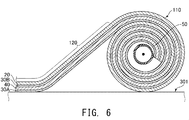
- the double-sided pressure-sensitive adhesive tapes described in Patent Documents 1 and 2 are wound together with the release liner 20 when not in use, and have a first pressure-sensitive adhesive layer 30A and a support in a cross section thereof. 40, the second pressure-sensitive adhesive layer 30 ⁇ / b> B, and the release liner 20, the release liner 20 is located outermost from the core 50.
- a part (one end) of the double-sided adhesive tape in a wound state is unwound, and the unwound portion (hereinafter referred to as “development”). (Referred to as “part 120”) to the object 301 to be attached.
- development the unwound portion
- part 120 the distance from the sticking target 301 is relatively large (far). Then, depending on the degree of the distance, it may be difficult to position the developing unit 120 and the sticking target 301.
- wound portion 110 The wound portion (hereinafter, referred to as “wound portion 110”) hinders the positioning.
- the developing unit 120 contracts after being attached to the sticking target 301, and may come off from the sticking target 301 depending on the degree of the contraction.
- An object of the present invention is to provide a double-sided pressure-sensitive adhesive tape roll excellent in operability when the double-sided pressure-sensitive adhesive tape roll is adhered and used.
- a wound double-sided adhesive tape wound body The double-sided pressure-sensitive adhesive tape is multiply wound so that the first pressure-sensitive adhesive layer is positioned at the outermost position with respect to the core of the double-sided pressure-sensitive adhesive tape roll in a cross section of the double-sided pressure-sensitive adhesive tape. Tape wound body.
- the release force of the release liner from the first pressure-sensitive adhesive layer is 10 to 2000 mN / 50 mm, and the release force of the release liner from the second pressure-sensitive adhesive layer is 200 to 5000 mN / 50 mm.
- the double-sided pressure-sensitive adhesive tape roll according to the above (1) or (2).
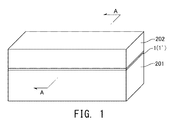
- FIG. 1 is a perspective view showing an example of a use state of the double-coated pressure-sensitive adhesive tape roll of the present invention.
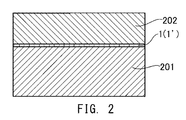
- FIG. 2 is a sectional view taken along the line AA in FIG.
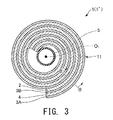
- FIG. 3 is a vertical cross-sectional view showing a double-sided pressure-sensitive adhesive tape roll (unused state) of the present invention.
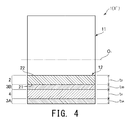
- FIG. 4 is a transverse cross-sectional view (a cross-sectional view taken along line BB in FIG. 3) showing the double-sided pressure-sensitive adhesive tape roll of the present invention.
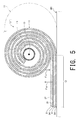
- FIG. 5 is a longitudinal sectional view showing a working state when the double-sided pressure-sensitive adhesive tape roll of the present invention is adhered.
- FIG. 6 is a longitudinal sectional view showing a working state when a conventional double-sided adhesive tape roll is attached.
- FIG. 1 is a perspective view showing an example of a use state of the rolled double-sided adhesive tape of the present invention.
- FIG. 2 is a sectional view taken along the line AA in FIG.
- FIG. 3 is a vertical cross-sectional view showing a double-sided pressure-sensitive adhesive tape roll (unused state) of the present invention.
- FIG. 4 is a transverse cross-sectional view (a cross-sectional view taken along line BB in FIG. 3) showing the double-sided pressure-sensitive adhesive tape roll of the present invention.
- FIG. 5 is a longitudinal sectional view showing a working state when the double-sided pressure-sensitive adhesive tape roll of the present invention is adhered.
- FIG. 6 is a longitudinal sectional view showing a working state when a conventional double-sided adhesive tape roll is attached.
- FIGS. 1 to 5 the upper side in FIGS. 1 to 5 is referred to as “upper (or upper)”, and the lower side is referred to as “lower (or lower)”.
- 3 to 6 the thickness of each layer of the double-sided double-coated pressure-sensitive adhesive tape is emphasized. Further, in FIGS. 3, 5 and 6, a gap is formed in a part of the outer peripheral portion of the core, but it is preferable that this gap is omitted.
- the rolled double-sided adhesive tape 1 is used for joining the first object 201 and the second object 202 in a developed state.
- the use aspect of this double-sided adhesive tape roll 1 is an example, and is not limited to this.
- the wound double-sided pressure-sensitive adhesive tape 1 in an unused state has a double-sided pressure-sensitive adhesive tape 1 ′, which is a double-sided pressure-sensitive adhesive tape, wound in multiple rolls around a core 5.
- This double-sided pressure-sensitive adhesive tape roll 1 (double-sided pressure-sensitive adhesive tape 1 ′) includes a first pressure-sensitive adhesive layer 3A, a support 4, a second pressure-sensitive adhesive layer 3B, and a release liner 2. It is composed of a laminate that is laminated in order.
- the first pressure-sensitive adhesive layer 3 ⁇ / b> A is placed on the core 5 (rolling center O 1 ) of the double-sided pressure-sensitive adhesive tape roll 1 in the cross section of the double-sided pressure-sensitive adhesive tape 1 ′. It is multiply wound so as to be positioned on the outermost side.
- the double-sided adhesive tape wound body 1 having such a configuration includes a wound portion 11 in a wound state and a developed portion 12 which is unfolded from the wound portion 11 and extended. Divided.
- the double-sided pressure-sensitive adhesive tape roll 1 double-sided pressure-sensitive adhesive tape 1 ′
- the first pressure-sensitive adhesive layer 3 ⁇ / b> A of the developing portion 12 having an appropriate length can be stuck to the first object 201.
- the developing unit 12 is cut from the winding unit 11.
- the release liner 2 can be peeled from the developing section 12.
- the second pressure-sensitive adhesive layer 3 ⁇ / b> B is exposed in the development part 12.
- the second object 202 can be attached to the second adhesive layer 3B. Thereby, the first object 201 and the second object 202 are joined.
- the support 4 is made of a flexible, long band-shaped member.
- the support 4 has a function as a core material of the double-sided pressure-sensitive adhesive tape 1 ', and also has a function as a support for supporting the first pressure-sensitive adhesive layer 3A and the second pressure-sensitive adhesive layer 3B.
- the support 4 is made of, for example, paper, nonwoven fabric, cloth, plastic film, or foam.
- the double-sided pressure-sensitive adhesive tape 1 ′ (developing portion 12) has flexibility, and thus can conform to the shape of the target object (the first target object 201 or the second target object 202).
- the thickness t 4 of the support 4 is not particularly limited, but is 50 ⁇ m or more and 350 ⁇ m or less for paper, nonwoven fabric or cloth, 6 ⁇ m or more and 250 ⁇ m or less for plastic film, and 100 ⁇ m or more and 3000 ⁇ m for foam. The following is preferred.
- the support 4 may have a roll-shaped winding habit in advance.
- a first pressure-sensitive adhesive layer 3A is formed over the entire surface, and on the other surface of the support 4 (the surface on the core 5 side), The second pressure-sensitive adhesive layer 3B is formed over the entirety.
- the first pressure-sensitive adhesive layer 3A is a layer that is adhered to the first object 201.
- the second pressure-sensitive adhesive layer 3B is a layer that is adhered to the second object 202.
- the pressure-sensitive adhesive constituting the first pressure-sensitive adhesive layer 3A and the second pressure-sensitive adhesive layer 3B may be any of acrylic, rubber, silicone, urethane and the like, but acrylic is preferable in terms of excellent adhesiveness.
- the acrylic pressure-sensitive adhesive composition includes an acrylic polymer (base), a crosslinking agent, and a tackifier (tackifier).
- the main agent is configured to include a main monomer that imparts tackiness and a monomer that imparts cohesive strength.
- Acrylic monomers can be used as the main monomer.
- the acrylic monomer for example, butyl (meth) acrylate, 2-ethylhexyl (meth) acrylate, octyl (meth) acrylate, dodecyl (meth) acrylate and the like are preferable, and butyl acrylate and 2-ethylhexyl acrylate are more preferable.
- Examples of the monomer that imparts cohesion include a monomer that has cohesion itself and a monomer that has crosslinkability.
- Examples of the monomer having cohesion itself include methyl (meth) acrylate, vinyl acetate, styrene and the like.
- crosslinkable monomer examples include monomers having a crosslinkable functional group such as a hydroxyl group, a carboxyl group, and an amide group.
- Examples of the monomer having a hydroxyl group include 2-hydroxyethyl (meth) acrylate, 3-hydroxypropyl (meth) acrylate, and 4-hydroxybutyl (meth) acrylate.
- Examples of the monomer having a carboxyl group include acrylic acid and methacrylic acid.
- Examples of the monomer having an amide group include acrylamide and methacrylamide.
- These monomers that impart cohesive strength to the main agent may be used alone or in a combination of two or more.
- the main agent can be adjusted to one having a suitable cohesive force.
- Crosslinking agent examples include an isocyanate-based crosslinking agent, an epoxy-based crosslinking agent, and an aziridine-based crosslinking agent. Isocyanate-based crosslinking agents are preferred from the viewpoint of increasing the cohesive force to obtain a pressure-sensitive adhesive composition with improved pressure-sensitive adhesive strength.
- isocyanate-based crosslinking agent examples include adduct, biuret, and nurate of polyvalent isocyanate compounds such as tolylene diisocyanate, xylylene diisocyanate, diphenylmethane diisocyanate, and hexamethylene diisocyanate.
- the content of the cross-linking agent is appropriately adjusted depending on the number of cross-linkable functional groups of the main agent (acrylic polymer) contained in the pressure-sensitive adhesive composition, and is 0.01 to 10 parts by mass based on 100 parts by mass of the main agent. , Preferably 0.03 to 7 parts by mass.
- the tackifier supplementarily improves the adhesive force of the acrylic polymer (base agent).
- the adherend that is, the first object 201 and the second object 202 include a polyolefin such as polyethylene or polypropylene
- the polarity of the polyolefin is relatively low. It can be difficult to make it work.
- a pressure-sensitive adhesive composition containing a tackifier together with an acrylic polymer a good adhesive strength can be exhibited even for such a low-polarity adherend.
- Tackifire includes, for example, rosin-based resins, terpene-based resins, petroleum-derived resins, and styrene-based resins.
- rosin resin examples include a rosin resin, a rosin ester resin, a polymerized rosin ester resin, an acid-modified polymerized rosin ester resin, a rosin-modified phenol resin, and hydrides thereof.
- terpene resin examples include terpene resins, terpene phenol resins, aromatic modified terpene resins, and hydrides thereof.
- Examples of the petroleum-derived resin include a C5 petroleum resin, a C9 petroleum resin, a C5-C9 copolymer petroleum resin, and hydrides thereof.
- Styrene resins include polystyrene resins, ⁇ -methylstyrene resins, and hydrides thereof.
- tackifiers may be used alone or in combination of two or more having different softening points and structures.
- the tackifier preferably has a softening point of 100 ° C. or more and 160 ° C. or less, and more preferably 110 ° C. or more and 130 ° C. or less.
- the softening point of the tackifier is within the above range, the adhesive strength of the adhesive composition can be further improved.
- the “softening point” of the tackifier means a value measured according to JIS K2207: 1996.
- the content ratio of the plurality of tackifiers is preferably adjusted so that the weighted average of the softening points of the plurality of tackifiers falls within the above range.
- the weight average molecular weight (Mw) of the tackifier is usually less than 20,000, preferably 400 to 10,000, more preferably 500 to 8,000.
- the content of the tackifier is preferably 20 parts by mass or more and 60 parts by mass or less, more preferably 30 parts by mass or more and 50 parts by mass or less with respect to 100 parts by mass of the main agent.
- the tackifier content is less than the lower limit or more than the upper limit, the effect of improving the adhesive strength is not sufficient.
- the pressure-sensitive adhesive composition may contain additives other than the above-described components, if necessary.
- additives examples include an ultraviolet absorber, an antioxidant, a plasticizer, a filler, and a colorant. Each of these additives may be used alone or in combination of two or more.
- composition of the first pressure-sensitive adhesive layer 3A and the second pressure-sensitive adhesive layer 3B may be the same or different.
- the thickness t 3A of the first pressure-sensitive adhesive layer 3A (see FIG. 4) and the thickness t 3B of the second pressure-sensitive adhesive layer 3B (see FIG. 4) are not particularly limited, but are, for example, not less than 5 ⁇ m and not more than 500 ⁇ m. And more preferably 10 ⁇ m or more and 100 ⁇ m or less. Further, the thickness t 3A and the thickness t 3B may be the same or different.
- the release liner 2 is made of a flexible and long band-shaped member similarly to the support 4, and the first double-sided adhesive tape wound body 1
- the function of preventing the pressure-sensitive adhesive layer 3A and the second pressure-sensitive adhesive layer 3B from adhering to each other, and the function of transporting the first pressure-sensitive adhesive layer 3A, the support 4 and the second pressure-sensitive adhesive layer 3B to an object to be bonded. Have.
- the surface 21 (outer surface) of the release liner 2 in the winding part 11 is in close contact with (adhered to) the second pressure-sensitive adhesive layer 3 ⁇ / b> B, and is opposite to the surface 21.
- Surface 22 (the inner surface) is in close contact with (adhered to) the first pressure-sensitive adhesive layer 3A.
- the release liner 2 has a surface 21 having releasability from the second adhesive layer 3B, and a surface 22 having releasability from the first adhesive layer 3A.
- the peel force F 3B from the second adhesive layer 3B of the release liner 2 is preferably greater than the peel force F 3A from the first pressure-sensitive adhesive layer 3A of release liner 2 (see FIG. 5).
- the peeling force F 3A is a force required for peeling the release liner 2 from the first pressure-sensitive adhesive layer 3A
- the peeling force F 3B is a force for peeling the release liner 2 from the second pressure-sensitive adhesive layer 3B. It is the power that is sometimes needed.
- the release liner 2 is in contact with both the first pressure-sensitive adhesive layer 3A and the second pressure-sensitive adhesive layer 3B.
- the release liner 2 Is peeled from the first pressure-sensitive adhesive layer 3A of the winding part 11 before the second pressure-sensitive adhesive layer 3B when the development part 12 is deployed (see FIG. 5). Thereafter, in the developing section 12, the release liner 2 can be released from the second pressure-sensitive adhesive layer 3B.
- the second object 202 can be attached to the second adhesive layer 3B.
- the peeling force F 3B is preferably 1.1 to 500 times, more preferably 1.1 to 10 times the peeling force F 3A .
- the peeling force F 3A is preferably from 10 to 2000 mN / 50 mm, and more preferably from 10 to 500 mN / 50 mm. Further, the peeling force F 3B is preferably from 200 to 5000 mN / 50 mm, and more preferably from 200 to 1000 mN / 50 mm. With such a numerical range, the release liner 2 can be easily and smoothly peeled.
- the peeling force F 3A is measured at a test temperature of 23 ° C. and a rewinding speed of 300 mm / min based on “low-speed rewinding force” specified in JIS Z0237: 2009.
- the peeling force F 3B is measured at a test temperature of 23 ° C. and a peeling speed of 300 mm / min based on “Testing method for peeling a release liner at 180 ° to an adhesive surface of a tape” specified in JIS Z0237: 2009. Is done.
- the ball tack of the first pressure-sensitive adhesive layer 3A is preferably 2 to 32, more preferably 10 to 20. If it is less than the lower limit value, it cannot be temporarily fixed to the first object 201, and if it exceeds the upper limit value, it is inferior in workability because it is adhered to a finger or a hand.
- “Ball tack” is a numerical value obtained based on an inclined ball tack defined in JIS Z0237: 2009, based on an inclination angle of 30 degrees.
- the adhesive force of the first adhesive layer 3A is preferably from 2 to 50 N / 25 mm, more preferably from 5 to 40 N / 25 mm, even more preferably from 10 to 30 N / 25 mm. If the adhesive strength of the first adhesive layer 3A is less than the lower limit, since becomes smaller than the peeling force F 3A from the first pressure-sensitive adhesive layer 3A of release liner 2, when attached to the first object 201 At the same time, the workability of developing the double-sided pressure-sensitive adhesive tape 1 ′ while rolling the winding portion 11 is poor. Further, when the adhesive force of the first adhesive layer 3A is more than the upper limit, the adhesive force to the first object 201 is too high, so that alignment becomes difficult.
- the adhesive strength of the first pressure-sensitive adhesive layer 3A is based on the “test method of peeling a tape to a stainless steel test plate at 180 °” specified in JIS Z0237: 2009, at a test temperature of 23 ° C and within 1 minute after pressure bonding. , Measured at a peeling speed of 300 mm / min.
- the release liner 2 is not particularly limited, and a known release liner used as a release liner of a double-sided pressure-sensitive adhesive tape (double-sided pressure-sensitive adhesive tape 1) can be appropriately selected and used.
- a paper or a plastic film that has been subjected to a process of peeling the pressure-sensitive adhesive layer on both sides is used as the release liner 2.
- Examples of the paper include high quality paper, glassine paper, and kraft paper.
- Examples of the plastic film include polyethylene terephthalate, polypropylene, and polyethylene.
- peeling treatment examples include applying silicone, fluorine, fluorosilicone, alkyd, etc., but silicone is preferred because the peeling force can be easily adjusted.
- the release treatment is performed so that the release force of the surface 21 of the release liner 2 that is in contact with the first pressure-sensitive adhesive layer 3A is larger than the surface 22 of the release liner 2 that is in contact with the second pressure-sensitive adhesive layer 3B.
- a method of adjusting the amount of the silicone resin and the like can be mentioned.
- the thickness t 2 (see FIG. 4) of the release liner 2 is not particularly limited, but is preferably from 10 ⁇ m to 150 ⁇ m, and more preferably from 20 ⁇ m to 130 ⁇ m.
- the material of the core 5 includes paper, vinyl chloride, polypropylene, acrylonitrile-butadiene-styrene copolymer and the like. Among these, paper is preferred because it can be easily cut to an arbitrary width.
- the inner diameter of the core 5 is 25, 30, 35, 76 mm, or the like. Among these, 76 mm having a large inner diameter is preferable from the viewpoint of sticking workability.
- the width of the double-sided adhesive tape 1 is preferably 1 mm or more and 100 mm or less. If it exceeds 100 mm, it will be easy to adhere to hands, fingers and objects to be stuck, and workability will be reduced.
- a release liner 2 having both sides of the release liner 2 subjected to a release treatment is prepared.
- the surface of the release liner 2 that is in contact with the second pressure-sensitive adhesive layer 3B is subjected to a release treatment so that the release force is greater than that of the surface 22 that is in contact with the first pressure-sensitive adhesive layer 3A.
- a second pressure-sensitive adhesive layer 3B, a support 4 and a first pressure-sensitive adhesive layer 3A are formed in this order. Thereby, the double-sided adhesive tape 1 'is obtained.
- the double-sided adhesive tape 1 ′ is gradually wound in a roll shape from one end side such that the surface 22 of the release liner 2 faces the core 5.
- the first pressure-sensitive adhesive layer 3A in cross-section of the double-sided adhesive tape 1 ' is outermost with respect to the winding center O 1 of the double-sided pressure-sensitive adhesive tape wound body 1, it will wound multiply.
- a double-sided pressure-sensitive adhesive tape wound body 1 in which the double-sided pressure-sensitive adhesive tape 1 'is wound is obtained.
- the first pressure-sensitive adhesive layer 3A has the core 5 ( It is multiply wound so as to be positioned on the outermost side with respect to the winding center O 1 ).
- this state is referred to as “the first pressure-sensitive adhesive layer outside arrangement state”.
- the first pressure-sensitive adhesive layer 3A can be brought closer to the first object 201 at the time of sticking, the alignment of the first pressure-sensitive adhesive layer 3A with respect to the first object 201 can be easily performed. Thereby, the first pressure-sensitive adhesive layer 3A can be accurately adhered to the first object 201.
- the vicinity of the winding core 5 (winding center O 1 ) of the winding portion 11 is grasped by hand, and the extending direction of the unfolding portion 12 is adjusted so that the winding portion 11 is aligned with the first object 201. It rotates in the opposite direction, that is, toward the right side in FIG. Thereby, the development part 12 can be formed longer.
- the winding part 11 can be rotated while pressing the winding part 11 against the first object 201 from above in FIG. By this pressing, fixing (press-bonding) of the deployed portion 12 to the first object 201 can be performed.
- the unfolded portion 12 is rotated in the opposite direction, that is, toward the left side in FIG. 11, so that the length of the unfolded portion 12 can be adjusted.
- the developing section 12 is cut at an appropriate place.
- the developing unit 12 double-sided adhesive tape 1 ′
- the developing unit 12 is attached to the first object 201.
- the second object 202 is attached to the second pressure-sensitive adhesive layer 3B. Thereby, the first object 201 and the second object 202 are joined.
- the first target object 201 and the second target object 202 are firmly joined via the double-sided adhesive tape 1 ′, that is, are permanently fixed (finally pressed).
- the first pressure-sensitive adhesive layer 3A is first aligned with the first object 201 while being positioned.
- the winding portion 11 is rotated as it is as described above, the operation of attaching the double-sided adhesive tape wound body 1 to the first object 201 can be performed easily and quickly. Thereby, the operability at the time of sticking and using the double-sided adhesive tape roll 1 is excellent, and the double-sided adhesive tape roll 1 is easy to use.
- the double-sided pressure-sensitive adhesive tape 1 ′ During application of the double-sided pressure-sensitive adhesive tape 1 ′, application of tension to the double-sided pressure-sensitive adhesive tape 1 ′ can be suppressed as much as possible. Thereby, the double-sided adhesive tape 1 ′ is suppressed or prevented from contracting after the first object 201 and the second object 202 are joined. Thereby, it is possible to prevent the double-sided adhesive tape 1 ′ from peeling off from the first object 201 and the second object 202, so that the joining state between the first object 201 and the second object 202 can be maintained for a long time. Can be maintained.
- the double-sided pressure-sensitive adhesive tape roll of the present invention has been described with reference to the illustrated embodiment, the present invention is not limited to this. It can be replaced with any configuration that can be exhibited. Also, an arbitrary component may be added.
- the rolled double-sided pressure-sensitive adhesive tape of the present invention has a first pressure-sensitive adhesive layer, a support, a second pressure-sensitive adhesive layer, and a release liner.
Landscapes
- Chemical & Material Sciences (AREA)
- Organic Chemistry (AREA)
- Adhesive Tapes (AREA)
Abstract
La présente invention concerne un rouleau de ruban adhésif double face comprenant une première couche adhésive, un corps formant support, une seconde couche adhésive et une doublure détachable, et un ruban adhésif double face dans lequel les composants ci-dessus sont disposés en couches dans l'ordre ci-dessus est enroulé en de multiples couches en forme de rouleau sur un noyau. Dans ce rouleau de ruban adhésif double face, le ruban adhésif double face est enroulé en de multiples couches de telle sorte que la première couche adhésive est positionnée le plus éloigné de l'extérieur par rapport au noyau du rouleau de ruban adhésif double face dans une coupe transversale du ruban adhésif double face. Dans le rouleau de ruban adhésif double face, la force de décollement de la doublure détachable de la seconde couche adhésive est de préférence supérieure à la force de décollement de la doublure détachable de la première couche adhésive.
Priority Applications (1)
| Application Number | Priority Date | Filing Date | Title |
|---|---|---|---|
| PCT/JP2018/024728 WO2020003472A1 (fr) | 2018-06-28 | 2018-06-28 | Rouleau de ruban adhésif double face |
Applications Claiming Priority (1)
| Application Number | Priority Date | Filing Date | Title |
|---|---|---|---|
| PCT/JP2018/024728 WO2020003472A1 (fr) | 2018-06-28 | 2018-06-28 | Rouleau de ruban adhésif double face |
Publications (1)
| Publication Number | Publication Date |
|---|---|
| WO2020003472A1 true WO2020003472A1 (fr) | 2020-01-02 |
Family
ID=68986850
Family Applications (1)
| Application Number | Title | Priority Date | Filing Date |
|---|---|---|---|
| PCT/JP2018/024728 Ceased WO2020003472A1 (fr) | 2018-06-28 | 2018-06-28 | Rouleau de ruban adhésif double face |
Country Status (1)
| Country | Link |
|---|---|
| WO (1) | WO2020003472A1 (fr) |
Citations (3)
| Publication number | Priority date | Publication date | Assignee | Title |
|---|---|---|---|---|
| JPS6326283U (fr) * | 1986-08-04 | 1988-02-20 | ||
| JPH0464544U (fr) * | 1990-10-05 | 1992-06-03 | ||
| JP2001348538A (ja) * | 2000-06-06 | 2001-12-18 | Sekisui Chem Co Ltd | 研磨材固定用両面粘着テープ |
-
2018
- 2018-06-28 WO PCT/JP2018/024728 patent/WO2020003472A1/fr not_active Ceased
Patent Citations (3)
| Publication number | Priority date | Publication date | Assignee | Title |
|---|---|---|---|---|
| JPS6326283U (fr) * | 1986-08-04 | 1988-02-20 | ||
| JPH0464544U (fr) * | 1990-10-05 | 1992-06-03 | ||
| JP2001348538A (ja) * | 2000-06-06 | 2001-12-18 | Sekisui Chem Co Ltd | 研磨材固定用両面粘着テープ |
Similar Documents
| Publication | Publication Date | Title |
|---|---|---|
| JP5486503B2 (ja) | フィルム剥離方法、光学フィルムの製造方法、フィルム剥離機構及び光学フィルム製造装置 | |
| JP6679239B2 (ja) | 粘着シート | |
| JP6747784B2 (ja) | 携帯型電子機器用粘着シート | |
| JP4912635B2 (ja) | 貼着部材および光学部品の貼着方法 | |
| JP5740124B2 (ja) | 両面粘着テープ及びタッチパネル付き表示装置 | |
| JP5637792B2 (ja) | 両面粘着テープ及びタッチパネル付き表示装置 | |
| TW201623509A (zh) | 雙面黏貼膠帶、物品及分離方法 | |
| JP6734663B2 (ja) | 手切れ性両面粘着テープ | |
| CN106232756A (zh) | 层叠片 | |
| JP6718142B2 (ja) | 物品の製造方法 | |
| JP6705105B2 (ja) | タイヤ用粘着シート | |
| JP2017071730A (ja) | 粘着シート | |
| JP2015147396A (ja) | 粘着剤付き化粧シート | |
| JP2002121503A (ja) | 床材固定用両面粘着テープ | |
| JP2008106242A (ja) | 易剥離性粘着テープ及びその製造方法 | |
| JP2020183502A (ja) | 粘着フィルム | |
| JP2010076178A (ja) | 保護フィルム | |
| JP5884608B2 (ja) | 両面粘着テープの製造方法 | |
| WO2020003472A1 (fr) | Rouleau de ruban adhésif double face | |
| JP2008024922A (ja) | セパレータ付き片面粘着発泡体テープ及びその製造方法 | |
| JP2002317156A (ja) | 両面テープ | |
| JP5009887B2 (ja) | 粘着シートの製造方法 | |
| JP7187026B2 (ja) | 感圧転写粘着テープ | |
| JP2003253224A (ja) | 両面粘着テープ | |
| JP3205388U (ja) | 粘着テープ積層体 |
Legal Events
| Date | Code | Title | Description |
|---|---|---|---|
| 121 | Ep: the epo has been informed by wipo that ep was designated in this application |
Ref document number: 18924035 Country of ref document: EP Kind code of ref document: A1 |
|
| NENP | Non-entry into the national phase |
Ref country code: DE |
|
| 122 | Ep: pct application non-entry in european phase |
Ref document number: 18924035 Country of ref document: EP Kind code of ref document: A1 |
|
| NENP | Non-entry into the national phase |
Ref country code: JP |