WO2020003496A1 - Structure d'imperméabilisation - Google Patents
Structure d'imperméabilisation Download PDFInfo
- Publication number
- WO2020003496A1 WO2020003496A1 PCT/JP2018/024830 JP2018024830W WO2020003496A1 WO 2020003496 A1 WO2020003496 A1 WO 2020003496A1 JP 2018024830 W JP2018024830 W JP 2018024830W WO 2020003496 A1 WO2020003496 A1 WO 2020003496A1
- Authority
- WO
- WIPO (PCT)
- Prior art keywords
- roof
- tile
- wall
- eaves
- eave
- Prior art date
- Legal status (The legal status is an assumption and is not a legal conclusion. Google has not performed a legal analysis and makes no representation as to the accuracy of the status listed.)
- Ceased
Links
Images



Classifications
-
- E—FIXED CONSTRUCTIONS
- E04—BUILDING
- E04D—ROOF COVERINGS; SKY-LIGHTS; GUTTERS; ROOF-WORKING TOOLS
- E04D13/00—Special arrangements or devices in connection with roof coverings; Protection against birds; Roof drainage ; Sky-lights
- E04D13/14—Junctions of roof sheathings to chimneys or other parts extending above the roof
Definitions
- the present disclosure relates to a waterproof structure, and more particularly, to a waterproof structure in a roof structure in which an upper end of a wall projects above a roof.
- FIG. 1 there is a roof structure in which an upper end of a wall protrudes above a roof (for example, see Patent Document 1).
- the roof in such a roof structure has a crosspiece support member, a tile crosspiece, and a tile.
- a plurality of crosspiece support members are juxtaposed in the eave direction between walls located at both ends in the eave direction.
- the roof tiles extend along the eaves direction, are arranged in parallel in the eaves ridge direction, and are mounted on the rail support members.
- the roof tiles are placed on roof tiles.
- An object of the present disclosure is to provide a waterproof structure in which water hardly enters from between a roof and a wall.
- a waterproof structure includes a roof, a wall having an upper end protruding above the roof, and a water receiving member.
- the roof is provided with a plurality of beam support members positioned at intervals in the eave direction, and mounted on the plurality of beam support members extending along the eave direction, and a plurality of beams located at intervals in the eave direction. It has a roof tile and a plurality of roof tiles placed on the roof tile.
- One side surface of the wall in the eave direction and one end surface of the tile bar in the eave direction face each other with a gap having a predetermined length in the eave direction.
- the water receiving member is disposed in the gap and extends along the eaves ridge direction, one end in the eaves direction is in contact with one side surface of the wall, and the other end in the eaves direction is above the roof tile. And located below the roof tile.
- FIG. 1 is a perspective view of a building to which a waterproof structure according to one embodiment is applied.
- FIG. 2 is a perspective view of a part of a roof of the same building.
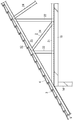
- FIG. 3 is a cross-sectional view of a part of the same roof as seen from the eaves direction.
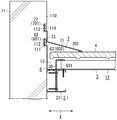
- FIG. 4 is a partially enlarged sectional view of FIG.
- FIG. 5 is a cross-sectional view of the main part of the same roof as seen from the eaves ridge direction.
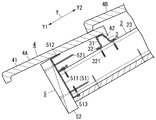
- FIG. 6 is a cross-sectional view of the vicinity of the roof tile of the same roof as viewed from the eaves direction.
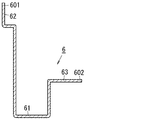
- FIG. 7 is a cross-sectional view of a water receiving member used for the roof.
- FIG. 8 is a sectional view of a drainer used for the roof.
- the present disclosure relates to a waterproof structure.
- a waterproof structure according to an embodiment of the present disclosure will be described with reference to FIGS. First, a building 1 having a waterproof structure according to one embodiment will be described.
- the building 1 includes a roof 12 and a wall 11 whose upper end protrudes above the roof 12.
- the building 1 includes walls 11 (outer walls) arranged at both ends in the eave direction, and a roof 12 arranged between the walls 11 on both sides.
- the eaves direction refers to a horizontal direction X along the surface of the wall 14 having windows, doorways, and the like of the roof 12 (hereinafter, eaves direction X).
- the eaves ridge direction refers to a direction Y orthogonal to the eaves direction and along the slope of the roof 12 (hereinafter, eaves ridge direction Y). In the eave ridge direction Y, the eave side is Y1 and the ridge side is Y2.
- the building 1 shown in FIG. 1 is constituted by one building having one independent living space by the walls 11 on both sides and the roof 12 therebetween.
- the building is a linked building having three or more walls arranged at intervals in the eave direction and a roof arranged between two adjacent walls. It may be configured.
- the space surrounded by two adjacent walls and the roof placed between them is an independent living space.
- the walls located at both ends in the eave direction are the outer walls.
- a wall other than the outer wall, that is, a wall located between two adjacent living spaces is a boundary wall.
- the building 1 is constructed by a so-called WPC (wall precast concrete) method in which PC panels (precast concrete panels) are connected.
- WPC wall precast concrete
- a plurality of PC panels are connected to form a first-floor and second-floor wall (outer wall and boundary wall), a first-floor ceiling (a second-floor floor), and a second-floor ceiling on a foundation.
- the building 1 of the present embodiment is a two-story building, the building may be a single-story building (one-story) or may have three or more floors. The building does not have to be constructed by the WPC method.
- the height of the upper end of the wall 11 protruding from the roof 12 is not particularly limited, but is preferably set to, for example, 100 mm, 200 mm, 300 mm, or more.
- the roof 12 includes the beam support member 2, the roof tile 3, and the roof tile 4.
- a plurality of crosspiece support members 2 are arranged at intervals in the eave direction X.
- the distance between the adjacent beam support members 2 is appropriately determined, such as 50 cm, 1 m, or 2 m, and is not particularly limited.
- the beam support member 2 is constituted by a truss. As shown in FIG. 3, the beam support member 2 includes a lower chord member 21, a column member 22, an upper chord member 23, and a diagonal member 24.
- the lower chord material 21 extends in a horizontal direction orthogonal to the eaves direction X.
- the lower chord material 21 is formed of a square tube material.
- the column member 22 is connected to the lower chord member 21.
- the column member 22 is connected to the lower chord member 21 so as to protrude above the lower chord member 21.
- the column member 22 is formed of a square tube material.
- the lower end of the pillar 22 is connected to the lower chord 21.
- the upper chord member 23 is connected to the upper end of the column member 22.
- the upper chord material 23 extends along the eaves ridge direction Y and has an inclination that determines the inclination of the roof 12 in the eaves ridge direction Y.
- the upper chord material 23 is formed of a square tube material.
- the height of the upper chord material 23 from the ground is highest at the center in the horizontal direction orthogonal to the eaves direction X, and is inclined so as to become lower toward the end of the eaves side Y1.
- the inclination of the upper chord material 23 determines the inclination of the roof 12.
- the diagonal members 24 are provided between the adjacent column members 22.
- the diagonal member 24 is formed of a square tube.
- the lower end of the slant 24 is connected to the lower chord 21, and the upper end of the slant 24 is connected to the upper chord 23.
- the crosspiece support member 2 (the lower chord member 21, the column member 22, the upper chord member 23, and the diagonal member 24) is formed of metal such as steel.
- the lower chord member 21 and the column member 22, the column member 22 and the upper chord member 23, the lower chord member 21 and the diagonal member 24, and the diagonal member 24 and the upper chord member 23 are connected by welding, fastening with bolts and nuts, etc., respectively.
- the method is not particularly limited.
- the beam support member 2 is mounted on the upper surface of a ceiling 15 made of a PC panel, which is mounted on a wall 14 having a doorway or the like.
- the crosspiece supporting member 2 is provided with a nose cover 5.
- the fascia part 5 is provided at an end of the eave support Y2 in the eaves ridge direction Y on the eaves side Y1.
- the fascia part 5 extends in the eaves direction X and is connected to the end of the eaves side Y1 in the eaves ridge direction Y of the plurality of beam support members 2.
- the nose cover 5 has an attachment member 51 and a plate-shaped member 52.
- the attachment member 51 has a substantially C-shaped mounting piece 511 that covers the upper surface, the side edge, and the lower surface of the end of the eaves side Y1 in the eaves ridge direction Y of the upper chord material 23, and a reverse protruding upward from the mounting piece 511.
- an upper piece 512 having an L-shape.
- the attachment member 51 is formed of metal such as steel, and extends along the eaves direction X.
- the mounting piece 511 is fixed to an end of the upper chord material 23 on the eaves side Y1 in the eaves ridge direction Y by a fixture 513 such as a nail.
- the plate member 52 is formed of a wooden plate.
- the plate member 52 extends in the eaves direction X.
- the plate-shaped member 52 is fixed to the beam support member 2 such that the upper end protrudes above the upper end of the end of the upper chord member 23 on the eaves side Y1 in the eaves ridge direction Y.
- the plate member 52 is fixed to the mounting member 51 by a fixing tool 521 such as a nail.
- the roof 12 does not include a field board and a roofing material.
- the roof tile 3 extends along the eaves direction X and is placed on the plurality of rail support members 2.
- a plurality of tile bars 3 are arranged at intervals in the eave ridge direction Y.
- the roof tile 3 is formed of a metal such as steel, such as a channel material, an angle material, an H-shaped material, a rectangular tube material, or the like.
- the roof tile 3 includes a main body 31 having a C-shaped cross section that opens downward, and flanges 32 that protrude from both ends in the cross section of the main body 31. .
- a fixture 321 such as a nail
- one end face 30 on one side of the eaves direction X of the tile bar 3 is connected to one side face 110 on the other side of the eaves direction X of the wall 11 and a predetermined angle in the eaves direction X. They face each other with a gap 13 having a length.
- the predetermined length of the gap 13 in the eaves direction X is appropriately determined, such as 3 cm, 5 cm, or 10 cm, and is not limited.
- the roof tile 4 is placed on the tile bar 3 as shown in FIG.
- the roof tile 4 is made of a ceramic material, and has a substantially rectangular plate-shaped main body 41, and a hook 42 that protrudes downward from both ends of the main body 41 in the eaves ridge direction Y.
- the roof tile 4A located closest to the eaves side Y1 is placed on the tile roof 3 whose end on the ridge side Y2 is located closest to the eaves side Y1. Of the building side Y2.
- the middle part of the roof tile 4 ⁇ / b> A located at the eaves side Y ⁇ b> 1 is placed on the nose cover 5.
- the tile 4 may be fixed to the tile bar 3 with a fixture such as a nail or a screw after being placed on the tile bar 3.
- the second roof tile 4B from the eaves side Y1 is placed on the second roof tile (not shown) from the eaves side Y1 at the end of the ridge side Y2, and a hook portion at the end of the roof side Y2. 42 is hooked on the ridge side Y2 portion of the roof tile 3.
- the end of the eaves side Y1 of the second tile 4B from the eaves side Y1 is placed on the tile 4A located closest to the eaves side Y1.
- the waterproof structure includes a wall 11, a roof 12, and a water receiving member 6.
- the water receiving member 6 is disposed in the gap 13 and extends along the eave ridge direction Y.
- the water receiving member 6 is preferably disposed over the entire length of the gap 13 in the eaves ridge direction Y, but is not particularly required to be disposed over the entire length of the gap 13 in the eaves ridge direction Y.
- One end 601 (embedded portion 62) of the water receiving member 6 in the eaves direction X is embedded in one side surface 110 of the wall 11.
- the other end 602 (mounting portion 63) of the water receiving member 6 in the eaves direction X is located above the roof tile 3 and below the roof tile 4. This will be described more specifically.
- the water receiving member 6 has a main body 61, a buried portion 62, and a mounting portion 63, and is formed of a metal such as steel.
- the main body 61 has a C-shaped cross section that is located in the gap 13 and that opens upward.
- the buried portion 62 serves as one end 601 of the water receiving member 6 in the eaves direction X, and has an L-shaped cross-sectional shape protruding laterally from the main body 61. As shown in FIG. 5, the buried portion 62 is buried in one side surface 110 of the wall 11. The end on the one side surface 110 side of the main body 61 protrudes to a position above the roof tile 4. The buried portion 62 is buried in one side surface 110 of the wall 11 at a position above the roof tile 4. The buried portion 62 is inserted into a concave portion 111 formed on one side surface 110 of the wall 11.
- the recess 111 into which the buried portion 62 is inserted is filled with a filler 112 made of silicon, mortar, or the like.
- a filler 112 made of silicon, mortar, or the like.
- the mounting portion 63 is the other end 602 in the eaves direction X of the water receiving member 6. As shown in FIG. 5, the body part 61 protrudes outward from an end of the body part 61 and is placed on the tile bar 3. The mounting portion 63 is fixed to the roof tile 3 by a fixing tool 631 such as a nail.
- the rainwater that has fallen on the tile 4 flows down on the tile 4 toward the eaves side Y1.
- Part of the rainwater that has fallen on the tile 4 flows in the eaves direction X and flows down from between the end of the tile 4 on the wall 11 side and the wall 11. In this case, the rainwater will enter the building 1 along the wall 11.
- the water receiving member 6 is disposed in the gap 13 between the one side surface 110 of the wall 11 and the one end surface 30 of the tile bar 3. Even if the rainwater falling on the tile 4 reaches the end of the tile 4 on the side of the wall 11 and the rainwater tries to flow down (fall) from between the roof 12 and the wall 11, the rainwater is received by the water receiving member 6. This suppresses rainwater from entering the building 1 from between the roof 12 and the wall 11.
- One end 601 (embedded portion 62) of water receiving member 6 is embedded in one side surface 110 of wall 11 at a position above tile 4. For this reason, it is difficult for the rainwater flowing on the roof tile 4 to reach the portion buried in the one side surface 110 of the water receiving member 6. This suppresses rainwater flowing on the tile 4 from entering the building 1 through a portion buried in the one side surface 110 of the water receiving member 6.
- the waterproof structure further has a drainer 7.
- the drainer 7 extends in the eaves ridge direction Y.
- the draining member 7 is preferably arranged over the entire length of the gap 13 in the eaves ridge direction Y.
- the drainage member 7 may not be particularly arranged over the entire length of the gap 13 in the eaves ridge direction Y.
- One end 701 (embedded portion 72) of the drainer 7 in the eaves direction X is embedded in one side surface 110 of the wall 11.
- the drainer 7 has a main body 71, a buried portion 72, and a vertical portion 73, and is formed of a metal such as steel.
- the embedded portion 72 is located at one end 701 of the draining member 7 in the eaves direction X, and is embedded in one side surface 110 of the wall 11 as shown in FIG.
- the buried portion 72 has an L-shaped cross section.
- the buried portion 72 is inserted into a concave portion 113 formed on one side surface 110 of the wall 11.
- the recess 113 is located above the recess 111.
- the recess 113 into which the buried portion 72 is inserted is filled with a filler 114 made of silicon, mortar, or the like.
- the one end 701 in the eaves direction X of the draining member 7 is buried in the one side surface 110 of the wall 11, but the embedding method is not limited, and the one end 701 is connected to the one side surface 110 by a method other than the embedding. You may make it contact.
- the vertical portion 73 protrudes downward from the end of the embedded portion 72.
- the main body 71 projects obliquely from the lower end of the vertical part 73.
- the other end 702 of the main body 71 in the eaves direction X is located above the roof tile 4.
- the draining member 7 covers an upper side of a portion embedded in one side surface 110 of the water receiving member 6.
- the rainwater flowing down one side surface 110 of the wall 11 may reach a portion buried in the one side surface 110 of the water receiving member 6 and enter the building 1.
- the rainwater flowing down one side surface 110 of the wall 11 reaches the place buried in the one side surface 110 of the water receiving member 6, and the rainwater is drained on the roof 4 by the draining member 7. Is induced. This suppresses rainwater flowing down one side surface 110 of the wall 11 from entering the building 1 through a portion buried in the one side surface 110 of the water receiving member 6.
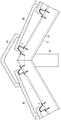
- the upper end of the wall 11 only needs to be located at least above the upper end of the end of the roof 12 facing the wall 11 (that is, the upper end of the tile 4). That is, a part of the roof 12 (for example, the roof tile 43) that is separated from the wall 11 in the eaves direction X may be located at a position higher than the upper end of the wall 11.
- the roof 12 may be uniformly inclined from one side to the other in the eave ridge direction Y (one-sided flow), and the inclination of the roof 12 is not limited.
- the nose cover 5 has an optional configuration, and may not be provided on the crosspiece support member 2.
- the material of the fascia part 5 is not limited.
- the beam support member 2 is not limited to a truss. Further, a plurality of rail support members 2 may not be provided. Moreover, the crosspiece support member 2 does not need to extend in parallel to the eaves ridge direction Y. Further, the crosspiece support member 2 may be formed of a metal other than steel, or may be formed of a member other than metal such as wood.
- the lower chord material 21 does not have to extend horizontally.
- the lower chord member 21, the column member 22, the upper chord member 23, and the diagonal member 24 may be made of, for example, a channel material, an angle material, an H-shaped material, and the like, and are not limited to the square tube material.
- the roof 12 may include a base plate and a roofing material. Also in this case, the field board and the roofing material are positioned so that a gap 13 is formed between the field board and the roofing material.
- the roof tile 3 is not limited to a channel material or the like.
- the material of the tile bar 3 may be a metal other than steel, or may be a material other than metal such as wood.
- the method of fixing the tile bar 3 to the beam support member 2 is not limited.
- the tile bar 3 does not need to extend in parallel with the eaves direction X.
- a plurality of roof tiles 3 may not be provided.
- the roof tile 4 may be formed of a metal or cement-based material, and need not be formed of a ceramic-based material.
- the water receiving member 6 and the draining member 7 may be formed of metal other than steel, or may be formed of a member other than metal.
- the waterproof structure of the first aspect has a roof (12), a wall (11) having an upper end protruding above the roof (12), and a water receiving member (6). ).
- the roof (12) is placed on a plurality of crosspiece support members (2) positioned at intervals in the eave direction (X) and a plurality of crosspiece support members (2) extending along the eave direction (X).
- a gap having a predetermined length in the eaves direction (X) is formed between one side surface (110) of the wall (11) in the eaves direction (X) and one end surface (30) of the roof tile (3) in the eaves direction (X). (13) open and face each other.
- the water receiving member (6) is arranged in the gap (13) and extends along the eave ridge direction (Y).
- One end (601) of the water receiving member (6) in the eaves direction (X) is in contact with one side surface (110) of the wall (11), and the other end of the water receiving member (6) in the eaves direction (X).
- the part (602) is located above the roof tile (3) and below the roof tile (4).
- the waterproof structure of the first aspect even if the rainwater falling on the tile (4) tries to flow down from between the roof (12) and the wall (11), the rainwater is received by the water receiving member (6). This suppresses rainwater from entering the building (1) from between the roof (12) and the wall (11).
- the present invention can be realized by a combination with the first aspect.
- one end (601) of the water receiving member (6) is embedded in one side surface (110) of the wall (11) at a position above the roof tile (4).
- the rainwater flowing on the roof tile (4) enters the building (1) from a location buried on one side surface (110) of the water receiving member (6). Be suppressed.
- the present invention can be realized by a combination with the first or second aspect.
- the waterproof structure has a drainer (7).
- the drainer (7) extends along the eaves ridge direction (Y).
- One end (701) of the drainer (7) in the eaves direction (X) is in contact with one side surface (110) of the wall (11), and the other end (701) of the drainer (7) in the eaves direction (X).
- 702 is located above the roof tile (4).
- the building (1) starts from the place where the rainwater flowing down one side surface (110) of the wall (11) contacts the one side surface (110) of the water receiving member (6). Infiltration into the inside is suppressed.
Landscapes
- Engineering & Computer Science (AREA)
- Architecture (AREA)
- Civil Engineering (AREA)
- Structural Engineering (AREA)
- Roof Covering Using Slabs Or Stiff Sheets (AREA)
Abstract
La présente invention aborde le problème de la fourniture d'une structure d'imperméabilisation qui rend la pénétration d'eau entre un toit et un mur plus difficile. Cette structure d'imperméabilisation est dotée d'un toit (12), d'un mur (11) présentant une extrémité supérieure qui fait davantage saillie vers le haut que le toit (12) et d'un élément de réception d'eau (6). Le toit (12) comprend : une pluralité d'éléments de support de traverse (2) positionnés avec un espacement dans une direction d'avant-toit (X) ; une pluralité de traverses de tuile (3) qui s'étend le long de la direction d'avant-toit (X) est placée sur la pluralité d'éléments de support de traverse (2) et est positionnée avec un espacement dans une direction d'arête d'avant-toit ; et une pluralité de tuiles (4) placée sur les traverses de tuile (3). Une surface latérale (110) dans la direction d'avant-toit (X) du mur (11) et une surface d'extrémité (30) dans la direction d'avant-toit (X) des traverses de tuile (3) se font face à travers un espace (13) présentant une longueur prédéterminée dans la direction d'avant-toit (X). L'élément de réception d'eau (6) est agencé dans l'espace (13), s'étend le long de la direction d'arête d'avant-toit, présente une section d'extrémité (601) dans la direction d'avant-toit (X) qui est en contact avec la surface latérale (110) du mur (11) et présente une autre section d'extrémité (602) dans la direction d'avant-toit (X) qui est située au-dessus des traverses de tuile (3) et au-dessous des tuiles (4).
Priority Applications (1)
| Application Number | Priority Date | Filing Date | Title |
|---|---|---|---|
| PCT/JP2018/024830 WO2020003496A1 (fr) | 2018-06-29 | 2018-06-29 | Structure d'imperméabilisation |
Applications Claiming Priority (1)
| Application Number | Priority Date | Filing Date | Title |
|---|---|---|---|
| PCT/JP2018/024830 WO2020003496A1 (fr) | 2018-06-29 | 2018-06-29 | Structure d'imperméabilisation |
Publications (1)
| Publication Number | Publication Date |
|---|---|
| WO2020003496A1 true WO2020003496A1 (fr) | 2020-01-02 |
Family
ID=68986819
Family Applications (1)
| Application Number | Title | Priority Date | Filing Date |
|---|---|---|---|
| PCT/JP2018/024830 Ceased WO2020003496A1 (fr) | 2018-06-29 | 2018-06-29 | Structure d'imperméabilisation |
Country Status (1)
| Country | Link |
|---|---|
| WO (1) | WO2020003496A1 (fr) |
Cited By (1)
| Publication number | Priority date | Publication date | Assignee | Title |
|---|---|---|---|---|
| CN116464230A (zh) * | 2023-05-08 | 2023-07-21 | 陈勇 | 一种防水靠墙梁结构 |
Citations (4)
| Publication number | Priority date | Publication date | Assignee | Title |
|---|---|---|---|---|
| US2112332A (en) * | 1936-10-22 | 1938-03-29 | William F Cox | Flashing block |
| JPS6220575Y2 (fr) * | 1981-06-30 | 1987-05-26 | ||
| JPH04216752A (ja) * | 1990-12-17 | 1992-08-06 | Nishi Nippon Daiwa House Hanbai Kk | 屋根断熱構造及びその施工方法 |
| JP2004003219A (ja) * | 2002-04-01 | 2004-01-08 | Sekishu Kawakami Yougyo:Kk | 捨水切 |
-
2018
- 2018-06-29 WO PCT/JP2018/024830 patent/WO2020003496A1/fr not_active Ceased
Patent Citations (4)
| Publication number | Priority date | Publication date | Assignee | Title |
|---|---|---|---|---|
| US2112332A (en) * | 1936-10-22 | 1938-03-29 | William F Cox | Flashing block |
| JPS6220575Y2 (fr) * | 1981-06-30 | 1987-05-26 | ||
| JPH04216752A (ja) * | 1990-12-17 | 1992-08-06 | Nishi Nippon Daiwa House Hanbai Kk | 屋根断熱構造及びその施工方法 |
| JP2004003219A (ja) * | 2002-04-01 | 2004-01-08 | Sekishu Kawakami Yougyo:Kk | 捨水切 |
Cited By (1)
| Publication number | Priority date | Publication date | Assignee | Title |
|---|---|---|---|---|
| CN116464230A (zh) * | 2023-05-08 | 2023-07-21 | 陈勇 | 一种防水靠墙梁结构 |
Similar Documents
| Publication | Publication Date | Title |
|---|---|---|
| JP7540355B2 (ja) | 屋根構造体 | |
| JP7303982B2 (ja) | 庇屋根構造及び建築物 | |
| KR101216948B1 (ko) | 박공 지붕의 누수 방지용 시트패널 | |
| EP2666918A2 (fr) | Balcon | |
| JP6388169B2 (ja) | 屋外床の防水構造 | |
| JP2001173240A (ja) | 補強外壁及び外壁の補強工法 | |
| EP2557253A1 (fr) | Procédé de conception de bâtiment | |
| JP6672035B2 (ja) | 手摺用支柱の支持構造 | |
| EP3404155A1 (fr) | Balkon oder terrasse extra | |
| RU51065U1 (ru) | Здание многоцелевого назначения | |
| JP5165984B2 (ja) | バルコニー床の支持構造 | |
| JP2024158599A (ja) | 化粧格子の取付構造 | |
| JP7193368B2 (ja) | 屋根パネル | |
| JPH0135847Y2 (fr) | ||
| JP5951313B2 (ja) | 建物付設物 | |
| JPH0522571Y2 (fr) | ||
| JP2000154590A (ja) | バルコニーの排水処理構造 | |
| JP3196816B2 (ja) | 建築物 | |
| JP2003119876A (ja) | 屋外通路 | |
| JP4588650B2 (ja) | 熨斗風瓦及び該熨斗風瓦を使用した棟部における熨斗積み構造及び壁際の水切り構造 | |
| JP2025024527A (ja) | 見切り材の取付構造 | |
| RU67142U1 (ru) | Керамическая облицовка и сейсмостойкая усиливающая конструкция с ее использованием (варианты) | |
| JP2024098870A (ja) | 建物の屋根構造 | |
| JP5841324B2 (ja) | 建物 | |
| JPH0735921Y2 (ja) | 建物の外廊下の構造 |
Legal Events
| Date | Code | Title | Description |
|---|---|---|---|
| 121 | Ep: the epo has been informed by wipo that ep was designated in this application |
Ref document number: 18924286 Country of ref document: EP Kind code of ref document: A1 |
|
| NENP | Non-entry into the national phase |
Ref country code: DE |
|
| 122 | Ep: pct application non-entry in european phase |
Ref document number: 18924286 Country of ref document: EP Kind code of ref document: A1 |
|
| NENP | Non-entry into the national phase |
Ref country code: JP |