WO2020003537A1 - Épaississant et procédé de production d'épaississant - Google Patents
Épaississant et procédé de production d'épaississant Download PDFInfo
- Publication number
- WO2020003537A1 WO2020003537A1 PCT/JP2018/024938 JP2018024938W WO2020003537A1 WO 2020003537 A1 WO2020003537 A1 WO 2020003537A1 JP 2018024938 W JP2018024938 W JP 2018024938W WO 2020003537 A1 WO2020003537 A1 WO 2020003537A1
- Authority
- WO
- WIPO (PCT)
- Prior art keywords
- resin
- thickener
- thickening component
- thickening
- resin layer
- Prior art date
- Legal status (The legal status is an assumption and is not a legal conclusion. Google has not performed a legal analysis and makes no representation as to the accuracy of the status listed.)
- Ceased
Links
Images


Classifications
-
- C—CHEMISTRY; METALLURGY
- C09—DYES; PAINTS; POLISHES; NATURAL RESINS; ADHESIVES; COMPOSITIONS NOT OTHERWISE PROVIDED FOR; APPLICATIONS OF MATERIALS NOT OTHERWISE PROVIDED FOR
- C09K—MATERIALS FOR MISCELLANEOUS APPLICATIONS, NOT PROVIDED FOR ELSEWHERE
- C09K3/00—Materials not provided for elsewhere
Definitions
- the present invention relates to a thickener and a method for producing the thickener.
- the drilling mud to which an additive such as a thickener is added may be used (for example, see Patent Document 1). ).
- the thickener dissolves immediately when mixed with water or the like, and the viscosity increases, and there is a problem that a large pumping pressure is generated when the wash water is pumped from the ground into the oil well. Therefore, it is desirable that the time until the thickener thickens can be adjusted.
- An object of one embodiment of the present invention is to provide a thickener capable of adjusting the time until thickening, and a method for producing the same.
- a thickener comprising a thickening component and a resin layer covering the thickening component.
- a thickener comprising: a thickening component having a hydroxyl group; and a protective substance which reacts with the hydroxyl group to form a protective group and from which the protective group is removable.
- the resin layer is made of a phenol resin, an epoxy resin, an acrylate resin, a polyester resin, a polyamide resin, a polyimide resin, a polyamideimide resin, a fluororesin, a nylon resin, a styrene resin, an acrylonitrile resin, a polyethylene resin, a polyolefin resin, and a polycarbonate resin.
- the thickener according to ⁇ 1> comprising at least one resin selected from the group consisting of vinyl chloride resin, polysulfone resin, silicone resin, and butyl rubber.
- the resin layer has a plurality of layers
- the resin contained in at least one of the plurality of layers has a different composition from the resin contained in another layer of the plurality of layers.
- the thickener according to any one of the above ⁇ 4> ⁇ 6>
- the resin layer includes a resin having a number average molecular weight of 1,000 to 1,000,000.
- ⁇ 8> The thickener according to any one of ⁇ 1> and ⁇ 3> to ⁇ 7>, wherein the resin layer accounts for 50% by mass or less based on the whole.
- ⁇ 9> The thickener according to any one of ⁇ 1> and ⁇ 3> to ⁇ 8>, wherein the thickness of the resin layer is 0.1 ⁇ m to 1000 ⁇ m.
- the thickening component is at least one selected from carboxymethylcellulose, hydroxyethylcellulose, modified hydroxyethylcellulose, polyanionic cellulose, guar gum, and chitansan gum. Thickener.
- a thickener comprising: a thickening component; and a protective portion that protects a portion of the thickening component that exhibits a thickening function and delays the thickening of the thickening component.
- a method for producing a thickener comprising: forming the resin layer covering the thickening component after the application.
- the resin applied to the surface of the thickening component is heated to a temperature equal to or higher than the softening temperature and lower than the curing temperature to cover the thickening component with the resin, and the resin coated with the thickening component is heated to a curing temperature or higher.
- ⁇ 14> heating the resin applied to the surface of the thickening component to a temperature equal to or higher than a melting temperature to coat the thickening component with the resin, and setting the resin coating the thickening component to a temperature lower than the melting temperature;
- ⁇ 15> The method for producing a thickener according to ⁇ 2>, wherein the hydroxyl group of the thickening component is reacted with the protective substance to form a protective group.
- ⁇ 16> The method according to any one of ⁇ 12> to ⁇ 15>, wherein the thickening component is at least one selected from carboxymethylcellulose, hydroxyethylcellulose, modified hydroxyethylcellulose, polyanionic cellulose, guar gum, and chitansan gum.
- a method for producing a thickener is at least one selected from carboxymethylcellulose, hydroxyethylcellulose, modified hydroxyethylcellulose, polyanionic cellulose, guar gum, and chitansan gum.
- a thickener capable of adjusting the time until thickening, and a method for producing the same.
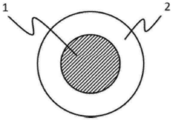
- FIG. 1 is a schematic cross-sectional view illustrating one embodiment of the present invention.
- FIG. 3 is a schematic sectional view showing another embodiment of the present invention.
- FIG. 3 is a schematic sectional view showing another embodiment of the present invention.
- FIG. 3 is a schematic sectional view showing another embodiment of the present invention.
- the present invention is not limited to the following embodiments.
- the constituent elements including element steps and the like
- the numerical ranges indicated by using “to” include the numerical values described before and after “to” as the minimum value and the maximum value, respectively.
- the upper limit or lower limit described in one numerical range may be replaced with the upper limit or lower limit of the numerical range described in other stages.
- the upper limit or the lower limit of the numerical range may be replaced with the value shown in the embodiment.
- each component may include a plurality of corresponding substances.
- the content of each component means the total content of the plurality of substances present in the composition unless otherwise specified.
- the “content rate” represents the mass% of each component when the total amount of the thickener is 100 mass%, unless otherwise specified.
- a thickener includes a thickening component, and a resin layer that covers the thickening component. Since the thickener is covered with the resin layer, the thickener can adjust the time until the thickener is thickened. For example, the thickener can delay the function expression of the thickening component.
- the thickener of the present disclosure may be used, for example, as a thickener for oil wells, or may be mixed with water to make washing water, and used for removing residues in oil wells.
- the thickener is not particularly limited as long as it has a thickening component and a resin layer covering the thickening component.
- the thickener of the present disclosure loses its potential or tends to lose its potential by external stimulus, that is, it may be one that expresses the function of the thickening component, and until the function of the thickening component is expressed. May be shortened.
- the external stimulus include mechanical stimulus such as external pressure and vibration, electric stimulus, solvent stimulus such as water, chemical stimulus such as acid and alkali, and thermal stimulus.
- the thickener may be one in which the function of a thickening component is developed by the resin layer being broken by an external stimulus, or until the resin layer becomes brittle and the function of the thickening component is developed. The time may be shortened.
- the thickening component of the present disclosure may be any as long as it exhibits a thickening function, preferably any one used for an oil well additive, and more preferably any one that contributes to oil well cleaning. . Further, the thickening component may exhibit a thickening function by reacting and interacting with a liquid such as water.
- the thickening component one having a hydroxyl group is preferable, and a polymer compound having a hydroxyl group is more preferable. More specifically, the thickening component preferably contains at least one selected from carboxymethylcellulose, hydroxyethylcellulose, modified hydroxyethylcellulose, polyanionic cellulose, guar gum and chitansan gum. Among them, carboxymethyl cellulose, hydroxyethyl cellulose and the like are preferable as the thickening component, and hydroxyethyl cellulose is more preferable.
- the thickening component for example, there is a solid or liquid at room temperature (25 ° C), and a solid at room temperature (25 ° C) is preferable from the viewpoint of resin coatability.
- the shape of the thickening component may be, for example, square, needle, or round, and is preferably round or square from the viewpoint of resin coatability.
- the particle diameter of the thickening component varies depending on its function, and is preferably from 0.1 ⁇ m to 5,000 ⁇ m, more preferably from 0.5 ⁇ m to 3,000 ⁇ m, from the viewpoint of resin coatability, It is more preferably from 1.0 ⁇ m to 2,000 ⁇ m, particularly preferably from 5.0 ⁇ m to 1,000 ⁇ m.
- the particle size of the thickening component can be measured by a laser diffraction method, sieving, or the like.
- the particle diameter of the thickener refers to the average particle diameter of the thickener contained in the thickener.
- the average particle size of the thickening component is an average particle size (D50) corresponding to 50% of the cumulative weight distribution from the smaller particle size side in the particle size distribution measured using a laser diffraction method.
- the content of the thickening component may be 25% by mass or more, 50% by mass or more, or 70% by mass to 99% by mass with respect to the whole. And it may be 80% by mass to 98% by mass.
- the resin layer included in the thickener of the present disclosure is a layer formed using a resin.
- the time until the function of the thickening component is developed can be adjusted, and for example, the function of the thickening component can be delayed.
- the resin layer may cover one thickening component, or may cover a plurality of thickening components. Further, the resin layer may cover one kind of thickening component or may cover a plurality of kinds of thickening components.
- “coating” indicates that the surface of the thickening component is not exposed in order to adjust the time until the function of the thickening component is developed.
- the thickener of the present disclosure and a thickener having no resin layer different from the present disclosure can be used in combination. It is preferable that the resin layer be able to withstand frictional pressure during mixing of washing water and other additives. Further, in the thickener of the present disclosure, the surface of the thickening component may be directly coated with a resin layer, another layer is disposed between the surface of the thickening component and the resin layer, via another layer Thus, the surface of the thickening component may be covered with a resin layer.
- the thickener according to the present disclosure referring to the drawings, as shown in FIG. 1, one obtained by coating one thickening component 1 with a resin layer 2 can be used. Furthermore, as shown in FIG. 2, as the thickener of the present disclosure, a thickener having a plurality of types of thickeners such as a thickener 3 and a thickener 4 coated with a resin layer 5 is used. You can also.
- the thickener of the present disclosure may be obtained by coating a granulated material of a thickening component with a resin layer.
- the resin layer tends to be coated with high uniformity, and the time until the function of the thickening component is developed tends to be adjusted later.
- the granulated material of the thickening component may be formed by binding the thickening components to each other using a binder resin or the like, or may be formed by binding using a thickening component having a binding property. Good.
- the binder resin may be the same component as the resin contained in the resin layer, or may be a different component.
- the thickener of the present disclosure When the thickener of the present disclosure is obtained by coating a granulated material of a thickener with a resin layer, a plurality of thickeners 8 are bound by a binder resin 9 as shown in FIG. It may be a granulated product and the granulated product is covered with the resin layer 10.
- the thickener of the present disclosure is composed of a plurality of types of thickeners, that is, a thickener component 12 partially covered with a resin layer 11 and a thickener component 13 that is completely covered. Can also be used.
- the layer structure of the resin layer may be a single layer or a plurality of layers, and can be selected according to the purpose.
- the resin contained in at least one of the plurality of layers may have a different composition from the resin contained in the other layers of the plurality of layers.
- the first resin layer and the second resin layer when viewed from the surface of the thickening component, have different properties such as different solubility in acids / alkali, water, organic solvents, etc., and different water vapor permeability.
- the time until the function of the thickening component can be adjusted can be adjusted by a method other than adjusting the thickness of the resin layer.
- the thickness of the resin layer is not particularly limited, and can be set in consideration of a required time until the function of the thickening component is developed. Specifically, the thickness of the resin layer is preferably from 0.1 ⁇ m to 1,000 ⁇ m, and from the viewpoint of expressing the function of the thickening component immediately after transporting the washing water into the oil well, is preferred. The thickness is more preferably from 0.5 ⁇ m to 800 ⁇ m, further preferably from 1.0 ⁇ m to 500 ⁇ m, and particularly preferably from 5.0 ⁇ m to 300 ⁇ m.
- the thickness of the resin layer can be determined by the FIB method in which a Ga + ion beam is irradiated in the x and y directions of the sample to perform sputtering, and the cross section is observed by focusing secondary electrons. Further, the thickness of the resin layer means a minimum thickness. The region where the thickness of the resin layer is minimum can be confirmed, for example, by observation with an electron microscope.
- the resin layer is, specifically, a phenol resin, an epoxy resin, an acrylate resin, a polyester resin, a polyamide resin, a polyimide resin, a polyamide imide resin, a fluororesin, a nylon resin, a styrene resin, an acrylonitrile resin, a polyethylene resin, a polyolefin resin, and a polycarbonate. It is preferable to include at least one resin selected from a resin, a vinyl chloride resin, a polysulfone resin, a silicone resin, and butyl rubber, and it is more preferable to include at least one of a phenol resin and an epoxy resin from the viewpoint of easy resin coating. And epoxy resin.
- the hydroxyl equivalent of the phenol resin is preferably from 80 g / eq to 200 g / eq, more preferably from 90 g / eq to 180 g / eq, even more preferably from 100 g / eq to 160 g / eq.
- the hydroxyl equivalent of the phenol resin is a value measured by a method according to JIS K 0070 (1992).
- the epoxy equivalent of the epoxy resin is preferably from 150 g / eq to 1000 g / eq, more preferably from 170 g / eq to 800 g / eq, and still more preferably from 180 g / eq to 600 g / eq.
- the epoxy equivalent of the epoxy resin is a value measured by a method according to JIS K 7236 (2009).
- the resin layer may include, as a resin, an alkali-soluble resin containing at least one functional group selected from an OH group, a COOH group, and an SO 3 H group.
- the resin layer preferably contains a network polymer from the viewpoint of controlling the time until the function is developed.
- the network polymer include a phenol resin and a urea resin.
- the number average molecular weight of the resin contained in the resin layer is preferably 1,000 to 1,000,000 from the viewpoint that the resin can be easily coated. In addition, the number average molecular weight can be measured by gel permeation chromatography (GPC).
- the content of the resin layer may be 75% by mass or less, 50% by mass or less, or 0.5% by mass to 40% by mass based on the whole. May be 1.0% to 30% by mass, or 3.0% to 25% by mass.
- DSC method differential scanning calorimetry
- TGA method thermogravimetric analysis method
- DTA method differential thermal analysis method
- SEM observation Scanning electron microscope observation
- EDX method energy dispersive X-ray spectroscopy
- FIB method focused ion beam method
- the thickener of the present disclosure for example, when a water-soluble thickener is selected, the thickener is added to water and stirred for a certain period of time, and the amount of the resin layer coated (content ) Can be estimated.
- the thickener of the present disclosure it is possible to confirm that the surface of the thickening component is covered with the resin by performing EDX analysis after SEM observation.
- the water vapor permeability of the resin contained in the resin layer may be 200 g / m 2 ⁇ day or less, preferably 1 g / m 2 ⁇ day to 190 g / m 2 ⁇ day, and more preferably 3 g / m 2 ⁇ day to It is more preferably 180 g / m 2 ⁇ day, still more preferably 5 g / m 2 ⁇ day to 150 g / m 2 ⁇ day, and more preferably 10 g / m 2 ⁇ day to 100 g / m 2 ⁇ day. Particularly preferred is 30 g / m 2 ⁇ day to 60 g / m 2 ⁇ day, and even more preferred.
- the water vapor permeability of the resin contained in the resin layer is 200 g / m 2 ⁇ day or less, when the thickener and water are mixed, the time until the function of the thickening component is developed tends to be reduced. . Further, when the water vapor permeability of the resin contained in the resin layer is 1 g / m 2 or more, there is a tendency that the coatability to the thickening component is excellent.
- the water vapor permeability of the resin contained in the resin layer is a value measured in accordance with the cup method of JIS Z0208 (1976).
- the transmittance coefficient of the resin contained in the resin layer is preferably 200 g ⁇ mm / m 2 ⁇ day or less, more preferably 1 g ⁇ mm / m 2 ⁇ day to 190 g ⁇ mm / m 2 ⁇ day. It is more preferably from 3 g ⁇ mm / m 2 ⁇ day to 180 g ⁇ mm / m 2 ⁇ day, particularly preferably from 5 g ⁇ mm / m 2 ⁇ day to 150 g ⁇ mm / m 2 ⁇ day, and 10 g.
- Mm / m 2 ⁇ day to 100 g ⁇ mm / m 2 ⁇ day is even more preferable, and 30 g ⁇ mm / m 2 ⁇ day to 60 g ⁇ mm / m 2 ⁇ day is even more preferable.
- the transmittance coefficient of the resin contained in the resin layer is 200 g ⁇ mm / m 2 ⁇ day or less, when the thickener and water are mixed, the time until the function of the thickening component is developed tends to be delayed. It is in. Further, when the transmittance coefficient of the resin contained in the resin layer is 1 g ⁇ mm / m 2 or more, there is a tendency that the coatability to the thickening component is excellent.
- the permeability coefficient is a product of the water vapor permeability and the thickness of the resin layer.
- the water vapor permeability and the permeability coefficient of the resin contained in the resin layer can be appropriately adjusted by changing the resin forming conditions such as the functional group of the resin contained in the resin layer, the curing temperature, and the curing time. is there.
- the resin forming conditions such as the functional group of the resin contained in the resin layer, the curing temperature, and the curing time. is there.
- the resin forming conditions such as the functional group of the resin contained in the resin layer, the curing temperature, and the curing time. is there.
- the resin forming conditions such as the functional group of the resin contained in the resin layer, the curing temperature, and the curing time. is there.
- the resin forming conditions such as the functional group of the resin contained in the resin layer, the curing temperature, and the curing time. is there.
- the resin forming conditions such as the functional group of the resin contained in the resin layer, the curing temperature, and the curing time. is there.
- the resin forming conditions such as the functional group of the resin contained in the resin
- the method for producing a thickener according to the present disclosure is the method for producing a thickener according to the above-described first aspect, and after applying the resin to the surface of the thickener, coating the thickener. This is a method for forming the resin layer.
- Specific Example 1 of the method for producing a thickener according to the present disclosure is that the resin applied to the surface of the thickening component is heated to a temperature equal to or higher than the softening temperature and lower than the curing temperature, and the resin is coated with the thickening component. May be heated to a curing temperature or higher to form a resin layer covering the thickening component.
- a thermosetting resin as the resin.
- the resin used for forming the resin layer is applied to the surface of the thickening component, the resin is heated to a softening temperature or higher and lower than the curing temperature, and the resin is coated with the thickening component. May be heated to a curing temperature or higher to form a resin layer covering the thickening component.
- the resin may be added to the thickening component. Heating may be performed as described above.
- the heating temperature of the resin is preferably equal to or higher than the curing temperature of the resin and lower than the denaturation temperature of the thickening component (for example, the temperature at which the thickening component becomes water-insoluble or hardly water-soluble).
- the method for producing a thickener in Example 1 is described in “(a) a step of applying a resin to the surface of a thickening component. (B) coating the thickening component with a resin by setting the resin to a softening temperature or higher and lower than a curing temperature. (C) heating the resin to a curing temperature or higher to form a resin layer covering the thickening component. " Further, the thickness of the resin layer can be adjusted by repeating the steps (a) to (c).
- the resin used in the step (a) is preferably in a state of a solution dissolved in a solvent.
- the viscosity of the resin solution used in the step (a) is preferably 500 mPa ⁇ s or less, more preferably 100 mPa ⁇ s or less, from the viewpoint of coating the resin with high uniformity on the thickening component. It is more preferably at most 50 mPa ⁇ s, particularly preferably at most 20 mPa ⁇ s.
- the viscosity of the resin solution used in the step (a) is the viscosity at 25 ° C. measured using an E-type viscometer.
- Examples of the method of heating the thickening component in the steps (b) and (c) include heating using a gas burner, an electric furnace, a dryer, or the like. It is desirable to use a dryer or an electric furnace that is easy to hold.
- the resin layer when a resin layer covering the thickener is formed using a mixture of a resin and a thickener, the resin layer may be formed by a wet method.
- a resin solution is prepared by dissolving a resin and a curing agent as necessary in a solvent, and the prepared resin solution and a thickening component are mixed together to form a resin layer that covers the thickening component using the mixture. Is also good.
- the coating is dried to evaporate the solvent, or the coating is heated to cure the resin, and the resin layer is formed. Good.
- the solvent a solvent having high compatibility with the resin and not reacting with the thickening component may be used, and a solvent having further excellent volatility is preferable.
- the solvent include ketones such as methyl ethyl ketone (MEK), methyl isobutyl ketone (MIBK) and acetone, dichloromethane, ethyl acetate, ethers and the like.
- the thickener may be produced by spray coating.
- a resin solution containing a thermosetting resin such as an epoxy resin, a phenol-based curing agent, a curing agent such as an imidazole-based curing agent, a solvent such as methyl ethyl ketone, etc.
- the thickener may be sprayed, followed by heating to remove the solvent and cure the thermosetting resin to produce a thickener.
- the thickening component is granulated, and after applying a resin used for forming a resin layer to the surface of the granulated material, a resin layer covering the granulated material may be formed. Good.
- the granulated material of the thickening component may be formed by binding the thickening components to each other using a binder resin or the like, or may be formed by binding using a thickening component having a binding property. Good.
- a granulated product obtained by mixing the thickening component and the binder resin and then binding the thickening components together by the binder resin may be formed.
- the granulated material may be formed by a wet method.
- a resin solution is prepared by dissolving a binder resin and, if necessary, a curing agent in a solvent, mixing the prepared resin solution with a thickening component, and binding the thickening components together using a mixture.
- Granules may be formed.
- the mixture may be dried to evaporate the solvent, or the mixture may be heated to cure the binder resin to form a granulated product.
- the content of the binder resin may be 30% by mass or less, may be 0.5% by mass to 20% by mass, and may be 1.0% by mass to 10% by mass. There may be.
- the total content of the resin layer and the binder resin may be 50% by mass or less, may be 0.5% by mass to 30% by mass, and may be 1.0% by mass. It may be from 25% by mass to 25% by mass.
- Specific Example 2 of the method for producing a thickener according to the present disclosure will be described.
- the specific example 2 of the above-mentioned method for producing a thickener is that the resin applied to the surface of the thickener is heated to a melting temperature or higher to coat the thickener with the resin, and then the resin coating the thickener is used. May be lower than the melting temperature to form a resin layer covering the thickening component.
- the resin after applying the resin used for forming the resin layer to the surface of the thickening component, the resin is heated to a melting temperature or higher, and the thickening component is coated with the applied resin, and further set to a melting temperature or higher.
- a method in which the resin is set to a temperature lower than the melting temperature to form a resin layer covering the thickening component may be used.
- the resin After heating the thickening component to a temperature higher than the melting temperature of the resin, the resin may be added to the thickening component at a temperature higher than the melting temperature of the resin. It may be adjusted below the melting temperature.
- the heating temperature of the resin is preferably equal to or higher than the melting temperature of the resin and lower than the denaturation temperature of the thickening component (for example, the temperature at which the thickening component becomes water-insoluble or hardly water-soluble).
- the method for producing the thickener in the specific example 2 is described as follows: “(a) a step of heating the thickening component to a temperature equal to or higher than the melting temperature of the resin used in the step (b). Adding a resin, and coating the thickening component with the added resin, and (c) forming a resin layer covering the thickening component by setting the temperature of the thickening component below the melting temperature of the resin. " It may be performed including three steps.
- Examples of the method of heating the thickening component in the step (a) and the method of heating the resin include heating with a gas burner, an electric furnace, a dryer, or the like, and the thickening component is not thermally decomposed and is as short as possible. From the viewpoint of heating over time, an electric furnace is preferred.
- the heating temperature of the resin and the heating temperature of the thickening component are preferably equal to or higher than the melting temperature of the resin and equal to or lower than the thermal decomposition temperature of the thickening component.
- the thickener may be manufactured by extrusion.
- a thickening component is mixed with a thermoplastic resin such as polyethylene, and the resulting mixture is charged into an extruder. Then, by heating the mixture in the extruder and cooling the mixture extruded from the die, a sheet-like or fibrous thickener can be obtained. The obtained thickener may be cut as necessary to form a pellet or the like.
- the heating temperature of the mixture in the extruder is preferably equal to or higher than the melting temperature of the thermoplastic resin, is equal to or higher than the melting temperature of the thermoplastic resin, and denatures the thickening component. More preferably, it is lower than the temperature.
- the heating temperature of the mixture in the extruder is preferably 120 ° C. or more and less than 140 ° C., and is 120 ° C. to 130 ° C. Is more preferable.
- the thickener according to the second embodiment of the present disclosure includes a thickening component having a hydroxyl group, and a protective substance which reacts with the hydroxyl group to form a protective group, and wherein the protective group is removable.
- This thickener can adjust the time until the function of the thickening component is developed by the elimination of the protecting group, since the hydroxyl group of the thickening component reacts with the protecting substance to form the protecting group.
- the thickener can delay the function expression of the thickening component.
- the thickening component used in this embodiment is not particularly limited as long as it has a hydroxyl group.
- the thickening component is preferably a polymer compound having a hydroxyl group, specifically, at least one selected from carboxymethylcellulose, hydroxyethylcellulose, modified hydroxyethylcellulose, polyanionic cellulose, guar gum and chitansan gum. preferable.
- the protective substance used in the thickener of the present disclosure is not particularly limited as long as it is a compound capable of forming a protective group by reacting with a hydroxyl group of a thickening component and releasing the protective group, that is, a compound capable of deprotection. Not done.
- the protective substance include aldehyde compounds, carbonyl compounds, trialkylsilyl halides, carboxylic acids, carboxylic anhydrides, and trityl halides.
- the aldehyde compound may be any compound capable of reacting with the hydroxyl group of the thickening component to form an acetal, and examples thereof include formaldehyde, acetaldehyde, glutaraldehyde and glyoxal.
- the carbonyl compound may be any compound that can react with a hydroxyl group of the thickening component to form an acetal, such as acetone.
- the trialkylsilyl halide may be any compound capable of reacting with a hydroxyl group of a thickening component and capable of trialkylsilylation. Examples thereof include trimethylsilyl halide, triethylsilyl halide and t-butyldimethylsilyl halide.
- the carboxylic acid may be any compound that can be esterified by reacting with the hydroxyl group of the thickening component, and examples thereof include formic acid, acetic acid, and oxalic acid.
- the carboxylic anhydride may be any compound capable of reacting with the hydroxyl group of the thickening component to be acetylated, such as acetic anhydride.
- the trityl halide may be any compound capable of reacting with a hydroxyl group of a thickening component and capable of being tritylated, such as trityl chloride.
- the content of the protective substance is preferably 0.0001% by mass to 5% by mass, and more preferably 0.001% by mass to 3% by mass with respect to 100% by mass of the thickening component. More preferably, it is 0.01% by mass to 1% by mass.
- the thickener of the present disclosure it is preferable that 50% or more of the hydroxyl groups of the thickening component is protected by a protective group, and it is more preferable that substantially 100% is protected by a protective group.
- the method for producing a thickener according to the present disclosure is the method for producing a thickener according to the second aspect described above, wherein the hydroxyl group of the thickening component is reacted with the protective substance to form a protective group.
- Preferred conditions for forming a protective group by reacting a hydroxyl group of a thickening component with a protective substance are the same as those for protecting a hydroxyl group using a protective substance in organic synthesis or the like.
- the thickener according to the third aspect of the present disclosure includes a thickening component, and a protecting unit that protects a part of the thickening component that exhibits a thickening function and delays the thickening of the thickening component.
- the thickener is capable of delaying the function expression of the thickening component until the protection of the site is released, since the portion that expresses the thickening function of the thickening component is protected.
- the protective portion may be, for example, a resin layer covering a thickening component like the thickener according to the above-described first embodiment, or may be a resin layer covering the thickening component according to the above-described second embodiment. And a protective substance which reacts with a hydroxyl group of the thickening component to form a protective group.
- the resin solutions (1) to (7) and Metrolose as a thickening component are added to the polycup such that the total amount of the resin and the curing agent is 20% by mass with respect to Metrolose.
- the mixture was stirred. After stirring, the mixture was dried to obtain coatings AG. Thereafter, the coatings A to G were put into a dryer at 120 ° C. for 1 hour, and the resin was cured to prepare thickeners A to G, respectively.
- the resin solutions (1) to (7) and Metrolose as a thickening component are added to the polycup so that the total amount of the resin and the curing agent is 40% by mass with respect to the Metrolse, The mixture was stirred. After stirring, the mixture was dried to obtain coatings HN. Thereafter, the coatings H to N were put into a dryer at 120 ° C. for one hour, and the resin was cured to produce thickeners H to N, respectively.
- the resin solutions (1) to (7) shown in Table 1 and Metrolose as a thickening component were mixed such that the total amount of the resin and the curing agent was 40% by mass with respect to the Metrolose.
- the resin was coated on Metroze by a wet method to prepare a thickener.
- the thickeners thus prepared were placed in a dryer and heated at 80 ° C. for 15 minutes and at 120 ° C. for 1 hour to cure the resin and increase the strength.
- thickeners H ′ to N ′ were prepared from the resin solutions (1) to (7), respectively.
- the tensile strength of the resin plate was measured as in (a) to (d).
- Samples 1 to 7 thickeners A to G: 4.8 g and ultrapure water: 160 mL
- Samples 8 to 14 thickeners H to N: 5.6 g and ultrapure water: 160 mL
- Sample 15 Metrolose: 4.0 g and ultrapure water: 160 mL
- Samples 1 'to 7' thickeners A 'to G': 4.8 g and ultrapure water: 160 mL
- Samples 8 'to 14' thickeners H 'to N': 5.6 g and ultrapure water: 160 mL
- Sample 15 ' Metrolose: 4.0 g and ultrapure water: 160 mL
- Sample 16 to 24 were each separated into 500 mL polybins, and stirred at room temperature at 780 rpm (rotation / minute) using a three-one motor (HEIDON FBL-600).
- Sample 16 thickener O: 8.0 g and ultrapure water: 160 mL
- Sample 17 thickener P: 6.0 g and ultrapure water: 160 mL
- Sample 18 thickener Q: 12.12 g and ultrapure water: 160 mL
- Sample 19 Thickener R: 8.0 g and ultrapure water: 160 mL
- Sample 21 thickener T: 5.0 g and ultrapure water: 160 mL
- Sample 22 thickener U: 4.7 g and ultrapure water: 160 mL
- Sample 23 thickener V: 4.44 g and ultrapure water: 160 mL
- Sample 24 thickener W: 4.2 g and ultrapure water:
- the sample liquid is taken out with a dropper every 30 minutes until 3 hours after the start of stirring and every 60 minutes thereafter, and the E-type viscometer (Toki Sangyo Co., Ltd. TV-22 type) was used to measure the viscosity of the sample liquid.
- the time until the increase in the viscosity of the sample liquid stopped was defined as the saturated viscosity reaching time, and the delay effect was confirmed.
- Table 10 shows the results.
- the resin coating amount means the resin amount with respect to Metroose.
- the water absorption of the thickeners 1 to 5 shown in Table 11 was determined by leaving each of the thickeners 1 to 5 at 25 ° C. and 85% for 72 hours and then calculating the water absorption based on the following formula (1).
- Water absorption (%) [(M2 ⁇ M1) / M1] ⁇ 100 Formula (1)
- ⁇ Potential evaluation method> The potential was evaluated by submerging the thickeners 1 to 5 in ultrapure water for a certain period of time and measuring the time until the function of the thickener was developed.
- Sample 25 thickener 1: 2.3 g and ultrapure water: 160 mL
- Sample 26 Thickener 2: 2.3 g and ultrapure water: 160 mL
- Sample 27 Thickener 3: 1.5 g and ultrapure water: 160 mL
- Sample 28 Thickener 4: 1.5 g and ultrapure water: 160 mL
- Sample 29 thickener 5: 3.2 g and ultrapure water: 160 mL
Landscapes
- Chemical & Material Sciences (AREA)
- Engineering & Computer Science (AREA)
- Materials Engineering (AREA)
- Organic Chemistry (AREA)
- Compositions Of Macromolecular Compounds (AREA)
- Medicinal Preparation (AREA)
Abstract
L'invention concerne un épaississant qui comprend un composant épaississant et une couche de résine qui recouvre le composant épaississant.
Priority Applications (1)
| Application Number | Priority Date | Filing Date | Title |
|---|---|---|---|
| PCT/JP2018/024938 WO2020003537A1 (fr) | 2018-06-29 | 2018-06-29 | Épaississant et procédé de production d'épaississant |
Applications Claiming Priority (1)
| Application Number | Priority Date | Filing Date | Title |
|---|---|---|---|
| PCT/JP2018/024938 WO2020003537A1 (fr) | 2018-06-29 | 2018-06-29 | Épaississant et procédé de production d'épaississant |
Publications (1)
| Publication Number | Publication Date |
|---|---|
| WO2020003537A1 true WO2020003537A1 (fr) | 2020-01-02 |
Family
ID=68984490
Family Applications (1)
| Application Number | Title | Priority Date | Filing Date |
|---|---|---|---|
| PCT/JP2018/024938 Ceased WO2020003537A1 (fr) | 2018-06-29 | 2018-06-29 | Épaississant et procédé de production d'épaississant |
Country Status (1)
| Country | Link |
|---|---|
| WO (1) | WO2020003537A1 (fr) |
Citations (8)
| Publication number | Priority date | Publication date | Assignee | Title |
|---|---|---|---|---|
| JPS471601B1 (fr) * | 1968-07-03 | 1972-01-17 | ||
| JPS57121083A (en) * | 1981-01-20 | 1982-07-28 | Sanyo Kokusaku Pulp Co Ltd | Method of preparing mud for civil engineering |
| JPH02161015A (ja) * | 1988-05-26 | 1990-06-20 | Konoike Constr Ltd | 特殊水中コンクリートの製造方法 |
| JPH07138131A (ja) * | 1993-11-16 | 1995-05-30 | Yuho Chem Kk | 水性マニキュア剤用粘度調節剤 |
| JP2009504821A (ja) * | 2005-08-10 | 2009-02-05 | コンストラクション リサーチ アンド テクノロジー ゲーエムベーハー | 建築化学用途の添加剤 |
| JP2012077129A (ja) * | 2010-09-30 | 2012-04-19 | Namics Corp | 樹脂組成物、および、それを用いた封止材 |
| WO2016060120A1 (fr) * | 2014-10-15 | 2016-04-21 | 王子ホールディングス株式会社 | Composition comprenant de fines fibres cellulosiques |
| JP2017105670A (ja) * | 2015-12-09 | 2017-06-15 | 日立化成株式会社 | コンクリート用添加剤及びこの添加剤の製造方法 |
-
2018
- 2018-06-29 WO PCT/JP2018/024938 patent/WO2020003537A1/fr not_active Ceased
Patent Citations (8)
| Publication number | Priority date | Publication date | Assignee | Title |
|---|---|---|---|---|
| JPS471601B1 (fr) * | 1968-07-03 | 1972-01-17 | ||
| JPS57121083A (en) * | 1981-01-20 | 1982-07-28 | Sanyo Kokusaku Pulp Co Ltd | Method of preparing mud for civil engineering |
| JPH02161015A (ja) * | 1988-05-26 | 1990-06-20 | Konoike Constr Ltd | 特殊水中コンクリートの製造方法 |
| JPH07138131A (ja) * | 1993-11-16 | 1995-05-30 | Yuho Chem Kk | 水性マニキュア剤用粘度調節剤 |
| JP2009504821A (ja) * | 2005-08-10 | 2009-02-05 | コンストラクション リサーチ アンド テクノロジー ゲーエムベーハー | 建築化学用途の添加剤 |
| JP2012077129A (ja) * | 2010-09-30 | 2012-04-19 | Namics Corp | 樹脂組成物、および、それを用いた封止材 |
| WO2016060120A1 (fr) * | 2014-10-15 | 2016-04-21 | 王子ホールディングス株式会社 | Composition comprenant de fines fibres cellulosiques |
| JP2017105670A (ja) * | 2015-12-09 | 2017-06-15 | 日立化成株式会社 | コンクリート用添加剤及びこの添加剤の製造方法 |
Similar Documents
| Publication | Publication Date | Title |
|---|---|---|
| Chang et al. | Effects of starch nanocrystal‐graft‐polycaprolactone on mechanical properties of waterborne polyurethane‐based nanocomposites | |
| TWI522368B (zh) | Production method of fine cellulose fiber dispersion | |
| CN103415536B (zh) | 具有改进的分散性能的水溶性聚合物粉末配制物 | |
| EP3083793B1 (fr) | Composition de poudres de poly-arylene-ether-cetone-cetones autorisant un excellent compromis coulabilite et coalescence adaptees au frittage laser | |
| JP6605461B2 (ja) | ナノ粒子インク組成物、プロセスおよび応用 | |
| Arukalam et al. | Exploitation of natural gum exudates as green fillers in self-healing corrosion-resistant epoxy coatings | |
| Fadiran et al. | Pollen fillers for reinforcing and strengthening of epoxy composites | |
| JP5374343B2 (ja) | コアシェル粒子及びコアシェル粒子の製造方法 | |
| Pattnaik et al. | Influence of waste vetiver root fiber on mechanical, hydrophobicity, and biodegradation of soy-based biocomposites as plastic substitute | |
| Sudhakara et al. | Thermal, mechanical, and morphological properties of maleated polypropylene compatibilized Borassus fruit fiber/polypropylene composites | |
| Fakraoui et al. | Comparative analysis of cellulose nanocrystals and cellulose nanofibrils on the physico‐chemical properties of polyvinyl alcohol/chitosan blend for sustainable food packaging | |
| WO2020003537A1 (fr) | Épaississant et procédé de production d'épaississant | |
| TWI288169B (en) | Latent curing agent | |
| TW200936600A (en) | Microencapsulated silane coupling agent | |
| Gabriel et al. | Performance enhancement of NaOAc/Canna Edulis ker. starch-based bioplastic: mechanical and thermal behavior properties | |
| JP6515002B2 (ja) | 複合繊維とその製造方法、並びに、複合材とその製造方法 | |
| KR102693488B1 (ko) | Bnnt 함유 수분산 폴리우레탄-아크릴레이트 수지 복합체 및 이의 제조 방법 | |
| JP5360378B2 (ja) | 潜在性硬化剤の製造方法、及び接着剤の製造方法 | |
| KR20220022245A (ko) | 한천을 포함하는 생분해성 필름 및 이의 제조 방법 | |
| CN102821946B (zh) | 多层结构及其制备方法 | |
| JP2008189692A (ja) | 多糖類複合材料 | |
| JP2008156570A (ja) | 潜在性硬化剤粒子の製造方法、接着剤の製造方法、及び接着フィルムの製造方法 | |
| Raj et al. | Effect of varying ratio of starch in melamine-formaldehyde/starch based adhesive and its properties | |
| JP2019001676A (ja) | コンクリート用添加剤及びコンクリート用添加剤の製造方法 | |
| JP2015505328A (ja) | 短カットマイクロファイバーを含有する溶媒型製品 |
Legal Events
| Date | Code | Title | Description |
|---|---|---|---|
| 121 | Ep: the epo has been informed by wipo that ep was designated in this application |
Ref document number: 18924331 Country of ref document: EP Kind code of ref document: A1 |
|
| NENP | Non-entry into the national phase |
Ref country code: DE |
|
| 122 | Ep: pct application non-entry in european phase |
Ref document number: 18924331 Country of ref document: EP Kind code of ref document: A1 |
|
| NENP | Non-entry into the national phase |
Ref country code: JP |