WO2020003651A1 - Système de production, procédé de production et dispositif de commande - Google Patents
Système de production, procédé de production et dispositif de commande Download PDFInfo
- Publication number
- WO2020003651A1 WO2020003651A1 PCT/JP2019/011588 JP2019011588W WO2020003651A1 WO 2020003651 A1 WO2020003651 A1 WO 2020003651A1 JP 2019011588 W JP2019011588 W JP 2019011588W WO 2020003651 A1 WO2020003651 A1 WO 2020003651A1
- Authority
- WO
- WIPO (PCT)
- Prior art keywords
- production
- control device
- inspection
- information
- lot
- Prior art date
- Legal status (The legal status is an assumption and is not a legal conclusion. Google has not performed a legal analysis and makes no representation as to the accuracy of the status listed.)
- Ceased
Links
Images








Classifications
-
- G—PHYSICS
- G05—CONTROLLING; REGULATING
- G05B—CONTROL OR REGULATING SYSTEMS IN GENERAL; FUNCTIONAL ELEMENTS OF SUCH SYSTEMS; MONITORING OR TESTING ARRANGEMENTS FOR SUCH SYSTEMS OR ELEMENTS
- G05B19/00—Program-control systems
- G05B19/02—Program-control systems electric
- G05B19/418—Total factory control, i.e. centrally controlling a plurality of machines, e.g. direct or distributed numerical control [DNC], flexible manufacturing systems [FMS], integrated manufacturing systems [IMS] or computer integrated manufacturing [CIM]
- G05B19/41875—Total factory control, i.e. centrally controlling a plurality of machines, e.g. direct or distributed numerical control [DNC], flexible manufacturing systems [FMS], integrated manufacturing systems [IMS] or computer integrated manufacturing [CIM] characterised by quality surveillance of production
-
- G—PHYSICS
- G05—CONTROLLING; REGULATING
- G05B—CONTROL OR REGULATING SYSTEMS IN GENERAL; FUNCTIONAL ELEMENTS OF SUCH SYSTEMS; MONITORING OR TESTING ARRANGEMENTS FOR SUCH SYSTEMS OR ELEMENTS
- G05B2219/00—Program-control systems
- G05B2219/30—Nc systems
- G05B2219/32—Operator till task planning
- G05B2219/32187—Correlation between controlling parameters for influence on quality parameters
-
- Y—GENERAL TAGGING OF NEW TECHNOLOGICAL DEVELOPMENTS; GENERAL TAGGING OF CROSS-SECTIONAL TECHNOLOGIES SPANNING OVER SEVERAL SECTIONS OF THE IPC; TECHNICAL SUBJECTS COVERED BY FORMER USPC CROSS-REFERENCE ART COLLECTIONS [XRACs] AND DIGESTS
- Y02—TECHNOLOGIES OR APPLICATIONS FOR MITIGATION OR ADAPTATION AGAINST CLIMATE CHANGE
- Y02P—CLIMATE CHANGE MITIGATION TECHNOLOGIES IN THE PRODUCTION OR PROCESSING OF GOODS
- Y02P80/00—Climate change mitigation technologies for sector-wide applications
- Y02P80/40—Minimising material used in manufacturing processes
-
- Y—GENERAL TAGGING OF NEW TECHNOLOGICAL DEVELOPMENTS; GENERAL TAGGING OF CROSS-SECTIONAL TECHNOLOGIES SPANNING OVER SEVERAL SECTIONS OF THE IPC; TECHNICAL SUBJECTS COVERED BY FORMER USPC CROSS-REFERENCE ART COLLECTIONS [XRACs] AND DIGESTS
- Y02—TECHNOLOGIES OR APPLICATIONS FOR MITIGATION OR ADAPTATION AGAINST CLIMATE CHANGE
- Y02P—CLIMATE CHANGE MITIGATION TECHNOLOGIES IN THE PRODUCTION OR PROCESSING OF GOODS
- Y02P90/00—Enabling technologies with a potential contribution to greenhouse gas [GHG] emissions mitigation
- Y02P90/02—Total factory control, e.g. smart factories, flexible manufacturing systems [FMS] or integrated manufacturing systems [IMS]
Definitions
- the present invention relates to a production system, a production method, and a control device.
- control target values, upper limit values, and lower limit values for various processes are determined in order to maintain product quality.
- control target values of a granulator or a dryer that performs various treatments on a granular material are determined so that a tablet as a final product has a predetermined solute.
- Such a control target value in the production process is determined by various methods (for example, see Patent Documents 1-2).
- JP 2009-021348 A JP-T-2012-515984
- the devices that perform various processes such as mixing, granulation, and drying are prepared, and the movement of raw materials (hereinafter, also referred to as “intermediate products”) between the processes is performed using piping. Performed continuously or intermittently using a container. Therefore, the state of the raw material flowing into each process is inevitably affected by various effects such as the content of the processing performed in the upper-level process and the characteristics of the raw material when shipped from the raw material maker. Therefore, the control target value of the device that performs each process is not uniquely determined, and may be dynamically adjusted based on experience or estimation.
- the state of the final product is a result of a number of processes performed in various processes interacting with each other. It is not easy to improve the overall process while trying to change certain control target values.
- an object of the present invention is to stabilize the quality of a product manufactured through a plurality of steps.
- the present invention provides a method for controlling production equipment based on information on a combination of groups specified according to the superiority of the route of the manufacturing conditions traced when each lot goes through a production process in the past. I decided to determine the value.
- the present invention is a production system for producing a product from a raw material by a production process having a plurality of steps, a plurality of production facilities for carrying out the process, and a control target value set for each of the plurality of production facilities.
- a control device that determines the manufacturing condition information indicating the state of at least any one of the plurality of processes. The superiority was determined based on the quality item of each lot classified for each combination between processes, and the combination of groups specified according to the superiority of the manufacturing condition route followed when each lot went through the production process
- a production system that refers to information and determines a control target value set in at least one of a plurality of production facilities.
- the manufacturing condition is a concept including various measured values, control amounts, and other information in the production process, and is not limited to a threshold such as an upper limit or a lower limit.
- acquiring information is not limited to a mode in which the control device actively acquires information.
- the control device passively acquires information, such as when an operator manually inputs information. This is a concept that includes a mode of acquiring.
- a control target value is determined based on past production results based on information on current production conditions. Therefore, the quality of the product can be further stabilized as compared with a case where a fixed control target value is uniformly set for each device regardless of the manufacturing state.
- control device refers to information of any combination that satisfies at least the condition of the quality of the product among the combinations of the groups, determines the control target value set in at least one of the plurality of production facilities, Is also good. If the control target value is determined in this way, it is possible to produce a product that satisfies the quality condition.
- the control device may set the determined control target value in at least one of the plurality of production facilities. If the control target value is set in this manner, for example, the control target value can be autonomously changed according to a change in the manufacturing state.
- the control device acquires the information of the manufacturing condition indicating the state of at least one of the plurality of processes, and based on the acquired information, the lot number of the product. It may be determined whether or not is in line with the manufacturing conditions of the route. If such a determination is made, it is possible to detect the occurrence of a lot that does not meet the manufacturing conditions.
- data including manufacturing conditions indicating the state of each process and quality items indicating the quality of the product are collected for each lot of the production process, and each process is divided into a plurality of groups according to the manufacturing conditions of the process. Sorting, dividing the lot into a plurality of routes for each combination of groups, judging the superiority of the route according to the quality item of the route, and information on a suitable combination of the group specified according to the superiority of the route. Is also good.
- the production process is a continuous production process for continuously producing a product from raw material powder
- the plurality of production facilities include a first processing device that performs first processing on the raw material powder and a first processing device.
- the device performs inspection of the powder in the inspection room after closing the path leading from the first processing device to the inspection room, and when the inspection is completed, the powder is removed from the inspection room.
- the control device refers to the combination information when the information of the characteristics of the powder in the inspection room is acquired by the inspection selection device, and the control target set in the second processing device.
- the value may be determined.
- the control device does not cause the inspection selection device to discharge the powder in the inspection room to the second processing device. Is also good. With such a production system, it is possible to prevent a lot deviating from the route from being sent to the second processing apparatus.
- the present invention can also be grasped from the aspect of a method.
- the present invention is a production method for producing a product from a raw material by a production process having a plurality of steps, wherein a step of operating a plurality of production facilities for performing the steps and a control set for each of the plurality of production facilities are provided. Causing the control device to determine the target value. In the step of causing the control device to determine, when information on manufacturing conditions indicating the state of at least one of the plurality of processes is obtained, the manufacturing conditions are determined in each process.
- the superiority was determined based on the quality item of each lot classified for each combination among the processes of a plurality of groups classified for each, and the superiority of the route of the manufacturing conditions followed when each lot went through the production process
- the control target value set in at least one of the plurality of production facilities may be determined with reference to the information on the combination of the groups specified accordingly.
- the present invention can also be grasped from the aspect of the control device.
- the present invention is a control device of a production system that produces a product from raw materials by a production process having a plurality of processes, and performs a process of determining a control target value that is set for each of a plurality of production facilities that perform the process.
- a processing unit to be executed, and an output unit that outputs a control target value determined by the processing unit, and the processing unit acquires information on manufacturing conditions indicating a state of at least one of the plurality of processes.
- the control target value to be set in at least one of the plurality of production facilities is determined by referring to the information of the combination of the groups specified according to the priority of the route. It may be.
- FIG. 1 is a diagram illustrating a continuous production system according to an embodiment.
- FIG. 2 is a diagram illustrating an example of an inspection and sorting device provided in the continuous production system.
- FIG. 3 is an operation explanatory diagram of the inspection and sorting device.
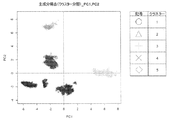
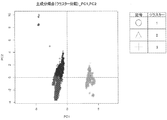
- FIG. 4 is a flowchart showing the procedure of the production process analysis method according to the present embodiment. It is a graph which shows the principal component score and group for every lot in a 1st process. It is a graph which shows the principal component score and group for every lot in a 2nd process. It is a graph which shows the principal component score and group for every lot in a 3rd process. It is a graph which shows the principal component score and group for every lot in a 4th process.
- FIG. 12 is a diagram illustrating a combination of groups of respective processes corresponding to Cases 4 to 7 in FIG. 11.
- FIG. 13 is a diagram illustrating an example of a process performed by the control device.
- FIG. 14 is a diagram illustrating an example of raw materials classified into a plurality of groups according to characteristics.
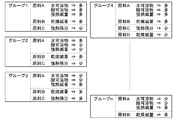
- FIG. 15 is a diagram showing an example of a route that appears when the raw material data is taken into the analysis of the production process.
- FIG. 16 is a diagram illustrating a state in which a specific lot follows a scheduled route.
- FIG. 17 is a diagram illustrating a state in which a specific lot deviates from a planned route.
- FIG. 1 is a diagram illustrating a continuous production system 1 according to the embodiment.
- the case where the product is continuously produced from the powder of the raw material will be described as an example. is there.
- a case where a pharmaceutical is manufactured will be described as an example, but the present invention is also applicable to, for example, manufacturing of food and other various products.
- a case where a product is continuously produced from powder will be described as an example.For example, a raw material containing a substance other than powder, or a case where a product is continuously produced from a raw material other than powder, Applicable.
- the continuous production system 1 is a system for producing tablets from a powdery raw material, and as shown in FIG. 1, a mixer 2, a granulator 3, a dryer 4, a mixer 5, a tableting machine 6, a coating machine. 7, a control device 8 for controlling these.
- the mixer 2 has an input port into which the raw material of the powder is input, and mixes various powders and liquids which are the raw materials of the tablet.
- the granulator 3 binds the raw materials mixed by the mixer 2 to a group of small particles to make them into a granular form.
- the dryer 4 adds various additional raw materials to the raw material granulated by the granulator 3 and dries the raw material.
- the mixer 5 mixes the granular raw materials dried by the dryer 4.
- the tableting machine 6 puts the granular raw materials mixed by the mixing machine 5 into a mold and compresses them into tablets.
- the coating machine 7 applies a coating to the tablets solidified by the tableting machine 6.
- a series of equipment from the mixer 2 to the coating machine 7 is connected. Therefore, in the continuous production system 1, various processes performed in a series of facilities from the mixer 2 to the coating machine 7 are continuously performed on the raw material input to the mixer 2.
- FIG. 1 a series of equipment from the mixer 2 to the coating machine 7 is illustrated one by one, but the continuous production system 1 is not limited to such a form.
- one or more mixers 2, granulators 3, and dryers 4 may be prepared, and a plurality of types of raw materials may be mixed by the mixer 5.
- the control device 8 includes a CPU (Central Processing Unit) (an example of a “processing unit”), a memory, and an input / output interface (an example of an “output unit” in the present application) that perform various arithmetic processes.
- the control target value of the machine 7 is determined.
- the measurement values referred to by the control device 8 include, for example, values obtained from each device from the mixer 2 to the coating machine 7 such as a rotation speed of a screw feeder provided in the mixer 2 and a temperature of the dryer 4, and other devices.
- route which connects is included.
- the control device 8 may control the granulator 3 or the granulator 3 according to the properties of the raw material exiting the dryer 4, for example.
- the operation amount of the mixer 5 can be changed.
- control device 8 responds, for example, according to the properties of the raw material leaving the mixer 2.
- the destination of the raw material can be changed to a destination other than the granulator 3.
- FIG. 2 is a diagram showing an example of the inspection and sorting device 10 provided in the continuous production system 1.
- the inspection and sorting device 10 can be provided at an appropriate place in the continuous production system 1.
- the inspection and sorting device 10 is provided, for example, in the middle of a path connecting each device from the mixer 2 to the coating machine 7 as shown by reference numerals A to E in FIG.
- the sensors provided in the continuous production system 1 are not limited to those indicated by reference numerals A to E in FIG. 1, but are also provided in each device constituting the continuous production system 1, for example. Then, the control device 8 obtains the temperature, the stirring speed, and various other various measurement values in the device for performing various processes such as the input amount of the raw material, the flow rate, and the heating from the sensors provided at the various places as described above.
- the inspection and sorting apparatus 10 includes an inflow path 11 into which raw materials sent from equipment connected to the upstream side of the inspection and selection apparatus 10 flows, an inlet gate valve 12 installed at a lower end of the inflow path 11, and a lower part of the inlet gate valve 12.
- An inspection chamber 16 formed on the side, an air blowing path 13 provided in the vicinity of the inlet-side gate valve 12, a sight glass 14 which constitutes a wall surface of the inspection room 16 and allows the inside of the inspection room 16 to be seen through from the surroundings,
- An outlet-side gate valve 18 is provided below the glass 14.
- the inspection and sorting device 10 in a state where the inlet-side gate valve 12 is in the open state and the outlet-side gate valve 18 is in the closed state, when raw materials are sent from a device connected to the upstream side of the inspection and sorting device 10, the inspection room 16 is moved to the inspection room 16. Accumulates the raw material. Then, when the laser sensor 15 detects that a predetermined amount of raw material has accumulated in the inspection chamber 16, the inlet-side gate valve 12 is closed, and the raw material is inspected using the spectrometer 17. A flow path switching valve 21 having valve holes 19 and 20 is provided below the outlet-side gate valve 18, and the raw material after the inspection is sent to an outflow path 22 or an outflow path 23 according to the inspection result.
- the presence or absence of the raw material remaining in the inspection room 16 is inspected by the laser sensor 24.
- an example using a near-infrared sensor as an example of the spectrometer 17 will be described.
- the continuous production system disclosed in the present application is not limited to such an embodiment.
- a so-called diverter valve will be described as an example of the flow path switching valve 21.
- the continuous production system disclosed in the present application is not limited to such a form, and the flow of other methods is not limited.
- a device using a road switching mechanism may be used.
- FIG. 3 is an explanatory diagram of the operation of the inspection and sorting apparatus 10.
- the inspection and sorting device 10 is connected to the control device 8 of the continuous production system 1. Then, the inspection and sorting device 10 operates as follows according to a control signal sent from the control device 8 of the continuous production system 1. That is, in the inspection and sorting device 10, when the raw material is sent from a device connected to the upstream side of the inspection and sorting device 10 in a state where the inlet-side gate valve 12 is in the open state and the outlet-side gate valve 18 is in the closed state, FIG. As shown in (A), raw materials accumulate in the inspection room 16.
- the inlet-side gate valve 12 is closed as shown in FIG.
- the inlet-side gate valve 12 closes, the flow of new raw material from the inflow path 11 to the inspection room 16 stops. While the flow of new raw material from the inflow path 11 to the inspection room 16 is stopped, the bulk density of the raw material in the inspection room 16 is kept constant. Therefore, after the inlet gate valve 12 is closed, the inspection of the raw material in the inspection chamber 16 using the spectrometer 17 is started.
- the switching operation of the flow path switching valve 21 is performed according to the inspection result. For example, when the inspection result of the raw material stored in the inspection room 16 is good, as shown in FIG. 3 (C), the outflow path 22 to which the equipment that performs the next process on the raw material stored in the inspection room 16 is connected. The direction of the flow path switching valve 21 is switched so that is communicated with the valve hole 20. Further, for example, when the inspection result of the raw material accumulated in the inspection room 16 is defective, the direction of the flow path switching valve 21 is set so that the outflow path 23 for discarding the raw material accumulated in the inspection room 16 communicates with the valve hole 19. Switches.
- the inspection chamber is moved from the air blowing path 13 to the inspection room.
- the air blow into the test chamber 16 is started, and the raw material in the test chamber 16 is quickly discharged from the test chamber 16.
- the outlet gate valve 18 is closed, and the optical inspection of the residual raw material is performed using the laser sensor 24.
- the inlet-side gate valve 12 is opened again.
- the inlet-side gate valve 12 When the inlet-side gate valve 12 is opened, the raw material sent from the equipment on the upstream side of the inspection and sorting device 10 and stored above the inlet-side gate valve 12 while the inlet-side gate valve 12 is closed is stored in the inspection chamber 16. Flows into.
- the above-described series of operations described with reference to FIGS. 3A to 3D are repeatedly performed in units of several tens of seconds to several minutes. Therefore, there is almost no possibility that the continuous operation of the devices connected to the upstream and downstream sides of the inspection and sorting apparatus 10 will be substantially hindered.
- Inspection of the raw material using the spectrophotometer 17 is performed with the inlet gate valve 12 closed at a predetermined height detected by the laser sensor 15, so that the bulk density of the raw material is kept constant every time. Will be done. Therefore, there is almost no possibility that the measurement value of the spectrometer 17 fluctuates depending on the bulk density of the powder.
- the inspection selection device 10 even in the continuous production system 1 that continuously produces tablets from a powdery raw material, a measurement value that fluctuates depending on the bulk density of the powder can be obtained with high accuracy. It is possible.
- all of the raw materials that are continuously handled in the continuous production system 1 can be inspected in the inspection room 16 and sorted by the flow path switching valve 21. Even if a defective product is temporarily generated in step 1, it is possible to separate the non-defective product from the non-defective product in the unit of the amount accumulated in the inspection room 16, thereby reducing the amount of discarded raw materials as much as possible. It is possible to do.
- the operation of the continuous production system 1 realized by the control device 8 will be described.
- the following description of the operation content is mainly divided into the content of the preparation stage and the content of the main operation stage.
- the control device 8 determines the control target value of each device based on the information. Information is prepared.
- the control device 8 determines the control target value of each device based on the basic information obtained in the preparation stage.
- the control target value determined by the control device 8 may be automatically set to each device through a control communication path connecting the control device 8 and each device, or may be manually set to each device by an operator. May be set.
- FIG. 4 is a flowchart showing the procedure of the production process analysis method according to the present embodiment.
- control device 8 collects information on the manufacturing conditions (process data and product data) measured by the sensor (step S1). In this step S1, the process data and product data for each lot are stored in the control device 8.
- step S2 the process data and product data collected in step S1 are standardized and converted into intermediate variables (step S2).
- step S2 The data standardization process performed in step S2 is a known process, and specifically, the control device 8 calculates based on Equation 1.
- step S3 a principal component load and a principal component score are determined based on the intermediate variables determined in step S2 (step S3).
- step 3 first, a correlation coefficient matrix for the intermediate variables is created, and eigenvalues and eigenvectors of the correlation coefficient matrix are derived.
- the first principal component PC1 is expressed as shown in Expression 2.
- the Nth principal component PCn is represented as shown in Expression 3.
- the coefficients a11, a12, a13,... Are used as elements in the first row, and the coefficients an1, an2, an3,.
- the principal component score is obtained from the eigenvector of the correlation coefficient matrix. Further, the contribution rate of each principal component is obtained from the eigenvalue of the correlation coefficient matrix. The contribution ratio of the principal component is obtained by dividing the eigenvalue by the sum of the eigenvalues.
- the first principal component, the second principal component,..., The Nth principal component are determined in descending order of the eigenvalue.
- the control device 8 determines the values of the first principal component PC1, the second principal component PC2,... Based on the intermediate variables x1, x2, x3 of each lot and each coefficient of the correlation coefficient matrix. , Calculate the principal component score.
- FIG. 5 is a graph in which the principal component scores are plotted in a coordinate system having the first principal component on the horizontal axis and the second principal component on the vertical axis for the manufacturing conditions in the first step.
- Cluster analysis is a method of classifying analysis target data (clusters) into a plurality of groups by focusing on similarity, and hierarchical clustering, classification optimization clustering, and the like are known.
- the “similarity” of interest in the cluster analysis in the present embodiment refers to the distance between the principal component scores of each lot.
- cohesive hierarchical clustering which is one of hierarchical clustering, is used.
- a Ward method that can stably obtain a solution was used as a method for calculating the distance between clusters.
- the “Ward method” is to select a cluster that minimizes the increase in the sum of squares of deviation when two clusters are merged. For example, when the clusters C are generated by merging the clusters A and B, the sums of squares of deviations Sa, Sb, and Sc in the clusters A, B, and C are represented by Equations 4 to 6, respectively.
- ⁇ ⁇ Sab in equation 7 means the increment of the sum of squared deviations when clusters A and B are merged to generate cluster C. Therefore, clustering is advanced by selecting and merging clusters such that ⁇ Sab is minimized at each merging stage.
- the data is divided into six groups 1 to 6 in a five-dimensional space including first to fifth eigenvectors.
- groups 1 to 6 correspond to clusters 1 to 6 in FIG. 5, respectively.
- the number of groups is not limited to six, and may be five or less or seven or more as long as the number is easy to handle.
- the principal component scores are plotted on a graph and divided into a plurality of groups.
- 6 to 10 are graphs showing principal component scores and groups (clusters) for the manufacturing conditions in the second to sixth steps.
- the lot generation process is divided into a plurality of routes for each combination of the groups in the first to sixth steps (step S5).
- the routes are classified into 16 routes.
- FIG. 11 shows a breakdown of all routes. Note that “Case” in FIG. 11 corresponds to the above-described route, and the numbers in FIG. 11 correspond to the numbers of the groups in the first to sixth steps.
- FIG. 12 shows routes corresponding to Cases 4 to 7 as an example of combinations of groups constituting the routes.
- step S6 the control device 8 calls an intermediate variable obtained from the product data (such as the appearance inspection failure rate) for each lot belonging to Cases 1 to 16 in FIG. 11 and determines the superiority or inferiority of these product data.
- the control device 8 calls an intermediate variable obtained from the product data (such as the appearance inspection failure rate) for each lot belonging to Cases 1 to 16 in FIG. 11 and determines the superiority or inferiority of these product data.
- the superiority or inferiority of the product data is determined based on an average value in a plurality of lots (lot groups) divided for each route. As a result, the variation of the product data of the lot group in the route is leveled, and the tendency of the quality of the product data between the routes can be grasped globally.
- the superiority of the product data may be determined based on the magnitude of the deviation of the product data in the route or the magnitude of the difference (range) between the maximum value and the minimum value, or two values such as an average value, a deviation, or an R value. The determination may be made in combination of the above. As an example of judging the superiority of the product data by combining the average value and the deviation, for example, when the average value in the route is the same, it is conceivable to determine the one with the smaller deviation in the route as superior. This makes it possible to globally grasp the tendency of the product data between routes taking into account the variation of the product data within the route.
- control device 8 compares the product data for each route and determines the superiority or inferiority.
- the failure rate of appearance inspection as product data in each route is evaluated in three levels of excellent, good, and acceptable according to their superiority.
- a suitable combination of the groups of the first to sixth steps is specified according to the superiority of the product data for each route (step S7). For example, comparing Cases 4 and 5 determined to be excellent with Cases 6 and 7 determined to be good, these are the same group in the first, second, fourth, and sixth steps, The third step is a different group. Further, it is assumed that the fifth step does not significantly affect the product data in any of groups 1 and 2. In other words, it can be seen that it is preferable to combine the third step group 1 with the route that has passed through the first step group 2 and the second step group 2.
- Case 14 determined to be excellent indicates that although the first to fourth and sixth steps belong to the same group, they differ in the fifth step. It is. That is, group 5 of the first step, group 3 of the second step, group 4 of the third step, group 2 of the fourth step, group 1 of the fifth step, and group 1 of the sixth step It turns out that a combination is preferable.
- the “suitable combination” in the present embodiment means a combination that contributes to the improvement of the product data, and does not intend only the combination having the best product data.
- the average value of the process data of each group is set to the initial value of the manufacturing conditions, and the quality of the product data at this time is checked. It is preferable to finely adjust the manufacturing conditions while doing so.
- the average value of the process data is set to the initial value, a preferable combination of the first to sixth process groups can be reproduced without departing from the past state, that is, without imposing an excessive load on the manufacturing equipment. can do.
- the continuous production system In the continuous production system 1, when a powdery raw material is put into the mixer 2, mixing of powder and liquid of the raw material is performed in the mixer 2, and the raw material mixed by the mixer 2 is bound to a small particle group.
- the granulating process is performed in the granulator 3, the raw material granulated by the granulator 3 is dried in the dryer 4, and the raw material dried in the dryer 4 is mixed in the mixer 5.
- the process of compressing the raw materials mixed by the mixer 5 into tablets is performed in the tableting machine 6, and the process of coating the tablets is performed in the coating machine 7.
- the control device 8 executes a process of changing the control target value of each device and a process of switching a valve provided in the middle of the path so that a series of devices from the mixer 2 to the coating machine 7 operate properly. At that time, the control device 8 executes a process of changing the control target value of each device and a process of switching a valve provided in the middle of the path based on the basic information obtained in the above-described preparation
- FIG. 13 is a diagram illustrating an example of a process performed by the control device 8.
- the control device 8 executes the processing flow shown in FIG. That is, when each facility of the continuous production system 1 operates, the control device 8 acquires information on current manufacturing conditions of each process (S11). Then, the control device 8 selects any one of the plurality of routes created in the preparation stage (S12). The selection of the route is performed based on the acquired information on the current manufacturing conditions.
- the first step in the processes realized in the continuous production system 1 is performed by the mixer 2. Therefore, the control device 8 transmits the information on the current manufacturing conditions acquired from the mixer 2. Make a route selection based on that.
- the control device 8 From among the two routes (Cases 14 to 15) that can be taken by the group 5, the route of Case 14 in which the quality of the final product is relatively good is selected.
- the control device 8 sets the control target value of each device of the continuous production system 1 so that the manufacturing conditions are along the selected route (S13).
- the control device 8 setting the control target value of each device, each device of the continuous production system 1 performs an operation according to the control target value set by the control device 8.
- the control device 8 sets the control target value of each device of the continuous production system 1 that performs each process to the default value of each process in the case of Case 14 illustrated in FIG.
- a control target value for each device is set so that the manufacturing conditions are satisfied. Thereby, each device of the continuous production system 1 performs an operation according to the control target value set by the control device 8. If there is no particular abnormality, each lot follows predetermined manufacturing conditions as indicated by a specific route in FIG.
- the controller 8 acquires the current manufacturing conditions in each process (S14), and acquires the current manufacturing conditions in each process. (S15) to determine whether or not the manufacturing conditions specified by the route selected in step S12 are being met. Then, when a negative determination is made in step S15, the control device 8 executes a process (S16) of determining whether to change the route selected in step S12.
- step S15 the difference between the allowable manufacturing conditions is set for each of the manufacturing conditions specified for each route in FIG. 12, and the current manufacturing condition acquired in step S14 is set to the difference. May be performed depending on whether or not it is within the range, or the manufacturing conditions defined for each route in FIG. 12 may define an upper limit value and a lower limit value in advance. The process may be performed depending on whether or not the current manufacturing condition acquired in S14 is between the upper limit value and the lower limit value.
- step S16 may be, for example, a process in which an operator is notified that the current manufacturing conditions deviate from the route, and the operator is required to determine whether or not the route can be changed.
- the control device 8 refers to information on a plurality of routes as shown in FIG. 12 and determines whether there is another alternative route different from the route selected in step S12. Good.
- the above-described series of processing is executed by the control device 8, and the production conditions of some routes that have already been confirmed to be able to maintain quality by past production results Is performed for each lot so as to meet the requirements. That is, in the continuous production system 1, by executing the above-described processing by the control device 8, the optimal control target value based on the past production results is set according to the current production state. The quality of the product can be further stabilized as compared with a case where a fixed control target value is uniformly set for each device regardless of the manufacturing state as conventionally performed.
- the continuous production system 1 is a system for continuously producing tablets, which are pharmaceuticals, from powdery raw materials, if a positive determination is made in step S15, the corresponding lot flows to the next process. Preventive processing may be performed.
- the process of preventing a specific lot from flowing to the next process can be realized, for example, by using the inspection and sorting device 10 arranged at an appropriate place in the continuous production system 1 as follows.
- an example of an entire control flow that can be realized by the continuous production system 1 when the inspection and sorting device 10 is installed at reference numeral C in FIG. 1 will be described.
- the dryer 4 of the continuous production system 1 shown in FIG. 1 various additional raw materials are added to the raw material granulated by the granulator 3 and drying is performed.
- the dryer 4 is provided with one or more heaters for performing heating and drying, and the control device 8 adjusts the amount of current supplied to the heaters so as to obtain an appropriate drying temperature.
- the dryer 4 is provided with a variable speed blower, and the rotation speed of the blower is controlled by the controller 8 so that the raw material granulated by the granulator 3 passes through the dryer 4 at an appropriate wind speed. It is adjusted by.
- the above-described inspection and sorting device 10 is installed in the middle of the path connecting the dryer 4 and the mixer 5, that is, at the site indicated by the symbol C in FIG. In the case of deviation, it is possible to prevent the raw material to be continuously processed from flowing to the mixer 5 which is responsible for the next step. Therefore, it is possible to transfer the raw material to equipment other than the mixer 5 to perform appropriate processing, or to discharge the raw material to the outside of the continuous production system 1.
- the control device 8 collects information on the manufacturing conditions (process data and product data) for the operated production process (step S1). At this time, in the above embodiment, the information on the manufacturing conditions measured by the sensor is collected. However, in this modification, in addition to the process data measured by the sensor, the raw material data (physical properties, composition, and the like of the raw material) are also obtained. Collected.
- the raw material data is provided from, for example, a raw material maker.
- step S2 a process of standardizing data (step S2) and a process of calculating a principal component load and a principal component score based on intermediate variables (step S3)
- step S4 Processing for dividing a lot into a plurality of groups (step S4), processing for dividing a lot generation process into a plurality of routes for each combination of groups (step S5), and processing for judging the superiority of product data for each route (step S5) S6), a process of specifying a suitable combination of groups (step S7) is performed.
- step S2 data standardization processing based on the above-described formula 1 is performed. Further, in step S3, after the creation of the correlation coefficient matrix for the intermediate variables and the derivation of the eigenvalues and eigenvectors of the correlation coefficient matrix, a principal component score is obtained from the eigenvectors of the correlation coefficient matrix. The contribution ratio of each principal component is obtained from the eigenvalues of the numerical matrix. In step S4, a process of applying a cluster analysis to the principal component scores to divide each lot into a plurality of groups is performed.
- step S6 after the processing in step S5, the intermediate variables obtained from the product data (such as the appearance inspection failure rate) are called for each lot, and the superiority or inferiority of these product data is determined, so that each route is determined. Of product data is judged. Further, in step S7, by comparing the superiority and the inferiority of the product data for each route, the combination of the groups of the respective processes whose quality is relatively good is specified.
- FIG. 14 is a diagram showing an example of raw materials classified into a plurality of groups according to characteristics.
- various raw materials such as powders have some variation in characteristics depending on lots, even for the same product purchased from a specific manufacturer. Therefore, in this modification, such information on the characteristics of the raw material is incorporated into the analysis of the production process as raw material data. Therefore, when a production process is analyzed based on past production results, there may be cases where there are some routes according to the raw material characteristics, in which the quality of the final product is relatively good.
- FIG. 15 is a diagram showing an example of a route that appears when the raw material data is taken into the analysis of the production process. Since the characteristics of various raw materials such as powders vary slightly depending on the lot, the raw material data is standardized and converted into intermediate variables, and the principal component score is obtained. As shown in the “Characteristics” graph, variations in the raw material characteristics appear on the graph. In the present modification, a process is performed in which each raw material is divided into a plurality of groups by applying cluster analysis to the principal component scores indicating variations in raw material characteristics.
- the superiority of the product data is determined for each route, As shown in FIG. 15, several routes starting from the raw material characteristics are extracted.
- control device 8 of this modification when each facility of the continuous production system 1 operates, a processing flow equivalent to that shown in FIG. 13 is executed. That is, when each facility of the continuous production system 1 operates, the control device 8 acquires the manufacturing conditions (S11). At this time, the control device 8 acquires raw material data as manufacturing conditions. The raw material data is input, for example, by an operation of an operator. Then, the control device 8 selects any one of the plurality of routes created in the preparation stage (S12). The route is selected based on the acquired raw material data. Then, after selecting the route, the control device 8 sets the control target value of each device of the continuous production system 1 so that the manufacturing conditions are along the selected route (S13).
- each device of the continuous production system 1 the operation according to the control target value set by the control device 8 is performed, and if there is no special abnormality, as shown in FIG. Will be traced by the current lot.
- the process of acquiring the information on the current manufacturing conditions in each process (S14) and the obtained current manufacturing conditions are selected in step S12.
- the process (S15) of determining whether or not the manufacturing condition is set according to the route is determined.
- step S15 when the current lot deviates from the selected scheduled route, a negative determination is made in step S15. Then, a process (S16) of determining whether to change the route selected in step S12 is executed.
- the above-described series of processing is executed by the control device 8 of the present modified example.
- Each lot is processed so as to meet the manufacturing conditions of some routes for which it has been confirmed that the quality can be maintained by the production results. Therefore, for example, the quality of the product can be further stabilized as compared with a case where a fixed control target value is uniformly set for each device regardless of the characteristics of the raw materials and the manufacturing state.
Landscapes
- Engineering & Computer Science (AREA)
- General Engineering & Computer Science (AREA)
- Manufacturing & Machinery (AREA)
- Quality & Reliability (AREA)
- Physics & Mathematics (AREA)
- General Physics & Mathematics (AREA)
- Automation & Control Theory (AREA)
- General Factory Administration (AREA)
Abstract
La présente invention aborde le problème lié à la stabilisation des qualités de produits qui sont fabriqués au moyen d'une pluralité d'étapes. La présente invention concerne un système de production pour produire des produits à partir de matières premières au moyen d'un procédé de production comprenant une pluralité d'étapes, et comprend : une pluralité d'installations de production qui réalisent les étapes ; et un dispositif de commande qui détermine des valeurs cibles de commande qui sont respectivement établies pour la pluralité d'installations de production, le dispositif de commande déterminant, lorsque sont acquises des informations concernant une condition de fabrication indiquant l'état d'une installation quelconque parmi la pluralité d'étapes, une valeur cible de commande devant être établie pour au moins une installation quelconque parmi la pluralité d'installations de production, en se référant à des informations concernant des combinaisons de groupes spécifiées en fonction des mérites relatifs des routes de conditions de fabrication suivies par des lots respectifs au cours du processus de production, les mérites relatifs étant déterminés sur la base d'éléments de qualité des lots classés pour chacune des combinaisons inter-étapes d'une pluralité de groupes qui sont classés sur la base des conditions de fabrication au niveau des étapes.
Priority Applications (2)
| Application Number | Priority Date | Filing Date | Title |
|---|---|---|---|
| EP19824597.9A EP3816746B1 (fr) | 2018-06-26 | 2019-03-19 | Système de production, procédé de production et dispositif de commande |
| US17/255,741 US11644822B2 (en) | 2018-06-26 | 2019-03-19 | Production system, production method, and control device |
Applications Claiming Priority (2)
| Application Number | Priority Date | Filing Date | Title |
|---|---|---|---|
| JP2018-121055 | 2018-06-26 | ||
| JP2018121055A JP6549760B1 (ja) | 2018-06-26 | 2018-06-26 | 生産システム、生産方法、及び制御装置 |
Publications (1)
| Publication Number | Publication Date |
|---|---|
| WO2020003651A1 true WO2020003651A1 (fr) | 2020-01-02 |
Family
ID=67390262
Family Applications (1)
| Application Number | Title | Priority Date | Filing Date |
|---|---|---|---|
| PCT/JP2019/011588 Ceased WO2020003651A1 (fr) | 2018-06-26 | 2019-03-19 | Système de production, procédé de production et dispositif de commande |
Country Status (4)
| Country | Link |
|---|---|
| US (1) | US11644822B2 (fr) |
| EP (1) | EP3816746B1 (fr) |
| JP (1) | JP6549760B1 (fr) |
| WO (1) | WO2020003651A1 (fr) |
Families Citing this family (5)
| Publication number | Priority date | Publication date | Assignee | Title |
|---|---|---|---|---|
| US11944590B2 (en) * | 2018-02-22 | 2024-04-02 | Mitsubishi Chemical Engineering Corporation | Continuous manufacturing system and method |
| JP6992889B2 (ja) * | 2018-05-14 | 2022-01-13 | 富士通株式会社 | 判定ルール取得装置、判定ルール取得方法および判定ルール取得プログラム |
| KR102295805B1 (ko) * | 2019-04-02 | 2021-08-31 | 주식회사 마키나락스 | 학습 데이터 관리 방법 |
| JP7521195B2 (ja) * | 2020-01-30 | 2024-07-24 | セイコーエプソン株式会社 | 繊維処理システム、及び、繊維処理方法 |
| JP2023174448A (ja) * | 2022-05-27 | 2023-12-07 | ニプロ株式会社 | 粉体検査装置および粉体検査方法 |
Citations (4)
| Publication number | Priority date | Publication date | Assignee | Title |
|---|---|---|---|---|
| US6766283B1 (en) * | 2000-10-13 | 2004-07-20 | Insyst Ltd. | System and method for monitoring process quality control |
| JP2007157007A (ja) * | 2005-12-08 | 2007-06-21 | Ricoh Co Ltd | 製造プロセス監視制御装置と監視制御方法及び記憶媒体 |
| JP2009021348A (ja) | 2007-07-11 | 2009-01-29 | Sharp Corp | 異常要因特定方法およびシステム、上記異常要因特定方法をコンピュータに実行させるためのプログラム、並びに上記プログラムを記録したコンピュータ読み取り可能な記録媒体 |
| JP2018034113A (ja) * | 2016-08-31 | 2018-03-08 | フロイント産業株式会社 | 逸脱処理装置及び逸脱処理方法 |
Family Cites Families (11)
| Publication number | Priority date | Publication date | Assignee | Title |
|---|---|---|---|---|
| JP3099932B2 (ja) * | 1993-12-14 | 2000-10-16 | 株式会社東芝 | インテリジェントテストラインシステム |
| JP3913715B2 (ja) * | 2003-06-18 | 2007-05-09 | 株式会社東芝 | 不良検出方法 |
| US7477958B2 (en) * | 2005-05-11 | 2009-01-13 | International Business Machines Corporation | Method of release and product flow management for a manufacturing facility |
| JP2010015236A (ja) | 2008-07-01 | 2010-01-21 | Sharp Corp | 生産ライン評価方法、生産ライン評価システム及び生産ライン評価プログラム並びに生産ライン評価プログラムを記録した記録媒体と、生産ライン制御方法 |
| US9069345B2 (en) | 2009-01-23 | 2015-06-30 | Mks Instruments, Inc. | Controlling a manufacturing process with a multivariate model |
| US9134711B2 (en) * | 2010-05-04 | 2015-09-15 | Frito-Lay North America, Inc. | Advanced batch control |
| US10290088B2 (en) * | 2014-02-14 | 2019-05-14 | Kla-Tencor Corporation | Wafer and lot based hierarchical method combining customized metrics with a global classification methodology to monitor process tool condition at extremely high throughput |
| JP2016167205A (ja) | 2015-03-10 | 2016-09-15 | 三菱化学エンジニアリング株式会社 | 製造プロセスのモニタリング方法 |
| JP5956094B1 (ja) * | 2015-03-10 | 2016-07-20 | 三菱化学エンジニアリング株式会社 | 製造プロセスの解析方法 |
| DE112016005697T5 (de) | 2016-01-15 | 2018-09-06 | Mitsubishi Electric Corporation | Vorrichtung, Verfahren und Programm zur Planerzeugung |
| JP6716423B2 (ja) * | 2016-10-26 | 2020-07-01 | 三菱ケミカルエンジニアリング株式会社 | 生産プロセスの解析方法 |
-
2018
- 2018-06-26 JP JP2018121055A patent/JP6549760B1/ja active Active
-
2019
- 2019-03-19 WO PCT/JP2019/011588 patent/WO2020003651A1/fr not_active Ceased
- 2019-03-19 EP EP19824597.9A patent/EP3816746B1/fr active Active
- 2019-03-19 US US17/255,741 patent/US11644822B2/en active Active
Patent Citations (4)
| Publication number | Priority date | Publication date | Assignee | Title |
|---|---|---|---|---|
| US6766283B1 (en) * | 2000-10-13 | 2004-07-20 | Insyst Ltd. | System and method for monitoring process quality control |
| JP2007157007A (ja) * | 2005-12-08 | 2007-06-21 | Ricoh Co Ltd | 製造プロセス監視制御装置と監視制御方法及び記憶媒体 |
| JP2009021348A (ja) | 2007-07-11 | 2009-01-29 | Sharp Corp | 異常要因特定方法およびシステム、上記異常要因特定方法をコンピュータに実行させるためのプログラム、並びに上記プログラムを記録したコンピュータ読み取り可能な記録媒体 |
| JP2018034113A (ja) * | 2016-08-31 | 2018-03-08 | フロイント産業株式会社 | 逸脱処理装置及び逸脱処理方法 |
Non-Patent Citations (1)
| Title |
|---|
| See also references of EP3816746A4 |
Also Published As
| Publication number | Publication date |
|---|---|
| US11644822B2 (en) | 2023-05-09 |
| EP3816746B1 (fr) | 2026-02-11 |
| JP6549760B1 (ja) | 2019-07-24 |
| US20210278828A1 (en) | 2021-09-09 |
| EP3816746A4 (fr) | 2022-03-23 |
| JP2020003939A (ja) | 2020-01-09 |
| EP3816746A1 (fr) | 2021-05-05 |
Similar Documents
| Publication | Publication Date | Title |
|---|---|---|
| WO2020003651A1 (fr) | Système de production, procédé de production et dispositif de commande | |
| WO2020003652A1 (fr) | Système de production, procédé de production, dispositif de commande et procédé d'analyse de processus de production | |
| JP2020004411A (ja) | 生産システム、生産方法、及び制御装置 | |
| Singh et al. | Implementation of an advanced hybrid MPC–PID control system using PAT tools into a direct compaction continuous pharmaceutical tablet manufacturing pilot plant | |
| Almaya et al. | Control strategies for drug product continuous direct compression—state of control, product collection strategies, and startup/shutdown operations for the production of clinical trial materials and commercial products | |
| TWI628525B (zh) | Manufacturing method analysis method | |
| JP7116975B2 (ja) | 逸脱処理装置及び逸脱処理方法 | |
| JP6578456B1 (ja) | 連続生産システム、方法および検査選別装置 | |
| Kirchengast et al. | Ensuring tablet quality via model-based control of a continuous direct compaction process | |
| Kruisz et al. | Material tracking in a continuous direct capsule-filling process via residence time distribution measurements | |
| Kamyar et al. | Soft sensor for real-time estimation of tablet potency in continuous direct compression manufacturing operation | |
| JP2014221343A (ja) | 錠剤の製造モジュール及び錠剤の連続製造方法 | |
| Oka et al. | Design of an integrated continuous manufacturing system | |
| JP2020004367A (ja) | 生産システム、生産方法及び制御装置 | |
| JP7224166B2 (ja) | 連続生産システム及び連続生産方法 | |
| Singh et al. | Advanced control of continuous pharmaceutical tablet manufacturing processes | |
| McAfee et al. | A novel approach to dynamic modelling of polymer extrusion for improved process control | |
| Jelsch et al. | Advanced process automation of a pharmaceutical continuous wet granulation line: Perspectives on the application of a model predictive control from solid feeders to dryer | |
| Vieth et al. | Improving Accuracy of Optical Sorters Using Closed-Loop Control of Material Recirculation. | |
| Singh et al. | Integrated process control | |
| Liu et al. | Online Optimization of a Top-Spray Fluidized Bed Granulation Process Based on a Three-Stage Population Balance Model |
Legal Events
| Date | Code | Title | Description |
|---|---|---|---|
| 121 | Ep: the epo has been informed by wipo that ep was designated in this application |
Ref document number: 19824597 Country of ref document: EP Kind code of ref document: A1 |
|
| NENP | Non-entry into the national phase |
Ref country code: DE |
|
| ENP | Entry into the national phase |
Ref document number: 2019824597 Country of ref document: EP Effective date: 20210126 |
|
| WWG | Wipo information: grant in national office |
Ref document number: 2019824597 Country of ref document: EP |