WO2020003798A1 - 歯間清掃具 - Google Patents
歯間清掃具 Download PDFInfo
- Publication number
- WO2020003798A1 WO2020003798A1 PCT/JP2019/019549 JP2019019549W WO2020003798A1 WO 2020003798 A1 WO2020003798 A1 WO 2020003798A1 JP 2019019549 W JP2019019549 W JP 2019019549W WO 2020003798 A1 WO2020003798 A1 WO 2020003798A1
- Authority
- WO
- WIPO (PCT)
- Prior art keywords
- cleaning tool
- interdental cleaning
- interdental
- tip
- torque value
- Prior art date
- Legal status (The legal status is an assumption and is not a legal conclusion. Google has not performed a legal analysis and makes no representation as to the accuracy of the status listed.)
- Ceased
Links
Images





Classifications
-
- A—HUMAN NECESSITIES
- A46—BRUSHWARE
- A46B—BRUSHES
- A46B3/00—Brushes characterised by the way in which the bristles are fixed or joined in or on the brush body or carrier
- A46B3/22—Brushes characterised by the way in which the bristles are fixed or joined in or on the brush body or carrier rubber bristles being fixed in or on brush bodies
-
- A—HUMAN NECESSITIES
- A61—MEDICAL OR VETERINARY SCIENCE; HYGIENE
- A61C—DENTISTRY; APPARATUS OR METHODS FOR ORAL OR DENTAL HYGIENE
- A61C15/00—Devices for cleaning between the teeth
- A61C15/02—Toothpicks
-
- A—HUMAN NECESSITIES
- A46—BRUSHWARE
- A46B—BRUSHES
- A46B5/00—Brush bodies; Handles integral with brushware
- A46B5/02—Brush bodies; Handles integral with brushware specially shaped for holding by the hand
-
- A—HUMAN NECESSITIES
- A46—BRUSHWARE
- A46B—BRUSHES
- A46B2200/00—Brushes characterized by their functions, uses or applications
- A46B2200/10—For human or animal care
- A46B2200/1066—Toothbrush for cleaning the teeth or dentures
- A46B2200/108—Inter-dental toothbrush, i.e. for cleaning interdental spaces specifically
Definitions
- the present invention relates to an interdental cleaning tool.
- Patent Literature 1 discloses the following interdental cleaning tool. That is, the interdental cleaning tool has a cleaning tool main body in which a grip portion that can be gripped by a finger and a shaft portion extending in one direction from the grip portion are integrally formed of a resin material. A resin cleaning section having a brush at the tip is covered.
- the interdental cleaning tool as described above inserts the cleaning portion between the teeth while the gripping portion is gripped by a finger, but the shaft portion has various angles depending on the position between the teeth into which the cleaning portion is inserted. Bendable. For example, when the cleaning unit is inserted between the back teeth, the shaft is bent at about 90 degrees, and the cleaning between the teeth is performed in this state.
- the shaft is bent at various angles depending on the position between the teeth, but it is required to have a hardness that does not break even when it is greatly bent.
- the shaft portion is too soft, there is a problem that it is difficult to transmit a force when cleaning the teeth, and it is rather difficult to use the teeth.
- the present invention has been made to solve the above problem, and has as its object to provide an interdental cleaning tool that is not too soft and hard to break during use.
- An interdental cleaning tool has a grip portion that can be gripped by a user's finger, and a shaft portion that extends in one direction from the grip portion, and a cleaning tool body formed of a synthetic resin and a tooth space.
- the cleaning tool body may contain glass fibers.
- the interdental cleaning tool of the present invention it is not too soft and not easily broken during use.
- FIG. 3 is a side view of FIG. 2. It is a front view of the device which measures the maximum torque value and the angle when bending the interdental cleaning tool.
- FIG. 4 is a plan view of FIG. 3. It is a top view of an interdental cleaning tool concerning an example and a comparative example.
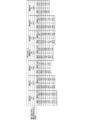
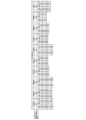
- FIG. 9 is a table showing physical property values such as bending characteristics of the interdental cleaning tools according to Examples 1 to 6.
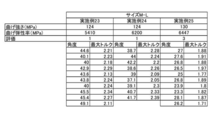
- 14 is a table showing physical property values such as bending characteristics of the interdental cleaning tools according to Examples 7 to 13.
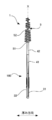
- FIG. 1 is a plan view of the interdental cleaning tool
- FIG. 2 is a side view of FIG.
- the left-right direction in FIG. 1 may be referred to as the width direction or the left-right direction
- the upper side in FIG. 1 may be referred to as the front end side or the front side.
- the present invention is not limited by the definition of this direction.
- the interdental cleaning tool 1 includes a cleaning tool main body 100 having a plate-shaped gripping portion 3 that can be gripped by a finger, and a shaft portion 4 extending from an end of the gripping portion 3. Have. A cleaning portion 5 formed in a brush shape is attached to the tip of the shaft portion 4.
- the direction in which the shaft portion 4 extends is referred to as the axial direction (one direction) or the front-back direction
- the side on which the cleaning portion 5 is provided is referred to as the front end or front end
- the side opposite thereto is referred to as the rear end.
- a direction orthogonal to the axial direction is referred to as a width direction or a left-right direction
- a direction connecting the two surfaces of the plate-shaped gripping portion 3 is referred to as a thickness direction.
- the gripping portion 3 is formed in a rectangular plate shape in a plan view, and has a first surface 31 and a second surface 32 opposed in the thickness direction.
- the shaft portion 4 has a first portion 41 connected to the tip of the grip portion 3 and a second portion 42 connected to the tip of the first portion 41, and these two portions 41, 42 are integrated. Is formed.
- the first portion 41 is formed in a triangular shape in a plan view, and is formed so that the width in the left-right direction decreases from the front end of the grip portion 3 to the front.
- the second part 42 is formed in a rod shape extending in the front-rear direction from the tip of the first part 41, and is formed so that the width becomes slightly smaller toward the tip.
- the length of the shaft portion 4 is not particularly limited, but is preferably, for example, 10 to 60 mm.
- the grip portion 3 and the shaft portion 4 are integrally formed of a resin material.
- the resin material used here can be, for example, polypropylene, ABS, polybutylene terephthalate, polycarbonate, polyethylene terephthalate, polystyrene, polyacetal, or the like. Further, these materials may contain glass fibers. The compounding ratio of the glass fiber is, for example, preferably from 15 to 35%, more preferably from 20 to 30%, and particularly preferably from 25 to 30%.
- the cleaning portion 5 includes a coating portion 51 that is coated in a thin film on the outer peripheral surface from the vicinity of the center of the second portion 42 of the shaft portion 4 in the axial direction to the distal end, and a direction perpendicular to the axial direction from the outer peripheral surface of the coating portion 51 And a large number of bristles 52 that protrude in the direction of movement and function as brushes, and are integrally formed.
- the bristles 52 are arranged at predetermined intervals in the front-rear direction on the outer peripheral surface of the covering portion 51, and a plurality of front and rear rows are formed over the entire covering portion 51 in the circumferential direction. Each bristle 52 is formed so as to become thinner toward the tip. Since the cleaning portion 5 covers the shaft portion 4 in this manner, the thickness of the cleaning portion 5 is thicker than the cleaning tool body 100 including the grip portion 3.
- the outer diameter of the cleaning unit 5 is not particularly limited.
- the outer diameter (including the bristle 52) of the cleaning unit 5 at a position A of 15 mm from the tip of the interdental cleaning tool is, for example, 1.5 to 5 mm.
- the axial length of the coating 5 is preferably, for example, 10 to 20 mm.
- an elastomer can be used as a material of the cleaning unit 5, for example.
- a styrene-based elastomer, silicon, an olefin-based elastomer, a polyester-based elastomer, or the like can be used.
- the bending characteristics of the interdental cleaning tool 100 will be described.
- the interdental cleaning tool 100 is bent at various angles depending on the position between the inserted teeth, and reciprocates between the teeth in this state, thereby removing dirt such as plaque. Therefore, if the interdental cleaning tool 100 breaks when bent or is too soft when bent, it is difficult to use. Therefore, in the interdental cleaning tool 100 according to the present invention, the bending characteristics of the interdental cleaning tool 100 are defined as follows.
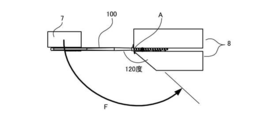
- the jig 8 is fixed to a position A 15 mm away from the tip of the cleaning unit 5 in the axial direction.
- the tip of the cleaning unit 5 is also the tip of the interdental cleaning tool.
- the gripping portion 3 is fixed such that the rear end thereof projects from the jig 8 beyond the position A of the interdental cleaning tool 100 so that the width direction of the gripping portion 3 is oriented in the vertical direction.
- the interdental cleaning tool satisfying the expression (1) is defined as the interdental cleaning tool 100 according to the present invention. Y> ⁇ 0.07X + 3.3 (1)
- the interdental cleaning tool 100 since the interdental cleaning tool 100 is used while being bent, it is preferable that the interdental cleaning tool 100 be bent as much as possible without breaking. That is, it is preferable that the rotation angle X until the maximum torque value is measured is as large as possible.
- the maximum torque value Y if the maximum torque value Y is small, there is a problem in that when the interdental cleaning tool 100 is bent, it is too soft to transmit a force to the cleaning unit 5. Therefore, in particular, the shaft portion 4 of the interdental cleaning tool 100 and the cleaning portion 5 that covers the shaft portion need to have a certain degree of hardness, and it is preferable that the maximum torque value Y is also somewhat large. That is, the interdental cleaning tool 100 requires flexibility and hardness at the time of bending.
- the reason that the position A of 15 mm from the tip is the center of rotation is that when cleaning between teeth, a length of about 15 mm from the tip is inserted between the teeth and the shaft portion 4 is bent in that state. It is because there is much.
- the interdental cleaning tool 100 that satisfies the above formula (1) is hard to be broken even when bent during use and has a hardness that is easy to use. Do you get it. Further, the user's evaluation shows that the interdental cleaning tool 100 satisfying the following equation (2) is more easy to use, and the interdental cleaning tool 100 satisfying the following equation (3) is particularly easy to use.
- the bending strength and the bending elastic modulus are set in a specified range. That is, the bending strength of the interdental cleaning tool 100 according to the present invention is preferably 90 to 175 MPa, more preferably 110 to 160 MPa, and particularly preferably 120 to 150 MPa. The bending strength is measured according to JIS K7171.
- the bending elastic modulus of the interdental cleaning tool 100 is preferably 4600 to 8500 MPa, more preferably 5400 to 7500 MPa, and particularly preferably 5800 to 6500 MPa.
- the flexural modulus is measured according to JIS K7171.
- the interdental cleaning tool 1 integrally forms the grip portion 3 and the shaft portion 4, but may be separate members.
- the shape of the grip is not particularly limited as long as the shape can be gripped with a finger.
- the configuration of the cleaning unit 5 is not particularly limited, and may be any shape other than the above-described brush shape, as long as it can scrape plaque between teeth.
- interdental cleaning tools according to Examples 1 to 25 and Comparative Examples which are formed of the above-described resin material having the same shape as that shown in the above-described embodiment but having different bending strength and bending elastic modulus, were manufactured. .
- a plurality of interdental cleaning tools according to each of Examples and Comparative Examples were manufactured (see FIGS. 7 to 10).
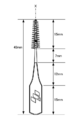
- the interdental cleaning tools according to the respective examples and comparative examples have the dimensions shown in FIGS. 5 and 6, but are different in shape from the outside diameter of the shaft portion and the cleaning portion covering the shaft portion. .
- the outer diameters at the position A of Examples 1 to 6, Examples 7 to 13, Examples 14 to 22, Comparative Example, and Examples 23 to 25 are 2.5 mm (size SSSS-SS), 3 0.5 mm (size SSS-S), 4 mm (size SS-M), and 4 mm (size ML).
- the overall satisfaction is a result of comprehensively evaluating the feeling of use (ease of use, ease of interdental teeth) on a five-point scale as follows. Overall satisfaction rating (i) Satisfaction (ii) Somewhat satisfied (iii) Neither can be said (iv) Somewhat dissatisfied (v) Dissatisfied Out of these five grades, the percentage of people who were judged satisfied or slightly satisfied Based on the above, evaluation of Examples and Comparative Examples was performed.
- Evaluation 1 Satisfaction: Slightly satisfied ratio is 80% or more.
- Evaluation 2 Satisfaction: Slightly satisfied ratio is 70% or more and less than 80%.
- 4 The percentage of satisfaction / slight satisfaction is less than 60%
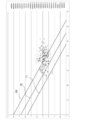
- FIG. 11 shows the distribution of the maximum torque value and its angle in Examples 1 to 25 and Comparative Example divided into the above evaluations 1 to 4.
- FIG. 12 shows the distribution of the maximum torque value and its angle for each example and comparative example. 11 and 12 show equations (1) to (3) shown in the above embodiment.
- the comparative example that obtained evaluation 4 does not satisfy Expression (1).
- Embodiments 20, 21, and 25 that obtained evaluation 3 satisfy Expression (1).
- the interdental cleaning tool that satisfies the expression (1) satisfies the user in the feeling of use. Then, it was found that, as Expressions (2) and (3) were satisfied, the degree of user satisfaction regarding the usability increased.
Landscapes
- Health & Medical Sciences (AREA)
- Dentistry (AREA)
- Epidemiology (AREA)
- Life Sciences & Earth Sciences (AREA)
- Animal Behavior & Ethology (AREA)
- General Health & Medical Sciences (AREA)
- Public Health (AREA)
- Veterinary Medicine (AREA)
- Brushes (AREA)
Abstract
使用時に、柔らかすぎず、且つ折れにくい、歯間清掃具を提供する。本発明に係る歯間清掃具は、使用者の指で把持可能な把持部、及び前記把持部から一方向に延びる軸部を有し、合成樹脂により形成された清掃具本体と、歯間を清掃するように構成されるとともに、前記軸部の先端部に被覆され、エラストマーにより形成された清掃部と、を備え、前記清掃部の先端から15mmの位置を中心に、前記把持部を回転速度10rpmで回転させたときの最大トルク値をY(N・cm)、当該最大トルク値が測定されたときの回転角度をX(度)としたとき、Y>-0.07X+3.3を充足する。
Description
本発明は、歯間清掃具に関する。
従来、種々のタイプの歯間清掃具が提案されており、その1つとして、特許文献1には、次のような歯間清掃具が開示されている。すなわち、この歯間清掃具は、指で把持可能な把持部と、この把持部から一方向に延びる軸部と、が樹脂材料で一体的に形成された清掃具本体を有するとともに、軸部の先端部にブラシを有する樹脂製の清掃部が被覆されている。
ところで、上記のような歯間清掃具は、把持部を指で把持した状態で、清掃部を歯間に挿入するが、清掃部を挿入する歯間の位置によって、軸部は種々の角度で折り曲げられる。例えば、清掃部を奥歯の歯間に挿入するときには、軸部は90度程度に曲がり、この状態で歯間の清掃を行う。
このように、軸部は歯間の位置によって種々の角度で折り曲げられるが、大きく曲げられたときでも、折れないような硬さが要求される。その一方で、軸部が柔らかすぎると、歯を清掃する際に力が伝達しづらく、かえって使いづらいという問題がある。本発明は、上記問題を解決するためになされたものであり、使用時に、柔らかすぎず、且つ折れにくい、歯間清掃具を提供することを目的とする。
本発明に係る歯間清掃具は、使用者の指で把持可能な把持部、及び前記把持部から一方向に延びる軸部を有し、合成樹脂により形成された清掃具本体と、歯間を清掃するように構成されるとともに、前記軸部の先端部に被覆され、エラストマーにより形成された清掃部と、を備え、前記清掃部の先端から15mmの位置を中心に、前記把持部を回転速度10rpmで回転させたときの最大トルク値をY(N・cm)、当該最大トルク値が測定されたときの回転角度をX(度)としたとき、Y>-0.07X+3.3を充足する。
上記歯間清掃具においては、Y>-0.07X+3.9を充足することがより好ましい。
上記歯間清掃具においては、Y>-0.07X+4.5を充足することが特に好ましい。
上記歯間清掃具においては、前記清掃具本体に、ガラス繊維を含有させることができる。
本発明に係る歯間清掃具によれば、使用時に、柔らかすぎず、且つ折れにくい。
以下、本発明に係る歯間清掃具の一実施形態について、図面を参照しつつ説明する。図1は歯間清掃具の平面図、図2は図1の側面図である。なお、以下では、説明の便宜上、各図の図面内での方向を基準に説明を行う。この方向の中で、図1における左右方向を幅方向または左右方向、図1における上側を先端側又は前側ということもある。但し、本発明はこの方向の規定により限定されるものではない。
<1.歯間清掃具>
図1及び図2に示すように、歯間清掃具1は、指で把持可能な板状の把持部3と、この把持部3の端部から延びる軸部4とを有する清掃具本体100を備えている。そして、軸部4の先端部には、ブラシ状に形成された清掃部5が取り付けられている。以下では、軸部4の延びる方向を軸方向(一方向)、または前後方向と称し、清掃部5が設けられている側を前端または先端、それとは反対側を後端と称することとする。また、板状の把持部3の面方向において、軸方向と直交する方向を幅方向または左右方向と称し、板状の把持部3の2つの面を結ぶ方向を厚み方向と称することとする。
図1及び図2に示すように、歯間清掃具1は、指で把持可能な板状の把持部3と、この把持部3の端部から延びる軸部4とを有する清掃具本体100を備えている。そして、軸部4の先端部には、ブラシ状に形成された清掃部5が取り付けられている。以下では、軸部4の延びる方向を軸方向(一方向)、または前後方向と称し、清掃部5が設けられている側を前端または先端、それとは反対側を後端と称することとする。また、板状の把持部3の面方向において、軸方向と直交する方向を幅方向または左右方向と称し、板状の把持部3の2つの面を結ぶ方向を厚み方向と称することとする。
把持部3は、平面視矩形状の板状に形成されており、厚み方向に対向する第1面31及び第2面32を有している。
次に、軸部4について説明する。軸部4は、把持部3の先端に連結される第1部位41と、この第1部位41の先端に連結される第2部位42とを有し、これら2つの部位41,42は一体的に形成されている。第1部位41は、平面視三角形状に形成されており、把持部3の先端から前方にいくにしたがって左右方向の幅が狭くなるように形成されている。第2部位42は、第1部位41の先端から前後方向に延びる棒状に形成されており、先端にいくにしたがって幅がわずかに小さくなるように形成されている。軸部4の長さは、特には限定されないが、例えば、10~60mmであることが好ましい。
これら把持部3及び軸部4は、樹脂材料により一体的に形成されている。ここで用いられる樹脂材料としては、例えば、ポリプロピレン、ABS、ポリブチレンテレフタレート、ポリカーボネート、ポリエチレンテレフタレート、ポリスチレン、ポリアセタール等とすることができる。また、これらの材料に、ガラス繊維を含有させることができる。ガラス繊維の配合率は、例えば、15~35%であることが好ましく、20~30%であることがさらに好ましく、25~30%であることが特に好ましい。
続いて、清掃部5について説明する。清掃部5は、軸部4の第2部位42の軸方向の中心付近から先端に亘って外周面に薄膜状に被覆される被覆部51と、この被覆部51の外周面から軸方向と直交する方向に突出しブラシとして機能する多数の毛52とを備えており、これらが一体的に形成されている。毛52は、被覆部51の外周面において、前後方向に所定間隔をおいて並び、この前後の列が、被覆部51の周方向の全体に亘って複数形成されている。また、各毛52は、先端にいくにしたがって細くなるように形成されている。このように清掃部5が軸部4を被覆することで、清掃部5の厚みは、把持部3を含む清掃具本体100よりも厚くなっている。
清掃部5の外径は、特には限定されないが、例えば、歯間清掃具の先端から15mmの位置Aにおける清掃部5の外径(毛52も含む)が、例えば、1.5~5mmであることが好ましい。また、被覆部5の軸方向の長さは、例えば、10~20mmであることが好ましい。
清掃部5を構成する材料としては、例えば、エラストマーを用いることができる。エラストマーとしては、例えば、スチレン系エラストマー、シリコン、オレフィン系エラストマー、ポリエステル系エラストマー等を用いることができる。
<2.曲げ特性>
次に、歯間清掃具100の曲げ特性について説明する。歯間清掃具100は、挿入する歯間の位置によって種々の角度で曲げられ、その状態で歯間を往復動することで、歯垢等の汚れを除去する。そのため、歯間清掃具100が曲がったときに折れたり、曲げる際に柔らかすぎたりすると、使用しがたい。そこで、本発明に係る歯間清掃具100では、次のように、歯間清掃具100の曲げ特性を規定した。
次に、歯間清掃具100の曲げ特性について説明する。歯間清掃具100は、挿入する歯間の位置によって種々の角度で曲げられ、その状態で歯間を往復動することで、歯垢等の汚れを除去する。そのため、歯間清掃具100が曲がったときに折れたり、曲げる際に柔らかすぎたりすると、使用しがたい。そこで、本発明に係る歯間清掃具100では、次のように、歯間清掃具100の曲げ特性を規定した。
まず、図3及び図4に示すように、清掃部5の先端から軸方向の15mm離れた位置Aまでを治具8により固定する。清掃部5の先端は、歯間清掃具の先端でもある。このとき、把持部3の幅方向が上下方向を向くように、歯間清掃具100の位置Aよりも後端が治具8から突出するように固定する。
次に、電動トルクメータにより、把持部3を押圧し、位置Aを中心として把持部3を水平方向に回転速度10rpmで120度回転させる(図4の矢印F)。これにより、軸部4が折れる。そして、この120度の回転の間の最大(軸部4が折れる直前の)トルク値Y(N・cm)、及びその最大トルク値Yを測定したときの回転角度X(度)の関係が以下の式(1)を充足した歯間清掃具を、本発明に係る歯間清掃具100とする。
Y>-0.07X+3.3 (1)
Y>-0.07X+3.3 (1)
上記のように、歯間清掃具100は、曲げながら使用されるため、折れることなく、できるだけ曲げられることが好ましい。つまり、最大トルク値が測定されるまでの回転角度Xはできるだけ大きいことが好ましい。その一方で、最大トルク値Yが小さいと、歯間清掃具100を曲げるときに、柔らかすぎ、清掃部5に力を伝達しがたいという問題がある。そのため、特に、歯間清掃具100の軸部4及びこれを被覆する清掃部5には、ある程度の硬さが必要であり、最大トルク値Yもある程度大きいことが好ましい。すなわち、歯間清掃具100には、曲げ時に、しなやかさと硬さが必要になる。
なお、先端から15mmの位置Aを回転中心としているのは、歯間を清掃する際に、先端から概ね15mm程度の長さを歯間に挿入し、その状態で軸部4を曲げることが一般的に多いからである。
そこで、後述する実施例に示すように、利用者による評価により、上記式(1)を充足する歯間清掃具100は、使用時に曲げても折れにくく、また使用しやすい硬さであることが分かった。さらに、利用者の評価により、下記の式(2)を充足する歯間清掃具100はさらに使用しやすく、下記の式(3)を充足する歯間清掃具100は特に使用しやすいことが分かった。
Y>-0.07X+3.9 (2)
Y>-0.07X+4.5 (3)
Y>-0.07X+3.9 (2)
Y>-0.07X+4.5 (3)
また、本発明に係る歯間清掃具100は、上記式(1)~(3)に示す曲げ特性のほかに、曲げ強度や曲げ弾性率を規定の範囲にしておくことが好ましい。すなわち、本発明に係る歯間清掃具100の曲げ強度は、90~175MPaであることが好ましく、110~160MPaであることがさらに好ましく、120~150MPaであることが特に好ましい。曲げ強度は、JIS K7171にしたがって測定される。
歯間清掃具100の曲げ弾性率は、4600~8500MPaであることが好ましく、5400~7500MPaであることがさらに好ましく、5800~6500MPaであることが特に好ましい。曲げ弾性率は、JIS K7171にしたがって測定される。
<7.変形例>
以上、本発明の一実施形態について説明したが、本発明は上記実施形態に限定されるものではなく、その趣旨を逸脱しない限りにおいて、種々の変更が可能である。なお、以下の変形例は、適宜組合せ可能である。
以上、本発明の一実施形態について説明したが、本発明は上記実施形態に限定されるものではなく、その趣旨を逸脱しない限りにおいて、種々の変更が可能である。なお、以下の変形例は、適宜組合せ可能である。
歯間清掃具1は、把持部3、軸部4を一体的に形成しているが、別部材であってもよい。また、把持部の形状は特には限定されず、指で把持できる形状であればよい。清掃部5の構成も特には限定されず、上述したブラシ状のほか、歯間の歯垢を掻き出せるような形状であればよい。
以下、本発明に係る歯間清掃具の実施例について説明する。但し、本発明は、以下の実施例に限定されない。
以下では、上記実施形態で示したものと同形状であるが、曲げ強度及び曲げ弾性率が異なる上述した樹脂材料で形成された実施例1~25及び比較例に係る歯間清掃具を作製した。但し、寸法公差等を考慮して、各実施例及び比較例に係る歯間清掃具は、それぞれ、複数作製した(図7~図10参照)。また、各実施例及び比較例に係る歯間清掃具は、図5及び図6に示す寸法を有しているが、形状としては、軸部及びこれを被覆する清掃部の外径が相違する。すなわち、実施例1~6、実施例7~13、実施例14~22及び比較例、実施例23~25の位置Aでの外径は、それぞれ、2.5mm(サイズSSSS-SS)、3.5mm(サイズSSS-S)、4mm(サイズSS-M)、4mm(サイズM-L)である。
次に、上記のように準備され各実施例及び比較例について、上記実施形態で示した曲げ特性(最大トルク値、角度)に係る試験を行った。また、各実施例及び比較例について、30~69歳の男女に2週間使用してもらい、評価を得た。ここでは、サイズSSSS-SS(実施例1~6)を57名、サイズSSS-S(実施例7~13)を88名、サイズSS-M(実施例14~22及び比較例)を110名、サイズM-L(実施例23~25)を58名に使用してもらい、総合的な満足度を評価してもらい、その結果を基に実施例・比較例の評価を行った。総合的な満足度とは、使用感(使いやすさ、歯間への入りやすさ)を以下のとおり総合的に5段階で評価した結果である。
総合的な満足度の評価
(i) 満足
(ii) やや満足
(iii)どちらとも言えない
(iv) やや不満
(v) 不満
これら5段階評価の内、満足又はやや満足と判定した人数の割合を基に、実施例・比較例の評価を行った。
総合的な満足度の評価
(i) 満足
(ii) やや満足
(iii)どちらとも言えない
(iv) やや不満
(v) 不満
これら5段階評価の内、満足又はやや満足と判定した人数の割合を基に、実施例・比較例の評価を行った。
実施例・比較例の評価は、以下の通りである。
・評価1:満足・やや満足の割合が80%以上
・評価2:満足・やや満足の割合が70%以上80%未満
・評価3:満足・やや満足の割合が60%以上70%未満
・評価4:満足・やや満足の割合が60%未満
・評価1:満足・やや満足の割合が80%以上
・評価2:満足・やや満足の割合が70%以上80%未満
・評価3:満足・やや満足の割合が60%以上70%未満
・評価4:満足・やや満足の割合が60%未満
結果は、図7~図10に示すとおりである。また、実施例1~25及び比較例における最大トルク値とその角度の分布を上記評価1~4に分けたものを図11に示す。また、図12に実施例、比較例ごとの最大トルク値とその角度の分布を示す。図11及び図12には、上記実施形態で示した式(1)~(3)を記載している。これらの図に示すように、評価4を得た比較例は、式(1)を充足していない。評価3を得た実施例20,21,25は、式(1)を充足している。評価2を得た実施例4~6,11,13,18,22は、式(2)を充足し、評価1を得た実施例1~3,7~10,12,14~17,19,23,24は式(3)を充足している。
したがって、式(1)を充足する歯間清掃具は、使用感において利用者が満足している。そして、式(2)、式(3)を充足するにしたがって、使用感に関する利用者の満足度が高くなっていることが分かった。
100 歯間清掃具
3 把持部
4 軸部
5 清掃部
3 把持部
4 軸部
5 清掃部
Claims (4)
- 使用者の指で把持可能な把持部、及び前記把持部から一方向に延びる軸部を有し、合成樹脂により形成された清掃具本体と、
歯間を清掃するように構成されるとともに、前記軸部の先端部に被覆され、エラストマーにより形成された清掃部と、を備え、
前記清掃部の先端から15mmの位置を中心に、前記把持部を回転速度10rpmで回転させたときの最大トルク値をY(N・cm)、当該最大トルク値が測定されたときの回転角度をX(度)としたとき、Y>-0.07X+3.3を充足する、歯間清掃具。 - Y>-0.07X+3.9を充足する、請求項1に記載の歯間清掃具。
- Y>-0.07X+4.5を充足する、請求項1に記載の歯間清掃具。
- 前記清掃具本体には、ガラス繊維が含有されている、請求項1から3のいずれかに記載の歯間清掃具。
Priority Applications (2)
| Application Number | Priority Date | Filing Date | Title |
|---|---|---|---|
| US17/256,371 US12502261B2 (en) | 2018-06-29 | 2019-05-16 | Interdental cleaning tool |
| EP19826467.3A EP3831339A4 (en) | 2018-06-29 | 2019-05-16 | INTERDENTAL CLEANING TOOL |
Applications Claiming Priority (2)
| Application Number | Priority Date | Filing Date | Title |
|---|---|---|---|
| JP2018-125596 | 2018-06-29 | ||
| JP2018125596A JP7449039B2 (ja) | 2018-06-29 | 2018-06-29 | 歯間清掃具 |
Publications (1)
| Publication Number | Publication Date |
|---|---|
| WO2020003798A1 true WO2020003798A1 (ja) | 2020-01-02 |
Family
ID=68986337
Family Applications (1)
| Application Number | Title | Priority Date | Filing Date |
|---|---|---|---|
| PCT/JP2019/019549 Ceased WO2020003798A1 (ja) | 2018-06-29 | 2019-05-16 | 歯間清掃具 |
Country Status (4)
| Country | Link |
|---|---|
| US (1) | US12502261B2 (ja) |
| EP (1) | EP3831339A4 (ja) |
| JP (1) | JP7449039B2 (ja) |
| WO (1) | WO2020003798A1 (ja) |
Families Citing this family (2)
| Publication number | Priority date | Publication date | Assignee | Title |
|---|---|---|---|---|
| CN115804496A (zh) | 2021-09-14 | 2023-03-17 | 株式会社Lg生活健康 | 牙间刷及其制造方法 |
| US12332438B2 (en) * | 2022-06-23 | 2025-06-17 | Snap Inc. | Color calibration tool for see-through augmented reality environment |
Citations (3)
| Publication number | Priority date | Publication date | Assignee | Title |
|---|---|---|---|---|
| WO2013176297A1 (ja) | 2012-05-24 | 2013-11-28 | サンスター スイス エスエー | 歯間清掃具の製造方法及び歯間清掃具 |
| JP2018057841A (ja) * | 2016-09-30 | 2018-04-12 | 小林製薬株式会社 | 歯間清掃具 |
| JP2018068514A (ja) * | 2016-10-26 | 2018-05-10 | サンスター株式会社 | 歯間ブラシ |
Family Cites Families (10)
| Publication number | Priority date | Publication date | Assignee | Title |
|---|---|---|---|---|
| WO2002011582A1 (fr) * | 2000-08-09 | 2002-02-14 | Lion Corporation | Brosse à dents |
| US20040187887A1 (en) * | 2003-03-24 | 2004-09-30 | Beckman Nancy Ruth | Disposable angled toothbrush, periodontal aid and floosing device |
| EP4098147B1 (de) * | 2012-07-02 | 2024-12-18 | Trisa Holding AG | Interdentalbürste |
| US20170319309A1 (en) | 2014-11-11 | 2017-11-09 | Sunstar Inc. | Interdental cleaning device |
| JP6575054B2 (ja) * | 2014-11-11 | 2019-09-18 | サンスター株式会社 | 歯間清掃具及びその製造方法 |
| WO2016199834A1 (ja) * | 2015-06-08 | 2016-12-15 | サンスター スイス エスエー | 歯間清掃具 |
| JP6594247B2 (ja) * | 2016-04-04 | 2019-10-23 | 小林製薬株式会社 | 歯間清掃具 |
| DE102016005012A1 (de) * | 2016-04-26 | 2017-10-26 | Interbros Gmbh | Interdentalreiniger |
| US11291867B2 (en) | 2016-09-30 | 2022-04-05 | Kobayashi Pharmaceutical Co., Ltd. | Interdental cleaning tool |
| JP7011896B2 (ja) | 2016-11-18 | 2022-01-27 | 旭化成エレクトロニクス株式会社 | ホール素子 |
-
2018
- 2018-06-29 JP JP2018125596A patent/JP7449039B2/ja active Active
-
2019
- 2019-05-16 EP EP19826467.3A patent/EP3831339A4/en active Pending
- 2019-05-16 US US17/256,371 patent/US12502261B2/en active Active
- 2019-05-16 WO PCT/JP2019/019549 patent/WO2020003798A1/ja not_active Ceased
Patent Citations (3)
| Publication number | Priority date | Publication date | Assignee | Title |
|---|---|---|---|---|
| WO2013176297A1 (ja) | 2012-05-24 | 2013-11-28 | サンスター スイス エスエー | 歯間清掃具の製造方法及び歯間清掃具 |
| JP2018057841A (ja) * | 2016-09-30 | 2018-04-12 | 小林製薬株式会社 | 歯間清掃具 |
| JP2018068514A (ja) * | 2016-10-26 | 2018-05-10 | サンスター株式会社 | 歯間ブラシ |
Non-Patent Citations (1)
| Title |
|---|
| See also references of EP3831339A4 |
Also Published As
| Publication number | Publication date |
|---|---|
| JP7449039B2 (ja) | 2024-03-13 |
| EP3831339A1 (en) | 2021-06-09 |
| US20210267732A1 (en) | 2021-09-02 |
| EP3831339A4 (en) | 2022-06-22 |
| US12502261B2 (en) | 2025-12-23 |
| JP2020000753A (ja) | 2020-01-09 |
Similar Documents
| Publication | Publication Date | Title |
|---|---|---|
| AU2005267921B2 (en) | Oral care implement | |
| CN110520010A (zh) | 口腔护理工具以及用于制造此类口腔护理工具的方法 | |
| JP6937693B2 (ja) | 歯間ブラシ | |
| WO2019208784A1 (ja) | 歯間清掃具 | |
| JP2020000753A (ja) | 歯間清掃具 | |
| JP7449038B2 (ja) | 歯間清掃具 | |
| JP6433065B2 (ja) | 歯間ブラシ | |
| JP2024117846A (ja) | 歯間清掃具 | |
| JP2020075125A (ja) | 液状歯磨き剤塗布ブラシ | |
| JP7028710B2 (ja) | 歯間清掃具 | |
| WO2017018340A1 (ja) | 歯ブラシ | |
| JP7252715B2 (ja) | 歯間清掃具 | |
| JP7191546B2 (ja) | 歯間清掃具 | |
| JP7599276B2 (ja) | 歯間清掃具 | |
| JP7457502B2 (ja) | 歯間清掃具 | |
| JP7634340B2 (ja) | 歯間清掃具 | |
| CN110545692A (zh) | 口腔护理工具以及用于制造此类口腔护理工具的方法 | |
| JP2021106723A (ja) | 歯間清掃具 | |
| WO2022004575A1 (ja) | 歯間清掃具 | |
| JP2021106722A (ja) | 歯間清掃具 | |
| JP2019188018A (ja) | 歯間清掃具 | |
| WO2019003949A1 (ja) | 歯間清掃具 | |
| KR200478338Y1 (ko) | 회전 가능한 듀얼칫솔 |
Legal Events
| Date | Code | Title | Description |
|---|---|---|---|
| 121 | Ep: the epo has been informed by wipo that ep was designated in this application |
Ref document number: 19826467 Country of ref document: EP Kind code of ref document: A1 |
|
| NENP | Non-entry into the national phase |
Ref country code: DE |