WO2020003799A1 - Vanne à membrane et son procédé de surveillance - Google Patents
Vanne à membrane et son procédé de surveillance Download PDFInfo
- Publication number
- WO2020003799A1 WO2020003799A1 PCT/JP2019/019635 JP2019019635W WO2020003799A1 WO 2020003799 A1 WO2020003799 A1 WO 2020003799A1 JP 2019019635 W JP2019019635 W JP 2019019635W WO 2020003799 A1 WO2020003799 A1 WO 2020003799A1
- Authority
- WO
- WIPO (PCT)
- Prior art keywords
- diaphragm valve
- support member
- flexible support
- flexible
- partition member
- Prior art date
- Legal status (The legal status is an assumption and is not a legal conclusion. Google has not performed a legal analysis and makes no representation as to the accuracy of the status listed.)
- Ceased
Links
Images


Classifications
-
- F—MECHANICAL ENGINEERING; LIGHTING; HEATING; WEAPONS; BLASTING
- F16—ENGINEERING ELEMENTS AND UNITS; GENERAL MEASURES FOR PRODUCING AND MAINTAINING EFFECTIVE FUNCTIONING OF MACHINES OR INSTALLATIONS; THERMAL INSULATION IN GENERAL
- F16K—VALVES; TAPS; COCKS; ACTUATING-FLOATS; DEVICES FOR VENTING OR AERATING
- F16K7/00—Diaphragm valves or cut-off apparatus, e.g. with a member deformed, but not moved bodily, to close the passage ; Pinch valves
- F16K7/12—Diaphragm valves or cut-off apparatus, e.g. with a member deformed, but not moved bodily, to close the passage ; Pinch valves with flat, dished, or bowl-shaped diaphragm
- F16K7/123—Diaphragm valves or cut-off apparatus, e.g. with a member deformed, but not moved bodily, to close the passage ; Pinch valves with flat, dished, or bowl-shaped diaphragm the seat being formed on the bottom of the fluid line
-
- C—CHEMISTRY; METALLURGY
- C08—ORGANIC MACROMOLECULAR COMPOUNDS; THEIR PREPARATION OR CHEMICAL WORKING-UP; COMPOSITIONS BASED THEREON
- C08L—COMPOSITIONS OF MACROMOLECULAR COMPOUNDS
- C08L21/00—Compositions of unspecified rubbers
-
- F—MECHANICAL ENGINEERING; LIGHTING; HEATING; WEAPONS; BLASTING
- F16—ENGINEERING ELEMENTS AND UNITS; GENERAL MEASURES FOR PRODUCING AND MAINTAINING EFFECTIVE FUNCTIONING OF MACHINES OR INSTALLATIONS; THERMAL INSULATION IN GENERAL
- F16K—VALVES; TAPS; COCKS; ACTUATING-FLOATS; DEVICES FOR VENTING OR AERATING
- F16K25/00—Details relating to contact between valve members and seats
- F16K25/005—Particular materials for seats or closure elements
-
- F—MECHANICAL ENGINEERING; LIGHTING; HEATING; WEAPONS; BLASTING
- F16—ENGINEERING ELEMENTS AND UNITS; GENERAL MEASURES FOR PRODUCING AND MAINTAINING EFFECTIVE FUNCTIONING OF MACHINES OR INSTALLATIONS; THERMAL INSULATION IN GENERAL
- F16K—VALVES; TAPS; COCKS; ACTUATING-FLOATS; DEVICES FOR VENTING OR AERATING
- F16K31/00—Actuating devices; Operating means; Releasing devices
- F16K31/12—Actuating devices; Operating means; Releasing devices actuated by fluid
- F16K31/122—Actuating devices; Operating means; Releasing devices actuated by fluid the fluid acting on a piston
- F16K31/1221—Actuating devices; Operating means; Releasing devices actuated by fluid the fluid acting on a piston one side of the piston being spring-loaded
-
- F—MECHANICAL ENGINEERING; LIGHTING; HEATING; WEAPONS; BLASTING
- F16—ENGINEERING ELEMENTS AND UNITS; GENERAL MEASURES FOR PRODUCING AND MAINTAINING EFFECTIVE FUNCTIONING OF MACHINES OR INSTALLATIONS; THERMAL INSULATION IN GENERAL
- F16K—VALVES; TAPS; COCKS; ACTUATING-FLOATS; DEVICES FOR VENTING OR AERATING
- F16K37/00—Special means in or on valves or other cut-off apparatus for indicating or recording operation thereof, or for enabling an alarm to be given
- F16K37/0025—Electrical or magnetic means
- F16K37/0041—Electrical or magnetic means for measuring valve parameters
-
- F—MECHANICAL ENGINEERING; LIGHTING; HEATING; WEAPONS; BLASTING
- F16—ENGINEERING ELEMENTS AND UNITS; GENERAL MEASURES FOR PRODUCING AND MAINTAINING EFFECTIVE FUNCTIONING OF MACHINES OR INSTALLATIONS; THERMAL INSULATION IN GENERAL
- F16K—VALVES; TAPS; COCKS; ACTUATING-FLOATS; DEVICES FOR VENTING OR AERATING
- F16K37/00—Special means in or on valves or other cut-off apparatus for indicating or recording operation thereof, or for enabling an alarm to be given
- F16K37/0025—Electrical or magnetic means
- F16K37/005—Electrical or magnetic means for measuring fluid parameters
-
- F—MECHANICAL ENGINEERING; LIGHTING; HEATING; WEAPONS; BLASTING
- F16—ENGINEERING ELEMENTS AND UNITS; GENERAL MEASURES FOR PRODUCING AND MAINTAINING EFFECTIVE FUNCTIONING OF MACHINES OR INSTALLATIONS; THERMAL INSULATION IN GENERAL
- F16K—VALVES; TAPS; COCKS; ACTUATING-FLOATS; DEVICES FOR VENTING OR AERATING
- F16K7/00—Diaphragm valves or cut-off apparatus, e.g. with a member deformed, but not moved bodily, to close the passage ; Pinch valves
- F16K7/12—Diaphragm valves or cut-off apparatus, e.g. with a member deformed, but not moved bodily, to close the passage ; Pinch valves with flat, dished, or bowl-shaped diaphragm
Definitions
- the present invention relates to a diaphragm valve and a method for monitoring the diaphragm valve.
- Diaphragm valves are widely used in the biotechnology, pharmaceutical, chemical, food processing, beverage, cosmetic, and semiconductor industries. These industries require valves, valves to prevent product contamination and leakage in the workplace and surrounding environment.
- diaphragms of diaphragm valves such as those made of rubber.
- a flexible partition member made of a polymer such as a fluorine-based resin disposed on the liquid-contacting side is provided.
- Patent Documents 1 and 2 disclose techniques for providing a sensor for detecting breakage of a flexible partition member on the liquid contact side.
- this technique when the breakage of the flexible partition member on the liquid contact side is detected, there is a possibility that the fluid in the diaphragm valve has already leaked to the outside.
- An object of the present invention is to provide a diaphragm valve which can prevent a fluid in the diaphragm valve from leaking to the outside due to the breakage of the diaphragm, and a method of monitoring the diaphragm valve.
- the diaphragm valve of the present invention is a valve body that defines a flow path through which a fluid flows, and an opening that opens to the outside in the middle of the flow path, A flexible partition member that separates the flow path and the outside while covering the opening, and changes the cross-sectional area of the flow path, A flexible support member disposed on the back side of the front flexible partition member opposite to the flow path side, A housing fixed to the valve body via peripheral portions of the flexible partition member and the flexible support member; A sensor for detecting a state of an atmosphere in a space defined by the flexible support member and the inner surface of the housing or a change thereof.
- the flexible partition wall member is designed to have a longer service life than the flexible support member.
- the flexible partition member may have a configuration in which the flexible partition member is formed of a material having a different transmittance to a specific gas from a material for forming the flexible support member. Specifically, a configuration can be adopted in which the flexible partition member is formed of a material that is permeable to water vapor, and the flexible support member is formed of a material that is permeable to water vapor.
- the sensor may have a configuration including a humidity sensor.
- the senor may detect the concentration of the specific gas in the atmosphere or a change thereof, or the humidity of the atmosphere or the change thereof.
- the flexible partition member is formed of a polymer, and more preferably, the flexible partition member is formed of polytetrafluoroethylene (PTFE).
- PTFE polytetrafluoroethylene
- the flexible support member is formed of an elastomer. More preferably, the flexible supporting member is made of natural rubber, nitrile rubber, styrene rubber, butadiene rubber, isobutylene synthetic rubber, polychloroprene rubber, butyl rubber, fluorine rubber, silicon rubber, polyurethane rubber, ethylene propylene diene rubber (EPDM). ) Is formed of a material selected from the group consisting of:
- the diaphragm monitoring method of the present invention is a method for monitoring a flow path through which a fluid flows, a valve body that defines an opening that opens to the outside in the middle of the flow path, and the flow path and the outside while covering the opening.
- a flexible partition member that is spaced apart and changes the cross-sectional area of the flow path; a flexible support member disposed on the back side of the front flexible partition member opposite to the flow path side; and the valve body.
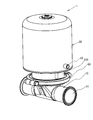
- FIG. 1 is an external perspective view of a diaphragm valve according to a first embodiment of the present invention.
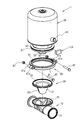
- FIG. 2 is an exploded perspective view of the diaphragm valve of FIG.
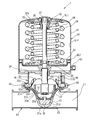
- FIG. 2 is a longitudinal sectional view of the diaphragm valve of FIG. 1 in a state where a flow path is closed.
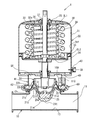
- FIG. 2 is a longitudinal sectional view of the diaphragm valve of FIG. 1 in a state where a flow path is opened. The expanded sectional view explaining the state where the flexible support member was damaged.
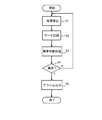
- 9 is a flowchart illustrating a first monitoring method in the processing circuit.
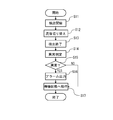
- 9 is a flowchart illustrating a second monitoring method in the processing circuit.
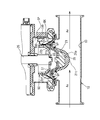
- FIG. 6 is a longitudinal sectional view of a diaphragm valve according to a second embodiment of the present invention.
- FIG. 9 is an enlarged cross-sectional view within a circle A in FIG. 8.
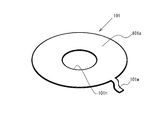
- FIG. 1 is an external perspective view of a flat type humidity sensor.
- FIG. 10 is an enlarged sectional view of a main part of a diaphragm valve according to a third embodiment of the present invention.
- FIG. 1 is an external perspective view of a diaphragm valve 1 according to a first embodiment of the present invention
- FIG. 2 is an exploded perspective view of the diaphragm valve 1 of FIG. 1
- FIG. 3 is a diaphragm with a flow path closed.
- FIG. 4 is a vertical sectional view of the diaphragm valve 1 in a state where a flow path is opened.
- the diaphragm valve 1 includes a valve body 10, a diaphragm 20, an actuator 30, a compressor 50 connected to the actuator 30, a piston 33 for driving the compressor 50, and a housing 41 fixed to the actuator 30, which will be described later. 10 is provided.
- the valve body 10 is made of a metal alloy, and includes a flow path 11 and an opening 12 that opens to the outside in the middle of the flow path 11. You. As shown in FIG. 3, a sealing surface 13 with which a later-described flexible partition member 21 abuts is formed in the flow path 11 of the valve body 10.
- the diaphragm 20 has a flexible partition member 21 and a flexible support member 22.
- the flexible partition member 21 is formed of a polymer.
- the flexible partition member 21 is formed of, for example, polytetrafluoroethylene (PTFE) that transmits water vapor as the specific gas.
- PTFE polytetrafluoroethylene
- the diaphragm 20 has a bell cup shape.
- the flexible partition member 21 has a thick portion 21a at a lower portion including a center portion at the distal end, and a thin portion 21b at an outer peripheral portion continuous with the lower portion.
- An annular seal projection 21c is formed on the outer peripheral edge of the thin portion 21b so as to abut on a support portion 12s formed on the peripheral edge of the opening 12 of the valve body 10.
- the outer peripheral edge of the seal projection 21c of the flexible partition member 21 further outside is guided by a concave guide portion formed on the support portion of the valve body 10.
- a single seal protrusion 21t is formed on the liquid contact surface of the flexible partition member 21 (see FIGS. 2 and 4).
- the seal protrusion 21t is formed.
- the channel 11 is blocked by being pressed against the sealing surface 13.
- a locking concave portion 21d for locking the metal connecting member 25 is formed.
- the connecting member 25 penetrates the flexible support member 22 and is connected to the compressor 50 by a connecting portion 25a.
- the flexible support member 22 is disposed to face the back surface of the flexible partition member 21 opposite to the liquid contact surface.
- the flexible support member 22 serves as a cushion whose main purpose is to prevent wear and breakage of the flexible partition member 21.
- Rubber or an elastomer is used for the flexible support member 22.
- natural rubber, nitrile rubber, styrene rubber, butadiene rubber, isobutylene synthetic rubber, polychloroprene rubber excellent in heat resistance, cold resistance, flexibility and corrosion are used.
- Butyl rubber, fluorine rubber, silicon rubber, polyurethane rubber, ethylene propylene diene rubber (EPDM), etc. can be used.
- the flexible support member 22 is formed using EPDM which does not transmit water vapor as the specific gas. are doing.
- An annular convex portion 22c is formed on the outer peripheral edge of the flexible support member 22, and fits into a concave groove of an annular member 42 fixed to a lower end portion of a housing 41 described later.
- the actuator 30 is provided on a casing 31 having a bottomed cylindrical shape, an upper support plate 32 provided on a ceiling portion of the casing 31, and an inner peripheral surface 31 f of the casing 31 movably provided in the casing 31 via a seal member SL2.
- the piston 33, the lower support plate 34 supported by the piston 33, and the piston 33 provided at the center of the casing 31 and connected to the piston 33 and penetrating through the lower plate 40 of the casing toward the valve body 10 side. It has an extending stem 35, a housing 41 fixed to the lower surface of the lower plate 40, and a compressor 50 fixed to the lower end of the stem 35.
- Two coil springs 38 and 39 are provided between the upper support plate 32 and the piston 33 and the lower support plate 34, and constantly bias the piston 33 toward the lower plate 40.
- a plurality of ventilation holes 32a are formed in the upper support plate 32, and communicate the inside of the casing 31 with the outside.
- a guide member 36 and a fixing member 37 are provided on the outer periphery of the upper end of the stem 35, and the space between the guide member 36 and the stem 35 is sealed by a seal member SL1.
- the outer peripheral surface of the casing 31 is provided with an air port 43 for supplying compressed air CA to a space between the piston 33 and the lower plate 40 of the casing 31 or discharging air from the space.
- the housing 41 is fixed to the lower plate 40 of the actuator 30, and forms a housing space SP for housing the compressor 50 together with the flexible support member 22 of the diaphragm 20.
- a humidity sensor 100 described later is provided on an inner wall in the housing space SP of the housing 41, and a circuit box 110 containing a processing circuit electrically connected to the humidity sensor 100 is fixed to an outer wall of the housing 41.
- An annular member 42 is integrally fixed to the lower end of the housing 41. The annular member 42 is fastened to the support portion 12s of the valve body 10 by the clamper 80 via the flexible partition member 21 and the flexible support member 22.
- the clamper 80 has a pair of semicircular members 81, a bolt BT that penetrates a connection hole 81a provided in each semicircular member 81, and a nut NT screwed with the bolt BT. Is converted into a force for pressing the annular member 42 against the support portion 12s of the valve body 10.
- the compressor 50 is made of a metal alloy, and has a pressing portion 51 that is in direct contact with the flexible support member 22 and is connected to the connection member 25.
- the pressing force acting on the flexible partition member 21 from the pressing portion 51 of the compressor 50 via the flexible support member 22 is released, and the flow path 11 of the valve body 10 is opened.
- the stem 35 moves upward, it can be seen that the thin portion 21b of the flexible partition member 21 is bent, as shown in FIG.
- the flexible support member 22 is also bent corresponding to the bent thin portion 21b of the flexible partition member 21.
- the bent portion 22b of the flexible support member 22 is also a portion pressed by the pressing surface 51f of the pressing portion 51 of the compressor 50.
- the bending portion 22b of the flexible support member 22 repeats the application of the pressing force from the pressing surface 51f of the pressing portion 51 of the compressor 50 and the bending after the release of the pressing force with the opening and closing operation of the diaphragm valve 1. Therefore, among the constituent members of the diaphragm 20, the bent portion 22b of the flexible support member 22 is placed under the most severe condition against wear and breakage.
- the bent portion 22b of the flexible support member 22 is placed under the most severe conditions for wear and breakage, and the design stage of the flexible partition member 21 and the flexible support member 22 is performed.
- the bent portion 22b of the flexible support member 22 is designed to be broken first. That is, the flexible support member 22 is designed in advance so that the service life thereof is shorter than that of the flexible partition member 21.
- the design for setting such a service life period takes into consideration the shapes, dimensions, materials, applied loads, materials of the compressor 50, use conditions, various experiments, and the like of the flexible partition member 21 and the flexible support member 22. This is easily possible.
- the humidity sensor 100 detects the humidity in the housing space SP of the housing 41 or a change thereof, and outputs the detected signal to the processing circuit in the circuit box 110 as an electric signal.
- the processing circuit in the circuit box 110 is composed of hardware such as a processor, an input / output circuit, a communication circuit memory, and required software.
- a first monitoring method of the diaphragm valve 1 will be described with reference to FIGS.
- a part of the water of the aqueous solution As evaporates to form steam.
- a part of the water vapor passes through the PTFE forming the flexible partition member 21, but the EPDM forming the flexible support member 22 does not transmit the water vapor, so that the humidity in the housing space SP of the housing 41 is large. Does not fluctuate.
- the abrasion and deterioration of the bent portion 22b of the flexible support member 22 progresses, and as shown in FIG. A portion BK occurs.
- the damaged portion BK occurs, the water vapor VP, which has been prevented from entering the accommodation space SP by the EPDM forming the flexible support member 22, enters the accommodation space SP through the damaged portion BK of the flexible support member 22. .
- the humidity in the housing space SP of the housing 41 suddenly increases.
- the abnormality of the diaphragm valve 1 is detected by detecting a humidity change in the accommodation space SP caused by the damaged portion BK of the flexible support member 22.
- the processing circuit in the circuit box 110 detects the humidity at predetermined sampling time intervals based on the electric signal from the humidity sensor 100 (Step S1).
- the detected humidity data is stored in the memory (Step S2).
- the processing circuit performs an abnormality detection process using the recorded data.
- an abnormality is determined from a change in humidity data in the housing space SP of the housing 41 stored in the memory. Accuracy can be increased. Any process can be adopted as long as it is a process for accurately detecting a change in humidity in the accommodation space SP.
- the processing circuit determines whether or not there is an abnormality (step S4), and if not, repeats the processing of steps S1 to S3. If it is determined that there is an abnormality, an alarm is output (step S5).
- an alarm signal is output as a wireless signal from the diaphragm valve 1 and received by a monitoring device including a personal computer or the like.
- an abnormality is determined from a change in humidity data detected by the humidity sensor 100 when the fluid flowing through the diaphragm valve 1 is switched between the aqueous solution As and the high-temperature steam.
- the humidity sensor 100 detects higher humidity than the outside air as described above, but when the size of the damaged portion BK is constant, the humidity becomes Converge to a certain steady-state value. This is because the accommodation space SP partially releases moisture to the outside air through the breathing hole.
- the high-temperature water vapor has a higher vapor pressure than the aqueous solution. rises.
- the humidity in the storage space SP keeps a substantially constant value regardless of the switching of the fluid. By detecting this difference, the presence or absence and size of the damaged portion BK can be detected.
- a measurement start signal is sent to the circuit box 110, and the circuit box 110 detects the humidity with the humidity sensor 100 and starts an operation of storing humidity data in the memory at a predetermined sampling interval (step S11).
- the fluid flowing through the diaphragm valve 1 is switched from the aqueous solution to the high-temperature steam (step S12).
- the detection is terminated (step S13).
- the timing of ending the detection is, for example, until a predetermined time has elapsed from the start of the detection in step S11.
- the processing circuit determines the abnormality based on the detected humidity data (step S14).
- step S15 the absolute value
- an alarm is output (step S16). After it is determined in step S15 that there is no abnormality or after an alarm is output in step S16, the processing circuit shifts to a standby state, which is a power saving state (step S17), and ends the processing.
- This process of switching the fluid to high-temperature steam is a process that is usually performed regularly for the purpose of high-temperature sterilization mainly in a valve for sanitary use, and does not require an additional process for detecting abnormality of the valve.
- the second monitoring method differs from the first monitoring method in that it is not necessary to constantly acquire data. Therefore, power consumption in the circuit box 110 can be reduced. In particular, when the circuit box 110 operates with a built-in battery for wireless communication, the frequency of battery replacement can be reduced.
- the flexible support member 22 is designed in advance so as to be damaged before the flexible partition member 21, and the atmosphere in the housing space SP of the housing 41 due to the damage of the flexible support member 22.
- the flexible support member 22 By detecting an abnormality from the humidity fluctuation, it is possible to prevent the liquid flowing through the flow passage 11 of the diaphragm valve 1 from leaking to the outside due to the breakage of the flexible partition member 21.
- FIG. 8 shows a longitudinal sectional view of a diaphragm valve 2 according to a second embodiment of the present invention. Note that the same components as those in the first embodiment are denoted by the same reference numerals, and description thereof is omitted.
- the diaphragm valve 2 has a flat humidity sensor 101 in the accommodation space SP.
- FIG. 9 is an enlarged cross-sectional view and
- FIG. 10 is a perspective view of the flat-type humidity sensor 101.
- the flat type humidity sensor 101 has an upper electrode 101B and a lower electrode 101C sandwiching a moisture-sensitive layer 101A (dielectric portion) having a hygroscopic property, and has a parallel plate structure.
- the moisture-sensitive layer 101A is made of a material that is highly hydrophilic and changes impedance with moisture absorption, and is made of, for example, a cellulose-based film or polyimide.
- the lower electrode 101C is formed of, for example, a conductive material as a thin film having many small holes or a thin film having a porous structure.
- the upper electrode 101B is made of a metal thin film and a resist for insulatingly coating the metal thin film, and is fixed to the lower plate 40 above the accommodation space SP.
- the planar humidity sensor 101 includes a disc-shaped moisture sensitive part 101 a having a flat plate shape, and a connection part 101 w for connecting the moisture sensitive part 101 a to the circuit box 110.
- the moisture-sensitive portion 101a has a hole 101h in the center thereof through which the stem 35 penetrates, and covers the entire upper portion of the diaphragm 20 after disposing the stem 35 immediately above the center of the diaphragm 20 in the accommodation space SP.
- connection part 101w is an elongated rectangular flat plate extending from the outer periphery of the moisture sensing part 101a, and one end thereof is inserted into a connector (not shown) in the circuit box 110 and connected.
- the moisture sensing part 101a and the connection part 101w may be formed integrally.
- the moisture-sensitive layer 101A of the moisture-sensitive portion 101a absorbs moisture, the impedance between the upper electrode 101B and the lower electrode 101C changes, and the impedance is measured by the circuit of the circuit box 110 to reduce the humidity. Can be detected. Further, when the moisture-sensitive layer 101A is wet with liquid water, the impedance between the upper electrode 101B and the lower electrode 101C is extremely reduced. By comparing the measured impedance with a predetermined threshold value, it is possible to perform wetness detection for determining whether or not a part of the planar humidity sensor 101 is wetted by liquid water. Thereby, it can be detected that the diaphragm 20 is damaged and the aqueous solution As flowing through the diaphragm valve 1 leaks into the accommodation space SP.
- FIG. 11 is an enlarged sectional view of a main part of a diaphragm valve according to a third embodiment of the present invention. Note that the same components as those in the above-described embodiments are denoted by the same reference numerals, and description thereof is omitted.
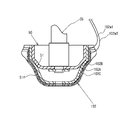
- the diaphragm valve according to the present embodiment has a humidity sensor 102 along a pressing surface (lower surface) 51f of the compressor 50.
- FIG. 11 is a diagram in which the periphery of the compressor 50 is cut out to emphasize the thickness of the humidity sensor 102 so that the structure of the humidity sensor 102 can be easily understood.
- the humidity sensor 102 has an upper electrode 102B and a lower electrode 102C formed on both sides of a moisture-sensitive layer 102A (dielectric portion) having a hygroscopic property, and has a parallel plate structure.
- the moisture-sensitive layer 102A is made of a material that is highly hydrophilic and changes impedance with moisture absorption, and is, for example, a cellulose-based film or a thin film made of polyimide.
- the lower electrode 102C is, for example, a thin film having many small holes or a thin film having a porous structure, and is formed of a conductive material. This allows the moisture-sensitive layer 102A to absorb and release moisture from the air in the storage space SP.
- the upper electrode 102B is a conductive thin film formed on the surface of the compressor 50, but the compressor 50 itself made of metal may be used as the upper electrode 102B.
- the upper electrode 102B and the lower electrode 102C are electrically connected to the circuit of the circuit box 110 by wirings 102w1 and 102w2, respectively.
- the moisture-sensitive layer 102A absorbs moisture, and the impedance between the upper electrode 102B and the lower electrode 102C changes.
- the humidity in the circuit box 110 can be detected by measuring the impedance between the upper electrode 102B and the lower electrode 102C.
- the impedance between the upper electrode 102B and the lower electrode 102C is extremely reduced. By comparing the measured impedance with a predetermined threshold value, it is possible to perform wetness detection for determining whether or not a part of the planar humidity sensor 102 is wetted by liquid water.
- the humidity sensor 102 is disposed in the immediate vicinity of the diaphragm 20 and so as to cover the upper surface of the diaphragm 20, it is possible to immediately detect the leak regardless of the place where the diaphragm 20 is damaged.
- a humidity sensor was used as the sensor, the specific gas was water vapor, the flexible partition member 21 was formed of water vapor permeable PTFE, and the flexible support member 22 was formed of water vapor impermeable EPDM.
- the present invention is not limited to this.
- the flexible partition member and the flexible support member are formed of materials having different transmittances for the specific gas.
- a sensor capable of detecting the concentration of the specific gas or its change is installed in the housing space SP. By adopting such a configuration, it is possible to prevent the liquid from leaking outside.
- the liquid is a low-boiling organic solvent such as ethanol.
- the humidity sensor 100 is installed in the accommodation space SP, but may be installed outside the accommodation space SP as long as the humidity or humidity change in the accommodation space SP can be detected.
- the diaphragm valve having the sealing surface along the flow path is exemplified, but the present invention is applicable to a so-called wear type diaphragm valve.
- Diaphragm valve 10 Valve body 11: Flow path 12: Opening 12 s: Support part 13: Seal surface 20: Diaphragm 21: Flexible partition member 21 a: Thick part 21 b: Thin part 21 c: Seal projection 21 d : Locking recess 21t: seal protrusion 22: flexible support member 22b: bent portion 22c: annular convex portion 25: connecting member 25a: connecting portion 30: actuator 31: casing 31f: inner peripheral surface 32: upper support plate 32a: Vent hole 33: Piston 34: Lower support plate 35: Stem 36: Guide member 37: Fixing member 38: Coil spring 39: Coil spring 40: Lower plate 41: Housing 42: Ring member 43: Air port 50: Compressor 51: Pressing portion 51f: pressing surface 80: clamper 81: semicircular portion Material 81a: Connection hole 100: Humidity sensor 101: Planar humidity sensor 102: Humidity sensor 110: Circuit box As: Aqueous solution BK: Damaged part BT: Bolt CA: Compressed air
Landscapes
- Engineering & Computer Science (AREA)
- General Engineering & Computer Science (AREA)
- Mechanical Engineering (AREA)
- Chemical & Material Sciences (AREA)
- Health & Medical Sciences (AREA)
- Chemical Kinetics & Catalysis (AREA)
- Medicinal Chemistry (AREA)
- Polymers & Plastics (AREA)
- Organic Chemistry (AREA)
- Indication Of The Valve Opening Or Closing Status (AREA)
- Diaphragms And Bellows (AREA)
Abstract
Priority Applications (4)
| Application Number | Priority Date | Filing Date | Title |
|---|---|---|---|
| US16/972,717 US11927280B2 (en) | 2018-06-30 | 2019-05-17 | Diaphragm valve and monitoring method thereof with improved leak detection |
| CN201980043717.5A CN112334696A (zh) | 2018-06-30 | 2019-05-17 | 隔膜阀以及其监视方法 |
| JP2020527275A JP7300187B2 (ja) | 2018-06-30 | 2019-05-17 | ダイヤフラムバルブおよびその監視方法 |
| KR1020217001143A KR20210021036A (ko) | 2018-06-30 | 2019-05-17 | 다이어프램 밸브 및 그 감시 방법 |
Applications Claiming Priority (2)
| Application Number | Priority Date | Filing Date | Title |
|---|---|---|---|
| JP2018125652 | 2018-06-30 | ||
| JP2018-125652 | 2018-06-30 |
Publications (1)
| Publication Number | Publication Date |
|---|---|
| WO2020003799A1 true WO2020003799A1 (fr) | 2020-01-02 |
Family
ID=68984789
Family Applications (1)
| Application Number | Title | Priority Date | Filing Date |
|---|---|---|---|
| PCT/JP2019/019635 Ceased WO2020003799A1 (fr) | 2018-06-30 | 2019-05-17 | Vanne à membrane et son procédé de surveillance |
Country Status (6)
| Country | Link |
|---|---|
| US (1) | US11927280B2 (fr) |
| JP (1) | JP7300187B2 (fr) |
| KR (1) | KR20210021036A (fr) |
| CN (1) | CN112334696A (fr) |
| TW (1) | TWI701405B (fr) |
| WO (1) | WO2020003799A1 (fr) |
Cited By (4)
| Publication number | Priority date | Publication date | Assignee | Title |
|---|---|---|---|---|
| EP3851711A1 (fr) * | 2020-01-20 | 2021-07-21 | SISTO Armaturen S.A. | Procédé de surveillance de soupapes à diaphragme |
| EP4098913A1 (fr) | 2021-06-01 | 2022-12-07 | Gregor Gaida | Soupape à membrane à passage intégral |
| WO2023016626A1 (fr) * | 2021-08-09 | 2023-02-16 | Carten Controls Limited | Ensemble vanne à manchon multiport interchangeable |
| EP4589181A1 (fr) * | 2024-01-18 | 2025-07-23 | Georg Fischer Rohrleitungssysteme AG | Joint d'étanchéité pour soupape à membrane |
Families Citing this family (6)
| Publication number | Priority date | Publication date | Assignee | Title |
|---|---|---|---|---|
| US11236846B1 (en) * | 2019-07-11 | 2022-02-01 | Facebook Technologies, Llc | Fluidic control: using exhaust as a control mechanism |
| CN115003942B (zh) * | 2020-01-14 | 2025-12-12 | 盖米工业设备有限两合公司 | 隔膜和隔膜阀 |
| KR102597315B1 (ko) | 2021-05-31 | 2023-11-02 | 주식회사 프로발 | 밸브 상태 자가진단 밸브 시스템 |
| CN115234697B (zh) * | 2022-08-11 | 2023-10-13 | 苏州协昌环保科技股份有限公司 | 电磁脉冲阀 |
| KR102744473B1 (ko) | 2022-12-23 | 2024-12-19 | 주식회사 프로발 | 공압 밸브 데이터 수집 시스템 |
| DE102023126000A1 (de) * | 2023-09-26 | 2025-03-27 | Friedrich Müller | Druckentlastetes Ventil |
Citations (9)
| Publication number | Priority date | Publication date | Assignee | Title |
|---|---|---|---|---|
| JPS57128902A (en) * | 1981-02-02 | 1982-08-10 | Chino Works Ltd | Moisture sensitive element |
| JPH02309079A (ja) * | 1989-05-24 | 1990-12-25 | Ueno Hiroshi | アセプティック流体制御弁 |
| JPH06101774A (ja) * | 1992-09-18 | 1994-04-12 | Fujitsu Ltd | ダイヤフラムバルブ |
| JPH08285090A (ja) * | 1995-04-10 | 1996-11-01 | Horie Metal Co Ltd | 密栓装置 |
| JP2001317658A (ja) * | 2000-05-10 | 2001-11-16 | Toyo Stainless Kogyo Kk | ダイアフラム弁の漏洩検知センサー |
| JP2004019792A (ja) * | 2002-06-17 | 2004-01-22 | Advance Denki Kogyo Kk | ダイヤフラム弁の透過ガス排出構造 |
| JP2004176828A (ja) * | 2002-11-27 | 2004-06-24 | Smc Corp | 流量調整弁 |
| JP2013500455A (ja) * | 2009-07-27 | 2013-01-07 | メルク・シャープ・エンド・ドーム・コーポレイション | 改良したシール性及び漏れ検出を有するダイヤフラムバルブ |
| WO2014196313A1 (fr) * | 2013-06-04 | 2014-12-11 | 株式会社フジキン | Obturateur à diaphragme |
Family Cites Families (5)
| Publication number | Priority date | Publication date | Assignee | Title |
|---|---|---|---|---|
| DE29507639U1 (de) | 1995-05-09 | 1995-07-06 | Arca Regler GmbH, 47918 Tönisvorst | Ventil |
| US6508266B2 (en) * | 2000-03-31 | 2003-01-21 | Toyo Stainless Steel Industries Co., Ltd. | Diaphragm valve |
| JP2002168176A (ja) * | 2000-12-04 | 2002-06-14 | Tacmina Corp | ダイヤフラム、該ダイヤフラムを備えた流体制御装置及びダイヤフラムの破損検出方法 |
| JP2013117241A (ja) * | 2011-12-01 | 2013-06-13 | Haruo Kamino | ダイヤフラム弁、ダイヤフラム弁のダイヤフラム破損検出方法およびプロセス制御システム |
| JP5710569B2 (ja) | 2012-09-27 | 2015-04-30 | 株式会社フジキン | ダイヤフラム弁 |
-
2019
- 2019-05-17 CN CN201980043717.5A patent/CN112334696A/zh active Pending
- 2019-05-17 JP JP2020527275A patent/JP7300187B2/ja active Active
- 2019-05-17 KR KR1020217001143A patent/KR20210021036A/ko not_active Ceased
- 2019-05-17 US US16/972,717 patent/US11927280B2/en active Active
- 2019-05-17 WO PCT/JP2019/019635 patent/WO2020003799A1/fr not_active Ceased
- 2019-05-28 TW TW108118343A patent/TWI701405B/zh active
Patent Citations (9)
| Publication number | Priority date | Publication date | Assignee | Title |
|---|---|---|---|---|
| JPS57128902A (en) * | 1981-02-02 | 1982-08-10 | Chino Works Ltd | Moisture sensitive element |
| JPH02309079A (ja) * | 1989-05-24 | 1990-12-25 | Ueno Hiroshi | アセプティック流体制御弁 |
| JPH06101774A (ja) * | 1992-09-18 | 1994-04-12 | Fujitsu Ltd | ダイヤフラムバルブ |
| JPH08285090A (ja) * | 1995-04-10 | 1996-11-01 | Horie Metal Co Ltd | 密栓装置 |
| JP2001317658A (ja) * | 2000-05-10 | 2001-11-16 | Toyo Stainless Kogyo Kk | ダイアフラム弁の漏洩検知センサー |
| JP2004019792A (ja) * | 2002-06-17 | 2004-01-22 | Advance Denki Kogyo Kk | ダイヤフラム弁の透過ガス排出構造 |
| JP2004176828A (ja) * | 2002-11-27 | 2004-06-24 | Smc Corp | 流量調整弁 |
| JP2013500455A (ja) * | 2009-07-27 | 2013-01-07 | メルク・シャープ・エンド・ドーム・コーポレイション | 改良したシール性及び漏れ検出を有するダイヤフラムバルブ |
| WO2014196313A1 (fr) * | 2013-06-04 | 2014-12-11 | 株式会社フジキン | Obturateur à diaphragme |
Cited By (7)
| Publication number | Priority date | Publication date | Assignee | Title |
|---|---|---|---|---|
| EP3851711A1 (fr) * | 2020-01-20 | 2021-07-21 | SISTO Armaturen S.A. | Procédé de surveillance de soupapes à diaphragme |
| EP3851711B1 (fr) | 2020-01-20 | 2023-08-30 | SISTO Armaturen S.A. | Procédé de surveillance de soupapes à diaphragme |
| EP4098913A1 (fr) | 2021-06-01 | 2022-12-07 | Gregor Gaida | Soupape à membrane à passage intégral |
| WO2023016626A1 (fr) * | 2021-08-09 | 2023-02-16 | Carten Controls Limited | Ensemble vanne à manchon multiport interchangeable |
| JP2024530206A (ja) * | 2021-08-09 | 2024-08-16 | カーテン コントロールズ リミティド | 取り換え可能なマルチポートピンチバルブアセンブリ |
| JP7823173B2 (ja) | 2021-08-09 | 2026-03-03 | カーテン コントロールズ リミティド | 取り換え可能なマルチポートピンチバルブアセンブリ |
| EP4589181A1 (fr) * | 2024-01-18 | 2025-07-23 | Georg Fischer Rohrleitungssysteme AG | Joint d'étanchéité pour soupape à membrane |
Also Published As
| Publication number | Publication date |
|---|---|
| CN112334696A (zh) | 2021-02-05 |
| TWI701405B (zh) | 2020-08-11 |
| JPWO2020003799A1 (ja) | 2021-08-02 |
| TW202006278A (zh) | 2020-02-01 |
| US20210262576A1 (en) | 2021-08-26 |
| US11927280B2 (en) | 2024-03-12 |
| JP7300187B2 (ja) | 2023-06-29 |
| KR20210021036A (ko) | 2021-02-24 |
Similar Documents
| Publication | Publication Date | Title |
|---|---|---|
| US11927280B2 (en) | Diaphragm valve and monitoring method thereof with improved leak detection | |
| US12000123B2 (en) | System for monitoring backflow preventer condition | |
| TWI687658B (zh) | 流體控制器的異常檢測裝置、異常檢測系統、異常檢測方法及流體控制器 | |
| KR102441617B1 (ko) | 유체 제어 기기, 유체 제어 기기의 이상 검지 방법, 이상 검지 장치, 및 이상 검지 시스템 | |
| US10030789B2 (en) | Diaphragm valve | |
| KR102402579B1 (ko) | 유체 제어 기기의 동작 분석 시스템, 방법, 및 컴퓨터 프로그램 | |
| KR102104829B1 (ko) | 진공 밸브의 외부 시일 구조 | |
| US20220333360A1 (en) | System for monitoring backflow preventer condition | |
| KR102229131B1 (ko) | 유체 제어 기기 | |
| TWI709736B (zh) | 流體控制機器 | |
| JP2004176828A (ja) | 流量調整弁 | |
| JP2007285416A (ja) | 遮断弁装置及びこれを組み込んだ質量流量制御装置 | |
| KR102771704B1 (ko) | 유체 제어 기기의 동작 정보 수집 시스템, 유체 제어 기기, 유체 제어 기기의 동작 정보 수집 방법, 및 컴퓨터 프로그램 | |
| JP2002156302A (ja) | 圧力センサー | |
| JP7265251B2 (ja) | 流体制御機器の動作分析システム、流体制御機器の動作分析方法、及びコンピュータプログラム | |
| US12130191B2 (en) | Pressure measuring unit for measuring a pressure | |
| WO2019004071A1 (fr) | Soupape entraînée par un fluide | |
| JP2017211026A (ja) | ドレントラップの診断装置およびドレントラップ | |
| JP2006162491A (ja) | 圧力センサ | |
| KR101991319B1 (ko) | 연료 압력 스위치 | |
| JP7541715B2 (ja) | 流体制御装置 | |
| JPH0343507B2 (fr) | ||
| JP4860590B2 (ja) | 圧力調整器異常検出装置および圧力調整器異常検出方法 | |
| JPH0684315U (ja) | 液面レベルセンサー |
Legal Events
| Date | Code | Title | Description |
|---|---|---|---|
| 121 | Ep: the epo has been informed by wipo that ep was designated in this application |
Ref document number: 19825369 Country of ref document: EP Kind code of ref document: A1 |
|
| ENP | Entry into the national phase |
Ref document number: 2020527275 Country of ref document: JP Kind code of ref document: A |
|
| NENP | Non-entry into the national phase |
Ref country code: DE |
|
| ENP | Entry into the national phase |
Ref document number: 20217001143 Country of ref document: KR Kind code of ref document: A |
|
| 122 | Ep: pct application non-entry in european phase |
Ref document number: 19825369 Country of ref document: EP Kind code of ref document: A1 |