WO2020003832A1 - Procédé et système de fourniture d'informations - Google Patents
Procédé et système de fourniture d'informations Download PDFInfo
- Publication number
- WO2020003832A1 WO2020003832A1 PCT/JP2019/020657 JP2019020657W WO2020003832A1 WO 2020003832 A1 WO2020003832 A1 WO 2020003832A1 JP 2019020657 W JP2019020657 W JP 2019020657W WO 2020003832 A1 WO2020003832 A1 WO 2020003832A1
- Authority
- WO
- WIPO (PCT)
- Prior art keywords
- delivery
- route
- information
- package
- routes
- Prior art date
- Legal status (The legal status is an assumption and is not a legal conclusion. Google has not performed a legal analysis and makes no representation as to the accuracy of the status listed.)
- Ceased
Links
- GSCVIAUUCUEVEH-UHFFFAOYSA-N C(CC1)CC2C1C(CCCC1)C1C1C2CCCC1 Chemical compound C(CC1)CC2C1C(CCCC1)C1C1C2CCCC1 GSCVIAUUCUEVEH-UHFFFAOYSA-N 0.000 description 1
Images


















Classifications
-
- G—PHYSICS
- G06—COMPUTING OR CALCULATING; COUNTING
- G06Q—INFORMATION AND COMMUNICATION TECHNOLOGY [ICT] SPECIALLY ADAPTED FOR ADMINISTRATIVE, COMMERCIAL, FINANCIAL, MANAGERIAL OR SUPERVISORY PURPOSES; SYSTEMS OR METHODS SPECIALLY ADAPTED FOR ADMINISTRATIVE, COMMERCIAL, FINANCIAL, MANAGERIAL OR SUPERVISORY PURPOSES, NOT OTHERWISE PROVIDED FOR
- G06Q10/00—Administration; Management
- G06Q10/08—Logistics, e.g. warehousing, loading or distribution; Inventory or stock management
- G06Q10/083—Shipping
- G06Q10/0838—Historical data
-
- A—HUMAN NECESSITIES
- A61—MEDICAL OR VETERINARY SCIENCE; HYGIENE
- A61B—DIAGNOSIS; SURGERY; IDENTIFICATION
- A61B5/00—Measuring for diagnostic purposes; Identification of persons
- A61B5/02—Detecting, measuring or recording for evaluating the cardiovascular system, e.g. pulse, heart rate, blood pressure or blood flow
- A61B5/024—Measuring pulse rate or heart rate
-
- B—PERFORMING OPERATIONS; TRANSPORTING
- B65—CONVEYING; PACKING; STORING; HANDLING THIN OR FILAMENTARY MATERIAL
- B65G—TRANSPORT OR STORAGE DEVICES, e.g. CONVEYORS FOR LOADING OR TIPPING, SHOP CONVEYOR SYSTEMS OR PNEUMATIC TUBE CONVEYORS
- B65G61/00—Use of pick-up or transfer devices or of manipulators for stacking or de-stacking articles not otherwise provided for
-
- G—PHYSICS
- G01—MEASURING; TESTING
- G01C—MEASURING DISTANCES, LEVELS OR BEARINGS; SURVEYING; NAVIGATION; GYROSCOPIC INSTRUMENTS; PHOTOGRAMMETRY OR VIDEOGRAMMETRY
- G01C21/00—Navigation; Navigational instruments not provided for in groups G01C1/00 - G01C19/00
- G01C21/26—Navigation; Navigational instruments not provided for in groups G01C1/00 - G01C19/00 specially adapted for navigation in a road network
- G01C21/34—Route searching; Route guidance
- G01C21/3407—Route searching; Route guidance specially adapted for specific applications
-
- G—PHYSICS
- G01—MEASURING; TESTING
- G01C—MEASURING DISTANCES, LEVELS OR BEARINGS; SURVEYING; NAVIGATION; GYROSCOPIC INSTRUMENTS; PHOTOGRAMMETRY OR VIDEOGRAMMETRY
- G01C21/00—Navigation; Navigational instruments not provided for in groups G01C1/00 - G01C19/00
- G01C21/26—Navigation; Navigational instruments not provided for in groups G01C1/00 - G01C19/00 specially adapted for navigation in a road network
- G01C21/34—Route searching; Route guidance
- G01C21/3407—Route searching; Route guidance specially adapted for specific applications
- G01C21/343—Calculating itineraries
-
- G—PHYSICS
- G01—MEASURING; TESTING
- G01C—MEASURING DISTANCES, LEVELS OR BEARINGS; SURVEYING; NAVIGATION; GYROSCOPIC INSTRUMENTS; PHOTOGRAMMETRY OR VIDEOGRAMMETRY
- G01C21/00—Navigation; Navigational instruments not provided for in groups G01C1/00 - G01C19/00
- G01C21/26—Navigation; Navigational instruments not provided for in groups G01C1/00 - G01C19/00 specially adapted for navigation in a road network
- G01C21/34—Route searching; Route guidance
- G01C21/36—Input/output arrangements for on-board computers
- G01C21/3667—Display of a road map
- G01C21/367—Details, e.g. road map scale, orientation, zooming, illumination, level of detail, scrolling of road map or positioning of current position marker
-
- G—PHYSICS
- G06—COMPUTING OR CALCULATING; COUNTING
- G06Q—INFORMATION AND COMMUNICATION TECHNOLOGY [ICT] SPECIALLY ADAPTED FOR ADMINISTRATIVE, COMMERCIAL, FINANCIAL, MANAGERIAL OR SUPERVISORY PURPOSES; SYSTEMS OR METHODS SPECIALLY ADAPTED FOR ADMINISTRATIVE, COMMERCIAL, FINANCIAL, MANAGERIAL OR SUPERVISORY PURPOSES, NOT OTHERWISE PROVIDED FOR
- G06Q10/00—Administration; Management
- G06Q10/04—Forecasting or optimisation specially adapted for administrative or management purposes, e.g. linear programming or "cutting stock problem"
- G06Q10/047—Optimisation of routes or paths, e.g. travelling salesman problem
-
- G—PHYSICS
- G06—COMPUTING OR CALCULATING; COUNTING
- G06Q—INFORMATION AND COMMUNICATION TECHNOLOGY [ICT] SPECIALLY ADAPTED FOR ADMINISTRATIVE, COMMERCIAL, FINANCIAL, MANAGERIAL OR SUPERVISORY PURPOSES; SYSTEMS OR METHODS SPECIALLY ADAPTED FOR ADMINISTRATIVE, COMMERCIAL, FINANCIAL, MANAGERIAL OR SUPERVISORY PURPOSES, NOT OTHERWISE PROVIDED FOR
- G06Q10/00—Administration; Management
- G06Q10/06—Resources, workflows, human or project management; Enterprise or organisation planning; Enterprise or organisation modelling
- G06Q10/063—Operations research, analysis or management
- G06Q10/0631—Resource planning, allocation, distributing or scheduling for enterprises or organisations
- G06Q10/06311—Scheduling, planning or task assignment for a person or group
- G06Q10/063114—Status monitoring or status determination for a person or group
-
- G—PHYSICS
- G06—COMPUTING OR CALCULATING; COUNTING
- G06Q—INFORMATION AND COMMUNICATION TECHNOLOGY [ICT] SPECIALLY ADAPTED FOR ADMINISTRATIVE, COMMERCIAL, FINANCIAL, MANAGERIAL OR SUPERVISORY PURPOSES; SYSTEMS OR METHODS SPECIALLY ADAPTED FOR ADMINISTRATIVE, COMMERCIAL, FINANCIAL, MANAGERIAL OR SUPERVISORY PURPOSES, NOT OTHERWISE PROVIDED FOR
- G06Q10/00—Administration; Management
- G06Q10/08—Logistics, e.g. warehousing, loading or distribution; Inventory or stock management
-
- G—PHYSICS
- G06—COMPUTING OR CALCULATING; COUNTING
- G06Q—INFORMATION AND COMMUNICATION TECHNOLOGY [ICT] SPECIALLY ADAPTED FOR ADMINISTRATIVE, COMMERCIAL, FINANCIAL, MANAGERIAL OR SUPERVISORY PURPOSES; SYSTEMS OR METHODS SPECIALLY ADAPTED FOR ADMINISTRATIVE, COMMERCIAL, FINANCIAL, MANAGERIAL OR SUPERVISORY PURPOSES, NOT OTHERWISE PROVIDED FOR
- G06Q10/00—Administration; Management
- G06Q10/08—Logistics, e.g. warehousing, loading or distribution; Inventory or stock management
- G06Q10/083—Shipping
- G06Q10/0833—Tracking
-
- G—PHYSICS
- G06—COMPUTING OR CALCULATING; COUNTING
- G06Q—INFORMATION AND COMMUNICATION TECHNOLOGY [ICT] SPECIALLY ADAPTED FOR ADMINISTRATIVE, COMMERCIAL, FINANCIAL, MANAGERIAL OR SUPERVISORY PURPOSES; SYSTEMS OR METHODS SPECIALLY ADAPTED FOR ADMINISTRATIVE, COMMERCIAL, FINANCIAL, MANAGERIAL OR SUPERVISORY PURPOSES, NOT OTHERWISE PROVIDED FOR
- G06Q10/00—Administration; Management
- G06Q10/08—Logistics, e.g. warehousing, loading or distribution; Inventory or stock management
- G06Q10/083—Shipping
- G06Q10/08355—Routing methods
-
- G—PHYSICS
- G08—SIGNALLING
- G08G—TRAFFIC CONTROL SYSTEMS
- G08G1/00—Traffic control systems for road vehicles
-
- G—PHYSICS
- G08—SIGNALLING
- G08G—TRAFFIC CONTROL SYSTEMS
- G08G1/00—Traffic control systems for road vehicles
- G08G1/123—Traffic control systems for road vehicles indicating the position of vehicles, e.g. scheduled vehicles; Managing passenger vehicles circulating according to a fixed timetable, e.g. buses, trains, trams
- G08G1/127—Traffic control systems for road vehicles indicating the position of vehicles, e.g. scheduled vehicles; Managing passenger vehicles circulating according to a fixed timetable, e.g. buses, trains, trams to a central station ; Indicators in a central station
- G08G1/13—Traffic control systems for road vehicles indicating the position of vehicles, e.g. scheduled vehicles; Managing passenger vehicles circulating according to a fixed timetable, e.g. buses, trains, trams to a central station ; Indicators in a central station the indicator being in the form of a map
-
- G—PHYSICS
- G16—INFORMATION AND COMMUNICATION TECHNOLOGY [ICT] SPECIALLY ADAPTED FOR SPECIFIC APPLICATION FIELDS
- G16H—HEALTHCARE INFORMATICS, i.e. INFORMATION AND COMMUNICATION TECHNOLOGY [ICT] SPECIALLY ADAPTED FOR THE HANDLING OR PROCESSING OF MEDICAL OR HEALTHCARE DATA
- G16H40/00—ICT specially adapted for the management or administration of healthcare resources or facilities; ICT specially adapted for the management or operation of medical equipment or devices
- G16H40/60—ICT specially adapted for the management or administration of healthcare resources or facilities; ICT specially adapted for the management or operation of medical equipment or devices for the operation of medical equipment or devices
- G16H40/67—ICT specially adapted for the management or administration of healthcare resources or facilities; ICT specially adapted for the management or operation of medical equipment or devices for the operation of medical equipment or devices for remote operation
-
- G—PHYSICS
- G16—INFORMATION AND COMMUNICATION TECHNOLOGY [ICT] SPECIALLY ADAPTED FOR SPECIFIC APPLICATION FIELDS
- G16H—HEALTHCARE INFORMATICS, i.e. INFORMATION AND COMMUNICATION TECHNOLOGY [ICT] SPECIALLY ADAPTED FOR THE HANDLING OR PROCESSING OF MEDICAL OR HEALTHCARE DATA
- G16H50/00—ICT specially adapted for medical diagnosis, medical simulation or medical data mining; ICT specially adapted for detecting, monitoring or modelling epidemics or pandemics
- G16H50/30—ICT specially adapted for medical diagnosis, medical simulation or medical data mining; ICT specially adapted for detecting, monitoring or modelling epidemics or pandemics for calculating health indices; for individual health risk assessment
-
- A—HUMAN NECESSITIES
- A61—MEDICAL OR VETERINARY SCIENCE; HYGIENE
- A61B—DIAGNOSIS; SURGERY; IDENTIFICATION
- A61B2503/00—Evaluating a particular growth phase or type of persons or animals
- A61B2503/20—Workers
-
- A—HUMAN NECESSITIES
- A61—MEDICAL OR VETERINARY SCIENCE; HYGIENE
- A61B—DIAGNOSIS; SURGERY; IDENTIFICATION
- A61B5/00—Measuring for diagnostic purposes; Identification of persons
- A61B5/02—Detecting, measuring or recording for evaluating the cardiovascular system, e.g. pulse, heart rate, blood pressure or blood flow
- A61B5/024—Measuring pulse rate or heart rate
- A61B5/02438—Measuring pulse rate or heart rate with portable devices, e.g. worn by the patient
-
- G—PHYSICS
- G06—COMPUTING OR CALCULATING; COUNTING
- G06F—ELECTRIC DIGITAL DATA PROCESSING
- G06F3/00—Input arrangements for transferring data to be processed into a form capable of being handled by the computer; Output arrangements for transferring data from processing unit to output unit, e.g. interface arrangements
- G06F3/01—Input arrangements or combined input and output arrangements for interaction between user and computer
- G06F3/048—Interaction techniques based on graphical user interfaces [GUI]
- G06F3/0481—Interaction techniques based on graphical user interfaces [GUI] based on specific properties of the displayed interaction object or a metaphor-based environment, e.g. interaction with desktop elements like windows or icons, or assisted by a cursor's changing behaviour or appearance
- G06F3/0482—Interaction with lists of selectable items, e.g. menus
Definitions
- the present disclosure accurately calculates a delivery route that can efficiently deliver a package and reduce the physical load on the deliverer in a situation where the deliverer delivers a plurality of packages to a plurality of destinations on foot. It aims to provide technology.
- the physical load of the delivery member can be further reduced. it can.
- each evaluation value may represent a physical load on the delivery member.
- the plurality of packages include a first package
- the plurality of destinations include a first destination
- the evaluation is performed.
- the value may be recalculated, and the recalculated evaluation value may be based on information obtained by removing the size or weight of the first package from the first package information.
- the plurality of evaluation values include an evaluation value of any one of the first delivery routes P included in the plurality of first delivery routes, and the first delivery route P is the delivery start location , D0, the plurality of destinations D1 to Dn, a route starting from D0 and ending at D1 as a 0th route, a route starting at D1 as a starting point and ending at D2 as a first route,.
- the load is a value according to the distance of the i-th route or the travel time of the i-th route of the delivery member, where 0 ⁇ i ⁇ n, i is an integer, and n may be an integer.
- the load of the package is represented by a sum of values obtained by multiplying a weight of each of the packages to be delivered by the delivery member in the i-th route by a first load coefficient of each of the packages.
- the first load coefficient may be set to a larger value as the size of the package increases.
- the undelivered package between the Di and the D (i + 1) is the first package,..., The m-th package, and the weight of the first package is W1,.
- the weight of the m load is Wm
- the first load coefficient corresponding to the first load is ⁇ 1
- ⁇ j> ⁇ k the size of the j-th load
- the size of the j-th load > (the size of the k-th load).
- the first delivery route information may include information on whether or not the cart can be used.
- the first delivery route information may include a first route in which the delivery staff uses the cart and a second route in which the delivery staff does not use the cart.
- the delivery person determines the route on which the truck can be used in the first delivery route. It is possible to easily understand where the truck is unusable and to realize efficient delivery.
- the luggage load is represented by a sum of values obtained by multiplying the weight of the luggage carried by the delivery member on the i-th route by a second load coefficient of the luggage,
- the second load coefficient may be set to a value according to the type of the package.
- the first delivery route information includes a distance of each of the routes and an altitude difference of each of the routes
- the route load is represented by a sum of values obtained by multiplying the distance of the i-th route by a third load coefficient
- the third load coefficient may be set to a larger value as the altitude difference increases in the ascending direction.
- the first delivery route information includes a distance of each of the routes and an average increase rate of the delivery person's heart rate in each of the routes
- the route load is represented by a sum of values obtained by multiplying the distance of the i-th route by a fourth load coefficient
- the fourth load coefficient may be set to a larger value as the average rate of increase in the heart rate increases.
- the first delivery route information includes the distance L0 of the zeroth route and the average increase rate of the heart rate of the delivery member in the zeroth route,..., The distance Ln of the nth route.
- the fourth load coefficient corresponding to the 0th route includes ⁇ 0,...,
- the fourth load coefficient corresponding to the nth route includes ⁇ n, including the average increase rate of the delivery person's heart rate in the nth route.
- an evaluation value is calculated for each of the plurality of first delivery routes including a destination whose distance from the delivery start location is equal to or smaller than the threshold as a destination, and an optimum value is calculated using the calculated evaluation value.
- a first delivery route is calculated. For this reason, it is possible to prevent a destination from which the distance from the delivery start location is larger than the threshold value and which is difficult to deliver on foot to be set as the destination.
- delivery start place information for storing a plurality of delivery start place candidates and positions in association with each other is further obtained from the memory, Further acquiring the current location of the delivery person, From among the plurality of delivery start location candidates, a delivery start location candidate closest to the current location of the delivery staff may be further determined as the delivery start location.
- the delivery start location candidate located closest to the current location of the delivery staff is determined as the delivery start location, so the delivery staff knows the delivery start location. If not, you can start delivering your luggage on foot from an appropriate delivery location nearby.
- a candidate for a delivery start location that is next to the current location of the delivery member among a plurality of delivery start location candidates may be further determined as the delivery start location.
- the delivery start location next to the current location is determined. We can deliver baggage well.
- information on the acceptability of the delivery start location may be further obtained from the first information terminal via a network.
- the delivery staff visits a first destination included in the plurality of destinations
- information indicating that a first recipient is not present at the first destination is transmitted from the first information terminal.
- a plurality of second delivery route information indicating a plurality of second delivery routes returning from the first destination to the remaining destinations in order and returning to the delivery start location; Calculating an evaluation value of each of the plurality of second delivery routes based on the first package information and the plurality of second delivery route information; Based on the calculated plurality of evaluation values, an optimal second delivery route is specified from among the plurality of second delivery routes, Outputting information indicating the specified second delivery route to the first information terminal;
- the specified second delivery route may be displayed on a display of the first information terminal.
- an optimal second delivery route connecting the first destination to the remaining destinations in order is rescheduled.
- An optimal second delivery route is determined in consideration of the weight or size of the package to be delivered.
- history information indicating a past redistribution ratio corresponding to each of the plurality of destinations is read from the memory,
- the evaluation value of each of the plurality of first delivery routes may be calculated based on the history information.
- the delivery member visits a first destination included in the plurality of destinations
- information indicating that the first package included in the plurality of packages is delivered and the second package is collected.
- Is obtained from the first information terminal via the network Acquiring second luggage information on the size or weight of the second luggage from the first information terminal via a network,
- a plurality of second delivery route information indicating a plurality of second delivery routes returning from the first destination to the remaining destinations in order and returning to the delivery start location;
- Based on the calculated plurality of evaluation values an optimal second delivery route is specified from among the plurality of second delivery routes, Outputting information indicating the specified second delivery route to the first information terminal;
- the specified second delivery route may be displayed on a display of the first information terminal.
- the second delivery that sequentially connects the first destination to the remaining destinations in consideration of the size or weight of the second package. Since the route is rescheduled, an optimal second delivery route is determined in consideration of the weight or size of the collected second package.
- the delivery member delivers the first package included in the plurality of packages and information indicating that the second package is to be collected is previously stored in the first destination.
- information indicating that the second package is to be collected is previously stored in the first destination.
- the evaluation value of each of the plurality of first delivery routes may be calculated based on the first package information and the second package information.
- the optimal delivery route is determined in consideration of not only the first package to be delivered but also the second package to be collected. You. Thereby, the first delivery route that can deliver the package with higher efficiency is determined.
- information indicating that the delivery member has got off the delivery vehicle is obtained from the first information terminal, Outputting information indicating that the delivery person is heading to a first destination included in the plurality of destinations to a second information terminal of a recipient at the first destination; Information indicating that the delivery staff is heading for the first destination may be displayed on a display of the second information terminal.
- the fact that the deliveryman is heading is output to the second information terminal of the recipient of the package, so that the recipient can receive the package more reliably. Can be.
- the second upper limit distance shorter than the first upper limit distance is selected.
- the destination is deleted such that the distance of one delivery route is shorter than the second upper limit distance. Therefore, it is possible to suppress an increase in the burden on the delivery staff due to bad weather, and to ensure the safety of the delivery staff.
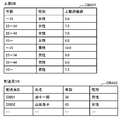
- the upper limit evaluation value according to the age or gender of the delivery member is obtained from the memory,
- the evaluation value of the specified first delivery route is equal to or more than the upper limit evaluation value
- the destination included in the first delivery route is deleted so that the evaluation value of the first delivery route becomes smaller than the upper limit evaluation value. May be.
- the upper limit evaluation value according to the age or gender is selected, and when the evaluation value of the first delivery route is equal to or larger than the upper limit evaluation value, the evaluation value of the first delivery route is smaller than the upper limit evaluation value. , The destination is deleted. Therefore, a delivery route with an appropriate load is presented according to the age or gender of the delivery member.
- the present disclosure can also be realized as a computer program that causes a computer to execute each characteristic step included in such a method, or a system that operates using the computer program. Needless to say, such a computer program can be distributed via a non-transitory computer-readable recording medium such as a CD-ROM or a communication network such as the Internet.
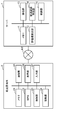
- FIG. 1 is a diagram illustrating an example of a network configuration of the information providing system according to the first embodiment.
- the information providing system is a system that presents an appropriate delivery route capable of efficiently delivering a package to a delivery person who delivers a plurality of packages to a plurality of destinations on foot.
- the information providing system includes a server 1 and a delivery terminal 2 (an example of a first information terminal).
- the server 1 and the delivery terminal 2 are communicably connected to each other via a network NT.
- the network NT for example, an Internet communication network, a mobile phone communication network, or the like is employed.
- the server 1 is composed of, for example, one or a plurality of computers, and controls the entire control of the information providing system.
- the delivery terminal 2 is composed of, for example, a portable information processing device such as a smartphone and a tablet terminal, and displays various messages to a delivery person who delivers packages.
- the deliveryman terminal 2 may be configured by an information processing device mounted on a delivery vehicle on which the deliveryman rides.
- the deliveryman terminal 2 may be implemented in an ECU (Electronic Control Unit) or a car navigation system provided in the delivery vehicle. Good.
- the delivery terminal 2 may be constituted by a dedicated portable information processing device developed for a delivery person of the package.
- FIG. 1 only one delivery terminal 2 is shown for convenience of description, but a plurality of delivery terminal 2 may be included.
- the data transmitted from the delivery staff terminal 2 is managed for each delivery staff using the delivery staff ID individually assigned to the delivery staff terminal 2.
- FIG. 2 is a block diagram showing an example of the configuration of the information providing system shown in FIG.
- the server 1 includes a memory 11, an evaluation value calculation unit 12, a communication unit 13, a delivery route identification unit 14, and a control unit 15.
- the evaluation value calculation unit 12, the delivery route identification unit 14, and the control unit 15 may be configured by a processor such as a CPU, or may be configured by a dedicated hardware circuit. In this case, these components may each be configured by separate hardware, or may be configured by one processor executing a predetermined program.
- the memory 11 is composed of, for example, a semiconductor memory, and stores in advance package information (an example of first package information) relating to the size or weight of each of a plurality of packages delivered from a delivery start location to a plurality of destinations by a delivery person. I do. Further, the memory 11 stores in advance a plurality of delivery route information (an example of the first delivery route information) indicating a plurality of delivery routes (an example of the first delivery route) connecting the delivery start location to the plurality of destinations in order.
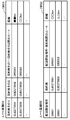
- the package information includes, for example, a package DB 31 described later with reference to FIG. Further, the plurality of delivery route information is configured, for example, by a delivery route DB 42 described later with reference to FIG.
- the evaluation value calculation unit 12 calculates an evaluation value of each of the plurality of delivery routes based on the package information and the delivery route information.
- each of the plurality of delivery route information stores the distance information of the delivery route.
- the distance information of the delivery route includes, for example, a route distance DB 51 and a route distance DB 52 described later with reference to FIG.
- the evaluation value is a value for evaluating the physical load of the delivery member when the delivery member carries the package, and takes a larger value as the load is larger. Therefore, a delivery route with a smaller evaluation value allows the delivery member to carry the package more easily, and the physical load on the delivery member is reduced. As a result, a delivery route that can reduce the physical load on the delivery member is calculated.
- the evaluation value calculation unit 12 reflects that the total size or weight of the remaining packages among the plurality of packages becomes smaller every time the packages are delivered to the destination. This makes it possible to calculate an evaluation value that accurately considers the physical load of the delivery staff.
- each of the evaluation values is a plurality of routes including a route connecting between the delivery start location and the destination and a route connecting the destinations when returning to the delivery start location by sequentially passing through the plurality of destinations from the delivery start location. It is expressed by the sum of the delivery load of
- the delivery load is a package load corresponding to the weight or size of one or more packages to be delivered by the i-th route (i is an index designating the route and an integer of 0 or more) indicating a certain route, and the distance of the i-th route. Alternatively, it is expressed by a product of a route load corresponding to a required time (moving time) required for moving.
- the weight or size of the package is specified from the package DB 31.
- the route load takes a larger value as the distance or the required time is longer.
- the distance of the i-th route is specified using the route distances DB51 and DB52. Further, the required time of the i-th route is calculated by dividing the distance of the i-th route by the traveling speed of the delivery staff on foot. The details of the evaluation value calculation will be described in an embodiment described later.
- the delivery route specifying unit 14 specifies an optimal delivery route from among the plurality of delivery routes based on the evaluation values of the plurality of delivery routes calculated by the evaluation value calculation unit 12.
- the delivery route with the smallest evaluation value is specified as the optimal delivery route.
- the communication unit 13 is composed of a communication device that connects the server 1 to the network NT, and transmits information indicating the optimum delivery route specified by the delivery route identification unit 14 to the delivery terminal 2.
- the control unit 15 controls the overall control of the server 1.
- the delivery terminal 2 includes a memory 21, a GPS 22, a control unit 23, a reading unit 24, a communication unit 25, a display unit 26, and an input unit 27.
- the memory 21 includes, for example, a semiconductor memory and stores an application for displaying information indicating a delivery route and the like transmitted from the server 1 and the like.
- a GPS (global positioning system sensor) 22 calculates the current location of the delivery terminal 2 using radio waves from GPS satellites.
- the GPS 22 may calculate the current location at predetermined time intervals (for example, 1 minute, 2 minutes, 10 minutes, etc.).
- the reading unit 24 is configured by, for example, a barcode reader that reads a barcode or a QR code (registered trademark) written on a package slip attached to the package.
- the barcode or QR code includes at least a package ID which is an identifier of the package.
- the reading unit 24 is used to read a barcode or a QR code (registered trademark) written on a baggage slip of a loaded baggage when a deliveryman loads a baggage on a delivery vehicle at a delivery center, for example.
- the delivery terminal 2 can obtain information such as the destination (delivery destination) and the recipient from the server 1 using the package ID read by the reading unit 24 as a key, and manage the package to be delivered. .
- the reading unit 24 is also used for, for example, reading a barcode or a QR code (registered trademark) written on a luggage slip when a deliveryman hands a luggage to a user. Thereby, the server 1 can manage whether or not the delivery of the package is completed.
- the communication unit 25 is constituted by a communication device that connects the delivery terminal 2 to the network NT, and receives information indicating the optimum delivery route transmitted from the server 1 and the like. In addition, the communication unit 25 transmits the current location detected by the GPS 22 to the server 1.
- the display unit 26 is configured by a display device such as a liquid crystal display, and displays various images including information indicating an optimal delivery route transmitted from the server 1 and the like.
- the input unit 27 includes, for example, a touch panel, and receives various operations from a user.
- the control unit 23 is configured by a processor such as a CPU, and controls the entire control of the delivery terminal 2.
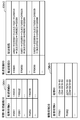
- FIG. 3 is a diagram showing an example of a data configuration of the package DB 31 and the customer DB 32 stored in the memory 11 of the server 1.
- the luggage DB 31 is a database that stores luggage information on luggage delivered by a delivery member, and one record is assigned to one luggage.
- the package DB 31 stores “package ID”, “delivery source customer ID”, “delivery destination customer ID”, “size”, and “weight” in association with each other.
- Package ID indicates an identifier assigned to uniquely identify a package.
- the “delivery source customer ID” indicates the identifier of the customer who is the sender of the package.
- Delivery destination customer ID indicates an identifier of a customer who is a recipient of the package.
- Size indicates the size of the package.
- the size of the luggage is represented by a product of the width, height, and depth of the luggage. Therefore, the larger the multiplication value, the larger the size of the package.
- Weight indicates the weight of the package.
- the customer DB 32 is a database that stores personal information of a customer who is a recipient of the package, and one record is assigned to one customer.
- the customer DB 32 stores “customer ID”, “address”, and “recipient name” in association with each other.
- “Address” indicates the address of the recipient, that is, the delivery destination (destination) of the package.
- “Recipient name” indicates the name of the recipient.
- the route distance DB 52 is a database that stores information on a delivery start location and a route connecting destinations, which constitute a delivery route indicated by the delivery route information stored in the delivery route DB 42, and includes “delivery start location”, “destination” "," The route between the delivery start place and the destination ", and" distance "are stored in association with each other.
- the “delivery start place” indicates a predetermined place where the delivery person stops the delivery vehicle and starts delivery of the package on foot.
- “Destination” indicates a destination located next to the delivery start location.
- the user ID of the recipient is stored in the column of “Destination”.
- the column of “route between delivery start location and destination” stores identifiers of routes that connect the delivery start location and the destination, such as “SR0001” and “SR0002”. “Distance” indicates the distance of the route.
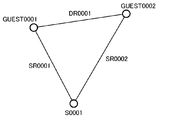
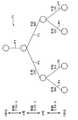
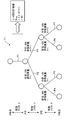
- FIG. 6 is a diagram for explaining symbols used to indicate a delivery route stored in the delivery route DB 42.
- FIG. 6 illustrates the delivery route indicated by the delivery route ID “TR0001” stored in the first row of the delivery route DB 42.
- a symbol starting with “S” such as “S0001” indicates an identifier of a delivery start place.
- a symbol starting with “SR” such as “SR0001” indicates an identifier of a route connecting the delivery start place and the destination.
- Symbols starting with GUEST such as “GUEST0001” indicate the customer ID of the recipient, that is, the destination.
- the delivery route of “TR0001” departs from the delivery start place “S0001”, goes to the destination “GUEST0001” through the route “SR0001”, goes to the destination “GUEST0002” through the route “DR0001”, The route that returns to the delivery start location “S0001” through the route “SR0002” is shown.
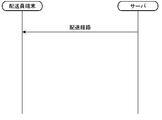
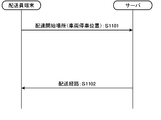
- FIG. 7 is a sequence diagram showing an example of data transmission and reception between the server 1 and the delivery terminal 2 in the information providing system shown in FIG.
- the server 1 specifies an optimal delivery route with the smallest evaluation value among a plurality of delivery routes corresponding to the delivery start location, and specifies the delivery route. Is transmitted to the delivery terminal 2.
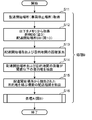
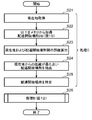
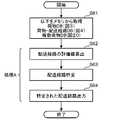
- FIG. 8 is a flowchart illustrating an example of processing of the information providing system according to the first embodiment.
- the control unit 15 of the server 1 acquires the package DB 31 and the package-delivery route DB 41 from the memory 11.
- the evaluation value calculation unit 12 acquires a plurality of delivery routes corresponding to a plurality of packages to be delivered together by the delivery person on foot from the delivery route DB 42, and calculates an evaluation value of each delivery route.
- the package IDs of a plurality of packages to be delivered are “1234-5678-90” and “1234-5678-89”.
- the multiple package ID “P0001” is specified with reference to the multiple package DB 43.
- the delivery route IDs “TR0001” and “TR0002” corresponding to the plurality of package IDs “P0001” are specified by referring to the package-delivery route DB 41.
- the delivery route DB 42 is referred to, and two delivery routes indicated by delivery route IDs “TR0001” and “TR0002” are specified as a plurality of delivery routes for which evaluation values are calculated. Then, an evaluation value is calculated for each of the two specified delivery routes.
- two delivery routes indicated by delivery route IDs “TR0001” and “TR0002” are specified as a plurality of delivery routes for which evaluation values are calculated. Then, an evaluation value is calculated for each of the two specified delivery routes.
- two delivery routes indicated by delivery route IDs “TR0001” and “TR0002” are specified as a plurality of delivery routes for which evaluation values are calculated.
- an evaluation value is calculated for each of the two specified delivery routes.
- an example in which two delivery routes are specified has been described, but the present disclosure is not limited to this, and three or more delivery routes may be specified.
- the delivery route identification unit 14 identifies the delivery route having the smallest evaluation value among the plurality of delivery routes whose evaluation values have been calculated in S2 as the optimal delivery route.
- the communication unit 13 transmits information indicating the optimum delivery route to the delivery terminal 2. Accordingly, the delivery terminal 2 displays an image indicating the optimal delivery route, and the delivery person is presented with the optimal delivery route.
- the evaluation value calculation unit 12 extracts, for example, a plurality of packages indicated by a plurality of package IDs including more destinations closer to the current delivery start location of the delivery member from the multiple package DB 43, It may be determined as a package to be delivered.
- FIG. 9 is a diagram showing an example of a display screen G1 showing an optimal delivery route displayed on the deliveryman terminal 2.
- a delivery route that the delivery person delivers on foot is shown for the two packages L1 and L2 indicated by the package IDs “1234-5678-90” and “0987-6543-21”.
- the display field R11 displays a map image showing destinations of the delivery destination of the package L1 and destinations of the delivery of the package L2 so that the delivery staff can grasp the whole image of the delivery route.
- a map image in which a route R0001 from the delivery start location SA to the destination of the luggage L1 to which the delivery person is heading out of the map images displayed in the display field R11 is displayed in an enlarged manner.
- the map image shown in the display field R11 is enlarged so that the map image shown in the display field R12 includes the current location and the destination according to the position information indicating the current location transmitted from the deliveryman terminal 2. Image.
- package IDs relating to a plurality of packages to be delivered together by the delivery staff on foot are displayed in order of delivery from the top.
- the destination of the plurality of packages, the delivery order of the plurality of packages, the route, and the like are displayed on the map image. Therefore, the delivery member delivers the package using the optimal delivery route.
- the delivery staff can be appropriately guided.
- each evaluation value of a plurality of delivery routes returning to the delivery start location by sequentially passing through a plurality of destinations from the delivery start location is only the distance information of the plurality of delivery routes, Instead, it is calculated using baggage information relating to the size or weight of each of a plurality of packages delivered by a delivery person on foot, and an optimal delivery route is determined based on the calculated evaluation values. Therefore, the present embodiment can accurately calculate a low-load delivery route that enables a delivery person to efficiently deliver a plurality of packages on foot from a delivery start location.
- the optimal delivery route is determined based on the evaluation value calculated using the baggage information, so that the optimal delivery route that can reduce the physical load on the delivery staff can be achieved. Can be determined.
- the delivery route determined in this way is displayed on the delivery staff terminal 2, so that the delivery staff can efficiently deliver a plurality of packages on foot. As a result, even a new delivery person can deliver packages with the same efficiency as a skilled delivery person.
- FIG. 10 is a diagram illustrating an example of a data configuration of the delivery start place DB 100 according to the second embodiment.
- the delivery start place DB 100 is a database that stores delivery start places stored in the memory 11 of the server 1 in advance, and one record is assigned to one delivery start place.
- the same components as those in the first embodiment are denoted by the same reference numerals, and description thereof is omitted.
- the network configuration diagram and the block diagram use FIG. 1 and FIG. These are the same in the following embodiments unless otherwise specified.
- the delivery start place DB 100 stores “delivery start place ID” and “address” in association with each other.
- “Delivery start place ID” indicates an identifier of a delivery start place managed by the server 1.
- "Address” indicates the address of each delivery start location.
- a predetermined place where the delivery car has been parked in the past is adopted, for example, a place such as a parking lot where the delivery car is easy to stop is adopted. I have.
- FIG. 12 is a flowchart illustrating an example of processing of the information providing system according to the second embodiment.
- the control unit 15 of the server 1 acquires the delivery start location transmitted from the delivery terminal 2 using the communication unit 13.
- the control unit 15 acquires the luggage DB 31 and the delivery start place DB 100 from the memory 11.
- the control unit 15 calculates the distance between the delivery start location acquired in S11 and each of the destinations of the plurality of packages stored in the package DB31.
- the destinations of a plurality of packages are specified by referring to the “address” of the customer DB 32 using the “delivery source customer ID” of the package DB 31 as a key. Further, as the position information of the delivery start place and the destination, the latitude and longitude associated with the “address” in the map information may be adopted. Then, the respective distances between the delivery start place and the plurality of destinations may be calculated using the position information including the latitude and the longitude.
- the control unit 15 extracts a destination whose distance between the delivery start place and the destination calculated in S13 is equal to or smaller than a threshold.
- a threshold value a predetermined distance that is appropriate for a delivery person carrying luggage to move on foot is used, and for example, a distance such as 10 m, 50 m, 100 m, or 500 m is used.
- the control unit 15 extracts a plurality of delivery routes connecting the plurality of destinations extracted in S14 from the delivery start location.
- the control unit 15 extracts a plurality of luggage IDs composed of the luggage having the destination extracted in S14 as the delivery destination from the plurality of luggage DBs 43, and determines a delivery route corresponding to the extracted plurality of luggage IDs in the delivery route DB 42.
- a plurality of delivery routes may be extracted.
- the process A is performed on the plurality of delivery routes extracted in S15.
- the process A is a process indicated by S2 to S4 in FIG.
- an evaluation value is calculated for each of a plurality of delivery routes including a delivery destination whose distance from the delivery start location is equal to or smaller than the threshold as a destination, and the calculated evaluation value is calculated.
- the optimum delivery route is calculated using the above. For this reason, it is possible to prevent a destination from which the distance from the delivery start location is larger than the threshold value and which is difficult to deliver on foot to be set as the destination.
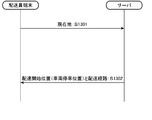
- FIG. 13 is a sequence diagram illustrating an example of data transmission and reception between the server 1 and the delivery terminal 2 in the information providing system according to the third embodiment.
- the deliveryman does not know the delivery start location managed by the server 1.
- the deliveryman terminal 2 transmits the current location detected by the GPS 22 to the server 1 (S1301).
- the server 1 determines the delivery start location closest to the current location, specifies the optimum delivery route from the delivery start location, and transmits the delivery route to the delivery terminal 2 (S1302).
- the delivery terminal 2 displays on the display unit 26 a display screen indicating the delivery start location and the optimal route transmitted from the server 1.
- the delivery person who browses the display screen moves the delivery vehicle to the delivery start location indicated by the display screen, stops the delivery vehicle, and delivers the package along the delivery route indicated by the display screen.
- the delivery staff terminal 2 transmits the current location to the server 1 in response to the input of the notification command of the current location from the delivery staff.
- this is an example, and the detection that the delivery vehicle has stopped is triggered. May be transmitted to the server 1.
- FIG. 14 is a flowchart illustrating an example of processing of the information providing system according to the third embodiment.
- the control unit 15 of the server 1 acquires the current location transmitted from the delivery terminal 2 using the communication unit 13.
- the control unit 15 acquires the delivery start place DB 100 from the memory 11.
- control unit 15 calculates the distance between the current location and each of the delivery start locations stored in the delivery start location DB 100.
- the control unit 15 may calculate, for example, the straight-line distance between the current location and the delivery start location as the distance, or calculate the distance of an optimal route connecting the current location and the delivery start location as the distance. Good.
- a delivery start location closest to the current location is extracted from the plurality of delivery start locations whose distances have been calculated in S23.
- control unit 15 specifies the delivery start location extracted in S24 as the delivery start location for notifying the delivery member.
- Process B is executed using the delivery start location specified in S25.
- Process B is the process of S11 to S16 in FIG.
- the delivery start location closest to the current location of the delivery staff is notified to the delivery staff from the delivery start location DB 100. Even if you do not know, you can start delivery of your luggage on foot from an appropriate delivery start location nearby.
- FIG. 15 is a flowchart illustrating an example of processing of the information providing system according to the fifth embodiment.
- Process B is the process of S11 to S16 in FIG.
- S31 the optimal delivery route from departure from the delivery start location to return to the delivery start location via a plurality of destinations is specified.
- control unit 15 detects that the delivery member has started delivery along the delivery route specified in S31.
- control unit 15 detects that the delivery member has visited the destination.
- the control unit 15 detects that the deliveryman has started delivery and that the deliveryman has visited the destination by monitoring the position information periodically transmitted from the deliveryman terminal 2, Good.
- the control unit 15 determines whether the delivery member has been able to deliver.
- the delivery person reads the barcode or QR code (registered trademark) written on the package slip by the reading unit 24 to obtain the package ID, and obtains the package ID.
- the information including the information indicating that the delivery of the package has been completed is transmitted from the delivery terminal 2 to the server 1. Therefore, the control unit 15 may determine that the package has been delivered when the communication unit 13 receives this information.
- the control unit 15 extracts one or more delivery routes using the remaining one or more destinations and delivery start locations for which delivery has not been completed in the delivery route specified in S31.
- the control unit 15 extracts all combinations of delivery routes that return to the delivery start location through all of the remaining destinations.
- the remaining destinations are destinations M1 and M2
- the current location is M0
- the delivery start location is S0
- the delivery route of M0-M1-M2-S0 and the delivery route of M0-M2-M1-S0 Are extracted.
- the destination located at the current location M0 corresponds to an example of a first destination
- the recipient of this destination corresponds to an example of the first recipient.
- the delivery route extracted in S35 is an example of a second delivery route.
- Process A is performed on the delivery route extracted in S35, the evaluation value of each delivery route is calculated, and the delivery route that minimizes the evaluation value is specified as the optimal delivery route.
- Process A is a process of S1 to S4 in FIG.
- the control unit 15 determines whether there is a next destination. For example, if the above-mentioned M0-M1-M2-S0 is specified as the optimal delivery route at the current location M0, if the delivery of the package to the destinations of M1 and M2 is not completed, YES is determined in S37. It is determined and the process returns to S33. On the other hand, in the example of M0-M1-M2-S0 described above, if the delivery to M2 is completed, the determination in S37 is NO, and the process ends.
- the delivery staff must carry the extra package and deliver the remaining package to the remaining destinations. In some cases, this is not the case.
- an optimal delivery route can be determined in consideration of the weight or size of undelivered packages.
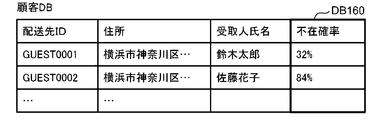
- FIG. 16 is a diagram illustrating an example of a data configuration of the customer DB 160 stored in the memory 11 of the server 1 according to the fifth embodiment.
- the customer DB 160 is further provided with an “absence probability” with respect to the customer DB 32 shown in FIG.
- the “absence probability” indicates the probability that the recipient was absent when the package was delivered, that is, the ratio of past redistribution.
- the memory 11 stores a delivery log (not shown) in which the date and time of delivery of the package and information indicating whether or not the package has been delivered are associated with each recipient (customer). You.
- the delivery log is created by the server 1 acquiring the delivery result input to the delivery staff terminal 2 by the delivery staff every time the delivery staff visits the destination. Therefore, the "absence probability" can be obtained by calculating the ratio of the absent number to the total number of deliveries stored in the delivery log for each customer.
- the customer DB 160 is an example of history information.
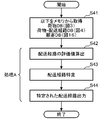
- FIG. 17 is a flowchart illustrating an example of processing of the information providing system according to the fifth embodiment.
- the control unit 15 acquires the package DB 31, the package-delivery route DB 41, and the customer DB 160 from the memory 11.
- steps S42 to S44 the process A further using the "absence probability" stored in the customer DB 160 is executed, and an optimal delivery route is calculated.
- Processing A is S2 to S4 in FIG.
- the evaluation value in consideration of the absence probability will be described in a specific example of a delivery route described later.
- the evaluation value is calculated in consideration of the absence probability, it is possible to calculate the evaluation value more in accordance with the actual situation. As a result, the reliability of the finally determined delivery route can be improved.
- FIG. 18 is a diagram illustrating an example of the display screen G2 displayed on the deliveryman terminal 2 in the sixth embodiment.
- the display screen G2 is a screen for notifying the server 1 that the luggage has been collected at the destination.
- Pickup refers to when a deliveryman visits a destination and picks up a package from a customer at the destination.
- FIG. 23 is a flowchart showing an example of processing of the information providing system according to the eighth embodiment.
- the process C is executed.
- Processing C is S21 to S25 in FIG.
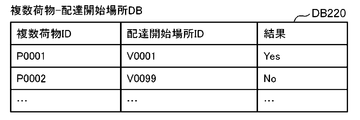
- the control unit 15 determines whether the result of the routine at S72 is YES. If the routine result in S72 is YES (YES in S73), the process ends, and if the routine result in S72 is NO (NO in S73), the process proceeds to S74. That is, when the delivery vehicle is stopped at the delivery start location determined in process C, the next delivery start location needs to be determined, and the process proceeds to S74. Note that the determination of whether the result of the routine is YES or NO uses information stored in the “Result” column of the multiple package-delivery start location DB 220.
- the control unit 15 refers to the delivery start location DB 100 and determines whether another delivery start location exists within a distance equal to or less than the threshold from the current location. If another delivery start location exists (YES in S74), the process proceeds to S75, and if there is no other delivery start location (NO in S74), the process ends.
- the present location corresponds to, for example, a place where the delivery member stopped the delivery vehicle near the original delivery start location because the stop was attempted at the original delivery start location but could not be stopped.
- control unit 15 extracts, from the delivery start location DB 100, the delivery start location closest to the current delivery location after the initial delivery start location.
- control unit 15 specifies the delivery start location extracted in S75 as a new delivery start location, and advances the process to S73.
- FIG. 24 is a flowchart showing details of the processing of the delivery start place evaluation subroutine in S72 of FIG.
- the control unit 15 determines whether or not the delivery vehicle has been parked at the delivery start location.
- the control unit 15 performs delivery to the delivery start location. What is necessary is just to determine that the car could not be stopped.
- the control unit 15 can stop the delivery vehicle at the delivery start location. What is necessary is just to determine.
- the control unit 15 sets YES in the “Result” column of the corresponding delivery start location in the multiple package-delivery start location DB 220. It is registered (S83). On the other hand, if it is determined that the delivery vehicle could not be parked at the delivery start location (NO in S81), the control unit 15 sets NO in the “Result” column of the corresponding delivery start location in the multiple package-delivery start location DB 220. Register. When the processing of S82 and S83 ends, the processing returns to FIG.
- Return button B31 is a button pressed to return the reason registration screen G3 to the previously displayed screen.
- the deliveryman cannot stop the delivery vehicle at the delivery start place, he inputs necessary information into each input field of the reason registration screen G3 and presses a registration button B32. Then, the communication unit 25 of the delivery terminal 2 transmits the information input in each column to the server 1.
- FIG. 26 is a diagram showing an example of the data configuration of the multiple package-delivery start location DB 260 stored in the memory 11 of the server 1 in the ninth embodiment.
- the multiple package-delivery start location DB 260 further has “reason” with respect to the multiple package-delivery start location DB 220 of FIG. “Reason” indicates the reason why the delivery vehicle input by the delivery person using the reason registration screen G3 could not be stopped.
- the delivery start location on the first line was able to stop the delivery car, so the “reason” column is blank.
- the delivery car could not be stopped because another car was stopped, so that the column of "reason” stores "parked vehicle”.
- FIG. 27 is a flowchart showing an example of the processing of the delivery start place evaluation subroutine according to the ninth embodiment.
- FIG. 23 is used for the main routine of the present embodiment.
- the same processes as those in FIG. 24 are denoted by the same step numbers.
- control unit 15 causes the display unit 26 of the delivery terminal 2 to display a reason registration screen G3.
- control unit 15 registers the reason why the delivery vehicle selected by the delivery member on the reason registration screen G3 could not be stopped in the "reason" column of the multiple package-delivery start location DB 260.
- the delivery vehicle cannot be stopped, the reason is notified from the delivery terminal 2 and registered in the multiple package-delivery start location DB 260. Therefore, it is possible to collect information for determining whether or not the location is a valid place as a delivery start location.
- the delivery staff is made to input whether or not the delivery start location is preferable as a stop place of the delivery vehicle.
- FIG. 28 is a diagram showing an example of the evaluation registration screen G4 displayed on the delivery terminal 2 in the tenth embodiment.
- the evaluation registration screen G4 is a screen for prompting a deliveryman to input an evaluation on the delivery start location when the delivery vehicle can be stopped at the delivery start location.
- a comment input field is provided in the input field R41.
- a comment about the delivery start place is input by the deliveryman.
- a comment by a delivery person such as "There is a slope up to the XX apartment" is input.
- an arbitrary message by the delivery person is input in the comment input field.
- the delivery person inputs necessary information into each input field of the evaluation registration screen G4 and presses the registration button B32. Then, the communication unit 25 of the delivery terminal 2 transmits the information input in each column to the server 1.
- control unit 15 causes the display unit 26 of the delivery terminal 2 to display the evaluation registration screen G4.
- control unit 15 registers the evaluation result input by the delivery member on the evaluation registration screen G4 in the “reason” column of the multiple package-delivery start place DB 290.
- the quality of the delivery vehicle is notified, so that information for determining whether or not the location is appropriate as a delivery start location is collected. it can.
- FIG. 31 is a diagram illustrating an example of a network configuration of the information providing system according to the eleventh embodiment.
- the walkable total distance is the upper limit distance of the delivery route.
- the weather information providing server 3 is a server that provides weather information including a weather forecast such as sunny or cloudy.
- FIG. 32 is a diagram illustrating an example of a data configuration of the weather distance DB 320 stored in the memory 11 of the server 1 according to the eleventh embodiment.
- Weather distance DB 320 is a database that stores the total walkable distance, which is the upper limit distance of the delivery route according to the weather, and stores “weather” and “total walkable distance” in association with each other.
- “0.5 km” is stored as “total walking distance” for “bad weather”
- “0.8 km” is stored as “total walking distance” for “others”.
- the “total walkable distance” with respect to “bad weather” corresponds to an example of a second upper limit distance
- the “total walkable distance” corresponding to the other corresponds to an example of a first upper limit distance.
- the total walkable distance is set shorter than in other cases.
- bad weather corresponds to, for example, rain, strong wind, and snow
- other corresponds to, for example, sunny and cloudy.
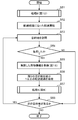
- FIG. 33 is a flowchart showing an example of processing of the information providing system according to Embodiment 11.
- the control unit 15 acquires the package DB 31, the package-delivery route DB 41, and the weather distance DB 320 from the memory 11.
- the control unit 15 of the server 1 acquires the weather information from the weather information providing server 3 using the communication unit 13.
- the transmitted weather information is the current weather information.
- the control unit 15 determines whether it is bad weather using the weather information acquired in S102.
- the control unit 15 refers to the weather distance DB 320 and sets the total walkable distance according to the determination result in S103.
- the determination result in S103 is bad weather
- 0.5 km is set as the total walkable distance
- 0.8 km is set as the total walkable distance.
- the process A is executed to specify the delivery route.
- Process A is the process of S2 to S4 in FIG.
- the control unit 15 calculates the total distance of the delivery route specified in S105.
- the control unit 15 specifies the respective distances of the routes included in the delivery route specified in S105 by referring to the route distance DBs 51 and 52, and obtains the sum of the distances of the specified routes.
- the total distance of the delivery route may be calculated. For example, in the example of the delivery route in FIG. 6, the respective distances of the routes “SR0001”, “DR0001”, and “SR0002” included in the delivery route are specified from the route distances DB51 and DB52, and the total distance is calculated. You.
- control unit 15 determines whether or not the total distance calculated in S106 is less than the total walkable distance set in S104. If the total distance is less than the walkable distance (YES in S107), the delivery route specified in S105 has an appropriate total distance with respect to the current weather, so that it is determined as an optimal delivery route, and the process ends. .
- the control unit 15 specifies the route having the longest distance among the routes configuring the delivery route specified in S105.
- the control unit 15 deletes one of the destinations located on the upstream and downstream sides of the longest route specified in S108 from the delivery route specified in S105.
- the control unit 15 deletes the destination if the longest route is a route connecting the destination to the destination from the delivery start location, and if the longest route is a route connecting the destinations, the destination is a destination on the downstream side. , And if the longest route is a route connecting the destination to the delivery start location, the destination may be deleted.
- the total distance that can be walked is set to a shorter distance than in a case other than bad weather, and the total distance of the delivery route is shorter than the set distance.
- the destination is deleted. Therefore, it is possible to suppress an increase in the burden on the delivery staff due to bad weather, and to ensure the safety of the delivery staff.
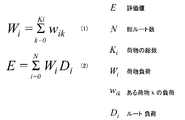
- E indicates an evaluation value.
- Wi indicates the load of the package according to the weight of the package held by the delivery member during the movement of the i-th route which is the i-th route forming the delivery route.
- Di indicates a route load according to the distance or the required time of the i-th route. For example, if the distance of the i-th route is 100 m, the route load Di is 100. Alternatively, if the time required for the delivery staff on the i-th route to walk is 5 minutes, the route load Di is 5.
- N indicates the total number of routes included in a certain delivery route. In the example of the delivery route in FIG. 6, the total number of routes is three.
- WWik shown in equation (1) indicates the load (for example, weight) of one package k held by the delivery person during the movement of the i-th route. Ki indicates the total number of packages carried during the movement of the i-th route. Therefore, the luggage load Wi shown in the equation (1) indicates the total load of the luggage held by the delivery staff on the i-th route.
- the evaluation value E increases as the distance of each route constituting the delivery route increases and as the weight of the package carried by each route increases. Therefore, by specifying the delivery route that minimizes the evaluation value E as the optimal delivery route, a delivery route with a low physical burden for the delivery member can be presented.
- the evaluation value E has a value that accurately reflects the burden on the delivery member since the load Wi of the package carried by the delivery member on foot is taken into account.
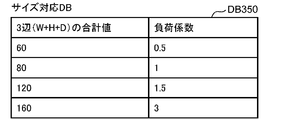
- FIG. 35 is a diagram illustrating an example of a data configuration of the size correspondence DB 350 stored in the memory 11 of the server 1 according to the thirteenth embodiment.
- the size correspondence DB 350 is a database that stores a load coefficient according to the size of the package, and stores “the total value of the three sides (W + H + D)” and the “load coefficient” in association with each other.
- the “total value of three sides (W + H + D)” is the total value of the width (W), height (H), and depth (D) of the load, and represents the size of the load.
- the “load coefficient” is a coefficient used when calculating the wick shown in Expression (1), and is set to a larger value as the size of the package increases. This load coefficient is an example of a first load coefficient.
- “Cool” indicates the type of luggage that needs to be cooled, such as fresh food or frozen food. “Golf” indicates the type of luggage in a golf bag that stores a plurality of golf clubs. “Normal” indicates a type of luggage other than these.
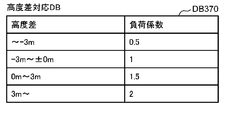
- FIG. 37 is a diagram illustrating an example of a data configuration of the altitude difference correspondence DB 370 stored in the memory 11 of the server 1 in the fifteenth embodiment.
- the altitude difference correspondence DB 370 is a database that stores a load coefficient corresponding to the altitude difference, and stores “altitude difference” and “load coefficient” in association with each other.
- “Altitude difference” indicates an altitude difference of the i-th route.
- the difference between the maximum altitude and the minimum altitude in the i-th route may be used as the altitude difference.
- the “load coefficient” is a coefficient used when calculating the route load Di shown in Expression (2), and is set to a larger value as the altitude difference increases in the ascending direction.
- This load coefficient is an example of a third load coefficient.
- the evaluation value calculation unit 12 selects 0.5 as the load coefficient when the altitude difference is ⁇ 3 m or less in the altitude difference correspondence DB 370, and loads the load coefficient when the altitude difference is greater than ⁇ 3 m and 0 m or less.
- the altitude difference is greater than 0 m and 3 m or less, 1.5 is selected as the coefficient, and when the altitude difference is greater than 3 m, 2 is selected as the load coefficient.
- Equation (2) the description will be given by taking an example of an i-th route having a distance of 100 m and a height difference of 3 m.
- the load coefficient is 1.5 from the altitude difference correspondence DB 370
- the evaluation value calculation unit 12 calculates the evaluation value E by substituting the route load Di calculated for each route in this way into Expression (2).
- the load Wi calculated by any one of the twelfth to fourteenth embodiments is used.
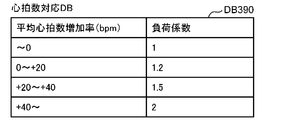
- the “average heart rate increase rate” corresponds to the “average heart rate increase rate” stored in the route distances DB381 and DB382.
- the “load coefficient” is a coefficient used when calculating the route load Di shown in Expression (2), and is set to a larger value as the average heart rate increase rate increases. This load coefficient is an example of a fourth load coefficient.
- the control unit 15 specifies the route having the highest load among the routes configuring the delivery route specified in S113.
- the load may be the luggage load Wi represented by the equation (2), the route load Di, or the delivery load represented by Wi ⁇ Di. Since the delivery route in FIG. 6 includes three routes of routes “SR0001”, “DR0001”, and “SR0002”, the route with the highest load among these routes is specified.
- information that contributes to the load on the delivery staff such as age and / or gender is input, and a delivery route is selected based on the information.
- the physical condition of the delivery staff changes daily. Therefore, before starting the delivery, it is possible to input the physical condition of the delivery staff such as “good physical condition”, “normal physical condition”, and “poor physical condition”, and calculate the delivery route according to the physical condition. It is.
- the delivery route was selected under the condition of "good physical condition", but in the afternoon the physical condition was not good
- Load coefficient (walk) and “load coefficient (trolley)” are coefficients used when calculating wik shown in equation (1), and are set to larger values as the size of the baggage increases. .
- the evaluation value calculation unit 12 selects 0.1 as the load coefficient (trolley), and the total value of the three sides is larger than 60 and 80. If not, select 0.2 as the load coefficient (trolley). If the total value of the three sides is greater than 80 and equal to or less than 120, select 0.4 as the load coefficient (trolley) and select the total of the three sides. If the value is larger than 120 and equal to or smaller than 160, 0.5 may be selected as the load coefficient (cart). When the total value of the three sides is larger than 160, the evaluation value calculation unit 12 may select, for example, 0.5 as the load coefficient (cart).
- FIG. 51 is a diagram showing an example of the data configuration of the type correspondence DB 360A stored in the memory 11 of the server 1 in the eighteenth embodiment.
- the type correspondence DB 360A includes, in the type correspondence DB 360 shown in FIG. 36, “load coefficient (walk)” and “load coefficient (cart)” instead of “load coefficient”.
- the “load coefficient (on foot)” is a load coefficient when the delivery person carries the luggage on foot, and is the same as the “load coefficient” in the type correspondence DB 360.
- the “load coefficient (trolley)” is a load coefficient when the delivery person uses the trolley to carry the load.
- Load coefficient (walk) and “load coefficient (trolley)” are coefficients used when calculating wik shown in equation (1), and are difficult to hold or require nervous handling. Larger values are set for the types of luggage that are more burdensome to carry.
- the altitude difference correspondence DB 370A includes, in the altitude difference correspondence DB 370 shown in FIG. 37, “load coefficient (walk)” and “load coefficient (cart)” instead of “load coefficient”.
- the “load coefficient (on foot)” is a load coefficient when the delivery staff carries the luggage on foot, and is the same as the “load coefficient” in the height difference correspondence DB 370.
- the “load coefficient (trolley)” is a load coefficient when the delivery person uses the trolley to carry the load.
- the value of the “load coefficient (cart)” is set to a smaller value than the value of the “load coefficient (walk)”.
- the evaluation value calculation unit 12 selects a load coefficient of 0.1 if the altitude difference is -3 m or less in the altitude difference DB 370A when the delivery person carries the luggage using the cart, Is greater than ⁇ 3 m and less than or equal to 0 m, a load coefficient of 0.2 is selected. If the altitude difference is greater than 0 m and less than or equal to 3 m, a load coefficient of 0.3 is selected. If the altitude difference is greater than 3 m, , 0.5 may be selected as the load coefficient.
- the route distance of the i-th route is calculated using the route distance DB 51A and the route distance DB 52A shown in FIG. 53 instead of the route distance DB 51 and the route distance DB 52 shown in FIG.
- FIG. 53 is a diagram showing an example of the data configuration of the route distance DB 51A and the route distance DB 52A according to the eighteenth embodiment.
- the route distance DB 51A is a database that stores information related to a route connecting destinations forming a delivery route indicated by the delivery route information stored in the delivery route DB 42.
- the route distance DB 51A is obtained by adding a “cart” to the route distance DB 51 shown in FIG. "Use of trolley” indicates whether a trolley is available in the corresponding route. For example, since a truck is available for the route “DR0001” in the first line, “OK” is described in the item of “Use a truck”, and a truck is not available for the route “DR0002” in the second line. , "Unavailable” is described in the item "Use of dolly”.
- the route distance DB 52A is a database that stores information relating to a route that connects a delivery start place and a destination that constitutes a delivery route indicated by the delivery route information stored in the delivery route DB 42.
- the item "Use trolley” is added.
- the item of “trolley use” indicates whether or not the trolley is available in the corresponding route. For example, since a truck is available for the route “SR0001” on the first line, “OK” is described in the item of “Use a truck”, and a truck is not available for the route “SR0002” on the second line. It is described as "impossible”.
- the wik of the expression (1) is calculated using the value of “load coefficient (cart)” of the size correspondence DB 350A or the type correspondence DB 360A.
- the calculated route load Di of Expression (2) is calculated using the value of the “load coefficient (bogie)” of the altitude difference correspondence DB.
- the route in which the trolley cannot be used is, for example, a route in which the width of the trajectory is narrower than the width of the trolley, a route in which the trolley is difficult to move due to the soft ground, a route including stairs, and a route in which the trolley is difficult to move due to a steep slope. It is.
- FIG. 54 is a flowchart showing an example of processing of the information providing system according to the eighteenth embodiment.
- the control unit 15 of the server 1 reads the luggage DB 31, the luggage-delivery route DB 41, the size correspondence DB 350A or the type correspondence DB 360A, the altitude difference correspondence DB 370A, the route distance DB 51A, and the route distance DB 52A from the memory 11. To get.
- the evaluation value calculation unit 12 extracts a plurality of delivery routes corresponding to a plurality of packages to be delivered, which are delivered collectively by a delivery person on foot or by trolley.
- a package ID corresponding to a plurality of packages to be delivered is specified from the multiple package DB 43
- a delivery route ID corresponding to the package ID is specified from the package-delivery route DB 41
- a plurality of deliveries corresponding to the delivery route ID are specified.
- the route is specified from the delivery route DB 42.
- the evaluation value calculation unit 12 refers to the size correspondence DB 350A or the type correspondence DB 360A and the altitude difference correspondence DB 370A to determine the load coefficient of the route that can be used by the bogie.
- the value of the “load coefficient (cart)” is acquired by referring to the size correspondence DB 350A or the type correspondence DB 360A, and the altitude difference is calculated.
- the value of “load coefficient (cart)” is acquired with reference to the correspondence DB 370A.
- the process A is S2 to S4 in FIG.
- the process of extracting a plurality of delivery routes is omitted in S2, and an evaluation value is calculated for each of the plurality of delivery routes extracted in S122.
- a delivery route indicating whether or not the trolley is available is output for each route.
- the delivery routes output here include those in which a trolley is available for all routes, those in which trolleys are available for some routes, and those in which trolleys are unavailable for all routes.
- the handling of the bogie is not particularly referred to.
- the evaluation value is calculated. Is also good.
- the delivery routes in this case are, for example, the first route “SR0001”, the second route “DR0001”, the third route “DR0001”, and the fourth route “SR0001”.
- the luggage load W1 and the route load D1 on the first route “SR0001” are calculated as the luggage load and the route load when all the luggage is carried by the trolley.
- the luggage load W2 and the route load D2 in the second route “DR0001” are calculated as the luggage load and the route load when the remaining luggage is carried on foot.
- the luggage load W3 and the route load D3 in the third route “DR0001” are further calculated as the luggage load and the route load when the luggage bag or the like is carried on foot when there is no remaining luggage or luggage.
- the luggage load W4 and the route load D4 in the fourth route “SR0001” are further calculated as the luggage load when a luggage bag or the like is carried by a trolley when there is no remaining luggage or luggage.
- the evaluation value is calculated in consideration of whether or not the luggage can be carried by the trolley, so that the evaluation value that more accurately reflects the physical load of the delivery staff is calculated. it can. Further, in this embodiment, a delivery route indicating which route the trolley can use and which route the trolley cannot be used is presented to the delivery staff, so the delivery staff can use the trolley appropriately and efficiently load the luggage. Can be delivered.
- FIG. 55 is a diagram illustrating an example of a network configuration of the information providing system according to the nineteenth embodiment.
- a user terminal 4 an example of a second information terminal is further added to the information providing system shown in FIG.
- the user terminal 4 is the terminal of the recipient of the package.
- the user terminal 4 may be configured by a portable information terminal such as a smartphone, a mobile phone, and a tablet terminal, or may be configured by a stationary information processing terminal.
- the server 1 acquires information indicating that from the delivery terminal 2 via the network NT.
- the delivery terminal 2 acquires, for example, the position information of the delivery vehicle from the GPS sensor provided in the delivery vehicle, and when the position information indicates that the delivery vehicle has been stopped for a predetermined period or more, the delivery member Is determined to have got off from the delivery vehicle, and a get-off signal may be transmitted to the server 1.
- the deliveryman terminal 2 may obtain a signal indicating that the engine of the delivery vehicle has been stopped from the delivery vehicle.
- the getting-off signal may be transmitted to the server 1.
- the delivery terminal 2 transmits a getting-off signal to the server 1 when a signal indicating that the door of the delivery vehicle has been opened or closed has been obtained from the delivery vehicle instead of or in addition to the above conditions. May be.
- the control unit 15 of the server 1 When acquiring the disembarkation signal transmitted from the delivery terminal 2, the control unit 15 of the server 1 specifies one or a plurality of recipients of the package to be delivered to the delivery clerk by the disembarkation signal indicated by the disembarkation signal, and specifies the specified reception.
- the information indicating that the delivery staff is heading to the human user terminal 4 is transmitted via the communication unit 13.
- the control unit 15 determines that the distance from the delivery start location is equal to or less than the threshold. Baggage destined for a location may be extracted based on the baggage DB 31 and the customer DB 32, and the recipient of the extracted baggage may be specified from the customer DB 32.
- the control unit 15 may specify the recipient as described below.
- the control unit 15 guides the delivery vehicle to a predetermined delivery start location as described in the third embodiment.
- the control unit 15 obtains the getting-off signal from the delivery terminal 2, and the control unit 15 specifies the recipient using the above-described method. Just fine.
- FIG. 56 is a diagram illustrating an example of a notification screen G56 displayed on the user terminal 4 when notifying information indicating that the delivery vehicle is heading for the recipient in the nineteenth embodiment.
- the notification screen G56 is provided with a heading “Delivery Notification”. Below this heading is a message that the package will be delivered soon. Here, a message is displayed that says, "It will be delivered soon. I will visit three customers after visiting Sato's home. Please wait a little longer.”
- this message includes information indicating the number of remaining packages to be delivered to the recipient after the delivery.
- the recipient can know the approximate time from when the delivery person will visit his / her home.
- the recipient can prepare to receive the package, can receive the package with a margin, and can receive the package more reliably.
- the fact that the delivery person is heading is transmitted to the user terminal 4 of the package recipient, so that the delivery The absence of a person can be prevented.
- FIG. 42 is a diagram illustrating an example of the delivery route RO.
- This delivery route RO is a delivery route that departs from point X, which is the delivery start location, and returns to point X through house A, which is the destination, and house B, which is the next destination.
- FIG. 43 is a diagram showing the delivery route RO shown in FIG. 42 by a stochastic binary tree T1.
- the binary tree T1 is composed of a path P1 connecting the house A from the X point, a path P2 connecting the house A to the house B when the house A is at home, and a path P3 connecting the house A to the house B when the house A is absent. Thus, it is represented by seven paths P1 to P7 according to whether the user is at home or not.
- FIG. 46 is a diagram further describing the binary tree T1 shown in FIG.
- the evaluation value EXA between the path P1 between the point X and the house A will be described.
- the weight of the baggage carried by the delivery person between the point X and the house A is the sum of 4 kg of the baggage LA, 7 kg of the baggage LB, and 1 kg of the baggage bag.
- FIG. 47 is a diagram further describing the binary tree T1 shown in FIG.
- the evaluation value EAB between the home A and the home B will be described.
- the weight of the baggage carried by the delivery member is the sum of 7 kg of baggage LB and 1 kg of baggage bag.
- the weight of the baggage carried by the delivery member is the sum of 4 kg of the baggage LA, 7 kg of the baggage LB, and 1 kg of the baggage bag.
- an efficient delivery route can be presented when the delivery staff carries the luggage on foot, which is useful for improving the efficiency of the delivery work of the delivery staff.
- Server 2 Delivery staff terminal 3: Weather information providing server 11: Memory 12: Evaluation value calculation unit 13: Communication unit 14: Delivery route identification unit 15: Control unit 21: Memory 22: GPS 23: control unit 24: reading unit 25: communication unit 26: display unit 27: input unit
Landscapes
- Business, Economics & Management (AREA)
- Engineering & Computer Science (AREA)
- Human Resources & Organizations (AREA)
- Economics (AREA)
- Physics & Mathematics (AREA)
- General Physics & Mathematics (AREA)
- Strategic Management (AREA)
- Entrepreneurship & Innovation (AREA)
- General Business, Economics & Management (AREA)
- Operations Research (AREA)
- Quality & Reliability (AREA)
- Marketing (AREA)
- Tourism & Hospitality (AREA)
- Development Economics (AREA)
- Theoretical Computer Science (AREA)
- Health & Medical Sciences (AREA)
- Radar, Positioning & Navigation (AREA)
- Remote Sensing (AREA)
- Public Health (AREA)
- Medical Informatics (AREA)
- Biomedical Technology (AREA)
- Game Theory and Decision Science (AREA)
- General Health & Medical Sciences (AREA)
- Life Sciences & Earth Sciences (AREA)
- Automation & Control Theory (AREA)
- Pathology (AREA)
- Primary Health Care (AREA)
- Epidemiology (AREA)
- Cardiology (AREA)
- Educational Administration (AREA)
- Physiology (AREA)
- Animal Behavior & Ethology (AREA)
- Surgery (AREA)
- Molecular Biology (AREA)
- Veterinary Medicine (AREA)
- Heart & Thoracic Surgery (AREA)
- Biophysics (AREA)
- Data Mining & Analysis (AREA)
- Databases & Information Systems (AREA)
- Management, Administration, Business Operations System, And Electronic Commerce (AREA)
Abstract
Des premières informations de colis indiquant la taille ou le poids de chaque colis parmi une pluralité de colis et des premières informations d'itinéraire de livraison indiquant une pluralité de premiers itinéraires de livraison sont acquises à partir d'une mémoire (S1). Sur la base des premières informations de colis et des premières informations d'itinéraire de livraison, des valeurs d'évaluation de chaque itinéraire parmi la pluralité de premiers itinéraires de livraison sont calculées (S2), chaque itinéraire parmi la pluralité de premiers itinéraires de livraison partant d'un site de commencement de livraison, parcourant une pluralité de destinations auxquelles la pluralité de colis doit être livrée, et se terminant au site de commencement de livraison. Sur la base de la pluralité de valeurs d'évaluation calculées, un premier itinéraire optimal de livraison est identifié parmi la pluralité de premiers itinéraires de livraison (S3). Des informations indiquant le premier itinéraire de livraison identifié sont délivrées à un terminal (S4) d'informations, le premier itinéraire de livraison identifié est affiché sur un affichage du terminal d'informations, et un livreur livre la pluralité de colis à la pluralité de destinations le long du premier itinéraire de livraison identifié.
Priority Applications (5)
| Application Number | Priority Date | Filing Date | Title |
|---|---|---|---|
| CN201980027278.9A CN112020726B (zh) | 2018-06-27 | 2019-05-24 | 信息提供方法以及信息提供系统 |
| JP2020527291A JP7413260B2 (ja) | 2018-06-27 | 2019-05-24 | 情報提供方法 |
| US17/073,456 US20210035064A1 (en) | 2018-06-27 | 2020-10-19 | Information providing method and information providing system |
| JP2023182702A JP7585428B2 (ja) | 2018-06-27 | 2023-10-24 | 情報提供方法 |
| JP2024193730A JP2025013496A (ja) | 2018-06-27 | 2024-11-05 | 情報提供方法 |
Applications Claiming Priority (4)
| Application Number | Priority Date | Filing Date | Title |
|---|---|---|---|
| JP2018122084 | 2018-06-27 | ||
| JP2018-122084 | 2018-06-27 | ||
| JP2019014658 | 2019-01-30 | ||
| JP2019-014658 | 2019-01-30 |
Related Child Applications (1)
| Application Number | Title | Priority Date | Filing Date |
|---|---|---|---|
| US17/073,456 Continuation US20210035064A1 (en) | 2018-06-27 | 2020-10-19 | Information providing method and information providing system |
Publications (1)
| Publication Number | Publication Date |
|---|---|
| WO2020003832A1 true WO2020003832A1 (fr) | 2020-01-02 |
Family
ID=68985598
Family Applications (1)
| Application Number | Title | Priority Date | Filing Date |
|---|---|---|---|
| PCT/JP2019/020657 Ceased WO2020003832A1 (fr) | 2018-06-27 | 2019-05-24 | Procédé et système de fourniture d'informations |
Country Status (4)
| Country | Link |
|---|---|
| US (1) | US20210035064A1 (fr) |
| JP (3) | JP7413260B2 (fr) |
| CN (1) | CN112020726B (fr) |
| WO (1) | WO2020003832A1 (fr) |
Cited By (14)
| Publication number | Priority date | Publication date | Assignee | Title |
|---|---|---|---|---|
| EP3821888A1 (fr) | 2017-05-07 | 2021-05-19 | Yeda Research and Development Co. Ltd | Agonistes de lxr pour le traitement de troubles de stress psychiatriques |
| JP2021120777A (ja) * | 2020-01-30 | 2021-08-19 | アスクル株式会社 | 配達支援方法、配達支援装置、およびプログラム |
| US20210272065A1 (en) * | 2020-02-27 | 2021-09-02 | Kabushiki Kaisha Toshiba | Information processing apparatus, information processing system, information processing method, information processing program, and display device |
| CN113393055A (zh) * | 2021-07-05 | 2021-09-14 | 苏州清研捷运信息科技有限公司 | 一种货车导航沿途限行数据的预处理及使用方法 |
| JPWO2021192527A1 (fr) * | 2020-03-27 | 2021-09-30 | ||
| JP2022175872A (ja) * | 2021-05-14 | 2022-11-25 | トヨタ自動車株式会社 | 物流システム、物流ロボット、及び物流ロボット制御方法 |
| JP7179221B1 (ja) * | 2021-07-16 | 2022-11-28 | 三菱電機株式会社 | 情報処理装置、情報処理システム、情報処理方法、及び情報処理プログラム |
| JP2022188589A (ja) * | 2021-06-09 | 2022-12-21 | 日本電気株式会社 | データ分析装置、データ分析方法、およびプログラム |
| JP2023027704A (ja) * | 2021-08-17 | 2023-03-02 | 日産自動車株式会社 | 情報処理装置、情報処理方法、プログラム及び情報処理システム |
| JP7234452B1 (ja) | 2022-11-02 | 2023-03-07 | 株式会社セブン&アイ・ホールディングス | 配送管理装置、配送管理方法及び配送管理プログラム |
| WO2023139744A1 (fr) * | 2022-01-21 | 2023-07-27 | 三菱電機株式会社 | Dispositif de mise à jour d'itinéraire d'exploitation, procédé de mise à jour d'itinéraire d'exploitation et programme de mise à jour d'itinéraire d'exploitation |
| JP2024048274A (ja) * | 2022-09-27 | 2024-04-08 | トヨタ自動車株式会社 | 配送支援装置 |
| WO2024142156A1 (fr) * | 2022-12-26 | 2024-07-04 | 三菱電機株式会社 | Dispositif de traitement d'informations, système de traitement d'informations, procédé de traitement d'informations et programme de traitement d'informations |
| WO2024176350A1 (fr) * | 2023-02-21 | 2024-08-29 | 日本電気株式会社 | Dispositif de gestion, procédé de gestion et support d'enregistrement |
Families Citing this family (9)
| Publication number | Priority date | Publication date | Assignee | Title |
|---|---|---|---|---|
| US11495030B1 (en) * | 2019-12-12 | 2022-11-08 | Amazon Technologies, Inc. | Systems and methods for creating an occupancy map based on an objective function |
| GB2592066A (en) * | 2020-02-17 | 2021-08-18 | Ford Global Tech Llc | Delivery optimisation |
| JP7368311B2 (ja) * | 2020-05-21 | 2023-10-24 | トヨタ自動車株式会社 | 情報処理方法、情報処理装置、及びプログラム |
| US20220044198A1 (en) * | 2020-08-10 | 2022-02-10 | Here Global B.V. | Method and apparatus for dynamic load selection and parking calculation for last mile delivery |
| CN112801592A (zh) * | 2021-02-09 | 2021-05-14 | 北京橙心无限科技发展有限公司 | 规划配送路径的方法和装置 |
| US12045767B1 (en) | 2021-02-25 | 2024-07-23 | Amazon Technologies, Inc. | System for determining and augmenting delivery routes |
| US11619512B1 (en) * | 2021-02-25 | 2023-04-04 | Amazon Technologies, Inc. | Device for presenting augmented delivery routes |
| WO2023038590A1 (fr) * | 2021-04-23 | 2023-03-16 | D Fast Dagitim Hizmetleri Ve Lojistik Anonim Sirketi | Procédé permettant de recevoir des expéditions provenant de clients pendant une distribution de marchandises |
| JP2024141363A (ja) * | 2023-03-29 | 2024-10-10 | 理想科学工業株式会社 | 配送物情報管理システム、配送物情報管理装置、方法およびプログラム並びに印刷装置 |
Citations (3)
| Publication number | Priority date | Publication date | Assignee | Title |
|---|---|---|---|---|
| JPH11271081A (ja) * | 1998-03-24 | 1999-10-05 | Fujitsu Ten Ltd | ナビゲーション装置 |
| WO2018021027A1 (fr) * | 2016-07-29 | 2018-02-01 | ダイムラー・アクチェンゲゼルシャフト | Système de sélection d'itinéraire de déplacement sur piste électrique, procédé de sélection d'itinéraire de déplacement sur piste électrique |
| WO2018047289A1 (fr) * | 2016-09-09 | 2018-03-15 | 株式会社日立物流 | Dispositif, procédé et programme d'évaluation |
Family Cites Families (19)
| Publication number | Priority date | Publication date | Assignee | Title |
|---|---|---|---|---|
| GB1601592A (en) * | 1978-05-31 | 1981-11-04 | Tamkin M R | Distributing and sorting apparatus |
| JP2673403B2 (ja) * | 1992-06-23 | 1997-11-05 | 本田技研工業株式会社 | 経路探索装置 |
| JPH07200903A (ja) * | 1993-12-28 | 1995-08-04 | Toshiba Corp | 配送ルート設定システム |
| JP2003141222A (ja) * | 2001-10-22 | 2003-05-16 | Internatl Business Mach Corp <Ibm> | 配送計画を作成する方法、システム、プログラム |
| JP2004026344A (ja) * | 2002-06-21 | 2004-01-29 | Toyota Motor Corp | 作業者が分担する部品群の決定装置 |
| US7778773B2 (en) * | 2007-05-02 | 2010-08-17 | Toshiba America Research, Inc. | Optimum route planning for service vehicles |
| JP4965345B2 (ja) * | 2007-06-11 | 2012-07-04 | アイコクアルファ株式会社 | 荷役物運搬機の導入評価システム |
| JP2011180005A (ja) * | 2010-03-02 | 2011-09-15 | Saxa Inc | 目的地案内装置、目的地案内システム、サーバ装置および目的地案内方法 |
| US8630958B2 (en) * | 2011-06-03 | 2014-01-14 | Cardinal Optimization, Inc. | Systems and methods for multi-vehicle resource allocation and routing solutions |
| CN102496096A (zh) * | 2011-11-25 | 2012-06-13 | 深圳市赛格导航科技股份有限公司 | 一种高效的物流调度系统和方法 |
| US10387822B1 (en) * | 2013-02-07 | 2019-08-20 | United Parcel Service Of America, Inc. | Systems and methods for synchronized delivery |
| US10467580B1 (en) * | 2013-08-12 | 2019-11-05 | United Parcel Service Of America, Inc. | Methods, apparatuses and computer program products for generating logistics zones |
| JP6524577B2 (ja) * | 2015-02-23 | 2019-06-05 | 南洋アスピレーション株式会社 | 配送状況管理サービスを提供するための方法およびプログラム、ならびにそれに用いられるサーバおよびシステム |
| CN104881710B (zh) * | 2015-05-11 | 2018-07-17 | 浙江大学 | 一种基于车辆自组网的城市快递配送方法 |
| CN106920053A (zh) * | 2015-12-25 | 2017-07-04 | 阿里巴巴集团控股有限公司 | 一种对配送点的配送运力进行分配的方法以及装置 |
| US20170262803A1 (en) * | 2016-03-14 | 2017-09-14 | United Parcel Service Of America, Inc. | Determining estimated pick-up/delivery windows using clustering |
| CN106779529A (zh) * | 2016-11-23 | 2017-05-31 | 合肥壹客送网络科技有限公司 | 一种商品货物配送方法及系统 |
| CN106779173A (zh) * | 2016-11-25 | 2017-05-31 | 浙江工业大学 | 一种物流配送车辆路径优化方法 |
| CN107274033B (zh) * | 2017-06-29 | 2021-04-06 | 安徽电信规划设计有限责任公司 | 一种简便易行的动态配送路径优化方法 |
-
2019
- 2019-05-24 WO PCT/JP2019/020657 patent/WO2020003832A1/fr not_active Ceased
- 2019-05-24 CN CN201980027278.9A patent/CN112020726B/zh active Active
- 2019-05-24 JP JP2020527291A patent/JP7413260B2/ja active Active
-
2020
- 2020-10-19 US US17/073,456 patent/US20210035064A1/en not_active Abandoned
-
2023
- 2023-10-24 JP JP2023182702A patent/JP7585428B2/ja active Active
-
2024
- 2024-11-05 JP JP2024193730A patent/JP2025013496A/ja active Pending
Patent Citations (3)
| Publication number | Priority date | Publication date | Assignee | Title |
|---|---|---|---|---|
| JPH11271081A (ja) * | 1998-03-24 | 1999-10-05 | Fujitsu Ten Ltd | ナビゲーション装置 |
| WO2018021027A1 (fr) * | 2016-07-29 | 2018-02-01 | ダイムラー・アクチェンゲゼルシャフト | Système de sélection d'itinéraire de déplacement sur piste électrique, procédé de sélection d'itinéraire de déplacement sur piste électrique |
| WO2018047289A1 (fr) * | 2016-09-09 | 2018-03-15 | 株式会社日立物流 | Dispositif, procédé et programme d'évaluation |
Cited By (26)
| Publication number | Priority date | Publication date | Assignee | Title |
|---|---|---|---|---|
| EP3821888A1 (fr) | 2017-05-07 | 2021-05-19 | Yeda Research and Development Co. Ltd | Agonistes de lxr pour le traitement de troubles de stress psychiatriques |
| JP2021120777A (ja) * | 2020-01-30 | 2021-08-19 | アスクル株式会社 | 配達支援方法、配達支援装置、およびプログラム |
| US20210272065A1 (en) * | 2020-02-27 | 2021-09-02 | Kabushiki Kaisha Toshiba | Information processing apparatus, information processing system, information processing method, information processing program, and display device |
| US12014302B2 (en) * | 2020-02-27 | 2024-06-18 | Kabushiki Kaisha Toshiba | Information processing apparatus, information processing system, information processing method, information processing program, and display device |
| JPWO2021192527A1 (fr) * | 2020-03-27 | 2021-09-30 | ||
| WO2021192527A1 (fr) * | 2020-03-27 | 2021-09-30 | パイオニア株式会社 | Dispositif de traitement d'informations, procédé de traitement d'informations, programme de traitement d'informations et support d'informations |
| JP2023184712A (ja) * | 2020-03-27 | 2023-12-28 | パイオニア株式会社 | 情報処理装置 |
| JP2024091865A (ja) * | 2021-05-14 | 2024-07-05 | トヨタ自動車株式会社 | 管理システム、制御方法、及びロボット |
| JP2022175872A (ja) * | 2021-05-14 | 2022-11-25 | トヨタ自動車株式会社 | 物流システム、物流ロボット、及び物流ロボット制御方法 |
| JP7643620B2 (ja) | 2021-05-14 | 2025-03-11 | トヨタ自動車株式会社 | 管理システム、制御方法、及びロボット |
| JP7480746B2 (ja) | 2021-05-14 | 2024-05-10 | トヨタ自動車株式会社 | 物流システム、物流ロボット、及び物流ロボット制御方法 |
| JP7711437B2 (ja) | 2021-06-09 | 2025-07-23 | 日本電気株式会社 | データ分析装置、データ分析方法、およびプログラム |
| JP2022188589A (ja) * | 2021-06-09 | 2022-12-21 | 日本電気株式会社 | データ分析装置、データ分析方法、およびプログラム |
| CN113393055B (zh) * | 2021-07-05 | 2023-07-25 | 苏州清研捷运信息科技有限公司 | 一种货车导航沿途限行数据的预处理及使用方法 |
| CN113393055A (zh) * | 2021-07-05 | 2021-09-14 | 苏州清研捷运信息科技有限公司 | 一种货车导航沿途限行数据的预处理及使用方法 |
| JP7179221B1 (ja) * | 2021-07-16 | 2022-11-28 | 三菱電機株式会社 | 情報処理装置、情報処理システム、情報処理方法、及び情報処理プログラム |
| JP7742257B2 (ja) | 2021-08-17 | 2025-09-19 | 日産自動車株式会社 | 情報処理装置、情報処理方法、プログラム及び情報処理システム |
| JP2023027704A (ja) * | 2021-08-17 | 2023-03-02 | 日産自動車株式会社 | 情報処理装置、情報処理方法、プログラム及び情報処理システム |
| WO2023139744A1 (fr) * | 2022-01-21 | 2023-07-27 | 三菱電機株式会社 | Dispositif de mise à jour d'itinéraire d'exploitation, procédé de mise à jour d'itinéraire d'exploitation et programme de mise à jour d'itinéraire d'exploitation |
| JP2024048274A (ja) * | 2022-09-27 | 2024-04-08 | トヨタ自動車株式会社 | 配送支援装置 |
| JP7760977B2 (ja) | 2022-09-27 | 2025-10-28 | トヨタ自動車株式会社 | 配送支援装置 |
| JP2024066637A (ja) * | 2022-11-02 | 2024-05-16 | 株式会社セブン&アイ・ホールディングス | 配送管理装置、配送管理方法及び配送管理プログラム |
| JP7234452B1 (ja) | 2022-11-02 | 2023-03-07 | 株式会社セブン&アイ・ホールディングス | 配送管理装置、配送管理方法及び配送管理プログラム |
| JPWO2024142156A1 (fr) * | 2022-12-26 | 2024-07-04 | ||
| WO2024142156A1 (fr) * | 2022-12-26 | 2024-07-04 | 三菱電機株式会社 | Dispositif de traitement d'informations, système de traitement d'informations, procédé de traitement d'informations et programme de traitement d'informations |
| WO2024176350A1 (fr) * | 2023-02-21 | 2024-08-29 | 日本電気株式会社 | Dispositif de gestion, procédé de gestion et support d'enregistrement |
Also Published As
| Publication number | Publication date |
|---|---|
| US20210035064A1 (en) | 2021-02-04 |
| JP7413260B2 (ja) | 2024-01-15 |
| JP2023175016A (ja) | 2023-12-08 |
| JPWO2020003832A1 (ja) | 2021-08-12 |
| JP2025013496A (ja) | 2025-01-24 |
| CN112020726B (zh) | 2024-06-21 |
| JP7585428B2 (ja) | 2024-11-18 |
| CN112020726A (zh) | 2020-12-01 |
Similar Documents
| Publication | Publication Date | Title |
|---|---|---|
| JP7585428B2 (ja) | 情報提供方法 | |
| JP7135014B2 (ja) | ライドシェア管理装置、ライドシェア管理方法、およびプログラム | |
| US9293048B2 (en) | Method for efficient dynamic allocation of vehicles to independent passengers | |
| US9057619B2 (en) | Optimal path search system and optimal path search method | |
| US11386362B1 (en) | System and method for optimizing waste / recycling collection and delivery routes for service vehicles | |
| JP6578524B2 (ja) | 交通手段情報提供サーバ及び交通手段情報提供方法 | |
| US12339128B2 (en) | Dynamically determining provider-transportation routes and rental-vehicle routes for a multi-modal graphical user interface | |
| CN112446529A (zh) | 一种物流装置和方法 | |
| JP2010039961A (ja) | 配送業務支援システム、配送予測時間算出方法及びプログラム | |
| JP5914399B2 (ja) | タクシー案内システムおよびタクシー案内方法 | |
| JP2009274875A (ja) | 個別宅配システム及びそれに適合するナビゲーションシステム | |
| JP5565104B2 (ja) | 情報提供システム | |
| US20090105941A1 (en) | Automatic destination determination for multiple travelers departing from multiple source locations based on user specified criteria | |
| JP3781013B2 (ja) | 営業区域を考慮した移動車両配車プログラム、移動車両配車方法 | |
| CN113657681B (zh) | 联结智能公交站台和共享交通的方法、系统和存储介质 | |
| JP7538292B2 (ja) | 情報提供方法 | |
| US20210065111A1 (en) | Systems and methods for item delivery using a mobility-as-a-service system | |
| JP2000028381A (ja) | ナビゲーション装置 | |
| Fang et al. | A multi-criteria system for recommending taxi routes with an advance reservation | |
| JP2024041393A (ja) | 駐車マス提案装置および駐車マス提案方法 | |
| Barnéoud et al. | The environmental footprint of home and out-of-home parcels delivery | |
| JP6978230B2 (ja) | 提供装置、提供方法、提供プログラムおよび算出装置 | |
| JP4443704B2 (ja) | 営業車用客情報提供システム | |
| JP2025111186A (ja) | 作業地点取得システム | |
| WO2025100503A1 (fr) | Dispositif de traitement d'informations et procédé d'aide à l'activité d'exercice |
Legal Events
| Date | Code | Title | Description |
|---|---|---|---|
| 121 | Ep: the epo has been informed by wipo that ep was designated in this application |
Ref document number: 19826257 Country of ref document: EP Kind code of ref document: A1 |
|
| DPE1 | Request for preliminary examination filed after expiration of 19th month from priority date (pct application filed from 20040101) | ||
| ENP | Entry into the national phase |
Ref document number: 2020527291 Country of ref document: JP Kind code of ref document: A |
|
| NENP | Non-entry into the national phase |
Ref country code: DE |
|
| 122 | Ep: pct application non-entry in european phase |
Ref document number: 19826257 Country of ref document: EP Kind code of ref document: A1 |