WO2020003882A1 - Moissonneuse-batteuse, procédé de calcul de rendement, système de calcul de rendement, programme de calcul de rendement, support d'enregistrement ayant un programme de calcul de rendement enregistré sur celui-ci, procédé de calcul de rendement de décharge de grains, système de calcul de rendement de décharge de grains, programme de calcul de rendement de décharge de grains, support d'enregistrement ayant un programme de calcul de rendement de décharge de grains enregistré sur celui-ci, système de détection d'entrée irrégulière, programme de détection d'entrée irrégulière, support d'enregistrement ayant un programme de détection d'entrée irrégulière enregistré sur celui-ci, procédé de détection d'entrée irrégulière, et système de détection de niveau de stockage - Google Patents
Moissonneuse-batteuse, procédé de calcul de rendement, système de calcul de rendement, programme de calcul de rendement, support d'enregistrement ayant un programme de calcul de rendement enregistré sur celui-ci, procédé de calcul de rendement de décharge de grains, système de calcul de rendement de décharge de grains, programme de calcul de rendement de décharge de grains, support d'enregistrement ayant un programme de calcul de rendement de décharge de grains enregistré sur celui-ci, système de détection d'entrée irrégulière, programme de détection d'entrée irrégulière, support d'enregistrement ayant un programme de détection d'entrée irrégulière enregistré sur celui-ci, procédé de détection d'entrée irrégulière, et système de détection de niveau de stockage Download PDFInfo
- Publication number
- WO2020003882A1 WO2020003882A1 PCT/JP2019/021536 JP2019021536W WO2020003882A1 WO 2020003882 A1 WO2020003882 A1 WO 2020003882A1 JP 2019021536 W JP2019021536 W JP 2019021536W WO 2020003882 A1 WO2020003882 A1 WO 2020003882A1
- Authority
- WO
- WIPO (PCT)
- Prior art keywords
- grain
- flow rate
- kernel
- yield
- tank
- Prior art date
- Legal status (The legal status is an assumption and is not a legal conclusion. Google has not performed a legal analysis and makes no representation as to the accuracy of the status listed.)
- Ceased
Links
Images











Classifications
-
- A—HUMAN NECESSITIES
- A01—AGRICULTURE; FORESTRY; ANIMAL HUSBANDRY; HUNTING; TRAPPING; FISHING
- A01D—HARVESTING; MOWING
- A01D41/00—Combines, i.e. harvesters or mowers combined with threshing devices
- A01D41/12—Details of combines
- A01D41/127—Control or measuring arrangements specially adapted for combines
- A01D41/1271—Control or measuring arrangements specially adapted for combines for measuring crop flow
- A01D41/1272—Control or measuring arrangements specially adapted for combines for measuring crop flow for measuring grain flow
-
- A—HUMAN NECESSITIES
- A01—AGRICULTURE; FORESTRY; ANIMAL HUSBANDRY; HUNTING; TRAPPING; FISHING
- A01D—HARVESTING; MOWING
- A01D41/00—Combines, i.e. harvesters or mowers combined with threshing devices
- A01D41/12—Details of combines
- A01D41/127—Control or measuring arrangements specially adapted for combines
-
- A—HUMAN NECESSITIES
- A01—AGRICULTURE; FORESTRY; ANIMAL HUSBANDRY; HUNTING; TRAPPING; FISHING
- A01D—HARVESTING; MOWING
- A01D41/00—Combines, i.e. harvesters or mowers combined with threshing devices
- A01D41/12—Details of combines
- A01D41/127—Control or measuring arrangements specially adapted for combines
- A01D41/1275—Control or measuring arrangements specially adapted for combines for the level of grain in grain tanks
-
- A—HUMAN NECESSITIES
- A01—AGRICULTURE; FORESTRY; ANIMAL HUSBANDRY; HUNTING; TRAPPING; FISHING
- A01F—PROCESSING OF HARVESTED PRODUCE; HAY OR STRAW PRESSES; DEVICES FOR STORING AGRICULTURAL OR HORTICULTURAL PRODUCE
- A01F12/00—Parts or details of threshing apparatus
- A01F12/60—Grain tanks
-
- B—PERFORMING OPERATIONS; TRANSPORTING
- B60—VEHICLES IN GENERAL
- B60Y—INDEXING SCHEME RELATING TO ASPECTS CROSS-CUTTING VEHICLE TECHNOLOGY
- B60Y2200/00—Type of vehicle
- B60Y2200/20—Off-Road Vehicles
- B60Y2200/22—Agricultural vehicles
- B60Y2200/222—Harvesters
-
- B—PERFORMING OPERATIONS; TRANSPORTING
- B60—VEHICLES IN GENERAL
- B60Y—INDEXING SCHEME RELATING TO ASPECTS CROSS-CUTTING VEHICLE TECHNOLOGY
- B60Y2400/00—Special features of vehicle units
- B60Y2400/30—Sensors
Definitions
- the present invention relates to a combine provided with a grain tank for storing threshed grains, and a technique for calculating the yield of the grains stored in the grain tank.
- the present invention also relates to a combine provided with a grain tank for storing threshed grains, and a technique for calculating the discharge yield of the grains stored in the grain tank.
- the present invention also provides a grain transport device for transporting grains obtained by a threshing apparatus for threshing a harvested grain culm and feeding the grains into a grain tank, and measuring a flow rate of grains fed to the grain tank.
- a grain transport device for transporting grains obtained by a threshing apparatus for threshing a harvested grain culm and feeding the grains into a grain tank, and measuring a flow rate of grains fed to the grain tank.
- a combine having a flow rate measuring means and a combine vessel having a measuring vessel that receives and stores a part of the grain to be supplied to a grain tank from a receiving port, an illegal inflow of the grain flowing into the measuring vessel is detected.
- a combine having a flow rate measuring means and a combine vessel having a measuring vessel that receives and stores a part of the grain to be supplied to a grain tank from a receiving port.
- the present invention provides a traveling machine, a threshing device for threshing a harvested culm, a grain tank for storing grains obtained by the threshing device, and a grain for transporting grains obtained by the threshing device.
- the present invention relates to a combine provided with a grain transport device to be charged into the tank of a grain tank, and a technique for detecting the storage level of the grain tank of such a combine.
- Some combiners include a grain tank for storing threshed grains and a grain discharging device for discharging the grains stored in the grain tank to the outside.
- the grains stored in the grain tank are generally discharged from the grain discharging device when the grain tank is full. Therefore, the combine disclosed in Patent Literature 2 includes a full sensor that detects that the grains in the grain tank are full.
- a temporary storage unit that temporarily stores the grains sent to the grain tank is formed, and the internal quality of the stored grains is optically controlled. It is configured to measure by a quality measuring device.
- the shutter configured to be openable and closable as the bottom of the temporary storage unit is opened, and the grains are discharged into the internal space of the grain tank.
- a discharge securing space is provided which is separated from the internal space of the grain tank so that the shutter can be opened even if the storage amount in the internal space of the grain tank is large. Is formed.
- Patent Literature 4 two temporary storage units as shown in Patent Literature 3 are provided in the grain tank, and the unit traveling yield is determined based on the storage state of the grains in one temporary storage unit. It is configured such that the taste value per unit mileage is calculated from the measured value related to the taste of the grain that has been calculated and stored in the other temporary storage unit.
- Patent Document 5 discloses a threshing device for threshing a harvested grain culm, a grain tank for storing grains obtained by the threshing device, and a grain tank for transporting grains obtained by the threshing device. And a grain transfer device ("Grain transfer mechanism” in the literature) for charging the inside of the tank.
- An inlet (the “grain discharge port” in the literature) through which the grains are injected into the grain tank is formed in the end area of the grain transport device in the transport direction, and passes through the grain transport device near the inlet.
- a flow sensor (“load detector” in the literature) that measures the flow rate of the grain to be processed is provided. Pressure based on the amount of grain is measured by a flow sensor.
- JP-A-2017-18014 JP 2004-187505 A JP 2016-67226A International Publication No. WO 2016/147521 JP 2018-38272 A
- the problems corresponding to the background art [1] are as follows.
- the measurement of the yield is also performed while the combine is harvesting while traveling.
- One of the causes of the error is that the storage state of the grains in the grain tank varies depending on the flow rate of the grains supplied to the grain tank, and an error may occur in the yield depending on the storage state.
- An object of the present invention is to accurately determine the yield of a grain.
- the problems corresponding to the background art [2] are as follows.
- the full sensor disclosed in Patent Literature 2 is provided in an upper side area in a grain tank, and detects that the grain is full by detecting the grain by the full sensor. Therefore, depending on the state of storage of the grains in the grain tank, the grains stored in the grain tank are biased even though the grains are not full, and the full sensor may erroneously detect the full state. there were. Conversely, in some cases, the full sensor does not detect the kernel even though the kernel is stored more than the assumed full.
- An object of the present invention is to accurately calculate the yield in a state where it is necessary to discharge grains from a grain tank, regardless of the storage state of grains.
- the grains are not always stored uniformly over the entire area, and in a situation where the grains are concentrated and stored in the area where the temporary storage unit is provided, the When the storage amount is almost full, there is a possibility that the storage may flow into the temporary storage unit from the grain receiving port located at the upper end of the cylindrical measurement container forming the temporary storage unit. If there is such an improper inflow, the measurement of the grain stored in the temporary storage unit becomes inaccurate, and in the worst case, the measurement becomes impossible.
- an object of the present invention is to provide a combine that can protect a flow sensor before an unexpected load acts on the flow sensor.
- the means for solving the problem [1] is as follows.
- the combine according to one embodiment includes: A combine having a grain tank in which threshed grains are supplied and stored, A flow sensor that is provided in the grain tank and measures a flow rate of the supplied grain, A yield sensor that is provided below the grain tank and outputs an output value based on the weight of the grain tank, A control unit for calculating a current yield of the kernel stored in the kernel tank based on the flow rate and the output value.
- the actual yield (current yield) of the grains stored in the grain tank is accurately obtained in consideration of the influence of the storage state of the grains that changes according to the flow rate of the supplied grains. be able to.
- control unit includes: A first map showing a relationship between the output value and the yield of the kernel stored in the kernel tank when storing the kernel in the kernel tank at a specific first flow rate value; A second map showing a relationship between the output value and the yield of the kernel stored in the kernel tank when storing the kernel in the kernel tank at a specific second flow rate value larger than the flow rate value.
- the current yield is calculated from the output value using
- control unit may determine the yield in the first map with respect to the output value and the yield in the second map with respect to the output value based on the first flow rate value, the second flow rate value, and the flow rate.
- the current yield is calculated by dividing the current yield.
- the first flow value is a lowest flow value assumed to be detected by the flow sensor
- the second flow value is a highest flow value assumed to be detected by the flow sensor. Is preferred.
- the measured flow rate becomes a value between the minimum flow rate and the maximum flow rate, the reliability of the map is improved, and the current yield can be obtained more accurately.
- the first map and the second map may be determined according to the type of crop to be threshed.
- the flow sensor is A temporary storage box for storing a part of the supplied kernel, A measuring unit that measures the time when a certain amount of the grains are stored in the temporary storage box, A shutter unit that discharges the kernel when a certain amount of the kernel is stored in the temporary storage box, and calculates the flow rate from the time and storage amount in which a certain amount of the kernel is stored. Is also good.
- a component sensor for measuring a component of the grain stored in the temporary storage box is provided.
- the measurement of the flow rate and the measurement of the components can be efficiently performed by one apparatus, and the weight or volume can be appropriately selected and used as the yield.
- a communication unit that communicates with the outside and acquires the requested amount from the outside
- An operation management unit that compares the current yield with the required amount and determines the end timing of the harvesting operation may be provided.
- the yield requested from the outside can be used as the emission yield, and the emission yield can be managed with high versatility.
- the yield calculation method In a combine having a grain tank in which threshed grains are supplied and stored and a yield sensor that outputs an output value based on the weight of the grain tank, the combiner is stored in the grain tank by the output value.
- a yield calculation method for calculating the current yield of the grain A step of previously obtaining a first map showing a relationship between the output value and the yield of the kernel stored in the kernel tank when storing the kernel in the kernel tank at a specific first flow rate value; , A second graph showing the relationship between the output value and the yield of the kernel stored in the kernel tank when storing the kernel in the kernel tank at a specific second flow value larger than the first flow value.
- the grain stored in the grain tank is considered in consideration of the influence of the storage state of the grain accompanying the flow rate at which the grain is supplied. Can be accurately obtained.
- a yield calculation system that calculates a current yield of the grain in a grain tank of a combine in which threshed grains are supplied and stored, A flow sensor that measures the flow rate of the grain supplied to the grain tank, A yield sensor that outputs an output value based on the weight of the grain tank, A control unit for calculating a current yield of the kernel stored in the kernel tank based on the flow rate and the output value.
- the yield calculation program In a combine having a grain tank in which threshed grains are supplied and stored and a yield sensor that outputs an output value based on the weight of the grain tank, the combiner is stored in the grain tank by the output value.
- a yield calculation program for calculating the current yield of the grain A function for previously obtaining a first map indicating a relationship between the output value and the yield of the kernel stored in the kernel tank when storing the kernel in the kernel tank at a specific first flow rate value; , A second graph showing the relationship between the output value and the yield of the kernel stored in the kernel tank when storing the kernel in the kernel tank at a specific second flow value larger than the first flow value.
- a function to obtain a map in advance A function of measuring the flow rate of the kernel supplied to the kernel tank, A function of acquiring the output value output from the yield sensor, According to the ratio of the flow rate to the first flow rate value and the second flow rate value, the yield in the first map for the output value and the yield in the second map for the output value are divided into the current A function to calculate the yield, On a computer.
- the recording medium on which the yield calculation program according to one embodiment is recorded In a combine having a grain tank in which threshed grains are supplied and stored and a yield sensor that outputs an output value based on the weight of the grain tank, the combiner is stored in the grain tank by the output value.
- a recording medium recording a yield calculation program for calculating the current yield of the grain, A function for previously obtaining a first map indicating a relationship between the output value and the yield of the kernel stored in the kernel tank when storing the kernel in the kernel tank at a specific first flow rate value; , A second graph showing the relationship between the output value and the yield of the kernel stored in the kernel tank when storing the kernel in the kernel tank at a specific second flow value larger than the first flow value.
- a function to obtain a map in advance A function of measuring the flow rate of the kernel supplied to the kernel tank, A function of acquiring the output value output from the yield sensor, According to the ratio of the flow rate to the first flow rate value and the second flow rate value, the yield in the first map for the output value and the yield in the second map for the output value are divided into the current A function to calculate the yield, Is recorded on the computer.
- the means for solving the problem [2] is as follows.
- the combine according to one embodiment includes: A combine having a grain tank in which threshed grains are supplied and stored, A flow sensor that is provided in the grain tank and measures a flow rate of the supplied grain, A control unit configured to calculate, based on the flow rate, a discharge yield of the kernel stored in the kernel tank in a discharge state in which the kernel needs to be discharged from the kernel tank.
- a full level sensor is provided in the grain tank and detects the grain when the grain tank is full.
- the discharge state may be a state in which the full level sensor has detected the kernel.
- a plurality of level sensors for detecting that the grain is stored to a predetermined height of the grain tank
- a communication unit that communicates with the outside and acquires the requested amount from the outside
- the discharge state may be a state in which a level sensor corresponding to the required amount among the plurality of level sensors detects the kernel.
- a yield sensor is provided below the grain tank and outputs an output value based on the weight of the grain tank, Preferably, the control unit calculates a current yield based on the flow rate and the output value.
- control unit is a second flow rate indicating the relationship between the output value and the yield of the kernel stored in the kernel tank when storing the kernel in the kernel tank at a specific first flow rate value. Relationship between the output value and the yield of the kernel stored in the kernel tank when the kernel is stored in the kernel tank at a specific second flow rate value larger than the first map and the first flow rate value Using the second map indicating the above, the current yield is calculated from the output value, The current yield is calculated by calculating the yield in the first map for the output value and the yield in the second map for the output value based on the first flow rate value, the second flow rate value, and the flow rate. It is preferable to prorate.
- the map showing the relationship between the output value of the yield sensor and the yield in accordance with the flow rate allows the current yield to be calculated more accurately.
- the discharge of kernels can be accurately and systematically performed, and the stored kernels can be discharged at a more appropriate timing up to the discharge yield.
- control unit calculates a time from the current yield to the discharge yield based on the flow rate.
- the flow sensor is A primary storage box for storing a part of the supplied kernels, A measuring unit that measures the time when a certain amount of the grains are stored in the primary storage box, A shutter unit that discharges the kernel when a certain amount of the kernel is stored in the primary storage box, and calculates the flow rate from a time and a storage amount in which a certain amount of the kernel is stored. Is preferred.
- the flow rate can be accurately measured continuously during the supply of the grain, and the current yield can be obtained with high accuracy. Can be discharged.
- a component sensor for measuring a component of the grain stored in the primary storage box is provided.
- the measurement of the flow rate and the measurement of the components can be efficiently performed by one apparatus, and the weight or volume can be appropriately selected and used as the yield.
- Grain emission yield calculation method In a combine having a grain tank in which threshed grains are supplied and stored and a yield sensor that outputs an output value based on the weight of the grain tank, discharging the grains from the grain tank may be performed.
- the first yield and the second yield are proportioned according to a ratio of the flow rate to the first flow rate value and the second flow rate value.
- a grain emission yield calculation system A flow sensor that measures the flow rate of the grain supplied to the grain tank, A control unit configured to calculate, based on the flow rate, a discharge yield of the kernel stored in the kernel tank in a discharge state in which the kernel needs to be discharged from the kernel tank.
- the kernel emission yield calculation program In a combine having a grain tank in which threshed grains are supplied and stored and a yield sensor that outputs an output value based on the weight of the grain tank, discharging the grains from the grain tank may be performed.
- the recording medium on which the kernel discharge yield calculation program according to one embodiment is recorded In a combine having a grain tank in which threshed grains are supplied and stored and a yield sensor that outputs an output value based on the weight of the grain tank, discharging the grains from the grain tank may be performed.
- a recording medium recording a kernel discharge yield calculation program for calculating a discharge yield of the kernel stored in the kernel tank in a required discharge state, A function of measuring the flow rate of the kernel supplied to the kernel tank, A function of calculating the emission yield based on the flow rate, And a computer program for calculating a grain discharge yield to make the computer realize the above.
- a combine according to the present invention is provided with a threshing device for threshing a harvested grain culm, a grain tank for storing grains obtained by the threshing device, and a state extending over the threshing device and an upper portion of the grain tank.
- a grain transporting device that transports the grains obtained by the threshing apparatus and throws the grains into the inside of the grain tank; and a grain that is provided inside the grain tank and is thrown into the grain tank.
- Flow rate measuring means for measuring the flow rate of the particles.
- the flow rate measuring means has a measurement container for receiving and storing a part of the grain to be supplied to the grain tank from a receiving port, and a certain amount of the grain is stored in the measurement container. It is configured to measure the flow rate based on time and return the kernel to the kernel tank after measuring the flow rate, based on the amount of change in the flow rate over time, outside the measurement container in the kernel tank. And an unauthorized inflow detecting unit for detecting an unauthorized inflow of the grains stored in the measuring container from the receiving port.
- Illegal inflow of grains handled here means that the grains stored in the grain tank overflow and flow into the measuring container from outside the measuring container through the receiving port.
- the amount of grains stored outside the measuring vessel in the grain tank increases and a part of the grains gets over the measuring vessel and flows illegally into the measuring vessel from the receiving port, such illegal inflow is caused by the flow rate measuring means.
- the flow measurement by the flow measuring means becomes inaccurate. Therefore, in one preferred embodiment of the present invention, when the unauthorized inflow detection unit detects the unauthorized inflow, the flow measurement is performed. The measurement by the means is stopped. As described above, since the flow measurement is stopped when the illegal inflow is detected, the inconvenience based on the incorrect flow measurement is avoided.
- the component values (moisture and protein) of the grains that are sequentially stored in a predetermined amount in a measurement container are measured along with the harvest traveling.
- the advantage is obtained that the distribution of the grain component in the field can be created.
- a component value sensor for measuring the component value of the grain stored in the measurement container is provided.
- the unauthorized inflow detection unit sets the fact that the flow rate is larger than a predetermined value as an unauthorized inflow detection condition. At that time, specifically, it is preferable to use a storage time until a fixed amount of grains defined by a sensor or the like is stored. By dividing a certain amount by the storage time, a flow rate per unit time is calculated.
- the storage time is a short time (a predetermined criterion as a criterion) in which it is impossible to obtain a certain amount of storage by using only the grains directly supplied from the grain transport device to the measurement container in a normal harvesting operation. Value), it can be determined that unauthorized inflow has occurred. It should be noted that the storage time is used as the determination criterion and the flow rate per unit time is used as the determination criterion.
- Combines are generally equipped with a weighing device that measures the weight of the grain tank (including the stored grain). Subtracting the weight of the grain tank alone from the measured weight gives the weight of the stored grain, ie the yield. Therefore, based on the measured weight, the storage state of the grains in the grain tank can be estimated. Unauthorized inflow of grain does not occur when the state of storage of grain is lower than the receiving port of the measuring container. Taking advantage of this, in one of the preferred embodiments of the present invention, when a weighing device for measuring the weight of the grain tank is provided, the unauthorized inflow detection unit includes The fact that the weight is larger than a predetermined value is set as one of the illegal inflow detection conditions. Thereby, erroneous detection of unauthorized inflow is reduced.
- the unauthorized inflow detection system includes: A threshing device for threshing a harvested grain culm, a grain tank for storing grains obtained by the threshing device, and a state provided over the threshing device and an upper portion of the grain tank, wherein the threshing device is provided.
- a grain transport device that transports the obtained grains and throws them into the inside of the grain tank, and a measuring container that receives and stores a part of the grains thrown into the grain tank from a receiving port,
- a combine configured to return the kernels to the kernel tank after measuring the flow rate of the kernels in the measurement container, wherein the unauthorized inflow detection system detects an unauthorized inflow flowing into the measurement container.
- Flow rate measuring means for measuring the flow rate of the grains to be charged into the grain tank based on the time during which a certain amount of grains are stored in the measurement container, Based on the amount of change over time in the flow rate, an unauthorized inflow detection unit that detects an unauthorized inflow of grains stored outside the measurement container in the kernel tank from the receiving port into the measurement container, Is provided.
- the unauthorized inflow detection program includes: A threshing device for threshing a harvested grain culm, a grain tank for storing grains obtained by the threshing device, and a state provided over the threshing device and an upper portion of the grain tank, wherein the threshing device is provided.
- a grain transport device that transports the obtained grains and throws them into the inside of the grain tank, and a measuring container that receives and stores a part of the grains thrown into the grain tank from a receiving port,
- a combine configured to return the kernels to the kernel tank after measuring the flow rate of the kernels in the measurement container, wherein the unauthorized inflow detection program detects an unauthorized inflow flowing into the measurement container.
- the recording medium on which the unauthorized inflow detection program according to one embodiment is recorded A threshing device for threshing a harvested grain culm, a grain tank for storing grains obtained by the threshing device, and a state provided over the threshing device and an upper portion of the grain tank, wherein the threshing device is provided.
- a grain transport device that transports the obtained grains and throws them into the inside of the grain tank, and a measuring container that receives and stores a part of the grains thrown into the grain tank from a receiving port,
- a combine configured to return the kernels to the kernel tank after measuring the flow rate of the kernels in the measurement container, an unauthorized inflow detection program that detects an unauthorized inflow flowing into the measurement container is recorded.
- An unauthorized inflow detection method includes: A threshing device for threshing a harvested grain culm, a grain tank for storing grains obtained by the threshing device, and a state provided over the threshing device and an upper portion of the grain tank, wherein the threshing device is provided.
- a grain transport device that transports the obtained grains and throws them into the inside of the grain tank, and a measuring container that receives and stores a part of the grains thrown into the grain tank from a receiving port,
- a combine configured to return the kernels to the kernel tank after measuring the flow rate of the kernels in the measurement container, wherein the unauthorized inflow detection method detects an unauthorized inflow flowing into the measurement container.
- a combine according to the present invention is provided with a threshing device for threshing a harvested grain culm, a grain tank for storing grains obtained by the threshing device, and a state extending over the threshing device and an upper portion of the grain tank.
- a grain transport device for transporting the grains obtained by the threshing device and introducing the grains into the inside of the grain tank; and And a level sensor that is provided at a position lower than the lower end of the flow sensor and detects that kernels are stored in the kernel tank up to the flow sensor. It is characterized.
- the level sensor is provided below the flow rate sensor, and the fact that the kernel is stored up to the flow rate sensor is detected by the level sensor. For this reason, the level sensor can detect the state immediately before the deposited kernel presses the flow rate sensor.
- a configuration is possible in which the introduction of grains is stopped before the grains continue to be poured into the inside of the grain tank and the deposited grains press the flow rate sensor more strongly, and an excessive load acts on the flow rate sensor. As a result, the possibility that the flow sensor will fail can be avoided. This realizes a combine that can protect the flow sensor before an unexpected load acts on the flow sensor.
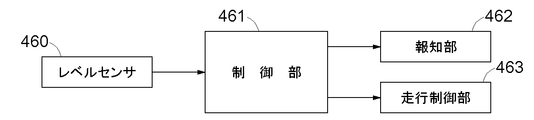
- a notifying unit that notifies that the grain is stored to the flow rate sensor based on the detection of the level sensor is provided.
- a notifying unit that notifies a decrease in the measurement accuracy of the flow rate sensor based on the detection of the level sensor is provided.
- the flow rate sensor may not be able to measure the flow rate of the grain with high accuracy.
- the occupant can recognize the decrease in the measurement accuracy of the flow rate sensor, so that the occupant can easily determine that the combine harvesting operation should be stopped.
- a traveling device is provided, and after the detection of the level sensor, if the introduction of the grain is detected by the flow rate sensor, the traveling device is stopped.
- the flow rate sensor becomes excessively large. There is a possibility that a load acts and the flow sensor breaks down. According to this configuration, when the traveling device stops, the harvesting traveling of the combine cannot be continued. That is, before the excessive load is applied to the flow rate sensor, the feeding of the grain is not continued, so that the possibility that the flow rate sensor is broken can be avoided. Further, it is possible to prevent low-precision measurement data from being mixed with the flow sensor data.
- a full level sensor is provided inside the tank and detects that kernels are stored to a full height in the kernel tank, and the level sensor is at a position lower than the full level sensor. Preferably, it is provided.
- the full level sensor is usually installed at a relatively high position inside the tank, but the kernels do not accumulate horizontally inside the tank, and depending on the input flow rate of the kernels, the kernels accumulate inside the tank. May be biased. With this configuration, even when a kernel is detected by the full level sensor, more kernels can be stored if the level sensor at a position lower than the full level sensor does not detect the kernel. It becomes. In other words, as many grains as possible are stored in the tank while preventing the flow sensor from being damaged.
- a plurality of other level sensors for detecting that grains are stored in the grain tank up to a specific height are provided, and the level sensor is Preferably, of the plurality of other level sensors, the sensor is provided at a position higher than another level sensor located at the next higher position than the full level sensor.
- the level sensor is provided at a position lower than the full level sensor, the level sensor is provided higher than other level sensors located next to the full level sensor. Thereby, more grains are stored inside the tank.
- a grain transport device that transports the obtained grains and throws the grains into the inside of the grain tank, and a combine having a storage level detection system that detects a storage level of the grain tank.
- a flow sensor that is provided in the input unit of the grain transport device and measures a flow rate of the input kernel,
- a level sensor that is provided at a position lower than the lower end of the flow rate sensor and detects that grains are stored in the grain tank up to the flow rate sensor.
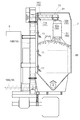
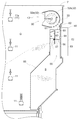
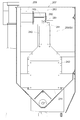
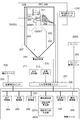
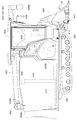
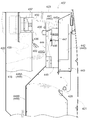
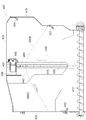
- FIG. 2 is a right side view of the fuselage showing the entire combine. It is an overall top view of a combine. It is a top view which shows the tank inside of a grain tank.
- FIG. 19 is a sectional view taken along line XIX-XIX of FIG. 18 showing the inside of the grain tank.
- FIG. 19 is a sectional view taken along the line XX-XX of FIG. 18 showing the inside of the grain tank.
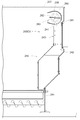
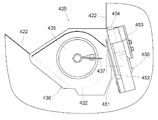
- FIG. 2 is a right side view of the machine body showing the flow rate sensor. It is a block diagram showing a control configuration based on a flow sensor. It is a flowchart figure which shows the control structure based on a flow sensor. It is a rear view showing another embodiment about composition of a grain conveying device, a flow sensor, and a level sensor.
- a combine according to the present invention includes a traveling machine body 2 that is self-propelled by a pair of left and right crawler traveling devices 1 and 1, and a harvesting unit 3 that harvests planted grain culms at the front of the traveling machine body 2. Is provided.
- An operating unit 5 whose periphery is covered by a cabin 4 is provided on the front right side of the traveling body 2. Behind the operation unit 5, a threshing device 6 for threshing grain culms harvested by the harvesting unit 3 and a grain tank 7 for storing grains obtained by threshing are arranged side by side. Deployed in state.
- the grain tank 7 is located on the right side of the fuselage, and the threshing device 6 is located on the left side of the fuselage. That is, the operating unit 5 is located in front of the grain tank 7.
- An engine is provided below the driver's seat 8 in the driver 5.
- a grain discharging device 9 for discharging the grains stored in the grain tank 7 out of the machine.
- the threshed grains are transported from the threshing device 6 to the interior of the grain tank 7 by the grain transport mechanism 16.
- a load cell 10 is provided below the grain tank 7 as an example of a yield sensor for measuring the yield of grains stored in the grain tank 7.
- the load cell 10 detects the pressure received according to the weight (yield) of the grain as a voltage or the like by a strain sensor.
- the weight (yield) of the stored grains is calculated from the output voltage.
- the grain transport mechanism 16 includes a first thing collection screw 16A, a lifting conveyor 16B, and a horizontal conveyor 16C provided at the bottom of the threshing device 6.
- a grain discharging device 13 for diffusing and discharging the grains inside the grain tank 7 is provided in the terminal region of the traverse conveyor 16C.
- the grain discharge device 13 includes a discharge rotating body 32 and a discharge case 31 that covers the periphery of the discharge rotating body 32.
- the discharge rotating body 32 is a rotating blade composed of a rotating shaft 32b and a blade plate 32a provided on the rotating shaft 32b.
- the blade 32a is fixed to the rotating shaft 32b so as to protrude radially outward from the rotating shaft 32b.
- the slat 32a has a substantially flat pushing surface for pushing the grains in the direction of rotation.
- the discharge case 31 is a cylindrical shape having an inner diameter slightly larger than the rotation locus of the blade plate 32a.
- a part of the peripheral surface of the discharge case 31 is notched.
- the cutout forms a grain discharge port 30 that releases the grain to the rear side inside the grain tank 7 by the rotation of the blade plate 32a.
- a plurality of openings 33 are formed on the lower surface side of the discharge case 31 of the grain discharge device 13. Grains for measurement described later (part of the grains stored in the tank) leak through the opening 33 and are supplied to a temporary storage section 51 described later.
- a quality measuring device 50 that measures the quality of the grain is provided.
- the quality measuring device 50 measures the components (quality) of the grain such as the water content and the protein amount of the grain.
- the quality measuring device 50 controls a temporary storage unit 51 as a first storage unit for temporarily storing a kernel to be measured and a kernel stored in the temporary storage unit 51.
- a measuring unit 52 is provided as a quality measuring unit that measures quality by performing a measuring operation.
- the temporary storage unit 51 is located inside the grain tank 7, and the measurement unit 52 is located outside the grain tank 7.
- the measuring unit 52 is housed inside a storage case 53 formed in a sealed shape.
- the temporary storage unit 51 is formed in a substantially rectangular tube shape integrally connected to the inner side surface of the storage case 53, and can store grains therein.
- the temporary storage section 51 has an up-down passage 55 penetrating in the up-down direction inside thereof, a discharge port 56 formed in the middle of the up-down path 55, and a closed position for closing the discharge port 56 (see the figure).
- a shutter 57 whose position can be changed to an open position (not shown) for opening the discharge port 56, and an operation unit (not shown) for changing the attitude of the shutter 57 by the driving force of an electric motor (not shown). .
- the temporary storage unit 51 receives and stores a part of the kernel transported into the kernel tank 7 by the kernel transport mechanism 16 and released from the kernel release device 13 as a kernel for measurement.
- the upper end of the vertical passage 55 is opened, and a grain intake 62 is formed.
- the grains released from the grain discharging device 13 are taken in from the intake port 62, the grains are received in a state where the shutter 57 is switched to the closed state, and a storage space formed above the shutter 57 for storage. 63 can store the grains.
- the shutter 57 is switched to the open state, the stored grains are dropped and discharged downward and returned to the inside of the grain tank 7.
- the temporary storage unit 51 includes a primary storage sensor 65 in the space 63.
- the primary storage sensor 65 is a contact sensor, and can detect that a certain amount of grains has been stored in the space 63.
- the measuring unit 52 measures the quality of the grains in a state where the grains are stored in a certain amount. After the primary storage sensor 65 detects that a certain amount of grain has been stored in the space 63, and the measuring unit 52 measures the component (quality), the operating unit (not shown) opens the shutter 57. The position is changed, and the kernel is discharged to the measured kernel storage space S described later.
- the measuring unit 52 irradiates light toward the grains stored in the storage space 63 and measures the internal quality of the grains based on the light obtained from the grains by a spectroscopic analysis technique that is a known technique. I do.
- a window 64 through which light can pass is formed on the side surface on the measurement unit 52 side of the side surface forming the storage space 63, and the measurement unit 52 irradiates the kernel with light through the window 64, Receives light from the grain.
- the measured grain storage space S is an area surrounded by a wall 66, communicates with the storage space 63 in the temporary storage unit 51 through the discharge port 56, and has a side portion.
- the storage space Q (inner space) of the grain tank 7 is defined, and the lower part thereof communicates with the storage space Q of the grain tank 7.
- the measured grain storage space S is formed to be wider in the front-rear direction and the left-right direction with respect to the temporary storage part 51 in plan view, and the lower part is wider in the front-rear direction and the left-right direction than the upper part. It extends to the lower part of the tank 7. Since the measured grain storage space S is partitioned from the storage space Q, no grain flows from the storage space Q during storage of the grain.
- the flow rate can be reliably measured a number of times corresponding to the size of the measured grain storage space S.
- the quality measuring device 50 can measure the flow rate of the grains supplied into the grain tank 7. That is, since the volume of the stored grains is constant, by measuring the time from when the shutter 57 is closed to when the primary storage sensor 65 detects the grains and a certain amount of grains is stored.
- the flow rate which is the volume of grain supplied per unit time, can be measured. The flow rate can be determined by dividing this volume by the measured time. Further, when the moisture content of the grain is measured as the quality, the volume can be converted to the weight. Therefore, the weight of the grain supplied per unit time can be obtained as the flow rate.
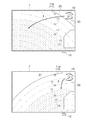
- the grain discharging device 13 is disposed in front of the traveling machine body 2 (see FIG. 1; the same applies hereinafter), and the grains are ejected toward the rear side of the traveling machine body 2. Grain release is affected by the flow rate of the supplied grain. When the flow rate is large, the kernel is discharged far away toward the rear side of the traveling vehicle 2 as indicated by the arrow I. When the flow rate is small, the kernel is compared with the case where the flow rate is large, as indicated by the arrow II. It is released only to the nearest position. Therefore, when the flow rate is large, the grains start to accumulate from the rear side of the grain tank 7, and when the flow rate is small, the grains start to accumulate from the front side of the grain tank 7.
- the grain storage state 20 is such that the number of grains is large at the rear side of the grain tank 7 and the number of kernels is small at the front side. There is a tendency that the grain is small on the rear side of the tank 7 and the grain is large on the front side. Due to such a storage state, detection errors occur in various sensors provided in the combine. Hereinafter, the error of the sensor will be described using the error of the fir sensor and the error of the load cell as examples.
- the grain tank 7 is provided with one or a plurality of fir sensors 11 which are level sensors for detecting the amount of stored grains.
- the fir sensor 11 is, for example, a contact sensor, and detects that the stored grain has reached the fir sensor 11.
- a fir sensor 11a provided near the upper end of the grain tank 7 detects that the grains in the grain tank 7 are full and have been stored to a state requiring discharge. For example, when the fir sensor 11a detects a grain, the worker is notified of the fact, and the worker shifts to an action for discharging the grain.
- the fir sensor 11 is arranged at a position shifted from the center of the traveling machine body 2 in the front-rear direction, for example, from the front side of the traveling machine body 2 in the grain tank 7. Further, as described above, the storage state of the grains is biased according to the flow rate. Therefore, the actual yield of the grains in the grain tank 7 when the fir sensor 11a detects that the grains are stored up to the full state varies depending on the flow rate. As shown in FIG. 4, the yield when the grain reaches the fir sensor 11a is higher when the flow rate is high than when the flow rate is low. As a result, the storage state of the grains when the fir sensor 11a detects the grains also differs depending on the flow rate.
- the yield of the grain stored in the grain tank 7 is different from the yield assumed to be full, the yield of the discharged grain may be excessive or insufficient, and then the drying operation may be performed. And the like may not be performed efficiently.
- the yield of the kernel stored in the kernel tank 7 is larger than the yield assumed as a full state (for example, the state of the storage state 20)
- the kernel overflows from the kernel tank 7, Inspection doors (not shown) provided in the grain tank 7 may be opened due to the pressure of the grains.
- the weight (yield) of the stored grains is calculated from the output value of the load cell 10 (see FIG. 1; the same applies hereinafter). Specifically, when the kernels are stored in the kernel tank 7 on the load cell 10 in advance, the relationship between the weight of the stored kernels and the output value of the load cell 10 with respect to this weight is checked, and a map is obtained.
- the weight of the grain in this map is determined in consideration of the weight of the grain tank 7.
- the weight (yield) of the stored grains is calculated from the output value of the load cell 10 and the map. The weight calculated as the yield can be converted into a volume based on the amount of water contained in the grain.
- the yield obtained from the load cell 10 also has an error due to the flow rate. That is, the load cell 10 is unevenly distributed with respect to the center of the grain tank 7 in the front-back direction. Generally, the load cell 10 is disposed forward of the center in the front-rear direction of the grain tank 7. Further, as described above, the grains in the grain tank 7 are stored unevenly in accordance with the flow rate. Therefore, when the center of gravity of the stored grains is not located directly above the load cell 10, an error occurs in the yield obtained from the load cell 10.
- an accurate yield (hereinafter, also referred to as a current yield) in consideration of the storage state accompanying the flow rate is obtained.
- discharge state a state in which the grain needs to be discharged
- an accurate yield (hereinafter, also referred to as a discharge yield) when the fir sensor 11 detects the grain is obtained.
- a configuration for calculating the yield (current yield) from the output value of the load cell 10 will be described with reference to FIGS.
- a configuration for calculating the current yield will be described as the yield calculation device 12.
- the calculation of the yield is not limited to the case of using the yield calculating device 12, but may be realized by dispersing each component, or may be combined with a device configuration in which arbitrary components are appropriately collected.
- the present yield may be calculated by various methods such as executing a program, regardless of the device configuration. When a program is used, the program is stored in a storage device 23 described below and executed by a control device 22 described later.
- the yield calculation device 12 includes a control device (corresponding to a control unit) 22 and a storage device 23.
- the control device 22 is connected to the quality measurement device 50, the load cell 10, and the storage device 23 so that data communication is possible.
- the storage device 23 stores a first map 24 and a second map 25.
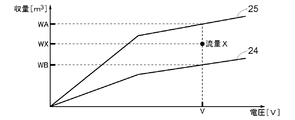
- the first map 24 indicates an output value (such as a voltage value) output by the load cell 10 when the kernel is stored in the kernel tank 7 at a specific flow rate (first flow rate value). This is information indicating the relationship between the voltage and the yield corresponding to this voltage value.
- the second map 25 shows the voltage value output by the load cell 10 and the voltage value when the kernel is stored in the kernel tank 7 at a specific flow rate (second flow rate value) different from the first flow rate value.
- the quality measuring device 50 measures the flow rate of the grain flowing from the grain discharging device 13 and transmits the measured flow rate to the control device 22.
- the load cell 10 measures a voltage value and outputs the voltage value to the control device 22 as an output value.
- the control device 22 receives the flow rate transmitted from the quality measurement device 50 and the voltage value transmitted from the load cell 10.
- the control device 22 calculates the yield corresponding to the received voltage value from the first map 24 and the second map 25 as the current yield of the grains stored in the grain tank 7 using the flow rate.
- the yield in the first map for the voltage value output by the load cell 10 and the yield in the second map for this voltage value are determined based on the measured flow rate, the first flow rate value, and the second flow rate value.
- the current yield is calculated by pro-rata.
- the control device 22 can be, for example, a computer such as a CPU or an ECU.
- the maps such as the first map and the second map are information indicating the relationship between the voltage value output by the load cell 10 and the yield assumed based on the voltage value, as described above, and the flow rate of the kernel Depends on This yield increases as the voltage value output by the load cell 10 increases, indicating a certain relationship.
- the yield of the grains actually stored in the grain tank 7 is determined by the storage state of the grains, and the storage state of the grains is determined by the flow rate of the supplied grains. Therefore, the relationship of the map shows a different relationship for each flow rate, and shows a constant relationship between the voltage value and the yield for each flow rate. As a result, the map takes into account the state of storage of the grains (see FIG. 7).
- a first map 24 and a second map 25 are obtained.
- the first map 24 is a map corresponding to the flow rate (lowest flow rate) when the kernel is supplied at the latest, which is assumed by the kernel tank 7, the kernel transport mechanism 16, and the kernel discharge device 13.
- the second map 25 is a map corresponding to the flow rate (the highest flow rate) when the grain is supplied earliest (step # 1 in FIG. 6).
- the obtained first map 24 and second map 25 are stored in the storage device 23.
- the flow rate of the supplied grain is calculated by the quality measuring device 50.
- the calculation of the flow rate is performed every time a certain amount of grains is stored in the quality measuring device 50 during storage of the grains.
- the flow rate is measured from the time during which this fixed amount of grain is stored and the amount (weight or volume) of the stored grain. If the flow rate has been measured a plurality of times since the storage of the grains in the grain tank 7 has been started, an average value of the flow rates measured so far is determined as the flow rate at that time (step # 2 in FIG. 6). .
- the quality measuring device 50 transmits the obtained flow rate to the control device 22.
- Step # 3 in FIG. 6 the voltage output from the load cell 10 is obtained (Step # 3 in FIG. 6).
- the load cell 10 transmits the detected voltage to the control device 22.
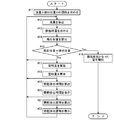
- the current yield is calculated using the first map 24 and the second map 25 based on the flow rate and the voltage (step # 4 in FIG. 6).
- the current yield is calculated using the first map 24 and the second map 25 based on the flow rate and the voltage (step # 4 in FIG. 6).
- the first map 24 is a map when the flow rate is A [m 3 / sec]
- the second map 25 is a map when the flow rate is B [m 3 / sec].
- the flow rate measured by the quality measuring device 50 is X [m 3 / sec]
- the voltage output from the load cell 10 is V [v].
- the present yield WX [m 3 ] is obtained by, as shown in Expression (1), the yield WA [m 3 ] in the first map 24 corresponding to the voltage V [v] and the second map corresponding to the voltage V.
- the yield WB [m 3 ] at 25 is obtained by prorating the ratio of the flow rate A of the first map 24 and the flow rate B of the second map 25 to the measured flow rate X.
- WX (WA ⁇ WB) ⁇ (X ⁇ B) / (AB) + WB (Formula 1) Thereafter, the steps # 2 to # 4 are repeated until the measurement of the yield becomes unnecessary, for example, when the grain tank 7 becomes full.
- the current yield can be obtained based on the flow rate from the output voltage using a plurality of maps corresponding to the flow rate. Therefore, the yield of the grains stored in the grain tank can be accurately determined in consideration of the storage state of the grains.
- the relationship between the yield (discharge yield) and the flow rate in the case of a discharge state such as a full state is determined experimentally in advance. Specifically, the emission yields at two different flow rates are experimentally determined. The two flow rates are preferably the highest flow rate and the lowest flow rate assumed as described above. Then, the relationship between the flow rate and the discharge yield is linearly determined from the discharge yields at the two flow rates. Specifically, a linear function indicating the relationship between the flow rate and the yield is obtained from the flow rate and the yield at two points (step # 11 in FIG. 8). The obtained linear function is stored in the storage device 23 as the discharge function 27.
- the flow rate of the supplied grain is calculated by the quality measuring device 50.
- the calculation of the flow rate is performed every time a certain amount of grains is stored in the quality measuring device 50 during storage of the grains. As described above, the flow rate is calculated based on the time during which the fixed amount of grains is stored and the amount (weight or volume) of the stored grains. If the measurement of the flow rate has been performed a plurality of times since the storage of the grains in the grain tank 7 has been started, an average value of the flow rates measured so far is obtained as the flow rate at that time (step # in FIG. 12). The quality measuring device 50 transmits the obtained flow rate to the control device 22.
- the emission yield 26 at the calculated flow rate is obtained from the emission function 27. Specifically, the yield obtained by introducing the calculated flow rate into the emission function 27 is set as the emission yield 26 (step # 13 in FIG. 8).
- the control device 22 calculates the emission yield 26 and stores it in the storage device 23.
- the current yield is calculated from the calculated yield by the method described with reference to FIG. 6 and the like (step # 14 in FIG. 8).
- the discharge yield 26 it is possible to grasp the yield in consideration of the flow rate when the fir sensor 11 or the like detects a grain. Therefore, when the grains are stored unevenly and the grains are detected by the fir sensor 11, it can be predicted that the grains are stored more than expected. 7 can be avoided.
- step # 15 in FIG. 8 it is determined whether or not the calculated yield matches the emission yield 26 (step # 15 in FIG. 8). Specifically, the control device 22 compares the calculated current yield with the emission yield 26 stored in the storage device 23.
- the control device 22 causes a notification device 29 such as a lamp provided in the operation unit 5 (see FIG. 1) to notify that the grain tank 7 has been discharged such as being full. By confirming this notification, the worker recognizes that the grain needs to be discharged, and can stop harvesting the crop and shift to a grain discharging operation or the like.
- the process can be returned to the step of calculating the flow rate (step # 12 in FIG. 8), but the yield required before the discharge state is calculated as the empty yield. (Step # 17 in FIG. 8). Specifically, the control device 22 calculates the difference between the discharge yield 26 stored in the storage device 23 and the current yield as an empty yield.
- the process returns to the step of calculating the flow rate (step # 12 in FIG. 8) while displaying the empty yield (step # 18 in FIG. 8).
- the control device 22 causes the display device 28 such as a liquid crystal panel provided in the driving section 5 (see FIG. 1) to display a display indicating the calculated empty yield. With this display, the operator can work while measuring the timing at which the discharge is required.
- the emission yield corresponding to the state requiring the discharge of the kernel is obtained, and the current yield is calculated according to the average flow rate. Since the emission yield is obtained based on the average flow rate, the emission yield is a value corresponding to the state of storage of the grain.
- the current yield is also an accurate value of the grains stored in the grain tank 7 determined from the average flow rate. Therefore, even in the case where the grains are unevenly stored in the grain tank 7 due to the influence of the flow rate of the supplied grains, and the storage state is not properly confirmed by the fir sensor 11 or the like (see FIG. 4). ), It is possible to accurately detect a state in which kernel discharge is required based on an accurate current yield, and discharge stored kernels at an appropriate timing.
- the empty yield is calculated and only the empty yield is displayed.
- the time until the discharge state also referred to as the kernel discharge time
- the travel distance until the discharge state the kernel discharge May be obtained and displayed.
- the control device 22 calculates the average storage speed since the storage of the kernels by dividing the current yield by the elapsed time. Further, the control device 22 calculates the kernel discharge time until the discharge yield by dividing the empty yield by the average storage speed.
- the process may return to the step of calculating the flow rate (step # 12 in FIG. 8) after displaying the grain discharge time (step # 20 in FIG. 8). ).
- the control device 22 causes the display device 28 such as a liquid crystal panel provided in the operation unit 5 (see FIG. 1) to display the calculated grain discharge time.
- the display device 28 may be the same as the one displaying the empty yield, or may be a different one, as long as it can distinguish between the empty yield and the kernel discharge time, and these may be displayed simultaneously.
- the travel distance until the emission yield is reached is calculated as the kernel emission distance (step # 21 in FIG. 8). Specifically, the traveling distance from the start of storing the grains is continuously measured, and the control device 22 calculates the average traveling speed from the traveling distance and the elapsed time. Then, the control device 22 multiplies the average traveling speed by the kernel discharge time to determine the kernel discharge distance.
- the process returns to the step of displaying the grain discharge distance and calculating the flow rate (step # 12 in FIG. 8) (step # 22 in FIG. 8).
- the control device 22 causes the display device 28 such as a liquid crystal panel provided in the driving unit 5 (see FIG. 1) to display the calculated grain discharge distance.
- the display device 28 may be the same as the one that displays the empty yield or the grain discharge time, or may be different, and can distinguish between the empty yield, the grain discharge time, and the grain discharge distance. And these may be displayed simultaneously.
- the operator can accurately confirm that the discharge state is attained. can do.
- the fir sensor 11 detects that a grain is full or the like, the storage state of the grain is biased with the flow rate, and the fir sensor 11 may detect an accurate yield (full state). Can not.
- the operator uses the accurate current yield and / or the empty yield, the grain discharge time, and / or the grain discharge distance to determine the timing of the discharge state. You can check. Further, the work plan until the discharge is performed can be easily set and the work can be efficiently performed based on the empty yield, the grain discharge time, and the grain discharge distance.
- the flow rate is measured using the quality measuring device 50. Therefore, the measurement of the flow rate and the measurement of the component (quality) can be performed using one device, and the measurement of the flow rate and the measurement of the component can be performed efficiently.
- the dedicated flow rate measuring device and the dedicated quality measuring device 50 may be individually provided in the grain tank 7 or the like. At least, a dedicated flow measurement device may be provided.
- the flow rate and the yield can be converted from the water content to a value relating to the volume and used. Since the yield can be processed using the volume, the yield of the grains in the grain tank 7 can be more accurately determined. Conversely, when the flow rate measuring device is provided independently, a configuration without the quality measuring device 50 may be adopted. In this case, the flow rate and the yield are treated as weight.
- the yield was measured using the load cell 10, but the yield can be measured using another yield sensor.
- the yield is measured using parameters other than the voltage, and the map indicates the relationship between the yield and the parameter.
- the full state is described as an example of the state in which the kernel needs to be discharged, but the state in which the kernel needs to be discharged may be a predetermined yield or a yield input from the outside.
- a communication unit that communicates with the outside may be further provided, and the communication unit may communicate with an external device such as an external dryer or a management server, and may receive the yield from which the kernel needs to be discharged from the external device. .
- Driers are efficient when grains are dried at a certain yield. For this reason, the dryer transmits the required grain yield to the combine as a discharge yield, and the combine discharges the grain when the yield is stored in the grain tank 7 and brings the grain to the dryer.
- the detection of the discharge yield can be performed by detecting a grain by the fir sensor 11 corresponding to the discharge yield among the fir sensors 11.
- the discharge yield can be detected using at least one of the empty yield, the grain discharge time, and the grain discharge distance with respect to the discharge yield.
- the grain yield that can be efficiently processed by an external device such as a dryer is transmitted to the combine as a discharge yield, and the combine accurately determines the discharge yield.
- the worker discharges the grains when the stored grains reach this discharge yield, so that external devices such as a dryer can be operated efficiently.
- the management server may manage these dryers.
- the management server links the amount of water and the yield suitable for drying the grain with the amount of water to the combine server and transmits the resultant to the combine.
- the combiner or the worker receives this information and determines that the yield (discharge yield) associated with the water content of the grain stored therein is stored.
- the combine can run automatically, and in this case, the transition from the harvesting state to the grain discharging state can also be performed by automatic control.
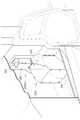
- the combine stops the harvesting operation by detecting that the discharge yield has been reached, and stops the harvesting around the field 71.
- the vehicle moves to a position near a transport vehicle 72 (fir wheel) that is stopped and the like, and discharges the stored grains to the transport vehicle 72.
- the grain discharge distance is L
- the grain is stored until the discharge yield
- the combine moves by the distance L and the combine reaches the point PB.
- the combine when the combine stops harvesting at the point PB and tries to move to the transport vehicle 72, it is necessary to retreat from the point PB. At this time, if the combine goes directly from the point PA to the transport vehicle 72 (traveling locus D) without performing a new harvesting operation, the combine can efficiently perform the grain discharging operation. In the above embodiment, by calculating the grain discharge distance, the combine can travel on the traveling trajectory D that can efficiently perform the grain discharge work in automatic traveling.
- the combine 70 and the yield calculation method have been described.
- Each functional unit in the above embodiment can be configured as a yield calculation system.
- the yield calculation system is a yield calculation system that calculates a current yield of the grain in a combine grain tank in which the threshed grain is supplied and stored, and is supplied to the grain tank.
- a flow rate sensor that measures the flow rate of the grain
- a yield sensor that outputs an output value based on the weight of the grain tank, and the grain stored in the grain tank based on the flow rate and the output value.
- a control unit for calculating the current yield of the above is a control unit for calculating the current yield of the above.
- the yield calculation program is a combine having a grain tank in which threshed grains are supplied and stored and a yield sensor that outputs an output value based on the weight of the grain tank, wherein the output value is The output value and the kernel tank when the kernel is stored in the kernel tank at a specific first flow rate value, configured as a program for calculating the current yield of the kernel stored in the kernel tank.
- the computer may be configured to realize the function of calculating the current yield by dividing the yield in the second map with respect to the yield and the output value.
- Such a yield calculation program can be configured to be recorded on a recording medium.
- the system can be configured as a kernel emission yield calculation system.
- the kernel discharge yield calculation system is stored in the kernel tank in a discharge state in which it is necessary to discharge the kernel from a kernel tank of a combine in which the threshed kernel is supplied and stored.
- a grain discharge yield calculation system for calculating the yield of the grain wherein the flow rate sensor measures a flow rate of the grain supplied to the grain tank, and the grain tank based on the flow rate
- a control unit that calculates a discharge yield of the kernel stored in the kernel tank in a discharge state in which the kernel needs to be discharged from the tank.
- the grain discharge yield calculation program is a combine having a grain tank in which threshed grains are supplied and stored and a yield sensor that outputs an output value based on the weight of the grain tank.
- the function of measuring the flow rate of the grain and the function of calculating the discharge yield based on the flow rate can be configured to be realized by a computer.
- kernel discharge yield calculation program can be configured to be recorded on a recording medium.
- the longitudinal direction of the fuselage is defined along the fuselage advancing direction in the working state, and the direction indicated by the symbol (F) in FIG. 10 is the front side of the aircraft, and the direction indicated by the symbol (B) is the rear side of the aircraft. It is.
- the definition of the left-right direction of the body is defined as left and right as viewed from the forward direction of the body.
- a cutting unit 203 that cuts planted grain culms is disposed in front of a traveling machine body 202 that is self-propelled by a pair of left and right crawler traveling devices 201.
- a driving unit 204 whose periphery is covered by a cabin is disposed on the front right side of the traveling body 202.
- a threshing device 205 for threshing the grain stalks cut by the cutting unit 203 is disposed behind the operation unit 204.
- a grain tank 207 is arranged laterally of the threshing device 205, and a grain transport device 208 for transporting grains from the threshing device 205 to the grain tank 207 is arranged between the threshing device 205 and the grain tank 207.
- the grain tank 207 is located on the right side of the fuselage, and the threshing device 205 is located on the left side of the fuselage.
- An engine 200E is provided below the operation unit 204.
- a grain discharging device 209 that discharges the grains stored in the grain tank 207 from the rear of the traveling machine body 202 to the outside of the machine is provided upright.
- a flow rate measuring unit 200 GV for measuring the flow rate of the grains to be supplied to the grain tank 207 is provided at an upper part (upper part of the front wall) inside the grain tank 207.
- the flow measuring means 200GV has a cylindrical measuring container 240.
- the measurement container 240 is located below the discharge portion 280 of the grain transport device 208 that has entered the inside of the grain tank 207.
- the grains scraped out by the rotary delivery blades 282 arranged in the discharge section 280 are discharged to the grain tank 207 through an inlet 283 formed in the discharge section 280.
- an opening 281 covered with a porous material such as punching metal is formed in a lower surface region of the cylindrical body that forms the discharge unit 280.
- the upper edge of the measurement container 240 functions as a receiving port 241 for receiving the grains falling from the opening 281.
- the grains transported to the discharge unit 280 by the screw conveyor of the grain transport device 208 are thrown into the grain tank 207 through the inlet 283 by scraping out the delivery blades 282 that rotate in conjunction with the screw conveyor, A part thereof is put into the receiving port 241 of the measuring container 240 through the opening 281.
- the measurement container 240 functions as a temporary storage unit that receives a part of the grain fed from the grain transport device 208 to the grain tank 207 and temporarily stores the grain.
- the grains temporarily stored in the measurement container 240 for measurement are discharged from the outlet 242 at the lower edge of the measurement container 240 after the measurement, and stored in the kernel tank 207.
- a lower region from the lower edge of the measurement container 240 is covered by a skirt portion 243 extending downward with a larger sectional area than the measurement container 240.
- the lower opening 244 of the skirt 243 faces the bottom of the grain tank 207.
- the side wall of the skirt portion 243 prevents the grains stored in the grain tank 207 from entering the inside of the measurement container 240 from the discharge port 242 of the measurement container 240 with the increase. Thereby, a storage space for the grains discharged from the measurement container 240 is secured, so that the number of times of measurement by the flow rate measuring means 200GV is sufficiently secured.
- the measurement container 240 as a temporary storage unit has a vertical passage penetrating the inside thereof in a vertical direction, a closed position for closing this passage, and opening this passage.
- a shutter 200ST that can change the position between the open position and the open position is provided.
- the position change of the shutter 200ST is performed by the driving force of the electric motor 200M1.
- the first storage sensor 291 detects that the temporary storage of the grain has reached a certain amount.
- the shutter 200ST When the storage of the grains reaches a certain amount, the shutter 200ST is switched to the closed position, and the temporarily stored grains are discharged into the skirt portion 243 through the discharge port 242.
- the flow rate (yield per hour) of the harvested kernel is calculated.
- the measurement container 240 is provided with a component value sensor 293 for measuring the component value of the grain temporarily stored in the measurement container 240.
- the component value sensor 293 irradiates, for example, light to the grain temporarily stored in the measurement container 240 and, based on the light obtained from the grain, analyzes the moisture and protein of the grain by a spectroscopic analysis method. Used to measure the amount of a component, such as an amount.
- FIG. 14 is a functional block diagram showing functions for detecting an illegal inflow, measuring a grain flow rate, and measuring a grain component in the combine control system.
- the control unit 206 controls various devices mounted on the combine by sending various control signals via the device control unit 262.
- This device includes an electric motor 200M1 that operates the shutter 200ST of the measurement container 240, and a notification device 820 that notifies a driver or a supervisor of information.
- the notification device 820 is for notifying a driver or a supervisor of various events occurring in the combine, and is a general term for a lamp, a buzzer, a speaker, a display, and the like.
- the input signal processing unit 261 receives signals from the traveling operation tool 211, the work operation tool 212, and the like.
- signals and data from the weight measuring device 270, the first storage sensor 291, the second storage sensor 292, the component value sensor 293, and the like are input to the input signal processing unit 261.
- the first storage sensor 291 and the second storage sensor 292 measure the volume of the grain temporarily stored in the measurement container 240.
- the component value sensor processing unit 290 converts component data indicating the kernel component based on the sensor signal from the component value sensor 293. Calculate and output.
- the weight measuring device 270 is a load cell for measuring the weight of the grain tank 207.
- the first storage sensor 291 and the second storage sensor 292 are proximity sensors that output a signal when a grain approaches or when a grain contacts.
- the engine control unit 263 adjusts a fuel supply amount and the like to the engine 200E based on a command from the control unit 206, and drives the engine 200E at a predetermined engine speed or a predetermined torque.
- the control unit 206 includes a travel control unit 264, a work control unit 265, a shutter control unit 266, a grain measurement unit 267, an unauthorized inflow detection unit 268, and a notification control unit 269.
- the traveling control unit 264 generates a control command to the crawler traveling device 201 based on the command from the traveling operation tool 211, and outputs the generated command via the device control unit 262.
- the work control unit 265 generates a control command to a work device such as the reaper 203, the threshing device 205, the grain transport device 208, and the grain discharge device 209 based on the command from the work operation tool 212, and controls the device. Output to the working device via the unit 262.
- the shutter control unit 266 gives a control command to the electric motor 200M1 via the device control unit 262 to change the position of the shutter 200ST.
- the shutter control unit 266 changes the shutter 200ST to the closed position, temporarily stores the grains in the measurement container 240, and detects from the first storage sensor 291 that detects that the storage of the grains has reached a certain amount.
- the shutter 200ST is changed to the open position based on the signal, and the temporarily stored grains are discharged from the measurement container 240.
- the grain measuring unit 267 includes a grain flow rate calculating unit 267a and a grain component value calculating unit 267b.
- the grain flow rate calculation unit 267a measures the flow rate of the grain that is charged into the grain tank 207 through the grain transport device 208 based on the time during which a fixed amount of grain is stored in the measurement container 240.
- the grain component value calculation unit 267b calculates the component value of the grain stored in the measurement container 240 based on the data from the component value sensor processing unit 290.
- the flow rate measuring unit 200GV having a function of measuring the grain component value also includes a measurement container 240, a shutter 200ST, a component value sensor 293, and the like.
- the unauthorized inflow detecting unit 268 detects the kernel stored in the kernel tank 207 outside the measuring container 240 based on the temporal change amount of the kernel flow rate calculated by the kernel flow calculating unit 267a. Of illegal flow flowing into the measuring container 240 from the receiving port 241 of the measuring device 240 is detected. That is, the unauthorized inflow detection unit 268 determines that the time during which a certain amount of grains is stored in the measurement container 240 is shorter than a predetermined value (for example, a time equal to or less than half the normal time). This is a detection condition.
- a predetermined value for example, a time equal to or less than half the normal time
- the flow rate can be directly calculated from the time during which a certain amount of grains is stored in the measurement container 240, and the flow rate of the grains to be supplied to the grain tank 207 can be estimated from the flow rate.
- this flow rate can be used for the first illegal inflow detection condition.
- a first improper inflow detection condition is that the flow rate per hour of the grain entering the measurement container 240 is larger than a predetermined value (for example, a flow rate twice or more the normal flow rate).
- the unauthorized inflow detection unit 268 indicates that the weight measured by the weight measuring device 270 has increased to such an extent that the grains stored in the grain tank 207 reach the receiving port 241 of the measurement container 240.
- the condition that the value is larger than a predetermined value is defined as a second unauthorized inflow detection condition. If the first unauthorized inflow detection condition and the second unauthorized inflow detection condition are satisfied, the unauthorized inflow detection unit 268 detects an unauthorized inflow.
- the unauthorized inflow detection unit 268 detects the unauthorized inflow, the grain measurement by the flow rate measuring unit 200GV is stopped. At the same time, when detecting the unauthorized inflow, the unauthorized inflow detection unit 268 gives a notification instruction to the notification control unit 269 in order to notify a driver or a monitor of an unauthorized inflow alarm.
- This kernel measurement routine starts when the kernel is started to be transported from the threshing device 205 by the kernel transport device 208 (# 201 Yes branch).
- the position of the shutter 200ST of the measurement container 240 is changed to the closed position (# 202), and the timer starts (# 203).
- the second storage sensor 292 detects that the amount of grains stored on the shutter 200ST in the closed position has reached an amount suitable for the component value measurement (Yes in # 204)
- the component value sensor 293 and the component value The component value measurement of the kernel is performed by the sensor processing unit 290 (# 205).
- the grain moisture value and the protein component value, which are the results obtained by the component value measurement are recorded together with the map coordinates acquired by GPS or the like (# 206).
- ⁇ Circle around (2) ⁇ It is checked whether the amount of grains stored on the shutter 200ST in the closed position has reached a certain amount detected by the first storage sensor 291 (# 207).
- the kernel amount reaches a certain amount (Yes in # 207)
- the timer is stopped (# 208), and the storage time for storing a certain amount of kernel in the measuring container 240 is calculated (# 209).
- the second storage sensor 292 is used to measure the storage amount at which the component value measurement can be started
- the first storage sensor 291 is used to measure the storage amount at which the flow rate measurement is performed.
- the first storage sensor 291 is configured to measure a larger storage amount than the second storage sensor 292.
- the storage of the grains in the measurement container 240 for the flow rate measurement is continued during the component value measurement. That is, since the component value measurement is performed during the flow rate measurement, the measurement efficiency is high. As a result, the flow rate can be measured with a large storage amount, and the short-term variation in the flow rate is averaged, so that the accuracy of the flow rate measurement is also improved.
- This storage time is used for detecting the above-mentioned illegal inflow of grain. Therefore, whether or not the above-described first unauthorized inflow detection condition is satisfied, that is, the calculated storage time is compared with a preset predetermined time (# 210). If the storage time is longer than the predetermined time (Yes in # 210), the first unauthorized inflow detection condition is not satisfied, and it is determined that unauthorized inflow has not occurred. By dividing a certain amount by the storage time, a grain flow rate per unit time is calculated. Further, the amount of grain (yield) per traveling distance can be calculated from the grain flow rate. The calculated grain flow rate is also recorded together with the map coordinates acquired by GPS or the like (# 211).
- the position of the shutter 200ST of the measurement container 240 is changed to the open position, and the grains temporarily stored in the measurement container 240 are discharged (# 212).
- This series of grain measurement processing is repeatedly performed as long as grain transport by the grain transport device 208 is performed (No in # 213), and when grain transport by the grain transport device 208 is stopped (# 213 Yes branch), this routine also ends.
- step # 210 if the storage time is shorter than the predetermined time (No in # 210), the first unauthorized inflow detection condition is satisfied.
- the weight of the grain tank measured by the weight measuring device 270 is obtained to determine whether the second unauthorized inflow detection condition is satisfied ( # 221), the weight of the grain tank is compared with a predetermined weight (# 222). If the grain tank weight exceeds the predetermined weight (# 222, Yes branch), the second unauthorized inflow detection condition is satisfied, and the unauthorized inflow detecting unit 268 determines that unauthorized inflow has occurred (# 223). .
- an illegal inflow alarm is notified through the notification device 820 (# 224). Further, the position of the shutter 200ST of the measurement container 240 is changed to the open position (# 225), and the subsequent grain measurement is stopped (# 226).
- step # 222 If it is determined in step # 222 that the weight of the grain tank is equal to or less than the predetermined weight (No in # 222), the second unauthorized inflow detection condition is not satisfied, and no unauthorized inflow has occurred. Is determined to be abnormal, the measurement abnormality is recorded (# 231), and after the measurement abnormality alarm is notified (# 232), the process jumps to step # 212.
- the kernel measurement may be stopped when a measurement abnormality occurs a predetermined number of times within a predetermined time.
- the measurement container 240 is used for measuring the flow rate of the grain supplied from the grain transport device 208 to the grain tank 207 and for measuring the component value of the grain.
- the measurement of the grain component value may be omitted.
- the measurement of the grain flow rate and the measurement of the grain component value are performed using the same measurement vessel 240, but may be performed using separate measurement vessels 240, respectively. At that time, the unauthorized flow rate detection processing can be performed on each measurement container 240.
- the first storage sensor 291 for measuring the flow rate and the second storage sensor 292 for measuring the component value were provided. Instead, one storage sensor may be used. In this case, if one storage sensor detects a predetermined storage amount, the flow rate measurement is started from the storage time, and at the same time, the component value measurement is started. When the component value measurement is completed, the shutter 200ST is changed to the open position. Then, the grains temporarily stored in the measurement container 240 may be discharged. Further, a configuration may be adopted in which only the first storage sensor 291 for measuring the flow rate is provided, and the component value measurement is started in a predetermined time after the shutter 200ST is changed to the closed position.
- the first unauthorized inflow detection condition and the second unauthorized inflow detection condition are used for detecting unauthorized inflow.
- only the first unauthorized inflow detection condition may be used.
- the above-described combine can be configured as an unauthorized inflow detection system.
- the unauthorized inflow detection system extends over a threshing device for threshing a harvested grain culm, a grain tank for storing grains obtained by the threshing device, and an upper portion of the threshing device and the grain tank.
- a grain conveying device that is provided in a state, and conveys the grains obtained by the threshing device and throws them into the inside of the grain tank, and a receiving port for receiving a part of the grains to be thrown into the grain tank
- a measuring vessel for receiving and storing the grains from the measuring vessel, and configured to return the grains to the grain tank after measuring the flow rate of the grains in the measuring vessel.
- An unauthorized inflow detection system that detects the flow rate of the grains to be introduced into the grain tank based on the time during which a certain amount of grains are stored in the measurement container, the flow rate measurement means, Change over time And an unauthorized inflow detection unit configured to detect an unauthorized inflow of grains stored outside the measurement container in the kernel tank from the receiving port, based on the amount, based on the amount. Is possible.
- each function unit in the above embodiment includes a threshing device for threshing the harvested grain culm, a grain tank for storing the grains obtained by the threshing device, and an upper portion of the threshing device and the grain tank.
- a grain conveying device that is provided in a state, and conveys the grains obtained by the threshing device and throws them into the inside of the grain tank, and a receiving port for receiving a part of the grains to be thrown into the grain tank
- a measuring vessel for receiving and storing the grains from the measuring vessel, and configured to return the grains to the grain tank after measuring the flow rate of the grains in the measuring vessel.
- a flow measurement function for measuring the flow rate of the kernels to be charged into the kernel tank based on the time during which a certain amount of kernels are stored in the measurement container; and Over time And an unauthorized inflow detection function of detecting an unauthorized inflow of the kernel stored in the grain tank outside the measurement container from the receiving port into the measurement container based on the amount of chemical conversion. Can be configured.
- such an unauthorized inflow detection program may be configured to be recorded on a recording medium.
- the above configuration can be configured as an unauthorized inflow detection method.
- the unauthorized inflow detection method includes a threshing device for threshing a harvested grain culm, a grain tank for storing grains obtained by the threshing device, and an upper portion of the threshing device and the grain tank.
- a grain conveying device that is provided in a state, and conveys the grains obtained by the threshing device and throws them into the inside of the grain tank, and a receiving port for receiving a part of the grains to be thrown into the grain tank
- a measuring vessel for receiving and storing the grains from the measuring vessel, and configured to return the grains to the grain tank after measuring the flow rate of the grains in the measuring vessel.
- an unauthorized inflow detection step of detecting an unauthorized inflow of grains stored outside the measurement container in the kernel tank from the receiving port into the measurement container. is there.
- the combine according to the present invention is a harvester that cuts planted grain culms at the front of a traveling body 402 that is self-propelled by a pair of left and right crawler traveling devices 401 and 401 as traveling devices.
- a unit 403 is provided.
- An operation unit 405 whose periphery is covered by a cabin 404 is provided on the front right side of the traveling body 402.
- a threshing device 406 and a grain tank 407 are arranged behind the operation unit 405 in a state where they are arranged in a horizontal direction. The threshing device 406 threshes the harvested grain stalks harvested by the harvesting unit 403 and collects grains.
- the grain tank 407 stores the grains obtained by the threshing device 406.
- the grain tank 407 is located on the right side of the fuselage, and the threshing device 406 is located on the left side of the fuselage.
- the operation unit 405 is located in front of the grain tank 407.
- the engine 400E is provided below the driver's seat 408 in the driver 405.
- a grain discharging device 409 is provided at the rear of the traveling machine body 402 and behind the grain tank 407, and the grain discharging device 409 discharges the grains stored in the grain tank 407 to the outside of the machine.
- the longitudinal direction of the aircraft when defining the longitudinal direction of the aircraft, it is defined along the aircraft traveling direction in the working state, and when defining the lateral direction of the aircraft, the left and right are defined as viewed from the aircraft traveling direction. . That is, the direction indicated by the arrow (F) in FIG. 16 is the forward direction of the aircraft, and the direction indicated by the arrow (B) in FIG. 16 is the rearward direction of the aircraft. In addition, the front side of the paper of FIG. 16 is the right side of the aircraft, and the back side of the paper of FIG.
- the cutting unit 403 includes a weeding tool 410, a plurality of raising devices 411, a clipper-type cutting blade 412, and a vertical transport device 413.
- the weeder 410 guides the root of the planted culm to be harvested.
- the raising device 411 raises the weeded planted cereal stem in a vertical posture.
- the cutting blade 412 cuts the stem of the raised planted grain culm.
- the vertical transport device 413 transports the harvested grain culm rearward while changing the posture from the vertical posture to the horizontal posture, and supplies the harvested culm to the threshing device 406.
- a dustproof cover 414 is provided above the vertical transport device 413, and the vertical transport device 413 is covered by the dustproof cover 414.
- the threshing device 406 performs threshing by handling the spike side in the handling room while nipping and transporting the stock side of the supplied harvested grain culm by the threshing feed chain.
- the processed material after the threshing process is sorted into grains and straw chips in a lower sorting section.
- a first-item transport device 415 and a deep-frying device 416 are provided as the grain transport device in the present invention.
- the grains are transported out of the threshing apparatus 406 to the right and left side by the first object transporting device 415, and then are transported into the grain tank 407 by being lifted by the graining device 416.
- the grain tank 407 stores the grains sent from the threshing device 406. Thereafter, the grains stored in the grain tank 407 are carried out to the outside by the grain discharging device 409.
- a bottom screw 417 is provided at the bottom of the grain tank 407.
- the bottom screw 417 rotates around the longitudinal axis and conveys the stored grains toward the rear of the machine.
- the grain discharge device 409 has a vertical feed screw conveyor 409A and a horizontal feed screw conveyor 409C.
- the vertical feed screw conveyor 409 ⁇ / b> A receives the grains discharged from the bottom screw 417 and conveys the grains upward.
- the horizontal screw conveyor 409C conveys the grains in the horizontal direction from a base end connected to the upper end of the vertical screw conveyor 409A to a discharge port 409B at the front end.
- the grain tank 407 includes a front wall portion 419 located on the front side of the aircraft, a rear wall portion 420 located on the rear side of the aircraft, a right side wall portion 421 located on the right side of the aircraft, and a left side of the aircraft. Is surrounded by each of the left side wall portions 422 located at. The upper side is covered by an upper side wall 423. Therefore, the inside of the grain tank 407, that is, the grain storage space 400Q, is surrounded by the front side wall 419, the rear side wall 420, the right side wall 421, the left side wall 422, and the upper side wall 423. As shown in FIG. 18, the left side wall 422 of the tank main body 424 is formed with a recess 425 for disposing the frying device 416 therein.
- a front-rear frame 426 extending in the vehicle front-rear direction across the front and rear portions of the grain tank 407 is provided.
- the front-rearward frame 426 is formed in a cylindrical shape, and extends between the front side wall portion 419 and the rear side wall portion 420 of the grain tank 407 in a state where the frame 426 is located in the vertical middle portion of the right side end of the body inside the grain tank 407. I have.
- a full height detection sensor 430 as a full level sensor and height detection sensors 431 and 432 as other level sensors are provided on the side wall of the grain tank 407.
- Each of the full height detection sensor 430 and the height detection sensors 431 and 432 is configured to be able to swing up and down around the swing fulcrum at the upper end, that is, around the horizontal axis.
- each of the full height detection sensor 430 and the height detection sensors 431 and 432 swings downward.
- the full height detection sensor 430 swings, the full height detection sensor 430 detects that the kernel is stored in the kernel tank 407 to the full height.
- each of the height detection sensors 431 and 432 swings, so that each of the height detection sensors 431 and 432 detects that the kernel is stored in the kernel tank 407 to a specific height.
- the full height detection sensor 430 is provided above the front side wall 419.
- the height detection sensors 431 and 432 are provided at positions lower than the full height detection sensor 430.
- the height detection sensor 431 is provided on the front wall 419 inside the grain tank 407. Further, the height detection sensor 432 is provided on the rear side wall portion 420 inside the grain tank 407. The height detection sensor 431 is located higher than the height detection sensor 432.
- a quality measuring device 440 for measuring the quality of the grain is provided at an upper position inside the grain tank 407. As shown in FIGS. 18 and 19, the quality measuring device 440 performs a measuring operation on the temporary storage unit 441 that temporarily stores the kernel to be measured and the kernel that is stored in the temporary storage unit 441. And a measuring unit 442 for measuring the quality.
- the temporary storage unit 441 is located inside the grain tank 407, and the measuring unit 442 is located outside the grain tank 407.
- the measurement unit 442 is housed inside a storage case 443 formed in a sealed shape.
- the temporary storage unit 441 includes a substantially rectangular cylindrical storage case 444 integrally connected to the inner side surface of the storage case 443, and can store grains therein.
- the temporary storage unit 441 has a vertical passage 445 that penetrates vertically in the storage case 444, and a shutter 446 is provided in the middle of the vertical passage 445.
- the position of the shutter 446 can be changed between a closed position (see FIG. 19) for closing the middle of the vertical passage 445 and an open position (not shown) for opening the middle of the vertical passage 445.
- a grain intake 445a is formed at the upper end of the vertical passage 445. Part of the grains discharged from the fryer 416 is taken into the intake port 445a.
- the measurement unit 442 irradiates the grain stored in the temporary storage space 445S with light, and measures the internal quality of the grain based on light obtained from the grain by a spectroscopic analysis technique that is a known technique. .
- a window 447 through which light can pass is formed on a side surface on the measurement unit 442 side among the side surfaces forming the temporary storage space 445S for storage, and the measurement unit 442 irradiates the kernel with light through the window 447. At the same time, it receives light from the grains.
- a measurement grain storage section 448 is provided below the temporary storage section 441, and the measurement grain storage section 448 is formed in a substantially flared cylindrical shape.
- the upper part of the measured grain storage part 448 communicates with the vertical passage 445, and the lower part of the measured grain storage part 448 communicates with the storage space 400 ⁇ / b> Q of the grain tank 407. Therefore, when the shutter 446 is switched from the closed state to the open state in a state where the grains are stored in the temporary storage space 445S, the stored grains are dropped and discharged downward and stored in the grain tank 407. It is returned to the space 400Q.
- the side of the measured grain storage unit 448 is partitioned from the storage space 400Q of the grain tank 407.
- the measured grain storage unit 448 is formed so as to be wider in the front-rear direction and the left-right direction with respect to the temporary storage unit 441 in plan view, and the lower part is wider in the front-rear direction and the left-right direction than the upper part. It extends to the lower part of the tank 407.
- a flared portion 448A is formed above the measured grain storage portion 448, and the flared portion 448A is wider toward the lower side in each of the temporary storage portion 441 in the front-rear direction and the left-right direction.
- a wide portion 448B having a vertically oriented side wall is formed so as to be continuous with the lower end of the flared portion 448A.
- the upper end of the flared portion 448A is connected to communicate with the lower end of the vertical passage 445 of the storage case 444.
- the kernels collected at the bottom of the threshing unit 406 are discharged to the right side outside of the threshing unit 406 by the foremost object transporting unit 415 (see FIG. 17), and then discharged to the kernel tank 407 by the unhulling unit 416. It is transported upward.
- the fryer 416 has a screw conveyor 435 that runs up and down, and the kernels are pumped by the screw conveyor 435 to near the upper end of the fryer 416. Further, a charging section 436 is formed at the upper end of the grain raising device 416, and the charging section 436 is connected to the inside of the grain tank 407 in communication.
- a delivery blade 437 is connected to an upper end of the screw conveyor 435, and the delivery blade 437 is located within a range of the vertical height of the input unit 436.
- the screw conveyor 435 and the delivery blade 437 integrally rotate clockwise in plan view.
- the grains are pumped up to near the upper end of the graining device 416 by the screw conveyor 435, and are pushed out from the input section 436 to the storage space 400 ⁇ / b> Q of the grain tank 407 by the delivery blades 437.
- the foremost material transporting device 415 and the grain lifting device 416 as the grain transporting devices are provided so as to extend over the threshing device 406 and the upper part of the grain tank 407, and the grain obtained by the threshing device 406 is provided. Is transported and charged into the storage space 400Q.
- the flow rate sensor 450 is supported by the left side wall 422 of the grain tank 407.
- the flow sensor 450 includes a flat detection plate 451, a load cell 452, a support bracket 453 that supports the detection plate 451 and the load cell 452, and a mounting bracket 454 that mounts the flow sensor 450 on the left side wall 422. I have.
- One end of the load cell 452 and the detection plate 451 are connected, and the other end of the load cell 452 and the support bracket 453 are connected. That is, the load cell 452 is cantilevered with the connection point between the load cell 452 and the support bracket 453 as a base end. With this configuration, when a load acts on the detection plate 451, distortion of the load cell 452 is promoted.
- the grains are bounced off from the input section 436 by the sending blades 437 and pressed against the detection plate 451, and the load cell 452 detects the pressing force applied to the detection plate 451.
- the support bracket 453 is configured to be swingable with the mounting bracket 454 as a swing fulcrum, and the position of the flow sensor 450 with respect to the delivery blade 437 can be adjusted by adjusting the swing angle of the support bracket 453. Has become.
- the grains are fed into the storage space 400 ⁇ / b> Q from the feeding unit 436 by the sending blades 437, and are pressed against the detection plate 451. Due to the pressing force of the grain, the load cell 452 is distorted, and an electric signal is generated. This electric signal is used as a detection signal for calculating the flow rate of the grain.
- the electric signal is represented by a voltage value or a current value.
- the flow rate sensor 450 provided in the input section 436 measures the flow rate of the input kernel.
- the grains stored in the storage space 400Q may be stored in a mountain shape with the vertex directly below the input unit 436 as shown by a broken line 500E in FIG.
- the kernels may accumulate near the input unit 436, and the flow rate sensor 450 may be buried in the kernels.
- the detection plate 451 is pressed not only by the kernel input from the input unit 436 but also by the deposited kernel. Can not be measured accurately.
- the load acting on the load cell 452 may continue to increase. If the load exceeds the rated load of the load cell 452, the load cell 452 may be inconvenienced. Therefore, in the present embodiment, a level sensor 460 for protecting the load cell 452 as described below is provided. Has been.
- a control unit 461 capable of inputting the detection of the level sensor 460 is provided.
- the control unit 461 is incorporated in a combine control system as a microcomputer module, for example.
- the control unit 461 outputs a signal to the notification unit 462 and the traveling control unit 463 based on the detection signal of the level sensor 460.
- the notifying unit 462 may be configured to notify the field manager or the occupant of the combine by outputting a voice, or by outputting the information to a display (not shown) provided in the operating unit 405 of the combine. A configuration for notifying the passenger may be employed.
- the notification unit 462 may be configured to transmit the notification information to the portable communication terminal of the driver or the field manager via wireless communication, for example.
- the traveling control unit 463 is a control module for performing traveling control on the crawler traveling devices 401, 401.
- the grains stored in the storage space 400 ⁇ / b> Q may be stored in a mountain shape with the vertex directly below the input unit 436 in some cases.
- a level sensor 460 is provided immediately below the charging section 436 and the flow rate sensor 450.
- the level sensor 460 is configured to be able to detect the height near the peak of the mountain shape among the grains stored in the storage space 400Q.
- the level sensor 460 is provided at a position lower than the lower end of the flow sensor 450. For this reason, when kernels accumulate to the height where the level sensor 460 is located, the level sensor 460 can output a detection signal to the control unit 461 before kernels accumulate to the height where the flow sensor 450 is located. Has become.
- the level sensor 460 is configured to be able to swing up and down around a swing fulcrum at the upper end, that is, around a horizontal axis.
- the level sensor 460 swings downward by receiving pressure from the grain as the grain is deposited.
- the level sensor 460 is configured to detect that the kernel is stored in the kernel tank 407 up to the flow sensor 450.
- the level sensor 460 is provided at a position lower than the full height detection sensor 430 and at a position higher than the height detection sensor 431. As described above, the level sensor 460 is configured to be able to detect the storage of the grains up to the flow sensor 450 before the full height detection sensor 430 detects the full state.
- control unit 461 outputs a signal to notification unit 462 and traveling control unit 463 based on the detection signal of level sensor 460. Specifically, as shown in the flowchart of FIG. 24, when the input of the kernel is detected by the level sensor 460 (step # 401: Yes), the control unit 461 measures the duration of the detection signal. Is incremented (step # 402). When the control unit 461 does not receive the detection signal of the level sensor 460 (Step # 401: No), the count value of the timer counter TC is set to zero (Step # 411).
- a notification signal is output from the control unit 461 to the notification unit 462, and the notification unit 462 notifies the flow sensor 450 that the kernel is stored based on the detection of the level sensor 460. (Step # 403). In addition, the notification unit 462 reports a decrease in the measurement accuracy of the flow sensor 450 based on the detection of the level sensor 460 (step # 404).
- step # 405 it is determined whether or not the count value of the timer counter TC has reached a preset determination value T1 (step # 405). If the count value of the timer counter TC has not reached the determination value T1 (Step # 405: No), the process returns to Step # 401. When the count value of the timer counter TC reaches the determination value T1 (Step # 405: Yes), it is determined whether the flow sensor 450 continues to detect the input of the grain (Step # 406). If there is no detection of the input of the grain by the flow rate sensor 450 (Step # 406: No), the process returns to Step # 401.
- Step # 406 If the detection of the input of the kernel by the flow rate sensor 450 is continued (Step # 406: Yes), a control signal is output from the control unit 461 to the travel control unit 463.
- the traveling control unit 463 stops driving the pair of left and right crawler traveling devices 401, 401 based on the control signal of the control unit 461 (step # 407).
- the control unit 461 is configured to stop the crawler traveling devices 401 as the traveling device when the input of the grain is detected by the flow sensor 450. . As a result, the harvesting work of the combine is not continued, and the possibility that the load applied to the load cell 452 exceeds the rated load and the load cell 452 is broken can be avoided.
- the grain conveying device includes a foremost material conveying device 415 provided at the bottom of the threshing device 406 and a fry conveyor 470 arranged between the threshing device 406 and the grain tank 407. And a lateral feed screw 471 penetrating the front upper portion of the left side wall of the grain tank 407.
- the fry conveyor 470 may be a screw conveyor or a bucket conveyor. After the grains are conveyed upward by the grain conveyor 470 to the grain tank 407, the grains are conveyed from the outside to the inside of the grain tank 407 by the lateral feed screw 471.
- a feeding section 472 is provided in the transport direction end area of the lateral feed screw 471, and the grains transported to the feeding section 472 are pushed out from the feeding section 472 to the inside of the grain tank 407 by the delivery blades 473.
- a flow sensor 474 for measuring the amount of grain input is provided in a state of being supported by the support frame 477 so as to face the input section 472.
- the flow rate sensor 474 includes a flat detection plate 475 and a load cell 476.
- the level sensor 478 is supported by the support frame 477, and the level sensor 478 is provided at a position lower than the lower end of the flow sensor 474.
- each of the full height detection sensor 430 and the height detection sensors 431 and 432 is configured to be able to swing up and down around the swing fulcrum at the upper end, that is, around the horizontal axis.
- the present invention is not limited to this embodiment.
- the swing fulcrums of the full height detection sensor 430 and the height detection sensors 431 and 432 are located at the front end and the rear end, and are configured to be able to swing back and forth around the vertical axis. Is also good.
- the level sensor 460 may be configured to be able to swing up and down around the horizontal axis.
- each of the full height detection sensor 430 and the height detection sensors 431 and 432 may be, for example, a pressure sensor. Therefore, the full height detection sensor 430 may detect that the kernel is stored to the full height in the kernel tank 407 by detecting a pressure equal to or higher than a preset pressure. Further, by detecting a pressure equal to or higher than a preset pressure, each of the height detection sensors 431 and 432 detects that the kernel is stored in the kernel tank 407 to a specific height. Is also good.
- control unit 461 is incorporated in the control system of the combine as a microcomputer module, for example, but is not limited to this embodiment.
- the control unit 461 may be a relay circuit or a mechanical control mechanism.
- the control unit 461 may be configured to stop or raise the cutting unit 403.
- the control unit 461 may be configured to stop the input of the kernel to the kernel tank 407.
- the notification unit 462 shown in the above-described embodiment may not be provided.
- the combine stops the harvesting operation and automatically discharges the kernel to a carrier or the like. It may be. In this case, it is not always necessary to be notified that the grains are stored up to the flow sensor 450.
- the level sensor 460 is provided at a position lower than the full height detection sensor 430, but is not limited to this embodiment.
- the level sensor 460 may be provided at a higher position than the full height detection sensor 430.
- the level sensor 460 may be provided at a position lower than the lower end of the flow rate sensor 450.
- two height detection sensors 431 and 432 are provided as other level sensors, but the other level sensors are not limited to two, and three or more are provided. Is also good. That is, the number of other level sensors can be changed as appropriate.
- Step # 406 the detection of the input of the kernel by the flow rate sensor 450 is continued.
- the present invention is not limited to this embodiment.
- a configuration may be employed in which the timer counter TC is not provided, and the determination in step # 406 is performed without going through the determination in step # 405.
- the kernel as in step # 406 is used between the notification that the grain has been stored up to the flow sensor 450 (step # 403) and the notification that the measurement accuracy of the flow sensor 450 has decreased (step # 404). May be provided for determining the detection of the insertion of the power supply.
- the configuration may be such that the notification process of step # 404 is performed if the input of the grain is still detected after the notification process of step # 403.
- the storage level detection system includes a threshing device for threshing the harvested culm, a grain tank for storing the grains obtained by the threshing device, and an upper portion of the threshing device and the grain tank.
- a grain transport device that is provided in a state, and transports the grains obtained by the threshing device and puts the grains into the inside of the grain tank, and a storage that detects a storage level of the grain tank.
- a level detection system which is provided in an input section of the grain transport device, and which is provided at a position lower than a lower end portion of the flow rate sensor for measuring a flow rate of the input kernel, wherein the grain is provided. And a level sensor for detecting that the grain has been stored in the tank up to the flow rate sensor.
- the present invention is suitable for various harvesting vehicles such as combine harvesters.
- the present invention can be applied to, for example, a self-combining type combine that throws only a tip into a threshing device, in addition to a normal combine that puts all culms including the entire stem portion of a harvested grain culm into a threshing device. Can be.
- the present invention is applicable not only to the self-removable combine, but also to a general-purpose combine in which all the culms of the harvested cereals are fed into the threshing apparatus.
- 207 Kernel tank 208: Kernel transport device 209: Kernel discharge device 240: Measurement container 241: Receiving port 242: Discharge port 243: Skirt section 244: Lower opening 206: Control unit 266: Shutter control section 267: Grain Grain measuring section 267a: Kernel flow rate calculating section 267b: Kernel component value calculating section 268: Illegal inflow detecting section 269: Notification control section 820: Notification device 270: Weight measuring device 290: Component value sensor processing unit 291: First storage Sensor 292: Second storage sensor 293: Component value sensor 200GV: Flow rate measuring means 200ST: Shutter
Landscapes
- Life Sciences & Earth Sciences (AREA)
- Environmental Sciences (AREA)
- Threshing Machine Elements (AREA)
Abstract
L'invention concerne une moissonneuse-batteuse comportant un réservoir de grains dans lequel des grains obtenus par battage sont fournis et stockés ; un capteur de débit 50 qui est disposé dans le réservoir de grains et qui mesure un débit des grains qui sont fournis ; un capteur de rendement 10 qui est mis en œuvre sous le réservoir de grains et délivre une valeur de sortie en fonction du poids du réservoir de grains ; et une unité de commande 22 qui calcule un rendement actuel des grains stockés dans le réservoir de grains en fonction du débit et de la valeur de sortie.
Priority Applications (2)
| Application Number | Priority Date | Filing Date | Title |
|---|---|---|---|
| CN201980028011.1A CN112533475B (zh) | 2018-06-25 | 2019-05-30 | 联合收割机、收获量计算方法、计算系统、及记录有计算程序的记录介质 |
| KR1020207029762A KR102832388B1 (ko) | 2018-06-25 | 2019-05-30 | 콤바인, 수량 산출 방법, 수량 산출 시스템, 수량 산출 프로그램, 및 수량 산출 프로그램을 기록한 기록 매체와, 곡립 배출 수량 산출 방법, 곡립 배출 수량 산출 시스템, 곡립 배출 수량 산출 프로그램, 및 곡립 배출 수량 산출 프로그램을 기록한 기록 매체와, 부정 유입 검지 시스템, 부정 유입 검지 프로그램, 부정 유입 검지 프로그램을 기록한 기록 매체, 그리고 부정 유입 검지 방법과, 저류 레벨 검출 시스템 |
Applications Claiming Priority (8)
| Application Number | Priority Date | Filing Date | Title |
|---|---|---|---|
| JP2018120283A JP7059124B2 (ja) | 2018-06-25 | 2018-06-25 | コンバイン及び収量算出方法 |
| JP2018-120284 | 2018-06-25 | ||
| JP2018120284A JP7059125B2 (ja) | 2018-06-25 | 2018-06-25 | コンバイン及び穀粒排出収量算出方法 |
| JP2018-120283 | 2018-06-25 | ||
| JP2018-119983 | 2018-06-25 | ||
| JP2018119983A JP7059121B2 (ja) | 2018-06-25 | 2018-06-25 | コンバイン |
| JP2018-123154 | 2018-06-28 | ||
| JP2018123154A JP6952652B2 (ja) | 2018-06-28 | 2018-06-28 | コンバイン |
Publications (1)
| Publication Number | Publication Date |
|---|---|
| WO2020003882A1 true WO2020003882A1 (fr) | 2020-01-02 |
Family
ID=68987065
Family Applications (1)
| Application Number | Title | Priority Date | Filing Date |
|---|---|---|---|
| PCT/JP2019/021536 Ceased WO2020003882A1 (fr) | 2018-06-25 | 2019-05-30 | Moissonneuse-batteuse, procédé de calcul de rendement, système de calcul de rendement, programme de calcul de rendement, support d'enregistrement ayant un programme de calcul de rendement enregistré sur celui-ci, procédé de calcul de rendement de décharge de grains, système de calcul de rendement de décharge de grains, programme de calcul de rendement de décharge de grains, support d'enregistrement ayant un programme de calcul de rendement de décharge de grains enregistré sur celui-ci, système de détection d'entrée irrégulière, programme de détection d'entrée irrégulière, support d'enregistrement ayant un programme de détection d'entrée irrégulière enregistré sur celui-ci, procédé de détection d'entrée irrégulière, et système de détection de niveau de stockage |
Country Status (3)
| Country | Link |
|---|---|
| KR (1) | KR102832388B1 (fr) |
| CN (1) | CN112533475B (fr) |
| WO (1) | WO2020003882A1 (fr) |
Cited By (1)
| Publication number | Priority date | Publication date | Assignee | Title |
|---|---|---|---|---|
| US20190281762A1 (en) * | 2015-08-20 | 2019-09-19 | Cnh Industrial America Llc | Side shake rate based on machine throughputs |
Families Citing this family (1)
| Publication number | Priority date | Publication date | Assignee | Title |
|---|---|---|---|---|
| KR102470736B1 (ko) * | 2021-11-29 | 2022-11-28 | 주식회사 대동 | 콤바인의 곡물 유입량 측정 장치 |
Citations (5)
| Publication number | Priority date | Publication date | Assignee | Title |
|---|---|---|---|---|
| JP2000354416A (ja) * | 1999-06-16 | 2000-12-26 | Yanmar Agricult Equip Co Ltd | コンバインの収量検出装置 |
| JP2003000047A (ja) * | 2001-06-22 | 2003-01-07 | National Agricultural Research Organization | コンバインタンクの流入穀量の計測法及び装置 |
| KR20080020356A (ko) * | 2006-08-31 | 2008-03-05 | 대한민국(관리부서:농촌진흥청) | 자탈형 콤바인의 벼 총량 계측장치 |
| WO2016147521A1 (fr) * | 2015-03-18 | 2016-09-22 | 株式会社クボタ | Moissonneuse-batteuse, et dispositif de commande d'évaluation de grain pour moissonneuse-batteuse |
| JP2017169515A (ja) * | 2016-03-25 | 2017-09-28 | 井関農機株式会社 | コンバイン |
Family Cites Families (22)
| Publication number | Priority date | Publication date | Assignee | Title |
|---|---|---|---|---|
| JPH07318403A (ja) * | 1994-03-29 | 1995-12-08 | Satake Eng Co Ltd | 穀類計量選別機における流量表示装置 |
| JP3710910B2 (ja) * | 1997-02-20 | 2005-10-26 | ヤンマー農機株式会社 | コンバイン |
| JP4846942B2 (ja) * | 2001-09-06 | 2011-12-28 | 三菱農機株式会社 | コンバインにおける収穫量の測定装置 |
| JP3828837B2 (ja) * | 2002-06-21 | 2006-10-04 | 三菱農機株式会社 | 機体位置の演算方法 |
| JP2004187505A (ja) | 2002-12-06 | 2004-07-08 | Kubota Corp | コンバインの穀粒貯留構造 |
| JP2005087078A (ja) * | 2003-09-16 | 2005-04-07 | Iseki & Co Ltd | コンバイン |
| JP4396307B2 (ja) * | 2004-02-16 | 2010-01-13 | 井関農機株式会社 | コンバイン |
| JP2005278539A (ja) * | 2004-03-30 | 2005-10-13 | Mitsubishi Agricult Mach Co Ltd | コンバインにおける収量測定システム |
| JP4340609B2 (ja) * | 2004-09-06 | 2009-10-07 | ヤンマー株式会社 | コンバイン |
| JP5809871B2 (ja) * | 2011-07-20 | 2015-11-11 | ヤンマー株式会社 | コンバイン |
| JP6088880B2 (ja) * | 2013-03-26 | 2017-03-01 | 株式会社クボタ | 穀粒収穫機 |
| JP6037912B2 (ja) * | 2013-03-27 | 2016-12-07 | 株式会社クボタ | コンバイン |
| CN104142674B (zh) * | 2013-10-21 | 2017-01-25 | 江苏大学 | 一种联合收割机多输入故障诊断方法 |
| EP3066428A2 (fr) * | 2013-11-08 | 2016-09-14 | CNH Industrial America LLC | Protection d'équipement utilisant un capteur du niveau d'un réservoir à grain |
| JP6023139B2 (ja) | 2014-09-26 | 2016-11-09 | 株式会社クボタ | コンバイン |
| JP6451530B2 (ja) | 2015-07-08 | 2019-01-16 | 井関農機株式会社 | コンバイン |
| JP6700696B2 (ja) * | 2015-09-18 | 2020-05-27 | 株式会社クボタ | コンバイン |
| KR102671689B1 (ko) * | 2015-09-02 | 2024-06-04 | 가부시끼 가이샤 구보다 | 콤바인 |
| JP6566833B2 (ja) * | 2015-10-20 | 2019-08-28 | ヤンマー株式会社 | マッピングシステム、マッピング装置及びコンピュータプログラム |
| JP6715595B2 (ja) | 2015-12-25 | 2020-07-01 | 株式会社クボタ | コンバイン |
| EP3195720A1 (fr) * | 2016-01-21 | 2017-07-26 | CLAAS E-Systems KGaA mbH & Co KG | Système de réservoir de culture |
| CN107509449A (zh) * | 2017-08-11 | 2017-12-26 | 潍坊艾格瑞智能科技有限公司 | 一种联合收割机产量监控系统 |
-
2019
- 2019-05-30 KR KR1020207029762A patent/KR102832388B1/ko active Active
- 2019-05-30 CN CN201980028011.1A patent/CN112533475B/zh active Active
- 2019-05-30 WO PCT/JP2019/021536 patent/WO2020003882A1/fr not_active Ceased
Patent Citations (5)
| Publication number | Priority date | Publication date | Assignee | Title |
|---|---|---|---|---|
| JP2000354416A (ja) * | 1999-06-16 | 2000-12-26 | Yanmar Agricult Equip Co Ltd | コンバインの収量検出装置 |
| JP2003000047A (ja) * | 2001-06-22 | 2003-01-07 | National Agricultural Research Organization | コンバインタンクの流入穀量の計測法及び装置 |
| KR20080020356A (ko) * | 2006-08-31 | 2008-03-05 | 대한민국(관리부서:농촌진흥청) | 자탈형 콤바인의 벼 총량 계측장치 |
| WO2016147521A1 (fr) * | 2015-03-18 | 2016-09-22 | 株式会社クボタ | Moissonneuse-batteuse, et dispositif de commande d'évaluation de grain pour moissonneuse-batteuse |
| JP2017169515A (ja) * | 2016-03-25 | 2017-09-28 | 井関農機株式会社 | コンバイン |
Cited By (2)
| Publication number | Priority date | Publication date | Assignee | Title |
|---|---|---|---|---|
| US20190281762A1 (en) * | 2015-08-20 | 2019-09-19 | Cnh Industrial America Llc | Side shake rate based on machine throughputs |
| US11723309B2 (en) * | 2015-08-20 | 2023-08-15 | Cnh Industrial America Llc | Side shake rate based on machine throughputs |
Also Published As
| Publication number | Publication date |
|---|---|
| KR102832388B1 (ko) | 2025-07-11 |
| KR20210023805A (ko) | 2021-03-04 |
| CN112533475A (zh) | 2021-03-19 |
| CN112533475B (zh) | 2024-12-10 |
Similar Documents
| Publication | Publication Date | Title |
|---|---|---|
| CN106998651B (zh) | 联合收割机 | |
| CN107613754B (zh) | 联合收割机 | |
| KR101902671B1 (ko) | 콤바인 | |
| JP7059125B2 (ja) | コンバイン及び穀粒排出収量算出方法 | |
| WO2020003882A1 (fr) | Moissonneuse-batteuse, procédé de calcul de rendement, système de calcul de rendement, programme de calcul de rendement, support d'enregistrement ayant un programme de calcul de rendement enregistré sur celui-ci, procédé de calcul de rendement de décharge de grains, système de calcul de rendement de décharge de grains, programme de calcul de rendement de décharge de grains, support d'enregistrement ayant un programme de calcul de rendement de décharge de grains enregistré sur celui-ci, système de détection d'entrée irrégulière, programme de détection d'entrée irrégulière, support d'enregistrement ayant un programme de détection d'entrée irrégulière enregistré sur celui-ci, procédé de détection d'entrée irrégulière, et système de détection de niveau de stockage | |
| US10945368B2 (en) | Combine harvester and grain yield management system for combine harvester | |
| CN107072150A (zh) | 联合收割机 | |
| WO2021261115A1 (fr) | Moissonneuse-batteuse | |
| JP6832625B2 (ja) | コンバイン用穀粒収量管理システム | |
| JP2015177750A (ja) | 収穫機 | |
| JP6621490B2 (ja) | 収穫機 | |
| JP6952652B2 (ja) | コンバイン | |
| JP2016154493A (ja) | コンバイン | |
| JP2020156323A (ja) | コンバイン | |
| JP2020156324A (ja) | コンバイン | |
| JP2022007916A (ja) | コンバイン | |
| JP4396307B2 (ja) | コンバイン | |
| JP2020156326A (ja) | コンバイン | |
| JP7059121B2 (ja) | コンバイン | |
| JP6279960B2 (ja) | コンバイン | |
| JP2006006144A (ja) | 葉茎収穫機 | |
| JP7059124B2 (ja) | コンバイン及び収量算出方法 | |
| JP7531453B2 (ja) | 支援システム | |
| WO2022124173A1 (fr) | Moissonneuse-batteuse, système de détermination, procédé de détermination, programme de détermination et support d'enregistrement | |
| JP5893526B2 (ja) | コンバイン |
Legal Events
| Date | Code | Title | Description |
|---|---|---|---|
| 121 | Ep: the epo has been informed by wipo that ep was designated in this application |
Ref document number: 19824782 Country of ref document: EP Kind code of ref document: A1 |
|
| ENP | Entry into the national phase |
Ref document number: 20207029762 Country of ref document: KR Kind code of ref document: A |
|
| NENP | Non-entry into the national phase |
Ref country code: DE |
|
| 122 | Ep: pct application non-entry in european phase |
Ref document number: 19824782 Country of ref document: EP Kind code of ref document: A1 |