WO2020003924A1 - 三塩化ホウ素の製造方法 - Google Patents
三塩化ホウ素の製造方法 Download PDFInfo
- Publication number
- WO2020003924A1 WO2020003924A1 PCT/JP2019/022194 JP2019022194W WO2020003924A1 WO 2020003924 A1 WO2020003924 A1 WO 2020003924A1 JP 2019022194 W JP2019022194 W JP 2019022194W WO 2020003924 A1 WO2020003924 A1 WO 2020003924A1
- Authority
- WO
- WIPO (PCT)
- Prior art keywords
- boron
- metal
- gas
- boron carbide
- boron trichloride
- Prior art date
- Legal status (The legal status is an assumption and is not a legal conclusion. Google has not performed a legal analysis and makes no representation as to the accuracy of the status listed.)
- Ceased
Links
Images
Classifications
-
- C—CHEMISTRY; METALLURGY
- C01—INORGANIC CHEMISTRY
- C01B—NON-METALLIC ELEMENTS; COMPOUNDS THEREOF; METALLOIDS OR COMPOUNDS THEREOF NOT COVERED BY SUBCLASS C01C
- C01B35/00—Boron; Compounds thereof
- C01B35/06—Boron halogen compounds
- C01B35/061—Halides
-
- C—CHEMISTRY; METALLURGY
- C01—INORGANIC CHEMISTRY
- C01B—NON-METALLIC ELEMENTS; COMPOUNDS THEREOF; METALLOIDS OR COMPOUNDS THEREOF NOT COVERED BY SUBCLASS C01C
- C01B32/00—Carbon; Compounds thereof
- C01B32/90—Carbides
- C01B32/914—Carbides of single elements
- C01B32/991—Boron carbide
-
- C—CHEMISTRY; METALLURGY
- C01—INORGANIC CHEMISTRY
- C01P—INDEXING SCHEME RELATING TO STRUCTURAL AND PHYSICAL ASPECTS OF SOLID INORGANIC COMPOUNDS
- C01P2004/00—Particle morphology
- C01P2004/51—Particles with a specific particle size distribution
-
- C—CHEMISTRY; METALLURGY
- C01—INORGANIC CHEMISTRY
- C01P—INDEXING SCHEME RELATING TO STRUCTURAL AND PHYSICAL ASPECTS OF SOLID INORGANIC COMPOUNDS
- C01P2004/00—Particle morphology
- C01P2004/60—Particles characterised by their size
- C01P2004/61—Micrometer sized, i.e. from 1-100 micrometer
-
- C—CHEMISTRY; METALLURGY
- C01—INORGANIC CHEMISTRY
- C01P—INDEXING SCHEME RELATING TO STRUCTURAL AND PHYSICAL ASPECTS OF SOLID INORGANIC COMPOUNDS
- C01P2006/00—Physical properties of inorganic compounds
- C01P2006/80—Compositional purity
- C01P2006/82—Compositional purity water content
-
- Y—GENERAL TAGGING OF NEW TECHNOLOGICAL DEVELOPMENTS; GENERAL TAGGING OF CROSS-SECTIONAL TECHNOLOGIES SPANNING OVER SEVERAL SECTIONS OF THE IPC; TECHNICAL SUBJECTS COVERED BY FORMER USPC CROSS-REFERENCE ART COLLECTIONS [XRACs] AND DIGESTS
- Y02—TECHNOLOGIES OR APPLICATIONS FOR MITIGATION OR ADAPTATION AGAINST CLIMATE CHANGE
- Y02P—CLIMATE CHANGE MITIGATION TECHNOLOGIES IN THE PRODUCTION OR PROCESSING OF GOODS
- Y02P20/00—Technologies relating to chemical industry
- Y02P20/10—Process efficiency
Definitions
- the present invention relates to a method for producing boron trichloride.
- Patent Document 1 A technique for removing and purifying metals contained in boron carbide is disclosed in, for example, Patent Document 1.
- a metal contained in boron carbide is dissolved in an acidic aqueous solution and removed by bringing an acidic aqueous solution such as hydrochloric acid, sulfuric acid, and nitric acid into contact with the boron carbide powder.
- an acidic aqueous solution such as hydrochloric acid, sulfuric acid, and nitric acid
- the acidic aqueous solution contains water, the water decomposes boron trichloride. Therefore, it is necessary to sufficiently dry the boron carbide treated with the acidic aqueous solution before subjecting it to the chlorination reaction. Further, it is necessary to post-process the acidic waste liquid generated by the treatment with the acidic aqueous solution. That is, when the technique disclosed in Patent Document 1 is applied to the above-described method for producing boron trichloride, there is a problem that the production process of boron trichloride is complicated.
- An object of the present invention is to provide a method for producing boron trichloride that can produce high-purity boron trichloride in a simple production process and that does not easily block a production line.
- a chlorine gas-containing gas is brought into contact with a raw material boron carbide, which is a boron carbide containing a metal other than boron as an impurity, at a temperature of 300 ° C. or more and 700 ° C. or less, and the chlorine gas in the chlorine gas-containing gas is brought into contact with the metal.
- a raw material boron carbide which is a boron carbide containing a metal other than boron as an impurity
- a metal chlorination step of obtaining boron carbide containing the metal chloride To a metal chloride, a metal chlorination step of obtaining boron carbide containing the metal chloride, A removing step of removing the metal chloride from the boron carbide containing the metal chloride obtained in the metal chlorination step, A step of bringing a chlorine gas-containing gas into contact with the boron carbide from which the metal chloride has been removed in the removing step, and reacting the boron carbide with the chlorine gas in the chlorine gas-containing gas to produce boron trichloride.
- a method for producing boron trichloride comprising:
- the raw material boron carbide is a powder having a D95 measured by a laser diffraction method of not more than 500 ⁇ m, and the D95 has a cumulative frequency of 95 from the small particle size side in a volume-based cumulative particle size distribution. %.
- the chlorine gas-containing gas used in the metal chlorination step is any one of [1] to [5], comprising 50% by volume or more and 100% by volume or less of chlorine gas and the balance of an inert gas. 3.
- high-purity boron trichloride can be produced by a simple production process, and the production line is not easily blocked.
- boron carbide used as a raw material in the method of producing boron trichloride by reacting boron carbide with chlorine gas
- a metal other than boron as an impurity.
- the metal of the impurity include iron (Fe), aluminum (Al), calcium (Ca), chromium (Cr), silicon (Si), titanium (Ti), and the like. It is contained in boron carbide in the form of an oxide or the like.
- the content of iron may be particularly large, and is considered to be derived from a ball mill used when producing (pulverizing) boron carbide.
- the metal is chlorinated simultaneously with the boron carbide during the chlorination reaction to produce boron trichloride. Things are generated. This metal chloride becomes a brownish oily substance and precipitates at a cooling point on the production line of boron trichloride. If the metal chloride accumulates, the production line may be blocked.
- iron (III) chloride (FeCl 3 ), aluminum chloride (AlCl 3 ), titanium chloride (IV) (TiCl 4 ), silicon tetrachloride (SiCl 4 ), and the like are produced as by-products due to chlorination of the metal, these metals are produced.
- Chloride may also be mixed into the gaseous boron trichloride product, which may reduce the purity of the product.
- the present inventors have conducted intensive studies and found that, when producing boron trichloride by reacting boron carbide with chlorine gas, a metal chloride contained as an impurity in boron carbide was chlorinated and produced as a by-product metal chloride. Was removed by a simple process to find a method capable of producing high-purity boron trichloride, and completed the present invention.
- the present embodiment is an example of the present invention, and the present invention is not limited to the present embodiment.
- various changes or improvements can be made to the present embodiment, and embodiments with such changes or improvements can be included in the present invention.
- the materials, dimensions, and the like exemplified in the present embodiment are merely examples, and the present invention is not limited thereto, and can be implemented with appropriate changes within a range in which the effects of the present invention are exhibited. It is.
- the method for producing boron trichloride of the present embodiment is to bring a chlorine gas-containing gas into contact with a raw material boron carbide, which is a boron carbide containing a metal other than boron as an impurity, and react the metal with chlorine gas in the chlorine gas-containing gas.
- the metal chlorination step is a step of bringing a raw material boron carbide into contact with a chlorine gas-containing gas, chlorinating the metal to a metal chloride while suppressing chlorination of the boron carbide, and obtaining boron carbide containing the metal chloride.
- the method for selectively performing the chlorination of the metal in the raw material boron carbide while suppressing the chlorination of the boron carbide is not particularly limited, for example, chlorination of the boron carbide hardly occurs and the chlorination of the metal is A method in which a chlorination reaction is performed under reaction conditions that easily occur.
- the metal is preferentially suppressed while suppressing the chlorination of boron carbide. It can be chlorinated to metal chloride. If the reaction temperature in the metal chlorination step is out of the above temperature range, chlorination of boron carbide may occur, or chlorination of metal may be insufficient, so that high-purity boron trichloride can be easily prepared. There is a possibility that the effect of being able to be manufactured in the manufacturing process and that the blockage of the manufacturing line hardly occurs is not sufficiently exerted.
- the temperature at which the chlorination of boron carbide is suppressed and the metal is preferentially chlorinated means that the formation of metal chlorides can be confirmed as colored stains such as brown, brown, and yellow, and the three- The temperature at which the concentration of boron chloride is less than 0.1% by mass. Such a temperature is usually 300 ° C. or more and 700 ° C. or less, but if it exceeds 500 ° C., a small amount of boron trichloride may be generated in the metal chlorination step. Leads to loss. Therefore, the temperature at which the raw material boron carbide is brought into contact with the chlorine gas-containing gas in the metal chlorination step is more preferably 300 ° C or more and 500 ° C or less.
- a chlorine gas-containing gas is introduced after disposing the raw material boron carbide in a reaction vessel for chlorinating the metal in the raw material boron carbide while suppressing the chlorination of boron carbide.
- a normal temperature chlorine gas-containing gas may be introduced into the reaction vessel, or a chlorine gas-containing gas heated to a high temperature (for example, 300 ° C. or more and 700 ° C. or less) may be introduced into the reaction vessel.
- the chlorination in the metal chlorination step can be performed under a pressure environment of an atmospheric pressure or less, but is preferably performed in a pressure environment of 0.09 MPa or more and 0.11 MPa or less. When it is 0.09 MPa or more, the contact efficiency between the raw material boron carbide and the chlorine gas-containing gas becomes good, and when it is 0.11 MPa or less, the airtightness of the reaction vessel is easily maintained.
- the flow rate of the chlorine gas-containing gas used in the metal chlorination step is not particularly limited, but the flow rate (linear velocity) of the chlorine gas can be 0.5 m / min or more and 2.5 m / min or less.
- a mixed gas composed of 50% by volume or more and less than 100% by volume of chlorine gas and the balance of inert gas can be used, and does not contain inert gas. 100% by volume of chlorine gas can also be used.
- the type of inert gas that can be used for the mixed gas is not particularly limited, and examples thereof include nitrogen gas, argon, and helium.
- the raw material boron carbide is preferably a powder having a D95 of 3 ⁇ m or more and 500 ⁇ m or less as measured by a laser diffraction method, and more preferably a powder having a D95 of 5 ⁇ m or more and 100 ⁇ m or less.
- D95 is a particle diameter at which the cumulative frequency from the small particle size side becomes 95% in the volume-based cumulative particle size distribution.
- the removal step is a step of removing metal chloride from boron carbide containing metal chloride obtained in the metal chlorination step. Before the formation of boron trichloride, it is easy to separate the metal chloride from boron carbide, so that the metal can be sufficiently removed from boron carbide by a simple process.
- the method of removing the metal chloride from boron carbide is not particularly limited, but for example, the metal chloride may be removed at a relatively low temperature such as iron (III) chloride, aluminum chloride, titanium (IV) chloride, and silicon tetrachloride.
- the boron carbide containing the metal chloride can be separated from the boron carbide by vaporizing the metal chloride while keeping the boron carbide at a high temperature.
- the metal chloride can be very easily separated from the boron carbide, so that the boron carbide is dried after removing the metal as in the above-described conventional technique, or the waste liquid is removed. No need for post-processing. That is, the metal can be removed from boron carbide by a very simple process. Therefore, the entire process of producing boron trichloride can be a very simple process.
- the holding temperature of the boron carbide containing the metal chloride may be set to a temperature equal to or higher than the temperature at which the metal chloride is vaporized.
- the raw material boron carbide and the chlorine gas-containing gas are heated to 300 ° C or higher and 700 ° C or lower.
- the metal chloride generated by the chlorination is vaporized at that temperature, and the metal is removed from the boron carbide. That is, the metal chlorination step and the removal step proceed simultaneously.
- the retention temperature of the boron carbide containing the metal chloride is lower than 300 ° C.
- the metal chloride for example, iron (III) chloride
- the holding temperature of the boron carbide containing the metal chloride in the removing step is 400 ° C. or higher.
- the total content of metals other than boron contained in the boron carbide from which the metal chloride has been removed is less than 0.30% by mass, preferably 0.25% by mass or less, more preferably 0.20% by mass or less. It is preferable to remove the metal chloride from the boron carbide so that the content thereof is not more than 0.3% by mass, and the iron content in the boron carbide from which the metal chloride has been removed is less than 0.30% by mass, preferably 0% by mass. It is preferable to remove the metal chloride from the boron carbide so that the content is 0.25% by mass or less, more preferably 0.20% by mass or less. Then, it becomes easy to obtain high-purity boron trichloride.
- ⁇ Evaporation of the metal chloride in the removing step can be performed under a pressure environment of not more than the atmospheric pressure, but is preferably performed under a pressure environment of not less than 0.09 MPa and not more than 0.11 MPa. If it is 0.09 MPa or more, the metal chloride is easily removed, and if it is 0.11 MPa or less, the airtightness of the container in which the removing step is performed is easily maintained.
- the generation step is a step in which a chlorine gas-containing gas is brought into contact with the boron carbide from which the metal chloride has been removed in the removal step, and the boron gas is reacted with the chlorine gas in the chlorine gas-containing gas to generate boron trichloride. .
- the temperature at which the boron carbide and the chlorine gas-containing gas are brought into contact in the production step is not particularly limited as long as boron trichloride is produced, but is preferably 550 ° C. or more and 1100 ° C. or less, and 800 ° C. or more and 1100 ° C. or less. ° C or lower, more preferably 900 ° C or higher and 1000 ° C or lower. If the temperature at which the boron carbide and the chlorine gas-containing gas are brought into contact with each other in the production step is the above temperature, the rate of production of boron trichloride is sufficiently high, and in addition to the reaction vessel in which the reaction of the production step is carried out and its surroundings. The member is hardly damaged.
- the chlorine gas-containing gas used in the production step may be a mixed gas composed of 50% by volume or more and less than 100% by volume of chlorine gas and the balance of inert gas, but 100% by volume without containing inert gas. Of chlorine gas. If a mixed gas obtained by diluting chlorine gas with an inert gas is used as the chlorine gas-containing gas, the generated boron trichloride and the inert gas will be mixed, and these must be separated.
- the type of the inert gas is not particularly limited, and examples thereof include nitrogen gas, argon, and helium.
- the same type of chlorine gas-containing gas may be used, or another type of chlorine gas-containing gas may be used. That is, the ratio of the chlorine gas in the chlorine gas-containing gas may be the same or different between the generation step and the metal chlorination step.
- the three steps of the metal chlorination step, the removal step, and the generation step may be performed in the same reaction vessel, or some or all of the three steps may be performed in separate reaction vessels. Is also good.
- the transfer operation is preferably performed in a dry environment such as in a glove box.
- the material of the reaction vessel used in the three steps is not particularly limited as long as it is not corroded by chlorine gas, boron trichloride, hydrogen chloride, or the like, and may be, for example, graphite, metal, or ceramic.
- the boron trichloride produced by the method for producing boron trichloride of the present embodiment contains, as impurities other than boron trichloride, oxygen gas, nitrogen gas, carbon dioxide, carbon monoxide, methane, hydrogen gas, helium, It may contain hydrogen, silicon tetrachloride, or the like. These impurities can be removed by general distillation.
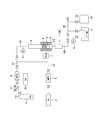
- FIG. 1 showing an example of a boron trichloride production apparatus.
- the main parts may be illustrated in an enlarged manner in order to make the features of the present invention easy to understand, and the dimensional ratios and the like of the components shown in FIG. It is not always the same as the actual boron trichloride production equipment.
- the apparatus for producing boron trichloride shown in FIG. 1 includes a chlorine gas container 1 (for example, a cylinder) filled with chlorine gas, a nitrogen gas container 2 (for example, a cylinder) filled with nitrogen gas, which is an inert gas, A tubular reaction vessel 8 made of quartz into which powder (raw material boron carbide) 9 is loaded, a Fourier transform infrared spectrometer 13 capable of analyzing boron trichloride, moisture, hydrogen chloride and the like in the gas, and A collection container 14 for liquefying and collecting gaseous boron trichloride.
- a reaction section in which a reaction such as a chlorination reaction is performed is provided inside the tubular reaction vessel 8, and boron carbide (raw material boron carbide) powder 9 is loaded into the reaction section while being supported on quartz wool 10. Have been.
- the temperature of the reaction section is controlled by the heater 7 and is kept warm by being covered with the heat insulating material 15.
- chlorine gas is introduced from the chlorine gas container 1 into the tubular reaction container 8 via the pipes 21 and 23.
- the flow rate of the chlorine gas is adjusted by the mass flow controller 4 while adjusting the supply pressure of the chlorine gas by the regulator 3.
- a pipe 22 that communicates the nitrogen gas container 2 with an intermediate portion of the pipe 21 is provided. Nitrogen gas is introduced from the nitrogen gas container 2 to the intermediate portion of the pipe 21 via the pipe 22, and chlorine gas and Nitrogen gas is mixed. At this time, since the flow rate of the nitrogen gas can be adjusted by the mass flow controller 5, the ratio of the chlorine gas in the mixed gas can be adjusted by the mass flow controller 5.
- the reaction section of the tubular reaction vessel 8 is loaded with powder 9 of boron carbide (raw boron carbide).
- the powder 9 of boron carbide (raw boron carbide) is It is heated to a temperature (300 ° C. or more and 700 ° C. or less) at which a reaction between boron carbide and chlorine gas hardly occurs.
- Chlorine gas is introduced there and comes into contact with the powder 9 of boron carbide (raw material boron carbide), so that the metal contained in the powder 9 of boron carbide (raw material boron carbide) is suppressed while chlorination of boron carbide is suppressed.
- Chlorine reacts preferentially with chlorine gas to produce metal chloride (metal chlorination step).
- the metal chlorination step may be performed under an atmospheric pressure environment, or may be performed under a pressure environment lower than the atmospheric pressure.
- the inside of the boron trichloride producing apparatus may be depressurized using a vacuum pump (not shown).
- the pressure in the tubular reaction vessel 8 can be measured by the pressure gauge 6.
- the tubular reaction vessel 8 is formed immediately after the formation. Is vaporized in the reaction section of (1) and separated from boron carbide (removal step). That is, in the case of the present embodiment, the metal chlorination step and the removal step proceed simultaneously. As a result, the metal is removed from the boron carbide in the tubular reaction vessel 8.
- the pipe 24A cannot flow and the pipe 24B can flow by the opening and closing control of the valve, so the vaporized metal chloride is sent to the cooling unit 11 by the chlorine gas and cooled. Liquefaction or solidification. Then, the gas from which the metal chloride has been removed by liquefaction or solidification passes through the Fourier transform infrared spectroscopy device 13 and is then sent to the outside of the boron trichloride production device via the pipe 25. At this time, the gas is sent to the outside of the apparatus for producing boron trichloride without passing through the collection container 14.
- the pipe 24A can be circulated and the pipe 24B cannot be circulated by controlling the opening and closing of the valve. Therefore, the gaseous boron trichloride is sent to the Fourier transform infrared spectrometer 13 by chlorine gas and analyzed. Is performed. By analyzing boron trichloride in the gas, the purity, yield, yield, etc. of boron trichloride can be calculated.
- the gas that has passed through the Fourier transform infrared spectrometer 13 is sent to the collection container 14 via the pipe 25. Then, since the gas is cooled to about 0 ° C. and the boron trichloride is liquefied in the collection container 14, the boron trichloride and the chlorine gas are separated, and the boron trichloride is collected in the collection container 14.
- the chlorine gas is sent to the outside of the boron trichloride production device via the pipe 25.
- the pressure in the pipes 24A, 24B, 25 can be measured by the pressure gauge 12.
- the present invention will be described in more detail with reference to the following Examples and Comparative Examples.
- Various analytical values and the like in Examples and Comparative Examples were measured by the following methods.
- the particle diameter D95 of the raw material boron carbide powder was measured by a wet laser diffraction scattering method.
- D95 is the particle diameter at which the integration frequency from the small particle size side becomes 95% in the volume-based integrated particle size distribution.
- the apparatus used for measuring the particle diameter D95 is a laser diffraction / scattering type particle diameter distribution measuring apparatus “Microtrack” manufactured by Microtrac Bell Co., Ltd.
- the measurement conditions are as follows.
- the content of metals other than boron was measured by high frequency inductively coupled plasma emission spectroscopy (ICP emission spectroscopy).
- concentration and amount of boron trichloride were measured with a Fourier transform infrared spectrometer manufactured by THERMO FISHER SCIENTIFIC.
- Window panel material Barium fluoride (BaF 2 ) Cell length: 10cm Data interval: 0.964 cm -1 , Number of scans: 16 Wave number used for analysis: 1908 cm -1
- the yield of boron trichloride was calculated by calculating the ratio of the actual amount of boron trichloride to the theoretical amount of boron trichloride calculated from the charged amount of the raw material boron carbide.
- Example 1 Using a boron trichloride production apparatus having the same configuration as that of the boron trichloride production apparatus of FIG. 1, the same operation as in the above embodiment is performed to react the raw material boron carbide powder with the chlorine gas-containing gas. Manufactured.
- the chlorine gas-containing gas a commercially available high-purity chlorine gas having a purity of 99.999% by volume and a water content of 0.9% by volume was used.
- the raw material boron carbide powder a boron carbide powder having a D95 of 48 ⁇ m measured by a laser diffraction method was used.
- the types and contents of metals other than boron contained in the raw material boron carbide powder are as follows. That is, it is 0.30% by mass of iron, 0.027% by mass of aluminum, 0.037% by mass of calcium, 0.012% by mass of chromium, and 0.78% by mass of silicon.
- 0.3 g of the raw material boron carbide powder was charged into a tubular reactor made of quartz, and while supplying nitrogen gas at a flow rate of 125.6 ccm (cm 3 / min) to the tubular reactor, the powder of the raw material boron carbide was added to the tubular reactor. The temperature was raised to 450 ° C. over a period of minutes.
- the gas supplied to the tubular reaction vessel is switched from the nitrogen gas to the chlorine gas-containing gas (high-purity chlorine gas), and the normal temperature chlorine gas-containing gas is supplied to the tubular reaction vessel at atmospheric pressure for one hour ( The flow rate was 125.6 ccm at room temperature), and the metal contained in the raw material boron carbide powder was reacted with chlorine gas to chlorinate the metal to obtain a metal chloride.
- the generated metal chloride was vaporized at 450 ° C. and removed from the boron carbide powder.
- the exhaust gas discharged from the tubular reaction vessel was drawn into a Fourier transform infrared spectrophotometer, and the exhaust gas was subjected to infrared spectroscopy.
- the chlorination reaction was performed while confirming that the concentration of boron trichloride in the exhaust gas during the chlorination reaction was 0.02% by volume or less.
- the gas supplied to the tubular reaction vessel is switched from a chlorine gas-containing gas to a nitrogen gas, and a nitrogen gas having a flow rate of 125.6 ccm is supplied to the tubular reaction vessel at room temperature for 10 minutes. Was replaced with nitrogen gas. Thereafter, a powder of boron carbide was collected from the tubular reaction vessel, and the content of iron was measured by inductively coupled plasma emission spectroscopy. As a result, the iron content in the boron carbide was 0.10% by mass.
- the boron carbide powder was heated to 900 ° C. over 30 minutes while supplying nitrogen gas at a normal temperature and a flow rate of 125.6 ccm to the tubular reaction vessel. Thereafter, the gas supplied to the tubular reaction vessel is switched from nitrogen gas to chlorine gas-containing gas, and a normal temperature chlorine gas-containing gas is supplied at atmospheric pressure for 10 minutes (flow rate: 125.6 ccm), whereby boron carbide and chlorine gas are supplied. The gas was reacted to produce boron trichloride.
- Example 2 Except that the temperature at which the metal contained in the raw material boron carbide powder is reacted with chlorine gas to chlorinate the metal, and the temperature at which the metal chloride is removed is 300 ° C., the same as in Example 1 is performed. Boron trichloride was produced. As a result, the content of iron in the boron carbide after removing the metal chloride was 0.22% by mass. Also, during the boron trichloride generation reaction, colored stains considered to be metal chlorides are not seen on the production line of the boron trichloride production device, and the production line of the boron trichloride production device may be blocked. Did not. Further, the content of iron in the produced boron trichloride was 100 mass ppb, and the content of aluminum was 6 mass ppb. Further, the yield of boron trichloride was 98%.
- Example 3 Except that the temperature at which the metal contained in the raw material boron carbide powder is reacted with chlorine gas to chlorinate the metal, and the temperature at which the metal chloride is removed is 375 ° C., the same as in Example 1 is performed. Boron trichloride was produced. As a result, the content of iron in the boron carbide after removing the metal chloride was 0.16% by mass. Also, during the boron trichloride generation reaction, colored stains considered to be metal chlorides are not seen on the production line of the boron trichloride production device, and the production line of the boron trichloride production device may be blocked. Did not. Further, the content of iron in the produced boron trichloride was 80 mass ppb, and the content of aluminum was 6 mass ppb. Further, the yield of boron trichloride was 98%.
- Example 4 A chlorine gas-containing gas used for a chlorination reaction of a metal contained in a raw material boron carbide powder and a chlorine gas-containing gas used for a chlorination reaction of boron carbide, and a mixed gas obtained by diluting chlorine gas with nitrogen gas. Boron trichloride was produced in the same manner as in Example 1 except for the point described above. The concentration of chlorine gas in the mixed gas was 50% by volume.
- the content of iron in the boron carbide after removing the metal chloride was 0.20% by mass.
- a light brown dirt which is considered to be a metal chloride, was found on the production line of the boron trichloride production apparatus (downstream opening of the tubular reaction vessel). The production line of the production equipment was not blocked.
- the content of iron in the produced boron trichloride was 100 mass ppb, and the content of aluminum was 6 mass ppb. Further, the yield of boron trichloride was 98%.
- Example 5 Boron trichloride was produced in the same manner as in Example 1 except that the time for contacting the raw material boron carbide powder with the chlorine gas-containing gas was 3 hours. As a result, the content of iron in the boron carbide after removing the metal chloride was 0.13% by mass. Also, during the boron trichloride generation reaction, colored stains considered to be metal chlorides are not seen on the production line of the boron trichloride production device, and the production line of the boron trichloride production device may be blocked. Did not. Further, the content of iron in the produced boron trichloride was 60 mass ppb, and the content of aluminum was 6 mass ppb. Further, the yield of boron trichloride was 98%.
- Example 6 Boron trichloride was produced in the same manner as in Example 1, except that the particle diameter D95 of the raw material boron carbide powder was 100 ⁇ m. As a result, the content of iron in the boron carbide after removing the metal chloride was 0.10% by mass. Also, during the boron trichloride generation reaction, colored stains considered to be metal chlorides are not seen on the production line of the boron trichloride production device, and the production line of the boron trichloride production device may be blocked. Did not. Further, the content of iron in the produced boron trichloride was 60 mass ppb, and the content of aluminum was 6 mass ppb. The yield of boron trichloride was 95%.
- Example 7 Boron trichloride was produced in the same manner as in Example 1 except that the particle diameter D95 of the raw material boron carbide powder was 500 ⁇ m. As a result, the content of iron in the boron carbide after removing the metal chloride was 0.10% by mass. Also, during the boron trichloride generation reaction, colored stains considered to be metal chlorides are not seen on the production line of the boron trichloride production device, and the production line of the boron trichloride production device may be blocked. Did not. Further, the content of iron in the produced boron trichloride was 60 mass ppb, and the content of aluminum was 6 mass ppb. The yield of boron trichloride was 90%.
- Example 8 The powder of the raw material boron carbide passes through a dry sieve having an opening of 5.60 mm, the dry sieve residue having an opening of 3.35 mm is 20% by mass or less, and the dry sieve residue having an opening of 1 mm is 65% by mass or more.
- a boron trichloride was produced in the same manner as in Example 1 except for the following. As a result, the content of iron in the boron carbide after removing the metal chloride was 0.13% by mass. Also, during the boron trichloride generation reaction, colored stains considered to be metal chlorides are not seen on the production line of the boron trichloride production device, and the production line of the boron trichloride production device may be blocked. Did not. Further, the content of iron in the produced boron trichloride was 70 mass ppb, and the content of aluminum was 6 mass ppb. Further, the yield of boron trichloride was 30%.
- Example 1 Same as Example 1 except that the metal contained in the raw boron carbide powder was not chlorinated and the boron gas was chlorinated by reacting chlorine gas with the raw boron carbide from which the metal had not been removed. To produce boron trichloride. The content of iron in the raw material boron carbide powder from which the metal had not been removed was 0.30% by mass.
- brown stains which are considered to be metal chlorides, were found on the production line of the boron trichloride production apparatus (downstream opening of the tubular reaction vessel). There was no blockage of the equipment production line. Further, the content of iron in the produced boron trichloride was 3 mass ppm, and the content of aluminum was 6 mass ppb. Further, the yield of boron trichloride was 98%.
- Example 3 Except that the temperature at which the metal contained in the raw material boron carbide powder is reacted with chlorine gas to chlorinate the metal, and the temperature at which the metal chloride is removed is 750 ° C., the same as in Example 1 is performed. Boron trichloride was produced. However, in the step of reacting the metal contained in the raw material boron carbide powder with the chlorine gas to chlorinate the metal, the boron carbide reacts with the chlorine gas to produce boron trichloride, and the generated gas (tubular reaction vessel) The concentration of boron trichloride in the exhaust gas (exhaust gas discharged from) is 90% by volume.
Landscapes
- Chemical & Material Sciences (AREA)
- Organic Chemistry (AREA)
- Inorganic Chemistry (AREA)
- Carbon And Carbon Compounds (AREA)
Abstract
Description
B4C + 6Cl2 → 4BCl3 + C
しかしながら、この製造方法においては、塩素化反応時に茶褐色のオイル状物が生成し、三塩化ホウ素の製造ラインを閉塞させるおそれがあるという問題があった。このオイル状物の主成分は、炭化ホウ素に不純物として含まれている鉄(Fe)等の金属が塩素ガスと反応して副生した金属塩化物である。また、このオイル状物中の金属塩化物が三塩化ホウ素に混入して、三塩化ホウ素の純度が低下するという問題もあった。
[1] ホウ素以外の金属を不純物として含有する炭化ホウ素である原料炭化ホウ素に、300℃以上700℃以下の温度で塩素ガス含有ガスを接触させ、前記金属に前記塩素ガス含有ガス中の塩素ガスを反応させて金属塩化物とし、前記金属塩化物を含有する炭化ホウ素を得る金属塩素化工程と、
前記金属塩素化工程で得られた前記金属塩化物を含有する炭化ホウ素から前記金属塩化物を除去する除去工程と、
前記除去工程で前記金属塩化物が除去された前記炭化ホウ素に塩素ガス含有ガスを接触させ、前記炭化ホウ素と前記塩素ガス含有ガス中の塩素ガスとを反応させて三塩化ホウ素を生成する生成工程と、
を備える三塩化ホウ素の製造方法。
[3] 前記金属が鉄、アルミニウム、カルシウム、クロム、ケイ素、及びチタンのうちの少なくとも1種である[1]又は[2]に記載の三塩化ホウ素の製造方法。
[4] 前記金属が鉄を含み、前記除去工程によって前記金属塩化物が除去された前記炭化ホウ素に含有される鉄の含有量が0.30質量%未満である[3]に記載の三塩化ホウ素の製造方法。
[6] 前記金属塩素化工程において使用される前記塩素ガス含有ガスは、50体積%以上100体積%以下の塩素ガスと残部の不活性ガスとからなる[1]~[5]のいずれか一項に記載の三塩化ホウ素の製造方法。
金属塩素化工程は、原料炭化ホウ素に塩素ガス含有ガスを接触させ、炭化ホウ素の塩素化を抑制しつつ金属を塩素化して金属塩化物とし、金属塩化物を含有する炭化ホウ素を得る工程である。炭化ホウ素の塩素化を抑制しながら原料炭化ホウ素中の金属の塩素化を選択的に行う方法は特に限定されるものではないが、例えば、炭化ホウ素の塩素化は生じにくく且つ金属の塩素化は生じやすい反応条件で塩素化反応を行う方法が挙げられる。
金属塩素化工程において用いる塩素ガス含有ガスの流量は特に限定されるものではないが、塩素ガスの流量(線速度)として、0.5m/min以上2.5m/min以下とすることができる。
なお、D95とは、体積基準の積算粒子径分布において小粒径側からの積算頻度が95%となる粒子径である。
除去工程は、金属塩素化工程で得られた金属塩化物を含有する炭化ホウ素から、金属塩化物を除去する工程である。三塩化ホウ素の生成前であれば、炭化ホウ素から金属塩化物を分離することが容易であるので、炭化ホウ素から金属を簡易な工程で十分に除去することが可能である。
生成工程は、除去工程で金属塩化物が除去された炭化ホウ素に塩素ガス含有ガスを接触させ、炭化ホウ素と塩素ガス含有ガス中の塩素ガスとを反応させて三塩化ホウ素を生成する工程である。
生成工程と金属塩素化工程とでは、同種の塩素ガス含有ガスを用いてもよいし、別種の塩素ガス含有ガスを用いてもよい。すなわち、生成工程と金属塩素化工程とで、塩素ガス含有ガス中の塩素ガスの割合は同一でもよいし、異なってもよい。
三塩化ホウ素を製造する際には、まず塩素ガスを塩素ガス容器1から配管21、23を介して管状反応容器8に導入する。その際には、レギュレーター3にて塩素ガスの供給圧を調整しつつ、マスフローコントローラー4にて塩素ガスの流量を調整する。
粒子透過性:透過
粒子屈折率:2.00
粒子形状 :非球形
溶媒名 :エタノール
溶媒屈折率:1.36
測定範囲 :0.021-1408μm
三塩化ホウ素の濃度及び生成量は、THERMO FISHER SCIENTIFIC社製のフーリエ変換赤外分光装置により測定した。
窓板の材質:フッ化バリウム(BaF2)
セル長 :10cm
データ間隔:0.964cm-1、
スキャン回数:16
分析に用いた波数:1908cm-1
三塩化ホウ素の収率は、原料炭化ホウ素の仕込み量から計算される三塩化ホウ素の理論生成量に対する三塩化ホウ素の実際の生成量の割合を計算することによって算出した。
図1の三塩化ホウ素製造装置と同様の構成の三塩化ホウ素製造装置を用い、上記実施形態と同様の操作を行って原料炭化ホウ素の粉末と塩素ガス含有ガスとを反応させ、三塩化ホウ素を製造した。
原料炭化ホウ素の粉末としては、レーザー回折法により測定したD95が48μmである炭化ホウ素粉末を用いた。また、この原料炭化ホウ素の粉末が含有するホウ素以外の金属の種類と含有量は、以下の通りである。すなわち、鉄0.30質量%、アルミニウム0.027質量%、カルシウム0.037質量%、クロム0.012質量%、ケイ素0.78質量%である。

原料炭化ホウ素の粉末に含有される金属と塩素ガスとを反応させて金属を塩素化する温度、及び、金属塩化物を除去する温度を300℃とした点以外は、実施例1と同様にして三塩化ホウ素を製造した。その結果、金属塩化物を除去した後の炭化ホウ素中の鉄の含有量は、0.22質量%であった。また、三塩化ホウ素の生成反応中は、金属塩化物と思われる有色の汚れが三塩化ホウ素製造装置の製造ライン上に見られることはなく、三塩化ホウ素製造装置の製造ラインが閉塞することもなかった。さらに、生成した三塩化ホウ素中の鉄の含有量は100質量ppbで、アルミニウムの含有量は6質量ppbであった。また、三塩化ホウ素の収率は98%であった。
原料炭化ホウ素の粉末に含有される金属と塩素ガスとを反応させて金属を塩素化する温度、及び、金属塩化物を除去する温度を375℃とした点以外は、実施例1と同様にして三塩化ホウ素を製造した。その結果、金属塩化物を除去した後の炭化ホウ素中の鉄の含有量は、0.16質量%であった。また、三塩化ホウ素の生成反応中は、金属塩化物と思われる有色の汚れが三塩化ホウ素製造装置の製造ライン上に見られることはなく、三塩化ホウ素製造装置の製造ラインが閉塞することもなかった。さらに、生成した三塩化ホウ素中の鉄の含有量は80質量ppbで、アルミニウムの含有量は6質量ppbであった。また、三塩化ホウ素の収率は98%であった。
原料炭化ホウ素の粉末に含有される金属の塩素化反応に使用する塩素ガス含有ガスと、炭化ホウ素の塩素化反応に使用する塩素ガス含有ガスとを、塩素ガスを窒素ガスで希釈した混合ガスとした点以外は、実施例1と同様にして三塩化ホウ素を製造した。混合ガス中の塩素ガスの濃度は50体積%とした。
原料炭化ホウ素の粉末と塩素ガス含有ガスとを接触させる時間を3時間とした点以外は、実施例1と同様にして三塩化ホウ素を製造した。その結果、金属塩化物を除去した後の炭化ホウ素中の鉄の含有量は、0.13質量%であった。また、三塩化ホウ素の生成反応中は、金属塩化物と思われる有色の汚れが三塩化ホウ素製造装置の製造ライン上に見られることはなく、三塩化ホウ素製造装置の製造ラインが閉塞することもなかった。さらに、生成した三塩化ホウ素中の鉄の含有量は60質量ppbで、アルミニウムの含有量は6質量ppbであった。また、三塩化ホウ素の収率は98%であった。
原料炭化ホウ素の粉末の粒子径D95が100μmである点以外は、実施例1と同様にして三塩化ホウ素を製造した。その結果、金属塩化物を除去した後の炭化ホウ素中の鉄の含有量は、0.10質量%であった。また、三塩化ホウ素の生成反応中は、金属塩化物と思われる有色の汚れが三塩化ホウ素製造装置の製造ライン上に見られることはなく、三塩化ホウ素製造装置の製造ラインが閉塞することもなかった。さらに、生成した三塩化ホウ素中の鉄の含有量は60質量ppbで、アルミニウムの含有量は6質量ppbであった。また、三塩化ホウ素の収率は95%であった。
原料炭化ホウ素の粉末の粒子径D95が500μmである点以外は、実施例1と同様にして三塩化ホウ素を製造した。その結果、金属塩化物を除去した後の炭化ホウ素中の鉄の含有量は、0.10質量%であった。また、三塩化ホウ素の生成反応中は、金属塩化物と思われる有色の汚れが三塩化ホウ素製造装置の製造ライン上に見られることはなく、三塩化ホウ素製造装置の製造ラインが閉塞することもなかった。さらに、生成した三塩化ホウ素中の鉄の含有量は60質量ppbで、アルミニウムの含有量は6質量ppbであった。また、三塩化ホウ素の収率は90%であった。
原料炭化ホウ素の粉末が、目開き5.60mmの乾式篩を通過し、目開き3.35mmの乾式篩残分が20質量%以下となり、目開き1mmの乾式篩残分が65質量%以上となるものである点以外は、実施例1と同様にして三塩化ホウ素を製造した。
その結果、金属塩化物を除去した後の炭化ホウ素中の鉄の含有量は、0.13質量%であった。また、三塩化ホウ素の生成反応中は、金属塩化物と思われる有色の汚れが三塩化ホウ素製造装置の製造ライン上に見られることはなく、三塩化ホウ素製造装置の製造ラインが閉塞することもなかった。さらに、生成した三塩化ホウ素中の鉄の含有量は70質量ppbで、アルミニウムの含有量は6質量ppbであった。また、三塩化ホウ素の収率は30%であった。
原料炭化ホウ素の粉末に含有される金属の塩素化を行わず、金属を除去していない原料炭化ホウ素に塩素ガスを反応させて炭化ホウ素の塩素化を行った点以外は、実施例1と同様にして三塩化ホウ素を製造した。金属を除去していない原料炭化ホウ素の粉末中の鉄の含有量は、0.30質量%であった。
原料炭化ホウ素の粉末に含有される金属と塩素ガスとを反応させて金属を塩素化する温度、及び、金属塩化物を除去する温度を250℃とした点以外は、実施例1と同様にして三塩化ホウ素を製造した。その結果、炭化ホウ素の粉末中の鉄の含有量は、0.30質量%であった。
原料炭化ホウ素の粉末に含有される金属と塩素ガスとを反応させて金属を塩素化する温度、及び、金属塩化物を除去する温度を750℃とした点以外は、実施例1と同様にして三塩化ホウ素を製造した。しかし、原料炭化ホウ素の粉末に含有される金属と塩素ガスとを反応させて金属を塩素化する工程で、炭化ホウ素と塩素ガスが反応して三塩化ホウ素が生成し、生成ガス(管状反応容器から排出される排出ガス)中の三塩化ホウ素の濃度が90体積%となってしまった。
2 窒素ガス容器
8 管状反応容器
9 炭化ホウ素の粉末
11 冷却部
13 フーリエ変換赤外分光装置
14 捕集容器
Claims (6)
- ホウ素以外の金属を不純物として含有する炭化ホウ素である原料炭化ホウ素に、300℃以上700℃以下の温度で塩素ガス含有ガスを接触させ、前記金属に前記塩素ガス含有ガス中の塩素ガスを反応させて金属塩化物とし、前記金属塩化物を含有する炭化ホウ素を得る金属塩素化工程と、
前記金属塩素化工程で得られた前記金属塩化物を含有する炭化ホウ素から前記金属塩化物を除去する除去工程と、
前記除去工程で前記金属塩化物が除去された前記炭化ホウ素に塩素ガス含有ガスを接触させ、前記炭化ホウ素と前記塩素ガス含有ガス中の塩素ガスとを反応させて三塩化ホウ素を生成する生成工程と、
を備える三塩化ホウ素の製造方法。 - 前記生成工程において前記炭化ホウ素と前記塩素ガス含有ガスとを550℃以上1100℃以下の温度で接触させる請求項1に記載の三塩化ホウ素の製造方法。
- 前記金属が鉄、アルミニウム、カルシウム、クロム、ケイ素、及びチタンのうちの少なくとも1種である請求項1又は請求項2に記載の三塩化ホウ素の製造方法。
- 前記金属が鉄を含み、前記除去工程によって前記金属塩化物が除去された前記炭化ホウ素に含有される鉄の含有量が0.30質量%未満である請求項3に記載の三塩化ホウ素の製造方法。
- 前記原料炭化ホウ素は、レーザー回折法により測定されたD95が500μm以下である粉体であり、前記D95とは、体積基準の積算粒子径分布において小粒径側からの積算頻度が95%となる粒子径である請求項1~4のいずれか一項に記載の三塩化ホウ素の製造方法。
- 前記金属塩素化工程において使用される前記塩素ガス含有ガスは、50体積%以上100体積%以下の塩素ガスと残部の不活性ガスとからなる請求項1~5のいずれか一項に記載の三塩化ホウ素の製造方法。
Priority Applications (5)
| Application Number | Priority Date | Filing Date | Title |
|---|---|---|---|
| CN201980043129.1A CN112313175B (zh) | 2018-06-26 | 2019-06-04 | 三氯化硼的制造方法 |
| US17/052,844 US11878912B2 (en) | 2018-06-26 | 2019-06-04 | Method of producing boron trichloride |
| KR1020207035064A KR102549707B1 (ko) | 2018-06-26 | 2019-06-04 | 삼염화붕소의 제조 방법 |
| JP2020527330A JP7264164B2 (ja) | 2018-06-26 | 2019-06-04 | 三塩化ホウ素の製造方法 |
| EP19825153.0A EP3816108B1 (en) | 2018-06-26 | 2019-06-04 | Boron trichloride production method |
Applications Claiming Priority (2)
| Application Number | Priority Date | Filing Date | Title |
|---|---|---|---|
| JP2018121137 | 2018-06-26 | ||
| JP2018-121137 | 2018-06-26 |
Publications (1)
| Publication Number | Publication Date |
|---|---|
| WO2020003924A1 true WO2020003924A1 (ja) | 2020-01-02 |
Family
ID=68984867
Family Applications (1)
| Application Number | Title | Priority Date | Filing Date |
|---|---|---|---|
| PCT/JP2019/022194 Ceased WO2020003924A1 (ja) | 2018-06-26 | 2019-06-04 | 三塩化ホウ素の製造方法 |
Country Status (7)
| Country | Link |
|---|---|
| US (1) | US11878912B2 (ja) |
| EP (1) | EP3816108B1 (ja) |
| JP (1) | JP7264164B2 (ja) |
| KR (1) | KR102549707B1 (ja) |
| CN (1) | CN112313175B (ja) |
| TW (1) | TWI714124B (ja) |
| WO (1) | WO2020003924A1 (ja) |
Families Citing this family (4)
| Publication number | Priority date | Publication date | Assignee | Title |
|---|---|---|---|---|
| CN112062134B (zh) * | 2020-09-21 | 2023-05-09 | 齐齐哈尔大学 | 一种利用固相原料制备三氯化硼-11的方法 |
| CN112897528B (zh) * | 2021-03-24 | 2022-11-22 | 云南华谱量子材料有限公司 | 一种激光烧结合成碳化硼/碳粉体材料的方法 |
| CN114162830B (zh) * | 2021-12-31 | 2022-06-28 | 大连科利德光电子材料有限公司 | 电子级三氯化硼的制备方法及其所获得的三氯化硼 |
| CN115672201A (zh) * | 2022-11-18 | 2023-02-03 | 福建久策气体股份有限公司 | 一种碳化硼与氯气反应制备三氯化硼的系统 |
Citations (4)
| Publication number | Priority date | Publication date | Assignee | Title |
|---|---|---|---|---|
| JP2008272688A (ja) | 2007-05-01 | 2008-11-13 | Denki Kagaku Kogyo Kk | セラミックス原料の粉砕方法 |
| JP2009227517A (ja) * | 2008-03-24 | 2009-10-08 | Ube Ind Ltd | 三塩化ホウ素の製造方法 |
| JP2010111550A (ja) * | 2008-11-07 | 2010-05-20 | Ube Ind Ltd | 高純度三塩化ホウ素及びその製造方法 |
| WO2017221642A1 (ja) * | 2016-06-23 | 2017-12-28 | 昭和電工株式会社 | 三塩化ホウ素の製造方法 |
Family Cites Families (7)
| Publication number | Priority date | Publication date | Assignee | Title |
|---|---|---|---|---|
| US3025138A (en) | 1957-04-15 | 1962-03-13 | Stauffer Chemical Co | Manufacture of boron trichloride |
| US3035138A (en) | 1961-02-01 | 1962-05-15 | Hughes Aircraft Co | Magnetic circuit breaker |
| KR100272688B1 (ko) | 1997-12-23 | 2000-11-15 | 구자홍 | 대표 피치 패턴을 이용한 한국어 합성음 생성방법 |
| DE10358080A1 (de) | 2003-12-10 | 2005-07-21 | Basf Ag | Verfahren zur Herstellung von Bortrichlorid |
| WO2015142942A2 (en) | 2014-03-18 | 2015-09-24 | Matheson Tri-Gas, Inc. | Reduction of sici4 in the presence of bc13 |
| CN106957061B (zh) | 2017-05-25 | 2023-06-16 | 江西瑞合特种材料有限公司 | 一种低光气含量的三氯化硼生产装置及方法 |
| CN108163868A (zh) | 2017-12-29 | 2018-06-15 | 和立气体(上海)有限公司 | 一种三氯化硼纯化装置 |
-
2019
- 2019-06-04 US US17/052,844 patent/US11878912B2/en active Active
- 2019-06-04 CN CN201980043129.1A patent/CN112313175B/zh active Active
- 2019-06-04 WO PCT/JP2019/022194 patent/WO2020003924A1/ja not_active Ceased
- 2019-06-04 JP JP2020527330A patent/JP7264164B2/ja active Active
- 2019-06-04 EP EP19825153.0A patent/EP3816108B1/en active Active
- 2019-06-04 KR KR1020207035064A patent/KR102549707B1/ko active Active
- 2019-06-14 TW TW108120601A patent/TWI714124B/zh active
Patent Citations (4)
| Publication number | Priority date | Publication date | Assignee | Title |
|---|---|---|---|---|
| JP2008272688A (ja) | 2007-05-01 | 2008-11-13 | Denki Kagaku Kogyo Kk | セラミックス原料の粉砕方法 |
| JP2009227517A (ja) * | 2008-03-24 | 2009-10-08 | Ube Ind Ltd | 三塩化ホウ素の製造方法 |
| JP2010111550A (ja) * | 2008-11-07 | 2010-05-20 | Ube Ind Ltd | 高純度三塩化ホウ素及びその製造方法 |
| WO2017221642A1 (ja) * | 2016-06-23 | 2017-12-28 | 昭和電工株式会社 | 三塩化ホウ素の製造方法 |
Non-Patent Citations (1)
| Title |
|---|
| See also references of EP3816108A4 |
Also Published As
| Publication number | Publication date |
|---|---|
| CN112313175A (zh) | 2021-02-02 |
| EP3816108A1 (en) | 2021-05-05 |
| TW202005912A (zh) | 2020-02-01 |
| KR102549707B1 (ko) | 2023-07-03 |
| US20210246040A1 (en) | 2021-08-12 |
| TWI714124B (zh) | 2020-12-21 |
| JP7264164B2 (ja) | 2023-04-25 |
| EP3816108A4 (en) | 2021-09-22 |
| CN112313175B (zh) | 2023-11-21 |
| US11878912B2 (en) | 2024-01-23 |
| JPWO2020003924A1 (ja) | 2021-07-08 |
| KR20210005268A (ko) | 2021-01-13 |
| EP3816108B1 (en) | 2024-08-07 |
Similar Documents
| Publication | Publication Date | Title |
|---|---|---|
| JP7264164B2 (ja) | 三塩化ホウ素の製造方法 | |
| CN110799666B (zh) | 金属氟氧化物的处理方法及清洁方法 | |
| EP2165973B1 (en) | Method for production of iodine heptafluoride | |
| US9468975B2 (en) | Treatment of chemical feedstocks | |
| JP6849677B2 (ja) | 三塩化ホウ素の製造方法 | |
| JP4842272B2 (ja) | マンガン化合物のフッ素化方法 | |
| JP3283292B2 (ja) | 窒化珪素粉末の製造方法 | |
| JP2010116282A (ja) | 四フッ化ゲルマニウムの製造方法 | |
| US20090022647A1 (en) | Process for Producing a Silicon Nitride Compound | |
| JPS62260722A (ja) | 高純度フツ化ハフニウムの製造方法 | |
| JP5032040B2 (ja) | セレン化水素の製造方法 | |
| Makhofane et al. | Manufacturing of anhydrous zirconium tetrafluoride in a batch reactor from plasma-dissociated zircon and ammonium bifluoride | |
| JPS62212223A (ja) | フツ化アルミニウムの製造方法および製造装置 | |
| JPS623019A (ja) | 四弗化チタンの製造方法 | |
| JP2014073914A (ja) | 金属シリコンの製造方法及び金属チタンの製造方法 |
Legal Events
| Date | Code | Title | Description |
|---|---|---|---|
| 121 | Ep: the epo has been informed by wipo that ep was designated in this application |
Ref document number: 19825153 Country of ref document: EP Kind code of ref document: A1 |
|
| ENP | Entry into the national phase |
Ref document number: 2020527330 Country of ref document: JP Kind code of ref document: A |
|
| ENP | Entry into the national phase |
Ref document number: 20207035064 Country of ref document: KR Kind code of ref document: A |
|
| NENP | Non-entry into the national phase |
Ref country code: DE |
|
| ENP | Entry into the national phase |
Ref document number: 2019825153 Country of ref document: EP Effective date: 20210126 |