WO2020004077A1 - Connecteur électrique à plaque de blindage, et procédé de fabrication pour boîtier de connecteur électrique - Google Patents
Connecteur électrique à plaque de blindage, et procédé de fabrication pour boîtier de connecteur électrique Download PDFInfo
- Publication number
- WO2020004077A1 WO2020004077A1 PCT/JP2019/023701 JP2019023701W WO2020004077A1 WO 2020004077 A1 WO2020004077 A1 WO 2020004077A1 JP 2019023701 W JP2019023701 W JP 2019023701W WO 2020004077 A1 WO2020004077 A1 WO 2020004077A1
- Authority
- WO
- WIPO (PCT)
- Prior art keywords
- plate
- housing
- fitting
- terminals
- wall
- Prior art date
- Legal status (The legal status is an assumption and is not a legal conclusion. Google has not performed a legal analysis and makes no representation as to the accuracy of the status listed.)
- Ceased
Links
Images





Classifications
-
- H—ELECTRICITY
- H01—ELECTRIC ELEMENTS
- H01R—ELECTRICALLY-CONDUCTIVE CONNECTIONS; STRUCTURAL ASSOCIATIONS OF A PLURALITY OF MUTUALLY-INSULATED ELECTRICAL CONNECTING ELEMENTS; COUPLING DEVICES; CURRENT COLLECTORS
- H01R13/00—Details of coupling devices of the kinds covered by groups H01R12/70 or H01R24/00 - H01R33/00
- H01R13/46—Bases; Cases
- H01R13/502—Bases; Cases composed of different pieces
-
- H—ELECTRICITY
- H01—ELECTRIC ELEMENTS
- H01R—ELECTRICALLY-CONDUCTIVE CONNECTIONS; STRUCTURAL ASSOCIATIONS OF A PLURALITY OF MUTUALLY-INSULATED ELECTRICAL CONNECTING ELEMENTS; COUPLING DEVICES; CURRENT COLLECTORS
- H01R43/00—Apparatus or processes specially adapted for manufacturing, assembling, maintaining, or repairing of line connectors or current collectors or for joining electric conductors
- H01R43/18—Apparatus or processes specially adapted for manufacturing, assembling, maintaining, or repairing of line connectors or current collectors or for joining electric conductors for manufacturing bases or cases for contact members
-
- H—ELECTRICITY
- H01—ELECTRIC ELEMENTS
- H01R—ELECTRICALLY-CONDUCTIVE CONNECTIONS; STRUCTURAL ASSOCIATIONS OF A PLURALITY OF MUTUALLY-INSULATED ELECTRICAL CONNECTING ELEMENTS; COUPLING DEVICES; CURRENT COLLECTORS
- H01R13/00—Details of coupling devices of the kinds covered by groups H01R12/70 or H01R24/00 - H01R33/00
- H01R13/40—Securing contact members in or to a base or case; Insulating of contact members
- H01R13/405—Securing in non-demountable manner, e.g. moulding, riveting
-
- H—ELECTRICITY
- H01—ELECTRIC ELEMENTS
- H01R—ELECTRICALLY-CONDUCTIVE CONNECTIONS; STRUCTURAL ASSOCIATIONS OF A PLURALITY OF MUTUALLY-INSULATED ELECTRICAL CONNECTING ELEMENTS; COUPLING DEVICES; CURRENT COLLECTORS
- H01R13/00—Details of coupling devices of the kinds covered by groups H01R12/70 or H01R24/00 - H01R33/00
- H01R13/40—Securing contact members in or to a base or case; Insulating of contact members
- H01R13/405—Securing in non-demountable manner, e.g. moulding, riveting
- H01R13/41—Securing in non-demountable manner, e.g. moulding, riveting by frictional grip in grommet, panel or base
-
- H—ELECTRICITY
- H01—ELECTRIC ELEMENTS
- H01R—ELECTRICALLY-CONDUCTIVE CONNECTIONS; STRUCTURAL ASSOCIATIONS OF A PLURALITY OF MUTUALLY-INSULATED ELECTRICAL CONNECTING ELEMENTS; COUPLING DEVICES; CURRENT COLLECTORS
- H01R13/00—Details of coupling devices of the kinds covered by groups H01R12/70 or H01R24/00 - H01R33/00
- H01R13/648—Protective earth or shield arrangements on coupling devices, e.g. anti-static shielding
- H01R13/658—High frequency shielding arrangements, e.g. against EMI [Electro-Magnetic Interference] or EMP [Electro-Magnetic Pulse]
- H01R13/6581—Shield structure
- H01R13/6585—Shielding material individually surrounding or interposed between mutually spaced contacts
-
- H—ELECTRICITY
- H01—ELECTRIC ELEMENTS
- H01R—ELECTRICALLY-CONDUCTIVE CONNECTIONS; STRUCTURAL ASSOCIATIONS OF A PLURALITY OF MUTUALLY-INSULATED ELECTRICAL CONNECTING ELEMENTS; COUPLING DEVICES; CURRENT COLLECTORS
- H01R13/00—Details of coupling devices of the kinds covered by groups H01R12/70 or H01R24/00 - H01R33/00
- H01R13/648—Protective earth or shield arrangements on coupling devices, e.g. anti-static shielding
- H01R13/658—High frequency shielding arrangements, e.g. against EMI [Electro-Magnetic Interference] or EMP [Electro-Magnetic Pulse]
- H01R13/6581—Shield structure
- H01R13/6585—Shielding material individually surrounding or interposed between mutually spaced contacts
- H01R13/6586—Shielding material individually surrounding or interposed between mutually spaced contacts for separating multiple connector modules
- H01R13/6587—Shielding material individually surrounding or interposed between mutually spaced contacts for separating multiple connector modules for mounting on PCBs
-
- B—PERFORMING OPERATIONS; TRANSPORTING
- B29—WORKING OF PLASTICS; WORKING OF SUBSTANCES IN A PLASTIC STATE IN GENERAL
- B29C—SHAPING OR JOINING OF PLASTICS; SHAPING OF MATERIAL IN A PLASTIC STATE, NOT OTHERWISE PROVIDED FOR; AFTER-TREATMENT OF THE SHAPED PRODUCTS, e.g. REPAIRING
- B29C45/00—Injection moulding, i.e. forcing the required volume of moulding material through a nozzle into a closed mould; Apparatus therefor
- B29C45/14—Injection moulding, i.e. forcing the required volume of moulding material through a nozzle into a closed mould; Apparatus therefor incorporating preformed parts or layers, e.g. injection moulding around inserts or for coating articles
- B29C45/14639—Injection moulding, i.e. forcing the required volume of moulding material through a nozzle into a closed mould; Apparatus therefor incorporating preformed parts or layers, e.g. injection moulding around inserts or for coating articles for obtaining an insulating effect, e.g. for electrical components
-
- H—ELECTRICITY
- H01—ELECTRIC ELEMENTS
- H01R—ELECTRICALLY-CONDUCTIVE CONNECTIONS; STRUCTURAL ASSOCIATIONS OF A PLURALITY OF MUTUALLY-INSULATED ELECTRICAL CONNECTING ELEMENTS; COUPLING DEVICES; CURRENT COLLECTORS
- H01R12/00—Structural associations of a plurality of mutually-insulated electrical connecting elements, specially adapted for printed circuits, e.g. printed circuit boards [PCB], flat or ribbon cables, or like generally planar structures, e.g. terminal strips, terminal blocks; Coupling devices specially adapted for printed circuits, flat or ribbon cables, or like generally planar structures; Terminals specially adapted for contact with, or insertion into, printed circuits, flat or ribbon cables, or like generally planar structures
- H01R12/70—Coupling devices
- H01R12/7005—Guiding, mounting, polarizing or locking means; Extractors
- H01R12/7011—Locking or fixing a connector to a PCB
- H01R12/7052—Locking or fixing a connector to a PCB characterised by the locating members
-
- H—ELECTRICITY
- H01—ELECTRIC ELEMENTS
- H01R—ELECTRICALLY-CONDUCTIVE CONNECTIONS; STRUCTURAL ASSOCIATIONS OF A PLURALITY OF MUTUALLY-INSULATED ELECTRICAL CONNECTING ELEMENTS; COUPLING DEVICES; CURRENT COLLECTORS
- H01R12/00—Structural associations of a plurality of mutually-insulated electrical connecting elements, specially adapted for printed circuits, e.g. printed circuit boards [PCB], flat or ribbon cables, or like generally planar structures, e.g. terminal strips, terminal blocks; Coupling devices specially adapted for printed circuits, flat or ribbon cables, or like generally planar structures; Terminals specially adapted for contact with, or insertion into, printed circuits, flat or ribbon cables, or like generally planar structures
- H01R12/70—Coupling devices
- H01R12/71—Coupling devices for rigid printing circuits or like structures
- H01R12/712—Coupling devices for rigid printing circuits or like structures co-operating with the surface of the printed circuit or with a coupling device exclusively provided on the surface of the printed circuit
- H01R12/716—Coupling device provided on the PCB
-
- H—ELECTRICITY
- H01—ELECTRIC ELEMENTS
- H01R—ELECTRICALLY-CONDUCTIVE CONNECTIONS; STRUCTURAL ASSOCIATIONS OF A PLURALITY OF MUTUALLY-INSULATED ELECTRICAL CONNECTING ELEMENTS; COUPLING DEVICES; CURRENT COLLECTORS
- H01R2107/00—Four or more poles
-
- H—ELECTRICITY
- H01—ELECTRIC ELEMENTS
- H01R—ELECTRICALLY-CONDUCTIVE CONNECTIONS; STRUCTURAL ASSOCIATIONS OF A PLURALITY OF MUTUALLY-INSULATED ELECTRICAL CONNECTING ELEMENTS; COUPLING DEVICES; CURRENT COLLECTORS
- H01R24/00—Two-part coupling devices, or either of their cooperating parts, characterised by their overall structure
- H01R24/60—Contacts spaced along planar side wall transverse to longitudinal axis of engagement
- H01R24/62—Sliding engagements with one side only, e.g. modular jack coupling devices
Definitions
- the present invention relates to an electrical connector having a shield plate, more specifically, an electrical connector having a shield plate between a terminal provided on one surface of a plate-shaped body and a terminal provided on the other surface, and
- the present invention relates to a method for manufacturing a housing.
- JP-A-2017-37851 discloses an example of the above-described type of electrical connector.
- the electrical connector includes a first terminal, a second terminal, and a shield.
- the first terminal includes a first connection portion arranged on one surface of the plate-shaped fitting portion and connected to a mating connector, and the second terminal has a surface opposite to the one surface of the fitting portion. And a second connection portion connected to the mating connector.
- the shielding plate is a plate-shaped member provided between the first connection part and the second connection part of the fitting part.
- the manufacturing process of the electrical connector includes a process of forming a primary molded portion in which a plurality of first terminals and a shielding plate are integrally provided by insert molding, and a process of forming a primary molded portion and a plurality of terminals in an integrated manner by insert molding. Forming a next molded part to form a housing.
- the shielding plate can be provided integrally with the housing by insert molding, so that there is no need to provide an accommodation space for accommodating the shielding plate in advance.
- the size of the accommodation space has become smaller, and for example, the thickness of the accommodation space may be as small as about 0.1 to 0.4 mm.
- the resin In order to form a housing space having such a small thickness and extending in the in-plane direction by using a mold, it is necessary to inject the resin with a very large pressure into a mold defining such a housing space. As a result, the mold may be damaged, and the mold may be displaced due to the pressure of the injected resin, making it difficult to accurately control the shape and size of the housing space.
- An object of the present invention is to provide an electrical connector having a space for accommodating a plate.
- an electrical connector includes a housing having a base, a plate-shaped body formed on a mating side of the base with a mating connector, and a housing attached to the housing.
- a plurality of first terminals provided in a state where at least a part thereof is exposed on one of the opposed plate surfaces of the plate-like body, and at least one first terminal provided on the other opposite plate surface of the plate-like body.
- a plurality of second terminals provided in a state where the portion is exposed, and a plurality of the first terminals and a plurality of the second terminals attached to the housing in a thickness direction of the plate-like body.
- the base body has a first housing portion in which a part of the shielding plate is housed, and the plate-shaped body is fitted and unmated with the mating connector.
- a second housing portion that communicates with the first housing portion in the other direction and that houses another part of the shielding plate, wherein the second housing portion is a mating side with the mating connector.
- a through hole provided in an end wall of the plate-shaped body located in the fitting and releasing directions.
- the base has a plurality of first terminal insertion holes through which the plurality of first terminals are respectively inserted, and a plurality of second terminals through which the plurality of second terminals are respectively inserted.
- a terminal insertion hole along the fitting and unmating direction, and the plurality of first terminal insertion holes are arranged with the plurality of first terminals formed on the one plate surface, respectively.
- the plurality of first grooves are continuous in the fitting and unmating directions with the plurality of first grooves, and the plurality of first grooves are arranged in a state where they are separated from each other on the one plate surface.
- the second terminal insertion hole is continuous with the plurality of second grooves formed on the other plate surface and in which the plurality of second terminals are respectively arranged in the fitting and unmating directions, and The second grooves are spaced apart from each other on the other plate surface. In may be arranged.
- a plurality of first protrusions that form at least a part of the plurality of first grooves are orthogonal to the fitting and releasing directions on the one plate surface.
- the first and second terminal insertion holes are provided along the mating and unmating directions in a state aligned with a first wall that partitions the plurality of first terminal insertion holes from each other in the direction, and the plurality of A plurality of second projections forming at least a part of the second groove, a second wall partitioning the plurality of second terminal insertion holes from each other in a direction orthogonal to the fitting and unmating directions. It may be provided along the fitting and releasing directions in an aligned state.
- the inner wall of the first housing portion on the one plate surface side and the second housing portion on the one plate surface side along the plate surface direction of the plate-shaped body.
- a plurality of first reinforcing portions arranged in a state of being separated from each other in a direction orthogonal to the fitting and disengaging direction, respectively, of the first housing portion and the second housing portion
- a plurality of second reinforcing portions arranged on the inner wall of the second housing portion at a distance from each other in a direction orthogonal to the fitting and unmating directions, respectively, And said inward of said second housing portion It is provided in a state protruding from the wall, a plurality of the first reinforcing portions, respectively, in an in-plane direction orthogonal to the fitting and disengaging direction, is disposed close to the first wall, Each of the plurality of second reinforcing portions may be arranged close to the second wall in an in-plane direction orthogonal to the fitting and releasing directions.
- a first press-fit portion into which the first terminal is press-fitted into the first terminal insertion hole is formed, and a plurality of the first reinforcing portions are at least the first press-fit portion.
- a second press-fit portion is provided in the vicinity of the press-fit portion, and the second terminal is press-fit into the second terminal insertion hole, and a plurality of the second reinforcing portions are at least the second press-fit portion. Is preferably provided in the vicinity of the press-fit portion.
- the method for manufacturing a housing of an electrical connector according to one aspect of the present invention for manufacturing the electrical connector according to the above aspect includes the method of manufacturing the electrical connector according to the aspect of the invention, wherein A first mold that defines a part of the hole, a second mold that defines an accommodation space in which the shielding plate 5 is accommodated, and a remaining part of the through hole provided in the end wall. At least a first part of the first mold for defining a part of the through hole provided in the end wall and a remaining part of the through hole provided in the end wall are molded. In a state where the second part of the second mold is connected to the second mold, the space formed by the first mold and the second mold is filled with a resin, thereby forming the housing 2. Is manufactured.
- the electrical connector which has the housing space of the shielding board whose shape and size were controlled accurately by effectively preventing the breakage and displacement of a metal mold, and the housing of this electrical connector Can be provided.
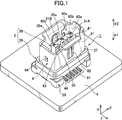
- FIG. 2 is a perspective view showing one use mode of the electrical connector according to one embodiment of the present invention.
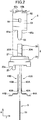
- FIG. 2 is an exploded side view of the electrical connector of FIG. 1.
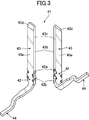
- FIG. 2 is an enlarged perspective view of a terminal used for the electric connector of FIG. 1.
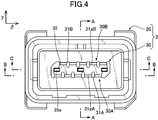
- It is a top view of the housing used for the electrical connector of FIG.
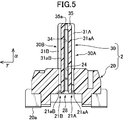
- FIG. 5 is a sectional view taken along line AA of FIG. 4.
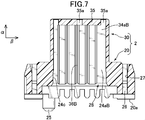
- FIG. 5 is a sectional view taken along line BB of FIG. 4.
- FIG. 5 is a sectional view taken along line CC of FIG. 4.
- FIG. 8 is a perspective view of FIG. 7.
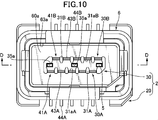
- FIG. 2 is a bottom view of a housing used for the electrical connector of FIG. 1. It is a top view of the electrical connector of FIG. FIG.
- FIG. 11 is a sectional view taken along line DD of FIG. 10 and is a sectional view corresponding to FIG. 6.
- FIG. 11 is a sectional view taken along line EE of FIG. 10.
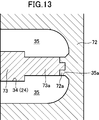
- FIG. 2 is a cross-sectional view illustrating an example of a mold that can be applied to manufacture a housing used for the electrical connector of FIG. 1.
- FIG. 1 is a perspective view showing one mode of use of the electrical connector 1, that is, a state of being soldered to the substrate 9, and FIG. 2 is an exploded side view thereof.
- the mating connector (not shown) can be fitted to the electrical connector 1 in the fitting direction “ ⁇ 1”, and is separated from the electrical connector 1 in the fitting releasing direction “ ⁇ 2” to release the fitting. be able to.
- the direction “ ⁇ ” along the mating direction “ ⁇ 1” and the mating release direction “ ⁇ 2” with the mating connector is defined as “vertical direction”, and along the longitudinal direction of the metal shell 6 orthogonal to this.
- the direction “ ⁇ ” is defined as a “left-right direction”, and in particular, the side on which the electrical connector 1 is fitted and released with the mating connector is defined as an “up” side.
- the electric connector 1 includes a resin housing 2, a plurality of terminals 41, a metal shell 6, and a shielding plate 5 attached to the housing 2.
- the housing 2 includes a flat and substantially rectangular base 20 and a thin plate-like body 30 standing upright so as to extend above the base 20, in other words, to a fitting side with a mating connector. .
- the components of the electrical connector 1, including the housing 2 have a generally symmetrical shape except for the plate 30.
- the plate 30 has a symmetrical shape in plan view, but like the other parts, the plate 30 may also have a symmetrical shape.
- the base 20 is formed stepwise in the vertical direction. For example, it may be formed in two stages.
- a projection 25 extends downward from the bottom surface 20a in the lower stage. The protrusion 25 can be used to position and fix the housing 2 to the substrate 9.
- the plate-like body 30 extends upward from the upper stage of the base body 20, in other words, to the fitting side with the mating connector.
- the plate 30 may have an extremely thin plate thickness of, for example, about 1 to 3 mm.
- a plurality of first terminals 41A and a plurality of second terminals 41B are respectively arranged on one plate surface 30A and the other plate surface 30B facing each other in the plate thickness direction “ ⁇ ” of the plate 30.
- the characters "A" and "B” are characters indicating one plate surface side of the plate-shaped body 30, but when it is not particularly necessary to distinguish one plate surface 30A from the other plate surface 30B, These characters may be omitted (the same applies hereinafter).
- the shielding plate 5 is of a flat, flat plate shape and has an extremely thin thickness of, for example, about 0.1 to 0.3 mm.
- the shielding plate 5 is inserted into the housing 2 from the lower side to the upper side of the base 20, and is installed so as to straddle both the base 20 and the plate 30.
- the shielding plate 5 is disposed between the plurality of first terminals 41 ⁇ / b> A and the plurality of second terminals 41 ⁇ / b> B, particularly in the thickness direction “ ⁇ ” of the plate 30.
- the first terminal 41A and the second terminal 41B are shielded.
- almost all portions of the shielding plate 5 are covered by the housing 2 when fixed to a substrate or the like.
- only a small portion of the shielding plate 5 is slightly exposed to the outside through the through hole 35a of the housing 2.
- the through hole 35a is inevitably generated when a housing space for housing the shielding plate 5 is formed using a mold.
- the 41 terminal 41 includes five first terminals 41A arranged on one plate surface 30A of the plate 30 and five second terminals 41B arranged on the other plate surface 30B. In the present embodiment, these terminals all have the same shape, but need not necessarily have the same shape.
- the first terminal 41 ⁇ / b> A and the second terminal 41 ⁇ / b> B are arranged in a staggered manner from the viewpoint of preventing crosstalk.
- FIG. 3 is an enlarged perspective view of the terminal 41.
- Each terminal 41 has a substantially L-shape when viewed from the side, and has a contact portion 43 that can be brought into contact with a mating connector, a press-fit portion 42 that is press-fitted into a predetermined portion of the base 20, and a pad 91 ( (See FIG. 1).
- the surface 43a of the terminal 41 is arranged in a state where the terminal 41 is partially exposed on one of the plate surfaces 30A and 30B of the plate 30 when the terminal 41 is installed in the housing 2.
- the bottom surface 43 b and the side surface 43 c of the terminal 41 are arranged in a state of being embedded in the housing 2.
- press-fit protrusions 42a are provided on the left and right side surfaces 43c of the terminal 41, respectively, and project sideways.
- these press-fit projections 42 a are pressed into the housing 2, particularly, a predetermined portion of the base 20.
- the terminal 41 is securely fixed to the housing 2.
- an urging protrusion 42b protruding outward from the surface 43a is provided on the surface 43a of the terminal 41 and near the press-fit protrusion 42a.
- the urging protrusion 42 b comes into contact with a predetermined wall surface of the base 20, and the tip 43 d of the contact portion 43 can be pressed against the bottom surface 43 b of the terminal 41. .
- the terminal 41 is installed on the housing 2, the urging protrusion 42 b comes into contact with a predetermined wall surface of the base 20, and the tip 43 d of the contact portion 43 can be pressed against the bottom surface 43 b of the terminal 41.
- the shell 6 includes a main body 61 formed in a substantially cylindrical shape. At an end of the opening 60b of the main body 61 on the side of fitting with the mating connector, an inviting portion 60c that is opened outward is provided so that the mating connector can be guided.
- a pair of fixing pieces 65 extending toward the mounting side with respect to the housing 2 are provided at the end of the main body 61 opposite to the side fitted with the mating connector.
- the shell 6 inserts and installs the end 61 a of the main body 61 on the opposite side to the mating side with the mating connector into the annular groove 27 provided in the housing 2, and attaches the fixing piece 65 to the side.
- the housing 2 is fixed to the housing 2 by being press-fitted into a through hole 26 (see FIG. 9 described later) of the housing 2 using the press-fitting protrusion 65a protruding in the direction.
- the inner wall 63 a of the main body 61 and the plate 30 of the housing 2 are connected to each other.
- a fitting space 60a into which a part of the mating connector is fitted is formed therebetween.
- the main body 61 is provided with, for example, a lock hole 64 as a through hole in which a predetermined portion of the mating connector fitted into the fitting space 60a is locked.
- a suppressing piece 62 which is formed by cutting and raising a part of the wall surface of the shell 6 and bending slightly inward.
- FIGS. 4 to 9 are individual product diagrams of the housing 2, and FIGS. 10 to 12 show the electric connector 1 as a completed product as in FIG. 4 is a plan view of the housing 2, FIG. 5 is a cross-sectional view taken along the line AA of FIG. 4, FIG. 6 is a cross-sectional view taken along the line BB of FIG. 4, and FIG. 8 is a perspective view of FIG. 7, FIG. 9 is a bottom view of the housing 2, while FIG. 10 is a plan view of the electrical connector 1, and FIG. FIG. 12 is a sectional view taken along line -D and corresponding to FIG. 6, and FIG. 12 is a sectional view taken along line EE of FIG.
- FIG. 6 shows the side of one plate surface 30A
- FIGS. 7, 8 and 11 show the side of the other plate surface 30B.
- 1 has a left-right symmetrical shape except for the plate-like body 30, and since the plate-like body 30 has a symmetrical shape in a plan view, the one surface 30A and the other surface 30B can be similarly considered.
- each of the first terminals 41 ⁇ / b> A is provided on one plate surface 30 ⁇ / b> A of the plate 30 by a plurality of first protrusions 31 ⁇ / b> A.
- a plurality of first grooves 31aA to be arranged are formed. These first grooves 31aA are provided in a continuous manner on one plate surface 30A in the fitting and releasing direction “ ⁇ ”, and are orthogonal to the fitting and releasing direction “ ⁇ ”. They are arranged equidistant from each other in the direction “ ⁇ ”.
- a plurality of second grooves 31aB in which each of the second terminals 41B is arranged are formed by the plurality of second protrusions 31B on the other plate surface 30B.
- These second grooves 31aB are provided in a continuous manner on the other plate surface 30B in the fitting and releasing direction “ ⁇ ”, and are orthogonal to the fitting and releasing direction “ ⁇ ”. They are arranged equidistant from each other in the direction “ ⁇ ”.
- a plurality of first terminal insertion holes 21 ⁇ / b> A into which the first terminals 41 ⁇ / b> A are inserted are fitted into the base 20. It is provided along the release direction “ ⁇ ”.
- the first terminals 41A are respectively inserted into the first terminal insertion holes 21A.
- a total of five first terminal insertion holes 21A are formed along the left-right direction “ ⁇ ”, corresponding to the number of first terminals 41A, here five terminals.
- the terminal insertion holes 21A are separated from each other by a first wall 21bA in the “ ⁇ ” direction, and each of the first walls 21bA is provided on one plate surface 30A of the plate 30.
- the first terminal insertion hole 21A fits and fits with each of the plurality of first grooves 31aA in which the first terminals 41A formed on one plate surface 30A of the plate 30 are respectively arranged. It becomes a continuous state in the combination release direction “ ⁇ ”. Utilizing the first terminal insertion holes 21A and the first grooves 31aA, the first terminals 41A are securely arranged at predetermined positions of the base body 20 and the plate-shaped body 30. Each terminal insertion hole 21A is provided with a taper 21aA near the entrance to facilitate the insertion of the terminal.
- the first terminal 41A is inserted into the first terminal insertion hole 21A through the taper 21aA at the contact portion 43 (see FIG. 3), and the first terminal 41A is inserted into the press-fit portion 21cA of the first terminal insertion hole 21A at the press-fit portion 21. It is press-fitted and is fixed thereto by using a press-fitting protrusion 42aA protruding to the side of the press-fitting portion 21. At this time, the mounting portion 44 of the first terminal 41A is disposed in the concave groove 21dA dug in the bottom surface 20a of the base 20 corresponding to each first terminal insertion hole 21A.
- the base 20 is provided with a plurality of second terminal insertion holes 21B through which the second terminals 41B are inserted, respectively, along the fitting and releasing directions “ ⁇ ”.
- the second terminals 41B are respectively inserted into these second terminal insertion holes 21B.
- a total of five first terminal insertion holes 21B are formed along the left-right direction “ ⁇ ”, corresponding to the number of the second terminals 41B.
- the terminal insertion holes 21B are separated from each other by a second wall 21bB in the “ ⁇ ” direction, and the second walls 21bB are provided on the other plate surface 30B of the plate 30 respectively. It is provided along the fitting and releasing direction “ ⁇ ” in a state of being aligned with the first projection 31B.
- the second terminal insertion hole 21B fits and fits with each of the plurality of second grooves 31aB in which the second terminals 41B formed on the other plate surface 30B of the plate 30 are arranged. It becomes a continuous state in the combination release direction “ ⁇ ”.
- the second terminal 41B is securely arranged at a predetermined position on the base 20 and the plate 30.
- Each terminal insertion hole 21B is provided with a taper 21aB near the entrance to facilitate the insertion of the terminal.
- the first terminal 41B is inserted into the first terminal insertion hole 21B through the taper 21aB at the contact portion 43 (see FIG.
- the mounting portion 44 of the second terminal 41B is disposed in the concave groove 21dB dug in the bottom surface 20a of the base 20 corresponding to each second terminal insertion hole 21B.
- reinforcing portions 36A, 36B having thickened resin are provided. ing.
- the first reinforcing portion 36A forms a position close to the first wall 21bA in the in-plane direction “ ⁇ - ⁇ ” orthogonal to the fitting and releasing direction “ ⁇ ”, for example, the accommodation spaces 24 and 34. It is preferably provided at a position facing in the thickness direction of the plate, and particularly preferably provided near the first press-fitting portion 21cA.
- the first reinforcing portion 36A is formed on the inner wall 24aA of the first housing portion 24A on the one plate surface 30A side and on the second wall on the one plate surface 30A side along the plate surface direction " ⁇ - ⁇ " of the plate 30.
- the second reinforcing portion 36B is located at a position close to the second wall 21bB in an in-plane direction “ ⁇ - ⁇ ” orthogonal to the fitting and releasing direction “ ⁇ ”, for example, the accommodation spaces 24 and 34. Is preferably provided at a position facing the thickness direction on the front and back surfaces of the plate on which is formed, and particularly preferably provided near the second press-fitting portion 21cB.
- the second reinforcing portion 36B is formed on the inner wall 24aB of the first housing portion 24B on the other plate surface 30B side and the second reinforcing member 36B on the one plate surface 30B side along the plate surface direction " ⁇ - ⁇ " of the plate 30.
- the base 20 of the housing 2 has a substantially plate-like first shape in which a part 5a (see FIG. 11) of the shielding plate 5 is accommodated.
- the plate-shaped body 30 of the housing 2 has a substantially plate-shaped second storage portion 34 in which another part 5b (see FIG. 11) of the shielding plate 5 is stored.
- the first accommodating portion 24 and the second accommodating portion 34 are connected to each other in the mating / unmating direction “ ⁇ ” with the mating connector and are in a single accommodating space for accommodating the shielding plate 5. 24 and 34 are formed.
- a shield plate insertion hole 28 through which the shield plate 5 is inserted is provided at the entrance of the accommodation spaces 24 and 34 in the base 20.
- the shield plate 5 passes through the shield plate insertion hole 28 into one housing space formed by the first housing portion 24 and the second housing portion 34 from below to above, in other words, to the mating connector.
- the shield plate insertion hole 28 is preferably provided with a taper 24d near the entrance in order to facilitate terminal insertion.
- the shielding plate 5 inserted through the taper 24d uses the press-fit projections 51 (see FIGS. 2 and 11) provided on the side thereof to press the press-fit portion 24c (see FIG. 11) on the first housing portion 24 side. And is fixed at a predetermined position.
- the shielding plate 5 is very thin, and accordingly, the accommodation spaces 24, 34 in which the shielding plate 5 is accommodated are also very thin, for example, only 0.1-0.
- the thickness is about 4 mm.
- the molds for forming the housing spaces 24, 34 are also very thin in accordance with the shape and size of the housing spaces 24, 34, As a result, the mold is damaged when the resin is poured into the mold, and the mold is displaced due to the pressure of the injected resin, which makes it difficult to accurately control the shape and size of the housing space.
- the housing spaces 24, 34 are formed by the mold portion extending from the end wall 35 of the plate 30 located on the mating side with the mating connector.
- the injection molding is performed in a state in which the mold for forming the second housing portion 34, in particular, the mold portion for forming the second housing portion 34 is suppressed.
- the second housing portion 34 communicates with the through hole 35 a provided in the end wall 35 of the plate-shaped body 30 in the fitting and releasing direction “ ⁇ ”. It has become something.
- the through-hole 35 a is a hole formed by a mold portion extending from the end wall 35 of the plate 30.
- the mold part forming the accommodation spaces 24 and 34 is pressed by the mold part extending through the through hole 35a, so that the mold (metal mold) is formed. It is possible to provide an electrical connector having storage spaces 24 and 34 for the shielding plate 5, which can effectively prevent breakage and displacement of the mold portion) and whose shape and size are accurately controlled. it can.
- the through holes 35a are provided at three places in the left-right direction “ ⁇ ”, and are located at both ends and the center of the accommodation spaces 24 and 34.
- the first reinforcing portion 36A and the second reinforcing portion 36B provided on the inner walls 24aA and 24aB of the first housing portion 24A and the inner walls 34aA and 34aB of the second housing portion 34 are not necessarily separated from the inner wall. It is not necessary to provide the reinforcing portion in a partially protruding state, and the thickness of the reinforcing portion can be increased in all portions. However, in this case, the plate thickness of the storage spaces 24 and 34 becomes smaller by that amount, and as a result, the mold for forming the storage spaces 24 and 34 becomes thinner. It is configured to protrude only partially.
- FIG. 13 is a sectional view showing an example of a mold that can be applied to manufacture the housing 2.
- This figure is a cross-sectional view corresponding to FIG. 5, particularly showing a mold for forming the vicinity of the through hole 35a provided in the end wall 35 of the plate 30.
- the mold that forms this part includes at least a first mold 72 that defines at least a part of the outer surface of the end wall 35 of the plate 30 and a part of the through hole 35 a provided in the end wall 35. It has a housing space (24) in which the shielding plate 5 is housed and a second mold 73 that defines the remaining part of the through hole 35a provided in the end wall 35.
- these dies may be appropriately divided in consideration of the die removing operation.
- the housing 2 includes a first portion 72 a of the first mold 72 for defining a part of the through hole 35 a provided in the end wall 35 and a remaining part of the through hole 35 a provided in the end wall 35.
- the housing space 34 (24) and the end wall 35 having the through hole 35a are molded.
- the first portion 72a and the second portion 73a can be connected by a spigot (fitting) structure.
- the second mold 73 may be damaged or deformed. And the displacement can be reliably prevented, and the spaces (24, 34) can be formed with accurate accuracy. Then, the shielding plate 5 can be housed in a predetermined position of the housing portion (24, 34) with high accuracy.
Landscapes
- Engineering & Computer Science (AREA)
- Manufacturing & Machinery (AREA)
- Details Of Connecting Devices For Male And Female Coupling (AREA)
- Connector Housings Or Holding Contact Members (AREA)
- Manufacturing Of Electrical Connectors (AREA)
Abstract
La présente invention concerne un connecteur électrique ayant un espace de logement de plaque de blindage dont la forme et la taille sont maîtrisées avec précision en empêchant efficacement une rupture et un écart de position d'un moule métallique. Ce connecteur électrique comprend : un boîtier comportant un substrat et un corps en forme de plaque ; une pluralité de premières bornes disposées sur l'une des surfaces de plaque opposées du corps en forme de plaque et une pluralité de secondes bornes disposées sur l'autre surface de plaque ; une plaque de blindage disposée entre la pluralité de premières bornes et la pluralité de secondes bornes ; et une coque métallique formant un espace d'accouplement dans lequel un connecteur homologue s'accouple entre la surface de plaque mentionnée en premier et l'autre surface de plaque. Le substrat comporte une première partie de logement dans laquelle une partie de la plaque de blindage est logée, et le corps en forme de plaque comporte une seconde partie de logement dans laquelle une autre partie de la plaque de blindage est logée et qui communique avec la première partie de logement dans la direction d'accouplement et de désaccouplement du connecteur homologue. La seconde partie de logement communique avec un trou traversant ménagé dans une paroi d'extrémité du corps en forme de plaque située du côté d'accouplement au connecteur homologue dans la direction d'accouplement et de désaccouplement.
Priority Applications (3)
| Application Number | Priority Date | Filing Date | Title |
|---|---|---|---|
| CN201980031445.7A CN112106263B (zh) | 2018-06-25 | 2019-06-14 | 具有遮蔽板的电连接器、以及该电连接器的壳体的制造方法 |
| US17/255,259 US11424568B2 (en) | 2018-06-25 | 2019-06-14 | Electric connector having shielding plate, and manufacturing method for housing of electric connector |
| EP19825671.1A EP3813207B1 (fr) | 2018-06-25 | 2019-06-14 | Connecteur électrique à plaque de blindage, et procédé de fabrication pour boîtier de connecteur électrique |
Applications Claiming Priority (2)
| Application Number | Priority Date | Filing Date | Title |
|---|---|---|---|
| JP2018-119778 | 2018-06-25 | ||
| JP2018119778A JP2020004494A (ja) | 2018-06-25 | 2018-06-25 | 遮蔽板を有する電気コネクタ、及び、該電気コネクタのハウジングの製造方法 |
Publications (1)
| Publication Number | Publication Date |
|---|---|
| WO2020004077A1 true WO2020004077A1 (fr) | 2020-01-02 |
Family
ID=68986468
Family Applications (1)
| Application Number | Title | Priority Date | Filing Date |
|---|---|---|---|
| PCT/JP2019/023701 Ceased WO2020004077A1 (fr) | 2018-06-25 | 2019-06-14 | Connecteur électrique à plaque de blindage, et procédé de fabrication pour boîtier de connecteur électrique |
Country Status (5)
| Country | Link |
|---|---|
| US (1) | US11424568B2 (fr) |
| EP (1) | EP3813207B1 (fr) |
| JP (2) | JP2020004494A (fr) |
| CN (1) | CN112106263B (fr) |
| WO (1) | WO2020004077A1 (fr) |
Cited By (2)
| Publication number | Priority date | Publication date | Assignee | Title |
|---|---|---|---|---|
| WO2022207498A1 (fr) * | 2021-04-01 | 2022-10-06 | Phoenix Contact Gmbh & Co. Kg | Procédé de fabrication d'unité de contact et unité de contact |
| CN115189166A (zh) * | 2022-07-28 | 2022-10-14 | Oppo广东移动通信有限公司 | 电连接器、充电器以及充电组件 |
Families Citing this family (1)
| Publication number | Priority date | Publication date | Assignee | Title |
|---|---|---|---|---|
| JP7507111B2 (ja) * | 2021-03-03 | 2024-06-27 | ヒロセ電機株式会社 | 電気コネクタ |
Citations (8)
| Publication number | Priority date | Publication date | Assignee | Title |
|---|---|---|---|---|
| JPH07114952A (ja) * | 1993-10-19 | 1995-05-02 | Hirose Electric Co Ltd | 多極電気コネクタ |
| JPH08321358A (ja) * | 1995-05-25 | 1996-12-03 | Kel Corp | グランド板付コネクタ |
| JPH09199231A (ja) * | 1996-01-17 | 1997-07-31 | Fujitsu Takamizawa Component Kk | コネクタ |
| JP2009283340A (ja) * | 2008-05-23 | 2009-12-03 | Alps Electric Co Ltd | コネクタ装置の製造方法 |
| JP2011192470A (ja) * | 2010-03-12 | 2011-09-29 | Omron Corp | コネクタ |
| JP2013222579A (ja) * | 2012-04-16 | 2013-10-28 | Japan Aviation Electronics Industry Ltd | コネクタ |
| US20160197442A1 (en) * | 2015-01-05 | 2016-07-07 | Lotes Co., Ltd | Electrical connector with a positioning member |
| JP2017037851A (ja) | 2016-11-04 | 2017-02-16 | Smk株式会社 | 電気コネクタの製造方法 |
Family Cites Families (20)
| Publication number | Priority date | Publication date | Assignee | Title |
|---|---|---|---|---|
| JPH05303988A (ja) * | 1992-04-28 | 1993-11-16 | Matsushita Electric Works Ltd | コネクタ |
| US5221212A (en) * | 1992-08-27 | 1993-06-22 | Amp Incorporated | Shielding a surface mount electrical connector |
| TW421302U (en) | 1998-12-18 | 2001-02-01 | Hon Hai Prec Ind Co Ltd | Electrical connector |
| JP4234714B2 (ja) * | 2005-11-16 | 2009-03-04 | 日本航空電子工業株式会社 | コネクタ及びコネクタ組立体 |
| CN1917297A (zh) * | 2006-08-28 | 2007-02-21 | 东莞蔻玛电子有限公司 | 线缆连接器 |
| US7625243B2 (en) * | 2007-06-13 | 2009-12-01 | Hon Hai Precision Ind. Co., Ltd. | Extension to version 2.0 universal serial bus connector with improved contact arrangement |
| JP5587714B2 (ja) * | 2010-09-22 | 2014-09-10 | ホシデン株式会社 | シールドケース、コネクタ及び電子機器 |
| US8398439B1 (en) * | 2011-12-14 | 2013-03-19 | Proconn Technology Co., Ltd. | Electrical connector |
| US9184545B2 (en) * | 2014-01-30 | 2015-11-10 | Ting-Chi CHEN | Combination USB connector |
| CN204216285U (zh) * | 2014-07-15 | 2015-03-18 | 番禺得意精密电子工业有限公司 | 电连接器 |
| TWI593194B (zh) * | 2014-11-21 | 2017-07-21 | 連展科技股份有限公司 | 屏蔽接地之插座電連接器 |
| JP6422815B2 (ja) | 2015-04-21 | 2018-11-14 | 日本航空電子工業株式会社 | コネクタ |
| JP6601092B2 (ja) * | 2015-09-24 | 2019-11-06 | 株式会社オートネットワーク技術研究所 | コネクタ |
| US9722362B2 (en) * | 2015-10-23 | 2017-08-01 | T-Conn Precision Corporation | Electrical connector with improved shielding shell |
| CN205724077U (zh) * | 2016-03-25 | 2016-11-23 | 番禺得意精密电子工业有限公司 | 电连接器 |
| CN206471572U (zh) * | 2017-01-10 | 2017-09-05 | 富誉电子科技(淮安)有限公司 | 电连接器 |
| US12478197B2 (en) * | 2017-03-14 | 2025-11-25 | Encompass Group, Llc | Metalized fabric heating blanket electrical connector |
| CN207098116U (zh) * | 2017-07-18 | 2018-03-13 | 昆山全方位电子科技有限公司 | 电连接器 |
| CN207490223U (zh) * | 2017-10-17 | 2018-06-12 | 富士能电子(昆山)有限公司 | 电连接器 |
| JP7292190B2 (ja) * | 2019-11-29 | 2023-06-16 | ホシデン株式会社 | グランド端子及びこれを備えたコネクタ |
-
2018
- 2018-06-25 JP JP2018119778A patent/JP2020004494A/ja active Pending
-
2019
- 2019-06-14 EP EP19825671.1A patent/EP3813207B1/fr active Active
- 2019-06-14 WO PCT/JP2019/023701 patent/WO2020004077A1/fr not_active Ceased
- 2019-06-14 CN CN201980031445.7A patent/CN112106263B/zh active Active
- 2019-06-14 US US17/255,259 patent/US11424568B2/en active Active
-
2022
- 2022-07-15 JP JP2022113846A patent/JP7369830B2/ja active Active
Patent Citations (8)
| Publication number | Priority date | Publication date | Assignee | Title |
|---|---|---|---|---|
| JPH07114952A (ja) * | 1993-10-19 | 1995-05-02 | Hirose Electric Co Ltd | 多極電気コネクタ |
| JPH08321358A (ja) * | 1995-05-25 | 1996-12-03 | Kel Corp | グランド板付コネクタ |
| JPH09199231A (ja) * | 1996-01-17 | 1997-07-31 | Fujitsu Takamizawa Component Kk | コネクタ |
| JP2009283340A (ja) * | 2008-05-23 | 2009-12-03 | Alps Electric Co Ltd | コネクタ装置の製造方法 |
| JP2011192470A (ja) * | 2010-03-12 | 2011-09-29 | Omron Corp | コネクタ |
| JP2013222579A (ja) * | 2012-04-16 | 2013-10-28 | Japan Aviation Electronics Industry Ltd | コネクタ |
| US20160197442A1 (en) * | 2015-01-05 | 2016-07-07 | Lotes Co., Ltd | Electrical connector with a positioning member |
| JP2017037851A (ja) | 2016-11-04 | 2017-02-16 | Smk株式会社 | 電気コネクタの製造方法 |
Cited By (3)
| Publication number | Priority date | Publication date | Assignee | Title |
|---|---|---|---|---|
| WO2022207498A1 (fr) * | 2021-04-01 | 2022-10-06 | Phoenix Contact Gmbh & Co. Kg | Procédé de fabrication d'unité de contact et unité de contact |
| BE1029267B1 (de) * | 2021-04-01 | 2022-11-04 | Phoenix Contact Gmbh & Co | Verfahren zur Herstellung einer Kontakteinheit und Kontakteinheit |
| CN115189166A (zh) * | 2022-07-28 | 2022-10-14 | Oppo广东移动通信有限公司 | 电连接器、充电器以及充电组件 |
Also Published As
| Publication number | Publication date |
|---|---|
| US11424568B2 (en) | 2022-08-23 |
| EP3813207A1 (fr) | 2021-04-28 |
| JP2020004494A (ja) | 2020-01-09 |
| CN112106263A (zh) | 2020-12-18 |
| US20210226374A1 (en) | 2021-07-22 |
| EP3813207A4 (fr) | 2022-04-06 |
| CN112106263B (zh) | 2022-01-11 |
| EP3813207B1 (fr) | 2025-07-23 |
| JP7369830B2 (ja) | 2023-10-26 |
| JP2022132490A (ja) | 2022-09-08 |
Similar Documents
| Publication | Publication Date | Title |
|---|---|---|
| TWI664780B (zh) | 連接器組 | |
| KR101674998B1 (ko) | 커넥터 | |
| KR101897403B1 (ko) | 전기 커넥터 및 그 제조 방법 | |
| CN112652900B (zh) | 电连接器及其制造方法 | |
| KR101921116B1 (ko) | 회로 기판용 전기 커넥터 | |
| JP7369830B2 (ja) | 遮蔽板を有する電気コネクタ、及び、該電気コネクタのハウジングの製造方法 | |
| CN107851941B (zh) | 连接器及连接器的制造方法 | |
| JP7413497B2 (ja) | 基板接続コネクタ向けの端子、コネクタ及びコネクタ製造方法 | |
| KR102674178B1 (ko) | 전기 커넥터 및 그의 제조 방법 | |
| KR20110108236A (ko) | 커넥터 및 전자기기 | |
| TW201637293A (zh) | 插座連接器 | |
| EP1467439B1 (fr) | Connecteur électrique | |
| CN104584340A (zh) | 同轴连接器 | |
| JP6814051B2 (ja) | コネクタ | |
| JP2013033633A (ja) | コネクタ | |
| CN111771309B (zh) | 连接器 | |
| CN114792899B (zh) | 具备嵌件成型的端子的连接器 | |
| WO2018221176A1 (fr) | Dispositif de connecteur de substrat | |
| JP2018110068A (ja) | 同軸コネクタ | |
| JP7287832B2 (ja) | 可動コネクタ | |
| JP7360813B2 (ja) | 可動コネクタ | |
| JP2006147186A (ja) | 基板用コネクタ | |
| CN105305165B (zh) | 电路板用电连接器 | |
| JP2013089350A (ja) | 基板用コネクタ |
Legal Events
| Date | Code | Title | Description |
|---|---|---|---|
| 121 | Ep: the epo has been informed by wipo that ep was designated in this application |
Ref document number: 19825671 Country of ref document: EP Kind code of ref document: A1 |
|
| NENP | Non-entry into the national phase |
Ref country code: DE |
|
| ENP | Entry into the national phase |
Ref document number: 2019825671 Country of ref document: EP Effective date: 20210125 |
|
| WWG | Wipo information: grant in national office |
Ref document number: 2019825671 Country of ref document: EP |